
Andrew Gregg Curtin, Governor, Commonwealth of Pennsylvania, circa 1860 (public domain).
“In this locality his very name is a tower of strength — and either in or out of politics, amid the exciting scenes and contests of his profession or in the reciprocity of the amenities and courtesies of society, Col. Curtin commands the respect of his fellows, and never fails to win the confidence of the people with whom he comes in contact. There are always men who seem to be born leaders, and he is one of them. He wins by intuition, as much by the grace of his learning, as by the fiery zeal of his nature. As a lawyer, he is keen, sagacious, and when full[y] engaged in a cause, irresistible in his efforts…. His zeal and devotion to the system of Common School Education, the present arrangement of which is owing to his energies … is as near perfection as possible.” — The Alleghenian, September 29, 1859
Known as “the Soldier’s Friend,” Andrew Gregg Curtin (1815-1894) was the fifteenth governor of the Commonwealth of Pennsylvania. “His influence had much to do with the first nomination for president of Abraham Lincoln,” according to The New York Times.
He was also revered as a friend by many Pennsylvanians, not only for the genuine compassion he showed to children who had been orphaned during the American Civil War, but for his leadership in improving public education for all children statewide.
FORMATIVE YEARS
Born on April 22, 1815, in the Borough of Bellefonte, the County Seat of Centre County in the Commonwealth of Pennsylvania, Andrew Gregg Curtin (1815-1894) was the eldest child of Roland Curtin (1764-1830), an emigrant from Ireland who became an iron industry pioneer in Pennsylvania, and his second wife, Jean Gregg (1791-1854), a daughter of Andrew Gregg, the former president pro tempore of the United States Senate.
Andrew G. Curtin was also the big brother of multiple Bellfonte-born siblings — Constans Curtin (1817-1895), who was born on March 6, 1817 and never married; Martha Maria Curtin (1819-1880), who was born on August 29, 1819 and would later wed William Irwin, M.D.; Ellen Honora Curtin (1822-1851), who was born on June 11, 1822 and would later wed William H. Allen, M.D.; Margery Gregg Curtin (1823-1885), who was born on December 23, 1823 and would later wed Thomas R. Reynolds (1824-1888); Nancy Jane Curtin (1828-1900), who was born on May 4, 1828 and would later wed D. D. Clarke, M.D.; and Julia G. Curtin (1831-1919), who was born on October 3, 1831 and never married.
Educated initially at a private school in Bellefonte, and via attendance with his parents and siblings at Presbyterian Church services, Andrew Curtin was subsequently enrolled at a preparatory school in the city of Harrisburg in Dauphin County, Pennsylvania prior to attending the Milton Academy in Milton, Northumberland County, Pennsylvania.
* Note: According to historian Herbert C. Bell, the Milton Academy was highly regarded:
“In 1815 Joseph D. Biles established an English school at the Broadway school house, adding Latin and Greek to his curriculum in the following year. This gained for his school the name of ‘The Milton Academy,’ thus for the first time applied to an educational institution at this place. In 1817 it numbered among its students John F. Wolfinger, for many years a member of the Northumberland county bar, Samuel Pollock, and James Pollock, afterward Governor of Pennsylvania. But this school did not long continue, and other pedagogues succeeded Biles….
“The Milton Academy, the leading educational institution of the West Branch valley during the period of its existence, originated with the Rev. George Junkin, pastor of the Presbyterian church and the moving spirit in many public enterprises of a moral and educational character. Through his efforts a stock company was formed, composed of Samuel Hepburn, Joseph Rhoads, William H. Sanderson, Samuel Teas, Sarah Pollock, and others, by whom a plain, one-story brick building was erected at a cost of four hundred dollars at the brow of the hill on the north side of Broadway, and a short distance to the east of the frame school building previously mentioned. The entrance was on the western side, and from its elevated location the academy commanded a view of the town, the river, and the valley. The interior was divided into two rooms by a narrow entrance hall. The apartment on the north was the smaller of the two; it was occupied by the students in Latin and Greek, the higher mathematics, rhetoric, etc., while the other room was set apart for those who had not advanced beyond the ordinary English branches. A small cupola surmounted the building, but the necessary appendage of a bell was never provided.
“The first principal of the academy … was the Rev. David Kirkpatrick. He was employed as a teacher of the classics at Oxford, Chester county, Pennsylvania, when Mr. Junkin formed his acquaintance and prevailed on him to change the field of his labors; he accordingly came to Milton, and on the second Monday of May, 1822, opened a classical school at a frame building that occupied the site of Dr. James McCleery’s residence on Front street. In the following October he removed his school to the academy building, where he taught until November, 1834, assisted at different times by a Mr. Mayne, Thomas C. Hambly, and others. Among his students were many who subsequently acquired honorable rank in the legal and medical professions, and as clergymen, teachers, civil engineers, etc.”
After completing his education at the Milton Academy, Andrew Curtin studied law with his mother’s cousin, William W. Potter, prior to enrolling formally in the law department at Dickinson College in Carlisle, Cumberland County, Pennsylvania. After graduating from Dickinson in 1837, he began practicing law in his hometown of Bellefonte. Focused primarily on criminal law during his work days, he spent a significant portion of his free time as a volunteer for the Whig Party.
Married to Katharine Irvine Wilson on May 30, 1844, Andrew Curtin settled with her in Centre County, where they then welcomed the births of: Mary Wilson Curtin (1845-1927), who was born in Potters Bank on March 7, 1845, and would later wed George Fairlamb Harris, M.D. (1843-1911); Jane Gregg Curtin (1847-1893), who was born in Bellefonte on January 17, 1847, and would later wed William Henry Sage (1844-1924); Martha Irvine Curtin (1848-1935), who was born on March 22, 1848, and would later wed Commander Kidder Randolph Breese (1831-1881); William Wilson Curtin (1851-1936), who was born in Bellefonte on March 27, 1851, and would later wed Harriet Fuller Harding (1853-1935); and Myron Stanley Curtin (1854-1857), who was born in Bellefonte on October 9, 1854.
On January 19, 1855, Andrew Curtin was appointed by Pennsylvania Governor James Pollock (1810-1890) as the secretary of the Commonwealth of Pennsylvania — a post that he held until January 20, 1858. During that time, he also served in an ex officio capacity as the commonwealth’s superintendent of public instruction. According to historians at the Pennsylvania & Historical Museum Commission (PHMC), it was during that period of his public service career that he “started the state system of teacher training in ‘normal’ schools.” The New York Times would later credit him with reforming the “entire management” of Pennsylvania’s system of public education. “It was Mr. Curtin who secured, among many other innovations, the adoption of the prevailing system [in 1894] of County Superintendents of Schools in Pennsylvania.”
Sadly, during that same time, he and his wife suffered a terrible loss when their youngest child, Myron, died at the age of two on January 13, 1857. They then welcomed the birth of daughter, Katharine Irvine Wilson Curtin (1859-1930), who was born in Bellefonte on May 2, 1859, and would later wed Moses Dewitt Burnett, Jr. (1854-1920).
ELECTED GOVERNOR OF PENNSYLVANIA
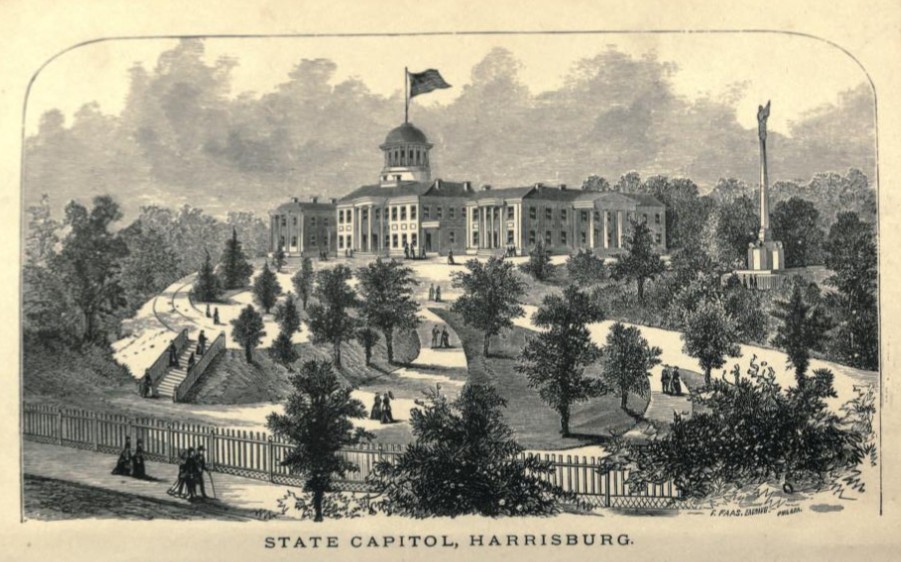
The Commonwealth of Pennsylvania’s State Capitol Building, Harrisburg, Pennsylvania, circa 1870s (James Laughery Paul, Pennsylvania Soldiers’ Orphan Schools, 1876, public domain; click to enlarge).
In 1860, according to PHMC historians, Andrew G. Curtin “helped persuade Pennsylvania’s delegates at the National Republican Convention to abandon the nomination of his political nemesis, Pennsylvania Senator Simon Cameron, [for the office of president of the United States] and instead cast their votes in-favor of [Abraham] Lincoln, making Pennsylvania a key swing state in his successful nomination. That fall, Curtin won Pennsylvania’s 1860 gubernatorial election, becoming the first Republican to hold this office.”
Inaugurated on January 15, 1861, Governor Andrew Curtin began his first term as the nation’s secession crisis was deepening. South Carolina had seceded from the United States on December 20, 1860, followed by Mississippi on January 9, 1861, Florida on January 10th, and Alabama on January 11th. (Georgia then seceded on January 19th, followed by Louisiana on January 26th and Texas on February 1st.)
Working with the Pennsylvania Legislature to prepare for the possibility of a full-blown civil war, he began to bring many of the militia units that had been operating in cities and towns across the commonwealth under the organizational umbrella of the Military Department of Pennsylvania, and then secured appropriations that would eventually fund the purchase and distribution of weapons, ammunition, uniforms, food and other supplies to the more than three hundred thousand Pennsylvanians who would ultimately serve in the Union Army during the American Civil War.
On March 14, 1861, he signed legislation repealing the tonnage tax on Pennsylvania’s railroad companies, “which helped the Pennsylvania Railroad become the nation’s largest transport system,” according to PHMC historians. That change, which was initially criticized by many newspapers statewide, would ultimately prove to be a critical, pro-Union incentive for those same companies over the next several months and years, as they transported Pennsylvanians and other men from the Mid-Atlantic Region to military training facilities and then on to Union Army encampments in Washington, D.C., Maryland and Virginia. According to The New York Times:
“In the lower house of the Legislature a bill was instantly introduced investing the Governor with power to raise and equip troops, and appropriating $500,000 for this purpose. In forty-eight hours the bill became a law. Its authority was used by the Governor so promptly that when the President issued his call for 75,000 men for 100 days the Pennsylvania soldiers were the first to reach the capital. The Governor foresaw that the war would be long, called an extra session of the Legislature, asked for authority to raise not less than fifteen nor more than thirty regiments, enlisted for three years, or until the end of the war, and obtained all that he requested and an appropriation of $3,500,000. The reserves equipped with this fund saved the capital of the United States from capture after the battle of Bull Run.”
Among the military units that were created by Governor Curtin during his first months in office was the 47th Pennsylvania Volunteer Infantry, which was established on August 5, 1861 and would later make history as the only regiment from Pennsylvania to take part in the Union’s 1864 Red River Campaign across Louisiana.
As the civil war raged into a second year, he presided over “The Loyal War Governors’ Conference” at the Logan House Hotel in Altoona, Blair County (September 1862). Its participants subsequently urged President Lincoln to remove Union General George B. McClellan from his position as the commander of the Army of the Potomac — a recommendation that Lincoln accepted.
A gifted writer and celebrated orator, Governor Curtin also delivered the first of his Thanksgiving Addresses in 1862. Re-elected in 1863, he then continued to lead the commonwealth’s prosecution of the war by securing funding to support the recruitment, training, transportation, and medical and spiritual care of Union soldiers and sailors from Pennsylvania. According to historian and biographer Rebecca Gifford Albright, “Among Andrew Curtin’s most admirable qualities what that of compassion…. Curtin insisted that all letters from soldiers be answered, either by himself or by his personal secretary. On many occasions, the Governor visited camp hospitals to talk with the wounded or to present them with some recognition of their sacrifices. In addition, Curtin heard countless pleas from wounded soldiers and their families and took what steps he could to relieve their anxieties.” He also “established the practice of bringing Pennsylvania war dead home for burial.”
Through it all, he tried to maintain a measure of normalcy as a husband and father. On October 19, 1865, he and his wife welcomed the birth of Bessie Elliott Curtin (1865-1866), who was born in Bellefonte. Sadly, she died in infancy at their family home on July 1, 1866.
HONORS AND ACHIEVEMENTS
Camp Curtin
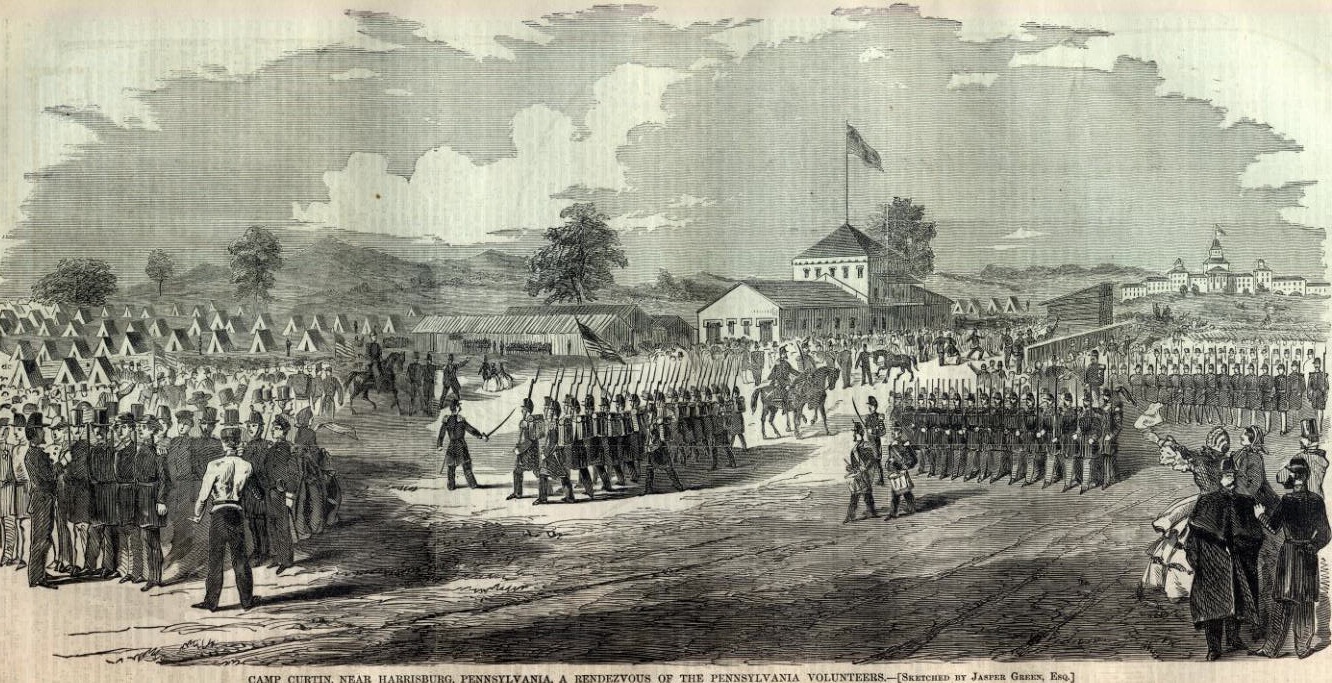
Camp Curtin (Harper’s Weekly, 1861, public domain).
Three days after the fall of Fort Sumter to Confederate States Army troops in mid-April 1861, a new military recruiting and training camp was opened just north of the State Capitol building in the city of Harrisburg in Dauphin County, Pennsylvania. Situated on eighty acres of land that had previously been used for Dauphin County’s Agricultural Fairgrounds, “The camp was between Reels Lane on the north, the Pennsylvania Railroad tracks on the east, Maclay Street on the south and Fifth Street on the west,” according to volunteers at the Camp Curtin Historical Society, and was initially named “Camp Union.”
“Harrisburg’s location on major railroad lines running east and west, and north and south made it the ideal location for moving men and supplies to the armies in the field. In addition to Pennsylvania regiments, troops from Maryland, Michigan, Minnesota, New Jersey, New York, Ohio, Wisconsin and the Regular Army used Camp Curtin.”
That same day (April 18, 1861), Major Joseph Knipe, “a native of Mount Joy, a veteran of the Mexican War … raised the American flag over the new camp and proposed that it be named after the governor,” according to Tom Huntington, author of Pennsylvania Civil War Trails — a recommendation that was quickly adopted. More than three thousand regular and volunteer Union Army soldiers would ultimately be enrolled, mustered in, trained, mustered out, and/or honorably discharged at Camp Curtin between the spring of 1861 and early January 1866, making it the largest military facility in the Commonwealth of Pennsylvania and one of the largest in the nation during the American Civil War.
Soldiers’ Orphan Schools
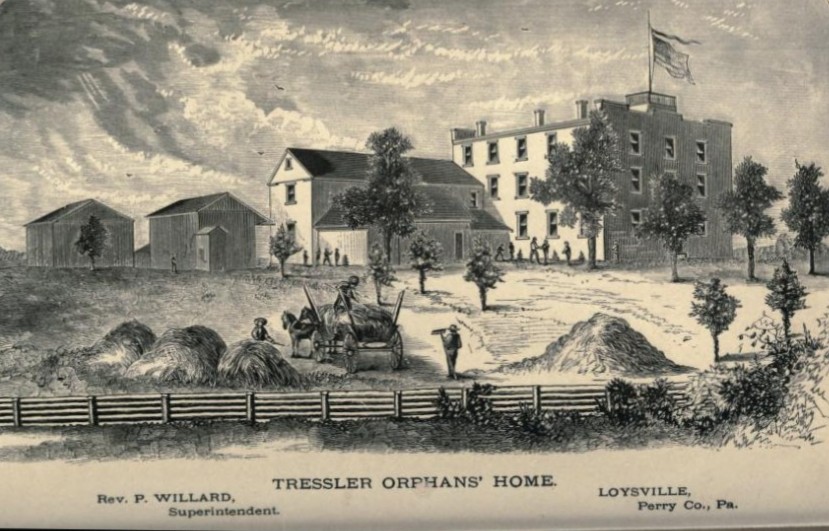
The Tressler Orphans’ Home in Loysville, Pennsylvania, depicted here circa 1876, was founded in 1865 as part of the Pennsylvania Soldiers’ Orphan Schools (John Laughery Paul, Pennsylvania’s Soldiers’ Orphan Schools, 1876, public domain; click to enlarge).
One of Governor Curtin’s most important initiatives was one that outlived him by many years — the creation of a system of schools for the thousands of Pennsylvania children whose fathers had died while serving with Union military units during the American Civil War (or had died, post-war, as a direct result of their service to the nation). Known as the Pennsylvania Soldiers’ Orphan Schools, this system was approved by an act of the Pennsylvania Legislature in 1864, which read as follows:
“Be it enacted by the Senate and House of Representatives of the Commonwealth of Pennsylvania in General Assembly met, and it is hereby enacted by the authority of the same, That the Governor of the Commonwealth of Pennsylvania be and is hereby authorized to accept the sum of fifty thousand dollars donated by the Pennsylvania Railroad Company, for the education and maintenance of destitute orphan children of deceased soldiers and sailors, and appropriate the same in such manner as he may deem best calculated to accomplish the object designed by said donation; the accounts of said disbursements to be settled, in the usual manner, by the Auditor General and the Governor, and make report of the same to the next Legislature.
On June 16, 1864, Governor Curtin appointed The Honorable Thomas L. Burrowes, L.L.D., as superintendent of soldiers’ orphans, and directed him to create a plan for the new school system. Dr. Burrowes, who had previously served as the ex officio superintendent of Pennsylvania’s common school system during his tenure as secretary of the commonwealth under Governor Joseph Ritter, was able to quickly complete that new plan, and submitted it to Governor Curtin on June 27 of that same year (1864). In addition to establishing the criteria for determining a child’s eligibility for orphans’ school enrollment, that plan defined the application procedures for the mother or guardian of an eligible child, the responsibilities of each orphans’ school (to house, clothe, feed, educate, and provide medical and spiritual care to each child enrolled), and the recordkeeping and reporting procedures.
Governor Curtin then dedicated a significant portion of his final years in office to securing a staggering amount of funding for the orphans’ school system from the Pennsylvania Legislature (four hundred thousand dollars), and also worked with Dr. Burrowes on refining the system’s admissions and operating procedures.
POST-GUBERNATORIAL LIFE
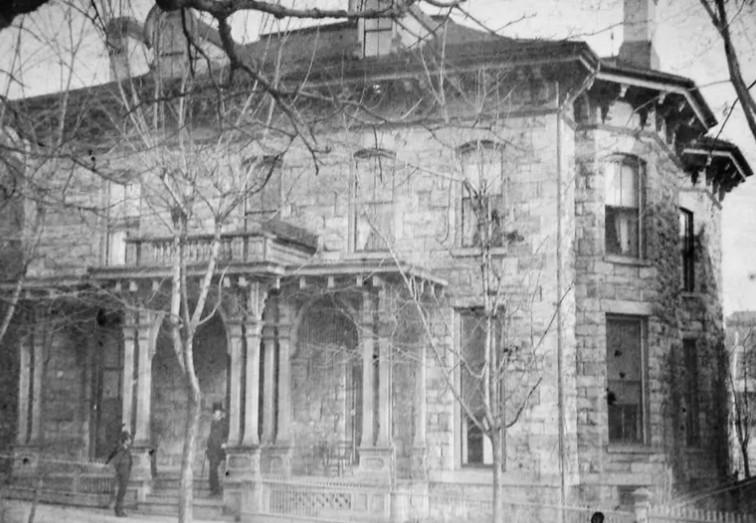
The residence of Pennsylvania’s Civil War-era governor, Andrew Gregg Curtin, Bellefonte, Pennsylvania, circa 1890s (public domain).
Having completed his second term as governor of the Commonwealth of Pennsylvania on January 15, 1867, Andrew Gregg Curtin chose to remain active in public service. Appointed by U.S. President Ulysses S. Grant as the United States’ minister to Russia in 1869, he held that post until 1872. From 1872-1873, he served as a delegate to the Commonwealth of Pennsylvania’s Constitutional Convention, the product of which was Pennsylvania’s updated constitution (1874), which, among other things, declared that:
- “All men are born equally free and independent, and have certain inherent and indefeasible rights, among which are those of enjoying and defending life and liberty, of acquiring, possessing and protecting property and reputation, and of pursuing their own happiness…; and that
- “Elections shall be free and equal; and no power, civil or military, shall at any time interfere to prevent the free exercise of the right of suffrage….”
Elected as a Democrat to the U.S. Congress in 1880, Andrew Gregg Curtin served three terms, from March 4, 1881 to March 3, 1887, during which time he chaired the U.S. House of Representatives’ committees on Foreign Affairs (1883-1885) and Banking and Currency (1885-1887). Eschewing a fourth term, he retired to Bellefonte.
By 1889, the Pennsylvania Soldiers’ Orphans School system that he had played such a key role in creating had grown into a network of forty-four separate educational institutions. A businessman involved with the First National Bank of Bellefonte, who had invested in the Bald Eagle Valley Railroad, his net worth during the latter part of his life was estimated at a quarter of a million dollars (the equivalent of more than nine million U.S. dollars in 2026). According to The New York Times:
“He lived at Bellefonte, in his stone house which has the air of a castle, among the books of his library. He was tall, slim, and straight…. His eyes were dark gray, his hair was silvery, and when he went to Washington his affability attracted around him a circle of eminent men, to whom he related his career and innumerable stories.”
Illness, Death, Funeral and Interment
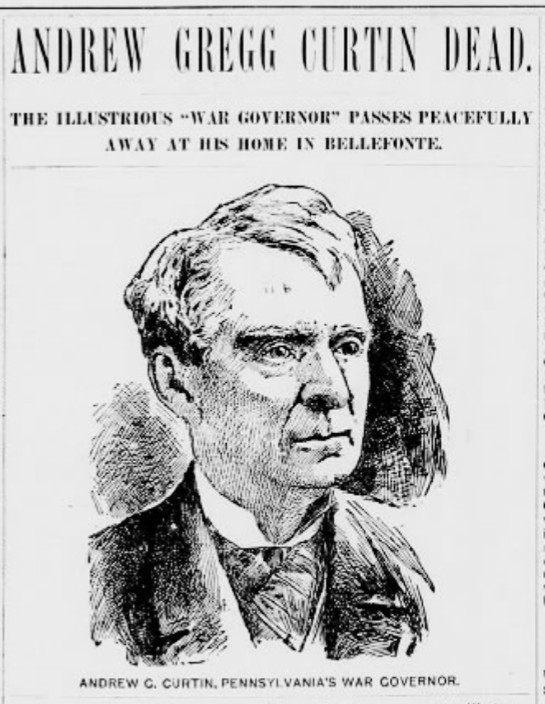
The Lewisburg Chronicle in Lewisburg, Pennsylvania paid tribute to former Pennsylvania Governor Andrew Gregg Curtin on its October 13, 1894 front page (public domain).
Ailing during the final years of his life, Andrew Gregg Curtin died at the age of seventy-nine, at his home in Bellefonte, at 5 a.m. on October 7, 1894, and was immediately eulogized by government officials and in newspapers nationwide. According to The New York Times, “Gov. Pattison issued a proclamation tonight in which he announced ex-Gov. Curtin’s death. After reviewing his distinguished services to his State and country, the proclamation concludes as follows:
‘In honor of his memory and in recognition of his eminent public service, I invoke for his bereaved family the sympathy of the people of Pennsylvania, and I recommend and order that on the day of his funeral the flags upon the public buildings be displayed at half mast and that the several departments of the State Government within executive control be closed upon that day.’”
Both private and public funeral services were then held for Governor Curtin on October 10, 1894. According to The Semi-Weekly New Era of Lancaster, Pennsylvania:
“Private services [were] held at his late home, after which the body [was] taken in charge by Post 89, G.A.R., of [Bellefonte], for burial under the ceremonies of war. Detachments of the Pennsylvania National Guard [acted] as escort to the Post. The pallbearers [were] Col. A. K. McClure and John Scott, of Philadelphia; ex-Governor James A. Beaver, General Daniel H. Hastings, Edward C. Humes and Judge Austin O. Furst, of Bellefonte; Hon. John Dean, of Hollidaysburg, Judge of the Supreme Court; Hon. Wm. A. Wallace, of Clearfield, and Wm. B. Mann, of Philadelphia.”
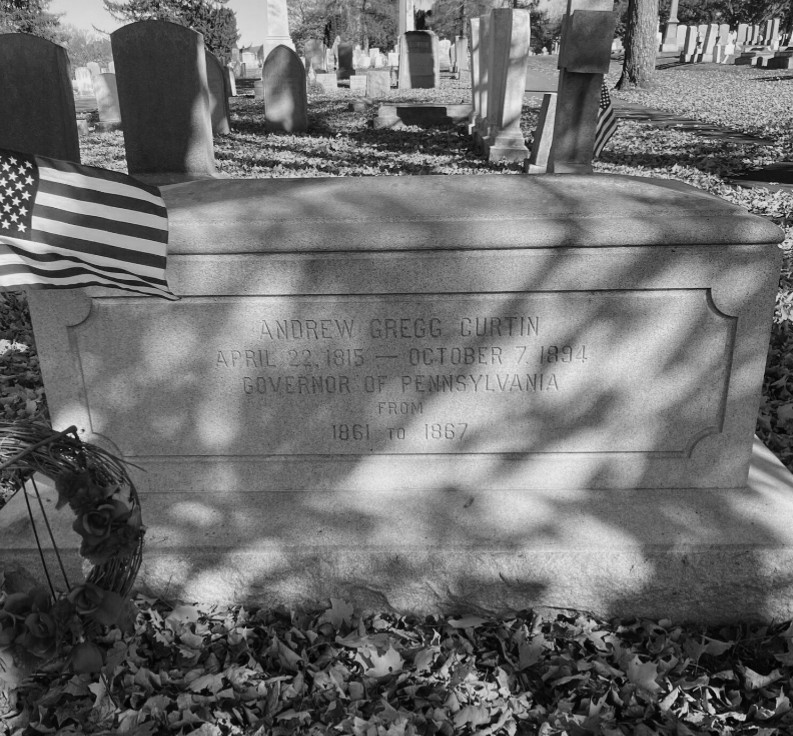
The monument at the grave of Pennsylvania Governor Andrew Gregg Curtin (Bellefonte Union Cemetery, Bellefonte, Pennsylvania, public domain).
In addition, the Pennsylvania National Guard’s “Second Brigade Band, Sheridan Troop, Battery B, Companies A, B, C, and G, of the Fifth Regiment, and A, B, D, G, and H, of the Twelfth Regiment” acted “as a funeral escort at the Curtin obsequies.” The Pennsylvania National Guard was also ordered to fire “seventeen minute guns … at the State Arsenal on the day of the funeral” — a funeral that merited coast to coast news coverage. According to The Seattle Post-Intelligencer:
“This town [Bellefonte, Pennsylvania was] draped in mourning today in honor of the memory of Andrew Gregg Curtin, who was laid to rest this afternoon. This morning a memorial meeting was held in the courthouse, a great number of distinguished men being present. Touching addresses were made by Gov. Pattison, A. K. McClure, of Philadelphia, Gen. Gobin [the final commanding officer of the 47th Pennsylvania Volunteer Infantry and a future lieutenant governor of Pennsylvania] and others. At 12 o’clock the ex-governor’s body was borne from the family residence to the courthouse, where it remained until 1:30, thousands of people viewing the remains while they lay in state. The body was then taken back to the Gregg mansion [sic], where at 2 o’clock the funeral services were held.
Following those tributes, The Honorable Andrew Gregg Curtin was laid to eternal rest at the Union Cemetery in his beloved hometown of Bellefonte.
Sources:
- Albright, Rebecca Gifford. “The Civil War Career of Andrew Gregg Curtin, Governor of Pennsylvania,” serialized in The Western Pennsylvania Historical Magazine, vols. 47 and 48, 1964-1965. Pittsburgh, Pennsylvania: Historical Society of Western Pennsylvania.
- “Andrew Curtin Dead: Pennsylvania’s Great War Governor Passes Away: His Invaluable Services to His State and Nation — Idolized by the Soldiers and Loved By All the People — Proclamation By Governor Pattison — Burial With Military Honors.” Meriden, Connecticut: The Meriden Daily Journal, October 8, 1894.
- “Andrew G. Curtin Historical Marker, in “Explore PA History.” Harrisburg, Pennsylvania: Pennsylvania Historical and Museum Commission, retrieved online August 4, 2026.
- “Andrew Gregg Curtin (1817-1894)” (alumus, class of 1937), in “Encyclopedia.” Carlisle, Pennsylvania: Archives & Special Collections, Dickinson College, retrieved online August 4, 2026.
- “Andrew Gregg Curtin Dead: The Illustrious ‘War Governor’ Passes Peacefully Away at His Home in Bellefonte.” Lewisburg, Pennsylvania: The Lewisburg Chronicle, October 13, 1894.
- Annual Reports of the Pennsylvania Commission of Soldiers’ Orphans Schools, 1870-1918. Harrisburg, Pennsylvania: Pennsylvania Historical and Museum Commission.
- “Another War Governor Gone: Andrew G. Curtin Passes Away at His Pennsylvania Home.” New York, New York: The New York Times, October 8, 1894.
- “Appointments by the Governor” (appointment by Governor James Pollock of Andrew G. Curtin as secretary of the Commonwealth of Pennsylvania). Lewisburg, Pennsylvania: The Lewisburg Chronicle, January 19, 1855.
- Bates, Samuel P. History of Pennsylvania Volunteers, 1865-5, vol. 1. Harrisburg, Pennsylvania: B. Singerly, State Printer, 1869.
- “Biographical Sketch of Andrew G. Curtin! Next Governor of Pennsylvania.” Towanda, Pennsylvania: The Bradford Reporter, September 20, 1860.
- Bordewich, Fergus M. “Fort Sumter: The Civil War Begins,” in Smithsonian Magazine, 2011. Washington, D.C.: Smithsonian.
- “Camp Curtin Historical Marker,” in ExplorePAhistory.com. Harrisburg, Pennsylvania: Pennsylvania Historical and Museum Commission, retrieved online July 25, 2022.
- “Curtin, Andrew Gregg,” in “History, Art & Archives.” Washington, D.C.: U.S. House of Representatives, retrieved online August 2, 2026.
- “Curtin, Andrew Gregg,” in “House Divided: The Civil War Research Engine at Dickinson College.” Carlisle, Pennsylvania: Dickinson College, retrieved online August 2026.
- “For the Repository and Transcript: A List of the Governors, Deputy Governors, Presidents, and Vice Presidents of Pennsylvania” (mentions Andrew G. Curtin’s tenure as secretary of the Commonwealth of Pennsylvania). Chambersburg, Pennsylvania: Franklin Repository and Transcript, December 1, 1858.
- “Funeral Arrangements and Pallbearers” and “Special Order to the National Guard,” in “Andrew G. Curtin Dead: The Famous War Governor at Rest.” Lancaster, Pennsylvania: The Semi-Weekly New Era, October 10, 1894.
- “Funeral of Andrew Gregg Curtin.” Seattle, Washington: The Seattle Post-Intelligencer, October 11, 1894.
- “Gov. Andrew Gregg Curtin,” in “Database of Former Governors: Pennsylvania.” Washington, D.C.: National Governors Association, retrieved online August 2, 2026.
- “Gov. Curtin and the Militia System of the State.” Pittsburgh, Pennsylvania: The Pittsburgh Post, April 12, 1861.
- “Governor Andrew Gregg Curtin,” in “Pennsylvania Governors.” Harrisburg, Pennsylvania: Pennsylvania Historical & Museum Commission, retrieved online August 1, 2026.
- “Governor Curtin Has Signed the Bill for the Repeal of the Tonnage Tax.” York, Pennsylvania: The Wrightsville Star, March 14, 1861.
- Grodzins, Dean and David Moss. “The U.S. Secession Crisis as a Breakdown of Democracy,” in When Democracy Breaks: Studies in Democratic Erosion and Collapse, from Ancient Athens to the Present Day (chapter 3). New York, New York: Oxford University Press, 2024.
- “History of Camp Curtin.” Harrisburg, Pennsylvania: Camp Curtin Historical Society, retrieved online July 25, 2022.
- “Hon. Andrew G. Curtin,” in “Personal.” Ebensburg, Pennsylvania: The Alleghenian, September 29, 1859.
- Huntington, Tom. Pennsylvania Civil War Trails: The Guide to Battle Sites, Monuments, Museums and Towns, pp. 65-66. Harrisburg, Pennsylvania: Pennsylvania Historical and Museum Commission, 2007; Mechanicsburg, Pennsylvania: Stackpole Books, 2007.
- Miller, William J. The Training of an Army: Camp Curtin and the North’s Civil War. Shippensburg, Pennsylvania: White Mane Publishing, 1990.
- Paul, James Laughery. Pennsylvania’s Soldiers’ Orphans Schools, Giving a Brief Account of the Origin of the Late Civil War, the Rise and Progress of the Orphan System, and Legislative Enactments Relating Thereto. Philadelphia, Pennsylvania: Claxton, Remson & Haffelfinger, 1876; and Harrisburg, Pennsylvania, Lane S. Hart, 1877.
- Schmidt, Lewis G. A Civil War History of the 47th Regiment of Pennsylvania Veteran Volunteers. Allentown, Pennsylvania: Self-published, 1986.
- Sobel, Robert, and John Raimo, eds. Biographical Directory of the Governors of the United States, 1789-1978, vol. 4. Westport, Connecticut: Meckler Books, 1978.
- The National Cyclopaedia of American Biography, vol. 2. New York, New York: James T. White & Company, 1895.



You must be logged in to post a comment.