The Honorable Andrew Gregg Curtin, Pennsylvania’s Civil War-Era Governor

Andrew Gregg Curtin, Governor, Commonwealth of Pennsylvania, circa 1860 (public domain).

“In this locality his very name is a tower of strength — and either in or out of politics, amid the exciting scenes and contests of his profession or in the reciprocity of the amenities and courtesies of society, Col. Curtin commands the respect of his fellows, and never fails to win the confidence of the people with whom he comes in contact. There are always men who seem to be born leaders, and he is one of them. He wins by intuition, as much by the grace of his learning, as by the fiery zeal of his nature. As a lawyer, he is keen, sagacious, and when full[y] engaged in a cause, irresistible in his efforts…. His zeal and devotion to the system of Common School Education, the present arrangement of which is owing to his energies … is as near perfection as possible.” — The Alleghenian, September 29, 1859


Known as “the Soldier’s Friend,” Andrew Gregg Curtin (1815-1894) was the fifteenth governor of the Commonwealth of Pennsylvania. “His influence had much to do with the first nomination for president of Abraham Lincoln,” according to The New York Times.

He was also revered as a friend by many Pennsylvanians, not only for the genuine compassion he showed to children who had been orphaned during the American Civil War, but for his leadership in improving public education for all children statewide.

FORMATIVE YEARS

Born on April 22, 1815, in the Borough of Bellefonte, the County Seat of Centre County in the Commonwealth of Pennsylvania, Andrew Gregg Curtin (1815-1894) was the eldest child of Roland Curtin (1764-1830), an emigrant from Ireland who became an iron industry pioneer in Pennsylvania, and his second wife, Jean Gregg (1791-1854), a daughter of Andrew Gregg, the former president pro tempore of the United States Senate.

Andrew G. Curtin was also the big brother of multiple Bellfonte-born siblings — Constans Curtin (1817-1895), who was born on March 6, 1817 and never married; Martha Maria Curtin (1819-1880), who was born on August 29, 1819 and would later wed William Irwin, M.D.; Ellen Honora Curtin (1822-1851), who was born on June 11, 1822 and would later wed William H. Allen, M.D.; Margery Gregg Curtin (1823-1885), who was born on December 23, 1823 and would later wed Thomas R. Reynolds (1824-1888); Nancy Jane Curtin (1828-1900), who was born on May 4, 1828 and would later wed D. D. Clarke, M.D.; and Julia G. Curtin (1831-1919), who was born on October 3, 1831 and never married.

Educated initially at a private school in Bellefonte, and via attendance with his parents and siblings at Presbyterian Church services, Andrew Curtin was subsequently enrolled at a preparatory school in the city of Harrisburg in Dauphin County, Pennsylvania prior to attending the Milton Academy in Milton, Northumberland County, Pennsylvania.

* Note: According to historian Herbert C. Bell, the Milton Academy was highly regarded:

“In 1815 Joseph D. Biles established an English school at the Broadway school house, adding Latin and Greek to his curriculum in the following year. This gained for his school the name of ‘The Milton Academy,’ thus for the first time applied to an educational institution at this place. In 1817 it numbered among its students John F. Wolfinger, for many years a member of the Northumberland county bar, Samuel Pollock, and James Pollock, afterward Governor of Pennsylvania. But this school did not long continue, and other pedagogues succeeded Biles….

“The Milton Academy, the leading educational institution of the West Branch valley during the period of its existence, originated with the Rev. George Junkin, pastor of the Presbyterian church and the moving spirit in many public enterprises of a moral and educational character. Through his efforts a stock company was formed, composed of Samuel Hepburn, Joseph Rhoads, William H. Sanderson, Samuel Teas, Sarah Pollock, and others, by whom a plain, one-story brick building was erected at a cost of four hundred dollars at the brow of the hill on the north side of Broadway, and a short distance to the east of the frame school building previously mentioned. The entrance was on the western side, and from its elevated location the academy commanded a view of the town, the river, and the valley. The interior was divided into two rooms by a narrow entrance hall. The apartment on the north was the smaller of the two; it was occupied by the students in Latin and Greek, the higher mathematics, rhetoric, etc., while the other room was set apart for those who had not advanced beyond the ordinary English branches. A small cupola surmounted the building, but the necessary appendage of a bell was never provided.

“The first principal of the academy … was the Rev. David Kirkpatrick. He was employed as a teacher of the classics at Oxford, Chester county, Pennsylvania, when Mr. Junkin formed his acquaintance and prevailed on him to change the field of his labors; he accordingly came to Milton, and on the second Monday of May, 1822, opened a classical school at a frame building that occupied the site of Dr. James McCleery’s residence on Front street. In the following October he removed his school to the academy building, where he taught until November, 1834, assisted at different times by a Mr. Mayne, Thomas C. Hambly, and others. Among his students were many who subsequently acquired honorable rank in the legal and medical professions, and as clergymen, teachers, civil engineers, etc.”

After completing his education at the Milton Academy, Andrew Curtin studied law with his mother’s cousin, William W. Potter, prior to enrolling formally in the law department at Dickinson College in Carlisle, Cumberland County, Pennsylvania. After graduating from Dickinson in 1837, he began practicing law in his hometown of Bellefonte. Focused primarily on criminal law during his work days, he spent a significant portion of his free time as a volunteer for the Whig Party.

Married to Katharine Irvine Wilson on May 30, 1844, Andrew Curtin settled with her in Centre County, where they then welcomed the births of: Mary Wilson Curtin (1845-1927), who was born in Potters Bank on March 7, 1845, and would later wed George Fairlamb Harris, M.D. (1843-1911); Jane Gregg Curtin (1847-1893), who was born in Bellefonte on January 17, 1847, and would later wed William Henry Sage (1844-1924); Martha Irvine Curtin (1848-1935), who was born on March 22, 1848, and would later wed Commander Kidder Randolph Breese (1831-1881); William Wilson Curtin (1851-1936), who was born in Bellefonte on March 27, 1851, and would later wed Harriet Fuller Harding (1853-1935); and Myron Stanley Curtin (1854-1857), who was born in Bellefonte on October 9, 1854.

On January 19, 1855, Andrew Curtin was appointed by Pennsylvania Governor James Pollock (1810-1890) as the secretary of the Commonwealth of Pennsylvania — a post that he held until January 20, 1858. During that time, he also served in an ex officio capacity as the commonwealth’s superintendent of public instruction. According to historians at the Pennsylvania & Historical Museum Commission (PHMC), it was during that period of his public service career that he “started the state system of teacher training in ‘normal’ schools.” The New York Times would later credit him with reforming the “entire management” of Pennsylvania’s system of public education. “It was Mr. Curtin who secured, among many other innovations, the adoption of the prevailing system [in 1894] of County Superintendents of Schools in Pennsylvania.”

Sadly, during that same time, he and his wife suffered a terrible loss when their youngest child, Myron, died at the age of two on January 13, 1857. They then welcomed the birth of daughter, Katharine Irvine Wilson Curtin (1859-1930), who was born in Bellefonte on May 2, 1859, and would later wed Moses Dewitt Burnett, Jr. (1854-1920).

ELECTED GOVERNOR OF PENNSYLVANIA
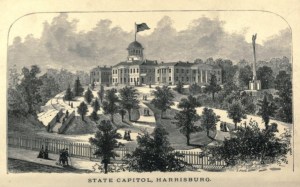
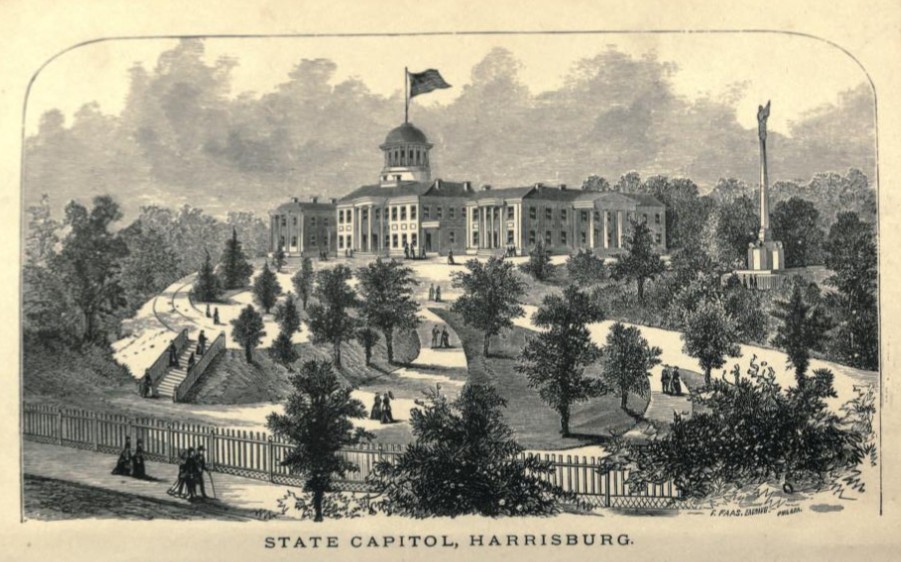
The Commonwealth of Pennsylvania’s State Capitol Building, Harrisburg, Pennsylvania, circa 1870s (James Laughery Paul, Pennsylvania Soldiers’ Orphan Schools, 1876, public domain; click to enlarge).

In 1860, according to PHMC historians, Andrew G. Curtin “helped persuade Pennsylvania’s delegates at the National Republican Convention to abandon the nomination of his political nemesis, Pennsylvania Senator Simon Cameron, [for the office of president of the United States] and instead cast their votes in-favor of [Abraham] Lincoln, making Pennsylvania a key swing state in his successful nomination. That fall, Curtin won Pennsylvania’s 1860 gubernatorial election, becoming the first Republican to hold this office.”

Inaugurated on January 15, 1861, Governor Andrew Curtin began his first term as the nation’s secession crisis was deepening. South Carolina had seceded from the United States on December 20, 1860, followed by Mississippi on January 9, 1861, Florida on January 10th, and Alabama on January 11th. (Georgia then seceded on January 19th, followed by Louisiana on January 26th and Texas on February 1st.)

Working with the Pennsylvania Legislature to prepare for the possibility of a full-blown civil war, he began to bring many of the militia units that had been operating in cities and towns across the commonwealth under the organizational umbrella of the Military Department of Pennsylvania, and then secured appropriations that would eventually fund the purchase and distribution of weapons, ammunition, uniforms, food and other supplies to the more than three hundred thousand Pennsylvanians who would ultimately serve in the Union Army during the American Civil War.

On March 14, 1861, he signed legislation repealing the tonnage tax on Pennsylvania’s railroad companies, “which helped the Pennsylvania Railroad become the nation’s largest transport system,” according to PHMC historians. That change, which was initially criticized by many newspapers statewide, would ultimately prove to be a critical, pro-Union incentive for those same companies over the next several months and years, as they transported Pennsylvanians and other men from the Mid-Atlantic Region to military training facilities and then on to Union Army encampments in Washington, D.C., Maryland and Virginia. According to The New York Times:

“In the lower house of the Legislature a bill was instantly introduced investing the Governor with power to raise and equip troops, and appropriating $500,000 for this purpose. In forty-eight hours the bill became a law. Its authority was used by the Governor so promptly that when the President issued his call for 75,000 men for 100 days the Pennsylvania soldiers were the first to reach the capital. The Governor foresaw that the war would be long, called an extra session of the Legislature, asked for authority to raise not less than fifteen nor more than thirty regiments, enlisted for three years, or until the end of the war, and obtained all that he requested and an appropriation of $3,500,000. The reserves equipped with this fund saved the capital of the United States from capture after the battle of Bull Run.”

Among the military units that were created by Governor Curtin during his first months in office was the 47th Pennsylvania Volunteer Infantry, which was established on August 5, 1861 and would later make history as the only regiment from Pennsylvania to take part in the Union’s 1864 Red River Campaign across Louisiana.

As the civil war raged into a second year, he presided over “The Loyal War Governors’ Conference” at the Logan House Hotel in Altoona, Blair County (September 1862). Its participants subsequently urged President Lincoln to remove Union General George B. McClellan from his position as the commander of the Army of the Potomac — a recommendation that Lincoln accepted.

A gifted writer and celebrated orator, Governor Curtin also delivered the first of his Thanksgiving Addresses in 1862. Re-elected in 1863, he then continued to lead the commonwealth’s prosecution of the war by securing funding to support the recruitment, training, transportation, and medical and spiritual care of Union soldiers and sailors from Pennsylvania. According to historian and biographer Rebecca Gifford Albright, “Among Andrew Curtin’s most admirable qualities what that of compassion…. Curtin insisted that all letters from soldiers be answered, either by himself or by his personal secretary. On many occasions, the Governor visited camp hospitals to talk with the wounded or to present them with some recognition of their sacrifices. In addition, Curtin heard countless pleas from wounded soldiers and their families and took what steps he could to relieve their anxieties.” He also “established the practice of bringing Pennsylvania war dead home for burial.”

Through it all, he tried to maintain a measure of normalcy as a husband and father. On October 19, 1865, he and his wife welcomed the birth of Bessie Elliott Curtin (1865-1866), who was born in Bellefonte. Sadly, she died in infancy at their family home on July 1, 1866.

HONORS AND ACHIEVEMENTS
Camp Curtin

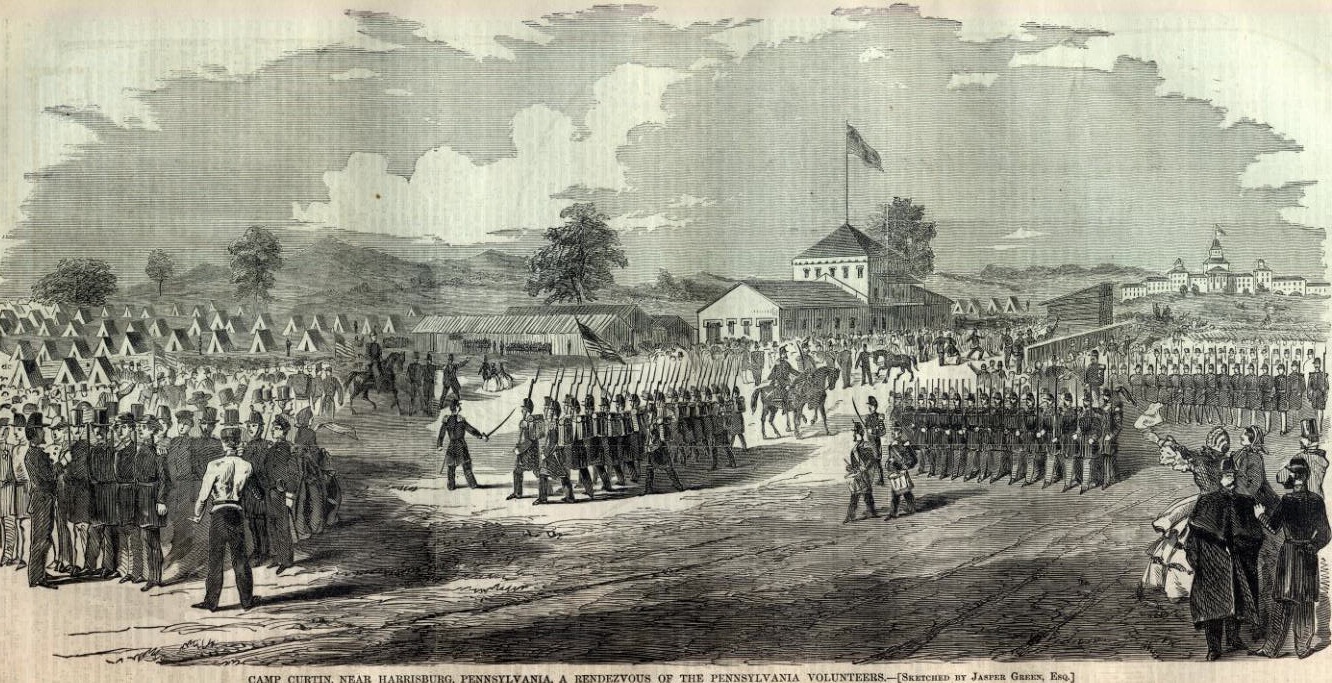
Camp Curtin (Harper’s Weekly, 1861, public domain).

Three days after the fall of Fort Sumter to Confederate States Army troops in mid-April 1861, a new military recruiting and training camp was opened just north of the State Capitol building in the city of Harrisburg in Dauphin County, Pennsylvania. Situated on eighty acres of land that had previously been used for Dauphin County’s Agricultural Fairgrounds, “The camp was between Reels Lane on the north, the Pennsylvania Railroad tracks on the east, Maclay Street on the south and Fifth Street on the west,” according to volunteers at the Camp Curtin Historical Society, and was initially named “Camp Union.”

Harrisburg’s location on major railroad lines running east and west, and north and south made it the ideal location for moving men and supplies to the armies in the field. In addition to Pennsylvania regiments, troops from Maryland, Michigan, Minnesota, New Jersey, New York, Ohio, Wisconsin and the Regular Army used Camp Curtin.”

That same day (April 18, 1861), Major Joseph Knipe, “a native of Mount Joy, a veteran of the Mexican War … raised the American flag over the new camp and proposed that it be named after the governor,” according to Tom Huntington, author of Pennsylvania Civil War Trails — a recommendation that was quickly adopted. More than three thousand regular and volunteer Union Army soldiers would ultimately be enrolled, mustered in, trained, mustered out, and/or honorably discharged at Camp Curtin between the spring of 1861 and early January 1866, making it the largest military facility in the Commonwealth of Pennsylvania and one of the largest in the nation during the American Civil War.

Soldiers’ Orphan Schools

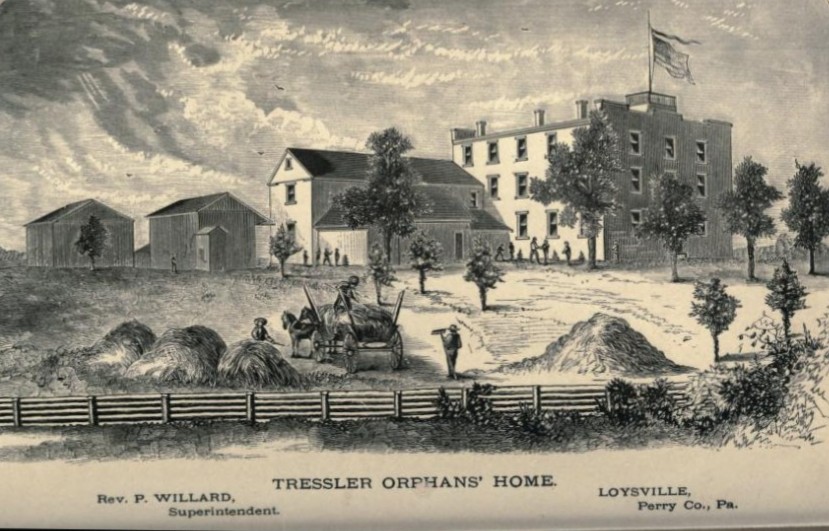
The Tressler Orphans’ Home in Loysville, Pennsylvania, depicted here circa 1876, was founded in 1865 as part of the Pennsylvania Soldiers’ Orphan Schools (John Laughery Paul, Pennsylvania’s Soldiers’ Orphan Schools, 1876, public domain; click to enlarge).

One of Governor Curtin’s most important initiatives was one that outlived him by many years — the creation of a system of schools for the thousands of Pennsylvania children whose fathers had died while serving with Union military units during the American Civil War (or had died, post-war, as a direct result of their service to the nation). Known as the Pennsylvania Soldiers’ Orphan Schools, this system was approved by an act of the Pennsylvania Legislature in 1864, which read as follows:

“Be it enacted by the Senate and House of Representatives of the Commonwealth of Pennsylvania in General Assembly met, and it is hereby enacted by the authority of the same, That the Governor of the Commonwealth of Pennsylvania be and is hereby authorized to accept the sum of fifty thousand dollars donated by the Pennsylvania Railroad Company, for the education and maintenance of destitute orphan children of deceased soldiers and sailors, and appropriate the same in such manner as he may deem best calculated to accomplish the object designed by said donation; the accounts of said disbursements to be settled, in the usual manner, by the Auditor General and the Governor, and make report of the same to the next Legislature.

On June 16, 1864, Governor Curtin appointed The Honorable Thomas L. Burrowes, L.L.D., as superintendent of soldiers’ orphans, and directed him to create a plan for the new school system. Dr. Burrowes, who had previously served as the ex officio superintendent of Pennsylvania’s common school system during his tenure as secretary of the commonwealth under Governor Joseph Ritter, was able to quickly complete that new plan, and submitted it to Governor Curtin on June 27 of that same year (1864). In addition to establishing the criteria for determining a child’s eligibility for orphans’ school enrollment, that plan defined the application procedures for the mother or guardian of an eligible child, the responsibilities of each orphans’ school (to house, clothe, feed, educate, and provide medical and spiritual care to each child enrolled), and the recordkeeping and reporting procedures.

Governor Curtin then dedicated a significant portion of his final years in office to securing a staggering amount of funding for the orphans’ school system from the Pennsylvania Legislature (four hundred thousand dollars), and also worked with Dr. Burrowes on refining the system’s admissions and operating procedures.

POST-GUBERNATORIAL LIFE
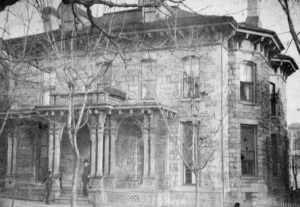
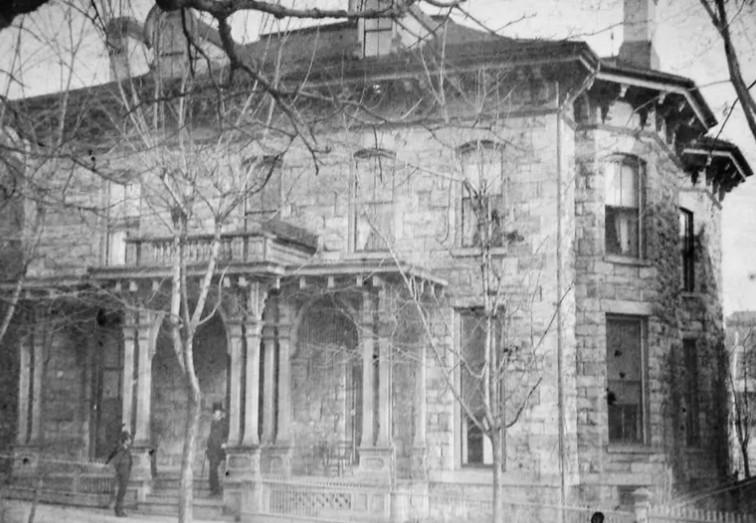
The residence of Pennsylvania’s Civil War-era governor, Andrew Gregg Curtin, Bellefonte, Pennsylvania, circa 1890s (public domain).

Having completed his second term as governor of the Commonwealth of Pennsylvania on January 15, 1867, Andrew Gregg Curtin chose to remain active in public service. Appointed by U.S. President Ulysses S. Grant as the United States’ minister to Russia in 1869, he held that post until 1872. From 1872-1873, he served as a delegate to the Commonwealth of Pennsylvania’s Constitutional Convention, the product of which was Pennsylvania’s updated constitution (1874), which, among other things, declared that:

  • “All men are born equally free and independent, and have certain inherent and indefeasible rights, among which are those of enjoying and defending life and liberty, of acquiring, possessing and protecting property and reputation, and of pursuing their own happiness…; and that
  • “Elections shall be free and equal; and no power, civil or military, shall at any time interfere to prevent the free exercise of the right of suffrage….”

Elected as a Democrat to the U.S. Congress in 1880, Andrew Gregg Curtin served three terms, from March 4, 1881 to March 3, 1887, during which time he chaired the U.S. House of Representatives’ committees on Foreign Affairs (1883-1885) and Banking and Currency (1885-1887). Eschewing a fourth term, he retired to Bellefonte.

By 1889, the Pennsylvania Soldiers’ Orphans School system that he had played such a key role in creating had grown into a network of forty-four separate educational institutions. A businessman involved with the First National Bank of Bellefonte, who had invested in the Bald Eagle Valley Railroad, his net worth during the latter part of his life was estimated at a quarter of a million dollars (the equivalent of more than nine million U.S. dollars in 2026). According to The New York Times:

“He lived at Bellefonte, in his stone house which has the air of a castle, among the books of his library.  He was tall, slim, and straight…. His eyes were dark gray, his hair was silvery, and when he went to Washington his affability attracted around him a circle of eminent men, to whom he related his career and innumerable stories.”

Illness, Death, Funeral and Interment
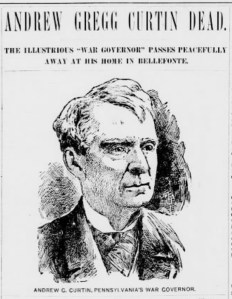
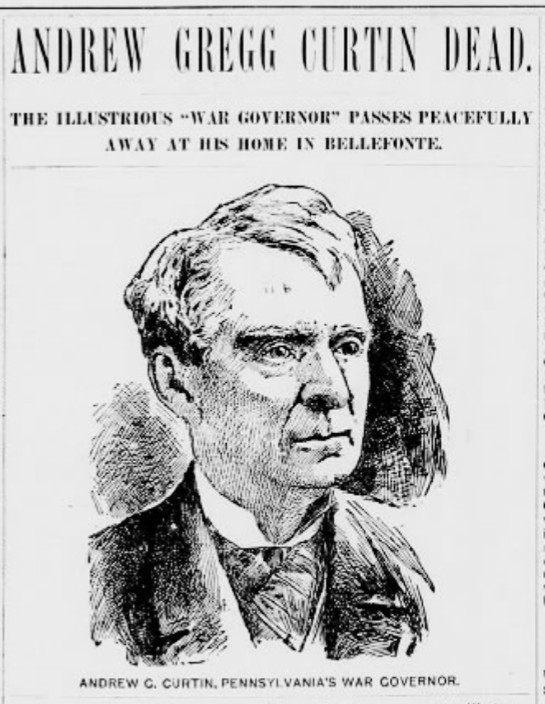
The Lewisburg Chronicle in Lewisburg, Pennsylvania paid tribute to former Pennsylvania Governor Andrew Gregg Curtin on its October 13, 1894 front page (public domain).

Ailing during the final years of his life, Andrew Gregg Curtin died at the age of seventy-nine, at his home in Bellefonte, at 5 a.m. on October 7, 1894, and was immediately eulogized by government officials and in newspapers nationwide. According to The New York Times, “Gov. Pattison issued a proclamation tonight in which he announced ex-Gov. Curtin’s death. After reviewing his distinguished services to his State and country, the proclamation concludes as follows:

‘In honor of his memory and in recognition of his eminent public service, I invoke for his bereaved family the sympathy of the people of Pennsylvania, and I recommend and order that on the day of his funeral the flags upon the public buildings be displayed at half mast and that the several departments of the State Government within executive control be closed upon that day.’”

Both private and public funeral services were then held for Governor Curtin on October 10, 1894. According to The Semi-Weekly New Era of Lancaster, Pennsylvania:

“Private services [were] held at his late home, after which the body [was] taken in charge by Post 89, G.A.R., of [Bellefonte], for burial under the ceremonies of war. Detachments of the Pennsylvania National Guard [acted] as escort to the Post. The pallbearers [were] Col. A. K. McClure and John Scott, of Philadelphia; ex-Governor James A. Beaver, General Daniel H. Hastings, Edward C. Humes and Judge Austin O. Furst, of Bellefonte; Hon. John Dean, of Hollidaysburg, Judge of the Supreme Court; Hon. Wm. A. Wallace, of Clearfield, and Wm. B. Mann, of Philadelphia.”

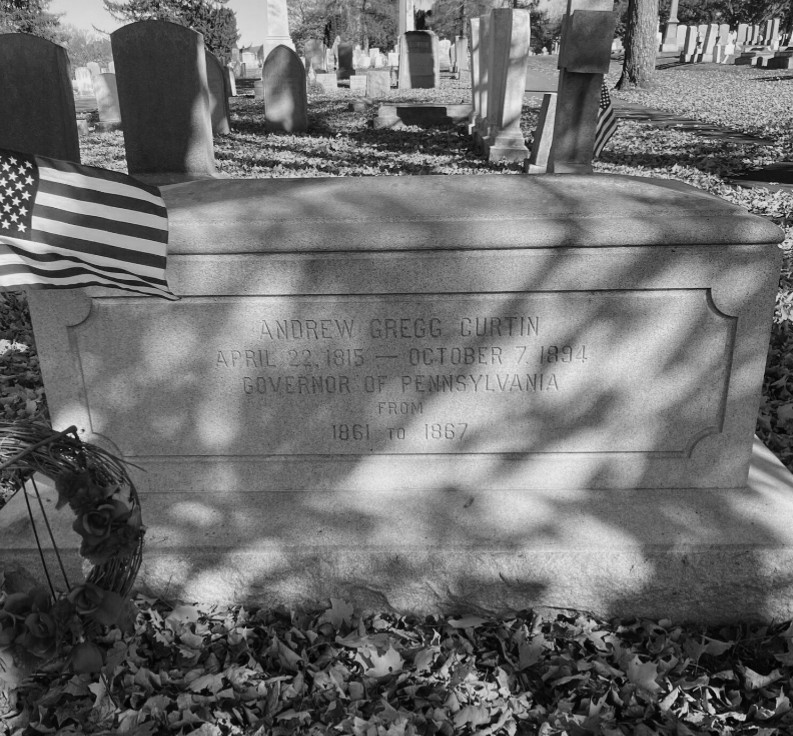
The monument at the grave of Pennsylvania Governor Andrew Gregg Curtin (Bellefonte Union Cemetery, Bellefonte, Pennsylvania, public domain).

In addition, the Pennsylvania National Guard’s “Second Brigade Band, Sheridan Troop, Battery B, Companies A, B, C, and G, of the Fifth Regiment, and A, B, D, G, and H, of the Twelfth Regiment” acted “as a funeral escort at the Curtin obsequies.” The Pennsylvania National Guard was also ordered to fire “seventeen minute guns … at the State Arsenal on the day of the funeral” — a funeral that merited coast to coast news coverage. According to The Seattle Post-Intelligencer:

“This town [Bellefonte, Pennsylvania was] draped in mourning today in honor of the memory of Andrew Gregg Curtin, who was laid to rest this afternoon. This morning a memorial meeting was held in the courthouse, a great number of distinguished men being present. Touching addresses were made by Gov. Pattison, A. K. McClure, of Philadelphia, Gen. Gobin [the final commanding officer of the 47th Pennsylvania Volunteer Infantry and a future lieutenant governor of Pennsylvania] and others. At 12 o’clock the ex-governor’s body was borne from the family residence to the courthouse, where it remained until 1:30, thousands of people viewing the remains while they lay in state. The body was then taken back to the Gregg mansion [sic], where at 2 o’clock the funeral services were held.

Following those tributes, The Honorable Andrew Gregg Curtin was laid to eternal rest at the Union Cemetery in his beloved hometown of Bellefonte.


Sources:

  1. Albright, Rebecca Gifford. “The Civil War Career of Andrew Gregg Curtin, Governor of Pennsylvania,” serialized in The Western Pennsylvania Historical Magazine, vols. 47 and 48, 1964-1965. Pittsburgh, Pennsylvania: Historical Society of Western Pennsylvania.
  2. “Andrew Curtin Dead: Pennsylvania’s Great War Governor Passes Away: His Invaluable Services to His State and Nation — Idolized by the Soldiers and Loved By All the People — Proclamation By Governor Pattison — Burial With Military Honors.” Meriden, Connecticut: The Meriden Daily Journal, October 8, 1894.
  3. Andrew G. Curtin Historical Marker, in “Explore PA History.” Harrisburg, Pennsylvania: Pennsylvania Historical and Museum Commission, retrieved online August 4, 2026.
  4. Andrew Gregg Curtin (1817-1894)” (alumus, class of 1937), in “Encyclopedia.” Carlisle, Pennsylvania: Archives & Special Collections, Dickinson College, retrieved online August 4, 2026.
  5. “Andrew Gregg Curtin Dead: The Illustrious ‘War Governor’ Passes Peacefully Away at His Home in Bellefonte.” Lewisburg, Pennsylvania: The Lewisburg Chronicle, October 13, 1894.
  6. Annual Reports of the Pennsylvania Commission of Soldiers’ Orphans Schools, 1870-1918. Harrisburg, Pennsylvania: Pennsylvania Historical and Museum Commission.
  7. “Another War Governor Gone: Andrew G. Curtin Passes Away at His Pennsylvania Home.” New York, New York: The New York Times, October 8, 1894.
  8. “Appointments by the Governor” (appointment by Governor James Pollock of Andrew G. Curtin as secretary of the Commonwealth of Pennsylvania). Lewisburg, Pennsylvania: The Lewisburg Chronicle, January 19, 1855.
  9. Bates, Samuel P. History of Pennsylvania Volunteers, 1865-5, vol. 1. Harrisburg, Pennsylvania: B. Singerly, State Printer, 1869.
  10. “Biographical Sketch of Andrew G. Curtin! Next Governor of Pennsylvania.” Towanda, Pennsylvania: The Bradford Reporter, September 20, 1860.
  11. Bordewich, Fergus M. “Fort Sumter: The Civil War Begins,” in Smithsonian Magazine, 2011. Washington, D.C.: Smithsonian.
  12. Camp Curtin Historical Marker,” in ExplorePAhistory.com. Harrisburg, Pennsylvania: Pennsylvania Historical and Museum Commission, retrieved online July 25, 2022.
  13. Curtin, Andrew Gregg,” in “History, Art & Archives.” Washington, D.C.: U.S. House of Representatives, retrieved online August 2, 2026.
  14. Curtin, Andrew Gregg,” in “House Divided: The Civil War Research Engine at Dickinson College.” Carlisle, Pennsylvania: Dickinson College, retrieved online August 2026.
  15. “For the Repository and Transcript: A List of the Governors, Deputy Governors, Presidents, and Vice Presidents of Pennsylvania” (mentions Andrew G. Curtin’s tenure as secretary of the Commonwealth of Pennsylvania). Chambersburg, Pennsylvania: Franklin Repository and Transcript, December 1, 1858.
  16. “Funeral Arrangements and Pallbearers” and “Special Order to the National Guard,” in “Andrew G. Curtin Dead: The Famous War Governor at Rest.” Lancaster, Pennsylvania: The Semi-Weekly New Era, October 10, 1894.
  17. “Funeral of Andrew Gregg Curtin.” Seattle, Washington: The Seattle Post-Intelligencer, October 11, 1894.
  18. Gov. Andrew Gregg Curtin,” in “Database of Former Governors: Pennsylvania.” Washington, D.C.: National Governors Association, retrieved online August 2, 2026.
  19. “Gov. Curtin and the Militia System of the State.” Pittsburgh, Pennsylvania: The Pittsburgh Post, April 12, 1861.
  20. Governor Andrew Gregg Curtin,” in “Pennsylvania Governors.” Harrisburg, Pennsylvania: Pennsylvania Historical & Museum Commission, retrieved online August 1, 2026.
  21. “Governor Curtin Has Signed the Bill for the Repeal of the Tonnage Tax.” York, Pennsylvania: The Wrightsville Star, March 14, 1861.
  22. Grodzins, Dean and David Moss. “The U.S. Secession Crisis as a Breakdown of Democracy,” in When Democracy Breaks: Studies in Democratic Erosion and Collapse, from Ancient Athens to the Present Day (chapter 3). New York, New York: Oxford University Press, 2024.
  23. History of Camp Curtin.” Harrisburg, Pennsylvania: Camp Curtin Historical Society, retrieved online July 25, 2022.
  24. “Hon. Andrew G. Curtin,” in “Personal.” Ebensburg, Pennsylvania: The Alleghenian, September 29, 1859.
  25. Huntington, Tom. Pennsylvania Civil War Trails: The Guide to Battle Sites, Monuments, Museums and Towns, pp. 65-66. Harrisburg, Pennsylvania: Pennsylvania Historical and Museum Commission, 2007; Mechanicsburg, Pennsylvania: Stackpole Books, 2007.
  26. Miller, William J. The Training of an Army: Camp Curtin and the North’s Civil War. Shippensburg, Pennsylvania: White Mane Publishing, 1990.
  27. Paul, James Laughery. Pennsylvania’s Soldiers’ Orphans Schools, Giving a Brief Account of the Origin of the Late Civil War, the Rise and Progress of the Orphan System, and Legislative Enactments Relating Thereto. Philadelphia, Pennsylvania: Claxton, Remson & Haffelfinger, 1876; and Harrisburg, Pennsylvania, Lane S. Hart, 1877.
  28. Schmidt, Lewis G. A Civil War History of the 47th Regiment of Pennsylvania Veteran Volunteers. Allentown, Pennsylvania: Self-published, 1986.
  29. Sobel, Robert, and John Raimo, eds. Biographical Directory of the Governors of the United States, 1789-1978, vol. 4. Westport, Connecticut: Meckler Books, 1978.
  30. The National Cyclopaedia of American Biography, vol. 2. New York, New York: James T. White & Company, 1895.

 

“March Madness”: American Civil War Style

The phrase, “Dum Tacent Clamant” (“While they are silent, they cry aloud”), is inscribed on the Grand Army of the Republic monument at the Chalmette National Cemetery in Louisiana (G.A.R. Monument, Chalmette National Cemetery, circa 1910, U.S. Library of Congress, public domain).

For many Americans, the phrase “March Madness” conjures visions of college life or good times spent with friends at sports bars, cheering on favorite teams as future NBA All Stars steal and dunk their way through basketball championships en route to fame and fortune. But a very real form of “madness” affected Americans during the American Civil War — and it was a devastating experience for many of the boys and men who were forced to endure it by circumstances that were largely out of their control. That condition, which was referred to by physicians as nostalgia, was known to cause feelings of “despair and homesickness so severe that soldiers became listless and emaciated and sometimes died,” according to the late journalist Tony Horwitz, and it affected multiple members of the 47th Pennsylvania Volunteer Infantry throughout the regiment’s long and storied history.

“Though geographically less distant from home than soldiers in foreign wars, most Civil War servicemen were farm boys, in their teens and early 20s, who had rarely if ever traveled far from family and familiar surrounds….”

Horowitz’s description of young Civil War-era soldiers was particularly true for the teenagers and young men who served with the 47th Pennsylvania Volunteer Infantry. Among the most distantly located of Union Army troops, many were transported from farms and small towns across Pennsylvania to Virginia in 1861 — and then down to America’s Deep South as the war raged on toward its second year. Initially stationed at Fort Taylor in Key West, Florida during the late winter of 1862, they were subsequently transferred to South Carolina, and were then moved back and forth between Florida and South Carolina between the fall of 1862 and mid-February 1864 as they engaged in the capture of Saint John’s Bluff, Florida, the Battle of Pocotaligo, South Carolina, the capture of Jacksonville, Florida, and the garrisoning of Fort Taylor in Key West and of Fort Jefferson in Florida’s Dry Tortugas — the latter of which was a duty station that was about as far south as any American could travel in the United States.

And then they were shipped west to Louisiana to fight in the Union’s 1864 Red River Campaign, during which time they made history as the only regiment from Pennsylvania to take part in that campaign — a series of intense military engagements in which more than a dozen 47th Pennsylvania Volunteers would be captured by Confederate troops and force marched to Texas, only to be held in deplorable conditions as prisoners of war at Camp Ford — the largest Confederate POW camp west of the Mississippi River. Several never made it out alive; those who did were never the same.

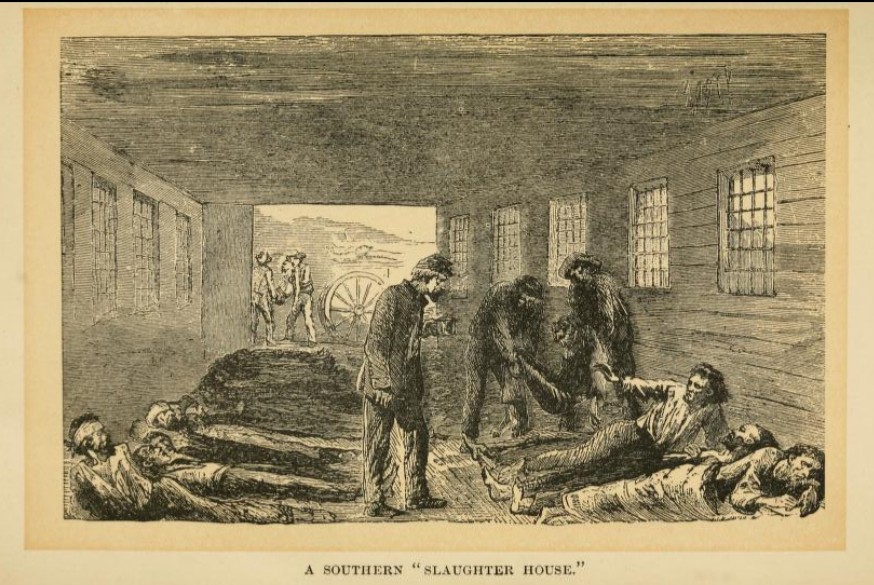
Even more damaging were the horrific conditions experienced by a far larger group of 47th Pennsylvania Volunteers who were taken prisoner in Virginia roughly six months later, including First Sergeant William Fry (1836-1865) of Company C and Corporal James Huff (1835-1865) of Company E, who were both captured during the Battle of Cedar Creek and then dragged away to the two most infamous POW camps in the Confederacy. Sergeant Fry, who “was paroled [on March 4, 1865], only to ‘come home to die’ from starvation and slow poison — the victim [at Andersonville] of atrocities such as have only been practiced by the traitors to our own government, and from which savages would turn in disgust,” died three weeks later at his mother’s home (on March 28, 1865), according to the 15 April 1865 edition of The Sunbury American, while Corporal Huff lost his will to live on March 5, 1865, after suffering through months of the mental and physical torment of starvation that he endured at Salisbury. (His body was then thrown into an unmarked trench grave there with those of thousands of other Union POWs, and was never able to be identified.)

War-Induced Trauma

“A Southern ‘Slaughter House'” depicted the suffering of Union soldiers at the Confederacy’s Salisbury Prison Camp (Charles S. Greene, Sparks from the Campfire, 1889, public domain).

While it is true that the majority of 47th Pennsylvania Volunteers managed to avoid being killed or imprisoned as POWs, it is also true that a significant number of them suffered serious emotional trauma — either personally because they were wounded or became ill as a direct result of their military service, or vicariously — because they saw one of their comrades fall in battle or watched as a sibling or friend succumbed to disease-related complications at a Union Army hospital. So, it’s often heartbreaking for present-day descendants to read diary entries and letters that were penned by their 47th Pennsylvania ancestors as they tried to convey their thoughts in shaky, cursive handwriting while cycling between happy memories of home, their hope for better days and their profound feelings of bewilderment, grief and despair.

While scribbling one such letter during church services on Sunday, December 29, 1861, for example, Private Abraham N. Wolf told his wife that the 47th Pennsylvania’s Regimental Band was playing a hymn at that moment, and went on to state, with childlike wonder and incandescent joy, that he’d received the gift box she’d sent him, adding “everything was in it yet what you said was in it and it came on the second day of Christmas.” But his words then turned bittersweet as he reported that he had already “fried some of the sausages” that she’d sent him in order to take with him for dinner as he headed out for duty to chop wood for the regiment. “They tasted pretty good to me for it was something new to me for it was from home.”

The next year, homesickness and grief darkened the holidays for a very pensive Henry Hornbeck, as evidenced by this diary notation:

“How different this Christmas from last year when all was Joy at home. Mary & myself for the sake of a Joyful surprise, placed upon the plate (before Breakfast) of Dear Mother, a Christmas Gift, and how pleased she was for that present, which was entirely unexpected. Now, alas, she is no more, never more are we to see her in this world. No one who has not lost a dearly beloved Mother, can feel that loss or have the least idea of what the loss of his or her dearest friend on earth is, until he or she experiences what we have, Standing at the death bed of a dying parent, and to feel as we felt, alone in this wide world…. Retrospection is often times pleasing and also horrifying. I wish you a Merry Christmas.”

The Consequences of Untreated Suffering

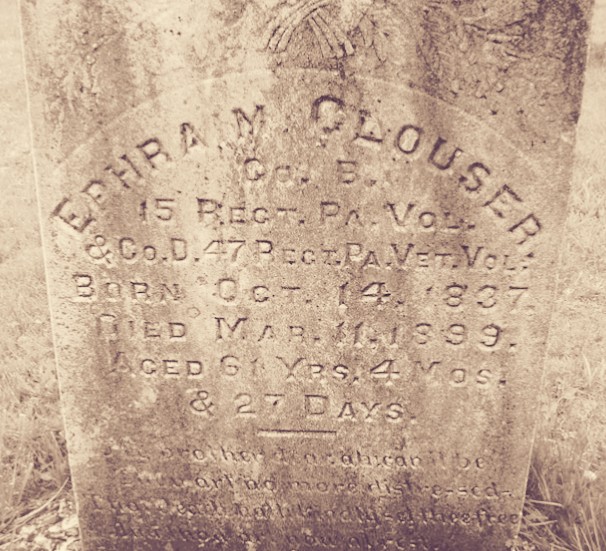
Placed by loved ones at the Bloomfield Cemetery in Perry County, Pennsylvania, this gravestone expresses the hope that the heart of 47th Pennsylvania veteran Ephraim Clouser is no longer distressed (public domain; click to enlarge).

One of the many heartbreaking truths of the American Civil War era is that soldiers who were battling depression or other mental health issues rarely received sympathy or support from their superior officers because those officers were advised by military physicians to respond harshly, rather than with compassion, to any behavior that might be perceived — or misperceived — as “malingering.” That surprising guidance was given by those surgeons because they had received medical school training which had taught them that any failure to shake off feelings of homesickness, sadness or grief was a sign of “weakness” or a “character flaw” rather than a symptom of a legitimate disease that required prompt and ongoing treatment. According to Horwitz:

“Military and medical officials recognized nostalgia as a serious ‘camp disease,’ but generally blamed it on ‘feeble will,’ ‘moral turpitude’ and inactivity in camp. Few sufferers were discharged or granted furloughs, and the recommended treatment was drilling and shaming of ‘nostalgic’ soldiers.”

In more than a few cases, the untreated or poorly-treated nostalgia experienced by 47th Pennsylvania Volunteer Infantrymen became so severe that it broke the hearts of those 47th Pennsylvanians — figuratively and then literally — as it led to the development of damaging heart or brain diseases that would later be termed “Soldier’s Heart” or “PTSD” (post-traumatic stress disorder).

One of the earliest casualties of that sub-standard treatment was Private Adolph Finster of the 47th Pennsylvania’s A Company, who ended his life by suicide in Key West, Florida on May 15, 1863. A twenty-five-year-old who had been employed as a clerk in Easton prior to the war, Private Finster was subsequently buried in grave number 180 “of the Key West Post Cemetery,” according to historian Lewis Schmidt.

Another was D Company Private Ephraim Clouser, who was hospitalized for months at one Union Army hospital after another, following his release from captivity as a POW on November 25, 1864. (Shot in the knee during the Battle of Pleasant Hill, Louisiana on April 9th, he had been force marched to Camp Ford in Texas, where he had then been subjected to starvation and dangerously unsanitary living conditions). Awarded a U.S. Civil War soldier’s invalid pension in 1866, he was then diagnosed with dementia (1868), described as “an insane veteran” by his hometown newspaper (1896) and “jailed as a dangerous character” (1898), before he was finally committed to the Pennsylvania State Lunatic Asylum (later known as the Harrisburg State Hospital).

Two of the other post-war casualties were William H. Sieger, a field musician from Company G, who died by suicide eight years after receiving his honorable discharge and eleven days after his twenty-ninth birthday, and Daniel Battaglia, a Swiss immigrant who served as a private with Adolph Finster in Company A and later battled mental health issues for decades before he was finally committed to the “Government Hospital for the Insane” (later known as St. Elizabeths Hospital) in Washington, D.C. — forty-five years after receiving his honorable discharge.

Still others, who managed to survive and be welcomed home with huzzahs and hearty backslaps after the war, seemed “just fine” to neighbors and co-workers but, in reality, were actually suffering greatly from physical or mental illnesses that would plague them for the remainder of their days — quiet casualties of a war that continued to claim lives more than half a century after it ended.

* Note: To see an image and read more of Abraham Wolf’s letter, read the article, 1861: Abraham Nicholas Wolf, Jr. to Sarah (Trexler) Wolf,” by Spared and Shared.


Sources:

  1. Da Costa, Jacob Mendez. “Observations on the diseases of the heart noticed among soldiers, particularly the organic diseases,” in Contributions relating to the Causation and Prevention of Disease, and to Camp Diseases; together with a Report of the Diseases, etc., Among the Prisoners at Andersonville, GA. New York: United States Sanitary Commission and Hurd and Houghton, 1867.
  2. Da Costa, Jacob Mendez. “On Irritable Heart; a Clinical Study of a Form of Functional Cardiac Disorder and Its Consequences: Result in Two Hundred Cases,” in The American Journal of the Medical Sciences, vol. 61, no. 121, p. 17. Philadelphia, Pennsylvania: Henry C. Lea, 1871.
  3. Friedman, Matthew J. “History of PTSD in Veterans: Civil War to DSM-5.” Washington, D.C.: National Center for PTSD, U.S. Department of Veterans Affairs, retrieved online, March 23, 2026.
  4. Greene, Lieutenant-Colonel Charles S. Sparks from the Campfire: Thrilling Stories of Heroism, Adventure, Daring and Suffering, Re-Told by the Boys Who Were There. New York: W. A. Houghton, 1889.
  5. Horwitz, Tony. “Did Civil War Soldiers Have PTSD?“, in Smithsonian Magazine. Washington, D.C.: Smithsonian Institution, January 2015.
  6. Pollard, Harvey, Chittari Shivakumari, et.al. “‘Soldier’s Heart’: A Genetic Basis for Elevated Cardiovascular Disease Risk Associated with Post-Traumatic Stress Disorder,” in Frontiers in Neuromolecular Science, September 23, 2016. Switzerland: Frontiers Research Foundation.
  7. “Resolutions of Condolence” (report regarding the death of former Andersonville prisoner of war, Sergeant William Fry, at his home in Sunbury). Sunbury, Pennsylvania: The Sunbury American, April 15, 1865.
  8. Schmidt, Lewis G. A Civil War History of the 47th Regiment of Pennsylvania Veteran Volunteers. Allentown, Pennsylvania: Self-published, 1986.


A Past That Seems Distant — But Wasn’t

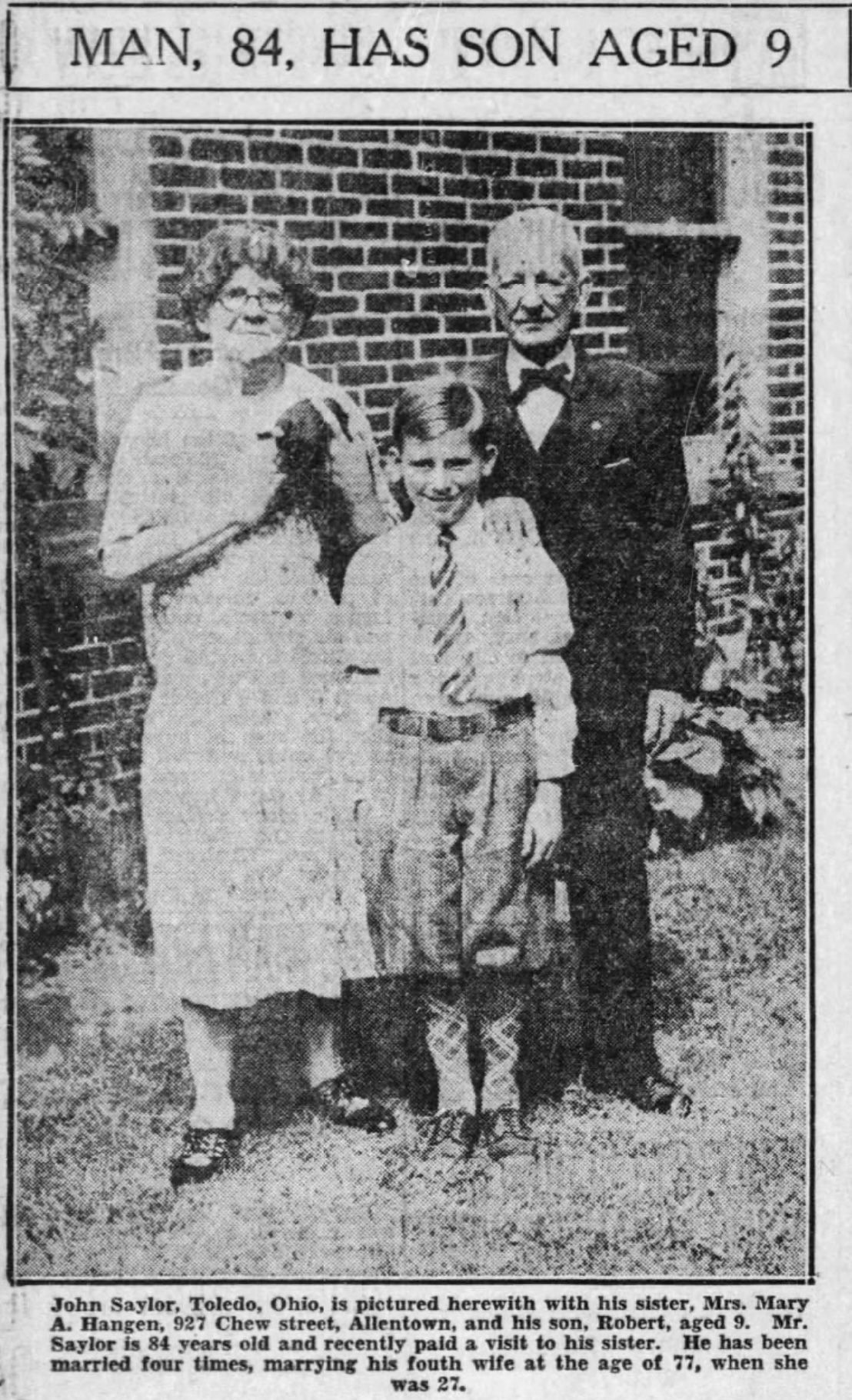
47th Pennsylvania veteran John Edward Saylor with his sister, Mary Alice (Saylor) Hangen, and his son, Robert Henry Saylor, (The Morning Call, Allentown, Pennsylvania, August 1929, public domain).

Many Americans tend to think of the American Civil War as part of the United States’ long distant past. Waged more than one hundred and sixty years ago, it began at a time when the art of photography was still in its infancy and the average newspaper contained mostly written text without any accompanying illustration.

As the war dragged on, though, newspaper publishers began sending Winslow Homer and other artists to far-flung locations, hoping that any sketches they sent back would give readers a better sense of the battles that were killing countless young men and destroying entire communities. Matthew B. Brady and Alexander Gardner, who had gained a measure of fame by photographing President Abraham Lincoln and members of his cabinet, went on to revolutionize war reporting by turning their cameras on carnage so horrific that it could not be conveyed by mere words or pencil illustrations. Their black and white photographs are the ones still viewed most often by history students in classrooms across the nation, contributing to the persistent notion that the American Civil War is distant, rather than recent history.

But that’s not quite correct, as the lives of Robert Henry Saylor and Edward John Saylor will show us. Born in the city of Toledo, Ohio during the early 1920s, the Saylor brothers could both lay claim to have been cradled in the arms of their father, John Edward Saylor (1846-1931), a veteran of the American Civil War who had served with the 47th Pennsylvania Volunteer Infantry’s K Company from early 1864 until early 1866.

Veterans of World War II, both brothers also made it through their respective tenures of military service and lived well into the last decades of the twentieth century, with the youngest brother nearly surviving long enough to witness the dawn of the twenty-first, making him a genuine “living bridge” between the not-so-distant past and present.

Their life stories help us to better understand just how recent so much of American History is. Reflect on that as you learn more about the Saylors’ lives by reading our new bio of Corporal John Edward Saylor.


Sources:

  1. Bates, Samuel P. History of Pennsylvania Volunteers, 1861-5, vol. 1. Harrisburg, Pennsylvania: B. Singerly, State Printer, 1869.
  2. Conway, William (boarding house operator) and Ollena; Saylor, John [sic, “John Edward Saylor”] (lodger and eighty-four-year-old Civil War veteran) and Robert (lodger and Civil War veteran’s ten-year-old son); et. al., in U.S. Census (Toledo, Lucas County, Ohio, 1930). Washington, D.C.: U.S. National Archives and Records Administration.
  3. “Edward Saylor” (obituary of a son of John Edward Saylor). Coshocton, Ohio: The Coshocton Tribune, August 5, 1999.
  4. “Former Resident Dies” (death notice of John Edward Saylor). Port Clinton, Ohio: News-Herald, September 4, 1931.
  5. John Saylor [sic, “John Edward Saylor”], in Death Certificates (registration district no.: 769, death of death: August 28, 1931). Columbus, Ohio: State of Ohio, Department of Health, Division of Vital Statistics.
  6. “Man, 84, Has Son Aged 9” (photo with caption of John Edward Saylor and his son, Robert, and John’s sister, Mary A. (Saylor) Hangen). Allentown, Pennsylvania: The Morning Call, August 25, 1929.
  7. Mary Alice Hangen (a sister of John Edward Saylor), in Death Certificates (file no.: 67765, registered no.: 858, date of death: July 12, 1932). Harrisburg, Pennsylvania: Commonwealth of Pennsylvania, Department of Health, Bureau of Vital Statistics.
  8. “Mrs. Mary A. Hangen” (obituary of a sister of John Edward Saylor). Allentown, Pennsylvania: The Morning Call, July 13, 1932.
  9. “Putnam Group Inducted Into Armed Forces” (notice of the impending World War II service of John Edward Saylor’s son, Robert Henry Saylor). Lima, Ohio: The Lima News, May 11, 1943.
  10. Robert Henry Saylor, in U.S. Headstone Applications for Military Veterans (Vista Memorial Gardens, Hialeah, Florida, year of death: 1977). Washington, D.C.: U.S. National Archives and Records Administration.
  11. “Saylor” (obituary of Robert Henry Saylor, a son of John Edward Saylor). Coshocton, Ohio: The Coshocton Tribune, January 4, 1977).
  12. Saylor, Edward J. (the groom and the youngest son of John Edward Saylor), John Saylor [sic, “John Edward Saylor”] (father of the groom) and Catherine Pyfer [sic, ” Pfeiffer”] (mother of the groom); and Loretta Wehrly (the bride), in Marriage Records (Putnam County, Ohio, June 10, 1946). Ottawa, Ohio: Putnam County Probate Court.
  13. Saylor, Edward J. (the youngest son of John Edward Saylor), Loretta, and Gloria J., in U.S. Census (Pleasant Township, Putnam County, Ohio, 1950). Washington, D.C.: U.S. National Archives and Records Administration.
  14. Saylor, John, in Civil War Muster Rolls (Company K, 47th Pennsylvania Infantry). Harrisburg, Pennsylvania: Pennsylvania State Archives.
  15. Saylor, John, in Civil War Veterans’ Card File, 1861-1866 (Company K, 47th Pennsylvania Infantry). Harrisburg, Pennsylvania: Pennsylvania State Archives.
  16. Saylor Robert (a son of John Edward Saylor) and Edwina, in U.S. Census (Coshocton, Coshocton County, Ohio, 1950). Washington, D.C.: U.S. National Archives and Records Administration.
  17. “Saylor, Robert H.” (obituary of a son of John Edward Saylor). Miami, Florida: The Miami Herald, January 4, 1977.


Finding Your 47th Pennsylvanian: Registers of Pennsylvania Volunteers, 1861-1865

Main website page for the Registers of Pennsylvania Volunteers, 1861-1865 (Pennsylvania State Archives, public domain; click to enlarge).

Another useful tool for Finding Your 47th Pennsylvanian is one of several records collections related to the American Civil War housed at the Pennsylvania State Archives in Harrisburg, Pennsylvania — the “Registers of Pennsylvana Volunteers, 1861-1865.”

Similar to the Pennsylvania State Archives’ collection of Pennsylvania Civil War Muster Rolls, the Registers of Pennsylvania Volunteers, 1861-1865 are part of a sixteen-volume set of rosters that document the names, ages, ranks, regiment and company affiliations, and dates and places of enlistment and discharge or desertion for the more than three hundred and sixty-thousand men who served with one or more of Pennsylvania’s volunteer infantry, volunteer militia, emergency militia, independent, or other military units during the war. In addition, many of these registers contain additional data about about the status of individual soldiers, including whether or not they were promoted or reduced in rank and whether or not they were wounded or killed in battle. According to Pennsylvania State Archives personnel:

“Arranged by regiment, rank, and then alphabetically by surname, these registers document Pennsylvania Volunteers who served during the Civil War. Information normally recorded includes the soldier’s name, age, rank, regiment and company; the term of service; and the date, place, and name of the person who enrolled him. Written remarks regarding the promotion, desertion, death, or discharge of the volunteer are frequently entered as well.”

Two PDFs to View for Each Soldier

Excerpt from left side of register entry, Company A, 47th Pennsylvania Volunteer Infantry (Registers of Pennsylvania Volunteers, 1861-1865, Pennsylvania State Archives, public domain; click to enlarge).

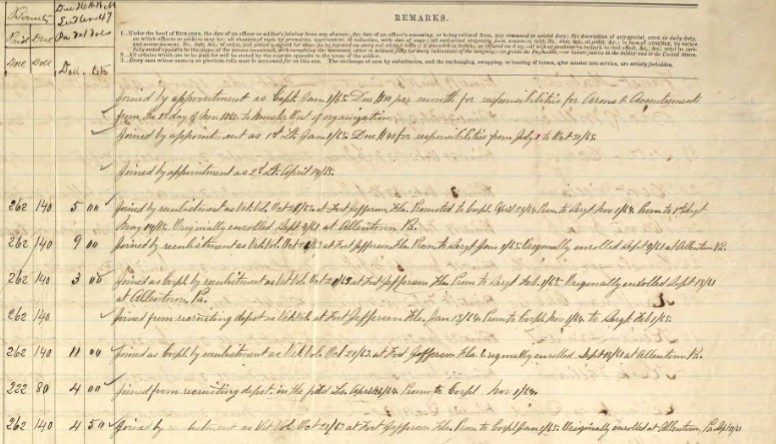
Due to the large size of each book in this register series, Pennsylvania State Archives personnel scanned each page of each register as two separate PDF pages — with the first page containing the left side of the roster with an alphabetized list of soldiers’ names and their respective enrollment data — and the second page containing the right side of the roster with its remarks section, which presents data about the service status for each of those soldiers (promotions, desertions, deaths, etc.). Those PDF pages were then grouped by regiment and company, officers first, followed by the enlisted members of the regiment who served under them, and were posted on the Pennsylvania State Archives’ website, where they remain available, free of charge to everyone, regardless of geographic location, and without any requirement to create an account in order to search these records.

This collection has also been indexed by FamilySearch volunteers, who have entered each soldier’s summarized data into a database that may be searched online, free of charge, via the “Pennsylvania, Register of Military Volunteers, 1861-1865” portal on the FamilySearch website. (Note: While the summarized data for soldiers may be viewed online from the privacy of one’s home, by creating and logging into a free FamilySearch account, the opportunity to browse through and view scanned images of the original registers is only available by visiting a FamilySearch Center in person.)

Remember and Honor Them

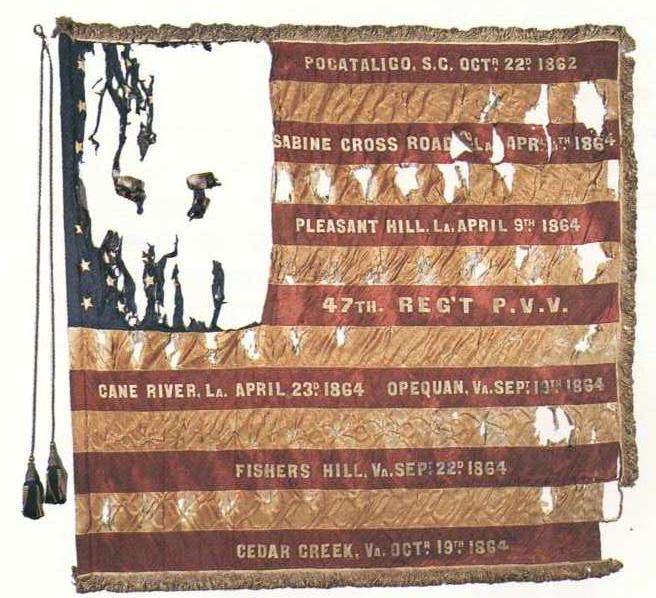
Second State Colors, 47th Pennsylvania Veteran
Volunteers (presented to the regiment 7 March 1865).

The members of the 47th Pennsylvania Volunteer Infantry gave everything they had in them to help preserve America’s Union. For that reason alone, they deserve our enduring gratitude and respect.

So, make it a practice to say the name of your ancestor out loud each week (or say the name of one of the men who fought beside him).

Tell and re-tell their stories to everyone you know (especially the children in your local school system).

And most of all, honor the sacrifices that they made by volunteering your own time and energy to make life better for everyone in your community.


Sources:

  1. Civil War Records,” in “Pennsylvania State Archives – Research Guides.” Harrisburg, Pennsylvania: Pennsylvania Historical and Museum Commission, Commonwealth of Pennsylvania, retrieved online November 3, 2025.
  2. Pennsylvania, Register of Military Volunteers, 1861-1865.” Lehi, Utah: FamilySearch, retrieved online November 3, 2025.
  3. Registers of Pennsylvania Volunteers, 1861-1865,” in Records of the Department of Military and Veterans’ Affairs (Record Group 19, Series 19.65). Harrisburg, Pennsylvania: Pennsylvania State Archives, retrieved online November 3, 2025.


Election Day 1864 — Lincoln or McClellan? How the 47th Pennsylvania Volunteers Voted

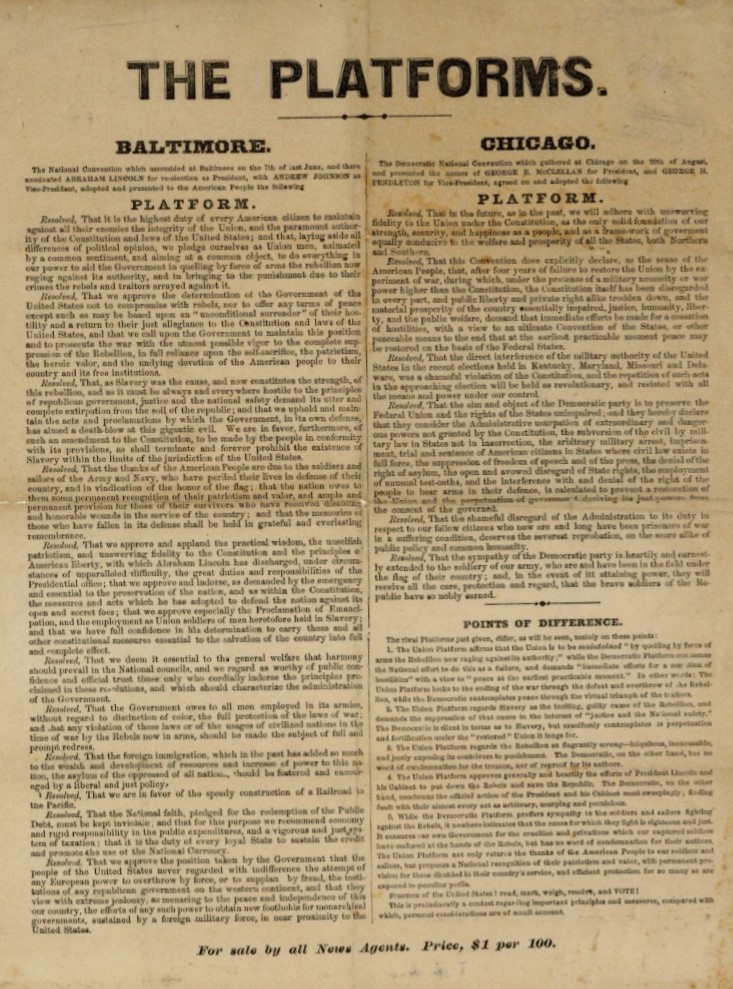
The platforms of the Union and Democratic parties, U.S. Presidential Election of 1864 (courtesy of the University of Illinois Urbana-Champaign; click to enlarge).

Even in the midst of a devastating civil war, Americans across the United States managed to come together to fulfill their civic responsibilities by voting on Election Day. Fathers and sons flocked to city and small town polling places while soldiers on active duty filled out ballot forms wherever they were stationed during the early to mid-1860s.

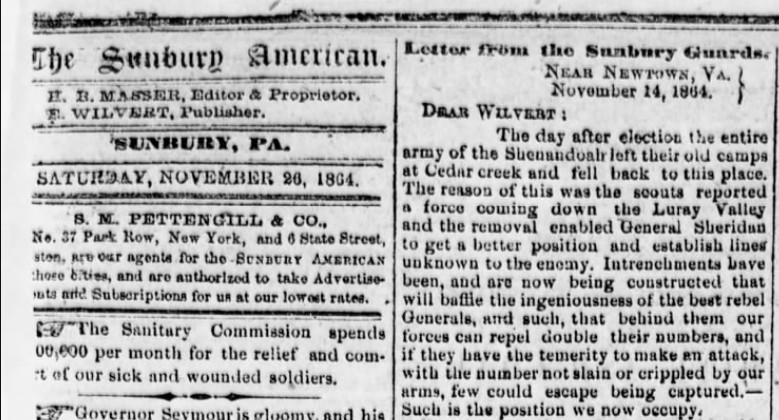
With respect to the Presidential Election of 1864, which was held in multiple states across America on November 8, 1864, that voting took place for members of the 47th Pennsylvania Volunteer Infantry at their encampment near Newtown, Virginia, according to a letter that was subsequently penned by 47th Pennsylvanian Henry D. Wharton to his hometown newspaper in Sunbury, Pennsylvania on November 14:

“The election passed off quietly and without any military interference, not the influence of officers used in controlling any man’s vote. In the regiments from the old Keystone, the companies were formed by the first Sergeant, when he stated to the men the object for which they were called to ‘fail to,’ and then they proceeded to the election of officers to hold the election – the boys having the whole control, none of the officers interfering in the least.”

Were the 47th Pennsylvania Volunteers pro-Lincoln or pro-McClellan?

Excerpt from Henry Wharton’s letter to his hometown newspaper, November 14, 1864 (The Sunbury American, November 14, 1864, public domain; click to enlarge).

Wharton reported that, after the votes from members of the regiment were counted, President Abraham Lincoln was the favored choice of most of the 47th Pennsylvania Volunteers. Lincoln had garnered one hundred and ninety-four votes to General George B. McClellan’s one hundred and twenty-one (a margin of seventy-three votes). Those votes, by individual company, were tallied as follows:

  • Company A: President Lincoln (ten); General McClellan (one)
  • Company B: President Lincoln (twenty-six); General McClellan (two)
  • Company C: President Lincoln (twenty-nine); General McClellan (thirteen)
  • Company D: President Lincoln (thirty-one); General McClellan (eleven)
  • Company E: President Lincoln (twenty-four); General McClellan (three)
  • Company F: President Lincoln (eighteen); General McClellan (sixteen)
  • Company G: President Lincoln (nine); General McClellan (thirteen)
  • Company H: President Lincoln (ten); General McClellan (twenty-four)
  • Company I: President Lincoln (nineteen); General McClellan (sixteen)
  • Company K: President Lincoln (eighteen); General McClellan (twenty)

But Wharton’s figures for the men from Company K were incorrect, according to historian Lewis Schmidt, who noted in his book, A Civil War History of the 47th Regiment of Pennsylvania Veteran Volunteers, that “Fifteen of the members [of Company K] voted for the Lincoln electors and seven for the McClellan electors” when they “voted on the battlefield of Cedar Creek, November 8, 1864.” The members of Company K who cast votes that day were: “David H. Fetherolf, Mathias Miller, John Keiser, Phaon Guth, James D. Weil, Daniel Strauss, Paul Strauss, George Sherer, Lewis G. Seip, Henry Hantz, Charles W. Abbott, George Kase, Charles Stoudt, William Schlicher, William F. Knerr, E. F. Benner, George Delp, Tilghman Boger, William H. Barber, William D. Schick, Frank Beisel, and David Semmel.”

Apathy or Attrition?

One of the first things that researchers notice when looking at those figures for the 1864 election is that the number of votes tendered by 47th Pennsylvania Volunteers that November day was lower than it should have been — shockingly so when considering that each company of the regiment had been staffed by roughly one hundred men when the 47th Pennsylvania left Camp Curtin and headed for Washington, D.C. three years earlier. The turnout of 47th Pennsylvanians was not a sign of voter apathy, however, but of a simple, ugly truth. The regiment had just recently lost the equivalent of nearly two full companies of men in combat. According to Wharton, “The battle at Cedar Creek thinned our ranks by which we lost many votes – this number and those away in hospitals would have increased the Union majority to three hundred.”

* Note: When Henry Wharton wrote the phrase “Union majority,” he was referring to the National Union Party, which had been established during the 1860s by prominent Republicans as a way to bring members of their party together with “War Democrats” and potential voters from border states to vote for President Lincoln and others who supported the Republican platform for eradicating chattel slavery and ending the nation’s secession crisis and civil war.

What Happened After That Election in 1864?

President Abraham Lincoln signing the Emancipation Proclamation in 1862 (W.E. Winner, painter, J. Serz, engraver, circa 1864; public domain, U.S. Library of Congress).

Successful in his bid for re-election, both in terms of the electoral college and popular vote, President Abraham Lincoln went on to deliver one of his most inspiring addresses to the nation, urging his fellow Americans “to bind up the nation’s wounds” and “do all which may achieve and cherish a just and lasting peace among ourselves and with all nations.” He then continued to shepherd his nation through one of its darkest times until the war was finally over.

Food for Thought

If Henry Wharton and his fellow soldiers could make it to the polls on Election Day after all they endured in battle, so can you. Please vote. Your voice does matter.


Sources:

  1. Political Party Timeline: 1836-1864,” in American Experience: Abraham and Mary Lincoln: A House Divided. Boston, Massachusetts: GBH Education for WGBH-TV (PBS), 2001.
  2. Schmidt, Lewis G. A Civil War History of the 47th Regiment of Pennsylvania Veteran Volunteers. Allentown, Pennsylvania: Self-published, 1986.
  3. The People’s Candidate: Lincoln’s Presidential Elections,” in “Illinois History & Lincoln Collections.” Urbana, Illinois: Main Library, University of Illinois Champaign-Urbana, retrieved online November 3, 2025.
  4. Transcript of Abraham Lincoln’s Second Inaugural Address (delivered Saturday March 4, 1865), in “UShistory.org.” Philadelphia, Pennsylvania: Independence Hall Association, retrieved online March 4, 2020 and November 3, 2025.
  5. Wharton, Henry D. “Letter from the Sunbury Guards, Near Newtown, VA, November 14, 1864.” Sunbury, Pennsylvania: The Sunbury American, November 26, 1864.

Finding Your 47th Pennsylvanian: The Surprising Details in Pennsylvania’s Civil War-Era Muster Rolls

Excerpt of muster-out roll, Company G, 47th Pennsylvania Volunteer Infantry, December 25, 1865, page one (Pennsylvania Civil War Muster Rolls, Pennsylvania State Archives, public domain; click to enlarge).

The Commonwealth of Pennsylvania’s collection of Civil War-era muster rolls is another of the three major tools that beginning, medium and advanced researchers initially turn to for help in determining which Pennsylvania military unit(s) a soldier served with during the American Civil War. Unfortunately, it is also a resource that often does not receive the close attention from researchers that it should.

Those who have chosen to spend significant time looking through the individual documents contained in this collection have come to understand that, in addition to confirming the identity of a soldier’s regiment and company, as well as his rank(s) at enrollment and final discharge, Pennsylvania’s Civil War-era muster rolls are also useful for documenting when and where that soldier enrolled and mustered in for service and whether or not he had some change to his status while serving, such as a promotion, reduction in rank or charge of desertion — and possibly data which documented whether or not he was wounded or killed in battle and, if so, when and where.

Physically created as hard-copy index cards that were later preserved by the Pennsylvania State Archives in Harrisburg, Pennsylvania, as part of the “Civil War Muster Rolls and Related Records” group of documents from the Pennsylvania Department of Military and Veterans Affairs’ archives (Series RG:-019-ADJT-11, 1861-1866, 1906), this collection includes muster rolls from each of Pennsylvania’s volunteer infantry and volunteer militia regiments, emergency volunteer militia regiments that were formed during the summer of 1863 in response to the looming invasion of the commonwealth by the Confederate States Army, United States Colored Troops (USCT), United States Veteran Volunteer regiments and Hancock Veterans Corps, regiments of the Veterans Reserve Corps, and independent or other unattached units. Preserved on microfilm decades ago by the Commonwealth of Pennsylvania, a portion of this large collection has since been partially digitized and made available on the Ancestry.com website as “Pennsylvania, U.S., Civil War Muster Rolls, 1860-1869.”

* Note: Although Ancestry.com is a subscription-based genealogy service that generally requires users to pay for access to its records collections, the Commonwealth of Pennsylvania entered into a partnership with Ancestry.com several years ago “to digitize family history records in the State Archives and make them available online.” As part of that agreement, Ancestry.com created Ancestry.com Pennsylvania to provide free access to Pennsylvania residents to the Pennsylvania records it has digitized. If you reside in Pennsylvania and want to learn more about how you may obtain free access to those records, please contact the Pennsylvania State Archives for guidance. If you reside elsewhere, check with your local library to determine if it offers access to Ancestry.com as part of its service to library users.

What May Researchers Find with This Resource?

Excerpt from muster-out roll, Company G, 47th Pennsylvania Volunteer Infantry, December 25, 1865, showing soldiers’ promotions, status as Veteran Volunteers, etc. (Pennsylvania State Archives, public domain; click to enlarge).

According to personnel at the Pennsylvania State Archives, Pennsylvania’s Civil War Muster Rolls and Related Records collection includes:

“Alphabetical Rolls. The rolls are arranged alphabetically by the soldiers’ surnames. Entries usually give the name, rank, civilian occupation, and residence, the unit, regiment, company, and commanding officer, and the date and place where the roll was taken. Particulars about sickness or injury are also sometimes noted.

“Descriptive Lists of Deserters. Lists give the names, ages, places of birth, height, hair and eye color, civilian occupations, and ranks of deserters, the units, regiments, and companies to which they were assigned, and the dates and places from which they deserted.

“Muster-In Rolls. Entries usually list the name, age, rank, unit, regiment, and company of the soldier, the date and place where enrolled, the name of the person who mustered him in, the term of enlistment, the date of mustering in, and the name of commanding officer. Remarks concerning promotions and assignments are sometimes recorded.

“Muster-Out Rolls. The dated lists ordinarily give the soldier’s name, age, rank, unit, regiment, and company, the date, place, and person who mustered him in, the period of enlistment, and the name of the commanding officer. Particulars concerning pay earned, promotions, capture by the enemy and the like also regularly appear.

“Muster and Descriptive Rolls. Generally the rolls give the name, age, town or county and state or kingdom of birth, civilian occupation, complexion, height, eye and hair color, and rank, the unit, regiment, company and commanding officer, and the amount of money received for pay, bounties, and clothing. Rolls for assigned United States black troops are included in this group. Included throughout are such related materials as regimental accounts of action, and correspondence related to infractions of military procedures, correspondence from soldiers addressed to the governor expressing grievances or petitioning for promotion.

“The data found in the documents of this series were used to create the Civil War Veterans Card File, 1861-1866 (Series 19.12).”

Be Sure to Look for Data Regarding Soldiers’ Pay

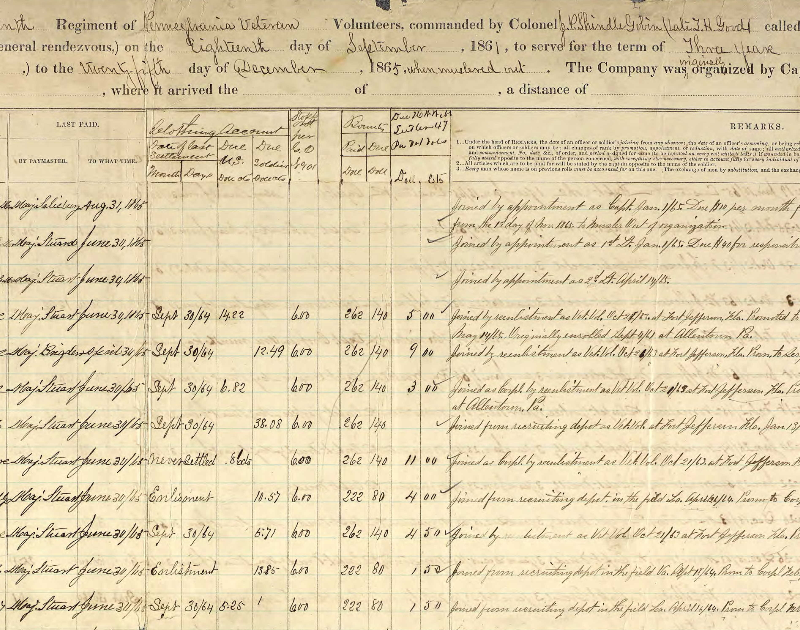
Excerpt from muster-out roll for Company G, 47th Pennsylvania Volunteer Infantry, showing soldiers’ pay data, December 25, 1865 (Pennsylvania State Archives, public domain).

One of the most fascinating features found on the muster-out rolls for Pennsylvania volunteer soldiers is that many of the infantry unit clerks took the time to meticulously record the pay data for multiple members of their respective regiments. As a result, present-day researchers are often able to determine how much bounty pay a particular soldier was eligible for at the time of his enlistment — and how much of that promised pay he actually received, as well as how much money he still owed the United States government for his army uniform, rifle and ammunition at the time of his discharged from the military.

Another striking feature on the muster-out rolls is the “Last Paid” column, which corroborates the shocking fact that many Union Army soldiers were expected to perform their duties, even though they were not being paid regularly — a data point that also may help to shed light on why some soldiers’ families faced greater hardship than others (because some soldiers were able to send part of their pay home while others were not).

Caveat Regarding Ancestry.com’s Collection Related to the 47th Pennsylvania Volunteer Infantry

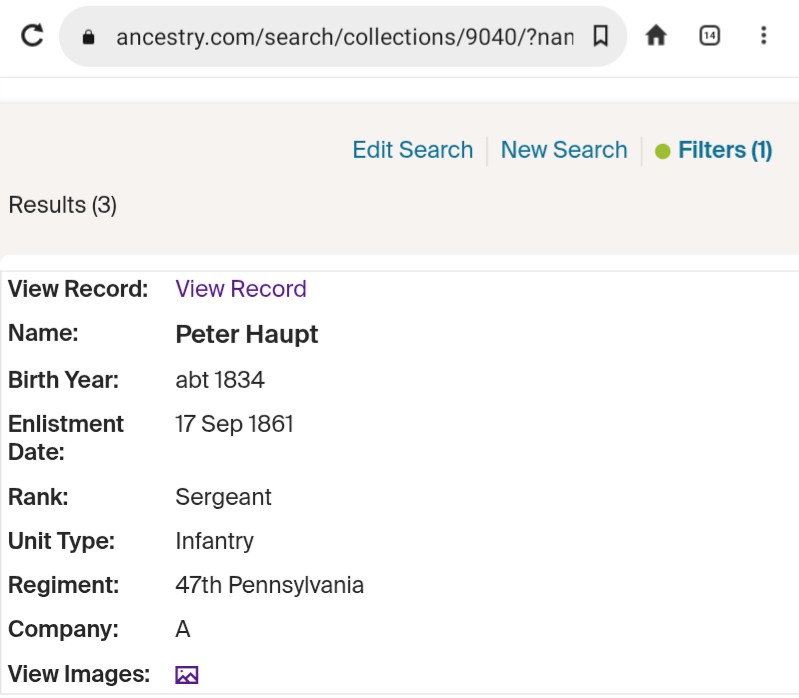
Screenshot of Ancestry.com’s record detail page for Peter Haupt, which incorrectly identifies him as a member of Company A, 47th Pennsylvania Volunteer Infantry, instead of Company C (fair use for illustration purpose, October 2025).

Although Ancestry.com’s collection of Pennsylvania Civil War-era muster rolls can be a useful tool for researchers, there is a significant problem with records related to the 47th Pennsylvania Volunteer Infantry that merits closer scrutiny — the inaccurate transcription of soldiers’ data. That scrutiny is needed because the muster rolls from the 47th Pennsylvania’s Company C were mixed together with the muster rolls from Company A when they were posted to Ancestry.com’s website, making it appear, when browsing through those rolls, that all of the soldiers listed on every single one of those incorrectly grouped muster rolls were all members of Company A, when they were not.

Complicating things further, the Ancestry.com personnel who were assigned to transcribe the data from each of those muster rolls and create Record Detail pages for each individual soldier that summarized each soldier’s data from the muster roll on which it appeared, apparently did not realize that the muster rolls from Companies A and C of the 47th Pennsylvania Volunteer Infantry had been mixed together. As a result, those transcribers incorrectly described every soldier from that improperly sorted muster roll group as a member of Company A, when they were not. (See attached image.)

So, when reviewing Ancestry.com’s collection of muster rolls, it is vitally important that researchers not take the transcribed data found on any of the Record Detail pages of 47th Pennsylvania muster rolls at face value. Instead, researchers should double check the data found on those muster rolls for the 47th Pennsylvania Volunteer Infantry against the data for individual soldiers published by Samuel P. Bates in his History of Pennsylvania Volunteers, 1861-5, volume 1, and should also then re-check that data against the information of individual soldiers that is contained in the Pennsylvania Civil War Veterans Index Card File, 1861-1866.

* Note: This is particularly important if you are a family historian who is hoping to identify the specific company in which your ancestor served. (And you will definitely want to know which company your ancestor served with because each company of the 47th Pennsylvania Volunteer Infantry was assigned to different duties in different locations at different times during the regiment’s service.)

Caveat Regarding “Deserters”

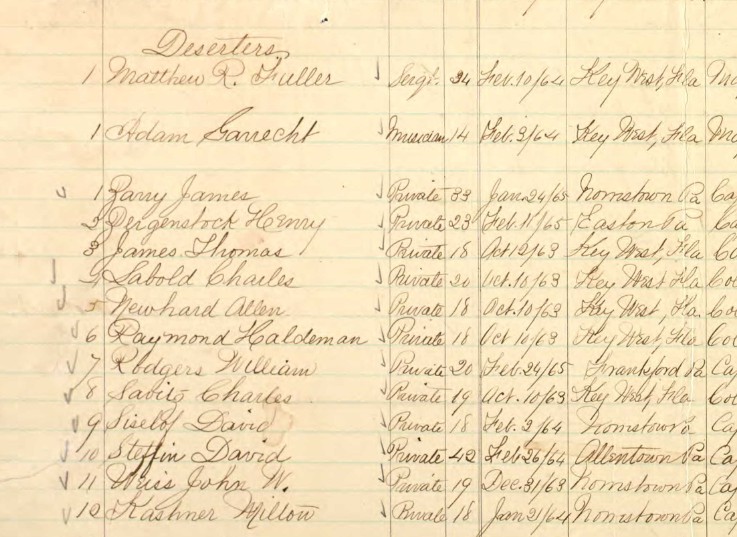
Private Milton P. Cashner, Company B, 47th Pennsylvania Volunteer Infantry, was incorrectly labeled as a deserter on this regimental muster roll from the American Civil War (Pennsylvania State Archives, public domain; click to enlarge).

If a muster roll entry for your ancestor noted that he was a deserter, it’s also important that you not take that label at face value, either, because that data may also be incorrect. Military records from the Civil War era contained a surprising number of errors, a fact that is understandable when considering what the average army clerk was expected to do — keep track of more than a thousand men, many of whom ended up becoming separated from their regiment and confined to Union Army hospitals after being wounded in battle. (Wounded too severely to identify themselves to army personnel, they were then often mis-identified by army hospital personnel and then also incorrectly labeled as “deserters” by their own regiments because they hadn’t shown up for post-battle roll calls.) So, it’s important to double and triple check the data for any ancestor who was labeled as a “deserter” because he might actually have been convalescing at a hospital and not absent without leave.

Honoring Our Ancestors 

One of the best ways to honor ancestors who fought to preserve America’s Union is to pass their stories along to future generations. No embellishment required. Their willingness to volunteer for military service and the bravery they displayed as they ran toward danger and certain death during one of America’s darkest times speaks for itself.

Our job, as students of American History, educators and family historians is to ensure that their stories are told as accurately and thoroughly as possible so that their valor and love of community and country are never forgotten.

Remember their names. Tell and re-tell their stories. Honor the sacrifices that they made.


Sources:

  1. “Ancestry Pennsylvania,” in “Agencies: Pennsylvania Historical and Museum Commission,” in “Pennsylvania State Archives.” Harrisburg, Pennsylvania: Commonwealth of Pennsylvania, retrieved online October 25, 2025.
  2. Civil War Muster Rolls and Related Records” (resource description). Harrisburg, Pennsylvania: Pennsylvania State Archives, retrieved online October 30, 2025.
  3. Pennsylvania,” in Collections. Lehi, Utah: Ancestry.com Operations, Inc., 2021 (retrieved online October 25, 2025).


Finding Your 47th Pennsylvanian: Using the Pennsylvania Civil War Veterans Card File, 1861-1866

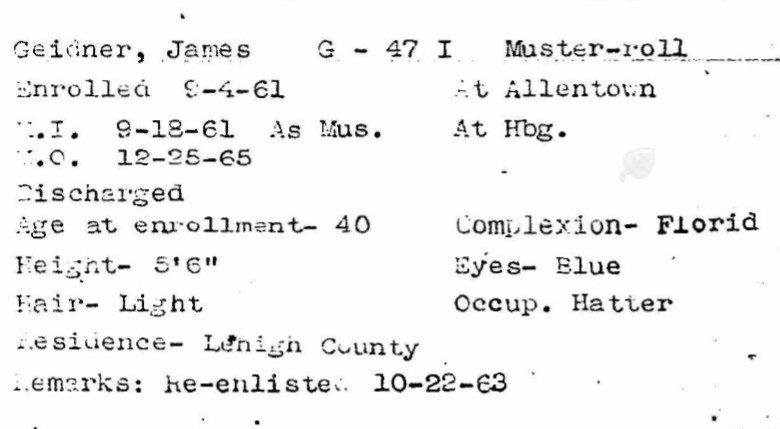
The index card of Field Musician James Geidner, Company G, 47th Pennsylvania Volunteer Infantry (Pennsylvania Civil War Veterans Card File, 1861-1866, courtesy of the Pennsylvania State Archives).

The Pennsylvania Civil War Veterans Index Card File, 1861-1866 is one of three resources that beginning, medium and advanced researchers frequently turn to for help in determining which Pennsylvania military unit(s) a soldier served with during the American Civil War. Physically housed at the Pennsylvania State Archives in Harrisburg, Pennsylvania, as part of the Pennsylvania Department of Military and Veterans Affairs’ archives (Series RG-019-ADJT-12), this collection of individual index cards was preserved on microfilm decades ago by the Commonwealth of Pennsylvania and then later digitized and made available, free of charge, on the State Archives’ website via a user-friendly portal, enabling researchers nationwide to search or browse, alphabetically, through each of the index cards that had been created for the majority of Pennsylvanians who had served with the Union Army (as well as the non-Pennsylvanians who had also served with Pennsylvania units). According to Pennsylvania State Archives personnel:

“These 3 x 5 cards were initially prepared to serve as an index to Samuel Penniman Bates’ History of Pennsylvania Volunteers, 1861-1865, (Harrisburg, 1869-1871). The Office of the Adjutant General later expanded the scope of the cards by transcribing onto them data found on the original documents. Among the information generally found are the soldiers’ names, military units, and ages at enrollment, the dates and places where enrolled, the dates and places where mustered in, and the dates of discharge. Physical descriptions (complexion, height, color of hair and eyes), residences, birthplaces, promotions and wounds also are sometimes included. The listing is not comprehensive.”

That last sentence is an important caveat because, while this index card system can be a helpful primary source for basic data about individual soldiers, it does not contain the name of every single Pennsylvanian who served with the Union Army during the Civil War. In addition, a significant number of the index cards contain errors (incorrect spellings of soldiers’ names, soldiers labeled as deserters when they had actually been honorably discharged or hospitalized to due battle wounds or illness, etc.).

* Note: Those faults are understandable, however, when considering that the index cards were based on data compiled by Samuel Bates for his History of Pennsylvania Volunteers, 1861-5a five-volume series of books that included rosters of soldiers for each Pennsylvania regiment that served during the American Civil War. The errors in Bates’ History are also understandable as you come to understand that Samuel Bates was assigned the task, during the mid-1860s, of summarizing thousands and thousands of muster rolls generated by Pennsylvania military units during the war — many of which were also filled with errors because the army clerks assigned to maintain those rolls were often unable to create accurate records as their regiments were being marched into battle or from one duty station to another.

Another more recent issue with this system is that its portal to the digitized index cards that was so easy to browse and search for free is now no longer available on the Pennsylvania State Archives’ website. The index cards are still available, however, to researchers who travel to Harrisburg to view the microfilmed version at the State Archives, as well as to online researchers via Ancestry.com as “Pennsylvania, U.S., Veterans Card Files, 1775-1948.” (Although Ancestry.com is a subscription-based genealogy service that generally requires users to pay for access to its records collections, the Commonwealth of Pennsylvania entered into a partnership with Ancestry.com several years ago “to digitize family history records in the State Archives and make them available online.” As part of that agreement, Ancestry.com created Ancestry.com Pennsylvania to provide free access to Pennsylvania residents to the Pennsylvania State Archives records it has digitized. If you reside in Pennsylvania and want to learn more about how you may obtain free access to those records, please contact the Pennsylvania State Archives for guidance. If you reside elsewhere, check with your local library to see if it offers access to Ancestry.com as part of its service to library users.)

Despite those issues, the Pennsylvania Civil War Veterans Index Card File, 1861-1866 remains a useful tool for finding your 47th Pennsylvanian because it may help you confirm your ancestor’s place of residence during the early 1860s and may also provide you with an approximate year of birth for him.

Additional Important Tips for Using This Resource

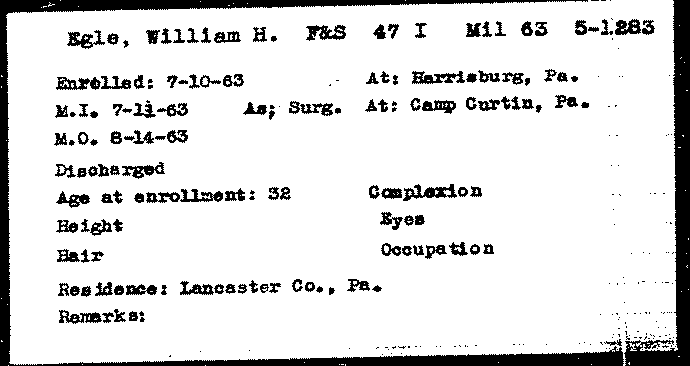
The index card of William H. Egle, M.D. shows that this soldier served with the 47th Pennsylvania Militia, Emergency of 1863 and not the 47th Pennsylvania Volunteer Infantry (Pennsylvania Civil War Veterans Card File, 1861-1866, courtesy of the Pennsylvania State Archives).

If you are able to find an index card for your ancestor in the Pennsylvania Civil War Veterans Index Card File, 1861-1866, pay particular attention to the top line of that card’s data. That data identifies the regiment number and company letter of his military unit. Then also look at the lines of data below. (Those lines of text note the start and dates of his service.) If you see dates of service indicating that your ancestor served between mid-April 1861 and the end of July 1861, you will realize that the regiment number in the top line was not “47.” This means that your ancestor performed what is known as “Three Months’ Service,” that he actually served with a different regiment during the first months of the war, and that he then may also have served with the 47th Pennsylvania Volunteer Infantry at a later date (because the 47th Pennsylvania Volunteer Infantry was not established until August 5, 1861). So, you’re one of those 47th Pennsylvania descendants who needs to look for two or more index cards in the Pennsylvania Civil War Veterans Index Card File, 1861-1866 — one for your ancestor’s “Three Month Service” and one for his service with the 47th Pennsylvania Volunteer Infantry (which was initially most likely a three-year term of enlistment, but may have been a one or two-year term, depending on how late he was enrolled for service).

HOWEVER, if you see dates of service indicating that your ancestor served at any point during 1863 — AND, if the top line indicates that his regiment was “47 I Mil 63” — this means that your ancestor DID NOT serve with the 47th Pennsylvania Volunteer Infantry. He served with the 47th Pennsylvania Militia, Emergency of 1863. (The soldiers who served with that militia group were also brave and honorable men, but they were part of a very different unit that had a very different mission. Learn more about that militia unit here.)

Regardless of whether or not your ancestor “performed Three Months’ Service” during the earliest part of the Civil War, if you see dates of service indicating that your ancestor served at any point between August 5, 1861 and early January 1866 — AND if the top line indicates that his regiment was “47 I” — then you can be reasonably confident that your ancestor actually did serve with the 47th Pennsylvania Volunteer Infantry (also known as the 47th Pennsylvania Volunteers or the 47th Pennsylvania Veteran Volunteers). So, you should make yourself a cup of coffee or tea, find a comfy chair, and spend some quality time exploring our website to learn more about the history-making 47th Pennsylvania Volunteer Infantry.

Best wishes for success with your research! Let us know what you learn about your ancestor!!


Sources:

  1. “Ancestry Pennsylvania,” in “Agencies: Pennsylvania Historical and Museum Commission,” in “Pennsylvania State Archives.” Harrisburg, Pennsylvania: Commonwealth of Pennsylvania, retrieved online October 25, 2025.
  2. Civil War Veterans Card File, 1861-1866” (resource description). Harrisburg, Pennsylvania: Pennsylvania State Archives, retrieved online October 25, 2025.
  3. Pennsylvania,” in Collections. Lehi, Utah: Ancestry.com Operations, Inc., 2021 (retrieved online October 25, 2025).


Remembering the Red River Campaign Prisoners of War on National POW/MIA Recognition Day

This POW/MIA Recognition Flag designed by Newt Heisley was formally recognized by U.S. House of Representatives Resolution No. 467 on September 21, 1990 (public domain).

During the Army of the United States’ 1864 Red River Campaign across Louisiana in the American Civil War, multiple members of the 47th Pennsylvania Volunteer Infantry were declared as “Missing in Action” (MIA) — largely due to the confusion caused by a series of engagements with the enemy in which Union soldiers were repeatedly required to retreat, regroup and resume the fight as they faced down wave after wave of Confederate troops attempting to outflank and perform end runs around the outer edges of Union Army lines.

Each time the cannon smoke began to clear from those battles, many of those MIA members of the 47th Pennsylvania Volunteer Infantry found their way back to the regiment, carrying word to senior officers of the 47th Pennsylvania Volunteers that members of the regiment had been captured by Confederate troops. By mid-May of 1864, it was clear that at least twenty-three 47th Pennsylvania Volunteers were being held as prisoners of war (POWs) by the Confederate States Army.

Regimental leaders would later learn that many of those men had been force marched roughly one hundred and fifty miles to Camp Ford, which was located outside of Tyler, Texas and would become the largest Confederate POW camp west of the Mississippi River by the summer of 1864. Once there, they were starved, given minimal to no medical care for any wounds they had sustained, exposed to extreme variations in temperature and weather, due to inadequate shelter, and sickened by dysentery and other diseases that were spread by living in the cramped, overcrowded conditions that became increasingly unsanitary, due to the placement of latrine facilities near water supplies meant for drinking or bathing. As their days dragged on, their treatment by Confederate soldiers grew more and more harsh. According to representatives of the Smith County Historical Society who have been working on documenting the history of Camp Ford:

On April 8th and 9th 1864 at the battles of Mansfield and Pleasant Hill, Louisiana, Confederate forces captured more than 2,000 Union soldiers, who were quickly marched to Tyler…. The existing stockade did not have sufficient area to house them, and an emergency enlargement was undertaken. Local slaves were again impressed, the north and east wall was dug up and the logs cut in half, and the top ten feet of the logs of the south and west walls were cut off. The resulting half logs gave sufficient timber to quadruple the area of the stockade, and it was expanded to about eleven acres.

With additional battles in Arkansas and Louisiana, the prison population had grown to around 5,000 by mid-June. Hard-pressed CS officials had no ability to provide shelter for the new prisoners, and their suffering was intense. The number of tools was inadequate, and many men could only dig holes in the ground for shelter. Rations were often insufficient and the death rate soared…. Of 316 total deaths at the camp, 232 occurred between July and November 1864….

At least three 47th Pennsylvania Volunteers are confirmed to have died while imprisoned at Camp Ford. Another member of the regiment was later removed from that prison and moved to Andersonville, the most notorious of all American Civil War POW camps. Two others died as POWs who were confined to a Confederate hospital.

In recognition of National POW/MIA Recognition Day, which is observed on the third Friday each September in the United States of America, we pay tribute to those twenty-three brave souls.

DeSoto and Sabine Parishes (Mansfield and Pleasant Hill, Louisiana)

Possibly wounded in action during the Battle of Pleasant Hill, Privates Solomon Powell and Jonathan Wantz of Company D were captured during that battle on April 9, 1864. Private Powell died either that same day or on June 7, 1864, while still being held by Confederate troops as a POW at Pleasant Hill. Private Wantz also died while still being held as a POW at Pleasant Hill; his death was reported as having occurred on June 17, 1864. Their exact burial locations remain unidentified.

Confederate Hospital (Shreveport, Louisiana)

G Company Private Joseph Clewell — who had only been a member of the 47th Pennsylvania since mid-November 1863, fell ill sometime after being captured by Confederate troops during one of the 47th Pennsylvania’s Red River Campaign engagements in the spring of 1864. Suffering from chronic diarrhea due to the poor water quality and unsanitary living conditions that he endured while being held as a POW, he was subsequently confined to the Confederate States Army Hospital No. 59 in Shreveport, Louisiana sometime in May or early June. Held at that hospital as a POW, his health continued to decline until he died there on June 18, 1864, according to the U.S. Army’s Registers of Deaths of Volunteer Soldiers. His exact burial location also remains unidentified.

This illustration presented a rosier view of life at Camp Ford, the largest Confederate Army prison camp west of the Mississippi River, than was the actual situation for the 47th Pennsylvania Volunteers confined there (Harper’s Weekly, March 4, 1865, public domain).

Camp Ford or Camp Groce (Texas)

The 47th Pennsylvania Volunteers confirmed to have been released from Camp Ford or Camp Groce in Texas during a series of prisoner exchanges between the Army of the United States and the Confederate States Army were:

  • Private Charles Frances Brown, Bugler of Company D and Regimental Band No. 2 (date of release: July 22, 1864; discharged after receiving medical treatment; re-enlisted with the 7th New York Volunteers in October 1864);
  • Private Charles Buss/Bress of Company D (fell ill with dysentery while confined as a POW at Camp Ford and developed chronic diarrhea and severe hemorrhoids — conditions that would plague him for the remainder of his life, date of release: July 22, 1864; received medical treatment and was honorably discharged from a Union Army medical facility in Philadelphia in May 1865);
  • Private Ephraim Clouser of Company D (captured after being shot in the right knee, date of release: November 25, 1864; placed on Union Army sick rolls after being diagnosed as being too traumatized to remain on duty, he was transferred to the Union Army’s Jefferson Barracks Hospital in St. Louis, Missouri, then to a Union Army hospital in Cincinnati, Ohio and then to the Union Army’s general hospital in York, Pennsylvania, where he remained until the end of the war; still suffering from post-traumatic stress disorder (PTSD) after the war, he was declared by the Pennsylvania court system to be unable to care for himself, and was confined to the Harrisburg State Hospital for the remainder of his life);
  • Sergeant James Crownover of Company D (captured after being shot in the right shoulder, date of release: November 25, 1864; received medical treatment, recovered and returned to duty);
  • Private James Downs of Company D (date of release: July 22, 1864; received medical treatment and returned to duty; possibly suffering from post-traumatic stress disorder (PTSD), he fell from a window of the Brookville Memorial Home in Jefferson County, Pennsylvania in 1921);
  • Private Conrad P. Holman, of Company C (date of release: July 22, 1864; received medical treatment, recovered and returned to duty);
  • Corporal James Huff of Company E (captured after being wounded, date of release: August 29, 1864; received medical treatment, recovered and returned to duty; captured by Confederate troops during the Battle of Cedar Creek, Virginia on October 19, 1864, was transported and force marched to North Carolina, where he was held as a POW at the Salisbury Prison Camp until his death there from starvation and harsh treatment on March 5, 1865; he was subsequently buried somewhere on the POW camp grounds in an unmarked mass trench grave of Union soldiers);
  • Private John Lewis Jones of Company F (captured after being wounded, date of release: September 24, 1864; received medical treatment, recovered and returned to duty);
  • Private Edward Mathews of Company C (date of release: July 22, 1864; received medical treatment, recovered and returned to duty);
  • Private Adam Maul/Moll/Moul of Company C (captured on May 3, 1864, while away from his regiment’s encampment in Alexandria, Louisiana — possibly while assigned to duties related to the construction of Bailey’s Dam, date of release: July 22, 1864; received medical treatment, recovered and was assigned to detached duty at Hilton Head, South Carolina on January 3, 1865, but was reportedly not given discharge paperwork by his regiment; his exact burial location remains unidentified);
  • Private John W. McNew of Company C (captured after being wounded, date of release: July 22, 1864; received medical treatment, recovered and returned to duty);
  • Corporal John Garber Miller of Company D (date of release: July 22, 1864; received medical treatment, recovered and returned to duty);
  • Private Samuel W. Miller of Company C (date of release: July 22, 1864; received medical treatment, recovered and returned to duty);
  • Private John Wesley Smith of Company C (date of release: July 22, 1864; received medical treatment, recovered and returned to duty;
  • Private William J. Smith of Company D (date of release: July 22, 1864; received medical treatment, recovered and returned to duty; and
  • Private Benjamin F. Wieand/Weiand of Companies B and D (captured after being wounded; received medical treatment after his release from captivity and was honorably discharged on July 21, 1865.

The 47th Pennsylvania Volunteers confirmed to have died on the grounds of Camp Ford were:

  • Private Samuel M. Kern of Company D (date of death: June 12, 1864);
  • Private Frederick Smith of Company I (date of death: May 4, 1864); and
  • Private John Weiss, Company F (captured after being severely wounded, he was initially confined to Camp Ford, but was then transferred to a “Rebel hospital” for treatment of his wounds, according to regimental records; died at that Confederate hospital on July 15, 1864).

The burial locations of Privates Samuel Kern, Frederick Smith and John Weiss remain unidentified. (The Confederate hospital where Private John Weiss died may have been the Confederate Army Hospital No. 59 in Shreveport, Louisiana — the same Confederate hospital where G Company Private Joseph Clewell died on June 18, 1864.)

Issuing Rations at the Andersonville POW Camp, August 17, 1864 (view from Main Gate, U.S. Library of Congress, public domain).

Andersonville (Fort Sumter, Georgia)

According to an article in the April 12, 1911 edition of the Reading Eagle, Private Ben Zellner of the 47th Pennsylvania’s Company K had also begun his imprisonment as a POW at Camp Ford, but was later transported to Georgia, where he was confined to Andersonville, the most notorious Confederate prison camp of them all.

Benjamin Zellner, who was one of the youngest soldiers during the Civil War, was captured by the Confederates at Pleasant Hill, La., April 8, 1864. He was a member of Co. K, 47th Regiment, with Gen. Banks’ army on the Red River expedition. Comrade Zellner was wounded in a charge to the left of the lines and fell on the field. The Union forces being driven back, he, with a number of others was captured. After being kept at Pleasant Hill two weeks, they were removed to Mansfield, La., on a Saturday night and kept over night [sic] in the Court House until Sunday morning. Thence they were removed to Shreveport, La., and again kept in the Court House. From thence they were marched 110 miles to Unionville prison at Tyler, Tex…. The 47th was the only Penn’a Regiment to participate in the Red River campaign.

Although POW records from Camp Ford that are maintained by the Smith County Historical Society note that a “Ben Cellner” was released in that camp’s July 22, 1864 prisoner exchange with the Union Army, interviews by several different newspaper reporters of Zellner in his later life contradict those records. According to Zellner and the Reading Eagle, he had been transported to Camp Sumter near Anderson, Georgia sometime in May or June 1864:

In about a month [after arriving at Camp Ford in Texas, following their 8 April capture in Louisiana] 300 or 400 of the strongest were brought back to Shreveport and then transported down the Red River to an old station and marched four days, when they were taken by train to Andersonville….

At the time of Private Zellner’s internment, Andersonville was under the command of Henry Wirz, who would later be convicted of war crimes for his brutal treatment of Union prisoners. According to the September 21, 1864 edition of The Soldiers’ Journal:

Those Union prisoners recently released from Camp Sumter, at Andersonville, Ga., have made affidavit of the condition of the 35,000 prisoners confined there. The horrors of their imprisonment, plainly and unaffectedly narrated, have no parallel outside of Taeping or Malay annals. Twenty-five acres of human beings – so closely packed that locomotion is made obsolete, compelled to drink from sewers, and to eat raw meat like cannibals – are dwelling under vigilant espionage, hopeless, helpless, and Godless. Some are lunatic, and others have become desperately wicked; all are living, loathing, naked, starved fellow-men.

Reportedly held as a POW for six months and fourteen days, according to the March 26, 1915 edition of The Allentown Leader, Zellner was freed from captivity during a Union and Confederate army prisoner exchange in September 1864 (per a report in the April 12, 1911 edition of the Reading Eagle). The April 8, 1911 Allentown Leader noted that, after this prisoner exchange, which took place “along the James River,” he was then sent with a number of his fellow former POWs “to Washington, to Fortress Monroe, to New York and home.” Following a period of recovery, he then returned to service with his regiment just in time to participate in a key portion of Union Major-General Phillip Sheridan’s 1864 Shenandoah Valley Campaign.

Read their stories. Remember their names. Honor their individual sacrifices.


Sources:

  1. “47 Years Today Since Rebels Caught Him: This Is a Memorable Anniversary for Comrade Ben Zellner.” Allentown, Pennsylvania: The Allentown Leader, April 8, 1911.
  2. Allentown’s Youngest Civil War Veteran (profile of Private Ben Zellner). Reading, Pennsylvania: Reading Eagle, April 12, 1911.
  3. Bates, Samuel P. History of Pennsylvania Volunteers, 1861-5, vol. 1. Harrisburg, Pennsylvania: B. Singerly, State Printer, 1869.
  4. Camp Ford,” in “Texas Beyond History.” Austin, Texas: Texas Archaeological Research Laboratory, University of Texas at Austin, retrieved online January 24, 2025.
  5. Camp Ford Prison Records (47th Pennsylvania Volunteer Infantry, 1864). Tyler, Texas: Smith County Historical Society.
  6. “Camp Sumter,” in “Editorial Jottings.” Washington, D.C.: The Soldiers’ Journal, September 21, 1864.
  7. Civil War Muster Rolls (47th Pennsylvania Infantry). Harrisburg, Pennsylvania: Pennsylvania State Archives.
  8. Civil War Veterans’ Card File, 1861-1866 (47th Pennsylvania Infantry). Harrisburg, Pennsylvania: Pennsylvania State Archives.
  9. Gilbert, Randal B. A New Look at Camp Ford, Tyler, Texas: The Largest Confederate Prison Camp West of the Mississippi River, 3rd Edition. Tyler, Texas: The Smith County Historical Society, 2010.
  10. “His Glorious Record as a Soldier: Fought at Gettysburg, Red River and Shenandoah Valley and Besides Enduring the Horrors of Andersonville, Carries Bullet to This Day.” Allentown, Pennsylvania: The Allentown Leader, March 26, 1917.
  11. Horwitz, Tony. “Did Civil War Soldiers Have PTSD?“, in Smithsonian Magazine, January 2015. Washington, D.C.: Smithsonian Institution.
  12. Lawrence, F. Lee. “Camp Ford,” in “Hand Book of Texas.” Austin, Texas: Texas State Historical Association, retrieved online January 24, 2025.
  13. “Newport: Special Correspondence” (notice documenting Ephraim Clouser’s confinement for mental illness and later death at the asylum in Harrisburg, Pennsylvania). Harrisburg, Pennsylvania: Harrisburg Daily Independent, March 18, 1899.
  14. POW/MIA Recognition Day.” Indianapolis, Indiana: The American Legion National Headquarters, retrieved online September 19, 2025.
  15. Registers of Deaths of Volunteers. Washington, D.C.: U.S. National Archives and Records Administration, 1864-1865.
  16. Schmidt, Lewis. A Civil War History of the 47th Regiment of Pennsylvania Veteran Volunteers. Allentown, Pennsylvania: Self-published, 1986.
  17. Simmons, G. W. “Camp Ford, Texas” (sketch, Harper’s Weekly, March 4, 1865; retrieved June 9, 2015, via University of North Texas Libraries, The Portal to Texas History, crediting Star of the Republic Museum, Washington, Texas).
  18. Slattery, Joe. “Confederate Soldiers Who Died at the Confederate General Hospital in Shreveport, Louisiana,” in The Genie, vol. 37, no. 1 (First Quarter, 2003), p. 12. Shreveport, Louisiana: Ark-La-Tex Genealogical Association.
  19. “The Exchange of Prisoners; The Cartel Agreed Upon by Gen. Dix for the United States, and Gen. Hill for the Rebels,” in “Supplementary Articles.” New York, New York: The New York Times, October 6, 1862.
  20. Thoms, Alston V., principal investigator and editor, and David O. Brown, Patricia A. Clabaugh, J. Philip Dering, et. al., contributing authors. Uncovering Camp Ford: Archaeological Interpretations of a Confederate Prisoner-of-War Camp in East Texas. College Station, Texas: Center for Ecological Archaelogy, Department of Anthropology, Texas A & M University.
  21. Union Army Deaths in Shreveport 1864-1865.” Shreveport, Louisiana: Sons of Union Veterans, Brig. Gen. Joseph Bailey Camp No. 5, retrieved April 29, 2021.
  22. “Up in Perry” (notice of Ephraim Clouser’s arrest and sanity hearing). Harrisburg, Pennsylvania: Harrisburg Telegraph, September 22, 1892.
  23. Wharton, Henry D. Letters from the Sunbury Guards, 1861-1866. Sunbury, Pennsylvania: Sunbury American.


National Poetry Month: The Meaning of Life During War and Peace

“Launched by the Academy of American Poets in April 1996, National Poetry Month is a special occasion that celebrates poets’ integral role in our culture and that poetry matters. Over the years, it has become the largest literary celebration in the world, with tens of millions of readers, students, K–12 teachers, librarians, booksellers, literary events curators, publishers, families, and — of course — poets, marking poetry’s important place in our lives.”

— American Academy of Poets


As we come to the close of National Poetry Month in 2025, we take a look back at poems that were written during the American Civil War, Reconstruction, Gilded Age, Progressive, World War I, and Roaring Twenties eras of American History by the famous (Thomas Buchanan Read and Walt Whitman) and less famous (Martha A. John), as well as by members of the 47th Pennsylvania Volunteer Infantry and their families who penned poems to express their insights about life and death during and after the war.

Read, reflect, remember, and share because humanities education programs really still do matter.

  • A Comet” (Martha A. John, a sister of Private George Dillwyn John, in A Souvenir: Incidents, Experiences, and Reflections,” 1902);
  • An Evening in Camp” (in The Sunbury American, December 28, 1861);
  • Drum-Taps” (Walt Whitman, in Leaves of Grass, October 1865);
  • The Battle of Cedar Creek” (Private H. B. Robinson, October 1864);
  • The Friendly Trio” (Jesse L. Bernheisel, a son of Private Luther Bernheisel, in Berny’s Poems; Hints Towards Happiness, 1927); and
  • Sheridan’s Ride” (Thomas Buchanan Read, in The Daily Evening Telegraph, Philadelphia, Pennsylvania, November 9, 1864).

Inkwell and book (excerpt of an illustration by F. Y. Cory, in Memoirs of a Baby, Josephine Daskam, author, 1893, public domain).


Sources:

  1. “An Evening in Camp.” Sunbury, Pennsylvania: The Sunbury American, December 28, 1861; and West Chester, Pennsylvania: The West Chester (Pa.) Times.
  2. Bernheisel, Jesse L. Berny’s Poems; Hints Towards Happiness. Philadelphia, Pennsylvania: Self-published, 1927.
  3. John, Martha A. “A Comet, in A Souvenir: Incidents, Experiences, and Reflections. Sterling, Illinois: Sterling Gazette Print, 1902-3.
  4. Robinson, H. B. “The Battle of Cedar Creek.” Cedar Creek, Virginia: Composed following the October 19, 1864 battle; preserved in The H. B. Robinson Collection, in The Maurer Family Archives, Amy Lowers Maurer, curator).
  5. “Sheridan’s Ride.” Philadelphia, Pennsylvania: The Daily Evening Telegraph, November 9, 1864; Cleveland, Ohio: The Evening Post, November 17, 1864; Davenport, Iowa: The Democrat, November 25, 1864; Brownsville, Nebraska Territory: Nebraska Advertiser, December 1, 1864; and Sacramento, California: The Sacramento Bee (in “Entertainment”), December 17, 1864.
  6. Whitman, Walt. “Drum-Taps,” in Leaves of Grass. Philadelphia, Pennsylvania: David McKay, 1891 (first published by Whitman in Drum-Taps, New York, October 1865).


April 12th: This Date in 47th Pennsylvania Volunteer Infantry History

April 12th would prove to be an important date for the men who served with the 47th Pennsylvania Volunteer Infantry during the American Civil War and Reconstruction eras. This abridged timeline illustrates why:

1861

The bombardment of Fort Sumter 12-14 April 1861 (Currier & Ives, public domain).

At 4:30 a.m., on April 12, 1861, artillery batteries of the Confederate States Army open fire on United States Army troops stationed at Fort Sumter in Charleston, South Carolina. A long and disastrous period of civil war begins in America.

The majority of Pennsylvanians and residents of other states throughout America who will ultimately serve with the 47th Pennsylvania Volunteer Infantry are at home, asleep in their beds — or just rising and readying themselves for their work days on family farms, as canal boatmen, in iron foundries, silk mills, tanneries or tobacco factories, as quarrymen toiling away in the slate industry, or as miners tunneling deeper inside of the Earth in poorly-lighted coal mines, along with countless other blue collar laborers who are risking their own health and safety just to keep their families housed and fed.

The 47th Pennsylvania Volunteer Infantry isn’t even “a glimmer” in anyone’s eyes — yet. (It won’t be founded until August 5, 1861.)

1862

In 1862, The Gazette, one of two hometown newspapers read by the majority of men serving with the 47th Pennsylvania Volunteer Infantry’s C Company, carries the following news in its April 12th edition:

Jeff. Davis is becoming desperate. He has issued an extraordinary Message ordering the enrollment of all citizens of the Confederate States between the ages of 18 and 35, for military service, the residue of the fighting population, above 35 to form a fighting force.

Although that particular edition of the newspaper has not yet reached the 47th Pennsylvania Volunteers who are stationed in Florida, a warning about the Confederate Conscription Act’s pending passage has likely been telegraphed by the U.S. War Department to senior officers at the 47th Pennsylvania’s headquarters at Fort Taylor in Key West in order to prepare them for the increased threat they and their troops will face.

1864

On April 12, 1864, Captain Charles William Abbott, commanding officer of the 47th Pennsylvania Volunteer Infantry’s K Company, pens a brief report from his regiment’s camp at Grand Ecore, Louisiana to his superior officers in the United States Army of the Gulf, which partially documents the losses in soldiers and supplies sustained by his regiment during the Battle of Pleasant Hill, Louisiana on April 9, 1864. That report also contains details about the regiment’s movements during this phase of duty.

Sergeant John Gross Helfrich then describes this same battle in a letter to his parents on May 5th, in which he notes:

I have learned additional news of the late fight of our boys of the “Nineteenth Corps”…. The casualties of our boys amounted to a great deal more than at first reported. The Lt. Col. of our Forty-seventh Regt. is missing, and supposed he is wounded or perhaps killed. Lt. Swoyer is dead.

1865

In a letter that he is writing to the Sunbury American on April 12, 1865 from the 47th Pennsylvania Volunteer Infantry’s camp near Summit Point, Virginia, 47th Pennsylvanian Henry D. Wharton describes a celebration that took place following the surrender at Appomattox by Confederate General Robert E. Lee and his army on April 9, 1865:

Since yesterday a week we have been on the move, going as far as three miles beyond Winchester. There we halted for three days, waiting for the return or news from Torbett’s cavalry who had gone on a reconnoisance [sic] up to the valley. They returned, reporting they were as far up as Mt. Jackson, some sixty miles, and found nary an armed reb. The reason of our move was to be ready in case Lee moved against us, or to march on Lynchburg, if Lee reached that point, so that we could aid in surrounding him and [his] army, and with Sheridan and Mead capture the whole party. Grant’s gallant boys saved us that march and bagged the whole crowd. Last Sunday night our camp was aroused by the loud road of artillery. Hearing so much good news of late, I stuck to my blanket, not caring to get up, for I suspected a salute, which it really was for the ‘unconditional surrender of Lee.’ The boys got wild over the news, shouting till they were hoarse, the loud huzzas [sic, huzzahs] echoing through the Valley, songs of ‘rally round the flag,’ &c., were sung, and above the noise of the ‘cannons opening roar,’ and confusion of camp, could be heard ‘Hail Columbia’ and Yankee Doodle played by our band. Other bands took it up and soon the whole army let loose, making ‘confusion worse confounded.’

The next morning we packed up, struck tents, marched away, and now we are within a short distance of our old quarters. – The war is about played out, and peace is clearly seen through the bright cloud that has taken the place of those that darkened the sky for the last four years. The question now with us is whether the veterans after Old Abe has matters fixed to his satisfaction, will have to stay ‘till the expiration of the three years, or be discharged as per agreement, at the ‘end of the war.’ If we are not discharged when hostilities cease, great injustice will be done.

The members of Co. ‘C,’ wishing to do honor to Lieut. C. S. Beard, and show their appreciation of him as an officer and gentleman, presented him with a splendid sword, sash and belt. Lieut. Beard rose from the ranks, and as one of their number, the boys gave him this token of esteem.

A few nights ago, an aid [sic] on Gen. Torbett’s staff, with two more officers, attempted to pass a safe guard stationed at a house near Winchester. The guard halted the party, they rushed on, paying no attention to the challenge, when the sentinel charged bayonet, running the sharp steel through the abdomen of the aid [sic], wounding him so severely that he died in an hour. The guard did his duty as he was there for the protection of the inmates and their property, with instruction to let no one enter.

The boys are all well, and jubilant over the victories of Grant, and their own little Sheridan, and feel as though they would soon return to meet the loved ones at home, and receive a kind greeting from old friends….

1866

On April 12, 1866, members of the 47th Pennsylvania Veteran Volunteers who survived the American Civil War are three months into their post-war civilian lives. Many are back home in Pennsylvania, trying to regain some sense of their old selves with normal work and family routines. Others have already left their pre-war and war lives behind, choosing to migrate west in search of better opportunities — or a certain peace of mind they hope to find in knowing they will be far away from any decision-makers who might drag their communities and nation back down into another disastrous war in the future.


Sources:

  1. Abbott, Charles W. Report from Captain Charles W. Abbott, Captain, Company K, 47th Pennsylvania Volunteer Infantry, to Senior Officers of the U.S. Army of the Gulf’s XIX Corps (19th Corps), Grand Ecore, Louisiana, April 12, 1864. Nazareth, Pennsylvania: Personal Collection of Julian Burley.
  2. Agriculture and Rural Life,” in “Stories from PA History.” Harrisburg, Pennsylvania: Pennsylvania Historical and Museum Commission, 2023.
  3. Fort Sumter and Fort Moultrie National Park.” Washington, D.C.: National Park Foundation, retrieved online April 12, 2025.
  4. Harris, Howard and Perry K. Blatz. Keystone of Democracy: A History of Pennsylvania Workers. Harrisburg, Pennsylvania: Pennsylvania Historical and Museum Commission, 1999.
  5. Helfrich, John Gross. Letter to His Parents, May 5, 1864. Mesa, Arizona: Personal Collection of the Colin Cofield Family Archives.
  6. Miller, Randall M. and William A. Pencak. Pennsylvania: A History of the CommonwealthUniversity Park, Pennsylvania: The Pennsylvania State University Press, 2002.
  7. Mining Anthracite,” in “Stories from PA History.” Harrisburg, Pennsylvania: Pennsylvania Historical and Museum Commission, 2023.
  8. Montgomery, Morton L. Early Furnaces and Forges of Berks County, Pennsylvania, in The Pennsylvania Magazine of History and Biography, 1884. Philadelphia, Pennsylvania: Historical Society of Pennsylvania, 1884.
  9. News Regarding the Confederate States’ New Conscription Order. Sunbury, Pennsylvania: The Gazette, April 12, 1862.
  10. Palladino, Grace. Another Civil War: Labor, Capital, and the State in the Anthracite Regions of Pennsylvania, 1840-1868. New York, New York: Fordham University Press, March 30, 2006.
  11. Sacher, John M. Confederate Conscription and the Struggle for Southern Soldiers. Baton Rouge, Louisiana: LSU Press, 2021.
  12. The Industrial Age,” in “Stories from PA History: Science and Invention.” Harrisburg, Pennsylvania: Pennsylvania Historical and Museum Commission, 2023.
  13. The Pennsylvania Iron Industry: Furnace and Forge of America,” in “Stories from PA History.” Harrisburg, Pennsylvania: Pennsylvania Historical and Museum Commission, 2023.
  14. The Railroad in Pennsylvania,” in “Stories from PA History.” Harrisburg, Pennsylvania: Pennsylvania Historical and Museum Commission, 2023.
  15. Timeline of Labor History in Pennsylvania.” Pennsylvania: Pennsylvania Labor History Society, retrieved online April 12, 2025.