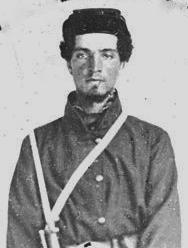
Private Abraham Nicholas Wolf, Company B, 47th Pennsylvania Volunteers, circa 1861 (public domain).
Some were middle-aged men, hardened by what they had seen, heard and endured as United States Army soldiers during the Mexican-American War or the opening months of the American Civil War. Far more were younger adults who had received some degree of “hands-on” experience with military protocols and the use of muskets or rifles as members of local militia units that had been operating in their hometowns for decades. A shocking number, however, were still baby-faced teenagers or even middle school-aged boys who were still too young to grow respectable beards, had no concept of the fragility of life (or the horrors that awaited them) and had only just figured out how to load and aim a weapon.
They were members of the recently-formed 47th Pennsylvania Volunteer Infantry and they had only just recently completed their basic training in Hardee’s light infantry tactics at Camp Curtin in Harrisburg, Dauphin County, Pennsylvania, which had taken place in three phases according to their manual of instruction:
Part One:
- Lesson 1: Position of the soldier without arms: Eyes right, left and front.
- Lesson 2: Facings.
- Lesson 3: Principles of the direct step in in common and quick time.
- Lesson 4: Principles of the direct step in double quick time and the run.
Part Two:
- Lesson 1: Principles of shouldered arms.
- Lesson 2: Manual of arms.
- Lesson 3: To load in four times, and at will.
- Lesson 4: Firings, direct, oblique, by file, and by rank.
- Lesson 5: To fire and load, kneeling and lying.
- Lesson 6: Bayonet exercise.
Part Three:
- Lesson 1: Union of eight or twelve men for instruction in the principles of alignment.
- Lesson 2: The direct march, the oblique march, and the different steps.
- Lesson 3: The march by the flank.
- Lesson 4: Principles of wheeling and change of direction.
- Lesson 5: Long marches in double quick time, and the run, with arms and knapsacks.
The “basic math” of that training was simple: those men who had mustered in for duty in early August had made it through more of those lessons than those who had only just mustered in mid-September — and there were simply not enough grains of sand left in “the nation’s hourglass” for company captains to bring the newest of the “newbies” up to speed.
Dressed for Success — Army Style
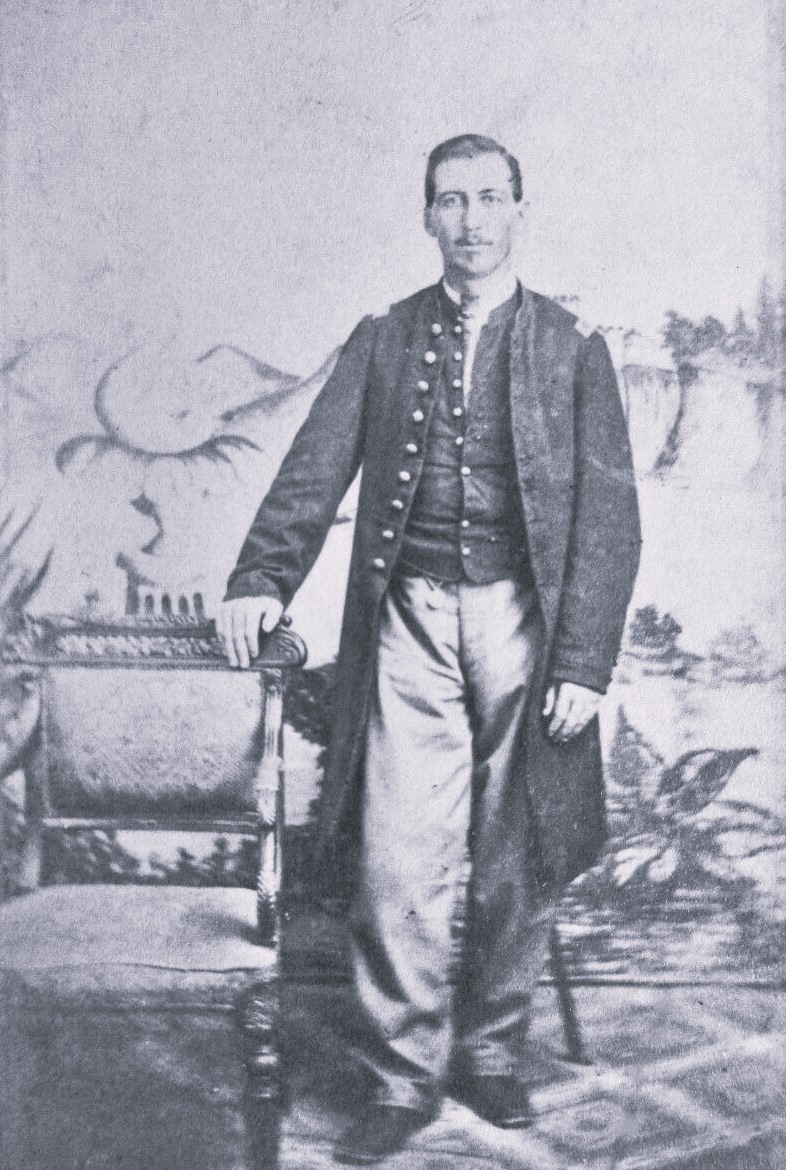
First Lieutenant Henry A. Haltiman, Sr., Company B, 47th Pennsylvania Volunteers, Charleston, South Carolina, 1865, public domain).
Trained as well as could be expected, given the national emergency that was threatening to tear the United States apart, the 47th Pennsylvania Volunteers were issued: “1 light blue overcoat, 1 extra good blouse, 1 pair dark pantaloons, 2 white flannel shirts, 2 pair drawers, 2 pair socks, 1 pair shoes, 1 cap, 1 knapsack (suspended from shoulder), 1 haversack (suspended from waist), 1 canteen,” Mississippi rifles, and ammunition on September 19, 1861, according to historian Lewis Schmidt. The next day, they were gathered together in formation, presented with the regiment’s First State Color (battle flag) by Pennsylvania Governor Andrew Curtin, and were marched to the railroad station in Harrisburg, where they hopped aboard a train and headed for the nation’s capital. Henry D. Wharton, a field musician with the 47th Pennsylvania’s C Company, who would function as the nineteenth-century equivalent of an “embedded reporter” for The Sunbury American throughout the war, sent one of his first dispatches on September 22:
“After a tedious ride we have, at last, safely arrived at the City of ‘magnificent distances.’ We left Harrisburg on Friday last at 1 o’clock A.M. and reached this camp yesterday (Saturday) at 4 P.M., as tired and worn out a sett [sic] of mortals as can possibly exist. On arriving at Washington we were marched to the ‘Soldiers Retreat,’ a building purposely erected for the benefit of the soldier, where every comfort is extended to him and the wants of the ‘inner man’ supplied.
After partaking of refreshments we were ordered into line and marched, about three miles, to this camp. So tired were the men, that on marching out, some gave out, and had to leave the ranks, but J. Boulton Young, our ‘little Zouave,’ stood it bravely, and acted like a veteran. So small a drummer is scarcely seen in the army, and on the march through Washington he was twice the recipient of three cheers.
We were reviewed by Gen. McClellan yesterday [21 September 1861] without our knowing it. All along the march we noticed a considerable number of officers, both mounted and on foot; the horse of one of the officers was so beautiful that he was noticed by the whole regiment, in fact, so wrapt [sic] up were they in the horse, the rider wasn’t noticed, and the boys were considerably mortified this morning on dis-covering they had missed the sight of, and the neglect of not saluting the soldier next in command to Gen. Scott.
Col. Good, who has command of our regiment, is an excellent man and a splendid soldier. He is a man of very few words, and is continually attending to his duties and the wants of the Regiment.
…. Our Regiment will now be put to hard work … and the boys expect and hope an occasional ‘pop’ at the enemy.”
And so it began — the history-making journey of the 47th Pennsylvania Volunteer Infantry.
Sources:
- Bates, Samuel P., in History of Pennsylvania Volunteers, 1861-5, vol. 1. Harrisburg, Pennsylvania: B. Singerly, State Printer, 1869.
- Bordewich, Fergus M. “Fort Sumter: The Civil War Begins,” in Smithsonian Magazine, April 2011. Washington, D.C.: Smithsonian Institution.
- “Camp Curtin Historical Marker,” in ExplorePAhistory.com. Harrisburg, Pennsylvania: Pennsylvania Historical and Museum Commission, retrieved online July 25, 2022.
- Dyer, Frederick H. A Compendium of the War of the Rebellion, p. 1589. Des Moines, Iowa: The Dyer Publishing Company, 1908.
- “Florida’s Role in the Civil War: ‘Supplier of the Confederacy.’” Tampa, Florida: Florida Center for Instructional Technology, University of South Florida (College of Education), retrieved online January 15, 2020.
- Gobin, John Peter Shindel. Personal Letters, 1861-1865. Northumberland, Pennsylvania: Personal Collection of John Deppen.
- Grodzins, Dean and David Moss. “The U.S. Secession Crisis as a Breakdown of Democracy,” in When Democracy Breaks: Studies in Democratic Erosion and Collapse, from Ancient Athens to the Present Day (chapter 3). New York, New York: Oxford University Press, 2024.
- “History of Camp Curtin.” Harrisburg, Pennsylvania: Camp Curtin Historical Society, retrieved online July 25, 2022.
- Huntington, Tom. Pennsylvania Civil War Trails: The Guide to Battle Sites, Monuments, Museums and Towns, pp. 65-66. Harrisburg, Pennsylvania: Pennsylvania Historical and Museum Commission, 2007; Mechanicsburg, Pennsylvania: Stackpole Books, 2007.
- Irwin, Richard Bache. History of the Nineteenth Army Corps. New York, New York: G. P. Putnam’s Sons, 1893.
- Keener-Farley, Lawrence and James Schmick. Civil War Harrisburg: A Guide to Capital Area Sites, Incidents and Personalities, second edition. Harrisburg, Pennsylvania, Camp Curtin Historical Society, 2008.
- Miller, William J. The Training of an Army: Camp Curtin and the North’s Civil War. Shippensburg, Pennsylvania: White Mane Publishing, 1990.
- “Roster of the 47th P. V. Inf.” Allentown, Pennsylvania: The Morning Call, October 26, 1930.
- Schmidt, Lewis G. A Civil War History of the 47th Regiment of Pennsylvania Veteran Volunteers. Allentown, Pennsylvania: Self-published, 1986.
- Scott, Robert N. The War of War of the Rebellion: A Compilation of the Official Records of the Union and Confederate Armies, series I, vol. XXXIV, part II: “Correspondence, etc.-Union,” Chapter XLVI: “Louisiana and the Trans-Mississippi,” p. 199. Washington, D.C.: Government Printing Office, 1891.
- “The History of the Forty-Seventh Regt. P. V.” Allentown, Pennsylvania: The Lehigh Register, July 20, 1870.
- Wharton, Henry D. “Letters from the Sunbury Guards.” Sunbury, Pennsylvania: The Sunbury American, 1861-1866.


You must be logged in to post a comment.