Juneteenth — Forever a Day to Remember

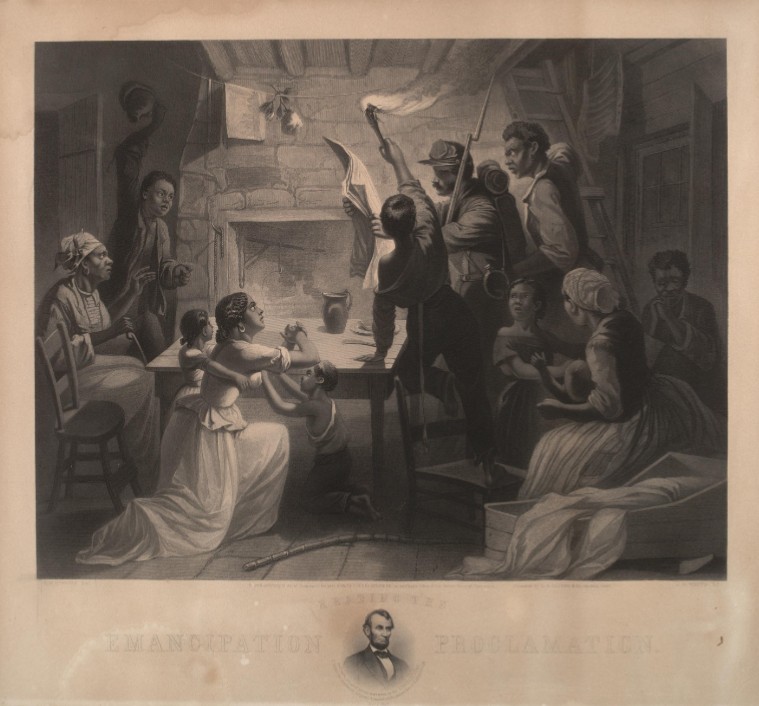
Union soldiers were depicted reading the Emancipation Proclamation to an enslaved family in 1864 by artist Lucius Stebbins (public domain).

“The people are informed that, in accordance with a proclamation from the Executive of the United States, all slaves are free.” — Major-General Gordon Granger, United States Army, Galveston Texas, June 19, 1865


With those words, the United States of America took another step forward in the effort to completely eradicate the savage practice of chattel slavery across the nation. It was on that date that Union Major-General Gordon Granger, commanding officer of the United States’ District of Texas, began to inform African American men, women and children who were still being held in bondage across Texas (despite President Abraham Lincoln’s announcement of the Emancipation Proclamation on January 1, 1863 and despite the Confederacy’s surrender in Virginia on April 9, 1865) that the people who had enslaved and brutalized them no longer had any power over them.

That same day, Major-General Granger also served notice to enslavers across Texas that their days of treating other human beings as their personal property were over. He did so by publishing General Orders, No. 3 in newspapers statewide. Not as forceful as it should have been, because its wording discouraged many newly-freed people from truly escaping from their enslavers while also effectively encouraging those enslavers to continue their efforts to dominate and subjugate the same people they had long exploited (as poorly-paid “employees”), his directive was still forceful enough to move the United States forward in its long struggle to become a fairer and more just nation:

Headquarters, District of Texas,
Galveston, Texas, June 19, 1865.

General Orders, No. 3.

The people are informed that, in accordance with a proclamation from the Executive of the United States, all slaves are free. This involves an absolute equality of personal rights and rights of property, between former masters and slaves, and the connection heretofore existing between them, becomes that between employer and hired labor. — The Freedmen are advised to remain at their present homes, and work for wages. They are informed that they will not be allowed to collect at military posts; and that they will not be supported in idleness either there or elsewhere.

By order of
Major-General Granger (Signed,)
F. W. Emery, Maj. and A. A. G.

Around that same time, a reporter for The New York Tribune described the atmosphere in and around the city where Major-General Granger was headquartered:

Galveston is a city of dogs and desolation. It is hard to tell which a stranger would be soonest impressed with — the multiplicity of the canine or the poverty and degradation of the human species.

…. No other Southern city of its prominence and local importance is so utterly insignificant and God-forsaken in appearance. It is desolation desolated, for before the war it was a parched and barren land. There is no shady park, and but one pleasant ride. The trees are stunted and scraggy like the people…. 

Loyalty does not manifest itself. There are loud professions. There are bitter and, I doubt not, sincere cursings of Davis and Kirby Smith. There are more welcomes to our presence, and especially to our greenbacks. But true loyalty — that prefers the United States to Texas; that venerates Washington above Houston; that loves freedom more than Slavery — is an exceedingly rare pearl in Galveston. I know how hard it is to distinguish the genuine from the counterfeit, but I am forced to believe the statement made to me a few days since by one who was well acquainted in every part of the State.

I asked him what he thought of the Amnesty Proclamation. He replied, “If it is carried out strictly, with its exceptions, not a wealthy man in Texas can escape, for all have aided and voluntarily assisted the Rebellion.”

THE LONE STAR CONFEDERACY

Even now, while Union soldiers patrol the streets, and a powerful fleet is anchored off the city, these narrow-minded and impoverished people cling to the idea of State independence. They want to fly the “Lone Star” flag once more, to subdivide their country into four States or more, and to become a recognized power in the world. Hireling editors and selfish leaders have actually made the masses believe that Texas came into the Union with the promise that she could go out again next year if she chose to do so….

THE SLAVES

There are many more slaves in Texas than there were before the war, but the institution is waning even here….

Aiding with Reconstruction

It is worth noting that, during the Union’s 1864 Red River Campaign, a small group of 47th Pennsylvania Volunteer Infantrymen actually became eyewitnesses to what life was like in Texas during the American Civil War. While their perspectives would have been somewhat limited, because they were actually watching events unfold while they were being force marched to Camp Ford near Tyler, Texas, and were then confined there as prisoners of war (POWs), they encountered both impoverished Texans and the brutality of chattel enslavement — compelled to watch helplessly as Confederate civilians and soldiers terrorized enslaved Black men, women and children while forcing them to perform back-breaking work.

Although a significant number of the seventeen 47th Pennsylvania Volunteers who were imprisoned at Camp Ford died there from starvation, disease and harsh treatment, most managed to survive — many of whom were subsequently given medical care by Union Army physicians and then honorably discharged on surgeons’ certificates of disability because their bodies and minds were no longer fit for duty.

But some actually recovered, returned to duty with the 47th Pennsylvania Veteran Volunteers and continued to serve with the regiment — by trying to help communities in Georgia and South Carolina rebuild as they returned to the Union. First Sergeant James Crownover, Corporal James Downs, Sergeant John Garber Miller, and Private William J. Smith were among the former Camp Ford POWs who traveled with their fellow 47th Pennsylvanians to Savannah, Georgia and to Charleston, South Carolina for provost and Reconstruction Era-related duties during that same summer of 1865 when enslaved people in Texas were being informed that they were finally free. Also traveling with the 47th Pennsylvania Volunteers to Georgia and South Carolina were nine formerly enslaved Black men who had enlisted in the 47th Pennsylvania Volunteer Infantry in 1862 (in South Carolina) and in 1864 (in Louisiana): Aaron Bullard (later known as “Aaron French“), James Bullard, John Bullard, Bristor Gethers, John Hamilton (later known as “Hamilton Blanchard“), Thomas Haywood, Abraham Jassum, Edward Jassum, and Samuel Jones.

Likely unaware of Major-General Gordon Granger’s emancipation announcement when it was first published on June 19, 1865, they eventually learned about what had happened that day as word spread beyond the borders of Texas. All nine ultimately survived the war, and went on to forge new lives for themselves as Freedmen. One even went on to become a delegate to a Republican Party convention during his post-war years.

Meanwhile, that important date would come and go every year across the nation. Remembered and commemorated as “Juneteenth” in Texas initially, and then in Louisiana and other states, as community elders, church leaders and educators taught new generations about the Emancipation Days of 1863 and 1865, June 19th was finally declared as an official federal holiday when the United States of America’s Juneteenth National Independence Day Act was signed into law on June 17, 2021.


Sources:

  1. “Blacks Celebrate Their Day of Independence.” Milwaukee, Wisconsin: Associated Press Wire Service, June 1975; Pascagoula, Mississippi: Mississippi Press Register, June 22, 1975; and Greenwood, South Carolina: The Index-Journal, June 20, 1975.
  2. Carson, Kelly. “Juneteenth Parade Salutes Miss Lillie.” Hattiesburg, Mississippi: Hattiesburg American, December 14, 1989.
  3. Carter, Kevin L. “Blacks’ Juneteenth Here from Texas Roots.” Pittsburgh, Pennsylvania: The Pittsburgh Press, June 15, 1987.
  4. “Celebrating June-Teenth.” Lake Charles, Louisiana: The American-Press, June 19, 1917.
  5. “From Texas: Galveston Occupied by Colored Troops — Dreariness and Desolation of the City — Questionable Loyalty of the People — The Lone Star Confederacy Again — The Reign of Terror” and “The Slaves Declared Free — The Acts of the Governor and Legislature Void — Public Property to Be Returned.” New York, New York: The New York Tribune, July 7, 1865.
  6. “From Texas: Granger in Command — His General Orders — Sheridan in Texas — Weitzel’s Command to Disembark at Brazos.” Pittsburgh, Pennsylvania: The Daily Post, July 8, 1865.
  7. “General Granger’s Order on Personal Equality in Texas.” Wheeling, West Virginia: The Wheeling Daily Register, July 8, 1865.
  8. “General Orders, No. 3” (announcement by Union Major-General G. Granger that “all slaves are free”). Galveston, Texas: The Galveston Daily News, June 21, 1865.
  9. “Grambling Slates Juneteenth Holiday.” Monroe, Louisiana: Monroe News-Star, June 17, 1976.
  10. Jackson, Anna and Katherine Schaeffer. “More Than Half of States Will Recognize Juneteenth as a Legal Holiday in 2026.” Washington, D.C.: Pew Research Center, June 11, 2026.
  11. Juneteenth, in “Swimming Hero Will Be Heard.” Greenville, South Carolina: The Greenville News, August 15, 1937.
  12. “‘Juneteenth’ a Big Day in This Section on Last Tuesday.” Jena, Louisiana: The Jena Times, June 21, 1934.
  13. “‘Juneteenth’ Committee,” in “Emancipation Celebration.” San Antonio, Texas: The Daily Light, May 16, 1893.
  14. “Juneteenth Is Here Again: Celebration of Negro Freedom Will Extend Over Period of Two Days.” Houston, Texas: The Houston Chronicle, June 19, 1910.
  15. “‘Juneteenth’ Is Marked By B.B.Q.” Opelousas, Louisiana: Daily World, June 20, 1948.
  16. Maraniss, David. “Juneteenth Celebration Makes Comeback in Texas.” Washington, D.C.: The Washington Post, June 1990; and Philadelphia, Pennsylvania: The Philadelphia Inquirer, June 24, 1990.
  17. Our American Story — Juneteenth.” Washington, D.C.: National Museum of African American History and Culture, Smithsonian Institution, retrieved online June 15, 2026.
  18. Pradarits, Rick. “Black Mayors Ask Holiday Off.” Houston, Texas: United Press International Wire Service, May 1980; and Shreveport, Louisiana: The Times, May 21, 1980.
  19. Public Law 117 – 17- Juneteenth National Independence Day Act,” in “GovInfo.” Washington, D.C.: U.S. Government Publishing Office, retrieved online June 15, 2026.
  20. Ramsey, Sonya Y. “Juneteenth Recalls Black Heritage.” Rosslyn, Virginia: Gannett News Service, June 1988; and Shreveport-Bossier, Louisiana: The Times, June 15, 1988.
  21. “The Colored Citizens Make Further Arrangements for Their Emancipation Celebration.” Houston, Texas: Houston Daily Post, April 23, 1901.
  22. The Emancipation Proclamation,” in “Featured Documents.” Washington, D.C.: U.S. National Archives and Records Administration, retrieved online June 15, 2026.
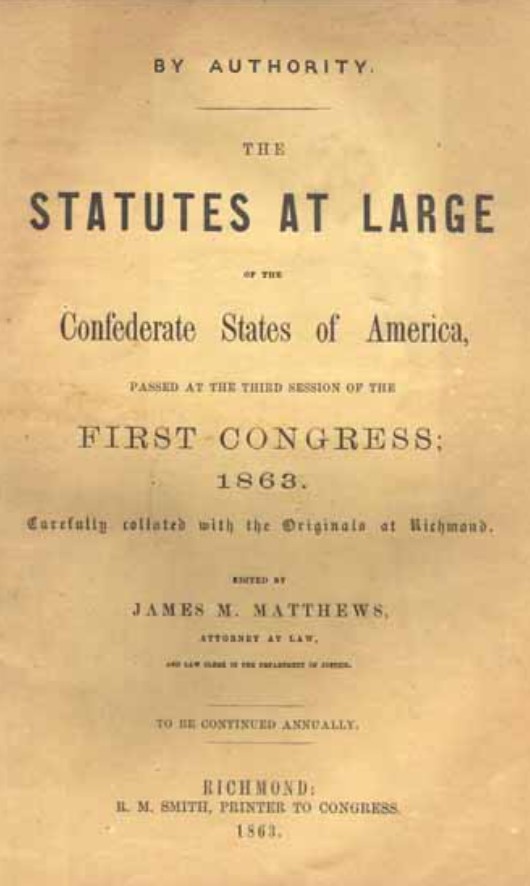
 

A Significant Confederate Threat to Black Union Soldiers and Their White Commanders (May 1, 1863)

Cover page of The Statutes at Large of the Confederate States of America, Passed at the Third Session of the First Congress, 1863 (Richmond, Virginia: R. M. Smith, Printer to Congress, 1863, public domain; click to enlarge).

During its legislative session on May 1, 1863, the Confederate Congress enacted several pieces of legislation prior to approving additional new resolutions. The most important, perhaps (from the perspective of historians and students engaged in research about the American Civil War), was resolution number five in which leaders of the Confederacy made clear their intent to re-enslave or execute Black Union soldiers if and when they were captured by Confederate troops — and to also execute their White commanding officers should any of those officers be captured by Confederate troops. The text of that resolution read as follows:

Resolved, by the Congress of the Confederate States of America, in response to the message of the President, transmitted to Congress at the commencement of the present session, that in the opinion of Congress the commissioned officers of the enemy ought not to be delivered to the authorities of the respective States, as suggested in the said message; but all captives taken by the confederate forces ought to be dealt with and disposed of by the confederate government.

Sec. 2. That, in the judgment of Congress, the Proclamations of the President of the United States, dated respectively September twenty-second, eighteen hundred and sixty-two, and January first, eighteen hundred and sixty-three, and the other measures of the Government of the United States and of its authorities, commanders and forces, designed or tending to emancipate slaves in the confederate States, or to abduct such slaves, or to incite them to insurrection, or to employ negroes in war against the confederate States, or to overthrow the institution of African slavery and bring on a servile war in these States, would, if successful, produce atrocious consequences, and they are inconsistent with the spirit of those usages which in modern warfare prevail among civilized nations; they may, therefore, be properly and lawfully repressed by retaliation.

Sec. 3. That in every case wherein, during the present war, any violation of the laws or usages of war among civilized nations shall be, or has been, done and perpetrated by those acting under the authority of the Government of the United States, on the persons or property of citizens of the confederate States, or of those under the protection or in the land or naval service of the confederate States, or of any State of the Confederacy, the President of the confederate States is hereby authorized to cause full and complete retaliation to be made for every such violation, in such manner and to such extent as he may think proper.

Sec. 4. That every white person, being a commissioned officer, or acting as such, who, during the present war, shall command negroes or mulattoes in arms against the confederate States, or who shall arm, train, organize, or prepare negroes or mulattoes for military service against the confederate States, or who shall voluntarily aid negroes or mulattoes in any military enterprise, attack, or conflict in such service, shall be deemed as inciting servile insurrection, and shall, if captured, be put to death, or be otherwise punished at the discretion of the court.

Sec 5. Every person, being a commissioned officer, or acting as such in the service of the enemy, who shall, during the present war, excite, attempt to excite or cause to be excited servile insurrection, or who shall incite or cause to be incited a slave to rebel, shall, if captured, be put to death, or be otherwise punished at the discretion of the court.

Sec 6. Every person charged with an offence punishable under the preceding resolutions shall, during the present war, be tried before the military court attached to the army or corps by the troops of which he shall have been captured, or by such other military court as the President may direct, and in such manner and under such regulations as the President shall prescribe, and, after conviction, the President may commute the punishment in such manner and on such terms as he may deem proper.

Sec. 7. All negroes and mulattoes who shall be engaged in war or taken in arms against the confederate States, or shall give aid or comfort to the enemies of the Confederate States, shall, when captured in the Confederate States, be delivered to the authorities of the State or States in which they shall be captured, to be dealt with according to the present or future laws of such State or States.

Approved May 1, 1863.


Sources:

  1. “Act Passed by the Rebel Congress: No. 74: Joint Resolution on the Subject of Retaliation.” St. Louis, Missouri: Daily Missouri Republican, June 5, 1863.
  2. “Acts Passed by the Rebel Congress: No. 74.” New York, New York: New York Herald, May 31, 1863.
  3. “Joint Resolutions on the Subject of Retaliation,” in “Acts Passed by the Confederate Congress [No. 74],” in “Late and Interesting News from the South — The Spirit and Tone of Rebel Journals.” Lafayette, Indiana: The Lafayette Weekly Argus, June 11, 1863.
  4. “Joint Resolutions on the Subject of Retaliation,” in “Latest News from the South.” Baltimore, Maryland: The Sun, June 2, 1863.
  5. No. 5: Joint Resolution on the Subject of Retaliation” (approved on May 1, 1863), in “Resolutions ” in “The Statutes at Large of the Confederate States of America, Passed at the Third Session of the First Congress; 1863. Carefully Collated with the Originals at Richmond,” in “Documenting the American South.” Chapel Hill, North Carolina: University Library, University of North Carolina at Chapel Hill, retrieved online April 24, 2026.
  6. “Rebel Law of Retaliation.” Keokuk, Iowa: The Gate City, June 18, 1863.
  7. “Rebel Law of Retaliation.” Pittsburgh, Pennsylvania: The Daily Pittsburgh Gazette, June 5, 1863.
  8. “Rebel Law of Retaliation” and “Gen. Hunter’s Letter to Jeff. Davis.” Indiana, Pennsylvania: Weekly Register, June 9, 1863.
  9. “Rebel Retaliation.” Kansas City, Missouri: The Journal of Commerce, June 11, 1863.
  10. “Retaliation Upon the Enemy: Report of the Judiciary Committee of the Confederate Senate — The Action of Congress.” Richmond, Virginia: The Richmond Whig, May 15, 1863.
  11. “The Retaliatory Act, Confederate Congress, May 1, 1863,” in “House Divided: The Civil War Research Engine at Dickinson College.” Carlisle, Pennsylvania: Dickinson College, retrieved online April 24, 2026.
  12. “The Retaliatory Code.” Washington, D.C.: Daily National Intelligencer, June 5, 1863.


Women’s History: A 47th Pennsylvania Wife Who Was “Married by Slave Custom”

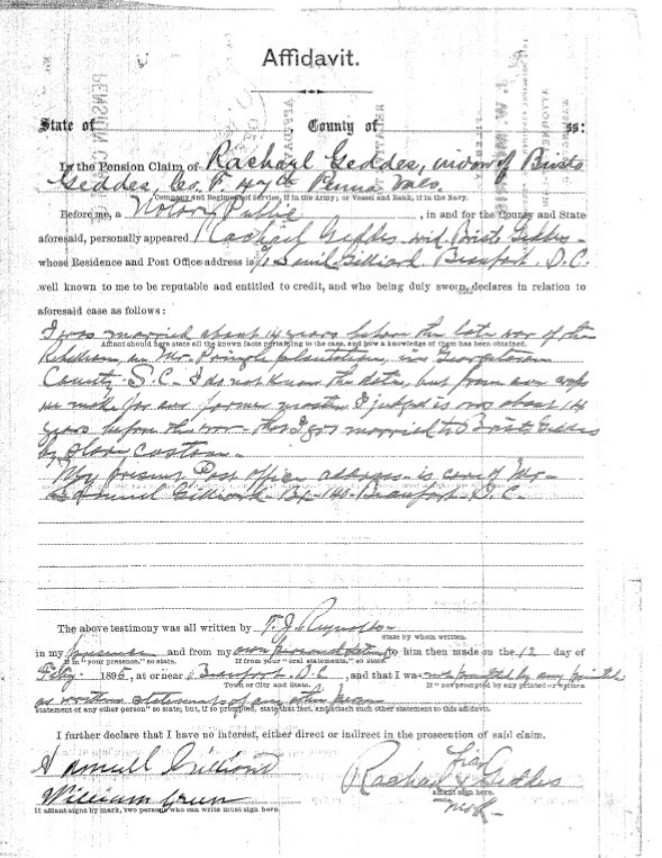
“I was married about 14 years before the late War of the Rebellion, on Mr. Pringle plantation, in Georgetown County, S.C. I do not know the date, but from our crops we make for our former master I judged it was about 14 years before the war that I got married to Bristo Geddes by slave custom.” — Rachael (Richardson) Gethers, excerpt from an affidavit filed by her attorney on February 12, 1895


Attestation made February 12, 1895 by Rachael (Richardson) Gethers of her 1847 marriage “by slave custom” on the Pringle plantation in Georgetown County, South Carolina to Bristor Gethers (affidavit excerpt, U.S. Civil War Widow’s Pension File of Bristor and Rachael Gethers, U.S. National Archives and Records Administration, public domain; click to enlarge).

We do not know the names of this woman’s parents, but we do know her name and the names of her husband and their closest friends, thanks to documents that were filed on her behalf by an attorney in Beaufort County, South Carolina, as part of her application for a U.S. Civil War Widow’s Pension during the late 1890s.

Her name was Rachael (Richardson) Gethers, and she was born into slavery in South Carolina circa 1825. Her parents, who had also been born in South Carolina, according to Rachael’s U.S. Census entries for 1870 and 1880, had also likely been born into slavery.

Virtually nothing else is known at present about her childhood and teen years. What researchers do know is that Rachael was still enslaved at the time of her marriage in Georgetown County, South Carolina, circa 1847 — during her early twenties, to Bristor Gethers, a man who was enslaved on the same plantation in that county.

* Note: The plantation where Rachael Richardson and Bristor Gethers were enslaved was owned by one of the largest family of enslavers in the United States — the Pringles. Among their multiple plantations and other Georgetown County properties were Beneventum and the White House Plantation, both of which were devoted primarily to rice production and profited from the labor of hundreds of enslaved Black men, women and children. (The Pringles had been actively engaged in the slave trade since the 1700s, and had broadened their wealth and power by marrying members of other families that were also heavily involved in chattel slavery, including the Allstons.)

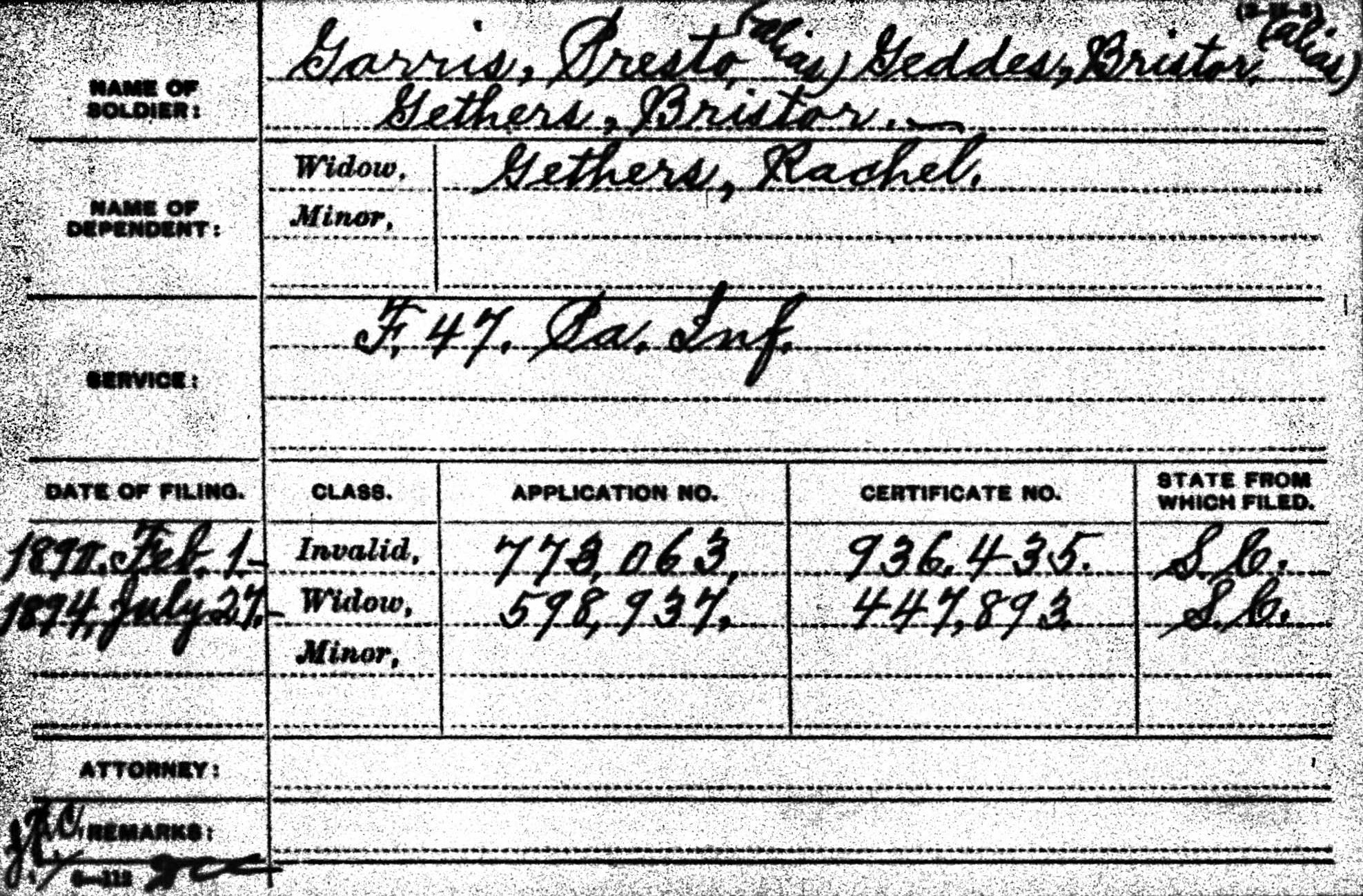
Unfortunately, the first and last names of Rachael (Richardson) Gethers’ husband were repeatedly misspelled in multiple civic, Freedmen’s Bureau, and military records throughout the nineteenth century. Variants of his given name between 1862 and 1893 included: Brista, Brister, Bristo, Bristor, Presto, Prestor, and Pristo; variants of his surname included: Gaddis, Garres, Garrees, Garris, Gathers, Geddes, Geddis, Gethers, Gettes. Affidavits filed in later life by Bristor Gethers and his attorney during the early 1890s finally confirmed the correct spelling of his name as “Bristor Gethers.” Rachael’s married surname was also spelled in various ways during her lifetime. In later years, an attorney who filed documents on her behalf for her application for a U.S. Civil War Widow’s Pension chose to spell her married surname as “Geddes.” Written as “Rachael” by that same attorney, her given name was spelled as “Rachel” on other records of the mid to late nineteenth century.

American Civil War

Spelling variants for Rachael (Richardson) Gethers and Bristor Gethers (U.S. Civil War General Pension Index Cards, U.S. National Archives, public domain).

The exact details of what happened to Rachael (Richardson) Gethers and her husband between the time of her marriage and the first years of the American Civil War are presently not known, but researchers do know that a new chapter in their life story began when her husband enlisted with a Union Army regiment in the city of Beaufort, South Carolina during the fall of 1862. Freed or escaped from slavery by that time, he joined the Union Army as a “Negro Under-Cook,” was entered onto the roster of Company F of the 47th Pennsylvania Volunteer Infantry on October 5, 1862, would go on to receive promotions to the rank of cook and then private during his three-year term of enlistment, and would travel with the 47th Pennsylvania as a member of its F Company to multiple duty stations and battle sites in Florida, Louisiana, Virginia, and Washington, D.C. during that war — and then to Georgia and South Carolina during five post-war months of the Reconstruction Era, at which point he was honorably discharged and allowed to return home to his wife.

Researchers have not yet determined what happened to Rachel during that same period, however; she may have escaped with Bristor and traveled with him to Beaufort or may have been freed herself by Union troops — or she may have remained behind, still enslaved on the Georgetown County plantation where they had been married, hoping that her husband would eventually return to free her.

What is known for certain is that Bristor did find her again.

Post-War Years

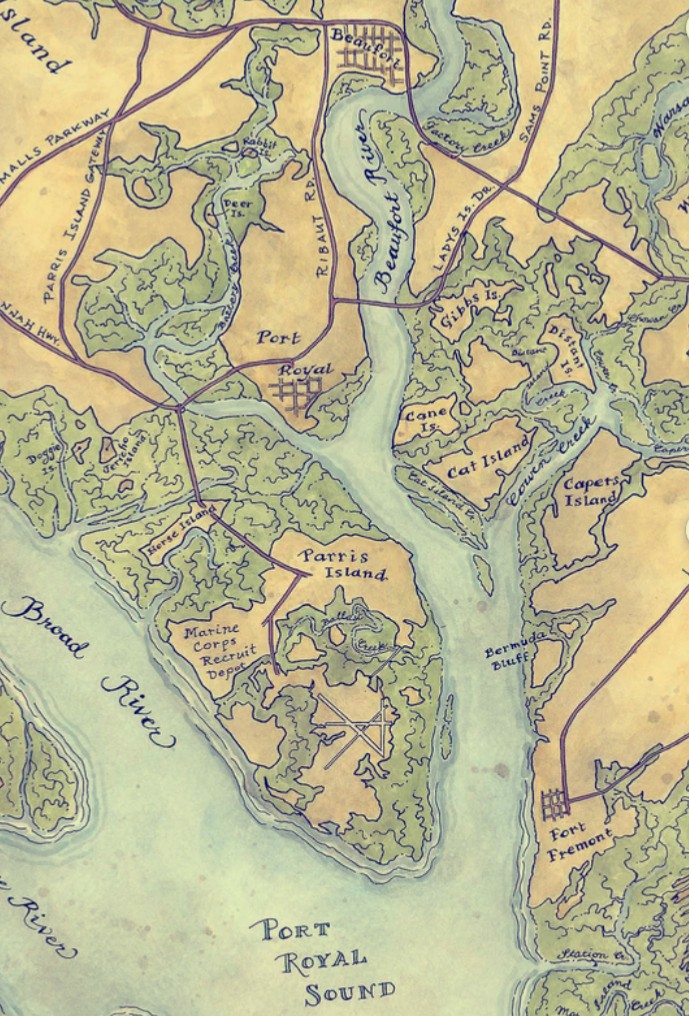
Horse Island, slightly above and to the left of Parris Island in Beaufort County, South Carolina (public domain; click to enlarge).

Following her husband’s honorable discharge from the Union Army, Rachael (Richardson) Gethers and her husband, Bristor, resumed life as a married couple. U.S. Census and Freedmen’s Bureau records confirm that they initially made their home in or near the city of Beaufort, South Carolina. Sometime around 1869, however, they relocated to Horse Island, in Beaufort Township, Beaufort County. According to the 1870 federal census, they resided there with their six-year-old son, Peter. By the time that the federal census was enumerated in 1880, however, their Horse Island household no longer included Peter.

Throughout their post-war years, Rachael and Bristor Gethers were farmers who often struggled to make ends meet. This was largely due to the fact that they were often required to turn over a significant portion of the funds they earned from their crops each harvest — under the terms of Freedmen’s Bureau contracts and other legal agreements that favored the wealthy White landowners whose land they were hired to farm. Adding to their worries was Bristor’s failing health. Having fallen seriously ill with dysentery during his military service, he was plagued by lifelong heart problems and chronic diarrhea that often left him too disabled to work.

But they persisted and managed to build a life together on Horse Island that lasted for nearly three decades. Preceded in death by her husband when he passed away on Horse Island in Beaufort Township on June 25, 1894, Rachael was so financially insecure at that point in her life that she was unable to pay for his burial. So, she reached out to friends for help.

Her husband’s close friend, Samuel Gilliard, was among the first to come to her rescue. He brought a coffin to the Gethers’ home, placed Bristor’s body in it and enlisted the help of Rachael’s neighbors in carrying the coffin down to the water, where they placed it on a boat, enabling Sam to transport it to Beaufort County’s Parris Island. Met there by William Green and other able-bodied men, Sam and his friends carried the coffin to a graveyard somewhere on that island, dug a new grave and laid Bristor to rest on June 26, 1894, according to affidavits that Sam and William both filed in support of Rachael’s Civil War widow’s pension application.

Life as a Widow

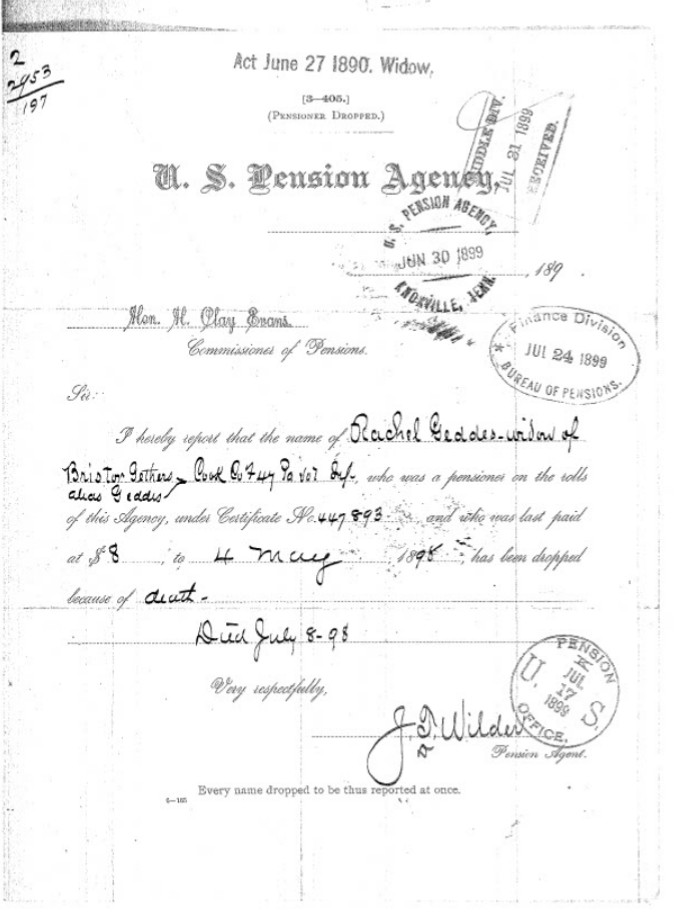
U.S. Pension Agency’s confirmation of Rachael (Richardson) Gethers’ date of death (U.S. National Archives and Records Administration, public domain; click to enlarge).

With a small U.S. Civil War Widow’s Pension of eight dollars per month (roughly three hundred and fifteen dollars per month in 2026 dollars), Rachael (Richardson) Gethers managed to survive her late husband by roughly four years. A certificate prepared by J. T. Wilder on behalf of the U.S. Pension Agency on June 30, 1899 confirmed that she died in Beaufort County, South Carolina on July 8, 1898.

Her exact burial location remains unknown, but is believed by researchers to be located somewhere on Parris Island in Beaufort County, South Carolina, based on U.S. Civil War Pension records which confirm that Parris Island was the burial location of her husband, Bristor Gethers.

* Note: To learn more about Rachael (Richardson) Gethers and her husband, Bristor, please read their full biography here and view their census and pension records, which are located on our website, Freedmen of the 47th Pennsylvania Volunteer Infantry (part of our special project dedicated to documenting the life histories of the nine formerly enslaved Black men who enlisted with the 47th Pennsylvania Volunteers).


Sources:

  1. Gaddis, Rachael, in U.S. Freedmen’s Bureau Hospital Records (Beaufort, South Carolina, December 1867), in Records of the Bureau of Refugees, Freedmen, and Abandoned Lands. Washington, D.C.: U.S. National Archives and Records Administration.
  2. Garris, Presto [sic, “Bristor Gethers”], in Civil War Muster Rolls and Civil War Veterans’ Card File, 1861-1866 (Company F, 47th Pennsylvania Infantry). Harrisburg, Pennsylvania: Pennsylvania State Archives.
  3. Garris, Presto (alias “Geddes, Bristor” and “Gethers, Bristor”) and Gethers, Rachel, in U.S. Civil War General Pension Index Cards (veteran’s application no.: 773063, veteran’s certificate no.: 936435, filed by the veteran from South Carolina, February 1, 1890; veteran’s widow’s application no.: 598937, veteran’s widow’s certificate no.: 447893, filed by the veteran’s widow from South Carolina, July 27, 1894). Washington, D.C.: U.S. National Archives and Records Administration.
  4. Geddes, Brister [sic, “Bristor Gethers”], Rachel and Peter, in U.S. Census (Beaufort, Beaufort Township, Beaufort County, South Carolina, 1870). Washington, D.C.: U.S. National Archives and Records Administration.
  5. Geddis, Brista [sic, “Bristor Gethers”] and Rachel, in U.S. Census (Beaufort Township, Beaufort County, South Carolina, 1880). Washington, D.C.: U.S. National Archives and Records Administration.
  6. Power, J. Tracy and Sherry Piland. “National Register of Historic Places Form: Beneventum Plantation” (filed by historians at the South Carolina Department of Archives and History, Columbia, South Carolina, September 15, 1987). Washington, D.C.: U.S. Department of the Interior, National Park Service.
  7. Roldán-Shaw, Michele. “Exploring the Sea Islands of Beaufort County.” Hilton Head, South Carolina: Local Life Insiders, retrieved online March 31, 2026.


Black History Month: Say His Name, Then Share His Story

Page one of the U.S. Army’s Civil War enlistment paperwork for Bristor Gethers (mistakenly listed as “Presto Garris”), 47th Pennsylvania Volunteer Infantry, Company F, 5 October 1862 (U.S. National Archives and Records Administration, public domain; click to enlarge).

Our realization, as researchers, that there were at least nine formerly enslaved Black men who enlisted with the 47th Pennsylvania Volunteer Infantry during the American Civil War was sparked by a single index card for a soldier named “Presto Garris” that we found in the Pennsylvania Civil War Veterans’ Card File, which is maintained by the Pennsylvania State Archives.

Our ability to determine the true name of that soldier and correct the historical record about his life by researching and writing his biography was made possible by reading the dozens of pages contained in his U.S. Civil War Pension file and Compiled Military Service Records, which are maintained by the U.S. National Archives and Records Administration.

It was worth every penny of the roughly one hundred and ten dollars that we spent to obtain copies of those records from the National Archives because one of those documents confirmed the precise location of where that soldier had been enslaved prior to the war while others told us that he had survived the war and had lived out his life as a farmer. Another document even provided clues to the location of his grave.

That knowledge was so much more than we could have ever have hoped to gain because so many of the millions of men, women and children who were sold into, born into and re-sold throughout the American system of chattel slavery were never identified by name on state and federal census records prior to the war or were listed under names that had been created for them by their enslavers.

So, it matters that we’re able to tell you, for certain, that the true name of the soldier listed on that aforementioned index card was Bristor Gethers, that he lived near Mt. Pleasant, South Carolina after the war and that he resided with his wife and son near Beaufort, South Carolina after that. Please take the time to learn more about him by reading his bio on our educational program’s special website, Freedmen of the 47th Pennsylvania Volunteer Infantry. Then, look through the records that document his life’s journey.

Mr. Gethers’ story teaches us all that it is possible to find a new way forward after surviving the darkest of times.


Sources:

  1. “Garris, Presto,” in Civil War Muster Rolls (Company F, 47th Pennsylvania Infantry). Harrisburg, Pennsylvania: Pennsylvania State Archives.
  2. “Garris, Presto,” in Pennsylvania Civil War Veterans’ Card File, 1861-1866 (Company F, 47th Pennsylvania Infantry). Harrisburg, Pennsylvania: Pennsylvania State Archives.
  3. “Geddis, Brista” and “Geddis, Rachel,” in U.S. Census (Beaufort Township, Beaufort County, South Carolina, 1880). Washington, D.C.: U.S. National Archives and Records Administration.
  4. “Geddis, Brister,” in “Agreement Between B. J. Whitesides and Fifteen Freedmen” (Mt. Pleasant, South Carolina, 12 February 1868), in “Records of the Bureau of Refugees, Freedmen, and Abandoned Lands.” Washington, D.C.: U.S. National Archives and Records Administration.
  5. “Gethers, Bristor,” “Garris, Presto” and “Geddes, Bristor,” in U.S. Civil War Pension and U.S. Civil War Widows’ Pension Files (widow’s pension application no.: 598937, widow’s certificate no.: 447893, filed by the widow, Rachel Geddes, from South Carolina, 27 July 1894). Washington, D.C.: U.S. National Archives and Records Administration.