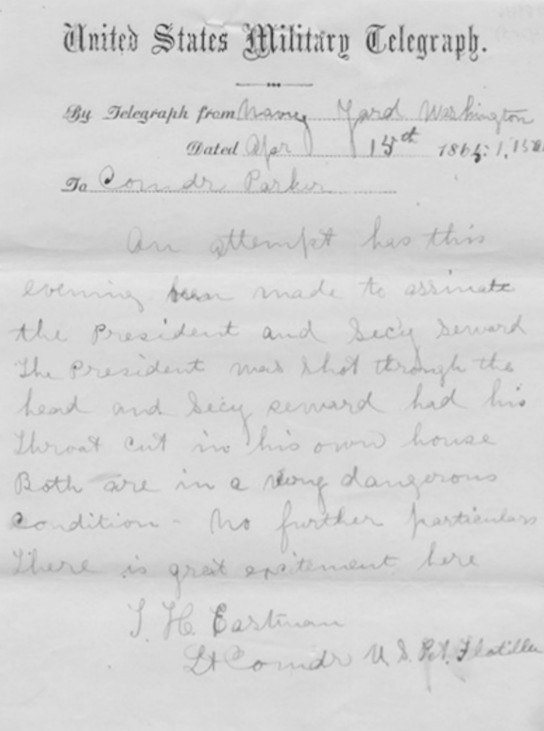
Telegram announcing the assassination of U.S. President Abraham Lincoln, sent by Henry Harrison Atwater at the U.S. Navy Yard in Washington, D.C. on 15 April 1865 at 1:30 a.m. (U.S. National Archives and Records Administration, public domain; click to enlarge).
They are fleeting glimpses into a nation reeling from the death of a beloved hero. Viewed in chronological sequence, they take readers from the utter shock experienced by stunned government employees through the stages of grief as they tried to carry out their expected duties while also coming to terms with their own emotions about what was unfolding through the chaos and confusion around them.
They were the telegrams, logbook entries, military orders, dispatches from executives of the United States government to their subordinates who were stationed throughout the U.S. and across the globe, and other documents that were hurriedly created during the immediate and ongoing aftermath of the assassination of United States President Abraham Lincoln, and they are illuminating, heartbreaking and, at times, infuriating — particularly as their intensity builds with each update regarding the dramatic hunt for, and capture of, the perpetrator and facilitators of one the most vile acts in American history.
Henry Harrison Atwater
Among the briefest but most powerful of the telegraph messages that were dispatched during the first hours after President Lincoln was shot at Ford’s Theatre were those transmitted by Washington Navy Yard telegrapher Henry Harrison Atwater:
- War Dept. Apr. 14 (186)5. Comd Parker. An attempt has been made this P.M. to assassinate the President & Secy of State – The parties may escape or attempt to escept [sic] down the Potomac [unclear] J.H. Taylor, Chf Staff
- War Dept. Washington. Apr 15th (186)5. 1.05 a.m. Brig Gen. Barnes Pt. Lookout. Stop all vessels going down the river & hold all persons on them till further orders and [sic] attempt has been made tonigh [sic] to assassinate the President & secy of state hold all persons leaving Washington H.W. Halleck Maj Gen Chf Staff
- Navy Yard Washington Apr 15th (186)5 1.15 a.m. Comdr Parker. An attempt has this evening been made to assinate [sic] the President and Sec’y Seward The President was shot through the head and Secy seward [sic] had his throat cut in his own house Both are in a very dangerous condition. No further particulars There is great excitement here T.H. Eastman Lt Comdr U.S. Pot. Flotilla
- War Dept Apr 15 (186)5 8 a.m. H.H. Atwater President died at seven twenty two (7.22) this a.m. Maynard Operator
- War Dept April 15th 2.20 p.m. (186)5. Comd J.B. Montgomery Navy Yard If the military authorities arrest the murderer of the President and take him to the yard put him on a monitor & anchor her in the stream with strong guard on vessel – wharf – and in yard Call upon Comdt Marine Corps for guard – Have vessel immediately prepared ready to receive him at any hour day or night with necessary instructions he will be heavily ironed and so guarded as to prevent escape or injury to himself Gideon Welles Secy Navy
Atwater, when interviewed half a century later for the May 1, 1915 edition of the journal, Telephone and Telegraph Age, explained how he came to be the person who transmitted those crucial messages:
I was not in the theatre on the evening of April 14, 1865, but was in my room at the Navy Yard, where I was stationed, when about eleven p.m. I was called up by Mr. Maynard at the War Department Office and informed that President Lincoln had been shot at Ford’s Theatre. I ran to give the information to Commodore Montgomery at his house, and met the Commodore as he was entering the yard and conveyed the information. He replied: — “I guess that is a mistake, for I have just come from uptown and heard nothing of it.” I told him it had just occurred, and returned to my quarters.
Edwin Stanton
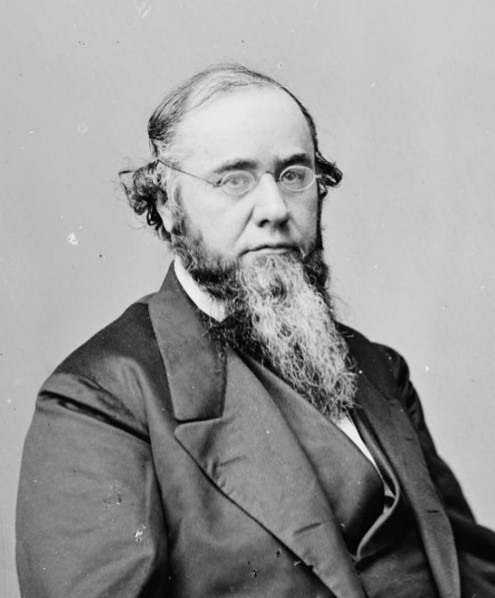
U.S. Secretary of War Edwin M. Stanton, circa 1862-1865 (Matthew Brady, U.S. Library of Congress, public domain).
Meanwhile, U.S. Secretary of War Edward Stanton was penning the following messages for telegraphic transmission by his subordinates:
- War Department, April 15, 1865 – 1:30 a.m.
Major-General Dix,
New York:
Last evening, about 10:30 p.m., at Ford’s Theater, the President, while sitting in his private box with Mrs. Lincoln, Miss Harris, and Major Rathbone, was shot by an assassin . . . The pistol-ball entered the back of the President’s head, and penetrated nearly through the head. The wound is mortal. The President has been insensible ever since it was inflicted, and is now dying. - War Department, April 15, 1865 – 2:35 a.m.
Investigation strongly indicates J. Wilkes Booth as the assassin of the President.
Roughly five hours later, on April 15, 1865, Secretary Stanton conveyed the news that:
- Abraham Lincoln died this morning at 22 minutes after 7 o’clock.
Stanton then began to write, rewrite and send announcements about the president’s death to senior officials of the federal government, which carried instructions that kept the federal government running during the transfer of power to the new president Andrew Johnson. Unable to employ the Transatlantic telegraph to quickly alert U.S. Department of State staff who were serving overseas at that time (because the transatlantic cable was still inoperable), Stanton was compelled to use the nineteenth-century version of “snail mail” when he sent this dispatch of April 15, 1865 by ship to Charles Francis Adams, the U.S. Minister to the United Kingdom:
Recd. 26 April, 1865
Charles Francis Adams
United States Minister, London
Washington, DC 15 April, 1865
Sir.
It has become my distressing duty to announce to you that last night His Excellency Abraham Lincoln President of The United States, was assassinated, about the hour of half past 10 o’clock, in his private box at Ford’s Theatre, in this city. The President about eight o’clock accompanied Mrs. Lincoln to the theatre. Another lady and gentleman were with them in the box. About half past ten during a pause in the performance, the assassin entered the box, the door of which was unguarded, hastily approached the President from behind, and discharged a pistol at his head. The bullet entered the back of his head, and penetrated nearly through. The assassin then leaped from the box upon the stage, brandishing a large knife or dagger, and exclaiming “Sic semper tyrannis!” and escaped in the rear of the theatre. Immediately upon the discharge the President fell to the floor insensible, and continued in that state until 20 minutes past 7 o’clock this morning when he breathed his last. About the same time the murder was being committed at the Theatre another assassin presented himself at the door of Mr. Seward’s residence, gained admission by representing he had a prescription from Mr. Seward’s physicians which he was directed to see administered and hurried up to the third story chamber where Mr. Seward was lying. He here discovered Mr. Frederick Seward, struck him over the head, inflicting several wounds, and fracturing the skull in two places, inflicting, it is feared mortal wounds. He then rushed into the room where Mr. Seward was in bed, attended by a young daughter and a male nurse. The male attendant was stabbed through the lungs, and it is believed will die. The assassin then struck Mr. Seward with a knife or dagger twice in the throat and twice in the face, inflicting terrible wounds. By this time Major Seward, eldest son of the Secretary, and another attendant reached the room, and rushed to the rescue of the Secretary; they were also wounded in the conflict, and the assassin escaped. No artery or important blood vessel was severed by any of the wounds inflicted upon him, but he was for a long time insensible from the loss of blood. Some hope of his possible recovery is entertained. Immediately upon the death of the President notice was given to Vice President Johnson, who happened to be in the City, and upon whom the office of President now devolves. He will take the office and assume the functions of President to-day. The murderer of the President has been discovered, and evidence obtained that these horrible crimes were committed in execution of conspiracy deliberately planned and set on foot by rebels on pretence of avenging the South and aiding the rebel cause; but it is hoped that the perpetrators will be caught.
The feeling occasioned by these atrocious crimes is so great, sudden, and overwhelming that I cannot at present do more than communicate them to you. At the earliest moment yesterday the late President called a Cabinet meeting, at which General Grant was present. He was more cheerful and happy than I had ever seen him, rejoiced at the near prospect of firm and durable peace at home and abroad, manifested in a marked degree the kindness and humanity of his disposition, and the tender and forgiving spirit that so eminently distinguished him. Public notice had been given that he and General Grant, would be present at the Theatre, and the opportunity of adding the Lieutenant General to the number of victims to be murdered was no doubt seized for the fitting occasion of executing the plans that appear to have been in preparation for some weeks, but General Grant was compelled to be absent, and thus escaped the designs upon him. It is needless for me to say anything in regard to the influence which this atrocious murder of the President may exercise upon the affairs of this country, but I will only add that, horrible as are the atrocities that have been resorted to by the enemies of the country, they are not likely in any degree to impair the public spirit, or postpone the complete and final overthrow of the rebellion. In profound grief for the events, which it has become my duty to communicate to you,
I have the honor to be
Very respectfully
Your obt. Servant
Edwin M. Stanton
Metropolitan Police, Washington, D.C.
In addition, a supervising police officer at the city of Washington’s Metropolitan Police Department headquarters penned this ten-line entry in the department’s logbook:
At this hour the melancholy intelligence of the assassination of Mr. Lincoln, President of the U.S, at Fords Theater was brought to this office, and the information obtained from the following persons goes to show that the assassin is a man named J. Wilks [sic] Booth. Secretary Seward & both his sons & servant were attacked at the same hour by a man supposed to be J____ Serratt. Assign to the Force.
The hunt for the conspirators had begun.
Sources:
- Brown, J. Willard, A.M. The Signal Corps, U.S.A. in the War of the Rebellion. Boston, Massachusetts: U.S. Veteran Signal Corps Association, 1896.
- “Exhibit: Lincoln Assassination Report.” Washington, D.C.: U.S. National Archives and Records Administration, retrieved online April 15, 1865.
- Kauffman, Michael W. American Brutus: John Wilkes Booth and the Lincoln Conspiracies. New York, New York: Random House, 2004.
- Langbart, David. “Reporting the Death of the President, 1865,” in The Text Message. Washington, D.C.: U.S. National Archives and Records Administration, April 15, 2015.
- “The Assassin’s Escape: Following John Wilkes Booth.” Washington, D.C.: Ford’s Theatre, retrieved online April 15, 1865.


You must be logged in to post a comment.