Trained, Dressed, Armed, and Headed for the Eastern Theater of the American Civil War (September 19-20, 1861)

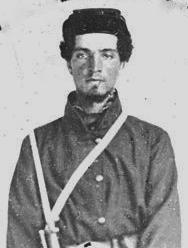
Private Abraham Nicholas Wolf, Company B, 47th Pennsylvania Volunteers, circa 1861 (public domain).

Some were middle-aged men, hardened by what they had seen, heard and endured as United States Army soldiers during the Mexican-American War or the opening months of the American Civil War. Far more were younger adults who had received some degree of “hands-on” experience with military protocols and the use of muskets or rifles as members of local militia units that had been operating in their hometowns for decades. A shocking number, however, were still baby-faced teenagers or even middle school-aged boys who were still too young to grow respectable beards, had no concept of the fragility of life (or the horrors that awaited them) and had only just figured out how to load and aim a weapon.

They were members of the recently-formed 47th Pennsylvania Volunteer Infantry and they had only just recently completed their basic training in Hardee’s light infantry tactics at Camp Curtin in Harrisburg, Dauphin County, Pennsylvania, which had taken place in three phases according to their manual of instruction:

Part One:

  • Lesson 1: Position of the soldier without arms: Eyes right, left and front.
  • Lesson 2: Facings.
  • Lesson 3: Principles of the direct step in in common and quick time.
  • Lesson 4: Principles of the direct step in double quick time and the run.

Part Two:

  • Lesson 1: Principles of shouldered arms.
  • Lesson 2: Manual of arms.
  • Lesson 3: To load in four times, and at will.
  • Lesson 4: Firings, direct, oblique, by file, and by rank.
  • Lesson 5: To fire and load, kneeling and lying.
  • Lesson 6: Bayonet exercise.

Part Three:

  • Lesson 1: Union of eight or twelve men for instruction in the principles of alignment.
  • Lesson 2: The direct march, the oblique march, and the different steps.
  • Lesson 3: The march by the flank.
  • Lesson 4: Principles of wheeling and change of direction.
  • Lesson 5: Long marches in double quick time, and the run, with arms and knapsacks.

The “basic math” of that training was simple: those men who had mustered in for duty in early August had made it through more of those lessons than those who had only just mustered in mid-September — and there were simply not enough grains of sand left in “the nation’s hourglass” for company captains to bring the newest of the “newbies” up to speed.

Dressed for Success — Army Style
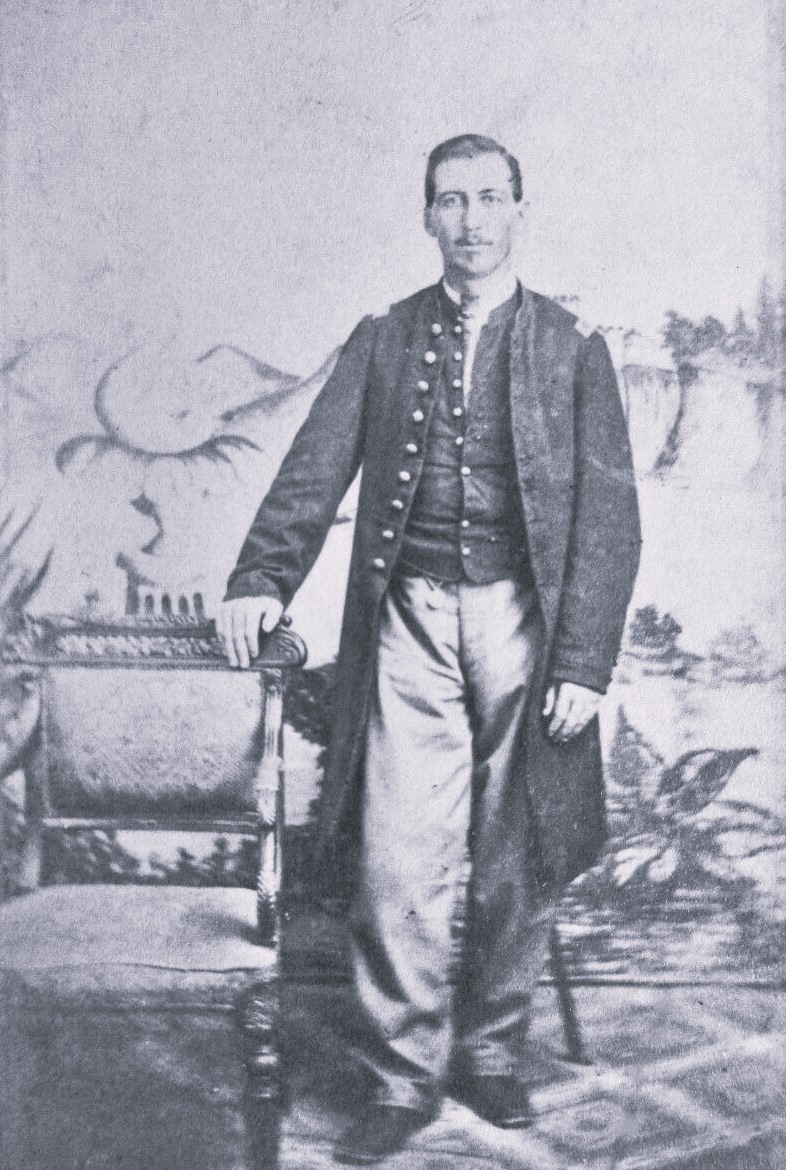
First Lieutenant Henry A. Haltiman, Sr., Company B, 47th Pennsylvania Volunteers, Charleston, South Carolina, 1865, public domain).

Trained as well as could be expected, given the national emergency that was threatening to tear the United States apart, the 47th Pennsylvania Volunteers were issued: “1 light blue overcoat, 1 extra good blouse, 1 pair dark pantaloons, 2 white flannel shirts, 2 pair drawers, 2 pair socks, 1 pair shoes, 1 cap, 1 knapsack (suspended from shoulder), 1 haversack (suspended from waist), 1 canteen,” Mississippi rifles, and ammunition on September 19, 1861, according to historian Lewis Schmidt. The next day, they were gathered together in formation, presented with the regiment’s First State Color (battle flag) by Pennsylvania Governor Andrew Curtin, and were marched to the railroad station in Harrisburg, where they hopped aboard a train and headed for the nation’s capital. Henry D. Wharton, a field musician with the 47th Pennsylvania’s C Company, who would function as the nineteenth-century equivalent of an “embedded reporter” for The Sunbury American throughout the war, sent one of his first dispatches on September 22:

“After a tedious ride we have, at last, safely arrived at the City of ‘magnificent distances.’ We left Harrisburg on Friday last at 1 o’clock A.M. and reached this camp yesterday (Saturday) at 4 P.M., as tired and worn out a sett [sic] of mortals as can possibly exist. On arriving at Washington we were marched to the ‘Soldiers Retreat,’ a building purposely erected for the benefit of the soldier, where every comfort is extended to him and the wants of the ‘inner man’ supplied.

After partaking of refreshments we were ordered into line and marched, about three miles, to this camp. So tired were the men, that on marching out, some gave out, and had to leave the ranks, but J. Boulton Young, our ‘little Zouave,’ stood it bravely, and acted like a veteran. So small a drummer is scarcely seen in the army, and on the march through Washington he was twice the recipient of three cheers.

We were reviewed by Gen. McClellan yesterday [21 September 1861] without our knowing it. All along the march we noticed a considerable number of officers, both mounted and on foot; the horse of one of the officers was so beautiful that he was noticed by the whole regiment, in fact, so wrapt [sic] up were they in the horse, the rider wasn’t noticed, and the boys were considerably mortified this morning on dis-covering they had missed the sight of, and the neglect of not saluting the soldier next in command to Gen. Scott.

Col. Good, who has command of our regiment, is an excellent man and a splendid soldier. He is a man of very few words, and is continually attending to his duties and the wants of the Regiment.

…. Our Regiment will now be put to hard work … and the boys expect and hope an occasional ‘pop’ at the enemy.”

And so it began — the history-making journey of the 47th Pennsylvania Volunteer Infantry.


Sources:

  1. Bates, Samuel P., in History of Pennsylvania Volunteers, 1861-5, vol. 1. Harrisburg, Pennsylvania: B. Singerly, State Printer, 1869.
  2. Bordewich, Fergus M. “Fort Sumter: The Civil War Begins,” in Smithsonian Magazine, April 2011. Washington, D.C.: Smithsonian Institution.
  3. “Camp Curtin Historical Marker,” in ExplorePAhistory.com. Harrisburg, Pennsylvania: Pennsylvania Historical and Museum Commission, retrieved online July 25, 2022.
  4. Dyer, Frederick H. A Compendium of the War of the Rebellion, p. 1589. Des Moines, Iowa: The Dyer Publishing Company, 1908.
  5. “Florida’s Role in the Civil War: ‘Supplier of the Confederacy.’” Tampa, Florida: Florida Center for Instructional Technology, University of South Florida (College of Education), retrieved online January 15, 2020.
  6. Gobin, John Peter Shindel. Personal Letters, 1861-1865. Northumberland, Pennsylvania: Personal Collection of John Deppen.
  7. Grodzins, Dean and David Moss. “The U.S. Secession Crisis as a Breakdown of Democracy,” in When Democracy Breaks: Studies in Democratic Erosion and Collapse, from Ancient Athens to the Present Day (chapter 3). New York, New York: Oxford University Press, 2024.
  8. “History of Camp Curtin.” Harrisburg, Pennsylvania: Camp Curtin Historical Society, retrieved online July 25, 2022.
  9. Huntington, Tom. Pennsylvania Civil War Trails: The Guide to Battle Sites, Monuments, Museums and Towns, pp. 65-66. Harrisburg, Pennsylvania: Pennsylvania Historical and Museum Commission, 2007; Mechanicsburg, Pennsylvania: Stackpole Books, 2007.
  10. Irwin, Richard Bache. History of the Nineteenth Army Corps. New York, New York: G. P. Putnam’s Sons, 1893.
  11. Keener-Farley, Lawrence and James Schmick. Civil War Harrisburg: A Guide to Capital Area Sites, Incidents and Personalities, second edition. Harrisburg, Pennsylvania, Camp Curtin Historical Society, 2008.
  12. Miller, William J. The Training of an Army: Camp Curtin and the North’s Civil War. Shippensburg, Pennsylvania: White Mane Publishing, 1990.
  13. “Roster of the 47th P. V. Inf.” Allentown, Pennsylvania: The Morning Call, October 26, 1930.
  14. Schmidt, Lewis G. A Civil War History of the 47th Regiment of Pennsylvania Veteran Volunteers. Allentown, Pennsylvania: Self-published, 1986.
  15. Scott, Robert N. The War of War of the Rebellion: A Compilation of the Official Records of the Union and Confederate Armies, series I, vol. XXXIV, part II: “Correspondence, etc.-Union,” Chapter XLVI: “Louisiana and the Trans-Mississippi,” p. 199. Washington, D.C.: Government Printing Office, 1891.
  16. “The History of the Forty-Seventh Regt. P. V.” Allentown, Pennsylvania: The Lehigh Register, July 20, 1870.
  17. Wharton, Henry D. “Letters from the Sunbury Guards.” Sunbury, Pennsylvania: The Sunbury American, 1861-1866.


A Tale of Two Swords: 47th Pennsylvania Officers Lauded by Citizens and Soldiers (Florida, 1863)

Captain Henry Durant Woodruff, commanding officer of Company D, 2nd Pennsylvania Volunteers, April-July 1861, and Company D, 47th Pennsylvania Volunteers, August 31, 1861-September 18, 1864 (public domain).

On Saturday, August 22, 1863, readers of The Sunbury American turned to page three of their favorite Northumberland County, Pennsylvania newspaper to find the latest “Letter from the Sunbury Guards,” one of the many field reports that would be sent during the American Civil War to the newspaper’s publisher and editor, Henry B. Masser and Emanuel Wilvert, by one of their former employees, Henry D. Wharton, a member of the 47th Pennsylvania Volunteer Infantry’s C Company. The letter from Henry that was published on that day in August provides important insights into what daily life was like for the 47th Pennsylvanians who were stationed at Fort Taylor in Key West, Florida in 1863 and also illustrates the positive rapport that the 47th Pennsylvania’s officers worked hard to build — not only with the regiment’s enlisted men, but with the civilians they encountered while serving the nation as members of an occupying military force in the nation’s Deep South.

Letter from the Sunbury Guards
Key West, Fla., July 30, 1863

Dear Wilvert: — One day last week, I was surprised at the confusion and loud cheering coming from Company D, usually a very quiet set of men. I crossed the Barracks ground to their quarters, when I learned the cause. The men had presented their Captain with a beautiful sword, sash and belt. The presentation was made in a neat speech by Private Baltozer, who in a few preliminary remarks thanked the Captain for his kindness to the members of Company D, and then said “receive this sword as a token of our estimation, and for your chivalrous spirits on the sanguine field, when the heavens glared with fire and the earth trembled ‘neath cannons roar. May it never rest in its scabbard until rebellion is crushed and traitorism is banished from the land, and peace spreads her white wings from the St. John’s to the sunny banks of the Rio Grande. That it may ever benefit you in the hour of peril, and that you may undauntingly use it as opportunity is afforded, is the ardent wish of the donors.” The presentation was unexpected to Captain Woodruff, who, modest man as he is, felt it keenly, so much so, that it was with difficulty he uttered the following reply:

“My companions in arms. — Your beautiful present is accepted with sincere satisfaction and heartfelt thanks. It affords the satisfaction that you still respect and have confidence in your commander; and he is thankful not only for the value of this gift; but, also for the rich token of your kind regard. And while I wear these arms and accoutrements, emblematical of my rank and office, may they never be worn unworthily or the noble donors have cause to blush for any ungallant act of the wearer. Two years have nearly elapsed since we have been associated as commander and commanded. Two years of privation and toil, and yet your love for the cause, and your ardor to serve your country has not abated.”

“When you entered upon this gigantic struggle, you were not prompted by large bribes and bounties, or intimidated by fear of being forced in service by fear of conscription, but, inspired by a noble patriotism, you cheerfully volunteered for the longest period known to the law. Your conduct thus far has been in accordance with the honorable principles which caused you to volunteer. No discipline too strict, no privations too great, no toil too hard, no trials too sore, but that your indomitable spirits have been able to accomplish, undergo and overcome. And now allow me to say to you that I am proud of the noble men who compose this company. I am proud of the honor you have this day conferred on your Captain. In looking forward, I have no fears for you in the future. Whatever you may be called on to do, in garrison, in the tented field, or on the ensanguined plain it will be bravely — it will be well done. Then, until rebels and traitors shall become extinct, or have grounded their arms, and acknowledged the supremacy of the Government and the law, let this ‘Our motto be, Give us death, or give us victory.'”

Colonel Tilghman H. Good, commanding officer, 47th Pennsylvania Volunteers (public domain image, circa 1863).

Wharton then continued his lengthy letter with a retelling of a second ceremony that took place on July 25, 1863:

On Saturday last, another sword presentation came off. This time Col. T. H. Good was the recipient, and the donors, the citizens. The sword is a magnificent one, and with the sash and belt, cost six hundred and ten dollars. At 4 o’clock P.M., the two companies stationed at the Barracks, were marched to the Fort, where, with the three other companies doing duty, we formed in line, and under command of the Colonel were moved through several streets, to the front of the Custom House. A fine stand was erected, on the piazza of the building seats were placed for the ladies, flags were stretched across the streets, and everything so arranged as to give it the appearance of a holiday. On the stand I noticed Rear Admiral Bailey and Capt. Templeton of the Navy, Gen. Woodbury and staff, Captains Hook and McFarland of the Army, besides Thomas J. Boynton, U.S. District Attorney for the Southern District of Florida. The articles were presented to Col. Good by Mr. Maloney, a lawyer of this city who complimented the Colonel on the fine bearing and appearance of his regiment. He spoke of the trials the citizens had under the military commander Col. Good relieved; of their being saved from banishment and separation of friends and all they held dear; of the wholesome administration of the Colonel, while in command of this Department, and in conclusion placed the sword in Col. Good’s hand, telling him if he used it as he used his own at Pocotaligo, the citizens would be satisfied, and have no fear of it ever being dishonored. The Colonel replied in a very short speech, saying, what he had done was by instructions by Head Quarters — thanked him for the present, and said as he then felt, he could assure the good people of Key West, that their present would never be dishonored through himself. As the Col. concluded, the Band of our regiment struck up the tune ‘Bully for You,’ which was received with cheer after cheer. Several speeches were made, among others, one by Mr. Boynton. He is a Missourian and received his appointment from the present administration. Although a southerner, he is Union all over. He said he hoped the cannon and sword would soon be made into plow shares and pruning hooks, but not until every rebel was on his knees willing to obey the laws and pay respect to the Star Spangled Banner. The Band then played several National airs, cheers were given for the Union, President Lincoln, Army and Navy, Gen. Woodbury, Admiral Baily, &c., when the meeting adjourned, and we were marched to our different quarters, well pleased with the proceedings, though I must say, completely worn out from fatigue and extreme heat.

According to Allentown’s Morning Call newspaper, the sword’s “hilt grip is a golden goddess Columbia, the female personification of the United States.”

Above her head on the pommel, a coiled snake seems ready to strike. On the crossguard a lion’s head roars defiance and Hercules slays the Nemean lion on the sword’s knuckle bow.

The blade is a riot of gilt allegorical figures. In tiny letters just above the hilt is the maker’s name and year: Collins and Company, Hartford, Connecticut, 1862. On the other side is the engraver, Ball Black & Company, New York.

In a subsequent description of the sword in 1915, The Morning Call noted that it had been engraved with the following tribute to Colonel Good:

“The Citizens of Key West, Florida, to Col. T. H. Good, 47th Penn Vols., in appreciation of his merit as a gentleman and a soldier, April, 1863.”

That sword would cost more than twenty-five hundred U.S. dollars were it crafted today. But its true value is priceless because it serves as a timeless reminder that effective leadership is possible — even in the darkest of times.


Sources:

  1. Bates, Samuel P. History of Pennsylvania Volunteers, 1861-5, vol. 1. Harrisburg, Pennsylvania: B. Singerly, State Printer, 1869.
  2. “July 25” (1995 photograph of the sword presented to Colonel Tilghman H. Good by the citizens of Key West, Florida on July 25, 1863), in “Florida Keys History Center.” Key West, Florida: Key West Library, retrieved online August 16, 2025.
  3. Schmidt, Lewis G. A Civil War History of the 47th Regiment of Pennsylvania Veteran Volunteers. Allentown, Pennsylvania: Self-published, 1986.
  4. “Sword Is a Reminder of Friendship Forged Amid War.” Allentown, Pennsylvania: The Morning Call, October 3, 2021.
  5. “Veterans of 47th Vols’ Meet in Reunion: Forty-third Annual Gathering Recalls Trying Days.” Allentown, Pennsylvania: The Morning Call, 23 October 1915.
  6. Wharton, Henry D. “Letter from the Sunbury Guards” (Key West, Florida, July 7, 1863). Sunbury, Pennsylvania: The Sunbury American, August 22, 1863.