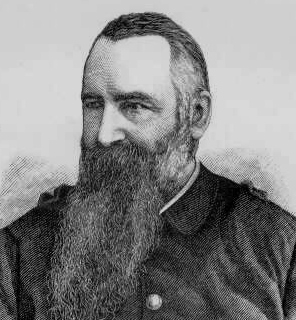
Colonel Tilghman H. Good, the founder and first commanding officer of the 47th Pennsylvania Volunteer Infantry, was a three-time mayor of the city of Allentown, Pennsylvania (public domain).
During the summer of 1887, time’s relentless march seemed to pause as Pennsylvanians came together to bid farewell to a lion of their commonwealth — Colonel Tilghman H. Good (1830-1887), the founder and first commanding officer of the history-making 47th Pennsylvania Volunteer Infantry. A native of South Whitehall Township in Lehigh County, Pennsylvania who had served three terms as mayor of the city of Allentown after the American Civil War, Colonel Good had died in the city of Reading in Berks County on July 18, 1887.
His funeral proved to be another memorable event in the history of Pennsylvania, one that unfolded in two cities and involved thousands in its planning, execution and viewing.
The Planning
According to historian Lewis G. Schmidt, members of the Good family worked with civic, community and religious officials in Reading, Allentown and Harrisburg to plan and carry out the funeral of Colonel Tilghman H. Good. On July 19, 1887, Colonel Good’s brother-in-law, “Russell A. Thayer, of Allentown, left in the morning for Reading to make arrangements to return the Colonel’s body to Allentown for burial; and Mayor Ruhe called for a meeting of the ex-Mayors of Allentown for 7:30 PM to make arrangements to attend the funeral.”
The next day (July 20), members of the Knights Templar, Reading Commandery, No. 42 met at the Board of Trade building in Reading “to make arrangements for attending the funeral of the late Col. Good,” acccording to the Reading Times.
Senior officials of the Commonwealth of Pennsylvania also stepped in to help by calling members of the Pennsylvania National Guard into service. According to Schmidt, “Capt. W. D. Mickley and Company D of the 4th Regiment of Infantry, 3rd Brigade, of the National Guard of Pennsylvania [were ordered] to attend the funeral, and were to meet at the square in light marching order at 2 PM [on July 22]. One Corporal and three Privates were detailed to guard duty and were to report to the Armory at 9 AM.” (Captain W. D. Mickley, who would later be commissioned as a colonel with the Pennsylvania National Guard and would live to become the oldest veteran of the Spanish-American War in Allentown, was William Deshler Mickley, one of the sons of Captain Charles Mickley, who had been killed in action during the Battle of Pocotaligo, South Carolina in 1862, while serving with the 47th Pennsylvania Volunteers under Colonel Tilghman H. Good.)
Meanwhile, other officials in Reading and Allentown were busy preparing their cities and citizenry for their respective days of official mourning. Routes were chosen for the procession of Colonel Good’s funeral cortege, and city personnel and business owners were issued instructions regarding the proper ways to drape buildings along those routes with American flags and bunting — displays of red, white and blue mixed with black that would inspire reflection among the crowds expected to witness the events. (A particularly large turnout was anticipated in Allentown because Colonel Good’s family had chosen a cemetery in that city to be his final resting place.)
The Funeral in Reading
The first funeral service for Colonel Good was held at the Central House (formerly known as the Grand Central Hotel) on Penn Street near 4th Street in Reading, Pennsylvania during the very early hours of Friday, July 22, 1887. Good’s body, which had been viewed by family privately in a room at the hotel and prepared for burial by an undertaker, was “placed in a casket in the early morning” that day, and taken down to “one of the parlors of the Central House,” for a formal viewing ceremony for his friends which lasted “until 6:40 o’clock” that morning. “Sir Knights” of the Reading Commandery, Knights Templar (No. 42) then escorted Colonel Good’s casket to Reading’s railroad station, placed it aboard a train that departed for Allentown at 7:10 a.m., and continued to guard it for the duration of its forty-minute journey.
The Funeral in Allentown
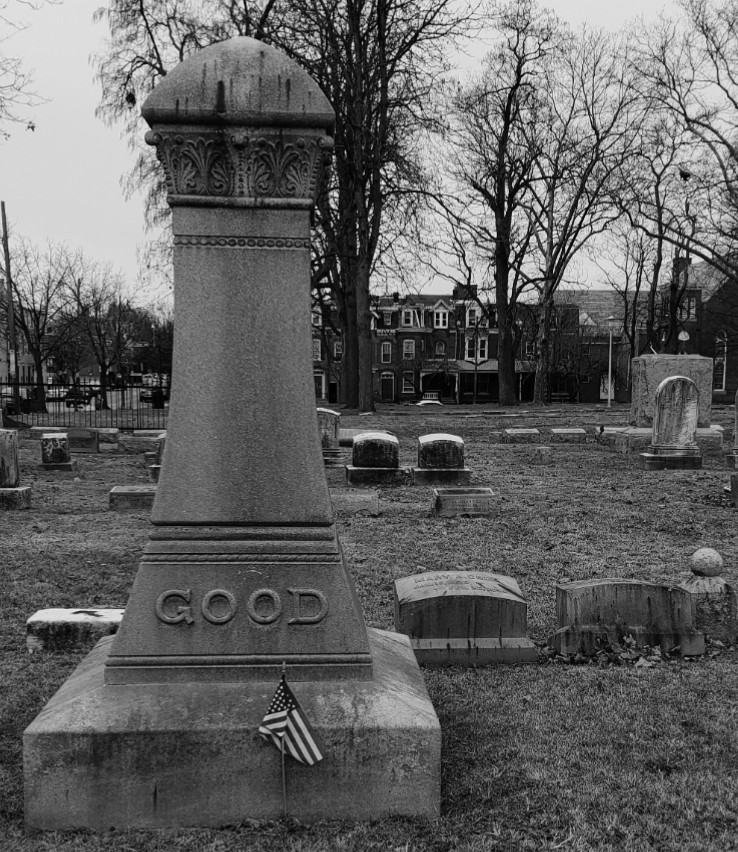
The family monument of Colonel Tilghman H. Good, founder of the 47th Pennsylvania Volunteer Infantry and three-time mayor of Allentown, Linden Street Cemetery, Allentown, Pennsylvania (public domain).
Upon the train’s arrival in Allentown at 8:30 a.m. on July 22, 1887, members of the Knights Templar’s Reading Commandery transferred their honor guard responsibilities to members of the Allen Commandery, which removed Colonel Good’s casket from the train and accompanied it on its transport to the home of Good’s brother-in-law, which was located at 532 Walnut Street in Allentown, according to Schmidt.
“From 12 to 2 PM, the body lay in state at St. John’s Reformed Church, where ‘several thousand people passed around the bier.’ The local military companies provided the guard of honor between 12 and 1 PM; and at 1 PM, the Knights Templar took charge….
“Col. Good wore a black broadcloth suit as he lay in his solid walnut casket with silver handles, and which was trimmed in black cloth. The lid bore a ‘massive silver plate bearing the name and dates of birth and death … on it rested the sword and chapeau which he wore as a member of the Allen Commandery.'”
St. John’s Reformed Church “was completely filled” for that second service, according to subsequent reports by area newspapers. Afterward, Colonel Good’s casket was carried from the sanctuary by its military escort and prepared for transport for additional graveside services at Colonel Good’s final resting place. According to Schmidt, “The route was up 6th to Hamilton, up Hamilton to 9th, out 9th to Linden, and up Linden to the cemetery. The band played a solemn dirge and the route was lined with people.”
“The order of the street column that accompanied the body to the grave was as follows: Platoon of Police; Allentown Band; Company D, 4th Regiment; Company B, 4th Regiment; Allen Commandery No. 20, Knights Templar, with delegations of Reading and DeMolay Commanderies; Hearse; Pallbearers; The horse which Col. Good rode while Colonel of the 4th Regiment; Visiting officers and members of the National Guard; Mayor Ruhe and ex-Mayors; and Citizens in carriages.
“The side walk column moved in the following order: Ex-policemen who served under the deceased while he was Mayor of Allentown; Members of the original Allen Rifles; survivors of the 47th Regiment; Post 87, G.A.R; Post 13, G.A.R.; Sons of Veterans; City Officials, Councilmen, ex-City Officials and ex-Councilmen; and Citizens.”
A reporter for The Age, a Democratic-leaning newspaper in York, Pennsylvania, would later note that “An imposing procession of Masons, militia, war veterans and civilians followed the remains to the grave.” Standing near Colonel Good’s freshly-dug grave, the attendees witnessed a third service that included the lengthy burial rituals of the Knights Templar (K.T.) and the Grand Army of the Republic (G.A.R.), followed by the appropriate military salute that was fired by serving members of the military.
How Did Tilghman H. Good Die?
Colonel Tilghman H. Good was just fifty-six years old when he was felled by heat exhaustion in Berks County, Pennsylvania on July 18, 1887, while overseeing a construction project in his capacity as the manager of the city of Reading’s Central House hotel. Realizing that he was unwell, he had left the construction site around 6:30 p.m. and had gone upstairs to the hotel room that he had occupied with his wife, Mary (Trexler) Good (1828-1899), hoping to rest and recover. Sadly, despite the best efforts of an attending physician who had been summoned for help, Colonel Good’s condition had quickly devolved into the far deadlier illness known as heat stroke, which had ended his life at 8:15 p.m. that same evening.
Sources:
- Beath, Robert B. History of the Grand Army of the Republic. New York, New York: Bryan, Taylor & Co., Publishers, 1889.
- “Col. Good’s Central House.” Reading, Pennsylvania: Reading Times, April 29, 1886.
- “Col. Good’s Funeral.” Reading, Pennsylvania: Reading Times, July 20, 1887.
- “Col. Good’s Funeral.” Wilkes-Barre, Pennsylvania: The Record of the Times, July 29, 1887.
- “Col. Mickley, Noted Veteran, Is Found Dead.” Allentown, Pennsylvania: The Morning Call, April 1, 1932.
- Col. T. H. Good, in “Other Deaths.” Pittsburgh, Pennsylvania: Pittsburgh Commercial Gazette, July 28, 1887.
- “Col. T. H. Good’s Death.” Reading, Pennsylvania: Reading Times, July 19, 1887.
- Colonel T. H. Good (brief funeral report), in “News Condensed: Reading.” Philadelphia, Pennsylvania: The Philadelphia Inquirer, July 23, 1887.
- Creigh, Alfred. History of the Knights Templar of the State of Pennsylvania, pp. 15, 167, 200 (Allen Commandery); 556-575 (burial rituals); 597-598 (Allen Commandery). Philadelphia, Pennsylvania: J. B. Lippincott & Co., 1868.
- “Funeral of Col. Good.” York, Pennsylvania: The Age, July 23, 1887.
- “Funeral of Colonel Good.” Hazleton, Pennsylvania: Hazleton Daily Sentinel, July 23, 1887.
- “Grand Central Hotel in New Hands” (transfer of the hotel’s management to “Col. T. H. Good, of Allentown”). Reading, Pennsylvania: Reading Times, December 10, 1885.
- Hartman, William L. The Mayors of Allentown, in Berlin’s Proceedings and Papers Read Before the Lehigh County Historical Society. Allentown, Pennsylvania: Lehigh County Historical Society, 1922.
- “Heat Exhaustion.” Scottsdale, Arizona: Mayo Clinic, retrieved online July 22, 2026.
- “Heat Stroke,” in “Diseases and Conditions.” Cleveland, Ohio: Cleveland Clinic, retrieved online July 22, 2026.
- Mathews, Alfred and Austin H. Hungerford. History of the Counties of Lehigh and Carbon. Philadelphia, Pennsylvania: Everts & Richards, 1884.
- Moody, John Sheldon and Calvin Duvall Cowles, et. al. The War of the Rebellion: A Compilation of the Official Records of the Union and Confederate Armies, series 1, vol. 14. Washington, D.C.: Government Printing Office, 1885.
- Schmidt, Lewis G. A Civil War History of the 47th Regiment of Pennsylvania Veteran Volunteers. Allentown, Pennsylvania: Self-published, 1986.
- “To Attend Col. Good’s Funeral.” Reading, Pennsylvania: Reading Times, July 21, 1887.
- “Trout Hall Formally Dedicated as Lehigh Co. Historical Society’s Home” (mention of Colonel Tilghman H. Good’s sword and its Key West presentation). Allentown, Pennsylvania: The Allentown Democrat, May 17, 1918.
- Waskie, Anthony. “The Grand Army of the Republic,” in The Essential Civil War Curriculum. Blacksburg, Virginia: Virginia Center for Civil War Studies, Virginia Tech University, retrieved online July 22, 2026.
- Wharton, Henry D. Transcripts of the addresses made by Colonel Tilghman H. Good to the 47th Pennsylvania Volunteer Infantry. Sunbury, Pennsylvania: Sunbury American, 1861-1864.


You must be logged in to post a comment.