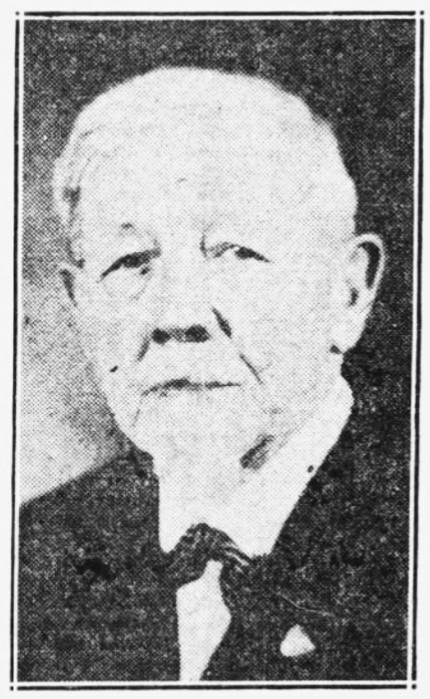
First Lieutenant William Hiram Bartholomew (1843-1933), shown here in 1932, helped to plan the first official reunion of the 47th Pennsylvania Volunteer Infantry, which was held in Catasauqua, Pennsylvania on 22 October 1873 (public domain).
The first official reunion that was held by the 47th Pennsylvania Veteran Volunteers after their regiment was deactivated in January 1866 was planned and executed by a small group of former officers and enlisted members of the regiment: William H. Bartholomew, Edwin Gilbert, William Kleckner, Aaron C. McHose, William Sieger, and William Weiss (alternate surname spelling: “Wise”). Subsequently known as the “Committee of Arrangements” or the “Committee on Organization,” that group announced its plans to hold that initial get-together, and invited veterans of the regiment to attend, by publishing the following announcement in newspapers across the Commonwealth of Pennsylvania during the summer of 1873:
All members of the Forty-seventh Regiment Pennsylvania Volunteers are respectfully invited to meet at the house of our old comrade, Capt. H. S. Harte, in Catasauqua, on Wednesday, October 22, 1873, the anniversary of the battle of Pocotaligo, to renew friendship, and to take into consideration the forming of an association to keep bright the recollections of the past. Nearly every other Regiment has done this already. Let us, therefore, gather at least once more, together, and touch elbows as of yore.
Col.’s Gobin and Good will be present.
As it is impossible for us to remember the names of all the members of the Regiment we cannot notify them, and, therefore, request you to notify any in your vicinity who may not have received this notice.
Very Respectfully, Yours,
A. C. McHose,
Wm. H. Bartholomew,
Edwin Gilbert,
Wm. Kleckner,
Wm. Wise [sic, “Weiss”]
Wm. Sieger,
Committee.

Captain Henry S. Harte, Company F, 47th Pennsylvania Volunteers, circa 1863 (public domain).
That reunion, which did actually take place in the Borough of Catasauqua in Lehigh County, Pennsylvania on 22 October 1873, was attended by more than eighty former officers and enlisted members of the regiment. Greeted by that “Committee of Arrangements” upon their arrival at Catasauqua’s train station shortly after noon that day, according to The Newport News, many arrived wearing their old “Union blues” or the newer uniforms of the Grand Army of the Republic (G.A.R.). Instructed to line up behind “the City Cornet Band of Allentown,” they were then marched “to the ‘Mansion House,’ (Captain Harte, proprietor), which was decorated with flags and evergreens, and had the words, “Welcome 47th,” on the front of the piazza, wreathed with evergreens.”
Here a general hand-shaking took place, congratulations of a hearty character were given, and old friendships renewed which had not been formed under such pleasant circumstances. There were probably a hundred present from various places — Allentown, Easton, and Northumberland and Perry counties. As we stood in the crowd, we noticed Col. W. W. Hammersly, of the 128th; Capt. Newhard and Lieutenants Paff and Hammersly, of the 54th, and Mr. Dallas Dillinger, of the 128th. — Among those of the 47th we noticed Cols. Gobin and Good, the former of Lebanon, and the latter of Allentown; Capts. Hart and Gilbert of Catasauqua; Capt. Yard, and Lieutenants Bonstine and Wycker [sic, “Wyker”], of Easton; Capt. Beard, of Harrisburg; Lieuts. Balliet and Stuber, Captains Kleckner and Leisenring, of Allentown; Assistant Surgeon Scheetz of Pottstown, and Quartermaster F. Z. Heebner, of Allentown.
Their business meeting then began at 2 p.m. in the town hall, which “was handsomely decorated with the Stars and Stripes, and hung with wreaths and festoons of evergreens and flowers,” according to The Newport News. That program began with this “address of welcome … by M. H. Horn, Cashier of the Catasauqua National Bank”:
Gentlemen of the Forty-Seventh: — In the absence of our worthy Chief Burgess, I am here in behalf of our town authorities and people, to say to you that you are welcome visitors. Your meeting here to-day recalls many interesting events of the past, and our thoughts go back to the times that truly tried the patriotism of the people of our country. We well remember the exciting scenes that stirred up as it were our whole population. The call to arms, the mustering, the good-byes and the heartfelt and tender wishes for a safe and speedy return, the hurrying into camp, the formation of companies, regiments, brigades and divisions and the marching to the front to meet the foe of our Government. We also remember the terrible and sanguinary conflicts, the sufferings on the battlefield, in prison pens, in the hospital — and the honored dead — you, gentlemen, of the 47 Regiment, have shared in all these scenes. You helped to save our honored institutions. Your share of this work has been recorded upon the pages of history, and has been read and re-read by thousands, and will be read by thousands yet unborn. Your object here to-day is to talk over the past, and to take steps towards securing a series of reunions. May your proceedings be harmonious and pleasant, and may your re-unions be continued until none of you survive, and may you all at last join in that re-union in a better land, where there is no war, but all is peace.

John Peter Shindel Gobin (circa 1877, public domain).
The regiment’s founder and first commanding officer, Colonel Tilghman H. Good, then made a motion to elect Colonel John Peter Shindel Gobin, the regiment’s final commanding officer, as the temporary first chairman of the regiment’s new veterans’ association, and to elect Captain Thomas Leisenring, the former commanding officer of the regiment’s G Company, as the association’s temporary first secretary — both of whom were approved by the group. According to The Newport News:
On motion of Quartermaster F. Z. Heebner, it was resolved that a committee of five be appointed to report permanent officers. The Chairman appointed as that committee, Quartermaster F. Z. Heebner, Chaplain W. D. Rothrock [sic, “Rodrock”], Private A. C. M’Hose, Lieut. W. H. M. Wycker [sic, “Wyker”], and Lieut. Beard.
After formally accepting his appointment, Colonel Gobin delivered his own address, during which he called to mind the highs and terrible lows of their long tenure of service. The Newport News later reported that “His speech was well received.” Allentown’s mayor, Theodore C. Yeager, M.D., then stepped up to the podium, “alluded to the trial and hardships … and paid a glowing tribute to the services of the gallant 47th.”
The Committee of Arrangements, which was reportedly chaired by Colonel Good, followed with a report regarding the planning and costs related to the first reunion, after which a roll call was conducted to formally document the names of the 47th Pennsylvania Veteran Volunteers who were present for that historic occasion:
- Field and Staff Officers: Tilghman H. Good, John Peter Shindel Gobin, Charles W. Abbott, Francis Z. Heebner, Reverend William D. C. Rodrock, and Jacob H. Scheetz, M.D.;
- Company A: Anthony B. Bush, William Ferry;
- Company B: Emanuel P. Rhoads, William H. Kleckner, Allen G. Balliet, Oliver Hiskey, Charles Knauss, Tilghman H. Reinsmith, Edward Remmel, Charles Savitz, Casper Schreiner, Frank H. Straehly, Charles A. Wagner, and Harrison Wieand;
- Company C: Christian S. Beard;
- Company E: Charles H. Yard, Lawrence L. Bonstine, William H. Wyker, William Adams, Thomas Callahan, Andrew McLaughlin, and Joseph Rodgers;
- Company F: Henry S. Harte, Edwin Gilbert, William H. Bartholomew, A. Beichly, Charles Buss, August Eagle, Alfred Finn, William H. Glace, John Guth, Joseph Heckman, William F. Hollenbach, William Ihrie, John K. Longenhagen, S. W. Franklin Longenhagen, David Schaffer, Gottlieb Schrank, Joseph H. Schwab, James Tait, James A. Trexler, John B. Weaver, Ambrose Wesner, and Frank H. Wilson;
- Company G: Thomas B. Leisenring, James Crader, David K. Diefenderfer, George T. Henry, Henry Moyer, William Sieger, William N. Smith, Allen D. Wolf, Jacob P. Worman, and Engelbert Zander;
- Company H: Aaron Laub;
- Company I: Charles E. Henry, Francis S. Daeufer, Edwin Dreisbach, Daniel H. Fritz, George T. Gross, George W. Hartzell, Edwin Hauser, Allen J. Lawall, John J. Lawall, Aaron C. McHose, Jesse Moyer, Charles Sassaman, Milton H. Stephens, James Stuber, Israel H. Troxell, and James Van Syckle; and
- Company K: Martin L. Guth, Phaon Guth, Henry S. Toole/Tool, and Benjamin F. Zellner.
According to The Newport News, Colonel Gobin proposed the following resolutions:
- Resolved, That the name shall be the Association of the 47th Regiment, Pennsylvania Volunteers.
- Resolved, That the object of this Association shall be to revive and cement friendship formed in the ranks, and promote the social feeling so desirable, and that should exist between the men whose names are found on the rolls of the 47th Regiment, Pennsylvania Volunteers.
- Resolved, That all persons, who were members thereof, can become members on such restrictions as the Association may prescribe.
- Resolved, That the officers of this shall consist of one President, and one Vice President from each Company, four Secretaries, one Treasurer and one Chaplain, who shall serve for one year.
- Resolved, That a Committee of three be appointed to provide further rules and regulations for the government of the Association, to report at next meeting.
A New Regimental Association
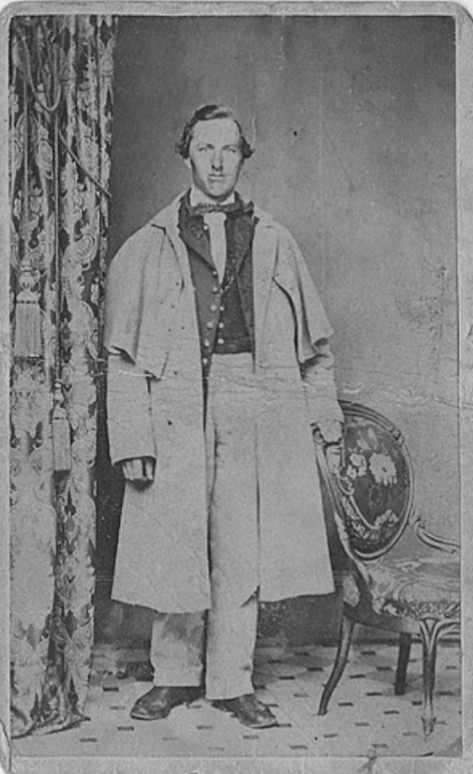
Anthony Bush, bandmaster of the 47th Pennsylvania Volunteer Infantry’s second Regimental Band (shown circa 1863-1864, public domain).
Following the group’s adoption of those basic association rules, the newly-appointed vice presidents of the newly-established Association of the 47th Regiment, Pennsylvania Volunteers were charged with locating and the men who had served with their respective former companies and urging each one to join the new regimental association.
In addition, “William Weiss was designated as Secretary on Membership, and instructed to prepare a record book” that would keep track of “the name and Post Office address of each member,” including the musicians of the former Regimental Band, who were expected to reunite under the baton of the 47th’s second bandmaster, Anthony B. Bush, giving the association’s new leadership to offer concerts by acclaimed musicians as part of their future event planning.
The date for the association’s next reunion was then debated and finalized. It would fall on the next anniversary of the Battle of Pocotaligo — Thursday, 22 October 1874, and would be held in Allentown — as would many other future gatherings of the 47th Pennsylvanians who helped bring the United States of America back from the brink of destruction.
Sources:
- Annual Reunion Recap, in “Neighboring Counties.” Reading, Pennsylvania: Reading Times, 30 October 1873.
- “Catasauqua, Pa., September 22, 1873: Captain Eichholz, Dear Sir” (letter to the newspaper inviting all former members of the 47th Pennsylvania Volunteers to participate in the regiment’s first reunion). Sunbury, Pennsylvania: The Democrat, 26 September 1873.
- Lambert, James F. and Henry J. Reinhard. A History of Catasauqua in Lehigh County Pennsylvania. Allentown, Pennsylvania: The Searle & Dressler Co., Inc., 1914.
- Reports of Colonel Tilghman H. Good, Forty-seventh Pennsylvania Infantry and acting commander, First Brigade, Tenth Army Corps, in The War of the Rebellion: A Compilation of the Official Records of the Union and Confederate Armies. Prepared Under the Direction of the Secretary of War, By Lieut. Col. Robert N. Scott, Third U.S. Artillery, and Published Pursuant to Act of Congress Approved June 16, 1880 (series I, vol. XIV). Washington, D.C.: Government Printing Office, 1885.
- “Reunion of the Forty-Seventh Regiment, Pennsylvania Volunteers: First Meeting at Catasauqua, Lehigh County, Pa., October 22d, 1873,” in “Military.” Newport, Pennsylvania: The Newport News, 8 November 1873.
- Schmidt, Lewis. A Civil War History of the 47th Regiment of Pennsylvania Veteran Volunteers. Allentown, Pennsylvania: Self-published, 1986.


You must be logged in to post a comment.