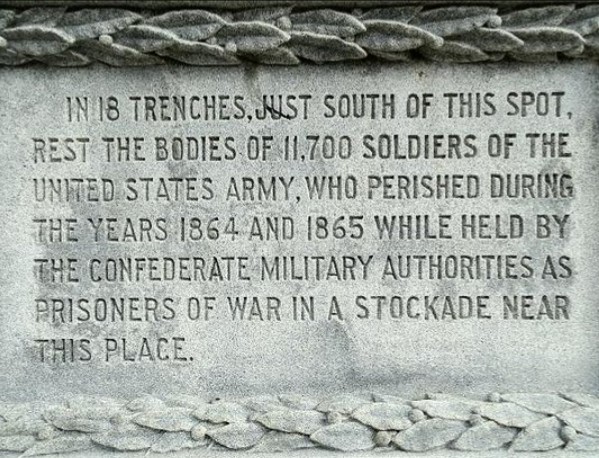
Inscription, Monument to 11,700 Unknown Dead, Salisbury National Cemetery, Salisbury, North Carolina (public domain).
During the Army of the United States’ 1864 Red River Campaign across Louisiana and 1864 Shenandoah Valley Campaign across Virginia, multiple members of the 47th Pennsylvania Volunteer Infantry were declared as “Missing in Action” (MIA) — largely due to the confusion caused by engagements with the enemy in which Union regiments were repeatedly required to charge into, retreat, regroup and resume the fight as they faced down wave after wave of Confederate troops attempting to outflank and perform end runs around the outer edges of Union lines.
Each time the cannon smoke began to clear from those battles, and many of those MIA members of the their corps, divisions or brigades found their way back to their respective regiments, senior Union officers and their clerks revised their casualty lists.
Again and again — and again.
Even so, the status of hundreds of Union soldiers remained murky, stubbornly persisting as “MIA” for days, weeks and even months after those battles had ended — until word was received from one of their comrades that those men had definitely been killed or captured by Confederate troops.
When Union soldiers were captured, they were most often taken to one of the multiple prison camps operated by the Confederacy across the nation’s south, where they were held as prisoners of war (POWs). Some, however, ended up at Confederate military hospitals. Regardless of where they were held, though, the conditions in which they lived were often abysmal and the treatment that they received from their captors was so harsh in many cases that it would later be described as criminal.
Starved and severely abused, multiple members of the 47th Pennsylvania Volunteer Infantry remain interred beneath the southern soil of the unmarked trench graves of the former prison camps where they had been held. Those who managed to survive were eventually released via parole or through prisoner exchanges that were arranged in accordance with the Dix-Hill Cartel or the Lieber Code. More than a few were so damaged, however, that their hearts and minds would never be the same.
Note: Prior to the Red River and Shenandoah Valley campaigns of 1864, the 47th Pennsylvania Volunteers who were identified as fatalities on Union Army casualty rosters were men who had died from disease-related complications or had been killed or wounded in combat. None were identified as having been captured by Confederate troops. For that reason, the content in this Prisoners of War section of the 47th Pennsylvania Volunteers: One Civil War Regiment’s Story website is largely focused on what happened to the 47th Pennsylvanians who became prisoners of war in 1864 and 1865 — years in which the harsh treatment of POWs resulted in shockingly high rates of death across the Confederacy’s system of POW camps. (For information regarding the treatment of POWs during the early part of the war, see: William Best Hesseltine’s book, Civil War Prisons: A Study in Prison Psychology, and James McPherson’s book, Battle Cry of Freedom: The Civil War Era.)
Red River Campaign (Louisiana, 1864)
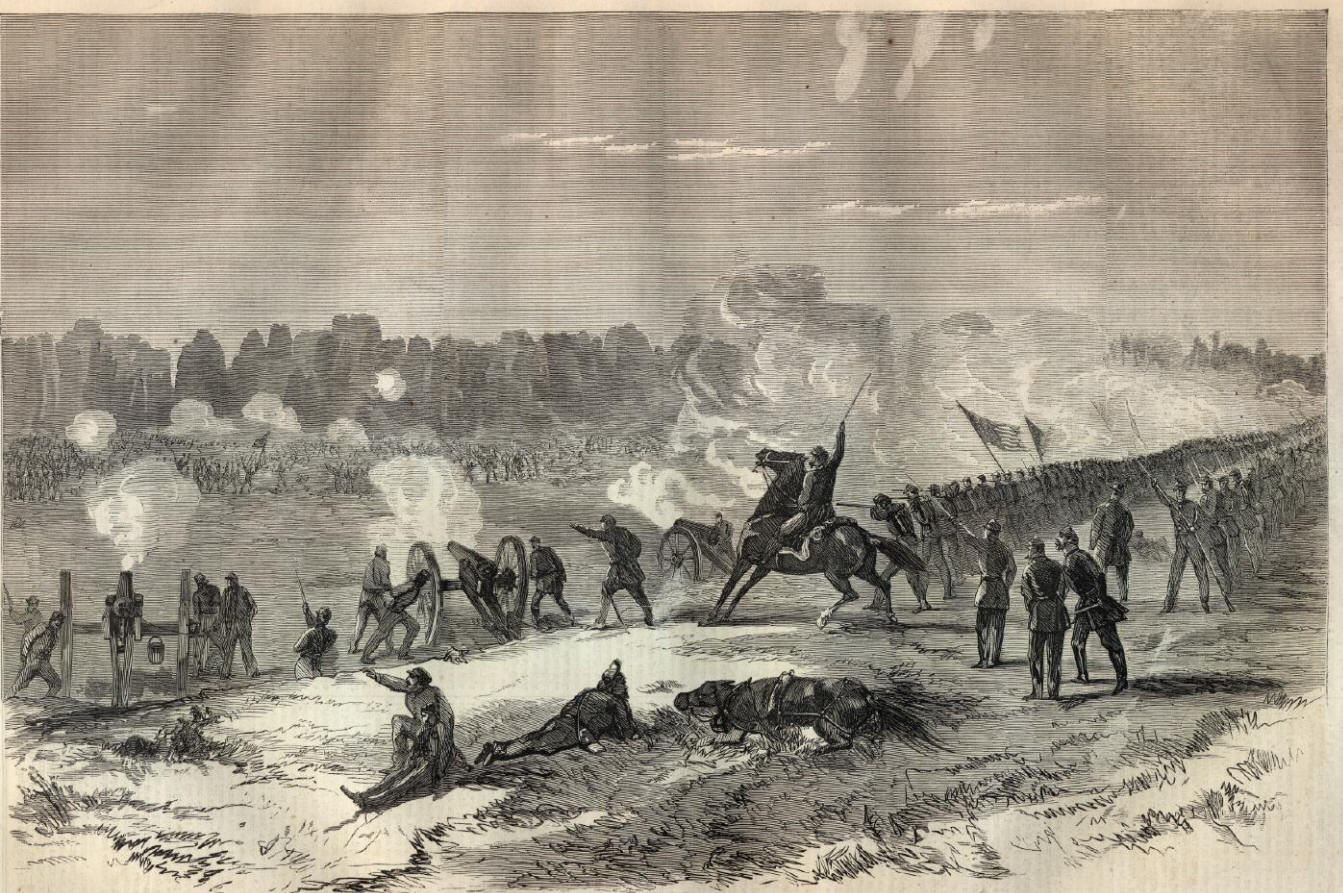
Battle of Pleasant Hill, Louisiana, 9 April 1864 (Harper’s Weekly, 7 May 1864, public domain).
During battles that were described by Major-General Nathaniel Banks as “desperate and sanguinary,” multiple members of the 47th Pennsylvania Volunteer Infantry were killed, wounded in action or labeled as “MIA” (missing in action) while serving with the regiment in Louisiana during the spring of 1864. By mid-May of that year, it was known for certain that seventeen of the 47th Pennsylvanians who had been labeled as “MIA” had, in fact, been captured by the enemy and were being held in captivity as POWs by the Confederate States Army at one of five locations in America’s Deep South:
- Pleasant Hill (captured Union hospital, Pleasant Hill, Louisiana)
- Camp Ford (Tyler, Texas)
- Camp Groce (Waller County, Texas)
- Camp Sumter (Andersonville, Georgia)
- Confederate Hospital (Shreveport, Louisiana)
During the summer of 1864, a member of the 19th Iowa Infantry who had been freed from captivity at Camp Ford on 22 July 1864, wrote a letter in which he described the harsh treatment of POWs at that prison and during that prisoner exchange in July). That letter, penned by Joseph R. Shipman six days after his release and published in the 13 August 1864 edition of the Sunbury Gazette newspaper, carried this important update for the families of 47th Pennsylvania Volunteers:
I have not time to tell you now of the many abuses and insults that we were compelled to submit to….
We were paroled on the 5th inst. [5 July 1864], left Tyler on the 9th for Shreveport, La., distant 119 miles. We made the trip through in four days, three-fourth of the men were barefooted and so ragged that it was impossible for many of us to conceal our nakedness. We were taken on steamers from Shreveport to the north Red River where we were met by the Commissioner of exchange for this Department with an equal number of Confederate prisoners and the exchange took place on the 22d. We left on the 23d for this Port [New Orleans], arrived here on the 24th, where we are now comfortably quartered with a whole new suit, plenty to eat and drink, all of which we have been strangers to for the last ten months, our food while we were prisoners consisted almost exclusively of corn meal and beef, and very small rations at that.
Fifteen members of the 47th Pennsylvania were inmates of the stockage at Tyler with us for a short time. Some four or five of Captain Gobin’s company [Company C] of Sunbury among them, they came out and were exchanged with us on the 22nd inst., among them was Samuel Miller, an old acquaintance of mine.
Sadly, other members of the 47th Pennsylvania remained behind, held there in captivity as POWs until they were released during subsequent prisoner exchanges that took place in August and November of 1864.
* Note: A roster identifying the 47th Pennsylvania Volunteers who were captured during the 1864 Red River Campaign and held as POWs in Georgia, Louisiana and/or Texas will be posted as this section of the website for 47th Pennsylvania Volunteers: One Civil War Regiment’s Story is expanded.
Sheridan’s Shenandoah Valley Campaign (Virginia, 1864)

Alfred Waud’s 1864 sketch, “Surprise at Cedar Creek,” captured the flanking attack on the rear of Union Brigadier-General William Emory’s 19th Corps by Lieutenant-General Jubal Early’s Confederate army, and the subsequent resistance by Emory’s troops from their Union rifle-pit positions, 19 October 1864 (public domain).
During the Battle of Cedar Creek, Virginia on 19 October 1864 — an intense, prolonged fight that ended in a major Union victory that was later described by President Abraham Lincoln as “splendid work,” the equivalent of roughly two full companies of men from the 47th Pennsylvania Volunteer Infantry were killed, wounded in action or labeled as “MIA” (missing in action). As the casualty figures were tallied and updated, it became clear that twenty-five or more of the 47th Pennsylvania Volunteers who were still missing weeks after the battle were not, in fact, deceased or MIA. They had been captured by the enemy.
While a few were sent to Confederate prisons in Richmond or Danville, Virginia, more than one hundred miles away from the scene of that battle, the majority were taken more than three hundred miles south to the Carolinas or Georgia, where they were held as prisoners of war at the worst of the worst prison camps operated by the Confederacy. The prisons where 47th Pennsylvania Volunteers were held during this phase of the regiment’s service to the nation were:
- Camp Sumter (Andersonville, Georgia)
- Danville Military Prison (Danville, Virginia)
- Florence Stockade (Florence, North Carolina)
- Libby and Belle Isle Prisons (Richmond, Virginia)
- Salisbury Prison (Salisbury, North Carolina)
The first of the ten 47th Pennsylvanians to die at Salisbury, Private Franklin P. Rhoads of Company B succumbed to disease-related complications on 15 November 1864. Slowly wasting away from starvation, Private Isaac Metcalf of Company F then died there on Christmas Day of that same year. Three days later, Private Henry Schlagle of Company I, who was sick with catarrh and also badly weakened by starvation, lost his own heroic struggle to survive.
One of the most poignant final outcomes of all, though, may be that of Sergeant William Fry of Company C. After managing to survive his imprisonment in Georgia, William made it home to the arms of his mother only to die at the age of twenty-eight, at her house in Sunbury, Pennsylvania, just weeks after his release by the Confederacy. His untimely death was a direct result of the terrible treatment that he had received at Andersonville.
The ordeal for Private Joseph C. Miller of Company A and other Union men continued, however, even after Confederate General Robert E. Lee surrendered his Confederate troops at Appomattox on 9 April 1865. Released three days after the Confederacy’s capitulation, Joseph Miller may very well have been the last of the 47th Pennsylvania Volunteers to have been freed from captivity.
* Note: A roster identifying the 47th Pennsylvania Volunteers who were captured during the 1864 Shenandoah Valley Campaign and held as POWs in Georgia, North Carolina and/or Virginia will be posted as this section of the website for 47th Pennsylvania Volunteers: One Civil War Regiment’s Story is expanded.
Sources:
- “47 Years Today Since Rebels Caught Him: This Is a Memorable Anniversary for Comrade Ben Zellner.” Allentown, Pennsylvania: The Allentown Leader, 8 April 1911.
- “A Maxim” (letter to the editor explaining the origins of Francis Lieber’s maxim, “Nullum jus sine officio”), in The American Historical Record, vol. 1, no. 2 (February 1872), pp. 80-81. Philadelphia, Pennsylvania: Chase & Town Publishers, 1872.
- Admissions Ledgers (U.S. National Home for Disabled Volunteer Soldiers, 1870-1935). Washington, D.C.: U.S. National Archives and Records Administration.
- Bates, Samuel P. History of Pennsylvania Volunteers, 1861-5, vol. 1. Harrisburg, Pennsylvania: B. Singerly, State Printer, 1869.
- “Camp Ford,” in “Texas Beyond History.” Austin, Texas: Texas Archaeological Research Laboratory, University of Texas at Austin, retrieved online 24 January 2025.
- Camp Ford Prison Records (47th Pennsylvania Volunteer Infantry, 1864). Tyler, Texas: Smith County Historical Society.
- “Camp Sumter,” in “Editorial Jottings.” Washington, D.C.: The Soldiers’ Journal, 21 September 1864.
- Carnahan, Burrus. “Global Impact: The Lincoln Administration and the Development of International Law.” Washington, D.C.: President Lincoln’s Cottage, May 9, 2016.
- Civil War Muster Rolls (47th Pennsylvania Infantry). Harrisburg, Pennsylvania: Pennsylvania State Archives.
- Civil War Veterans’ Card File, 1861-1866 (47th Pennsylvania Infantry). Harrisburg, Pennsylvania: Pennsylvania State Archives.
- Clouser, Ephraim, Lizzie and Jacob, in U.S. Census (Supplemental Schedules, Nos. 1 to 7, for the Defective, Dependent, and Delinquent Classes: Insane Inhabitants in the Township of Centre and Borough of New Bloomfield, Perry County, Pennsylvania, 1880). Washington, D.C.: U.S. National Archives and Records Administration.
- “Danville National Cemetery” (brochure). Washington, D.C.: U.S. National Cemetery Administration and U.S. Department of Veterans Affairs, retrieved online 10 April 2026.
- “General Orders 100: The Lieber Code,” in “The Avalon Project: Documents in Law, History and Diplomacy.” New Haven, Connecticut: Lillian Goldman Law Library, Yale Law School, Yale University, retrieved online 3 April 2024.
- “George Smith, of Juniata, Citizen and Soldier,” in “From Juniata.” Altoona, Pennsylvania: Altoona Tribune, 12 December 1908.
- Gesley, Jenny. “The ‘Lieber Code’ — the First Modern Codification of the Laws of War,” in “In Custodia Legis: Law Librarians of Congress.” Washington, D.C.: U.S. Library of Congress, retrieved online 3 April 2024.
- Gilbert, Randal B. A New Look at Camp Ford, Tyler, Texas: The Largest Confederate Prison Camp West of the Mississippi River, 3rd Edition. Tyler, Texas: The Smith County Historical Society, 2010.
- Gilman, D. C.; Peck, H. T.; Colby, F. M., editors. “Lieber, Francis,” in New International Encyclopedia (first edition). New York, New York: Dodd, Mead, 1905.
- Heebner, T. Z. [sic, “Francis Z. Heebner”], in “Rolls of Officers, Prisoners of War, received by Lieut.-Col. John E. Mulford, United States Assistant Agent for Exchange, at Varina, Va., from Richmond and Danville, Va.,” in “Our Returned Prisoners: Names of Five Hundred Released Officers Sent to Annapolis: The Richmond and Danville Prisons Empty.” New York, New York: The New York Times, 28 February 1865.
- Hesseltine, William B. Civil War Prisons: A Study in War Psychology. Columbus, Ohio: The Ohio State University Press, 1930 (edited reprinted with a new foreward by William Blair, 1998).
- “His Glorious Record as a Soldier: Fought at Gettysburg, Red River and Shenandoah Valley and Besides Enduring the Horrors of Andersonville, Carries Bullet to This Day.” Allentown, Pennsylvania: The Allentown Leader, 26 March 1917.
- Horwitz, Tony. “Did Civil War Soldiers Have PTSD?”, in Smithsonian Magazine, January 2015. Washington, D.C.: Smithsonian Institution.
- Lawrence, F. Lee. “Camp Ford,” in “Hand Book of Texas.” Austin, Texas: Texas State Historical Association, retrieved online 24 January 2025.
- Letter from Joseph R. Shipman, 19th Iowa (regarding the treatment of Union soldiers who were being held prisoner at Camp Ford, Tyler, Texas). Sunbury, Pennsylvania: Sunbury Gazette, 13 August 1864.
- Lieber, Francis. Instructions for the Government of Armies of the United States in the Field. Washington, D.C.: Government Printing Office, 1898.
- McPherson, James M. Battle Cry of Freedom: The Civil War Era. New York, New York: Oxford University Press, 1988.
- Registers of Deaths of Volunteers. Washington, D.C.: U.S. National Archives and Records Administration.
- “Roll of Honor No. XIV: Names of Soldiers Who in Defence of the American Union, Suffered Martyrdom in the Prison Pens,” in Records of the U.S. Office of the Quartermaster General. Washington, D.C.: U.S. Government Printing Office, 20 February 1868.
- Schmidt, Lewis. A Civil War History of the 47th Regiment of Pennsylvania Veteran Volunteers. Allentown, Pennsylvania: Self-published, 1986.
- Simmons, G. W. “Camp Ford, Texas” (sketch, Harper’s Weekly, 4 March 1865; accessed 9 June 2015, via University of North Texas Libraries, The Portal to Texas History, crediting Star of the Republic Museum, Washington, Texas).
- Stegall, Joel T. “Salisbury Prison: North Carolina’s Andersonville.” Fayetteville, North Carolina: North Carolina Civil War & Reconstruction History Center, 13 September 2018.
- “The Exchange of Prisoners; The Cartel Agreed Upon by Gen. Dix for the United States, and Gen. Hill for the Rebels,” in “Supplementary Articles.” New York, New York: The New York Times, 6 October 1862.
- “The Laws of War: The Lieber Codes.” Andersonville, Georgia: Andersonville National Historic Site, U.S. National Park Service, retrieved online 3 April 2024.
- Thoms, Alston V., principal investigator and editor, and David O. Brown, Patricia A. Clabaugh, J. Philip Dering, et. al., contributing authors. Uncovering Camp Ford: Archaeological Interpretations of a Confederate Prisoner-of-War Camp in East Texas. College Station, Texas: Center for Ecological Archaelogy, Department of Anthropology, Texas A & M University.
- “Union Army Deaths in Shreveport 1864-1865.” Shreveport, Louisiana: Sons of Union Veterans, Brig. Gen. Joseph Bailey Camp No. 5, retrieved online 29 April 2021.
- Wharton, Henry D. Letters from the Sunbury Guards, 1861-1866. Sunbury, Pennsylvania: Sunbury American.


You must be logged in to post a comment.