Alternate Spellings of Given Name: Mathias, Matthias
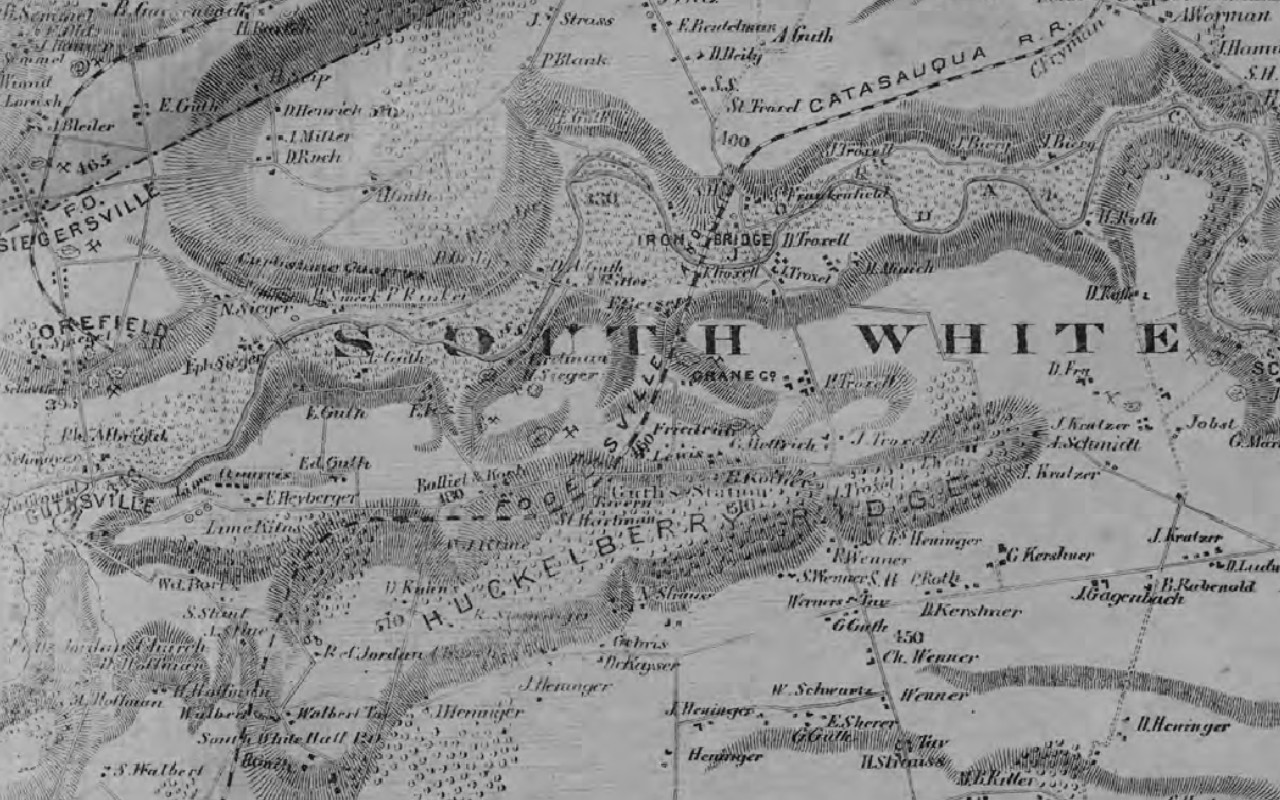
Excerpt from G.A. Aschbach’s 1862 map of Lehigh County, Pennsylvania showing Orefield and Guthsville in South Whitehall Township (public domain).
Mathias Miller was so skilled at motivating his fellow soldiers to fight to save America’s Union that he was repeatedly promoted up through the ranks of his regiment to become the commanding officer of his company. One of his sons would go on to inspire generations of African American men to strive for and achieve greatness as historians, philosophers, physicians, and scholars during the twentieth century. Another would survive the attack on Pearl Harbor in 1941, becoming a living eyewitness to the seminal event that transformed the United States from an isolationist nation to a major combatant in World War II.
Formative Years
Born in Guthsville, Lehigh County, Pennsylvania on 2 December 1839, Mathias Miller was a son of native Pennsylvanian John Miller (1808-1881) and Anna (Guth) Miller (1807-1872), who was a daughter of Heinrich Guth and Catharine Maria (Butz) Guth.
In 1850, Mathias Miller resided in South Whitehall Township, Lehigh County with his Lehigh County-born siblings: Franklin Miller (1830-1898), who had been born in May 1830 and would later wed Esther Sheirer (1830-1902), who was known to family and friends as “Hettie”; Aaron Miller (1834-1859), who had been born circa 1854 and would later marry and become a railroad laborer; Henry Miller (circa 1835-unknown), who had been born circa 1835 but appears to have died in early childhood (because his name was listed as one of John and Anna Miller’s children on the 1850 federal census but not on subsequent federal census records for this branch of the Miller family); Catherine Miller (1835-1920), who had been born in Guthsville on 8 March 1836, was known to family and friends as “Kate” and would later have a child with Daniel Norgang (1824-1905), before marrying German immigrant Johannes Miller (1833-1905), who later became known to family and friends as “John Miller”; Fronica Euphurnia Miller (1838-1918) who had been born on 26 January 1838, was known to family and friends as “Froney” and would later wed Moses Jonas Guth (1831-1901); Carolina Louisa Miller (1842-1898), who was born in Guthsville on 3 February 1842 and would later wed Tilghman Franklin Sourwine (1839-1915); Sarah M. Miller (1845-1937), who was born on 19 October 1845 and would later wed Charles Sauerwine (1841-1916) and settle with him in Guthsville; and Jonathan Miller (1849-1913), who was born on 30 October 1849 and would later become known as “John W. Miller” and marry Maria Elizabeth Anna Fenstermacher (1845-1906).
Sadly, before the 1850s ended, Mathias Miller’s older brother, Aaron Miller, was killed during a work-related railroad accident in October 1859, according to federal census mortality records. By the time that a federal census enumerator arrived on the doorstep of the Miller family home in South Whitehall in early July of 1860, a number of the Miller children had married and moved into their own homes to begin their own family lines. Those still living at home were: Caroline, Sarah and Jonathan/John W. Miller. The family’s patriarch — John Miller, the elder — was employed as a teamster, and had amassed personal and real estate holdings that were valued at one thousand dollars (the equivalent of roughly forty thousand U.S. dollars in 2026). Also living with the family was Simon Norgang (1852-1932), who was a son of Mathias Miller’s oldest sister, Catherine Miller.
* Note: Simon Norgang, who was a son of Catherine Miller, was born in Guthsville on 6 July 1852. He would grow up to become the organist at the Heidelberg Church and a justice of the peace in Lehigh County, and would marry and have multiple children with Sabina Catherine Biery (1858-1907), before being widowed by her and marrying for the second time to widow Tevilla Polly (Fries) Knauss (1866-1947).
During the summer of that same year (1860), Mathias Miller was residing and working as a farmhand on the farm and tannery of Joseph Guth in South Whitehall. The Guth operations were doing so well that they were valued at fourteen thousand dollars (the equivalent of more than a half million U.S. dollars in 2026).
But he and the Miller and Guth families would see their hopes and dreams for a brighter future dim as their nation descended into the darkness of secession and civil war.
American Civil War
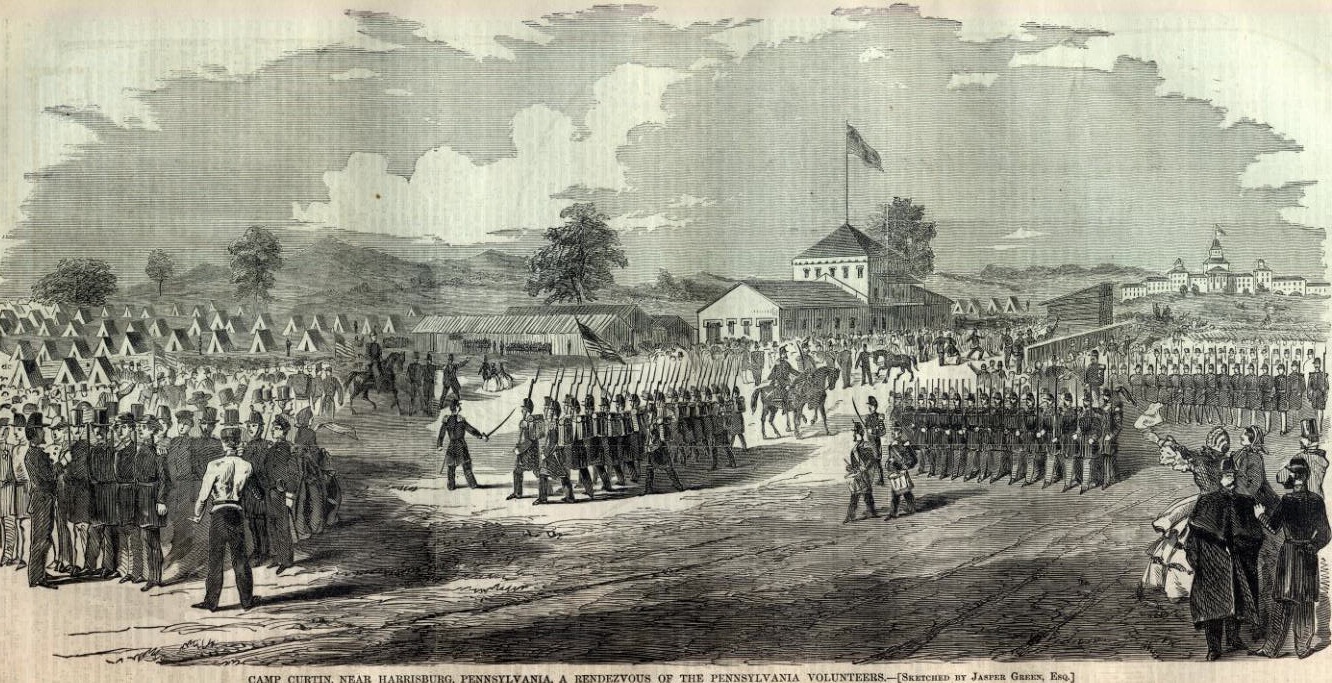
Camp Curtin (Harper’s Weekly, 1861, public domain).
Just twenty-one years old when President Abraham Lincoln issued his call for volunteers to help defend the nation’s capital, following the fall of Fort Sumter to Confederate troops in mid-April 1861, Mathias Miller was initially not among the First Defenders who headed to the city of Washington, but he did become one of the nation’s early responders when he enrolled for military service in Allentown on 21 August 1861. He then officially mustered in for duty at Camp Curtin in Dauphin County on as a corporal with Company K of the newly-formed 47th Pennsylvania Volunteer Infantry. Military records at the time described him as a butcher residing in Guthsville who was five feet, nine inches tall with brown hair, brown eyes and a light complexion.
* Note: Company K was raised with the intent of being an “all-German” company. Its founder, George Junker, was a twenty-six-year-old, proud native of Germany who lived and worked as a tombstone carver in Allentown, Lehigh County, Pennsylvania, and had served as a quartermaster sergeant with the Allen Infantry at the dawn of the American Civil War. Also known as the “Allen Guards,” that group of soldiers had been commanded by Captain Thomas Yeager and had become the first of the Allentown militia units (and one of the first five Pennsylvania units) to respond to President Abraham Lincoln’s first call for volunteers.
Following his return home to the bucolic Lehigh Valley in Pennsylvania and his adopted hometown of Allentown, Junker had promptly begun recruiting men to join a new company of soldiers for a three-year tour of duty, making a concerted effort to reach out to German immigrants, as well as naturalized and native born German-Americans for help. Der Lecha Caunty Patriot, the Lehigh Valley’s Allentown-based, German language newspaper, praised him for his initiative in its 7 August 1861 edition. Roughly translated, that announcement read:
It’s good to hear, that Sergeant Junker, of this city, is bringing a new German company of the Lehigh Valley along under the terms of recruitment for the duration of the war. It will be particularly sweet to him if such Germans already here or abroad, who have served as soldiers, sign up immediately for him, and join the company. It can be noted that Sergeant Junker, who recently returned from the scene of the war, has done important services for the Union side in this time, and has all capabilities that are necessary for a Captain. We wish him the best luck for his company.
Conducting most of his outreach within Allentown’s boundaries, Junker also recruited soldiers from Guthsville, Hazleton, Longswamp, and Saegersville.

The U.S. Capitol Building, unfinished at the time of President Abraham Lincoln’s inauguration, was still not completed when the 47th Pennsylvania Volunteers arrived in Washington, D.C. in September 1861 (public domain).
Following a brief training period in light infantry tactics at Camp Curtin, the men of Company K and their fellow 47th Pennsylvania Volunteers hopped aboard a train at the Harrisburg depot on 20 September 1861, and were transported by rail to Washington, D.C., where they disembarked and marched for the Soldiers’ Retreat to have dinner and rest. They were then marched to the Union’s “Camp Kalorama” on the Kalorama Heights near Georgetown — roughly two miles from the White House — where they pitched their tents and began their defense of the nation’s capital on 21 September.
The next day, Henry D. Wharton, a field musician (drummer) with the regiment’s C Company, penned the following update to his hometown newspaper, the Sunbury American:
After a tedious ride we have, at last, safely arrived at the City of ‘magnificent distances.’ We left Harrisburg on Friday last at 1 o’clock A.M. and reached this camp yesterday (Saturday) at 4 P.M., as tired and worn out a sett [sic] of mortals as can possibly exist. On arriving at Washington we were marched to the ‘Soldiers Retreat,’ a building purposely erected for the benefit of the soldier, where every comfort is extended to him and the wants of the ‘inner man’ supplied.
After partaking of refreshments we were ordered into line and marched, about three miles, to this camp. So tired were the men, that on marching out, some gave out, and had to leave the ranks, but J. Boulton Young, our ‘little Zouave,’ stood it bravely, and acted like a veteran. So small a drummer is scarcely seen in the army, and on the march through Washington he was twice the recipient of three cheers.
We were reviewed by Gen. McClellan yesterday [21 September 1861] without our knowing it. All along the march we noticed a considerable number of officers, both mounted and on foot; the horse of one of the officers was so beautiful that he was noticed by the whole regiment, in fact, so wrapt [sic] up were they in the horse, the rider wasn’t noticed, and the boys were considerably mortified this morning on dis-covering they had missed the sight of, and the neglect of not saluting the soldier next in command to Gen. Scott.
Col. Good, who has command of our regiment, is an excellent man and a splendid soldier. He is a man of very few words, and is continually attending to his duties and the wants of the Regiment.
…. Our Regiment will now be put to hard work; such as drilling and the usual business of camp life, and the boys expect and hope for an occasional ‘pop’ at the enemy.
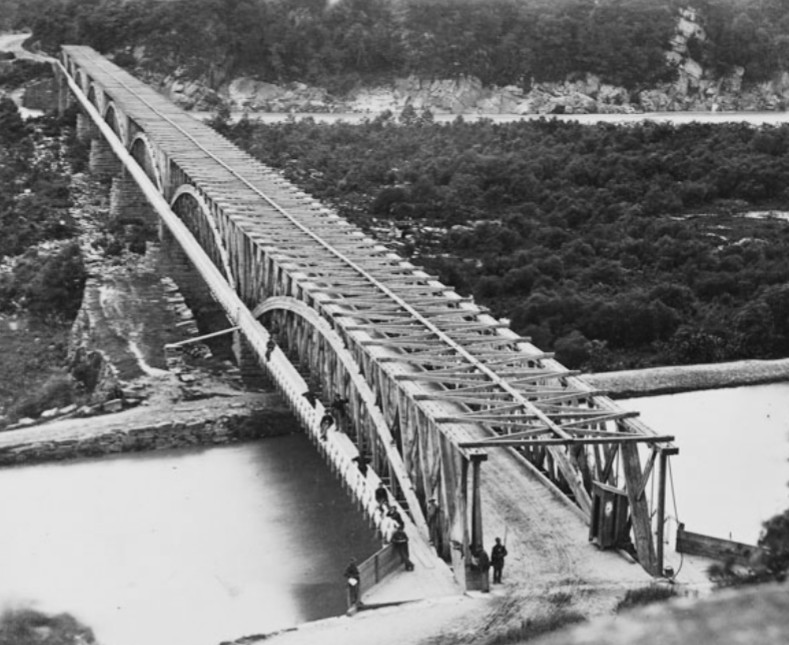
Unidentified Union soldiers guarding the Chain Bridge between Washington, D.C. and Virginia, circa 1861 (U.S. Library of Congress, public domain.
Acclimated somewhat to their new way of life, the soldiers of the 47th Regiment, Pennsylvania Volunteer Infantry finally became part of the U.S. Army when they were officially mustered into federal service on 24 September. Three days later, the 47th Pennsylvania was assigned to the 3rd Brigade of Brigadier-General Isaac Stevens, which also included the 33rd, 49th and 79th New York regiments. By that afternoon, the 47th Pennsylvanians were on the move again. Ordered onward by Brigadier-General Silas Casey, the Mississippi rifle-armed 47th Pennsylvania Volunteers marched behind their Regimental Band until reaching Camp Lyon, Maryland on the Potomac River’s eastern shore. At 5 p.m., they joined the 46th Pennsylvania in moving double-quick (one hundred and sixty-five steps per minute using thirty-three-inch steps) across the “Chain Bridge” marked on federal maps, and continued on for roughly another mile before being ordered to make camp.
The next morning, they broke camp and moved again. Marching toward Falls Church, Virginia, they arrived at Camp Advance around dusk. There, about two miles from the bridge they had crossed a day earlier, they re-pitched their tents in a deep ravine near a new federal fort under construction (Fort Ethan Allen). They had completed a roughly eight-mile trek, were situated close to the headquarters of Brigadier-General William Farrar Smith (also known as “Baldy”), and were now part of the massive U.S. Army of the Potomac (“Mr. Lincoln’s Army”). Under Smith’s leadership, their regiment and brigade would help to defend the nation’s capital from the time of their September arrival through late January when the men of the 47th Pennsylvania would be shipped south.
Once again, Company C Musician Henry Wharton recapped the regiment’s activities, noting, via his 29 September letter home to the Sunbury American, that the 47th had changed camps three times in three days:
On Friday last we left Camp Kalorama, and the same night encamped about one mile from the Chain Bridge on the opposite side of the Potomac from Washington. The next morning, Saturday, we were ordered to this Camp [Camp Advance near Fort Ethan Allen, Virginia], one and a half miles from the one we occupied the night previous. I should have mentioned that we halted on a high hill (on our march here) at the Chain Bridge, called Camp Lyon, but were immediately ordered on this side of the river. On the route from Kalorama we were for two hours exposed to the hardest rain I ever experienced. Whew, it was a whopper; but the fellows stood it well – not a murmur – and they waited in their wet clothes until nine o’clock at night for their supper. Our Camp adjoins that of the N.Y. 79th (Highlanders.)….
We had not been in this Camp more than six hours before our boys were supplied with twenty rounds of ball and cartridge, and ordered to march and meet the enemy; they were out all night and got back to Camp at nine o’clock this morning, without having a fight. They are now in their tents taking a snooze preparatory to another march this morning…. I don’t know how long the boys will be gone, but the orders are to cook two days’ rations and take it with them in their haversacks….
There was a nice little affair came off at Lavensville [sic, Lewinsville], a few miles from here on Wednesday last; our troops surprised a party of rebels (much larger than our own.) killing ten, took a Major prisoner, and captured a large number of horses, sheep and cattle, besides a large quantity of corn and potatoes, and about ninety six tons of hay. A very nice day’s work. The boys are well, in fact, there is no sickness of any consequence at all in our Regiment….

The Big Chestnut Tree, Camp Griffin, Langley, Virginia, 1861 (U.S. Library of Congress, public domain).
Sometime during that phase of duty, as part of the 3rd Brigade, the 47th Pennsylvanians were moved to a site they initially christened “Camp Big Chestnut” in reference to a large chestnut tree located nearby. The site would eventually become known to the Keystone Staters as “Camp Griffin,” and was located roughly ten miles from Washington, D.C.
On 11 October, the 47th Pennsylvania Volunteers marched in the Grand Review at Bailey’s Cross Roads. In a mid-October letter written to friends and family, Captain John Peter Shindel Gobin (the leader of C Company who would be promoted in 1864 to lead the entire 47th Regiment) reported that companies D, A, C, F and I (the 47th Pennsylvania’s right wing) were ordered to picket duty after the left-wing companies (B, E, G, H, and K) had been forced to return to camp by Confederate troops. In his letter of 13 October, Henry Wharton described their duties, as well as their new home:
The location of our camp is fine and the scenery would be splendid if the view was not obstructed by heavy thickets of pine and innumerable chesnut [sic] trees. The country around us is excellent for the Rebel scouts to display their bravery; that is, to lurk in the dense woods and pick off one of our unsuspecting pickets. Last night, however, they (the Rebels) calculated wide of their mark; some of the New York 33d boys were out on picket; some fourteen or fifteen shots were exchanged, when our side succeeded in bringing to the dust, (or rather mud,) an officer and two privates of the enemy’s mounted pickets. The officer was shot by a Lieutenant in Company H [?], of the 33d.
Our own boys have seen hard service since we have been on the ‘sacred soil.’ One day and night on picket, next day working on entrenchments at the Fort, (Ethan Allen.) another on guard, next on march and so on continually, but the hardest was on picket from last Thursday morning ‘till Saturday morning – all the time four miles from camp, and both of the nights the rain poured in torrents, so much so that their clothes were completely saturated with the rain. They stood it nobly – not one complaining; but from the size of their haversacks on their return, it is no wonder that they were satisfied and are so eager to go again tomorrow. I heard one of them say ‘there was such nice cabbage, sweet and Irish potatoes, turnips, &c., out where their duty called them, and then there was a likelihood of a Rebel sheep or young porker advancing over our lines and then he could take them as ‘contraband’ and have them for his own use.’ When they were out they saw about a dozen of the Rebel cavalry and would have had a bout with them, had it not been for…unlucky circumstance – one of the men caught the hammer of his rifle in the strap of his knapsack and caused his gun to fire; the Rebels heard the report and scampered in quick time….
On Friday morning, 22 October 1861, the 47th engaged in a divisional review, described by historian Lewis Schmidt as massing “about 10,000 infantry, 1000 cavalry, and twenty pieces of artillery all in one big open field.” Also around this time, Captain Junker issued his first Special Orders:
I. 15 minutes after breakfast every tent will be cleaned. The commander of each tent will be held responsible for it, and every soldier must obey the orders of the tent commander. If not, said commanders will report such men to the orderly Sgt. who will report them to headquarters.
II. There will be company drills every two hours during the day, including regimental drills with knapsacks. No one will be excused except by order of the regimental surgeon. The hours will be fixed by the commander, and as it is not certain therefore, every man must stay in his quarter, being always ready for duty. The roll will be called each time and anyone in camp found not answering will be punished the first time with extra duty. The second with carrying the 75 lb. weights, increased to 95 lb. The talking in ranks is strictly forbidden. The first offense will be punished with carrying 80 lb. weights increased to 95 lbs. for four hours.

Unknown regiment, Camp Griffin, Virginia, fall 1861 (U.S. Library of Congress, public domain).
In his letter of 17 November, Henry Wharton revealed still more details about life at Camp Griffin:
This morning our brigade was out for inspection; arms, accoutrements [sic], clothing, knapsacks, etc, all were out through a thorough examination, and if I must say it myself, our company stood best, A No. 1, for cleanliness. We have a new commander to our Brigade, Brigadier General Brannen [sic], of the U.S. Army, and if looks are any criterion, I think he is a strict disciplinarian and one who will be as able to get his men out of danger as he is willing to lead them to battle….
The boys have plenty of work to do, such as piquet [sic] duty, standing guard, wood-chopping, police duty and day drill; but then they have the most substantial food; our rations consist of fresh beef (three times a week) pickled pork, pickled beef, smoked pork, fresh bread, daily, which is baked by our own bakers, the Quartermaster having procured portable ovens for that purpose, potatoes, split peas, beans, occasionally molasses and plenty of good coffee, so you see Uncle Sam supplies us plentifully….
A few nights ago our Company was out on piquet [sic]; it was a terrible night, raining very hard the whole night, and what made it worse, the boys had to stand well to their work and dare not leave to look for shelter. Some of them consider they are well paid for their exposure, as they captured two ancient muskets belonging to Secessia. One of them is of English manufacture, and the other has the Virginia militia mark on it. They are both in a dilapidated condition, but the boys hold them in high estimation as they are trophies from the enemy, and besides they were taken from the house of Mrs. Stewart, sister to the rebel Jackson who assassinated the lamented Ellsworth at Alexandria. The honorable lady, Mrs. Stewart, is now a prisoner at Washington and her house is the headquarters of the command of the piquets [sic]….
Since the success of the secret expedition, we have all kinds of rumors in camp. One is that our Brigade will be sent to the relief of Gen. Sherman, in South Carolina. The boys all desire it and the news in the ‘Press’ is correct, that a large force is to be sent there, I think their wish will be gratified….
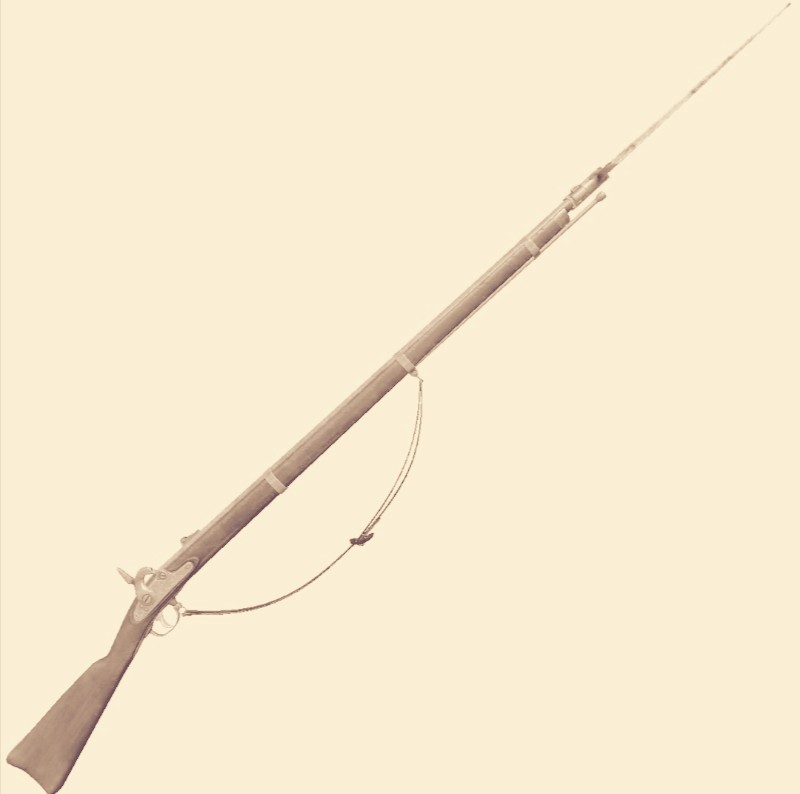
1861 Springfield rifle with attached bayonet (public domain).
On 21 November, the 47th participated in a morning divisional headquarters review monitored by Colonel Tilghman Good, followed by brigade and division drills all afternoon. According to Schmidt, “each man was supplied with ten blank cartridges.” Afterward, “Gen. Smith requested Gen. Brannan to inform Col. Good that the 47th was the best regiment in the whole division.”
As a reward for the regiment’s impressive performance that day — and in preparation for the even bigger adventures and honors that were yet to come, Brigadier-General John Milton Brannan ordered his staff to ensure that brand new Springfield rifles were obtained and distributed to every member of the 47th Pennsylvania Volunteer Infantry.
1862
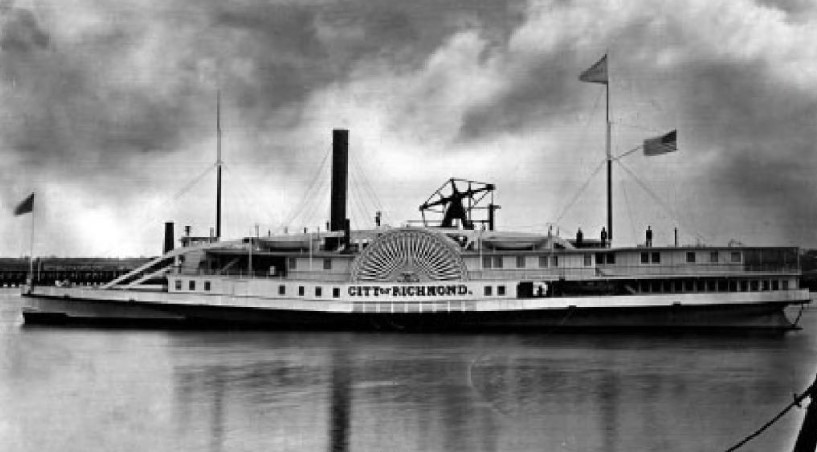
The City of Richmond, a sidewheel steamer, transported Union troops during the Civil War (Maine, circa late 1860s, public domain).
Next ordered to move from their Virginia encampment back to Maryland, the 47th Pennsylvania Volunteers left Camp Griffin at 8:30 a.m. on Wednesday, 22 January 1862, marching through deep mud with their equipment for three miles in order to reach the railroad station at Falls Church. Sent by rail to Alexandria, they then sailed the Potomac via the steamship City of Richmond to the Washington Arsenal, where they were reequipped before they were marched off for dinner and rest at the Soldiers’ Retreat in Washington, D.C. The next afternoon, the 47th Pennsylvanians hopped cars on the Baltimore & Ohio Railroad, and headed for Annapolis, Maryland.
Arriving around 10 p.m., they were assigned quarters in barracks at the United States Naval Academy. They then spent that Friday through Monday (24-27 January 1862) loading their equipment and other supplies onto the steamship Oriental.
By the afternoon of Monday, 27 January, the 47th Pennsylvania Volunteers had commenced boarding the Oriental. Ferried to the big steamship by smaller steamers, the enlisted men boarded first, followed by the officers. Then, per the directive of Brigadier-General Brannan, they steamed away for the Deep South at 4 p.m. The 47th Pennsylvanians were headed for Florida which, despite its secession from the United States, remained strategically important to the Union due to the presence of Forts Taylor and Jefferson in Key West and the Dry Tortugas.
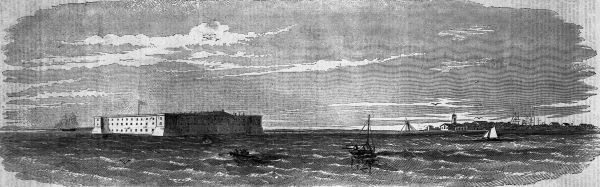
Fort Taylor, Key West, Florida, circa 1861 (courtesy, State Archives of Florida).
The men of Company K and their fellow 47th Pennsylvania Volunteers arrived in Key West by early February 1862. There, they were assigned to garrison Fort Taylor. During the weekend of Friday, 14 February, the 47th Pennsylvania Volunteers introduced their presence to Key West residents by parading through the streets of the city. That Sunday, a number of soldiers from the regiment attended to their spiritual needs by sitting in on the services at local churches, where they also met and mingled with residents from the area.
Drilling daily in heavy artillery tactics, they strengthened the fortifications at this federal installation, felled trees and built new roads.
Sometime during this phase of service, several members of the 47th Pennsylvania Volunteers contracted typhoid fever, and were confined to the post hospital at Fort Taylor. Privates Amandus Long, Augustus Schirer (alternate spelling: “Shirer”), George Leonhard (alternate spelling: “Leonard”), and Lewis Dipple of K Company died from “Febris Typhoides” on March 29, 5 April, 19 April, and 27 April 1862, respectively. According to Schmidt:
Pvt. Schirer was buried in grave #6 at the Key West Post Cemetery, but his remains lost their identity enroute [sic] to Fort Barrancas National Cemetery, where he is buried as an unknown in a group of 228….
And as if this were not enough, Pvt. George Leonard of Company K died in the General Hospital at Key West on Saturday, April 19. He was a miner in civilian life and was another member lost to Typhoid. His remains were originally buried in grave #9 at the Key West Post Cemetery and later removed to Fort Barrancas National Cemetery Section 17, grave 163….
Pvt. Lewis Dipple … former locksmith died in the General Hospital at Key West, and was buried in grave #10 at the Key West Post Cemetery, when the cemetery was abandoned and the bodies moved to Fort Barrancas National Cemetery, his body was one that was mishandled, and his remains are buried in a group of 228 unknown graves.
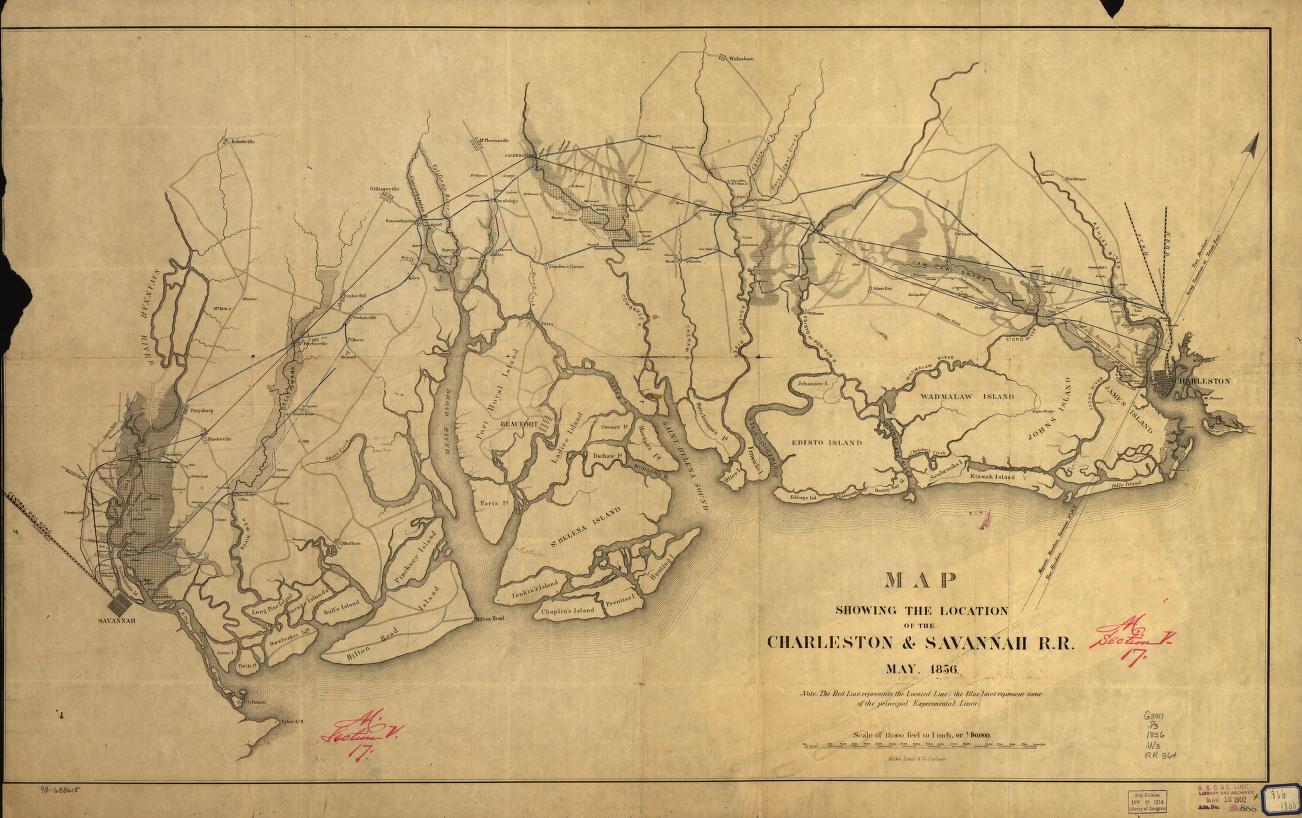
This 1856 map of the Charleston & Savannah Railroad shows the island of Hilton Head, South Carolina in relation to the towns of Beaufort and Pocotaligo (U.S. Library of Congress, public domain).
Next ordered to Hilton Head, South Carolina from mid-June through July, the 47th Pennsylvania Volunteers made camp near Fort Walker before relocating to the Beaufort District, Department of the South, roughly thirty-five miles away. Frequently assigned to hazardous picket detail north of their main camp, as Company K was on 5 July, the members of the 47th Pennsylvania were put at increased risk from enemy sniper fire when sent out on these special teams. According to historian Samuel P. Bates, during that phase of their service, the men of the 47th “received the highest commendation from Generals Hunter and Brannan” for their “attention to duty, discipline and soldierly bearing.”
Detachments from the regiment were also assigned to the Expedition to Fenwick Island (9 July) and the Demonstration against Pocotaligo (10 July). From 20-31 August 1862, Company K resumed picket duty — at “Barnwells” (so labeled by Company C Captain J. P. S. Gobin) while other companies from the regiment performed picket duty in the areas around Point Royal Ferry.
Saint John’s Bluff and the Capture of a Confederate Steamer

Earthworks surrounding the Confederate battery atop Saint John’s Bluff along the Saint John’s River in Florida (J. H. Schell, 1862, public domain).
During a return expedition to Florida beginning 30 September, the 47th joined with the 1st Connecticut Battery, 7th Connecticut Infantry, and part of the 1st Massachusetts Cavalry in assaulting Confederate forces at their heavily protected camp at Saint John’s Bluff overlooking the Saint John’s River area. Trekking and skirmishing through roughly twenty-five miles of dense swampland and forests after disembarking from ships at Mayport Mills on 1 October, the 47th captured artillery and ammunition stores (on 3 October), which had been abandoned by Confederate forces due to the bluff’s bombardment by Union gunboats.
A New Mission for Company K
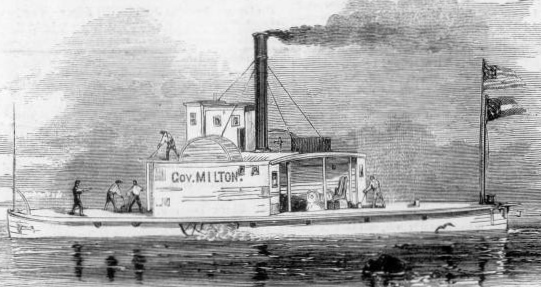
This rebel steamer, the Governor Milton,was captured by the U.S. flotilla during the Saint John’s River expedition in Florida (Frank Leslie’s Illustrated Newspaper, courtesy of the State Archives of Florida, Florida Memory Project, public domain).
After capturing Saint John’s Bluff, Union leaders ordered their gunboats and army troops to extend the expedition. As they did, they captured assorted watercraft as they advanced farther up the river. Companies E and K of the 47th were then led by Captain Yard on a special mission; the men of E and K Companies joined with other Union Army soldiers in the reconnaissance and subsequent capture of Jacksonville, Florida on 5 October 1862. A day later, sailing up river on board the Union gunboat Darlington (a former Confederate steamer) — with protection from the Union gunboat Hale, a detachment of Union soldiers traveled two hundred miles in search of another Confederate steamer — the Governor Milton, which was being used as a troop and supply ship by Confederate Army units scattered throughout the region, including the batteries at Saint John’s Bluff and Yellow Bluff. Seized by soldiers from the 47th Pennsylvania’s E and K Companies at a dock near Hawkinsville, that steamer was subsequently moved back down the Saint John’s River and secured behind Union lines to prevent its reuse by the Confederacy.
Integration of the Regiment
Meanwhile, as the majority of 47th Pennsylvania Volunteers engaged in the Expedition to Saint John’s Bluff, those who remained behind in Beaufort, South Carolina were helping their regiment to make history. On 5 and 15 October 1862, respectively, the 47th Pennsylvania became an integrated regiment by adding to its muster rolls several young to middle-aged Black men who had endured plantation enslavement in and around Beaufort and Hilton Head. Among the men freed who subsequently opted to enroll as members of the 47th Pennsylvania Volunteers were Abraham Jassum and Edward Jassum (aged sixteen and twenty-two, respectively), and Bristor Gethers (aged thirty-three).
Battle of Pocotaligo, South Carolina

Highlighted version of the U.S. Army map of the Coosawhatchie-Pocotaligo Expedition, 22 October 1862 (public domain).
From 21-23 October, under the brigade and regimental commands of Colonel Tilghman Good and Lieutenant-Colonel George Warren (“G. W.”) Alexander, the 47th Regiment, Pennsylvania Volunteer Infantry joined with other Union regiments to engage the heavily protected Confederate forces in and around Pocotaligo, South Carolina — including at Frampton’s Plantation and the Pocotaligo Bridge — a key piece of the South’s railroad infrastructure which Union leaders felt should be destroyed.
Harried by snipers en route to the Pocotaligo Bridge, they met resistance from yet another entrenched, heavily fortified Confederate battery which opened fire on the Union troops as they entered an open cotton field. Those headed toward higher ground at the Frampton Plantation fared no better as they encountered artillery and infantry fire from the surrounding forests. But the Union soldiers would not give in; grappling with the Confederates where they found them, they pursued the Rebels for four miles as the Confederate Army retreated to the bridge. There, the 47th relieved the 7th Connecticut.
Unfortunately, the enemy was just too well armed. After two hours of intense fighting in an attempt to take the ravine and bridge, the 47th was forced by depleted ammunition supplies to withdraw to Mackay’s Point. Losses for the 47th Pennsylvania were significant. Captain Charles Mickley of G Company died where he fell from a gunshot wound to his head, and K Company Private John McConnell was also killed in action, while his commanding officer, Captain George Junker, was mortally wounded by a Confederate Minié ball during the intense fighting near the Frampton Plantation. Private Gottlieb Fiesel, however, somehow managed to survive his head wound, only to contract meningitis while recuperating at Hilton Head. He died there on 9 November 1862, despite the heroic efforts of Union Army physicians to save him. Private Edward Frederick lasted a short while longer, finally succumbing on 16 February 1863 at Fort Jefferson in the Dry Tortugas, Florida to brain fever, a complication from the personal war he had waged with his battle wounds.
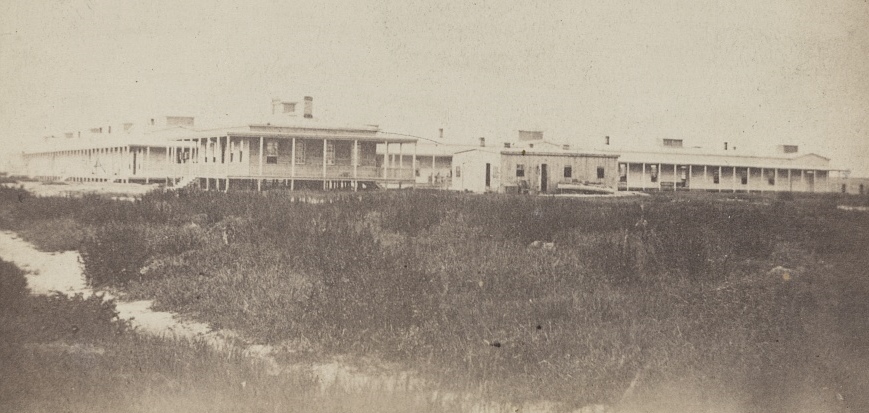
The U.S. General Hospital on Hilton Head Island in South Carolina, shown here circa 1861-1865, was built facing the ocean and Port Royal Bay at the mouth of the Broad River (U.S. Library of Congress, public domain; click to enlarge).
Company K’s Corporal John Bischoff and Privates Manoah J. Carl, Jacob F. Hertzog, Frederick Knell, Samuel Kunfer, Samuel Reinert, John Schimpf, William Schrank, and Paul Strauss were among those wounded in action who rallied. Private Strauss miraculously survived an artillery shell wound to his right shoulder, recuperated, and continued to serve with the regiment. Private Knell was discharged on a surgeon’s certificate of disability on 9 May 1863. Private Hertzog, who had been discharged two months earlier on his own surgeon’s certificate, on 24 February 1863, had sustained a gunshot wound (“Vulnus Sclopet”) to his right arm; his treatment, like that of the aforementioned Private Fiesel, was detailed extensively in medical journals during and after his period of service:
[A]dmitted to Hospital. No. 1, Beaufort, S.C., with gunshot wound of right elbow joint, the ball entering the outer, and emerging just above the inner condyle of the humerus of on [sic] the opposite side.
Oct. 26t. Exsection of the lower end of humerus, and articulating ends of the ulna and radius was performed, and the arm laid upon an angular splint of two parallel strips, leaving an open space the whole extent, thus rendering approach to the wound of exit easy. Morph. sulph. was applied to the wound, and a dressing of serate cloth to cover the whole, a bag of ice was also applied.
Nov. 1st. Suppuration considerable, but the great tumefaction of the arm and forearm, much diminished.
Nov. 15th. The sutures of lead wire were to-day removed, the wound having healed sufficiently to keep the parts in shape. The general condition of the patient improved.
Dec. 15th. The patient has been for some days dressed and walking about the grounds. The wound is nearly healed, the elbow admitting of free motion in every direction.
Dec. 28th. The wound has been some days healed, there are no discharges, the patient was to-day sent north per steamer ‘Star of the South.’ The good result attained in the above case, may without doubt, be attributed partially to the excellent condition of the patient; he never having used in his life, either alcoholic or malt liquors, neither tea, coffee, nor tobacco.
New Company K Leadership
The command vacancy created when Captain George Junker fell in battle at Pocotaligo was quickly filled when K Company’s First Lieutenant Charles W. Abbott was advanced to the rank of captain that same day. After returning to Hilton Head on 23 October, a special detachment of the regiment was then assigned to serve as the honor guard for the funeral of Major-General Ormsby M. Mitchel, the commander of the U.S. Army’s 10th Corps and Department of the South, who died from yellow fever on 30 October.
1863
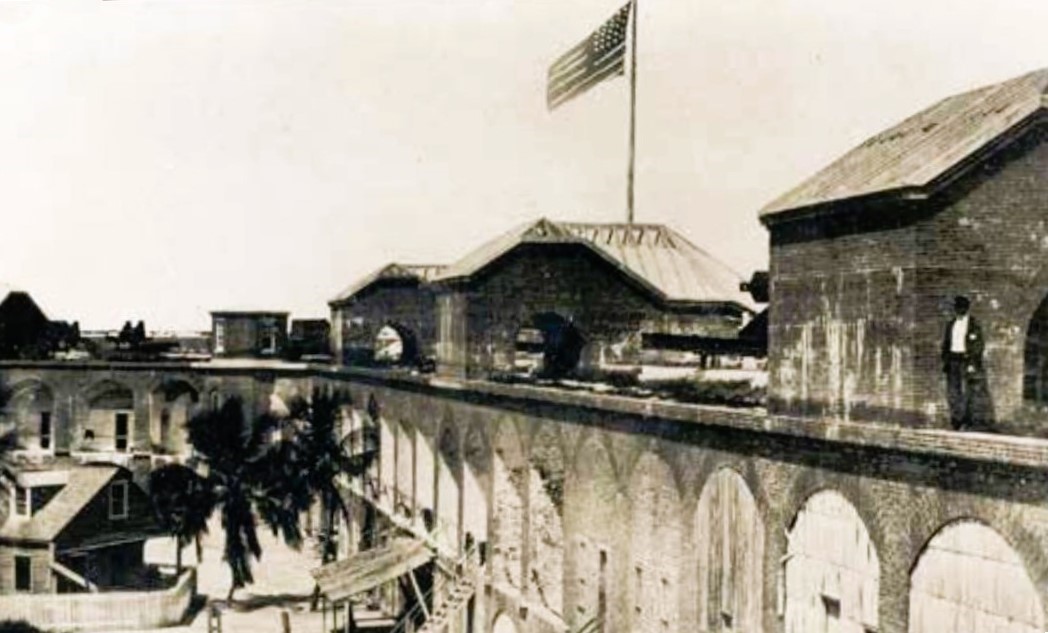
Second-tier casemates, lighthouse keeper’s house, sallyport, and lean-to structure, Fort Jefferson, Dry Tortugas, Florida, late 1860s (U.S. National Park Service and National Archives, public domain).
Having been ordered back to Key West on 15 November 1862, the 47th Pennsylvania Volunteers spent much of 1863 garrisoning federal installations in Florida as part of the U.S. Army’s 10th Corps, Department of the South. The men of K Company joined with Companies D, F, and H in garrisoning Fort Jefferson in the Dry Tortugas. So remotely situated off the coast of Florida was that Union outpost that it was accessible only by ship. As with their previous assignments, the 47th Pennsylvania Volunteers soon came to realize that disease would be their constant devil, making it all the more remarkable that the majority of 47th Pennsylvanians chose to re-enlist when their three-year service terms were up, including Corporal Mathias Miller, who re-enrolled as a corporal with the same company and same regiment of the Union Army (Company K of the 47th Pennsylvania Volunteer Infantry) at Fort Jefferson on 27 October 1863 — earning him the coveted title of “Veteran Volunteer.”
1864
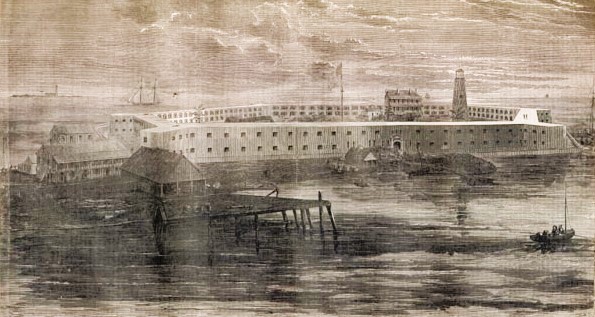
Fort Jefferson and its wharf areas, Dry Tortugas, Florida (Harper’s Weekly, 23 February 1861, public domain).
Just over two months later, as the New Year of 1864 dawned at Fort Jefferson in Florida, it brought new responsibilities for Mathias Miller, who was promoted to first segeant of the 47th Pennsylvania’s K Company on 1 January 1864. Senior leaders of the 47th were then ordered to expand the Union’s reach by sending part of the regiment north to retake possession of Fort Myers, a federal installation that had been abandoned in 1858 following the U.S. government’s third war with the Seminole Indians. Per orders issued earlier in 1864 by Major-General D. P. Woodbury, Commanding Officer, U.S. Department of the Gulf, District of Key West and the Tortugas, that the fort be used to facilitate the Union’s Gulf Coast blockade, Captain Richard Graeffe and a group of men from Company A were charged with expanding the fort and conducting raids on area cattle herds to provide food for the growing Union troop presence across Florida. Graeffe and his men subsequently turned the fort into both their base of operations and a shelter for pro-Union supporters, escaped slaves, Confederate Army deserters, and others fleeing Rebel troops.
Meanwhile, all of the other companies of the 47th Pennsylvania Volunteer Infantry were preparing for the regiment’s history-making journey to Louisiana. Boarding yet another steamer — the Charles Thomas — on 25 February 1864, the men of Companies B, C, D, I, and K of the 47th Pennsylvania headed for Algiers, Louisiana, followed on 1 March by other members of the regiment from Companies E, F, G, and H who had been stationed at Fort Jefferson in the Dry Tortugas. Upon the second group’s arrival, the now almost fully reunited regiment moved by train on 28 February to Brashear City (now Morgan City, Louisiana) before heading to Franklin by steamer through the Bayou Teche. Once there, the 47th Pennsylvania Volunteer Infantry joined the 2nd Brigade, 1st Division of the U.S. Department of the Gulf’s 19th Army Corps, becoming the only Pennsylvania regiment to serve in the Red River Campaign of Union Major-General Nathaniel P. Banks. (Unable to reach Louisiana until 23 March, Company A’s men were assigned to detached duty in New Orleans while awaiting transport. Charged with guarding and transporting two hundred and forty-five Confederate prisoners, they boarded the Ohio Belle on 7 April and finally reached Alexandria with those prisoners on 9 April.)
* Note: Tragically, the Red River Campaign had not even begun for the men of Company K before tragedy struck. According to Henry Wharton:
Just as the steamer was rounding, preparatory to our landing … on the beach … at Algiers, a fatal accident happened to a member of Company K. He was sitting in one of the side hatches of the boat, lost his balance and before a boat could get to him, either from the steamer or shore, he was drowned. No one saw him fall, and it was only known by seeing him come up astern of the boat, that a ‘man was overboard’. His cap was found: on the vizier was ‘F.K.’, by which means it was discovered the missing man was Frederick Koehler, a citizen of Lehigh County and a member of Company K, Capt. Abbott.”
Red River Campaign
From 14-26 March, the majority of 47th Pennsylvania Volunteers marched for Alexandria and Natchitoches, Louisiana, by way of New Iberia, Vermilionville (now part of Lafayette), Opelousas, and Washington.
Then, on 5 April 1864, the regiment added to its roster of young Black soldiers when Aaron Bullard (later known as Aaron French), James and John Bullard, Samuel Jones, and Hamilton Blanchard (also known as John Hamilton) enrolled for military service with the 47th Pennsylvania at Natchitoches. According to their respective entries in the Civil War Veterans’ Card File at the Pennsylvania State Archives and on regimental muster rolls, the men were then officially mustered in for duty on 22 June at Morganza. Several of their entries noted that they were assigned the rank of “(Colored) Cook” while others were given the rank of “undercook.”
Often short on food and water throughout their long harsh-climate trek through enemy territory, the men encamped briefly at Pleasant Hill the night of 7 April before continuing on the next day, marching until mid-afternoon.
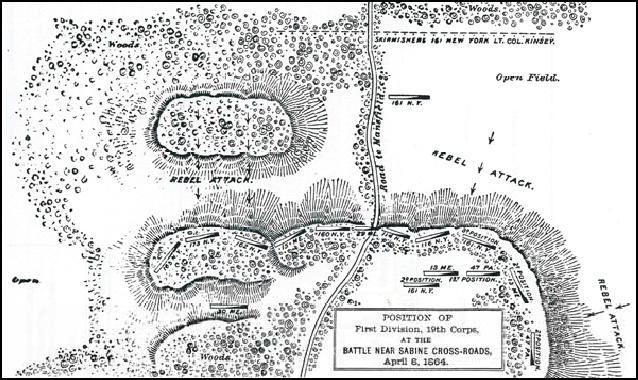
19th U.S. Army Map, Phase 3, Battle of Sabine Cross Roads/Mansfield (8 April 1864, public domain).
Marching until mid-afternoon, the 47th Pennsylvanians were then rushed into battle ahead of other regiments in the 2nd Division. Sixty members of the 47th were cut down on 8 April during the volley of fire unleashed during the Battle of Sabine Cross Roads (Mansfield).
The fighting waned only when darkness fell. The exhausted, but uninjured collapsed beside the gravely wounded and dead. After midnight, the surviving Union troops withdrew to Pleasant Hill. Among those who died that day was Company K’s Second Lieutenant Alfred P. Swoyer. According to his superior officer, his final words were, “They’re coming nine deep.” His burial location remains unidentified.
The next day, the 47th Pennsylvania Volunteers were ordered into a critically important defensive position at the far right of the Union lines, their right flank spreading up onto a high bluff. By 3 p.m., after enduring a midday charge by the troops of Confederate Major-General Richard Taylor (a plantation owner who was the son of Zachary Taylor, former president of the United States), the brutal fighting still showed no signs of ending. Suddenly, just as the 47th was shifting to the left side of the massed Union forces, the men of the 47th Pennsylvania were forced to bolster the 165th New York’s buckling lines by blocking another Confederate assault durIng what is now known as the Battle of Pleasant Hill.
Casualties were severe. Privates Nicholas Hagelgans, Jacob Madder and Samuel Wolf of K Company were all killed in action. The regiment’s second-in-command, Lieutenant-Colonel Alexander, was nearly killed, and the regiment’s two color-bearers, both from Company C, were also seriously wounded while preventing the American flag from falling into enemy hands. Still others from the 47th were captured by Confederate troops. Held initially as prisoners of war at Pleasant Hill, Louisiana, they were subsequently marched roughly one hundred and twenty-five miles to Camp Ford, a Confederate Army prison camp near Tyler, Texas, and held there as POWs until they were released during prisoner exchanges beginning 22 July. Sadly, multiple members of the 47th never made it out alive.
Following what some historians have called a rout by Confederates at Pleasant Hill and others have labeled a technical victory for the Union or a draw for both sides, the 47th Pennsylvanians fell back to Grand Ecore, where they remained for eleven days and engaged in the hard labor of strengthening regimental and brigade fortifications. They then moved back to Natchitoches Parish on 22 April, arriving in Cloutierville at 10 p.m. that same night, after marching forty-five miles. While en route, they were attacked again — this time at the rear of their brigade, but they were able to quickly end the encounter and continue on.

The 47th Pennsylvania Volunteers were stationed just to the left of the “Thick Woods” with Emory’s 2nd Brigade, 1st Division as shown on this map of Union troop positions for the Battle of Cane River Crossing at Monett’s Ferry, Louisiana, 23 April 1864 )Major-General Nathaniel Banks’ official Red River Campaign Report, public domain).
The next morning (23 April 1864), episodic skirmishing quickly roared into the flames of a robust fight. As part of the advance party led by Brigadier-General William Emory, the 47th Pennsylvanians took on Brigadier-General Hamilton P. Bee’s Confederate Cavalry in the Battle of Cane River (also known as “the Affair at Monett’s Ferry” or the “Cane River Crossing”). Responding to a barrage from the Confederate artillery’s twenty-pound Parrott guns and raking fire from enemy troops situated near a bayou and on a bluff, Emory directed one of his brigades to keep Bee’s Confederates busy while sending the other two brigades to find a safe spot where his Union troops could ford the Cane River. As part of the “beekeepers,” the 47th Pennsylvania supported Emory’s artillery.
Meanwhile, Emory’s other units worked their way across the Cane River, attacked Bee’s flank, forced a Rebel retreat, and erected a series of pontoon bridges, enabling the 47th and other remaining Union troops to make the Cane River Crossing by the next day. As the Confederates retreated, they torched their own food stores, as well as the cotton supplies of their fellow southerners. In a letter penned from Morganza, Louisiana on 29 May, Henry Wharton described what had happened to the 47th Pennsylvanians during and immediately after making camp at Grand Ecore:
Our sojourn at Grand Ecore was for eleven days, during which time our position was well fortified by entrenchments for a length of five miles, made of heavy logs, five feet high and six feet wide, filled in with dirt. In front of this, trees were felled for a distance of two hundred yards, so that if the enemy attacked we had an open space before us which would enable our forces to repel them and follow if necessary. But our labor seemed to the men as useless, for on the morning of 22d April, the army abandoned these works and started for Alexandria. From our scouts it was ascertained that the enemy had passed some miles to our left with the intention of making a stand against our right at Bayou Cane, where there is a high bluff and dense woods, and at the same attack Smith’s forces who were bringing up the rear. This first day was a hard one on the boys, for by ten o’clock at night they made Cloutierville, a distance of forty-five miles. On that day the rear was attacked which caused our forces to reverse their front and form in line of battle, expecting too, to go back to the relief of Smith, but he needed no assistance, sending word to the front that he had ‘whipped them, and could do it again.’ It was well that Banks made so long a march on that day, for on the next we found the enemy prepared to carry out their design of attacking us front and rear. Skirmishing commenced early in the morning and as our columns advanced he fell back towards the bayou, when we soon discovered the position of their batteries on the bluff. There was then an artillery duel by the smaller pieces, and some sharp fighting by the cavalry, when the ‘mule battery,’ twenty pound Parrott guns, opened a heavy fire, which soon dislodged them, forcing the chivalry to flee in a manner not at all suitable to their boasted courage. Before this one cavalry, the 3d Brigade of the 1st Div., and Birges’ brigade of the second, had crossed the bayou and were doing good service, which, with the other work, made the enemy show their heels. The 3d brigade done some daring deeds in this fight, as also did the cavalry. In one instance the 3d charged up a hill almost perpendicular, driving the enemy back by the bayonet without firing a gun. The woods on this bluff was so thick that the cavalry had to dismount and fight on foot. During the whole of the day, our brigade, the 2d was supporting artillery, under fire all the time, and could not give Mr. Reb a return shot.
While we were fighting in front, Smith was engaged some miles in the rear, but he done his part well and drove them back. The rebel commanders thought by attacking us in the rear, and having a large face on the bluffs, they would be able to capture our train and take us all prisoners, but in this they were mistaken, for our march was so rapid that we were on them before they had thrown up the necessary earthworks. Besides they underrated the amount of our artillery, calculating from the number engaged at Pleasant Hill. The rebel prisoners say it ‘seems as though the Yankees manufacture, on short notice, artillery to order, and the men are furnished with wings when they wish to make a certain point.
The damage done to the Confederate cause by the burning of cotton was immense. On the night of the 22d our route was lighted up for miles and millions of dollars worth of this production was destroyed. This loss will be felt more by Davis & Co., than several defeats in this region, for the basis of the loan in England was on the cotton of Western Louisiana.
After the rebels had fled from the bluff the negro troops put down the pontoons, and by ten that night we were six miles beyond the bayou safely encamped. The next morning we moved forward and in two days were in Alexandria. Johnnys followed Smith’s forces, keeping out of range of his guns, except when he had gained the eminence across the bayou, when he punished them (the rebs) severely.
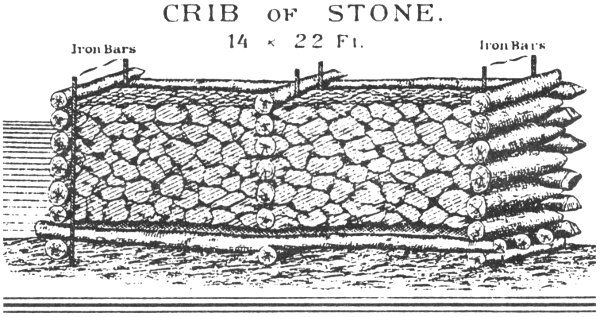
Sketches of the crib and tree dams designed by Lieutenant-Colonel Joseph Bailey to improve the water levels of the Red River near Alexandria, Louisiana, spring 1864 (Joseph Bailey, “Report on the Construction of the Dam Across the Red River,” 1865, public domain).
Having finally reached Alexandria on 26 April, they learned they would remain at their latest new camp for at least two weeks. Placed temporarily under the command of Lieutenant-Colonel Joseph Bailey, they were assigned yet again to the hard labor of fortification work, helping to erect “Bailey’s Dam,” a timber structure that enabled Union gunboats to more easily make their way back down the Red River. Explained Wharton:
We were at Alexandria seventeen days, during which time the men were kept busy at throwing up earthworks, foraging and three times went out some distance to meet the enemy, but they did not make their appearance in numbers large enough for an engagement. The water in the Red river had fallen so much that it prevented the gunboats from operating with us, and kept our transports from supplying the troops with rations, (and you know soldiers, like other people, will eat) so Banks was compelled to relinquish his designs on Shreveport and fall back to the Mississippi. To do this a large dam [Bailey’s Dam] had to be built on the falls at Alexandria to get the ironclads down the river. After a great deal of labor this was accomplished and by the morning of May 13th the last one was through the shute [sic], when we bade adieu to Alexandria, marching through the town with banners flying and keeping step to the music of ‘Rally around the flag,’ and ‘When this cruel war is over.’ The next morning, at our camping place, the fleet of boats passed us, when we were informed that Alexandria had been destroyed by fire – the act of a dissatisfied citizen and several negroes. Incendiary acts were strictly forbidden in a general order the day before we left the place, and a cavalry guard was left in the rear to see the order enforced. After marching a few miles skirmishing commenced in front between the cavalry and the enemy in riflepits [sic] on the bank of the river, but they were easily driven away. When we came up we discovered their pits and places where there had been batteries planted. At this point the John Warren, an unarmed transport, on which were sick soldiers and women, was fired into and sunk, killing many and those that were not drowned taken prisoners. A tin-clad gunboat was destroyed at the same place, by which we lost a large mail. Many letters and directed envelopes were found on the bank – thrown there after the contents had been read by the unprincipled scoundrels. The inhumanity of Guerrilla bands in this department is beyond belief, and if one did not know the truth of it or saw some of their barbarities, he would write it down as the story of a ‘reliable gentleman’ or as told by an ‘intelligent contraband.’ Not satisfied with his murderous intent on unarmed transports he fires into the Hospital steamer Laurel Hill, with four hundred sick on board. This boat had the usual hospital signal floating fore and aft, yet, notwithstanding all this, and the customs of war, they fired on them, proving by this act that they are more hardened than the Indians on the frontier.
On Sunday, May 15, we left the river road and took a short route through the woods, saving considerable distance. The windings of Red river are so numerous that it resembles the tape-worm railroad wherewith the politicians frightened the dear people during the administration of Ritner and Stevens. – We stopped several hours in the woods to leave cavalry pass, when we moved forward and by four o’clock emerged into a large open plain where we formed in line of battle, expecting a regular engagement. The enemy, however, retired and we advanced ‘till dark, when the forces halted for the night, with orders to rest on their arms. – ‘Twas here that Banks rode through our regiment, amidst the cheers of the boys, and gave the pleasant news that Grant had defeated Lee.

“Sleeping on Their Arms” by Winslow Homer (Harper’s Weekly, 21 May 1864).
Having entered Avoyelles Parish, they “rested on their arms” for the night, half-dozing without pitching their tents, but with their rifles right beside them. They were now positioned just outside of Marksville, Louisiana on the eve of the 16 May 1864 Battle of Mansura, which unfolded as follows, according to Wharton:
Early next morning we marched through Marksville into a prairie nine miles long and six wide where every preparation was made for a fight. The whole of our force was formed in line, in support of artillery in front, who commenced operations on the enemy driving him gradually from the prairie into the woods. As the enemy retreated before the heavy fire of our artillery, the infantry advanced in line until they reached Mousoula [sic], where they formed in column, taking the whole field in an attempt to flank the enemy, but their running qualities were so good that we were foiled. The maneuvring [sic] of the troops was handsomely done, and the movements was [sic] one of the finest things of the war. The fight of artillery was a steady one of five miles. The enemy merely stood that they might cover the retreat of their infantry and train under cover of their artillery. Our loss was slight. Of the rebels we could not ascertain correctly, but learned from citizens who had secreted themselves during the fight, that they had many killed and wounded, who threw them into wagons, promiscuously, and drove them off so that we could not learn their casualties. The next day we moved to Simmsport on the Achafalaya [sic] river, where a bridge was made by putting the transports side by side, which enabled the troops and train to pass safely over. – The day before we crossed the rebels attacked Smith, thinking it was but the rear guard, in which they, the graybacks, were awfully cut up, and four hundred prisoners fell into our hands. Our loss in killed and wounded was ninety. This fight was the last one of the expedition. The whole of the force is safe on the Mississippi, gunboats, transports and trains. The 16th and 17th have gone to their old commands.
It is amusing to read the statements of correspondents to papers North, concerning our movements and the losses of our army. I have it from the best source that the Federal loss from Franklin to Mansfield, and from their [sic] to this point does not exceed thirty-five hundred in killed, wounded and missing, while that of the rebels is over eight thousand.

Union Army base at Morganza Bend, Louisiana, circa 1863-1865 (U.S. Library of Congress, public domain).
Continuing on, the surviving members of the 47th marched for Simmesport and then Morganza, where they made camp again. While encamped at Morganza, the nine formerly enslaved Black men who had enlisted with the 47th Pennsylvania in Beaufort, South Carolina (1862) and Natchitoches, Louisiana (April 1864) were officially mustered into the regiment between 20-24 June 1864. The regiment then moved on once again, and arrived in New Orleans in late June.
That same month, Company K lost another of its members when Private Paul Houser died while on furlough; he was among those men who drowned near Cape May, New Jersey during the sinking of the steamer Pocohontas. Follow-up coverage in The New York Times reported that many of those who lost their lives had been on their way home, having been wounded in action or taken ill while in service to their nation.
Then, on the Fourth of July, while stationed in New Orleans, senior officers of the 47th Pennsylvania Volunteer Infantry received orders to return their regiment to the East Coast. As a result, the men of Companies A, C, D, E, F, H, and I steamed for the Washington, D.C. area beginning 7 July, while those from Companies B, G and K stayed behind on detached duty, awaiting transportation. Led by F Company Captain Henry S. Harte, First Sergeant Mathias Miller and that second group of 47th Pennsylvania Volunteers finally sailed away at the end of the month aboard the Blackstone. Arriving in Virginia on 28 July, they reconnected with the 47th at Monocacy, Virginia on 2 August, missing a memorable encounter with President Abraham Lincoln on 12 July 1864 and the Battle of Cool Spring at Snicker’s Gap, Virginia.
On 24 July 1864, Captain John Peter Shindel Gobin was promoted from his leadership of Company C to the rank of major and began serving with the 47th Pennsylvania’s central regimental command.
Sheridan’s 1864 Shenandoah Valley Campaign
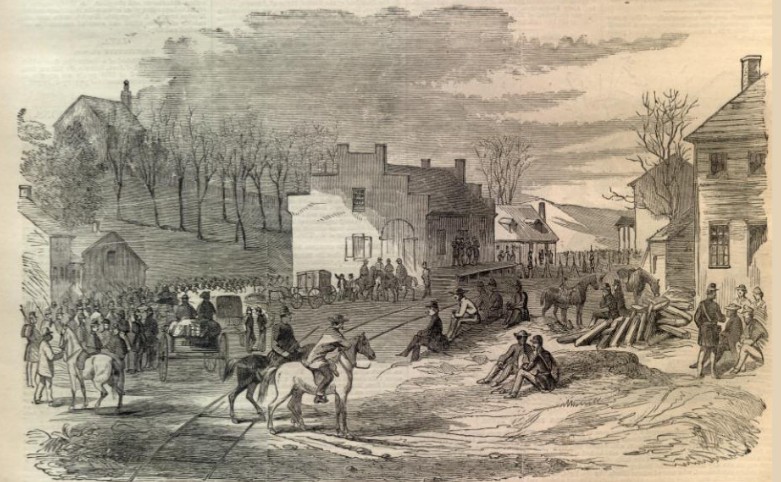
“The Rendezvous of the Virginians at Halltown, Virginia, 5 p.m. on April 18, 1861 to March on Harper’s Ferry” (D. H. Strother, Harper’s Weekly, 11 May 1861, public domain).
On 1 August 1864, the men of K Company received word that their own First Sergeant Matthias Miller would be promoted again, advanced this time to the rank of second lieutenant; in addition, Corporal Franklin Beisel became First Sergeant Beisel that same day, and Private Samuel Reinert was promoted to the rank of corporal. Attached to the Middle Military Division, U.S. Army of the Shenandoah, led by Union General Philip Sheridan, the 47th Pennsylvania Volunteers were then assigned to defensive duties in and around Halltown, and also began to engage in a series of back-and-forth movements between Halltown, Berryville, Middletown, Charlestown, and Winchester, Virginia during a “mimic war” waged between Sheridan’s forces with those commanded by Confederate Lieutenant-General Jubal Early.
From 3-4 September, the 47th Pennsylvania engaged with Confederate troops in the Battle of Berryville, Virginia. Several men were killed or wounded in action, including Private George Kilmore (alternate spelling “Killmer”), who sustained a fatal gunshot wound to the abdomen on 5 September.
On 14 September, Corporal Elias F. Benner was promoted to the rank of sergeant. Four days later, multiple members of the 47th Pennsylvania opted to leave, content that they had fulfilled their obligations to the nation by completing their original three-year terms of enlistment. Among those receiving honorable discharges on 18 September were: Company D’s Captain Henry Woodruff, E Company’s Captain Charles H. Yard and Captain Henry S. Harte of F Company, as well as K Company’s Sergeant-Major Conrad Volkenand, Sergeant Peter Reinmiller, Corporals Lewis Benner and George Knuck, and Privates Valentine Amend, M. Bornschier, Charles Fisher, Charles Heiney, Jacob Kentzler, John Koldhoff, Anthony Krause, Elias Leh, Samuel Madder, Lewis Metzger, Alfred Muthard, John Schimpf, John Scholl, and Christopher Ulrich. All were officially mustered out at Berryville, Virginia.
Those members of the 47th who remained on duty, however, were about to engage in their regiment’s greatest moments of valor.
Battles of Opequan and Fisher’s Hill

Battle of Opequan (aka Third Winchester), Virginia, 19 September 1864 (public domain).
Together with other regiments under the command of Union Major-General Philip H. (“Little Phil”) Sheridan and Brigadier-General William H. Emory, commander of the 19th Corps, the members of Company K and their fellow 47th Pennsylvania Volunteers helped to inflict heavy casualties on Lieutenant-General Jubal Early’s Confederate forces in the Battle of Opequan (also spelled as “Opequon” and referred to as “Third Winchester”). That battle is still considered by many historians to be one of the most important during Sheridan’s 1864 campaign; the Union’s victory here helped to ensure the reelection of President Abraham Lincoln.
The 47th Pennsylvania’s march toward destiny at Opequan began at 2 a.m. on 19 September 1864 as the regiment left camp and joined up with others in the Union’s 19th Corps. Advancing slowly from Berryville toward Winchester, the 19th Corps became bogged down for several hours by the massive movement of Union troops and supply wagons, enabling Early’s men to dig in. Finally reaching the Opequan Creek, Sheridan’s men came face to face with Early’s Confederate Army. The fighting, which began in earnest at noon, was long and brutal. The Union’s left flank (6th Corps) took a beating from Confederate artillery stationed on high ground.

Victory of Philip Sheridan’s Union Army over Jubal Early’s Confederate forces, Battle of Opequan, 19 September 1864 (Kurz & Allison, circa 1893, U.S. Library of Congress, public domain).
Meanwhile, the 47th Pennsylvania and the 19th Corps were directed by Brigadier-General Emory to attack and pursue Major-General John B. Gordon’s Confederate forces. Some success was achieved, but casualties mounted as a Confederate artillery group opened fire on Union troops trying to cross a clearing. When a nearly fatal gap began to open between the 6th and 19th Corps, Sheridan sent in units led by Brigadier-Generals Emory Upton and David A. Russell. Russell, hit twice — once in the chest, was mortally wounded. The 47th Pennsylvania opened its lines long enough to enable the Union cavalry under William Woods Averell and the foot soldiers of Brigadier-General George Crook to charge the Confederates’ left flank. The 19th Corps, with the 47th in the thick of the fighting, then began pushing the Confederates back. Early’s “grays” retreated in the face of the valor displayed by Sheridan’s “blue jackets,” giving the Union Army a clear victory that day — a day on which Privates Samuel Kunfer, William Landis and Christian Weidenbach were promoted to the rank of corporal.
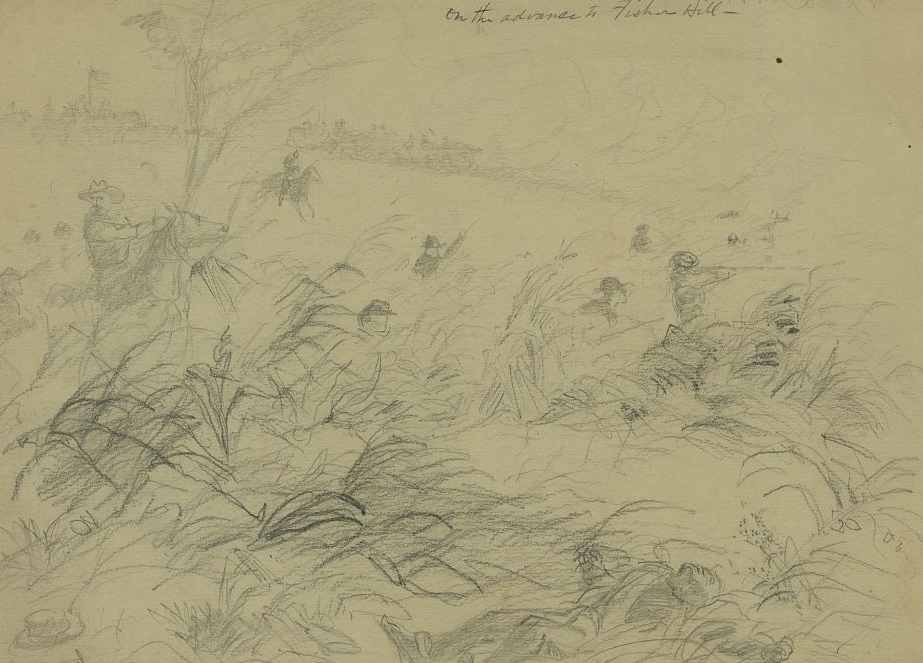
“On the Advance to Fisher’s Hill, Forward the Skirmishers” (Alfred Waud, 22 September 1864, U.S. Library of Congress, public domain).
Afterward, the Rebels retreated eight miles to the south, leaving twenty-five hundred of their wounded behind. As one of the Union units that pursued the enemy over the next several days, the 47th Pennsylvania Volunteer Infantry subsequently re-engaged with the enemy during the Battle of Fisher’s Hill from 21-22 September, in which Sheridan’s Union men which outnumbered Early’s three to one. Early’s Confederates then fled to Waynesboro — with Union troops in hot pursuit. The 47th Pennsylvanians then rejoined the massive Union encampment at Cedar Creek. Among the 47th Pennsylvanians listed on the casualty rosters following that engagement was Private James M. Sieger of Company K. (According to the special veterans’ census that would later be taken in 1890, he had sustained a wound above one of his knees.)
Over the next two days (23-24 September), the 47th Pennsylvania’s founder, Colonel Tilghman H. Good, and his second-in-command, Lieutenant-Colonel George Alexander, both left the regiment, mustering out upon the expiration of their respective terms of service. Fortunately, they were replaced with leaders who were equally respected for their front-line experience, including Major John Peter Shindel Gobin, formerly of the 47th’s Company C.
Battle of Cedar Creek

Alfred Waud’s 1864 sketch, “Surprise at Cedar Creek,” captured the flanking attack on the rear of Union Brigadier-General William Emory’s 19th Corps by Lieutenant-General Jubal Early’s Confederate army, and the subsequent resistance by Emory’s troops from their Union rifle-pit positions, 19 October 1864 (public domain).
During the fall of 1864, Major-General Sheridan began the first of the Union’s true “scorched earth” campaigns, starving the enemy into submission by destroying Virginia’s farming infrastructure. Viewed through today’s lens of history as inhumane, the strategy claimed many innocents — civilians whose lives were cut short by their inability to find food. This same strategy, however, almost certainly contributed to the further turning of the war’s tide in the Union’s favor during the Battle of Cedar Creek on 19 October 1864. Successful throughout most of their engagement with Union forces at Cedar Creek, Early’s Confederate troops began peeling off in ever growing numbers to forage for food, thus enabling the 47th Pennsylvania and others under Sheridan’s command to rally and win the day.
From a military standpoint, it was another impressive, but heartrending encounter. During the morning of 19 October, Early launched a surprise attack directly on Sheridan’s Cedar Creek-encamped forces. Early’s men were able to capture Union weapons while freeing a number of Confederates who had been taken prisoner during previous battles — all while pushing seven Union divisions back. According to Bates:
When the Army of West Virginia, under Crook, was surprised and driven from its works, the Second Brigade, with the Forty-seventh on the right, was thrown into the breach to arrest the retreat…. Scarcely was it in position before the enemy came suddenly upon it, under the cover of fog. The right of the regiment was thrown back until it was almost a semi-circle. The brigade, only fifteen hundred strong, was contending against Gordon’s entire division, and was forced to retire, but, in comparative good order, exposed, as it was, to raking fire. Repeatedly forming, as it was pushed back, and making a stand at every available point, it finally succeeded in checking the enemy’s onset, when General Sheridan suddenly appeared upon the field, who ‘met his crest-fallen, shattered battalions, without a word of reproach, but joyously swinging his cap, shouted to the stragglers, as he rode rapidly past them – “Face the other way, boys! We are going back to our camp! We are going to lick them out of their boots!’”

Sheridan Rallying His Troops, Battle of Cedar Creek, Virginia, 19 October 1864 (U.S. Library of Congress, public domain).
As Union counterattacks punched Early’s forces into submission, the men of the 47th performed so well that they were later commended for their heroism by General Stephen Thomas (who, in 1892, would be awarded the Medal of Honor for his own “distinguished conduct in a desperate hand-to-hand encounter, in which the advance of the enemy was checked” that day). Bates described the 47th’s actions as follows:
When the final grand charge was made, the regiment moved at nearly right angles with the rebel front. The brigade charged gallantly, and the entire line, making a left wheel, came down on his flank, while engaging the Sixth Corps, when he went “whirling up the valley” in confusion. In the pursuit to Fisher’s Hill, the regiment led, and upon its arrival was placed on the skirmish line, where it remained until twelve o’clock noon of the following day. The army was attacked at early dawn…no respite was given to take food until the pursuit was ended.
But once again, casualties for the 47th were high. Sergeant William Pyers, the C Company man who had so gallantly rescued the flag at Pleasant Hill was cut down and later buried on the battlefield. Privates Lewis Berliner and Lewis Schneck of K Company were killed in action, as was Private Moses Klotz, who sustained a fatal head wound. Sergeant William H. Burger of Company K, who somehow managed to survive the wound to his head by an artillery shell fragment (or musket ball) that had compressed his brain, fought hard to live but ultimately died from his traumatic brain injury on 5 November 1864 at the Union Army’s Satterlee General Hospital in Philadelphia. Meanwhile, Private Harrison Fegely and First Lieutenant David K. Fetherolf were waging personal battles of their own. After their respective recoveries from serious wounds, Private Fegely was transferred to the Veteran Reserve Corps’ Company E, 21st Regiment, 1st Battalion, while First Lieutenant Fetherolf was sent home to Heidelberg Township, Lehigh County, Pennsylvania on 17 November 1864. He was in such bad shape, though, that he died during the summer of 1865.
K Company Corporals Joseph Frack and William Landis were more fortunate, as were Privates James Strauss and Ben Zellner; wounded in action, they all survived and continued to serve with the regiment, as did Regimental Chaplain William Rodrock, who suffered a near miss when a bullet pierced his cap.
Still others were captured and confined as prisoners of war; several then died while being held at the notorious Confederate Army prison camp at Salisbury, North Carolina. Even worse, perhaps, at least one member of the 47th — Sergeant William Fry of Company C — ended up at the Rebels’ Andersonville prison in Georgia. Although he managed to survive until he was released and sent home to Pennsylvania, he died at his mother’s home in Sunbury, Pennsylvania just weeks after his return.
Doing Their Civic Duty While Still on Duty
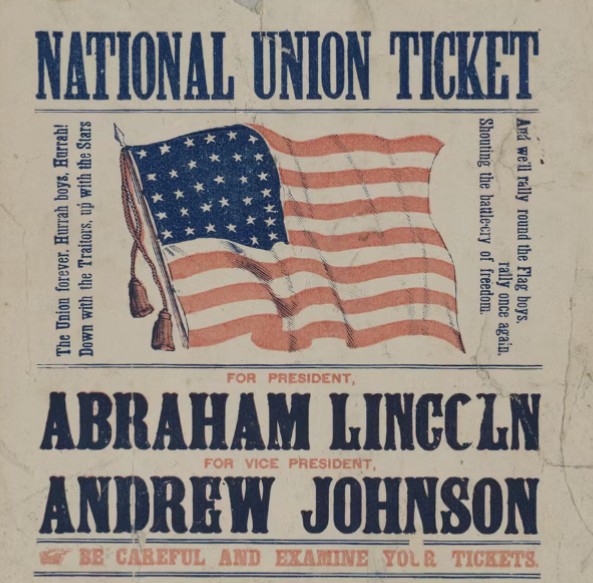
Excerpt of flyer advertising the Republican ticket for the 1864 U.S. presidential election, urging Union soldiers and veterans to vote for incumbent President Abraham Lincoln (public domain).
Meanwhile, the healthiest members of the 47th Pennsylvania Volunteer Infantry were joining with their convalescent comrades in lines to cast their votes in that year’s presidential election on 8 November 1864. Among those voting that day were Company K’s Charles W. Abbott, William H. Barber, Frank Beisel, Elias F. Benner, Tilghman Boger, George Delp, David Fetherolf, Phaon Guth, Henry Hantz, George Kase, John Keiser, William F. Knerr, Mathias Miller, William D. Schick, William Schlicher, Lewis G. Seip, David Semmel, George Sherer, Daniel Strauss, Paul Strauss, Charles Stoudt, and James D. Weil.
Based at Camp Russell near Winchester from November through most of December 1864, the 47th Pennsylvania Volunteers received new orders — to assume outpost and railroad guard duties at Camp Fairview in Charlestown, West Virginia. Five days before Christmas, they trudged through a driving snowstorm in order to reach their new home.
1865 — 1866

Spectators gather for the Grand Review of the Armies, 23-24 May 1865, beside the crepe-draped U.S. Capitol, flag at half-staff after the assassination of President Abraham Lincoln (Matthew Brady, U.S. Library of Congress, public domain).
Blessed once again to witness the dawn of another New Year — but acutely aware that he was doing so as America’s greatest national crisis continued to rage on into yet another disastrous year, Second Lieutenant Mathias Miller was also in a reflective state of mind — remembering the many members of his company who had been killed or seriously wounded during Major-General Sheridan’s tide-turning Shenandoah Valley Campaign. Three days later, on 4 January 1865, he was commissioned as a captain and placed in charge of the 47th Pennsylvania’s K Company. He had risen up through the ranks from corporal to become the commanding officer of his own unit.
* Note: Mathias Miller’s former captain, Charles W. Abbott, had also been promoted around that same time. Commissioned as a lieutenant-colonel the previous day, Abbott had been awarded the position of second-in-command of the entire 47th Pennsylvania in recognition of his bravery and skilled leadership.
Assigned in February to the Provisional Division of the 2nd Brigade of the U.S. Army of the Shenandoah, the 47th Pennsylvania Volunteers were subsequently ordered to head for Washington, D.C., via Winchester and Kernstown. By 19 April 1864, they were helping to defend the nation’s capital — this time following the shocking assassination of President Abraham Lincoln. Stationed at Camp Brightwood, they received new uniforms and were resupplied with ammunition. Letters written during that time by 47th Pennsylvanians to family and friends back home, and post-war interviews by newspaper reporters with 47th Pennsylvania veterans, confirm that at least one 47th Pennsylvania Volunteer was given the high honor of guarding President Lincoln’s funeral train, while others may have guarded the key Lincoln assassination conspirators during the early days of their imprisonment and trial at the Washington Arsenal Penitentiary. On 22 May, Captain Levi Stuber of Company I joined the 47th’s central command at the rank of major, making him third-in-command of the entire regiment.
The next day — 23 May 1865 — the 47th Pennsylvania Volunteers marched in the Union’s Grand Review of the National Armies, as part of Dwight’s Division of the 2nd Brigade of the U.S. Department of Washington’s 22nd Corps. It was a spectacle for the ages as a massive wave of Union soldiers paraded triumphantly through the city’s streets, but it was also a day made less joyful with the knowledge that their beloved, late commander-in-chief, Abraham Lincoln, was not there to watch over them.
Reconstruction
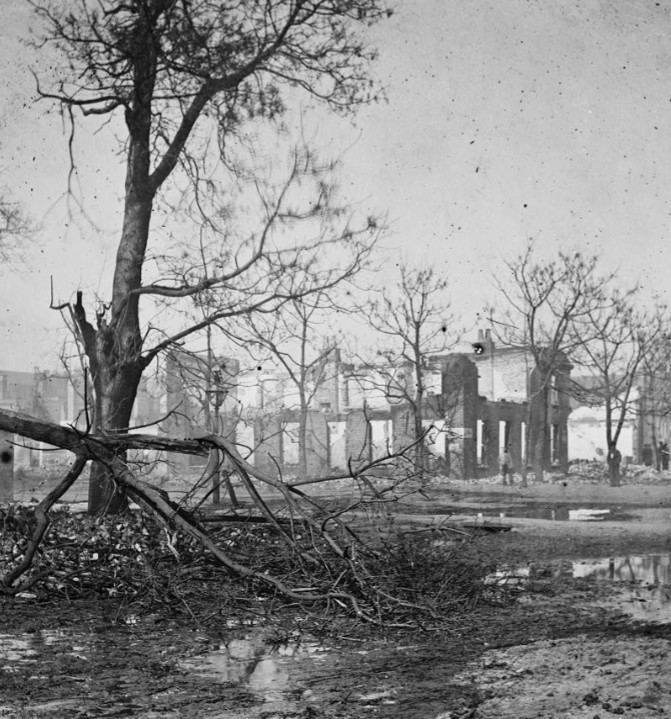
War-damaged houses in Savannah, Georgia, 1865 (Sam Cooley, U.S. Army, U.S. Library of Congress, public domain).
Subsequently ordered to embark on yet another new assignment, the men of Company K and their fellow 47th Pennsylvanians packed up their belongings in early June 1865 and headed south for Savannah, Georgia. Assigned again to Dwight’s Division, they were attached to the 3rd Brigade, U.S. Department of the South and assigned to reconstruction and provost (military police) duties there before taking over for the 165th New York Volunteers in Charleston, South Carolina in July. Once again, they were assigned to reconstruction and provost-related duties, which they continued to perform throughout that fall. On 1 October 1865, Corporals Samuel Reinert and William Landis who had been wounded in action, respectively, during the Battles of Pocotaligo and Cedar Creek, were both promoted to the rank of sergeant while Privates Nathan Handwerk and Amos Slutter advanced to the rank of corporal. Mustering out that same day, upon expiration of their three-year terms of service were Sergeant Phaon Guth, Corporals Martin Guth and William Knerr, and Privates Benjamin Amey, Tilghman Breisch, Harrison Handwerk, Edward Houser, John Keiser, Henry Savitz, and William Schlicher.

Ruins of Charleston, South Carolina as seen from the Circular Church, 1865 (U.S. National Archives and Records Administration, public domain).
But, once again, disease became a major foe, felling multiple members of the regiment who contracted typhoid fever and dysentery. Then, beginning on Christmas Day of that year, Captain Mathias Miller and most of his fellow 47th Pennsylvania Veteran Volunteers finally began to muster out for the final time in Charleston — a process that continued through early January of 1866. Following a stormy voyage home — to New York City by ship and then to Pennsylvania by train, the weary 47th Pennsylvania Veteran Volunteers marched into Camp Cadwalader in Philadelphia, where they were given their final discharge paperwork between 9-11 January 1866 and honorably dismissed from the Army of the United States.
Return to Civilian Life
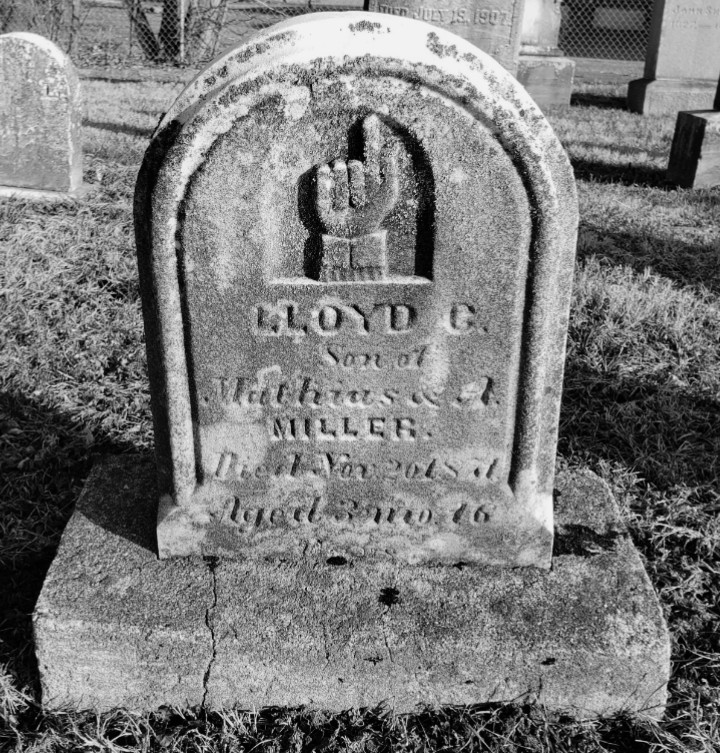
The jubilation Captain Mathias Miller felt upon receiving his honorable discharge from the 47th Pennsylvania Volunteer Infantry was soon tempered by heartache with the death of his infant son, Lloyd G. Miller, in 1871. Lloyd was later laid to rest at the Jordan Lutheran Church Cemetery in Orefield, Pennsylvania (public domain).
Following his honorable discharge from the military, Mathias Miller returned home to Pennsylvania’s Lehigh Valley, where he found work as a farm laborer. Sometime after his return, he married and began his own family line. After settling in Lehigh County with his wife, Abigail (1844-1881), a fellow Pennsylvanian who was known to family and friends as “Abbie,” he became the father of Agnes Miller (1868-1951), who was born on 28 May 1868 and would later wed Frank B. Wentworth (1866-1946) and settle with him in Bucks County, Pennsylvania before migrating west with him to San Bernardino County, California.
By 1870, the Miller trio resided in South Whitehall, Lehigh County, where Mathias continued to work the land. A son, Lloyd G. Miller (1871-1871), was then born in August 1871, but died in infancy roughly three months later, on 20 November 1871, and was buried at the Jordan Lutheran Cemetery in Orefield, Lehigh County. The following year, Mathias Miller and his siblings lost their mother, Anna (Guth) Miller, who died at the age of sixty-five in Lehigh County on 21 October 1872. Following funeral services, she was also laid to rest at Orefield’s Jordan Lutheran Cemetery.
A second son — Gobin Daniel E. Miller (1876-1955) — was then born to Mathias and Abigail Miller. Named after John Peter Shindel Gobin (1837-1910), who was Mathias Miller’s former commanding officer in the 47th Pennsylvania Volunteer Infantry during the American Civil War, Gobin D. E. Miller arrived on 30 June 1876. A second daughter, Bertha Miller (1877-1877), was then born on 7 June 1877. Sadly, though, she also died in infancy. Just twenty-two days old at the time of her passing, she was also buried at the Jordan Lutheran Cemetery.
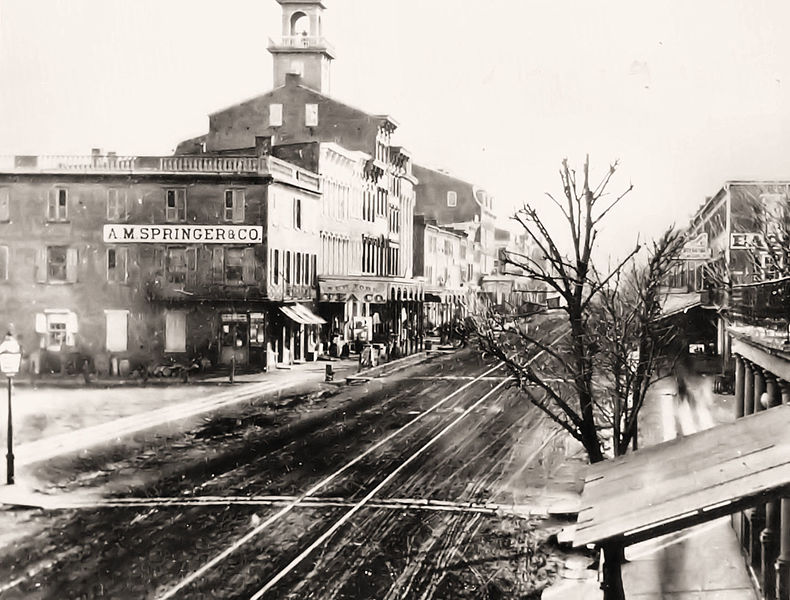
Hamilton Street, looking west from Center Square, Allentown, Pennsylvania, 1880 (public domain).
By 1880, Mathias and Abigail Miller were living with their children, Agnes and Gobin, in the Fifth Ward of Allentown, where Mathias was employed as a butcher. Sadly, Mathias Miller’s wife and father then also died. Following her passing at the age of thirty-seven years, one month and twenty-one days, in Allentown on 21 May 1881, Abbie Miller was then buried at the Jordan Lutheran Cemetery. Following his passing in Orefield at the age of seventy-three years, two months and thirteen days, John Miller was then also laid to rest there.
A single father of two children, Mathias Miller subsequently chose to remarry after being widowed, and wed Lehigh County native Louisa Anna Schlicher (1869-1936), who was a daughter of James Schlicher (1823-1885) and Berks County native Caroline (Reinhard) Schlicher (1829-1904). Together, he and his second wife then welcomed the Lehigh County birth of Herbert Clair Miller (1882-1907), who was born in Allentown on 31 August 1882, baptized on 1 November of that same year and would later wed Louisa L. Reppert.
Active with the 47th Pennsylvania Volunteers’ veterans’ association and the Grand Army of the Republic, he led a group of veterans caring for the military graves at the Jordan Lutheran Cemetery in Orefield for Decoration Day (now known as Memorial Day) in late May 1894. He and his second wife, Louisa, then welcomed the birth of their son, Philip Sheridan Miller (1896-1955), who was born in Stettlersville, Lehigh County on 19 October 1896 — the thirty-second anniversary of the Battle of Cedar Creek, Virginia, one of the Shenandoah Valley battles that Mathias Miller participated in under the command of Union Major-General Philip Henry Sheridan.
* Note: The name that Mathias Miller gave to his son, in tribute to a Union Army leader he greatly admired, proved to be a motivator for his son, Philip Sheridan Miller (1896-1955), who went on to become a lieutenant commander and chaplain in the United States Navy, serving his nation during both World War I and World War II.
But as a new century beckoned, the old continued to exact a terrible toll with the deaths of two Miller siblings within a period of eighteen days in 1898. The first to pass away was Mathias Miller’s older sister, Caroline Louisa (Miller) Sourwine (1842-1898), who had survived a stroke four years earlier only to succumb to complications from pneumonia in Allentown on 21 March. Just fifty-six years old at the time of her death, Caroline was subsequently buried at the Fairview Cemetery in Allentown.
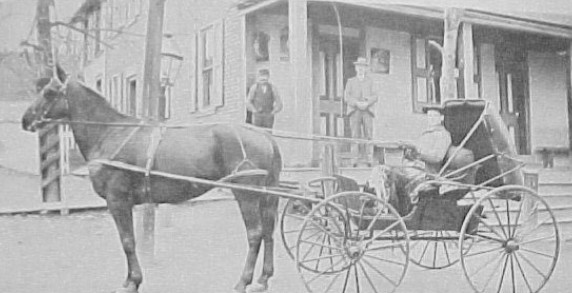
Calvin D. Miller, a son of Frank Miller and a nephew of Mathias Miller, stood with John Weidner on the porch of the Guthsville Station Hotel in Guthsville, Pennsylvania, as Calvin’s son, Clement Miller, sat in a buggy, circa late 1890s (public domain).
The second was Mathias Miller’s oldest brother, Franklin Miller (1830-1898). Just shy of his sixty-eighth birthday at the time of his death from apoplexy in Guthsville on 8 April, Frank Miller was buried at the same cemetery where other Miller family members were already at rest (the Jordan Lutheran Cemetery in Orefield).
* Note: Following her marriage to Tilghman Franklin Sourwine (1839-1915; alternate surname spelling: “Sauerwine”) on 13 December 1859, Caroline Louisa (Miller) Sourwine had welcomed the Lehigh County births with him of: Sarah Sourwine (1863-1945), who had been born in Catasauqua on 5 December 1863 and later wed Philip Frederick Kurtz (1856-1916); Margaret E. Sourwine (1865-1939), who had been born in Siegersville on 25 January 1865 and later wed Harry H. Edelman (1864-1914); Quintus A. Sourwine (1866-1919), who had been born on 14 October 1866 and later wed Amanda Bohlen (1865-1942); Henry Sourwine, who had been born circa 1867; Hattie A. Sourwine (1871-1953), who had been born in Guthsville in 1871 and later wed William G. Weinert (1865-1925); Carrie Mary Sourwine (1877-1879), who had been born on 5 March 1877 and baptized on 29 July of that same year, but had fallen ill with dysentery and had died at the age of two in South Whitehall in June 1879; Jennie Sourwine (1879-1946), who had been born in Guthsville on 13 August 1879 and later wed Jacob Stanley Ricker (1875-1960); and Minnie E. Sourwine (1881-1972), who had been born on 2 August 1881 and later wed William A. Robertson (1874-1942) in Allentown on 20 October 1901. (Residents of South Whitehall during the 1870s, when a number of their children were born, Caroline (Miller) Sourwine and her stone cutter husband, Tilghman F. Sourwine, had moved their family to Salisbury Township in Lehigh County by 1880.)
Following his marriage to Esther Sheirer (1839-1902) during the early 1850s, Frank Miller and his wife had welcomed the births of: Calvinus Daniel Miller (1853-1913), who had been born at Guth’s Station in Lehigh County on 10 April 1853, was known to family and friends as “Calvin,” had wed Tevilla E. Deschler (1850-1928), and had become a hotelier in Lehigh County; and Anna Catharine E. Miller (1862-1931), who had been born in South Whitehall Township on 26 October 1862 and had later wed Quinester Henry (1861-1952), was known to family and friends as “Catharine,” “Kate” or “Katie.” (Empty nesters by 1880, Frank Miller and his wife, Esther — also known as “Hettie” — had continued to live by themselves in the Village of Guthsville in South Whitehall Township until his death there in April 1898.)

Allentown Militia, Soldiers and Sailors Monument Dedication, Allentown, Pennsylvania, 1899 (public domain).
But Mathias Miller was soon able turn his perspective from grief to joy as he and his wife, Louisa, welcomed the birth of another son — Joseph James Miller (1898-1968) — in Allentown on 1 October 1898. A year later, Mathias and his family were privileged to witness a spectacle that would be talked about for decades to come — the unveiling of the Lehigh County Soldiers and Sailors Monument in Allentown on 19 October 1899. Held on the anniversary of the Battle of Cedar Creek, Virginia, the day’s events included a massive parade featuring many of the surviving 47th Pennsylvania Veteran Volunteers and other Union Army units from across and beyond the Lehigh Valley, chapters of the Grand Army of the Republic (G.A.R.), soldiers who were currently serving in the U.S. military, local and state dignitaries, fire and police units, and area bands. Viewed by a crowd that was estimated at forty thousand men, women and children, that parade was followed by a ceremony in which the monument was dedicated.
A New Century Dawns
Still residing in South Whitehall Township after the turn of the century, Mathias Miller was the head of a household that included his wife, Louisa, and their sons, Herbert, Philip and Joseph, with support for the family brought in by Herbert who was working as a laborer at an ore mine. Unfortunately, he was then injured during a “runaway accident” by a horse/wagon in Guthsville during the summer of 1906. According to Allentown’s Morning Call newspaper, “Horses in carriages driven by Rev. Ritter and Captain Matthias Miller were scared by an auto on the road along the Jordan at Green Hill, north of the home of James Fries.”
Mr. Ritter was driving to New Tripoli, his team being followed by that of Captain Miller, who sells medicines and liniments.
Rev. Ritter quieted his horse after he had torn the harness and broke the shafts. Captain Miller, who is an old soldier, grabbed his horse by the bridle, stuck heroically and prevented a runaway, but instead tumbled down an embankment, in the form of a somersault and landed on the edge of the Jordan. His little son Joe, who was seated on the wagon, miraculously escaped being crushed to death. Captain Miller himself escaped with a few bruises and scratches. The wagon was smashed. Mr. Ritter, after helping Captain Miller, borrowed a set of harness and a wagon from Mr. Fries and proceeded on his way.
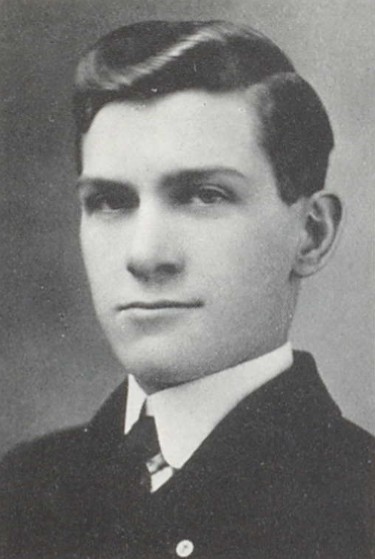
The 1916 Allentown High School graduation photo captured the self-confidence and determination of Mathias Miller’s son, Philip Sheridan Miller (public domain).
The following year, local newspapers reported that Mathias Miller was still residing in the Guthsville-Stettlersville area and had been awarded a contract to deliver mail between a local trolley line and those towns. But in mid-January 1909, Mathias began to make a new life for himself by moving his family to the city of Allentown, where he planned to open a store. He then sold his house in Guthsville to Henry Werley in February, and auctioned off his horse harnesses and “surplus household goods” that March. By mid-April of 1910, Matthias Miller was running a grocery store and residing at 226 North Jefferson Street in Allentown’s Eleventh Ward with his wife, Louisa, and their sons, Philip and Joseph, who were both students in Allentown’s public school system.
Mathias and his wife would continue to reside at that home for the remainder of his days. His son Philip, who graduated from Allentown High School in 1916, went off to college that fall, launching his long and succesful career in academia.
Illness, Death and Interment
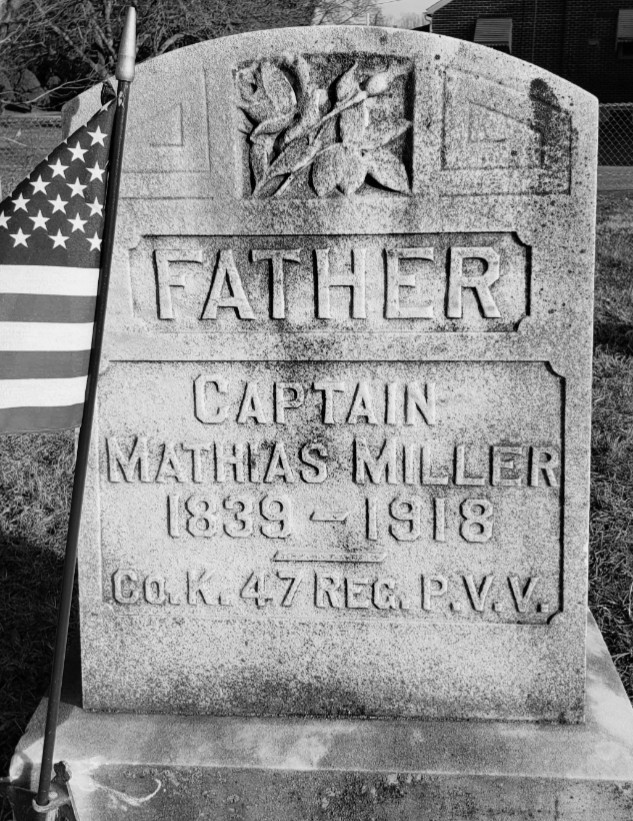
Gravestone of Captain Mathias Miller, Company K, 47th Pennsylvania Volunteers, Jordan Lutheran Cemetery, Orefield, Pennsylvania (public domain).
Ailing with chronic bronchitis and asthma, which were both likely attributable to his long tenure of military service during the American Civil War, 47th Pennsylvania Veteran Volunteer Mathias Miller was compelled to retire by the time he was in his mid to late sixties. Sadly, his health still continued to decline. Six days before his eightieth birthday, he suffered an asthma attack and died at his home at 226 Jefferson Street in Allentown, on 26 November 1918. Following funeral services at that home, at 1:30 p.m., on Saturday, 30 November, he was laid to rest beside his first wife at the Jordan Lutheran Cemetery in Orefield.
He was survived by four of his children: daughter Agnes (Miller) Wentworth, who was residing with her family in Newtown Township, Bucks County, Pennsylvania; son Gobin Daniel E. Miller, who was residing in Stettlersville, Lehigh County; son Philip Sheridan Miller, who was serving with the United States Naval Coast Defense at its Great Lakes Station; and son Joseph Miller, who was residing in Egg Harbor, New Jersey. In addition, he was also survived by two of his siblings — sisters, Kate (Miller) Miller, of Eckerts; and Sarah (Miller) Sourwine, of Guthsville.
What Happened to the Children and Second Wife of Mathias Miller?
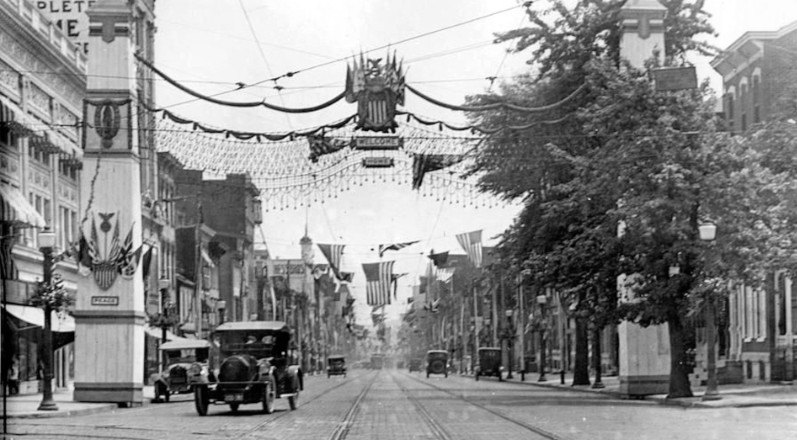
World War I Victory Parade, Tenth and Hamilton Streets, Allentown, Pennsylvania, 1919 (public domain).
Following his death, Mathias Miller’s second wife, Louisa Anna (Schlicher) Miller (1860-1936), went on to survive him by roughly seventeen years. Bequeathed her husband’s estate of one thousand and eight hundred dollars (the equivalent of roughly thirty-nine thousand U.S. dollars in 2026), she continued to reside at her family’s home on Jefferson Street in Allentown. Her son, Philip, who was a college student in 1920, still lived with her that year. She made ends meet from the rent she received from lodger Lewis Kugler, a thirty-five-year-old German immigrant who had become a naturalized citizen of the United States. Four years later, her son, Philip, a minister who resided in Lincoln University, Chester County, Pennsylvania, began his own family line when he married Bertha Alice Bloy (1889-1990) in Allentown on 16 September 1924. By 1930, Louisa (Schlicher) Miller had moved into an apartment at 228 Twelfth Street in Allentown’s Eleventh Ward. Her widowed older brother, James H. Schlicher, lived with her. During her final years, she resided with her son, Philip, in Chester County, Pennsylvania. After a full life, Louisa suffered a cerebral hemorrhage and died at the age of seventy-five in Lower Oxford Township, Chester County, on 9 May 1936. Following funeral services, she was laid to rest beside her husband at the Jordan Lutheran Cemetery in Orefield, Lehigh County.
Herbert C. Miller
Sadly, Mathias Miller’s son from his second marriage, Herbert C. Miller (1882-1907), died young. A machinist at a cement plant in Coplay, Lehigh County who had married fellow Coplay resident Louella L. Reppert in Coplay on 20 October 1906, Herbert Miller had continued to work as a machinist to support her, but soon fell ill with typhoid fever. As his condition worsened during the summer of 1907, he developed an inflammation of the brain and died from brain fever in Coplay, at the age of twenty-four years and ten months, on 19 July 1907. Following funeral services at the home of his parents in Guthsville, he was laid to rest at the Jordan Lutheran Cemetery in Orefield.
Agnes (Miller) Wentworth
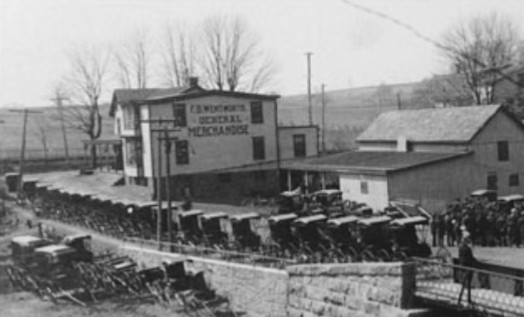
Frank B. Wentworth’s general store, shown here circa 1905, was located at 203 North Sycamore Street in Newtown, Pennsylvania in an old saloon that had been built in 1836 (F. B. Wentworth General Store, rear view, public domain; click to enlarge).
Mathias Miller’s daughter from his first marriage, Agnes (Miller) Wentworth (1868-1951), who had married Frank B. Wentworth (1866-1946), a native of West Liberty, Ohio, circa 1865 or early 1886, had initially settled in Lehigh County, where she and her husband had then welcomed the births of: Eva Sophia Wentworth (1886-1935), who was born on 6 August 1886 and baptized on 5 January 1890; and Addie May Wentworth (1888-1936), who was born on 12 September 1888 and was also baptized on 5 January 1890. By 1900, Agnes (Miller) Wentworth and her family had relocated to Newtown Township in Bucks County, Pennsylvania, where her husband was employed as a successful merchant. Also residing with their family that year was twenty-seven-year-old Calvin Deur, who was an assistant in Frank Wentworth’s general store, and fifty-three-year-old laborer James H. Craven. Circa 1906 and 1908, their daughters Eva and Addie then began their own family lines by marrying Walter Smith (1892-1962) and Cecil Firmin Kitchin (1886-1973), respectively. By 1910, Eva (Wentworth) Smith was living with her husband and daughters at the Sycamore Street home of her parents, Frank and Agnes (Miller) Wentworth, in Newtown Township, where Frank’s general store continued to do well (see photo), as evidenced by the presence of two live-in servants (Edward Frazier and Sara Willis) at their home that year. Meanwhile, Agnes and Frank’s other daughter, Addie May (Wentworth) Kitchen, was employed as a stenographer and residing with her husband Cecil elsewhere in Newtown Township. By 1920, however, Agnes (Miller) Wentworth and her husband Frank were “empty nesters” in Newtown Township, and her husband was employed as an insurance salesman.
The city of San Bernardino, California in 1923 (public domain; click to enlarge).
But in 1923, Agnes and her husband left the life they had come to know and migrated west to California, where Frank Wentworth went on to become a prominent insurance agent in San Bernardino County. In 1930, they lived at 790 D Street in San Bernardino. Also residing with them were their daughter, May (Wentworth) Kitchin, and her daughter, Ruth Kitchin, as well as Frank’s brother, Walter B. Wentworth. That decade would prove to be a tragic one, however, when Agnes and Frank lost their two daughters — Eva Sophia in March of 1935 and Addie May in October of 1936.
* Note: Eva Sophia (Wentworth) Smith (1886-1935), who had wed Walter H. Smith (1892-1962) circa 1906, had welcomed the births with him of: Erma Smith (1907-2000), who was born on 29 March 1907 and would later wed Norman Haydis; Iona Smith (1909-1987), who was born on 6 May 1909 and would later wed Verne L. Miller; and Audrey Harris Smith (1910-1878), who was born in Newtown Township on 17 September 1910 and would later marry Charles H. Miller. By 1920, Eva S. (Wentworth) Smith was still living in San Bernardino with her husband and three unmarried daughters; by 1930, however, their household included just their daughter, Iona, and Iona’s husband. Ailing during her final months, Eva S. (Wentworth) Smith succumbed to disease-related complications at the age of forty-eight, near Beaumont in Riverside County, California, on 29 March 1935. Following funeral services, she was cremated at San Bernardino’s Mountain View Cemetery.
Addie May (Wentworth Kitchin) Grimes (1888-1936), who had been known to family and friends as “May,” had wed Cecil Firmin Kitchin (1886-1973) at her parents’ home in Newtown Township, Bucks County, Pennsylvania on 4 May 1908, and had welcomed the Bucks County birth with him of daughter Ruth Wentworth Kitchin (1917-1988) on 23 February 1917. Separated from her husband circa 1923, May (Wentworth) Kitchen had then migrated west to California with her daughter and moved into the San Bernardino home of her parents. Divorced from Cecil Kitchin in 1926 (on the grounds that he had become permanently estranged from her after traveling to the Panama Canal with another woman in 1924, according to San Bernardino’s Daily Sun newspaper), May (Wentworth) Kitchin continued to raise her daughter, Ruth, there. After marrying Nathan Grimes (1886-1970) in Yuma, Arizona on 24 April 1930, May (Wentworth Kitchin) Grimes settled with him at 790 D Street in San Bernardino. Ailing since January 1936, May succumbed to disease-related complications at the age of forty-eight at the Ramona Hospital on 16 October 1936, and was laid to rest at San Bernardino’s Pioneer Memorial Cemetery.
The town of Crestline in the San Bernardino Mountains of California, circa late 1940s (public domain; click to enlarge).
Following that double tragedy, Agnes (Miller) Wentworth and her husband continued to live in San Bernardino, making their primary home at 387 Alexander Street during the 1940s, while spending their summers at a second home at 1539 Huston Way in the town of Crestline in the San Bernardino Mountains. Widowed by her husband, Frank, when he died at the age of eighty at their summer home on 10 July 1946, Agnes arranged for his remains to be returned to their adopted hometown. He was then laid to rest at the same cemetery where their daughter, Eva, had been buried (San Bernardino’s Mountain View Cemetery). Still residing in San Bernardino in 1950, Agnes had a full household. Living with her were her granddaughters, Ruth Wentworth Kitchin and Erma (Smith) Haydis, as well as Erma’s husband, Norman, and their son, Everett Wentworth Haydis (1936-2010). After a long, full life, Agnes (Miller) Wentworth died at the age of eighty-three in San Bernardino, on 6 July 1951. Following cremation, her remains were subsequently entombed at San Bernardino’s Mountain View Cemetery.
Philip Sheridan Miller
Mathias Miller’s son, Professor Philip Sheridan Miller, shown here circa 1955, was a renowned Classics scholar and educator (The Lion, Lincoln University, Chester County, Pennsylvania, 1957, public domain; click to enlarge).
Mathias Miller’s second son from his second marriage, Philip Sheridan Miller (1896-1955), who had been named after Union Major-General Philip Henry Sheridan, went on to become a lieutenant commander and chaplain in the United States Navy, serving his nation during both World War I and World War II. A seaman in the U.S. Navy during World War I, he subsequently attended Moravian College in Bethlehem, Pennsylvania, where he was awarded a Bachelor of Arts degree in 1920. He then earned his Bachelor of Theology degree at the Princeton Theological Seminary in Princeton, New Jersey in 1924, followed by his Master of Arts degree at the University of Pennsylvania in Philadelphia in 1927, and his Doctor of Philosophy degree at the University of Erlangen in Germany in 1932.
A minister and educator, the Reverend Doctor Philip S. Miller was appointed to the faculty of Lincoln University in Chester County, Pennsylvania during the early 1920s. The first Historically Black College and University (HBCU) in the United States to award degrees, Lincoln University had become “known as ‘the Black Princeton’ due to its Princeton University-educated founder and early faculty, rigorous curriculum ties to the Presbyterian Church,” according to the university’s website. Dr. Miller then steadily advanced through the ranks of academia to become a tenured full professor in the Classics Department. Awarded an endowed post as the John H. Cassidy Professor of Classical Languages, he was also appointed as Dean of Lincoln University’s College of Liberal Arts.
As he progressed through the early years of that thirty-one-year academic and theological career, the Reverend Doctor Philip Sheridan Miller also began his own family line with his marriage in Allentown on 16 September 1924. That day, he wed Bertha Alice Bloy (1889-1990), a resident of the city of Windsor in Ontario, Canada, who had been born in Dereham, Breckland Borough, Norfolk, England and was a daughter of Homer Bloy a merchant and native of England. The parents of Oakley Bloy Miller (1924-1997), who had been born in West Grove, Chester County, Pennsylvania on 24 May 1924, Philip Sheridan Miller and his wife, Bertha (Bloy) Miller, then also welcomed the birth of Joyce Rose Mary Miller (1930-unknown), who was born in West Grove on 10 July 1930. They then continued to live at the Lincoln University Village in Chester County, where Philip was employed as a full professor at the university by 1940.
After the United States entered World War II, however, Philip Sheridan Miller felt strongly that he needed to put his academic career on hold in order to help bring an end to a war that threatened to destroy the world as he knew it. So, he chose to serve with the U.S. Navy, and did so as a lieutenant commander and chaplain. According to the 22 May 1943 edition of the Atlanta Daily World newspaper, Lieutenant Commander Miller was subsequently assigned as the Protestant chaplain at Camp Robert Smalls, the primary U.S. military training facility for Black soldiers. After that war ended, Chaplain Miller returned to Lincoln University, resumed his academic career and continued to teach there for the remainder of his life.
The day after participating in commencement exercises at Lincoln University in early June 1955, Professor Philip Sheridan Miller suffered a heart attack at his home, and was rushed to the Chester County Hospital in West Chester. Pronounced dead on arrival, he was fifty-eight years old at the time of his passing on 7 June 1955. His life was subsequently celebrated by his family, colleagues and students during memorial services at the Mary Dodd Brown Chapel at Lincoln University. Laid to rest at the Oxford Cemetery in Oxford, Chester County, his efforts to educate and uplift his students continued to echo long after his passing, as evidenced by this entry in Lincoln University’s 1957 yearbook, The Lion:
The language of sorrow is a universal language. It is the language of human emotions and is born of human experience. Wherever death brings grief and the sense of loss; wherever love brings disillusionment; wherever hopes are shattered and visions dimmed — there will be found sorrow. So this Lion is dedicated in humble respect to a man who was not only a great scholar but an inspiration to all who knew him — Philip Sheridan Miller.
Any attempt … to detach the figure of Philip Sheridan Miller from the evanescent element of Parnassus and Mount Olympus re-created under the magical spell of his voice, and to incorporate it in the more enduring substance of the written word, must become something more than the mere babbling of a disciple.
To try to describe Dr. Miller’s services to the spirit of Art and Learning and his wizard’s influence over his audience is describing, above all, an ethical deed. Dr. Miller was one of the sincerest men of our time, devoting himself to the service of the Classics with such fidelity, ardour, and humility as we are rarely privileged to admire in any other sphere of learning. He bowed his head before the higher will of the master he revered, so that he combined the mediating function of the priest with the fervour of the disciple, combined the strictness of the teacher with the unresting diligence and veneration of the pupil. Since he invariably put a touch of his personal genius and the whole of his peculiar moral and spiritual energy, no student, majoring in the Classics or not, can truthfully say that he walked out from Dr. Miller’s presence without having been captivated by the warmth of his charm and the genuine interest in the student’s welfare.
Not only was Dr. Miller a teacher, but he was also an author. His individual triumphs in the realm of writing transcended the boundaries of ordinary authors to become the suprapersonal victory of creative will over the inertia of matter — a splendid proof that, even in a disintegrated and shattered age like ours, now and again it is possible for the gifted few to achieve the miracle of perfection.
Dr. Miller was a man who demanded perfection from both himself and his students. The fairly good, the nearly perfect, the approximate, he could not endure.… To him the idea of the absolute was supreme in any form of art. He believed that if we were ever to achieve anything worthwhile in life, we must demand and strive for the absolute or perfect.
Every student who has been guided by Dr. Miller will testify that, within the elemental energy that radiated from him, lassitude and incompetence were dispelled. At the beginning of a course each individual would be inspired with the power of a devine terror, with a communicable strength which, after an initial phase of palsied alarm, induced in those affected by it a might which greatly transcended the ordinary. The discharge of his own tensions increased the capacity for a better and greater appreciation of the Classics for those who happened to be in his neighborhood, thus expanding the faculties of every student.
Gobin Daniel E. Miller
Gobin Daniel E. Miller (1876-1955), Mathias Miller’s son from his first marriage, never married, and lived a troubled life. Accused of stealing pigeons from his employer, Dr. M. J. Kline, in Hoffmansville, Pennsylvania at the age of twenty-two, in November 1898, he admitted his involvement and served one day in jail. Two years later, he reportedly joined the Forepaugh-Sells Brothers Circus on 7 May 1900, without telling anyone, according to The Allentown Democrat. After returning to Lehigh County sometime before the fall of 1902, he ran afoul of the law on 30 November that year and was arrested “for Sunday drunkeness” and jailed for ten days, according to The Allentown Leader. A boarder at a hotel operated by John J. Gackenbach in South Whitehall Township in 1910, he earned money as a day laborer who performed “odd jobs.” Arrested for larceny in September 1912 for stealing money from Wellington Stauffer, he served three months in jail. Arrested for public drunkenness in late October of 1916, he spent another night in jail for that conviction. Still unmarried and living separately from his father throughout that decade, Gobin Miller had become a forty-three-year-old farmer in Stettlersville, Lehigh County by September of 1918. When a federal census taker arrived on his doorstep two years later, he was documented as a farm laborer who lived at the farm of Clinton Snyder in South Whitehall Township. Subsequently employed as an innkeeper in Upper Lehigh County and then as a watchman at a silk mill, Gobin D. E. Miller ultimately ended up living “in a small wooden shack” in Orefield, where he was killed when that shack burned down during an accidental fire on 1 November 1955. Aged seventy-nine at that time, he was described by Allentown’s Morning Call, as “the last of his family,” but was actually survived by his younger stepbrother, Joseph James Miller (1898-1968), who was employed as a successful contractor in Modesto, California. Following funeral services at the Russell H. Scheirer Funeral Home in Siegersville, Lehigh County, Gobin Daniel E. Miller was interred at the same cemetery where his parents were at rest — the Jordan Lutheran Cemetery in Orefield.
Joseph James Miller
Cuyamel Fruit Company workers unloading bananas from Honduras in New Orleans, Louisiana, circa 1920 (U.S. Library of Congress, public domain).
Matthias Miller’s son from his second marriage, Joseph James Miller (1898-1968), who was residing in Egg Harbor, New Jersey at the time of Matthias Miller’s death in 1918, was employed by the Cuyamel Fruit Company during the summer of 1919. A staff member of that company’s Honduras Division, he departed from the port of New Orleans, Louisiana in September of that year for a four-month trip to Central America, during which time he worked as a surveyor on a construction project in Honduras for Cuyamel, which was engaged in the plantation production and international exportation of bananas and sugar.
A resident of Rowland in Robeson County, North Carolina by 1922, Joseph J. Miller married Bernice Mae Smith (1902-1972) in Stanly County on 23 September that year. He and his wife then became the parents of: Joseph James Miller, Jr. (1924-1924), who was born prematurely on 30 July 1924 but died just over three weeks later in Fayetteville, Cumberland County, North Carolina on 21 August and was buried in Fayetteville, according to his North Carolina death certificate; and Shirley Jacquelyn Miller (1926-2011), who was born in Forest City, Rutherford County, North Carolina on 17 August 1926 and was known to family and friends as “Jacquelyn.”
* Note: S. Jacquelyn Miller (1926-2011) would go on to marry Joaquin Fernando Lopez (1919-1960), a native of Oaxaca, Monterey, Mexico who had emigrated to the United States in 1922 and had served with the U.S. Army Air Corps during World War II. Following their marriage in 1950, she would welcome the births with him of three children, be widowed by him in 1960, and would then wed Manfred A. Wills (1912-1979, alternate surname spelling: “Wells”) and settle with him in Modesto, California.
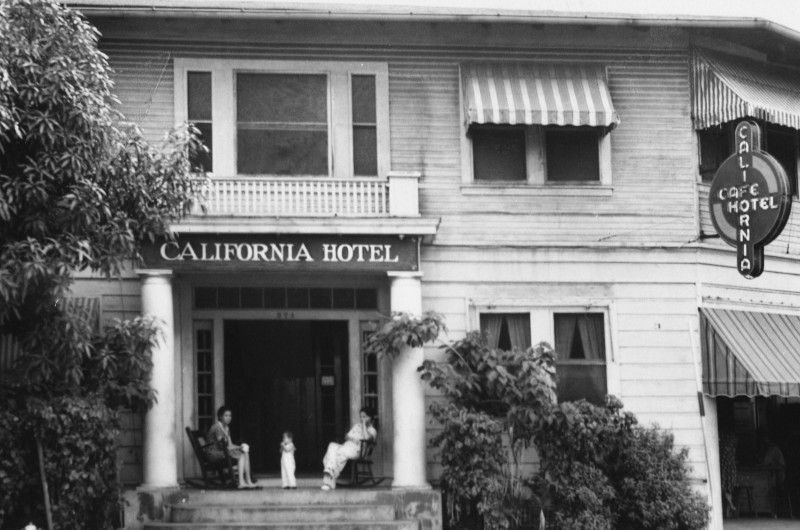
Unidentified guests at the California Cafe and Hotel, Honolulu, Territory of Hawaii, 22 May 1941 (public domain; click to enlarge).
Sometime after his daughter’s birth in 1926, Joseph J. Miller migrated to the Midwest with his wife and daughter. His son, Robert D. Miller (1931-2015), was then born in Hill City, Graham County, Kansas on 3 July 1931 (alternate birth year: 1932). After moving with his family to Nebraska, Joseph found work as a civil engineer and joined both the Nebraska State Board of Civil Engineers and the American Society of Civil Engineers.
His skills would soon be even more in demand as the world descended into a new darkness with the start of World War II. In response, Joseph Miller migrated even farther west with his family — moving them by ship aboard the SS Coolidge from San Francisco, California on 20 May 1941 to the U.S. Territory of Hawaii on 25 May. Once there, he began work as a civil engineer for a civilian construction project at the waterfront in Pearl Harbor. Located on the Island of Oahu, near the city of Honolulu, Pearl Harbor had become the home base of the United States’ Pacific Fleet in 1940.
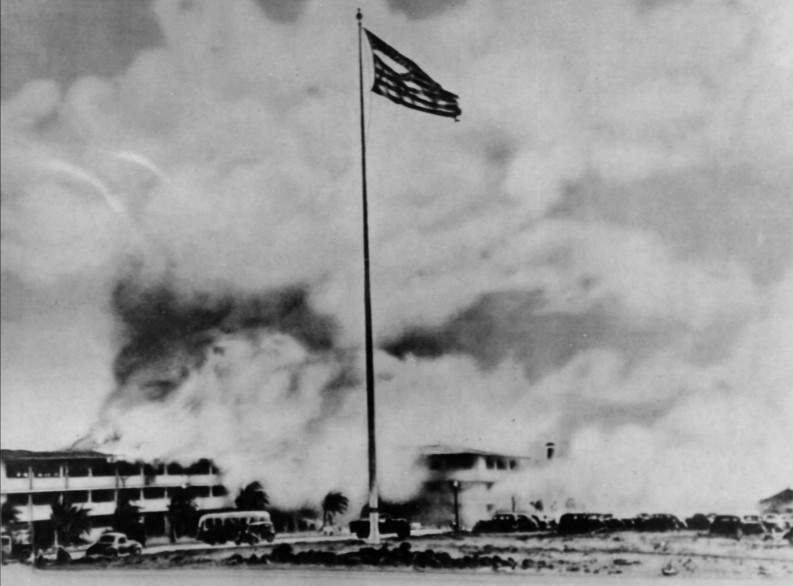
The burning barracks at Hickam Air Field, following the Empire of Japan’s attack on the U.S. Navy’s Pacific Fleet at Pearl Harbor, Honolulu, U.S. Territory of Hawaii, 7 December 1941 (public domain; click to enlarge).
Less than seven months later, that fleet and many of the military aircraft supporting its ships were decimated during an attack by the military forces of the Empire of Japan on 7 December 1941– a terrifying and seminal moment in American history that President Franklin Delano Roosevelt would soon term “a date which will live in infamy” — a description that has continued to echo well into the twenty-first century. According to historians at the United States Naval History and Heritage Command:
A single carefully-planned and well-executed stroke removed the United States Navy’s battleship force as a possible threat to the Japanese Empire’s southward expansion. America, unprepared and now considerably weakened, was abruptly brought into the Second World War as a full combatant.
Eyewitnesses to the attack, Joseph J. Miller and his badly-shaken family rendered what assistance they could to survivors but ultimately decided it would be safer for them to return to the mainland of the United States. Following their arrival in late May of 1942, they settled in California and began to forge new lives. By 1950, Joseph J. Miller had moved to the city of Modesto in Stanislaus County, California and had become a successful contractor. Ailing during the last years of his life, Joseph James Miller spent his final months in a convalescent home in Modesto. Following his death there at the age of seventy, on 14 November 1968, he was laid to rest at the Lakewood Memorial Park in Hughson, Stanislaus County.
What Happened to Mathias Miller’s Siblings?
Following his marriage to Maria Elizabeth Anna Fenstermacher (1845-1906) circa 1869, Mathias Miller’s youngest brother, Jonathan W. Miller (1849-1913), who became known to family and friends as “John,” settled with his wife in Lehigh County, where they welcomed the births of: Franklin Henry Miller (1870-1900), who had been born on 23 February 1870 and would later wed Mary A. S. Wagner (1868-1938); Ammon George Miller (1876-1926), who had been born in South Whitehall Township on 28 March 1876 and would later wed Annie D. Noll (1880-1958); and Eugene Llewellyn Miller (1882-1941), who had been born in Allentown on 17 August 1882 and would later wed Carrie A. Epler (1884-1914). Widowed by his wife in 1906, John W. Miller survived her by roughly seven years. Following his death at the age of sixty-three in South Whitehall Township on 5 April 1913, he, too, was buried at Orefield’s Jordan Lutheran Cemetery.
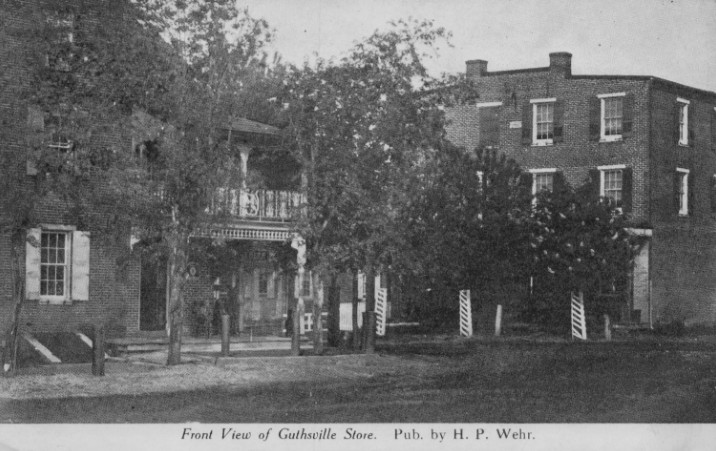
Guthsville Store, Guthsville, Pennsylvania, circa early 1900s (public domain; click to enlarge).
Following her marriage to Moses Jonas Guth (1831-1901), Mathias Miller’s older sister, Fronica Euphurnia (Miller) Guth (1838-1918) who was known to family and friends as “Froney,” had settled with her husband in Guthsville, where they welcomed the births of: Chester F. Guth (1860-1926), who had been born on 28 April 1860 and would later wed and be widowed by Elizabeth L. Schiffert (1864-1896), before marrying Anna I. Kressley (1867-1920); Mary C. Guth (1865-1897), who had been born on 17 October 1865, would never marry and would die from consumption (tuberculosis) at a young age, on 13 May 1897; Henry J. Guth (1867-1946), who had been born on 18 July 1867 and would wed Esther A. Cullin (1870-1948); Elizabeth R. Guth (1870-1954), who had been born in Guthsville on 20 February 1870 and would wed Henry Alfred Reeser (1868-1946); Annie K. Guth (1873-1944), who had been born in South Whitehall Township on 13 July 1873 and would wed John C. Kriner (1872-1961); Edgar Hayes Moses Guth (1877-1925), who had been born in Guthsville on 25 February 1877 and would wed Amelia (Hilbert) Mellinger (1879-1965); Arlean L. Guth (1881-1966), who had been born in Guthsville in January 1881, would become known as “Lena” to family and friends and would wed and be widowed by Harry M. App (1879-1915), before marrying Nero J. Kohler (1883-1960). Widowed by her husband in 1901, Fronica Euphurnia (Miller) Guth survived him by roughly seventeen years. After a long, full life, she died at the age of eighty in Lehigh County on 28 June 1918, and was laid to rest at the same cemetery where her parents and many of her siblings were interred (the Jordan Lutheran Cemetery in Orefield).

Macungie Train Depot, Lehigh County, Pennsylvania, circa mid to late-1800s (public domain).
Following her marriage to German immigrant Johannes Miller (1833-1905), Mathias Miller’s oldest sister, Catherine (Miller) Miller (1835-1920), who was known to family and friends as “Kate,” settled with him in South Whitehall Township, where her husband took up farming. Together, they welcomed the Lehigh County births of: Alice Miller, who was born circa 1857 but appears to have died in childhood or married young (because her name was not recorded on the 1880 federal census with her siblings); Mathias Jacob J. Miller (1862-1943), who was born in South Whitehall Township on 24 October 1862 and would later become a bridge foreman with Bethlehem Steel, marry Amanda S. Bertsch (1864-1935) and settle with her in Allentown; Ellen E. Miller (1865-1930), who was born on 30 May 1865 and would later wed Oscar E. Butz (1858-1952) and settle with him in the Borough of Emaus in Lehigh County; Sarah Miller, who was born circa 1869 but appears to have died in childhood (because her name was also not recorded on the 1880 federal census with her siblings); Eugene Samuel Miller (1874-1956), who was born in Upper Macungie Township on 20 May 1874 and would later become a steel inspector for the Consolidated Steel Company in Texas, marry Daisy S. Knerr (1876-1958) and settle in Greenawalds; Elmer F. Miller (1876-1938), who was born in South Whitehall on 14 January 1876 and would later become a foreign language teacher specializing in Spanish studies at Allentown High School, marry Julia E. S. Smith and settle in Orefield; and Catherine Miller (1877-1964), who was born in Krocksville, Lehigh County in 1877, became known to family and friends as “Katie” and would later marry Chester Peter Wenner (1880-1927) and settle with him in Eckerts, South Whitehall Township. By 1880, Catherine (Miller) Miller was residing in Upper Macungie Township, Lehigh County with her husband, Johannes Miller, and their children: Matthias J. J. Miller and Ellen, Eugene Samuel, Elmer F., and Catherine Miller. Still a working farmer, Catherine’s husband was known by that time as “John Miller.” Widowed by her husband in 1905 and ailing with arteriosclerosis during her final years, Catherine (Miller) Miller developed hypostatic pneumonia and died at the age of eighty-five at the home of her son-in-law, Chester Wenner, in Eckerts, South Whitehall Township on 3 December 1920. Following funeral services in Eckerts and then at the Jordan Lutheran Church, she, too, was buried at the Jordan Lutheran Cemetery in Orefield.
Following her marriage to Charles Sauerwine (1841-1916), Mathias Miller’s younger sister, Sarah M. (Miller) Sauerwine (1845-1937), and her husband welcomed the Lehigh County births of: Savannah A. Sauerwine (1866-1944), who was born in South Whitehall Township on 8 May 1866 and would later wed Victor Calvinus Sell (1856-1939); Melvina Sauerwine (1870-1944), who was born in South Whitehall Township on 2 February 1870 and would later wed Franklin Landis (1866-1922); Mary Sauerwine (February 1880-unknown), who was born in South Whitehall Township in February 1880; and Nero Charles Sauerwine (1880-1969), who was born in Snidersville (Hillside) in South Whitehall Township on 19 January 1880 and would later wed Minnie Miller (1884-1947). Sarah (Miller) Sauerwine later subsequently settled with her husband, Charles, in Guthsville. Widowed by him in 1916, she went on to live a long, full life. Ninety-one years old at the time of her passing in Richland Township, Bucks County, Pennsylvania, on 25 January 1937, her remains were returned to Lehigh County for burial at the Jordan Lutheran Cemetery.
Sources:
- Abbie Miller (the first wife of Mathias Miller), in “Died.” Allentown, Pennsylvania: The Allentown Democrat, 25 May 1881.
- “Admitted Stealing Pigeons” (mention of jail sentence received by Mathias Miller’s son, Gobin Miller, for his theft of pigeons). Allentown, Pennsylvania: The Morning Call, 8 November 1898.
- Audrey Harris Smith (a daughter of Eva (Wentworth) Smith, a granddaughter of Agnes (Wentworth) Miller and a great-granddaughter of Mathias Miller), in Birth Certificates (file no.: 138653, registered no.: 91, date of birth: 17 September 1910). Harrisburg, Pennsylvania: Commonwealth of Pennsylvania, Department of Health, Bureau of Vital Statistics.
- Agnes G. Wentworth (Mathias Miller’s daughter from his first marriage), in California Death Index (maiden name: Miller; date of birth: May 28, 1868; date of death: July 6, 1951, San Bernardino, California). Sacramento, California: State of California, Department of Health.
- Agnes G. Wentworth (funeral notice of Mathias Miller’s daughter from his first marriage), in “In the Shadows.” San Bernardino, California: Daily Sun, 10 July 1951.
- “Announcement Made of Grimes-Kitchin Wedding in Yuma” (announcement of the marriage of Nathan Grimes to Addie May (Wentworth) Kitchin, a granddaughter of Mathias Miller and a daughter of Agnes (Miller) Wentworth). San Bernardino, California: Daily Sun, 11 May 1930.
- “Auto Scares Horses: And Double Runaway Resulted Near New Tripoli” (mentions Mathias Miller). Allentown, Pennsylvania: The Allentown Democrat, 14 July 1906.
- Bates, Samuel P. History of Pennsylvania Volunteers, 1861-5, vol. 1. Harrisburg, Pennsylvania: B. Singerly, State Printer, 1869.
- “Captain Mathias Miller Dies in 80th Year.” Allentown, Pennsylvania: The Allentown Democrat, 27 November 1918.
- “Caroline L. Sourwine” (obituary of an older sister of Mathias Miller). Allentown, Pennsylvania: The Morning Call, 22 March 1898.
- Catherine Miller (the oldest sister of Mathias Miller), in Death Certificates (file no.: 123389, registered no.: 1305, date of death: 3 December 1920). Harrisburg, Pennsylvania: Commonwealth of Pennsylvania, Department of Health, Bureau of Vital Statistics.
- “Catherine Miller” (the oldest sister of Mathias Miller), in “Obituary.” Allentown, Pennsylvania: The Allentown Morning Call, 4 December 1920.
- “Catherine Miller” (the oldest sister of Mathias Miller), in “Laid at Rest.” Allentown, Pennsylvania: The Allentown Morning Call, 10 December 1920.
- “Death of Herbert Miller” (obituary of a son of Mathias Miller). Allentown, Pennsylvania: The Allentown Leader, 20 July 1907.
- “Decoration Day in South Whitehall — Soldiers’ Monument Dedicated” (mentions Mathias Miller). Allentown, Pennsylvania: The Allentown Democrat, 6 June 1894.
- “Dr. Philip S. Miller” (obituary of Mathias Miller’s son, Philip Sheridan Miller). New York, New York: The New York Times, 9 June 1955.
- Ellen E. Butz (a niece of Mathias Miller and a daughter of Catherine (Miller) Miller), in Death Certificates (file no.: 78066, registered no.: 48, date of death: 19 August 1930). Harrisburg, Pennsylvania: Commonwealth of Pennsylvania, Department of Health, Bureau of Vital Statistics.
- Elmer F. Miller (a nephew of Mathias Miller and a son of Catherine (Miller) Miller), in Death Certificates (file no.: 37525, registered no.: 596, date of death: 28 April 1938). Harrisburg, Pennsylvania: Commonwealth of Pennsylvania, Department of Health, Bureau of Vital Statistics.
- Eschner, Kat. “Where We Got the Term ‘Banana Republic’,” in Smithsonian Magazine. Washington, D.C.: Smithsonian Institution, 18 January 2017.
- Eugene S. Miller (a nephew of Mathias Miller and a son of Catherine (Miller) Miller), in Death Certificates (file no.: 45480, registered no.: 25, date of death: 6 May 1956). Harrisburg, Pennsylvania: Commonwealth of Pennsylvania, Department of Health, Bureau of Vital Statistics.
- Eva Sophia Wentworth and Addie May Wentworth (infants) and Frank B. Wentworth and Agnes Miller (parents), in Birth and Baptismal Records (Jordan United Church of Christ, Allentown, Lehigh County, Pennsylvania; Eva’s date of birth: 6 August 1886; Addie’s date of birth: 12 September 1888; date of both girls’ baptisms: 5 January 1890). Allentown, Pennsylvania: Jordan United Church of Christ.
- “Eva Wentworth Smith” (obituary of a granddaughter of Mathias Miller and a daughter of Agnes (Miller) Wentworth), in “In the Shadows.” San Bernardino, California: Daily Sun, 31 March 1935.
- Frank B. Wentworth (a son-in-law of Mathias Miller and the husband of Agnes (Miller) Wentworth), in “In the Shadows.” San Bernardino, California: Daily Sun, 12 July 1946.
- “Funeral Today for Orefield Fire Victim” (follow-up report on the death of Mathias Miller’s son, Gobin Daniel E. Miller). Allentown, Pennsylvania: The Morning Call, 3 November 1918.
- Gackenbach, John J. (hotel operator), Ellen, Clinton, and Herbert; and Miller, Gobin (a boarder who was a son of Mathias Miller), et. al., in U.S. Census (South Whitehall Township, Lehigh County, Pennsylvania, 1910). Washington, D.C.: U.S. National Archives and Records Administration.
- Gobin Daniel Miller (a son of Mathias Miller), in U.S. World War I Draft Registration Cards, 1918. Washington, D.C.: U.S. National Archives and Records Administration.
- Gobin Miller (a son of Mathias Miller), in Death Certificates (file no.: 98145, registered no.: 104, date of death: 19 July 1907). Harrisburg, Pennsylvania: Commonwealth of Pennsylvania, Department of Health, Bureau of Vital Statistics.
- Gobin, John Peter Shindel. Personal Letters, 1861-1865. Northumberland, Pennsylvania: Personal Collection of John Deppen.
- Grant, Ulysses S. Personal Memoirs of Ulysses S. Grant. New York, New York: Charles L. Webster & Company, 1885.
- Grodzins, Dean and David Moss. “The U.S. Secession Crisis as a Breakdown of Democracy,” in When Democracy Breaks: Studies in Democratic Erosion and Collapse, from Ancient Athens to the Present Day (chapter 3). New York, New York: Oxford University Press, 2024.
- Guth, Joseph (a farm and tannery operator), Mary, Henry, Febbyan, Emmalina, and Peter; Baker, John and Moyer, Edwin (tanners); and Miller, Mathias (farm worker), in U.S. Census (South Whitehall, South Whitehall Township, Lehigh County, Pennsylvania, 1860). Washington, D.C.: U.S. National Archives and Records Administration.
- “Henry, Kate A.” (obituary of a niece of Mathias Miller and a daughter of Franklin Miller), in “Deaths.” Allentown, Pennsylvania: The Morning Call, 20 August 1931.
- Herbert C. Miller (a son of Mathias Miller), in Death Certificates (file no.: 64938, registered no.: 1561, date of death: 1 November 1955). Harrisburg, Pennsylvania: Commonwealth of Pennsylvania, Department of Health, Bureau of Vital Statistics.
- Herbert C. Miller (the groom and a son of Mathias Miller) and Louisa L. Reppert (the bride), in Marriage Records (St. John’s Lutheran Church, Lehigh County, Pennsylvania, 20 October 1906). Coplay, Pennsylvania: St. John’s Lutheran Church.
- Injury of Mathias Miller During Runaway Accident, in “Guthsville.” Allentown, Pennsylvania: The Allentown Democrat, 17 July 1906.
- Irwin, Richard Bache. History of the Nineteenth Army Corps. New York, New York: G. P. Putnam’s Sons, 1893.
- “Items from Stettlersville and Vicinity” (notice that Gobin Miller, a son of Mathias Miller, had joined the Forepaugh-Sells Brothers’ circus). Allentown, Pennsylvania: The Allentown Democrat, 23 May 1900.
- Jennie E. Ricker (a niece of Mathias Miller and a daughter of Caroline (Miller) Sourwine, in Death Certificates (file no.: 4794, registered no.: 55, date of death: 7 January 1946). Harrisburg, Pennsylvania: Commonwealth of Pennsylvania, Department of Health, Bureau of Vital Statistics.
- “Joseph J. Miller” (obituary of the youngest son of Mathias Miller). Modesto, California: The Modesto Bee, 15 November 1968.
- Joseph James Miller (the youngest son of Mathias Miller), in U.S. Passport Applications (application date: 26 August 1919). Washington, D.C.: U.S. National Archives and Records Administration.
- “Judge and Juries Busy with Big List of Criminal Cases” (mention of the guilty plea by Mathias Miller’s son, Gobin Miller, for larceny). Allentown, Pennsylvania: The Morning Call, 10 September 1912.
- “Kitchin” (obituary of the ex-husband of Addie May (Wentworth Kitchin) Grimes, a granddaughter of Mathias Miller and a daughter of Agnes (Miller) Wentworth). Palm Springs, California: The Desert Sun, 1 June 1973.
- Kitchin, Cecil F. and A. May (a granddaughter of Mathias Miller and a daughter of Agnes (Miller) Wentworth), in U.S. Census (Newtown Township, Bucks County, Pennsylvania, 1910). Washington, D.C.: U.S. National Archives and Records Administration.
- “Lincoln Univ. Professor Dies” (obituary of Mathias Miller’s son, Philip Sheridan Miller). Lancaster, Pennsylvania: Daily Intelligencer Journal, 8 June 1955.
- Louisa Anna Schlicher Miller, in Death Certificates (file no.: 50686, registered no.: 25, date of death: 9 May 1936). Harrisburg, Pennsylvania: Commonwealth of Pennsylvania, Department of Health, Bureau of Vital Statistics.
- “Many Prisoners Heard at Police Court” (mention of conviction for public drunkenness of Mathias Miller’s son, Gobin Miller). Allentown, Pennsylvania: The Morning Call, 31 October 1916.
- Mathias Miller [sic, “Captain Mathias Miller”], in Death Certificates (file no.: 155795, registered no.: 1445, date of death: 26 November 1918). Harrisburg, Pennsylvania: Commonwealth of Pennsylvania, Department of Health, Bureau of Vital Statistics.
- Matthias Miller [sic, ” Captain Mathias Miller”], in “News of Lehigh and Adjoining Counties: Stettlersville.” Allentown, Pennsylvania: The Allentown Democrat, 15 May 1907.
- Matthias J. J. Miller (a nephew of Mathias Miller and a son of Catherine (Miller) Miller), in Death Certificates (file no.: 39056, registered no.: 623, date of death: 27 April 1943). Harrisburg, Pennsylvania: Commonwealth of Pennsylvania, Department of Health, Bureau of Vital Statistics.
- “May Wentworth Grimes” (obituary of a granddaughter of Mathias Miller and a daughter of Agnes (Miller) Wentworth). San Bernardino, California: Daily Sun, 17 October 1936.
- “Mayor’s Court” (mention of the conviction for public drunkenness of Mathias Miller’s son, Gobin Miller). Allentown, Pennsylvania: The Allentown Leader, 1 December 1902.
- Miller, Aaron (an older brother of Mathias Miller), in U.S. Federal Census Mortality Schedule (South Whitehall Township, Lehigh County, Pennsylvania, 1860; date of death: October 1859). Washington, D.C.: U.S. National Archives and Records Administration.
- Miller, Frank (the oldest brother of Mathias Miller) and Hettie, in U.S. Census (Village of Guthsville, South Whitehall Township, Lehigh County, Pennsylvania, 1880). Washington, D.C.: U.S. National Archives and Records Administration.
- Miller, Frank (the oldest brother of Mathias Miller), Hettie and Keety [sic, “Katie”], in U.S. Census (South Whitehall, South Whitehall Township, Lehigh County, Pennsylvania, 1870). Washington, D.C.: U.S. National Archives and Records Administration.
- Miller, Franklin (the oldest brother of Mathias Miller), Hester and Calvinus, in U.S. Census (South Whitehall, South Whitehall Township, Lehigh County, Pennsylvania, 1860). Washington, D.C.: U.S. National Archives and Records Administration.
- Miller, Herbert Clair (infant) and Mathias and Louisa Miller, in Birth and Baptismal Records (Salem United Church of Christ, Allentown, Lehigh County, Pennsylvania, date of birth: 31 September 1882 [sic, “31 August 1882” or “30 September 1882”], baptism: 1 November 1882). Allentown, Pennsylvania: Salem United Church of Christ.
- Miller, John, Anna, Frank, Aaron, Henry, Mathias, Froney [sic, “Fronica E. Miller”], Caroline, Sarah, and Jonathan, in U.S. Census (South Whitehall Township, Lehigh County, Pennsylvania, 1850). Washington, D.C.: U.S. National Archives and Records Administration.
- Miller, John, Annah, Caroline, Sarah, and John; and Nergen [sic, “Norgan”], Simon, in U.S. Census (South Whitehall Township, Lehigh County, Pennsylvania, 1860). Washington, D.C.: U.S. National Archives and Records Administration.
- Miller, John (a German immigrant), Catharine (the oldest sister of Captain Mathias Miller and the wife of German immigrant John Miller), Alice, Mathias [sic, “Mathias J. J. Miller”] (a nephew of Captain Mathias Miller and a son of Catherine (Miller) Miller), Ellen, and Sarah; and Norgan, Simon (the son of Catharine (Miller) Miller from her prior union with Daniel Norgan), in U.S. Census (South Whitehall, South Whitehall Township, Lehigh County, Pennsylvania, 1870). Washington, D.C.: U.S. National Archives and Records Administration.
- Miller, John (a German immigrant), Catherine (the oldest sister of Captain Mathias Miller and the wife of German immigrant John Miller), Mathias [sic, “Mathias J. J. Miller”] (a nephew of Captain Mathias Miller and a son of Catherine (Miller) Miller), Ellen, Eugene S., Elmer F., and Catherine (daughter), in U.S. Census (South Whitehall, South Whitehall Township, Lehigh County, Pennsylvania, 1880). Washington, D.C.: U.S. National Archives and Records Administration.
- Miller, Joseph J. (the groom and the youngest son of Mathias Miller) and Smith, Bernice (the bride), in Marriage Records (Stanly County, North Carolina, date of marriage: 23 September 1922). Raleigh, North Carolina: North Carolina State Archives.
- Miller, Joseph J. (the youngest son of Mathias Miller, Bona, Shirley J., and Robert D., in “List of United States Citizens (for the Immigration Authorities)” (passenger records for the SS Coolidge, sailing from San Francisco, California on 20 May 1941 to Honolulu, Hawaiian Islands, 25 May 1941). Washington, D.C.: U.S. National Archives and Records Administration.
- Miller, Louisa (the widow of Mathias Miller) and Philip S. (a son of Mathias Miller); and Kugler, Lewis (a lodger), in U.S. Census (Allentown, Lehigh County, Pennsylvania, 1920). Washington, D.C.: U.S. National Archives and Records Administration.
- Miller, Louisa (the widow of Mathias Miller) and Schlicher, James (her brother), in U.S. Census (Allentown, Eleventh Ward, Lehigh County, Pennsylvania, 1930). Washington, D.C.: U.S. National Archives and Records Administration.
- Miller, M. T. [sic, “Mathias Miller”], Louisa, Herbert, Peter S. [sic, “Philip Sheridan Miller”], and Joseph D., in U.S. Census (South Whitehall Township, Lehigh County, Pennsylvania, 1900). Washington, D.C.: U.S. National Archives and Records Administration.
- Miller, Mathias, in Civil War Muster Rolls (Company K, 47th Pennsylvania Infantry). Harrisburg, Pennsylvania: Pennsylvania State Archives.
- Miller, Mathias, in Civil War Veterans’ Card File, 1861-1866 (Company K, 47th Pennsylvania Infantry). Harrisburg, Pennsylvania: Pennsylvania State Archives.
- Miller, Mathias, Abigail and Agnes, in U.S. Census (South Whitehall, Lehigh County, Pennsylvania, 1870). Washington, D.C.: U.S. National Archives and Records Administration.
- Miller, Mathias, Abigail, Agnes, and Gobin D. E., in U.S. Census (Allentown, Fifth Ward, Lehigh County, Pennsylvania, 1880). Washington, D.C.: U.S. National Archives and Records Administration.
- Miller, Mathias, Louisa, Philip S., and Joseph D., in U.S. Census (Allentown, Eleventh Ward, Lehigh County, Pennsylvania, 1910). Washington, D.C.: U.S. National Archives and Records Administration.
- Miller, Phillip S., Bertha A., Oakley B., and Joyce R., in U.S. Census (Lincoln University Village, Lower Oxford Township, Chester County, Pennsylvania, 1940). Washington, D.C.: U.S. National Archives and Records Administration.
- “Miller, Philip Sheridan” (a son of Mathias Miller), in Who’s Who in the Clergy, 1935-36, vol. 1, p. 807. New York, New York: J. C. Schwarz, 1936.
- Nero C. Sauerwine (a nephew of Mathias Miller and a son of Sarah (Miller) Sauerwine), in Death Certificates (file no.: 038771-69, local reg. no.: 700, date of death: 20 April 1969). Harrisburg, Pennsylvania: Commonwealth of Pennsylvania, Department of Health, Bureau of Vital Statistics.
- “Newtown” (marriage notice of Cecil F. Kitchin to Addie May Wentworth, a granddaughter of Mathias Miller and a daughter of Agnes (Miller) Wentworth). Bristol, Pennsylvania: The Bucks County Gazette, 15 May 1908.
- “Norgang-Knauss” (marriage announcement of Simon Norgang, a nephew of Mathias Miller and a son of Catherine (Miller) Miller). Allentown, Pennsylvania: The Allentown Democrat, 24 November 1914.
- “Our History,” in “About.” Lincoln University, Pennsylvania: Lincoln University, retrieved online 5 April 2026.
- “Pearl Harbor Raid,” in “Wars and Events: World War II.” Washington, D.C.: U.S. Naval History and Heritage Command, retrieved online 7 April 2026.
- Philip S. Miller (the groom) and Mathias Miller and Louise (Schlicher) Miller (parents); and Bloy, Bertha A. (the bride) and Homer Bloy and Heigen (Pond) Bloy (parents), in Marriage License Docket of Lehigh County, PA (license no.: 43385, date of marriage: 16 September 1924). Allentown, Pennsylvania: Clerk of the Orphans’ Court of Lehigh County, Pennsylvania.
- “Return from Pearl Harbor” (report about the youngest son of Mathias Miller, Joseph James Miller, and his family surviving the attack on Pearl Harbor by the Imperial Japanese Navy). San Bernardino, California: Daily Sun, 7 June 1942.
- “Roster of the 47th P. V. Inf.” Allentown, Pennsylvania: The Morning Call, 26 October 1930.
- Saurwein [sic, “Sauerwine”], Charles, Sarah (a younger sister of Mathias Miller), Savannah, and Marvena [sic, “Melvina Sauerwine”], in U.S. Census (South Whitehall, South Whitehall Township, Lehigh County, Pennsylvania, 1870).
- Sauerwine [sic, “Sourwine”], Carrie Mary (infant), Tilghman Sauerwine [sic, “Tilghman Franklin Sourwine”] (father) and Carolina Miller (mother of the infant and an older sister of Mathias Miller), in Birth and Baptismal Records (Jordan Reformed Church, Allentown, Lehigh County, Pennsylvania, dare of birth: 5 March 1877, baptism: 29 July 1877). Allentown, Pennsylvania: Jordan United Church of Christ.
- Sauerwine, T. [sic, “Tilghman Franklin Sourwine”], Caroline (an older sister of Mathias Miller), Sarah, Macey [sic], and Henry, in U.S. Census (South Whitehall, South Whitehall Township, Lehigh County, Pennsylvania, 1870). Washington, D.C.: U.S. National Archives and Records Administration.
- Schmidt, Lewis G. A Civil War History of the 47th Regiment of Pennsylvania Veteran Volunteers. Allentown, Pennsylvania: Self-published, 1986.
- Sheridan, Philip Henry. Personal Memoirs of P. H. Sheridan, General, United States Army in Two Volumes. New York, New York: Charles L. Webster & Company, 1888.
- Simon M. Norgang (the groom and a nephew of Mathias Miller and the son of Catharine (Miller) Miller); and Tevilia P. Knauss (the bride), in Marriage License Docket of Lehigh County, Pa.” (Slatington, Lehigh County, Pennsylvania, date of marriage: 21 November 1914). Allentown, Pennsylvania: Clerk of the Orphans’ Court of Lehigh County, Pennsylvania.
- Smith, Walter H., Eva W. (a granddaughter of Mathias Miller and a daughter of Agnes (Miller) Wentworth), Erma, Iona B., and Audrey H., in U.S. Census (City of San Bernardino, San Bernardino County, California, 1920). Washington, D.C.: U.S. National Archives and Records Administration.
- Smith, Walter H. and Eva W. (a granddaughter of Mathias Miller and a daughter of Agnes (Miller) Wentworth); and Miller, Verne L. Iona B. (a daughter of Walter and Eva Miller), in U.S. Census (City of San Bernardino, Fourth Ward, San Bernardino County, California, 1930). Washington, D.C.: U.S. National Archives and Records Administration.
- Snyder, Clinton (farmer), Annie, Florence, Sallie, Charles, Lillian, Marguerite, Leona, Clifford, Anna, and Arlene; Stauffer, Sasaman (a boarder and butcher); and Miller, Gobin (a boarder and farm laborer who was a son of Mathias Miller), in U.S. Census (South Whitehall Township, Lehigh County, Pennsylvania, 1920). Washington, D.C.: U.S. National Archives and Records Administration.
- Sourwine, Carrie (a niece of Matthias Miller and a daughter of Caroline (Miller) Sourwine), in U.S. Federal Census Mortality Schedule (South Whitehall, Lehigh County, Pennsylvania,1880; date of death: June 1879). Washington, D.C.: U.S. National Archives and Records Administration.
- Sourwine [sic, “Sauerwine”], Charles, Sarah (a younger sister of Mathias Miller), Savannah, and Malvena, in U.S. Census (South Whitehall Township, Lehigh County, Pennsylvania, 1880).
- Sourwine, Tilghman, Caroline (an older sister of Mathias Miller), Sarah, Quincy, Hattie, and Jennie in U.S. Census (Salisbury Township, Lehigh County, Pennsylvania, 1880). Washington, D.C.: U.S. National Archives and Records Administration.
- “Spiritual Needs of Navy Men Cared for” (mentions Mathias Miller’s son, Philip Sheridan Miller). Atlanta, Georgia: Atlanta Daily World, 22 May 1943.
- “Stettlersville” (mentions Mathias Miller’s planned move from Guthsville to Allentown). Allentown, Pennsylvania: The Morning Call, 8 January 1909.
- “Stettlersville” (mentions the sale of Mathias Miller’s home in Guthsville). Allentown, Pennsylvania: The Morning Call, 3 February 1909.
- “The History of the Forty-Seventh Regt. P. V.” Allentown, Pennsylvania: The Lehigh Register, 20 July 1870.
- “Veterans of the Gallant 47th Regiment Gather in Reunion: Celebrate Anniversary of Battle of Pocotaligo at 44th Meeting, Incidentally Battle of Fisher’s Hill.” Allentown, Pennsylvania: The Morning Call, 24 October 1916.
- “Veterans’ Reunion: Heroes of the 47th Assembled at the Duck Farm: Their Old Commander Present: Large Gathering of Old Soldiers in Whom Martial Spirit Is Still Strong.” Allentown, Pennsylvania: The Allentown Leader, 22 October 1902.
- Wentworth, Frank, Agnes (the oldest daughter of Mathias Miller), Eva S., and Abbie; Craven, James H. (a laborer); and Deur, Calvin (an assistant at Frank Wentworth’s store), in U.S. Census (Newtown Township, Bucks County, Pennsylvania, 1900). Washington, D.C.: U.S. National Archives and Records Administration.
- Wentworth, Frank and Agnes (the oldest daughter of Mathias Miller); Smith, Walter (son-in-law), Eva (a daughter of Frank and Agnes Wentworth) and Erma and Iona (the daughters of Walter and Eva Smith and the granddaughters of Frank and Agnes Wentworth); and Frazier, Edward and Willis, Sara (servants), in U.S. Census (Newtown Township, Bucks County, Pennsylvania, 1910). Washington, D.C.: U.S. National Archives and Records Administration.
- Wentworth, Frank and Agnes (the oldest daughter of Mathias Miller), in U.S. Census (Newtown Township, Bucks County, Pennsylvania, 1920). Washington, D.C.: U.S. National Archives and Records Administration.
- Wentworth, Frank and Agnes (the oldest daughter of Mathias Miller); Wentworth, Walter B. Frank’s brother; and Kitchin, May W. and Ruth W. (a daughter and granddaughter of Frank and Agnes (Miller) Wentworth), in U.S. Census (City of San Bernardino, San Bernardino County, California, 1930). Washington, D.C.: U.S. National Archives and Records Administration.
- Wentworth, Agnes (the oldest daughter of Mathias Miller); Haydis, Norman, Erma (a granddaughter of Agnes (Miller) Wentworth and a great-granddaughter of Mathias Miller) and Everett; and Kitchin, Ruth W. (a granddaughter of Frank and Agnes (Miller) Wentworth), in U.S. Census (City of San Bernardino, San Bernardino County, California, 1950). Washington, D.C.: U.S. National Archives and Records Administration.
- Wharton, Henry D. “Letters from the Sunbury Guards.” Sunbury, Pennsylvania: The Sunbury American, 1861-1864.
- “Wife Charges Mate Took Another Trip to Coast via Canal” (divorce action by Addie May (Wentworth) Kitchen, a granddaughter of Mathias Miller and a daughter of Agnes (Miller) Wentworth, against Cecil Kitchin). San Bernardino, Daily Sun, 8 September 1926.
- “Wills for Probate” (mentions the widow and estate of Mathias Miller). Allentown, Pennsylvania: The Allentown Democrat, 19 December 1918.


You must be logged in to post a comment.