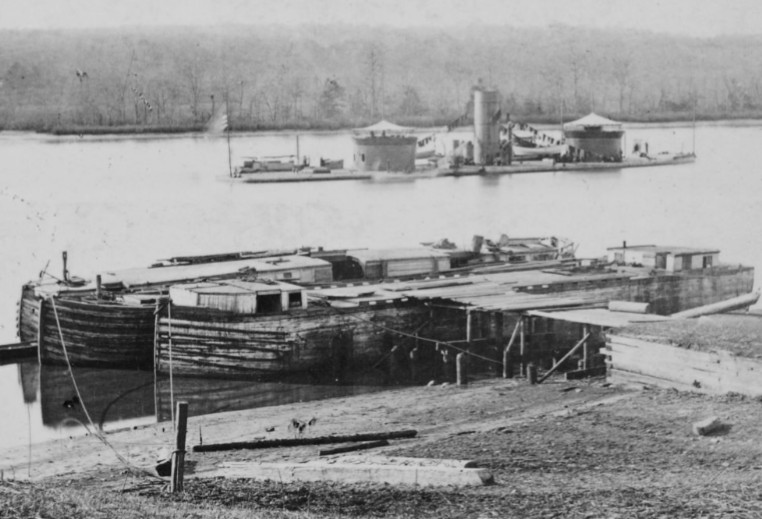
Aiken’s Landing on the James River in Virginia became the site of frequent prisoner exchanges between the Union and Confederacy during the American Civil War. In 1864, the double-turreted, ironclad monitor USS Onondaga, was photographed as it passed by the landing (public domain; click to enlarge).
During the first year of the American Civil War, soldiers who were captured by United States or Confederate military forces were generally held as prisoners of war (POWs) or released on compassionate grounds at the discretion of their captors (when soldiers were sick or wounded, for example). But as the war grew and the number of prisoners held by the Union and Confederacy continued to climb, officers in the field were forced to find better ways of coping with prisoners who needed to be sheltered, guarded, clothed, and fed. So, they gradually devised an unofficial system of prisoner releases in which soldiers were either paroled with the stipulation that they would not take up arms again after their release (but could still serve in non-combat roles), or were released during prisoner exchanges that enabled them to return to active duty in combat with their respective or similar regiments (assuming they were still fit for duty after their confinement as POWs).
During those prisoner transfers, captured Union officers or enlisted men were typically swapped for Confederate officers or enlisted men of equal rank in “man-for-man” individual or group exchanges.
The Dix-Hill Cartel (July 1862)
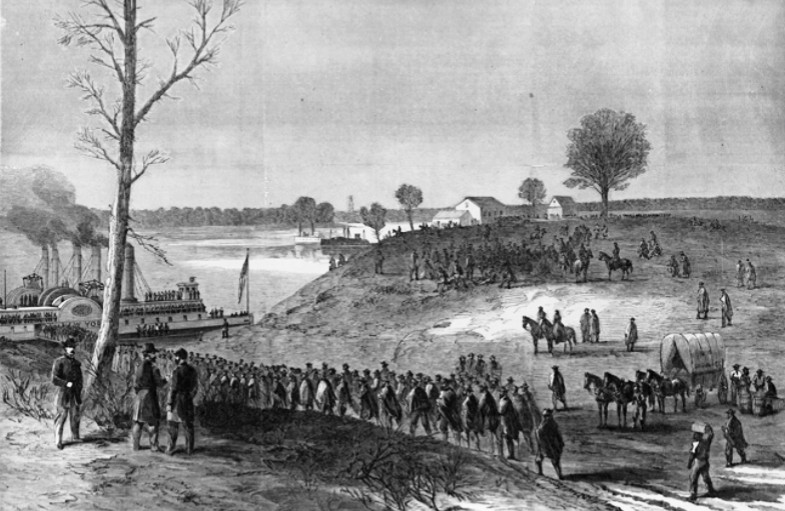
“Embarkation of Exchanged Union Prisoners at Aiken’s Landing” (woodcut: J.R. Hamilton, 21 February 1865, U.S. Library of Congress public domain; click to enlarge).
By early 1862, as more and more soldiers were captured by the Union and Confederacy, the process of exchanging prisoners became harder and harder, prompting senior military officials from both sides to come together to work out a new plan. Led by Union Major-General John A. Dix and Confederate Major-General D. H. Hill, those negotiations ultimately resulted in the creation of the first official system of rules and procedures for the treatment and exchange of prisoners during the American Civil War. Finalized at Haxall’s Landing on the James River in Virginia on 22 July 1862, it became known as the Dix-Hill Cartel.
* Note: Once the provisions of that cartel took effect, military leaders on both sides of the conflict adopted a “scale of equivalents,” enabling them to identify and approve officers or enlisted men for release. Under that new system, captured officers were deemed as being “worth” more than non-commissioned officers, and non-commissioned officers were “worth” more than privates. (For example, a general who was a commander-in-chief could either be exchanged for another general who was also a commander-in-chief — or for sixty privates, while a brigadier-general could be exchanged for another brigadier-general or for twenty privates. Captured privates, however, would still be exchanged on a man-for-man basis.)
Unfortunately, the Dix-Hill Cartel began to fall apart roughly five months later when Confederate president Jefferson Davis prohibited the parole of Union officers in retaliation for the death of Confederate sympathizer William Mumford, who had been court martialed and executed for treason by the Union Army — an action that prompted U.S. Secretary of War Edwin Stanton to prohibit the exchange of all commissioned officers. The cartel then disintegrated further and further as news regarding the mistreatment of Union prisoners by their Confederate captors began to be reported on an increasingly frequent basis.
To read each of the specific provisions for the exchange of prisoners of war between the Union and Confederacy, please see “The Dix-Hill Cartel for the Exchange of Prisoners.”
The Lieber Code (April 1863)
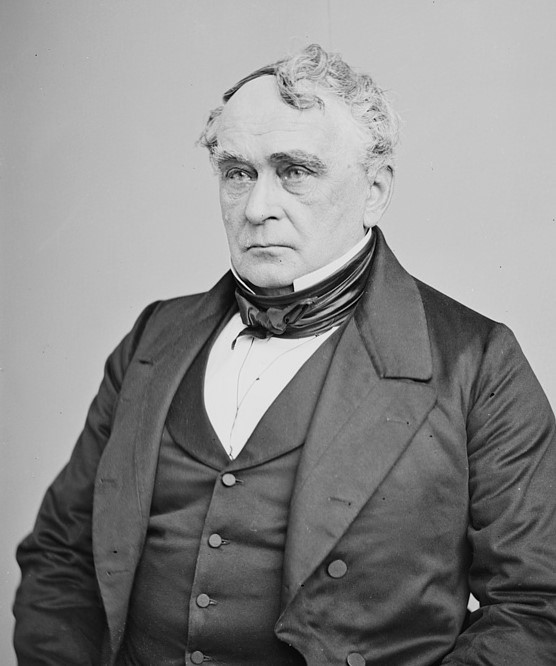
Professor Francis Lieber, circa 1860s (U.S. Library of Congress, public domain).
As the provisions of the Dix-Hill Cartel continued to unravel and other serious issues related to the conduct of soldiers began to crop up, senior Union military officials decided that the nation’s Articles of War needed to be modernized to reflect the changing realities of the American Civil War. So, they enlisted the help of jurist Franz Lieber.
The end product of Lieber’s work was officially published on 24 April 1863 by President Abraham Lincoln as “General Orders, No. 100: Instructions for the Government of Armies of the United States in the Field.” Known more commonly as the “Lieber Code,” that lengthy new set of rules defined how regular and volunteer military personnel in service to the United States were expected to behave toward one another, toward civilians and toward those they considered to be the enemy (government officials, sailors, soldiers, spies, and others supporting the Confederacy), and “remains the basis of most regulations of the laws of war for the United States,” according to Jenny Gesley, a foreign law specialist at the U.S. Library of Congress.
Essentially, those new rules prohibited the starvation and torture of prisoners of war and required that Black and White POWs were to be treated equally.
To learn more about the Lieber Code’s specific provisions regarding the treatment of prisoners of war, please see “The Lieber Code: President Abraham Lincoln Formalizes the Code of Conduct for the Union Army.”
The Retaliatory Act, Confederate Congress (May 1863)
In response to the Lieber Code’s publication, the Confederate Congress issued a joint resolution on 1 May 1863, declaring that any Black men who had been enslaved prior to their enlistment with the Union Army would be treated as runaway slaves, if captured, and returned to their former “owners,” and also declared that “every white person being a commissioned officer who shall command Negroes or mulattoes in arms against the Confederate States shall be deemed as inciting servile insurrection, and shall if captured be put to death or be otherwise punished at the discretion of the Court.”
General Orders, No. 252 (July 1863)
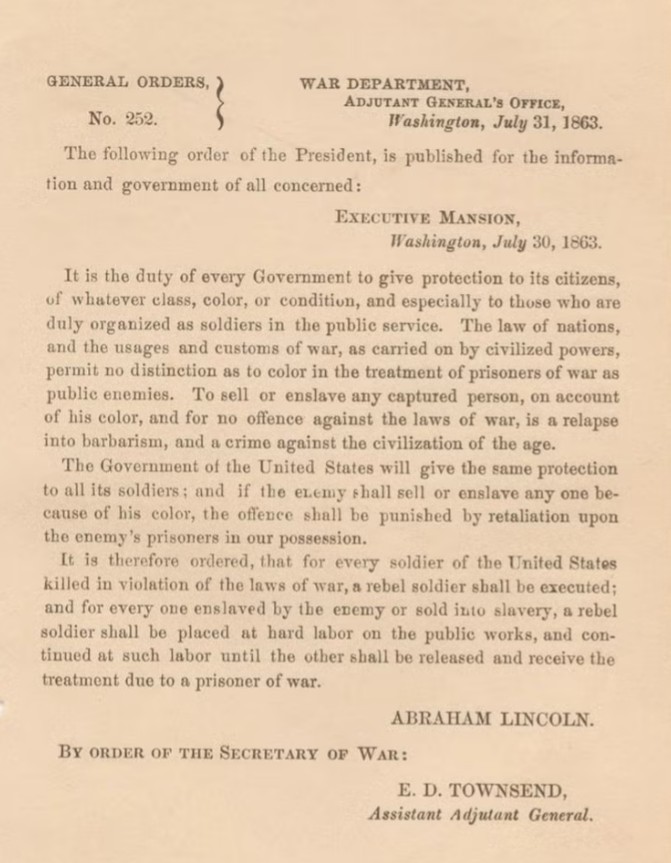
General Orders, No. 252, issued by President Abraham Lincoln, 30 July 1863 to protect Black Union soldiers and their White superior officers (public domain; click to enlarge).
In response to the Confederacy’s Retaliatory Act, and determined to ensure that Confederate military leaders would fully adhere to the new Lieber Code (particularly as it applied to the treatment of Black soldiers and their White commanders), U.S. President Abraham Lincoln subsequently issued General Orders, No. 252 on 30 July 1863:
It is the duty of every Government to give protection to its citizens, of whatever class, color, or condition, and especially to those who are duly organized as soldiers in the public service. The law of nations, and the usages and customs of war, as carried on by civilized powers, permit no distinction as to color in the treatment of prisoners of war as public enemies. To sell or enslave any captured person on account of his color, and for no offense against the laws of war, is a relapse into barbarism, and a crime against the civilization of the age.
The Government of the United States will give the same protection to all its soldiers; and if the enemy shall sell or enslave any one because of his color, the offense shall be punished by retaliation upon the enemy’s prisoners in our possession.
It is therefore ordered, that for every soldier of the United States killed in violation of the law, a Rebel soldier shall be executed; and for every one enslaved by the enemy or sold into slavery, a Rebel soldier shall be placed at hard labor on the public works, and continued at such labor until the other shall be released and receive the treatment due to a prisoner of war.
According to historians at the Andersonville National Historic Site in Georgia, General Orders, No. 252 “effectively suspended the Dix-Hill Cartel until the Confederate forces agreed to treat Black prisoners the same as White prisoners.” But when Confederate leaders refused to adhere to that new code and, instead, chose to escalate their threats against Union officers and enlisted men instead of compromising, “large scale prisoner exchanges largely ceased by August 1863, resulting in a dramatic increase in the prison populations on both sides.”
The Halt to All Prisoner Exchanges (April 1864)
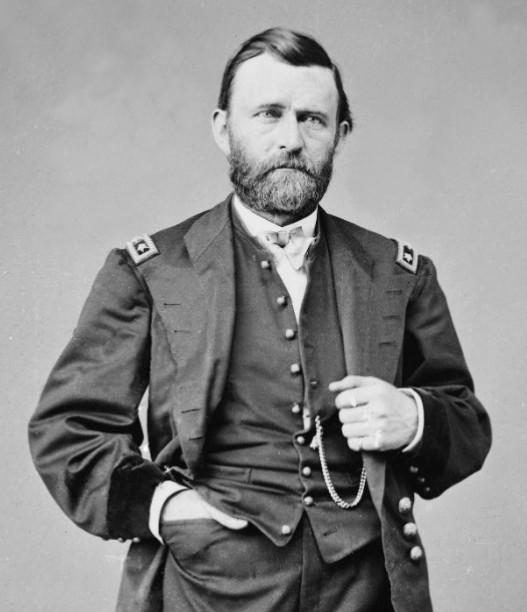
Lieutenant-General Ulysses S. Grant (public domain).
Following his elevation to the rank of commanding general of the United States Army in March 1864, Lieutenant-General Ulysses S. Grant immediately looked for ways to maintain or improve the procedures under which the Union’s artillery, cavalry and infantry units had been operating. “In April, he ordered a continuation of the established policy of halting prisoner of war exchanges on the basis of the Confederates’ mistreatment of African American soldiers of the U.S. army,” according to historians at the Richmond National Battlefield Park in Virginia.
Grant stated that the murder of surrendering African American soldiers at Fort Pillow on April 12 motivated him to issue a formal demand that Black and White United States soldiers receive identical consideration in their treatment and exchange as prisoners by the Confederacy.
On April 17, Grant wrote to General Benjamin Butler – who was negotiating a resumption of prisoner exchanges – that “the status of colored prisoners” was a priority. He ordered that Butler should communicate the non-negotiable demand that “no distinction whatever will be made in the exchange between white and colored prisoners,” that “the same terms as to treatment while prisoners and conditions of release and exchange must be exacted… in the case of colored soldiers as in the case of white soldiers.”
Grant then added the following major caveat:
Non-acquiescence by the Confederate authorities will be regarded as a refusal on their part to agree to the further exchange of prisoners.
But Confederate leaders were intransigent. According to Richmond National Battlefield historians, “Confederate Secretary of War James Seddon responded with a refusal of the terms. ‘I doubt,’ he said, ‘whether the exchange of negroes at all for our soldiers would be tolerated.’ Ominously, Seddon added, ‘As to the white officers serving with negro troops, we ought never to be inconvenienced with such prisoners.’”
Robert E. Lee, writing to Grant later in the year, indicated his willingness to include “all captured soldiers of the United States of whatever nation and color,” in exchanges, but complicated the matter by also communicating the contradictory stance that he did not believe anyone who was formerly enslaved warranted treatment as a prisoner of war. “Negroes belonging to our citizens,” he wrote, “are not considered subjects of exchange… they cannot be returned.” Grant’s response was to inform Lee that “the Government is bound to secure to all persons received into her armies the rights due to soldiers. This being denied by you in the persons of such men as have escaped from Southern masters induces me to decline making the exchanges you ask.” As such, according to Grant’s April 17 demands, the prohibition on formal prisoner exchanges continued, as it had since the first appearance of African American soldiers on the battlefields.
A Thaw in the Frozen Exchange (Summer and Fall 1864)
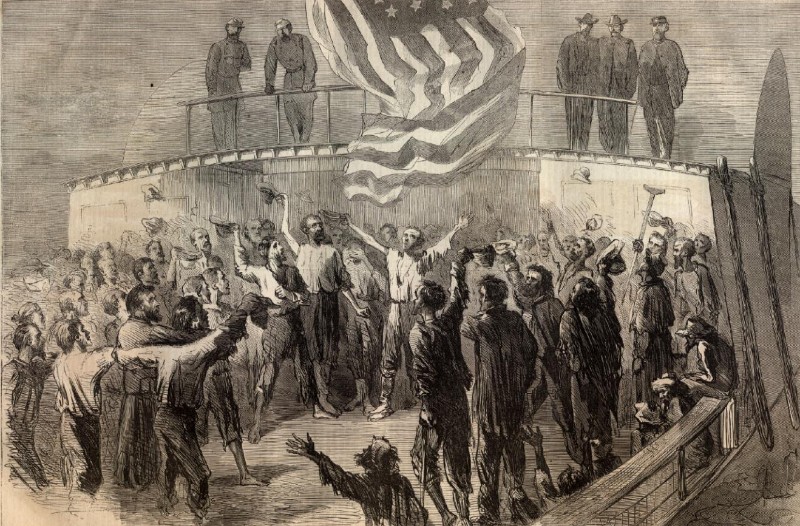
“‘Thank God!’ — Reception of Our Exchanged Prisoners Aboard the Eliza Hancock, November 18, 1864” (Alfred Waud, Harper’s Weekly, 10 December 1864, public domain).
By the summer of 1864, a limited number of prisoner exchanges were resumed between the Union and Confederacy, as evidenced by the muster rolls of the 47th Pennsylvania Volunteer Infantry, which documented the release of several of its members from captivity at the Confederacy’s Camp Ford in Texas in July and August. Later that same year, Harper’s Weekly illustrator and war correspondent Alfred Waud covered three prisoner exchanges between the Union and Confederacy, sketching what he saw on board three different ships that were transporting Union soldiers who had been released by the Confederacy: the New York, the gunboat Metacomet and the Eliza Hancock — the latter of which held a significant number of men who had been confined at Andersonville in Georgia.
Prisoner Exchange Agreement (February 1865)
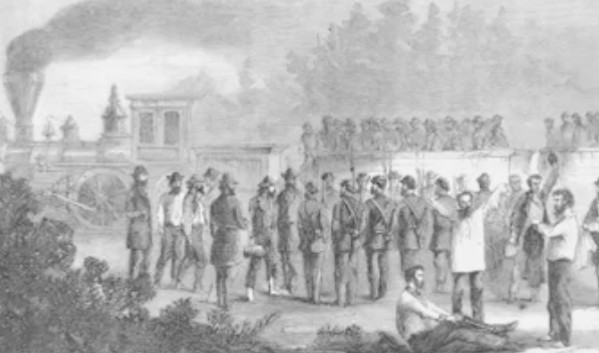
Union POWs waiting to board a train at the Burgaw Depot during the Wilmington, North Carolina prisoner exchange that took place from 26 February to 4 March 1865 (public domain; click to enlarge).
On 16 February 1865, Union and Confedrate military leaders finalized an agreement to provide for the release of thousands of prisoners of war. That prisoner exchange process was initiated after the city of Wilmington, North Carolina fell into Union hands on 22 February, and took place from 26 February to 4 March 1865 “at the crossing of the Northeast Cape Fear River, on the main road from Wilmington to Goldsborough,” according to historians at the North Carolina Department of Natural and Cultural Resources (NCDNCR).
Although NCDNCR historians have not reported a definitive figure for the total number of Confederate POWs released by Union military leaders during that time, they have determined that eight thousand six hundred and eighty-four Union prisoners of war were freed from captivity at the Confederacy’s Salisbury Prison in Rowan County, North Carolina, and that, of that number, nine hundred and ninety-two were commissioned Union officers and one hundred and twenty were Black Union soldiers.
Sources:
- “A Maxim” (letter to the editor explaining the origins of Francis Lieber’s maxim, “Nullum jus sine officio”), in The American Historical Record, vol. 1, no. 2 (February 1872), pp. 80-81. Philadelphia, Pennsylvania: Chase & Town Publishers, 1872.
- Bates, Samuel P. History of Pennsylvania Volunteers, 1861-5, vol. 1. Harrisburg, Pennsylvania: B. Singerly, State Printer, 1869.
- “Camp Ford,” in “Texas Beyond History.” Austin, Texas: Texas Archaeological Research Laboratory, University of Texas at Austin, retrieved online 24 January 2025.
- “Camp Sumter,” in “Editorial Jottings.” Washington, D.C.: The Soldiers’ Journal, 21 September 1864.
- Carnahan, Burrus. “Global Impact: The Lincoln Administration and the Development of International Law.” Washington, D.C.: President Lincoln’s Cottage, May 9, 2016.
- “General Orders 100: The Lieber Code,” in “The Avalon Project: Documents in Law, History and Diplomacy.” New Haven, Connecticut: Lillian Goldman Law Library, Yale Law School, Yale University, retrieved online 3 April 2024.
- Gesley, Jenny. “The ‘Lieber Code’ — the First Modern Codification of the Laws of War,” in “In Custodia Legis: Law Librarians of Congress.” Washington, D.C.: U.S. Library of Congress, retrieved online 3 April 2024.
- Gilbert, Randal B. A New Look at Camp Ford, Tyler, Texas: The Largest Confederate Prison Camp West of the Mississippi River, 3rd Edition. Tyler, Texas: The Smith County Historical Society, 2010.
- Gilman, D. C.; Peck, H. T.; Colby, F. M., editors. “Lieber, Francis,” in New International Encyclopedia (first edition). New York, New York: Dodd, Mead, 1905.
- Hesseltine, William B. Civil War Prisons: A Study in War Psychology. Columbus, Ohio: The Ohio State University Press, 1930 (edited reprinted with a new foreward by William Blair, 1998).
- James A. Seddon to Howell Cobb (13 June 1864), in The War of the Rebellion: A Compilation of the Official Records of the Union and Confederate Armies, Additions and Corrections to Series II, vol. 7. Washington, D.C.: Government Printing Office, 1902.
- Lawrence, F. Lee. “Camp Ford,” in “Hand Book of Texas.” Austin, Texas: Texas State Historical Association, retrieved online 24 January 2025.
- Lieber, Francis. Instructions for the Government of Armies of the United States in the Field. Washington, D.C.: Government Printing Office, 1898.
- McPherson, James M. Battle Cry of Freedom: The Civil War Era. New York, New York: Oxford University Press, 1988.
- “Myth: Grant Stopped the Prisoner Exchange.” Andersonville, Georgia: Andersonville National Historic Site, retrieved online 24 April 2026.
- “No. 5: Joint Resolution on the Subject of Retaliation” (approved on 1 May 1863), in “Resolutions ” in “The Statutes at Large of the Confederate States of America, Passed at the Third Session of the First Congress; 1863. Carefully Collated with the Originals at Richmond,” in “Documenting the American South.” Chapel Hill, North Carolina: University Library, University of North Carolina at Chapel Hill, retrieved online 24 April 2026.
- “Our Exchanged Prisoners” (with illustrations by Alfred Waud). New York, New York: Harper’s Weekly, 10 December 1864.
- “Prisoner Exchange (D-99).” Raleigh, North Carolina: North Carolina Department of Natural and Cultural Resources, 11 December 2023.
- “Prisoner Exchanges Halted — April 17, 1864.” Richmond, Virginia: Richmond National Battlefield Park, retrieved online 24 April 2026.
- Robert E. Lee to Ulysses Grant (3 October 1864), in The War of the Rebellion: A Compilation of the Official Records of the Union and Confederate Armies, vol. 7. Washington, D.C.: Government Printing Office, 1902.
- Schmidt, Lewis. A Civil War History of the 47th Regiment of Pennsylvania Veteran Volunteers. Allentown, Pennsylvania: Self-published, 1986.
- Stegall, Joel T. “Salisbury Prison: North Carolina’s Andersonville.” Fayetteville, North Carolina: North Carolina Civil War & Reconstruction History Center, 13 September 2018.
- “The Exchange of Prisoners; The Cartel Agreed Upon by Gen. Dix for the United States, and Gen. Hill for the Rebels,” in “Supplementary Articles.” New York, New York: The New York Times, 6 October 1862.
- “The Laws of War: The Lieber Codes.” Andersonville, Georgia: Andersonville National Historic Site, U.S. National Park Service, retrieved online 3 April 2024.
- “The President’s Order No. 252,” in “On This Day.” New York, New York: The New York Times, 2001.
- “The Retaliatory Act, Confederate Congress May 1, 1863,” in “House Divided: The Civil War Research Engine at Dickinson College.” Carlisle, Pennsylvania: Dickinson College, retrieved online 24 April 2026.
- Ulysses Grant to Benjamin Butler (17 April 1864), in Private and Official Correspondence of Gen. Benjamin F. Butler. Norwood, Massachusetts: Plimpton Press, 1917.
 47th Pennsylvania Volunteers
You must be logged in to post a comment.