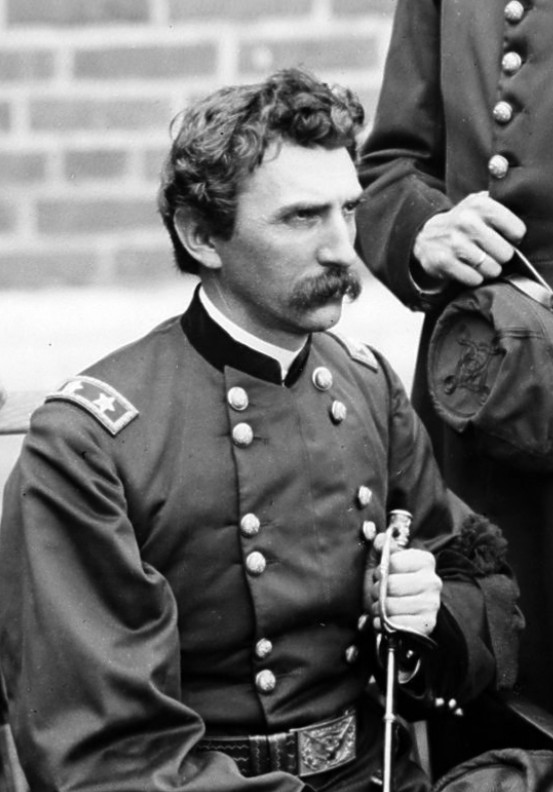
Brevet Major-General John Frederick Hartranft, governor and commanding officer of the Washington Arsenal military prison in Washington, D.C., July 7, 1865 (excerpted from original public domain photo of Hartranft and staff, U.S. Library of Congress).
On May 10, 1865, a group of soldiers from the 47th Pennsylvania Volunteer Infantry concluded another of their regiment’s history-making assignments — guarding the individuals who were instrumental in planning and carrying out the assassination of U.S. President Abraham Lincoln. Present-day historians know this to be true thanks to this brief note that was written by Brevet Major-General John Frederick Hartranft, the commanding officer of the United States military prison where those conspirators were held in the days leading up to their trial:
Hd. Qrs. Mil. Prison
Wash. Arsenal May 11th 1865.
Major Gen’l. Hancock
Com’dg. Mid. Mil. Div.
Gen’l,
I have the honor to report that 10.25 a.m. yesterday, Lt. Col. J. M. Clough, 18th N.H. reported with 450 muskets, for four days duty relieving the 47th Pa. Vols.
At 11.45, the prisoners on trial were taken into Court, in compliance with the orders of the same. At 1 P.M. the Court ordered the prisoners returned to their cells, which was done.
At 1.10 P.M. dinner was served to the prisoners in the usual manner.
At 1.30 in compliance with your orders Marshal McPhail was admitted to see the prisoner in 161, his hood having been previously removed; he remained with him until 2.35, immediately after which his hood was replaced and the door locked.
At 3.45 P.M. Mr. George L. Crawford in accordance with your instructions, was permitted to have an interview with prisoner in 209. I was present during the same, and heard all that was said. The conversation was in regard to the property of the prisoner in Philadelphia. At 4.25 the hood was replaced and the cell locked.
At 6 P.M. Supper was furnished the prisoners and at the same time Dr. Porter and myself made inspections of all the cells and prisoners.
At 6 P.M. in accordance with your instructions, Mr. Stone, Counsel for Dr. Mudd, was permitted to visit his client. The interview took place in the presence of Lt. Col. McCall but not in his hearing.
At 6.35 the interview closed, and the door was again locked.
At 7 this A.M. breakfast was served to the prisoners in the usual manner. At 7.15, Dr. Porter and myself made Inspections of all the cells and prisoners.
I would respectfully recommend that the prisoner in 190 be removed to cell 165.
All passes admitting persons during the last 24 hours are herewith enclosed.
I have the honor to be
Very Respectfully
Your Obt. Servt.
Bvt. Maj. Genl. and
Gov. and Comdr. Mil. Prison
* Note: The conspirator who was identified only as “prisoner 161” in Major-General Hartranft’s entry regarding the visit to the prison at 1:30 p.m. by Marshal McPhail was George Atzerodt, according to historians Edward Steers, Jr. and Harold Holzer, who worked with the U.S. National Archives and Records Administration to publish a book containing correspondence that Hartranft wrote during his tenure as the head of the military prison where Atzerodt was being held, along with his fellow conspirators Samuel Arnold (cell 170), David Herold (cell 205), Dr. Samuel Mudd (cell 176), Michael O’Laughlen (cell 181), Lewis Payne/Lewis Powell (cell 195), Edman Spangler (cell 190 and then cell 184), and Mary Surratt (cell 157 and then cell 200). Also imprisoned there at that time were suspected conspirator John Celestino (cell 209) and Willie Jett (cell 211), the Confederate soldier who had accompanied Lincoln assassin John Wilkes Booth and David Herold as they crossed the Rappahannock River to evade capture by Union troops, and had then also secured lodging for Booth at the farm of Richard Garrett in Virginia.
Researchers for 47th Pennsylvania Volunteers: One Civil War Regiment’s Story are currently working to confirm the nature of and exact start and end dates for the 47th Pennsylvania Volunteer Infantry’s guard duty assignment at the Washington Arsenal military prison in Washington, D.C., as well as which companies of the regiment may have been involved. Their current theory (based on the first sentence of Major-General Hartranft’s May 11, 1865 letter shown above) is that as many as four hundred and fifty men from the 47th Pennsylvania may have been stationed at the Washington Arsenal for a four-day period between May 6-9, 1865. If so, then those 47th Pennsylvanians would have been on guard duty somewhere on the grounds of, or near, that prison on the day when Major-General Hartranft personally visited the cells of each of the key conspirators and read the official charges against them (May 8, 1865) and on the day when the key conspirators appeared before the military tribunal and were each asked whether or not he or she wanted to have an attorney advise and represent them — to which each said yes (May 9). The next morning, as the 47th Pennsylvania Volunteers were being released from their duties and replaced by men from the 18th New Hampshire, Samuel Arnold, George Atzerodt, David Herold, Samuel Mudd, Michael O’Laughlen, Lewis Powell (also known as Lewis Payne), Edman Spangler (also known as Ned Spangler), and Mary Surratt stood in front of the military tribunal at the Washington Arsenal, listening as the charges against them were read out loud in open court during their formal arraignment.
Sources:
- “Assassination Conspirators Tried, Convicted & Executed,” in Civil War on the Western Border: Border War Timeline. Kansas City, Missouri: Kansas City Public Library, 2013-2015.
- “Executive Order — General Court-Martial Orders: 356” (the legal charges filed in May 1865 against the key conspirators in the assassination of U.S. President Abraham Lincoln), in The American Presidency Project. Santa Barbara, California: University of California, Santa Barbara, retrieved online May 10, 2026.
- Steers, Jr., Edward and Harold Holzer, editors. The Lincoln Assassination Conspirators: Their Confinement and Execution, as Recorded in the Letterbook of John Frederick Hartranft. Baton Rouge, Louisiana: Louisiana State University Press in Association with the U.S. National Archives, Washington, D.C., 2009.
- “The Trial of the Conspirators,” in Lincoln’s Assassination: Investigating the Assassination. Washington, D.C.: Ford’s Theatre, retrieved online May 10, 2026.


You must be logged in to post a comment.