The Honorable Andrew Gregg Curtin, Pennsylvania’s Civil War-Era Governor

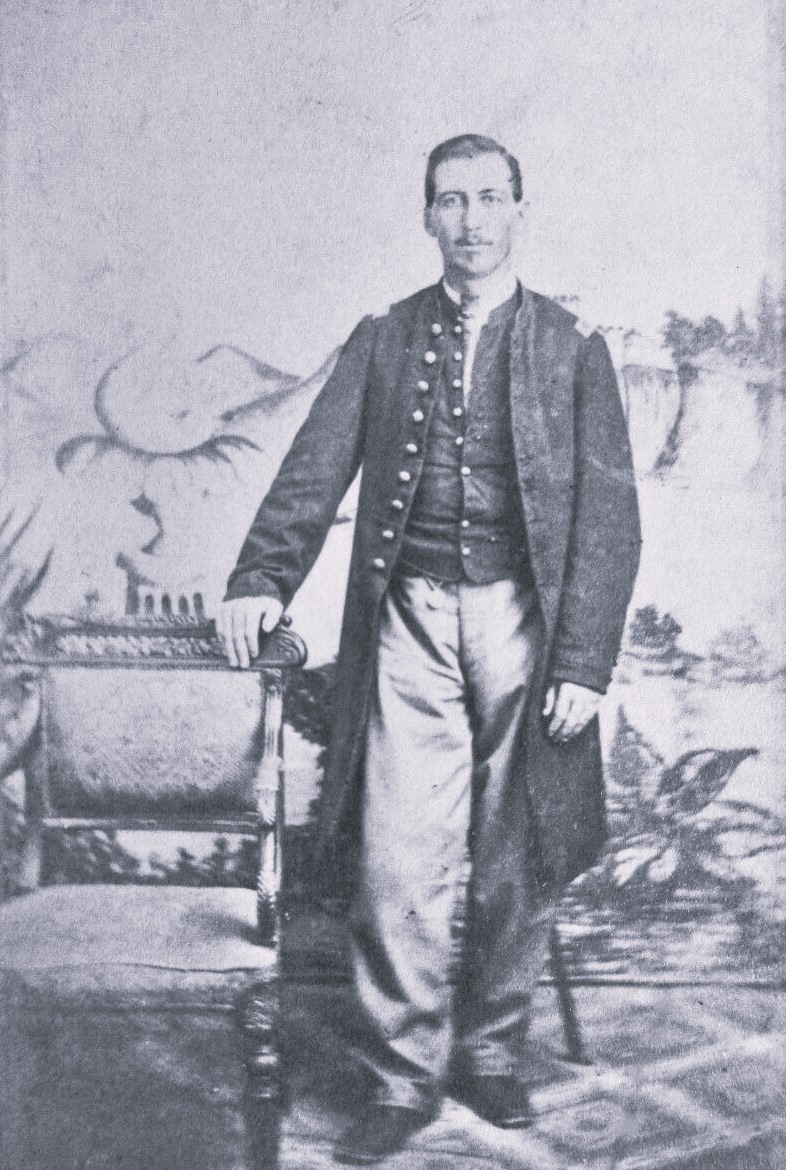
Andrew Gregg Curtin, Governor, Commonwealth of Pennsylvania, circa 1860 (public domain).

“In this locality his very name is a tower of strength — and either in or out of politics, amid the exciting scenes and contests of his profession or in the reciprocity of the amenities and courtesies of society, Col. Curtin commands the respect of his fellows, and never fails to win the confidence of the people with whom he comes in contact. There are always men who seem to be born leaders, and he is one of them. He wins by intuition, as much by the grace of his learning, as by the fiery zeal of his nature. As a lawyer, he is keen, sagacious, and when full[y] engaged in a cause, irresistible in his efforts…. His zeal and devotion to the system of Common School Education, the present arrangement of which is owing to his energies … is as near perfection as possible.” — The Alleghenian, September 29, 1859


Known as “the Soldier’s Friend,” Andrew Gregg Curtin (1815-1894) was the fifteenth governor of the Commonwealth of Pennsylvania. “His influence had much to do with the first nomination for president of Abraham Lincoln,” according to The New York Times.

He was also revered as a friend by many Pennsylvanians, not only for the genuine compassion he showed to children who had been orphaned during the American Civil War, but for his leadership in improving public education for all children statewide.

FORMATIVE YEARS

Born on April 22, 1815, in the Borough of Bellefonte, the County Seat of Centre County in the Commonwealth of Pennsylvania, Andrew Gregg Curtin (1815-1894) was the eldest child of Roland Curtin (1764-1830), an emigrant from Ireland who became an iron industry pioneer in Pennsylvania, and his second wife, Jean Gregg (1791-1854), a daughter of Andrew Gregg, the former president pro tempore of the United States Senate.

Andrew G. Curtin was also the big brother of multiple Bellfonte-born siblings — Constans Curtin (1817-1895), who was born on March 6, 1817 and never married; Martha Maria Curtin (1819-1880), who was born on August 29, 1819 and would later wed William Irwin, M.D.; Ellen Honora Curtin (1822-1851), who was born on June 11, 1822 and would later wed William H. Allen, M.D.; Margery Gregg Curtin (1823-1885), who was born on December 23, 1823 and would later wed Thomas R. Reynolds (1824-1888); Nancy Jane Curtin (1828-1900), who was born on May 4, 1828 and would later wed D. D. Clarke, M.D.; and Julia G. Curtin (1831-1919), who was born on October 3, 1831 and never married.

Educated initially at a private school in Bellefonte, and via attendance with his parents and siblings at Presbyterian Church services, Andrew Curtin was subsequently enrolled at a preparatory school in the city of Harrisburg in Dauphin County, Pennsylvania prior to attending the Milton Academy in Milton, Northumberland County, Pennsylvania.

* Note: According to historian Herbert C. Bell, the Milton Academy was highly regarded:

“In 1815 Joseph D. Biles established an English school at the Broadway school house, adding Latin and Greek to his curriculum in the following year. This gained for his school the name of ‘The Milton Academy,’ thus for the first time applied to an educational institution at this place. In 1817 it numbered among its students John F. Wolfinger, for many years a member of the Northumberland county bar, Samuel Pollock, and James Pollock, afterward Governor of Pennsylvania. But this school did not long continue, and other pedagogues succeeded Biles….

“The Milton Academy, the leading educational institution of the West Branch valley during the period of its existence, originated with the Rev. George Junkin, pastor of the Presbyterian church and the moving spirit in many public enterprises of a moral and educational character. Through his efforts a stock company was formed, composed of Samuel Hepburn, Joseph Rhoads, William H. Sanderson, Samuel Teas, Sarah Pollock, and others, by whom a plain, one-story brick building was erected at a cost of four hundred dollars at the brow of the hill on the north side of Broadway, and a short distance to the east of the frame school building previously mentioned. The entrance was on the western side, and from its elevated location the academy commanded a view of the town, the river, and the valley. The interior was divided into two rooms by a narrow entrance hall. The apartment on the north was the smaller of the two; it was occupied by the students in Latin and Greek, the higher mathematics, rhetoric, etc., while the other room was set apart for those who had not advanced beyond the ordinary English branches. A small cupola surmounted the building, but the necessary appendage of a bell was never provided.

“The first principal of the academy … was the Rev. David Kirkpatrick. He was employed as a teacher of the classics at Oxford, Chester county, Pennsylvania, when Mr. Junkin formed his acquaintance and prevailed on him to change the field of his labors; he accordingly came to Milton, and on the second Monday of May, 1822, opened a classical school at a frame building that occupied the site of Dr. James McCleery’s residence on Front street. In the following October he removed his school to the academy building, where he taught until November, 1834, assisted at different times by a Mr. Mayne, Thomas C. Hambly, and others. Among his students were many who subsequently acquired honorable rank in the legal and medical professions, and as clergymen, teachers, civil engineers, etc.”

After completing his education at the Milton Academy, Andrew Curtin studied law with his mother’s cousin, William W. Potter, prior to enrolling formally in the law department at Dickinson College in Carlisle, Cumberland County, Pennsylvania. After graduating from Dickinson in 1837, he began practicing law in his hometown of Bellefonte. Focused primarily on criminal law during his work days, he spent a significant portion of his free time as a volunteer for the Whig Party.

Married to Katharine Irvine Wilson on May 30, 1844, Andrew Curtin settled with her in Centre County, where they then welcomed the births of: Mary Wilson Curtin (1845-1927), who was born in Potters Bank on March 7, 1845, and would later wed George Fairlamb Harris, M.D. (1843-1911); Jane Gregg Curtin (1847-1893), who was born in Bellefonte on January 17, 1847, and would later wed William Henry Sage (1844-1924); Martha Irvine Curtin (1848-1935), who was born on March 22, 1848, and would later wed Commander Kidder Randolph Breese (1831-1881); William Wilson Curtin (1851-1936), who was born in Bellefonte on March 27, 1851, and would later wed Harriet Fuller Harding (1853-1935); and Myron Stanley Curtin (1854-1857), who was born in Bellefonte on October 9, 1854.

On January 19, 1855, Andrew Curtin was appointed by Pennsylvania Governor James Pollock (1810-1890) as the secretary of the Commonwealth of Pennsylvania — a post that he held until January 20, 1858. During that time, he also served in an ex officio capacity as the commonwealth’s superintendent of public instruction. According to historians at the Pennsylvania & Historical Museum Commission (PHMC), it was during that period of his public service career that he “started the state system of teacher training in ‘normal’ schools.” The New York Times would later credit him with reforming the “entire management” of Pennsylvania’s system of public education. “It was Mr. Curtin who secured, among many other innovations, the adoption of the prevailing system [in 1894] of County Superintendents of Schools in Pennsylvania.”

Sadly, during that same time, he and his wife suffered a terrible loss when their youngest child, Myron, died at the age of two on January 13, 1857. They then welcomed the birth of daughter, Katharine Irvine Wilson Curtin (1859-1930), who was born in Bellefonte on May 2, 1859, and would later wed Moses Dewitt Burnett, Jr. (1854-1920).

ELECTED GOVERNOR OF PENNSYLVANIA
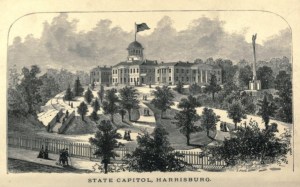
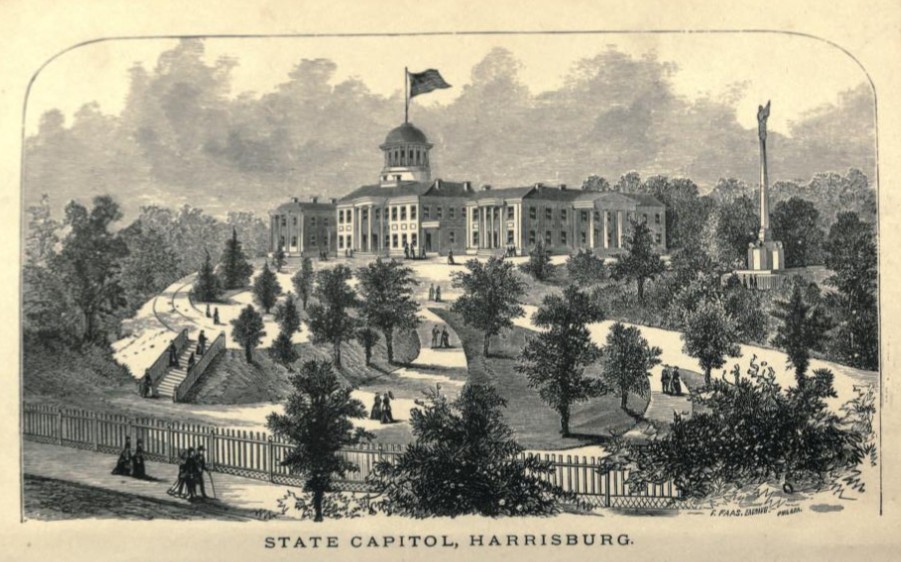
The Commonwealth of Pennsylvania’s State Capitol Building, Harrisburg, Pennsylvania, circa 1870s (James Laughery Paul, Pennsylvania Soldiers’ Orphan Schools, 1876, public domain; click to enlarge).

In 1860, according to PHMC historians, Andrew G. Curtin “helped persuade Pennsylvania’s delegates at the National Republican Convention to abandon the nomination of his political nemesis, Pennsylvania Senator Simon Cameron, [for the office of president of the United States] and instead cast their votes in-favor of [Abraham] Lincoln, making Pennsylvania a key swing state in his successful nomination. That fall, Curtin won Pennsylvania’s 1860 gubernatorial election, becoming the first Republican to hold this office.”

Inaugurated on January 15, 1861, Governor Andrew Curtin began his first term as the nation’s secession crisis was deepening. South Carolina had seceded from the United States on December 20, 1860, followed by Mississippi on January 9, 1861, Florida on January 10th, and Alabama on January 11th. (Georgia then seceded on January 19th, followed by Louisiana on January 26th and Texas on February 1st.)

Working with the Pennsylvania Legislature to prepare for the possibility of a full-blown civil war, he began to bring many of the militia units that had been operating in cities and towns across the commonwealth under the organizational umbrella of the Military Department of Pennsylvania, and then secured appropriations that would eventually fund the purchase and distribution of weapons, ammunition, uniforms, food and other supplies to the more than three hundred thousand Pennsylvanians who would ultimately serve in the Union Army during the American Civil War.

On March 14, 1861, he signed legislation repealing the tonnage tax on Pennsylvania’s railroad companies, “which helped the Pennsylvania Railroad become the nation’s largest transport system,” according to PHMC historians. That change, which was initially criticized by many newspapers statewide, would ultimately prove to be a critical, pro-Union incentive for those same companies over the next several months and years, as they transported Pennsylvanians and other men from the Mid-Atlantic Region to military training facilities and then on to Union Army encampments in Washington, D.C., Maryland and Virginia. According to The New York Times:

“In the lower house of the Legislature a bill was instantly introduced investing the Governor with power to raise and equip troops, and appropriating $500,000 for this purpose. In forty-eight hours the bill became a law. Its authority was used by the Governor so promptly that when the President issued his call for 75,000 men for 100 days the Pennsylvania soldiers were the first to reach the capital. The Governor foresaw that the war would be long, called an extra session of the Legislature, asked for authority to raise not less than fifteen nor more than thirty regiments, enlisted for three years, or until the end of the war, and obtained all that he requested and an appropriation of $3,500,000. The reserves equipped with this fund saved the capital of the United States from capture after the battle of Bull Run.”

Among the military units that were created by Governor Curtin during his first months in office was the 47th Pennsylvania Volunteer Infantry, which was established on August 5, 1861 and would later make history as the only regiment from Pennsylvania to take part in the Union’s 1864 Red River Campaign across Louisiana.

As the civil war raged into a second year, he presided over “The Loyal War Governors’ Conference” at the Logan House Hotel in Altoona, Blair County (September 1862). Its participants subsequently urged President Lincoln to remove Union General George B. McClellan from his position as the commander of the Army of the Potomac — a recommendation that Lincoln accepted.

A gifted writer and celebrated orator, Governor Curtin also delivered the first of his Thanksgiving Addresses in 1862. Re-elected in 1863, he then continued to lead the commonwealth’s prosecution of the war by securing funding to support the recruitment, training, transportation, and medical and spiritual care of Union soldiers and sailors from Pennsylvania. According to historian and biographer Rebecca Gifford Albright, “Among Andrew Curtin’s most admirable qualities what that of compassion…. Curtin insisted that all letters from soldiers be answered, either by himself or by his personal secretary. On many occasions, the Governor visited camp hospitals to talk with the wounded or to present them with some recognition of their sacrifices. In addition, Curtin heard countless pleas from wounded soldiers and their families and took what steps he could to relieve their anxieties.” He also “established the practice of bringing Pennsylvania war dead home for burial.”

Through it all, he tried to maintain a measure of normalcy as a husband and father. On October 19, 1865, he and his wife welcomed the birth of Bessie Elliott Curtin (1865-1866), who was born in Bellefonte. Sadly, she died in infancy at their family home on July 1, 1866.

HONORS AND ACHIEVEMENTS
Camp Curtin

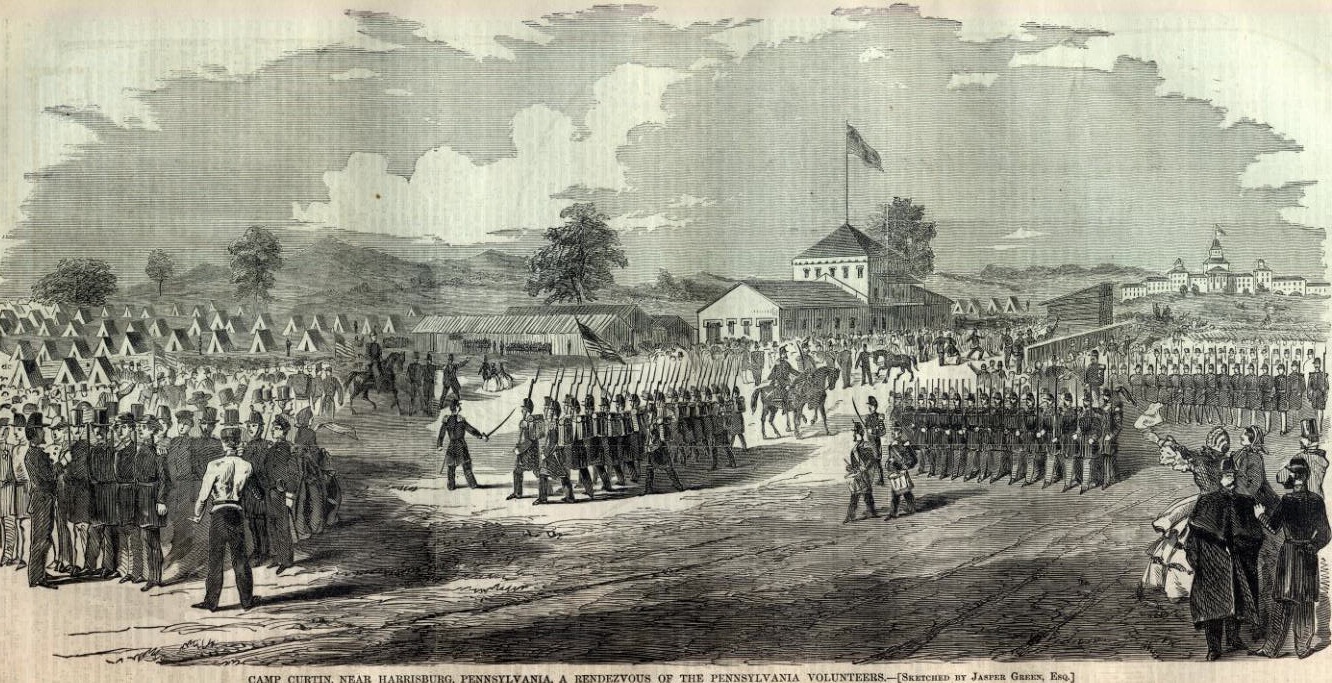
Camp Curtin (Harper’s Weekly, 1861, public domain).

Three days after the fall of Fort Sumter to Confederate States Army troops in mid-April 1861, a new military recruiting and training camp was opened just north of the State Capitol building in the city of Harrisburg in Dauphin County, Pennsylvania. Situated on eighty acres of land that had previously been used for Dauphin County’s Agricultural Fairgrounds, “The camp was between Reels Lane on the north, the Pennsylvania Railroad tracks on the east, Maclay Street on the south and Fifth Street on the west,” according to volunteers at the Camp Curtin Historical Society, and was initially named “Camp Union.”

Harrisburg’s location on major railroad lines running east and west, and north and south made it the ideal location for moving men and supplies to the armies in the field. In addition to Pennsylvania regiments, troops from Maryland, Michigan, Minnesota, New Jersey, New York, Ohio, Wisconsin and the Regular Army used Camp Curtin.”

That same day (April 18, 1861), Major Joseph Knipe, “a native of Mount Joy, a veteran of the Mexican War … raised the American flag over the new camp and proposed that it be named after the governor,” according to Tom Huntington, author of Pennsylvania Civil War Trails — a recommendation that was quickly adopted. More than three thousand regular and volunteer Union Army soldiers would ultimately be enrolled, mustered in, trained, mustered out, and/or honorably discharged at Camp Curtin between the spring of 1861 and early January 1866, making it the largest military facility in the Commonwealth of Pennsylvania and one of the largest in the nation during the American Civil War.

Soldiers’ Orphan Schools

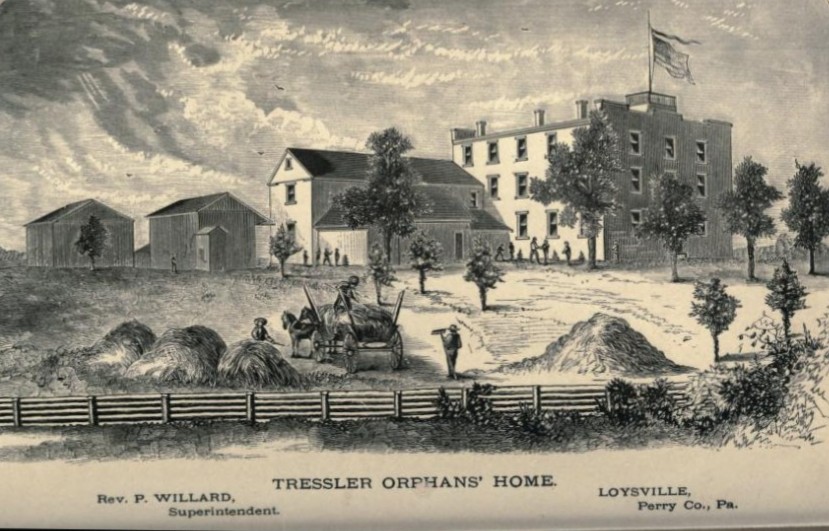
The Tressler Orphans’ Home in Loysville, Pennsylvania, depicted here circa 1876, was founded in 1865 as part of the Pennsylvania Soldiers’ Orphan Schools (John Laughery Paul, Pennsylvania’s Soldiers’ Orphan Schools, 1876, public domain; click to enlarge).

One of Governor Curtin’s most important initiatives was one that outlived him by many years — the creation of a system of schools for the thousands of Pennsylvania children whose fathers had died while serving with Union military units during the American Civil War (or had died, post-war, as a direct result of their service to the nation). Known as the Pennsylvania Soldiers’ Orphan Schools, this system was approved by an act of the Pennsylvania Legislature in 1864, which read as follows:

“Be it enacted by the Senate and House of Representatives of the Commonwealth of Pennsylvania in General Assembly met, and it is hereby enacted by the authority of the same, That the Governor of the Commonwealth of Pennsylvania be and is hereby authorized to accept the sum of fifty thousand dollars donated by the Pennsylvania Railroad Company, for the education and maintenance of destitute orphan children of deceased soldiers and sailors, and appropriate the same in such manner as he may deem best calculated to accomplish the object designed by said donation; the accounts of said disbursements to be settled, in the usual manner, by the Auditor General and the Governor, and make report of the same to the next Legislature.

On June 16, 1864, Governor Curtin appointed The Honorable Thomas L. Burrowes, L.L.D., as superintendent of soldiers’ orphans, and directed him to create a plan for the new school system. Dr. Burrowes, who had previously served as the ex officio superintendent of Pennsylvania’s common school system during his tenure as secretary of the commonwealth under Governor Joseph Ritter, was able to quickly complete that new plan, and submitted it to Governor Curtin on June 27 of that same year (1864). In addition to establishing the criteria for determining a child’s eligibility for orphans’ school enrollment, that plan defined the application procedures for the mother or guardian of an eligible child, the responsibilities of each orphans’ school (to house, clothe, feed, educate, and provide medical and spiritual care to each child enrolled), and the recordkeeping and reporting procedures.

Governor Curtin then dedicated a significant portion of his final years in office to securing a staggering amount of funding for the orphans’ school system from the Pennsylvania Legislature (four hundred thousand dollars), and also worked with Dr. Burrowes on refining the system’s admissions and operating procedures.

POST-GUBERNATORIAL LIFE
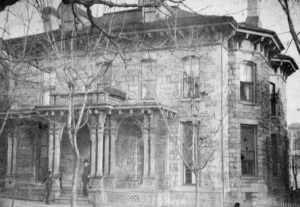
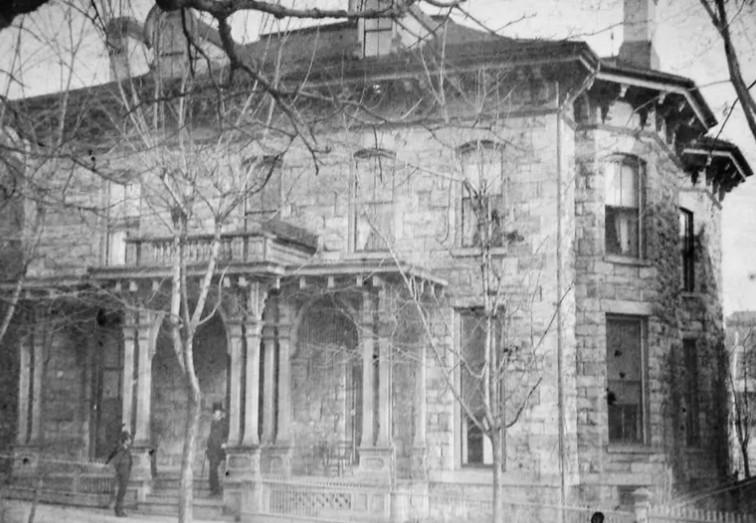
The residence of Pennsylvania’s Civil War-era governor, Andrew Gregg Curtin, Bellefonte, Pennsylvania, circa 1890s (public domain).

Having completed his second term as governor of the Commonwealth of Pennsylvania on January 15, 1867, Andrew Gregg Curtin chose to remain active in public service. Appointed by U.S. President Ulysses S. Grant as the United States’ minister to Russia in 1869, he held that post until 1872. From 1872-1873, he served as a delegate to the Commonwealth of Pennsylvania’s Constitutional Convention, the product of which was Pennsylvania’s updated constitution (1874), which, among other things, declared that:

  • “All men are born equally free and independent, and have certain inherent and indefeasible rights, among which are those of enjoying and defending life and liberty, of acquiring, possessing and protecting property and reputation, and of pursuing their own happiness…; and that
  • “Elections shall be free and equal; and no power, civil or military, shall at any time interfere to prevent the free exercise of the right of suffrage….”

Elected as a Democrat to the U.S. Congress in 1880, Andrew Gregg Curtin served three terms, from March 4, 1881 to March 3, 1887, during which time he chaired the U.S. House of Representatives’ committees on Foreign Affairs (1883-1885) and Banking and Currency (1885-1887). Eschewing a fourth term, he retired to Bellefonte.

By 1889, the Pennsylvania Soldiers’ Orphans School system that he had played such a key role in creating had grown into a network of forty-four separate educational institutions. A businessman involved with the First National Bank of Bellefonte, who had invested in the Bald Eagle Valley Railroad, his net worth during the latter part of his life was estimated at a quarter of a million dollars (the equivalent of more than nine million U.S. dollars in 2026). According to The New York Times:

“He lived at Bellefonte, in his stone house which has the air of a castle, among the books of his library.  He was tall, slim, and straight…. His eyes were dark gray, his hair was silvery, and when he went to Washington his affability attracted around him a circle of eminent men, to whom he related his career and innumerable stories.”

Illness, Death, Funeral and Interment
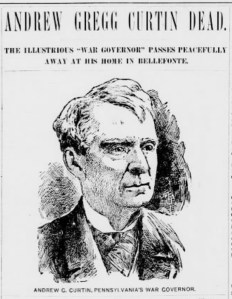
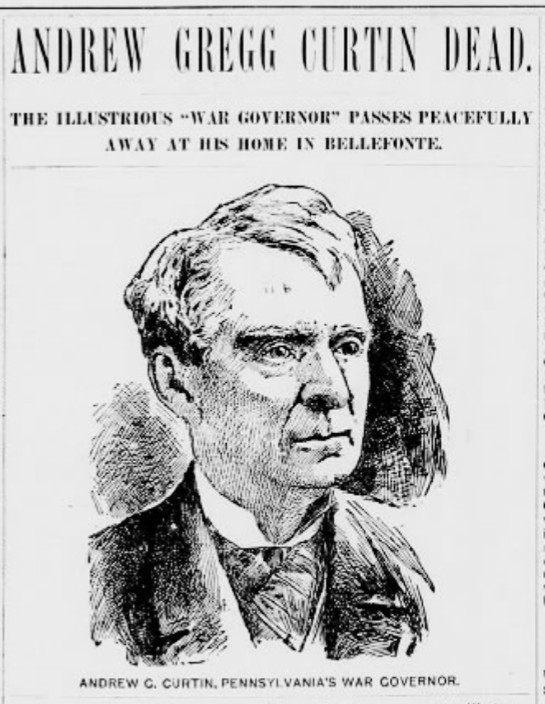
The Lewisburg Chronicle in Lewisburg, Pennsylvania paid tribute to former Pennsylvania Governor Andrew Gregg Curtin on its October 13, 1894 front page (public domain).

Ailing during the final years of his life, Andrew Gregg Curtin died at the age of seventy-nine, at his home in Bellefonte, at 5 a.m. on October 7, 1894, and was immediately eulogized by government officials and in newspapers nationwide. According to The New York Times, “Gov. Pattison issued a proclamation tonight in which he announced ex-Gov. Curtin’s death. After reviewing his distinguished services to his State and country, the proclamation concludes as follows:

‘In honor of his memory and in recognition of his eminent public service, I invoke for his bereaved family the sympathy of the people of Pennsylvania, and I recommend and order that on the day of his funeral the flags upon the public buildings be displayed at half mast and that the several departments of the State Government within executive control be closed upon that day.’”

Both private and public funeral services were then held for Governor Curtin on October 10, 1894. According to The Semi-Weekly New Era of Lancaster, Pennsylvania:

“Private services [were] held at his late home, after which the body [was] taken in charge by Post 89, G.A.R., of [Bellefonte], for burial under the ceremonies of war. Detachments of the Pennsylvania National Guard [acted] as escort to the Post. The pallbearers [were] Col. A. K. McClure and John Scott, of Philadelphia; ex-Governor James A. Beaver, General Daniel H. Hastings, Edward C. Humes and Judge Austin O. Furst, of Bellefonte; Hon. John Dean, of Hollidaysburg, Judge of the Supreme Court; Hon. Wm. A. Wallace, of Clearfield, and Wm. B. Mann, of Philadelphia.”

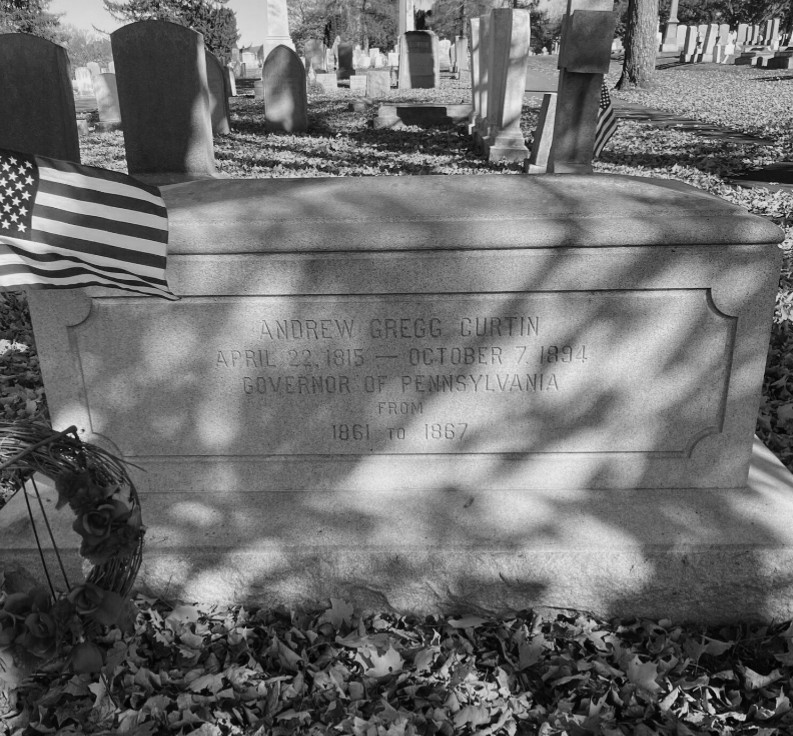
The monument at the grave of Pennsylvania Governor Andrew Gregg Curtin (Bellefonte Union Cemetery, Bellefonte, Pennsylvania, public domain).

In addition, the Pennsylvania National Guard’s “Second Brigade Band, Sheridan Troop, Battery B, Companies A, B, C, and G, of the Fifth Regiment, and A, B, D, G, and H, of the Twelfth Regiment” acted “as a funeral escort at the Curtin obsequies.” The Pennsylvania National Guard was also ordered to fire “seventeen minute guns … at the State Arsenal on the day of the funeral” — a funeral that merited coast to coast news coverage. According to The Seattle Post-Intelligencer:

“This town [Bellefonte, Pennsylvania was] draped in mourning today in honor of the memory of Andrew Gregg Curtin, who was laid to rest this afternoon. This morning a memorial meeting was held in the courthouse, a great number of distinguished men being present. Touching addresses were made by Gov. Pattison, A. K. McClure, of Philadelphia, Gen. Gobin [the final commanding officer of the 47th Pennsylvania Volunteer Infantry and a future lieutenant governor of Pennsylvania] and others. At 12 o’clock the ex-governor’s body was borne from the family residence to the courthouse, where it remained until 1:30, thousands of people viewing the remains while they lay in state. The body was then taken back to the Gregg mansion [sic], where at 2 o’clock the funeral services were held.

Following those tributes, The Honorable Andrew Gregg Curtin was laid to eternal rest at the Union Cemetery in his beloved hometown of Bellefonte.


Sources:

  1. Albright, Rebecca Gifford. “The Civil War Career of Andrew Gregg Curtin, Governor of Pennsylvania,” serialized in The Western Pennsylvania Historical Magazine, vols. 47 and 48, 1964-1965. Pittsburgh, Pennsylvania: Historical Society of Western Pennsylvania.
  2. “Andrew Curtin Dead: Pennsylvania’s Great War Governor Passes Away: His Invaluable Services to His State and Nation — Idolized by the Soldiers and Loved By All the People — Proclamation By Governor Pattison — Burial With Military Honors.” Meriden, Connecticut: The Meriden Daily Journal, October 8, 1894.
  3. Andrew G. Curtin Historical Marker, in “Explore PA History.” Harrisburg, Pennsylvania: Pennsylvania Historical and Museum Commission, retrieved online August 4, 2026.
  4. Andrew Gregg Curtin (1817-1894)” (alumus, class of 1937), in “Encyclopedia.” Carlisle, Pennsylvania: Archives & Special Collections, Dickinson College, retrieved online August 4, 2026.
  5. “Andrew Gregg Curtin Dead: The Illustrious ‘War Governor’ Passes Peacefully Away at His Home in Bellefonte.” Lewisburg, Pennsylvania: The Lewisburg Chronicle, October 13, 1894.
  6. Annual Reports of the Pennsylvania Commission of Soldiers’ Orphans Schools, 1870-1918. Harrisburg, Pennsylvania: Pennsylvania Historical and Museum Commission.
  7. “Another War Governor Gone: Andrew G. Curtin Passes Away at His Pennsylvania Home.” New York, New York: The New York Times, October 8, 1894.
  8. “Appointments by the Governor” (appointment by Governor James Pollock of Andrew G. Curtin as secretary of the Commonwealth of Pennsylvania). Lewisburg, Pennsylvania: The Lewisburg Chronicle, January 19, 1855.
  9. Bates, Samuel P. History of Pennsylvania Volunteers, 1865-5, vol. 1. Harrisburg, Pennsylvania: B. Singerly, State Printer, 1869.
  10. “Biographical Sketch of Andrew G. Curtin! Next Governor of Pennsylvania.” Towanda, Pennsylvania: The Bradford Reporter, September 20, 1860.
  11. Bordewich, Fergus M. “Fort Sumter: The Civil War Begins,” in Smithsonian Magazine, 2011. Washington, D.C.: Smithsonian.
  12. Camp Curtin Historical Marker,” in ExplorePAhistory.com. Harrisburg, Pennsylvania: Pennsylvania Historical and Museum Commission, retrieved online July 25, 2022.
  13. Curtin, Andrew Gregg,” in “History, Art & Archives.” Washington, D.C.: U.S. House of Representatives, retrieved online August 2, 2026.
  14. Curtin, Andrew Gregg,” in “House Divided: The Civil War Research Engine at Dickinson College.” Carlisle, Pennsylvania: Dickinson College, retrieved online August 2026.
  15. “For the Repository and Transcript: A List of the Governors, Deputy Governors, Presidents, and Vice Presidents of Pennsylvania” (mentions Andrew G. Curtin’s tenure as secretary of the Commonwealth of Pennsylvania). Chambersburg, Pennsylvania: Franklin Repository and Transcript, December 1, 1858.
  16. “Funeral Arrangements and Pallbearers” and “Special Order to the National Guard,” in “Andrew G. Curtin Dead: The Famous War Governor at Rest.” Lancaster, Pennsylvania: The Semi-Weekly New Era, October 10, 1894.
  17. “Funeral of Andrew Gregg Curtin.” Seattle, Washington: The Seattle Post-Intelligencer, October 11, 1894.
  18. Gov. Andrew Gregg Curtin,” in “Database of Former Governors: Pennsylvania.” Washington, D.C.: National Governors Association, retrieved online August 2, 2026.
  19. “Gov. Curtin and the Militia System of the State.” Pittsburgh, Pennsylvania: The Pittsburgh Post, April 12, 1861.
  20. Governor Andrew Gregg Curtin,” in “Pennsylvania Governors.” Harrisburg, Pennsylvania: Pennsylvania Historical & Museum Commission, retrieved online August 1, 2026.
  21. “Governor Curtin Has Signed the Bill for the Repeal of the Tonnage Tax.” York, Pennsylvania: The Wrightsville Star, March 14, 1861.
  22. Grodzins, Dean and David Moss. “The U.S. Secession Crisis as a Breakdown of Democracy,” in When Democracy Breaks: Studies in Democratic Erosion and Collapse, from Ancient Athens to the Present Day (chapter 3). New York, New York: Oxford University Press, 2024.
  23. History of Camp Curtin.” Harrisburg, Pennsylvania: Camp Curtin Historical Society, retrieved online July 25, 2022.
  24. “Hon. Andrew G. Curtin,” in “Personal.” Ebensburg, Pennsylvania: The Alleghenian, September 29, 1859.
  25. Huntington, Tom. Pennsylvania Civil War Trails: The Guide to Battle Sites, Monuments, Museums and Towns, pp. 65-66. Harrisburg, Pennsylvania: Pennsylvania Historical and Museum Commission, 2007; Mechanicsburg, Pennsylvania: Stackpole Books, 2007.
  26. Miller, William J. The Training of an Army: Camp Curtin and the North’s Civil War. Shippensburg, Pennsylvania: White Mane Publishing, 1990.
  27. Paul, James Laughery. Pennsylvania’s Soldiers’ Orphans Schools, Giving a Brief Account of the Origin of the Late Civil War, the Rise and Progress of the Orphan System, and Legislative Enactments Relating Thereto. Philadelphia, Pennsylvania: Claxton, Remson & Haffelfinger, 1876; and Harrisburg, Pennsylvania, Lane S. Hart, 1877.
  28. Schmidt, Lewis G. A Civil War History of the 47th Regiment of Pennsylvania Veteran Volunteers. Allentown, Pennsylvania: Self-published, 1986.
  29. Sobel, Robert, and John Raimo, eds. Biographical Directory of the Governors of the United States, 1789-1978, vol. 4. Westport, Connecticut: Meckler Books, 1978.
  30. The National Cyclopaedia of American Biography, vol. 2. New York, New York: James T. White & Company, 1895.

 

July 22, 1887: The Funeral of Tilghman H. Good, Founder of the 47th Pennsylvania Volunteer Infantry

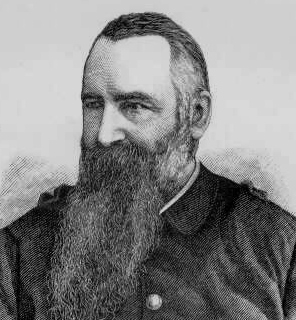
Colonel Tilghman H. Good, the founder and first commanding officer of the 47th Pennsylvania Volunteer Infantry, was a three-time mayor of the city of Allentown, Pennsylvania (public domain).

During the summer of 1887, time’s relentless march seemed to pause as Pennsylvanians came together to bid farewell to a lion of their commonwealth — Colonel Tilghman H. Good (1830-1887), the founder and first commanding officer of the history-making 47th Pennsylvania Volunteer Infantry. A native of South Whitehall Township in Lehigh County, Pennsylvania who had served three terms as mayor of the city of Allentown after the American Civil War, Colonel Good had died in the city of Reading in Berks County on July 18, 1887.

His funeral proved to be another memorable event in the history of Pennsylvania, one that unfolded in two cities and involved thousands in its planning, execution and viewing.

The Planning

According to historian Lewis G. Schmidt, members of the Good family worked with civic, community and religious officials in Reading, Allentown and Harrisburg to plan and carry out the funeral of Colonel Tilghman H. Good. On July 19, 1887, Colonel Good’s brother-in-law, “Russell A. Thayer, of Allentown, left in the morning for Reading to make arrangements to return the Colonel’s body to Allentown for burial; and Mayor Ruhe called for a meeting of the ex-Mayors of Allentown for 7:30 PM to make arrangements to attend the funeral.”

The next day (July 20), members of the Knights Templar, Reading Commandery, No. 42 met at the Board of Trade building in Reading “to make arrangements for attending the funeral of the late Col. Good,” acccording to the Reading Times.

Senior officials of the Commonwealth of Pennsylvania also stepped in to help by calling members of the Pennsylvania National Guard into service. According to Schmidt, “Capt. W. D. Mickley and Company D of the 4th Regiment of Infantry, 3rd Brigade, of the National Guard of Pennsylvania [were ordered] to attend the funeral, and were to meet at the square in light marching order at 2 PM [on July 22]. One Corporal and three Privates were detailed to guard duty and were to report to the Armory at 9 AM.” (Captain W. D. Mickley, who would later be commissioned as a colonel with the Pennsylvania National Guard and would live to become the oldest veteran of the Spanish-American War in Allentown, was William Deshler Mickley, one of the sons of Captain Charles Mickley, who had been killed in action during the Battle of Pocotaligo, South Carolina in 1862, while serving with the 47th Pennsylvania Volunteers under Colonel Tilghman H. Good.)

Meanwhile, other officials in Reading and Allentown were busy preparing their cities and citizenry for their respective days of official mourning. Routes were chosen for the procession of Colonel Good’s funeral cortege, and city personnel and business owners were issued instructions regarding the proper ways to drape buildings along those routes with American flags and bunting — displays of red, white and blue mixed with black that would inspire reflection among the crowds expected to witness the events. (A particularly large turnout was anticipated in Allentown because Colonel Good’s family had chosen a cemetery in that city to be his final resting place.)

The Funeral in Reading

The first funeral service for Colonel Good was held at the Central House (formerly known as the Grand Central Hotel) on Penn Street near 4th Street in Reading, Pennsylvania during the very early hours of Friday, July 22, 1887. Good’s body, which had been viewed by family privately in a room at the hotel and prepared for burial by an undertaker, was “placed in a casket in the early morning” that day, and taken down to “one of the parlors of the Central House,” for a formal viewing ceremony for his friends which lasted “until 6:40 o’clock” that morning. “Sir Knights” of the Reading Commandery, Knights Templar (No. 42) then escorted Colonel Good’s casket to Reading’s railroad station, placed it aboard a train that departed for Allentown at 7:10 a.m., and continued to guard it for the duration of its forty-minute journey.

The Funeral in Allentown

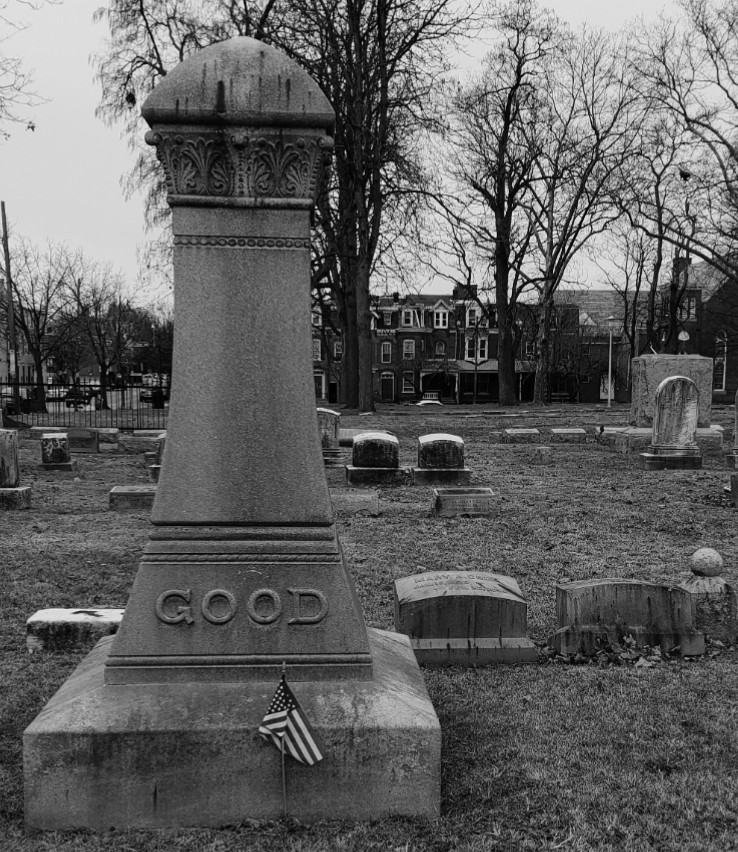
The family monument of Colonel Tilghman H. Good, founder of the 47th Pennsylvania Volunteer Infantry and three-time mayor of Allentown, Linden Street Cemetery, Allentown, Pennsylvania (public domain).

Upon the train’s arrival in Allentown at 8:30 a.m. on July 22, 1887, members of the Knights Templar’s Reading Commandery transferred their honor guard responsibilities to members of the Allen Commandery, which removed Colonel Good’s casket from the train and accompanied it on its transport to the home of Good’s brother-in-law, which was located at 532 Walnut Street in Allentown, according to Schmidt.

“From 12 to 2 PM, the body lay in state at St. John’s Reformed Church, where ‘several thousand people passed around the bier.’ The local military companies provided the guard of honor between 12 and 1 PM; and at 1 PM, the Knights Templar took charge….

“Col. Good wore a black broadcloth suit as he lay in his solid walnut casket with silver handles, and which was trimmed in black cloth. The lid bore a ‘massive silver plate bearing the name and dates of birth and death … on it rested the sword and chapeau which he wore as a member of the Allen Commandery.'”

St. John’s Reformed Church “was completely filled” for that second service, according to subsequent reports by area newspapers. Afterward, Colonel Good’s casket was carried from the sanctuary by its military escort and prepared for transport for additional graveside services at Colonel Good’s final resting place. According to Schmidt, “The route was up 6th to Hamilton, up Hamilton to 9th, out 9th to Linden, and up Linden to the cemetery. The band played a solemn dirge and the route was lined with people.”

“The order of the street column that accompanied the body to the grave was as follows: Platoon of Police; Allentown Band; Company D, 4th Regiment; Company B, 4th Regiment; Allen Commandery No. 20, Knights Templar, with delegations of Reading and DeMolay Commanderies; Hearse; Pallbearers; The horse which Col. Good rode while Colonel of the 4th Regiment; Visiting officers and members of the National Guard; Mayor Ruhe and ex-Mayors; and Citizens in carriages.

“The side walk column moved in the following order: Ex-policemen who served under the deceased while he was Mayor of Allentown; Members of the original Allen Rifles; survivors of the 47th Regiment; Post 87, G.A.R; Post 13, G.A.R.; Sons of Veterans; City Officials, Councilmen, ex-City Officials and ex-Councilmen; and Citizens.”

A reporter for The Age, a Democratic-leaning newspaper in York, Pennsylvania, would later note that “An imposing procession of Masons, militia, war veterans and civilians followed the remains to the grave.” Standing near Colonel Good’s freshly-dug grave, the attendees witnessed a third service that included the lengthy burial rituals of the Knights Templar (K.T.) and the Grand Army of the Republic (G.A.R.), followed by the appropriate military salute that was fired by serving members of the military.

How Did Tilghman H. Good Die?

Colonel Tilghman H. Good was just fifty-six years old when he was felled by heat exhaustion in Berks County, Pennsylvania on July 18, 1887, while overseeing a construction project in his capacity as the manager of the city of Reading’s Central House hotel. Realizing that he was unwell, he had left the construction site around 6:30 p.m. and had gone upstairs to the hotel room that he had occupied with his wife, Mary (Trexler) Good (1828-1899), hoping to rest and recover. Sadly, despite the best efforts of an attending physician who had been summoned for help, Colonel Good’s condition had quickly devolved into the far deadlier illness known as heat stroke, which had ended his life at 8:15 p.m. that same evening.


Sources:

  1. Beath, Robert B. History of the Grand Army of the Republic. New York, New York: Bryan, Taylor & Co., Publishers, 1889.
  2. “Col. Good’s Central House.” Reading, Pennsylvania: Reading Times, April 29, 1886.
  3. “Col. Good’s Funeral.” Reading, Pennsylvania: Reading Times, July 20, 1887.
  4. “Col. Good’s Funeral.” Wilkes-Barre, Pennsylvania: The Record of the Times, July 29, 1887.
  5. “Col. Mickley, Noted Veteran, Is Found Dead.” Allentown, Pennsylvania: The Morning Call, April 1, 1932.
  6. Col. T. H. Good, in “Other Deaths.” Pittsburgh, Pennsylvania: Pittsburgh Commercial Gazette, July 28, 1887.
  7. “Col. T. H. Good’s Death.” Reading, Pennsylvania: Reading Times, July 19, 1887.
  8. Colonel T. H. Good (brief funeral report), in “News Condensed: Reading.” Philadelphia, Pennsylvania: The Philadelphia Inquirer, July 23, 1887.
  9. Creigh, Alfred. History of the Knights Templar of the State of Pennsylvania, pp. 15, 167, 200 (Allen Commandery); 556-575 (burial rituals); 597-598 (Allen Commandery). Philadelphia, Pennsylvania: J. B. Lippincott & Co., 1868.
  10. “Funeral of Col. Good.” York, Pennsylvania: The Age, July 23, 1887.
  11. “Funeral of Colonel Good.” Hazleton, Pennsylvania: Hazleton Daily Sentinel, July 23, 1887.
  12. “Grand Central Hotel in New Hands” (transfer of the hotel’s management to “Col. T. H. Good, of Allentown”). Reading, Pennsylvania: Reading Times, December 10, 1885.
  13. Hartman, William L. The Mayors of Allentown, in Berlin’s Proceedings and Papers Read Before the Lehigh County Historical Society. Allentown, Pennsylvania: Lehigh County Historical Society, 1922.
  14. Heat Exhaustion.” Scottsdale, Arizona: Mayo Clinic, retrieved online July 22, 2026.
  15. Heat Stroke,” in “Diseases and Conditions.” Cleveland, Ohio: Cleveland Clinic, retrieved online July 22, 2026.
  16. Mathews, Alfred and Austin H. Hungerford. History of the Counties of Lehigh and Carbon. Philadelphia, Pennsylvania: Everts & Richards, 1884.
  17. Moody, John Sheldon and Calvin Duvall Cowles, et. al. The War of the Rebellion: A Compilation of the Official Records of the Union and Confederate Armies, series 1, vol. 14. Washington, D.C.: Government Printing Office, 1885.
  18. Schmidt, Lewis G. A Civil War History of the 47th Regiment of Pennsylvania Veteran Volunteers. Allentown, Pennsylvania: Self-published, 1986.
  19. “To Attend Col. Good’s Funeral.” Reading, Pennsylvania: Reading Times, July 21, 1887.
  20. “Trout Hall Formally Dedicated as Lehigh Co. Historical Society’s Home” (mention of Colonel Tilghman H. Good’s sword and its Key West presentation). Allentown, Pennsylvania: The Allentown Democrat, May 17, 1918.
  21. Waskie, Anthony. “The Grand Army of the Republic,” in The Essential Civil War Curriculum. Blacksburg, Virginia: Virginia Center for Civil War Studies, Virginia Tech University, retrieved online July 22, 2026.
  22. Wharton, Henry D. Transcripts of the addresses made by Colonel Tilghman H. Good to the 47th Pennsylvania Volunteer Infantry. Sunbury, Pennsylvania: Sunbury American, 1861-1864.


One Million Page Views: A Milestone Reached

This is a short post, but an important one. It marks a major milestone for 47th Pennsylvania Volunteers: One Civil War Regiment’s Story — one million page views of our education project’s primary website (47thpennsylvaniavolunteers.com), an achievement that was documented by our website’s statistics tracking software as June 26th rolled on into June 27, 2026.

My heartfelt thanks to each and every one of you who have read our battle profiles and soldiers’ biographies over the years. You’ve helped to inspire others to learn more about the history-making 47th Pennsylvania Volunteers, ensuring that their story will continue to be told and re-told across the globe, now and for generations yet to come.

Flag Days: The History of One Regiment’s Battle Flags

Cared for by archivists of the Pennsylvania Capitol Preservation Committee in Harrisburg, Pennsylvania, the two battle flags that were carried by the 47th Pennsylvania Volunteer Infantry during its tenure of service in the American Civil War were known as the First and Second State Colors.

First State Color

The First State Color of the 47th Pennsylvania Volunteer Infantry was presented to the regiment by Pennsylvania Governor Andrew Curtin on September 20, 1861, and was officially retired on May 11, 1865 (source: Pennsylvania Capitol Preservation Committee, 1985.057, Evans and Hassall, v1p126).

Presented to the regiment by Pennsylvania Governor Andrew Gregg Curtin in Harrisburg, Pennsylvania on September 20, 1861, the First State Color of the 47th Pennsylvania Volunteer Infantry was manufactured by Evans and Hassall of Philadelphia, Pennsylvania. According to the September 17, 1861 edition of The Philadelphia Inquirer newspaper:

Under an act of the Legislature, passed during the extra session of 1861, the Governor of the State was authorized to purchase stands of colors for the several regiments of Pennsylvania. — Twelve of these have been completed, marked with the appropriate numbers of the regiments, and sent to Gov. Curtin. We have been shown one of these new standards. It bore upon it the Stars and Stripes, with the coat of Arms of Pennsylvania exquisitely painted on the blue field, and surrounded by the thirty-four Stars. On the central stripe the number of the regiment was emblazoned. The material is rich, heavy and lustrous silk. The sunlight never flashed on a more beautiful ensign…. The trimmings of the flags are very handsome. The work was completed by Messrs. Evans & Hassall, No. 51 S. Fourth Street.

The First State Color was the battle flag that was initially cared for and carried by the 47th Pennsylvania’s first color bearer, Sergeant Benjamin Walls, as the regiment took part in multiple military engagements, including the:

The First State Color was then carried by Sergeant William Pyers in subsequent military engagements, including the:

Subsequently carried by a third regimental color bearer, the First State Color was also the flag carried by the regiment during the 47th Pennsylvania Volunteer Infantry’s defense of Washington, D.C., following the assassination of President Abraham Lincoln (beginning mid-April 1865 and lasting until the First State Color was officially retired on May 11, 1865).

Second State Color

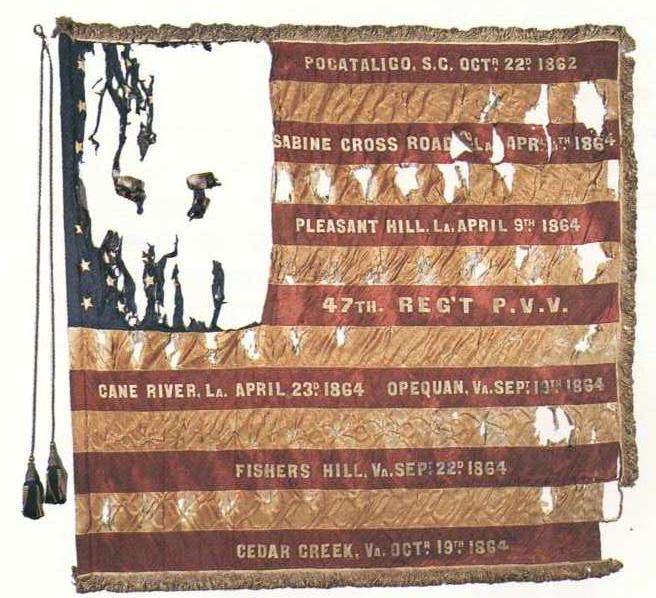
Second State Color, 47th Pennsylvania Volunteer Infantry, presented to the regiment on March 7, 1865, this battle flag documents the regiment’s major engagements (source: Pennsylvania Capitol Preservation Committee, 1985.058, Horstmann Brothers and Company, v1p127).

The Second State Color of the 47th Pennsylvania Volunteer Infantry was the battle flag that was carried by the regiment’s color-bearer as the 47th Pennsylvania marched through the streets of Washington, D.C. during the Grand Review of the National Armies on May 23, 1865, and as it marched into Savannah, Georgia in early June 1865 and into Charleston, South Carolina in July of that same year (while stationed in both cities on provost duty during the Reconstruction Era).

Presented to Captain Daniel Oyster on March 7, 1865, the commanding officer of the 47th Pennsylvania’s C Company (the regiment’s color guard unit), while Captain Oyster was at home in Sunbury, Pennsylvania on a thirty-day military furlough (after having been wounded in action twice during Sheridan’s 1864 Shenandoah Valley Campaign), it had been shipped to Sunbury in February by its manufacturer, Horstmann Brothers & Company of Philadelphia. According to archivists at the American History Museum in Washington, D.C.:

“William Hortsmann [sic, “Horstmann”], born in Germany, emigrated to the United States and established himself as a maker of fringe, laces, and trimmings in Philadelphia, in 1815. William Horstmann & Sons were located at North Third Street between 1830 and 1857, manufacturing and importing everything from textiles and trimmings to military goods including drums, pistols, and swords. As the company expanded, Horstmann & Sons moved the factory to 5th and Cherry Streets and their storefront to 2223 Chestnut Street. Later the company would grow to two stores in New York and an agency in Paris. William Horstmann retired from the company in 1845, and his sons, William and Sigmund continued the family business until 1872.”

Sources:

  1. 47th Infantry,” in “Pennsylvania Civil War Battle Flags.” Harrisburg, Pennsylvania: Pennsylvania Capitol Preservation Committee, retrieved online June 3, 2026.
  2. “A Handsome Flag.” Sunbury, Pennsylvania: The Sunbury American, March 11, 1865.
  3. Bates, Samuel P., in History of Pennsylvania Volunteers, 1861-5, vol. 1. Harrisburg, Pennsylvania: B. Singerly, State Printer, 1869.
  4. “Flags for Pennsylvania Regiments.” Philadelphia, Pennsylvania: The Philadelphia Inquirer, September 17, 1861.
  5. Historical Listing of Pennsylvania Civil War Color Bearers,” in “Pennsylvania Civil War Battle Flags.” Harrisburg, Pennsylvania: Pennsylvania Capitol Preservation Committee, retrieved online June 3, 2026.
  6. Horstmann Brothers & Co. Military Trumpet.” Washington, D.C.: American History Museum, Smithsonian Institute, retrieved online June 3, 2026.
  7. Schmidt, Lewis G. A Civil War History of the 47th Regiment of Pennsylvania Veteran Volunteers. Allentown, Pennsylvania: Self-published, 1986.
  8. “The History of the Forty-Seventh Regt. P. V.” Allentown, Pennsylvania: The Lehigh Register, July 20, 1870.


A Past That Seems Distant — But Wasn’t

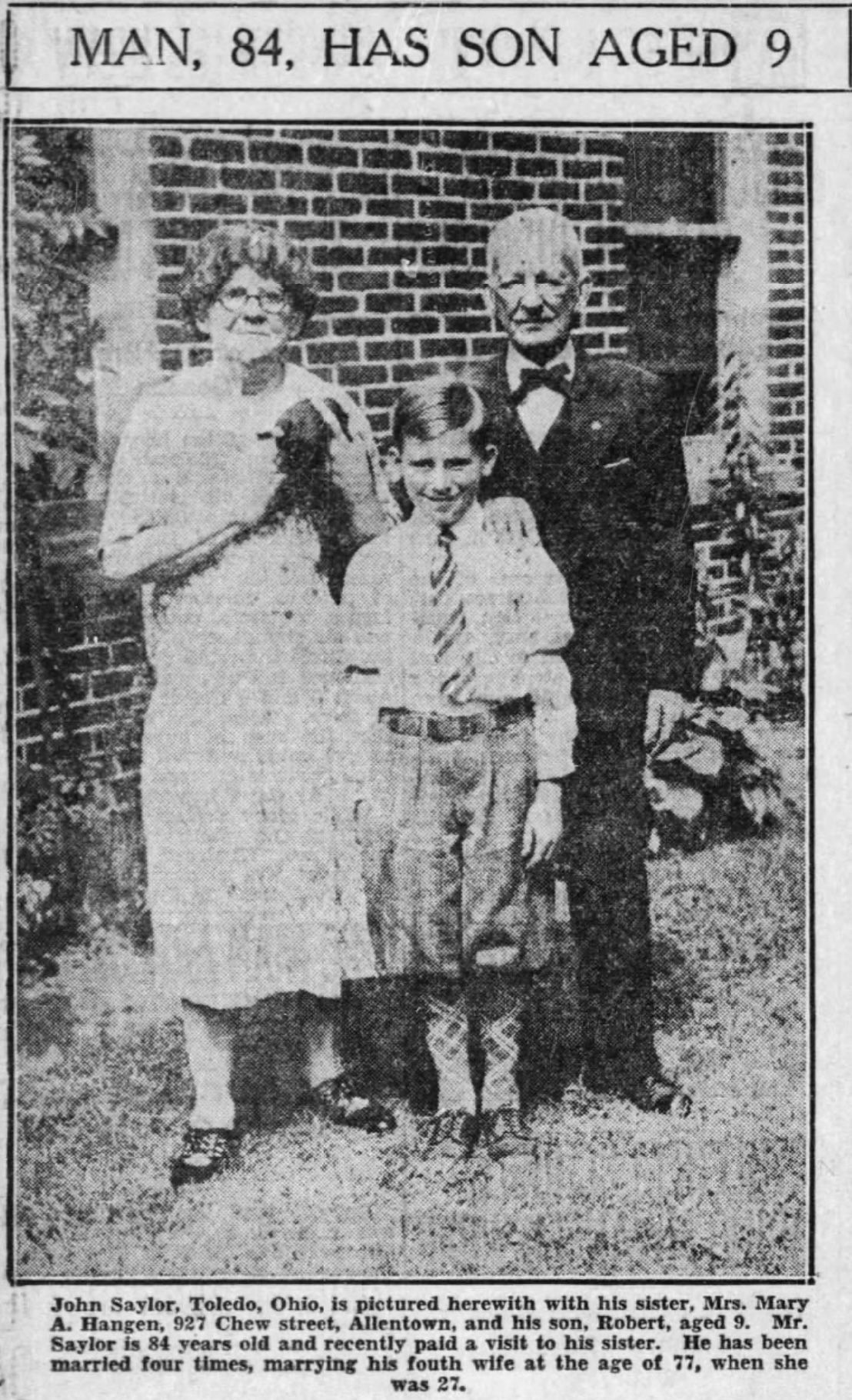
47th Pennsylvania veteran John Edward Saylor with his sister, Mary Alice (Saylor) Hangen, and his son, Robert Henry Saylor, (The Morning Call, Allentown, Pennsylvania, August 1929, public domain).

Many Americans tend to think of the American Civil War as part of the United States’ long distant past. Waged more than one hundred and sixty years ago, it began at a time when the art of photography was still in its infancy and the average newspaper contained mostly written text without any accompanying illustration.

As the war dragged on, though, newspaper publishers began sending Winslow Homer and other artists to far-flung locations, hoping that any sketches they sent back would give readers a better sense of the battles that were killing countless young men and destroying entire communities. Matthew B. Brady and Alexander Gardner, who had gained a measure of fame by photographing President Abraham Lincoln and members of his cabinet, went on to revolutionize war reporting by turning their cameras on carnage so horrific that it could not be conveyed by mere words or pencil illustrations. Their black and white photographs are the ones still viewed most often by history students in classrooms across the nation, contributing to the persistent notion that the American Civil War is distant, rather than recent history.

But that’s not quite correct, as the lives of Robert Henry Saylor and Edward John Saylor will show us. Born in the city of Toledo, Ohio during the early 1920s, the Saylor brothers could both lay claim to have been cradled in the arms of their father, John Edward Saylor (1846-1931), a veteran of the American Civil War who had served with the 47th Pennsylvania Volunteer Infantry’s K Company from early 1864 until early 1866.

Veterans of World War II, both brothers also made it through their respective tenures of military service and lived well into the last decades of the twentieth century, with the youngest brother nearly surviving long enough to witness the dawn of the twenty-first, making him a genuine “living bridge” between the not-so-distant past and present.

Their life stories help us to better understand just how recent so much of American History is. Reflect on that as you learn more about the Saylors’ lives by reading our new bio of Corporal John Edward Saylor.


Sources:

  1. Bates, Samuel P. History of Pennsylvania Volunteers, 1861-5, vol. 1. Harrisburg, Pennsylvania: B. Singerly, State Printer, 1869.
  2. Conway, William (boarding house operator) and Ollena; Saylor, John [sic, “John Edward Saylor”] (lodger and eighty-four-year-old Civil War veteran) and Robert (lodger and Civil War veteran’s ten-year-old son); et. al., in U.S. Census (Toledo, Lucas County, Ohio, 1930). Washington, D.C.: U.S. National Archives and Records Administration.
  3. “Edward Saylor” (obituary of a son of John Edward Saylor). Coshocton, Ohio: The Coshocton Tribune, August 5, 1999.
  4. “Former Resident Dies” (death notice of John Edward Saylor). Port Clinton, Ohio: News-Herald, September 4, 1931.
  5. John Saylor [sic, “John Edward Saylor”], in Death Certificates (registration district no.: 769, death of death: August 28, 1931). Columbus, Ohio: State of Ohio, Department of Health, Division of Vital Statistics.
  6. “Man, 84, Has Son Aged 9” (photo with caption of John Edward Saylor and his son, Robert, and John’s sister, Mary A. (Saylor) Hangen). Allentown, Pennsylvania: The Morning Call, August 25, 1929.
  7. Mary Alice Hangen (a sister of John Edward Saylor), in Death Certificates (file no.: 67765, registered no.: 858, date of death: July 12, 1932). Harrisburg, Pennsylvania: Commonwealth of Pennsylvania, Department of Health, Bureau of Vital Statistics.
  8. “Mrs. Mary A. Hangen” (obituary of a sister of John Edward Saylor). Allentown, Pennsylvania: The Morning Call, July 13, 1932.
  9. “Putnam Group Inducted Into Armed Forces” (notice of the impending World War II service of John Edward Saylor’s son, Robert Henry Saylor). Lima, Ohio: The Lima News, May 11, 1943.
  10. Robert Henry Saylor, in U.S. Headstone Applications for Military Veterans (Vista Memorial Gardens, Hialeah, Florida, year of death: 1977). Washington, D.C.: U.S. National Archives and Records Administration.
  11. “Saylor” (obituary of Robert Henry Saylor, a son of John Edward Saylor). Coshocton, Ohio: The Coshocton Tribune, January 4, 1977).
  12. Saylor, Edward J. (the groom and the youngest son of John Edward Saylor), John Saylor [sic, “John Edward Saylor”] (father of the groom) and Catherine Pyfer [sic, ” Pfeiffer”] (mother of the groom); and Loretta Wehrly (the bride), in Marriage Records (Putnam County, Ohio, June 10, 1946). Ottawa, Ohio: Putnam County Probate Court.
  13. Saylor, Edward J. (the youngest son of John Edward Saylor), Loretta, and Gloria J., in U.S. Census (Pleasant Township, Putnam County, Ohio, 1950). Washington, D.C.: U.S. National Archives and Records Administration.
  14. Saylor, John, in Civil War Muster Rolls (Company K, 47th Pennsylvania Infantry). Harrisburg, Pennsylvania: Pennsylvania State Archives.
  15. Saylor, John, in Civil War Veterans’ Card File, 1861-1866 (Company K, 47th Pennsylvania Infantry). Harrisburg, Pennsylvania: Pennsylvania State Archives.
  16. Saylor Robert (a son of John Edward Saylor) and Edwina, in U.S. Census (Coshocton, Coshocton County, Ohio, 1950). Washington, D.C.: U.S. National Archives and Records Administration.
  17. “Saylor, Robert H.” (obituary of a son of John Edward Saylor). Miami, Florida: The Miami Herald, January 4, 1977.


Seven Continents: The Year of 2025 in Review

“The Blue Marble” (Earth, photographed by Apollo 17 astronauts, December 7, 1972; NASA, public domain).

Another year almost gone. More milestones achieved for a personal research project that has grown into a multi-faceted, educational outreach program with connections on all seven continents of our planet.

Seven out of seven continents.

That statistic is the one that astonishes me most of all as I sit here compiling our annual Year in Review report for 2025. 47th Pennsylvania Volunteers: One Civil War Regiment’s Story is truly now a global community of lifelong learners.

Children and adults are engaged, at the moment I write this, in a quest to understand what it actually meant to be a member of the 47th Pennsylvania Volunteer Infantry during the American Civil War. As they do so, they are learning that the light of hope persists even when the world is filled with darkness.

Key Project Statistics (as of 6 p.m. Pacific Time on December 31, 2025):

  • First Content Posted to Website: May 25, 2014
  • Total Website Page Views to Date: 967,350
  • Total Number of Website Visitors to Date: 767,532
  • Total Number of Facebook Followers: 2,213
  • Total Number of Instagram Followers: 1,160
  • Total Number of 47th Pennsylvania Volunteer Gravesites Documented Via the Project’s Virtual Cemetery: 1,446
  • Total Number of Individual Officers and Enlisted Men Profiled to Date: 345
  • Most Popular Post in 2025: Finding Your 47th Pennsylvanian: Use “Bates’ History” — But With Caution

Why Is There So Much Interest, Globally, in a Single, Seemingly “Obscure” Civil War Regiment from Pennsylvania?

The light and dark blue areas of this map show the reach of 47th Pennsylvania Volunteers: One Civil War Regiment’s Story as of December 31, 2025 (image courtesy of Snyder Family Archives).

What started as a personal research interest of one descendant of a 47th Pennsylvania Volunteer Infantryman soon became the research focus of a half dozen descendants of 47th Pennsylvania Volunteers — and then dozens more as the website and social media sites for 47th Pennsylvania Volunteers: One Civil War Regiment’s Story launched and gradually attracted followers, including family historians, Civil War enthusiasts, history professors, and students in high schools and universities across the Commonwealth of Pennsylvania — and beyond.

In 2020, the project’s audience grew substantially as teachers and students turned to distance learning and the “47th Pennsylvania Volunteers’ Project” as a way to keep minds sharp during the COVID pandemic that prompted the closure of schools and businesses worldwide. It was that year that educators from India residing in the United States and teachers across India found our website and began helping their students better understand the history of the United States by encouraging them to “see” the American Civil War “through the eyes of” the soldiers and families whose biographies were available on our website.

As more people heard about our website, supporters of our work began donating photographs of young soldiers in uniform and letters penned by 47th Pennsylvanians stationed far from home — each artifact a “log on the fire” of expansion — growth that continued even as in-person instruction returned to classrooms across the globe. Since that time, Pennsylvanians have been reading and learning from the same content as students in:

  • Amsterdam (the Netherlands)
  • Bangkok (Thailand)
  • Barcelona, Madrid and Zaragoza (Spain)
  • Bengaluru and Mumbai (India)
  • Brussels (Belgium)
  • Bogota (Columbia)
  • Dubai (the United Arab Emirates)
  • Dhaka (Bangladesh)
  • Dublin (Ireland)
  • Falkenstein, Bielefeld, Frankfurt, and Koeln (Germany)
  • Glasgow (Scotland)
  • Helsinki (Finland)
  • Ho Chi Minh City (Vietnam)
  • Hrebinka (Ukraine)
  • Istanbul (Türkiye)
  • Jakarta (Indonesia)
  • Lagos (Nigeria)
  • Lima (Peru)
  • London, Durham, Leeds, and Manchester (Great Britain)
  • Luleå (Sweden)
  • Manama (Bahrain)
  • Manila (the Philippines)
  • Melbourne and Sydney (Australia)
  • Montreal, Courtenay, Edmonton, Ottawa, Saskatoon, Toronto, and Vancouver (Canada)
  • Nairobi (Kenya)
  • Santiago (Chile)
  • São Paulo (Brazil)
  • Seongnam and Seoul (South Korea)
  • Warsaw and Witkowo (Poland)
  • Singapore (Republic of Singapore)
  • Tokyo and Kumamoto (Japan)
  • Vientiane (Laos)
  • Xiamen, Beijing, Hong Kong, Shanghai, and Zhengzhou (China), and
  • Christchurch (New Zealand).

We now even have contacts at McMurdo Station in Antarctica! (Not a bad way to close the book on a challenging and often heartbreaking year.)

A Resolution for 2026

The 47th Pennsylvania Volunteers fought long and hard to help end a devastating civil war, eradicate the shameful practice of slavery and rebuild their shattered nation, and for those reasons alone, should be remembered for their service to the nation.

But perhaps the most important part of their collective story is that soldiers who somehow managed to survive unimaginable horrors never gave up trying to make their world a better one.

And neither should we.

My hope for 2026 is that more individuals in our world will “see wrong and try to right it” while also doing what is humanly possible to heal suffering in ways that “send forth ripples of hope and change.”

Happy New Year!


Finding Your 47th Pennsylvanian: Registers of Pennsylvania Volunteers, 1861-1865

Main website page for the Registers of Pennsylvania Volunteers, 1861-1865 (Pennsylvania State Archives, public domain; click to enlarge).

Another useful tool for Finding Your 47th Pennsylvanian is one of several records collections related to the American Civil War housed at the Pennsylvania State Archives in Harrisburg, Pennsylvania — the “Registers of Pennsylvana Volunteers, 1861-1865.”

Similar to the Pennsylvania State Archives’ collection of Pennsylvania Civil War Muster Rolls, the Registers of Pennsylvania Volunteers, 1861-1865 are part of a sixteen-volume set of rosters that document the names, ages, ranks, regiment and company affiliations, and dates and places of enlistment and discharge or desertion for the more than three hundred and sixty-thousand men who served with one or more of Pennsylvania’s volunteer infantry, volunteer militia, emergency militia, independent, or other military units during the war. In addition, many of these registers contain additional data about about the status of individual soldiers, including whether or not they were promoted or reduced in rank and whether or not they were wounded or killed in battle. According to Pennsylvania State Archives personnel:

“Arranged by regiment, rank, and then alphabetically by surname, these registers document Pennsylvania Volunteers who served during the Civil War. Information normally recorded includes the soldier’s name, age, rank, regiment and company; the term of service; and the date, place, and name of the person who enrolled him. Written remarks regarding the promotion, desertion, death, or discharge of the volunteer are frequently entered as well.”

Two PDFs to View for Each Soldier

Excerpt from left side of register entry, Company A, 47th Pennsylvania Volunteer Infantry (Registers of Pennsylvania Volunteers, 1861-1865, Pennsylvania State Archives, public domain; click to enlarge).

Due to the large size of each book in this register series, Pennsylvania State Archives personnel scanned each page of each register as two separate PDF pages — with the first page containing the left side of the roster with an alphabetized list of soldiers’ names and their respective enrollment data — and the second page containing the right side of the roster with its remarks section, which presents data about the service status for each of those soldiers (promotions, desertions, deaths, etc.). Those PDF pages were then grouped by regiment and company, officers first, followed by the enlisted members of the regiment who served under them, and were posted on the Pennsylvania State Archives’ website, where they remain available, free of charge to everyone, regardless of geographic location, and without any requirement to create an account in order to search these records.

This collection has also been indexed by FamilySearch volunteers, who have entered each soldier’s summarized data into a database that may be searched online, free of charge, via the “Pennsylvania, Register of Military Volunteers, 1861-1865” portal on the FamilySearch website. (Note: While the summarized data for soldiers may be viewed online from the privacy of one’s home, by creating and logging into a free FamilySearch account, the opportunity to browse through and view scanned images of the original registers is only available by visiting a FamilySearch Center in person.)

Remember and Honor Them

Second State Colors, 47th Pennsylvania Veteran
Volunteers (presented to the regiment 7 March 1865).

The members of the 47th Pennsylvania Volunteer Infantry gave everything they had in them to help preserve America’s Union. For that reason alone, they deserve our enduring gratitude and respect.

So, make it a practice to say the name of your ancestor out loud each week (or say the name of one of the men who fought beside him).

Tell and re-tell their stories to everyone you know (especially the children in your local school system).

And most of all, honor the sacrifices that they made by volunteering your own time and energy to make life better for everyone in your community.


Sources:

  1. Civil War Records,” in “Pennsylvania State Archives – Research Guides.” Harrisburg, Pennsylvania: Pennsylvania Historical and Museum Commission, Commonwealth of Pennsylvania, retrieved online November 3, 2025.
  2. Pennsylvania, Register of Military Volunteers, 1861-1865.” Lehi, Utah: FamilySearch, retrieved online November 3, 2025.
  3. Registers of Pennsylvania Volunteers, 1861-1865,” in Records of the Department of Military and Veterans’ Affairs (Record Group 19, Series 19.65). Harrisburg, Pennsylvania: Pennsylvania State Archives, retrieved online November 3, 2025.


Finding Your 47th Pennsylvanian: The Surprising Details in Pennsylvania’s Civil War-Era Muster Rolls

Excerpt of muster-out roll, Company G, 47th Pennsylvania Volunteer Infantry, December 25, 1865, page one (Pennsylvania Civil War Muster Rolls, Pennsylvania State Archives, public domain; click to enlarge).

The Commonwealth of Pennsylvania’s collection of Civil War-era muster rolls is another of the three major tools that beginning, medium and advanced researchers initially turn to for help in determining which Pennsylvania military unit(s) a soldier served with during the American Civil War. Unfortunately, it is also a resource that often does not receive the close attention from researchers that it should.

Those who have chosen to spend significant time looking through the individual documents contained in this collection have come to understand that, in addition to confirming the identity of a soldier’s regiment and company, as well as his rank(s) at enrollment and final discharge, Pennsylvania’s Civil War-era muster rolls are also useful for documenting when and where that soldier enrolled and mustered in for service and whether or not he had some change to his status while serving, such as a promotion, reduction in rank or charge of desertion — and possibly data which documented whether or not he was wounded or killed in battle and, if so, when and where.

Physically created as hard-copy index cards that were later preserved by the Pennsylvania State Archives in Harrisburg, Pennsylvania, as part of the “Civil War Muster Rolls and Related Records” group of documents from the Pennsylvania Department of Military and Veterans Affairs’ archives (Series RG:-019-ADJT-11, 1861-1866, 1906), this collection includes muster rolls from each of Pennsylvania’s volunteer infantry and volunteer militia regiments, emergency volunteer militia regiments that were formed during the summer of 1863 in response to the looming invasion of the commonwealth by the Confederate States Army, United States Colored Troops (USCT), United States Veteran Volunteer regiments and Hancock Veterans Corps, regiments of the Veterans Reserve Corps, and independent or other unattached units. Preserved on microfilm decades ago by the Commonwealth of Pennsylvania, a portion of this large collection has since been partially digitized and made available on the Ancestry.com website as “Pennsylvania, U.S., Civil War Muster Rolls, 1860-1869.”

* Note: Although Ancestry.com is a subscription-based genealogy service that generally requires users to pay for access to its records collections, the Commonwealth of Pennsylvania entered into a partnership with Ancestry.com several years ago “to digitize family history records in the State Archives and make them available online.” As part of that agreement, Ancestry.com created Ancestry.com Pennsylvania to provide free access to Pennsylvania residents to the Pennsylvania records it has digitized. If you reside in Pennsylvania and want to learn more about how you may obtain free access to those records, please contact the Pennsylvania State Archives for guidance. If you reside elsewhere, check with your local library to determine if it offers access to Ancestry.com as part of its service to library users.

What May Researchers Find with This Resource?

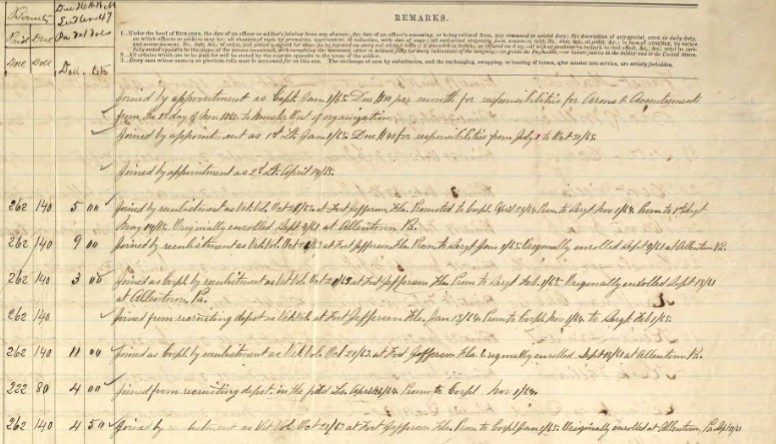
Excerpt from muster-out roll, Company G, 47th Pennsylvania Volunteer Infantry, December 25, 1865, showing soldiers’ promotions, status as Veteran Volunteers, etc. (Pennsylvania State Archives, public domain; click to enlarge).

According to personnel at the Pennsylvania State Archives, Pennsylvania’s Civil War Muster Rolls and Related Records collection includes:

“Alphabetical Rolls. The rolls are arranged alphabetically by the soldiers’ surnames. Entries usually give the name, rank, civilian occupation, and residence, the unit, regiment, company, and commanding officer, and the date and place where the roll was taken. Particulars about sickness or injury are also sometimes noted.

“Descriptive Lists of Deserters. Lists give the names, ages, places of birth, height, hair and eye color, civilian occupations, and ranks of deserters, the units, regiments, and companies to which they were assigned, and the dates and places from which they deserted.

“Muster-In Rolls. Entries usually list the name, age, rank, unit, regiment, and company of the soldier, the date and place where enrolled, the name of the person who mustered him in, the term of enlistment, the date of mustering in, and the name of commanding officer. Remarks concerning promotions and assignments are sometimes recorded.

“Muster-Out Rolls. The dated lists ordinarily give the soldier’s name, age, rank, unit, regiment, and company, the date, place, and person who mustered him in, the period of enlistment, and the name of the commanding officer. Particulars concerning pay earned, promotions, capture by the enemy and the like also regularly appear.

“Muster and Descriptive Rolls. Generally the rolls give the name, age, town or county and state or kingdom of birth, civilian occupation, complexion, height, eye and hair color, and rank, the unit, regiment, company and commanding officer, and the amount of money received for pay, bounties, and clothing. Rolls for assigned United States black troops are included in this group. Included throughout are such related materials as regimental accounts of action, and correspondence related to infractions of military procedures, correspondence from soldiers addressed to the governor expressing grievances or petitioning for promotion.

“The data found in the documents of this series were used to create the Civil War Veterans Card File, 1861-1866 (Series 19.12).”

Be Sure to Look for Data Regarding Soldiers’ Pay

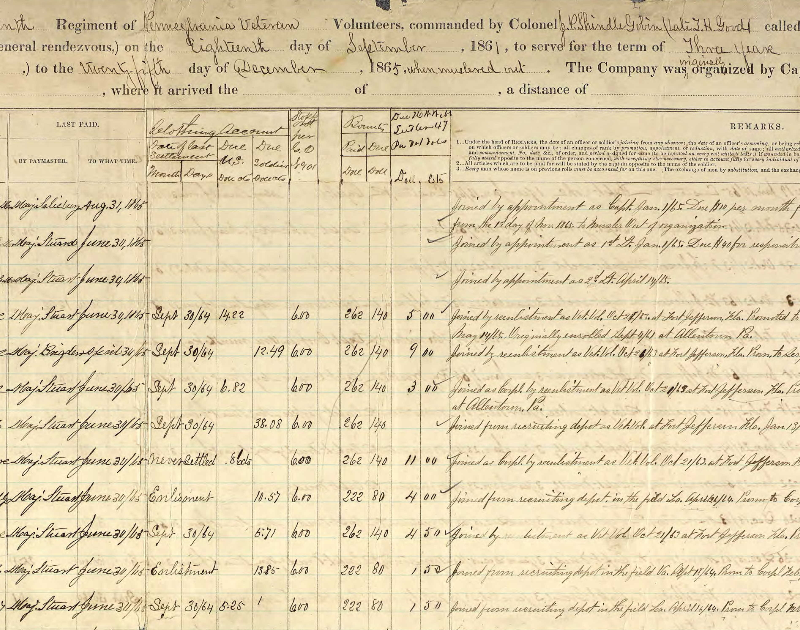
Excerpt from muster-out roll for Company G, 47th Pennsylvania Volunteer Infantry, showing soldiers’ pay data, December 25, 1865 (Pennsylvania State Archives, public domain).

One of the most fascinating features found on the muster-out rolls for Pennsylvania volunteer soldiers is that many of the infantry unit clerks took the time to meticulously record the pay data for multiple members of their respective regiments. As a result, present-day researchers are often able to determine how much bounty pay a particular soldier was eligible for at the time of his enlistment — and how much of that promised pay he actually received, as well as how much money he still owed the United States government for his army uniform, rifle and ammunition at the time of his discharged from the military.

Another striking feature on the muster-out rolls is the “Last Paid” column, which corroborates the shocking fact that many Union Army soldiers were expected to perform their duties, even though they were not being paid regularly — a data point that also may help to shed light on why some soldiers’ families faced greater hardship than others (because some soldiers were able to send part of their pay home while others were not).

Caveat Regarding Ancestry.com’s Collection Related to the 47th Pennsylvania Volunteer Infantry

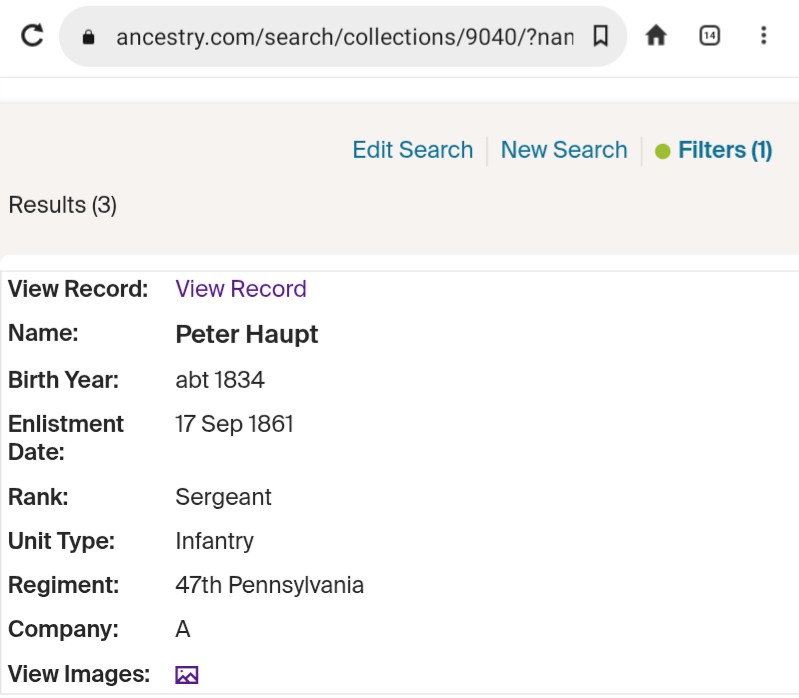
Screenshot of Ancestry.com’s record detail page for Peter Haupt, which incorrectly identifies him as a member of Company A, 47th Pennsylvania Volunteer Infantry, instead of Company C (fair use for illustration purpose, October 2025).

Although Ancestry.com’s collection of Pennsylvania Civil War-era muster rolls can be a useful tool for researchers, there is a significant problem with records related to the 47th Pennsylvania Volunteer Infantry that merits closer scrutiny — the inaccurate transcription of soldiers’ data. That scrutiny is needed because the muster rolls from the 47th Pennsylvania’s Company C were mixed together with the muster rolls from Company A when they were posted to Ancestry.com’s website, making it appear, when browsing through those rolls, that all of the soldiers listed on every single one of those incorrectly grouped muster rolls were all members of Company A, when they were not.

Complicating things further, the Ancestry.com personnel who were assigned to transcribe the data from each of those muster rolls and create Record Detail pages for each individual soldier that summarized each soldier’s data from the muster roll on which it appeared, apparently did not realize that the muster rolls from Companies A and C of the 47th Pennsylvania Volunteer Infantry had been mixed together. As a result, those transcribers incorrectly described every soldier from that improperly sorted muster roll group as a member of Company A, when they were not. (See attached image.)

So, when reviewing Ancestry.com’s collection of muster rolls, it is vitally important that researchers not take the transcribed data found on any of the Record Detail pages of 47th Pennsylvania muster rolls at face value. Instead, researchers should double check the data found on those muster rolls for the 47th Pennsylvania Volunteer Infantry against the data for individual soldiers published by Samuel P. Bates in his History of Pennsylvania Volunteers, 1861-5, volume 1, and should also then re-check that data against the information of individual soldiers that is contained in the Pennsylvania Civil War Veterans Index Card File, 1861-1866.

* Note: This is particularly important if you are a family historian who is hoping to identify the specific company in which your ancestor served. (And you will definitely want to know which company your ancestor served with because each company of the 47th Pennsylvania Volunteer Infantry was assigned to different duties in different locations at different times during the regiment’s service.)

Caveat Regarding “Deserters”

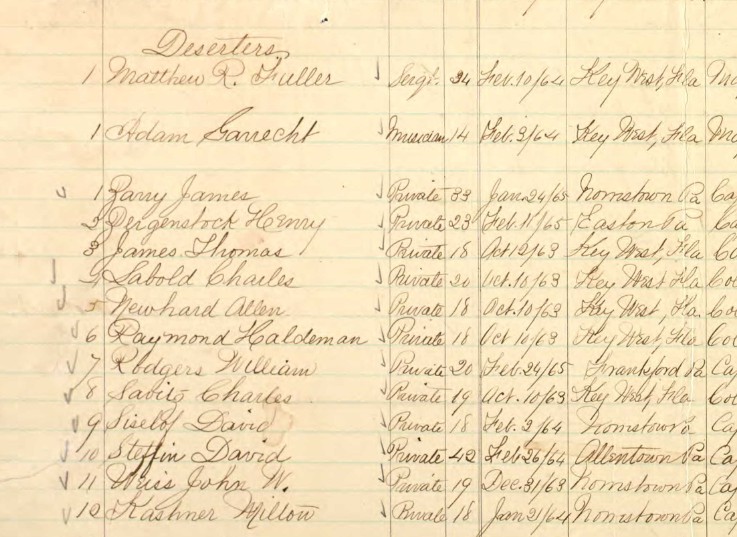
Private Milton P. Cashner, Company B, 47th Pennsylvania Volunteer Infantry, was incorrectly labeled as a deserter on this regimental muster roll from the American Civil War (Pennsylvania State Archives, public domain; click to enlarge).

If a muster roll entry for your ancestor noted that he was a deserter, it’s also important that you not take that label at face value, either, because that data may also be incorrect. Military records from the Civil War era contained a surprising number of errors, a fact that is understandable when considering what the average army clerk was expected to do — keep track of more than a thousand men, many of whom ended up becoming separated from their regiment and confined to Union Army hospitals after being wounded in battle. (Wounded too severely to identify themselves to army personnel, they were then often mis-identified by army hospital personnel and then also incorrectly labeled as “deserters” by their own regiments because they hadn’t shown up for post-battle roll calls.) So, it’s important to double and triple check the data for any ancestor who was labeled as a “deserter” because he might actually have been convalescing at a hospital and not absent without leave.

Honoring Our Ancestors 

One of the best ways to honor ancestors who fought to preserve America’s Union is to pass their stories along to future generations. No embellishment required. Their willingness to volunteer for military service and the bravery they displayed as they ran toward danger and certain death during one of America’s darkest times speaks for itself.

Our job, as students of American History, educators and family historians is to ensure that their stories are told as accurately and thoroughly as possible so that their valor and love of community and country are never forgotten.

Remember their names. Tell and re-tell their stories. Honor the sacrifices that they made.


Sources:

  1. “Ancestry Pennsylvania,” in “Agencies: Pennsylvania Historical and Museum Commission,” in “Pennsylvania State Archives.” Harrisburg, Pennsylvania: Commonwealth of Pennsylvania, retrieved online October 25, 2025.
  2. Civil War Muster Rolls and Related Records” (resource description). Harrisburg, Pennsylvania: Pennsylvania State Archives, retrieved online October 30, 2025.
  3. Pennsylvania,” in Collections. Lehi, Utah: Ancestry.com Operations, Inc., 2021 (retrieved online October 25, 2025).


Finding Your 47th Pennsylvanian: Using the Pennsylvania Civil War Veterans Card File, 1861-1866

The index card of Field Musician James Geidner, Company G, 47th Pennsylvania Volunteer Infantry (Pennsylvania Civil War Veterans Card File, 1861-1866, courtesy of the Pennsylvania State Archives).

The Pennsylvania Civil War Veterans Index Card File, 1861-1866 is one of three resources that beginning, medium and advanced researchers frequently turn to for help in determining which Pennsylvania military unit(s) a soldier served with during the American Civil War. Physically housed at the Pennsylvania State Archives in Harrisburg, Pennsylvania, as part of the Pennsylvania Department of Military and Veterans Affairs’ archives (Series RG-019-ADJT-12), this collection of individual index cards was preserved on microfilm decades ago by the Commonwealth of Pennsylvania and then later digitized and made available, free of charge, on the State Archives’ website via a user-friendly portal, enabling researchers nationwide to search or browse, alphabetically, through each of the index cards that had been created for the majority of Pennsylvanians who had served with the Union Army (as well as the non-Pennsylvanians who had also served with Pennsylvania units). According to Pennsylvania State Archives personnel:

“These 3 x 5 cards were initially prepared to serve as an index to Samuel Penniman Bates’ History of Pennsylvania Volunteers, 1861-1865, (Harrisburg, 1869-1871). The Office of the Adjutant General later expanded the scope of the cards by transcribing onto them data found on the original documents. Among the information generally found are the soldiers’ names, military units, and ages at enrollment, the dates and places where enrolled, the dates and places where mustered in, and the dates of discharge. Physical descriptions (complexion, height, color of hair and eyes), residences, birthplaces, promotions and wounds also are sometimes included. The listing is not comprehensive.”

That last sentence is an important caveat because, while this index card system can be a helpful primary source for basic data about individual soldiers, it does not contain the name of every single Pennsylvanian who served with the Union Army during the Civil War. In addition, a significant number of the index cards contain errors (incorrect spellings of soldiers’ names, soldiers labeled as deserters when they had actually been honorably discharged or hospitalized to due battle wounds or illness, etc.).

* Note: Those faults are understandable, however, when considering that the index cards were based on data compiled by Samuel Bates for his History of Pennsylvania Volunteers, 1861-5a five-volume series of books that included rosters of soldiers for each Pennsylvania regiment that served during the American Civil War. The errors in Bates’ History are also understandable as you come to understand that Samuel Bates was assigned the task, during the mid-1860s, of summarizing thousands and thousands of muster rolls generated by Pennsylvania military units during the war — many of which were also filled with errors because the army clerks assigned to maintain those rolls were often unable to create accurate records as their regiments were being marched into battle or from one duty station to another.

Another more recent issue with this system is that its portal to the digitized index cards that was so easy to browse and search for free is now no longer available on the Pennsylvania State Archives’ website. The index cards are still available, however, to researchers who travel to Harrisburg to view the microfilmed version at the State Archives, as well as to online researchers via Ancestry.com as “Pennsylvania, U.S., Veterans Card Files, 1775-1948.” (Although Ancestry.com is a subscription-based genealogy service that generally requires users to pay for access to its records collections, the Commonwealth of Pennsylvania entered into a partnership with Ancestry.com several years ago “to digitize family history records in the State Archives and make them available online.” As part of that agreement, Ancestry.com created Ancestry.com Pennsylvania to provide free access to Pennsylvania residents to the Pennsylvania State Archives records it has digitized. If you reside in Pennsylvania and want to learn more about how you may obtain free access to those records, please contact the Pennsylvania State Archives for guidance. If you reside elsewhere, check with your local library to see if it offers access to Ancestry.com as part of its service to library users.)

Despite those issues, the Pennsylvania Civil War Veterans Index Card File, 1861-1866 remains a useful tool for finding your 47th Pennsylvanian because it may help you confirm your ancestor’s place of residence during the early 1860s and may also provide you with an approximate year of birth for him.

Additional Important Tips for Using This Resource

The index card of William H. Egle, M.D. shows that this soldier served with the 47th Pennsylvania Militia, Emergency of 1863 and not the 47th Pennsylvania Volunteer Infantry (Pennsylvania Civil War Veterans Card File, 1861-1866, courtesy of the Pennsylvania State Archives).

If you are able to find an index card for your ancestor in the Pennsylvania Civil War Veterans Index Card File, 1861-1866, pay particular attention to the top line of that card’s data. That data identifies the regiment number and company letter of his military unit. Then also look at the lines of data below. (Those lines of text note the start and dates of his service.) If you see dates of service indicating that your ancestor served between mid-April 1861 and the end of July 1861, you will realize that the regiment number in the top line was not “47.” This means that your ancestor performed what is known as “Three Months’ Service,” that he actually served with a different regiment during the first months of the war, and that he then may also have served with the 47th Pennsylvania Volunteer Infantry at a later date (because the 47th Pennsylvania Volunteer Infantry was not established until August 5, 1861). So, you’re one of those 47th Pennsylvania descendants who needs to look for two or more index cards in the Pennsylvania Civil War Veterans Index Card File, 1861-1866 — one for your ancestor’s “Three Month Service” and one for his service with the 47th Pennsylvania Volunteer Infantry (which was initially most likely a three-year term of enlistment, but may have been a one or two-year term, depending on how late he was enrolled for service).

HOWEVER, if you see dates of service indicating that your ancestor served at any point during 1863 — AND, if the top line indicates that his regiment was “47 I Mil 63” — this means that your ancestor DID NOT serve with the 47th Pennsylvania Volunteer Infantry. He served with the 47th Pennsylvania Militia, Emergency of 1863. (The soldiers who served with that militia group were also brave and honorable men, but they were part of a very different unit that had a very different mission. Learn more about that militia unit here.)

Regardless of whether or not your ancestor “performed Three Months’ Service” during the earliest part of the Civil War, if you see dates of service indicating that your ancestor served at any point between August 5, 1861 and early January 1866 — AND if the top line indicates that his regiment was “47 I” — then you can be reasonably confident that your ancestor actually did serve with the 47th Pennsylvania Volunteer Infantry (also known as the 47th Pennsylvania Volunteers or the 47th Pennsylvania Veteran Volunteers). So, you should make yourself a cup of coffee or tea, find a comfy chair, and spend some quality time exploring our website to learn more about the history-making 47th Pennsylvania Volunteer Infantry.

Best wishes for success with your research! Let us know what you learn about your ancestor!!


Sources:

  1. “Ancestry Pennsylvania,” in “Agencies: Pennsylvania Historical and Museum Commission,” in “Pennsylvania State Archives.” Harrisburg, Pennsylvania: Commonwealth of Pennsylvania, retrieved online October 25, 2025.
  2. Civil War Veterans Card File, 1861-1866” (resource description). Harrisburg, Pennsylvania: Pennsylvania State Archives, retrieved online October 25, 2025.
  3. Pennsylvania,” in Collections. Lehi, Utah: Ancestry.com Operations, Inc., 2021 (retrieved online October 25, 2025).


Finding Your 47th Pennsylvanian: Use “Bates’ History” — But With Caution

“History of Pennsylvania Volunteers, 1861-5,” Samuel P. Bates, 1869-1871 (public domain).

“So long as differences arise among nations, which cannot be settled by peaceful conference, and appeals are made to the arbitrament of the sword, the only safety that remains to the government is in the courage of its soldiery. In the late sanguinary struggle, the national unity was preserved, and the perpetuity of democratic institutions secured, by the men who bore the musket, and who led in the deadly conflict. Argument and moral sentiment were at fault, diplomacy was powerless, and courage proved the only peacemaker.

“In recognition of their services, and as a mark of the appreciation in which their valor is held, the Legislature of Pennsylvania authorized the preparation of a record of each of the military organizations in the field since 1861.” 

— Samuel P. Bates, “Preface,” History of Pennsylvania Volunteers, 1861-5


One of the first pieces of advice that archivists, librarians and professional genealogists will often give to descendants of Pennsylvania Volunteer Infantrymen when beginning their research of soldier-ancestors is to “Check Bates’ History,” which often results in descendants responding with, “What’s that?” and “Where Can I Find It?”

“Bates’ History” is, in fact, a five-volume series of books entitled, History of Pennsylvania Volunteers, 1861-5; Prepared in Compliance with Acts of the Legislature, that was researched, written and published during the mid-1860s through the early 1870s by Samuel Penniman Bates, an American educator and historian. Appointed in 1864 as state historian of the Commonwealth of Pennsylvania by Pennsylvania Governor Andrew Gregg Curtin, Bates was subsequently commissioned by the governor on June 1, 1866 to fulfill a legislative directive that “a military history of the organization of Pennsylvania volunteers and militia, who have been, or may be in the field” be researched, written and published for the public record. Bates was then given additional instructions by the Pennsylvania Legislature on April 17, 1867 “that the military history of the Pennsylvania volunteers … embrace an account of the organization, and services in the field, of each regiment, together with a roll giving the name, age, and residence of each officer and soldier, the date and term of enlistment, the promotions, the discharges, and casualties, and the places of burial of those who died in service.”

Thanks to that foresight by elected officials from Pennsylvania and Bates’ Herculean effort, generations of genealogists and academic historians have since visited historical societies and libraries across Pennsylvania and beyond to peruse increasingly worn copies of Bates’ books in order to learn more about the history of a specific regiment and confirm the names of that regiment’s leaders and rank and file members.

Access to Bates’ data was then made even easier by technological advancements in library science with the digitization of Bates’ books. As a result, family historians and other researchers no longer need to schlep to libraries to hunker down over their desired dusty tomes because Bates’ complete series has been accessible online, free of charge since 2012, thanks to HathiTrust, a collaborative effort between multiple academic institutions across the United States that is headquartered at the University of Michigan’s main campus in Ann Arbor. (“Go Blue!”)

This highly user-friendly format presented by HathiTrust allows users to not only read or browse each volume, but to also search for a specific soldier’s name by entering that name into the search textbox for the volume where that soldier’s name would most likely be located.

With respect to members of the 47th Pennsylvania Volunteer Infantry, that book would be Bates’ first volume. So, to find your 47th Pennsylvanian:

  1. Pull up volume one of Bates;
  2. Click on the downward-facing arrow of the black “Options” line near the top of the webpage you’re now seeing;
  3. Click on “Search in This Text”;
  4. Enter your ancestor’s name in that text box, between quotation marks, beginning with his last name, followed by a comma, one space, and his given name (example: “Clouser, Ephraim”); and
  5. Click the magnifying glass.

That search should pull up a new webpage that lists the page(s) in Bates’ first volume on which your ancestor’s name might appear — if your ancestor actually did serve with the 47th Pennsylvania Volunteer Infantry. Each of those items on that list will have an active link that will take you to the specific page in Bates’ first volume on which your ancestor is listed (or may take you to a page on which someone who had the same name as your ancestor is listed; so double check the data to be sure you’re looking at data for the correct soldier).

But if your search does not pull up a page(s) with your ancestor’s name, it may mean that your ancestor did not actually serve with the 47th Pennsylvania Volunteer Infantry — or that Bates spelled your ancestor’s name incorrectly.

Caveat Emptor

“Let the buyer beware” — or in this case “Caveat Scholaris” (“Let the student beware.”) While Bates History can be a helpful starting point for research regarding the 47th Pennsylvania Volunteer Infantry, each volume in the series contains significant errors — understandable when considering that Bates was tasked with summarizing the myriad number of muster rolls generated by hundreds of Pennsylvania military units that were staffed by more than three hundred and sixty thousand soldiers from Pennsylvania during the American Civil War. (And many of those original muster rolls were filled with errors because the Union Army clerks assigned to maintain those rolls simply could not create or update records when their regiments were being moved from one duty station to another as they marched into, or retreated from, battlefields scattered throughout three theaters of war that spread across multiple states in the Union and Confederacy.)

That being said, Bates left future generations of Pennsylvanians with a useful, detailed and reasonably accurate record of Pennsylvania’s role in the American Civil War. So, by all means, use Bates’ History to further your research; just don’t rely on it as your sole source of data.

As you go about finding your 47th Pennsylvanian, always double check the new data you find against the regiment’s original muster rolls and against other sources, such as the individual U.S. Civil War Pension file(s) for your ancestor and his parents, widow and/or children — records that are often chock full of new data and are maintained by the U.S. National Archives and Records Administration. (More information about those pension records is available online here.)


Sources:

  1. “A State History of Our Pennsylvania Regiments.” Philadelphia, Pennsylvania: The Daily Evening Telegraph, January 19, 1867.
  2. Bates, Samuel P. History of Pennsylvania Volunteers, 1861-5; Prepared in Compliance with Acts of the Legislature, volumes 1-5. Harrisburg, Pennsylvania: B. Singerly, State Printer, 1869-1871 (full text search and browse options available through HathiTrust, University of Michigan).
  3. Hodge, Ruth E. “Samuel Penniman Bates Papers, 1853-1895,” in “Guide to African American Resources at the Pennsylvania State Archives.” Harrisburg, Pennsylvania: Pennsylvania Historical and Museum Commission, 2000.
  4. Royer, Douglas L. Guide to Civil War Holdings of the Pennsylvania State Archives. Harrisburg, Pennsylvania: Pennsylvania State Archives, 2001.