A native-born Pennsylvanian and son of a nineteenth-century, Pennsylvania-born physician, William McHenry James (1844-1915) was also a lineal descendant of American Revolutionary War Patriot Josiah James (1741-1806), who served under Captain Henry Darrach and Lieutenant-Colonel William Roberts, as a private, 8th class with the 3rd Company of the 3rd Battalion of the Bucks County Militia.
This is his story of patriotism and love of community, commonwealth and country.
Formative Years
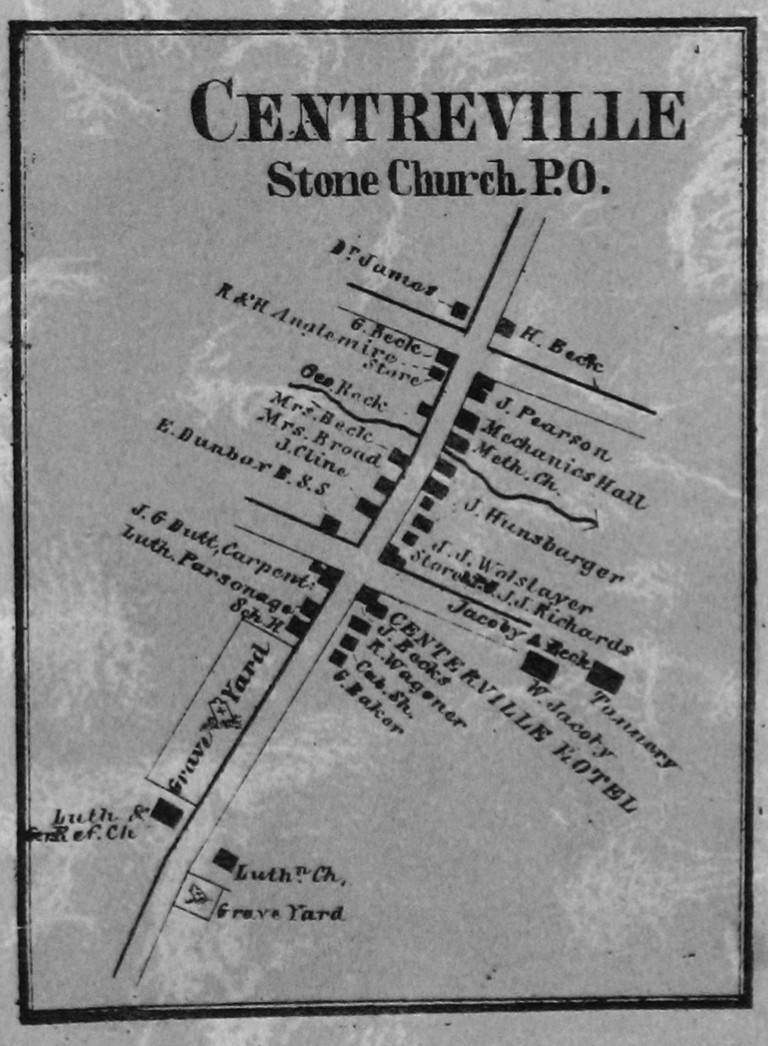
An 1860 map of Centreville (also known as Stone Church) in Mount Bethel Township, Northampton County, Pennsylvania (public domain, click to enlarge).
Born in Northampton County, Pennsylvania on 15 April 1844 (alternate birth date: 12 April 1844), William McHenry James (1844-1915) was a son of Bucks County, Pennsylvania native Robert Evan James, M.D. (1802-1860) and Caroline (Dietterich) James (1817-1853).
He was raised and educated in Northampton County with his siblings: Frances Minerva James (1839-1909), who had been born in Upper Mount Bethel Township, Northampton County on 20 August 1839, was known to family and friends as “Fanny” and would later wed Hiram Long, M.D. (1831-1903), a surgeon with the 173rd and 205th Pennsylvania Volunteer Infantry regiments during the American Civil War; Mary Elizabeth James (1841-1917), who had been born in the community of Centreville (also known as Stone Church) in Upper Mount Bethel Township on 31 August 1841 and would later wed Truman Harvey Purdy (1830-1898); Jacob Dieterich James (1846-1907), who was born on 12 April 1846 (alternate birth date: 15 April 1846), was also known to family and friends as “Dieterich” and would later wed Laura Irene Clement (1851-1891; alternate given name: “Lena”); and Robert Evan James (1848-1913), who was born in Centreville on 9 August 1848, would marry Anna Barbara Heller (1850-1926) and would later be elected to the Pennsylvania House of Representatives and subsequently appointed as a national bank examiner of the United States of America.
* Note: The James family’s partriarch, Robert Evan James, M.D., had built a long record of public service during the early to mid-nineteenth century. A member of the Baptist Church and graduate of the Jefferson Medical College in Philadelphia, he had subsequently opened a medical practice in the community of Centreville (also known as “Stone Church”) in Northampton County, which would later expand significantly to include patients in Monroe County, Pennsylvania and Warren County, New Jersey. On 13 Febuary 1835, he was appointed as his town’s postmaster — a position he would hold until 28 September 1839. In addition, he served as an elector who represented Northampton County during the presidential campaign season of 1852, which saw Franklin Pierce elected as the fourteenth president of the United States. According to historians John W. Jordan, Edgar Moore Green and George T. Ettinger, Dr. Evans “was a Democrat in politics, with strong anti-slavery inclinations.”
In 1850, the James family resided in Upper Mount Bethel Township in Northampton County in what was very likely a comfortable home that was supported through the income of their family’s physician-patriarch, Robert Evan James, Sr., M.D., who owned real estate that was valued by that year’s federal census at four thousand dollars (the equivalent of more than one hundred seventy-one thousand U.S. dollars in 2026). Also residing with the family that year were Enos and Elonia Weaver. Roughly three years later, tragedy struck when the family’s matriarch, Caroline (Dietterich) James died at the age of thirty-six in Centreville, Upper Mount Bethel Township on 14 May 1853. Following funeral services, she was laid to rest at the Christ Church Cemetery (also known as the old Union Cemetery) in Stone Church, Northampton County. Residents of the community of Mount Bethel in Upper Mount Bethel Township during the summer of 1860, according to the 1860 federal census, the James household included their family’s patriarch, physician Robert E. James, M.D., whose real estate and personal property were valued at six thousand dollars (the equivalent of roughly two hundred forty-two thousand U.S. dollars in 2026); and Robert’s children: Frances, Mary, William, Jacob, and Robert, James, Jr.
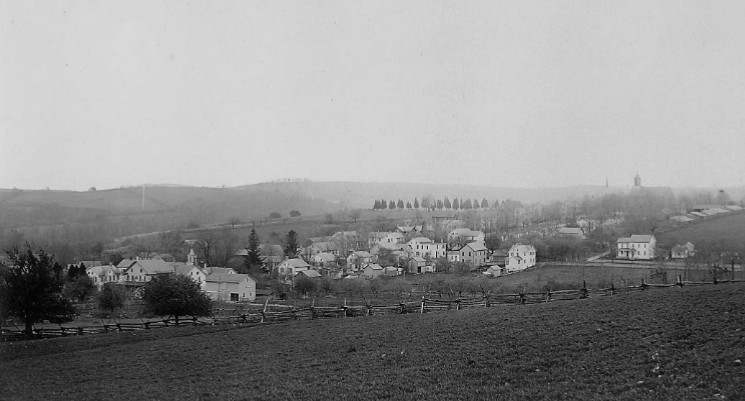
Centreville, also known as Stone Church, in Upper Mount Bethel Township, Northampton County, Pennsylvania (date unknown, public domain; click to enlarge).
But tragedy struck yet again. Roughly two months after that federal census was enumerated, the family’s patriarch died at the age of fifty-seven in Centreville, Northampton County on 13 August 1860. Following funeral services, he was laid to rest beside his wife at the Christ Church Cemetery. Four months later, the United States of America descended into the darkness of a national secession crisis that would quickly devolve into a full-blown, disastrous civil war that would ultimately claim the lives of more than seven hundred thousand Americans.
American Civil War
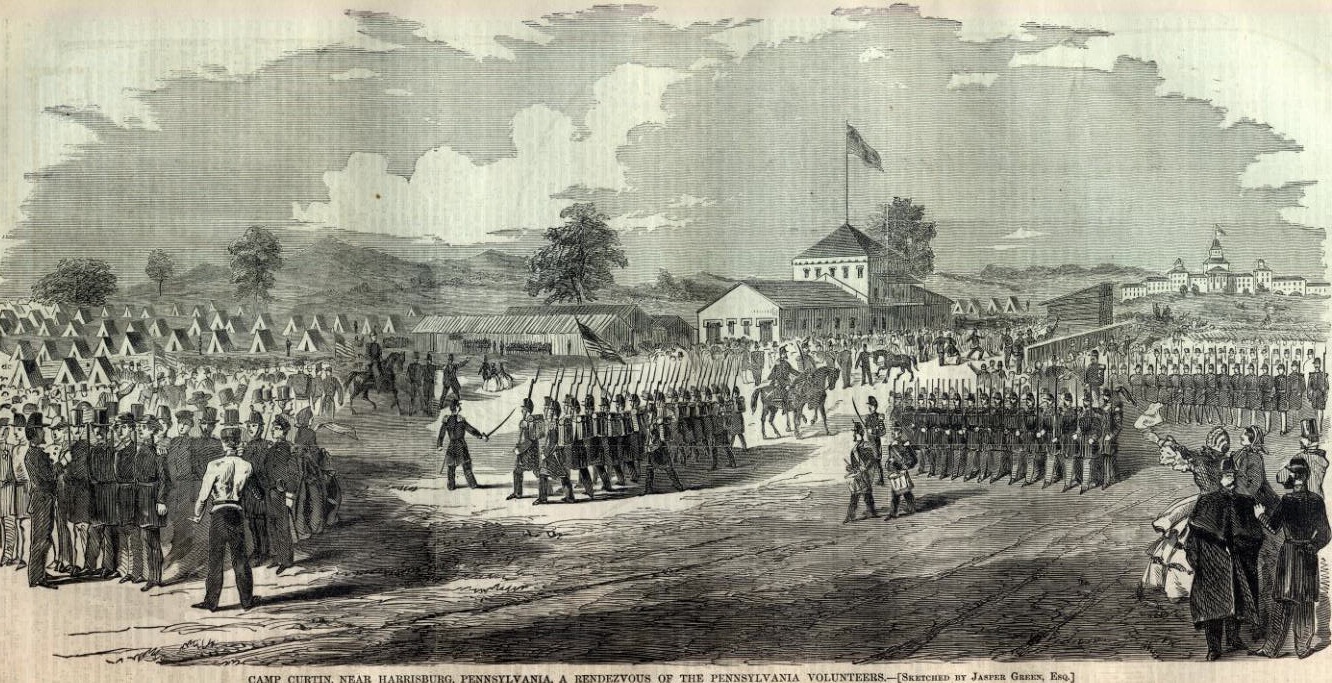
Camp Curtin (Harper’s Weekly, 1861, public domain).
On 25 August 1861, nineteen-year-old William McHenry James became one of the early responders to President Abraham Lincoln’s call for volunteers to bring an end to the American Civil War when he enrolled for military service in Easton, Northampton County, Pennsylvania. He then officially mustered in for duty on 16 September at Camp Curtin in Harrisburg, Dauphin County, Pennsylvania as a private with Company E of the recently-formed 47th Pennsylvania Volunteer Infantry. But he received little to no basic training in light infantry tactics because the officers and enlisted members of his regiment were preparing to board a train later that same week. Military records described Private James as a clerk who lived in Upper Mount Bethel Township, Northampton County, who was five feet, six inches tall with black hair, black eyes and a dark complexion.
* Note: Company E of the 47th Pennsylvania Volunteer Infantry was commanded by Captain Charles Hickman Yard, who had served as a second lieutenant with Company C of the 1st Pennsylvania Volunteers at the beginning of the American Civil War and had begun recruiting men for a new company of soldiers after completing his Three Months’ Service with that regiment. According to Lewis G. Schmidt, author of A Civil War History of the 47th Regiment of Pennsylvania Veteran Volunteers:
Capt. Yard had been enrolling men at Yard’s Saloon in Easton and took part of his company to Harrisburg on Friday, August 23, to be attached to Col. Good’s ‘Zouaves’ (a title that did not remain long with the 47th). The Captain had been recruiting men since August 13, and a number of men were still needed to fill the unit which would become Company E in the 47th.… By Monday the 26th, an additional 40 men were ready and another group left for Harrisburg. But the company was still not filled and the Captain planned to return to recruit the remaining members.
These groups were ‘sworn’ (probably enrolled) into the state service on the 28th, and placed in the hands of 1st Lt. Bonstein [sic, “Lawrence Bonstine”] for instruction in the drill, while the Captain returned to Easton to ‘shanghai’ some more recruits at Yard’s Saloon.
It was not until the following Monday, September 2 that an additional group of 24 men had been recruited and Capt. Yard left with these men in the morning, planning to return and complete the enrollment of the unit later.
While stationed at Camp Curtin, the 47th Pennsylvania Volunteers were issued: “1 light blue overcoat, 1 extra good blouse, 1 pair dark pantaloons, 2 white flannel shirts, 2 pair drawers, 2 pair socks, 1 pair shoes, 1 cap, 1 knapsack (suspended from shoulder), 1 haversack (suspended from waist), 1 canteen, and received 71 rifles on the 19th,” according to Schmidt. Upon completion of their basic training, they were presented with the regiment’s First State Color by Pennsylvania Governor Andrew Curtin and marched to the train station in Harrisburg on 20 September 1861.

The U.S. Capitol Building, unfinished at the time of President Abraham Lincoln’s inauguration, was still not completed when the 47th Pennsylvania Volunteers arrived in Washington, D.C. in September 1861 (public domain).
Transported by rail to Washington, D.C., the 47th Pennsylvania Volunteers disembarked, were reassembled by company, and marched to the Soldiers’ Retreat, where they were fed and given time to rest before they were ordered to re-form and march for the Kalorama Heights near Georgetown. Upon arrival at “Camp Kalorama” on 21 September 1861, they pitched their tents at the 47th Pennsylvania’s section of the large Union Army encampment, which was located roughly two miles from the White House. Henry D. Wharton, a musician with the 47th Pennsylvania’s C Company, penned the following update to the Sunbury American on 22 September:
After a tedious ride we have, at last, safely arrived at the City of ‘magnificent distances.’ We left Harrisburg on Friday last at 1 o’clock A.M. and reached this camp yesterday (Saturday) at 4 P.M., as tired and worn out a sett [sic] of mortals as can possibly exist. On arriving at Washington we were marched to the ‘Soldiers Retreat,’ a building purposely erected for the benefit of the soldier, where every comfort is extended to him and the wants of the ‘inner man’ supplied.
After partaking of refreshments we were ordered into line and marched, about three miles, to this camp. So tired were the men, that on marching out, some gave out, and had to leave the ranks, but J. Boulton Young, our ‘little Zouave,’ stood it bravely, and acted like a veteran. So small a drummer is scarcely seen in the army, and on the march through Washington he was twice the recipient of three cheers.
We were reviewed by Gen. McClellan yesterday [21 September 1861] without our knowing it. All along the march we noticed a considerable number of officers, both mounted and on foot; the horse of one of the officers was so beautiful that he was noticed by the whole regiment, in fact, so wrapt [sic] up were they in the horse, the rider wasn’t noticed, and the boys were considerably mortified this morning on dis-covering they had missed the sight of, and the neglect of not saluting the soldier next in command to Gen. Scott.
Col. Good, who has command of our regiment, is an excellent man and a splendid soldier. He is a man of very few words, and is continually attending to his duties and the wants of the Regiment.
…. Our Regiment will now be put to hard work; such as drilling and the usual business of camp life, and the boys expect and hope an occasional ‘pop’ at the enemy.
On the 24th of that same month, the 47th Regiment, Pennsylvania Volunteer Infantry finally became part of the U.S. Army when its men were officially mustered into federal service. The next day, 25 September, George Washington Hahn of E Company, David Huber and F. J. Scott described their early days via a letter from Camp Kalorama to the Easton Daily Evening Express:
[A]fter a ride of about twenty-four hours in those delightful cattle cars, we came in sight of the Capitol of the U.S. with colors flying and the band playing and everyone in the best of spirits…. We have one of the best camps in the Union; plenty of shade trees, water and food at present; we have had no ‘Hardees’ [hardtack] yet in this camp, but no doubt we will have them in abundance by and by. But we can cook them in so many different ways, they are better than beef. We soak them over night, fry them for breakfast, stew them for dinner, and warm them over for supper…. The way we pass our time in the evening is as follows: first, after supper, we have a good Union song, then we read, write, crack jokes and sing again. We are ‘gay and happy’ and always shall be while the stars and stripes float over us.
…. We have a noble Colonel and an excellent Band, and the company officers throughout are well drilled for their positions. Our boys are well and contented; satisfied with their clothing, satisfied with their rations, and more than all satisfied with their officers, from Captain to the 8th Corporal. Our boys will stand by the Captain till the last man falls….
This morning we … visited Georgetown Heights; we stood on top of the reservoir and from there had a fine view of the Federal forts and forces on the other side of the Potomac. It looks impossible for an enemy to enter Washington, so strongly fortified is every hill and the camps connect for miles along the river. We saw General McClellan and Professor Lowe taking a view of the Confederate army from the balloon. The rebels are now only four miles from here….

Chain Bridge across the Potomac above Georgetown looking toward Virginia, 1861 (The Illustrated London News, public domain).
On 27 September — a rainy day, the 47th Pennsylvania was assigned to the 3rd Brigade of Union Brigadier-General Isaac Ingalls Stevens, which also included the 33rd, 49th and 79th New York regiments. By that afternoon, the 47th Pennsylvania was on the move again. Ordered onward by Brigadier-General Silas Casey, the Mississippi rifle-armed 47th Pennsylvania infantrymen marched behind their Regimental Band until reaching Camp Lyon, Maryland on the Potomac River’s eastern shore. At 5 p.m., they joined the 46th Pennsylvania in moving double-quick (one hundred and sixty-five steps per minute using thirty-three-inch steps) across the “Chain Bridge” marked on federal maps, and continued on for roughly another mile before being ordered to make camp.
The next morning, they broke camp and moved again. Marching toward Falls Church, Virginia, they arrived at Camp Advance around dusk. There, about two miles from the bridge they had crossed a day earlier, they re-pitched their tents in a deep ravine near a new federal fort under construction (Fort Ethan Allen). They had completed a roughly eight-mile trek, were situated close to the headquarters of General William Farrar Smith (nicknamed “Baldy”), and were now part of the Union’s massive Army of the Potomac (“Mr. Lincoln’s Army”). Under Smith’s leadership, their regiment and brigade would help to defend the nation’s capital from the time of their September arrival through late January when the men of the 47th Pennsylvania would be shipped to the nation’s Deep South.
Once again, Company C Musician Henry Wharton recapped the regiment’s activities, noting, via his 29 September letter home to the Sunbury American, that the 47th had changed camps three times in three days:
On Friday last we left Camp Kalorama, and the same night encamped about one mile from the Chain Bridge on the opposite side of the Potomac from Washington. The next morning, Saturday, we were ordered to this Camp [Camp Advance near Fort Ethan Allen, Virginia], one and a half miles from the one we occupied the night previous. I should have mentioned that we halted on a high hill (on our march here) at the Chain Bridge, called Camp Lyon, but were immediately ordered on this side of the river. On the route from Kalorama we were for two hours exposed to the hardest rain I ever experienced. Whew, it was a whopper; but the fellows stood it well – not a murmur – and they waited in their wet clothes until nine o’clock at night for their supper. Our Camp adjoins that of the N.Y. 79th (Highlanders.)….
We had not been in this Camp more than six hours before our boys were supplied with twenty rounds of ball and cartridge, and ordered to march and meet the enemy; they were out all night and got back to Camp at nine o’clock this morning, without having a fight. They are now in their tents taking a snooze preparatory to another march this morning…. I don’t know how long the boys will be gone, but the orders are to cook two days’ rations and take it with them in their haversacks….
We had not been in this Camp more than six hours before our boys were supplied with twenty rounds of ball and cartridge, and ordered to march and meet the enemy; they were out all night and got back to Camp at nine o’clock this morning, without having a fight. They are now in their tents taking a snooze preparatory to another march this morning…. I don’t know how long the boys will be gone, but the orders are to cook two days’ rations and take it with them in their haversacks….
There was a nice little affair came off at Lavensville [sic, Lewinsville], a few miles from here on Wednesday last; our troops surprised a party of rebels (much larger than our own.) killing ten, took a Major prisoner, and captured a large number of horses, sheep and cattle, besides a large quantity of corn and potatoes, and about ninety six tons of hay. A very nice day’s work. The boys are well, in fact, there is no sickness of any consequence at all in our Regiment….

Defense of Washington, D.C. in 1861 from key Union Army sites in Virginia: Chain Bridge and Fort Ethan Allen at right, Langley’s where Camp Griffin was located at top, and Lewinsville at left (Robert K. Sneden maps, public domain).
Sometime during that phase of duty, as part of the 3rd Brigade, the 47th Pennsylvanians were moved to a site they initially christened “Camp Big Chestnut” in reference to a large chestnut tree located nearby. The site would eventually become known to the Keystone Staters as “Camp Griffin,” and was located roughly ten miles from Washington, D.C.
On 11 October, the 47th Pennsylvania Volunteers marched in a Grand Review at Bailey’s Cross Roads. In a mid-October letter to his family back in Pennsylvania, Captain John Peter Shindel Gobin (the leader of C Company who would be promoted in 1864 to lead the entire 47th Regiment) reported that companies D, A, C, F and I (the 47th Pennsylvania’s right wing) were ordered to picket duty after the left wing companies (B, G, K, E, and H) had been forced to return to camp by Confederate troops. In his letter of 13 October, Henry Wharton described their duties, as well as their new home:
The location of our camp is fine and the scenery would be splendid if the view was not obstructed by heavy thickets of pine and innumerable chesnut [sic] trees. The country around us is excellent for the Rebel scouts to display their bravery; that is, to lurk in the dense woods and pick off one of our unsuspecting pickets. Last night, however, they (the Rebels) calculated wide of their mark; some of the New York 33d boys were out on picket; some fourteen or fifteen shots were exchanged, when our side succeeded in bringing to the dust, (or rather mud,) an officer and two privates of the enemy’s mounted pickets. The officer was shot by a Lieutenant in Company H [?], of the 33d.
Our own boys have seen hard service since we have been on the ‘sacred soil.’ One day and night on picket, next day working on entrenchments at the Fort, (Ethan Allen.) another on guard, next on march and so on continually, but the hardest was on picket from last Thursday morning ‘till Saturday morning – all the time four miles from camp, and both of the nights the rain poured in torrents, so much so that their clothes were completely saturated with the rain. They stood it nobly – not one complaining; but from the size of their haversacks on their return, it is no wonder that they were satisfied and are so eager to go again tomorrow. I heard one of them say ‘there was such nice cabbage, sweet and Irish potatoes, turnips, &c., out where their duty called them, and then there was a likelihood of a Rebel sheep or young porker advancing over our lines and then he could take them as ‘contraband’ and have them for his own use.’ When they were out they saw about a dozen of the Rebel cavalry and would have had a bout with them, had it not been for…unlucky circumstance – one of the men caught the hammer of his rifle in the strap of his knapsack and caused his gun to fire; the Rebels heard the report and scampered in quick time….

Unknown regiment, Camp Griffin, Virginia, fall 1861 (U.S. Library of Congress, public domain).
On Friday morning, 22 October 1861, the 47th engaged in another major review, described by Schmidt as massing “about 10,000 infantry, 1000 cavalry, and twenty pieces of artillery all in one big open field.” Less than a month later, in his letter of 17 November, Henry Wharton revealed more details about life at Camp Griffin:
This morning our brigade was out for inspection; arms, accoutrements [sic], clothing, knapsacks, etc, all were out through a thorough examination, and if I must say it myself, our company stood best, A No. 1, for cleanliness. We have a new commander to our Brigade, Brigadier General Brannen [sic], of the U.S. Army, and if looks are any criterion, I think he is a strict disciplinarian and one who will be as able to get his men out of danger as he is willing to lead them to battle….
The boys have plenty of work to do, such as piquet [sic] duty, standing guard, wood-chopping, police duty and day drill; but then they have the most substantial food; our rations consist of fresh beef (three times a week) pickled pork, pickled beef, smoked pork, fresh bread, daily, which is baked by our own bakers, the Quartermaster having procured portable ovens for that purpose, potatoes, split peas, beans, occasionally molasses and plenty of good coffee, so you see Uncle Sam supplies us plentifully….
A few nights ago our Company was out on piquet [sic]; it was a terrible night, raining very hard the whole night, and what made it worse, the boys had to stand well to their work and dare not leave to look for shelter. Some of them consider they are well paid for their exposure, as they captured two ancient muskets belonging to Secessia. One of them is of English manufacture, and the other has the Virginia militia mark on it. They are both in a dilapidated condition, but the boys hold them in high estimation as they are trophies from the enemy, and besides they were taken from the house of Mrs. Stewart, sister to the rebel Jackson who assassinated the lamented Ellsworth at Alexandria. The honorable lady, Mrs. Stewart, is now a prisoner at Washington and her house is the headquarters of the command of the piquets [sic]….
Since the success of the secret expedition, we have all kinds of rumors in camp. One is that our Brigade will be sent to the relief of Gen. Sherman, in South Carolina. The boys all desire it and the news in the ‘Press’ is correct, that a large force is to be sent there, I think their wish will be gratified….
On 20 November, Private William M. James and his fellow 47th Pennsylvania Volunteers marched in The Grand Review of the Army of the Potomac at Bailey’s Crossroads, Virginia. According to National Portrait Gallery historian James Barber:
For three hours some 70,000 polished troops marched passed the reviewing stand, where the president, members of his cabinet, and Washington dignitaries were in attendance. It was the largest military assemblage up to that time in North America. ‘The Grand Review went off splendidly,’ wrote McClellan that night in a letter to his wife, ‘not a mistake was made, not a hitch. I never saw so large a Review in Europe so well done—I was completely satisfied & delighted beyond expression.’
Among the 20,000 spectators to witness the Grand Review was the poet and social activist Julia Ward Howe of Boston, Massachusetts, who was visiting the Washington area with her husband, Dr. Samuel Gridley Howe.
After leaving the review, during the carriage ride back to Washington, she heard troops singing the song ‘John Brown’s Body.’ A companion suggested that she should write new lyrics to the song, the melody of which lingered in her mind that night in her room at Willard’s Hotel in Washington. She awoke ‘in the gray of the morning twilight’ with the song still in her head and ‘the long lines of the desired poem began to twine themselves in my mind.’ She arose quickly and in the dimness of the early hour she began scribbling the verses on stationery ‘almost without looking at the paper.’
Her poem, The Battle Hymn of the Republic, was first published in The Atlantic Monthly in February 1862; the magazine paid her five dollars. Soon thereafter her verse was set to music and her inspirational song became a wartime favorite….
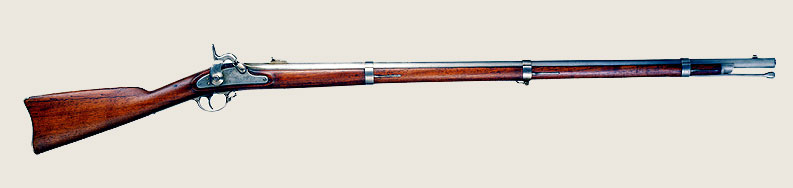
Springfield rifle, 1861 model (public domain).
The next day, according to Schmidt, the regiment participated in a morning divisional headquarters review that was overseen by the regiment’s commanding officer, Colonel Tilghman H. Good, followed by brigade and division drills all afternoon. According to Schmidt, “each man was supplied with ten blank cartridges.” Afterward, “Gen. Smith requested Gen. Brannan to inform Col. Good that the 47th was the best regiment in the whole division.” As a reward for their performance — and in preparation for even bigger adventures and honors to come, Brannan obtained brand new Springfield rifles for every member of the 47th Pennsylvania.
1862
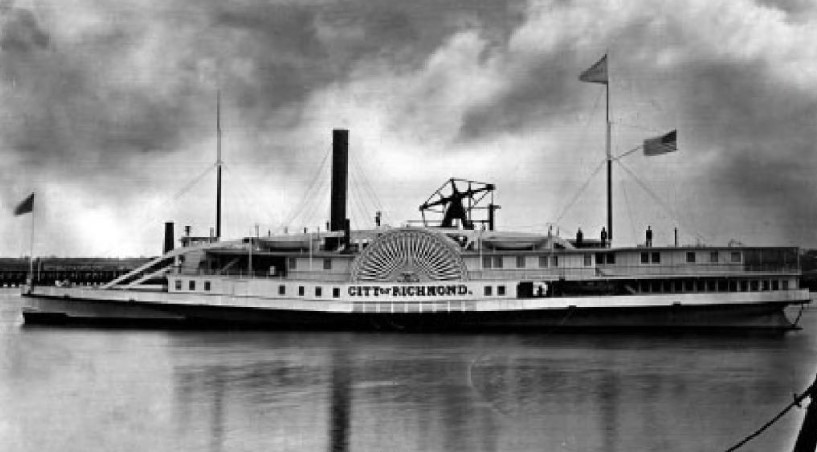
The City of Richmond, a sidewheel steamer, transported Union troops during the Civil War (Maine, circa late 1860s, public domain).
Next ordered to move from their Virginia encampment back to Maryland, the 47th Pennsylvania Volunteers left Camp Griffin at 8:30 a.m. on Wednesday, 22 January 1862. Marching through deep mud with their equipment for three miles in order to reach the railroad station at Falls Church, they were then transported by rail to Alexandria, before sailing the Potomac River aboard the steamship City of Richmond to the Washington Arsenal. While there, they were reequipped before being marched off for dinner and rest at the Soldiers’ Retreat in Washington, D.C. That same day, 22 January 1862, E Company Private Francis Parks was promoted to the rank of corporal.
The next afternoon, the 47th Pennsylvania Volunteers hopped aboard cars on the Baltimore & Ohio Railroad, and headed for Annapolis, Maryland. Arriving around 10 p.m., they were assigned quarters in barracks at the United States Naval Academy. They then spent that Friday through Monday (24-27 January 1862) loading their equipment and other supplies onto the steamship Oriental. According to Schmidt and letters home from members of the regiment, those preparations ceased on Monday, 27 January, at 10 a.m. when:
The regiment was formed and instructed by Lt. Col. Alexander ‘that we were about drumming out a member who had behaved himself unlike a soldier.’ …. The prisoner, Pvt. James C. Robinson of Company I, was a 36 year old miner from Allentown who had been ‘disgracefully discharged’ by order of the War Department. Pvt. Robinson was marched out with martial music playing and a guard of nine men, two men on each side and five behind him at charge bayonets. The music then struck up with ‘Robinson Crusoe’ as the procession was marched up and down in front of the regiment, and Pvt. Robinson was marched out of the yard.
Reloading then resumed. By that afternoon, as the 47th Pennsylvania Volunteers commenced boarding the Oriental, they were ferried to the big steamship by smaller steamers. The officers boarded last and, per the directive of Brigadier-General John Milton Brannan, they sailed away for the Deep South at 4 p.m., and headed for Florida which, despite its secession from the Union, remained strategically important to the Union due to the presence of Fort Taylor in Key West and Fort Jefferson in the Dry Tortugas.
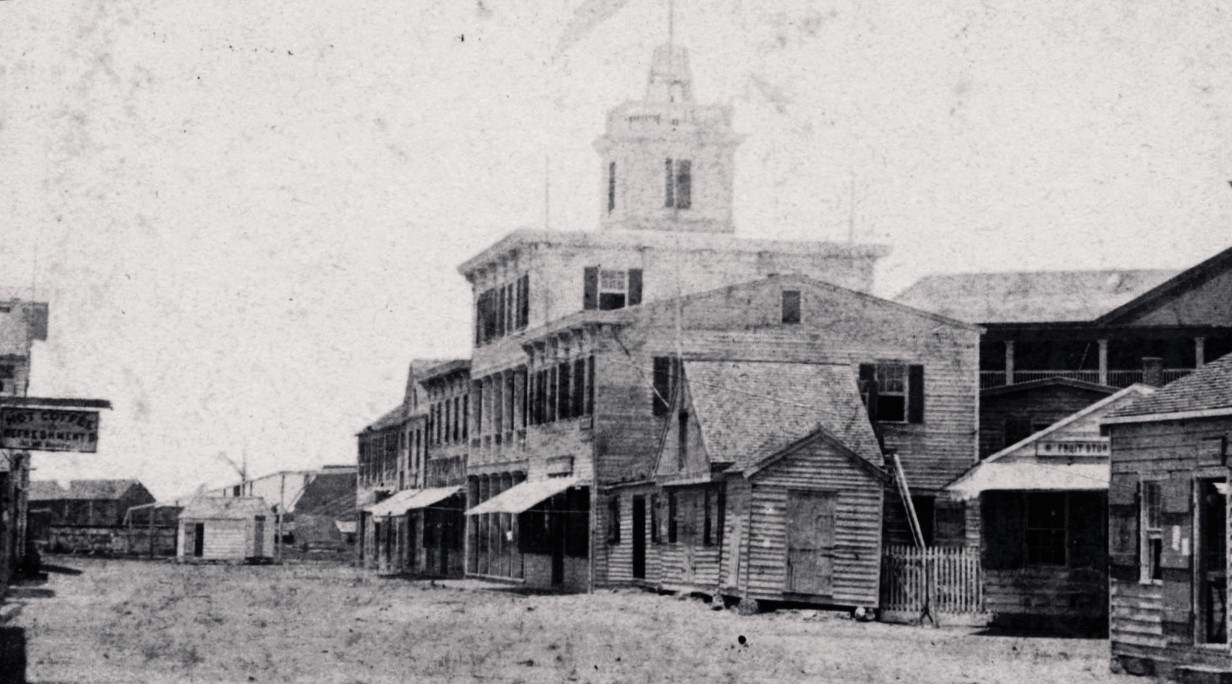
Front Street near Duval, Key West, Florida, circa 1860 (public domain).
Private William James and the men of E Company arrived in Key West, Florida with their fellow 47th Pennsylvania Volunteers in early February 1862. After disembarking from the Oriental, they pitched their tents on the beach and then began garrison duties at Fort Taylor. During the weekend of Friday, 14 February, they introduced their presence to Key West residents during a regimental parade that wound its way through the city’s streets. That Sunday, members of the regiment attended local church services, where they met and mingled with area residents.
By April 1862, according to Schmidt, Captain Charles H. Yard had been placed in command of three regiments that were charged with “clearing land and cutting roads” with a “fine military road … cut by the brigade from Fort Taylor directly through the island.” Drilled daily in light infantry or heavy artillery tactics, the 47th Pennsylvania Volunteers also worked on strengthening the fortifications at Fort Taylor. As their stay there lingered on, however, the quality of water available to them for drinking and bathing became increasingly problematic — just as Florida’s punishing heat and humidity worsened. As a result, multiple members of the regiment fell ill with dysentery or typhoid fever. Far too many died. Others lived, but found it harder and harder to perform their duties because they were weakened by the weather or disease.
But they “soldiered on,” guarding the fort, keeping the peace in the community and forging powerful, positive bonds with many of the citizens of Key West.
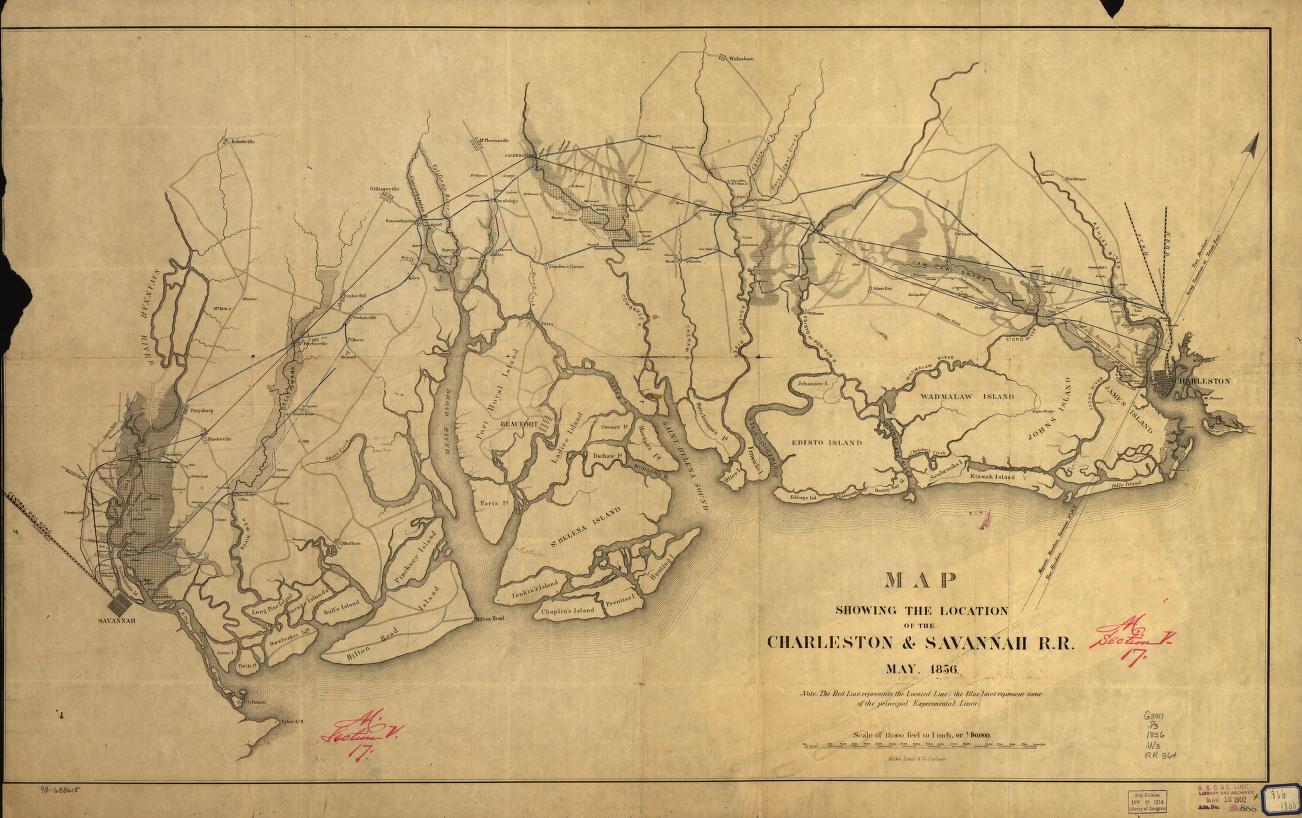
This 1856 map of the Charleston & Savannah Railroad shows the island of Hilton Head, South Carolina in relation to the towns of Beaufort and Pocotaligo (U.S. Library of Congress, public domain).
Subsequently ordered to Hilton Head, South Carolina from mid-June through July, Private William James and his regiment made camp near Fort Walker before relocating to the Beaufort District, Department of the South, roughly thirty-five miles away. Frequently assigned to hazardous picket detail to the north, where they were increasingly at risk of enemy sniper fire, the 47th Pennsylvanians became known for their “attention to duty, discipline and soldierly bearing,” and “received the highest commendation from Generals Hunter and Brannan,” according to historian Samuel P. Bates.
On 9 and 10 July, respectively, detachments from the regiment were assigned to the Expedition to Fenwick Island and the Demonstration against Pocotaligo.
Capture of Saint John’s Bluff

Earthworks surrounding the Confederate battery atop Saint John’s Bluff along the Saint John’s River in Florida (J. H. Schell, 1862, public domain).
During a return expedition to Florida beginning 30 September, the 47th Pennsylvania joined with the 1st Connecticut Battery, 7th Connecticut Infantry, and part of the 1st Massachusetts Cavalry in assaulting Confederate forces at their heavily protected camp at Saint John’s Bluff overlooking the Saint John’s River area.
Backed by the U.S. gunboats Cimarron, E.B. Hale, Paul Jones, Uncas, and Water Witch and their twelve-pound boat howitzers, the fifteen hundred-strong Union Army force commanded by Brigadier-General Brannan advanced up the Saint John’s River and inland along the Pablo and Mt. Pleasant Creeks on 1 October 1862 before disembarking and marching for the battery atop Saint John’s Bluff. The next day, Union gunboats exchanged shellfire with the Rebel battery while the Union ground force continued on. When the 47th Pennsylvanians reached Saint John’s Bluff with their fellow brigade members on 3 October 1862, they found an abandoned battery. (Other Union troops discovered that the Yellow Bluff battery nearby was also Rebel-free.)
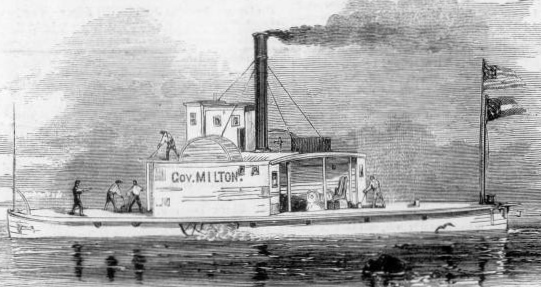
The rebel steamer Governor Milton, captured by the U.S. flotilla in St. John’s River, Florida (Frank Leslie’s Illustrated Newspaper, courtesy: State Archives of Florida, Florida Memory Project, public domain).
Companies E and K of the 47th Pennsylvania were then led by Captain Yard on a special mission with other Union Army soldiers in the reconnaissance and recapture of the city of Jacksonville, Florida on 5 October 1862. A day later, after receiving intelligence that a Confederate steamer — the Governor Milton — was engaged in furnishing troops, ammunition and food to Confederate Army units scattered throughout the region, men from the 47th Pennsylvania’s Companies E and K boarded the Union gunboat Darlington (a former Confederate steamer) — and set out in search of that steamer. Traveling two hundred miles along the Saint John’s River — with protection from the Union gunboat Hale — th 47th Pennsylvanians found their prize at a dock in Hawkinsville, Florida, captured it and steamed it back down the river to place it safely behind Union Navy lines. According to Schmidt, Corporal George R. Nichols of E Company was one of the men involved in that ship’s capture and later described that mission:
At 9 PM … October 7, discovered the steamer Gov. Milton in a small creek, 2 miles above Hawkinsville; boarded her in a small boat, and found that she had been run in there but a short time before, as her fires were not yet out. Her engineer and mate, then in charge, were asleep on board at the time of her capture. They informed us that owing to the weakness of the steamer’s boiler we found her where we did….
I commanded one of the Small Boats that went in after her. I was Boatman and gave orders when the headman jumped on Bord [sic] take the Painter with him. That however Belongs to Wm. Adams or Jacob Kerkendall. It was So dark I could not tell witch [sic] Struck the deck first. But when I Struck the deck I demanded the Surrend [sic] of the Boat in the name of the U.S. after we had the boat an offercier [sic] off [sic] the Paul Jones, a Gun Boat was with us he ask me how Soon could I move her out in the Stream I said five minuts [sic]. So an Engineer one of coulered [sic] Men helped Me. and I will Say right hear [sic] he learned Me More than I ever knowed about Engineering. Where we started down the River we was one hundred and twenty five miles up the river. When we Stopped at Polatkey [Palatka] to get wood for the Steamer I went out and Borrowed a half of a deer that hung up in a [sic] out house and a bee hive for some honey for the Boys. I never forget the boys.
Integration of the Regiment
Meanwhile, back at its South Carolina base of operations, the 47th Pennsylvania was making history as it became an integrated regiment. On 5 and 15 October 1862, respectively, the regiment added to its muster rolls several young Black men who had endured plantation enslavement near Beaufort or in Georgetown County, including sixteen-year-old Abraham Jassum, twenty-two-year-old Edward Jassum and thirty-three-year-old Bristor Gethers — all of whom would go on to successfully complete their three-year periods of enlistment and be honorably discharged in October 1865.
Battle of Pocotaligo, South Carolina

Highlighted version of the U.S. Army map of the Coosawhatchie-Pocotaligo Expedition, 22 October 1862 (public domain).
From 21-23 October, under the brigade and regimental commands of Colonel Tilghman H. Good and Lieutenant-Colonel George Warren Alexander, members of the 47th Regiment, Pennsylvania Volunteer Infantry joined with other Union regiments to engage the heavily protected Confederate forces in and around Pocotaligo, South Carolina — including at Frampton’s Plantation and the Pocotaligo Bridge — a key part of the area’s railroad infrastructure that was targeted for destruction by senior Union officers.
Harried by snipers en route to the Pocotaligo Bridge, they met resistance from yet another entrenched, heavily fortified Confederate battery which opened fire on the Union troops as they entered an open cotton field. Those headed toward higher ground at the Frampton Plantation fared no better as they encountered artillery and infantry fire from the surrounding forests. But the Union soldiers would not give in; grappling with the Confederates where they found them, they pursued the Rebels for four miles as the Confederate Army retreated to the bridge. There, the 47th relieved the 7th Connecticut. Unfortunately, the enemy was just too well armed. After two hours of intense fighting in an attempt to take the ravine and bridge, the 47th was forced by depleted ammunition supplies to withdraw to Mackay’s Point.
Losses for the 47th Pennsylvania were significant. Captain Charles Mickley of G Company was killed, and Captain George Junker of Company K was mortally wounded. Privates Henry A. Backman, Nathan George, Samuel Minnich, George B. Rose and fourteen other enlisted men died; a total of one hundred and fourteen had been wounded in action.
On 23 October, the surviving 47th Pennsylvania Volunteers returned to Hilton Head, where several members were appointed later that month to serve as the funeral honor guard for Major-General Ormsby M. Mitchel, the commander of the U.S. Army’s 10th Corps and Department of the South who succumbed to yellow fever on 30 October.
1863
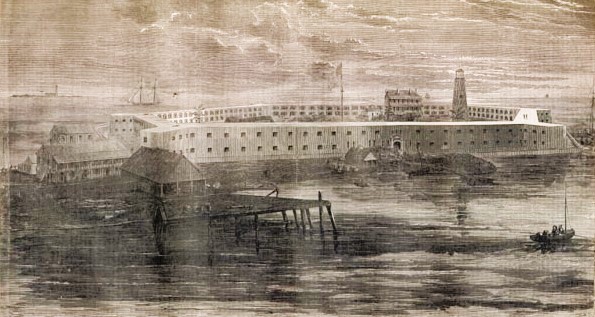
Fort Jefferson and its wharf areas, Dry Tortugas, Florida (Harper’s Weekly, 23 February 1861, public domain).
Having been ordered back to Key West on 15 November 1862, the 47th Pennsylvania Volunteers subsequently spent the entire year of 1863 garrisoning federal installations in Florida as part of the U.S. Army’s 10th Corps, Department of the South. Once again, the men of E Company joined with Companies A, B, C, G, and I in guarding Key West’s Fort Taylor while Companies D, F, H, and K garrisoned Fort Jefferson, the Union’s remote outpost in the Dry Tortugas off the coast of Florida.
According to the U.S. Army’s records collection known as “Returns from Military Posts,” sometime shortly after returning to Key West, Company E’s First Lieutenant Lawrence Bonstine was assigned to special duty as post adjutant — a position he continued to hold from at least 10 January 1863 through the end of December 1863. Reporting directly to the regiment’s commanding officer, Colonel Tilghman Good, he was essentially Good’s right hand, and was responsible for ensuring that regimental records and reports to senior military officials were kept up to date.
On 5 March 1863, Private William H. Eichman was promoted to the rank of corporal, and exactly one month later, on 5 April 1863, Second Lieutenant W. Scott Johnston was promoted to the rank of first lieutenant and also appointed as adjutant with the central regimental staff.
Garrisoning Federal Forts to Weaken the Confederacy
Prior to intervention by the Union Army and Navy, the owners of plantations, livestock ranches and fisheries, as well as the operators of smaller family farms across Florida, had been able to consistently furnish beef and pork, fish, fruits, and vegetables to Confederate troops stationed throughout the Deep South during the first year of the American Civil War. Large herds of cattle were raised near Fort Myers, for example, while orchard owners in the Saint John’s River area were actively engaged in cultivating sizeable orange groves. Florida was also a major producer of salt, which was used as a preservative for food. Consequently, the 47th Pennsylvania Volunteers and other Union troops across Florida were ordered to capture or destroy salt manufacturing plants in order to further curtail the enemy’s access to food.
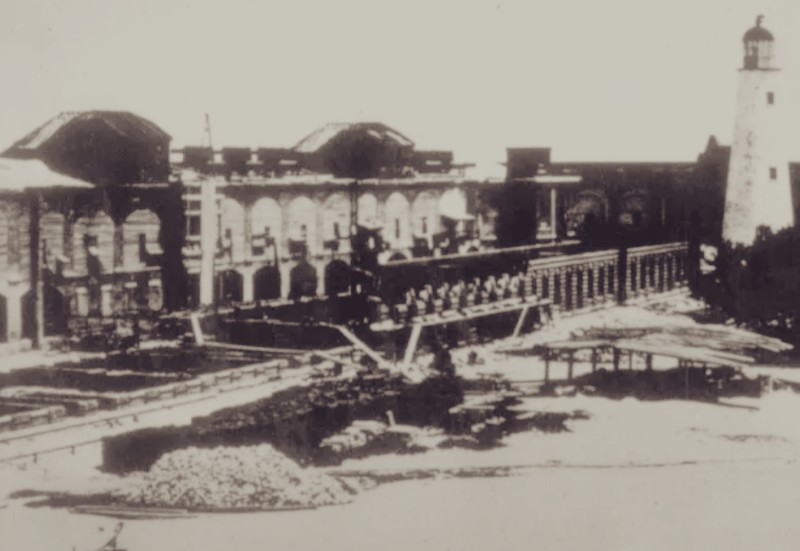
Lighthouse at Fort Jefferson, Dry Tortugas, Florida, circa 1863 (U.S. National Park Service, public domain).
On 16 May 1863, garrison staffing arrangements were adjusted as the members of Company D relocated from Fort Jefferson in the Dry Tortugas to Fort Taylor in Key West. Around that same time, Captain Charles Yard boarded a ship with a number of his Company E men and headed for Fort Jefferson.
As with the 47th Pennsylvania Volunteers’ previous assignments, officers and enlisted members of the regiment soon came to realize that disease would again be their constant companion and foe — making it all the more remarkable that, during that phase of service, the majority of 47th Pennsylvania Volunteers chose to re-enlist when their three-year service terms were up.
1864
As the New Year dawned in Florida for the 47th Pennsylvania Volunteers, life continued much as it had throughout 1863. The majority of men assigned to Companies A, B, C, D, G, and I were still garrisoning Fort Taylor in Key West, while men from Companies E, F, H, and K were still stationed at Fort Jefferson in the Dry Tortugas. Garrison staffing was adjusted again, however, when senior officers of the 47th Pennsylvania Volunteer Infantry were ordered to expand the Union Army’s reach by sending part of the regiment north to rehabilitate Fort Myers, which had been abandoned in 1858 following the U.S. government’s third war with the Seminole Indians. Per orders issued earlier in 1864 by Major-General D. P. Woodbury, commanding officer, U.S. Department of the Gulf, District of Key West and the Tortugas, that the fort be reclaimed to facilitate the Union’s Gulf Coast blockade, Captain Richard Graeffe and a detachment of men from Company A were assigned to the duty of raiding cattle herds in northern Florida in order to provide food for the growing Union troop presence in the state. Graeffe and his men subsequently turned the fort into both their base of operations and a shelter for pro-Union supporters, Confederate Army deserters and men, women and children who had escaped from enslavement and feared being recaptured or killed.
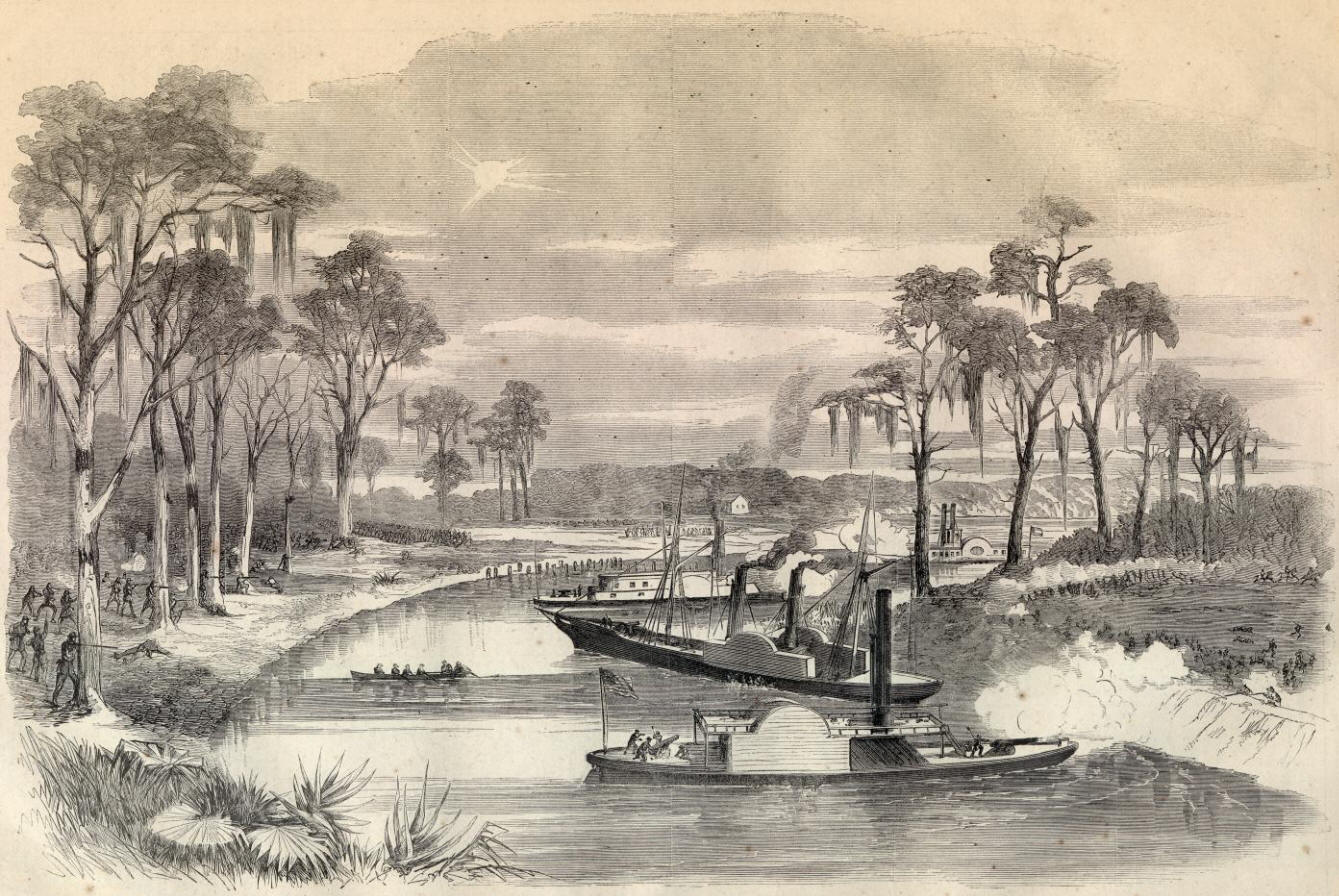
Bayou Teche, Louisiana (Harper’s Weekly, 14 February 1863, public domain).
Then, as January gave way to February, the 47th Pennsylvania Volunteers received new orders and began preparing to embark on what would turn out to be a history-making assignment in Louisiana. Boarding yet another steamer — the Charles Thomas — on 25 February 1864, the men from Companies B, C, D, I, and K of the 47th Pennsylvania headed for Algiers, Louisiana (across the river from New Orleans), followed on 1 March by Private William James and the members of Companies E, F, G, and H who had been stationed at Fort Jefferson in the Dry Tortugas. Upon that second group’s arrival, the now almost fully reunited regiment moved by train on 28 February to Brashear City (now Morgan City, Louisiana) before heading to Franklin by steamer through the Bayou Teche. Once there, the 47th Pennsylvania Volunteer Infantry joined the 2nd Brigade, 1st Division of the Department of the Gulf’s 19th Army Corps, and became the only Pennsylvania regiment to serve in the Red River Campaign of Union Major-General Nathaniel P. Banks. (Unable to reach Louisiana until 23 March, the men from Company A were placed on a different type of detached duty in New Orleans while they awaited transport to enable them to catch up to the main part of their regiment. Charged with guarding and overseeing the transport of two hundred and forty-five Confederate prisoners, they were finally able to board the Ohio Belle on 7 April, and reached Alexandria with those prisoners on 9 April.)
Red River Campaign
The early days on the ground in Louisiana quickly woke the 47th Pennsylvania Volunteers up to just how grueling that new phase of duty would be. From 14-26 March, most members of the regiment marched for Alexandria and Natchitoches, Louisiana, by way of New Iberia, Vermilionville (now part of Lafayette), Opelousas, and Washington.
From 4-5 April 1864, the regiment added to its roster of young Black soldiers when Aaron Bullard (later known as Aaron French), James Bullard, John Bullard, Samuel Jones, and Hamilton Blanchard (also known as John Hamilton) enrolled for military service with the 47th Pennsylvania at Natchitoches. According to their respective entries in the Civil War Veterans’ Card File at the Pennsylvania State Archives and on regimental muster rolls, the men were then officially mustered in for duty on 22 June at Morganza. Several of their entries noted that they were assigned the rank of “(Colored) Cook” while others were given the rank of “Under-Cook.”
Often short on food and water throughout their long harsh-climate trek through enemy territory, the men encamped briefly at Pleasant Hill (now the Village of Pleasant Hill) the night of 7 April before continuing on the next day.
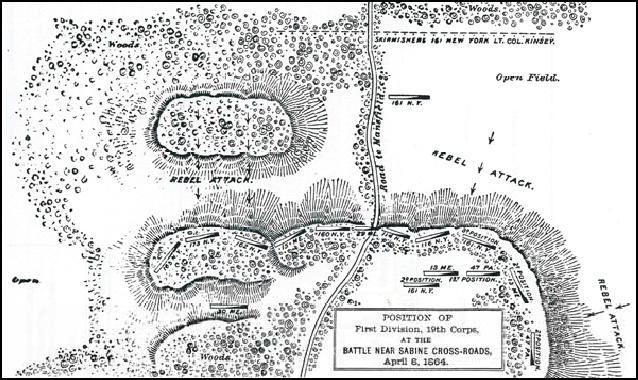
19th U.S. Army Map, Phase 3, Battle of Sabine Cross Roads/Mansfield (8 April 1864, public domain).
Marching until mid-afternoon on 8 April, the 47th Pennsylvania Volunteers were rushed into battle ahead of other regiments in the 2nd Division. Sixty members of the 47th were cut down that day during the volley of fire unleashed in the Battle of Sabine Cross Roads (also known as the Battle of Mansfield due to its proximity to the town of Mansfield). The fighting waned only when darkness fell, as the exhausted, but uninjured men collapsed beside the gravely wounded and the dead. After midnight, the surviving Union troops withdrew to Pleasant Hill.
The next day, the 47th Pennsylvania Volunteers were ordered into a critically important defensive position at the far right of the Union lines, their right flank spreading up onto a high bluff. By 3 p.m., after enduring a midday charge by the troops of Confederate Major-General Richard Taylor (a plantation owner who was the son of Zachary Taylor, former president of the United States), the brutal fighting still showed no signs of ending. Suddenly, just as the 47th was shifting to the left side of the massed Union forces, the men of the 47th Pennsylvania were forced to bolster the 165th New York’s buckling lines by blocking another Confederate assault, during what has since become known as the Battle of Pleasant Hill.
Casualties were severe. Second Lieutenant Alfred Swoyer of Company K and Private Richard Hahn of Company E were killed in action. The regiment’s second-in-command, Lieutenant-Colonel Alexander, was grievously wounded, and the regiment’s two color-bearers, both from Company C, were also seriously wounded while preventing the American flag from falling into enemy hands. Still others from the 47th were captured by Confederate troops, marched roughly one hundred and twenty-five miles to Camp Ford, a Confederate Army prison camp near Tyler, Texas, and held there as prisoners of war until they were released during prisoner exchanges that began on 22 July and dragged on into November. Sadly, multiple members of the 47th Pennsylvania never made it out alive.
Following what some historians have called a rout by Confederates at Pleasant Hill and others have labeled a technical victory for the Union or a draw for both sides, the 47th Pennsylvanians fell back to Grand Ecore to resupply and regroup. They remained at Grand Ecore for a total of eleven days (through 22 April 1864), where they engaged in the hard labor of strengthening regimental and brigade fortifications in a brutal climate. They then moved back to Natchitoches Parish, where they arrived in Cloutierville at 10 p.m. that night, after marching forty-five miles. En route, the Union forces were attacked again — this time in the rear, but they were able to end the encounter quickly and continue on.

The 47th Pennsylvania Volunteers were stationed just to the left of the “Thick Woods” with Emory’s 2nd Brigade, 1st Division as shown on this map of Union troop positions for the Battle of Cane River Crossing at Monett’s Ferry, Louisiana, 23 April 1864 (Major-General Nathaniel Banks’ official Red River Campaign Report, public domain).
The next morning (23 April 1864), episodic skirmishing quickly roared into the flames of a robust fight. As part of the advance party led by Union Brigadier-General William Emory, the 47th Pennsylvania took on the Confederate cavalry of Brigadier-General Hamilton P. Bee during the Battle of Cane River (also known as “the Affair at Monett’s Ferry” or the “Cane River Crossing”).
Responding to a barrage from the Confederate’s twenty-pound Parrott guns and raking fire from enemy troops situated near a bayou and on a bluff, Brigadier-General Emory directed one of his brigades to keep Bee’s Confederates busy while sending the other two brigades to find a safe spot where his Union troops could ford the Cane River. As part of the “beekeepers,” the 47th Pennsylvanians supported Emory’s artillery.
Meanwhile, other troops under Emory found and worked their way across the Cane River, attacked Bee’s flank, and forced a Rebel retreat. That Union brigade then erected a series of pontoon bridges, enabling the 47th and other remaining Union units to make the Cane River Crossing by the next day. As the Confederates retreated, they torched their own food stores, as well as the cotton supplies of their fellow southerners. In a letter penned from Morganza, Louisiana on 29 May, Henry Wharton described what happened to the 47th Pennsylvanians during and immediately after making camp at Grand Ecore:
Our sojourn at Grand Ecore was for eleven days, during which time our position was well fortified by entrenchments for a length of five miles, made of heavy logs, five feet high and six feet wide, filled in with dirt. In front of this, trees were felled for a distance of two hundred yards, so that if the enemy attacked we had an open space before us which would enable our forces to repel them and follow if necessary. But our labor seemed to the men as useless, for on the morning of 22d April, the army abandoned these works and started for Alexandria. From our scouts it was ascertained that the enemy had passed some miles to our left with the intention of making a stand against our right at Bayou Cane, where there is a high bluff and dense woods, and at the same attack Smith’s forces who were bringing up the rear. This first day was a hard one on the boys, for by ten o’clock at night they made Cloutierville, a distance of forty-five miles. On that day the rear was attacked which caused our forces to reverse their front and form in line of battle, expecting too, to go back to the relief of Smith, but he needed no assistance, sending word to the front that he had ‘whipped them, and could do it again.’ It was well that Banks made so long a march on that day, for on the next we found the enemy prepared to carry out their design of attacking us front and rear. Skirmishing commenced early in the morning and as our columns advanced he fell back towards the bayou, when we soon discovered the position of their batteries on the bluff. There was then an artillery duel by the smaller pieces, and some sharp fighting by the cavalry, when the ‘mule battery,’ twenty pound Parrott guns, opened a heavy fire, which soon dislodged them, forcing the chivalry to flee in a manner not at all suitable to their boasted courage. Before this one cavalry, the 3d Brigade of the 1st Div., and Birges’ brigade of the second, had crossed the bayou and were doing good service, which, with the other work, made the enemy show their heels. The 3d brigade done some daring deeds in this fight, as also did the cavalry. In one instance the 3d charged up a hill almost perpendicular, driving the enemy back by the bayonet without firing a gun. The woods on this bluff was so thick that the cavalry had to dismount and fight on foot. During the whole of the day, our brigade, the 2d was supporting artillery, under fire all the time, and could not give Mr. Reb a return shot.
While we were fighting in front, Smith was engaged some miles in the rear, but he done his part well and drove them back. The rebel commanders thought by attacking us in the rear, and having a large face on the bluffs, they would be able to capture our train and take us all prisoners, but in this they were mistaken, for our march was so rapid that we were on them before they had thrown up the necessary earthworks. Besides they underrated the amount of our artillery, calculating from the number engaged at Pleasant Hill. The rebel prisoners say it ‘seems as though the Yankees manufacture, on short notice, artillery to order, and the men are furnished with wings when they wish to make a certain point.
The damage done to the Confederate cause by the burning of cotton was immense. On the night of the 22d our route was lighted up for miles and millions of dollars worth of this production was destroyed. This loss will be felt more by Davis & Co., than several defeats in this region, for the basis of the loan in England was on the cotton of Western Louisiana.
After the rebels had fled from the bluff the negro troops put down the pontoons, and by ten that night we were six miles beyond the bayou safely encamped. The next morning we moved forward and in two days were in Alexandria. Johnnys followed Smith’s forces, keeping out of range of his guns, except when he had gained the eminence across the bayou, when he punished them (the rebs) severely.
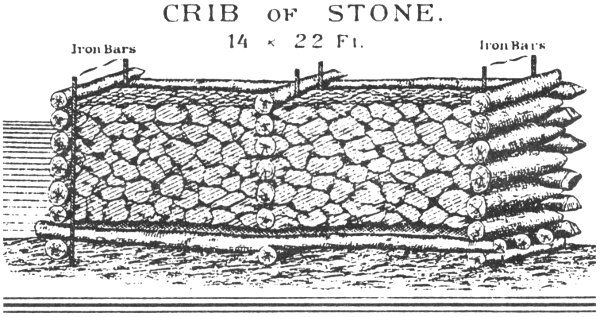
Sketches of the crib and tree dams designed by Lieutenant-Colonel Joseph Bailey to improve the water levels of the Red River near Alexandria, Louisiana, spring 1864 (Joseph Bailey, “Report on the Construction of the Dam Across the Red River,” 1865, public domain).
Having finally reached Alexandria on 26 April, the 47th Pennsylvania Volunteers learned they would remain at their latest new camp for at least two weeks. Placed temporarily under the command of Lieutenant-Colonel Joseph Bailey, they were assigned yet again to the hard labor of fortification work — this time helping to erect “Bailey’s Dam,” a timber structure that enabled Union gunboats to more easily make their way back down the Red River. According to Wharton:
We were at Alexandria seventeen days, during which time the men were kept busy at throwing up earthworks, foraging and three times went out some distance to meet the enemy, but they did not make their appearance in numbers large enough for an engagement. The water in the Red river had fallen so much that it prevented the gunboats from operating with us, and kept our transports from supplying the troops with rations, (and you know soldiers, like other people, will eat) so Banks was compelled to relinquish his designs on Shreveport and fall back to the Mississippi. To do this a large dam had to be built on the falls at Alexandria to get the ironclads down the river. After a great deal labor this was accomplished and by the morning of May 13th the last one was through the shute [sic], when we bade adieu to Alexandria, marching through the town with banners flying and keeping step to the music of ‘Rally around the flag,’ and ‘When this cruel war is over.’ The next morning, at our camping place, the fleet of boats passed us, when we were informed that Alexandria had been destroyed by fire – the act of a dissatisfied citizen and several negroes. Incendiary acts were strictly forbidden in a general order the day before we left the place, and a cavalry guard was left in the rear to see the order enforced. After marching a few miles skirmishing commenced in front between the cavalry and the enemy in riflepits [sic] on the bank of the river, but they were easily driven away. When we came up we discovered their pits and places where there had been batteries planted. At this point the John Warren, an unarmed transport, on which were sick soldiers and women, was fired into and sunk, killing many and those that were not drowned taken prisoners. A tin-clad gunboat was destroyed at the same place, by which we lost a large mail. Many letters and directed envelopes were found on the bank – thrown there after the contents had been read by the unprincipled scoundrels. The inhumanity of Guerrilla bands in this department is beyond belief, and if one did not know the truth of it or saw some of their barbarities, he would write it down as the story of a ‘reliable gentleman’ or as told by an ‘intelligent contraband.’ Not satisfied with his murderous intent on unarmed transports he fires into the Hospital steamer Laurel Hill, with four hundred sick on board. This boat had the usual hospital signal floating fore and aft, yet, notwithstanding all this, and the customs of war, they fired on them, proving by this act that they are more hardened than the Indians on the frontier.
On Sunday, May 15, we left the river road and took a short route through the woods, saving considerable distance. The windings of Red river are so numerous that it resembles the tape-worm railroad wherewith the politicians frightened the dear people during the administration of Ritner and Stevens. – We stopped several hours in the woods to leave cavalry pass, when we moved forward and by four o’clock emerged into a large open plain where we formed in line of battle, expecting a regular engagement. The enemy, however, retired and we advanced ‘till dark, when the forces halted for the night, with orders to rest on their arms. – ‘Twas here that Banks rode through our regiment, amidst the cheers of the boys, and gave the pleasant news that Grant had defeated Lee.

“Sleeping on Their Arms” by Winslow Homer (Harper’s Weekly, 21 May 1864).
Having entered Avoyelles Parish, they “rested on their arms” for the night, half-dozing without pitching their tents, but with their rifles right beside them. They were now positioned just outside of Marksville, Louisiana on the eve of the 16 May 1864 Battle of Mansura, which unfolded as follows, according to Wharton:
Early next morning we marched through Marksville into a prairie nine miles long and six wide where every preparation was made for a fight. The whole of our force was formed in line, in support of artillery in front, who commenced operations on the enemy driving him gradually from the prairie into the woods. As the enemy retreated before the heavy fire of our artillery, the infantry advanced in line until they reached Mousoula [sic, Mansura], where they formed in column, taking the whole field in an attempt to flank the enemy, but their running qualities were so good that we were foiled. The maneuvring [sic] of the troops was handsomely done, and the movements was [sic] one of the finest things of the war. The fight of artillery was a steady one of five miles. The enemy merely stood that they might cover the retreat of their infantry and train under cover of their artillery. Our loss was slight. Of the rebels we could not ascertain correctly, but learned from citizens who had secreted themselves during the fight, that they had many killed and wounded, who threw them into wagons, promiscuously, and drove them off so that we could not learn their casualties. The next day we moved to Simmsport [sic, Simmesport] on the Achafalaya [sic, Atchafalaya] river, where a bridge was made by putting the transports side by side, which enabled the troops and train to pass safely over. – The day before we crossed the rebels attacked Smith, thinking it was but the rear guard, in which they, the graybacks, were awfully cut up, and four hundred prisoners fell into our hands. Our loss in killed and wounded was ninety. This fight was the last one of the expedition. The whole of the force is safe on the Mississippi, gunboats, transports and trains. The 16th and 17th have gone to their old commands.
It is amusing to read the statements of correspondents to papers North, concerning our movements and the losses of our army. I have it from the best source that the Federal loss from Franklin to Mansfield, and from their [sic] to this point does not exceed thirty-five hundred in killed, wounded and missing, while that of the rebels is over eight thousand.

Union Army base at Morganza Bend, Louisiana, circa 1863-1865 (U.S. Library of Congress, public domain).
While encamped at Morganza, the nine formerly enslaved Black men who had enlisted with the 47th Pennsylvania in Beaufort, South Carolina (1862) and Natchitoches, Louisiana (April 1864) were officially mustered into the regiment between 20-24 June 1864. During that same phase of duty, E Company Corporal Francis Parks was promoted to the rank of sergeant (on 22 June 1864).
The regiment was then ordered to move on and headed for New Orleans, arriving there in late June. As they did during their tour through the Carolinas and Florida, the men serving with the 47th Pennsylvania had battled the elements, disease and the Confederate States Army, holding out hope that they would preserve America’s Union.
On 7 July 1864, Private William James and his fellow E Company men boarded yet another steamer, the U.S. McClellan, along with the 47th Pennsylvania’s Companies A, C, D, F, H, and I, and returned to the Washington, D.C. area. Following their arrival and a memorable encounter with President Abraham Lincoln, they then joined Major-General David Hunter’s forces at Snicker’s Gap, Virginia to fight in the Battle of Cool Spring.
Sheridan’s 1864 Shenandoah Valley Campaign
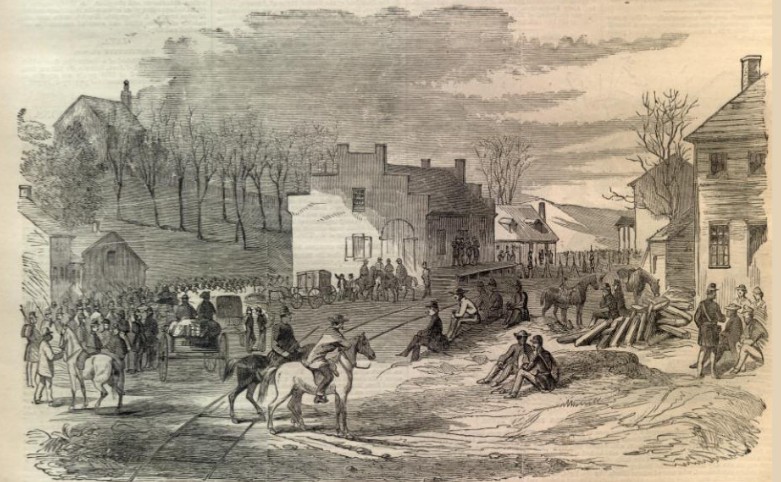
“The Rendezvous of the Virginians at Halltown, Virginia, 5 p.m. on April 18, 1861 to March on Harper’s Ferry” (D. H.Strother, Harper’s Weekly, 11 May 1861, public domain).
Attached to the Middle Military Division, United States’ Army of the Shenandoah commanded by Union Major-General Philip Sheridan, the ten companies of roughly one hundred men each that made up the 47th Pennsylvania Volunteer Infantry took part in a series of back-and-forth movements between Halltown, Berryville, Middletown, Charlestown, and Winchester, Virginia, beginning in August 1864. Skirmishing here and there with troops led by Confederate Lieutenant-General Jubal Early, the regiment then went head to head with a larger group of Early’s men in the Battle of Berryville between 3-4 September.
Two weeks later, Company D’s Captain Henry Woodruff, E Company’s Captain Charles H. Yard and Captain Henry S. Harte of F Company all mustered out at Berryville upon expiration of their respective three-year terms of service, along with multiple other members of the regiment, including Private William McHenry James.
Return to Civilian Life
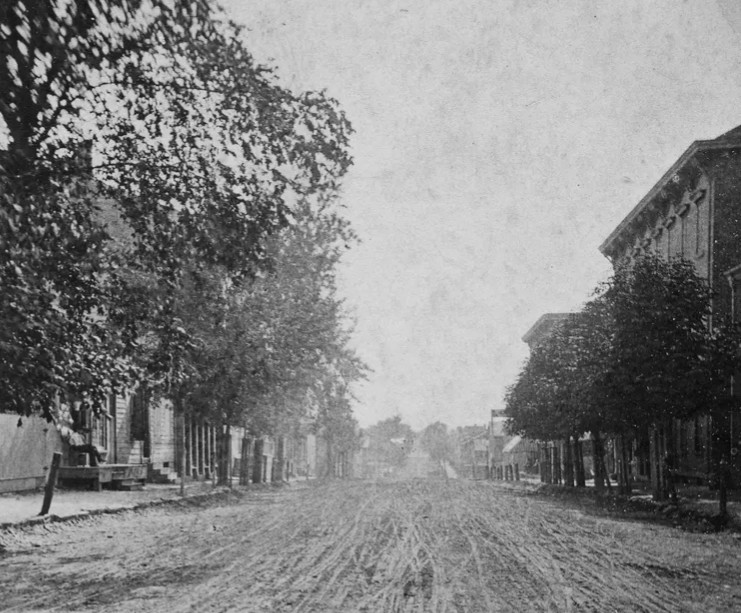
Market Street, Lewisburg, Union County, Pennsylvania, circa 1873 (public domain; click to enlarge).
Following his honorable discharge from the military, William M. James gradually began to resume aspects of his pre-war life as he pondered what the future might hold for him. On 3 September 1868, he married Caroline Criswell (1845-1920) at the home of her parents, James and Jennie Criswell, in Lewisburg, Union County, Pennsylvania. Employed as a clerk in a store in Lewisburg by 1870, he resided with his wife in that borough’s South Ward, where they became the parents of: Sallie James (1870-1888; given name variants: “Carrie” and “Clara”), who was born on the Fourth of July in 1870; Willie James (1872-1873), who was born on 6 February 1872, but would die in Lewisburg at the age of one year, seven months and ten days on 16 September 1873 and be buried at the Lewisburg Cemetery; and Edith Criswell James (1876-1956), who was born in Lewisburg on 8 September 1876 and would later wed Alfred Joel Feight (1875-1908).
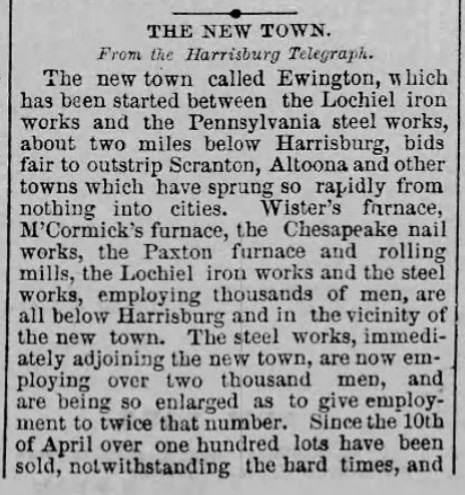
News article profiling the growing community of Ewington in Dauphin County, Pennsylvania (The Patriot, Harrisburg, Pennsylvania, 2 Aug 1876, public domain).
On 22 November 1879,William M. James applied for a U.S. Civil War Pension, which was subsequently awarded to him. Then, sometime prior to the federal census of June 1880, he and his wife packed up their daughters, moved to Dauphin County and settled in Ewington, which had grown from thirty-seven houses in 1875 to one hundred and thirty-seven homes in 1876, largely thanks to several real estate developers, including William M. James’ brother-in-law, Truman H. Purdy (1830-1898). By 1880, the community was home to many of the railroad and steel workers who were employed in neighboring Steelton. (As Steelton continued to thrive and expand outward, Ewington would ultimately become one of that borough’s neighborhoods.) Employed as a grocer during that summer of 1880, William’s household included his wife and their daughters Clara and Edith. During that same period of his life he was also an active member of his local chapter of the Grand Army of the Republic (G.A.R.).
But the latter part of that decade would prove to be an unhappy time for William and Caroline James due to the death of their daughter, Sallie James (1870-1886), who fell ill with peritonitis on Wednesday, 10 February 1886 and died at her family’s home in Steelton at the age of fifteen, on 15 February 1886. Following funeral services, her remains were returned to Union County for burial at the Lewisburg Cemetery, where her baby brother, Willie, had been laid to rest in 1873. According to the Harrisburg Telegraph:
The late elder daughter of Mr. Wm. James, of Steelton, ha[d] been during the past five years a pupil of Miss Woodward’s seminary. As a result of uninterrupted attendance, and the conscientious exercise of naturally fine abilities, she was at the time of her death, although not yet sixteen years old, a member of the class of ’86, and had she lived would have completed her course of study next June with honor, doubtless, to herself and the school. Although the recollections of her pupil life will always be a source of gratification to her parents and teachers, it is not as a student that Sallie James will be chiefly remembered. No friend who has known the cheeriness of her merry heart and loved her sweet, winsome face, can escape the knowledge that her death has taken from his daily life some of its accustomed sunshine. Her presence always brought with it brightness, and she seemed a creature formed for happiness.
Although enjoying every prospect which makes life in this world alluring, and fully conscious that death was approaching, she died as she lived — with an unclouded spirit and a heart full of love. Her last words were messages of kindness to absent friends and words of cheer and comfort to her sorrowing parents. Seldom has it been granted to one whose life was so short to bring so much of sunshine and good-will into this world, where sunshine is always welcome, and good-will a message from the angels.
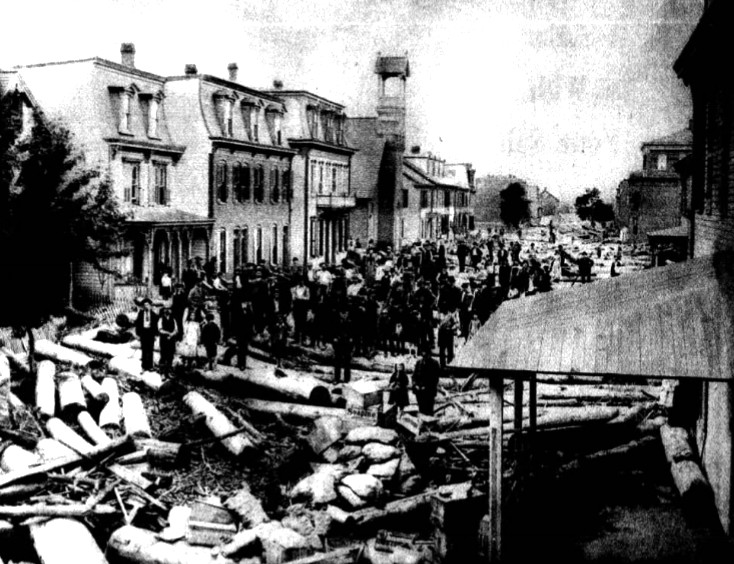
June 1889 flood, Steelton, Pennsylvania (“Rotogravure Section,” The Evening News, Harrisburg, Pennsylvania, 10 October 1931; click to enlarge).
Another tragedy then struck — the Great Flood and Storms of 1889 — which impacted multiple families across Pennsylvania, including the residents of Steelton. According to the U.S. National Weather Service:
On May 31, 1889, a catastrophic failure of the South Fork Dam on the Little Connemaugh River, approximately 14 miles upstream of Johnstown, Pennsylvania, resulted in one of the worst natural catastrophes in the history of the United States, creating the largest loss of life from a natural disaster not caused by a hurricane or earthquake.
Intense heavy rains fell across the area in the day preceding the failure, and the poorly maintained earthen dam weakened and subsequently failed during the afternoon hours. This sudden failure sent a torrent of water down a canyon, into the heart of Johnstown. It was reported that the flood wave produced a wall of water 35 feet high and a half mile wide….
Flooding was also widespread across the state from this weather event. Major flooding was reported along the West Branch of the Susquehanna River. The prosperous lumber town of Williamsport reported that 75 percent of the town was under water during the peak of the flooding.
According to the Johnstown Area Heritage Association, “The rain, which began in the late afternoon of Thursday, May 30, continued with increased violence until Saturday, June 1. Clearfield borough had flooded streets by 5 a.m., May 31…. Renovo, southeast of Clearfield on the West Branch, was flooded by evening, May 31.”
At 8 p.m. [on 31 May 1889], the West Branch [of the Susquehanna River] at Lock Haven began to rise rapidly…. The log dam held until 2 a.m., Saturday, June 1, when it broke with a great roar….
The West Branch was running seventeen feet deep at the time that the boom at Lock Haven broke. With the endless procession of the 73,000,000 million feet of lumber spanning the river, the flood bore down on Williamsport where another log boom crossed the river.
The flood entered Williamsport at 3 a.m., Saturday morning [1 June 1889].
That same day (1 June 1889), flood waters also spread through the streets, homes and businesses of multiple communities across the region, including the Borough of Steelton, where members of the James family were living. According to a retrospective report that was published in the 10 October 1931 edition Harrisburg’s Evening News, “logs were backed up to Main and Conestoga streets” (see photo, above right).
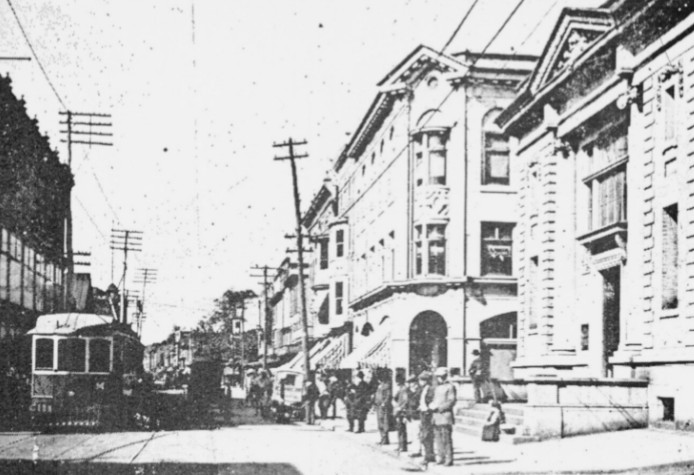
Steelton, Dauphin County, Pennsylvania, circa early 1900s (public domain; click to enlarge).
But the James family endured. Persevering in the face of adversity, they continued to reside in Steelton for another decade-plus, moving into a home at the corner of Main and Trewick streets that would later be described as “commodious” by the Star-Independent of Harrisburg. During that same period of his life, William M. James transitioned from his ownership of a successful grocery store “on Myers Street, near Trewick,” into a job as the supervisor of a planing mill in Steelton. By the turn of the century, William M. James and his wife, Caroline, were “empty nesters”; their daughter, Edith, had married and settled with her new husband in Cumberland County Pennsylvania.
Sadly, Caroline then fell ill. As her condition deteriorated, she became “an invalid” who was “entirely helpless,” according to subsequent reports in Harrisburg newspapers. Motivated to live closer to their daughter, Edith (James) Feight, William and Caroline James moved to Cumberland County. In 1910, he and his wife were documented as residents of 49 Market Street in the Borough of New Cumberland. Also residing with them was William’s widowed aunt, Elizabeth Spotts. Living nearby, at 50 Market Street, were William’s widowed daughter, Edith, and her sons, John William Feight (1900-1921) and James Shapley Feight (1908-1906), as well as Edith’s widowed sister-in-law, Jennie Feight.
Death and Interment
Worn out by his years of military service and years of caregiving for his ailing wife, William McHenry James died at the age of seventy in New Cumberland, Cumberland County, Pennsylvania on 27 January 1915. Following funeral services, his remains were returned to Union County for burial at the Lewisburg Cemetery in Lewisburg, Union County.
What Happened to the Widow and Surviving Daughter of William McHenry James?
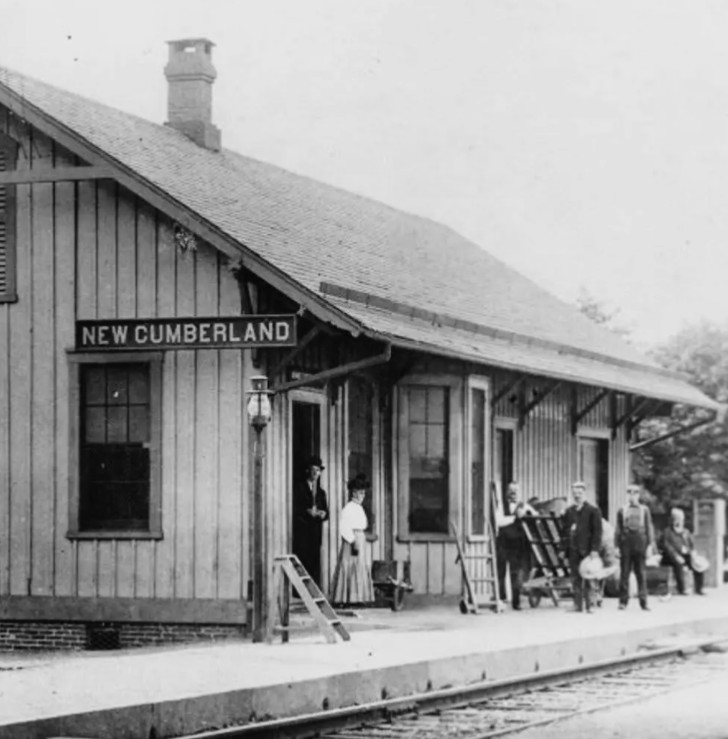
Unidentified travelers, New Cumberland railroad station, Borough of New Cumberland in Cumberland County, Pennsylvania, 1906 (public domain).
Roughly a month after her husband’s death, William M. James’ widow, Caroline (Criswell) James (1845-1920), filed for, and was subsequently awarded, a U.S. Civil War Widow’s Pension — a form of federal government assistance that enabled her daughter to care for her at home in New Cumberland. She then continued to reside at the home of her daughter, Edith Criswell (James) Feight, in New Cumberland for the remainder of her days, and died there at the age of seventy-three on 12 May 1920. Following funeral services, Caroline James was buried beside her husband at the Lewisburg Cemetery in Lewisburg, Union County.
Following her marriage to attorney and Shippensburg, Cumberland County, Pennsylvania native Alfred Joel Feight (1875-1908) in Steelton on 1 November 1899, William M. James’ daughter, Edith Criswell (James) Feight (1876-1956), settled with her husband in Cumberland County, where they became the parents of: John William Feight (1900-1921), who was born with hydrocephalus and epilepsy on 15 September 1900, and would die while still in his early twenties in New Cumberland on 25 February 1921 and be buried at the Spring Hill Cemetery in Shippensburg; and James Shapley Feight (1908-1986), who was born in New Cumberland on 24 February 1908 and would later become an attorney, a deputy state attorney general of the Commonwealth of Pennsylvania, a vice president and general counsel with Blue Cross, and the husband of Cambridge, Massachusetts native Eleanor Sara Verrill (1915-1994). Predeceased by her husband, Alfred J. Feight, when he died in his early thirties in Charleston, South Carolina on 6 December 1908, Edith (James) Feight continued to raise their children in New Cumberland. In 1910, her household also included her widowed sister-in-law; in 1920, it included her widowed mother, but not her sister-in-law; by 1930, it was just Edith and her son, James; by 1940, she was residing by herself in New Cumberland. After a long, full life, marked by sorrow and joy, Edith Criswell (James) Feight died at the age of seventy-nine at a hospital in Harrisburg on 4 April 1956. Survived by her son, James, a resident of Philadelphia, she was also buried at the Spring Hill Cemetery in Shippensburg.
What Happened to the Siblings of William McHenry James?
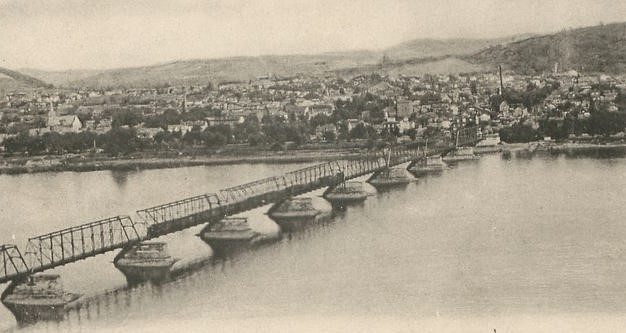
Railroad bridge leading to Sunbury, Pennsylvania, 19 May 1905 (public domain; click to enlarge).
Following his marriage to Sunbury, Pennsylvania resident Laura Irene Clement (1851-1891; alternate given name: “Lena”) at the home of her father, Ira T. Clement in Sunbury, Northumberland County, Pennsylvania on 15 February 1871, William M. James’ younger brother, Jacob Dieterich James (1846-1907), who was known to family and friends as “J. D.” or “Dieterich,” settled with his wife in Sunbury, where they became the parents of: Thornton Clement James (1874-1831), who was born in Sunbury on 19 October 1874, was baptized at Boehm’s Reformed Church in Sunbury on 16 December 1874 and would later wed Mary Elizabeth Walters (1876-1960) in Sunbury on 12 August 1896 and become a baggage master for the Pennsylvania Railroad; and Marion James (born 1876-died before June 1880), who was born in Sunbury on 13 June 1876, was baptized at Boehm’s Reformed Church in Sunbury on 12 August 1876 but appears to have died in infancy or early childhood because her name did not appear as a member of her father’s household on 1880 and 1900 federal census records, and also did not appear in later obituaries of her siblings. A practicing attorney during the summer of 1880, J. D. James resided in Sunbury’s West Ward with his wife, Laura, and their five-year-old son, Thornton. More children soon followed: Robert Evan James (1883-1956), who was born in Sunbury on 4 August 1883 and would later become a yardmaster with the Pennsylvania Railroad; Laura Irene James (1884-1973), who was born in Sunbury on 11 November 1884 and would later wed Frank C. Lohr (1877-1865) in Sunbury on 8 June 1910; Frances James (1886-1951), who was born in Sunbury on 10 January 1886, would become an accomplished pianist and would later wed John Kift on 21 April 1909; and Madeline “Tot” James (1891-1962), who was born in Sunbury on 7 September 1891 and would later wed Henry James Dick and settle with him in Brooklyn, New York City, New York before relocating to Harrisburg, Pennsylvania. During the late 1880s and early 1890s, J. D. James was employed as a traveling salesman — a job that frequently required him to travel great distances, leaving his wife to care for their growing family. Roughly forty years old when she had given birth to their final child (Madeline) in early September 1891, Laura contracted “La Grippe” (influenza) a short time later and died at their home in Sunbury on 7 December 1891. J. D. James then continued to reside in Sunbury with his children and subsequently found work as an agent for the United States Life Insurance Company in 1892. By 1900, however, he was living by himself at a boarding house that was operated by James and Mary Furman at 439 William Street in Williamsport, Lycoming County, Pennsylvania. A federal census enumerator described him as a fifty-four-year-old widowed lawyer who was residing there with eight other boarders who were employed in various occupations. After a challenging life, Jacob Dieterich James died at the age of sixty in Sunbury on 10 February 1907, and was laid to rest at a cemetery in Sunbury on 12 February, according to his entry in a death and burial ledger that was created for him by the pastor at Boehm’s Reformed Church in 1907. Researchers are continuing to search for the exact burial locations of Jacob and his wife.
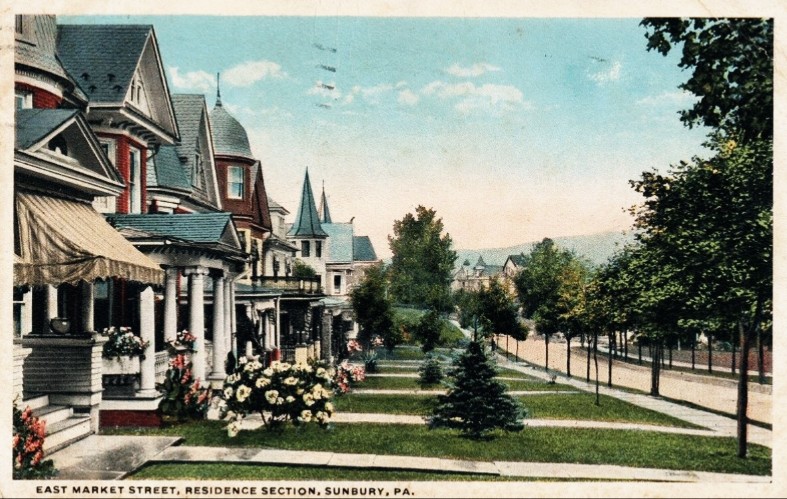
Postcard depicting the residential section of East Market Street in Sunbury, Northumberland County, Pennsylvania, circa early 1900s (public domain).
Following her marriage to Sunbury, Pennsylvania physician Hiram Long, M.D. (1831-1903) at the Methodist Church in Lewisburg, Union County, Pennsylvania on 28 October 1860, William M. James’ oldest sibling, Frances Minerva (James) Long (1839-1909), who had become known to family and friends as “Fanny,” had settled with her husband in Hartleton, Union County, where he operated medical practice. By 1870, he had amassed real estate and personal property valued at six thousand dollars (the equivalent of roughly one hundred fifty-three thousand U.S. dollars in 2026). Also living with them that year was seven-year-old George Spiece, who was enrolled in school. Residents of the Borough of Sunbury in Northumberland County by 1871, Frances and her husband lived by themselves in a home on Chestnut Street in that borough’s West Ward in 1880. Still childless by 1900, they resided at 1040 East Market Street in Sunbury’s Eighth Ward. Also living with them were sixteen-year-old Nettie Persing and fourteen-year-old Frances James, who were both still attending school, and twenty-three-year-old Maggie Sanders, who was a live-in servant. Widowed by her husband, Hiram, when he died from heart disease-related complications at the age of seventy-one in Sunbury on 24 April 1903, and was buried at the Pomfret Manor Cemetery in Sunbury, Frances Minerva (James) Long continued to reside at her home at 1040 East Market Street in Sunbury for the remainder of her days. Ailing with kidney disease, she died at her home at the age of sixty-nine on 10 April 1909, and was laid to rest beside her husband at the Pomfret Manor Cemetery. The Sunbury American subsequently described her as “a most estimable woman of noble traits of character, who was beloved by all who had the pleasure of her acquaintance.”
Although quiet and unassuming in her demeanor, Mrs. Long was a very active woman, ever ready to lend her aid and influence to any worthy cause. Her acts of charity were many and were performed in a quiet unostentatious manner and thus a great part of her worth and goodness was only known to the recipients of her kind heart, but her many good deeds will live after her and her memory will ever be cherished by those who knew and loved her.
She was a consistent member of the Presbyterian church for a period of thirty-seven years and always took a deep interest in church work, being one of the congregation’s most valued members. She served as the President of the Ladies Relief Corps of the G.A.R., and at the time of her death was both President of the Young Women’s Christian Association and the Ladies Aid to the Mary M. Packer hospital.
She is survived by two brothers, Robert E. James, of Easton, and William M. James, of New Columbia, and one sister, Mrs. T. H. Purdy, of Sunbury. Other surviving relatives residing in Sunbury are Thornton, Robert, Laura and Frances James, nephews and nieces, children of the late Dietrich James. Funeral Tuesday afternoon [20 April 1909] at 2:30 o’clock. Rev. Morton will officiate and interment in Pomfret Manor cemetery.
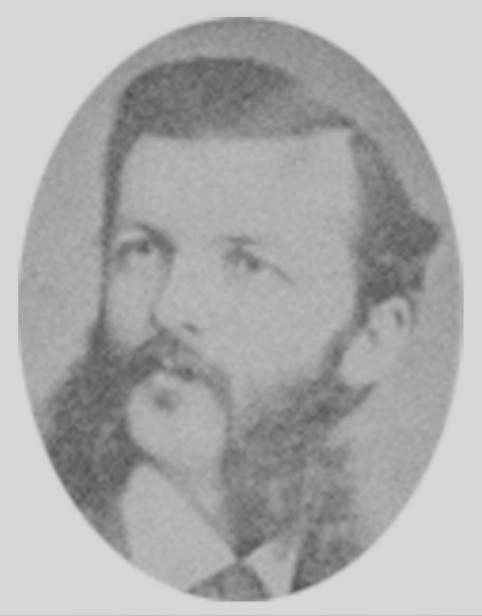
Robert Evan James (1848-1913), Pennsylvania House of Representatives, circa 1876 (public domain).
A student at Pennsylvania College (now known as Gettysburg College) and the Lewisburg Academy (now known as Bucknell University) prior to his graduation from Lafayette College in Easton during the late 1860s, William M. James’ younger brother, Robert Evan James (1848-1913), was initially employed as an educator at Towanda (1869) and the Nottingham Academy (1870) before serving as the principal of Easton High School during the early 1870s. After pursuing legal studies with Easton attorney Edward J. Fox, Robert E. James was admitted to the bar in 1872 and began to practice law. He would continue to be a member of the legal profession for the remainder of his days — even while making a name for himself in the fields of public service and banking. A Democrat, politically, he was elected as president of Easton’s school board (1875-1876). Married to Anna Barbara Heller (1850-1926) in Northampton County on 4 April 1877, he and his wife subsequently became the parents of: Robert Evans James, Jr. (1879-1957), who was born in Easton on 10 April 1879 and would later wed Margaret Ruth Mercer (1892-1971) and would also become a district attorney.
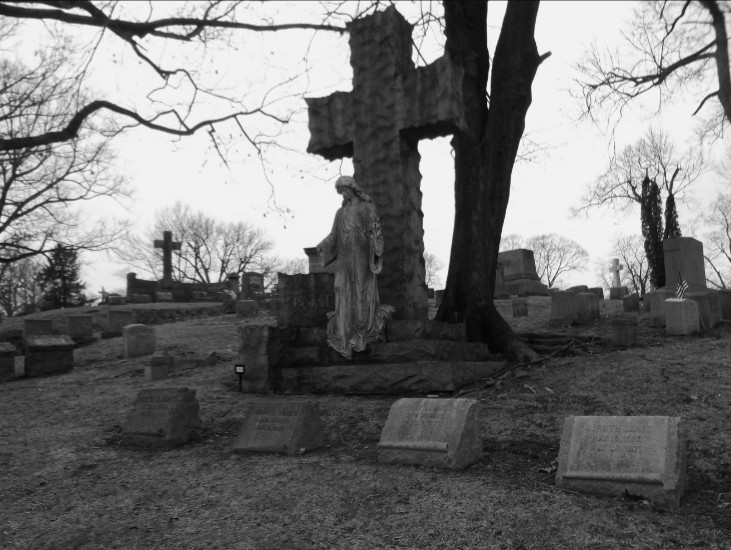
The family monument and headstones of banking executive Robert Evan James (1848-1913) and his family, Easton Cemetery, Easton, Pennsylvania (used with permission, courtesy of Rory Morgan).
As his family grew, so too did his visibility as a public servant. Elected as a Democrat to represent Northampton County in the Pennsylvania House of Representatives in 1876 and 1877, Robert Evan James, Sr. eschewed reelection to that legislative body, preferring instead to be elected as Northampton County’s solicitor (1879-1880) and district attorney (1881-1884). Unsuccessful in bids to become the governor of Pennsylvania (1882) and a Lebanon-Dauphin district judge (1883), he was subsequently appointed as a U.S. National Bank Examiner during the administrations of Presidents Grover Cleveland and Benjamin Harrison, during which time he assessed the health of financial institutions in Eastern Pennsylvania, New Jersey, and New York City (1885-1890) and devised strategies for their improvement. Hired by the Easton Trust Company in 1890, he served as a loan and trust officer prior to his appointment as that company’s president in 1893. He also chaired the Association of Trust Companies of the State of Pennsylvania and the law committee of the American Bankers Association. According to the Carbondale Leader, “His views on national financial questions were sought and given wide publicity.”
Ailing with gallbladder issues as he aged, he underwent a surgical procedure to remove gallstones in September 1913. Sent home to recuperate, Robert E. James, Sr. died there from surgical complications at the age of sixty-five on 10 November 1913. Following funeral services, he was laid to rest at the Easton Cemetery.
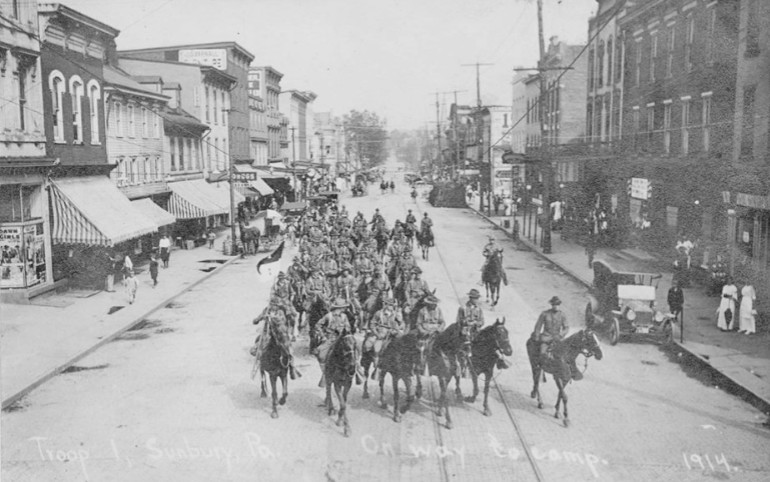
U.S. Army Cavalrymen riding down Market Street in Sunbury Pennsylvania, 1914 (public domain).
Following her marriage to attorney and Sunbury, Northumberland County, Pennsylvania resident Truman Harvey Purdy (1830-1898) during the early 1860s, William M. James’ older sister, Mary Elizabeth (James) Purdy (1841-1917), had settled with her husband in Sunbury, where they had become the parents of: Carrie Purdy (1866-1938), who had been born on 23 November 1866 and would later become a Methodist Church missionary and teacher in Mexico and South America, but would never marry; and Truman James Purdy (1869-1951), who had been born on 19 April 1869 and would later marry Lillian Merrey (1872-1970), would follow in his father’s footsteps by becoming an attorney and would help to found the Mary M. Packer Hospital in Sunbury. During the summer of 1870, Mary Elizabeth (James) Purdy resided in Sunbury, Upper Augusta Township with her attorney-husband, Truman Harvey Purdy, and their children Carrie and Truman James Purdy. Also residing with the family that year were Lizzie Fisher and attorney J. L. James. Another child then followed: Hiram Long Purdy (1874-1942), who was born on 14 April 1874 and would later wed Blanche R. D. Harvey (1886-1966) and become a real estate agent and insurance broker. Still living in Upper Augusta Township in 1880, Mary Elizabeth (James) Purdy resided there with her husband, and their children, Carrie, Truman and Hiram. From 1884-1885, Mary’s husband, Truman Harvey Purdy, served in the Pennsylvania Legislature. Widowed by her husband when he died at the age of sixty-seven in Sunbury on 4 April 1898, Mary Elizabeth (James) Purdy continued to raise her children to adulthood. Still residing in Sunbury after the turn of the century, she lived there with her children, Truman, Carrie and Hiram, in a home that she owned at 192 Purdy Street. Also residing with them was Stella Siegfried, a foster daughter who was employed as a teacher at a local school. By 1910, her household included just Hiram and Stella. After a full life, Mary Elizabeth (James) Purdy died at the age of seventy-five in Sunbury on 24 April 1917, and was also laid to rest at the Pomfret Manor Cemetery in Sunbury.
Sources:
- “About Steelton.” Steelton, Pennsylvania: Borough of Steelton, retrieved online 30 August 2026.
- “An Estimable Woman Dies from La Grippe” (obituary of a sister-in-law of William M. James and the wife of Jacob D. James). Sunbury, Pennsylvania: The Sunbury News, 10 December 1891.
- “A Terrible Calamity: Johnstown Nearly All Destroyed by Flood.” Ebensburg, Pennsylvania: Cambria Freeman, 7 June 1889.
- Bates, Samuel P., in History of Pennsylvania Volunteers, 1861-5, vol. 1. Harrisburg, Pennsylvania: B. Singerly, State Printer, 1869.
- “Bonstein, L.,” on U.S. Army Returns from Military Posts” (Fort Taylor, Key West, Florida: January, April, May, June, July, August, September, October, November, and December 1863). Washington, D.C.: U.S. Army and U.S. National Archives and Records Administration.
- Bordewich, Fergus M. “Fort Sumter: The Civil War Begins,” in Smithsonian Magazine, April 2011. Washington, D.C.: Smithsonian Institution.
- “Carrie M. Purdy” (a niece of William M. James and a daughter of Mary Elizabeth (James) Purdy), in Death Certificates (file no.: 74228, registered no.: 57, date of death: 5 August 1938). Harrisburg, Pennsylvania: Commonwealth of Pennsylvania, Department of Health, Bureau of Vital Statistics.
- “Caroline, wife of Dr. Robert E. James” (death notice of William M. James’ mother), in “Died.” Stroudsburg, Pennsylvania: The Jeffersonian, 26 May 1853.
- Condit, Uzal. The History of Easton, Penn’a from the Earliest Times to the Present, 1738-1885. Easton, Pennsylvania: E. W. West, 1885.
- “Death of a Young Lady” (death notice of Sallie James, the eldest daughter of William M. James). Harrisburg, Pennsylvania: Harrisburg Telegraph, 16 February 1886.
- “Death of Former Resident of Lewisburg: William M. James’ Remains to Be Interred Here on Saturday.” Lewisburg, Pennsylvania: The Lewusburg Journal, 29 January 1915.
- “Death of Mrs. J. D. James” (obituary of a sister-in-law of William M. James and the wife of Jacob D. James). Sunbury, Pennsylvania: The Northumberland County Democrat, 10 December 1891.
- “Died at Sunbury” (death notice of Hiram Long, M.D., a brother-in-law of William M. James and the husband of Frances M. (James) Long). Lewisburg, Pennsylvania: Lewisburg Journal, 1 May 1903.
- Dyer, Frederick H. A Compendium of the War of the Rebellion, p. 1589. Des Moines, Iowa: The Dyer Publishing Company, 1908.
- “Easton’s Big Day: Over 30,000 Strangers Attend the Unveiling of the Soldiers’ Monument.” Wilkes-Barre, Pennsylvania: The Wilkes-Barre Record, 11 May 1900.
- “Easton’s Monument: Unveiled Yesterday with Patriotic Pomp.” Allentown, Pennsylvania: The Allentown Daily Leader, 11 May 1900.
- Edith C. Feight (a daughter of William M. James), in Death Certificates (file no.: 33712, registered no.: 635, date of death: 4 April 1956). Harrisburg, Pennsylvania: Commonwealth of Pennsylvania, Department of Health, Bureau of Vital Statistics.
- Edith Criswell James (the bride) and William M. and Caroline C. James (the parents of the bride); and Alfred J. Feight (the groom) and John W. and Emma M. Feight (the parents of the groom), in Applications for Marriage Licenses (Steelton, Dauphin County, Pennsylvania, date of marriage: 1 November 1899). Harrisburg, Pennsylvania: Clerk of the Orphans’ Court of Dauphin County, Pennsylvania.
- “Ewington.” Harrisburg, Pennsylvania: The Patriot, 23 May 1876.
- “Ewington and Steelton: A Trip to the Steelworks.” Harrisburg, Pennsylvania: The Patriot, 31 July 1880.
- “Facts About Ewington.” Harrisburg, Pennsylvania: The Patriot, 27 September 1876.
- Fanny M. James [sic, “Frances M. James”] (the bride, who was the oldest sister of William M. James); and Hyram Long (the groom), in “Record of Marriages” (United Methodist Church, Lewisburg, Union County, Pennsylvania, date of marriage: 28 October 1860). Philadelphia, Pennsylvania: Historical Society of Pennsylvania.
- “Feight” (obituary of John William Feight, who was a grandson of William M. James and a son of Edith (James) Feight). Shippensburg, Pennsylvania: The Shippensburg Chronicle, 3 March 1921.
- Feight, Edith C. (a daughter of William M. James) and James S., in U.S. Census (New Cumberland, Cumberland County, Pennsylvania, 1930). Washington, D.C.: U.S. National Archives and Records Administration.
- Feight, Edith, in U.S. Census (New Cumberland, Cumberland County, Pennsylvania, 1940). Washington, D.C.: U.S. National Archives and Records Administration.
- Fight [sic, “Feight”], Edith C. (a daughter of William M. James), J. William and James S.; and James, Carrie C. (the widow of William M. James and Edith’s mother), in U.S. Census (New Cumberland, Cumberland County, Pennsylvania, 1920). Washington, D.C.: U.S. National Archives and Records Administration.
- “Flood at Williamsport.” Indiana, Pennsylvania: Indiana Weekly News, 5 June 1889.
- Flood of June 1889, in “Rotogravure Section.” Harrisburg, Pennsylvania: The Evening News, 10 October 1931.
- “Florida’s Role in the Civil War: ‘Supplier of the Confederacy.” Tampa, Florida: Florida Center for Instructional Technology, University of South Florida (College of Education), retrieved online 15 January 2020.
- Frances M. Long (the oldest sister of William M. James), in Death Certificates (file no.: 38458, registered no.: 57, date of death: 10 April 1909). Harrisburg, Pennsylvania: Commonwealth of Pennsylvania, Department of Health, Bureau of Vital Statistics.
- “Fresh Flood Facts.” Sunbury, Pennsylvania: The Northumberland County Democrat, 14 June 1889.
- “G.A.R. Veteran Dies at New Cumberland” (obituary of William M. James). Carlisle, Pennsylvania: Carlisle Evening Herald, 28 January 1915.
- Gobin, John Peter Shindel. Personal Letters, 1861-1865. Northumberland, Pennsylvania: Personal Collection of John Deppen.
- Grodzins, Dean and David Moss. “The U.S. Secession Crisis as a Breakdown of Democracy,” in When Democracy Breaks: Studies in Democratic Erosion and Collapse, from Ancient Athens to the Present Day (chapter 3). New York, New York: Oxford University Press, 2024.
- Hiram Long Purdy (a nephew of William M. James and a son of Mary Elizabeth (James) Purdy), in Death Certificates (file no.: 64476, registered no.: 162, date of death: 2 July 1942). Harrisburg, Pennsylvania: Commonwealth of Pennsylvania, Department of Health, Bureau of Vital Statistics.
- Irwin, Richard Bache. History of the Nineteenth Army Corps. New York, New York: G. P. Putnam’s Sons, 1893. Washington, D.C.: U.S. National Archives and Records Administration.
- Jacob Detrick James [sic, “Dieterich”] (a younger brother of William M. James), in Death and Burial Records (Boehm’s Reformed Church, Sunbury, Northumberland County, Pennsylvania, date of death 10 February 1907, burial in Sunbury, Pennsylvania: 12 February 1907). Philadelphia, Pennsylvania: Historical Society of Pennsylvania.
- J. D. James (a brother of William M. James), in “Mere Mention.” Sunbury, Pennsylvania: The Sunbury News, 14 January 1892.
- “J. S. Feight Takes Bride” (wedding notice of James S. Feight, a grandson of William M. James and a son of Edith (James) Feight). Harrisburg, Pennsylvania: Harrisburg Telegraph, 4 May 1935.
- “James-Clement” (announcement of the marriage of William M. James’ brother, Jacob D. James to Laura Irene Clement), in “Married.” Sunbury, Pennsylvania: The Sunbury Gazette, 18 February 1871.
- James, J. D. [sic, “Jacob Dieterich James”] (a younger brother of William M. James), Laura and Thornton (Sunbury, West Ward, Northumberland County, Pennsylvania, 1880). Washington, D.C.: U.S. National Archives and Records Administration.
- James, Robert E., Caroline, Francis, Mary, William, Delteh [sic, “Jacob”], and Robert; and Weaver, Enos and Elonia, in U.S. Census (Upper Mount Bethel Township, Northampton County, Pennsylvania, 1850). Washington, D.C.: U.S. National Archives and Records Administration.
- James, Robert E., Frances, Mary, William, Dietterich [sic, “Jacob Dieterich James”], and Robert, in U.S. Census (Mount Bethel, Upper Mount Bethel Township, Northampton County, Pennsylvania, 1860). Washington, D.C.: U.S. National Archives and Records Administration.
- James, Thornton (a nephew of William M. James and a son of Jacob D. James), Mary, Harry C., and Tot M. (a sister of Thornton James); and Cooper, Mary M. (a cousin of Thornton James), in U.S. Census (Sunbury, First Ward, Northumberland County, Pennsylvania, 1900). Washington, D.C.: U.S. National Archives and Records Administration.
- James, W. M., Caroline, Clara, and Edith, in U.S. Census (Ewington, Dauphin County, Pennsylvania, 1880). Washington, D.C.: U.S. National Archives and Records Administration.
- James, William and Caroline, in U.S. Census (Lewisburg, South Ward, Union County, Pennsylvania, 1870). Washington, D.C.: U.S. National Archives and Records Administration.
- James, William and Caroline, in U.S. Census (Steelton, Dauphin County, Pennsylvania, 1900). Washington, D.C.: U.S. National Archives and Records Administration.
- James, William and Carrie C., and Spotts, Elizabeth J. (William’s aunt); and Feight, Edith (the widowed daughter and neighbor of William M. James), John William and James S. (Edith’s children); and Feight, Jennie B. (Edith’s sister-in-law), in U.S. Census (New Cumberland, Cumberland County, Pennsylvania, 1910). Washington, D.C.: U.S. National Archives and Records Administration.
- James, William M. and Caroline, in U.S. Civil War Pension General Index Cards (veteran’s application no.: 322255, veteran’s certificate no.: 235001, filed by the veteran, 22 November 1879; veteran’s widow’s application no.: 1040917, veteran’s widow’s certificate no.: 787557, filed by the veteran’s widow from Pennsylvania, 3 February 1915). Washington, D.C.: U.S. National Archives and Records Administration.
- John William Feight (a grandson of William M. James and a son of Edith (James) Feight), in Death Certificates (file no.: 19472, registered no.: 6, date of death: 25 February 1921). Harrisburg, Pennsylvania: Commonwealth of Pennsylvania, Department of Health, Bureau of Vital Statistics.
- Jordan, John W., Edgar Moore Green and George T. Ettinger, editors. Historic Homes and Institutions and Genealogical and Personal Memoirs of the Lehigh Valley Pennsylvania, vol. 1, pp. 88-91: “Robert E. James” (family history profile of the ancestors of William McHenry James). New York, New York and Chicago, Illinois: The Lewis Publishing Company, 1905.
- “Lewisburg History,” in “About Lewisburg PA.” Lewisburg, Pennsylvania: Borough of Lewisburg, retrieved online 29 August 1861.
- “Lohr-James” (announcement of the marriage of Laura Irene James, who was a niece of William M. James and a daughter of Jacob D. James). Indiana, Pennsylvania: The Indiana Gazette, 13 June 1910).
- Long, Frances M. (the oldest sister of William M. James, in Williams’ Directory of Sunbury, Penna., p. 143. Binghamton, New York: J. E. Williams, Publisher, 1909.
- Long, Hiram and Fanny [sic, “Frances M. (James) Long”] (the oldest sister of William M. James); and Spiece, George, in U.S. Census (Hartleton, Union County, Pennsylvania, 1870). Washington, D.C.: U.S. National Archives and Records Administration.
- Long, Hiram and Frances M. (the oldest sister of William M. James), in U.S. Census (Sunbury, West Ward Northumberland County, Pennsylvania, 1880). Washington, D.C.: U.S. National Archives and Records Administration.
- Long, Hiram and Frances (the oldest sister of William M. James); Persing, Nettie and James, Frances (lodgers and students); and Sanders, Maggie (servant), in U.S. Census (Sunbury, Eighth Ward Northumberland County, Pennsylvania, 1900). Washington, D.C.: U.S. National Archives and Records Administration.
- Long, Hiram and Frances M. (the oldest sister of William M. James), in U.S. Civil War Pension General Index Cards (veteran’s application no.: 1184776, veteran’s certificate no.: 933469, filed by the veteran from Pennsylvania, 8 January 1897; veteran’s widow’s application no.: 892911, veteran’s widow’s certificate no.: 659580, filed by the veteran’s widow from Pennsylvania, 4 May 1908). Washington, D.C.: U.S. National Archives and Records Administration.
- Marion James (an infant who was a niece of William M. James and a daughter of Jacob D. James) and James, J. D. and Laura (parents), in Birth and Baptismal Records (Boehm’s Reformed Church, Sunbury, Northumberland County, Pennsylvania, date of birth: 13 June 1876, baptism: 12 August 1876). Philadelphia, Pennsylvania: Historical Society of Pennsylvania.
- Mathews, Alfred and Austin Hungerford. History of the Counties of Lehigh and Carbon, in the Commonwealth Pennsylvania. Philadelphia, Pennsylvania: Everts & Richards, 1884.
- “Miss Carrie M. Purdy” (obituary of a niece of William M. James and a daughter of Mary Elizabeth (James) Purdy). Selinsgrove, Pennsylvania: The Snyder County Tribune, 11 August 1938.
- Miss Sallie James (mention of the condolences sent to William M. James by his fellow members of the Steelton chapter of the Grand Army of the Republic, upon the death of his daughter, Sallie), in “Steelton Laconics.” Harrisburg, Pennsylvania: Harrisburg Telegraph, 20 February 1886.
- Mrs. Caroline C. James (the widow of William M. James), in “Deaths and Funerals.” Harrisburg, Pennsylvania: Harrisburg Telegraph and The Patriot, 12 May 1920).
- “Mrs. Edith Feight” (obituary of a daughter of William M. James). Harrisburg, Pennsylvania: The Patriot, 6 April 1956.
- “Mrs. Frances Kift, Member of Pioneer City Family, Dies” (obituary of a niece of William M. James and a daughter of Jacob D. James). Sunbury, Pennsylvania: Sunbury Daily Item, 10 September 1951.
- “Mrs. Frances M. Long Summoned By Death” (the oldest sister of William M. James). Sunbury, Pennsylvania: The Sunbury American, 16 April 1909.
- “Mrs. Henry Dick, Formerly of City” (obituary of a niece of William M. James and a daughter of Jacob D. James). Sunbury, Pennsylvania: Sunbury Daily Item, 18 April 1962).
- “New Cumberland Woman, Invalid 15 Years, Dies” (obituary of William M. James’ widow, Caroline (Criswell) James. Harrisburg, Pennsylvania: The Evening News, 12 May 1920.
- Nicholson, Jim. “James Feight, Ex-Blue Cross V.P.; Was Pa. Deputy Attorney General” (obituary of a grandson of William M. James and a son of Edith (James) Feight). Philadelphia, Pennsylvania: Philadelphia Daily News, 15 September 1986.
- “Northampton’s Monument Is Unveiled at Easton: Great Throngs from All Sections Participate in the Big Celebration.” Philadelphia, Pennsylvania: The Philadelphia Inquirer, 11 May 1900.
- “Obituary: Miss Sallie James, of Steelton” (the eldest daughter of William M. James). Harrisburg, Pennsylvania: Harrisburg Telegraph, 18 February 1886.
- “Obituary: Mrs. Caroline C. James” (the widow of William M. James). Harrisburg, Pennsylvania: The Evening News, 12 May 1920).
- Pennsylvania Genealogies: Index of Surnames, p. 748: “Mary Stewart.” Levi, Utah: Ancestry.com, retrieved online 28 August 2026.
- Purdy, Mary E. (a widowed sister of William M. James), Carrie M., Truman (Mary’s son), and Hiram L.; and Siegfried, Stella (foster daughter), in U.S. Census (Sunbury, Northumberland County, Pennsylvania, 1900). Washington, D.C.: U.S. National Archives and Records Administration.
- Purdy, Mary E. (a widowed sister of William M. James) and Hiram L.; and Siegfried, Stella (foster daughter), in U.S. Census (Sunbury, Eighth Ward, Northumberland County, Pennsylvania, 1910). Washington, D.C.: U.S. National Archives and Records Administration.
- Purdy, T. H., Mary E. (a sister of William M. James), Carrie, and Truman; Fisher, Lizzie; and James, J. L., in U.S. Census (Sunbury, Upper Augusta Township, Northumberland County, Pennsylvania, 1870). Washington, D.C.: U.S. National Archives and Records Administration.
- Purdy, Truman H., Mary E. (a sister of William M. James), Carrie M., Truman, J., and Hiram L., in U.S. Census (Upper Augusta Township, Northumberland County, Pennsylvania, 1880). Washington, D.C.: U.S. National Archives and Records Administration.
- “R. E. James Is Dead: Easton Trust Company’s President for 20 Years” (obituary of a younger brother of William M. James). Honesdale, Pennsylvania: Carbondale Leader, 11 November 1913.
- Reports and Other Correspondence of W. D. C. Rodrock, Chaplain, 47th Pennsylvania Volunteer Infantry (Record Group R29). Washington, D.C.: U.S. National Archives and Records Administration, 1864-1865.
- Robert E. James (appointment of William M. James’s father, Robert E. James, M.D., as a U.S. Postmaster), in “Records of Appointments of Postmasters” (Stone Church, Northampton County, Pennsylvania, 1835-1839), in Records of the Post Office Department (record group no. 28, series M841, roll no.: 111). Washington, D.C.: U.S. National Archives and Records Administration.
- Robert E. James (the father of William M. James), in “Democrats to the Polls! ‘Union, Harmony and Victory!'” (service of Robert Evan James, M.D. as a presidential elector). Lancaster, Pennsylvania: Intelligencer & Journal, 2 November 1852.
- “Robert E. James Dies at Age of 73” (obituary of a nephew of William M. James and a son of Jacob D. James). Sunbury, Pennsylvania: Sunbury Daily Item, 24 September 1956.
- “Robert E. James Dies at His Home in Easton” (obituary of a younger brother of William M. James). Allentown, Pennsylvania: The Morning Call, 11 November 1913.
- Robert E. James, Jr. and Davydd M. James (applicants), in Sons of the American Revolution Membership Applications, 1889-1970 (American Revolutionary War Patriot Josiah James). Louisville, Kentucky: National Society of the Sons of the American Revolution.
- “Robert E. James, Northampton” (the father of William M. James), in “Democratic Nominations for President” (service of Robert Evan James, M.D. as a presidential elector). York, Pennsylvania: York Gazette, 5 October 1852.
- “Robert Evan James” (a younger brother of William M. James), in “People: Members of the House of Representatives: Member Biography.” Harrisburg, Pennsylvania: Archives, Pennsylvania House of Representatives.
- “Roster of the 47th P. V. Inf.” Allentown, Pennsylvania: The Morning Call, 26 October 1930.
- “Sad Death of Alfred J. Feight” (obituary of the son-in-law of William M. James and the husband of Edith (James) Feight). Shippensburg, Pennsylvania: The Shippensburg Chronicle, 10 December 1908.
- Sallie James (notice of funeral arrangements for the eldest daughter of William M. James), in “Steelton Sparks.” Harrisburg, Pennsylvania: The Patriot, 19 February 1886.
- Schmidt, Lewis G. A Civil War History of the 47th Regiment of Pennsylvania Veteran Volunteers. Allentown, Pennsylvania: Self-published, 1986.
- Scott, Robert N. The War of War of the Rebellion: A Compilation of the Official Records of the Union and Confederate Armies, series I, vol. XXXIV, part II: “Correspondence, etc.-Union,” Chapter XLVI: “Louisiana and the Trans-Mississippi,” p. 199. Washington, D.C.: Government Printing Office, 1891.
- Smith, Cynthia H. “Centerville, Pennsylvania, 1874,” in Who’s Your Grammie? Upper Mount Bethel Township, Pennsylvania: Self-published, 14 February 2014.
- Staubach, Lieutenant Colonel James C. “Miami During the Civil War: 1861-65,” in Tequesta: The Journal of the Historical Association of Southern Florida, vol. LIII, pp. 31-62. Miami: Historical Museum of Southern Florida, 1993.
- Tamiami Trail Modifications: Next Steps — Draft Environmental Impact Statement, Appendix E. Washington, D.C.: U.S. National Park Service: Everglades National Park: 29 January 2010.
- “The Great Storm of 1889,” in “Education.” Johnstown, Pennsylvania: Johnstown Area Heritage Association, retrieved online, 30 August 2026.
- “The History of the Forty-Seventh Regt. P. V.” Allentown, Pennsylvania: The Lehigh Register, 20 July 1870.
- “The New Town” (a profile of Ewington, Dauphin County, Pennsylvania). Harrisburg, Pennsylvania: The Patriot, 2 August 1876.
- “The Shaping of Easton,” in “About Easton: History.” Easton, Pennsylvania: City of Easton, retrieved online 11 June 2026.
- “The Unveiling of the Soldiers’ and Sailors’ Monument at Easton on Thursday.” Allentown, Pennsylvania: The Allentown Democrat, 16 May 1900.
- “T. J. Purdy, 82, Lawyer, Civic Booster, Dies” (obituary of Truman J. Purdy, a nephew of William M. James and a son of Mary Elizabeth (James) Purdy). Sunbury, Pennsylvania: Sunbury Daily Item, 10 December 1951.
- Thornton James (a nephew of William M. James and a son of Jacob D. James), in Death Certificates (file no.: 68646, registered no.: 1225, date of death: 13 July 1931). Harrisburg, Pennsylvania: Commonwealth of Pennsylvania, Department of Health, Bureau of Vital Statistics.
- Thornton C. James (the groom, who was a nephew of William M. James and a son of Jacob D. James) and James, J. D. and L. C. (parents of the groom); and Mary E. Walters (the bride) and Harriet S. Henkel (the mother of the bride; father deceased), in Marriage Records (Sunbury, Northumberland County, Pennsylvania, date of marriage: 12 August 1896). Sunbury, Pennsylvania: Clerk of the Orphans’ Court of Northumberland County, Pennsylvania.
- Thornton Clement James (an infant who was a nephew of William M. James and a son of Jacob D. James) and James, J. D. and Laura (parents), in Birth and Baptismal Records (Boehm’s Reformed Church, Sunbury, Northumberland County, Pennsylvania, date of birth: 19 October 1874, baptism: 16 December 1874). Philadelphia, Pennsylvania: Historical Society of Pennsylvania.
- “Veterans’ Reunion: Heroes of the 47th Assembled at the Duck Farm: Their Old Commander Present: Large Gathering of Old Soldiers in Whom Martial Spirit Is Still Strong.” Allentown, Pennsylvania: The Allentown Leader, 22 October 1902.
- Wharton, Henry D. “Letters from the Sunbury Guards.” Sunbury, Pennsylvania: The Sunbury American, 1861-1864.
- Wm. M. James [sic, “William McHenry James”] (the groom), Caroline Criswell (the bride) and James and Jennie Criswell (the bride’s parents), in “Marriages” (United Methodist Church, Lewisburg, Union County, Pennsylvania, date of marriage: 3 September 1868). Philadelphia, Pennsylvania: Historical Society of Pennsylvania.
- “William M’Henry James Dies at New Cumberland.” Harrisburg, Pennsylvania: Harrisburg Star-Independent, 27 January 1915.
- Yard, Charles, et. al., in Returns From U.S. Military Posts, 1863-1864 (Company E, 47th Pennsylvania Infantry, Fort Jefferson, Dry Tortugas, Florida, May-July 1864), in Records of the Adjutant General’s Office, 1762-1984 (Record Group 94; Microfilm Publication M617, 1550; NAID: 561324). Washington, D.C.: U.S. National Archives and Records Administration.


You must be logged in to post a comment.