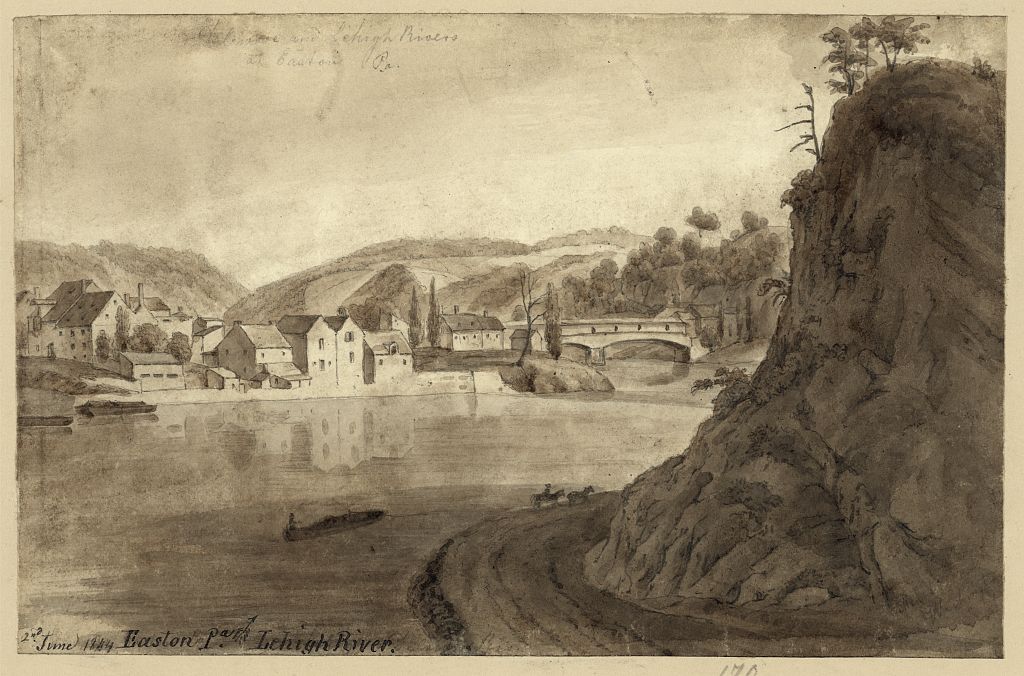
Delaware and Lehigh Rivers at Easton, Pennsylvania, 1844 (Augustus Kollner, U.S. Library of Congress, public domain).
Corporal James Huff is another of the “mystery men of the 47th Pennsylvania Volunteer Infantry. Very little is presently known about his formative years, save for the following data points:
- He was born in Pennsylvania in 1835;
- He resided in Easton, Northampton County, Pennsylvania during the mid-nineteenth century; and
- He was a father by the time he was in his early twenties.
Early Adult Life
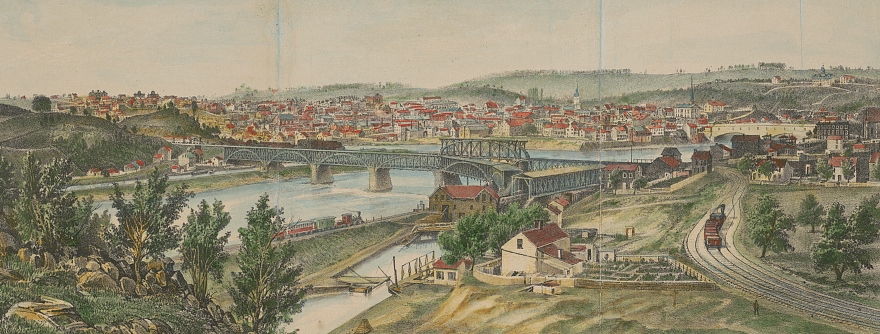
View of Easton (from Phillipsburg Rock, circa 1860-1862, James Fuller Queen, U.S. Library of Congress, public domain; click to enlarge).
Sometime during the early 1850s, James Huff wed Northampton County native Isabella Roberts (1835-1904), who was a daughter of Easton, Pennsylvania native Thomas Roberts (1804-1854) and Rebecca (Moser) Roberts (1803-1901). After settling in Easton, James and Isabella Huff subsequently welcomed the births there of: Irene Huff (1855-1914), who was born on 16 January 1855 and would later wed Francis Sigman (1850-1917) in 1870; Elizabeth Huff (1858-1876), who was born in 1858, but would later die in her teen years; and Catherine Huff (1859-1875), who was born in 1859 but would also later die in her teen years.
During the summer of 1860, James Huff was employed as a distiller and was residing in Easton with his wife, Isabella, and their children: Irene, Eliza and Kate. Their financial circumstances were clearly difficult; the value of his personal estate was estimated by a federal census enumerator at just twenty-five dollars (the equivalent of roughly one thousand dollars U.S. dollars in 2026).
Less than six months later, their lives and the lives of those around them would change dramatically as their nation was rocked by a secession crisis that quickly devolved into a disastrous civil war.
American Civil War

Unknown regiment, Camp Griffin, Virginia, fall 1861 (U.S. Library of Congress, public domain).
Unlike many of his fellow 47th Pennsylvania Volunteer Infantrymen, James Huff enlisted with the Union Army at a later date and at a location that was far from his home. After making his way to Virginia, he was enrolled on 1 November 1861 at Camp Griffin near what is now the city of Langley. He was then mustered in there that same day as a private with Company E of the 47th Pennsylvania Volunteer Infantry. Military records at the time described him as a twenty-six-year-old laborer and resident of Easton, who was five feet, nine inches tall with light hair gray eyes and a light complexion.
* Note: Company E was commanded by Captain Charles Hickman Yard, who had completed his Three Months’ Service as a second lieutenant with Company C of the 1st Pennsylvania Volunteers at the dawn of the American Civil War, and had then begun recruiting men for a the newly-established 47th Pennsylvania Volunteer Infantry during the summer of 1861. According to regimental historian Lewis G. Schmidt, each member of Company E was equipped with “1 light blue overcoat, 1 extra good blouse, 1 pair dark pantaloons, 2 white flannel shirts, 2 pair drawers, 2 pair socks, 1 pair shoes, 1 cap, 1 knapsack (suspended from shoulder), 1 haversack (suspended from waist), 1 canteen,” and a rifle at the start of his service.
On 17 November 1861, Henry Wharton, a field musician with the 47th Pennsylvania’s C Company, penned a letter to his hometown newspaper, the Sunbury American, in which he described what life was like at Camp Griffin:
This morning our brigade was out for inspection; arms, accoutrements [sic], clothing, knapsacks, etc, all were out through a thorough examination, and if I must say it myself, our company stood best, A No. 1, for cleanliness. We have a new commander to our Brigade, Brigadier General Brannen [sic], of the U.S. Army, and if looks are any criterion, I think he is a strict disciplinarian and one who will be as able to get his men out of danger as he is willing to lead them to battle….
The boys have plenty of work to do, such as piquet [sic] duty, standing guard, wood-chopping, police duty and day drill; but then they have the most substantial food; our rations consist of fresh beef (three times a week) pickled pork, pickled beef, smoked pork, fresh bread, daily, which is baked by our own bakers, the Quartermaster having procured portable ovens for that purpose, potatoes, split peas, beans, occasionally molasses and plenty of good coffee, so you see Uncle Sam supplies us plentifully….
A few nights ago our Company was out on piquet [sic]; it was a terrible night, raining very hard the whole night, and what made it worse, the boys had to stand well to their work and dare not leave to look for shelter. Some of them consider they are well paid for their exposure, as they captured two ancient muskets belonging to Secessia. One of them is of English manufacture, and the other has the Virginia militia mark on it. They are both in a dilapidated condition, but the boys hold them in high estimation as they are trophies from the enemy, and besides they were taken from the house of Mrs. Stewart, sister to the rebel Jackson who assassinated the lamented Ellsworth at Alexandria. The honorable lady, Mrs. Stewart, is now a prisoner at Washington and her house is the headquarters of the command of the piquets [sic]….
Since the success of the secret expedition, we have all kinds of rumors in camp. One is that our Brigade will be sent to the relief of Gen. Sherman, in South Carolina. The boys all desire it and the news in the ‘Press’ is correct, that a large force is to be sent there, I think their wish will be gratified….
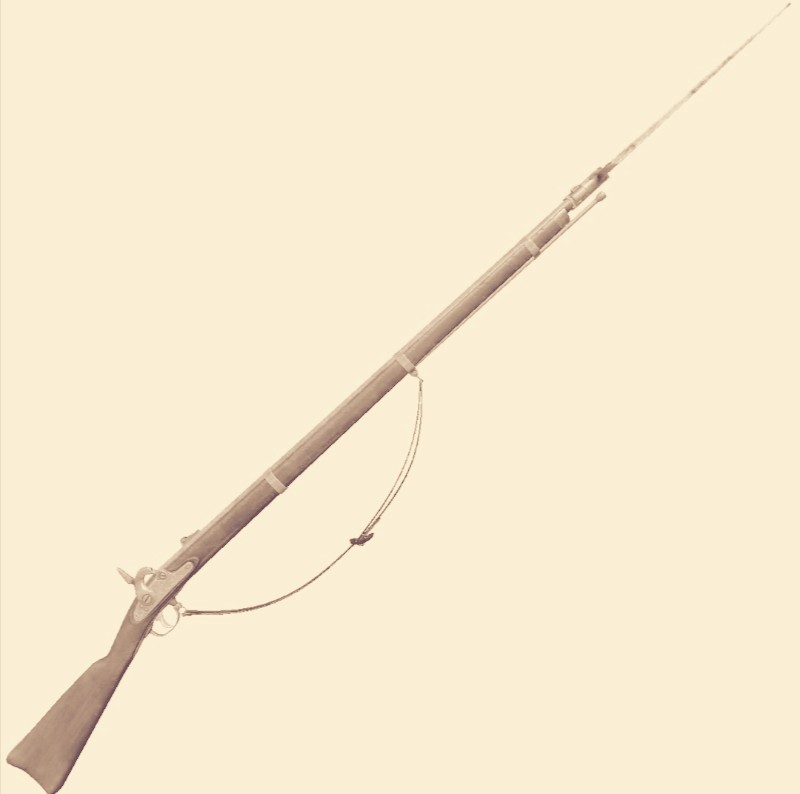
1861 Springfield rifle with attached bayonet (public domain).
On 20 November, Private James Huff and his fellow 47th Pennsylvania Volunteers marched in The Grand Review of the Army of the Potomac at Bailey’s Crossroads, Virginia. According to National Portrait Gallery historian James Barber:
For three hours some 70,000 polished troops marched passed the reviewing stand, where the president, members of his cabinet, and Washington dignitaries were in attendance. It was the largest military assemblage up to that time in North America. ‘The Grand Review went off splendidly,’ wrote McClellan that night in a letter to his wife, ‘not a mistake was made, not a hitch. I never saw so large a Review in Europe so well done—I was completely satisfied & delighted beyond expression.’
Among the 20,000 spectators to witness the Grand Review was the poet and social activist Julia Ward Howe of Boston, Massachusetts, who was visiting the Washington area with her husband, Dr. Samuel Gridley Howe.
After leaving the review, during the carriage ride back to Washington, she heard troops singing the song ‘John Brown’s Body.’ A companion suggested that she should write new lyrics to the song, the melody of which lingered in her mind that night in her room at Willard’s Hotel in Washington. She awoke ‘in the gray of the morning twilight’ with the song still in her head and ‘the long lines of the desired poem began to twine themselves in my mind.’ She arose quickly and in the dimness of the early hour she began scribbling the verses on stationery ‘almost without looking at the paper.’
Her poem, The Battle Hymn of the Republic, was first published in The Atlantic Monthly in February 1862; the magazine paid her five dollars. Soon thereafter her verse was set to music and her inspirational song became a wartime favorite….

Sketch of the 47th Pennsylvania Volunteers’ winter quarters at Camp Griffin, near Langley, Virginia, by Second Lieutenant William H. Wyker, Company E, December 1861 (public domain).
The next day, the regiment participated in a morning divisional headquarters review that was overseen by the regiment’s commanding officer, Colonel Tilghman H. Good, followed by brigade and division drills all afternoon. According to Schmidt, “each man was supplied with ten blank cartridges.” Afterward, “Gen. Smith requested Gen. Brannan to inform Col. Good that the 47th was the best regiment in the whole division.” As a reward for their performance, Brannan also ordered brand new Springfield rifles and had them distrubuted to every member of the 47th Pennsylvania.
As November gave way to December, military operations began to wane on both sides of the conflict, enabling the 47th Pennsylvania Volunteers to hunker down with other Union troops in winter quarters at Camp Griffin. Meanwhile, back home in Easton, Pennsylvania, Private James Huff’s wife, Isabella, kept the home fires burning as she waited to give birth to another child. Sarah Margaret Huff (1861-1889) was subsequently born on Christmas Eve in 1861. Later known to family and friends as “Maggie,” she would go on to become the wife of Charles P. Nixon (1860-1902).
1862

The 47th Pennsylvania Volunteers were transported to Florida aboard the steamship Oriental in January 1862 (public domain).
Next ordered to move from their Virginia encampment back to Maryland, the 47th Pennsylvania Volunteers left Camp Griffin at 8:30 a.m. on Wednesday, 22 January 1862. Marching through deep mud with their equipment for three miles in order to reach the railroad station at Falls Church, they were then transported by rail to Alexandria, before sailing the Potomac River aboard the steamship City of Richmond to the Washington Arsenal. While there, they were reequipped before being marched off for dinner and rest at the Soldiers’ Retreat in Washington, D.C.
The next afternoon, the 47th Pennsylvania Volunteers hopped aboard cars on the Baltimore & Ohio Railroad, and headed for Annapolis, Maryland. Arriving around 10 p.m., they were assigned quarters in barracks at the United States Naval Academy. They then spent that Friday through Monday (24-27 January 1862) loading their equipment and other supplies onto the steamship Oriental. According to Schmidt and letters home from members of the regiment, those preparations ceased on Monday, 27 January, at 10 a.m. when:
The regiment was formed and instructed by Lt. Col. Alexander ‘that we were about drumming out a member who had behaved himself unlike a soldier.’ …. The prisoner, Pvt. James C. Robinson of Company I, was a 36 year old miner from Allentown who had been ‘disgracefully discharged’ by order of the War Department. Pvt. Robinson was marched out with martial music playing and a guard of nine men, two men on each side and five behind him at charge bayonets. The music then struck up with ‘Robinson Crusoe’ as the procession was marched up and down in front of the regiment, and Pvt. Robinson was marched out of the yard.
Reloading then resumed. By that afternoon, as the 47th Pennsylvania Volunteers commenced boarding the Oriental, they were ferried to the big steamship by smaller steamers. The officers boarded last and, per the directive of Brigadier-General John Milton Brannan, they sailed away for the Deep South at 4 p.m., and headed for Florida which, despite its secession from the Union, remained strategically important to the Union due to the presence of Fort Taylor in Key West and Fort Jefferson in the Dry Tortugas.
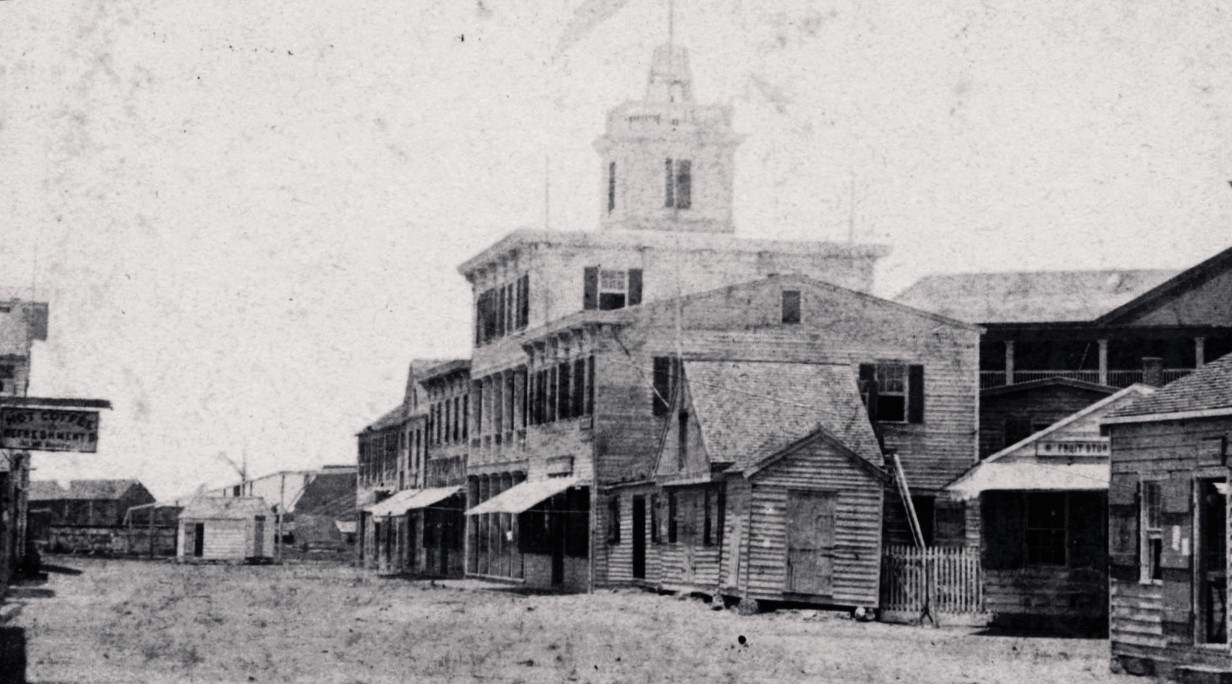
Front Street near Duval, Key West, Florida, circa 1860 (public domain).
Private James Huff and the men of E Company arrived with their fellow 47th Pennsylvania Volunteers in Key West in early February 1862. Upon their arrival, they initially pitched their tents on the beach and then began garrison duties at Fort Taylor. During the weekend of Friday, 14 February, they introduced their presence to Key West residents during a regimental parade that wound its way through the city’s streets. That Sunday, members of the regiment attended local church services, where they met and mingled with area residents.
By April 1862, according to Schmidt, Captain Charles H. Yard had been placed in command of three regiments that were charged with “clearing land and cutting roads” with a “fine military road … cut by the brigade from Fort Taylor directly through the island.” Continuing to drill daily in heavy artillery tactics, the 47th Pennsylvania Volunteers also continued to work on strengthening the fortifications at Fort Taylor. As their stay there lingered on, the quality of water available to them for drinking and bathing became increasingly problematic — just as Florida’s punishing heat and humidity worsened. As a result, multiple members of the regiment fell ill with dysentery or typhoid fever. Far too many died. Others lived, but found it harder and harder to perform their duties because they were weakened by the weather or disease.
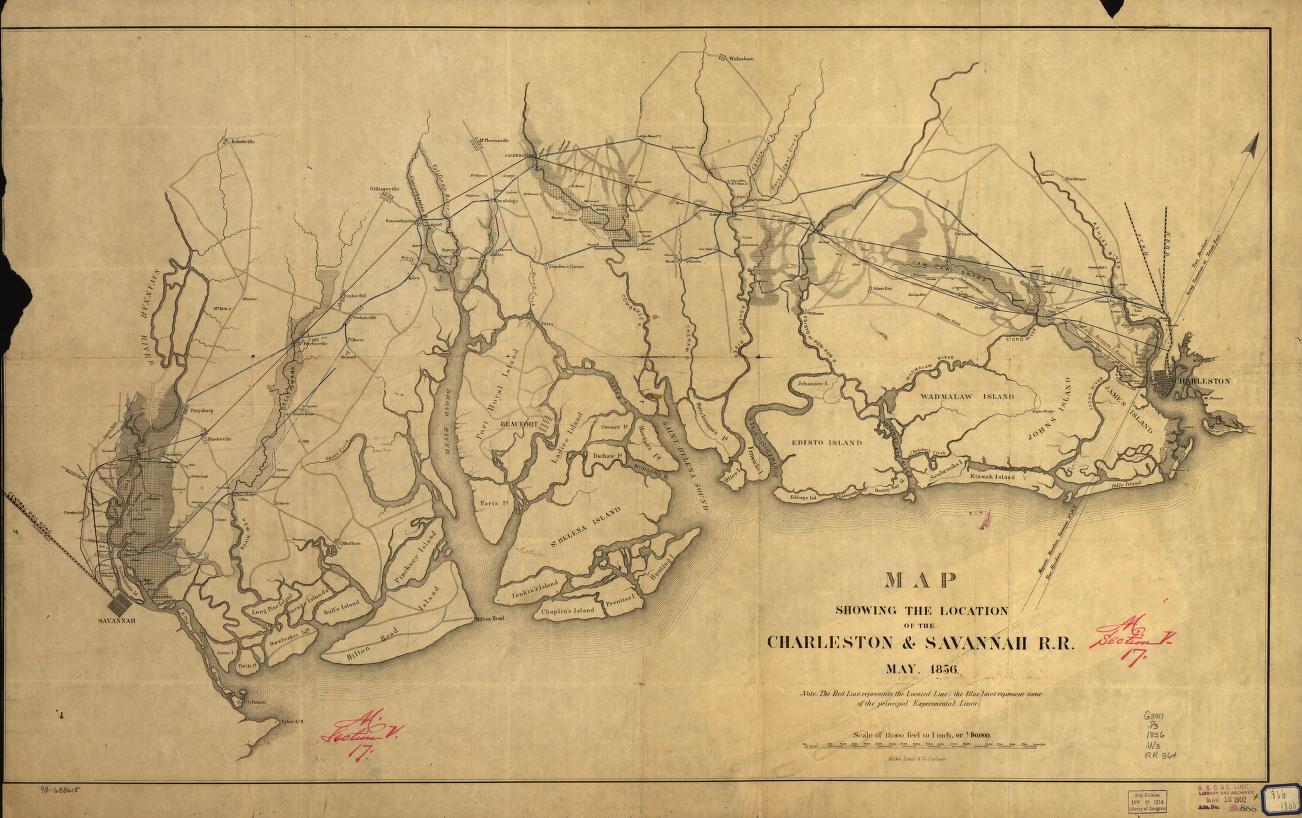
This 1856 map of the Charleston & Savannah Railroad shows the island of Hilton Head, South Carolina in relation to the towns of Beaufort and Pocotaligo (U.S. Library of Congress, public domain; click to enlarge).
Subsequently ordered to Hilton Head, South Carolina from mid-June through July, the 47th Pennsylvania Volunteers made camp near Fort Walker before relocating to the Beaufort District, Department of the South, roughly thirty-five miles away. Frequently assigned to hazardous picket detail north of their main camp, which put them at increased risk from enemy sniper fire, they became known for their “attention to duty, discipline and soldierly bearing,” and “received the highest commendation from Generals Hunter and Brannan,” according to historian Samuel P. Bates.
During that phase of duty, Private James Huff was promoted to the rank of corporal on 30 June 1862. Roughly two weeks later, on 9 and 10 July, respectively, detachments from the 47th Pennsylvania were assigned to the Expedition to Fenwick Island and the Demonstration against Pocotaligo.
Capture of Saint John’s Bluff

Earthworks surrounding the Confederate battery atop Saint John’s Bluff along the Saint John’s River in Florida (J. H. Schell, 1862, public domain).
During a return expedition to Florida beginning 30 September, the 47th Pennsylvania joined with the 1st Connecticut Battery, 7th Connecticut Infantry, and part of the 1st Massachusetts Cavalry in assaulting Confederate forces at their heavily protected camp at Saint John’s Bluff overlooking the Saint John’s River area.
Backed by the U.S. gunboats Cimarron, E.B. Hale, Paul Jones, Uncas, and Water Witch and their twelve-pound boat howitzers, the fifteen hundred-strong Union Army force commanded by Brigadier-General Brannan advanced up the Saint John’s River and inland along the Pablo and Mt. Pleasant Creeks on 1 October 1862 before disembarking and marching for the battery atop Saint John’s Bluff. The next day, Union gunboats exchanged shellfire with the Rebel battery while the Union ground force continued on. When the 47th Pennsylvanians reached Saint John’s Bluff with their fellow brigade members on 3 October 1862, they found an abandoned battery. (Other Union troops discovered that the Yellow Bluff battery was also Rebel-free.)

The Governor Milton was a Confederate steamer that was captured by Companies E and K of the 47th Pennsylvania Volunteers in October 1862 (Frank Leslie’s Illustrated Newspaper, public domain).
Companies E and K of the 47th Pennsylvania were then led by Captain Yard on a special mission with other Union Army soldiers in the reconnaissance and recapture of the city of Jacksonville, Florida on 5 October 1862. A day later, after receiving intelligence that a Confederate steamer — the Governor Milton — had been engaged in furnishing troops, ammunition and other supplies to Confederate Army units scattered throughout the region, men from the 47th Pennsylvania’s Companies E and K were sent out to find and capture or destroy it. Boarding the Union gunboat Darlington (a former Confederate steamer), they traveled roughly two hundred miles along the Saint John’s River, with protection from the Union gunboat Hale, until they found their prize docked near Hawkinsville. Able to capture it, they steamed the Governor Milton back down the river and tucked it away — safely behind Union Navy lines. According to Schmidt, Corporal George R. Nichols of E Company was one of the men involved in that steamer’s capture and later described that mission:
At 9 PM … October 7, discovered the steamer Gov. Milton in a small creek, 2 miles above Hawkinsville; boarded her in a small boat, and found that she had been run in there but a short time before, as her fires were not yet out. Her engineer and mate, then in charge, were asleep on board at the time of her capture. They informed us that owing to the weakness of the steamer’s boiler we found her where we did….
I commanded one of the Small Boats that went in after her. I was Boatman and gave orders when the headman jumped on Bord [sic] take the Painter with him. That however Belongs to Wm. Adams or Jacob Kerkendall. It was So dark I could not tell witch [sic] Struck the deck first. But when I Struck the deck I demanded the Surrend [sic] of the Boat in the name of the U.S. after we had the boat an offercier [sic] off [sic] the Paul Jones, a Gun Boat was with us he ask me how Soon could I move her out in the Stream I said five minuts [sic]. So an Engineer one of coulered [sic] Men helped Me. and I will Say right hear [sic] he learned Me More than I ever knowed about Engineering. Where we started down the River we was one hundred and twenty five miles up the river. When we Stopped at Polatkey [Palatka] to get wood for the Steamer I went out and Borrowed a half of a deer that hung up in a [sic] out house and a bee hive for some honey for the Boys. I never forget the boys.
Integration of the Regiment
Meanwhile, back at its South Carolina base of operations, the 47th Pennsylvania was making history as it became an integrated regiment. On 5 and 15 October 1862, respectively, the regiment added to its muster rolls several young Black men who had endured plantation enslavement in the Beaufort vicinity, including sixteen-year-old Abraham Jassum, twenty-two-year-old Edward Jassum and thirty-three-year-old Bristor Gethers — all of whom would go on to successfully complete their three-year periods of enlistment and be honorably discharged in October 1865.
Battle of Pocotaligo, South Carolina

Highlighted version of the U.S. Army map of the Coosawhatchie-Pocotaligo Expedition, 22 October 1862 (public domain).
From 21-23 October, under the brigade and regimental commands of Colonel Tilghman H. Good and Lieutenant-Colonel George Warren Alexander, members of the 47th Pennsylvania Volunteer Infantry joined with other Union regiments in an attack on Confederate forces in and around Pocotaligo, South Carolina — including at Frampton’s Plantation and the Pocotaligo Bridge — a key piece of the South’s railroad infrastructure that had been targeted for destruction by senior Union military leaders.
Unfortunately, the mission would be more challenging than anyone anticipated. Harried by snipers while headed to the Pocotaligo Bridge, the Union troops quickly met resistance from an entrenched, heavily fortified Confederate battery that opened fire as they entered an open cotton field. Men from the 47th Pennsylvania who were headed toward the higher ground of the Frampton Plantation fared no better as they faced artillery and infantry fire from the forests around them. Refusing to give up, they pursued the Rebels for four miles as they retreated to the bridge, where the 47th Pennsylvania Volunteers then relieved men from the 7th Connecticut Volunteer Infantry and began exchanging fire with the enemy. After two hours of intense fighting in an unsuccessful attempt to take the ravine and bridge, however, they were forced by their depleted ammunition to withdraw to Mackay’s Point.
Losses for the 47th Pennsylvania were significant. Privates Henry A. Backman, Nathan George, Samuel Minnich, George B. Rose and fourteen other enlisted men had died; a total of one hundred and fourteen had been wounded in action.
On 23 October, the 47th Pennsylvania Volunteers returned to Hilton Head, where several members were appointed later that month to serve as the funeral honor guard for Major-General Ormsby M. Mitchel, the commander of the U.S. Army’s 10th Corps and Department of the South who succumbed to yellow fever on 30 October. (The Mountains of Mitchel, a part of Mars’ South Pole discovered by Mitchel in 1846 while working as a University of Cincinnati astronomer, and Mitchelville, the first Freedmen’s town created after the Civil War, were both later named for him.)
1863

Fort Taylor, Key West, Florida (Harper’s Weekly, 1864, public domain).
Having been ordered back to Key West on 15 November 1862, the 47th Pennsylvania Volunteers subsequently spent the entire year of 1863 garrisoning federal installations in Florida as part of the U.S. Army’s 10th Corps, Department of the South. Once again, the men of E Company joined with Companies A, B, C, G, and I in guarding Key West’s Fort Taylor while Companies D, F, H, and K garrisoned Fort Jefferson, the Union’s remote outpost in the Dry Tortugas off the coast of Florida.
According to the U.S. Army’s records collection known as “Returns from Military Posts,” sometime shortly after returning to Key West, Company E’s First Lieutenant Lawrence Bonstine was assigned to special duty as post adjutant — a position he continued to hold from at least 10 January 1863 through the end of December 1863. Reporting directly to the regiment’s commanding officer, Colonel Tilghman Good, he was essentially Good’s right hand, and was responsible for ensuring that regimental records and reports to senior military officials were kept up to date.
On 5 March 1863, Private William H. Eichman was promoted to the rank of corporal. Exactly one month later (on 5 April 1863), Second Lieutenant W. Scott Johnston was then promoted to the rank of first lieutenant and appointed as adjutant with the central regimental staff.
Garrisoning Federal Forts to Weaken the Confederacy

Fort Jefferson (Harper’s Weekly, 26 Aug 1865, public domain).
Prior to intervention by the Union Army and Navy, the owners of plantations, livestock ranches and fisheries, as well as the operators of smaller family farms across Florida, had been able to consistently furnish beef and pork, fish, fruits, and vegetables to Confederate troops stationed throughout the Deep South during the war’s first years. Large herds of cattle were raised near Fort Myers, and orchard owners in the Saint John’s River area were actively cultivating sizeable orange groves. In addition, Florida was a major producer of salt, which was used as a preservative for food.
Consequently, the Florida-based 47th Pennsylvania Volunteers were ordered to capture or destroy Confederate harvests and salt manufacturing plants in order to further curtail the enemy’s access to food. But they also continued their peacekeeping and diplomatic work. On 16 May 1863, garrison staffing arrangements were adjusted as the members of Company D were moved from Fort Jefferson in the Dry Tortugas to Fort Taylor in Key West. Around that same time, Captain Charles Yard boarded a ship with a number of his Company E men and headed for Fort Jefferson.
1864

Map of 1864 Red River Campaign locations, showing the battle sites of Sabine Cross Roads, Pleasant Hill and Mansura in relation to the Union’s occupation sites at Alexandria, Grand Ecore, Morganza, and New Orleans (excerpt from Dickinson College/U.S. Library of Congress map, public domain).
As the New Year dawned in Florida for Corporal James Huff and his fellow 47th Pennsylvania Volunteers, life continued much as it had throughout 1863. The majority of men assigned to Companies A, B, C, D, G, and I were still garrisoning Fort Taylor in Key West, while men from Companies E, F, H, and K were still stationed at Fort Jefferson in the Dry Tortugas. Shortly thereafter, garrison staffing was adjusted yet again when the 47th Pennsylvania Volunteer Infantry was ordered to expand the Union Army’s reach by sending part of the regiment north to rehabilitate Fort Myers, which had been abandoned in 1858 following the U.S. government’s third war with the Seminole Indians. Per orders issued earlier in 1864 by Major-General D. P. Woodbury, commanding officer, U.S. Department of the Gulf, District of Key West and the Tortugas, that the fort be reclaimed to facilitate the Union’s Gulf Coast blockade, Captain Richard Graeffe and a detachment of men from Company A were assigned to the duty of raiding cattle herds in northern Florida in order to provide food for the growing Union troop presence in the state. Graeffe and his men subsequently turned the fort into both their base of operations and a shelter for pro-Union supporters, Confederate Army deserters, and men, women and children who were trying to escape from enslavers across the region.
Then, as January gave way to February, the 47th Pennsylvania Volunteers received new orders and began preparing to embark on what would turn out to be a history-making assignment in Louisiana. Boarding yet another steamer — the Charles Thomas — on 25 February 1864, Companies B, C, D, I, and K of the 47th Pennsylvania headed for Algiers, Louisiana (across the river from New Orleans), followed on 1 March by Corporal James Huff and the members of Companies E, F, G, and H who had been stationed at Fort Jefferson in the Dry Tortugas. Upon that second group’s arrival, the now almost fully reunited regiment moved by train on 28 February to Brashear City (now Morgan City, Louisiana) before heading to Franklin by steamer through the Bayou Teche. Once there, the 47th Pennsylvania Volunteer Infantry joined the 2nd Brigade, 1st Division of the Department of the Gulf’s 19th Army Corps, and became the only Pennsylvania regiment to serve in the Red River Campaign of Union Major-General Nathaniel P. Banks. (Unable to reach Louisiana until 23 March, the men from Company A were placed on a different type of detached duty in New Orleans while they awaited transport to enable them to catch up with the main part of their regiment. Charged with guarding and overseeing the transport of two hundred and forty-five Confederate prisoners, they then boarded the Ohio Belle on 7 April and reached Alexandria with those prisoners on 9 April.)
Red River Campaign
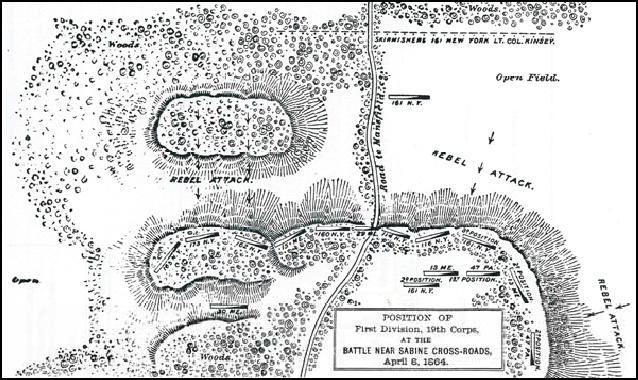
19th U.S. Army Map, Phase 3, Battle of Sabine Cross Roads/Mansfield (8 April 1864, public domain).
The early days on the ground in Louisiana quickly woke the 47th Pennsylvania Volunteers up to just how grueling that new phase of duty would be. From 14-26 March, most members of the regiment marched for Alexandria and Natchitoches, Louisiana, by way of New Iberia, Vermilionville (now part of Lafayette), Opelousas, and Washington.
From 4-5 April 1864, the regiment added to its roster of young Black soldiers when Aaron Bullard (later known as Aaron French), James Bullard, John Bullard, Samuel Jones, and Hamilton Blanchard (also known as John Hamilton) enrolled for military service with the 47th Pennsylvania at Natchitoches. According to their respective entries in the Civil War Veterans’ Card File at the Pennsylvania State Archives and on regimental muster rolls, the men were then officially mustered in for duty on 22 June at Morganza. Several of their entries noted that they were assigned the rank of “(Colored) Cook” while others were given the rank of “Under-Cook.”
Often short on food and water throughout their long harsh-climate trek through enemy territory, the men encamped briefly at Pleasant Hill (now the Village of Pleasant Hill) the night of 7 April before continuing on the next day.
Marching until mid-afternoon on 8 April, the 47th Pennsylvania Volunteers were rushed into battle ahead of other regiments in the 2nd Division. Sixty members of the 47th were cut down that day during the back-and-forth volley of fire unleashed during the Battle of Sabine Cross Roads (also known as the Battle of Mansfield due to its proximity to the town of Mansfield). The fighting waned only when darkness fell. The exhausted, but uninjured collapsed beside the gravely wounded. After midnight, the surviving Union troops withdrew to Pleasant Hill.
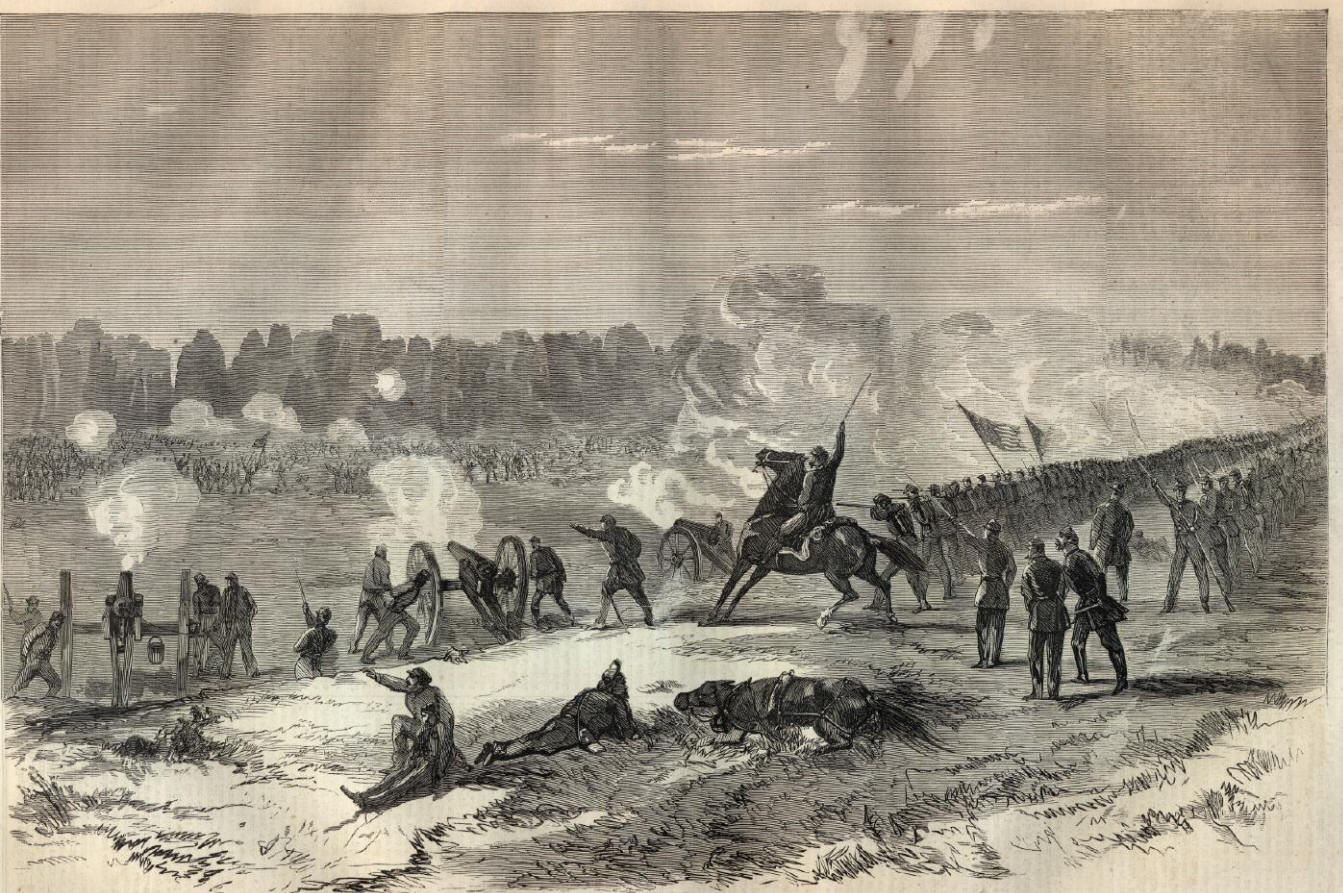
Battle of Pleasant Hill, Louisiana, 9 April 1864 (Harper’s Weekly, 7 May 1864, public domain).
The next day, the 47th Pennsylvania Volunteers were ordered into a critically important defensive position at the far right of the Union lines, their right flank spreading up onto a high bluff. By 3 p.m., after enduring a midday charge by the troops of Confederate Major-General Richard Taylor (a plantation owner who was the son of Zachary Taylor, former president of the United States), the brutal fighting still showed no signs of ending. Suddenly, just as the 47th was shifting to the left side of the massed Union forces, the men of the 47th Pennsylvania were forced to bolster the 165th New York’s buckling lines by blocking another Confederate assault, during what has since become known as the Battle of Pleasant Hill. Casualties were severe. Second Lieutenant Alfred Swoyer of Company K and Private Richard Hahn of Company E were killed in action. The regiment’s second-in-command, Lieutenant-Colonel Alexander, was nearly killed, and the regiment’s two color-bearers, both from Company C, were also seriously wounded while preventing the American flag from falling into enemy hands.
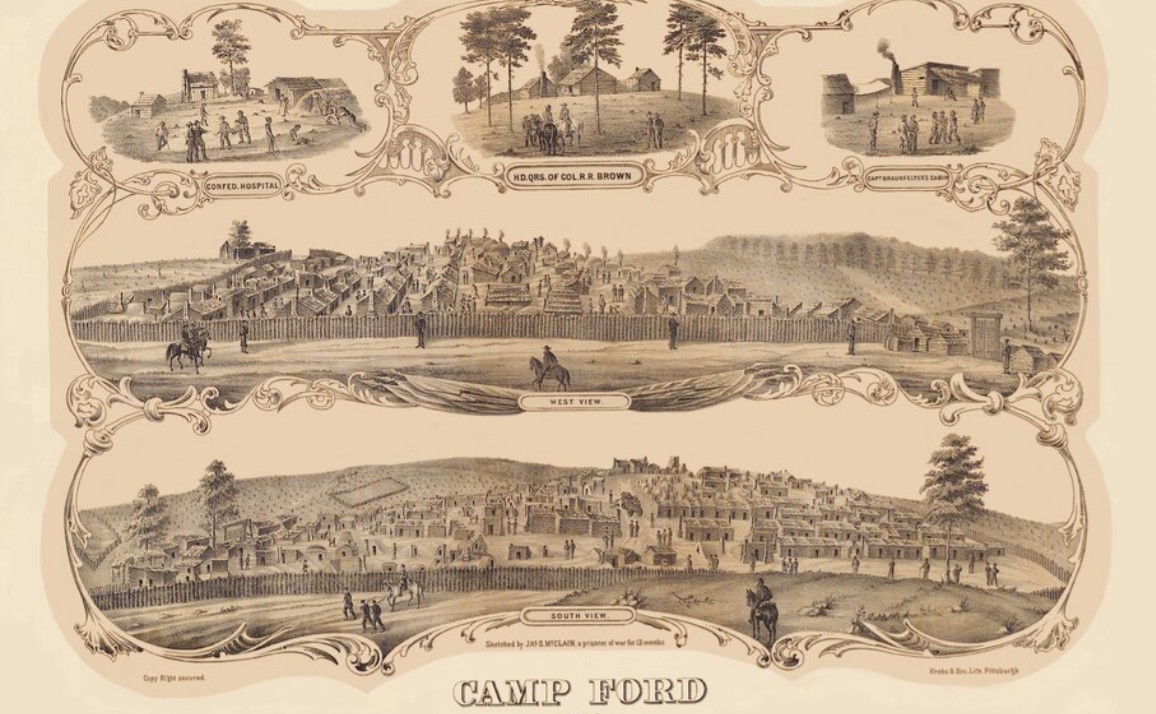
James S. McClain drew these sketches of the Confederate POW camp in Texas, Camp Ford, between 3 May 1864 and 27 May 1865 (public domain; click to enlarge).
Still others from the 47th were captured by Confederate troops, including E Company Corporal James Huff, who had been wounded prior to his capture. Force marched roughly one hundred and twenty-five miles to Camp Ford, the Confederacy’s largest prison camp west of the Mississippi River, they were held there at that POW camp near Tyler, Texas as prisoners of war (POWs) until they were released during prisoner exchanges that began on 22 July. (Corporal Huff languished there until his release on 29 August 1864. After recuperating from the ordeal, with help from Union Army physicians, he was able to return to duty with his Company E comrades at their encampment in Virginia, where they had been stationed since mid-July.)
Sheridan’s 1864 Shenandoah Valley Campaign
Attached to the Middle Military Division, United States’ Army of the Shenandoah beginning in August 1864, the 47th Pennsylvania Volunteer Infantry was now involved in the 1864 Shenandoah Valley Campaign of Union Major-General Philip Sheridan. As summer turned to fall, they would repeatedly engage in minor skirmishes and major tide-turning battles with Confederate troops commanded by Lieutenant-General Jubal Early.
From 3-4 September, they fought in the Battle of Berryville. Two weeks later, a major change occurred when Company D’s Captain Henry Woodruff, E Company’s Captain Charles H. Yard and Captain Henry S. Harte of F Company all mustered out at Berryville on 18 September, upon expiration of their respective three-year terms of service.
Battles of Opequan and Fisher’s Hill, September 1864

Battle of Opequan (aka Third Winchester), Virginia, 19 September 1864 (public domain).
On 19 September 1864, Corporal James Huff and his fellow 47th Pennsylvanians helped to inflict heavy casualties on Lieutenant-General Jubal Early’s Confederate forces during the Battle of Opequan (also spelled as “Opequon” and referred to as “Third Winchester”) as part of a large Union force led by Union Major-General Philip H. (“Little Phil”) Sheridan and Brigadier-General William H. Emory, commander of the 19th Corps. Still considered by many historians to be one of the most important battles of Sheridan’s 1864 campaign, that Union victory on 19 September 1864 helped to ensure the reelection of President Abraham Lincoln.
The 47th Pennsylvania’s march toward destiny began at 2 a.m. as the regiment left camp and joined up with others in the Union’s 19th Corps. Advancing slowly from Berryville toward Winchester, their march quickly bogged down in the face of the Union’s massive movement of troops and supply wagons, enabling Early’s Confederates to dig in. When they finally reached the Opequan Creek, Sheridan’s men came face to face with Early’s army. The fighting, which began in earnest at noon, was long and brutal as the Union’s left flank (6th Corps) took a beating from Early’s artillery, which was positioned on higher ground.

Victory of Philip Sheridan’s Union Army over Jubal Early’s Confederate forces, Battle of Opequan, 19 September 1864 (Kurz & Allison, circa 1893, U.S. Library of Congress, public domain).
Meanwhile, the 47th Pennsylvanians and their fellow 19th Corps members were directed by Brigadier-General Emory to attack and pursue Major-General John B. Gordon’s Confederate forces. Casualties mounted as Confederate cannon opened fire on Union troops as they tried to cross a clearing. When a nearly fatal gap began to open between the 6th and 19th Corps, Sheridan responded by ordering the units of Brigadier-Generals Emory Upton and David A. Russell to plug the hole. Russell, hit twice — once in the chest — was mortally wounded.
The 19th Corps, with the 47th in the thick of the fighting, then began pushing the Confederates back. Early’s “grays” retreated in the face of the valor displayed by Sheridan’s “blue jackets.” Leaving twenty-five hundred wounded behind, the Rebels retreated to Fisher’s Hill, eight miles south of Winchester (21-22 September), and then to Waynesboro, following a successful early morning flanking attack by Sheridan’s Union men which outnumbered Early’s three to one. Afterward, the 47th Pennsylvania Volunteers were sent out on skirmishing parties before making camp at Cedar Creek.
The 47th Pennsylvania then lost its two most senior leaders when Colonel Tilghman H. Good and Good’s second-in-command, Lieutenant-Colonel George Alexander, mustered out upon expiration of their respective terms of service.
Battle of Cedar Creek, 19 October 1864

Alfred Waud’s 1864 sketch, “Surprise at Cedar Creek,” captured the flanking attack on the rear of Union Brigadier-General William Emory’s 19th Corps by Lieutenant-General Jubal Early’s Confederate army, and the subsequent resistance by Emory’s troops from their Union rifle-pit positions, 19 October 1864 (public domain).
It was during that phase of the American Civil War that Major-General Sheridan initiated the first use of the Union’s “scorched earth” campaigns — starving the enemy into submission by destroying Virginia’s farming infrastructure. Viewed through today’s lens of history as inhumane, the strategy claimed many innocents, but certainly helped to facilitate the war’s significant shift in the Union’s favor — especially during the Battle of Cedar Creek on 19 October 1864 as Early’s troops began peeling off, one by one and group by group to forage for food, thus enabling the 47th Pennsylvania and others under Sheridan’s command to rally and win the day.
It began when Early launched a surprise attack directly on Sheridan’s Cedar Creek-encamped forces. Capturing Union weapons, Early’s troops also freed a number of Confederate soldiers who had been taken prisoner during previous battles — all while pushing seven Union divisions back. According to Bates:
When the Army of West Virginia, under Crook, was surprised and driven from its works, the Second Brigade, with the Forty-seventh on the right, was thrown into the breach to arrest the retreat…. Scarcely was it in position before the enemy came suddenly upon it, under the cover of fog. The right of the regiment was thrown back until it was almost a semi-circle. The brigade, only fifteen hundred strong, was contending against Gordon’s entire division, and was forced to retire, but, in comparative good order, exposed, as it was, to raking fire. Repeatedly forming, as it was pushed back, and making a stand at every available point, it finally succeeded in checking the enemy’s onset, when General Sheridan suddenly appeared upon the field, who ‘met his crest-fallen, shattered battalions, without a word of reproach, but joyously swinging his cap, shouted to the stragglers, as he rode rapidly past them – ‘Face the other way, boys! We are going back to our camp! We are going to lick them out of their boots!’

Sheridan Rallying His Troops, Battle of Cedar Creek, Virginia, 19 October 1864 (U.S. Library of Congress, public domain).
But the Union men were able to regroup, and pounded Early’s forces into submission during a poetry-inspiring counterattack. So effective were the men of the 47th Pennsylvania Volunteer Infantry that they were later commended for their heroism by General Stephen Thomas who, in 1892, was awarded the Medal of Honor for his own “distinguished conduct in a desperate hand-to-hand encounter, in which the advance of the enemy was checked.” Pennsylvania historian Samuel Bates later described the 47th’s actions as follows:
When the final grand charge was made, the regiment moved at nearly right angles with the rebel front. The brigade charged gallantly, and the entire line, making a left wheel, came down on his flank, while engaging the Sixth Corps, when he went ‘whirling up the valley’ in confusion. In the pursuit to Fisher’s Hill, the regiment led, and upon its arrival was placed on the skirmish line, where it remained until twelve o’clock noon of the following day. The army was attacked at early dawn…no respite was given to take food until the pursuit was ended.
But once again, regimental casualties were high. The regiment’s final casualty figures would later confirm that the 47th Pennsylvania Volunteer Infantry had lost the equivalent of two full companies of men (killed, mortally wounded, wounded who survived but were no longer fit for any military duty and were discharged on surgeons’ certificates of disability, wounded who survived but were no longer fit for combat and were transferred to the Veterans’ Reserve Corps, captured by Confederate troops and held as prisoners of war, or missing in action). Among those who had been killed outright in battle that day were E Company Privates Marcus Berksheimer and Franklin Moser — and Sergeant Francis A. Parks.
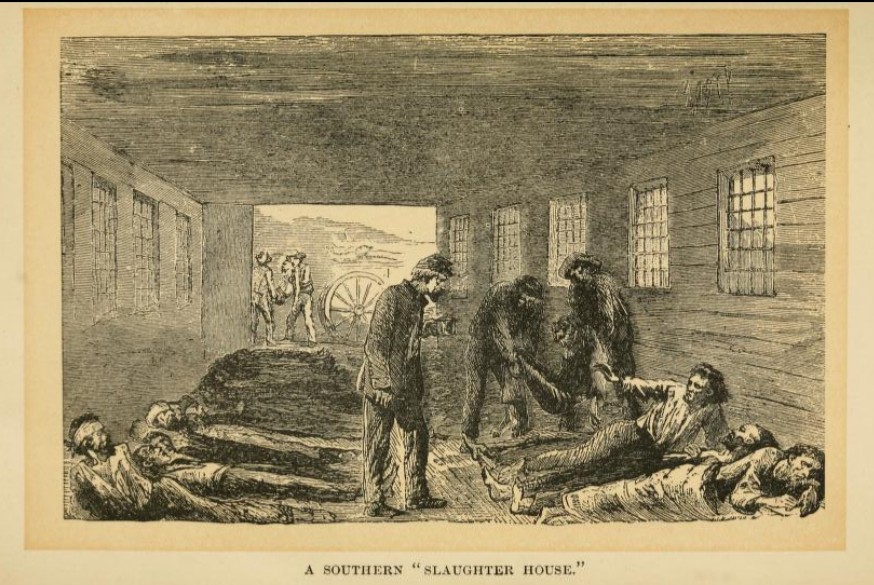
“A Southern ‘Slaughter House'” depicted the suffering of Union soldiers interned at the Confederacy’s Salisbury Prison Camp (Charles S. Greene, Sparks from the Campfire, 1889, public domain; click to enlarge).
Sadly, the fate of Corporal James Huff was far less clear. Initially declared missing in action, it was eventually determined that he had been force marched away from the battlefield by Confederate troops. Subsequently loaded onto a train with other captives from the 47th Pennsylvania Volunteer Infantry, Corporal Huff was transported far beyond the reach of Union help — to Rowan County in North Carolina — where he was then confined as a prisoner of war at Salisbury Prison, one of the Confederacy’s two most notorious POW camps. According to Professor Emeritus Joel Stegall:
Early in October 1864, five thousand Union prisoners were added to the civilians already confined in the Salisbury Prison. By the end of the month, another 5,000 arrived. With more than 10,000 men confined in a facility designed for 2,500, thousands had to sleep outside on the ground. What little food they had was not fit to eat. Sewage was worse than inadequate. Pervasive filth brought rampant disease. All available indoor space was quickly taken by the sick and wounded. The only anesthetic available for surgery was whiskey.…
The harsh treatment meted out by their Confederate guards only added to their suffering. While some maintained standard military behavior and a basic level of human decency, other guards taunted their captives, prodding them to cross prohibited “dead lines” located inside the prison, six feet from the walls that surrounded them, only to shoot and kill those who made the attempt (or had mistakenly gotten “too close” to those lines).
After Confederate Major John Gee was appointed as the prison camp’s commandant during the summer of 1864, conditions deteriorated even further. Per his orders, Union POWs were purposefully starved with more than seven thousand “forced to live outside on the ground as late-fall overnight temperatures dropped near freezing,” according to Stegall. Many wore “only thin, lice-infested rags for clothes.” As a result, disease tore its way through the ranks of the 47th Pennsylvania Volunteers. Gradually, their bodies began to fail, one by one:
- Private Franklin Rhoads (Company B) died from chronic diarrhea on 22 November 1864;
- Private Henry Shapely/Shepley (Company H) died from starvation and hard treatment on 10 December 1864;
- Private Charles H. Michael (Company F) died from starvation on 11 December 1864;
- Private Isaac Metcalf (Company F) died from disease-related complications on Christmas Day in 1864; and
- Private Henry Schlagle (Company I) then died from starvation and catarrh on 28 December 1864.
1865
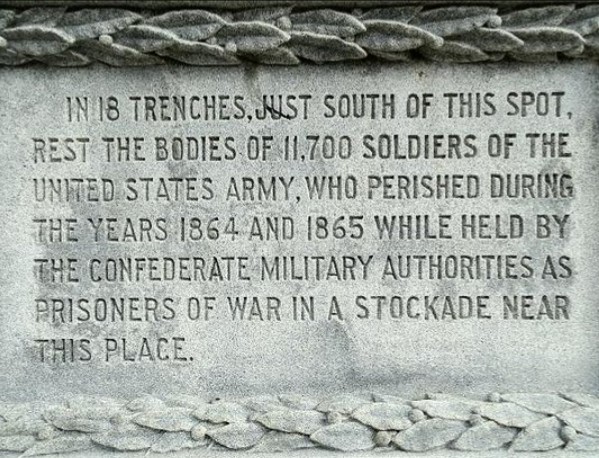
Inscription, Monument to 11,700 Unknown Dead, Salisbury National Cemetery, Salisbury, North Carolina (public domain).
As winter dragged on and the old year gave way to the new, the deaths continued at the Confederacy’s Salisbury Prison in North Carolina. Private Martin M. Berger (Company C) died on 6 January 1865, followed by Private Stephen Shaffer (Company H), who died on 8 January. Both succumbed to disease-related complications.
Finally, as Corporal James Huff could endure no more, he quietly drew his last breath far from the arms of his wife and daughters, on 5 March 1865. His body, emaciated by starvation, was subsequently thrown into a mass unmarked trench grave with other Union POWs. That trench grave and seventeen other unmarked mass trench graves are now part of the Salisbury National Cemetery.
* Note: According to regimental historian Lewis Schmidt, one of the Union POWs who survived his confinement at the Confederacy’s Salisbury Prison later gave an entirely different account of what had actually happened to Corporal James Huff: “He got his throat cut with a ball and I sott him up against stump to die.” If true, the meaning of that statement is clear — Corporal Huff had been shot in the throat by a Confederate guard, possibly because he had gotten to close to one of the “dead lines” at Salisbury. Regardless of how he had finally died, he had suffered tremendously and needlessly.
A memorial has been created online for James Huff on Find a Grave. Researchers hope you’ll pay tribute to his service to the nation by visiting it and leaving a virtual flower for him.
What Happened to the Widow and Children of James Huff?
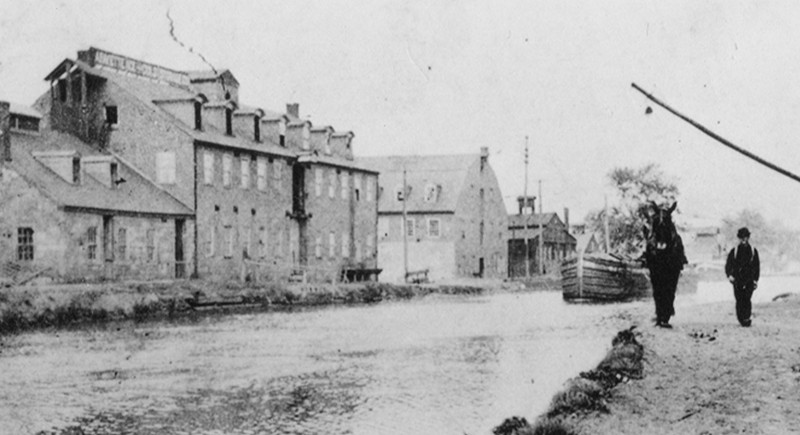
Unidentified canal boatman using a mule to move a canal boat along the Lehigh River through the Abbott Street industrial area of Easton, Pennsylvania, circa 1860s-1870s (public domain; click to enlarge).
Still residing with her children in Easton, Northampton County, Pennsylvania during the mid-1860s, Isabella Roberts (Huff) (1835-1904) subsequently filed for and was later awarded a U.S. Civil War Widows’ Pension (filing date 17 May 1865), in recognition of her husband’s death in battle while serving with the 47th Pennsylvania Volunteers. Faced with persistent economic hardship, however, she chose to marry again roughly two years later, in order to keep a roof over the heads of her children; sometime circa 1867, she wed house carpenter Theodore Mixsell (1835-1918; alternate surname spelling: “Meixsell”), who was a son of Melchior and Margaret (Messinger) Mixsell. Following their marriage in New York, Isabella (Roberts Huff) Mixsell and her husband made their home in Northampton County, where they welcomed the birth of their own son, Howard Mixsell (1868-1940), who was born in Easton on 16 February 1868 and would later wed Elizabeth H. Weir (1869-1937).
By 1870, Isabella and her second husband were residing in that county’s Forks Township. Also living with them were their son, Howard Mixsell, and her three daughters from her first marriage: Irene, Eliza and Sarah Margaret Huff. Isabella and her second husband then welcomed the arrival of another son — William Mixsell (1871-1947) — who was born in Easton on 24 June 1871 and would later became a stone mason and the husband of Georgeanna Farley (1858-1926). But the joy of the early 1870s would turn to sorrow with the untimely deaths of two of Isabella’s daughters — Catherine Huff (1859-1875), who died in October 1875 and Elizabeth Huff (1858-1876), who died in January 1876.
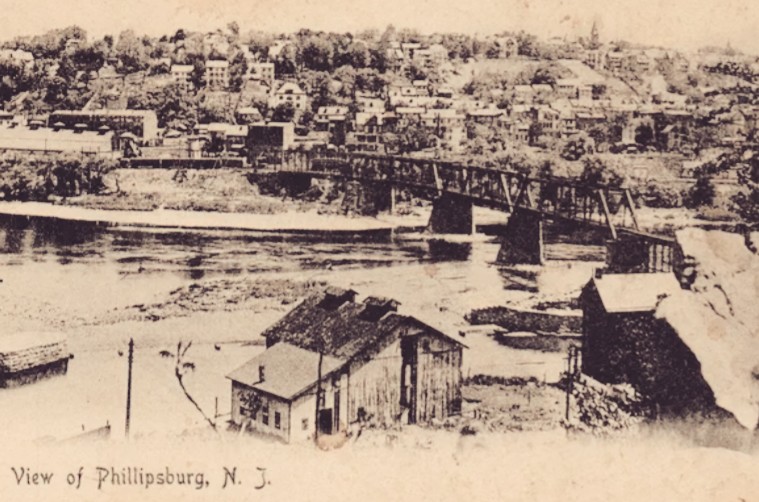
Phillipsburg, New Jersey as viewed from Easton, Pennsylvania, circa 1896-1905 (public domain; click to enlarge).
In the wake of her tragic loss, Isabella (Roberts Huff) Mixsell and her second husband moved their family to the city of Phillipsburg in Warren County, New Jersey, where Isabella then gave birth to another daughter — Mary E. Mixsell (1877-1959), who was born in 1877 and would later wed John A. Lutz (1869-1944). On 29 March 1878, Isabella filed for a second U.S. Civil War Pension — this time from New Jersey — ostensibly to support her daughter, Sarah Margaret Huff, the minor child of a deceased Union soldier. That pension claim was then also approved by U.S. Pension Bureau officials. Still married to vinegar maker Theodore Mixsell when the 1880 federal census was enumerated in Phillipsburg, Isabella (Roberts Huff) Mixsell continued to raise their children, Howard, William and Mary Mixsell, while preparing to give birth to another: Melchior Mixsell (1880-1961), who was born on 15 July 1880 and would later wed Elizabeth Keis (1881-1937).
By mid- June of 1900, however, Isabella and her second husband had moved their family back to Pennsylvania, and were residing in Easton’s Third Ward. Living with them were their children: William, an unmarried day laborer; Melchior, an unmarried baker’s apprentice; and their married daughter, Mary (Mixsell) Lutz; her husband, John A. Lutz, a day laborer; and their children: George M. Lutz (1895-1965), Earl Douglas Lutz (1898-1962), and Edwin K. Lutz (1900-1988). Isabella’s second husband, Theodore Mixsell was employed that year as a stationery engineer. (That year’s federal census enumerator also noted that Isabella had given birth to nine children, only six of whom were still alive, and that Harold W. Levers, a fourteen-year-old boarder was also residing at her home.) Four years, later, Isabella (Roberts Huff) Mixsell was gone. In her late sixties at the time of her death in Easton on 15 March 1904, she was laid to rest at the Easton Cemetery.
James Huffs’ daughter, Catherine Huff (1859-1875), who had been the first of his children to die, had never married. Just sixteen years old at the time of her passing in October 1875, she had been laid to rest at the Easton Cemetery. His daughter, Elizabeth Huff (1858-1876), who had then died in Easton roughly a year later, had also never married. Eighteen at the time of her passing in January 1876, she had also been buried at the Easton Cemetery.
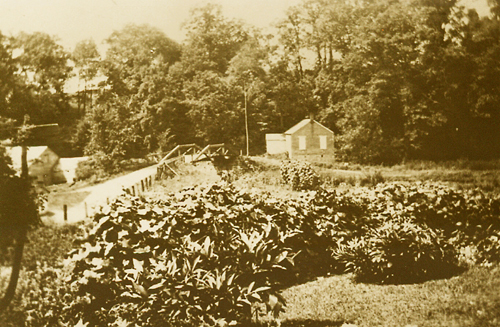
Some Phillipsburg, New Jersey children attended this one-room school on Lock Street near the Morris Canal (circa late 1800s-early 1900s, public domain; click to enlarge).
Following her marriage to Charles P. Nixon (1860-1902) sometime during the 1870s, James Huff’s daughter, Sarah Margaret (Huff) Nixon (1861-1889), who was known to family and friends as “Maggie,” had settled with her husband in Phillipsburg, Warren County, New Jersey, where she had then given birth to three unnamed babies: Infant Nixon (1879-1879), who had been stillborn on 7 February 1879; Infant Male Nixon (1880-1880), who had been stillborn on 5 November 1880; and Infant Female Nixon (1881-1881), who had been stillborn on the day after Christmas in 1881.
Sarah Margaret (Huff) Nixon then gave birth to three sons: Charles F. Nixon (1882-1883), who was born on 8 December 1882, but died just over three weeks later, on New Year’s Day in 1883; Harry Nixon (1884-1885), who was born on 28 October 1884, but died three months later, on 8 February 1885; and Edward B. Nixon (1885-1959), who was born on 26 January 1885, became known to family and friends as “Ed” or “Eddie” and would later wed Katherine Kelly (1882-1953) in 1909. Sadly, the years of difficult pregnancies gradually took their toll on the health of Sarah Margaret (Huff) Nixon. She died in Phillipsburg, New Jersey at the age of twenty-seven, on 26 May 1889. Following funeral services, she was also laid to rest at the Easton Cemetery.
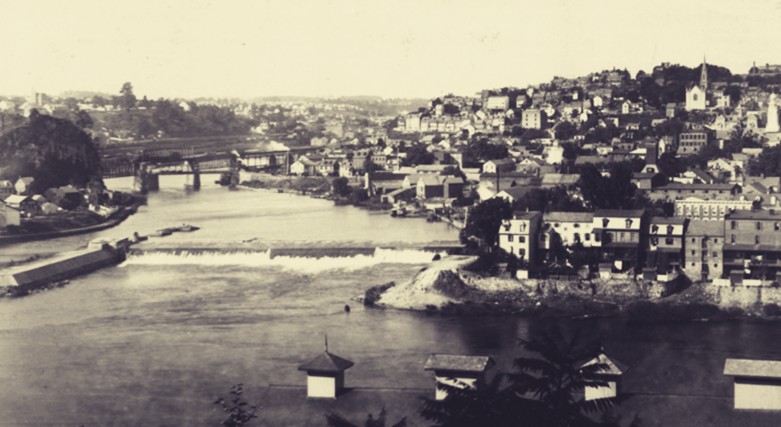
Easton, Pennsylvania on the Delaware River, circa 1890s-early 1900s (public domain; click to enlarge).
James Huff’s eldest child, Irene Huff (1855-1914), who had married Francis Sigman (1850-1917) on 29 August 1870 at what is now the First United Church of Christ in Easton, also settled with her husband in Easton, where they welcomed the birth of a son, George Sigman (1871-1923), who was born on 10 December 1871 and would later become a foreman at a wholesale grocery store. In 1880, her husband was employed as a carpet weaver in Easton. Still residing in that city after the turn of the century, Irene lived at the home of her son, George Sigman, but without her husband. Also residing with them was Jacob Levis/Lewis, a forty-two-year-old boarder and day laborer — an arrangement that continued into 1910. Ailing with kidney disease, Irene (Huff) Sigman died roughly four years later, at the age of fifty-nine in Easton, on 17 May 1914, and was buried at the Easton Heights Cemetery on 21 May.
* Note: Researchers for 47th Pennsylvania Volunteers: One Civil War Regiment’s Story are continuing to search for records that will confirm the names of James Huff’s parents and/or help to document his formative years. If you are a descendant of his and have access to a Huff family Bible or copies of James Huff’s U.S. Civil War Pension file, please Contact Us.
Sources:
- Bates, Samuel P., in History of Pennsylvania Volunteers, 1861-5, vol. 1. Harrisburg, Pennsylvania: B. Singerly, State Printer, 1869.
- “Bonstein, L.,” on U.S. Army Returns from Military Posts” (Fort Taylor, Key West, Florida: January, April, May, June, July, August, September, October, November, and December 1863). Washington, D.C.: U.S. Army and U.S. National Archives and Records Administration.
- Captain Charles Yard, et. al., in Returns From U.S. Military Posts, 1863-1864 (Company E, 47th Pennsylvania Infantry, Fort Jefferson, Dry Tortugas, Florida, May-July 1864), in Records of the Adjutant General’s Office, 1762-1984 (Record Group 94; Microfilm Publication M617, 1550; NAID: 561324). Washington, D.C.: U.S. National Archives and Records Administration.
- Condit, Uzal. The History of Easton, Penn’a from the Earliest Times to the Present, 1738-1885. Easton, Pennsylvania: E. W. West, 1885.
- Costa, Dora L. “Scarring and Mortality Selection Among Civil War POWs: A Long-Term Mortality, Morbidity, and Socioeconomic Follow-Up,” in Demography, 12 September 2012, pp. 1185-1206. Durham, North Carolina: Duke University Press (full article text available here, courtesy of the National Library of Medicine).
- Dyer, Frederick H. A Compendium of the War of the Rebellion, p. 1589. Des Moines, Iowa: The Dyer Publishing Company, 1908.
- “Florida’s Role in the Civil War: ‘Supplier of the Confederacy.” Tampa, Florida: Florida Center for Instructional Technology, University of South Florida (College of Education), retrieved online January 15, 2020.
- Frank Sigman and Irene Hoff [sic, “Irene Huff”] (the eldest daughter of James Huff), in Marriage Records (First United Church of Christ, Easton, Northampton County, Pennsylvania, date of marriage: 29 August 1870). Philadelphia, Pennsylvania: Historical Society of Pennsylvania.
- Gobin, John Peter Shindel. Personal Letters, 1861-1865. Northumberland, Pennsylvania: Personal Collection of John Deppen.
- Grodzins, Dean and David Moss. “The U.S. Secession Crisis as a Breakdown of Democracy,” in When Democracy Breaks: Studies in Democratic Erosion and Collapse, from Ancient Athens to the Present Day (chapter 3). New York, New York: Oxford University Press, 2024.
- Huff, James, in Civil War Muster Rolls (Company E, 47th Pennsylvania Infantry). Harrisburg, Pennsylvania: Pennsylvania State Archives.
- Huff, James, in Civil War Veterans’ Card File, 1861-1866 (Company E, 47th Pennsylvania Infantry). Harrisburg, Pennsylvania: Pennsylvania State Archives.
- Huff, James, Isabella, Irene, Eliza, and Kate, in U.S. Census (Easton, Palmer Township, Northampton County, Pennsylvania, 1860). Washington, D.C.: U.S. National Archives and Records Administration.
- Huff, James, Isabella and Sarah M. (minor child), in U.S. Civil War Pension General Index Cards (widow’s application no.: 93956, widow’s certificate no.: 68522, filed by the veteran’s widow, Sarah Huff, from Pennsylvania, 17 May 1865; minor child’s application no.: 236521, minor child’s certificate no.: 183682, filed from New Jersey by the veteran’s widow/guardian on behalf of the veteran’s minor child, Sarah M. Huff, 29 March 1878). Washington, D.C.: U.S. National Archives and Records Administration.
- Irene Sigman, in Death Certificates (file no.: 48334, registered no.: 246, date of death: 17 May 1914). Harrisburg, Pennsylvania: Commonwealth of Pennsylvania, Department of Health, Bureau of Vital Statistics.
- Irwin, Richard Bache. History of the Nineteenth Army Corps. New York, New York: G. P. Putnam’s Sons, 1893.
- Keys, Ancel, Josef Brožek, Austin Henschel, Olaf Mickelsen, and Henry Longstreet Taylor. The Biology of Human Starvation. Minneapolis, Minnesota: The University of Minnesota Press, 1950.
- Meixsell [sic, “Mixsell”], Theodore, Isabella (Theodore’s wife, who was the widow of James Huff), William, and Melchior; Lutz, John A., Mary E. (a daughter of Theodore and Isabella), George M., Earl D., and Edwin K.; and Levers, Harold W. (boarder), in U.S. Census (Easton, Third Ward, Northampton County, Pennsylvania, 1900). Washington, D.C.: U.S. National Archives and Records Administration.
- Mettraux, Guénaël. “A Little-known Case from the American Civil War: The War Crimes Trial of Major General John H. Gee,” in Journal of International Criminal Justice, vol. 8, no. 4, September 2010, pp. 1059-1068. United Kingdom, Oxford University Press.
- Mixsell, Theodore, Isabella (Theodore’s wife, who was the widow of James Huff) and Howard; and Huff, Irene, Eliza and Margaret (the daughters of Isabella (Roberts Huff) Muxsell and James Huff), in U.S. Census (Forks Township, Northampton County, Pennsylvania, 1870). Washington, D.C.: U.S. National Archives and Records Administration.
- Mixsell, Theodore, Isabella (Theodore’s wife, who was the widow of James Huff) and Howard, William and Mary Mixsell (their chidren), in U.S. Census (Phillipsburg, Warren County, New Jersey, 1880). Washington, D.C.: U.S. National Archives and Records Administration.
- “Roster of the 47th P. V. Inf.” Allentown, Pennsylvania: The Morning Call, 26 October 1930.
- Schmidt, Lewis G. A Civil War History of the 47th Regiment of Pennsylvania Veteran Volunteers. Allentown, Pennsylvania: Self-published, 1986.
- Scott, Robert N. The War of War of the Rebellion: A Compilation of the Official Records of the Union and Confederate Armies, series I, vol. XXXIV, part II: “Correspondence, etc.-Union,” Chapter XLVI: “Louisiana and the Trans-Mississippi,” p. 199. Washington, DC: Government Printing Office, 1891.
- Sheridan, Philip Henry. Personal Memoirs of P. H. Sheridan, General, United States Army in Two Volumes. New York, New York: Charles L. Webster & Company, 1888.
- Sigman, Frank, Irene (the eldest daughter of James Huff) and George, in U.S. Census (Easton, Northampton County, Pennsylvania, 1880). Washington, D.C.: U.S. National Archives and Records Administration.
- Sigman, George (a grandson of James Huff) and Irene (a daughter of James Huff and the mother of George Huff); and Levis/Lewis, Jacob (boarder), in U.S. Census (Easton, Second and then First Wards, Northampton County, Pennsylvania, 1900, 1910). Washington, D.C.: U.S. National Archives and Records Administration.
- Staubach, Lieutenant Colonel James C. “Miami During the Civil War: 1861-65,” in Tequesta: The Journal of the Historical Association of Southern Florida, vol. LIII, pp. 31-62. Miami: Historical Museum of Southern Florida, 1993.
- Stegall, Joel L. Salisbury Prison: North Carolina’s Andersonville. Fayetteville, North Carolina: North Carolina History Center on the Civil War, Emancipation & Reconstruction, 13 September 2018.
- Tamiami Trail Modifications: Next Steps — Draft Environmental Impact Statement, Appendix E. Washington, DC: U.S. National Park Service: Everglades National Park: 29 January 2010.
- “The History of the Forty-Seventh Regt. P. V.” Allentown, Pennsylvania: The Lehigh Register, 20 July 1870.
- “The Shaping of Easton,” in “About Easton: History.” Easton, Pennsylvania: City of Easton, retrieved online 11 June 2026.
- Wharton, Henry D. “Letters from the Sunbury Guards.” Sunbury, Pennsylvania: The Sunbury American, 1861-1864.


You must be logged in to post a comment.