Alternate Surname Spellings: Frey, Fry, Frye
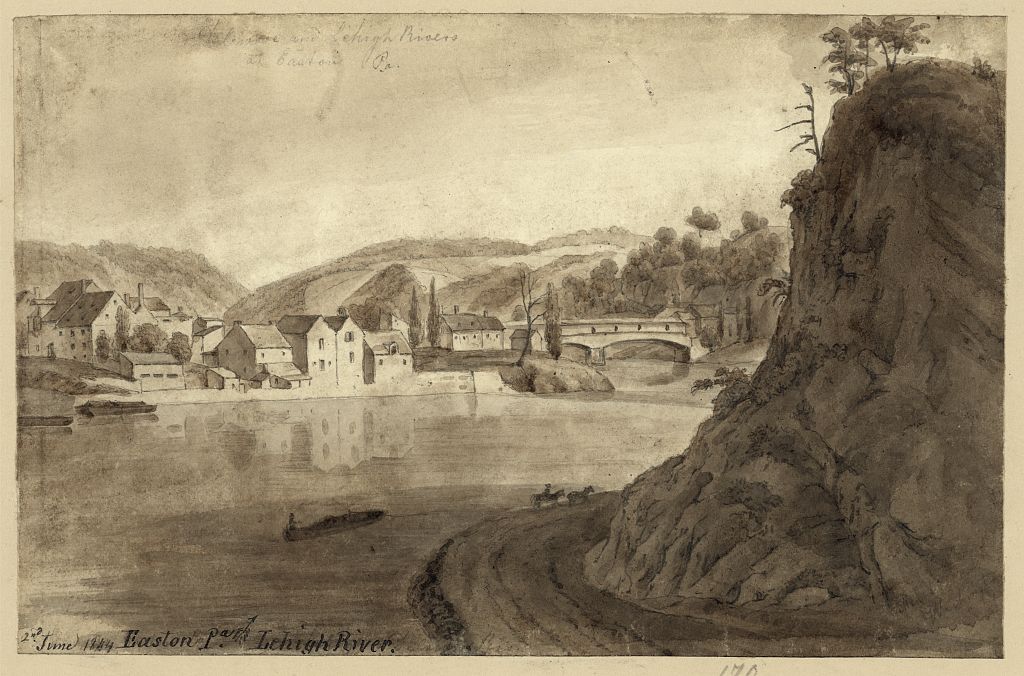
Delaware and Lehigh Rivers at Easton, Pennsylvania, 1844 (Augustus Kollner, U.S. Library of Congress, public domain).
Relatively privileged by the socioeconomic standards of their time, the Frey brothers of Northampton County, Pennsylvania were still just teenagers when they became brothers-in-arms during one of the most dangerous eras of American history.
Formative Years
Born in the Borough of Easton in Northampton County, Pennsylvania on 30 November 1845 and 9 March 1848, respectively, Charles Henry Frey (1845-1913) and Edward Augustus Frey (1848-1904) were sons of Martin Luther Frey (1822-1894), a native of Upper Mount Bethel Township in Northampton County, and Elizabeth (Steel/Steele) Frey (1825-1883), a native of Easton.
Baptized on the same day (29 May 1850) at First Church in Easton, Charles H. Frey and Edward A. Frey were raised and educated in Easton with their Easton-born siblings: Annie Elizabeth Frey (1850-1924), who was born on 7 May 1850, was known to family and friends as “Annie”; and Franklin Frey (1853-unknown), who was born on 18 September 1853 and baptized at First Church on 19 February 1855.
In 1850, the Frey household included Charles and his parents, as well as his siblings, Edward and Ann. By 1860, their household also included Charles and Edward’s one-year-old sister, Mary Margaret Frey (1858-1929), who had been born in Easton on 17 December 1858 and would later wed Osman F. Reinhard (1855-1929). That census did not include Franklin Frey, however, who had evidently died sometime after his baptism in February 1855 but before the federal census of 1860 (which did not list Franklin as a member of the Frey household when it was enumerated in Easton on 21 June 1860).
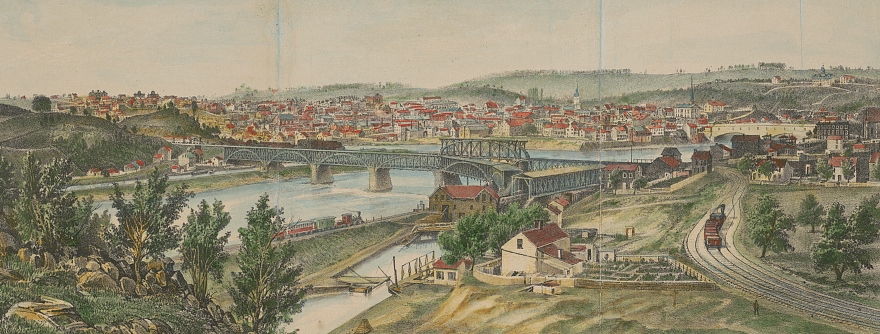
View of Easton (from Phillipsburg Rock, circa 1860-1862, James Fuller Queen, U.S. Library of Congress, public domain; click to enlarge).
Another interesting data point of that federal census is that twenty-one-year-old Jacob Sandt was also residing with the Freys in 1860. Employed as a clerk that year, Jacob Sandt would go on to serve in the 36th Pennsylvania Militia during the American Civil War and would then marry Charles and Edward’s sister, Annie Frey, after the war.
Another Frey sibling, Emma Steele Frey (1861-1931), was then born on 8 May 1861. She would later marry and be widowed by Jeremiah F. George (1849-1907), before marrying widower Edwin Meixsell (1853-1919).
But like so many Northampton County residents, the relatively untroubled lives of the Freys were growing darker by the moment as their nation was drawn deeper and deeper from a worrisome secession crisis into the horrors of a major war that would claim the lives of roughly seven hundred thousand Americans before it was finally won.
American Civil War
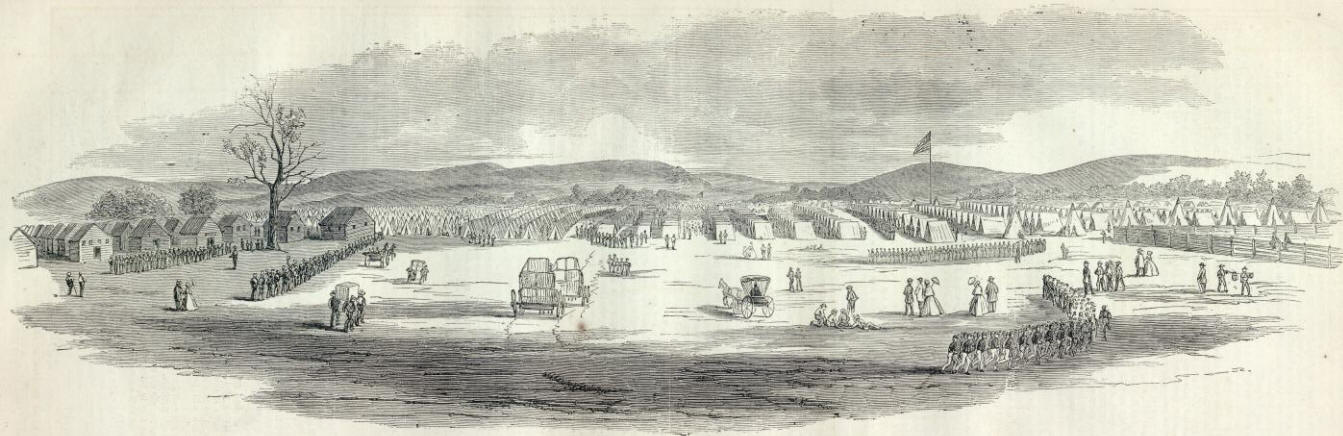
Camp Curtin, Harrisburg, Pennsylvania (Harper’s Weekly, 13 December 1862, public domain; click to enlarge).
As soon as he reached the age of enlistment for the Union Army, Charles Henry Frey enrolled for military service in Allentown, Lehigh County on 30 August 1862. He then officially mustered in for duty at Camp Curtin in Harrisburg on 16 September as a private with Company E of the 47th Pennsylvania Volunteer Infantry, where he received basic training in light infantry tactics. Military records at the time described him as a sixteen-year-old clerk who lived and worked in the city of Easton in Northampton County.
Transported south by train and ship to South Carolina, where he connected with his company and regiment at its encampment near Beaufort, South Carolina on 14 October 1862, he arrived just after the regiment had taken part in the capture of Saint John’s Bluff in Florida, the subsequent capture of a Confederate steamer near Hawkinsville — and the regiment’s integration, which had begun the first week in October 1862 with the enrollment of four Black men who had previously been enslaved on plantations near Beaufort.
He also arrived barely a week before many of his new comrades would head off to a battle from which they would never return.
Battle of Pocotaligo, South Carolina

Highlighted version of the U.S. Army map of the Coosawhatchie-Pocotaligo Expedition, 22 October 1862 (public domain).
From 21-23 October, under the brigade and regimental commands of Colonel Tilghman H. (“T. H.”) Good and Lieutenant-Colonel George Warren (“G. W.”) Alexander, members of the 47th Regiment, Pennsylvania Volunteer Infantry joined with other Union regiments to engage the heavily protected Confederate forces in and around Pocotaligo, South Carolina — including at Frampton’s Plantation and the Pocotaligo Bridge — a key piece of the South’s railroad infrastructure that had been targeted for destruction by senior Union military leaders.
Harried by snipers en route to the Pocotaligo Bridge, they met resistance from yet another entrenched, heavily fortified Confederate battery which opened fire on the Union troops as they entered an open cotton field. Those headed toward higher ground at the Frampton Plantation fared no better as they encountered artillery and infantry fire from the surrounding forests. But the Union soldiers would not give in; grappling with the Confederates where they found them, they pursued the Rebels for four miles as the Confederate Army retreated to the bridge. There, the 47th relieved the 7th Connecticut. Unfortunately, the enemy was just too well armed. After two hours of intense fighting in an attempt to take the ravine and bridge, the 47th was forced by depleted ammunition supplies to withdraw to Mackay’s Point.
But the battle had been a costly one for the 47th Pennsylvania. Captain Charles Mickley of G Company had been killed, and Captain George Junker of Company K had been mortally wounded. In addition, Privates Henry A. Backman, Nathan George, Samuel Minnich, George B. Rose and fourteen other enlisted men had died; an additional one hundred and fourteen had been wounded in action, including First Lieutenant William Geety of H Company, who had sustained a grievous head wound. (Thanks to his powerful will to live and the skill of Union Army surgeons, he managed to survive, as did E Company’s Corporal Reuben Weiss, who had been wounded in both legs.)
* Note: Researchers for 47th Pennsylvania Volunteers: One Civil War Regiment’s Story have not yet determined whether or not Private Charles H. Frey took part in the Battle of Pocotaligo. According to regimental historian Lewis Schmidt, approximately six hundred of the 47th Pennsylvania’s roughly one thousand members were involved. (The four hundred who did not participate had been left behind to protect the regiment’s encampment near Beaufort and had continued to perform the duties assigned to the regiment as part of the Union’s occupation force in that region.) Researchers theorize that Private Frey may have been among the men who remained in Beaufort because he had only just recently completed basic training and his superior officers had not yet had enough time to fully assess his ability to handle his weapon and follow orders under pressure.
On 23 October 1862, the surviving 47th Pennsylvania Volunteers returned from Pocotaligo to Hilton Head, South Carolina. Later that same month, several members of the regiment served as the honor guard during the funeral of Major-General Ormsby M. Mitchel, the commander of the U.S. Army’s 10th Corps and Department of the South who died from yellow fever on 30 October.
Having been ordered to head for Key West, Florida on 15 November 1862, Private Charles Frey and his fellow 47th Pennsylvania Volunteers would subsequently spend the entire year of 1863 garrisoning federal installations in Florida as part of the U.S. Army’s 10th Corps, Department of the South.
1863

Fort Taylor, Key West, Florida (Harper’s Weekly, 1864, public domain).
During those first months of the New Year, Private Charles Frey and the other members of Company E joined with the men from Companies A, B, C, G, and I in guarding Key West’s Fort Taylor while the members of Companies D, F, H, and K were shipped farther south — to Fort Jefferson, the Union’s remote outpost in the Dry Tortugas off the coast of Florida — and assigned to garrison duties there. According to the U.S. Army’s records collection known as “Returns from Military Posts,” sometime shortly after returning to Key West, Company E’s First Lieutenant Lawrence Bonstine was assigned to special duty as post adjutant — a position he continued to hold from at least 10 January 1863 through the end of December 1863. Reporting directly to the regiment’s commanding officer, Colonel Tilghman Good, he was essentially Good’s right hand, and was responsible for ensuring that regimental records and reports to senior military officials were kept up to date.
On 5 March 1863, Private William H. Eichman was promoted to the rank of corporal, and exactly one month later, on 5 April 1863, Second Lieutenant W. Scott Johnston was promoted to the rank of first lieutenant and also appointed as adjutant with the central regimental staff.
* Note: While all of that was unfolding, Private Charles Frey’s parents were welcoming the birth of a daughter, Jennie Frey (1863-1944), who was born in Easton, Pennsylvania on 30 March 1863 and would later marry William H. Frederick (1862-1953) in 1885.
Garrisoning Federal Forts to Weaken the Confederacy
Prior to intervention by the Union Army and Navy, the owners of plantations, livestock ranches and fisheries, as well as the operators of smaller family farms across Florida, had been able to consistently furnish beef and pork, fish, fruits, and vegetables to Confederate troops stationed throughout the Deep South during the first year of the American Civil War. Large herds of cattle were raised near Fort Myers, for example, while orchard owners in the Saint John’s River area were actively engaged in cultivating sizeable orange groves. (Other types of citrus trees were found growing throughout more rural areas of the state.)
Florida was also a major producer of salt, which was used as a preservative for food. Consequently, the 47th Pennsylvania Volunteers and other Union troops across Florida were ordered to capture or destroy salt manufacturing plants in order to further curtail the enemy’s access to food.
But, the officers and enlisted members of the regiment soon came to realize that disease would be a constant companion and foe — making it all the more remarkable when, during that phase of service, the majority of 47th Pennsylvania Volunteers chose to re-enlist as their three-year service terms began to expire.
1864
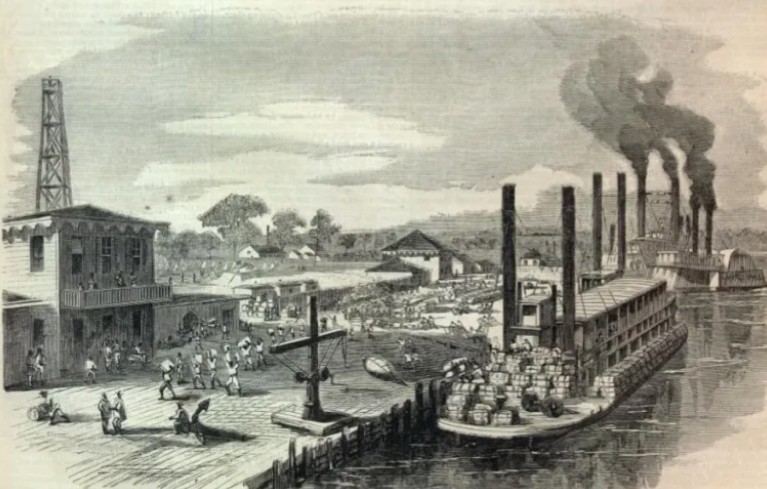
Brashear City, Louisiana, circa 1860s (public domain).
In early January 1864, the 47th Pennsylvania Volunteer Infantry was ordered to expand the Union Army’s reach by sending part of the regiment north to retake possession of, and rehabilitate, Fort Myers, which had been abandoned in 1858 following the U.S. government’s third war with the Seminole Indians. Per orders issued earlier in 1864 by Major-General D. P. Woodbury, commanding officer, U.S. Department of the Gulf, District of Key West and the Tortugas, that the fort be reclaimed to facilitate the Union’s Gulf Coast blockade, Captain Richard Graeffe and a group of men from Company A were assigned to the duty of raiding cattle herds in northern Florida in order to provide food for the growing Union troop presence in the state. Graeffe and his men subsequently turned the fort into both their base of operations and a shelter for pro-Union supporters, men, women and children who were escaping slavery, Confederate Army deserters, and others fleeing Rebel troops.
Meanwhile, the men from E Company and the other members of the 47th Pennsylvania Volunteer Infantry were preparing to embark on the regiment’s history-making journey to Louisiana. Boarding yet another steamer — the Charles Thomas — on 25 February 1864, the men from Companies B, C, D, I, and K of the 47th Pennsylvania headed for Algiers, Louisiana (across the river from New Orleans), followed on 1 March by other members of the regiment from Companies E, F, G, and H who had been stationed at Fort Jefferson in the Dry Tortugas. Upon the second group’s arrival, the now almost fully reunited regiment moved by train on 28 February to Brashear City (now Morgan City, Louisiana) before heading to Franklin by steamer through the Bayou Teche. There, the 47th Pennsylvania Volunteer Infantry joined the 2nd Brigade, 1st Division of the Department of the Gulf’s 19th Army Corps, and became the only Pennsylvania regiment to serve in the Red River Campaign of Union Major-General Nathaniel P. Banks. (Unable to reach Louisiana until 23 March, the men from Company A were effectively placed on a different type of detached duty in New Orleans while they awaited transport to enable them to catch up with the main part of their regiment. Charged with guarding and overseeing the transport of two hundred and forty-five Confederate prisoners, they were finally able to board the Ohio Belle on 7 April. They then reached Alexandria with those prisoners on 9 April.)
Red River Campaign, Louisiana
The early days on the ground in Louisiana quickly woke the 47th Pennsylvania Volunteers up to just how grueling that new phase of duty would be. From 14-26 March, most members of the regiment marched for Alexandria and Natchitoches, Louisiana, by way of New Iberia, Vermilionville (now part of Lafayette), Opelousas, and Washington.
From 4-5 April 1864, the regiment added to its roster of young Black soldiers when Aaron Bullard (later known as Aaron French), James Bullard, John Bullard, Samuel Jones, and Hamilton Blanchard (also known as John Hamilton) enrolled for military service with the 47th Pennsylvania at Natchitoches. According to their respective entries in the Civil War Veterans’ Card File at the Pennsylvania State Archives and on regimental muster rolls, several of the men were then assigned the rank of “(Colored) Cook” while others were given the rank of “Under-Cook.”
Often short on food and water throughout their long harsh-climate trek through enemy territory, the men encamped briefly at Pleasant Hill (now the Village of Pleasant Hill) the night of 7 April before continuing on the next day.
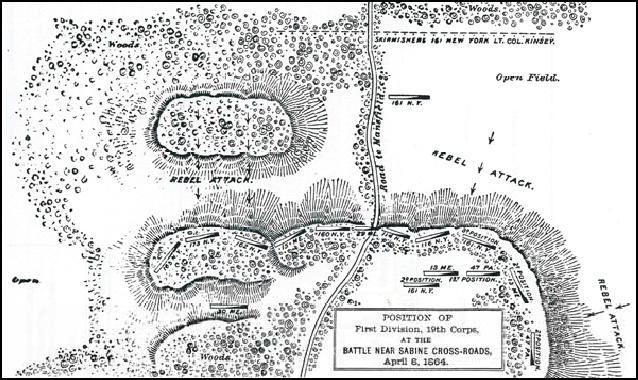
19th U.S. Army Map, Phase 3, Battle of Sabine Cross Roads/Mansfield (8 April 1864, public domain).
Marching until mid-afternoon on 8 April, the 47th Pennsylvania Volunteers were rushed into battle ahead of other regiments in the 2nd Division. Sixty members of the 47th were cut down that day during the back-and-forth volley of fire unleashed during the Battle of Sabine Cross Roads (also known as the Battle of Mansfield due to its proximity to the town of Mansfield). The fighting waned only when darkness fell. The exhausted, but uninjured collapsed beside the gravely wounded. After midnight, the surviving Union troops withdrew to Pleasant Hill.
The next day, the 47th Pennsylvania Volunteers were ordered into a critically important defensive position at the far right of the Union lines, their right flank spreading up onto a high bluff. By 3 p.m., after enduring a midday charge by the troops of Confederate Major-General Richard Taylor (a plantation owner who was the son of Zachary Taylor, former president of the United States), the brutal fighting still showed no signs of ending. Suddenly, just as the 47th was shifting to the left side of the massed Union forces, the men of the 47th Pennsylvania were forced to bolster the 165th New York’s buckling lines by blocking another Confederate assault, during what has since become known as the Battle of Pleasant Hill.
Casualties were severe. Second Lieutenant Alfred Swoyer of Company K and Private Richard Hahn of Company E were killed in action. The regiment’s second-in-command, Lieutenant-Colonel Alexander, was nearly killed, and the regiment’s two color-bearers, both from Company C, were also seriously wounded while preventing the American flag from falling into enemy hands. Still others from the 47th were captured by Confederate troops, marched roughly one hundred and twenty-five miles to Camp Ford, a Confederate Army prison camp near Tyler, Texas, and held there as prisoners of war until they were released during prisoner exchanges beginning 22 July and into November 1864. Corporal James Huff, who had been wounded in action during the Battle of Pleasant Hill on 9 April, was one of those POWs who were finally released (on 29 August 1864). Sadly, at least two members of the 47th Pennsylvania never made it out alive.
Following what some historians have called a rout by Confederates at Pleasant Hill and others have labeled a technical victory for the Union or a draw for both sides, the 47th Pennsylvanians fell back to Grand Ecore to resupply and regroup. They remained at Grand Ecore for a total of eleven days (through 22 April 1864), where they engaged in the hard labor of strengthening regimental and brigade fortifications in a brutal climate. They then moved back to Natchitoches Parish, where they arrived in Cloutierville at 10 p.m. that night, after marching forty-five miles. En route, the Union forces were attacked again — this time in the rear, but they were able to end the encounter fairly quickly and continue on.

The 47th Pennsylvania Volunteers were stationed just to the left of the “Thick Woods” with Emory’s 2nd Brigade, 1st Division as shown on this map of Union troop positions for the Battle of Cane River Crossing at Monett’s Ferry, Louisiana, 23 April 1864 (Major-General Nathaniel Banks’ official Red River Campaign Report, public domain).
The next morning (23 April 1864), episodic skirmishing quickly roared into the flames of a robust fight. As part of the advance party led by Union Brigadier-General William Emory, the 47th Pennsylvania took on the Confederate cavalry of Brigadier-General Hamilton P. Bee during the Battle of Cane River (also known as “the Affair at Monett’s Ferry” or the “Cane River Crossing”).
Responding to a barrage from the Confederate’s twenty-pound Parrott guns and raking fire from enemy troops situated near a bayou and on a bluff, Brigadier-General Emory directed one of his brigades to keep Bee’s Confederates busy while sending the other two brigades to find a safe spot where his Union troops could ford the Cane River. As part of the “beekeepers,” the 47th Pennsylvanians supported Emory’s artillery.
Meanwhile, other troops under Emory found and worked their way across the Cane River, attacked Bee’s flank, and forced a Rebel retreat. That Union brigade then erected a series of pontoon bridges, enabling the 47th and other remaining Union units to make the Cane River Crossing by the next day. As the Confederates retreated, they torched their own food stores, as well as the cotton supplies of their fellow southerners. In a letter penned from Morganza, Louisiana on 29 May, Henry Wharton described what happened to the 47th Pennsylvanians during and immediately after making camp at Grand Ecore:
Our sojourn at Grand Ecore was for eleven days, during which time our position was well fortified by entrenchments for a length of five miles, made of heavy logs, five feet high and six feet wide, filled in with dirt. In front of this, trees were felled for a distance of two hundred yards, so that if the enemy attacked we had an open space before us which would enable our forces to repel them and follow if necessary. But our labor seemed to the men as useless, for on the morning of 22d April, the army abandoned these works and started for Alexandria. From our scouts it was ascertained that the enemy had passed some miles to our left with the intention of making a stand against our right at Bayou Cane, where there is a high bluff and dense woods, and at the same attack Smith’s forces who were bringing up the rear. This first day was a hard one on the boys, for by ten o’clock at night they made Cloutierville, a distance of forty-five miles. On that day the rear was attacked which caused our forces to reverse their front and form in line of battle, expecting too, to go back to the relief of Smith, but he needed no assistance, sending word to the front that he had ‘whipped them, and could do it again.’ It was well that Banks made so long a march on that day, for on the next we found the enemy prepared to carry out their design of attacking us front and rear. Skirmishing commenced early in the morning and as our columns advanced he fell back towards the bayou, when we soon discovered the position of their batteries on the bluff. There was then an artillery duel by the smaller pieces, and some sharp fighting by the cavalry, when the ‘mule battery,’ twenty pound Parrott guns, opened a heavy fire, which soon dislodged them, forcing the chivalry to flee in a manner not at all suitable to their boasted courage. Before this one cavalry, the 3d Brigade of the 1st Div., and Birges’ brigade of the second, had crossed the bayou and were doing good service, which, with the other work, made the enemy show their heels. The 3d brigade done some daring deeds in this fight, as also did the cavalry. In one instance the 3d charged up a hill almost perpendicular, driving the enemy back by the bayonet without firing a gun. The woods on this bluff was so thick that the cavalry had to dismount and fight on foot. During the whole of the day, our brigade, the 2d was supporting artillery, under fire all the time, and could not give Mr. Reb a return shot.
While we were fighting in front, Smith was engaged some miles in the rear, but he done his part well and drove them back. The rebel commanders thought by attacking us in the rear, and having a large face on the bluffs, they would be able to capture our train and take us all prisoners, but in this they were mistaken, for our march was so rapid that we were on them before they had thrown up the necessary earthworks. Besides they underrated the amount of our artillery, calculating from the number engaged at Pleasant Hill. The rebel prisoners say it ‘seems as though the Yankees manufacture, on short notice, artillery to order, and the men are furnished with wings when they wish to make a certain point.
The damage done to the Confederate cause by the burning of cotton was immense. On the night of the 22d our route was lighted up for miles and millions of dollars worth of this production was destroyed. This loss will be felt more by Davis & Co., than several defeats in this region, for the basis of the loan in England was on the cotton of Western Louisiana.
After the rebels had fled from the bluff the negro troops put down the pontoons, and by ten that night we were six miles beyond the bayou safely encamped. The next morning we moved forward and in two days were in Alexandria. Johnnys followed Smith’s forces, keeping out of range of his guns, except when he had gained the eminence across the bayou, when he punished them (the rebs) severely.
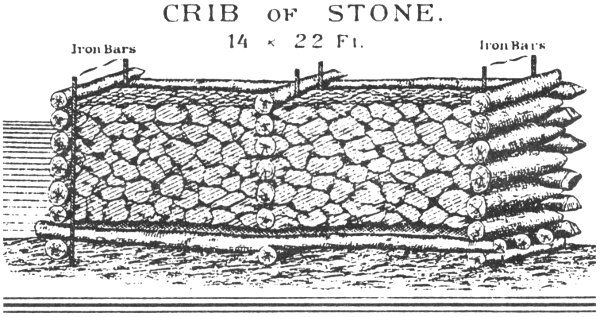
Sketches of the crib and tree dams designed by Lieutenant-Colonel Joseph Bailey to improve the water levels of the Red River near Alexandria, Louisiana, spring 1864 (Joseph Bailey, “Report on the Construction of the Dam Across the Red River,” 1865, public domain).
Having finally reached Alexandria on 26 April, the 47th Pennsylvania Volunteers learned they would remain at their latest new camp for at least two weeks. Placed temporarily under the command of Lieutenant-Colonel Joseph Bailey, they were assigned yet again to the hard labor of fortification work — this time helping to erect “Bailey’s Dam,” a timber structure that enabled Union gunboats to more easily make their way back down the Red River. According to Wharton:
We were at Alexandria seventeen days, during which time the men were kept busy at throwing up earthworks, foraging and three times went out some distance to meet the enemy, but they did not make their appearance in numbers large enough for an engagement. The water in the Red river had fallen so much that it prevented the gunboats from operating with us, and kept our transports from supplying the troops with rations, (and you know soldiers, like other people, will eat) so Banks was compelled to relinquish his designs on Shreveport and fall back to the Mississippi. To do this a large dam had to be built on the falls at Alexandria to get the ironclads down the river. After a great deal labor this was accomplished and by the morning of May 13th the last one was through the shute [sic], when we bade adieu to Alexandria, marching through the town with banners flying and keeping step to the music of ‘Rally around the flag,’ and ‘When this cruel war is over.’ The next morning, at our camping place, the fleet of boats passed us, when we were informed that Alexandria had been destroyed by fire – the act of a dissatisfied citizen and several negroes. Incendiary acts were strictly forbidden in a general order the day before we left the place, and a cavalry guard was left in the rear to see the order enforced. After marching a few miles skirmishing commenced in front between the cavalry and the enemy in riflepits [sic] on the bank of the river, but they were easily driven away. When we came up we discovered their pits and places where there had been batteries planted. At this point the John Warren, an unarmed transport, on which were sick soldiers and women, was fired into and sunk, killing many and those that were not drowned taken prisoners. A tin-clad gunboat was destroyed at the same place, by which we lost a large mail. Many letters and directed envelopes were found on the bank – thrown there after the contents had been read by the unprincipled scoundrels. The inhumanity of Guerrilla bands in this department is beyond belief, and if one did not know the truth of it or saw some of their barbarities, he would write it down as the story of a ‘reliable gentleman’ or as told by an ‘intelligent contraband.’ Not satisfied with his murderous intent on unarmed transports he fires into the Hospital steamer Laurel Hill, with four hundred sick on board. This boat had the usual hospital signal floating fore and aft, yet, notwithstanding all this, and the customs of war, they fired on them, proving by this act that they are more hardened than the Indians on the frontier.
On Sunday, May 15, we left the river road and took a short route through the woods, saving considerable distance. The windings of Red river are so numerous that it resembles the tape-worm railroad wherewith the politicians frightened the dear people during the administration of Ritner and Stevens. – We stopped several hours in the woods to leave cavalry pass, when we moved forward and by four o’clock emerged into a large open plain where we formed in line of battle, expecting a regular engagement. The enemy, however, retired and we advanced ‘till dark, when the forces halted for the night, with orders to rest on their arms. – ‘Twas here that Banks rode through our regiment, amidst the cheers of the boys, and gave the pleasant news that Grant had defeated Lee.

“Sleeping on Their Arms” by Winslow Homer (Harper’s Weekly, 21 May 1864).
Having entered Avoyelles Parish, they “rested on their arms” for the night, half-dozing without pitching their tents, but with their rifles right beside them. They were now positioned just outside of Marksville, Louisiana on the eve of the 16 May 1864 Battle of Mansura, which unfolded as follows, according to Wharton:
Early next morning we marched through Marksville into a prairie nine miles long and six wide where every preparation was made for a fight. The whole of our force was formed in line, in support of artillery in front, who commenced operations on the enemy driving him gradually from the prairie into the woods. As the enemy retreated before the heavy fire of our artillery, the infantry advanced in line until they reached Mousoula [sic, Mansura], where they formed in column, taking the whole field in an attempt to flank the enemy, but their running qualities were so good that we were foiled. The maneuvring [sic] of the troops was handsomely done, and the movements was [sic] one of the finest things of the war. The fight of artillery was a steady one of five miles. The enemy merely stood that they might cover the retreat of their infantry and train under cover of their artillery. Our loss was slight. Of the rebels we could not ascertain correctly, but learned from citizens who had secreted themselves during the fight, that they had many killed and wounded, who threw them into wagons, promiscuously, and drove them off so that we could not learn their casualties. The next day we moved to Simmsport [sic, Simmesport] on the Achafalaya [sic, Atchafalaya] river, where a bridge was made by putting the transports side by side, which enabled the troops and train to pass safely over. – The day before we crossed the rebels attacked Smith, thinking it was but the rear guard, in which they, the graybacks, were awfully cut up, and four hundred prisoners fell into our hands. Our loss in killed and wounded was ninety. This fight was the last one of the expedition. The whole of the force is safe on the Mississippi, gunboats, transports and trains. The 16th and 17th have gone to their old commands.
It is amusing to read the statements of correspondents to papers North, concerning our movements and the losses of our army. I have it from the best source that the Federal loss from Franklin to Mansfield, and from their [sic] to this point does not exceed thirty-five hundred in killed, wounded and missing, while that of the rebels is over eight thousand.

Union Army base at Morganza Bend, Louisiana, circa 1863-1865 (U.S. Library of Congress, public domain).
Continuing on, the surviving members of the 47th marched for Simmesport and then Morganza, where they made camp again. While encamped there, the nine formerly enslaved Black men who had enlisted with the 47th Pennsylvania in Beaufort, South Carolina (1862) and Natchitoches, Louisiana (April 1864) were officially mustered into the regiment between 20-24 June 1864. During that same time, E Company Corporal Francis A. Parks was promoted to the rank of sergeant (on 22 June).
The regiment then moved on once again, and arrived in New Orleans in late June. As they did during their tour through the Carolinas and Florida, the men of the 47th had battled the elements and disease, as well as the Confederate Army, in order to survive and continue to defend their nation. On 7 July 1864, First Lieutenant Lawrence Bonstein, Private Charles H. Frey and their fellow E Company men boarded yet another steamer, the U.S. McClellan, along with the 47th Pennsylvania’s Companies A, C, D, F, H, and I, and returned to the Washington, D.C. area.
Following their arrival and a memorable encounter with President Abraham Lincoln, they joined up with Major-General David Hunter’s forces at Snicker’s Gap, Virginia to fight in the Battle of Cool Spring, and then assisted in defending Washington, D.C. once again while also helping to drive Confederate troops from Maryland.
Sheridan’s 1864 Shenandoah Valley Campaign
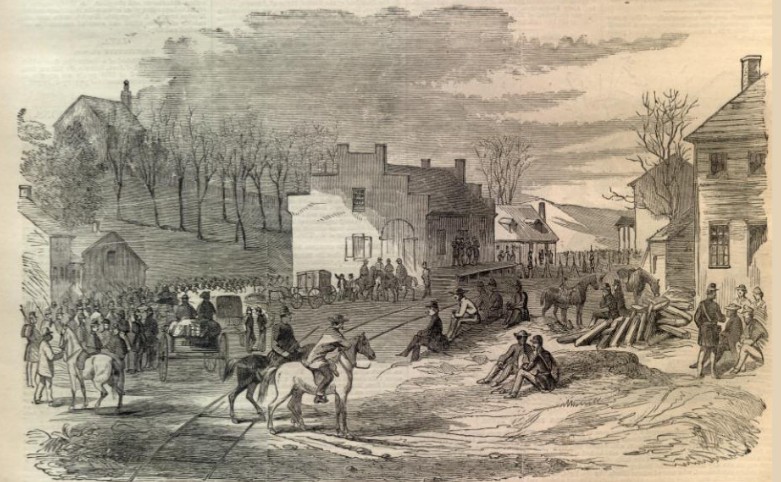
“The Rendezvous of the Virginians at Halltown, Virginia, 5 p.m. on April 18, 1861 to March on Harper’s Ferry” (D. H.Strother, Harper’s Weekly, 11 May 1861, public domain).
Attached to the Middle Military Division, United States’ Army of the Shenandoah beginning in August 1864, the 47th Pennsylvania Volunteer Infantry was assigned to defensive duties in and around Halltown, Virginia during the opening days of that month. Involved at that time in the 1864 Shenandoah Valley Campaign of Union Major-General Philip Sheridan, they subsequently engaged in a series of back-and-forth movements over the next several weeks between Halltown, Berryville, Middletown, Charlestown, and Winchester as part of a “mimic war” being waged by Sheridan’s Union forces with those commanded by Confederate Lieutenant-General Jubal Early.
From 3-4 September, the 47th Pennsylvania Volunteers also fought in the Battle of Berryville. But it would be the last fight for multiple commissioned officers and enlisted members of the regiment because those 47th Pennsylvanians had completed their respective, original three-year terms of enlistment and had decided not to re-enlist. Among those awarded honorable discharges at Berryville on 18 September were E Company’s Captain Charles Yard and First Lieutenant Lawrence Bonstine.
The remaining members of the 47th Pennsylvania who stayed — like Private Charles H. Frey — were about to engage in the regiment’s greatest displays of valor.
Battle of Opequan, Virginia

Battle of Opequan (aka Third Winchester), Virginia, 19 September 1864 (public domain).
On 19 September 1864, Private Charles Frey and his fellow 47th Pennsylvanians helped to inflict heavy casualties on Lieutenant-General Jubal Early’s Confederate forces during the Battle of Opequan (also spelled as “Opequon” and referred to as “Third Winchester”) as part of a large Union force led by Union Major-General Philip H. (“Little Phil”) Sheridan and Brigadier-General William H. Emory, commander of the 19th Corps. Still considered by many historians to be one of the most important battles of Sheridan’s 1864 campaign, that military engagement resulted in a Union victory that helped to ensure the reelection of President Abraham Lincoln.
The 47th Pennsylvania’s march toward destiny began at 2 a.m. as the regiment left camp and joined up with others in the Union’s 19th Corps. Advancing slowly from Berryville toward Winchester, the advance soon bogged due to the massive movement of troops and supply wagons, enabling Early’s Confederates to dig in. Upon reaching Opequan Creek, Sheridan’s men came face to face with Early’s army. The fighting, which began in earnest at noon, was long and brutal as the Union’s left flank (6th Corps) took a beating from Early’s artillery, which was positioned on higher ground.

Victory of Philip Sheridan’s Union Army over Jubal Early’s Confederate forces, Battle of Opequan, 19 September 1864 (Kurz & Allison, circa 1893, U.S. Library of Congress, public domain).
Meanwhile, the 47th Pennsylvanians and their fellow 19th Corps members were directed by Brigadier-General Emory to attack and pursue Major-General John B. Gordon’s Confederate forces. Casualties mounted as Confederate cannon opened fire on Union troops as they tried to cross a clearing. When a nearly fatal gap began to open between the 6th and 19th Corps, Sheridan responded by ordering the units of Brigadier-Generals Emory Upton and David A. Russell to plug the hole. Russell, hit twice — once in the chest — was mortally wounded.
As the battle intensified, the 47th Pennsylvania opened its lines long enough to enable the Union cavalry under William Woods Averell and General George Crook’s foot soldiers to charge the Confederates’ left flank. The 19th Corps, with the 47th in the thick of the fighting, then began pushing the Confederates back. Early’s “grays” retreated in the face of the valor displayed by Sheridan’s “blue jackets.” Leaving twenty-five hundred wounded behind, the Rebels retreated to Fisher’s Hill, eight miles south of Winchester (21-22 September), and then to Waynesboro, following a successful early morning flanking attack by Sheridan’s Union men, which outnumbered Early’s three to one. Afterward, the 47th Pennsylvania Volunteers were sent out on skirmishing parties before making camp at Cedar Creek.
A week later, the 47th Pennsylvania lost its two most senior leaders when Colonel Tilghman Good and Good’s second-in-command, Lieutenant-Colonel George Alexander, mustered out upon expiration of their respective terms of service.
Battle of Cedar Creek, 19 October 1864

Alfred Waud’s 1864 sketch, “Surprise at Cedar Creek,” captured the flanking attack on the rear of Union Brigadier-General William Emory’s 19th Corps by Lieutenant-General Jubal Early’s Confederate army, and the subsequent resistance by Emory’s troops from their Union rifle-pit positions, 19 October 1864 (public domain).
It was during that part of the American Civil War that Major-General Sheridan began the Union’s “scorched earth” campaigns — starving the Confederacy into submission by destroying Virginia’s farming infrastructure. Viewed through today’s lens of history as inhumane, the strategy claimed many innocents, but also contributed to the war’s shift in the Union’s favor — especially during the Battle of Cedar Creek on 19 October 1864, as Early’s seemingly unstoppable troops peeled off in growing numbers to forage for food, enabling the 47th Pennsylvania and others under Sheridan’s command to rally and win that tide-turning engagement.
From a military standpoint, it was an impressive, but heartrending day. During the morning of 19 October, Early launched a surprise attack directly on Sheridan’s Cedar Creek-encamped forces, and his troops captured Union weapons while freeing a number of Confederates who had been taken prisoner during previous battles — all while pushing seven Union divisions back. According to Bates:
“When the Army of West Virginia, under Crook, was surprised and driven from its works, the Second Brigade, with the Forty-seventh on the right, was thrown into the breach to arrest the retreat…. Scarcely was it in position before the enemy came suddenly upon it, under the cover of fog. The right of the regiment was thrown back until it was almost a semi-circle. The brigade, only fifteen hundred strong, was contending against Gordon’s entire division, and was forced to retire, but, in comparative good order, exposed, as it was, to raking fire. Repeatedly forming, as it was pushed back, and making a stand at every available point, it finally succeeded in checking the enemy’s onset, when General Sheridan suddenly appeared upon the field, who ‘met his crest-fallen, shattered battalions, without a word of reproach, but joyously swinging his cap, shouted to the stragglers, as he rode rapidly past them – “Face the other way, boys! We are going back to our camp! We are going to lick them out of their boots!’”

Sheridan Rallying His Troops, Battle of Cedar Creek, Virginia, 19 October 1864 (U.S. Library of Congress, public domain).
The Union’s counterattack pounded Early’s forces into submission. So effective were the men of the 47th that they were later commended for their heroism by General Stephen Thomas who, in 1892, was awarded the Medal of Honor for his own “distinguished conduct in a desperate hand-to-hand encounter, in which the advance of the enemy was checked” that day. Bates described the 47th’s actions:
“When the final grand charge was made, the regiment moved at nearly right angles with the rebel front. The brigade charged gallantly, and the entire line, making a left wheel, came down on his flank, while engaging the Sixth Corps, when he went ‘whirling up the valley’ in confusion. In the pursuit to Fisher’s Hill, the regiment led, and upon its arrival was placed on the skirmish line, where it remained until twelve o’clock noon of the following day. The army was attacked at early dawn…no respite was given to take food until the pursuit was ended.”
But once again, casualties for the 47th Pennsylvania were high. Multiple members of the regiment had been captured and taken to Confederate prisons, where they were held as held as prisoners of war (POWs); a shocking number later died from starvation or physical abuse. And the equivalent of nearly two full companies of men from the 47th were dead with many, many others wounded, including Company E’s Corporal Edward Menner and Privates Andrew Burk, John Kunker, Owen Moser, John Peterson, and Jacob T. Ochs. Kunker, Menner, Moser, and Peterson survived but Private Burk, who had sustained gunshot wounds to the head and upper right arm and had initially been declared killed in action by mistake, was sent to the Union Army’s post hospital at Winchester where he underwent surgery on 13 December to remove bone matter from his brain. Moved to the Union Army’s General Hospital at Frederick, Maryland, he died there just two days before Christmas from phthisis, a common, chronic wasting away from disease-related complications (often tubercular). Private Ochs, who had been shot in the foot, would also survive, but was injured severely enough that he required a lengthy period of recuperation. (He spent the remainder of his service under the care of Union Army medical personnel.)

General J. D. Fessenden’s headquarters, U.S. Army of the Shenandoah at Camp Russell near Stephens City (now Newtown) in Virginia (Lieutenant S. S. Davis, Frank Leslie’s Illustrated Newspaper, December 31, 1864, public domain).
Following those major engagements, the 47th was ordered to Camp Russell near Winchester from November through most of December. Rested and somewhat healed, the 47th was then ordered to Camp Fairview in Charlestown, West Virginia, in order to bring an end to the guerrilla attacks that had been damaging the Union’s railroad operations and supply distribution efforts in the region. Five days before Christmas, they trudged through a snowstorm in order to reach their new home.
1865
On New Year’s Day, E Company Corporal Adam Ward was promoted to the rank of sergeant and Sergeant George A. Diehl was promoted to the rank of second lieutenant. The 47th Pennsylvania Volunteer Infantry was then assigned to the Provisional Division of the 2nd Brigade of the U.S. Army of the Shenandoah in February. Commissioned as a captain on 15 February, First Lieutenant William A. Bachman was now in charge of Company E. George A. Diehl, who had been commissioned as a first lieutenant that same day, was now Captain Bachman’s second-in-command.

Charlestown West Virginia, circa 1863 (public domain).
Still stationed at Camp Fairview near Charlestown, West Virginia as the snowy winter dragged on, the 47th Pennsylvania Volunteers continued to pursue Confederate guerrillas and protect key Union railroad and supply lines.
In March 1865, Private Jacob M. Kerkendall, who had been wounded during the fighting at Fisher’s Hill on 22 September 1864, was wounded again at Charlestown, West Virginia. (He was subsequently discharged on a surgeon’s certificate of disability four months later, on 20 July 1865.) According to historians at the Pennsylvania State Archives, who uncovered details about the 47th Pennsylvania’s time at Camp Fairview by reading the diaries of Jeremiah Siders of Company H, the 47th Pennsylvanians were also “employed building blockhouses at all the railroad ‘posts’ (meaning loading stations)” during that phase of duty. Then, as the end of March 1865 loomed, according to The Lehigh Register, “The command was ordered to proceed up the valley to intercept the enemy’s troops, should any succeed in making their escape in that direction.”
Meanwhile, as the New Year of 1865 progressed and the American Civil War continued to rage, Private Charles’s Frey’s younger brother, Edward A. Frederick, grew more and more determined to join the fight. When he was finally eligible to do so, Edward Frederick enrolled for military service in Reading, Berks County, Pennsylvania on 27 March 1865, and then then officially mustered in for duty there that same day as a private with the same company of the same regiment in which his older brother had been serving since 1862 — Company E of the 47th Pennsylvania Volunteer Infantry. Military records at the time described Private Edward Frey as a seventeen-year-old laborer and native of Northampton County, Pennsylvania, who was five feet, four inches tall with brown hair, gray eyes and a light complexion.
Ordered to return to Virginia as winter waned, the 47th Pennsylvania Volunteers made their way back to Winchester and then to Kernstown, arriving by 4 April 1865. Three days later, Private Edward Frey reunited with his brother, Private Charles Frey at the 47th’s encampment and was introduced to his new comrades in Company E. Two days later, a celebration broke out among the 47th Pennsylvania Volunteers as they received word that General Robert E. Lee had surrendered his Confederate Army to Union General Ulysses S. Grant at Appomattox (on 9 April 1865). In a letter penned to the Sunbury American on 12 April, 47th Pennsylvanian Henry Wharton described cheers “echoing through the Valley,” noting that Union Army operations were still ongoing to ensure that surrender would hold:
Letter from the Sunbury Guards.
CAMP NEAR SUMMIT POINT, Va.,April 12, 1865
Since yesterday a week we have been on the move, going as far as three miles beyond Winchester. There we halted for three days, waiting for the return or news from Torbett’s cavalry who had gone on a reconnoisance [sic] up to the valley. They returned, reporting they were as far up as Mt. Jackson, some sixty miles, and found nary an armed reb. The reason of our move was to be ready in case Lee moved against us, or to march on Lynchburg, if Lee reached that point, so that we could aid in surrounding him and [his] army, and with Sheridan and Mead capture the whole party. Grant’s gallant boys saved us that march and bagged the whole crowd. Last Sunday night our camp was aroused by the loud road of artillery. Hearing so much good news of late, I stuck to my blanket, not caring to get up, for I suspected a salute, which it really was for the ‘unconditional surrender of Lee.’ The boys got wild over the news, shouting till they were hoarse, the loud huzzas [sic, huzzahs] echoing through the Valley, songs of ‘rally round the flag,’ &c., were sung, and above the noise of the ‘cannons opening roar,’ and confusion of camp, could be heard ‘Hail Columbia’ and Yankee Doodle played by our band. Other bands took it up and soon the whole army let loose, making ‘confusion worse confounded.’
The next morning we packed up, struck tents, marched away, and now we are within a short distance of our old quarters. – The war is about played out, and peace is clearly seen through the bright cloud that has taken the place of those that darkened the sky for the last four years. The question now with us is whether the veterans after Old Abe has matters fixed to his satisfaction, will have to stay ‘till the expiration of the three years, or be discharged as per agreement, at the ‘end of the war.’ If we are not discharged when hostilities cease, great injustice will be done.
The members of Co. ‘C,’ wishing to do honor to Lieut. C. S. Beard, and show their appreciation of him as an officer and gentleman, presented him with a splendid sword, sash and belt. Lieut. Beard rose from the ranks, and as one of their number, the boys gave him this token of esteem.
A few nights ago, an aid [sic] on Gen. Torbett’s staff, with two more officers, attempted to pass a safe guard stationed at a house near Winchester. The guard halted the party, they rushed on, paying no attention to the challenge, when the sentinel charged bayonet, running the sharp steel through the abdomen of the aid [sic], wounding him so severely that he died in an hour. The guard did his duty as he was there for the protection of the inmates and their property, with instruction to let no one enter.
The boys are all well, and jubilant over the victories of Grant, and their own little Sheridan, and feel as though they would soon return to meet the loved ones at home, and receive a kind greeting from old friends, and do you believe me to be
Yours Fraternally,
H. D. W.

Spectators gather for the Grand Review of the Armies, 23-24 May 1865, beside the crepe-draped U.S. Capitol, flag at half-staff after the assassination of President Abraham Lincoln (Matthew Brady, U.S. Library of Congress, public domain).
The long war appeared to be over; just two days later, however, that fragile peace was shattered when a Confederate loyalist fired a bullet that changed the course of American history forever. As a result, the 47th Pennsylvania Volunteers were ordered to head for Washington, D.C. Stationed there by 19 April 1865, they were now responsible for helping to ensure that the nation’s capital was safe in the wake of the assassination of President Abraham Lincoln — a terrible act of blind hate that threatened to reignite the civil war they had just helped to end. Making camp near Fort Stevens, they were issued new uniforms and additional ammunition.
Letters sent to friends and family back home during that period and newspaper interviews that were conducted, post-war, with survivors of the 47th Pennsylvania confirm that at least one 47th Pennsylvania Volunteer was given the high honor of guarding President Lincoln’s funeral train while others may have guarded the Lincoln assassination conspirators during the early days of their imprisonment and trial, which began on 9 May 1865.
During that phase of duty, the regiment was head quartered at Camp Brightwood. Attached to Dwight’s Division of the 2nd Brigade, Department of Washington’s 22nd Corps, the Frey brothers and their fellow 47th Pennsylvania Volunteer Infantrymen also participated in the Union’s Grand Review of the National Armies on 23 May.
Nine days later, on 1 June 1865, Private Charles H. Frey was honorably discharged at Camp Brightwood by General Orders, No. 53 and allowed to return home to his family in Easton, Pennsylvania, where he subsequently found work as a laborer.
* Note: Three months after Charles H. Frey returned home, his mother gave birth to yet another child — Harry C. Frey (1865-1941), who was born in Easton on 9 September 1865, would later marry Ann Elizabeth Hulsizer (1864-1931) and would become a prominent executive in the railroad industry. Charles Frey then celebrated his twentieth birthday in Easton on 30 November of that same year (1865).
Meanwhile, Private Edward A. Frey was packing up his gear and getting ready to head for the nation’s Deep South.
Reconstruction

Ruins of Charleston, South Carolina as seen from the Circular Church, 1865 (U.S. National Archives and Records Administration, public domain).
On their final swing through the South, the still-serving 47th Pennsylvania Volunteers were stationed in Savannah, Georgia by early June. Attached again to Dwight’s Division, they were now assigned to the 3rd Brigade, U.S. Department of the South. Order to relieve the 165th New York in July, they were then headquartered at a mansion that had been previously owned by the Confederacy’s Secretary of the Treasury. Their duties in both states were largely related to civil governance and rebuilding shattered communities.
Then, on Christmas Day, Private Edward A. Frey and his fellow 47th Pennsylvania Volunteers mustered out for the final time in Charleston — a process that continued through early January 1866. Following a stormy voyage north, they disembarked in New York City and were transported to Philadelphia by train, where the regiment was officially honorably discharged at Camp Cadwalader between 9-11 January 1866.
Return to Civilian Life — Edward Frey
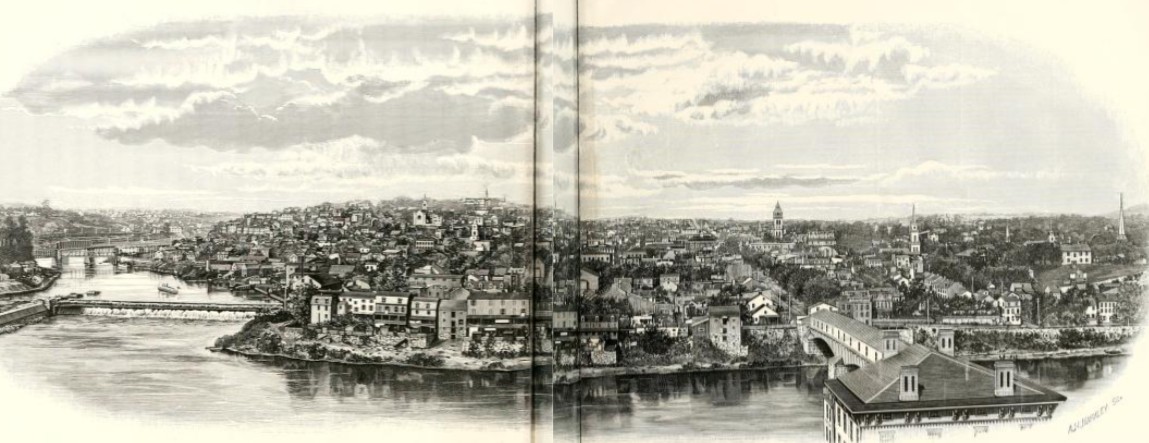
Panorama of Easton, Pennsylvania, 1885 (Uzal Condit, The History of Easton, Penn’a from the Earliest Times to the Present, 1738-1885, public domain; click to enlarge).
Following his honorable discharge from the military, Edward A. Frey (1848-1904) returned home to his family in Easton, Pennsylvania, where he found work as a bricklayer. Still unmarried as of 1870, he continued to live at his parents’ home in Easton’s West Ward with his brother and fellow 47th Pennsylvania veteran, Charles Henry Frey — a laborer — and their siblings: Mary, Emma, Jennie, and Harry. Their father was employed as a clerk in the local court system. Then, sometime between that federal census of 1870 (which was enumerated on 6 July) and early November of that same year, Edward A. Frey wed Mary A. Smith (1852-1914) and settled with her in Easton, where he continued to work as a bricklayer. Together, they welcomed the births of: William Frey (1870-1949), who was born on 5 November 1870 and would later become a bricklayer like his father, but would never marry; Anna Margaret Frey (1876-1941), who was born on 8 May 1876 (alternate birth date: 9 March 1876), was known to family and friends as “Annie,” but would also never marry; and Alice Frey, who was born circa 1878.
Still employed as a brick mason in 1880, Edward Frey resided in Easton’s Seventh Ward with his wife, Mary, and their children, William, Annie and Alice. More children soon followed: Katherine Ann Frey (1884-1963), who was born on 3 September 1884 and would later become a nurse and the wife of Horace W. Drake (1875-1944); Richard Porter Frey (1886-1959), who was born on 12 July 1886 and would later become a trolley conductor and bus driver for Lehigh Valley Transit and the husband of Sophia Smith (1900-1984); Martin Luther Frey (1888-1965), who was born on 5 March 1888 and would later wed Frances Gardner Souders (1886-1944); Florence Frey (born 1892-died after 1912), who was born in May 1892; and Herbert Frey (1895-1940), who was born on 4 August 1895 and would later become a machinist.
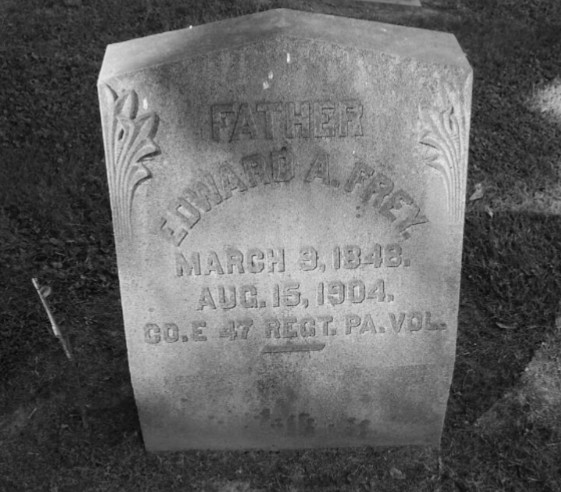
Gravestone, 47th Pennsylvania veteran Edward Augustus Frey, Easton Heights Cemetery, Easton, Pennsylvania (used with permission, courtesy of R.E.H.).
A veteran of the American Civil War who had served with the 47th Pennsylvania Volunteer Infantry from 27 March 1865 to 25 December 1865, Edward A. Frey was documented by the 1890 special federal census as a resident of Easton’s Seventh Ward, where his younger brother and fellow 47th Pennsylvania veteran, Charles Henry Frey, also resided. No other remarks about Edward or Charles were included in that census, which appears to indicate that neither had been wounded in battle or sickened by disease during the war. By 1900, bricklayer Edward Frey’s large household on Jefferson Street in Easton’s Seventh Ward included his wife, Mary, and their children: William, a bricklayer; daughters Annie and Katie; sons Richard and Martin, the latter of whom was still in school; daughter Florence, who was still in school; and four-year-old Herbert.
* Note: While Edward A. Frey’s daughter, Alice Frey, appeared on the Frey family’s listing on the 1880 federal census, she was not listed on the family’s federal census listing in 1900, indicating that she was either married or deceased before early 1900.
Illness, Death and Interment — Edward Augustus Frey
Diagnosed during his final years with locomotor ataxia, a spinal cord disease that caused serious balance and gait problems, Edward A. Frey continued to work as a bricklayer when he was able to do so. He died at the age of fifty-six at his home in Easton, at 11 p.m. on 15 August 1904. Following funeral services, he was laid to rest at Easton’s Easton Heights Cemetery near multiple Frey family members.
Return to Civilian Life — Charles Henry Frey
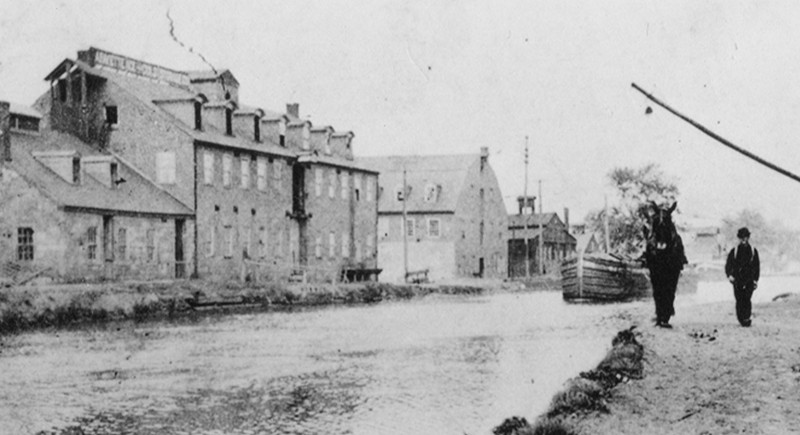
Unidentified canal boatman using a mule to move a canal boat along the Lehigh River through the Abbott Street industrial area of Easton, Pennsylvania, circa 1860s-1870s (public domain; click to enlarge).
Still unmarried by 1870, Charles Henry Frey was also still living at his parents’ home in Easton’s West Ward with his brother and fellow 47th Pennsylvania veteran, Edward Frey — an unmarried bricklayer, and their siblings: Mary, Emma, Jennie, and Harry. Their father was employed as a clerk in the local court system.
All of that changed on 18 April 1878 when Charles Henry Frey married Alice P. Johns (1862-1883) in the parsonage at St. John’s Evangelical Church in Easton. She was a daughter of Josef and Elizabeth Johns. Together, they welcomed the arrival of daughter Blanche Emily Frey (1878-died after 1941), who was born on 1 September 1878 and would later wed David A. Barron, before marrying iron worker William J. Murray, Jr. By early June of 1880, they were residing on Elm Street in Easton. A second daughter, Jennie Elizabeth Frey (1880-1958), was then born in Scranton, Lackawanna County, Pennsylvania on 15 September 1880.
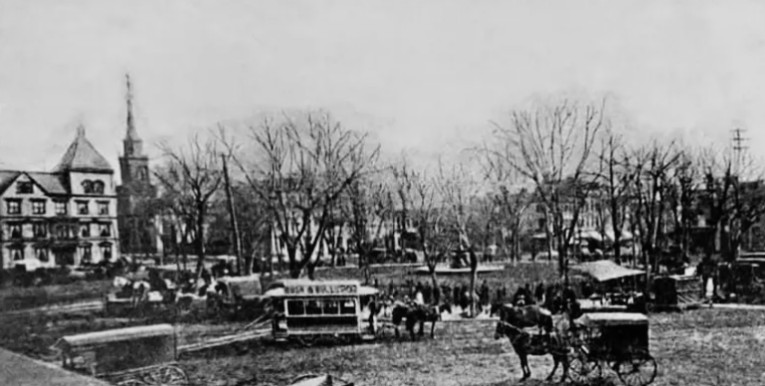
Center Square market, Easton, Pennsylvania, 1885 (public domain; click to enlarge).
Tragically, Charles Frey was widowed by Alice (Johns) Frey when she died in Easton in 1883. Less than two years later, he married for the second time — to Emma (Banghart) Garis (1854-1934), the widow of John Garis (1827-1884) and a daughter of Andrew Banghart (1812-1874) and Sarah L. C. (Biddleman) Banghart (1816-1864). Their wedding took place in Easton on 29 January 1885.
* Note: At the time of his second marriage, Charles H. Frey also became a stepfather to Linda B. Sapp (1870-1921) and Elsie Gertrude Garis (1876-1926), the daughters of Emma (Banghart) Garis. Linda would later go on to marry Denton Cosman Anderson (1855-1939) and settle with him in New York City and Poughkeepsie, New York, while Elsie would later wed George Bernard Dicker (1872-1948) and settle with him in Easton, Pennsylvania.
A railroad employee for a significant part of his work life, Charles H. Frey was employed as a flagman during the 1880s and was also a member of the Brotherhood of Railway Trainmen. By 1890, he was living in Easton’s Seventh Ward, where his older brother, Edward A. Frey, also resided. According to that year’s special federal census, Charles was a veteran of the American Civil War who had served with the 47th Pennsylvania Volunteer Infantry from 28 August 1862 to 2 June 1865.

Allentown Militia, Soldiers and Sailors Monument Dedication, Allentown, Pennsylvania, 1899 (public domain).
On 19 October 1899, Charles H. Frey likely witnessed a spectacle that would be talked about for decades to come — the unveiling of the Lehigh County Soldiers and Sailors Monument in Allentown. Held on the anniversary of the Battle of Cedar Creek, Virginia, the day’s events included a massive parade featuring many of the surviving 47th Pennsylvania Veteran Volunteers and other Union Army units from across and beyond the Lehigh Valley, chapters of the Grand Army of the Republic (G.A.R.), soldiers who were currently serving in the U.S. military, local and state dignitaries, fire and police units, and area bands marching through the streets, past building after building draped in red, white and blue bunting. Viewed by a crowd that was estimated at forty thousand men, women and children, that parade was followed by the monument’s formal dedication ceremony, during which children sang patriotic songs and prominent elected officials lauded the long-dead, young heroes and stout-hearted, aging veterans who had saved America’s Union.
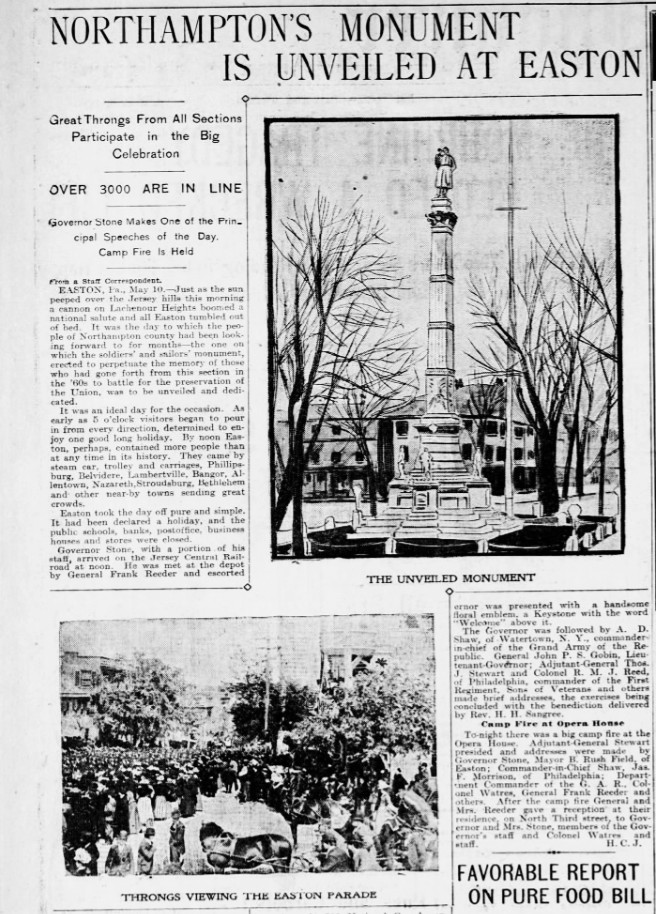
“Northampton’s Monument Is Unveiled at Easton” (The Philadelphia Inquirer, 11 May 1900, public domain).
Employed as a railroad brakeman after the turn of the century, Charles H. Frey and his second wife, Emma, were living alone on Lehigh Street in Easton’s Eighth Ward. That year would also be a memorable one, thanks to the unveiling and dedication of the Northampton County Soldiers’ and Sailors’ Monument in Easton on 11 May 1900. Although smaller than the massive crowds that attended the events of the unveiling and dedication of the Lehigh County Soldiers and Sailors Monument, the Easton dedication ceremonies were still quite impressive. The day began with the firing of cannon at sunrise. Later that morning, wizened members of the Grand Army of the Republic sat down with old friends for breakfast in hotels and restaurants across the city. That afternoon, local and state officials, active duty soldiers, veterans of the American Civil War and their descendants, school students, and members of the Allentown Band, Fullerton Drum Corps and other marching bands made their way to their designated meeting places in preparation for a parade with roughly five thousand participants who stepped forward at 2 p.m. and marched through the city’s streets to Easton’s Grand Square, where the monument was then unveiled after multiple orators addressed the excited crowd during formal dedication ceremonies. Later that same evening, “a campfire was held in the Easton Opera House and a military ball was given by the Sons of Veterans, followed by a reception to Governor and Mrs. Stone and the commissioned officers of the Thirteenth Regiment by General and Mrs. Reeder,” according to The Allentown Leader. Adjutant General Stewart presided over the campfire meeting, which featured speeches by the governor, Easton’s mayor and several senior officers of the Grand Army of the Republic. And then Lieutenant Governor John Peter Shindel Gobin (the 47th Pennsylvania’s final commanding officer) made a special appearance at the military ball. By the time the day was done, roughly thirty thousand people from Pennsylvania, New Jersey and other parts of the United States had joined in or witnessed the parade, monument dedication and evening’s gala events, according to The Allentown Democrat.
Illness, Death and Interment — Charles Henry Frey
Suffering from acute indigestion on 28 November 1913, Charles Frey sought medical attention, but died at his home at 1332 Lehigh Street in Easton twelve hours later that same day (just two days before his sixty-eighth birthday and just two years away from his eligibility for a Central Railroad pension). Following funeral services on 1 December, he was laid to rest at the Easton Heights Cemetery in Easton.
What Happened to the Widow and Children of Charles Henry Frey?
Charles H. Frey’s second wife and widow, Emma (Banghart Garis) Frey (1854-1934), went on to live a long life, and survived him by more than two decades. Ailing with arteriosclerosis and senile psychosis during her final years, she died at the age of eighty in Easton, on 6 June 1934, and was also buried at that city’s Easton Heights Cemetery.
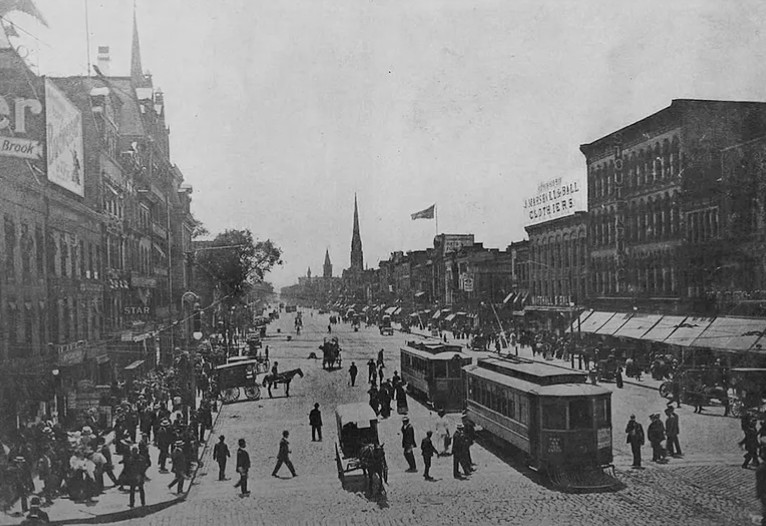
Broad Street viewed from Market in Newark, New Jersey, circa 1908 (public domain; click to enlarge).
Following her marriage to New York native David A. Barron circa 1902, Blanche Emily Frey (1878-died after 1941) — Charles H. Frey’s oldest daughter from his first marriage — settled with her husband in Newark, New Jersey. Still childless by 1910, she and her husband, a foreman at an iron foundry, resided at 72 Bruce Street in Newark’s Sixth Ward. By mid-June of 1915, they were living in Newark’s Thirteenth Ward. Divorced from her husband sometime after that year’s New Jersey State Census, Blanche Emily (Frey) Barron then married again — this time to iron worker William J. Murray, Jr., circa 1919. Also residents of Newark, Blanche and her second husband then welcomed the births of: Thelma Murray, who was born circa 1921; Muriel Murray, who was born circa 1922; and Henry Murray, who was born circa 1929. Widowed by her second husband sometime before the federal census of 1940 was enumerated in New Jersey, Blanche Emily (Frey Barron) Murray rented a home at 182 Summit Street in Newark’s Seventh Ward, where she lived with her three unmarried children: Thelma Murray, a twenty-year-old beautician; Muriel Murray, an eighteen-year-old shirt press operator at a laundry; and eleven-year-old Henry Murray. Also residing with them was John Mooney, a forty-three-year-old machinist employed by the Consolidated Machine Company, who was described on that year’s federal census as Blanche’s brother-in-law, whom she may then have married in 1941, according to marriage records of the State of New Jersey. Very little else is presently known about her life, including the date and location of her death, as well as her burial location.
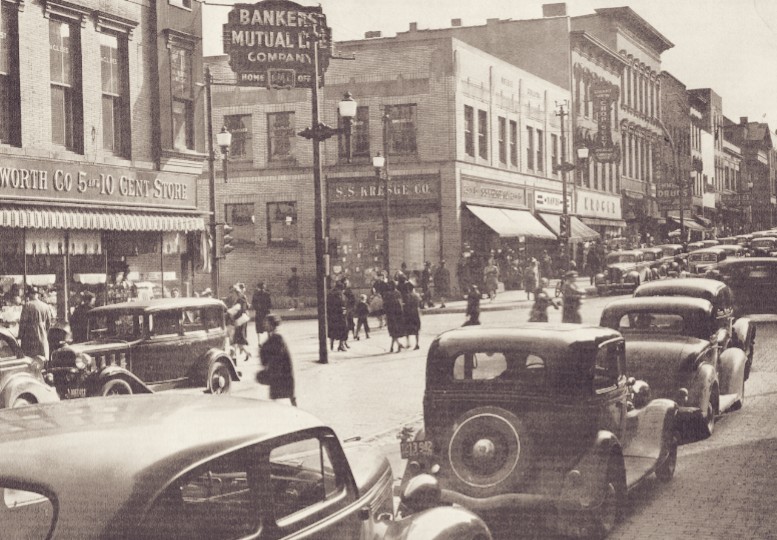
East Stephenson Street, Freeport, Illinois, 1940s (public domain).
Following her marriage to Albany, New York native Earl Stanley Welch (1881-1946; alternate surname spelling: “Welsh”) in Poughkeepsie, New York on 10 September 1913, Jennie Elizabeth (Frey) Welch (1880-1958) — a younger daughter of Charles H. Frey from his first marriage — subsequently migrated west with Earl to Illinois and settled with him in Freeport, Stephenson County. Their son, John Carrington Welch (1916-1977), was then born there on 19 July 1916. In 1920, she resided with her husband and son in Freeport’s First Ward, where they continued to reside into the 1930s. By 1940, however, the trio were living in Freeport’s Sixth Ward. Widowed in 1946 by insurance industry executive Earl Welch, when he died at the age of sixty-six at the Deaconess Hospital in Freeport, on 17 October that year (after having recently had surgery there), Jennie Elizabeth (Frey) Welch survived him by more than a decade. In her late seventies at the time of her death in 1958, she was laid to rest beside her husband at the Oakland Cemetery in Freeport.
What Happened to the Widow and Children of Edward Augustus Frey?
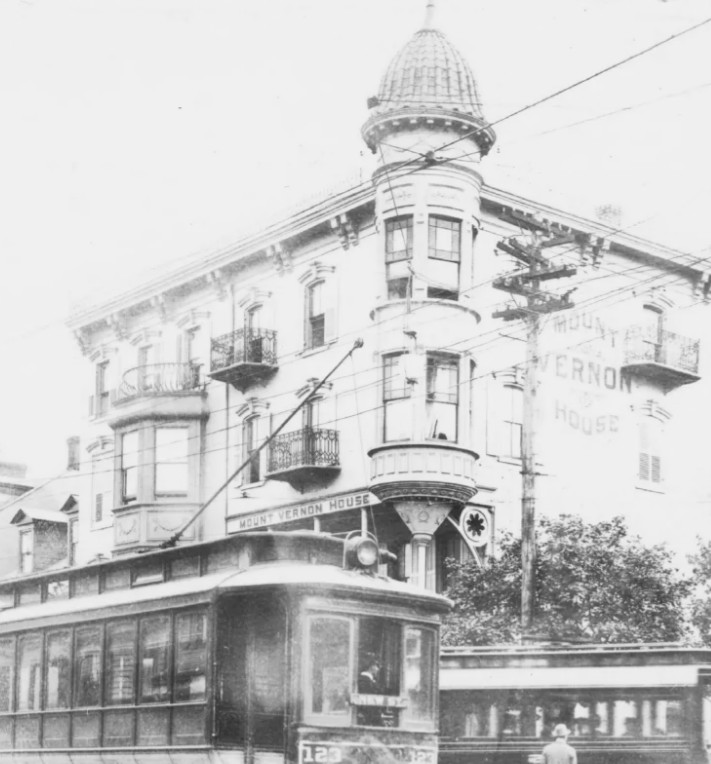
Electric trolley passing by the Mt. Vernon House in Easton, Pennsylvania, 1914 (public domain).
Following his death, Edward Frey’s widow, Mary (Smith) Frey (1852-1914), continued to reside in Easton, where she still rented a home at 1100 Jefferson Street in Easton’s Seventh Ward in 1910. She supported herself and her children by working as a laundress. Living with her that year were her children: Anna, who was employed outside of their home as a domestic worker; Katie, who was employed as a saleswoman at a department store; and Richard, Florence and Herbert, who were all described as laborers on that year’s census. Roughly four years later, Mary (Smith) Frey was also gone, having passed away at the age of sixty-one in Easton on 16 March 1914. Following funeral services, she was buried next to her husband at Easton’s Easton Heights Cemetery.
Edward’s son, Herbert Frey (1895-1940), became a machinist and reportedly married, but was then separated from his wife. Sadly, he contracted syphilis, which devolved into syphilitic meningo-encephalitis by 1932, leading to his confinement at the Allentown State Mental Hospital in Lehigh County, where he died at the age of forty-five on 6 October 1940. Following funeral services, his remains were interred at Easton’s Easton Heights Cemetery on 9 October.
Edward Frey’s daughter, Anna Margaret Frey (1876-1941), who was known to family and friends as “Annie,” never married, and supported herself by working as a domestic servant or housecleaner for much of her adult life. Unemployed in 1920, she resided at 1100 Jefferson Street in Easton’s Seventh Ward with her younger siblings, Katherine A. Frey, who was employed as a nurse, and Richard P. Frey, who worked as a trolley conductor. Also residing with them was Richard’s wife, Sophia (Smith) Frey (1900-1984), who was also unemployed. While living at the Easton home of her sister, Katherine (Frey) Drake, and Katherine’s husband, Horace W. Drake, Anna Margaret Frey became increasingly ill. Battling breast cancer during the final four years of her life, she succumbed to cancer-related complications at the age of sixty-five at the home of her sister, Katherine, at 40 South Eighth Street in Easton, on 4 November 1941, and became another of the Frey family members to be buried at the Easton Heights Cemetery in Easton.
Edward Frey’s son, William J. Frey (1870-1949), who also became a bricklayer, never married and continued to reside with his parents into his thirties. He then relocated to Trenton, New Jersey, where he continued to work as a bricklayer and plasterer from roughly 1910 until the early 1940s. He then returned to Easton circa 1945. Ailing with valvular heart disease during the final years of his life, William J. Frey died at the age of seventy-eight at the home of his widowed sister, Katherine Ann (Frey) Drake, at 40 South Eighth Street in Easton, on 24 July 1949, and was then interred near other Frey family members at the Easton Heights Cemetery in Easton.
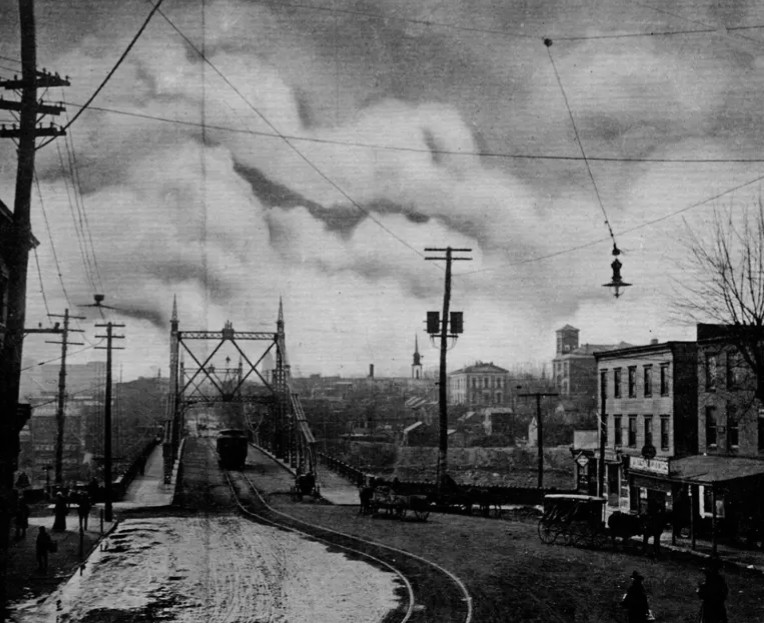
Trolley on the bridge between Easton, Pennsylvania and Phillipsburg, New Jersey, late 1800s-early 1900s (public domain).
Edward Frey’s son, Richard Porter Frey (1886-1959), was employed as a trolley conductor by the time of the 1920 federal census, which was enumerated in Easton in mid-January, and was living at the Easton home of his sister, Katherine Frey, a nurse, and their sister, Anna Frey, who was unemployed. Also residing with them was Richard’s wife, Sophia Smith (1900-1984), whom he had married sometime prior to that year’s census. By 1930, Richard Frey and his wife were renting a home on Ferry Street in Easton’s Eighth Ward. Residing with them was their daughter, Katherine Frey (1922-2008), who had been born on 26 July 1922 and would later wed Charles Nemeth, Jr. (1921-1980). The trio then moved into a rented home on Butler Street in Easton’s Seventh Ward. By 1950, however, Richard Frey’s daughter had married and moved on. Employed as a bus driver by the Lehigh Valley Transit Company that year, Richard and his wife resided at the home of his widowed sister, Katherine (Frey) Drake, at 40 South Eighth Street in Easton. Retired by the end of that decade and ailing with heart disease, Richard P. Frey suffered a pulmonary embolism in October 1959 and subsequently died from complications at the age of seventy-three at the Easton Hospital, on 2 November 1959. Following funeral services, he was buried at the Northampton Memorial Shrine in Palmer Township, Northampton County.
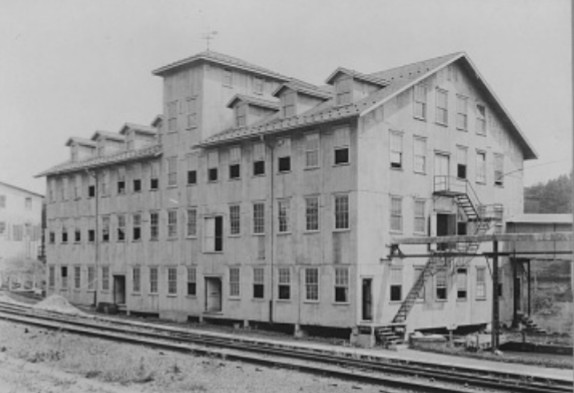
The Binney & Smith factory, Easton, Pennsylvania, where Crayola Crayons were manufactued in 1916 (public domain).
Trained as a nurse, Edward Frey’s daughter, Katherine Ann Frey (1884-1963), was, by the time of the federal census of 1920, the head of her own household in Easton, which included her unemployed older sister, Anna Margaret Frey; their brother, Richard P. Frey, who was employed as a trolley conductor; and Richard’s wife, Sophia (Smith) Frey (1900-1984), who was also unemployed. Married to life insurance salesman Horace W. Drake (1875-1944) sometime before the federal census of 1940, Katherine (Frey) Drake was then widowed by him when he died in Easton on 8 June 1944. Employed at some point during her life as a clerk by Binney & Smith, which had manufactured the first box of Crayola Crayons in Easton in 1903, and had then gone on to become a major supplier of crayons and other educational and entertainment products for children in schools and homes across the United States and worldwide, Katherine Ann (Frey) Drake was once again the head of a family-filled household by the time that the federal census was enumerated in Easton on 7 April 1950. Living with her at her home at 40 South Eighth Street were her were her brother, Richard Frey, who was employed as a bus driver, and his wife, Sophia. Ailing with heart disease and breast cancer during the final years of her life, Katherine Ann (Frey) Drake died at the age of seventy-eight at the Gracedale Home in Upper Nazareth Township, Northampton County, on 23 March 1963, and was then buried at Easton’s Easton Heights Cemetery on 27 March.
Edward Frey’s son, Martin Luther Frey (1888-1965), also grew up to be a bricklayer like his father. Still residing at his parents’ home in Easton at the turn of the century, he married Frances Gardner Souders (1886-1944) circa 1908. Together, they welcomed the birth of Charles Martin Frey (1909-1978) in Phillipsburg, Warren County, New Jersey on 24 September 1909. By 1910, Martin Frey was still working as a brick mason, but he and his wife were residing with their infant at the home of her parents, John and Catherine Souders, in Phillipsburg’s Third Ward. Martin and Frances then welcomed the birth of their second child, Frances Katherine Frey (1915-2000), who was born in Phillipsburg on 20 March 1915 and would later adopt the married surname of “Holloway” and settle in Easton. A resident of Easton during the early 1940s, Martin Frey was widowed by his wife, Frances (Souders) Frey, when she passed away in her late fifties on 8 January 1944. Still working in construction at the time of the 1950 federal census, he resided in apartment one at 116 Front Street in Easton with his son, Charles, a chemical factory laborer, and daughter, Frances, the proprietor of a retail store. Ailing with cancer during the final two years of his life, Martin Luther Frey suffered a coronary occlusion that ended his life on 16 March 1965. Pronounced dead upon arrival at the Easton Hospital that day, he was seventy-seven years old at the time of his passing. Following funeral services, he was laid to rest at the Fairmount Cemetery in Phillipsburg, New Jersey on 19 March.
What Happened to the Frey Brothers’ Siblings?
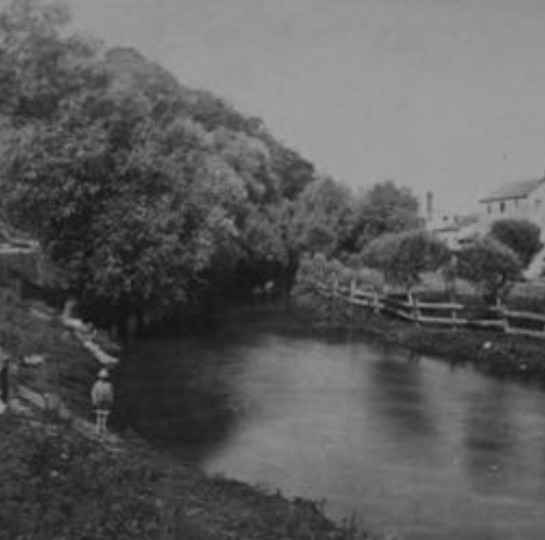
Bushkill area, Easton, Pennsylvania, circa 1870s-1880s (public domain).
Following her marriage during the late 1860s to American Civil War veteran Jacob Sandt (1840-1889), who had performed his American Civil War military service as a corporal in Company C of the 38th Pennsylvania Militia (also known as the 9th Pennsylvania Reserves), the Frey brothers’ sister, Annie Elizabeth (Frey) Sandt (1850-1923), settled with him in Easton, where they welcomed the births of: Carrie May Sandt (1869-1922), who was born on 14 September 1869 and would later become a bookkeeper and marry Charles P. Miller; and Frank Raymond Sandt (1876-1938), who was born on 15 June 1876 and would later become a physician and pathologist at the Patterson General Hospital in Patterson, Passaic County, New Jersey. In 1870, Annie (Frey) Sandt resided in Easton’s Bushkill Ward with her husband, a retail grocer, and their daughter, Carrie; by 1880, their household had grown to include their son, Frank, and was located in Easton’s Seventh Ward. Widowed by her husband in early April 1889 when he died by suicide at their home on Bushkill Street in Easton, Annie (Frey) Sandt continued to soldier on as a single mother of a twenty-year-old daughter and thirteen-year-old son. By 1900, her children had moved on to begin their own lives; she supported herself through the income she brought in from renting two rooms in her house at 234 Bushkill Street in Easton to two boarders. By 1910, however, she was renting a home at 35 North Ninth Street in Easton’s Fourth Ward, and her widowed daughter, Carrie (Frey) Miller was living with her. By 1920, though, the duo had returned to 234 Bushkill Street. That year, Carrie was employed as a bookkeeper at an underwear factory. Ailing with liver cancer during the final months of her life, Annie (Frey) Sandt died at the age of seventy-three in Easton on 3 November 1923, and was then laid to rest at the Easton Cemetery in Easton.
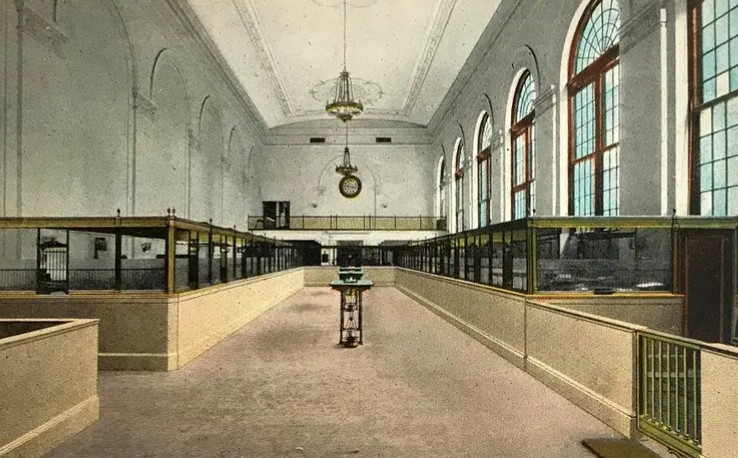
Interior of the new Bethlehem National Bank building, Third and Adams Streets, Bethlehem, Pennsylvania, circa 1920s (public domain).
Following her marriage on 18 March 1880 to banker Osman F. Reinhard (1855-1929), a native of Bath, Northampton County, the Frey brothers’ sister, Mary Margaret (Frey) Reinhard (1858-1929), settled with her husband in the Fifth Ward of the city of Easton, where he was employed as a clerk. They then became the parents of: Dora E. Reinhard (1883-1883), who was born in Easton on 10 December 1883 but died there nine days later, on 19 December 1883; an unnamed stillborn son who was born and died on 26 March 1885; Joseph Raymond Reinhard (1881-1904), who was born on 2 July 1881 but would never marry; and Emily Ruth Reinhard (1887-1914), who was born on 23 June 1887 and would later wed Carson A. Wright. By 1900, the Reinhards were residents of Seventh Street in Easton’s Sixth Ward and the family’s patriarch, Osman, was employed as a bank cashier, while his son, Joseph, was employed as a mechanical draftsman. Tragically, Joseph died roughly four years later. Just twenty-three years old at the time of his passing on 30 September 1904, he was subsequently laid to rest at the Easton Heights Cemetery in Easton. By 1910, Mary, Osman and their daughter, Emily, were living in Bethlehem’s Fourth Ward, where Osman continued to work as a bank cashier. Married sometime after that year’s federal census was enumerated, Emily Ruth (Reinhard) Wright, subsequently gave birth to a son, Carson Reinhard Wright (1911-1978), on 14 August 1911, but then lost her battle with heart and lung disease and died at the age of twenty-seven in Bethlehem, on 11 November 1914. Following funeral services she was interred at the Easton Heights Cemetery. In late December of that same year Mary (Frey) Reinhard and her husband, Osman, adopted Emily’s three-year-old son and secured approval from a judge to change the boy’s name to “Carson W. Reinhard.” By 1920, the Reinhards were residing with Carson in Bethlehem’s Ninth Ward, where Osman was now the vice president of the Bethlehem National Bank; however, their time together would be all too brief. Widowed by her husband when he passed away at the age of seventy-three, at their home in the Borough of Wilson in Northampton County, on 13 June 1929, Mary Margaret (Frey) Reinhard survived him by roughly six months, due to her struggles with high blood pressure and cognitive decline. Following her death on 4 December 1929 (alternate date of death: 4 November 1929), Mary Margaret (Frey) Reinhard died in Wilson. Having passed away roughly a month before her seventy-first birthday, she was then laid to rest beside her husband at the Easton Heights Cemetery.
* Note: Carson W. Reinhard went on to attend the Nazareth Military Academy, serve with the U.S. Army during World War II, marry, and began his own family line. He died at the age of sixty-seven at his home in Allentown, on 26 September 1978, and was also laid to rest at the Easton Heights Cemetery in Easton.
Following her marriage to Jeremiah F. George (1849-1907) during the early 1880s, the Frey brothers’ sister, Emma Steele (Frey) George (1861-1931), welcomed the birth with him of Helen Elizabeth George (1883-1950), who was born in Lower Mt. Bethel Township, Northampton County on 11 June 1950 and would later wed Peter Hines (1891-1940). Widowed by her husband, Jeremiah F. George (1849-1907), when he passed away at the age of fifty-eight in Easton on 12 September 1907, Emma Steele (Frey) George was still residing in Easton with her daughter, Helen George, when the federal census of 1910 was enumerated on 16 April. Then, sometime between that summer and the summer of 1919, Emma married for the second time — to widower Edwin Meixsell (1853-1919), who then widowed her when he died in Wilson at the age of sixty-five on 30 June 1919. After her second husband’s death, she moved into the home of her married daughter, Helen (George) Hines, in Bethlehem’s Fourteenth Ward, according to the 1920 federal census. By 1930, Emma and Helen were the only two occupants of their house in that same ward. Ailing with liver cancer during her final years, Emma Steele (Frey George) Meixsell died at the age of seventy in Bethlehem on 6 July 1931, and was laid to rest beside her first husband at the Hope Cemetery in Hecktown, Northampton County.
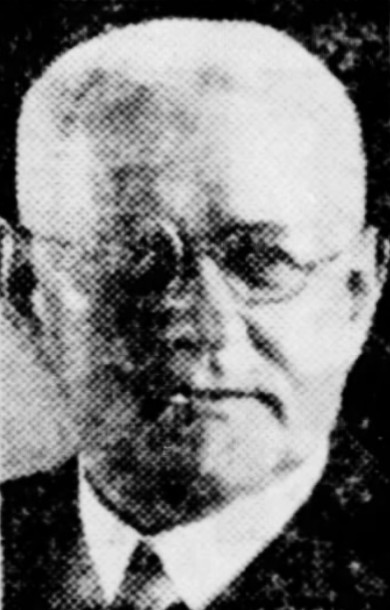
Harry C. Frey (1865-1941), shown here circa the 1930s, was the youngest brother of 47th Pennsylvania veterans Charles H. and Edward Frey (public domain).
Following his marriage in Easton at at St. Mark’s Reformed Church (now St. Mark’s United Church of Christ) on 25 April 1893 to Ann Elizabeth Hulsizer (1864-1931), a native of Riegelsville, Bucks County, Pennsylvania who was known to family and friends as “Lizzie,” the Frey brothers’ youngest brother, Harry C. Frey (1865-1941), continued to make progress in his fifty-year-plus career in the railroad industry, during which time he rose from the job of freight room laborer with the Lehigh Valley Railroad in Bethlehem, Pennsylvania during the 1880s to become a prominent executive with the General Railway Signal Company in the State of New York in the 1900s. He and his wife, Lizzie, became the parents of: Harry Joseph Frey (1894-1970), who was born in Easton on 21 September 1894 and would later serve as an officer in both World War I and World War II, graduate from law school, marry Helen Amelia Wilhelm (1894-1973) circa 1920, and ultimately become a partner in the law firm of Connoly, Frey, Eschmann & LaPasta in Brooklyn, New York; and Margaret Irene Frey (1895-1932), who was born in Easton in December 1895 and would never marry. Turn-of-the-century residents of Easton when the federal census was enumerated there on 9 June 1900, the Freys were supported by their patriarch, Harry C. Frey, on the wages he earned as a railroad timekeeper with the Lehigh Valley Railroad. Later that same year, Harry C. Frey was hired by the National Switch and Signal Company, which subsequently became known as the General Railway Signal Company in 1904. By 1910, he had been promoted to the job of purchasing agent with General Railway and had moved his family into a home on Melrose Street in the Nineteenth Ward of the city of Rochester in Monroe County, New York. Renting a room from them that year was a twenty-nine-year-old bookkeeper, Bessie Jasper. By 1920, Bessie had moved out, leaving the four Freys to continue their comfortable home life on Melrose Street. Widowed by his wife, Lizzie, when she passed away at their home at 75 Melrose Street in Rochester, New York on 12 November 1931 (and was subsequently buried at the Riverside Cemetery in that city), Harry C. Frey then also lost his daughter (Margaret Irene Frey) less than a year later, when she died in her mid-thirties in Rochester on 26 September 1932 and was buried near her mother at the Rochester Cemetery. By 1930, the Frey quartet had become a trio, with Harry C. Frey’s son, Harry Joseph Frey, having married and moved away to begin his own family line in the Borough of Queens in the State of New York. Retired in 1931 and subsequently remarried to Verdella Eby (1902-1988), who was a native of Didsbury in Calgary, Alberta, Canada, the Frey brothers’ youngest brother, Harry C. Frey, then widowed his second wife when he died at the age of seventy-five in Rochester on 22 January 1941. Following funeral services, Harry was subsequently buried next to his first wife at Rochester’s Riverside Cemetery.
* Note: The widow of Harry C. Frey, Maria Verdella (Eby) Frey, received eleven thousand seven hundred and thirteen dollars from Harry’s estate after probate (the equivalent of roughly two hundred and fifty-nine thousand U.S. dollars in 2026). She then married again on 17 February 1945 — to Joseph Pino Cannioto (1884-1967), a native of Italy and barber who lived in Brighton, New York. Widowed by him when he died at the age of eighty-three in Rochester on 9 May 1867, she subsequently relocated to the city of Tampa, in Hillsborough County, Florida, where, at the age of sixty-eight, she wed for the third time — to seventy-seven-year-old retired architect Carl Hagemann (1892-1973), in St. Petersburg, Florida during the spring of 1970. Widowed by Carl when he died in Tampa on 4 November 1973 (and was subsequently cremated), Maria Verdella (Eby Frey Cannioto) Hagemann died at the age of eighty-six in Tampa, on 21 December, and was later buried beside her second husband, Joseph Cannioto, at the Creekside Cemetery in Churchville, Monroe County, New York.
Following her marriage to William H. Frederick (1862-1953) in 1885, the Frey brothers’ youngest sister, Jennie (Frey) Frederick (1863-1944), initially settled with her husband in Northampton County, where they welcomed the births of: Myra Frederick, who was born in 1886 or 1887; and Frances Frederick (1899-1904), who was born in May 1899, but died at the age of four on 8 April 1904. As the new century dawned, Jennie (Frey) Frederick resided in the Fourth Ward in the Borough of Bethlehem in Northampton County with her husband and their daughters, Myra and Frances. By 1910, however, she and her husband had moved north with their daughter, Myra, to the Sixteenth Ward in the city of Buffalo in Erie County, New York, where Jennie’s husband was employed as the traffic manager at a manufacturing plant. Having returned to Northampton County by the spring of 1930, William and Jennie (Frey) Frederick were “empty nesters” residing in Easton, where William was employed as a traffic manager at a steel plant. In 1940, they resided at the Easton home of William’s stepbrother, Max Wolff. Four years later, Jennie was gone, having passed away at the age of eighty in Easton, on 15 January 1944. Following funeral services, she was also buried at the Easton Heights Cemetery in Easton.
Sources:
- “Ann Elizabeth Frey Is Claimed By Death” (obituary of a sister-in-law of Charles H. and Edward A. Frey and the wife of Harry C. Frey). Rochester, New York: Rochester Times-Union, 12 November 1931.
- “Anna M. Frey” (obituary of a daughter of Edward A. Frey). Allentown, Pennsylvania: The Morning Call, 5 November 1941.
- Anna Margaret Frey (a daughter of Edward A. Frey), in Death Certificates (file no.: 101598, registered no.: 610, date of death: 4 November 1941). Harrisburg, Pennsylvania: Commonwealth of Pennsylvania, Department of Health, Bureau of Vital Statistics.
- Annie Elizabeth Sandt (a sister of Charles H. and Edward A. Frey), in Death Certificates (file no.: 112765, registered no.: 629, date of death: 3 November 1923). Harrisburg, Pennsylvania: Commonwealth of Pennsylvania, Department of Health, Bureau of Vital Statistics.
- Barron, David and Blanche (a daughter of Charles Henry, Frey), in U.S. Census (Newark, Sixth Ward, Essex County, New Jersey, 1910). Washington, D.C.: U.S. Army and U.S. National Archives and Records Administration.
- Barron, David and Blanche (a daughter of Charles Henry, Frey), in New Jersey State Census (Newark, Thirteenth Ward, Essex County, New Jersey, 1915). Trenton, New Jersey: New Jersey State Archives.
- Bates, Samuel P., in History of Pennsylvania Volunteers, 1861-5, vol. 1. Harrisburg, Pennsylvania: B. Singerly, State Printer, 1869.
- Blanche Fry [sic, “Blanche Emily Frey”] and David Barron, in Marriage Records (New Jersey, 1902). Trenton, New Jersey: New Jersey State Archives.
- Blanche Murray [sic, “Blanche Emily Frey”] and John J. Mooney, in Marriage Records (New Jersey, 1941). Trenton, New Jersey: New Jersey State Archives.
- “Bonstein, L.,” on U.S. Army Returns from Military Posts” (Fort Taylor, Key West, Florida: January, April, May, June, July, August, September, October, November, and December 1863). Washington, D.C.: U.S. Army and U.S. National Archives and Records Administration.
- Carl Hagemann and Maria Verdella Cannioto [sic, “Verdella (Eby) Frey”] (the widow of Harry C. Fry, the youngest brother of Charles H. and Edward A. Frey), in “Marriage Licenses (Applications).” St. Petersburg, Florida: St. Petersburg Times, 26 March 1970.
- Carrie May Miller (a niece of Charles H. and Edward A. Frey and a daughter of Annie (Frey) Sandt), in Death Certificates (file no.: 40387, registered no.: 199, date of death: 9 April 1922). Harrisburg, Pennsylvania: Commonwealth of Pennsylvania, Department of Health, Bureau of Vital Statistics.
- Carson Reinhard Wright (a son of Charles H. and Edward A. Frey’s niece, Emily (Reinhard) Wright), in Birth Certificates (file no.: 117455, registered no.: 287, date of birth: 14 August 1911). Harrisburg, Pennsylvania: Commonwealth of Pennsylvania, Department of Health, Bureau of Vital Statistics.
- “Carson W. Reinhard” (obituary of a son of Charles H. and Edward A. Frey’s niece, Emily (Reinhard) Wright), in “Deaths.” Allentown, Pennsylvania: The Morning Call, 28 September 1978.
- “Cases Disposed of in Court at Easton” (mentions Mary (Frey) Reinhard, a sister of Charles H. and Edward A. Frey; Mary’s deceased daughter, Emily (Reinhard) Wright; and the adoption by Mary of Emily’s son, Carson Reinhard Wright). Allentown, Pennsylvania: The Morning Call, 30 December 1914.
- Charles H. Frey, in Death Certificates (file no.: 109033, registered no.: 566, date of death: 28 November 1913). Harrisburg, Pennsylvania: Commonwealth of Pennsylvania, Department of Health, Bureau of Vital Statistics.
- Charles H. Frey and Edward A. Frey, in U.S. Census (“Special Schedule. — Surviving Soldiers, Sailors, and Marines, and Widows, etc.”: Easton, Seventh Ward, Northampton County, Pennsylvania, 1890). Washington, D.C.: U.S. National Archives and Records Administration.
- “Charles M. Frey” (obituary of a grandson of Edward A. Frey and a son of Martin L. Frey), in “Deaths.” Allentown, Pennsylvania; The Morning Call, 24 August 1978.
- Condit, Uzal. The History of Easton, Penn’a from the Earliest Times to the Present, 1738-1885. Easton, Pennsylvania: E. W. West, 1885.
- “Crayola: Our History.” Easton, Pennsylvania: Crayola (corporate website, retrieved online, 22 March 2026).
- Diaries of Jeremiah Siders (Company H, 47th Pennsylvania Volunteer Infantry), in “Pennsylvania Military Museum Collections, 1856-1970” (MG 272). Harrisburg, Pennsylvania: Pennsylvania State Archives.
- “Dr. Frank Sandt, General Hospital Pathologist, Dies” (obituary of a nephew of Charles H. and Edward A. Frey and a son of Annie (Frey) Sandt). Patterson, New Jersey: The Morning Call, 6 April 1938.
- Drake, Horace and Katherine (a daughter of Edward A. Frey); and Frey, Anna (a daughter of Edward A. Frey and Katherine’s sister), in U.S. Census (Easton, Sixth Ward, Northampton County, Pennsylvania, 1940). Washington, D.C.: U.S. National Archives and Records Administration.
- Drake, Katherine A. (a daughter of Edward A. Frey), Richard (a son of Edward A. Frey and Katherine’s brother) and Sophia (Richard’s wife), in U.S.Census (Easton, Northampton County, Pennsylvania, 1950). Washington, D.C.: U.S. National Archives and Records Administration.
- Dyer, Frederick H. A Compendium of the War of the Rebellion, p. 1589. Des Moines, Iowa: The Dyer Publishing Company, 1908.
- “Easton’s Big Day: Over 30,000 Strangers Attend the Unveiling of the Soldiers’ Monument.” Wilkes-Barre, Pennsylvania: The Wilkes-Barre Record, 11 May 1900.
- “Easton’s Monument: Unveiled Yesterday with Patriotic Pomp.” Allentown, Pennsylvania: The Allentown Daily Leader, 11 May 1900.
- “Edward A. Frey” (obituary).” Allentown, Pennsylvania: The Morning Call, 18 August 1904.
- Emily Ruth Wright (a niece of Charles H. and Edward A. Frey and a daughter of Mary M. (Frey) Reinhard, in Death Certificates (file no.: 105461, registered no.: 196, date of death: 11 November 1914). Harrisburg, Pennsylvania: Commonwealth of Pennsylvania, Department of Health, Bureau of Vital Statistics.
- Emma George Meixell (a sister of Charles H. and Edward A. Frey), in Death Certificates (file no.: 72600, registered no.: 274, date of death: 6 July 1921). Harrisburg, Pennsylvania: Commonwealth of Pennsylvania, Department of Health, Bureau of Vital Statistics.
- “Florida’s Role in the Civil War: ‘Supplier of the Confederacy.” Tampa, Florida: Florida Center for Instructional Technology, University of South Florida (College of Education), retrieved online January 15, 2020.
- Frederick, Wm. H., Jennie (a sister of Charles H. and Edward A. Frey) and Myra, in U.S. Census (Bethlehem, Fourth Ward, Erie County, Pennsylvania, 1910). Washington, D.C.: U.S. National Archives and Records Administration.
- Frederick, William H., Jennie M. (a sister of Charles H. and Edward A. Frey), Myra E., and Frances I., in U.S. Census (Bethlehem, Fourth Ward, Northampton County, Pennsylvania, 1900). Washington, D.C.: U.S. National Archives and Records Administration.
- Frederick, William and Jennie (a sister of Charles H. and Edward A. Frey), in U.S. Census (Easton, Northampton County, Pennsylvania, 1930). Washington, D.C.: U.S. National Archives and Records Administration.
- “Frey” (death notice of Harry C. Frey, the youngest brother of Charles H. and Edward A. Frey), in “Died.” Rochester, New York: Rochester Times-Union 24 January 1941.
- “Frey” (obituary of Harry Joseph Frey, a nephew of Charles H.and Edward A. Frey and a son of Harry C. Frey). Fort Lauderdale, Florida: Fort Lauderdale News, 12 February 1970.
- Frey, Catherine, Anna, Richard, and Sophia (children of Edward A. Frey), in U.S. Census (Easton, Seventh Ward, Northampton County, Pennsylvania, 1920). Washington, D.C.: U.S. National Archives and Records Administration.
- Frey, Charles H., in Civil War Muster Rolls (Company E, 47th Pennsylvania Infantry). Harrisburg, Pennsylvania: Pennsylvania State Archives.
- Frey, Charles H., in Civil War Veterans’ Card File, 1861-1866 (Company E, 47th Pennsylvania Infantry). Harrisburg, Pennsylvania: Pennsylvania State Archives.
- Frey, Charles H., Alice P. and Blanche E., in U.S. Census (Easton, Northampton County, Pennsylvania, 1880). Washington, D.C.: U.S. National Archives and Records Administration.
- Frey, Charles H. and Emma, in U.S. Census (Easton, Eighth Ward, Northampton County, Pennsylvania, 1900). Washington, D.C.: U.S. National Archives and Records Administration.
- Frey, Charles H. and Emma, in U.S. Civil War Pension General Index Cards (veteran’s application no.: 1000799, veteran’s certificate no.: 802222, filed by the veteran from Pennsylvania, 5 March 1891; widow’s application no.: 1022644, widow’s certificate no.: 775740, filed by the veteran’s widow from Pennsylvania, 18 February 1914). Washington, D.C.: U.S. National Archives and Records Administration.
- Frey, Edward A., in Civil War Muster Rolls (Company E, 47th Pennsylvania Infantry). Harrisburg, Pennsylvania: Pennsylvania State Archives.
- Frey, Edward A., in Civil War Veterans’ Card File, 1861-1866 (Company E, 47th Pennsylvania Infantry). Harrisburg, Pennsylvania: Pennsylvania State Archives.
- Frey, Edward A., Mary E., William, and Annie, in U.S. Census (Easton, Seventh Ward, Northampton County, Pennsylvania, 1870). Washington, D.C.: U.S. National Archives and Records Administration.
- Frey, Edward A., Mary E., William, Annie, and Alice, in U.S. Census (Easton, Seventh Ward, Northampton County, Pennsylvania, 1880). Washington, D.C.: U.S. National Archives and Records Administration.
- Frey, Edward, Mary E., William, Annie M., Katie A., Richard, Martin L., Florence F., and Herbert, in U.S. Census (Easton, Seventh Ward, Northampton County, Pennsylvania, 1900). Washington, D.C.: U.S. National Archives and Records Administration.
- Frey, Edward A. and Mary E., in U.S. Civil War Pension General Index Cards (veteran’s application no.: 880808, veteran’s certificate no.: 622160, filed by the veteran from Pennsylvania, 7 August 1890; widow’s application no.: 812571, widow’s certificate no.: 585048, filed by the veteran’s widow from Pennsylvania, 25 August 1904). Washington, D.C.: U.S. National Archives and Records Administration.
- Frey, Harry [sic, “Harry Joseph Frey”] (a nephew of Charles H. and Edward A. Frey and a son of Harry C. Frey), Helen and Amelia E.; and Meiss, Anna (servant), in U.S. Census (Queens Village, Queens County, New York, 1930). Washington, D.C.: U.S. National Archives and Records Administration.
- Frey, Harry C. (the youngest brother of Charles H. and Edward A. Frey and the father of Harry J. Frey), Elizabeth, Harry (son), and Margt [sic, “Margaret Frey”], in U.S. Census (Easton, Seventh Ward, Northampton County, Pennsylvania, 1900). Washington, D.C.: U.S. National Archives and Records Administration.
- Frey, Harry C. (the youngest brother of Charles H. and Edward A. Frey and the father of Harry J. Frey), Anna E., Harry J. (son), and Margret A. [sic, “Margaret Frey”]; and Jasper, Bessie (boarder), in U.S. Census (Rochester, Nineteenth Ward, Monroe County, New York, 1910). Washington, D.C.: U.S. National Archives and Records Administration.
- Frey, Harry C. (the youngest brother of Charles H. and Edward A. Frey and the father of Harry J. Frey), Anna E., Harry J. (son), and Margaret A. [sic, “Margaret Frey”], in U.S. Census (Rochester, Nineteenth Ward, Monroe County, New York, 1920). Washington, D.C.: U.S. National Archives and Records Administration.
- Frey, Harry C. (the youngest brother of Charles H. and Edward A. Frey), Ann E. and Margaret, in U.S. Census (Rochester, Nineteenth Ward, Monroe County, New York, 1930). Washington, D.C.: U.S. National Archives and Records Administration.
- Frey, Herbert (a patient who was a son of Edward A. Frey), in U.S. Census (Allentown State Mental Hospital, Allentown, Lehigh County, Pennsylvania, 1940). Washington, D.C.: U.S. National Archives and Records Administration.
- Frey, Martin, Elizabeth, Charles, Edward, and Ann, in U.S. Census (Easton, Northampton County, Pennsylvania, 1850). Washington, D.C.: U.S. National Archives and Records Administration.
- Frey, Martin, Elizabeth, Charles H., Edward A., Anna E., and Mary M.; and Sandt, Jacob (a future brother-in-law of Charles H. and Edward Frey and the future husband of Anna Frey), in U.S. Census (Easton, West Ward, Northampton County, Pennsylvania, 1860). Washington, D.C.: U.S. National Archives and Records Administration.
- Frey, Martin, Elizabeth, Charles, Edward, Mary, Emma, Jennie, and Harry, in U.S Census (Easton, West Ward, Northampton County, Pennsylvania, 1870). Washington, D.C.: U.S. National Archives and Records Administration.
- Frey, Martin L. (a son of Edward A. Frey), Charles M., and Francis K., in U.S. Census (Easton, Northampton County, Pennsylvania, 1950). Washington, D.C.: U.S. National Archives and Records Administration.
- Frey, Mary (the widow of Edward A. Frey), and Anna M., Katie A., Richard, Florence, and Herbert (Mary’s children, who were sons and daughters of Edward A. Frey), in U.S. Census (Easton, Seventh Ward, Northampton County, Pennsylvania, 1910). Washington, D.C.: U.S. National Archives and Records Administration.
- Frey, Mrs. Emma (the second wife and widow of Charles H. Frey), in Death Certificates (file no.: 61327, registered no.: 371, date of death: 6 June 1934). Harrisburg, Pennsylvania: Commonwealth of Pennsylvania, Department of Health, Bureau of Vital Statistics.
- Frey, Richard (a son of Edward A. Frey), Sophia and Katherine, in U.S. Census (Easton, Eighth Ward, Northampton County, Pennsylvania, 1930). Washington, D.C.: U.S. National Archives and Records Administration.
- Frey, Richard (a son of Edward A. Frey), Sophia and Katherine, in U.S. Census (Easton, Seventh Ward, Northampton County, Pennsylvania, 1940). Washington, D.C.: U.S. National Archives and Records Administration.
- Frey, Verdelle [sic, “Verdella (Eby) Frey”], in Marriage Records (Rochester, Monroe County, New York, date of marriage to Joseph Cannioto: 17 February 1945). Rochester, New York: Rochester City Archives.
- Fry [sic, “Frey”], Charles Henry (infant) and Martin and Elizabeth Fry (parents), in Birth and Baptismal Records (First Church, Easton, Northampton County, Pennsylvania, date of birth: 30 November 1845, baptism: 29 May 1850). Easton, Pennsylvania: First United Church of Christ; and Philadelphia, Pennsylvania: Historical Society of Pennsylvania.
- Fry [sic, “Frey”], Edward Augustus (infant) and Martin and Elizabeth Fry (parents), in Birth and Baptismal Records (First Church, Easton, Northampton County, Pennsylvania, date of birth: 9 March 1848, baptism: 29 May 1850). Easton, Pennsylvania: First United Church of Christ; and Philadelphia, Pennsylvania: Historical Society of Pennsylvania.
- Fry [sic, “Frey”], Franklin (infant) and Martin and Elizabeth Fry (parents), in Birth and Baptismal Records (First Church, Easton, Northampton County, Pennsylvania, date of birth: 18 September 1853, baptism: 19 February 1855). Easton, Pennsylvania: First United Church of Christ; and Philadelphia, Pennsylvania: Historical Society of Pennsylvania.
- George, Emma [sic, “Emma (Frey) George, a sister of Charles H. and Edward A. Frey) and Helen (Emma’s daughter); and Hildebrand, Laura (boarder), in U.S. Census (Easton, Sixth Ward, Northampton County, Pennsylvania, 1910). Washington, D.C.: U.S. National Archives and Records Administration.
- Gobin, John Peter Shindel. Personal Letters, 1861-1865. Northumberland, Pennsylvania: Personal Collection of John Deppen.
- Grant, Ulysses S. Personal Memoirs of Ulysses S. Grant. New York, New York: Charles L. Webster & Company, 1885.
- Grodzins, Dean and David Moss. “The U.S. Secession Crisis as a Breakdown of Democracy,” in When Democracy Breaks: Studies in Democratic Erosion and Collapse, from Ancient Athens to the Present Day (chapter 3). New York, New York: Oxford University Press, 2024.
- Harry C. Frey (groom and the youngest brother of Charles H. and Edward A. Frey); and Lizzie Hulshizer (bride), in Marriage Records (St. Mark’s Reformed Church, Easton, Northampton County, Pennsylvania, date of marriage: 25 April 1893). Easton, Pennsylvania: St. Mark’s United Church of Christ; and Philadelphia, Pennsylvania: Historical Society of Pennsylvania.
- Harry C. Frey and Verdella Frey (resolution of the estate of the youngest brother of Charles H. and Edward A. Frey), in “Dr. Enright Wills $66423.” Rochester, New York: Rochester Times-Union, 2 July 1941.
- Helen E. Hines (a niece of Charles H. and Edward A. Frey and a daughter of Emma (Frey) George), in Death Certificates (file no.: 33342, registered no.: 449, date of death: 10 April 1950). Harrisburg, Pennsylvania: Commonwealth of Pennsylvania, Department of Health, Bureau of Vital Statistics.
- Herbert Frey (a son of Edward A. Frey), in Death Certificates (file no.: 93687, registered no.: 1426, date of death: 6 October 1940). Harrisburg, Pennsylvania: Commonwealth of Pennsylvania, Department of Health, Bureau of Vital Statistics.
- Hines, Peter and Helen (a niece of Charles H. and Edward A. Frey and a daughter of Emma (Frey George) Meixsell); and Meixsell, Emma [sic, “Emma (Frey George) Meixsell, a sister of Charles H. and Edward A. Frey), in U.S. Census (Bethlehem, Fourteenth Ward, Northampton County, Pennsylvania, 1920). Washington, D.C.: U.S. National Archives and Records Administration.
- Irwin, Richard Bache. History of the Nineteenth Army Corps. New York, New York: G. P. Putnam’s Sons, 1893.
- Katherine Ann Drake (a daughter of Edward A. Frey), in Death Certificates (file no.: 031214-63, local reg. no.: 47, date of death: 23 March 1963). Harrisburg, Pennsylvania: Commonwealth of Pennsylvania, Department of Health, Bureau of Vital Statistics.
- “Last Rites for Harry Frey Will Be Saturday Morning” (obituary of the youngest brother of Charles H. and Edward A. Frey). Rochester, New York: Rochester Democrat and Chronicle, 23 January 1941.
- Margaret I. Frey (a niece of Charles H. and Edward A. Frey and a daughter of Harry C. Frey), in “Daily Death Roll.” Rochester, New York: Rochester Times-Union, 26 September 1932.
- Martin L. Frey (a son of Edward A. Frey), in Death Certificates (file no.: 029729-65, local reg. no.: 173, date of death: 16 March 1965). Harrisburg, Pennsylvania: Commonwealth of Pennsylvania, Department of Health, Bureau of Vital Statistics.
- Mary M. Reinhard (a sister of Charles H. and Edward A. Frey), in Death Certificates (file no.: 123901, registered no.: 768, date of death: 4 November 1929). Harrisburg, Pennsylvania: Commonwealth of Pennsylvania, Department of Health, Bureau of Vital Statistics.
- Meixsell, Emma [sic, “Emma (Frey George) Meixsell”] (a sister of Charles H. and Edward A. Frey); and Hines, Helen (Emma’s daughter), in U.S. Census (Bethlehem, Fourteenth Ward, Northampton County, Pennsylvania, 1930). Washington, D.C.: U.S. National Archives and Records Administration.
- Murray, Blanche (a daughter of Charles Henry Frey), Thelma, Muriel, and Henry, in U.S. Census (Newark, Seventh Ward, Essex County, New Jersey, 1940). Washington, D.C.: U.S. National Archives and Records Administration.
- Murray, William J., Blanche (a daughter of Charles Henry Frey), Thelma, Muriel, and Henry, in U.S. Census (Newark, Thirteenth Ward, Essex County, New Jersey, 1930). Washington, D.C.: U.S. National Archives and Records Administration.
- “Northampton’s Monument Is Unveiled at Easton: Great Throngs from All Sections Participate in the Big Celebration.” Philadelphia, Pennsylvania: The Philadelphia Inquirer, 11 May 1900.
- Noyalas, Jonathan. “The Fight at Cedar Creek Was Over. So Why Couldn’t Union Troops Let Their Guard Down?” Arlington, Virginia: HistoryNet, 27 February 2023.
- “Obituary: Charles H. Frey.” Easton Pennsylvania: Easton Daily Express, 20 November 1913.
- “Osman F. Reinhard, Well Known Banker, Dies; 73 Years Old” (obituary of a brother-in-law of Charles H. and Edward A. Frey). Allentown, Pennsylvania: The Morning Call, 15 August 1929.
- Reinhard, O. F., Mary M. and Carson W., in U.S. Census (Bethlehem, Ninth Ward, Northampton County, Pennsylvania, 1920). Washington, D.C.: U.S. National Archives and Records Administration.
- Reinhard, Osman and Mary (a sister of Charles H. and Edward A. Frey), in U.S. Census (Easton, Fifth Ward, Northampton County, Pennsylvania, 1880). Washington, D.C.: U.S. National Archives and Records Administration.
- Reinhardt [sic, “Reinhard”], Osman F., Mary M. (a sister of Charles H. and Edward A. Frey), Joseph R., and Ruth E. [sic, “Emily Ruth Reinhard”], in U.S. Census (Easton, Sixth Ward, Northampton County, Pennsylvania, 1900). Washington, D.C.: U.S. National Archives and Records Administration.
- Reinhard, Osman, Mary (a sister of Charles H. and Edward A. Frey) and Emily R. [sic, “Emily Ruth Reinhard”], in U.S. Census (Bethlehem, Fourth Ward, Northampton County, Pennsylvania, 1910). Washington, D.C.: U.S. National Archives and Records Administration.
- Reports and Other Correspondence of W. D. C. Rodrock, Chaplain, 47th Pennsylvania Volunteer Infantry (Record Group R29). Washington, D.C.: U.S. National Archives and Records Administration, 1864-1865.
- Richard P. Frey (a son of Edward A. Frey), in Death Certificates (file no.: 104751, registered no.: 481, date of death: 2 November 1959). Harrisburg, Pennsylvania: Commonwealth of Pennsylvania, Department of Health, Bureau of Vital Statistics.
- “Roster of the 47th P. V. Inf.” Allentown, Pennsylvania: The Morning Call, 26 October 1930.
- Sandt, Annie [sic, “Annie (Frey) Sandt”] (a sister of Charles H. and Edward Frey); Sherman, Chas D. and Livoch, Emma boarders), in U.S. Census (Easton, Second Ward, Northampton County, Pennsylvania, 1900). Washington, D.C.: U.S. National Archives and Records Administration.
- Sandt, Annie [sic, “Annie (Frey) Sandt”] (a sister of Charles H. and Edward Frey) and Miller, Carrie M. (Annie’s daughter), in U.S. Census (Easton, Fourth Ward, Northampton County, Pennsylvania, 1910). Washington, D.C.: U.S. National Archives and Records Administration.
- Sandt, Annie [sic, “Annie (Frey) Sandt”] (a sister of Charles H. and Edward Frey) and Miller, Carrie M. (Annie’s daughter), in U.S. Census (Easton, Second Ward, Northampton County, Pennsylvania, 1920). Washington, D.C.: U.S. National Archives and Records Administration.
- Sandt, Jacob (a brother-in-law of Charles H. and Edward A. Frey and the husband of Annie (Frey) Sandt), in Civil War Muster Rolls (Company E, 47th Pennsylvania Infantry). Harrisburg, Pennsylvania: Pennsylvania State Archives.
- Sandt, Jacob, Annie (a sister of Charles H. and Edward A. Frey), in U.S. Census (Easton, Bushkill Ward, Northampton County, Pennsylvania, 1870). Washington, D.C.: U.S. National Archives and Records Administration.
- Sandt, Jacob, Annie (a sister of Charles H. and Edward A. Frey), in U.S. Census (Easton, Seventh Ward, Northampton County, Pennsylvania, 1880). Washington, D.C.: U.S. National Archives and Records Administration.
- Schmidt, Lewis G. A Civil War History of the 47th Regiment of Pennsylvania Veteran Volunteers. Allentown, Pennsylvania: Self-published, 1986.
- Scott, Robert N. The War of War of the Rebellion: A Compilation of the Official Records of the Union and Confederate Armies, series I, vol. XXXIV, part II: “Correspondence, etc.-Union,” Chapter XLVI: “Louisiana and the Trans-Mississippi,” p. 199. Washington, DC: Government Printing Office, 1891.
- “Services for Mrs. Anderson Thursday” (obituary of Charles H. Frey’s stepdaughter, Linda B. (Sapp) Anderson, who was the daughter of Charles Frey’s second wife; mentions names of Charles Frey’s other children). Poughkeepsie, New York: Poughkeepsie Eagle-News, 25 January 1921.
- Sheridan, Philip Henry. Personal Memoirs of P. H. Sheridan, General, United States Army in Two Volumes. New York, New York: Charles L. Webster & Company, 1888.
- Souders, John and Catherine; Frey, Martin (a son-in-law of John Souders and a son of Edward A. Frey), Frances and Charles M., in U.S. Census (Phillipsburg, Third Ward, Warren County, New Jersey, 1910). Washington, D.C.: U.S. National Archives and Records Administration.
- Staubach, Lieutenant Colonel James C. “Miami During the Civil War: 1861-65,” in Tequesta: The Journal of the Historical Association of Southern Florida, vol. LIII, pp. 31-62. Miami: Historical Museum of Southern Florida, 1993.
- “Suicide of a Knight Templar” (report regarding the death of Jacob Sandt, a brother-in-law of Charles H. and Edward A. Frey and the husband of Annie (Frey) Sandt). Annapolis, Maryland: Evening Capital, 9 April 1889.
- Tamiami Trail Modifications: Next Steps — Draft Environmental Impact Statement, Appendix E. Washington, DC: U.S. National Park Service: Everglades National Park: 29 January 2010.
- “The History of the Forty-Seventh Regt. P. V.” Allentown, Pennsylvania: The Lehigh Register, 20 July 1870.
- “The Shaping of Easton,” in “About Easton: History.” Easton, Pennsylvania: City of Easton, retrieved online 11 June 2026.
- “The Unveiling of the Soldiers’ and Sailors’ Monument at Easton on Thursday.” Allentown, Pennsylvania: The Allentown Democrat, 16 May 1900.
- “Veterans of the Gallant 47th Regiment Gather in Reunion: Celebrate Anniversary of Battle of Pocotaligo at 44th Meeting, Incidentally Battle of Fisher’s Hill.” Allentown, Pennsylvania: The Morning Call, 24 October 1916.
- “Veterans’ Reunion: Heroes of the 47th Assembled at the Duck Farm: Their Old Commander Present: Large Gathering of Old Soldiers in Whom Martial Spirit Is Still Strong.” Allentown, Pennsylvania: The Allentown Leader, 22 October 1902.
- Welch, Earl S., Jennie E. (a daughter of Charles Henry Frey) and John C. in U.S. Census (Freeport, First Ward, Stephenson County, Illinois, 1920, 1930). Washington, D.C.: U.S. National Archives and Records Administration.
- Welch, Earl S., Jennie E. (a daughter of Charles Henry Frey) and John C. in U.S. Census (Freeport, Sixth Ward, Stephenson County, Illinois, 1940). Washington, D.C.: U.S. National Archives and Records Administration.
- Wharton, Henry D. “Letters from the Sunbury Guards.” Sunbury, Pennsylvania: The Sunbury American, 1861-1864.
- William J. Frey (a son of Edward A. Frey), in Death Certificates (file no.: 62596, registered no.: 365, date of death: 24 July 1949). Harrisburg, Pennsylvania: Commonwealth of Pennsylvania, Department of Health, Bureau of Vital Statistics.
- “William J. Frey” (obituary of a son of Edward A. Frey). Allentown, Pennsylvania: The Morning Call, 26 July 1949.
- Wolff, Max and L. Rae; Weisfield, Herbert Wolffand Pearl; Levy, Jacob; Galia, Josephine; and Frederick, H. William (a stepbrother of Max Wolff) and Jennie (William’s wife and a sister of the Frey brothers), in U.S. Census (Easton, Northampton County, Pennsylvania, 1944). Washington, D.C.: U.S. National Archives and Records Administration.


You must be logged in to post a comment.