Alternate Spellings of Surname: Cohler, Cöler, Cooler, Coler, Kohler
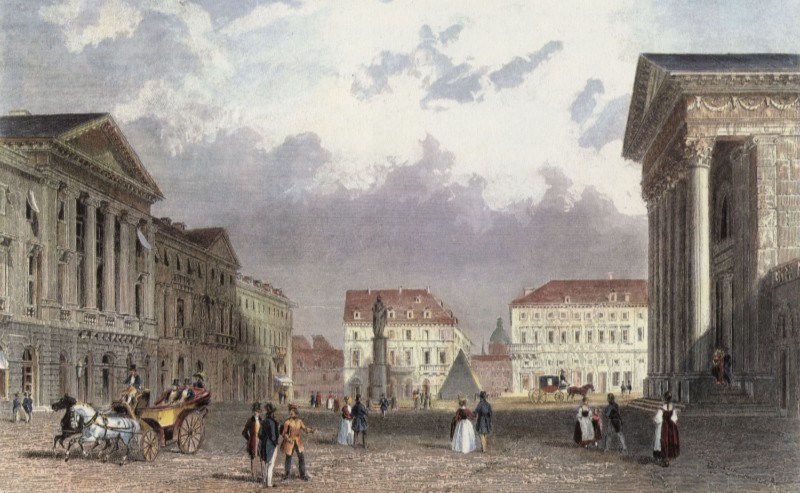
The Rathaus and Stadtkirche in the Karlsruhe marketplace, city of Karlsruhe, Duchy of Baden (Jean Jacques Outhwaite, public domain; click to enlarge).
Two of the many German immigrants who settled in the Commonwealth of Pennsylvania during the mid-nineteenth century, Jacob and John Michael Cohler were also two of the many German immigrants who enlisted with the 47th Pennsylvania Volunteer Infantry during the first year of the American Civil War.
Blood brothers, as well as brothers-in-arms, they also both worked as stone masons as young men, helping to rebuild a nation that had nearly been torn asunder by a disastrous civil war.
Formative Years
Born on 7 May 1841 as Jacob Kohler in or near Knielingen in the northwestern section of the city of Karlsruhe in the Grand Duchy of Baden (on the eastern side of the Rhine River in what is now the state of Baden-Württemberg in Germany), and then baptized at the Evangelische Kirche Knielingen on 13 May of that same year, Jacob Cohler (1841-1922) was a son of Johann Michael Kohler (1814-1890) and Johanna (Riey) Kohler (1818-1872), who was known to family and friends as “Hannah.”
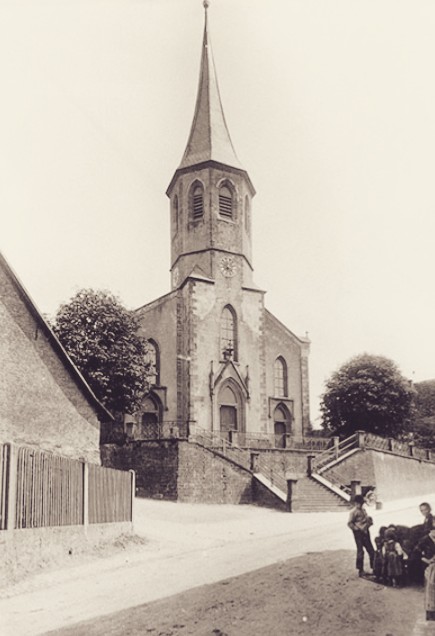
The Evangelische Kirche Knielingen in Karlsruhe, Germany (shown here circa 1900) would have looked much like this during the 1840s-1850s when the Kohler siblings were baptized there (public domain; click to enlarge).
More siblings soon followed at the Kohler family home in Karlsruhe: Christina Barbara Kohler (1844-unknown), who was born on 10 February 1844, was baptized at the Evangelische Kirche Knielingen on 18 February of that same year and would later marry, take her husband’s surname of “Windish” (alternate surname spelling: “Windisch”) and settle with him in Shenandoah, Schuylkill County, Pennsylvania; John Michael Cohler (1846-1909) who was born as Johann Michael Kohler on 8 April 1846, was baptized at the Evangelische Kirche Knielingen on 16 April of that same year and would later serve with Jacob in the 47th Pennsylvania Volunteer Infantry during the American Civil War, before marrying Rebecca Simpson (1847-1915); Gottlieb F. Kohler (1848-1913), who was born on 22 April 1848, was baptized at the Evangelische Kirche Knielingen on 2 May 1848 and would later wed Baden-Württemberg native Maria Salome Rossweiler (1847-1932), who was known to family and friends as “Mary”; Johanna Kohler (1850-1900), who was born on 5 August 1850, was baptized at the Evangelische Kirche Knielingen on 15 August of that same year, subsequently became known to family and friends as “Hannah” and would later wed teamster Richard Bernice (1850-1928; alternate surname spellings: “Brainice,” “Breineis,” “Breneis” and “Brennias”); Juliana Katharina Kohler (1851-1906), who was born on 16 October 1851, was baptized at the Evangelische Kirche Knielingen on 23 October of that same year, became known to family and friends as “Lulu” and would later wed Theodore M. Miller (1848-1908) in 1868; and Josephine Kohler (1857-1915), who was born as Jakobine Kohler on 5 August 1857, was baptized at the Evangelische Kirche Knielingen and would later wed Allen G. Houck (1845-1914).
* Note: Karlsruhe was the former capital of the Grand Duchy of Baden, which was part of the German Confederation at the time that Jacob and John Michael Cohler were born there during the 1840s. They were both still just young children at the dawn of one of the most turbulent moments in their homeland’s history — the German Revolution of 1848, which was “the last and … greatest of the middle-class revolutions which had convulsed Europe periodically since 1789,” according to Theodore S. Hamerow, late professor emeritus of history at the University of Wisconsin-Madison and leading expert on the history of German Unification:
“It must have been exciting to be alive in the spring of 1848, that ‘springtime of nations,” when God smiled with favor upon every parliamentary subcommittee and the liberal millennium was just around the corner. Barricades were mushrooming in the capitals of Europe from the Seine to the Danube; angry mobs were stoning royal palaces; unpopular ministers were hastily signing resignations and hurrying into exile; exiled revolutionaries were hurrying home to a hero’s welcome. To liberals witnessing these events it appeared as if a new world were about to be born, as if a new reign of liberty and justice were beginning.”
To the Cohler brothers’ parents, those months may have felt hopeful; if so, their optimism was soon tempered. Per Hamerow, “the brave dream of a European polity of free individuals organized in free nations turned into a nightmare.”
“The Revolution, greeted as the opening act of a process of cosmic liberation, degenerated before long into a war of all against all, of proletarian against bourgeois, Dane against Prussian, Pole against German, German against Czech. Like the sorcerer’s apprentice, liberalism could not control the forces it had unleashed and was defeated by the Revolution it had created. By 1849 its strength was exhausted, and conservatives returned to the seats of power which liberals had occupied a year earlier. The effect of 1848 was to discredit political ideals and ideologies and to prepare the way for ‘strong’ men, men who at least got what they wanted, even if what they wanted was not always morally justifiable.”
For middle income families, life in Baden became less and less bearable with each passing year. According to historians at the U.S. Library of Congress, in the aftermath of the revolution, “typical working people in Germany … were forced to endure land seizures, unemployment, [and] increased competition from British goods.” Because of those hardships:
“It soon became easier to leave Germany, as restrictions on emigration were eased. As steamships replaced sailing ships, the transatlantic journey became more accessible and more tolerable. As a result, more than 5 million people left Germany for the U.S. during the 19th century….
An army of skilled German workers rolled into American cities … bringing with them the trades they had plied in their homeland. German Americans were employed in many urban craft trades, especially baking, carpentry, and the needle trades. Many German Americans worked in factories founded by the new generation of German American industrialists, such as John Bausch and Henry Lomb, who created the first American optical company; Steinway, Knabe and Schnabel (pianos); Rockefeller (petroleum); Studebaker and Chrysler (cars); H.J. Heinz (food); and Frederick Weyerhaeuser (lumber).
The social turmoil of Europe in the 19th century also sent many intellectuals and scholars to the United States. In particular, supporters of the German Revolution of 1848 — sometimes called ‘Forty-Eighters’ — brought their tradition of vigorous public debate and social activism to bear on the issues facing the U.S., including land reform, abolition, workers’ rights, and women’s suffrage. The student radical Carl Schurz, for example, escaped from Germany after the Revolution and settled in Wisconsin. In the course of a long public life, Schurz served his new country as a farmer, a lawyer, a journalist, a campaigner for Abraham Lincoln’s Republican Party, a Union general, a cabinet official, a U.S. senator, an early member of the conservation movement, and the founder and editor of several newspapers, in both English and German.”
According to economic historian Susan B. Carter, between 1846 and 1854, the number of German immigrants arriving in the United States increased from 57,500 to 215,000. But it had not been easy for them. The average cost of a steerage class ticket for just one adult emigrating from Germany in 1853, for example, ranged from 33.50 Prussian thalers (or roughly $23 in U.S. dollars in 1853) — if that adult was sailing from the Port of Hamburg to the Port of New York — to a high of 44 Prussian thalers if that adult was sailing from the Port of Bremen. And the adult steamship steerage fare from Hamburg to New York was even higher, averaging roughly 60.8 thalers. Even more daunting, the fare for just one child (under the age of eight or ten, depending on ship rules), traveling from Hamburg to New York, ranged roughly between 29.3 (by sail) and 46.3 (by steamer). Consequently, “Mid-nineteenth-century German immigrants who settled in the United States and other faraway destinations faced the formidable hurdle of crossing an ocean and coming up with the resources to pay for it,” according to economic historians Raymond L. Cohn and Simone A. Wegge.
“These fares explain why most of the Germans who emigrated were positively self-selected, that is, they were not poor farm laborers or servants but were somewhat better off…. A farm laborer in an average rural village in the Hesse-Cassel principality, for example, made on average 24 Thalers a year. Few of them could afford to emigrate to the United States. Around 1850, even a master farm laborer in the Rhine area earned only about 60 Thalers per year in cash in addition to various in-kind goods, worth probably another 20 Thaler.”
Carpenters and masons generally made more than that, per Cohn and Wegge, but the cost of traveling from Germany to New York, Baltimore, or Philadelphia would likely have been too high even for them because “one transatlantic fare would have cost between one-third and one-half of their yearly income.” As a result, “paying for the voyage was made more feasible in that they would typically liquidate all their goods and property before leaving and/or make use of an inheritance.” And traveling in steerage became the go-to option because “first class … fares averaged two to three times those of steerage” with second-class accommodations still out of reach for most at “about 40 percent higher than steerage.” Furthermore, “The total cost of the journey for an emigrant would have included the costs incurred in getting to the embarkation point,” according to Cohn and Wegge, as well as overnight lodging while “waiting for the ship to leave” and “the extra expense of getting to their destination after arrival.”
A New Life in Pennsylvania
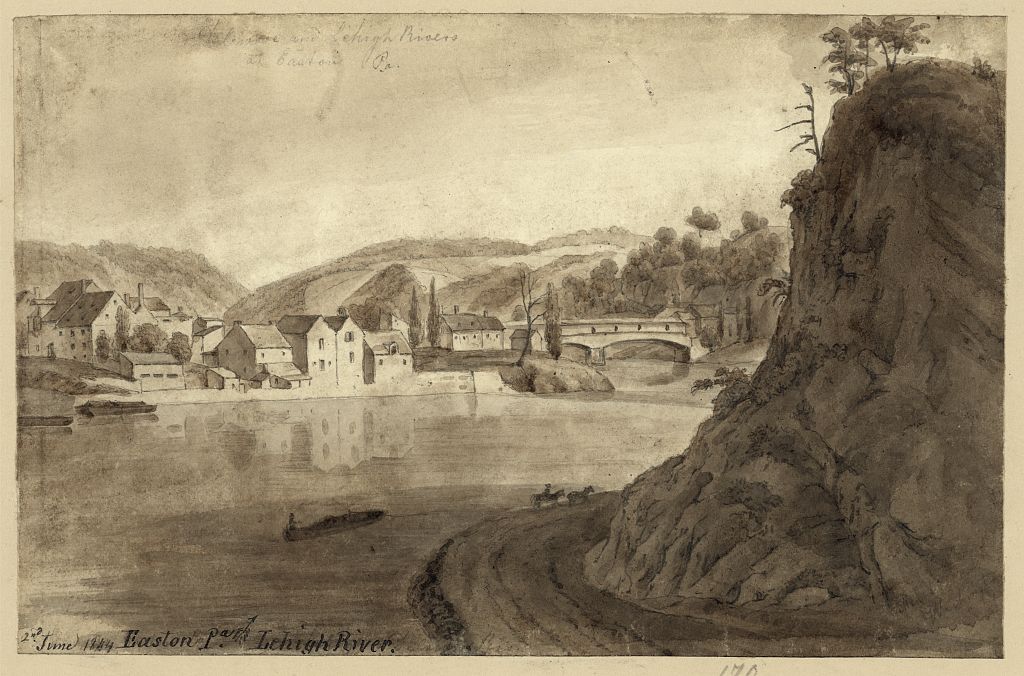
Delaware and Lehigh Rivers at Easton, Pennsylvania, 1844 (Augustus Kollner, U.S. Library of Congress, public domain; click to enlarge).
Even so, the parents of Jacob and John M. Cohler decided the cost was worth it. So, the entire Kohler family (parents and children) left their home in Karlsruhe, headed for the port, boarded the New Orleans and sailed for the United States during the summer of 1861. Following their arrival at the Port of New York City in the State of New York, they traveled south to the Commonwealth of Pennsylvania and settled in the Borough of Easton in Northampton County, where their surname was initially still spelled as “Kohler.” (That spelling would then alternate with the variant of “Cohler” on entries for their family on various federal census records and other records created for individual family members over the next several decades.)
* Note: While Jacob and John Michael Cohler appear to have chosen to spell their surname as “Cohler” on various documents (the same spelling that was then used on their respective gravestones), their parents apparently made the decision not to change their surname spelling (as evidenced by the use of “Kohler” on their own gravestones).
American Civil War
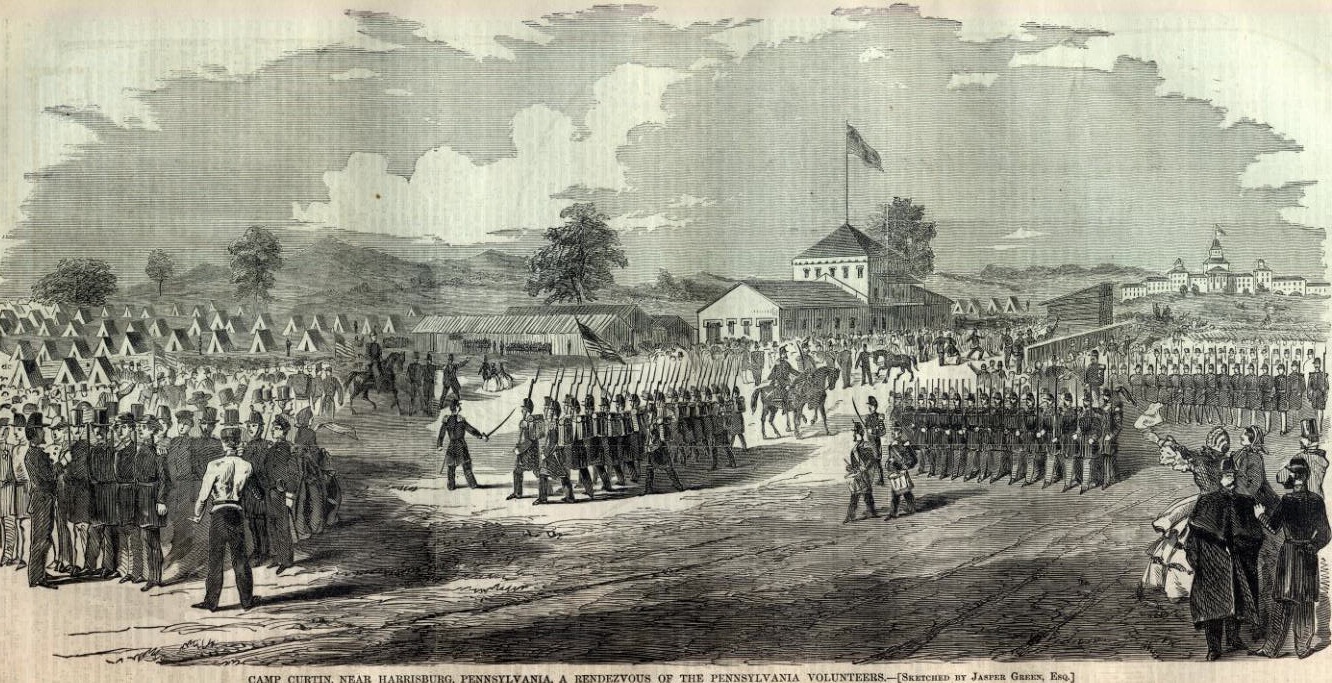
Camp Curtin (Harper’s Weekly, 1861, public domain).
Well aware of the dangers posed by civil strife, having experienced it firsthand during their formative years in Karlsruhe, Jacob and John Michael Cohler knew they could not simply “sit on the sidelines” as their adopted homeland disintegrated further and further with each passing week of the American Civil War. Though not yet naturalized citizens of the United States, they both still chose to do what they could to help stabilize the nation.
Twenty-one-year-old Jacob Cohler became the first of the two brothers to answer U.S. President Abraham Lincoln’s call for help to defend the United States’ capital following the fall of Fort Sumter to Confederate States Army troops. Following his enrollment for military service on 10 September 1861, in Harrisburg, Pennsylvania, which was also home to Camp Curtin, one of the largest recruiting and training centers for the Army of the United States (also known as the Union Army), Jacob Cohler officially mustered in for duty there on 24 September 1861 as a private with Company A of the newly-formed 47th Pennsylvania Volunteer Infantry. Military records at the time described him as a laborer and resident of Easton who was five feet, five inches tall with dark eyes and a light complexion.
* Note: The initial recruitment for members to fill Company A of the Pennsylvania Volunteers’ 47th Regiment was conducted in Easton, Northampton County, Pennsylvania. According to historian Lewis Schmidt, “The Easton Express reported on August 14 that … 33 year old Capt. Richard A. Graeffe, a merchant from Easton who would command Company A of the 47th, was recruiting at Glantz’s’ [sic] in Easton.” The Glanz saloon was operated by Charles Frederick William Glanz, an 1845 emigrant from Germany who had gone into the brewery business in Easton with W. Kuebler in 1852, and had then also been appointed later that same decade as the captain of the Northampton County militia unit known as the “Easton Jaegers.” Having performed his Three Months’ Service with the 9th Pennsylvania Volunteers during the opening months of the American Civil War, Graeffe was then commissioned as a captain of the newly-formed 47th Pennsylvania Volunteer Infantry and placed in charge of that regiment’s Company A on 16 September 1861. The first ninety-three members of Graeffe’s company were then also officially mustered in that same day. Representatives for Graeffe then continued to recruit members for Company A, even after the 47th Pennsylvania was assigned to duties in Virginia.

The U.S. Capitol Building, unfinished at the time of President Abraham Lincoln’s inauguration, was still not completed when the 47th Pennsylvania Volunteers arrived in Washington, D.C. in September 1861 (public domain).
Following a brief light infantry training period at Harrisburg’s Camp Curtain, the men of Company A and the 47th Pennsylvania headed for Washington, D.C. where they were stationed at “Camp Kalorama” on Kalorama Heights near Georgetown, beginning 21 September. Henry D. Wharton, a Musician with the regiment’s C Company, wrote to the Sunbury American newspaper the next day with the following update:
After a tedious ride we have, at last, safely arrived at the City of ‘magnificent distances.’ We left Harrisburg on Friday last at 1 o’clock A.M. and reached this camp yesterday (Saturday) at 4 P.M., as tired and worn out a sett [sic] of mortals as can possibly exist. On arriving at Washington we were marched to the ‘Soldiers Retreat,’ a building purposely erected for the benefit of the soldier, where every comfort is extended to him and the wants of the ‘inner man’ supplied.
After partaking of refreshments we were ordered into line and marched, about three miles, to this camp. So tired were the men, that on marching out, some gave out, and had to leave the ranks, but J. Boulton Young, our ‘little Zouave,’ stood it bravely, and acted like a veteran. So small a drummer is scarcely seen in the army, and on the march through Washington he was twice the recipient of three cheers.
We were reviewed by Gen. McClellan yesterday [21 September 1861] without our knowing it. All along the march we noticed a considerable number of officers, both mounted and on foot; the horse of one of the officers was so beautiful that he was noticed by the whole regiment, in fact, so wrapt [sic] up were they in the horse, the rider wasn’t noticed, and the boys were considerably mortified this morning on dis-covering they had missed the sight of, and the neglect of not saluting the soldier next in command to Gen. Scott.
Col. Good, who has command of our regiment, is an excellent man and a splendid soldier. He is a man of very few words, and is continually attending to his duties and the wants of the Regiment.
…. Our Regiment will now be put to hard work; such as drilling and the usual business of camp life, and the boys expect and hope an occasional ‘pop’ at the enemy.
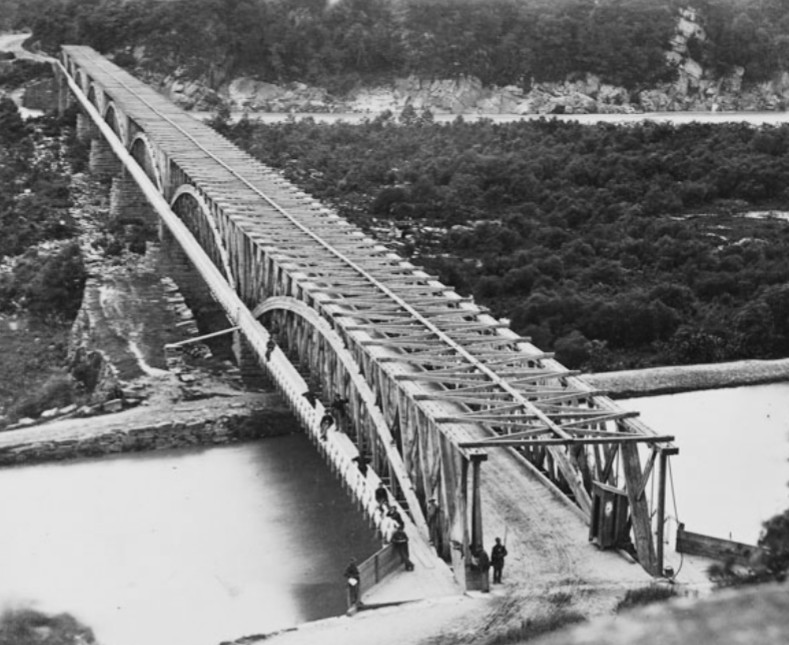
Unidentified Union soldiers guarding the Chain Bridge between Washington, D.C. and Virginia, circa 1861 (U.S. Library of Congress, public domain.
On 24 September 1861, Captain Richard Graeffe, First Lieutenant James F. Meyers and their men from Company A became members of the U.S. Army when they were officially mustered into federal service with the other members of the 47th Regiment, Pennsylvania Volunteer Infantry. Three days later, the 47th Pennsylvania was assigned to the 3rd Brigade of Brigadier-General Isaac Ingalls Stevens, which also included the 33rd, 49th and 79th New York regiments. By that afternoon, the 47th Pennsylvania was on the move again. Ordered onward by Brigadier-General Silas Casey, the Mississippi rifle-armed 47th Pennsylvania infantrymen marched behind their Regimental Band until reaching Camp Lyon, Maryland on the Potomac River’s eastern shore. At 5 p.m., they joined the 46th Pennsylvania in moving double-quick (one hundred and sixty-five steps per minute using thirty-three-inch steps) across the “Chain Bridge” marked on federal maps, and continued on for roughly another mile before being ordered to make camp.
The next morning, they broke camp and moved again. Marching toward Falls Church, Virginia, they arrived at Camp Advance around dusk. There, about two miles from the bridge they had crossed a day earlier, they re-pitched their tents in a deep ravine near a new federal fort under construction (Fort Ethan Allen). They had completed a roughly eight-mile trek, were situated close to the headquarters of Brigadier-General William Farrar Smith (also known as “Baldy”), and were now part of the massive Army of the Potomac (“Mr. Lincoln’s Army”). Under Smith’s leadership, their regiment and brigade would help to defend the nation’s capital from the time of their September arrival through late January when the men of the 47th Pennsylvania would be shipped south.
Once again, Company C Musician Henry Wharton recapped the regiment’s activities, noting, via his 29 September letter home to the Sunbury American, that the 47th had changed camps three times in three days:
On Friday last we left Camp Kalorama, and the same night encamped about one mile from the Chain Bridge on the opposite side of the Potomac from Washington. The next morning, Saturday, we were ordered to this Camp [Camp Advance near Fort Ethan Allen, Virginia], one and a half miles from the one we occupied the night previous. I should have mentioned that we halted on a high hill (on our march here) at the Chain Bridge, called Camp Lyon, but were immediately ordered on this side of the river. On the route from Kalorama we were for two hours exposed to the hardest rain I ever experienced. Whew, it was a whopper; but the fellows stood it well – not a murmur – and they waited in their wet clothes until nine o’clock at night for their supper. Our Camp adjoins that of the N.Y. 79th (Highlanders.)….
We had not been in this Camp more than six hours before our boys were supplied with twenty rounds of ball and cartridge, and ordered to march and meet the enemy; they were out all night and got back to Camp at nine o’clock this morning, without having a fight. They are now in their tents taking a snooze preparatory to another march this morning…. I don’t know how long the boys will be gone, but the orders are to cook two days’ rations and take it with them in their haversacks….
There was a nice little affair came off at Lavensville [sic, Lewinsville], a few miles from here on Wednesday last; our troops surprised a party of rebels (much larger than our own.) killing ten, took a Major prisoner, and captured a large number of horses, sheep and cattle, besides a large quantity of corn and potatoes, and about ninety six tons of hay. A very nice day’s work. The boys are well, in fact, there is no sickness of any consequence at all in our Regiment….

The Big Chestnut Tree, Camp Griffin, Langley, Virginia, 1861 (U.S. Library of Congress, public domain).
Sometime during that phase of duty, while attached to the 3rd Brigade, Private Jacob Cohler and his fellow 47th Pennsylvania Volunteers were moved to a site they called “Camp Big Chestnut” in reference to a large chestnut tree located nearby. The site would eventually become known to the Keystone Staters as “Camp Griffin,” and was located roughly ten miles from Washington, D.C.
On 11 October, the 47th Pennsylvania marched in the Grand Review at Bailey’s Cross Roads. Also around that time, companies D, A, C, F and I (the 47th Pennsylvania’s right wing) were ordered to picket duty after the left-wing companies (B, G, K, E, and H) had been forced to return to camp by Confederate troops. In his letter of 13 October, Henry Wharton described their duties, as well as their new home:
The location of our camp is fine and the scenery would be splendid if the view was not obstructed by heavy thickets of pine and innumerable chesnut [sic] trees. The country around us is excellent for the Rebel scouts to display their bravery; that is, to lurk in the dense woods and pick off one of our unsuspecting pickets. Last night, however, they (the Rebels) calculated wide of their mark; some of the New York 33d boys were out on picket; some fourteen or fifteen shots were exchanged, when our side succeeded in bringing to the dust, (or rather mud,) an officer and two privates of the enemy’s mounted pickets. The officer was shot by a Lieutenant in Company H [?], of the 33d.
Our own boys have seen hard service since we have been on the ‘sacred soil.’ One day and night on picket, next day working on entrenchments at the Fort, (Ethan Allen.) another on guard, next on march and so on continually, but the hardest was on picket from last Thursday morning ‘till Saturday morning – all the time four miles from camp, and both of the nights the rain poured in torrents, so much so that their clothes were completely saturated with the rain. They stood it nobly – not one complaining; but from the size of their haversacks on their return, it is no wonder that they were satisfied and are so eager to go again tomorrow. I heard one of them say ‘there was such nice cabbage, sweet and Irish potatoes, turnips, &c., out where their duty called them, and then there was a likelihood of a Rebel sheep or young porker advancing over our lines and then he could take them as ‘contraband’ and have them for his own use.’ When they were out they saw about a dozen of the Rebel cavalry and would have had a bout with them, had it not been for…unlucky circumstance – one of the men caught the hammer of his rifle in the strap of his knapsack and caused his gun to fire; the Rebels heard the report and scampered in quick time….
On Friday, 22 October, the 47th engaged in a Divisional Review, described by Schmidt as “about 10,000 infantry, 1000 cavalry, and twenty pieces of artillery all in one big open field.” Less than a month later, in his letter of 17 November, Henry Wharton revealed more details about life at Camp Griffin:
This morning our brigade was out for inspection; arms, accoutrements [sic], clothing, knapsacks, etc, all were out through a thorough examination, and if I must say it myself, our company stood best, A No. 1, for cleanliness. We have a new commander to our Brigade, Brigadier General Brannen [sic, Brannan], of the U.S. Army, and if looks are any criterion, I think he is a strict disciplinarian and one who will be as able to get his men out of danger as he is willing to lead them to battle….
The boys have plenty of work to do, such as piquet [sic] duty, standing guard, wood-chopping, police duty and day drill; but then they have the most substantial food; our rations consist of fresh beef (three times a week) pickled pork, pickled beef, smoked pork, fresh bread, daily, which is baked by our own bakers, the Quartermaster having procured portable ovens for that purpose, potatoes, split peas, beans, occasionally molasses and plenty of good coffee, so you see Uncle Sam supplies us plentifully….
A few nights ago our Company was out on piquet [sic]; it was a terrible night, raining very hard the whole night, and what made it worse, the boys had to stand well to their work and dare not leave to look for shelter. Some of them consider they are well paid for their exposure, as they captured two ancient muskets belonging to Secessia. One of them is of English manufacture, and the other has the Virginia militia mark on it. They are both in a dilapidated condition, but the boys hold them in high estimation as they are trophies from the enemy, and besides they were taken from the house of Mrs. Stewart, sister to the rebel Jackson who assassinated the lamented Ellsworth at Alexandria. The honorable lady, Mrs. Stewart, is now a prisoner at Washington and her house is the headquarters of the command of the piquets [sic]….
Since the success of the secret expedition, we have all kinds of rumors in camp. One is that our Brigade will be sent to the relief of Gen. Sherman, in South Carolina. The boys all desire it and the news in the ‘Press’ is correct, that a large force is to be sent there, I think their wish will be gratified….
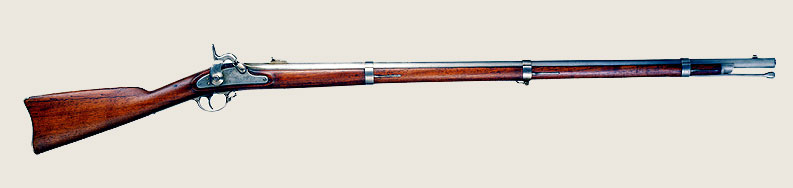
Springfield rifle, 1861 model (public domain).
On 21 November, the 47th participated in a morning divisional headquarters review that was monitored by their regiment’s founder and most senior commanding officer, Colonel Tilghman H. Good, followed by brigade and division drills all afternoon. According to Schmidt, “each man was supplied with ten blank cartridges.” Afterward, “Gen. Smith requested Gen. Brannan to inform Col. Good that the 47th was the best regiment in the whole division.” As a reward — and in preparation for bigger things to come, Brannan obtained new Springfield rifles for every member of the 47th Pennsylvania.
A New Addition to Company A
While all of that was happening, Private Jacob Cohler’s younger brother, John Michael Cohler was also preparing to enlist in the Union Army. Following his enrollment in their adopted hometown of Easton, Pennsylvania on 4 December 1861, John M. Cohler also boarded a train for Harrisburg in order to officially muster in for duty at Camp Curtin, which he did on 23 December 1861 — as a private with the same regiment and company in which his brother, Jacob Cohler, was already serving — Company A of the 47th Pennsylvania Volunteer Infantry.

Sketch of the 47th Pennsylvania Volunteers’ winter quarters at Camp Griffin, near Langley, Virginia, by Second Lieutenant William H. Wyker, Company E, December 1861 (public domain).
Military records at the time of his enlistment described Private John Cohler as an eighteen-year-old mason who was five feet, six inches tall with light hair, gray eyes and a fair complexion. Transported south by train to Virginia, he reconnected with his brother at their regiment’s winter quarters at Camp Griffin, which was located near Langley, Virginia. By that time, a total of one hundred and one men were listed on Company A’s roster.
While at Camp Griffin, the 47th PennsylvaniaVolunteers continued to receive training in light infantry tactics, but thought more and more about friends and family as Christmas Day and the New Year approached. Their days were brightened somewhat with a surprise delivery of sauerkraut by the 47th Pennsylvania’s regimental quartermaster.
1862

The 47th Pennsylvania Volunteers were transported to Florida aboard the steamship Oriental in January 1862 (public domain).
Ordered to move from their Virginia encampment back to Maryland, the Cohler brothers and their fellow 47th Pennsylvania Volunteers left Camp Griffin at 8:30 a.m. on Wednesday, 22 January 1862. Marching through deep mud with their equipment for three miles in order to reach the railroad station at Falls Church, they were then transported by rail to Alexandria, Virginia, where they boarded the steamship City of Richmond and sailed to the Washington Arsenal. While there, they were re-equipped with weapons and ammunition before being marched off for dinner and rest at the Soldiers’ Retreat in Washington, D.C.
The next afternoon, they hopped aboard cars on the Baltimore & Ohio Railroad, and headed for Annapolis, Maryland. Arriving around 10 p.m., they were assigned quarters in barracks at the United States Naval Academy. They then spent that Friday through Monday (24-27 January 1862) loading their equipment and other supplies onto the steamship Oriental.
During the afternoon of Monday, 27 January, they began lining up at the wharf for the final time. Ferried to the big steamship by smaller steamers, the enlisted men boarded the Oriental first, followed by the officers. Then, per the directive of Brigadier-General Brannan, they steamed away for the Deep South at 4 p.m. — headed for Florida which, despite its secession from the United States, remained strategically important to the Union due to the presence of Forts Taylor and Jefferson in Key West and the Dry Tortugas.
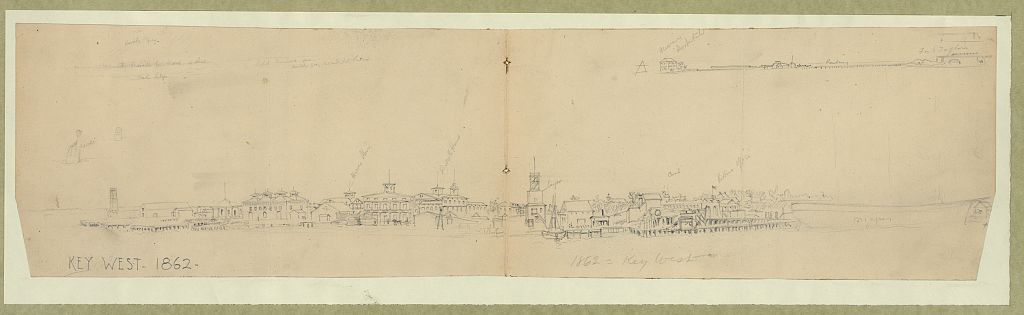
Alfred Waud’s 1862 sketch of Fort Taylor and Key West, Florida (U.S. Library of Congress, public domain).
Arriving in Key West in early February 1862, the 47th Pennsylvania Volunteers initially made camp on the beach, re-erecting their Sibley tents. Assigned to garrison Fort Taylor, they introduced their presence to Key West residents by parading through the streets of the city during the weekend of Friday, 14 February.
That Sunday, a number of soldiers from the regiment attended local church services, where they met and mingled with residents from the area as part of the first of many community outreach efforts to build support for the army’s efforts to preserve the nation’s Union. Drilling daily in heavy artillery tactics, they also strengthened the fortifications at that federal installation, felled trees and built new roads.
Sometime during that phase of service, a number of 47th Pennsylvania Volunteer Infantrymen began suffering problems with chronic diarrhea. Diagnosed with typhoid fever, several members of the regiment were confined to the post hospital at the fort.
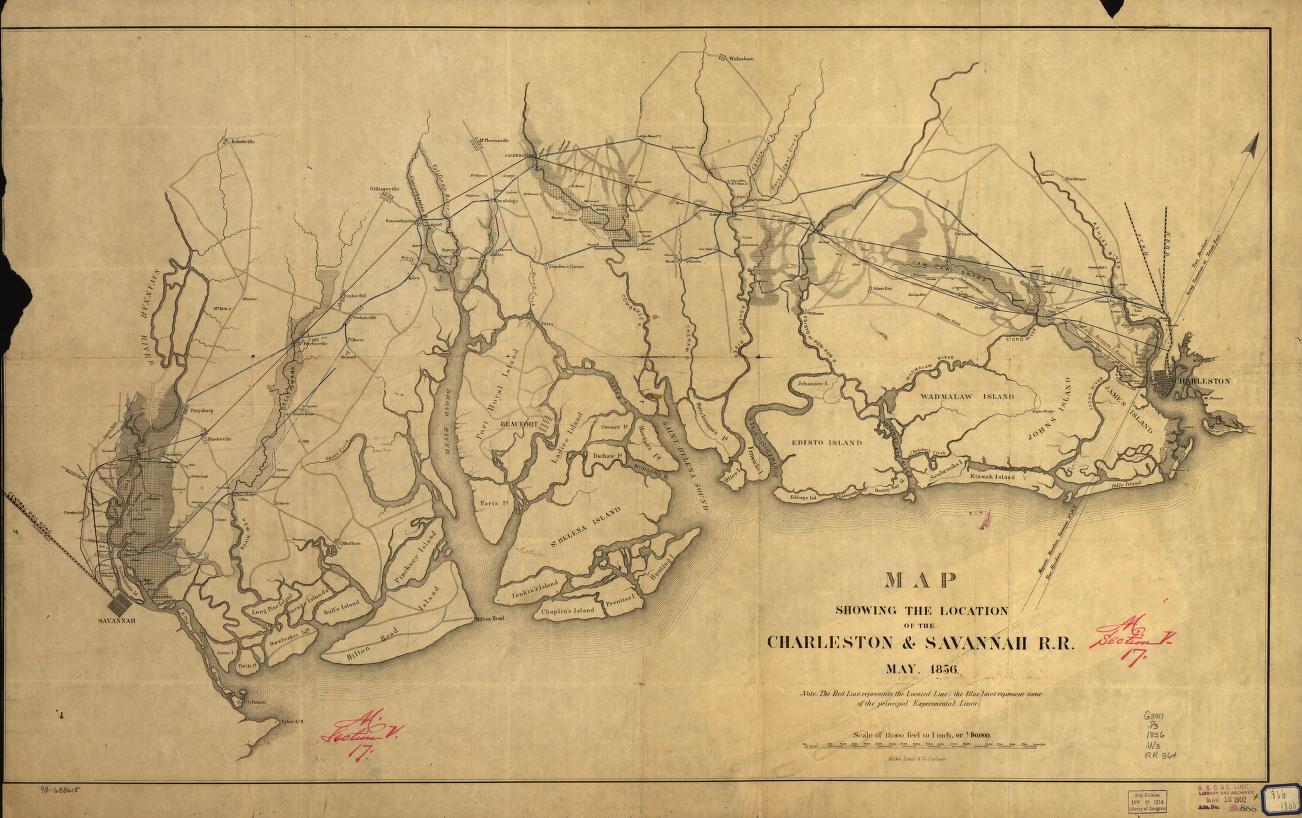
This 1856 map of the Charleston & Savannah Railroad shows the island of Hilton Head, South Carolina in relation to the towns of Beaufort and Pocotaligo (U.S. Library of Congress, public domain; click to enlarge).
Next ordered to Hilton Head, South Carolina from mid-June through July, they camped near Fort Walker before relocating to the Beaufort District in the U.S. Army’s Department of the South, roughly thirty-five miles away. Frequently assigned to hazardous picket detail north of their main camp, the Cohler brothers and other members of the 47th Pennsylvania were put at increased risk from enemy sniper fire when sent out on those special teams. According to historian Samuel P. Bates, during that phase of their service, the men of the 47th “received the highest commendation from Generals Hunter and Brannan” for their “attention to duty, discipline and soldierly bearing.”
Detachments from the regiment were also assigned to the Expedition to Fenwick Island (9 July) and the Demonstration against Pocotaligo (10 July).
During the second week of July, according to Schmidt, the regiment’s third-in-command — Major William H. Gausler — and F Company’s Captain Henry S. Harte returned home to Pennsylvania’s Lehigh Valley to resume the 47th Pennsylvania’s recruiting efforts. After arriving in Allentown on 15 July, they quickly re-established an efficient operation that they would keep running through early November 1862. During that time, Major Gausler was able to persuade fifty-four new recruits to join the 47th Pennsylvania while Harte rounded up an additional twelve.
Meanwhile, the remainder of the regiment continued to soldier on. From 20-31 August 1862, companies of the 47th Pennsylvania resumed picket duty, including at “Barnwells” (so labeled by Company C Captain J. P. S. Gobin) while other companies from the regiment performed picket duty in the areas around Point Royal Ferry.
On 12 September, the 47th Pennsylvania’s founder and commanding officer Colonel Tilghman H. Good and his adjutant, First Lieutenant Washington H. R. Hangen, issued Regimental Orders, No. 207 from the 47th Pennsylvania’s Headquarters in Beaufort, South Carolina:
I. The Colonel commanding desires to call the attention of all officers and men in the regiment to the paramount necessity of observing rules for the preservation of health. There is less to be apprehended from battle than disease. The records of all companies in climate like this show many more casualties by the neglect of sanitary post action then [sic] by the skill, ordnance and courage of the enemy. Anxious that the men in my command may be preserved in the full enjoyment of health to the service of the Union. And that only those who can leave behind the proud epitaph of having fallen on the field of battle in the defense of their country shall fail to return to their families and relations at the termination of this war.
II. All the tents will be struck at 7:30 a.m. on Monday, Wednesday and Saturday of each week. The signal for this purpose will be given by the drum major by giving three taps on the drum. Every article of clothing and bedding will be taken out and aired; the flooring and bunks will be thoroughly cleaned. By the same signal at 11 a.m. the tents will be re-erected. On the days the tents are not struck the sides will be raised during the day for the purpose of ventilation.
III. The proper cooking of provisions is a matter of great importance more especially in this climate but have not yet received from a majority of officers of the regiment that attention that should be paid to it.
IV. Thereafter an officer of each company will be detailed by the commander of each company and have their names reported to these headquarters to superintend the cooking of provisions taking care that all food prepared for the soldiers is sufficiently cooked and that the meats are all boiled or seared (not fried). He will also have charge of the dress table and he is held responsible for the cleanliness of the kitchen cooking utensils and the preparation of the meals at the time appointed.
V. The following rules for the taking of meals and regulations in regard to the conducting of the company will be strictly followed. Every soldier will turn his plate, cup, knife and fork into the Quarter Master Sgt who will designate a permanent place or spot for each member of the company and there leave his plate & cup, knife and fork placed at each meal with the soldier’s rations on it. Nor will any soldier be permitted to go to the company kitchen and take away food therefrom.
VI. Until further orders the following times for taking meals will be followed Breakfast at six, dinner at twelve, supper at six. The drum major will beat a designated call fifteen minutes before the specified time which will be the signal to prepare the tables, and at the time specified for the taking of meals he will beat the dinner call. The soldier will be permitted to take his spot at the table before the last call.
VII. Commanders of companies will see that this order is entered in their company order book and that it is read forth with each day on the company parade. All commanding officers of companies will regulate daily their time by the time of this headquarters. They will send their 1st Sergeants to this headquarters daily at 8 a.m. for this purpose.
Great punctuality is enjoined in conforming to the stated hours prescribed by the roll calls, parades, drills, and taking of meals; review of army regulations while attending all roll calls to be suspended by a commissioned officer of the companies, and a Captain to report the alternate to the Colonel or the commanding officer.
At 5 a.m., Commanders of companies are imperatively instructed to have the company quarters washed and policed and secured immediately after breakfast.
At 6 a.m., morning reports of companies request [sic] by the Captains and 1st Sgts and all applications for special privileges of soldiers must be handed to the Adjutant before 8 a.m.
By Command of Col. T. H. Good
W. H. R. Hangen Adj
In addition, First Lieutenant and Regimental Adjutant Hangen clarified the regiment’s schedule as follows:
- Reveille (5:30 a.m.) and Breakfast (6:00 a.m.)
- First and Second Calls for Guard (6:10 a.m. and 6:15 a.m.)
- Surgeon’s Call (6:30 a.m.)
- First and Second Calls for Company Drill (6:45 a.m. and 7:00 a.m.)
- Recall from Company Drill (8:00 a.m.)
- First and Second Calls for Squad Drill (9:00 a.m. and 9:15 a.m.)
- Recall from Squad Drill (10:30 a.m.) and Dinner (12:00 noon)
- Call for Non-commissioned Officers (1:30 p.m.)
- Recall for Non-commissioned Officers (2:30 p.m.)
- First and Second Calls for Squad Drills (3:15 p.m. and 3:30 p.m.)
- Recall from Squad Drill (4:30 p.m.)
- First and Second Calls for Dress Parade (5:10 p.m. and 5:15 p.m.)
- Supper (6:10 p.m.)
- Tattoo (9:00 p.m.) and Taps (9:15 p.m.)

First State Color, 47th Regiment, Pennsylvania Volunteer Infantry (presented to the regiment by Pennsylvania Governor Andrew Curtin, 20 September 1861; retired 11 May 1865, public domain).
As the one-year anniversary of the 47th Pennsylvania’s departure from the Great Keystone State dawned on 20 September, thoughts turned to home and Divine Providence as Colonel Tilghman Good issued Special Orders, No. 60 from the 47th’s Regimental Headquarters in Beaufort, South Carolina:
The Colonel commanding takes great pleasure in complimenting the officers and men of the regiment on the favorable auspices of today.
Just one year ago today, the organization of the regiment was completed to enter into the service of our beloved country, to uphold the same flag under which our forefathers fought, bled, and died, and perpetuate the same free institutions which they handed down to us unimpaired.
It is becoming therefore for us to rejoice on this first anniversary of our regimental history and to show forth devout gratitude to God for this special guardianship over us.
Whilst many other regiments who swelled the ranks of the Union Army even at a later date than the 47th have since been greatly reduced by sickness or almost cut to pieces on the field of battle, we as yet have an entire regiment and have lost but comparatively few out of our ranks.
Certain it is we have never evaded or shrunk from duty or danger, on the contrary, we have been ever anxious and ready to occupy any fort, or assume any position assigned to us in the great battle for the constitution and the Union.
We have braved the danger of land and sea, climate and disease, for our glorious cause, and it is with no ordinary degree of pleasure that the Colonel compliments the officers of the regiment for the faithfulness at their respective posts of duty and their uniform and gentlemanly manner towards one another.
Whilst in numerous other regiments there has been more or less jammings and quarrelling [sic] among the officers who thus have brought reproach upon themselves and their regiments, we have had none of this, and everything has moved along smoothly and harmoniously. We also compliment the men in the ranks for their soldierly bearing, efficiency in drill, and tidy and cleanly appearance, and if at any time it has seemed to be harsh and rigid in discipline, let the men ponder for a moment and they will see for themselves that it has been for their own good.
To the enforcement of law and order and discipline it is due our far fame as a regiment and the reputation we have won throughout the land.
With you he has shared the same trials and encountered the same dangers. We have mutually suffered from the same cold in Virginia and burned by the same southern sun in Florida and South Carolina, and he assures the officers and men of the regiment that as long as the present war continues, and the service of the regiment is required, so long he stands by them through storm and sunshine, sharing the same danger and awaiting the same glory.
Saint John’s Bluff and the Capture of a Confederate Steamer
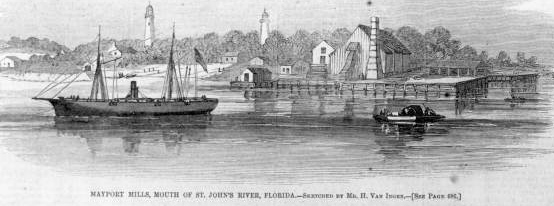
Union Navy Base, Mayport Mills, Florida (Harper’s Weekly, 5 October 1862, public domain).
During a return expedition to Florida beginning 30 September, the 47th Pennsylvania Volunteers joined with the 1st Connecticut Battery, 7th Connecticut Infantry, and part of the 1st Massachusetts Cavalry in assaulting Confederate forces at their heavily protected camp at Saint John’s Bluff, overlooking the Saint John’s River area. Trekking and skirmishing through roughly twenty-five miles of dense swampland and forests after disembarking from ships at Mayport Mills on 1 October, the 47th captured artillery and ammunition stores (on 3 October) that had been abandoned by Confederate forces during the bluff’s bombardment by Union gunboats.
* Note: The capture of Saint John’s Bluff followed a string of U.S. Army and Navy successes that had enabled the Union to gain control over key southern towns and transportation hubs. In November 1861, the Union’s South Atlantic Blockading Squadron had established a base at Port Royal, South Carolina to facilitate Union expeditions in Georgia and Florida, during which U.S. troops took possession of Fort Clinch and Fernandina, Florida (3-4 March 1862), secured the surrender of Fort Marion and Saint Augustine (11 March) and established a Union Navy base at Mayport Mills (mid-March).
That summer, Brigadier-General Joseph Finnegan, commanding officer of the Confederate States of America’s Department of Middle and Eastern Florida, had ordered the placement of earthworks-fortified gun batteries atop Saint John’s Bluff and at nearby Yellow Bluff, hoping to disable the Union’s naval and ground force operations at Mayport Mills by deploying eighteen cannon, including three eight-inch siege howitzers and four eight-inch smoothbores and Columbiads (two of each).
After the U.S. gunboats Uncas and Patroon had exchanged shell fire with the Confederate battery at Saint John’s Bluff on 11 September, Rebel troops were initially driven away, but had then returned to the bluff. When a second, larger Union gunboat flotilla tried and failed to shake the Confederates loose six days later, Union military leaders had then ordered an army operation with naval support.

Earthworks surrounding the Confederate battery atop Saint John’s Bluff along the Saint John’s River in Florida (J. H. Schell, 1862, public domain).
Backed by U.S. gunboats Cimarron, E. B. Hale, Paul Jones, Uncas, and Water Witch that were armed with twelve-pound boat howitzers, the fifteen-hundred-strong Union Army force of Brigadier-General Brannan moved up the Saint John’s River and further inland along the Pablo and Mt. Pleasant Creeks on 1 October 1862 before disembarking and marching for Saint John’s Bluff. But when the 47th Pennsylvanians reached Saint John’s Bluff with their fellow Union brigade members on 3 October 1862, they found the battery abandoned. (Other Union troops later discovered that the Yellow Bluff battery was also Rebel free.) According to Henry Wharton, “On the day following our occupation of these works the guns were dismounted and removed on board the steamer Neptune, together with the shot and shell, and removed to Hilton Head. The powder was all used in destroying the batteries.”
Meanwhile that same weekend (Friday and Saturday, 3-4 October 1862), Brigadier-General Brannan, who was quartered on board the Ben Deford as the Union expedition’s commanding officer, was busy penning reports to his superiors while also planning the next move of his expeditionary force. That Saturday, Brannan ordered officers to direct their men to prepare rations and ammunition for a new foray that would take them roughly twenty miles upriver to Jacksonville. (A sophisticated hub of cultural and commercial activities with a racially diverse population of more than two thousand residents, the city had repeatedly changed hands between the Union and Confederacy until its occupation by Union forces on 12 March 1862.) Among the Union soldiers selected for that mission were 47th Pennsylvania Volunteers from Company C, Company E and Company K.
According to Schmidt, the small force steamed upriver roughly one to two hundred miles “to Lake Beresford, where they then assisted in capturing the [68-ton] steamer Governor Milton,” which had been renamed in honor of Florida’s governor after having been “formerly known as the George M. Bird [under its previous owners] a New England family named ‘Swift’, who were timber cutters and used it as a tug boat to tow rafts loaded with live oak to the lumber market.”
In a subsequent report to his superiors, Brigadier-General Brannan noted that the Union party “returned on the morning of the 9th with a Rebel steamer, Governor Milton, which they captured in a creek about 230 miles up the river and about 27 miles north [and slightly west] from the town of Enterprise. Lt. Bacon, my aide-de-camp, accompanied the expedition… On the return of the successful expedition after the Rebel steamers… I proceeded with that portion of my command to St. John’s Bluff, awaiting the return of the Boston.”
That return trip did not happen without complications, however; in a letter penned to The New York Times on October 14, Wharton reported that:
Finding that the Cosmopolitan, which had been sent to Hilton Head for provisions, had struck heavily in crossing the bar, on her return to the St. John’s River, and was temporarily disabled for service, the Seventh Connecticut Regiment was sent to Hilton Head on the Boston, with the request that she should return for the remainder of the troops, and she got back on the 11th, when the command was reembarked, reaching this plane yesterday, excepting one company of the Forty-seventh Pennsylvania, which is left for the protection of the Cosmopolitan. The accident to this valuable steamer is severe. A large hole was made in her bottom and she filled, but she will not be a wreck, as was at first feared.
Integration of the Regiment
On 5 and 15 October 1862, respectively, the 47th Pennsylvania made history as it became an integrated regiment, adding to its muster rolls several Black men who had escaped from chattel enslavement on plantations near Beaufort, South Carolina. Among the formerly enslaved men who enlisted at that time were Bristor Gethers, Abraham Jassum and Edward Jassum.
Battle of Pocotaligo, South Carolina

Highlighted version of the U.S. Army map of the Coosawhatchie-Pocotaligo Expedition, 22 October 1862 (public domain).
From 21-23 October 1862, under the brigade and regimental commands of Colonel T. H. Good and Lieutenant-Colonel George W. Alexander, the 47th Pennsylvania Volunteers next engaged the heavily protected Confederate forces in and around Pocotaligo, South Carolina — including at Frampton’s Plantation and the Pocotaligo Bridge — a key piece of southern railroad infrastructure that Union leaders had ordered to be destroyed in order to disrupt the flow of Confederate troops and supplies in the region.
Harried by snipers en route to the Pocotaligo Bridge, they met resistance from an entrenched, heavily fortified Confederate battery which opened fire on the Union troops as they entered an open cotton field. Those headed toward higher ground at the Frampton Plantation fared no better as they encountered artillery and infantry fire from the surrounding forests. The Union soldiers grappled with Confederates where they found them, pursuing the Rebels for four miles as they retreated to the bridge. There, the 47th relieved the 7th Connecticut. But the enemy was just too well armed. After two hours of intense fighting in an attempt to take the ravine and bridge, depleted ammunition forced the 47th to withdraw to Mackay’s Point.
The next day — 23 October 1862 — the regiment returned to Hilton Head, South Carolina, where a significant number of men were admitted to the Union Army’s general hospital for treatment of the wounds they had sustained in combat. Shortly thereafter, a group of 47th Pennsylvania Volunteers were assigned to serve as the honor guard for the funeral of Union Major-General Ormsby Mitchel, who had succumbed to yellow fever on 30 October.
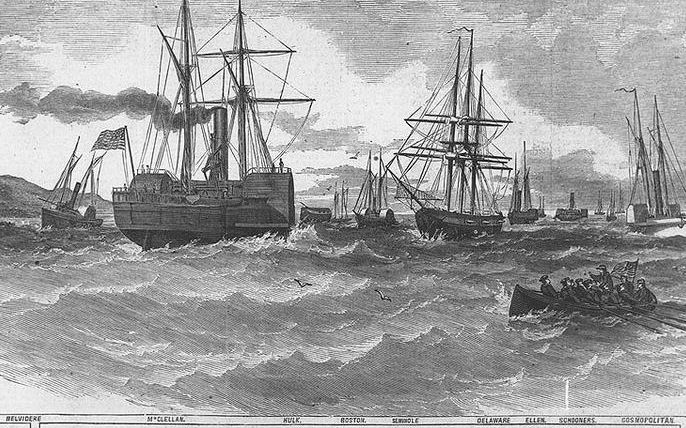
USS Seminole and USS Ellen accompanied by transports (left to right: Belvidere, McClellan, Boston, Delaware, and Cosmopolitan) at Wassau Sound, Georgia (circa January 1862, Harper’s Weekly, public domain).
Having been ordered back to Key West on 15 November 1862, the 47th Pennsylvanians did not know it, yet, but much of 1863 for them would be spent garrisoning federal installations in Florida as part of the 10th Corps, U.S. Army, Department of the South. Companies A, B, C, E, G, and I would once again garrison Fort Taylor in Key West, but this time, the men from Companies D, F, H, and K would garrison Fort Jefferson, the Union’s remote outpost in the Dry Tortugas off the southern coast of Florida.
After packing their belongings at their Beaufort, South Carolina encampment and loading their equipment onto the U.S. Steamer Cosmopolitan, the officers and enlisted members of the 47th Pennsylvania Volunteer Infantry sailed toward the mouth of the Broad River on 15 December 1862, and anchored briefly at Port Royal Harbor in order to allow the regiment’s medical director, Elisha W. Baily, M.D., and members of the regiment who had recuperated enough from their Pocotaligo-related battle injuries at the Union’s General Hospital at Hilton Head, to rejoin the regiment.
At 5 p.m. that same evening, the regiment sailed for Florida, during what was later described by several members of the regiment as a treacherous and nerve-wracking voyage. According to Schmidt, the ship’s captain “steered a course along the coast of Florida for most of the voyage,” which made the voyage more precarious “because of all the reefs.” On 16 December “the second night, the ship was jarred as it ran aground on one during a storm, but broke free, and finally steered a course further from shore, out in the Gulf Stream.” In a letter penned to the Sunbury American on 21 December, Henry Wharton provided the following details about the regiment’s trip:
On the passage down, we ran along almost the whole coast of Florida. Rather a dangerous ground, and the reefs are no playthings. We were jarred considerably by running on one, and not liking the sensation our course was altered for the Gulf Stream. We had heavy sea all the time. I had often heard of ‘waves as big as a house,’ and thought it was a sailor’s yarn, but I have seen ‘em and am perfectly satisfied; so now, not having a nautical turn of mind, I prefer our movements being done on terra firma, and leave old neptune to those who have more desire for his better acquaintance. A nearer chance of a shipwreck never took place than ours, and it was only through Providence that we were saved. The Cosmopolitan is a good river boat, but to send her to sea, loadened [sic, loaded] with U.S. troops is a shame, and looks as though those in authority wish to get clear of soldiers in another way than that of battle. There was some sea sickness on our passage; several of the boys ‘casting up their accounts’ on the wrong side of the ledger.
According to Corporal George Nichols of Company E, “When we got to Key West the Steamer had Six foot of water in her hole [sic]. Waves Mountain High and nothing but an old river Steamer. With Eleven hundred Men on I looked for her to go to the Bottom Every Minute.”
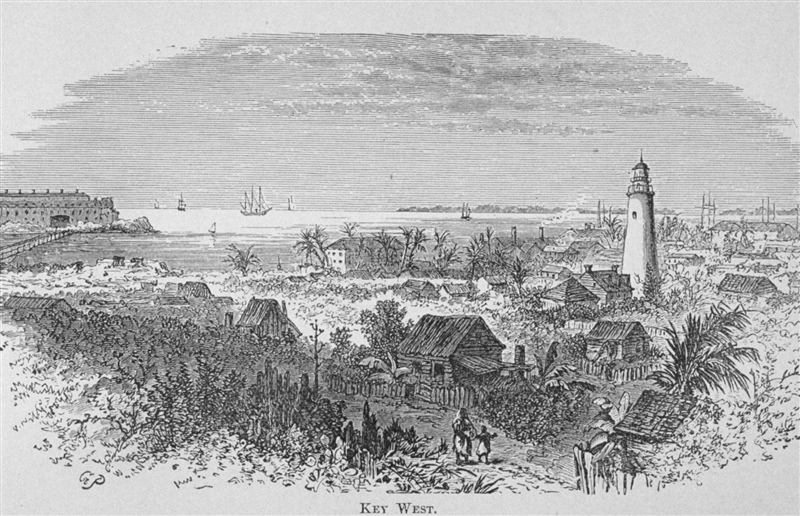
Lighthouse, Key West, Florida, early to mid-1800s (Florida for Tourists, Invalids, and Settlers, George M. Barbour, 1881, public domain).
Although the Cosmopolitan arrived at the Key West Harbor on Thursday, 18 December, the Cohler brothers and their fellow 47th Pennsylvania Volunteers did not set foot on Florida soil until noon the next day. The men from Companies C and I were immediately marched to Fort Taylor, where they were placed under the command of Major William Gausler, the regiment’s third-in-command. The men from Companies B and E were assigned to the older barracks that had been erected by the United States Army and were placed under the command of B Company Captain Emanuel P. Rhoads while the men from Companies A and G were placed under the command of A Company Captain Richard A. Graeffe and stationed at newer facilities known as the “Lighthouse Barracks” on “Lighthouse Key.”
On Saturday, 21 December, Lieutenant-Colonel G. W. Alexander, the regiment’s second-in-command, sailed away aboard the Cosmopolitan with the men from the regiment’s remaining companies — Companies D, F, H, and K — and headed south to Fort Jefferson, where they would assume garrison duties in the Dry Tortugas, roughly seventy miles off the coast of Florida (in the Gulf of Mexico). According to Henry Wharton:
We landed here on last Thursday at noon, and immediately marched to quarters. Company I. and C., in Fort Taylor, E. and B. in the old Barracks, and A. and G. in the new Barracks. Lieut. Col. Alexander, with the other four companies proceeded to Tortugas, Col. Good having command of all the forces in and around Key West. Our regiment relieves the 90th Regiment N.Y.S. Vols. Col. Joseph Morgan, who will proceed to Hilton Head to report to the General commanding. His actions have been severely criticized by the people, but, as it is in bad taste to say anything against ones [sic, one’s] superiors, I merely mention, judging from the expression of the citizens, they were very glad of the return of the 47th Pennsylvania Volunteers….
Key West has improved very little since we left last June, but there is one improvement for which the 90th New York deserve a great deal of praise, and that is the beautifying of the ‘home’ of dec’d. soldiers. A neat and strong wall of stone encloses the yard, the ground is laid off in squares, all the graves are flat and are nicely put in proper shape by boards eight or ten inches high on the ends sides, covered with white sand, while a head and foot board, with the full name, company and regiment, marks the last resting place of the patriot who sacrificed himself for his country….
1863
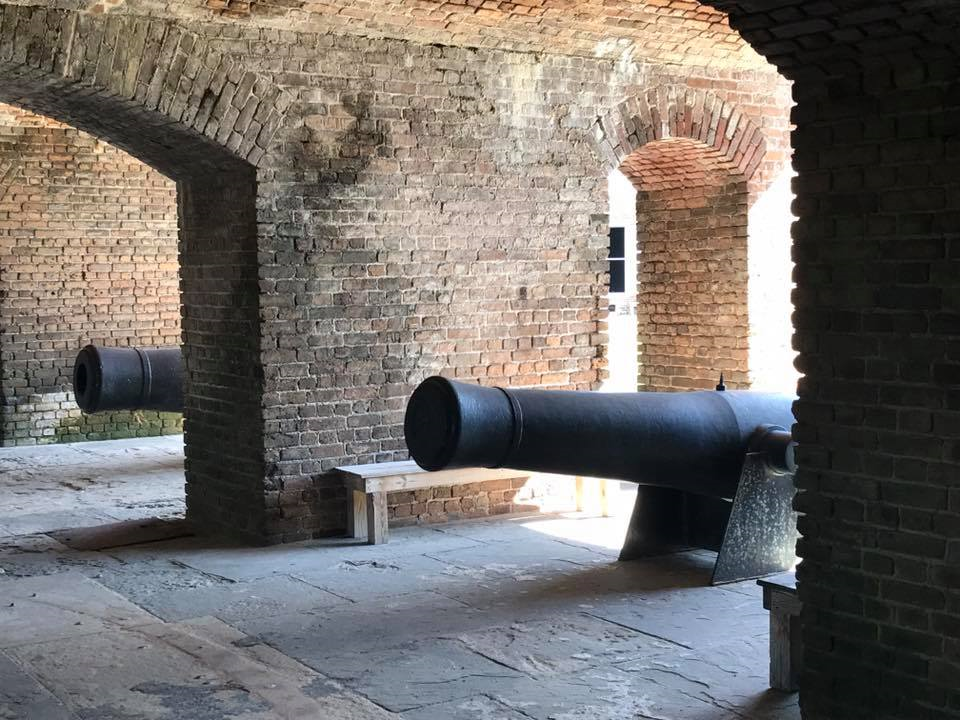
Artillery, Fort Taylor, Key West, Florida (Phil Spaugy, 2017, photo used with permission).
Life for members of the 47th Pennsylvania then went on, the hours taken up by training, drilling and inspections that were scheduled regularly to keep them in a perpetual state of readiness for anything that the Confederate Army or Navy could throw at them. In addition, they were also sent out on skirmishes and received training in operating the light and heavy artillery defenses of Forts Taylor and Jefferson. (Companies A, B, C, E, G, and I were based at Fort Taylor, while Companies D, F, H, and K were stationed at Fort Jefferson.)
As that phase of garrison duty continued, another important element of the 47th Pennsylvania’s storied service began to emerge — the fact that, despite all of the hardships endured by the members of the regiment, more than half of its members chose to re-enlist when their respective, original terms of service expired, including Private Jacob Cohler, who re-enlisted as a private with the same company and regiment (Company A of the 47th Pennsylvania Volunteer Infantry) at Fort Taylor in Key West on 10 October 1863, and Private John M. Cohler, who re-enlisted as a private with the same company and regiment (Company A of the 47th Pennsylvania Volunteer Infantry) at Fort Taylor in Key West on 23 December 1863, earning both brothers the coveted designation of “Veteran Volunteer.”
1864
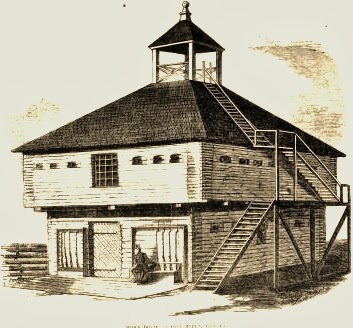
Blockhouse, Fort Myers, circa 1850s (courtesy of the Florida State Archives).
In early January 1864, Company A underwent a significant transformation, following orders that the 47th Pennsylvania Volunteer Infantry help to expand the Union’s reach across Florida. In response, Captain Graeffe selected a group of soldiers for a special duty assignment that required those A Company men to march north to Fort Myers and revitalize a federal installation that had been abandoned in 1858 after the U.S. government’s third war with the Seminole Indians.
Ordered to be reclaimed by Major-General Daniel P. Woodbury, the commanding officer of the U.S. Army’s Department of the Gulf, District of Key West and the Tortugas, the fort would subsequently be used, under Captain Graeffe’s leadership, to support the Union’s Gulf Coast blockade and create a safe haven for pro-Union supporters, Confederate Army deserters and children and adults who were escaping chattel slavery. Captain Graeffe and his men were also charged with launching raids on cattle herds in the region around the fort in order to provide food for the growing Union troop presence across Florida. According to Schmidt:
Capt. Richard A. Graeffe, accompanied by Assistant Surgeon William F. Reiber, commanded the main portion of Company A which boarded ship on Monday, January 4 and sailed the following day, Tuesday, for Fort Myers, on the Caloosahatchee River fifteen air miles southeast of Charlotte Harbor. The company was transported on board the Army quartermaster schooner Matchless, after having embarked the day before, and was accompanied by the steamer U.S.S. Honduras commanded by Lt. Harris, and with Gen. Woodbury aboard. Lt. Harris was directed to tow the Matchless if necessary.
Punta Rassa was probably the location where the troops disembarked, and was located on the tip of the southwest delta of the Caloosahatchee River … near what is now the mainland or eastern end of the Sanibel Causeway… Fort Myers was established further up the Caloosahatchee at a location less vulnerable to storms and hurricanes. In 1864, the Army built a long wharf and a barracks 100 feet long and 50 feet wide at Punta Rassa, and used it as an embarkation point for shipping north as many as 4400 Florida cattle….
Capt. Graeffe and company were disembarked on the evening of January 7, and Gen. Woodbury ordered the company to occupy Fort Myers on the south side of the Caloosahatchee, about 12 miles from its mouth and 150 miles from Key West. Shortly after, [a detachment of men from the 47th Pennsylvania’s A Company stationed on Useppa Island] was also ordered to proceed to Fort Myers and join the main body of Company A, the entire command under direct orders of the General who was in the area…. Gen. Woodbury returned to Key West on the Honduras prior to January 19, and the command was left in charge of Capt. Graeffe who dispatched various patrols in search of refugees for enlistment and for activities involving Confederate cattle shipments.
Company A’s muster roll provides the following account of the expedition under command of Capt. Graeffe: ‘The company left Key West Fla Jany 4. 64 enroute to Fort Meyers Coloosahatche River [sic] Fla. were joined by a detachment of the U.S. 2nd Fla Rangers at Punta Rossa Fla took possession of Fort Myers Jan 10. Captured a Rebel Indian Agent and two other men.’
Schmidt also noted that Graeffe’s hand drawings included depictions of roughly twelve buildings “primarily situated along the river, with a log palisade protecting those portions not bounded by the Caloosahatchee; the whole in a densely wooded area and entered through an opening on the southeast protected by the river on the west near the area of the wharf, and a log blockhouse on the east.”
An 1856 survey of the fort contained in the Federal Register “suggest[ed] that the fort’s wooden stockade ran from just east of Broadway to just east of Royal Palm, and from Main Street on the south to the river bank, which meandered along what is Bay Street today,” according to Tom Hall, creator of a website about the arts in Southwest Florida:
It consisted of as many as three dozen hewn pine buildings which included officers’ quarters … barracks, administration offices, a 2½-story hospital with plastered rooms, warehouses for the storage of munitions and general supplies, a guard house … blacksmith’s and carpenter’s shops, a kitchen, bakery, laundry, a sutler’s store, stables for horses and mules, a gardener’s shack, and even a bowling alley and bathing pier and pavilion.
It also boasted a pier nearly 700 feet long that had wide dock and rails that enabled the soldiers to bring in supplies by tram without having to lighter them ashore. The buildings were sided and topped by cedar shingles shipped in from Pensacola and Apalachicola, together with doors, windows and flooring. The interior featured parade grounds, a carefully-tended velvety lawn, two immense vegetable gardens, rock-rimmed river banks, shell walks, lush palms and even citrus trees.
Also according to Hall:
By the time Captain Richard A. Graeffe and his soldiers arrived at the fort, most of the wood stockade had disappeared, so he ordered his men to construct an earthen wall 15 feet wide by 7 feet tall. Three guard towers were also constructed: one where the hospital had been; a second by the garden and bowling alley; and the third between the stables and riverside warehouse. Then Captain Graeffe sent his troops across the river to begin rounding up the herds of scrub cows being raised by ranchers between Punta Gorda and Tampa. As they did, resistance began to grow. Captain Graeffe realized he needed reinforcements and Companies D and I of the [U.S. Colored Troop’s] 2nd Regiment were brought up from Fort Zachary Taylor in Key West.
A draft Environmental Impact Statement prepared in 2010 for the Everglades National Park partially documents the time of Richard Graeffe and the men under his Florida command this way:
A small contingent of 20 men and two officers from the Pennsylvania 47th Regiment, led by Captain Henry Crain of the 2nd Regiment of Florida, arrived at the fort on January 7, 1864. A short time later, the party was joined by another small detachment of the 47th under the command of Captain Richard A. Graeffe. Over a short period, increasing reinforcements of the fort led to increasing cattle raids throughout the region. A Union force so far into Confederate land did not go well with Confederate loyalists. The fact that so many men stationed at the post were black soldiers from the newly created U.S. Colored Troops was particularly aggravating. The raids were so antagonizing that the Confederates created a Cattle Guard Battalion called the “Cow Cavalry” to repulse Union raiders. The unit remained a primary threat to the Union soldiers carrying out raids and reconnaissance missions from Brooksville to as far south as Lake Okeechobee and Fort Myers.
Early on, according to Schmidt, Captain Graeffe sent the following report to Woodbury:
‘At my arrival hier [sic] I divided my forces in three detachment, viz one at the Hospital one into the old guardhouse and one into the Comissary [sic] building, the Florida Rangers I quartered into one of the old Company quarters, I set all parties to work after placing the proper pickets and guards at the Hospital i have build [sic] and now nearly finished a two story loghouse of hewn and square logs 12 inches through seventeen by twenty-two fifteen feet high with a cupola onto the roof of six feet high and at right angle with two lines of picket fences seven feet high. i shall throw up a half a bastion around it as soon as completed. around the old guardhouse i have thrown up a bastion seven feet through at the foot and three feet on the top nine feet high from the bottom of the ditch and five on the inside. I also build [sic] a loghouse sixteen by eighteen of two storys [sic] Southeast of the Commissary building with a bastion around it at right angles with a picket fence each bastion has the distance you recomandet [sic] from the loghouses 20 feet on the sides and 20 to the salient angle, i caused to be dug a well close to bl. houses and inside of the bastions at each Station inside they are all comfortable fitted up with stationary bunks for the men without interfering with the defence [sic] of the work outside of the Bastions and inside the picket fense i have erected small kitchens and messrooms for each station, i am building now a guardhouse build [sic] of square hewn logs sixteen by sixteen two storys high the lower room to be used for the guard and the upper one as a prison, the building to be used for defence [sic] (in case of attack) by the Rangers each work is within view and supporting distance from the other; Capt. Crane with a detachment of his men repaired the wharf, which is in good condition now and fit for use, the bakehouse i got repaired, and the fourth day hier [sic] we had already very good fresh bread; the parade ground is in a good condition had all the weeds mowed off being to [sic] green to burn. i intend to fit up a schoolroom and church as soon as possible.’
Muster rolls for Company A from that period noted that “a detachment of 25 men crossed over to the north west side of the river” on 16 January and “scoured the country till up to Fort Thompson a distance of 50 miles,” where they “encountered a Rebel Picket who retreated after exchanging shots.” Making their way back, they swam across the river, and reached the fort on 23 January. Meanwhile, while that group was still away, Captain Graeffe ordered a smaller detachment of eight men to head out on 17 January in search of cattle. Finding only a few, they instead took possession of four barrels of Confederate turpentine, which were later disposed of by other Union troops.
Graeffe’s men also captured three Confederate sympathizers at the fort, including a blockade runner and spy named Griffin and an Indian interpreter and agent named Lewis. Charged with multiple offenses against the United States, they were transported to Key West, where they were kept under guard by Major William Gausler, the officer who was third-in-command of the 47th Pennsylvania Volunteer Infantry who was serving as the provost marshal of Key West at that time. That phase of duty lasted until sometime in February of 1864.
* Note: Captain Richard Graeffe’s detachment at Fort Myers became known as the “Florida Rangers,” according to The War of the Rebellion: A Compilation of the Official Records of the Union and Confederate Armies, prepared by Lieutenant Colonel Robert N. Scott, et. al. (1891). His hand-drawn sketches of Fort Myers were later published in Images of America: Fort Myers by Gregg Turner and Stan Mulford. Researchers for 47th Pennsylvania Volunteers: One Civil War Regiment’s Story have not yet determined if Privates Jacob and John M. Cohler were among the soldiers from Company A who were selected by Captain Richard Graeffe for the Fort Myers assignment or not. If they were not chosen by Graeffe for that mission, they most likely remained behind at Fort Taylor, where they continued to perform their duties as part of his regiment’s garrison function.
Red River Campaign
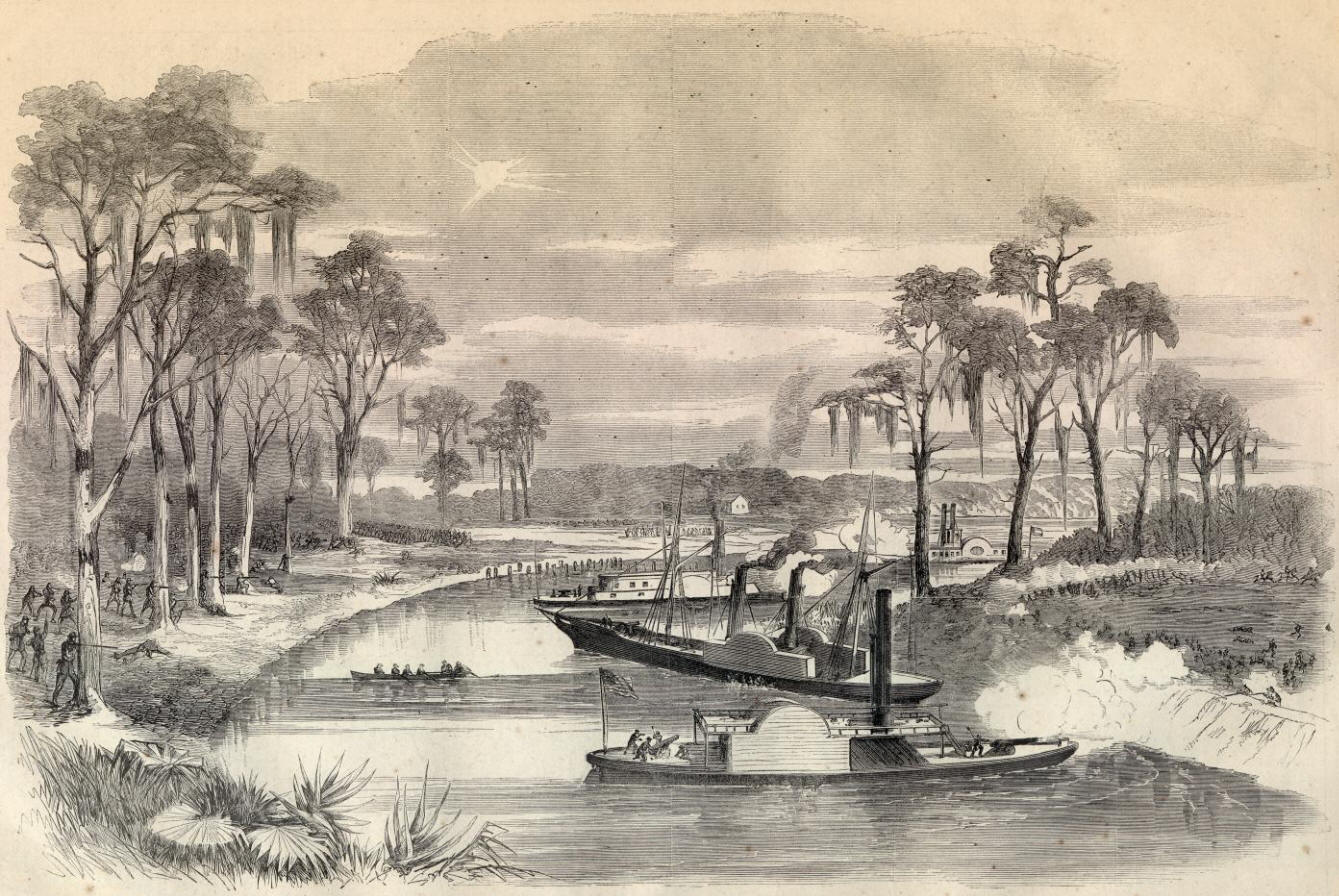
Bayou Teche, Louisiana (Harper’s Weekly, 14 February 1863, public domain).
Meanwhile, all of the other companies of the 47th Pennsylvania Volunteer Infantry had begun preparing for the regiment’s history-making journey to Louisiana. Boarding yet another steamer — the Charles Thomas — on 25 February 1864, the men from Companies B, C, D, I, and K of the 47th Pennsylvania headed for Algiers, Louisiana (across the river from New Orleans), followed on 1 March by other members of the regiment from Companies E, F, G, and H who had been stationed at Fort Jefferson in the Dry Tortugas.
Upon the second group’s arrival, the now almost-fully-reunited regiment moved by train on 28 February to Brashear City (now Morgan City, Louisiana) before heading to Franklin by steamer through the Bayou Teche. There, the 47th Pennsylvania Volunteer Infantry joined the 2nd Brigade, 1st Division of the Department of the Gulf’s 19th Army Corps (XIX Corps), and became the only Pennsylvania regiment to serve in the Red River Campaign of Union Major-General Nathaniel P. Banks.
Unable to reach Louisiana until 23 March, the men from Company A were effectively placed on a different type of detached duty in New Orleans while they awaited transport to enable them to catch up with the main part of their regiment. Charged with guarding and overseeing the transport of two hundred and forty-five Confederate prisoners, they were finally able to board the Ohio Belle on 7 April, and reached Alexandria, Louisiana with those prisoners on 9 April.
But they had missed the two bloodiest combat engagements that their regiment would endure during the Red River Campaign — the Battle of Sabine Cross Roads/Mansfield on 8 April and the Battle of Pleasant Hill on 9 April. According to Schmidt, they were so far away from the scene of those battles because they had been ordered to return the Confederate prisoners to New Orleans — a directive that extended their detached duty and kept them from rejoining the main regiment until they reached Alexandria, Louisiana on 27 April.
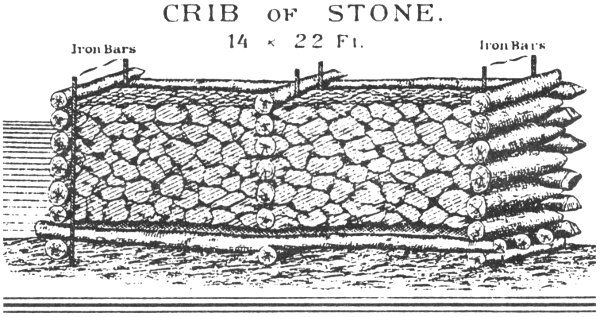
Sketches of the crib and tree dams designed by Lieutenant-Colonel Joseph Bailey to improve the water levels of the Red River near Alexandria, Louisiana, spring 1864 (Joseph Bailey, “Report on the Construction of the Dam Across the Red River,” 1865, public domain).
This means that the men from Company A also missed a third combat engagement — the Battle of Cane River (also known as “the Affair at Monett’s Ferry”), which took place on 23 April. They were able to participate in their regiment’s next major engagement, however. From late April through mid-May, they helped erect Bailey’s Dam on the Red River near Alexandria. In a letter penned from Morganza, Louisiana on 29 May, Henry Wharton described their mission and the weeks that followed:
We were at Alexandria seventeen days, during which time the men were kept busy at throwing up earthworks, foraging and three times went out some distance to meet the enemy, but they did not make their appearance in numbers large enough for an engagement. The water in the Red river had fallen so much that it prevented the gunboats from operating with us, and kept our transports from supplying the troops with rations, (and you know soldiers, like other people, will eat) so Banks was compelled to relinquish his designs on Shreveport and fall back to the Mississippi. To do this a large dam had to be built on the falls at Alexandria to get the ironclads down the river. After a great deal labor this was accomplished and by the morning of May 13th the last one was through the shute [sic], when we bade adieu to Alexandria, marching through the town with banners flying and keeping step to the music of ‘Rally around the flag,’ and ‘When this cruel war is over.’ The next morning, at our camping place, the fleet of boats passed us, when we were informed that Alexandria had been destroyed by fire – the act of a dissatisfied citizen and several negroes. Incendiary acts were strictly forbidden in a general order the day before we left the place, and a cavalry guard was left in the rear to see the order enforced. After marching a few miles skirmishing commenced in front between the cavalry and the enemy in riflepits [sic] on the bank of the river, but they were easily driven away. When we came up we discovered their pits and places where there had been batteries planted. At this point the John Warren, an unarmed transport, on which were sick soldiers and women, was fired into and sunk, killing many and those that were not drowned taken prisoners. A tin-clad gunboat was destroyed at the same place, by which we lost a large mail. Many letters and directed envelopes were found on the bank – thrown there after the contents had been read by the unprincipled scoundrels. The inhumanity of Guerrilla bands in this department is beyond belief, and if one did not know the truth of it or saw some of their barbarities, he would write it down as the story of a ‘reliable gentleman’ or as told by an ‘intelligent contraband.’ Not satisfied with his murderous intent on unarmed transports he fires into the Hospital steamer Laurel Hill, with four hundred sick on board. This boat had the usual hospital signal floating fore and aft, yet, notwithstanding all this, and the customs of war, they fired on them, proving by this act that they are more hardened than the Indians on the frontier.
On Sunday, May 15, we left the river road and took a short route through the woods, saving considerable distance. The windings of Red river are so numerous that it resembles the tape-worm railroad wherewith the politicians frightened the dear people during the administration of Ritner and Stevens. – We stopped several hours in the woods to leave cavalry pass, when we moved forward and by four o’clock emerged into a large open plain where we formed in line of battle, expecting a regular engagement. The enemy, however, retired and we advanced ‘till dark, when the forces halted for the night, with orders to rest on their arms. – ‘Twas here that Banks rode through our regiment, amidst the cheers of the boys, and gave the pleasant news that Grant had defeated Lee.

“Sleeping on Their Arms” by Winslow Homer (Harper’s Weekly, 21 May 1864).
Having entered Avoyelles Parish, they “rested on their arms” for the night, half-dozing without pitching their tents, but with their rifles right beside them. They were now positioned just outside of Marksville, Louisiana on the eve of the 16 May 1864 Battle of Mansura, which unfolded as follows, according to Wharton:
Early next morning we marched through Marksville into a prairie nine miles long and six wide where every preparation was made for a fight. The whole of our force was formed in line, in support of artillery in front, who commenced operations on the enemy driving him gradually from the prairie into the woods. As the enemy retreated before the heavy fire of our artillery, the infantry advanced in line until they reached Mousoula [sic, Mansura], where they formed in column, taking the whole field in an attempt to flank the enemy, but their running qualities were so good that we were foiled. The maneuvring [sic] of the troops was handsomely done, and the movements was [sic] one of the finest things of the war. The fight of artillery was a steady one of five miles. The enemy merely stood that they might cover the retreat of their infantry and train under cover of their artillery. Our loss was slight. Of the rebels we could not ascertain correctly, but learned from citizens who had secreted themselves during the fight, that they had many killed and wounded, who threw them into wagons, promiscuously, and drove them off so that we could not learn their casualties. The next day we moved to Simmsport [sic, Simmesport] on the Achafalaya [sic, Atchafalaya] river, where a bridge was made by putting the transports side by side, which enabled the troops and train to pass safely over. – The day before we crossed the rebels attacked Smith, thinking it was but the rear guard, in which they, the graybacks, were awfully cut up, and four hundred prisoners fell into our hands. Our loss in killed and wounded was ninety. This fight was the last one of the expedition. The whole of the force is safe on the Mississippi, gunboats, transports and trains. The 16th and 17th have gone to their old commands.
It is amusing to read the statements of correspondents to papers North, concerning our movements and the losses of our army. I have it from the best source that the Federal loss from Franklin to Mansfield, and from their [sic] to this point does not exceed thirty-five hundred in killed, wounded and missing, while that of the rebels is over eight thousand.
After the surviving members of the 47th made their way through Simmesport and into the Atchafalaya Basin, they moved on to Morganza, where they made camp again. While there, the nine formerly enslaved Black men who had enlisted with the 47th Pennsylvania in Beaufort, South Carolina (October-November 1862) and Natchitoches, Louisiana (5 April 1864) were officially mustered into the regiment between 20-24 June 1864. But once again, disease was proving to be a formidable foe, sickening a significant number of 47th Pennsylvanians who had been weakened by the long, grueling marches across challenging terrain in difficult weather. Among those who fell ill during that period was A Company Corporal William Schweitzer. As his condition worsened, he was hospitalized on 20 June 1864 aboard the USS Laurel Hill, which was docked near Morganza. Diagnosed with typhoid fever, he died aboard that ship four days later, on 24 June (alternate death date: 23 June), from complications related to that disease.

U.S. Steamer McClellan (Alfred Waud, circa 1860-1865, U.S. Library of Congress, public domain).
Meanwhile, the Cohler brothers and other healthier 47th Pennsylvanians were expected to soldier on when the regiment was ordered to march for New Orleans — which they did. When the regiment was given new orders on the Fourth of July to return to the Eastern Theater of the war, they packed up their gear and then climbed aboard the U.S. Steamer McClellan three days later and prepared to sail away from America’s Deep South. Joining the men from the 47th Pennsylvania’s A Company on that voyage were the men from Companies C, D, E, F, H, and I. (The remaining companies then followed later that month, transported by the Blackstone.)
Following their arrival in Virginia and a memorable encounter with President Abraham Lincoln on 12 July, the Cohler brothers and their fellow 47th Pennsylvanians joined up with Major-General David Hunter’s forces at Snicker’s Gap in mid-July 1864. There, they fought in the Battle of Cool Spring and assisted in defending Washington, D.C. while also helping to drive Confederate troops from Maryland.
Sheridan’s 1864 Shenandoah Valley Campaign
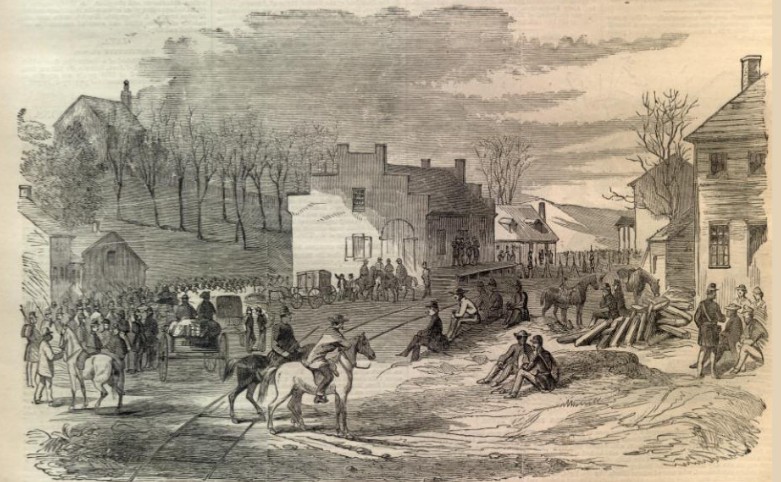
“The Rendezvous of the Virginians at Halltown, Virginia, 5 p.m. on April 18, 1861 to March on Harper’s Ferry” (D. H. Strother, Harper’s Weekly, 11 May 1861, public domain).
Attached to the Middle Military Division, U.S. Army of the Shenandoah from August through November of 1864, the 47th Pennsylvania Volunteers were assigned to defensive duties in and around Halltown, Virginia in early August 1864, and engaged in a series of back-and-forth movements between Halltown, Berryville, Middletown, Charlestown, and Winchester as part of a “mimic war” being waged by the Union forces commanded by Major-General Philip Sheridan with those commanded by Confederate Lieutenant-General Jubal Early.
From 3-4 September, the 47th Pennsylvania Volunteers fought in the Battle of Berryville and engaged in related post-battle skirmishes with the enemy over subsequent days.
Two weeks later, multiple members of the 47th Pennsylvania opted to leave, content that they had fulfilled their obligations to the nation by completing their original three-year terms of enlistment, including Company A’s two most senior officers — Captain Richard Graeffe and First Lieutenant James F. Meyers. The members of the 47th Pennsylvania Volunteer Infantry who opted to stay, however, were about to engage in the regiment’s greatest displays of valor.
Battles of Opequan and Fisher’s Hill

Battle of Opequan (aka Third Winchester), Virginia, 19 September 1864 (public domain).
Together with other regiments under the command of Union Major-General Sheridan and Brigadier-General William H. Emory, commander of the 19th Corps (XIX Corps), the 47th Pennsylvania Volunteers next helped to inflict heavy casualties on the Confederate forces of Lieutenant-General Early in the Battle of Opequan (also spelled as “Opequon” and referred to as “Third Winchester”). The battle is still considered by many historians to be one of the most important during Sheridan’s 1864 campaign; the Union’s victory here helped to ensure the reelection of President Abraham Lincoln.
The 47th Pennsylvania’s march toward destiny at Opequan began at 2 a.m. on 19 September 1864 as the regiment left camp and joined up with others in the Union’s 19th Corps. Advancing slowly from Berryville toward Winchester, the 19th Corps became bogged down for several hours by the massive movement of Union troops and supply wagons, enabling Early’s men to dig in. Finally reaching the Opequon Creek, Sheridan’s men came face to face with Early’s Confederate Army. The fighting, which began in earnest at noon, was long and brutal. The Union’s left flank (6th Corps) took a beating from Confederate artillery stationed on high ground.

Victory of Philip Sheridan’s Union Army over Jubal Early’s Confederate forces, Battle of Opequan, 19 September 1864 (Kurz & Allison, circa 1893, U.S. Library of Congress, public domain).
Meanwhile, the 47th Pennsylvania and the 19th Corps were directed by Brigadier-General Emory to attack and pursue Major-General John B. Gordon’s Confederate forces. Some success was achieved, but casualties mounted as a Confederate artillery group opened fire on Union troops trying to cross a clearing. When a nearly fatal gap began to open between the 6th and 19th Corps, Sheridan sent in units led by Brigadier-Generals Emory Upton and David A. Russell. Russell, hit twice — once in the chest, was mortally wounded.
The 47th Pennsylvania subsequently opened its lines long enough to enable the Union cavalry under William Woods Averell and the foot soldiers of Brigadier-General George Crook to charge the Confederates’ left flank. As the 19th Corps began pushing the Confederates back, with the 47th involved in the thick of the fight, Early’s “grays” retreated. Sheridan’s “blue jackets” ultimately went on to win the day.
Leaving twenty-five hundred wounded behind, the Rebels retreated to Fisher’s Hill, eight miles south of Winchester (21-22 September). Following a successful early morning flanking attack by Sheridan’s Union men which outnumbered Early’s three to one, Early’s Confederates then fled to Waynesboro. The 47th Pennsylvania Volunteers were among those sent out in skirmishing parties.
Afterward, the 47th Pennsylvanian Volunteers and other Union infantry regiments made camp at Cedar Creek. They would continue to distinguish themselves in battle, but they would do so without two more of their respected commanders: Colonel Tilghman H. Good and Good’s second-in-command, Lieutenant-Colonel George Alexander, who mustered out 23-24 September upon the expiration of their respective terms of service.
Battle of Cedar Creek

Alfred Waud’s 1864 sketch, “Surprise at Cedar Creek,” captured the flanking attack on the rear of Union Brigadier-General William Emory’s 19th Corps by Lieutenant-General Jubal Early’s Confederate army, and the subsequent resistance by Emory’s troops from their Union rifle-pit positions, 19 October 1864 (public domain).
During the fall of 1864, Major-General Sheridan began the first of the Union’s true “scorched earth” campaigns, starving the enemy into submission by destroying Virginia’s farming infrastructure. Viewed through today’s lens of history as inhumane, the strategy claimed many innocent civilians whose lives were cut short by their inability to find food. This same strategy, however, almost certainly contributed to the further turning of the war’s tide in the Union’s favor during the Battle of Cedar Creek on 19 October 1864. Successful throughout most of their engagement with Union forces at Cedar Creek, Early’s Confederate troops began peeling off in ever growing numbers to forage for food, thus enabling the 47th Pennsylvania and others under Sheridan’s command to rally and win the day.
From a military standpoint, it was another impressive, but heartrending encounter. During the morning of 19 October, Early launched a surprise attack directly on Sheridan’s Cedar Creek-encamped forces. Early’s men were able to capture Union weapons while freeing a number of Confederates who had been taken prisoner during previous battles — all while pushing seven Union divisions back. According to Bates:
When the Army of West Virginia, under Crook, was surprised and driven from its works, the Second Brigade, with the Forty-seventh on the right, was thrown into the breach to arrest the retreat…. Scarcely was it in position before the enemy came suddenly upon it, under the cover of fog. The right of the regiment was thrown back until it was almost a semi-circle. The brigade, only fifteen hundred strong, was contending against Gordon’s entire division, and was forced to retire, but, in comparative good order, exposed, as it was, to raking fire. Repeatedly forming, as it was pushed back, and making a stand at every available point, it finally succeeded in checking the enemy’s onset, when General Sheridan suddenly appeared upon the field, who ‘met his crest-fallen, shattered battalions, without a word of reproach, but joyously swinging his cap, shouted to the stragglers, as he rode rapidly past them – “Face the other way, boys! We are going back to our camp! We are going to lick them out of their boots!’”

Sheridan Rallying His Troops, Battle of Cedar Creek, Virginia, 19 October 1864 (U.S. Library of Congress, public domain).
In response, Union troops staged a decisive counterattack that punched Early’s forces into submission. Afterward, the men of the 47th were commended for their heroism by General Stephen Thomas who, in 1892, was awarded the Medal of Honor for his own “distinguished conduct in a desperate hand-to-hand encounter, in which the advance of the enemy was checked” that day. Bates described the 47th’s actions:
When the final grand charge was made, the regiment moved at nearly right angles with the rebel front. The brigade charged gallantly, and the entire line, making a left wheel, came down on his flank, while engaging the Sixth Corps, when he went “whirling up the valley” in confusion. In the pursuit to Fisher’s Hill, the regiment led, and upon its arrival was placed on the skirmish line, where it remained until twelve o’clock noon of the following day. The army was attacked at early dawn…no respite was given to take food until the pursuit was ended.

“Thanksgiving 1864: Raising the Flag at the Sheridan Field Hospital Near Winchester, Virginia,” 1864 (James E. Taylor, Frank Leslie’s Illustrated Newspaper, 1864, public domain).
But, once again, casualties for the 47th were high. The 47th Pennsylvania lost the equivalent of nearly two full companies of soldiers alone — men who were killed, wounded, missing in action, or captured by Confederate troops. Among the names that appeared on the rosters of wounded Union men was that of Company A Private John M. Cohler, who had sustained a gunshot wound to his left thigh. Given time to recuperate after receiving medical treatment from Union Army physicians, he was eventually able to return to active duty with the 47th Pennsylvania.
A restructuring of the 47th Pennsylvania Volunteer Infantry was then undertaken in order to fill the staffing gaps created by the 47th Pennsylvania’s staggering number of casualties and subsequent honorable discharges. One of the most important changes that occurred during that time was the promotion of Major John Peter Shindel Gobin, who was commissioned as a lieutenant-colonel and officially placed in charge of the 47th Pennsylvania Volunteer Infantry on 4 November 1864 as the regiment’s final commanding officer. Four days later, the 47th Pennsylvanians who were physically able to do so cast their votes in that year’s presidential election (on 8 November 1864).
Subsequently based at Camp Russell near Winchester from November through most of December 1864, the 47th Pennsylvania Volunteers received new orders as winter was beginning to take hold — to assume outpost and railroad guard duties at Camp Fairview in Charlestown, West Virginia. So, five days before Christmas, they trudged through a driving snowstorm in order to reach their new home.
1865 — 1866

Charlestown West Virginia, circa 1863 (public domain).
Still stationed at Camp Fairview near Charlestown, West Virginia, from late December 1864 through early April 1865, Private John M. Cohler and his fellow 47th Pennsylvania Volunteers were “on constant active duty, guarding the railroad and constructing works for defense against the incursions of guerrillas, “according to an 1870 edition of The Lehigh Register. The regiment also “participated in a number of reconnoissances [sic] and skirmishes during the winter.”
By February 1865, they were attached to the Provisional Division of the 2nd Brigade of the U.S. Army of the Shenandoah. According to historians at the Pennsylvania State Archives, who had uncovered details about the 47th Pennsylvania’s time at Camp Fairview by reading the diaries of Jeremiah Siders of Company H, the 47th Pennsylvanians “were employed building blockhouses at all the railroad ‘posts’ (meaning loading stations)” during that phase of duty. That same month or early the next, the Cohler brothers received word from home that they had a new baby brother. Their parents had welcomed the birth of Charles C. Kohler (1865-1936) in Easton, Northampton County, Pennsylvania on 17 February 1865.
Then, as the end of March 1865 loomed, according to The Lehigh Register, “The command was ordered to proceed up the valley to intercept the enemy’s troops, should any succeed in making their escape in that direction.” By 4 April 1865, the 47th Pennsylvania Volunteers had made their way back to Winchester, Virginia and were headed for Kernstown. Five days later, they received word that General Robert E. Lee had surrendered the Confederate Army of Northern Virginia to Union General Ulysses S. Grant at Appomattox on 9 April 1865. The long war appeared to be over.
In a letter penned to the Sunbury American on 12 April, 47th Pennsylvanian Henry Wharton described the celebration that took place following Lee’s surrender, adding that Union Army operations in Virginia were still continuing in order to ensure that the Confederate surrender would hold:
Letter from the Sunbury Guards.
CAMP NEAR SUMMIT POINT, Va.,April 12, 1865
Since yesterday a week we have been on the move, going as far as three miles beyond Winchester. There we halted for three days, waiting for the return or news from Torbett’s cavalry who had gone on a reconnoisance [sic] up to the valley. They returned, reporting they were as far up as Mt. Jackson, some sixty miles, and found nary an armed reb. The reason of our move was to be ready in case Lee moved against us, or to march on Lynchburg, if Lee reached that point, so that we could aid in surrounding him and [his] army, and with Sheridan and Mead capture the whole party. Grant’s gallant boys saved us that march and bagged the whole crowd. Last Sunday night our camp was aroused by the loud road of artillery. Hearing so much good news of late, I stuck to my blanket, not caring to get up, for I suspected a salute, which it really was for the ‘unconditional surrender of Lee.’ The boys got wild over the news, shouting till they were hoarse, the loud huzzas [sic, huzzahs] echoing through the Valley, songs of ‘rally round the flag,’ &c., were sung, and above the noise of the ‘cannons opening roar,’ and confusion of camp, could be heard ‘Hail Columbia’ and Yankee Doodle played by our band. Other bands took it up and soon the whole army let loose, making ‘confusion worse confounded.’
The next morning we packed up, struck tents, marched away, and now we are within a short distance of our old quarters. – The war is about played out, and peace is clearly seen through the bright cloud that has taken the place of those that darkened the sky for the last four years. The question now with us is whether the veterans after Old Abe has matters fixed to his satisfaction, will have to stay ‘till the expiration of the three years, or be discharged as per agreement, at the ‘end of the war.’ If we are not discharged when hostilities cease, great injustice will be done.
The members of Co. ‘C,’ wishing to do honor to Lieut. C. S. Beard, and show their appreciation of him as an officer and gentleman, presented him with a splendid sword, sash and belt. Lieut. Beard rose from the ranks, and as one of their number, the boys gave him this token of esteem.
A few nights ago, an aid [sic] on Gen. Torbett’s staff, with two more officers, attempted to pass a safe guard stationed at a house near Winchester. The guard halted the party, they rushed on, paying no attention to the challenge, when the sentinel charged bayonet, running the sharp steel through the abdomen of the aid [sic], wounding him so severely that he died in an hour. The guard did his duty as he was there for the protection of the inmates and their property, with instruction to let no one enter.
The boys are all well, and jubilant over the victories of Grant, and their own little Sheridan, and feel as though they would soon return to meet the loved ones at home, and receive a kind greeting from old friends, and do you believe me to be
Yours Fraternally,
H. D. W.

Spectators gather for the Grand Review of the Armies, 23-24 May 1865, beside the crepe-draped U.S. Capitol, flag at half-staff after the assassination of President Abraham Lincoln (Matthew Brady, U.S. Library of Congress, public domain).
Two days later, that fragile peace was shattered when a Confederate loyalist fired the bullet that ended the life of President Abraham Lincoln.
By 19 April 1865, the 47th Pennsylvania Volunteers were responsible, once again, for helping to ensure that the nation’s capital was safe — but this time, they were doing so in the wake of a presidential assassination that threatened to reignite the civil war they had just helped to end. Making camp near Fort Stevens, they were issued new uniforms and additional ammunition.
Letters sent to friends and family back home during that period and newspaper interviews that were conducted, post-war, with survivors of the 47th Pennsylvania confirm that at least one 47th Pennsylvania Volunteer was given the high honor of guarding President Lincoln’s funeral train while others may have guarded the Lincoln assassination conspirators during the early days of their imprisonment and trial, which began on 9 May 1865. During that phase of duty, the regiment was head quartered at Camp Brightwood.
Attached to Dwight’s Division of the 2nd Brigade, Department of Washington’s 22nd Corps, the 47th Pennsylvania Volunteer Infantry also participated in the Union’s Grand Review of the National Armies on 23 May.
Reconstruction

Ruins of Charleston, South Carolina as seen from the Circular Church, 1865 (U.S. National Archives and Records Administration, public domain).
On their final swing through the South, the Cohler brothers and their fellow 47th Pennsylvania Volunteers served in Savannah, Georgia in early June. Attached again to Dwight’s Division, this time, they were assigned to the 3rd Brigade, U.S. Department of the South. Relieving the 165th New York in July, they were housed in a mansion formerly owned by the Confederate Secretary of the Treasury.
During that phase of duty, Private Jacob Cohler was promoted to the rank of corporal.
Finally, on Christmas Day, 1865, Corporal John Cohler and his younger brother, Private John M. Cohler, joined the majority of their fellow 47th Pennsylvania Veteran Volunteers in mustering out for the final time in Charleston, South Carolina — a process that continued through early January 1866. Following a stormy voyage north, they disembarked in New York City, and were then transported to Philadelphia by train, where the regiment was officially honorably discharged at Camp Cadwalader between 9-11 January 1866.
Return to Civilian Life
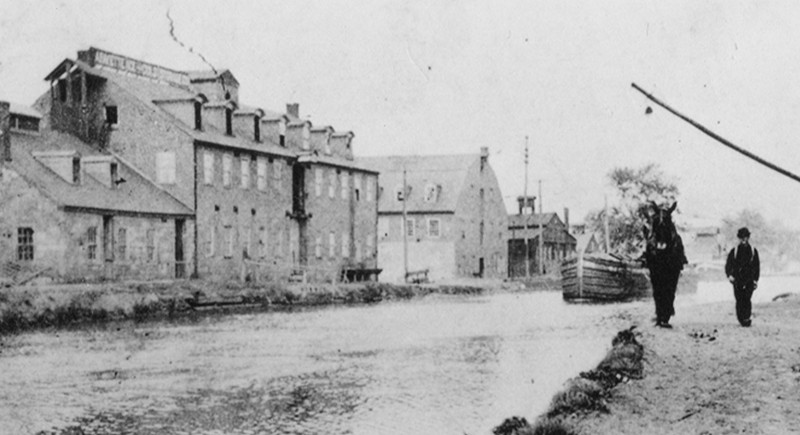
Unidentified canal boatman using a mule to move a canal boat along the Lehigh River through the Abbott Street industrial area of Easton, Pennsylvania, circa 1860s-1870s (public domain).
Following their honorable discharges from the military, Jacob and John M. Cohler returned to their adopted hometown of Easton in Northampton County, Pennsylvania, where they found work as laborers and tried to begin life anew as German immigrants and civilians.
Still employed as a stone mason by 1880, Jacob Cohler was also still unmarried, and resided with other boarders at the home of forty-two-year-old Louisa Garis at 633 Pine Street in Easton’s Sixth Ward.
Meanwhile, stone mason John Michael Cohler had been building a different life for himself. Having chosen to become a family man with Rebecca Simpson (1847-1915), a younger sister of fellow 47th Pennsylvania veteran James Simpson (1844-1907), John and Rebecca welcomed the births of: Mary Jane Cohler (1866-1941), who was born on 6 August 1866 and would later wed William E. Ginnard (1862-1961); and Johanna Elizabeth May Cohler (1868-1926/later), who was born in Easton on 29 May 1868, was baptized on 20 June 1869, became known to family and friends as “Lizzie” and would later wed Henry/Harry Page Key (1863-1925) in 1891 and settle with him in the Philadelphia area.
According to Lutheran Church records, John M. Cohler subsequently married Rebecca Simpson at St. John’s Lutheran Church in Easton on 21 August 1867. Their son, Charles Cohler (1870-unknown), was then born in Easton in January 1870. By the summer of that same year, he and his wife and their children, Mary, Lizzie and, Charles, were all residing at their home in Easton’s West Ward. (Their post office location was South Easton, according to that year’s federal census.) Also residing with them was Rebecca’s mother, Amy Simpson (1809-unknown).
Another son soon followed: William Cohler (1871-1882), who was born on 25 September 1871. Less than four months later, John Cohler’s mother, Johanna (Riey) Kohler (1818-1872), who was known to family and friends as “Hannah,” died in Easton at the age of fifty-three, on 3 January 1872. Following funeral services, she was laid to rest at the Easton Cemetery. Joy soon returned to the Cohler family, though, thanks to the arrival of another child — Harry Henry Cohler (1873-1926), who was born on 27 March 1873. But four years later, grief darkened the Cohler household yet again when John Cohler’s wife, Rebecca, gave birth to a child who died at birth or shortly thereafter, in September 1877 and was then also interred at the Easton Cemetery.
Some Phillipsburg, New Jersey children attended this one-room school on Lock Street near the Morris Canal (circa late 1800s-early 1900s, public domain).
More change was in store, however. By 1880, mason John M. Cohler and his wife, Rebecca, were living in the city of Phillipsburg in Warren County, New Jersey. Residing with them, according to that year’s federal census, were their children, Lizzie, Charles, William, and Harry — data which appears to indicate that their oldest daughter, Mary Cohler, may have married before that census was taken.
Like so many of his fellow 47th Pennsylvania Volunteers, however, John Cohler’s post-war life was not an easy one. Battling significant health issues that were attributable to his prior military service, he filed for a U.S. Civil War Soldier’s Pension (from New Jersey in 1880) to make life a bit easier — not just for himself, but for his wife and children.
Sadly, another tragedy struck the Cohler household roughly two years later when John and Rebecca (Simpson) Cohler’s son, William Cohler (1871-1882), “fell from a moving canal-boat at Slatington on Monday [18 September 1882] and was drowned,” according to the Evening Dispatch of York County, Pennsylvania and The Times of Philadelphia, both of which added that William’s “body was recovered.” A week shy of his eleventh birthday when that accident occurred in Lehigh County, Willie was subsequently laid to rest at the Easton Cemetery. Still, the Cohlers did their best to “soldier on.”
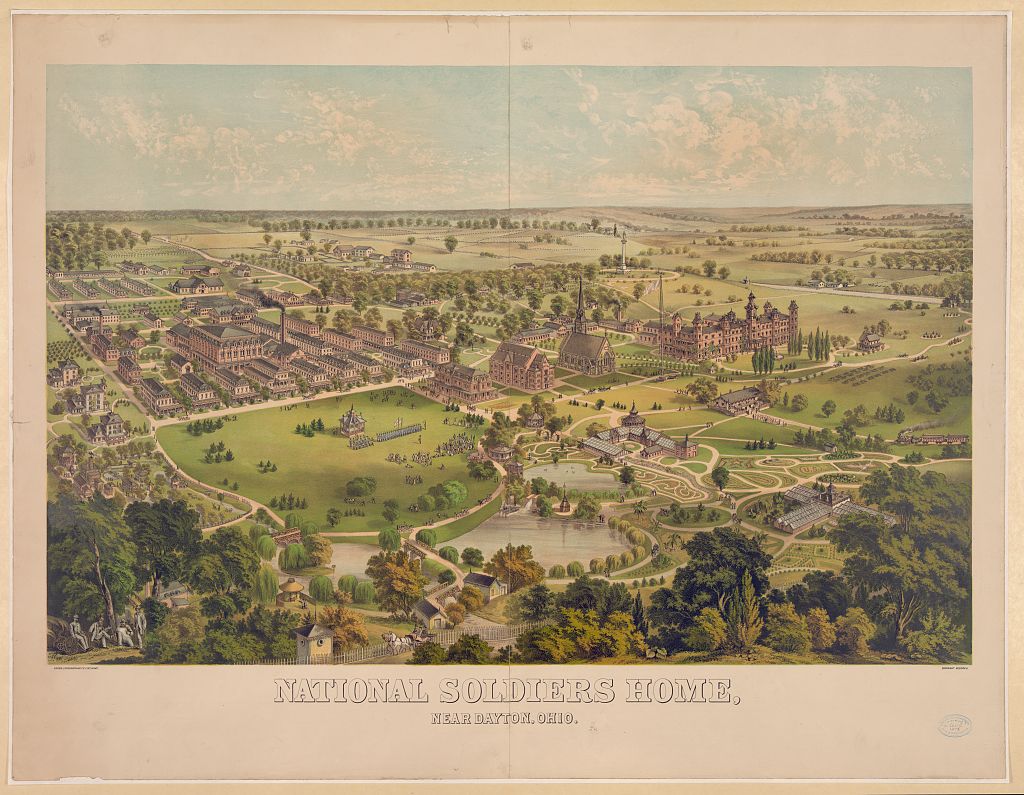
This public domain image depicts the U.S. National Home for Disabled Volunteer Soldiers in Dayton, Ohio (U.S. Library of Congress, public domain; click to enlarge).
By the summer of 1888, John Cohler had come to the realization that if his health were to improve or to at least stabilize somewhat, he would need to seek help from better-trained doctors — physicians who understood the unique medical problems that so many veterans of the American Civil War were facing as they aged. So, he boarded a train and traveled to the city of Dayton in Montgomery County, Ohio, where he was then admitted to the Central Branch of the U.S. National Home for Disabled Volunteer Soldiers on 23 July 1888. Admissions records noted that he was a forty-three-year-old laborer living in South Easton, Pennsylvania who was five feet, six inches tall with gray hair, dark eyes and a fair complexion, and whose wife and next of kin, Rebecca, was still living in South Easton. The physicians who examined him confirmed that he had definitely sustained a gunshot wound to his left thigh during the Battle of Cedar Creek, Virginia on 19 October 1864, and also noted that he was suffering with an eye disease — and that he was receiving a U.S. Civil War Pension of two dollars per month at that time. He subsequently received medical care for his various ailments, as well as other social and spiritual support at that National Soldiers’ Home branch, and continued to do so until he was discharged by general orders on 8 October of that same year.
Documented as a resident of South Easton when the federal government’s special veterans’ census was enumerated there in June 1890, John Cohler had remained active in and beyond his community by attending events sponsored by his local chapter of the Grand Army of the Republic (G.A.R.), as well as annual reunions of his former Civil War regiment — the 47th Pennsylvania Veteran Volunteers.
But 1890 was also a year mixed with sadness due to the death of the Cohler brothers’ father, Johann Michael Kohler, who passed away in Easton at the age of seventy-six, on 7 September 1890, and was subsequently laid to rest beside his wife (Jacob and John Cohler’s mother) at the Easton Cemetery.

Allentown Militia, Soldiers and Sailors Monument Dedication, Allentown, Pennsylvania, 1899 (public domain).
On 19 October 1899, the Cohler brothers were likely privileged to witness a spectacle that would be talked about for decades to come — the unveiling of the Lehigh County Soldiers and Sailors Monument in Allentown on 19 October 1899. Held on the anniversary of the Battle of Cedar Creek, Virginia, the day’s events included a massive parade featuring many of the surviving 47th Pennsylvania Veteran Volunteers and other Union Army units from across and beyond the Lehigh Valley, chapters of the Grand Army of the Republic (G.A.R.), soldiers who were currently serving in the U.S. military, local and state dignitaries, fire and police units, and area bands marching through the streets, past building after building draped in red, white and blue bunting. Viewed by a crowd that was estimated at forty thousand men, women and children, that parade was followed by the monument’s formal dedication ceremony, during which children sang patriotic songs and prominent elected officials lauded the long-dead, young heroes and stout-hearted, aging veterans who had saved America’s Union.
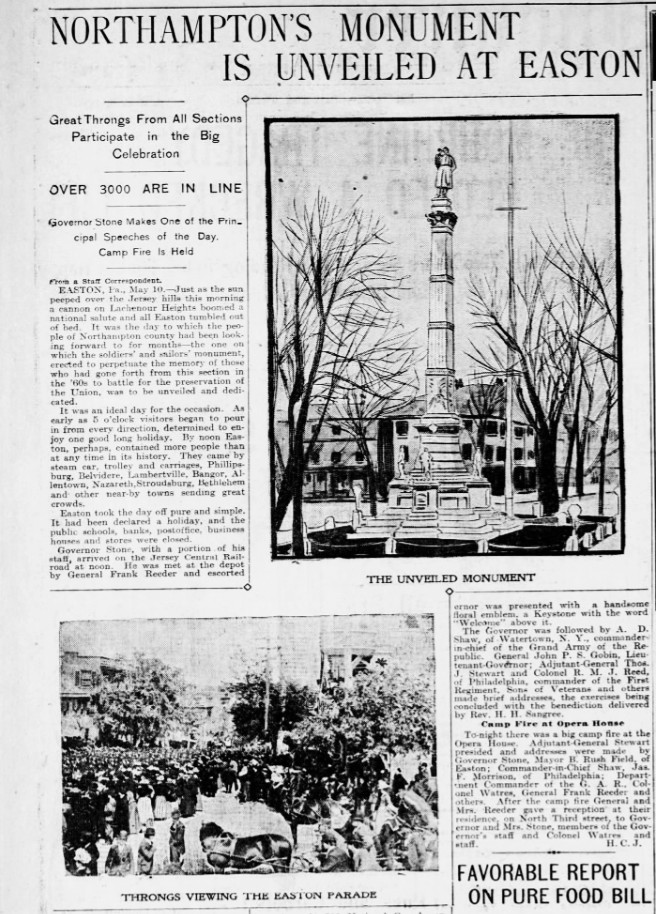
“Northampton’s Monument Is Unveiled at Easton” (The Philadelphia Inquirer, 11 May 1900, public domain).
Roughly seven months later, the Cohler brothers likely witnessed another major event — the unveiling and dedication of the Northampton County Soldiers’ and Sailors’ Monument in Easton’s Great Square on 11 May 1900. Although smaller than the massive crowds that attended the events of the unveiling and dedication of the Lehigh County Soldiers and Sailors Monument, the number of men, women and children for the Easton dedication ceremonies was still quite impressive. The day began with the firing of cannon at sunrise. Later that morning, wizened members of the Grand Army of the Republic sat down with old friends for breakfast in hotels and restaurants across the city. That afternoon, local and state officials, active duty soldiers, veterans of the American Civil War and their descendants, school students, and members of the Allentown Band, Fullerton Drum Corps and other marching bands made their way to their designated meeting places in preparation for a parade with roughly five thousand participants who stepped forward at 2 p.m. and marched through the city’s streets to Easton’s Grand Square, where the monument was then unveiled after multiple orators addressed the excited crowd during formal dedication ceremonies. Later that same evening, “a campfire was held in the Easton Opera House and a military ball was given by the Sons of Veterans, followed by a reception to Governor and Mrs. Stone and the commissioned officers of the Thirteenth Regiment by General and Mrs. Reeder,” according to The Allentown Leader. Adjutant General Stewart presided over the campfire meeting, which featured speeches by the governor, Easton’s mayor and several senior officers of the Grand Army of the Republic. And then Lieutenant Governor John Peter Shindel Gobin (the 47th Pennsylvania’s final commanding officer) made a special appearance at the military ball. By the time the day was done, roughly thirty thousand people from Pennsylvania, New Jersey and other parts of the United States had joined in or witnessed the parade, monument dedication and evening’s gala events, according to The Allentown Democrat.
The next month, a federal census enumerator knocked on the door of John M. Cohler’s home at 635 Church Street in Easton’s Eleventh Ward, and confirmed that he was a naturalized American citizen from Germany who was renting that home and residing there with his wife, Rebecca, and their twenty-seven-year-old son, Harry Cohler, both of whom had been born in Pennsylvania. That enumerator also noted that none of the three inhabitants were employed and that Rebecca had given birth to a total of eight children during her lifetime, but that only three were still alive.
Illness, Death and Interment — John Michael Cohler

Gravestone of Private John M. Cohler, Company A, 47th Pennsylvania Volunteers, Easton Cemetery, Easton, Pennsylvania, June 2024 (used with permission of Julian Burley).
Sadly, John Cohler’s health had declined so much by the turn of the century that he was described as an invalid in the 1900 edition of the Easton city directory (as was his son, Harry Cohler). Diagnosed with Bright’s Disease, his kidneys began to fail as he also lost more and more of his vision.
Blind during his final months, John M. Cohler succumbed to disease-related complications at the age of sixty-three in Easton, on 16 July 1909, and was buried at the Easton Cemetery, in Easton.
Illness, Death and Interment — Jacob Cohler
By 1910, Jacob Cohler was no longer working. Still single he resided in a rental home at 50 West Street in Easton’s Fifth Ward. Also living with him were: Sabilla Laubach (1842-1918), a sixty-six-year-old married housekeeper; her two sons, Charles Laubach, a thirty-one-year-old laborer at a drill factory, and Edward Laubach, a twenty-five-year-old oyster opener at a fish market; and Sabilla’s eight-year-old grandson, Charles Laubach.
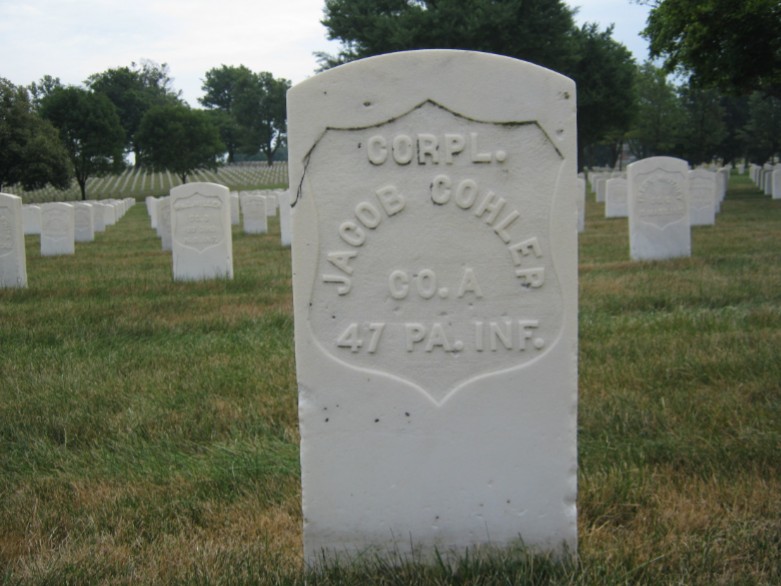
The military headstone of Corporal Jacob Cohler, Company A, 47th Pennsylvania Volunteer Infantry, Dayton National Cemetery, Dayton, Ohio (used with permission, courtesy of Wade Davis).
Admitted to the Roseburg Branch of the U.S. National Home for Disabled Volunteer Soldiers in Hampton, Virginia on 5 December 1917, Jacob Cohler was diagnosed by physicians there with arteriosclerosis, chronic constipation, defective vision, and slight prostatic hypertrophy. Receiving a U.S. Civil War Pension of thirty dollars per month at the time of his admission there, he was described as a seventy-six-year-old native of Germany who was five feet, seven inches tall with gray hair, dark eyes and a fair complexion. Admissions records also noted that he had been employed as a stone mason in Easton, Pennsylvania, was still single with no next of kin and that he was a Protestant who could read and write.
Transferred to the Central Branch of the U.S. National Home for Disabled Volunteer Soldiers in the city of Dayton, Ohio on 8 November 1918, Jacob Cohler was diagnosed by physicians with the same medical conditions that had been noted by his physicians at the Hampton soldiers’ home. As he aged, he also developed heart disease that grew worse over time, and subsequently died there at that soldiers’ home in Dayton from chronic myocarditis and acute dilation of the heart, on 12 December 1922. Following funeral services, Jacob Cohler was laid to rest at the Dayton National Cemetery in Dayton. Hospital records noted that a “Mrs. Minnie Helfmeyer” of Dayton was notified of his passing, and that he had had just roughly fourteen dollars in money and possessions at the time of his death.
What Happened to the Widow and Surviving Children of John Michael Cohler?
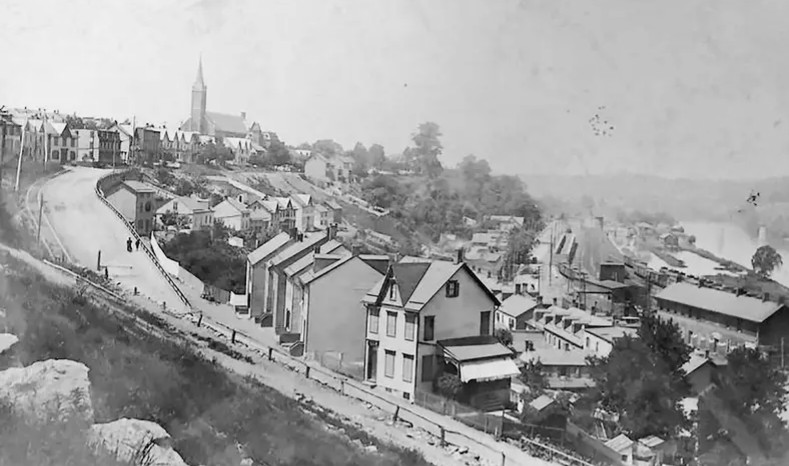
Canal Street in the southeastern section of Easton, Pennsylvania, prior to 1911 (public domain; click to enlarge).
Following her husband’s death, Rebecca (Simpson) Cohler filed for a U.S. Civil War Widow’s Pension in 1909, which was subsequently awarded to her, following a review of her application by federal pension bureau officials. According to pension records, she was residing in Pennsylvania at that time. By 1910, she was living by herself in an apartment building at 102 East Canal Street in Easton. Having survived her ailing husband by roughly five years and now in declining health herself, Rebecca (Simpson) Cohler was admitted to the hospital in Easton in mid-January 1915 for medical treatment, but died there at the age of sixty-six, on 27 January of that year (alternate date of death: 26 January 1915). Following funeral services, she was then laid to rest at the same cemetery where her husband had been interred.
Researchers have not yet determined what happened to John M. Cohler’s son, Charles C. Cohler (1870-unknown) after the federal census of 1880 was enumerated in Easton. What is presently known is that Charles Cohler’s name was not listed as a member of John Cohler’s household in Easton on the federal census of 1900, indicating that Charles may have died or married and moved into his own home sometime before that census was conducted in Easton — and that Charles Cohler definitely died sometime prior to his father’s death on 16 July 1909 (according to his father’s 1909 obituary). Researchers are continuing to search for Charles Cohler’s death and burial data.
John M. Cohler’s son, Harry Henry Cohler (1873-1926), was still unmarried and living with his widowed mother in 1910, according to Easton’s city directory, and continued to reside in Easton after her death. Documented in September 1918 by a World War I draft registration board as an Easton resident whose right leg had been amputated at the knee, he was described as being of medium height and build with brown hair. His draft registration record also noted that his next of kin was his sister, “Lizzie Key,” of Philadelphia. An unmarried news vendor who was ailing with diabetes during his final years, Harry Henry Cohler succumbed to disease-related complications at the age of fifty-three in Easton on 2 October, 1926 and was buried at the same cemetery where his parents were interred (the Easton Cemetery).
Street Scene, Philadelphia, 1897 (B.W. Kilburn, U.S. Library of Congress, public domain).
Following her marriage to Henry/Harry Page Key (1863-1925) in Germantown, Philadelphia County, Pennsylvania on 1 June 1891, John M. Cohler’s daughter, Johanna Elizabeth Cohler (1868-1926 or later), who was known to family and friends as “Lizzie,” settled with her husband in the city of Philadelphia. Very little is presently known about their life together, save for the fact that she was widowed by her husband, Harry P. Key, when he died suddenly in Philadelphia on 8 May 1925, while still in his early sixties. Researchers have been able to determine that she definitely survived him, according to her husband’s death notice in The Philadelphia Inquirer, and believe that she died between 1926 to 1930 and may have been buried at the West Laurel Hill Cemetery in Bala Cynwyd, Montgomery County, Pennsylvania, where her husband had been interred in 1925.
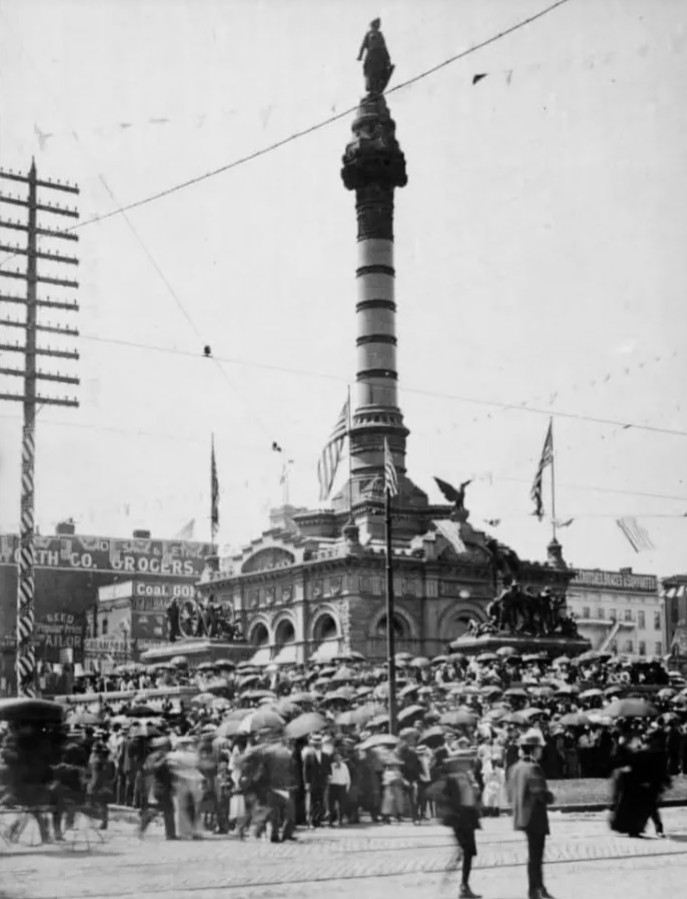
Dedication ceremony, Cuyahoga County Soldiers’ and Sailors’ Monument, Cleveland, Ohio, July 4, 1894 (public domain).
Following her marriage to William E. Ginnard (1862-1961), John M. Cohler’s daughter, Mary Jane (Cohler) Ginnard (1866-1941), settled with her husband in Easton, where they welcomed the births of: Ethel Ginnard (1887-1973), who was born on 13 June 1887 and would later wed Peter Materse (1886-1978); William Harrison Ginnard (1888-1954), who was born on 8 November 1888 and would later wed Florence Mabel Hines (1888-1964). Mary Jane (Cohler) Ginnard then migrated west with her husband and children to Ohio, and settled with them in Cuyahoga County. Their son, Clayton Sherid Ginnard (1892-1974), was then born in the city of Cleveland, Cuyahoga County on 17 August 1892 and would later wed Luella H. Gilberson (1918-2009). In 1910, the Ginnard family resided in Cleveland’s Twenty-Second Ward, and were supported by the wages that their father brought in by working as a janitor. By 1920, Mary Jane (Cohler) Ginnard and her husband were “empty nesters” living in the Second Ward of East Cleveland, Cuyahoga County, where her husband was employed as a janitor. Sometime circa 1927, however, she and her husband migrated farther west to California and settled in the San Francisco Bay Area. By 1930, they were living with their daughter, Ethel (Ginnard) Materse, and her husband and their son, William Ginnard Materse (1917-1980), at their home at 830 Urbano Street in the Ingleside Terraces neighborhood in San Francisco’s West Side, and continued to reside there into early 1940. (That single-family home, which had been built in 1916, was still standing and occupied as of June 2026.) After thirteen years on the West Coast, however, she and her husband returned to Ohio in June 1940 and settled in Cleveland Heights. She died at her home in Cleveland Heights at the age of seventy-four, on 26 February 1941 and was laid to rest at the Lakeview Cemetery in Cleveland.
What Happened to the Surviving Siblings of the Cohler Brothers?
Center Square market, Easton, Pennsylvania, 1885 (public domain; click to enlarge).
Following her marriage to teamster Richard Bernice (1850-1928; alternate surname spellings: “Brainice,” “Breineis,” “Breneis,” “Brennias”), John M. Cohler’s younger sister, Johanna (Cohler) Bernice (1850-1900), who was known to family and friends as “Hannah,” settled with her husband in Easton, where he worked as a teamster and day laborer at various periods during their years together. Ailing with cancer during her final months, Johanna (Kohler) Bernice succumbed to disease-related complications at the age of forty-seven, at their home at 512 Ferry Street in Easton’s Eighth Ward, on 1 March 1900. Following funeral services, she was subsequently interred at the Easton Heights Cemetery in Easton.
* Note: The husband of Johanna (Cohler) Bernice, Richard Bernice (1850-1928; alternate spellings of surname: “Brainice,” “Breineis,” “Breneis,” “Brennias”) continued to reside in Easton into the 1920s, and was documented by federal census enumerators as a boarder residing in that city’s Eighth Ward (in 1900) and Tenth Ward (in 1920). Sometime during the 1920s, however, he moved into the Northampton County Alms House in Upper Nazareth Township. Ailing with a foot injury that had become infected with streptococcus bacteria which had then spread to his right leg, he died there from that infection on 22 June 1928. His body was then donated to the Commonwealth of Pennsylvania’s Anatomical Board for use in medical research, according to his state death certificate, which spelled his surname as “Brainice.” (The informant for that data was Clarence Holland, the steward of the Northampton County Alms House.)
Easton, Pennsylvania on the Delaware River, circa 1890s-early 1900s (public domain; click to enlarge).
Following her marriage to Theodore M. Miller (1848-1908) in 1868, John M. Cohler’s younger sister, Juliana (Kohler) Miller (1851-1906), who was known to family and friends as “Lulu,” began her own large family line with the births of daughters, Alice R. Miller (1870-1935) and Josephine Miller (1872-1958), were born, respectively, in Reading, Berks County, Pennsylvania on 15 March 1870 and in Easton, Northampton County, on 2 February 1872. Alice would later go on to marry Henry D. Schafer (1868-1930), while Josephine Miller, who became known to family and friends as “Josie,” would later wed Daniel L. Richter (1869-1956). More children soon followed for Juliana (Kohler) Miller: Franklin Gottlieb Miller (1875-1940), who was born in Carpentersville, Warren County, New Jersey on 7 February 1875, became known to family and friends as “Frank” and would later marry Ida May Fell (1875-1945); Mary A. Miller (1878-1943), who was born in Easton on 26 July 1878 and would later wed Frederick C. Schnoor (1876-1916); Theodore M. Miller, Jr. (1881-1900), who was born in Easton on 2 March 1881 but would die from typhoid fever in Easton at the age of twenty on 25 February 1900; William B. Miller (1881-1951), who was born in Easton on 15 November 1881 and would later wed Josephine Ehrhardt (1882-1940); Bertha May Miller (1882-1927), who was born in Easton on 2 October 1882 and would later wed Oscar Michael Zink (1877-1946), before divorcing him and marrying Samuel A. Collinge (1876-1946); George Edward Miller (1883-1947), who was born in Easton on 5 November 1883 and would later wed Lillian Beatrice Troxell (1889-1966); Martha Elizabeth Miller (1890-1926), who was born in Easton on 6 September 1890 and would later wed Emil Holveck/Holvick; and Daniel Louis Miller (1894-1895), who was born in Easton on 11 October 1894 but died there in infancy on 25 January 1895. Sadly, the Miller family would also experience another tragedy when Juliana (Kohler) Miller was severely burned during an accident in her yard at home in Easton during the afternoon 8 May 1906. Transported to the hospital in Easton, she succumbed to her injuries there at 11:30 p.m. that same evening, and was subsequently buried at the South Easton Cemetery in Easton.
Trolley on the bridge between Easton, Pennsylvania and Phillipsburg, New Jersey, late 1800s-early 1900s (public domain).
Following his marriage to Maria Salome Rossweiler (1847-1932) circa early 1869, who was known to family and friends as “Mary,” John M. Cohler’s younger brother, Gottlieb F. Kohler (1848-1913), settled with his wife in Easton, where he was employed as a laborer and where they welcomed the births of: George Kohler (1869-1937), who was born on 21 December 1869 and would later wed Christina Stotz in 1891; William Frederick Kohler (1871-1958), who was born on 1 August 1871 and would later wed Ida Elizabeth Zink (23 March 1958); Frank Gottlieb Kohler (1874-1937), who was born on 1 September 1874 and would later wed Herralda Sandt (1883-1948); Edward John Kohler (1877-1937), who was born on 29 March 1877 and would later wed Sabilla Esther Bercaw (1883-1936); Henry T. Kohler (1878-1936), who was born on 26 December 1878; Daniel Kohler (1882-1936), who was born on 6 November 1882 and would later wed Lizzie Stout (1885-1933); Anna Maria Kohler (1885-1888), who was born on Christmas Day in 1885 but would die in Easton at the age of two, on 25 March 1888; and Jacob Frederick Kohler (1888-1953), who was born on New Year’s Day in 1888 and would later wed Sarah Anna Houseberg (1893-1945). A naturalized citizen of the United States by the turn of the century, Gottlieb F. Kohler resided in Easton’s Second Ward with his wife, Mary, and their children: Henry, Frank and Daniel, who were all employed at a silk mill, and Jacob, who was still in school. Employed at the Ingersoll-Rand plant in Easton, Gottlieb Kohler fell ill at his home at 421 Lehigh Street in Easton during the evening of 16 February, and died at 3 a.m. the next morning (on 17 February 1913). Following funeral services, he was buried at Easton’s Easton Heights Cemetery.
Electric trolley passing by the Mt. Vernon House in Easton, Pennsylvania, 1914 (public domain).
Following her marriage to widower Allen G. Houck (1845-1915) circa 1884, John M. Cohler’s younger sister, Josephine (Kohler) Houck (1857-1915), settled with her husband in Easton, where she became the stepmother of Allen Houck’s son, Joseph Houck, who had been born circa 1876. By 1900, she was residing with her husband and his son in Easton’s Fifth Ward, where they were employed, respectively as a moulder and plasterer. Still residing in Easton’s Fifth Ward as of 1910, Josephine and her husband were living there without Joseph, but their household now included their fourteen-year-old adopted daughter, Esther Mae Houck. An invalid for the final ten years of her life, Josephine (Kohler) Houck was then widowed by her husband, Allen, when he died at the age of seventy-two in Easton, on 26 June 1914, and was buried at the Easton Heights Cemetery in Easton. She spent the final year of her life being cared for at the home of Mrs. Mary Kohler at 42 South Sixth Street in Easton, where she died at the age of fifty-eight, on 3 July 1915. Following funeral services, Josephine (Kohler) Houck was buried beside her husband at the Easton Heights Cemetery.
Easton, Pennsylvania on the Lehigh River in 1935 (Walker Evans, November 1935, U.S. Library of Congress, public domain; click to enlarge).
John M. Cohler’s youngest brother, Charles C. Kohler (1865-1936), who had been born in Easton while John was stationed at Camp Fairview in West Virginia with the 47th Pennsylvania Volunteers during the American Civil War, was employed as a waiter at a saloon in Easton by the time he was a teenager. In 1880, he resided at the home of his older brother, Gottlieb Kohler (1848-1913), in Easton’s Sixth Ward. Three years later, Charles Kohler wed Mary Franklin (1866-sometime before April 1930), who was known to family and friends as “Mamie.” Together, they welcomed the births of: Katie M. Kohler (1884-unknown), who was born in March 1884; Caroline Kohler (1887-unknown), who was born in July 1887; Emma T. Cohler (1889-unknown), who was born in February 1889; and Gertrude Kohler (1898-1988), who was born in September 1898, would later marry William R. Leaman (1905-1979) and would work for ALPO Petfoods as a product packer. By 1900, Charles Kohler was employed as an iron ore miner and was residing in Easton’s Eleventh Ward with his wife, Mary, and their children: Katie, Caroline, Emma, and Gertrude. Also residing with them was Mary’s father, Edwin T. Franklin. Ailing with diabetes during his final years, Charles C. Kohler developed gangrene in his hands and feet as his health continued to decline. Widowed by his wife sometime before April of 1930, he spent his final six years at the Northampton County Alms House in Upper Nazareth Township. On 1 April 1936, he suffered a pulmonary embolism that ultimately led to his death there at the age of seventy-one, on 8 May 1936. He was then buried at the South Easton Cemetery in Easton on 11 May.
* Note: Researchers for 47th Pennsylvania Volunteers: One Civil War Regiment’s Story are still working to document the life of the Cohler brothers’ sister, Christina Barbara (Kohler) Windish/Windisch (1844-unknown). What is known for certain is that she was born in Karlsruhe in the Duchy of Baden on 10 February 1844, was still single at the time that she emigrated with her family from Karlsruhe during the summer of 1861 and married a man with the surname of Windish/Windisch sometime after settling with her parents in the city of Easton in Northampton County, Pennsylvania, according to the 1909 obituary of her brother, John Michael Cohler, which reported that she was a resident of the town of Shenandoah in Schuylkill County, Pennsylvania that year.
Sources:
- “A New Surge of Growth,” and “Urban German,” in “Immigration and Relocation in U.S. History,” in “Classroom Materials.” Washington, DC: U.S. Library of Congress, retrieved online 4 July 2021.
- Baker, Clarence Franklin (superintendent); Miller, Clarence Milton (officer); Schnerr, Rose (officer); Fraunfelter, Florence (officer); Teel, Elmer (officer); Stein, Chester (officer); Fritchman, Robert D. (head); Rohn, Minnie (officer); Kohler, Charles (inmate), et. al., in U.S. Census (Northampton County Alms Hoyse, Upper Nazareth Township, Northampton County, Pennsylvania, 1930; Charles Kohler’s name is listed on p. 2B of multiple pages of names of inmates housed at the Alms House). Washington, D.C.: U.S. National Archives and Records Administration.
- Bates, Samuel P. History of Pennsylvania Volunteers, 1861-5, vol. 1. Harrisburg, Pennsylvania: B. Singerly, State Printer, 1869.
- Brainice, Richard (a brother-in-law of Jacob and John M. Cohler and the widowed husband of Johanna (Cohler) Bernice/Brainice/Breineis/Breneis/Brennais), in Death Certificates (file no.: 64637, registered no.: 70, date of death: 22 June 1928). Harrisburg, Pennsylvania: Commonwealth of Pennsylvania, Department of Health, Bureau of Vital Statistics.
- “Camp Russell.” The Historical Marker Database, retrieved online December 27, 2023.
- Carter, Susan B. et. al. (eds.) Historical Statistics of the United States (Millennial Edition). New York: Cambridge University Press, 2006.
- Charles C. Kohler (the youngest brother of Jacob and John Michael Cohler), in Death Certificates (file no.: 52974, registered no.: 1018[?], date of death: 8 May 1936). Harrisburg, Pennsylvania: Commonwealth of Pennsylvania, Department of Health, Bureau of Vital Statistics.
- “Civil War, 1861-1865.” Stephens City, Virginia: Newtown History Center, retrieved online 27 December 2023.
- Cohler, John, in Civil War Muster Rolls (Company A, 47th Pennsylvania Infantry). Harrisburg, Pennsylvania: Pennsylvania State Archives.
- Cohler, John, in Civil War Veterans’ Card File, 1861-1866 (Company A, 47th Pennsylvania Infantry). Harrisburg, Pennsylvania: Pennsylvania State Archives.
- Cohler, John, in U.S. Census (“Special Schedule. — Surviving Soldiers, Sailors, and Marines, and Widows, etc.”: South Easton, Northampton County, Pennsylvania, 1890). Washington, D.C.: U.S. National Archives and Records Administration.
- Cohler, John M. and Harry, in West’s Directory of Greater Easton for the Year 1900, p. 58. Easton, Pennsylvania: The West Job Printing House, 1900.
- Cohler, Rebecca (the widow of John M. Cohler), in U.S. Census (Easton, Ninth Ward, Northampton County, Pennsylvania, 1910). Washington, D.C.: U.S. National Archives and Records Administration.
- Cohn, Raymond L., and Simone A. Wegge. “Overseas Passenger Fares and Emigration from Germany in the Mid-Nineteenth Century,” in Social Science History, vol. 41, no. 3, Fall 2017, pp. 393-413. Cambridge, United Kingdom: Cambridge University Press, 2017.
- Coler [sic, “Cohler”], Jacob, in Civil War Muster Rolls (Company A, 47th Pennsylvania Infantry). Harrisburg, Pennsylvania: Pennsylvania State Archives.
- Coler [sic, “Cohler”], Jacob, in Civil War Veterans’ Card File, 1861-1866 (Company A, 47th Pennsylvania Infantry). Harrisburg, Pennsylvania: Pennsylvania State Archives.
- Cooler [sic, “Cohler”], John, Rebecca, Mary, Lizzie, and Charles; and Simpson, Amy (Rebecca’s mother), in U.S. Census (Easton, West Ward/Post Office: South Easton, Northampton County, Pennsylvania, 1870). Washington, D.C.: U.S. National Archives and Records Administration.
- Condit A.M., Rev. Uzal. The History of Easton, Penn’a from the Earliest Times to the Present, 1739-1885. Washington, DC: West & Condit, 1885.
- Dailey, Eugene F., Anna M., Catherine L., Eugene F. (son), Mabel F., and John J.; and Brennias, Richard (a boarder who was a brother-in-law of Jacob and John M. Cohler and the widowed husband of Johanna (Cohler) Bernice/Brainice/Breineis/Breneis/Brennias), in U.S. Census (Easton, Tenth Ward, Northampton County, Pennsylvania, 1900). Washington, D.C.: U.S. National Archives and Records Administration.
- Daniel Kohler (a nephew of Jacob and John Michael Kohler and a son of Gottlieb F. Kohler), in Death Certificates (file no.: 61707, registered no.: 365, date of death: 9 June 1936). Harrisburg, Pennsylvania: Commonwealth of Pennsylvania, Department of Health, Bureau of Vital Statistics.
- “Death of John M. Cohler.” Allentown, Pennsylvania: The Allentown Leader, 19 July 1909.
- Diaries of Jeremiah Siders (Company H, 47th Pennsylvania Volunteer Infantry), in “Pennsylvania Military Museum Collections, 1856-1970” (MG 272). Harrisburg, Pennsylvania: Pennsylvania State Archives.
- Dyer, Frederick H. A Compendium of the War of the Rebellion, p. 1589. Des Moines, Iowa: The Dyer Publishing Company, 1908.
- “Easton’s Big Day: Over 30,000 Strangers Attend the Unveiling of the Soldiers’ Monument.” Wilkes-Barre, Pennsylvania: The Wilkes-Barre Record, 11 May 1900.
- “Easton’s Monument: Unveiled Yesterday with Patriotic Pomp.” Allentown, Pennsylvania: The Allentown Daily Leader, 11 May 1900.
- “Florida’s Role in the Civil War: ‘Supplier of the Confederacy.” Tampa, Florida: Florida Center for Instructional Technology, University of South Florida (College of Education), retrieved online January 15, 2020.
- Garis, Louisa (boarding house operator); Roseberry, Jacob (boarder); Kohler [sic, “Cohler”], Jacob (boarder), et.al., in U.S. Census (Easton, Sixth Ward, Northampton County, Pennsylvania, 1880). Washington, D.C.: U.S. National Archives and Records Administration.
- Gennard [sic, “Ginnard”], William, Mary (a daughter of John M. Cohler), Ethel, Willie, and Clayton, in U.S. Census (Cleveland, Thirty-Seventh Ward, Cuyahoga County, Ohio, 1900). Washington, D.C.: U.S. National Archives and Records Administration.
- Ginnard, William and Mary (a daughter of John M. Cohler), in U.S. Census (East Cleveland, Second Ward, Cuyahoga County, Ohio, 1920). Washington, D.C.: U.S. National Archives and Records Administration.
- Ginnard, William, Mary (a daughter of John Michael Cohler), William H. (son), Ethel, and Clayton, in U.S. Census (Cleveland, Twenty-Second Ward, Cuyahoga County, Ohio, 1910). Washington, D.C.: U.S. National Archives and Records Administration.
- Gobin, John Peter Shindel. Personal Letters, 1861-1865. Northumberland, Pennsylvania: Personal Collection of John Deppen.
- Gottlieb Kohler (obituary of a brother of Jacob and John M. Cohler). Easton, Pennsylvania: Easton Daily Express, 17 February 1913.
- Grant, Ulysses S. Personal Memoirs of Ulysses S. Grant. New York, New York: Charles L. Webster & Company, 1885.
- Grodzins, Dean and David Moss. “The U.S. Secession Crisis as a Breakdown of Democracy,” in When Democracy Breaks: Studies in Democratic Erosion and Collapse, from Ancient Athens to the Present Day (chapter 3). New York, New York: Oxford University Press, 2024.
- Hamerow, Theodore S. “History and the German Revolution of 1848,” in The American Historical Review, vol. 60, no. 1, October 1954, pp. 27-44. Oxford University Press, 1954.
- Hannah Kohler Bernice [sic, “Johanna (Kohler) Bernice”) (obituary of a younger sister of Jacob and John M. Kohler). Easton, Pennsylvania: Easton Daily Express, 1 March 1900.
- Harry Henry Cohler (a son of John M. Cohler) and Lizzie Key (Harry H. Cohler’s sister and next of kin and a daughter of John M. Cohler), in U.S. World War I Draft Registration Records (Easton, Northampton County, Pennsylvania, serial no.: 4448, order no.: a615, date of registration: 18 September 1918). Washington, D.C.: U.S. National Archives and Records Administration.
- Harry Kohler [sic, “Cohler”] (a son of John M. Cohler), in Death Certificates (file no.: 101427, registered no.: 603, date of death: 2 October 1926). Harrisburg, Pennsylvania: Commonwealth of Pennsylvania, Department of Health, Bureau of Vital Statistics.
- Henry Page Key (the groom) and John and Jane Key (the groom’s parents); and Elizabeth May Cohler (the bride) and John and Rebecca Cohler (the bride’s parents), in Marriage Records (St. John the Baptist Church, Germantown, Philadelphia County, Pennsylvania, date of marriage: 1 June 1891). Philadelphia, Pennsylvania: Historical Society of Pennsylvania.
- Hiram Simpson (a brother-in-law of Jacob and John M. Cohler), in Death Certificates (file no.: 76444, registered no.: 354, date of death: 15 August 1907). Harrisburg, Pennsylvania: Commonwealth of Pennsylvania, Department of Health, Bureau of Vital Statistics.
- Hiram Simpson (a brother-in-law of Jacob and John M. Cohler), in Records of Burial Places of Veterans (Easton Cemetery, Easton, Northampton County, Pennsylvania, date of birth: 18 March 1831, date of death: 15 August 1907). Harrisburg, Pennsylvania: Commonwealth of Pennsylvania, Department of Military Affairs.
- Houck, Allen, Josephine (a sister of Jacob and John M. Cohler) and Joseph W., in U.S. Census (Easton, Fifth Ward, Northampton County, Pennsylvania, 1900). Washington, D.C.: U.S. National Archives and Records Administration.
- Houck, Allen, Josephine (a sister of Jacob and John M. Cohler) and Esther Mae (adopted daughter), in U.S. Census (Easton, Fifth Ward, Northampton County, Pennsylvania, 1910). Washington, D.C.: U.S. National Archives and Records Administration.
- Irwin, Richard Bache. History of the Nineteenth Army Corps. New York, New York: G. P. Putnam’s Sons, 1893.
- Jacob Cohler, in Admissions Records, U.S. National Home for Disabled Volunteer Soldiers (Roseburg Branch, Hampton, Virginia, 1917; and Central Branch, Dayton, Montgomery County, Ohio, 1918-1922). Washington, D.C.: U.S. National Archives and Records Administration.
- James Simpson (a brother-in-law of Jacob and John M. Cohler), in Death Certificates (file no.: 48757, registered no.: 28, date of death: 28 May 1907). Harrisburg, Pennsylvania: Commonwealth of Pennsylvania, Department of Health, Bureau of Vital Statistics.
- John Cohler, in Admissions Records, U.S. National Home for Disabled Volunteer Soldiers (Central Branch, Dayton, Montgomery County, Ohio, 1888). Washington, D.C.: U.S. National Archives and Records Administration.
- John M. Cohler (obituary). Easton, Pennsylvania: Easton Express, July 1909.
- John Michael Kohler [sic, “Cohler”] (the groom), Michael & Joanna K. (the groom’s parents); Rebecca Simpson (the bride) and Reuben & Amy S. (the bride’s parents), in Marriage Records (St. John’s Lutheran Church, Easton, Northampton County, Pennsylvania, date of marriage: 21 August 1867). Philadelphia, Pennsylvania: Historical Society of Pennsylvania.
- Josephine (Kohler) Hauck/Houck (obituary of a sister of Jacob and John M. Cohler). Easton, Pennsylvania: Easton Daily Express, 6 July 1915.
- “Key” (death notice of Harry P. Key, a son-in-law of Jacob and John M. Cohler and the husband of Johanna Elizabeth May (Cohler) Key). Philadelphia, Pennsylvania: The Philadelphia Inquirer, 11 May 1925.
- Koch, William, Mary, Caroline, Sophia, Gertrude, and Barbara; and Simpson, Hiram (boarder and a brother-in-law of Jacob and John M. Cohler), in U.S. Census (Easton, Sixth Ward, Northampton County, Pennsylvania, 1880). Washington, D.C.: U.S. National Archives and Records Administration.
- Kohler, Charles (ths youngest brother of Jacob and John M. Cohler), Mary A., Katie M., Caroline, Emma T., Gertrude, and Edwin T. Franklin, in U.S. Census (Easton, Eleventh Ward, Northampton County, Pennsylvania, 1900). Washington, D.C.: U.S. National Archives and Records Administration.
- Kohler, Christina Barbara (a sister of John M. Cohler) and Michael Kohler and Johanna Kohler (parents), in Birth and Baptismal Records (Evangelische Kirche Knielingen, Karlsruhe, Duchy of Baden, date of birth: 10 February 1844, baptism: 18 February 1844), in “Baden, Germany, Lutheran Baptisms, Marriages, and Burials, 1783-1875.” Lehi, Utah: Ancestry.com.
- Kohler, George (a nephew of Jacob and John Michael Kohler and a son of Gottlieb F. Kohler), in Death Certificates (file no.: 21539, registered no.: 166, date of death: 28 February 1937). Harrisburg, Pennsylvania: Commonwealth of Pennsylvania, Department of Health, Bureau of Vital Statistics.
- Kohler, Gottlieb F. (a brother of Jacob and John M. Cohler) and Johann Michael Kohler and Johanna Kohler (parents), in Birth and Baptismal Records (Evangelische Kirche Knielingen, Karlsruhe, Duchy of Baden, date of birth: 22 April 1848, baptism: 2 May 1848), in “Baden, Germany, Lutheran Baptisms, Marriages, and Burials, 1783-1875.” Lehi, Utah: Ancestry.com.
- Kohler, Gottlieb F. (head of the household and a younger brother of Jacob and John M. Cohler), Mary Salome, George, William, Frank, Edward, Henry, and Frederick; and Kohler, Charles (the youngest brother of Jacob and John M. Cohler and Gottlieb F. Kohler), in U.S. Census (Easton, Sixth Ward, Northampton County, Pennsylvania, 1880). Washington, D.C.: U.S. National Archives and Records Administration.
- Kohler, Jacob [sic, “Cohler”] and John Michael Kohler and Johanna Kohler (parents), in Birth and Baptismal Records (Evangelische Kirche Knielingen, Karlsruhe, Duchy of Baden, date of birth: 7 May 1841, baptism: 13 May 1841), in “Baden, Germany, Lutheran Baptisms, Marriages, and Burials, 1783-1875.” Lehi, Utah: Ancestry.com.
- Kohler [sic, “Cohler”], Jacob; and Laubach, Sabilla, Charles (Sabilla’s son), Edward (Sabilla’s son), and Charles (Sabilla’s grandson), in U.S. Census (Easton, Fifth Ward, Northampton County, Pennsylvania, 1910). Washington, D.C.: U.S. National Archives and Records Administration.
- Kohler, Jakobine [sic, “Josephine Kohler”] (the youngest sister of Jacob and John M. Cohler) and Michael Kohler and Johanna Kohler (parents), in Birth and Baptismal Records (Evangelische Kirche Knielingen, Karlsruhe, Duchy of Baden, date of birth: 5 August 1857, baptism: 15 August 1857), in “Baden, Germany, Lutheran Baptisms, Marriages, and Burials, 1783-1875.” Lehi, Utah: Ancestry.com.
- Kohler, Johann Michael [sic, “John Michael Cohler”] and John Michael Kohler and Johanna Kohler (parents), in Birth and Baptismal Records (Evangelische Kirche Knielingen, Karlsruhe, Duchy of Baden, date of birth: 8 April 1846, baptism: 16 April 1846), in “Baden, Germany, Lutheran Baptisms, Marriages, and Burials, 1783-1875.” Lehi, Utah: Ancestry.com.
- Kohler, Johanna (a sister of Jacob and John M. Cohler) and John Michael Kohler and Johanna Kohler (parents), in Birth and Baptismal Records (Evangelische Kirche Knielingen, Karlsruhe, Duchy of Baden, date of birth: 5 August 1850, baptism: 15 August 1850), in “Baden, Germany, Lutheran Baptisms, Marriages, and Burials, 1783-1875.” Lehi, Utah: Ancestry.com.
- Kohler, Johanna Elizabeth (a daughter of John M. Cohler), in Birth and Baptismal Records (St. John’s Lutheran Church, Easton, Northampton County, Pennsylvania, date of birth: 29 May 1868, baptism: 20 June 1869). Philadelphia, Pennsylvania: Historical Society of Pennsylvania.
- Kohler, John; Cohler, John (alias); and Kohler [sic, “Cohler”], Rebecca (widow), in U.S. Civil War Pension General Index Cards (veteran’s application no.: 412820, certificate no.: 231785, filed by the veteran from New Jersey, 16 December 1880; widow’s application no.: 925121, widow’s certificate no.: 688646, filed by the veteran’s widow, Rebecca Kohler [sic, “Kohler”] from Pennsylvania, 5 August 1909). Washington, D.C.: U.S. National Archives and Records Administration.
- Kohler [sic, “Cohler”], John, Rebecca, Lizzie, Charles, Willie and Harry, in U.S. Census (Phillipsburg, Warren County, New Jersey, 1880). Washington, D.C.: U.S. National Archives and Records Administration.
- Kohler [sic, “Cohler”], John, Rebecca and Harry H., in U.S. Census (Easton, Eleventh Ward, Northampton County, Pennsylvania, 1900). Washington, D.C.: U.S. National Archives and Records Administration.
- Kohler [sic, “Cohler”], Michael, Johanna, Jacob, Barbara, Johann [sic, “John Michael Cohler”], Gottlieb, Johanna, Juliana, and Josephine, in “Passenger Lists of Vessels Arriving at New York, New York, 1820-1897” (Microfilm Serial or NAID: M237; RG Title: Records of the U.S. Customs Service; RG: 36; ship: New Orleans, place of origin: France/Baden, departure: Le Havre, France, arrival: Port of New York, New York, 16 July 1861). Washington, D.C.: U.S. National Archives and Records Administration.
- Kohler, Juliana Katharina (a sister of Jacob and John M. Cohler) and Johann Michael Kohler and Johanna Kohler (parents), in Birth and Baptismal Records (Evangelische Kirche Knielingen, Karlsruhe, Duchy of Baden, date of birth: 16 October 1851, baptism: 23 October 1851), in “Baden, Germany, Lutheran Baptisms, Marriages, and Burials, 1783-1875.” Lehi, Utah: Ancestry.com.
- Kolb, William, Anna and Catharine; and Simpson, James (boarder and a brother-in-law of Jacob and John M. Cohler), in U.S. Census (Borough of South Easton, Northampton County, Pennsylvania, 1870). Washington, D.C.: U.S. National Archives and Records Administration.
- Kolb, William, Anna, Bertha, Luther, and Catharine; Marworth, Eva M. (a cousin of William Kolb); and Simpson, James (boarder and a brother-in-law of Jacob and John M. Cohler), in U.S. Census (Borough of South Easton, Second Ward, Northampton County, Pennsylvania, 1880). Washington, D.C.: U.S. National Archives and Records Administration.
- Martin, John, Gertrude A. and Katherine M.; Koch, Barbara E. (boarder); and Simpson, Hiram (boarder and a brother-in-law of Jacob and John M. Cohler), in U.S. Census (Easton, Fourth Ward, Northampton County, Pennsylvania, 1900). Washington, D.C.: U.S. National Archives and Records Administration.
- Materse, Ethel (a granddaughter of John Michael Cohler and a daughter of Mary Jane (Cohler) Ginnard), William [sic, “Peter Materse”] (Ethel’s husband) and William G. (Ethel’s son, who resided with Ethel in 1930, but not 1940); and Ginnard William E. and Mary [sic, “Mary Jane (Cohler) Ginnard”] (a daughter of John Michael Cohler), in U.S. Census (San Francisco, 24th Assembly District, San Francisco County, California, 1930, 1940). Washington, D.C.: U.S. National Archives and Records Administration.
- “Mrs. William E. Ginnard” (obituary of Mary Jane (Kohler) Ginnard, who was a daughter of John Michael Cohler). Cleveland, Ohio: Cleveland Plain Dealer, 27 February 1941.
- “Northampton’s Monument Is Unveiled at Easton: Great Throngs from All Sections Participate in the Big Celebration.” Philadelphia, Pennsylvania: The Philadelphia Inquirer, 11 May 1900.
- Noyalas, Jonathan. “The Fight at Cedar Creek Was Over. So Why Couldn’t Union Troops Let Their Guard Down?” Arlington, Virginia: HistoryNet, 27 February 2023.
- “Obituary: Hiram Simpson” (a brother-in-law of Jacob and John M. Cohler). Allentown, Pennsylvania: The Morning Call, 16 August 1907.
- “Obituary: James Simpson” (a brother-in-law of Jacob and John M. Cohler). Allentown, Pennsylvania: The Morning Call, 30 May 1907.
- Rebecca Cohler (obituary of the widow of John M. Cohler). Easton, Pennsylvania: Easton Express, 27 January 1915.
- Reports and Other Correspondence of W. D. C. Rodrock, Chaplain, 47th Pennsylvania Volunteer Infantry (Record Group R29). Washington, D.C.: U.S. National Archives and Records Administration, 1864-1865.
- Sapp, Jacob, Mary A., Sarah, and Barker H. K.; Breineis, Richard (a boarder who was a brother-in-law of Jacob and John M. Cohler and the widowed husband of Johanna (Cohler)Bernice/Brainice/Breineis/Breneis/Brennias); and Carey, George A., in U.S. Census (Easton, Eighth Ward, Northampton County, Pennsylvania, 1900). Washington, D.C.: U.S. National Archives and Records Administration.
- Schmidt, Lewis. A Civil War History of the 47th Regiment of Pennsylvania Veteran Volunteers. Allentown, Pennsylvania: Self-published, 1986.
- Scott, Robert N. The War of War of the Rebellion: A Compilation of the Official Records of the Union and Confederate Armies, series I, vol. XXXIV, part II: “Correspondence, etc.-Union,” Chapter XLVI: “Louisiana and the Trans-Mississippi,” p. 199. Washington, DC: Government Printing Office, 1891.
- “Served in the 47th” (obituary of James Simpson, a brother-in-law of Jacob and John M. Cohler). Allentown, Pennsylvania: The Allentown Leader, 29 May 1907.
- Sheridan, Philip Henry. Personal Memoirs of P. H. Sheridan, General, United States Army in Two Volumes. New York, New York: Charles L. Webster & Company, 1888.
- Simpson, James (a brother-in-law of Jacob and John M. Cohler), in Civil War Muster Rolls (Company H, 47th Pennsylvania Infantry). Harrisburg, Pennsylvania: Pennsylvania State Archives.
- Simpson, James (a brother-in-law of Jacob and John M. Cohler), in Civil War Veterans’ Card File, 1861-1866 (Company H, 47th Pennsylvania Infantry). Harrisburg, Pennsylvania: Pennsylvania State Archives.
- Simpson, James (a brother-in-law of Jacob and John M. Cohler), in Records of Burial Places of Veterans (Hays Cemetery, South Easton, Northampton County, Pennsylvania, date of birth: 1944, date of death: 28 May 1907). Harrisburg, Pennsylvania: Commonwealth of Pennsylvania, Department of Military Affairs.
- Simpson, Reuben (father), Amie, Hiram, Robert, Mary, Reuben (son), James, Martha, and Rebecca (John M. Cohler’s future wife), in U.S. Census (Borough of South Easton, Northampton County, Pennsylvania, 1850). Washington, D.C.: U.S. National Archives and Records Administration.
- Simpson, Reuben (father), Emma, Hiram, Reuben (son), James, and Rebecca (John M. Cohler’s future wife), in U.S. Census (Borough of South Easton, Northampton County, Pennsylvania, 1860). Washington, D.C.: U.S. National Archives and Records Administration.
- Staubach, Lieutenant Colonel James C. “Miami During the Civil War: 1861-65,” in Tequesta: The Journal of the Historical Association of Southern Florida, vol. LIII, pp. 31-62. Miami: Historical Museum of Southern Florida, 1993.
- Tamiami Trail Modifications: Next Steps — Draft Environmental Impact Statement, Appendix E. Washington, DC: U.S. National Park Service: Everglades National Park: 29 January 2010.
- “The History of the Forty-Seventh Regt. P. V.” Allentown, Pennsylvania: The Lehigh Register, 20 July 1870.
- “The Shaping of Easton,” in “About Easton: History.” Easton, Pennsylvania: City of Easton, retrieved online 11 June 2026.
- “The Unveiling of the Soldiers’ and Sailors’ Monument at Easton on Thursday.” Allentown, Pennsylvania: The Allentown Democrat, 16 May 1900.
- “Veterans’ Reunion: Heroes of the 47th Assembled at the Duck Farm: Their Old Commander Present: Large Gathering of Old Soldiers in Whom Martial Spirit Is Still Strong.” Allentown, Pennsylvania: The Allentown Leader, 22 October 1902.
- Wharton, Henry D. Letters from the Sunbury Guards, 1861-1866. Sunbury, Pennsylvania: Sunbury American.
- William Kohler [sic, “Cohler”] (a son of John M. Cohler), in “State News.” Philadelphia, Pennsylvania: The Philadelphia Times, 20 September 1882.
- William Kohler [sic, “Cohler”] (a son of John M. Cohler), in “State News.” York, Pennsylvania: Evening Dispatch, 21 September 1882.
- Yarington, Bowman H., Mary Y., Elizabeth, George H., Edgar, and Lillie I.; and Simpson, James (boarder and a brother-in-law of John M. Cohler), in U.S. Census (Easton, Tenth Ward, Northampton County, Pennsylvania, 1900). Washington, D.C.: U.S. National Archives and Records Administration.


You must be logged in to post a comment.