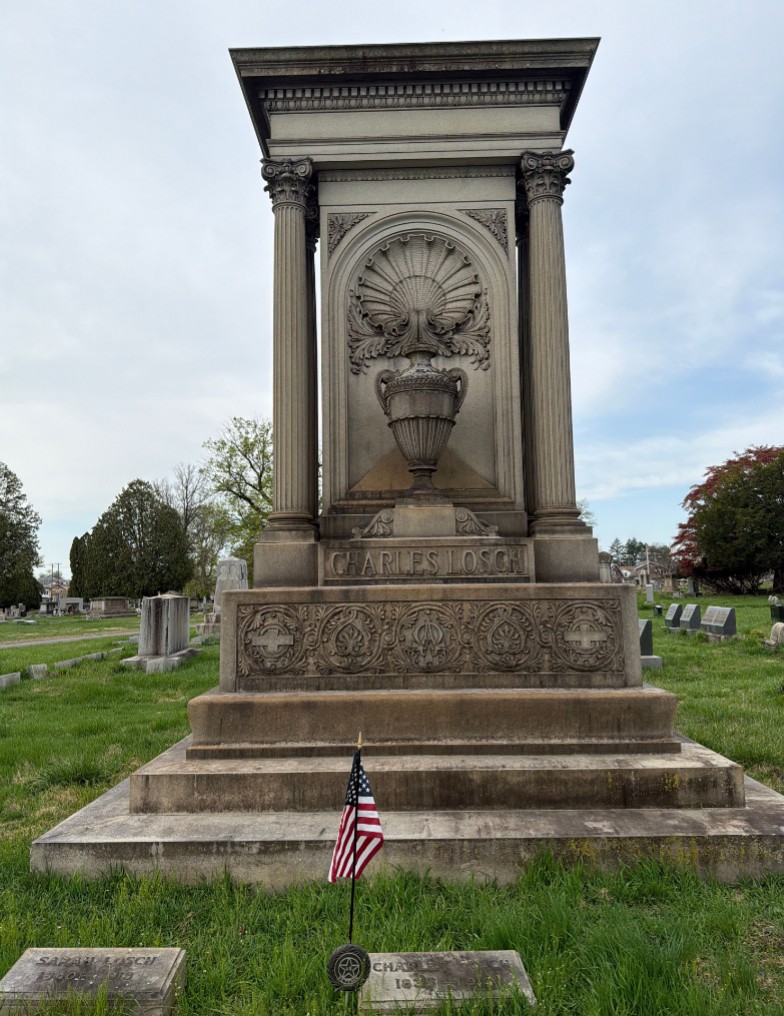
The monument and individual headstones marking the graves of liveryman Charles Losch (1835-1913) and his sister, Sarah Losch (1840-1913), Fairview Cemetery, Allentown, Pennsylvania (public domain; click to enlarge).
Following the death of Charles Losch (1835-1913) in Allentown, Pennsylvania on 17 November 1913, the extent and sources of his vast wealth and those of his other family members were revealed during the reading of his last will and testament — details that were subsequently reported by multiple newspapers across and beyond Pennsylvania’s Lehigh Valley. According to the actual text of that will, which was written by his own hand, these were his specific directives:
- I order and direct, that my body shall be decently interred in a manner corresponding with my state, and situation in life.
- I devise the benefit and income, of all that certain house and lot, situate on Florence Street, between South and Eighth Streets in the City of Allentown, Shown as Number 728 Florence Street, for the following purposes. To the Trustee of St. Paul’s, German Lutheran Church on South 8th, Street Allentown Pennsylvania, for which the said Trustees or the successers [sic, “successors”] shall be for all time, keep my Monument and Grave, and my Father’s Monument and plot, and all the graves thereon, and also my Brother Constantine’s grave, plot, stones and Monument in good order and repair, and keep the three Cemetery lots butified [sic, “beautified”] with flowers during summer. But the said mentioned house and lot shall forever the property of the Charles Losch Estate, should the Officers or Trustees of St. Paul’s German Lutheran Church fail or neglect to comply, with this my request, I direct that the Orphans Court of Lehigh County, to make a decree directing the fulfillment of my wish and desire. The said Trustees, or custodian, as the case may be, shall pay all taxes and repairs to said property. I order and direct that the said Custodian, shall throw the three adjoining lots on Fairview Cemetery together into one plot.
- I give devise and bequeath to my son Andrew Losch, Five hundred Dollars cash, and the income of my farm with the contents, situate in South Whitehall Township Lehigh County Pennsylvania, to have and enjoy the same during his natural life, and after his death it shall revert back to my estate.
- I give and bequeath the sum of Fifteen hundred dollars to Miss, Abby Hause of No 835 North 12th, Street Philadelphia Pennsylvania.
- I order and direct my hereinafter named Executors, to apply the sum of Twelve thousand dollars towards a Monument, and improvement of the lot, to be placed on my burial plot on Fairview Cemetery Allentown Pennsylvania.
- I order and direct my hereinafter named Executors to apply the sum of Three thousand dollars, to the purchase of a Monument and plot, to be placed on the burial plot marking the grave of my deceased brother William Losch, of Calafornia [sic, “California”]; and furthermore order and direct the sum of Five hundred dollars, to be invested in first Mortgage security, the interest of which to be used and applied annually, to the keeping in proper condition, and butifying [sic, “beautifying”] the burial plot of my deceased Brother William Losch.
- I order and direct my hereinafter named Executors, to apply the sum of Ten Thousand dollars, to the purchase of a Monument, to be placed on my Father’s burial plot, in Fairview Cemetery Allentown Pennsylvania.
- I order and direct, that before any portion of my estate divided or paid to any of the legatees herein before mentioned, that the provisions relative to the erecting of the Monuments on the burial plots of the deceased, at the time of my death, be strictly complied with, and all the Monunents erected.
- It is my wish that my hereinafter named Executors, shall so arrange that the different amounts set forth, for my monument and that of my Father’s monument in the the above items, be so applied by them, so the cost of each monument be comparatively equal in design cast.
- And as to all the rest, residue and remainder of my Estate, real, personal or mixed, of whatever nature or kind, or wheresoever situate at the time of my decease, I do hereby give devise and bequeath as follows to wit: one share to my sister Alice Losch, one share to the legal heirs of my Brother J. Frank Losch, and one share to the legal heirs of my Brother William Losch.
- And lastly, I do make, constitute and appoint my Son Andrew Losch and my esteemed friends Reuben Helfrich, and James Kressler to be the Executors of this my last Will and Testament, hereby revoking all former Wills and Testaments by me at any time heretofore made, and declaring this to be my last Will and Testament.
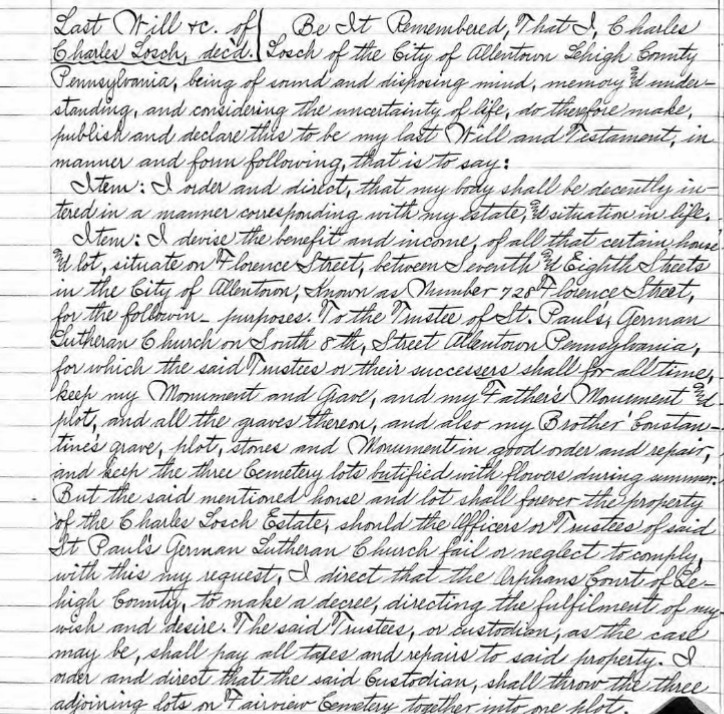
Page one of the Last Will and Testament of Allentown, Pennsylvania liveryman Charles Losch (1835-1913), 4 April 1913 (Office of the Register of Wills, Lehigh County, Pennsylvania, public domain; click to enlarge).
That will was “signed, sealed, published and declared by the testator above named” (Charles Losch) on 4 April 1913 as two men — E. J. Schmoyer and M. S. Weidner — witnessed the signing process. Roughly four months later, Charles Losch then attached the following codicil, which was signed and sealed by him on 30 August 1913 as those same two witnesses watched him set his hand to the paper:
I Charles Losch of the City of Allentown, Lehigh County, Pennsylvania, do hereby make and publish this codicil to my last will and testament, bearing date the Fourth day of April in the year of our Lord one thousand nine hundred and thirteen (1913).
I devise and bequeath unto the Trustees of the Congregation of the Gospel Chapel of the City of Allentown, All that certain lot or piece of ground, now in ther [sic, “their”] possession, and occupied by them, situate at the North East Corner of Church and Linden Streets, in the City of Allentown, Lehigh County Pennsylvania, Containing Thirty feet in front on said Linden Street, more or less, and in depth of an equeal [sic, “equal”] width to a line of a brick house on the North of other property of the said Charles Losch. So long as the same shall be used for Christian or Church purposes.
In Witness whereof, I have hereunto set my hand and seal, this thirtieth day of August in the year of our Lord one thousand nine hundred and thirteen (1913).
Less than three months later, Charles Losch was buried at the Fairview Cemetery in Allentown, in a manner befitting his “state and situation in life,” as specified in his last will and testament. That final will was then submitted for probate by his executors, Reuben Helfrich and James Kressler, to W. Koehler at the Office of the Register of Wills of Lehigh County, Pennsylvania on 24 November 1913. Also appearing with the executors before the Register of Wills that day were M. S. Weidner and E. S. Schmoyer, the two men who had witnessed Charles Losch sign both his final will of 4 April 1913 and its codicil of 30 August 1913. During that opening of the probate process, the executors and the witnesses each signed an attestation that Charles Losch had been “of sound mind, memory and understanding” when he had written his will and codicil.
But that probate process would prove to be the beginning of a new chapter in the life story of Charles Losch, rather than its ending.
An Increasingly Shocking Legal Dispute
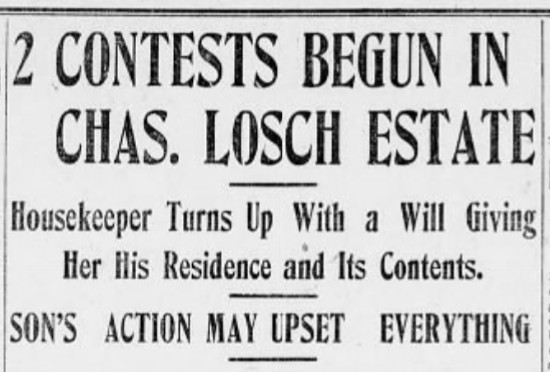
One of the more sensational headlines in newspaper coverage of the long-running saga of the probate of Charles Losch’s estate was published in The Allentown Leader on 7 February 1914 (public domain).
Charles Losch had barely drawn his last breath when attempts to overturn his final will and codicil were initiated by his son, Andrew Losch, followed by a series of counter-maneuvers by other beneficiaries who had fared better in that will. One of the earliest eyebrow-raising moments in the ensuing battle unfolded when a newspaper published false statements that had been fed to a reporter by Andrew. According to that article, which was published in The Allentown Democrat on 7 February 1914, under the headline, “Generosity Without Parallel Here,” Andrew had recently received letters “to the effect that the heirs of William and J. Frank Losch, of Nebraska, and Miss Alice Losch, will sign their inheritance by will from the late Charles Losch to Andrew Losch declaring they have plenty of this world’s goods themselves,” adding that:
In their letters they declare Andrew Losch is the rightful heir and that they will not contest it and will sign over their portion to ‘the real heir Andrew Losch.’
The estate was valued at about $150,000, out of which sum the son was given $500 and a life interest on the farm which he occupies at Wennersville.
On that same day, however, that newspaper’s competitor, The Allentown Leader, ran a more detailed article that was far less sympathetic to Andrew Losch and offered a new twist — a claim by Charles Losch’s housekeeper that she possessed a codicil to Charles Losch’s final will that allegedly bequeathed his house to her. According to the Leader:
The will of Mr. Losch, made last April, provides that the executors shall erect a monument to cost $12,000 over his own grave in Allentown, $3,000 for a monument over the grave of his brother in California, or $27,000 in all for monuments. His son Andrew is to receive $500 in addition to the income of a farm for life. The rest of the estate, worth consderably more than $100,000, is to be divided among his sisters in California.
House to Housekeeper.
For the past four years Mr. Losch had lived alone with his housekeeper, Mrs. Angelina Kern, a widow of about 40, who not only took care of him as housekeeper and nurse, but did a great deal of his business. She collected the rent of his 25 properties and saw to the collection of the interest on his mortgages and other investments, and also was his private secretary in the conduct of his correspondence. When the will was probated, it was rumored that Mr. Losch in a separate and later will had bequeathed his handsome residence at 619 Linden Street, valued at $10,000, to Mrs. Kern, for faithful service. Today Captain James I. Schaadt [sic, “James L. Schaadt”], as her attorney, filed this additional will on behalf of Mrs. Kern. It directs former Alderman, James F. Kressler, as an executor of the estate, to make out a deed for the property to Mrs. Kern, and gives her also all the belongings in the house. This will was written and witnessed by Mrs. Kern herself, but there is no doubt about the well-known signature of Mr. Losch, given under seal. The contest of Mrs. Kern was precipitated by the action of the executors in refusing to recognize the will of which she is the beneficiary.
Virtually Evicted.
Since the death of Mr. Losch she has lived in the house…. Yesterday the executors came with a number of men and it is alleged broke into the house and proceeded to rip up the carpets and proceed with other preparations for [a public sale of Charles Losch’s personal property]. Mrs. Kern then engaged Captain Schaadt as her attorney and there will be an action in trespass to establish what she claims are her rights. Her remedy for this action, if her will be recognized as legal, will be recovery of the value of the furniture and other contents of the house by process of law.
Son Starts Action.
Simultaneously, the son, Andrew Losch, through his attorney, Thomas F. Diefenderfer, president of the Merchants National Bank, started action to upset the will of his father on the ground of incompetency. The son is dissatisfied with the share bequeathed him, only $500 and a few hundred a year, as against $25,000 for monuments and the enormous sum given to the collateral heirs in California. In addition to incompetency he alleges undue influence, especially on the part of the housekeeper. The situation is such that if the original will be upset, that making the housekeeper a beneficiary will also fail, because if he were incompetent at the time the original will was made, he was worse only a short time before his death.
Was Forceful Man.
Mr. Losch was somewhat eccentric, but was a forceful man. It was said by some close to him that he was hard to get along with. He was in his 80th year. It was remarked that he had made plenty of enemies in his time who would assert that he was incompetent, but at the same time he had many friends who liked him and would testify to his strength of character and a thorough knowledge of what he was doing and intended to do….
Expected Diamonds.
A woman in black, who declined to reveal her identity other than that she said she was from New York, attended the funeral of Mr. Losch. She waited several days for the filing of the will and was the first person to demand to see it after it had been probated. She expressed great disappointment that she was not mentioned in it, saying Mr. Losch had been a friend and had promised to bequeath her his diamonds.
Engaged to Wed.
Mrs. Kern, the housekeeper, is a handsome woman nearly six feet tall, and has the reputation of having considerable ability. She is the daughter of the late Colonel Buck of Lynn Township, who was a well-known Civil War veteran, famous for his bravery in battle. Mrs. Kern has for several years been engaged to marry Alfred Schaeffer, former policeman, 6 feet 6 inches in his stockings, who is the tallest man in Allentown. They say the wedding would have taken place ere this, but for Mr. Losch’s pleadings that she not desert him, as he was getting old and needed help, and he promised her the property if she would remain with him.
Fortune at Stake.
Should the son win, he will become a rich man, gaining at least $150,000. If the original will stand[s], Mrs. Kern is believed to have a good chance to secure her bequest, as she has witnesses who will testify that Mr. Losch told them he wished her to have the house as a reward for her faithful attendance.
Also on that same day (7 February 1914), Reuben Helfrich and James Kressler, the executors of Charles Losch’s estate, published announcements in area newspapers regarding their planned public sale to carry out out Charles’ wishes that items from his personal property be sold off so that the proceeds could be given to his heirs. That sale was slated to be held at Charles’ former home (at 619 Linden Street in Allentown), and would include: carpets, furniture (bedroom items, clocks, a parlor suite, rocking chairs, a roll top desk, a sideboard and tables), a gold watch with chain, a music box, a refrigerator, a revolver, two buggies, two sleighs, one bay horse, and fifteen tons of chestnut and egg coal that was still stored in the cellar of Charles Losch’s former house.
In follow-up reporting, The Philadelphia Inquirer noted that a hearing had been set by Lehigh County’s Register of Wills for 20 March 1914 to address the codicil that Angelina Kern allegedly possessed.
This codicil, which was not attached to the original will, was written on one side of one of Mr. Losch’s printed letterheads and [was] dated November 3, 1913. The codicil has but one witness and she is the beneficiary. It reads as follows:
‘I will give my house furnished as it is now to my present housekeeper, who is now taking care of me, to Angelina Kern, for special favors and honest, kind work and good service she has done for me during the last three months and before. She shall have my home which I promised to her for the last few months past for staying with me to the end of my life. I name and order my executor, James Kressler, to lawfully sign said deed over to and in her name, and after my death to hand and deliver same said deed to her, Angelina Kern. Witness my hand and seal. In the name of Charles Losch.’
Two months after the notice was published by the executors of Charles Losch’s estate advertising the public sale of Charles Losch’s property, Andrew Losch petitioned the Orphans’ Court of Lehigh County to overturn its decision to approve his father’s will. According to a notice that was published by Sheriff Harry F. Bower and Andrew Losch’s attorney, Thomas F. Diefenderfer, in Allentown’s Morning Call on 10 April 1914:
In the matter of the estate of Chas. Losch, deceased.
To Mark Losch, John R. Losch, Blanche Losch Tucker, Lulu Losch Twitchell, G. C. Losch, Grace Huse, Frank Losch, and Richard Losch, legal heirs of J. Frank Losch, deceased, and William G. Losch, Eugene Losch, Frank A. Losch, and Grace M. Losch, legal heirs of William Losch, deceased, and all other persons interested.
You and each of you are hereby notified that Andrew C. Losch only son and heir at law of the said, Charles Losch, deceased, has filed his petition in the Orphans’ Court of Lehigh County alleging among other things that the papers in writing alleged to be the Last Will and Testament and codicil thereto of the said Charles Losch, deceased, and probated before the Register of Wills of Lehigh County November 24, 1913, is not the Last Will and Testament and codicil thereto of the said, Charles Losch, deceased, and further alleging that at the time of the execution thereof the said Charles Losch was not of sound disposing mind memory and understanding, that the said papers were procured by undue influence, and that the said papers were the result of insane delusions and hallucinations which controlled the mind of the said Chas. Losch in the making thereof; and that on April 6, 1914, the court ordered and decreed that a citation be issued upon all the parties in interest under said will, to appear in court on the first Monday of May next to answer the said petition and show cause why the probate of said papers as the Last Will and Testament and codicil of the said Charles Losch, deceased, should not be set aside and the Letters Testamentary granted thereon should not be revoked.
Pursuant thereto you are hereby notified to answer said petition as provided by the order of the court above cited, and to show cause why the probate of said will should not be set aside and the Letters Testamentary granted thereon revoked.
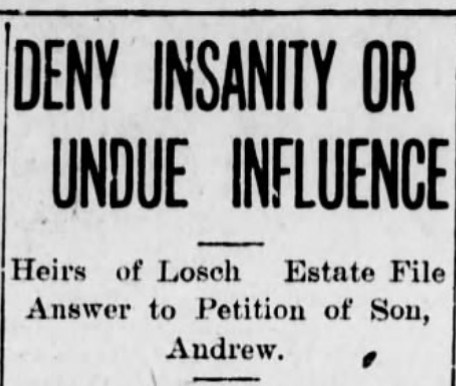
This sensational headline drew readers to an article in The Allentown Democrat on 6 May 1914, which presented the position by heirs of Charles Losch that he was “of sound mind” when he named them as the primary beneficiaries in his final will (public domain).
A month after that court petition, the principle heirs of Charles Losch responded to Andrew Losch and his attorneys, to the court and to the general public. According to The Allentown Democrat:
Answers were filed by the attorneys representing heirs of the late Charles Losch, who oppose the petition of Andrew C. Losch, a son of the wealthy liveryman who died in Allentown, November 13, 1913, to have the probating of the will revoked upon grounds alleging undue influence, weakness of mind, hallucinations and other causes. There are 12 interrogatories to answer by the heirs who desire to have the action of [the] Register of Wills sustained in probating the will and have the petition of Andrew C. Losch dismissed.The answers were filed in the office of Clerk of Orhpans’ Court Koenig and the matter will now be brought before the court for argument.
The answers were filed by lawyer Evan Holben, guardian ad litem of Frank Losch, and Richard Losch, minor heirs of J. Frank Losch, of Los Angeles, California; Messrs. Deshler and Webb, who represent Grace Losch Huse, Glenn S. Losch, Norfolk, Neb., Lulu Losch Twichell, Mark C. Losch, John Roy Losch, Blanche Losch Tucker, of West Point, Nebraska, and also by the attorneys for Reuben Helfrich and James Kressler, the executors of the estate.
Former Senator Holben in his answer for Frank and Richard Losch, say [sic, “said”] that he “has no personal knowledge of the alleged facts contained in the petition and citation, and that he has no cause or reason to show why the prayer of the petitioner should not be granted, but demands proof of the facts alleged and submits himself to the order of the court.’
The executors in their answer admit that the will was admitted to probate and that letters testamentary were granted them but they deny ‘that the only son of the said decedent [is entitled] to any share in the estate other than the [one that was] devised and bequeathed to him in the last will of the decedent.’ Denial is also made by them ‘that the decedent was not of sound mind or that the will or codicil were procured by undue influence, or that the will or codicil were the direct result and offspring of insane delusions and hallucinations which controlled the mind of said decedent.’
Messrs. Deshler & Webb for their clients also make denial in the same manner and ask that the prayer of the petitioner be dismissed.
After the death of Charles Losch his will was probated in which he left the sum of $500 to his son, Andrew S. Losch [sic, “Andrew C. Losch”] and the use of the farm so long as the son lives. The son has appealed from the probating of the will declaring that his father was of unsound mind and that undue influence was used in securing the execution of the will. Mr. Losch’s estate is said to be valued at $250,000 and since the will was probated his housekeeper comes [sic, “has come”] forward with a paper which she alleges is a codicil of the original document and in which it is alleged the decedent left her his home on Linden St., between Sixth and Church Sts.
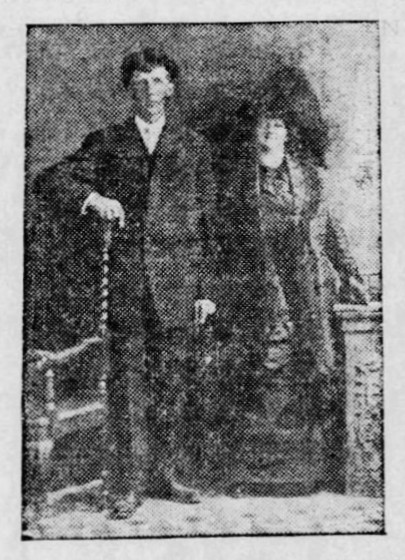
Charles Losch’s former housekeeper, Angelina Kern, shown here with her new husband, George Schaffer, continued to assert that Losch “had bequeathed her his handsome home at No. 619 Linden Street” in Allentown, Pennsylvania in news reports of her marriage in 1915 (The Morning Call, 17 July 1915, public domain).
On 26 May 1914, the Orphans’ Court of Lehigh County appointed Milton C. Henninger, Esquire as the examiner in charge of overseeing testimony by all parties involved and also reporting that testimony to the court, but the dispute had yet to be resolved more than a year later (in 1915) when newspapers nationwide ran the story, “Tall Pair Married in Pennsylvania,” which announced the marriage of the housekeeper who had claimed to be in a possession of a codicil to Charles Losch’s final will. According to The Twin-City Daily Sentinel of Winston-Salem, North Carolina, Mrs. Angie Kern, “who has been a widow several years, is a prospective heiress, if she can manage to break the will of the late Charles Losch, who died last year at the age of 79. He cut off his son with the income from a farm worth about $10,000 and provided for a $10,000 monument for himself in Allentown, a $5,000 monument for his father [in Allentown] and a $10,000 monument for a brother buried in California.”
Mrs. Kern produced a letter, purporting to have been signed by Losch, saying that if she would take care of him in his declining years, he would will her his homestead in Allentown, a property centrally located, valued at $12,000.
* Note: Researchers have not yet confirmed whether or not Angelina Kern was able to convince the Orphans’ Court of Lehigh County, Pennsylvania that the document she had submitted as a codicil to Charles Losch’s will was genuine, but theorize that she was ultimately unsuccessful. According to reports by Allentown area newspapers, a court hearing to address her claim was definitely held on the date previously announced (20 March 1914), but during those proceedings, attorneys requested a continuance of that hearing, which the judge granted (but no date was provided in those news reports to indicate when that second hearing would be held). News reports of Angelina Kern’s marriage more than a year later (in July of 1915) noted that she and her husband were residing “near Redhill” at that time (another possible indicator that the judge had dismissed her claim without awarding her the deed to the Losch house).
The Official Resolution
The Losch family’s legal feud finally came to an end when Andrew Losch “withdrew all action in the will contest proceedings,” according to the 21 November 1916 edition of Allentown’s Morning Call newspaper. As a result, Charles Losch’s executors were free to undertake a construction spree that forever altered the lanscape of cemeteries in Pennsylvania and California.
Massive Monuments That Still Stand
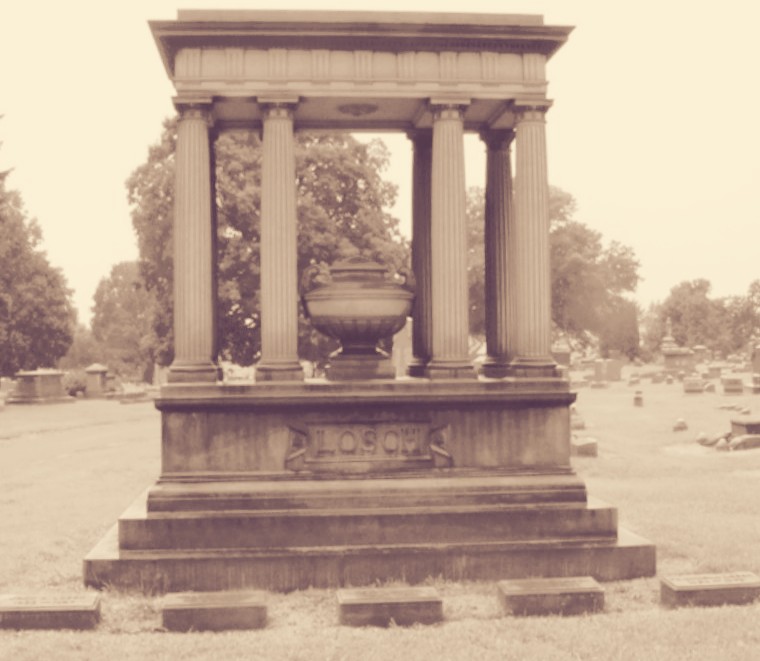
This massive granite structure, which was erected circa 1917, was built per the 1913 final will of liveryman Charles Losch, directing his executors “to apply the sum of ten thousand dollars to the purchase of a monument, to be placed on [his] Father’s burial plot, in Fairview Cemetery, Allentown, Pennsylvania.” It towers over the graves of his parents, John Losch (1801-1888) and Regina (Agster) Losch (1812-1877), and was designed and built by the New England Granite Company (public domain).
One of the provisions of the will of the late Charles, Losch, the well known liveryman of church and Linden streets, was that his executors were to expend $25,000 for monuments and markers for the Losch lots in Fairview Cemetery in this city and at Suisun, Cal. The executors, Reuben Helfrich and James F. Kressler, having settled the pending will contest and there being no other hindrances to the carrying out of the provisions of the will, have awarded the contract for the stonework. They had a number of monument designers, local and foreign, submit designs, and from their work the selection was made by Messrs. Helfrich and Kressler. Their choice fell upon the designs submitted by the New England Granite Co., of 489 Fifth avenue, New York city, with quarries and plant at Westerly, R.I.
A contract was entered into with the concern to fulfill the terms of the will and the company is to have the work finished by July first next [1 July 1917]. The price is to be $25,000.
The Losch lots, four in number and contiguous, are in Fairview Cemetery, near the main entrance and in the angle made by the branching of the second driveway to the left. The plots are surrounded by hedges and all the graves of Mr. Losch’s parents and his brothers and sister are marked with stones. The handsomest is the one over the grave of his brother, Walter, who was a marble dealer in his day and whose yard was at the southeast corner of Seventh and Linden streets. This design is that of an angel and it is of pure white marble.
According to the will all these stones are to be removed and broken up. This will be done by the New England Granite Works, which will also grade the lots and prepare them for the new work. A marker will be put up at each corner of the lot and each of the eight graves is to be marked with a stone.
The two upstanding features of the decorations of the burial plots are to be the peristyle that is to grace the centre of the lot and the monument that is to be erected over the grave of Mr. Losch [Charles Losch]. The peristyle will have eight columns on a base supporting an entablature and with an urn in the centre. The base will be 13 by 8 feet 11 inches and the design will 13 feet 9 inches high.
The dimensions of the monument over the grave will be 13 1/2 feet by 10 feet and 17 feet 10 inches high. The name, Charles Losch, will appear on the die and on the front of the monument will be an urn over which will be a design like a huge seashell.
A stone, 10 by 5 feet 5 inches, and 5 feet 5 inches high, will also be erected over the grave of his brother, William Losch, Sr., at Suisun, Cal., the design to be in the form of a sarcophagus.
All the markers are to be of stone supplied by the Crumb Granite Co. It is to be a fine grained blue white granite, brightly colored and free from flaws, sap and other imperfections, and it is to be what is known as tencut work.
The Losch lots are four in number and on them appear the graves of the following:
John Losch, born January 27, 1801, and died September 24, 1888.
His wife, Regina, born October 17, 1812, and died June 24, 1877.
The above were the parents of the Losch family and over their graves rises a large granite monument.
David Losch, who died in Virginia October 29, 1861, aged 22 years and 3 days, while a member of Company I, Forty-seventh Regiment, during the Civil war. His monument was erected by his parents and his comrades-in-arms, and it bears a device of crossed flags.
Walter Losch, born June 16, 1845, and died June 19, 1882.
John A. Losch, born December 2, 1832, and died March 6, 1897.
Miss Sarah Losch, born in 1840 and died in 1913.
Charles Losch, died November 17, 1913, aged 79 years, 1 month and 25 days.
Constantine Losch, born October 31, 1847, and died July 2, 1896.
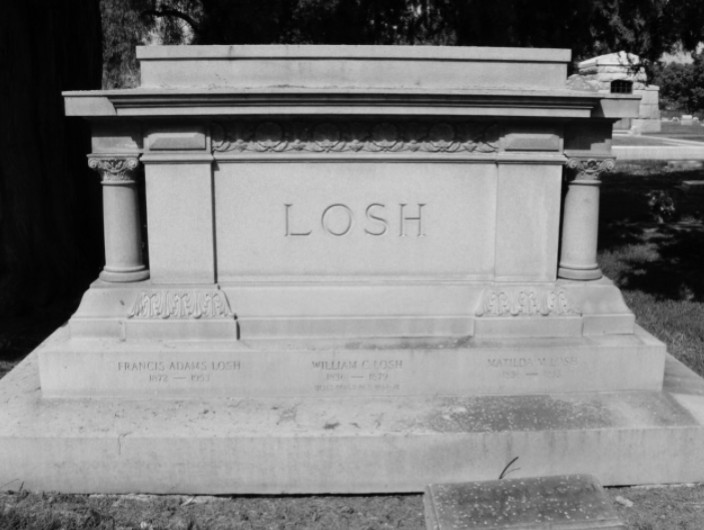
Charles Losch (1835-1913), an older brother of William Losh (1836-1879), directed executors “to apply the sum of three thousand dollars to the purchase of a monument … to be placed on the burial plot marking the grave of my deceased brother William,” and also bequeathed additional funds to William’s heirs to be used for the upkeep of William’s grave (public domain).
Having also been directed to obtain a monument for the grave of Charles Losch’s brother, William, who was known in later life as “William C. Losh” (1836-1879), Reuben Helfrich and James Kressler disbursed the funds that had been bequeathed by Charles to William’s heirs — a payment that likely took place sometime during the first six months of 1917. William’s son, Francis Adams Losh (1872-1953), then contracted with Doyle Brothers of Vallejo, California to design and erect the monument at William’s grave, which was located at the Fairfield Cemetery (now known as the Suisun-Fairfield Cemetery) in Solano County, California. According to the Solano County Courier:
A fine monument is being placed on the William Losh block in the Fairfield cemetery. It will cost $3,000 and will be the largest and most attractive monument in Solano county. It was endowed by a brother of [the] deceased, who died in Pennsylvania two years ago. He was a bachelor and left a valuable estate, which has been distributed in a large part to Miss Grace Losh and Frank Losh, and to the children of William and Eugene Losh, both of whom are dead.
The erection of the monument is being done under the direction of Frank Losh. It is being done by Doyle Bros. of Vallejo.
Completed circa 1917-1918, that monument still stands there today as a tribute to a Pennsylvanian who became a California pioneer.
Sources:
- “2 Contests Begun in Charles Losch Estate: Housekeeper Turns Up with a Will Giving Her His Residence and Its Contents: Son’s Action May Upset Everything.” Allentown, Pennsylvania: The Allentown Leader, 7 February 1914.
- Andrew C. Losch (a son of Charles Losch), in Death Certificates (file no.: 8250, registered no.: 123, date of death: 28 January 1933). Harrisburg, Pennsylvania: Commonwealth of Pennsylvania, Department of Health, Bureau of Vital Statistics.
- “Another Chapter in Losch Will Contest.” Allentown, Pennsylvania: The Morning Call, 26 May 1915.
- “At the Courthouse: Under Will Estate Goes to a Sister” (filing of a probate petition by Mary Alice R. Losch for the estate of her sister, Sarah Losch, both of whom were sisters of David, Charles and Constant Losch). Santa Ana, California: The Santa Ana Daily Register, 13 January 1913.
- “Beautiful Monument for the Losch Family Contracted for: Executors of Liveryman’s Estate Settle Will Contest and Now Are Carrying Out Extraordinary Provisions for Memorial.” Allentown, Pennsylvania: The Morning Call, 19 December 1916.
- “Charles Losch Called by Death.” Allentown, Pennsylvania: The Allentown Leader, 17 November 1913.
- “Chat About Your Friends” (mention of the stroke suffered by Charles Losch). Allentown, Pennsylvania: The Morning Call, 12 May 1908.
- “Death of Walter Losch, the Marble Cutter” (obituary of a brother of David, Charles and Constant Losch). Allentown, Pennsylvania: The Allentown Democrat, 21 June 1882.
- “Deny Insanity or Undue Influence: Heirs of Losch Estate File Answer to Petition of Son, Andrew” (report on court proceedings related to the disputed final will and estate of Charles Losch). Allentown, Pennsylvania: The Allentown Democrat, 6 May 1914.
- “Examiner’s Notice” (notice of the appointment by the Orphans’ Court of Lehigh County, Pennsylvania to oversee the testimony of the parties involved in the dispute regarding the validity of the last will and testament of Charles Losch). Allentown, Pennsylvania: The Morning Call, 4 June 1914.
- “Funeral of Miss Sarah Losch” (funeral announcement of David, Charles and Constant Losch’s sister, Sarah Losch). Allentown, Pennsylvania: The Morning Call, 27 January 1913.
- “Generosity Without Parallel Here” (false report that the heirs of Constant Losch’s brother, Charles Losch, had signed the money and property they were to inherit from him over to Charles Losch’s son, Andrew Losch). Allentown, Pennsylvania: The Allentown Democrat, 7 February 1914.
- “Housekeeper’s Will Stirs Big Estate: Angelina Kern Wants Probate Reopened to Share in Charles Losch’s $125,000.” Philadelphia, Pennsylvania: The Philadelphia Inquirer, 8 March 1914.
- Last Will and Testament of Charles Losch, in Wills and Probate Records Allentown, Lehigh County, Pennsylvania, 4 April 1913 and 30 August 1913). Allentown, Pennsylvania: Office of the Register of Wills, Lehigh County, Pennsylvania.
- Last Will and Testament of Constantine F. Losch (also includes subsequent will-related paperwork of his widow), in Wills and Probate Records Allentown, Lehigh County, Pennsylvania, 1896 and 1935). Allentown, Pennsylvania: Office of the Register of Wills, Lehigh County, Pennsylvania.
- Last Will and Testament of John A. Losch, in Wills and Probate Records Allentown, Lehigh County, Pennsylvania, 1897). Allentown, Pennsylvania: Office of the Register of Wills, Lehigh County, Pennsylvania.
- “Losch” (death notice of Charles Losch). Allentown, Pennsylvania: The Morning Call, 22 November 1913.
- “Losch” (death notice of Charles Losch’s brother, Constantine F. Losch), in “Deaths.” Allentown, Pennsylvania: The Allentown Democrat, 8 July 1896.
- “Losch” (death notice of David, Charles and Constant Losch’s sister, Sarah Losch), in “Deaths.” Allentown, Pennsylvania: The Allentown Leader, 27 January 1913.
- Losch, David, John and Regina, in Burial Records (death and burial records of Charles Losch’s brother and parents, St. Paul’s Lutheran Church, Allentown, Lehigh County, Pennsylvania). Allentown, Pennsylvania: St. Paul’s Lutheran Church.
- “Losch Estate Will Bring $180,000, High Bids at Sale” (report on the sale of stocks previously owned by Charles Losch). Allentown, Pennsylvania: The Allentown Leader, 18 December 1916.
- Losch, Miss Mary A. R. (a sister of David, Charles and Constant Losch), in Index to the Great Register of Orange County (voter registration, Orange County Precinct No. 2, Anaheim, Orange County, California, 1818-1920). Sacramento, California: Office of the Secretary of State.
- Losch, Walter (a brother of David, Charles and Constant Losch), in Records of Burial Places of Veterans (Fairview Cemetery, Allentown, Pennsylvania). Harrisburg, Pennsylvania: Commonwealth of Pennsylvania, Department of Military Affairs.
- Losch, Walter and Mary A. R., in Probate Records (Lehigh County, Pennsylvania, July 1882). Allentown, Pennsylvania: Office of the Register of Wills, Lehigh County, Pennsylvania.
- Losh [sic, “Losch], John, Regina, Charles, William, David, Sarah, Frederick [sic, “Constantine Frederick” or “Constant F.”], Alfred, and Walter, in U.S. Census (Borough of Allentown, Lehigh County, Pennsylvania, 1850). Washington, D.C.: U.S. National Archives and Records Administration.
- Mary Alice Losch (a sister of David, Charles and Constant Losch), in Orange County Directory, 1936-1938. Long Beach, California: Western Directory Co.
- Miller, Nathan, Susan [sic, “Susannah Elizabeth (Brader Losch) Miller”] (the ex-wife of Charles Losch and second wife of widower Nathan Miller), Susnella, Christ, and Carrie; and Losch, Henry, Alice and Andrew (the children of Susannah Elizabeth (Brader Losch) Miller from her first marriage to Charles Losch), in U.S. Census (Allentown, Lehigh County, Pennsylvania, 1870). Washington, D.C.: U.S. National Archives and Records Administration.
- “Miss Mary Alice Losch” (obituary of David, Charles and Constant Losch’s sister). Santa Ana, California: The Santa Ana Register, 23 July 1946.
- “Miss Sarah Losch” (death announcement of David, Charles and Constant Losch’s sister, Sarah Losch), in “Obituary.” Allentown, Pennsylvania: The Morning Call, 4 January 1913.
- “Monuments Erected” (description of several of the monuments and gravestones carved by David, Charles and Constant Losch’s brother, Walter Losch, for Lehigh Valley area cemeteries). Allentown, Pennsylvania: The Allentown Democrat, 17 December 1879.
- “Monument to Cost $3,000” (report regarding the monument to be erected at the grave of Charles Losch’s brother, William Losh, at the “Fairfield Cemetery” in Solano County, California). Suisun City, California: Solano County Courier, 25 October 1917.
- “Orphans’ Court Notice” (publication of the legal notice announcing the intent of Andrew Losch to overturn the last will and testament of his father, Charles Losch). Allentown, Pennsylvania: The Morning Call, 10 April 1914.
- “Public Sale of Valuable Personal Property” (notice of the sale of the personal property of Charles Losch by his estate’s executors). Allentown, Pennsylvania: The Morning Call, 7 February 1914.
- “Royal Arcanum — Two Death Losses” (mentions the insurance benefit assigned by Charles Losch’s brother, Walter Losch, to one of their sisters). Allentown, Pennsylvania: The Allentown Democrat, 5 July 1882.
- “Tall Pair Married in Pennsylvania” (mentions an alleged codicil to Charles Losch’s will that would have awarded his former home in Allentown to his housekeeper, Angie Kern). Winston-Salem, North Carolina: The Twin-City Daily Sentinel, 20 July 1915.
- “Well Known Couple Joined in Matrimony” (announcement with photo of the marriage of Angelina Kern, Charles Losch’s former housekeeper who claimed that he had bequeathed his house to her). Allentown, Pennsylvania: The Morning Call, 17 July 1915.
- “Will Contest Is Dropped by Losch” (notice of the withdrawal by Andrew C. Losch of his petition to the Orphans’ Court of Lehigh County, Pennsylvania to revoke the probated approval of Charles Losch’s last will and testament). Allentown, Pennsylvania: The Morning Call, 21 November 1916.


You must be logged in to post a comment.