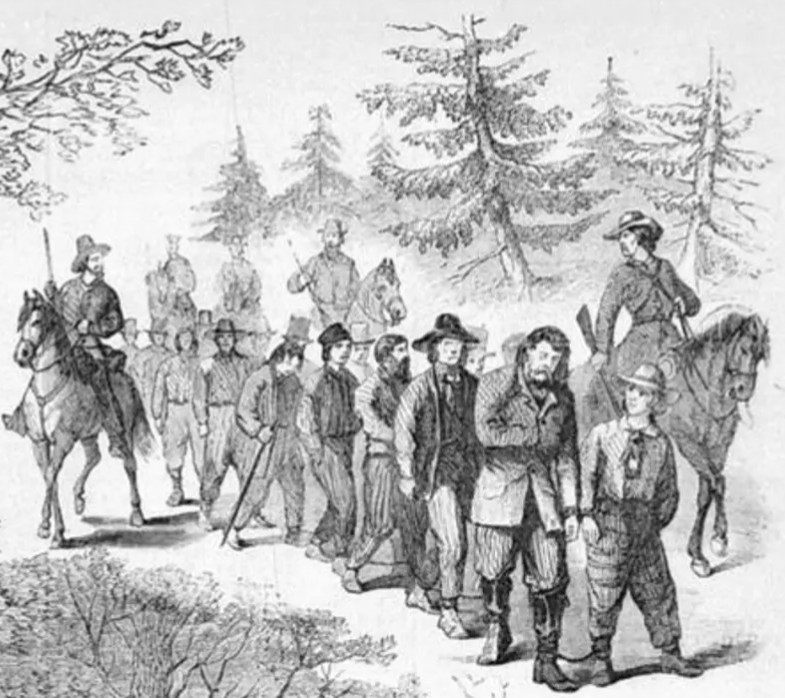
“Bringing in Union Men in Texas” (Frank Leslie’s Illustrated Newspaper, circa 1864, public domain).
During battles that were described by Major-General Nathaniel Banks as “desperate and sanguinary,” multiple members of the 47th Pennsylvania Volunteer Infantry were killed, wounded in action or labeled as “MIA” (missing in action) while serving with the regiment in Louisiana in April and May 1864. By early June, senior officers of the 47th Pennsylvania knew for certain that at least twenty subordinates were not, in fact, “MIA,” but had actually been captured by Confederate troops.
As more information was received, it became clear that the majority of those unfortunate 47th Pennsylvanians were being held in captivity as prisoners of war (POWs) by the Confederacy at one of five Confederate hospital or prison locations in America’s Deep South, and that many of those 47th Pennsylvania Volunteer Infantrymen had been force marched to those destinations — several of which were a hundred miles or more from where they were captured.
Descriptions of those Confederate prisons are provided below, along with information about the 47th Pennsylvania Volunteers who were imprisoned, respectively, at those locations.
Pleasant Hill (Pleasant Hill, Louisiana)
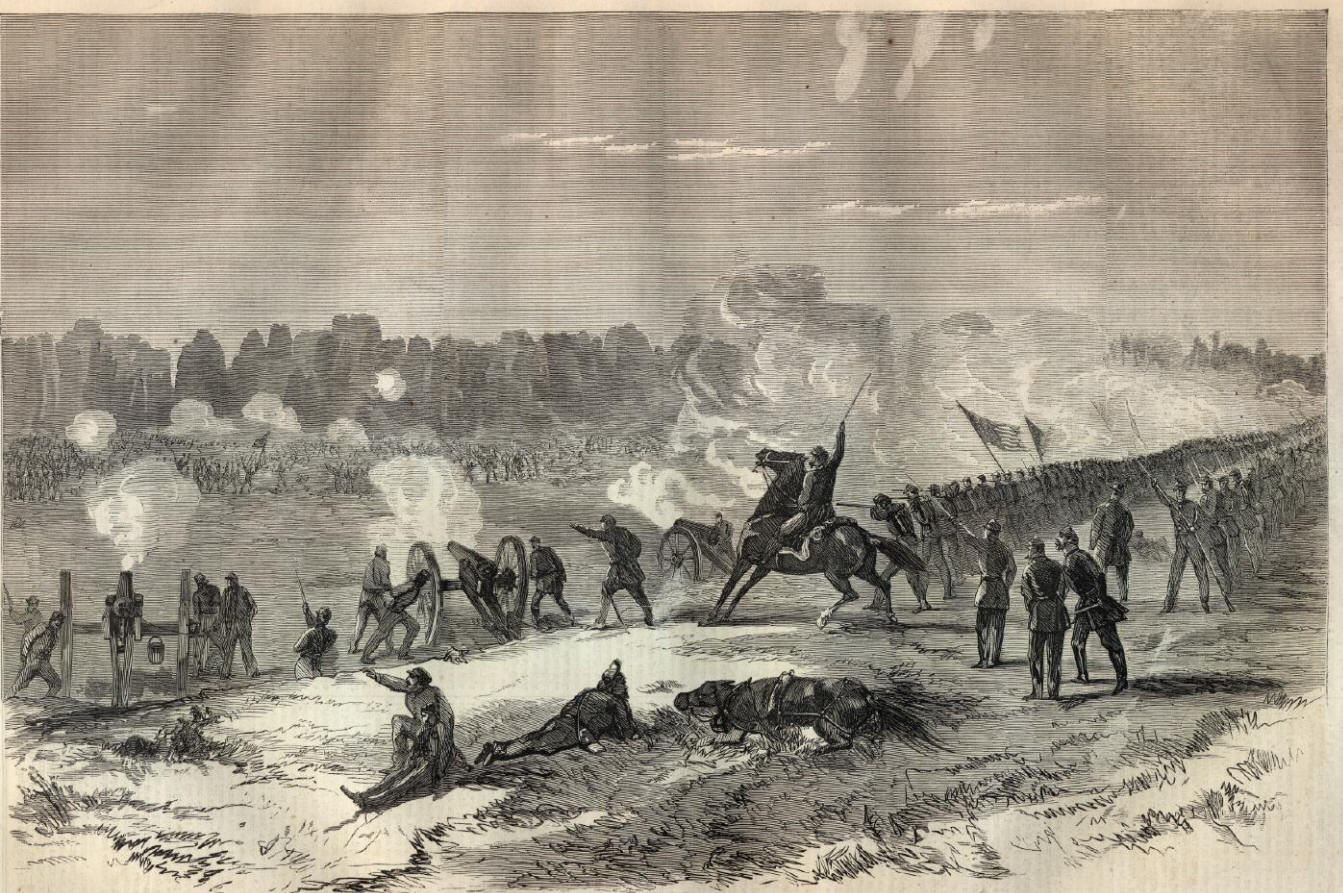
Battle of Pleasant Hill, Louisiana, 9 April 1864 (Harper’s Weekly, 7 May 1864, public domain).
On 9 April 1864, areas within and around the village of Pleasant Hill in Sabine Parish, Louisiana were roused from the quiet of small town and bucolic farm life and transformed into heartbreaking sites of fear, carnage and valor during the Battle of Pleasant Hill. Among the Union infantrymen who were likely wounded in action that day were Privates Solomon Powell and Jonathan Wantz of the 47th Pennsylvania’s D Company — both of whom were either captured during that fight or while they were in the process of receiving medical treatment at a Union Army general hospital behind Union lines.
* Note: Overrun by Confederate troops, the Union Army’s general hospital in Pleasant Hill, Louisiana was converted into a hospital that was controlled and maintained by Confederate physicians after the Battle of Pleasant Hill ended and the Union Army retreated to Grand Ecore. As a result, the patients receiving care there in the aftermath of that battle were primarily Confederate men; however, multiple Union soldiers who had been receiving care there prior to that hospital’s capture, and who were too seriously ill or wounded to be moved to a Confederate prison, also continued to be housed at that hospital in Pleasant Hill.
The 47th Pennsylvania Volunteers who were confirmed by Union Army leaders to have died in or near Pleasant Hill, Louisiana, while still being held as POWs by the Confederacy, were:
- Powell, Solomon (Private, Company D): Private Powell subsequently died either on the day of the Battle of Pleasant Hill (9 April 1864) — or on 7 June 1864, while still being held as a POW by Confederates within or near the village of Pleasant Hill; and
- Wantz, Jonathan (Private, Company D): Private Wantz died while still being held as a POW at Pleasant Hill; his death was reported as having occurred on 17 June 1864.
According to historian Lewis Schmidt, “Privates Powell and Wantz were probably buried in a cemetery at Pleasant Hill, ‘at the rear of the brick building used for a hospital,’ and after the war reinterred at Alexandria National Cemetery at Pineville, Louisiana in unknown graves.”
Camp Ford and Camp Groce (Texas)

This illustration presented a far rosier image of life at Camp Ford, Texas than the camp’s actual day-to-day living conditions in 1864 and 1865. The largest Confederate Army prison camp west of the Mississippi River, it had poor sanitation and lacked adequate shelter, food and medical care (Harper’s Weekly, 4 March 1865, public domain).
Following the Battle of Pleasant Hill, Louisiana and other engagements with the Confederate States Army during the Red River Campaign, seventeen members of the 47th Pennsylvania Volunteer Infantry were spirited away to Tyler, Texas, where they were then confined as POWs at Camp Ford — the largest Confederate prison camp west of the Mississippi River (or at Camp Groce, which was located near Hempstead, Texas). Languishing for months in Texas — more than one hundred and twenty-five miles away from the scenes of the military engagements where they had been captured (after having been wounded in some cases), they were starved, given minimal to no medical care for any wounds they had sustained, exposed to extreme variations in temperature and weather (due to inadequate shelter) and sickened by dysentery and other diseases that were spread by living in cramped, overcrowded conditions that became increasingly unsanitary (due to the placement of latrine facilities near water supplies meant for drinking or bathing). As their days dragged on, their treatment by Confederate soldiers also became increasingly harsh.
* Note: According to representatives of the Smith County Historical Society who have been working on documenting the history of Camp Ford:
“During the winter of 1863-64 the camp housed only about 170 prisoners, mostly officers…. Fairly substantial log cabins were erected. Streets were laid out and named…. Most important for the future, Captain Amos Johnson of the USS Sachem was named ‘commissioner of Aqueducts’ and developed a series of catch basins in the spring branch, one for drinking, one for washing, and one for bathing….
“On April 8th and 9th 1864 at the battles of Mansfield and Pleasant Hill, Louisiana, Confederate forces captured more than 2,000 Union soldiers, who were quickly marched to Tyler [more than one hundred and twenty-five miles]…. The existing stockade did not have sufficient area to house them, and an emergency enlargement was undertaken. Local slaves were again impressed, the north and east wall was dug up and the logs cut in half, and the top ten feet of the logs of the south and west walls were cut off. The resulting half logs gave sufficient timber to quadruple the area of the stockade, and it was expanded to about eleven acres.
“With additional battles in Arkansas and Louisiana, the prison population had grown to around 5,000 by mid-June. Hard-pressed CS officials had no ability to provide shelter for the new prisoners, and their suffering was intense. The number of tools was inadequate, and many men could only dig holes in the ground for shelter. Rations were often insufficient and the death rate soared…. Of 316 total deaths at the camp, 232 occurred between July and November 1864….”
Tragically, the cause of illness and death for members of the 47th Pennsylvania who were held as POWs at Camp Ford may have been far more insidious than their families were told. During a subsequent news report given by 47th Pennsylvanian Henry Wharton, readers of the Sunbury American newspaper learned that at least several of the 47th Pennsylvania POWs had been “vaccinated or inoculated, with impure matter which impregnated their blood.” Allegedly commited at the behest of the Confederate officers in charge of Camp Ford operations, those medical atrocities reportedly left the 47th Pennsylvania POWs “afflicted with ulcerated limbs and sore eyes” according to Wharton, who posited that:
“The fiends, pretending to give these men a preventive for small pox, filled their systems with a loathsome disease that will cling through life. Is not this an inhuman act?”
Research undertaken by twentieth-century regimental historian Lewis Schmidt subsequently supported Wharton’s report, confirming that Union POWs were definitely mistreated while held at Camp Ford:
“The camp was enclosed by an 8 foot high stockade, and a large ten foot gate was located at the west entrance, secured by a bar and padlock; and another large gate was located on the north side of the enclosure….
“A guard house called the ‘Wolf Pen’ was located 300 feet west of the gate, where unruly prisoners were kept or punished….. The daily rations consisted of “from one half to one pint of corn meal, often times musty. From one half to three fourths pound fresh beef. Local farmers would occasionally bring some of their produce to the camp for sale to the prisoners and guards, but prices were usually beyond the means of most of the imprisoned men [and any of those food items that were made available to the POWs were only able to be purchased using Confederate money, which the Union POWs often did not possess].”
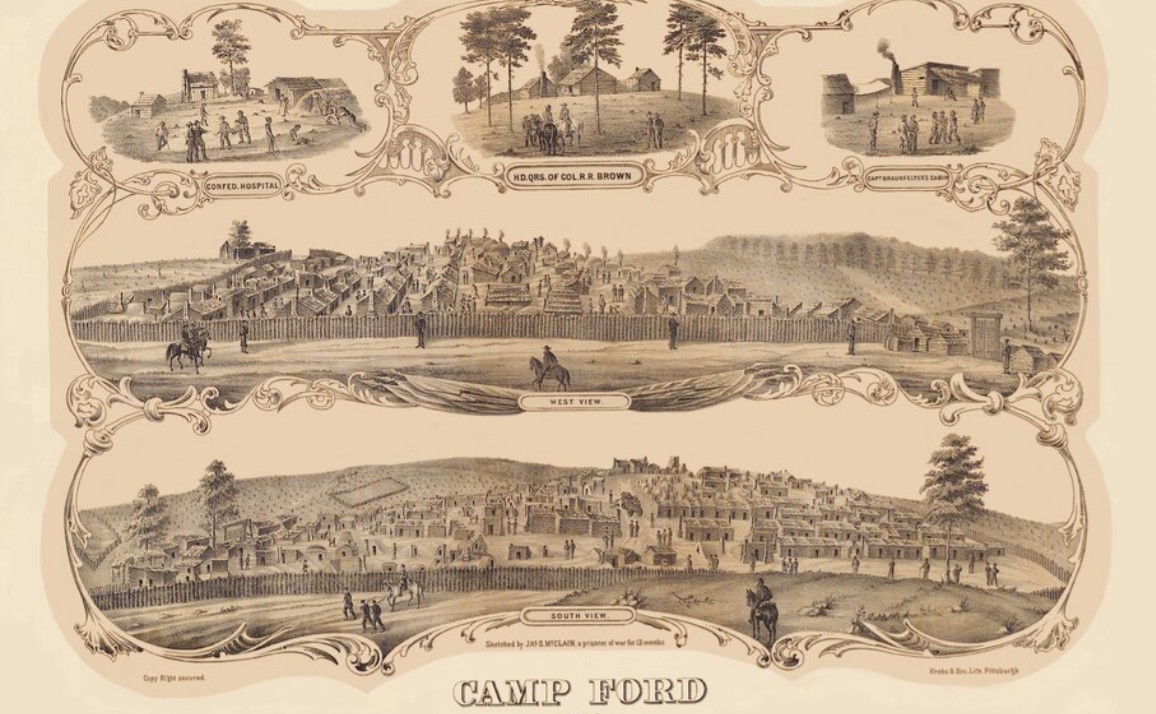
James S. McClain drew these sketches of the Confederate POW camp in Texas, Camp Ford, between 3 May 1864 and 27 May 1865 (public domain).
As a result, several of the seventeen 47th Pennsylvanians imprisoned at Camp Ford were unable to endure the ordeal. Those known to have died on the grounds of Camp Ford were Private Samuel M. Kern of Company D (date of death: 12 June 1864) and Private Frederick Smith of Company I (date of death: 4 May 1864).
Also listed among those who died during their imprisonment was Private John Weiss of the 47th Pennsylvania’s F Company; however, while early reports confirmed that he had indeed been confined to Camp Ford, updated military records noted that his battle wounds had been severe enough that he had been transferred to a “Rebel hospital,” where he died from his wounds on 15 July 1864.
* Note: While it is possible that the Confederate hospital where Private John Weiss died was the prison hospital at Camp Ford, Private Weiss may actually have died elsewhere (possibly at the Confederate Army Hospital No. 59 in Shreveport, Louisiana because that hospital in Shreveport was the site where another member of the 47th Pennsylvania — Private Joseph Clewell, Jr. of Company G — died on 18 June 1864, according to U.S. Army death ledgers. For further details regarding that death, see Private Clewell’s entry under “Confederate Hospital (Shreveport, Louisiana)” below.
Sadly, even the processes for the exchange of prisoners that were employed by the Confederacy were often cruel. During the summer of 1864, a member of the 19th Iowa Volunteers — Joseph R. Shipman — wrote a letter in which he described how one Camp Forge prisoner exchange unfolded on 22 July:
“We were paroled on the 5th inst. [5 July 1864], left Tyler on the 9th for Shreveport, La., distant 119 miles. We made the trip through in four days, three-fourth of the men were barefooted and so ragged that it was impossible for many of us to conceal our nakedness. We were taken on steamers from Shreveport to the north Red River where we were met by the Commissioner of exchange for this Department with an equal number of Confederate prisoners and the exchange took place on the 22d. We left on the 23d for this Port [New Orleans], arrived here on the 24th, where we are now comfortably quartered with a whole new suit, plenty to eat and drink, all of which we have been strangers to for the last ten months, our food while we were prisoners consisted almost exclusively of corn meal and beef, and very small rations at that.
“Fifteen members of the 47th Pennsylvania were inmates of the stockage at Tyler with us for a short time. Some four or five of Captain Gobin’s company [Company C] of Sunbury among them, they came out and were exchanged with us on the 22nd inst., among them was Samuel Miller, an old acquaintance of mine….”
Despite those inhumane conditions, sixteen members of the 47th Pennsylvania Volunteer Infantry managed to survive until they were finally released:
- Brown, Charles or Francis (Bugler and Cornetist, Regimental Band): Force marched to Camp Ford near Tyler, Texas, following his capture by Confederate troops during the Battle of Pleasant Hill on 9 April 1864, Bugler Brown was held there as a POW until his release on 22 July 1864. Reportedly returned to his regiment at its duty station in Virginia, he was given medical care and awarded a thirty-day furlough to recuperate. Reported by his regiment as a deserter on 16 September 1864 (mistakenly), he had either misunderstood the terms of his furlough or had actually been honorably discharged because he was later re-enrolled as a bugler by the 7th New York Volunteers in October 1864 and went on to serve with that regiment until his honorable discharge on 4 August 1865.
- Buss, Charles (Private, Company F): Captured during the Battle of Pleasant Hill and force marched to Camp Ford in Texas, where he was mistakenly entered onto the POW rosters as “Charles Bress,” Private Charles Buss contracted dysentery and developed chronic diarrhea and a lingering problem with severe hemorrhoids during his captivity. Following his release from Camp Ford with other 47th Pennsylvania POWs on 22 July 1864, he received stabilizing treatment from Union Army physicians, and was then transported by ship back to the Eastern Theater, where he resumed his Company F duties and continued to serve with the 47th Pennsylvania until he was honorably mustered out on 25 May 1865 (alternate discharge date: January 1865).
- Clouser, Ephraim (Private, Company D): Captured by Confederate troops after being wounded during the Battle of Pleasant Hill and force marched to Camp Ford in Texas, Private Ephraim Clouser was subject to mental and physical torture while being held there as a POW. Taunted by his Confederate captors with false promises of release during a planned prisoner exchange on 16 June 1864, his spirits were crushed when he learned that he would continue to languish in captivity there as a POW. Finally released on 25 November 1864, Private Clouser was one of the final 47th Pennsylvania POWs to walk through the gates of Camp Ford. Initially given stabilizing medical care by Union Army physicians, he was then transferred from one Union Army hospital to another in Missouri, Ohio and Pennsylvania, as military physicians determined that he needed further treatment for the psychological and physical trauma that he had sustained during his time as a prisoner of the Confederacy. Never able to return to duty, he was eventually dropped from his regiment’s muster rolls. Honorably discharged sometime after his stay at the Union Army’s hospital in York, Pennsylvania, he filed for an invalid soldier’s pension with the federal government on 22 January 1866. He then spent the remainder of his life battling the form of mental illness known today as post-traumatic stress disorder (PTSD).
- Crownover, James (Sergeant, Company D): Wounded in the right shoulder during the Battle of Pleasant Hill on 9 April 1864, Sergeant James Crownover was subsequently captured by Confederate troops and force marched to Camp Ford in Texas. While being held there as a POW, he was commissioned in absentia, but not mustered, as a second lieutenant on 31 August 1864 by senior officers of the 47th Pennsylvania who hoped that his new status as a commissioned officer would motivate his Confederate captors to treat him less cruelly. One of the final 47th Pennsylvania Volunteers to be released from captivity at Camp Ford, Sergeant Crownover walked out of the gates of that POuW camp on 25 November of that same year. After receiving medical care from Union Army physicians, he was transported back to the Eastern Theater, where he resumed his service with Company D. Promoted to the rank of first sergeant on 5 July 1865, he honorably mustered out with his regiment on Christmas Day in 1865.
- Downs, James (Private, Company D): Captured during the Battle of Pleasant Hill and force marched to Camp Ford in Texas, Private James Downs was held there as a POW until his release with other 47th Pennsylvania Volunteers during a prisoner exchange on 22 July 1864. After receiving medical care from Union Army physicians, he was transported by ship back to the Eastern Theater of the war, where he resumed his D Company duties. Promoted to the rank of corporal on 5 July 1865, he continued to serve with the 47th Pennsylvania until the regiment was mustered out on Christmas Day in 1865.
- Holman, Conrad P. (Private, Company C): Captured during the Battle of Pleasant Hill and force marched to Camp Ford in Texas, Private Conrad Holman was held there as a POW until his release with other 47th Pennsylvania Volunteers during a prisoner exchange on 22 July 1864. After receiving medical care from Union Army physicians, he was transported by ship back to the Eastern Theater of the war, where he was honorably discharged at Berryville, Virginia on 18 September 1864, upon expiration of his term of service.
- Huff, James (Corporal, Company E): Wounded in action prior to his capture during the battle of Pleasant Hill and then force marched to Camp Ford in Texas, Corporal James Huff was held there until his release during a prisoner exchange on 29 August 1864. Treated by Union Army physicians, he was then transported by ship back to the Eastern Theater, where he resumed his E Company duties and continued to serve with the 47th Pennsylvania in Virginia until he was captured by Confederate troops less than three months later and taken to the Confederacy’s notorious Salisbury Prison in North Carolina. (Read his biography to learn more about the even worse treatment he received there.)
- Jones, John Lewis (Private, Company F): Wounded in action prior to his capture and force marched to Camp Ford in Texas, Private John L. Jones was promoted to the rank of corporal, in absentia, on 18 September 1864 — an act that motivated his captors to release him six days later (on 24 September). After receiving treatment from Union Army physicians, he was transported by ship back to the Eastern Theater, where he resumed his Company F duties. Later promoted again, he continued to serve until he honorably mustered out with his regiment on Christmas Day in 1865.
- Mathews, Edward (Private, Company C): Captured by Confederate troops during the Battle of Sabine Cross Roads/Mansfield on 8 April 1864 and force marched to Camp Ford in Texas, Private Edward Mathews was held there as a POW until his release with other 47th Pennsylvania Volunteers during a prisoner exchange on 22 July of that same year. Subsequently treated by Union Army physicians, he was transported by ship back to the Eastern Theater of the war, where he resumed his duties with Company C and was honorably discharged on 1 October 1865, upon expiration of his term of service.
- Maul, Adam (Private, Company C): Captured on the banks of the Cane River, near the city of Alexandria, Louisiana on 3 May 1864, while engaged with the 47th Pennsylvania Volunteers in erecting Bailey’s Dam, Private Adam Maul (alternate surname spelling: “Moul”) was then also forced marched to Camp Ford and held there as a POW until his release with other 47th Pennsylvania POWs on 22 July 1864. Treated by Union Army physicians, he was then transported by ship back to the Eastern Theater, where he continued to serve with Company C until he was honorably mustered out with his regiment on Christmas Day in 1865.
- McNew, John (Private, Company C): Captured during the Battle of Pleasant Hill and force marched to Camp Ford in Texas, Private John McNew was held there as a POW until his release with other 47th Pennsylvania Volunteers during a prisoner exchange on 22 July 1864. After receiving medical care from Union Army physicians, he was transported by ship back to the Eastern Theater of the war, where he resumed his duties with the 47th Pennsylvania and continued to serve with Company C until he honorably mustered out with his regiment on Christmas Day in 1965.
- Miller, John Garber (Corporal, Company D): Captured during the Battle of Pleasant Hill and force marched to Camp Ford in Texas, Private John G. Miller was held there as a POW until his release with other 47th Pennsylvania Volunteers during a prisoner exchange on 22 July 1864. After receiving medical care from Union Army physicians, he was transported by ship back to the Eastern Theater of the war, where he resumed his duties with Company D. Promoted to the rank of sergeant on 19 September 1864, he continued to serve with the 47th Pennsylvania until the regiment was honorably mustered out on Christmas Day in 1865.
- Miller, Samuel W. (Private, Company C): Captured by Confederate troops during the Battle of Sabine Cross Roads/Mansfield on 8 April 1864 and force marched to Camp Ford in Texas, Private Samuel Miller was also held there as a POW until his release with other 47th Pennsylvania Volunteers during a prisoner exchange on 22 July of that same year. Subsequently treated by Union Army physicians at a Union Army general hospital in New Orleans (according to the aforementioned letter written by fellow 47th Pennsylvania Volunteer Henry Wharton), Samuel was then transported by ship back to the Eastern Theater of the war, where he resumed his duties with Company C, and was then honorably mustered out with his regiment on Christmas Day in 1865.
- Smith, John Wesley (Private, Company C): Captured by Confederate troops during the Battle of Pleasant Hill and force marched to Camp Ford in Texas, Private John W. Smith was held there as a POW until his release with other 47th Pennsylvania Volunteers during a prisoner exchange on 22 July 1864. After receiving medical care from Union Army physicians, he was transported by ship back to the Eastern Theater of the war, where he also resumed his service with the 47th Pennsylvania and continued to serve with Company C until he honorably mustered out with his regiment on Christmas Day in 1865.
- Smith, William J. (Private, Company D): Captured by Confederate troops during the Battle of Pleasant Hill and force marched to Camp Ford in Texas, Private William J. Smith was also held there as a POW until his release with other 47th Pennsylvania Volunteers during a prisoner exchange on 22 July of that same year. Subsequently treated by Union Army physicians, he was transported by ship back to the Eastern Theater of the war, where he resumed his duties with Company D, and was then honorably mustered out with his regiment on Christmas Day in 1865.
- Weiand, Benjamin (Private, Company D): Captured by Confederate troops during the Battle of Pleasant Hill and force marched to Camp Ford in Texas, Private Benjamin Weiand (alternate surname spelling: “Wieand”), was held there as a POW until his release. Treated by Union Army physicians, he was then shipped back to the Eastern Theater of the war, where he continued to serve with Company D until his honorable discharge on 21 July 1865.
Camp Sumter (Andersonville, Georgia)
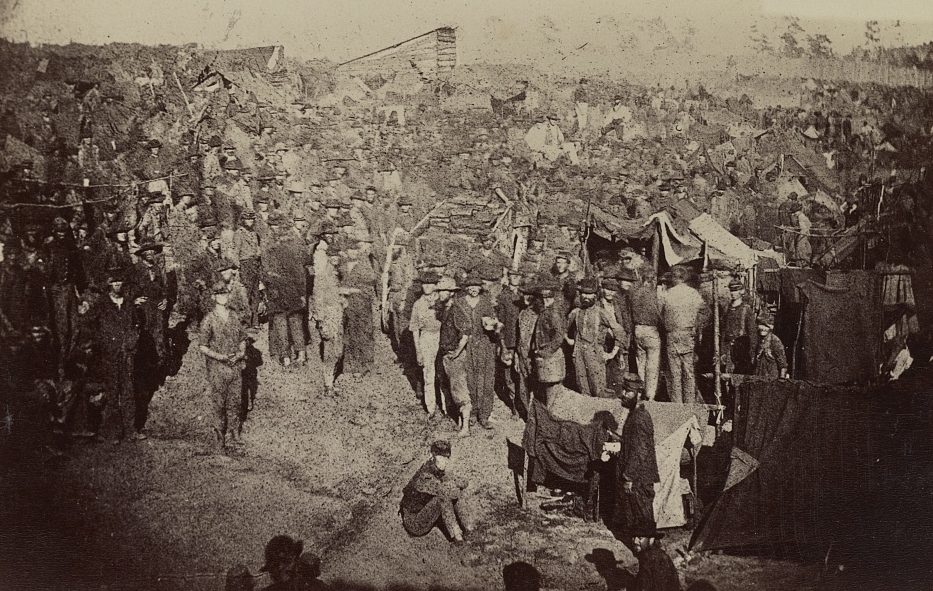
Issuing rations at the Andersonville POW Camp, 17 August 1864 (view from Main Gate, U.S. Library of Congress, public domain).
The most notorious of the Confederacy’s prisoner of war camps, Camp Sumter came to be known simply by the name of the town in Georgia that was closest to it — Andersonville. Built in early 1864 on roughly sixteen and one-half acres of land, it was surrounded by a gated, stockade fence that was fifteen feet tall, and began receiving its first prisoners in February of that year. By June, more than twenty-six thousand POWs were confined to space that had planned to house just ten thousand. As a result, its conditions devolved so fast and its death rate climbed so quickly that simply speaking its name caused the bravest and most stout-hearted of Union soldiers to shudder at the thought of men they knew who were likely suffering there.
As the overcrowding grew, access to adequate shelter became increasingly difficult, exposing the Union POWs to harsh weather while the camp’s deteriorating sanitation systems began attract more and more vermin — a deadly combination that enabled dysentery and crime to spread like uncontrollable wildfires. Each day became more dreadful than the last as prisoners, weakened by starvation, were felled by virulent diseases or preyed upon by stronger inmates bent on stealing what little strength and food they had.
As the sun set, conditions became even more dangerous. According to historian Evan Kutzler, “Darkness temporarily disabled the eyes and increased one’s reliance on moonlight and artificial light as well as the non visual senses, to understand the environment to ward off danger.”
“Listening, smelling, tasting, feeling, were perhaps most acute in the hours of darkness. The sounds of suffering, of hungry prisoners and sick men trying to stay warm, were everywhere.
“Night air smelled more noxious and thus more capable of making prisoners ill…. And this contributes to a kind of ghastly scene that prisoners frequently referred to as a form of Hell…. They’re thinking back to Dante’s Inferno. They’re thinking back to religious depictions of the underworld. Many of them believe they’re seeing this in Southwest Georgia in the summer of 1864….
“Night was a frontier, a less disciplined time than during the day. For sentries, night seemed to offer the weak cover to shed some constraints. But it also encouraged the powerful to respond with more brutality.
“Prisoners were thus more likely to talk back to guards, but the guards were also more likely to shoot prisoners and to do so with minimal provocation and little or no warning.”
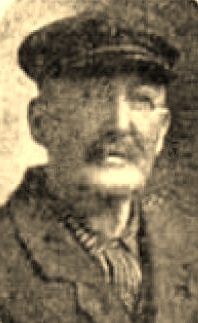
Benjamin Franklin Zellner, circa 1914 (public domain).
Private Ben Zellner of the 47th Pennsylvania’s Company K, who had initially been held prisoner near where he had been captured during the Battle of Pleasant Hill, Louisiana on 9 April 1864, and had then been force marched with other Union prisoners to Shreveport before being force marched to Camp Ford near Tyler, Texas roughly two weeks later, had then been marched back to Shreveport, Louisiana with three to four hundred other Union POWs. Then, sometime in May or early June 1864, he was moved again, via a combination of forced marches and boat trips, and placed on a train that was bound for Georgia. He likely had no idea that he was headed for Andersonville. According to the 12 April 1911 edition of the Reading Eagle newspaper:
“Benjamin Zellner, who was one of the youngest soldiers during the Civil War, was captured by the Confederates at Pleasant Hill, La., April 8, 1864. He was a member of Co. K, 47th Regiment, with Gen. Banks’ army on the Red River expedition. Comrade Zellner was wounded in a charge to the left of the lines and fell on the field. The Union forces being driven back, he, with a number of others was captured. After being kept at Pleasant Hill two weeks, they were removed to Mansfield, La., on a Saturday night and kept over night [sic] in the Court House until Sunday morning. Thence they were removed to Shreveport, La., and again kept in the Court House. From thence they were marched 110 miles to Unionville prison at Tyler, Tex…. The 47th was the only Penn’a Regiment to participate in the Red River campaign….
“In about a month [after arriving at Camp Ford in Texas, following their 8 April capture in Louisiana] 300 or 400 of the strongest were brought back to Shreveport and then transported down the Red River to an old station and marched four days, when they were taken by train to Andersonville….”
At the time of Private Zellner’s internment, Andersonville was under the command of Henry Wirz, who would later be convicted of war crimes for his brutal treatment of Union prisoners. According to the 21 September 1864 edition of The Soldiers’ Journal:
“Those Union prisoners recently released from Camp Sumter, at Andersonville, Ga., have made affidavit of the condition of the 35,000 prisoners confined there. The horrors of their imprisonment, plainly and unaffectedly narrated, have no parallel outside of Taeping or Malay annals. Twenty-five acres of human beings – so closely packed that locomotion is made obsolete, compelled to drink from sewers, and to eat raw meat like cannibals – are dwelling under vigilant espionage, hopeless, helpless, and Godless. Some are lunatic, and others have become desperately wicked; all are living, loathing, naked, starved fellow-men.”
Reportedly held as a POW for six months and fourteen days, according to the 26 March 1915 edition of The Allentown Leader, Private Zellner was freed from captivity during a prisoner exchange between the Union and Confederacy in September 1864. The 8 April 1911 Allentown Leader noted that, after that prisoner exchange, which took place “along the James River,” he was then sent with a number of his fellow former POWs “to Washington, to Fortress Monroe, to New York and home.” Subsequently awarded a furlough to continue his recovery, he returned to service with the 47th Pennsylvania Volunteers just in time to participate in a key portion of Union Major-General Phillip Sheridan’s 1864 Shenandoah Valley Campaign.
In addition to Private Zellner’s imprisonment at Andersonville, Andrew Powell was also held captive there as a POW. Formerly a member of the 47th Pennsylvania’s D Company, Private Powell had a far different outcome. Having been honorably discharged from the 47 Pennsylvania Volunteers on a surgeon’s certificate of disability in November 1862, Private Powell had served a brief stint with the 36th Pennsylvania Militia in 1863 prior to being drafted as a private into the 149th Pennsylvania Volunteer Infantry. Subsequently captured by Confederate troops during the Battle of the Wilderness on 5 May 1864, he was then taken to Andersonville. Sickened by dysentery, he died there on 6 September of that same year and was buried in an unmarked grave.
* Note: Records for the Union prisoners of war who were imprisoned at Camp Ford in Texas are maintained by the Smith County Historical Society; however, because those records contain errors, it’s important to assess their veracity. For example, one Camp Ford record stated that a “Ben Cellner” [sic, “Benjamin Zellner”] was released during that camp’s 22 July 1864 prisoner exchange with the Union Army, but several different newspapers learned from Private Zellner himself that he had actually been transferred to Andersonville prior to that date.
Confederate Hospital (Shreveport, Louisiana)
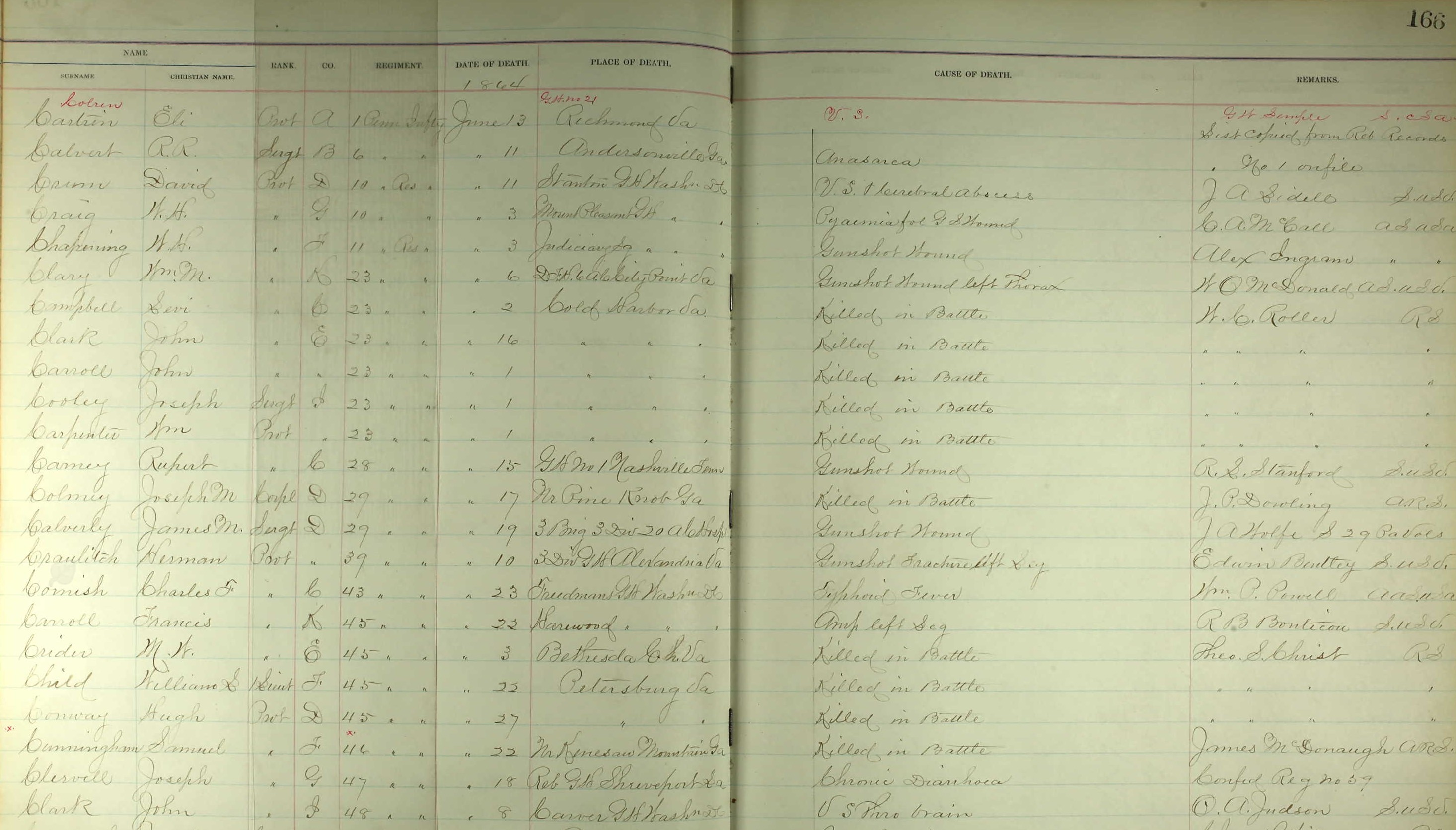
The June 1864 death of Private Joseph Clewell, Company G, 47th Pennsylvania Volunteer Infantry, was documented by the U.S. Army as having occurred at the Confederate Army Hospital No. 59 in Shreveport, Louisiana (Registers of Deaths of Volunteers, 1864, U.S. Army and U.S. National Archives and Records Administration, public domain; click to enlarge).
G Company Private Joseph Clewell — who had only been a member of the 47th Pennsylvania since mid-November 1863, fell ill sometime after being captured by Confederate troops during one of the 47th Pennsylvania’s Red River Campaign engagements.
Suffering from chronic diarrhea due to the poor water quality and unsanitary living conditions that he endured while being held as a prisoner of war (POW), he was subsequently confined to the Confederate States Army Hospital No. 59 in Shreveport, Louisiana sometime in May or early June. Held at that hospital as a POW, his health continued its decline until he died there on 18 June 1864, according to the U.S. Army’s Registers of Deaths of Volunteer Soldiers.
Sources:
- “47 Years Today Since Rebels Caught Him: This Is a Memorable Anniversary for Comrade Ben Zellner.” Allentown, Pennsylvania: The Allentown Leader, 8 April 1911.
- “A Heavy Exchange to be Effected” (description of the planning process for an exchange of prisoners between the Union and Confederate Armies that would involve the release of Union POWs from Camp Ford near Tyler, Texas). New Orleans, Louisiana: The Daily Picayune, 18 August 1864.
- Allentown’s Youngest Civil War Veteran (profile of Private Ben Zellner). Reading, Pennsylvania: Reading Eagle, 12 April 1911.
- Bates, Samuel P. History of Pennsylvania Volunteers, 1861-5, vol. 1. Harrisburg, Pennsylvania: B. Singerly, State Printer, 1869.
- Bress [sic, “Buss”], Charles, in Prisoner of War Records, Camp Ford (47th Pennsylvania Volunteer Infantry, Camp Ford, Tyler, Texas, 1864). Tyler Texas: Smith County Historical Society, 2010.
- Brown, Francis, in Civil War Muster Rolls (47th Pennsylvania Infantry, 1861-1864). Harrisburg, Pennsylvania: Pennsylvania State Archives.
- Brown, Francis, in Prisoner of War Records, Camp Ford (47th Pennsylvania Volunteer Infantry, Camp Ford, Tyler, Texas, 1864). Tyler Texas: Smith County Historical Society, 2010.
- Buss, Charles, in Civil War Muster Rolls (Company F, 47th Pennsylvania Infantry). Harrisburg, Pennsylvania: Pennsylvania State Archives.
- “Camp Ford,” in “Texas Beyond History.” Austin, Texas: Texas Archaeological Research Laboratory, University of Texas at Austin, retrieved online 24 January 2025.
- “Camp Sumter,” in “Editorial Jottings.” Washington, D.C.: The Soldiers’ Journal, 21 September 1864.
- Cellner [sic, “Zellner”], Benjamin, in Prisoner of War Records, Camp Ford (47th Pennsylvania Volunteer Infantry, Camp Ford, Tyler, Texas, 1864). Tyler Texas: Smith County Historical Society, 2010.
- Charles Brown, in Admissions Ledgers (U.S. National Home for Disabled Volunteer Soldiers, Milwaukee, Wisconsin, 1881-1897). Washington, D.C.: U.S. National Archives and Records Administration.
- Charles Buss, in Admissions Ledgers (U.S. National Home for Disabled Volunteer Soldiers, Central Branch, Dayton, Ohio, 1877-1878). Washington, D.C.: U.S. National Archives and Records Administration.
- Clewell, Joseph, in U.S. Registers of Deaths of Volunteers (Shreveport, Louisiana, date of death: 18 June 1864). Washington, D.C.: U.S. National Archives and Records Administration.
- Clouser, Ephraim, Lizzie and Jacob, in U.S. Census (Supplemental Schedules, Nos. 1 to 7, for the Defective, Dependent, and Delinquent Classes: Insane Inhabitants in the Township of Centre and Borough of New Bloomfield, Perry County, Pennsylvania, 1880). Washington, D.C.: U.S. National Archives and Records Administration.
- Crownover, James, in Civil War Veterans’ Card File, 1861-1866 (Company D, 47th Pennsylvania Infantry). Harrisburg, Pennsylvania: Pennsylvania State Archives.
- “Deaths and Funerals: Ephraim Clouser.” Harrisburg, Pennsylvania: Harrisburg Telegraph, 16 March 1899.
- Downs, James, in Civil War Veterans’ Card File, 1861-1866 (Company D, 47th Pennsylvania Infantry). Harrisburg, Pennsylvania: Pennsylvania State Archives.
- Downs, James, in Prisoner of War Records, Camp Ford (47th Pennsylvania Volunteer Infantry, Camp Ford, Tyler, Texas, 1864). Tyler Texas: Smith County Historical Society, 2010.
- “From New Orleans: Return of 300 Wounded Soldiers (report on the release of three hundred Union officers and enlisted men, including 47th Pennsylvania Volunteer Infantrymen, who had been captured after being wounded during the Battles of Mansfield and Pleasant Hill, Louisiana, and had been held as POWs at Confederate hospitals in Mansfield and Pleasant Hill or transferred to Camp Ford near Tyler, Texas, or were deceased). New York, New York: New York Tribune, 30 June 1864.
- Gilbert, Randal B. A New Look at Camp Ford, Tyler, Texas: The Largest Confederate Prison Camp West of the Mississippi River, 3rd Edition. Tyler, Texas: The Smith County Historical Society, 2010.
- Hangen, G. D., Reinmiller, Peter, Hoff, James [sic, “James Hoff”], and Mathews, Edward, in “Exchange of Prisoners of War.” New Orleans, Louisiana: The Daily True Delta, 9 August 1864, and The Daily Picayune, 18 August 1864.
- “His Glorious Record as a Soldier: Fought at Gettysburg, Red River and Shenandoah Valley and Besides Enduring the Horrors of Andersonville, Carries Bullet to This Day.” Allentown, Pennsylvania: The Allentown Leader, 26 March 1917.
- “History of the Andersonville Prison.” Andersonville, Georgia: Andersonville National Historic Site,” retrieved online 28 April 2026.
- Holman, Conrad P., in Civil War Veterans’ Card File, 1861-1866 (Company C, 47th Pennsylvania Infantry). Harrisburg, Pennsylvania: Pennsylvania State Archives.
- Holman, Conrad, in Prisoner of War Records, Camp Ford (47th Pennsylvania Volunteer Infantry, Camp Ford, Tyler, Texas, 1864). Tyler Texas: Smith County Historical Society, 2010.
- Horwitz, Tony. “Did Civil War Soldiers Have PTSD?“, in Smithsonian Magazine, January 2015. Washington, D.C.: Smithsonian Institution.
- Huff, James, in Civil War Muster Rolls and Civil War Veterans’ Card File, 1861-1866 (Company E, 47th Pennsylvania Infantry). Harrisburg, Pennsylvania: Pennsylvania State Archives.
- Hunter-Chang, Gabriel. “Sensing the Past: Nighttime at Andersonville Prison.” Richmond, Virginia: The American Civil War Museum, 24 May 2021.
- Jones, John L., in Civil War Veterans’ Card File, 1861-1866 (Company F, 47th Pennsylvania Infantry). Harrisburg, Pennsylvania: Pennsylvania State Archives.
- Kern, Samuel M., in Civil War Veterans’ Card File, 1861-1866 (Company D, 47th Pennsylvania Infantry). Harrisburg, Pennsylvania: Pennsylvania State Archives.
- Lawrence, F. Lee. “Camp Ford,” in “Hand Book of Texas.” Austin, Texas: Texas State Historical Association, retrieved online 24 January 2025.
- Letter from Joseph R. Shipman, 19th Iowa (regarding the treatment of Union soldiers who were being held prisoner at Camp Ford, Tyler, Texas). Sunbury, Pennsylvania: Sunbury Gazette, 13 August 1864.
- Matthews [sic, “Mathews”], Edward, in Civil War Veterans’ Card File, 1861-1866 (Company C, 47th Pennsylvania Infantry). Harrisburg, Pennsylvania: Pennsylvania State Archives.
- Maul, Adam, in Civil War Veterans’ Card File, 1861-1866 (Company C, 47th Pennsylvania Infantry). Harrisburg, Pennsylvania: Pennsylvania State Archives.
- McNew, John W., in Civil War Veterans’ Card File, 1861-1866 (Company C, 47th Pennsylvania Infantry). Harrisburg, Pennsylvania: Pennsylvania State Archives.
- Miller, John G., in Civil War Muster Rolls, 1861-1866 (Co. D, 47th Pennsylvania Infantry). Harrisburg, Pennsylvania State Archives.
- Miller, John G., in Civil War Veterans’ Card File, 1861-1866 (Co. D, 47th Pennsylvania Infantry). Harrisburg, Pennsylvania: Pennsylvania State Archives.
- Miller, John, in Prisoner of War Records, Camp Ford (47th Pennsylvania Volunteer Infantry, Camp Ford, Tyler, Texas, 1864). Tyler Texas: Smith County Historical Society, 2010.
- Miller, Samuel, in Prisoner of War Records, Camp Ford (47th Pennsylvania Volunteer Infantry, Camp Ford, Tyler, Texas, 1864). Tyler Texas: Smith County Historical Society, 2010.
- “Newport: Special Correspondence” (notice documenting Ephraim Clouser’s confinement for mental illness and later death at the asylum in Harrisburg, Pennsylvania). Harrisburg, Pennsylvania: Harrisburg Daily Independent, 18 March 1899.
- Notice of Ephraim Clouser’s Illness. Harrisburg, Pennsylvania: Harrisburg Telegraph, 13 January 1899.
- Powell, Andrew and Powell, Andrew F. [sic, “Andrew J. Powell”], in Civil War Veterans’ Card File, 1861-1866 (Company D, 47th Pennsylvania Infantry and Company C, 149th Pennsylvania Infantry). Harrisburg, Pennsylvania: Pennsylvania State Archives.
- Powell, Solomon, in Civil War Veterans’ Card File, 1861-1866 (Company D, 47th Pennsylvania Infantry). Harrisburg, Pennsylvania: Pennsylvania State Archives.
- Schmidt, Lewis. A Civil War History of the 47th Regiment of Pennsylvania Veteran Volunteers. Allentown, Pennsylvania: Self-published, 1986.
- Simmons, G. W. “Camp Ford, Texas” (sketch, Harper’s Weekly, 4 March 1865; accessed 9 June 2015, via University of North Texas Libraries, The Portal to Texas History, crediting Star of the Republic Museum, Washington, Texas).
- Slattery, Joe. “Confederate Soldiers Who Died at the Confederate General Hospital in Shreveport, Louisiana,” in The Genie, vol. 37, no. 1 (First Quarter, 2003), p. 12. Shreveport, Louisiana: Ark-La-Tex Genealogical Association.
- Smith, Frederick, in Civil War Veterans’ Card File, 1861-1866 (Company I, 47th Pennsylvania Infantry). Harrisburg, Pennsylvania: Pennsylvania State Archives.
- Smith, William J., in Prisoner of War Records, Camp Ford (47th Pennsylvania Volunteer Infantry, Camp Ford, Tyler, Texas, 1864). Tyler Texas: Smith County Historical Society, 2010.
- “The Exchange of Prisoners; The Cartel Agreed Upon by Gen. Dix for the United States, and Gen. Hill for the Rebels,” in “Supplementary Articles.” New York, New York: The New York Times, 6 October 1862.
- Thoms, Alston V., principal investigator and editor, and David O. Brown, Patricia A. Clabaugh, J. Philip Dering, et. al., contributing authors. Uncovering Camp Ford: Archaeological Interpretations of a Confederate Prisoner-of-War Camp in East Texas. College Station, Texas: Center for Ecological Archaelogy, Department of Anthropology, Texas A & M University.
- “Union Army Deaths in Shreveport 1864-1865.” Shreveport, Louisiana: Sons of Union Veterans, Brig. Gen. Joseph Bailey Camp No. 5, retrieved online 29 April 2021.
- “Up in Perry” (notice of Ephraim Clouser’s arrest and sanity hearing). Harrisburg, Pennsylvania: Harrisburg Telegraph, 22 September 1892.
- Wantz, Jonathan, in Civil War Veterans’ Card File, 1861-1866 (Company D, 47th Pennsylvania Infantry). Harrisburg, Pennsylvania: Pennsylvania State Archives.
- Weiss, John, in Civil War Muster Rolls (Company F, 47th Pennsylvania Infantry). Harrisburg, Pennsylvania: Pennsylvania State Archives.
- Weiss, John, in Civil War Veterans’ Card File, 1861-1866 (Company F, 47th Pennsylvania Infantry). Harrisburg, Pennsylvania: Pennsylvania State Archives.
- Weiss, John, in Prisoner of War Records, Camp Ford (47th Pennsylvania Volunteer Infantry, Camp Ford, Tyler, Texas, 1864). Tyler Texas: Smith County Historical Society, 2010.
- Weiss, John and Doras, in U.S. Civil War Widows’ and Orphans’ Pension Files. Washington, D.C.: U.S. National Archives and Records Administration.
- Wharton, Henry D. Letters from the Sunbury Guards, 1861-1866. Sunbury, Pennsylvania: Sunbury American.
- “Why Andersonville Prison Was the Worst Prisoner of War Camp of the Civil War” (video), in “Georgia Stories,” in “PBS Learning Media.” Boston, Massachusetts: GBH Education (in partnership with Georgia Public Broadcasting), 2025.
- Wieand [sic, “Weiand”], Benjamin, in U.S. Census (“Special Schedule. — Surviving Soldiers, Sailors, and Marines, and Widows, etc.”: Philadelphia, Philadelphia County, Pennsylvania, 1890). Washington, D.C.: U.S. National Archives and Records Administration.


You must be logged in to post a comment.