Alternate Spellings of Surname: Hutcheson, Hutchinson, Hutchison
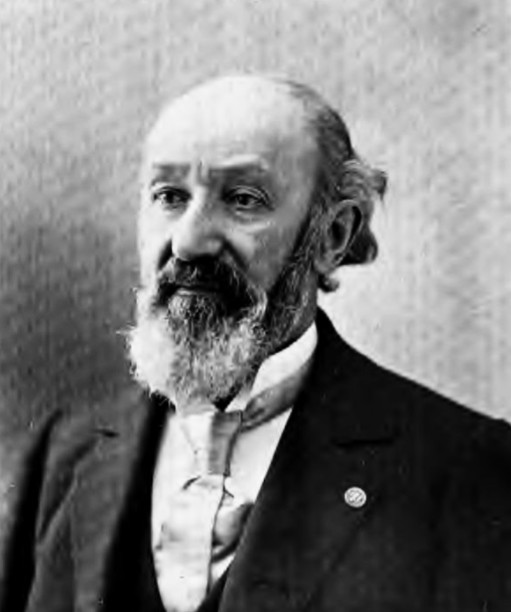
The Honorable William Cornelius Hutcheson (1834-1903), shown here as a member of the Ohio State Legislature circa 1896, served with the 47th Pennsylvania Volunteer Infantry from 1861-1864 (public domain).
The son of a successful railroad coachmaker, William Cornelius Hutcheson was a teacher-turned-soldier during the American Civil War. Wounded and then felled by sunstroke, he would ultimately survive, and would go on to migrate west, post-war, to Ohio, where he would make a name for himself as a successful building painter and decorator prior to his election to the Ohio State Legislature.
Formative Years
Born in Chambersburg, Franklin County, Pennsylvania on 24 January 1834, William Cornelius Hutcheson (1834-1903) was a son of William John Greenfield Hutcheson (1811-1875), a Chambersburg native and coachmaker who would later serve with the 133rd Pennsylvania Volunteer Infantry during the American Civil War, and Jane Ann Frank (1812-1888; alternate maiden name: “Franks”), who was a native of the Borough of Carlisle in Cumberland County, Pennsylvania.
By the mid to late 1830s, however, William C. Hutcheson and his parents were living in Perry County, Pennsylvania. It was while living there that he became the older brother to: Jane E. Hutcheson (1839-1876), who was born circa 1839; Mary Elizabeth Frank/Franks Hutcheson (1842-1924), who was born on 18 June 1842 and would later become a seamstress but would never marry; Elmira Sibbitt Hutcheson (1843-1910), who was born in Landisburg, Perry County on 10 June 1843 (according to burial records of the Mt. Zion Evangelical Lutheran Church in Goodyear, Cumberland County, Pennsylvania; alternate birth date: May 1840, according to federal census records) and would later wed Jeremiah H. Hull (1845-1905); Anna B. D. Hutcheson (1844-1876; alternate birth year: 1847), who was born circa 1844 and would also never marry; John Alpheus Linn Hutcheson (1850-1940), who was born in Landisburg on 13 January 1850 and would later wed Mary Elizabeth Jumper (1858-1937); and Alfareta K. Hutcheson (1853-1923), who was born on 3 August 1853, would become known to family and friends as “Kate” and would later wed David Michael Boyer (1848-1917).
Educated in the common schools of Perry County until 1848, William C. Hutcheson then benefitted from further study at the academies in “Neville and Shippensburg, Pa., afterward entering Dixon college” [sic, possibly Dickinson College in Carlisle], according to biographers James K. Mercer and C. N. Vallandigham. In addition, he received five years of military training. Beginning as a drummer boy with the Landisburg Artillery, he subsequently advanced up through the ranks “to sergeant, lieutenant and captain.”
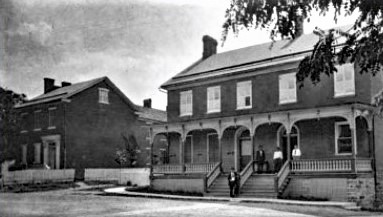
This building at the corner of Main and Carlisle Streets in Landisburg, Perry County, Pennsylvania served as a stop on the Underground Railroad before and during the American Civil War (photo circa 1900, public domain).
It was also during that phase of his life that he began sharing the knowledge he was acquiring with others, as a teacher in the communities where he resided — a profession he would continue to pursue for six years. He then began his own family line by marrying Sarah Jones Kacy (1839-1929) in Carlisle on 8 March 1858. A native of Elliottsburg, Perry County, Sarah was a daughter of Mary Ann Chisholm (1847-1887; alternate given name: “Marianna”) and James Kacy (1837-1897), who would later serve as William C. Hutcheson’s commanding officer in the 47th Pennsylvania Volunteer Infantry during the American Civil War.
Following their marriage, William and Sarah (Kacy) Hutcheson settled in Perry County, where they became the parents of Frazier Kacy Hutcheson (1859-1929), who was born in Landisburg on 14 December 1858, would grow up to become an allopathic physician and would marry Ida Koch (1861-1928) in 1880. By the early 1860s, William C. Hutcheson was employed as a painter, and was crafting a new life with his wife and children in Elliottsburg, while his parents and siblings continued to reside in Landisburg. Their stability would soon be threatened, however, as the United States of America descended into a secession crisis that would quickly devolve into a disastrous civil war.
American Civil War
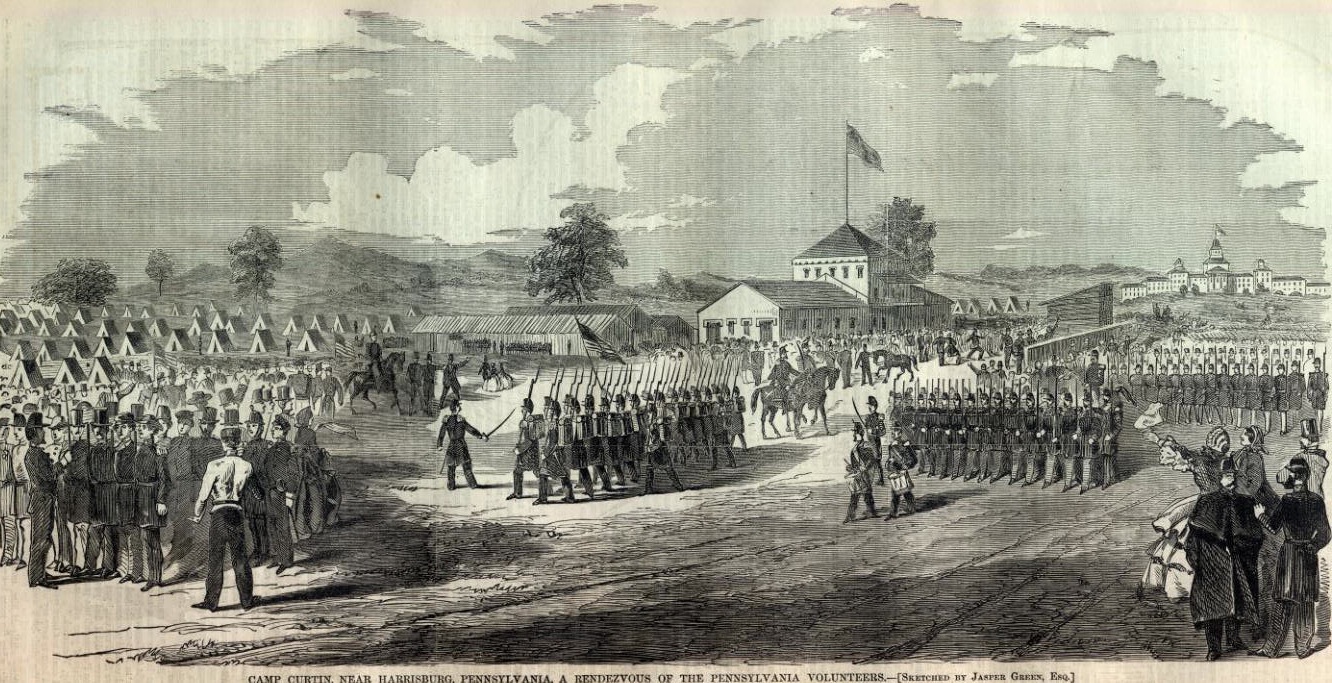
Camp Curtin (Harper’s Weekly, 1861, public domain).
On 21 August 1861, William C. Hutcheson became one of the early responders to U.S. President Abraham Lincoln’s call for volunteers to help bring an end to the nation’s expanding civil war when he enrolled for military service in Elliottsburg, Perry County, Pennsylvania. Roughly a month later, he kissed his pregnant wife goodbye, hugged his children and headed for the railroad station, where he boarded a train and departed for the city of Harrisburg in Dauphin County, Pennsylvania. After disembarking there, he headed for Camp Curtin, where, on 19 September, he officially mustered in as a private with Company H of the recently-formed 47th Pennsylvania Volunteer Infantry. Military records at the time described him as a twenty-six-year-old painter and Elliottsburg resident who was five feet, eight inches tall with black hair, hazel eyes and a light complexion.
* Note: Company H was the final company to be mustered in to the Pennsylvania Volunteers’ 47th Regiment, and was led by William C. Hutcheson’s father-in-law, Captain James Kacy, a forty-four-year-old merchant and resident of Elliottsburg who had served as a railroad postal clerk for the United States government in the mid-1850s, during the tenure of U.S. President Franklin Pierce. Supporting Captain Kacy as an H Company officer was First Lieutenant William Wallace Geety, a twenty-nine-year-old dentist from Harrisburg. With only ninety men mustered for duty by 19 September 1861 (compared to the average total of one hundred), those officers would continue to recruit and enroll men through 30 October, eventually bringing H Company’s roster up to ninety-seven.

The U.S. Capitol Building, unfinished at the time of President Abraham Lincoln’s inauguration, was still not completed when the 47th Pennsylvania Volunteers arrived in Washington, D.C. in September 1861 (public domain).
Following brief light infantry training, Captain Kacy and his company were sent by train with the 47th Pennsylvania to Washington, D.C., where they were stationed at “Camp Kalorama” on the Kalorama Heights near Georgetown, about two miles from the White House, beginning 21 September. On 22 September, C Company Field Musician Henry D. Wharton penned the following update for his hometown newspaper, the Sunbury American:
“After a tedious ride we have, at last, safely arrived at the City of ‘magnificent distances.’ We left Harrisburg on Friday last at 1 o’clock A.M. and reached this camp yesterday (Saturday) at 4 P.M., as tired and worn out a sett [sic] of mortals as can possibly exist. On arriving at Washington we were marched to the ‘Soldiers Retreat,’ a building purposely erected for the benefit of the soldier, where every comfort is extended to him and the wants of the ‘inner man’ supplied.
After partaking of refreshments we were ordered into line and marched, about three miles, to this camp. So tired were the men, that on marching out, some gave out, and had to leave the ranks, but J. Boulton Young, our ‘little Zouave,’ stood it bravely, and acted like a veteran. So small a drummer is scarcely seen in the army, and on the march through Washington he was twice the recipient of three cheers.
We were reviewed by Gen. McClellan yesterday [21 September 1861] without our knowing it. All along the march we noticed a considerable number of officers, both mounted and on foot; the horse of one of the officers was so beautiful that he was noticed by the whole regiment, in fact, so wrapt [sic] up were they in the horse, the rider wasn’t noticed, and the boys were considerably mortified this morning on dis-covering they had missed the sight of, and the neglect of not saluting the soldier next in command to Gen. Scott.
Col. Good, who has command of our regiment, is an excellent man and a splendid soldier. He is a man of very few words, and is continually attending to his duties and the wants of the Regiment.
…. Our Regiment will now be put to hard work; such as drilling and the usual business of camp life, and the boys expect and hope an occasional ‘pop’ at the enemy.”

Chain Bridge across the Potomac above Georgetown looking toward Virginia, 1861 (The Illustrated London News, public domain).
Then, on 24 September, the soldiers of Company H and their fellow 47th Pennsylvanians became part of the federal service when the regiment officially mustered into the U.S. Army. Three days later, on 27 September, they were assigned to the 3rd Brigade of Brigadier-General Isaac Ingalls Stevens, which also included the 33rd, 49th and 79th New York regiments. By that afternoon, the 47th Pennsylvania was on the move again. Ordered onward by Brigadier-General Silas Casey, the 47th Pennsylvania Volunteer Infantrymen marched behind their Regimental Band until reaching Camp Lyon, Maryland on the Potomac River’s eastern shore. At 5 p.m., they joined the 46th Pennsylvania in moving double-quick (one hundred and sixty-five steps per minute using thirty-three-inch steps) across the “Chain Bridge” marked on federal maps, and continued on for roughly another mile before being ordered to make camp.
The next morning, they broke camp and moved again. Marching toward Falls Church, Virginia, they arrived at Camp Advance around dusk, where they pitched their tents in a deep ravine about two miles from the bridge they had just crossed, near a new federal military facility under construction (Fort Ethan Allen), which was also located near the headquarters of Brigadier-General William Farrar Smith (nicknamed “Baldy”), the commander of the Union’s massive Army of the Potomac (“Mr. Lincoln’s Army”). Armed with Mississippi rifles supplied by the Keystone State, their job was to help defend the nation’s capital.
Once again, Company C Musician Henry Wharton recapped the regiment’s activities, noting, via his 29 September letter home to the Sunbury American, that the 47th had changed camps three times in three days:
“On Friday last we left Camp Kalorama, and the same night encamped about one mile from the Chain Bridge on the opposite side of the Potomac from Washington. The next morning, Saturday, we were ordered to this Camp [Camp Advance near Fort Ethan Allen, Virginia], one and a half miles from the one we occupied the night previous. I should have mentioned that we halted on a high hill (on our march here) at the Chain Bridge, called Camp Lyon, but were immediately ordered on this side of the river. On the route from Kalorama we were for two hours exposed to the hardest rain I ever experienced. Whew, it was a whopper; but the fellows stood it well – not a murmur – and they waited in their wet clothes until nine o’clock at night for their supper. Our Camp adjoins that of the N.Y. 79th (Highlanders.)….
We had not been in this Camp more than six hours before our boys were supplied with twenty rounds of ball and cartridge, and ordered to march and meet the enemy; they were out all night and got back to Camp at nine o’clock this morning, without having a fight. They are now in their tents taking a snooze preparatory to another march this morning…. I don’t know how long the boys will be gone, but the orders are to cook two days’ rations and take it with them in their haversacks….
There was a nice little affair came off at Lavensville [sic, Lewinsville], a few miles from here on Wednesday last; our troops surprised a party of rebels (much larger than our own.) killing ten, took a Major prisoner, and captured a large number of horses, sheep and cattle, besides a large quantity of corn and potatoes, and about ninety six tons of hay. A very nice day’s work. The boys are well, in fact, there is no sickness of any consequence at all in our Regiment….”

Unidentified regiment, Camp Griffin, Virginia, fall 1861 (U.S. Library of Congress, public domain).
Sometime during that phase of duty, as part of the 3rd Brigade, the 47th Pennsylvanians were moved to a site they initially christened “Camp Big Chestnut” in reference to a large chestnut tree that was located nearby. The site would eventually become known to the Keystone Staters as “Camp Griffin,” and was located roughly ten miles from Washington, D.C. Posted not far from their home state, members of the regiment occasionally had the good fortune to receive personal visits from family members.
On 11 October, the 47th Pennsylvania Volunteers marched in the Grand Review at Bailey’s Cross Roads. In a letter home in mid-October, Captain John Peter Shindel Gobin (the commanding officer of C Company who would be promoted in 1864 to lead the entire 47th Regiment) reported that companies D, A, C, F and I (the 47th Pennsylvania’s right wing) were ordered to picket duty after the left-wing companies (B, G, K, E, and H) had been forced to return to camp by Confederate troops:
“I was ordered to take my company to Stewart’s [sic] house, drive the Rebels from it, and hold it at all hazards. It was about 3 o’clock in the morning, so waiting until it was just getting day, I marched 80 men up; but the Rebels had left after driving Capt. Kacy’s company [H] into the woods. I took possession of it, and stationed my men, and there we were for 24 hours with our hands on our rifles, and without closing an eye. I took ten men, and went out scouting within half a mile of the Rebels, but could not get a prisoner, and we did not dare fire on them first. Do not think I was rash, I merely obeyed orders, and had ten men with me who could whip a hundred; Brosius, Piers, Harp and McEwen [all of Company C] were among the number. Every man in the company wanted to go. The Rebels did not attack us, and if they had they would have met with a warm reception, as I had my men posted in such a manner that I could have whipped a regiment. My men were all ready and anxious for a ‘fight.’”
Captain Gobin had been referring to Brigadier-General James Ewell Brown (“J.E.B.”) Stuart, commanding officer of the Confederate Army of the Potomac (later known as the Army of Northern Virginia), under whose authority the 4th Virginia Cavalry (“Black Horse Cavalry”) fell. Stuart’s Fairfax County, Virginia home had been commandeered by the Union Army and used by the 47th Pennsylvania Volunteers and other Union regiments as the base of operations for their picket lines in that area. In his letter of 13 October, Henry Wharton also described their duties and their new home:
“The location of our camp is fine and the scenery would be splendid if the view was not obstructed by heavy thickets of pine and innumerable chesnut [sic] trees. The country around us is excellent for the Rebel scouts to display their bravery; that is, to lurk in the dense woods and pick off one of our unsuspecting pickets. Last night, however, they (the Rebels) calculated wide of their mark; some of the New York 33d boys were out on picket; some fourteen or fifteen shots were exchanged, when our side succeeded in bringing to the dust, (or rather mud,) an officer and two privates of the enemy’s mounted pickets. The officer was shot by a Lieutenant in Company H [?], of the 33d.
Our own boys have seen hard service since we have been on the ‘sacred soil.’ One day and night on picket, next day working on entrenchments at the Fort, (Ethan Allen.) another on guard, next on march and so on continually, but the hardest was on picket from last Thursday morning ‘till Saturday morning – all the time four miles from camp, and both of the nights the rain poured in torrents, so much so that their clothes were completely saturated with the rain. They stood it nobly – not one complaining; but from the size of their haversacks on their return, it is no wonder that they were satisfied and are so eager to go again tomorrow. I heard one of them say ‘there was such nice cabbage, sweet and Irish potatoes, turnips, &c., out where their duty called them, and then there was a likelihood of a Rebel sheep or young porker advancing over our lines and then he could take them as ‘contraband’ and have them for his own use.’ When they were out they saw about a dozen of the Rebel cavalry and would have had a bout with them, had it not been for…unlucky circumstance – one of the men caught the hammer of his rifle in the strap of his knapsack and caused his gun to fire; the Rebels heard the report and scampered in quick time….”

The Big Chestnut Tree, Camp Griffin, Langley, Virginia, 1861 (U.S. Library of Congress, public domain).
On 20 October 1861, Private Daniel Foose of H Company died while the regiment was stationed at Camp Griffin. According to historian Lewis Schmidt and others researching the 47th Pennsylvania, Private Foose was laid to rest with full military honors three days later — at 4 p.m. on 23 October 1861 — under the large chestnut tree for which the camp had originally been named (“Camp Big Chestnut”). He was just nineteen years old. Two days later, on Friday, 22 October, the 47th engaged in a morning Divisional Review, described by Schmidt as massing “about 10,000 infantry, 1000 cavalry, and twenty pieces of artillery all in one big open field.” In late October, according to Schmidt, the men from Companies B, G and H woke at 3 a.m., assembled a day’s worth of rations, marched four miles from camp, and took over picket duties from the 49th New York:
“Company B was stationed in the vicinity of a Mrs. Jackson’s house, with Capt. Kacy’s Company H on guard around the house. The men of Company B had erected a hut made of fence rails gathered around an oak tree, in front of which was the house and property, including a persimmon tree whose fruit supplied them with a snack. Behind the house was the woods where the Rebels had been fired on last Wednesday morning while they were chopping wood there.”
Around that same time, Capt. Kacy divided H Company into four squads, by tent grouping, each under the leadership of a sergeant “whose duty it shall be to see that the arms and accoutrements are kept in good order.”
“That the men keep their tents clean, that they are clean in their person, and that they wash their hands and faces and comb their hair every day. That the men keep order in their quarters and report all damage to arms, want or waste of ammunition, and all disorderly conduct.”
Kacy followed that order with another clarifying meal times (breakfast: 6 a.m., dinner: noon, supper: 6 p.m.) and duty schedules (7 a.m., 1 p.m., 7 p.m.). In early November, Kacy directed that “while in camp, no permits for washing will be given on any other days than Monday, Wednesday, or Friday.”
“No permits or leaves of absence from company will be given on any days but Monday and Friday. Sutler tickets will be given only in the morning between the hours of 7 and 9.”
It was during that same period of his military service that Private William C. Hutcheson received word at Camp Griffin that his wife, Sarah, had given birth to their second son, James McClellan Hutcheson (1861-1936), who had been born in Elliottsburg on 16 November 1861; James would later go on to marry Anna Maria Garretson (1865-1952).
On 17 November, Company C’s Henry Wharton revealed more details about life at Camp Griffin:
“This morning our brigade was out for inspection; arms, accoutrements [sic], clothing, knapsacks, etc, all were out through a thorough examination, and if I must say it myself, our company stood best, A No. 1, for cleanliness. We have a new commander to our Brigade, Brigadier General Brannen [sic], of the U.S. Army, and if looks are any criterion, I think he is a strict disciplinarian and one who will be as able to get his men out of danger as he is willing to lead them to battle….
The boys have plenty of work to do, such as piquet [sic] duty, standing guard, wood-chopping, police duty and day drill; but then they have the most substantial food; our rations consist of fresh beef (three times a week) pickled pork, pickled beef, smoked pork, fresh bread, daily, which is baked by our own bakers, the Quartermaster having procured portable ovens for that purpose, potatoes, split peas, beans, occasionally molasses and plenty of good coffee, so you see Uncle Sam supplies us plentifully….
A few nights ago our Company was out on piquet [sic]; it was a terrible night, raining very hard the whole night, and what made it worse, the boys had to stand well to their work and dare not leave to look for shelter. Some of them consider they are well paid for their exposure, as they captured two ancient muskets belonging to Secessia. One of them is of English manufacture, and the other has the Virginia militia mark on it. They are both in a dilapidated condition, but the boys hold them in high estimation as they are trophies from the enemy, and besides they were taken from the house of Mrs. Stewart, sister to the rebel Jackson who assassinated the lamented Ellsworth at Alexandria. The honorable lady, Mrs. Stewart, is now a prisoner at Washington and her house is the headquarters of the command of the piquets [sic]….
Since the success of the secret expedition, we have all kinds of rumors in camp. One is that our Brigade will be sent to the relief of Gen. Sherman, in South Carolina. The boys all desire it and the news in the ‘Press’ is correct, that a large force is to be sent there, I think their wish will be gratified….”
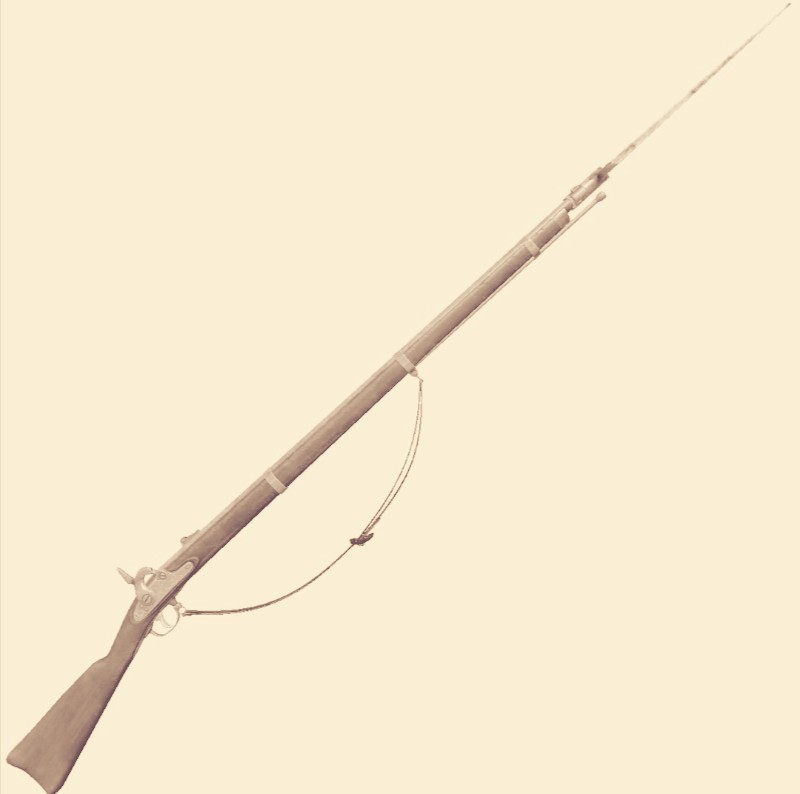
1861 Springfield rifle with attached bayonet (public domain).
Four days later — on 21 November, the 47th Pennsylvania participated in another morning divisional review that was monitored by the regiment’s founder and most senior officer, Colonel Tilghman H. Good; additional drills were then held that afternoon. According to Schmidt, “each man was supplied with ten blank cartridges.” Afterward, “Gen. Smith requested Gen. Brannan to inform Col. Good that the 47th was the best regiment in the whole division.” As a reward — and in preparation for bigger things to come, Brigadier-General John Milton Brannan obtained brand new Springfield rifles for every member of the 47th Pennsylvania.
As winter arrived and deepened, Privates Robert Fry and William Dorman were discharged, respectively, on surgeons’ certificates of disability on 16 December and New Year’s Eve. Captain Kacy of H Company was also granted leave, and was able to spend a brief period of time with his family at home in Perry County over the holidays before returning for duty in early January.
1862

The 47th Pennsylvania Volunteers were transported to Florida aboard the steamship Oriental in January 1862 (public domain).
Ordered to relocate from Virginia back to Maryland in early to mid-January 1862, the 47th Pennsylvania Volunteers packed up their scant personal belongings, weapons and other equipment and departed from Camp Griffin at 8:30 a.m. on Wednesday, 22 January. Marching through deep mud for three miles in order to reach the railroad station at Falls Church, they were then transported by rail to Alexandria, where they boarded the steamship, City of Richmond, and sailed the Potomac to the Washington Arsenal. Once there, they were re-equipped before they were marched off for dinner and rest at the Soldiers’ Retreat in Washington, D.C.
The next afternoon, the 47th Pennsylvanians hopped cars on the Baltimore & Ohio Railroad, and headed for Annapolis, Maryland. Arriving around 10 p.m., they were assigned quarters in barracks at the Naval Academy. They then spent that Friday through Monday (24-27 January 1862) loading their equipment and other supplies onto the steamship Oriental.
By that afternoon, when the 47th Pennsylvania Volunteers commenced boarding the Oriental, they were ferried to the big steamship by smaller steamers. The officers boarded last and, per the directive of Brigadier-General Brannan, they steamed away for the Deep South at 4 p.m. They were headed for Florida which, despite its secession from the Union, remained strategically important to the Union due to the presence of Forts Taylor and Jefferson in Key West and the Dry Tortugas.
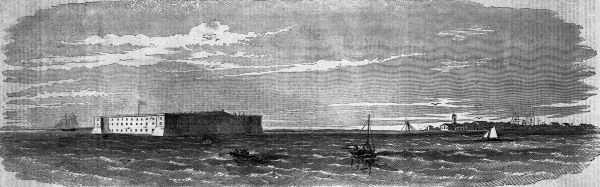
Fort Taylor, Key West, Florida, circa 1861 (courtesy, State Archives of Florida).
Several days later, in early February 1862, the 47th Pennsylvania Volunteers arrived in Key West, where they were assigned either to barracks at Fort Taylor or tents on the city’s east side. Their chaplain, the Reverand William D. C. Rodrock, described their quarters as “large and commodious two story buildings forming three sides of a quadrangle, the opening toward the sea.” Officers were housed in six of the fort’s structures near the parade ground while the enlisted men were housed in two other buildings or in Sibley tents. Despite having seemingly more stable accommodations, Private Frederick Watts was dead within days of H Company’s arrival, having succumbed 13 February 1862 while confined to the 47th’s Regimental Hospital. Military records described his cause of death as pneumonia or “brain fever.” According to Schmidt, Watts “arrived at Key West sick with measles and a cold he had caught on board ship.” In response, Captain Kacy continued to refine H Company operations, noting:
“Sgt. R.S. Gardner will have under his command tents #1 and 2 and will be held personally responsible for the clean up of the men in person, clothing, arms, accoutrements, and quarters. Sgt. James Hahn will have under him tents #3 and 4 and be held responsible the same as #1 and 2. Sgt. Lynch will have under his control tents #5 and 6 and will be likewise held responsible. The Sgts. Gardner, Hahn and Lynch will have the men of the company on the parade ground at 5:30 AM and when one of them is on guard, the other two will attend to this drill duty and divide the squad between their respective commands.”
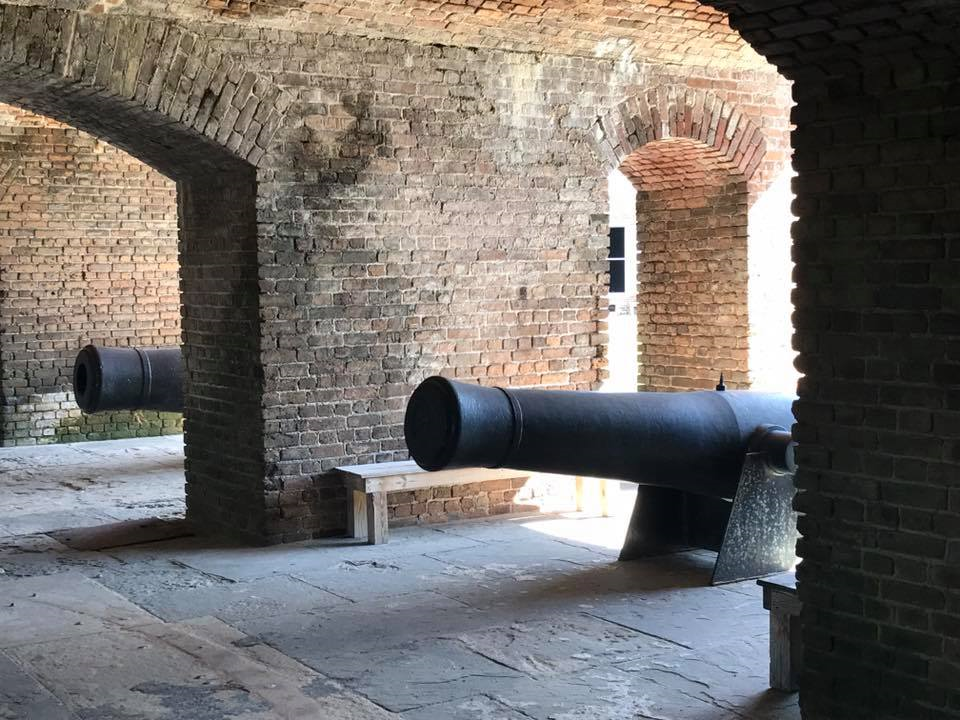
Artillery, Fort Taylor, Key West, Florida (Phil Spaugy, 2017, photo used with permission).
During the weekend of Friday, 14 February, the 47th Pennsylvanians introduced their presence to Key West residents as the regiment paraded through the streets of the city. That Sunday, a number of the men attended to their spiritual needs by participating in services at area churches and mingling with the locals. Life then slowly fell into a routine as the 47th Pennsylvanians adjusted to their new schedule of daily drills, garrison duties and heavy artillery training. Members of the regiment also felled trees, built new roads and strengthened the installation’s fortifications. But there were lighter moments as well. According to a letter penned by Henry Wharton on 27 February 1862, the regiment commemorated the birthday of former U.S. President George Washington with a parade, a special ceremony involving the reading of Washington’s farewell address to the nation (first delivered in 1796), the firing of cannon at the fort, and a sack race and other games on 22 February. The festivities resumed two days later when the 47th Pennsylvania’s Regimental Band hosted an officers’ ball at which “all parties enjoyed themselves, for three o’clock of the morning sounded on their ears before any motion was made to move homewards.” This was then followed by another concert by the Regimental Band on Wednesday evening, 26 February.
As winter turned to spring and early summer and they were sent out beyond the city of Key West on various duty assignments, however, they became increasingly aware of just how different their new work environment was. According to Schmidt:
“There was a slave camp about one mile from the military camps, where 150 Blacks were engaged in manufacturing salt; it was reported that 50,000 bushels of salt were made on the island each year by solar evaporation…. The manufacture of salt was terminated later in 1862, and was not restarted until 1864, to prevent any salt from the facility finding its way into the Confederacy….
Another building of note on the island of Key West during the war was the ‘slave barracoons’, used to house Blacks taken from captured slavery vessels, and described as being a long low building about 300 feet by 30 feet. Lt. Geety reported that there were 1500 slaves there at one time, and 400 died in four months [sic] time.”
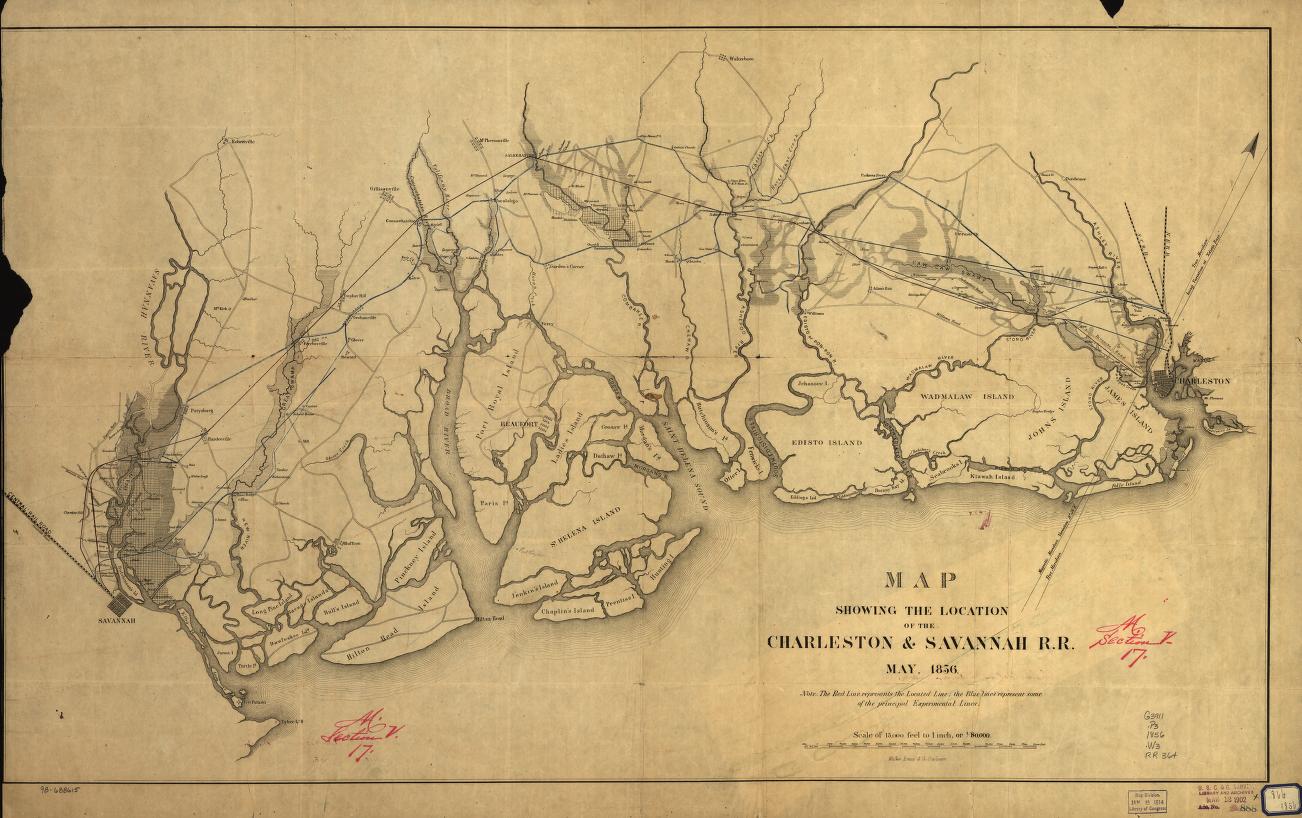
This 1856 map of the Charleston & Savannah Railroad shows the island of Hilton Head, South Carolina in relation to the towns of Beaufort and Pocotaligo (U.S. Library of Congress, public domain).
Next ordered to Hilton Head, South Carolina from mid-June through July, the 47th Pennsylvanians camped near Fort Walker before relocating to the Beaufort District, Department of the South, roughly thirty-five miles away. Frequently assigned to hazardous picket detail north of their main camp, which put them at increased risk from enemy sniper fire, the members of the 47th Pennsylvania became known for their “attention to duty, discipline and soldierly bearing,” and “received the highest commendation from Generals Hunter and Brannan,” according to historian Samuel P. Bates. Around that same time, detachments from the regiment were assigned to the Expedition to Fenwick Island (9 July) and the Demonstration against Pocotaligo (10 July) while men from Companies B and H “crossed the Coosaw River at the Port Royal Ferry and drove off the Rebel pickets before returning ‘home’ without a loss,” according to Schmidt. The actions were the Union’s response to the burning by Confederate troops of the ferry house at Port Royal. H Company’s Sergeant Reuben Shatto Gardner later described that mission in a letter to family and friends:
“So the other day we took a notion to turn the joke on them and we crossed over to this side and drove them off their posts and back several miles, and burnt four houses that were used by them to picket in. Our skirmishers had four shots at the rebels, but with what effect we don’t know as they soon got out of harm’s way. Companies H and B were all that crossed. The boys got so eager to follow up the rebels that they did not want to come back when ordered. Our force was too small to advance far, so we went back after doing all the damage we could to them. They fled in such a hurry as to leave three saddles, one double barrelled shot gun, several overcoats, haversacks, canteens, &c., all of which our boys brought along as relics, that being the first of anything of that kind our regiment had. Now the boys want to cross every day; but the Colonel won’t allow them as it is beyond his orders to cross the river, and probably we would meet with a repulse, as the rebels have been in force on the opposite side since we drove them off. They are like a bee’s nest when stirred up. The day after we were over they fired more than a hundred shots at our boys. They returned some shots and we only laughed at them. The distance across the river is from 800 to 1000 yards, and of course there can be but little damage done at that distance.”
On Saturday, 12 July, H Company’s First Lieutenant William Geety documented the engagement of Union troops with other Confederate soldiers, noting that troops from five Union gunboats had “shelled the shore and crossed over and burned three shanties…. I had command of the right of the skirmish but did not get an opportunity to kill any secessionists. I got a secessionist cap box made in New York and case of a shell.” The next day, Sergeant Reuben Gardner continued working on his letter, noting:
“We have been on picket now ten days [near Port Royal Ferry, along the Broad River] and were due to be relieved tomorrow; but for some cause are now to stay five days longer. The general rule is ten days; but always whip the horse that pulls the hardest. We are ten miles from camp, and are picketing around the west end of the island, for 12 miles along the shore. Five companies of our regiment are out at a time. The rebel pickets are right opposite to us, across the river, and dozens of shots are exchanged every day; but without any effect on our side. The rebel’s [sic] guns fail to reach across. Our files will shoot across with a double charge, but we only fire at each other for fun. The 7th New Hampshire were on here before we came out and the rebels made them leave the line. They took advantage of that and crossed over and burnt a ferry house that stood on the end of the causeway on this side….
We have the greatest picket line here entirely. At low tide down along the beach at night you can’t hear thunder, by times, for the snapping of oysters, croaking of frogs, buzzing of mosquitoes, and the noise of a thousand other reptiles and varmints. It beats all I have heard since the commencement of the war. We have had a pretty good time out here on picket and good weather; but 15 days is a little too long to lie in the woods for my fancy.”
On 23 July, the men were reminded, via H Company Orders, No. 27, that “All members of Company H must while on duty be in proper uniform.” During that time, the weather was hot and humid with temperatures reaching into the mid to upper 90s. By August, it was “98 degrees in the shade,” according to C Company Musician Henry Wharton, prompting Union officers to suspend military drills. Private Jeremiah Smith subsequently became one of those to die while stationed with the 47th Pennsylvania at Beaufort, South Carolina — although his foe was not a human one. He succumbed to fever complicated by dysentery on 9 August 1862.
* Note: Meanwhile, William C. Hutcheson’s father, William John Greenfield Hutcheson, was preparing to report for basic training in Pennsylvania. Enrolled for military service in Loysville, Perry County on 8 August 1862, he would report for duty at Camp Curtin in Harrisburg, where he would officially muster in on 13 August as a private with Company H of the the 133rd Pennsylvania Volunteer Infantry. Forty-three years old at the time, Private William J. G. Hutcheson would subsequently take part in the Battle of Fredericksburg, Virginia (12-15 December 1862), the “Mud March” of Union General Ambrose Burnside (20-24 January 1863) and the Battle of Chancellorsville, Virginia (1-5 May 1863), prior to his honorable discharge with his regiment on 25 May 1863.
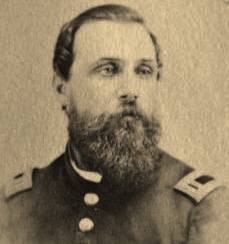
Adjutant and First Lieutenant Washington H. R. Hangen (circa 1862-1864, public domain).
On 12 September 1862, Colonel Tilghman Good and his adjutant, First Lieutenant Washington H. R. Hangen, issued Regimental Orders, No. 207 from the 47th Pennsylvania’s Headquarters in Beaufort, South Carolina:
“I. The Colonel commanding desires to call the attention of all officers and men in the regiment to the paramount necessity of observing rules for the preservation of health. There is less to be apprehended from battle than disease. The records of all companies in climate like this show many more casualties by the neglect of sanitary post action then [sic] by the skill, ordnance and courage of the enemy. Anxious that the men in my command may be preserved in the full enjoyment of health to the service of the Union. And that only those who can leave behind the proud epitaph of having fallen on the field of battle in the defense of their country shall fail to return to their families and relations at the termination of this war.
II. All the tents will be struck at 7:30 a.m. on Monday, Wednesday and Saturday of each week. The signal for this purpose will be given by the drum major by giving three taps on the drum. Every article of clothing and bedding will be taken out and aired; the flooring and bunks will be thoroughly cleaned. By the same signal at 11 a.m. the tents will be re-erected. On the days the tents are not struck the sides will be raised during the day for the purpose of ventilation.
III. The proper cooking of provisions is a matter of great importance more especially in this climate but have not yet received from a majority of officers of the regiment that attention that should be paid to it.
IV. Thereafter an officer of each company will be detailed by the commander of each company and have their names reported to these headquarters to superintend the cooking of provisions taking care that all food prepared for the soldiers is sufficiently cooked and that the meats are all boiled or seared (not fried). He will also have charge of the dress table and he is held responsible for the cleanliness of the kitchen cooking utensils and the preparation of the meals at the time appointed.
V. The following rules for the taking of meals and regulations in regard to the conducting of the company will be strictly followed. Every soldier will turn his plate, cup, knife and fork into the Quarter Master Sgt who will designate a permanent place or spot each member of the company and there leave his plate & cup, knife and fork placed at each meal with the soldier’s rations on it. Nor will any soldier be permitted to go to the company kitchen and take away food therefrom.
VI. Until further orders the following times for taking meals will be followed Breakfast at six, dinner at twelve, supper at six. The drum major will beat a designated call fifteen minutes before the specified time which will be the signal to prepare the tables, and at the time specified for the taking of meals he will beat the dinner call. The soldier will be permitted to take his spot at the table before the last call.
VII. Commanders of companies will see that this order is entered in their company order book and that it is read forth with each day on the company parade. All commanding officers of companies will regulate daily their time by the time of this headquarters. They will send their 1st Sergeants to this headquarters daily at 8 a.m. for this purpose.
Great punctuality is enjoined in conforming to the stated hours prescribed by the roll calls, parades, drills, and taking of meals; review of army regulations while attending all roll calls to be suspended by a commissioned officer of the companies, and a Captain to report the alternate to the Colonel or the commanding officer.
At 5 a.m., Commanders of companies are imperatively instructed to have the company quarters washed and policed and secured immediately after breakfast.
At 6 a.m., morning reports of companies request [sic] by the Captains and 1st Sgts and all applications for special privileges of soldiers must be handed to the Adjutant before 8 a.m.
By Command of Col. T. H. Good
W. H. R. Hangen Adj”
In addition, First Lieutenant and Regimental Adjutant Hangen clarified the regiment’s schedule as follows:
- Reveille (5:30 a.m.) and Breakfast (6:00 a.m.)
- First and Second Calls for Guard (6:10 a.m. and 6:15 a.m.)
- Surgeon’s Call (6:30 a.m.)
- First and Second Calls for Company Drill (6:45 a.m. and 7:00 a.m.)
- Recall from Company Drill (8:00 a.m.)
- First and Second Calls for Squad Drill (9:00 a.m. and 9:15 a.m.)
- Recall from Squad Drill (10:30 a.m.)
- Dinner (12:00 noon)
- Call for Non-commissioned Officers (1:30 p.m.)
- Recall for Non-commissioned Officers (2:30 p.m.)
- First and Second Calls for Squad Drills (3:15 p.m. and 3:30 p.m.)
- Recall from Squad Drill (4:30 p.m.)
- First and Second Calls for Dress Parade (5:10 p.m. and 5:15 p.m.)
- Supper (6:10 p.m.)
- Tattoo (lights out, 9:00 p.m.) and Taps (9:15 p.m.)

Colonel Tilghman H. Good, commanding officer, 47th Pennsylvania Volunteers (public domain image, circa 1863).
As the one-year anniversary of the 47th Pennsylvania’s departure from the Great Keystone State dawned, thoughts turned to home and Divine Providence as Colonel Tilghman Good issued Special Orders, No. 60 from the 47th’s Regimental Headquarters in Beaufort, South Carolina:
“The Colonel commanding takes great pleasure in complimenting the officers and men of the regiment on the favorable auspices of today.
Just one year ago today, the organization of the regiment was completed to enter into the service of our beloved country, to uphold the same flag under which our forefathers fought, bled, and died, and perpetuate the same free institutions which they handed down to us unimpaired.
It is becoming therefore for us to rejoice on this first anniversary of our regimental history and to show forth devout gratitude to God for this special guardianship over us.
Whilst many other regiments who swelled the ranks of the Union Army even at a later date than the 47th have since been greatly reduced by sickness or almost cut to pieces on the field of battle, we as yet have an entire regiment and have lost but comparatively few out of our ranks.
Certain it is we have never evaded or shrunk from duty or danger, on the contrary, we have been ever anxious and ready to occupy any fort, or assume any position assigned to us in the great battle for the constitution and the Union.
We have braved the danger of land and sea, climate and disease, for our glorious cause, and it is with no ordinary degree of pleasure that the Colonel compliments the officers of the regiment for the faithfulness at their respective posts of duty and their uniform and gentlemanly manner towards one another.
Whilst in numerous other regiments there has been more or less jammings and quarrelling [sic] among the officers who thus have brought reproach upon themselves and their regiments, we have had none of this, and everything has moved along smoothly and harmoniously. We also compliment the men in the ranks for their soldierly bearing, efficiency in drill, and tidy and cleanly appearance, and if at any time it has seemed to be harsh and rigid in discipline, let the men ponder for a moment and they will see for themselves that it has been for their own good.
To the enforcement of law and order and discipline it is due our far fame as a regiment and the reputation we have won throughout the land.
With you he has shared the same trials and encountered the same dangers. We have mutually suffered from the same cold in Virginia and burned by the same southern sun in Florida and South Carolina, and he assures the officers and men of the regiment that as long as the present war continues, and the service of the regiment is required, so long he stands by them through storm and sunshine, sharing the same danger and awaiting the same glory.”
A Regiment Victorious — and Bloodied
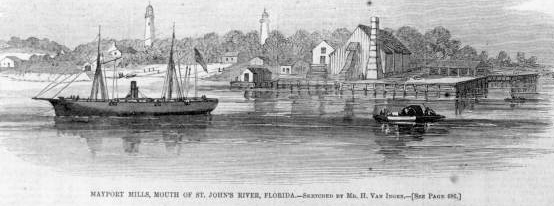
Union Navy Base, Mayport Mills, Florida (Harper’s Weekly, 5 October 1862, public domain).
Sent on a return expedition to Florida as September 1862 waned, the men of Company H saw their first truly intense moments of service when H Company participated with the 47th Pennsylvania and other Union regiments in the capture of Saint John’s Bluff from 1 to 3 October. Commanded by Brigadier-General Brannan, the 47th Pennsylvanians disembarked with more than one thousand other Union soldiers at Mayport Mills and Mount Pleasant Creek from troop carriers guarded by Union gunboats. Taking point, the 47th Pennsylvanians then led the 3rd Brigade through twenty-five miles of dense, pine forested swamps populated with deadly snakes and alligators. By the time the expedition ended, the Union brigade had forced the Confederate Army to abandon its artillery battery atop Saint John’s Bluff, and had paved the way for the Union Army to occupy the town of Jacksonville, Florida.

Earthworks surrounding the Confederate battery atop Saint John’s Bluff along the Saint John’s River in Florida (J. H. Schell, 1862, public domain).
In his report on the matter, filed from Mount Pleasant Landing, Florida on 2 October 1862, Colonel Tilghman H. Good described the Union Army’s assault on Saint John’s Bluff:
“In accordance with orders received I landed my regiment on the bank of Buckhorn Creek at 7 o’clock yesterday morning. After landing I moved forward in the direction of Parkers plantation, about 1 mile, being then within about 14 miles of said plantation. Here I halted to await the arrival of the Seventh Connecticut Regiment. I advanced two companies of skirmishers toward the house, with instructions to halt in case of meeting any of the enemy and report the fact to me. After they had advanced about three-quarters of a mile they halted and reported some of the enemy ahead. I immediately went forward to the line and saw some 5 or 6 mounted men about 700 or 800 yards ahead. I then ascended a tree, so that I might have a distinct view of the house and from this elevated position I distinctly saw one company of infantry close by the house, which I supposed to number about 30 or 40 men, and also some 60 or 70 mounted men. After waiting for the arrival of the Seventh Connecticut Volunteers until 10 o’clock, and it not appearing, I dispatched a squad of men back to the landing for a 6-pounder field howitzer which had been kindly offered to my service by Lieutenant Boutelle, of the Paul Jones. This howitzer had been stationed on a flat-boat to protect our landing. The party, however, did not arrive with the piece until 12 o’clock, in consequence of the difficulty of dragging it through the swamp. Being anxious to have as little delay as possible, I did not await the arrival of the howitzer, but at 11 a.m. moved forward, and as I advanced the enemy fled.
After reaching the house I awaited the arrival of the Seventh Connecticut and the howitzer. After they arrived I moved forward to the head of Mount Pleasant Creek to a bridge, at which place I arrived at 2 p.m. Here I found the bridge destroyed, but which I had repaired in a short time. I then crossed it and moved down on the south bank toward Mount Pleasant Landing. After moving about 1 mile down the bank of the creek my skirmishing companies came upon a camp, which evidently had been very hastily evacuated, from the fact that the occupants had left a table standing with a sumptuous meal already prepared for eating. On the center of the table was placed a fine, large meat pie still warm, from which one of the party had already served his plate. The skirmishers also saw 3 mounted men leave the place in hot haste. I also found a small quantity of commissary and quartermasters stores, with 23 tents, which, for want of transportation, I was obliged to destroy. After moving about a mile farther on I came across another camp, which also indicated the same sudden evacuation. In it I found the following articles … breech-loading carbines, 12 double-barreled shot-guns, 8 breech-loading Maynard rifles, 11 Enfield rifles, and 96 knapsacks. These articles I brought along by having the men carry them. There were, besides, a small quantity of commissary and quartermasters stores, including 16 tents, which, for the same reason as stated, I ordered to be destroyed. I then pushed forward to the landing, where I arrived at 7 p.m.
We drove the enemys [sic] skirmishers in small parties along the entire march. The march was a difficult one, in consequence of meeting so many swamps almost knee-deep.”
On 3 October, Good filed his report from Saint John’s Bluff, Florida, now in Union hands:
“At 9 o’clock last night Lieutenant Cannon reported to me that his command, consisting of one section of the First Connecticut Battery, was then coming up the creek on flat-boats with a view of landing. At 4 o’clock this morning a safe landing was effected and the command was ready to move. The order to move to Saint John’s Bluff reached me at 4 p.m. yesterday. In accordance with it I put the column in motion immediately and moved cautiously up the bank of the Saint John’s River, the skirmishing companies occasionally seeing small parties of the enemy’s cavalry retiring in our front as we advanced. When about 2 miles from the bluff the left wing of the skirmishing line came upon another camp of the enemy, which, however, in consequence of the lateness of the hour, I did not take time to examine, it being then already dark.
After my arrival at the bluff, it then being 7:30 o’clock, I dispatched Lieutenant-Colonel Alexander with two companies back to the last-named camp (which I found, from a number of papers left behind, to have been called Camp Hopkins and occupied by the Milton Artillery, of Florida) to reconnoiter and ascertain its condition. Upon his return he reported that from every appearance the skedaddling of the enemy was as sudden as in the other instances already mentioned, leaving their trunks and all the camp equipage behind; also a small store of commissary supplies, sugar, rice, half barrel of flour, one bag of salt, &c., including 60 tents which I have brought in this morning. The commissary stores were used by the troops of my command.
Three companies were thrown out as pickets, the negro guide directing. We went about a mile from the wharf, two companies on the left and one on the right…. We had hardly got stationed and were just about to send the negro and a party of men for his family three miles further on when the pickets gave the alarm that the Rebel cavalry was coming. The reserve was very speedily in line to receive them. We were on the railroad, but the cavalry came down the plank road. The outpost men fired and fell back on the reserve.”
Afterward several companies of the 47th Pennsylvania were sent out on detached duty. Company C joined other Union forces in the Union’s second capture and occupation of Jacksonville while Companies E and K participated in the capture of the Governor Milton, a Confederate steamer that had been transporting troops and supplies up and down the waterways of the region.
While that was all unfolding, the 47th Pennsylvania’s commanding officer, Colonel Tilghman Good, who had been placed in command of the remaining troops at the bluff, was directing the removal of all of the Confederate cannon from the area — a process that took several days. On 10 October, the Union troops then set explosive charges and destroyed the fort, which was known as Fort Finnegan. Shortly thereafter, the combined Union force made its way back to Hilton Head, South Carolina in a staged departure; the 47th Pennsylvanians then moved from Hilton Head back to Beaufort.
Integration of the Regiment
On 5 and 15 October 1862, respectively, the 47th Pennsylvania made history as it became an integrated regiment, adding to its muster rolls several Black men who had escaped from chattel slavery on plantations near Beaufort, South Carolina. Among the formerly enslaved men who enlisted were Bristor Gethers, Abraham Jassum and Edward Jassum.
Battle of Pocotaligo, South Carolina
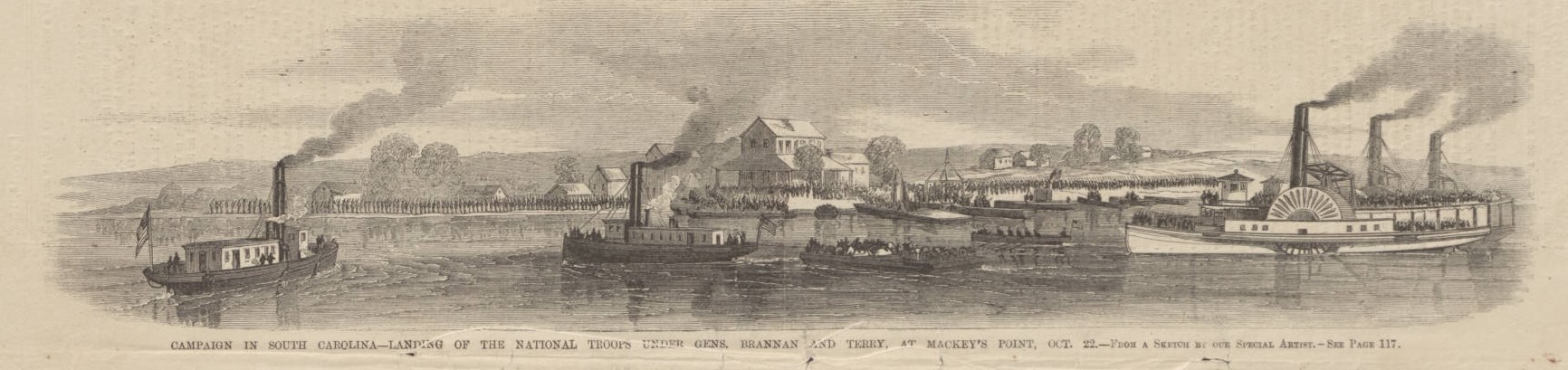
Landing of the U.S. Tenth Army Corps at Mackay’s Point, South Carolina at the start of the Expedition to Pocotaligo, 22 October 1862 (“The commencement of the Battle near Pocotaligo,” Frank Leslie’s Illustrated Newspaper, October 1862, public domain; click to enlarge).
The 47th Pennsylvania Volunteers next went head to head with Confederate troops in and around the village of Pocotaligo, South Carolina on 22 October 1862. Their brigade, which had been ordered to destroy a Confederate railroad bridge that was being used to transport soldiers and supplies throughout the region, was led by the 47th Pennsylvania’s own commanding officer, Colonel Tilghman H. Good, while their regiment was led by their second-in-command, Lieutenant-Colonel George W. Alexander. (As that day unfolded, the men of Company H were learning that they would be serving under the direct command of H Company’s First Lieutenant William Wallace Geety because H Company’s commanding officer, Captain James Kacy, was still in the hospital recuperating from an illness.)
Landing at Mackay’s Point, the 47th Pennsylvanians were placed on point once again, but they and their fellow 3rd Brigaders were less fortunate this time. Harried by snipers en route to the Pocotaligo Bridge, they met resistance from an entrenched, heavily fortified Confederate battery that opened fire on the Union troops as they entered an open cotton field. Those headed toward the higher ground of the Frampton Plantation fared no better as they encountered artillery and infantry fire from the surrounding forests.
Even so, the Union soldiers grappled with the Confederates where they found them, ultimately pursuing the Rebels for four miles as they retreated to the bridge. Once there, the 47th Pennsylvanians relieved the 7th Connecticut Volunteers, and continued the Union’s attempt to take the ravine and destroy the bridge. Unfortunately, the enemy was just too well armed. After two hours of intense fighting, their ammunition depleted, the 47th Pennsylvania Volunteers and other Union troops had no other choice. They had to withdraw to Mackay’s Point.

“The Commencement of the Battle near Pocotaligo River” (Frank Leslie’s Illustrated Newspaper, October 1862, public domain; click to enlarge).
Losses for the 47th Pennsylvania Volunteer Infantry were significant. Two officers and eighteen enlisted men died, including Privates Peter Deitrick, J. T. Robinson, Henry Stambaugh, and Jefferson Waggoner. All four fell during the fighting which raged near Frampton Plantation. In addition, two officers and one hundred fourteen enlisted members of the 47th were wounded, including H Company’s First and Second Lieutenants, William Geety and William Gardner, First Sergeant George Reynolds, Corporals Daniel Reeder and P. W. Stockslager, and Privates Samuel Huggins, Comley Idall, Cyrus Johnson, and R. R. Kingsborough.
Geety’s survival was nothing short of miraculous; his condition and resulting medical care were recounted in reports by his physicians and described repeatedly in newspapers in later years. Following his recovery, he was assigned to recruiting duties for the 47th Pennsylvania and as quartermaster at Camp Curtin. Idall, Reynolds and Huggins were less fortunate, ultimately succumbing to complications from their wounds. Reeder, who lost an arm due to his battle wounds, and Stockslager, Johnson and Kingsborough all survived, but were later discharged and sent home on surgeons’ certificates of disability. In addition, First Sergeant Reuben Shatto Gardner also sustained serious battle wounds — to his head and thigh. Treated by regimental medical personnel in the field, he was transported to the U.S. Army’s post hospital at Hilton Head on 23 October. Subsequently hospitalized there for an extended period, he was given more advanced care that saved his life.
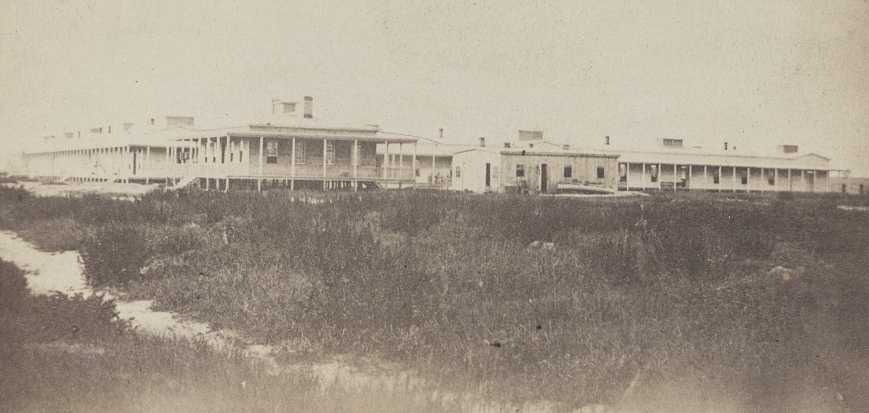
The U.S. General Hospital on Hilton Head Island in South Carolina, shown here circa 1861-1865, the medical director’s residence in the foreground at left, was built facing the ocean and Port Royal Bay at the mouth of the Broad River (U.S. Library of Congress, public domain; click to enlarge).
Meanwhile, the able-bodied 47th Pennsylvanians were returned to their camp in Beaufort, by way of Hilton Head, on 23 October. The next day, Colonel Good penned his first report to his superiors:
“SIR: I have the honor to submit the following report of the part taken by the Forty-seventh Regiment Pennsylvania Volunteers in the action of October 22:
Eight companies, comprising 480 men, embarked on the steamship Ben De Ford, and two companies, of 120 men, on the Marblehead, at 2 p.m. October 21. With this force I arrived at Mackays Landing before daylight the following morning. At daylight I was ordered to disembark my regiment and move forward across the first causeway and take a position, and there await the arrival of the other forces. The two companies of my regiment on board of the Marblehead had not yet arrived, consequently I had but eight companies of my regiment with me at this juncture.
At 12 m. I was ordered to take the advance with four companies, one of the Forty-seventh and one of the Fifty-fifth Pennsylvania Volunteers, and two of the Sixth Connecticut, and to deploy two of them as skirmishers and move forward. After moving forward about 2 miles I discerned some 30 or 40 of the enemys [sic] cavalry ahead, but they fled as we advanced. About 2 miles farther on I discovered two pieces of artillery and some cavalry, occupying a position about three-quarters of a mile ahead in the road. I immediately called for a regiment, but seeing that the position was not a strong one I made a charge with the skirmishing line. The enemy, after firing a few rounds of shell, fled. I followed up as rapidly as possible to within about 1 mile of Frampton Creek. In front of this stream is a strip of woods about 500 yards wide, and in front of the woods a marsh of about 200 yards, with a small stream running through it parallel with the woods. A causeway also extends across the swamp, to the right of which the swamp is impassable. Here the enemy opened a terrible fire of shell from the rear, of the woods. I again called for a regiment, and my regiment came forward very promptly. I immediately deployed in line of battle and charged forward to the woods, three companies on the right and the other five on the left of the road. I moved forward in quick-time, and when within about 500 yards of the woods the enemy opened a galling fire of infantry from it. I ordered double-quick and raised a cheer, and with a grand yell the officers and men moved forward in splendid order and glorious determination, driving the enemy from this position.
On reaching the woods I halted and reorganized my line. The three companies on the right of the road (in consequence of not being able to get through the marsh) did not reach the woods, and were moved by Lieutenant-Colonel Alexander by the flank on the causeway. During this time a terrible fire of grape and canister was opened by the enemy through the woods, hence I did not wait for the three companies, but immediately charged with the five at hand directly through the woods; but in consequence of the denseness of the woods, which was a perfect matting of vines and brush, it was almost impossible to get through, but by dint of untiring assiduity the men worked their way through nobly. At this point I was called out of the woods by Lieutenant Bacon, aide-de-camp, who gave the order, ‘The general wants you to charge through the woods.’ I replied that I was then charging, and that the men were working their way through as fast as possible. Just then I saw the two companies of my regiment which embarked on the Marblehead coming up to one of the companies that was unable to get through the swamp on the right. I went out to meet them, hastening them forward, with a view of re-enforcing the five already engaged on the left of the road in the woods; but the latter having worked their way successfully through and driven the enemy from his position, I moved the two companies up the road through the woods until I came up with the advance. The two companies on the right side of the road, under Lieutenant-Colonel Alexander had also worked their way up through the woods and opened fire on the retreating enemy. At this point I halted and reorganized my regiment, by forming close column by companies. I then detailed Lieutenant Minnich, of Company B, and Lieutenant Breneman, of Company H, with a squad of men, to collect the killed and wounded. They promptly and faithfully attended to this important duty, deserving much praise for the efficiency and coolness they displayed during the fight and in the discharge of this humane and worthy trust.
The casualties in this engagement were 96. Captain Junker of Company K; Captain Mickley, of Company I [sic], and Lieutenant Geety, of Company H, fell mortally wounded while gallantly leading their respective companies on.
I cannot speak too highly of the conduct of both officers and men. They all performed deeds of valor, and rushed forward to duty and danger with a spirit and energy worthy of veterans.
The rear forces coming up passed my regiment and pursued the enemy. When I had my regiment again placed in order, and hearing the boom of cannon, I immediately followed up, and, upon reaching the scene of action, I was ordered to deploy my regiment on the right side of the wood, move forward along the edge of it, and relieve the Seventh Connecticut Regiment. This I promptly obeyed. The position here occupied by the enemy was on the opposite side of the Pocotaligo Creek, with a marsh on either side of it, and about 800 yards distant from the opposite wood, where the enemy had thrown up rifle pits all along its edge.
On my arrival the enemy had ceased firing; but after the lapse of a few minutes they commenced to cheer and hurrah for the Twenty-sixth South Carolina. We distinctly saw this regiment come up in double-quick and the men rapidly jumping into the pits. We immediately opened fire upon them with terrible effect, and saw their men thinning by scores. In return they opened a galling fire upon us. I ordered the men under cover and to keep up the fire. During this time our forces commenced to retire. I kept my position until all our forces were on the march, and then gave one volley and retired by flank in the road at double-quick about 1,000 yards in the rear of the Seventh Connecticut. This regiment was formed about 1,000 yards in the rear of my former position. We jointly formed the rear guard of our forces and alternately retired in the above manner.
My casualties here amounted to 15 men.
We arrived at Frampton (our first battle ground) at 8 p.m. Here my regiment was relieved from further rear-guard duty by the Fourth New Hampshire Regiment. This gave me the desired opportunity to carry my dead and wounded from the field and convey them back to the landing. I arrived at the above place at 3 o’clock the following morning.”

Highlighted version of the U.S. Army map of the Coosawhatchie-Pocotaligo Expedition, 22 October 1862 (public domain, click ).
In a second report made from Beaufort on 25 October 1862, Colonel Good added the following details:
“SIR: I have the honor to submit the following report of the part taken by the First Brigade in the battles of October 22:
After meeting the enemy in his first position he was driven back by the skirmishing line, consisting of two companies of the Sixth Connecticut, one of the Forty-seventh Pennsylvania, and one of the Fifty-fifth Pennsylvania, under my command. Here the enemy only fired a few rounds of shot and shell. He then retreated and assumed another position, and immediately opened fire. Colonel Chatfield, then in command of the brigade, ordered the Forty-seventh Pennsylvania forward to me, with orders to charge. I immediately charged and drove the enemy from the second position. The Sixth Connecticut was deployed in my rear and left; the Fifty-fifth Pennsylvania on my right, and the Fourth New Hampshire in the rear of the Fifty-fifth, both in close column by divisions, all under a heavy fire of shell and canister. These regiments then crossed the causeway by the flank and moved close up to the woods. Here they were halted, with orders to support the artillery. After the enemy had ceased firing the Fourth New Hampshire was ordered to move up the road in the rear of the artillery and two companies of the Forty-seventh Pennsylvania to follow this regiment. The Sixth Connecticut followed up, and the Fifty-fifth moved up through the woods. At this juncture Colonel Chatfield fell, seriously wounded, and Lieutenant-Colonel Speidel was also wounded.
The casualties in the Forty-seventh Pennsylvania amounted to 96 men. As yet I am unable to learn the loss of the entire brigade.
The enemy having fled, the Fourth New Hampshire and the Fifty-fifth Pennsylvania followed in close pursuit. During this time the Forty-seventh Pennsylvania and the Sixth Connecticut halted and again organized, after which they followed. On coming up to the engagement I assumed command of the brigade, and found the forces arranged in the following order: The Fourth New Hampshire was deployed as skirmishers along the entire front, and the Fifty-fifth deployed in line of battle on the left side of the road, immediately in the rear of the Fourth New Hampshire. I then ordered the Sixth Connecticut to deploy in the rear of the Fifty-fifth Pennsylvania and the Forty-seventh Pennsylvania to deploy on the right side of the road in line of battle and relieve the Seventh Connecticut. I then ordered the Fourth New Hampshire, which had spent all its ammunition, back under cover on the road in the woods. The enemy meantime kept up a terrific fire of grape and musketry, to which we replied with terrible effect. At this point the orders were given to retire, and the Forty-seventh Pennsylvania and Seventh Connecticut formed the rear guard. I then ordered the Thirty-seventh Pennsylvania to keep its position and the Sixth Connecticut to march by the flank into the road and to the rear, the Fourth New Hampshire and Fifty-fifth Pennsylvania to follow. The troops of the Second Brigade were meanwhile retiring. After the whole column was in motion and a line of battle established by the Seventh Connecticut about 1,000 yards in the rear of the Forty-seventh Pennsylvania I ordered the Forty-seventh to retire by the flank and establish a line of battle 1,000 yards in the rear of the Seventh Connecticut; after which the Seventh Connecticut moved by the flank to the rear and established a line of battle 1,000 yards in the rear of the Forty seventh, and thus retiring, alternately establishing lines, until we reached Frampton Creek, where we were relieved from this duty by the Fourth New Hampshire. We arrived at the landing at 3 o’clock on the morning of the 23d instant.
The casualties of the Sixth Connecticut are 34 in killed and wounded and the Forty-seventh Pennsylvania 112 in killed and wounded. As to the remaining regiments I have as yet received no report.”
That same day, Captain James Kacy of Company H penned the following letter to The Perry County Democrat:
“Beaufort, S.C., Oct. 25, 1862.
Dear Sir,Jason Robinson, a printer, joined my company, from your place and was killed at the battle of Pocotaligo one 22d inst. I do not know his relations or where to write to them. Probably you do. The following is a list of killed and wounded in my company:
COMPANY H. – Killed – Henry Stambaugh, Jefferson Waggoner, Peter Deitrick, Jason P. Robinson. – Wounded—First Lieutenant W. W. Geety, mortally, Orderly Sergeant, George Reynolds; Sergeant Reuben S. Gardner, in head and leg; Corporals Daniel Reeder, David H. Smith, Peter W. Stockslager; privates Jerome Briner [sic], Henry Bolinger, Augustus Rupp, Samuel Huggins, Comley Idall, Patrick Mullen, Jefferson Haney.
We did not lose a prisoner but took some. Total loss in the 47th Reg. 99 wounded, 23 killed. Several have died since. Our boys fought like Turks. We ran out of ammunition and had to leave the field.–We are going back soon.
The effects of Robinson will be sent home as soon as I can put up and forward by express.
Yours, James Kacy,
Capt. Co. H, 47th Reg. P. V.”
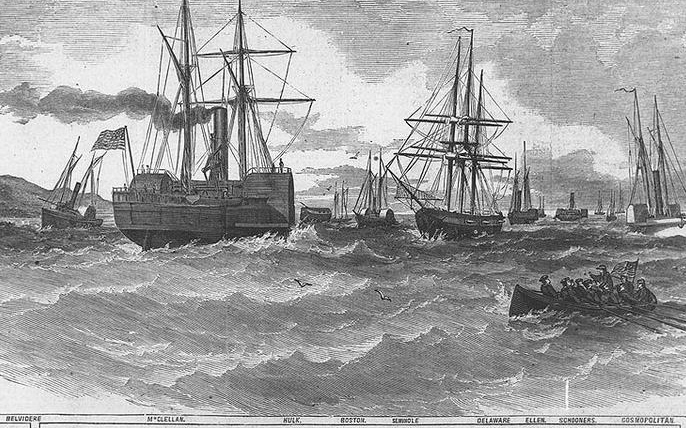
USS Seminole and USS Ellen accompanied by transports (left to right: Belvidere, McClellan, Boston, Delaware, and Cosmopolitan) at Wassau Sound, Georgia (circa January 1862, Harper’s Weekly, public domain).
Having been ordered back to Key West on 15 November 1862, the 47th Pennsylvanians did not know it, yet, but much of 1863 would be spent garrisoning federal installations in Florida as part of the 10th Corps, U.S. Army, Department of the South. Companies A, B, C, E, G, and I would once again garrison Fort Taylor in Key West, but this time, the men from Companies D, F, H, and K would garrison Fort Jefferson, the Union’s remote outpost in the Dry Tortugas off the southern coast of Florida.
After packing their belongings at their Beaufort, South Carolina encampment and loading equipment onto the U.S. Steamer Cosmopolitan, the officers and enlisted members of the 47th Pennsylvania sailed for the mouth of the Broad River on 15 December 1862, and anchored briefly at Port Royal Harbor to allow the regiment’s medical director, Elisha W. Baily, M.D., and wounded 47th Pennsylvanians to rejoin the regiment. At 5 p.m. that same evening, the regiment headed for Florida, during what was later described by several 47th Pennsylvanians as a treacherous, stressful voyage. According to Schmidt, the ship’s captain “steered a course along the coast of Florida for most of the voyage,” which made the voyage precarious “because of all the reefs.” On 16 December, “the ship was jarred as it ran aground … during a storm, but broke free, and finally steered a course further from shore, out in the Gulf Stream.” In a letter penned to the Sunbury American on 21 December, Henry Wharton explained that:
“We had heavy sea all the time. I had often heard of ‘waves as big as a house,’ and thought it was a sailor’s yarn, but I have seen ‘em and am perfectly satisfied; so now, not having a nautical turn of mind, I prefer our movements being done on terra firma, and leave old neptune to those who have more desire for his better acquaintance. A nearer chance of a shipwreck never took place than ours, and it was only through Providence that we were saved. The Cosmopolitan is a good river boat, but to send her to sea, loadened [sic, loaded] with U.S. troops is a shame, and looks as though those in authority wish to get clear of soldiers in another way than that of battle. There was some sea sickness on our passage; several of the boys ‘casting up their accounts’ on the wrong side of the ledger.”
According to Corporal George Nichols of Company E, “When we got to Key West the Steamer had Six foot of water in her hole [sic]. Waves Mountain High and nothing but an old river Steamer. With Eleven hundred Men on I looked for her to go to the Bottom Every Minute.”
Although they arrived at the Key West Harbor on Thursday, 18 December, the 47th Pennsylvanians did not set foot on Florida soil until noon the next day. The men from Companies C and I were immediately marched to Fort Taylor, where they were placed under the command of Major William Gausler, the regiment’s third-in-command. The men from Companies B and E were assigned to the older barracks that had been erected by the United States Army and were placed under the command of B Company Captain Emanuel P. Rhoads while the men from Companies A and G were placed under the command of A Company Captain Richard A. Graeffe and stationed at newer facilities known as the “Lighthouse Barracks” on “Lighthouse Key.”

Fort Jefferson (Harper’s Weekly, 26 Aug 1865, public domain).
On Saturday, 20 December, Lieutenant-Colonel Alexander, the regiment’s second-in-command, boarded the Cosmopolitan with the men from the regiment’s remaining units — Companies D, F, H, and K — and headed south, around the coast of Florida, and west to Fort Jefferson, where they would assume garrison duties in the Dry Tortugas (in the Gulf of Mexico, seventy miles from Florida). According to Henry Wharton:
“We landed here on last Thursday at noon, and immediately marched to quarters. Company I. and C., in Fort Taylor, E. and B. in the old Barracks, and A. and G. in the new Barracks. Lieut. Col. Alexander, with the other four companies proceeded to Tortugas, Col. Good having command of all the forces in and around Key West. Our regiment relieves the 90th Regiment N.Y.S. Vols. Col. Joseph Morgan, who will proceed to Hilton Head to report to the General commanding. His actions have been severely criticized by the people, but, as it is in bad taste to say anything against ones [sic, one’s] superiors, I merely mention, judging from the expression of the citizens, they were very glad of the return of the 47th Pennsylvania Volunteers….
Key West has improved very little since we left last June, but there is one improvement for which the 90th New York deserve a great deal of praise, and that is the beautifying of the ‘home’ of dec’d. soldiers. A neat and strong wall of stone encloses the yard, the ground is laid off in squares, all the graves are flat and are nicely put in proper shape by boards eight or ten inches high on the ends sides, covered with white sand, while a head and foot board, with the full name, company and regiment, marks the last resting place of the patriot who sacrificed himself for his country….”
That same day (20 December 1862), William C. Hutcheson, who had been serving as a “third sergeant” since at least the winter of 1862 according to Schmidt, “was assigned duty as Provost Sergeant” at Fort Jefferson.
1863
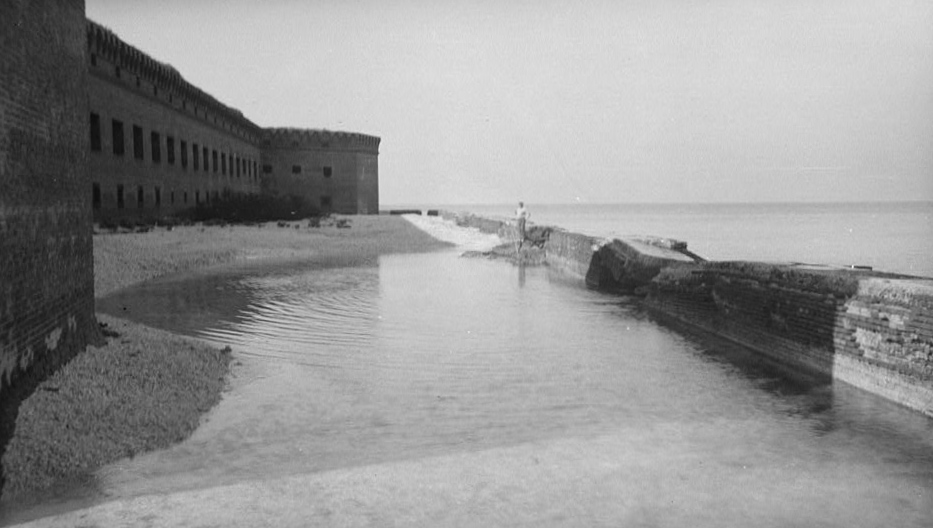
Fort Jefferson’s moat and wall, circa 1934, Dry Tortugas, Florida (C. E. Peterson, U.S. Library of Congress, public domain).
Life for members of the 47th Pennsylvania then went on as the New Year of 1863 dawned, the hours taken up by training, drilling and inspections that were scheduled regularly to keep them in a perpetual state of readiness for anything that the Confederate Army or Navy could throw at them. Companies A, B, C, E, G, and I were still based at Fort Taylor in Key West, while Companies D, F, H, and K were stationed at Fort Jefferson in the Dry Tortugas, where the climate and living conditions were harsh and frequently unpleasant. According to U.S. National Park Service historians:
“Even though construction began in 1846, by the time the Civil War came around Fort Jefferson was nowhere near completed (the Union Army controlled the fort during the war). It was vital to place cannon on the top level of the fort, which was not yet ready, and thus it was ordered to construct the second level only to the extent that it could support the weight of the structure above it. Once done, efforts on the second level ceased and all resources were put into completing and arming the top level. The unfinished second level was eventually used as housing for the enlisted men and as a military prison during and after the Civil War.”

Officers’ quarters and parade grounds, interior of Fort Jefferson, Dry Tortugas, Florida, 1898 (U.S. National Park Service and National Archives and Records Administration, public domain).
From 1862 through the early part of 1863, the second floor “housing” of 47th Pennsylvania Volunteers and their prisoners was located, in “empty casemates” — a “series of brick rooms framed by archways” at Fort Jefferson. In addition, the quality of water available to soldiers for drinking and bathing was substandard. According to Schmidt:
“‘Fresh’ water was provided by channeling the rains from the city’s barbette through channels in the interior walls, to filter trays filled with sand; and finally to the 114 cisterns located under the fort which held, 1,231,000 gallons of water. The cisterns were accessible in each of the first level cells or rooms through a ‘trap hole’ in the floor covered by a temporary wooden cover…. Considerable dirt must have found its way into these access points and was responsible for some of the problems resulting in the water’s impurity…. The fort began to settle and the asphalt covering on the outer walls began to deteriorate and allow the sea water (polluted by debris in the moat) to penetrate the system…. Two steam condensers were available … and distilled 7000 gallons of tepid water per day for a separate system of reservoirs located in the northern section of the parade ground near the officers [sic, officers’] quarters. No provisions were made to use any of this water for personal hygiene of the [planned 1,500-soldier garrison force]….”
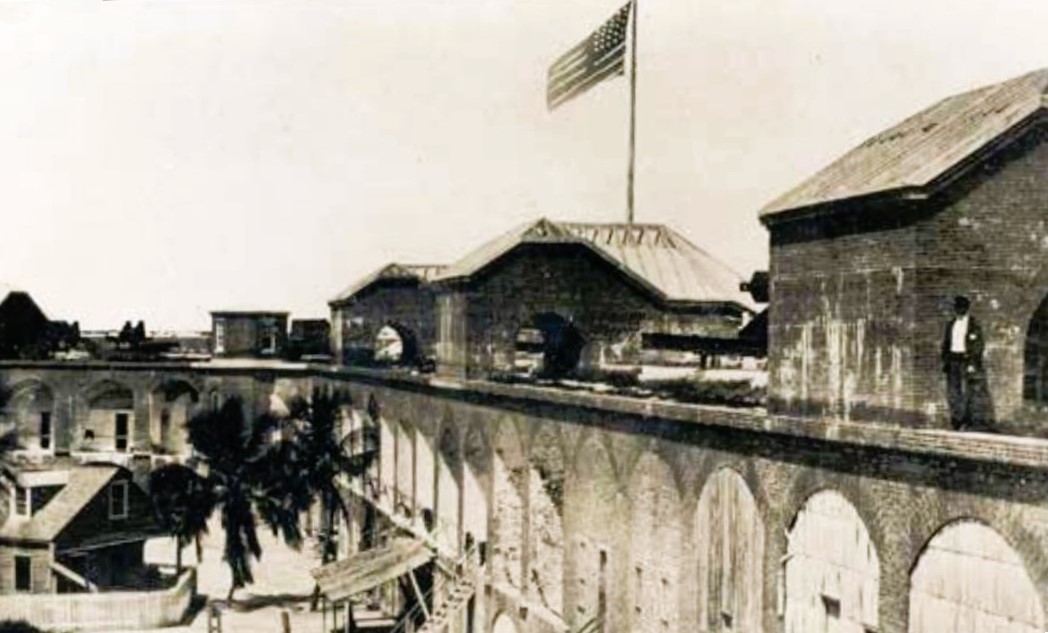
Second-tier casemates, lighthouse keeper’s house, sallyport, and lean-to structure, Fort Jefferson, Dry Tortugas, Florida, late 1860s (U.S. National Park Service and National Archives, public domain).
As a result, the soldiers stationed there washed themselves and their clothes, using saltwater from the ocean. As if that weren’t difficult enough, “toilet facilities were located outside of the fort,” according to Schmidt:
“At least one location was near the wharf and sallyport, and another was reached through a door-sized hole in a gunport and a walk across the moat on planks at the northwest wall…. These toilets were flushed twice each day by the actions of the tides, a procedure that did not work very well and contributed to the spread of disease. It was intended that the tidal flush should move the wastes into the moat, and from there, by similar tidal action, into the sea. But since the moat surrounding the fort was used clandestinely by the troops to dispose of litter and other wastes … it was a continuous problem for Col. Alexander and his surgeon.”
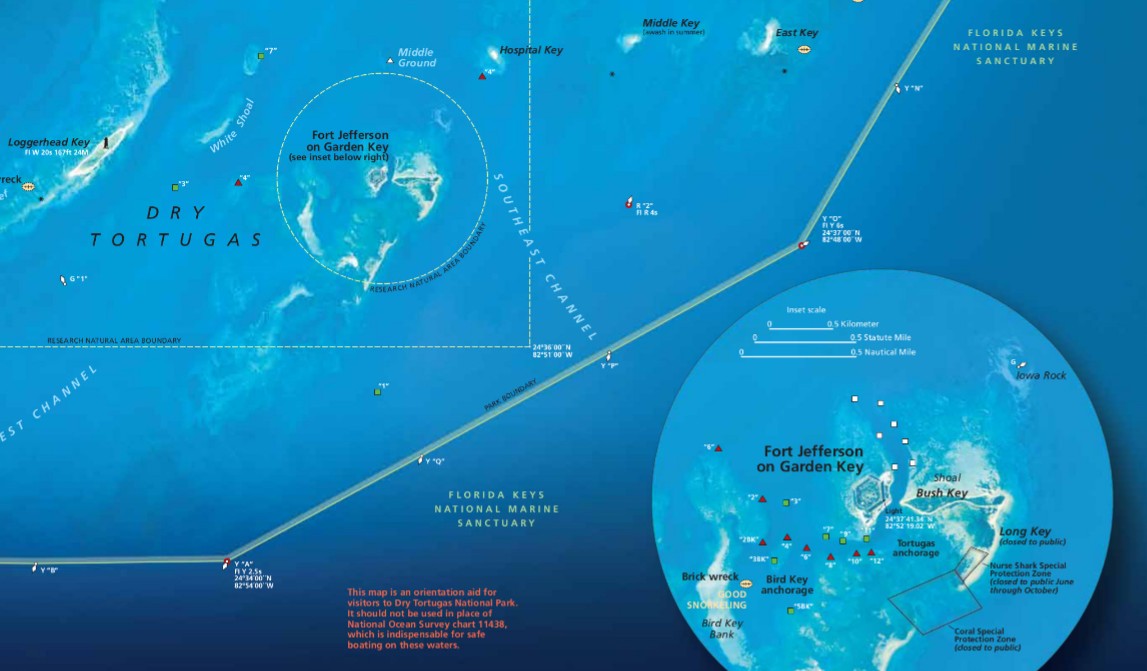
Fort Jefferson on Garden Key, Dry Tortugas, Florida in relation to Bird, East, Hospital, and Loggerhead Keys, 2016 (U.S. National Park Service map, public domain; click to enlarge).
So, once again, disease became the 47th Pennsylvania Volunteers’ most fearsome foe. According to Schmidt, more than fifty patients were admitted to the post hospital at Fort Jefferson in late February and early March 1863 after falling ill with dysentery and chronic diarrhea. Unfortunately, that disease then spread from patient to caregiver with deadly impact. On 5 March, Provost Sergeant William Hutcheson “took the grave diggers to Bird Key … to prepare a grave for the hospital steward” — Alfred G. Shaner, who had been a member of a regular Union Army unit.
* Note: When soldiers or prisoners were sickened by smallpox, typhoid fever or other virulent diseases that were highly transmissable, they were transported to an infectious disease hospital on Sand Key. Fatalities at that facility were then usually buried in the cemetery on that key.
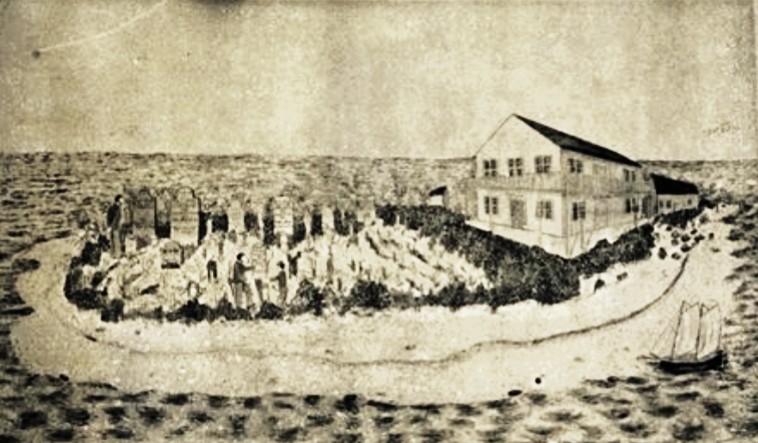
This watercolor may depict an infectious disease hospital and cemetery that were established on Sand Key to keep virulent diseases from spreading at Fort Jefferson on nearby Garden Key in the Dry Tortugas of Florida (1860s-1870s, U.S. National Park Service, public domain; click to enlarge).
In addition to burial detail duties, Provost Sergeant William Hutcheson was also assigned to assist with artillery and rifle training tasks. As a result, he spent time searching for “a target that had floated out to sea during the night” of 6 March. Roughly two weeks later, he traveled by boat to Loggerhead Key in the morning (on 22 March), and spent several hours there trying to determine the cause of the non-functioning light in the lighthouse before returning to the fort. A week later, he returned to Bird Key to bury a “Sgt. Jackson,” according to Schmidt. The next two days (30-31 March), he was kept busy dealing with problems related to the docking and departure of the Union, a schooner that had arrived with a drunken crew and had then caused further trouble when it “ran aground on Long Key.” On 1 April, he “sailed for Loggerhead Key with four of the men from Company H and lighthouse keeper Robert Thompson.” A week later, he hauled another “target to Long Key” (on 8 April) for use in artillery training sessions, and then took a crew of four men to Loggerhead Key to forage for vegetables for future consumption by field and staff officers. The next day, he “boarded the steamer ‘Blackstone,’ which had arrived from New York loaded with troops and government stores, in addition to 105 prisoners and Lt. Smith with 34 guards from Washington. The prisoners had to be transported to the shore” by Provost Sergeant Hutcheson “and his detail,” according to Schmidt, “and were put in charge of Lt. Hunsberger.” On Monday, 13 April, he supervised another grave detail on Bird Key, in between moving rifle and artillery targets in and out of their assigned positions for that day’s training sessions. Two days later, he “hauled some clothes that had been used in the hospital out to Long Key to burn them.” The next day he supervised a work crew of eighteen prisoners” who were assigned to a “cleaning” detail in “the area outside the fort.” On Tuesday, 21 April, he supervised a work crew of twenty-seven prisoners who had been assigned to remove “the filth from the breakwater (moat).” A week later he was back to foraging for food, traveling to East Key on Tuesday, 28 April, “to collect eggs,” and then returning the following day with five subordinates who “captured five turtles” (sea turtles) — the same task he and his team would perform again as April gave way to May. On 6 May they returned to the fort with “162 dozen birds eggs,” a number of which were used “for supper” the following evening, according to Schmidt.
Diminishing Florida’s Role as the “Supplier of the Confederacy”
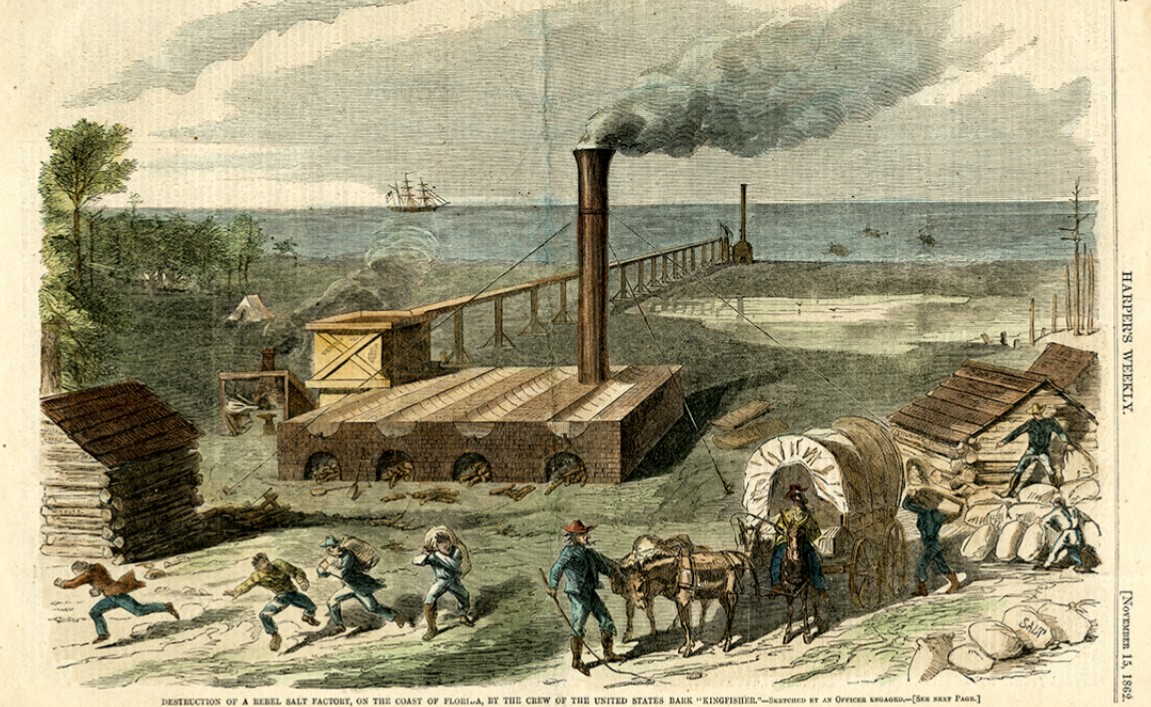
“Destruction of a Rebel Salt Factory, on the Coast of Florida, By the Crew of the United States Bark ‘Kingfisher’” (Harper’s Weekly, 15 November 1862; courtesy, Florida Memory Project, Florida State Library, public domain; click to enlarge).
Prior to intervention by the Union Army and Navy, the owners of plantations, livestock ranches and fisheries, as well as the operators of smaller family farms across Florida, had been able to consistently furnish beef and pork, fish, fruits, and vegetables to Confederate troops stationed throughout the Deep South during the first year of the American Civil War. Large herds of cattle were raised near Fort Myers, for example, while orchard owners in the Saint John’s River area were actively engaged in cultivating sizeable orange groves. Florida was also a major producer of salt, which was used as a preservative for food. Consequently, the 47th Pennsylvania Volunteers and other Union troops across Florida were ordered to capture or destroy salt manufacturing plants in order to further curtail the enemy’s access to food.
Fortunately that situation changed later on when a new main sewer line and improved accommodations for enlisted men were built, enabling members of the 47th Pennsylvania to eventually move into actual army barracks.
The remainder of the year passed in much the same manner for Provost Sergeant William Hutcheson, as he responded to orders from his superiors to board and inspect supply ships that were arriving, forage for food for his fellow soldiers, take out the regiment’s trash, or supervise prisoners assigned to beautification or burial work crews inside and outside of the fort. Although his duties often seemed mundane or “boring” when compared to those of other Union infantrymen (particularly those who had been engaged in one battle after another), there were moments when his life and the lives of the men under his command had genuinely been in danger. On 1 October 1863, for example, Provost Sergeant Hutcheson and his crew had been thrown into the sea while they were aboard the “barque Annie,” which had capsized as it was being “towed by the US Gunboat Clyde.” The Clyde had “started off at full speed … before the rope could be loosened up.”
1864
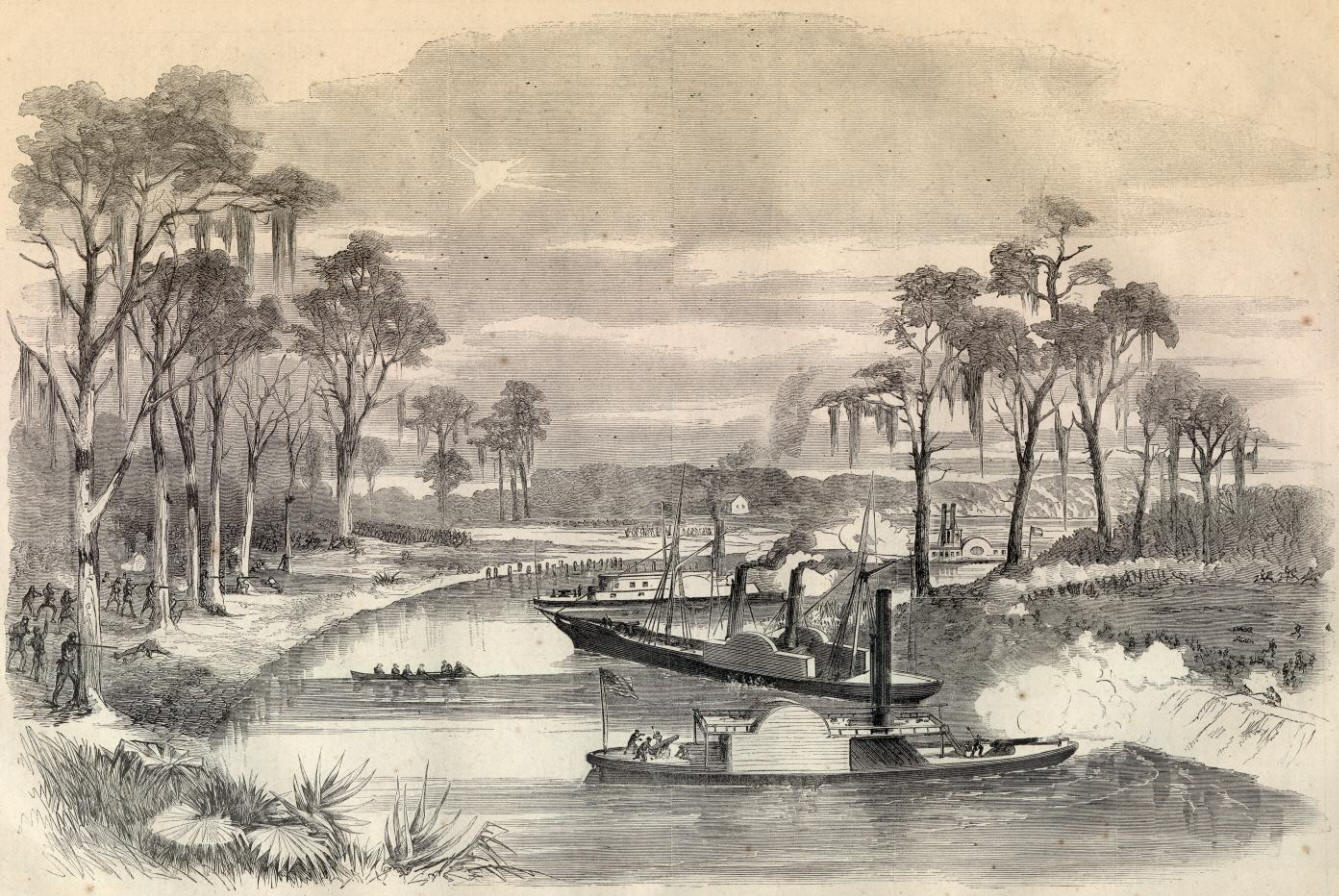
Bayou Teche, Louisiana (Harper’s Weekly, 14 February 1863, public domain).
In early January 1864, the 47th Pennsylvania Volunteer Infantry was ordered to expand the Union Army’s reach by sending part of the regiment north to retake possession of, and rehabilitate, Fort Myers, which had been abandoned in 1858 following the U.S. government’s third war with the Seminole Indians. Per orders issued earlier in 1864 by Major-General D. P. Woodbury, commanding officer, U.S. Department of the Gulf, District of Key West and the Tortugas, that the fort be reclaimed to facilitate the Union’s Gulf Coast blockade, Captain Richard Graeffe and a group of men from Company A were assigned to the duty of raiding cattle herds in northern Florida in order to provide food for the growing Union troop presence in the state. Graeffe and his men subsequently turned the fort into both their base of operations and a shelter for pro-Union supporters, men, women and children who were escaping slavery, Confederate Army deserters, and others fleeing Rebel troops.
Meanwhile, the men from Company H and the other members of the 47th Pennsylvania Volunteer Infantry were preparing to embark on the regiment’s history-making journey to Louisiana. Boarding yet another steamer — the Charles Thomas — on 25 February 1864, the men from Companies B, C, D, I, and K of the 47th Pennsylvania headed for Algiers, Louisiana (across the river from New Orleans), followed on 1 March by the men of Companies E, F, G, and H, who had been stationed at Fort Jefferson in the Dry Tortugas and were transported by the DeMolay.
Shortly after disembarking at Algiers on 5 March, H Company Provost Sergeant William C. Hutcheson slipped away with others from the second group that had arrived aboard the DeMolay, and headed into town for a bit of fun. According to Schmidt, some of those 47th Pennsylvanians attended a circus performance; others opted to get drunk and ended up on the receiving end of disciplinary actions, including William Hutcheson, who was reduced to the rank of private by Regimental Orders, No. 16 for “having been unduly intoxicated while enroute with his regiment from Fort Jefferson, and conducting himself unbecoming a noncommissioned officer.” That directive also made clear to Private William C. Hutcheson that he had been “reduced to ranks” because he had “forfeited the confidence of the commissioned officers of the regiment.”
* Note: The incident in Algiers was not the first time that William C. Hutcheson had been disciplined by his superiors. According to Schmidt, Hutcheson “had previously been under arrest the past Christmas” (in December 1863), while still serving as a provost sergeant at Fort Jefferson.
Upon the second group’s arrival, the now almost fully-reunited regiment moved by train on 28 February to Brashear City (now Morgan City, Louisiana) before heading to Franklin by steamer through the Bayou Teche. Once there, the 47th Pennsylvania Volunteer Infantry joined the 2nd Brigade, 1st Division of the Department of the Gulf’s 19th Army Corps, becoming the only Pennsylvania regiment to serve in the Red River Campaign of Union Major-General Nathaniel P. Banks. (Unable to reach Louisiana until 23 March, the men from Company A were effectively placed on a different type of detached duty in New Orleans while they awaited transport to enable them to catch up with the main part of their regiment. Charged with guarding and overseeing the transport of two hundred and forty-five Confederate prisoners, they were finally able to board the Ohio Belle on 7 April. They then reached Alexandria with those prisoners on 9 April.)
Red River Campaign, Louisiana
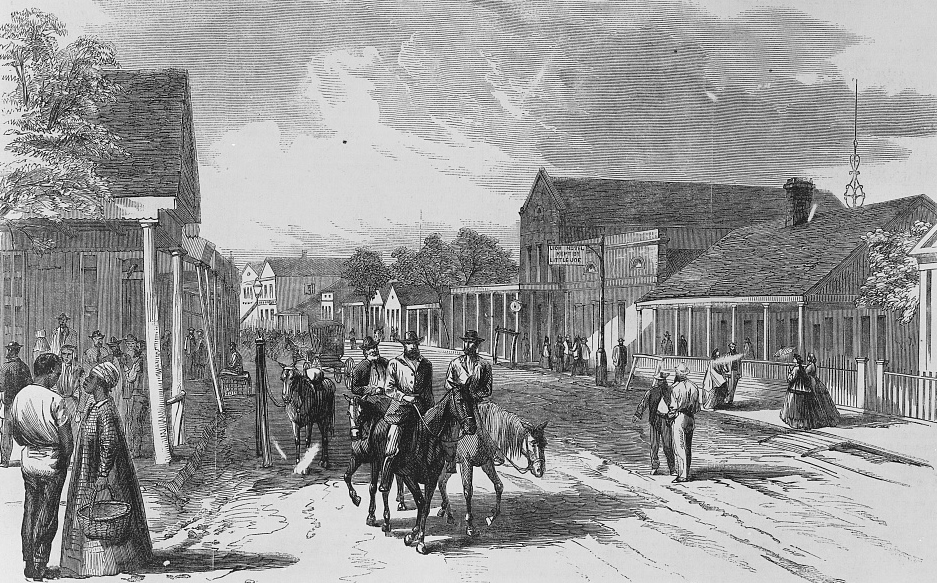
New Iberia, Louisiana (Alfred Waud, Harper’s Weekly, 11 August 1866, public domain).
The early days on the ground in Louisiana quickly woke the 47th Pennsylvanians up to just how grueling their new phase of duty would be. From 14-26 March, Companies B through K marched for Alexandria and Natchitoches, Louisiana, by way of New Iberia, Vermilionville (now Lafayette), Opelousas, and Washington.
From 4-5 April 1864, the regiment added to its roster of young Black soldiers when Aaron Bullard (later known as Aaron French), James Bullard, John Bullard, Samuel Jones, and Hamilton Blanchard (also known as John Hamilton) enrolled for military service with the 47th Pennsylvania at Natchitoches. According to their respective entries in the Civil War Veterans’ Card File at the Pennsylvania State Archives and on regimental muster rolls, several of the men were then assigned the rank of “(Colored) Cook” while others were given the rank of “Under-Cook.”
Often short on food and water throughout their long harsh-climate trek through enemy territory, the men encamped briefly at Pleasant Hill (now the Village of Pleasant Hill) the night of 7 April before continuing on the next day.
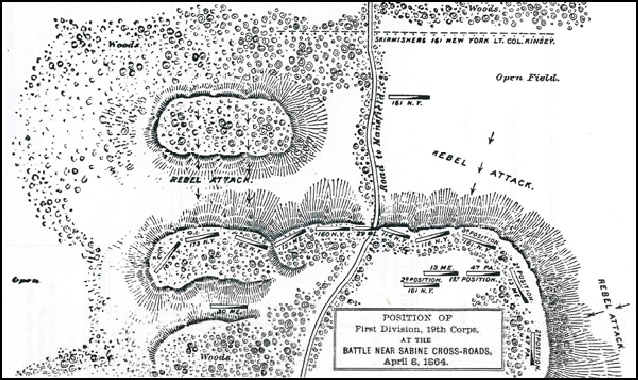
19th U.S. Army Map, Phase 3, Battle of Sabine Cross Roads/Mansfield (8 April 1864, public domain).
Marching until mid-afternoon on 8 April, the 47th Pennsylvania Volunteers were rushed into battle ahead of other regiments in the 2nd Division. Sixty members of the 47th were cut down that day during the back-and-forth volley of fire unleashed during the Battle of Sabine Cross Roads (also known as the Battle of Mansfield due to its proximity to the town of Mansfield). The fighting waned only when darkness fell. The exhausted, but uninjured collapsed beside the gravely wounded. After midnight, the surviving Union troops withdrew to Pleasant Hill. Casualty reports later confirmed that Private William Barry of H Company was one of the 47th Pennsylvania Volunteers who had been killed in action that day.
The next day — 9 April — the 47th Pennsylvania Volunteers were ordered into a critically important defensive position at the far right of the Union lines, their right flank spreading up onto a high bluff. By 3 p.m., after enduring a midday charge by the troops of Confederate Major-General Richard Taylor (a plantation owner and son of Zachary Taylor, former president of the United States), the brutal fighting still showed no signs of ending. Suddenly, just as the 47th was shifting to the left side of the massed Union forces, the men of the 47th Pennsylvania were forced to bolster the 165th New York’s buckling lines by blocking another Confederate assault.
Casualties were severe. Privates William F. Dumm (alternate spelling: Drumm) and Nicholas Orris of Company H were killed in action, while Lieutenant-Colonel Alexander was grievously wounded, and the regiment’s two color-bearers, both from Company C, were also wounded while preventing the American flag from falling into enemy hands. Still others from the 47th were captured, force marched more than one hundred twenty-five miles to Camp Ford, a Confederate Army prison camp near Tyler, Texas, and held there as prisoners of war (POWs) until released during prisoner exchanges beginning 22 July 1864. (At least two men from the 47th never made it out of that camp alive, and another died while being treated at the Confederate Army hospital in Shreveport, Louisiana.)
Following what some historians have called a rout by Confederates at Pleasant Hill and others have labeled a technical victory for the Union, or a draw for both sides, the 47th Pennsylvanians fell back to Grand Ecore, where, for eleven days, they engaged in the hard labor of strengthening regimental and brigade fortifications. During that phase of duty, H Company Corporal George W. Albert was discharged on a surgeon’s certificate of disability (on 18 April). Private Reuben Shaffer then died on the regiment’s last day at Grand Ecore. Beginning their march back to Natchitoches Parish on 22 April, the 47th Pennsylvania Volunteers arrived in Cloutierville at 10 p.m. that same night — after completing a forty-five-mile trek, during which they quickly fended off an attack at the rear of their brigade.

The 47th Pennsylvania Volunteers were stationed just to the left of the “Thick Woods” with Emory’s 2nd Brigade, 1st Division as shown on this map of Union troop positions for the Battle of Cane River Crossing at Monett’s Ferry, Louisiana, 23 April 1864 (Major-General Nathaniel Banks’ official Red River Campaign Report, public domain).
The next morning (23 April 1864), episodic skirmishing quickly roared into the flames of a robust fight. As part of the advance party led by Union Brigadier-General William Emory, the 47th Pennsylvania took on the Confederate cavalry of Brigadier-General Hamilton P. Bee during the Battle of Cane River (also known as “the Affair at Monett’s Ferry” or the “Cane River Crossing”). Responding to a barrage from the Confederate’s twenty-pound Parrott guns and raking fire from enemy troops situated near a bayou and on a bluff above, Brigadier-General Emory directed one of his brigades to keep Bee’s Confederates busy while sending the other two brigades to find a safe spot where his Union troops could ford the Cane River. As part of the “beekeepers,” the 47th Pennsylvanians supported Emory’s artillery.
While working their way across the Cane River, Emory’s troops attacked Bee’s flank, forcing the Rebels to retreat. That Union contingent then erected a series of pontoon bridges, enabling the 47th Pennsylvania and other Union units to cross the Cane River the next day. (Meanwhile, the retreating Confederates were setting fire to their own food supply and the cotton stores of their fellow southerners.) In a letter penned from Morganza, Louisiana on 29 May, Henry Wharton described what the 47th had endured:
“Our sojourn at Grand Ecore was for eleven days, during which time our position was well fortified by entrenchments for a length of five miles, made of heavy logs, five feet high and six feet wide, filled in with dirt. In front of this, trees were felled for a distance of two hundred yards, so that if the enemy attacked we had an open space before us which would enable our forces to repel them and follow if necessary. But our labor seemed to the men as useless, for on the morning of 22d April, the army abandoned these works and started for Alexandria. From our scouts it was ascertained that the enemy had passed some miles to our left with the intention of making a stand against our right at Bayou Cane, where there is a high bluff and dense woods, and at the same attack Smith’s forces who were bringing up the rear. This first day was a hard one on the boys, for by ten o’clock at night they made Cloutierville, a distance of forty-five miles. On that day the rear was attacked which caused our forces to reverse their front and form in line of battle, expecting too, to go back to the relief of Smith, but he needed no assistance, sending word to the front that he had ‘whipped them, and could do it again.’ It was well that Banks made so long a march on that day, for on the next we found the enemy prepared to carry out their design of attacking us front and rear. Skirmishing commenced early in the morning and as our columns advanced he fell back towards the bayou, when we soon discovered the position of their batteries on the bluff. There was then an artillery duel by the smaller pieces, and some sharp fighting by the cavalry, when the ‘mule battery,’ twenty pound Parrott guns, opened a heavy fire, which soon dislodged them, forcing the chivalry to flee in a manner not at all suitable to their boasted courage. Before this one cavalry, the 3d Brigade of the 1st Div., and Birges’ brigade of the second, had crossed the bayou and were doing good service, which, with the other work, made the enemy show their heels. The 3d brigade done some daring deeds in this fight, as also did the cavalry. In one instance the 3d charged up a hill almost perpendicular, driving the enemy back by the bayonet without firing a gun. The woods on this bluff was so thick that the cavalry had to dismount and fight on foot. During the whole of the day, our brigade, the 2d was supporting artillery, under fire all the time, and could not give Mr. Reb a return shot.
While we were fighting in front, Smith was engaged some miles in the rear, but he done his part well and drove them back. The rebel commanders thought by attacking us in the rear, and having a large face on the bluffs, they would be able to capture our train and take us all prisoners, but in this they were mistaken, for our march was so rapid that we were on them before they had thrown up the necessary earthworks. Besides they underrated the amount of our artillery, calculating from the number engaged at Pleasant Hill. The rebel prisoners say it ‘seems as though the Yankees manufacture, on short notice, artillery to order, and the men are furnished with wings when they wish to make a certain point.
The damage done to the Confederate cause by the burning of cotton was immense. On the night of the 22d our route was lighted up for miles and millions of dollars worth of this production was destroyed. This loss will be felt more by Davis & Co., than several defeats in this region, for the basis of the loan in England was on the cotton of Western Louisiana.
After the rebels had fled from the bluff the negro troops put down the pontoons, and by ten that night we were six miles beyond the bayou safely encamped. The next morning we moved forward and in two days were in Alexandria. Johnnys followed Smith’s forces, keeping out of range of his guns, except when he had gained the eminence across the bayou, when he punished them (the rebs) severely.”
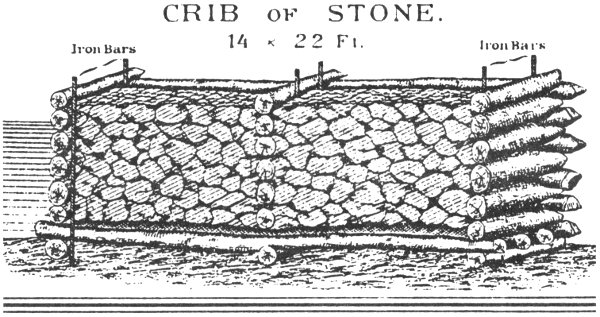
Sketches of the crib and tree dams designed by Lieutenant-Colonel Joseph Bailey to improve the water levels of the Red River near Alexandria, Louisiana, spring 1864 (Joseph Bailey, “Report on the Construction of the Dam Across the Red River,” 1865, public domain).
Having finally reached Alexandria on 26 April, the 47th Pennsylvania Volunteers learned they would remain at their latest new camp for at least two weeks. Placed temporarily under the command of Lieutenant-Colonel Joseph Bailey, they were assigned yet again to the hard labor of fortification work — this time helping to erect “Bailey’s Dam,” a timber structure that enabled Union gunboats to more easily make their way back down the Red River. According to Wharton:
“We were at Alexandria seventeen days, during which time the men were kept busy at throwing up earthworks, foraging and three times went out some distance to meet the enemy, but they did not make their appearance in numbers large enough for an engagement. The water in the Red river had fallen so much that it prevented the gunboats from operating with us, and kept our transports from supplying the troops with rations, (and you know soldiers, like other people, will eat) so Banks was compelled to relinquish his designs on Shreveport and fall back to the Mississippi. To do this a large dam had to be built on the falls at Alexandria to get the ironclads down the river. After a great deal labor this was accomplished and by the morning of May 13th the last one was through the shute [sic], when we bade adieu to Alexandria, marching through the town with banners flying and keeping step to the music of ‘Rally around the flag,’ and ‘When this cruel war is over.’ The next morning, at our camping place, the fleet of boats passed us, when we were informed that Alexandria had been destroyed by fire – the act of a dissatisfied citizen and several negroes. Incendiary acts were strictly forbidden in a general order the day before we left the place, and a cavalry guard was left in the rear to see the order enforced. After marching a few miles skirmishing commenced in front between the cavalry and the enemy in riflepits [sic] on the bank of the river, but they were easily driven away. When we came up we discovered their pits and places where there had been batteries planted. At this point the John Warren, an unarmed transport, on which were sick soldiers and women, was fired into and sunk, killing many and those that were not drowned taken prisoners. A tin-clad gunboat was destroyed at the same place, by which we lost a large mail. Many letters and directed envelopes were found on the bank – thrown there after the contents had been read by the unprincipled scoundrels. The inhumanity of Guerrilla bands in this department is beyond belief, and if one did not know the truth of it or saw some of their barbarities, he would write it down as the story of a ‘reliable gentleman’ or as told by an ‘intelligent contraband.’ Not satisfied with his murderous intent on unarmed transports he fires into the Hospital steamer Laurel Hill, with four hundred sick on board. This boat had the usual hospital signal floating fore and aft, yet, notwithstanding all this, and the customs of war, they fired on them, proving by this act that they are more hardened than the Indians on the frontier.
On Sunday, May 15, we left the river road and took a short route through the woods, saving considerable distance. The windings of Red river are so numerous that it resembles the tape-worm railroad wherewith the politicians frightened the dear people during the administration of Ritner and Stevens. – We stopped several hours in the woods to leave cavalry pass, when we moved forward and by four o’clock emerged into a large open plain where we formed in line of battle, expecting a regular engagement. The enemy, however, retired and we advanced ‘till dark, when the forces halted for the night, with orders to rest on their arms. – ‘Twas here that Banks rode through our regiment, amidst the cheers of the boys, and gave the pleasant news that Grant had defeated Lee.”

“Sleeping on Their Arms” by Winslow Homer (Harper’s Weekly, 21 May 1864).
Having entered Avoyelles Parish, they “rested on their arms” for the night, half-dozing without pitching their tents, but with their rifles right beside them. They were now positioned just outside of Marksville, Louisiana on the eve of the 16 May 1864 Battle of Mansura, which unfolded as follows, according to Wharton:
“Early next morning we marched through Marksville into a prairie nine miles long and six wide where every preparation was made for a fight. The whole of our force was formed in line, in support of artillery in front, who commenced operations on the enemy driving him gradually from the prairie into the woods. As the enemy retreated before the heavy fire of our artillery, the infantry advanced in line until they reached Mousoula [sic, Mansura], where they formed in column, taking the whole field in an attempt to flank the enemy, but their running qualities were so good that we were foiled. The maneuvring [sic] of the troops was handsomely done, and the movements was [sic] one of the finest things of the war. The fight of artillery was a steady one of five miles. The enemy merely stood that they might cover the retreat of their infantry and train under cover of their artillery. Our loss was slight. Of the rebels we could not ascertain correctly, but learned from citizens who had secreted themselves during the fight, that they had many killed and wounded, who threw them into wagons, promiscuously, and drove them off so that we could not learn their casualties. The next day we moved to Simmsport [sic, Simmesport] on the Achafalaya [sic, Atchafalaya] river, where a bridge was made by putting the transports side by side, which enabled the troops and train to pass safely over. – The day before we crossed the rebels attacked Smith, thinking it was but the rear guard, in which they, the graybacks, were awfully cut up, and four hundred prisoners fell into our hands. Our loss in killed and wounded was ninety. This fight was the last one of the expedition. The whole of the force is safe on the Mississippi, gunboats, transports and trains. The 16th and 17th have gone to their old commands.
It is amusing to read the statements of correspondents to papers North, concerning our movements and the losses of our army. I have it from the best source that the Federal loss from Franklin to Mansfield, and from their [sic] to this point does not exceed thirty-five hundred in killed, wounded and missing, while that of the rebels is over eight thousand.”

Union Army base at Morganza Bend, Louisiana, circa 1863-1865 (U.S. Library of Congress, public domain).
Continuing on, the surviving members of the 47th marched for Simmesport and then Morganza, where they made camp again. While at Morganza, the nine formerly enslaved Black men who had enlisted with the 47th Pennsylvania in Beaufort, South Carolina (1862) and Natchitoches, Louisiana (April 1864) were officially mustered into the regiment between 20-24 June 1864.
The regiment then moved on once again, and arrived in New Orleans in late June. As they did during their tour through the Carolinas and Florida, the men of the 47th had battled the elements and disease, as well as the Confederate Army, in order to survive and continue to defend their nation.
On the 4th of July, they were informed that their fight was not yet over. Ordered to return to the East Coast for further duty, they subsequently departed in two groups: Companies A, C, D, E, F, and I sailed for the Washington, D.C. area aboard the U.S. McClellan on 7 July, while the men from Companies B, G, H, and K departed aboard the Blackstone later that month.
* Note: According to biographers Mercer and Vallandigham, Private William Hutcheson had been “wounded in the right arm,” at some point during his service with the 47th Pennsylvania, “and while on the Red River expedition in June, 1864, suffered a sunstroke.” Later accounts of Hutcheson’s life would attribute his lingering problems with balance and chronic vertigo to that sunstroke episode.
Sheridan’s 1864 Shenandoah Valley Campaign
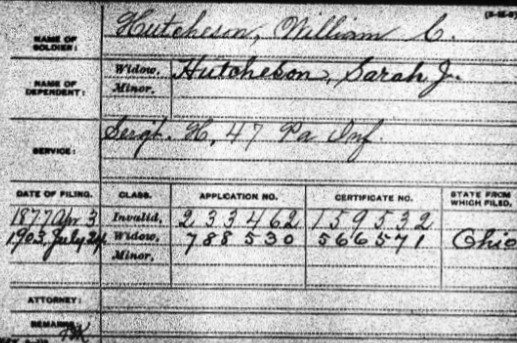
Sergeant William C. Hutcheson, 47th Pennsylvania Volunteer Infantry, and his widow, Sarah J. Hutcheson, U.S. Civil War Pension General Index Card (U.S. National Archives and Records Administration, circa early 1900s, public domain; click to enlarge).
Although Private William C. Hutcheson’s biographers, James K. Mercer and C. N. Vallandigham, would later indicate that William Hutcheson had not participated in the majority of the 47th Pennsylvania’s engagements during Sheridan’s 1864 Shenandoah Valley Campaign, because William “was so prostrated from extreme fatigue that he was sent to Frederick City hospital, Maryland, for ten months” during “the latter part of July, 1864,” other primary and secondary sources do not support those statements. Those same primary and secondary sources also appear to contradict the Mercer-Vallandigham statement that William had been “elected fifth sergeant,” and had then been “promoted to third sergeant and orderly sergeant and first lieutenant” during his tenure of service with the 47th Pennsylvania Volunteer Infantry, as well as a claim by the Cleveland Plain Dealer that William Hutcheson had been “discharged as first lieutenant.” According to historian Samuel Bates, who used the 47th Pennsylvania Volunteers’ own muster rolls when writing about the 47th Pennsylvania in his History of Pennsylvania Volunteers in 1869, William C. Hutcheson entered and left service with the 47th Pennsylvania as a private. That same data was repeated in the federal government’s special veterans’ census of 1890 and the Pennsylvania Civil War Veterans’ Card File.
Those primary and secondary source records were clearly incomplete, however; an index card created for William C. Hutcheson for his U.S. Civil War Pension file at the U.S. National Archives confirms that he did reach the rank of sergeant — data that is also supported by the research of regimental historian Lewis Schmidt, who reported that William Hutcheson had been serving as a third sergeant by the winter of 1862, was “assigned duty as Provost Sergeant” at Fort Jefferson in the Dry Tortugas, Florida on 20 December 1862, and was reduced to the rank of private in early March 1862.
In reviewing the totality of the data contained in those various sources, researchers for 47th Pennsylvania Volunteers: One Civil War Regiment’s Story theorize that Private William C. Hutcheson was treated for sunstroke-related complications by regimental physicians from the time he suffered sunstroke in Louisiana in June 1864 until he was honorably discharged at Berryville, Virginia on 18 September 1864. If so, he missed not only a memorable encounter with President Abraham Lincoln, but also missed the Battle of Cool Spring at Snicker’s Gap, Virginia in mid-July 1864 and the Battle of Berryville from 3-4 September.
Return to Civilian Life
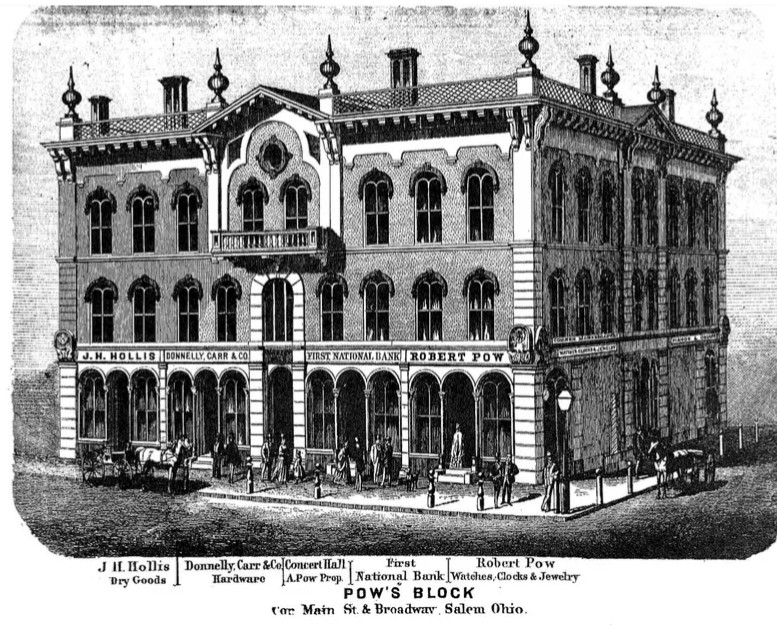
“Pow’s Block,” Main and Broadway, Salem, Ohio, circa 1869 (public domain).
Sometime after his honorable discharge from the military, William Hutcheson returned home to Perry County, where he tried to regain some semblance of his pre-war life. But his spirit was restless. So, he packed up his pregnant wife, their two sons and his family’s possessions, migrated west during the spring of 1865 and began to forge a new life with them in Columbiana County, Ohio, where he found work as a house painter. Their daughter, Mary Florence Hutcheson (1865-1957), was then born at their home in the village of Salem on 17 June 1865; she would later go on to marry Otto C. Juergens (1861-1939) and would settle with him in Salem. More children then followed: William Oscar Hutcheson (1867-1914), who was born on 12 August 1867 and would later wed Rachel Ann Heffner (born circa 1873-died after 1920); and Charles Maxwell Hutcheson (1869-1919), who was born on 23 July 1869, and would later wed Mary Houlette (1869-1942). A member of the First Presbyterian Church of Salem, William was also installed as a church elder during that phase of his life (on 8 September 1867).
Still employed as a painter during the summer of 1870, William C. Hutcheson resided in Salem with his wife, Sarah, and their children: Frazier, James, Mary, William, and Charles. Three more children then arrived: Herbert Calvin Hutcheson (1871-1954), who was born on 1 September 1871 and would later wed Mary Jane Leake (1870-1927); Grace Greenfield Hutcheson (1873-1949), who was born on 29 June 1873 and would later wed Harry Shook (1872-1932); and John Alpheus Hutcheson (1875-1877), who was born on 5 October 1875.
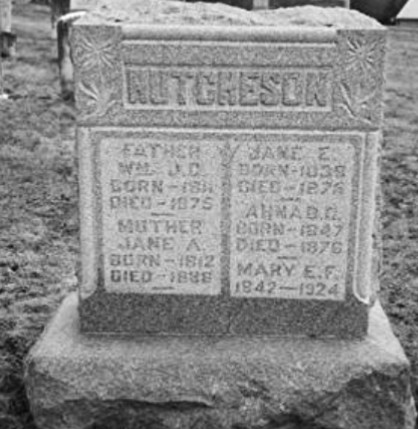
Graves of William J. G. Hutcheson, his wife, Jane Ann (Frank/Franks) Hutcheson, and their daughters Jane E., Anna B. D. and Mary E. F. Hutcheson, Landisburg Cemetery, Landisburg, Pennsylvania (public domain; click to enlarge).
But the 1870s would also bring grief, far and near, for the Hutchesons. In 1875, William C. Hutcheson received word that his father, William John Greenfield Hutcheson, had died in Perry County, Pennsylvania on 18 April; in his early sixties at the time of his passing, William J. G. Hutcheson was subsequently buried at the Landisburg Cemetery in Landisburg. According to The Perry County Democrat, the elder William “was a great lover of his party and labored earnestly, believing it was the best to restore the Union to peace and prosperity.”
“His whole soul was wrapped up in the Church and he labored to see souls happily saved, Joshua-like he loved his nation and his church, and desired their prosperity. At a very early age he became a free and accepted Mason and joined the Lodge … at Chambersburg. When the long roll beat, and the cannon’s [sic, “cannon”] roared and sent its peal to States for help, through Abraham Lincoln, his patriotism arose and he went forth to fill the call, and did his duty faithfully, for an old gray haired veteran. The grand army paid their last respects to him, by honors of war. He died in the triumph of faith. He will be greatly missed as a friend, a citizen, a father and a husband. Many mourn his loss. His place will not be easily filled, but our loss is his gain. ‘Blessed are the dead that die in the Lord.’”
The news from home the following year was even more distressing — two of William C. Hutcheson’s younger sisters, Jane and Anna, had also passed away. Jane E. Hutcheson (1839-1876) died in her mid-thirties in Perry County in 1876 and was laid to rest at the Landisburg Cemetery in Landisburg. Anna B. D. Hutcheson (1844-1876; alternate birth year: 1847), who died in her late twenties in Perry County that same year, was also buried at the Landisburg Cemetery.
Suffering from bouts of vertigo that had made it challenging for him to climb ladders when working on painting contracts around that same time, William C. Hutcheson was able to secure financial help from the federal government by filing for a U.S. Civil War Pension on 3 April 1877, which was subsequently awarded to him following a review of his application materials by U.S. Pension Bureau officials. Sadly, William’s young son, John Alpheus Hutcheson (1875-1877), then died in early childhood. A toddler at the time of his death on 18 November 1877, the little one was buried at Salem’s Hope Cemetery.
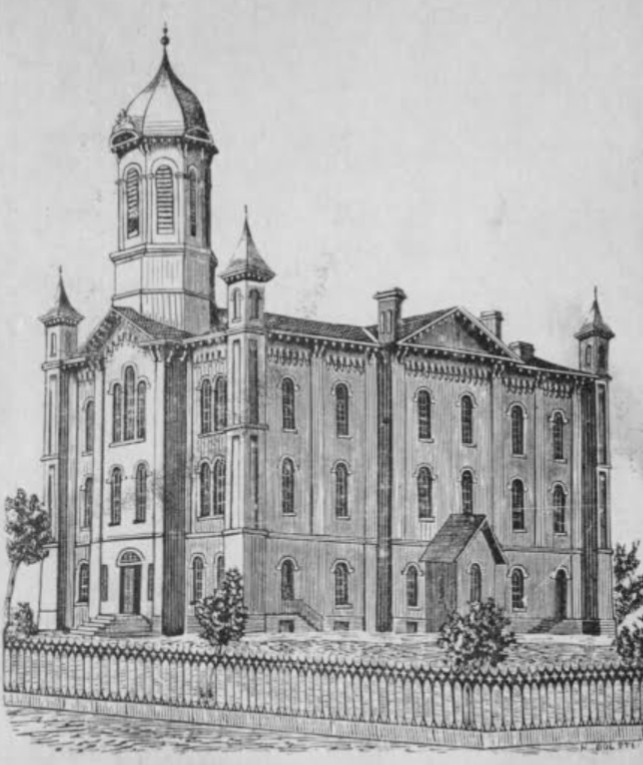
Union High School, which was built in Salem, Ohio in 1862, was razed in 1896 (illustration circa early 1900s, public domain).
William C. Hutcheson’s grief was mitigated just over a year later, however, when his wife gave birth to another daughter — Anna Eliza Hutcheson (1878-1959) — who was born on 10 December 1878 and would later wed Bert B. Chamberlain (1870-1935). Still painting houses as of June 1880, William resided with his wife, Sarah, in the “incorporated village” of Salem, according to that year’s federal census. Also living with them were their children: Frazier, who was employed as a bread baker; James, who was working as a clerk at a local store; Mary, William, Charles, Herbert, and Grace, who were all still attending school; and little Annie. An active member of the Grand Army of the Republic (G.A.R.) for much of his post-Civil War life, the elder William was then elected as chaplain of Salem’s Trescott Post, which had more than two hundred members, according to Salem’s Daily News. But grief descended upon the Hutchesons once more with the news that William C. Hutcheson’s mother, Jane Ann (Frank/Franks Hutcheson), was gone. Following her death at the age of seventy-six in Landisburg, Perry County, Pennsylvania on 26 July 1888, she was laid to rest beside her husband at the Landisburg Cemetery.
Still William and his wife, Sarah, “soldiered on.” According to Salem’s city directories of 1891 and 1892, his home was located at 238 Main Street, but his painting and ornamental wallpaper hanging business was headquartered at 81-1/2 Main Street. A Republican who was descscribed by The Salem Daily News as “the workingman’s friend,” William C. Hutcheson was also active in local and regional politics. Initially interested in securing a seat on his local school board, his focus soon shifted when members of his party persuaded him to set his sights higher. Elected to the Ohio State Legislature in November 1893, he delivered his “maiden lecture” in that legislative body on 23 January 1894:
“In his speech Mr. Hutcheson dropped into a Biblical mood and recited the story of the rebuilding of the Jewish walls of the captivity of King Nehemiah. That gentleman, he declared, was pestered much in the same way as Governor McKinley is at the present time upon the biennial session question, and showed that by ignoring such opposition he succeeded in rebuilding the walls of Jerusalem within 52 days. Mr. Hutcheson declared that it was a sacred pledge that they were called upon to fulfill, and, not only that, but the people of Ohio were crying out that the legislature adjourn and go home.
In speaking of his address the Ohio State Journal says:
Mr. Hutcheson gave an unexpected display of his oratorical powers, which was a pleasing surprise. He had an entertaining way of backing up his arguments by Scriptural references. He compared the present situation to the rebuilding of the walls by Nehemiah around Jerusalem. The opponents of the biennial plan were likened to Sanballat and Tobias, who discouraged Nehemiah and told him there were too many obstacles in the way to rebuild the walls. However, if the friends of the plan were like Nehemiah they would go ahead. He rebuilt the wall in 52 days. The Columbiana statesman hoped that the republicans would ‘sing a new song.’
It was decided by a vote of 50 yeas to 33 nays to defer action of the matter under discussion which [was] equivalent to killing it. Mr. Hutcheson voted yea while Mr. Brittain, the other representative from this county, voted nay.”
The Honorable William C. Hutcheson then went on to represent his constituents in Columbiana County through 1896, serving in both the seventy-first and seventy-second general assemblies of the Ohio House of Representatives. During his first term, he frequently traveled from Columbus to his county, where he met with constituents and delivered speeches at county fairs and other public events, including an address entitled, “A Christian’s Obligation to His Brother,” that was made at “the Y.M.C.A. open air meeting on the north side school grounds” in Salem during the afternoon of Sunday, 2 September 1894, according to his hometown newspaper, The Salem Daily News. During his second term, he chaired the committee on federal relations, and also served on “the committee on claims and the committee on the girls’ industrial home,” according to that same publication.
But as 1896 began to wane, his attention shifted to securing a more powerful position, and, in early 1897, he “announced his candidacy for the Republican nomination for state senator from [the] joint Twentieth and Twenty-second district,” according to the 19 January edition of Salem’s Daily News. His campaign would prove to be a short-lived one, however; he withdrew from the race ten days later, explaining to the Republican Party leadership by letter that “the primary was set too early for me to make a canvass in such weather as this. I dare not venture without injuring my health.” Less than two months later, he boarded a train and headed for Washington, D.C. to attended the inauguration of U.S. President William McKinley (who had been the governor of Ohio at the time that William C. Hutcheson had served in the Ohio State Legislature). That presidential inauguration of 1897 was held in front of the U.S. Capitol on 4 March. Six days later, William Hutcheson’s wife, Sarah Jones (Kacy) Hutcheson, received word that her father, Captain James Kacy, had died at his home in Bird-in-Hand, Lancaster County, Pennsylvania (on 10 March 1897).
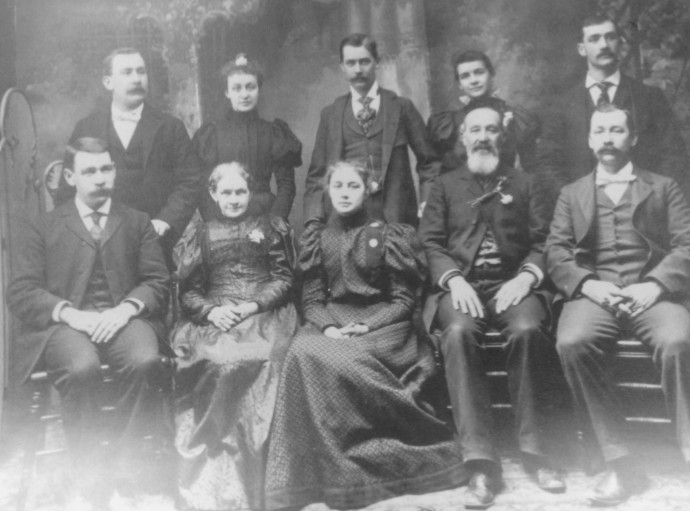
40th Anniversary photo of William C. Hutcheson and his wife, Sarah, with their children in Salem, Ohio, circa March 1898. Seated left to right: James McClellan Hutcheson, Sarah Jones (Kacy) Hutcheson, Anna Eliza Hutcheson, William Cornelius Hutcheson, and Frazier Kacy Hutcheson. Standing left to right: William Oscar Hutcheson, Grace Greenfield (Hutcheson) Shook, Charles Maxwell Hutcheson, Mary Florence (Hutcheson) Juergens, and Herbert Calvin Hutcheson (public domain; click to enlarge).
Roughly a year later, William C. Hutcheson and his wife celebrated their fortieth wedding anniversary with family and friends in Salem. Sometime during that event, which occurred circa March 1898, they were photographed with their children: Frazier Kacy Hutcheson, M.D., James McClellan Hutcheson, Mary Florence (Hutcheson) Juergens, William Oscar Hutcheson, Charles Maxwell Hutcheson, Herbert Calvin Hutcheson, Grace Greenfield (Hutcheson) Shook, and Anna Eliza Hutcheson (see image).
Still employed as a painting contractor after the turn of the century, William C. Hutcheson headed a much smaller household that included just his wife, Sarah, and their twenty-one-year-old, unmarried daughter, Anna. Their house, which William owned, was located at 238 East Main Street in Salem’s Fourth Ward, according to the 1900 federal census.
Injury, Death and Interment
Three years into the new century, tragedy struck the Hutcheson family yet again. On Monday, 13 July 1903, William C. Hutcheson sustained severe internal injuries during a fall from the roof of a house he was painting. The Evening News Review of East Liverpool, Ohio subsequently reported that he had fallen “25 feet from a roof alighting on his head … his spine and chest being affected.” The Cleveland Plain Dealer, noted that the fall had “caused concussion of [his] spine.” After lingering in pain for several days, the old soldier died at the age of sixty-nine at his Main Street home in Salem on 15 July (alternate death date: 16 July 1903). His city death certificate later attributed his cause of death to his military service during the American Civil War, by adding the following:
“Chief Cause: Accident
Contributing Cause: Ruptured blood vessel from vertigo from sunstroke in army”
Following funeral services, William C. Hutcheson was buried at the Hope Cemetery in Salem.
What Happened to the Widow and Children of William C. Hutcheson?
Unidentified homes on McKinley Avenue, looking west, in Salem, Ohio, 1909 (public domain; click to enlarge).
Following William C. Hutcheson’s death, his widow, Sarah Jones (Kacy) Hutcheson (1839-1929), continued to reside with her daughter in Salem, Ohio. On 24 July of that same year (1903), Sarah filed for a U.S. Civil War Widow’s Pension, which was subsequently awarded to her, following a review of her application materials by U.S. Pension Bureau officials. By 1910, Sarah and her daughter, Anna, were living at 238 McKinley Avenue, and Anna was employed as a compositor at a printing company. Anna then married Bert B. Chamberlain (1870-1935) in Columbiana County on 4 October 1913, and moved into her own home with her husband. Tragedy then struck yet again when Sarah lost two more of her children — William Oscar Hutcheson in 1914 and Charles Maxwell Hutcheson in 1919.
* Note: Following his marriage to Rachel Ann Heffner (born circa 1873-died after 1920) in Salem circa 1889, William C. Hutcheson’s son, William Oscar Hutcheson (1867-1914), had initially settled with her in Salem, where they had become the parents of: Raymond Miles Hutcheson (1890-1945), who had been born on 24 November 1890 and would later marry and begin a family with Helma G. Gill (1896-1988) in Cleveland, Cuyahoga County, Ohio, before relocating with her to California’s San Fernando Valley; and Lloyd William Hutcheson (1893-1943), who had been born on 8 August 1893 and would later wed Dorothea Lisette Beckenbach (1897-1989). By 1900, William O. Hutcheson had relocated with his wife and sons to the Ninth Ward in the city of Cleveland, Ohio, where he had secured a job as an iron moulder. By 1910, however, he had secured a job as an ornamental moulder at a foundry in San Francisco, California, where he was residing with his wife and sons at 214 6th Street in that city. Both of his sons had also secured jobs as moulders at a foundry by that time. In 1912, the family resided at 537 Columbus Avenue, according to San Francisco’s voter registration records. Sometime prior to the summer of 1914, however, William O. Hutcheson and his wife had returned to Cleveland, Ohio, where he had then died at his home, in his late forties on 4 September 1914, according to Cuyahoga County death records and his obituary in The Salem News. Following the return of his remains to Salem on Monday evening, 7 September, a viewing was held at the East Fourth Street home of his sister, Mary Florence (Hutcheson) Juergens, from 7 to 9 p.m. His funeral was then held at her home at 2 p.m. the next day. Researchers have not yet identified his burial location.
Following his marriage to Mary Houlette (1869-1942) in Columbiana County on New Year’s Eve in 1891, William C. Hutcheson’s son, Charles Maxwell Hutcheson (1869-1919), had settled with his wife in Salem, where they had become the parents of Clare Charles Hutcheson (1894-1977), who was born on 19 May 1894 and would later wed Alma Victoria Reynolds (1902-1949). Sometime before the summer of 1900, Charles M. Hutcheson had then relocated with his wife and son to the city of Elyria in Lorain County, Ohio, where Charles had secured a job as a baker. By 1910, the trio had relocated to the city of Mansfield in Richland County, Ohio, where Charles was also employed as a baker. Sadly, Charles Maxwell Hutcheson suffered a fatal heart attack during the afternoon of Saturday, 25 January 1919. Just forty-nine years old at the time of his death, he was subsequently buried near other Hutcheson family members at the Hope Cemetery in Salem.
After the deaths of her two sons, William C. Hutcheson’s widow, Sarah Jones (Kacy) Hutcheson (1839-1929), continued to “soldier on” in the face of adversity. Still residing at 238 McKinley Avenue in Salem when the federal census was enumerated in January 1920, she subsequently became ill and frail, prompting her to move into the home of her daughter, Mary Florence (Hutcheson) Juergens, on East Fourth Street in Salem, where she died at the age of eighty-nine on 29 April 1929. Following funeral services, Sarah was then laid to eternal rest beside her husband at the Hope Cemetery in Salem.
Postcard showing Main Street in Wellsville, Ohio, circa 1890s to early 1900s (public domain).
William C. Hutcheson’s first-born son, Frazier Kacy Hutcheson, M.D. (1859-1929), grew up to become an allopathic physician. A graduate of the University of Virginia, Frazier had earned his medical degree from the widely-respected medical school at Johns Hopkins University in Baltimore, Maryland. Following his marriage to Ida Koch (1861-1928) in Columbiana County on 4 November 1880, Dr. Frazier Hutcheson settled with her in Wellsville, Columbiana County, where he practiced medicine for more than two decades. Newspapers in the region frequently reported his involvement in the treatment and care of patients with a wide range of illnesses or injuries, including: abrasions, broken bones, bruises, concussions, cuts, eye injuries, and other wounds caused by buggy accidents, criminal assaults, domestic violence incidents, falls inside or outside of the home, kicking horses, or workplace accidents; bowel obstructions and other diseases affecting children or adults; and food or other accidental poisoning. In addition, he was also often called to render medical opinions following the deaths by suicide of area residents. Still practicing medicine in Wellsville in 1900, Dr. Frazier Hutcheson resided with his wife at 125 Main Street. During the early part of that decade, he also served as a member of Wellsville’s local school board, according to the 17 February 1902 edition East Liverpool’s Evening Review, and as the “city poor director,” according to the 10 May 1901 and 27 February 1903 editions of that same publication. Then, during the summer of 1904, he and his wife, Ida, traveled to Boston, Massachusetts so that she could receive advanced medical care for a lingering illness, according to the 15 August 1904 edition of the Evening Review. While she was recovering, he spent roughly two weeks traveling with a group of physicians in Maine, according to that newspaper’s 6 and 26 August editions. Later that same year, he provided expert witness testimony during the murder trial of Joseph Gismonti. By the spring of 1910, Dr. Hutcheson and his wife were residing in a home at 935 Riverside Avenue in Wellsville. Later that same year, on 4 November, he and his wife celebrated their Pearl Wedding Anniversary at their home at 935 Riverside Avenue in Wellsville. According to Liverpool’s Evening Review, “The rooms had been artistically decorated for the occasion, the color scheme being white and yellow, and chrysanthemums the flowers used…. An elegant buffet luncheon was served during the evening. The gifts were appropriately numerous and beautiful.” Fifty-eight family members and friends from Wellsville mingled with twelve from East Liverpool, East Palestine and Salem, as well as several guests who made the trip from Pennsylvania. But that event would prove to be one of their final happy times together. Divorced sometime before January 1920, according to that year’s federal census, Frazier K. Hutcheson had also made two other major changes around that same time. Practicing medicine in the city of Dayton in Montgomery County, Ohio, he was now also living with Zana Isabella Burnett (1894-unknown).
* Note: Although the federal census enumerator reported that Frazier K. Hutcheson, M.D. and Zana I. Burnett had already married by January 1920, marriage records in the State of Kentucky documented their marriage as having taken place nine months later — in Newport, Campbell County, Kentucky on 11 September 1920.
But his new life would prove to be a brief one. Ailing with stomach cancer during his final years, Frazier Kacy Hutcheson, M.D. died at the age of sixty-two at his home at 529 East Second Street in Dayton on 5 May 1929 (just six days after the death of his mother), and was laid to rest at that city’s Dayton Memorial Park Cemetery. He was survived by three brothers and two sisters, as well as his second wife, Zana.
Stereoscope of Salem, Ohio (aerial view from West Main Street, 1890s-early 1900s, public domain).
Following his marriage to Anna Maria Garretson (1865-1952) in Columbiana County on 23 May 1889, William C. Hutcheson’s son, James McClellan Hutcheson (1861-1936), settled with her in Salem, where, like his father before him, he had become a painter and wallpaper hanger, according to Salem city directories that were published during their respective lives. James M. Hutcheson and his wife, Annie, then became the parents of Irma S. Hutcheson (1890-1956), who was born on 23 February 1890 and would never marry; Bernice May Hutcheson (1892-1977), who was born on 27 July 1892 and would later wed farmer Monroe Jesse Freshly (1893-1971); and Earl James Hutcheson (1894-1960), who was born on 4 March 1894 and would later wed Marguerite Schultz (1894-1965). By 1900, James M. Hutcheson resided in a home that he owned in Salem’s First Ward. Also living with him were his wife, Annie, and their children, Irma, Bernice and Earl, who were all attending school, and Annie’s parents, Eli and Margaret Garretson. Two more children then followed: Lucille Hutcheson (1901-1984), who was born on 9 May 1901 and would later wed Edward J. Kunkel (1897-1979); and Harold Kenneth Hutcheson (1906-1982), who was born on 24 April 1906 and would later wed Mary E. McLaughlin (1913-2008). Residents of Woodland Avenue in Salem’s Fourth Ward by 1910, their household included everyone but the Garretsons. By 1920, however, their household on East High Street in Salem’s Fourth Ward was smaller, and included just James and his wife, Annie, and their children: Irma, who was employed as a stenographer at a farm equipment company; Bernice, who was employed as a teacher at a local public school; and Lucille and Harold, who were both unemployed. A resident of 1543 East Third Street in 1930, painting contractor James M. Hutcheson lived there with his wife, Annie, and their children: Irma, who was unemployed; Lucille, who was employed as a teacher in Salem’s public school system; and Harold, who was also employed as a painter and decorator. Still residing 1543 East Third Street in 1936, James M. Hutcheson set out on a hunting trip to celebrate his birthday (16 November), and brought his son, Earl, with him. After traveling a short distance to the farm of his daughter, Bernice (Hutcheson) Freshly, on Damascus Road in Salem, they began their day’s adventure with excitement and hope. Sadly, shortly before 1 p.m. that same day, James suffered a sudden heart attack and cerebral hemorrhage, and died at the age of seventy-five. Following funeral services, he was also interred at the Hope Cemetery in Salem.
Pittsburgh, Pennsylvania, circa 1905 (public domain; click to enlarge).
Following her marriage to Harry Shook (1872-1932) in Columbiana County on 2 July 1890, William C. Hutcheson’s daughter, Grace Greenfield (Hutcheson) Shook (1873-1949), initially settled with her husband in Salem, where they became the parents of Charles R. Shook (1891-1955), who was born on 21 January 1891 and would later become an iceman and mechanic’s helper but would never marry; and Frazier K. Shook (1892-1969), who was born 12 February 1892 and would later wed Helen Jane Evans (1891-1965). By the turn of the century, however, Grace (Hutcheson) Shook, her husband and two sons had relocated to the city of Pittsburgh in Allegheny County, Pennsylvania, and were residing at 132 18th Street. Her husband was employed as a cooper that year. By 1910, she and her streetcar motorman-husband were renting a home at 3 Amanda Avenue in the Allegheny County borough of Knoxville, which was also home to their two sons: Charles, who was employed as a grocery store clerk; and Frazier, who was working as a printer’s engraver. The following year, Grace gave birth to another son, Norman Harry Shook (1911-1985), who was born in Pittsburgh on 9 June 1911 and would later wed Florence Ethlyn Davis (1911-1999). Still residing in Knoxville with her streetcar motorman-husband in 1920, Grace managed a household that included her unemployed sons, Charles and Norman. By 1930, however, Grace and her motorman-husband were residing in Pittsburgh’s Thirtieth Ward with their sons: Charles, who operated his own ice delivery business; and Norman, who was employed as a gas station clerk. Also renting a room from them that year was seventy-six-year-old Martha Miller. Widowed by her husband when he died at the age of sixty in Pittsburgh on 27 March 1932, and was buried at the South Side Cemetery, Grace (Hutcheson) Shook continued to reside in Pittsburgh with her son, Charles, and their aging lodger, Martha Miller, into the 1940s. After her son’s passing, Grace continued to reside in Pittsburgh. Ailing with heart disease during the final two years of her life, she died at the age of seventy-six in Allegheny County on 25 September 1949, and was buried at the South Side Cemetery, according to her death certificate.
Herbert C. Hutcheson (1871-1954), shown here circa 1937, was also known as “Hutchie.” The longtime janitor at the McKinley School in Salem, Ohio, he also rang the school bell each day (public domain).
William C. Hutcheson’s son, Herbert C. Hutcheson (1861-1954), who was affectionately known to family, friends and neighbors as “Hutchie,” became the longtime janitor at the McKinley School — an historic structure in Salem that had gradually transitioned from oil lamps to electric lighting during his tenure of employment. Following his marriage to Mary Jane Leake (1870-1927) in Columbiana County on 19 February 1891, he settled with her in Salem, where they became the parents of: Sarah Jane Hutcheson (1892-1970), who was born on 1 August 1892 and would later wed Willis McArtor (1890-1971) and settle with him in Salem; Richard Leake Hutcheson (1893-1986), who was born on 15 September 1893 and would later wed Hazel F. DeVenne (1895-1981) and would settle in Salem; Mildred Judith Hutcheson (1895-1934), who was born on 15 July 1895, was also known as “Judy” and would later wed Shirel Charles Greene (1895-1988) in Salem in 1917; and Rowena Nancy Hutcheson (1899-1987), who was born on 7 July 1899 and would later wed Walter E. Tressler (1901-1958) and settle with him in Salem. By 1900, Herbert Hutcheson was employed as a painter and was residing in a home that he owned at 24 West Eighth Street in Salem’s First Ward. Also living with him were his wife, Mary Jane (also known as “Molly”), and their children: Sarah and Richard, who were both attending school; and pre-schoolers Judy and Nancy. Another daughter, Anna Mary Hutcheson (1904-1997), was then born on 19 December 1904; she would later wed Joseph DeVault (1905-1989) and settle with him in Blue Island, Illinois. Employed as a janitor at the McKinley School in 1910, Herbert Hutcheson was living in a rented home that year at 50 Fair Street in Salem’s Fourth Ward. Residing with him were his wife and their children, Richard, Mildred, Rowena, and Anna. Still employed as a janitor at the McKinley School in 1920, Herbert Hutcheson owned his Fair Street home by 1920, and resided there with his wife and their children: Richard, who was employed as a shoe salesman; Rowena, who was employed as a saleswoman at a book shop; and Mary, who was unemployed. Widowed by his wife, Mary Jane (Leake) Hutcheson, when she died in Salem at the age of fifty-seven on 30 September 1927, and was buried at the Grandview Cemetery, Herbert Hutcheson continued to work as the McKinley School as a janitor until his retirement in 1942. During that phase of his life, he also lost his daughter, Mildred Judith (Hutcheson) Greene when she died in her late thirties in Michigan on 29 July 1934, and was subsequently buried at the Grandview Cemetery in Salem. Still residing in Salem when the federal census was enumerated there in 1950, “Hutchie” was a member of Dads of Foreign Service Veterans, according to later newspaper accounts of his life. Ailing during his final eighteen months, he relocated to the Gregg Nursing Home in Salem in October 1953, where his health continued to decline. Transported to the Central Clinic in Salem on Saturday, 27 February 1954, he died there from disease-related complications later that same day, according to his obituary, which was published in The Salem News on Monday, 1 March. Following funeral services, he was laid to rest at the Grandview Cemetery in Salem. In addition to his four children and two sisters, “Hutchie” was survived by thirteen grandchildren and eighteen great-grandchildren.
Mary Florence (Hutcheson) Juergens, a daughter of 47th Pennsylvania veteran William C. Hutcheson, Salem, Ohio, circa 1940s (public domain).
Following her marriage to Otto C. Juergens (1861-1939) in Columbiana County on 24 February 1887, William C. Hutcheson’s daughter, Mary Florence (Hutcheson) Juergens (1865-1957), settled with her husband in Salem, where they became the parents of: Carl H. Juergens (1887-1970), who was born on 21 December 1887 and would later wed Ann L. Loop (1891-1982); and Ethel M. Juergens (1895-1965), who was born on 6 July 1895 and would later wed Fred G. Hall (1892-1964). By 1900, Mary (Hutcheson) Juergens was residing at 157 East Fourth Street in Salem’s Second Ward with her husband, Otto, who was employed as a cigar merchant, and their two children. Another son, William J. Juergens (1903-1965), was then born on 6 June 1903; William would later go on to marry Carrie E. Harding (1903-1974). Seven years later, Otto Juergens was still making and selling cigars, and was still living with Mary (Hutcheson) Juergens in the same house with their children: Carl, who was employed in his father’s cigar business; Ethel and William. In 1920, however, their East Fourth Street household included: Mary and her husband, Otto, who was now employed as a truant officer; their unmarried and unemployed son, William; and their married daughter, Ethel (Juergens) Hall; her husband, Fred Hall, who was employed as a salesman by a brush factory; and their toddler, Fred Grant Hall. By 1930, Mary and Otto were “empty nesters” at their East Fourth Street home, and Otto was still employed as a truant officer. Widowed by her husband when he died at the age of seventy-seven from a sudden heart attack while gardening at their home on 27 April 1939, Mary (Hutcheson) Juergens supervised his funeral arrangements, including his burial at the Hope Cemetery in Salem, and then continued to reside at their home on East Fourth Street. By 1940, her daughter, Ethel (Juergens) Hall, and her husband had become the head of that household, which included Mary. By 1950, Mary Florence (Hutcheson) Juergens was residing at the Salem home of her son, William H. Juergens and his wife, Carrie. Sadly, she broke her hip there in May 1957. Admitted to the Salem City Hospital, she died there from injury-related complications later that same month (on 30 May 1957). Ninety-one years old at the time of her passing, Mary was also laid to rest at the Hope Cemetery in Salem.
State Street, Salem, Ohio, circa 1940s (public domain; click to enlarge).
William C. Hutcheson’s youngest daughter, Anna Eliza (Hutcheson) Chamberlain (1878-1959), grew up to become a compositor at a printing company in Salem. Still single and residing with her mother, Sarah Jones (Kacy) Hutcheson (1839-1929), during the spring of 1910, Anna subsequently wed printer Bert B. Chamberlain (1870-1935) in Columbiana County on 4 October 1913, and became the stepmother of his daughter, Lorene Esther Chamberlain (1910-1993), who had been born on 20 September 1910 and would later wed Charles Frederick Schamp. Anna and Bert then welcomed the birth of their own daughter, Dorothea V. Chamberlain (1915-1962), who was born in Akron, Summit County, Ohio in 1915 and would later wed Elmer Emil Wurgler (1913-1987) in Cuyahoga County on 3 July 1940. Still employed as a printer in 1920, Anna (Hutcheson) Chamberlain resided with her printer-husband, Bert, and their daughter, Dorothea, in the Village of Lisbon in Columbiana County. No longer working by the spring of 1930, Anna resided with printer-husband, Bert, in Ravenna, Portage County, Ohio. Also living with them were their daughter, Dorothea, and Bert’s daughter, Lorene, the latter of whom was employed as a stenographer by a local college. Widowed by her husband, Bert, when he died from a heart attack at the age of sixty-five at their home on East Seventh Street in Salem on 17 July 1935, according to that day’s edition of The Salem News, Anna (Hutcheson) Chamberlain continued to reside with her daughter, Dorothea, for a number of years. By 1940, they were sharing a home in the city of Salem, where they were employed, respectively as a practical nurse and maid in a private home. They also received income from a room they were renting to Doris Saunders, who was also working as a maid in a private home. Retired by 1950, Anna (Hutcheson) Chamberlain waa a lodger living without her daughter at the home of Alfred and Mary Stratton, which was located at 615 East 7th Street in Salem. Researchers have not yet located Anna’s burial location.
What Happened to the Siblings of William C. Hutcheson?
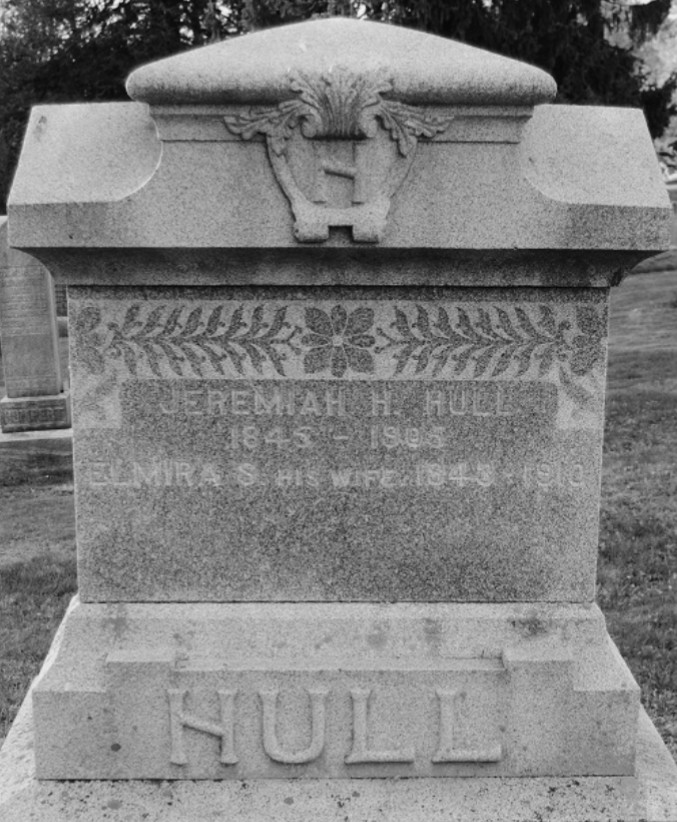
Monument at the grave of 47th Pennsylvania veteran William C. Hutcheson’s sister, Elmira Sibbitt (Hutcheson) Hull, and her husband, Jeremiah H. Hull, Mount Zion Evangelical Lutheran Church Cemetery in Goodyear, Cumberland County, Pennsylvania (public domain; click to enlarge).
Following her marriage to blacksmith Jeremiah H. Hull (1845-1905) in Perry County, Pennsylvania during the mid to late 1860s, William C. Hutcheson’s younger sister, Elmira Sibbitt (Hutcheson) Hull (1843-1910), had settled with her husband in that county, where they had then become the parents of Edward Hull (1869-1950), who had been born circa 15 June 1869, would later marry Alma Kingsley Beckner/Buckner, become a teacher and found the Banks Business College in Philadelphia. In 1870, the trio resided in or near the community of Andersonburg in Madison Township, Perry County, where they remained into the 1880s. But her life would prove to be an often heartbreaking one, according to the 1900 federal census which noted that Elmira had given birth to seven children, only one of whom had survived. That year, she and her husband were residing in Huntington Township, Adams County, Pennsylvania, where her husband was employed as a mail messenger. Also living with them were their son, Edward Hull, who was teaching law, and a boarder, Edward M. Foose, a blacksmith who would later be described in Elmira’s obituary as her adopted son. Widowed by her husband, Jeremiah Hull, when he died at the age of sixty, from a combination of ailments, including paralysis, on 28 December 1905, and was buried at the Mount Zion Evangelical Church Cemetery in Goodyear, Cumberland County, Pennsylvania, Elmira Sibbitt (Hutcheson) Hull survived her husband by less than five years. Ailing during her final months, she was transported to Philadelphia for a surgical procedure at the Women’s Hospital, but died there from complications at the age of sixty-seven years and one day. Her remains were subsequently transported to Cumberland County for burial beside her husband at the Mount Zion Evangelical Church Cemetery in Goodyear.
This image of Newport, Pennsylvania illustrates how rural much of Perry County still was during the 1870s (Silas Wright, History of Perry County in Pennsylvania, 1873, public domain).
Following her marriage to farmer David Michael Boyer (1848-1917) in Newport, Perry County on 7 January 1875, William C. Hutcheson’s younger sister, Alfareta K. (Hutcheson) Boyer (1853-1923), who was known to family and friends as “Kate,” settled with her husband in Perry County, where they became the parents of: Linn Hutcheson/Hutchinson Boyer (1875-1958), who was born in Landisburg, Perry County on 24 October 1875 (alternate birth dates: 24 November 1878) and would later wed Eva Jane Liggett (1871-1936); Gracie Boyer (1876-1877; alternate spelling of given name: “Graceie”), who did not survive infancy and was buried at Saint Johns Church Cemetery in Markelsville, Perry County; Lowery Walter Boyer (1880-1964), who was born in Markelsville on 10 July 1880 and would later wed Orpha Wilhelmina Burd (1876-1942); Mary Jane Boyer (1882-1964), who was born on 24 November and would later wed Warren Ridgeway Wengert (1882-1969); Marion Bella Boyer (1884-1961), who was born on 7 May 1884 and would later wed George Peter Smith (1881-1956); Guy Edward Boyer (1890-1971), who was born in Markelsville on 4 April 1890 and would later wed Mae B. Kline (1888-1976); and Edna Elmira Boyer (1892-1975), who was born on 16 May 1892 (alternate birth years: 1891, 1893) and would later wed Allen E. Attick (1888-1979). After the turn of the century, Alfareta (Hutcheson) Boyer was still residing in Juniata Township, Perry County with her farmer-husband, David M. Boyer, and their children: Linn, Lowery, Mary Jane, Marion, Guy, and Elmira. By 1910, Alfareta and her husband were “empty nesters” who were living and working on their Juniata Township farm. Widowed by her husband when he died at the age of sixty-nine from sudden heart failure at their home in “Middle Ridge near Markelsville,” on 20 May 1917, according to his obituary, she arranged for her husband’s burial at Saint Johns Church Cemetery in Markelsville, and then continued to reside on their farm. In 1920, she was still living there by herself. By 1923, however, she was residing at the home of her daughter, Edna Elmira (Boyer) Attick, at 1251 Derry Street in Harrisburg. Following her death there, Alfareta was subsequently buried beside her husband and infant at Saint Johns Church Cemetery in Markelsville.
William C. Hutcheson’s younger sister, Mary E. F. Hutcheson (1842-1924), became a seamstress but never married. A resident of her parents’ home for much of her early adult life, she continued to reside in Landisburg, Perry County following their respective deaths in 1875 and 1888. By 1920, she was retired and living alone in Landisburg. Increasingly frail as she aged, she fell ill during the early winter of 1924. As her condition worsened, she developed bronchopneumonia and died at her home on 29 February. Following funeral services, she was laid to rest at the Landisburg Cemetery.
Harrisburg, Pennsylvania as viewed from the Capitol Building, circa 1930s (public domain; click to enlarge).
Following his marriage to Mary Elizabeth Jumper (1858-1937) in New Bloomfield, Perry County on 1 March 1887, William C. Hutcheson’s younger brother, John Alpheus Linn Hutcheson (1850-1940), settled with his wife in the city of Harrisburg in Dauphin County, Pennsylvania, where they became the parents of: Ethel Frankes Hutcheson (1888-1966), who was born in Harrisburg on 6 May 1888; and Elmira A. Hutcheson (1892-1912), who was born in Harrisburg on 5 October 1892. Employed as a repairman by the Pennsylvania Railroad in 1900, John A. L. Hutcheson resided with his wife and two daughters in a rented home at 1724 Fulton Street in Harrisburg’s Sixth Ward. Still renting a home a decade later at the same address, which was now part of Harrisburg’s Twelfth Ward, railroad machinist John A. L. Hutcheson resided there with his wife and their daughters: Ethel, who was employed as a sewing machine operator at a bonnet factory; and Elmira. Sadly, John’s daughter, Elmira, who had also secured a job as a machine operator at an area factory by 1911, contracted malaria in November of that year. After battling the disease for more than two months, she developed an abdominal abscess, and died at the age of nineteen in Harrisburg on 9 February 1912. Following funeral services, she was buried at the East Harrisburg Cemetery in Dauphin County. Three years later, joy returned to the Hutcheson household when John’s daughter, Ethel, married templet maker Alfred F. Fries (1886-1958) in Harrisburg on 12 August 1915. In 1920, railroad machinist John A. L. Hutcheson and his wife were “empty nesters” in their rented home on Fulton Street. Retired by 1930, John A. L. Hutcheson and his wife were now living at the home of their married daughter, Ethel (Hutcheson) Fries, at 113 Fourth Street in the Borough of Steelton in Dauphin County, where they had moved circa 1921. Living there with them were Ethel’s husband, Alfred Fries, who was employed as the boiler shop foreman at a steel plant, and E. Laverne and Mary E. H. Fries, the young daughters of Ethel and Alfred. Widowed by his wife, Mary Elizabeth (Jumper) Hutcheson, when she died at the age of seventy-nine at their daughter’s home in Steelton on 6 July 1937, and was subsequently buried at the East Harrisburg Cemetery, John A. L. Hutcheson continued to reside with his daughter in Steelton until his death there at the age of ninety on 16 January 1940. Following funeral services, he was then also buried at the East Harrisburg Cemetery.
Sources:
- Bates, Samuel P. History of Pennsylvania Volunteers, 1861-5, vol. 1. Harrisburg, Pennsylvania: B. Singerly, State Printer, 1869.
- Bert B. Chamberlain (the groom), Amos Chamberlain (father of the groom) and Frances Tyler (mother of the groom); and Ann E. Hutcheson (the bride, who was a daughter of William C. Hutcheson), Wm. C. Hutcheson (father of the bride) and Sarah De Kacy [sic, “Sarah Jones (Kacy) Hutcheson”] (mother of the bride), in Marriage Licenses (Columbiana County, Ohio, date of marriage: 4 October 1913). Lisbon, Ohio: Probate Court, Columbiana County, Ohio.
- “Boyer-Hutchinson” [sic, “Hutcheson”] (announcement of the marriage of William C. Hutcheson’s younger sister, “Alfaretta K. Hutchinson, of Landisburg,” to “D. M. Boyer, of Markelville” on 7 January 1875). Bloomfield, Pennsylvania: The Perry County Democrat, 5 May 1875.
- Boyer, Alfaretta (a younger sister of William C. Hutcheson), in U.S. Census (Juniata Township, Perry County, Pennsylvania, 1920). Washington, D.C.: U.S. National Archives and Records Administration.
- Boyer, D. M., Alfereta (a younger sister of William C. Hutcheson), Linn, and Lowry, in U.S. Census (Juniata Township, Perry County, Pennsylvania, 1880). Washington, D.C.: U.S. National Archives and Records Administration.
- Boyer, D. M., Alfarata (a younger sister of William C. Hutcheson), Linn, Lowrie, Mary, Marian, Guy, and Elmira, in U.S. Census (Juniata Township, Perry County, Pennsylvania, 1900). Washington, D.C.: U.S. National Archives and Records Administration.
- Boyer, David M. and Alfaretta (a younger sister of William C. Hutcheson), in U.S. Census (Juniata Township, Perry County, Pennsylvania, 1910). Washington, D.C.: U.S. National Archives and Records Administration.
- “Captain Kacy Dead” (notice of the death of William C. Hutcheson’s father-in-law and former commanding officer in the 47th Pennsylvania Volunteer Infantry). Salem, Ohio: The Salem Daily News, 12 March 1897.
- C. M. Hutcheson [sic, “Charles Maxwell Hutcheson”] (the groom, who was a son of William C. Hutcheson); and Mary Houlette (the bride), in Marriage Records (Columbiana County, Ohio, date of marriage: 31 December 1891). Lisbon, Ohio: Probate Court, Columbiana County, Ohio.
- Chamberlain, Ann (a daughter of William C. Hutcheson) and Dorothy; and Saunders, Doris (lodger), in U.S. Census (Salem, Columbiana County, Ohio, 1940). Washington, D.C.: U.S. National Archives and Records Administration.
- Chamberlain, Bert, Anna (a daughter of William C. Hutcheson) and Dorothea, in U.S. Census (Lisbon, Columbiana County, Ohio, 1920). Washington, D.C.: U.S. National Archives and Records Administration.
- Chamberlain, Bert, Anna (a daughter of William C. Hutcheson), Lorene (Bert’s daughter from his first marriage), and Dorothea, in U.S. Census (Ravenna, Portage County, Ohio, 1930). Washington, D.C.: U.S. National Archives and Records Administration.
- “Death of D. M. Boyer” (obituary of a brother-in-law of William C. Hutcheson and the husband of Alfareta K. (Hutcheson) Boyer). New Bloomfield, Pennsylvania: The Perry County Times, 31 May 1917.
- Delivery of the Address Entitled, “A Christian’s Obligation to His Brother, “by William C. Hutcheson, in “The City and Country.” Salem, Ohio: The Salem Daily News, 1 September 1894.
- “Dr. Edward M. Hull” (obituary of a grandson of William C. Hutcheson and a son of Elmira Sibbitt (Hutcheson) Hull). Philadelphia, Pennsylvania: The Philadelphia Inquirer, 12 April 1950.
- Dr. F. K. Hutcheson (William C. Hutcheson’s son, Frazier K. Hutcheson, M.D.), in “Gismonti’s Fate Rests with Jury.” East Liverpool, Ohio: The Evening Review, 23 November 1904.
- Edward M. Hull (a grandson of William C. Hutcheson and a son of Elmira Sibbitt (Hutcheson) Hull), in Death Certificates (file no.: 36855, reg. no.: 7421, date of death: 11 April 1950). Harrisburg, Pennsylvania: Commonwealth of Pennsylvania, Department of Health, Bureau of Vital Statistics.
- Edward M. Hull (the groom, who was a grandson of William C. Hutcheson and a son of Elmira Sibbitt (Hutcheson) Hull); and Alma Kingsley Beckner (the bride), in “Marriages and Deaths: Marriage Licenses.” Philadelphia, Pennsylvania: The Philadelphia Times, 17 December 1901.
- Ellis, Franklin and Austin N. Hungerford, ed. History of That Part of the Susquehanna and Juniata Valleys, Embraced in the Counties of Mifflin, Juniata, Perry, Union and Snyder, in the Commonwealth of Pennsylvania, vol. 1. Philadelphia, Pennsylvania: Everts, Peck & Richards, 1886.
- Elmira Sibbitt Hull [sic, “Elmira Sibbitt (Hutcheson) Hull”] (a sister of William C. Hutcheson) and Jere Hull (Elmira’s husband), in Burial Records (Mt. Zion Evangelical Lutheran Church, Goodyear, Cumberland County, Pennsylvania, Elmira’s date of death: 11 June 1910; Jere’s date of death: 28 December 1905). Philadelphia, Pennsylvania: Historical Society of Pennsylvania.
- Elmyra Hutchison [sic, “Elmira Hutcheson”] (a niece of William C. Hutcheson and a daughter of John A. L. Hutcheson), in Death Certificates (file no.: 13797, local reg. no.: 160, date of death: 9 February 1912). Harrisburg, Pennsylvania: Commonwealth of Pennsylvania, Department of Health, Bureau of Vital Statistics.
- Ethel Frankes Hutcheson (the bride, who was a niece of William C. Hutcheson and a daughter of John A. L. Hutcheson), J. L. Hutcheson [sic, “John Alpheus Linn Hutcheson”] (father of the bride and a brother of William C. Hutcheson) and Mary Jumper (mother of the bride); and Alfred F. Fries (the groom), Joseph Fries (father of the groom) and Laura Myers (mother of the groom), in Marriage Records (Harrisburg, Dauphin County, date of marriage: 12 August 1915). Harrisburg, Pennsylvania: Clerk of the Orphans’ Court of Dauphin County, Pennsylvania.
- Ethel M. Fries [sic, “Ethel Frankes (Hutcheson) Fries”] (a niece of William C. Hutcheson and a daughter of John A. L. Hutcheson), in Death Certificates (file no.: 003898-66, local reg. no.: 161, date of death: 26 January 1966). Harrisburg, Pennsylvania: Commonwealth of Pennsylvania, Department of Health, Bureau of Vital Statistics.
- “Ex-Legislator Dead at Salem: Hon. Wm. C. Hutcheson Dies As the Result of a Fall on Monday.” East Liverpool, Ohio: Evening News Review, 16 July 1903.
- “Florida’s Role in the Civil War: ‘Supplier of the Confederacy.” Tampa, Florida: Florida Center for Instructional Technology, University of South Florida (College of Education), retrieved online 15 January 2020.
- “Former Representative Dead: William C. Hutchinson [sic, “Hutcheson”] Was a War Veteran and Active Republican” (brief obituary of William Cornelius Hutcheson). Cleveland, Ohio: Cleveland Plain Dealer, 17 July 1903.
- “For Senator: Representative Hutcheson of This City in the Race Along With Others.” Salem, Ohio: The Salem Daily News, 19 January 1897.
- Frazier K. Hutcheson (the groom, who was a son of William C. Hutcheson); and Zana Isabelle Burnett (the bride), in Marriage Records (Newport, Campbell County, Kentucky, date of marriage: 11 September 1920). Campbell County, Kentucky: Office of the County Clerk.
- Fries, Alfred F., Ethel F. (a niece of William C. Hutcheson and a daughter of John A. L. Hutcheson), E. Laverne, and Mary E. H.; and Hutcheson, John L. and Mary E. (a younger brother and sister-in-law of William C. Hutcheson and Ethel’s parents), in U.S. Census (Steelton, Dauphin County, Pennsylvania, 1930). Washington, D.C.: U.S. National Archives and Records Administration.
- Gobin, John Peter Shindel. Personal Letters, 1861-1865. Northumberland, Pennsylvania: Personal Collection of John Deppen.
- Grace G. Hutcheson (the bride, who was a daughter of William C. Hutcheson); and Harry Shook (the groom), in Marriage Records (Columbiana County, Ohio, date of marriage: 2 July 1890). Lisbon, Ohio: Probate Court, Columbiana County, Ohio.
- Grace Shook [sic, “Grace Greenfield (Hutcheson) Shook”] (a daughter of William C. Hutcheson), in Death Certificates (file no.: 75851, registered no.: 646, date of death: 25 September 1949). Harrisburg, Pennsylvania: Commonwealth of Pennsylvania, Department of Health, Bureau of Vital Statistics.
- Grodzins, Dean and David Moss. “The U.S. Secession Crisis as a Breakdown of Democracy,” in When Democracy Breaks: Studies in Democratic Erosion and Collapse, from Ancient Athens to the Present Day (chapter 3). New York, New York: Oxford University Press, 2024.
- Hain, Harry Harrison. History of Perry County, Pennsylvania. Including Descriptions of Indians and Pioneer Life from the Time of Earliest Settlement. Harrisburg, Pennsylvania: Hain-Moore Company, 1922.
- “H. C. Hutcheson Dies at Age 82: Was McKinley School Janitor 42 Years” (obituary of Herbert C. Hutcheson, who was a son of William C. Hutcheson). Salem, Ohio: The Salem News, 1 March 1954.
- Hall, Fred G., Ethel (a granddaughter of William C. Hutcheson and a daughter of Mary F. (Hutcheson) Juergens); and Juergens, Mary F. Juergens (a daughter of William C. Hutcheson and Ethel’s mother), in U.S. Census (Salem, Second Ward, Columbiana County, Ohio, 1940). Washington, D.C.: U.S. National Archives and Records Administration.
- “Her Grand Sires at War When Parents Were Born: Mrs. Boyer Had Considerable Soldier Connection” [sic, “Alfaretta K. (Hutcheson) Boyer”] (obituary of a sister of William C. Hutcheson). Newport, Pennsylvania: The News, 26 January 1923.
- Hull, Jermiah, Elmira (a sister of William C. Hutcheson) and Edward, in U.S. Census (Andersonburg, Madison Township, Perry County, Pennsylvania, 1870, 1880). Washington, D.C.: U.S. National Archives and Records Administration.
- Hull, Jeremiah H., Elmira S. (a sister of William C. Hutcheson) and Edward M.; and Foose, Edward M. (boarder), in U.S. Census (Huntington Township, Adams County, Pennsylvania, 1900). Washington, D.C.: U.S. National Archives and Records Administration.
- Hurburt C. Hutcheson [sic, “Herbert Calvin Hutcheson”] (the groom, who was a son of William C. Hutcheson); and Mary Jane Leake (the bride), in Marriage Records (Columbiana County, Ohio, date of marriage: 19 February 1891). Lisbon, Ohio: Probate Court, Columbiana County, Ohio.
- “Hutcheson” [sic, “Charles Maxwell Hutcheson”] (obituary of a son of William C. Hutcheson), in “Deaths.” Mansfield, Ohio: The Mansfield News, 25 January 1919.
- Hutcheson, C. M. (a son of William C. Hutcheson), Mary and Clare; and Strausbaugh, _____ (roomer), in U.S. Census (Mansfield, Madison Township, Richland County, Ohio, 1910). Washington, D.C.: U.S. National Archives and Records Administration.
- Hutcheson, Charles (a son of William C. Hutcheson), Mary and Clare, in U.S. Census (Elyria, Third Ward, Lorain County, Ohio, 1900). Washington, D.C.: U.S. National Archives and Records Administration.
- Hutcheson, F. [sic, “Frazier K. Hutcheson”] (a son of William C. Hutcheson) and Z. [sic, “Zana Isabella (Burnett) Hutcheson”] (Frazier Hutcheson’s second wife), in U.S. Census (Dayton, Second Ward, Montgomery County, Ohio, 1920). Washington, D.C.: U.S. National Archives and Records Administration.
- Hutcheson, Frazier (a son of William C. Hutcheson) and Ida, in U.S. Census (Wellsville, Columbiana County, Ohio, 1900, 1910). Washington, D.C.: U.S. National Archives and Records Administration.
- Hutcheson, Herbert (a son of William C. Hutcheson), Mary J., Sarah J., Richard L., Mildred, and Rowena, in U.S. Census (Salem, First Ward, Columbiana County, Ohio, 1900). Washington, D.C.: U.S. National Archives and Records Administration.
- Hutcheson, Herbert (a son of William C. Hutcheson), Mary J., Richard, Mildred, Rowena, and Anna M., in U.S. Census (Salem, Fourth Ward, Columbiana County, Ohio, 1910). Washington, D.C.: U.S. National Archives and Records Administration.
- Hutcheson, Herbert (a son of William C. Hutcheson), Mary J., Richard, Rowena, and Mary A., in U.S. Census (Salem, Fourth Ward, Columbiana County, Ohio, 1920). Washington, D.C.: U.S. National Archives and Records Administration.
- Hutcheson, Herbert (a son of William C. Hutcheson), in U.S. Census (Salem, Fourth Ward, Columbiana County, Ohio, 1930, 1940, 1950). Washington, D.C.: U.S. National Archives and Records Administration.
- Hutcheson, James (a son of William C. Hutcheson), Anna, Irma, Bernice, and Earl; and Garretson, Eli and Margaret (Annie’s parents), in U.S. Census (Salem, First Ward, Columbiana County, Ohio, 1900). Washington, D.C.: U.S. National Archives and Records Administration.
- Hutcheson, James (a son of William C. Hutcheson), Anna, Irma, Bernice, and Earl; and Garretson, Eli and Margaret (Annie’s parents), in U.S. Census (Salem, Fourth Ward, Columbiana County, Ohio, 1910, 1920, 1930). Washington, D.C.: U.S. National Archives and Records Administration.
- Hutcheson, John L. (a younger brother of William C. Hutcheson), Mary E., Ethel F., and Elmira A., in U.S. Census (Harrisburg, Twelfth Ward, Dauphin County, Pennsylvania, 1910). Washington, D.C.: U.S. National Archives and Records Administration.
- Hutcheson, John L. (a younger brother of William C. Hutcheson), and Mary E., in U.S. Census (Harrisburg, Twelfth Ward, Dauphin County, Pennsylvania, 1920). Washington, D.C.: U.S. National Archives and Records Administration.
- Hutcheson, Sarah (the widow of William C. Hutcheson), in U.S. Census (Salem, Fourth Ward, Columbiana County, Ohio, 1920). Washington, D.C.: U.S. National Archives and Records Administration.
- Hutcheson, William, in Civil War Muster Rolls (Company H, 47th Pennsylvania Infantry). Harrisburg, Pennsylvania: Pennsylvania State Archives.
- Hutcheson, William C., in Grave Registration Cards (Hope Cemetery, Salem, Columbiana County, Ohio, 1903). Columbus, Ohio: Ohio History Connection.
- Hutcheson, William C., Sarah J., Frazier K., James M., Mary F., William O., Charles M., Herbert C., Grace G., and Annie E., in U.S. Census (Salem, Columbiana County, Ohio, 1880). Washington, D.C.: U.S. National Archives and Records Administration.
- Hutcheson, William C., Sarah J. and Anna E., in U.S. Census (Salem, Columbiana County, Ohio, 1900). Washington, D.C.: U.S. National Archives and Records Administration.
- Hutcheson, William C. and Sarah J., in U.S. Civil War Pension General Index Cards and U.S. Civil War Pension and U.S. Civil War Widow’s Pension Files (veterans application no.: 233462, veteran’s certificate no.: 159532, filed by the veteran, 3 April 1877; veteran’s widow’s application no.: 788530, veteran’s widow’s certificate no.: 566571, filed by the veteran’s widow from Ohio, 24 July 1903). Washington, D.C.: U.S. National Archives and Records Administration.
- Hutcheson, William O. (a son of William C. Hutcheson), Rachel, Raymond, and Lloyd, in U.S. Census (San Francisco, Thirtieth Assembly District, San Francisco County, California, 1910). Washington, D.C.: U.S. National Archives and Records Administration.
- Hutcheson, Wm. (the father of William C. Hutcheson), Jane, Cornelius [sic, “William Cornelius Hutcheson”], Jane, Elmyra, Mary, Ann, and, John; and Elliott, Robert (boarder), in U.S. Census (Landisburg, Perry County, Pennsylvania, 1850). Washington, D.C.: U.S. National Archives and Records Administration.
- Hutcheson, Wm. J. G. (father of William C. Hutcheson), Jane A. (mother of William C. Hutcheson), Jane E., Elmira S., Mary E., Anna B. D., John A. L., and Alfaretta, in U.S. Census (Landisburg, Perry County, Pennsylvania, 1860). Washington, D.C.: U.S. National Archives and Records Administration.
- Hutcheson, Wm. [sic, “William Oscar Hutcheson”] (a son of William C. Hutcheson), Reacheal [sic, “Rachel (Heffner) Hutcheson”], Raymond, and Loyed [sic, “Lloyd William Hutcheson”], in U.S. Census (Cleveland, Ninth Ward, Cuyahoga County, Ohio, 1900). Washington, D.C.: U.S. National Archives and Records Administration.
- “Hutchinson” [sic, “Jane Ann (Frank/Franks) Hutcheson”] (death notice of William C. Hutcheson’s mother). Newport, Pennsylvania: The Newport News, 4 August 1888.
- Hutchinson, Mary [sic, “Mary E. F. Hutcheson”] (a younger sister of William C. Hutcheson), in U.S. Census (Landisburg, Perry County, Pennsylvania, 1900). Washington, D.C.: U.S. National Archives and Records Administration.
- Hutchinson, W. [sic, “William C. Hutcheson”], Sarah, Frazier, James, Mary, William, and Charles, in U.S. Census (Salem, Columbiana County, Ohio, 1870). Washington, D.C.: U.S. National Archives and Records Administration.
- Hutchinson, Wm. (William C. Hutcheson’s father), in Civil War Veterans’ Card File, 1861-1866 (Company H, 133rd Pennsylvania Infantry). Harrisburg, Pennsylvania: Pennsylvania State Archives.
- Hutchinson [sic, “Hutcheson”], Wm. J. G. (William C. Hutcheson’s father), in Records of Burial Places of Veterans (Landisburg Cemetery, Landisburg, Perry County, Pennsylvania, date of birth: 1811, date of death: 1875). Harrisburg, Pennsylvania: Pennsylvania Department of Military Affairs.
- Hutchison [sic, “Hutcheson”], Sarah and Anna (the widow and youngest daughter of William C. Hutcheson), in U.S. Census (Salem, Fourth Ward,Columbiana County, Ohio, 1910). Washington, D.C.: U.S. National Archives and Records Administration.
- “Hutchinson” [sic, “Hutcheson”] (death notice of William C. Hutcheson], in “Died.” Newport, Pennsylvania: The Newport News, 6 August 1903; and Bloomfield, Pennsylvania: The Perry County Democrat, 12 August 1903.
- Hutchison [sic, “Hutcheson”], William C., in Civil War Veterans’ Card File, 1861-1866 (Company H, 47th Pennsylvania Infantry). Harrisburg, Pennsylvania: Pennsylvania State Archives.
- Hutchison [sic, “Hutcheson”], William C., in “Registers of Pennsylvania Volunteers, 1861-1865” (47th Regiment, Company H), in “Records of the Department of Military and Veterans’ Affairs” (record group: 19, series no.: 19.65). Harrisburg, Pennsylvania: Pennsylvania State Archives.
- Hutchison, John D. [sic, “John A. L. Hutcheson”] (a younger brother of William C. Hutcheson), Mary E., Ethel F., and Elmira A., in U.S. Census (Harrisburg, Sixth Ward, Dauphin County, Pennsylvania, 1900). Washington, D.C.: U.S. National Archives and Records Administration.
- Hutchison, William [sic, “William O. Hutcheson”] (a son of William C. Hutcheson), in Death Records (Cuyahoga County, Ohio, date of death: 4 September 1914). Columbus, Ohio: State of Ohio, Department of Health.
- “Illness Fatal to Aged Woman: Mrs. Sarah J. Hutcheson Dies in 89th Year; Last of Family” (obituary of the widow of William C. Hutcheson). Salem, Ohio: The Salem News, 1 May 1929.
- Irwin, Richard Bache. History of the Nineteenth Army Corps. New York, New York: G. P. Putnam’s Sons, 1893.
- Jas. M. Hutchinson [sic, “James McClellan Hutcheson”] (the groom, who was a son of William C. Hutcheson); and Annie M. Garretson (the bride), in Marriage Records (Columbiana County, Ohio, date of marriage: 23 May 1889). Lisbon, Ohio: Probate Court, Columbiana County, Ohio.
- “J. M. Hutcheson Dies Suddenly: Succumbs on Daughter’s Farm While on Hunting Trip” (obituary of William C. Hutcheson’s son, James McClellan Hutcheson). Salem, Ohio: The Salem News, 17 November 1936.
- “John L. Hutcheson” (obituary of a younger brother of William C. Hutcheson). Harrisburg, Pennsylvania: Harrisburg Telegraph, 17 January 1940.
- Juergens, Otto, Mary (a daughter of William C. Hutcheson), Carl, and Ethel, in U.S. Census (Salem, Second Ward, Columbiana County, Ohio, 1900). Washington, D.C.: U.S. National Archives and Records Administration.
- Juergens, Otto, Mary F. (a daughter of William C. Hutcheson), Carl, Ethel, and William H., in U.S. Census (Salem, Second Ward, Columbiana County, Ohio, 1910). Washington, D.C.: U.S. National Archives and Records Administration.
- Juergens, Otto, Mary (a daughter of William C. Hutcheson) and William H.; and Hall, Fred G., Ethel (a granddaughter of William C. Hutcheson and a daughter of Mary F. (Hutcheson) Juergens, in U.S. Census (Salem, Second Ward, Columbiana County, Ohio, 1920). Washington, D.C.: U.S. National Archives and Records Administration.
- Juergens, Otto and Mary (a daughter of William C. Hutcheson), in U.S. Census (Salem, Second Ward, Columbiana County, Ohio, 1930). Washington, D.C.: U.S. National Archives and Records Administration.
- Juergens, William H. (a grandson of William C. Hutcheson and a son of Mary F. (Hutcheson) Juergens, Carrie and Mary (a daughter of William C. Hutcheson and William H. Hutcheson’s mother), in U.S. Census (Salem, Second Ward, Columbiana County, Ohio, 1950). Washington, D.C.: U.S. National Archives and Records Administration.
- “Late Physician Had Practiced Long Time: Eagles Will Hold Memorial Rites for Dr. F. K. Hutcheson Monday Evening” (obituary of William C. Hutcheson’s son, Frazier K. Hutcheson, M.D.). Dayton, Ohio: The Dayton Herald, 6 May 1929.
- Letter from Captain James Kacy from Beaufort, South Carolina, 25 October 1862 regarding H Company casualties sustained during the Battle of Pocotaligo, South Carolina, 22 October 1862. Bloomfield, Pennsylvania: The Perry County Democrat, 6 November 1862.
- Mary Hutcheson (a sister of William C. Hutcheson), in Death Certificates (file no.: 16355, reg. no.: 4, date of death: 29 February 1924). Harrisburg, Pennsylvania: Commonwealth of Pennsylvania, Department of Health, Bureau of Vital Statistics.
- Mary F. Hutcheson (the bride, who was a daughter of William C. Hutcheson); and Otto Juergens (the groom), in Marriage Records (Columbiana County, Ohio, date of marriage: 24 February 1887). Lisbon, Ohio: Probate Court, Columbiana County, Ohio.
- Mercer, James K. and C. N. Vallandigham. Representative Men of Ohio, 1896-97, p. 114 with photo. Columbus, Ohio: Mercer & Vallandigham, Publishers; Hann & Adair, Printers, 1896.
- “Miss Mary Hutchinson” [sic, “Mary E. F. Hutcheson”] (obituary of a younger sister of William C. Hutcheson). Bloomfield, Pennsylvania: The Perry County Democrat, 5 March 1924.
- “Mrs. Alfarata K. Boyer” (obituary of a younger sister of William C. Hutcheson). Newport, Pennsylvania: The News, 19 January 1923.
- “Mrs. Elmira Hull” [sic, “Elmira Sibbitt (Hutcheson) Hull”] (death notice of a sister of William C. Hutcheson). Gettysburg, Pennsylvania: Gettysburg Compiler, 29 June 1910.
- “Mrs. Elmira S. Hull” [sic, “Elmira Sibbitt (Hutcheson) Hull”] (death notice of a sister of William C. Hutcheson). Harrisburg, Pennsylvania: Harrisburg Telegraph, 13 June 1910.
- “Mrs. J. L. Hutcheson” (death notice of a sister-in-law of William C. Hutcheson and the wife of John A. L. Hutcheson). New Bloomfield, Pennsylvania: The Perry County Democrat, 14 July 1937.
- “Obituary: Dr. Frazier Hutcheson” (the first-born son of William C. Hutcheson). Salem, Ohio: The Salem News, 9 May 1929.
- “Obituary: Mrs. O. C. Juergens” [sic, “Mary Florence (Hutcheson) Juergens”] (a daughter of William C. Hutcheson). Salem, Ohio: The Salem News, 31 May 1957.
- “Obituary: William J. G. Hutchinson, Esq.” [sic, “William John Greenfield Hutcheson”] (the father of William C. Hutcheson). Bloomfield, Pennsylvania: The Perry County Democrat, 21 April 1875.
- “Otto C. Juergens, Former Cigar Maker and Truant Officer, Succumbs Suddenly” (obituary of a son-in-law of William C. Hutcheson and the husband of Mary (Hutcheson) Juergens). Salem, Ohio: The Salem News, 27 April 1939.
- “Pearl Wedding Anniversary Celebrated: Dr. and Mrs. F. K. Hutchinson [sic, “Hutcheson”] Were Hosts — Large Number Present” (celebration of the wedding anniversary of William C. Hutcheson’s son, Frazier K. Hutcheson, M.D.). East Liverpool, Ohio: The Evening Review, 5 November 1910.
- “Result of the Primary: Hutcheson the Winner By a Handsome Majority.” Salem, Ohio: The Salem Daily News, 17 April 1893.
- “Roster of the 47th P. V. Inf.” Allentown, Pennsylvania: The Morning Call, 26 October 1930.
- “Salem, Nov. 17” (brief notice of the death of William C. Hutcheson’s son, James M. Hutcheson). Newark, Ohio: The Newark Advocate and American Tribune, 17 November 1936.
- Schmidt, Lewis. A Civil War History of the 47th Regiment of Pennsylvania Veteran Volunteers. Allentown, Pennsylvania: Self-published, 1986.
- Scott, Robert N. The War of War of the Rebellion: A Compilation of the Official Records of the Union and Confederate Armies, series I, vol. XXXIV, part II: “Correspondence, etc.-Union,” Chapter XLVI: “Louisiana and the Trans-Mississippi,” p. 199. Washington, D.C.: Government Printing Office, 1891.
- “Scriptur’: Quoted by W. C. Hutcheson in His Maiden Speech.” Salem, Ohio: The Salem Daily News, 25 January 1894.
- Sheridan, Philip Henry. Personal Memoirs of P. H. Sheridan, General, United States Army in Two Volumes. New York, New York: Charles L. Webster & Company, 1888.
- Shook, Harry, Grace (a daughter of William C. Hutcheson), Charles, and Frazier, in U.S. Census (Pittsburgh, Allegheny County, Pennsylvania, 1900). Washington, D.C.: U.S. National Archives and Records Administration.
- Shook, Harry, Grace (a daughter of William C. Hutcheson), Charles, and Frazier, in U.S. Census (Knoxville, Allegheny County, Pennsylvania, 1910). Washington, D.C.: U.S. National Archives and Records Administration.
- Shook, Harry, Grace (a daughter of William C. Hutcheson), Charles, and Norman, in U.S. Census (Knoxville, Allegheny County, Pennsylvania, 1920). Washington, D.C.: U.S. National Archives and Records Administration.
- Shook, Harry, Grace (a daughter of William C. Hutcheson), Charles, and Norman; and Miller, Martha (lodger), in U.S. Census (Pittsburgh, Allegheny County, Pennsylvania, 1930). Washington, D.C.: U.S. National Archives and Records Administration.
- Shook, Grace (a daughter of William C. Hutcheson) and Charles; and Miller, Martha (lodger), in U.S. Census (Pittsburgh, Allegheny County, Pennsylvania, 1940). Washington, D.C.: U.S. National Archives and Records Administration.
- Staubach, Lieutenant Colonel James C. “Miami During the Civil War: 1861-65,” in Tequesta: The Journal of the Historical Association of Southern Florida, vol. LIII, pp. 31-62. Miami: Historical Museum of Southern Florida, 1993.
- Stratton, Alfred H. and Mary D.; Chamberlain, Ann (a lodger, who was a daughter of William C. Hutcheson); and Green, Clyde (lodger), in U.S. Census (Salem, Columbiana County, Ohio, 1950). Washington, D.C.: U.S. National Archives and Records Administration.
- “Tamiami Trail Modifications: Next Steps,” in Draft Environmental Impact Statement. Washington, D.C. and Everglades National Park, Florida: U.S. National Park Service, 2010.
- “The History of the Forty-Seventh Regt. P. V.” Allentown, Pennsylvania: The Lehigh Register, 20 July 1870.
- “Trescott Post, G.A.R.” Salem, Ohio: The Daily News, 3 December 1889.
- W. C. Hutcheson (documentation of his installation as a Presbyterian Church elder), in U.S. Presbyterian Church Records, 1701-1970 (First Presbyterian Church, Salem, Ohio, 8 September 1867). Lehi, Utah: Ancestry.com.
- W. C. Hutcheson (mention of his campaign for a seat in the Ohio State Legislature), in “Comparing the Votes.” Salem, Ohio: The Salem News, 6 November 1893.
- W. C. Hutcheson (mention of his campaign for a seat in the Ohio State Legislature), in “Republican County Ticket.” Salem, Ohio: The Salem News, 5 May 1893.
- W. C. Hutchison [sic, “Hutcheson”] (notice of his serious injury during a fall), in “County and Neighborhood.” East Liverpool, Ohio: Evening News Review, 16 July 1903.
- Wharton, Henry D. Letters from the Sunbury Guards. Sunbury, Pennsylvania: Sunbury American, 1861-1868.
- “Will Celebrate Golden Wedding” (report on the fiftieth wedding anniversary of William C. Hutcheson’s younger brother, John A. L. Hutcheson). Harrisburg, Pennsylvania: Harrisburg Telegraph, 27 February 1937.
- “William Hutcheson” [sic, “William O. Hutcheson”] (obituary of a son of William C. Hutcheson”), in “Deaths.” Salem, Ohio: The Salem News, 5 September 1914.
- William C. Hutcheson, in “Return of a Death” (City of Salem, Columbiana County, Ohio; location and date of birth: Chambersburg, Pennsylvania, 24 January 1834, location and date of death: 238 McKinley, Salem, Columbiana County, Ohio, 15 July 1903). Columbus, Ohio: Ohio History Connection.
- William Hutchinson [sic, “William C. Hutcheson”], in U.S. Census (“Special Schedule. — Surviving Soldiers, Sailors, and Marines, and Widows, etc.”: Salem, Columbiana County, Ohio, 1890). Washington, D.C.: U.S. National Archives and Records Administration.
- “Withdraws: Mr. Hutcheson Pulls Out of the Senatorial Race.” Salem, Ohio: The Salem Daily News, 2 February 1897.


You must be logged in to post a comment.