Alternate Spellings of Surname: Hauser, Houser
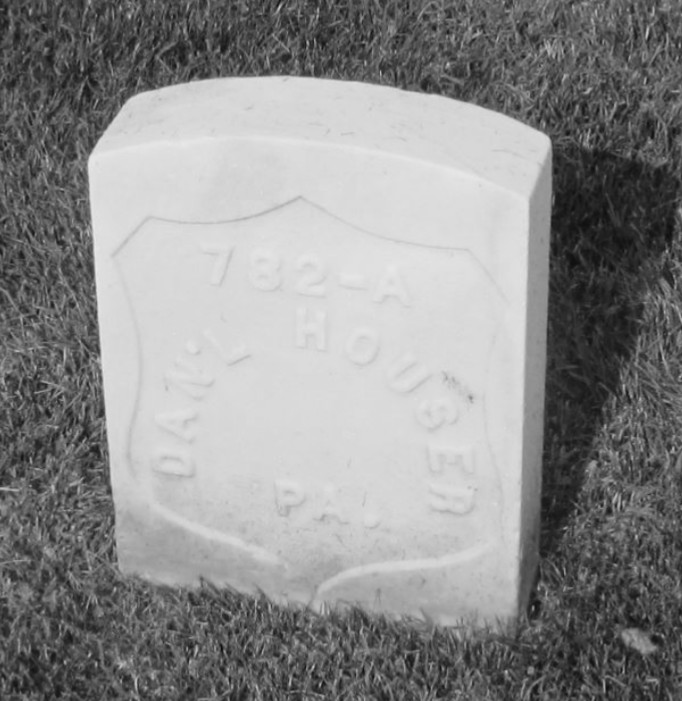
The military headstone of Private Daniel Houser, Company E, 47th Pennsylvania Volunteer Infantry, Hampton National Cemetery, Hampton, Virginia (used with permission, courtesy of Ron Stewart).
One of the three hundred sixty thousand Pennsylvanians to serve with the Union Army during the American Civil War, Daniel Houser was also one of thousands of Union soldiers who not only received lifesaving medical treatment during that war, but were subsequently given life-lengthening care and support throughout their post-war lives by the federal government’s pension system for Civil War veterans and by physicians and nurses who were employed by the federal government at state and national soldiers’ homes.
Formative Years
Born in Monroe County, Pennsylvania (alternate birthplace: Northampton County) in 1842, Daniel Houser (1842-1924) was a son of of native Pennsylvanians Joseph Houser (1816-1893) and Christiana (Getz) Houser (1819-1892). By 1850, Daniel was residing in Hamilton Township, Monroe County with his parents and siblings: Thomas Houser (1839-1904), who had been born in Hamilton Township on 11 October 1839 and would later wed and be widowed by Henrietta Anthony (1846-1865), before marrying Sarah Heffelfinger (1842-1912); Adam Houser (1843-1915), who had been born in Hamilton Township on 22 October 1843 and would later wed Dianna Keiper (born circa 1853-died before June 1900); Levi Houser (1845-1919), who had been born in Sciota, Monroe County on 18 April 1845 and would later wed Sarah Eschenbach (1846-1924); Joseph Theodore Houser (1846-1917), who had been born in Hamilton Township on 27 December 1846 and would later wed Elizabeth Barthol (1841-1917); and Hillorius Houser (1848-1923), who had been born in Hamilton Township on 4 October 1848, would later become known as “Hillory” and would marry Mary Ann R. Person (1852-1902).
Patriarch Joseph Houser supported the family on his wages as a laborer. Another Houser child then arrived during the early years of that decade: Anna Mariah Houser (1852-1933) was born in Hamilton Township on 1 September 1952; she would later go on to marry Henry M. Lester (1848-1934) and would settle with him in Lopez, Sullivan County, Pennsylvania. By the early 1860s, Daniel Houser was living and working as a farmer in Forks Springs, Northampton County, while his parents still resided in Hamilton Township, Monroe County, where his father continued to support Daniel’s siblings: Adam, who was employed as a farmhand; Hillarious and Anna.
But their lives and the lives of those they loved would soon be clouded by worry as their nation descended into the darkness of disunion and civil war.
American Civil War
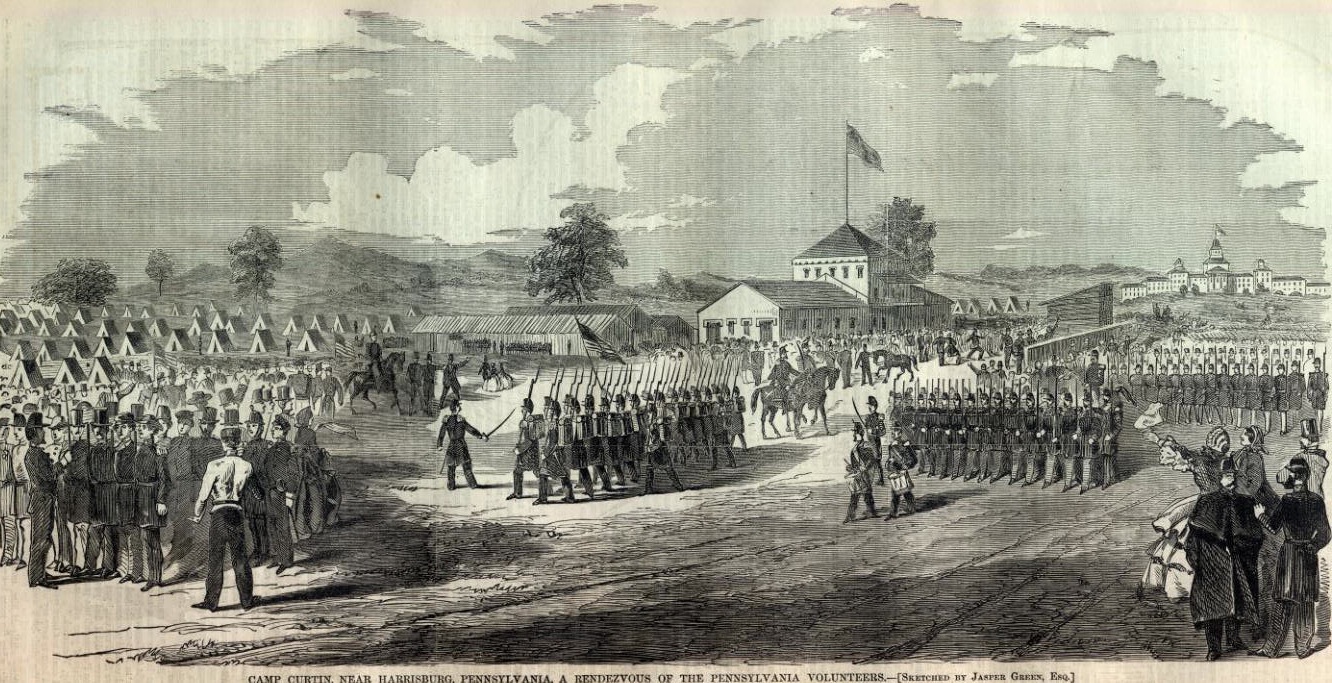
Camp Curtin (Harper’s Weekly, 1861, public domain).
Following his enrollment for military service in Easton, Northampton County (alternate enrollment site: Allentown, Lehigh County), on 30 July 1862, Daniel Houser officially mustered in for duty at Camp Curtin in Dauphin County on 26 August 1862 as a private with Company E of the 47th Pennsylvania Volunteer Infantry. Military records at the time described him as a twenty-year-old farmer and resident of Forks Springs. Given brief, basic training in light infantry tactics, he was then transported by train and ship to the nation’s Deep South, where he connected with his regiment at its encampment near Beaufort, South Carolina on 19 September 1862, arriving just weeks before the 47th Pennsylvania would see its first serious engagement with Confederate States Army troops.
Saint John’s Bluff and the Capture of a Confederate Steamer

Earthworks surrounding the Confederate battery atop Saint John’s Bluff along the Saint John’s River in Florida (J. H. Schell, 1862, public domain).
On 30 September 1862, the 47th Pennsylvania Volunteers boarded Union Navy gunboats and other troop transport ships, and set out on an expedition to Florida, as part of an expeditionary force that included men from the 1st Connecticut Battery, 7th Connecticut Infantry, and the 1st Massachusetts Cavalry. Backed by the gunboats Cimarron, E.B. Hale, Paul Jones, Uncas, and Water Witch, which were equipped with twelve-pound boat howitzers, that fifteen hundred-strong Union Army force was led by Brigadier-General John Milton Brannan, and had been sent to capture and then destroy Confederate artillery batteries along the Saint John’s River that had been firing on Union ships. Advancing up that river, they then moved inland along the Pablo and Mt. Pleasant Creeks on 1 October 1862. After reaching their assigned dropoff point, the 47th Pennsylvanians disembarked and marched for one of the entrenched, earthworks-fortified batteries that was located atop Saint John’s Bluff. On 2 October, Union gunboats exchanged shellfire with that Rebel battery and another atop Yellow Bluff nearby, as the 47th Pennsylvania Volunteers and other members of their brigade moved closer and closer. By the time that the Union’s ground troops reached those bluffs on 3 October, however, they found that both had been abandoned by the Confederate artillerymen who had fled the shelling by Union gunboats.
According to Field Musician Henry D. Wharton, who served with the 47th Pennsylvania’s C Company, “On the day following our occupation of these works the guns were dismounted and removed on board the steamer Neptune, together with the shot and shell, and removed to Hilton Head. The powder was all used in destroying the batteries.” Meanwhile, that same weekend (Friday and Saturday, 3-4 October 1862), the expedition’s commanding officer, Brigadier-General Brannan, was busy planning his next troop movements. That Saturday, Brannan ordered several officers to select subordinates and prepare rations and ammunition for a new mission that would take them roughly twenty miles upriver to Jacksonville. Among the Union soldiers selected were 47th Pennsylvania Volunteer Infantrymen from Company C, Company E and Company K. Boarding the Union gunboat Darlington (formerly a Confederate steamer), they moved upriver, along the Saint John’s, with protection from the Union gunboat Hale, ultimately traveling a distance of two hundred miles. Charged with locating and capturing Confederate ships that had been engaged in furnishing troops, ammunition and other supplies to Confederate Army units scattered throughout the region, including the batteries at Saint John’s Bluff and Yellow Bluff, the members of Company C were ordered by Brannan to set fire to the headquarters of the Southern Rights newspaper, due to its repeated publication of pro-Confederacy propaganda, while the members of Companies E and K were playing a key role in the capture of the Governor Milton, a Confederate steamer that had been transporting Confederate troops and military supplies throughout the region. According to Schmidt, Corporal George R. Nichols of E Company was one of the men involved in that steamer’s capture and later described that mission:
“At 9 PM … October 7, discovered the steamer Gov. Milton in a small creek, 2 miles above Hawkinsville; boarded her in a small boat, and found that she had been run in there but a short time before, as her fires were not yet out. Her engineer and mate, then in charge, were asleep on board at the time of her capture. They informed us that owing to the weakness of the steamer’s boiler we found her where we did….
I commanded one of the Small Boats that went in after her. I was Boatman and gave orders when the headman jumped on Bord [sic] take the Painter with him. That however Belongs to Wm. Adams or Jacob Kerkendall. It was So dark I could not tell witch [sic] Struck the deck first. But when I Struck the deck I demanded the Surrend [sic] of the Boat in the name of the U.S. after we had the boat an offercier [sic] off [sic] the Paul Jones, a Gun Boat was with us he ask me how Soon could I move her out in the Stream I said five minuts [sic]. So an Engineer one of coulered [sic] Men helped Me. and I will Say right hear [sic] he learned Me More than I ever knowed about Engineering. Where we started down the River we was one hundred and twenty five miles up the river. When we Stopped at Polatkey [Palatka] to get wood for the Steamer I went out and Borrowed a half of a deer that hung up in a [sic] out house and a bee hive for some honey for the Boys. I never forget the boys.”
Integration of the Regiment
The 47th Pennsylvania also made history during the month of October 1862 as it became an integrated regiment, adding to its muster rolls several Black men who had escaped chattel enslavement on plantations near Beaufort, South Carolina, including: Bristor Gethers, Abraham Jassum and Edward Jassum.
Battle of Pocotaligo, South Carolina

Highlighted version of the U.S. Army map of the Coosawhatchie-Pocotaligo Expedition, 22 October 1862 (public domain).
From 21-23 October, under the brigade and regimental commands of Colonel Tilghman H. Good and Lieutenant-Colonel George Warren Alexander, members of the 47th Regiment, Pennsylvania Volunteer Infantry joined with other Union regiments to engage the heavily protected Confederate forces in and around Pocotaligo, South Carolina. Harried by snipers en route to the Pocotaligo Bridge, which had been targeted for destruction during that expedition (in order to further disrupt the Confederacy’s ability to transport troops and ammunition), they met resistance from yet another entrenched, heavily fortified Confederate battery that opened fire on the Union troops as they entered an open cotton field.
Those headed toward higher ground at the Frampton Plantation fared no better as they encountered artillery and infantry fire from the surrounding forests. But the Union soldiers would not give in; grappling with Rebels wherever they met them, they pursued the enemy for four miles as the Confederate Army retreated to the bridge. Once there, the 47th Pennsylvania relieved the 7th Connecticut. Unfortunately, the enemy was just too well armed. After two hours of intense fighting in an unsuccesful attempt to take the ravine and bridge, the 47th Pennsylvania Volunteers were finally forced to withdraw by their depleted ammunition, and retreated to Mackay’s Point.
Losses for the regiment were particularly high. Captain Charles Mickley of G Company was killed, and Captain George Junker of Company K was mortally wounded. Privates Henry A. Backman, Nathan George, Samuel Minnich, George B. Rose and fourteen other enlisted men died; a total of one hundred and fourteen had been wounded in action.
On 23 October, the 47th Pennsylvania Volunteers returned to Hilton Head, where several members were appointed later that month to serve as the honor guard for the funeral of Major-General Ormsby M. Mitchel, the commander of the U.S. Army’s 10th Corps and Department of the South who succumbed to yellow fever on 30 October. (The Mountains of Mitchel, a part of Mars’ South Pole discovered by Mitchel in 1846 while working as a University of Cincinnati astronomer, and Mitchelville, the first Freedmen’s town created after the Civil War, were both later named for him.) The men selected from the 47th Pennsylvania for that special detail were given the high honor of firing the salute over his grave.
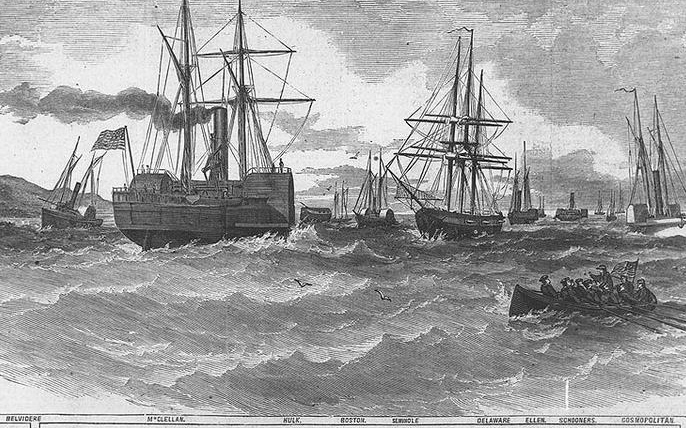
USS Seminole and USS Ellen accompanied by transports (left to right: Belvidere, McClellan, Boston, Delaware, and Cosmopolitan) at Wassau Sound, Georgia (circa January 1862, Harper’s Weekly, public domain).
Ordered back to Key West on 15 November 1862, the 47th Pennsylvania Volunteers would spend the coming year guarding federal installations in Florida. Companies A, B, C, E, G, and I would once again garrison Fort Taylor in Key West, while the men from Companies D, F, H, and K would garrison Fort Jefferson, the Union’s remote outpost in the Dry Tortugas off the southern coast of Florida. After packing their belongings at their Beaufort encampment and loading their equipment onto the U.S. Steamer Cosmopolitan, the officers and enlisted members of the 47th Pennsylvania Volunteer Infantry sailed toward the mouth of the Broad River on 15 December 1862, and anchored briefly at Port Royal Harbor in order to allow the regiment’s medical director, Elisha W. Baily, M.D., and recently-recovered soldiers to rejoin the regiment.
At five p.m. that same evening, the regiment sailed for Florida, during what was described by several members of the 47th as a treacherous and nerve-wracking voyage. According to historian Lewis Schmidt, the ship’s captain “steered a course along the coast of Florida for most of the voyage,” which made the voyage more precarious “because of all the reefs.” On 16 December, “the second night, the ship was jarred as it ran aground on one during a storm, but broke free, and finally steered a course further from shore, out in the Gulf Stream.”In a letter penned to the Sunbury American on 21 December, Company C soldier Henry Wharton provided the following details about that trip:
“On the passage down, we ran along almost the whole coast of Florida. Rather all dangerous ground, and the reefs are no playthings. We were jarred considerably by running on one, and not liking the sensation our course was altered for the Gulf Stream. We had heavy sea all the time. I had often heard of ‘waves as big as a house,’ and thought it was a sailors yarn, but I have seen ’em and am perfectly satisfied; so now, not having a nautical turn of mind, I prefer our movements being done on terra firma, and leave old neptune to those who have more desire for his better acquaintance. A nearer chance of a shipwreck never took place than ours, and it was only through Providence that we were saved. The Cosmopolitan is a good riverboat, but to send her to sea, loadened [sic, loaded] with U.S. troops is a shame, and looks as though those in authority wish to get clear of soldiers in another way than that of battle. There was some sea sickness on our passage; several of the boys ‘casting up their accounts’ on the wrong side of the ledger.”
According to Corporal George Nichols of Company E, “When we got to Key West the Steamer had Six foot of water in her hole [sic, hold]. Waves Mountain High and nothing but an old river Steamer. With Eleven hundred Men on I looked for her to go to the Bottom Every Minute.”
Although the Cosmopolitan arrived at Key West Harbor on Thursday, 18 December, the 47th Pennsylvania Volunteers did not set foot on Florida soil until noon the next day. The men from Companies C and I were immediately marched to Fort Taylor, while the men from Companies B and E were assigned to older barracks that had previously been erected by the U.S. Army. Members of Companies A and G were marched to the newer “Lighthouse Barracks” located on “Lighthouse Key.”
1863

Fort Taylor, Key West, Florida (Harper’s Weekly, 1864, public domain).
Stationed in Florida for the entire year of 1863, the 47th Pennsylvania Volunteers were literally ordered to “hold the fort.” Their primary duty was to prevent foreign powers from assisting the Confederate Army and Navy in gaining control over federal installations and other territories across the Deep South.
According to the U.S. Army’s records collection known as “Returns from Military Posts,” sometime shortly after returning to Key West, Company E’s First Lieutenant Lawrence Bonstine was assigned to special duty as post adjutant — a position he continued to hold from at least 10 January 1863 through the end of December 1863. Reporting directly to the regiment’s commanding officer, Colonel Tilghman Good, he was essentially Good’s right hand, and was responsible for ensuring that regimental records and reports to senior military officials were kept up to date.
On 5 March 1863, E Company Private William H. Eichman was promoted to the rank of corporal, and exactly one month later, on 5 April 1863, Second Lieutenant W. Scott Johnston was promoted to the rank of first lieutenant and appointed as adjutant to the regiment’s most senior officers.
In addition to infantry training and regular drills, the 47th Pennsylvania Volunteers were taught to use the fort’s artillery weapons and were also called upon to play an ongoing role in weakening Florida’s ability to supply and transport food and troops throughout areas held by the Confederate States of America.
* Note: Prior to intervention by the Union Army and Navy, the owners of plantations, livestock ranches and fisheries, as well as the operators of smaller family farms across Florida, had been able to consistently furnish beef and pork, fish, fruits, and vegetables to Confederate troops stationed throughout the Deep South during the first year of the American Civil War. Large herds of cattle were raised near Fort Myers, for example, while orchard owners in the Saint John’s River area were actively engaged in cultivating sizable orange groves. (Other types of citrus trees were found growing throughout more rural areas of the state.) Florida was also a major producer of salt, which was used as a preservative for food. Consequently, the 47th Pennsylvania Volunteers and other Union troops across Florida were ordered to capture or destroy salt manufacturing plants in order to further curtail the enemy’s access to food.
As with the 47th Pennsylvania Volunteers’ previous assignments, officers and enlisted members of the regiment soon came to realize that disease would again be their constant companion and foe — making it all the more remarkable that, during that phase of service, the majority of 47th Pennsylvania Volunteers chose to re-enlist when their three-year service terms were up
1864
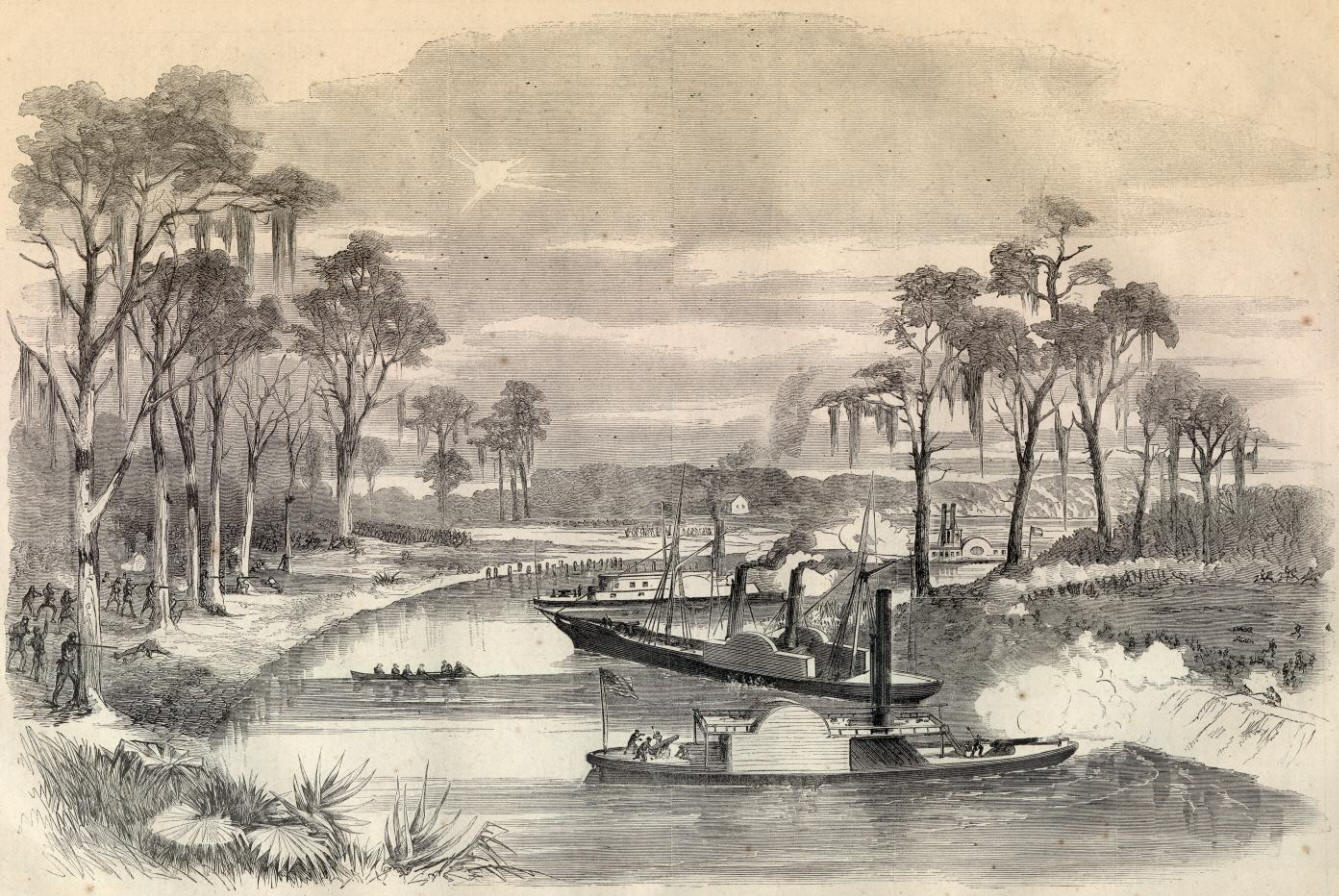
Bayou Teche, Louisiana (Harper’s Weekly, 14 February 1863, public domain).
In early January 1864, the 47th Pennsylvania Volunteer Infantry was ordered to expand the Union Army’s reach by sending part of the regiment north to retake possession of, and rehabilitate, Fort Myers, which had been abandoned in 1858 following the U.S. government’s third war with the Seminole Indians. Per orders issued earlier in 1864 by Major-General D. P. Woodbury, Commanding Officer, U.S. Department of the Gulf, District of Key West and the Tortugas, that the fort be reclaimed to facilitate the Union’s Gulf Coast blockade, Captain Richard Graeffe and a group of men from Company A were assigned to the duty of raiding cattle herds in northern Florida in order to provide food for the growing Union troop presence in the state. Graeffe and his men subsequently turned the fort into both their base of operations and a shelter for pro-Union supporters, men, women and children who were escaping slavery, Confederate Army deserters, and others fleeing Rebel troops.
Meanwhile, the men from E Company and the other members of the 47th Pennsylvania Volunteer Infantry were preparing to embark on the regiment’s history-making journey to Louisiana. Boarding yet another steamer — the Charles Thomas — on 25 February 1864, the men from Companies B, C, D, I, and K of the 47th Pennsylvania headed for Algiers, Louisiana (across the river from New Orleans), followed on 1 March by other members of the regiment from Companies E, F, G, and H who had been stationed at Fort Jefferson in the Dry Tortugas and were transported by the DeMolay. Upon the second group’s arrival, the now almost fully reunited regiment moved by train on 28 February to Brashear City (now Morgan City, Louisiana) before heading to Franklin by steamer through the Bayou Teche. Once there, the 47th Pennsylvania Volunteer Infantry joined the 2nd Brigade, 1st Division of the Department of the Gulf’s 19th Army Corps, and became the only Pennsylvania regiment to serve in the Red River Campaign of Union Major-General Nathaniel P. Banks. (Unable to reach Louisiana until 23 March, the men from Company A were assigned to detached duty in New Orleans while they awaited transport to enable them to catch up with the main part of their regiment. Charged with guarding and overseeing the transport of two hundred and forty-five Confederate prisoners, they were finally able to board the Ohio Belle on 7 April, and reached Alexandria with those prisoners on 9 April.)
Red River Campaign
The early days on the ground in Louisiana quickly woke the 47th Pennsylvania Volunteers up to just how grueling their new phase of duty would be. From 14-26 March, most members of the regiment marched for Alexandria and Natchitoches, Louisiana, by way of New Iberia, Vermilionville (now part of Lafayette), Opelousas, and Washington.
From 4-5 April 1864, the regiment added to its roster of young Black soldiers when Aaron Bullard (later known as Aaron French), James Bullard, John Bullard, Samuel Jones, and Hamilton Blanchard (also known as John Hamilton) enrolled for military service with the 47th Pennsylvania at Natchitoches. According to their respective entries in the Civil War Veterans’ Card File at the Pennsylvania State Archives and on regimental muster rolls, the men were then officially mustered in for duty on 22 June at Morganza. Several of their entries noted that they were assigned the rank of “(Colored) Cook” while others were given the rank of “Under-Cook.”
Often short on food and water throughout their long harsh-climate trek through enemy territory, the men encamped briefly at Pleasant Hill (now the Village of Pleasant Hill) the night of 7 April before continuing on the next day.
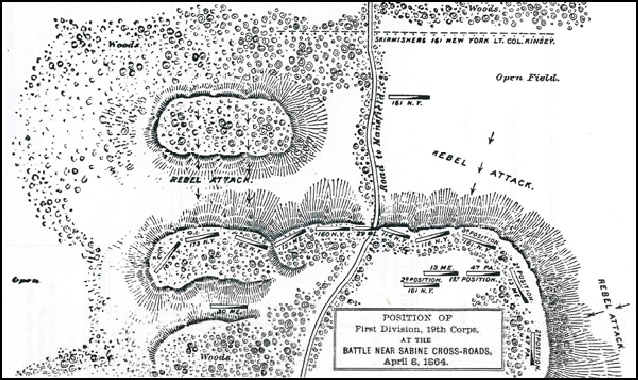
19th U.S. Army Map, Phase 3, Battle of Sabine Cross Roads/Mansfield (8 April 1864, public domain).
Marching until mid-afternoon on 8 April, the 47th Pennsylvania Volunteers were rushed into battle ahead of other regiments in the 2nd Division. Sixty members of the 47th were cut down that day during the volley of fire unleashed in the Battle of Sabine Cross Roads (also known as the Battle of Mansfield due to its proximity to the town of Mansfield). The fighting waned only when darkness fell. The exhausted, but uninjured collapsed beside the gravely wounded. After midnight, the surviving Union troops withdrew to Pleasant Hill.
The next day, the 47th Pennsylvania Volunteers were ordered into a critically important defensive position at the far right of the Union lines, their right flank spreading up onto a high bluff. By 3 p.m., after enduring a midday charge by the troops of Confederate Major-General Richard Taylor (a plantation owner who was the son of Zachary Taylor, former president of the United States), the brutal fighting still showed no signs of ending. Suddenly, just as the 47th was shifting to the left side of the massed Union forces, the men of the 47th Pennsylvania were forced to bolster the 165th New York’s buckling lines by blocking another Confederate assault, during what has since become known as the Battle of Pleasant Hill.
Casualties were severe. Second Lieutenant Alfred Swoyer of Company K and Private Richard Hahn of Company E were killed in action. The regiment’s second-in-command, Lieutenant-Colonel Alexander, was nearly killed, and the regiment’s two color-bearers, both from Company C, were also seriously wounded while preventing the American flag from falling into enemy hands. Still others from the 47th were captured by Confederate troops, marched roughly one hundred and twenty-five miles to Camp Ford, a Confederate Army prison camp near Tyler, Texas, and held there as prisoners of war until they were released during prisoner exchanges which began on 22 July and dragged on into November 1864. E Company Corporal James Huff, who had been wounded in action during the Battle of Pleasant Hill on 9 April, was one of those POWs who were finally released (on 29 August 1864). Sadly, at least three members of the 47th Pennsylvania never made it out alive.
Following what some historians have called a rout by Confederates at Pleasant Hill and others have labeled a technical victory for the Union (or a draw for both sides), the 47th Pennsylvanians fell back to Grand Ecore to resupply and regroup. They remained there for a total of eleven days (through 22 April 1864) and were engaged in the hard labor of strengthening regimental and brigade fortifications in a brutal climate. They then moved back to Natchitoches Parish, arriving in Cloutierville at 10 p.m. that night after marching forty-five miles. En route, the Union forces were attacked again — this time in the rear, but they were able to end the encounter quickly and move on.

The 47th Pennsylvania Volunteers were stationed just to the left of the “Thick Woods” with Emory’s 2nd Brigade, 1st Division as shown on this map of Union troop positions for the Battle of Cane River Crossing at Monett’s Ferry, Louisiana, 23 April 1864 (Major-General Nathaniel Banks’ official Red River Campaign Report, public domain).
The next morning (23 April 1864), episodic skirmishing quickly roared into the flames of a robust fight. As part of the advance party led by Union Brigadier-General William Emory, the 47th Pennsylvania took on the Confederate cavalry of Brigadier-General Hamilton P. Bee during the Battle of Cane River (also known as “the Affair at Monett’s Ferry” or the “Cane River Crossing”).
Responding to a barrage from the Confederate’s twenty-pound Parrott guns and raking fire from enemy troops situated near a bayou and atop a bluff, Brigadier-General Emory directed one of his brigades to keep Bee’s Confederates busy while sending the other two brigades to find a safe spot where his Union troops could ford the Cane River. As part of the “beekeepers,” the 47th Pennsylvanians supported Emory’s artillery.
Meanwhile, other soldiers from Emory’s command found and worked their way across the Cane River, attacked Bee’s flank, and forced a Rebel retreat. That Union brigade then erected a series of pontoon bridges, enabling the 47th and other remaining Union units to make the Cane River Crossing by the next day. As the Confederates retreated, they torched their own food stores, as well as the cotton supplies of their fellow southerners. In a letter penned from Morganza, Louisiana on 29 May, Henry Wharton described what happened to the 47th Pennsylvanians during and immediately after making camp at Grand Ecore:
“Our sojourn at Grand Ecore was for eleven days, during which time our position was well fortified by entrenchments for a length of five miles, made of heavy logs, five feet high and six feet wide, filled in with dirt. In front of this, trees were felled for a distance of two hundred yards, so that if the enemy attacked we had an open space before us which would enable our forces to repel them and follow if necessary. But our labor seemed to the men as useless, for on the morning of 22d April, the army abandoned these works and started for Alexandria. From our scouts it was ascertained that the enemy had passed some miles to our left with the intention of making a stand against our right at Bayou Cane, where there is a high bluff and dense woods, and at the same attack Smith’s forces who were bringing up the rear. This first day was a hard one on the boys, for by ten o’clock at night they made Cloutierville, a distance of forty-five miles. On that day the rear was attacked which caused our forces to reverse their front and form in line of battle, expecting too, to go back to the relief of Smith, but he needed no assistance, sending word to the front that he had ‘whipped them, and could do it again.’ It was well that Banks made so long a march on that day, for on the next we found the enemy prepared to carry out their design of attacking us front and rear. Skirmishing commenced early in the morning and as our columns advanced he fell back towards the bayou, when we soon discovered the position of their batteries on the bluff. There was then an artillery duel by the smaller pieces, and some sharp fighting by the cavalry, when the ‘mule battery,’ twenty pound Parrott guns, opened a heavy fire, which soon dislodged them, forcing the chivalry to flee in a manner not at all suitable to their boasted courage. Before this one cavalry, the 3d Brigade of the 1st Div., and Birges’ brigade of the second, had crossed the bayou and were doing good service, which, with the other work, made the enemy show their heels. The 3d brigade done some daring deeds in this fight, as also did the cavalry. In one instance the 3d charged up a hill almost perpendicular, driving the enemy back by the bayonet without firing a gun. The woods on this bluff was so thick that the cavalry had to dismount and fight on foot. During the whole of the day, our brigade, the 2d was supporting artillery, under fire all the time, and could not give Mr. Reb a return shot.
“While we were fighting in front, Smith was engaged some miles in the rear, but he done his part well and drove them back. The rebel commanders thought by attacking us in the rear, and having a large face on the bluffs, they would be able to capture our train and take us all prisoners, but in this they were mistaken, for our march was so rapid that we were on them before they had thrown up the necessary earthworks. Besides they underrated the amount of our artillery, calculating from the number engaged at Pleasant Hill. The rebel prisoners say it ‘seems as though the Yankees manufacture, on short notice, artillery to order, and the men are furnished with wings when they wish to make a certain point.
“The damage done to the Confederate cause by the burning of cotton was immense. On the night of the 22d our route was lighted up for miles and millions of dollars worth of this production was destroyed. This loss will be felt more by Davis & Co., than several defeats in this region, for the basis of the loan in England was on the cotton of Western Louisiana.
“After the rebels had fled from the bluff the negro troops put down the pontoons, and by ten that night we were six miles beyond the bayou safely encamped. The next morning we moved forward and in two days were in Alexandria. Johnnys followed Smith’s forces, keeping out of range of his guns, except when he had gained the eminence across the bayou, when he punished them (the rebs) severely.”
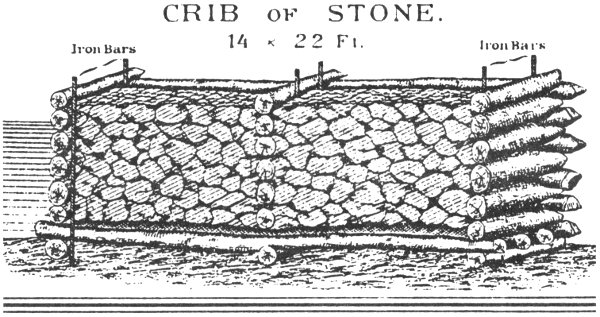
Sketches of the crib and tree dams designed by Lieutenant-Colonel Joseph Bailey to improve the water levels of the Red River near Alexandria, Louisiana, spring 1864 (Joseph Bailey, “Report on the Construction of the Dam Across the Red River,” 1865, public domain).
Having finally reached Alexandria on 26 April, the 47th Pennsylvania Volunteers learned they would remain at their latest new camp for at least two weeks. Placed temporarily under the command of Lieutenant-Colonel Joseph Bailey, they were assigned yet again to the hard labor of fortification work — this time helping to erect “Bailey’s Dam,” a timber structure that enabled Union gunboats to more easily make their way back down the Red River. According to Wharton:
“We were at Alexandria seventeen days, during which time the men were kept busy at throwing up earthworks, foraging and three times went out some distance to meet the enemy, but they did not make their appearance in numbers large enough for an engagement. The water in the Red river had fallen so much that it prevented the gunboats from operating with us, and kept our transports from supplying the troops with rations, (and you know soldiers, like other people, will eat) so Banks was compelled to relinquish his designs on Shreveport and fall back to the Mississippi. To do this a large dam had to be built on the falls at Alexandria to get the ironclads down the river. After a great deal labor this was accomplished and by the morning of May 13th the last one was through the shute [sic], when we bade adieu to Alexandria, marching through the town with banners flying and keeping step to the music of ‘Rally around the flag,’ and ‘When this cruel war is over.’ The next morning, at our camping place, the fleet of boats passed us, when we were informed that Alexandria had been destroyed by fire – the act of a dissatisfied citizen and several negroes. Incendiary acts were strictly forbidden in a general order the day before we left the place, and a cavalry guard was left in the rear to see the order enforced. After marching a few miles skirmishing commenced in front between the cavalry and the enemy in riflepits [sic] on the bank of the river, but they were easily driven away. When we came up we discovered their pits and places where there had been batteries planted. At this point the John Warren, an unarmed transport, on which were sick soldiers and women, was fired into and sunk, killing many and those that were not drowned taken prisoners. A tin-clad gunboat was destroyed at the same place, by which we lost a large mail. Many letters and directed envelopes were found on the bank – thrown there after the contents had been read by the unprincipled scoundrels. The inhumanity of Guerrilla bands in this department is beyond belief, and if one did not know the truth of it or saw some of their barbarities, he would write it down as the story of a ‘reliable gentleman’ or as told by an ‘intelligent contraband.’ Not satisfied with his murderous intent on unarmed transports he fires into the Hospital steamer Laurel Hill, with four hundred sick on board. This boat had the usual hospital signal floating fore and aft, yet, notwithstanding all this, and the customs of war, they fired on them, proving by this act that they are more hardened than the Indians on the frontier.
“On Sunday, May 15, we left the river road and took a short route through the woods, saving considerable distance. The windings of Red river are so numerous that it resembles the tape-worm railroad wherewith the politicians frightened the dear people during the administration of Ritner and Stevens. – We stopped several hours in the woods to leave cavalry pass, when we moved forward and by four o’clock emerged into a large open plain where we formed in line of battle, expecting a regular engagement. The enemy, however, retired and we advanced ‘till dark, when the forces halted for the night, with orders to rest on their arms. – ‘Twas here that Banks rode through our regiment, amidst the cheers of the boys, and gave the pleasant news that Grant had defeated Lee.”

“Sleeping on Their Arms” by Winslow Homer (Harper’s Weekly, 21 May 1864).
Having entered Avoyelles Parish, they “rested on their arms” for the night, half-dozing without pitching their tents, but with their rifles right beside them. They were now positioned just outside of Marksville, Louisiana on the eve of the 16 May 1864 Battle of Mansura, which unfolded as follows, according to Wharton:
“Early next morning we marched through Marksville into a prairie nine miles long and six wide where every preparation was made for a fight. The whole of our force was formed in line, in support of artillery in front, who commenced operations on the enemy driving him gradually from the prairie into the woods. As the enemy retreated before the heavy fire of our artillery, the infantry advanced in line until they reached Mousoula [sic, Mansura], where they formed in column, taking the whole field in an attempt to flank the enemy, but their running qualities were so good that we were foiled. The maneuvring [sic] of the troops was handsomely done, and the movements was [sic] one of the finest things of the war. The fight of artillery was a steady one of five miles. The enemy merely stood that they might cover the retreat of their infantry and train under cover of their artillery. Our loss was slight. Of the rebels we could not ascertain correctly, but learned from citizens who had secreted themselves during the fight, that they had many killed and wounded, who threw them into wagons, promiscuously, and drove them off so that we could not learn their casualties. The next day we moved to Simmsport [sic, Simmesport] on the Achafalaya [sic, Atchafalaya] river, where a bridge was made by putting the transports side by side, which enabled the troops and train to pass safely over. – The day before we crossed the rebels attacked Smith, thinking it was but the rear guard, in which they, the graybacks, were awfully cut up, and four hundred prisoners fell into our hands. Our loss in killed and wounded was ninety. This fight was the last one of the expedition. The whole of the force is safe on the Mississippi, gunboats, transports and trains. The 16th and 17th have gone to their old commands.
“It is amusing to read the statements of correspondents to papers North, concerning our movements and the losses of our army. I have it from the best source that the Federal loss from Franklin to Mansfield, and from their [sic] to this point does not exceed thirty-five hundred in killed, wounded and missing, while that of the rebels is over eight thousand.”

Union Army base at Morganza Bend, Louisiana, circa 1863-1865 (U.S. Library of Congress, public domain).
Continuing on, the 47th Pennsylvania Volunteers marched for Simmesport and then Morganza, where they made camp again. According to Wharton, the members of Company C were sent on a special mission which took them on an intense one hundred and twenty-mile journey:
“Company C, on last Saturday was detailed by the General in command of the Division to take one hundred and eighty-seven prisoners (rebs) to New Orleans. This they done [sic] satisfactorily and returned yesterday to their regiment, ready for duty. While in the City some of the boys made Captain Gobin quite a handsome present, to show their appreciation of him as an officer gentleman.”
While encamped at Morganza, the nine formerly enslaved Black men who had enlisted with the 47th Pennsylvania in Beaufort, South Carolina (1862) and Natchitoches, Louisiana (April 1864) were officially mustered into the regiment between 20-24 June 1864. During that same time, Corporal Francis A. Parks was promoted to the rank of sergeant (on 22 June). The regiment then moved on once again, and arrived in New Orleans in late June. As they did during their tour through the Carolinas and Florida, the men of the 47th had battled the elements and disease, as well as the Confederate Army, in order to survive and continue to defend their nation.

U.S. Steamer McClellan (Alfred Waud, circa 1860-1865, U.S. Library of Congress, public domain).
On 7 July 1864, Private Daniel Houser and his fellow E Company men boarded yet another steamer, the U.S. McClellan, along with the 47th Pennsylvania’s Companies A, C, D, F, H, and I, and returned to the Washington, D.C. area. Following their arrival and a memorable encounter with President Abraham Lincoln, they joined up with Major-General David Hunter’s forces at Snicker’s Gap, Virginia to fight in the Battle of Cool Spring, and then assisted in defending Washington, D.C. once again while also helping to drive Confederate troops from Maryland. (Meanwhile, the members of Companies B, G and K — were awaiting transportation in New Orleans, and finally departed for the East Coast aboard the Blackstone in late July.)
Sheridan’s 1864 Shenandoah Valley Campaign
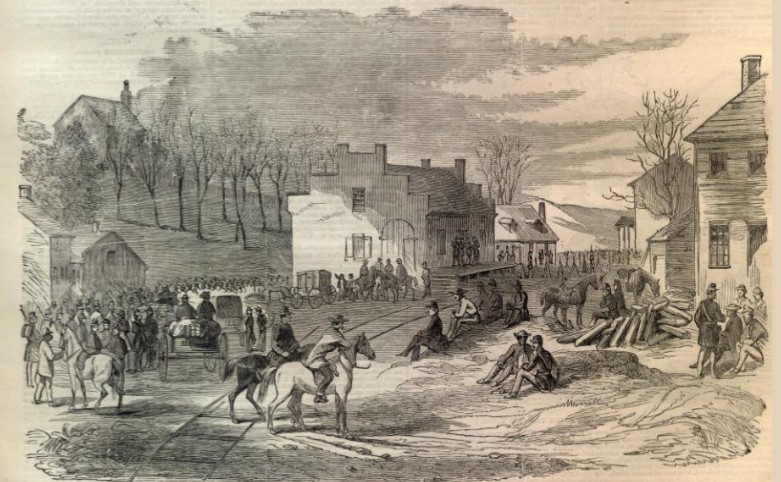
“The Rendezvous of the Virginians at Halltown, Virginia, 5 p.m. on April 18, 1861 to March on Harper’s Ferry” (D. H.Strother, Harper’s Weekly, 11 May 1861, public domain).
Attached to the Middle Military Division, U.S. Army of the Shenandoah from August through November of 1864, it was at that time and place, under the leadership of legendary Union Major-General Philip H. Sheridan and Brigadier-General William H. Emory, that the members of the 47th Pennsylvania would engage in their greatest moments of valor. Of the experience, Company C’s Samuel Pyers said it was “our hardest engagement.”
Records of the 47th Pennsylvania Volunteers confirm that the regiment was assigned to defensive duties in and around Halltown in early August 1864, and engaged in a series of back-and-forth movements between Halltown, Berryville, Middletown, Charlestown, and Winchester, Virginia as part of a war waged by Sheridan’s Union forces with those commanded by Confederate Lieutenant-General Jubal Early.
From 3-4 September, the 47th Pennsylvania Volunteers fought in the Battle of Berryville. Two weeks later, on 18 September 1864, multiple members of the regiment mustered out at Berryville, upon expiration of their respective terms of enlistment. Among those who were honorably discharged that day were E Company’s three most senior officers — Captain Charles Yard, First Lieutenant Lawrwnce Bonstine and Second Lieutenant William Wyker.
Battles of Opequan and Fisher’s Hill

Battle of Opequan (aka Third Winchester), Virginia, 19 September 1864 (public domain).
Inflicting heavy casualties during the Battle of Opequan (also known as “Third Winchester”) on 19 September 1864, Sheridan’s gallant blue jackets forced a stunning retreat of Jubal Early’s grays — first to Fisher’s Hill (21-22 September) and then, following a successful early morning flanking attack, to Waynesboro. Those impressive Union victories helped Abraham Lincoln secure his second term as president. Recalling the battle years later, Sheridan noted:
“My army moved at 3 o’clock that morning. The plan was for Torbert to advance with Merritt’s division of cavalry from Summit Point, carry the crossings of the Opequon at Stevens’s and Lock’s fords, and form a junction near Stephenson’s depot, with Averell, who was to move south from Darksville by the Valley pike. Meanwhile, Wilson was to strike up the Berryville pike, carry the Berryville crossing of the Opequon, charge through the gorge or cañon on the road west of the stream, and occupy the open ground at the head of this defile. Wilson’s attack was to be supported by the Sixth and Nineteenth corps, which were ordered to the Berryville crossing, and as the cavalry gained the open ground beyond the open gorge, the two infantry corps, under command of General Wright, were expected to press on after and occupy Wilson’s ground, who was then to shift to the south bank of Abraham’s creek and cover my left; Crook’s two divisions, having to march from Summit Point, were to follow the Sixth and Nineteenth corps to the Opequon, and should they arrive before the action began, they were to be held in reserve till the proper moment came, and then, as a turning-column, be thrown over toward the Valley pike, south of Winchester.”
By dawn on 19 September, the brigade from Wilson’s division headed by McIntosh had succeeded in compelling Confederate pickets to flee their Berryville positions with “Wilson following rapidly through the gorge with the rest of the division, debouched from its western extremity with such suddenness as to capture a small earthwork in front of General Ramseur’s main line.” Although “the Confederate infantry, on recovering from its astonishment, tried hard to dislodge them,” they were unable to do so, according to Sheridan. Wilson’s Union troops were then reinforced by the U.S. 6th Army.
“I followed Wilson to select the ground on which to form the infantry. The Sixth Corps began to arrive about 8 o’clock, and taking up the line Wilson had been holding, just beyond the head of the narrow ravine, the cavalry was transferred to the south side of Abraham’s Creek.
The Confederate line lay along some elevated ground about two miles east of Winchester, and extended from Abraham’s Creek north across the Berryville pike, the left being hidden in the heavy timber on Red Bud Run. Between this line and mine, especially on my right, clumps of woods and patches of underbrush occurred here and there, but the undulating ground consisted mainly of open fields, many of which were covered with standing corn that had already ripened.”
“The 6th Corps formed across the Berryville Road” while the “19th Corps prolonged the line to the Red Bud on the right with the troops of the Second Division.” According to Irwin, the:
“First Division’s First and Second Brigades, under Beal and McMillan, formed in the rear of the Second Division and on the right flank. Beal’s First Brigade was on the right of the division’s position, and McMillan’s Second Brigade deployed on the left and rear of Beal; in order of the 47th Pennsylvania, 8th Vermont, 160th New York, and 12th Connecticut, with five companies of the 47th Pennsylvania deployed to cover the whole right flank of his brigade and to move forward with it by the flank left in front. By this time, the Army of West Virginia had crossed the ford and was massed on the left of the west bank.
While the ground in front of the 6th Corps was for the most part open, the 19th Corps found itself in a dense wood, restricting its vision of both the enemy and its own forces.”
“Much time was lost in getting all of the Sixth and Nineteenth corps through the narrow defile,” Sheridan observed, adding that, because Grover’s division was “greatly delayed there by a train of ammunition wagons … it was not until late in the forenoon that the troops intended for the attack could be got into line ready to advance.” As a result:
“General Early was not slow to avail himself of the advantages thus offered him, and my chances of striking him in detail were growing less every moment, for Gordon and Rodes were hurrying their divisions from Stephenson’s depot across-country on a line that would place Gordon in the woods south of Red Bud Run, and bring Rodes into the interval between Gordon and Ramseur.
When the two corps had all got through the cañon they were formed with Getty’s division of the Sixth to the left of the Berryville pike, Rickett’s division to the right of the pike, and Russell’s division in reserve in rear of the other two. Grover’s division of the Nineteenth Corps came next on the right of Rickett’s, with Dwight to its rear in reserve, while Crook was to begin massing near the Opequon crossing about the time Wright and Emory [including the 47th Pennsylvania Volunteers] were ready to attack.”

Victory of Philip Sheridan’s Union Army over Jubal Early’s Confederate forces, Battle of Opequan, 19 September 1864 (Kurz & Allison, circa 1893, U.S. Library of Congress, public domain).
More than a quarter of a century after that clash, Irwin conjured the spirit of the battle’s beginning:
“About a quarter before twelve o’clock, at the sound of Sheridan’s bugle, repeated from corps, division, and brigade headquarters, the whole line moved forward with great spirit, and instantly became engaged. Wilson pushed back Lomax, Wright drove in Ramseur, while Emory, advancing his infantry [including the 47th Pennsylvania Volunteers] rapidly through the wood, where he was unable to use his artillery, attacked Gordon with great vigor. Birge, charging with bayonets fixed, fell upon the brigade of Evans, forming the extreme left of Gordon, and without a halt drove it in confusion through the wood and across the open ground beyond to the support of Braxton’s artillery, posted by Gordon to secure his flank on the Red Bud road. In this brilliant charge, led by Birge in person, his lines naturally became disordered….
Sharpe, advancing simultaneously on Birge’s left, tried in vain to keep the alignment with Ricketts and with Birge…. At first the order of battle formed a right angle with the road, but the bend once reached, in the effort to keep closed upon it, at every step Ricketts was taking ground more and more to the left, while the point of direction for Birge, and equally for Sharpe, was the enemy in their front, standing almost in the exact prolongation of the defile, from which line, still plainly marked by Ash Hollow, the road … was steadily diverging.”
As that battle had continued to unfold, the disorganization affected the lines on both sides of the conflict. According to Irwin:
“The 19th Corps Second Division was initially successful, but in its charge became disorganized; and the troops on the left in following the less obstructed area of the road which veared [sic] slightly left, soon opened up a gap on their right; while the remainder of the Union forces were moving straight ahead as they engaged the Confederates. This gap eventually reached 400 yards in width, an opportunity the Confederates soon exploited. Fortunately the Confederates were soon themselves disorganized by their advance, and encountering fresh Union troops on their right flank were halted. The Confederate attack on the right flank also achieved initial success, until halted by Beal’s first brigade.
McMillan had been ordered to move forward at the same time as Beal, and to form on his left. The five companies of the 47th Pennsylvania that had been detached to form a skirmish line on the Red Bud Run to cover McMillan’s right flank, had some how [sic] lost their way on the broken ground among the thickets, and, not finding them in place, McMillan had been obliged to send the remaining companies of the same regiment to do the same duty, and brought the rest of the brigade to the front to restore the line. The line then charged and drove the Confederates back beyond the positions where their attack had started. The initial engagement had lasted barely an hour, and by 1 PM was over. The right flank of the 19th Corps was held by the 47th Pennsylvania and 30th Massachusetts.”
“Just before noon the line of Getty, Ricketts, and Grover moved forward, and as we advanced, the Confederates, covered by some heavy woods on their right, slight underbrush and corn-fields along their centre [sic], and a large body of timber on their left along the Red Bud, opened fire from their whole front. We gained considerable ground at first, especially on our left but the desperate resistance which the right met with demonstrated that the time we had unavoidably lost in the morning had been of incalculable value to Early, for it was evident that he had been enabled already to so far concentrate his troops as to have the different divisions of his army in a connected line of battle in good shape to resist.
Getty and Ricketts made some progress toward Winchester in connection with Wilson’s cavalry…. Grover in a few minutes broke up Evans’s brigade of Gordon’s division, but his pursuit of Evans destroyed the continuity of my general line, and increased an interval that had already been made by the deflection of Ricketts to the left, in obedience to instructions that had been given him to guide his division on the Berryville pike. As the line pressed forward, Ricketts observed this widening interval and endeavored to fill it with the small brigade of Colonel Keifer, but at this juncture both Gordon and Rodes struck the weak spot where the right of the Sixth Corps and the left of the Nineteenth should have been in conjunction, and succeeded in checking my advance by driving back a part of Ricketts’s division, and the most of Grover’s. As these troops were retiring I ordered Russell’s reserve division to be put into action, and just as the flank of the enemy’s troops in pursuit of Grover was presented, Upton’s brigade, led in person by both Russell and Upton, struck it in a charge so vigorous as to drive the Confederates back … to their original ground.
The success of Russell enabled me to re-establish the right of my line some little distance in advance of the position from which it started in the early morning, and behind Russell’s division (now commanded by Upton) the broken regiments of Ricketts’s division were rallied. Dwight’s division was then brought up on the right, and Grover’s men formed behind it….
No news of Torbert’s progress came … so … I directed Crook to take post on the right of the Nineteenth Corps and, when the action was renewed, to push his command forward as a turning-column in conjunction with Emory. After some delay … Crook got his men up, and posting Colonel Thoburn’s division on the prolongation of the Nineteenth Corps, he formed Colonel Duval’s division to the right of Thoburn. Here I joined Crook, informing him that … Torbert was driving the enemy in confusion along the Martinsburg pike toward Winchester; at the same time I directed him to attack the moment all of Duval’s men were in line. Wright was introduced to advance in concert with Crook, by swinging Emory [including the 47th Pennsylvania and his other 19th Corps’ troops] and the right of the Sixth Corps to the left together in a half-wheel. Then leaving Crook, I rode along the Sixth and Nineteenth corps, the open ground over which they were passing affording a rare opportunity to witness the precision with which the attack was taken up from right to left. Crook’s success began the moment he started to turn the enemy’s left….
Both Emory [including the 47th Pennsylvania] and Wright took up the fight as ordered…. [A]s I reached the Nineteenth Corps the enemy was contesting the ground in its front with great obstinacy; but Emory’s dogged persistence was at length rewarded with success, just as Crook’s command emerged from the morass of the Red Bud Run, and swept around Gordon, toward the right of Breckenridge….”
As “Early tried hard to stem the tide” of the multi-pronged Union assault, “Torbert’s cavalry began passing around his left flank, and as Crook, Emory, and Wright attacked in front, panic took possession of the enemy, his troops, now fugitives and stragglers, seeking escape into and through Winchester,” according to Sheridan.
“When this second break occurred, the Sixth and Nineteenth corps were moved over toward the Millwood pike to help Wilson on the left, but the day was so far spent that they could render him no assistance.” The battle winding down, Sheridan headed for Winchester to begin writing his report to Grant.”
According to Irwin, although the heat of battle had cooled by one p.m., troop movements had continued on both sides throughout the afternoon until “Crook, with a sudden … effective half-wheel to the left, fell vigorously upon Gordon, and Torbert coming on with great impetuosity … the weight was heavier than the attenuated lines of Breckinridge and Gordon Could bear.” As a result, “Early saw his whole left wing give back in disorder, and as Emory [including the 47th Pennsylvania] and Wright pressed hard, Rodes and Ramseur gave way, and the battle was over.”
“Early vainly endeavored to reconstruct his shattered lines [near Winchester]. About five o’clock Torbert and Crook, fairly at right angles to the first line of battle, covered Winchester on the north from the rocky ledges that lie to the eastward of the town…. Thence Wright extended the line at right angles with Crook and parallel with the valley road, while Sheridan drew out Emory [including the 47th Pennsylvania] … and sent him to extend Wright’s line to the south….
Sheridan, mindful that his men had been on their feet since two o’clock in the morning … made no attempt to send his infantry after the flying enemy….
Sheridan … openly rejoiced, and catching the enthusiasm of their leader, his men went wild with excitement when, accompanied by his corps commanders, Wright and Emory and Crook, Sheridan rode down the front of his lines. Then went up a mighty cheer that gave new life to the wounded and consoled the last moments of the dying….”
Summing up the battle for Lincoln and Grant, Sheridan reported:
“My losses in the Battle of Opequon were heavy, amounting to about 4,500 killed, wounded and missing. Among the killed was General Russell, commanding a division, and the wounded included Generals Upton, McIntosh and Chapman, and Colonels Duval and Sharpe. The Confederate loss in killed, wounded, and prisoners equaled about mine. General Rodes being of the killed, while Generals Fitzhugh Lee and York were severely wounded.
We captured five pieces of artillery and nine battle flags. The restoration of the lower valley – from the Potomac to Strasburg – to the control of the Union forces caused great rejoicing in the North, and relieved the Administration from further solicitude for the safety of the Maryland and Pennsylvania borders. The President’s appreciation of the victory was expressed in a despatch [sic] so like Mr. Lincoln I give a fac-simile [sic] of it to the reader. This he supplemented by promoting me to the grade of brigadier-general in the regular army, and assigning me to the permanent command of the Middle Military Department, and following that came warm congratulations from Mr. Stanton and from Generals Grant, Sherman and Meade.”
“The losses of the Army of the Shenandoah, according to the revised statements compiled in the War Department, were 5018, including 697 killed, 3983 wounded, 338 missing,” per revised estimates by Irwin. “Of the three infantry corps, the 19th, though in numbers smaller than the 6th, suffered the heaviest loss, the aggregate being 2074 [314 killed, 1554 wounded, 206 missing]. Conversely, Early “lost nearly 4000 in all, including about 200 prisoners; or as other sources reported, anywhere from 5500 to 6850 killed, wounded, and missing or captured.”
Despite the significant number of killed, wounded and missing on both sides of the conflict, casualties within the 47th Pennsylvania Volunteers were surprisingly low. Private Thomas Steffen of Company B was killed in action while F Company Private William H. Jackson’s cause of death was somewhat less clear; he was reported in Bates’ History of Pennsylvania Volunteers, 1861-5 as having died on the same day on which the battle took place. Among the injured were C Company Corporal Timothy Matthias Snyder, who was wounded slightly in the knee, and Privates William Adams (E Company), Charles Pfeiffer (B Company), who lost the forefinger of his right hand, J. D. Raubenold (B Company), and Edward Smith (E Company).
As he penned his memoir in 1885 during the final days of his life, President Ulysses S. Grant again made clear the significance of the Battle of Opequan:
“Sheridan moved at the time he had fixed upon. He met Early at the crossing of Opequon Creek [September 19], and won a most decisive victory – one which electrified the country. Early had invited this attack himself by his bad generalship and made the victory easy. He had sent G. T. Anderson’s division east of the Blue Ridge [to Lee] before I [Grant] went to Harpers Ferry and about the time I arrived there he started with two other divisions (leaving but two in their camps) to march to Martinsburg for the purpose of destroying the Baltimore and Ohio Railroad at that point. Early here learned that I had been with Sheridan and, supposing there was some movement on foot, started back as soon as he got the information. But his forces were separated and … he was very badly defeated. He fell back to Fisher’s Hill, Sheridan following.”
On 23-24 September Colonel Tilghman Good and Lieutenant-Colonel George W. Alexander mustered out upon expiration of their respective terms of service.
Battle of Cedar Creek

Alfred Waud’s 1864 sketch, “Surprise at Cedar Creek,” captured the flanking attack on the rear of Union Brigadier-General William Emory’s 19th Corps by Lieutenant-General Jubal Early’s Confederate army, and the subsequent resistance by Emory’s troops from their Union rifle-pit positions, 19 October 1864 (public domain).
On 19 October 1864, Early’s Confederate forces briefly stunned the Union Army, launching a surprise attack at Cedar Creek, but Sheridan was able to rally his troops. Intense fighting raged for hours and ranged over a broad swath of Virginia farmland. Weakened by hunger wrought by the Union’s earlier destruction of crops, Early’s army gradually peeled off, one by one, to forage for food while Sheridan’s forces fought on, and won the day.
According to Union General Ulysses S. Grant:
“On the 18th of October Early was ready to move, and during the night succeeded in getting his troops in the rear of our left flank, which fled precipitately and in great confusion down the valley, losing eighteen pieces of artillery and a thousand or more prisoners [Battle of Cedar Creek]. The right under General Getty maintained a firm and steady front, falling back to Middletown where it took a position and made a stand. The cavalry went to the rear, seized the roads leading to Winchester and held them for the use of our troops in falling back, General Wright having ordered a retreat back to that place.
Sheridan having left Washington on the 18th, reached Winchester that night. The following morning he started to join his command. He had scarcely got out of town, when he met his men returning, in panic from the front and also heard heavy firing to the south. He immediately ordered the cavalry at Winchester to be deployed across the valley to stop the stragglers. Leaving members of his staff to take care of Winchester and the public property there, he set out with a small escort directly for the scene of the battle. As he met the fugitives he ordered them to turn back, reminding them that they were going the wrong way. His presence soon restored confidence. Finding themselves worse frightened than hurt the men did halt and turn back. Many of those who had run ten miles got back in time to redeem their reputation as gallant soldiers before night.”
Given inadequate intelligence by his staff that fateful morning, Sheridan had begun his day at a leisurely pace, unaware of the potential disaster in the making:
“Toward 6 o’clock the morning of the 19th, the officer on picket duty at Winchester came to my room, I being yet in bed, and reported artillery firing from the direction of Cedar Creek. I asked him if the firing was continuous or only desultory, to which he replied that it was not a sustained fire, but rather irregular and fitful. I remarked: ‘It’s all right; Grover has gone out this morning to make a reconnaissance, and he is merely feeling the enemy.’ I tried to go to sleep again, but grew so restless that I could not, and soon got up and dressed myself. A little later the picket officer came back and reported that the firing, which could be distinctly heard from his line on the heights outside of Winchester, was still going on. I asked him if it sounded like a battle, and as he again said that it did not, I still inferred that the cannonading was caused by Grover’s division banging away at the enemy simply to find out what he was up to. However, I went down-stairs and requested that breakfast be hurried up, and at the same time ordered the horses to be saddled and in readiness, for I concluded to go to the front before any further examinations were made in regard to the defensive line.
We mounted our horses between half-past 8 and 9, and as we were proceeding up the street which leads directly through Winchester, from the Logan residence, where Edwards was quartered, to the Valley pike, I noticed that there were many women at the windows and doors of the houses, who kept shaking their skirts at us and who were otherwise markedly insolent in their demeanor, but supposing this conduct to be instigated by their well-known and perhaps natural prejudices, I ascribed to it no unusual significance. On reaching the edge of town I halted a moment, and there heard quite distinctly the sound of artillery firing in an unceasing roar. Concluding from this that a battle was in progress, I now felt confident that the women along the street had received intelligence from the battlefield by the ‘grape-vine telegraph,’ and were in raptures over some good news, while I as yet was utterly ignorant of the actual situation. Moving on, I put my head down toward the pommel of my saddle and listened intently, trying to locate and interpret the sound, continuing in this position till we had crossed Mill Creek, about half a mile from Winchester. The result of my efforts in the interval was the conviction that the travel of the sound was increasing too rapidly to be accounted for by my own rate of motion, and that therefore my army must be falling back.
At Mill Creek my escort fell in behind, and we were going ahead at a regular pace, when, just as we made the crest of the rise beyond the stream, there burst upon our view the appalling spectacle of a panic-stricken army – hundreds of slightly wounded men, throngs of others unhurt but utterly demoralized, and baggage-wagons by the score, all pressing to the rear in hopeless confusion, telling only too plainly that a disaster had occurred at the front. On accosting some of the fugitives, they assured me that the army was broken up, in full retreat, and that all was lost; all this with a manner true to that peculiar indifference that takes possession of panic-stricken men. I was greatly disturbed by the sight, but at once sent word to Colonel Edwards, commanding the brigade in Winchester, to stretch his troops across the valley, near Mill Creek, and stop all fugitives, directing also that the transportation be passed through and parked on the north side of the town.
As I continued at a walk a few hundred yards farther, thinking all the time of Longstreet’s telegram to Early, ‘Be ready when I join you, and we will crush Sheridan,’ I was fixing in my mind what I should do. My first thought was to stop the army in the suburbs of Winchester as it came back, form a new line, and fight there; but as the situation was more maturely considered a better conception prevailed. I was sure the troops had confidence in me, for heretofore we had been successful; and as at other times they had seen me present at the slightest sign of trouble or distress, I felt that I ought to try now to restore their broken ranks, or, failing in that, to share their fate because of what they had done hitherto.
About this time Colonel Wood, my chief commissary, arrived from the front and gave me fuller intelligence, reporting that everything was gone, my headquarters captured, and the troops dispersed. When I heard this I took two of my aides-de-camp, Major George A. Forsyth and Captain Joseph O’Keefe, and with twenty men from the escort started for the front, at the same time directing Colonel James W. Forsyth and Colonels Alexander and Thom to remain behind and do what they could to stop the runaways.
For a short distance I traveled on the road, but soon found it so blocked with wagons and wounded men that my progress was impeded, and I was forced to take to the adjoining fields to make haste. When most of the wagons and wounded were past I returned to the road, which was thickly lined with unhurt men, who, having got far enough to the rear to be out of danger, had halted without any organization, and begun cooking coffee, but when they saw me they abandoned their coffee, threw up their hats, shouldered their muskets, and as I passed along turned to follow with enthusiasm and cheers. To acknowledge this exhibition of feeling I took off my hat, and with Forsyth and O’Keefe rode some distance in advance of my escort, while every mounted officer who saw me galloped out on either side of the pike to tell the men at a distance that I had come back. In this way the news was spread to the stragglers off the road, when they, too, turned their faces to the front and marched toward the enemy, changing in a moment from the depths of depression to the extreme of enthusiasm. I already knew that even in the ordinary condition of mind enthusiasm is a potent element with soldiers, but what I saw that day convinced me that if it can be excited from a state of despondency its power is almost irresistible. I said nothing except to remark, as I rode among those on the road: ‘If I had been with you this morning this disaster would not have happened. We must face the other way; we will go back and recover our camp.’
My first halt was made just north of Newtown, where I met a chaplain digging his heels into the sides of his jaded horse, and making for the rear with all possible speed. I drew up for an instant, and inquired of him how matters were going at the front. He replied, ‘Everything is lost; but all will be right when you get there’; yet notwithstanding this expression of confidence in me, the parson at once resumed his breathless pace to the rear. At Newtown I was obliged to make a circuit to the left, to get round the village. I could not pass through it, the streets were so crowded, but meeting on this detour Major McKinley, of Crook’s staff, he spread the news of my return through the motley throng there.”
According to Grant, “When Sheridan got to the front he found Getty and Custer still holding their ground firmly between the Confederates and our retreating troops.”
“Everything in the rear was now ordered up. Sheridan at once proceeded to intrench [sic] his position; and he awaited an assault from the enemy. This was made with vigor, and was directed principally against Emory’s corps [including the 47th Pennsylvania Volunteers], which had sustained the principal loss in the first attack. By one o’clock the attack was repulsed. Early was so badly damaged that he seemed disinclined to make another attack, but went to work to intrench [sic] himself with a view to holding the position he had already gained….”

Sheridan Rallying His Troops, Battle of Cedar Creek, Virginia, 19 October 1864 (U.S. Library of Congress, public domain).
What Sheridan encountered as he approached Newtown and the Valley pike from the south made him urge Rienzi on:
“I saw about three-fourths of a mile west of the pike a body of troops, which proved to be Rickett’s and Wheaton’s divisions of the Sixth Corps, and then learned that the Nineteenth Corps [to which the 47th Pennsylvania had been assigned] had halted a little to the right and rear of these; but I did not stop, desiring to get to the extreme front. Continuing on parallel with the pike, about midway between Newtown and Middletown I crossed to the west of it, and a little later came up in rear of Getty’s division of the Sixth Corps. When I arrived, this division and the cavalry were the only troops in the presence of and resisting the enemy; they were apparently acting as a rear guard at a point about three miles north of the line we held at Cedar Creek when the battle began. General Torbert was the first officer to meet me, saying as he rode up, ‘My God! I am glad you’ve come.’ Getty’s division, when I found it, was about a mile north of Middleton, posted on the reverse slope of some slightly rising ground, holding a barricade made with fence-rails, and skirmishing slightly with the enemy’s pickets. Jumping my horse over the line of rails, I rode to the crest of the elevation, and there taking off my hat, the men rose up from behind their barricade with cheers of recognition. An officer of the Vermont brigade, Colonel A. S. Tracy, rode out to the front, and joining me, informed me that General Louis A. Grant was in command there, the regular division commander General Getty, having taken charge of the Sixth Corps in place of Ricketts, wounded early in the action, while temporarily commanding the corps. I then turned back to the rear of Getty’s division, and as I came behind it, a line of regimental flags rose up out of the ground, as it seemed, to welcome me. They were mostly the colors of Crook’s troops, who had been stampeded and scattered in the surprise of the morning. The color-bearers, having withstood the panic, had formed behind the troops of Getty. The line with the colors was largely composed of officers, among whom I recognized Colonel R. B. Hayes, since president of the United States, one of the brigade commanders. At the close of this incident I crossed the little narrow valley, or depression, in rear of Getty’s line, and dismounting on the opposite crest, established that point as my headquarters. In a few minutes some of my staff joined me, and the first directions I gave were to have the Nineteenth Corps [to which the 47th Pennsylvania was attached] and the two divisions of Wright’s corps brought to the front, so they could be formed on Getty’s division prolonged to the right; for I had already decided to attack the enemy from that line as soon as I could get matters in shape to take the offensive. Crook met me at this time, and strongly favored my idea of attacking, but said, however, that most of his troops were gone. General Wright came up a little later, when I saw that he was wounded, a ball having grazed the point of his chin so as to draw the blood plentifully.
Wright gave me a hurried account of the day’s events, and when told that we would fight the enemy on the line which Getty and the cavalry were holding, and that he must go himself and send all his staff to bring up the troops, he zealously fell in with the scheme; and it was then that the Nineteenth Corps [including the 47th Pennsylvania] and two divisions of the Sixth were ordered to the front from where they had been halted to the right and rear of Getty.
After this conversation I rode to the east of the Valley pike and to the left of Getty’s division, to a point from which I could obtain a good view of the front, in the mean time [sic] sending Major Forsyth to communicate with Colonel Lowell (who occupied a position close in toward the suburbs of Middletown and directly in front of Getty’s left) to learn whether he could hold on there. Lowell replied that he could. I then ordered Custer’s division back to the right flank, and returning to the place where my headquarters had been established I met near them Rickett’s division under General Kiefer and General Frank Wheaton’s division, both marching to the front. When the men of these divisions saw me they began cheering and took up the double quick to the front, while I turned back toward Getty’s line to point out where these returning troops should be placed. Having done this, I ordered General Wright to resume command of the Sixth Corps, and Getty, who was temporarily in charge of it, to take command of his own division. A little later the Nineteenth Corps [including the 47th Pennsylvania] came up and was posted between the right of the Sixth Corps and Middle Marsh Brook.
All this had consumed a great deal of time, and I concluded to visit again the point to the east of the Valley pike, from where I had first observed the enemy, to see what he was doing. Arrived there, I could plainly seem him getting ready for attack, and Major Forsyth now suggested that it would be well to ride along the line of battle before the enemy assailed us, for although the troops had learned of my return, but few of them had seen me. Following his suggestion I started in behind the men, but when a few paces had been taken I crossed to the front and, hat in hand, passed along the entire length of the infantry line; and it is from this circumstance that many of the officers and men who then received me with such heartiness have since supposed that that was my first appearance on the field. But at least two hours had elapsed since I reached the ground, for it was after mid-day when this incident of riding down the front took place, and I arrived not later, certainly, than half-past 10 o’clock.
After re-arranging the line and preparing to attack I returned again to observe the Confederates, who shortly began to advance on us. The attacking columns did not cover my entire front, and it appeared that their onset would be mainly directed against the Nineteenth Corps [including the 47th Pennsylvania], so, fearing that they might be too strong for Emory on account of his depleted condition (many of his men not having had time to get up from the rear), and Getty’s division being free from assault, I transferred a part of it from the extreme left to the support of the Nineteenth Corps. The assault was quickly repulsed by Emory, however, and as the enemy fell back Getty’s troops were returned to their original place. This repulse of the Confederates made me feel pretty safe from further offensive operations on their part, and I now decided to suspend the fighting till my thin ranks were further strengthened by the men who were continually coming up from the rear, and particularly till Crook’s troops could be assembled on the extreme left.
In consequence of the despatch [sic] already mentioned, ‘Be ready when I join you, and we will crush Sheridan,’ since learned to have been fictitious, I had been supposing all day that Longstreet’s troops were present, but as no definite intelligence on this point had been gathered, I concluded, in the lull that now occurred, to ascertain something positive regarding Longstreet; and Merritt having been transferred to our left in the morning, I directed him to attack an exposed battery then at the edge of Middletown, and capture some prisoners. Merritt soon did this work effectually, concealing his intention till his troops got close in to the enemy, and then by a quick dash gobbling up a number of Confederates. When the prisoners were brought in, I learned from them that the only troops of Longstreet’s in the fight were of Kershaw’s division, which had rejoined Early at Brown’s Gap in the latter part of September, and that the rest of Longstreet’s corps was not on the field. The receipt of this information entirely cleared the way for me to take the offensive, but on the heels of it came information that Longstreet was marching by the Front Royal pike to strike my rear at Winchester, driving Powell’s cavalry in as he advanced. This renewed my uneasiness, and caused me to delay the general attack till after assurances came from Powell, denying utterly the reports as to Longstreet, and confirming the statements of the prisoners.”
Launching another advance sometime mid-afternoon during which Sheridan “sent his cavalry by both flanks, and they penetrated to the enemy’s rear,” Grant added:
“The contest was close for a time, but at length the left of the enemy broke, and disintegration along the whole line soon followed. Early tried to rally his men, but they were followed so closely that they had to give way very quickly every time they attempted to make a stand. Our cavalry, having pushed on and got in the rear of the Confederates, captured twenty-four pieces of artillery, besides retaking what had been lost in the morning. This victory pretty much closed the campaign in the Valley of Virginia. All the Confederate troops were sent back to Richmond with the exception of one division of infantry and a little cavalry. Wright’s corps was ordered back to the Army of the Potomac, and two other divisions were withdrawn from the valley. Early had lost more men in killed, wounded and captured in the valley than Sheridan had commanded from first to last.”
The High Price of Valor
But it was another extremely costly engagement for Pennsylvania’s native sons. The 47th experienced a total of one hundred and seventy-six casualties during the Battle of Cedar Creek alone, including: E Company’s Sergeant Francis A. Parks (killed in action), Corporal William H. Eichman (wounded, captured and held by Confederates as a prisoner of war), Corporal James Huff (captured and held as a prisoner of war until his death at the Confederacy’s notorious Salisbury Prison), Second Lieutenant Edward W. Menner (survived gunshot wound to the left shoulder), and Corporal Frederick J. Scott (captured and held as a POW until his death at the Confederacy’s military prison in Danville, Virginia). In recounting the events in a letter later sent to the Sunbury American, Corporal Henry Wharton wrote, “This victory was, to us, of company C, dearly bought.”
Soldiering On
Subsequently ordered to relocate yet again, the 47th Pennsylvania Volunteers were marched from their encampment near Cedar Creek to Camp Russell, a newly-erected, temporary Union Army installation that was located south of Winchester, just west of Stephens City, on grounds that were adjacent to the Opequon Creek. Housed here from November through 20 December 1864, they remained attached to the U.S. Army of the Shenandoah.
Five days before Christmas, they were on the move yet again — this time, marching through a snowstorm to reach Camp Fairview, which was located just outside of Charlestown, West Virginia. Upon their arrival, they were assigned to guard area railroad lines and serve on outpost duty.
1865 — 1866

Charlestown West Virginia, circa 1863 (public domain).
Still stationed at Camp Fairview as the old year gave way to the new, the 47th Pennsylvania Volunteer Infantry continued to help fulfill the directive of Major-General Sheridan that the Army of the Shenandoah search out and eliminate the ongoing threat posed by guerrilla soldiers who had been attacking federal troops, railroad systems and supply lines throughout Virginia and West Virginia.
This was not “easy duty” as some historians and Civil War enthusiasts have claimed but critically important because it kept vital supply lines open for the Union Army, as a whole, as it battled to finally bring the American Civil War to a close with the surrender of General Robert E. Lee’s Confederate Army at Appomattox Court House on 9 April 1865. In point of fact, it was a genuinely dangerous time for 47th Pennsylvanians, as evidenced by regimental casualty reports, which noted that several members of the regiment were wounded or killed by Confederate guerrillas.
Assigned in February 1865 to the Provisional Division of the 2nd Brigade, Army of the Shenandoah, the regiment was in an “improved condition and general good health,” according to a report penned at the end of that month by Regimental Chaplain William DeWitt Clinton Rodrock.
“A large influx of recruits has materially increased our numbers; making our present aggregate 954 men, including 35 commissioned officers.
The number of sick in the Reg. is 22; all of which are transient cases, and no deaths have occurred during the month.
Whilst in a moral and religious point of view there is still a wide margin for amendment and improvement; it is nevertheless gratifying to state that all practicable and available means are employed for the promotion of the spiritual and physical welfare of the command.”
The next month, Chaplain Rodrock described the regiment’s condition as “favorable and improved,” adding:
“In a military sense it has greatly improved in efficiency and strength. By daily drill and a constant accession of recruits, these desirable objects have been attained. The entire strength of the Reg. rank and file is now 1019 men.
Its sanitary condition is all that can be desired. But 26 are on the sick list, and these are only transient cases. We have now our full number of Surgeons, – all efficient and faithful officers.
We have lost none by natural death. Two of our men were wounded by guerillas, while on duty at their Post. From the effects of which one died on the same day of the sad occurrence. He was buried yesterday with appropriate ceremonies. All honor to the heroic dead.”
Another New Mission, Another March
According to The Lehigh Register, as the end of March 1865 loomed, “The command was ordered to proceed up the valley to intercept the enemy’s troops, should any succeed in making their escape in that direction.” By 4 April 1865, the 47th Pennsylvania Volunteers had made their way back to Winchester, Virginia and were headed for Kernstown. Five days later, they received word that Lee surrendered the Confederate Army of Northern Virginia to Union General Ulysses S. Grant.
In a letter penned to the Sunbury American on 12 April 1864, 47th Pennsylvanian Henry Wharton, described the celebration that took place, adding that Union Army operations in Virginia were still continuing in order to ensure that the Confederate surrender would hold:
“Letter from the Sunbury Guards
CAMP NEAR SUMMIT POINT, Va.,
April 12, 1865Since yesterday a week we have been on the move, going as far as three miles beyond Winchester. There we halted for three days, waiting for the return or news from Torbett’s cavalry who had gone on a reconnoisance [sic] up to the valley. They returned, reporting they were as far up as Mt. Jackson, some sixty miles, and found nary an armed reb. The reason of our move was to be ready in case Lee moved against us, or to march on Lynchburg, if Lee reached that point, so that we could aid in surrounding him and [his] army, and with Sheridan and Mead capture the whole party. Grant’s gallant boys saved us that march and bagged the whole crowd. Last Sunday night our camp was aroused by the loud road of artillery. Hearing so much good news of late, I stuck to my blanket, not caring to get up, for I suspected a salute, which it really was for the ‘unconditional surrender of Lee.’ The boys got wild over the news, shouting till they were hoarse, the loud huzzas [sic] echoing through the Valley, songs of ‘rally round the flag,’ &c., were sung, and above the noise of the ‘cannons opening roar,’ and confusion of camp, could be heard ‘Hail Columbia’ and Yankee Doodle played by our band. Other bands took it up and soon the whole army let loose, making ‘confusion worse confounded.’
The next morning we packed up, struck tents, marched away, and now we are within a short distance of our old quarters. – The war is about played out, and peace is clearly seen through the bright cloud that has taken the place of those that darkened the sky for the last four years. The question now with us is whether the veterans after Old Abe has matters fixed to his satisfaction, will have to stay ‘till the expiration of the three years, or be discharged as per agreement, at the ‘end of the war.’ If we are not discharged when hostilities cease, great injustice will be done.
The members of Co. ‘C,’ wishing to do honor to Lieut C. S. Beard, and show their appreciation of him as an officer and gentleman, presented him with a splendid sword, sash and belt. Lieut. Beard rose from the ranks, and as one of their number, the boys gave him this token of esteem.
A few nights ago, an aid [sic] on Gen. Torbett’s staff, with two more officers, attempted to pass a safe guard stationed at a house near Winchester. The guard halted the party, they rushed on, paying no attention to the challenge, when the sentinel charged bayonet, running the sharp steel through the abdomen of the aid [sic], wounding him so severely that he died in an hour. The guard did his duty as he was there for the protection of the inmates and their property, with instruction to let no one enter.
The boys are all well, and jubilant over the victories of Grant, and their own little Sheridan, and feel as though they would soon return to meet the loved ones at home, and receive a kind greeting from old friends, and do you believe me to be
Yours Fraternally,
H. D. W.”

Spectators gather for the Grand Review of the Armies, 23-24 May 1865, beside the crepe-draped U.S. Capitol, flag at half-staff after the assassination of President Abraham Lincoln (Matthew Brady, U.S. Library of Congress, public domain).
Two days later, that fragile peace was shattered when a Confederate loyalist fired the bullet that ended the life of President Abraham Lincoln. On 16 April 1865, U.S. Secretary of War Edwin Stanton and Lieutenant-General Ulysses S. Grant issued General Orders, No. 66, confirming that President Abraham Lincoln had been murdered and informing all Union Army regiments about changes to their duties in the wake of President Lincoln’s assassination. Those orders also explained to Union soldiers what the appropriate procedures were for mourning the president:
“The distressing duty has devolved upon the Secretary of War to announce to the armies of the United States, that at twenty-two minutes after 7 o’clock, on the morning of Saturday, the 15th day of April, 1865, ABRAHAM LINCOLN, President of the United States, died of a mortal wound inflicted upon him by an assassin….
The Headquarters of every Department, Post, Station, Fort, and Arsenal will be draped in mourning for thirty days, and appropriate funeral honors will be paid by every Army, and in every Department, and at every Military Post, and at the Military Academy at West Point, to the memory of the late illustrious Chief Magistrate of the Nation and Commander-in-Chief of its Armies.
Lieutenant-General Grant will give the necessary instructions for carrying this order into effect….
On the day after the receipt of this order at the Headquarters of each Military Division, Department, Army, Post, Station, Fort, and Arsenal and at the Military Academy at West Point the troops and cadets will be paraded at 10 o’clock a. m. and the order read to them, after which all labors and operations for the day will cease and be suspended as far as practicable in a state of war.
The national flag will be displayed at half-staff.
At dawn of day thirteen guns will be fired, and afterwards at intervals of thirty minutes between the rising and setting sun a single gun, and at the close of the day a national salute of thirty-six guns.
The officers of the Armies of the United States will wear the badge of mourning on the left arm and on their swords and the colors of their commands and regiments will be put in mourning for the period of six months.”
Reassigned to defend the nation’s capital, the 47th Pennsylvania Volunteers were stationed just outside of Washington, D.C. and ready to intercept any former Confederate soldiers or their sympathizing followers bent on wreaking more havoc in the nation’s capital. Although they were prohibited from attending President Lincoln’s funeral in Washington, D.C. (because they were expected to remain on duty), they were given time to mourn their slain commander-in-chief by taking part in a special, separate memorial service that was conducted for their brigade that same day, and was led by the 47th Pennsylvania’s regimental chaplain, the Reverend William D. C. Rodrock. Chaplain Rodrock later expressed the feelings of many 47th Pennsylvania Volunteers in a written report in which he described Lincoln’s assassination as “a crime against God, against the Nation, against humanity and against liberty” and “the madness of Treason and murder!” Penned on 30 April 1865, he observed that “We have great duties in this crisis. And the first is to forget selfishness and passion and party, and look to the salvation of the Country.”
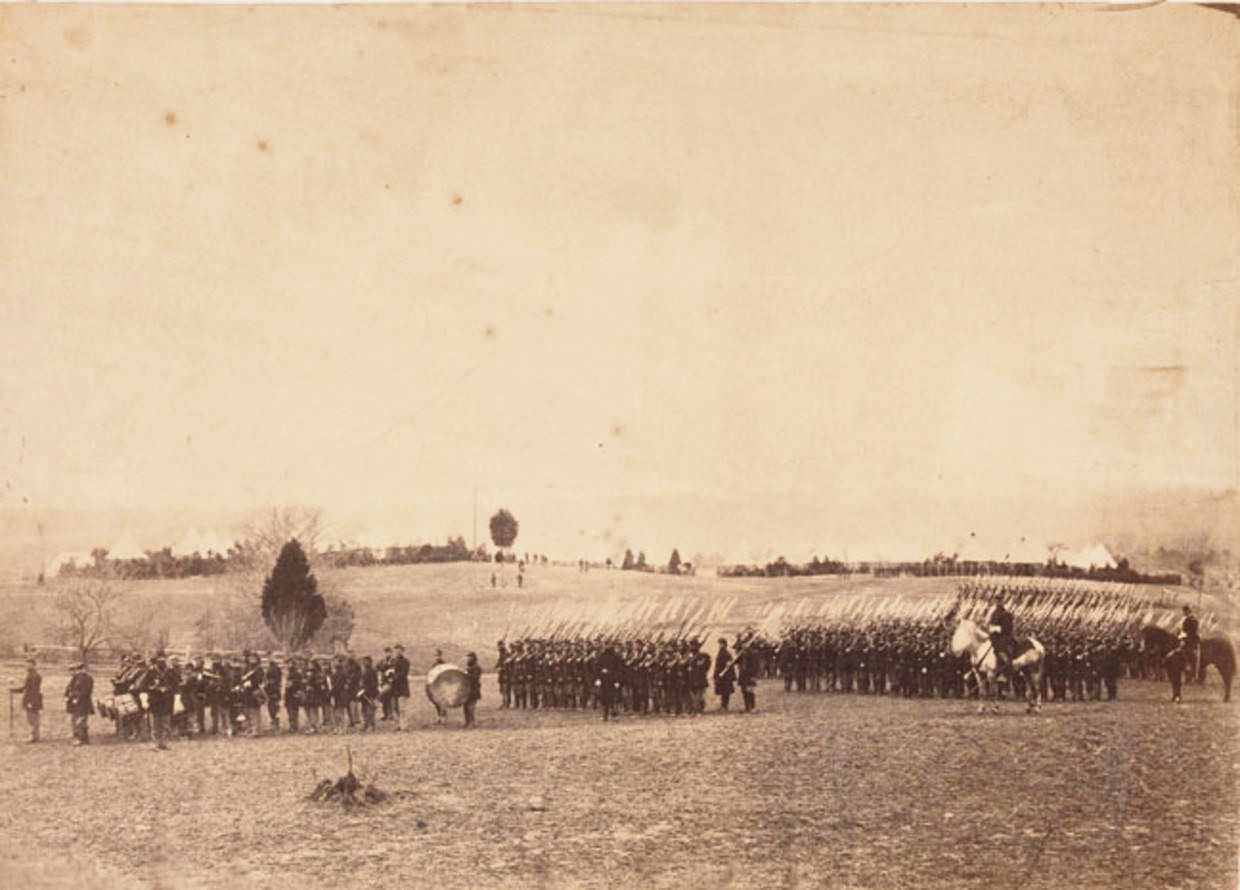
Unidentified Union infantry regiment, Camp Brightwood, Washington, D.C., circa 1865 (public domain).
Letters written by other 47th Pennsylvanians to family and friends back home during that period documented that C Company Drummer Samuel Hunter Pyers was given the honor of guarding the late president’s funeral train while other members of the regiment were involved in guarding the key conspirators in Lincoln’s assassination during the early days of their imprisonment and trial in Washington, D.C.
On 11 May 1865, the 47th Pennsylvania’s First State Color was retired and replaced with the regiment’s Second State Color. Attached to Dwight’s Division, 2nd Brigade, U.S. Department of Washington’s 22nd Corps, the 47th Pennsylvania Volunteers next flexed their muscles in an impressive show of the Union Army’s power and indomitable spirit during the Union’s Grand Review of the Armies in Washington, D.C. on 23 May 1865, under the watchful eyes of President Lincoln’s successor, President Andrew Johnson, and Lieutenant-General Grant. During that phase of duty, the 47th Pennsylvania Volunteers were housed at Camp Brightwood in Washington, D.C.
Then, on 1 June 1865, as other members of the 47th Pennsylvania Volunteer Infantry were preparing to head back to the nation’s Deep South, Private Daniel Houser was honorably discharged from Camp Brightwood by General Orders, No. 53.
* Note: According to post-war admissions records of the Pennsylvania Soldiers’ and Sailors’ Home in Erie County, Pennsylvania, Private Daniel Houser had sustained a gunshot wound to his left hand at some point during his tenure of service with the 47th Pennsylvania Volunteer Infantry.
Return to Civilian Life

Allentown Militia, Soldiers and Sailors Monument Dedication, Allentown, Pennsylvania, 1899 (public domain).
Following his honorable discharge from the military, Daniel Houser returned home to Pennsylvania’s Lehigh Valley, where he found work as a laborer. Unfortunately, very little is presently known about his life during that period. According to records of the U.S. National Home for Disabled Volunteer Soldiers, he reportedly married and was then widowed; however, researchers for 47th Pennsylvania Volunteers: One Civil War Regiment’s Story have not yet located records that identify the name of his spouse, the location and date of their wedding ceremony, or the location and date of her death.
What is known for certain is that, by the summer of 1890, Daniel Houser was living in the lower district of Plainfield Township in Northampton County, Pennsylvania. Although he had been wounded in battle during the American Civil War, that year’s special veterans’ census made no mention of that injury. Records also show that Daniel Houser lost both of his parents within roughly a year’s time, during the early part of that same decade. His mother, Christiana (Getz) Houser, died at the age of seventy-three in Northampton County on 7 December 1892, and was buried at the Plainfield Cemetery in Plainfield Township. His father, Joseph Houser, then died at the age of seventy-six in that same county on 22 October 1893, and was then also buried at the Plainfield Cemetery.
As that decade came to a close, the Lehigh Valley was abuzz with preparations for the unveiling of a massive monument to soldiers from the region who had helped to save America’s Union and end the American Civil War. Now known as the Lehigh County Soldiers and Sailors Monument, it was officially dedicated on 19 October 1899 (the thirty-fifth anniversary of the Battle of Cedar Creek, Virginia), following a parade that was witnessed by an estimated crowd of sixty thousand children and adults.
Illness and Soldiers’ Home Admissions
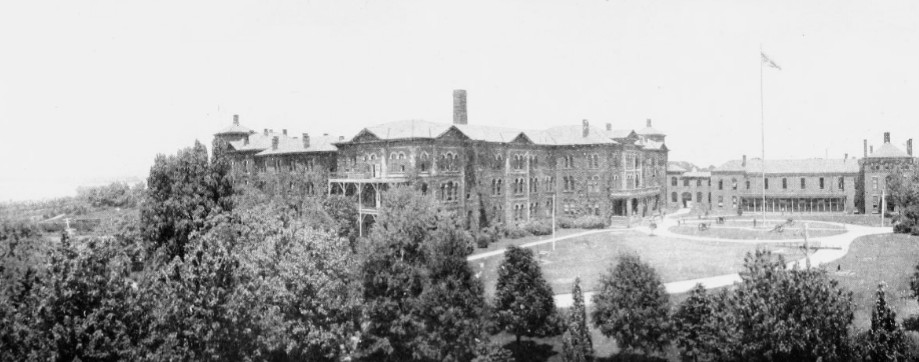
Pennsylvania Soldiers’ and Sailors’ Home in the city of Erie in Erie County, Pennsylvania, 1906 (public domain; click to enlarge).
Like many of his fellow 47th Pennsylvania Volunteers, Daniel Houser suffered serious health issues as he aged, prompting him to seek admittance to state and national facilities where specialized medical care was available to veterans of the American Civil War. Admitted to the Pennsylvania Soldiers’ and Sailors’ Home in the city of Erie in Erie County on 18 November 1911, he was documented in reports by the home’s board of trustees in 1912 and 1914 as a widowed farmer and laborer from Lehigh County who had sustained a gunshot wound to his left hand during that war and was now suffering from valvular heart disease.
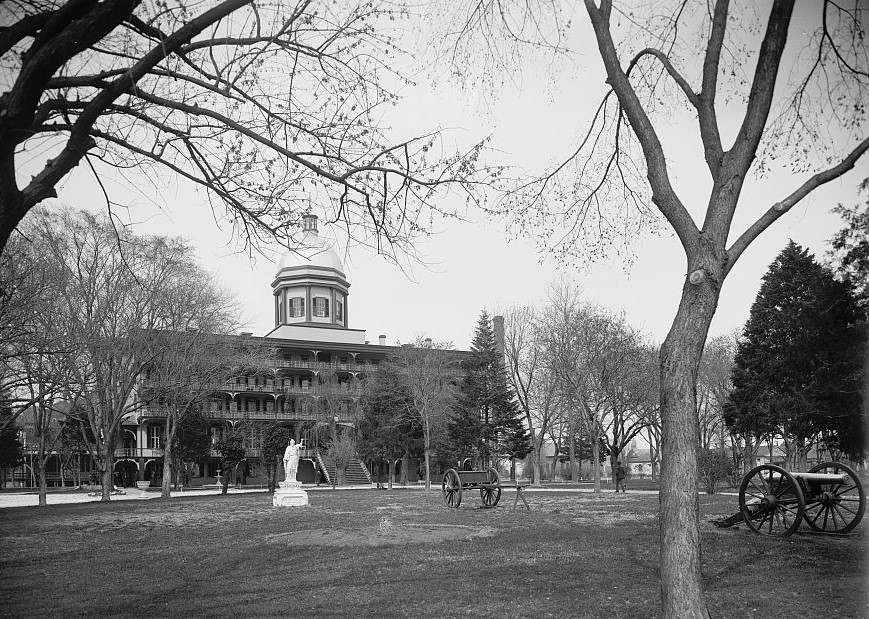
Main Building, National Home for Disabled Volunteer Soldiers, Hampton, Virginia, circa 1902 (U.S. Library of Congress, public domain).
Less than three years later, he was admitted to the Southern Branch of the U.S. National Home for Disabled Volunteer Soldiers in Hampton, Virginia on 11 February 1917. At the time of that admission, physicians noted that the battle wound that he had sustained to his left hand had been caused by an artillery shell fragment (rather than a gunshot), and that he had defective vision, was blind in his left eye, had lost many of his teeth, and had previously sustained a head injury, a fracture to his nose and a hip injury. Furthermore, he was also suffering from cardiac hypertrophy (now known as hypertrophic cardiomyopathy), chronic rheumatism and senile kyphosis (now known as age-related hyperkyphosis — “an exaggerated anterior curvature of the thoracic spine, sometimes referred to as Dowager’s hump or gibbous deformity” that “impairs mobility, and increases the risks of falls and fractures,” according to University of California physical therapy professor Wendy B. Katzman, et. al.). In addition, physicians described Daniel Houser as a seventy-four-year-old widower and Northampton County, Pennsylvania native who had been employed as a laborer, and was five feet, eleven inches tall with gray hair, brown eyes and a light complexion. A Protestant who was able to read and write, his place of residence, if discharged, would be the city of Allentown in Lehigh County, Pennsylvania. His next of kin was his sister, Anna M. (Houser) Lester, who resided in Lopez, Sullivan County, Pennsylvania.
A resident at the Southern Branch of the National Soldiers’ Home until 8 November 1918, Daniel Houser was transferred to the system’s Central Branch in Dayton, Montgomery County, Ohio that day, and remained there until he was transferred back to the Southern Branch in Hampton, Virginia on 6 April 1920. Around that same time he was receiving a U.S. Civil War Pension of thirty dollars per month. Discharged sometime afterward, according to admissions records, he was then readmitted to the Southern Branch on 15 August 1922.
Death and Interment
After a long, full life, the old soldier answered his final bugle call at the National Home for Disabled Volunteer Soldiers in Hampton, Virginia on 17 September 1924. In his early eighties at the time of his passing, Private Daniel Houser was then laid to rest with military honors at the Hampton National Cemetery in Hampton. At the time of his death, he had had forty-five dollars and seventy-six cents in cash and roughly two dollars in personal effects in his possession, the latter of which were auctioned off to other residents of the soldiers’ home on 11 December 1925. (A soldiers’ home administrator had previously sent the money to Daniel’s sister, Anna, giving her an inheritance worth the 2026 equivalent of slightly more than nine hundred U.S. dollars.)
What Happened to the Siblings of Daniel Houser?

Wilkes-Barre, Pennsylvania, circa 1889 (public domain).
Following his marriage to Henrietta Anthony (1846-1865) in Allentown, Lehigh County on 15 December 1861, Daniel Houser’s older brother, Thomas Houser (1839-1904), settled with his wife in Northampton County, where they became the parents of Anderson Houser (born circa 1861-1863-died after 1900); and Sidney L. Houser (1865-1947), who was born on 8 June 1865. Widowed by his wife when she died at the age of nineteen on 10 September 1865, and was buried at the Christ Church Little Moore Cemetery in Danielsville, Northampton County, Thomas Houser was then married for a second time to Sarah Heffelfinger (1842-1912). Their daughter, Priscilla Rebecca Houser (1867-1955), was then born in Northampton County on 15 December 1867; she would later go on to marry Henry Edwin Groff (1872-1949). In 1870, Thomas Houser was employed as a hotelier in Lehigh Township, Northampton County. Residing with him were: his second wife, Sarah; their daughter, Priscilla Rebecca Houser; his son from his first marriage, Anderson Houser; and his wife’s younger sister, Mary Heffelfinger. By 1880, however, Thomas Houser and his wife, Sarah, were residing in the Borough of Wilkes-Barre in Luzerne County, Pennsylvania, with their children, Anderson, Sidney and Priscilla. His son, Anderson, was also employed as a laborer that year. Still residing in Wilkes-Barre as of 1900, Thomas Houser headed a significantly smaller household that included only his wife and her father, John Heffelfinger. That year’s federal census noted that all three of their children were still alive. After a long, full life, Thomas Houser died in Northampton County just days before his eighty-fifth birthday. Following funeral services, he was also buried at the Christ Church Little Moore Cemetery in Danielsville.

Canal and Rickertsville Road, Weissport, Carbon County, Pennsylvania, circa 1905 (public domain).
Following his marriage to Dianna Keiper (born circa 1853-died before June 1900; alternate spellings of given name: “Diana” or “Dyanna”) circa the early to mid- 1870s, Daniel Houser’s older brother, Adam Houser (1843-1915), settled with her in Carbon County, Pennsylvania, where they became the parents of: Ida Elizabeth Houser (1877-1964), who was born on 21 June 1877 and would later wed Nero B. Weiss (1876-1940); Elnora Catherine Houser (1879-1953), who was born on 23 September 1879 and would later wed David Charles Engle (1881-1952); John Henry Houser (1884-1961; alternate surname spelling: “Hauser”), who was born in Harrity, Carbon County on 23 January 1884; and Martha Jane Houser (1892-1967), who was born on 15 May 1892 and would later wed John David Getz (1891-1981). Employed as a laborer at a zinc foundry, Adam Houser was widowed by his wife, Dianna (Keiper) Houser sometime before the federal census of 1900, which was enumerated in Carbon County on 15 June. That year, he resided in Lower Towamensing Township with his children, John and Martha, and stedaughter Ida Meckes, who were all attending school. Still residing in Lower Towamensing Township in 1910, he resided there with his unmarried daughter, Martha, who was employed as a spinner at a silk mill, and Louisa Shoeberger, a fifty-three-year-old servant. By 1915, he was residing at 158 Lehigh Avenue in the Borough of Palmerton in Carbon County. On 28 November of that year, he suffered an episode of apoplexy. Admitted to the Palmerton Hospital in Palmerton, he died there just days later, at the age of seventy-two, on 2 December. Although his burial location was reported to be the North Weissport Cemetery (according to his state death certificate), or the Rickettsville Cemetery (according to Allentown’s Morning Call newspaper), a memorial that was created for him on Find a Grave indicates that he may have been buried at, or may have a cenotaph at, the Towamensing Cemetery in Palmerton, Carbon County.
Rooftop view from Diehl’s Furniture, 8th and Turner Streets, Allentown, Pennsylvania, looking west, 1910 (public domain).
Following his marriage to Elizabeth Barthol (1841-1917) in Northampton County during the late 1860s or in early 1870, Daniel Houser’s younger brother, Joseph Theodore Houser (1846-1917), settled with her in Lehigh Township, Northampton County, where he was employed as a carpenter. They then became the parents of: Amelia R. Houser (1871-1925), who was born in Northampton County on 22 June 1871 and would later wed Steward J. Metzger (1876-1943); Anna E. Houser (1872-1953), who was born on 1 November 1872 and would later wed Charles A. Brady (1870-1953); Clara L. Houser (1875-1925), who was born on 1 July 1875 and would later wed Edward F. Hahn (1879-1947); Emma Cora Houser (1876-1963), who would grow up to become a deaconess with the Salem Reformed Church and would never marry; and Joseph Houser (1879-1902), who was born in 1879 and also grew up to become a nail maker. Still employed as a carpenter in 1880, Joseph T. Houser also still resided in Lehigh Township with his wife and their children, Amelia, Anna, Clara, and Emma. Another son, Charles Thomas Houser (1880-1950), was then born on 16 August 1880; he would later wed Andora C. Angstadt (1878-1947). By 1900, however, carpenter Joseph T. Houser was residing in the Eighth Ward of the city of Allentown in Lehigh County with his wife, Elizabeth, and their children: Clara; Cora, a weaver at a silk mill; and Joseph and Charles, who were both employed as day laborers. Also living with them was day laborer Sydney L. Houser, who was a nephew of Joseph T. Houser and a son of Thomas Houser. Joseph T. Houser’s namesake son, Joseph, then accepted a job as a nail maker for a wire mill in Ensley, Alabama in December 1901, but died there on 9 September 1902. His remains were subsequently returned to Pennsylvania for burial at the Highland Memorial Park Cemetery in Allentown. Still residing in Allentown’s Eighth Ward by 1910, Joseph T. Houser’s household that year included his wife, Elizabeth, and their married daughter, Clara, as well as Clara’s husband, Edward Hahn, and their sons, Ernest and Theo Hahn. Sadly, before that new decade was over, both Joseph T. Houser and his wife, Elizabeth (Barthol) Houser, would be gone. Ailing with kidney disease and uterine cancer, Elizabeth died at the age of seventy-five in Allentown on 17 April 1917, and was buried at the Highland Memorial Park Cemetery on 21 April. Ailing with kidney and heart disease, Joseph died the following day (on 18 April 1917), and was buried beside her at the same cemetery on the same day.
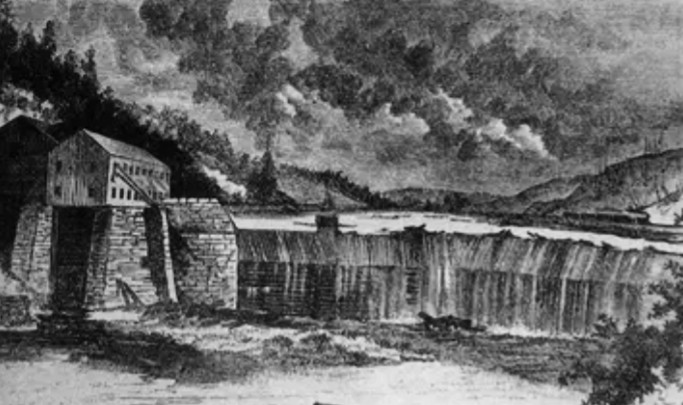
Lehigh Tannery and Dam, Kidder Township, Carbon County, Pennsylvania, 1873 (public domain).
Following his marriage to Sarah Eschenbach (1846-1924) sometime during the mid to late 1860s, Daniel Houser’s younger brother, Levi Houser (1845-1919), settled with her in Carbon County, where they became the parents of Emma Lenora Houser (1868-1953), who was born on 10 July 1868 and would later wed Elmer Ellsworth Taylor (1866-1898). In 1870, Levi Taylor was employed as a laborer and was residing in Lehigh Tannery, Kidder Township, Carbon County with his wife and daughter. They then moved to Lackawanna County, Pennsylvania, where more children were born: Joseph Herbert Houser (1875-1921), who was born in January 1875 and would later wed Anna E. Knowles (1876-1939); and Effie F. Houser (1880-1971), who was born in Thornhurst, Lackawanna County on 8 January 1880 and would later wed Arthur Francis Knowles (1882-1946). Employed at a tannery during that summer of 1880, Levi Houser resided in Lehigh Township with his wife, Sarah, and their children: Emma, Joseph and Effie. By 1900, however, Levi Houser had become a hotelier in Fairmount Township, Luzerne County. Residing with him were his wife, Sarah; their daughter, Emma (Houser) Taylor, and her three children (Grant, Harold and Effie Taylor, aged seven, four and one); their daughter, Effie F. (Houser) Bush, and her son (Clifford Bush, aged one; and two boarders, John Hayes and Michael Sweeney. By 1910, Levi Houser and his wife, Sarah, were residing at the home of their son, Joseph H. Houser, in Colley Township, Sullivan County, where Joseph was employed as a fireman at a lumber mill. Also residing there were: Joseph’s wife, Anna; their children (Blanche and Levi, aged eight and three); Joseph’s nieces and nephews (Clifford Bush, and Grant, Harold and Effie Taylor); and a boarder, Isaac Newell. Ailing with progressive pernicious anemia, Levi Houser died at the age of seventy-four in Davidson Township, Sullivan County on 19 December 1919, and was buried at the Pleasant Hill Cemetery in Hughesville, Lycoming County, Pennsylvania.
Dedication ceremony, Northampton County Soldiers’ and Sailors’ Monument, Easton, Pennsylvania, 10 May 1900 (public domain).
Following his marriage to Mary Ann R. Person (1852-1902) in Northmpton County during the mid to late 1860s, Daniel Houser’s younger brother, Hillorius Houser (1848-1923), who had become known as “Hillory,” settled with his wife in eastern Pennsylvania, where they became the parents of: Melissa R. Houser (1869-1935), who was born in Moore Township, Northampton County on 12 December 1869 (alternate birth year: 1863), would become known as “Lizzie” and would later wed John E. Remaly (1867-1907); Minnie Christine Houser (1874-1973), who was born in Slatington, Lehigh County on 16 November 1874 (alternate birth year: 1876) and would later wed Adam Kresge (1879-1953); Matilda M. Houser (1876-1961), who was born in Cherryville, Northampton County on 17 March 1876, would later become known as “Tilly” and would marry Charles L. Anewalt (1877-1950); and Lucetta Houser (1880-1969), who was born on 5 February 1880, would later be known as “Sadie” and would later wed George Huhn. By the time that the federal census was enumerated in Northampton County in mid-June 1880, Hillory Houser was employed as an engineer and was residing in that county’s Western Lehigh Township with his wife and their children: Melissa, Minnie, Matilda, and Lucetta. More children then followed: Ida S. Houser (1882-1956), who was born in November 1882 and would later wed Morris Landis (1880-1964); and George O. Houser (1890-1960), who was born on 8 February 1890 and would later wed Jennie K. Titlow (1890-1972). Still employed as an engineer after the turn of the century, Hillory Houser resided in the Borough of Bethlehem with his wife and their children, Sadie, Ida and George. Also renting a room from them that year was Richard Horn, a twenty-four-year-old teamster. That same year, Northampton County unveiled and dedicated its own monument to area soldiers. Widowed by his wife, Mary Ann, when she died at the age of fifty in Northampton County on 3 April 1902, and was buried at the Fairview Cemetery in Bethlehem, Northampton County, Hillory Houser survived her by more than two decades. Following his death from pyonephrosis at the age of seventy-four in Moore Township, Northampton County on 2 March 1923, he was laid to rest beside his wife at the Fairview Cemetery in Bethlehem on 5 March.
Unidentified families of lumbermen photographed outside of their homes on Keystone Avenue in the Village of Lopez in Sullivan County, Pennsylvania, circa early 1900s (public domain).
Following her marriage to Henry M. Lester (1848-1934), Daniel Houser’s sister, Anna Mariah (Houser) Lester (1852-1933), settled with her husband in Buck Township, Luzerne County, Pennsylvania, where her husband was employed as a laborer. In 1870, their household included Mike Gusset, a twenty-one-year-old boarder. They then became the parents of: Eugene Lester (1873-1902), who was born on 16 June 1873; Elsie Lester (1878-1941), who was born in 1878 and would later wed Joel Dutter (1874-1962); and Emarilla Lester (1880-unknown), who was born circa March 1880. Still residing in Buck Township that summer of 1880, their family made ends meet on the wages Henry Lester brought in as a laborer. More children then followed: Priscilla R. Lester (1883-1961), who was born in May 1883 and would later wed and begin a family with Isaac Newell, before marrying LeRoy L. Johnson (1885-1928); Howard Joseph Lester (1886-1961), who was born in Gouldsboro, Pennsylvania on 25 April 1886 and would later wed Mary Catherine VanHorn (1888-1914); William Allen Lester (1887-1925), who was born in Gouldsboro on 29 November 1887 and would later serve in the U.S. Army during World War I, before becoming a coal miner; and Beulah Lester (1892-1973), who was born on 14 September 1892 and would later wed Charles W. Dunlap (1895-1980). After the turn of the century, Anna (Houser) Lester resided in the Lopez Precinct in Colley Township, Sullivan County, Pennsylvania, where her husband was employed in the lumber industry as a saw filer. Residing with them were their children: Eugene, who was employed as a bark puller; Priscilla, who was employed as a clothes pin packer; and Howard, Willie and Beulah. In 1910, their home in the Village of Lopez housed just Henry, Anna, William, and Beulah. Although Beulah was no longer residing with them in 1920, their ten-year-old grandson, Cortez Lester, was a member of their household — a living arrangement that continued into 1930. After a long, full life, Anna Mariah (Houser) Lester suffered a cerebral hemorrhage on 19 September 1933 and died at the age of eighty-one in Lopez on 25 September. Following funeral services, she was laid to rest at the Fairview Cemetery in Dushore, Sullivan County on 27 September.
Sources:
- Adam Houser (an older brother of Daniel Houser), in Death Certificates (file no.: 117675, registered no.: 105, date of death: 25 September 1933). Harrisburg, Pennsylvania: Commonwealth of Pennsylvania, Department of Health, Bureau of Vital Statistics.
- “Adam Houser” (an older brother of Daniel Houser), in “Obituary.” Allentown, Pennsylvania: The Morning Call, 4 December 1915.
- “Anna M. Lester” (funeral report of a younger sister of Daniel Houser), in “Late News from Neighboring Counties.” Wilkes-Barre, Pennsylvania: Times-Leader, 3 October 1933.
- Anna Mariah Lester (a younger sister of Daniel Houser), in Death Certificates (file no.: 82134, registered no.: 28, date of death: 2 December 1915). Harrisburg, Pennsylvania: Commonwealth of Pennsylvania, Department of Health, Bureau of Vital Statistics.
- Bates, Samuel P. History of Pennsylvania Volunteers, 1861-5, vol. 1. Harrisburg, Pennsylvania: B. Singerly, State Printer, 1869.
- “Bonstein, L.,” on U.S. Army Returns from Military Posts” (Fort Taylor, Key West, Florida: January, April, May, June, July, August, September, October, November, and December 1863). Washington, D.C.: U.S. Army and U.S. National Archives and Records Administration.
- “Double Funeral of an Aged Couple” (obituary of Daniel Houser’s younger brother, Joseph T. Houser). Allentown, Pennsylvania: The Allentown Leader, 21 April 1917.
- Dyer, Frederick H. A Compendium of the War of the Rebellion, p. 1589. Des Moines, Iowa: The Dyer Publishing Company, 1908.
- “Easton’s Big Day: Over 30,000 Strangers Attend the Unveiling of the Soldiers’ Monument.” Wilkes-Barre, Pennsylvania: The Wilkes-Barre Record, 11 May 1900.
- “Easton’s Monument: Unveiled Yesterday with Patriotic Pomp.” Allentown, Pennsylvania: The Allentown Daily Leader, 11 May 1900.
- “Florida’s Role in the Civil War: ‘Supplier of the Confederacy.” Tampa, Florida: Florida Center for Instructional Technology, University of South Florida (College of Education), retrieved online 15 January 2020
- Gobin, John Peter Shindel. Personal Letters, 1861-1865. Northumberland, Pennsylvania: Personal Collection of John Deppen.
- Grant, Ulysses S. Personal Memoirs of Ulysses S. Grant. New York, New York: Charles L. Webster & Company, 1885.
- Grodzins, Dean and David Moss. “The U.S. Secession Crisis as a Breakdown of Democracy,” in When Democracy Breaks: Studies in Democratic Erosion and Collapse, from Ancient Athens to the Present Day (chapter 3). New York, New York: Oxford University Press, 2024.
- Hauser (sic, “Houser”], Hillory (a younger brother of Daniel Houser), Mary A., Malissa R., Minnie C., Tillie M., and Lucetta A., in U.S. Census (Western Lehigh Township, Northampton County, Pennsylvania, 1880). Washington, D.C.: U.S. National Archives and Records Administration.
- Hauser [sic, “Houser”], Joseph (a younger brother of Daniel Houser) and Elizabeth; and Hahn, Edward, Clara (a niece of Daniel Houser and a daughter of Joseph T. Houser), Ernest, and Theo, in U.S. Census (Allentown, Eighth Ward, Lehigh County, Pennsylvania, 1910). Washington, D.C.: U.S. National Archives and Records Administration.
- Hauser [sic, “Houser”], Levi (a younger brother of Daniel Houser) and Sarah; Taylor, Emma (a niece of Daniel Houser and a daughter of Levi Houser), Grant R., Harold E. and Effie A. (Emma Taylor’s children); Bush, Effie F. (a niece of Daniel Hauser and a daughter of Levi Houser) and Clifford L. (Effie Bush’s son); and Sweeney, Michael and Hayes, John (boarders), in U.S. Census (Fairmount Township, Luzerne County, Pennsylvania, 1900). Washington, D.C.: U.S. National Archives and Records Administration.
- Hillory Houser (a younger brother of Daniel Houser), in Death Certificates (file no.: 32892, registered no.: 35, date of death: 2 March 1923). Harrisburg, Pennsylvania: Commonwealth of Pennsylvania, Department of Health, Bureau of Vital Statistics.
- Houser, Adam (an older brother of Daniel Houser), Dyanna, Ida E., and Elnora C., in U.S. Census (Franklin Township, Carbon County, Pennsylvania, 1880). Washington, D.C.: U.S. National Archives and Records Administration.
- Houser, Adam (an older brother of Daniel Houser), John H. and Martha J.; Meckes, Ida M. (stepdaughter); and Shaffer, Gertie (servant), in U.S. Census (Lower Towamensing Township, Carbon County, Pennsylvania, 1900). Washington, D.C.: U.S. National Archives and Records Administration.
- Houser, Daniel, in Admissions Records, U.S. National Home for Disabled Volunteer Soldiers (Southern Branch, Hampton, Virginia, 1917-1918 and 1922-1924; and Central Branch, Dayton, Montgomery County, Ohio, 1918-1920). Washington, D.C.: U.S. National Archives and Records Administration.
- Houser, Daniel, in Civil War Muster Rolls (Company E, 47th Pennsylvania Infantry). Harrisburg, Pennsylvania: Pennsylvania State Archives.
- Houser, Daniel, in Civil War Veterans’ Card File, 1861-1866 (Company E, 47th Pennsylvania Infantry). Harrisburg, Pennsylvania: Pennsylvania State Archives.
- Houser, Daniel, in U.S. Census (“Special Schedule. — Surviving Soldiers, Sailors, and Marines, and Widows, etc.”: Plainfield Township, Lower District, Northampton County, Pennsylvania, 1890). Washington, D.C.: U.S. National Archives and Records Administration.
- Houser, Hillory (a younger brother of Daniel Houser), Mary, Malissa R., Sadie [sic, “Lucetta Houser”], Ida and George, in U.S. Census (Bethlehem, Third Ward, Northampton County, Pennsylvania, 1900). Washington, D.C.: U.S. National Archives and Records Administration.
- Houser, Joseph L., Christina, Thomas, Daniel, Adam, Levi, Joseph T., and Helorius [sic], in U.S. Census (Hamilton Township, Monroe County, Pennsylvania, 1850). Washington, D.C.: U.S. National Archives and Records Administration.
- Houser, Joseph, Christina, Adam, Hillarious [sic] and Annamaria [sic, “Anna Mariah”], in U.S. Census (Hamilton Township, Monroe County, Pennsylvania, 1850). Washington, D.C.: U.S. National Archives and Records Administration.
- Houser, Joseph (a younger brother of Daniel Houser) and Elizabeth, in U.S. Census (Lehigh Township, Northampton County, Pennsylvania, 1870). Washington, D.C.: U.S. National Archives and Records Administration.
- Houser, Joseph (a younger brother of Daniel Houser), Elizabeth, Clara, Cora E., Joseph, Charles T., and Sidney (a nephew of Joseph T. Houser and a son of Thomas Houser), in U.S. Census (Allentown, Eighth Ward, Lehigh County, Pennsylvania, 1900). Washington, D.C.: U.S. National Archives and Records Administration.
- Houser, Levi (a younger brother of Daniel Houser), Sarah and Emma, in U.S. Census (Lehigh Tannery, Kidder Township, Carbon County, Pennsylvania, 1870). Washington, D.C.: U.S. National Archives and Records Administration.
- Houser, Levi (a younger brother of Daniel Houser), Sarah, Emma, Joseph, and Effie, in U.S. Census (Lehigh Township, Lackawanna County, Pennsylvania, 1880). Washington, D.C.: U.S. National Archives and Records Administration.
- Houser, Thomas (an older brother of Daniel Houser), Sarah, Anderson, and Rebecca, in U.S. Census (Lehigh Township, Northampton County, Pennsylvania, 1870). Washington, D.C.: U.S. National Archives and Records Administration.
- Houser, Thomas (an older brother of Daniel Houser), Unidentified Heffinger [sic, “Sarah (Heffelfinger) Houser”], Anderson, Sidney and Priscilla, in U.S. Census (Wilkes-Barre, Fourth Ward, Luzerne County, Pennsylvania, 1880). Washington, D.C.: U.S. National Archives and Records Administration.
- Ida E. Weiss (a niece of Daniel Houser and a daughter of Adam Houser), in Death Certificates (file no.: 097073-64, local reg. no.: 1734, date of death: 24 October 1964). Harrisburg, Pennsylvania: Commonwealth of Pennsylvania, Department of Health, Bureau of Vital Statistics.
- Irwin, Richard Bache. History of the Nineteenth Army Corps. New York, New York: G. P. Putnam’s Sons, 1893.
- Joseph T. Houser (a younger brother of Daniel Houser), in Death Certificates (file no.: 38785, registered no.: 472, date of death: 18 April 1917). Harrisburg, Pennsylvania: Commonwealth of Pennsylvania, Department of Health, Bureau of Vital Statistics.
- Katzman, Wendy B., Linda Wanek, John A. Shepherd, and Deborah A. Sellmeyer. “Age-Related Hyperkyphosis: Its Causes, Consequences, and Management,” in Journal of Orthopaedic & Sports Physical Therapy, vol. 40, no. 6, pp.352-360, June 2010. Alexandria, Virginia: American Physical Therapy Association.
- Lester, Henry and Ann M. (a younger sister of Daniel Houser); and Gusset, Mike (boarder), in U.S. Census (Buck Township, Luzerne County, Pennsylvania, 1870). Washington, D.C.: U.S. National Archives and Records Administration.
- Lester, Henry, Anna M. (a younger sister of Daniel Houser), Eugene, Elcenora [sic, “Elsie”], and Emarilla, in U.S. Census (Buck Township, Luzerne County, Pennsylvania, 1880). Washington, D.C.: U.S. National Archives and Records Administration.
- Lester, Henry, Anna (a younger sister of Daniel Houser), Eugene, Priscilla, Howard, Willie, and Beulah, in U.S. Census (Colley Township, Lopez Precinct, Sullivan County, Pennsylvania, 1900). Washington, D.C.: U.S. National Archives and Records Administration.
- Lester, Henry, Ann M. (a younger sister of Daniel Houser), William, and Beulah, in U.S. Census (Village of Lopez, Colley Township, Sullivan County, Pennsylvania, 1910). Washington, D.C.: U.S. National Archives and Records Administration.
- Lester, Henry, Anna M. (a younger sister of Daniel Houser), William, and Cortez (grandson), in U.S. Census (Village of Lopez, Colley Township, Sullivan County, Pennsylvania, 1920, 1930). Washington, D.C.: U.S. National Archives and Records Administration.
- Levi Houser (a younger brother of Daniel Houser), in Death Certificates (file no.: 121495, registered no.: 23, date of death: 19 December 1919). Harrisburg, Pennsylvania: Commonwealth of Pennsylvania, Department of Health, Bureau of Vital Statistics.
- Lucetta A. Huhn [sic, “Lucetta A. (Houser) Huhn”] (a niece of Daniel Houser and a daughter of Hillorius Houser), in Death Certificates (file no.: 027990-69, local reg. no.: 76, date of death: 10 March 1969). Harrisburg, Pennsylvania: Commonwealth of Pennsylvania, Department of Health, Bureau of Vital Statistics.
- “Northampton’s Monument Is Unveiled at Easton: Great Throngs from All Sections Participate in the Big Celebration.” Philadelphia, Pennsylvania: The Philadelphia Inquirer, 11 May 1900.
- “Obituary: Joseph Houser” (obituary of a nephew of Daniel Houser and a son of Joseph T. Houser). Allentown, Pennsylvania: The Morning Call, 11 September 1902.
- “Remaly” (obituary of Lizzie (Houser) Remaly, who was a niece of Daniel Houser and a daughter of Hillorius Houser), in “Deaths.” Allentown, Pennsylvania: The Morning Call, 6 June 1935.
- Report of the Board of Trustees of the Pennsylvania Soldiers’ and Sailors’ Home at Erie for the Two Years Ending May 31, 1910, pp. 72 and 76-77. Philadelphia, Pennsylvania: Press of Allen, Lane & Scott, 1912.
- Reports and Other Correspondence of W. D. C. Rodrock, 1864-1865, Chaplain, 47th Pennsylvania Volunteer Infantry (Record Group R29). Washington, D.C.: U.S. National Archives and Records Administration.
- “Roster of the 47th P. V. Inf.” Allentown, Pennsylvania: The Morning Call, 26 October 1930.
- Schmidt, Lewis. A Civil War History of the 47th Regiment of Pennsylvania Veteran Volunteers. Allentown, Pennsylvania: Self-published, 1986.
- Scott, Robert N. The War of War of the Rebellion: A Compilation of the Official Records of the Union and Confederate Armies, series I, vol. XXXIV, part II: “Correspondence, etc.-Union,” Chapter XLVI: “Louisiana and the Trans-Mississippi,” p. 199. Washington, D.C.: Government Printing Office, 1891.
- Sheridan, Philip Henry. Personal Memoirs of P. H. Sheridan, General, United States Army in Two Volumes. New York, New York: Charles L. Webster & Company, 1888.
- Sidney L. Houser (a nephew of Daniel Houser and a son of Thomas Houser), in Death Certificates (file no.: 54993, registered no.: 734, date of death: 12 June 1947). Harrisburg, Pennsylvania: Commonwealth of Pennsylvania, Department of Health, Bureau of Vital Statistics.
- Staubach, Lieutenant Colonel James C. “Miami During the Civil War: 1861-65,” in Tequesta: The Journal of the Historical Association of Southern Florida, vol. LIII, pp. 31-62. Miami: Historical Museum of Southern Florida, 1993.
- Tamiami Trail Modifications: Next Steps — Draft Environmental Impact Statement, Appendix E. Washington, D.C.: U.S. National Park Service: Everglades National Park: 29 January 2010.
- “The History of the Forty-Seventh Regt. P. V.” Allentown, Pennsylvania: The Lehigh Register, 20 July 1870.
- “The Unveiling of the Soldiers’ and Sailors’ Monument at Easton on Thursday.” Allentown, Pennsylvania: The Allentown Democrat, 16 May 1900.
- “To Consecrate a Deaconess” (announcement of the consecration of Emma Houser, who was a niece of Daniel Houser and a daughter of Joseph T. Houser). Allentown, Pennsylvania: The Morning Call, 29 May 1909.
- Wharton, Henry D. “Letters from the Sunbury Guards.” Sunbury, Pennsylvania: The Sunbury American, 1861-1864.
- Yard, Charles Yard, et. al., in Returns From U.S. Military Posts, 1863-1864 (Company E, 47th Pennsylvania Infantry, Fort Jefferson, Dry Tortugas, Florida, May-July 1864), in Records of the Adjutant General’s Office, 1762-1984 (Record Group 94; Microfilm Publication M617, 1550; NAID: 561324). Washington, D.C.: U.S. National Archives and Records Administration.


You must be logged in to post a comment.