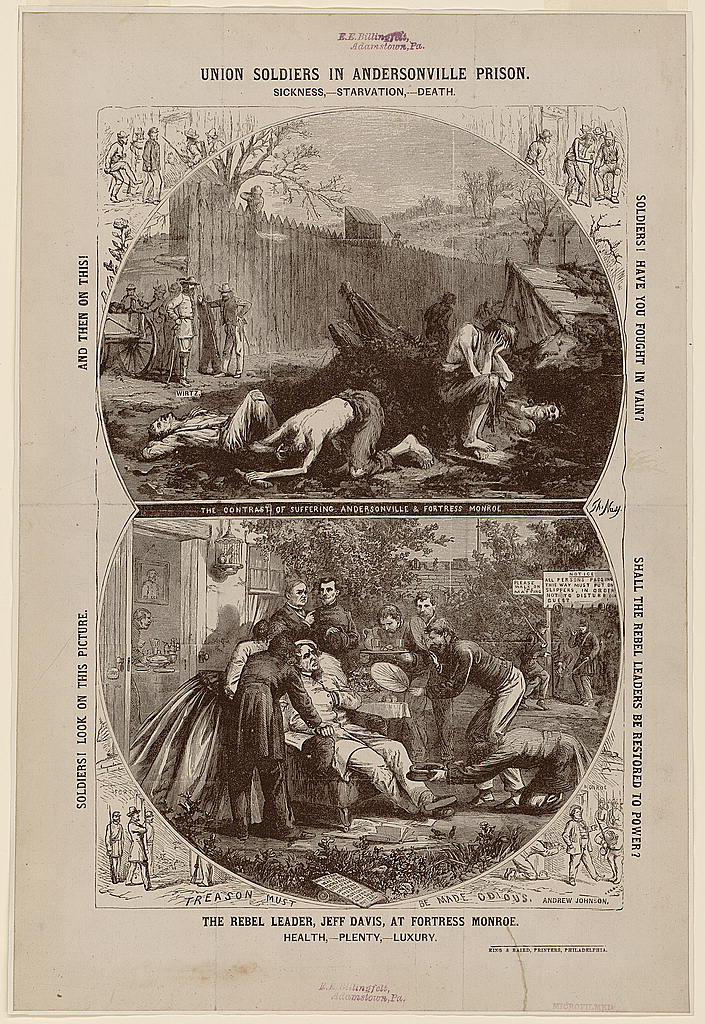
A full-page spread with two illustrations by American artist Thomas Nast, which appeared in U.S. newspapers in 1866, contrasted the brutal treatment of Union prisoners of war at Andersonville with the far more comfortable life of the Confederacy’s leader Jefferson Davis (Thomas Nast, Union Soldiers in Andersonville Prison and The Rebel Leader, Jeff Davis, at Fortress Monroe, 1865, public domain).
During the Battle of Cedar Creek, Virginia on 19 October 1864 — an intense, prolonged fight that ended in victory for the Union but was later described by 47th Pennsylvania Volunteer Henry Wharton as “dearly bought” — multiple members of the 47th Pennsylvania Volunteer Infantry were killed, wounded in action or labeled as “MIA” (missing in action).
By the winter of 1864-1865, it was clear that more than two dozen of the 47th Pennsylvania’s MIA had been captured by the enemy. While a few were sent to the Libby Prison in Richmond, roughly one hundred forty miles away from the scene of that battle, the majority were taken much farther south — to the Carolinas or Georgia — where they were held as prisoners of war by the Confederate States Army at the worst of the worst Confederate POW camps.
One 47th Pennsylvanian survived long enough to make it home to see his mother, only to die at her house within weeks of his release from captivity. Others somehow survived, recovered from their ordeal and returned to duty with the regiment, but a heartbreaking number of 47th Pennsylvania Volunteer Infantrymen died without ever being freed from captivity. Starved and tortured both mentally and physically, at least ten are known to have been callously buried in unmarked, trench graves with thousands of other Union soldiers, their individual resting places obscured for all time.
Camp Sumter (Andersonville, Georgia)
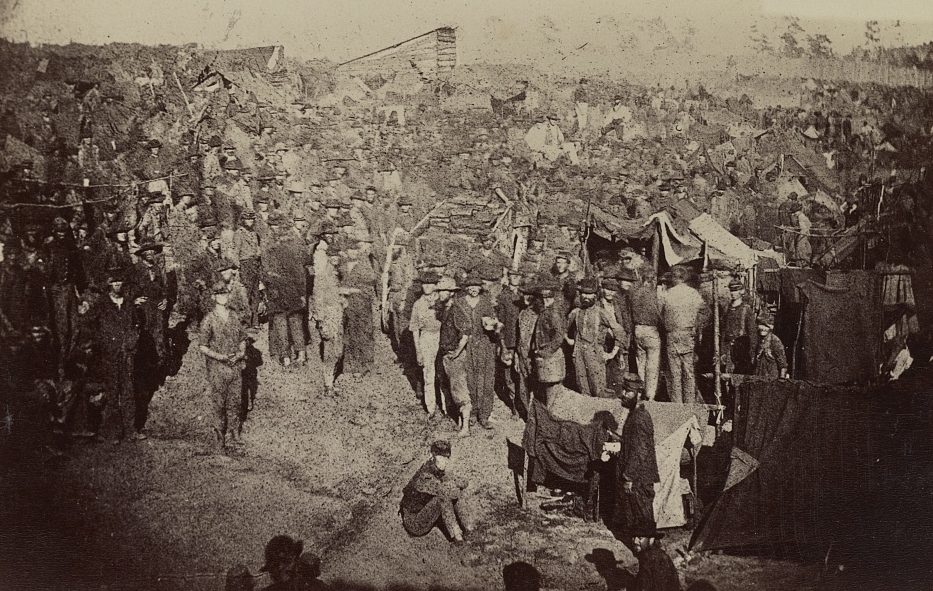
Issuing rations at the Andersonville POW Camp, 17 August 1864 (view from Main Gate, U.S. Library of Congress, public domain).
The most notorious of the Confederacy’s prisoner of war camps, Camp Sumter, came to be known simply by the name of the town in Georgia that was closest to it — Andersonville. Built in early 1864 on roughly sixteen and one-half acres of land, it was surrounded by a gated, stockade fence that was fifteen feet tall, and had begun receiving its first prisoners in February of that year. By June, more than twenty-six thousand POWs were confined to space that had been designed to house just ten thousand. As a result, its conditions devolved so fast, and its death rate climbed so quickly, that simply speaking its name caused the bravest and most stout-hearted of Union soldiers to shudder at the thought of men they knew who were likely suffering there.
As the overcrowding worsened, access to adequate shelter became even more difficult, exposing the Union POWs to harsh weather while the camp’s deteriorating sanitation systems began attract more and more vermin — a deadly combination that enabled dysentery and crime to spread like wildfires. Each day was more dreadful than the last as prisoners, weakened by starvation and wracked by disease, were preyed upon by stronger inmates bent on stealing their meager, sub-standard rations.
Their nights were even more perilous. According to historian Evan Kutzler, “Darkness temporarily disabled the eyes and increased one’s reliance on moonlight and artificial light as well as the non visual senses, to understand the environment to ward off danger.”
“Listening, smelling, tasting, feeling, were perhaps most acute in the hours of darkness. The sounds of suffering, of hungry prisoners and sick men trying to stay warm, were everywhere.
“Night air smelled more noxious and thus more capable of making prisoners ill…. And this contributes to a kind of ghastly scene that prisoners frequently referred to as a form of Hell…. They’re thinking back to Dante’s Inferno. They’re thinking back to religious depictions of the underworld. Many of them believe they’re seeing this in Southwest Georgia in the summer of 1864….
“Night was a frontier, a less disciplined time than during the day. For sentries, night seemed to offer the weak cover to shed some constraints. But it also encouraged the powerful to respond with more brutality.
“Prisoners were thus more likely to talk back to guards, but the guards were also more likely to shoot prisoners and to do so with minimal provocation and little or no warning.”
The sole 47th Pennsylvanian confirmed to have been held captive at Andersonville following the Battle of Cedar Creek was First Sergeant William Fry of Company C. Starved, tortured and severely weakened by disease, he somehow managed to endure until he was finally released during a prisoner exchange on 4 March 1865. Transported north, he was treated briefly by Union Army physicians to stabilize him enough to be taken home to his mother’s house in Sunbury, Northumberland County, Pennsylvania, where he died just over three weeks later — on 28 March 1865. Just twenty-eight years old at the time of his passing, he was laid to rest at the Sunbury Cemetery.
At the time of Sergeant Fry’s internment, Andersonville had been under the command of Henry Wirz, who would later be convicted of war crimes for his brutal treatment of Union prisoners. According to the 21 September 1864 edition of The Soldiers’ Journal:
“Those Union prisoners recently released from Camp Sumter, at Andersonville, Ga., have made affidavit of the condition of the 35,000 prisoners confined there. The horrors of their imprisonment, plainly and unaffectedly narrated, have no parallel outside of Taeping or Malay annals. Twenty-five acres of human beings – so closely packed that locomotion is made obsolete, compelled to drink from sewers, and to eat raw meat like cannibals – are dwelling under vigilant espionage, hopeless, helpless, and Godless. Some are lunatic, and others have become desperately wicked; all are living, loathing, naked, starved fellow-men.”
The 15 April 1865 edition of The Sunbury Gazette reported on Sergeant Fry’s tragic death as follows:
“At a meeting of the officers and enlisted men of Company ‘C,’ 47th Penna. Vet. Vols., held at the Head Quarters of the company, at Camp Fairview, Va. April 3d, 1865, at which Capt. Daniel Oyster presided and Lieut. Wm. Hendricks and H. D. Wharton acted as Secretaries, the following preamble and resolutions were unanimously adopted as a testimonial of their appreciation and feeling for 1st Sergt. William Fry, who died at Sunbury, Penna., March 28, 1865. Sergeant Fry was taken prisoner at the battle of Cedar Creek, Va., October 19th, 1865, and carried to one of the prison pens of rebeldom, from which he was paroled, only to ‘come home to die’ from starvation and slow poison — the victim of atrocities such as have only been practiced by the traitors to our own government, and from which savages would turn in disgust.
“WHEREAS, 1st Sergeant William Fry, Co. ‘C,’ 47th Pa. Vet. Vols., in the dispensation of an all-wise Providence has been removed from our midst, therefore
“RESOLVED, That in the death of Sergt. Fry his company has lost a most efficient non-commissioned officer, his comrades a cherished friend, and the service a brave and disciplined soldier.
“RESOLVED, That the family and friends of the deceased have our heartfelt sympathies in this, their sad bereavement. Although dead, he is remembered — we will endeavor to emulate his virtues.
“RESOLVED, That more substantially to express our grief, we the officers and enlisted men of company ‘C,’ erect suitable monument to his memory.
“RESOLVED, That these resolutions be published in the Sunbury ‘American’ and ‘Gazette,’ and that a copy be forwarded to the mother of the deceased.”
Belle Isle Prison (Richmond, Virginia)
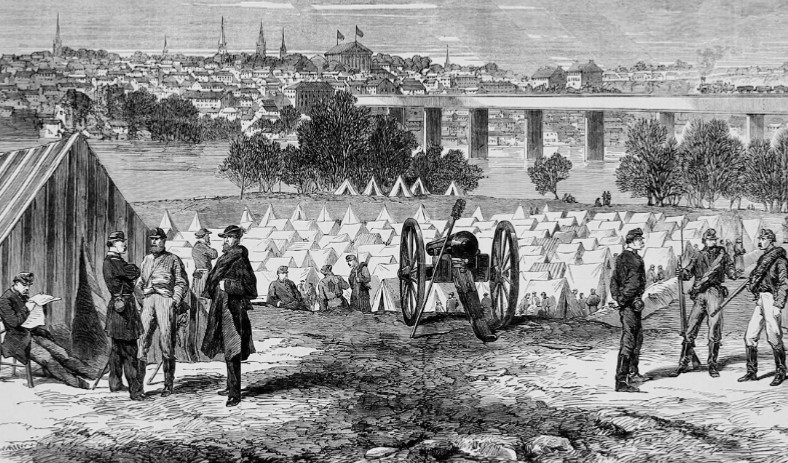
Belle Isle Prison, Richmond, Virginia (Illustrated London News, 9 April 1864, public domain, courtesy of “House Divided,” Dickinson College; click to enlarge).
Private George Smith, who had previously served as a private with Company E of the 47th Pennsylvania Volunteers and Company B of the 7th Pennsylvania Reserves prior to his tenure with the 190th Pennsylvania Volunteers (during which time he was captured by Confederate troops on 19 August 1864, during the second day of a battle to gain control of the Weldon Railroad near Petersburg, Virginia), had initially been held as a POW at the Confederacy’s Libby Prison in Richmond, Virginia, until his transfer to the Confederacy’s prison on Belle Isle in the James River. Accessible from Richmond by footbridge, Belle Isle had been used primarily to incarcerate Union Army privates and non-commissioned officers since its opening in June 1862, according to the Encyclopedia Virginia (whereas Libby had been used to imprison Union officers).
“It was originally intended only as a holding facility until more adequate prisons were available. A hospital for prisoners and an iron factory were located on the island, but no barracks were ever built for the prisoners. They were sheltered only by tents, and forced to withstand excessive heat in the summer, frigid temperatures in the winter, and multiple disease epidemics.”
Unfortunately for Private Smith, Belle Isle had been placed under the command of Henry Wirz, a cruel and merciless Confederate physician who would ultimately be convicted of war crimes and hanged for the maltreatment and murder of Union POWs. As a result, life at Belle Isle would prove to be even worse than what Private Smith had experienced at Libby. According to historian Angela Zombek, “Belle Isle was an open-air stockade. The prison’s six-acre perimeter consisted of earthworks that stood roughly three feet high, and the prisoners’ only shelter came from three hundred or fewer Sibley tents (conical, pole tents invented by Henry Hopkins Sibley), which slept about ten men each.” In addition, food shortages were regular and severe, motivating prisoners to steal from each other, only to then be subject to “bugging and gagging,” which Zombek explains was “a type of punishment in which one piece of wood was tied in a prisoner’s mouth, and another piece of wood was tied behind his knees, thus rendering the prisoner unable to move.”
Despite those inhumane conditions, Private George Smith managed to endure and was eventually moved farther south to the Confederacy’s Salisbury Prison during one of multiple transfers of Union POWs that were ordered prior to the prison’s closure in October 1864. (See the Salisbury section of this article for his final outcome.)
Danville Military Prison (Danville, Virginia)
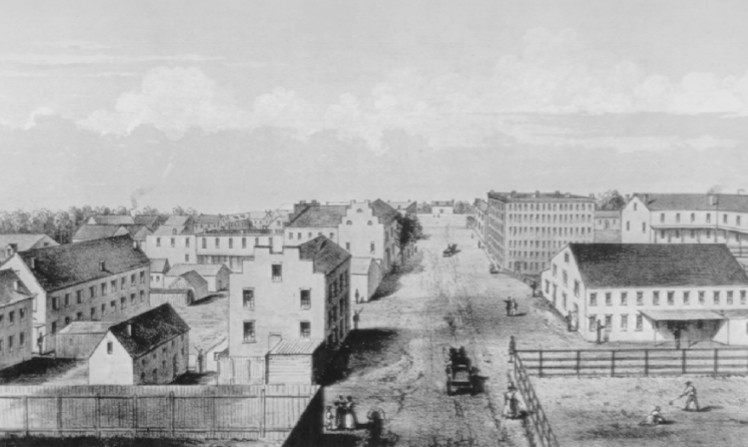
The Confederacy’s Danville Military Prison in Danville, Virginia, shown here circa 1865, was a complex of six former tobacco warehouse buildings where thousands of Union Army prisoners of war were held in unsanitary conditions between 1863 and 1865 (U.S. Library of Congress, public domain; click to enlarge).
Established by order of Confederate General Robert E. Lee in late 1863 to relieve the overcrowding at other prisoner of war camps operated by the Confederacy in and around Virginia, the Danville Military Prison in Danville, Virginia was composed of six former tobacco production warehouses that were converted into a prison complex. According to historians at the U.S. Department of Veterans Affairs, “Prisoners were forbidden to look out windows or use the first floor or grounds, and could use the latrine only in groups of six.” Initially populated with four thousand Union POWs in November 1863, this prison complex also quickly became overcrowded and unsanitary due to poor ventilation, the presence of vermin and the lack of clean water for drinking and bathing — conditions that fed the spread of smallpox and other diseases that killed dozens of prisoners every week.
Corporal Frederick J. Scott of the 47th Pennsylvania’s E Company became one of the Union officers imprisoned at the Danville Military Prison following his capture by Confederate troops during the Battle of Cedar Creek on 19 October 1864. Held there as a POW until his death on 23 February 1865, he was posthumously commissioned, but not mustered, as a second lieutenant by senior officers of the 47th Pennsylvania Volunteer Infantry. His precise burial location remains unidentified.
Florence Stockade (Florence, North Carolina)
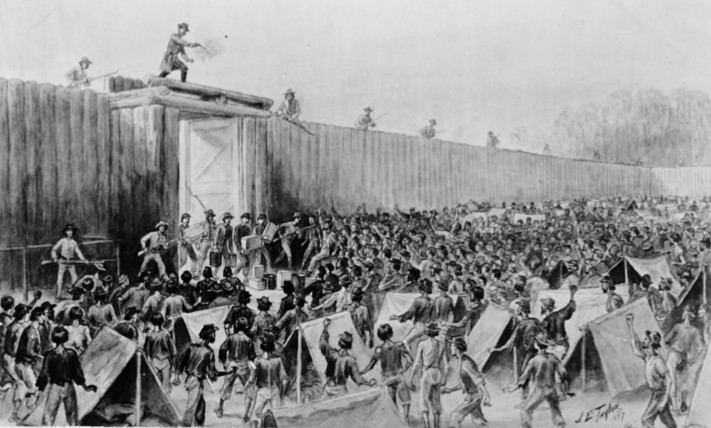
Confederate States Army Lieutenant Barrett firing into the crowd of emaciated prisoners, Florence Stockade, Florence, South Carolina, circa 1864-1865 (J. E. Taylor, circa 1897, U.S. Library of Congress, public domain).
A newer Confederate prison camp that was located in Florence, South Carolina and encircled by a trench to prevent prisoner escapes, the Florence Stockade quickly became as notorious as the Confederacy’s POW camps at Andersonville and Salisbury for its shockingly harsh treatment of Union POWs and high death rates. Many of the roughly fifteen thousand to eighteen thousand Union prisoners confined there were starved, forced to sleep naked and unsheltered without blankets, tortured physically and mentally with false promises of prisoner releases, or even murdered in cold blood. When they died there, as many did, their emaciated bodies were thrown into unmarked trench graves.
One of the Union POWs who suffered greatly at the Florence Stockade was Private William H. Moyer of the 47th Pennsylvania Volunteer Infantry’s F Company (who was identified in Samuel Bates’ History of Pennsylvania Volunteers, 1861-5 as “William H. Moyer, I” or “W. H. Moyer, I”). Captured by Confederate troops during or after the Battle of Cedar Creek on 19 October 1864, he was subsequently taken to that stockade, where he died from starvation on 22 January 1865. His precise burial location also remains unidentified.
Libby Prison (Richmond, Virginia)
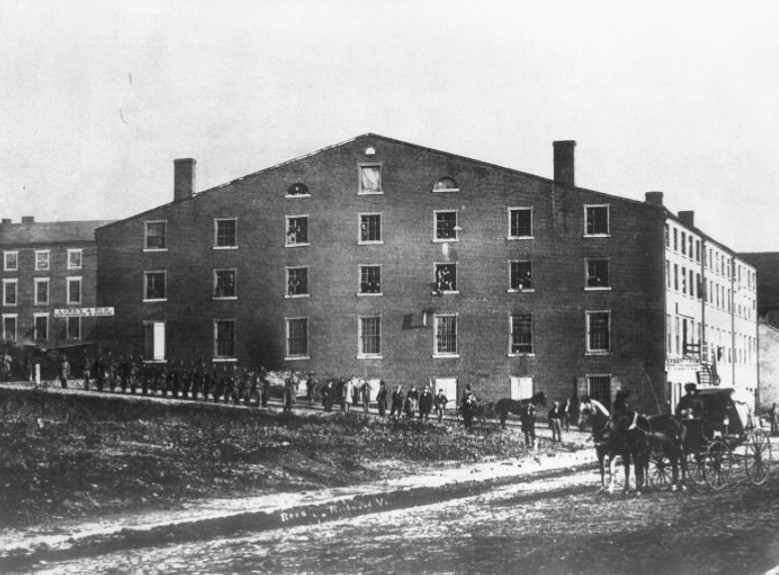
Confederate prison guards in formation at left, Libby Prison, 20th and Cary Streets in Richmond, Virginia, 1863 (C. R. Rees, public domain; click to enlarge).
Located at the southeast corner of 20th and Cary streets in the city of Richmond, Virginia, the Confederacy’s Libby Prison was actually a group of three industrial buildings that had been part of a tobacco factory prior to the American Civil War. Brick structures that had been erected between 1845 and 1852, they had been leased to Luther Libby in 1854 for use in his grocery and shipping company, according to historian Angela Zombek.
“The complex was converted to a prison in March 1862 in response to problems at a prisoner depot in central Richmond…. [T]he number of Union prisoners increased after the Seven Days’ Battles in June 1862….
“Connected by inner doors, the three Libby buildings came to be known as East, Middle, and West. Prisoners were confined to the upper two floors, which contained six sparsely furnished rooms — there were no bunks and few benches — each measuring approximately 105 by 45 feet. Wooden bars covered small windows that were otherwise open to the elements. They contributed to overheating in the summer and frigid drafts in the winter and admitted little light, even during the daytime. The kitchen was located in the first floor Middle and was the only room to which Confederate officials granted inmates free access. The hospital was on the first floor East, with offices and guardrooms on first floor West. The cellar was reserved for a carpenter shop and for housing slaves. The center cellar had four cells reserved for particularly dangerous inmates.”
In addition to its role in the confinement of commissioned Union military officers, Libby Prison also served as a receiving depot for Union privates and non-commissioned officers, who were processed into the Confederacy’s POW system and then force marched or transported by ship or train to one of its other prisons throughout the south.
Captured by Confederate troops during the Battle of Cedar Creek, Virginia on 19 October 1864, Privates Jacob C. Hochstetter/Hostetter and Henry Shapley of Company H were initially held captive at the Confederacy’s Libby Prison in Richmond, Virginia from 22 October until 1 November 1864, when they were then moved out of reach of Union troops who were close enough free them. Transported by train and forced march, they were taken to one of the Confederacy’s most notorious prison camps — the Salisbury Prison, which was located just outside of the town of Salisbury in Rowan County, North Carolina. (See the Salisbury section of this article for their respective final outcomes.)
After carrying his wounded brother and fellow A Company comrade, Corporal Amandus Sandt, to the cellar of a house at the rear of Union Army lines during the Battle of Cedar Creek, Private Edwin Sandt returned to the fight, but was subsequently captured by Confederate troops during that same battle. Marched away from the scene to prevent Union soldiers from freeing him, Private Edwin Sandt was then taken to the Confederate States Army’s Libby Prison in Richmond, Virginia, where he turned eighteen as a POW, on 25 October 1864. Sometime afterward, he was also moved to the Confederacy’s notorious Salisbury POW in Rowan County, North Carolina. (See the Salisbury section of this article for his final outcome.)
Captured by Confederate troops sometime around the Battle of Cedar Creek, Virginia, Private Reuben Rader of Company A was held captive as a POW at the Confederacy’s Libby Prison in Richmond, Virginia for six months prior to his release, according to the federal government’s special veterans’ census of 1890. Returned during a prisoner exchange, he was given medical treatment and then allowed to return to duty with his company. Subsequently promoted to the rank of corporal in May 1865, he continued to serve with the 47th Pennsylvania until it was dissolved in early January 1866.
Private George Smith, who had previously served with the 47th Pennsylvania’s E Company and the 7th Pennsylvania Reserves’ B Company prior to his tenure with the 190th Pennsylvania Volunteers, and had initially been confined to the Confederacy’s Libby Prison, following his capture by Confederate troops on 19 August 1864, was subsequently transferred to the Confederacy’s prison on Belle Isle in Richmond, where he would remain until his transfer to the Confederacy’s Salisbury Prison in North Carolina. (Also see the Belle Isle and Salisbury sections of this article for more information.)
Salisbury Prison (Salisbury, Rowan County, North Carolina)
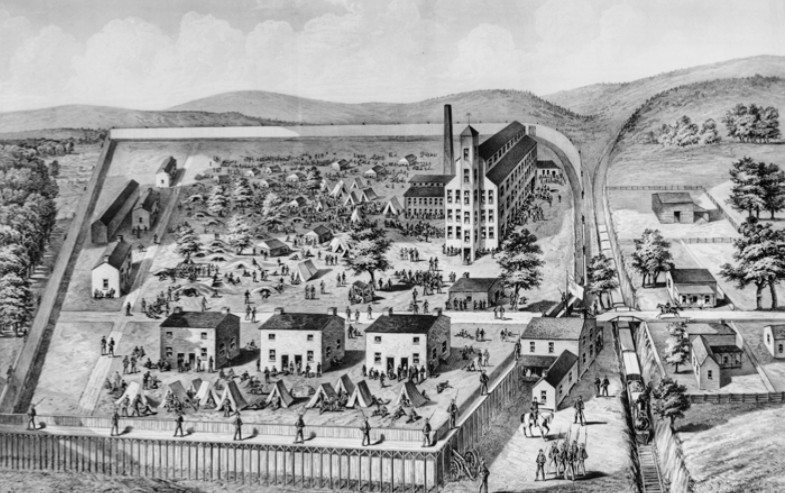
The Salisbury Prison, Salisbury, Rowan County, North Carolina (lithograph, 1886, courtesy of the North Carolina Collection, University of North Carolina at Chapel Hill Library; click to enlarge).
Converted from a cotton mill in 1861, the Confederacy’s Salisbury Prison was located in the town of Salisbury in Rowan County, North Carolina; it received its first Union POWs in December that year. According to the American Battlefield Trust, “The 120 or so Union soldiers interned there were fed meager yet adequate rations, sanitation was passable, shielding from the elements was provided, and the prisoners were even allowed to play recreational games such as baseball. However, as the war progressed, the conditions at Salisbury plummeted.”
“By October of 1864, the number of Union prisoners inside Salisbury swelled to more than 5,000 men, and within a few more months that number skyrocketed to more than 10,000.
“With the increase in men came overcrowding, decreased sanitation, shortages of food, and thus the proliferation of disease, filth, starvation, and death. This is a common thread among camps over the course of the Civil War.
“Salisbury marks a prime example of the effects that overcrowding had on prison populations, especially given the stark contrast in its camp death rate. In 1861, while the population was quite low, the death rate hovered around 2%. In 1865, when the number of prisoners ballooned to its peak, the death rate exceeded 28%.”
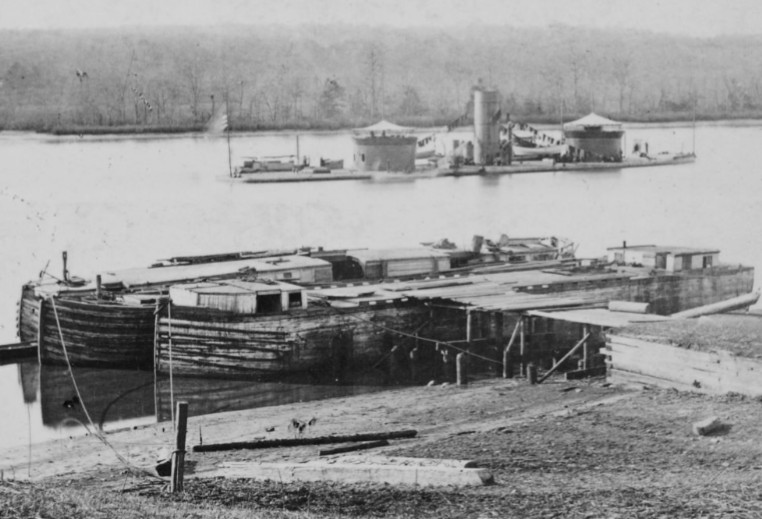
Aiken’s Landing on the James River in Virginia was the site of frequent prisoner exchanges between the Union and Confederacy during the war. The USS Onondaga, an ironclad monitor with double turrets, was photographed as it passed by the landing in 1864 (public domain; click to enlarge).
In response to those horrific conditions, Union and Confedrate military leaders finalized an agreement, on 16 February 1865, to provide for the release of thousands of prisoners of war. That prisoner exchange process was initiated after the city of Wilmington, North Carolina fell into Union hands on 22 February, and took place from 26 February to 4 March 1865 “at the crossing of the Northeast Cape Fear River, on the main road from Wilmington to Goldsborough,” according to historians at the North Carolina Department of Natural and Cultural Resources (NCDNCR). Although NCDNCR historians have not reported a definitive figure for the total number of Confederate POWs released by Union military leaders during that time, they have determined that eight thousand six hundred and eighty-four Union prisoners of war were freed from captivity at the Confederacy’s Salisbury Prison in Rowan County, North Carolina, and that, of that number, nine hundred and ninety-two were commissioned Union officers and one hundred and twenty were Black Union soldiers.
What Happened to the 47th Pennsylvanians at Salisbury?
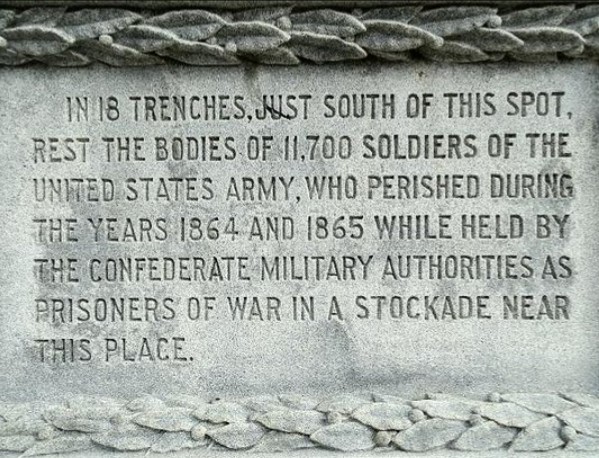
Inscription, Monument to 11,700 Unknown Dead, Salisbury National Cemetery, Salisbury, North Carolina (public domain).
Private Franklin P. Rhoads of Company B became the first of the 47th Pennsylvania Volunteers imprisoned at the Confederacy’s Salisbury Prison Camp to die. Wounded or ailing by the time he reached that camp, he began suffering from bouts of diarrhea shortly after his arrival there, and died as a POW from chronic diarrhea on 15 November 1864 — less than a month after his capture in battle. Buried somewhere on the grounds of that POW camp on 22 November 1864, the precise location of his grave is still unknown.
Having been confined initially to the Confederacy’s Libby Prison in Richmond, Virginia fron 22 October until 1 November 1864, Privates Henry Shapley and Jacob C. Hochstetter/Hostetter of Company H were soon moved to the Confederacy’s Salisbury Prison in North Carolina. Upon their arrival in late November, they were starved and treated harshly. As a result, Private Shapley died from starvation on 10 December 1864 and was buried in an unmarked trench grave. Private Hochstetter/Hostetter, who managed to survive until his release at Northeast Ferry, North Carolina on 2 March 1865, was transported north to Maryland for debriefing and medical treatment at Camp Parole in Annapolis (beginning on 14 March). Subsequently awarded a thirty-day furlough, he was permitted to travel back to Pennsylvania to visit family during that period. He then returned to Virginia, where he resumed his duties with the 47th Pennsylvania Volunteer Infantry, and continued to serve with his regiment until its final muster out on Christmas Day in 1865. (Note: Private Hochstetter/Hostetter later filed an affidavit in which he described what had happened to Private Shapley, enabling his comrade’s mother to obtain a U.S. Civil War Mother’s Pension.)
In addition, these 47th Pennsylvania Volunteers, who had also been captured during or shortly after the Battle Creek and also died in captivity at Salisbury were:
- Berger, Martin M. (Private, Company C): Died from harsh treatment and chronic diarrhea on 6 March 1865; buried in an unmarked trench grave, his precise burial location remains unidentified;
- Hartman, J. A. or Henry (Private, Company A): Although this POW survived until his release during a prisoner exchange in Wilmington, North Carolina in late February or early March 1865, his body was severely damaged by rheumatism and other medical issues that hastened his death; following his death at the Union Army hospital in Wilmington on 20 March 1865 (alternate dates of death: 21 or 22 March 1865), he was buried with military honors in plot six, grave no. 1548 at the Wilmington National Cemetery;
- Huff, James (Corporal, Company E): Having survived his previous capture by Confederate troops during the 1864 Red River Campaign in Louisiana and his subsequent confinement as a POW at Camp Ford in Tyler, Texas, Corporal James Huff had been able to resume his duties with the 47th Pennsylvania, but was then captured during the Battle of Cedar Creek and interned at Salisbury; subjected to harsh treatment, he died from starvation on 5 March 1865, and was also bured in an unmarked trench grave; his precise burial location also remains unidentified;
- Metcalf, Isaac (Private, Company F): Died from starvation and chronic diarrhea on Christmas Day in 1864; buried in an unmarked trench grave, his precise burial location remains unidentified;
- Michael/Michel, Charles H. (Private, Company F): Died from starvation on 11 December 1864; buried in an unmarked trench grave, his precise burial location remains unidentified;
- Morse, W. (Private, Company F: Died from typhoid fever on 18 January 1865; buried in an unmarked trench grave, his precise burial location remains unidentified; note: although this soldier’s name was listed in the “Roll of Honor, No. XIV,” published by the U.S. Office of the Quartermaster General in 1868, regimental rosters of the 47th Pennsylvania did not list a soldier in Company F who bore that surname or its variant; therefore, it is possible that he served with an entirely different regiment prior to his capture;
- Schalor, S. (Private, Company E): Died from chronic diarrhea on 2 January 1865; buried in an unmarked trench grave, his precise burial location remains unidentified; note: although this soldier’s name was listed in the “Roll of Honor, No. XIV,” published by the U.S. Office of the Quartermaster General in 1868, regimental rosters of the 47th Pennsylvania did not list a soldier in Company E who bore that surname or its variant; therefore, it is possible that he served with an entirely different regiment prior to his capture;
- Schlagle, Henry J. (Private, Company I; alternate surname spelling: “Schlagle”): Died from starvation and disease-related catarrh on 28 December 1864 (alternate death date: 27 December 1864); buried in an unmarked trench grave, his precise burial location remains unidentified; and
- Shaffer, Stephen (Private, Company H): Died from starvation, chronic diarrhea and disease-related catarrh on 8 January 1865; buried in an unmarked trench grave, his precise burial location remains unidentified.
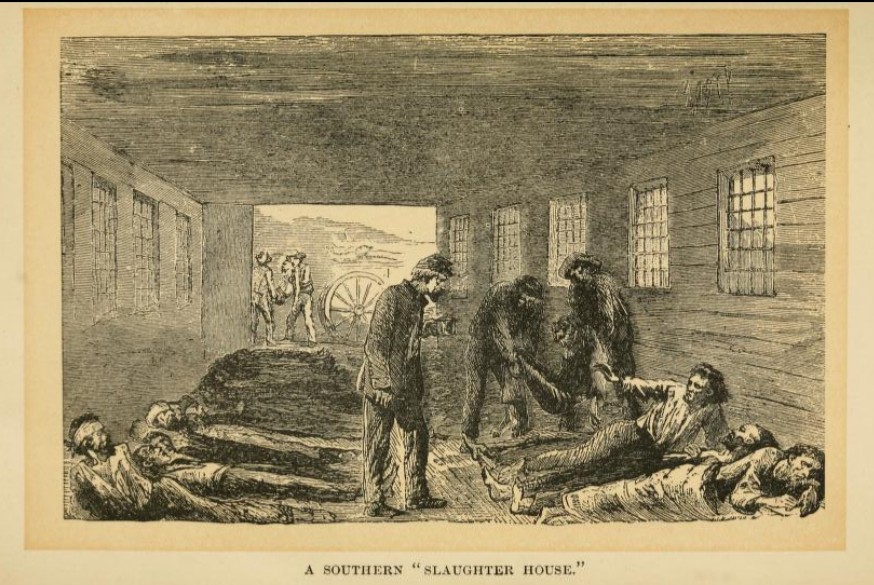
“A Southern ‘Slaughter House'” depicted the suffering of Union soldiers at the Confederacy’s Salisbury Prison Camp (Charles S. Greene, Sparks from the Campfire, 1889, public domain; click to enlarge).
The following 47th Pennsylvania Volunteers who survived and were released from captivity at Salisbury were:
- Miller, Joseph C. (Private, Company A): Held in captivity as a POW even after Confederate General Robert E. Lee surrendered at Appomattox on 9 April 1865, this POW was freed from imprisonment at Salisbury on 12 April 1865, but was never able to return to duty with the regiment, even as the 47th Pennsylvania Volunteer Infantry continued its service to the nation into the early months of the Reconstruction Era. A native of Lebanon County, Pennsylvania, Joseph Miller eventually returned home after receiving medical treatment by Union military physicians; he died at the age of sixty-eight in Huntingdon County, Pennsylvania on 16 August 1887, and was laid to rest at the Hays Cemetery in Easton, Northampton County, Pennsylvania;
- Sandt, Edwin C. (Private, Company A): Having been confined initially to the Confederacy’s Libby Prison in Richmond, Virginia, where he then turned eighteen on 25 October 1864, Private Edwin Sandt of Company A was subsequently moved to the Salisbury Prison, where he was starved and tortured until he was released during a prisoner exchange; transported north to Virginia, he received medical treatment from Union Army physicians, was then allowed to rejoin his regiment, and went on to serve with the 47th Pennsylvania’s A Company until the regiment was honorably mustered out on Christmas Day in 1865;
- Schweitzer, John (Private, Company A): Held as a POW at Salisbury until his release during a prisoner exchange at Wilmington, North Carolina on 2 March 1865, this soldier returned north, received medical treatment from Union Army physicians and was then honorably discharged on a surgeon’s certificate of disability on 11 April 1865 — an indicator that he had suffered greatly from the harsh treatment that he had endured at the hands of his Confederate captors; and
- Smith, George (Private, Company I, 190th Pennsylvania Volunteers, who had previously served as a private with Company E, 47th Pennsylvania Volunteers and Company B of the 7th Pennsylvania Reserves): Having been held initially at the Confederacy’s Libby Prison in Richmond after being captured by Confederate troops near Petersburg, Virginia on 19 August 1864, Private George Smith had then been transferred to the Confederacy’s Belle Isle Prison nearby, where he had been held until he was moved to Salisbury Prison. “Reduced to a state bordering on collapse,” after eight months of captivity in total at those three prisons, according to a 1908 report by the Altoona Tribune, he found the strength to escape with three of his fellow Salisbury POWs, while gathering wood outside of the prison as part of a POW work detail of fifty men. “The prisoners had been given old rebel uniforms to wear and on the day after their escape bravely passed through the city of Salisbury in daylight and after 325 miles of weary travel, three of them reached the Union lines at Petersburg, thirteen days after the escape.” Awarded a twenty-day furlough, Private Smith was then honorably discharged in Harrisburg on 28 June 1865.
Other Prisoners of War
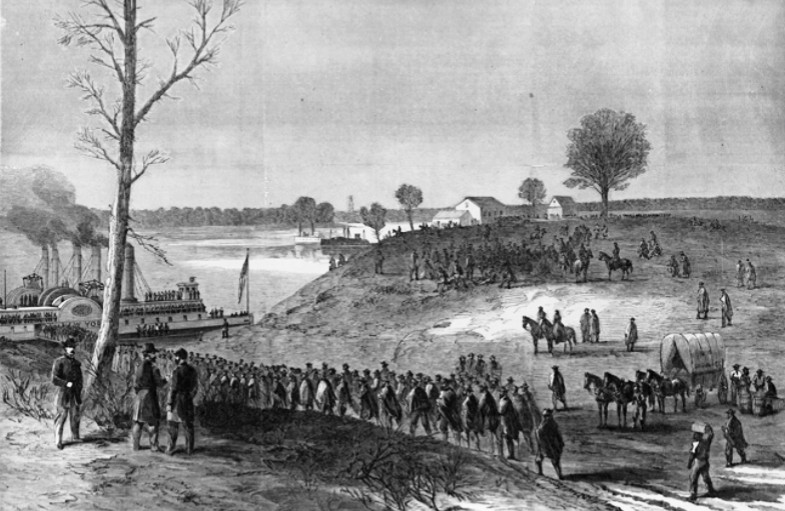
“Embarkation of Exchanged Union Prisoners at Aiken’s Landing” (woodcut by J.R. Hamilton, 21 February 1865, U.S. Library of Congress public domain).
Captured by Confederate troops during the Battle of Cedar Creek on 19 October 1864, Regimental Quartermaster Francis Z. Heebner was taken to one of the Confederacy’s POW camps for officers in Virginia — either the Libby Prison or the Danville Military Prison, according to the 28 February 1865 edition of The New York Times. (For information about those POW camps, please see their respective sections above.)
Held captive as a POW by the Confederacy, Quartermaster Heebner was released during a large-scale prisoner exchange between the Union and the Confederacy in February 1865 which resulted in the release of five hundred Union officers at Varina Landing on the James River in Virginia. Also known as “Akin’s Landing,” the dock was the site of multiple prisoner exchanges during the war. Returned north to Annapolis, Maryland, Quartermaster Heebner received medical care from Union military physicians prior to his honorable discharge on 1 June 1865, upon expiration of the term of his officer’s commission.
In addition to the 47th Pennsylvania Volunteers mentioned above, there were several members of the regiment whose POW status was documented on regimental rosters but entered without identifying where those men had been imprisoned, including:
- Beavers, Henry L. (Private, Company E): Captured during the Battle of Cedar Creek, Virginia on 19 October 1864, he was held as a POW until his release on 8 March 1865 at Akin’s Landing; subsequently provided with medical treatment by Union Army physicians, Private Beavers (alternate surname spelling: “Beabers”) was then honorably discharged on 14 June 1865 by General Orders that were issued by Brigadier-General Hanks, M.D., U.S. Chief Medical Officer, in accordance with a telegram issued by the U.S. War Department on 15 May 1865; possible burial location: Rose Hill Cemetery, Columbia, Maury County, Tennessee;
- Bower, Lewis (Private, Company A): Captured by Confederate troops during the Battle of Cedar Creek on 19 October 1864, he was held as a POW until his death from harsh treatment on 1 March 1865; his burial location remains unidentified;
- Eichman, William H. (Corporal, Company E): Captured after being wounded in action during the Battle of Cedar Creek, Virginia on 19 October 1864, he was held as a POW until his release on 11 May 1865; subsequently provided with medical treatment by Union Army physicians, he was then honorably discharged by General Orders on 1 June of that same year;
- Fraunfelder, Levi (Private, Company A): Captured during the Battle of Cedar Creek on 19 October 1864, after sustaining gunshot wounds to both legs, above the ankle joints, he was held as a POW until he was released during a prisoner exchange at parole Camp Annapolis in Maryland on 1 February 1865; promoted that same day to the rank of corporal, he received medical care from Union military physicians that enabled him to return to his duties with Company K, and continued to serve with the 47th Pennsylvania until its final muster out on Christmas Day in 1865;
- Haggerty, Peter Jacob (Private, Company E): Captured during the Battle of Cedar Creek, Virginia on 19 October 1864, he was held as a POW until his release on 1 March 1865 at Annapolis, Maryland; subsequently provided with medical treatment by Union Army physicians, Private Haggerty was then honorably discharged on 29 June 1865 by General Orders, No. 77 issued by the U.S. War Department in April 1865;
- Stuart, Charles F. (Private, Company C): Captured during the Battle of Cedar Creek, Private Charles Stuart was held as a POW until his release during a prisoner exchange on 4 March 1865; returned north, he received medical treatment from Union Army physicians, and was honorably discharged by General Orders, No. 77 on 29 May 1865.
Sources:
- Bates, Samuel P. History of Pennsylvania Volunteers, 1861-5, vol. 1. Harrisburg, Pennsylvania: B. Singerly, State Printer, 1869.
- Beabers/Beavers, Henry L., in Civil War Muster Rolls and Civil War Veterans’ Card File, 1861-1866 (Company E, 47th Pennsylvania Infantry). Harrisburg, Pennsylvania: Pennsylvania State Archives.
- Berger, Martin, in “Roll of Honor No. XIV: Names of Soldiers Who in Defence of the American Union, Suffered Martyrdom in the Prison Pens,” in Records of the U.S. Office of the Quartermaster General. Washington, D.C.: U.S. Government Printing Office, 20 February 1868.
- Bower, Lewis, in Civil War Veterans’ Card File, 1861-1866 (Company A, 47th Pennsylvania Infantry). Harrisburg, Pennsylvania: Pennsylvania State Archives.
- “Camp Sumter,” in “Editorial Jottings.” Washington, D.C.: The Soldiers’ Journal, 21 September 1864.
- “Confederate Prison Camp at Belle Isle, outside Richmond, Virginia, spring 1864: artist’s impression detail,” in Illustrated London News, 9 April 1864, courtesy of “House Divided: The Civil War Research Engine at Dickinson College.” Carlisle, Pennsylvania: Dickinson College, retrieved online 30 September 2026.
- “Danville National Cemetery” (brochure). Washington, D.C.: U.S. National Cemetery Administration and U.S. Department of Veterans Affairs, retrieved online 10 April 2026.
- “Death of Edwin Sandt.” Allentown, Pennsylvania: The Allentown Leader, 9 July 1901.
- “Easton Veteran Dead” (obituary of Levi Fraunfelder). Allentown, Pennsylvania: The Morning Call, 8 April 1914.
- Eichman, William H., in Civil War Muster Rolls (Company E, 47th Pennsylvania Infantry). Harrisburg, Pennsylvania: Pennsylvania State Archives.
- Flavion, Gary. “Civil War Prison Camps: Suffering and Survival,” in “Learn.” Washington, D.C.: American Battlefield Trust, 10 August 2026.
- Fraunfelder, Levi, in Civil War Veterans’ Card File, 1861-1866 (Company A, 47th Pennsylvania Infantry). Harrisburg, Pennsylvania: Pennsylvania State Archives.
- Fraunfelder, Levi, in Records of Burials of Veterans (Easton Cemetery, Easton, Northampton County, Pennsylvania, date of death: 6 April 1914; mentions his status as a prisoner of war). Harrisburg, Pennsylvania: Commonwealth of Pennsylvania, Department of Military Affairs.
- “George Smith, of Juniata, Citizen and Soldier,” in “From Juniata.” Altoona, Pennsylvania: Altoona Tribune, 12 December 1908.
- Haggerty, Jacob, in Civil War Veterans’ Card File, 1861-1866 (Company E, 47th Pennsylvania Infantry). Harrisburg, Pennsylvania: Pennsylvania State Archives.
- Heebner, T. Z. [sic, “Francis Z. Heebner”], in “Rolls of Officers, Prisoners of War, received by Lieut.-Col. John E. Mulford, United States Assistant Agent for Exchange, at Varina, Va., from Richmond and Danville, Va.,” in “Our Returned Prisoners: Names of Five Hundred Released Officers Sent to Annapolis: The Richmond and Danville Prisons Empty.” New York, New York: The New York Times, 28 February 1865.
- “History of the Andersonville Prison.” Andersonville, Georgia: Andersonville National Historic Site,” retrieved online 28 April 2026.
- Horwitz, Tony. “Did Civil War Soldiers Have PTSD?“, in Smithsonian Magazine, January 2015. Washington, D.C.: Smithsonian Institution.
- Huff, James, in Civil War Muster Rolls and Civil War Veterans’ Card File, 1861-1866 (Company E, 47th Pennsylvania Infantry). Harrisburg, Pennsylvania: Pennsylvania State Archives.
- Hunter-Chang, Gabriel. “Sensing the Past: Nighttime at Andersonville Prison.” Richmond, Virginia: The American Civil War Museum, 24 May 2021.
- Metcalf, Isaac, in “Roll of Honor No. XIV: Names of Soldiers Who in Defence of the American Union, Suffered Martyrdom in the Prison Pens,” in Records of the U.S. Office of the Quartermaster General. Washington, D.C.: U.S. Government Printing Office, 20 February 1868.
- Michael, Charles H., in Civil War Veterans’ Card File, 1861-1866 (Company F, 47th Pennsylvania Infantry). Harrisburg, Pennsylvania: Pennsylvania State Archives.
- Morse, W., in “Roll of Honor No. XIV: Names of Soldiers Who in Defence of the American Union, Suffered Martyrdom in the Prison Pens,” in Records of the U.S. Office of the Quartermaster General. Washington, D.C.: U.S. Government Printing Office, 20 February 1868.
- Nast, Thomas. Union Soldiers in Andersonville Prison and The Rebel Leader, Jeff Davis, at Fortress Monroe (illustrations). Washington, D.C.: U.S. Library of Congress Public Domain Archive; and Athens, Georgia: Digital Library of Georgia, University of Georgia University Libraries, retrieved online 30 September 2026.
- “Prisoner Exchange (D-99).” Raleigh, North Carolina: North Carolina Department of Natural and Cultural Resources, 11 December 2023.
- Registers of Deaths of Volunteers. Washington, D.C.: U.S. National Archives and Records Administration.
- “Resolutions of Condolence” (tribute to First Sergeant William Fry, Company C, by members of the 47th Pennsylvania Volunteer Infantry). Sunbury, Pennsylvania: The Sunbury Gazette, 15 April 1865.
- Reuben E. Rader, in U.S. Census (“Special Schedule. — Surviving Soldiers, Sailors, and Marines, and Widows, etc.”: Belfast, Northampton County, Pennsylvania, 1890). Washington, D.C.: U.S. National Archives and Records Administration.
- Rhoads, Franklin P., in “Roll of Honor No. XIV: Names of Soldiers Who in Defence of the American Union, Suffered Martyrdom in the Prison Pens,” in Records of the U.S. Office of the Quartermaster General. Washington, D.C.: U.S. Government Printing Office, 20 February 1868.
- Schmidt, Lewis. A Civil War History of the 47th Regiment of Pennsylvania Veteran Volunteers. Allentown, Pennsylvania: Self-published, 1986.
- Schweitzer, John, in Civil War Veterans’ Card File, 1861-1866 (Company A, 47th Pennsylvania Infantry). Harrisburg, Pennsylvania: Pennsylvania State Archives.
- Scott, Frederick J., in Civil War Muster Rolls and Civil War Veterans’ Card File, 1861-1866 (Company E, 47th Pennsylvania Infantry). Harrisburg, Pennsylvania: Pennsylvania State Archives.
- Stegall, Joel T. “Salisbury Prison: North Carolina’s Andersonville.” Fayetteville, North Carolina: North Carolina Civil War & Reconstruction History Center, 13 September 2018.
- Stuart, Charles F., in Civil War Veterans’ Card File, 1861-1866 (Company C, 47th Pennsylvania Infantry). Harrisburg, Pennsylvania: Pennsylvania State Archives.
- “The Exchange of Prisoners; The Cartel Agreed Upon by Gen. Dix for the United States, and Gen. Hill for the Rebels,” in “Supplementary Articles.” New York, New York: The New York Times, 6 October 1862.
- Wharton, Henry D. Letters from the Sunbury Guards, 1861-1866. Sunbury, Pennsylvania: Sunbury American.
- “Why Andersonville Prison Was the Worst Prisoner of War Camp of the Civil War” (video), in “Georgia Stories,” in “PBS Learning Media.” Boston, Massachusetts: GBH Education (in partnership with Georgia Public Broadcasting), 2025.
- Zombek, Angela. “Belle Isle Prison,” in Encyclopedia Virginia. Charlottesville, Virginia: Virginia Humanities, retrieved online 30 September 2026.


You must be logged in to post a comment.