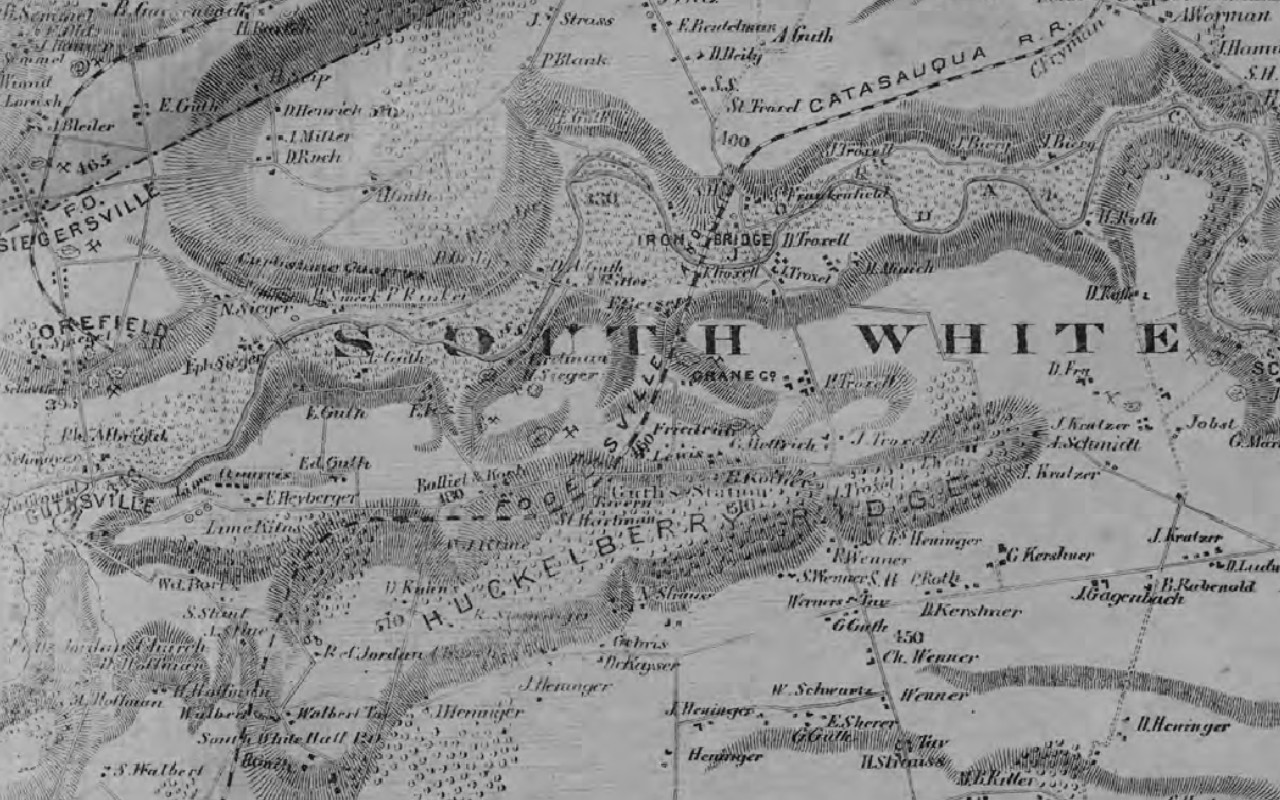
Excerpt from G. A. Aschbach’s 1862 map of Lehigh County, Pennsylvania showing many of the towns of South Whitehall Township (public domain; click to enlarge).
Musician. Farmer. Soldier. Henry J. Kern (1838-1903) was all of those — and more. According to The Allentown Leader, he was not only well known in his community, he was highly respected.
Formative Years
Born on his family’s homestead near the towns of Kernsville and Orefield, and roughly one-half mile southwest of the town of Siegersville in Lehigh County, Pennsylvania, on 11 April 1838, Henry J. Kern (1838-1903) was a son of Pennsylvania natives Jeremiah Kern (1808-1894), who had been born on 22 January 1808, and Helena (Moyer) Kern (1810-1894), who was a daughter of Daniel Moyer and Maria (Schubert) Moyer. According to The Allentown Democrat:
One of the descendants of George Jacob Kern, the pioneer ancestor of the Kern family of Whitehall, was Jeremiah Kern, son of Joseph Kern and grandson of George Jeremiah Kern, who secured the homestead of 100 acres now owned by Morris Schantz [sic, “in 1915”]. It is located about one-half mile southwest of Siegersville. Jeremiah Kern was a talented musician and was the instructor of the old Siegersville band and of a band at Hamburg. He was also noted as a hunter and shot thousands of wild pigeons and small game of all kinds. He was a member of the Reformed church and served as deacon and elder. In politics he was a sterling Democrat. He married Helena Moyer and had five children: Sarah, who married Dr. Joseph Weller and who died in May, 1903; Josiah, who married Hanna Sieger; Louisa, who married Milton J. Wenner, and who died August 21, 1903; Elizabeth, who married Henry Ruch, of Fogelsville; and Henry.
Henry J. Kern was raised and educated in South Whitehall Township, Lehigh County with his older, Lehigh County-born siblings: Sarah Ann Kern (1833-1903), who had been born in 1833 and would later wed Huffs Church, Berks County, Pennsylvania dentist Joseph Weller (1825-1894); Josiah Kern (1834-1907), who had been born on 26 May 1834 and would later wed Hannah Sieger (1832-1895); and Elizabeth Kern (1835-1911), who had been born on 20 February 1835, became known to family and friends as “Lizzie” and would later wed Henry C. Ruch (1833-1899). Henry Kern’s younger sister, Louisa R. Kern (1841-1903), who was subsequently born in South Whitehall Township on 27 April 1841, would later go on to marry Milton J. Wenner (1845-1884). Kern family patriarch Jeremiah Kern provided music instruction to his children, prompting at least one — Henry J. Kern — to follow in his father’s footsteps, as a musician who performed with the Siegersville Band.
By 1860, several of Jeremiah Kern’s children had made the decision to move out of his farmhouse in order to begin their own lives, leaving Jeremiah’s nineteen-year-old daughter, Louisa, as the only child at home in South Whitehall. That year, Jeremiah’s real estate and personal property were valued by a federal census enumerator at twelve thousand five hundred dollars (the equivalent of more than half a million U.S. dollars in 2026). Also living with Jeremiah and Helena was their four-year-old grandson, Theodore Jeremiah Ruch (1857-1927; alternate birth year: 1856), who was a son of their daughter, Elizabeth (Kern) Ruch. Residing nearby on adjoining farmland, were Jeremiah’s sons, Josiah and Henry J. Kern, as well as Josiah’s wife, Hannah (Sieger) Kern, and twenty-three-year-old housekeeper Adeline Roth. Josiah’s farm was valued at one thousand dollars (the equivalent of roughly forty-one thousand U.S. dollars in 2026).
But the Kerns’ collective contentment and largely peaceful, bucolic existence would soon be shaken by a national secession crisis that quickly devolved into a disastrous civil war.
American Civil War
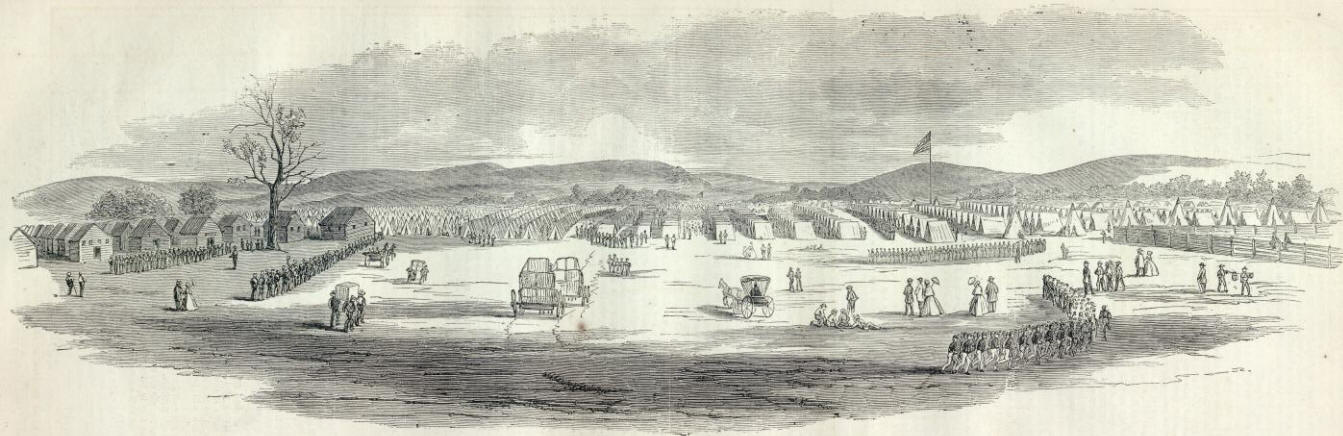
Camp Curtin, Harrisburg, Pennsylvania (Harper’s Weekly, 13 December 1862, public domain).
During the first year of the American Civil War, Henry J. Kern watched and worried as other family members, friends and fellow church congregants enlisted for military service, hoping they would be able to secure a swift end to the conflict that was tearing their nation apart. Meanwhile, he and his father grew the crops that would not only feed neighboring Pennsylvanians, but many of the soldiers who were currently away, serving in Union Army regiments. As the war continued to rage on into its second year, however, Henry realized that he could no longer “sit on the sidelines” while people he cared about were in harm’s way. So, he enrolled for military service in Allentown on 27 October 1862. Two days later, he boarded a train in Allentown, traveled to Harrisburg and officially mustered in for duty at Camp Curtin on 29 October as a private with Company E of the battle-hardened 47th Pennsylvania Volunteer Infantry. Military records described him as a twenty-three-year-old farmer and resident of Lehigh County.
Transported south by ship to Florida, Private Henry Kern connected with his regiment at Fort Taylor in Key West, Florida on 21 November 1862. As a new recruit, he continued to receive training in basic light infantry tactics.
* Note: Having been ordered to head for Florida on 15 November 1862, the 47th Pennsylvania Volunteers had been split roughly in half, with the men from Companies A, B, C, E, G, and I assigned to garrison duty at Fort Taylor in Key West, and the members of Companies D, F, H, and K stationed at Fort Jefferson — the Union’s remote outpost in the Dry Tortugas off the coast of Florida. Both halves of the regiment were attached to the U.S. Army’s Tenth Corps, Department of the South.
1863

Fort Taylor, Key West, Florida (Harper’s Weekly, 1864, public domain).
As the New Year of 1863 dawned at Fort Taylor for Private Henry Kern, life continued much as it had for the previous weeks, with respect to his job duties. From a regimental leadership perspective, however, things were changing. According to the U.S. Army’s records collection known as “Returns from Military Posts,” sometime shortly after returning to Key West, Company E’s First Lieutenant Lawrence Bonstine was promoted to special duty as post adjutant — a position he continued to hold from at least 10 January 1863 through the end of December 1863. Reporting directly to the regiment’s commanding officer, Colonel Tilghman Good, he was essentially Good’s right hand, and was responsible for ensuring that regimental records and reports to senior military officials were kept up to date. Then, on 5 March 1863, Private William H. Eichman was advanced to the rank of corporal. Exactly one month later, on 5 April, Second Lieutenant W. Scott Johnston was also promoted — to the rank of first lieutenant. He was then also appointed as adjutant to the central regimental staff.
Sometime during that early 1863 service, E Company Private Henry J. Kern was also re-assigned — transferred from the typical duties of a private to a new role as a musician with the 47th Pennsylvania Volunteers’ second Regimental Band, which was led by Regimental Bandmaster Anton B. Bush. Under Bush’s leadership, the band members would not only support the regiment, they would help to build diplomatic “bridges” of understanding and cooperation between Union forces and the local citizenry in communities that were situated near those federal installations.
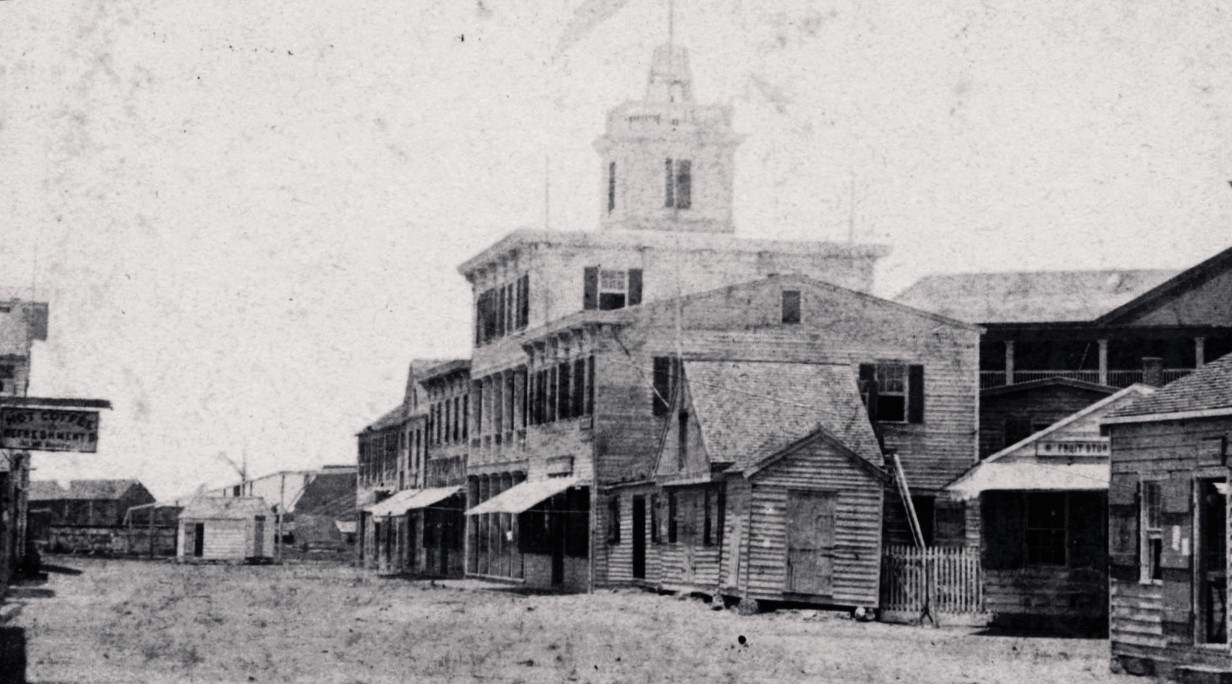
Front Street near Duval, Key West, Florida, circa 1860 (public domain; click to enlarge).
By May of that same year, Musician Henry J. Kern was earning twenty-two dollars per month (the equivalent of roughly five hundred eighty U.S. dollars per month in 2026). By June, two former men from the Easton Band plus a full brass section from Allentown had been added to the roster of the 47th Pennsylvania Volunteer Infantry’s Regimental Band, which was based at Fort Taylor. The next month, on Saturday, 25 July 1863, the bandsmen performed for an audience in Key West, as part of a ceremony held by the leaders and residents of the city to honor the 47th Pennsylvania’s commanding officer, Colonel Tilghman H. Good. According to C Company Field Musician Henry D. Wharton:
On Saturday last, another sword presentation came off. This time Col. T. H. Good was the recipient, and the donors, the citizens. The sword is a magnificent one, and with the sash and belt, cost six hundred and ten dollars [the equivalent of more than twenty-five hundred U.S. dollars in 2025]. At 4 o’clock P.M., the two companies stationed at the Barracks, were marched to the Fort, where, with the three other companies doing duty, we formed in line, and under command of the Colonel were moved through several streets, to the front of the Custom House. A fine stand was erected, on the piazza of the building seats were placed for the ladies, flags were stretched across the streets, and everything so arranged as to give it the appearance of a holiday. On the stand I noticed Rear Admiral Bailey and Capt. Templeton of the Navy, Gen. Woodbury and staff, Captains Hook and McFarland of the Army, besides Thomas J. Boynton, U.S. District Attorney for the Southern District of Florida. The articles were presented to Col. Good by Mr. Maloney, a lawyer of this city who complimented the Colonel on the fine bearing and appearance of his regiment. He spoke of the trials the citizens had under the military commander Col. Good relieved; of their being saved from banishment and separation of friends and all they held dear; of the wholesome administration of the Colonel, while in command of this Department, and in conclusion placed the sword in Col. Good’s hand, telling him if he used it as he used his own at Pocotaligo, the citizens would be satisfied, and have no fear of it ever being dishonored. The Colonel replied in a very short speech, saying, what he had done was by instructions by Head Quarters — thanked him for the present, and said as he then felt, he could assure the good people of Key West, that their present would never be dishonored through himself. As the Col. concluded, the Band of our regiment struck up the tune ‘Bully for You,’ which was received with cheer after cheer. Several speeches were made, among others, one by Mr. Boynton. He is a Missourian and received his appointment from the present administration. Although a southerner, he is Union all over. He said he hoped the cannon and sword would soon be made into plow shares and pruning hooks, but not until every rebel was on his knees willing to obey the laws and pay respect to the Star Spangled Banner. The Band then played several National airs, cheers were given for the Union, President Lincoln, Army and Navy, Gen. Woodbury, Admiral Baily, &c., when the meeting adjourned, and we were marched to our different quarters, well pleased with the proceedings, though I must say, completely worn out from fatigue and extreme heat.
In a letter to the Sunbury American on 23 August 1863, Wharton described Thanksgiving celebrations held by the regiment and residents of Key West and a yacht race the following Saturday at which participants had “an opportunity of tripping the ‘light, fantastic toe,’ to the fine music of the 47th Band, lead by that excellent musician, Prof. Bush.”
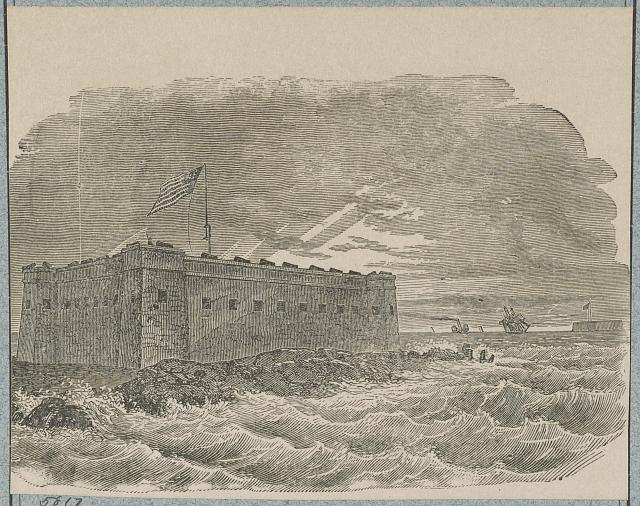
Woodcut depicting the harsh climate at Fort Taylor in Key West, Florida during the Civil War (U.S. Library of Congress, public donain).
It was not all “easy duty,” however; disease was a constant companion and foe. As a result, many 47th Pennsylvanians fell ill and died, victims of dysentery and typhoid that were spread by unsanitary living conditions and the poor quality of water made available to the men for drinking and bathing.
But Private Henry J.Kern and his fellow 47th Pennsylvanians came to understand that they were stationed in Florida for a very important reason. Their primary duty was to prevent foreign powers from assisting the Confederate Army and Navy in gaining control over Forts Taylor and Jefferson. In addition, they were also helping to weaken Florida’s ability to supply and transport food and troops to and through areas held by the Confederacy.
* Note: Prior to intervention by the Union Army and Navy, the owners of plantations, livestock ranches and fisheries, as well as the operators of smaller family farms across Florida, had been able to consistently furnish beef and pork, fish, fruits, and vegetables to Confederate troops stationed throughout the Deep South during the first years of the American Civil War. Large herds of cattle were raised near Fort Myers, for example, while orchard owners in the Saint John’s River area cultivated large orange groves. In addition, Florida was known to be a major producer of salt, which was used as a preservative for food. Consequently, the 47th Pennsylvania Volunteers and other Union troops were ordered to capture or destroy salt manufacturing plants in Florida to interrupt the flow of salt sales and curtail the enemy’s access to food.
1864
In early January 1864, the 47th Pennsylvania Volunteers experienced a significant change when members of the regiment were ordered to expand the Union’s reach by sending part of the regiment north to retake Fort Myers, a federal installation that had been abandoned in 1858, following the federal government’s third war with the Seminole Indians. In response, Company A Captain Richard Graeffe and a detachment of his subordinates traveled north, captured the fort and began conducting cattle raids to provide food for the growing Union troop presence across the region. They subsequently turned their fort not only into their base of operations, but into a shelter for pro-Union supporters, escaped slaves, Confederate deserters, and others fleeing Rebel troops.
Red River Campaign
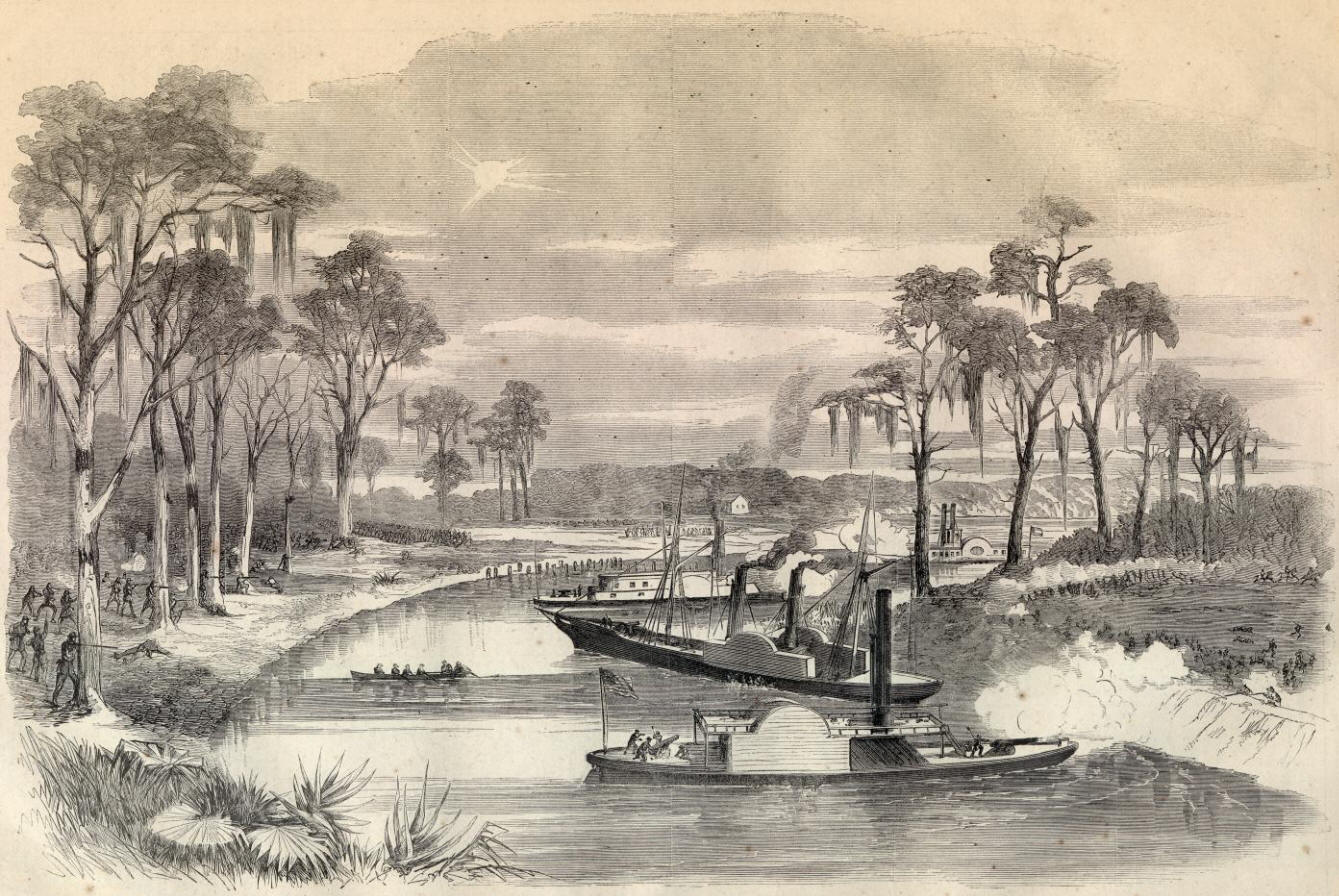
Bayou Teche, Louisiana (Harper’s Weekly, 14 February 1863, public domain).
Meanwhile, all of the other companies of the 47th Pennsylvania Volunteer Infantry had begun preparing for the regiment’s history-making journey to Louisiana. Boarding yet another steamer, the Charles Thomas, the men from Companies B, C, D, I, and K headed for Algiers, Louisiana (across the river from New Orleans), followed on 1 March by the men from Companies E, F, G, and H. Upon the second group’s arrival, the now almost-fully-reunited-regiment moved by train to Brashear City (now Morgan City), before heading to Franklin by steamer through the Bayou Teche. There, the 47th Pennsylvania Volunteer Infantry joined the 2nd Brigade, 1st Division of the 19th Corps (XIX) of the United States’ Army of the Gulf, and became the only regiment from the Commonwealth of Pennsylvania to serve in the Red River Campaign commanded by Union Major-General Nathaniel P. Banks. (Unable to reach Louisiana until 23 March, the soldiers from Company A were assigned to detached duty while awaiting transport that enabled them to reconnect with their regiment at Alexandria, Louisiana on 9 April.)
The early days on the ground quickly woke Regimental Bandsman Henry J. Kern and his fellow 47th Pennsylvania Volunteers up to just how grueling their new phase of duty would be. From 14-26 March, the 47th Pennsylvania Volunteers marched for the city of Alexandria and then on to Natchitoches, which was located near the top of the L-shaped state. While encamped at Natchitoches, the regiment added to its roster of Black soldiers when Aaron Bullard (later known as Aaron French), James Bullard, John Bullard, Samuel Jones, and Hamilton Blanchard (also known as John Hamilton) enrolled for military service with the 47th Pennsylvania at Natchitoches from 4-5 April 1864. According to their respective entries in the Civil War Veterans’ Card File at the Pennsylvania State Archives and on regimental muster rolls, the men were officially mustered into the regiment on 22 June at Morganza, Louisiana. Several of their entries noted that they were assigned the rank of “Colored Cook” while others were given the rank of “Under-Cook.”
Often short on food and water throughout their long, harsh-climate trek, the 47th Pennsylvania Volunteers encamped briefly at Pleasant Hill (now the Village of Pleasant Hill) the night of 7 April, before continuing on the next day.
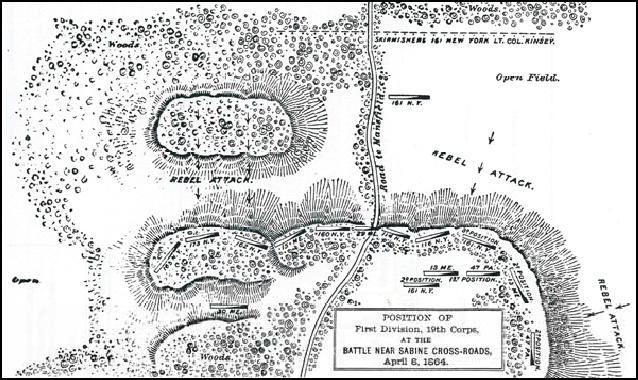
19th U.S. Army Map, Phase 3, Battle of Sabine Cross Roads/Mansfield (8 April 1864, public domain).
Rushed into battle ahead of other regiments in the second division, sixty members of the 47th Pennsylvania Volunteer Infantry were cut down on 8 April 1864 during the intense volley of fire in the Battle of Sabine Cross Roads (also known as the Battle of Mansfield due to its proximity to the town of Mansfield). The fighting waned only when darkness fell. The exhausted, but uninjured collapsed beside the gravely wounded and dead. After midnight, the surviving Union troops withdrew to Pleasant Hill.
The next day, the 47th Pennsylvania Volunteers were ordered into a critically important defensive position at the far right of the Union lines, their right flank spreading up unto a high bluff. By 3 p.m., after enduring a midday charge by the troops of Confederate Major-General Richard Taylor (a plantation owner who was the son of Zachary Taylor, a former president of the United States), the brutal fighting still showed no signs of ending. Suddenly, just as the 47th was shifting to the left side of the Union force, the men of the 47th were forced to bolster the 165th New York’s buckling lines by blocking another Confederate assault.
During that engagement (now known as the Battle of Pleasant Hill), the 47th Pennsylvania Volunteers succeeded in recapturing a Massachusetts artillery battery that had been lost during the earlier Confederate assault. Unfortunately, the regiment’s second-in-command, Lieutenant-Colonel George Warren Alexander, and its two color-bearers, Sergeants Benjamin Walls and William Pyers, were wounded. Alexander sustained wounds to both of his legs, and Walls was shot in the left shoulder as he attempted to mount the 47th Pennsylvania’s colors on caissons that had been recaptured, while Pyers was wounded as he grabbed the flag from Walls to prevent it from falling into Confederate hands.
All three survived the day, however, and continued to serve with the regiment, but many others, like K Company Sergeant Alfred Swoyer, were killed in action during that chaotic battle, or were wounded so severely that they were unable to continue the fight. (Swoyer’s final words were, “They’re coming nine deep!” Shot in the right temple shortly afterward, his body was never recovered).
Still others were captured by Confederate troops, marched roughly one hundred and twenty-five miles to Camp Ford, a Confederate Army prison camp near Tyler, Texas, and held there as prisoners of war until they were released during a series of prisoner exchanges that began on 22 July and continued through November. At least two members of the regiment never made it out of that prison camp alive; another died at a Confederate hospital in Shreveport.
Meanwhile, as the captured 47th Pennsylvanians were being spirited away to Camp Ford, the bulk of the regiment was carrying out orders from senior Union Army leaders to head for Grand Ecore, Louisiana. Encamped there from 11-22 April, the Union soldiers engaged in the hard labor of strengthening regimental and brigade fortifications.
They then moved back to Natchitoches Parish on 22 April. While they were in route, they were attacked again — at the rear of their retreating brigade — but they were able to end the encounter quickly and move on to reach Cloutierville at 10 p.m. that same night (after a forty-five-mile march).

The 47th Pennsylvania Volunteers were stationed just to the left of the “Thick Woods” with Emory’s 2nd Brigade, 1st Division as shown on this map of Union troop positions for the Battle of Cane River Crossing at Monett’s Ferry, Louisiana, 23 April 1864 (Major-General Nathaniel Banks’ official Red River Campaign Report, public domain).
The next morning (23 April), episodic skirmishing quickly roared into the flames of a robust fight. As part of the advance party led by Union Brigadier-General William Emory, the 47th Pennsylvanians took on the Confederate Cavalry of Brigadier-General Hamilton Bee in the Battle of Cane River (also known as “the affair at Monett’s Ferry” or the “Cane River Crossing”).
Responding to a barrage from the Confederate Artillery’s twenty-pound Parrott guns and from enemy troops positioned atop a bluff and near a bayou, Brigadier-General Emory directed one of his brigades to keep Bee’s Confederate troops busy while sending two other brigades to find a safe spot for the Union’s forces to cross the Cane River. As part of “the beekeepers,” the 47th Pennsylvania supported Smith’s artillery.
Meanwhile, additional troops under Smith’s command attacked Bee’s flank to force a Rebel retreat, and then erected a series of pontoon bridges that enabled the 47th Pennsylvania and other Union regiments to make the Cane River Crossing by the next day. As the Confederates retreated, they torched their own food stores, as well as the cotton supplies of their fellow southerners. In a letter penned from Morganza, C Company Musician Henry Wharton described what had happened:
Our sojourn at Grand Score was for eleven days, during which time our position was well fortified by entrenchments for a length of five miles, made of heavy logs, five feet high and six feet wide, filled in with dirt. In front of this, trees were felled for a distance of two hundred yards, so that if the enemy attacked we had an open space before us which would enable our forces to repel them and follow if necessary. But our labor seemed to the men as useless, for on the morning of 22d April, the army abandoned these works and started for Alexandria. From our scouts it was ascertained that the enemy had passed some miles to our left with the intention of making a stand against our right at Bayou Cane, where there is a high bluff and dense woods, and at the same attack Smith’s forces who were bringing up the rear. This first day was a hard one for the boys, for at 10 o’clock at night they made Cloutierville, a distance of forty drive miles. On that day our rear was attacked which caused our forces to reverse their front and form in line of battle, expecting too, to go back to the relief of Smith, but he needed no assistance, sending word to the front that he had ‘whipped them, and could do it again.’ It was well that Banks made so long a march on that day, for on the next we found the enemy prepared to carry out their design of attacking us front and rear. Skirmishing commenced early in the morning and as our columns advanced he fell back towards the bayou, when we soon discovered the position of their batteries on the bluff. There was then an artillery duel by the smaller pieces, and some sharp fighting by the cavalry, when the ‘mule battery,’ twenty pound Parrott guns opened a heavy fire, which soon dislodged them, forcing the chivalry to flee in a manner not at all suitable to their boasted courage. Before this one cavalry, the 3d Brigade of the 1st Div., and Birges’ brigade of the second, had crossed the bayou and were doing good service, which, with the other work, made the enemy show their heels. The 3d brigade done some daring deeds in this fight, as also did the cavalry. In one instance the 3d charged up a hill almost perpendicular, driving the enemy back by the bayonet without firing a gun. The woods on this bluff was so thick that the cavalry had to dismount and fight on foot. During the whole of the day, our brigade, the 2d, was supporting artillery, under fire all the time, and could not give Mr. Reb a return shot.
While we were fighting in front, Smith was engaged some miles in the rear, but he done his part well and drove them back. The rebel commanders thought by attacking us in the rear, and having a large face on the bluffs, they would be able to capture our train and take us all prisoners, but in this they were mistaken, for our march was so rapid that we were on them before they had thrown up the necessary earthworks. Besides they underrated the amount of our artillery, calculating from the number engaged at Pleasant Hill. The rebels say it ‘seems as though the Yankees manufacture, on short notice, artillery to order, and the men are furnished with wings when they wish to make a certain point.’
The damage done to the Confederate cause by the burning of cotton was immense. On the night of the 22d our route was lighted up for miles and millions of dollars worth if this production was destroyed. This loss will be felt more by Davis & Co., than several defeats in this region, for the basis of the loan in England was on the cotton in Louisiana.
After the rebels had fled from the bluff the negro troops put down the pontoons, and by ten that night we were six miles beyond the bayou safely encamped. The next morning we moved forward and in two days were in Alexandria. Johnnys followed Smith’s forces, keeping out of range of his guns, except when he had gained the eminence across the bayou, when he punished them (the rebs) severely.
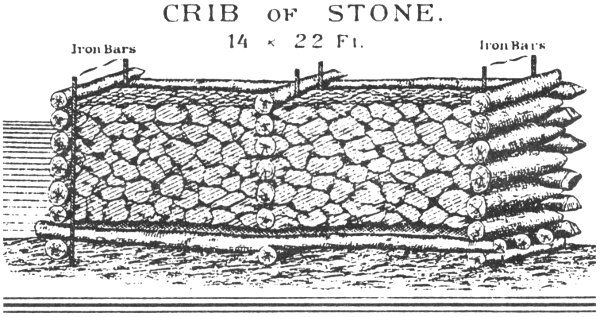
Sketches of the crib and tree dams designed by Lieutenant-Colonel Joseph Bailey to improve the water levels of the Red River near Alexandria, Louisiana, spring 1864 (Joseph Bailey, “Report on the Construction of the Dam Across the Red River,” 1865, public domain).
Having finally reached Alexandria on 26 April, they learned that they would remain at their latest new camp for at least two weeks. Placed temporarily under the command of Lieutenant-Colonel Joseph Bailey, they were assigned yet again to the hard labor of construction work, helping to erect “Bailey’s Dam,”a timber structure that was designed to enable Union gun boats to safely navigate the fluctuating water levels of the Red River. According to Musician Henry Wharton:
We were at Alexandria seventeen days, during which time the men were kept busy at throwing up earthworks, foraging and three times went out some distance to meet the enemy, but they did not make their appearance in numbers large enough for an engagement. The water in the Red river had fallen so much that it prevented the gun boats from operating with us, and kept our transports from supplying the troops with rations, (and you know soldiers, like other people will eat), so Banks was compelled to relinquish his designs on Shreveport and fall back to the Mississippi. To do this a large dam had to be built on the falls at Alexandria to get the iron clads down the river. After a great deal of labor this was accomplished and by the morning of May 13th the last one was through the shute [sic, chute], when we bade adieu to Alexandria, marching through the town with banners flying and keeping step to the music of ‘Rally around the flag,’ and ‘When this cruel war is over.’ The next morning, at our camping place, the fleet of boats passed us, when we were informed that Alexandria had been destroyed by fire – the act of a dissatisfied citizen and several negroes. Incendiary acts were strictly forbidden in a general order before we left the place, and a cavalry guard was left in the rear to see the order enforced. After marching a few miles skirmishing commenced in front between the cavalry and the enemy in riflepits on the bank of the river, but they were easily driven away. When we came up we discovered their pits and places where there had been batteries planted. At this point the John Warren, an unarmed transport, on which were sick soldiers and women, was fired into and sunk, killing many and those that were not drowned taken prisoners. A tin-clad gunboat was destroyed at the same place, by which we lost a large mail. Many letters and directed envelopes were found on the bank – thrown there after the contents had been read by the unprincipled scoundrels. The inhumanity of Guerrilla bands in this department is beyond belief, and if one did not know the truth of it or saw some of their barbarities, he would write it down as the story of a ‘reliable gentleman’ or as told by an ‘intelligent contraband.’ Not satisfied with his murderous intent on unarmed transports he fires into the Hospital steamer Laurel Hill, with four hundred sick on board. This boat had the usual hospital signal floating fore and aft, yet, notwithstanding all this, and the customs of war, they fired on them, proving by this act that they are more hardened than the Indians on the frontier.
Continuing their march, the 47th Pennsylvania Volunteers headed toward Avoyelles Parish. According to Wharton:
On Sunday, May 15th, we left the river road and took a short route through the woods, saving considerable distance. The windings of the Red river are so numerous that it resembles the tape-worm railroad where with the politicians frightened the dear people during the administration of Ritner and Stevens. — We stopped several hours in the woods to leave cavalry pass, when we moved forward and by four o’clock emerged into a large open plain where we formed into line of battle, expecting a regular engagement. The enemy, however, retired, and we advanced ’till dark, when the forces halted for the night with orders to rest on their arms. ‘Twas here that Banks rode through our regiment, amidst the cheers of the boys, and gave the pleasant news that Grant had defeated Lee.

“Sleeping on Their Arms” by Winslow Homer (Harper’s Weekly, 21 May 1864).
“Resting on their arms” (half-dozing, without pitching their tents, and with their rifles right beside them), they were now positioned just outside of Marksville, on the eve of the 16 May 1864 Battle of Mansura, which unfolded as follows, according to Wharton:
Early next morning we marched through Marksville into a prairie nine miles long and six wide where every preparation was made for a fight. The whole of our force was formed in line, in support of artillery in front, who commenced operations on the enemy driving him gradually from the prairie into the woods. As the enemy retreated before the heavy fire of our artillery, they reached Missoula [sic, Mansura], where they formed in column, taking the whole field in an attempt to flank the enemy, but their running qualities were so good that we were foiled. The maneuvring [sic, maneuvering] of the troops was handsomely done, and the movements was [sic, were] one of the finest things of the war. The fight of artillery was a steady one of five miles. The enemy merely stood that they might cover the retreat of their infantry and train under cover of their artillery. Our loss was slight. Of the rebels we could not ascertain directly, but learned from citizens who had secreted themselves during the fight, that they had many killed and wounded, who threw them into wagons, promiscuously, and drove them off so that we could not learn their casualties. The next day we moved to Simmsport [sic, Simmesport] on the Achafalaya [sic, Atchafalaya] river, where a bridge was made by putting the transports side by side, which enabled the troops and train to pass safely over.– The day before we crossed the rebels attacked Smith, thinking it was but the rear guard, in which they, the graybacks, were awfully cut up, and four hundred prisoners fell into our hands. Our loss in killed and wounded was ninety. This fight was the last one of the expedition. The whole of the force is safe on the Mississippi, gunboats, transports and trains. The 16th and 17th have gone to their old commands.
It is amusing to read the statements of correspondents to papers North, concerning our movements and the losses of the army. I have it from the best source that the Federal loss from Franklin to Mansfield, and from their [sic, there] to this point does not exceed thirty-five hundred in killed, wounded and missing, while that of the rebels is over eight thousand.

Union Army base at Morganza Bend, Louisiana, circa 1863-1865 (U.S. Library of Congress, public domain).
Continuing on, the healthy members of the 47th Pennsylvania Volunteer Infantry headed for Simmesport and then Morganza, where they made camp again. While encamped there, the nine formerly enslaved Black men who had enlisted with the regiment in Beaufort, South Carolina (1862) and Natchitoches, Louisiana (1864) were officially mustered into the regiment between 22-24 June. The regiment then moved on and arrived in New Orleans in late June.
Ironically, while many Americans were celebrating Independence Day in other parts of the country on the Fourth of July, the 47th Pennsylvania Volunteers were being informed by their superiors that their regiment had been ordered to return to the East Coast for new duties there. Three days later, they began their departure, a process that unfolded in two stages. Companies A, C, D, E, F, H, and I boarded the U.S. Steamer McClellan on 7 July and headed out of the harbor that day, while the members of Companies B, G and K remained behind in the city, awaiting transport. They subsequently departed aboard the Blackstone at the end of that month. Arriving in Virginia, on 28 July, that second group reconnected with the first at Monocacy, having missed an encounter with President Abraham Lincoln and the Battle of Cool Spring at Snicker’s Gap in mid-July (a battle in which the first group of 47th Pennsylvanians had taken part).
Sheridan’s 1864 Shenandoah Valley Campaign
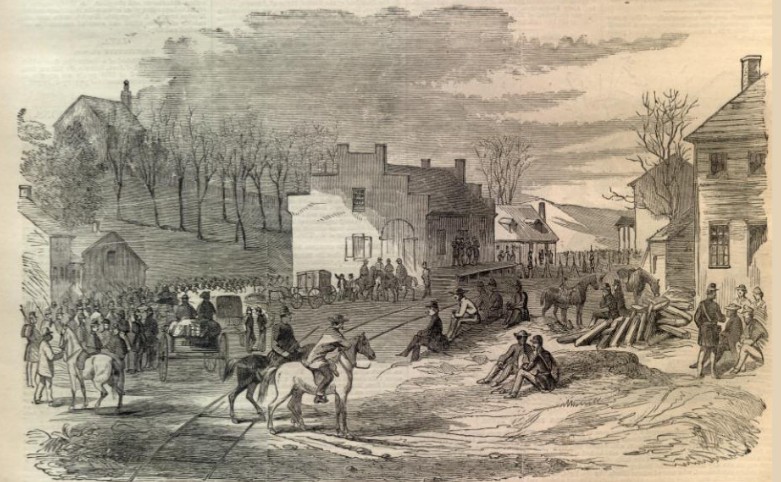
“The Rendezvous of the Virginians at Halltown, Virginia, 5 p.m. on April 18, 1861 to March on Harper’s Ferry” (D. H. Strother, Harper’s Weekly, 11 May 1861, public domain).
Attached to the Middle Military Division, U.S. Army of the Shenandoah, beginning in early August of 1864, and placed under the command of Union Major-General Philip H. Sheridan, the 47th Pennsylvania Volunteer Infantry was assigned to defensive duties in and around Halltown, and also engaged over the next several weeks in a series of back-and-forth movements between Halltown, Berryville, Middletown, Charlestown, and Winchester as part of a “mimic war” being waged by Sheridan’s Union forces with those commanded by Confederate Lieutenant-General Jubal Early.
As summer waned, regimental records of the 47th Pennsylvania Volunteer Infantry noted that Bandmaster Anton Bush and multiple members of his ensemble were paid for their service with Regimental Band No. 2 on 31 August:
[The] 47th was paid this date by a Major Eaton. Various members of the band were paid by the 47th’s Council of Administration effective through this date, generally for a three to four month period. The men and accounts are as follows: Anthony B. Bush, $157.50; Eugene Walters [sic] and John Rupp, each $100; David Gackenback [sic, “Daniel Gackenbach“], $52.50 Henry Kern and George Frederick, each $60; Henry Tool, $30; and Lewis Sponheimer, Harrison Handwerk, Edwin Dreisbach, Daniel Dachradt [sic, “Daniel Dachrodt“] and William Heckman, each $16.”
Just over two weeks later, Bandmaster Bush was honorably discharged on a surgeon’s certificate of disability at Berryville, Virginia, on 18 September 1864. A number of other officers and enlisted men from the 47th were also honorably discharged that day, including E Company’s Captain Charles H. Yard, who mustered out upon expiration of his three-year term of service.
* Note: Although the 1906 obituary of Anthony B. Bush would subsequently state that he had been awarded the rank of lieutenant, historian Samuel P. Bates only noted a rank of private for Anthony Bush in his book, History of Pennsylvania Volunteers, 1861-5.
Meanwhile, Regimental Bandsman Henry J. Kern continued to soldier on.
Battles of Opequan and Fisher’s Hill — September 1864

Battle of Opequan (aka Third Winchester), Virginia, 19 September 1864 (public domain).
Together with other regiments under the command of Union Major-General Philip H. (“Little Phil”) Sheridan and Brigadier-General William H. Emory, commander of the 19th Corps, the members of Company E and their fellow 47th Pennsylvanians helped to inflict heavy casualties on Lieutenant-General Jubal Early’s Confederate forces at Opequan (also spelled as “Opequon” and referred to as “Third Winchester”). The battle is still considered by many historians to be one of the most important during Sheridan’s 1864 campaign; the Union’s victory here helped to ensure the reelection of President Abraham Lincoln.
The 47th Pennsylvania’s march toward destiny at Opequan began at 2 a.m. on 19 September 1864 as the regiment left camp and joined up with others in the Union’s 19th Corps. Advancing slowly from Berryville toward Winchester, the 19th Corps became bogged down for several hours by the massive movement of Union troops and supply wagons, enabling Early’s men to dig in. Finally reaching the Opequan Creek, Sheridan’s men came face to face with Early’s Confederate Army. The fighting, which began in earnest at noon, was long and brutal. The Union’s left flank (6th Corps) took a beating from Confederate artillerymen who were positioned on higher ground.

Victory of Philip Sheridan’s Union Army over Jubal Early’s Confederate forces, Battle of Opequan, 19 September 1864 (Kurz & Allison, circa 1893, U.S. Library of Congress, public domain).
Meanwhile, the 47th Pennsylvania and the 19th Corps were directed by Brigadier-General Emory to attack and pursue Major-General John B. Gordon’s Confederate forces. Some success was achieved, but casualties mounted as another Confederate artillery group opened fire on Union troops trying to cross a clearing. When a nearly fatal gap began to open between the 6th and 19th Corps, Sheridan sent in units led by Brigadier-Generals Emory Upton and David A. Russell. Russell, hit twice — once in the chest, was mortally wounded. The 47th Pennsylvania opened its lines long enough to enable the Union cavalry under William Woods Averell and the foot soldiers of General George Crook to charge the Confederates’ left flank. The 19th Corps, with the 47th in the thick of the fighting, then began pushing the Confederates back, and Early’s “grays” retreated in the face of the valor displayed by Sheridan’s “blue jackets.”
Leaving twenty-five hundred wounded behind, the Rebels marched to a spot eight miles south of Winchester, where they re-engaged with the 47th Pennsylvania and other Union Army regiments during the Battle of Fisher’s Hill (21-22 September). Defeated that day by a successful early morning flanking attack launched by by Sheridan’s Union force (which outnumbered Early’s Confederates three to one), the Rebels continued their retreat to Waynesboro.
Moving forward, the 47th Pennsylvania Volunteers would continue to distinguish themselves in battle, but they would do so without two more of their respected commanders: Colonel Tilghman H. Good and Good’s second-in-command, Lieutenant-Colonel George Alexander, who mustered out 23-24 September upon the expiration of their respective terms of service. Fortunately, they were replaced with leaders who were equally respected for their front line experience and temperament, including Major John Peter Shindel Gobin, formerly of the 47th’s Company C, who had been promoted up through the regimental staff to the rank of major (and who would be promoted again on 4 November to the rank of lieutenant-colonel and regimental commanding officer).
Battle of Cedar Creek — October 1864

Alfred Waud’s 1864 sketch, “Surprise at Cedar Creek,” captured the flanking attack on the rear of Union Brigadier-General William Emory’s 19th Corps by Lieutenant-General Jubal Early’s Confederate army, and the subsequent resistance by Emory’s troops from their Union rifle-pit positions, 19 October 1864 (public domain).
During the fall of 1864, Major-General Sheridan began the first of the Union’s true “scorched earth” campaigns, starving the enemy into submission by destroying Virginia’s farming infrastructure. Viewed through today’s lens of history as inhumane, the strategy claimed many innocents — civilians whose lives were cut short by their inability to find food. That strategy, however, almost certainly contributed to the turning of the war’s tide further in the Union’s favor during the Battle of Cedar Creek on 19 October 1864. Successful throughout most of their engagement with Union forces at Cedar Creek, Early’s Confederate troops began peeling off in ever growing numbers to forage for food, thus enabling the 47th Pennsylvania and others under Sheridan’s command to rally and win the day.
From a military standpoint, it was another impressive, but heartrending day. During the morning of 19 October, Early launched a surprise attack directly on Sheridan’s Cedar Creek-encamped forces. Early’s men were able to capture Union weapons while freeing a number of Confederates who had been taken prisoner during previous battles — all while pushing seven Union divisions back. According to Bates:
When the Army of West Virginia, under Crook, was surprised and driven from its works, the Second Brigade, with the Forty-seventh on the right, was thrown into the breach to arrest the retreat…. Scarcely was it in position before the enemy came suddenly upon it, under the cover of fog. The right of the regiment was thrown back until it was almost a semi-circle. The brigade, only fifteen hundred strong, was contending against Gordon’s entire division, and was forced to retire, but, in comparative good order, exposed, as it was, to raking fire. Repeatedly forming, as it was pushed back, and making a stand at every available point, it finally succeeded in checking the enemy’s onset, when General Sheridan suddenly appeared upon the field, who ‘met his crest-fallen, shattered battalions, without a word of reproach, but joyously swinging his cap, shouted to the stragglers, as he rode rapidly past them – “Face the other way, boys! We are going back to our camp! We are going to lick them out of their boots!’”

Sheridan Rallying His Troops, Battle of Cedar Creek, Virginia, 19 October 1864 (U.S. Library of Congress, public domain).
The Union’s counterattack punched Early’s forces into submission, and the men of the 47th were commended for their heroism by General Stephen Thomas who, in 1892, was awarded the Medal of Honor for his own “distinguished conduct in a desperate hand-to-hand encounter, in which the advance of the enemy was checked” that day. Bates described the 47th’s actions:
When the final grand charge was made, the regiment moved at nearly right angles with the rebel front. The brigade charged gallantly, and the entire line, making a left wheel, came down on his flank, while engaging the Sixth Corps, when he went “whirling up the valley” in confusion. In the pursuit to Fisher’s Hill, the regiment led, and upon its arrival was placed on the skirmish line, where it remained until twelve o’clock noon of the following day. The army was attacked at early dawn…no respite was given to take food until the pursuit was ended.
Once again, the casualties for the 47th were high. Sergeant William Pyers, the C Company man who had so gallantly rescued the flag at Pleasant Hill, was cut down and later buried on the battlefield. Company E’s Corporal Edward W. Menner and Privates Andrew Burk, John Kunker, Owen Moser, Jacob Ochs, and John Peterson were wounded in action. Kunker, Menner, Moser, Ochs, and Peterson survived but Private Burk, who had sustained gunshot wounds to the head and upper right arm and had initially been declared killed in action by mistake, finally succumbed to battle wound-related complications just two days before Christmas.
Still others were captured and held as prisoners of war (POWs), several of whom died. Corporal James Huff, who had previously been wounded in action and captured by Confederate forces during the Battle of Pleasant Hill, Louisiana just six months earlier, was captured again by Rebels during the Battle of Cedar Creek, as was Corporal Frederick Scott, who was subsequently promoted by his superiors to the rank of second lieutenant on 20 March 1865 in the hopes of securing his release, without realizing that he had already died in captivity at the Confederacy’s prison in Danville, Virginia in February. Corporal Huff, who had been force marched to a train and transported to the Confederate Army prison camp in Salisbury, North Carolina, subsequently died there as a POW on 5 March 1865.
Meanwhile, as their comrades were being spirited away, the 47th Pennsylvania Volunteers continued to soldier on. Following those major engagements in Virginia, the 47th was ordered to Camp Russell near Winchester, where it remained from November through most of December. (Private Charles Arnold, who was accidentally wounded on 23 November 1864, would be discharged seven months later, on 25 June 1865, on a surgeon’s certificate of disability.)
Rested and somewhat healed, the 47th Pennsylvanians were then ordered to take up outpost and railroad guard duties at Camp Fairview in Charlestown, West Virginia. Five days before Christmas, they trudged through a snowstorm in order to reach their new home.
1865 — 1866

Spectators gather for the Grand Review of the Armies, 23-24 May 1865, beside the crepe-draped U.S. Capitol, flag at half-staff after the assassination of President Abraham Lincoln (Matthew Brady, U.S. Library of Congress, public domain).
Assigned in February to the Provisional Division of the 2nd Brigade of the Army of the Shenandoah, the men of the 47th moved, via Winchester and Kernstown, back to Washington, D.C. On 19 April 1864, the 47th Pennsylvania Volunteers were once again responsible for helping to defend the nation’s capital — this time following the assassination of President Abraham Lincoln. Encamped near Fort Stevens, they were issued new uniforms and resupplied with ammunition.
Letters sent to family and friends back home during that period, and post-war newspaper interviews with veterans of the 47th Pennsylvania, indicate that at least one 47th Pennsylvania Volunteer was given the high honor of guarding President Lincoln’s funeral train while others may have guarded the Lincoln assassination conspirators during the early days of their imprisonment and trial, which began on 9 May 1865. During that phase of duty, the regiment was headquartered at Camp Brightwood, which was located in the Brightwood section of Washington, D.C.
Attached to Dwight’s Division of the 2nd Brigade of the U.S. Department of Washington’s 22nd Corps, Musician Henry J. Kern and his fellow 47th Pennsylvania Regimental Bandsmen performed in an impromptu concert for Union Generals Ulysses S. Grant and Philip Sheridan at Willard’s Hotel during the evening of 22 May. The larger regiment then also marched in the Union’s Grand Review the next day (23 May). Captain Levi Stuber of Company I also advanced to the rank of major with the regiment’s central staff during that phase of duty.
Reconstruction

Ruins of Charleston, South Carolina as seen from the Circular Church, 1865 (U.S. National Archives and Records Administration, public domain).
On their final southern tour, Bandmaster J. Eugene Walter, Musician Henry J. Kern and their fellow 47th Pennsylvanians served in Savannah, Georgia in early June. Attached again to Dwight’s Division, this time they were assigned to the 3rd Brigade, U.S. Department of the South. Taking over for the 165th New York Volunteers in July, they quartered in Charleston, South Carolina at the former mansion of the Confederate Secretary of the Treasury.
Musician Henry J. Kern was then honorably discharged in Charleston on 28 October 1865, upon expiration of his term of service.
Return to Civilian Life
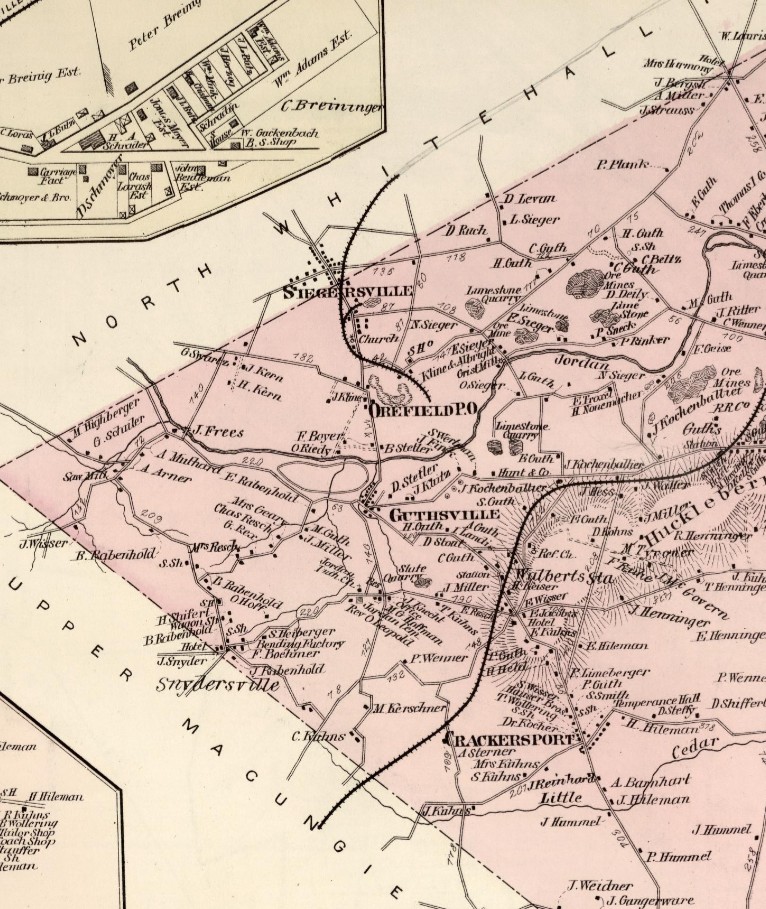
The adjoining farms of 47th Pennsylvania Volunteer Infantry veteran Henry J. Kern and his father, Jeremiah Kern, which were situated in the northwestern area of South Whitehall Township in Lehigh County, Pennsylvania, near the border of North Whitehall Township, were documented on this 1876 map excerpt by F. A. Davis (South Whitehall Township map, public domain; click to enlarge).
Following his honorable discharge from the military, Henry J. Kern returned home to Pennsylvania’s Lehigh Valley, where, he resumed his life as a farmer. In late 1865 or early 1866, he wed Amanda S. Koch (1839-1911), who was a daughter of Upper Macungie resident Samuel Koch. Henry and Amanda Kern then welcomed the birth of Samuel J. Kern (1866-1931), who was born in South Whitehall Township in Lehigh County on 7 September 1866 and would later become a public school teacher and the husband of Rosa A. Henninger (1865-1933).
By 1870, Henry Kern had amassed a personal estate that was valued at two thousand five hundred dollars (the equivalent of roughly sixty-four thousand U.S. dollars in 2026), from his operation of a farm in South Whitehall Township, Lehigh County, where he resided with his wife, Amanda and their son, Samuel. Two others were also living at their home that year: seventeen-year-old Alice Sell and twenty-three-year-old stone cutter William Blotts. Residing on and working a farm a short distance away in that same township were Henry’s parents, Jeremiah and Helena Kern, whose real estate and personal property were valued at twenty-four thousand two hundred dollars (the equivalent of roughly six hundred and fourteen thousand U.S. dollars in 2026). Also living with Jeremiah and Helena was their grandson, twelve-year-old Theodore Jeremiah Ruch (1857-1927; alternate birth year: 1856), who was the son of their daughter, Elizabeth (Kern) Ruch.
Another child was then born to Henry and Amanda (Koch) Kern: Carrie Amanda Kern (1871-1955), who was born in Kernsville, Lehigh County on 20 May 1871, was baptized at the Jordan Reformed Church in Allentown on 25 June 1871 and would later wed Henry Grant Bachman (1868-1913) circa 1893.
Officially residing on nearby farms in the Village of Hoffmansville in South Whitehall Township by the summer of 1880, according to that year’s federal census enumerator, Jeremiah Kern and his son, Henry Kern, continued to prosper. Still a member of the household run by Jeremiah and Helena Kern was Theodore Jeremiah Ruch, who was described as a twenty-three-year-old coach painter. Also living there at that time, though, was Theodore’s younger sister, Susan Ruch, who was described as a nineteen-year-old live-in servant by the enumerator, but was, in reality, a granddaughter of Jeremiah and Helena Kern and a daughter of Elizabeth (Kern) Ruch. Meanwhile, Henry Kern had become the head of a household that included his wife, Amanda, and their two children, Samuel and Carrie. Also of significance, live-in workers Alice Sell and William Blotts had departed from Henry Kern’s home and had been replaced by seventeen-year-old live-in servant Sarah Acker and forty-three-year-old farmhand Willoughby Derr.
The following year, during the evening of Wednesday, 17 August 1881, a large dinner party was held at the home of Jeremiah Kern near Kernsville in celebration of the dual birthdays of Mr. an Mrs. John Romich of Romich’s Mill in North Whitehall, according to The Allentown Democrat. The dinner was followed by a “very fine” performance by the Siegersville string band. Roughly seven years, later, on 13 August 1888, Henry Kern filed for a U.S. Civil War Pension, which was subsequently awarded to him, following a review of his application materials by U.S. Pension Bureau officials.
According to The Allentown Leader, Henry J. Kern owned “the ancestral farm on the Jordan near his home, one of the finest in the county.” Sometime around 1891, he retired from the back-breaking work he had undertaken for most of his life and moved to the hamlet of Stetlersville in Lehigh County.
* Note: According to The Allentown Leader, Henry J. Kern continued to own the same farm “on the Jordan,” even after his retirement.
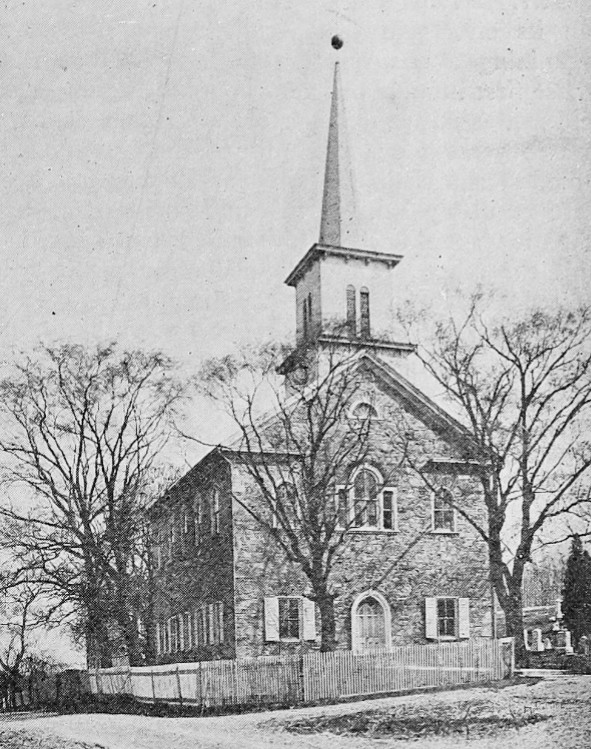
The Jordan Reformed Church, shown here circa 1914, was erected in South Whitehall Township, Lehigh County, Pennsylvania in 1808 (public domain; click to enlarge).
Sadly, the year of 1894 proved to be a difficult one for Henry Kern, however, because he lost both of his parents within a period of six months. His father, Jeremiah Kern, was the first to pass when he died at the age of eighty-six in Lehigh County on 15 April 1894 and was laid to rest at the Jordan Reformed Church Cemetery (what is now known as the Jordan United Church of Christ Cemetery) in Allentown. Before he did, however, Jeremiah had drawn up a final will in which he appointed his son, Henry, to act as the executor of his state:
I Jeremiah Kern of South Whitehall Township, Lehigh County, Pennsylvania, being of sound mind, memory, and understanding, do make and publish this my last will and testament, hereby revoking, and making void all former wills by me at any time heretofore made.
And First — reverently commending my soul to God. I direct that my body be interred among those of my kindred according to the rites and ceremonies of the Reformed Church, and that my funeral be conducted in a manner corresponding to my estate and situation in life.
And as to such estate as it has pleaseth God to entrust me with, I do dispose of the same as follows, to wit:
Item — I give and bequeath unto my beloved wife all my household furniture, now in our residence and the interest of the sum of $5000.00 to be paid to her semi-annually by my son Henry during her life.
I also give and devise to her the house in which we now reside, and the premises adjacent thereto not exceeding one acre, to have and to hold the same during her natural life.
To my son Henry I give and devise all my real estate in the County of Lehigh, subject nevertheless to the following charges, conditions, and payments to wit:
First — to the use and occupancy of my residence and adjacent ground as above stated to my wife for life; and also food and pasture for one cow.
Second — to the payment of any debts of mine that may remain unpaid at my death.
Third — to the payment of the annual interest of $5000.00 to my wife for life, as above provided, and
Fourth — to the payment of the principal sum of $6000.00, at and after her death in annual payments of $1000.00 to my other children in equal shares to wit: to Josiah, to Sarah Weller, Louisa Wenner, and Eliza Ruch, to and for their own seperate sic, “separate”] use if living or to their legal representatives, and
Lastly — I nominate my son Henry to be the executor of this my last will and testament.
In witness whereof I have hereunto set my hand and seal this Twenty sixth day of October, one thousand eight hundred and eighty five.
Signed, sealed, published, and declared by the above named Jeremiah Kern as and for his last will and testament in the presence of us who have hereunto subscribed our names at his request as witnesses thereto in the presence of the said testator, and of each other.
(Witness signatures by [illegible name] and Chas. Seagraves and seal with signed name of _____ Transue [illegible given name])
But that was not all that Jeremiah Kern wrote. Later that same day, he added a codicil directing “that the share of [his] estate that [would] come to [his] daughter, Eliza Ruch, [should] not be paid to her, but [should] remain invested and secured in the hands of [his] executor during her life, the interest thereof to be paid to her semi-annually and the principal at her death to and among her children in equal shares, or to their legal representatives.” Roughly six months later, Henry Kern’s mother, Helena (Moyer) Kern, then also passed away in Lehigh County at the age of eighty-four, on 28 October 1894, and was buried at the same cemetery where Henry’s father was at rest.
Injury, Illness, Death, and Interment
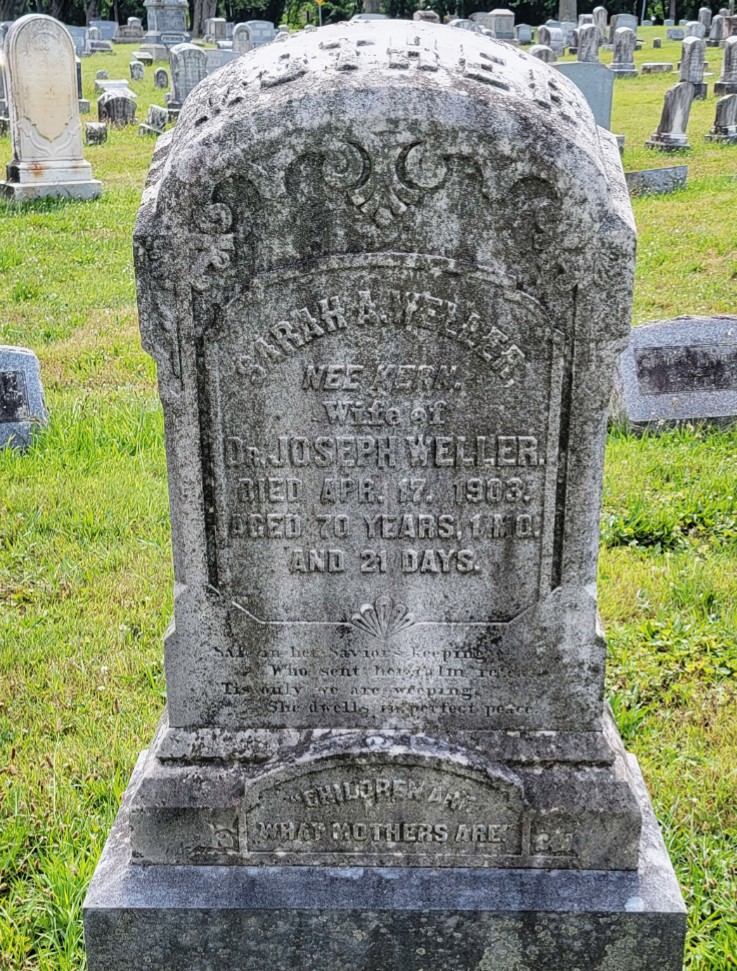
The headstone of Sarah Ann (Kern) Weller (1833-1903), the oldest sister of 47th Pennsylvania Volunteer Infantry veteran Henry J. Kern, Saint Pauls United Church of Christ Cemetery, Trexlertown, Pennsylvania (public domain).
As the old century gave way to the new, Henry J. Kern still owned the same farm. Sometime between 1900 and 1902, he suffered a serious fall there, during which he landed “on the edge of a barrel in his barn, broke a rib and injured one of his lungs,” according to The Allentown Leader. Sadly, he “never recovered from the injury to his lung, and this, with Bright’s disease, brought him long suffering.” As a result, he was “confined to his house” during the winter of 1902-1903.
He seemed to rally, though, as 1903 progressed. “Early in the spring he became better and during the spring and early summer he gained 30 pounds in weight.” Conversely, as he was gaining strength, his oldest sister, Sarah Ann (Kern) Weller (1833-1903), was fading away. She died at the age of seventy in Lehigh County on 17 April 1903, and was laid to rest at Saint Pauls United Church of Christ Cemetery in Trexlertown.
* Note: Following her marriage to dentist Joseph Weller (1825-1894) in Lehigh County circa 1858, Henry Kern’s older sister, Sarah Ann (Kern) Weller (1833-1903), had settled with her husband in Trexlertown, Upper Macungie Township, Lehigh County. Together, she and her husband had then welcomed the Trexlertown births of: Harvey A. Weller (1859-1926), who had been born on 8 July 1859 and had grown up to become a minister and would later marry Marion Julia Erb (1884-1963) in 1921; Elmer Kern Weller (1863-1891), who had been born on 5 December 1863 and had later become a physician and drug store owner, but had not married prior to his death from bronchitis at the age of twenty-seven on 5 August 1891; Anna Pauline Weller (1866-unknown), who had been born in 1866; Charles Henry Kern Weller (1869-1956), who had been born on 15 November 1869 (alternate birth date: 5 November 1869) and had then gone on to marry Jemima Martha Housel (1877-1972), who was known to family and friends as “Jenny”; and Elsie Louise Weller (1876-1900), who had been born on 26 February 1876 and had gone on to marry William Berkey (1876-1948; alternate surname spelling: ” Berky”). Widowed by her husband when he succumbed to complications from Bright’s disease at the age of sixty-nine in Trexlertown on 26 August 1894, Sarah Ann (Kern) Weller had then continued to reside in Trexlertown until her death, surviving her husband by nearly nine years.
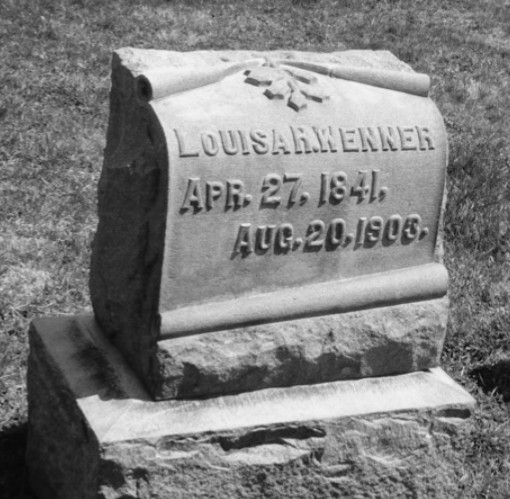
The headstone of Louisa R. (Kern) Wenner (1841-1903), the youngest sister of 47th Pennsylvania Volunteer Infantry veteran Henry J. Kern, Saint Pauls United Church of Christ Cemetery, Trexlertown, Pennsylvania (public domain).
Tragically, news regarding the death of his oldest sister appears to have halted Henry Kern’s recovery. As his “lung trouble became more severe,” he was “confined to bed” in early August of 1903, according to multiple reports by Allentown-area newspapers. His youngest sister, Louisa R. (Kern) Wenner (1841-1903), then also passed away in East Texas, Lehigh County, on 20 August 1903. Just sixty-two at the time of her death, she was also laid to rest at Saint Pauls United Church of Christ Cemetery in Trexlertown.
* Note: Following her marriage to farmer Milton J. Wenner (1845-1884) in Lehigh County circa early 1866, Henry Kern’s youngest sister, Louisa R. (Kern) Wenner (1841-1903), had then also settled with her husband in Lehigh County. Together, she and her husband had then welcomed the births of: Emma Jane Wenner (1866-1943), who had been born in South Whitehall Township on 24 October 1866 and had then gone on to marry Sylvester C. O. Schmoyer (1864-1932); Elmer Jacob Wenner (1870-1922), who had been born in Lehigh County on 16 January 1870 and had then gone on to marry Annie Victoria Shankweiler (1871-1943); Wayne W. Wenner (1875-1926), who had been born in Upper Macungie Township on 10 June 1875 and had then gone on to marry Laura V. Hausman (1878-1964); and Marietta Helena Wenner (1876-1934), who had been born in Lehigh County on 8 January 1876 and had then gone on to marry H. John Gorr (1874-1940). By 1880, Louisa (Kern) Wenner had settled into a family routine with her husband and their children, Elmer, Wayne and Marietta, at their home in Upper Macungie Township. Widowed suddenly by her husband when he had died at the unexpected age of thirty-nine on 19 November 1884, Louisa (Kern) Wenner had then continued to reside in Upper Macungie Township with her children. By 1900, however, she had moved into the home of her daughter, Emma (Wenner) Schmoyer, in East Texas, Lehigh County. Also residing there were Emma’s husband, who was employed as a teacher, and Emma’s children: Venus Milton Schmoyer (1885-1949), who had been born in Orefield, Lehigh County on 24 October 1885; Carrie B. Schmoyer (1887-1965), who had been born on 24 August 1887; Edna L. Schmoyer (1893-1977), who had been born on 17 October 1893); and Helen Schmoyer (1896-1993), who had been born on 16 September 1896). Louise R. (Kern) Wenner had then followed her husband in death in 1903, having survived her husband by nearly two decades.
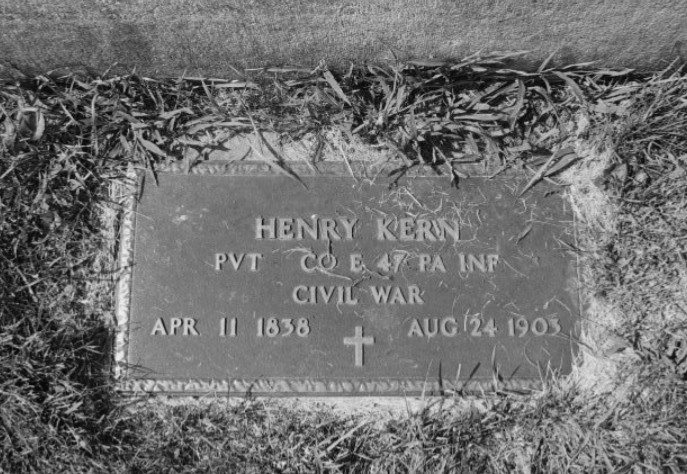
The military service plaque on the grave of Henry J. Kern (1838-1903), 47th Pennsylvania Volunteer Infantry, documents his service with Company E, but not his membership in the 47th Pennsylvania’s Regimental Band (public domain; click to enlarge).
Sadly, the shock of his youngest sister’s death appeared to have been too much for Henry J. Kern, who died in his mid-sixties just three days after her passing. Following his death at his home in Stetlersville, South Whitehall Township on 24 August 1903, two funeral services were held in his honor on 29 August — one at his home and another at the Jordan Reformed Church — and were officiated by the Reverend Doctor E. J. Fogel. Afterward, Henry was then laid to rest at the same cemetery in Allentown where his parents had been buried (now known as the Jordan United Church of Christ Cemetery). His pallbearers were: Daniel Gackenbach, John Guilden, Phaon Guth, William H. Guth, Mathias Miller, and Charles Sourwine — all of whom were veterans of the American Civil War and several of whom had also been members of the 47th Pennsylvania Volunteer Infantry. Roughly two hundred of his mourners then retired to the Hotel Henninger, where they reminsced about him over dinner.
A congregant at the Jordan Reformed Church in Lehigh County from the time of his baptism there, Henry J. Kern had also been a long-time member of the Grand Army of the Republic’s E. B. Young Post (No. 87). When reporting on his passing, The Allentown Democrat noted that he had been “a man of commanding appearance, having been six feet one and one-half inches in height” who had “served as township school director, assessor and auditor” during his lifetime.
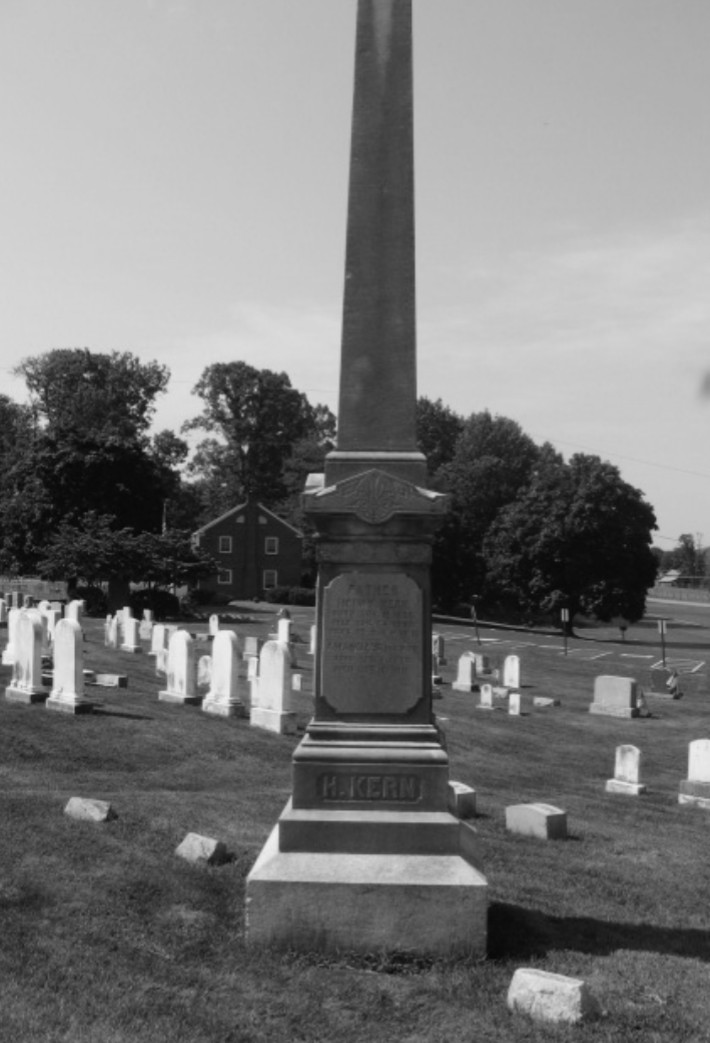
An obelisk marks the graves of 47th Pennsylvania Volunteer Infantry Bandsman Henry J. Kern (1838-1903) and his wife, Amanda S. (Koch) Kern (1839-1911), at the Jordan United Church of Christ Cemetery in Allentown, Pennsylvania (public domain; click to enlarge).
What Happened to Henry Kern’s Widow and Children?
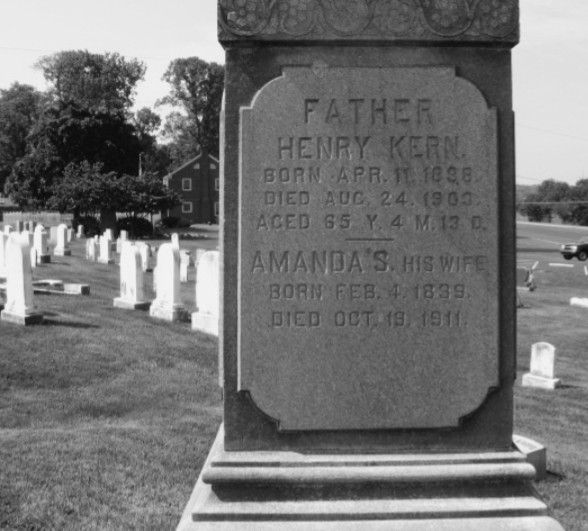
The plaque on the obelisk at the grave of Amanda S. (Koch) Kern (1839-1911) and her husband, 47th Pennsylvania veteran Henry J. Kern (Jordan United Church of Christ Cemetery, Allentown, Pennsylvania, public domain; click to enlarge).
Roughly a month after Henry Kern’s death, his widow, Amanda S. (Koch) Kern (1839-1911), oversaw a public sale of his carpentry tools, farm implements and wagons (in September 1903). Afterward, she spent the next five weeks visiting family and friends, and then returned home to Stetlersville, where she began to forge a new path forward. On 27 April 1908, she filed for a U.S. Civil War Widow’s Pension, which was subsequently awarded to her following a review of her application by U.S. Pension Bureau officials. That government assistance would ultimately enable her to keep a roof over her head for more than eight years. Ailing during her final weeks, Amanda S. (Koch) Kern followed her husband in death in 1911. Seventy-two years old at the time of her passing in South Whitehall Township, on 19 October of that year, she was subsequently laid to rest beside her husband at Allentown’s Jordan Reformed Church Cemetery (also known as the Jordan United Church of Christ Cemetery).
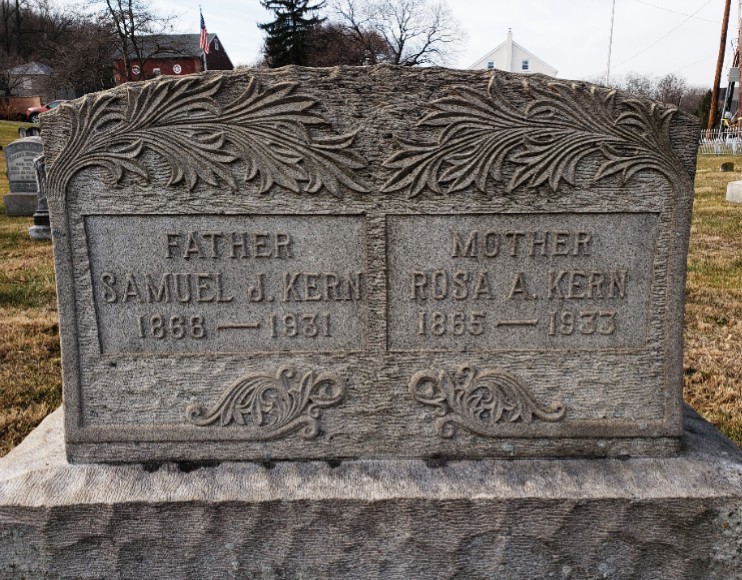
The headstone of Rosa A. Kern (1866-1933) and her husband, Samuel J. Kern (1866-1931), who was a son of 47th Pennsylvania Volunteer Infantryman Henry J. Kern, Jordan Lutheran Church Cemetery, Orefield, Pennsylvania (public domain; click to enlarge).
Following his graduation from Millersville State Normal School (now known as Millersville University in Millersville, Pennsylvania) during the 1850s, Henry J. Kern’s son, Samuel J. Kern (1866-1931), “was licensed to teach by County Superintendent James O. Knauss in 1855,” according to The Allentown Democrat, and “taught in Washington, Whitehall, and South Whitehall township. In the latter township he taught for a period of fifteen years.” At some point, he also held down a second job as “a transcribing clerk in the recorder’s office,” according to Allentown’s Morning Call newspaper. Married to Rosa A. Henninger (1865-1933), a daughter of Tilghman Henninger, in South Whitehall, Lehigh County on 20 September 1888, Samuel and his wife then welcomed the birth of a daughter, Sadie Mae Kern (1896-1905), who was born in South Whitehall Township on 2 June 1896. Still teaching in 1900, Samuel J. Kern continued to reside in South Whitehall Township with his wife, Rosa, and their daughter, Sadie. Also living with them was Rosa’s mother, Judith Henninger. Sometime circa 1905, he purchased a one hundred and three-acre farm near Walberts Pike — land that had previously been owned by Tilghman Henninger and which had originally been part of the Henninger family’s six-hundred-acre homestead for more than a century. Around that same time, Samuel also sold the Kern family’s homestead, where he had been living with his wife and daughter, and where his father and grandfather had resided before him, and moved his wife and daughter into the farmhouse on his new farm. Sadly, tragedy then struck when his only child, Sadie, died from heart disease at the age of eight years and nine months, on 5 March 1905, at their home near Walberts (in what is now Allentown). Following funeral services at her parents’ home, she was then laid to rest at the Jordan Lutheran Church Cemetery (rather than at the Jordan Reformed Church Cemetery). According to The Allentown Leader, “She was the only child and was held in high esteem by all who knew her.” A Democrat, politically, who was described by Allentown newspapers as “influential,” Samuel J. Kern was subsequently elected to the position of auditor in South Whitehall Township. By 1915, he was serving as the secretary and treasurer of that township’s board of supervisors and was also a member of the board of directors of the Allentown trust company. In addition, he “was one of the pioneer manufacturers of cement block,” according to The Allentown Democrat. After a productive life, Samuel J. Kern died at the age of sixty-four in Lehigh County, on 31 August 1931, and was laid to rest at the same cemetery where his daughter, Sadie, had been buried more than a quarter of a century before (the Jordan Lutheran Church Cemetery).
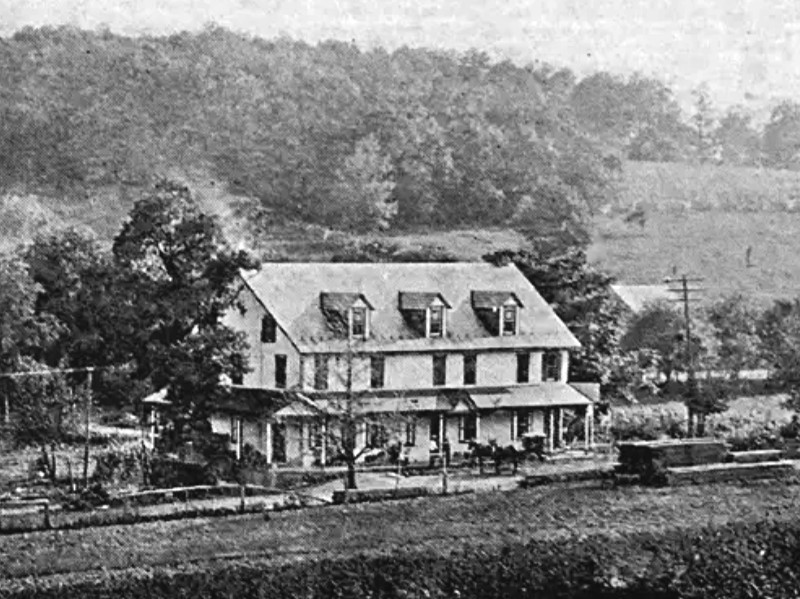
The Lynnville Hotel in Lynnville, Lynn Township, Lehigh County, Pennsylvania, circa early 1900s (public domain; click to enlarge).
Following her marriage to Pennsylvania native and farmer Henry Grant Bachman (1868-1913) in Guthsville, Lehigh County on 3 November 1893, Henry J. Kern’s daughter, Carrie Amanda Kern (1871-1955), settled with her husband in the town of Lynnville in Lynn Township, Lehigh County. Together, they then became the parents of: Paul Kern Bachman (1894-1975), who was born on 14 September 1894 and would later wed Emma M. Peters (1894-1969) circa 1918; Helen R. Bachman (1898-1994), who was born on 22 June 1898 and would later marry Frederick Harrison Werley (1895-1970); and Leroy H. Bachman (1900-1900), who was born on 24 January 1900 but died on 23 September of that same year (just shy of his eighth-month birth anniversary), and was then laid to rest at Saint Peters Union Church Cemetery in Lynnville. Still residing in Lynnville with her husband and their children, Paul, Henry and Leroy, in mid-June of 1900, Carrie (Kern) Bachman ran a household that also included two live-in employees of her family: Charles P. Peter, a sixteen-year-old farmhand; and Florence E. Moyer, a fourteen-year-old domestic servant. By 1910, however, her smaller household included only her husband and two children, Paul and Helen. Widowed by her husband shortly thereafter, when he passed away at the age of forty-four in Lynn Township on 22 February 1913, Carrie (Kern) Bachman continued to raise her surviving children. As the decade waned, she relocated to a home on Turner Street in Allentown’s Eleventh Ward; her son, Paul, also married Emma M. Peters around that same time. During the 1920s, her household included her son and his wife — and their son Kenneth Paul Bachman (1918-1978), who had been born in Allentown on 7 November 1918. By the 1930s, it also included Paul and Emma’s son, Leonard John Bachman (1928-2024), who had been born in Allentown on 8 July 1927. That household composition continued into the 1940s. By 1950, however, Carrie’s grandsons had moved out to begin their own life journeys. Ailing during the final six weeks of her life, Carrie (Kern) Bachman died at the age of eighty-four at the Allentown Hospital in Allentown, on 14 September 1955, and was then laid to rest beside her husband and son at Saint Peters Union Church Cemetery in Lynnville.
What Happened to Henry Kern’s Other Siblings?
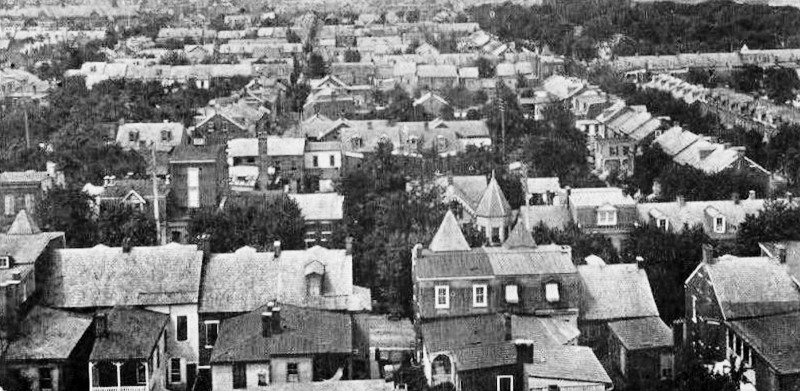
8th and Turner streets, looking west, Allentown, Pennsylvania, 1905 (public domain; click to enlarge).
During the summer of 1870, Henry J. Kern’s older brother, Josiah Kern (1834-1907), was still living with his wife, Hannah (Sieger) Kern (1832-1895), but was tending to his own farm that year. His real estate was valued at one thousand three hundred dollars (the equivalent of roughly thirty-four thousand U.S. dollars in 2026). Also living with them was thirteen-year-old Amelia Hess. By 1880, however, Amelia had been replaced by twenty-six-year-old housekeeper Elmina Strauss. Widowed by his wife, Hannah, when she passed away at the age of sixty-two in Lehigh County on 20 January 1895, Josiah Kern subsequently gave up farming and moved into the boarding house of his niece, Susan (Ruch) Fritsch (1862-1920), that she operated with her husband, Horatio Nathaniel Fritch, Jr. (1852-1929), at 339 Eighth Street in Allentown’s Fourth Ward. (Although Josiah was no longer farming land in South Whitehall himself, he was evidently deriving some form of income from his farm or another property because he was described on the 1900 federal census as a boarder who was employed as a “landlord.” Also living at that boarding house in 1900 were eight others, most of whom were young, single girls and women who were employed as knitting and silk mill workers.) Sadly, on 1 November 1907, Josiah Kern suffered an episode of apoplexy in his room at his niece’s boarding house in Allentown and died there five days later. Seventy-three years old at the time of his passing on 6 November, he was also interred at the Jordan Reformed Church Cemetery in Allentown.
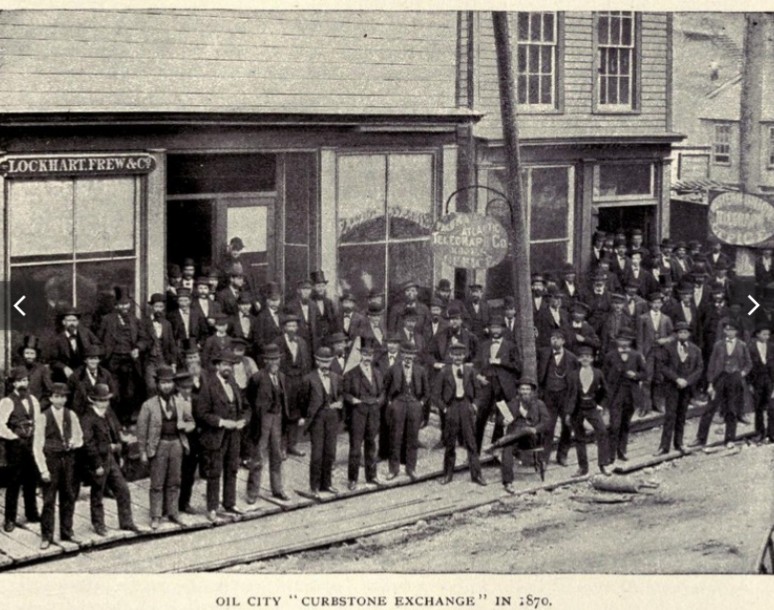
The “Curbstone Exchange” in Oil City, Pennsylvania, 1870 (McLaurin, John J. Sketches in Crude Oil Illustrated, 1902, public domain).
Following her marriage to Henry C. Ruch (1833-1899) in Lehigh County during the early 1850s, Henry J. Kern’s older sister, Elizabeth (Kern) Ruch (1835-1911), who was known to family and friends as “Lizzie,” settled with her husband in Lehigh County, where he worked as a shoemaker and farmer, and where they began to grow their own large family line with the births of: Theodore Jeremiah Ruch (1857-1927), who was born on 8 December 1857 (alternate birth year: 1856), but would be raised to manhood by Lizzie’s parents on their farm in South Whitehall and would later marry Ida Florence Anderson (1869-1917) circa 1898; Ellen J. Ruch (1858-1940), who was born on 10 February 1858 and would later wed Charles E. F. Tice (1850-1925) and settle with him in East Texas, Lehigh County; Margaret Ruch (1859-1933), who was born on 29 October 1959 and would later marry and raise a family in Guthsville, Lehigh County with Walter Jonathan Diehl (1856-1896) before being widowed by him and marrying widower Daniel Stettler (1825-1899) in Stetlersville, Lehigh County on 26 March 1899 (who then died later that same year); and Susan M. Ruch (1861-1920), who was born in Lehigh County on 8 February 1861 (alternate birth year: 1862) and would later also be raised by her grandparents, Jeremiah and Helena Kern, before marrying and operating an Allentown boarding house with Horatio Nathaniel Fritch, Jr. (1852-1929). Sometime after the birth of that daughter, Elizabeth (Kern) Ruch and her husband, Henry, packed up their belongings and migrated west with their family to Oil City in Venango County, Pennsylvania, where they welcomed the births of more children: Barbara C. Ruch (1862-1940), who was born in Oil City on 19 November 1862 and would later wed Charles R. Klein (1857-1930; alternate surname spelling: “Kline”) and migrate west with him to Mason City in Cerro Gordo County, Iowa; Charles Henry Ruch (1865-1944), who was born on 30 June 1865 and would later migrate west to California, where he would serve with Battery D of the California Heavy Artillery before serving as a sergeant with the 36th U.S. Volunteer Infantry in the Philippine Islands during the Spanish-American War, from 8 July 1899 to 2 March 1901; Sarah E. Ruch (1867-1935), who was born on 24 November 1867 and would later wed James H. Sell (1863-1926); Lena Ruch (1869-1939), who was born on 10 November 1869 and would later wed Charles Herbert (1872-1955); Minnie Alice Ruch (1871-1952), who was born on 20 May 1871 and would later grow up to become a licensed practical nurse in Lehigh County but would never marry; and William Kern Ruch (1874-1949), who was born on 4 December 1874 and would later wed Mary Scheirer (1878-1946) and settle in Cementon, Lehigh County. By the fall of 1880, however, Elizabeth (Kern) Ruch and her husband had moved their family back to Lehigh County, and were making a new home for themselves in the town of Orefield, where their youngest son, Stephen Leidy Ruch (1880-1951), was born on 14 November 1880, and where her husband was employed as an innkeeper. Widowed by her husband, Henry C. Ruch, when he passed away at the age of sixty-six in Lehigh County on 10 April 1899, Elizabeth (Kern) Ruch subsequently resided in Fogelsville, Upper Macungie Township with her children, William, Sarah and Stephen, according to the 1900 federal census. Also residing with her was her four-year-old granddaughter, Lulu Irene Diehl (1895-1901), who had been born on 16 June 1895 and was a daughter of Margaret (Ruch Diehl) Stettler, who had been widowed by her first husband in 1896 and her second in 1899. Sadly, Lulu then fell ill with diphtheria and died at the age of six in Fogelsville on 13 March 1901. Roughly a decade later, Elizabeth (Kern) Ruch, died at the age of seventy-six at her home in Fogelsville, on 19 October 1911 — one day after her brother’s widow, Amanda S. (Koch) Kern, had died near Eckerts in Lehigh County. Following funeral services at her home, Elizabeth (Kern) Ruch was then laid to rest at the Fogelsville Union Cemetery in Fogelsville.
Sources:
- “47th Regiment Reunion.” Allentown, Pennsylvania: The Allentown Democrat, 20 September 1882.
- “47th Reunion.” Allentown, Pennsylvania: The Allentown Leader, 13 October 1899.
- Bachman, Carrie A. [sic, “Carrie Amanda (Kern) Bachman] (a daughter of Henry Kern), Paul K. (a grandson of Henry Kern and a son of Carrie Amanda (Kern) Bachman), Emma M. (Paul’s wife), Kenneth P., and Leonard J., in U.S. Census (Allentown, Eleventh Ward, Lehigh County, Pennsylvania, 1930, 1940). Washington, D.C.: U.S. National Archives and Records Administration.
- Bachman, Carrie A. [sic, “Carrie Amanda (Kern) Bachman] (a daughter of Henry Kern), Paul K. (a grandson of Henry Kern and a son of Carrie Amanda (Kern) Bachman) and Emma M. (Paul’s wife), in U.S. Census (Allentown, Lehigh County, Pennsylvania, 1950). Washington, D.C.: U.S. National Archives and Records Administration.
- Bachman, Henry G., Carrie A. (a daughter of Henry Kern), Paul K., Helen R., and Leroy H.; and Peter, Charles P. (a boarder and farmhand); and Moyer, Florence E. (a boarder and servant), in U.S. Census (Lynnville, Lynn Township, Lehigh County, Pennsylvania, 1900). Washington, D.C.: U.S. National Archives and Records Administration.
- Bachman, Henry G., Carrie A. (a daughter of Henry Kern), Paul K., and Helen R., in U.S. Census (Lynnville, Lynn Township, Lehigh County, Pennsylvania, 1910). Washington, D.C.: U.S. National Archives and Records Administration.
- Bachman, Paul K. (a grandson of Henry Kern and a son of Carrie Amanda (Kern) Bachman), Emma N. (Paul’s wife) and Carrie A. [sic, “Carrie Amanda (Kern) Bachman] (a daughter of Henry Kern and the mother of Paul Bachman), in U.S. Census (Allentown, Eleventh Ward, Lehigh County, Pennsylvania, 1920). Washington, D.C.: U.S. National Archives and Records Administration.
- Bates, Samuel P. History of Pennsylvania, 1861-5, vol. 1. Harrisburg, Pennsylvania: B. Singerly, State Printer, 1869.
- “Birthday Celebration — A Double Decker” (mentions family of Jeremiah Kern and the Siegersville string band). Allentown, Pennsylvania: The Allentown Democrat, 24 August 1881.
- Carrie A. Kern (the bride) and Henry Kern (the father of the bride); and Henry G. Bachman (the groom) and Phaon H. Bachman (the groom’s father), in “Marriage License Docket” (Guthsville, Lehigh County, Pennsylvania, date of marriage: 3 November 1893). Allentown, Pennsylvania: Clerk of the Orphans’ Court of Lehigh County, Pennsylvania.
- “Catasauqua, Pa., September 22, 1873: Captain Eichholz, Dear Sir” (letter to the newspaper inviting all former members of the 47th Pennsylvania Volunteers to participate in the regiment’s first reunion). Sunbury, Pennsylvania: The Democrat, 26 September 1873.
- “Civil War Military Bands: Their Purpose and Composition.” Washington, D.C.: American Battlefield Trust, 28 September 2020 (revised 12 May 2021).
- “Death of Henry Kern.” Allentown, Pennsylvania: The Allentown Leader, 25 August 1903.
- “Death of Henry Kern, of Stettlersville.” Allentown, Pennsylvania: The Allentown Democrat, 2 September 1903.
- “Death of Miss Kern” (obituary of Sadie Mae Kern, who was a granddaughter of Henry Kern and a daughter of Samuel Kern). Allentown, Pennsylvania: The Allentown Leader, 6 March 1905.
- “Death of Veteran Musician: Anthony B. Bush Expires After Long Sickness.” Allentown, Pennsylvania: The Allentown Leader, 17 December 1906.
- “Died at Fogelsville” (obituary of Elizabeth (Kern) Ruch, Henry Kern’s older sister). Allentown, Pennsylvania: The Allentown Democrat, 21 October 1911.
- Dyer, Frederick H. A Compendium of the War of the Rebellion, p. 1589. Des Moines, Iowa: The Dyer Publishing Company, 1908.
- Elmer Jacob Wenner (a nephew of Henry Kern and a son of Louise R. (Kern) Wenner), in Death Certificates (file no.: 74627, registered no.: 836, date of death: 2 August 1922). Harrisburg, Pennsylvania: Commonwealth of Pennsylvania, Department of Health, Bureau of Vital Statistics.
- “Florida’s Role in the Civil War: ‘Supplier of the Confederacy.” Tampa, Florida: Florida Center for Instructional Technology, University of South Florida (College of Education), retrieved online January 15, 2020.
- “Friend Played Taps” (report on the funeral of Anthony B. Bush). Allentown, Pennsylvania: The Morning Call, 20 December 1906.
- Fritch, Horatio and Susan (a niece of Henry and Josiah Kern and a daughter of Elizabeth (Kern) Ruch); Kern, Josiah (an older brother of Henry Kern); and Smoll, Minerva S., Smith, Ella R., Fetherolf, Jennie, Lutz, Beulah and Laura, Follweiler, Carrie, Simmons, Alice, and Kurtz, Fred (all boarders), in U.S. Census (Allentown, Fourth Ward, Lehigh County, Pennsylvania, 1900). Washington, D.C.: U.S. National Archives and Records Administration.
- “Funeral of Henry Kern,” in “Obituary.” Allentown, Pennsylvania: The Morning Call, 31 August 1903.
- “Gen. Gobin’s Vets: Forty-Seventh’s Reunion.” Harrisburg, Pennsylvania: Harrisburg Telegraph, 22 October 1895.
- Gobin, John Peter Shindel. Personal Letters, 1861-1865. Northumberland, Pennsylvania: Personal Collection of John Deppen.
- Grant, Ulysses S. Personal Memoirs of Ulysses S. Grant. New York, New York: Charles L. Webster & Company, 1885.
- Grodzins, Dean and David Moss. “The U.S. Secession Crisis as a Breakdown of Democracy,” in When Democracy Breaks: Studies in Democratic Erosion and Collapse, from Ancient Athens to the Present Day (chapter 3). New York, New York: Oxford University Press, 2024.
- Helen R. Bachman (the bride, who was a granddaughter of Henry Kern and a daughter of Carrie Amanda (Kern) Bachman); and Frederick H. Werley (the groom), in “Marriage License Docket” (marriage license no.: 34114, Lehigh County, Pennsylvania, date and location of marriage: Allentown, Pennsylvania, 15 June 1918). Allentown, Pennsylvania: Clerk of the Orphans’ Court of Lehigh County, Pennsylvania.
- Henry Kern (the deceased congregant, who was a son of Jeremiah Kern and Helena Moyer, and was also the husband of Amanda Koch), in “Those Who Passed On” (Jordan Reformed Church records, date of death: 24 August 1903, date of burial: 29 August 1903, in death and burial records of the Jordan United Church of Christ in Allentown, Lehigh County, Pennsylvania). Philadelphia, Pennsylvania: Historical Society of Pennsylvania.
- History of the Kern Family in Lehigh County, in “Observed and Noted by Allen Towne.” Allentown, Pennsylvania: The Allentown Democrat, 16 October 1915.
- Irwin, Richard Bache. History of the Nineteenth Army Corps. New York, New York: G. P. Putnam’s Sons, 1893.
- “Items from Stetlersville” (mention of Henry Kern’s widow, Amanda). Allentown, Pennsylvania: The Allentown Democrat, 7 October 1903.
- Josiah Kern (an older brother of Henry Kern), in Death Certificates (file no.: 105161, registered no.: 879, date of death: 6 November 1907). Harrisburg, Pennsylvania: Commonwealth of Pennsylvania, Department of Health, Bureau of Vital Statistics.
- “Josiah Kern” (obituary of an older brother of Henry Kern). Allentown, Pennsylvania: The Allentown Democrat, 7 November 1907.
- “July 25” (1995 photograph of the sword presented to Colonel Tilghman H. Good, commanding officer of the 47th Pennsylvania Volunteer Infantry, by the citizens of Key West, Florida on July 25, 1863), in “Florida Keys History Center.” Key West, Florida: Key West Library, retrieved online August 16, 2025.
- Kern, Carrie Amanda (infant), Henry Kern (father) and Amanda Koch (mother), in “Record of the Baptism of Infants” (Jordan Reformed Church records, infant’s date of birth: 20 May 1871, baptism: 25 June 1871, in birth and baptismal records of the Jordan United Church of Christ in Allentown, Lehigh County, Pennsylvania). Philadelphia, Pennsylvania: Historical Society of Pennsylvania.
- Kern, Helena (the deceased congregant, who was a daughter of Daniel Moyer and Maria Schubert, and was also the widow of Jeremiah Kern), in “Those Who Passed On” (Jordan Reformed Church records, date of death: 28 September 1894, date of burial: 1 October or November 1894, in death and burial records of the Jordan United Church of Christ, Allentown, Lehigh County, Pennsylvania). Philadelphia, Pennsylvania: Historical Society of Pennsylvania.
- Kern, Henry, in Civil War Muster Rolls (47th Pennsylvania Infantry). Harrisburg, Pennsylvania: Pennsylvania State Archives.
- Kern, Henry, in Civil War Veterans’ Card File, 1861-1866 (47th Pennsylvania Infantry). Harrisburg, Pennsylvania: Pennsylvania State Archives.
- Kern, Henry and Amanda S., in U.S. Civil War Pension General Index Cards (veteran’s application no.: 668007, veteran’s certificate no.: 830448, filed by the veteran from Pennsylvania, 13 August 1888; veteran’s widow’s application no.: 890570, veteran’s widow’s certificate no.: 655167, filed by the veteran’s widow, Amanda S. Kern, from Pennsylvania, 27 April 1908). Washington, D.C.: U.S. National Archives and Records Administration.
- Kern, Jeremiah (an infant who would later become Henry Kern’s father), in “Record of the Baptism of Infants” (Jordan Reformed Church records, infant’s date of birth: 22 January 1808, in birth and baptismal records of the Jordan United Church of Christ in Allentown, Lehigh County, Pennsylvania). Philadelphia, Pennsylvania: Historical Society of Pennsylvania.
- Kern, Jeremiah (the deceased congregant, who was a son of Joseph Kern and Maria Romich, and was also the husband of Helena Moyer), in “Those Who Passed On” (Jordan Reformed Church records, date of death: 15 April 1894, date of burial: 19 April 1894, in death and burial records of the Jordan United Church of Christ, Allentown, Lehigh County, Pennsylvania). Philadelphia, Pennsylvania: Historical Society of Pennsylvania.
- Kern, Jeremiah, Helena and Louisa, and Ruch, Theodore (a grandson of Jeremiah Kern and a son of Elizabeth (Kern) Ruch); and Kern, Josiah (Henry Kern’s brother), Henry (Josiah’s brother and farmhand) and Hannah (Josiah’s wife) and Roth, Adeline (housekeeper), in U.S. Census (adjoining dwelling numbers 473-474, South Whitehall, South Whitehall Township, Lehigh County, Pennsylvania, 1860). Washington, D.C.: U.S. National Archives and Records Administration.
- Kern, Jeremiah and Helena; and Ruch, Isadore [sic, “Theodore” (a grandson of Jeremiah and Helena Kern and a son of Elizabeth (Kern) Ruch); and Kern, Henry, Amanda and Samuel, and Sell, Alice and Blotts, William, in U.S. Census (dwelling numbers 274 and 276, South Whitehall, South Whitehall Township, Lehigh County, Pennsylvania, 1870). Washington, D.C.: U.S. National Archives and Records Administration.
- Kern, Jeremiah and Helena; and Ruch, Isadore [sic, “Theodore”] and Susan (grandchildren of Jeremiah and Helena Kern and the children of Elizabeth (Kern) Ruch); and Kern, Henry, Amanda, Samuel and Carrie; Acker, Sarah (servant); and Derr, Willoughby (farmhand), in U.S. Census (dwelling numbers 167 and 169, Village of Hoffmansville, South Whitehall Township, Lehigh County, Pennsylvania, 1880). Washington, D.C.: U.S. National Archives and Records Administration.
- Kern, Josiah (Henry Kern’s brother) and Hannah; and Hess, Amelia, in U.S. Census (South Whitehall, South Whitehall Township, Lehigh County, Pennsylvania, 1870). Washington, D.C.: U.S. National Archives and Records Administration.
- Kern, Josiah (Henry Kern’s brother) and Hannah; and Strauss, Elmina, in U.S. Census (South Whitehall, South Whitehall Township, Lehigh County, Pennsylvania, 1880). Washington, D.C.: U.S. National Archives and Records Administration.
- Kern, Samuel J. (a son of Henry Kern), Rosa and Sadie; and Henninger, Judith (Rosa’s mother), in U.S. Census (South Whitehall Township, Lehigh County, Pennsylvania, 1900). Washington, D.C.: U.S. National Archives and Records Administration.
- Last Will and Testament of Jeremiah Kern (Henry Kern, executor), in Wills and Probate Records (South Whitehall Township, Lehigh County, Pennsylvania, 1894). Allentown, Pennsylvania: Clerk of the Orphans’ Court of Lehigh County, Pennsylvania.
- Lena R. Herbert (a niece of Henry Kern and a daughter of Elizabeth (Kern) Ruch), in Death Certificates (file no.: 99031, registered no.: 1543, date of death: 23 November 1939). Harrisburg, Pennsylvania: Commonwealth of Pennsylvania, Department of Health, Bureau of Vital Statistics.
- “Local and Personal” (announcement of the 47th Pennsylvania’s annual reunion). Lehighton, Pennsylvania: The Carbon Advocate, 31 August 1878.
- “Louisa R. Wenner” (obituary of Henry Kern’s younger sister). Allentown, Pennsylvania: The Morning Call, 22 August 1903.
- “Lulu Diehl” (obituary of a grand niece of Henry Kern, a grandaughter of Elizabeth (Kern) Ruch and a daughter of Margaret (Ruch Diehl) Stettler). Allentown, Pennsylvania: The Morning Call, 15 March 1901).
- Margaret M. Stettler (a niece of Henry Kern and a daughter of Elizabeth (Kern) Ruch), in Death Certificates (file no.: 70231, registered no.: 81, date of death: 15 August 1933). Harrisburg, Pennsylvania: Commonwealth of Pennsylvania, Department of Health, Bureau of Vital Statistics.
- Marietta Helena Gorr (a niece of Henry Kern and a daughter of Louise R. (Kern) Wenner), in Death Certificates (file no.: 8573, registered no.: 2, date of death: 7 January 1934). Harrisburg, Pennsylvania: Commonwealth of Pennsylvania, Department of Health, Bureau of Vital Statistics.
- “Military Funeral: Appropriate Services at Burial of Town’s Oldest Veteran [P. F. Remmel].” Allentown, Pennsylvania: The Allentown Leader, 23 June 1902.
- Minnie Alice Ruch (a niece of Henry Kern and a daughter of Elizabeth (Kern) Ruch), in Death Certificates (file no.: 53127, registered no.: 930, date of death: 27 June 1952). Harrisburg, Pennsylvania: Commonwealth of Pennsylvania, Department of Health, Bureau of Vital Statistics.
- “Mrs. Carrie Bachman” (obituary of a daughter of Henry Kern). Allentown, Pennsylvania: The Morning Call, 15 September 1955.
- Mrs. Sarah E. Sell (a niece of Henry Kern and a daughter of Elizabeth (Kern) Ruch), in Death Certificates (file no.: 73083, registered no.: 1048, date of death: 19 August 1935). Harrisburg, Pennsylvania: Commonwealth of Pennsylvania, Department of Health, Bureau of Vital Statistics.
- “Obituary: Henry Kern.” Allentown, Pennsylvania: The Morning Call, 26 August 1903.
- Paul K. Bachman (the groom, who was a grandson of Henry Kern and a son of Carrie Amanda (Kern) Bachman); and Emma M. Peters (the bride), in “Marriage License Docket” (marriage license no.: 33485, Lehigh County, Pennsylvania, date and location of marriage: Perkasie, Bucks County, Pennsylvania, 1 January 1918). Allentown, Pennsylvania: Clerk of the Orphans’ Court of Lehigh County, Pennsylvania.
- “Physician Dies of Bronchitis” (obituary of Elmer Kern Weller, M.D., who was a nephew of Henry Kern and a son of Sarah Ann (Kern) Weller). Allentown, Pennsylvania: The Allentown Democrat, 12 August 1891.
- “Program Adopted: Order of Exercises for Unveiling Decided Upon.” Allentown, Pennsylvania: The Allentown Leader, 5 October 1899.
- Report Regarding Henry Kern’s Funeral, in “Stetlersville.” Allentown, Pennsylvania: The Allentown Leader, 1 September 1903.
- Reports and Other Correspondence of W. D. C. Rodrock, Chaplain, 47th Pennsylvania Volunteer Infantry (Record Group R29).Washington, D.C.: U.S. National Archives and Records Administration, 1864.
- “Reunion of the 47th: Surviving Members of General Gobin’s Regiment Meet at Harrisburg.” Scranton, Pennsylvania: The Scranton Tribune, 23 October 1895.
- “Roster of the 47th P. V. Inf.” Allentown, Pennsylvania: The Morning Call, 26 October 1930.
- Ruch, Henry, Elizabeth (a sister of Henry Kern), Maggie, Susan, Barbery, Charles, Sarah, and Delia, in U.S. Census (Oil Creek Township, Venango County, Pennsylvania, 1870). Washington, D.C.: U.S. National Archives and Records Administration.
- Ruch, Elizabeth (a sister of Henry Kern), William, Sarah, and Leidy [sic, “Stephen Leidy Ruch”]; and Diehl, Lulu I. (Elizabeth’s granddaughter), in U.S. Census (Upper Macungie Township, Lehigh County, Pennsylvania, 1900). Washington, D.C.: U.S. National Archives and Records Administration.
- Ruch, Joseph [sic, “Charles H. Ruch”], Lizzie [sic, “Elizabeth (Kern) Ruch”] (a sister of Henry Kern), Barbara, Sarah, Minie, and Willie, in U.S. Census (Upper Macungie Township, Lehigh County, Pennsylvania, 1880).
- Ruck [sic, “Ruch”], Charles H. (a nephew of Henry Kern and a son of Elizabeth (Kern) Ruch), in Spanish-American War Veterans Index Cards (36th U.S. Volunteer Infantry). Harrisburg, Pennsylvania: Pennsylvania State Archives.
- Samuel J. Kern (the groom) and Henry Kern (the groom’s father); and Miss Rosa A. Henninger (the bride) and Tilghman Henninger (the bride’s father), in “Marriage License Docket” (South Whitehall, Lehigh County, Pennsylvania, date of marriage: 20 September 1888). Allentown, Pennsylvania: Clerk of the Orphans’ Court of Lehigh County, Pennsylvania.
- Schmidt, Lewis G. A Civil War History of the 47th Regiment of Pennsylvania Veteran Volunteers. Allentown, Pennsylvania: Self-published, 1986.
- Schmoyer, Sylvester C., Emma J. (a niece of Henry Kern and a daughter of Louise R. (Kern) Wenner), Venus M., Carrie B., Edna L., and Helen V.; and Wenner, Louisa R. (the youngest sister of Henry Kern). Washington, D.C.: U.S. National Archives and Records Administration.
- Scott, Robert N. The War of War of the Rebellion: A Compilation of the Official Records of the Union and Confederate Armies, series I, vol. XXXIV, part II: “Correspondence, etc.-Union,” Chapter XLVI: “Louisiana and the Trans-Mississippi,” p. 199. Washington, D.C.: Government Printing Office, 1891.
- Sheridan, Philip Henry. Personal Memoirs of P. H. Sheridan, General, United States Army in Two Volumes. New York, New York: Charles L. Webster & Company, 1888.
- Staubach, Lieutenant Colonel James C. “Miami During the Civil War: 1861-65,” in Tequesta: The Journal of the Historical Association of Southern Florida, vol. LIII, pp. 31-62. Miami, Florida: Historical Museum of Southern Florida, 1993.
- Stephen Leidy Ruch (a nephew of Henry Kern and a son of Elizabeth (Kern) Ruch), in Death Certificates (file no.: 79170, registered no.: 260, date of death: 16 September 1951). Harrisburg, Pennsylvania: Commonwealth of Pennsylvania, Department of Health, Bureau of Vital Statistics.
- Stockham, Jeff. “Civil War Music Instruments” (video), in Making Music (magazine). Syracuse, New York: Bentley Hall, Inc., 15 July 2013.
- Susan M. Fritch (a niece of Henry Kern and a daughter of Elizabeth (Kern) Ruch), in Death Certificates (file no.: 35793, registered no.: 360, date of death: 24 March 1920). Harrisburg, Pennsylvania: Commonwealth of Pennsylvania, Department of Health, Bureau of Vital Statistics.
- Tamiami Trail Modifications: Next Steps — Draft Environmental Impact Statement, Appendix E. Washington, D.C.: U.S. National Park Service: Everglades National Park: 29 January 2010.
- “The Grand Old Men: The Veterans of the Forty-seventh Deserve That Title.” Allentown, Pennsylvania: The Allentown Daily Leader, 23 October 1893.
- “The Civil War Bands,” in Band Music from the Civil War Era. Washington, D.C.: U.S. Library of Congress, retrieved online, September 2015.
- “The History of the Forty-Seventh Regt. P. V.” Allentown, Pennsylvania: The Lehigh Register, 20 July 1870.
- “The Reunion of a Regiment: The Old Boys of the Forty-seventh Will Have Their Festival on the Morrow.” Allentown, Pennsylvania: The Allentown Daily Leader, 22 October 1893.
- “The Re-Union of the Forty-Seventh.” Allentown, Pennsylvania: The Allentown Democrat, 11 October 1882.
- “The Re-Union of the Old 47th.” Allentown, Pennsylvania: The Allentown Democrat, October 1883.
- “The Re-Union of the Forty-Seventh.” Allentown, Pennsylvania: The Allentown Democrat, 2 October 1889.
- “Veterans’ Reunion: Heroes of the 47th Assembled at the Duck Farm: Their Old Commander Present: Large Gathering of Old Soldiers in Whom Martial Spirit Is Still Strong.” Allentown, Pennsylvania: The Allentown Leader, 22 October 1902.
- Wayne Wenner (the groom, who was a nephew of Henry Kern and a son of Louise R. (Kern) Wenner) and Laura V. Hausman (the bride), in “Marriage Licenses.” Allentown, Pennsylvania: The Allentown Democrat, 13 January 1897).
- Weller, Joseph (dentist), Sarah (the oldest sister of Henry Kern) and Harvy [sic, “Harvey”]; and Weller, Henry (dentist’s student), in U.S. Census (Trexlertown, Upper Macungie Township, Lehigh County, Pennsylvania, 1860). Washington, D.C.: U.S. National Archives and Records Administration.
- Weller, Joseph (dentist), Sarah A. (the oldest sister of Henry Kern) Harvey A.; Elmer K., Annie, and Charles in U.S. Census (Trexlertown, Upper Macungie Township, Lehigh County, Pennsylvania, 1870). Washington, D.C.: U.S. National Archives and Records Administration.
- Weller, Robert G. The Weller Family, pp. 194-195. Pottstown, Pennsylvania: Published for the 51st Weller Reunion Held at Hill Church, Berks County, Pa., 29 June 1941.
- Wenner, Milton, Louisa (the youngest sister of Henry Kern), J. Elmer, Wayne W., and Mary H., in U.S. Census (Upper Macungie Township, Lehigh County, Pennsylvania, 1880). Washington, D.C.: U.S. National Archives and Records Administration.
- Wenner, Wayne W. (a nephew of Henry Kern and a son of Louise R. (Kern) Wenner), in Death Certificates (file no.: 65490, registered no.: 949, date of death: 14 June 1926). Harrisburg, Pennsylvania: Commonwealth of Pennsylvania, Department of Health, Bureau of Vital Statistics.
- Wharton, Henry D. “Letters from the Sunbury Guards.” Sunbury, Pennsylvania: The Sunbury American, 1861-1864.
- William Ruch (a nephew of Henry Kern and a son of Elizabeth (Kern) Ruch), in Death Certificates (file no.: 23478, registered no.: 321, date of death: 3 March 1949). Harrisburg, Pennsylvania: Commonwealth of Pennsylvania, Department of Health, Bureau of Vital Statistics.


You must be logged in to post a comment.