
“The Commencement of the Battle Near Pocotaligo River” (Frank Leslie’s Illustrated Newspaper, October 1862, public domain; click to enlarge).
“The rebels here had every advantage of ground, being ensconced in a wood, with a deep swamp in front, passable only by a narrow causeway, on which the bridge had been destroyed, while, on our side of the swamp and along the entire front and flanks of the enemy (extending to the swamps), was an impervious thicket, intersected by a deep water ditch, and passable only by a narrow road. Into this road the rebels threw a most terrific fire of grape, shot, shell, canister, and musket balls, killing and wounding great numbers of my command.” — Brigadier-General John M. Brannan, commanding, Battle of Pocotaligo, South Carolina (October 22, 1864)
“This victory was, to us, of company C, dearly bought…. It is my painful duty to inform you of the news and I will now give you our loss in killed wounded and missing.” — Field Musician Henry D. Wharton, drummer, 47th Pennsylvania Volunteers, Battle of Cedar Creek, Virginia (October 19, 1864)
The month of October was often a confusing one for many veterans of the 47th Pennsylvania Volunteer Infantry, bringing with it the conflicting emotions of pride and profound grief, as memories of bloody battles bravely waged on distant fields long ago suddenly began reinserting themselves into their daytime thoughts and haunting their dreams.
For some, the “time machine” of memory transported them back to South Carolina in 1862 when nearly one hundred and fifty members of the regiment were seriously wounded or killed in action during the Battle of Pocotaligo — the first major combat experience for the 47th Pennsylvania Volunteers. Others flashed back to 1864 — when the regiment lost the equivalent of nearly two full companies of men during the Battle of Cedar Creek, Virginia.
But as painful and frightening as those memories often were, the 47th Pennsylvania Veteran Volunteers also knew that their service to the nation had genuinely mattered. Each, in his own way, had helped to save the United States of America from disunion.
So it will come as no surprise, then, to learn that many of the surviving members of the 47th Pennsylvania made a concerted effort to schedule their get-togethers in conjunction with the anniversaries of those two battles. More often than not, those annual reunions fell on the actual anniversary of the Battle of Pocotaligo — October 22.
The First Reunion
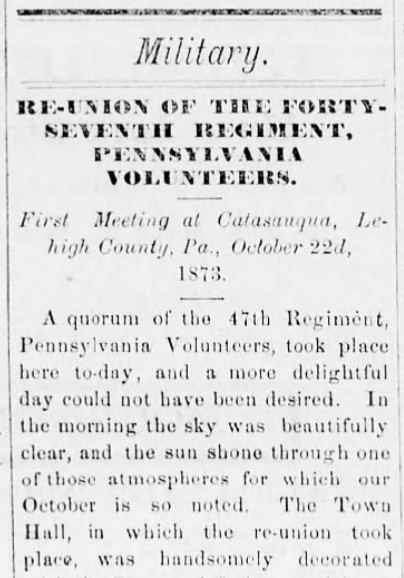
Newspaper headline regarding the first reunion of 47th Pennsylvania Volunteer Infantry veterans in Catasauqua, Pennsylvania on October 22, 1873 (The Newport News, Newport, Pennsylvania, November 8, 1873, public domain).
The first official gathering of 47th Pennsylvania Veteran Volunteers took place in the Borough of Catasauqua in Lehigh County, Pennsylvania on October 22, 1873, and was attended by more than eighty of the regiment’s former officers and enlisted men who had been greeted by the “Committee of Arrangements” upon their arrival at Catasauqua’s train station shortly after noon that day, according to The Newport News. Dressed either in their old uniforms or the newer uniforms of the Grand Army of the Republic (G.A.R.), they lined up behind “the City Cornet Band of Allentown,” and “were conducted to the ‘Mansion House,’ (Captain Harte, proprietor), which was decorated with flags and evergreens, and had the words, “Welcome 47th,” on the front of the piazza, wreathed with evergreens.”
“Here a general hand-shaking took place, congratulations of a hearty character were given, and old friendships renewed which had not been formed under such pleasant circumstances. There were probably a hundred present from various places — Allentown, Easton, and Northumberland and Perry counties…. Among those of the 47th we noticed Cols. Gobin and Good, the former of Lebanon, and the latter of Allentown; Capts. Hart and Gilbert of Catasauqua; Capt. Yard and Lieutenants Bonstine and Wycker, of Easton; Capt. Beard, of Harrisburg; Lieuts. Balliet and Stuber, Captains Kleckner and Leisenring, of Allentown; Assistant Surgeon Scheetz of Pottstown, and Quartermaster F. Z. Heebner, of Allentown.”
Their business meeting then began at 2 p.m. in the town hall, which “was handsomely decorated with the Stars and Stripes, and hung with wreaths and festoons of evergreens and flowers,” according to The Newport News. An “address of welcome was made by M. H. Horn, Cashier of the Catasauqua National Bank,” who spoke of “the terrible and sanguinary conflicts, the sufferings on the battlefield, in prison pens, in the hospital — and the honored dead,” and observed that the 47th Pennsylvania Volunteers had “shared in all [those] scenes.”
“You helped to save our honored institutions. Your share of this work has been recorded upon the pages of history, and has been read and re-read by thousands, and will be read by thousands yet unborn. Your object here to-day is to talk over the past, and to take steps towards securing a series of reunions. May your proceedings be harmonious and pleasant, and may your re-unions be continued until none of you survive, and may you all at last join in that re-union in a better land, where there is no war, but all is peace.”
The 47th Pennsylvanians then elected a temporary slate of officers and appointed a five-member committee to help guide them in the formation of their own, new veterans’ group. Their former commanding officer, John Peter Shindel Gobin, who had been appointed to serve as the chairman of their association’s first board of directors, then delivered his own address, during which he called to mind the highs and terrible lows of their long tenure of service. According to The Newport News, “His speech was well received.”
Allentown’s mayor, Theodore C. Yeager, M.D., then stepped up to the podium, “alluded to the trial and hardships … and paid a glowing tribute to the services of the gallant 47th.”
The Committee on Organization, which was chaired by the regiment’s founder and Allentown’s former mayor, Tilghman H. Good, followed with a report regarding the planning and costs related to that first reunion, after which a roll call was conducted to formally document the names of the 47th Pennsylvania Veteran Volunteers who were present for that historic occasion.
Additional business matters were then debated — the result of which was the approval of the group’s official name — “Association of the 47th Regiment, Pennsylvania Volunteers” — and of its mission statement — “to revive and cement friendship formed in the ranks, and promote the social feeling so desirable, and that should exist between the men whose names are found on the rolls of the 47th Regiment, Pennsylvania Volunteers.” Vice presidents, who had just been elected by the group to represent the companies in which they had served during the war, were then charged with reaching out to their former comrades to urge them to join the regiment’s new association. “William Weiss was designated as Secretary on Membership, and instructed to prepare a record book” that would keep track of “the name and Post Office address of each member,” including the musicians of the former Regimental Band, who were expected to reunite under the baton of the 47th’s second bandmaster, Anthony B. Bush.
The date chosen for their next reunion was Thursday, October 22, 1874. Also scheduled to take place on the anniversary of the Battle of Pocotaligo, it would be held in Allentown — as would many subsequent gatherings of 47th Pennsylvanians. One, in particular, would prove to be the most memorable of all — for the veterans and for their families.
Making History Yet Again

Allentown Militia, Soldiers and Sailors Monument Dedication, Allentown, Pennsylvania, 1899 (public domain).
Without question, the most notable of the reunions held by the Association of the 47th Regiment, Pennsylvania Volunteers was the one that was planned to coincide with the anniversary of the Battle of Cedar Creek in 1899 — a history-making year in which the Lehigh County Soldiers and Sailors Monument was scheduled to be unveiled and dedicated in the city of Allentown.
Designated as “Monument Day,” October 19, 1899 had officially been declared as a holiday for students and many workers across the city. According to the October 5 edition of The Allentown Leader that year, all schools were to be closed so that students and their families could participate in the parade and dedication ceremony, with as many as one thousand elementary school students expected to be on hand to “sing national anthems at the unveiling exercises.” As planning for the celebration continued to unfold, leaders of the Association of the 47th Regiment, Pennsylvania Volunteers announced that veterans of the regiment would “carry their old tattered flag that was used in the war” when marching in the parade that would be held prior to the dedication ceremony.
And when that parade began? It was breathtaking. An estimated fifteen thousand marchers from one hundred twenty-five organizations, “representing the principal towns and cities in the eastern section of the state,” were stretched out along a two-mile line, according to various newspaper accounts that would later describe the procession as “the largest and grandest demonstration in the history of the city.” The parade’s chief marshal, Corporal Francis Daeufer, a veteran of the 47th Pennsylvania’s Company I, ensured that each of the divisions (Grand Army of the Republic, Union Veteran Legion, Sons of Veterans, Patriotic Order Sons of America, Knights of the Golden Eagle, Junior Order United American Mechanics, Improved Order of Red Men, the city’s fire department, Survivors of the Forty-seventh Regiment, Soldiers and Sailors of the Spanish-American War, Knights of Pythias, Knights of Friendship, Knights of the Mystic Chain, National Guard of Pennsylvania, and various other organizations) stepped off on time and kept the parade flowing with energy and efficiency.
In its follow-up coverage, The Allentown Leader estimated that the total crowd may have reached sixty thousand men, women and children, many of whom cheered and waved American flags as the aging veterans marched past them. Roughly fifteen thousand of those attendees then “massed on the Square” for the actual monument dedication, during which a group of daughters and granddaughters of Civil War veterans assisted with the monument’s unveiling while younger children sang the Star-Spangled Banner.
No other regimental reunion, no matter how well planned in years to come, would ever eclipse those inspiring events of Monument Day. Memories of long-forgotten sacrifices were rekindled and wounded hearts were healed as Americans put aside their differences to pay sincere tribute to the men who had given their all to save the United States of America.
Sources:
- “47th Reunion.” Allentown, Pennsylvania: The Allentown Leader, October 13, 1899.
- Bates, Samuel P. History of Pennsylvania Volunteers, 1861-5, vol. 1. Harrisburg, Pennsylvania: B. Singerly, State Printer, 1869.
- “Board of Control: Legislation for the Benefit of Allentown Schools: Monument Day Will Be a Holiday.” Allentown, Pennsylvania: The Allentown Leader, October 5, 1899.
- Gobin, John Peter Shindel. Personal Letters, 1861-1865. Northumberland, Pennsylvania: Personal Collection of John Deppen.
- Irwin, Richard Bache. History of the Nineteenth Army Corps. New York, New York: G. P. Putnam’s Sons, 1893.
- Lambert, James F. and Henry J. Reinhard. A History of Catasauqua in Lehigh County Pennsylvania. Allentown, Pennsylvania: The Searle & Dressler Co., Inc., 1914.
- “Program Adopted: Order of Exercises for Unveiling Decided Upon.” Allentown, Pennsylvania: The Allentown Leader, October 5, 1899.
- Reports of Colonel Tilghman H. Good, Forty-seventh Pennsylvania Infantry and acting commander, First Brigade, Tenth Army Corps, in The War of the Rebellion: A Compilation of the Official Records of the Union and Confederate Armies. Prepared Under the Direction of the Secretary of War, By Lieut. Col. Robert N. Scott, Third U.S. Artillery, and Published Pursuant to Act of Congress Approved June 16, 1880 (series I, vol. XIV). Washington, D.C.: Government Printing Office, 1885.
- “Reunion of the Forty-Seventh Regiment, Pennsylvania Volunteers: First Meeting at Catasauqua, Lehigh County, Pa., October 22d, 1873,” in “Military.” Newport, Pennsylvania: The Newport News, November 8, 1873.
- “Roster of the 47th P. V. Inf.” Allentown, Pennsylvania: The Morning Call, October 26, 1930.
- Schmidt, Lewis. A Civil War History of the 47th Regiment of Pennsylvania Veteran Volunteers. Allentown, Pennsylvania: Self-published, 1986.
- Sheridan, Philip Henry. Personal Memoirs of P. H. Sheridan, General, United States Army in Two Volumes. New York, New York: Charles L. Webster & Company, 1888.
- “The Forty-Seventh in Annual Reunion: Anniversary of Pocotaligo Was Celebrated by Veterans: Met at South Bethlehem.” Allentown, Pennsylvania: The Morning Call, October 23, 1908.
- “The History of the Forty-Seventh Regt. P. V.” Allentown, Pennsylvania: The Lehigh Register, July 20, 1870.
- Wharton, Henry D. Letters from the Sunbury Guards. Sunbury, Pennsylvania: Sunbury American, 1861-1868.


You must be logged in to post a comment.