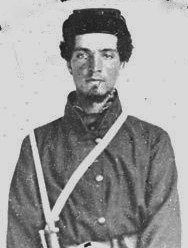
Red Octobers: Remembering Two of the 47th Pennsylvania Volunteers’ Costliest Battles

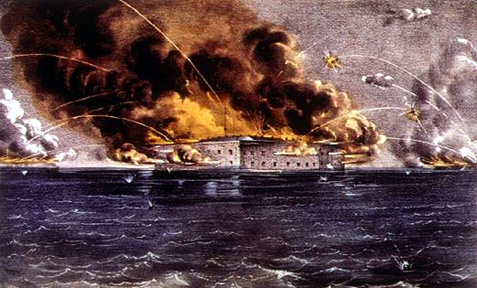
“The Commencement of the Battle Near Pocotaligo River” (Frank Leslie’s Illustrated Newspaper, October 1862, public domain; click to enlarge).

“The rebels here had every advantage of ground, being ensconced in a wood, with a deep swamp in front, passable only by a narrow causeway, on which the bridge had been destroyed, while, on our side of the swamp and along the entire front and flanks of the enemy (extending to the swamps), was an impervious thicket, intersected by a deep water ditch, and passable only by a narrow road. Into this road the rebels threw a most terrific fire of grape, shot, shell, canister, and musket balls, killing and wounding great numbers of my command.” — Brigadier-General John M. Brannan, commanding, Battle of Pocotaligo, South Carolina (October 22, 1864)

“This victory was, to us, of company C, dearly bought…. It is my painful duty to inform you of the news and I will now give you our loss in killed wounded and missing.” — Field Musician Henry D. Wharton, drummer, 47th Pennsylvania Volunteers, Battle of Cedar Creek, Virginia (October 19, 1864)


The month of October was often a confusing one for many veterans of the 47th Pennsylvania Volunteer Infantry, bringing with it the conflicting emotions of pride and profound grief, as memories of bloody battles bravely waged on distant fields long ago suddenly began reinserting themselves into their daytime thoughts and haunting their dreams.

For some, the “time machine” of memory transported them back to South Carolina in 1862 when nearly one hundred and fifty members of the regiment were seriously wounded or killed in action during the Battle of Pocotaligo — the first major combat experience for the 47th Pennsylvania Volunteers. Others flashed back to 1864 — when the regiment lost the equivalent of nearly two full companies of men during the Battle of Cedar Creek, Virginia.

But as painful and frightening as those memories often were, the 47th Pennsylvania Veteran Volunteers also knew that their service to the nation had genuinely mattered. Each, in his own way, had helped to save the United States of America from disunion.

So it will come as no surprise, then, to learn that many of the surviving members of the 47th Pennsylvania made a concerted effort to schedule their get-togethers in conjunction with the anniversaries of those two battles. More often than not, those annual reunions fell on the actual anniversary of the Battle of Pocotaligo — October 22.

The First Reunion

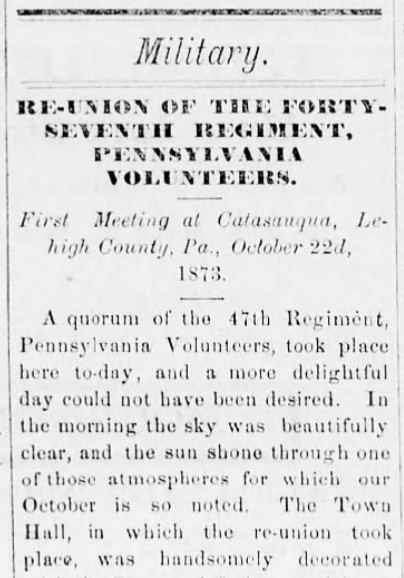
Newspaper headline regarding the first reunion of 47th Pennsylvania Volunteer Infantry veterans in Catasauqua, Pennsylvania on October 22, 1873 (The Newport News, Newport, Pennsylvania, November 8, 1873, public domain).

The first official gathering of 47th Pennsylvania Veteran Volunteers took place in the Borough of Catasauqua in Lehigh County, Pennsylvania on October 22, 1873, and was attended by more than eighty of the regiment’s former officers and enlisted men who had been greeted by the “Committee of Arrangements” upon their arrival at Catasauqua’s train station shortly after noon that day, according to The Newport News. Dressed either in their old uniforms or the newer uniforms of the Grand Army of the Republic (G.A.R.), they lined up behind “the City Cornet Band of Allentown,” and “were conducted to the ‘Mansion House,’ (Captain Harte, proprietor), which was decorated with flags and evergreens, and had the words, “Welcome 47th,” on the front of the piazza, wreathed with evergreens.”

“Here a general hand-shaking took place, congratulations of a hearty character were given, and old friendships renewed which had not been formed under such pleasant circumstances. There were probably a hundred present from various places — Allentown, Easton, and Northumberland and Perry counties…. Among those of the 47th we noticed Cols. Gobin and Good, the former of Lebanon, and the latter of Allentown; Capts. Hart and Gilbert of Catasauqua; Capt. Yard and Lieutenants Bonstine and Wycker, of Easton; Capt. Beard, of Harrisburg; Lieuts. Balliet and Stuber, Captains Kleckner and Leisenring, of Allentown; Assistant Surgeon Scheetz of Pottstown, and Quartermaster F. Z. Heebner, of Allentown.”

Their business meeting then began at 2 p.m. in the town hall, which “was handsomely decorated with the Stars and Stripes, and hung with wreaths and festoons of evergreens and flowers,” according to The Newport News. An “address of welcome was made by M. H. Horn, Cashier of the Catasauqua National Bank,” who spoke of “the terrible and sanguinary conflicts, the sufferings on the battlefield, in prison pens, in the hospital — and the honored dead,” and observed that the 47th Pennsylvania Volunteers had “shared in all [those] scenes.”

“You helped to save our honored institutions. Your share of this work has been recorded upon the pages of history, and has been read and re-read by thousands, and will be read by thousands yet unborn. Your object here to-day is to talk over the past, and to take steps towards securing a series of reunions. May your proceedings be harmonious and pleasant, and may your re-unions be continued until none of you survive, and may you all at last join in that re-union in a better land, where there is no war, but all is peace.”

The 47th Pennsylvanians then elected a temporary slate of officers and appointed a five-member committee to help guide them in the formation of their own, new veterans’ group. Their former commanding officer, John Peter Shindel Gobin, who had been appointed to serve as the chairman of their association’s first board of directors, then delivered his own address, during which he called to mind the highs and terrible lows of their long tenure of service. According to The Newport News, “His speech was well received.”

Allentown’s mayor, Theodore C. Yeager, M.D., then stepped up to the podium, “alluded to the trial and hardships … and paid a glowing tribute to the services of the gallant 47th.”

The Committee on Organization, which was chaired by the regiment’s founder and Allentown’s former mayor, Tilghman H. Good, followed with a report regarding the planning and costs related to that first reunion, after which a roll call was conducted to formally document the names of the 47th Pennsylvania Veteran Volunteers who were present for that historic occasion.

Additional business matters were then debated — the result of which was the approval of the group’s official name — “Association of the 47th Regiment, Pennsylvania Volunteers” — and of its mission statement — “to revive and cement friendship formed in the ranks, and promote the social feeling so desirable, and that should exist between the men whose names are found on the rolls of the 47th Regiment, Pennsylvania Volunteers.” Vice presidents, who had just been elected by the group to represent the companies in which they had served during the war, were then charged with reaching out to their former comrades to urge them to join the regiment’s new association. “William Weiss was designated as Secretary on Membership, and instructed to prepare a record book” that would keep track of “the name and Post Office address of each member,” including the musicians of the former Regimental Band, who were expected to reunite under the baton of the 47th’s second bandmaster, Anthony B. Bush.

The date chosen for their next reunion was Thursday, October 22, 1874. Also scheduled to take place on the anniversary of the Battle of Pocotaligo, it would be held in Allentown — as would many subsequent gatherings of 47th Pennsylvanians. One, in particular, would prove to be the most memorable of all — for the veterans and for their families.

Making History Yet Again

Allentown Militia, Soldiers and Sailors Monument Dedication, Allentown, Pennsylvania, 1899 (public domain).

Without question, the most notable of the reunions held by the Association of the 47th Regiment, Pennsylvania Volunteers was the one that was planned to coincide with the anniversary of the Battle of Cedar Creek in 1899 — a history-making year in which the Lehigh County Soldiers and Sailors Monument was scheduled to be unveiled and dedicated in the city of Allentown.

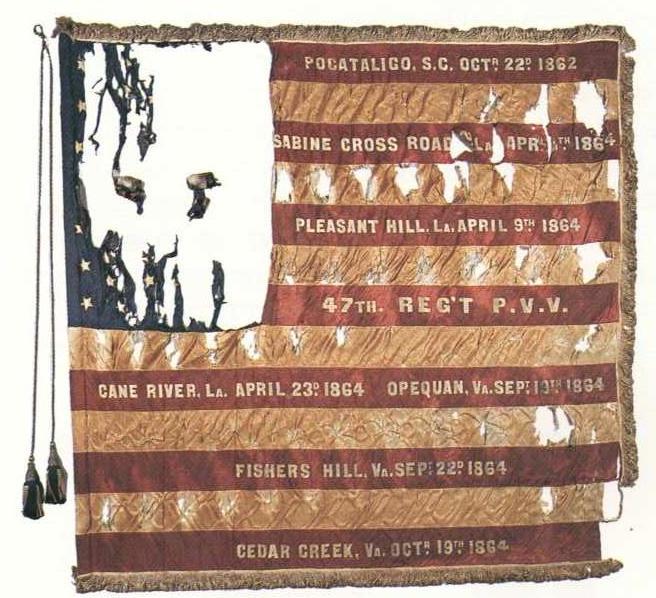
Designated as “Monument Day,” October 19, 1899 had officially been declared as a holiday for students and many workers across the city. According to the October 5 edition of The Allentown Leader that year, all schools were to be closed so that students and their families could participate in the parade and dedication ceremony, with as many as one thousand elementary school students expected to be on hand to “sing national anthems at the unveiling exercises.” As planning for the celebration continued to unfold, leaders of the Association of the 47th Regiment, Pennsylvania Volunteers announced that veterans of the regiment would “carry their old tattered flag that was used in the war” when marching in the parade that would be held prior to the dedication ceremony.

And when that parade began? It was breathtaking. An estimated fifteen thousand marchers from one hundred twenty-five organizations, “representing the principal towns and cities in the eastern section of the state,” were stretched out along a two-mile line, according to various newspaper accounts that would later describe the procession as “the largest and grandest demonstration in the history of the city.” The parade’s chief marshal, Corporal Francis Daeufer, a veteran of the 47th Pennsylvania’s Company I, ensured that each of the divisions (Grand Army of the Republic, Union Veteran Legion, Sons of Veterans, Patriotic Order Sons of America, Knights of the Golden Eagle, Junior Order United American Mechanics, Improved Order of Red Men, the city’s fire department, Survivors of the Forty-seventh Regiment, Soldiers and Sailors of the Spanish-American War, Knights of Pythias, Knights of Friendship, Knights of the Mystic Chain, National Guard of Pennsylvania, and various other organizations) stepped off on time and kept the parade flowing with energy and efficiency.

In its follow-up coverage, The Allentown Leader estimated that the total crowd may have reached sixty thousand men, women and children, many of whom cheered and waved American flags as the aging veterans marched past them. Roughly fifteen thousand of those attendees then “massed on the Square” for the actual monument dedication, during which a group of daughters and granddaughters of Civil War veterans assisted with the monument’s unveiling while younger children sang the Star-Spangled Banner.

No other regimental reunion, no matter how well planned in years to come, would ever eclipse those inspiring events of Monument Day. Memories of long-forgotten sacrifices were rekindled and wounded hearts were healed as Americans put aside their differences to pay sincere tribute to the men who had given their all to save the United States of America.


Sources:

  1. “47th Reunion.” Allentown, Pennsylvania: The Allentown Leader, October 13, 1899.
  2. Bates, Samuel P. History of Pennsylvania Volunteers, 1861-5, vol. 1. Harrisburg, Pennsylvania: B. Singerly, State Printer, 1869.
  3. “Board of Control: Legislation for the Benefit of Allentown Schools: Monument Day Will Be a Holiday.” Allentown, Pennsylvania: The Allentown Leader, October 5, 1899.
  4. Gobin, John Peter Shindel. Personal Letters, 1861-1865. Northumberland, Pennsylvania: Personal Collection of John Deppen.
  5. Irwin, Richard Bache. History of the Nineteenth Army Corps. New York, New York: G. P. Putnam’s Sons, 1893.
  6. Lambert, James F. and Henry J. Reinhard. A History of Catasauqua in Lehigh County Pennsylvania. Allentown, Pennsylvania: The Searle & Dressler Co., Inc., 1914.
  7. “Program Adopted: Order of Exercises for Unveiling Decided Upon.” Allentown, Pennsylvania: The Allentown Leader, October 5, 1899.
  8. Reports of Colonel Tilghman H. Good, Forty-seventh Pennsylvania Infantry and acting commander, First Brigade, Tenth Army Corps, in The War of the Rebellion: A Compilation of the Official Records of the Union and Confederate Armies. Prepared Under the Direction of the Secretary of War, By Lieut. Col. Robert N. Scott, Third U.S. Artillery, and Published Pursuant to Act of Congress Approved June 16, 1880 (series I, vol. XIV). Washington, D.C.: Government Printing Office, 1885.
  9. “Reunion of the Forty-Seventh Regiment, Pennsylvania Volunteers: First Meeting at Catasauqua, Lehigh County, Pa., October 22d, 1873,” in “Military.” Newport, Pennsylvania: The Newport News, November 8, 1873.
  10. “Roster of the 47th P. V. Inf.” Allentown, Pennsylvania: The Morning Call, October 26, 1930.
  11. Schmidt, Lewis. A Civil War History of the 47th Regiment of Pennsylvania Veteran Volunteers. Allentown, Pennsylvania: Self-published, 1986.
  12. Sheridan, Philip Henry. Personal Memoirs of P. H. Sheridan, General, United States Army in Two Volumes. New York, New York: Charles L. Webster & Company, 1888.
  13. “The Forty-Seventh in Annual Reunion: Anniversary of Pocotaligo Was Celebrated by Veterans: Met at South Bethlehem.” Allentown, Pennsylvania: The Morning Call, October 23, 1908.
  14. “The History of the Forty-Seventh Regt. P. V.” Allentown, Pennsylvania: The Lehigh Register, July 20, 1870.
  15. Wharton, Henry D. Letters from the Sunbury Guards. Sunbury, Pennsylvania: Sunbury American, 1861-1868.


Election Day 1864 — Lincoln or McClellan? How the 47th Pennsylvania Volunteers Voted

The platforms of the Union and Democratic parties, U.S. Presidential Election of 1864 (courtesy of the University of Illinois Urbana-Champaign; click to enlarge).

Even in the midst of a devastating civil war, Americans across the United States managed to come together to fulfill their civic responsibilities by voting on Election Day. Fathers and sons flocked to city and small town polling places while soldiers on active duty filled out ballot forms wherever they were stationed during the early to mid-1860s.

With respect to the Presidential Election of 1864, which was held in multiple states across America on November 8, 1864, that voting took place for members of the 47th Pennsylvania Volunteer Infantry at their encampment near Newtown, Virginia, according to a letter that was subsequently penned by 47th Pennsylvanian Henry D. Wharton to his hometown newspaper in Sunbury, Pennsylvania on November 14:

“The election passed off quietly and without any military interference, not the influence of officers used in controlling any man’s vote. In the regiments from the old Keystone, the companies were formed by the first Sergeant, when he stated to the men the object for which they were called to ‘fail to,’ and then they proceeded to the election of officers to hold the election – the boys having the whole control, none of the officers interfering in the least.”

Were the 47th Pennsylvania Volunteers pro-Lincoln or pro-McClellan?

Excerpt from Henry Wharton’s letter to his hometown newspaper, November 14, 1864 (The Sunbury American, November 14, 1864, public domain; click to enlarge).

Wharton reported that, after the votes from members of the regiment were counted, President Abraham Lincoln was the favored choice of most of the 47th Pennsylvania Volunteers. Lincoln had garnered one hundred and ninety-four votes to General George B. McClellan’s one hundred and twenty-one (a margin of seventy-three votes). Those votes, by individual company, were tallied as follows:

  • Company A: President Lincoln (ten); General McClellan (one)
  • Company B: President Lincoln (twenty-six); General McClellan (two)
  • Company C: President Lincoln (twenty-nine); General McClellan (thirteen)
  • Company D: President Lincoln (thirty-one); General McClellan (eleven)
  • Company E: President Lincoln (twenty-four); General McClellan (three)
  • Company F: President Lincoln (eighteen); General McClellan (sixteen)
  • Company G: President Lincoln (nine); General McClellan (thirteen)
  • Company H: President Lincoln (ten); General McClellan (twenty-four)
  • Company I: President Lincoln (nineteen); General McClellan (sixteen)
  • Company K: President Lincoln (eighteen); General McClellan (twenty)

But Wharton’s figures for the men from Company K were incorrect, according to historian Lewis Schmidt, who noted in his book, A Civil War History of the 47th Regiment of Pennsylvania Veteran Volunteers, that “Fifteen of the members [of Company K] voted for the Lincoln electors and seven for the McClellan electors” when they “voted on the battlefield of Cedar Creek, November 8, 1864.” The members of Company K who cast votes that day were: “David H. Fetherolf, Mathias Miller, John Keiser, Phaon Guth, James D. Weil, Daniel Strauss, Paul Strauss, George Sherer, Lewis G. Seip, Henry Hantz, Charles W. Abbott, George Kase, Charles Stoudt, William Schlicher, William F. Knerr, E. F. Benner, George Delp, Tilghman Boger, William H. Barber, William D. Schick, Frank Beisel, and David Semmel.”

Apathy or Attrition?

One of the first things that researchers notice when looking at those figures for the 1864 election is that the number of votes tendered by 47th Pennsylvania Volunteers that November day was lower than it should have been — shockingly so when considering that each company of the regiment had been staffed by roughly one hundred men when the 47th Pennsylvania left Camp Curtin and headed for Washington, D.C. three years earlier. The turnout of 47th Pennsylvanians was not a sign of voter apathy, however, but of a simple, ugly truth. The regiment had just recently lost the equivalent of nearly two full companies of men in combat. According to Wharton, “The battle at Cedar Creek thinned our ranks by which we lost many votes – this number and those away in hospitals would have increased the Union majority to three hundred.”

* Note: When Henry Wharton wrote the phrase “Union majority,” he was referring to the National Union Party, which had been established during the 1860s by prominent Republicans as a way to bring members of their party together with “War Democrats” and potential voters from border states to vote for President Lincoln and others who supported the Republican platform for eradicating chattel slavery and ending the nation’s secession crisis and civil war.

What Happened After That Election in 1864?

President Abraham Lincoln signing the Emancipation Proclamation in 1862 (W.E. Winner, painter, J. Serz, engraver, circa 1864; public domain, U.S. Library of Congress).

Successful in his bid for re-election, both in terms of the electoral college and popular vote, President Abraham Lincoln went on to deliver one of his most inspiring addresses to the nation, urging his fellow Americans “to bind up the nation’s wounds” and “do all which may achieve and cherish a just and lasting peace among ourselves and with all nations.” He then continued to shepherd his nation through one of its darkest times until the war was finally over.

Food for Thought

If Henry Wharton and his fellow soldiers could make it to the polls on Election Day after all they endured in battle, so can you. Please vote. Your voice does matter.


Sources:

  1. “Political Party Timeline: 1836-1864,” in American Experience: Abraham and Mary Lincoln: A House Divided. Boston, Massachusetts: GBH Education for WGBH-TV (PBS), 2001.
  2. Schmidt, Lewis G. A Civil War History of the 47th Regiment of Pennsylvania Veteran Volunteers. Allentown, Pennsylvania: Self-published, 1986.
  3. “The People’s Candidate: Lincoln’s Presidential Elections,” in “Illinois History & Lincoln Collections.” Urbana, Illinois: Main Library, University of Illinois Champaign-Urbana, retrieved online November 3, 2025.
  4. Transcript of Abraham Lincoln’s Second Inaugural Address (delivered Saturday March 4, 1865), in “UShistory.org.” Philadelphia, Pennsylvania: Independence Hall Association, retrieved online March 4, 2020 and November 3, 2025.
  5. Wharton, Henry D. “Letter from the Sunbury Guards, Near Newtown, VA, November 14, 1864.” Sunbury, Pennsylvania: The Sunbury American, November 26, 1864.

April 12th: This Date in 47th Pennsylvania Volunteer Infantry History

April 12th would prove to be an important date for the men who served with the 47th Pennsylvania Volunteer Infantry during the American Civil War and Reconstruction eras. This abridged timeline illustrates why:

1861

The bombardment of Fort Sumter 12-14 April 1861 (Currier & Ives, public domain).

At 4:30 a.m., on April 12, 1861, artillery batteries of the Confederate States Army open fire on United States Army troops stationed at Fort Sumter in Charleston, South Carolina. A long and disastrous period of civil war begins in America.

The majority of Pennsylvanians and residents of other states throughout America who will ultimately serve with the 47th Pennsylvania Volunteer Infantry are at home, asleep in their beds — or just rising and readying themselves for their work days on family farms, as canal boatmen, in iron foundries, silk mills, tanneries or tobacco factories, as quarrymen toiling away in the slate industry, or as miners tunneling deeper inside of the Earth in poorly-lighted coal mines, along with countless other blue collar laborers who are risking their own health and safety just to keep their families housed and fed.

The 47th Pennsylvania Volunteer Infantry isn’t even “a glimmer” in anyone’s eyes — yet. (It won’t be founded until August 5, 1861.)

1862

In 1862, The Gazette, one of two hometown newspapers read by the majority of men serving with the 47th Pennsylvania Volunteer Infantry’s C Company, carries the following news in its April 12th edition:

Jeff. Davis is becoming desperate. He has issued an extraordinary Message ordering the enrollment of all citizens of the Confederate States between the ages of 18 and 35, for military service, the residue of the fighting population, above 35 to form a fighting force.

Although that particular edition of the newspaper has not yet reached the 47th Pennsylvania Volunteers who are stationed in Florida, a warning about the Confederate Conscription Act’s pending passage has likely been telegraphed by the U.S. War Department to senior officers at the 47th Pennsylvania’s headquarters at Fort Taylor in Key West in order to prepare them for the increased threat they and their troops will face.

1864

On April 12, 1864, Captain Charles William Abbott, commanding officer of the 47th Pennsylvania Volunteer Infantry’s K Company, pens a brief report from his regiment’s camp at Grand Ecore, Louisiana to his superior officers in the United States Army of the Gulf, which partially documents the losses in soldiers and supplies sustained by his regiment during the Battle of Pleasant Hill, Louisiana on April 9, 1864. That report also contains details about the regiment’s movements during this phase of duty.

Sergeant John Gross Helfrich then describes this same battle in a letter to his parents on May 5th, in which he notes:

I have learned additional news of the late fight of our boys of the “Nineteenth Corps”…. The casualties of our boys amounted to a great deal more than at first reported. The Lt. Col. of our Forty-seventh Regt. is missing, and supposed he is wounded or perhaps killed. Lt. Swoyer is dead.

1865

In a letter that he is writing to the Sunbury American on April 12, 1865 from the 47th Pennsylvania Volunteer Infantry’s camp near Summit Point, Virginia, 47th Pennsylvanian Henry D. Wharton describes a celebration that took place following the surrender at Appomattox by Confederate General Robert E. Lee and his army on April 9, 1865:

Since yesterday a week we have been on the move, going as far as three miles beyond Winchester. There we halted for three days, waiting for the return or news from Torbett’s cavalry who had gone on a reconnoisance [sic] up to the valley. They returned, reporting they were as far up as Mt. Jackson, some sixty miles, and found nary an armed reb. The reason of our move was to be ready in case Lee moved against us, or to march on Lynchburg, if Lee reached that point, so that we could aid in surrounding him and [his] army, and with Sheridan and Mead capture the whole party. Grant’s gallant boys saved us that march and bagged the whole crowd. Last Sunday night our camp was aroused by the loud road of artillery. Hearing so much good news of late, I stuck to my blanket, not caring to get up, for I suspected a salute, which it really was for the ‘unconditional surrender of Lee.’ The boys got wild over the news, shouting till they were hoarse, the loud huzzas [sic, huzzahs] echoing through the Valley, songs of ‘rally round the flag,’ &c., were sung, and above the noise of the ‘cannons opening roar,’ and confusion of camp, could be heard ‘Hail Columbia’ and Yankee Doodle played by our band. Other bands took it up and soon the whole army let loose, making ‘confusion worse confounded.’

The next morning we packed up, struck tents, marched away, and now we are within a short distance of our old quarters. – The war is about played out, and peace is clearly seen through the bright cloud that has taken the place of those that darkened the sky for the last four years. The question now with us is whether the veterans after Old Abe has matters fixed to his satisfaction, will have to stay ‘till the expiration of the three years, or be discharged as per agreement, at the ‘end of the war.’ If we are not discharged when hostilities cease, great injustice will be done.

The members of Co. ‘C,’ wishing to do honor to Lieut. C. S. Beard, and show their appreciation of him as an officer and gentleman, presented him with a splendid sword, sash and belt. Lieut. Beard rose from the ranks, and as one of their number, the boys gave him this token of esteem.

A few nights ago, an aid [sic] on Gen. Torbett’s staff, with two more officers, attempted to pass a safe guard stationed at a house near Winchester. The guard halted the party, they rushed on, paying no attention to the challenge, when the sentinel charged bayonet, running the sharp steel through the abdomen of the aid [sic], wounding him so severely that he died in an hour. The guard did his duty as he was there for the protection of the inmates and their property, with instruction to let no one enter.

The boys are all well, and jubilant over the victories of Grant, and their own little Sheridan, and feel as though they would soon return to meet the loved ones at home, and receive a kind greeting from old friends….

1866

On April 12, 1866, members of the 47th Pennsylvania Veteran Volunteers who survived the American Civil War are three months into their post-war civilian lives. Many are back home in Pennsylvania, trying to regain some sense of their old selves with normal work and family routines. Others have already left their pre-war and war lives behind, choosing to migrate west in search of better opportunities — or a certain peace of mind they hope to find in knowing they will be far away from any decision-makers who might drag their communities and nation back down into another disastrous war in the future.


Sources:

  1. Abbott, Charles W. Report from Captain Charles W. Abbott, Captain, Company K, 47th Pennsylvania Volunteer Infantry, to Senior Officers of the U.S. Army of the Gulf’s XIX Corps (19th Corps), Grand Ecore, Louisiana, April 12, 1864. Nazareth, Pennsylvania: Personal Collection of Julian Burley.
  2. “Agriculture and Rural Life,” in “Stories from PA History.” Harrisburg, Pennsylvania: Pennsylvania Historical and Museum Commission, 2023.
  3. “Fort Sumter and Fort Moultrie National Park.” Washington, D.C.: National Park Foundation, retrieved online April 12, 2025.
  4. Harris, Howard and Perry K. Blatz. Keystone of Democracy: A History of Pennsylvania Workers. Harrisburg, Pennsylvania: Pennsylvania Historical and Museum Commission, 1999.
  5. Helfrich, John Gross. Letter to His Parents, May 5, 1864. Mesa, Arizona: Personal Collection of the Colin Cofield Family Archives.
  6. Miller, Randall M. and William A. Pencak. Pennsylvania: A History of the Commonwealth. University Park, Pennsylvania: The Pennsylvania State University Press, 2002.
  7. “Mining Anthracite,” in “Stories from PA History.” Harrisburg, Pennsylvania: Pennsylvania Historical and Museum Commission, 2023.
  8. Montgomery, Morton L. Early Furnaces and Forges of Berks County, Pennsylvania, in The Pennsylvania Magazine of History and Biography, 1884. Philadelphia, Pennsylvania: Historical Society of Pennsylvania, 1884.
  9. News Regarding the Confederate States’ New Conscription Order. Sunbury, Pennsylvania: The Gazette, April 12, 1862.
  10. Palladino, Grace. Another Civil War: Labor, Capital, and the State in the Anthracite Regions of Pennsylvania, 1840-1868. New York, New York: Fordham University Press, March 30, 2006.
  11. Sacher, John M. Confederate Conscription and the Struggle for Southern Soldiers. Baton Rouge, Louisiana: LSU Press, 2021.
  12. “The Industrial Age,” in “Stories from PA History: Science and Invention.” Harrisburg, Pennsylvania: Pennsylvania Historical and Museum Commission, 2023.
  13. “The Pennsylvania Iron Industry: Furnace and Forge of America,” in “Stories from PA History.” Harrisburg, Pennsylvania: Pennsylvania Historical and Museum Commission, 2023.
  14. “The Railroad in Pennsylvania,” in “Stories from PA History.” Harrisburg, Pennsylvania: Pennsylvania Historical and Museum Commission, 2023.
  15. “Timeline of Labor History in Pennsylvania.” Pennsylvania: Pennsylvania Labor History Society, retrieved online April 12, 2025.


The Backbones of a Nation: The Laborers Who Enlisted with the 47th Pennsylvania Volunteer Infantry

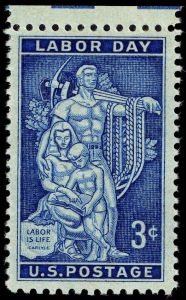
“Labor Is Life” (U.S. Postal Service’s Labor Day Stamp, 1956, U.S. Library of Congress, public domain).

Bakers, blacksmiths, boatmen, butchers, carpenters, cabinetmakers, cigarmakers, coal miners, factory workers, farmers, gardeners, gold miners, iron workers, masons, quarry workers, teamsters, tombstone carvers. These were just a few of the diverse job titles held by the laborers who enlisted with the 47th Pennsylvania Volunteer Infantry during the American Civil War.

Many returned to their same occupations after the war ended while others found new pathways for their life journeys. Far too many were never able to return to the arms of their loved ones and still rest in marked or unmarked graves far from the Commonwealth of Pennsylvania.

In honor of Labor Day, 47th Pennsylvania Volunteers: One Civil War Regiment’s Story is proud to present this abridged list of blue-collar men and boys who served with the 47th Pennsylvania Volunteer Infantry between August 1861 and January 1866, as well as the names of two of the women associated with the regiment who made their own unforgettable marks on the world.

* Auchmuty, Samuel S. (First Lieutenant, Company D): A native of Duncannon, Perry County and veteran of the Mexican-American War who was employed as a carpenter during the early 1860s, Samuel Auchmuty responded to President Abraham Lincoln’s call for volunteers to defend the nation’s capital during the opening weeks of the American Civil War by enrolling as a first lieutenant with Company D of the newly-formed 47th Pennsylvania Volunteer Infantry on August 20, 1861; after completing his three-year term of enlistment, he was honorably discharged in September 1864 and returned home to Pennsylvania, where he resumed his work as a house carpenter and launched a successful contracting business that was responsible for building new business structures, churches, single-family homes, and schools, as well as renovating existing structures; he died in 1891, following a brief illness;
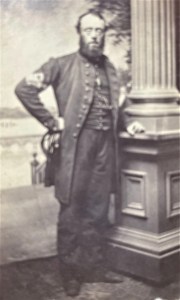
First Sergeant Christian S. Beard, circa 1863 (public domain).

* Beard, Christian Seiler (First Lieutenant, Company C): A twenty-seven-year-old, married carpenter residing in Williamsport, Lycoming County when President Abraham Lincoln called for seventy-five thousand volunteers to defend the nation’s capital, following the fall of Fort Sumter in mid-April 1865, Chistian S. Beard promptly enrolled for Civil War military service before that month was out as a private with Company D of the 11th Pennsylvania Volunteers; honorably discharged in July after completing his Three Months’ Service, he re-enlisted as a sergeant with Company C of the newly-formed 47th Pennsylvania Volunteers on August 19; after rising up through the ranks to become a first lieutenant, he was honorably discharged on Christmas Day, 1865, and returned home to his wife in Dauphin County, Pennsylvania, where he continued to work as a carpenter; after having several children with his wife, he was widowed by her; remarried in 1884, he relocated with his wife and children to Pittsburgh, where he continued to work as a carpenter; ailing with heart and kidney disease, he died there on November 16, 1911 and was interred at that city’s Highwood Cemetery;

* Burke, Thomas (Sergeant, Company I): A first-generation American, Thomas Burke was a twenty-year-old cabinetmaker residing in Allentown at the dawn of the American Civil War; after enrolling for military service on the day that the 47th Pennsylvania Volunteer Infantry was founded (August 5, 1861), he was officially mustered in as a private; from that point on, he continued to work his way up the ranks, receiving a promotion to corporal on September 19, 1864 and then to sergeant on July 11, 1865; honorably mustered out with his company in Charleston, South Carolina on December 25, 1865, he returned home to Lehigh County, where he married and began a family; sometime in early to mid-1871, he and his family migrated west to Iowa, settling in Anamosa, Jones County, where he was employed as a carpenter and contractor; he died at his home there on October 22, 1910 and was buried at that town’s Riverside Cemetery;

* Colvin, John Dorrance (Second Lieutenant, Company C): A native of Abington Township, Lackawanna County who was a farmer when he enlisted for Civil War military service on September 12, 1861, John D. Colvin transferred to the U.S. Army Signal Corps on October 13, 1863, and continued to serve with the Signal Corps for the duration of the war; employed as an engineer, post-war, he helped the Pacific Railroad to extend its service from Atchison, Kansas to Fort Kearney in Nebraska before returning home to Pennsylvania, where he married, began a family and resided with them in Olyphant and Carbondale before relocating with them to Parsons in Luzerne County, where he became a prominent civic leader and member of the school board; initially employed as a machinist, he went on to become superintendent of the Delaware & Hudson Coal company before taking a similar job with the Lehigh Valley Coal Company; the U.S. Postal Service’s postmaster of Parsons during the early 1890s, he died there on March 15, 1901 and was buried at the Hollenback Cemetery in Wilkes-Barre;

* Crownover, James (Sergeant, Company D): A twenty-three-year-old teamster residing in Blain, Perry County when he enrolled for Civil War military service on August 20, 1861, James Crownover rose up through the ranks of the 47th Pennsylvania from private to reach the rank of sergeant; wounded in the right shoulder and captured by Confederate troops during the Battle of Pleasant Hill, Louisiana on April 9, 1864, he was marched to Camp Ford, near Tyler, Texas, the largest Confederate prison camp west of the Mississippi River, where he was held as a prisoner of war (POW) until he was released during a prisoner exchange on November 25, 1864; during captivity, he was commissioned, but not mustered as a second lieutenant; given medical treatment before he was returned to active duty, he was honorably discharged with his regiment in Charleston, South Carolina on December 25, 1865; after returning home, he found work at a tannery near Blain, married, began a family and then relocated with them to East Huntingdon Township, Westmoreland County, where he worked as a teamster; relocating with them to Braddock in Allegheny County after the turn of the century, he worked at a local mill there; he died in Allegheny County on July 18, 1903 and was buried at the Monongahela Cemetery in Braddock Hills;

Jacob Daub, circa 1862-1865 (carte de visite, Cooley & Beckett Photographers, Savannah, Georgia and Beaufort and Hilton Head, South Carolina, public domain).

* Daub, Jacob and William J. (Drummer Boy, Company A): A German immigrant as a child, Jacob Daub emigrated with his parents and younger brother, William, circa 1852; after settling in Easton, Northampton County, Pennsylvania, where his father found work as a stone mason, Jacob grew up to become a cigarmaker, and also became the first of the two brothers to enlist in the American Civil War; after enrolling at the age of sixteen, he was classified as a field musician and assigned to Company A as its drummer boy; his nineteen-year-old brother, William, a carpenter by 1865, followed him into the war when he enlisted as a private with the same company in February of that year; after the war ended, both returned home to Northampton County, where they married, had children and went on to live long, full lives; William eventually died at the age of eighty in 1928, followed by Jacob, who passed away in 1936, roughly two months before his ninety-first birthday;

* Detweiler, Charles C. (Private, Company A): Berks County native Charles Detweiler enrolled for Civil War military service on September 16, 1862; a carpenter who later became a farmer, he served with Company A until he was severely injured in the Battle of Cedar Creek, Virginia, October 19, 1864, when he sustained a musket ball wound to the middle of his thigh; treated at a Union Army hospital in Virginia before being transported to the Union’s Mower General Hospital in Philadelphia, Pennsylvania, he learned that the musket ball had damaged his femur and femoral arteries; following his wound-related death at Mower on March 12, 1865, he was buried at the Fairview Cemetery in Kutztown, Berks County;

* Diaz, John (Private, Company I): An immigrant from Spain’s Canary Islands, John Diaz emigrated sometime between 1862 and 1865 and settled in Philadelphia, Pennsylvania, where he found work as a cigarmaker; on January 25, 1865, at the age of nineteen, he enlisted with the Union Army at a recruiting depot in Norristown, Montgomery County and served as a private with Company I of the 47th Pennsylvania Volunteer Infantry until it was mustered out on Christmas Day, 1865; following his return to Pennsylvania, he resumed work as a cigarmaker in Philadelphia, eventually launching his own cigarmaking firm, which became a family business as his sons became old enough to work for him; sometime between 1906 and 1910, he relocated with his wife and several of his children to Camden County, New Jersey, where he died on September 5, 1915;

James Downs (circa 1880s, public domain).

* Downs, James (Corporal, Company D): A twenty-three-year-old tanner residing in Blain, Perry County when he enrolled for Civil War military service on August 20, 1861, James Downs was captured by Confederate troops during the Battle of Pleasant Hill, Louisiana on April 9, 1864 and marched to Camp Ford, near Tyler, Texas, the largest Confederate prison camp west of the Mississippi River; held there as a prisoner of war (POW) until he was released during a prisoner exchange on July 22, 1864, he received medical treatment and was subsequently returned to active duty; following his honorable discharge with his regiment in Charleston, South Carolina, on December 25, 1865, he returned home, married, began a family and relocated with his family to Phillipsburg, New Jersey; suffering from heart and kidney disease, and possibly also from post-traumatic stress disorder, rather than “insane” as physicians at the Pennsylvania Memorial Home in Brookville, Jefferson County, Pennsylvania had diagnosed him, he fell from a window at that home and died at there on September 16, 1921; he was subsequently interred in the Veterans’ Circle of the Brookville Cemetery;

* Eagle, Augustus (Second Lieutenant, Company F): A German immigrant as a teenager, Augustus Eagle arrived in America on June 23, 1855, two years after his brother, Frederick Eagle, had emigrated and made a life for himself in Catasauqua, Lehigh County, Pennsylvania; both men married and began families there, with Fred employed as a laborer and Gus employed by the Crane Iron Works; when President Abraham Lincoln issued his call for volunteers to defend the nation’s capital during the opening weeks of the American Civil War, both men enrolled for military service on August 21, 1861 as privates with Company F of the 47th Pennsylvania Volunteer Infantry; in 1862, Fred fell ill and was honorably discharged on a surgeon’s certificate of disability, but Gus continued to serve, rising up through the regiment’s enlisted and officers’ ranks; commissioned as a second lieutenant, he was honorably discharged on September 11, 1864, upon completion of his three-year term of service; post-war, Fred became a successful baker with real estate and personal property valued at $4,200 (roughly $155,750 in 2023 dollars) and died in Catasauqua in 1885, while Gus owned a successful restaurant in Whitehall Township before operating the Fairview Hotel, which became a popular spot for political gatherings; after suffering a series of strokes in 1902, Gus died at his home on August 17 and was buried at the Fairview Cemetery in West Catasauqua;

* Eisenbraun, Alfred (Drummer Boy, Company B): A tobacco stripper and first-generation American from Allentown, Lehigh County, fifteen-year-old Alfred Eisenbraun became the second “man” from the 47th Pennsylvania to die when he succumbed to complications from typhoid fever at the Kalorama Eruptive Fever Hospital in Georgetown, District of Columbia on October 26, 1861; he still rests at the U.S. Soldiers’ and Airmen’s Home Cemetery in Washington, D.C.;

* Fink, Aaron (Corporal, Company B): A shoemaker and native of Salisbury Township, Lehigh County, Pennsylvania, Aaron Fink, grew up, began a family and established a successful small shoemaking business, first in Allentown and then in Mauch Chunk (now Jim Thorpe) in Carbon County; on August 20, 1861, he chose to respond to President Abraham Lincoln’s call for volunteers to help bring the American Civil War to a quick end when he enrolled for military service; shot in the right leg during the fighting at the Frampton Plantation during the Battle of Pocotaligo, South Carolina on October 22, 1862, he was treated at the Union Army’s hospital at Hilton Head, South Carolina, but died there from wound-related complications on November 5, 1862; initially buried near that hospital, his remains were later exhumed by Allentown undertaker Paul Balliet and returned to Pennsylvania for reinterment at that city’s Union-West End Cemetery;

* Fornwald, Reily M. (Corporal, Company G): Born in Heidelberg Township, Berks County, Reily Fornwald was raised there on his family’s farm near Stouchsberg; educated in his community’s common schools and then at Millersville State Normal School, he became a railroad worker before returning to farm life shortly before the dawn of the American Civil War; after enlisting for military service at the age of twenty on September 11, 1862, he was wounded in the head and groin by an exploding artillery shell during the Battle of Pocotaligo, South Carolina on October 22, 1862; stabilized on the battlefield before being transported to a field hospital for more advanced medical care, he spent four weeks recuperating before returning to active duty with his regiment; promoted to the rank of corporal on January 19, 1863, he continued to serve with his regiment until he was honorably discharged at Berryville, Virginia on September 18, 1864, upon expiration of his term of enlistment; after returning home, he spent four years operating a blast furnace for White & Ferguson in Robesonia, Berks County; he also married and began a family; sometime around 1870, he left that job to become an engine operator for Wright, Cook & Co. in Sheridan and then moved to a job as an engine operator for William M. Kauffman—a position he held for roughly a decade before securing employment as a shifting engineer with the Reading Railway Company at its yards in Reading; following his retirement in 1905, he and his wife settled in Robesonia, where he became involved in buying and selling real estate; following a severe fall in May 1925, during which he fractured a thigh bone, he died at the Homeopathic Hospital in Reading on June 1 and was buried at Robesonia’s Heidelberg Cemetery;
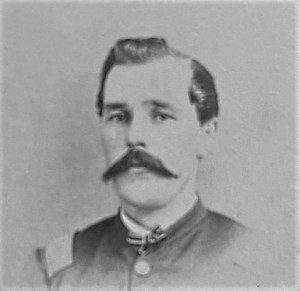
Captain Reuben Shatto Gardner, Company H, 47th Pennsylvania Volunteers, circa 1863 (public domain).

* Gardner, Reuben Shatto, John A. and Jacob S. R.: Natives of Perry County, Reuben Shatto Gardner and his brothers, John A. Gardner and Jacob S. R. Gardner, began their work lives as laborers; among the earliest responders to President Abraham Lincoln’s call to defend the nation’s capital, following the fall of Fort Sumter in mid-April 1861, Reuben was a twenty-five-year-old miller who resided in Newport, Perry County; after enlisting as a private with Company D of the 2nd Pennsylvania Volunteers on April 20, he was honorably mustered out after completing his term of service; he then re-upped for a three-year tour of duty, mustering in as a first sergeant with Company H of the newly-formed 47th Pennsylvania Volunteer Infantry; also enrolling with him that same day were his twenty-three-year-old and twenty-one-year-old brothers, John A. Gardner and Jacob S. R. Gardner; John officially mustered in at Camp Curtin in Harrisburg on September 18 (the day before Reuben arrived), while Jacob officially mustered in on September 19; both joined their brother’s company, entering at their respective ranks of corporal and private, but Jacob’s tenure was a short one; sickened by typhoid fever in late December 1861, he died at the 47th Pennsylvania’s regimental hospital at Camp Griffin, near Langley, Virginia on January 8, 1862; his remains were later returned to Perry County for burial at the Old Newport Cemetery; soldiering on, Reuben and John were transported with their regiment by ship to Fort Taylor in Key West, Florida and subsequently sent to South Carolina with their regiment and other Union troops; shot in the head and thigh during the Battle of Pocotaligo, South Carolina on October 22, 1862, Reuben was treated at the Union Army’s hospital at Hilton Head, South Carolina for an extended period of time, and then returned to active duty with his regiment; meanwhile, John was assigned with H Company and the men from Companies D, F and K to garrison Fort Jefferson in Florida’s Dry Tortugas; both brothers then continued to work their way up the regiment’s ranks, with John promoted to corporal on September 18, 1864 and Reuben ultimately commissioned as a captain and given  command of Company H on February 16, 1865; both then returned home after honorably mustering out with the regiment in Charleston, South Carolina on Christmas Day, 1865; sometime around 1866 or 1867, Reuben and his wife migrated west, first to Elk River Station in Sherburne County, Minnesota and then to Stillwater, Washington County, before settling in the city of Minneapolis; through it all, he worked as a miller; Reuben and his family then relocated farther west, arriving in King County, Washington after the Great Seattle Fire of 1889; initially employed in the restaurant industry, Reuben later found work as a railroad conductor before prospecting for gold with son Edward in the western United States and British Columbia, Canada during the 1890s Gold Rush; employed as a U.S. Post Office clerk in charge of the money order and registry departments in Seattle from 1898 to 1902, Reuben died in Seattle at the age of sixty-eight on September 25, 1903 and was interred at that city’s Lakeview Cemetery; meanwhile, his brother John, who had resumed work as a fireman with the Pennsylvania Railroad after returning from the war, was widowed by his wife in 1872; after remarrying and welcoming the births of more children, he was severely injured on October 9, 1873 while working as a fireman on the Pacific Express for the Pennsylvania Railroad; unable to continue working as a fireman due to his amputated hand, he worked briefly as a railroad call messenger before launching his own transfer business in Harrisburg; after he was widowed by his ailing second wife, John was severely injured in a second accident in 1894 while loading his delivery wagon; still operating his business after the turn of the century, he remarried on January 3, 1900, but was widowed by his third wife when she died during a surgical procedure in 1911; he subsequently closed his business and relocated to the home of his daughter in the city of Reading, Berks County; four years later, he fell on an icy sidewalk and became bedfast; aged eighty and ailing from arteriosclerosis and lung congestion, he died at her home on February 20, 1918 and was buried at Reading’s Charles Evans Cemetery;

* Gethers, Bristor (Under-Cook, Company F): Born into slavery in South Carolina circa 1829, Bristor Gethers was married “by slave custom at Georgetown, S.C.” on the Pringle plantation in Georgetown sometime around 1847 to “Rachael Richardson” (alternate spelling “Rachel”); a field hand at the dawn of the Civil War, he was freed from chattel enslavement in 1862 by Union Army troops; he then enlisted as an “Under-Cook” with Company F of the 47th Pennsylvania Volunteer Infantry in Beaufort, South Carolina on October 5, 1862, and traveled with the regiment until October 4, 1865, when he was honorably discharged in Charleston, South Carolina upon completion of his three-year term of enlistment; at that point, he returned to Beaufort and resumed life with his wife and their son, Peter; a farmer, Bristor was ultimately disabled by ailments that were directly attributable to his Union Army tenure; awarded a U.S. Civil War Soldiers’ Pension, he lived out his days with his wife on Horse Island, South Carolina, and died on Horse Island, South Carolina on June 24 or 25, 1894; he was then laid to rest at a graveyard on Parris Island on June 26 of that same year;

* Gilbert, Edwin (Captain, Company F): A native of Northampton County and a carpenter residing in Catasauqua, Lehigh County at the dawn of the American Civil War, Edwin Gilbert enrolled as a corporal on August 21, 1861; after rising up through his regiment’s officer ranks, he was ultimately commissioned as a captain and placed in charge of his company on New Year’s Day, 1865, and then mustered out with his company in Charleston, South Carolina of Christmas of that same year; resuming his life with his wife and children in Lehigh County after the war, he continued to work as a carpenter; after suffering a stroke in late December 1893, he died on January 2, 1894 and was buried at the Fairview Cemetery in West Catasauqua;
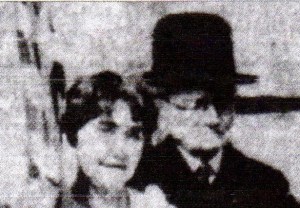
Mrs. Caroline Bost and Martin L. Guth celebrated the anniversary of President Abraham Lincoln’s birthday with fellow Grand Army of the Republic and ladies auxiliary members in February 1933 (public domain).

* Guth, Martin Luther (Corporal, Company K): A native of Lehigh County and son of a farmer, Martin L. Guth was a seventeen-year-old laborer and resident of Guthsville in Whitehall Township at the dawn of the American Civil War; after enrolling for military service on September 26, 1862, he was officially mustered in as a corporal; he continued to serve with his regiment until he was honorably mustered out on October 1, 1865, upon expiration of his term of service; at some point during that service, he broke his leg—an injury that did not heal properly and plagued him for the remainer of his life; after returning home to the Lehigh Valley, he found work again as a laborer; married in 1883, he became the father of four children, one of whom was born in New Mexico and another who was born in California; he had moved his family west in search of work in the mining industry; documented as a “prospector” or “miner” records created in Nevada during that period, he was also documented on voter registration rolls of Butte City in Glenn County, California in August 1892; by 1900, he was living separately from his wife, who was residing in Bandon, Coos County, Oregon with their two children while he was residing at the Veterans’ Home of California in Yount Township, Napa County, California; subsequently admitted to the Mountain Branch of the network of U.S. National Homes for Disabled Volunteer Soldiers in Johnson City, Tennessee on February 11, 1912, his disabilities included an old compound fracture of his right leg with chronic ulceration, defective vision (right eye), chronic bronchitis, and arteriosclerosis; discharged on December 12, 1920, he was admitted to the U.S. National Soldiers’ Home in Leavenworth, Kansas on July 30, 1912, but discharged on September 29, 1913; by 1920, he was living alone on Fruitvale Avenue in the city of Oakland, California, but was remaining active with his local chapter of the Grand Army of the Republic as he rose through the leadership ranks of chapter, state and national G.A.R. organizations; after a long, adventure-filled life, he died on October 11, 1935, at the age of ninety-one, at the veterans’ home in San Francisco and was interred at the San Francisco National Cemetery (also known as the Presidio Cemetery);

Lieutenant Charles A. Hackman, Company G, 47th Pennsylvania Volunteers, circa 1864 (public domain).

* Hackman, Charles Abraham and Martin Henry (First Lieutenant and Sergeant, Company G): Natives of Rittersville, Lehigh County, Charles and Martin Hackman began their work lives as apprentices, with Charles employed by a carpenter and Martin employed by master coachmaker Jacob Graffin; members of the local militia unit known as the Allen Rifles, they were among the earliest responders to President Abraham Lincoln’s call to defend the nation’s capital, following the fall of Fort Sumter in mid-April 1861; both enlisted as privates with Company I of the 1st Pennsylvania Volunteers on April 20 and were honorably mustered out in July after completing their service; Charles then re-upped for a three-year tour of duty, mustering in as a sergeant with Company G of the newly-formed 47th Pennsylvania Volunteer Infantry; he then spent most of his early service in Virginia; meanwhile, his younger brother, Martin H. Hackman, who was employed as a coach trimmer in Lehigh County, re-enlisted for his own second tour of duty, as a private with Charles’ company, on January 8, 1862; working their way up the ranks, Charles was commissioned as a first lieutenant on June 18, 1863, while Martin was promoted to sergeant on April 26, 1864; Charles was then breveted as a captain on November 30, 1864 after having mustered out on November 5; Martin was then honorably discharged on January 8, 1865; initially employed, post-war, with the Philadelphia & Reading Railroad’s train car facility in Reading, Berks County, Charles was promoted to car inspector at the company’s Philadelphia facility in December 1866; he subsequently married, but had no children and was widowed in 1904; remarried, he remained in Philadelphia until the early 1900s, when he relocated to Allentown; Martin, who worked as a bricklayer in Allentown, did have children after marrying, but he, too, was widowed; also remarried, he became a manager at a rolling mill; ailing with pneumonia in early 1917, Charles was eighty-six years old when he died in Allentown on January 17; he was buried at Allentown’s Union-West End Cemetery, while his brother Martin was buried at the Nisky Hill Cemetery in Bethlehem, following his death in Bethlehem from a cerebral hemorrhage on December 14, 1921;

* Junker, George (Captain, Company K): A German immigrant as a young adult, George Junker emigrated sometime around the early 1850s and settled in Allentown, Lehigh County, Pennsylvania, where he found employment as a marble worker and tombstone carver, and where he also joined the Allen Infantry, one of his adopted hometown’s three militia units; responding to U.S. President Abraham Lincoln’s call for volunteers to defend the nation’s capital during the opening weeks of the American Civil War, George enlisted with his fellow Allen Infantrymen, honorably completed his Three Months’ Service, and promptly began his own recruitment of men for an “all-German company” for the newly-formed 47th Pennsylvania Volunteer Infantry; commissioned as a captain with the 47th Pennsylvania, he was placed in charge of his men who became known as Company K; mortally wounded by a Confederate rifle shot during the Battle of Pocotaligo, South Carolina on October 22, 1862, he died from his wounds the next day at the Union Army’s division hospital at Hilton Head, South Carolina; his remains were returned to his family in Hazleton, Luzerne County for reburial at the Vine Street Cemetery;

* Kern, Samuel (Private, Company D): A native of Perry County who was employed as a farmer in Bloomfield, Perry County when he enrolled for Civil War military service on August 20, 1861, Samuel Kern was wounded and captured by Confederate troops during the Battle of Pleasant Hill, Louisiana on April 9, 1864; marched to Camp Ford, near Tyler, Texas, the largest Confederate prison camp west of the Mississippi River, he was held there as a prisoner of war (POW) until he died from harsh treatment on June 12, 1864; buried somewhere on the grounds of that prison camp, his grave remains unidentified;

* Kosier, George (Captain, Company D): A native of Perry County and twenty-four-year-old carpenter residing in that county’s community of New Bloomfield at the dawn of the American Civil War, George Kosier became one of the earliest men from his county to respond to President Abraham Lincoln’s call for to defend the nation’s capital, following the fall of Fort-Sumter in mid-April 1861, when he enrolled for military service on April 20 as a corporal with Company D of the 2nd Pennsylvania Volunteers; honorably discharged in July after completing his Three Months’ Service, he re-enlisted as a first sergeant with Company D of the newly-formed 47th Pennsylvania Volunteer Infantry; joining him were his younger brothers, Jesse and William S. Kosier, aged nineteen and twenty-three, who were enrolled as privates with the same company; all three subsequently re-enlisted with their company at Fort Taylor in Key West, Florida in 1863; sadly, Jesse fell ill with pleurisy and died at the Union Army’s Field Hospital in Sandy Hook, Maryland on August 1864; initially buried at a cemetery in Weverton, Maryland, his remains were later exhumed and reinterred at the Antietam National Cemetery in Sharpsburg, Maryland; both George and William continued to serve with the regiment, with George continuing his rise up the ranks; commissioned as a captain, he was given command of Company D in early June 1865; both brothers were then honorably discharged with their regiment on Christmas Day, 1865; post-war, both men married and began families; William died in Pennsylvania sometime around 1879, but George went on to live a long full life; after settling in Ogle County, Illinois, where he was employed as a carpenter, he relocated with his family to Wright County, Iowa, where he built bridges; he died in Chicago on December 3, 1920 and was buried at that city’s Rosehill Cemetery;
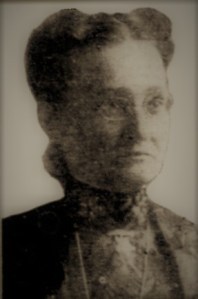
Anna (Weiser) Leisenring (1851-1942) , circa 1914 (public domain).

* Leisenring, Annie (Weiser): The wife of Thomas B. Leisenring (Captain, Company G), Annie Leisenring was employed by the Commonwealth of Pennsylvania as a factory inspector after the American Civil War; she became well known through newspaper accounts of her inspection visits and also became widely respected for her efforts to improve child labor laws statewide;

* Lowrey, Thomas (Corporal, Company E): An Irish immigrant as a young adult, Thomas Lowrey emigrated sometime around the late 1840s or early 1850s and settled in Northampton County, Pennsylvania, where he found work as a miner, married and began a family; responding to U.S. President Abraham Lincoln’s call for volunteers to defend the nation’s capital during the opening weeks of the American Civil War, Thomas enlisted with Company E of the 47th Pennsylvania on September 16, 1861; after completing his three-year term of enlistment, he was honorably discharged in September 1864 and returned home to Pennsylvania, where he resumed work as a coal miner near Shenandoah, Schuylkill County, and where he resided with his wife and children; after witnessing the dawn of a new century, he died in Shenandoah on January 11, 1906;
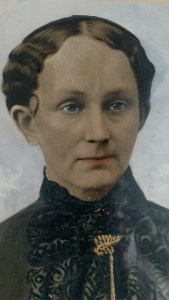
This image of Julia (Kuenher) Minnich, circa 1860s, is being presented here through the generosity of Chris Sapp and his family, and is being used with Mr. Sapp’s permission. This image may not be reproduced, repurposed, or shared with other websites without the permission of Chris Sapp.

* Magill, Julia Ann (Kuehner Minnich): Widowed and the mother of a young son at the time that her husband, B Company’s Captain Edwin G. Minnich, was killed in battle during the American Civil War, Julia Ann (Kuehner) Minnich became a Union Army nurse at Harewood Hospital in Washington, D.C. during the war in order to keep a roof over her son’s head; she then spent the remainder of her life battling the U.S. Pension Bureau to receive and keep both the U.S. Civil War Widow’s Pension and U.S. Civil War Nurse’s Pension that she was entitled to under federal law; forced to go on working into her later years by poverty, she finally found work as a cook at a hotel in South Bethlehem; she died sometime after 1906;

* Menner, Edward W. (Second Lieutenant, Company E): A first-generation American who was a native of Easton, Northampton County, Edward Menner was a sixteen-year-old carpenter when he enrolled for Civil War military service on August 25, 1861; working his way up from private to second lieutenant before he was honorably discharged with his regiment in Charleston, South Carolina on Christmas Day, 1865, he was wounded in the left shoulder during the Battle of Cedar Creek, Virginia on October 19, 1864; after returning home to the Lehigh Valley, he secured employment as a hooker with the Bethlehem Iron Company (later known as Bethlehem Steel) on March 15, 1866; he married, begam a family and continued to work in the iron industry for much of his life; he died in Bethlehem on April 25, 1913 and was buried at that city’s Nisky Hill Cemetery;

* Miller, John Garber (Sergeant, Company D): A native of Ironville, Blair County, John G. Miller was a twenty-one-year-old laborer living in Duncannon, Perry County when he enrolled for Civil War military service on August 20, 1861; captured by Confederate troops during the Battle of Pleasant Hill, Louisiana on April 9, 1864 and marched to Camp Ford, near Tyler, Texas, the largest Confederate prison camp west of the Mississippi River, he was held there as a prisoner of war (POW) until he was released during a prisoner exchange on July 22, 1864; returned to active duty with his regiment after receiving medical treatment, he continued to serve until he was honorably discharged with the regiment in Charleston, South Carolina on December 25, 1865; after returning home, he married, began a family and relocated with his family to Philipsburg, Centre County, Pennsylvania, where he was employed as a teamster; returning to Blair County with his family, he resided with them in Logan Township before relocating with them again to Coalport, Clearfield County; suffering from heart disease, he died in Coalport on February 16, 1921 and was interred at the Coalport Cemetery;
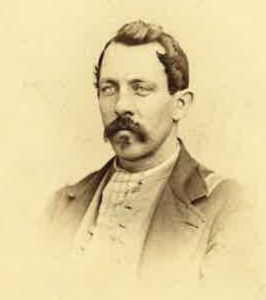
Captain Theodore Mink, Company I, 47th Pennsylvania Volunteers (circa 1870s-1880s, courtesy of Julian Burley; used with permission).

* Mink, Theodore (Captain, Company I): A native of Allentown, Lehigh County who was apprenticed as a coachmaker and then tried his hand as a whaler and blacksmith prior to the American Civil War, Thedore Mink became one of the “First Defenders” who responded to President Abraham Lincoln’s call for seventy-five thousand volunteers to defend the nation’s capital after the fall of Fort Sumter in mid-April 1861; after honorably completing his Three Months’ Service in July, he re-enlisted on August 5 as a sergeant with Company I of the newly-formed 47th Pennsylvania Volunteer Infantry; after steadily working his way up through the ranks, he was commissioned as a captain and placed in charge of his company on May 22, 1865; he continued to serve with his regiment until it was mustered out on Christmas Day, 1865; following his return to Pennsylvania, he was hired as a laborer with a circus troupe operated by Mike Lipman before finding longtime employment in advertising and then as head of the circus wardrobe for the Forepaugh Circus before he was promoted to management with the circus; felled by pneumonia during late 1889, he died in Philadelphia on January 7, 1890 and was interred in Allentown’s Union-West End Cemetery;

* Newman, Edward (Private, Company H): A German immigrant who left his homeland sometime around 1920, Edward Newman chose to settle in Allentown, Lehigh County, Pennsylvania, where he found work as a baker; after enlisting for Civil War military service in August 1862, he mustered in as a private with Company I of the 127th Pennsylvania Volunteers and fought in the Battle of Fredericksburg from December 11-15 of that year; honorably mustered out with his regiment in May 1863, he re-enlisted on October 23, 1863 for a second tour of duty—but as a private with a different regiment—Company H of the 47th Pennsylvania Volunteers; he continued to serve with the 47th Pennsylvania until he was officially mustered out in Charleston, South Carolina on Christmas Day, 1865, he returned to Pennsylvania’s Lehigh Valley, where he worked briefly as a baker; suffering from rheumatism that developed while the 47th Pennsylvania was stationed near Cedar Creek, Virginia during the fall of 1864, he was admitted to the network of U.S. Homes for Disabled Volunteer Soldiers at the Central Branch in Dayton, Montgomery County, Ohio on July 17, 1877; still unmarried and still living there in 1880, his health continued to decline; diagnosed with acute enteritis, he died there on January 22, 1886 and was buried at the Dayton National Cemetery;

Captain Daniel Oyster, Company C, 47th Pennsylvania Volunteers, circa 1864 (public domain).

* Oyster, Daniel (Captain, Company C): A native of Sunbury, Northumberland County who was employed as a machinist, Daniel Oyster became one of the earliest men from his county to respond to President Abraham Lincoln’s call to defend the nation’s capital, following the fall of Fort-Sumter in mid-April 1861, when he enrolled for Civil War military service on April 23 as a corporal with Company F of the 11th Pennsylvania Volunteers; honorably discharged in July after completing his Three Months’ Service, he re-enlisted as a first sergeant with Company C of the newly-formed 47th Pennsylvania Volunteers on August 19; his brother, John Oyster, subsequently followed him into the service, enrolling as a private with his company on November 20, 1863; after rising up through the ranks to become captain of his company, Daniel was shot in his left shoulder near Berryville, Virginia on September 5, 1864 and then shot in his right shoulder during the Battle of Cedar Creek on October 19; successfully treated by Union Army surgeons for both wounds, he was awarded a veteran’s furlough in order to continue his recuperation and returned home to Sunbury; he then returned to duty and was honorably discharged with his company on Christmas Day, 1865; post-discharge, he and his brother, John, returned home to Sunbury; Daniel continued to reside with their aging mother and was initially employed as a policeman, but was then forced by a war-related decline in his health to take less-taxing work as a railroad postal agent; his brother John, who was married, lived nearby and worked as a fireman, but died in Sunbury on April 20, 1899; employed as a bookkeeper after the turn of the century, Daniel never married and was ultimately admitted to the Southern Branch of the U.S. National Home for Disabled Volunteer Soldiers in Hampton, Virginia, where he died on August 5, 1922—exactly sixty-one years to the day after the 47th Pennsylvania Volunteer Infantry was founded; he was given a funeral with full military honors before being laid to rest in the officers’ section at the Arlington National Cemetery on August 11;

* Sauerwein, Thomas Franklin (First Sergeant, Company B): The son of a lock tender in Pennsylvania’s Lehigh Valley, Thomas Sauerwein was employed as a carpenter at the dawn of the American Civil War; following his enrollment for military service in Allentown, Lehigh County on August 20, 1861, he was officially mustered in as a private with Company B of the 47th Pennsylvania Volunteer Infantry; from that point on, he steadily worked his way up the ranks of the regiment, ultimately being promoted to first sergeant on New Year’s Day, 1865; following his honorable discharge with his company on Christmas Day of that same year, he returned home to the Lehigh Valley, where he found work as a carpenter, married and began a family; by 1880, he had moved his family west to Williamsport in Lycoming County, where he had found work as a machinist; employed as a leather roller with a tanning factory, he was promoted to a position as a leather finisher after the turn of the century, while his two sons worked as leather rollers in the same industry; he died in Williamsport on July 29, 1912 and was buried at the East Wildwood Cemetery in Loyalsock;

* Slayer, Joseph (Private, Company E; also known as “Dead Eye Dick” and “E. J. McMeeser”): A native of Philadelphia, Joseph Slayer was a nineteen-year-old miner residing in Willliams Township, Northampton County, Pennsylvania at the dawn of the American Civil War; after enrolling for military service in Easton, Northampton County on September 9, 1861, he was officially mustered in as a private with Company E of the 47th Pennsylvania Volunteers; he continued to serve with his company, re-enlisting as a private with Company E, under the name of Joseph Slayer, at Fort Jefferson in Florida’s Dry Tortugas on January 4, 1864; honorably mustered out with his company in Charleston, South Carolina on Christmas Day, 1865, he relocated to Zanesville, Ohio sometime after the war, where he joined the Grand Army of the Republic’s Hazlett Post No. 81; he may then have relocated briefly to St. Paul, Minnesota sometime around the 1870s or early 1880s, or may simply have had a child and grandchild living there, because newspaper reports of his death noted that he had been carrying a photograph of a toddler named Robert—a photo that had “To Grandpa” inscribed on it and indicated that the grandchild, Robert, was a resident of St. Paul in 1892; by the 1880s, Joseph had made it as far west as the Dakota Territory—but this was where his life’s journey took a strange twist; discarding the name he had used in the army (“Joseph Slayer”), he changed his name several times over the next several years, as if he were trying to shed his prior life and all of its associations; acquaintances he met in the southern part of the Dakota Territory during the early to mid-1880s knew him as “Dead Eye Dick” while others who met him after he had resettled in Bismarck, in the northern part of the Dakota Territory, knew him as “Eugene McMeeser” or “E. J. McMeeser” (alternate spelling: “McNeeser”); by the time that the federal government conducted its special census of Civil War veterans in June 1890, Joseph was so comfortable fusing parts of his old and new lives together that he was convincingly documented by an enumerator as “Eugene McMeeser,” a veteran who had served as a private with Company E of the 47th Pennsylvania Infantry from September 9, 1861 until January 11, 1866; in 1890, Joseph became a married man; documented as having rheumatism so severe that he was “at times confined at home,” he filed for a U.S. Civil War Pension from North Dakota on March 28, 1891—but he did so as “Joseph Slayer”—the name under which he had first enrolled for military service in Pennsylvania in 1861; ultimately awarded a pension—which would not have happened if federal officials had not been able to verify his identity and match it to his existing military service records, he was diagnosed with angina pectoris in 1904, but still managed to secure a U.S. patent for one of his inventions—a napkin holder; he died in Bismarck less than a month later, on January 12 or 13, 1905; found on the floor of his rented room, his death sparked a coroner’s inquest which revealed that he had been living under an assumed name; he was buried at Saint Mary’s Cemetery in Bismarck; the name “Joseph Slayer” was carved onto his military headstone;

* Snyder, Timothy (Corporal, Company C): A carpenter who was born in Rebuck, Northumberland County, Tim Snyder was employed as a carpenter and residing in the city of Sunbury in that county by the dawn of the American Civil War; after enlisting for military service as a private in August 1861, he was wounded twice in combat, once during the Battle of Pocotaligo, South Carolina (1862) and a second time, in the knee, during the Battle of Opequan, Virginia (1864), shortly after he had been promoted to the rank of corporal; he survived and returned to Pennsylvania, where he resumed work as a carpenter; after relocating to Schuylkill County, he settled in the community of Ashland; in 1870, he married Catharine Boyer and started a family with her; he continued to work as a carpenter in Schuylkill County until his untimely death in May 1889 and was laid to rest with military honors at the Brock Cemetery in Ashland; John Hartranft Snyder, his first son to survive infancy, grew up to become a co-founder of the Lavelle Telegraph and Telephone Company, while his second son to survive infancy, Timothy Grant Snyder, became a corporal in the United States Marine Corps during the Spanish-American War; stationed on the USS Buffalo as it visited Port Said, Egypt, he also served aboard Admiral George Dewey’s flagship, the USS Olympia, in 1899;
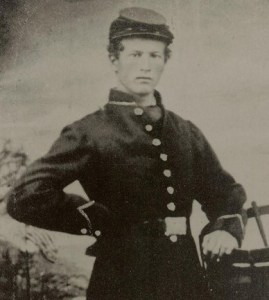
Drummer Boy William Williamson, 47th Pennsylvania Volunteers, Company A, circa 1863 (public domain).

* Williamson, William (Drummer, Company A): A farmer from Stockertown, Northampton County, William Williamson was documented by a mid-nineteenth-century federal census enumerator as an unmarried laborer who lived at the Easton home of Northampton County physician John Sandt, M.D.—an indication that William’s parents may have either died or were struggling so much financially during the 1850s and early 1860s that they had encouraged him to “leave the nest” and begin supporting himself, or had hired him out as an apprentice or indentured servant; like so many other young men from Northampton County, when President Abraham Lincoln issued his call for help to protect the nation’s capital from a likely invasion by Confederate States Army troops, he stepped forward, raised his hand, and stated the following:

I, William Williamson appointed a private in the Army of the United States, do solemnly swear, or affirm, that I will bear true allegiance to the United States of America, and that I will serve them honestly and faithfully against all their enemies or opposers whatsoever, and observe and obey the orders of the President of the United States, and the orders of the officers appointed over me, according to the rules and articles for the government of the Armies of the United States.

Later in life, William Williamson became a champion for an older woman who had been struggling to convince officials of the federal government that she was worthy enough to be awarded a U.S. Civil War Mother’s Pension, after her son had died in service to the nation as a Union Army soldier.

Post-war, William Williamson found work at a slate quarry, married, began a family in Belfast, Northampton County, and lived to witness the dawn of a new century. Following his death at the age of sixty in Plainfield Township on June 17, 1901, he was laid to rest at the Belfast Union Cemetery.


Sources:

  1. “A Badge from Admiral Dewey and Schuylkill County” (announcements of Timothy Grant Snyder’s service on Admiral Dewey’s flagship). Reading, Pennsylvania: Reading Eagle: October 3, 1899 and November 21, 1899.
  2. Baptismal, census, marriage, military, death, and burial records of the Snyder family. Pennsylvania, California, Florida, Louisiana, Massachusetts, Nevada, Ohio, etc.: Snyder Family Archives, 1650-present; and in Historic Pennsylvania Church and Town Records (baptismal, marriage, death and burial records of various churches across Pennsylvania). Philadelphia, Pennsylvania: Historical Society of Pennsylvania, 1776-1918.
  3. Bates, Samuel P. History of Pennsylvania Volunteers, 1861-5, vol. 1. Harrisburg, Pennsylvania: B. Singerly, State Printer, 1869.
  4. James Crownover, James Downs and Samuel Kern, et. al., in Camp Ford Prison Records. Tyler, Texas: The Smith County Historical Society, 1864.
  5. Civil War Muster Rolls, 1861-1866 (47th Pennsylvania Infantry). Harrisburg, Pennsylvania: Pennsylvania State Archives.
  6. Civil War Veterans’ Card File, 1861-1866 (47th Pennsylvania Infantry). Harrisburg, Pennsylvania: Pennsylvania State Archives.
  7. Registers of Deaths of Volunteers, U.S. Army; Admissions Ledgers, U.S. National Homes for Disabled Volunteer Soldiers; federal burial ledgers, and national cemetery interment control forms, 1861-1935. Washington, D.C.: U.S. Office of the Adjutant General (Record Group 94), U.S. National Archives and Records Administration.
  8. Schmidt, Lewis. A Civil War History of the 47th Regiment of Pennsylvania Veteran Volunteers. Allentown, Pennsylvania: Self-published, 1986.
  9. U.S. Census Records, 1830-1930. Washington, D.C.: U.S. National Archives and Records Administration.
  10. U.S. Civil War Pension Records, 1862-1935. Washington, D.C.: U.S. National Archives and Records Administration.

Research Update: Additional New Details Learned About Bristor Gethers, One of the Nine Formerly Enslaved Men Who Enlisted with the 47th Pennsylvania Volunteers

Page one of the U.S. Army’s Civil War enlistment paperwork for Bristor Gethers (mistakenly listed as “Presto Garris”), 47th Pennsylvania Volunteer Infantry, Company F, October 5, 1862 (U.S. National Archives and Records Administration, public domain; click to enlarge).

Fleeing the brutal experience of chattel slavery in Georgetown County, South Carolina, a thirty-three-year-old Black man was willing to enlist for military service in the fall of 1862 as an “undercook”—a designation within the United States Army that was first authorized by the U.S. War Department on September 28, 1863—in order to ensure his freedom in America’s Deep South during the American Civil War.

Arriving at a federal military recruiting depot in Union Army-occupied Beaufort, South Carolina, that man—Bristor Gethers—was certified as fit for duty by Dr. William Reiber, an assistant surgeon with the 47th Pennsylvania Volunteer Infantry, and was then accepted into that regiment on October 5, 1862 by Captain Henry Samuel Harte, a German immigrant who had been commissioned as the commanding officer of that regiment’s F Company.

The reason that officers of the 47th Pennsylvania Volunteer Infantry were able to enroll Bristor Gethers, along with three additional formerly enslaved men that fall (roughly three months before U.S. President Abraham Lincoln officially issued the nation’s Emancipation Proclamation), was because the U.S. Congress had previously passed the Militia Act of 1862 on July 17, 1862, which authorized state and federal military units in Union-held territories to recruit and enroll enslaved and free Black men to fill labor-related jobs.

According to section twelve of that legislation, starting on that date, President Lincoln was “authorized to receive into the service of the United States, for the purpose of constructing intrenchments, or performing camp service or any other labor, or any military or naval service for which they may be found competent, persons of African descent, and such persons shall be enrolled and organized under such regulations, not inconsistent with the Constitution and laws, as the President may prescribe” while the next three sections specified the following additional details of that military service:

SEC. 13. And be it further enacted, That when any man or boy of African descent, who by the laws of any State shall owe service or labor to any person who, during the present rebellion, has levied war or has borne arms against the United States, or adhered to their enemies by giving them aid and comfort, shall render any such service as is provided for in this act, he, his mother and his wife and children, shall forever thereafter be free, any law, usage, or custom whatsoever to the contrary notwithstanding: Provided, That the mother, wife and children of such man or boy of African descent shall not be made free by the operation of this act except where such mother, wife or children owe service or labor to some person who, during the present rebellion, has borne arms against the United States or adhered to their enemies by giving them aid and comfort.

SEC. 14. And be it further enacted, That the expenses incurred to carry this act into effect shall be paid out of the general appropriation for the army and volunteers.

SEC. 15. And be it further enacted, That all persons who have been or shall be hereafter enrolled in the service of the United States under this act shall receive the pay and rations now allowed by law to soldiers, according to their respective grades: Provided, That persons of African descent, who under this law shall be employed, shall receive ten dollars per month and one ration, three dollars of which monthly pay may be in clothing.

Seeking to add more teeth to its anti-slavery legislation, the U.S. Congress then also passed the Confiscation Act of 1862 that same day, proclaiming that “every person who shall hereafter commit the crime of treason against the United States, and shall be adjudged guilty thereof, shall suffer death, and all his slaves, if any, shall be declared and made free.”

General Orders No. 323 (enlistment and pay of undercooks of African descent), U.S. War Department and Office of the Adjutant General, September 28, 1863 (U.S. Library of Congress, public domain; click to enlarge).

By taking that important step toward securing what he hoped would be permanent freedom from the plantation enslavement he had endured in South Carolina for more than three decades, Bristor Gethers was, in reality, trading one form of backbreaking labor (slavery) for another that was only marginally better because he was entering military life as an “undercook”—a designation that placed him on the very bottom of the 47th Pennsylvania’s military rosters—beneath the names of soldiers who were listed at the rank of private or drummer boy.

His status clearly improved enough over time, though, that he was willing to stay with the 47th Pennsylvania Volunteer Infantry for nearly the entire duration of its service to the nation. Traveling with the 47th to Florida, where the regiment was stationed on garrison duty at Forts Taylor and Jefferson from late December 1862 through early February 1864, he likely participated side by side with the regiment’s white soldiers as they felled trees, built new roads and engaged in other similar tasks designed to strengthen the fortifications of those federal installations. It was during this same time that he would have learned from his commanding officer, Captain Harte, that President Abraham Lincoln had officially issued the Emancipation Proclamation on January 1, 1863 and that the U.S. War Department and Adjutant General’s Office had issued General Orders No. 323 on September 28th of that same year, which authorized all Union Army units “to cause to be enlisted for each cook [in each Union Army regiment] two under-cooks of African descent, who shall receive for their full compensation ten dollars per month and one ration per day” (three dollars of which could be issued to undercooks “in clothing,” rather than money).

Bristor Gethers was listed as a private on the final version of the Commonwealth of Pennsylvania’s “Registers of Volunteers, 1861-1865” for Company F of the 47th Pennsylvania Volunteer Infantry (Pennsylvania State Archives, public domain; click to enlarge and scroll down).

Promoted to the rank of Cook by the spring of 1863, according to regimental muster rolls, his duties were also likely expanded to include the job of caring for the regiment’s combat casualties by the spring and fall of 1864, when the 47th Pennsylvania was engaged in the Union’s 1864 Red River Campaign across Louisiana and the 1864 Shenandoah Valley Campaign across Virginia. In addition to rescuing and carrying wounded men from multiple fields of battle under fire as a stretcher bearer during this time, as many other undercooks in the Union Army were ordered to do, he may very well also have helped to dig the graves for his 47th Pennsylvania comrades who had been killed in action.

Apparently so well thought of by his superior officers, according to the regiment’s final muster-out ledgers, Bristor Gethers was ultimately accorded the rank of private—a hard-won title that, on paper in the present day, may seem as if it were a minor achievement.

It wasn’t. It was, in reality, historic.

About “Faces of the 47th: Freedmen of the 47th Pennsylvania Volunteer Infantry”

“Faces of the 47th: Freedmen of the 47th Pennsylvania Volunteer Infantry” is a special project of 47th Pennsylvania Volunteers: One Civil War Regiment’s Story, an educational program designed to teach children and adults about the history of the 47th Pennsylvania Veteran Volunteers, a Union Army regiment which served for nearly the entire duration of the American Civil War and became the only military unit from the Commonwealth of Pennsylvania to participate in the Union’s 1864 Red River Campaign across Louisiana.

This important initiative is dedicated to researching, documenting and presenting the life stories of nine formerly enslaved Black men who enlisted with the 47th Pennsylvania Volunteer Infantry during two of the regiment’s most eventful years of service to the nation—1862 and 1864. Largely forgotten for more than a century after honorably completing their historic military service, these nine men have been repeatedly overlooked by mainstream historians over the years as potentially important subjects for research and have also been an ongoing source of mystery and frustration to their descendants because the majority of their military service records have still not been digitized by state and national archives.

To learn more about the life of Bristor Gethers before, during and after the war, and to view his U.S. Civil War military and pension records, visit his profile on “Freedmen of the 47th Pennsylvania Volunteer Infantry.”


Sources:

  1. Berlin, Ira, Joseph P. Reidy, and Leslie S. Rowland. Freedom’s Soldiers: the Black Military Experience in the Civil War. Cambridge, United Kingdom: Cambridge University Press, 1998.
  2. Blight, David W. Frederick Douglass’ Civil War: Keeping Faith in Jubilee. Baton Rouge, Louisiana: Louisiana State University Press, 1989.
  3. Foner, Eric. The Fiery Trial: Abraham Lincoln and American Slavery. New York, New York: W.W. Norton, 2010.
  4. “Garris, Presto” [sic, “Gethers, Bristor”], in Civil War Veterans’ Card File, 1861-1866. Harrisburg, Pennsylvania: Pennsylvania State Archives.
  5. “Garris, Presto” [sic, “Gethers, Bristor”], in “Registers of Pennsylvania Volunteers, 1861-1865” (47th Regiment, Company F), in “Records of the Department of Military and Veterans’ Affairs” (RG-19). Harrisburg, Pennsylvania: Pennsylvania State Archives.
  6. “Garris, Presto” [sic, “Gethers, Bristor”], in U.S. Civil War Compiled Military Service Records, 1862-1865. Washington, D.C.: U.S. National Archives and Records Administration.
  7. “Garris, Presto” [sic, “Gethers, Bristor”], in U.S. Civil War General Pension Index (veteran’s pension application no.: 773063, certificate no.: 936435, filed from South Carolina, February 1, 1890; widow’s pension application no.: 598937, certificate no.: 447893, filed from South Carolina, July 27, 1894). Washington, D.C.: U.S. National Archives and Records Administration.
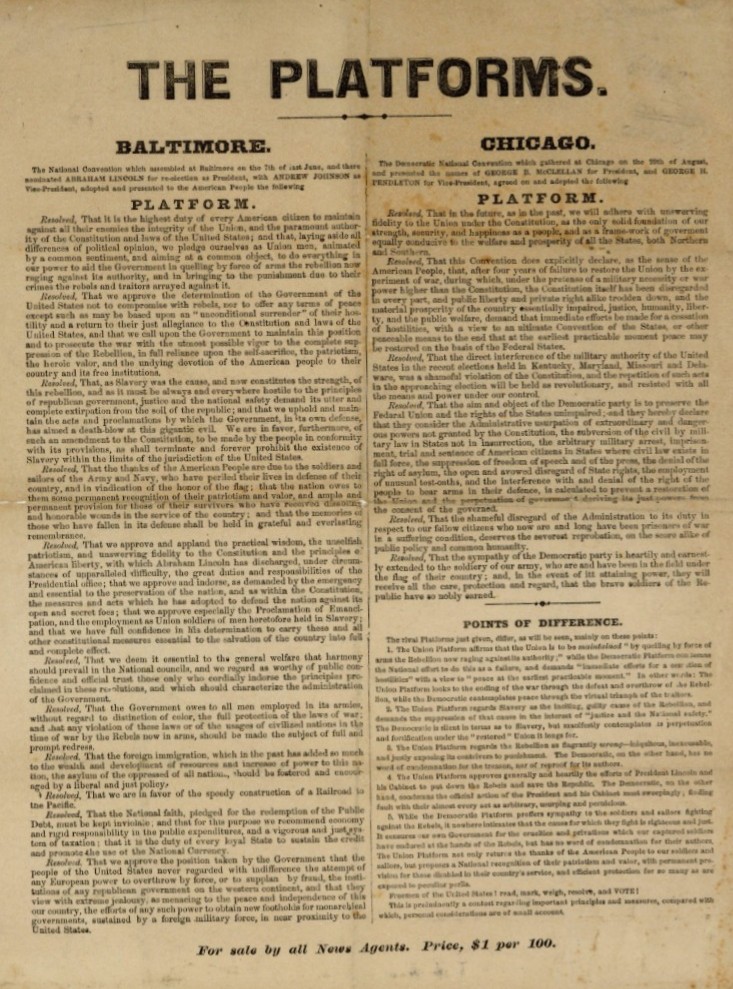
  8. “Garris, Presto” [sic, “Gethers, Bristor”], in U.S. Civil War Muster Rolls (47th Pennsylvania Volunteer Infantry, Company F), 1862-1865. Harrisburg, Pennsylvania: Pennsylvania State Archives.
  9. McPherson, James M. The Negro’s Civil War: How American Blacks Felt and Acted During the War for the Union. New York, New York: Ballantine Books, 1991.
  10. Oakes, James. The Radical and the Republican: Frederick Douglass, Abraham Lincoln, and the Triumph of Antislavery Politics. New York, New York: W. W. Norton & Co., 2007.
  11. Smith, John David. Black Soldiers in Blue: African American Troops in the Civil War Era. Chapel Hill, North Carolina: University of North Carolina, 2002.
  12. The Militia Act of 1862, in U.S. Statutes at Large, Treaties, and Proclamations of the United States of America, vol. 12, pp. 597-600: Boston, Massachusetts: Little, Brown and Company, 1863.
  13. “The Confiscation Act.” New York, New York: The New York Times, July 15, 1862.
  14. “The Confiscation Acts of 1861 and 1862.” Washington, D.C.: United States Senate, retrieved online January 14, 2024.


Sheridan’s 1864 Shenandoah Valley Campaign: Camp Fairview, Charlestown, West Virginia (December 20, 1864 – early April 1865)

Charlestown West Virginia, circa 1863 (public domain).

Encamped in early December 1864 with the United States Army of the Shenandoah at its winter quarters at Camp Russell, which was located just west of Stephens City (now Newtown) and south of Winchester, Virginia, the members of the 47th Pennsylvania Volunteer Infantry were learning that their stay at this Union Army complex was destined to be shorter than they had hoped. Ordered to prepare for yet another march, they were informed by their superiors that they were being reassigned yet again—this time to help fulfill the directive of Major-General Philip H. Sheridan that the Army of the Shenandoah search out and eliminate the ongoing threat posed by Confederate States Army guerrilla soldiers who had been attacking federal troops, railroad systems and supply lines throughout Virginia and West Virginia.

So, after packing up and saying goodbye to the new friends they’d made at Camp Russell, they began a new, thirty-mile march, five days before Christmas. Trudging north during a driving snowstorm on December 20, 1864, they finally reached Charlestown, West Virginia, where they quickly established their latest “new home” at Camp Fairview, which was situated roughly two miles outside of the village.

Per an 1870 edition of The Lehigh Register, while marching for Charlestown, the 47th Pennsylvania Volunteers made their way through Winchester and followed the Charlestown and Winchester Railroad line “until two o’clock the following morning” when they were forced to sleep on their arms “until daylight, the guide having lost his way.”

Initially using this camp as the regiment’s winter quarters, the 47th Pennsylvania Volunteers were soon “on constant active duty, guarding the railroad and constructing works for defense against the incursions of guerrillas. The regiment participated in a number of reconnoissances [sic] and skirmishes during the winter”—as the old year of 1864 became the New Year of 1865.

More specifically, by 1865, according to historians at the Pennsylvania State Archives, who had uncovered details about the 47th Pennsylvania’s time at Camp Fairview by reading the diaries of Jeremiah Siders of Company H, the 47th Pennsylvania Volunteers “were employed building blockhouses at all the railroad ‘posts’ (meaning loading stations).”

A Chaplain Expresses His Thoughts on the Ongoing War

Rev. William DeWitt Clinton Rodrock, chaplain, 47th Pennsylvania Volunteers, Fort Jefferson, Dry Tortugas, Florida, 1863 (courtesy of Robert Champlin, used with permission).

On New Year’s Eve in 1864, the Rev. William DeWitt Clinton Rodrock, the regimental chaplain of the 47th Pennsylvania Volunteer Infantry, penned the following words in a report to his superiors:

Camp, 47th Reg. Pa. Vet. Vol’s
Near Charlestown Va, Dec. 31st 1864

Brig. Gen’l L. Thomas,
Adj. Gen’l, U.S. Army

Sir.

I respectfully, beg leave to state that absence from the Reg. accounts for my failing to report for the previous month.

And in submitting my report for the present month it affords me great pleasure to state that the condition and morale of the Reg. is in every respect encouraging.

Of the large number of wounded in the terrible battle of Cedar Creek, Oct. 19th/64, comparatively few have died, probably fourteen, or even a less number will cover the entire loss, whilst nearly all the surviving ones, will be able to join our ranks.

No deaths have occurred in the Reg during the month, whilst few are sick in Hospital, and the health generally is good.

For some time past, the Reg. had been deficient in its quota of officers, but this deficiency is now being happily filled by suitable promotions from the ranks.

In the aggregate it now numbers 882 men. Of which 24 are officers.

In a moral and religious point of view, there is still a large margin for improvement and it is my earnest endeavor to devote all proper and available means for the spiritual welfare of the command.

Under its new organization and in the fourth year of its history, our Reg. has an encouraging future before it.

In conclusion, I may yet say that the review of our National life during the year that is about being numbered with the past, affords rare promise for the future. At no period in the history of our great contest for freedom and Unity has the prospect of returning peace, through honorable conflict, been so promising.

The efforts, the sacrifices, the patience of the loyal states and People are crowned, at last, with triumphs worthy of the holy cause of liberty.

Yet a little while, and we shall rejoice in a peace based on the everlasting foundations of Religion, Humanity, Nationality, and freedom.

For this defeat of traitors at home as well as of Rebels in arms and their sympathizers abroad, for this expression of stern and resolute purpose, for this unshrinking determination to make the last needed sacrifice, how can we be sufficiently grateful?

May the God of our fathers still smile upon us.

I have the honor, Gen’l, to remain,
Very Respectfully, Your Obed’t Serv’nt

W.D. C. Rodrock, Chap., 47th Reg. P.V.V.
2nd Brig. 1st Div. 19th A.C.

* Note: Chaplain Rodrock’s December 31, 1864 report to superiors had noticeable errors, including his significant underestimation of his regiment’s casualty figures during Sheridan’s 1864 Shenandoah Valley Campaign. During the Battle of Cedar Creek alone, more than one hundred and seventy-four members of the 47th Pennsylvania were declared killed, wounded, captured, or missing (forty killed in action, ninety-nine wounded in action, fifteen of whom later died, twenty-five captured, ten of whom later died while still being held as POWs or shortly after their release by CSA troops, nine missing, one unresolved). While he may not yet have had full casualty figures by the time he penned the report above, he would certainly have been able to at least obtain accurate figures regarding the number of men who had been killed and mortally wounded.

Page one of a report written by the Rev. William DeWitt Clinton Rodrock, 47th Pennsylvania Volunteer Infantry Regimental Chaplain, from Camp Fairview, West Virginia to his superiors, January 31, 1865 (U.S. Army, U.S. National Archives and Records Administration, public domain).

Exactly one month later, Rev. Rodrock was putting the final touches on his latest report:

Camp Fairview.
Two miles from Charlestown, Va
January 31st, 1865

Brig. Gen’l L. Thomas
Adj. Gen’l, U.S. Army

Sir.

I have the honor respectfully, to submit the following report for the present month.

Although God is not in men’s thoughts; his law being violated with impunity and his authority contemned “at will”; yet as a nation, our God is the Lord. The mind rest with pleasure on the abounding proof of this great fact. The history of the past, how full of it!

From the first planting of our Fathers on this soil, onward to this day, the true God has been claimed as ours. The foundations of our government were laid in the full and firm apprehension and acknowledgment of this fact. There is one scene recorded in our history which more than all others prove this; we have it commemorated in the engraving of the First Prayer in Congress.

There were the sages and patriots of our land – the representations of the whole country. They had reached a most critical point in their deliberations. They felt the need of higher wisdom than their own. They call in the minister of God, the servant of Jesus Christ; and there and then, in most affecting, service, our country – our whole country is laid at the foot of the Divine throne.

If ever there was heartfelt acknowledgment of a living and true God, and most hearty and sincere invocation of his favor, it was there. For themselves, for their living countrymen, for those to come after them, they cast their all on God, and bound themselves and all to him! Most touching and ever-memorable scene! Worthy the occasion and worthy of a great nation. In this spirit the Christian and the patriot, whether in civic or military life strive to labor, and should fire all hearts and nerve all arms in our present fiery struggle for universal freedom.

I am happy to report the favorable and healthy condition of the Reg. Our aggregate is 891. Of these 19 are transiently on the sick list. No deaths have occurred during the month.

We employ all available means for promoting the temporal and spiritual welfare of the command.

Having a large library of select books, I am prepared to meet the wants of the men in this direction.

Besides I distribute several hundred religious papers among them every week. I am convinced, by experience, that this is one of the effectual and welcome means of gaining the attention of the mass of the men to religious truth, and keeping up the tie between them and the Church at home.

Ever striving to labor with an eye single to the glory of God and our country.

I have the honor,
Gen’l to remain
Your Obed’t Servant

W. D. C. Rodrock
Chaplain, 47th Reg. P.V.V.
2nd Brig. 1st Div. 19th Corps

Page one of a report written by the Rev. William DeWitt Clinton Rodrock, 47th Pennsylvania Volunteer Infantry Regimental Chaplain, from Camp Fairview, West Virginia to his superiors, February 28, 1865 (U.S. Army, U.S. National Archives and Records Administration, public domain).

While Rev. Rodrock’s next monthly report conveyed the following to his superiors:

Camp Fairview
Near Charlestown, Va
Feb. 28th 1865

Brig. Gen. L. Thomas
Adj. Gen’l U.S. Army

Sir.

I have the honor herewith, to present my report for the month of February.

That blessed peace whose type and emblem is our holy Gospel it is as yet not ours to enjoy. The stern alarums of war still resound in the ears of the nation. And as our victorious columns are marching on, they are sounding the death-knell of the so called Southern Confederacy.

In the strange system and series of paradoxes which make up human life, it often happens that the very disciples of “good will” and brotherly love must buckle on the harness of war. Such emphatically is the case in our present contest. Nor should it be otherwise.

Even our Saviour [sic] came not to bring peace, but a sword until the right should triumph and the sword be beat to a ploughshare. And as our present struggle involves on our side, all that is worthy living for and all that is worth dying for, it may very well fire all hearts and nerve all arms in its behalf.

The Flag which Hernando Cortes carried in that most extraordinary of expeditions in Mexico had for its device, flames of fire on a white and blue ground, with a red cross in the midst of the blaze, and the following words on the borders as a motto, ‘Amici, Crucem sequamur, et in hoc signo vincemur!’ Friends, let us follow the cross, and, trusting in that emblem we shall conquer!’

In these more enlightened times, with more intelligent soldiers, with a purer Church at our back, and with a holier cause, we will keep the motto of Cortes steadily before our eyes; and in personal as in national experience, we shall turn the war into a blessing to the country and to humanity.

It gives me great pleasure to report the improved condition and general good health of the Reg. A large influx of recruits has materially increased our numbers; making our present aggregate 954 men, including 35 commissioned officers.

The number of sick in the Reg. is 22; all of which are transient cases, and no deaths have occurred during the month.

Whilst in a moral and religious point of view there is still a wide margin for amendment and improvement; it is nevertheless gratifying to state that all practicable and available means are employed for the promotion of the spiritual and physical welfare of the command.

And in this connection, I desire to mention our indebtedness to the U.S. Christian Commission for furnishing us with a large supply of excellent reading matter and such delicacies as are highly useful for the Hospital.

That God is in this war of rebellion, that he has brought it upon us, that He over rules it, that its issues are in his hand, that he intends to teach us and the whole world some of the greatest and most sublime lessons ever taught in his providential dealings since the world began, is becoming more and more manifest.

To Him, we will ascribe all Honor and Glory, now and forever.

I have the honor, Gen’l, to remain
Respectfully, Your Obed’t Servant.

W. D. C. Rodrock,
Chaplain, 47th Reg. P.V.V.
2nd Brig. 1st Division, 19th A.C.

Page one of a report written by the Rev. William DeWitt Clinton Rodrock, 47th Pennsylvania Volunteer Infantry Regimental Chaplain, from Camp Fairview, West Virginia to his superiors, March 31, 1865 (U.S. Army, U.S. National Archives and Records Administration, public domain).

In his final report from Camp Fairview, Rev. Rodrock wrote:

Camp Fairview.
Near Charlestown, Va.
March 31st/65

Brig. Gen’l L. Thomas
Adj. Gen’l U.S. Army

Sir.
I have the honor herewith, to transmit my report for the present month.

Very Respectfully Yours,

W. D. C. Rodrock
Chapl’n, 47th Reg. P. Vols


Camp Fairview
Two Miles from Charlestown, Va.
March 5th/65

Brig. Gen’l L. Thomas
Adj. Gen., U.S. Army

Sir.

I hereby enclose my report for Feb. It having been returned from Brig. Hd. Qrts, to be forwarded direct. In accordance with Gen’l  Orders No 158, dated Apl. 13th 1864, I hitherto forwarded my reports through the “usual military channels”. Why I am now ordered to forward direct, is not clear to my mind. Would you have the kindness to forward me any orders issued since the one of the above date & bearing on the duties of Chaplains etc.

If any have been issued, I never recd [sic] them.

I have the honor, Gen’l
To remain, respectfully,
Your Obed’t Servant

W. D. C. Rodrock
Chap. 47th Reg. P.V.V.
2nd Brig. 1st Div. 19th Corps
Washington, D.C.


Camp Fairview, Va.
March 31st 1865

Brig. Gen’l L. Thomas
Adj. Gen’l, U.S. Army

Sir.

Amidst the general glory and success attending our arms on land and sea, it is my pleasant duty to report also the favorable and improved condition of our Reg. for the present month.

In a military sense it has greatly improved in efficiency and strength. By daily drill and a constant accession of recruits, these desirable objects have been attained. The entire strength of the Reg. rank and file is now 1019 men.

Its sanitary condition is all that can be desired. But 26 are on the sick list, and these are only transient cases. We have now our full number of Surgeons, – all efficient and faithful officers.

We have lost none by natural death. Two of our men were wounded by guerillas, while on duty at their Post. From the effects of which one died on the same day of the sad occurrence. He was buried yesterday with appropriate ceremonies. All honor to the heroic dead.

In a moral and religious point of view, we can never attain too great a proficiency. And in our Reg. like in all others, the vices incident to army life prevail to a considerable extent, whatever means may be employed for their restraint.

Still it affords me pleasure to state, that every possible facility is extended the men for moral and religious culture. Divine services are held whenever practicable, and a good supply of moral and religious reading matter, in the form of books and papers, is furnished to the command.

Glory be to the Father and to the Son, and to the Holy Ghost; as it was in the beginning, is now, and ever shall be, world without end.

I have the honor, Gen’l
To remain, Respectfully
Your Obed’t. Servant.

W. D. C. Rodrock
Chapl’n, 47th Reg. P.V. Vols

Another New Mission, Another March

“The capitulation and surrender of Robt. E. Lee and his army at Appomattox C.H., Va. to Lt. Gen. U.S. Grant. April 9th 1865” (Kurz & Allison, 16 September 1885, U.S. Library of Congress, public domain).

According to The Lehigh Register, as the end of March 1865 loomed, “The command was ordered to proceed up the valley to intercept the enemy’s troops, should any succeed in making their escape in that direction.”

By April 4, 1865, the 47th Pennsylvania Volunteers had made their way back to Winchester, Virginia and were headed for Kernstown. Five days later, they received word that General Robert E. Lee had surrendered the Confederate Army of Northern Virginia to Union General Ulysses S. Grant at Appomattox on April 9, 1865. The long war appeared to be over.

But it wasn’t. In a letter penned to the Sunbury American on April 12, 47th Pennsylvanian Henry Wharton described the celebration that took place following Lee’s surrender while also explaining to residents of his hometown that Union Army operations in Virginia were still continuing in order to ensure that the Confederate surrender would hold:

Letter from the Sunbury Guards.
CAMP NEAR SUMMIT POINT, Va.,
April 12, 1865

Since yesterday a week we have been on the move, going as far as three miles beyond Winchester. There we halted for three days, waiting for the return or news from Torbett’s cavalry who had gone on a reconnoisance [sic] up to the valley. They returned, reporting they were as far up as Mt. Jackson, some sixty miles, and found nary an armed reb. The reason of our move was to be ready in case Lee moved against us, or to march on Lynchburg, if Lee reached that point, so that we could aid in surrounding him and [his] army, and with Sheridan and Mead capture the whole party. Grant’s gallant boys saved us that march and bagged the whole crowd. Last Sunday night our camp was aroused by the loud road of artillery. Hearing so much good news of late, I stuck to my blanket, not caring to get up, for I suspected a salute, which it really was for the ‘unconditional surrender of Lee.’ The boys got wild over the news, shouting till they were hoarse, the loud huzzas [sic] echoing through the Valley, songs of ‘rally round the flag,’ &c., were sung, and above the noise of the ‘cannons opening roar,’ and confusion of camp, could be heard ‘Hail Columbia’ and Yankee Doodle played by our band. Other bands took it up and soon the whole army let loose, making ‘confusion worse confounded.’

The next morning we packed up, struck tents, marched away, and now we are within a short distance of our old quarters. – The war is about played out, and peace is clearly seen through the bright cloud that has taken the place of those that darkened the sky for the last four years. The question now with us is whether the veterans after Old Abe has matters fixed to his satisfaction, will have to stay ‘till the expiration of the three years, or be discharged as per agreement, at the ‘end of the war.’ If we are not discharged when hostilities cease, great injustice will be done.

The members of Co. ‘C,’ wishing to do honor to Lieut. C. S. Beard, and show their appreciation of him as an officer and gentleman, presented him with a splendid sword, sash and belt. Lieut. Beard rose from the ranks, and as one of their number, the boys gave him this token of esteem.

A few nights ago, an aid [sic] on Gen. Torbett’s staff, with two more officers, attempted to pass a safe guard stationed at a house near Winchester. The guard halted the party, they rushed on, paying no attention to the challenge, when the sentinel charged bayonet, running the sharp steel through the abdomen of the aid [sic], wounding him so severely that he died in an hour. The guard did his duty as he was there for the protection of the inmates and their property, with instruction to let no one enter.

The boys are all well, and jubilant over the victories of Grant, and their own little Sheridan, and feel as though they would soon return to meet the loved ones at home, and receive a kind greeting from old friends, and do you believe me to be

Yours Fraternally,
H. D. W.

Two days later, that fragile peace was shattered when a Confederate loyalist fired the bullet that ended the life of President Abraham Lincoln.


Sources:

  1. “Camp Russell.” The Historical Marker Database, retrieved online December 27, 2023.
  2. “Civil War, 1861-1865.” Stephens City, Virginia: Newtown History Center, retrieved online December 27, 2023.
  3. Diaries of Jeremiah Siders (Company H. 47th Pennsylvania Volunteer Infantry), in “Pennsylvania Military Museum Collections, 1856-1970” (MG 272). Harrisburg, Pennsylvania: Pennsylvania State Archives.
  4. Dyer, Frederick H. A Compendium of the War of the Rebellion, p. 1589. Des Moines, Iowa: The Dyer Publishing Company, 1908.
  5. Letters home from ”H.D.W.” and the “Sunbury Guards.” Sunbury, Pennsylvania: Sunbury American, 1864-1865.
  6. Noyalas, Jonathan. “The Fight at Cedar Creek Was Over. So Why Couldn’t Union Troops Let Their Guard Down?” Arlington, Virginia: HistoryNet, 27 February 2023.
  7. Reports and Other Correspondence of W. D. C. Rodrock, Chaplain, 47th Pennsylvania Volunteer Infantry (Record Group R29). Washington, D.C.: U.S. National Archives and Records Administration, 1864-1865.
  8. “The History of the Forty-Seventh Regt. P. V.” Allentown, Pennsylvania: The Lehigh Register, July 20, 1870.


Sheridan’s 1864 Shenandoah Valley Campaign: Camp Russell, Stephens City, Virginia (November 1864 – December 20, 1864)

General J. D. Fessenden’s headquarters, U.S. Army of the Shenandoah at Camp Russell near Stephens City (now Newtown) in Virginia (Lieutenant S. S. Davis, Frank Leslie’s Illustrated Newspaper, December 31, 1864, public domain; click to enlarge).

Erected in November 1864 on grounds that were adjacent to the Opequon Creek, just west of Stephens City (now Newtown) and south of Winchester, Virginia, by Union Army troops operating under the command of Major-General Philip H. Sheridan, Camp Russell was the site where the 47th Pennsylvania Volunteer Infantry was housed from November 1864 until December 20, 1864, while it was still attached to the United States Army of the Shenandoah.

Named after Brigadier-General David A. Russell, who had been killed in action on September 19, 1864 during the Battle of Opequan (also known as “Third Winchester”), which had unfolded just over two miles away during the earlier part of Sheridan’s 1864 Shenandoah Valley Campaign, Camp Russell was built using the lumber and bricks from a neighboring African American Methodist chapel that had been dismantled by Sheridan’s troops, according to historians at the Newtown History Center.

It quickly became a two-mile-long complex that consisted of separate encampments for each of the Army of the Shenandoah’s individual regiments, as well as a hospital system, and was protected by a roughly four-mile-long system of earthworks and trenches that had been installed on both sides of the Valley Pike (south of what, today, is the intersection of Interstate 81 and Virginia Route 37).

These earthworks and trenches were subsequently connected to the Carysbrooke Redoubt on the pike’s eastern side, which ensured that the southern end of Camp Russell was also well fortified (a critical planning component since the Confederate States Army troops of Lieutenant-General Jubal Early were positioned to the south during this point in time). In addition, Camp Russell was also heavily guarded around the clock by Union Army soldiers who were assigned to scouting duties and picket details.

During this same time, C Company soldier Henry Wharton penned a new letter to the Sunbury American, his hometown newspaper:

NEAR NEWTOWN, VA. 
November 14, 1864.

DEAR WILVERT:

The day after election the entire army of the Shenandoah left their old camps at Cedar creek and fell back to this place. The reason of this was the scouts reported a force coming down the Luray Valley and the removal enabled General Sheridan to get a better position and establish lines unknown to the enemy. Intrenchments [sic] have been, and are now being constructed that will baffle the ingeniousness of the best rebel Generals, and such, that behind them our forces can repel double their numbers, and if they have the temerity to make an attack, with the number not slain or crippled by our arms, few could escape being capture. – Such is the position we now occupy.

For the last three days a considerable number of the enemy’s cavalry have been bothering our pickets, with the purpose, no doubt, of finding out our position. Our Brigade, (the 2d) was sent out to give the Johnnies a chance for a fight, but on their arrival, the cavalry of Jefferson D. fell back out of range of our rifles. Since then our cavalry went out in several directions for the purpose of giving them fight or gobble them up, the latter if possible. Brigadier General Powell took the road to Front Royal, met the graybacks, whipped them, captured one hundred and sixty prisoners, two pieces of artillery, (all they had) their caissons, ammunition, ambulances, wagon train, and drove the balance ten miles from where they first met. Of the other cavalry we have had no report as yet, but from the fact that they are led by a man who knows not defeat, the daring General Custer, we can expect news that will cheer the hearts of all who are in favor of putting down the rebellion by force of arms.

The election passed off quietly and without any military interference, not the influence of officers used in controlling any man’s vote. In the regiments from the old Keystone, the companies were formed by the first Sergeant, when he stated to the men the object for which they were called to ‘fail to,’ and then they proceeded to the election of officers to hold the election – the boys having the whole control, none of the officers interfering in the least.

Wharton went on to report the numbers of the election results by company as follows:

  • Company A (ten votes for Abraham Lincoln, one vote for George McClellan);
  • Company B (twenty-six votes for Abraham Lincoln, two votes for George McClellan);
  • Company C (twenty-nine votes for Abraham Lincoln, fifteen votes for George McClellan);
  • Company D (thirty-one votes for Abraham Lincoln, eleven votes for George McClellan);
  • Company E (twenty-four votes for Abraham Lincoln, three votes for George McClellan);
  • Company F (eighteen votes for Abraham Lincoln, sixteen votes for George McClellan);
  • Company G (nine votes for Abraham Lincoln, thirteen votes for George McClellan);
  • Company H (ten votes for Abraham Lincoln, twenty-four votes for George McClellan);
  • Company I (nineteen votes for Abraham Lincoln, sixteen votes for George McClellan); and
  • Company K (eighteen votes for Abraham Lincoln, twenty votes for George McClellan).
  • Lincoln’s Majority: 73 votes.

According to Wharton, “The battle at Cedar Creek thinned our ranks by which we lost many votes—this number and those away in hospitals would have increased the Union majority to three hundred.”

* Note: To read more of Henry Wharton’s letters from 1864, click here.

A Time of Celebration and Sadness

As evidenced by several of the letters that were written by 47th Pennsylvanians during this phase of duty, life at Camp Russell was a time of both celebration and profound heartache. According to Professor Jonathan A. Noyalas, director of Shenandoah University’s McCormick Civil War Institute:

In celebrating Maj. Gen. Philip H. Sheridan’s triumph at the Battle of Cedar Creek on October 19, 1864, newspapers across the North enthusiastically conjectured that this latest in a series of spectacular Union successes would finally end military operations in the Shenandoah Valley…. On October 23, a correspondent for Iowa’s Muscatine Evening Journal concluded the same, proclaiming, ‘Sheridan’s victory at Cedar Creek makes the third he has gained during the present campaign in the Shenandoah Valley. This last defeat will, it is more than probable, end the campaign on the part of the enemy in that region.’

…. Yet in Sheridan’s army itself, the soldiers’ mood generally remained much more restrained, reflective, and somber. Veterans especially found it difficult to reconcile the joy of victory with the grief they felt….

Beyond such melancholy reflections, the army’s veterans also confronted the stark reality that Confederate Lt. Gen. Jubal Early likely wasn’t done yet….

In Cedar Creek’s immediate wake, continued harassment from Confederate partisans, irregulars, and bushwhackers only added to the uncertainty. Sheridan had been particularly annoyed by ‘guerrilla bands’ throughout the campaign [but] was confident these guerrillas could be curtailed by depriving them of potential manpower. On October 22, Sheridan ordered the arrest of every Confederate male civilian capable of bearing arms….

Significant Recognition for the 47th Pennsylvania’s Distinguished Service

Second State Colors, 47th Pennsylvania Veteran Volunteers, showing the battles for which the 47th Pennsylvania Volunteer Infantry was honored for its distinguished service to the United States during the American Civil War (presented to the regiment 7 March 1865).

One of the more uplifting moments in the history of the 47th Pennsylvania Volunteer Infantry occurred in late November 1864 when this regiment’s members were honored by a senior Union Army officer, Brevet Major-General William H. Emory, for their valiant service during the Union’s spring 1864 Red River Campaign across Louisiana.

GENERAL ORDERS, HDQRS. NINETEENTH ARMY CORPS, No. 12.
Camp Russell, November 22, 1864.

The following-named regiments are hereby authorized to inscribe upon their colors the names of the engagements set opposite their respective names in which they bore a distinguished part:

Thirteenth, Fifteenth, Twenty-ninth, and Thirtieth Maine Volunteers-Sabine Cross-Roads, Pleasant Hill, Cane River Crossing, La.; One hundred and fourteenth, One hundred and sixteenth, One hundred and fifty-third, One hundred and sixteenth, One hundred and sixty-second, One hundred and sixty-fifth, and One hundred and seventy-third New York Volunteers-Sabine Cross-Roads, Pleasant Hill, Cane River Crossing, La; Forty-seventh Pennsylvania Volunteers-Sabine Cross-Roads, Pleasant Hill, Cane River Crossing, La.; Thirty-eight Massachusetts, Thirteenth Connecticut, and One hundred and twenty-eight New York Volunteers-Cane River Crossing, La.

By command of Brevet Major-General Emory:
PETER FRENCH, Acting Assistant Adjutant-General.”

A War That Still Needed to Be Won

Charlestown West Virginia, circa 1863 (public domain).

Rested and somewhat healed, thanks to their stay at Camp Russell, the 47th Pennsylvania Volunteers were informed less than a month after being honored by Brigadier-General Emory that their stay at their new winter quarters was destined to be shorter than they had hoped. They were being reassigned yet again—this time to help fulfill Major-General Sheridan’s directive that the Army of the Shenandoah eliminate the continuing threat posed by Confederate guerrillas and their sympathizers.

And so, after packing up and saying goodbye to the new friends they’d made at Camp Russell, they began a new, thirty-mile march, five days before Christmas. Trudging north during a driving snowstorm, they finally reached Charlestown, West Virginia, where they quickly established their latest “new home” at Camp Fairview, and continued to soldier on.


Sources:

  1. “Camp Russell.” The Historical Marker Database, retrieved online December 27, 2023.
  2. “Civil War, 1861-1865.” Stephens City, Virginia: Newtown History Center, retrieved online December 27, 2023.
  3. “General Orders, No. 12” (Issued by Brigadier-General William H. Emory, Camp Russell, Virginia, November 22, 1864), in The War of the Rebellion: Official Records of the Civil War: Chapter LV: “Operations in Northern Virginia, West Virginia, Maryland, and Pennsylvania: Correspondence.” Washington, D.C.: Government Printing Office, 1894.
  4. Noyalas, Jonathan . “The Fight at Cedar Creek Was Over. So Why Couldn’t Union Troops Let Their Guard Down?” Arlington, Virginia: HistoryNet, 27 February 2023.


Learn More About the 47th Pennsylvania Volunteers

First State Color, 47th Regiment, Pennsylvania Volunteer Infantry (presented to the regiment by Pennsylvania Governor Andrew Curtin, 20 September 1861; retired 11 May 1865, public domain).

Largely forgotten by mainstream historians, the 47th Pennsylvania Volunteer Infantry was a Union Army unit which served for nearly the entire duration of the American Civil War. Formed by the fruit of the Great Keystone State’s small towns and cities, the regiment was born on August 5, 1861, when its founder, Tilghman H. Good, received permission from Pennsylvania Governor Andrew Gregg Curtin to form an entirely new regiment in response to President Abraham Lincoln’s call for additional volunteers to help preserve American’s Union. It ended its service during the early months of the nation’s Reconstruction Era, officially mustering out at Charleston, South Carolina on Christmas Day in 1865, its members receiving their final discharge papers at Camp Cadwalader in Philadelphia, Pennsylvania in early January of 1866.

Along the way, the 47th Pennsylvania made history, becoming an integrated regiment in 1862 and the only regiment from Pennsylvania to participate in the Union’s 1864 Red River Campaign across Louisiana. Its members also distinguished themselves in battle, repeatedly, including during Union General Philip Sheridan’s Shenandoah Valley Campaign, which unfolded between August and December of 1864.

Learn more about key moments in this regiment’s history by reading the following posts:

1861:

1862:

1863:

1864:

1865:

December 1861: A Young Regiment’s First Christmas and New Year’s Day Away from Home

First State Color, 47th Pennsylvania Volunteers (issued 20 September 1861, retired 11 May 1865).

Barely four months old when December 1861 arrived, the 47th Pennsylvania Volunteer Infantry continued its occupation of Virginia—just one of the many Union regiments attached to the Army of the Potomac charged with defending the nation’s capital from potential invasion by Confederate States Army troops during the first year of America’s Civil War. Encamped at Camp Advance near Fort Ethan Allen during late September and early October, the 47th Pennsylvania had spent a significant portion of its time reinforcing and expanding upon the basic training in Hardee’s light infantry tactics that it had received upon its muster at Camp Curtin.

On one typical day—Friday, October 4—the regiment drilled from just after reveille until roughly 7 a.m., repeated the drill between 10 and 11 a.m. and then again between 2 and 3 p.m., and then marched in a formal regimental parade from 5 to 6 p.m. Two days later, the regiment demonstrated its readiness yet again when its members were formally inspected by senior officers of its brigade. At midnight the next day—Monday, October 7—the 47th Pennsylvania Volunteer Infantry was ordered to engage the enemy.

Following behind the 79th New York Volunteers and trailed by the 33rd and 49th New York, as well as a Union cavalry unit and three Union artillery batteries, the 47th Pennsylvania Volunteers marched away from Camp Advance at 3 a.m.—excited to do more than mere drilling. Before they could reach their intended destination, however, the 79th New York Volunteers ran smack into Confederate skirmishers three miles outside of Lewinsville.

As battle lines began to form, the 47th Pennsylvania was ordered to move to the front and both sides of the road to shield the brigade’s other units. Initially stationed at the front, the 47th Pennsylvania’s F Company and A Company were shifted to protective positions at the brigade’s left and right, respectively, and Company D and Company I were then shifted to protect the brigade’s front. Advancing in this formation up and down three miles of the undulating, forested Virginia countryside, the 47th Pennsylvania Volunteers pushed the Confederate troops back toward Prospect Hill, where they stopped and held their brigade’s position for the remainder of the day and night.

Forming a new battle line the next morning at 8 a.m., the 47th Pennsylvania Volunteers were assigned, again, to guard both sides of their brigade. When neighboring Confederate troops failed to attack by 10 a.m., they were ordered to begin fortifying their brigade’s position, and proceeded to carve out a five-mile road and fell a substantial number of trees in order to construct earthen breastworks in front of the brigade’s artillery batteries. They were also assigned to dig holes to create rifle pits for brigade snipers—work which continued until they were relieved by a regiment from Vermont at sundown. Allowed to sleep until daylight via a procedure known as “laying on their arms,” they essentially held their rifles while napping lightly.

Unknown regiment, Camp Griffin, Virginia, fall 1861 (public domain, U.S. Library of Congress).

Ordered on toward Manassas Gap early that same week, the 47th Pennsylvania Volunteers were next stationed between Lewinsville and Falls Church as part of this mission. Moving back and forth around this area, they reached as far as the Leesburg Turnpike, which was roughly two miles from the Chain Bridge they had first crossed when entering Virginia in September. Moving out again the next day, the 47th Pennsylvania’s right wing (Companies A, C, D, F, and I) were ordered to head for a new camp site in Fairfax County, Virginia. Marching to a site two miles outside of Falls Church, they began pitching regimental tents at “Camp Big Chestnut”—so named due to the looming presence of a large chestnut tree located there. This encampment would ultimately come to be known as Camp Griffin.

Meanwhile, the men from H Company and other units of the 47th Pennsylvania’s left wing were ordered out on a new, five-mile expedition. During this time, a six-man detail from H Company, commanded by Lieutenant William W. Geety, was sent out on reconnaissance toward the Richmond Turnpike, but nearly met with disaster when Confederate cavalry approached within 300 feet of that detail’s position around midnight. Fortunately, this detachment was saved by a thick fog which descended and obscured its position from the enemy’s view.

On Thursday, October 10, Geety’s party was joined by the regiment’s third-in-command, Major William H. Gausler, who ordered Geety to perform further reconnaissance. Spotting enemy pickets a quarter mile away from the main encampment of the 47th Pennsylvania’s expedition, Geety promptly returned to Gausler to report his findings. Men from G Company were then placed on picket duty, which they performed until they were relieved at 1 a.m. the next day.

According to regimental historian, Lewis Schmidt, Colonel Tilghman H. Good, the 47th Pennsylvania’s founder and commanding officer, reported to his superiors “that the work associated with being out on advanced picket duty was very difficult, and that the enemy pickets at times were too close to his camp, which gave his troops constant unrest.” Further adding to their stress, they were forced to wait so long for their tents to be brought from their former encampment that they ended up having to pitch those tents “during constant alarms from the enemy pickets.”

They’d barely finished when the rains came. Geety later reported that they’d endured such a hard downpour that he’d “slept in a puddle all night”; those of his subordinates who weren’t sent out on picket duty again spent the next two days trying unsuccessfully to dry their clothes.

Captain John Peter Shindel Gobin, Co. C, 47th Pennsylvania Volunteers, c. 1862 (public domain).

Many hours were, in fact, passed in similarly miserable conditions—so much so that camp life became a test of endurance. According to Captain John Peter Shindel Gobin, the commanding officer of the 47th Pennsylvania’s C Company, Friday, November 29 was “the most disagreeable time we have yet experienced.” Assigned to picket duty, he had been ordered to march his subordinates out and position them away from camp some distance in order to head off potential enemy attacks on the Army of the Potomac’s massive encampment by Confederate troops stationed in their vicinity.

“It rained hard all day and night, and was very cold. I had command of the first relief, which went to the special reserve at 12 midnight. By that time most of us were wet through, so I took possession of a minister’s house, near by, where I quartered my men until morning.”

Additional letters written by other 47th Pennsylvanians around this same time evoke similar shivers of empathy, transporting present day readers back in time and into the muddy shoes and heavy, sodden uniforms of the cold, sniffling soldiers who wearily set pen to paper once they were finally permitted to crawl back into their dry tents at camp.

Consequently, disease became an even more formidable foe than the Confederate States Army—and a fearsome one at that, scything multiple members of the regiment from its ranks, including two drummer boys, aged thirteen and fifteen, and a seasoned sergeant within days of each of their respective hospitalizations, followed by Daniel Foose, a 19-year-old private from Perry County’s H Company who was felled by typhoid or bilious fever; David Losch, a 22-year-old Allentown native and private from I Company; Daniel Biceline, a 23-year-old H Company private also felled by typhoid; and Private William Young of G Company.

Easing their distress somewhat was the long overdue news that members of the 47th Pennsylvania Volunteer Infantry would finally be paid for the first time since enrolling for service. When the money arrived, many members of the regiment began transferring what they could home to parents and wives. C Company men sent $900 to their loved ones in Sunbury while those from Company A and Company D sent a whopping $2,500 and $2,000, respectively, to Northampton and Perry counties.

Additionally, the regiment was still stationed close enough to Pennsylvania that a significant number of 47th Pennsylvanians were able to personally return to their hometowns on brief furloughs while others were buoyed by family members who had the means to travel to their Virginia encampment for short visits.

Christmas

Quartermaster James Van Dyke procured a holiday surprise for the 47th Pennsylvania Volunteers (Sunbury American, 21 December 1861, public domain).

As a result, it was with a mixture of heavy hearts and hope that members of the 47th Pennsylvania Volunteer Infantry welcomed the dawn of Christmas Day in 1861.

Among those making the time more bearable for his fellow 47th Pennsylvanians was Regimental Quartermaster and former Northumberland County sheriff James Van Dyke who, according to the December 21 edition of the Sunbury American, “came home on a short visit and returned to Camp Griffin 47th Regiment … taking with him three or four large boxes filled with various articles of comfort, for the inner as well as the outer man….”

The newspaper also included this important detail:

“Among the edibles, was a barrel of ‘sour krout,’ presented by William I. Greenough, Esq.”

In addition to being a beloved taste of home for the often hungry members of the regiment, the sauerkraut likely also served an important cultural function for the numerous German-Americans and German immigrants who had enrolled with the 47th. When paired with pork and eaten on New Year’s Day as part of an annual tradition, sauerkraut has been said to attract prosperity for the remainder of the year because it is made from green cabbage (green being the color of money) while eating pork ensures progress and good luck because pigs “root forward” with their snouts rather than backward with their feet as chickens do, according to a 2015 article by Billy Penn News.

Pvt. Abraham Nicholas Wolf, Company B, 47th Pennsylvania Volunteers, c. 1861 (public domain).

Food and other “articles of comfort” were, in fact, on the minds of pretty much all members of the regiment as they were about to spend their first Christmas and New Year’s holidays away from loved ones. While penning a letter to his family during regimental church services on Sunday, December 29, Private Abraham N. Wolf told his wife, Sarah, that the Regimental Band was playing a hymn as he wrote to her.

Noting that he’d received the gift box she’d sent him, Wolf’s joy was child-like when he added that “everything was in it yet what you said was in it and it came on the second day of Christmas.” Just that morning, he’d “fried some of the sausages” that she’d sent him “and took some sausages along for dinner” later because he’d been scheduled for duty—chopping wood for the regiment—“and they tasted pretty good to me for it was something new to me for it was from home.” And then he added that the day before:

“… the chicken cooked for dinner and so we had a good dinner for it was the best dinner that I had since I left home. And this morning I ate the last part of the chickens but I have some of your molasses candy yet which you sent to me. And I have the big cake yet. And that pocket handkerchief which your mother sent to me I got too.”

Their joy and respite were brief, however; by mid-January 1862, the 47th Pennsylvania Volunteers were on the move again. When they finally stopped and were able to take in their new surroundings, they would suddenly gain an entirely different perspective on the meaning of “far from the comforts of home.”

For more Christmas and New Year’s-related content, please check out this sampling of our prior posts on 47th Pennsylvania Volunteers: One Civil War Regiment’s Story:

To see an image and read more of Abraham Wolf’s letter, read the article, “1861: Abraham Nicholas Wolf, Jr. to Sarah (Trexler) Wolf,” by Spared and Shared.


Sources:

  1. Bates, Samuel P. History of Pennsylvania Volunteers, 1861-5, Vol 1. Harrisburg, Pennsylvania: B. Singerly, State Printer, 1869.
  2. Gobin, John Peter Shindel. Personal Letters, 1861-1865. Northumberland, Pennsylvania: Personal Collection of John Deppen.
  3. Schmidt, Lewis G. A Civil War History of the 47th Regiment of Pennsylvania Veteran Volunteers. Allentown, Pennsylvania: Self-published, 1986.
  4. Wharton, Henry D. Letters from the Sunbury Guards. Sunbury, Pennsylvania: Sunbury American, 1861-1868.


Sheridan’s Tide-Turning Shenandoah Valley Campaign: The Battle of Cedar Creek and Its Aftermath (Virginia, October-December 1864)

Alfred Waud’s sketch, “Surprise at Cedar Creek,” captured the flanking attack on the rear of Union Brigadier-General William Emory’s 19th Corps by Lieutenant-General Jubal Early’s Confederate army, and the resistance by Emory’s troops from their Union rifle-pit positions, 19 October 1864 (public domain).

Sheridan having driven the enemy out of the valley, and taken the productions of the valley so that instead of going there for supplies the enemy would have to bring his provisions with him if he again entered it, recommended a reduction of his own force, the surplus to be sent where it could be of more use. I approved of his suggestion, and ordered him to send Wright’s corps back to the James River. I further directed him to repair the railroad up the Shenandoah Valley towards the advanced position which we would hold with a small force. The troops were to be sent to Washington by way of Culpeper, in order to watch the east side of the Blue Ridge, and prevent the enemy from getting into the rear of Sheridan while he was still doing his work of destruction.

The valley was so very important, however, to the Confederate army that, contrary to our expectations, they determined to make one more strike, and save it if possible before the supplies should all be destroyed.

– President Ulysses S. Grant, Personal Memoirs


Those were the thoughts of President Ulysses S. Grant in 1885 as he recalled his days of strategic planning as head of the Union Army during America’s fateful Fall of 1864. Having just described how one of his leading commanding officers, Major-General Philip H. Sheridan, had won the Battles of Berryville, Opequan and Fisher’s Hill that September, he began to set the stage for his retelling of what would be one of the bloodiest and most important moments of the U.S. Civil War—the Battle of Cedar Creek.

Reinforcements had been sent to [Confederate Lieutenant General Jubal] Early, and this before any of our troops had been withdrawn. Early prepared to strike Sheridan at Harrisonburg; but the latter had not remained there.

On the 6th of October Sheridan commenced retiring down the valley, taking or destroying all the food and forage and driving the cattle before him, Early following. At Fisher’s Hill Sheridan turned his cavalry back on that of Early, which, under the lead of Rosser, was pursuing closely, and routed it most completely, capturing eleven guns and a large number of prisoners. Sheridan lost only about sixty men. His cavalry pursued the enemy back some twenty-five miles.

“Custer’s Division Retiring from Mount Jackson, Shenandoah Valley, Virginia,” 7 July 1864 (Alfred Waud, U.S. Library of Congress, public domain).

Recalling the fall 1864 movements of his troops from the vantage point of his own memoirs (penned in 1888), Sheridan noted that on 6 October 1864:

The cavalry as it retired was stretched across the country from the Blue Ridge to the eastern slope of the Alleghanies [sic], with orders to drive off all stock and destroy all supplies as it moved northward. The infantry proceeded [sic] the cavalry, passing down the Valley pike, and as we marched along the many columns of smoke from burning stacks, and mills filled with grain, indicated that the adjacent country was fast losing the features which hitherto had made it a great magazine of stores for the Confederate armies.

During the 6th and 7th of October, the enemy’s horse followed us up, though at a respectful distance. This cavalry was now under command of General T. W. Rosser, who on October 5 had joined Early with an additional brigade from Richmond. As we proceeded the Confederates gained confidence, probably on account of the reputation with which its new commander had been heralded, and on the third day’s march had the temerity to annoy my rear guard considerably. Tired of these annoyances, I concluded to open the enemy’s eyes in earnest, so that night I told Torbert I expected him to give Rosser a drubbing next morning or get whipped himself, and that the infantry would be halted until the affair was over; I also informed him that I proposed to ride out to Round Top Mountain to see the fight. When I decided to have Rosser chastised, Merritt was encamped at the foot of Round Top, an elevation just north of Tom’s Brook, and Custer some six miles farther north and west, near Tumbling Run. In the night Custer was ordered to retrace his steps before daylight by the Back road, which is parallel to and about three miles from the Valley pike, and attack the enemy at Tom’s Brook crossing, while Merritt’s instructions were to assail him on the Valley pike in concert with Custer. About 7 in the morning, Custer’s division encountered Rosser himself with three brigades, and while the stirring sounds of the resulting artillery duel were reverberating through the valley Merritt moved briskly to the front and fell upon Generals Lomax and Johnson on the Valley pike. Merritt, by extending his right, quickly established connection with Custer, and the two divisions move forward together under Torbert’s direction, with a determination to inflict on the enemy the sharp and summary punishment his rashness had invited.

The engagement soon became general across the valley, both sides fighting mainly mounted. For about two hours the contending lines struggled with each other along Tom’s Brook, the charges and counter charges at many points being plainly visible from the summit of Round Top, where I had my headquarters for the time.

The open country permitting a sabre fight, both sides seemed bent on using that arm. In the centre [sic] the Confederates maintained their position with much stubbornness, and for a time seemed to have recovered their former spirit, but at last they began to give way on both flanks, and as these receded, Merritt and Custer went at the wavering ranks in a charge along the whole front. The result was a general smash-up of the entire Confederate line, the retreat quickly degenerating into a rout the like of which was never before seen. For twenty-six miles this wild stampede kept up, with our troopers close at the enemy’s heels; and the ludicrous incidents of the chase never ceased to be amusing topics around the camp-fires of Merritt and Custer. In the fight and pursuit Torbert took eleven pieces of artillery, with their caissons, all the wagons and ambulances the enemy had on the ground, and three hundred prisoners….

After this catastrophe, Early reported to General Lee that his cavalry was so badly demoralized that it should be dismounted; and the citizens of the valley, intensely disgusted with the boasting and swaggering that had characterized the arrival of the ‘Laurel Brigade’ in that section, baptized the action (known to us as Tom’s Brook) the ‘Woodstock Races,’ and never tired of poking fun at General Rosser about his precipitate and inglorious fight.

On the 10th my army, resuming its retrograde movement, crossed to the north side of Cedar Creek. The work of repairing the Manassas Gap branch of the Orange and Alexandria railroad had been begun some days before, out from Washington, and, anticipating that it would be in readiness to transport troops by the time they could reach Piedmont, I directed the Sixth Corps to continue its march toward Front Royal, expecting to return to the Army of the Potomac by that line. By the 12th, however, my views regarding the reconstruction of this railroad began to prevail, and the work on it was discontinued. The Sixth Corps, therefore, abandoned that route, and moved toward Ashby’s Gap with the purpose of marching direct to Washington, but on the 13th I recalled it to Cedar Creek, in consequence of the arrival of the enemy’s infantry at Fisher’s Hill, and the receipt, the night before, of the following despatch [sic], which again opened the question of an advance on Gordonsville and Charlottesville:

‘(Cipher.)
WASHINGTON, OCTOBER 12, 1864, 12 M.
MAJOR-GENERAL SHERIDAN:

Lieutenant-General Grant wishes a position taken far enough south to serve as a base for further operations upon Gordonsville and Charlottesville. It must be strongly fortified and provisioned. Some point in the vicinity of Manassas Gap would seem best suited for all purposes. Colonel Alexander, of the Engineers, will be sent to consult with you as soon as you connect with General Augur.

H. W. HALLECK, Major-General.’

As it was well known in Washington that the views expressed in the above despatch [sic] were counter to my convictions, I was the next day required by the following telegram from Secretary Stanton to repair to that city:

‘WASHINGTON, OCTOBER 13, 1864.
MAJOR-GENERAL SHERIDAN
(through General Augur):

If you can come here, a consultation on several points is extremely desirable. I propose to visit General Grant, and would like to see you first.

EDWIN M. STANTON,
Secretary of War’

I got all ready to comply with the terms of Secretary Stanton’s despatch [sic], but in the meantime the enemy appeared in my front in force, with infantry and cavalry, and attacked Colonel Thoburn, who had been pushed out toward Strasburg from Crook’s command, and also Custer’s division of cavalry on the Back road. As afterward appeared, this attack was made in the belief that all of my troops but Crook’s had gone to Petersburg. From this demonstration there ensued near Hupp’s Hill a bitter skirmish between Kershaw and Thoburn, and the latter was finally compelled to withdraw to the north bank of Cedar Creek. Custer gained better results, however, on the Back road, with his usual dash driving the enemy’s cavalry away from his front, Merritt’s division then joining him and remaining on the right.

In 1883, Union Army veterans gathered for a reunion at Belle Grove House, the site of former Major-General Philip H. Sheridan’s headquarters in the lead-up to the 19 October 1864 Battle of Cedar Creek Virginia (U.S. National Park Service, public domain).

The day’s events pointing to a probability that the enemy intended to resume the offensive, to anticipate such a contingency I ordered the Sixth Corps to return from its march toward Ashby’s Gap. It reached me by noon of the 14th, and went into position to the right and rear of the Nineteenth Corps [including the 47th Pennsylvania Volunteers], which held a line along the north bank of Cedar Creek, west of the Valley pike. Crook was posted on the left of the Nineteenth Corps and east of the Valley pike, with Thoburn’s division advanced to a round hill, which commanded the junction of Cedar Creek and the Shenandoah River, while Torbert retained both Merritt and Custer on the right of the Sixth Corps, and at the same time covered with Powell the roads toward Front Royal. My headquarters were at the Belle Grove House, which was to the west of the pike and in rear of the Nineteenth Corps [including the 47th Pennsylvania Volunteers]. It was my intention to attack the enemy as soon as the Sixth Corps reached me, but General Early having learned from his demonstration that I had not detached as largely as his previous information had led him to believe, on the night of the 13th withdrew to Fisher’s Hill; so, concluding that he could not do us serious hurt from there, I changed my mind as to attacking, deciding to defer such action till I could get to Washington, and come to some definite understanding about my future operations.

Grant, discovering that his directive to Sheridan “to halt, and improve the opportunity it afforded by the enemy’s having been sufficiently weakened, to move back again and cut the James River Canal and Virginia Central Railroad” had been disrupted by Union Major-General Henry W. Halleck’s interference in the transmittal of those orders to Sheridan, promptly reached out to Sheridan to clarify his thinking:

[W]hen Sheridan received what purported to be a statement of what I wanted him to do it was something entirely different. Halleck informed Sheridan that it was my wish for him to hold a forward position as a base from which to act against Charlottesville and Gordonsville; that he should fortify this position and provision it.

Sheridan objected to this most decidedly; and I was impelled to telegraph him, on the 14th as follows:

‘City Point, Va.,
October 14, 1864, 12:30 P.M.

MAJOR-GENERAL SHERIDAN,
Cedar Creek, Va.

What I want is for you to threaten the Virginia Central Railroad and canal in the manner your judgment tells you is best, holding yourself ready to advance, if the enemy draw off their forces. If you make the enemy hold a force equal to your own for the protection of those thoroughfares, it will accomplish nearly as much as the destruction. If you cannot do this, then the next best thing to do is to send here all the force you can. I deem a good cavalry force necessary for your offensive, as well as defensive operations. You need not therefore send here more than one division of cavalry.

U.S. GRANT,
Lieutenant General’

Sheridan having been summoned to Washington City, started on the 15th leaving Wright in command. His army was then at Cedar Creek, some twenty miles south of Winchester.

The next morning [16 October 1864], while at Front Royal, Sheridan received a dispatch from Wright, saying that a dispatch from Longstreet to Early had been intercepted. It directed the latter to be ready to move and to crush Sheridan as soon as he, Longstreet, arrived. On the receipt of this news Sheridan ordered the cavalry up the valley to join Wright.

Meanwhile, Sheridan directed “all of the cavalry under General Torbert to accompany” him to Front Royal on 15 October, “again intending to push it thence through Chester Gap to the Virginia Central railroad at Charlottesville, to destroy the bridge over the Rivanna River, while I passed through Manassas Gap to Rectortown, and thence by rail to Washington.”

On my arrival with the cavalry near Front Royal on the 16th, I halted at the house of Mrs. Richards, on the north bank of the river, and there received the following despatch [sic] and inclosure [sic] from General Wright, who had been left in command at Cedar Creek:

‘HEADQUARTERS MIDDLE MILITARY DIVISION,
OCTOBER 16, 1864.

GENERAL:

I enclose you despatch [sic] which explains itself. If the enemy should be strongly re-enforced in cavalry, he might, by turning our right, give us a great deal of trouble. I shall hold on here until the enemy’s movements are developed, and shall only fear an attack on my right, which I shall make every preparation for guarding against and resisting.

Very respectfully, your obedient servant,
H.
G. WRIGHT, Major-General Commanding. 

MAJOR-GENERAL P. H. SHERIDAN,
Commanding Middle Military Division.

[INCLOSURE.]

TO LIEUTENANT-GENERAL EARLY:

Be ready to move as soon as my forces join you, and we will crush Sheridan.

LONGSTREET, Lieutenant-General.’

The message from Longstreet had been taken down as it was being flagged from the Confederate signal-station on Three Top Mountain, and afterward translated by our signal officers, who knew the Confederate signal code. I first thought it a ruse, and hardly worth attention, but on reflection deemed it best to be on the safe side, so I abandoned the cavalry raid toward Charlottesville, in order to give General Wright the entire strength of the army, for it did not seem wise to reduce his numbers while reinforcement for the enemy might be near, and especially when such pregnant messages were reaching Early from one of the ablest of the Confederate generals. Therefore I sent the following note to General Wright:

‘HEADQUARTERS MIDDLE MILITARY DIVISION,
Front Royal, October 16, 1864.

GENERAL:

The cavalry is all ordered back to you; make your position strong. If Longstreet’s despatch [sic] is true, he is under the impression that we have largely detached. I will go over to Augur, and may get additional news. Close in Colonel Powell, who will be at this point. If the enemy should make an advance, I know you will defeat him. Look well to your ground and be well prepared. Get up everything that can be spared. I will bring up all I can, and will be up on Tuesday, if not sooner.

P. H. SHERIDAN, Major-General.

MAJOR-GENERAL H. G. WRIGHT,
Commanding Sixth Army Corps.’

At 5 o’clock on the evening of the 16th I telegraphed General Halleck from Rectortown, giving him the information which had come to me from Wright, asking if anything corroborative of it had been received from General Grant, and also saying that I would like to see Halleck; the telegram ending with the question: ‘Is it best for me to go to see you?’ Next morning I sent back to Wright all the cavalry except one regiment, which escorted me through Manassas Gap to the terminus of the railroad from Washington. I had with me Lieutenant-Colonel James W. Forsyth, chief-of-staff, and three of my aides, Major George A. Forsyth, Captain Joseph O’Keefe, and Captain Michael V. Sheridan. I rode my black horse, Rienzi, and the others their own respective mounts.

Before leaving Cedar Creek I had fixed the route of my return to be by rail from Washington to Martinsburg, and thence by horseback to Winchester and Cedar Creek, and had ordered three hundred cavalry to Martinsburg to escort me from that point to the front. At Rectortown I met General Augur, who had brought a force out from Washington to reconstruct and protect the line of railroad, and through him received the following reply from General Halleck:

‘HEADQUARTERS ARMIES OF THE UNITED STATES,
WASHINGTON, D.C., OCTOBER, 16, 1864.

TO MAJOR-GENERAL SHERIDAN,
Rectortown, Va.

General Grant says that Longstreet brought with him no troops from Richmond, but I have very little confidence in the information collected at his headquarters. If you can leave your command with safety, come to Washington, as I wish to give you the views of the authorities here.

H. W. HALLECK, Major-General, Chief-of-Staff.’

In consequence of the Longstreet despatch [sic], I felt a concern about my absence which I could hardly repress, but after duly considering what Halleck said, and believing that Longstreet could not unite with Early before I got back, and that even if he did Wright would be able to cope with them both, I and my staff, with our horses, took the cars for Washington, where we arrived on the morning of the 17th at about 8 o’clock. I proceeded at an early hour to the War Department, and as soon as I met Secretary Stanton, asked him for a special train to be ready at 12 o’clock to take me to Martinsburg, saying that in view of existing conditions I must get back to my army as quickly as possible. He at once gave the order for the train, and then the Secretary, Halleck, and I proceeded to hold a consultation in regard to my operating east of the Blue Ridge. The upshot was that my views against such a plan were practically agreed to, and two engineer officers were designated to return with me for the purpose of reporting on a defensive line in the valley that could be held while the bulk of my troops were being detached to Petersburg. Colonel Alexander and Colonel Thom, both of the Engineer Corps, reported to accompany me, and at 12 o’clock we took the train.

We arrived about dark at Martinsburg, and there found the escort of three hundred men which I had ordered before leaving Cedar Creek. We spent that night at Martinsburg, and early next morning mounted and started up the Valley pike for Winchester, leaving Captain Sheridan behind to conduct to the army the Commissioners whom the State of New York had sent down to receive the vote of her troops in the coming Presidential election. Colonel Alexander … and Colonel Thom … were both unaccustomed to riding [and] we had to go slowly, losing so much time, in fact, that we did not reach Winchester till between 3 and 4 o’clock in the afternoon, though the distance is but twenty-eight miles. As soon as we arrived at Colonel Edwards’s headquarters in the town, where I intended stopping for the night, I sent a courier to the front to bring me a report of the condition of affairs, and then took Colonel Alexander out on the heights about Winchester, in order that he might overlook the country, and make up his mind as to the utility of fortifying there. By the time we had completed out survey it was dark, and just as we reached Colonel Edwards’s house on our return a courier came in from Cedar Creek bringing word that everything was all right, that the enemy was quiet at Fisher’s Hill, and that a brigade of Grover’s division was to make a reconnaissance in the morning, the 19th, so about 10 o’clock I went to bed greatly relieved, and expecting to rejoin my headquarters at my leisure next day.

According to Grant, however, the intelligence provided to Sheridan was seriously flawed:

On the 18th of October Early was ready to move, and during the night succeeded in getting his troops in the rear of our left flank, which fled precipitately and in great confusion down the valley, losing eighteen pieces of artillery and a thousand or more prisoners [Battle of Cedar Creek]. The right under General Getty maintained a firm and steady front, falling back to Middletown where it took a position and made a stand. The cavalry went to the rear, seized the roads leading to Winchester and held them for the use of our troops in falling back, General Wright having ordered a retreat back to that place.

Sheridan having left Washington on the 18th, reached Winchester that night. The following morning he started to join his command. He had scarcely got out of town, when he met his men returning, in panic from the front and also heard heavy firing to the south. He immediately ordered the cavalry at Winchester to be deployed across the valley to stop the stragglers. Leaving members of his staff to take care of Winchester and the public property there, he set out with a small escort directly for the scene of the battle. As he met the fugitives he ordered them to turn back, reminding them that they were going the wrong way. His presence soon restored confidence. Finding themselves worse frightened than hurt the men did halt and turn back. Many of those who had run ten miles got back in time to redeem their reputation as gallant soldiers before night.

Still not provided with adequate intelligence by his staff by the following morning, Sheridan began his day at a leisurely pace, clearly unaware of the potential disaster in the making:

Toward 6 o’clock the morning of the 19th, the officer on picket duty at Winchester came to my room, I being yet in bed, and reported artillery firing from the direction of Cedar Creek. I asked him if the firing was continuous or only desultory, to which he replied that it was not a sustained fire, but rather irregular and fitful. I remarked: ‘It’s all right; Grover has gone out this morning to make a reconnaissance, and he is merely feeling the enemy.’ I tried to go to sleep again, but grew so restless that I could not, and soon got up and dressed myself. A little later the picket officer came back and reported that the firing, which could be distinctly heard from his line on the heights outside of Winchester, was still going on. I asked him if it sounded like a battle, and as he again said that it did not, I still inferred that the cannonading was caused by Grover’s division banging away at the enemy simply to find out what he was up to. However, I went down-stairs and requested that breakfast be hurried up, and at the same time ordered the horses to be saddled and in readiness, for I concluded to go to the front before any further examinations were made in regard to the defensive line.

We mounted our horses between half-past 8 and 9, and as we were proceeding up the street which leads directly through Winchester, from the Logan residence, where Edwards was quartered, to the Valley pike, I noticed that there were many women at the windows and doors of the houses, who kept shaking their skirts at us and who were otherwise markedly insolent in their demeanor, but supposing this conduct to be instigated by their well-known and perhaps natural prejudices, I ascribed to it no unusual significance. On reaching the edge of town I halted a moment, and there heard quite distinctly the sound of artillery firing in an unceasing roar. Concluding from this that a battle was in progress, I now felt confident that the women along the street had received intelligence from the battlefield by the ‘grape-vine telegraph,’ and were in raptures over some good news, while I as yet was utterly ignorant of the actual situation. Moving on, I put my head down toward the pommel of my saddle and listened intently, trying to locate and interpret the sound, continuing in this position till we had crossed Mill Creek, about half a mile from Winchester. The result of my efforts in the interval was the conviction that the travel of the sound was increasing too rapidly to be accounted for by my own rate of motion, and that therefore my army must be falling back.

At Mill Creek my escort fell in behind, and we were going ahead at a regular pace, when, just as we made the crest of the rise beyond the stream, there burst upon our view the appalling spectacle of a panic-stricken army – hundreds of slightly wounded men, throngs of others unhurt but utterly demoralized, and baggage-wagons by the score, all pressing to the rear in hopeless confusion, telling only too plainly that a disaster had occurred at the front. On accosting some of the fugitives, they assured me that the army was broken up, in full retreat, and that all was lost; all this with a manner true to that peculiar indifference that takes possession of panic-stricken men. I was greatly disturbed by the sight, but at once sent word to Colonel Edwards, commanding the brigade in Winchester, to stretch his troops across the valley, near Mill Creek, and stop all fugitives, directing also that the transportation be passed through and parked on the north side of the town.

As I continued at a walk a few hundred yards farther, thinking all the time of Longstreet’s telegram to Early, ‘Be ready when I join you, and we will crush Sheridan,’ I was fixing in my mind what I should do. My first thought was to stop the army in the suburbs of Winchester as it came back, form a new line, and fight there; but as the situation was more maturely considered a better conception prevailed. I was sure the troops had confidence in me, for heretofore we had been successful; and as at other times they had seen me present at the slightest sign of trouble or distress, I felt that I ought to try now to restore their broken ranks, or, failing in that, to share their fate because of what they had done hitherto.

About this time Colonel Wood, my chief commissary, arrived from the front and gave me fuller intelligence, reporting that everything was gone, my headquarters captured, and the troops dispersed. When I heard this I took two of my aides-de-camp, Major George A. Forsyth and Captain Joseph O’Keefe, and with twenty men from the escort started for the front, at the same time directing Colonel James W. Forsyth and Colonels Alexander and Thom to remain behind and do what they could to stop the runaways.

For a short distance I traveled on the road, but soon found it so blocked with wagons and wounded men that my progress was impeded, and I was forced to take to the adjoining fields to make haste. When most of the wagons and wounded were past I returned to the road, which was thickly lined with unhurt men, who, having got far enough to the rear to be out of danger, had halted without any organization, and begun cooking coffee, but when they saw me they abandoned their coffee, threw up their hats, shouldered their muskets, and as I passed along turned to follow with enthusiasm and cheers. To acknowledge this exhibition of feeling I took off my hat, and with Forsyth and O’Keefe rode some distance in advance of my escort, while every mounted officer who saw me galloped out on either side of the pike to tell the men at a distance that I had come back. In this way the news was spread to the stragglers off the road, when they, too, turned their faces to the front and marched toward the enemy, changing in a moment from the depths of depression to the extreme of enthusiasm. I already knew that even in the ordinary condition of mind enthusiasm is a potent element with soldiers, but what I saw that day convinced me that if it can be excited from a state of despondency its power is almost irresistible. I said nothing except to remark, as I rode among those on the road: ‘If I had been with you this morning this disaster would not have happened. We must face the other way; we will go back and recover our camp.’

My first halt was made just north of Newtown, where I met a chaplain digging his heels into the sides of his jaded horse, and making for the rear with all possible speed. I drew up for an instant, and inquired of him how matters were going at the front. He replied, ‘Everything is lost; but all will be right when you get there’; yet notwithstanding this expression of confidence in me, the parson at once resumed his breathless pace to the rear. At Newtown I was obliged to make a circuit to the left, to get round the village. I could not pass through it, the streets were so crowded, but meeting on this detour Major McKinley, of Crook’s staff, he spread the news of my return through the motley throng there.

According to Grant, “When Sheridan got to the front he found Getty and Custer still holding their ground firmly between the Confederates and our retreating troops.”

Everything in the rear was now ordered up. Sheridan at once proceeded to intrench [sic] his position; and he awaited an assault from the enemy. This was made with vigor, and was directed principally against Emory’s corps [including the 47th Pennsylvania Volunteers], which had sustained the principal loss in the first attack. By one o’clock the attack was repulsed. Early was so badly damaged that he seemed disinclined to make another attack, but went to work to intrench [sic] himself with a view to holding the position he had already gained….

Union General Phil Sheridan’s ride to the front, 19 October 1864 (Harper’s Weekly, 5 November 1864, Library of Congress, public domain).

What Sheridan encountered as he approached Newtown and the Valley pike from the south made him urge Rienzi on:

I saw about three-fourths of a mile west of the pike a body of troops, which proved to be Rickett’s and Wheaton’s divisions of the Sixth Corps, and then learned that the Nineteenth Corps [to which the 47th Pennsylvania had been assigned] had halted a little to the right and rear of these; but I did not stop, desiring to get to the extreme front. Continuing on parallel with the pike, about midway between Newtown and Middletown I crossed to the west of it, and a little later came up in rear of Getty’s division of the Sixth Corps. When I arrived, this division and the cavalry were the only troops in the presence of and resisting the enemy; they were apparently acting as a rear guard at a point about three miles north of the line we held at Cedar Creek when the battle began. General Torbert was the first officer to meet me, saying as he rode up, ‘My God! I am glad you’ve come.’ Getty’s division, when I found it, was about a mile north of Middleton, posted on the reverse slope of some slightly rising ground, holding a barricade made with fence-rails, and skirmishing slightly with the enemy’s pickets. Jumping my horse over the line of rails, I rode to the crest of the elevation, and there taking off my hat, the men rose up from behind their barricade with cheers of recognition. An officer of the Vermont brigade, Colonel A. S. Tracy, rode out to the front, and joining me, informed me that General Louis A. Grant was in command there, the regular division commander General Getty, having taken charge of the Sixth Corps in place of Ricketts, wounded early in the action, while temporarily commanding the corps. I then turned back to the rear of Getty’s division, and as I came behind it, a line of regimental flags rose up out of the ground, as it seemed, to welcome me. They were mostly the colors of Crook’s troops, who had been stampeded and scattered in the surprise of the morning. The color-bearers, having withstood the panic, had formed behind the troops of Getty. The line with the colors was largely composed of officers, among whom I recognized Colonel R. B. Hayes, since president of the United States, one of the brigade commanders. At the close of this incident I crossed the little narrow valley, or depression, in rear of Getty’s line, and dismounting on the opposite crest, established that point as my headquarters. In a few minutes some of my staff joined me, and the first directions I gave were to have the Nineteenth Corps [to which the 47th Pennsylvania was attached] and the two divisions of Wright’s corps brought to the front, so they could be formed on Getty’s division prolonged to the right; for I had already decided to attack the enemy from that line as soon as I could get matters in shape to take the offensive. Crook met me at this time, and strongly favored my idea of attacking, but said, however, that most of his troops were gone. General Wright came up a little later, when I saw that he was wounded, a ball having grazed the point of his chin so as to draw the blood plentifully.

Wright gave me a hurried account of the day’s events, and when told that we would fight the enemy on the line which Getty and the cavalry were holding, and that he must go himself and send all his staff to bring up the troops, he zealously fell in with the scheme; and it was then that the Nineteenth Corps [including the 47th Pennsylvania] and two divisions of the Sixth were ordered to the front from where they had been halted to the right and rear of Getty.

After this conversation I rode to the east of the Valley pike and to the left of Getty’s division, to a point from which I could obtain a good view of the front, in the mean time [sic] sending Major Forsyth to communicate with Colonel Lowell (who occupied a position close in toward the suburbs of Middletown and directly in front of Getty’s left) to learn whether he could hold on there. Lowell replied that he could. I then ordered Custer’s division back to the right flank, and returning to the place where my headquarters had been established I met near them Rickett’s division under General Kiefer and General Frank Wheaton’s division, both marching to the front. When the men of these divisions saw me they began cheering and took up the double quick to the front, while I turned back toward Getty’s line to point out where these returning troops should be place. Having done this, I ordered General Wright to resume command of the Sixth Corps, and Getty, who was temporarily in charge of it, to take command of his own division. A little later the Nineteenth Corps [including the 47th Pennsylvania] came up and was posted between the right of the Sixth Corps and Middle Marsh Brook.

All this had consumed a great deal of time, and I concluded to visit again the point to the east of the Valley pike, from where I had first observed the enemy, to see what he was doing. Arrived there, I could plainly seem him getting ready for attack, and Major Forsyth now suggested that it would be well to ride along the line of battle before the enemy assailed us, for although the troops had learned of my return, but few of them had seen me. Following his suggestion I started in behind the men, but when a few paces had been taken I crossed to the front and, hat in hand, passed along the entire length of the infantry line; and it is from this circumstance that many of the officers and men who then received me with such heartiness have since supposed that that was my first appearance on the field. But at least two hours had elapsed since I reached the ground, for it was after mid-day when this incident of riding down the front took place, and I arrived not later, certainly, than half-past 10 o’clock.

After re-arranging the line and preparing to attack I returned again to observe the Confederates, who shortly began to advance on us. The attacking columns did not cover my entire front, and it appeared that their onset would be mainly directed against the Nineteenth Corps [including the 47th Pennsylvania], so, fearing that they might be too strong for Emory on account of his depleted condition (many of his men not having had time to get up from the rear), and Getty’s division being free from assault, I transferred a part of it from the extreme left to the support of the Nineteenth Corps. The assault was quickly repulsed by Emory, however, and as the enemy fell back Getty’s troops were returned to their original place. This repulse of the Confederates made me feel pretty safe from further  offensive operations on their part, and I now decided to suspend the fighting till my thin ranks were further strengthened by the men who were continually coming up from the rear, and particularly till Crook’s troops could be assembled on the extreme left.

In consequence of the despatch [sic] already mentioned, ‘Be ready when I join you, and we will crush Sheridan,’ since learned to have been fictitious, I had been supposing all day that Longstreet’s troops were present, but as no definite intelligence on this point had been gathered, I concluded, in the lull that now occurred, to ascertain something positive regarding Longstreet; and Merritt having been transferred to our left in the morning, I directed him to attack an exposed battery then at the edge of Middletown, and capture some prisoners. Merritt soon did this work effectually, concealing his intention till his troops got close in to the enemy, and then by a quick dash gobbling up a number of Confederates. When the prisoners were brought in, I learned from them that the only troops of Longstreet’s in the fight were of Kershaw’s division, which had rejoined Early at Brown’s Gap in the latter part of September, and that the rest of Longstreet’s corps was not on the field. The receipt of this information entirely cleared the way for me to take the offensive, but on the heels of it came information that Longstreet was marching by the Front Royal pike to strike my rear at Winchester, driving Powell’s cavalry in as he advanced. This renewed my uneasiness, and caused me to delay the general attack till after assurances  came from Powell, denying utterly the reports as to Longstreet, and confirming the statements of the prisoners.

Launching another advance sometime mid-afternoon during which Sheridan “sent his cavalry by both flanks, and they penetrated to the enemy’s rear,” Grant added:

The contest was close for a time, but at length the left of the enemy broke, and disintegration along the whole line soon followed. Early tried to rally his men, but they were followed so closely that they had to give way very quickly every time they attempted to make a stand. Our cavalry, having pushed on and got in the rear of the Confederates, captured twenty-four pieces of artillery, besides retaking what had been lost in the morning. This victory pretty much closed the campaign in the Valley of Virginia. All the Confederate troops were sent back to Richmond with the exception of one division of infantry and a little cavalry. Wright’s corps was ordered back to the Army of the Potomac, and two other divisions were withdrawn from the valley. Early had lost more men in killed, wounded and captured in the valley than Sheridan had commanded from first to last.

Battlefields of Fisher’s Hill and Cedar Creek, Virginia (U.S. Engineers’ Map, Lieutenant-Colonel G. L. Gillespie, 1873, public domain).

Sheridan recalled this phase of the battle as follows:

Between half-past 3 and 4 o’clock, I was ready to assail, and decided to do so by advancing my infantry line in a swinging movement, so as to gain the Valley pike with my right between Middletown and the Belle Grove House; and when the order was passed along, the men pushed steadily forward with enthusiasm and confidence. General Early’s troops extended some little distance beyond our right, and when my flank neared the overlapping enemy, he turned on it, with the effect of causing a momentary confusion, but General McMillan [and his troops, which included the 47th Pennsylvania] quickly realizing the danger, broke the Confederates at the re-entering angle by a counter charge with his brigade, doing his work so well that the enemy’s flanking troops were cut off from their main body and left to shift for themselves. Custer, who was just then moving in from the west side of Middle Marsh Brook, followed McMillan’s timely blow with a charge of cavalry…. [T]he troops broken by McMillan had gained some little distance to their rear, but Custer’s troopers sweeping across the Middletown meadows and down toward Cedar Creek, took many of them prisoners before they could reach the stream….

My whole line as far as the eye could see was now driving everything before it, from behind trees, stone walls, and all such sheltering obstacles, so I rode toward the left to ascertain how matters were getting on there. As I passed along behind the advancing troops, first General Grover, and then Colonel Mackenzie, rode up to welcome me. Both were severely wounded, and I told them to leave the field, but they implored permission to remain till success was certain. When I reached the Valley pike Crook had reorganized his men, and as I desired that they should take part in the fight, for they were the very same troops that had turned Early’s flank at the Opequon and at Fisher’s Hill, I ordered them to be pushed forward; and the alacrity and celerity with which they moved on Middletown demonstrated that their ill-fortune of the morning had not sprung from lack of valor.

Meanwhile Lowell’s brigade of cavalry, which, it will be remembered, had been holding on, dismounted, just north of Middletown ever since the time I arrived from Winchester, fell to the rear for the purpose of getting their led horses. A momentary panic was created in the nearest brigade of infantry by this withdrawal of Lowell, but as soon as his men were mounted they charged the enemy clear up to the stone walls in the edge of Middletown; at sight of this the infantry brigade renewed its attack, and the enemy’s right gave way. The accomplished Lowell received his death-wound in this courageous charge.

All our troops were now moving on the retreating Confederates, and as I rode to the front Colonel Gibbs, who succeeded Lowell, made ready for another mounted charge, but I checked him from pressing the enemy’s right, in the hope that the swinging attack from my right would throw most of the Confederates to the east of the Valley pike, and hence off their line of retreat through Strasburg to Fisher’s Hill. The eagerness of the men soon frustrated this anticipation, however, the left insisting on keeping pace with the centre [sic] and right, and all pushing ahead till we regained our old camps at Cedar Creek. Beyond Cedar Creek, at Strasburg, the pike makes a sharp turn to the west toward Fisher’s Hill, and here Merritt uniting with Custer, they together fell on the flank of the retreating columns, taking many prisoners, wagons, and guns, among the prisoners being Major-General Ramseur, who, mortally wounded, died the next day.

On 22 Oct 1864, President Abraham Lincoln wrote this letter congratulating Major-General Philip Sheridan for his victory at Cedar Creek on 19 October (U.S. Library of Congress, public domain).

When news of the victory was received, General Grant directed a salute of one hundred guns to be fired into Petersburg. President Abraham Lincoln also tendered his thanks via this letter of commendation:

‘Executive Mansion
Washington, Oct. 22, 1864

Major General Sheridan

With great pleasure I tender to you and your brave army, the thanks of the Nation, and my own personal admiration and gratitude, for the months operations in the Shenandoah Valley, and especially for the splendid work of Oct. 19, 1864.

Your Obt. Servt.
Abraham Lincoln’

Several weeks later, President Lincoln then promoted Sheridan to the rank of Major-General with the U.S. Army.

I received notice of this in a special letter from the Secretary of War, saying, ‘that for the personal gallantry, military skill, and just confidence in the courage and patriotism of your troops, displayed by you on the 19th day of October at Cedar Run, whereby, under the blessing of Providence, your routed army was reorganized, a great National disaster averted, and a brilliant victory achieved over the rebels for the third time in pitched battle within thirty days, Philip H. Sheridan is appointed a major-general in the United States Army.’

The direct result of the battle was the recapture of all the artillery, transportation, and camp equipage we had lost, and in addition twenty-four pieces of the enemy’s artillery, twelve hundred prisoners, and a number of battle-flags. But more still flowed from this victory, succeeding as it did the disaster of the morning, for the re-occupation of our old camps at once re-established a morale which for some hours had been greatly endangered by ill-fortune.

It was not till after the battle that I learned fully what had taken place before my arrival, and then found that the enemy, having gathered all the strength he could through the return of convalescents and other absentees, had moved quietly from Fisher’s Hill, in the night of the 18th and early on the morning of the 19th, to surprise my army, which, it should be remembered, was posted on the north bank of Cedar Creek, Crook holding on the left of the Valley pike, with Thoburn’s division advanced toward the creek, and Duval’s (under Colonel Rutherford B. Hayes) and Kitching’s provisional divisions to the north and rear of Thoburn. The Nineteenth Corps [including the 47th Pennsylvania] was on the right of Crook, extending in a semi-circular line from the pike nearly to Meadow Brook, while the Sixth Corps lay to the west of the book in readiness to be used as a movable column. Merritt’s division was to the right and rear of the Sixth Corps, and about a mile and a half west of Merritt was Custer covering the fords of Cedar Creek as far west as the Middle road.

General Early’s plan was for one column under General Gordon, consisting of three divisions of infantry (Gordon’s, Ramseur’s, and Pegram’s), and Payne’s brigade of cavalry, to cross the Shenandoah River directly east of the Confederate works at Fisher’s Hill, march around the northerly face of the Massanutten Mountain, and again cross the Shenandoah at Bowman’s and McInturff’s fords. Payne’s task was to capture me at the Belle Grove House. General Early himself, with Kershaw’s and Wharton’s divisions, was to move through Strasburg, Kershaw, accompanied by Early, to cross Cedar Creek at Roberts’s ford and connect with Gordon, while [Confederate Brigadier-General Gabriel C. Wharton] was to continue on the Valley pike to Hupp’s Hill and join the left of Kershaw, when the crossing of the Valley pike over Cedar Creek became free.

Lomax’s cavalry, then in the Luray Valley, was ordered to join the right of Gordon on the field of battle, while Rosser was to carry the crossing of Cedar Creek on the Back road and attack Custer. Early’s conceptions were carried through in the darkness with little accident or delay, Kershaw opening the fight by a furious attack on Thoburn’s division, while at dawn and in a dense fog Gordon struck Crook’s extreme left, surprising his pickets, and bursting into his camp with such suddenness as to stampede Crook’s men. Gordon directing his march on my headquarters (the Belle Grove House), successfully turned our position as he gained the Valley pike, and General Wright was thus forced to order the withdrawal of the Nineteenth Corps [including the 47th Pennsylvania] from its post at the Cedar Creek crossing, and this enabled [Confederate Brigadier-General Wharton] to get over the stream there unmolested and join Kershaw early in the action.

After Crook’s troops had been driven from their camps, General Wright endeavored to form a line with the Sixth Corps to hold the Valley pike to the left of the Nineteenth [including the 47th Pennsylvania], but failing in this he ordered the withdrawal of the latter corps, Ricketts, temporarily commanding the Sixth Corps, checking Gordon till Emory [and his troops, including the 47th Pennsylvania] had retired. As already stated, Wharton was thus permitted to cross Cedar Creek on the pike, and now that Early had a continuous line, he pressed his advantage so vigorously that the whole Union army was soon driven from its camps in more or less disorder; and though much disjointed resistance was displayed, it may be said that no systematic stand was made until Getty’s division, aided by Torbert’s  cavalry, which Wright had ordered to the left early in the action, took up the ground where, on arriving from Winchester, I found them.

When I left my command on the 16th, little did I anticipate that anything like this would happen. Indeed, I felt satisfied that Early was, of himself, too weak to take the offensive, and although I doubted the Longstreet despatch [sic], yet I was confident that, even should it prove true, I could get back before the junction could be made, and at the worst I felt certain that my army was equal to confronting the forces of Longstreet and Early combined. Still, the surprise of the morning might have befallen me as well as the general on whom it did descend, and though it is possible that this could have been precluded  had Powell’s cavalry been closed in, as suggested in my despatch [sic] from Front Royal, yet the enemy’s desperation might have prompted some other clever and ingenious scheme for relieving his fallen fortunes in the Shenandoah Valley.

The 47th Pennsylvania Volunteers – Valor and Unprecedented Loss

Headstone of Sergeant William Pyers, 47th Pennsylvania Volunteers, Co. C, Winchester National Cemetery, Virginia; he was killed in the fighting at the Cooley Farm during the Battle of Cedar Creek, Virginia, 19 October 1864 (courtesy of Randy Fletcher, 2014).

Two days after the last shot was fired during the Battle of Cedar Creek, Virginia, Henry Wharton recapped the valor and horror of the day for his hometown newspaper—the Sunbury American:

Letter from the Sunbury Guards.
NEAR MIDDLETOWN, Va., Oct 21, 1864.

DEAR WILVERT:

On Wednesday morning, October 19, at 4 o’clock, the rebels under Early made an attack and by a flank movement nearly undone the glorious work and victories achieved during the last month. Early’s forces were reported, the evening previous to the attack, to have left Fisher’s Hill and were moving up the valley towards Staunton. The report cause less vigilance on the part of some one in command, and at the hour mentioned the Johnneys [sic] came on the left flank of the 8th corps, taking them by surprise, and pouring in such a deadly fire that they were forced to leave their breastworks. The 19th corps was ordered to their support that they (the 8th) might form their broken ranks, which they did, but the terrific fire of the enemy forced them back, and as they were unsupported, they fell from line to line, pouring into the rebel ranks the deadliest fire, until they fell back to 6th corps, who had just come up. The fighting then was desperate, but by some means our flanks were exposed, and our forces fell back 1 mile east of Middletown. Here our men made a decided stand and held their position.

Up to this time we had lost twenty-two pieces of artillery, a portion of our wagon train, ambulances and a number of prisoners. At this critical moment Gen Sheridan who had been on to Washington, arrived. – His presence was received by the troops with cheers that made the valley ring. Gen Custer was so elated that he dismounted and embraced his beloved commander. A General rode up to Sheridan and said, ‘Sir, we are badly whipped, but the boys are not, and to-night they will encamp on their old ground,’ and turned his horse and rode in front of the entire line. When he reviewed his troops and had matters fixed to suit himself, orders was [sic] given to charge. This was done and with such impetuosity that the Johnnies could not stand it, and then commenced the tallest running that has yet been done on the sacred soil by any of the chivalry. Our infantry followed in pursuit across Cedar Creek to Strasburg, when they halted, the cavalry, however, following up the retreat to Harrisonburg, and perhaps further for aught I know to the contrary. We recaptured all our guns, besides twenty-six pieces of the enemy, that they had just brought from Richmond. We re-captured our wagons with one hundred and fifty of theirs, any quantity of small arms and four thousand prisoners. The road to Strasburg showed plainly their eagerness to escape. – Ambulances, caissons, torn horses, small arms, &c., filled the road. The retreat of Early, at Winchester, was a big thing on ice; but this beats anything I ever saw and is beyond my powers of description. It was a great and glorious victory, and shows what confidence the men have in that great little man, Major-General Phil Sheridan.

This victory was, to us, of company C, dearly bought, and will bring with it sorrow to more than one in Sunbury. It is my painful duty to inform you of the news [sic] and I will now give you our loss in killed wounded and missing.

KILLED.
Sergeant William Pyers,
“                   John Bartlow,
Privates – Theodore Kiehl, Jasper Gardner, John E. Will, James Brown, George Keiser.

WOUNDED.
Captain D. Oyster, right arm.
Bellas Rodrigue, slight.
Joseph Walters, slight.
George Blain, thigh.
Jacob Grubb, two wounds in leg.
Jesse G. Green, two wounds in leg.
David Weikel, arm and side.
William Michaels, wrist.
Alex. Given, abdomen.
Richard O’Rourke, face and shoulder.
John Lunken, nose.
Perry Colvin, twice in head, slight.
George Hepler, slight, head.
H.
Keiser, thumb.
P.
Swinehart, side.
William Finck, leg.

Pennsylvania Monument, Salisbury National Cemetery, site of the former Confederate prison camp where so many 47th Pennsylvania Volunteers died from starvation or disease, and were buried in unmarked mass graves (Section C, North side elevation looking south, U.S. Library of Congress, public domain).

MISSING.
1st Sergeant William Fry, prisoner.
Martin Berger, prisoner.
George D. John.
Isaac Kramer, prisoner.
* B. A. Shiffer,        “ [prisoner].
Joseph Smith,       “ [prisoner].
John W. Firth, lately released from Tyler, Texas.

The loss in the 47th Reg’t. was one hundred and seventy-one (171) killed, wounded and missing. The wounded are getting along well, and I am assured by the Surgeons that none of them are dangerous. – The rest of the boys are well. Please remember me to friends.

Yours, Fraternally,
H.
D. W.

* Mr. Shiffer [sic, alternate spelling: “Shiffin”] has since written a letter to this place, stating that he was at Baltimore, and was wounded in the thigh. – ED.

In subsequent days and weeks, regimental rosters were revised again and again, as Wharton and other clerks added more men to the list of those who had been killed in action, confirmed the Confederate prison camp locations of the 47th Pennsylvanians who had been captured in battle, and changed the status of the most gravely wounded to “deceased.” By the time the tallies were finally completed, it was clear that the 47th Pennsylvania Volunteers had sustained a grievous casualty rate equal to roughly two of its ten companies.

  • Acker, Joseph (Private, Company D; killed in action)
  • Andrews, Valentine (Private, Company H; killed in action)
  • Bachman, Charles (Sergeant, Company B; wounded; survived)
  • Baldwin, Isaac (Corporal, Company D; survived)
  • Bartholomew, John (Private, Company I; killed in action)
  • Beavers, Henry (Private, Company E; captured and held as a POW at a Confederate prison camp until his release 8 March 1865; discharged 14 June 1865 by General Orders)
  • Berger, Martin M. (Private, Company C; captured and held as a POW at the Confederate prison camp at Salisbury, North Carolina, where he died 6 January 1865)
  • Becher, John (Private, Company G; killed in action)
  • Berksheimer, Marcus (Private, Company E; killed in action)
  • Berliner, Lewis (Private, Company K; killed in action)
  • Bower, Lewis (Private, Company A; died at a Confederate prison camp 1 March 1865)
  • Bower, Thomas J. (Private, Company A; killed in action)
  • Breidinger/Bridinger/BirdingerSamuel (Private, Company A; killed in action)
  • Burger, William (Sergeant; Company K; suffered a compression of the brain after being struck in the head by shrapnel from an exploding artillery shell or musket ball; died at the Union Army’s Satterlee General Hospital in Philadelphia 5 November 1864)
  • Burke, Andrew (Private, Company E; initially reported as killed in action, was diagnosed with gunshot wounds to the head and upper right arm; died from battle wound-related complications 23 December 1864 at the Union Army hospital at Frederick, Maryland)
  • Cope, Peter (Private, Company K; although the Union Army’s Registers of Deaths of Volunteer Soldiers stated that Private Peter Cope of K Company was killed in action during the Battle of Cedar Creek, historian Samuel P. Bates indicated that this soldier was discharged 22 June 1865 by General Orders of the U.S. War Department)
  • Crawford, Daniel S. (Private, Company A; severely wounded in the right leg; discharged 31 May 1864 on a surgeon’s certificate of disability, following earlier amputation of leg)
  • Darrohn, John A. (Corporal, Company B; wounded 4 October 1864 in the lead-up to the Battle of Cedar Creek; died from wound-related complications at the Union Army’s hospital at Winchester, Virginia 12 November 1864)
  • Detweiler, Charles (Private, Company A; wounded in action; died at a Union Army hospital in Philadelphia from battle wound-related complications 12 February 1865)
  • Egolf, John (Private, Company D; killed in action)
  • Eichman, William Henry (Corporal, Company E; wounded and captured by Confederate forces; held as a POW until his release 11 May 1865; discharged 1 June 1865 per General Order)
  • Fegely, Harrison (Private, Company K; wounded; transferred 17 January 1865 to Company E, 21st Regiment, 1st Battalion, Veteran Reserve Corps)
  • Fetherolf, David (1st Lieutenant, Company K; wounded; discharged on a surgeon’s certificate of disability 17 November 1864; died at home 19 August 1865)
  • Foreman, Henry (Private, Company D; wounded; survived)
  • Frack, Joseph (Private, Company K; wounded; survived)
  • Fraunfelder, Levi (Private, Company A; captured and held at a Confederate POW camp until his release 1 February 1865)
  • Fry, William (1st Sergeant, Company C; captured and held as a POW at the notorious Confederate prison camp at Andersonville, Georgia; released 4 March 1865, but died at home due to disease-related complications 28 March 1865)
  • Gatence, Lawrence (Private, Company A; killed in action)
  • Geho, Addison Kaiser (Private, Company F; killed in action)
  • Geidner, Evan (Private, Company B; wounded in action; survived)
  • Geiger, Harrison (Private, Company B; wounded in action; survived)
  • Gildner/Guildner, Francis (Private, Company I; killed in action)
  • Given, Alexander (Private, Company C; wounded in the abdomen and/or the left knee joint; died from battle wound-related complications 1 December 1864 at the Union Army’s Jarvis General Hospital in Baltimore, Maryland)
  • Goebel, John Joseph (Captain, Company G; sustained gunshot wound to his left hip which fractured the neck and head of his left femur; died from a battle wound-related complication – irritative fever – at the Union Army hospital at Winchester, Virginia 5 November 1864)
  • Golio, Reuben (Private, Company E; wounded; survived)
  • Grader, Rainey (Private, Company F; killed in action)
  • Grubb, Jacob C. (Private, Company C; sustained two gunshot wounds to his leg(s); died from battle wound-related complications at the Union Army hospital in Winchester, Virginia 9 November1864)
  • Haggerty, Peter Jacob (Private, Company E; captured and held as a POW at a Confederate prison camp until his release 1 March 1865; discharged by General Order 29 June 1865
  • Haltiman, Peter (Private, Company B; wounded; died at Baltimore, Maryland 20 November 1864 from battle wound-related complications – possibly paemia/septicemia)
  • Hahn, George (Corporal, Company E; wounded in action; survived)
  • Harper, Edward (Corporal, Company D; wounded; survived)
  • Heenan, Michael (Private, Company H; killed in action)
  • Hochstetter, Jacob C. (Private, Company H; captured and held as a POW at Libby Prison in Richmond, Virginia before being transferred to the Confederate prison camp at Salisbury, North Carolina, where he was held as a POW until his release)
  • Huff, James (Corporal, Company A; captured and held as POW at the Confederate prison camp at Salisbury, North Carolina, where he died from starvation 5 March 1865)
  • Jones, Harrison (Private, Company D; killed in action)
  • Klotz, Moses F. (Private, Company K; sustained fatal head wound in combat)
  • Knauss, Allen (Corporal, Company I; wounded; discharged on a surgeon’s certificate of disability 7 September 1865)
  • Knauss, Charles Henry (Private, Company B; wounded in action; survived)
  • Kolb, Hiram (Private, Company K; wounded; survived)
  • Kramer, Allen (Private, Company B; wounded in action; survived)
  • Kramer, Henry H. (Private, Company B; wounded in action; survived)
  • Kramer, Isaac (Private, Company C; wounded in action and captured by Confederate forces; held as a POW until his release; discharged on a surgeon’s certificate of disability 18 August 1865)
  • Koch, Ambrose (Private, Company A; killed in action)
  • Kunker, John (Private, Company E; wounded; survived)
  • Landis, William (Private, Company K; wounded; survived)
  • Lasker, Julius (Private, Company G; killed in action)
  • Liddick I, John (Private, Company H; wounded; died from battle wound-related complications 8 November 1864 at a Union Army hospital in Baltimore, Maryland)
  • Lunken, John (Private, Company C; alternate surname spelling: “Sunker”; wounded in action in the nose; survived)
  • Lutz, James (Private, Company I; declared missing in action and supposed dead, then declared killed in action)
  • Martin, William (Private, Company I; wounded; survived)
  • Mayers, William H. (Sergeant, Company I; wounded; survived)
  • McCalla, Daniel (Private, Company A; killed in action)
  • McIntire, John (Private, Company H; killed in action)
  • Menner, Edward (Private, Company E; wounded; survived)
  • Metcalf, Isaac (Private, Company F; captured and held as a POW at the Confederate prison at Salisbury, North Carolina, where he died from disease-related complications 25 December 1864)
  • Michael, Charles H. (Private, Company F; captured and held as a POW at the Confederate prison at Salisbury, North Carolina, where he died from starvation 11 December 1864)
  • Miller, Joseph (Private, Company A; captured and held at a Confederate POW camp until his release 12 April 1865)
  • Miller, Thomas (Corporal, Company B; wounded in action; died from battle wound-related complications at the Union Army hospital at Winchester, Virginia 25 October 1864)
  • Minnich, Edwin G. (Captain, Company B; killed in action)
  • Moll, William (Private, Company F; wounded; survived)
  • Moser, Franklin (Private, Company E; wounded; declared missing in action and supposed dead)
  • Moser, Owen (Private, Company E; wounded; survived)
  • Moyer I, William H. (Private, Company F; captured by Confederate forces during or after the Battle of Cedar Creek; died from starvation 22 January 1865 while being held as POW at the Confederate prison camp at Florence, South Carolina)
  • Newhard, Allen (Private, Company B; wounded in action; survived)
  • Ochs, Jacob (Private, Company E; wounded in the foot; discharged from Baltimore on a surgeon’s certificate of disability 19 June 1865)
  • Oyster, Daniel (Captain, Company C; sustained severe gunshot wound to right shoulder; survived)
  • Parks, Francis A. (Sergeant, Company E; killed in action)
  • Peterson, John (Private, Company E; wounded; survived)
  • Powell, Jr., Daniel (Private, Company D; killed in action)
  • Remaly, Samuel (Private, Company A; wounded in action; survived)
  • Repsher, Joseph (Private, Company B; wounded in action; survived)
  • Rhoads, Franklin (Private, Company B; captured and held as a POW at the Confederate prison camp at Salisbury, North Carolina, where he died from disease-related complications 15 November 1864; buried in an unmarked trench grave 22 November 1864)
  • Rupley, John (Corporal, Company H; wounded; survived)
  • Sailor, Cyrus James (Private, Company D; wounded; survived)
  • Sandt, Amandus (Corporal, Company A; shot in the hip; survived after being left to die by Confederate troops who had captured his brother, Edwin, who had stayed behind Union lines to care for him)
  • Sandt, Edwin (Private, Company A; narrowly avoided being shot thanks to a cartridge box which blocked a bullet’s path; captured behind Union lines by advancing Confederate forces while caring for his brother, Amandus, who had been shot in the hip; held initially as a POW at Libby Prison in Richmond, Virginia before being transferred to the Confederate prison camp at Salisbury, North Carolina; survived and returned to serve with regiment)
  • Scherer, August (Private, Company B; sustained gunshot wound to right thigh; died from battle wound-related complications at Newton University General Hospital in Baltimore, Maryland 28 October 1864)
  • Schimpf, John (Private, Company B; killed in action)
  • Schlagle, Henry J. (Private, Company I; captured and held as a POW at the Confederate prison camp at Salisbury, North Carolina, where he died from catarrh and starvation on 27 or 28 December 1864)
  • Schneck, Lewis (Private, Company K; killed in action)
  • Scott, Frederick J. (Corporal, Company E; captured and held as a POW at the Confederate prison camp at Danville, Virginia, where he died 23 February 1865)
  • Shaffer, Stephen (Private, Company H; captured and held as a POW at the Confederate prison camp at Salisbury, North Carolina, where he died 8 January 1865)
  • Shapley, Henry (Private, Company H; captured and held as a POW at Libby Prison in Richmond, Virginia before being transferred to the Confederate prison camp at Salisbury, North Carolina, where he died from starvation and harsh treatment 10 December 1864)
  • Shelley, Joseph (Private, Company H; killed in action)
  • Shiffin, Henry (Private, Company C; wounded in action; survived, and transferred to Veteran Reserve Corps February 1865)
  • Small, Jerome (Private, Company D; killed in action)
  • Smith, Joseph (Private, Company C; although Henry Wharton indicated this soldier was captured and held as a prisoner of war, other records show he was killed in action)
  • Smith, Joseph (Private, Company H; died from disease-related complications at a Union Army hospital near Cedar Creek, Virginia 11 November 1864)
  • Stephens, Joseph (Private, Company I; killed in action)
  • Strauss, James (Corporal, Company K; wounded; survived)
  • Stuart, Charles F. (Private, Company C; captured and held as a POW at a Confederate prison camp until his release 4 March 1865)
  • Swinehart, Peter (Private, Company C; wounded in the side; died from battle wound-related complications 1 December 1864)
  • Tagg, James (Private, Company D; wounded; survived)
  • Tice, James (Private, Company B; killed in action)
  • Walk, Josiah (Private, Company F; wounded; survived)
  • Werkheiser, Lewis (Private, Company A; killed in action)
  • Zellner, Benjamin F. (Private, Company K; shot in the leg and sustained bayonet wound; survived; also survived previous wounds sustained at the Battle of Pleasant Hill, Louisiana, 9 April 1864, as well as his capture and confinement as a POW following that battle at both the Confederate prison camps at Tyler, Texas and Andersonville, Georgia)
  • Ziegler, Thomas (Private, Company I; sustained gunshot wound to the left leg; survived)

The Battle’s Impact on the Overall Prosecution of the War

Reporting on the battle two weeks later in its 5 November 1864 edition, Harper’s Weekly described Sheridan’s leadership in glowing terms:

PHIL SHERIDAN RIDING TO THE FRONT.

The victory gained at Cedar Creek that day [19 October 1864] surpassed in interest the victory gained precisely one month earlier at Winchester. It was a victory following upon the heels of apparent reverse, and therefore reflecting peculiar credit on the brave commander to whose timely arrival upon the field the final success of the day must be attributed.

The General was at Winchester in the early morning when the enemy attacked – fifteen miles distant from the field of operations. General Wright was in command. The enemy had approached under cover of a heavy fog, and flanking the extreme right of the Federal line, held by Crook’s Corps, and attacking in the centre [sic], had thrown the entire line into confusion, and driven it for several miles. The stragglers to the rear were fearfully numerous, and the enemy was pushing on, turning against the Federals a score of guns already captured from them.

This was the situation a little before noon when Sheridan came on the field, rising, says one of his staff, so that the devil himself could not have kept up. A staff-officer meeting him pronounced the situation of the army to be ‘awful.’

‘Pshaw,’ said Sheridan, ‘it’s nothing of the sort. It’s all right, or we’ll fix it right!’

Sheridan hastened to his cavalry on the extreme left. Galloping past the batteries,’ says the World correspondent, ‘to the extreme left of the line held by the cavalry, he rode to the front, took off his hat and waved it, while a cheer went up from the ranks not less hearty and enthusiastic than that which greeted him after the battle of Winchester. Generals rode out to meet him, officers waved their swords, men threw up their hats in an extremity of glee. General Custer, discovering Sheridan at the moment he arrived, rode up to him, threw his arms around his neck, and kissed him on the cheek. Waiting for no other parley than simply to exchange greeting, and to say, ‘This retreat must be stopped!’ Sheridan broke loose and began galloping down the lines, along the whole front of the army. Every where [sic] the enthusiasm caused by his appearance was the same.’

The line was speedily reformed; provost marshals brought in stragglers by the scores; the retreating army turned its face to the foe. An attack just about to be made was repulsed, and the tide of battle turned. Then Sheridan’s time was come. A cavalry charge was ordered against right and left flank of the enemy, and then a grand advance of the three infantry corps from left to right on the Enemy’s centre [sic]. ‘On through Middletown,’ says the correspondent above quoted, ‘and beyond, the enemy hurried, and the Army of the Shenandoah pursued. The roar of musketry now had a gleeful, dancing sound. The guns fired shafted salutes of victory. Custer and Merritt, charging in on right and left, doubled up the flanks of the foe, taking prisoners, slashing, killing, driving as they went. The march of the infantry was more majestic and more terrible. The lines of the foe swayed and broke before it every where [sic]. Beyond Middletown, on the battle-field fought over in the morning, their columns were completely overthrown and disorganized [sic]. They fled along the pike and over the fields like sheep.’

Thus on through Strasburg with two brigades of cavalry at their heels. Two thousand prisoners were gathered together, though there was not a sufficient guard to send them all to the rear. The guns lost in the morning were recaptured, and as many more taken, making fifty in all, and, according to Sheridan’s report, the enemy reached Mount Jackson without an organized regiment.

The scene at Sheridan’s head-quarters at night after the battle was wildly exciting. ‘General Custer arrived about 9 o’clock. The first thing he did was to hug General Sheridan with all his might, lifting him in the air, whirling him around and around, with the shout: ‘By ___, we’ve cleaned them out and got the guns!’ Catching sight of General Torbert, Custer went through the same proceeding with him, until Torbert was forced to cry out: ‘There, there, old fellow, don’t capture me!’

Sheridan’s ride to the front, October 19, 1864 will go down in history as one of the most important and exciting events which have ever given interest to a battle scene; and to this event will be attributed the victory of the day. Says General Grant, ‘Turning what bid fair to be a disaster into a glorious victory stamps Sheridan what I have always thought him, one of the ablest of Generals.’

The 47th Pennsylvania Volunteers were also later recognized for their service that costly but important day, commended for their heroism by General Stephen Thomas who, in 1892, was awarded the Medal of Honor for his own “distinguished conduct in a desperate hand-to-hand encounter, in which the advance of the enemy was checked” on 19 October 1864.

Fisher’s Hill, Virginia, circa 1892 (William Henry Jackson, Detroit Publishing Co., U.S. Library of Congress, public domain).

As Sheridan looked back on his 1864 Shenandoah Valley Campaign from the vantage point of his 1888 memoirs, he also described the aftermath of Cedar Creek post-battle:

Early’s broken army practically made no halt in its retreat after the battle of Cedar  Creek until it reached New Market, though at Fisher’s Hill was left a small rear-guard of cavalry, which hastily decamped, however, when charged by Gibbs’s brigade on the morning of the 20th. Between the date of his signal defeat and the 11th of November, the enemy’s scattered forces had sufficiently reorganized to permit his again making a reconnaissance in the valley as far north as Cedar Creek, my army having meanwhile withdrawn to Kernstown, where it had been finally decided that a defensive line should be held to enable me to detach troops to General Grant, and where, by reconstructing the Winchester and Potomac railroad from Stephenson’s depot to Harper’s Ferry, my command might be more readily supplied. Early’s reconnaissance north of Cedar Creek ended in a rapid withdrawal of his infantry after feeling my front, and with the usual ill-fortune to his cavalry; Merritt and Custer driving Rosser and Lomax with ease across Cedar Creek and on the Middle and Back roads, while Powell’s cavalry struck McCausland near Stony Point, and after capturing two pieces of artillery and about three hundred officers and men, chased him into the Luray Valley.

Early got back to New Market on the 14th of November, and, from lack of subsistence, being unable to continue demonstrations to prevent my reinforcement of General Grant, began himself to detach to General Lee by returning Kershaw’s division to Petersburg, as was definitely ascertained by Torbert in a reconnaissance to Mount Jackson. At this time General Grant wished me to send him the Sixth Corps … but when I informed him that … Early still retained four divisions of infantry and one of cavalry, it was decided, on my suggestion, to let the Sixth Corps remain till the season should be a little further advanced, which the inclemency of the weather would preclude infantry campaigning. These conditions came about early in December….

Ordered to Camp Russell near Winchester, the 47th Pennsylvania Volunteers spent much of November and December trying to heal minds as well as bodies. Five days before Christmas of 1864, they trudged through a snowstorm in order to reach their new home—Camp Fairview in Charlestown, West Virginia—where they were assigned to outpost and railroad guard duties.

Attached to the Provisional Division of the 2nd Brigade of the Army of the Shenandoah in February 1865, they then moved back to Washington, D.C. via Winchester and Kernstown, setting the stage once again for the 47th Pennsylvanians to play a role in one of the most pivotal moments in American history.


Sources:

  1. Bates, Samuel P. History of Pennsylvania Volunteers, 1861-5, vol. 1. Harrisburg, Pennsylvania: B. Singerly, State Printer, 1869.
  2. “Battle of Cedar Creek,” in CWSAC Battle Summaries. Washington, D.C.: Civil War Sites Advisory Commission (CWSAC), The American Battlefield Protection Program, retrieved online 1 September 2016.
  3. Bluhm, Jr., Raymond K. Shenandoah Valley Campaign: March-November 1864. Washington, D.C.: Center of Military History, United States Army.
  4. Grant, Ulysses S. Personal Memoirs of Ulysses S. Grant. New York, New York: C. L. Webster, 1885.
  5. Irwin, Richard B. History of the Nineteenth Army Corps. New York, New York: G. P. Putnam’s Sons, 1892.
  6. Mahon, Michael G. The Shenandoah Valley 1861-1865: The Destruction of the Granary of the Confederacy. Mechanicsburg, Pennsylvania: Stackpole Books, 1999.
  7. “Phil Sheridan Riding to the Front.” New York, New York: Harper’s Weekly, 5 November 1864.
  8. Registers of Deaths of Volunteers, in Records of the U.S. Adjutant General’s Office (Record Group 94). Washington, D.C.: U.S. National Archives and Records Administration, 1861-1865.
  9. Schmidt, Lewis. A Civil War History of the 47th Regiment of Pennsylvania Veteran Volunteers. Allentown, Pennsylvania: Self-published, 1986.
  10. “Sheridan’s 1864 Shenandoah Campaign,” in “Shenandoah at War.” New Market, Virginia: Shenandoah Valley Battlefields Foundation, retrieved online 1 September 2016.
  11. Sheridan, Philip Henry. Personal Memoirs of P. H. Sheridan, General, United States Army in Two Volumes, vol. II. New York, New York: Charles L. Webster & Company, 1888.
  12. Snyder, Laurie. From Louisiana to Virginia (1864): The Battle of Snicker’s Gap and Service with the Army of the Shenandoah, and Sheridan’s Tide-Turning Shenandoah Valley Campaign: The September Battles (Virginia, July-September 1864), in 47th Pennsylvania Volunteers: One Civil War Regiment’s Story. Retrieved online 10 September 2017.
  13. “The Battle of Cedar Creek,” in “Cedar Creek and Belle Grove.” Washington, D.C.: U.S. National Park Service, retrieved online 1 September 2017.
  14. U.S. Civil War Veterans’, Widows’ and Orphans’ Pension Files. Washington, D.C.: U.S. National Archives and Records Administration.
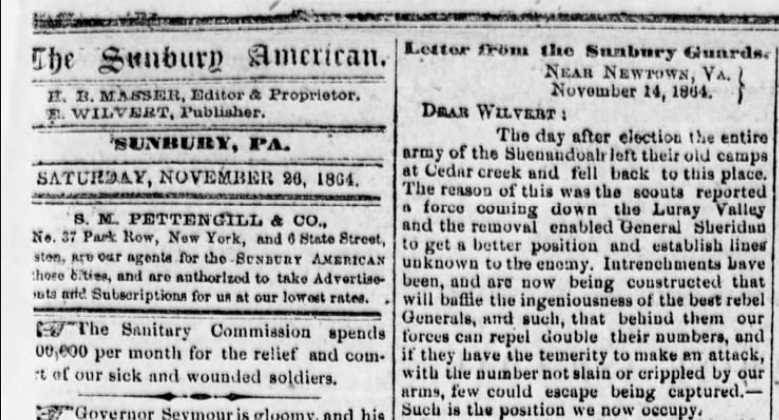
  15. Wert, Jeffry D. From Winchester to Cedar Creek: The Shenandoah Campaign of 1864. Mechanicsburg, Pennsylvania: Stackpole Books, 1997.
  16. Wharton, Henry D. Letters from the Sunbury Guards. Sunbury, Pennsylvania: Sunbury American, 1864.
  17. Whitehorn, Joseph W. A. The Battle of Cedar Creek. Washington, D.C.: U.S. Army, Center of Military History, 1992.