Finding Your 47th Pennsylvanian: Use “Bates’ History” — But With Caution

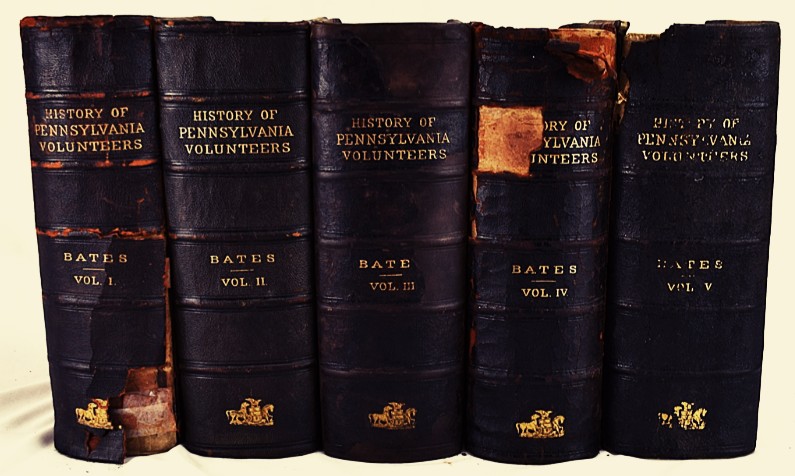
“History of Pennsylvania Volunteers, 1861-5,” Samuel P. Bates, 1869-1871 (public domain).

“So long as differences arise among nations, which cannot be settled by peaceful conference, and appeals are made to the arbitrament of the sword, the only safety that remains to the government is in the courage of its soldiery. In the late sanguinary struggle, the national unity was preserved, and the perpetuity of democratic institutions secured, by the men who bore the musket, and who led in the deadly conflict. Argument and moral sentiment were at fault, diplomacy was powerless, and courage proved the only peacemaker.

“In recognition of their services, and as a mark of the appreciation in which their valor is held, the Legislature of Pennsylvania authorized the preparation of a record of each of the military organizations in the field since 1861.” 

— Samuel P. Bates, “Preface,” History of Pennsylvania Volunteers, 1861-5


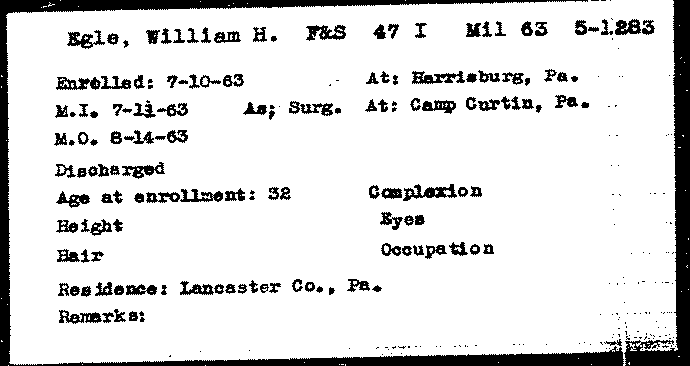
One of the first pieces of advice that archivists, librarians and professional genealogists will often give to descendants of Pennsylvania Volunteer Infantrymen when beginning their research of soldier-ancestors is to “Check Bates’ History,” which often results in descendants responding with, “What’s that?” and “Where Can I Find It?”

“Bates’ History” is, in fact, a five-volume series of books entitled, History of Pennsylvania Volunteers, 1861-5; Prepared in Compliance with Acts of the Legislature, that was researched, written and published during the mid-1860s through the early 1870s by Samuel Penniman Bates, an American educator and historian. Appointed in 1864 as state historian of the Commonwealth of Pennsylvania by Pennsylvania Governor Andrew Gregg Curtin, Bates was subsequently commissioned by the governor on June 1, 1866 to fulfill a legislative directive that “a military history of the organization of Pennsylvania volunteers and militia, who have been, or may be in the field” be researched, written and published for the public record. Bates was then given additional instructions by the Pennsylvania Legislature on April 17, 1867 “that the military history of the Pennsylvania volunteers … embrace an account of the organization, and services in the field, of each regiment, together with a roll giving the name, age, and residence of each officer and soldier, the date and term of enlistment, the promotions, the discharges, and casualties, and the places of burial of those who died in service.”

Thanks to that foresight by elected officials from Pennsylvania and Bates’ Herculean effort, generations of genealogists and academic historians have since visited historical societies and libraries across Pennsylvania and beyond to peruse increasingly worn copies of Bates’ books in order to learn more about the history of a specific regiment and confirm the names of that regiment’s leaders and rank and file members.

Access to Bates’ data was then made even easier by technological advancements in library science with the digitization of Bates’ books. As a result, family historians and other researchers no longer need to schlep to libraries to hunker down over their desired dusty tomes because Bates’ complete series has been accessible online, free of charge since 2012, thanks to HathiTrust, a collaborative effort between multiple academic institutions across the United States that is headquartered at the University of Michigan’s main campus in Ann Arbor. (“Go Blue!”)

This highly user-friendly format presented by HathiTrust allows users to not only read or browse each volume, but to also search for a specific soldier’s name by entering that name into the search textbox for the volume where that soldier’s name would most likely be located.

With respect to members of the 47th Pennsylvania Volunteer Infantry, that book would be Bates’ first volume. So, to find your 47th Pennsylvanian:

  1. Pull up volume one of Bates;
  2. Click on the downward-facing arrow of the black “Options” line near the top of the webpage you’re now seeing;
  3. Click on “Search in This Text”;
  4. Enter your ancestor’s name in that text box, between quotation marks, beginning with his last name, followed by a comma, one space, and his given name (example: “Clouser, Ephraim”); and
  5. Click the magnifying glass.

That search should pull up a new webpage that lists the page(s) in Bates’ first volume on which your ancestor’s name might appear — if your ancestor actually did serve with the 47th Pennsylvania Volunteer Infantry. Each of those items on that list will have an active link that will take you to the specific page in Bates’ first volume on which your ancestor is listed (or may take you to a page on which someone who had the same name as your ancestor is listed; so double check the data to be sure you’re looking at data for the correct soldier).

But if your search does not pull up a page(s) with your ancestor’s name, it may mean that your ancestor did not actually serve with the 47th Pennsylvania Volunteer Infantry — or that Bates spelled your ancestor’s name incorrectly.

Caveat Emptor

“Let the buyer beware” — or in this case “Caveat Scholaris” (“Let the student beware.”) While Bates History can be a helpful starting point for research regarding the 47th Pennsylvania Volunteer Infantry, each volume in the series contains significant errors — understandable when considering that Bates was tasked with summarizing the myriad number of muster rolls generated by hundreds of Pennsylvania military units that were staffed by more than three hundred and sixty thousand soldiers from Pennsylvania during the American Civil War. (And many of those original muster rolls were filled with errors because the Union Army clerks assigned to maintain those rolls simply could not create or update records when their regiments were being moved from one duty station to another as they marched into, or retreated from, battlefields scattered throughout three theaters of war that spread across multiple states in the Union and Confederacy.)

That being said, Bates left future generations of Pennsylvanians with a useful, detailed and reasonably accurate record of Pennsylvania’s role in the American Civil War. So, by all means, use Bates’ History to further your research; just don’t rely on it as your sole source of data.

As you go about finding your 47th Pennsylvanian, always double check the new data you find against the regiment’s original muster rolls and against other sources, such as the individual U.S. Civil War Pension file(s) for your ancestor and his parents, widow and/or children — records that are often chock full of new data and are maintained by the U.S. National Archives and Records Administration. (More information about those pension records is available online here.)


Sources:

  1. “A State History of Our Pennsylvania Regiments.” Philadelphia, Pennsylvania: The Daily Evening Telegraph, January 19, 1867.
  2. Bates, Samuel P. History of Pennsylvania Volunteers, 1861-5; Prepared in Compliance with Acts of the Legislature, volumes 1-5. Harrisburg, Pennsylvania: B. Singerly, State Printer, 1869-1871 (full text search and browse options available through HathiTrust, University of Michigan).
  3. Hodge, Ruth E. “Samuel Penniman Bates Papers, 1853-1895,” in “Guide to African American Resources at the Pennsylvania State Archives.” Harrisburg, Pennsylvania: Pennsylvania Historical and Museum Commission, 2000.
  4. Royer, Douglas L. Guide to Civil War Holdings of the Pennsylvania State Archives. Harrisburg, Pennsylvania: Pennsylvania State Archives, 2001.


Observing Pennsylvania German Day on June 28

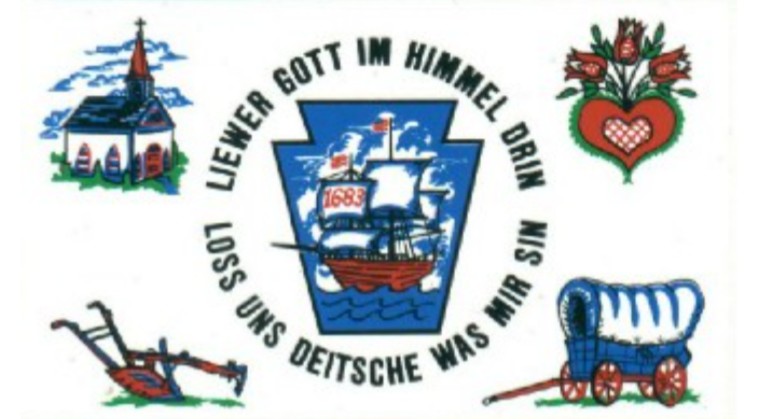
This Pennsylvania German Flag, which was created by Peter V. Fritsch, was officially dedicated at the Allentown Court House in 1989 (public domain).

On June 29, 1976, the General Assembly of the Commonwealth of Pennsylvania enacted P. L. 458, No. 113, directing that Pennsylvania German Day be observed annually on June 28, across the great Keystone State:

Section 1. In recognition of the cultural, educational and historical contributions from their heritage to this Commonwealth, June 28 of each year is set aside to commemorate the Pennsylvania German, commonly known as Pennsylvania Dutch, and is hereby designated to be “Pennsylvania German Day.”

The Governor is authorized and requested to issue a proclamation each year calling upon the people of the Commonwealth to commemorate the contributions of the German people to the history and culture of the Commonwealth, and to approve that day with appropriate honors and ceremonies.

Section 2. This act shall take effect immediately.

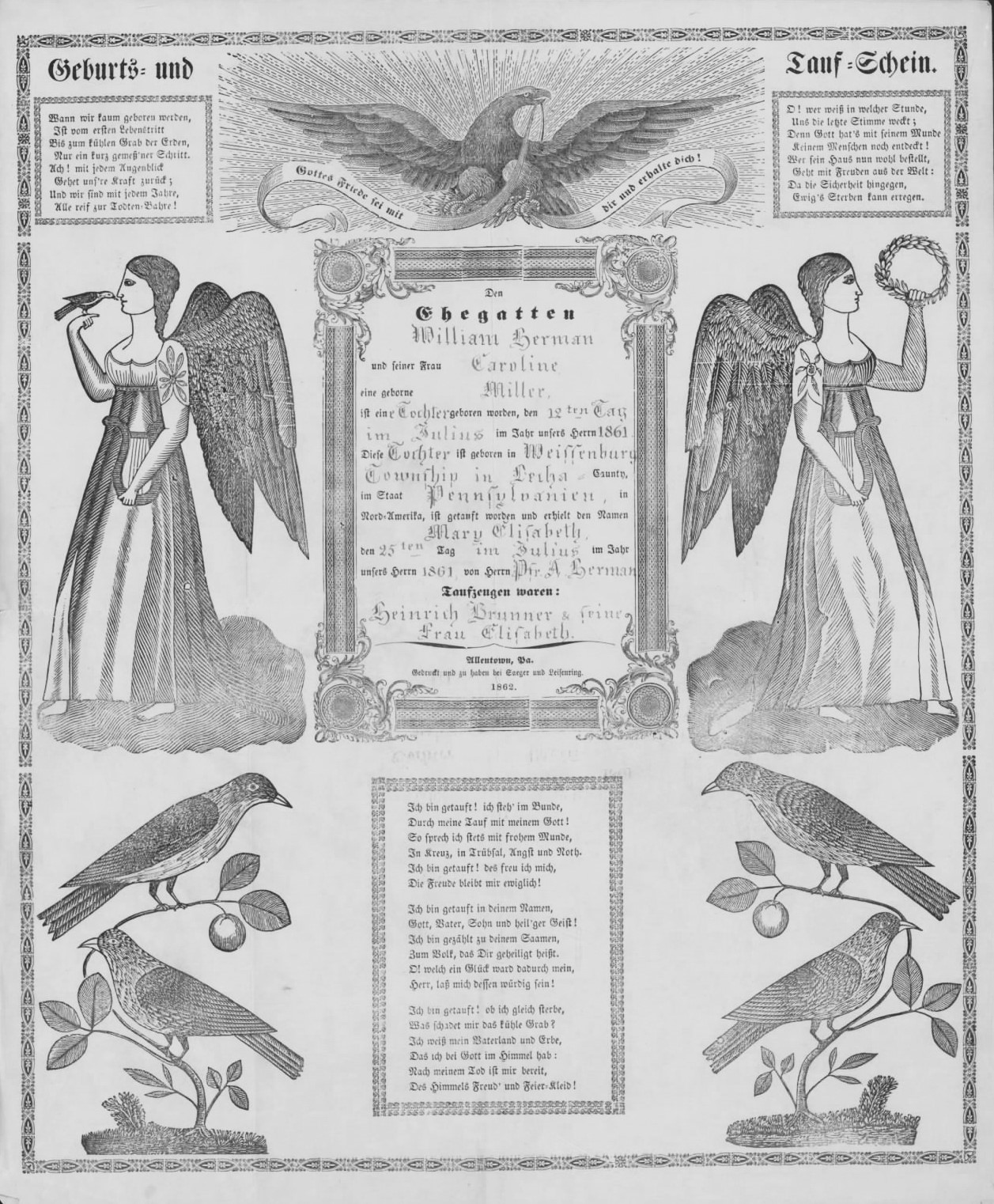
Copy of the 1862 Taufschein of Mary Elisabeth Herman, daughter of Private William Herman, 47th Pennsylvania Volunteers (U.S. Civil War Widows’ and Orphans’ Pension Files, U.S. National Archives and Records Administration, public domain; click to enlarge).

That act carries special meaning for all who are involved with 47th Pennsylvania Volunteers: One Civil War Regiment’s Story because a significant portion of the men who served with the 47th Pennsylvania Volunteer Infantry during the American Civil War were men and boys of German heritage, including:

Read their stories. Remember their names. Honor the sacrifices they made for the United States of America and the world.


Sources: 

  1. “Act No. 113 of 1976: Pennsylvania German Day — Observance.” Harrisburg, Pennsylvania: Pennsylvania General Assembly, June 29, 1976 (retrieved online June 28, 2025).
  2. Civil War Veterans’ Card File, 1861-1866 (47th Pennsylvania Infantry). Harrisburg, Pennsylvania: Pennsylvania State Archives.
  3. Moyer, Del-Louise. “John Daniel Eisenbrown: Fraktur Artist and Grave Monument Engraver.” Philadelphia, Pennsylvania: AlyssumArts, September 7, 2015.
  4. U.S. Civil War Pension Files. Washington, D.C.: U.S. National Archives and Records Administration.


“Propitious Weather and a Splendid Spectacle”: The United States of America’s Grand Review of the Armies (May 23, 1865)

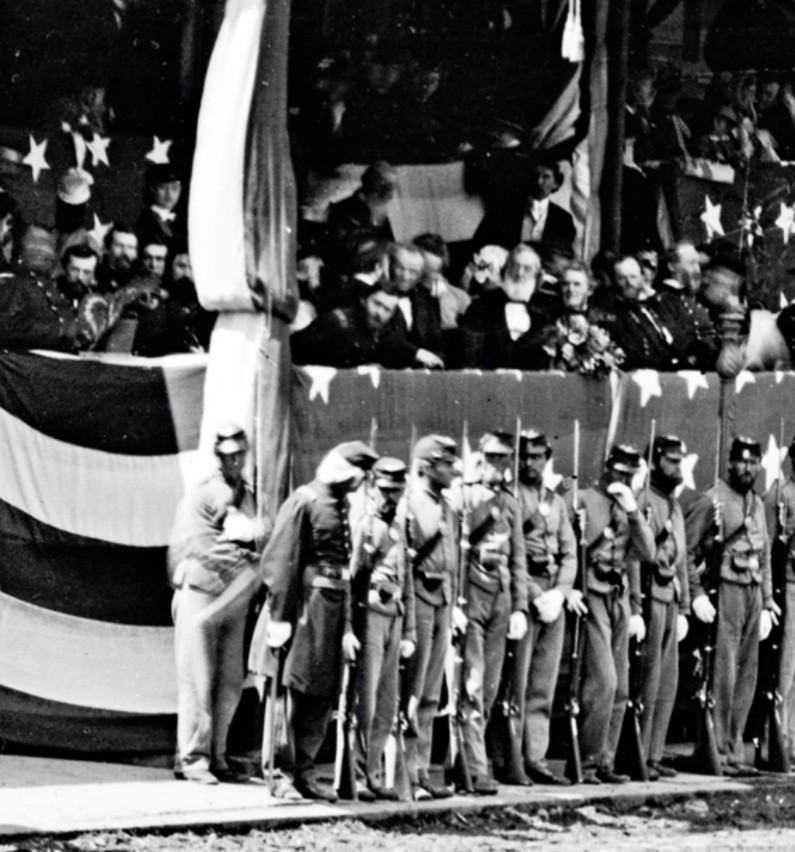
Lieutenant-General Ulysses S. Grant leans forward to have a better look at a Union regiment approaching the presidential reviewing stand, President Andrew Johnson to his left, Grand Review of the National Armies, Washington, D.C., May 23, 1865 (U.S. Library of Congress, public domain; click to enlarge).

It was a week to remember. The 47th Pennsylvania Veteran Volunteers had survived the bloody Battle of Pocotaligo in South Carolina (October 1862) to make history as the only regiment from the Great Keystone State to participate in the Union’s 1864 Red River Campaign across Louisiana and help firmly, finally turn the tide of the American Civil War in the Union’s favor during Sheridan’s 1864 Shenandoah Valley Campaign — only to be brought to their knees in mourning, upon receiving the heartbreaking news that their beloved commander-in-chief had been assassinated — just as victory was at hand.

Now, they were joining more than one hundred and forty-five thousand other “boys in blue” in a triumphant march through the streets of Washington, D.C. that would subsequently be described by The New York Times as “The Grand Procession of Battle Stained Banners” and a “splendid spectacle” that was graced with “propitious weather.” The reporter penning those superlatives was describing the Union’s Grand Review of the National Armies, which took place from May 23 to 24.

The Army of the Potomac has passed in review. The first day’s pageant is over, and to the correspondent falls the duty of depicting a scene almost devoid of incident, save in its grand aspiration. Every circumstance has combined to make it a complete success. The weather has been magnificent; the air, delightfully tempered by the rains of the past week, is cool and fragrant, and dust, is for the time subdued….

Though the city is so crowded, it is yet gay and jovial with the good feeling that prevails, for the occasion is one of such grand import and true rejoicing, that small vexations sink out of sight. With many it is the greatest epoch of their lives; with the soldier it is the last act in the drama; with the nation it is the triumphant exhibition of the resources and valor which have saved it from disruption and placed it first upon earth.

So the scene of to-day (and that of to-morrow) will never be forgotten, and he who is privileged to be a witness will mark it as a white day in the calendar, from which to gather hope and courage for the future….

That Times reporter went on to describe the ways in which multiple Union Army regiments had made their way to the nation’s capital, where they had set up tents upon their respective arrivals and how they had assembled for the first day of the review, providing a list, line-by-line, of the long order of march — a list which included the 47th Pennsylvania Volunteers. (Officially stationed at Camp Brightwood in the northwest corner of Washington, D.C. by early May 1865, the 47th Pennsylvanians had departed from that camp on Monday, May 22 to move closer to their assigned position for the Grand Review’s start, according to Private Henry Horn of Company G.)

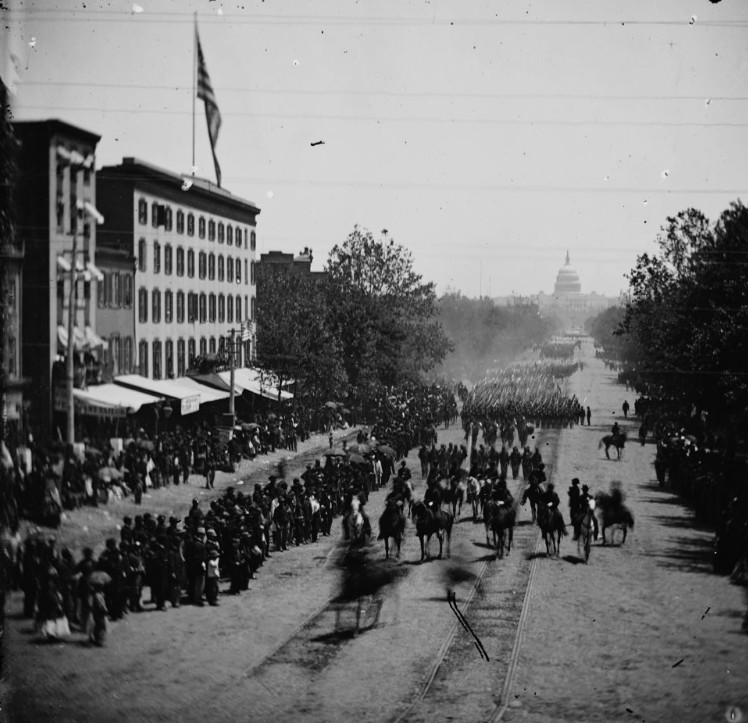
19th Corps, Army of the United States, Grand Review of the National Armies, Pennsylvania Avenue, Washington, D.C., May 23, 1865 (Matthew Brady, U.S. Library of Congress, public domain).

The 47th Pennsylvania was just one of the one hundred and eighteen infantry regiments, twenty-nine cavalry regiments and thirty-three artillery batteries that boldly stepped forth from Capitol Hill on that first day of the Grand Review (May 23, 1865). Marching with the precision they were known for, under the banners of the Army of the Potomac (Mr. Lincoln’s Army), they were participants in a thrilling, six-hour parade, passing in front of a review stand that sheltered U.S. President Andrew Johnson, Secretary of War Edwin M. Stanton, Lieutenant-General Ulysses S. Grant, and other high-ranking officials of the military and federal government. According to the Times, the 47th Pennsylvania Veteran Volunteers were positioned behind the parade’s third division, as part of the Nineteenth Army Corps (XIX Corps) in Dwight’s Division:

Third Division.
Brevet Brig.-Gen. John G. Curtin commanding.

First Brigade, Col. A. B. McCalmon commanding — 51st Pennsylvania Veteran Volunteers, Col. William J. Bolton; 208th Pennsylvania, Lieut.-Col. M. T. Heintzelman; 209th Pennsylvania, Col. T. B. Kaufman; 200th Pennsylvania, Maj. Jacob Rehm.

Second Brigade, Col. J. A. Mathews commanding — 207th Pennsylvania, Col. R. C. Cox; 211th Pennsylvania, Lieut.-Col. Coulter; 205th Pennsylvania, Lieut.-Col. W. F. Walter.

Dwight’s Division.
Nineteenth Army Corps, Brig.-Gen. William Dwight commanding.

First Brigade, Brig.-Gen. G. L. Beal commanding — 15th Maine, Col. Isaac Dyer; 114th New York, Col. S. R. Per Lee; 29th Maine, Col. George H. Nye; 30th Massachusetts, Lieut.-Col. N. Shardman; 1st Maine Battalion, Capt. C. S. Brown.

Second Brigade, Brevet Brig.-Gen. E. P. Davis commanding — 153rd New York, Lieut.-Col. J. A. McLaughlin; 8th Vermont, Col. J. B. Mead; 12th Connecticut, Lieut.-Col. G. W. Lewis; 26th Massachusetts, Lieut.-Col. W. H. Chapman; 47th Pennsylvania, Col. J. P. S. Gobin.

Third Brigade, Brig.-Gen. J. D. Fessenden commanding — 173rd New York, Col. L. M. Peck; 160th New York, Col. C. C. Dwight; 162nd New York, Col. J. W. Blanchard; 133rd New York, Col. L. D. Currie; 30th Maine, Col. T. H. Hubbard.

Artillery Brigade, Brevet Brig.-Gen. J. C. Tidball commanding — 34th New York Battery, Brevet Maj. J. Roemer; 7th Maine Battery, Capt. A. B. Twitchell; 19th New York Battery, Capt. E. W. Rogers; Battery D, 47th Pennsylvania Volunteer Artillery; Capt. S. H. Rhoads; 11th Massachusetts Battery, Capt. E. J. Jones; 27th New York Battery, Capt. J. B. Eaton.

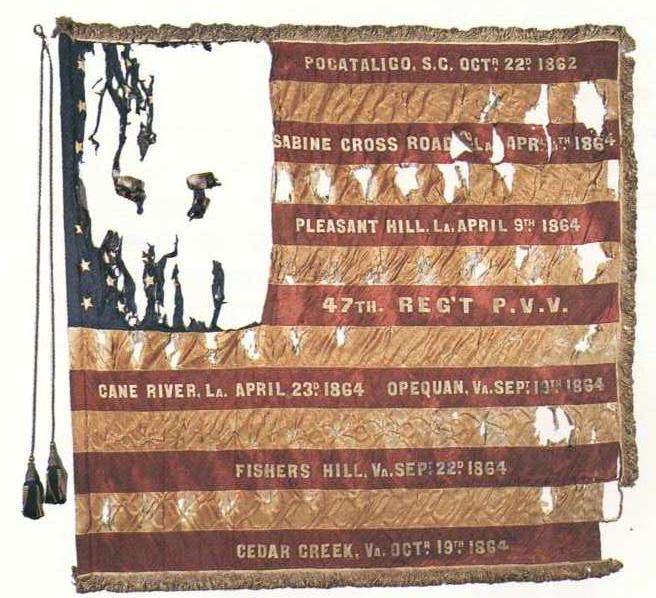
Second State Colors, 47th Pennsylvania Veteran Volunteers (presented to the regiment 7 March 1865).

Lest one be tempted to think that the 47th Pennsylvania Veteran Volunteers were placed further back in the line of march because they were being accorded less respect, one only need look at the rosters of the men who immediately followed the 47th. The division positioned directly behind them was composed of general staff of the Army of the United States and regiments led by American Civil War icon and Gettyburg hero Joshua L. Chamberlain. Observed U.S. Secretary of War Edwin M. Stanton, “You see in these armies, the foundation of the Republic: our future railroad managers, congressmen, bank presidents, senators, manufacturers, judges, governors and diplomats; yes and not less than half a dozen presidents.”

John Peter Shindel Gobin, 47th Pennsylvania Volunteers, shown here as a captain in 1863, went on to become lieutenant governor of Pennsylvania after the war (public domain).

Among the 47th Pennsylvanians who would continue to serve their communities, commonwealth and nation faithfully were future city councilmen, industrialists, inventors, judges, a three-time mayor, newspaper publishers, physicians, policemen, federal postmasters, local school board members, and a state senator who would be publicly elected as Pennsylvania’s seventh lieutenant governor. Each one had experienced the horrors of war. All were forever changed. So, please take time this Memorial Day weekend to read and share their stories with your family, friends and neighbors — and say their names as you offer a toast in tribute to their valor. We owe them at least that much for the sacrifices they made to save our nation.


Sources:

  1. Bates, Samuel P. History of Pennsylvania Volunteers, 1861-5, vol. 1. Harrisburg, Pennsylvania: B. Singerly, State Printer, 1869.
  2. “Grand Military Review: Streets Crowded with Spectators: Sherman Greeted with Deafening Cheers.” Pittsburgh, Pennsylvania: The Daily Post, May 25, 1865.
  3. “Our Heroes! The Grand Review at Washington. Honor to the Brave. Immense Outpouring of the People. The Troops Reviewed by Gen. Grant.” Harrisburg, Pennsylvania: Daily Telegraph, May 23, 1865.
  4. “Review of the Armies; Propitious Weather and a Splendid Spectacle. Nearly a Hundred Thousand Veterans in the Lines.” New York, New York: The New York Times, May 24, 1865, front page.
  5. Rodrock, Rev. William D. C. Chaplain’s Reports (47th Pennsylvania Volunteer Infantry, 1865). Washington, D.C.: U.S. National Archives and Records Administration.
  6. Schmidt, Lewis. A Civil War History of the 47th Regiment of Pennsylvania Veteran Volunteers. Allentown, Pennsylvania: Self-published, 1986.
  7. “Serenade to General Grant” (performance for Lieutenant-General Ulysses S. Grant by the 47th Pennsylvania Veteran Volunteers’ Regimental Band), in “Washington.” Philadelphia, Pennsylvania: The Inquirer, May 22, 1865.
  8. “The Final March: Grand Review of the Armies.” Washington, D.C.: U.S. National Park Service, retrieved online May 20, 2025.
  9. “The Grand Review: A Grand Spectacle Witnessed.” Pittsburgh, Pennsylvania: The Daily Post, May 24, 1865.
  10. “The Grand Review: Immense Crowds in Washington: Fine Appearance of the Troops: Their Enthusiastic Reception.” Harrisburg, Pennsylvania: Pennsylvania Daily Telegraph, May 24, 1865; and West Chester, Pennsylvania: The Record, May 17, 1865.
  11. “The Grand Review: The City Crowded with Visitors: Order of Corps, Divisions, Brigades and Regiments.” Philadelphia, Pennsylvania: Daily Constitutional Union, May 23, 1865.
  12. “The History of the Forty-Seventh Regt. P. V.” Allentown, Pennsylvania: The Lehigh Register, 20 July 1870.


April 12th: This Date in 47th Pennsylvania Volunteer Infantry History

April 12th would prove to be an important date for the men who served with the 47th Pennsylvania Volunteer Infantry during the American Civil War and Reconstruction eras. This abridged timeline illustrates why:

1861

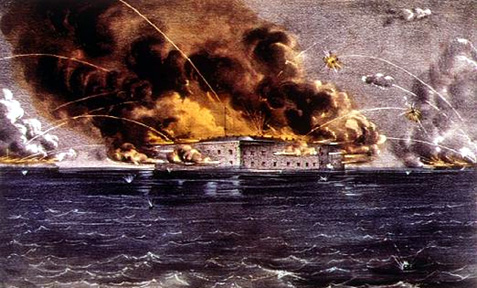
The bombardment of Fort Sumter 12-14 April 1861 (Currier & Ives, public domain).

At 4:30 a.m., on April 12, 1861, artillery batteries of the Confederate States Army open fire on United States Army troops stationed at Fort Sumter in Charleston, South Carolina. A long and disastrous period of civil war begins in America.

The majority of Pennsylvanians and residents of other states throughout America who will ultimately serve with the 47th Pennsylvania Volunteer Infantry are at home, asleep in their beds — or just rising and readying themselves for their work days on family farms, as canal boatmen, in iron foundries, silk mills, tanneries or tobacco factories, as quarrymen toiling away in the slate industry, or as miners tunneling deeper inside of the Earth in poorly-lighted coal mines, along with countless other blue collar laborers who are risking their own health and safety just to keep their families housed and fed.

The 47th Pennsylvania Volunteer Infantry isn’t even “a glimmer” in anyone’s eyes — yet. (It won’t be founded until August 5, 1861.)

1862

In 1862, The Gazette, one of two hometown newspapers read by the majority of men serving with the 47th Pennsylvania Volunteer Infantry’s C Company, carries the following news in its April 12th edition:

Jeff. Davis is becoming desperate. He has issued an extraordinary Message ordering the enrollment of all citizens of the Confederate States between the ages of 18 and 35, for military service, the residue of the fighting population, above 35 to form a fighting force.

Although that particular edition of the newspaper has not yet reached the 47th Pennsylvania Volunteers who are stationed in Florida, a warning about the Confederate Conscription Act’s pending passage has likely been telegraphed by the U.S. War Department to senior officers at the 47th Pennsylvania’s headquarters at Fort Taylor in Key West in order to prepare them for the increased threat they and their troops will face.

1864

On April 12, 1864, Captain Charles William Abbott, commanding officer of the 47th Pennsylvania Volunteer Infantry’s K Company, pens a brief report from his regiment’s camp at Grand Ecore, Louisiana to his superior officers in the United States Army of the Gulf, which partially documents the losses in soldiers and supplies sustained by his regiment during the Battle of Pleasant Hill, Louisiana on April 9, 1864. That report also contains details about the regiment’s movements during this phase of duty.

Sergeant John Gross Helfrich then describes this same battle in a letter to his parents on May 5th, in which he notes:

I have learned additional news of the late fight of our boys of the “Nineteenth Corps”…. The casualties of our boys amounted to a great deal more than at first reported. The Lt. Col. of our Forty-seventh Regt. is missing, and supposed he is wounded or perhaps killed. Lt. Swoyer is dead.

1865

In a letter that he is writing to the Sunbury American on April 12, 1865 from the 47th Pennsylvania Volunteer Infantry’s camp near Summit Point, Virginia, 47th Pennsylvanian Henry D. Wharton describes a celebration that took place following the surrender at Appomattox by Confederate General Robert E. Lee and his army on April 9, 1865:

Since yesterday a week we have been on the move, going as far as three miles beyond Winchester. There we halted for three days, waiting for the return or news from Torbett’s cavalry who had gone on a reconnoisance [sic] up to the valley. They returned, reporting they were as far up as Mt. Jackson, some sixty miles, and found nary an armed reb. The reason of our move was to be ready in case Lee moved against us, or to march on Lynchburg, if Lee reached that point, so that we could aid in surrounding him and [his] army, and with Sheridan and Mead capture the whole party. Grant’s gallant boys saved us that march and bagged the whole crowd. Last Sunday night our camp was aroused by the loud road of artillery. Hearing so much good news of late, I stuck to my blanket, not caring to get up, for I suspected a salute, which it really was for the ‘unconditional surrender of Lee.’ The boys got wild over the news, shouting till they were hoarse, the loud huzzas [sic, huzzahs] echoing through the Valley, songs of ‘rally round the flag,’ &c., were sung, and above the noise of the ‘cannons opening roar,’ and confusion of camp, could be heard ‘Hail Columbia’ and Yankee Doodle played by our band. Other bands took it up and soon the whole army let loose, making ‘confusion worse confounded.’

The next morning we packed up, struck tents, marched away, and now we are within a short distance of our old quarters. – The war is about played out, and peace is clearly seen through the bright cloud that has taken the place of those that darkened the sky for the last four years. The question now with us is whether the veterans after Old Abe has matters fixed to his satisfaction, will have to stay ‘till the expiration of the three years, or be discharged as per agreement, at the ‘end of the war.’ If we are not discharged when hostilities cease, great injustice will be done.

The members of Co. ‘C,’ wishing to do honor to Lieut. C. S. Beard, and show their appreciation of him as an officer and gentleman, presented him with a splendid sword, sash and belt. Lieut. Beard rose from the ranks, and as one of their number, the boys gave him this token of esteem.

A few nights ago, an aid [sic] on Gen. Torbett’s staff, with two more officers, attempted to pass a safe guard stationed at a house near Winchester. The guard halted the party, they rushed on, paying no attention to the challenge, when the sentinel charged bayonet, running the sharp steel through the abdomen of the aid [sic], wounding him so severely that he died in an hour. The guard did his duty as he was there for the protection of the inmates and their property, with instruction to let no one enter.

The boys are all well, and jubilant over the victories of Grant, and their own little Sheridan, and feel as though they would soon return to meet the loved ones at home, and receive a kind greeting from old friends….

1866

On April 12, 1866, members of the 47th Pennsylvania Veteran Volunteers who survived the American Civil War are three months into their post-war civilian lives. Many are back home in Pennsylvania, trying to regain some sense of their old selves with normal work and family routines. Others have already left their pre-war and war lives behind, choosing to migrate west in search of better opportunities — or a certain peace of mind they hope to find in knowing they will be far away from any decision-makers who might drag their communities and nation back down into another disastrous war in the future.


Sources:

  1. Abbott, Charles W. Report from Captain Charles W. Abbott, Captain, Company K, 47th Pennsylvania Volunteer Infantry, to Senior Officers of the U.S. Army of the Gulf’s XIX Corps (19th Corps), Grand Ecore, Louisiana, April 12, 1864. Nazareth, Pennsylvania: Personal Collection of Julian Burley.
  2. “Agriculture and Rural Life,” in “Stories from PA History.” Harrisburg, Pennsylvania: Pennsylvania Historical and Museum Commission, 2023.
  3. “Fort Sumter and Fort Moultrie National Park.” Washington, D.C.: National Park Foundation, retrieved online April 12, 2025.
  4. Harris, Howard and Perry K. Blatz. Keystone of Democracy: A History of Pennsylvania Workers. Harrisburg, Pennsylvania: Pennsylvania Historical and Museum Commission, 1999.
  5. Helfrich, John Gross. Letter to His Parents, May 5, 1864. Mesa, Arizona: Personal Collection of the Colin Cofield Family Archives.
  6. Miller, Randall M. and William A. Pencak. Pennsylvania: A History of the Commonwealth. University Park, Pennsylvania: The Pennsylvania State University Press, 2002.
  7. “Mining Anthracite,” in “Stories from PA History.” Harrisburg, Pennsylvania: Pennsylvania Historical and Museum Commission, 2023.
  8. Montgomery, Morton L. Early Furnaces and Forges of Berks County, Pennsylvania, in The Pennsylvania Magazine of History and Biography, 1884. Philadelphia, Pennsylvania: Historical Society of Pennsylvania, 1884.
  9. News Regarding the Confederate States’ New Conscription Order. Sunbury, Pennsylvania: The Gazette, April 12, 1862.
  10. Palladino, Grace. Another Civil War: Labor, Capital, and the State in the Anthracite Regions of Pennsylvania, 1840-1868. New York, New York: Fordham University Press, March 30, 2006.
  11. Sacher, John M. Confederate Conscription and the Struggle for Southern Soldiers. Baton Rouge, Louisiana: LSU Press, 2021.
  12. “The Industrial Age,” in “Stories from PA History: Science and Invention.” Harrisburg, Pennsylvania: Pennsylvania Historical and Museum Commission, 2023.
  13. “The Pennsylvania Iron Industry: Furnace and Forge of America,” in “Stories from PA History.” Harrisburg, Pennsylvania: Pennsylvania Historical and Museum Commission, 2023.
  14. “The Railroad in Pennsylvania,” in “Stories from PA History.” Harrisburg, Pennsylvania: Pennsylvania Historical and Museum Commission, 2023.
  15. “Timeline of Labor History in Pennsylvania.” Pennsylvania: Pennsylvania Labor History Society, retrieved online April 12, 2025.


Judy Snyder Wasserman: A Woman Who Made the World Better

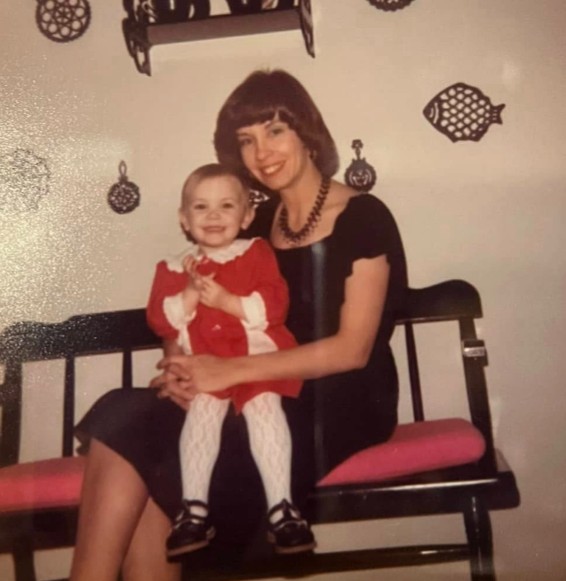
Judy (Snyder) Wasserman and daughter, New Jersey, 1980s (courtesy of the Snyder-Wasserman-Griffin-Silvio Family Archives).

She was my sister and she was a force of nature. Join me in paying tribute to the first supporter of 47th Pennsylvania Volunteers: One Civil War Regiment’s Story, Judy (Snyder) Wasserman.

This educational project would not have been possible without her.

Who Was She?

Born in Houston, Texas on February 23, 1947, Judy Leah Snyder was a daughter of Schuylkill County, Pennsylvania natives Willard Emery Snyder (1917-1972) and Genevieve Madeline (Krupa) Snyder (1918-1997).

Her father, who had served with the United States Navy’s Seabees during World War II and was an employee of the Bell Telephone Company of Pennsylvania afterward, was a son of telephone industry pioneer John Hartranft Snyder (1873-1944), and a descendant of American Revolutionary War Patriot Johannes Nicholas Schneider (1749-1821) and American Civil War veteran Timothy Matthias Snyder (1840-1889), who served with the 47th Pennsylvania Volunteer Infantry’s C Company, the unit which had protected the American flag during multiple battles in South Carolina, Louisiana and Virginia.

Her mother, Genevieve, who had worked in the blueprints division at the Philadelphia Navy Yard during World War II, was a first-generation American whose parents, Jan Krupa (1881-1942) and Rozalia (Tuczek) Krupa (1884-1962), had emigrated separately from Poland between 1902 and 1905, and had met and married in Philadelphia’s Manayunk section in 1906 before relocating to the community of Minersville in Schuylkill County, where Jan found work as an explosives expert in the anthracite coal mining industry.

Initially raised in Lavelle, Schuylkill County, Judy Snyder relocated with her parents to the nearby community of Frackville, where she became the older sister to two siblings and was enrolled as a student at the Frackville Elementary School during the early 1950s.

Later that same decade, she relocated with her parents and younger sisters to the Borough of West Lawn in Berks County, Pennsylvania, where her youngest sister was born. An avid reader and persuasive debater who was inspired by the characters in Louisa May Alcott’s novel, “Little Women,” Judy successfully lobbied her parents to name her baby sister, “Laurie,” saving her from the years of playground bullying that would likely have resulted had one of several other proposed names been chosen. Fortunately, their parents agreed, assuring a lifelong, loving bond between the oldest and youngest sisters — a bond that was strengthened as Judy wheeled Laurie around their neighborhood on frequent stroller rides to nurture a sense of curiosity and wonder.

Skilled at math, Judy was also a Russian language student at Wilson High School in West Lawn. A talented painter during those same high school years, she went on to become an adept visual artist as the designer of eye-catching, award-winning window displays for major department stores in New York City and New Jersey, as well as interior designs and decorations for multiple Casual Corner stores on the East Coast.

Judy (Snyder) Wasserman as she created a department store window display (courtesy of the Snyder-Wasserman-Griffin-Silvio Family Archives).

A fashionable dresser, she helped her younger sisters to develop their own sense of style, as each went on to become educators in Pennsylvania’s highly regarded system of public schools. (She was less successful, however, at convincing “dear old Dad” to modernize. The bellbottom pants that she picked out for him one year never quite made it out of his closet, for one reason or another.)

Married to Howard Wasserman, one of the genuinely good guys in the world, Judy welcomed the births of two beautiful, brilliant daughters, Jess and Corry, who have each made their own positive impact on the world and will continue to do so for many years to come. Judy and Howard’s granddaughter, Izzy, has already shown signs that she, too, will be a formidable woman who will change the world in a positive way.

A lifelong learner who enjoyed studying American History, Judy drove her “baby” sister across Louisiana and back during two epic, 1990s road trips. Visiting multiple cities and towns, they stayed in a hotel on Bourbon Street in New Orleans that was reportedly haunted by the ghosts of Union Army soldiers, photographed the stained glass art at New Orleans’ Metairie Cemetery, marveled at the phenomenal flora and fauna found along Louisiana’s back roads, made a lifelong friend of the curator of the Bayou Folk Museum and Kate Chopin House in Cloutierville, toured the key filming locations for the movie, “Steel Magnolias,” in Natchitoches, Louisiana, and had some of the most memorable fine and junk food dining experiences in history.

She was witty and knew how to laugh and have fun — but she also knew when to get serious.

A fierce advocate for the most vulnerable in the world, she fought to improve public education for children across New Jersey and Louisiana, where she resided with her family, beginning in the 1990s. Also sensitive to the plight of animals that were being neglected or abused, she rescued more than a few from fates worse than death.

A warrior to the end, Judy (Snyder) Wasserman passed away in Lake Charles, Louisiana on April 1, 2023, but her sense of wonder and fighting spirit live on in those who love her still.


Sources: Images and oral history segments, courtesy of the Snyder-Wasserman-Griffin-Silvio Family Archives.

Women’s History Month: A Look Back at the Mothers, Wives, Widows, Daughters, and Granddaughters of the 47th Pennsylvania Volunteers

Leanna (Diehl) Hornbeck (1851-1934).

Leanna (Diehl) Hornbeck (1851-1934).

As Women’s History Month 2025 comes to a close, we take a look back at the mothers, wives, widows, daughters, and granddaughters of 47th Pennsylvania Volunteer Infantrymen who helped to preserve America’s Union and rebuild their shattered nation following the end of the American Civil War.

The backbones of their respective families, they not only kept the home fires burning while their husbands were engaged in combat far from their loving arms, they each left their own marks on the communities where they lived, and deserve to be remembered and celebrated for their own courage and resilience. Learn more about these remarkable women by watching our YouTube video, “Faces of the 47th: Wives, Widows and Daughters of the 47th Pennsylvania Volunteers,” and by reading the following biographies:

Remember their names. Be inspired by their strength. Honor the sacrifices they made for community and country.


Sources: 

  1. “Allen and Nona Albert’s Retirement a Loss to Long-Time Customers.” Tremont, Pennsylvania: The Press-Herald and The Pine Grove Herald, 12 February 1970.
  2. “Allentown Woman on the Roll of Honor: Gov. Brumbaugh Retires Mrs. Anna S. Leisenring, Factory Inspector, with Half Pay.” Reading, Pennsylvania: Reading Eagle, 20 January 1918.
  3. “Allentown Woman to Come to Reading to Inspect Bake Shops and Textile Establishments: Mrs. Annie Leisenring Is Lineal Descendant of Conrad Weiser, the Great Colonial Pioneer Who Lived Near Womelsdorf. Was First Appointed to Factory Inspection Service in 1893.” Reading, Pennsylvania: Reading Eagle, 20 May 1914.
  4. Baptismal, marriage, military, death, and burial records of the Snyder family. Pennsylvania, California, Florida, Louisiana, Nevada, Ohio, etc.: Snyder Family Archives, 1650-present and Historic Pennsylvania Church and Town Records (baptismal, marriage, death, and burial records of various churches across Pennsylvania). Harrisburg, Pennsylvania: Department of Health, Bureau of Vital Statistics, 1905-1956; and Philadelphia, Pennsylvania: Historical Society of Pennsylvania, 1776-1956.
  5. Beyerle, Emma; and Snyder, H. Corinne [sic, Corrine], Catharine R. and Lillian E., in U.S. Census (City of Reading, Fourteenth Ward, City of Reading, Berks County, Pennsylvania, 1930). Washington, D.C.: U.S. National Archives and Records Administration.
  6. Breneman, Christian K. and Margaret J., in U.S. Civil War Pension Index (application no.: 432815, certificate no.: 307318, filed by the widow from Pennsylvania on 7 July 1891). Washington, D.C.: U.S. National Archives and Records Administration.
  7. Breneman, Margaret A., Wm. L. Gardner, and Margaret J. Breneman; Victor L., Carrie I. Landis, Christian and Margaret J. Breneman, and R. M. Landis; Benj. C Breneman, Lena M. Rupley, Christian K. and Margaret J. Breneman, and Henry M. and Phoebe Rupley; Harry S. Breneman, Anna May Gebhard, C. K. and M. J. Breneman, and Jacob and Anna Gebhard, in Applications for Marriage Licenses. Harrisburg, Pennsylvania: Clerk of the Orphans’ Court of Dauphin County, Pennsylvania, 21 December 1897; 21 November 1906; 17 June 1911; and 3 October 1914.
  8. “Catharine Courtney, 89, Private Secretary” (obituary). Lancaster, Pennsylvania: Intelligencer Journal, 28 August 1995.
  9. Catharine S. Courtney, in “Clubs: York Woman Heads State Secretaries.” Lancaster, Pennsylvania: New Era, 23 April 1956.
  10. Chalkley John, in Portrait and Biographical Album of Whiteside County, Illinois, Containing Full-Page Portraits and Biographical Sketches of Prominent and Representative Citizens of the County, Together with the Portraits and Biographies of All the Governors of Illinois, and the Presidents of the United States. Chicago, Illinois: Chapman Brothers, 1863.
  11. Charles Magill and “Julian Ruston” [sic], in Certificate of Marriage. Camden, New Jersey: St. Paul’s Protestant Episcopal Church, 18 January 1887.
  12. Courtney, Charles F. and Catharine R., in Polk’s Lancaster City Directory, 1950. Boston, Massachusetts: R. L. Polk & Co., Inc., Publishers, 1950.
  13. Davis, William W. History of Whiteside County, Illinois from Its Earliest Settlement to 1908: Illustrated, with Biographical Sketches of Some Prominent Citizens of the County, vols. 1 and 2. Chicago, Illinois: Pioneer Publishing Co., 1908.
  14. “Death of a Highly Esteemed Citizen.” Allentown, Pennsylvania: The Allentown Democrat, 5 October 1898.
  15. Edwin Minnich, Juliann (Kuehner) Minnich, and George Minnich, in U.S. Civil War Widows’ Pension Files. Washington, D.C.: U.S. National Archives and Records Administration, 1865-1901.
  16. “Explaining Trends in the Gender Wage Gap: A Report by The Council of Economic Advisors.” Washington, D.C.: The White House, June 1998.
  17. “Funeral of Mrs. Mary B. Moyer from Her Late Home on East Market Street,” in “Green Ridge Items.” Scranton, Pennsylvania: The Scranton Tribune, 9 December 1901.
  18. Fusselman, Daniel, Catherine, Celistia [sic, Salista], Catherine, John W. R., Caroline, Mary E., and Sarah, in U.S. Census (East Waterford, Tuscarora Township, Juniata County, Pennsylvania, 1860). Washington, D.C.: U.S. National Archives and Records Administration.
  19. Fusselman, Daniel (father), Kate, John, Caroline, Emna Sarah, Daniel (son), Amanda, Rosa, and Josiah, in U.S. Census (McCullochs Mills, Tuscarora Township, Juniata County, Pennsylvania, 1870). Washington, D.C.: U.S. National Archives and Records Administration.
  20. Fusselman, Daniel and Catharine, in U.S. Civil War Pension Files (application no.: 254530, certificate no.: 315939, filed from Pennsylvania by the veteran, 8 May 1878; application no.: 250052, certificate no.: 347812, filed by the veteran’s widow, 20 August 1879). Washington, D.C.: U.S. National Archives and Records Administration.
  21. Gordon, Elizabeth Putnam. Women Torch-Bearers: The Story of the Woman’s Christian Temperance Union. Evanston, Illinois: National Woman’s Christian Temperance Union Publishing House, 1924.
  22. “Holland Farmer Passed Away Friday.” Abilene, Kansas: Abilene Daily Reflector, 29 August 1914.
  23. “John Family Papers, 1775-1951” (RG5/077). Swarthmore, Pennsylvania: Friends Historical Library of Swarthmore College.
  24. John, Clark E. History and Family Record of the “John” Family, 1683 to 1964: The Descendants of John Phillips and Ellen, His Wife, from Haverfordwest, Pembrokeshire, Wales. Salt Lake City, Utah: Genealogical Society of the Church of Latter Day Saints, 1967.
  25. John, Don D. and Helen Doup John. “Eliza John Diary from 1839 to 1863: An Historical and Genealogical Record of the Quakers in Northumberland County, Pennsylvania and What Befell Them,” in Historical Collections of the John Family in America, 1950. Louisville, Kentucky: J. D. John, Self-published, 1951.
  26. John, George D., Mary Alice John, Elida P. John, Sarah Hughes, and Sidney A. John, in Illinois Deaths and Stillbirths, 1916-1947 (database via Public Board of Health, Archives, Springfield, Illinois, Family History Library microfilm 1,614,419, 1,786,728 and 1,818,801; dates: 1928, 1937, 1938). Salt Lake City, Utah: Family History Library.
  27. Leanna D. Hornbeck, in Illinois Deaths and Stillbirths, 1916–1947. Salt Lake City, Utah: FamilySearch, 1934.
  28. Leanna D. Hornbeck, in U.S. Passport Applications (No. 5492 on Roll No. 184). Washington, D.C.: U.S. Department of State, Bureau of Citizenship and U.S. National Archives, 10 May 1913.
  29. Lecture Presentation by Annie E. Leisenring, in “Addresses and Discussions: Fourth Annual Welfare and Efficiency Conference, Pennsylvania Department of Labor and Industry, November 21, 22, 23, 1916.” Harrisburg, Pennsylvania: Monthly Bulletin of the Pennsylvania Department of Labor and Industry, William Stanley Ray, State Printer, March 1917.
  30. Leisenring, Annie, in U.S. Census of Union Veterans and Widows of the Civil War. Washington, D.C. and Pennsylvania: 1890.
  31. Leisenring, Annie E., in United States Veterans Administration Pension Payment Cards (Certificate No.: 240043). Washington, D.C.: U.S. National Archives and Records Administration, 1887-1920.
  32. “Letter from Key West” (from “W. D. C. R., Chaplain, Forty-seventh Regiment, P. V.”; dated 13 March 1862). Philadelphia, Pennsylvania: The Press, 31 March 1862, front page.
  33. Lewis, Jim. “Not Forgotten: She Was Both Pediatrician and Pioneer” (obituary of Sandra Rowan, MD, one of the children cared for by Lillie May Snyder). Reading, Pennsylvania: Reading Eagle, 16 July 2016.
  34. “Lillian Snyder, 92, Was Registered Nurse” (obituary of H. Corrine Snyder’s younger sister, Lillian Estelle Snyder). Lancaster, Pennsylvania: Intelligencer Journal, 9 June 2001.
  35. “Local Group Returns from Tour of Orient” (photo with article about the travels of Catharine R. (Snyder) Courtney and friends). Lancaster, Pennsylvania: Intelligencer Journal, 2 April 1963.
  36. “Many Attend Funeral of Stephen J. Moyer.” Scranton, Pennsylvania: The Scranton Tribune, 9 August 1915.
  37. Maurer, Russ. “Lavelle Telegraph Telephone Company Charted in 1908,” in “Memories of Russ Maurer.” Hegins, Pennsylvania: The Citizen-Standard, circa 1990s.
  38. “Minick, Julia A. (nee) Megill, Julia A.” [sic], in U.S. Civil War Pension General Index Cards, 1896. Washington, D.C.: U.S. National Archives and Records Administration.
  39. Minnich, Capt. Edwin G. and Mrs. Julia (Kuehner) Minnich (images and military paperwork). Pennsylvania: Personal Collection of Chris Sapp.
  40. “Miss Nona Snyder Is Married Today to Pine Grove Man” (article describing the wedding ceremony of Nona M. Snyder and Allen A. Albert). Lebanon, Pennsylvania: Lebanon Daily News, 23 September 1953.
  41. Mrs. Julia Magill, in “Prominent Army Nurses,” in “The National Association of Army Nurses of the Civil War.” Washington, D.C.: The Evening Times, Wednesday, October 8, 1902.
  42. “Mrs. Margaret J. Breneman” (obituary). Harrisburg, Pennsylvania: Harrisburg Telegraph, 20 March 1930.
  43. “Nona Albert” (obituary). Lebanon, Pennsylvania: The Daily News, 3 June 1960.
  44. Notice of Mrs. Henry Hornbeck’s Return from Chicago. Allentown, Pennsylvania: The Allentown Democrat, 23 September 1909.
  45. Occupational Outlook Handbook, 1959 Edition, pp. 239-249, in Bulletin No. 1255. Washington, D.C.: United States Department of Labor, 1959.
  46. Rodrock, William D. C. and Julia M. Rodrock, in U.S. Civil War Pension Index (application no.: 296549, certificate no.: 260499, filed by the veteran on 17 July 1879; application no.: 793449, certificate no.: 574458, filed by the veteran’s widow from New Jersey on 24 October 1903). Washington, D.C.: U.S. National Archives and Records Administration.
  47. “Shopping Nights Are Agreed Upon.” Allentown, Pennsylvania: The Allentown Leader, 17 December 1917.
  48. Smalser, Robert. Letter of Mary Barbara (Nyhart) Moyer to her husband, Stephen J. Moyer, and photographs of Stephen J. and Mary Moyer and their children. Seabeck, Washington: Personal Collection of Col. Bob Smalser (used with permission).
  49. Snyder, Catharine, John, Timothy, Lillie, and Salome, in A Directory of the Eleventh Census of the Population of Schuylkill County, Giving the Names and Ages of Males and Females, Published by Cities, Boroughs, Wards, Townships, Precincts or Towns, in Connection with a Business Directory of the Same for Advertising Purposes. Lebanon, Pennsylvania: E. A. Schartel, Publisher, 1891.
  50. Snyder, Catharine R. and Courtney, Charles F., in “Massachusetts Vital Records Index to Marriages” (documentation of the marriage of H. Corrine Snyder’s younger sister, Catharine, in Boston in 1947). Boston, Massachusetts: New England Historic Genealogical Society.
  51. Snyder, Catharine R. and Lillian, E., in The Boston Directory for the Year Commencing July 1, 1942 (Boston Massachusetts, 1942). Chicago, Illinois: R. L. Polk Publishers, 1942.
  52. Snyder, Corrine and Catharine, in Reading City Directory, 1926. Reading, Pennsylvania: Boyd’s City Directories.
  53. Snyder, Corrine, Lillian E. and Catharine R., in U.S. Census (City of Reading, Fourteenth Ward, Berks County, Pennsylvania, 1940). Washington, D.C.: U.S. National Archives and Records Administration.
  54. Snyder, H. Corrine, in U.S. Census (Allentown, Lehigh County, Pennsylvania, 1950). Washington, D.C.: U.S. National Archives and Records Administration.
  55. Snyder, John H., Minnie R., Timothy P. and Nona M., in U.S. Census (Butler Township, Schuylkill County, Pennsylvania, 1900). Washington, D.C.: U.S. National Archives and Records Administration.
  56. Snyder, John H., Minnie R., Timothy P., Nona M., H. Corrine, John S., Catharine R., and Lillian E., in U.S. Census (Lavelle, Northwest Butler Township, Schuylkill County, Pennsylvania, 1910). Washington, D.C.: U.S. National Archives and Records Administration.
  57. Snyder, John H., Minnie, Nona M., John S., and Willard E. in U.S. Census (Butler Township, Schuylkill County, Pennsylvania, 1930). Washington, D.C.: U.S. National Archives and Records Administration.
  58. Snyder, John H., Minnie R., Nona, Corrine, John S., Catharine R., Lillian E., Chester H., and Willard E. in U.S. Census (Butler Township, Schuylkill County, Pennsylvania, 1920). Washington, D.C.: U.S. National Archives and Records Administration.
  59. Snyder, Lillie May, in Gibson & Sanders Funeral Home Records (1956). Reading, Pennsylvania: Sanders Funeral Home, retrieved in 2011.
  60. Snyder, Miss Lillie (obituary and funeral notice). Reading, Pennsylvania: Reading Eagle, 16 and 18 May 1956.
  61. “Stephen J. Moyer,” in “Deaths.” Scranton, Pennsylvania: The Scranton Tribune, 6 August 1915.
  62. “Veterans Who Will Be at the G.A.R. Celebration Owe Their Lives to the Heroic Self-Sacrifice of These Wgomen Nurses.” Philadelphia, Pennsylvania: The Philadelphia Times, Sunday, 20 August 1899.
  63. “Violate Child Labor Law: One Employer Heavily Fined and Others to Be Arrested. Special to The Telegraph.” Harrisburg, Pennsylvania: Harrisburg Telegraph, 8 September 1911.
  64. Wattenberg, Ben. “FMC Program Segments 1900-1930: Infant and Maternal Mortality,” in “The First Measured Century.” Washington, D.C.: PBS, 2000 (retrieved online 14 February 2025).
  65. “W.C.T.U. Convention,” in “Frackville News.” Shenandoah, Pennsylvania: Evening Herald, 30 September 1950.
  66. “Will of Henry J. Hornbeck.” Allentown, Pennsylvania: The Allentown Democrat, 19 October 1898.


A New Year and Our Second Decade of Storytelling

“New Year’s” (Thomas Nast, Harper’s Weekly, 8 January 1881, public domain).

Out with the old and in with the … old? Such are the lives of researchers and students of the American Civil War and Reconstruction eras as we move forward from 2024 into the New Year of 2025.

Unlike millions of other human beings across our pale blue dot (as Carl Sagan called our planet), we will continue to spend a significant portion of our lives looking back as 2025 progresses. We will do so not because we are backward in our ways of thinking, however, but because we’re hoping to better understand how our nation and world came to be what it is at present — as we also try to answer questions about our respective ancestors and the roles they played in shaping how we became who we are as individuals today.

My promise, as the founder and managing editor of 47th Pennsylvania Volunteers: One Civil War Regiment’s Story, is that our travels back in time, during what is now our second decade of operation, will continue to include adventures filled with fascinating twists and turns that will sometimes be sad, but more often than not, will be informative and positively energizing.

Our 2025 education program objectives are much the same as they’ve always been — to hunt for data that sheds light on the lives of the men who served with the 47th Pennsylvania Volunteer Infantry, to learn more about their immediate families and descendants, to find records, photographs and other memorabilia that will corroborate the data we uncover, to use those details, documents, photographs, and memorabilia to tell the stories of those men and their families as accurately and thoroughly as we possibly can, and to motivate learners of all ages across Pennsylvania, the United States and the world to study the history of this regiment and appreciate the impact that its members made, as individuals, on their communities, our nation and our beloved “pale blue dot.”

Welcome to 2025! Let the time travels begin!!


A Decade and a Year in Review

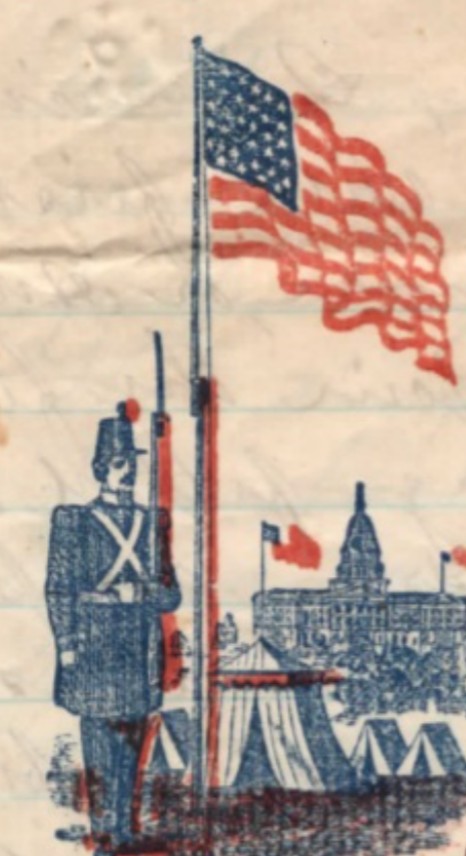
Detail from stationery used in a letter by a 47th Pennsylvania Volunteer to his parents (1862, public domain).

When I launched the website for 47th Pennsylvania Volunteers: One Civil War Regiment’s Story in 2014, my goal was simple — to create an online space that could function as a basic “placeholder” for the research that I had been conducting, for years, about the life of my great-grandfather, Timothy M. Snyder, who had served with the 47th Pennsylvania Volunteer Infantry during the American Civil War.

I was simply trying to understand why Tim Snyder had continued to serve with his regiment for such a long period of time (from mid-August 1861 through early January 1866), despite having completed his initial, three-year term of enlistment and despite his having been wounded twice in battle.

Along the way, I began uncovering details about another man — Henry D. Wharton. It seemed, from letters that Henry had written to my great-grandfather’s hometown newspaper, that he had not only served beside Tim Snyder on battlefields far from home, but that he might actually have been Tim’s neighbor or friend — or possibly even his cousin.

So, I began searching Civil War-era newspaper collections for more of Henry Wharton’s letters in the hope of finding more information about my great-grandfather, but what I found was so much more — accounts of battles so poetic, so lyrical, that I felt that Henry might have become a friend of mine, had we lived in the same town, during the same decades.

I needed to know what happened to Henry. Did he survive? Did he make it home? What was his life like before the war? How did he become such a gifted writer? As I learned more about him, I realized that, yes, he did survive, and, yes, he did marry — but he never had children. (“So there’s no one left to tell his story.”)

It was that single thought that inspired me to research and write a biography about Henry Wharton, and it was that biography that prompted me, in turn, to create 47th Pennsylvania Volunteers: One Civil War Regiment’s Story.

I could not have imagined back then that my research would attract the attention of descendants of other men who had also served with the 47th Pennsylvania, nor that my research findings would be of help to other academic and public historians and educators in K-12 school systems, colleges and universities, historical societies, public libraries, and museums across the United States.

Nor could I have anticipated the extraordinary generosity of the volunteers who have trekked over hill and dale through cemeteries, in all kinds of weather, to photograph the graves of 47th Pennsylvania Volunteer Infantrymen, or have ventured to far-flung flea markets and archives of small-town historical societies (or into the dusty, spider-friendly attics of grandparents — “Eek!”) in search of military records, photos and other memorabilia to help me create accurate biographies of their 47th Pennsylvania ancestors.

And I certainly could not have conceived of any future in which my audience would become a global one, with readers of my posts about the regiment’s activities and biographies of individual soldiers transformed into avid fans of the 47th Pennsylvania Volunteer Infantrymen who helped to preserve a nation’s Union and end the brutal practice of chattel slavery, wherever they encountered it, whenever they had the power to do so.

But each of those scenarios did come to pass, fueled largely by word of mouth. As my research findings grew, transforming a “placeholder website” into an educational outreach initiative, WordPress and other technology tools documented the history of “The 47th Pennsylvania Volunteers’ Project,” enabling me to provide this helpful snapshot of success for you.

Key Project Statistics (as of 2 p.m. on December 31, 2024):

  • First Content Posted to Website: May 25, 2014
  • Total Website Page Views to Date: 892,101
  • Total Number of Website Visitors to Date: 745,686
  • Total Number of 47th Pennsylvania Volunteer Gravesites Documented via the Project’s Virtual Cemetery to Date: 1,448
  • Total Number of Individual Officers, Enlisted Men and Regimental Support Personnel Profiled to Date: 302

I am profoundly grateful to my great-grandfather. He bequeathed the gift of all gifts to each of his descendants and to history lovers everywhere — breadcrumbs scattered, with and without thought, along the path of his life’s journey, never dreaming that his “factcrumbs” would be found, analyzed, layered and baked into satisfying, lifelong “brainfood” for present-day and future students of history.

I am also grateful to Henry Wharton for his presence of mind to faithfully chronicle the activities of the 47th Pennsylvania Volunteer Infantry in ways that made readers want to learn more about so many of the regiment’s individual members and their families.

As I close out both 2024 and the first decade of operations for “the 47th Pennsylvania Volunteers’ Project,” I thank you, dear reader, for joining me on this journey and ask to you to stay engaged with the content on this website, its related social media accounts and our companion website, Freedmen of the 47th Pennsylvania Volunteer Infantry, because there are more than a thousand soldiers’ stories that are still waiting to be uncovered and told.

May your New Year be filled with laughter, love and light!


The Thanksgiving Messages of Pennsylvania’s Civil War-Era Governor, Andrew Gregg Curtin

Andrew Gregg Curtin, Governor, Commonwealth of Pennsylvania, circa 1860 (public domain).

Proclamation of a Day of Thanksgiving. – 1862.

Pennsylvania, ss.
(Signed) A. G. Curtin.

IN THE NAME AND BY the Authority of the Commonwealth of Pennsylvania, Andrew G. Curtin, Governor of the said Commonwealth.

A PROCLAMATION.

Whereas, It is a good thing to render thanks unto God for His Mercy and loving kindness:

Therefore, I, Andrew G. Curtin, Governor of the Commonwealth of Pennsylvania, do recommend that Thursday the 27th day of November next, be set apart by the people of this Commonwealth, as a day of solemn Prayer and Thanksgiving to the Almighty: – Giving Him thanks that He has been graciously pleased to protect our free institutions and Government, and to keep us from sickness and pestilence; and to cause the earth to bring forth her increase, so that our garners are choked with the harvest; and to look so favorably on the toil of His children, that industry has thriven among us and labor had its reward; and also that He hath delivered us from the hands of our enemies, and filled our officers and men in the field with a loyal and intrepid spirit and given them victory; and that He has poured out upon us (albeit unworthy) other great and manifold blessings:

Beseeching Him to help and govern us, in his steadfast fear and love, and to put into our minds good desires, so that by His continued help we may have a right judgement in all things:

And especially praying Him to give to Christian churches grace to hate the thing which is evil, and to utter the teachings of truth and righteousness, declaring openly the whole counsel of God:

And most heartily entreating Him to bestow upon our Civil Rulers, wisdom and earnestness in council and upon our military leaders zeal and vigor in action, that the fires of rebellion may be quenched, that we, being armed with His defense, may be preserved from all perils, and that hereafter our people living in peace and quietness, may, from generation to generation, reap the abundant fruits of His mercy; and with joy and thankfulness praise and magnify His holy name.

Given under my Hand and the Great Seal of the State at Harrisburg, this twentieth day of October in the year of our Lord, one thousand eight hundred and sixty two, and the Commonwealth, the eighty-seventh.

By the Governor:

Eli Slifer,
Secretary of the Commonwealth.


Thanksgiving Proclamation. – 1863.

Pennsylvania, ss.
(Signed) A. G. Curtin

IN THE NAME AND BY the Authority of the Commonwealth of Pennsylvania, Andrew G. Curtin, Governor of the said Commonwealth.

A PROCLAMATION.

Whereas, The President of the United States, by his proclamation, bearing, date on the third day of this month, has invited the citizens of the United States to set apart Thursday, the twenty-sixth day of November next, as a day of Thanksgiving and Prayer, now I, Andrew G. Curtin, Governor of the Commonwealth of Pennsylvania, do hereby recommend, that the people of Pennsylvania do set apart and observe the said day accordingly, and that they do especially return thanks to Almighty God, for the gathered harvests of the fruits of the earth;

For the prosperity with which He has blessed the Industry of our people;

For the general health and welfare which He has graciously bestowed upon them;

And for the crowning mercy by which the blood-thirsty and devastating enemy was driven from our soil by the valor of our brethren freemen of this and other States;

And that they do especially pray for the continuance of the blessings which have been heaped upon us by the Divine Hand;

And for the safety and welfare and success of our brethren in the field, that they may be strengthened to the overthrow and confusion of the rebels now in arms against our beloved country;

So that peace may be restored to all our borders, and the Constitution and laws of the land be everywhere within them re-established and sustained.

Given under my Hand and the Great Seal of the State at Harrisburg, this twenty-eighth day of October in the year of our Lord, one thousand eight hundred and sixty-three and of the Commonwealth, the eighty-eighth.

By the Governor:

Eli Slifer,
Secretary of the Commonwealth.


Thanksgiving Proclamation. – 1864.

Pennsylvania, ss.
(Signed) A. G. Curtin.

IN THE NAME AND BY the Authority of the Commonwealth of Pennsylvania, Andrew G. Curtin, Governor of the said Commonwealth.

A PROCLAMATION.

Whereas, It is the honored custom of Pennsylvania to set apart, on the recommendation of the Executive, a day for returning thanks to the Giver of all Good, the Shepherd and Bishop of our Souls: Now, therefore,

I, Andrew G. Curtin, Governor as aforesaid, do recommend that the people throughout the Commonwealth observe Thursday, the twenty-fourth day of November instant, as a day of Thanksgiving to Almighty God,

For the gathered fruits of the earth;

For the continuance of health;

For the prosperity of industry;

For the preservation of good order and tranquility throughout our borders;

For the victories which He has vouchsafed to us over armed traitors,

And for the manifold blessings which he has heaped upon us, unworthy.

And that they do, moreover, humbly beseech Him to renew and increase his merciful favor to us during the year to come, so that rebellion being overthrown, peace may be restored to our distracted country, and, in every State, with grateful and loving accord, the incense of Praise and Thanksgiving may be offered by all the people unto His Holy Name.

Given under my Hand and the Great Seal of the Commonwealth at Harrisburg, this second day of [L. S.] November in the year of our Lord one thousand eight hundred and sixty-four and of the Commonwealth, the eighty-ninth.

By the Governor:

Eli Slifer,
Secretary of the Commonwealth.


Proclamation By the Governor.
The 7th of December Appointed a State Thanksgiving Day.

PROCLAMATION.

With feelings of the most profound gratitude to Almighty God, I invite the good people of the Commonwealth to meet in their places of public worship, on Thursday, the seventh day of December next, and raise their hearts and voices in praise and thanksgiving to Him, not only for the manifest ordinary blessings which, during the past year, He has continued to heap upon us,

For abundant and gathered harvests;

For thriving industry;

For general health;

For domestic good order and government;

But also most expressly and fervently for His unequalled goodness in having so strengthened and guarded our people during the last four years that they have been able to crush to the earth the late wicked rebellion–to exterminate the system of human slavery, which caused it.

As we wrestled in prayer with Him in the dark time of our trouble, when our brothers and sons were staking life and limb for us on a bloody field, or suffering by torture or famine in the hells of Andersonville or the Libby, so now, when our supplications have been so marvellously [sic, marvelously] and graciously answered, let us not withhold from Him the homage of our thanksgiving.

Let us say to all, “Choose, ye, this day, whom he will serve, but for us and our house, we will serve the Lord.”

Great Seal of the Commonwealth of Pennsylvania (public domain).

Come, then, ye people whom He hath so helped and led; come, ye war-worn and mutilated men whom He hath spared to return to your dear homes, let us throng the gates of His temples; let us throw ourselves on the knees of our hearts with a wilful joy at the foot of His throne, and render aloud our praise and thanksgiving to Him, because He hath made the right to prevail; because He hath given us the victory; because he has cleansed our land from the stain of human slavery, and because He hath graciously shown forth in the eyes of all men the great truth that no government is so strong as a republic controlled under His guidance by an educated, moral and religious people.

By the Governor:

Eli Slifer,
Secretary of the Commonwealth.
Harrisburg, November 7, 1865.


Sources:

  1. Curtin, Andrew Gregg. Proclamation of a Day of Thanksgiving – 1862, in Pennsylvania Archives: Fourth Series, Vol. VIII: Papers of the Governors, 1858-1871, Samuel Hazard, John Blair Lynn, William Henry Egle, et. al., editors. Harrisburg, Pennsylvania: Wm. Stanley Ray, State Printer, 1902.
  2. “Thanksgiving Proclamation.” Reading, Pennsylvania: Gazette and Democrat, November 21, 1863.
  3. “In the Name and by the Authority of the Commonwealth of Pennsylvania, Andrew G. Curtin, Governor of Said Commonwealth: A Proclamation.” Harrisburg, Pennsylvania: Daily Telegraph, November 10, 1864.
  4. “Proclamation by the Governor.” Philadelphia, Pennsylvania: The American Presbyterian, November 10, 1865.


Through the Eyes of a Captain: The Sights, Sounds and Side Effects of the Battle of Pocotaligo, South Carolina

Captain John Peter Shindel Gobin, Company C, 47th Pennsylvania Volunteers, circa 1863 (public domain).

Five days after the Battle of Pocotaligo was waged on October 22, 1862 between Union and Confederate troops in South Carolina, Captain John Peter Shindel Gobin set pen to paper to document the events that had led up to and taken place that terrible day. His powerful account revealed a scale of carnage that shocked the readers of the November 15, 1862 edition of The Sunbury Gazette.

The commanding officer of the 47th Pennsylvania Volunteer Infantry’s color-bearer unit, Company C, Captain Gobin was a lawyer from Sunbury, Northumberland County who would later go on to command the entire regiment and, post-war, would be elected to the Pennsylvania State Senate and then as lieutenant governor of the Commonwealth of Pennsylvania. His account of this often overlooked American Civil War battle is one that merits the attention of historians because of the statistics and insights he shared with close friends.

Headquarters, Co. C, 47th Reg’t.,
Beaufort, S.C.,
Oct. 27, 1862

Dear Friends:–For the first time since our terrible engagement on the main land, I find time to write you an account of the affair. As my last informed you, during the St. John’s Expedition, I contracted the intermittent fever, and on my arrival here, was placed in the officers’ hospital.–Good nursing and an abundance of quinine, however, soon placed me on my feet, and on Monday, the 20th, I went to camp well, but still weak. On Tuesday morning our regiment received orders for six hundred men to embark on a Transport, with two days’ rations, at 1 o’clock P.M. I selected sixty men, and embarked. Our destination was unknown, although it was the general opinion that it was the Charleston and Savannah Railroad bridges. We steamed down the river, and were all advised by Gen. Brennan [sic, Brannan], who was on the boat with our regiment, to get as much sleep as possible. I sought my berth, and when I awoke next morning, found we were in the Broad River, opposite Mackay’s Point. A detachment of the 4th New Hampshire, sent on shore to capture the enemy’s pickets, having failed, we were ordered to disembark immediately. Eight Companies of our regiment, (the other two being on another Transport) were gotten [ready], and at once took up the line of march. After about three miles, we came in sight of the pickets, when we halted until joined by the 55th Pennsylvania, 6th Connecticut, and one section of the 1st U.S. Artillery. We were again ordered forward–a few of the enemy’s cavalry slowly retiring before us, until we reached a place known as Caston, where two pieces of artillery, supported by cavalry, were discovered in position in the road.–They fired two shells at us, which went wide.

While our artillery ran to the front and unlimbered, our regiment was ordered forward at double quick. The enemy however left after receiving one round from our artillery, which killed one of their men. We followed them closely for about two miles, when we found their battery of six pieces, posted in a strong position at the edge of a wood, supported by infantry and cavalry. They opened upon us immdiately, which was replied to by our artillery, posted in the road. This road ran through a sweet potato field, covered with vines and brush. Our regiment was thrown in mass and deployed on my company [Company C], which brought my right in the road. We were ordered to charge, and with a yell the men went in. We had scarcely taken a dozen steps before we were greeted with a shower of round shot and shell from the enemy’s artillery. A round shot stuck the ground fairly in front of me, covering me with sand, bounding to the right and killing the third man in the company to my right. It was followed by a shell, that gave us another shower of sand, and flew between the legs of Corporal Keefer, the man on my left, tearing his pantaloons, striking his file coverer, Billington, on the knee, and glancing and striking a man named Gensemer on Billington’s left, and bringing them to the ground, but fortunately failing to explode. Almost at the same instant Jeremiah Haas and Jno. Barlow were struck, the former in the face and breast by a piece of shell, the latter through the leg by a cannister shot. The shower we received here was terrific. Nothing daunted, on they rushed for the battery, but it was almost impossible to get through the weeds and vines. When within a hundred yards the enemy limbered up, and retreated through the woods. We followed as rapidly as possible, but we had scarcely entered the woods, when we were again greeted with a terrific storm of shell, grape and cannister from a new position, on the other side of the woods.

Samuel Y. Haupt, 47th Pennsylvania Volunteers (circa 1863, public domain).

Ordering my men to keep to the right of the road, we pushed forward through a wood almost impenetrable. We were at times obliged to crawl on our hands and knees.–In the meantime the enemy’s infantry opened upon us, and assisted in raking the woods. Sergeant Haupt [sic, Peter Haupt] here received his wound. When at length we pushed through, we found ourselves separated from the enemy by an impassable swamp, about one hundred yards in width. The only means of getting over was by a narrow causeway of about twelve feet in width. Seeing this, our regiment fell back to the edge of the woods, lay down and engaged the enemy’s infantry opposite us. In the meantime two howitzers from the Wabash, [that] had been placed in position in the rear of the woods, commenced shelling the enemy, whose artillery, was on the right of the road on the opposite side of the swamp. The latter replied, the shells of both parties passing over us. Our situation was extremely critical. Exposed to the cross-fire of the contending artillery and the infantry in the front, with the limbs and tops of trees falling on and around us, it was indeed a position I never want to be placed in again.–Here Peter Wolf while endeavoring, in company with Sergeant Brosious, Corp. S. Y. Haupt and Isaac Kembel, to pick off some artillerymen, received two balls and fell dead. I had him carried five miles and buried by the side of the road. Corp. S. Y. Haupt, had the stock of his rifle shattered by a rifle ball, that embedded itself.

In about twenty minutes the fire became too hot for them, and they again “skedaddled“ just as Gen. Terry’s Brigade, 75th Pennsylvania, in advance, were ordered up to relieve us. They followed them up rapidly, until they arrived at Pocotaligo creek, over which the rebels crossed, and tore up the bridge, and ensconced themselves behind their breastworks and in their rifle pits.–We were again ordered forward, deployed to the right, and advanced to the bank of the creek, or marsh, which was fringed by woods. We lay a short time supporting the 7th Connecticut, when their ammunition became expended, and we took the front. Here occurred the most desperate fighting of the day. The enemy were reinforced by the 26th South Carolina, which came upon the breastworks with a rush. We gave them a volley that sent them staggering, but they formed in the rear of the first line, and the two poured into us one of the most scathing, withering fires ever endured. Added to it, their artillery commenced throwing grape and cannister amongst us, but we soon drove the artillerymen from their guns, and silenced them. The colors on the left of my company attracting a very heavy fire, I ordered the Sergeant to wrap them up.–This caused quite a yell among the Confederates, but we soon changed their tune.–We fired until our ammunition was nearly expended, when we ceased. This caused the enemy’s artillery to open upon us, while the musketry continued with redoubled energy. Eight men of my company fell at this last fight. We held our position, unsupported, until dark, when we were ordered to fall back. We did so and covered the retreat. We were the first regiment in the fight, and last out of it. Our men fought like veterans, and did fearful execution among the enemy. Our loss was very heavy, losing one hundred and twelve men out of six hundred. I detailed my entire company to carry their dead and wounded comrades to the boat, which I did not reach until 4 o’clock A.M., bringing with me the last man, Billington. In consequence of having no stretchers or ambulances, we were compelled to carry our wounded in blankets. They were, however, all taken good care of.

Although we did not succeed in burning the bridge, yet we were not defeated. We drove the enemy five miles, compelling him to leave a number of his dead and wounded on the field. We captured two caissons, and a number of prisoners, and were only prevented from capturing or scattering the whole force by the destruction of the bridge over Pocotaligo creek, and their immense reinforcements. I shall never forget the sound of those locomotive whistles in my life. Gen. Beauregard commanded the rebels.

My men fought as men accustomed to it all their life. Nothing could exceed their valor. In addition to the loss in my own company, of the color guard, composed of Corporals from other companies attached to it, all but two were struck. Every man seemed determined to win.

My loss is as follows:–Killed–PeterWolf, Sunbury, Pa.; George Harner [sic, Horner], Upper Mahanoy; Seth Deibert, Lehigh county.–Wounded, Sergeant Peter Haupt, Sunbury, Pa., cannister shot through foot; will save the foot; Corporal Samuel Y. Haupt, rifle shot on chin; will be ready for duty in a week. His rifle was struck with a piece of shell, and after shattered by rifle ball. Corporal William Finck, near Milton; rifle shot through leg–amputation not necessary; private S. H. Billington, Sunbury, struck on knee by shell; will save the leg; private John Bartlow, cannister shot through leg; will save the leg; private Jeremiah Haas, struck in face and breast by piece of shell; will soon be well; private Conrad Halman [sic, Holman], Juniata county, shot in face by rifle ball–teeth all gone; will recover; private Theodore Kiehl, struck in the mouth by a rifle ball; lower jaw shattered, but will recover; Charles Leffler [sic, Lefler], Lehigh county, rifle shot through leg–will recover without amputation; Michael Larkins [sic, Larkin], Lehigh county, wounded in side and hip in a hand to hand fight with a mounted officer; killed the officer and captured his horse; able to be about; Thomas Lothard, Pittston, Pa., grape shot through right side; will recover; Richard O’Rourke, Juniata county; rifle ball through right side, will recover; James R. Rine [sic, Rhine], Juniata county, struck on leg by round shot–not serious.

Killed ………… 3
Wounded …. 13
Total ……….. 16

This being over one-fourth of the number engaged, I think, is pretty heavy. However I think most of the wounded will be fit for duty again. They are all comfortable and well cared for. None of their wounds will, from present appearances, prove mortal. I will write again in a few days. With love to all, I remain

Yours, J. P. S. G. 

*Note: Captain Gobin’s assessment of his wounded men was, unfortunately, overly optimistic with respect to Sergeant Peter Haupt. While undergoing treatment at a Union Army hospital, Sergeant Haupt developed traumatic tetanus–a direct cause of the lead injected into his system by the cannister shot that had felled him. He subsequently died from tetanus a related lockjaw.


Sources: 

  1. “Army Correspondence.” Sunbury, Pennsylvania: The Sunbury Gazette, November 15, 1862.
  2. Haupt, Peter, in U.S. Registers of Deaths of Volunteer Soldiers, October 1862. Washington, D.C.: U.S. National Archives and Records Administration.