Juneteenth — Forever a Day to Remember

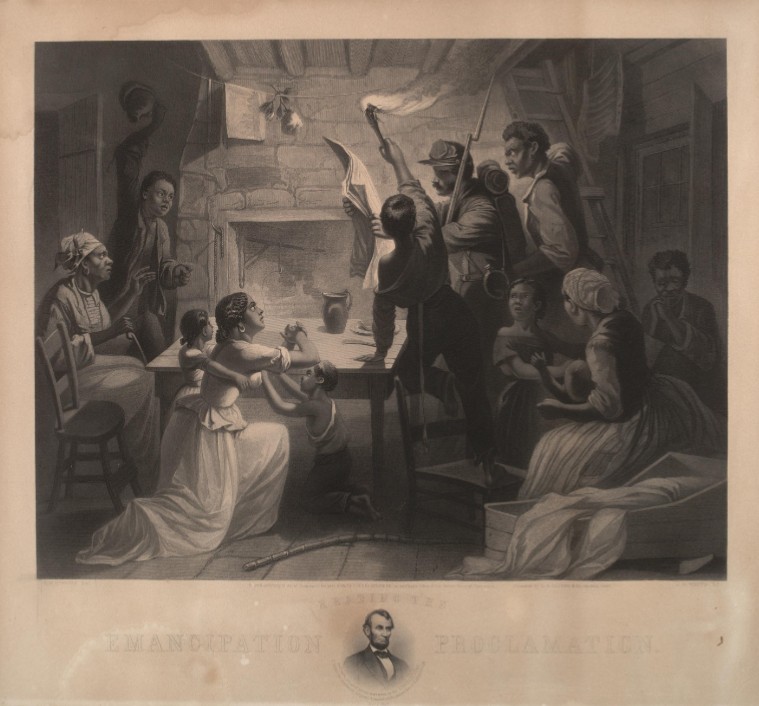
Union soldiers were depicted reading the Emancipation Proclamation to an enslaved family in 1864 by artist Lucius Stebbins (public domain).

“The people are informed that, in accordance with a proclamation from the Executive of the United States, all slaves are free.” — Major-General Gordon Granger, United States Army, Galveston Texas, June 19, 1865


With those words, the United States of America took another step forward in the effort to completely eradicate the savage practice of chattel slavery across the nation. It was on that date that Union Major-General Gordon Granger, commanding officer of the United States’ District of Texas, began to inform African American men, women and children who were still being held in bondage across Texas (despite President Abraham Lincoln’s announcement of the Emancipation Proclamation on January 1, 1863 and despite the Confederacy’s surrender in Virginia on April 9, 1865) that the people who had enslaved and brutalized them no longer had any power over them.

That same day, Major-General Granger also served notice to enslavers across Texas that their days of treating other human beings as their personal property were over. He did so by publishing General Orders, No. 3 in newspapers statewide. Not as forceful as it should have been, because its wording discouraged many newly-freed people from truly escaping from their enslavers while also effectively encouraging those enslavers to continue their efforts to dominate and subjugate the same people they had long exploited (as poorly-paid “employees”), his directive was still forceful enough to move the United States forward in its long struggle to become a fairer and more just nation:

Headquarters, District of Texas,
Galveston, Texas, June 19, 1865.

General Orders, No. 3.

The people are informed that, in accordance with a proclamation from the Executive of the United States, all slaves are free. This involves an absolute equality of personal rights and rights of property, between former masters and slaves, and the connection heretofore existing between them, becomes that between employer and hired labor. — The Freedmen are advised to remain at their present homes, and work for wages. They are informed that they will not be allowed to collect at military posts; and that they will not be supported in idleness either there or elsewhere.

By order of
Major-General Granger (Signed,)
F. W. Emery, Maj. and A. A. G.

Around that same time, a reporter for The New York Tribune described the atmosphere in and around the city where Major-General Granger was headquartered:

Galveston is a city of dogs and desolation. It is hard to tell which a stranger would be soonest impressed with — the multiplicity of the canine or the poverty and degradation of the human species.

…. No other Southern city of its prominence and local importance is so utterly insignificant and God-forsaken in appearance. It is desolation desolated, for before the war it was a parched and barren land. There is no shady park, and but one pleasant ride. The trees are stunted and scraggy like the people…. 

Loyalty does not manifest itself. There are loud professions. There are bitter and, I doubt not, sincere cursings of Davis and Kirby Smith. There are more welcomes to our presence, and especially to our greenbacks. But true loyalty — that prefers the United States to Texas; that venerates Washington above Houston; that loves freedom more than Slavery — is an exceedingly rare pearl in Galveston. I know how hard it is to distinguish the genuine from the counterfeit, but I am forced to believe the statement made to me a few days since by one who was well acquainted in every part of the State.

I asked him what he thought of the Amnesty Proclamation. He replied, “If it is carried out strictly, with its exceptions, not a wealthy man in Texas can escape, for all have aided and voluntarily assisted the Rebellion.”

THE LONE STAR CONFEDERACY

Even now, while Union soldiers patrol the streets, and a powerful fleet is anchored off the city, these narrow-minded and impoverished people cling to the idea of State independence. They want to fly the “Lone Star” flag once more, to subdivide their country into four States or more, and to become a recognized power in the world. Hireling editors and selfish leaders have actually made the masses believe that Texas came into the Union with the promise that she could go out again next year if she chose to do so….

THE SLAVES

There are many more slaves in Texas than there were before the war, but the institution is waning even here….

Aiding with Reconstruction

It is worth noting that, during the Union’s 1864 Red River Campaign, a small group of 47th Pennsylvania Volunteer Infantrymen actually became eyewitnesses to what life was like in Texas during the American Civil War. While their perspectives would have been somewhat limited, because they were actually watching events unfold while they were being force marched to Camp Ford near Tyler, Texas, and were then confined there as prisoners of war (POWs), they encountered both impoverished Texans and the brutality of chattel enslavement — compelled to watch helplessly as Confederate civilians and soldiers terrorized enslaved Black men, women and children while forcing them to perform back-breaking work.

Although a significant number of the seventeen 47th Pennsylvania Volunteers who were imprisoned at Camp Ford died there from starvation, disease and harsh treatment, most managed to survive — many of whom were subsequently given medical care by Union Army physicians and then honorably discharged on surgeons’ certificates of disability because their bodies and minds were no longer fit for duty.

But some actually recovered, returned to duty with the 47th Pennsylvania Veteran Volunteers and continued to serve with the regiment — by trying to help communities in Georgia and South Carolina rebuild as they returned to the Union. First Sergeant James Crownover, Corporal James Downs, Sergeant John Garber Miller, and Private William J. Smith were among the former Camp Ford POWs who traveled with their fellow 47th Pennsylvanians to Savannah, Georgia and to Charleston, South Carolina for provost and Reconstruction Era-related duties during that same summer of 1865 when enslaved people in Texas were being informed that they were finally free. Also traveling with the 47th Pennsylvania Volunteers to Georgia and South Carolina were nine formerly enslaved Black men who had enlisted in the 47th Pennsylvania Volunteer Infantry in 1862 (in South Carolina) and in 1864 (in Louisiana): Aaron Bullard (later known as “Aaron French“), James Bullard, John Bullard, Bristor Gethers, John Hamilton (later known as “Hamilton Blanchard“), Thomas Haywood, Abraham Jassum, Edward Jassum, and Samuel Jones.

Likely unaware of Major-General Gordon Granger’s emancipation announcement when it was first published on June 19, 1865, they eventually learned about what had happened that day as word spread beyond the borders of Texas. All nine ultimately survived the war, and went on to forge new lives for themselves as Freedmen. One even went on to become a delegate to a Republican Party convention during his post-war years.

Meanwhile, that important date would come and go every year across the nation. Remembered and commemorated as “Juneteenth” in Texas initially, and then in Louisiana and other states, as community elders, church leaders and educators taught new generations about the Emancipation Days of 1863 and 1865, June 19th was finally declared as an official federal holiday when the United States of America’s Juneteenth National Independence Day Act was signed into law on June 17, 2021.


Sources:

  1. “Blacks Celebrate Their Day of Independence.” Milwaukee, Wisconsin: Associated Press Wire Service, June 1975; Pascagoula, Mississippi: Mississippi Press Register, June 22, 1975; and Greenwood, South Carolina: The Index-Journal, June 20, 1975.
  2. Carson, Kelly. “Juneteenth Parade Salutes Miss Lillie.” Hattiesburg, Mississippi: Hattiesburg American, December 14, 1989.
  3. Carter, Kevin L. “Blacks’ Juneteenth Here from Texas Roots.” Pittsburgh, Pennsylvania: The Pittsburgh Press, June 15, 1987.
  4. “Celebrating June-Teenth.” Lake Charles, Louisiana: The American-Press, June 19, 1917.
  5. “From Texas: Galveston Occupied by Colored Troops — Dreariness and Desolation of the City — Questionable Loyalty of the People — The Lone Star Confederacy Again — The Reign of Terror” and “The Slaves Declared Free — The Acts of the Governor and Legislature Void — Public Property to Be Returned.” New York, New York: The New York Tribune, July 7, 1865.
  6. “From Texas: Granger in Command — His General Orders — Sheridan in Texas — Weitzel’s Command to Disembark at Brazos.” Pittsburgh, Pennsylvania: The Daily Post, July 8, 1865.
  7. “General Granger’s Order on Personal Equality in Texas.” Wheeling, West Virginia: The Wheeling Daily Register, July 8, 1865.
  8. “General Orders, No. 3” (announcement by Union Major-General G. Granger that “all slaves are free”). Galveston, Texas: The Galveston Daily News, June 21, 1865.
  9. “Grambling Slates Juneteenth Holiday.” Monroe, Louisiana: Monroe News-Star, June 17, 1976.
  10. Jackson, Anna and Katherine Schaeffer. “More Than Half of States Will Recognize Juneteenth as a Legal Holiday in 2026.” Washington, D.C.: Pew Research Center, June 11, 2026.
  11. Juneteenth, in “Swimming Hero Will Be Heard.” Greenville, South Carolina: The Greenville News, August 15, 1937.
  12. “‘Juneteenth’ a Big Day in This Section on Last Tuesday.” Jena, Louisiana: The Jena Times, June 21, 1934.
  13. “‘Juneteenth’ Committee,” in “Emancipation Celebration.” San Antonio, Texas: The Daily Light, May 16, 1893.
  14. “Juneteenth Is Here Again: Celebration of Negro Freedom Will Extend Over Period of Two Days.” Houston, Texas: The Houston Chronicle, June 19, 1910.
  15. “‘Juneteenth’ Is Marked By B.B.Q.” Opelousas, Louisiana: Daily World, June 20, 1948.
  16. Maraniss, David. “Juneteenth Celebration Makes Comeback in Texas.” Washington, D.C.: The Washington Post, June 1990; and Philadelphia, Pennsylvania: The Philadelphia Inquirer, June 24, 1990.
  17. Our American Story — Juneteenth.” Washington, D.C.: National Museum of African American History and Culture, Smithsonian Institution, retrieved online June 15, 2026.
  18. Pradarits, Rick. “Black Mayors Ask Holiday Off.” Houston, Texas: United Press International Wire Service, May 1980; and Shreveport, Louisiana: The Times, May 21, 1980.
  19. Public Law 117 – 17- Juneteenth National Independence Day Act,” in “GovInfo.” Washington, D.C.: U.S. Government Publishing Office, retrieved online June 15, 2026.
  20. Ramsey, Sonya Y. “Juneteenth Recalls Black Heritage.” Rosslyn, Virginia: Gannett News Service, June 1988; and Shreveport-Bossier, Louisiana: The Times, June 15, 1988.
  21. “The Colored Citizens Make Further Arrangements for Their Emancipation Celebration.” Houston, Texas: Houston Daily Post, April 23, 1901.
  22. The Emancipation Proclamation,” in “Featured Documents.” Washington, D.C.: U.S. National Archives and Records Administration, retrieved online June 15, 2026.


The Thanksgiving Messages of Pennsylvania’s Civil War-Era Governor, Andrew Gregg Curtin

Andrew Gregg Curtin, Governor, Commonwealth of Pennsylvania, circa 1860 (public domain).

Proclamation of a Day of Thanksgiving. – 1862.

Pennsylvania, ss.
(Signed) A. G. Curtin.

IN THE NAME AND BY the Authority of the Commonwealth of Pennsylvania, Andrew G. Curtin, Governor of the said Commonwealth.

A PROCLAMATION.

Whereas, It is a good thing to render thanks unto God for His Mercy and loving kindness:

Therefore, I, Andrew G. Curtin, Governor of the Commonwealth of Pennsylvania, do recommend that Thursday the 27th day of November next, be set apart by the people of this Commonwealth, as a day of solemn Prayer and Thanksgiving to the Almighty: – Giving Him thanks that He has been graciously pleased to protect our free institutions and Government, and to keep us from sickness and pestilence; and to cause the earth to bring forth her increase, so that our garners are choked with the harvest; and to look so favorably on the toil of His children, that industry has thriven among us and labor had its reward; and also that He hath delivered us from the hands of our enemies, and filled our officers and men in the field with a loyal and intrepid spirit and given them victory; and that He has poured out upon us (albeit unworthy) other great and manifold blessings:

Beseeching Him to help and govern us, in his steadfast fear and love, and to put into our minds good desires, so that by His continued help we may have a right judgement in all things:

And especially praying Him to give to Christian churches grace to hate the thing which is evil, and to utter the teachings of truth and righteousness, declaring openly the whole counsel of God:

And most heartily entreating Him to bestow upon our Civil Rulers, wisdom and earnestness in council and upon our military leaders zeal and vigor in action, that the fires of rebellion may be quenched, that we, being armed with His defense, may be preserved from all perils, and that hereafter our people living in peace and quietness, may, from generation to generation, reap the abundant fruits of His mercy; and with joy and thankfulness praise and magnify His holy name.

Given under my Hand and the Great Seal of the State at Harrisburg, this twentieth day of October in the year of our Lord, one thousand eight hundred and sixty two, and the Commonwealth, the eighty-seventh.

By the Governor:

Eli Slifer,
Secretary of the Commonwealth.


Thanksgiving Proclamation. – 1863.

Pennsylvania, ss.
(Signed) A. G. Curtin

IN THE NAME AND BY the Authority of the Commonwealth of Pennsylvania, Andrew G. Curtin, Governor of the said Commonwealth.

A PROCLAMATION.

Whereas, The President of the United States, by his proclamation, bearing, date on the third day of this month, has invited the citizens of the United States to set apart Thursday, the twenty-sixth day of November next, as a day of Thanksgiving and Prayer, now I, Andrew G. Curtin, Governor of the Commonwealth of Pennsylvania, do hereby recommend, that the people of Pennsylvania do set apart and observe the said day accordingly, and that they do especially return thanks to Almighty God, for the gathered harvests of the fruits of the earth;

For the prosperity with which He has blessed the Industry of our people;

For the general health and welfare which He has graciously bestowed upon them;

And for the crowning mercy by which the blood-thirsty and devastating enemy was driven from our soil by the valor of our brethren freemen of this and other States;

And that they do especially pray for the continuance of the blessings which have been heaped upon us by the Divine Hand;

And for the safety and welfare and success of our brethren in the field, that they may be strengthened to the overthrow and confusion of the rebels now in arms against our beloved country;

So that peace may be restored to all our borders, and the Constitution and laws of the land be everywhere within them re-established and sustained.

Given under my Hand and the Great Seal of the State at Harrisburg, this twenty-eighth day of October in the year of our Lord, one thousand eight hundred and sixty-three and of the Commonwealth, the eighty-eighth.

By the Governor:

Eli Slifer,
Secretary of the Commonwealth.


Thanksgiving Proclamation. – 1864.

Pennsylvania, ss.
(Signed) A. G. Curtin.

IN THE NAME AND BY the Authority of the Commonwealth of Pennsylvania, Andrew G. Curtin, Governor of the said Commonwealth.

A PROCLAMATION.

Whereas, It is the honored custom of Pennsylvania to set apart, on the recommendation of the Executive, a day for returning thanks to the Giver of all Good, the Shepherd and Bishop of our Souls: Now, therefore,

I, Andrew G. Curtin, Governor as aforesaid, do recommend that the people throughout the Commonwealth observe Thursday, the twenty-fourth day of November instant, as a day of Thanksgiving to Almighty God,

For the gathered fruits of the earth;

For the continuance of health;

For the prosperity of industry;

For the preservation of good order and tranquility throughout our borders;

For the victories which He has vouchsafed to us over armed traitors,

And for the manifold blessings which he has heaped upon us, unworthy.

And that they do, moreover, humbly beseech Him to renew and increase his merciful favor to us during the year to come, so that rebellion being overthrown, peace may be restored to our distracted country, and, in every State, with grateful and loving accord, the incense of Praise and Thanksgiving may be offered by all the people unto His Holy Name.

Given under my Hand and the Great Seal of the Commonwealth at Harrisburg, this second day of [L. S.] November in the year of our Lord one thousand eight hundred and sixty-four and of the Commonwealth, the eighty-ninth.

By the Governor:

Eli Slifer,
Secretary of the Commonwealth.


Proclamation By the Governor.
The 7th of December Appointed a State Thanksgiving Day.

PROCLAMATION.

With feelings of the most profound gratitude to Almighty God, I invite the good people of the Commonwealth to meet in their places of public worship, on Thursday, the seventh day of December next, and raise their hearts and voices in praise and thanksgiving to Him, not only for the manifest ordinary blessings which, during the past year, He has continued to heap upon us,

For abundant and gathered harvests;

For thriving industry;

For general health;

For domestic good order and government;

But also most expressly and fervently for His unequalled goodness in having so strengthened and guarded our people during the last four years that they have been able to crush to the earth the late wicked rebellion–to exterminate the system of human slavery, which caused it.

As we wrestled in prayer with Him in the dark time of our trouble, when our brothers and sons were staking life and limb for us on a bloody field, or suffering by torture or famine in the hells of Andersonville or the Libby, so now, when our supplications have been so marvellously [sic, marvelously] and graciously answered, let us not withhold from Him the homage of our thanksgiving.

Let us say to all, “Choose, ye, this day, whom he will serve, but for us and our house, we will serve the Lord.”

Great Seal of the Commonwealth of Pennsylvania (public domain).

Come, then, ye people whom He hath so helped and led; come, ye war-worn and mutilated men whom He hath spared to return to your dear homes, let us throng the gates of His temples; let us throw ourselves on the knees of our hearts with a wilful joy at the foot of His throne, and render aloud our praise and thanksgiving to Him, because He hath made the right to prevail; because He hath given us the victory; because he has cleansed our land from the stain of human slavery, and because He hath graciously shown forth in the eyes of all men the great truth that no government is so strong as a republic controlled under His guidance by an educated, moral and religious people.

By the Governor:

Eli Slifer,
Secretary of the Commonwealth.
Harrisburg, November 7, 1865.


Sources:

  1. Curtin, Andrew Gregg. Proclamation of a Day of Thanksgiving – 1862, in Pennsylvania Archives: Fourth Series, Vol. VIII: Papers of the Governors, 1858-1871, Samuel Hazard, John Blair Lynn, William Henry Egle, et. al., editors. Harrisburg, Pennsylvania: Wm. Stanley Ray, State Printer, 1902.
  2. “Thanksgiving Proclamation.” Reading, Pennsylvania: Gazette and Democrat, November 21, 1863.
  3. “In the Name and by the Authority of the Commonwealth of Pennsylvania, Andrew G. Curtin, Governor of Said Commonwealth: A Proclamation.” Harrisburg, Pennsylvania: Daily Telegraph, November 10, 1864.
  4. “Proclamation by the Governor.” Philadelphia, Pennsylvania: The American Presbyterian, November 10, 1865.


A Thanksgiving Message from the Past: Andrew Gregg Curtin

Andrew Gregg Curtin, Governor, Commonwealth of Pennsylvania, c. 1860 (public domain).

Proclamation of a Day of Thanksgiving. – 1862.

Pennsylvania, ss.
(Signed) A. G. Curtin.


IN THE NAME AND BY the Authority of the Commonwealth of Pennsylvania, ANDREW G. CURTIN, Governor of the said Commonwealth.

A PROCLAMATION.


Whereas, It is a good thing to render thanks unto God for His Mercy and loving kindness:

Therefore, I Andrew G. Curtin Governor of the Commonwealth of Pennsylvania, do recommend that Thursday the 27th day of November next, be set apart by the people of this Commonwealth, as a day of solemn Prayer and Thanksgiving to the Almighty: – Giving Him thanks that He has been graciously pleased to protect our free institutions and Government, and to keep us from sickness and pestilence; and to cause the earth to bring forth her increase, so that our garners are choked with the harvest; and to look so favorably on the toil of His children, that industry has thriven among us and labor had its reward; and also that He hath delivered us from the hands of our enemies, and filled our officers and men in the field with a loyal and intrepid spirit and given them victory; and that He has poured out upon us (albeit unworthy) other great and manifold blessings:

Beseeching Him to help and govern us, in his steadfast fear and love, and to put into our minds good desires, so that by His continued help we may have a right judgement in all things:

And especially praying Him to give to Christian churches grace to hate the thing which is evil, and to utter the teachings of truth and righteousness, declaring openly the whole counsel of God:

And most heartily entreating Him to bestow upon our Civil Rulers, wisdom and earnestness in council and upon our military leaders zeal and vigor in action, that the fires of rebellion may be quenched, that we, being armed with His defense, may be preserved from all perils, and that hereafter our people living in peace and quietness, may, from generation to generation, reap the abundant fruits of His mercy; and with joy and thankfulness praise and magnify His holy name.

Great Seal of the State of Pennsylvania (public domain).

Given under my Hand and the Great Seal of the State at Harrisburg, this twentieth day of October in the year of our Lord one thousand eight hundred and sixty two, and the Commonwealth the eighty-seventh.

By the Governor:

Eli Slifer,
Secretary of the Commonwealth.


Source:

Curtin, Andrew Gregg. Proclamation of a Day of Thanksgiving – 1862, in Pennsylvania Archives: Fourth Series, Vol. VIII: Papers of the Governors, 1858-1871, Samuel Hazard, John Blair Lynn, William Henry Egle, et. al., editors. Harrisburg, Pennsylvania: Wm. Stanley Ray, State Printer, 1902.