Juneteenth — Forever a Day to Remember

Union soldiers were depicted reading the Emancipation Proclamation to an enslaved family in 1864 by artist Lucius Stebbins (public domain).

“The people are informed that, in accordance with a proclamation from the Executive of the United States, all slaves are free.” — Major-General Gordon Granger, United States Army, Galveston Texas, June 19, 1865


With those words, the United States of America took another step forward in the effort to completely eradicate the savage practice of chattel slavery across the nation. It was on that date that Union Major-General Gordon Granger, commanding officer of the United States’ District of Texas, began to inform African American men, women and children who were still being held in bondage across Texas (despite President Abraham Lincoln’s announcement of the Emancipation Proclamation on January 1, 1863 and despite the Confederacy’s surrender in Virginia on April 9, 1865) that the people who had enslaved and brutalized them no longer had any power over them.

That same day, Major-General Granger also served notice to enslavers across Texas that their days of treating other human beings as their personal property were over. He did so by publishing General Orders, No. 3 in newspapers statewide. Not as forceful as it should have been, because its wording discouraged many newly-freed people from truly escaping from their enslavers while also effectively encouraging those enslavers to continue their efforts to dominate and subjugate the same people they had long exploited (as poorly-paid “employees”), his directive was still forceful enough to move the United States forward in its long struggle to become a fairer and more just nation:

Headquarters, District of Texas,
Galveston, Texas, June 19, 1865.

General Orders, No. 3.

The people are informed that, in accordance with a proclamation from the Executive of the United States, all slaves are free. This involves an absolute equality of personal rights and rights of property, between former masters and slaves, and the connection heretofore existing between them, becomes that between employer and hired labor. — The Freedmen are advised to remain at their present homes, and work for wages. They are informed that they will not be allowed to collect at military posts; and that they will not be supported in idleness either there or elsewhere.

By order of
Major-General Granger (Signed,)
F. W. Emery, Maj. and A. A. G.

Around that same time, a reporter for The New York Tribune described the atmosphere in and around the city where Major-General Granger was headquartered:

Galveston is a city of dogs and desolation. It is hard to tell which a stranger would be soonest impressed with — the multiplicity of the canine or the poverty and degradation of the human species.

…. No other Southern city of its prominence and local importance is so utterly insignificant and God-forsaken in appearance. It is desolation desolated, for before the war it was a parched and barren land. There is no shady park, and but one pleasant ride. The trees are stunted and scraggy like the people…. 

Loyalty does not manifest itself. There are loud professions. There are bitter and, I doubt not, sincere cursings of Davis and Kirby Smith. There are more welcomes to our presence, and especially to our greenbacks. But true loyalty — that prefers the United States to Texas; that venerates Washington above Houston; that loves freedom more than Slavery — is an exceedingly rare pearl in Galveston. I know how hard it is to distinguish the genuine from the counterfeit, but I am forced to believe the statement made to me a few days since by one who was well acquainted in every part of the State.

I asked him what he thought of the Amnesty Proclamation. He replied, “If it is carried out strictly, with its exceptions, not a wealthy man in Texas can escape, for all have aided and voluntarily assisted the Rebellion.”

THE LONE STAR CONFEDERACY

Even now, while Union soldiers patrol the streets, and a powerful fleet is anchored off the city, these narrow-minded and impoverished people cling to the idea of State independence. They want to fly the “Lone Star” flag once more, to subdivide their country into four States or more, and to become a recognized power in the world. Hireling editors and selfish leaders have actually made the masses believe that Texas came into the Union with the promise that she could go out again next year if she chose to do so….

THE SLAVES

There are many more slaves in Texas than there were before the war, but the institution is waning even here….

Aiding with Reconstruction

It is worth noting that, during the Union’s 1864 Red River Campaign, a small group of 47th Pennsylvania Volunteer Infantrymen actually became eyewitnesses to what life was like in Texas during the American Civil War. While their perspectives would have been somewhat limited, because they were actually watching events unfold while they were being force marched to Camp Ford near Tyler, Texas, and were then confined there as prisoners of war (POWs), they encountered both impoverished Texans and the brutality of chattel enslavement — compelled to watch helplessly as Confederate civilians and soldiers terrorized enslaved Black men, women and children while forcing them to perform back-breaking work.

Although a significant number of the seventeen 47th Pennsylvania Volunteers who were imprisoned at Camp Ford died there from starvation, disease and harsh treatment, most managed to survive — many of whom were subsequently given medical care by Union Army physicians and then honorably discharged on surgeons’ certificates of disability because their bodies and minds were no longer fit for duty.

But some actually recovered, returned to duty with the 47th Pennsylvania Veteran Volunteers and continued to serve with the regiment — by trying to help communities in Georgia and South Carolina rebuild as they returned to the Union. First Sergeant James Crownover, Corporal James Downs, Sergeant John Garber Miller, and Private William J. Smith were among the former Camp Ford POWs who traveled with their fellow 47th Pennsylvanians to Savannah, Georgia and to Charleston, South Carolina for provost and Reconstruction Era-related duties during that same summer of 1865 when enslaved people in Texas were being informed that they were finally free. Also traveling with the 47th Pennsylvania Volunteers to Georgia and South Carolina were nine formerly enslaved Black men who had enlisted in the 47th Pennsylvania Volunteer Infantry in 1862 (in South Carolina) and in 1864 (in Louisiana): Aaron Bullard (later known as “Aaron French“), James Bullard, John Bullard, Bristor Gethers, John Hamilton (later known as “Hamilton Blanchard“), Thomas Haywood, Abraham Jassum, Edward Jassum, and Samuel Jones.

Likely unaware of Major-General Gordon Granger’s emancipation announcement when it was first published on June 19, 1865, they eventually learned about what had happened that day as word spread beyond the borders of Texas. All nine ultimately survived the war, and went on to forge new lives for themselves as Freedmen. One even went on to become a delegate to a Republican Party convention during his post-war years.

Meanwhile, that important date would come and go every year across the nation. Remembered and commemorated as “Juneteenth” in Texas initially, and then in Louisiana and other states, as community elders, church leaders and educators taught new generations about the Emancipation Days of 1863 and 1865, June 19th was finally declared as an official federal holiday when the United States of America’s Juneteenth National Independence Day Act was signed into law on June 17, 2021.


Sources:

  1. “Blacks Celebrate Their Day of Independence.” Milwaukee, Wisconsin: Associated Press Wire Service, June 1975; Pascagoula, Mississippi: Mississippi Press Register, June 22, 1975; and Greenwood, South Carolina: The Index-Journal, June 20, 1975.
  2. Carson, Kelly. “Juneteenth Parade Salutes Miss Lillie.” Hattiesburg, Mississippi: Hattiesburg American, December 14, 1989.
  3. Carter, Kevin L. “Blacks’ Juneteenth Here from Texas Roots.” Pittsburgh, Pennsylvania: The Pittsburgh Press, June 15, 1987.
  4. “Celebrating June-Teenth.” Lake Charles, Louisiana: The American-Press, June 19, 1917.
  5. “From Texas: Galveston Occupied by Colored Troops — Dreariness and Desolation of the City — Questionable Loyalty of the People — The Lone Star Confederacy Again — The Reign of Terror” and “The Slaves Declared Free — The Acts of the Governor and Legislature Void — Public Property to Be Returned.” New York, New York: The New York Tribune, July 7, 1865.
  6. “From Texas: Granger in Command — His General Orders — Sheridan in Texas — Weitzel’s Command to Disembark at Brazos.” Pittsburgh, Pennsylvania: The Daily Post, July 8, 1865.
  7. “General Granger’s Order on Personal Equality in Texas.” Wheeling, West Virginia: The Wheeling Daily Register, July 8, 1865.
  8. “General Orders, No. 3” (announcement by Union Major-General G. Granger that “all slaves are free”). Galveston, Texas: The Galveston Daily News, June 21, 1865.
  9. “Grambling Slates Juneteenth Holiday.” Monroe, Louisiana: Monroe News-Star, June 17, 1976.
  10. Jackson, Anna and Katherine Schaeffer. “More Than Half of States Will Recognize Juneteenth as a Legal Holiday in 2026.” Washington, D.C.: Pew Research Center, June 11, 2026.
  11. Juneteenth, in “Swimming Hero Will Be Heard.” Greenville, South Carolina: The Greenville News, August 15, 1937.
  12. “‘Juneteenth’ a Big Day in This Section on Last Tuesday.” Jena, Louisiana: The Jena Times, June 21, 1934.
  13. “‘Juneteenth’ Committee,” in “Emancipation Celebration.” San Antonio, Texas: The Daily Light, May 16, 1893.
  14. “Juneteenth Is Here Again: Celebration of Negro Freedom Will Extend Over Period of Two Days.” Houston, Texas: The Houston Chronicle, June 19, 1910.
  15. “‘Juneteenth’ Is Marked By B.B.Q.” Opelousas, Louisiana: Daily World, June 20, 1948.
  16. Maraniss, David. “Juneteenth Celebration Makes Comeback in Texas.” Washington, D.C.: The Washington Post, June 1990; and Philadelphia, Pennsylvania: The Philadelphia Inquirer, June 24, 1990.
  17. Our American Story — Juneteenth.” Washington, D.C.: National Museum of African American History and Culture, Smithsonian Institution, retrieved online June 15, 2026.
  18. Pradarits, Rick. “Black Mayors Ask Holiday Off.” Houston, Texas: United Press International Wire Service, May 1980; and Shreveport, Louisiana: The Times, May 21, 1980.
  19. Public Law 117 – 17- Juneteenth National Independence Day Act,” in “GovInfo.” Washington, D.C.: U.S. Government Publishing Office, retrieved online June 15, 2026.
  20. Ramsey, Sonya Y. “Juneteenth Recalls Black Heritage.” Rosslyn, Virginia: Gannett News Service, June 1988; and Shreveport-Bossier, Louisiana: The Times, June 15, 1988.
  21. “The Colored Citizens Make Further Arrangements for Their Emancipation Celebration.” Houston, Texas: Houston Daily Post, April 23, 1901.
  22. The Emancipation Proclamation,” in “Featured Documents.” Washington, D.C.: U.S. National Archives and Records Administration, retrieved online June 15, 2026.


A Significant Confederate Threat to Black Union Soldiers and Their White Commanders (May 1, 1863)

Cover page of The Statutes at Large of the Confederate States of America, Passed at the Third Session of the First Congress, 1863 (Richmond, Virginia: R. M. Smith, Printer to Congress, 1863, public domain; click to enlarge).

During its legislative session on May 1, 1863, the Confederate Congress enacted several pieces of legislation prior to approving additional new resolutions. The most important, perhaps (from the perspective of historians and students engaged in research about the American Civil War), was resolution number five in which leaders of the Confederacy made clear their intent to re-enslave or execute Black Union soldiers if and when they were captured by Confederate troops — and to also execute their White commanding officers should any of those officers be captured by Confederate troops. The text of that resolution read as follows:

Resolved, by the Congress of the Confederate States of America, in response to the message of the President, transmitted to Congress at the commencement of the present session, that in the opinion of Congress the commissioned officers of the enemy ought not to be delivered to the authorities of the respective States, as suggested in the said message; but all captives taken by the confederate forces ought to be dealt with and disposed of by the confederate government.

Sec. 2. That, in the judgment of Congress, the Proclamations of the President of the United States, dated respectively September twenty-second, eighteen hundred and sixty-two, and January first, eighteen hundred and sixty-three, and the other measures of the Government of the United States and of its authorities, commanders and forces, designed or tending to emancipate slaves in the confederate States, or to abduct such slaves, or to incite them to insurrection, or to employ negroes in war against the confederate States, or to overthrow the institution of African slavery and bring on a servile war in these States, would, if successful, produce atrocious consequences, and they are inconsistent with the spirit of those usages which in modern warfare prevail among civilized nations; they may, therefore, be properly and lawfully repressed by retaliation.

Sec. 3. That in every case wherein, during the present war, any violation of the laws or usages of war among civilized nations shall be, or has been, done and perpetrated by those acting under the authority of the Government of the United States, on the persons or property of citizens of the confederate States, or of those under the protection or in the land or naval service of the confederate States, or of any State of the Confederacy, the President of the confederate States is hereby authorized to cause full and complete retaliation to be made for every such violation, in such manner and to such extent as he may think proper.

Sec. 4. That every white person, being a commissioned officer, or acting as such, who, during the present war, shall command negroes or mulattoes in arms against the confederate States, or who shall arm, train, organize, or prepare negroes or mulattoes for military service against the confederate States, or who shall voluntarily aid negroes or mulattoes in any military enterprise, attack, or conflict in such service, shall be deemed as inciting servile insurrection, and shall, if captured, be put to death, or be otherwise punished at the discretion of the court.

Sec 5. Every person, being a commissioned officer, or acting as such in the service of the enemy, who shall, during the present war, excite, attempt to excite or cause to be excited servile insurrection, or who shall incite or cause to be incited a slave to rebel, shall, if captured, be put to death, or be otherwise punished at the discretion of the court.

Sec 6. Every person charged with an offence punishable under the preceding resolutions shall, during the present war, be tried before the military court attached to the army or corps by the troops of which he shall have been captured, or by such other military court as the President may direct, and in such manner and under such regulations as the President shall prescribe, and, after conviction, the President may commute the punishment in such manner and on such terms as he may deem proper.

Sec. 7. All negroes and mulattoes who shall be engaged in war or taken in arms against the confederate States, or shall give aid or comfort to the enemies of the Confederate States, shall, when captured in the Confederate States, be delivered to the authorities of the State or States in which they shall be captured, to be dealt with according to the present or future laws of such State or States.

Approved May 1, 1863.


Sources:

  1. “Act Passed by the Rebel Congress: No. 74: Joint Resolution on the Subject of Retaliation.” St. Louis, Missouri: Daily Missouri Republican, June 5, 1863.
  2. “Acts Passed by the Rebel Congress: No. 74.” New York, New York: New York Herald, May 31, 1863.
  3. “Joint Resolutions on the Subject of Retaliation,” in “Acts Passed by the Confederate Congress [No. 74],” in “Late and Interesting News from the South — The Spirit and Tone of Rebel Journals.” Lafayette, Indiana: The Lafayette Weekly Argus, June 11, 1863.
  4. “Joint Resolutions on the Subject of Retaliation,” in “Latest News from the South.” Baltimore, Maryland: The Sun, June 2, 1863.
  5. No. 5: Joint Resolution on the Subject of Retaliation” (approved on May 1, 1863), in “Resolutions ” in “The Statutes at Large of the Confederate States of America, Passed at the Third Session of the First Congress; 1863. Carefully Collated with the Originals at Richmond,” in “Documenting the American South.” Chapel Hill, North Carolina: University Library, University of North Carolina at Chapel Hill, retrieved online April 24, 2026.
  6. “Rebel Law of Retaliation.” Keokuk, Iowa: The Gate City, June 18, 1863.
  7. “Rebel Law of Retaliation.” Pittsburgh, Pennsylvania: The Daily Pittsburgh Gazette, June 5, 1863.
  8. “Rebel Law of Retaliation” and “Gen. Hunter’s Letter to Jeff. Davis.” Indiana, Pennsylvania: Weekly Register, June 9, 1863.
  9. “Rebel Retaliation.” Kansas City, Missouri: The Journal of Commerce, June 11, 1863.
  10. “Retaliation Upon the Enemy: Report of the Judiciary Committee of the Confederate Senate — The Action of Congress.” Richmond, Virginia: The Richmond Whig, May 15, 1863.
  11. “The Retaliatory Act, Confederate Congress, May 1, 1863,” in “House Divided: The Civil War Research Engine at Dickinson College.” Carlisle, Pennsylvania: Dickinson College, retrieved online April 24, 2026.
  12. “The Retaliatory Code.” Washington, D.C.: Daily National Intelligencer, June 5, 1863.


Women’s History: A 47th Pennsylvania Wife Who Was “Married by Slave Custom”

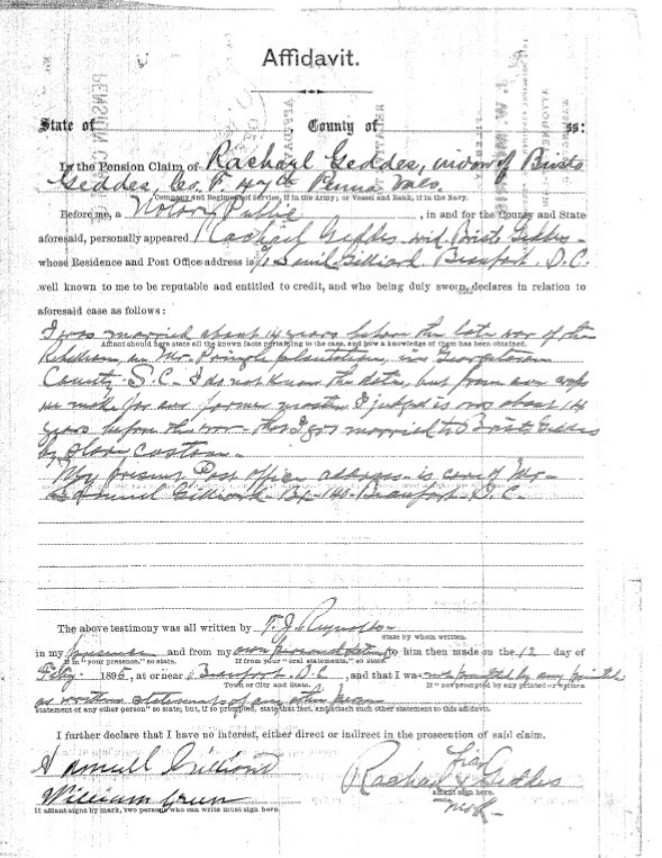
“I was married about 14 years before the late War of the Rebellion, on Mr. Pringle plantation, in Georgetown County, S.C. I do not know the date, but from our crops we make for our former master I judged it was about 14 years before the war that I got married to Bristo Geddes by slave custom.” — Rachael (Richardson) Gethers, excerpt from an affidavit filed by her attorney on February 12, 1895


Attestation made February 12, 1895 by Rachael (Richardson) Gethers of her 1847 marriage “by slave custom” on the Pringle plantation in Georgetown County, South Carolina to Bristor Gethers (affidavit excerpt, U.S. Civil War Widow’s Pension File of Bristor and Rachael Gethers, U.S. National Archives and Records Administration, public domain; click to enlarge).

We do not know the names of this woman’s parents, but we do know her name and the names of her husband and their closest friends, thanks to documents that were filed on her behalf by an attorney in Beaufort County, South Carolina, as part of her application for a U.S. Civil War Widow’s Pension during the late 1890s.

Her name was Rachael (Richardson) Gethers, and she was born into slavery in South Carolina circa 1825. Her parents, who had also been born in South Carolina, according to Rachael’s U.S. Census entries for 1870 and 1880, had also likely been born into slavery.

Virtually nothing else is known at present about her childhood and teen years. What researchers do know is that Rachael was still enslaved at the time of her marriage in Georgetown County, South Carolina, circa 1847 — during her early twenties, to Bristor Gethers, a man who was enslaved on the same plantation in that county.

* Note: The plantation where Rachael Richardson and Bristor Gethers were enslaved was owned by one of the largest family of enslavers in the United States — the Pringles. Among their multiple plantations and other Georgetown County properties were Beneventum and the White House Plantation, both of which were devoted primarily to rice production and profited from the labor of hundreds of enslaved Black men, women and children. (The Pringles had been actively engaged in the slave trade since the 1700s, and had broadened their wealth and power by marrying members of other families that were also heavily involved in chattel slavery, including the Allstons.)

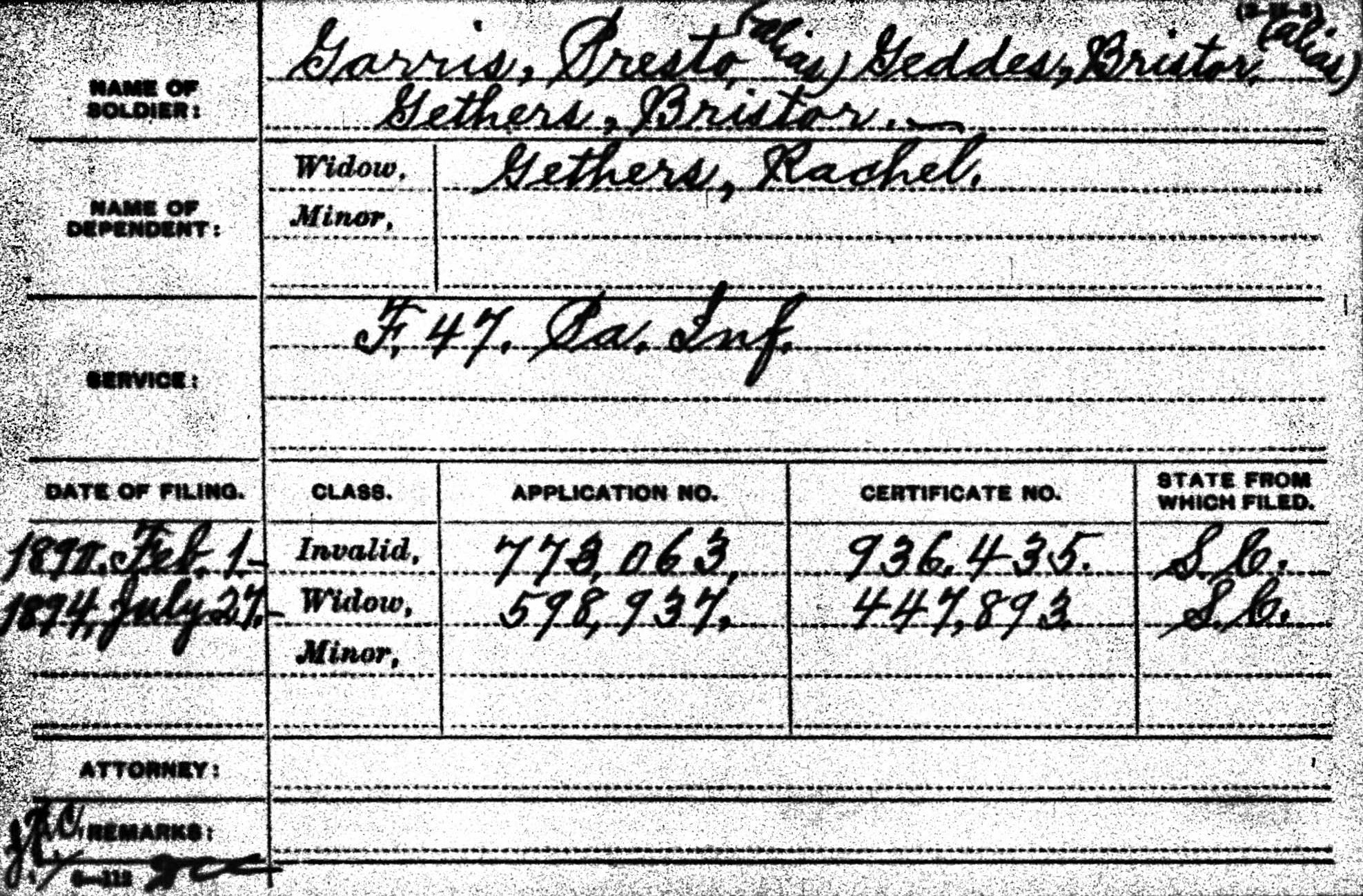
Unfortunately, the first and last names of Rachael (Richardson) Gethers’ husband were repeatedly misspelled in multiple civic, Freedmen’s Bureau, and military records throughout the nineteenth century. Variants of his given name between 1862 and 1893 included: Brista, Brister, Bristo, Bristor, Presto, Prestor, and Pristo; variants of his surname included: Gaddis, Garres, Garrees, Garris, Gathers, Geddes, Geddis, Gethers, Gettes. Affidavits filed in later life by Bristor Gethers and his attorney during the early 1890s finally confirmed the correct spelling of his name as “Bristor Gethers.” Rachael’s married surname was also spelled in various ways during her lifetime. In later years, an attorney who filed documents on her behalf for her application for a U.S. Civil War Widow’s Pension chose to spell her married surname as “Geddes.” Written as “Rachael” by that same attorney, her given name was spelled as “Rachel” on other records of the mid to late nineteenth century.

American Civil War

Spelling variants for Rachael (Richardson) Gethers and Bristor Gethers (U.S. Civil War General Pension Index Cards, U.S. National Archives, public domain).

The exact details of what happened to Rachael (Richardson) Gethers and her husband between the time of her marriage and the first years of the American Civil War are presently not known, but researchers do know that a new chapter in their life story began when her husband enlisted with a Union Army regiment in the city of Beaufort, South Carolina during the fall of 1862. Freed or escaped from slavery by that time, he joined the Union Army as a “Negro Under-Cook,” was entered onto the roster of Company F of the 47th Pennsylvania Volunteer Infantry on October 5, 1862, would go on to receive promotions to the rank of cook and then private during his three-year term of enlistment, and would travel with the 47th Pennsylvania as a member of its F Company to multiple duty stations and battle sites in Florida, Louisiana, Virginia, and Washington, D.C. during that war — and then to Georgia and South Carolina during five post-war months of the Reconstruction Era, at which point he was honorably discharged and allowed to return home to his wife.

Researchers have not yet determined what happened to Rachel during that same period, however; she may have escaped with Bristor and traveled with him to Beaufort or may have been freed herself by Union troops — or she may have remained behind, still enslaved on the Georgetown County plantation where they had been married, hoping that her husband would eventually return to free her.

What is known for certain is that Bristor did find her again.

Post-War Years

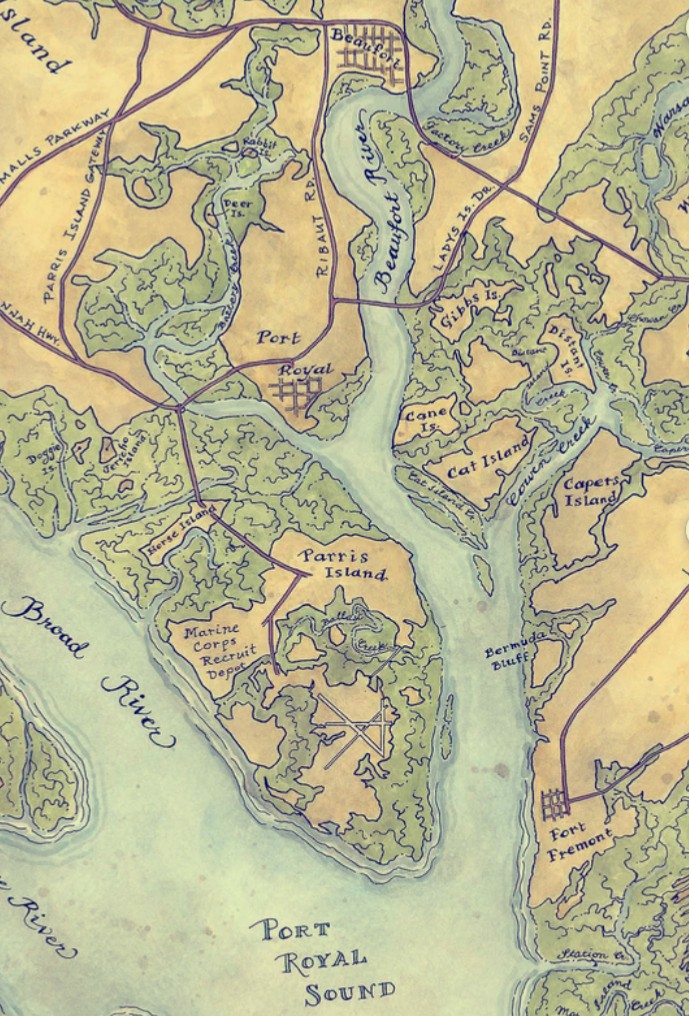
Horse Island, slightly above and to the left of Parris Island in Beaufort County, South Carolina (public domain; click to enlarge).

Following her husband’s honorable discharge from the Union Army, Rachael (Richardson) Gethers and her husband, Bristor, resumed life as a married couple. U.S. Census and Freedmen’s Bureau records confirm that they initially made their home in or near the city of Beaufort, South Carolina. Sometime around 1869, however, they relocated to Horse Island, in Beaufort Township, Beaufort County. According to the 1870 federal census, they resided there with their six-year-old son, Peter. By the time that the federal census was enumerated in 1880, however, their Horse Island household no longer included Peter.

Throughout their post-war years, Rachael and Bristor Gethers were farmers who often struggled to make ends meet. This was largely due to the fact that they were often required to turn over a significant portion of the funds they earned from their crops each harvest — under the terms of Freedmen’s Bureau contracts and other legal agreements that favored the wealthy White landowners whose land they were hired to farm. Adding to their worries was Bristor’s failing health. Having fallen seriously ill with dysentery during his military service, he was plagued by lifelong heart problems and chronic diarrhea that often left him too disabled to work.

But they persisted and managed to build a life together on Horse Island that lasted for nearly three decades. Preceded in death by her husband when he passed away on Horse Island in Beaufort Township on June 25, 1894, Rachael was so financially insecure at that point in her life that she was unable to pay for his burial. So, she reached out to friends for help.

Her husband’s close friend, Samuel Gilliard, was among the first to come to her rescue. He brought a coffin to the Gethers’ home, placed Bristor’s body in it and enlisted the help of Rachael’s neighbors in carrying the coffin down to the water, where they placed it on a boat, enabling Sam to transport it to Beaufort County’s Parris Island. Met there by William Green and other able-bodied men, Sam and his friends carried the coffin to a graveyard somewhere on that island, dug a new grave and laid Bristor to rest on June 26, 1894, according to affidavits that Sam and William both filed in support of Rachael’s Civil War widow’s pension application.

Life as a Widow

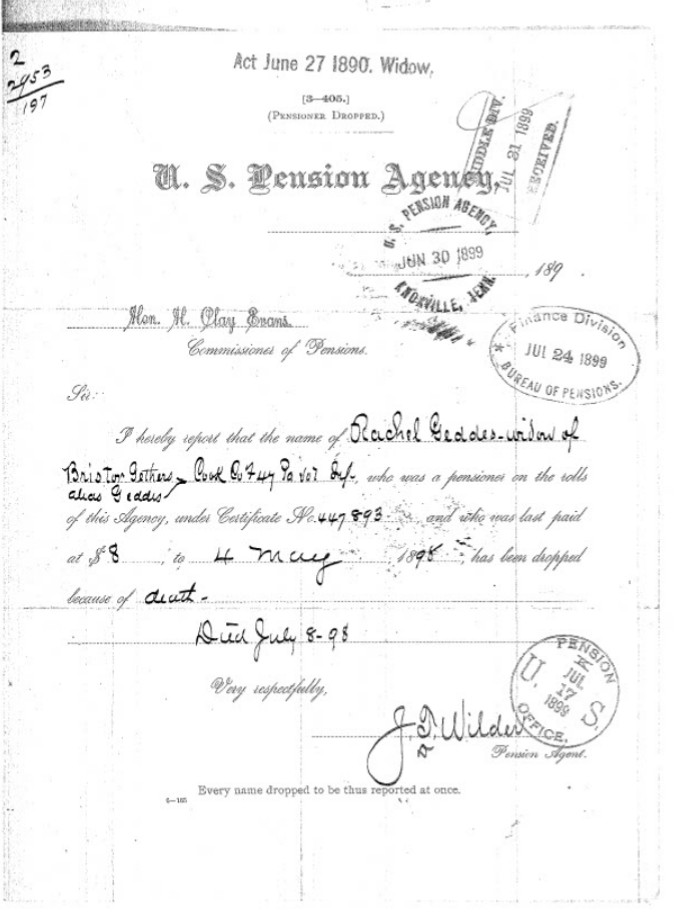
U.S. Pension Agency’s confirmation of Rachael (Richardson) Gethers’ date of death (U.S. National Archives and Records Administration, public domain; click to enlarge).

With a small U.S. Civil War Widow’s Pension of eight dollars per month (roughly three hundred and fifteen dollars per month in 2026 dollars), Rachael (Richardson) Gethers managed to survive her late husband by roughly four years. A certificate prepared by J. T. Wilder on behalf of the U.S. Pension Agency on June 30, 1899 confirmed that she died in Beaufort County, South Carolina on July 8, 1898.

Her exact burial location remains unknown, but is believed by researchers to be located somewhere on Parris Island in Beaufort County, South Carolina, based on U.S. Civil War Pension records which confirm that Parris Island was the burial location of her husband, Bristor Gethers.

* Note: To learn more about Rachael (Richardson) Gethers and her husband, Bristor, please read their full biography here and view their census and pension records, which are located on our website, Freedmen of the 47th Pennsylvania Volunteer Infantry (part of our special project dedicated to documenting the life histories of the nine formerly enslaved Black men who enlisted with the 47th Pennsylvania Volunteers).


Sources:

  1. Gaddis, Rachael, in U.S. Freedmen’s Bureau Hospital Records (Beaufort, South Carolina, December 1867), in Records of the Bureau of Refugees, Freedmen, and Abandoned Lands. Washington, D.C.: U.S. National Archives and Records Administration.
  2. Garris, Presto [sic, “Bristor Gethers”], in Civil War Muster Rolls and Civil War Veterans’ Card File, 1861-1866 (Company F, 47th Pennsylvania Infantry). Harrisburg, Pennsylvania: Pennsylvania State Archives.
  3. Garris, Presto (alias “Geddes, Bristor” and “Gethers, Bristor”) and Gethers, Rachel, in U.S. Civil War General Pension Index Cards (veteran’s application no.: 773063, veteran’s certificate no.: 936435, filed by the veteran from South Carolina, February 1, 1890; veteran’s widow’s application no.: 598937, veteran’s widow’s certificate no.: 447893, filed by the veteran’s widow from South Carolina, July 27, 1894). Washington, D.C.: U.S. National Archives and Records Administration.
  4. Geddes, Brister [sic, “Bristor Gethers”], Rachel and Peter, in U.S. Census (Beaufort, Beaufort Township, Beaufort County, South Carolina, 1870). Washington, D.C.: U.S. National Archives and Records Administration.
  5. Geddis, Brista [sic, “Bristor Gethers”] and Rachel, in U.S. Census (Beaufort Township, Beaufort County, South Carolina, 1880). Washington, D.C.: U.S. National Archives and Records Administration.
  6. Power, J. Tracy and Sherry Piland. “National Register of Historic Places Form: Beneventum Plantation” (filed by historians at the South Carolina Department of Archives and History, Columbia, South Carolina, September 15, 1987). Washington, D.C.: U.S. Department of the Interior, National Park Service.
  7. Roldán-Shaw, Michele. “Exploring the Sea Islands of Beaufort County.” Hilton Head, South Carolina: Local Life Insiders, retrieved online March 31, 2026.


Black History Month: Say His Name, Then Share His Story

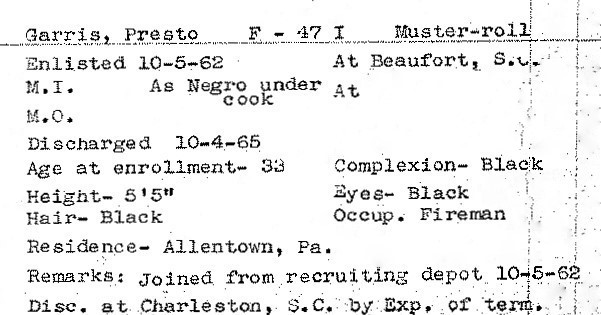
Page one of the U.S. Army’s Civil War enlistment paperwork for Bristor Gethers (mistakenly listed as “Presto Garris”), 47th Pennsylvania Volunteer Infantry, Company F, 5 October 1862 (U.S. National Archives and Records Administration, public domain; click to enlarge).

Our realization, as researchers, that there were at least nine formerly enslaved Black men who enlisted with the 47th Pennsylvania Volunteer Infantry during the American Civil War was sparked by a single index card for a soldier named “Presto Garris” that we found in the Pennsylvania Civil War Veterans’ Card File, which is maintained by the Pennsylvania State Archives.

Our ability to determine the true name of that soldier and correct the historical record about his life by researching and writing his biography was made possible by reading the dozens of pages contained in his U.S. Civil War Pension file and Compiled Military Service Records, which are maintained by the U.S. National Archives and Records Administration.

It was worth every penny of the roughly one hundred and ten dollars that we spent to obtain copies of those records from the National Archives because one of those documents confirmed the precise location of where that soldier had been enslaved prior to the war while others told us that he had survived the war and had lived out his life as a farmer. Another document even provided clues to the location of his grave.

That knowledge was so much more than we could have ever have hoped to gain because so many of the millions of men, women and children who were sold into, born into and re-sold throughout the American system of chattel slavery were never identified by name on state and federal census records prior to the war or were listed under names that had been created for them by their enslavers.

So, it matters that we’re able to tell you, for certain, that the true name of the soldier listed on that aforementioned index card was Bristor Gethers, that he lived near Mt. Pleasant, South Carolina after the war and that he resided with his wife and son near Beaufort, South Carolina after that. Please take the time to learn more about him by reading his bio on our educational program’s special website, Freedmen of the 47th Pennsylvania Volunteer Infantry. Then, look through the records that document his life’s journey.

Mr. Gethers’ story teaches us all that it is possible to find a new way forward after surviving the darkest of times.


Sources:

  1. “Garris, Presto,” in Civil War Muster Rolls (Company F, 47th Pennsylvania Infantry). Harrisburg, Pennsylvania: Pennsylvania State Archives.
  2. “Garris, Presto,” in Pennsylvania Civil War Veterans’ Card File, 1861-1866 (Company F, 47th Pennsylvania Infantry). Harrisburg, Pennsylvania: Pennsylvania State Archives.
  3. “Geddis, Brista” and “Geddis, Rachel,” in U.S. Census (Beaufort Township, Beaufort County, South Carolina, 1880). Washington, D.C.: U.S. National Archives and Records Administration.
  4. “Geddis, Brister,” in “Agreement Between B. J. Whitesides and Fifteen Freedmen” (Mt. Pleasant, South Carolina, 12 February 1868), in “Records of the Bureau of Refugees, Freedmen, and Abandoned Lands.” Washington, D.C.: U.S. National Archives and Records Administration.
  5. “Gethers, Bristor,” “Garris, Presto” and “Geddes, Bristor,” in U.S. Civil War Pension and U.S. Civil War Widows’ Pension Files (widow’s pension application no.: 598937, widow’s certificate no.: 447893, filed by the widow, Rachel Geddes, from South Carolina, 27 July 1894). Washington, D.C.: U.S. National Archives and Records Administration.


Black History Month: Ratification of the 15th Amendment to the United States Constitution (February 3, 1870)

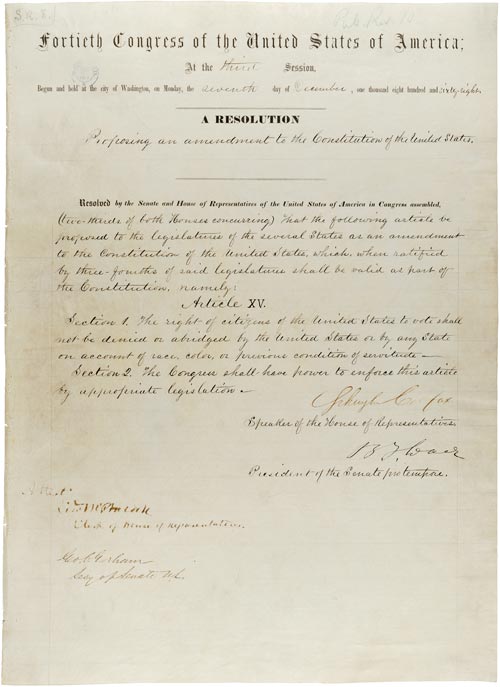
The 15th Amendment to the United States Constitution, which ensured voting access for all American male citizens, regardless of race, color or previous condition of servitude, was passed by the United States Congress on February 26, 1869 and ratified on February 3, 1870 (U.S. National Archives and Records Administration, public domain; click to enlarge).

Passed by the United States Congress on February 26, 1869, the 15th Amendment to the United States Constitution granted Voting Rights to African American men. That amendment was officially ratified on February 3, 1870.

Text of the 15th Amendment

Fortieth Congress of the United States of America;

At the third Session, Begun and held at the city of Washington, on Monday, the seventh day of December, one thousand eight hundred sixty-eight.

A RESOLUTION

Proposing an Amendment to the Constitution of the United States.

Resolved by the Senate and House of Representatives of the United States of America in Congress assembled, (two-thirds of both houses concurring) that the following article be proposed to the legislature of the several States as an amendment to the Constitution of the United States which, when ratified by three-fourths of said legislatures shall be valid as part of the Constitution, namely:

Article XV.

Section 1. The right of citizens of the United States to vote shall not be denied or abridged by the United States or by any State on account of race, color, or previous condition of servitude–

Section 2. The Congress shall have power to enforce this article by appropriate legislation.


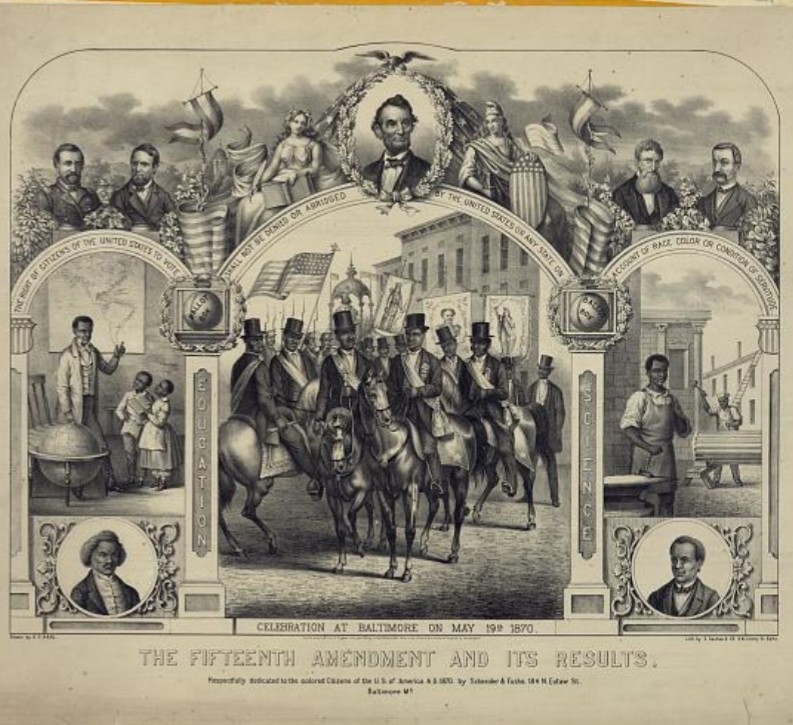
“The Fifteenth Amendment and Its Results” (G. F. Kahl for E. Sachse & Co., lithographer, circa 1870, U.S. Library of Congress, public domain; click to enlarge).


Sources:

  1. 15th Amendment to the United States Constitution: Voting Rights (1870),” in “Milestone Documents.” Washington, D.C.: U.S. National Archives and Records Administration, retrieved online February 3, 2025.
  2. The Fifteenth Amendment and Its Results.” Washington, D.C.: U.S. Library of Congress, retrieved online February 3, 2025.


Research Update: New Details Learned About Abraham Jassum, One of Nine Formerly Enslaved Men Who Enlisted with the 47th Pennsylvania Volunteers

Enlistment form for Abraham Jassum, Undercook, 47th Pennsylvania Volunteers, 5 October 1862, p. 1 (Compiled Military Service Records, U.S. National Archives and Records Administration, public domain; click to enlarge).

Fleeing the brutal practice of chattel slavery in South Carolina during the fall of 1862, a Black youth walked into a recruiting station for the Army of the United States in Beaufort, South Carolina and told an officer there that he wanted to become a soldier. His name, according to his enlistment paperwork, was Abraham Jassum, and he was just sixteen years old.

Sadly, much of that teenager’s life has remained a mystery that has stubbornly resisted unraveling–until now. Thanks to documents recently copied by the U.S. National Archives for 47th Pennsylvania Volunteers: One Civil War Regiment’s Story, researchers now know that Abraham Jassum was born into slavery in Charleston, South Carolina sometime around 1846.

Although specific details about what happened to this teenager between the dates of his birth and army enlistment have not yet been found, researchers do already have several ideas. One theory is that Abraham’s surname was not actually “Jassum” because that surname does not appear to have been present on any federal census records for any plantation owners or other enslavers in South Carolina between 1840 and 1860, nor was it used for any Black Freedmen in South Carolina on federal census records that were completed after the American Civil War. Furthermore, there appear to be no U.S. Civil War Pension records that exist for any soldier with the surname of “Jassum.”

Another theory is that, by the time that Abraham reached the age of sixteen, he had been transported to Beaufort to be used as an enslaved laborer there (or was “sold as property” by his enslaver in Charleston to a plantation owner or other enslaver near Beaufort), and that he was freed by Union soldiers when Beaufort was occupied by the Union Army.

Fortunately, the Compiled Military Service Records (CMSR) file for Abraham Jassum does contain important details about his life between October 1862 and October 1865.

Bay Street Looking West, Beaufort, South Carolina, circa 1862 (Sam A. Cooley, 10th Army Corps, photographer, public domain).

What is known for certain is that he enlisted for military service on October 5, 1862 as an “undercook“–a designation that was first authorized for use by regiments serving with the Army of the United States by the U.S. War Department. Examined and certified as fit for duty by William F. Reiber, M.D., an assistant regimental surgeon with the 47th Pennsylvania Volunteer Infantry, Abraham Jassum was then assigned to the 47th Pennsylvania Volunteers’ F Company.

Military records at the time of his enlistment noted that he was five feet, six inches tall and had black hair, black eyes and a black complexion. Muster sheets subsequently described him as a “Negro.”

During his three-year term of enlistment, he traveled with the 47th Pennsylvania to its battle, garrison, occupation, and other duty assignments in Florida, Louisiana, Virginia, Washington D.C., and South Carolina. While stationed with his regiment in Louisiana, he was documented as having been officially mustered into the regiment in June 1864, along with the other Black soldiers of the 47th Pennsylvania.

Additional military records of the 47th Pennsylvania Volunteer Infantry confirm Abraham Jassum’s service in 1864 and 1865, describing him as a “cook” or as a “private,” which appears to indicate that he may have been promoted at some point prior to his honorable discharge.

Issued his honorable discharge paperwork on October 4, 1865, while his regiment was assigned to Reconstruction-related duties in Charleston, South Carolina, he was given a small travel allowance to enable him to return to his place of enlistment (Beaufort, South Carolina), which seems to indicate that he chose to settle in Beaufort, at least initially, rather than remaining in the city where he had been born (Charleston), and instead of relocating north with his former regiment when it returned to Pennsylvania.

Researchers will continue to search for records that can shed more light on what happened to Abraham Jassum after the war, and will post updates if and when new data is uncovered.


Sources:

  1. Bates, Samuel P. History of Pennsylvania Volunteers, 1861-5, vol. 1. Harrisburg, Pennsylvania: B. Singerly, State Printer, 1869.
  2. Jassum, Abraham, in Civil War Veterans’ Card File, 1861-1866 (Company F, 47th Pennsylvania Infantry). Harrisburg, Pennsylvania: Pennsylvania State Archives.
  3. Jassum, Abraham, Civil War Muster Rolls (Company F, 47th Pennsylvania Infantry). Harrisburg, Pennsylvania: Pennsylvania State Archives.
  4. Jassum, Abraham, in Compiled Military Service Records (Company F, 47th Pennsylvania Volunteer Infantry). Washington, D.C.: U.S. National Archives and Records Administration.
  5. Jassum, Abraham, in Registers of Pennsylvania Volunteers, 1861-1865 (Company F, 47th Pennsylvania Infantry), in Records of the Department of Military and Veterans’ Affairs (RG-19). Harrisburg, Pennsylvania: Pennsylvania State Archives.
  6. Schmidt, Lewis. A Civil War History of the 47th Regiment of Pennsylvania Veteran Volunteers. Allentown, Pennsylvania: Self-published, 1986.


Black History Month: The Authorization, Duties and Pay of “Under-Cooks”

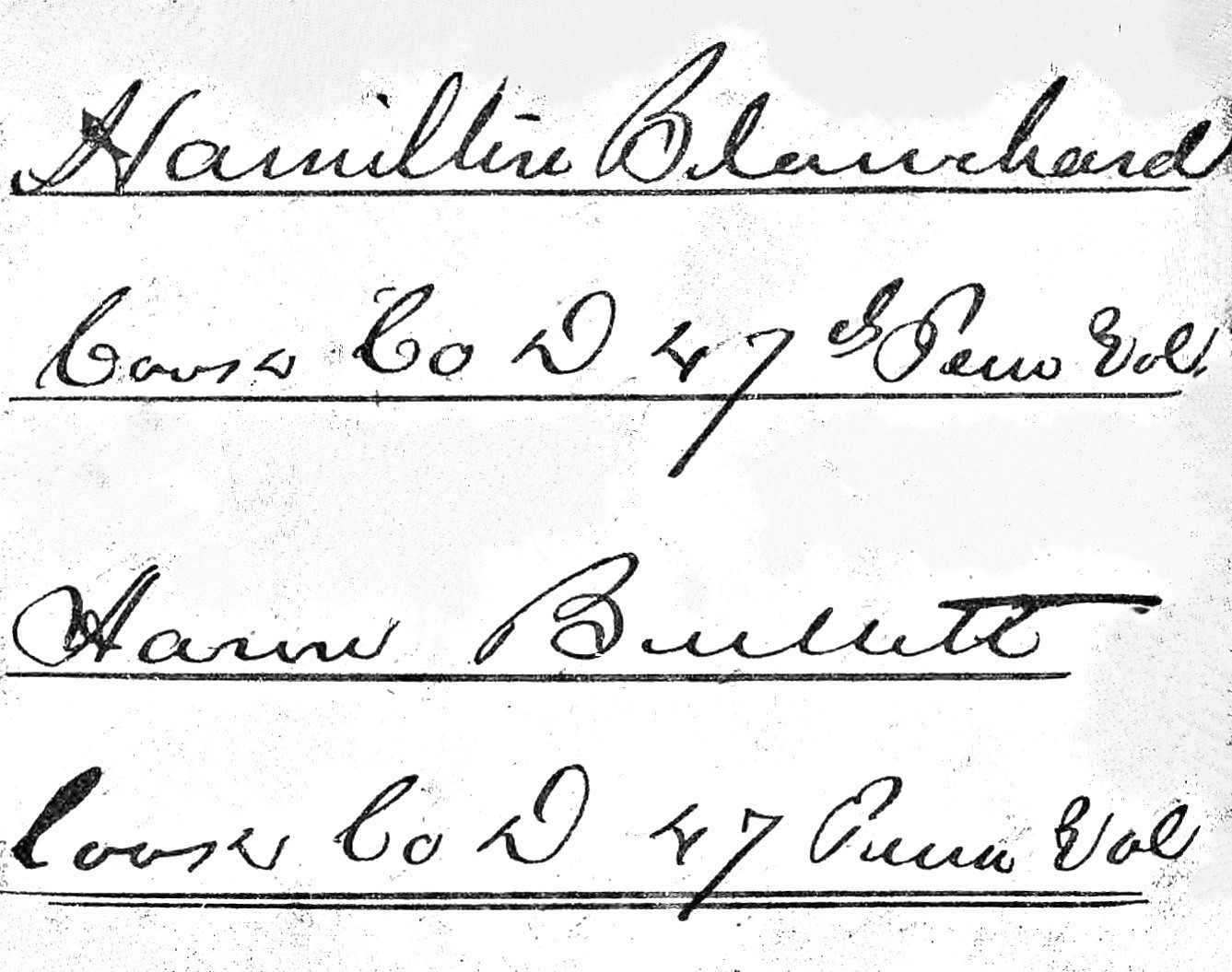
One of several U.S. Civil War Pension documents that confirmed the Union Army enrollment of Hamilton Blanchard and Aaron Bullard, known later as Aaron French, as Cooks (a higher rank than under-cook) with Company D of the 47th Pennsylvania Volunteer Infantry (U.S. Civil War Pension Files, U.S. National Archives and Records Administration, public domain).

Following executive orders promulgated by President Abraham Lincoln in 1862 and legislation enacted that same year by the United States Congress to facilitate the enrollment by free and enslaved Black men with Union Army regiments, the 47th Pennsylvania Volunteer Infantry began processing the enlistments of four of the nine formerly enslaved men who would ultimately be entered onto the rosters of this history-making regiment.

Enrolled as “Negro Under-Cooks” while the regiment was stationed in Beaufort, South Carolina as part of the U.S. Department of the South and Tenth Army (X Corps), Bristor Gethers, Thomas Haywood, Abraham Jassum, and Edward Jassum ranged in age from sixteen to thirty-three.

Roughly two years later, officers from the 47th Pennsylvania Volunteers then processed the enlistment paperwork for an additional five formerly enslaved men in Natchitoches, Louisiana in April 1864 while the 47th Pennsylvania was stationed there (as the only regiment from Pennsylvania to participate in the Union’s Red River Campaign across Louisiana). Hamilton Blanchard, Aaron French (who was known at that time as Aaron Bullard), James Bullard, John Bullard, and Samuel Jones ranged in age from sixteen to twenty-nine.

All but one of the nine would go on to complete their three-year terms of enlistment and be honorably mustered out in October 1865.

What Were Their Job Duties?

General Orders No. 323 (enlistment and pay of under-cooks of African descent), U.S. War Department and Office of the Adjutant General, September 28, 1863 (U.S. Library of Congress, public domain).

The duties and other pertinent details about the military tasks performed by Cooks and Under-Cooks of the Union Army were explained as follows by August Kautz in his 1864 manual, Customs of Service for Non-Commissioned Officers and Soldiers as Derived from Law and Regulations and Practised in the Army of the United States:

“108. DAILY DUTY.—A soldier is on daily duty when he is put upon some continuous duty that excuses him from the ordinary company duty but does not entitle him to additional pay from the government,—such as company cooks, tailors, clerks, standing orderlies, &c. These duties may be performed by soldiers selected on account of special capacity or merit, or detailed in turn, as is most convenient and conducive to the interest of the service.

109. The company cooks are one or more men in each company detailed to do the cooking for the entire company. This is the case usually in companies where it is not the custom to distribute the provisions to the men; for in this case the messes furnish their own cooks, and they are not excused from any duty except what is absolutely necessary and which their messmates can do for them.

110. The law authorizes the detailing of one cook to thirty men, or less; two cooks if there are more than thirty men in the company. It also allows to each cook two assistant cooks (colored), who are enlisted for the purpose, and are allowed ten dollars per month. (See Par. 269.)

111. The cooks are under the direction of the first sergeant or commissary-sergeant, who superintends the issue of provisions and directs the cooking for each day. Company cooks for the whole company are generally detailed in turn, and for periods of a week or ten days….

269. Cooks. — The law now allows the enlistment of four African under-cooks for each company of more than thirty men; if less, two are allowed. They receive ten dollars per month, three of which may be drawn in clothing, and one ration. (See Act March 3, 1863, section 10.) They are enlisted the same as other enlisted men, and their accounts are kept in the same way: they are entered on the company muster-rolls, at the foot of the list of privates. (G. 0. No. 323, 1863.)

270. These cooks are to be under the direction, of a head-cook, detailed from the soldiers alternately every ten days, when the company is of less than thirty men; when the company is of more than thirty men, two head-cooks are allowed. These are quite sufficient to cook the rations for a company; and, by system and method, the comfort and subsistence of a company may be greatly improved. The frequent changing of cooks under the old system worked badly for the comfort of the soldier and they were often treated to unwholesome food, in consequence of the inexperience of some of the men.

271. The object of changing the head-cooks every ten days, as required by section 9, Act March 3, 1863, is to teach all the men how to cook; but it will follow that the under-cooks, who are permanently on that duty will know more about it than the head-cooks. They will simply be held responsible that the cooking is properly performed.”

From Under-Cook to Private

Samuel Jones was an enslaved Black man who enlisted as an Under-Cook with Company C of the 47th Pennsylvania Volunteer Infantry in Natchitoches, Louisiana on April 5, 1864. Official regimental muster rolls confirmed that he was a private at the time of his honorable discharge in 1865 (Registers of Pennsylvania Volunteers, 1861-1865: 47th Regiment, in “Records of the Department of Military and Veterans’ Affairs,” Pennsylvania State Archives, public domain; click to enlarge).

As the officers and enlisted members of the 47th Pennsylvania Volunteer Infantry interacted more frequently with the nine formerly enslaved men who had enlisted with their regiment, their trust in, and respect for, those nine men grew. Over time, several of the nine men were assigned to increasingly responsible duties, which ultimately led to their respective promotions to the ranks of cook and private—ranks that were documented on official muster rolls of the 47th Pennsylvania Volunteers.

About “Faces of the 47th: Freedmen of the 47th Pennsylvania Volunteer Infantry”

“Faces of the 47th: Freedmen of the 47th Pennsylvania Volunteer Infantry” is a special project of 47th Pennsylvania Volunteers: One Civil War Regiment’s Story, an educational program designed to teach children and adults about the history of the 47th Pennsylvania Veteran Volunteers, a Union Army regiment which served for nearly the entire duration of the American Civil War and became the only military unit from the Commonwealth of Pennsylvania to participate in the Union’s 1864 Red River Campaign across Louisiana.

This important initiative is dedicated to researching, documenting and presenting the life stories of nine formerly enslaved Black men who enlisted with the 47th Pennsylvania Volunteer Infantry during two of the regiment’s most eventful years of service to the nation—1862 and 1864.

Largely forgotten for more than a century after honorably completing their historic military service, these nine men have been repeatedly overlooked by mainstream historians over the years as potentially important subjects for research and have also been an ongoing source of mystery and frustration to their descendants because the majority of their military service records have still not been digitized by state and national archives.

The purpose of this initiative is to remedy those failures and create a lasting tribute to these nine remarkable men.

Learn more about their lives before, during and after the war by visiting Freedmen of the 47th Pennsylvania Volunteer Infantry.”


Sources:

  1. “Bounties to Volunteers.” Washington, D.C.: National Republican, January 5, 1864.
  2. “Comfort of the Soldier.” Washington, D.C.: Daily National Republican, February 23, 1863.
  3. “Garris, Presto” [sic, “Gethers, Bristor”], and “Jones, Samuel,” in “Registers of Pennsylvania Volunteers, 1861-1865” (47th Regiment, Companies F and C), in “Records of the Department of Military and Veterans’ Affairs” (RG-19). Harrisburg, Pennsylvania: Pennsylvania State Archives.
  4. “General Orders No. 323” (enlistment and pay of “under-cooks of African descent”). Washington, D.C.: U.S. War Department and Adjutant General’s Office, September 28, 1863.
  5. “Important Diplomatic Circular by Secretary Seward: Review of Recent Military Events.” Washington, D.C.: The Evening Star, September 15, 1863.
  6. Kautz, August V. Customs of Service for Non-Commissioned Officers and Soldiers as Derived from Law and Regulations and Practised in the Army of the United States, pp. 41-42 (definitions and responsibilities of cooks and under-cooks), 68-69 (special enlistments: African Under-Cook), 84-88 (cooking responsibilities of hospital stewards), 90-9 (special enlistments: African Under-Cook, definition, enlistment and record-keeping for, and pay), and 93 (cooks and attendants in hospitals) . Philadelphia, Pennsylvania: J. B. Lippincott & Co., 1864.
  7. “Military Notices” (Fourteenth United States Infantry). Philadelphia, Pennsylvania: The Philadelphia Inquirer, January 14, 1864.
  8. “Official: Laws of the United States, Passed at the Third Session of the Thirty-seventh Congress.” Washington, D.C.: Daily National Republican, March 27, 1863.
  9. “Under Cooks of African Descent.” Washington, D.C.: National Republican, May 8, 1865.


Black History Month: New Details Uncovered Regarding the Formerly Enslaved Black Men Who Enlisted with the 47th Pennsylvania Volunteer Infantry

Research regarding the lives of the nine formerly enslaved Black men who enlisted with the 47th Pennsylvania Volunteer Infantry in 1862 and 1864 has continued to progress—even in the middle of a pandemic that has forced the closure of numerous local, state, and national archives.*

In addition to uncovering details about the life of the soldier from South Carolina who was mistakenly listed on muster rolls for the 47th Pennsylvania as “Presto Gettes” (learn more about him in this article here), researchers for 47th Pennsylvania Volunteers: One Civil War Regiment’s Story have been able to determine more about what happened to two of the other men post-war, and have also located records which seem to indicate that there may have been two or three other Black men who enlisted with the regiment (potentially bringing the total number of Black enlistees in the regiment to twelve).

Aaron French (enlisted as Aaron Bullard):

Muster roll entries for Aaron Bullard and Hamilton Blanchard, Company D, 47th Pennsylvania Volunteers (U.S. National Archives, public domain).

1864 was a life-changing year for Aaron Bullard and four other young Black men in Louisiana. After enlisting with the 47th Pennsylvania Volunteer Infantry on April 5 while the 47th was stationed at Natchitoches, Louisiana, Samuel Jones, Hamilton Blanchard (also known as John Hamilton), and Aaron, James, and John Bullard traveled with the 47th Pennsylvania as it participated in the multiple battles associated with the Union’s 1864 Red River Campaign across Louisiana. On or about June 22, they were formally mustered into the regiment at Morganza, Louisiana.

Sometime later (possibly post-war), Aaron Bullard changed his surname to French. After the American Civil War, he married, became a land-owning farmer—and a dad.

Post-Civil War, Aaron French and his family resided in Issaquena County, Mississippi (U.S. Census, 1870, public domain).

In August of 1870, Aaron French and his wife, Amanda, lived with their eight-month-old daughter, “Simpy” (also known as Cynthia or Cyntha) in Skipworth Precinct, Issaquena County, Mississippi. Still residing in Issaquena County a decade later when the June 1880 federal census was taken, Aaron and Amanda were the proud parents of three daughters: Cynthia (who would go on to marry Samuel L. Dixon on March 20, 1890), Jesanna (also known as Jessie/Jesse), and “Arctavia” (also known as Octavia). Jessie, who later went on to wed John B. Cobb on January 28, 1892, made a life with her husband and son in Mayersville, Mississippi, where she was a teacher in the local schools. Octavia married Frank Childress on March 20, 1894.

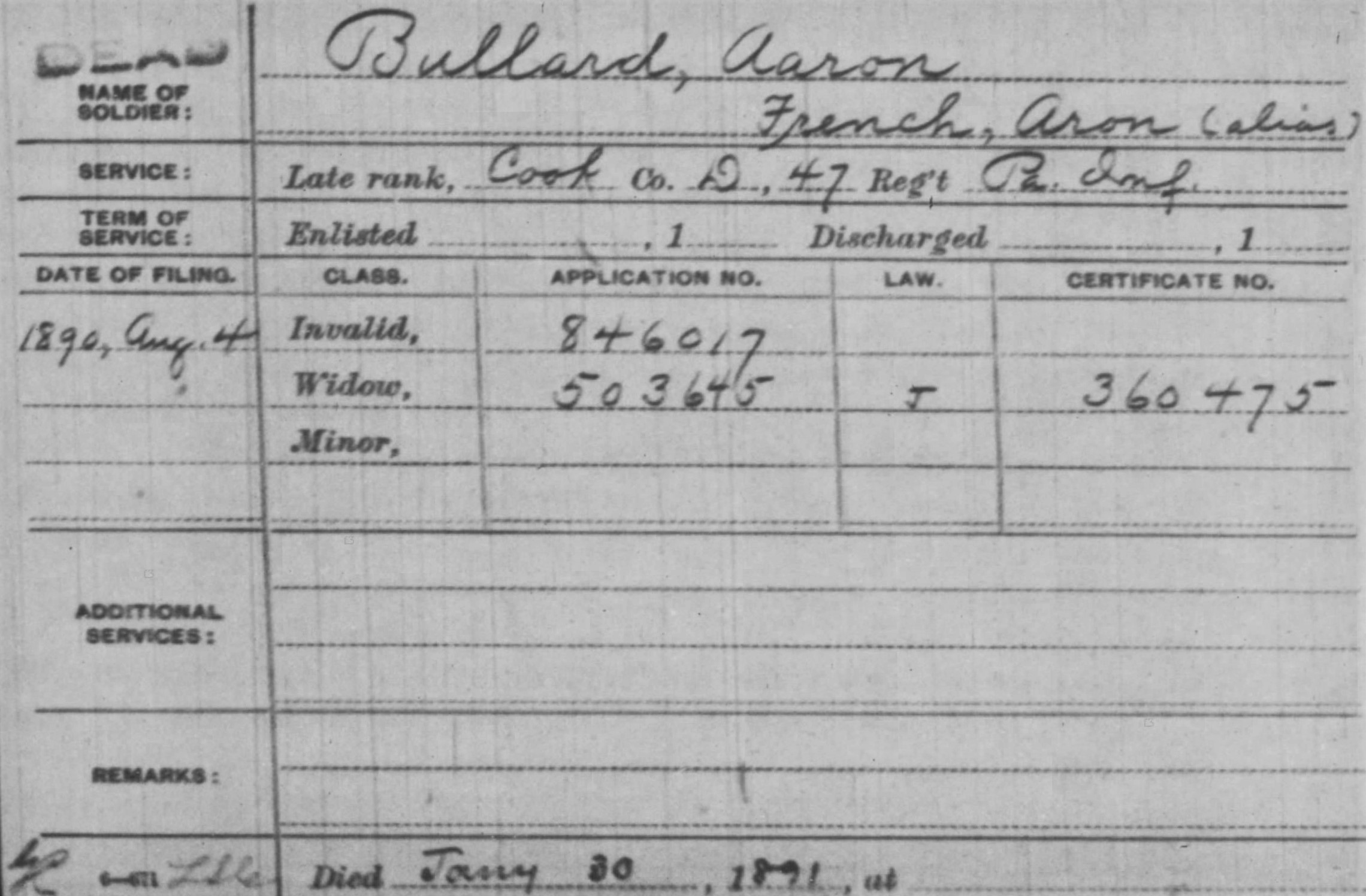
U.S. Civil War Pension Index Card for Aaron French, who enlisted with the 47th Pennsylvania Volunteers in Louisiana in 1864 (U.S. National Archives, public domain).

Sadly, Aaron French did not live to see his two youngest daughters marry because he died in Mississippi on January 30, 1891. He was just 40-43 years old, according to U.S. Census records and other data, which indicate that he was born in Louisiana sometime between 1848 and 1850.

Hearteningly, though, an even more intriguing piece of data has recently been uncovered about the later life of Aaron French—one that indicates that he had become active in politics prior to his death. According to the Vicksburg Evening Post, Aaron was appointed as a delegate from Issaquena County to the Republican Congressional Convention for the Third District, which was held in Greenville, Mississippi on August 7, 1886. Researchers are continuing to search for further details about his political activities and untimely death, as well as the exact location of his gravesite.

Thomas Haywood (alternate spellings of surname: Hayward, Haywood, Heywood) and Jack Jacobs:

Muster roll entries of Thomas Haywood and Edward Jassum, Company H, 47th Pennsylvania Volunteers (U.S. National Archives, public domain).

Born into slavery in South Carolina sometime around 1832, Thomas Haywood enlisted for a three-year term of service as an Under Cook with Company H of the 47th Pennsylvania Volunteer Infantry at Beaufort, South Carolina on November 1, 1862. He and three other formerly enslaved Black men—Abraham and Edward Jassum and Presto Gettes”—who had previously enlisted with the 47th Pennsylvania at Beaufort in October of 1862, then traveled with the 47th Pennsylvania as it participated in multiple military engagements, including the 47th’s garrisoning of Fort Taylor and Fort Jefferson in Florida in 1863 and 1864, the battles of the Union’s spring 1864 Red River Campaign across Louisiana, and the battles of Sheridan’s tide-turning Shenandoah Valley Campaign across Virginia in the fall of 1864.

On or about June 22, 1864 all nine of these Black soldiers were formally mustered into the regiment at Morganza, Louisiana; Thomas Haywood and seven of the eight others all successfully completed their tours of duty, and were honorably mustered out upon expiration of their respective terms of enlistment. In Thomas Haywood’s case, that honorable discharge was awarded on October 31, 1865.

Post-war, it appears from various Freedmen’s Bureau records that he may have entered into yearly contracts with several men who had previously been plantation owners in the Beaufort, South Carolina area. In exchange for agreeing to plant and cultivate cotton for those men on three to five-acre parcels of land that had been leased to him by those white men, he was allowed to keep portions of the cotton sales (the largest portions of which went to the former plantation owners who had also most likely been slave owners prior to and during the Civil War).

U.S. Civil War Index Card for Thomas Haywood, who enlisted with the 47th Pennsylvania Volunteers in South Carolina in 1862 (U.S. National Archives, public domain).

His body warn out from years of slavery prior to the war, difficult military service during the war, and harsh sharecropping experiences post-war, Thomas Hayward applied for, and was awarded a U.S. Civil War Pension on April 30, 1888. That pension was subsequently renewed by the federal government in 1907 at the rate of $15 per month (roughly $415 per month in today’s U.S. dollar equivalency).

By 1890, Thomas Haywood was living in Sheldon Township, Beaufort County, South Carolina. After a long life, he died on January 13, 1911. Unfortunately, his burial location has also not yet been identified by researchers.

In 1890, Thomas Haywood lived near Hanna Jacobs, the widow of Jack Jacobs, who may have been another Black soldier who enlisted with the 47th Pennsylvania Volunteers (U.S. Census, 1890, Sheldon Township, Beaufort County, South Carolina, public domain).

One other piece of tantalizing data that has recently been discovered is that a woman named “Hanna Jacobs” lived near Thomas Haywood in 1890. This information may be significant because Hanna was described on the 1890 U.S. Census of Union soldiers and widows as the widow of “Jack Jacobs,” who had served in the same company with Thomas Haywood (according to that special census).

Researchers currently believe that Jack Jacobs may, in fact, have been another formerly enslaved Black man who had enlisted with the 47th Pennsylvania when it was stationed near Beaufort in 1862, and are currently conducting a Go Fund Me campaign to raise funds to purchase the Civil War military and pension records of Hanna and Jack Jacobs, as well as the nine known formerly enslaved Black men who enlisted with the 47th Pennsylvania Volunteer Infantry in 1862 and 1864.

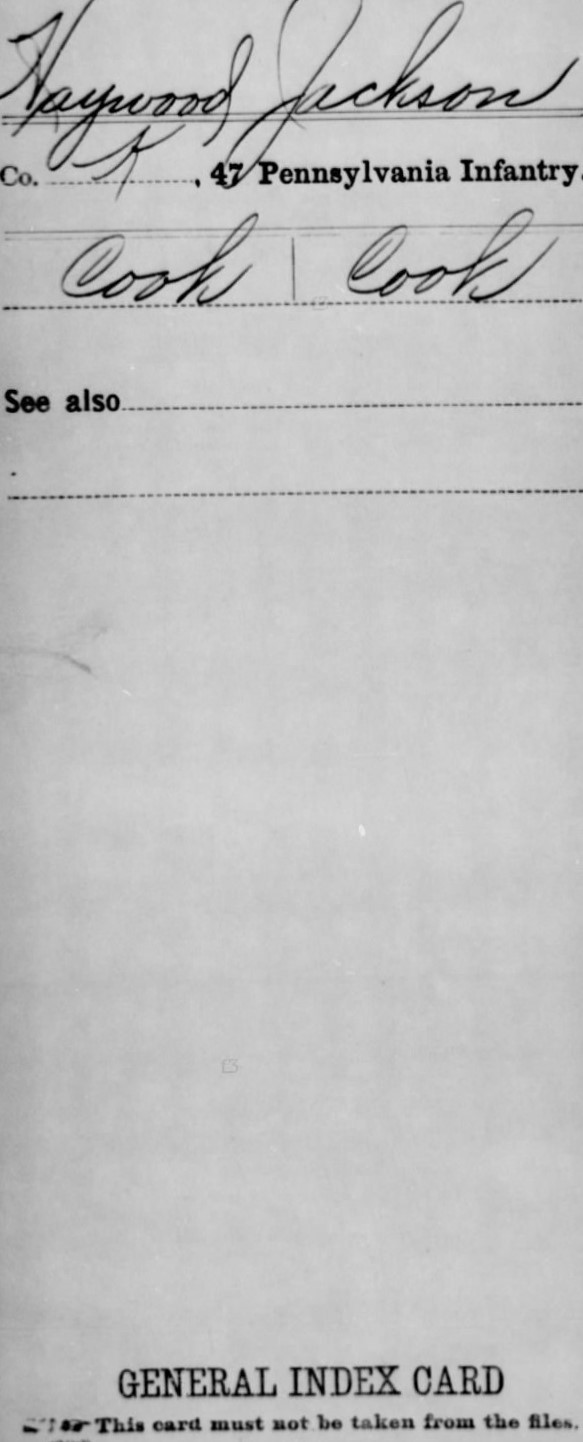
Jackson Haywood:

General Index Card for Jackson Haywood, who may have been a Black soldier who enlisted with the 47th Pennsylvania Volunteers (U.S. National Archives, public domain).

According to the “Index to Compiled Service Records of Volunteers Who Served in Organizations from the State of Pennsylvania,” which was created by staff at the U.S. National Archives, a General Index Card was created for yet another mystery man—a soldier named “Jackson Hayward.”

To date, researchers have only been able to determine that he may have enlisted with Company K of the 47th Pennsylvania Volunteer Infantry as a cook—a rank similar to that at which the known nine formerly enslaved Black men who enlisted with the 47th Pennsylvania were entered on the muster rolls of the regiment.

Researchers hope, with time and the continued financial support of the followers of 47th Pennsylvania Volunteers: One Civil War Regiment’s Story, to be able to confirm the dates of military service and race of this individual, as well as that of “Jack Jacobs.”

As always, we appreciate everyone’s help in ensuring that the service to the nation of these soldiers will never be forgotten. They helped to preserve our Union and deserve to be recognized more fully for their heroism and dedication.

* Our most important goal continues to be the purchase of the Compiled Military Service Records (CMSR) and U.S. Civil War Pension records for each of these remarkable men in order to document and freely share their stories with the widest possible audience. We continue to await word from staff at the U.S. National Archives regarding the timeframe for their resumption of digitization and reproduction services that have temporarily been suspended due to the coronavirus pandemic. As soon as those services have resumed, we will request an update regarding their estimated timeframe for fulfilling our records requests. In the interim, we will seek out further details about each of these soldiers via local and state archival resources across the nation, and will post updates as we confirm more data.

Sources:

  1. Bullard, Aaron, in Index to Compiled Service Records of Volunteers. Washington, DC: U.S. National Archives, 1861-1865.
  2. Bullard, Aaron and French, Aaron, in U.S. Civil War Pension Index Cards. Washington, DC: U.S. National Archives, 1890-1891.
  3. Bullard, Aaron, Presto Garris, Thomas Haywood, et. al. in U.S. Civil War Muster Out Rolls (47th Pennsylvania Volunteer Infantry). Washington, DC: U.S. National Archives, 1865-1866 (available via Ancestry.com).
  4. French, Aaron, in “Proceedings of the Third District Republican Convention.” Vicksburg, Mississippi: Vicksburg Evening Post, August 9, 1886.
  5. French, Aaron and Family, in U.S. Census Records (Issaquena County, Mississippi): Washington, DC: U.S. National Archives, 1870-1910.
  6. Haywood, Jackson, in Index to Compiled Service Records of Volunteers. Washington, DC: U.S. National Archives, 1861-1865.
  7. Haywood, Thomas, in Index to Compiled Service Records of Volunteers. Washington, DC: U.S. National Archives, 1861-1865.
  8. Haywood, Thomas, in U.S. Civil War Pension Index Cards. Washington, DC: U.S. National Archives, 1888, 1907.
  9. Haywood, Thomas, in U.S. Veterans’ Administration Pension Payment Cards. Washington, DC: U.S. National Archives, 1888, 1907.
  10. Haywood, Thomas, in U.S. Census (Beaufort County, South Carolina): Washington, DC: U.S. National Archives, 1890.
  11. Hanna Jacobs, widow of Jack Jacobs, in U.S. Census (Beaufort County, South Carolina): Washington, DC: U.S. National Archives, 1890.


His First Name was “Presto?” A Black History Month Mystery

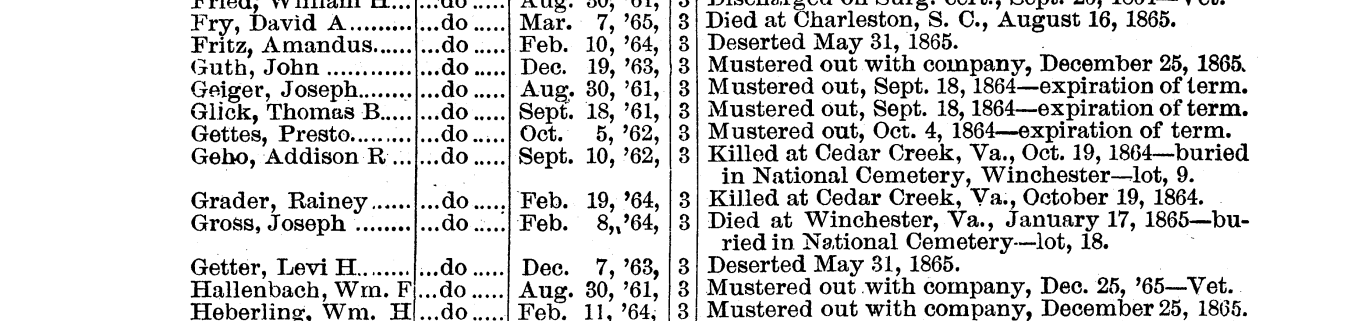
Roster entry: Presto Garris,” Company F, 47th Pennsylvania Volunteers, Bates’ History of Pennsylvania Volunteers, Vol. 1, 1869 (public domain; double click to enlarge).

“Presto?” The first name stood out like a sore thumb on the roster of my great-grandfather’s Civil War regiment—one with a rank and file populated largely by soldiers with Germanic surnames: “Acher,” “Bachman,” “Bauer,” “Bauman,” “Burger,” “Dachrodt,” “Diehl,” “Eisenbraun,” “Eppler,” “Fritz,” “Grimm,” “Guth,” “Handwerk,” “Hertzog,” “Keiser,” “Knecht,” “Knorr,” “Koenig,” “Laub,” “Metzger,” “Münch,” “Rehrig,” “Reinert,” “Richter,” “Sauerwein,” “Schmidt,” “Schneider,” “Strauss,” “Ulrich,” “Volkenand,” “Wagner,” “Weiss,” and “Zeppenfeld.”

Many of their given or middle names were equally as Germanic—“Adolph,” “Bernhard,” “Gottlieb,” “Friedrich,” “Heinrich,” “Levi,” “Matthias,” “Reinhold,” “Tilghman,” “Tobias,” and “Werner.” In addition, one of the regiment’s component units—Company K—had even been founded by a German immigrant with the intent of creating “a new German company” staffed entirely by German-Americans who had been born in the Lehigh Valley, as well as recent émigrés from Germany.

So, “Presto” as a given name seemed like it warranted further investigation. Did the spelling of this soldier’s given name signal that he had emigrated from a different part of the world—possibly Italy? There was, after all, another member of the 47th Pennsylvania’s ranks with a seemingly Italian surname—Battaglia (later proven to be an immigrant of Switzerland). Plus, there were also multiple men with Irish surnames who had also enlisted with the 47th.

Or, maybe this soldier had been employed as a magician prior to enlisting in the military? (Probably not, but strange discoveries are surprisingly common with genealogical research.)

A more likely scenario? A harried Union Army clerk, in his haste to process new enlistees, simply omitted the “n” at the end of this soldier’s name—making him “Presto” for posterity’s sake rather than “Preston.”

I just had to know. Who was Presto?

Listing for “Presto Garris,” Company F, 47th Pennsylvania Volunteers, Civil War Veterans’ Card File, 1861-1866, Pennsylvania State Archives (public domain).

It turned out that this 47th Pennsylvania Volunteer wasn’t a magician, and he wasn’t an immigrant from Italy, but he was someone whose first and last names were badly mangled by multiple “mis-spellers” over decades of data entry.

Upon further investigation, it became clear that he was a formerly enslaved, 33-year-old black man who had enlisted with the 47th Pennsylvania Volunteer Infantry on October 5, 1862 while the regiment was stationed near Beaufort, South Carolina—meaning that my great-grandfather’s regiment had become an integrated one at least three months before President Lincoln had issued the Emancipation Proclamation.

Totally “wowed” by this discovery, I searched for even more information about this very important enlisted man, but my quest wasn’t as easy as I hoped it would be because the regimental clerk who had entered “Presto” on the roster for Company F of the 47th Pennsylvania Regiment in the Registers of Pennsylvania Volunteers had spelled his name incorrectly—an error that was then perpetuated by historian Samuel P. Bates in his History of Pennsylvania Volunteers, 1861-5.

Possible name variants for an African American member of the 47th Pennsylvania Volunteers, U.S. Civil War General Pension Index Cards (National Archives, public domain).

Fortunately, this soldier’s listing in the U.S. Civil War General Pension Index Card system was slightly more helpful, providing multiple “alias” (alternate) spellings of his name: “Presto Garris,” “Bristor Geddes,” and “Bristor Gethers,” as well as a potential spelling for the name of his wife, “Rachel Gethers,” and a possible place of residency and year of death—1894—because his widow had filed for a U.S. Civil War Widow’s Pension from South Carolina on July 27, 1894.

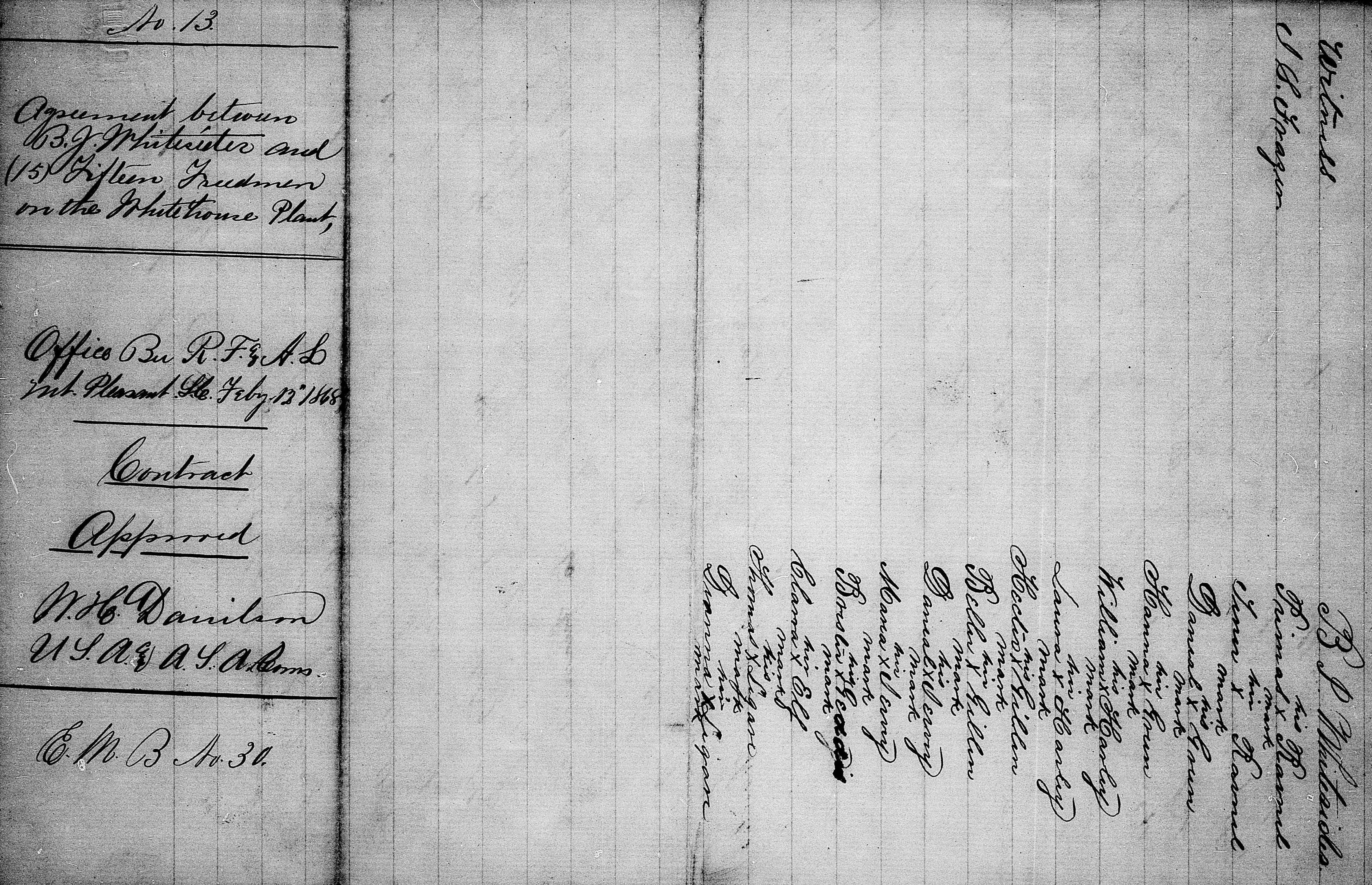
Despite those hints, it took quite some time to pick up this soldier’s trail again. Eventually, though, that pension index card data helped me to find a Freedmen’s Bureau contract for him which confirmed that he had indeed settled in South Carolina post-war. Dated February 12, 1868, this document also confirmed that he had been signed to a contract with 14 other Freedmen by the Mt. Pleasant, South Carolina office of the U.S. Freedmen’s Bureau to provide labor for the Whitehouse Plantation.

List showing “Brister Geddis,” et. al. on an 1868 Freedmen’s Bureau contract with the Whitehouse Plantation in South Carolina (public domain; double click to enlarge).

But, in another seemingly frustrating turn of events, that contract caused further confusion surrounding his name—this time spelling it as “Brister Geddis.” Fortunately, this new variant was repeated in the 1870 federal census—a sign that it was either the correct spelling or at least a closer approximation of how this soldier had pronounced his own name. Describing him as a 42-year-old black male residing in Beaufort, South Carolina, that same census also noted that he lived in Beaufort Township with his wife “Rachel,” a 24-year-old black woman (estimated birth year 1846), and son “Peter,” a 6-year-old black child, and confirmed that all three had been born in South Carolina. And that census record also noted that both “Brister” and “Rachel” were involved in farming land valued at $1,500.

Unfortunately, the 1880 federal census taker created still more confusion by illegibly writing the name as “Geddes, Brista” or “Geddis, Bristor”—and gave rise to two new puzzles by omitting son Peter’s name and also radically altering the estimated birth year of wife “Rachel”—changing it from 1846 to 1820 by stating that she was a 60-year-old who was four years older than her husband (rather than younger as she had reportedly been in 1870).

Even more frustrating? The special veterans’ census of 1890 altered the spelling of his name yet again—this time to “Brister Gedders.”

At that point, I made the decision to do everything humanly possible to right the wrong of this 47th Pennsylvania Volunteer’s forgotten military service by launching a GoFundMe campaign to support the purchase of this his full set of his military and pension records from the National Archives (as well as those of the other eight African American men who enlisted with the 47th Pennsylvania Volunteer Infantry).

If just three of you who regularly read the content on this website and follow our Facebook page donate $10 each to this campaign, we will be able to purchase the entire Compiled Military Service File for this forgotten member of the 47th Pennsylvania Volunteers and make it publicly available (free of charge) to other family history researchers and historians. If just four of you donate $20 each, we would also be able to purchase the entire Federal Military Pension Application File for that same soldier—a file that may very well contain critical vital statistics about this soldier’s birth, life and death, as well as vital statistics for his widow and son.

We might just even be able to determine when and where Brister/Bristor was buried and whether or not a gravestone marks his final resting place. If we find that no marker exists, or that the existing one has been damaged, or that the gravestone carver spelled his name incorrectly, we can then fix that wrong as well by asking the appropriate county, state and federal authorities to erect a suitable veteran’s headstone for him.

Please help us honor the military service of this unsung hero by making your donation today to our GoFundMe campaign, Honor 9 Black Soldiers of the American Civil War.”

With Sincere Gratitude,

Laurie Snyder, Managing Editor
47th Pennsylvania Volunteers: One Civil War Regiment’s Story


Sources:

1. Bates, Samuel P. History of Pennsylvania Volunteers: 1861-5, Vol. 1. Harrisburg, Pennsylvania: B. Singerly, State Printer, 1869.

2. “Garris, Presto,” in Civil War Veterans’ Card File, 1861-1866. Harrisburg, Pennsylvania: Pennsylvania State Archives.

3. “Garris, Presto” (alias “Geddes, Bristor”, alias “Gethers, Bristor”), in U.S. Civil War General Pension Index, 1890-1894. Washington, D.C.: U.S. National Archives and Records Administration.

4. “Roll of Co. F., 47th Regiment, Infantry,” in Registers of Pennsylvania Volunteers, 1861-1865, in “Records of the Department of Military and Veterans’ Affairs.” Harrisburg, Pennsylvania: Pennsylvania State Archives, retrieved online February 10, 2020.


Black History Month: An Early Encounter with the Evil of Slavery and a Celebration of Washington’s Birthday (February 1862)

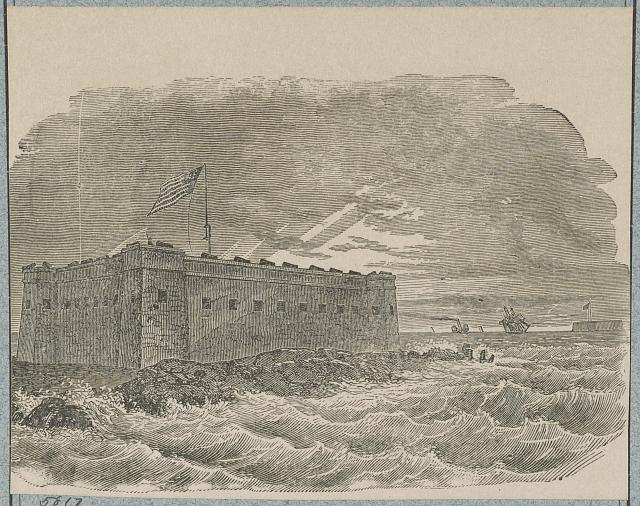
Woodcut depicting the harsh climate at Fort Taylor in Key West, Florida during the Civil War (public domain, U.S. Library of Congress).

“I was a servant until I was 13 years old and then my master put me into the field to make sugar and molasses. I tried to escape, but my master came on the ship and took me back.”

— Walter Bowten, a twenty-seven-year-old Black man who requested help from the 47th Pennsylvania Volunteers after successfully escaping from slavery in February 1862


Attached to the command of Brigadier-General John Milton Brannan and assigned to garrison Fort Zachary Taylor in Key West, Florida in early February 1862, the members of the 47th Regiment, Pennsylvania Volunteer Infantry were soon brought face to face with the realities of life behind enemy lines in America’s Deep South as the United States was about to enter into the second year of its Civil War. Familiarized early on with the open, corrosive hatred of supporters of secession and the Confederacy, they also learned about the ugliest practices of slavery firsthand from a young man who had been whipped simply because his clothing had torn during a period of hard labor.

Taking turns with members of Brannan’s other regiments (the 90th and 91st New York Volunteers) in guarding roughly 200 to 300 blockade runners, gunboat operators and other Confederate prisoners, as well as 57 secessionists from Ship Island, the 47th Pennsylvanians also drilled daily in heavy artillery tactics, felled trees, helped to build new roads, and strengthened the fortifications in and around the Union Army’s presence in Key West.

* Note: Although several earlier historians have speculated that the 47th Pennsylvania Infantry was ordered to Florida because its members were incompetent militarily or because they were being punished for some unspecified wrongdoing, this belief is unfounded. Brigadier-General Brannan personally selected the 47th Pennsylvania to accompany him on what he knew would be a difficult mission—terminating Florida’s role as “the supplier of the Confederacy.” Florida’s livestock farmers were among the earliest to feed Confederate States Army troops, becoming one of the largest sources of cattle for CSA regiments, as well as suppliers of pork products while other food producers contributed fruit and fish. In addition, Florida was a major producer of American salt—a key ingredient critical to the preservation of food for CSA troops on the move.

Furthermore, President Abraham Lincoln and his generals realized that, if they were to prevent Europe from helping the Confederate States of America turn the tide of war in its favor by landing ammunition and food-laden ships on the coast of Florida, Union troops would need to capture and then maintain control of Florida’s coastal and interior waterways. So, they began to beef up the presence of Union Army and Navy forces at key locations around the state, including at Fort Taylor in Key West and Fort Jefferson in the Dry Tortugas, as well as via offshore shipping blockades; they then also increased the heavy artillery training of their fort-based troops to further persuade Confederate and European leaders that any attempted sea-based attack or supply delivery would be so costly that it would not be worth the risk.

As the 47th Pennsylvania Volunteers settled in further to their new assignments, they also began to make their presence felt in another important way—by trooping regularly at the fort and through the town. On Friday, February 7 alone, the 47th Pennsylvanians marched behind their Regimental Band in three separate regimental parades, followed by an evening drill in front of their barracks.

To safeguard against potential misbehavior by soldiers stationed far from home, military discipline was also instilled and reinforced through a series of proclamations by superior officers at the brigade, regimental, or unit levels, such as General Order No. 2, which announced that water permits would be “issued to the quartermaster Sgt. of each company each evening at 6:45 for the succeeding day” due to a critical shortage of safe drinking water:

“A sufficient number of men will be detailed to carry water, but they will not be excused from other duty. No bathing will be allowed after 5:30 AM. The right wing of the regiment will bathe tomorrow morning from 5 to 5:30 AM. They will be in charge of a commanding officer of each company. The commanding officer will see that the men avail themselves of bathing as it is essential to the health and welfare of the regiment. All bathing in daytime is absolutely prohibited. Hours of service and roll call are: Reveille at daybreak; police immediately after; call for drill 5:30; recall 7; breakfast 7:15; surgeon’s call 7:45; guard mounting 9; call for drill 10; recall 11; dinner 12; 1st Sgt. call 1; call for drill 3:30; recall 5; dress parade 5:30; tattoo at 8; taps 8:30. These calls will be beat by the drum at the central guard quarters five minutes before the time stated.”

Captain Richard A. Graeffe, Company A, 47th Pennsylvania Volunteers (c. 1863, public domain).

Special Order No. 18 authorized Captain Richard Graeffe, the commanding officer of Company A, to direct two men to immediately report to the regiment’s master baker for extra duties as bakers’ helpers while General Order No. 3 directed the commanding officers of individual companies to ensure that their respective sergeants had enough time to complete their administrative duties before submitting their required reports to the brigade’s headquarters each morning by 10 a.m. (Regimental Order No. 2 was subsequently modified to reflect the rescheduling of tattoo and taps to 9 and 9:30 p.m., respectively.) Around this same time, Private Abraham N. Wolf was awarded a temporary boost in authority with his assignment as “boss carpenter”—an additional duty he would continue to perform until June 20.

Following an early inspection by their superiors on Sunday, February 9, many 47th Pennsylvanians walked into the main part of the city to attend church services. C Company Musician Henry D. Wharton described the experience a week later in another of his letters to the Sunbury American:

“With several members of our company I attended Episcopal Church last Sabbath—The church building is a large and beautiful one, and the people deserve great credit for erecting it. The Minister is a strong Union man, and it struck me, on last Sabbath, that he lost no opportunity of displaying his Union sentiments. Some time ago some members of the Church were very disloyal, and when the Minister read the prayer “to behold and bless Thy servant, the President of the United States, and all others in authority,” they would close the prayer book, and look daggers at him, wondering whom they should hang first – the Minister or Abe Lincoln. General Brannan (Captain at the time), hearing of it, put an end to this disrespect, made them take the oath of allegiance, and now they now can say ‘Amen’ as loud and as heartily as the best Union men on the island…. For the sake of the Church, I am happy to state that only a few of its members were weak enough to show their fondness for Jeff Davis—the rest of the members were very glad that Gen. Brannan took the matter in hand.

The population of the island is about four thousand, consisting of negroes, Spaniards, and a few whites. With the exception of five storekeepers, the occupation of its inhabitants is fishing, dealing in fruit and selling hot coffee and cool drinks. There are as many coffee and cool drink saloons here as there are Lager Bier saloons in the Everlasting State of Williamsport, and from that you can readily perceive there is no need of being thirsty. As for intoxicating drinks, they are prohibited—the island being under martial law it is impossible to get even a smell, and it is well that it is so, for in this climate there is no telling what amount of sickness its use might produce. The buildings used for stores are very large and airy, but I can assure you that in the stores of either Friling & Grant or E. Y. Bright & Son, there are more goods than in all the stores on this island put together. Oranges, coming from Cuba and Nassau islands, are very plenty, and can be bo’t [sic] at three for a sixpence; not such as you folks get at home, but real fresh, juicy fellows that melt in one’s mouth equal to the best ice cream made in H. B. Masser’s patent ice cream freezers. Fish are very plenty [sic], and can be bought cheap. Thanks to Sergeant Smelser [alternate spelling “Smeltzer”], our company is living high in the fish line. He is Company Quarter-Master Sergeant, and on every fish market morning, Peter is at the wharf, and there exchanges our surplus pork and beef for fish; so that the boys have a variety and are content.

Horse and cattle are very small. They come from Cuba. The horses are not near as big as Peter B. Masser’s black ponies, and I have seen at home two year old cattle larger than those they use here for beeves.

There is an article here, that I believe bothers the whole human race, and that is mosquitoes. Those on this island are not of the common kind, but regular tormentors. – Fix your net work as you may, you will receive their sting before morning. They are great on a serenade too, and if one is impolite enough to go to sleep as they are in the middle of a glee, the leader will give you a tickler with his sting that it is impossible to resist; but for my part, I can easily dispense with that kind of music, and often wish that they would favor some one else who can appreciate their talents better than I can.

The Fort on this island (Fort Taylor) is a very large one, and is now of the most importance to the Government. It is not near finished, but so much so that the rebels dare not venture within the range of its guns. – When finished it will have one hundred and eighty guns, and with those on the embankment on the moat, fronting the town, it will have two hundred and seventy five. Some time since the fort came within an ace of being taken by the rebels, but Capt. Brannan saved it be stratagem. Men were working at the fort, so, to prevent suspicion, the Captain every morning would march a guard from the garrison to the fort, and in that manner before the rebels were aware of it, he had full possession of it. Mulraner, formerly a Sergeant of the Captain’s, who became rich in the rum business, hoisted a secesh flag on his hotel, and sent an impudent note to the Captain requesting him to honor the seven stars by firing a salute from the fort. The reply was that if the rag was not taken down on the return of the messenger, the Commander would open the guns of the fort on the town, and send Mulraner and his friends to Tortugas to work in the hot sand and give them time to repent of their folly, preparatory to dangling at the end of a rope. The flag was taken down — Mulraner vamoosed [sic] the ranch, and is now in command of a company of rebels somewhere near Pensacola. It is tho’t [sic] that when Gen. Brannan arrives Mulraner’s property, which is valuable, will be confiscated.

There are a large number of men-of-war here, and every day more are added to their number. Fifty-seven prisoners were brought in during the last week from Ship Island, besides two prizes, one loaded with turpentine, and the other with arms and machinery that were on the road to New Orleans, for a large steamer that is building there for use of the rebels.

You need not be surprised to here [sic] of an expedition being sent out from here – everything looks like it – so many vessels in port, more expected and troops arriving every day. There are three regiments here now, the 90th and 91st New York, and our own, besides the Regulars in the fort. If we do go, there will have to be a strong force left behind; for, in my opinion, the most of the Union men here are as treacherous as the men who use the stiletto to stab a friend, at night, from behind.

With the exception of fish and fruit, everything they use comes from the North. They would starve if it were not for the ‘mud ills,’ and yet they would try to break up the Government that protects them. Lumber is worth one hundred dollars per thousand feet. Carpenters’ wages are three dollars per day but I think they would starve at that, as I see no employment for them. The boys are very well, and are enjoying themselves with the sea bathing. We have received the American and Gazette three times since our arrival, and they are very welcome visitors, much more so than were the morning papers in Virginia. It is very strange we receive no letters; if the ‘folks at home’ knew how anxious we are to get them they would be a little more punctual.”

Following completion that same Sunday (February 9) of the brigade’s dress parade, which began at 5:30 p.m., B Company Lieutenant Allen G. Balliet marched roughly 40 members of the 47th Pennsylvania to Key West’s Methodist Church for evening services during which a sermon was delivered by the 91st New York Volunteers’ regimental chaplain. That same day, H Company Captain James Kacy issued Company Order No. 7:

“Sgt. R. S. Gardner will have under his command tents #1 and 2 and will be held personally responsible for the clean up of the men in person, clothing, arms, accoutrements, and quarters. Sgt. James Hahn will have under him tents #3 and 4 and be held responsible the same as #1 and 2. Sgt. Lynch will have under his control tents #5 and 6 and will be likewise held responsible. The Sgts. Gardner, Hahn and Lynch will have the men of the company on the parade ground at 5:30 AM and when one of them is on guard, the other two will attend to this drill duty and divide the squad between their respective commands.”

As the days of February rolled by, the commanding officers of the 47th Pennsylvania made a concerted effort to stabilize the living arrangements for their subordinates, housing the bulk of their men in military barracks southeast of Palm Avenue and White Street at Peary Court on the eastern side of Key West. Lodged in three buildings on the northeast side and three buildings on the southwest side of the Union Army’s parade grounds were the regiment’s field and staff officers, as well as the entire membership of the Regimental Band. Additionally, two 125-foot by 20-foot buildings accommodated a portion of enlisted members of the 47th Pennsylvania with the remainder housed in adjacent military tents—effective Tuesday, February 18. Known as Sibley tents, these were large, round, canvas structures which were 12 feet tall by 18 feet in diameter, supported by center poles and warmed by central fireplaces. Housing 16 to 19 men each, seven tents each were erected by the 47th Pennsylvania’s ten companies. One tent per company was placed at the head of each company’s “street” to house that company’s officers with the other six tents per company allotted to the enlisted men, each of whom who were arranged on the inside “like the spokes of a wheel,” according to Schmidt, “with their feet to the fireplace.”

According to Regimental Chaplain William DeWitt Clinton Rodrock, “The barracks were large and commodious two story [sic] buildings forming three sides of a quadrangle, the opening toward the sea.” Also located in this section of the city were the army’s hospital and cemetery.

As Henry Wharton indicated in his letter (above), serving with the 47th Pennsylvania under Brannan were the 90th New York, which was commanded by Colonel Joseph S. Morgan and which would later fight alongside the 47th Pennsylvania during the Union’s 1864 Red River Campaign across Louisiana and 1864 Shenandoah Valley Campaign across Virginia, and the 91st New York, commanded by Colonel J. Van Sandt. In addition, five companies of U.S. Army “regulars” also called Fort Taylor home at this time. (The 7th New Hampshire, which was stationed at Fort Jefferson in Florida’s Dry Tortugas, would be brought into closer proximity with the 47th Pennsylvania a few months later when Brannan and his men were ordered to move to South Carolina.)

There were also a significant number of enslaved and formerly enslaved men, women and children in the region. According to Schmidt:

“There was a slave camp about one mile from the military camps, where 150 Blacks were engaged in manufacturing salt; it was reported that 50,000 bushels of salt were made on the island each year by solar evaporation…. The manufacture of salt was terminated later in 1862, and was not restarted until 1854, to prevent any salt from the facility finding its way into the Confederacy….

Another building of note on the island of Key West during the war was the ‘slave barracoons’, used to house Blacks taken from captured slavery vessels, and described as being a long low building about 300 feet by 30 feet. Lt. Geety reported that there were 1500 slaves there at one time, and 400 died in four months [sic] time; a rate per day that the 90th New York Regiment would approach in August-September as a result of a Yellow Fever epidemic, during which time the barracoons, located at Whitehead’s Point in the southernmost area of Key West would be converted into a temporary hospital.”

Rendering of Fort Taylor, Key West, Florida (Harper’s Weekly, 1864, public domain).

On Friday, February 14, the 47th Pennsylvania Volunteers made their presence known once again to Key West residents as the regiment paraded through the streets of the city. Two days later, their commanding officers insisted that they get better acquainted with the residents of their new community by attending services at local churches. That same Sunday evening, a young black man named Walter Bowten entered the camp to request protection. Provided food and a tobacco-filled pipe, he was also given a regimental uniform to replace his tattered, soiled clothing. His mind at greater ease, he then explained that he had escaped slavery from Providence Island, and recounted his life experience to one of the regiment’s bilingual members, who documented the man’s story in German. The following translation was provided by regimental historian Lewis Schmidt:

“My name is Walter Bowten and I was born in 1835. My parents were born slaves but they worked to free themselves. I was a servant until I was 13 years old and then my master put me into the field to make sugar and molasses. I tried to escape, but my master came on the ship and took me back…. Where my master lives is not much of a place, it is only one island where tangerines, oranges, lemons and coconuts grow. I do not have a cent of money from my master and would rather be with the white folks than with a mulatto. I had to work every day from morning until night, and on Sunday we had to work until 8 in the morning. We had two changes of clothing, one for work and one change for good, and when the clothing was torn, our master would threaten and whip us. Our master would not let us go to the soldiers and said he would shoot us, but we came away anyway.”

Regrettably, the attempts of the 47th Pennsylvanians to protect Bowten were thwarted the next day by other soldiers at the fort who seized Bowten while the 47th Pennsylvania was marching in another of its regimental parades. Bowten was subsequently ordered to be held at the fort, according to Schmidt, “until a ship which had gone to Havana for a load of sugar would return.”

Brigadier-General John Milton Brannan, U.S. Army (public domain).

On Friday, February 21, the 47th Pennsylvania Volunteers marched, for the first time in Key West, in a dress parade that was observed by Brigadier-General Brannan, who had just arrived at Fort Taylor that day. Brannan later took the time to ride his horse along the various “company streets” of the 47th Pennsylvania’s encampment, “tipping his hat” as he passed his cheering subordinates, according to Schmidt.

Another brigade parade was then held at 10 a.m. the next day—Washington’s Birthday—a day of great joy that began with prayer and a reading of President George Washington’s farewell address

“Friends and Fellow Citizens,

The period for a new election of a citizen to administer the executive government of the United States being not far distant, and the time actually arrived when your thoughts must be employed in designating the person who is to be clothed with that important trust, it appears to me proper, especially as it may conduce to a more distinct expression of the public voice, that I should now apprise you of the resolution I have formed, to decline being considered among the number of those out of whom a choice is to be made.

I beg you, at the same time, to do me the justice to be assured that this resolution has not been taken without a strict regard to all the considerations appertaining to the relation which binds a dutiful citizen to his country; and that in withdrawing the tender of service, which silence in my situation might imply, I am influenced by no diminution of zeal for your future interest, no deficiency of grateful respect for your past kindness, but am supported by a full conviction that the step is compatible with both.

The acceptance of, and continuance hitherto in, the office to which your suffrages have twice called me have been a uniform sacrifice of inclination to the opinion of duty and to a deference of what appeared to be your desire. I constantly hoped that it would have been much earlier in my power, consistently with motives which I was not at liberty to disregard, to return to that retirement from which I had been reluctantly drawn. The strength of my inclination to do this, previous to the last election, had even led to the preparation of an address to declare it to you; but mature reflection on the then perplexed and critical posture of our affairs with foreign nations, and the unanimous advice of persons entitled to my confidence, impelled me to abandon the idea.

I rejoice that the state of your concerns, external as well as internal, no longer renders the pursuit of inclination incompatible with the sentiment of duty or propriety, and am persuaded, whatever partiality may be retained for my services, that, in the present circumstances of our country, you will not disapprove my determination to retire.

The impressions with which I first undertook the arduous trust were explained on the proper occasion. In the discharge of this trust, I will only say that I have, with good intentions, contributed towards the organization and administration of the government in the best exertions of which a very fallible judgment was capable. Not unconscious in the outset of the inferiority of my qualifications, experience in my own eyes, perhaps still more in the eyes of others, has strengthened the motives to diffidence of myself; and every day the increasing weight of years admonishes me more and more that the shade of retirement is as necessary to me as it will be welcome. Satisfied that if any circumstances have given peculiar value to my services, they were temporary, I have the consolation to believe that, while choice and prudence invite me to quit the political scene, patriotism does not forbid it.

In looking forward to the moment which is intended to terminate the career of my public life, my feelings do not permit me to suspend the deep acknowledgment of that debt of gratitude which I owe to my beloved country for the many hours it has conferred upon me; still more for the steadfast confidence with which it has supported me; and for the opportunities I have thence enjoyed of manifesting my inviolable attachment, by services faithful and persevering, though in usefulness unequal to my zeal. If benefits have resulted to our country from these services, let it always be remembered to your praise, and as an instructive example in our annals, that under circumstances in which the passions, agitated in every direction, were liable to mislead, amidst appearances sometimes dubious, vicissitudes of fortune often discouraging, in situations in which not unfrequently want of success has countenanced the spirit of criticism, the constancy of your support was the essential prop of the efforts, and a guarantee of the plans by which they were effected. Profoundly penetrated with this idea, I shall carry it with me to my grave, as a strong incitement to unceasing vows that heaven may continue to you the choicest tokens of its beneficence; that your union and brotherly affection may be perpetual; that the free Constitution, which is the work of your hands, may be sacredly maintained; that its administration in every department may be stamped with wisdom and virtue; that, in fine, the happiness of the people of these States, under the auspices of liberty, may be made complete by so careful a preservation and so prudent a use of this blessing as will acquire to them the glory of recommending it to the applause, the affection, and adoption of every nation which is yet a stranger to it.

Here, perhaps, I ought to stop. But a solicitude for your welfare, which cannot end but with my life, and the apprehension of danger, natural to that solicitude, urge me, on an occasion like the present, to offer to your solemn contemplation, and to recommend to your frequent review, some sentiments which are the result of much reflection, of no inconsiderable observation, and which appear to me all-important to the permanency of your felicity as a people. These will be offered to you with the more freedom, as you can only see in them the disinterested warnings of a parting friend, who can possibly have no personal motive to bias his counsel. Nor can I forget, as an encouragement to it, your indulgent reception of my sentiments on a former and not dissimilar occasion.

Interwoven as is the love of liberty with every ligament of your hearts, no recommendation of mine is necessary to fortify or confirm the attachment.

The unity of government which constitutes you one people is also now dear to you. It is justly so, for it is a main pillar in the edifice of your real independence, the support of your tranquility at home, your peace abroad; of your safety; of your prosperity; of that very liberty which you so highly prize. But as it is easy to foresee that, from different causes and from different quarters, much pains will be taken, many artifices employed to weaken in your minds the conviction of this truth; as this is the point in your political fortress against which the batteries of internal and external enemies will be most constantly and actively (though often covertly and insidiously) directed, it is of infinite moment that you should properly estimate the immense value of your national union to your collective and individual happiness; that you should cherish a cordial, habitual, and immovable attachment to it; accustoming yourselves to think and speak of it as of the palladium of your political safety and prosperity; watching for its preservation with jealous anxiety; discountenancing whatever may suggest even a suspicion that it can in any event be abandoned; and indignantly frowning upon the first dawning of every attempt to alienate any portion of our country from the rest, or to enfeeble the sacred ties which now link together the various parts.

For this you have every inducement of sympathy and interest. Citizens, by birth or choice, of a common country, that country has a right to concentrate your affections. The name of American, which belongs to you in your national capacity, must always exalt the just pride of patriotism more than any appellation derived from local discriminations. With slight shades of difference, you have the same religion, manners, habits, and political principles. You have in a common cause fought and triumphed together; the independence and liberty you possess are the work of joint counsels, and joint efforts of common dangers, sufferings, and successes.

But these considerations, however powerfully they address themselves to your sensibility, are greatly outweighed by those which apply more immediately to your interest. Here every portion of our country finds the most commanding motives for carefully guarding and preserving the union of the whole.

The North, in an unrestrained intercourse with the South, protected by the equal laws of a common government, finds in the productions of the latter great additional resources of maritime and commercial enterprise and precious materials of manufacturing industry. The South, in the same intercourse, benefitting by the agency of the North, sees its agriculture grow and its commerce expand. Turning partly into its own channels the seamen of the North, it finds its particular navigation invigorated; and, while it contributes, in different ways, to nourish and increase the general mass of the national navigation, it looks forward to the protection of a maritime strength, to which itself is unequally adapted. The East, in a like intercourse with the West, already finds, and in the progressive improvement of interior communications by land and water, will more and more find a valuable vent for the commodities which it brings from abroad, or manufactures at home. The West derives from the East supplies requisite to its growth and comfort, and, what is perhaps of still greater consequence, it must of necessity owe the secure enjoyment of indispensable outlets for its own productions to the weight, influence, and the future maritime strength of the Atlantic side of the Union, directed by an indissoluble community of interest as one nation. Any other tenure by which the West can hold this essential advantage, whether derived from its own separate strength, or from an apostate and unnatural connection with any foreign power, must be intrinsically precarious.

While, then, every part of our country thus feels an immediate and particular interest in union, all the parts combined cannot fail to find in the united mass of means and efforts greater strength, greater resource, proportionably greater security from external danger, a less frequent interruption of their peace by foreign nations; and, what is of inestimable value, they must derive from union an exemption from those broils and wars between themselves, which so frequently afflict neighboring countries not tied together by the same governments, which their own rival ships alone would be sufficient to produce, but which opposite foreign alliances, attachments, and intrigues would stimulate and embitter. Hence, likewise, they will avoid the necessity of those overgrown military establishments which, under any form of government, are inauspicious to liberty, and which are to be regarded as particularly hostile to republican liberty. In this sense it is that your union ought to be considered as a main prop of your liberty, and that the love of the one ought to endear to you the preservation of the other.

These considerations speak a persuasive language to every reflecting and virtuous mind, and exhibit the continuance of the Union as a primary object of patriotic desire. Is there a doubt whether a common government can embrace so large a sphere? Let experience solve it. To listen to mere speculation in such a case were criminal. We are authorized to hope that a proper organization of the whole with the auxiliary agency of governments for the respective subdivisions, will afford a happy issue to the experiment. It is well worth a fair and full experiment. With such powerful and obvious motives to union, affecting all parts of our country, while experience shall not have demonstrated its impracticability, there will always be reason to distrust the patriotism of those who in any quarter may endeavor to weaken its bands.

In contemplating the causes which may disturb our Union, it occurs as matter of serious concern that any ground should have been furnished for characterizing parties by geographical discriminations, Northern and Southern, Atlantic and Western; whence designing men may endeavor to excite a belief that there is a real difference of local interests and views. One of the expedients of party to acquire influence within particular districts is to misrepresent the opinions and aims of other districts. You cannot shield yourselves too much against the jealousies and heartburnings [sic] which spring from these misrepresentations; they tend to render alien to each other those who ought to be bound together by fraternal affection. The inhabitants of our Western country have lately had a useful lesson on this head; they have seen, in the negotiation by the Executive, and in the unanimous ratification by the Senate, of the treaty with Spain, and in the universal satisfaction at that event, throughout the United States, a decisive proof of how unfounded were the suspicions propagated among them of a policy in the General Government and in the Atlantic States unfriendly to their interests in regard to the Mississippi; they have been witnesses to the formation of two treaties, that with Great Britain, and that with Spain, which secure to them everything they could desire, in respect to our foreign relations, towards confirming their prosperity. Will it not be their wisdom to rely for the preservation of these advantages on the Union by which they were procured? Will they not henceforth be deaf to those advisors, if such there are, who would sever them from their brethren and connect them with aliens?

To the efficacy and permanency of your Union, a government for the whole is indispensable. No alliance, however strict, between the parts can be an adequate substitute; they must inevitably experience the infractions and interruptions which all alliances in all times have experienced. Sensible of this momentous truth, you have improved upon your first essay, by the adoption of a constitution of government better calculated than your former for an intimate union, and for the efficacious management of your common concerns. This government, the offspring of our own choice, uninfluenced and unawed, adopted upon full investigation and mature deliberation, completely free in its principles, in the distribution of its powers, uniting security with energy, and containing within itself a provision for its own amendment, has a just claim to your confidence and your support. Respect for its authority, compliance with its laws, acquiescence in its measures, are duties enjoined by the fundamental maxims of true liberty. The basis of our political systems is the right of the people to make and to alter their constitutions of government. But the Constitution which at any time exists, till charged by an explicit and authentic act of the whole people, is sacredly obligatory upon all. The very idea of the power and the right of the people to establish government presupposes the duty of every individual to obey the established government.

All obstructions to the execution of the laws, all combinations and associations, under whatever plausible character, with the real design to direct, control, counteract, or awe the regular deliberation and action of the constituted authorities, are destructive of this fundamental principle, and of fatal tendency. They serve to organize faction, to give it an artificial and extraordinary force; to put, in the place of the delegated will of the nation the will of a party, often a small but artful and enterprising minority of the community; and according to the alternate triumphs of different parties, to make the public administration the mirror of the ill-concerted and incongruous projects of faction, rather than the organ of consistent and wholesome plans digested by common counsels and modified by mutual interests.

However combinations or associations of the above description may now and then answer popular ends, they are likely, in the course of time and things, to become potent engines, by which cunning, ambitious, and unprincipled men will be enabled to subvert the power of the people and to usurp for themselves the reins of government, destroying afterwards the very engines which have lifted them to unjust dominion.

Towards the preservation of your government, and the permanency of your happy state, it is requisite, not only that you steadily discountenance irregular oppositions to its acknowledged authority, but also that you resist with care the spirit of innovation upon its principles, however specious the pretexts. One method of assault may be to effect, in the forms of the Constitution, alterations which will impair the energy of the system, and thus to undermine what cannot directly be overthrown. In all the changes to which you may be invited, remember that time and habit are at least as necessary to fix the true character of governments as of other human institutions; that experience is the surest standard by which to test the real tendency of the existing constitution of a country; that facility in changes, upon the credit of mere hypothesis and opinion; and remember, especially, that for the efficient management of your common interests, in a country so extensive as ours, a government of as much vigor as is consistent with the perfect security of liberty is indispensable. Liberty itself will find in such a government, with powers properly distributed and adjusted, its surest guardian. It is, indeed, little else than a name, where the government is too feeble to withstand the enterprises of faction, to confine each member of the society within the limits prescribed by the laws, and to maintain all in the secure and tranquil enjoyment of the rights of person and property.

I have already intimated to you the danger of parties in the State, with particular reference to the founding of them on geographical discriminations. Let me now take a more comprehensive view, and warn you in the most solemn manner against the baneful effects of the spirit of party generally.

This spirit, unfortunately, is inseparable from our nature, having its root in the strongest passions of the human mind. It exists under different shapes in all governments, more or less stifled, controlled, or repressed; but, in those of the popular form, it is seen in its greatest rankness, and is truly their worst enemy.

The alternate domination of one faction over another, sharpened by the spirit of revenge, natural to party dissension, which in different ages and countries has perpetrated the most horrid enormities, is itself a frightful despotism. But this leads at length to a more formal and permanent despotism. The disorders and miseries which result gradually incline the minds of men to seek security and repose in the absolute power of an individual; and sooner or later the chief of some prevailing faction, more able or more fortunate than his competitors, turns this disposition to the purposes of his own elevation, on the ruins of public liberty.

Without looking forward to an extremity of this kind (which nevertheless ought not to be entirely out of sight), the common and continual mischiefs of the spirit of party are sufficient to make it the interest and duty of a wise people to discourage and restrain it.

It serves always to distract the public councils and enfeeble the public administration. It agitates the community with ill-founded jealousies and false alarms, kindles the animosity of one part against another, foments occasionally riot and insurrection. It opens the door to foreign influence and corruption, which finds a facilitated access to the government itself through the channels of party passions. Thus the policy and the will of one country are subjected to the policy and will of another.

There is an opinion that parties in free countries are useful checks upon the administration of the government and serve to keep alive the spirit of liberty. This within certain limits is probably true, and in governments of a monarchical cast, patriotism may look with indulgence, if not with favor, upon the spirit of party. But in those of the popular character, in governments purely elective, it is a spirit not to be encouraged. From their natural tendency, it is certain there will always be enough of that spirit for every salutary purpose. And there being constant danger of excess, the effort ought to be by force of public opinion, to mitigate and assuage it. A fire not to be quenched, it demands a uniform vigilance to prevent its bursting into a flame, lest, instead of warming, it should consume.

It is important, likewise, that the habits of thinking in a free country should inspire caution in those entrusted with its administration, to confine themselves within their respective constitutional spheres, avoiding in the exercise of the powers of one department to encroach upon another. The spirit of encroachment tends to consolidate the powers of all the departments in one, and thus to create, whatever the form of government, a real despotism. A just estimate of that love of power, and proneness to abuse it, which predominates in the human heart, is sufficient to satisfy us of the truth of this position. The necessity of reciprocal checks in the exercise of political power, by dividing it and distributing it into different depositaries, and constituting each the guardian of the public weal against invasions by the others, has been evinced by experiments ancient and modern; some of them in our country and under our own eyes. To preserve them must be as necessary as to institute them. If, in the opinion of the people, the distribution or modification of the constitutional powers be in any particular wrong, let it be corrected by an amendment in the way which the Constitution designates. But let there be no change by usurpation; for though this, in one instance, may be the instrument of good, it is the customary weapon by which free governments are destroyed. The precedent must always greatly overbalance in permanent evil any partial or transient benefit, which the use can at any time yield.

Of all the dispositions and habits which lead to political prosperity, religion and morality are indispensable supports. In vain would that man claim the tribute of patriotism, who should labor to subvert these great pillars of human happiness, these firmest props of the duties of men and citizens. The mere politician, equally with the pious man, ought to respect and to cherish them. A volume could not trace all their connections with private and public felicity. Let it simply be asked: Where is the security for property, for reputation, for life, if the sense of religious obligation desert the oaths which are the instruments of investigation in courts of justice? And let us with caution indulge the supposition that morality can be maintained without religion. Whatever may be conceded to the influence of refined education on minds of peculiar structure, reason and experience both forbid us to expect that national morality can prevail in exclusion of religious principle.

It is substantially true that virtue or morality is a necessary spring of popular government. The rule, indeed, extends with more or less for to every species of free government. Who that is a sincere friend to it can look with indifference upon attempts to shake the foundation of the fabric?

Promote then, as an object of primary importance, institutions for the general diffusion of knowledge. In proportion as the structure of a government gives force to public opinion, it is essential that public opinion should be enlightened.

As a very important source of strength and security, cherish public credit. One method of preserving it is to use it as sparingly as possible, avoiding occasions of expense by cultivating peace, but remembering also that timely disbursements to prepare for danger frequently prevent much greater disbursements to repel it, avoiding likewise the accumulation of debt, not only by shunning occasions of expense, but by vigorous exertion in time of peace to discharge the debts which unavoidable wars may have occasioned, not ungenerously throwing upon posterity the burden which we ourselves ought to bear. The execution of these maxims belongs to your representatives, but it is necessary that public opinion should co-operate. To facilitate to them the performance of their duty, it is essential that you should practically bear in mind that towards the payment of debts there must be revenue; that to have revenue there must be taxes; that no taxes can be devised which are not more or less inconvenient and unpleasant; that the intrinsic embarrassment, inseparable from the selection of the proper objects (which is always a choice of difficulties), ought to be a decisive motive for a candid construction of the conduct of the government in making it, and for a spirit of acquiescence in the measures for obtaining revenue, which the public exigencies may at any time dictate.

Observe good faith and justice toward all nations; cultivate peace and harmony with all. Religion and morality enjoin this conduct; and can it be, that good policy does not equally enjoin it? It will be worthy of a free, enlightened, and at no distance period, a great nation, to give to mankind the magnanimous and too novel example of a people always guided by an exalted justice and benevolence. Who can doubt that, in the course of time and things, the fruits of such a plan would richly repay any temporary advantages which might be lost by a steady adherence to it? Can it be that Providence has not connected the permanent felicity of a nation with its virtue? The experiment, at least, is recommended by every sentiment which ennobles human nature. Alas! is it rendered impossible by its vices?

In the execution of such a plan, nothing is more essential than that permanent, inveterate antipathies against particular nations, and passionate attachments for others, should be excluded; and that, in place of them, just and amicable feelings towards all should be cultivated. The nation which indulges toward another a habitual hatred or a habitual fondness is in some degree a slave. It is a slave to its animosity or to its affection, either of which is sufficient to lead it astray from its duty and its interest. Antipathy in one nation against another disposes each more readily to offer insult and injury, to lay hold of slight causes of umbrage, and to be haughty and intractable, when accidental or trifling occasions of dispute occur. Hence, frequent collisions, obstinate, envenomed, and bloody contests. The nation, prompted by ill-will and resentment, sometimes impels to war the government, contrary to the best calculations of policy. The government sometimes participates in the national propensity, and adopts through passion what reason would reject; at other times it makes the animosity of the nation subservient to projects of hostility instigated by pride, ambition, and other sinister and pernicious motives. The peace often, sometimes perhaps the liberty, of nations, has been the victim.

So likewise, a passionate attachment of one nation to another produces a variety of evils.
Sympathy for the favorite nation, facilitating the illusion of an imaginary common interest in cases where no real common interest exists, and infusing into one the enmities of the other, betrays the former into a participation in the quarrels and wars of the latter without adequate inducement or justification. It leads also to concessions to the favorite nation of privileges denied to others which is apt doubly to injure the nation making the concessions; by unnecessarily parting with what ought to have been retained, and by exciting jealousy, ill-will, and a disposition to retaliate, in the parties from whom equal privileges are withheld. And it gives to ambitious, corrupted, or deluded citizens (who devote themselves to the favorite nation), facility to betray or sacrifice the interests of their own country, without odium, sometimes even with popularity; gliding, with the appearances of a virtuous sense of obligation, a commendable deference for public opinion, or a laudable zeal for public good, the base or foolish compliances of ambition, corruption, or infatuation.

As avenues to foreign influence in innumerable ways, such attachments are particularly alarming to the truly enlightened and independent patriot. How many opportunities do they afford to tamper with domestic factions, to practice the arts of seduction, to mislead public opinion, to influence or awe the public councils? Such an attachment of a small or weak towards a great and powerful nation dooms the former to be the satellite of the latter.

Against the insidious wiles of foreign influence (I conjure you to believe me, fellow-citizens) the jealousy of a free people ought to be constantly awake, since history and experience prove that foreign influence is one of the most baneful foes of republican government. But that jealousy to be useful must be impartial; else it becomes the instrument of the very influence to be avoided, instead of a defense against it. Excessive partiality for one foreign nation an excessive dislike of another cause those whom they actuate to see danger only on one side, and serve to veil and even second the arts of influence on the other. Real patriots who may resist the intrigues of the favorite are liable to become suspected and odious, while its tools and dupes usurp the applause and confidence of the people, to surrender their interests.

The great rule of conduct for us in regard to foreign nations is in extending our commercial relations, to have with them as little political connection as possible. So far as we have already formed engagements, let them be fulfilled with perfect good faith. Here let us stop. Europe has a set of primary interests which to us have none; or a very remote relation. Hence she must be engaged in frequent controversies, the causes of which are essentially foreign to our concerns. Hence, therefore, it must be unwise in us to implicate ourselves by artificial ties in the ordinary vicissitudes of her politics, or the ordinary combinations and collisions of her friendships or enmities.

Our detached and distant situation invites and enables us to pursue a different course. If we remain one people under an efficient government, the period is not far off when we may defy material injury from external annoyance; when we may take such an attitude as will cause the neutrality we may at any time resolve upon to be scrupulously respected; when belligerent nations, under the impossibility of making acquisitions upon us, will not lightly hazard the giving us provocation; when we may choose peace or war, as our interest, guided by justice, shall counsel.

Why forego the advantages of so peculiar a situation? Why quit our own to stand upon foreign ground? Why, by interweaving our destiny with that of any part of Europe, entangle our peace and prosperity in the toils of European ambition, rivalship, interest, humor or caprice?

It is our true policy to steer clear of permanent alliances with any portion of the foreign world; so far, I mean, as we are now at liberty to do it; for let me not be understood as capable of patronizing infidelity to existing engagements. I hold the maxim no less applicable to public than to private affairs, that honesty is always the best policy. I repeat it, therefore, let those engagements be observed in their genuine sense. But, in my opinion, it is unnecessary and would be unwise to extend them.

Taking care always to keep ourselves by suitable establishments on a respectable defensive posture, we may safely trust to temporary alliances for extraordinary emergencies.

Harmony, liberal intercourse with all nations, are recommended by policy, humanity, and interest. But even our commercial policy should hold an equal and impartial hand; neither seeking nor granting exclusive favors or preferences; consulting the natural course of things; diffusing and diversifying by gentle means the streams of commerce, but forcing nothing; establishing (with powers so disposed, in order to give trade a stable course, to define the rights of our merchants, and to enable the government to support them) conventional rules of intercourse, the best that present circumstances and mutual opinion will permit, but temporary, and liable to be from time to time abandoned or varied, as experience and circumstances shall dictate; constantly keeping in view that it is folly in one nation to look for disinterested favors from another; that it must pay with a portion of its independence for whatever it may accept under that character; that, by such acceptance, it may place itself in the condition of having given equivalents for nominal favors, and yet of being reproached with ingratitude for not giving more. There can be no greater error than to expect or calculate upon real favors from nation to nation. It is an illusion, which experience must cure, which a just pride ought to discard.

In offering to you, my countrymen, these counsels of an old an affectionate friend, I dare not hope they will make the strong and lasting impression I could wish; that they will control the usual current of the passions, or prevent our nation from running the course which has hitherto marked the destiny of nations. But, if I may even flatter myself that they may be productive of some partial benefit, some occasional good; that they may now and then recur to moderate the fury of party spirit, to warn against the mischiefs of foreign intrigue, to guard against the impostures of pretended patriotism; this hope will be a full recompense for the solicitude for your welfare, by which they have been dictated.

How far in the discharge of my official duties I have been guided by the principles which have been delineated, the public records and other evidences of my conduct must witness to you and to the world. To myself, the assurance of my own conscience is, that I have at least believed myself to be guided by them.

In relation to the still subsisting war in Europe, my proclamation of the twenty-second of April, 1793, is the index of my plan. Sanctioned by your approving voice, and by that of your representatives in both houses of Congress, the spirit of that measure has continually governed me, uninfluenced by any attempts to deter or divert me from it.

After deliberate examination, with the aid of the best lights I could obtain, I was well satisfied to that our country, under all the circumstances of the case, had a right to take, and was bound in duty and interest to take, a neutral position. Having taken it, I determined, as far as should depend upon me, to maintain it, with moderation, perseverance, and firmness.

The considerations which respect the right to hold this conduct, it is not necessary on this occasion to detail. I will only observe that, according to my understanding of the matter, that right, so far from being denied by any of the belligerent powers, has been virtually admitted by all.

The duty of holding a neutral conduct may be inferred, without anything more, from the obligation which justice and humanity impose on every nation, in cases in which it is free to act, to maintain inviolate the relations of peace and amity towards other nations.

The inducements of interest for observing that conduct will best be referred to your own reflections and experience. With me a predominant motive has been to endeavor to gain time to our country to settle and mature its yet recent institutions, and to progress without interruption to that degree of strength and consistency which is necessary to give it, humanly speaking, the command of its own fortunes.

Though, in reviewing the incidents of my administration, I am unconscious of intentional error, I am nevertheless too sensible of my defects not to think it probably that I may have committed many errors. Whatever they may be, I fervently beseech the Almighty to avert or mitigate the evils to which they may tend. I shall also carry with me the hope that my country will never cease to view them with indulgence; and that, after forty five years of my life dedicated to its service with an upright zeal, the faults of incompetent abilities will be consigned to oblivion, as myself must soon be to the mansions of rest.

Relying on its kindness in this as in other things, and actuated by that fervent love towards it, which is so natural to a man who views in it the native soil of himself and his progenitors for several generations, I anticipate with pleasing expectation that retreat in which I promise myself to realize, without alloy, the sweet enjoyment of partaking, in the midst of my fellow-citizens, the benign influence of good laws under a free government, the ever-favorite object of my heart, and the happy reward, as I trust, of our mutual cares, labors, and dangers.

United States
19th September, 1796

Geo. Washington”

Professor Thomas Coates, the “Father of Band Music in America,” led the Regimental Band, 47th Pennsylvania Volunteer Infantry from August 1861 to September 1862 (public domain).

The parade then began on Washington’s birthday, 1862 with the 47th Pennsylvania Volunteer Infantry and the other units commanded by Brannan marching through Key West to the home of a Union-supporting judge who was known for proudly flying the American flag. Stopping behind its Regimental Band as it struck up “The Star-Spangled Banner,” the 47th Pennsylvania Infantry then marched to Fort Taylor, where its members witnessed the firing of a national, 34-gun salute by the fort’s artillery guns, followed by a salute fired by the guns of the man-of-war, Pensacola.

The celebration continued well into the evening, as brigade members were treated to a formal band concert and formal address by C Company Captain John Peter Shindel Gobin. Brigade members then competed against one another in foot, wheelbarrow and sack races, as well as a pig chase. C Company Corporal Jacob K. Keefer came in second in that foot race while C Company Private P. M. Randall somehow managed to take second in the sack race after falling down near the end and rolling across the finish line.

Joseph Eugene Walter, cornetist, Regimental Band, 47th Pennsylvania Volunteers, c. 1861.

On Monday, February 24 and Wednesday, February 26, the 47th Pennsylvania’s Regimental Band again performed in concert with the band giving “a ball for the officers, which was “numerously attended by the Knights of the spur and tinsel,” according to Wharton, who also noted the unfortunate circumstance that “there were only enough ladies in attendance to form six setts.”

On Friday, February 28, the entire regiment reported for an 8 a.m. inspection in response to Regimental Order No. 39, which had been issued by the commanding officers of the 47th Pennsylvania per Brigadier-General Brannan’s General Order No. 5. The regiment also received the following additional instruction via Brannan’s General Order No. 11:
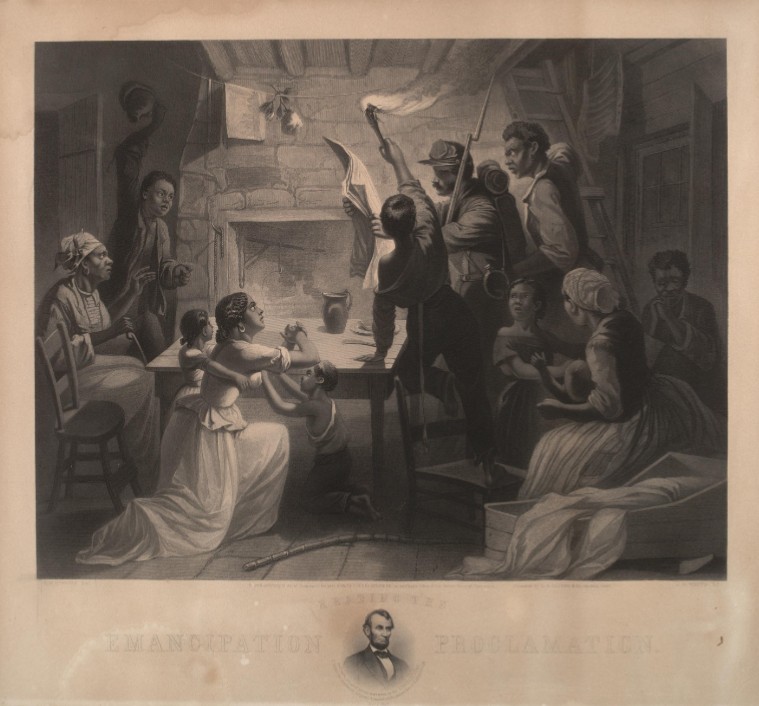
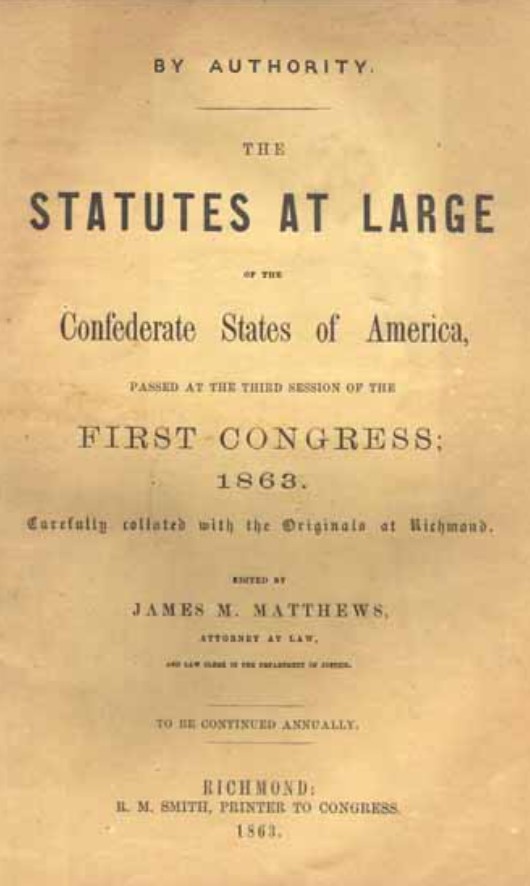
“I. Officers and soldiers are required to live within the limits of their respective commands and on no account to sleep out thereof without special permission of the Brigadier General commanding. No non-commissioned officers or soldier will be allowed in the town without a written pass from his commanding officer. Non-commissioned officers furnished with permits from their commanding officers will be allowed in town. But the provost guard has strict orders to arrest any Private who on any pretext is found in town after the tattoo beating [the signal from regimental musicians that lights should be extinguished and all loud talking or other noise should cease within 15 minutes when Taps will be played] except by special permit from headquarters.

II. The attention of commissioned officers is specially directed to article 29, paragraph 237 to 257 relating to: Honor to be paid by the troops. Any non-commissioned officer or soldier when approaching a commanding officer will invariably salute, if armed by touching his musket at the position of shoulder arms, if unarmed by raising the outer hand horizontally to his cap peak. Should the officer address him he will stand in the respectful position of attention until the officer shall have concluded. On an officer entering the quarters of any party of non-commissioned officers, the senior officer will call the party to attention; and on his approaching any party of men commanded by a non-commissioned officer they will immediately be called to attention and if armed brought to the position of shoulder arms. Should an officer approach any soldier or party of soldiers sitting or lying down they will immediately rise and remain in the position of attention until he shall have passed…. A sentry on post on the approach of an officer will first halt, second face outward from his post, third come to the position of shoulder arms. Should the officer prove to be a general or field officer he will further come to the position of present arms and so remain at the requisite salute until the officers shall have passed his post. The sentry on the guard room door of all guards will turn out his guard at the approach of the general commanding, the field officer of the day, and all armed parties. Regimental guards will further turn out to the commanding officer of their respective regiments….

III. No officer or soldier on guard duty will leave his guard room on any business whatever without being fully equipped. Neither will any soldier be permitted to leave the camp or station of his regiment or company unless properly dressed in accordance with the regulations of that headquarters.

IV. Public property is on no account to be used otherwise then in the service of the government nor will any soldier be permitted to act as an officer’s servant unless he be duly mustered as such.

… VII. All communications for these headquarters are invariably to be made through the chief of staff, signed by Gen. Brannan.”

This last day of February 1862 also brought a brief change for C Company 1st Lt. William Reese, a thirty-two-year-old former Juniata County shoemaker, who was temporarily transferred to the staff of the Chief of Topographical Engineers of Brannan’s 3rd Brigade—a position he held until March 25, 1862.


Sources:

  1. Bates, Samuel P. History of Pennsylvania Volunteers, 1861-5, Vol 1. Harrisburg, Pennsylvania: B. Singerly, State Printer, 1869.
  2. Florida’s Role in the Civil War: ‘Supplier of the Confederacy.” Tampa, Florida: Florida Center for Instructional Technology, University of South Florida (College of Education), retrieved online January 15, 2020.
  3. Gobin, John Peter Shindel. Personal Letters, 1861-1865. Northumberland, Pennsylvania: Personal Collection of John Deppen.
  4. Schmidt, Lewis G. A Civil War History of the 47th Regiment of Pennsylvania Veteran Volunteers. Allentown, Pennsylvania: Self-published, 1986.
  5. President George Washington’s Farewell Address (1796), in Our Documents.” Washington, DC: U.S. National Archives, et. al., retrieved online January 18, 2020.
  6. United States War Department (multiple contributors). The War of the Rebellion: A Compilation of the Official Records of the Union and Confederate Armies: Series I, Vol. VI. Washington, DC: Government Printing Office, 1880-1901.
  7. Wharton, Henry D. Letters from the Sunbury Guards. Sunbury, Pennsylvania: Sunbury American, 1861-1868.