Making History in May: Guarding the Key Conspirators in the Lincoln Assassination Plot

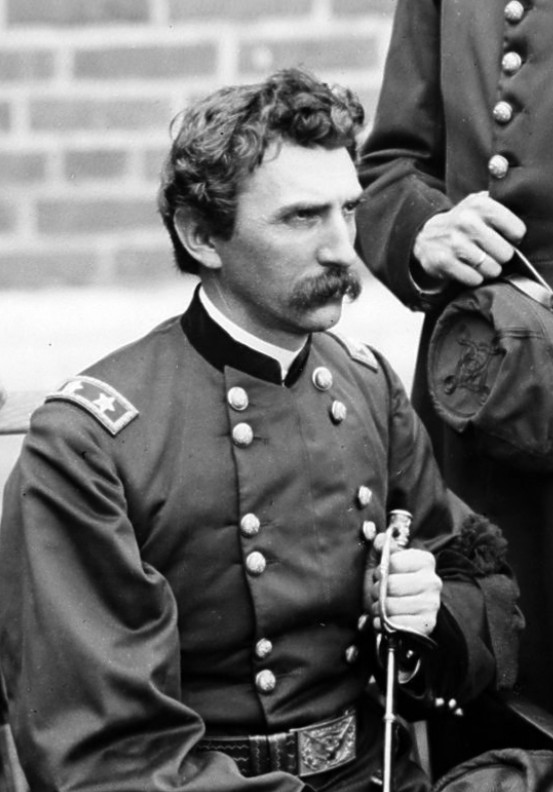
Brevet Major-General John Frederick Hartranft, governor and commanding officer of the Washington Arsenal military prison in Washington, D.C., July 7, 1865 (excerpted from original public domain photo of Hartranft and staff, U.S. Library of Congress).

On May 10, 1865, a group of soldiers from the 47th Pennsylvania Volunteer Infantry concluded another of their regiment’s history-making assignments — guarding the individuals who were instrumental in planning and carrying out the assassination of U.S. President Abraham Lincoln. Present-day historians know this to be true thanks to this brief note that was written by Brevet Major-General John Frederick Hartranft, the commanding officer of the United States military prison where those conspirators were held in the days leading up to their trial:

Hd. Qrs. Mil. Prison
Wash. Arsenal May 11th 1865.

Major Gen’l. Hancock
Com’dg. Mid. Mil. Div.
Gen’l,

I have the honor to report that 10.25 a.m. yesterday, Lt. Col. J. M. Clough, 18th N.H. reported with 450 muskets, for four days duty relieving the 47th Pa. Vols.

At 11.45, the prisoners on trial were taken into Court, in compliance with the orders of the same. At 1 P.M. the Court ordered the prisoners returned to their cells, which was done.

At 1.10 P.M. dinner was served to the prisoners in the usual manner.

At 1.30 in compliance with your orders Marshal McPhail was admitted to see the prisoner in 161, his hood having been previously removed; he remained with him until 2.35, immediately after which his hood was replaced and the door locked.

At 3.45 P.M. Mr. George L. Crawford in accordance with your instructions, was permitted to have an interview with prisoner in 209. I was present during the same, and heard all that was said. The conversation was in regard to the property of the prisoner in Philadelphia. At 4.25 the hood was replaced and the cell locked.

At 6 P.M. Supper was furnished the prisoners and at the same time Dr. Porter and myself made inspections of all the cells and prisoners.

At 6 P.M. in accordance with your instructions, Mr. Stone, Counsel for Dr. Mudd, was permitted to visit his client. The interview took place in the presence of Lt. Col. McCall but not in his hearing.

At 6.35 the interview closed, and the door was again locked.

At 7 this A.M. breakfast was served to the prisoners in the usual manner. At 7.15, Dr. Porter and myself made Inspections of all the cells and prisoners.

I would respectfully recommend that the prisoner in 190 be removed to cell 165.

All passes admitting persons during the last 24 hours are herewith enclosed.

I have the honor to be
Very Respectfully
Your Obt. Servt.
Bvt. Maj. Genl. and
Gov. and Comdr. Mil. Prison

* Note: The conspirator who was identified only as “prisoner 161” in Major-General Hartranft’s entry regarding the visit to the prison at 1:30 p.m. by Marshal McPhail was George Atzerodt, according to historians Edward Steers, Jr. and Harold Holzer, who worked with the U.S. National Archives and Records Administration to publish a book containing correspondence that Hartranft wrote during his tenure as the head of the military prison where Atzerodt was being held, along with his fellow conspirators Samuel Arnold (cell 170), David Herold (cell 205), Dr. Samuel Mudd (cell 176), Michael O’Laughlen (cell 181), Lewis Payne/Lewis Powell (cell 195), Edman Spangler (cell 190 and then cell 184), and Mary Surratt (cell 157 and then cell 200). Also imprisoned there at that time were suspected conspirator John Celestino (cell 209) and Willie Jett (cell 211), the Confederate soldier who had accompanied Lincoln assassin John Wilkes Booth and David Herold as they crossed the Rappahannock River to evade capture by Union troops, and had then also secured lodging for Booth at the farm of Richard Garrett in Virginia.

Researchers for 47th Pennsylvania Volunteers: One Civil War Regiment’s Story are currently working to confirm the nature of and exact start and end dates for the 47th Pennsylvania Volunteer Infantry’s guard duty assignment at the Washington Arsenal military prison in Washington, D.C., as well as which companies of the regiment may have been involved. Their current theory (based on the first sentence of Major-General Hartranft’s May 11, 1865 letter shown above) is that as many as four hundred and fifty men from the 47th Pennsylvania may have been stationed at the Washington Arsenal for a four-day period between May 6-9, 1865. If so, then those 47th Pennsylvanians would have been on guard duty somewhere on the grounds of, or near, that prison on the day when Major-General Hartranft personally visited the cells of each of the key conspirators and read the official charges against them (May 8, 1865) and on the day when the key conspirators appeared before the military tribunal and were each asked whether or not he or she wanted to have an attorney advise and represent them — to which each said yes (May 9). The next morning, as the 47th Pennsylvania Volunteers were being released from their duties and replaced by men from the 18th New Hampshire, Samuel Arnold, George Atzerodt, David Herold, Samuel Mudd, Michael O’Laughlen, Lewis Powell (also known as Lewis Payne), Edman Spangler (also known as Ned Spangler), and Mary Surratt stood in front of the military tribunal at the Washington Arsenal, listening as the charges against them were read out loud in open court during their formal arraignment.


Sources:

  1. Assassination Conspirators Tried, Convicted & Executed,” in Civil War on the Western Border: Border War Timeline. Kansas City, Missouri: Kansas City Public Library, 2013-2015.
  2. Executive Order — General Court-Martial Orders: 356” (the legal charges filed in May 1865 against the key conspirators in the assassination of U.S. President Abraham Lincoln), in The American Presidency Project. Santa Barbara, California: University of California, Santa Barbara, retrieved online May 10, 2026.
  3. Steers, Jr., Edward and Harold Holzer, editors. The Lincoln Assassination Conspirators: Their Confinement and Execution, as Recorded in the Letterbook of John Frederick Hartranft. Baton Rouge, Louisiana: Louisiana State University Press in Association with the U.S. National Archives, Washington, D.C., 2009.
  4. The Trial of the Conspirators,” in Lincoln’s Assassination: Investigating the Assassination. Washington, D.C.: Ford’s Theatre, retrieved online May 10, 2026.
 

A Significant Confederate Threat to Black Union Soldiers and Their White Commanders (May 1, 1863)

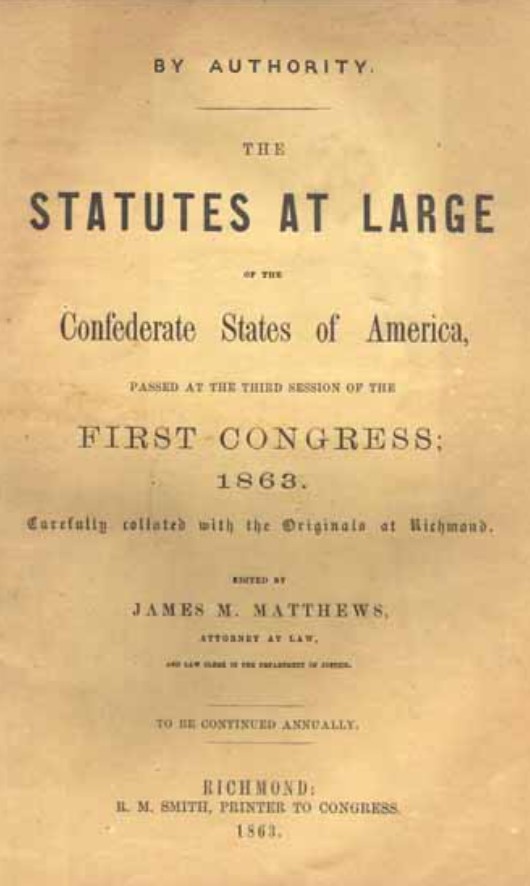
Cover page of The Statutes at Large of the Confederate States of America, Passed at the Third Session of the First Congress, 1863 (Richmond, Virginia: R. M. Smith, Printer to Congress, 1863, public domain; click to enlarge).

During its legislative session on May 1, 1863, the Confederate Congress enacted several pieces of legislation prior to approving additional new resolutions. The most important, perhaps (from the perspective of historians and students engaged in research about the American Civil War), was resolution number five in which leaders of the Confederacy made clear their intent to re-enslave or execute Black Union soldiers if and when they were captured by Confederate troops — and to also execute their White commanding officers should any of those officers be captured by Confederate troops. The text of that resolution read as follows:

Resolved, by the Congress of the Confederate States of America, in response to the message of the President, transmitted to Congress at the commencement of the present session, that in the opinion of Congress the commissioned officers of the enemy ought not to be delivered to the authorities of the respective States, as suggested in the said message; but all captives taken by the confederate forces ought to be dealt with and disposed of by the confederate government.

Sec. 2. That, in the judgment of Congress, the Proclamations of the President of the United States, dated respectively September twenty-second, eighteen hundred and sixty-two, and January first, eighteen hundred and sixty-three, and the other measures of the Government of the United States and of its authorities, commanders and forces, designed or tending to emancipate slaves in the confederate States, or to abduct such slaves, or to incite them to insurrection, or to employ negroes in war against the confederate States, or to overthrow the institution of African slavery and bring on a servile war in these States, would, if successful, produce atrocious consequences, and they are inconsistent with the spirit of those usages which in modern warfare prevail among civilized nations; they may, therefore, be properly and lawfully repressed by retaliation.

Sec. 3. That in every case wherein, during the present war, any violation of the laws or usages of war among civilized nations shall be, or has been, done and perpetrated by those acting under the authority of the Government of the United States, on the persons or property of citizens of the confederate States, or of those under the protection or in the land or naval service of the confederate States, or of any State of the Confederacy, the President of the confederate States is hereby authorized to cause full and complete retaliation to be made for every such violation, in such manner and to such extent as he may think proper.

Sec. 4. That every white person, being a commissioned officer, or acting as such, who, during the present war, shall command negroes or mulattoes in arms against the confederate States, or who shall arm, train, organize, or prepare negroes or mulattoes for military service against the confederate States, or who shall voluntarily aid negroes or mulattoes in any military enterprise, attack, or conflict in such service, shall be deemed as inciting servile insurrection, and shall, if captured, be put to death, or be otherwise punished at the discretion of the court.

Sec 5. Every person, being a commissioned officer, or acting as such in the service of the enemy, who shall, during the present war, excite, attempt to excite or cause to be excited servile insurrection, or who shall incite or cause to be incited a slave to rebel, shall, if captured, be put to death, or be otherwise punished at the discretion of the court.

Sec 6. Every person charged with an offence punishable under the preceding resolutions shall, during the present war, be tried before the military court attached to the army or corps by the troops of which he shall have been captured, or by such other military court as the President may direct, and in such manner and under such regulations as the President shall prescribe, and, after conviction, the President may commute the punishment in such manner and on such terms as he may deem proper.

Sec. 7. All negroes and mulattoes who shall be engaged in war or taken in arms against the confederate States, or shall give aid or comfort to the enemies of the Confederate States, shall, when captured in the Confederate States, be delivered to the authorities of the State or States in which they shall be captured, to be dealt with according to the present or future laws of such State or States.

Approved May 1, 1863.


Sources:

  1. “Act Passed by the Rebel Congress: No. 74: Joint Resolution on the Subject of Retaliation.” St. Louis, Missouri: Daily Missouri Republican, June 5, 1863.
  2. “Acts Passed by the Rebel Congress: No. 74.” New York, New York: New York Herald, May 31, 1863.
  3. “Joint Resolutions on the Subject of Retaliation,” in “Acts Passed by the Confederate Congress [No. 74],” in “Late and Interesting News from the South — The Spirit and Tone of Rebel Journals.” Lafayette, Indiana: The Lafayette Weekly Argus, June 11, 1863.
  4. “Joint Resolutions on the Subject of Retaliation,” in “Latest News from the South.” Baltimore, Maryland: The Sun, June 2, 1863.
  5. No. 5: Joint Resolution on the Subject of Retaliation” (approved on May 1, 1863), in “Resolutions ” in “The Statutes at Large of the Confederate States of America, Passed at the Third Session of the First Congress; 1863. Carefully Collated with the Originals at Richmond,” in “Documenting the American South.” Chapel Hill, North Carolina: University Library, University of North Carolina at Chapel Hill, retrieved online April 24, 2026.
  6. “Rebel Law of Retaliation.” Keokuk, Iowa: The Gate City, June 18, 1863.
  7. “Rebel Law of Retaliation.” Pittsburgh, Pennsylvania: The Daily Pittsburgh Gazette, June 5, 1863.
  8. “Rebel Law of Retaliation” and “Gen. Hunter’s Letter to Jeff. Davis.” Indiana, Pennsylvania: Weekly Register, June 9, 1863.
  9. “Rebel Retaliation.” Kansas City, Missouri: The Journal of Commerce, June 11, 1863.
  10. “Retaliation Upon the Enemy: Report of the Judiciary Committee of the Confederate Senate — The Action of Congress.” Richmond, Virginia: The Richmond Whig, May 15, 1863.
  11. “The Retaliatory Act, Confederate Congress, May 1, 1863,” in “House Divided: The Civil War Research Engine at Dickinson College.” Carlisle, Pennsylvania: Dickinson College, retrieved online April 24, 2026.
  12. “The Retaliatory Code.” Washington, D.C.: Daily National Intelligencer, June 5, 1863.