Flag Days: The History of One Regiment’s Battle Flags

Cared for by archivists of the Pennsylvania Capitol Preservation Committee in Harrisburg, Pennsylvania, the two battle flags that were carried by the 47th Pennsylvania Volunteer Infantry during its tenure of service in the American Civil War were known as the First and Second State Colors.

First State Color

The First State Color of the 47th Pennsylvania Volunteer Infantry was presented to the regiment by Pennsylvania Governor Andrew Curtin on September 20, 1861, and was officially retired on May 11, 1865 (source: Pennsylvania Capitol Preservation Committee, 1985.057, Evans and Hassall, v1p126).

Presented to the regiment by Pennsylvania Governor Andrew Gregg Curtin in Harrisburg, Pennsylvania on September 20, 1861, the First State Color of the 47th Pennsylvania Volunteer Infantry was manufactured by Evans and Hassall of Philadelphia, Pennsylvania. According to the September 17, 1861 edition of The Philadelphia Inquirer newspaper:

Under an act of the Legislature, passed during the extra session of 1861, the Governor of the State was authorized to purchase stands of colors for the several regiments of Pennsylvania. — Twelve of these have been completed, marked with the appropriate numbers of the regiments, and sent to Gov. Curtin. We have been shown one of these new standards. It bore upon it the Stars and Stripes, with the coat of Arms of Pennsylvania exquisitely painted on the blue field, and surrounded by the thirty-four Stars. On the central stripe the number of the regiment was emblazoned. The material is rich, heavy and lustrous silk. The sunlight never flashed on a more beautiful ensign…. The trimmings of the flags are very handsome. The work was completed by Messrs. Evans & Hassall, No. 51 S. Fourth Street.

The First State Color was the battle flag that was initially cared for and carried by the 47th Pennsylvania’s first color bearer, Sergeant Benjamin Walls, as the regiment took part in multiple military engagements, including the:

The First State Color was then carried by Sergeant William Pyers in subsequent military engagements, including the:

Subsequently carried by a third regimental color bearer, the First State Color was also the flag carried by the regiment during the 47th Pennsylvania Volunteer Infantry’s defense of Washington, D.C., following the assassination of President Abraham Lincoln (beginning mid-April 1865 and lasting until the First State Color was officially retired on May 11, 1865).

Second State Color
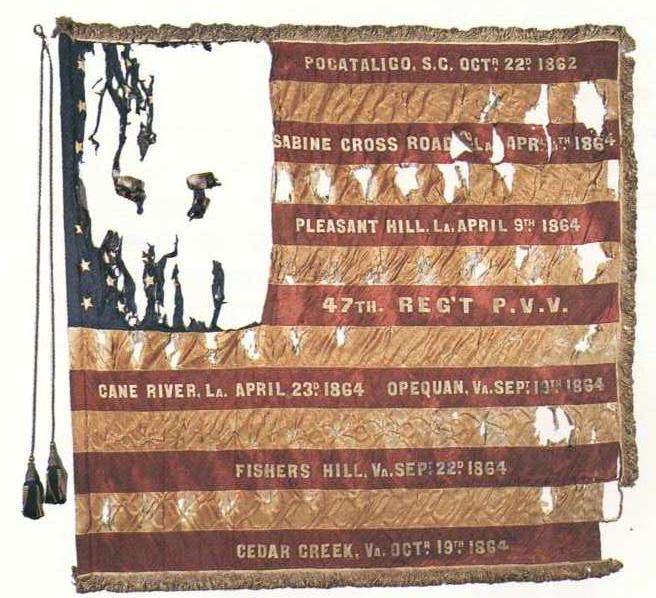
Second State Color, 47th Pennsylvania Volunteer Infantry, presented to the regiment on March 7, 1865, this battle flag documents the regiment’s major engagements (source: Pennsylvania Capitol Preservation Committee, 1985.058, Horstmann Brothers and Company, v1p127).

The Second State Color of the 47th Pennsylvania Volunteer Infantry was the battle flag that was carried by the regiment’s color-bearer as the 47th Pennsylvania marched through the streets of Washington, D.C. during the Grand Review of the National Armies on May 23, 1865, and as it marched into Savannah, Georgia in early June 1865 and into Charleston, South Carolina in July of that same year (while stationed in both cities on provost duty during the Reconstruction Era).

Presented to Captain Daniel Oyster on March 7, 1865, the commanding officer of the 47th Pennsylvania’s C Company (the regiment’s color guard unit), while Captain Oyster was at home in Sunbury, Pennsylvania on a thirty-day military furlough (after having been wounded in action twice during Sheridan’s 1864 Shenandoah Valley Campaign), it had been shipped to Sunbury in February by its manufacturer, Horstmann Brothers & Company of Philadelphia. According to archivists at the American History Museum in Washington, D.C.:

“William Hortsmann [sic, “Horstmann”], born in Germany, emigrated to the United States and established himself as a maker of fringe, laces, and trimmings in Philadelphia, in 1815. William Horstmann & Sons were located at North Third Street between 1830 and 1857, manufacturing and importing everything from textiles and trimmings to military goods including drums, pistols, and swords. As the company expanded, Horstmann & Sons moved the factory to 5th and Cherry Streets and their storefront to 2223 Chestnut Street. Later the company would grow to two stores in New York and an agency in Paris. William Horstmann retired from the company in 1845, and his sons, William and Sigmund continued the family business until 1872.”

Sources:

  1. 47th Infantry,” in “Pennsylvania Civil War Battle Flags.” Harrisburg, Pennsylvania: Pennsylvania Capitol Preservation Committee, retrieved online June 3, 2026.
  2. “A Handsome Flag.” Sunbury, Pennsylvania: The Sunbury American, March 11, 1865.
  3. Bates, Samuel P., in History of Pennsylvania Volunteers, 1861-5, vol. 1. Harrisburg, Pennsylvania: B. Singerly, State Printer, 1869.
  4. “Flags for Pennsylvania Regiments.” Philadelphia, Pennsylvania: The Philadelphia Inquirer, September 17, 1861.
  5. Historical Listing of Pennsylvania Civil War Color Bearers,” in “Pennsylvania Civil War Battle Flags.” Harrisburg, Pennsylvania: Pennsylvania Capitol Preservation Committee, retrieved online June 3, 2026.
  6. Horstmann Brothers & Co. Military Trumpet.” Washington, D.C.: American History Museum, Smithsonian Institute, retrieved online June 3, 2026.
  7. Schmidt, Lewis G. A Civil War History of the 47th Regiment of Pennsylvania Veteran Volunteers. Allentown, Pennsylvania: Self-published, 1986.
  8. “The History of the Forty-Seventh Regt. P. V.” Allentown, Pennsylvania: The Lehigh Register, July 20, 1870.
 

“Propitious Weather and a Splendid Spectacle”: The United States of America’s Grand Review of the Armies (May 23, 1865)

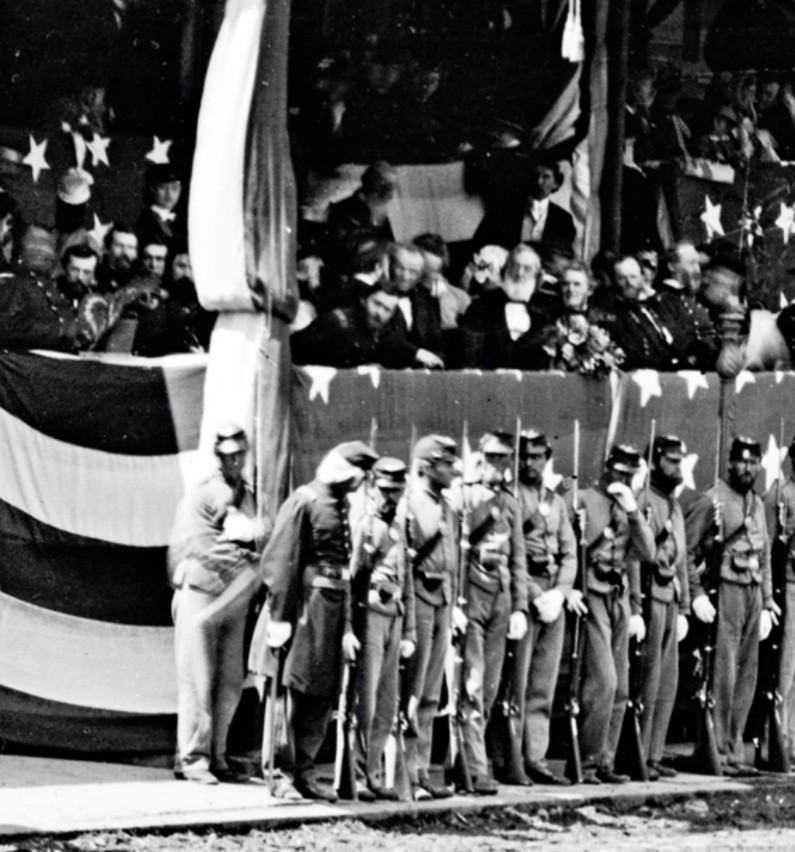
Lieutenant-General Ulysses S. Grant leans forward to have a better look at a Union regiment approaching the presidential reviewing stand, President Andrew Johnson to his left, Grand Review of the National Armies, Washington, D.C., May 23, 1865 (U.S. Library of Congress, public domain; click to enlarge).

It was a week to remember. The 47th Pennsylvania Veteran Volunteers had survived the bloody Battle of Pocotaligo in South Carolina (October 1862) to make history as the only regiment from the Great Keystone State to participate in the Union’s 1864 Red River Campaign across Louisiana and help firmly, finally turn the tide of the American Civil War in the Union’s favor during Sheridan’s 1864 Shenandoah Valley Campaign — only to be brought to their knees in mourning, upon receiving the heartbreaking news that their beloved commander-in-chief had been assassinated — just as victory was at hand.

Now, they were joining more than one hundred and forty-five thousand other “boys in blue” in a triumphant march through the streets of Washington, D.C. that would subsequently be described by The New York Times as “The Grand Procession of Battle Stained Banners” and a “splendid spectacle” that was graced with “propitious weather.” The reporter penning those superlatives was describing the Union’s Grand Review of the National Armies, which took place from May 23 to 24.

The Army of the Potomac has passed in review. The first day’s pageant is over, and to the correspondent falls the duty of depicting a scene almost devoid of incident, save in its grand aspiration. Every circumstance has combined to make it a complete success. The weather has been magnificent; the air, delightfully tempered by the rains of the past week, is cool and fragrant, and dust, is for the time subdued….

Though the city is so crowded, it is yet gay and jovial with the good feeling that prevails, for the occasion is one of such grand import and true rejoicing, that small vexations sink out of sight. With many it is the greatest epoch of their lives; with the soldier it is the last act in the drama; with the nation it is the triumphant exhibition of the resources and valor which have saved it from disruption and placed it first upon earth.

So the scene of to-day (and that of to-morrow) will never be forgotten, and he who is privileged to be a witness will mark it as a white day in the calendar, from which to gather hope and courage for the future….

That Times reporter went on to describe the ways in which multiple Union Army regiments had made their way to the nation’s capital, where they had set up tents upon their respective arrivals and how they had assembled for the first day of the review, providing a list, line-by-line, of the long order of march — a list which included the 47th Pennsylvania Volunteers. (Officially stationed at Camp Brightwood in the northwest corner of Washington, D.C. by early May 1865, the 47th Pennsylvanians had departed from that camp on Monday, May 22 to move closer to their assigned position for the Grand Review’s start, according to Private Henry Horn of Company G.)

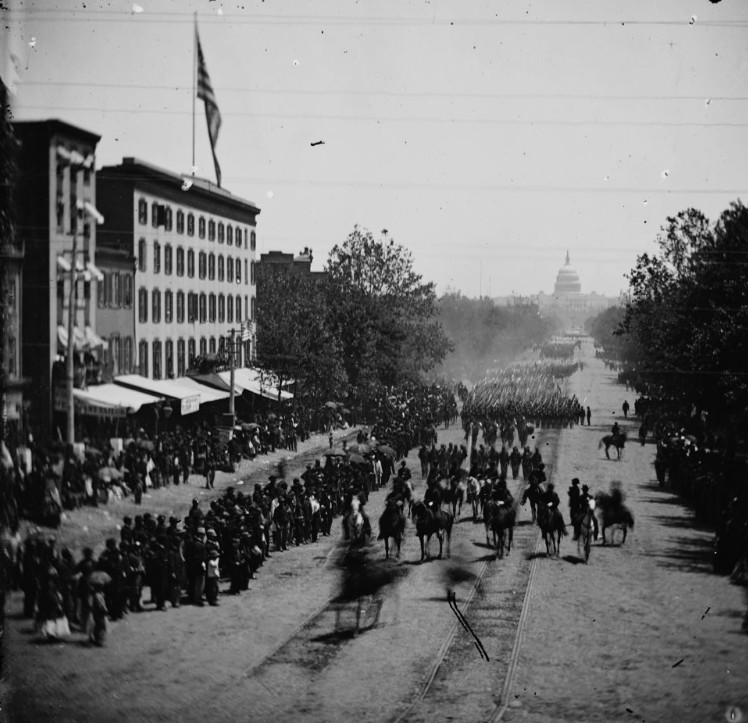
19th Corps, Army of the United States, Grand Review of the National Armies, Pennsylvania Avenue, Washington, D.C., May 23, 1865 (Matthew Brady, U.S. Library of Congress, public domain).

The 47th Pennsylvania was just one of the one hundred and eighteen infantry regiments, twenty-nine cavalry regiments and thirty-three artillery batteries that boldly stepped forth from Capitol Hill on that first day of the Grand Review (May 23, 1865). Marching with the precision they were known for, under the banners of the Army of the Potomac (Mr. Lincoln’s Army), they were participants in a thrilling, six-hour parade, passing in front of a review stand that sheltered U.S. President Andrew Johnson, Secretary of War Edwin M. Stanton, Lieutenant-General Ulysses S. Grant, and other high-ranking officials of the military and federal government. According to the Times, the 47th Pennsylvania Veteran Volunteers were positioned behind the parade’s third division, as part of the Nineteenth Army Corps (XIX Corps) in Dwight’s Division:

Third Division.
Brevet Brig.-Gen. John G. Curtin commanding.

First Brigade, Col. A. B. McCalmon commanding — 51st Pennsylvania Veteran Volunteers, Col. William J. Bolton; 208th Pennsylvania, Lieut.-Col. M. T. Heintzelman; 209th Pennsylvania, Col. T. B. Kaufman; 200th Pennsylvania, Maj. Jacob Rehm.

Second Brigade, Col. J. A. Mathews commanding — 207th Pennsylvania, Col. R. C. Cox; 211th Pennsylvania, Lieut.-Col. Coulter; 205th Pennsylvania, Lieut.-Col. W. F. Walter.

Dwight’s Division.
Nineteenth Army Corps, Brig.-Gen. William Dwight commanding.

First Brigade, Brig.-Gen. G. L. Beal commanding — 15th Maine, Col. Isaac Dyer; 114th New York, Col. S. R. Per Lee; 29th Maine, Col. George H. Nye; 30th Massachusetts, Lieut.-Col. N. Shardman; 1st Maine Battalion, Capt. C. S. Brown.

Second Brigade, Brevet Brig.-Gen. E. P. Davis commanding — 153rd New York, Lieut.-Col. J. A. McLaughlin; 8th Vermont, Col. J. B. Mead; 12th Connecticut, Lieut.-Col. G. W. Lewis; 26th Massachusetts, Lieut.-Col. W. H. Chapman; 47th Pennsylvania, Col. J. P. S. Gobin.

Third Brigade, Brig.-Gen. J. D. Fessenden commanding — 173rd New York, Col. L. M. Peck; 160th New York, Col. C. C. Dwight; 162nd New York, Col. J. W. Blanchard; 133rd New York, Col. L. D. Currie; 30th Maine, Col. T. H. Hubbard.

Artillery Brigade, Brevet Brig.-Gen. J. C. Tidball commanding — 34th New York Battery, Brevet Maj. J. Roemer; 7th Maine Battery, Capt. A. B. Twitchell; 19th New York Battery, Capt. E. W. Rogers; Battery D, 47th Pennsylvania Volunteer Artillery; Capt. S. H. Rhoads; 11th Massachusetts Battery, Capt. E. J. Jones; 27th New York Battery, Capt. J. B. Eaton.

Second State Colors, 47th Pennsylvania Veteran Volunteers (presented to the regiment 7 March 1865).

Lest one be tempted to think that the 47th Pennsylvania Veteran Volunteers were placed further back in the line of march because they were being accorded less respect, one only need look at the rosters of the men who immediately followed the 47th. The division positioned directly behind them was composed of general staff of the Army of the United States and regiments led by American Civil War icon and Gettyburg hero Joshua L. Chamberlain. Observed U.S. Secretary of War Edwin M. Stanton, “You see in these armies, the foundation of the Republic: our future railroad managers, congressmen, bank presidents, senators, manufacturers, judges, governors and diplomats; yes and not less than half a dozen presidents.”

John Peter Shindel Gobin, 47th Pennsylvania Volunteers, shown here as a captain in 1863, went on to become lieutenant governor of Pennsylvania after the war (public domain).

Among the 47th Pennsylvanians who would continue to serve their communities, commonwealth and nation faithfully were future city councilmen, industrialists, inventors, judges, a three-time mayor, newspaper publishers, physicians, policemen, federal postmasters, local school board members, and a state senator who would be publicly elected as Pennsylvania’s seventh lieutenant governor. Each one had experienced the horrors of war. All were forever changed. So, please take time this Memorial Day weekend to read and share their stories with your family, friends and neighbors — and say their names as you offer a toast in tribute to their valor. We owe them at least that much for the sacrifices they made to save our nation.


Sources:

  1. Bates, Samuel P. History of Pennsylvania Volunteers, 1861-5, vol. 1. Harrisburg, Pennsylvania: B. Singerly, State Printer, 1869.
  2. “Grand Military Review: Streets Crowded with Spectators: Sherman Greeted with Deafening Cheers.” Pittsburgh, Pennsylvania: The Daily Post, May 25, 1865.
  3. “Our Heroes! The Grand Review at Washington. Honor to the Brave. Immense Outpouring of the People. The Troops Reviewed by Gen. Grant.” Harrisburg, Pennsylvania: Daily Telegraph, May 23, 1865.
  4. Review of the Armies; Propitious Weather and a Splendid Spectacle. Nearly a Hundred Thousand Veterans in the Lines.” New York, New York: The New York Times, May 24, 1865, front page.
  5. Rodrock, Rev. William D. C. Chaplain’s Reports (47th Pennsylvania Volunteer Infantry, 1865). Washington, D.C.: U.S. National Archives and Records Administration.
  6. Schmidt, Lewis. A Civil War History of the 47th Regiment of Pennsylvania Veteran Volunteers. Allentown, Pennsylvania: Self-published, 1986.
  7. “Serenade to General Grant” (performance for Lieutenant-General Ulysses S. Grant by the 47th Pennsylvania Veteran Volunteers’ Regimental Band), in “Washington.” Philadelphia, Pennsylvania: The Inquirer, May 22, 1865.
  8. The Final March: Grand Review of the Armies.” Washington, D.C.: U.S. National Park Service, retrieved online May 20, 2025.
  9. “The Grand Review: A Grand Spectacle Witnessed.” Pittsburgh, Pennsylvania: The Daily Post, May 24, 1865.
  10. “The Grand Review: Immense Crowds in Washington: Fine Appearance of the Troops: Their Enthusiastic Reception.” Harrisburg, Pennsylvania: Pennsylvania Daily Telegraph, May 24, 1865; and West Chester, Pennsylvania: The Record, May 17, 1865.
  11. “The Grand Review: The City Crowded with Visitors: Order of Corps, Divisions, Brigades and Regiments.” Philadelphia, Pennsylvania: Daily Constitutional Union, May 23, 1865.
  12. “The History of the Forty-Seventh Regt. P. V.” Allentown, Pennsylvania: The Lehigh Register, 20 July 1870.