Telegraphing the News — From President Abraham Lincoln’s Assassination to His Assassin’s Capture

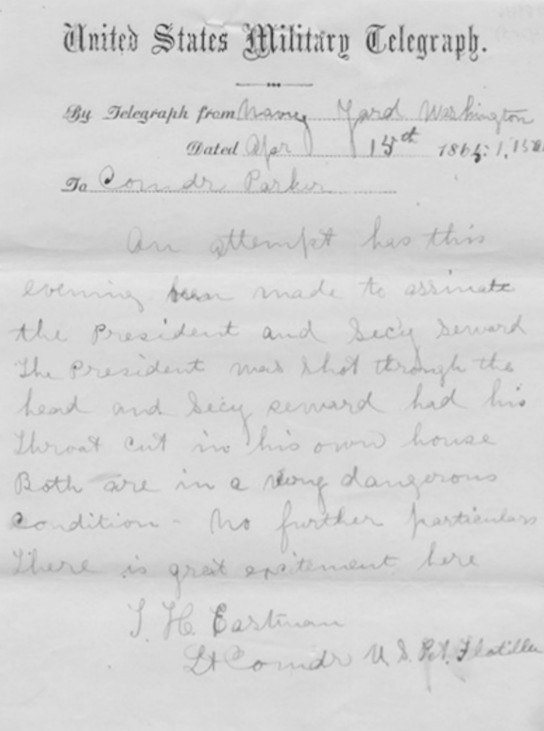
Telegram announcing the assassination of U.S. President Abraham Lincoln, sent by Henry Harrison Atwater at the U.S. Navy Yard in Washington, D.C. on 15 April 1865 at 1:30 a.m. (U.S. National Archives and Records Administration, public domain; click to enlarge).

They are fleeting glimpses into a nation reeling from the death of a beloved hero. Viewed in chronological sequence, they take readers from the utter shock experienced by stunned government employees through the stages of grief as they tried to carry out their expected duties while also coming to terms with their own emotions about what was unfolding through the chaos and confusion around them.

They were the telegrams, logbook entries, military orders, dispatches from executives of the United States government to their subordinates who were stationed throughout the U.S. and across the globe, and other documents that were hurriedly created during the immediate and ongoing aftermath of the assassination of United States President Abraham Lincoln, and they are illuminating, heartbreaking and, at times, infuriating — particularly as their intensity builds with each update regarding the dramatic hunt for, and capture of, the perpetrator and facilitators of one the most vile acts in American history.

Henry Harrison Atwater

Among the briefest but most powerful of the telegraph messages that were dispatched during the first hours after President Lincoln was shot at Ford’s Theatre were those transmitted by Washington Navy Yard telegrapher Henry Harrison Atwater:

  • War Dept. Apr. 14 (186)5. Comd Parker. An attempt has been made this P.M. to assassinate the President & Secy of State – The parties may escape or attempt to escept [sic] down the Potomac [unclear] J.H. Taylor, Chf Staff
  • War Dept. Washington. Apr 15th (186)5. 1.05 a.m. Brig Gen. Barnes Pt. Lookout. Stop all vessels going down the river & hold all persons on them till further orders and [sic] attempt has been made tonigh [sic] to assassinate the President & secy of state hold all persons leaving Washington H.W. Halleck Maj Gen Chf Staff 
  • Navy Yard Washington Apr 15th (186)5 1.15 a.m. Comdr Parker. An attempt has this evening been made to assinate [sic] the President and Sec’y Seward The President was shot through the head and Secy seward [sic] had his throat cut in his own house Both are in a very dangerous condition. No further particulars There is great excitement here T.H. Eastman Lt Comdr U.S. Pot. Flotilla
  • War Dept Apr 15 (186)5 8 a.m. H.H. Atwater President died at seven twenty two (7.22) this a.m. Maynard Operator
  • War Dept April 15th 2.20 p.m. (186)5. Comd J.B. Montgomery Navy Yard If the military authorities arrest the murderer of the President and take him to the yard put him on a monitor & anchor her in the stream with strong guard on vessel – wharf – and in yard Call upon Comdt Marine Corps for guard – Have vessel immediately prepared ready to receive him at any hour day or night with necessary instructions he will be heavily ironed and so guarded as to prevent escape or injury to himself Gideon Welles Secy Navy

Atwater, when interviewed half a century later for the May 1, 1915 edition of the journal, Telephone and Telegraph Age, explained how he came to be the person who transmitted those crucial messages:

I was not in the theatre on the evening of April 14, 1865, but was in my room at the Navy Yard, where I was stationed, when about eleven p.m. I was called up by Mr. Maynard at the War Department Office and informed that President Lincoln had been shot at Ford’s Theatre. I ran to give the information to Commodore Montgomery at his house, and met the Commodore as he was entering the yard and conveyed the information. He replied: — “I guess that is a mistake, for I have just come from uptown and heard nothing of it.” I told him it had just occurred, and returned to my quarters.

Edwin Stanton
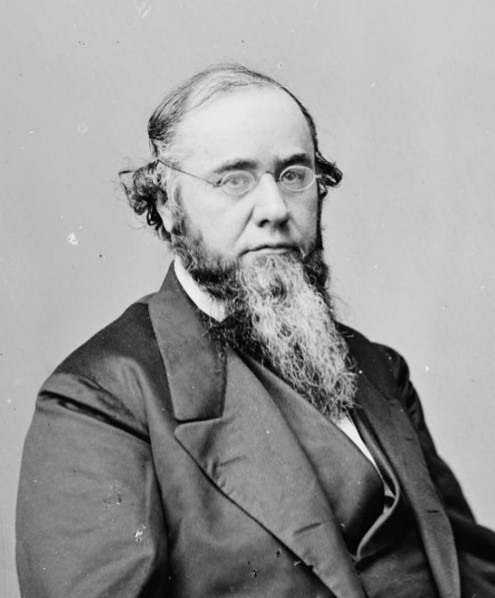
U.S. Secretary of War Edwin M. Stanton, circa 1862-1865 (Matthew Brady, U.S. Library of Congress, public domain).

Meanwhile, U.S. Secretary of War Edward Stanton was penning the following messages for telegraphic transmission by his subordinates:

  • War Department, April 15, 1865 – 1:30 a.m.
    Major-General Dix,
    New York:
    Last evening, about 10:30 p.m., at Ford’s Theater, the President, while sitting in his private box with Mrs. Lincoln, Miss Harris, and Major Rathbone, was shot by an assassin . . . The pistol-ball entered the back of the President’s head, and penetrated nearly through the head. The wound is mortal. The President has been insensible ever since it was inflicted, and is now dying.
  • War Department, April 15, 1865 – 2:35 a.m.
    Investigation strongly indicates J. Wilkes Booth as the assassin of the President.

Roughly five hours later, on April 15, 1865, Secretary Stanton conveyed the news that:

  • Abraham Lincoln died this morning at 22 minutes after 7 o’clock.

Stanton then began to write, rewrite and send announcements about the president’s death to senior officials of the federal government, which carried instructions that kept the federal government running during the transfer of power to the new president Andrew Johnson. Unable to employ the Transatlantic telegraph to quickly alert U.S. Department of State staff who were serving overseas at that time (because the transatlantic cable was still inoperable), Stanton was compelled to use the nineteenth-century version of “snail mail” when he sent this dispatch of April 15, 1865 by ship to Charles Francis Adams, the U.S. Minister to the United Kingdom:

Recd. 26 April, 1865
Charles Francis Adams
United States Minister, London
Washington, DC 15 April, 1865

Sir.

It has become my distressing duty to announce to you that last night His Excellency Abraham Lincoln President of The United States, was assassinated, about the hour of half past 10 o’clock, in his private box at Ford’s Theatre, in this city. The President about eight o’clock accompanied Mrs. Lincoln to the theatre. Another lady and gentleman were with them in the box. About half past ten during a pause in the performance, the assassin entered the box, the door of which was unguarded, hastily approached the President from behind, and discharged a pistol at his head. The bullet entered the back of his head, and penetrated nearly through. The assassin then leaped from the box upon the stage, brandishing a large knife or dagger, and exclaiming “Sic semper tyrannis!” and escaped in the rear of the theatre. Immediately upon the discharge the President fell to the floor insensible, and continued in that state until 20 minutes past 7 o’clock this morning when he breathed his last. About the same time the murder was being committed at the Theatre another assassin presented himself at the door of Mr. Seward’s residence, gained admission by representing he had a prescription from Mr. Seward’s physicians which he was directed to see administered and hurried up to the third story chamber where Mr. Seward was lying. He here discovered Mr. Frederick Seward, struck him over the head, inflicting several wounds, and fracturing the skull in two places, inflicting, it is feared mortal wounds. He then rushed into the room where Mr. Seward was in bed, attended by a young daughter and a male nurse. The male attendant was stabbed through the lungs, and it is believed will die. The assassin then struck Mr. Seward with a knife or dagger twice in the throat and twice in the face, inflicting terrible wounds. By this time Major Seward, eldest son of the Secretary, and another attendant reached the room, and rushed to the rescue of the Secretary; they were also wounded in the conflict, and the assassin escaped. No artery or important blood vessel was severed by any of the wounds inflicted upon him, but he was for a long time insensible from the loss of blood. Some hope of his possible recovery is entertained. Immediately upon the death of the President notice was given to Vice President Johnson, who happened to be in the City, and upon whom the office of President now devolves. He will take the office and assume the functions of President to-day. The murderer of the President has been discovered, and evidence obtained that these horrible crimes were committed in execution of conspiracy deliberately planned and set on foot by rebels on pretence of avenging the South and aiding the rebel cause; but it is hoped that the perpetrators will be caught.

The feeling occasioned by these atrocious crimes is so great, sudden, and overwhelming that I cannot at present do more than communicate them to you. At the earliest moment yesterday the late President called a Cabinet meeting, at which General Grant was present. He was more cheerful and happy than I had ever seen him, rejoiced at the near prospect of firm and durable peace at home and abroad, manifested in a marked degree the kindness and humanity of his disposition, and the tender and forgiving spirit that so eminently distinguished him. Public notice had been given that he and General Grant, would be present at the Theatre, and the opportunity of adding the Lieutenant General to the number of victims to be murdered was no doubt seized for the fitting occasion of executing the plans that appear to have been in preparation for some weeks, but General Grant was compelled to be absent, and thus escaped the designs upon him. It is needless for me to say anything in regard to the influence which this atrocious murder of the President may exercise upon the affairs of this country, but I will only add that, horrible as are the atrocities that have been resorted to by the enemies of the country, they are not likely in any degree to impair the public spirit, or postpone the complete and final overthrow of the rebellion. In profound grief for the events, which it has become my duty to communicate to you,

I have the honor to be
Very respectfully
Your obt. Servant
Edwin M. Stanton

Metropolitan Police, Washington, D.C.

In addition, a supervising police officer at the city of Washington’s Metropolitan Police Department headquarters penned this ten-line entry in the department’s logbook:

At this hour the melancholy intelligence of the assassination of Mr. Lincoln, President of the U.S, at Fords Theater was brought to this office, and the information obtained from the following persons goes to show that the assassin is a man named J. Wilks [sic] Booth. Secretary Seward & both his sons & servant were attacked at the same hour by a man supposed to be J____ Serratt. Assign to the Force.

The hunt for the conspirators had begun.


Sources:

  1. Brown, J. Willard, A.M. The Signal Corps, U.S.A. in the War of the Rebellion. Boston, Massachusetts: U.S. Veteran Signal Corps Association, 1896.
  2. Exhibit: Lincoln Assassination Report.” Washington, D.C.: U.S. National Archives and Records Administration, retrieved online April 15, 1865.
  3. Kauffman, Michael W. American Brutus: John Wilkes Booth and the Lincoln Conspiracies. New York, New York: Random House, 2004.
  4. Langbart, David. “Reporting the Death of the President, 1865,” in The Text Message. Washington, D.C.: U.S. National Archives and Records Administration, April 15, 2015.
  5. The Assassin’s Escape: Following John Wilkes Booth.” Washington, D.C.: Ford’s Theatre, retrieved online April 15, 1865.
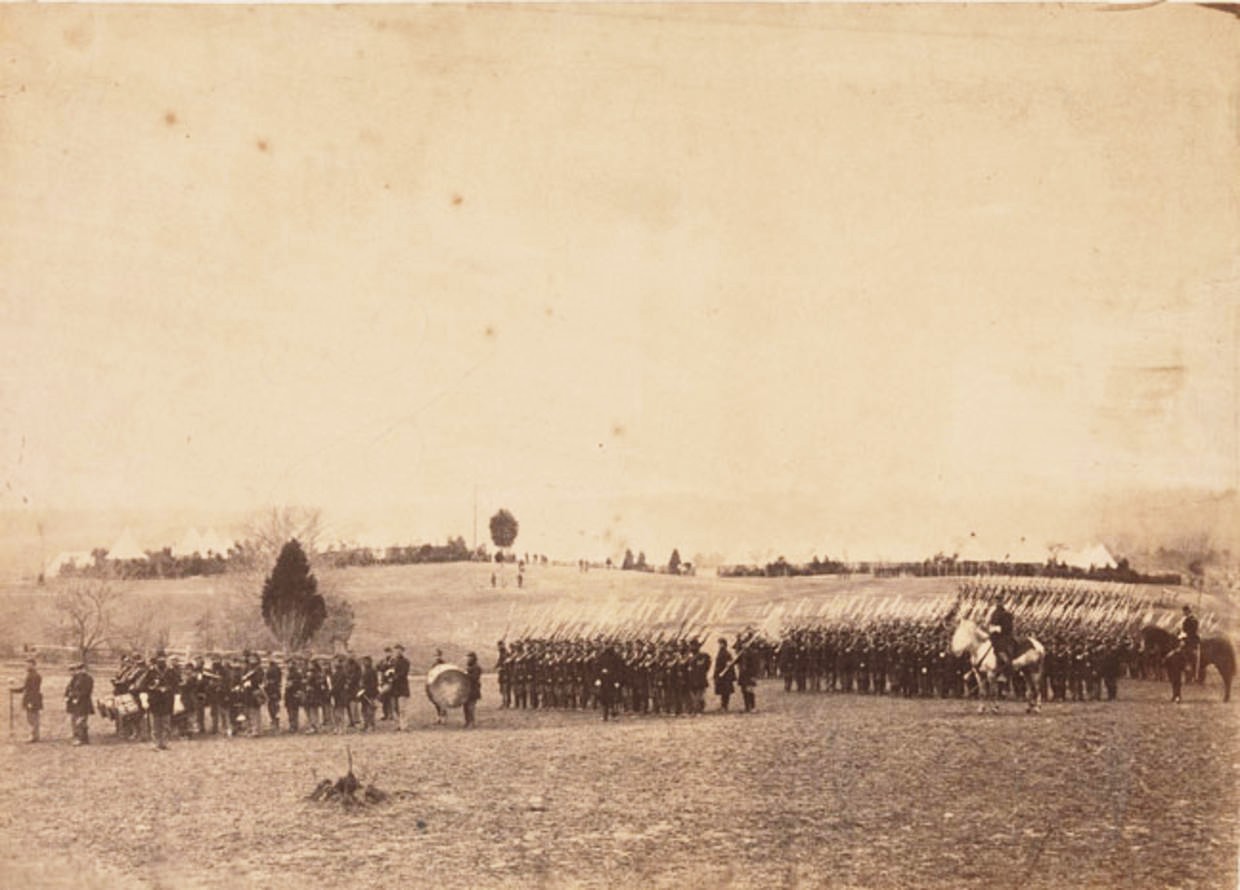
 

Camp Brightwood, Washington, D.C. (Mid-April – June 2, 1865)

Unidentified Union infantry regiment, Camp Brightwood, Washington, D.C., circa 1865 (public domain; click to enlarge).

Marched closer to the nation’s capital in the wake of U.S. President Abraham Lincoln’s assassination in mid-April 1865, the 47th Pennsylvania Veteran Volunteers were directed to proceed to the Brightwood district in the northwestern section of Washington, D.C. and erect their Sibley tents at the Union Army duty station known as Camp Brightwood.

Their new job was to prevent Confederate States Army troops and their sympathizers from reigniting the flames of civil war that had just been stamped out weeks earlier.

According to historians at Cultural Tourism DC, Brightwood was “one of Washington, DC’s early communities and the site of the only Civil War battle to take place within the District of Columbia” — the Battle of Fort Stevens.

This crossroads community developed from the Seventh Street Turnpike, today’s Georgia Avenue, and Military Road. Its earliest days included a pre-Civil War settlement of free African Americans…. Eventually Brightwood boasted a popular race track, country estates, and sturdy suburban housing. In 1861 the area was known as Brighton, but once it was large enough to merit a U.S. Post Office, the name was changed to Brightwood to distinguish it from Brighton, Maryland.

Also, according to Cultural Tourism historians, Camp Brightwood was established on the grounds of “Emery Place, the summer estate of Matthew Gault Emery,” who had “made a fortune in stone-cutting, including the cornerstone for the Washington Monument,” which was laid in 1848.

During the Civil War (1861-1865), Captain Emery led the local militia. His hilltop became a signal station where soldiers used flags or torches to communicate with nearby Fort DeRussy or the distant Capitol. Soldiers of the 35th New York Volunteers created Camp Brightwood here. During the Battle of Fort Stevens in July 1864, Camp Brightwood was a transfer point for the wounded.

By late April of 1865, it was home to multiple Union Army regiments, including the 47th Pennsylvania Veteran Volunteers.

Guarding the Lincoln Assassination Conspirators

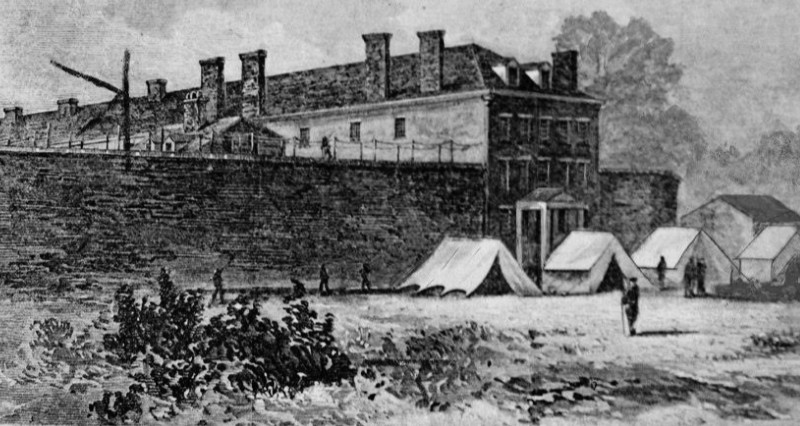
Washington Arsenal Penitentiary, Washington, D.C., 1865 (Joseph Hanshew, public domain; click to enlarge).

Sometime after their arrival at Camp Brightwood during that fateful spring of 1865, a group of 47th Pennsylvania Veteran Volunteers were given a new assignment — guard duty at the Washington Arsenal and its prison facility, where eight people were being held in connection with their involvement in the assassination of President Abraham Lincoln. They had been arrested between April 17 and 26.

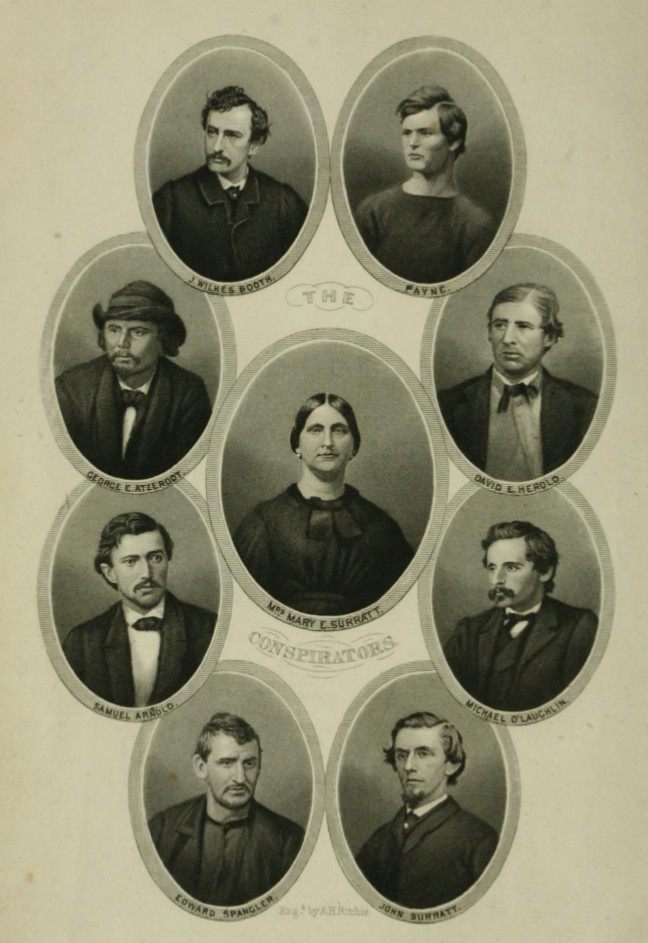
The key conspirators involved in President Abraham Lincoln’s assassination (Benn Pitman, The Assassination of President Lincoln and the Trial of the Conspirators,” 1865, U.S. Library of Congress, public domain).

While researchers for 47th Pennsylvania Volunteers: One Civil War Regiment’s Story have not yet determined the exact start date of the 47th Pennsylvania’s guard duties at the Washington Arsenal Penitentiary, they are now able to offer a better estimate — thanks to the work of Lincoln scholars Edward Steers, Jr. and Harold Holzer, who published documents written by Union Major-General John Frederick Hartranft, the Pennsylvanian appointed by U.S. President Andrew Johnson on May 1, 1865 “to command the military prison at the Washington Arsenal, where the U.S. government had just incarerated the seven men and one woman accused of complicity in the shooting.” Included in the Steers-Holzer compilation is a letter from Major-General Hartranft, governor and commander of the “Washington Arsenal Military Prison,” to Major-General Winfield S. Hancock, commanding officer of the United States Middle Military Division, which was dated May 11, 1865. Hartranft began by informing Hancock that “at 10:25 yesterday [May 10, 1865], Lt. Col. J. M. Clough, 18th N. H. reported with 450 muskets, for four days duty, relieving the 47th Pa. Vols.” He then went on to describe the duties performed by 18th New Hampshire Volunteers at the Washington Arsenal on May 10:

At 11:45, the prisoners on trial were taken into Court, in compliance with the orders of the same. At 1 P.M. the Court ordered the prisoners returned to their cells, which was done.

At 1:10 P.M. dinner was served to the prisoners in the usual manner.

At 1:30 in compliance with your orders Marshal McPhail was admitted to see the prisoner in 161 [Atzerodt], his hood having been previously removed; he remained with him until 2.35, immediately after which his hood was replaced and the door locked.

At 3:45 P.M. Mr. George L. Crawford in accordance with your instructions, was permitted to have an interview with prisoner in 209. I was present during the same, and heard all that was said. The conversation was in regard to the property of the prisoner in Philadelphia. At 4:25 the hood was replaced and the cell locked.

At 6 P.M. Supper was furnished the prisoners and at the same time Dr. Porter and myself made inspections of all the cells and prisoners.

At 6 P.M. in accordance with your instructions, Mr. Stone, counsel for Dr. Mudd, was permitted to visit his client. The interview took place in the presence of Lt. Col. McCall but not in his hearing.

At 6:35 the interview closed, and the door was again locked.

At 7 this A.M. breakfast was served to the prisoners in the usual manner. At 7:15, Dr. Porter and myself made Inspections of all the cells and prisoners.

I would respectfully recommend that the prisoner in 190 be removed to cell 165.

All passes admitting persons during the last 24 hours are here with enclosed.

As a result, researchers for the 47th Pennsylvania Volunteers’ project postulate that:

  1. As many as four hundred and fifty 47th Pennylvania Veteran Volunteer Infantrymen may have been stationed at the Washington Arsenal between May 6-10, 1865; and
  2. At least some of those 47th Pennsylvanians may very well have interacted with the key Lincoln assassination conspirators (Samuel Bland Arnold, George A. Atzerodt, David E. Herold, Dr. Samuel Alexander Mudd, Michael O’Laughlen, Lewis Thornton Powell/Lewis Payne, Edman Spangler/Ned Spangler, and Mary Elizabeth Surratt) — interactions which likely took place while those eight prisoners were confined at the Washington Arsenal prison; on the way to and from the courtroom, where they were being tried for conspiring to assassinate President Lincoln; inside that courtroom during trial proceedings; and possibly also at other sites related to their confinement and trial.

Although the duties performed between by 47th Pennsylvania Volunteers between May 6-9 would not have been exactly the same as those performed by the New Hampshire soldiers on May 10, they may very well have been similar — meaning that at least some 47th Pennsylvania Volunteers may have been involved in locking and unlocking the doors of the conspirators’ cells, escorting the conspirators into the courtroom of their military trial (which began on May 9, 1865), standing guard over the conspirators during their trial to prevent their escape, escorting them from the courtroom, and interacting with them in their cells by:

  • Bringing meals to them;
  • Removing and replacing the hoods that covered their heads so that they could interact with their lawyers and other visitors;
  • Verifying the legitimacy of passes held by would-be visitors and denying or granting access to those visitors as appropriate;
  • Escorting visitors to and from their cells; and
  • Monitoring their visits with anyone granted entry to their cells.

With their guard assignment completed by the morning of May 10, 1865, the 47th Pennsylvania Volunteers who were serving on detached duty at the Washington Arsenal were marched back to Camp Brightwood, where they would remain until their next assignment — participating in the Union’s Grand Review of the National Armies on May 23, 1865.

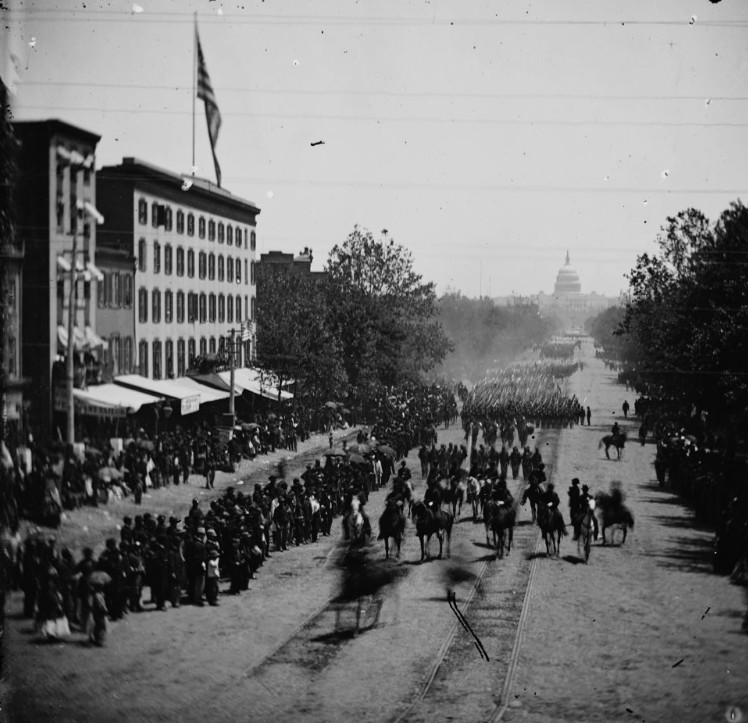
19th Corps, Army of the United States, Grand Review of the National Armies, Pennsylvania Avenue, Washington, D.C., May 23, 1865 (Matthew Brady, U.S. Library of Congress, public domain).

The Grandest of the Grand Reviews

The 47th Pennsylvania Veteran Volunteer Infantry was just one group of the more than one hundred and forty-five thousand Union military men who marched from Capitol Hill through the streets of Washington, D.C. during a two-day spectacle designed to celebrate the end of the American Civil War and heal Americans’ heartbreak in the wake of President Lincoln’s assassination. Held from May 23-24, 1865, it was a sight that had never been seen before — and one that would likely never be seen anywhere in the United States of America ever again. The first day’s parade alone lasted six hours.

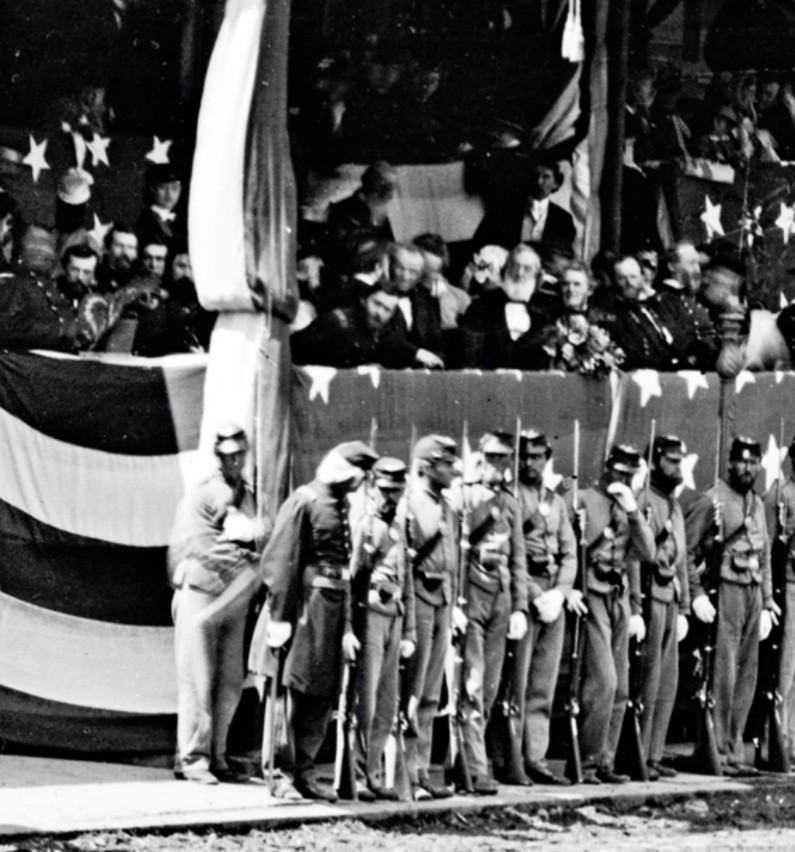
Lieutenant-General Ulysses S. Grant, leaning forward, President Andrew Johnson to his left, Grand Review of the National Armies, Washington, D.C., May 23, 1865 (U.S. Library of Congress, public domain).

According to The New York Times, the 47th Pennsylvanians were positioned behind the parade’s third division, as part of the Nineteenth Army Corps (XIX Corps) in Dwight’s Division. Marching with the precision for which they had become renowned, they passed in front of a review stand which sheltered U.S. President Andrew Johnson, Secretary of War Edwin M. Stanton and Lieutenant-General Ulysses S. Grant. The division directly behind the 47th Pennsylvanians in that day’s line of march included other officers and general staff of the Army of the United States and regiments commanded by American Civil War icon Brigadier-General Joshua L. Chamberlain, one of the most beloved heroes from the tide-turning Battle of Gettysburg.

Rev. William DeWitt Clinton Rodrock, chaplain, 47th Pennsylvania Volunteers (courtesy of Robert Champlin, used with permission).

Afterward, 47th Pennsylvania Chaplain William DeWitt Clinton Rodrock summed up the experience in a report penned at Camp Brightwood on May 31:

The wise king of the Scriptures speaks of a sorrow that pervades the human heart “in the midst of laughter.” The truthfulness of this Divine philosophy is a matter of daily experience. Our most joyous seasons are intermingled with a sadness that often challenges definition. Every garden has its sepulchre. Every draft of sweet has its ingredient of bitter. This fact has never been so fully realized as this month. With the mighty army of brave soldiers congregated and reviewed in Washington and the … expressions of deep regret that Abraham Lincoln is not here to have witnessed the great pageant of the 23rd and 24th inst. have been universal. Not the splendid victories which our brave soldiers have won — not the pleasing prospect that they are “homeward bound” — not the consolatory thought that the reins of government have fallen into the hands of so good a man as Andrew Johnson — have served to restrain these utterances of grief and sorrow. Had it been God’s will to spare Mr. Lincoln’s life, what an eclat his presence would have imparted to the mighty pageant.

But as He willed otherwise and “doeth all things well,” it is ours to learn the great lesson of the hour.

Rebuilding a Shattered Nation

Ruins of Charleston, South Carolina as seen from the Circular Church, 1865 (U.S. National Archives and Records Administration, public domain).

As the cheers of the Grand Review crowds faded, the 47th Pennsylvania Veteran Volunteers resumed life at Camp Brightwood, with many assuming that their days of wearing “Union Blue” were finally coming to an end. But that assumption proved to be an incorrect one when the 47th Pennsylvania Veteran Volunteers received word that they were being reassigned. Ordered to pack their belongings in late May 1865, they would be heading back to America’s Deep South — this time to assist with Reconstruction duties in Georgia and South Carolina, beginning the first week in June.


Sources:

  1. Assassination of President Abraham Lincoln.” Washington, D.C.: U.S. Library of Congress, retrieved online May 21, 2025.
  2. Bates, Samuel P. History of Pennsylvania Volunteers, 1861-5, vol. 1. Harrisburg, Pennsylvania: B. Singerly, State Printer, 1869.
  3. Battleground National Cemetery: Battleround to Community — Brightwood Heritage Trail,” “Fort Stevens” and “Mayor Emery and the Union Army.” United States: Historical Marker Database, retrieved online May 20, 2025.
  4. “Battleground to Community: Brightwood Heritage Trail.” Washington, D.C.: Cultural Tourism DC, 2008.
  5. “Grand Military Review: Streets Crowded with Spectators: Sherman Greeted with Deafening Cheers.” Pittsburgh, Pennsylvania: The Daily Post, May 25, 1865.
  6. Grant” (television mini-series). New York, New York: History Channel Education, 2020.
  7. “Our Heroes! The Grand Review at Washington. Honor to the Brave. Immense Outpouring of the People. The Troops Reviewed by Gen. Grant.” Harrisburg, Pennsylvania: Daily Telegraph, May 23, 1865.
  8. Pitman, Benn. The Assassination of President Abraham Lincoln and the Trial of the Conspirators. Cincinnati, Ohio and New York, New York: Moore, Wilstach & Boldwin, 1865.
  9. Reconstruction: An Overview.” Washington, D.C.: American Battlefield Trust, November 28, 2023.
  10. Review of the Armies; Propitious Weather and a Splendid Spectacle. Nearly a Hundred Thousand Veterans in the Lines.” New York, New York: The New York Times, May 24, 1865, front page.
  11. Rodrock, Rev. William D. C. Chaplain’s Reports (47th Pennsylvania Volunteer Infantry, 1865). Washington, D.C.: U.S. National Archives and Records Administration.
  12. Schmidt, Lewis. A Civil War History of the 47th Regiment of Pennsylvania Veteran Volunteers. Allentown, Pennsylvania: Self-published, 1986.
  13. “Serenade to General Grant” (performance for Lieutenant-General Ulysses S. Grant by the 47th Pennsylvania Veteran Volunteers’ Regimental Band), in “Washington.” Philadelphia, Pennsylvania: The Inquirer, May 22, 1865.
  14. Steers, Edward Jr. and Harold Holzer. The Lincoln Assassination Conspirators: Their Confinement and Execution, as Recorded in the Letterbook of John Frederick Hartranft. Baton Rouge, Louisiana, 2009.
  15. The Final March: Grand Review of the Armies.” Washington, D.C.: U.S. National Park Service, retrieved online May 20, 2025.
  16. “The Grand Review: A Grand Spectacle Witnessed.” Pittsburgh, Pennsylvania: The Daily Post, May 24, 1865.
  17. “The Grand Review: Immense Crowds in Washington: Fine Appearance of the Troops: Their Enthusiastic Reception.” Harrisburg, Pennsylvania: Pennsylvania Daily Telegraph, May 24, 1865; and West Chester, Pennsylvania: The Record, May 17, 1865.
  18. “The Grand Review: The City Crowded with Visitors: Order of Corps, Divisions, Brigades and Regiments.” Philadelphia, Pennsylvania: Daily Constitutional Union, May 23, 1865.
  19. “The History of the Forty-Seventh Regt. P. V.” Allentown, Pennsylvania: The Lehigh Register, 20 July 1870.
  20. The Lincoln Conspirators,” in “Ford’s Theatre.” Washington, D.C.: U.S. National Park Service, retrieved online May 21, 2025.