Black History Month: Paving the Way for the Integration of the Union Army

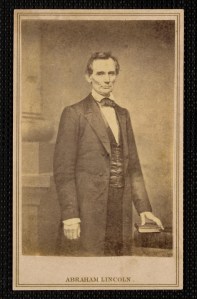
Abraham Lincoln in New York City on Monday morning, February 27, 1860, several hours before he delivered his Cooper Union address (Matthew Brady, U.S. Library of Congress, public domain).

Acutely aware that Union military casualty figures had continued to climb as the American Civil War moved into and through its second year, President Abraham Lincoln and his senior military advisors soon realized that more drastic measures would need to be taken—and far more volunteer soldiers would need to be recruited if they were to ever begin healing their divided nation.

During the summer of 1862, President Lincoln kicked off that series of drastic measures by issuing his July 2 call for volunteers in which he pressed state governors of Connecticut, Maine, New Hampshire, Illinois, Indiana, Maryland, Michigan, Minnesota, Missouri, New Jersey, New York, Ohio, Pennsylvania, Vermont, Virginia, Tennessee, and Wisconsin, as well as the president of the Military Board of Kentucky, to furnish an additional three hundred thousand men for military service. That action was followed by the passage, two weeks later, of the Militia Act of 1862 on July 17, through which the U.S. Congress empowered Lincoln to “make all necessary rules and regulations to provide for enrolling the militia,” and also authorized state and federal military units in Union-held territories to recruit and enroll enslaved and free Black men to fill labor-related jobs.

Starting on July 17, according to section twelve of that legislation, President Lincoln was “authorized to receive into the service of the United States, for the purpose of constructing intrenchments, or performing camp service or any other labor, or any military or naval service for which they may be found competent, persons of African descent.” In addition, the new law’s next section specified that “when any man or boy of African descent, who by the laws of any State shall owe service or labor to any person who, during the present rebellion, has levied war or has borne arms against the United States, or adhered to their enemies by giving them aid and comfort, shall render any such service as is provided for in this act, he, his mother and his wife and children, shall forever thereafter be free, any law, usage, or custom whatsoever to the contrary notwithstanding: Provided, That the mother, wife and children of such man or boy of African descent shall not be made free by the operation of this act except where such mother, wife or children owe service or labor to some person who, during the present rebellion, has borne arms against the United States or adhered to their enemies by giving them aid and comfort.”

The subsequent two sections of this act then spelled out how the newly enlisted Black soldiers would be compensated for their work, stating that “the expenses incurred to carry this act into effect shall be paid out of the general appropriation for the army and volunteers,” and that “all persons who have been or shall be hereafter enrolled in the service of the United States under this act shall receive the pay and rations now allowed by law to soldiers, according to their respective grades: Provided, That persons of African descent, who under this law shall be employed, shall receive ten dollars per month and one ration, three dollars of which monthly pay may be in clothing.”

Adding More Teeth to the Fight’s Bite

That same day (July 17 1862), the U.S. Congress then also passed the Confiscation Act of 1862, proclaiming that “every person who shall hereafter commit the crime of treason against the United States, and shall be adjudged guilty thereof, shall suffer death, and all his slaves, if any, shall be declared and made free.”

A subsequent push that same summer by President Lincoln and his senior military advisors to state leaders to furnish an additional three hundred thousand men—for a revised total of six hundred thousand new volunteer soldiers—resulted in the enlistment of more than half a million men—with an additional ninety thousand troops added to Union rosters through the implementation of a nationwide draft.

Freeing More Enslaved Men and Enabling Them to Enlist
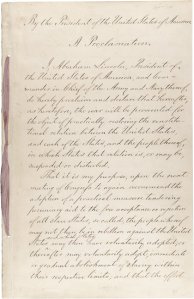
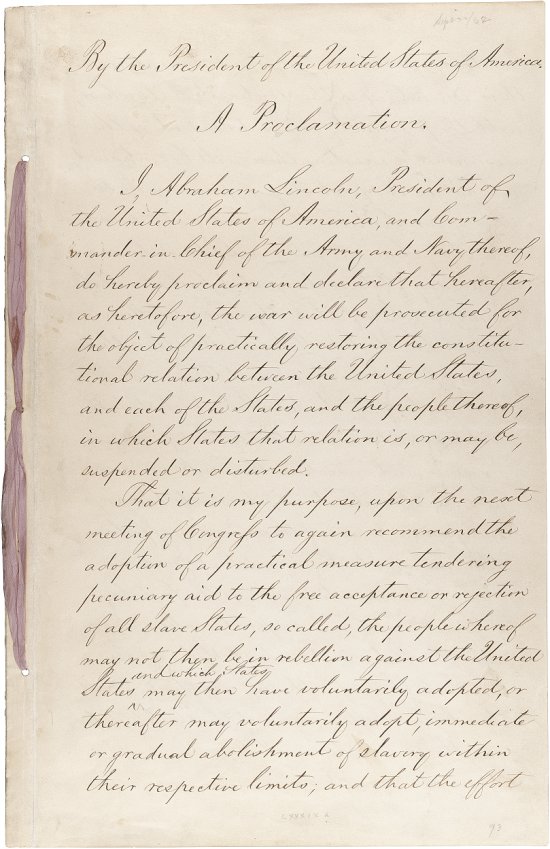
Page one of the Preliminary Emancipation Proclamation issued by President Abraham Lincoln, September 22, 1862 (U.S. National Archives and Records Administration, public domain; click to enlarge).

President Lincoln followed up his blistering recruitment drive of the summer of 1862 by adding even more support for his plan to increase federal troop strength by issuing his Preliminary Emancipation Proclamation on September 22, 1862. Giving a preview of what he intended to do in 1863 if Confederate States officials failed to cease hostilities and rejoin the Union, he began paving the road for Union regiments to rescue and recruit larger numbers of enslaved men:

By the President of the United States of America.
A Proclamation.

I, Abraham Lincoln, President of the United States of America, and Commander-in-Chief of the Army and Navy thereof, do hereby proclaim and declare that hereafter, as heretofore, the war will be prosecuted for the object of practically restoring the constitutional relation between the United States, and each of the States, and the people thereof, in which States that relation is, or may be, suspended or disturbed.

That it is my purpose, upon the next meeting of Congress to again recommend the adoption of a practical measure tendering pecuniary aid to the free acceptance or rejection of all slave States, so called, the people whereof may not then be in rebellion against the United States and which States may then have voluntarily adopted, or thereafter may voluntarily adopt, immediate or gradual abolishment of slavery within their respective limits; and that the effort to colonize persons of African descent, with their consent, upon this continent, or elsewhere, with the previously obtained consent of the Governments existing there, will be continued.

That on the first day of January in the year of our Lord, one thousand eight hundred and sixty-three, all persons held as slaves within any State, or designated part of a State, the people whereof shall then be in rebellion against the United States shall be then, thenceforward, and forever free; and the executive government of the United States, including the military and naval authority thereof, will recognize and maintain the freedom of such persons, and will do no act or acts to repress such persons, or any of them, in any efforts they may make for their actual freedom.

That the executive will, on the first day of January aforesaid, by proclamation, designate the States, and part of States, if any, in which the people thereof respectively, shall then be in rebellion against the United States; and the fact that any State, or the people thereof shall, on that day be, in good faith represented in the Congress of the United States, by members chosen thereto, at elections wherein a majority of the qualified voters of such State shall have participated, shall, in the absence of strong countervailing testimony, be deemed conclusive evidence that such State and the people thereof, are not then in rebellion against the United States.

That attention is hereby called to an Act of Congress entitled ‘An Act to make an additional Article of War’ approved March 13, 1862, and which act is in the words and figure following:

‘Be it enacted by the Senate and House of Representatives of the United States of America in Congress assembled, That hereafter the following shall be promulgated as an additional article of war for the government of the army of the United States, and shall be obeyed and observed as such:

Article-All officers or persons in the military or naval service of the United States are prohibited from employing any of the forces under their respective commands for the purpose of returning fugitives from service or labor, who may have escaped from any persons to whom such service or labor is claimed to be due, and any officer who shall be found guilty by a court martial of violating this article shall be dismissed from the service.

Sec.2. And be it further enacted, That this act shall take effect from and after its passage.

Also to the ninth and tenth sections of an act entitled ‘An Act to suppress Insurrection, to punish Treason and Rebellion, to seize and confiscate property of rebels, and for other purposes,’ approved July 17, 1862, and which sections are in the words and figures following:

Sec.9. And be it further enacted, That all slaves of persons who shall hereafter be engaged in rebellion against the government of the United States, or who shall in any way give aid or comfort thereto, escaping from such persons and taking refuge within the lines of the army; and all slaves captured from such persons or deserted by them and coming under the control of the government of the United States; and all slaves of such persons found on (or) being within any place occupied by rebel forces and afterwards occupied by the forces of the United States, shall be deemed captives of war, and shall be forever free of their servitude and not again held as slaves.

Sec.10. And be it further enacted, That no slave escaping into any State, Territory, or the District of Columbia, from any other State, shall be delivered up, or in any way impeded or hindered of his liberty, except for crime, or some offence against the laws, unless the person claiming said fugitive shall first make oath that the person to whom the labor or service of such fugitive is alleged to be due is his lawful owner, and has not borne arms against the United States in the present rebellion, nor in any way given aid and comfort thereto; and no person engaged in the military or naval service of the United States shall, under any pretence whatever, assume to decide on the validity of the claim of any person to the service or labor of any other person, or surrender up any such person to the claimant, on pain of being dismissed from the service.’

And I do hereby enjoin upon and order all persons engaged in the military and naval service of the United States to observe, obey, and enforce, within their respective spheres of service, the act, and sections above recited.

And the executive will in due time recommend that all citizens of the United States who shall have remained loyal thereto throughout the rebellion, shall (upon the restoration of the constitutional relation between the United States, and their respective States, and people, if that relation shall have been suspended or disturbed) be compensated for all losses by acts of the United States, including the loss of slaves.

In witness whereof, I have hereunto set my hand, and caused the seal of the United States to be affixed.

Done at the City of Washington this twenty-second day of September, in the year of our Lord, one thousand, eight hundred and sixty-two, and of the Independence of the United States the eighty seventh.

[Signed:] Abraham Lincoln
By the President

[Signed:] William H. Seward
Secretary of State

Page one of the Emancipation Proclamation issued by U.S. President Abraham Lincoln, January 1, 1863 (U.S. National Archives and Records Administration, public domain; click to enlarge).

When those state officials failed to comply, President Lincoln officially issued the Emancipation Proclamation on January 1, 1863:

By the President of the United States of America:
A Proclamation.

Whereas, on the twenty-second day of September, in the year of our Lord one thousand eight hundred and sixty-two, a proclamation was issued by the President of the United States, containing, among other things, the following, to wit:

‘That on the first day of January, in the year of our Lord one thousand eight hundred and sixty-three, all persons held as slaves within any State or designated part of a State, the people whereof shall then be in rebellion against the United States, shall be then, thenceforward, and forever free; and the Executive Government of the United States, including the military and naval authority thereof, will recognize and maintain the freedom of such persons, and will do no act or acts to repress such persons, or any of them, in any efforts they may make for their actual freedom.

That the Executive will, on the first day of January aforesaid, by proclamation, designate the States and parts of States, if any, in which the people thereof, respectively, shall then be in rebellion against the United States; and the fact that any State, or the people thereof, shall on that day be, in good faith, represented in the Congress of the United States by members chosen thereto at elections wherein a majority of the qualified voters of such State shall have participated, shall, in the absence of strong countervailing testimony, be deemed conclusive evidence that such State, and the people thereof, are not then in rebellion against the United States.’

Now, therefore I, Abraham Lincoln, President of the United States, by virtue of the power in me vested as Commander-in-Chief, of the Army and Navy of the United States in time of actual armed rebellion against the authority and government of the United States, and as a fit and necessary war measure for suppressing said rebellion, do, on this first day of January, in the year of our Lord one thousand eight hundred and sixty-three, and in accordance with my purpose so to do publicly proclaimed for the full period of one hundred days, from the day first above mentioned, order and designate as the States and parts of States wherein the people thereof respectively, are this day in rebellion against the United States, the following, to wit:

Arkansas, Texas, Louisiana, (except the Parishes of St. Bernard, Plaquemines, Jefferson, St. John, St. Charles, St. James Ascension, Assumption, Terrebonne, Lafourche, St. Mary, St. Martin, and Orleans, including the City of New Orleans) Mississippi, Alabama, Florida, Georgia, South Carolina, North Carolina, and Virginia, (except the forty-eight counties designated as West Virginia, and also the counties of Berkley, Accomac, Northampton, Elizabeth City, York, Princess Ann, and Norfolk, including the cities of Norfolk and Portsmouth[)], and which excepted parts, are for the present, left precisely as if this proclamation were not issued.

And by virtue of the power, and for the purpose aforesaid, I do order and declare that all persons held as slaves within said designated States, and parts of States, are, and henceforward shall be free; and that the Executive government of the United States, including the military and naval authorities thereof, will recognize and maintain the freedom of said persons.

And I hereby enjoin upon the people so declared to be free to abstain from all violence, unless in necessary self-defence; and I recommend to them that, in all cases when allowed, they labor faithfully for reasonable wages.

And I further declare and make known, that such persons of suitable condition, will be received into the armed service of the United States to garrison forts, positions, stations, and other places, and to man vessels of all sorts in said service.

And upon this act, sincerely believed to be an act of justice, warranted by the Constitution, upon military necessity, I invoke the considerate judgment of mankind, and the gracious favor of Almighty God.

In witness whereof, I have hereunto set my hand and caused the seal of the United States to be affixed.

Done at the City of Washington, this first day of January, in the year of our Lord one thousand eight hundred and sixty three, and of the Independence of the United States of America the eighty-seventh.

By the President: ABRAHAM LINCOLN

WILLIAM H. SEWARD, Secretary of State.

Adding More Teeth to the Fight’s Bite
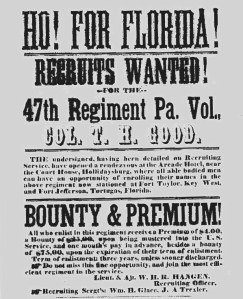
This Civil War-era recruiting flyer documents the service of the 47th Pennsylvania Volunteer Infantry at Forts Taylor and Jefferson, Florida, under the leadership of Colonel Tilghman Good, as well as the premium and bounty added to standard pay to inspire more men to enlist (public domain).

Just over a month later, in February 1863, the United States Congress passed U.S. Senate Bill 511 (“An act for enrolling and calling out the national forces, and for other purposes”). Better known as the Enrollment Act of 1863 or “Conscription Act,” it was signed into law by President Lincoln on 3 March 1863, and gave state officials throughout the north the ability to draft men to serve whenever those officials were unable to meet their federal troop quotas through volunteer recruitment drives. It also allowed draftees to recruit others to muster in and serve for them.

Whereas there now exist in the United States an insurrection and rebellion against the authority thereof, and it is, under the Constitution of the United States, the duty of the government to suppress insurrection and rebellion, to guarantee to each State a republican form of government, and to preserve the public tranquility; and whereas, for these high purposes, a military force is indispensable, to raise and support which all persons ought willingly to contribute; and whereas no service can be more praiseworthy and honorable than that which is rendered for the maintenance of the Constitution and Union, and the consequent preservation of free government: Therefore—

Be it enacted by the Senate and House of Representatives of the United States of America in Congress assembled, That all able-bodied male citizens of the United States, and persons of foreign birth who shall have declared on oath their intention to become citizens under and in pursuance of the laws thereof, between the ages of twenty and forty-five years, except as hereinafter excepted, are hereby declared to constitute the national forces, and shall be liable to perform military duty in the service of the United States when called out by the President for that purpose.

SEC 2. And be it further enacted, That the following persons be, and they are hereby, excepted and exempt from the provisions of this act, and shall not be liable to military duty under the same, to wit: Such as are rejected as physically or mentally unfit for the service; also, First the Vice-President of the United States, the judges of the various courts of the United States, the heads of the various executive departments of the government, and the governors of the several States. Second, the only son liable to military duty of a widow dependent upon his labor for support. Third, the only son of aged or infirm parent or parents dependent upon his labor for support. Fourth, where there are two or more sons of aged or infirm parents subject to draft, the father, or, if he be dead, the mother, may elect which son shall be exempt. Fifth, the only brother of children not twelve years old, having neither father nor mother dependent upon his labor for support. Sixth, the father of motherless children under twelve years of age dependent upon his labor for support. Seventh, where there are a father and sons in the same family and household, and two of them are in the military service of the United States as non-commissioned officers, musicians, or privates, the residue of such family and household, not exceeding two, shall be exempt. And no persons but such as are herein excepted shall be exempt: Provided, however, That no person who has been convicted of any felony shall be enrolled or permitted to serve in said forces.

SEC. 3. And be it further enacted, That the national forces of the United States not now in the military service, enrolled under this act, shall be divided into two classes: the first of which shall comprise all persons subject to do military duty between the ages of twenty and thirty-five years, and all unmarried persons subject to do military duty above the age of thirty-five and under the age of forty-five; the second class shall comprise all other persons subject to do military duty, and they shall not, in any district, be called into the service of the United States until those of the first class hall have been called.

SEC. 4. And be it further enacted, That, for greater convenience in enrolling, calling out, and organizing the national forces, and for the arrest of deserters and spies of the enemy, the United States shall constitute one or more, as the President shall direct, and each congressional district of the respective states, as fixed by a law of the state next preceding the enrolment, shall constitute one: Provided, That in states which have not by their laws been divided into two or more congressional districts, the President of the United States shall divide the same into so many enrolment districts as he may deem fit and convenient.

SEC 8. And be it further enacted, That in each of said districts there shall be a board of enrolment, to be composed of the provost-marshal, as president, and two other persons, to be appointed by the President of the United States, one of whom shall be a licensed and practising physician and surgeon.

SEC. 10. And be it further enacted, That the enrolment of each class shall be made separately, and shall only embrace those whose ages shall be on the first day of July thereafter between twenty and forty-five years.

SEC. 11. And be it further enacted, That all persons thus enrolled shall be subject, for two years after the first day of July succeeding the enrolment, to be called into the military service of the United States, and to continue in service during the present rebellion, not, however, exceeding the term of three years; and when called into service shall be placed on the same footing, in all respects, as volunteers for three years, or during the war, including advance pay and bounty as now provided by law.

SEC. 12. And be it further enacted, That whenever it may be necessary to call out the national forces for military service, the President is hereby authorized to assign to each district the number of men to be furnished by said district; and thereupon the enrolling board shall, under the direction of the President, make a draft of the required number, and fifty per cent, in addition, and shall make an exact and complete roll of the names of the person so drawn, and of the order in which they are drawn, so that the first drawn may stand first upon the said roll and the second may stand second, and so on; and the persons so drawn shall be notified of the same within ten days thereafter, by a written or printed notice, to be served personally or by leaving a copy at the last place of residence, requiring them to appear at a designated rendezvous to report for duty. In assigning to the districts the number of men to be furnished therefrom, the President shall take into consideration the number of volunteers and militia furnished by and from the several states in which said districts are situated, and the period of their service since the commencement of the present rebellion, and shall so make said assignment as to equalize the numbers among the districts of the several states, considering and allowing for the numbers already furnished as aforesaid and the time of their service.

SEC. 13. And be it further enacted, That any person drafted and notified to appear as aforesaid, may, on or before the day fixed for his appearance, furnish an acceptable substitute to take his place in the draft; or he may pay to such person as the Secretary of War may authorize to receive it, such sum, not exceeding three hundred dollars, as the Secretary may determine, for the procuration of such substitute; which sum shall be fixed at a uniform rate by a general order made at the time of ordering a draft for any state or territory; and thereupon such person so furnishing the substitute, or paying the money, shall be discharged from further liability under that draft. And any person failing to report after due service of notice, as herein prescribed, without furnishing a substitute, or paying the required sum therefor, shall be deemed a deserter, and shall be arrested by the provost-marshal and sent to the nearest military post for trial by court-martial, unless, upon proper showing that he is not liable to do military duty, the board of enrolment shall relive him from the draft.

SEC. 16. And be it further enacted, That as soon as the required number of able-bodied men liable to do military duty shall be obtained from the list of those drafted, the remainder shall be discharged; and all drafted persons reporting at the place of rendezvous shall be allowed travelling pay from their places of residence; and all persons discharged at the place of rendezvous shall be allowed travelling pay to their places of residence; and all expenses connected with the enrolment and draft, including subsistence while at the rendezvous, shall be paid form the appropriation for enrolling and drafting, under such regulations as the President of the United States shall prescribe; and all expenses connected with the arrest and return of deserters to their regiments, or such other duties as the provost-marshal shall be called upon to perform, shall be paid from the appropriation for arresting deserters, under such regulations as the President of the United States shall prescribe: Provided, The provost-marshals shall in no case receive commutation for transportation or for fuel and quarters, but only for forage, when not furnished by the government, together with actual expenses of postage, stationery, and clerk hire authorized by the provost-marshal-general.

SEC. 17. And be it further enacted, That any person enrolled and drafted according to the provisions of this act who shall furnish an acceptable substitute, shall thereupon receive from the board of enrolment a certificate of discharge from such draft, which shall exempt him from military duty during the time for which he was drafted; and such substitute shall be entitled to the same pay and allowances provided by law as if he had been originally drafted into the service of the United States.

SEC. 18. And be it further enacted, That such of the volunteers and militia now in the service of the United States as may reenlist to serve one year, unless sooner discharged, after the expiration of their present term of service, shall be entitled to a bounty of fifty dollars, one half of which to be paid upon such reenlistment, and the balance at the expiration of the term of reenlistment; and such as may reenlist to serve for two years, unless sooner discharged, after the expiration of their present term of enlistment, shall receive, upon such reenlistment, twenty-five dollars of the one hundred dollars bounty for enlistment provided by the fifth section of the act approved twenty-second of July, eighteen hundred and sixty-one, entitled “An act to authorize the employment of volunteers to aid in enforcing the laws and protecting public property.”

SEC. 25. And be it further enacted, That if any person shall resist any draft of men enrolled under this act into the service of the United States, or shall counsel or aid any person to resist any such draft; or shall counsel or aid any person to resist any such draft; or shall assault or obstruct any officer in making such draft, or in the performance of any service in relation thereto; or shall counsel any person to assault or obstruct any such officer, or shall counsel any drafted men not to appear at the place of rendezvous, or wilfully dissuade them from the performance of military duty as required by law, such person shall be subject to summary arrest by the provost-marshal, and shall be forthwith delivered to the civil authorities, and upon conviction thereof, be punished by a fine not exceeding five hundred dollars, or by imprisonment not exceeding two years, or by both of said punishments.

SEC. 33. And be it further enacted, That the President of the United States is hereby authorized and empowered, during the present rebellion, to call forth the national forces, by draft, in the manner provided for in this act.

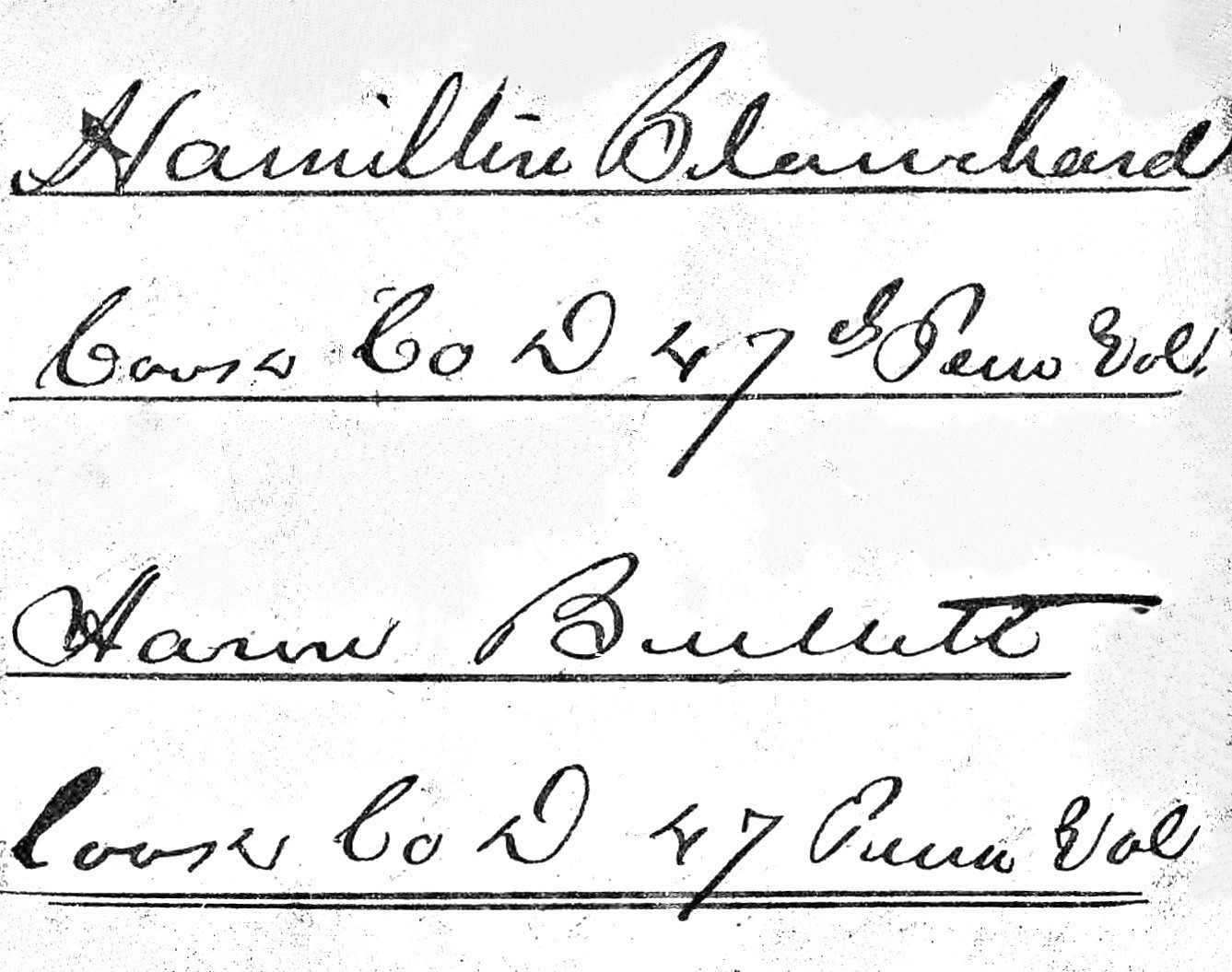
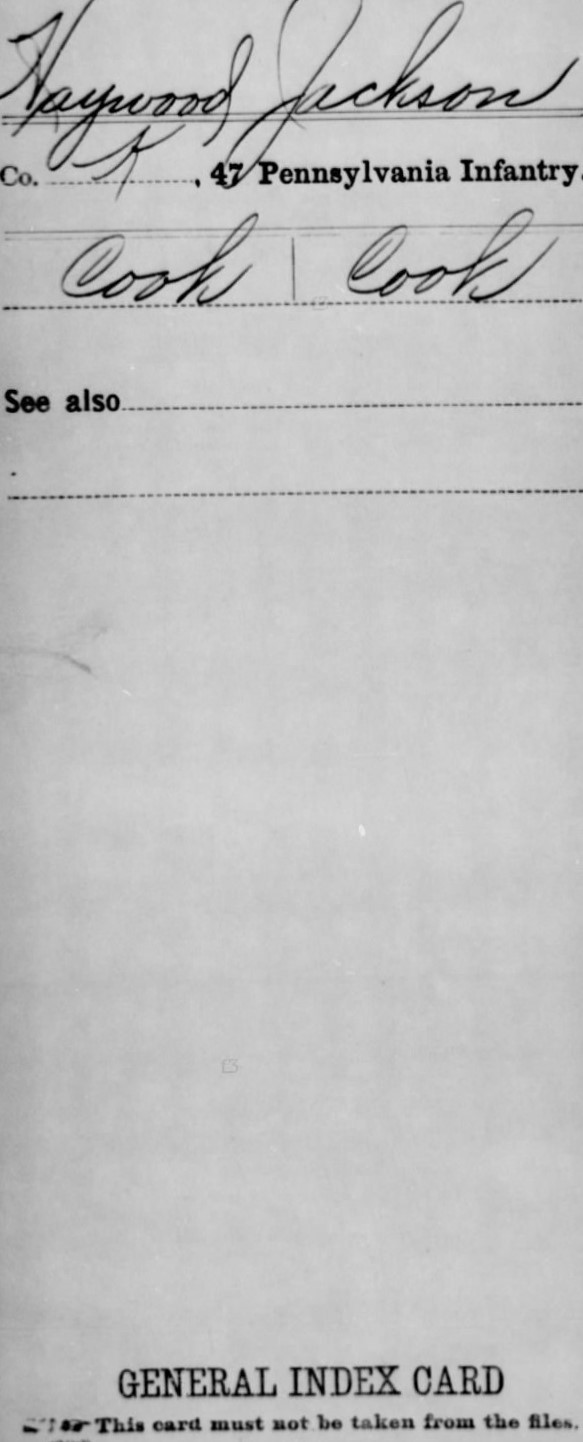
Those combined actions by President Lincoln and the U.S. Congress enabled the officers of the 47th Pennsylvania Volunteer Infantry to enroll the first four of nine formerly enslaved men in their regiment in early October 1862 while it was stationed in Beaufort, South Carolina—and then enabled the regiment’s officers to enroll five more formerly enslaved men in early April 1864 while the 47th Pennsylvania Volunteers were stationed in Natchitoches, Louisiana.

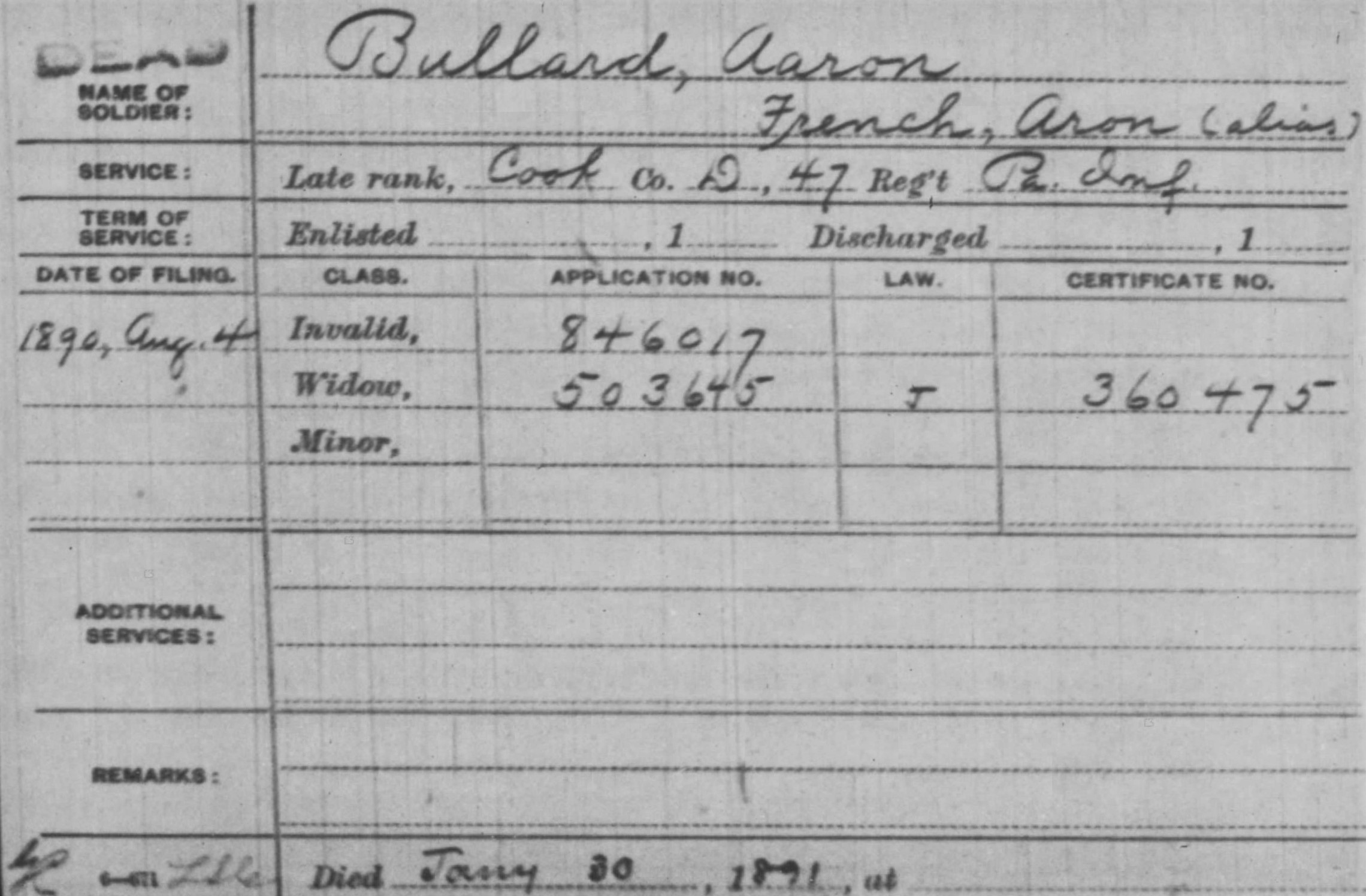
Initially assigned the rank of “Under-Cook,” and entered on regimental muster rolls below the names of the men who had enrolled at the rank of private, several of these nine formerly enslaved men were later awarded the rank of private, according to subsequent regimental records. After completing their respective terms of enlistment, all but one were honorably discharged during the fall of 1865 with several also being awarded U.S. Civil War Pensions in later life. Their life stories are now being documented on the website, Faces of the 47th: Freedmen of the 47th Pennsylvania Volunteer Infantry.”

Next: Black History Month: The Authorization, Duties and Pay of “Under-cooks


Sources:

  1. An Act for enrolling and calling out the national Forces, and for other Purposes,” Congressional Record. 37th Cong. 3d. Sess. Ch. 74, 75. 1863. March 3, 1863.” New Haven, Connecticut: Gilder Lehrman Center for the Study of Slavery, Resistance, and Abolition at the Whitney and Betty MacMillan Center for International and Area Studies at Yale University, retrieved online February 1, 2024.
  2. Emancipation Proclamation, January 1, 1863,” in “Presidential Proclamations, 1791-1991” (Record Group 11: General Records of the United States Government). Washington, D.C.: U.S. National Archives and Records Administration.
  3. Preliminary Emancipation Proclamation, September 22, 1862,” in “Presidential Proclamation 93” (Record Group 11, vault, box 2: General Records of the U.S. Government). Washington, D.C.: U.S. National Archives and Records Administration.
  4. The Conscription Act.; Judge Cadwallader’s Opinion Establishing Its Constitutionality.” New York, New York: The New York Times, September 13, 1863.
  5. The Law of the Draft.; Important Circulars Issued by the Provost-Marshal General. No Escape After a Name is Enrolled. Penalties of a Failure to Respond The Treatment of Deserters. The Question of Exemptions.” New York, New York: The New York Times, July 19, 1863.


Research Update: Additional New Details Learned About Bristor Gethers, One of the Nine Formerly Enslaved Men Who Enlisted with the 47th Pennsylvania Volunteers

Page one of the U.S. Army’s Civil War enlistment paperwork for Bristor Gethers (mistakenly listed as “Presto Garris”), 47th Pennsylvania Volunteer Infantry, Company F, October 5, 1862 (U.S. National Archives and Records Administration, public domain; click to enlarge).

Fleeing the brutal experience of chattel slavery in Georgetown County, South Carolina, a thirty-three-year-old Black man was willing to enlist for military service in the fall of 1862 as an “undercook”—a designation within the United States Army that was first authorized by the U.S. War Department on September 28, 1863—in order to ensure his freedom in America’s Deep South during the American Civil War.

Arriving at a federal military recruiting depot in Union Army-occupied Beaufort, South Carolina, that man—Bristor Gethers—was certified as fit for duty by Dr. William Reiber, an assistant surgeon with the 47th Pennsylvania Volunteer Infantry, and was then accepted into that regiment on October 5, 1862 by Captain Henry Samuel Harte, a German immigrant who had been commissioned as the commanding officer of that regiment’s F Company.

The reason that officers of the 47th Pennsylvania Volunteer Infantry were able to enroll Bristor Gethers, along with three additional formerly enslaved men that fall (roughly three months before U.S. President Abraham Lincoln officially issued the nation’s Emancipation Proclamation), was because the U.S. Congress had previously passed the Militia Act of 1862 on July 17, 1862, which authorized state and federal military units in Union-held territories to recruit and enroll enslaved and free Black men to fill labor-related jobs.

According to section twelve of that legislation, starting on that date, President Lincoln was “authorized to receive into the service of the United States, for the purpose of constructing intrenchments, or performing camp service or any other labor, or any military or naval service for which they may be found competent, persons of African descent, and such persons shall be enrolled and organized under such regulations, not inconsistent with the Constitution and laws, as the President may prescribe” while the next three sections specified the following additional details of that military service:

SEC. 13. And be it further enacted, That when any man or boy of African descent, who by the laws of any State shall owe service or labor to any person who, during the present rebellion, has levied war or has borne arms against the United States, or adhered to their enemies by giving them aid and comfort, shall render any such service as is provided for in this act, he, his mother and his wife and children, shall forever thereafter be free, any law, usage, or custom whatsoever to the contrary notwithstanding: Provided, That the mother, wife and children of such man or boy of African descent shall not be made free by the operation of this act except where such mother, wife or children owe service or labor to some person who, during the present rebellion, has borne arms against the United States or adhered to their enemies by giving them aid and comfort.

SEC. 14. And be it further enacted, That the expenses incurred to carry this act into effect shall be paid out of the general appropriation for the army and volunteers.

SEC. 15. And be it further enacted, That all persons who have been or shall be hereafter enrolled in the service of the United States under this act shall receive the pay and rations now allowed by law to soldiers, according to their respective grades: Provided, That persons of African descent, who under this law shall be employed, shall receive ten dollars per month and one ration, three dollars of which monthly pay may be in clothing.

Seeking to add more teeth to its anti-slavery legislation, the U.S. Congress then also passed the Confiscation Act of 1862 that same day, proclaiming that “every person who shall hereafter commit the crime of treason against the United States, and shall be adjudged guilty thereof, shall suffer death, and all his slaves, if any, shall be declared and made free.”

General Orders No. 323 (enlistment and pay of undercooks of African descent), U.S. War Department and Office of the Adjutant General, September 28, 1863 (U.S. Library of Congress, public domain; click to enlarge).

By taking that important step toward securing what he hoped would be permanent freedom from the plantation enslavement he had endured in South Carolina for more than three decades, Bristor Gethers was, in reality, trading one form of backbreaking labor (slavery) for another that was only marginally better because he was entering military life as an “undercook”—a designation that placed him on the very bottom of the 47th Pennsylvania’s military rosters—beneath the names of soldiers who were listed at the rank of private or drummer boy.

His status clearly improved enough over time, though, that he was willing to stay with the 47th Pennsylvania Volunteer Infantry for nearly the entire duration of its service to the nation. Traveling with the 47th to Florida, where the regiment was stationed on garrison duty at Forts Taylor and Jefferson from late December 1862 through early February 1864, he likely participated side by side with the regiment’s white soldiers as they felled trees, built new roads and engaged in other similar tasks designed to strengthen the fortifications of those federal installations. It was during this same time that he would have learned from his commanding officer, Captain Harte, that President Abraham Lincoln had officially issued the Emancipation Proclamation on January 1, 1863 and that the U.S. War Department and Adjutant General’s Office had issued General Orders No. 323 on September 28th of that same year, which authorized all Union Army units “to cause to be enlisted for each cook [in each Union Army regiment] two under-cooks of African descent, who shall receive for their full compensation ten dollars per month and one ration per day” (three dollars of which could be issued to undercooks “in clothing,” rather than money).

Bristor Gethers was listed as a private on the final version of the Commonwealth of Pennsylvania’s “Registers of Volunteers, 1861-1865” for Company F of the 47th Pennsylvania Volunteer Infantry (Pennsylvania State Archives, public domain; click to enlarge and scroll down).

Promoted to the rank of Cook by the spring of 1863, according to regimental muster rolls, his duties were also likely expanded to include the job of caring for the regiment’s combat casualties by the spring and fall of 1864, when the 47th Pennsylvania was engaged in the Union’s 1864 Red River Campaign across Louisiana and the 1864 Shenandoah Valley Campaign across Virginia. In addition to rescuing and carrying wounded men from multiple fields of battle under fire as a stretcher bearer during this time, as many other undercooks in the Union Army were ordered to do, he may very well also have helped to dig the graves for his 47th Pennsylvania comrades who had been killed in action.

Apparently so well thought of by his superior officers, according to the regiment’s final muster-out ledgers, Bristor Gethers was ultimately accorded the rank of private—a hard-won title that, on paper in the present day, may seem as if it were a minor achievement.

It wasn’t. It was, in reality, historic.

About “Faces of the 47th: Freedmen of the 47th Pennsylvania Volunteer Infantry”

Faces of the 47th: Freedmen of the 47th Pennsylvania Volunteer Infantry is a special project of 47th Pennsylvania Volunteers: One Civil War Regiment’s Story, an educational program designed to teach children and adults about the history of the 47th Pennsylvania Veteran Volunteers, a Union Army regiment which served for nearly the entire duration of the American Civil War and became the only military unit from the Commonwealth of Pennsylvania to participate in the Union’s 1864 Red River Campaign across Louisiana.

This important initiative is dedicated to researching, documenting and presenting the life stories of nine formerly enslaved Black men who enlisted with the 47th Pennsylvania Volunteer Infantry during two of the regiment’s most eventful years of service to the nation—1862 and 1864. Largely forgotten for more than a century after honorably completing their historic military service, these nine men have been repeatedly overlooked by mainstream historians over the years as potentially important subjects for research and have also been an ongoing source of mystery and frustration to their descendants because the majority of their military service records have still not been digitized by state and national archives.

To learn more about the life of Bristor Gethers before, during and after the war, and to view his U.S. Civil War military and pension records, visit his profile on “Freedmen of the 47th Pennsylvania Volunteer Infantry.”


Sources:

  1. Berlin, Ira, Joseph P. Reidy, and Leslie S. Rowland. Freedom’s Soldiers: the Black Military Experience in the Civil War. Cambridge, United Kingdom: Cambridge University Press, 1998.
  2. Blight, David W. Frederick Douglass’ Civil War: Keeping Faith in Jubilee. Baton Rouge, Louisiana: Louisiana State University Press, 1989.
  3. Foner, Eric. The Fiery Trial: Abraham Lincoln and American Slavery. New York, New York: W.W. Norton, 2010.
  4. “Garris, Presto” [sic, “Gethers, Bristor”], in Civil War Veterans’ Card File, 1861-1866. Harrisburg, Pennsylvania: Pennsylvania State Archives.
  5. “Garris, Presto” [sic, “Gethers, Bristor”], in “Registers of Pennsylvania Volunteers, 1861-1865” (47th Regiment, Company F), in “Records of the Department of Military and Veterans’ Affairs” (RG-19). Harrisburg, Pennsylvania: Pennsylvania State Archives.
  6. “Garris, Presto” [sic, “Gethers, Bristor”], in U.S. Civil War Compiled Military Service Records, 1862-1865. Washington, D.C.: U.S. National Archives and Records Administration.
  7. “Garris, Presto” [sic, “Gethers, Bristor”], in U.S. Civil War General Pension Index (veteran’s pension application no.: 773063, certificate no.: 936435, filed from South Carolina, February 1, 1890; widow’s pension application no.: 598937, certificate no.: 447893, filed from South Carolina, July 27, 1894). Washington, D.C.: U.S. National Archives and Records Administration.
  8. “Garris, Presto” [sic, “Gethers, Bristor”], in U.S. Civil War Muster Rolls (47th Pennsylvania Volunteer Infantry, Company F), 1862-1865. Harrisburg, Pennsylvania: Pennsylvania State Archives.
  9. McPherson, James M. The Negro’s Civil War: How American Blacks Felt and Acted During the War for the Union. New York, New York: Ballantine Books, 1991.
  10. Oakes, James. The Radical and the Republican: Frederick Douglass, Abraham Lincoln, and the Triumph of Antislavery Politics. New York, New York: W. W. Norton & Co., 2007.
  11. Smith, John David. Black Soldiers in Blue: African American Troops in the Civil War Era. Chapel Hill, North Carolina: University of North Carolina, 2002.
  12. The Militia Act of 1862, in U.S. Statutes at Large, Treaties, and Proclamations of the United States of America, vol. 12, pp. 597-600: Boston, Massachusetts: Little, Brown and Company, 1863.
  13. The Confiscation Act.” New York, New York: The New York Times, July 15, 1862.
  14. The Confiscation Acts of 1861 and 1862.” Washington, D.C.: United States Senate, retrieved online January 14, 2024.


Attempts to End Chattel Slavery Across America: President Abraham Lincoln Issues the Emancipation Proclamation (January 1, 1863)

President Abraham Lincoln signing the Emancipation Proclamation in 1862 (W.E. Winner, painter, J. Serz, engraver, circa 1864; public domain, U.S. Library of Congress).

“I do order and declare that all persons held as slaves within said designated States, and parts of States, are, and henceforward shall be free; and that the Executive government of the United States, including the military and naval authorities thereof, will recognize and maintain the freedom of said persons.”

—President Abraham Lincoln, “Emancipation Proclamation,” January 1, 1863


With those words, President Abraham Lincoln and the United States of America took another step forward in the nation’s long process of ending the brutal practice of chattel slavery in America. Issued on January 1, 1863, “the Emancipation Proclamation was limited in many ways,” according to historians at the U.S. National Archives. “It applied only to states that had seceded from the United States, leaving slavery untouched in the loyal border states. It also expressly exempted parts of the Confederacy (the Southern secessionist states) that had already come under Northern control. Most important, the freedom it promised depended upon Union (United States) military victory.”

Although the Emancipation Proclamation did not end slavery in the nation, it captured the hearts and imagination of millions of Americans and fundamentally transformed the character of the war. After January 1, 1863, every advance of federal troops expanded the domain of freedom. Moreover, the Proclamation announced the acceptance of black men into the Union Army and Navy, enabling the liberated to become liberators. By the end of the war, almost 200,000 black soldiers and sailors had fought for the Union and freedom.

From the first days of the Civil War, slaves had acted to secure their own liberty. The Emancipation Proclamation confirmed their insistence that the war for the Union must become a war for freedom. It added moral force to the Union cause and strengthened the Union both militarily and politically. As a milestone along the road to slavery’s final destruction, the Emancipation Proclamation has assumed a place among the great documents of human freedom.

By the time that President Lincoln had issued this proclamation, the 47th Pennsylvania Volunteer Infantry had already become an integrated regiment, having enrolled four formerly enslaved Black men in October and November 1862 while the regiment was assigned to occupation duties with the United States Army’s Tenth Corps (X Corps) in Beaufort, South Carolina—a process the regiment would continue during its tenure as the only regiment from Pennsylvania to participate in the Union’s 1864 Red River Campaign across Louisiana—an integration process that was supported by President Lincoln’s Emancipation Proclamation of 1863.

Page one of the Emancipation Proclamation issued by U.S. President Abraham Lincoln, January 1, 1863 (U.S. National Archives and Records Administration, public domain; click to enlarge).

The Full Text of the Emancipation Proclamation

January 1, 1863
By the President of the United States of America:
A Proclamation.

Whereas, on the twenty-second day of September, in the year of our Lord one thousand eight hundred and sixty-two, a proclamation was issued by the President of the United States, containing, among other things, the following, to wit:

That on the first day of January, in the year of our Lord one thousand eight hundred and sixty-three, all persons held as slaves within any State or designated part of a State, the people whereof shall then be in rebellion against the United States, shall be then, thenceforward, and forever free; and the Executive Government of the United States, including the military and naval authority thereof, will recognize and maintain the freedom of such persons, and will do no act or acts to repress such persons, or any of them, in any efforts they may make for their actual freedom.

‘That the Executive will, on the first day of January aforesaid, by proclamation, designate the States and parts of States, if any, in which the people thereof, respectively, shall then be in rebellion against the United States; and the fact that any State, or the people thereof, shall on that day be, in good faith, represented in the Congress of the United States by members chosen thereto at elections wherein a majority of the qualified voters of such State shall have participated, shall, in the absence of strong countervailing testimony, be deemed conclusive evidence that such State, and the people thereof, are not then in rebellion against the United States.’

Now, therefore I, Abraham Lincoln, President of the United States, by virtue of the power in me vested as Commander-in-Chief, of the Army and Navy of the United States in time of actual armed rebellion against the authority and government of the United States, and as a fit and necessary war measure for suppressing said rebellion, do, on this first day of January, in the year of our Lord one thousand eight hundred and sixty-three, and in accordance with my purpose so to do publicly proclaimed for the full period of one hundred days, from the day first above mentioned, order and designate as the States and parts of States wherein the people thereof respectively, are this day in rebellion against the United States, the following, to wit:

Arkansas, Texas, Louisiana, (except the Parishes of St. Bernard, Plaquemines, Jefferson, St. John, St. Charles, St. James Ascension, Assumption, Terrebonne, Lafourche, St. Mary, St. Martin, and Orleans, including the City of New Orleans) Mississippi, Alabama, Florida, Georgia, South Carolina, North Carolina, and Virginia, (except the forty-eight counties designated as West Virginia, and also the counties of Berkley, Accomac, Northampton, Elizabeth City, York, Princess Ann, and Norfolk, including the cities of Norfolk and Portsmouth[)], and which excepted parts, are for the present, left precisely as if this proclamation were not issued.

And by virtue of the power, and for the purpose aforesaid, I do order and declare that all persons held as slaves within said designated States, and parts of States, are, and henceforward shall be free; and that the Executive government of the United States, including the military and naval authorities thereof, will recognize and maintain the freedom of said persons.

And I hereby enjoin upon the people so declared to be free to abstain from all violence, unless in necessary self-defence; and I recommend to them that, in all cases when allowed, they labor faithfully for reasonable wages.

And I further declare and make known, that such persons of suitable condition, will be received into the armed service of the United States to garrison forts, positions, stations, and other places, and to man vessels of all sorts in said service.

And upon this act, sincerely believed to be an act of justice, warranted by the Constitution, upon military necessity, I invoke the considerate judgment of mankind, and the gracious favor of Almighty God.

In witness whereof, I have hereunto set my hand and caused the seal of the United States to be affixed.

Done at the City of Washington, this first day of January, in the year of our Lord one thousand eight hundred and sixty three, and of the Independence of the United States of America the eighty-seventh.

By the President: ABRAHAM LINCOLN

WILLIAM H. SEWARD, Secretary of State.


Sources:

  1. Establishing Slavery in the Lowcountry,” in “African Passages, Lowcountry Adaptations.” Charleston, South Carolina: Lowcountry Digital History Initiative, retrieved online January 1, 2024.
  2. “Franklin, John Hope. The Emancipation Proclamation: An Act of Justice,” in Prologue Magazine, Summer 1993, vol. 25, no. 2. Washington, D.C.: U.S. National Archives and Records Administration.
  3. Snyder, Laurie. “Freedmen from South Carolina,” in “Freedmen of the 47th Pennsylvania Volunteer Infantry.” 47th Pennsylvania Volunteers: One Civil War Regiment’s Story, 2023.
  4. The Emancipation Proclamation.” Washington, D.C.: U.S. National Archives and Records Administration, May 5, 2017.
  5. Transcript of the Proclamation (transcription of the Emancipation Proclamation).” Washington, D.C.: U.S. National Archives and Records Administration, May 5, 2017.


New Year, Familiar Duties: Preventing Assaults on Federal Forts by Confederate Troops and Foreign Powers (Florida, late December 1862 – early February 1864)

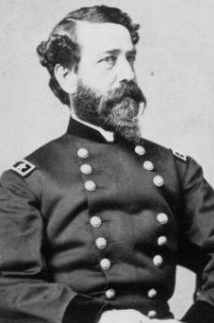
Brigadier-General John Milton Brannan, U.S. Army, circa 1863 (public domain).

“It is hardly necessary to point out to you the extreme military importance of the two works now intrusted [sic, entrusted] to your command. Suffice it to state that they cannot pass out of our hands without the greatest possible disgrace to whoever may conduct their defense, and to the nation at large. In view of difficulties that may soon culminate in war with foreign powers, it is eminently necessary that these works should be immediately placed beyond any possibility of seizure by any naval or military force that may be thrown upon them from neighboring ports….

Seizure of these forts by coup de main may be the first act of hostilities instituted by foreign powers, and the comparative isolation of their position, and their distance from reinforcements, point them out (independent of their national importance) as peculiarly the object of such an effort to possess them.”

Excerpt from orders issued by Brigadier-General John M. Brannan, commanding officer, United States Army, Department of the South, to Colonel Tilghman H. Good, commanding officer of the 47th Pennsylvania Volunteer Infantry in December 1862


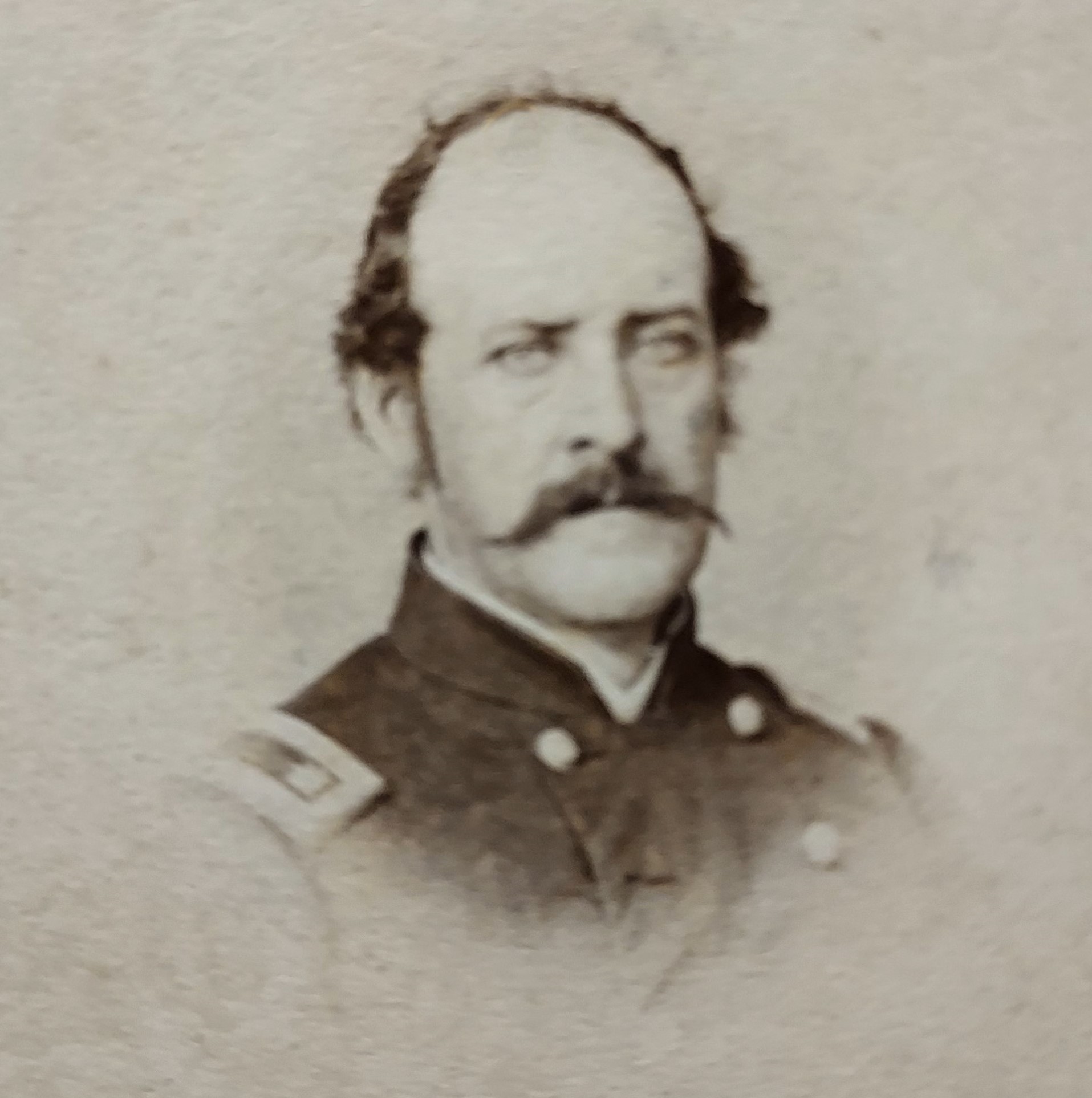
Colonel Tilghman H. Good, commanding officer, 47th Pennsylvania Volunteers (public domain image, circa 1863).

With those words above, Colonel Tilghman H. Good, the founder and commanding officer of the 47th Pennsylvania Volunteer Infantry, learned that he and his subordinates were being sent back to Florida to resume their garrison duties at Fort Taylor in Key West, Florida. Far from being a punishment, following the regiment’s performance during the Battle of Pocotaligo, South Carolina on October 22, 1862, though, as several historians have claimed over the years, those words written to Colonel Good make clear that the return of the 47th Pennsylvania Volunteers to Florida was viewed by senior Union military officers as a critically important assignment, not only for the regiment, but for the United States of America.

More simply put, senior federal government officials, in consultation with senior Union Army officers, had determined that two key federal military installations in Florida—Fort Taylor in Key West and Fort Jefferson in the Dry Tortugas—were at continuing risk of attack and capture by foreign powers, as well as by Confederate States Army troops, because Confederate States leaders had been able to secure support from several European nations, despite promises by the leaders of those nations that they would remain “neutral” as the American Civil War progressed. In addition to helping Confederate troops defeat the Union’s blockade of Confederate States ports that had been established in 1861, enabling the Confederacy to raise financial support for its war efforts through the sale of cotton to European nations, Great Britain had been “provid[ing] significant assistance in other ways, chiefly by permitting the construction in English shipyards of Confederate warships,” according to historians J. Matthew Gallman and Eric Foner.

The most serious incidents of this nature were initiated with the launch of the Confederate cruiser, Alabama, on July 29, 1862. Per research completed by historians at the United States Department of State:

[The Alabama] captured 58 Northern merchant ships before it was sunk in June 1864 by a U.S. warship off the coast of France. In addition to the Alabama, other British-built ships in the Confederate Navy included the Florida, Georgia, Rappahannock, and Shenandoah. Together, they sank more than 150 Northern ships and impelled much of the U.S. merchant marine to adopt foreign registry. The damage to Northern shipping would have been even worse had not fervent protests from the U.S. Government persuaded British and French officials to seize additional ships intended for the Confederacy. Most famously, on September 3, 1863, the British Government impounded two ironclad, steam-driven “Laird rams” that Confederate agent James D. Bulloch had surreptitiously arranged to be built at a shipyard in Liverpool.

The United States demanded compensation from Britain for the damage wrought by the British-built, Southern-operated commerce raiders, based upon the argument that the British Government, by aiding the creation of a Confederate Navy, had inadequately followed its neutrality laws. The damages discussed were enormous. Charles Sumner, Chairman of the Senate Foreign Relations Committee, argued that British aid to the Confederacy had prolonged the Civil War by 2 years, and indirectly cost the United States hundreds of millions, or even billions of dollars (the figure Sumner suggested was $2.125 billion)….

As a result, senior federal government and military officials grew increasingly worried that Confederate States troops would attempt to take over Forts Taylor and Jefferson—possibly in much the same way that Rebel forces had captured Fort Sumter in April 1861.

Ordered to prevent those takeovers from happening by Special Order No. 384, which was issued by Brigadier-General Brannan of the United States Army’s Department of the South, the 47th Pennsylvania Volunteers were specifically chosen for this mission because of the reputation they had built during their first sixteen months of Civil War service. Cited by senior Union Army leaders as being specially worthy of notice by their bravery and praiseworthy conduct during the Battle of Pocotaligo, members of the 47th Pennsylvania had already become known for their “attention to duty, discipline and soldierly bearing” as early as 1861, according to historian Samuel P. Bates.

Another Sea Journey

Elisha Wilson Bailey, M.D., Regimental Surgeon, 47th Pennsylvania Volunteer Infantry, circa 1863 (used with permission; courtesy of Julian Burley).

After packing their belongings at their Beaufort, South Carolina encampment and loading their equipment onto the U.S. Steamer Cosmopolitan, the officers and enlisted members of the 47th Pennsylvania Volunteer Infantry sailed toward the mouth of the Broad River on December 15, 1862, and anchored briefly at Port Royal Harbor in order to allow the regiment’s medical director, Elisha W. Baily, M.D., and members of the regiment who had recuperated enough from their Pocotaligo-related battle injuries at the Union’s General Hospital at Hilton Head, to rejoin the regiment.

At 5 p.m. that same evening, the regiment sailed for Florida, during what was later described by several members of the regiment as a treacherous and nerve-wracking voyage. According to historian Lewis Schmidt, the ship’s captain “steered a course along the coast of Florida for most of the voyage,” which made the voyage more precarious “because of all the reefs.” On December 16, “the second night, the ship was jarred as it ran aground on one during a storm, but broke free, and finally steered a course further from shore, out in the Gulf Stream.”

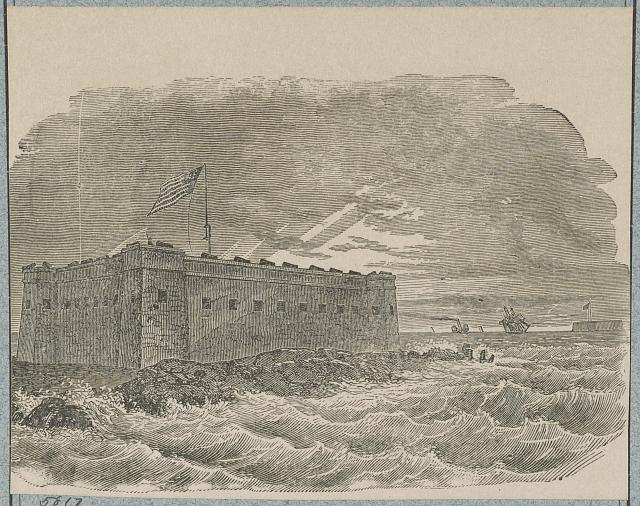
Woodcut depicting the harsh climate at Fort Taylor in Key West, Florida during the Civil War (U.S. Library of Congress, public domain).

In a letter penned to the Sunbury American on 21 December, C Company Musician Henry Wharton provided the following details about the regiment’s trip:

On the passage down, we ran along almost the whole coast of Florida. Rather a dangerous ground, and the reefs are no playthings. We were jarred considerably by running on one, and not liking the sensation our course was altered for the Gulf Stream. We had heavy sea all the time. I had often heard of ‘waves as big as a house,’ and thought it was a sailor’s yarn, but I have seen ‘em and am perfectly satisfied; so now, not having a nautical turn of mind, I prefer our movements being done on terra firma, and leave old neptune to those who have more desire for his better acquaintance. A nearer chance of a shipwreck never took place than ours, and it was only through Providence that we were saved. The Cosmopolitan is a good river boat, but to send her to sea, loadened [sic, loaded] with U.S. troops is a shame, and looks as though those in authority wish to get clear of soldiers in another way than that of battle. There was some sea sickness on our passage; several of the boys ‘casting up their accounts’ on the wrong side of the ledger.

According to Corporal George Nichols of Company E, “When we got to Key West the Steamer had Six foot of water in her hole [sic]. Waves Mountain High and nothing  but an old river Steamer. With Eleven hundred Men on I looked for her to go to the Bottom Every Minute.”

Although the Cosmopolitan arrived at the Key West Harbor on Thursday, December 18, the 47th Pennsylvania Volunteers did not set foot on Florida soil until noon the next day. The men from Companies C and I were immediately marched to Fort Taylor, where they were placed under the command of Major William H. Gausler, the regiment’s third-in-command. The men from Companies B and E were assigned to the older barracks that had been erected by the United States Army, and were placed under the command of B Company Captain Emanual P. Rhoads while the men from Companies A and G were placed under the command of A Company Captain Richard A. Graeffe, and stationed at newer facilities known as the “Lighthouse Barracks” on “Lighthouse Key.”

Lieutenant-Colonel George Warren Alexander, second-in-command, 47th Pennsylvania Volunteer Infantry, with officers from the 47th, Fort Jefferson, Dry Tortugas, Florida, circa 1863 (public domain; click to enlarge).

Three days later, on Saturday, December 21, 1862, Lieutenant-Colonel George Warren Alexander, the regiment’s second-in-command, sailed away aboard the Cosmopolitan with the men from the regiment’s remaining companies—Companies D, F, H, and K—and headed south to Fort Jefferson, where they would assume garrison duties at the Union’s remote outpost in the Dry Tortugas, roughly seventy miles off the coast of Florida (in the Gulf of Mexico). According to Henry Wharton:

We landed here on last Thursday at noon, and immediately marched to quarters. Company I. and C., in Fort Taylor, E. and B. in the old Barracks, and A. and G. in the new Barracks. Lieut. Col. Alexander, with the other four companies proceeded to Tortugas, Col. Good having command of all the forces in and around Key West. Our regiment relieves the 90th Regiment N.Y.S. Vols. Col. Joseph Morgan, who will proceed to Hilton Head to report to the General commanding. His actions have been severely criticized by the people, but, as it is in bad taste to say anything against ones [sic, one’s] superiors, I merely mention, judging from the expression of the citizens, they were very glad of the return of the 47th Pennsylvania Volunteers….

Key West has improved very little since we left last June, but there is one improvement for which the 90th New York deserve a great deal of praise, and that is the beautifying of the ‘home’ of dec’d. soldiers. A neat and strong wall of stone encloses the yard, the ground is laid off in squares, all the graves are flat and are nicely put in proper shape by boards eight or ten inches high on the ends sides, covered with white sand, while a head and foot board, with the full name, company and regiment, marks the last resting place of the patriot who sacrificed himself for his country….

Although water quality was a challenge for members of the regiment at both of these duty stations, it was particularly problematic at Fort Jefferson. According to Schmidt:

‘Fresh’ water was provided by channeling the rains from the fort’s barbette through channels in the interior walls, to filter trays filled with sand; and finally to the 114 cisterns located under the fort which held 1,231,200 gallons of water. The cisterns were accessible in each of the first level cells or rooms through a ‘trap hole’ in the floor covered by a temporary wooden cover…. Considerable dirt must have found its way into these access points and was responsible for some of the problems resulting in the water’s impurity…. The fort began to settle and the asphalt covering on the outer walls began to deteriorate and allow the sea water (polluted by debris in the moat) to penetrate the system…. Two steam condensers were available … and distilled 7000 gallons of tepid water per day for a separate system of reservoirs located in the northern section of the parade ground near the officers [sic, officers’] quarters. No provisions were made to use any of this water for personal hygiene of the [planned 1,500-soldier garrison force]….

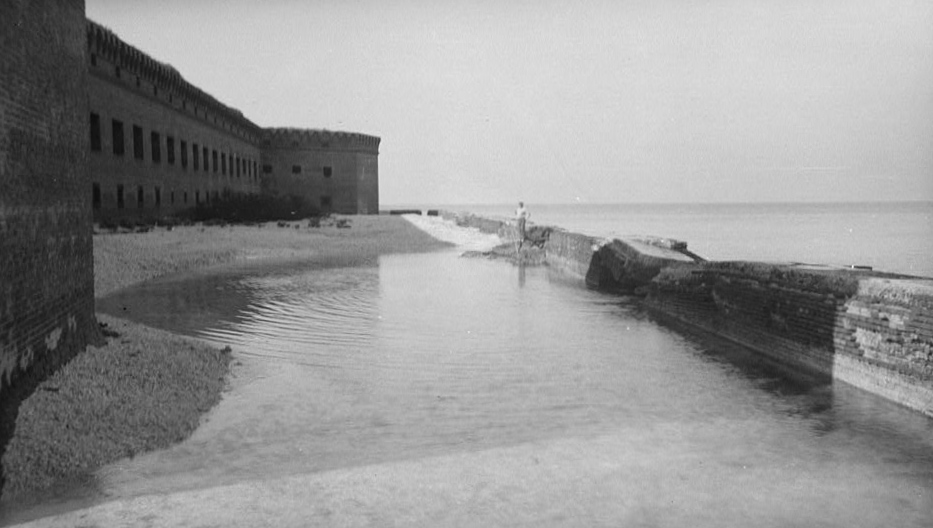
Fort Jefferson’s moat and wall, circa 1934, Dry Tortugas, Florida (C.E. Peterson, U.S. Library of Congress, public domain).

As a result, the soldiers stationed at Fort Jefferson washed themselves and their clothes, using saltwater from the ocean. As if that weren’t difficult enough, “toilet facilities were located outside of the fort,” according to Schmidt:

At least one location was near the wharf and sallyport, and another was reached through a door-sized hole in a gunport, and a walk across the moat on planks at the northwest wall…. These toilets were flushed twice each day by the actions of the tides, a procedure that did not work very well and contributed to the spread of disease. It was intended that the tidal flush should move the wastes into the moat, and from there, by similar tidal action, into the sea. But since the moat surrounding the fort was used clandestinely by the troops to dispose of litter and other wastes … it was a continuous problem for Lt. Col. Alexander and his surgeon.

As for housing and feeding the soldiers stationed here, as well as daily operations, there was a fort post office and the “interior parade grounds, with numerous trees and shrubs in evidence, contained … officers quarters, [a] magazine, kitchens and out houses,” according to Schmidt, as well as “a ‘hot shot oven’ which was completed in 1863 and used to heat shot before firing.”

Most quarters for the garrison … were established in wooden sheds and tents inside the parade [grounds] or inside the walls of the fort in second-tier gun rooms of ‘East’ front no. 2, and adjacent bastions … with prisoners housed in isolated sections of the first and second tiers of the southeast, or no. 3 front, and bastions C and D, located in the general area of the sallyport. The bakery was located in the lower tier of the northwest bastion ‘F’, located near the central kitchen….

Additional Duties: Diminishing Florida’s Role as the “Supplier of the Confederacy”

On top of the strategic role played by the 47th Pennsylvania Volunteers in preventing foreign powers from assisting the Confederate Army and Navy in gaining control over federal forts in the Deep South, members of this regiment would also be called upon to play an ongoing role in weakening Florida’s abilities to supply and transport food and troops throughout the area held by the Confederate States of America.

Prior to intervention by Union Army and Navy forces, the owners of plantations and livestock ranches, as well as the operators of small, family farms across Florida, had been able to consistently furnish beef and pork, fish, fruits, and vegetables to Confederate troops stationed throughout the Deep South during the first year of the American Civil War. Large herds of cattle were raised near Fort Myers, for example, while orchard owners in the Saint John’s River area were actively engaged in cultivating large orange groves (while other types of citrus trees were easily found growing throughout the state’s wilderness areas).

The state was also a major producer of salt, which was used as a preservative for the foods. As a result, the 47th Pennsylvania Volunteers and other Union troops across Florida were ordered to capture or destroy salt manufacturing facilities in order to further curtail the enemy’s access to food.

And they would be undertaking all of these duties in conditions that were far more challenging than what many other Union Army units were experiencing up north in the Eastern Theater. The weather was frequently hot and humid as spring turned to summer, the mosquitos and other insects were an ever-present annoyance and serious threat when they were carrying tropical diseases, and there were also scorpions and snakes that put the men’s health at further risk.

Consequently, the time spent in Florida during the whole of 1863 and early 1864 was most definitely not “easy duty” for the 47th Pennsylvania Volunteers. It was a serious and perilous time for them, and it would prove to be one that a significant number of 47th Pennsylvanians would not survive.


Sources:

  1. Bates, Samuel P. History of Pennsylvania Volunteers, 1861-5, vol. 1. Harrisburg, Pennsylvania: B. Singerly, State Printer, 1869.
  2. Florida’s Role in the Civil War: ‘Supplier of the Confederacy.’” Tampa, Florida: Florida Center for Instructional Technology, University of South Florida (College of Education), retrieved online January 15, 2020.
  3. Gallman, J. Matthew, editor, and Eric Foner, introduction. The Civil War Chronicle: The Only Day-by-Day Portrait of Americas Tragic Conflict as Told by Soldiers, Journalists, Politicians, Farmers, Nurses, Slaves, and Other Eyewitnesses. New York, New York: Crown, 2000.
  4. History: Crops (Historic Florida Barge Canal Trail).” Historical Marker Database, retrieved online December 30, 2023.
  5. Mathews, Alfred and Austin N. Hungerford. History of the Counties of Lehigh and Carbon, in the Commonwealth of Pennsylvania. Philadelphia, Pennsylvania: Everts & Richards, 1884.
  6. Owsley, Frank Lawrence and Harriet Fason Chappell. King Cotton Diplomacy: Foreign Relations of the Confederate States of America. Chicago, Illinois: University of Chicago Press, 1959.
  7. Preventing Diplomatic Recognition of the Confederacy, 1861–1865,” and The Alabama Claims, 1862–1872,” in “Milestones: 1861–1865.” Washington, D.C.: Office of the Historian, Foreign Service Institute, United States Department of State, retrieved online December 30, 2023.
  8. Schmidt, Lewis G. A Civil War History of the 47th Regiment of Pennsylvania Veteran Volunteers. Allentown, Pennsylvania: Self-published, 1986.
  9. Staubach, Lieutenant Colonel James C. Miami During the Civil War: 1861-65,” in Tequesta: The Journal of the Historical Association of Southern Florida, vol. LIII, pp. 31-62. Miami, Florida: Historical Museum of Southern Florida, 1993.
  10. Stuckey, Sterling, Linda Kerrigan and Judith L. Irvin, et. al. Call to Freedom. Austin, Texas: Holt, Reinhart and Winston, 2000.
  11. Wharton, Henry D. Letters from the Sunbury Guards. Sunbury, Pennsylvania: Sunbury American, 1861-1868.


Thoughts of Home at Christmas: The Influence of Thomas Nast’s Art During a 47th Pennsylvania Volunteer’s Lifetime

“Christmas Eve,” 1862 (Thomas Nast, Harper’s Weekly, Vol. 7, pp. 8-9, Christmas edition, 1862, public domain; click to enlarge).

When thinking about what life was like for the Pennsylvania volunteer soldiers who served their nation during the American Civil War, the influence of nineteenth century artists on their lives would likely not be the first thing that comes to mind. The orders they received from their superior officers in the Army and the “trickle down” effect of the directives issued by state and federal elected officials to those Union Army officers, yes, but visual artists? Probably not.

But artists and their artwork—paintings and illustrations created during and after the 1860s—did leave their mark on the psyches of soldiers in ways that were profoundly illuminating and long lasting.

Many of the most powerful artworks that were likely seen and reflected on by members of the 47th Pennsylvania Volunteer Infantry were those drawn by Thomas Nast (1840-1902), a native of Germany who had emigrated to the United States from Bavaria with his mother and siblings in 1846. He spent most of his formative years in New York City, where he took up drawing while still in school. As he aged, he came to view America as his homeland, but still grew up experiencing many German traditions—as had many 47th Pennsylvania Volunteers during their own formative years. (Company K, for example, was established in August 1861 as an “all-German company” of the 47th Pennsylvania.)

Nast’s first depiction of the Christmas season (shown above) was created for the cover and centerfold of the Christmas edition of Harper’s Weekly 1862, shortly after he was hired as a staff illustrator.

“Santa Claus in Camp,” 1863 (Thomas Nast, Harper’s Weekly, January 3, 1863, public domain; click to enlarge).

He then continued to create illustrations of Santa for Harper’s Weekly in subsequent years. According to journalist Lorraine Boissoneault:

You could call it the face that launched a thousand Christmas letters. Appearing on January 3, 1863, in the illustrated magazine Harper’s Weekly, two images cemented the nation’s obsession with a jolly old elf. The first drawing shows Santa distributing presents in a Union Army camp. Lest any reader question Santa’s allegiance in the Civil War, he wears a jacket patterned with stars and pants colored in stripes. In his hands, he holds a puppet toy with a rope around its neck, its features like those of Confederate president Jefferson Davis….

According to historians at Grant Cottage, “In 1868, newly elected 18th President U.S. Grant paid tribute to Thomas Nast by saying, ‘Two things elected me, the sword of Sheridan and the pencil of Thomas Nast.’”

As a result, members of the 47th Pennsylvania Volunteer Infantry had ample time to become well acquainted with Nast’s artistry and his support for their efforts, as part of the United States Army, to end the Civil War and preserve America’s Union. An ardent abolitionist, Nast also actively supported the federal government’s efforts to eradicate the brutal practice of chattel slavery.

Fort Taylor, Key West, Florida (Harper’s Weekly, 1864, public domain).

Nast’s first illustrations of Santa Claus and depictions of soldiers longing for family at Christmas would initially have been seen by 47th Pennsylvania Volunteers while they were stationed far from home at Fort Taylor in Key West, Florida—just two months after the regiment had sustained a shockingly high rate of casualties during the Battle of Pocotaligo, South Carolina on October 22, 1862. More than one hundred members of the regiment had been killed in action, mortally wounded, grievously wounded, or wounded less seriously, but still able to continue their service.

So terrible was the outcome that it would have been enough to make an impression even on individual 47th Pennsylvanians who hadn’t been wounded. They were not only now battle tested, they were battle scarred, according to comments made by individual members of the regiment in the letters they wrote to families and friends back home during that Christmas of 1862.

No matter how strong their capacity for overcoming adversity had been before that battle, their hearts and minds would never be the same. It would take time to heal and move forward—time they were given while stationed on garrison duty for more than a year.

Fort Jefferson (Harper’s Weekly, August 26, 1865, public domain; click to enlarge).

By the time that the American Civil War was ending its third year, the mental wounds of Pocotaligo were far less fresh than they had been the previous Christmas. Still stationed in Florida on garrison duty in 1863, the 47th Pennsylvania Volunteer Infantry was now a divided regiment. While slightly more than half of the regiment was still on duty at in Key West, as companies A, B, C, E, G, and I remained at Fort Taylor, the remaining members of the regiment—companies D, F, H, and K—were now even farther away from home—stationed at Fort Jefferson, the Union’s remote outpost that was situated so far off of Florida’s coast that it was accessible only by ship.

Letters penned to family and friends back in Pennsylvania during the early part of 1863 capture a sense of sadness and longing that pervaded the regiment—as 47th Pennsylvanians mourned the loss of their deceased comrades and thought about how deeply they missed their own families.

Gradually, as the year wore on, those feelings turned to acceptance of their respective losses and, eventually, frustration at still being assigned to garrison duty when they felt they could and should be helping the federal government bring a faster end to the war by defeating the Confederate States Army through enough tide-turning combat engagements that the Confederate States of America would finally surrender and agree to re-unify the nation.

By early 1864, the wish of those 47th Pennsylvanians was granted by senior Union Army officials. They were not only given the opportunity to return to combat, but to return to intense combat as a history-making regiment.

The only regiment from Pennsylvania to fight in the Union’s 1864 Red River Campaign across Louisiana, the 47th Pennsylvanians repeatedly displayed their valor as the blood of more and more of their comrades was spilled to eradicate slavery across the nation while also fighting to preserve the nation’s Union. By the fall of 1864, they were participating in such fierce, repeated battles across Virginia during Union Major-General Philip Sheridan’s 1864 Shenandoah Valley Campaign that President Abraham Lincoln was able to secure his reelection and the tide of the American Civil War was decisively turned in the federal government’s favor once and for all.

Ruins of Charleston, South Carolina as seen from the Circular Church, 1865 (U.S. National Archives and Records Administration, public domain).

By April 1865, the Confederate States Army had surrendered, the war was over and President Lincoln was gone, felled by an assassin’s bullet that had too easily found its target. So, once again, the 47th Pennsylvania Volunteers were in mourning.

Sent back to America’s Deep South that summer, they were assigned to Reconstruction duties in Savannah, Georgia and Charleston, South Carolina, where they helped to reestablish functioning local and state governments, rebuild shattered infrastructure, and reinvigorate a free press that was dedicated to supporting a unified nation—all while other Pennsylvania volunteer regiments were being mustered out and sent home.

Finally, after a long and storied period of service to their nation, the 47th Pennsylvania Veteran Volunteers were given their honorable discharge papers at Camp Cadwalader in Philadelphia, and were then sent home to their own family and friends in communities across Pennsylvania in early January 1866.

Return to Civilian Life

“Santa Claus and His Works,” 1866 (Thomas Nast, Harper’s Weekly, December 29, 1866, public domain; click to enlarge).

Attempting to regain some sense of normalcy as their post-war lives unfolded over the years between the late 1860s and the early 1900s, many of the surviving veterans of the 47th Pennsylvania Volunteer Infantry resumed the jobs they held prior to the war while others found new and better ways to make a living. Some became small business creators, pastors or other church officials, members of their local town councils or school boards, beloved doctors, or even inventors. One even became the lieutenant governor of the Commonwealth of Pennsylvania.

Most also married and began families, some small, some large. Still others made their way west—as far as the states of California and Washington—in search of fortune or, more commonly, places where war’s Grim Reaper would never find them again.

“‘Twas the Night Before Christmas,” 1866 (Thomas Nast, Harper’s Weekly, December 25, 1886, public domain; click to enlarge).

As the years rolled on, they saw more and more of Thomas Nast’s work as it was published in Harper’s Weekly, particularly at Christmas. But the Santa Claus of war was now transformed by Nast as the Saint Nicholas of his childhood in Germany—kind, altruistic, loving, and jolly.

Over time, those illustrations collectively formed the “mind pictures” that the majority of American children and adults experienced when they imagined Santa Claus. So powerful has Nast’s influence been that, even today, when Americans encounter the many variations of Santa used to promote products in Christmas advertising campaigns, they see images that are often based on Nast’s nineteenth century drawings—drawings that had their genesis as beacons of light and hope during one of the darkest times in America’s history.

Like Abraham Lincoln, Nast has been helping Americans to summon and follow “the better angels of our nature” for more than one hundred and sixty years. May the power of his art help us all continue to do so this year and for the remainder of our days.


Sources:

  1. Boissoneault, Lorraine. A Civil War Cartoonist Created the Modern Image of Santa Claus as Union Propaganda.” Washington, D.C.: Smithsonian Magazine, December 19, 2018.
  2. Drawn Together: The Friendship of U.S. Grant and Thomas Nast (video). Wilton, New York: Grant Cottage, May 14, 2022.
  3. Santa Claus,” in “Thomas Nast.” Columbus, Ohio: University Libraries, The Ohio State University, retrieved online December 23, 2023.
  4. Santa Claus in Camp (from ‘Harper’s Weekly,’ vol. 7, p. 1).” New York, New York: The Met, retrieved online December 23, 2023.
  5. Vinson, J. Chal. Thomas Nast and the American Political Scene,” in American Quarterly, vol. 9, no. 3, Autumn 1957, pp. 337-344. Baltimore, Maryland: The Johns Hopkins University Press.


Uniforms and Insignia of the 47th Pennsylvania Volunteer Infantry

Captain Richard A. Graeffe, Company A, 47th Pennsylvania Volunteers, circa 1862 (public domain).

Upon mustering in at Camp Curtin in Harrisburg, Pennsylvania in August and early September of 1861, the men who had enrolled for military service with the 47th Pennsylvania Volunteer Infantry were assigned to their respective companies and issued standardized uniforms—the same style of dark blue, wool uniforms that were worn by the regular officers or enlisted members of the U.S. Army. The uniform of Captain Richard Graeffe (pictured at right) shows the typical details of a company commander’s uniform with shoulder bars, hat and sword.

Initially equipped with Mississippi rifles, the 47th Pennsylvania Volunteers were then provided with basic training in light infantry tactics through mid-September. Presented with the regiment’s First State Color on September 20, 1861 by Pennsylvania Governor Andrew Curtin, they were subsequently marched to Harrisburg’s train station, and were transported to Washington, D.C., where they participated in the first of multiple duty assignments that would take them from the Eastern Theater of the American Civil War to the Western and Trans-Mississippi theaters between early 1862 and March of 1864 before being transported back to the Eastern Theater for the fateful and tide-turning Shenandoah Valley Campaign, which unfolded during the summer and fall of 1864.

Army of the United States, Corps Badges, 1865 (U.S. Library of Congress, public domain; click to enlarge).

Along the way, the 47th Pennsylvania Volunteer Infantry would be attached to the:

  • U.S. Army of the Potomac (“Mr. Lincoln’s Army”) in the Eastern Theater (1861);
  • U.S. Army’s Tenth Corps (X Corps) in the Western Theater (Occupying force duties and battles in Florida and South Carolina, early winter 1862 through early winter 1864);
  • U.S. Army’s Nineteenth Corps (XIX Corps) in the Trans-Mississippi Theater (Red River Campaign, spring and early summer 1864);
  • U.S. Army of the Shenandoah, Nineteenth Corps (XIX Corps) in the Eastern Theater (Battle of Cool Spring and Sheridan’s 1864 Shenandoah Valley Campaign, summer and fall 1864);
  • U.S. Army of the Shenandoah, Nineteenth Corps (XIX Corps) in the Eastern Theater (Defense of Washington, D.C., late winter 1864 through the immediate aftermath of the assassination of President Abraham Lincoln in 1865);
  • Selected units of the U.S. Army’s former Nineteenth Corps (XIX Corps (Reconstruction duties in Savannah, Georgia and Charleston, South Carolina, June through late December 1865); and
  • Camp Cadwalader (final discharge, early January 1866).
Each time that the 47th Pennsylvania Volunteers were attached to a different Union Army corps, they were issued specific insignia that were then sewn onto their uniforms. The chart pictured above shows the different insignia that were worn by the various Union corps’ members.

The Demographics of the 47th Pennsylvania Volunteer Infantry

Lieutenant-Colonel George Warren Alexander, second-in-command, 47th Pennsylvania Volunteer Infantry, with officers from the 47th at Fort Jefferson in the Dry Tortugas, Florida, circa 1863 (public domain).

Recruited primarily at community gathering places in their respective hometowns, the majority of soldiers who served with the 47th Pennsylvania Volunteer Infantry were enrolled at county seats or other large population centers within the Commonwealth of Pennsylvania.

The youngest member of the regiment was a 12-year-old drummer boy; the oldest was a 65-year-old, financially successful farmer who would attempt to re-enlist, at the age of 68, after being seriously wounded while protecting the American flag in battle.

Roughly 70 percent were residents of Pennsylvania’s Lehigh Valley, including the cities of Allentown, Bethlehem and Easton and surrounding communities in Lehigh and Northampton counties. Company C, which was formed primarily of men from Northumberland County, was more commonly known as the “Sunbury Guards.” Company D and Company H were staffed largely by men from Perry County. Company K was formed with the intent of creating an “all-German” company that would be composed of German-Americans and German immigrants.

In point of fact, a number of the 47th Pennsylvania Volunteers were immigrants or first-generation Americans. A significant percentage of each of the regiment’s companies were men whose families still spoke German or “Pennsylvania Dutch” at their homes and churches more than a century after their ancestors emigrated from Germany in search of religious or political freedom. Others traced their roots to Ireland; one had been born on Spain’s Canary Islands, and at least two were natives of Cuba.

In early October of 1862, several African American men who had been freed from enslavement on plantations near Beaufort, South Carolina, joined the ranks of the 47th Pennsylvania, followed by the April 1864 enrollment of other formerly enslaved men in Natchitoches, Louisiana.

Their final resting places span the nation, from Maine to California and from the State of Washington to Florida.


Learn More About the 47th Pennsylvania Volunteers

First State Color, 47th Regiment, Pennsylvania Volunteer Infantry (presented to the regiment by Pennsylvania Governor Andrew Curtin, 20 September 1861; retired 11 May 1865, public domain).

Largely forgotten by mainstream historians, the 47th Pennsylvania Volunteer Infantry was a Union Army unit which served for nearly the entire duration of the American Civil War. Formed by the fruit of the Great Keystone State’s small towns and cities, the regiment was born on August 5, 1861, when its founder, Tilghman H. Good, received permission from Pennsylvania Governor Andrew Gregg Curtin to form an entirely new regiment in response to President Abraham Lincoln’s call for additional volunteers to help preserve American’s Union. It ended its service during the early months of the nation’s Reconstruction Era, officially mustering out at Charleston, South Carolina on Christmas Day in 1865, its members receiving their final discharge papers at Camp Cadwalader in Philadelphia, Pennsylvania in early January of 1866.

Along the way, the 47th Pennsylvania made history, becoming an integrated regiment in 1862 and the only regiment from Pennsylvania to participate in the Union’s 1864 Red River Campaign across Louisiana. Its members also distinguished themselves in battle, repeatedly, including during Union General Philip Sheridan’s Shenandoah Valley Campaign, which unfolded between August and December of 1864.

Learn more about key moments in this regiment’s history by reading the following posts:

1861:

1862:

1863:

1864:

1865:

Black History Month: New Details Uncovered Regarding the Formerly Enslaved Black Men Who Enlisted with the 47th Pennsylvania Volunteer Infantry

Research regarding the lives of the nine formerly enslaved Black men who enlisted with the 47th Pennsylvania Volunteer Infantry in 1862 and 1864 has continued to progress—even in the middle of a pandemic that has forced the closure of numerous local, state, and national archives.*

In addition to uncovering details about the life of the soldier from South Carolina who was mistakenly listed on muster rolls for the 47th Pennsylvania as “Presto Gettes” (learn more about him in this article here), researchers for 47th Pennsylvania Volunteers: One Civil War Regiment’s Story have been able to determine more about what happened to two of the other men post-war, and have also located records which seem to indicate that there may have been two or three other Black men who enlisted with the regiment (potentially bringing the total number of Black enlistees in the regiment to twelve).

Aaron French (enlisted as Aaron Bullard):

Muster roll entries for Aaron Bullard and Hamilton Blanchard, Company D, 47th Pennsylvania Volunteers (U.S. National Archives, public domain).

1864 was a life-changing year for Aaron Bullard and four other young Black men in Louisiana. After enlisting with the 47th Pennsylvania Volunteer Infantry on April 5 while the 47th was stationed at Natchitoches, Louisiana, Samuel Jones, Hamilton Blanchard (also known as John Hamilton), and Aaron, James, and John Bullard traveled with the 47th Pennsylvania as it participated in the multiple battles associated with the Union’s 1864 Red River Campaign across Louisiana. On or about June 22, they were formally mustered into the regiment at Morganza, Louisiana.

Sometime later (possibly post-war), Aaron Bullard changed his surname to French. After the American Civil War, he married, became a land-owning farmer—and a dad.

Post-Civil War, Aaron French and his family resided in Issaquena County, Mississippi (U.S. Census, 1870, public domain).

In August of 1870, Aaron French and his wife, Amanda, lived with their eight-month-old daughter, “Simpy” (also known as Cynthia or Cyntha) in Skipworth Precinct, Issaquena County, Mississippi. Still residing in Issaquena County a decade later when the June 1880 federal census was taken, Aaron and Amanda were the proud parents of three daughters: Cynthia (who would go on to marry Samuel L. Dixon on March 20, 1890), Jesanna (also known as Jessie/Jesse), and “Arctavia” (also known as Octavia). Jessie, who later went on to wed John B. Cobb on January 28, 1892, made a life with her husband and son in Mayersville, Mississippi, where she was a teacher in the local schools. Octavia married Frank Childress on March 20, 1894.

U.S. Civil War Pension Index Card for Aaron French, who enlisted with the 47th Pennsylvania Volunteers in Louisiana in 1864 (U.S. National Archives, public domain).

Sadly, Aaron French did not live to see his two youngest daughters marry because he died in Mississippi on January 30, 1891. He was just 40-43 years old, according to U.S. Census records and other data, which indicate that he was born in Louisiana sometime between 1848 and 1850.

Hearteningly, though, an even more intriguing piece of data has recently been uncovered about the later life of Aaron French—one that indicates that he had become active in politics prior to his death. According to the Vicksburg Evening Post, Aaron was appointed as a delegate from Issaquena County to the Republican Congressional Convention for the Third District, which was held in Greenville, Mississippi on August 7, 1886. Researchers are continuing to search for further details about his political activities and untimely death, as well as the exact location of his gravesite.

Thomas Haywood (alternate spellings of surname: Hayward, Haywood, Heywood) and Jack Jacobs:

Muster roll entries of Thomas Haywood and Edward Jassum, Company H, 47th Pennsylvania Volunteers (U.S. National Archives, public domain).

Born into slavery in South Carolina sometime around 1832, Thomas Haywood enlisted for a three-year term of service as an Under Cook with Company H of the 47th Pennsylvania Volunteer Infantry at Beaufort, South Carolina on November 1, 1862. He and three other formerly enslaved Black men—Abraham and Edward Jassum and Presto Gettes”—who had previously enlisted with the 47th Pennsylvania at Beaufort in October of 1862, then traveled with the 47th Pennsylvania as it participated in multiple military engagements, including the 47th’s garrisoning of Fort Taylor and Fort Jefferson in Florida in 1863 and 1864, the battles of the Union’s spring 1864 Red River Campaign across Louisiana, and the battles of Sheridan’s tide-turning Shenandoah Valley Campaign across Virginia in the fall of 1864.

On or about June 22, 1864 all nine of these Black soldiers were formally mustered into the regiment at Morganza, Louisiana; Thomas Haywood and seven of the eight others all successfully completed their tours of duty, and were honorably mustered out upon expiration of their respective terms of enlistment. In Thomas Haywood’s case, that honorable discharge was awarded on October 31, 1865.

Post-war, it appears from various Freedmen’s Bureau records that he may have entered into yearly contracts with several men who had previously been plantation owners in the Beaufort, South Carolina area. In exchange for agreeing to plant and cultivate cotton for those men on three to five-acre parcels of land that had been leased to him by those white men, he was allowed to keep portions of the cotton sales (the largest portions of which went to the former plantation owners who had also most likely been slave owners prior to and during the Civil War).

U.S. Civil War Index Card for Thomas Haywood, who enlisted with the 47th Pennsylvania Volunteers in South Carolina in 1862 (U.S. National Archives, public domain).

His body warn out from years of slavery prior to the war, difficult military service during the war, and harsh sharecropping experiences post-war, Thomas Hayward applied for, and was awarded a U.S. Civil War Pension on April 30, 1888. That pension was subsequently renewed by the federal government in 1907 at the rate of $15 per month (roughly $415 per month in today’s U.S. dollar equivalency).

By 1890, Thomas Haywood was living in Sheldon Township, Beaufort County, South Carolina. After a long life, he died on January 13, 1911. Unfortunately, his burial location has also not yet been identified by researchers.

In 1890, Thomas Haywood lived near Hanna Jacobs, the widow of Jack Jacobs, who may have been another Black soldier who enlisted with the 47th Pennsylvania Volunteers (U.S. Census, 1890, Sheldon Township, Beaufort County, South Carolina, public domain).

One other piece of tantalizing data that has recently been discovered is that a woman named “Hanna Jacobs” lived near Thomas Haywood in 1890. This information may be significant because Hanna was described on the 1890 U.S. Census of Union soldiers and widows as the widow of “Jack Jacobs,” who had served in the same company with Thomas Haywood (according to that special census).

Researchers currently believe that Jack Jacobs may, in fact, have been another formerly enslaved Black man who had enlisted with the 47th Pennsylvania when it was stationed near Beaufort in 1862, and are currently conducting a Go Fund Me campaign to raise funds to purchase the Civil War military and pension records of Hanna and Jack Jacobs, as well as the nine known formerly enslaved Black men who enlisted with the 47th Pennsylvania Volunteer Infantry in 1862 and 1864.

Jackson Haywood:

General Index Card for Jackson Haywood, who may have been a Black soldier who enlisted with the 47th Pennsylvania Volunteers (U.S. National Archives, public domain).

According to the “Index to Compiled Service Records of Volunteers Who Served in Organizations from the State of Pennsylvania,” which was created by staff at the U.S. National Archives, a General Index Card was created for yet another mystery man—a soldier named “Jackson Hayward.”

To date, researchers have only been able to determine that he may have enlisted with Company K of the 47th Pennsylvania Volunteer Infantry as a cook—a rank similar to that at which the known nine formerly enslaved Black men who enlisted with the 47th Pennsylvania were entered on the muster rolls of the regiment.

Researchers hope, with time and the continued financial support of the followers of 47th Pennsylvania Volunteers: One Civil War Regiment’s Story, to be able to confirm the dates of military service and race of this individual, as well as that of “Jack Jacobs.”

As always, we appreciate everyone’s help in ensuring that the service to the nation of these soldiers will never be forgotten. They helped to preserve our Union and deserve to be recognized more fully for their heroism and dedication.

* Our most important goal continues to be the purchase of the Compiled Military Service Records (CMSR) and U.S. Civil War Pension records for each of these remarkable men in order to document and freely share their stories with the widest possible audience. We continue to await word from staff at the U.S. National Archives regarding the timeframe for their resumption of digitization and reproduction services that have temporarily been suspended due to the coronavirus pandemic. As soon as those services have resumed, we will request an update regarding their estimated timeframe for fulfilling our records requests. In the interim, we will seek out further details about each of these soldiers via local and state archival resources across the nation, and will post updates as we confirm more data.

Sources:

  1. Bullard, Aaron, in Index to Compiled Service Records of Volunteers. Washington, DC: U.S. National Archives, 1861-1865.
  2. Bullard, Aaron and French, Aaron, in U.S. Civil War Pension Index Cards. Washington, DC: U.S. National Archives, 1890-1891.
  3. Bullard, Aaron, Presto Garris, Thomas Haywood, et. al. in U.S. Civil War Muster Out Rolls (47th Pennsylvania Volunteer Infantry). Washington, DC: U.S. National Archives, 1865-1866 (available via Ancestry.com).
  4. French, Aaron, in “Proceedings of the Third District Republican Convention.” Vicksburg, Mississippi: Vicksburg Evening Post, August 9, 1886.
  5. French, Aaron and Family, in U.S. Census Records (Issaquena County, Mississippi): Washington, DC: U.S. National Archives, 1870-1910.
  6. Haywood, Jackson, in Index to Compiled Service Records of Volunteers. Washington, DC: U.S. National Archives, 1861-1865.
  7. Haywood, Thomas, in Index to Compiled Service Records of Volunteers. Washington, DC: U.S. National Archives, 1861-1865.
  8. Haywood, Thomas, in U.S. Civil War Pension Index Cards. Washington, DC: U.S. National Archives, 1888, 1907.
  9. Haywood, Thomas, in U.S. Veterans’ Administration Pension Payment Cards. Washington, DC: U.S. National Archives, 1888, 1907.
  10. Haywood, Thomas, in U.S. Census (Beaufort County, South Carolina): Washington, DC: U.S. National Archives, 1890.
  11. Hanna Jacobs, widow of Jack Jacobs, in U.S. Census (Beaufort County, South Carolina): Washington, DC: U.S. National Archives, 1890.


St. Charles County Historical Society Donates David H. Smith Papers to 47th Pennsylvania Volunteers: One Civil War Regiment’s Story

Honorable Discharge (excerpt), First Sergeant David H. Smith, Company H, 47th Pennsylvania Volunteers, December 25, 1865 (public domain).

A challenging year for many Americans due to the COVID-19 pandemic, a faltering economy, and civil strife, 2020 proved to be a remarkably constructive one on many fronts for a humanities project dedicated to preserving and educating children and adults about the 47th Pennsylvania Volunteer Infantry—a Union Army unit which made history during the American Civil War as the only regiment from Pennsylvania to participate in the 1864 Red River Campaign across Louisiana, and which also was involved in guarding Mary Surratt and the other key conspirators involved in Lincoln’s assassination in 1865.

One of the most important developments in 2020 was the donation by the St. Charles County Historical Society in St. Charles, Missouri of its David H. Smith Papers collection to 47th Pennsylvania Volunteers: One Civil War Regiment’s Story.

David H. Smith was one of the 47th Pennsylvania Volunteers who served for the duration of the war. Following his enrollment at Harrisburg, Pennsylvania on August 22, 1861, Smith mustered in at Camp Curtin in Harrisburg on September 19 of that year as a private with Company H. Described as a nineteen-year-old farmer with light hair, blue eyes, and a light complexion who was five feet, nine inches tall, he was promoted to the rank of corporal on October 21, 1862—the day before the regiment was bloodied badly in the Battle of Pocotaligo, South Carolina. He then re-enlisted with the 47th Pennsylvania Volunteers in mid-October of 1863 at Fort Jefferson in the Dry Tortugas, Florida, where half of the regiment was stationed at the time, and was subsequently promoted to the rank of Sergeant on September 18, 1864—one day before the Battle of Opequan, Virginia, and promoted again to First Sergeant on April 21, 1865—exactly one week after Lincoln’s assassination. Smith then continued to serve until the regiment was honorably mustered out at Charleston, South Carolina on Christmas Day of that same year.

According to Adam Pesek, a collections volunteer with the St. Charles County Historical Society who reached out to Laurie Snyder, the managing editor of the 47th Pennsylvania Volunteers’ project, society personnel made the helpful overture because they had made a decision to downsize the society’s collection, and were seeking to redistribute a range of items to other organizations whose ties to those items were stronger.

Society archivist Amy G. Haake explained that she and her colleagues had made the decision to donate Smith’s papers when they realized “that Smith had no connections to St. Charles County, whether through marriage or otherwise,” and wanted to find a group which would ensure that the historic documents would be preserved and made publicly available for study by other historians and history students. Among the original documents are certificates related to promotions received by Smith during his tenure with the 47th Pennsylvania, as well as his reenlistment and honorable discharge paperwork.

“My plan is to digitize Sergeant Smith’s papers in 2021, research and write a biographical sketch of his life, and then make each of Smith’s documents and his biography publicly available online via our project’s website and Facebook page. I will then also donate Smith’s papers to a museum or historical society in Pennsylvania,” said Snyder. “These precious papers not only document Smith’s service to the nation; they provide tangible links to a defining time in our nation’s history—reminding us all of the sacrifices made by the heroes who left hearth and home to fight for the Union of a country they loved more than life.”

*******************************************************

47th Pennsylvania Volunteers: One Civil War Regiment’s Story is an educational initiative dedicated to documenting and raising public awareness about the history-making role played by the 47th Pennsylvania Volunteer Infantry during the American Civil War, as well as the contributions made by its members, post-war, to America’s growth and the advancement of its democratic ideals. Integrated in October of 1862 (prior to President Abraham Lincoln’s official release of the Emancipation Proclamation), this regiment went on to become the only regiment from Pennsylvania to participate in the Union’s 1864 Red River Campaign across Louisiana and the only regiment from Pennsylvania to have men held captive as prisoners of war at Camp Ford—the largest Confederate prison west of the Mississippi River, and was also involved in guarding Mary Surratt and the other key conspirators in Lincoln’s assassination in 1865 during the early days of their imprisonment.

Founded in 1956, the St. Charles County Historical Society (SCCHS) is a nonprofit organization which was initially established to preserve the history of St. Charles County, Missouri. In 2009, it merged with the St. Charles Genealogical Society in order to expand upon its mission “to foster an understanding and appreciation of all aspects of Saint Charles County history” to ensure that genealogical records of county residents are also preserved.