Attempts to End Chattel Slavery Across America: President Abraham Lincoln Issues the Emancipation Proclamation (January 1, 1863)

President Abraham Lincoln signing the Emancipation Proclamation in 1862 (W.E. Winner, painter, J. Serz, engraver, circa 1864; public domain, U.S. Library of Congress).

“I do order and declare that all persons held as slaves within said designated States, and parts of States, are, and henceforward shall be free; and that the Executive government of the United States, including the military and naval authorities thereof, will recognize and maintain the freedom of said persons.”

—President Abraham Lincoln, “Emancipation Proclamation,” January 1, 1863


With those words, President Abraham Lincoln and the United States of America took another step forward in the nation’s long process of ending the brutal practice of chattel slavery in America. Issued on January 1, 1863, “the Emancipation Proclamation was limited in many ways,” according to historians at the U.S. National Archives. “It applied only to states that had seceded from the United States, leaving slavery untouched in the loyal border states. It also expressly exempted parts of the Confederacy (the Southern secessionist states) that had already come under Northern control. Most important, the freedom it promised depended upon Union (United States) military victory.”

Although the Emancipation Proclamation did not end slavery in the nation, it captured the hearts and imagination of millions of Americans and fundamentally transformed the character of the war. After January 1, 1863, every advance of federal troops expanded the domain of freedom. Moreover, the Proclamation announced the acceptance of black men into the Union Army and Navy, enabling the liberated to become liberators. By the end of the war, almost 200,000 black soldiers and sailors had fought for the Union and freedom.

From the first days of the Civil War, slaves had acted to secure their own liberty. The Emancipation Proclamation confirmed their insistence that the war for the Union must become a war for freedom. It added moral force to the Union cause and strengthened the Union both militarily and politically. As a milestone along the road to slavery’s final destruction, the Emancipation Proclamation has assumed a place among the great documents of human freedom.

By the time that President Lincoln had issued this proclamation, the 47th Pennsylvania Volunteer Infantry had already become an integrated regiment, having enrolled four formerly enslaved Black men in October and November 1862 while the regiment was assigned to occupation duties with the United States Army’s Tenth Corps (X Corps) in Beaufort, South Carolina—a process the regiment would continue during its tenure as the only regiment from Pennsylvania to participate in the Union’s 1864 Red River Campaign across Louisiana—an integration process that was supported by President Lincoln’s Emancipation Proclamation of 1863.

Page one of the Emancipation Proclamation issued by U.S. President Abraham Lincoln, January 1, 1863 (U.S. National Archives and Records Administration, public domain; click to enlarge).

The Full Text of the Emancipation Proclamation

January 1, 1863
By the President of the United States of America:
A Proclamation.

Whereas, on the twenty-second day of September, in the year of our Lord one thousand eight hundred and sixty-two, a proclamation was issued by the President of the United States, containing, among other things, the following, to wit:

That on the first day of January, in the year of our Lord one thousand eight hundred and sixty-three, all persons held as slaves within any State or designated part of a State, the people whereof shall then be in rebellion against the United States, shall be then, thenceforward, and forever free; and the Executive Government of the United States, including the military and naval authority thereof, will recognize and maintain the freedom of such persons, and will do no act or acts to repress such persons, or any of them, in any efforts they may make for their actual freedom.

‘That the Executive will, on the first day of January aforesaid, by proclamation, designate the States and parts of States, if any, in which the people thereof, respectively, shall then be in rebellion against the United States; and the fact that any State, or the people thereof, shall on that day be, in good faith, represented in the Congress of the United States by members chosen thereto at elections wherein a majority of the qualified voters of such State shall have participated, shall, in the absence of strong countervailing testimony, be deemed conclusive evidence that such State, and the people thereof, are not then in rebellion against the United States.’

Now, therefore I, Abraham Lincoln, President of the United States, by virtue of the power in me vested as Commander-in-Chief, of the Army and Navy of the United States in time of actual armed rebellion against the authority and government of the United States, and as a fit and necessary war measure for suppressing said rebellion, do, on this first day of January, in the year of our Lord one thousand eight hundred and sixty-three, and in accordance with my purpose so to do publicly proclaimed for the full period of one hundred days, from the day first above mentioned, order and designate as the States and parts of States wherein the people thereof respectively, are this day in rebellion against the United States, the following, to wit:

Arkansas, Texas, Louisiana, (except the Parishes of St. Bernard, Plaquemines, Jefferson, St. John, St. Charles, St. James Ascension, Assumption, Terrebonne, Lafourche, St. Mary, St. Martin, and Orleans, including the City of New Orleans) Mississippi, Alabama, Florida, Georgia, South Carolina, North Carolina, and Virginia, (except the forty-eight counties designated as West Virginia, and also the counties of Berkley, Accomac, Northampton, Elizabeth City, York, Princess Ann, and Norfolk, including the cities of Norfolk and Portsmouth[)], and which excepted parts, are for the present, left precisely as if this proclamation were not issued.

And by virtue of the power, and for the purpose aforesaid, I do order and declare that all persons held as slaves within said designated States, and parts of States, are, and henceforward shall be free; and that the Executive government of the United States, including the military and naval authorities thereof, will recognize and maintain the freedom of said persons.

And I hereby enjoin upon the people so declared to be free to abstain from all violence, unless in necessary self-defence; and I recommend to them that, in all cases when allowed, they labor faithfully for reasonable wages.

And I further declare and make known, that such persons of suitable condition, will be received into the armed service of the United States to garrison forts, positions, stations, and other places, and to man vessels of all sorts in said service.

And upon this act, sincerely believed to be an act of justice, warranted by the Constitution, upon military necessity, I invoke the considerate judgment of mankind, and the gracious favor of Almighty God.

In witness whereof, I have hereunto set my hand and caused the seal of the United States to be affixed.

Done at the City of Washington, this first day of January, in the year of our Lord one thousand eight hundred and sixty three, and of the Independence of the United States of America the eighty-seventh.

By the President: ABRAHAM LINCOLN

WILLIAM H. SEWARD, Secretary of State.


Sources:

  1. Establishing Slavery in the Lowcountry,” in “African Passages, Lowcountry Adaptations.” Charleston, South Carolina: Lowcountry Digital History Initiative, retrieved online January 1, 2024.
  2. “Franklin, John Hope. The Emancipation Proclamation: An Act of Justice,” in Prologue Magazine, Summer 1993, vol. 25, no. 2. Washington, D.C.: U.S. National Archives and Records Administration.
  3. Snyder, Laurie. “Freedmen from South Carolina,” in “Freedmen of the 47th Pennsylvania Volunteer Infantry.” 47th Pennsylvania Volunteers: One Civil War Regiment’s Story, 2023.
  4. The Emancipation Proclamation.” Washington, D.C.: U.S. National Archives and Records Administration, May 5, 2017.
  5. Transcript of the Proclamation (transcription of the Emancipation Proclamation).” Washington, D.C.: U.S. National Archives and Records Administration, May 5, 2017.


Thoughts of Home at Christmas: The Influence of Thomas Nast’s Art During a 47th Pennsylvania Volunteer’s Lifetime

“Christmas Eve,” 1862 (Thomas Nast, Harper’s Weekly, Vol. 7, pp. 8-9, Christmas edition, 1862, public domain; click to enlarge).

When thinking about what life was like for the Pennsylvania volunteer soldiers who served their nation during the American Civil War, the influence of nineteenth century artists on their lives would likely not be the first thing that comes to mind. The orders they received from their superior officers in the Army and the “trickle down” effect of the directives issued by state and federal elected officials to those Union Army officers, yes, but visual artists? Probably not.

But artists and their artwork—paintings and illustrations created during and after the 1860s—did leave their mark on the psyches of soldiers in ways that were profoundly illuminating and long lasting.

Many of the most powerful artworks that were likely seen and reflected on by members of the 47th Pennsylvania Volunteer Infantry were those drawn by Thomas Nast (1840-1902), a native of Germany who had emigrated to the United States from Bavaria with his mother and siblings in 1846. He spent most of his formative years in New York City, where he took up drawing while still in school. As he aged, he came to view America as his homeland, but still grew up experiencing many German traditions—as had many 47th Pennsylvania Volunteers during their own formative years. (Company K, for example, was established in August 1861 as an “all-German company” of the 47th Pennsylvania.)

Nast’s first depiction of the Christmas season (shown above) was created for the cover and centerfold of the Christmas edition of Harper’s Weekly 1862, shortly after he was hired as a staff illustrator.

“Santa Claus in Camp,” 1863 (Thomas Nast, Harper’s Weekly, January 3, 1863, public domain; click to enlarge).

He then continued to create illustrations of Santa for Harper’s Weekly in subsequent years. According to journalist Lorraine Boissoneault:

You could call it the face that launched a thousand Christmas letters. Appearing on January 3, 1863, in the illustrated magazine Harper’s Weekly, two images cemented the nation’s obsession with a jolly old elf. The first drawing shows Santa distributing presents in a Union Army camp. Lest any reader question Santa’s allegiance in the Civil War, he wears a jacket patterned with stars and pants colored in stripes. In his hands, he holds a puppet toy with a rope around its neck, its features like those of Confederate president Jefferson Davis….

According to historians at Grant Cottage, “In 1868, newly elected 18th President U.S. Grant paid tribute to Thomas Nast by saying, ‘Two things elected me, the sword of Sheridan and the pencil of Thomas Nast.’”

As a result, members of the 47th Pennsylvania Volunteer Infantry had ample time to become well acquainted with Nast’s artistry and his support for their efforts, as part of the United States Army, to end the Civil War and preserve America’s Union. An ardent abolitionist, Nast also actively supported the federal government’s efforts to eradicate the brutal practice of chattel slavery.

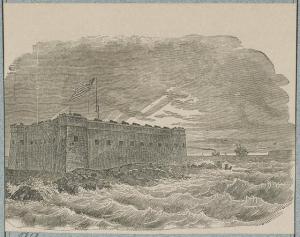
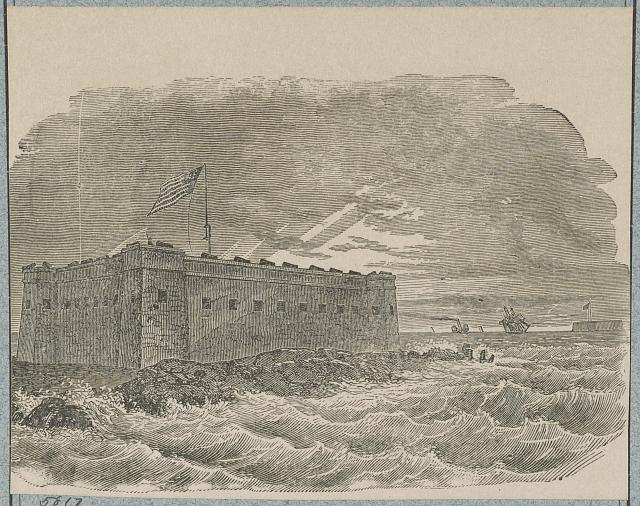
Fort Taylor, Key West, Florida (Harper’s Weekly, 1864, public domain).

Nast’s first illustrations of Santa Claus and depictions of soldiers longing for family at Christmas would initially have been seen by 47th Pennsylvania Volunteers while they were stationed far from home at Fort Taylor in Key West, Florida—just two months after the regiment had sustained a shockingly high rate of casualties during the Battle of Pocotaligo, South Carolina on October 22, 1862. More than one hundred members of the regiment had been killed in action, mortally wounded, grievously wounded, or wounded less seriously, but still able to continue their service.

So terrible was the outcome that it would have been enough to make an impression even on individual 47th Pennsylvanians who hadn’t been wounded. They were not only now battle tested, they were battle scarred, according to comments made by individual members of the regiment in the letters they wrote to families and friends back home during that Christmas of 1862.

No matter how strong their capacity for overcoming adversity had been before that battle, their hearts and minds would never be the same. It would take time to heal and move forward—time they were given while stationed on garrison duty for more than a year.

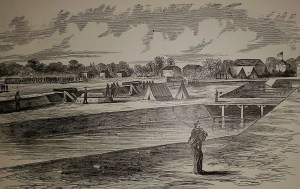
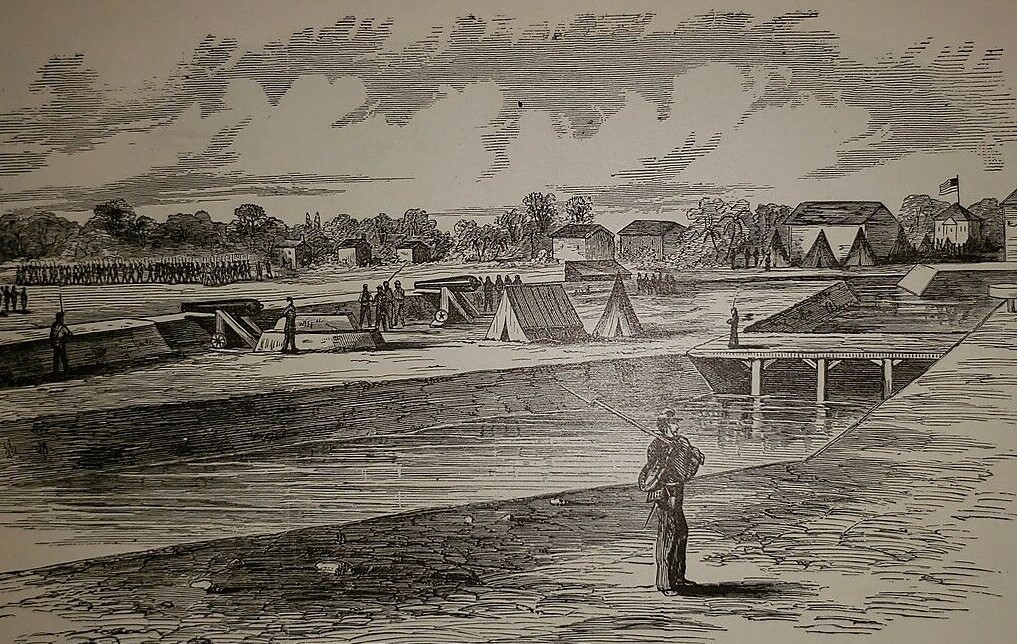
Fort Jefferson (Harper’s Weekly, August 26, 1865, public domain; click to enlarge).

By the time that the American Civil War was ending its third year, the mental wounds of Pocotaligo were far less fresh than they had been the previous Christmas. Still stationed in Florida on garrison duty in 1863, the 47th Pennsylvania Volunteer Infantry was now a divided regiment. While slightly more than half of the regiment was still on duty at in Key West, as companies A, B, C, E, G, and I remained at Fort Taylor, the remaining members of the regiment—companies D, F, H, and K—were now even farther away from home—stationed at Fort Jefferson, the Union’s remote outpost that was situated so far off of Florida’s coast that it was accessible only by ship.

Letters penned to family and friends back in Pennsylvania during the early part of 1863 capture a sense of sadness and longing that pervaded the regiment—as 47th Pennsylvanians mourned the loss of their deceased comrades and thought about how deeply they missed their own families.

Gradually, as the year wore on, those feelings turned to acceptance of their respective losses and, eventually, frustration at still being assigned to garrison duty when they felt they could and should be helping the federal government bring a faster end to the war by defeating the Confederate States Army through enough tide-turning combat engagements that the Confederate States of America would finally surrender and agree to re-unify the nation.

By early 1864, the wish of those 47th Pennsylvanians was granted by senior Union Army officials. They were not only given the opportunity to return to combat, but to return to intense combat as a history-making regiment.

The only regiment from Pennsylvania to fight in the Union’s 1864 Red River Campaign across Louisiana, the 47th Pennsylvanians repeatedly displayed their valor as the blood of more and more of their comrades was spilled to eradicate slavery across the nation while also fighting to preserve the nation’s Union. By the fall of 1864, they were participating in such fierce, repeated battles across Virginia during Union Major-General Philip Sheridan’s 1864 Shenandoah Valley Campaign that President Abraham Lincoln was able to secure his reelection and the tide of the American Civil War was decisively turned in the federal government’s favor once and for all.

Ruins of Charleston, South Carolina as seen from the Circular Church, 1865 (U.S. National Archives and Records Administration, public domain).

By April 1865, the Confederate States Army had surrendered, the war was over and President Lincoln was gone, felled by an assassin’s bullet that had too easily found its target. So, once again, the 47th Pennsylvania Volunteers were in mourning.

Sent back to America’s Deep South that summer, they were assigned to Reconstruction duties in Savannah, Georgia and Charleston, South Carolina, where they helped to reestablish functioning local and state governments, rebuild shattered infrastructure, and reinvigorate a free press that was dedicated to supporting a unified nation—all while other Pennsylvania volunteer regiments were being mustered out and sent home.

Finally, after a long and storied period of service to their nation, the 47th Pennsylvania Veteran Volunteers were given their honorable discharge papers at Camp Cadwalader in Philadelphia, and were then sent home to their own family and friends in communities across Pennsylvania in early January 1866.

Return to Civilian Life

“Santa Claus and His Works,” 1866 (Thomas Nast, Harper’s Weekly, December 29, 1866, public domain; click to enlarge).

Attempting to regain some sense of normalcy as their post-war lives unfolded over the years between the late 1860s and the early 1900s, many of the surviving veterans of the 47th Pennsylvania Volunteer Infantry resumed the jobs they held prior to the war while others found new and better ways to make a living. Some became small business creators, pastors or other church officials, members of their local town councils or school boards, beloved doctors, or even inventors. One even became the lieutenant governor of the Commonwealth of Pennsylvania.

Most also married and began families, some small, some large. Still others made their way west—as far as the states of California and Washington—in search of fortune or, more commonly, places where war’s Grim Reaper would never find them again.

“‘Twas the Night Before Christmas,” 1866 (Thomas Nast, Harper’s Weekly, December 25, 1886, public domain; click to enlarge).

As the years rolled on, they saw more and more of Thomas Nast’s work as it was published in Harper’s Weekly, particularly at Christmas. But the Santa Claus of war was now transformed by Nast as the Saint Nicholas of his childhood in Germany—kind, altruistic, loving, and jolly.

Over time, those illustrations collectively formed the “mind pictures” that the majority of American children and adults experienced when they imagined Santa Claus. So powerful has Nast’s influence been that, even today, when Americans encounter the many variations of Santa used to promote products in Christmas advertising campaigns, they see images that are often based on Nast’s nineteenth century drawings—drawings that had their genesis as beacons of light and hope during one of the darkest times in America’s history.

Like Abraham Lincoln, Nast has been helping Americans to summon and follow “the better angels of our nature” for more than one hundred and sixty years. May the power of his art help us all continue to do so this year and for the remainder of our days.


Sources:

  1. Boissoneault, Lorraine. A Civil War Cartoonist Created the Modern Image of Santa Claus as Union Propaganda.” Washington, D.C.: Smithsonian Magazine, December 19, 2018.
  2. Drawn Together: The Friendship of U.S. Grant and Thomas Nast (video). Wilton, New York: Grant Cottage, May 14, 2022.
  3. Santa Claus,” in “Thomas Nast.” Columbus, Ohio: University Libraries, The Ohio State University, retrieved online December 23, 2023.
  4. Santa Claus in Camp (from ‘Harper’s Weekly,’ vol. 7, p. 1).” New York, New York: The Met, retrieved online December 23, 2023.
  5. Vinson, J. Chal. Thomas Nast and the American Political Scene,” in American Quarterly, vol. 9, no. 3, Autumn 1957, pp. 337-344. Baltimore, Maryland: The Johns Hopkins University Press.


Abraham Lincoln’s Road to the Presidency

Abraham Lincoln in New York City on Monday morning, February 27, 1860, several hours before he delivered his Cooper Union address (Matthew Brady, U.S. Library of Congress, public domain).

During the almost quarter of a century that he resided in his adopted hometown of Springfield, Illinois, Abraham Lincoln was transformed from an average, young adult, who was embarking upon a crucial phase of his life’s journey in early nineteenth-century America, into the lawyer-turned-civic leader that would place his feet on the path to the White House.

A product of rural America, his formative years had been spent in Kentucky and southern Indiana. A resident of New Salem, Illinois in 1831, he was just twenty-five when he was elected to his first term in the Illinois State Legislature and began to study law more seriously. By 1837, he was a solicitor who lived and practiced law in Springfield. Married to Mary Todd five years later, he built his life with her at their Eighth and Jackson street-corner home, while also carving out a name for himself as a skilled and trustworthy legal scholar and successful courtroom attorney. Avidly interested in politics, he also became an active member of the Whig Party.

Persuaded by his wife and political associates to run for federal office in 1846, he was elected to the U.S. House of Representatives in that same year. His initial service was short-lived, however; he had pledged to serve only one, two-year term, hoping to secure a more stable, federal government job in the administration of U.S. President Zachary Taylor. But when that opportunity fell through, he returned home to Springfield and threw himself back into the practice of law.

* Note: During his tenure with the U.S. House of Representatives, Abraham Lincoln co-wrote a bill with Congressman Joshua R. Giddings that he hoped would end the practice of slavery in the District of Columbia. Lacking support from his fellow Whig Party members, however, he subsequently chose to withdraw that bill.

By the mid-1850s, Abraham Lincoln was realizing that his conscience would no longer permit him to sit on the sidelines, politically, when there was so much in his country that needed to be changed. Incensed by the passage of the Kansas-Nebraska Act in 1854, which paved the way for the brutal practice of chattel slavery to spread like a wave of toxic sludge over newly-forming states, Lincoln left the Whigs behind to join a new, more forward-thinking political organization—the Republican Party.

Four years later, he mounted a campaign against U.S. Senator Stephen A. Douglas. Although he lost that race, he would forever become linked to that Democrat as a result of their famously intense Lincoln-Douglas Debates, a forum that gave him a nationwide name recognition so high that it enabled him to become President of the United States.

Chosen by the Republican Party in 1860 to be its candidate for the highest office in the nation, Abraham Lincoln was elected as President on November 6, 1860.

How That Crucial Election Day Unfolded

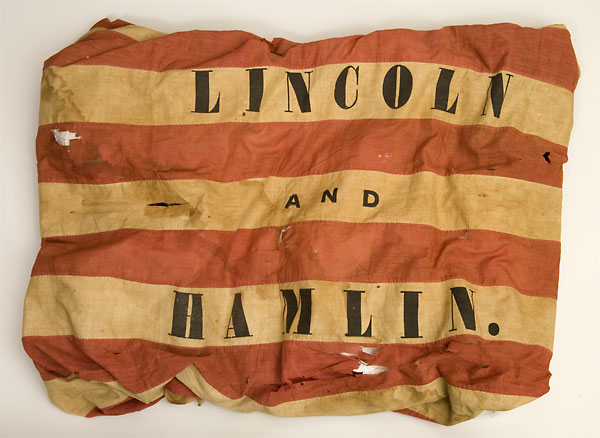
Hand-sewn banner used in Abraham Lincoln’s 1860 campaign for President of the United States (Lincoln Home, U.S. National Park Service, public domain).

According to Jamie Malanowski, a former editor at Time magazine:

“There were no surprises: the long-settled Yankees in Maine and New Hampshire and pioneering Germans of Michigan and Wisconsin delivered the expected victories. And then came news from Illinois: ‘We have stood fine. Victory has come.’ And then from Indiana: ‘Indiana over twenty thousand for honest Old Abe.’

The throngs in the streets cheered every report, every step towards the electoral college number, but news from the big Eastern states was coming painfully slowly…. The advisers paced the floorboards, jumping at every eruption of the rapid clacking of Morse’s machine….

It wasn’t until after 10 that reports of victory in Pennsylvania arrived in the form a telegram from the canny vote-counter Simon Cameron, the political boss of the Keystone State, who tucked within his state’s tallies joyfully positive news about New York: ‘Hon. Abe Lincoln, Penna seventy thousand for you. New York safe. Glory enough.’

Not until 2 a.m. did official results from New York arrive … the one-time rail-splitter won by 50,000 votes.”

The Aftermath

“As the votes were counted, Lincoln had about 40 percent of the popular vote and 180 electoral votes, compared with 133 for his opponents combined,” according to historians at the National Constitution Center, but events in America’s Deep South “cast a pall over the upcoming Electoral College voting process”:

“What if the southern states refused to take part in the Electoral College? Or what if a unified front to avoid secession could convince enough ‘faithless electors’ to switch sides to derail the election?

And what if the southern states boycotted the Electoral College?”

Lincoln scholar Harold Holzer sums up what was in the minds of many Americans in the days following the 1860 presidential election:

“If these states did not participate in the traditional process, could the Electoral College proceed? What would constitute a quorum? No one, least of all Lincoln, knew the answers to these vexing questions.”

Those questions were finally answered when those southern states agreed to participate in the Electoral College process of the United States.

“But there was a greater than normal military presence on Capitol Hill” to ensure that the peaceful transfer of power would take place that certification day, according to historians at the National Constitution Center. And it did.

Abraham Lincoln’s election was officially certified by the U.S. Congress on February 15, 1861.


Sources:

  1. Donald, David Herbert. Lincoln. New York, New York: Simon & Schuster, 1996.
  2. Foner, Eric. The Fiery Trial: Abraham Lincoln and American Slavery. New York, New York: W. W. Norton & Company, Inc., 2010.
  3. Harris, William C. Lincoln’s Rise to the Presidency. Lawrence, Kansas: University Press of Kansas, 2007.
  4. “Lawyer to President,” in “Virtual Museum Exhibit.” Springfield, Illinois: Lincoln Home National Historic Site, retrieved online November 6, 2023.
  5. Malanowski, Jamie. “Lincoln Wins. Now What,” in “Disunion.” New York, New York: The New York Times, November 7, 2010.
  6. Oates, Stephen B. “Abraham Lincoln 1861–1865,” in C. Vann Woodward, ed. Responses of the Presidents to Charges of Misconduct. New York City: Dell Publishing Co., Inc. pp. 111–123, 1974.
  7. Oates, Stephen B. With Malice Toward None: A Life of Abraham Lincoln. New York, New York: Harper Collins, 2011.
  8. On This Day, Abraham Lincoln Is Elected President.” Philadelphia, Pennsylvania: National Constitution Center, November 6, 2023.
  9. President Abraham Lincoln.” Washington, D.C.: U.S. Library of Congress, retrieved online November 6, 2023.

The Demographics of the 47th Pennsylvania Volunteer Infantry

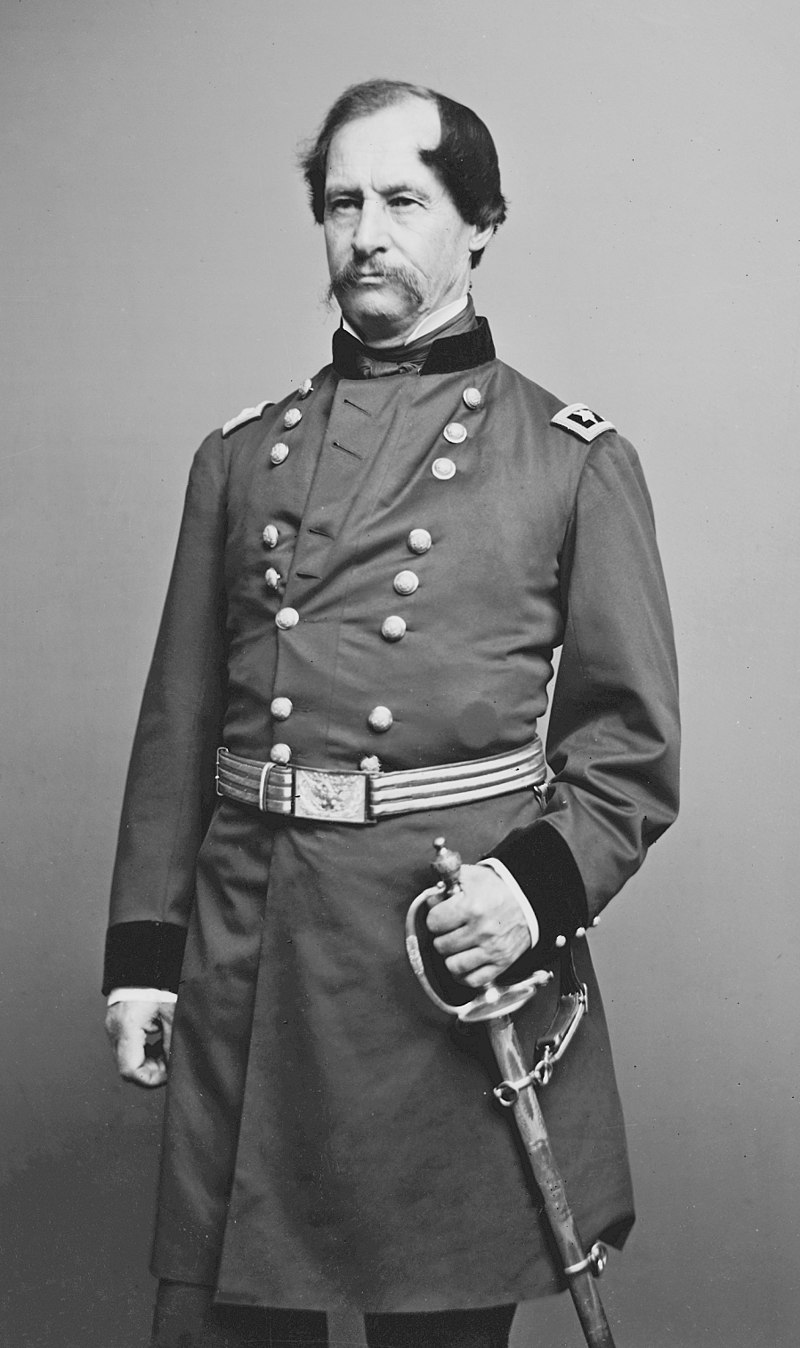
Lieutenant-Colonel George Warren Alexander, second-in-command, 47th Pennsylvania Volunteer Infantry, with officers from the 47th at Fort Jefferson in the Dry Tortugas, Florida, circa 1863 (public domain).

Recruited primarily at community gathering places in their respective hometowns, the majority of soldiers who served with the 47th Pennsylvania Volunteer Infantry were enrolled at county seats or other large population centers within the Commonwealth of Pennsylvania.

The youngest member of the regiment was a 12-year-old drummer boy; the oldest was a 65-year-old, financially successful farmer who would attempt to re-enlist, at the age of 68, after being seriously wounded while protecting the American flag in battle.

Roughly 70 percent were residents of Pennsylvania’s Lehigh Valley, including the cities of Allentown, Bethlehem and Easton and surrounding communities in Lehigh and Northampton counties. Company C, which was formed primarily of men from Northumberland County, was more commonly known as the “Sunbury Guards.” Company D and Company H were staffed largely by men from Perry County. Company K was formed with the intent of creating an “all-German” company that would be composed of German-Americans and German immigrants.

In point of fact, a number of the 47th Pennsylvania Volunteers were immigrants or first-generation Americans. A significant percentage of each of the regiment’s companies were men whose families still spoke German or “Pennsylvania Dutch” at their homes and churches more than a century after their ancestors emigrated from Germany in search of religious or political freedom. Others traced their roots to Ireland; one had been born on Spain’s Canary Islands, and at least two were natives of Cuba.

In early October of 1862, several African American men who had been freed from enslavement on plantations near Beaufort, South Carolina, joined the ranks of the 47th Pennsylvania, followed by the April 1864 enrollment of other formerly enslaved men in Natchitoches, Louisiana.

Their final resting places span the nation, from Maine to California and from the State of Washington to Florida.


Learn More About the 47th Pennsylvania Volunteers

First State Color, 47th Regiment, Pennsylvania Volunteer Infantry (presented to the regiment by Pennsylvania Governor Andrew Curtin, 20 September 1861; retired 11 May 1865, public domain).

Largely forgotten by mainstream historians, the 47th Pennsylvania Volunteer Infantry was a Union Army unit which served for nearly the entire duration of the American Civil War. Formed by the fruit of the Great Keystone State’s small towns and cities, the regiment was born on August 5, 1861, when its founder, Tilghman H. Good, received permission from Pennsylvania Governor Andrew Gregg Curtin to form an entirely new regiment in response to President Abraham Lincoln’s call for additional volunteers to help preserve American’s Union. It ended its service during the early months of the nation’s Reconstruction Era, officially mustering out at Charleston, South Carolina on Christmas Day in 1865, its members receiving their final discharge papers at Camp Cadwalader in Philadelphia, Pennsylvania in early January of 1866.

Along the way, the 47th Pennsylvania made history, becoming an integrated regiment in 1862 and the only regiment from Pennsylvania to participate in the Union’s 1864 Red River Campaign across Louisiana. Its members also distinguished themselves in battle, repeatedly, including during Union General Philip Sheridan’s Shenandoah Valley Campaign, which unfolded between August and December of 1864.

Learn more about key moments in this regiment’s history by reading the following posts:

1861:

1862:

1863:

1864:

1865:

Research Update: More New Details Regarding the Lives of Formerly Enslaved Black Men Who Enlisted with the 47th Pennsylvania Volunteer Infantry

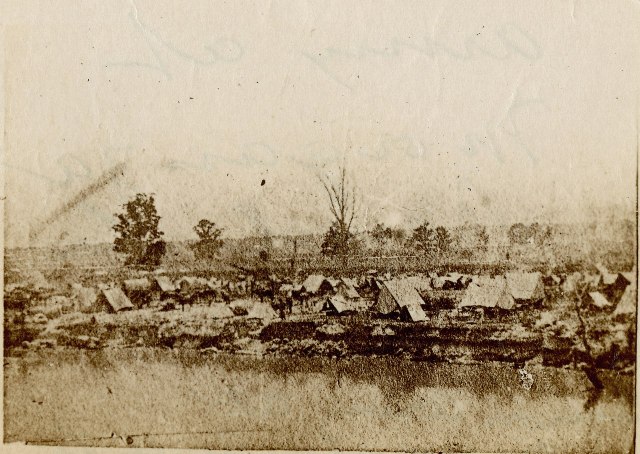
Union Army at Morganza Bend, Louisiana, c. 1863-1865_USLOC, pubdom

Union Army base at Morganza Bend, Louisiana, circa 1863-1865 (U.S. Library of Congress, public domain).

Researchers investigating the lives of nine formerly enslaved Black men who enlisted with the 47th Pennsylvania Volunteer Infantry during the American Civil War recently uncovered new details about two of those soldiers.

In addition to finding more data related to the immediate post-war life of Aaron French (learn more about him in this article here), including how and why he ended up settling in Mississippi following the Civil War, researchers have also now found important information about the life of Hamilton Blanchard—who enrolled with Bullard on the same day.

Born into slavery in Natchitoches, Louisiana sometime around 1843, Hamilton Blanchard was able to secure his freedom twenty-one years later when the United States Army arrived in town as part of an expedition led by Union Major-General Nathaniel P. Banks. Determined not to be forced back into bondage after the Union troops moved on in their ill-fated quest to capture the city of Shreveport, he chose to enlist with one of the units serving under Banks—the 47th Pennsylvania Volunteer Infantry—the only regiment from Pennsylvania that was involved in the Union’s 1864 Red River Campaign across Louisiana.

After enrolling in the military, Hamilton Blanchard was then assigned to Company D at the rank of “Cook” on 5 April 1864.

Crop_Bullard, Aaron and Hamilton Blanchard_Co. D, 47th PA_Muster Roll

Muster roll entries for Aaron Bullard and Hamilton Blanchard, Company D, 47th Pennsylvania Volunteers (U.S. National Archives, public domain).

The official muster-in of Blanchard, Aaron Bullard, and three other young Black men who enrolled that day did not take place immediately, however, because the 47th Pennsylvania Volunteers were ordered to move out shortly after their arrival, and were quickly drawn into intense combat with enemy troops commanded by Confederate Major-General Richard Taylor (a plantation owner and son of Zachary Taylor, former President of the United States). Battered badly during the Battle of Sabine Cross Roads near Mansfield, Louisiana on 8 April and in the Battle of Pleasant Hill the next day (9 April), they fought the Confederate Army again on 23 April near Monett’s Ferry in the Battle of Cane River and on 16 May in the Battle of Mansura near Marksville.

Continuing on toward the southeastern part of Louisiana, the 47th Pennsylvania Volunteers marched for Morganza, which had been held in Union hands since the fall of 1863 and was now the site of a major Union Army encampment. While there, the officers of the 47th Pennsylvania Volunteer Infantry officially mustered in all nine of the formerly enslaved Black men who had enlisted with the 47th Pennsylvania in Beaufort, South Carolina (1862) and Natchitoches, Louisiana (April 1864)—a process which took place between 20-24 June 1864.

From that point on, those nine men traveled with the 47th Pennsylvania as it returned to the East Coast and engaged in multiple battles associated with Union Major-General Philip Sheridan’s 1864 Shenandoah Valley Campaign across Virginia, the protection of the nation’s capital following the April 1865 assassination of President Abraham Lincoln, and the early days of Reconstruction in Georgia and South Carolina.

On Christmas Day in 1865, Hamilton Blanchard then joined his fellow 47th Pennsylvania Volunteers in mustering out from their final duty station in Charleston, South Carolina.

Post-War Life

Having been honorably discharged from the 47th Pennsylvania Volunteer Infantry when the regiment mustered out, at least two of the nine formerly enslaved Black men who had enlisted with the regiment evidently made their way north—possibly when the other members of their former regiment returned home to Pennsylvania. (It is also possible, however, that they made the journey independently of their former regiment because both men appear to have resettled in the Washington, D.C. area, post-war, while the other 47th Pennsylvania Volunteers were transported by ship directly to New York City and then by train to Camp Cadwalader in Philadelphia, Pennsylvania, where they were given their final discharge papers on 9 January 1866.)

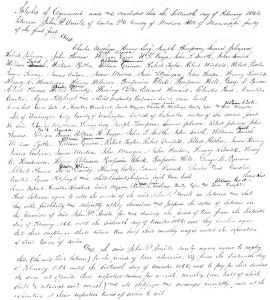
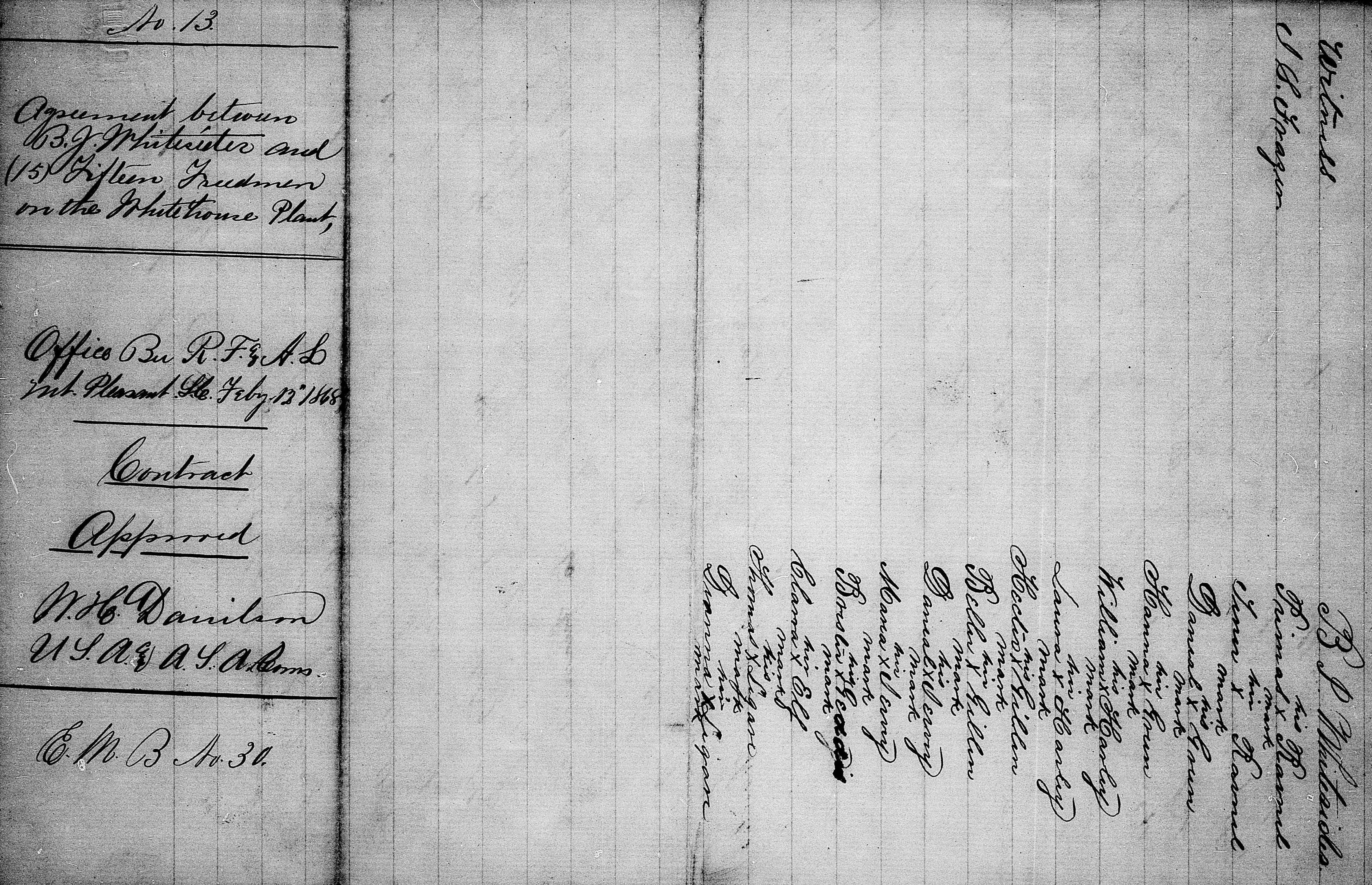
Blanchard-Bullard_Madison Co., MS_Freedmen's Bureau Contract, Feb-Dec 1866, p. 1

Freedmen’s Bureau contract between Madison County, Mississippi farm owner John P. Arvile [sic] and farm laborers Hamilton Blanchard, Aaron Bullard, et. al., Washington, D.C., 16 February 1866 (excerpt, p. 1, U.S. National Archives).

What is known for certain is that Hamilton Blanchard and Aaron Bullard made contact with a representative of the Bureau of Refugees, Freedmen, and Abandoned Lands sometime in late 1865 or early 1866. They then signed a contract with the Freedmen’s Bureau during the early winter of 1866 in which they both agreed to join a large group of formerly enslaved Black men, women, and children who would be providing farm labor to a man named John P. Avrill (alternate spellings: “Averile”, “Averill”, “Arvile”, “Arville”, or “Avrille”) at his property in Canton, Madison County, Mississippi.

That Freedmen’s Bureau contract was slated to be in effect between 16 February and 16 December of 1866, and begins with a cover page which states:

Washington D.C.
February 1866
Contract No.
John P. Arvill
With (66) Freedmen

John Arville
Contract with
46 Farm Hands

The main body of the document goes on to reveal the following details of the contract:

Articles of Agreement made and concluded this the Sixteenth day of February 1866 between John P. Arvile of Canton P.O. County of Madison State of Mississippi party of the first part and

Charles Matthews, Henry Long, Joseph Thompson, Samuel Johnson, Robert Johnson, John Thomas … Charles Ford, Caroline Carter, Agnes Fitzhugh and child (infant), Benjamin Smith, Anna Smith, Thomas Reed [sp?], Aaron Bullard, Hamilton Blanchard, Isaiah Wiggins, James Lewis, Charles K. [illegible], Baily Taylor, William Carter, and Andy Hampton [sp?].

The next paragraph lists Hamilton Blanchard and Aaron Bullard a second time, along with multiple names from the aforementioned group of farm laborers. Subsequent paragraphs spell out further points of the agreement:

All of Washington City, County of Washington, District of Columbia, parties of the second part, the said Charles Matthews, Henry Long, Joseph Thompsen, Samuel Johnson, Robert Johnson, John Thomas … Aaron Bullard, Hamilton Blanchard, Isaiah Wiggins, James Lewis … Field Laborers, agree to enter the service of the said John P. Averile as Laborers and that they will faithfully and diligently apply themselves and perform the duties of Laborers on the premises of said John P. Averile for and during the period of time from the Sixteenth day of February 1866 until the sixteenth day of 1866; and they further agree that their employer shall retain one half their monthly wages until the expiration of their term of service.

And the said John P. Arvile hereby agrees to employ them (the said Field laborers) for the period of time aforesaid. Viz from the Sixteenth day of February 1866 until the sixteenth day of December 1866; and to pay for their services the sum set opposite their respective names per month, monthly (one half of which shall be retained each month) and all stoppages and arranged promptly, paid at the expiration of their respective terms of service to wit…..

In equal monthly payments; and the said John P. Arvile further agrees to furnish said Freed laborers … quarters, fuel, full substantial and healthy rations, and all necessary attendance and supplies in case of sickness, in addition to the compensation … named, and that he will assist and encourage efforts for the education of the children of his employees, and it is further agreed by the said John P. Arvile, that in case he at any time fails to perform his part of this contract agreement he will pay to each of the said laborers the full sum of One hundred and twenty dollars [strikethrough made by someone’s hand to original contract], as fixed, agreed and liquidated damages. This contract can be annulled by the mutual consent of the Employer and the employee, but only in the presence of an Authorized Agent of the Bureau of Refugees Freedmen and Abandoned Lands and such annullment [sic] on the part of the Employer and anyone [sic] employee shall in no wise affect the validity of the Contract in respect to the employer and the other employees and should either party violate this contract then the other party shall make complaint to the nearest authorized agent of the Bureau Refugees Freemen & Abandoned Lands.

The contract continues on, specifying that both Aaron Bullard and Hamilton Blanchard were to each be paid a wage of $10 per month, and stating that some of the other men on the list would be paid as much as $12 per month while others would be paid $8 per month. (Teenaged boys and women on the list were to be paid even less—$6 per month.)

In all cases, the reality was far different. Per the contract, they were initially paid only half of what their monthly wages were because the Freedmen’s Bureau agent in charge of looking out for the welfare of these formerly enslaved men, women, and children allowed the white farmer—their “employer”—to “retain one half their monthly wages until the expiration of their term of service.”

No further data has been uncovered from Freedmen’s Bureau records about the status of those unpaid wages or the outcome of that contract, but because these Black men, women, and children were essentially returned to an unequal system of servitude by the Freedmen’s Bureau agent (as evidenced by the manner in which this contract was drafted—favoring the White “employer” over the Black “field laborer” and including multiple after-the-fact revisions, such as word insertions and strikethroughs)—it is highly unlikely that Hamilton Blanchard, Aaron Bullard, or the other Black men, women, and children mentioned in the contract were ever paid the full amount they were entitled to for what was most assuredly very hard labor.

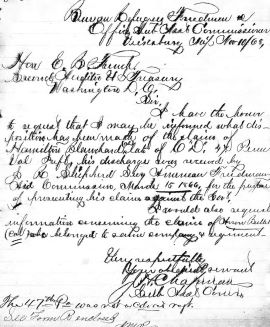
Blanchard-Bullard-Chapman_Treasury Inquiry, 10 Nov 1866

Letter of inquiry from J. H. Chapman on behalf of Hamilton Blanchard to E. B. French, second auditor, U.S. Treasury Department, 10 November 1868 (Freedmen’s Bureau records, U.S. National Archives). 

This hypothesis posed by researchers investigating the history of the 47th Pennsylvania Volunteer Infantry is backed up by a letter of inquiry penned on 10 November 1868 by J. H. Chapman, a Sub-Assistant Commissioner of the Freedmen’s Bureau working at an office in Vicksburg, Mississippi, to E. B. French, Second Auditor of the U.S. Department of the Treasury in Washington, D.C.

In this letter, Chapman asks French that he “be informed what disposition has been made of the claim of Hamilton Blanchard, late of Co. “D” 47 Penn Vol. Inft., his discharge was received by J. R. Schuchard [sp?]” of the “Freedmen’s Aid Commission, March 15, 1866.” Chapman added that he was requesting this update on Blanchard’s behalf “for the purpose of prosecuting his claim against the Gov.” He then also requested “information concerning the claim of Aaron Bullard (Col.) who belonged to same company & regiment.”

* Note: An unidentified individual added an undated notation to the bottom of this letter in handwriting that is clearly different from that of the original letter writer, Chapman. That notation correctly states: “The 47th Pa was not a colored regt. See Form R enclosed. A.M.R. 103.” (The 47th Pennsylvania Volunteer Infantry became an integrated regiment on 5 October 1862, but its African American members were not considered to be part of the U.S. Colored Troops, also known as the USCT.)

Researchers have not yet located the “Form R” referred to in the notation to Chapman’s letter, but will be pursuing this lead, as well as investigating the claims filed by Hamilton Blanchard and Aaron Bullard, and searching for additional information regarding what happened to Hamilton Blanchard during and after the 1870s. 

An additional avenue of inquiry will be the potential relationship that may have developed between Aaron Bullard and E. B. French during or after this time—a new theory being considered in light of the discovery of French’s name on this letter. (Aaron Bullard changed his surname, “Bullard,” which had been associated with his enslavement in Louisiana, to “French” sometime between his 1868 appeal to E. B. French in the U.S. Treasury Department and the day he was visited at home in Issaquena County, Mississippi by an enumerator of the 1870 U.S. Census—possibly indicating that he wanted to both shed his “slave name” and honor someone who had been helpful to him.)

Sources:

  1. Bates, Samuel P. History of Pennsylvania Volunteers, 1861-5, vol. 1. Harrisburg, Pennsylvania: B. Singerly, State Printer, 1869.
  2. Civil War Muster Rolls, in Records of the Department of Military and Veterans’ Affairs (Record Group 19, Series 19.11). Harrisburg, Pennsylvania: Pennsylvania Historical and Museum Commission, 1861-1865.
  3. Civil War Veterans’ Card File. Harrisburg, Pennsylvania: Pennsylvania State Archives.
  4. “Records of the Field Offices for the District of Columbia, Bureau of Refugees, Freedmen, and Abandoned Lands, 1865-1870” (NARA Series Number: M1902; NARA Reel Number: 18; NARA Record Group Number: 105; NARA Record Group Name: Records of the Bureau of Refugees, Freedmen, and Abandoned Lands, 1861 – 1880; Collection Title: District of Columbia Freedmen’s Bureau Field Office Records 1863-1872: Aaron Bullard and Hamilton Blanchard, 1866 and 1868). Washington, D.C.: U.S. National Archives and Records Administration.
  5. Schmidt, Lewis. A Civil War History of the 47th Regiment of Pennsylvania Veteran Volunteers. Allentown, Pennsylvania: Self-published, 1986.
  6. Wharton, Henry D. Letters from the Sunbury Guards. Sunbury, Pennsylvania: Sunbury American, 1861-1868.

Black History Month: New Details Uncovered Regarding the Formerly Enslaved Black Men Who Enlisted with the 47th Pennsylvania Volunteer Infantry

Research regarding the lives of the nine formerly enslaved Black men who enlisted with the 47th Pennsylvania Volunteer Infantry in 1862 and 1864 has continued to progress—even in the middle of a pandemic that has forced the closure of numerous local, state, and national archives.*

In addition to uncovering details about the life of the soldier from South Carolina who was mistakenly listed on muster rolls for the 47th Pennsylvania as “Presto Gettes” (learn more about him in this article here), researchers for 47th Pennsylvania Volunteers: One Civil War Regiment’s Story have been able to determine more about what happened to two of the other men post-war, and have also located records which seem to indicate that there may have been two or three other Black men who enlisted with the regiment (potentially bringing the total number of Black enlistees in the regiment to twelve).

Aaron French (enlisted as Aaron Bullard):

Muster roll entries for Aaron Bullard and Hamilton Blanchard, Company D, 47th Pennsylvania Volunteers (U.S. National Archives, public domain).

1864 was a life-changing year for Aaron Bullard and four other young Black men in Louisiana. After enlisting with the 47th Pennsylvania Volunteer Infantry on April 5 while the 47th was stationed at Natchitoches, Louisiana, Samuel Jones, Hamilton Blanchard (also known as John Hamilton), and Aaron, James, and John Bullard traveled with the 47th Pennsylvania as it participated in the multiple battles associated with the Union’s 1864 Red River Campaign across Louisiana. On or about June 22, they were formally mustered into the regiment at Morganza, Louisiana.

Sometime later (possibly post-war), Aaron Bullard changed his surname to French. After the American Civil War, he married, became a land-owning farmer—and a dad.

Post-Civil War, Aaron French and his family resided in Issaquena County, Mississippi (U.S. Census, 1870, public domain).

In August of 1870, Aaron French and his wife, Amanda, lived with their eight-month-old daughter, “Simpy” (also known as Cynthia or Cyntha) in Skipworth Precinct, Issaquena County, Mississippi. Still residing in Issaquena County a decade later when the June 1880 federal census was taken, Aaron and Amanda were the proud parents of three daughters: Cynthia (who would go on to marry Samuel L. Dixon on March 20, 1890), Jesanna (also known as Jessie/Jesse), and “Arctavia” (also known as Octavia). Jessie, who later went on to wed John B. Cobb on January 28, 1892, made a life with her husband and son in Mayersville, Mississippi, where she was a teacher in the local schools. Octavia married Frank Childress on March 20, 1894.

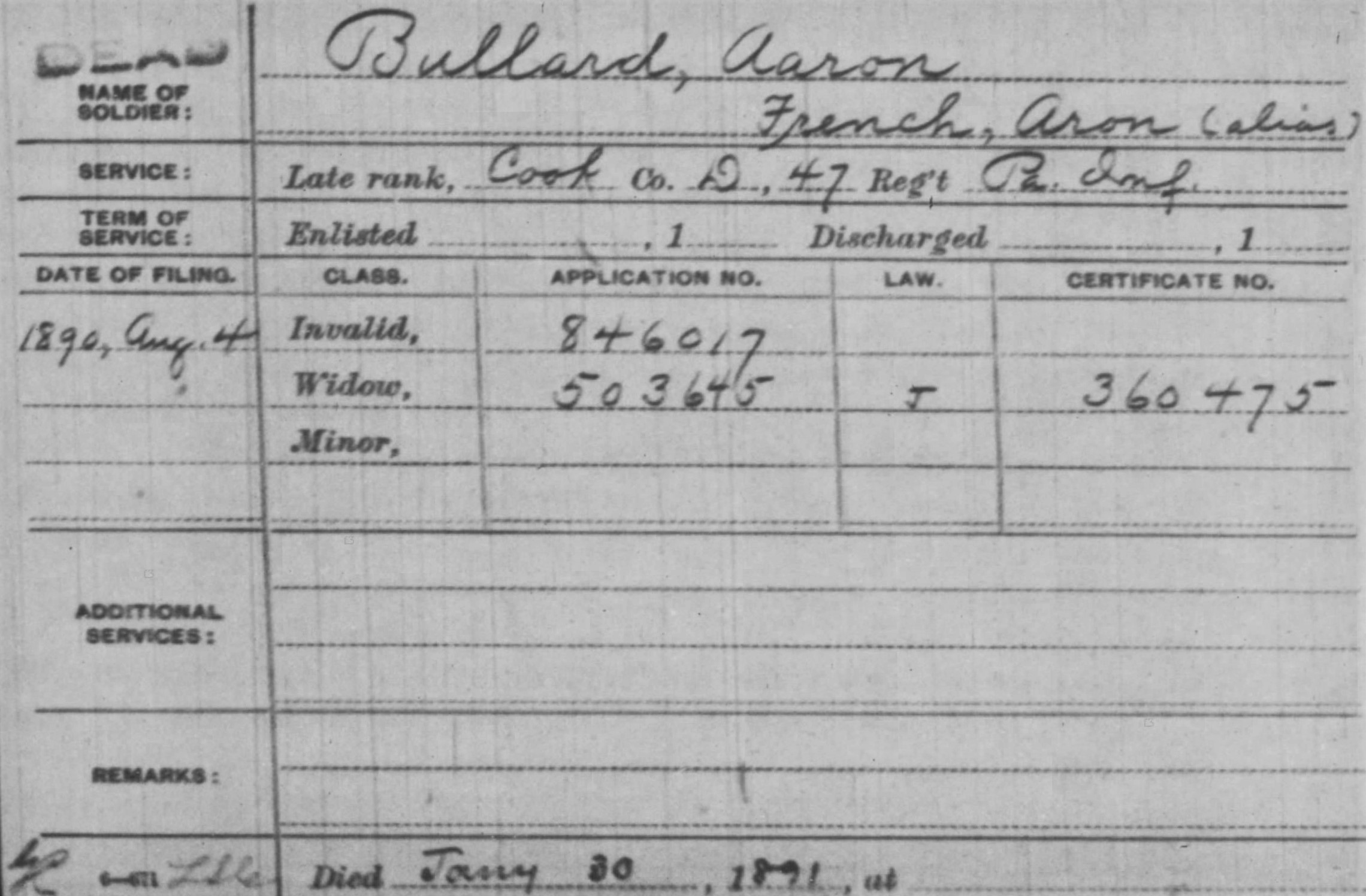
U.S. Civil War Pension Index Card for Aaron French, who enlisted with the 47th Pennsylvania Volunteers in Louisiana in 1864 (U.S. National Archives, public domain).

Sadly, Aaron French did not live to see his two youngest daughters marry because he died in Mississippi on January 30, 1891. He was just 40-43 years old, according to U.S. Census records and other data, which indicate that he was born in Louisiana sometime between 1848 and 1850.

Hearteningly, though, an even more intriguing piece of data has recently been uncovered about the later life of Aaron French—one that indicates that he had become active in politics prior to his death. According to the Vicksburg Evening Post, Aaron was appointed as a delegate from Issaquena County to the Republican Congressional Convention for the Third District, which was held in Greenville, Mississippi on August 7, 1886. Researchers are continuing to search for further details about his political activities and untimely death, as well as the exact location of his gravesite.

Thomas Haywood (alternate spellings of surname: Hayward, Haywood, Heywood) and Jack Jacobs:

Muster roll entries of Thomas Haywood and Edward Jassum, Company H, 47th Pennsylvania Volunteers (U.S. National Archives, public domain).

Born into slavery in South Carolina sometime around 1832, Thomas Haywood enlisted for a three-year term of service as an Under Cook with Company H of the 47th Pennsylvania Volunteer Infantry at Beaufort, South Carolina on November 1, 1862. He and three other formerly enslaved Black men—Abraham and Edward Jassum and Presto Gettes”—who had previously enlisted with the 47th Pennsylvania at Beaufort in October of 1862, then traveled with the 47th Pennsylvania as it participated in multiple military engagements, including the 47th’s garrisoning of Fort Taylor and Fort Jefferson in Florida in 1863 and 1864, the battles of the Union’s spring 1864 Red River Campaign across Louisiana, and the battles of Sheridan’s tide-turning Shenandoah Valley Campaign across Virginia in the fall of 1864.

On or about June 22, 1864 all nine of these Black soldiers were formally mustered into the regiment at Morganza, Louisiana; Thomas Haywood and seven of the eight others all successfully completed their tours of duty, and were honorably mustered out upon expiration of their respective terms of enlistment. In Thomas Haywood’s case, that honorable discharge was awarded on October 31, 1865.

Post-war, it appears from various Freedmen’s Bureau records that he may have entered into yearly contracts with several men who had previously been plantation owners in the Beaufort, South Carolina area. In exchange for agreeing to plant and cultivate cotton for those men on three to five-acre parcels of land that had been leased to him by those white men, he was allowed to keep portions of the cotton sales (the largest portions of which went to the former plantation owners who had also most likely been slave owners prior to and during the Civil War).

U.S. Civil War Index Card for Thomas Haywood, who enlisted with the 47th Pennsylvania Volunteers in South Carolina in 1862 (U.S. National Archives, public domain).

His body warn out from years of slavery prior to the war, difficult military service during the war, and harsh sharecropping experiences post-war, Thomas Hayward applied for, and was awarded a U.S. Civil War Pension on April 30, 1888. That pension was subsequently renewed by the federal government in 1907 at the rate of $15 per month (roughly $415 per month in today’s U.S. dollar equivalency).

By 1890, Thomas Haywood was living in Sheldon Township, Beaufort County, South Carolina. After a long life, he died on January 13, 1911. Unfortunately, his burial location has also not yet been identified by researchers.

In 1890, Thomas Haywood lived near Hanna Jacobs, the widow of Jack Jacobs, who may have been another Black soldier who enlisted with the 47th Pennsylvania Volunteers (U.S. Census, 1890, Sheldon Township, Beaufort County, South Carolina, public domain).

One other piece of tantalizing data that has recently been discovered is that a woman named “Hanna Jacobs” lived near Thomas Haywood in 1890. This information may be significant because Hanna was described on the 1890 U.S. Census of Union soldiers and widows as the widow of “Jack Jacobs,” who had served in the same company with Thomas Haywood (according to that special census).

Researchers currently believe that Jack Jacobs may, in fact, have been another formerly enslaved Black man who had enlisted with the 47th Pennsylvania when it was stationed near Beaufort in 1862, and are currently conducting a Go Fund Me campaign to raise funds to purchase the Civil War military and pension records of Hanna and Jack Jacobs, as well as the nine known formerly enslaved Black men who enlisted with the 47th Pennsylvania Volunteer Infantry in 1862 and 1864.

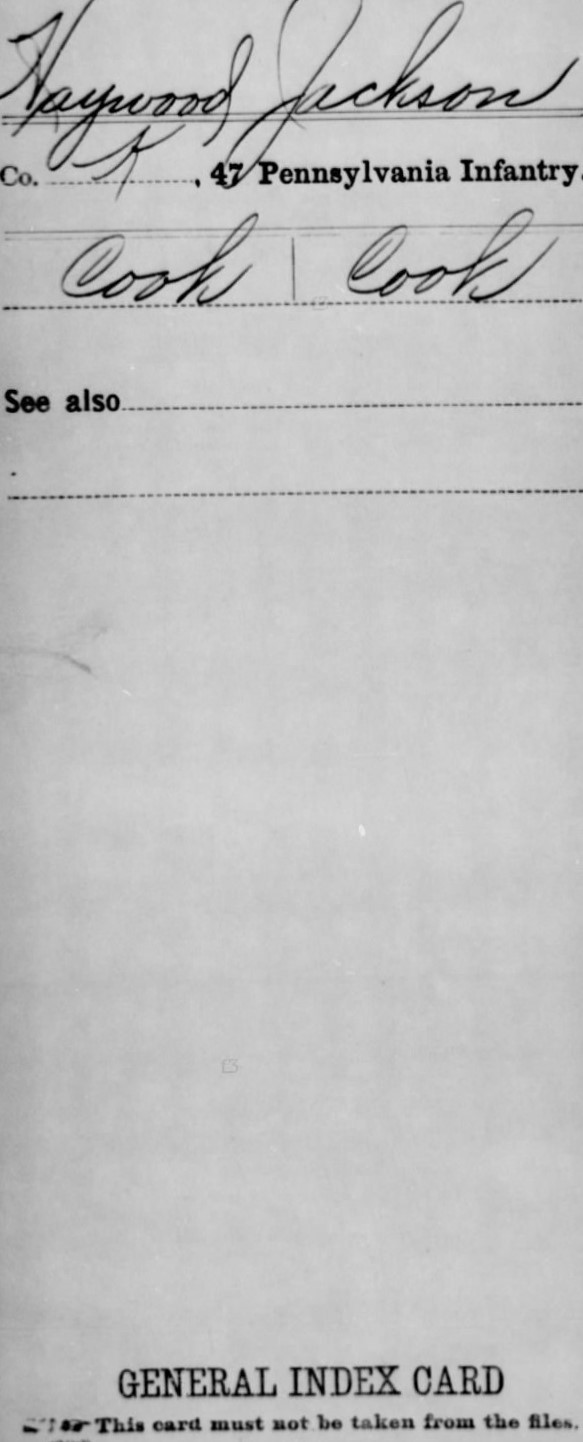
Jackson Haywood:

General Index Card for Jackson Haywood, who may have been a Black soldier who enlisted with the 47th Pennsylvania Volunteers (U.S. National Archives, public domain).

According to the “Index to Compiled Service Records of Volunteers Who Served in Organizations from the State of Pennsylvania,” which was created by staff at the U.S. National Archives, a General Index Card was created for yet another mystery man—a soldier named “Jackson Hayward.”

To date, researchers have only been able to determine that he may have enlisted with Company K of the 47th Pennsylvania Volunteer Infantry as a cook—a rank similar to that at which the known nine formerly enslaved Black men who enlisted with the 47th Pennsylvania were entered on the muster rolls of the regiment.

Researchers hope, with time and the continued financial support of the followers of 47th Pennsylvania Volunteers: One Civil War Regiment’s Story, to be able to confirm the dates of military service and race of this individual, as well as that of “Jack Jacobs.”

As always, we appreciate everyone’s help in ensuring that the service to the nation of these soldiers will never be forgotten. They helped to preserve our Union and deserve to be recognized more fully for their heroism and dedication.

* Our most important goal continues to be the purchase of the Compiled Military Service Records (CMSR) and U.S. Civil War Pension records for each of these remarkable men in order to document and freely share their stories with the widest possible audience. We continue to await word from staff at the U.S. National Archives regarding the timeframe for their resumption of digitization and reproduction services that have temporarily been suspended due to the coronavirus pandemic. As soon as those services have resumed, we will request an update regarding their estimated timeframe for fulfilling our records requests. In the interim, we will seek out further details about each of these soldiers via local and state archival resources across the nation, and will post updates as we confirm more data.

Sources:

  1. Bullard, Aaron, in Index to Compiled Service Records of Volunteers. Washington, DC: U.S. National Archives, 1861-1865.
  2. Bullard, Aaron and French, Aaron, in U.S. Civil War Pension Index Cards. Washington, DC: U.S. National Archives, 1890-1891.
  3. Bullard, Aaron, Presto Garris, Thomas Haywood, et. al. in U.S. Civil War Muster Out Rolls (47th Pennsylvania Volunteer Infantry). Washington, DC: U.S. National Archives, 1865-1866 (available via Ancestry.com).
  4. French, Aaron, in “Proceedings of the Third District Republican Convention.” Vicksburg, Mississippi: Vicksburg Evening Post, August 9, 1886.
  5. French, Aaron and Family, in U.S. Census Records (Issaquena County, Mississippi): Washington, DC: U.S. National Archives, 1870-1910.
  6. Haywood, Jackson, in Index to Compiled Service Records of Volunteers. Washington, DC: U.S. National Archives, 1861-1865.
  7. Haywood, Thomas, in Index to Compiled Service Records of Volunteers. Washington, DC: U.S. National Archives, 1861-1865.
  8. Haywood, Thomas, in U.S. Civil War Pension Index Cards. Washington, DC: U.S. National Archives, 1888, 1907.
  9. Haywood, Thomas, in U.S. Veterans’ Administration Pension Payment Cards. Washington, DC: U.S. National Archives, 1888, 1907.
  10. Haywood, Thomas, in U.S. Census (Beaufort County, South Carolina): Washington, DC: U.S. National Archives, 1890.
  11. Hanna Jacobs, widow of Jack Jacobs, in U.S. Census (Beaufort County, South Carolina): Washington, DC: U.S. National Archives, 1890.


Early to Mid-October 1862: Jacksonville, a Confederate Steamer, and a Regiment’s Historic Integration

Earthen works surrounding the Confederate battery atop Saint John’s Bluff along the Saint John’s River in Florida, 1862 (J. H. Schell, public domain).

Following their early October 1862 routing of Confederate States Army troops at an artillery battery on Saint John’s Bluff in Duval County, Florida—a battery which had been strategically positioned to prevent Union ships from making their way from the Atlantic Ocean and mouth of the Saint John’s River at Jacksonville to Palatka and points south, the 47th Pennsylvania Volunteers joined other Union soldiers in disabling the battery. According to 47th Pennsylvania Volunteer Infantryman Henry D. Wharton:

“On the day following our occupation of these works the guns were dismounted and removed on board the steamer Neptune, together with the shot and shell, and removed to Hilton Head. The powder was all used in destroying the batteries.”

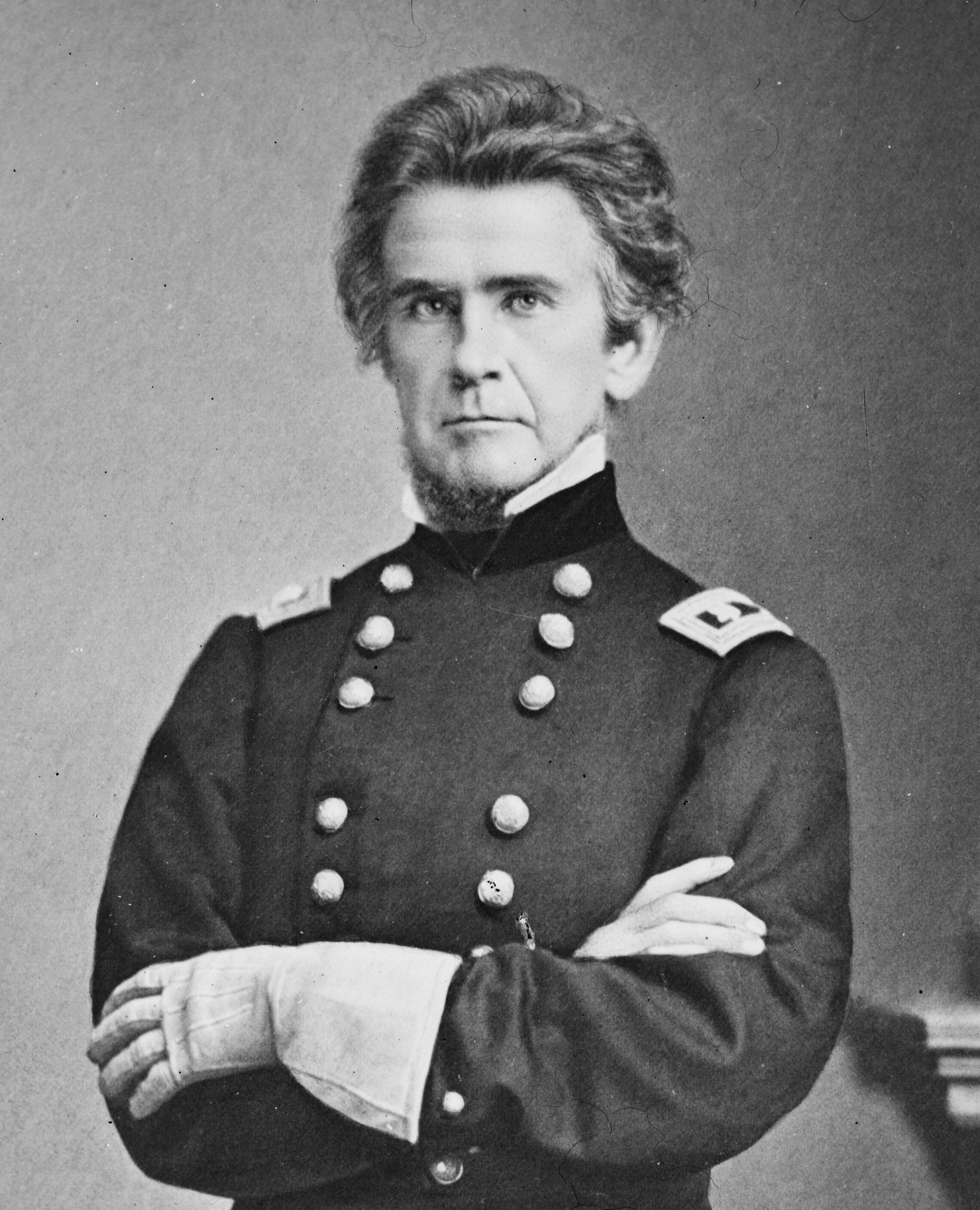
Meanwhile that same weekend (Friday and Saturday, October 3-4, 1862), Brigadier-General John Milton Brannan, who was quartered on board the Ben Deford as the Union expedition’s commanding officer, Colonel Tilghman H. Good, commanding officer of the 47th Pennsylvania Volunteers, and other Union officers serving under Brannan were busy penning reports to their respective superiors, and were also planning their next move to further secure this region of Florida, which had been deemed of key strategic importance by senior Union military leaders due to the significant role the state had been playing as a supplier of food to the Confederacy.

On Saturday, Brannan chose several officers to direct their subordinates to prepare rations and ammunition for a new expedition that would take them roughly 20 miles upriver to Jacksonville. (A sophisticated hub of cultural and commercial activities with a racially diverse population of roughly 2,100 residents, the city had repeatedly changed hands between the Union and Confederacy until its occupation by Union forces on March 12, 1862.) Among the Union soldiers selected for this mission were 47th Pennsylvania Volunteers from Company C, Company E, and Company K.

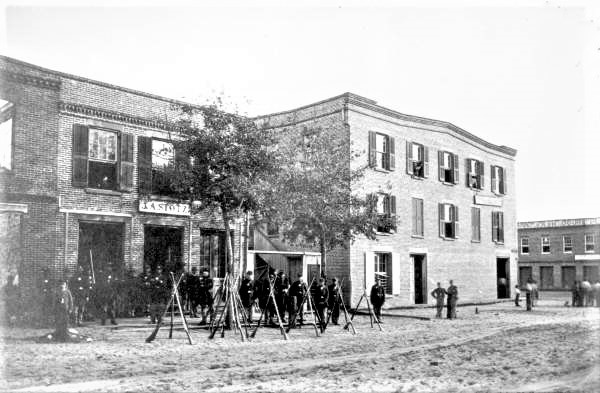
Provost Marshal’s guardhouse, Jacksonville, Florida, 1864 (public domain).

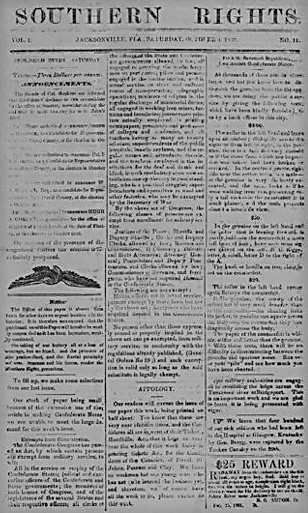
One of the first groups to depart—Company C of the 47th Pennsylvania, did so that Saturday as part of a small force made up of infantry and gunboats, the latter of which were commanded by Captain Charles E. Steedman. Their mission was to destroy all enemy boats they encountered to stop the movement of Confederate troops throughout the region. Upon arrival in Jacksonville later that same day, the infantrymen were charged by Brannan with setting fire to the office of that city’s Southern Rights newspaper.

This special pro-Union edition of Jacksonville, Florida’s formerly pro-Confederate Southern Rights newspaper was written and printed by Henry Wharton and other members of the 47th Pennsylvania Volunteers on October 4, 1862 (public domain).

Before that action was taken, however, Captain John Peter Shindel Gobin and his subordinate, Henry Wharton, who had both been employed by the Sunbury American newspaper in Sunbury, Pennsylvania prior to the war, salvaged the pro-Confederacy publication’s printing press so that Wharton could more efficiently produce the regimental newspaper he had launched while the 47th Pennsylvania was stationed at Fort Taylor in Key West, Florida. That salvage operation also gave Wharton and several of his C Company comrades the opportunity to take a parting, verbal “shot” at Confederate sympathizers in the region by publishing a snarky, final edition of the paper. Dated October 4, 1862, its text included the following:

“On account of the presence of distinguished visitors, the election is indefinitely postponed.

A few lines have been taken from the matter of this page to make room for explanation.

The form from which we strike off a few copies, is the same taken from Secession Printing Office at Jacksonville, Fla., on the expedition of Gen. J.M. Brannan to the St. John’s River.

Wishing to know whether secesh type would print under Federal rule, we concluded to bring along with us the press and fixtures; to our surprise and gratification we find the machine prints almost alone, satisfying us that it rejoices at the change. We have no doubt it will continue the good spirit already manifested and will make itself generally useful under the kind treatment already received, in printing various blanks required by the Post. It is possible it may get patriotic and issue a Constitutional Union Paper.

Beaufort, S.C. Oct. 17, 1862
Notice

The editor of this paper is absent from town for a few days on urgent business in the interior. It is therefore announced that the publication of this Paper will hereafter be weekly suspended as it has been heretofore, weakly continued.

The taking of our battery after a loss of courage, but no blood, and the presence of the yankee [sic] fleet, and the fearful proximity of Gen. Brannan and his forces, render the Southern Rights precarious.

The friends of Col. Hopkins are informed that the Colonel declines to run as a candidate for the office of Senator, notwithstanding the good time he made running from St. John’s Bluff.” 

According to historian Lewis Schmidt, the “newspaper contained other original articles of local interest,” as well as the announcement of a $25 reward for the capture of Ned, a 28-year-old Black man who had escaped slavery near Jacksonville.

On Sunday, October 5, Brannan and his detachment sailed away for Jacksonville at 6:30 a.m. Per Wharton, the weekend’s events unfolded as follows:

“As soon as we had got possession of the Bluff, Capt. STEEDMAN and his gunboats went to Jacksonville for the purpose of destroying all boats and intercepting the passage of the rebel troops across the river, and on the 5th Gen. BRANNAN also went up to Jacksonville in the steamer Ben Deford, with a force of 785 infantry, and occupied the town. On either side of the river were considerable crops of grain, which would have been destroyed or removed, but this was found impracticable for want of means of transportation. At Yellow Bluff we found that the rebels had a position in readiness to secure seven heavy guns, which they appeared to have lately evacuated, Jacksonville we found to be nearly deserted, there being only a few old men, women, and children in the town, soon after our arrival, however, while establishing our picket line, a few cavalry appeared on the outskirts, but they quickly left again. The few inhabitants were in a wretched condition, almost destitute of food, and Gen. BRANNAN, at their request, brought a large number up to Hilton Head to save them from starvation, together with 276 negroes—men, women, and children, who had sought our protection.”

* Note: Yellow Bluff, which was situated five miles to the north of Saint John’s Bluff on the opposite side of the Saint John’s River, was the site of another Confederate artillery battery—one surrounded by T-shaped earthen works that had been erected earlier in 1862.

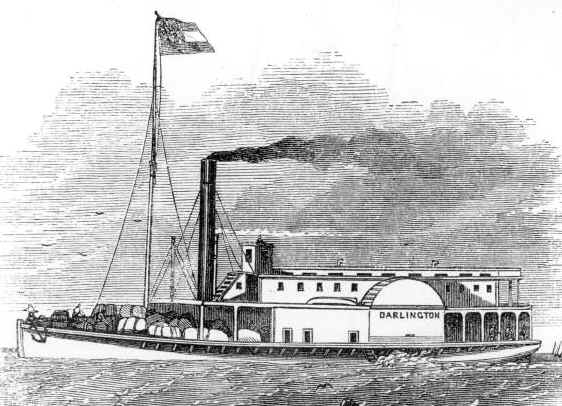
The Darlington, a former Confederate steamer turned Union gunboat (public domain).

Receiving word soon after his arrival at Jacksonville that “Rebel steamers were secreted in the creeks up the river,” Brigadier-General Brannan ordered Captain Charles Yard of the 47th Pennsylvania’s Company E to take a detachment of 100 men from his own company and those of the 47th’s Company K, and board the steamer Darlington “with two 24-pounder light howitzers and a crew of 25 men.” All would be under the command of Lt. Williams of the U.S. Navy, who would command the “convoy of gunboats to cut them out.” Describing the Darlington in a subsequent diary entry, Corporal George R. Nichols of the 47th Pennsylvania Volunteers’ E Company wrote:

“This steamer is runn [sic] by a negro crew and this same crew runn [sic] her away from the Rebels out of charleston [sic] harbor Passed [sic] forts Sumpter and Moltre [sic] and all the land Batterys [sic] and turned her over to Uncle Sam. The crew is Brave and Smart and that if they are Black men.”

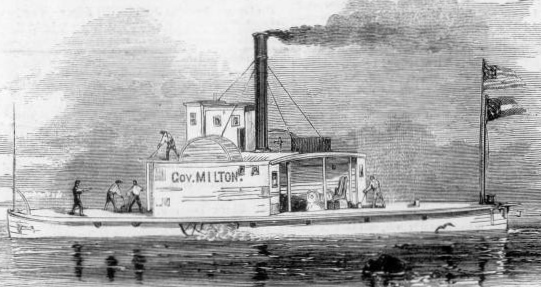
The rebel steamer Governor Milton, captured by the U.S. flotilla in St. John’s River, Florida (Frank Leslie’s Illustrated Newspaper, courtesy: State Archives of Florida, Florida Memory Project, public domain).

According to Schmidt, the small force steamed upriver roughly 100 to 200 miles “to Lake Beresford, where they then assisted in capturing the [68-ton] steamer Governor Milton,” which had been renamed in honor of Florida’s governor after having been “formerly known as the George M. Bird [under its previous owners] a New England family named ‘Swift’, who were timber cutters and used it as a tug boat to tow rafts loaded with live oak to the lumber market.”

Corporal Nichols of E Company went on to describe the capture as follows:

“At 9 PM … October 7, discovered the steamer Gov. Milton in a small creek, 2 miles above Hawkinsville; boarded her in a small boat, and found that she had been run in there but a short time before, as her fires were not yet out. Her engineer and mate, then in charge, were asleep on board at the time of her capture. They informed us that owing to the weakness of the steamer’s boiler we found her where we did. We returned our prize the next day…..

I commanded one of the Small Boats that whent [sic] in after her. I was Boatman and gave orders when the headman jumped on Bord [sic] take the Painter with him. That however belongs to Wm. Adams or Jacob Kerkendall [sic]. It was So dark I could not tell witch [sic] Struck the deck first. But when I Struck the deck I demanded the Surrend [sic] of the Boat in the name of the U.S. after we had the boat an offercier [sic] off the Paul Jones, a Gun Boat was with us he ask me how Soon could I move her out in the Stream I said five minuts [sic]. So an Engineer one of coulered [sic] Men helped me. and I will Say right hear [sic] he learned Me More than I ever knowed about Engineering. Where we Started down the River we was one hundred and twenty five miles up the river. When we Stopped at Polatkey [Palatka] to get wood for the Steamer I whent [sic] out and Borrowed a half of a deer that hung up in a cut house and a bee hive for some honey for the Boys. I never forget the boys.’” 

According to Brigadier-General Brannan, the Union party “returned on the morning of the 9th with a Rebel steamer, Governor Milton, which they captured in a creek about 230 miles up the river and about 27 miles north [and slightly west] from the town of Enterprise. Lt. Bacon, my aide-de-camp, accompanied the expedition… On the return of the successful expedition after the Rebel steamers… I proceeded with that portion of my command to St. John’s Bluff, awaiting the return of the Boston.”

This return trip did not happen without complications, however; in a letter penned to The New York Times on October 14, Wharton reported the following:

“Finding that the Cosmopolitan, which had been sent to Hilton Head for provisions, had struck heavily in crossing the bar, on her return to the St. John’s River, and was temporarily disabled for service, the Seventh Connecticut Regiment was sent to Hilton Head on the Boston, with the request that she should return for the remainder of the troops, and she got back on the 11th, when the command was reembarked, reaching this plane yesterday, excepting one company of the Forty-seventh Pennsylvania, which is left for the protection of the Cosmopolitan. The accident to this valuable steamer is severe. A large hole was made in her bottom and she filled, but she will not be a wreck, as was at first feared.”

The Governor Milton, which would later be appraised by the Union Navy at $2,000, was also temporarily left behind, under the command of Captain Steedman so that its boiler could be repaired. Overseeing those repairs was Corporal Nichols, who had been temporarily detached from the 47th Pennsylvania’s E Company. Observed Nichols:

“So hear [sic] we are at Jacksonville and off we go down the river again, and the Captain Yard Said you are detailed on detached duty as Engineer well that beats hell. I told him I did not Enlist for an Engineer. well I cannot help it he said. I got orders for you to stay hear [sic]. When the Boys was gone about a week orders came for us to come to Beaufort, S. Carolina by the inland rout over the Museley Mash Rout. So I Borrowed a twelve pound gun with amanition [sic] for to Protect our Selves with. But I only used it once to clear Some cavelry [sic] away. We Passed fort Palask [sic]. But that was in our Possession and we got Back to Beaufort all right. and I whent [sic] up to See the Boys and Beged [sic] captain to get me Back in the company, But he could not make it go.”

Integration of the Regiment

Meanwhile, as those activities were unfolding at Saint John’s Bluff, Yellow Bluff, Jacksonville and aboard the Governor Milton, the 47th Pennsylvania Volunteer Infantry was making history back in South Carolina when it became an integrated regiment on Sunday, October 5, 1862—three months before President Abraham Lincoln officially issued the Emancipation Proclamation.

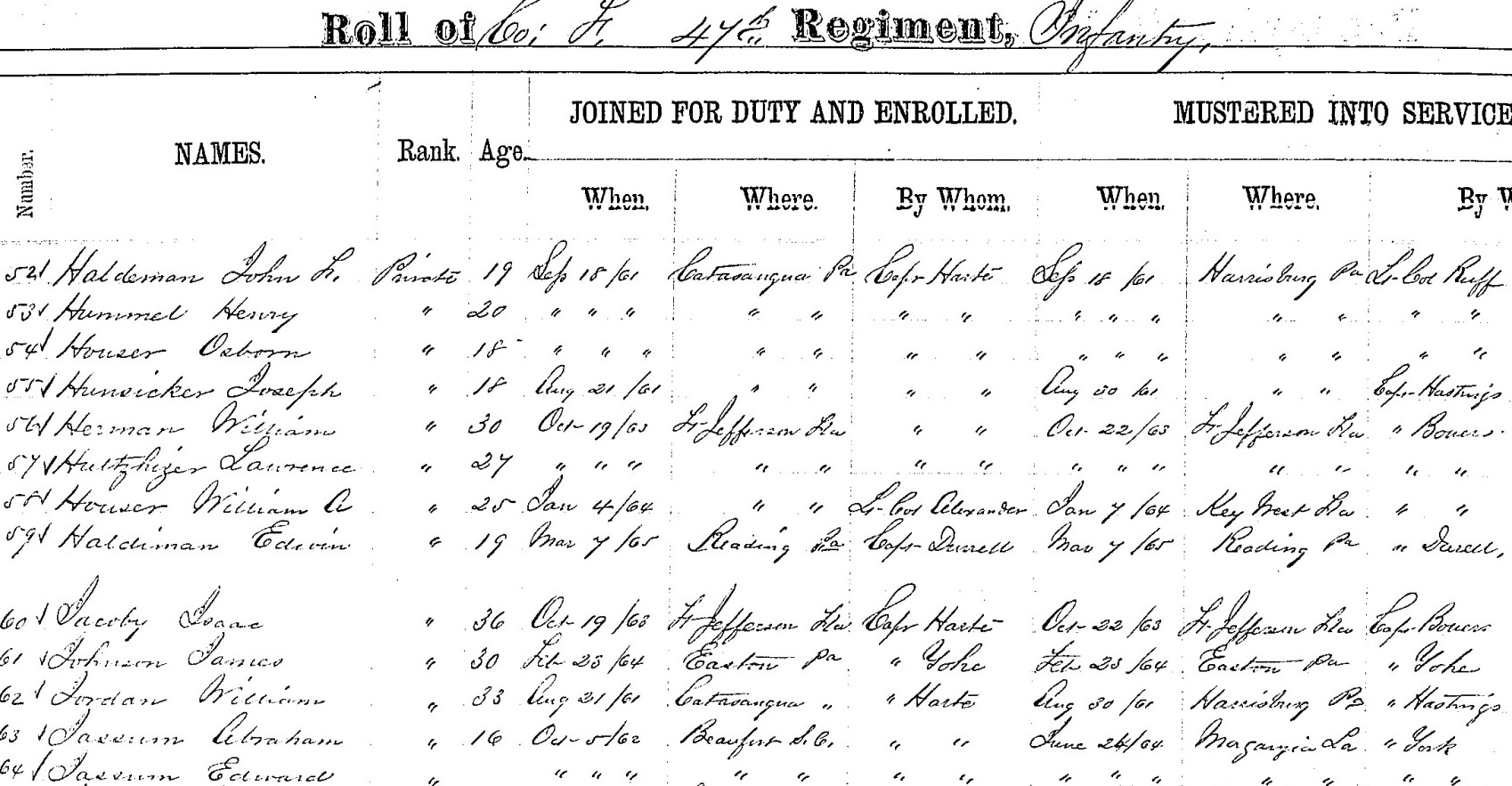
Roster entries for Privates Abraham and Edward Jassum confirm their October 1862 enlistments with Company F, 47th Pennsylvania Volunteer Infantry in Beaufort, South Carolina (Registers of Pennsylvania Volunteers, Pennsylvania State Archives, public domain).

On that day, two Black men who had been freed from slavery in Beaufort, South Carolina—Abraham Jassum and Bristor Gethers—enlisted with the 47th Pennsylvania Volunteers at a recruiting depot in Beaufort.

Jassum, who was just 16 years old, mustered in as a “negro undercook” with Company F. Military records described him as being 5 feet 6 inches tall with black hair, black eyes and a black complexion, and stated that his occupation prior to enlistment was “Cook.” (Those same records also confirm that Abraham Jassum continued to serve with F Company until he honorably mustered out at Charleston, South Carolina on October 4, 1865 when his three-year term of enlistment expired while an alternate set of records offers an alternate date of October 16, 1862 for his enlistment.)

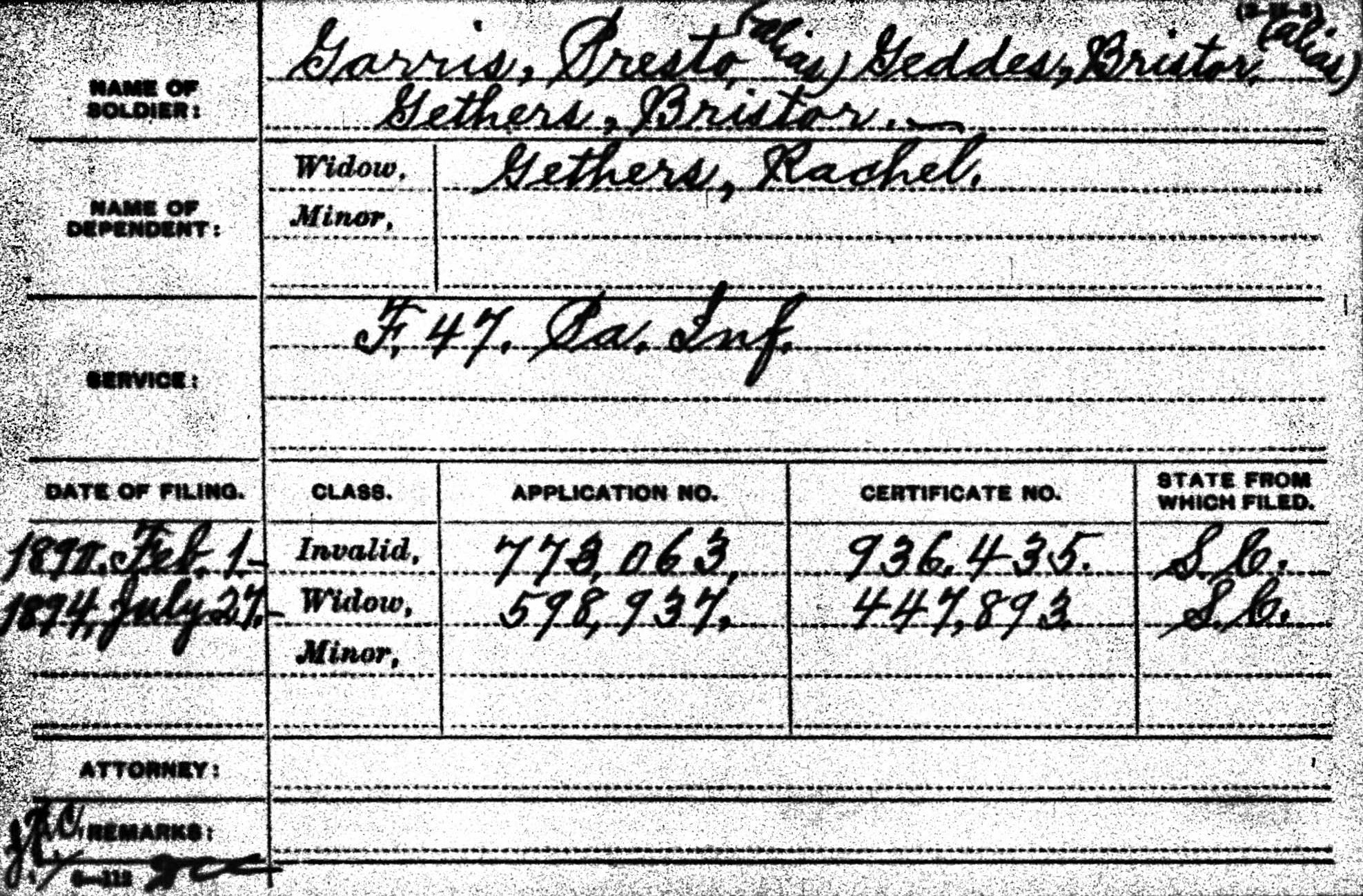
Possible name variants for Bristor Gethers of the 47th Pennsylvania Volunteers, 1894 (U.S. Civil War General Pension Index Cards, U.S. National Archives, public domain).

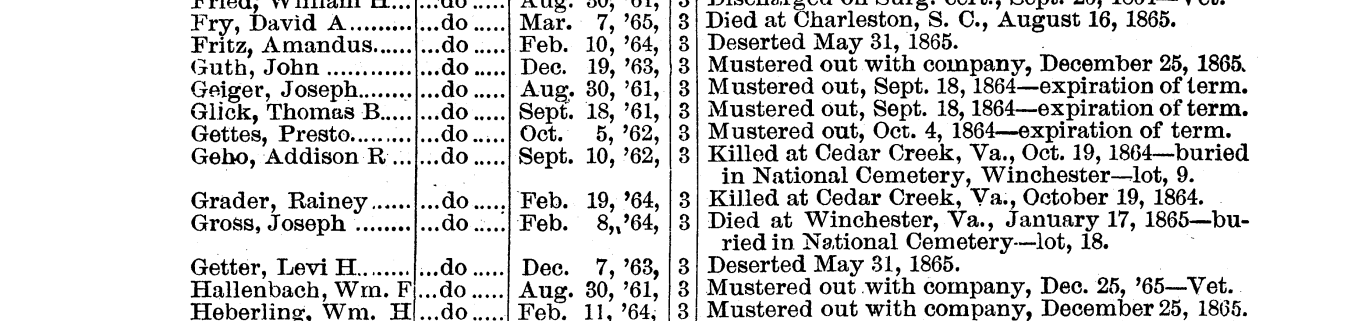
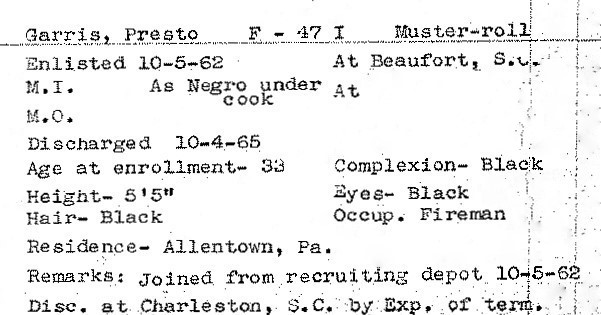
Gethers, a 33-year-old man whose name was misspelled repeatedly on military records throughout and following his enlistment tenure (as “Presto Gettes” on his muster roll entry and later listing in the Civil War Veterans’ Card File in the Pennsylvania State Archives and as “Presto Garris” and “Bristor Geddes” on U.S. Civil War Pension records), also mustered in with Company F as a “negro undercook.” Described on military records as being 5 feet 5 inches tall with black hair, black eyes and a black complexion, his entry in the Civil War Veterans’ Card File noted, perhaps incorrectly, that he had been employed as a fireman. (These same records also indicate that Bristor Gethers honorably mustered out at Charleston, South Carolina on October 4, 1865 upon expiration of his three-year term of service while federal records indicate that he and his wife, “Rachel Gethers,” applied for his Civil War Pension from South Carolina.)

The regiment’s integration also continued mid-month with the October 15 enlistment of 22-year-old Edward Jassum, who was also initially assigned to Company F as an undercook. (These same records indicate that he was transferred two years later—to Company H—on October 11, 1864, and that he also continued to serve with the 47th Pennsylvania Volunteers until being honorably discharged on October 14, 1865 upon expiration of his three-year term of service.)

Mop Up and Return to Headquarters

As that integration of the 47th Pennsylvania Volunteer Infantry was taking place in Beaufort, South Carolina, Brigadier-General Brannan’s expeditionary force was winding down its activities in Duval County, Florida. According to a letter penned by Private William Brecht of the 47th Pennsylvania’s K Company, once the artillery pieces were carried away from Saint John’s Bluff by Brannan’s troops, Brannan ordered Captain Henry D. Woodruff of the 47th’s D Company to take his company as well men from Company F and Company I to “blow up the fort, which was done with the most terrific explosions, filling the air for a great distance with fragments of timber and sand.”

“And thus came to an end Fort Finnegan, on St. John’s Bluff,” mused Brecht, who added that “after we destroyed the fort and it exploded into the air, the steamer Cosmopolitan which had been damaged and was full of water, we pumped out and fixed up again.”

Recapping the activities of his troops for his superiors, Brannan subsequently stated that, on Saturday, October 11:

“I embarked the section of the 1st Connecticut Battery, with their guns, horses, &c., and one company of the 47th on board the steamer Darlington, sending them to Hilton Head via Fernandina, Fla…. [T]he Boston having returned, I embarked myself, with the last remaining portion of my command, except one company of the 47th left to assist and protect the Cosmopolitan…which was stuck on the bar…for Hilton Head, S.C., on the 12th instant, and arrived at that place on the 13th instant. The captured steamer Governor Milton I left in charge of Capt. Steedman, U.S. Navy and Cpl. Nichols.”

According to Schmidt:

“Company F embarked for Hilton Head on Friday and arrived home on Sunday, while Company D embarked on Saturday…but did not leave the St. John’s River til Sunday…. Some of the troops, including Company C, had returned to Beaufort on Saturday, October 11, but at least portions of Company K did not return until the following Tuesday. Returning with Company C was Capt. Gobin, who had contracted intermittent fever during the expedition and was hospitalized as soon as he returned….

Company D arrived back at Hilton Head on Saturday, and Company B and F on Sunday; and by Monday, October 13, most of the troops were back in camp in Beaufort, including Companies, A, G and K which arrived on this date. Company E did not arrive until Wednesday and Company H on Thursday night.” 

Although Corporal Nichols of E Company would not return from his detached duties aboard the Governor Milton until much later, Captain Gobin was able to return to active duty on October 20. Crediting his recovery to “good nursing and an abundance of quinine,” he resumed leadership of the 47th Pennsylvania’s C Company, which had returned to South Carolina nine days earlier.

October 20 also proved to be an important day for the regiment when The New York Times published a letter that had been penned six days earlier by Wharton, and which recapped the events of the St. John’s Bluff Expedition and subsequent successes by Brigadier-General Brannan’s troops. In addition to excerpts presented above in this article and in the article, Late September to Early October 1862: First Victory,” Wharton’s letter also included the following insights:

“Gen. BRANNAN thinks it evident, from his experience on this expedition, that the rebel troops in this portion of the country have not sufficient organization and determination, in consequence of their living in separate and distinct companies, to sustain any position, but seem rather to devote themselves to a system of guerrilla warfare. This was exemplified by the advance on St. John’s Bluff, where, after evacuating the fort, they continued to hover on our flanks and front, but did not come near enough to make their fire effective. We learned at Jacksonville that they commenced evacuating the Bluff immediately after our surprise of their pickets at Mount Pleasant Creek.

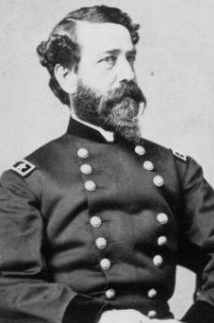
Major-General Ormsby M. Mitchel, Commanding Officer, U.S. Department of the South, circa 1862 (public domain).

Wharton also included remarkable details regarding the October 12, 1862 dedication of the First African Baptist Church on Hilton Head Island, South Carolina by Union Major-General Ormsby Mitchel—during which Mitchel outlined his plans for the creation of Mitchelville—“the first self-governed town of formerly enslaved people in the United States,” according to staff at the Historic Mitchelville Freedom Park. Wharton observed that:

“On Sunday the negro church at Hilton Head was dedicated to Divine service. Gen. HUNTER authorized the construction of the building, and before he left the work was nearly finished. The situation of the church is good; the appearance is neat, though plain as a Quaker meeting-house, and in all respects the building meets the requirements of the case. Three hundred persons may be comfortably seated. The Pastor is a black man from Savannah, named ABRAM MURCHISON, who has been in due form ordained a Baptist minister by the army Chaplains, and installed in office. ABRAM, though able to read and write, is not polished in his manners; but what he lacks in culture is more than compensated in earnest eloquence, a vigorous and clear expression of his views, deep piety, and a powerful influence over the colored people. The dedication exercises were interesting in themselves, being conducted by Rev. H.N. HUDSON, Chaplain of the New-York Volunteer Engineer Regiment, and elocutionist of celebrity. Gen. MITCHEL was present, with the members of this Staff, and, by invitation, addressed the audience. His remarks were pointed, impressive and instructive. They were listened to attentively, and indorsed [sic] with nods of approbation from young and old. I do not think that a portion of the TIMES could be better filled than with this frank and unmistakable expression of the Gen. MITCHEL’s views on the negro question. He said:

‘I have been requested to say a few words to you by your teacher, who is a good man. Any good man I like, regardless of color. I respect him as much whether he is black or white. If he be a bad man I shall treat him as such, whether he is white or black. Most of you know that I have talked to all my soldiers since I came here, and now I am talking to you who are another set of soldiers, who have not yet arms in their hands, but are under my protection and guidance, and in whom I take interest. With your past life I fully sympathize. I know and understand it all. I was reared in the midst of Slavery, born in Kentucky, and know all about it. While there are many things connected with it that are pleasant, to which you will testify, there are a vast many other things which are not pleasant, and I think that God intends all men shall be free, because he intends that all men shall serve him with their whole heart. I think this is true. I am not certain. I don’t know. But in any condition we can all love and serve God. That privilege cannot be taken away. I care not how savage and wicked the master may be, he cannot prevent you from praying in the midst of the night, and God hears and answers the prayer of all, slave or free.

But it seems to me that there is a new time coming for you colored people; a better day is dawning for you oppressed and down-trodden blacks. I don’t know that this is true, but I hope that the door is being opened for your deliverance. And now, how deeply you should ponder these words. If now you are unwilling to help yourselves nobody will be willing to help you. You must trust yourselves to the guidance of those who have had better opportunities and have acquired superior wisdom, if you would be carried through this crisis successfully. And I believe the good God will bless your efforts, and lift you up to a higher level than you have yet occupied, so that you and your children may become educated and industrious citizens. You must organize yourselves into families. Husbands must love their wives and children, clinging to them and turning from all others, and feeling that their highest object in life, next to serving the good God, is to do all they can for their families, working for them continually.

Good colored friends, you have a great work to do, and you are in a position of responsibility. The whole North, all the people in the Free States, are looking at you and the experiment now tried on your behalf with the deepest interest. This experiment is to give you freedom, position, home and your own families—wives, property, your own soil. You shall till and cultivate your own crops; you shall gather and sell the products of your industry for your own benefit; you shall own your own savings, and you shall be able to feel that God is prospering you from day to day and from year to year, and raising you to a higher level of goodness, religion and a nobler life.

Supposing you fail down here; that will be an end to the whole matter. It is like attaching a cable to a stranded vessel, and all the strength that can be mustered is put upon this rope to haul her off. If this only rope breaks the vessel is lost. God help you all and help us all to help you. If you are idle, vicious, indolent and negligent, you will fail and your last hope is gone; if you are not faithful you rivet eternally the fetters upon those who to-day are fastened down by fetters and suffer by the driver’s goad. You have in your hands the rescuing of those sufferers over whose sorrows you mourn continually. If you fail, what a dreadful responsibility it will be when you come to die to feel that the only great opportunity you had for serving yourselves and your oppressed race was allowed to slip.

And you, women, you must be careful of your children. You must teach them to be industrious, cleanly, obedient, and dutiful at all times. You must keep your houses neat and tidy, working all day, if necessary, to have them in the best possible condition, always thinking and contriving to make them cleaner and more comfortable. When your husband comes home from the labors and fatigues of the day, always have something good and nice for his supper, and speak kindly to him, for these little acts of love and attention will bring you happiness and joy.

And when you men go out to work, you must labor with diligence and zeal. It seems to me, had I the stimulus to work that you have that I could labor like a giant. Now you know who I am. My first duty here is to deal justly; second, to love mercy, and third, to walk humbly. First, justly—I shall endeavor to get you to do your duty faithfully. If you do I shall reward you; and if you refuse, then what comes next? Why, the wicked must be punished and made to do right. I will take the bad man by the throat and force him to his duty. I do not mean that I will take hold of him with my own hands, but with the strong arm of military power. Now do we understand each other? I am working for you already. I am told by your Superintendent that a gang of fifty men are building your houses at the rate of six a day. These houses are to make you more comfortable. You are to have a patch of ground, which you can call your own, to raise your own garden truck, and you may work for the Government for good wages. And you women must make your houses shine; you must plaster them and whitewash them, and gradually get furniture in your cabins, and a cooking-stove. I have arranged in such a way that you will get your clothing cheaper and better than before, and you are to have a school for your children. And you must have flowers in your gardens and blossoms before your doors. You will see in a little while how much happier you will be made. Are you not willing to work for this? Yes, God helping, you will all work. This is only for yourselves; but if you are successful, this plan will go all through the country, and we will have answered the question that has puzzled all good, thinking men in the world for one hundred years. They have asked, ‘What will you do with the black man after liberating him?’ We will show them what we will do. We will make him a useful, industrious citizen—give him the earnings of the sweat of his brow, and as a man, we will give him what the Lord ordained him to have.

I shall watch everything closely respecting this experiment. It is something to be permanent—more than for a day, more than for a year. Upon you depends whether this mighty result shall be worked out, and the day of jubilee come to God’s ransomed people.’”

Wharton also noted that:

“The white people have also had the advantage of religious instruction offered them during the past two Sabbaths, for the first time since the military occupation of South Carolina soil. An upper floor of one of the large commissary building has been appropriated as a place of worship, and the various regimental Chaplains are to officiate alternately. The first Sunday a discourse was delivered by the Rev. H.N. HUDSON, (Episcopal,) of the Volunteer Engineer Regiment, and day before yesterday the Rev. Dr. STRICKLAND, (Methodist,) Chaplain of the New-York Forty-eighth, favored us with a sermon. Gen. MITCHEL, who has instituted these religious privileges, is himself a regular attendant on the services.

Wharton then closed his letter with the following additional details:

“The propeller Trade Wind, Capt. Delanoy, was towed into this port last week by the gunboat Pocahontas, disabled by the bursting of her cylinder, when in latitude 25° north, longitude 79° 30′ west, on a voyage from New-York to New-Orleans, carrying a United States mail, and a cargo of Sutler’s goods. The damage is too great to be repaired here with our limited facilities, and she awaits a chance of being towed to New-York. Mr. RANKIN, of Philadelphia, chief engineer of the vessel, was severely sealed [sic] by the accident. The mails will be forwarded to New-Orleans by the first naval supply vessel going to that port.

The gunboat Quaker City at noon on Saturday last, ran [up] on the bar at North Edisto. Fears were [high] for the safely of the vessel, and the army steamers [?] Point and Rescue were sent to her aid. She was, however, out of danger when they reached her.

The work of organizing the troops in this Department into brigades has been commenced by Gen. MITCHEL, with a view to more system, and enhanced probability in future operations. Brig.-Gen. TERRY has been relieved of the command of the posts of the Florida Coast, and assigned to the Second Brigade, which is composed of the Seventh-sixth and Ninety-seventh Pennsylvania, the Seventh Connecticut, and the Third New-Hampshire Regiments….

By command of Maj.-Gen. O.M. MITCHEL,
W.P. [?], Maj.-Gen. and Chief of Staff ,
H. J. W.”


Sources:

  1. Beecher, Herbert W. History of the First Light Battery Connecticut Volunteers, 1861-1865, Vol. I. New York, New York: A. T. De La Mare Ptg. and Pub. Co., Ltd., 1901.
  2. “Florida’s Role in the Civil War: Supplier of the Confederacy.” Tampa, Florida: Florida Center for Instructional Technology, University of South Florida (College of Education), retrieved online, January 15, 2020.
  3. IMPORTANT FROM PORT ROYAL.; The Expedition to Jacksonville, DESTRUCTION OF THE REBEL BATTERIES. CAPTURE OF A STEAMBOAT. Another Speech from Gen. Mitchell. His Policy and Sentiments on the Negro Question.” New York, New York: The New York Times, October 20, 1862.
  4. “Mitchelville: Freedom’s Home,” in Think Like a Historian.” Beaufort County, South Carolina: Finding Freedom’s Home: Archaeology at Mitchelville, retrieved online, January 18, 2021.
  5. Proctor, Samuel. Jacksonville During the Civil War,” in Florida Historical Quarterly, Vol. 41, No. 4, 1962, pp. 343-355. Orlando, Florida STARS (Showcase of Text, Archives, Research & Scholarship), University of Central, Florida.
  6. Reports of Lieut. Col. Tilghman H. Good, Forty-seventh Pennsylvania Infantry, in Official Records of the Union and Confederate Armies, 1861-1865 (Microfilm M262). Washington, D.C.: U.S. National Archives and Records Administration.
  7. Schmidt, Lewis G. A Civil War History of the 47th Regiment of Pennsylvania Veteran Volunteers. Allentown, Pennsylvania: Self-published, 1986.
  8. Timucuan: The River War: The Timucuan Preserve in the Civil War.” Washington, DC: National Park Service and the U.S. Department of the Interior, retrieved online, January 18, 2021.


Spring and Summer of 1862: Disease, Duty and Another Departure

View the video related to this article

Sibley Tent (Patent #14740, United States Patent Office, April 22, 1856, H. H. Sibley, public domain).

As spring continued to take hold across Pennsylvania in 1862, turning the Great Keystone State’s colorful, budding trees into soothing havens of green-leafed shade, the members of the 47th Pennsylvania Volunteer Infantry continued to battle their great foe—disease. It was a fight that was made more difficult by the regiment’s challenging living conditions. The weather was warm, the water quality was poor, the mosquitos were plentiful, and hygiene was substandard because the majority of 47th Pennsylvania Volunteer Infantrymen continued to live in the close quarters of the Sibley tents that had been erected as “Camp Brannan” in Key West, Florida. (The men of Company F were slightly more fortunate, having been previously ordered to live and work at Fort Taylor.)

As a result, multiple members of the regiment fell ill during the month of April, including First Lieutenant and Regimental Adjutant Washington H. R. Hangen, who was required to temporarily cede his duties to H Company First Lieutenant William Wallace Geety after being admitted to the officers’ hospital at in Key West, and C Company’s Theodore Kiehl and Henry W. Wolfe, who had been confined to the hospital for enlisted men. Deemed too ill to continue serving with the regiment, F Company privates John G. Seider and Samuel Smith were honorably discharged on surgeons’ certificates of disabilities and sent back home.

Meanwhile, other members of the regiment continued to be advanced in rank, including Second-Sergeant Christian Seiler Beard, who was promoted to First-Sergeant, and Private Peter Haupt who was promoted to the rank of Sergeant—while others assumed additional duties, including D Company privates James E. Albert and William Collins, who were assigned to help the fort’s assistant surgeon, William F. Cornick, in caring for the increased number of patients who had been admitted. Then, General Order No. 84 was issued, directing I Company Captain Coleman A. G. Keck and one of his subordinates, Private William Smith, to return home to Pennsylvania to recruit more volunteers to help beef up the regiment’s dwindling ranks.

In addition, several officers from the 47th Pennsylvania were also called upon to conduct a general court martial trial of a lieutenant from the 90th New York Volunteers who was charged with having been absent from his duties without appropriate authorization (known more commonly today as being absent without leave or “AWOL”). Colonel Tilghman H. Good served as the court’s president, C Company Captain John Peter Shindel Gobin served as its general advocate, and H Company Captain James Kacy was one of the men appointed to serve on the court’s judicial panel, which found the 90th New Yorker guilty and directed that he lose roughly two weeks of pay.

April—May 1862

Key West, Florida, c. 1850 (courtesy of Florida Memory Project)

Key West, Florida, circa 1850 (courtesy of Florida Memory Project).

On April 19, the 47th Pennsylvania’s most prolific scribe, C Company Musician Henry D. Wharton, penned a letter to his hometown newspaper, the Sunbury American, from Camp Brannan in Key West:

“DEAR WILVERT:– Having finished a plate of soup, (not a hasty one) enjoyed a piece of ham, cooked in my best style, fried and now luxuriating in a pipe of the best Lynchburg tobacco, I conclude to indite [sic] you a few lines from this most miserable place, Key West.

There are now lying here three very fine vessels captured from Secessia. The cargoes are very valuable, consisting of cotton, coffee, rice, liquor, kerosene and olive oils, leather, and a great many articles of use. I attended the sale of one of the cargoes, and one article I found more numerous than any other—that of hooped skirts. I was curious to know why they had supplied themselves so plentifully with that article, when an old gentleman said that was easily understood, for when the rebels had to run, and in fear of being caught they would make good hiding places, and then he related a circumstance of a Mexican General who, in running away, found crinoline very convenient as a hiding place, but not secure enough for the Lynx-eyed Americans, as the brave gentleman was caught in his wife’s trap.

There has been considerable sickness among the troops, but I am happy to state it is abating. Two members of our company, Theodore Kiehl, and H. Wolf, have been in the Hospital, but are now out and almost ready for duty. They take very readily to their rations when they get back to the company, saying the Hospital is a very nice place to get well in, but no place for grub, as they were as hungry as wolves all the time they were in, or rather when they became better. We have lost eight men from our regiment, by death, since we have been on this island. From what I can learn the diseases were mostly contracted in Virginia, but if they have not, it is a wonder that the mortality is not greater among us, owing to the sudden change of climate, the bad water, hot sun and hard work our men are subjected to.

Lieut. Henry Bush, Co. F., in our regiment, died two weeks ago. His company were in the Fort, learning heavy artillery, where he was attacked with typhoid fever—in a few days he was beyond the physicians [sic] skill, and now he is sleeping his last sleep in the strangers [sic] cemetery. His funeral was very largely attended by the military and the masonic fraternity, of which he was a member. Lieut. Bush was beloved by his company—they having presented him with a sword a few days before he was taken sick—and in fact was liked by the whole regiment for his kindness and gentlemanly bearing to the men. As soon as the necessary arrangements can be made his body will be sent to Catasauqua, Lehigh county, where his widow and two little children reside.

Since the promotion of Lieut. Oyster, there has [sic] been some changes in our company, 2d Sergeant Beard has been made 1st Sergeant, and Peter Haupt, of Sunbury, taken from the ranks and promoted to 1st Sergeant. Haupt passed an excellent examination, and I am proud, for Sunbury, to say that he is considered one of the A. No. 1’s on drill in our regiment.

With the exceptions of a few slight cases of sickness, the boys are getting along very well and would be perfectly contented if they were at a place where there could be a chance to have a hand in some of the glorious victories which their brothers in arms are engaged in, and away from this detested spot, where there would be something to relieve the eye beside sea-gulls, pelicans and turkey-buzzards. Excuse the shortness of this, hoping ere long to be able to give you an account of a victory in which Co. C., was engaged….”

* Note: To read more of Henry Wharton’s insights, please see our collection of his letters here.

By mid-April, typhoid fever was claiming one member of the regiment after another. On Saturday April 19 and Sunday April 27, respectively, K Company privates George Leonhard and Lewis Dipple died at the Key West general hospital while E Company Private John B. Mickley died on April 30.

Death ledger entry for Private Lewis Dipple, Company K, “Registers of Deaths of Volunteers,” U.S. Army, 1862 (U.S. National Archives, public domain).

Initially interred in graves numbered nine, ten, and twelve at the fort’s post cemetery, the remains of Privates Leonhard, Dipple, and Mickley were later exhumed for reburial at the Barrancas National Cemetery. Although the process was successfully completed for Privates Leonard and Mickley in 1927, Private Dipple’s remains were handled so disrespectfully that they were later unable to be identified. As a result, they were consigned to a common grave at Barrancas with 227 other “unknown” soldiers.

That same day, General Order No. 26 was announced, directing that:

“I. The troops will be mustered and inspected at 7:45 AM tomorrow morning, 30th inst. April 30, 1862.

II. Immediately after muster, a council of administration to consist of Capt. Harte and officers will assemble to transact such business as regulations require.”

Major-General David Hunter, U.S. Army, circa 1863 (carte de visite, public domain).

Meanwhile, on April 25, 1862, the winds of change had begun to clear the way for long-denied social justice as Union Major-General David Hunter, commanding officer of the U.S. Army’s Department of the South, issued General Orders, No. 11, which directed that all enslaved men, women, and children in Georgia, Florida, and North Carolina be freed immediately:

“Head Quarters Department of the South,
Hilton Head, S.C. May 9, 1862.

General Orders, No 11.— The three States of Georgia, Florida and South Carolina, comprising the military department of the south, having deliberately declared themselves no longer under the protection of the United States of America, and having taken up arms against the said United States, it becomes a military necessity to declare them under martial law. This was accordingly done on the 25th day of April, 1862. Slavery and martial law in a free country are altogether incompatible; the persons in these three States—Georgia, Florida and South Carolina—heretofore held as slaves, are therefore declared forever free.

(Official) David Hunter,
Major General Commanding.”

Although word of Hunter’s order did not immediately reach members of the regiment, it would eventually be carried in newspapers across America.

Meanwhile, the 47th Pennsylvania Volunteers continued to perform their provost and garrison duties in Key West. At the end of April, F Company Private Henry Falk was ordered to take on new duties with the quartermaster while Order No. 21 reassigned H Company Corporal James F. Naylor to the regimental color guard. During the first two days of May, I Company Private William Frack then became Corporal Frack while H Company Private Robert Kingsborough took over quartermaster duties performed previously by Private William O’Brien.

As spring progressed, the weather in Key West became hotter, and the mosquitoes grew even more bold. Even so, the fort’s commanding officer and his subordinates were still able to find a few minutes of relaxation. On May 7, they made time to attend a ball. Corporal James J. Kacey, however, was assigned to fix cartridge boxes around this same time while E Company Corporal George Nicholas was busy dodging disciplinary action, as well as a brush with death:

“I went down to the docks and ask [sic] a Man who owned the Storehouses their [sic] and he said the govemient Seased [sic] them. So I Said I will Sease [sic] the life Boat that laid their [sic]. So I took it up to camp and fixed it up and that got me in trouble I went out Sailing and Missed drill, and got a log to carry, and the next time in the Guard House…. [A] Scorpen Stung me in the finger and I cut a piece out and Sucked it and put Tobacco on it. My arm and hand commenced to Swell Some But Not Much.”

Increasingly debilitated by the bug that had recently felled him, the regiment’s founder and commanding officer, Colonel Tilghman Good, finally realized that he would need to distance himself from his men if he were to continue as their leader. In a letter penned to the Assistant Adjutant, Captain Lambert, he asked “permission to leave camp for a few days, to secure comfortable quarters in town, which I have every reason to believe would materially aid in my speedy restoration to health and strength. The Doctor tells me this desirable end can be attained, by taking rest in elevated and comfortable quarters for a few days. In consequence I do not deem it essential to remove to the hospital.”

Good’s decision proved to be a sound one as more and more members of the regiment were felled by disease, including D Company’s Private George Isett. Suffering from chronic diarrhea, he died on Friday, May 16, and was initially laid to rest in grave no. 14 at the post cemetery. Sadly, his remains were also mishandled when they were exhumed in 1927 for reburial, and were also consigned in the unknown grave of 227 Union soldiers at the Barrancas National Cemetery. His grieving comrades honored him by securing publication of the following Tribute of Respect in their hometown newspaper:

“WHEREAS, it has pleased God in his allwise providence, to remove from our midst our friend and brother in arms, Geo S. Isett; therefore,

RESOLVED, that by his death we have lost a warm hearted friend, a true patriot and good soldier, and one whose place cannot be filled among us.

RESOLVED, That we most heartily sympathize with the deceased and hope that he who has thus afficted [sic] them, will be their reliance in time of need.

RESOLVED, That these resolutions be forwarded to the Perry County papers for publication, and a copy be sent to the friends of the deceased.

Signed: George W. Topley, Jesse Meadith, Jacob Charles, George W. Jury, Isaac Baldwin, Committee.”

That same day (May 16), The Athens Post in Athens, Tennessee specifically mentioned the 47th Pennsylvania’s problems with illness in a news article entitled, “Yankees Sick and Dying”:

“A letter from the flag ship Niagara, published in the Providence Press, fears that the warm weather and imprudence and exposure will cause much sickness among the three Yankee regiments stationed at Key West, Florida. ‘Already the 47 Pennsylvania Regiment has lost a number of its members by the typhoid fever, and I am told they have 70 sick.’ They will have plenty of the same sort before August.”

In response to the continuing wave of sickness, H Company Private Daniel Kochenderfer was reassigned to nursing duties at Key West’s general hospital, where he earned $7.75 for the hazardous duty. Two days later, G Company Private Edmund G. Scholl succumbed to typhoid fever. Initially interred at the post cemetery, Private Scholl’s remains would later be returned home to his family when Allentown undertaker Paul Balliet took on the mission of bringing home both Scholl’s body and that of the infant Regimental Chaplain William Rodrock in 1864. (Both were then reinterred at the “New Allentown Cemetery” on January 30, 1864.)

On May 19, President Abraham Lincoln overturned the emancipation order issued by Major-General David Hunter. His proclamation read as follows:

“Washington [D.C.] this nineteenth day of May,
in the year of our Lord one thousand eight hundred and sixty-two

By the President of the United States of America.

A Proclamation.

Whereas there appears in the public prints, what purports to be a proclamation, of Major General Hunter, in the words and figures following, to wit:

‘Head Quarters Department of the South,
Hilton Head, S.C. May 9, 1862.

General Orders No 11.— The three States of Georgia, Florida and South Carolina, comprising the military department of the south, having deliberately declared themselves no longer under the protection of the United States of America, and having taken up arms against the said United States, it becomes a military necessity to declare them under martial law. This was accordingly done on the 25th day of April, 1862. Slavery and martial law in a free country are altogether incompatible; the persons in these three States—Georgia, Florida and South Carolina—heretofore held as slaves, are therefore declared forever free.

(Official) David Hunter,
Major General Commanding.
Ed. W. Smith, Acting Assistant Adjutant General.’

And whereas the same is producing some excitement, and misunderstanding; therefore I, Abraham Lincoln, President of the United States, proclaim and declare, that the government of the United States, had no knowledge, information, or belief, of an intention on the part of General Hunter to issue such a proclamation; nor has it yet, any authentic information that the document is genuine— And further, that neither General Hunter, nor any other commander, or person, has been authorized by the Government of the United States, to make proclamations declaring the slaves of any State free; and that the supposed proclamation, now in question, whether genuine or false, is altogether void, so far as respects such declaration.

I further make known that whether it be competent for me, as Commander-in-Chief of the Army and Navy, to declare the slaves of any State or States, free, and whether at any time, in any case, it shall have become a necessity indispensable to the maintenance of the government, to exercise such supposed power, are questions which, under my responsibility, I reserve to myself, and which I cannot feel justified in leaving to the decision of commanders in the field. These are totally different questions from those of police regulations in armies and camps.

On the sixth day of March last, by a special message, I recommended to Congress the adoption of a joint resolution to be substantially as follows:

Resolved, That the United States ought to co-operate with any State which may adopt a gradual abolishment of slavery, giving to such State pecuniary aid, to be used by such State in its discretion, to compensate for the inconveniences, public and private, produced by such change of system.

The resolution, in the language above quoted, was adopted by large majorities in both branches of Congress, and now stands an authentic, definite, and solemn proposal of the nation to the States and people most immediately interested in the subject matter. To the people of those States I now earnestly appeal— I do not argue, I beseech you to make the arguments for yourselves— You can not [sic] if you would, be blind to the signs of the times— I beg of you a calm and enlarged consideration of them, ranging, if it may be, far above personal and partizan [sic] politics. This proposal makes common cause for a common object, casting no reproaches upon any— It acts not the pharisee. The change it contemplates would come gently as the dews of heaven, not rending or wrecking anything. Will you not embrace it? So much good has not been done, by one effort, in all past time, as, in the providence of God, it is now your high privilege to do. May the vast future not have to lament that you have neglected it.

In witness whereof, I have hereunto set my hand, and caused the seal of the United States to be affixed.

Abraham Lincoln”

* Note: During the short time in which Major-General David Hunter’s emancipation order was in effect, thousands of enslaved individuals escaped from horrific conditions across Florida, Georgia, and South Carolina, and made their way to the safety of Union military encampments. In response, Hunter directed his subordinates in the U.S. Army’s Department of the South to create a loose network of social services to provide food, clothing, educational services, medical care, and shelter to the newly free men, women, and children. Hunter then also began advocating for able-bodied Freemen to be allowed to enlist with the Union Army.

Although many of these social justice initiatives were put on hold when Lincoln rescinded Hunter’s emancipation order, the disagreement between Lincoln and Hunter evidently made an indelible impression on leaders of the 47th Pennsylvania Volunteer Infantry; just six months later, those 47th Pennsylvanians would pave the way for the regiment to become an integrated one by facilitating the enlistment on October 5, 1862 of several young Black men who were freed from plantations near Beaufort, South Carolina—roughly three months prior to the enactment of Lincoln’s Emancipation Proclamation.

As May wore on, disease continued to thin the regiment’s ranks. Another member of the 47th to be felled by typhoid fever was B Company Private John Apple who died at Key West’s general hospital on May 21 (alternate date: March 12). Reportedly buried shortly thereafter and then disinterred from grave number 18 at the fort’s post cemetery in 1927, his remains were also among those that were reportedly consigned to a group grave of 228 unknown soldiers at the Barrancas National Cemetery, according to one source but, according to The Allentown Democrat, were returned to Pennsylvania on January 28, 1864 with the bodies of three other members of the regiment and the body of the regimental chaplain’s infant son. Private Apple was subsequently laid to rest at the Union-West End Cemetery in Allentown on January 31, 1864.

Around this same time, Henry Wharton was dusting off the skills he had learned, pre-war, as an employee of the Sunbury American newspaper. Founding a new publication—the Key West Herald, he was able to get the first edition of his newspaper into the hands of his fellow 47th Pennsylvanians by Saturday, May 24.

The newspaper’s release could not have been more timely. A significant number of his fellow 47th Pennsylvanians were in desperate need of reading material as they fought their way back from sickness. Among those ailing at this time were multiple members of Company D, including privates William Ewing, Samuel Kern, Andrew and William Powell, and Emanuel Snyder, Corporal Samuel Reed, and Sergeants William Fertig and George Topley. Of those, Fertig was the only one to be hospitalized. In addition, B Company Teamster Tilghman Ritz developed rheumatism sometime around the month of May, and underwent several weeks of treatment at the post hospital from the 47th Pennsylvania’s regimental surgeon, Elisha Baily. Even though he was treated “successfully” by Baily, however, the condition would continue to plague Ritz for the remainder of his life.

Early June—A Fateful Encounter with Friendly Fire

Woodcut depicting the harsh climate at Fort Taylor in Key West, Florida during the Civil War (U.S. Library of Congress, public domain).

One of the most senseless deaths of 47th Pennsylvania Volunteers during the entire war was a “friendly fire” incident which occurred on June 9, 1862. The day had started out peacefully enough—with weather so inviting that I Company Sergeant Charles Nolf, Jr. and several friends felt compelled to take a stroll along the southern portion of the beach in Key West. Tragically, while gathering seashells for family and friends back home, he was accidentally killed by a member of the 90th New York Volunteer Infantry who had been inexplicably playing around with a loaded rifle in violation of brigade regulations while walking on the same stretch of beach with three other members of his regiment—all three of whom had also been carrying loaded rifles—against regulations. Shot in the forehead, Sergeant Nolf died instantly at the scene. Initially interred at the fort’s post cemetery, his body was among the aforementioned group of soldiers’ remains disinterred and returned to Pennsylvania’s Lehigh Valley by Allentown undertaker Paul Balliet, where they were reburied at the Fairview Cemetery in West Catasauqua in late January of 1864.

On the same day that Charles Nolf departed from the world (June 9), First Lieutenant William W. Geety was released from the hospital having successfully recovered from an attack of bilious fever which had resulted in his confinement beginning May 18. In a letter penned to his wife while recuperating, he described himself as “jaundiced.”

Brigadier-General John Milton Brannan, U.S. Army (public domain).

By June 11, I Company Captain Coleman Keck was back home in Allentown, Pennsylvania, hard at work recruiting more men to serve with the 47th Pennsylvania. Meanwhile, the “old men” of the regiment—the veterans—were sensing another change in the winds of fate. That change came on Friday, June 13, via General Order No. 53, which was issued by Brigadier-General Brannan:

“The 47th Regiment of Pennsylvania Volunteers will hold itself in readiness for immediate embarkation. Company F of this regiment which is detached at Fort Taylor will report at headquarters of the regiment. Each regiment will take six months [sic] supply of medicine and medical stores on embarkation.”

Rumors swirled that the regiment would be shipped to Port Royal, South Carolina in preparation for a Union attempt to wrest control of Savannah, Georgia or Charleston, South Carolina from the control of the Confederacy.

On Saturday, June 14, the 47th Pennsylvania Volunteers participated in a review with other members of Brigadier-General Brannan’s troops. According to an edition of the New Era, which was published around this same time:

“The 47th Pennsylvania Volunteers under command of Lt. Col. Alexander made a fine appearance. Their marching was perfect and the entire regiment showed the effect of careful drill. A more sturdy, soldierly looking body of men cannot be found, probably, in the service. Col. Good and the officers under his command have succeeded in bringing the regiment to a state of military discipline creditable alike to them and the state from which they hail. The regimental band deserves some mention; there are many bands in the service of greater celebrity, whose performances would not bear comparison with that attached to the 47th Regiment.”

On June 16, Wharton penned another letter to his hometown newspaper in which he reflected on the untimely, friendly fire death of Sergeant Nolf and provided further insights into the soldiering life in America’s Deep South:

“Great excitement was caused by the accident, and for a time (our boys not knowing the particulars) some of them were determined to avenge their comrade’s death, but an investigation pronounced it accidental, when they were satisfied. Nolf was a young man of excellent character, beloved by all who knew him, and it seems hard that he should be hurried into eternity in such a manner, and that too, when the carrying of loadened [sic] rifles is strictly prohibited.

There is a family in this city [Key West] by the name of Fift. One of them, A. Fift, after making a fortune out of his Uncle Samuel, (U.S.), thought to make another speck by going to New Orleans to his friend Mr. Mallory, one of Jeff Davis’ Cabinet (?) in the manufacture of gun boats. Mallory and he went into partnership. After finishing boats, while at Memphis, with a considerable amount of Confederate funds in his pocket, (specie) he gave them the slip. Some of his indignant southern friends followed the double traitor, caught him and immediate hung him, thus saving the United States the trouble of buying an extra rope after this war is over. His brother, who has grown fat off the government, and at the time giving aid to secesh, wishing to visit a cooler atmosphere, and act the part of a nabob in the North, was a few days ago provided with a passage to New York in a Government steamer, while on the same vessel, a soldier, for want of room, could not send a box of sea-shells to gratify the curiosity of his friends at home. You can draw your own inference….

The paymaster has come at last and paid us off for four months. The sight of money was new to the boys, and most eagerly accepted by them. The Sunbury boys sent most of their pay home to their friends, very glad to do so, showing that, although far away from home, loved ones are not forgotten.

We have received marching (sailing) orders, and before this reaches you, if winds do not play us false, we will be in South Carolina, and probably before Charleston, helping to reduce the place where this foul rebellion first broke out. I will write to you immediately on our arrival, attempting to give you a description of the voyage, and an account of the manner in which Neptune treated the health and feelings of the boys. All is hurry and bustle in camp, striking tents, &c., so much so that I can scarcely write. We are all well. None of the Sunbury boys left behind….”

The next day, the 47th Pennsylvania Volunteer Infantry began a phased departure from Key West.

A Summertime Occupation of South Carolina

Dock, Hilton Head, South Carolina, circa 1862 (Sam Cooley, U.S. Library of Congress, public domain).

On Tuesday, June 17, 1862, the members of the 47th Pennsylvania assigned to Companies A, F, and D boarded the schooner “Emilene,” and sailed for Hilton Head Island in South Carolina. Also readying for departure this day were the men from Companies B, C, and I, who boarded a brig, the Sea Lark. On June 19, Companies E and H boarded a different ship, which was not identified by regimental clerks in subsequent reports, but was identified in soldiers’ later correspondence as the Tangire. Setting off at 10:02 p.m. in the same direction as their predecessors, they were followed by the men from Companies G and K, who boarded a sloop, the Ellen Benan [identified in later soldiers’ correspondence as the “Ellen Bernard”], and departed at 2 p.m. on June 20—barely dodging the yellow fever epidemic which swept Key West, Florida.

On June 19, just prior to his departure, G Company Sergeant John Gross Helfrich penned a letter to his parents from the Officers’ Hospital in Key West, where he had been assigned as a hospital steward:

“…. We are under marching orders, some of the companies of our regiment have already gone. The reason for our not going together, is owing to not having vessels enough. Those who have left had to embark on small “briggs” & skooners [sic], taking from two to three companies aboard. The place of our destination is ‘Beaufort S. Carolina.’ The two companies of regulars, stationed here, have also left a few days ago; for the same place.

The health of our men is exceedingly good at present, out of our whole regiment there are but nineteen, who are unable on account of sickness to accompany us, which is comparatively, but a very small number, and these as far as my knowledge is concerned, are not dangerously ill; and it is hoped that they may soon be able to follow us.

After we are gone the garrison at this place will only consist of six companies of the 90th Regt. N.Y.V. [90th New York Volunteers]. The other four companies of the above named regt. are stationed at “Fort Jefferson”, Tortugas; some fifty-odd miles from here.

The 91st Regt. N.Y.V. were ordered a few weeks ago, to Pensacola, Fla. So you perceive, that there has been a considerable change made among the military, of late at this place….

Letter from Sergeant John G. Helfrich, Company G, to his parents, June 25, 1862 (used with permission, courtesy of Colin Cofield).

After Helfrich settled into his new quarters at Hilton Head, South Carolina, he penned the following update to his parents on June 25:

“Having first arrived at our place of destination spoken off [sic] in my last, I will now give you a brief description of our passage to this place.

We left Key West, on the 19th inst., about mid-night in the brigg [sic] “Ellen Bernard,” and arrived at this place yesterday (the 24th) at one o’clock p.m. having had a very pleasant voyage, not the slightest accident having occurred, and the men seem to get accustomed to riding at sea, as but a few had what is generally called ‘seasickness’. Our regt. was put on four small vessels, the ‘Sea Lark’, ‘Emaline’, “Tangire’ [handwriting difficult to read] & ‘Ellen Bernard, the second last named, has up to this time, not yet arrived, having started about 4 hours ahead of us. She had three companies aboard & the hospital baggage.

The weather is not quite so hot here as where we come from, but I think it will perhaps make a material change in a few days, as the ground is at present cooled off by the rain….

Since our arrival on this island we learned that a pretty severe fight came off about eighteen miles from here, at a place called ‘James island’ at which our boys seem to have got the worst of it as the hospital at this place contains a great many of the wounded.

Our boys are all eager for a fight, and no doubt they will get a chance to show their fighting abilities ere long, as it is rumored that an assault is to be made on ‘Charleston’ at an early date. Troops are coming and going every day, I am told, and I should not be surprised if we had to go away from here in a day or so.

You must excuse me for writing with red ink as it was the only article of the kind within reach.

I am in the full enjoyment of health at present, hoping you are the same.

I will enclose forty dolls. which I will send to you for safe keeping, until I return home, which will be ere long I reckon. Write soon, as I am anxious to hear from you….”

* Note: The letters of Sergeant John Helfrich are used with permission of Colin Cofield and his family who generously provided copies for use in documenting the history of the 47th Pennsylvania Volunteer Infantry. To read more of his insights, see our collection of Helfrich’s letters here.

According to military reports, the first two units of the regiment to arrive at Hilton Head—Companies E and H—disembarked on Sunday, June 22. After having spent four days aboard ship, these men quickly realized their initial accommodations would be far from plush. They were expected to sleep out in the open on the dock. The men from Companies, A, D, and F and B, C, and I arrived next, respectively disembarking from the “Emilene” and “Sea Lark” on Monday. They, too, all spent a restless night sleeping on the dock.

Fort Walker, Hilton Head, South Carolina, circa 1861 (Frank Leslie’s Illustrated Newspaper, public domain).

Finally, on Wednesday, June 25, at 2 p.m., the regiment was made whole again when the men from Companies G and K arrived on the “Ellen Benan.” The regiment was then marched to the rear of Fort Walker, where the 47th Pennsylvanians were ordered to pitch tents and organize their supplies.

* Note: Per an unspecified military report, Hilton Head was considered to be “a depot to receive army supplies . . . strongly fortified so as to command the channel, and [was] a good depot for troops, as they [could] be sent from there to almost any point needed in [that] part of the south.” Located on opposite sides of the channel from each other, Hilton Head and Port Royal were just fifteen miles upstream from Beaufort, South Carolina, which would ultimately become a long-term duty station for the 47th Pennsylvania Volunteers.

Fort Walker, which was situated in Hilton Head’s northeast section, “was irregularly shaped in a form that could be roughly described as half an octagon facing the ocean, backed by a slightly larger rectangle, and with a triangle on the inland side,” according to historian Lewis Schmidt. “Located about 1200 feet north of the fort was a pier which extended at right angles from the beach for a distance of 1277 feet. Inland from the fort and pier were numerous auxiliary facilities such as quarters, guard house, stables, quartermaster, ice house, blacksmith, carpenter, post office, bakery, hotel, theatre, church, and numerous other buildings.”

Mitchelville, a village built to house numerous formerly enslaved men, women and children, was located just west of the fort. Facilities of the provost marshal, provost guard, and Union Army’s engineering department, as well as the 60,000-square foot Union Army Hospital at Hilton Head were located on South Carolina’s coastline, just south of the fort. 

Bay Street Looking West, Beaufort, South Carolina, 1862 (Sam A. Cooley, 10th Army Corps, photographer, public domain).

The 47th Pennsylvania Volunteer Infantry did not remain in the Hilton Head-Port Royal area long, however; on July 2, the regiment departed for its new assignment—provost (military police and judicial) duties in Beaufort, South Carolina. Still assigned to the command of Brigadier-General John Milton Brannan, the 47th Pennsylvanians performed those duties as part of a combined occupying force that included the: 6th Connecticut under Colonel J. L. Chatfield, the 8th Maine under Lieutenant Colonel J. F. Twitchell, three companies of the 4th New Hampshire under Major J. D. Drew, the 7th New Hampshire under Colonel H. S. Putnam, the 55th Pennsylvania under Colonel R. White, the 1st Connecticut Battery under Captain A. P. Rockwell, three batteries of the 1st U. S. Artillery under Captain L. L. Langdon, three companies of the 1st Massachusetts Cavalry under Captain A. H. Stevens, Jr., and a detachment of the 1st New York Engineers.

According to Schmidt, roughly two thousand people resided in Beaufort during this time—a “population which sometimes doubled in the summer months with the influx of wealthy planters.”

The town had been located on Port Royal Island on a slightly higher elevation than the surrounding areas, and on its eastern side was bounded by a channel which is now part of the Intracoastal Waterway connecting Port Royal and St. Helena Sound. There were many large and beautiful homes with large pillars and porches in the southern tradition, and numerous live oak trees scattered throughout the area…. The town was laid out in a rectangle, with streets of fine white sand, but without any sidewalks.”

But it is the first-hand impressions of Beaufort, penned to family and friends by members of the regiment shortly after their arrival, which still provide important insights into life in Union Army-occupied Beaufort during the summer of 1862. Second Lieutenant William Geety noted that every house was “built in from the street with a yard, shade trees and lots of flowers, and that “the Rebels left much behind” while Private Francis Gildner of Company I juxtaposed the hardships and horrors of war with the city’s elegance:

“This is a beautiful place and has good water, and no defects like Key West. The hospital is in a very large building, however when you come inside you come upon a terrible scene. Here are hundreds of army men who have been wounded in the legs, and many were shot in the breast and face. There is an arm or leg amputated daily. The health of the regiment is good, but we hope we do not stay here too long as this area is infested with millions of mosquitoes and sandflies whom plague us both day and night.”

Enslaved men and women on the grounds of Mrs. Barnwell’s home in Beaufort, South Carolina, circa 1860 (U.S. Library of Congress, public domain).

Meanwhile, Private John Wantz of D Company dug deeper to produce an even more illuminating analysis:

“The city of Beaufort is, I suppose, one of the handsomest places in the United States. It was inhabited by only the rich, retired planters of the South and they spared no pains nor expense in making it beautiful with art, and nature could not develope [sic] itself more handsomely than it does here. The weather is pleasant the year round. The large shade trees cannot be surpassed for beauty. Their flower gardens are superb and there is not a single house but what is clustered around with orange, lemon, and fig trees; grapes they have in abundance, and in fact everything that the most fastidious could desire to make them happy and contented. They have all the different kind of vegetables that we are blessed with in the North and in much greater abundance. Everything tends to make a person happy and comfortable. Dull care is driven away by the sweet tones of the mocking bird, whose warble is continuously heard, and the air scented with the fragrance of the shrub and honeysuckle.

In time of peace, the question is who lives here? It is answered, ‘none but those who have obtained a fortune’, for a man of limited means could not. The work done here is by slaves, and a man of ordinary means would be obliged to put himself on equality with the negro, and I doubt if there is a man in the North would do so if he was to see the degraded, uneducated and deplorable looking set of negroes there is in this part of the country. They know of nothing but hard work upon the cotton, rice and corn plantations, and do not know why this war is, what was the cause of it, or anything about it, only that their masters were driven away by the soldiers and that some soldiers have driven other soldiers away. I never would have thought there was so much difference between the North and South if I had not seen it.”

By the second week of July, Union Army leaders issued orders directing part of the 47th Pennsylvania Volunteer Infantry to participate in an Expedition to Fenwick Island (July 9), followed by a Demonstration Against Pocotaligo (July 10). In response, the members of H Company marched to Port Royal Ferry, crossed the Coosaw River, and drove off Confederate soldiers who had set fire to the ferry house while out on picket duty. C Company Captain Gobin described the incident later in a letter, noting that “Two companies of our Regiment were thrown across under cover of a gunboat, drove in the rebel pickets, and penetrated into the country for about half a mile” while C Company Musician Wharton wrote:

“That portion of our regiment to whom was assigned picket duty, on the line nearest the enemy, have returned, being relieved by the 7th New Hampshire Volunteers. Our fellows report the duty pleasant, as it was amusing to see the Georgia sharpshooters trying to pop the pickets on post, forgetting that our Springfield rifles were of longer range than theirs, however they soon discovered it, as could be seen, by the way they jumped behind trees whenever our boys returned their fire. Before our party were relieved, two of three companies crossed the river to have some fun, the rebels not liking the appearance of our bright barrels, skedaddled, leaving our men nothing to do but to burn down the houses they had for protection, and the pay for their trouble amounted to a few red cotton overcoats.” 

Company Sergeant Reuben S. Gardner added even more details in his own letter to family, writing:

“So the other day we took a notion to turn the joke on them and we crossed over to this side and drove them off their posts and back several miles, and burnt four houses that were used by them to picket in. Our skirmishers had four shots at the rebels, but with what effect we don’t know as they soon got out of harm’s way. Companies H and B were all that crossed. The boys got so eager to follow up the rebels that they did not want to come back when ordered. Our force was too small to advance far, so we went back after doing all the damage we could to them. They fled in such a hurry as to leave three saddles, one double barreled [sic] shot gun, several overcoats, haversacks, canteens, &c., all of which our boys brought along as relics, that being the first of anything of that kind our regiment had. Now the boys want to cross every day; but the Colonel won’t allow them as it is beyond his orders to cross the river, and probably we would meet with a repulse, as the rebels have been in force on the opposite side since we drove them off. They are like a bee’s nest when stirred up. The day after we were over they fired more than a hundred shots at our boys. They returned some shots and only laughed at them. The distance across the river is some 800 to 1000 yards, and of course there can be but little damage done at that distance.”

Meanwhile, back at the regiment’s main camp, Regimental Order No. 160 was announced on July 10:

“I. The old officer of the day will be relieved by the new one at 9 AM at these headquarters.

II. The officer of the day will have charge of the camp and will be held responsible for the proper performance of the duties of the guard, the quietness of the camp and its cleanliness. The old guard under charge of its Captain will report to him immediately after breakfast for police purposes and he will have all rubbish and filth carried from the camp a sufficient distance and then have it buried or burned. He will visit the kitchens and quarters of every company accompanied by its commander immediately after he enters upon his duties and report the condition of the same to these headquarters.

III. The officer of the day will be held responsible for the calls of the hours of service and roll calls. One bugler will be detailed daily to report to him for that purpose.

IV. The attention of company commanders is called to article #28, paragraph #234, revised army regulations which requests all roll calls to be superintended by a commanding officer of the companies and Captains to report the absentees to the Colonel or the commanding officer.

V. Commanders of companies are imperatively directed to have the company quarters, kitches, &c., policed and cleaned immediately after breakfast.

VI. Morning reports of companies signed by the Captains and 1st Sergeants and all applications for special priviledges [sic] of soldiers must be handed to the Adjutant before 8 AM.

Col. Good”

The next day, the men of D Company were ordered to report to picket duty. On Saturday, July 12, Company H was sent out on skirmishing duty, as described by Second Lieutenant Geety:

“Five gunboats came up…Saturday and shelled the shore and crossed over and burned three shanties…. I had command of the right of the skirmish but did not get an opportunity to kill any secessionists. I got a secessionist cap box made in New York and the paper and case of a shell.”

On Sunday, Sergeant Reuben Gardner continued working on his letter to his father:

“We have been on picket now ten days [near the Port Royal Ferry and along the Broad River] and were to be relieved tomorrow; but for some cause are now to stay five days longer. The general rule is ten days; but always whip the horse that pulls the hardest. We are ten miles from camp, and are picketing around the west of the island, for 12 miles along the shore. Five companies of our regiment are out at a time. The rebel pickets are right opposite to us, across the river, and dozens of shots are exchanged every day; but without any effect on our side. The rebel’s [sic] guns fail to reach across. Our rifles will shoot across with a double charge, but we only fire at each other for fun. The 7th New Hampshire were on here before we came out and the rebels made them leave the line. They took advantage of that and crossed over and burnt a ferry house that stood on the end of the causeway on this side….

We have the greatest picket line here entirely. At low tide down along the beach at night you can’t hear thunder, by times, for the snapping of oysters, croaking of frogs, buzzing of mosquitoes, and the noise of a thousand other reptiles and varmints. It beats all I have heard since the commencement of the war. We have had a pretty good time out here on picket and good weather; but 15 days is a little too long to lie in the woods for my fancy….

* Note: Gardner apparently went on in this letter to express a virulent hatred of the formerly enslaved Black men, women, and children who were being employed by the Federal Government to cultivate and harvest the corn and cotton fields located near the regiment’s camp. But it is not clear if the ugliest parts of this letter were actually written by Gardner himself. According to Schmidt, Gardner’s correspondence was “one of the few anti-abolitionist letters uncovered in the correspondence of members of the regiment.” Printed “in a staunchly anti-abolitionist paper, the Perry County Democrat,” the original text of the letter may have been “embellished by the editor” to better align “with the paper’s views.”

Consequently, the managing editor of 47th Pennsylvania Volunteers: One Civil War Regiment’s Story has made the decision not to include that portion of Gardner’s letter here as part of this article. Further research is being conducted in an effort to verify Schmidt’s analysis; if that research is able to be completed, the full text of the letter will be presented with its analysis under the “Letters Home” section of this website.

An Old Foe Resurfaces

Even though the change of scenery for the 47th Pennsylvanians appears to have done some good for morale since they were now being given more opportunities to interact with the enemy, the men were still finding that they were being dogged by their old foe—disease. During the month of July, the following members of the 47th were among those seeking medical treatment:

  • Private George Nichols, Company E (admitted July 14, 1862 for treatment of a hernia);
  • Private Andrew Burke, Company E (admitted July 17, 1862 for treatment of a boil);
  • Private Peter McLaughlin, Company H (admitted July 18, 1862 for treatment of a sprain);
  • Private William Ward, Company E (admitted July 18, 1862 for treatment of a carbuncle);
  • Private Luther Bernheisel, Company H (admitted July 23, 1862 for treatment of a funiculus condition);
  • Private John Bruch, Company E (admitted July 24, 1862);
  • Private John Richards, Company E (admitted July 26, 1862 for treatment of a febrile condition);
  • Second Lieutenant William Wyker, Company E (admitted July 26, 1862 for treatment of diarrhea);
  • Corporal Joseph Schwab, Company F (admitted July 26, 1862 for treatment of bilious remittent fever);
  • Sergeant William Hiram Bartholomew, Company F (admitted July 26, 1862); and
  • First Lieutenant George W. Fuller, Company F (admitted July 26, 1862 for treatment of piles).

In addition, Earnest Rodman (alternate spelling “Ruttman”) of B Company sustained a severe wound to his lower jaw when his rifle accidentally discharged while he was assigned to picket duty at Beaufort on July 15.

As a result, as hospitalizations and medical discharges from the regiment increased, leaders of the 47th Pennsylvania realized that new enlistees would be needed to stabilize the 47th’s rosters. So, Major William Gausler and Captain Henry S. Harte were sent home to Pennsylvania to announce and manage a recruiting drive. Both arrived in their respective communities of Allentown and Catasauqua on July 15, and remained at home until early November. New recruits were enticed by the following:

  • Enlistment Premium: $4
  • One Month’s Pay (in advance): $13
  • 25% of the Standard Bounty (in advance): $25
  • County Bounty: $50
  • Additional Bounty (paid at the end of the war or end of the soldier’s term of service): $75
  • Regular Monthly Pay: $13

Meanwhile, back in Beaufort, Special Order No. 57 was issued on July 16, directing that:

“The hours of drill specified in the order determining the hours of service must be attended to by all the commanding officers of companies not on special duty. Second, in addition to the established hours of service, commanders of companies will cause the chiefs of squads to drill the squads from 9:30 to 10 AM and from 2:30 to 3 PM under the supervision of a commanding officer. Third, there will be a daily drill for noncommissioned officers from 1 to 2 PM. All noncommissioned officers not on special duty or sick must attend these drills. The Sergeants will be drilled by a 1st Lieutenant who will be detailed for that purpose for one weekend; the Corporals by a 2nd Lieutenant who will be detailed in the same manner. They will assemble in front of the color line, under the shade trees, at the sound of the Sergeants call. Lt. Fuller and Lt. Dennig are hereby detailed for that purpose and they will report to these headquarters immediately after drills to report all absentees. Fourth, a roster of each squad with the name of its chief at the head will be furnished to these headquarters as soon as practicable. Col. Good”

As the month of July wound down and hot days tested the patience of 47th Pennsylvanians, tempers flared. On July 24, Private William Kirkpatrick of D Company lost his cool and told his superior, Sergeant Alex D. Wilson, to “go to hell” after Wilson ordered him to add axe-grinding to his duties. Four days later, Kirkpatrick was brought before a military tribunal for “conduct prejudicial to good order and discipline.” Although he pleaded not guilty, he was convicted by the presiding officer, Captain Charles H. Yard, was sentenced to “close confinement for three days on a bread and water diet,” and was also required to forfeit a third of one month’s pay.

On July 29, Musician Daniel Fritz and Private Rudolph Fisher, both of Company K, were discharged on surgeons’ certificates of disability. Fritz, who had contracted typhoid fever and was also losing his eyesight, survived, but Fisher succumbed to his illness at a Union Army hospital in New York.

For much of July, 47th Pennsylvanians had been been assigned to picket duty at or near Port Royal Ferry; they would continue to perform similar duties in the same area throughout most of August as well. Company E would be assigned to “Barnwells” while men from Company D would be stationed near “Seabrook.”

August

As summer wore on, disease and injury continued to take out more members of the regiment. Among those hospitalized were:

  • Private Israel Reinhard, Company G (admitted August 6, 1862 for treatment of bilious remittent fever);
  • Corporal Solomon Wieder, Company G (admitted August 6, 1862 for treatment of otitis);
  • Sergeant Robert Nelson, Company H (admitted August 7, 1862 for treatment of intermittent fever);
  • Private Charles Rohrer, Company H (admitted with August 8, 1862 for treatment of diarrhea); and
  • Sergeant James Hahn, Company H (admitted August 10, 1862 for dysentery).

The month of August was particularly hard due to typhoid fever, which felled locals and soldiers alike in and around Hilton Head, Beaufort, and Port Royal. Yellow fever then also descended on Hilton Head. One of the protective measures employed by members of the regiment at this time, according to a letter penned by Private Alfred C. Pretz, was “liquid ammonia … kept in the office for the purpose of washing the skin where the little stingers [mosquitos] have sown their venom.”

Robert Barnwell Rhett’s home (“Secession House”), Beaufort, South Carolina, circa 1860s (U.S. Library of Congress, public domain).

It was also unbearably hot. In a letter to family and friends, C Company Captain Gobin noted that:

“The thermometer to-day has fallen to a respectable number … The weather for the last few weeks has been beyond conception. It was sweltering until Saturday a cool breeze from the North sprung up, and we have enjoyed two comfortable days … Every day last week until Saturday, it ranged from 100 to 110 degrees in our tents, and from 98 to 105 the coolest place you could find…. Our pickets at Seabrook, a few days ago, discovered the rebels throwing up earthworks, and the general impression is that a simultaneous attack will be made by their land forces. News has been received here for some time, of their concentrating large forces of the latter at Grahamsville and Pocotaligo….

But it was these two sentences of Gobin’s letter which provided the most illuminating details about what life was genuinely like for 47th Pennsylvania Volunteers who were now truly part of an occupying army in America’s Deep South:

“We occupy the house of Senator Rhett, which is one of the finest in the place. A large portion of the furniture is still in it, as is also a portion of his library. It is a magnificent residence, surrounded by orange trees and flowers of the most gorgeous colors. I presume he never intended it for the occupancy of Yankee Court Martial.”

Robert Barnwell Rhett (1800-1876) was, in fact, a powerful, longtime, pro-slavery, pro-secession activist. A native of Beaufort, South Carolina who began his professional life as a lawyer, he quickly became a vocal critic of the Tariff of 1828 (the “Tariff of Abominations”) while serving as a member of the South Carolina state House of Representatives (after he was first elected in 1826). Resigning that seat to become South Carolina’s Attorney General in 1832, he was subsequently elected to represent South Carolina in the U.S. House of Representatives (1837). A supporter of John C. Calhoun, Rhett ultimately parted ways with him when he came to believe that Calhoun was too moderate.

“The Union Is Dissolved” (South Carolina’s secession from the United States as announced by the Charleston Mercury, December 20, 1860 (U.S. Library of Congress, public domain).

By the mid-1840s, Rhett had worked his way into an even more powerful role, becoming the de facto leader of the fire eaters—South Carolina’s increasingly vocal, pro-secession movement. Opting not to seek reelection in 1849, he was elected to the U.S. Senate in December of 1850, but resigned that seat in 1852 when his efforts to advance the cause of secession stalled. He then turned to journalism. Purchasing the Charleston Mercury during the 1850s in partnership with his son, Barnwell, he used that newspaper to fan the embers of secession into a raging wildfire—going so far as to call for South Carolina to secede if U.S. voters selected any Republican candidate as the next President of the United States.

As a result, after Abraham Lincoln was elected to his first term, South Carolina seceded on December 20, 1860—just as Rhett had hoped. Rhett then lobbied multiple southern states to meet in Montgomery, Alabama in order to form a new country—one that he envisioned would be made up entirely of slaveholding states.

During what historians now refer to as the Montgomery Convention, Rhett played a key role in drafting a new constitution for the Confederate States of America (CSA). Among his contributions to that document were a stipulation that all future CSA presidents would serve six-year terms and wording that would prohibit future CSA leaders from levying tariffs; but, he failed in his attempt to remove wording that declared foreign slave trade to be illegal, and also failed at adding a provision that would have required all CSA states to allow the practice of slavery.

The sun was already beginning to set on his political career, however; by the time the 47th Pennsylvania Volunteers arrived in Beaufort, Rhett had lost the support of many fellow Confederates after having repeatedly denounced CSA President Jefferson Davis in the Charleston Mercury. Knowing that his hometown of Beaufort had fallen to the U.S. Army and that his Beaufort home had been commandeered for use by the 47th Pennsylvania for provost actions only served to stoke his anger and frustration.

Orders from on High

Directed by President Abraham Lincoln to participate in a parade to honor the late former President Martin Van Buren, the 47th Pennsylvania Volunteer Infantry turned out in full dress uniform on August 15 to listen to prayers and a eulogy. The regimental colors and officers’ sleeves subsequently remained covered with the appropriate designations of mourning for six months after the event. That same day, the regiment was also ordered to engage in enhanced bayonet drills per General Order No. 26.

Six days later, the 47th Pennsylvania lost its renowned Regimental Band when the ensemble (Pomp’s Cornet Band) was formally mustered out of service by the order of the U.S. Congress and U.S. War Department, which had deemed Union Army bands to be an unnecessary expense as the Civil War continued to rage.

While Gobin and other officers of the 47th Pennsylvania were busy with their judicial activities, regimental physicians and their soldier-patients continued their war against disease. Writing to superiors from the 47th Pennsylvania’s headquarters in Beaufort, South Carolina on August 31, Assistant Regimental Surgeon Jacob H. Scheetz reported that:

“Remittent Fever has prevailed to a considerable extent. It was characterized by a daily exacerbation and remission. The greater number of those afflicted with it, presented the following symptoms: A general feeling of lassitude for two or three days, with partial loss of appetite, followed by chills and flashes of heat alternately; cephalgia, felt principally over the orbits, of a sharp lancinating character, sometimes, however, described as a dull, aching, heavy sensation. The eyes were most generally suffused, skin sallow, tongue coated, thirst, anorexia. The bowels in the greater number of cases were torpid, but in others disposed to looseness; there was a tenderness over the right hypochondriac and epigastric regions, frequent nausea, and sometimes vomiting. The pulse ranged from 85 to 115 per minute. The skin was hot and dry during the exacerbations, moist and flacid [sic] during remissions. The urine was generally high colored, and caused frequent complaints of a scalding sensation while voiding it, and there was a continual complaint of pain in the back and extremities, etc. The treatment which was found most beneficial was to administer a mercurial purgative in cases in which the bowels were torpid; when there was nausea, twenty grains of ipecacuanha were combined with it. After the intestinal canal had been acted upon, five grains of quinine were given four to six times daily. When there was diarrhea, half a grain of opium or five of Dover’s powder were given with each alternate dose. When the peculiar effects of the quinia were apparent the disease rapidly yielded. The epigastric tenderness, when severe, was treated with sinapisms and opiates. The diet was light as possible.”

Scheetz also noted that, “Diarrhea prevailed considerably,” and added that the “cases were uniformly mild … unaccompanied by any febrile symptoms, and yielded to treatment very readily”—a protocol which “consisted of vegetable astringents and opium, tannic acid, and catechu being the astringents principally used.”

“Dysentery also assumed a mild type, very few cases presenting much febrile action. The treatment consisted in administering two grains of tartar emetic with half an ounce of epsom salts, and following it with a combination of acetate of lead and opium or more frequently two drachms of castor oil and forty drops of laudanum three times daily.”

Early to Mid-September

Design of the U.S. Army’s insignia for the Tenth (X) Army Corps, which would have been sewn onto uniforms of the 47th Pennsylvania Volunteer Infantry as a badge and displayed on a flag carried by the regiment.

On September 1, a Monday, Wharton penned another letter to the Sunbury American, confirming that:

“The right wing of our regiment, Company C included, have been on picket for the last ten days, tomorrow they return, being relieved by the 8th Maine Volunteers. Our fellows have had a sorry time of it so far as the elements were concerned for it has done nothing but rain, rain, and to get a sight of the sun, in that time was really reviving … the continual change of apparel, when the wardrobe is not very extensive, made it rather inconvenient for them, and more than one in need for a change of flannel had to make a shift without it….

Picket duty here is different from that in Virginia. There 24 hours did the business for one company for ten days, while here 500 men, besides a battery are the quantity required for that length of time. A river divides our line from the rebels and shots are continually exchanged with them, none, however, doing much damage. Occasionally a secesh horseman has temerity enough to come within shooting distance of our Springfields, when he is accomodated [sic] with their merry barkings, but in an instant he skedaddles, and that in such a hurry that does no credit to Southern chivalry or one who is willing to die in the last ditch.”

As summer wound down, two major changes were made to Union Army operations which would dramatically reshape the lives of 47th Pennsylvania Volunteers for the remainder of 1862. The 47th Pennsylvania was attached to the newly formed Tenth Army Corps (X Corps) after it was formed as a new army corps on September 3. On September 16, the Tenth Army was then placed under the command of Major-General Ormsby M. Mitchel when he took over command of the U.S. Department of the South from Major-General David Hunter.

As a direct result of those changes, before the month was out, disease would no longer be the 47th Pennsylvania Volunteer Infantry’s primary foe.

View the video related to this article.
 

Sources:

  1. Bates, Samuel P. History of Pennsylvania Volunteers, 1861-5. Harrisburg, Pennsylvania: B. Singerly, State Printer, 1869.
  2. Berlin, Ira, Barbara J. Fields, et. al. Freedom: A Documentary History of Emancipation, 1861-1867, Series I, Vol. I, pp. 123-125: “The Destruction of Slavery.” New York, New York: Cambridge University Press, 2010.
  3. Berlin, Ira, Barbara J. Fields, et. al. Free at Last: A Documentary History of Freedom, Slavery, and the Civil War, pp. 46-48. New York, New York: The New Press, 2007.
  4. Farrell, Michael. “History of the Formation of the Tenth Army Corps,” in “Department General Order No. 2 (Series 2013-2014, August 15, 2013).” Boca Raton, Florida: Sons of Union Veterans of the Civil War (Department of Florida).
  5. Hunter, Major-General David. Abstract from Return of the Department of the South, Major General David Hunter, U. S. Army, commanding, for July 31, 1862,” in The War of the Rebellion: Official Records of the Civil War: Chapter XXVI: “Operations on the Coast of South Carolina, Georgia, and Middle and East Florida, Apr. 12, 1862-Jun 11, 1863: Correspondence, etc.: Union.” Washington, D.C.: Government Printing Office, 1885.
  6. Lincoln, Abraham. “Proclamation by Abraham Lincoln, May 19, 1862, #90” (rescinding Major-General David Hunter’s Emancipation of Enslaved Persons in Georgia, Florida, and South Carolina via General Order No. 11), in “Presidential Proclamations” (Series 23, Record Group 11). Washington, D.C.: U.S. National Archives and Records Administration.
  7. Miller, Steven. Proclamation by the President,” in “Freedmen & Southern Society Project.” College Park, Maryland: University of Maryland, College Park (History Department), June 19, 2020.
  8. Reynolds, Michael S. “Rhett, Robert Barnwell,” in South Carolina Encyclopedia. Columbia, South Carolina: University of South Carolina, Institute for Southern Studies, October 25, 2016.
  9. “Registers of Deaths of Volunteers” (1862 U.S. Army death ledger entries for multiple members of the 47th Pennsylvania Volunteers). Washington, D.C.: U.S. National Archives and Records Administration.
  10. Schmidt, Lewis. A Civil War History of the 47th Regiment of Pennsylvania Veteran Volunteers. Allentown, Pennsylvania: Self-published, 1986.
  11. “Yankees Sick and Dying.” Athens, Tennessee: The Athens Post, May 16, 1862.


His First Name was “Presto?” A Black History Month Mystery

Roster entry: Presto Garris,” Company F, 47th Pennsylvania Volunteers, Bates’ History of Pennsylvania Volunteers, Vol. 1, 1869 (public domain; double click to enlarge).

“Presto?” The first name stood out like a sore thumb on the roster of my great-grandfather’s Civil War regiment—one with a rank and file populated largely by soldiers with Germanic surnames: “Acher,” “Bachman,” “Bauer,” “Bauman,” “Burger,” “Dachrodt,” “Diehl,” “Eisenbraun,” “Eppler,” “Fritz,” “Grimm,” “Guth,” “Handwerk,” “Hertzog,” “Keiser,” “Knecht,” “Knorr,” “Koenig,” “Laub,” “Metzger,” “Münch,” “Rehrig,” “Reinert,” “Richter,” “Sauerwein,” “Schmidt,” “Schneider,” “Strauss,” “Ulrich,” “Volkenand,” “Wagner,” “Weiss,” and “Zeppenfeld.”

Many of their given or middle names were equally as Germanic—“Adolph,” “Bernhard,” “Gottlieb,” “Friedrich,” “Heinrich,” “Levi,” “Matthias,” “Reinhold,” “Tilghman,” “Tobias,” and “Werner.” In addition, one of the regiment’s component units—Company K—had even been founded by a German immigrant with the intent of creating “a new German company” staffed entirely by German-Americans who had been born in the Lehigh Valley, as well as recent émigrés from Germany.

So, “Presto” as a given name seemed like it warranted further investigation. Did the spelling of this soldier’s given name signal that he had emigrated from a different part of the world—possibly Italy? There was, after all, another member of the 47th Pennsylvania’s ranks with a seemingly Italian surname—Battaglia (later proven to be an immigrant of Switzerland). Plus, there were also multiple men with Irish surnames who had also enlisted with the 47th.

Or, maybe this soldier had been employed as a magician prior to enlisting in the military? (Probably not, but strange discoveries are surprisingly common with genealogical research.)

A more likely scenario? A harried Union Army clerk, in his haste to process new enlistees, simply omitted the “n” at the end of this soldier’s name—making him “Presto” for posterity’s sake rather than “Preston.”

I just had to know. Who was Presto?

Listing for “Presto Garris,” Company F, 47th Pennsylvania Volunteers, Civil War Veterans’ Card File, 1861-1866, Pennsylvania State Archives (public domain).

It turned out that this 47th Pennsylvania Volunteer wasn’t a magician, and he wasn’t an immigrant from Italy, but he was someone whose first and last names were badly mangled by multiple “mis-spellers” over decades of data entry.

Upon further investigation, it became clear that he was a formerly enslaved, 33-year-old black man who had enlisted with the 47th Pennsylvania Volunteer Infantry on October 5, 1862 while the regiment was stationed near Beaufort, South Carolina—meaning that my great-grandfather’s regiment had become an integrated one at least three months before President Lincoln had issued the Emancipation Proclamation.

Totally “wowed” by this discovery, I searched for even more information about this very important enlisted man, but my quest wasn’t as easy as I hoped it would be because the regimental clerk who had entered “Presto” on the roster for Company F of the 47th Pennsylvania Regiment in the Registers of Pennsylvania Volunteers had spelled his name incorrectly—an error that was then perpetuated by historian Samuel P. Bates in his History of Pennsylvania Volunteers, 1861-5.

Possible name variants for an African American member of the 47th Pennsylvania Volunteers, U.S. Civil War General Pension Index Cards (National Archives, public domain).

Fortunately, this soldier’s listing in the U.S. Civil War General Pension Index Card system was slightly more helpful, providing multiple “alias” (alternate) spellings of his name: “Presto Garris,” “Bristor Geddes,” and “Bristor Gethers,” as well as a potential spelling for the name of his wife, “Rachel Gethers,” and a possible place of residency and year of death—1894—because his widow had filed for a U.S. Civil War Widow’s Pension from South Carolina on July 27, 1894.

Despite those hints, it took quite some time to pick up this soldier’s trail again. Eventually, though, that pension index card data helped me to find a Freedmen’s Bureau contract for him which confirmed that he had indeed settled in South Carolina post-war. Dated February 12, 1868, this document also confirmed that he had been signed to a contract with 14 other Freedmen by the Mt. Pleasant, South Carolina office of the U.S. Freedmen’s Bureau to provide labor for the Whitehouse Plantation.

List showing “Brister Geddis,” et. al. on an 1868 Freedmen’s Bureau contract with the Whitehouse Plantation in South Carolina (public domain; double click to enlarge).

But, in another seemingly frustrating turn of events, that contract caused further confusion surrounding his name—this time spelling it as “Brister Geddis.” Fortunately, this new variant was repeated in the 1870 federal census—a sign that it was either the correct spelling or at least a closer approximation of how this soldier had pronounced his own name. Describing him as a 42-year-old black male residing in Beaufort, South Carolina, that same census also noted that he lived in Beaufort Township with his wife “Rachel,” a 24-year-old black woman (estimated birth year 1846), and son “Peter,” a 6-year-old black child, and confirmed that all three had been born in South Carolina. And that census record also noted that both “Brister” and “Rachel” were involved in farming land valued at $1,500.

Unfortunately, the 1880 federal census taker created still more confusion by illegibly writing the name as “Geddes, Brista” or “Geddis, Bristor”—and gave rise to two new puzzles by omitting son Peter’s name and also radically altering the estimated birth year of wife “Rachel”—changing it from 1846 to 1820 by stating that she was a 60-year-old who was four years older than her husband (rather than younger as she had reportedly been in 1870).

Even more frustrating? The special veterans’ census of 1890 altered the spelling of his name yet again—this time to “Brister Gedders.”

At that point, I made the decision to do everything humanly possible to right the wrong of this 47th Pennsylvania Volunteer’s forgotten military service by launching a GoFundMe campaign to support the purchase of this his full set of his military and pension records from the National Archives (as well as those of the other eight African American men who enlisted with the 47th Pennsylvania Volunteer Infantry).

If just three of you who regularly read the content on this website and follow our Facebook page donate $10 each to this campaign, we will be able to purchase the entire Compiled Military Service File for this forgotten member of the 47th Pennsylvania Volunteers and make it publicly available (free of charge) to other family history researchers and historians. If just four of you donate $20 each, we would also be able to purchase the entire Federal Military Pension Application File for that same soldier—a file that may very well contain critical vital statistics about this soldier’s birth, life and death, as well as vital statistics for his widow and son.

We might just even be able to determine when and where Brister/Bristor was buried and whether or not a gravestone marks his final resting place. If we find that no marker exists, or that the existing one has been damaged, or that the gravestone carver spelled his name incorrectly, we can then fix that wrong as well by asking the appropriate county, state and federal authorities to erect a suitable veteran’s headstone for him.

Please help us honor the military service of this unsung hero by making your donation today to our GoFundMe campaign, Honor 9 Black Soldiers of the American Civil War.”

With Sincere Gratitude,

Laurie Snyder, Managing Editor
47th Pennsylvania Volunteers: One Civil War Regiment’s Story


Sources:

1. Bates, Samuel P. History of Pennsylvania Volunteers: 1861-5, Vol. 1. Harrisburg, Pennsylvania: B. Singerly, State Printer, 1869.

2. “Garris, Presto,” in Civil War Veterans’ Card File, 1861-1866. Harrisburg, Pennsylvania: Pennsylvania State Archives.
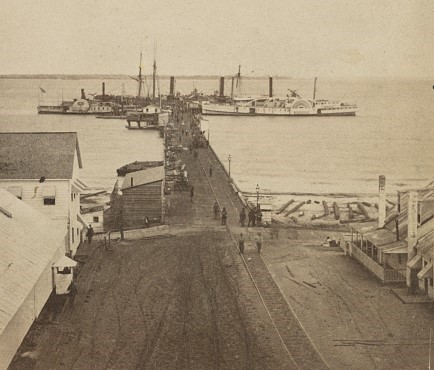
3. “Garris, Presto” (alias “Geddes, Bristor”, alias “Gethers, Bristor”), in U.S. Civil War General Pension Index, 1890-1894. Washington, D.C.: U.S. National Archives and Records Administration.

4. “Roll of Co. F., 47th Regiment, Infantry,” in Registers of Pennsylvania Volunteers, 1861-1865, in “Records of the Department of Military and Veterans’ Affairs.” Harrisburg, Pennsylvania: Pennsylvania State Archives, retrieved online February 10, 2020.