Uniforms and Insignia of the 47th Pennsylvania Volunteer Infantry

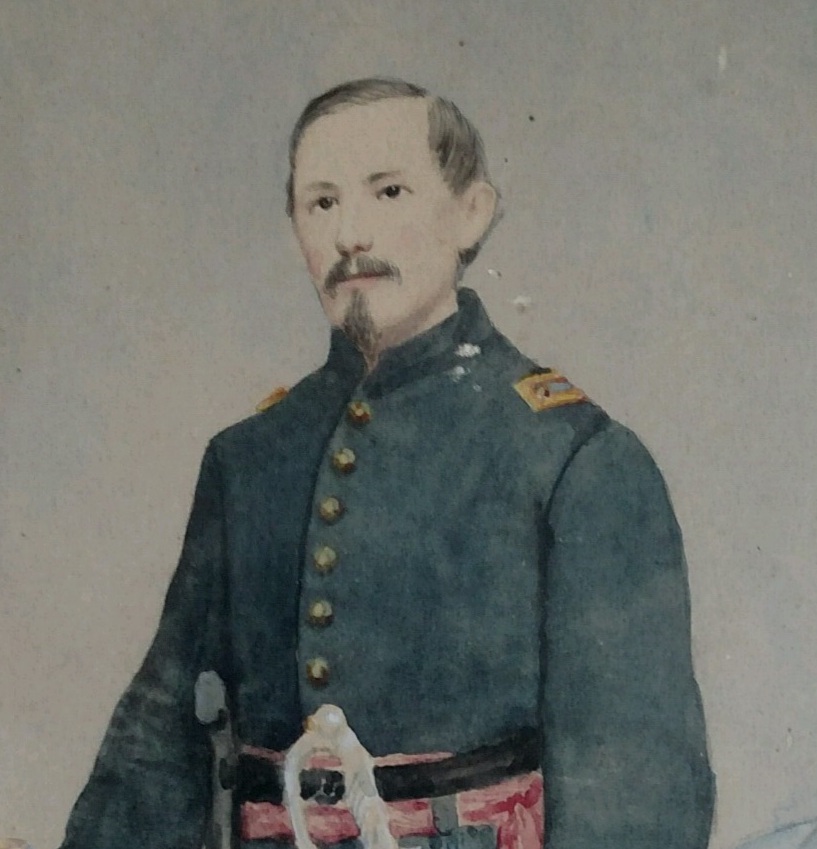
Captain Richard A. Graeffe, Company A, 47th Pennsylvania Volunteers, circa 1862 (public domain).

Upon mustering in at Camp Curtin in Harrisburg, Pennsylvania in August and early September of 1861, the men who had enrolled for military service with the 47th Pennsylvania Volunteer Infantry were assigned to their respective companies and issued standardized uniforms—the same style of dark blue, wool uniforms that were worn by the regular officers or enlisted members of the U.S. Army. The uniform of Captain Richard Graeffe (pictured at right) shows the typical details of a company commander’s uniform with shoulder bars, hat and sword.

Initially equipped with Mississippi rifles, the 47th Pennsylvania Volunteers were then provided with basic training in light infantry tactics through mid-September. Presented with the regiment’s First State Color on September 20, 1861 by Pennsylvania Governor Andrew Curtin, they were subsequently marched to Harrisburg’s train station, and were transported to Washington, D.C., where they participated in the first of multiple duty assignments that would take them from the Eastern Theater of the American Civil War to the Western and Trans-Mississippi theaters between early 1862 and March of 1864 before being transported back to the Eastern Theater for the fateful and tide-turning Shenandoah Valley Campaign, which unfolded during the summer and fall of 1864.

Army of the United States, Corps Badges, 1865 (U.S. Library of Congress, public domain; click to enlarge).

Along the way, the 47th Pennsylvania Volunteer Infantry would be attached to the:

  • U.S. Army of the Potomac (“Mr. Lincoln’s Army”) in the Eastern Theater (1861);
  • U.S. Army’s Tenth Corps (X Corps) in the Western Theater (Occupying force duties and battles in Florida and South Carolina, early winter 1862 through early winter 1864);
  • U.S. Army’s Nineteenth Corps (XIX Corps) in the Trans-Mississippi Theater (Red River Campaign, spring and early summer 1864);
  • U.S. Army of the Shenandoah, Nineteenth Corps (XIX Corps) in the Eastern Theater (Battle of Cool Spring and Sheridan’s 1864 Shenandoah Valley Campaign, summer and fall 1864);
  • U.S. Army of the Shenandoah, Nineteenth Corps (XIX Corps) in the Eastern Theater (Defense of Washington, D.C., late winter 1864 through the immediate aftermath of the assassination of President Abraham Lincoln in 1865);
  • Selected units of the U.S. Army’s former Nineteenth Corps (XIX Corps (Reconstruction duties in Savannah, Georgia and Charleston, South Carolina, June through late December 1865); and
  • Camp Cadwalader (final discharge, early January 1866).
Each time that the 47th Pennsylvania Volunteers were attached to a different Union Army corps, they were issued specific insignia that were then sewn onto their uniforms. The chart pictured above shows the different insignia that were worn by the various Union corps’ members.

First Blood: The Battle of Pocotaligo, South Carolina (47th Pennsylvania Volunteers’ Perspective, October 22, 1862)

Colonel Tilghman H. Good, commanding officer, 47th Pennsylvania Volunteers, circa 1863 (public domain image).

They were steady, true and brave. If heavy losses may indicate gallantry, the palm may be given to Col. Good’s noble regiment, the Forty-seventh Pennsylvania Volunteers. Upon this command the brunt of battle fell. Out of 600 who went into action, nearly 150 were killed or wounded. All of the Keystone troops did splendidly….

– Newspapers across America, October and November 1862


Although reports penned by senior military officials immediately following the combined Union Army-Navy Expedition to Pocotaligo provide an important overview of the incidents leading up to the Battle of Pocotaligo, South Carolina on October 22, 1862, it is the individual reports penned by the brigade and regimental commanding officers on site which provide the most detailed accounts of how this Union military engagement changed from an “expedition” to a raging battle.

Perhaps the most important of these front-line accounts come from members of the 47th Pennsylvania Volunteer Infantry themselves because the regiment’s founder, Colonel Tilghman H. Good, served that day as both commanding officer of his own regiment and as the commanding officer of the U.S. Tenth Army’s First Brigade, to which the 47th Pennsylvania was attached, and because the enlisted men and their direct superiors were involved in the most heated parts of this particular battle.

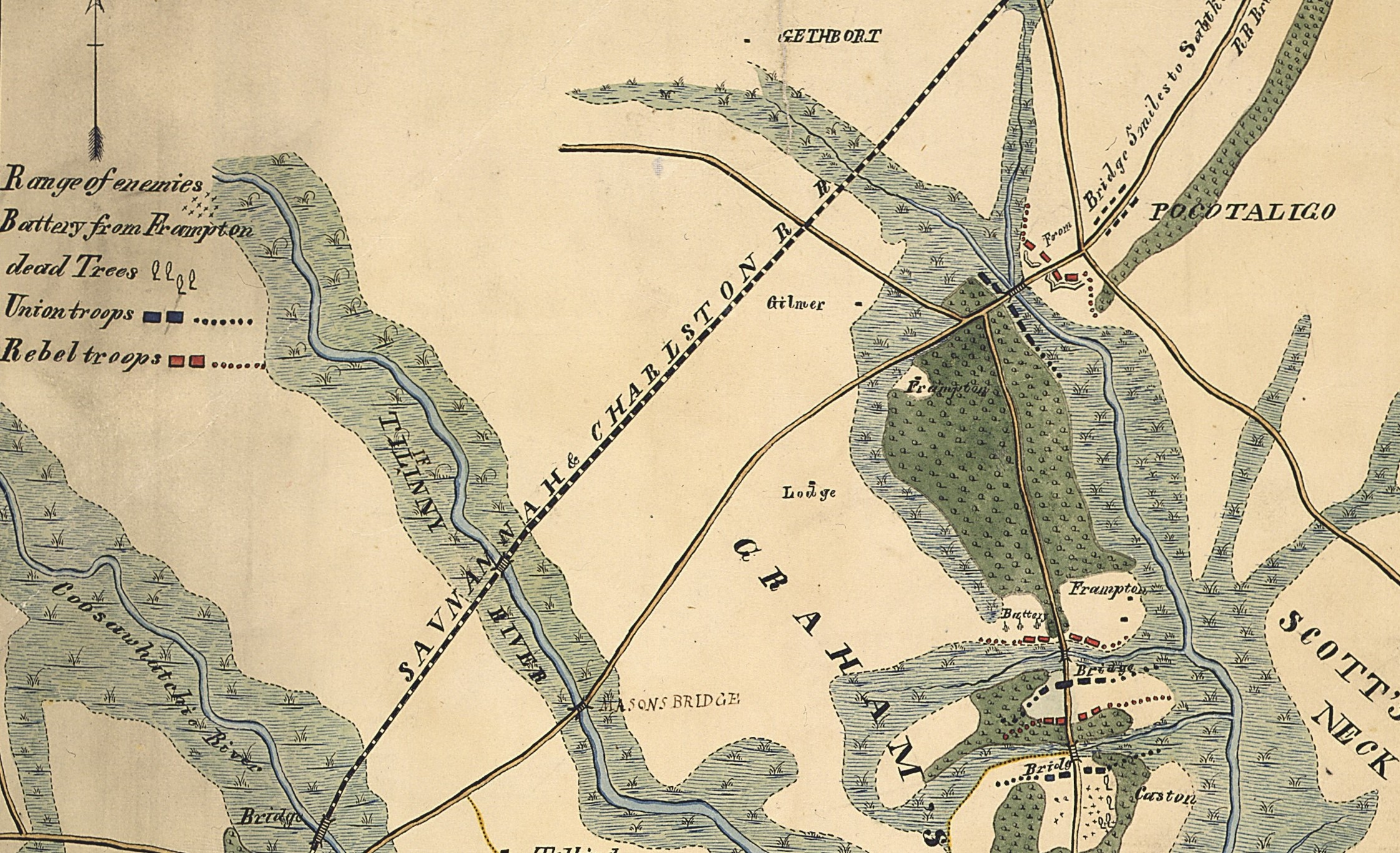
Highlighted version of the U.S. Army’s map of the Pocotaligo-Coosawhatchie Expedition, South Carolina, October 22, 1862. Blue Arrow: Mackay’s Point, where the U.S. Tenth Army debarked and began its march. Blue Box: Position of Union troops (blue) and Confederate troops (red) in relation to the Pocotaligo bridge and town of Pocotaligo, the Charleston & Savannah Railroad, and the Caston and Frampton plantations (blue highlighting added by Laurie Snyder, 2023; public domain; click to enlarge).

Colonel Good’s first account of the battle was written on October 24, 1862, two days after the engagement with the enemy occurred, and was penned at his desk at the headquarters of the 47th Pennsylvania Volunteer Infantry in Beaufort, South Carolina.

SIR: I have the honor to submit the following report of the part taken by the Forty-seventh Regiment Pennsylvania Volunteers in the action of October 22:

Eight companies, comprising 480 men, embarked on the steamship Ben De Ford [sic, Ben Deford], and two companies, of 120 men, on the Marblehead, at 2 a.m. October 21. With this force I arrived at Mackays Landing before daylight the following morning. At daylight I was ordered to disembark my regiment and move forward across the first causeway and take a position, and there await the arrival of the other forces. The two companies of my regiment on board of the Marblehead had not yet arrived, consequently I had but eight companies of my regiment with me at this juncture.

At 12 [noon]. I was ordered to take the advance with four companies, one of the Forty-seventh and one of the Fifty-fifth Pennsylvania Volunteers, and two of the Sixth Connecticut, and to deploy two of them as skirmishers and move forward. After moving forward about 2 miles I discerned some 30 or 40 of the enemys [sic] cavalry ahead, but they fled as we advanced. About 2 miles farther on I discovered two pieces of artillery and some cavalry, occupying a position about three-quarters of a mile ahead in the road. I immediately called for a regiment, but seeing that the position was not a strong one I made a charge with the skirmishing line. The enemy, after firing a few rounds of shell, fled. I followed up as rapidly as possible to within about 1 mile of Frampton Creek. In front of this stream is a strip of woods about 500 yards wide, and in front of the woods a marsh of about 200 yards, with a small stream running through it parallel with the woods. A causeway also extends across the swamp, to the right of which the swamp is impassable. Here the enemy opened a terrible fire of shell from the rear, of the woods. I again called for a regiment, and my regiment came forward very promptly. I immediately deployed in line of battle and charged forward to the woods, three companies on the right and the other five on the left of the road. I moved forward in quick-time, and when within about 500 yards of the woods the enemy opened a galling fire of infantry from it. I ordered double-quick and raised a cheer, and with a grand yell the officers and men moved forward in splendid order and glorious determination, driving the enemy from this position.

Lieutenant-Colonel George Warren Alexander, 47th Pennsylvania Volunteers, circa 1861 (public domain).

On reaching the woods I halted and reorganized my line. The three companies on the right of the road (in consequence of not being able to get through the marsh) did not reach the woods, and were moved by Lieutenant-Colonel Alexander by the flank on the causeway. During this time a terrible fire of grape and canister was opened by the enemy through the woods, hence I did not wait for the three companies, but immediately charged with the five at hand directly through the woods; but in consequence of the denseness of the woods, which was a perfect matting of vines and brush, it was almost impossible to get through, but by dint of untiring assiduity the men worked their way through nobly. At this point I was called out of the woods by Lieutenant Bacon, aide-de-camp, who gave the order, ‘The general wants you to charge through the woods.’ I replied that I was then charging, and that the men were working their way through as fast as possible. Just then I saw the two companies of my regiment which embarked on the Marblehead coming up to one of the companies that was unable to get through the swamp on the right. I went out to meet them, hastening them forward, with a view of re-enforcing the five already engaged on the left of the road in the woods; but the latter having worked their way successfully through and driven the enemy from his position, I moved the two companies up the road through the woods until I came up with the advance. The two companies on the right side of the road, under Lieutenant-Colonel Alexander had also worked their way up through the woods and opened fire on the retreating enemy. At this point I halted and reorganized my regiment, by forming close column by companies.

This image of Captain Edwin G. Minnich is being presented here through the generosity of Chris Sapp and his family, and is being used with Mr. Sapp’s permission. This image may not be reproduced, repurposed, or shared with other websites without the permission of Chris Sapp.

I then detailed Lieutenant Minnich, of Company B, and Lieutenant Breneman, of Company H, with a squad of men, to collect the killed and wounded. They promptly and faithfully attended to this important duty, deserving much praise for the efficiency and coolness they displayed during the fight and in the discharge of this humane and worthy trust.

The casualties in this engagement were 96. Captain Junker of Company K; Captain Mickley, of Company I [sic, “G”], and Lieutenant Geety, of Company H, fell mortally wounded while gallantly leading their respective companies on.

I cannot speak too highly of the conduct of both officers and men. They all performed deeds of valor, and rushed forward to duty and danger with a spirit and energy worthy of veterans.

The rear forces coming up passed my regiment and pursued the enemy. When I had my regiment again placed in order, and hearing the boom of cannon, I immediately followed up, and, upon reaching the scene of action, I was ordered to deploy my regiment on the right side of the wood, move forward along the edge of it, and relieve the Seventh Connecticut Regiment. This I promptly obeyed. The position here occupied by the enemy was on the opposite side of the Pocotaligo Creek, with a marsh on either side of it, and about 800 yards distant from the opposite wood, where the enemy had thrown up rifle pits all along its edge.

On my arrival the enemy had ceased firing; but after the lapse of a few minutes they commenced to cheer and hurrah for the Twenty-sixth South Carolina. We distinctly saw this regiment come up in double-quick and the men rapidly jumping into the pits. We immediately opened fire upon them with terrible effect, and saw their men thinning by scores. In return they opened a galling fire upon us. I ordered the men under cover and to keep up the fire.

Excerpt from the U.S. Army map of the Pocotaligo-Coosawhatchie Expedition, October 22, 1862, showing the Caston and Frampton plantations in relation to the town of Pocotaligo, the Pocotaligo bridge and the Charleston & Savannah Railroad (public domain).

During this time our forces commenced to retire. I kept my position until all our forces were on the march, and then gave one volley and retired by flank in the road at double-quick about 1,000 yards in the rear of the Seventh Connecticut. This regiment was formed about 1,000 yards in the rear of my former position. We jointly formed the rear guard of our forces and alternately retired in the above manner.

My casualties here amounted to 15 men.

We arrived at Frampton (our first battle ground) at 8 p.m. Here my regiment was relieved from further rear-guard duty by the Fourth New Hampshire Regiment. This gave me the desired opportunity to carry my dead and wounded from the field and convey them back to the landing. I arrived at the above place at 3 o’clock the following morning.

* Note: All of this unfolded without two of the 47th Pennsylvania’s more seasoned officers: Major William H. Gausler, Colonel Good’s third-in-command, and Captain Henry S. Harte, the commanding officer of Company F. Both had been ordered to return home to Pennsylvania’s Lehigh Valley in July to resume their recruiting efforts, which ran through early November 1862. Major Gausler persuaded fifty-four new recruits to join the 47th Pennsylvania while Harte rounded up an additional twelve. Meanwhile, back in the Deep South, Captain Harte’s F Company men were commanded by Harte’s direct subordinates, First Lieutenant George W. Fuller and Second Lieutenant August G. Eagle. As a result, neither Gausler, nor Harte participated in their regiment’s first truly significant military engagements at Saint John’s Bluff and Pocotaligo.

First State Color, 47th Regiment, Pennsylvania Volunteer Infantry (presented to the regiment by Pennsylvania Governor Andrew Curtin, September 20, 1861; retired May 11, 1865, public domain).

In a second letter to his superiors, Colonel Good presented his “report of the part taken by the First Brigade in the battles of October 22,” which included further details about the 47th Pennsylvania’s role that day:

After meeting the enemy in his first position he was driven back by the skirmishing line, consisting of two companies of the Sixth Connecticut, one of the Forty-seventh Pennsylvania, and one of the Fifty-fifth Pennsylvania, under my command. Here the enemy only fired a few rounds of shot and shell. He then retreated and assumed another position, and immediately opened fire. Colonel Chatfield, then in command of the brigade, ordered the Forty-seventh Pennsylvania forward to me, with orders to charge. I immediately charged and drove the enemy from the second position. The Sixth Connecticut was deployed in my rear and left; the Fifty-fifth Pennsylvania on my right, and the Fourth New Hampshire in the rear of the Fifty-fifth, both in close column by divisions, all under a heavy fire of shell and canister. These regiments then crossed the causeway by the flank and moved close up to the woods. Here they were halted, with orders to support the artillery. After the enemy had ceased firing the Fourth New Hampshire was ordered to move up the road in the rear of the artillery and two companies of the Forty-seventh Pennsylvania to follow this regiment. The Sixth Connecticut followed up, and the Fifty-fifth moved up through the woods. At this juncture Colonel Chatfield fell, seriously wounded, and Lieutenant-Colonel Speidel was also wounded.

The casualties in the Forty-seventh Pennsylvania amounted to 96 men. As yet I am unable to learn the loss of the entire brigade.

“The Commencement of the Battle near Pocotaligo River” (Frank Leslie’s Illustrated Newspaper, October 1862, public domain).

The enemy having fled, the Fourth New Hampshire and the Fifty- fifth Pennsylvania followed in close pursuit. During this time the Forty-seventh Pennsylvania and the Sixth Connecticut halted and again organized, after which they followed. On coming up to the engagement I assumed command of the brigade, and found the forces arranged in the following order: The Fourth New Hampshire was deployed as skirmishers along the entire front, and the Fifty-fifth deployed in line of battle on the left side of the road, immediately in the rear of the Fourth New Hampshire. I then ordered the Sixth Connecticut to deploy in the rear of the Fifty-fifth Pennsylvania and the Forty-seventh Pennsylvania to deploy on the right side of the road in line of battle and relieve the Seventh Connecticut. I then ordered the Fourth New Hampshire, which had spent all its ammunition, back under cover on the road in the woods. The enemy meantime kept up a terrific fire of grape and musketry, to which we replied with terrible effect. At this point the orders were given to retire, and the Forty-seventh Pennsylvania and Seventh Connecticut formed the rear guard. I then ordered the Thirty-seventh Pennsylvania to keep its position and the Sixth Connecticut to march by the flank into the road and to the rear, the Fourth New Hampshire and Fifty-fifth Pennsylvania to follow. The troops of the Second Brigade were meanwhile retiring. After the whole column was in motion and a line of battle established by the Seventh Connecticut about 1,000 yards in the rear of the Forty-seventh Pennsylvania I ordered the Forty-seventh to retire by the flank and establish a line of battle 1,000 yards in the rear of the Seventh Connecticut; after which the Seventh Connecticut moved by the flank to the rear and established a line of battle 1,000 yards in the rear of the Forty seventh, and thus retiring, alternately establishing lines, until we reached Frampton Creek, where we were relieved from this duty by the Fourth New Hampshire. We arrived at the landing at 3 o’clock on the morning of the 23d instant.

The casualties of the Sixth Connecticut are 34 in killed and wounded and the Forty-seventh Pennsylvania 112 in killed and wounded. As to the remaining regiments I have as yet received no report.

The Post-Battle Confederate Response

In the days following the Battle of Pocotaligo (known today as the Second Battle of Pocotaligo or the Battle of Yemassee due to its proximity to the town of Yemassee, South Carolina), newspapers across the Confederate States carried comments attributed to Confederate Brigadier-General Pierre Gustave Toutant de Beauregard on October 23:

The enemy advanced yesterday morning in two columns, one against Coosawhatchie and the other against Pocotaligo. They were repulsed from Pocotaligo by our forces, but at Coosawhatchie they succeeded in gaining the Railroad, yet, before they could do it much damage, our troops came up and drove them off.

The Railroad and Telegraph lines have been mended and are again in working order.

The enemy’s gunboats are anchored below Coosawhatchie.

Intent on leaving no doubt as to what the Confederate States Army was actually fighting for, General Beauregard then wrote:

The Abolitionists attacked in force Pocotaligo and Coosawhatchie yesterday. They were gallantly repulsed to their gunboats at Mackey’s Point and Bee’s Creek Landing, by Col. W. S. Walker commanding the District, and D. P. Harrison, commanding the troops sent from here. The enemy had come in thirteen transports and gunboats. The Charleston and Savannah Railroad is uninjured. The Abolitionists left their dead and wounded on the field, and our cavalry is in hot pursuit.

Among the Confederate regiments that battled the U.S. Tenth Army Corps that day, according to southern newspaper accounts, were the Virginia Artillery, Captain J. N. Lampkin, commanding, the Beaufort Volunteer Artillery, Captain Stephen Elliott, Jr., commanding, the Charleston Light Dragoons, and the Rutledge Mounted Riflemen.

Commendations Received by Members of the 47th Pennsylvania Volunteers

Captain John Peter Shindel Gobin, Co. C, 47th Pennsylvania Volunteers, shown here circa 1863, went on to become Lieutenant Governor of Pennsylvania after the war (public domain).

Praise for the performance of the 47th Pennsylvania Volunteers quickly followed after the regiment returned to Hilton Head. Brigadier-General Brannan praised Colonel Good twice, noting:

Col. T. H. Good, Forty-seventh Regiment Pennsylvania Volunteers (Colonel Chatfield being wounded early in the day), commanded the First Brigade during the latter part of the engagement with much ability. Nothing could be more satisfactory than the promptness and skill with which the wounded were attended to by Surg. E. W. Bailey [sic, Baily], Forty-seventh Pennsylvania Volunteers, medical director, and the entire medical staff of the command.

He then added this update:

I herewith transmit the reports of Brig. Gen. A. H. Terry and Col. T. H. Good, Forty-seventh Regiment Pennsylvania Volunteers, who commanded brigades during the late expedition, under my command, to Pocotaligo, S.C., and would beg respectfully to bring them to the favorable notice of the department for their gallant and meritorious conduct during the engagement of October 22….

In addition to those officers mentioned in my report of the expedition I have great pleasure, on the recommendation of their respective commanders, in bringing to the favorable consideration of the department the following officers and men, who rendered themselves specially worthy of notice by their bravery and praiseworthy conduct during the entire expedition and the engagements attending it: First Lieut. E. Gittings, wounded, lieutenant Company E, Third U.S. Artillery, commanding section, who served his pieces with great coolness and judgment under the heavy fire of a rebel battery; Lieutenant Col. G. W. Alexander, Forty-seventh Regiment Pennsylvania Volunteers; Maj. J. H. Filler, Fifty-fifth Regiment Pennsylvania Volunteers; Capt. Theodore Bacon, Seventh Regiment Connecticut Volunteers, acting assistant adjutant-general Second Brigade; First Lieut. Adrian Terry, Seventh Connecticut Volunteers, and Second Lieut. Martin S. James, Third Regiment Rhode Island Volunteer Artillery, staff of Brigadier-General Terry; Capt. J. P. Shindel Gobin, Company C, Forty-seventh Regiment Pennsylvania Volunteers; Capt. George Junker, killed, Company K, Forty-seventh Regiment, Pennsylvania Volunteers; Captain Mickley, killed, Company G, Forty-seventh Regiment Pennsylvania Volunteers; First Lieut. W. H. R. Hangen, adjutant, wounded, Forty-seventh Regiment Pennsylvania Volunteers; First Lieutenant Minnich, Company B, Forty-seventh Regiment Pennsylvania Volunteers; First Lieut. W. W. Geety, severely wounded, commanding Company H, Forty-seventh Pennsylvania Volunteers; Second Lieutenant Breneman, Company H, Forty-seventh Regiment Pennsylvania Volunteers; Private Michael Larkins [sic, Larkin], wounded, Company C, Forty-seventh Regiment Pennsylvania Volunteers….

Brigadier-General Alfred H. Terry, commanding officer of the U.S. Tenth Army’s Second Brigade that day, had this to say about the 47th Pennsylvania Volunteers:

The Forty-seventh Regiment Pennsylvania Volunteers was for a short time under my immediate command, and, although they are not a portion of my brigade, I cannot forbear mentioning the steadiness and discipline by this admirable regiment during our movements to the rear.

47th Pennsylvania Volunteer Infantry Casualty Reports by Officers of the Regiment

Captain Charles Mickley, Company G, 47th Pennsylvania Volunteers, circa 1862 (public domain).

Losses for the 47th at Pocotaligo were statistically significant. Two officers and eighteen enlisted men died; an additional two officers and one hundred and fourteen enlisted men from the 47th were wounded.

Der Lecha Caunty Patriot, an Allentown-based German-language newspaper, reported that Captain Charles Mickley, the commanding officer of Company G, had suffered a fatal head wound during the Battle of Pocotaligo on “the railway between Charleston, South Carolina and Savannah, Georgia.” His “remains were brought immediately after his death to his home in Allentown.” Captain Mickley’s subsequent funeral service, which was officiated by the Reverands Derr and Brobst at the local Reformation Church, was widely attended by a “suffering entourage.”

Also among the G Company casualties were Privates Benjamin Diehl, James Knappenberger, John Kuhns (alternate spelling: Kuntz), and George Reber. Privates Knappenberger and Kuhns were killed in action during the 47th’s early engagement at the Frampton Plantation; George Reber, a resident of Thorntown, Pennsylvania, sustained a fatal gunshot wound to his head. Private Franklin Oland subsequently died from his wounds at the Union Army’s general hospital at Hilton Head, South Carolina on October 30, and Private John Heil, who had sustained a gunshot wound (termed “Vulnus Sclopet” in his medical records), succumbed to his own battle wound-related complications at Hilton Head on November 2, 1862.

Daniel K. Reeder, former corporal, Company H, 47th Pennsylvania Volunteers (National Republican, December 1, 1887, public domain).

On October 25, 1862, Captain James Kacy of Company H penned the following letter to his company’s hometown newspaper, The Perry County Democrat. Writing from the regiment’s headquarters at Beaufort, he asked for the community’s help in reaching a decedent’s family:

Jason Robinson, a printer, joined my company, from your place and was killed at the battle of Pocotaligo on 22d inst. I do not know his relations or where to write to them. Probably you do. The following is a list of killed and wounded in my company:

COMPANY H. – Killed – Henry Stambaugh, Jefferson Waggoner, Peter Deitrick, Jason P. Robinson. – Wounded—First Lieutenant W. W. Geety, mortally, Orderly Sergeant, George Reynolds; Sergeant Reuben S. Gardner, in head and leg; Corporals Daniel Reeder, David H. Smith, Peter W. Stockslager; privates Jerome Briner [sic], Henry Bolinger, Augustus Rupp, Samuel Huggins, Comley Idall, Patrick Mullen, Jefferson Haney.

We did not lose a prisoner but took some. Total loss in the 47th Reg. 99 wounded, 23 killed. Several have died since. Our boys fought like Turks. We ran out of ammunition and had to leave the field.–We are going back soon.

The effects of Robinson will be sent home as soon as I can put up and forward by express.

Reeder, who had been shot in the arm, was wounded so severely that surgeons were forced to amputate his damaged limb above the elbow. After convalescing briefly at the Union Army’s General Hospital at Hilton Head, South Carolina, he was discharged on a surgeon’s certificate of disability on November 24, 1862, and sent home to Pennsylvania.

Geety’s survival was nothing short of miraculous, according to accounts by physicians who provided follow-up treatment for him in 1863 Harrisburg, where he had been reassigned to recruiting duties for the 47th Pennsylvania and quartermaster duties for Camp Curtin. (See Geety’s bio on our website for details.)

Idall, Reynolds and Huggins, however, were less fortunate. Idall died from gunshot-related complications eight days after the battle, while undergoing care at the Union Army’s post hospital at Hilton Head, South Carolina. Reynolds also succumbed to complications there on November 8 while Private Huggins, who had sustained a wound to his leg (also described on his Army death ledger entry as “Vulnus Sclopet”) died there from his wounds on December 16, 1862.

Captain Daniel Oyster, Company C, 47th Pennsylvania Volunteers, circa 1864 (public domain).

The losses within Company C were higher, in many cases, than those of other companies within the regiment, largely due to one simple fact—Company C was the color-bearer unit. As such, it came under heavier fire than many of the 47th’s other units because the red, white, and blue American flag carried by the company was easy to spot for sharpshooters and artillerymen, even through the smoky air of battle. In one heartbreaking “twist of fate” tragedy, Sergeant Peter Haupt and his brother, Private Samuel Y. Haupt, initially were counting their lucky stars after being hit—Samuel sustaining a wound to his chin and Peter sustaining a wound to his foot, only to learn later that Peter’s foot injury was resisting the best treatment efforts of regimental and division medical personnel. In a stunning turn, Peter Haupt died at the Union Army’s post hospital at Hilton Head, just over three weeks later. According to an affidavit submitted to the Commissioner of Pensions, United States by Second Lieutenant Daniel Oyster at Fort Taylor, Key West, Florida on August 14, 1863, and certified at Fort Taylor on August 20, 1863 by Captain John Peter Shindel Gobin in his acting capacity as Judge Advocate:

This is to certify that Sergeant Peter Haupt of Company (C) 47th Regiment of Pennsylvania Volunteers died at Hilton Head South Carolina November 14th 1862 of wounds received at Pocotalico [sic] South Carolina;

That the said wounds were received by the said Peter Haupt during an engagement with the enemy at the place aforesaid and were caused by a Rifle or Musket ball having entered his left foot and which resulted in his death at the time and place aforesaid that I was present and have personal knowledge of the facts.

The actual cause of Sergeant Peter Haupt’s death, which was listed by his physician on the Union Army hospital’s death ledger, was “traumatic tetanus.” His remains were subsequently returned home; he was then laid to rest at the Sunbury Cemetery in Sunbury, Northumberland County, Pennsylvania.

Also on the roster of C Company wounded was Private Timothy Matthias Snyder. Unlike so many others in the 47th, Tim survived, recuperated and returned to duty, serving with the regiment until its final muster out on Christmas day in 1865. His son, John Hartranft Snyder, grew up to become a pioneer in the telephone industry.

Among the Company E injured was Corporal Reuben Weiss. Wounded in both legs (including a gunshot to the left leg), he returned to duty after convalescing, and served for another two years until being honorably discharged on a surgeon’s certificate.

One of the Company I casualties was Edwin Dreisbach, who also survived and continued to serve for the duration of the war. Sadly, though, his later life was altered by mental illness (possibly Soldier’s Heart,” which is more commonly known today as post-traumatic stress disorder).

As hard as this battle was on Company C, though, it was Company K that suffered many of the regiment’s most severe casualties. Private John McConnell died on the field of battle while Captain George Junker was mortally wounded by a minie ball fired from a Confederate rifle during the intense fighting near the Frampton Plantation. Also mortally wounded were Privates Abraham Landes (alternate spelling: “Landis”) and Joseph Louis (alternate spelling: “Lewis”). All three died the next day while being treated at the Union Army’s General Hospital at Hilton Head, South Carolina.

Private John Schuchard, who was also mortally wounded at Pocotaligo, died at the same hospital on October 24. Private Edward Frederick lasted a short while longer, finally succumbing on February 16, 1863 at Fort Jefferson in the Dry Tortugas, Florida to brain fever, a complication from the personal war he had waged with his battle wounds. He was initially buried at the fort’s parade grounds.

Private Gottlieb Fiesel, who had also sustained a head wound, initially survived. Although his skull had been fractured and the left side of his head badly damaged by shrapnel from an exploding artillery shell, physicians were hopeful that Fiesel might still recover since surgeries to remove bone fragments from his brain had been successful—but then he contracted meningitis while recuperating. He passed away at Hilton Head on November 9, 1862, and was one of those interred at the Beaufort National Cemetery.

Private Jacob Hertzog, 47th Pennsylvania Volunteers – Co. K, successfully recovered from a gunshot wound to his right arm, circa 1866 (U.S. Surgeon General’s Office, public domain).

K Company’s Corporal John Bischoff and Privates Manoah J. Carl, Jacob F. Hertzog, Frederick Knell, Samuel Kunfer, Samuel Reinert, John Schimpf, William Schrank, and Paul Strauss were among those wounded in action who rallied. Private Strauss survived an artillery shell wound to his right shoulder, recuperated, and continued to serve with the regiment. Private Hertzog, who had been discharged two months earlier on his own surgeon’s certificate, on February 24, 1863, had sustained a gunshot wound to his right arm; his treatment, like that of the aforementioned Private Fiesel, was detailed extensively in medical journals during and after his period of service. (See his bio on our website for more details.)

In late October and early November, newspapers nationwide began publishing more detailed casualty lists. Even just as partial tallies, they were still jaw-dropping, in terms of numbers and in terms of the severity and types of battle wounds sustained by members of the regiment:

Regimental Officers:

  • Hangen, Regimental First Lieutenant and Adjutant Washington H. R.: Severely wounded in the knee; narrowly avoided amputation; survived and returned to duty after lengthy convalescence period;

Company A:

  • Ferer (alternate spelling: Fever), Sergeant William: Slight wound;
  • Fraunfelder (alternate spelling of surname: Trumpfelder), Corporal Levi: Slight wound;
  • Strauss, Corporal David: Severe thigh wound;

Company B:

  • Fink, Corporal Aaron: Sustained gunshot wounds to both legs, below the knees; died from wounds at the Union Army’s post hospital at Hilton Head, South Carolina, November 5, 1862;
  • Gaumer, Sergeant Allen: Killed, Frampton Plantation;
  • George, Private Nathan: Died from battle wounded-related complications at the Union Army’s post hospital, Hilton Head, South Carolina, November 14, 1862;
  • Kern (alternate spelling: Hern), Private William: Sustained service-related wound the day before the Battle of Pocotaligo, South Carolina; died from military wound-related complications at the Union Army’s post hospital at Hilton Head, South Carolina, October 23, 1862;
  • Leisenring, Private Martin: Unspecified wound;
  • Pfeifer, Private Obadiah: Leg amputated after being wounded in action during the Battle of Pocotaligo, South Carolina, October 22, 1862; discharged on a surgeon’s certificate of disability, March 16, 1865, due to loss of leg;
  • Raymond, Private Haldeman: Gunshot wound to left arm;
  • Ruttman, Private Ernst (alternate spelling: Rothman, Earnest): Unspecified wound;
  • Savitz, Private Charles J.: Finger shot off;
  • Wieand (alternate spellings: Weiand, Wiand), Private Benjamin: Unspecified wound;
  • Wieand (alternate spelling: Wiand), Private John: Leg amputated after sustaining gunshot or shrapnel wound; discharged on surgeon’s certificate of disability, December 3, 1862;

Company C:

  • Bartlow, Private John: Leg wound;
  • Billington, Private Samuel H.: Leg wound;
  • Deibert, Private Seth: Killed;
  • Finck, Corporal William F.: Leg wound;
  • Haas, Private Jeremiah: Breast and face wounds;
  • Haupt, Corporal Samuel S.: Chin/face wound;
  • Haupt, Sergeant Peter: Ankle/foot wound;
  • Holman, Private Conrad: Face wound;
  • Horner, Private George: Killed;
  • Kiehl, Private Theodore: Face wound;
  • Larkins, Private Michael: Hip and side wounds;
  • Leffler, Private Charles: Leg wound;
  • Lothard, Private Thomas (also known as Marshall, Charles): Body wound;
  • O’Rourke, Private Richard: Side wound;
  • Rhine, Private James R.: Leg wound;
  • Snyder, Private Timothy: Unspecified wound;
  • Wolf, Private Peter: Killed;

Company D:

  • Baltozer (alternate spelling: Balltager), Private Jacob: Arm wound;
  • Crownover, Corporal James: Slight breast wound;
  • Musser (alternate spelling: Muiser), Private Alex: Killed;
  • Sheaffer, Private Benjamin: Slight breast wound;
  • Stewart, Corporal Cornelius: Severe side wound;

Company E:

  • Adams, Private William: Leg wound;
  • Bachman (alternate spelling: Bauchman), Private Henry A.: Killed (possibly killed at the actual Pocotaligo bridge; military affidavits for his mother’s U.S. Civil War Pension stated that his death occurred at “the battle of Pocotaligo Bridge, South Carolina”);
  • Coult, Private George: Hip wound;
  • Derr, Private Nathan: Shoulder wound;
  • Force (alternate spelling: Farce), Private William H.: Wrist wound;
  • Hahn, Private George: Leg wound;
  • Harkins, Private Daniel F.: Arm wound;
  • Jacoby (alternate spelling of surname: Jacobs), Private Moses: Hand wound;
  • Kirkendall (alternate spelling: Kerkendall), Private Jacob: Unspecified wound;
  • Lind, Private John: Wounds to both legs;
  • Minnick (alternate spelling: Minnich), Private Samuel: Killed;
  • Munday (alternate spelling: Monday), Private John: Neck wound;
  • Rose, Private George: Killed;
  • Stem (alternate spellings: Stein, Stern), Private Samuel: Shoulder wound;
  • Weiss, Corporal Reuben: Wounds to both legs;

Company F:

  • Eberhard (alternate spellings: Eberhart, Everhart), Corporal Augustus: Wounds to both legs;
  • Fink, Private William: Thigh wound;
  • King (alternate spelling: Ping), Private Charles: Arm wound;
  • Moser (alternate spelling: Morser), Private Peter: Arm wound;
  • O’Brien (alternate spelling: O’Brian), Private John: Gunshot wound to face;

Company G:

  • Ambrum (alternate spellings: Ambron, Arnbrunn), Private Richard: Unspecified wound;
  • Beidleman (alternate spelling: Beidelman), Private Jacob: Unspecified wound;
  • Diehl, Private Benjamin: Killed at the Frampton Plantation;
  • Fornwald, Private Reily M. (alternate spelling: Reilly Fernwald): Sustained shrapnel wounds to the head and groin; spent four weeks recuperating at the Union Army’s post hospital at Hilton Head, South Carolina before returning to duty;
  • Hallmeyer, Private Max Joseph: Wounded in the right leg and back; discharged on a surgeon’s certificate of disability October 28, 1862; died from wound-related complications at home in 1869;
  • Heil, Private John: Died from gunshot wound-related complications at the Union Army’s post hospital at Hilton Head, South Carolina, November 2, 1862;
  • Hensler (alternate spelling: Hansler), Private William: Unspecified wound;
  • Hoffert (alternate spelling: Huffert), Private Franklin: Unspecified wound;
  • Kemmerer, Private Allen: Sustained gunshot wound(s), possibly to his right leg and/or left foot;
  • Knappenberger, Private Jonas: Killed at the Frampton Plantation;
  • Kramer, Private William H.: Unspecified wound;
  • Kuhns (alternate spelling: Kuntz), Private John Henry: Killed at the Frampton Plantation;
  • Moser (alternate spelling: Mazer), Private Franklin: Unspecified wound;
  • Mickley, Captain Charles: Killed by fatal head shot;
  • Oland, Private Franklin: Unspecified wound; died at the Union Army’s post hospital at Hilton Head, South Carolina, October 30, 1862;
  • Raber (alternate spelling: Reber), Private George: Unspecified wound;
  • Wieder (alternate spelling: Weider), Private David: Unspecified wound;

Company H:

  • Bigger, Private Alexander: Unspecified wound; discharged on a surgeon’s certificate of disability, November 18, 1862;
  • Bollinger (alternate spelling: Bolinger), Private Henry: Unspecified wound;
  • Bupp (alternate spelling: Rupp), Private Augustus: Unspecified wound;
  • Bryner, Private Jerome (alternate: Briner, James): Unspecified wound;
  • Deitrick (alternate spellings: Deitrich), Private Peter: Killed near the Frampton Plantation;
  • Gardner, Sergeant Reuben Shatto: Head and thigh wounds; recovered after a long period of convalescence and returned to duty;
  • Geety, First Lieutenant William W. Geety: Initially listed as mortally wounded due to a severe head wound, he survived, following multiple surgeries; assigned to recruiting duty for the remainder of his military career so that he could continue his medical treatment;
  • Handy, Private Jefferson (possibly: Haney, Thomas J.): Unspecified wound;
  • Huggins (alternate spelling: Higgins), Private Samuel: Sustained gunshot wound to leg; died from wound-related complications at the Union Army’s post hospital at Hilton Head, December 16, 1862;
  • Idall, Private Comley: Sustained gunshot wound; died from wound-related complications at the Union Army’s post hospital at Hilton Head, October 30, 1862;
  • Johnson, Private Cyrus: Unspecified wound; discharged on a surgeon’s certificate of disability, December 16, 1862;
  • Kingsborough, Private Robert Reid: Unspecified wound; discharged on a surgeon’s certificate of disability, October 26, 1862;
  • Mullen, Private Patrick: Unspecified wound;
  • Reeder (alternate spelling: Ruder), Corporal Daniel: Wounded in the arm, resulting in the amputation of that arm above the elbow and subsequent discharge on a surgeon’s certificate of disability, November 24, 1862;
  • Reynolds, Orderly Sergeant George: Unspecified severe wound; died from wound-related complications at the Union Army’s post hospital at Hilton Head, November 8, 1862;
  • Robinson: Private Jason F.: Killed near the Frampton Plantation;
  • Smith, Corporal David H.: Unspecified wound;
  • Stambaugh, Private Henry: Killed near the Frampton Plantation;
  • Stockslager, Corporal Peter W.: Unspecified wound;
  • Waggoner, Private Jefferson: Killed near the Frampton Plantation;

Company I:

  • Baudenschlager (alternate spellings: Bartenslager, Bondenschlager), Private John: Unspecified wound; discharged on a surgeon’s certificate of disability, October 29, 1862;
  • Cole, Private James B.: Unspecified wound; discharged on a surgeon’s certificate of disability, November 15, 1862;
  • Dreisbach, Private Edwin: Unspecified slight wound;
  • Druckenmiller, Private Lewis (alternate given name: Daniel): Killed;
  • Kramer, Private Daniel Joseph: Leg wound;
  • Metz (alternate spelling; Mertz), Private Jeremiah: Killed;

Company K:

  • Bischoff (alternate spelling: Bishop), Corporal John: Leg wound;
  • Carl, Private Manoah: Foot wound;
  • Fiesel, Private Gottlieb: Left side of head damaged and skull fractured by shrapnel from exploding artillery shell; physicians at the Union Army’s post hospital at Hilton Head, South Carolina were hopeful that he might recover since surgeries to remove bone fragments from his brain had been successful, but he contracted meningitis while recuperating and died at Hilton Head on November 9, 1862;
  • Frederick (alternate spelling: Fredericks), Private Edwin: Head wound;
  • Hertzog, Private Jacob: Sustained severe gunshot wound (“Vulnus Sclopet”) to his right elbow joint; treated initially in the field and at his regiment’s hospital before being admitted to the U.S. Army’s Hospital No. 1 at Beaufort, South Carolina for more advanced care; underwent surgery of his right arm October 26, 1862, his sutures were removed November 15; by December 15, 1862, he was dressed and walking around the grounds of the Beaufort hospital; sent north via the steamer Star of the South December 28, 1862; discharged from Fort Wood in the New York Harbor via a surgeon’s certificate of disability February 24, 1863;
  • Junker, Captain George: Mortally wounded in action by a minie ball fired from a Confederate Army soldier’s rifle; died October 23, 1862 at the Union Army’s post hospital at Hilton Head, South Carolina; his remains were returned to his family in Hazleton, Luzerne County, Pennsylvania for reburial;
  • Knell, Private Frederick: Unspecified wound; discharged on a surgeon’s certificate of disability, May 9, 1863;
  • Kolb (alternate spellings: Holb, Kolp), Private Hiram: Finger shot off; sent north for more advanced care, ultimately hospitalized at the Union Army’s general hospital in York, Pennsylvania;
  • Kunfer (alternate spelling: Cunfer), Private Samuel: Unspecified wound;
  • Landes, Private Abraham: Gunshot wound to breast; died from battle wounds, October 23, 1862, while being treated at the Union Army’s post hospital at Hilton Head, South Carolina;
  • Louis (alternate spelling: Lewis), Private Joseph: Mortally wounded by gunshot; died October 23, 1862, while being treated at the Union Army’s post hospital at Hilton Head, South Carolina;
  • Marder, Private Jacob (possibly Matter, Jacob): Stomach wound;
  • McConnell, Private John: Killed;
  • Miller, Private Louis: Wounded in both thighs;
  • Reinert, Private Samuel: Right shoulder wound;
  • Schiff (possibly Schimpf), Private John: Thigh wound;
  • Schrank, Private William: Arm wound;
  • Schuchard (alternate spelling: Shuckard), Private John: Mortally wounded; died from battle wounds October 24, 1862 while being treated at the Union Army’s post hospital at Hilton Head, South Carolina; and
  • Strauss, Private Paul: Sustained artillery shell wounds to his right shoulder and back.

Battered, But Not Cowed

Described as “shattered” by one newspaper correspondent, the 47th Pennsylvania rested, recuperated, regrouped, and they soldiered on in their fight to preserve America’s Union and eradicate slavery nationwide. The only regiment from the Commonwealth of Pennsylvania to participate in the Union Army’s 1864 Red River Campaign, the 47th Pennsylvanians helped turn the tide of war firmly in the Union’s favor by re-engaging with the enemy time and again during Sheridan’s Shenandoah Valley Campaign in the fall of that same year.

But they would always remember the cost of that terrible day in 1862. Surviving veterans of the 47th Pennsylvania never failed to honor the memory of their friends who never made it home, paying tribute through annual reunions of the regiment, which were typically held in October to mark the anniversaries of the Battle of Pocotaligo (October 22, 1862) and the Battle of Cedar Creek (October 19, 1864).

For the remainder of their lives, they continued to be steady, true and brave.

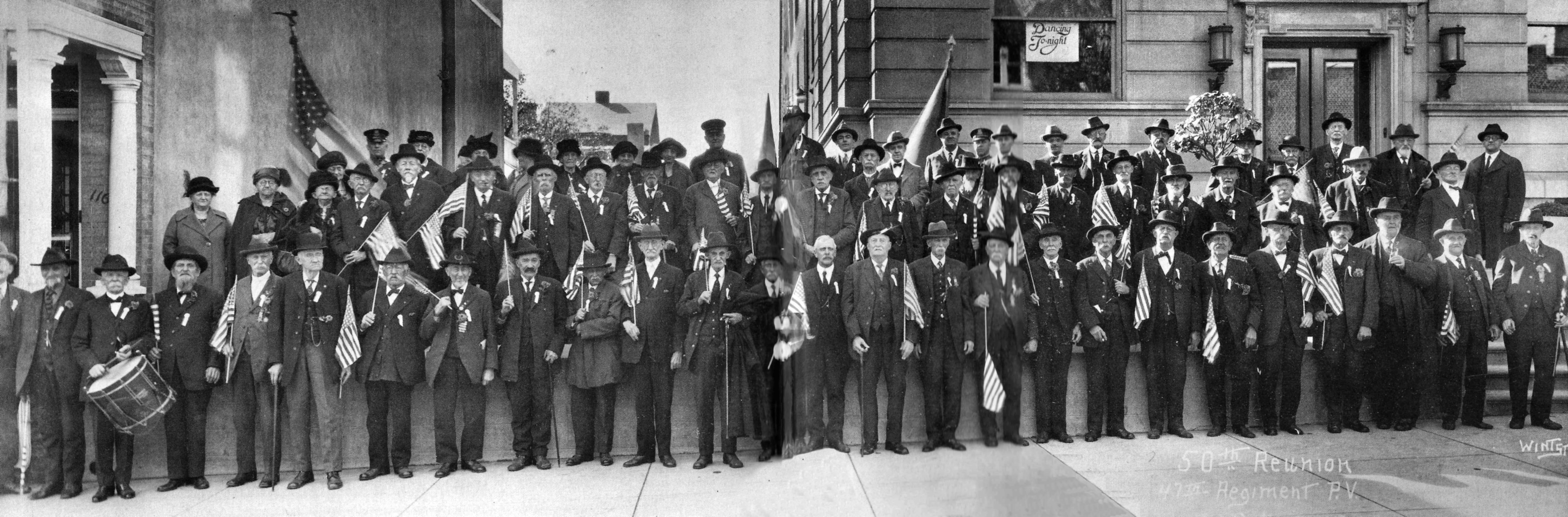
Surviving members of the 47th Pennsylvania Volunteer Infantry at their 1923 reunion, Odd Fellows Hall, Allentown, Pennsylvania (public domain).


Sources:

  1. Burial Ledgers, in Record Group 15, The National Cemetery Administration, and Record Group 92, U.S. Departments of Defense and Army (Quartermaster General). Washington, D.C.: U.S. National Archives and Records Administration: 1861-1865.
  2. Civil War Muster Rolls, in Records of the Department of Military and Veterans’ Affairs (Record Group 19, Series 19.11). Harrisburg: Pennsylvania Historical and Museum Commission.
  3. Peter and Freeman Haupt, in Card Records of Headstones Provided for Deceased Union Civil War Veterans, in Records of the Office of the Quartermaster General (Record Group 92, Microfilm M1845). Washington, D.C.: U.S. National Archives.
  4. Peter and Mary Haupt, in U.S. Civil War Widows’ Pension Files. Washington, D.C.: U.S. National Archives and Records Administration.
  5. Report of Col. Tilghman H. Good, Forty-seventh Pennsylvania Infantry and Report of Col. Tilghman H. Good, Forty-seventh Pennsylvania Infantry, commanding First Brigade, Tenth Army Corps, in The War of the Rebellion: A Compilation of the Official Records of the Union and Confederate Armies. Prepared Under the Direction of the Secretary of War, By Lieut. Col. Robert N. Scott, Third U.S. Artillery, and Published Pursuant to Act of Congress Approved June 16, 1880, Series I, Vol. XIV. Washington, D.C.: Government Printing Office, 1885.
  6. “The Killed and Wounded in the Battle” (casualty list from the Battle of Pocotaligo). New York, New York: The New York Herald, October 29, 1862.
  7. “The Latest Telegraphic News: Advance of the Enemy to Pocotaligo — Repulsed by Our Forces.” Raleigh, North Carolina: The North Carolina Standard, October 28, 1862.
  8. “The Fight at Pocotaligo — Further Particulars.” Camden, South Carolina: The Camden Confederate, October 31, 1862.
  9. “The Recent Battles Near Charleston — The Rebels Driven to Pocotaligo Bridge,” in “The War News.” Baltimore, Maryland: The Baltimore Sun, October 30, 1862.


First Blood: The Battle of Pocotaligo, South Carolina (Planning and Preparation: Mid-October 1862)

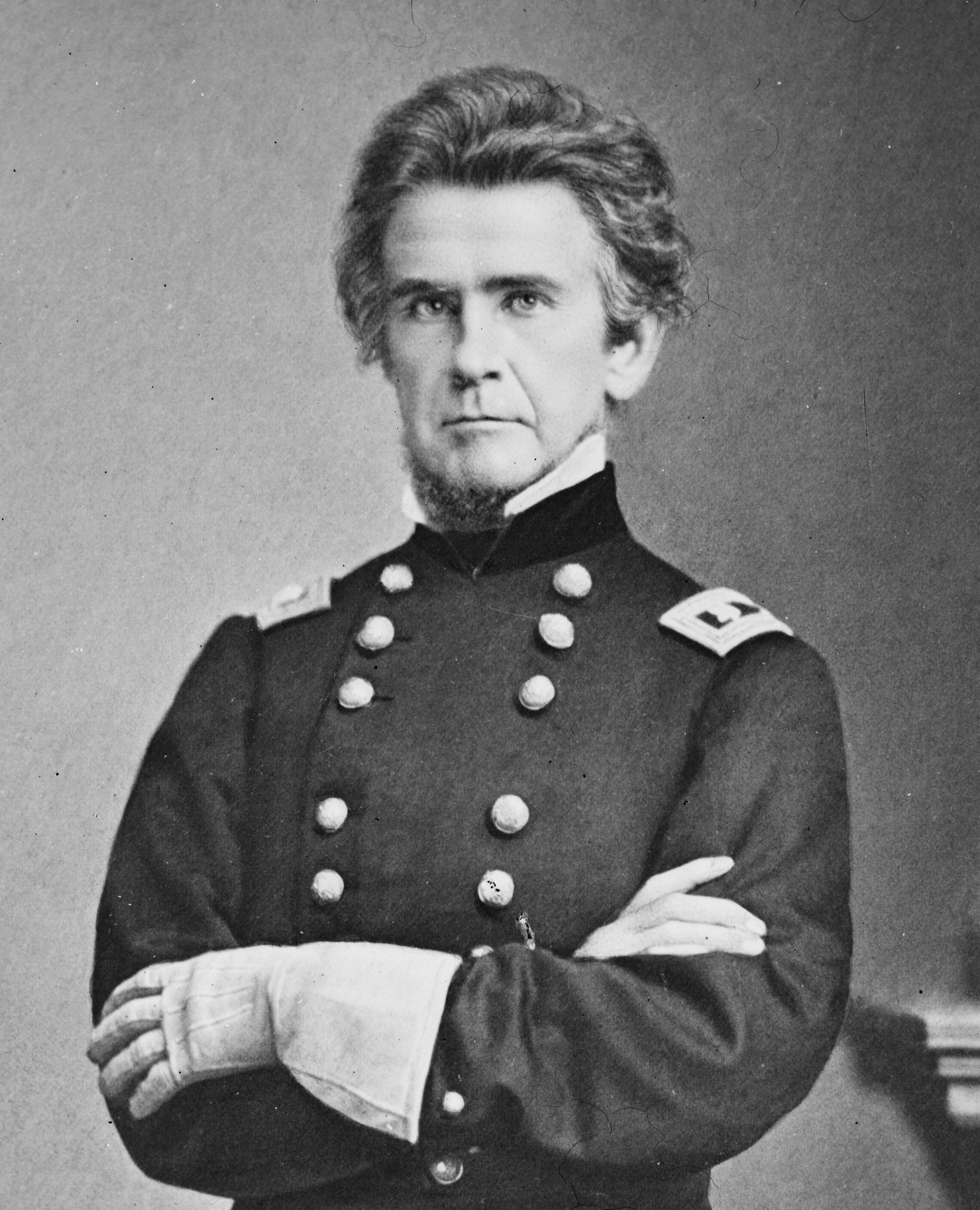
Major-General Ormsby MacKnight Mitchel, Commanding Officer, U.S. Department of the South and Tenth Corps, U.S. Army, circa 1862 (public domain).

On the heels of his army’s successful capture of Saint John’s Bluff, Florida and related events in early October 1862, Union Major-General Ormsby MacKnight Mitchel, commanding officer of the United States Army’s Department of the South, directed his senior staff and leadership of the U.S. Army’s Tenth Corps (X Corps) to intensify actions against the Confederate States Army and Navy in an effort to further disrupt the enemy’s ability to move troops and supplies throughout Florida, Georgia and South Carolina. As part of this directive, he engaged his senior officers in planning a new expedition — this time to Pocotaligo, South Carolina. According to Mitchel, preparations for that event began in earnest in mid-October, with an eye to the following objectives:

First, to make a complete reconnaissance of the Broad River and its three tributaries, Coosawhatchie, Tulifiny [sic], and Pocotaligo; second, to test practically the rapidity and safety with which a landing could be effected; third to learn the strength of the enemy on the main-land, now guarding the Charleston and Savannah Railroad; and fourth, to accomplish the destruction of so much of the road as could be effected in one day….

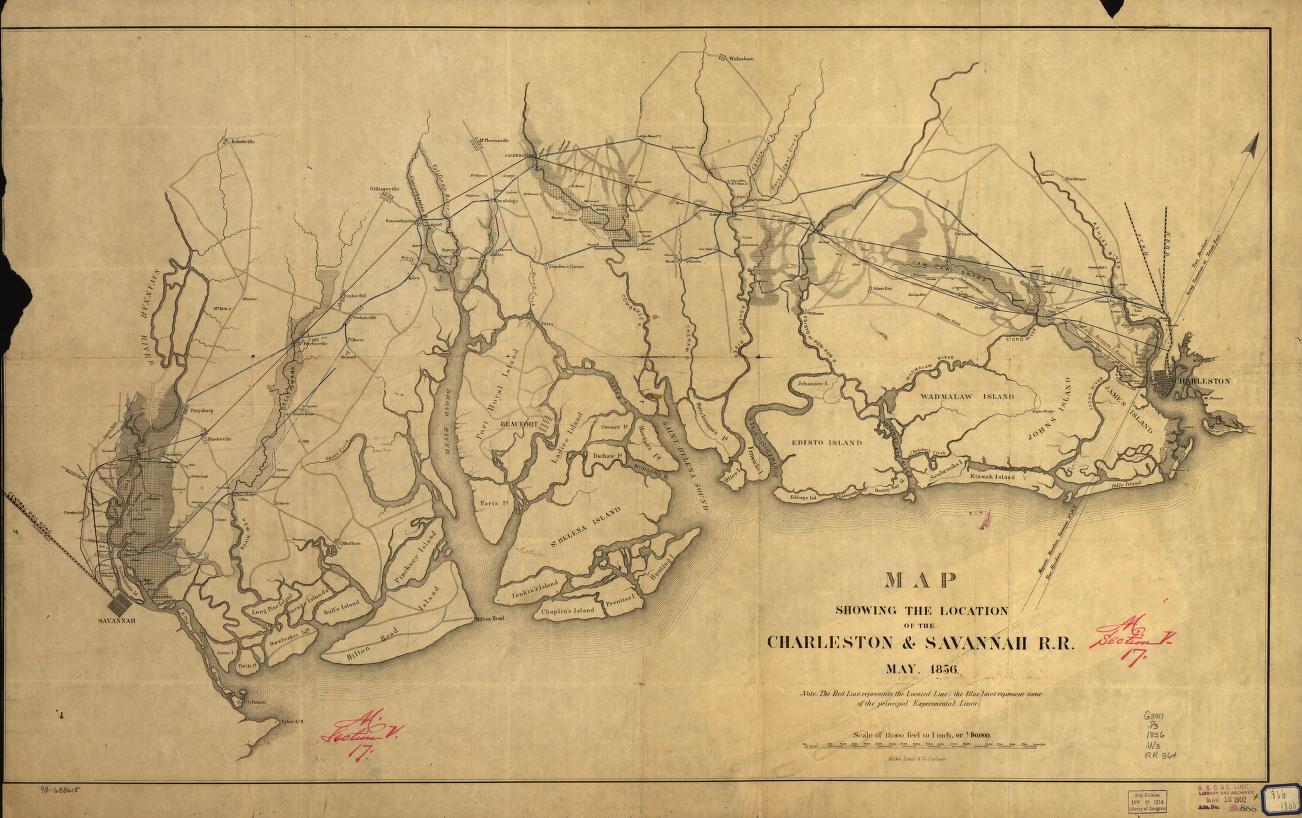
This 1856 map of the Charleston & Savannah Railroad shows the island of Hilton Head, South Carolina in relation to the town of Pocotaligo (U.S. Library of Congress, public domain; click to enlarge).

Mitchel then worked with his subordinate officers to determine how much of the U.S. Army’s Tenth Corps would take part in the expedition, assess the potential weak spots in his strategy and revise planning details to improve his soldiers’ likelihood of success:

The troops composing the expedition were the following: Forty-seventh Pennsylvania, 600 men; Fifty-fifth Pennsylvania, 400 men; Fourth New Hampshire, 600 men; Seventh Connecticut, 500 men; Third New Hampshire: 480 men; Sixth Connecticut, 500 men; Third Rhode Island, 300 men; Seventy-sixth Pennsylvania, 430 men; New York Mechanics and Engineers, 250 men; Forty-eighth New York, 300 men; one section of Hamilton’s battery and 40 men; one section of the First Regiment Artillery, Company M, battery and 40 men, and the First Massachusetts Cavalry, 100 men. Making an entire force of 4,500 men.

Every pains [sic] had been taken to secure as far as possible success for the expedition. Scouts and spies had been sent to the main-land to all the most important points between the Savannah River railroad bridge and the bridge across the Salkehatchie. A small party was sent out to cut, if possible, the telegraph wires. Scouts had been sent in boats up the tributaries of the Broad River. All the landings had been examined, and the depth of water in the several rivers ascertained as far as practicable. Two of our light-draught transports have been converted into formidable gunboats and are now heavily armed, to wit, The Planter and the George Washington. By my orders the New York Mechanics and Engineers, Colonel Serrell, had constructed two very large flat-boats, or scows, each capable of transporting half a battery of artillery, exclusive of the caissons, with the horses. They were provided with hinged aprons, to facilitate the landing not only of artillery but of troops from the transports.

Owing to an accident which occurred to the transport Cosmopolitan during the expedition to the Saint John’s River I found myself deficient in transportation, and applied to the commanding officer, Commodore Godon, of the South Atlantic Blockading Squadron, who promptly placed under my orders a number of light-draught gunboats for the double purpose of transportation and military protection.

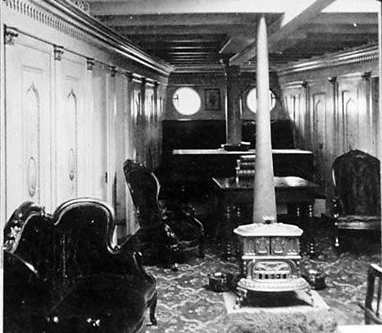
The after cabin inside of the U.S. Steamer Ben Deford, c. 1860s (U.S. Library of Congress, public domain).

As planning progressed, details were firmed up regarding the Union Navy’s anticipated support. According to Mitchel:

On the evening of the 21st, under the command of Captain Steedman, U.S. Navy, the gunboats and transports were arranged in the following order for sailing: The Paul Jones, Captain Steedman, without troops; the Ben De Ford, Conemaugh, Wissahickon, Boston, Patroon, Darlington, steam-tug Relief, with schooner in tow; Marblehead, Vixen, Flora, Water Witch, George Washington, and Planter. The flat-boats, with artillery, were towed by the Ben De Ford and Boston. The best negro pilots which could be found were placed on the principal vessels, as well as signal officers, for the purpose of intercommunication. The night proved to be smoky and hazy, which produced some confusion in the sailing of the vessels, as signal lights could not be seen by those most remote from the leading ship. The larger vessels, however, got under way about 12 o’clock at night.

Union Army map, Pocotaligo-Coosawhatchie Expedition, 21-23 October 1862 (public domain; click to enlarge).

Mitchel and his leadership team also worked out the details of the expedition’s landing and debarkation plans, decided upon the weaponry they would need to disrupt and permanently disable the railroad tracks and the bridge at Pocotaligo and identified other possible actions to be undertaken by the expeditionary force:

After a careful examination of the map I ordered a landing to be effected at the mouth of the Pocotaligo River, at a place known as Mackay’s Point. This is really a narrow neck of land made by the Broad River and the Pocotaligo, in both of which rivers gunboats could lie and furnish a perfect protection for the debarkation and embarkation of the troops. There is a good country road leading from the Point to the old town of Pocotaligo, then entering a turnpike, which leads from the town of Coosawhatchie to the principal ferry on the Salkehatchie River. The distance to the railroad was only about 7 or 8 miles, thus rendering it possible to effect a landing, cut the railroad and telegraph wires, and return to the boats in the same day. I saw that it would be impossible for the troops to be attacked by the enemy either in flank or rear, as the two flanks were protected by the Pocotaligo River on the one hand and by the Broad and by the Tulifiny [sic, Tulifinny], its tributary, on the other. Presuming that the enemy would make his principal defense at or near Pocotaligo, I directed that a detachment of the Forty-eighth New York, under command of Colonel Barton, with the armed transport Planter, accompanied by one or two light-draught gunboats, should ascend the Coosawhatchie River, for the purpose of making a diversion, and in case no considerable force of the enemy was met, to destroy the railroad at and near the town of Coosawhatchie.

In addition to our land forces we were furnished by the Navy with several transports, armed with howitzers, three of which were landed with the artillery, and thus gave us a battery of seven pieces. All the troops were furnished with 100 rounds of ammunition. Two light ambulances and one wagon, with its team, accompanied the expedition.

The Integral Role of the 47th Pennsylvania

Design of the U.S. Army’s insignia for the Tenth (X) Army Corps, which would have been sewn onto uniforms of the 47th Pennsylvania Volunteer Infantry and displayed on a flag carried by the regiment during the Battle of Pocotaligo, South Carolina on 22 October 1862 (public domain).

The Union Army regiments selected for participation in the Pocotaligo expedition were part of the U.S. Army’s Tenth Corps (X Corps), which was part of the U.S. Army’s larger Department of the South, which was headquartered at Hilton Head, South Carolina and oversaw Union military operations in Florida, Georgia and South Carolina during this time. Established on 13 September 1862, the Tenth Corps served under the command of Union Major-General Ormsby MacKnight Mitchel from the time of its founding until his death from yellow fever on 30 October of that same year. It was then placed under the command of Brigadier-General John Milton Brannan, who had also assumed command of the U.S. Army’s Department of the South, a position he held until 21 January 1863.

Among the regiments attached to the U.S. Army’s Tenth Corps in the U.S. Department of the South during fall of 1862 was the 47th Pennsylvania Volunteer Infantry, which would later make history as the only regiment from Pennsylvania to participate in the Union’s 1864 Red River Campaign across Louisiana. The 47th Pennsylvania, which had been founded on 5 August 1861 by Colonel Tilghman H. Good, remained under Colonel Good’s command. Regimental operations were also overseen by Good’s second-in-command, Lieutenant-Colonel George Warren Alexander.

As preparations continued to be refined, Brigadier-General Brannan determined, in his new role as commanding officer of the expedition, that he would need one of his subordinate officers to take his place on the field as the expedition began. He chose Colonel Good of the 47th Pennsylvania Volunteers, who would go on to become a three-time mayor of Allentown, Pennsylvania after the war. Good then placed Lieutenant-Colonel Alexander in direct command of the 47th Pennsylvania. A New Hampshire native, Alexander had served as captain of the Reading Artillerists in Berks County, Pennsylvania prior to the war; post-war, he founded G. W. Alexander & Sons, a renowned hat manufacturing company that was based in West Reading.

What all of those Union Army infantrymen did not know at the time they boarded their respective transport ships on 21 October 1862 was that they would soon been engaged in combat so intense that the day would come to be described in history books more than a century later as the Second Battle of Pocotaligo (or the Battle of Yemassee, due to its proximity to the town of Yemassee, South Carolina).

This encounter between the Union and Confederate armies would unfold on 22 October 1862 between Savannah, Georgia and Charleston, South Carolina on the banks of the Pocotaligo River in northern Beaufort County, South Carolina.

Next: The Second Battle of Pocotaligo


Sources:

  1. “General Orders, Hdqrs., Department of the South, Numbers 40, Hilton Head, Port Royal, S. C., September 17, 1862” (announcement by Major-General Ormsby M. Mitchel that he has assumed command of the newly formed Department of the South), in The War of the Rebellion: A Compilation of the Official Records of the Union and Confederate Armies. Prepared Under the Direction of the Secretary of War, By Lieut. Col. Robert N. Scott, Third U.S. Artillery, and Published Pursuant to Act of Congress Approved June 16, 1880, Series I, Vol. XIV, Serial 20, p. 382. Washington, D.C.: Government Printing Office, 1885.
  2. “Report of Maj. Gen. Ormsby M. Mitchel, U.S. Army, commanding Department of the South and Return of Casualties in the Union forces in the skirmish at Coosawhatchie and engagements at the Caston and Frampton Plantations, near Pocotaligo, S.C., October 22, 1862,” in The War of the Rebellion: A Compilation of the Official Records of the Union and Confederate Armies. Prepared Under the Direction of the Secretary of War, By Lieut. Col. Robert N. Scott, Third U.S. Artillery, and Published Pursuant to Act of Congress Approved June 16, 1880, Series I, Vol. XIV. Washington, D.C.: Government Printing Office, 1885.

Learn More About the 47th Pennsylvania Volunteers

First State Color, 47th Regiment, Pennsylvania Volunteer Infantry (presented to the regiment by Pennsylvania Governor Andrew Curtin, 20 September 1861; retired 11 May 1865, public domain).

Largely forgotten by mainstream historians, the 47th Pennsylvania Volunteer Infantry was a Union Army unit which served for nearly the entire duration of the American Civil War. Formed by the fruit of the Great Keystone State’s small towns and cities, the regiment was born on August 5, 1861, when its founder, Tilghman H. Good, received permission from Pennsylvania Governor Andrew Gregg Curtin to form an entirely new regiment in response to President Abraham Lincoln’s call for additional volunteers to help preserve American’s Union. It ended its service during the early months of the nation’s Reconstruction Era, officially mustering out at Charleston, South Carolina on Christmas Day in 1865, its members receiving their final discharge papers at Camp Cadwalader in Philadelphia, Pennsylvania in early January of 1866.

Along the way, the 47th Pennsylvania made history, becoming an integrated regiment in 1862 and the only regiment from Pennsylvania to participate in the Union’s 1864 Red River Campaign across Louisiana. Its members also distinguished themselves in battle, repeatedly, including during Union General Philip Sheridan’s Shenandoah Valley Campaign, which unfolded between August and December of 1864.

Learn more about key moments in this regiment’s history by reading the following posts:

1861:

1862:

1863:

1864:

1865:

Research Update: More New Details Regarding the Lives of Formerly Enslaved Black Men Who Enlisted with the 47th Pennsylvania Volunteer Infantry

Union Army at Morganza Bend, Louisiana, c. 1863-1865_USLOC, pubdom

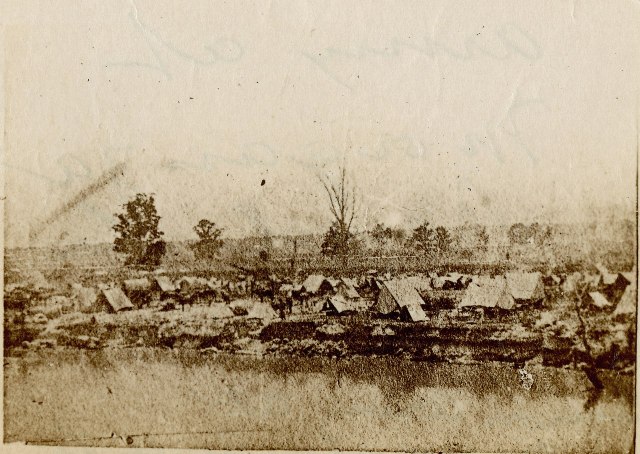
Union Army base at Morganza Bend, Louisiana, circa 1863-1865 (U.S. Library of Congress, public domain).

Researchers investigating the lives of nine formerly enslaved Black men who enlisted with the 47th Pennsylvania Volunteer Infantry during the American Civil War recently uncovered new details about two of those soldiers.

In addition to finding more data related to the immediate post-war life of Aaron French (learn more about him in this article here), including how and why he ended up settling in Mississippi following the Civil War, researchers have also now found important information about the life of Hamilton Blanchard—who enrolled with Bullard on the same day.

Born into slavery in Natchitoches, Louisiana sometime around 1843, Hamilton Blanchard was able to secure his freedom twenty-one years later when the United States Army arrived in town as part of an expedition led by Union Major-General Nathaniel P. Banks. Determined not to be forced back into bondage after the Union troops moved on in their ill-fated quest to capture the city of Shreveport, he chose to enlist with one of the units serving under Banks—the 47th Pennsylvania Volunteer Infantry—the only regiment from Pennsylvania that was involved in the Union’s 1864 Red River Campaign across Louisiana.

After enrolling in the military, Hamilton Blanchard was then assigned to Company D at the rank of “Cook” on 5 April 1864.

Crop_Bullard, Aaron and Hamilton Blanchard_Co. D, 47th PA_Muster Roll

Muster roll entries for Aaron Bullard and Hamilton Blanchard, Company D, 47th Pennsylvania Volunteers (U.S. National Archives, public domain).

The official muster-in of Blanchard, Aaron Bullard, and three other young Black men who enrolled that day did not take place immediately, however, because the 47th Pennsylvania Volunteers were ordered to move out shortly after their arrival, and were quickly drawn into intense combat with enemy troops commanded by Confederate Major-General Richard Taylor (a plantation owner and son of Zachary Taylor, former President of the United States). Battered badly during the Battle of Sabine Cross Roads near Mansfield, Louisiana on 8 April and in the Battle of Pleasant Hill the next day (9 April), they fought the Confederate Army again on 23 April near Monett’s Ferry in the Battle of Cane River and on 16 May in the Battle of Mansura near Marksville.

Continuing on toward the southeastern part of Louisiana, the 47th Pennsylvania Volunteers marched for Morganza, which had been held in Union hands since the fall of 1863 and was now the site of a major Union Army encampment. While there, the officers of the 47th Pennsylvania Volunteer Infantry officially mustered in all nine of the formerly enslaved Black men who had enlisted with the 47th Pennsylvania in Beaufort, South Carolina (1862) and Natchitoches, Louisiana (April 1864)—a process which took place between 20-24 June 1864.

From that point on, those nine men traveled with the 47th Pennsylvania as it returned to the East Coast and engaged in multiple battles associated with Union Major-General Philip Sheridan’s 1864 Shenandoah Valley Campaign across Virginia, the protection of the nation’s capital following the April 1865 assassination of President Abraham Lincoln, and the early days of Reconstruction in Georgia and South Carolina.

On Christmas Day in 1865, Hamilton Blanchard then joined his fellow 47th Pennsylvania Volunteers in mustering out from their final duty station in Charleston, South Carolina.

Post-War Life

Having been honorably discharged from the 47th Pennsylvania Volunteer Infantry when the regiment mustered out, at least two of the nine formerly enslaved Black men who had enlisted with the regiment evidently made their way north—possibly when the other members of their former regiment returned home to Pennsylvania. (It is also possible, however, that they made the journey independently of their former regiment because both men appear to have resettled in the Washington, D.C. area, post-war, while the other 47th Pennsylvania Volunteers were transported by ship directly to New York City and then by train to Camp Cadwalader in Philadelphia, Pennsylvania, where they were given their final discharge papers on 9 January 1866.)

Blanchard-Bullard_Madison Co., MS_Freedmen's Bureau Contract, Feb-Dec 1866, p. 1

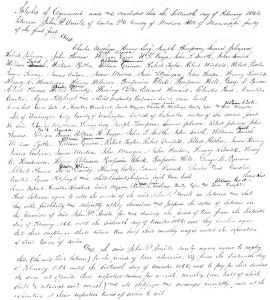
Freedmen’s Bureau contract between Madison County, Mississippi farm owner John P. Arvile [sic] and farm laborers Hamilton Blanchard, Aaron Bullard, et. al., Washington, D.C., 16 February 1866 (excerpt, p. 1, U.S. National Archives).

What is known for certain is that Hamilton Blanchard and Aaron Bullard made contact with a representative of the Bureau of Refugees, Freedmen, and Abandoned Lands sometime in late 1865 or early 1866. They then signed a contract with the Freedmen’s Bureau during the early winter of 1866 in which they both agreed to join a large group of formerly enslaved Black men, women, and children who would be providing farm labor to a man named John P. Avrill (alternate spellings: “Averile”, “Averill”, “Arvile”, “Arville”, or “Avrille”) at his property in Canton, Madison County, Mississippi.

That Freedmen’s Bureau contract was slated to be in effect between 16 February and 16 December of 1866, and begins with a cover page which states:

Washington D.C.
February 1866
Contract No.
John P. Arvill
With (66) Freedmen

John Arville
Contract with
46 Farm Hands

The main body of the document goes on to reveal the following details of the contract:

Articles of Agreement made and concluded this the Sixteenth day of February 1866 between John P. Arvile of Canton P.O. County of Madison State of Mississippi party of the first part and

Charles Matthews, Henry Long, Joseph Thompson, Samuel Johnson, Robert Johnson, John Thomas … Charles Ford, Caroline Carter, Agnes Fitzhugh and child (infant), Benjamin Smith, Anna Smith, Thomas Reed [sp?], Aaron Bullard, Hamilton Blanchard, Isaiah Wiggins, James Lewis, Charles K. [illegible], Baily Taylor, William Carter, and Andy Hampton [sp?].

The next paragraph lists Hamilton Blanchard and Aaron Bullard a second time, along with multiple names from the aforementioned group of farm laborers. Subsequent paragraphs spell out further points of the agreement:

All of Washington City, County of Washington, District of Columbia, parties of the second part, the said Charles Matthews, Henry Long, Joseph Thompsen, Samuel Johnson, Robert Johnson, John Thomas … Aaron Bullard, Hamilton Blanchard, Isaiah Wiggins, James Lewis … Field Laborers, agree to enter the service of the said John P. Averile as Laborers and that they will faithfully and diligently apply themselves and perform the duties of Laborers on the premises of said John P. Averile for and during the period of time from the Sixteenth day of February 1866 until the sixteenth day of 1866; and they further agree that their employer shall retain one half their monthly wages until the expiration of their term of service.

And the said John P. Arvile hereby agrees to employ them (the said Field laborers) for the period of time aforesaid. Viz from the Sixteenth day of February 1866 until the sixteenth day of December 1866; and to pay for their services the sum set opposite their respective names per month, monthly (one half of which shall be retained each month) and all stoppages and arranged promptly, paid at the expiration of their respective terms of service to wit…..

In equal monthly payments; and the said John P. Arvile further agrees to furnish said Freed laborers … quarters, fuel, full substantial and healthy rations, and all necessary attendance and supplies in case of sickness, in addition to the compensation … named, and that he will assist and encourage efforts for the education of the children of his employees, and it is further agreed by the said John P. Arvile, that in case he at any time fails to perform his part of this contract agreement he will pay to each of the said laborers the full sum of One hundred and twenty dollars [strikethrough made by someone’s hand to original contract], as fixed, agreed and liquidated damages. This contract can be annulled by the mutual consent of the Employer and the employee, but only in the presence of an Authorized Agent of the Bureau of Refugees Freedmen and Abandoned Lands and such annullment [sic] on the part of the Employer and anyone [sic] employee shall in no wise affect the validity of the Contract in respect to the employer and the other employees and should either party violate this contract then the other party shall make complaint to the nearest authorized agent of the Bureau Refugees Freemen & Abandoned Lands.

The contract continues on, specifying that both Aaron Bullard and Hamilton Blanchard were to each be paid a wage of $10 per month, and stating that some of the other men on the list would be paid as much as $12 per month while others would be paid $8 per month. (Teenaged boys and women on the list were to be paid even less—$6 per month.)

In all cases, the reality was far different. Per the contract, they were initially paid only half of what their monthly wages were because the Freedmen’s Bureau agent in charge of looking out for the welfare of these formerly enslaved men, women, and children allowed the white farmer—their “employer”—to “retain one half their monthly wages until the expiration of their term of service.”

No further data has been uncovered from Freedmen’s Bureau records about the status of those unpaid wages or the outcome of that contract, but because these Black men, women, and children were essentially returned to an unequal system of servitude by the Freedmen’s Bureau agent (as evidenced by the manner in which this contract was drafted—favoring the White “employer” over the Black “field laborer” and including multiple after-the-fact revisions, such as word insertions and strikethroughs)—it is highly unlikely that Hamilton Blanchard, Aaron Bullard, or the other Black men, women, and children mentioned in the contract were ever paid the full amount they were entitled to for what was most assuredly very hard labor.

Blanchard-Bullard-Chapman_Treasury Inquiry, 10 Nov 1866

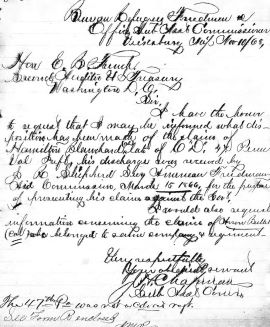
Letter of inquiry from J. H. Chapman on behalf of Hamilton Blanchard to E. B. French, second auditor, U.S. Treasury Department, 10 November 1868 (Freedmen’s Bureau records, U.S. National Archives). 

This hypothesis posed by researchers investigating the history of the 47th Pennsylvania Volunteer Infantry is backed up by a letter of inquiry penned on 10 November 1868 by J. H. Chapman, a Sub-Assistant Commissioner of the Freedmen’s Bureau working at an office in Vicksburg, Mississippi, to E. B. French, Second Auditor of the U.S. Department of the Treasury in Washington, D.C.

In this letter, Chapman asks French that he “be informed what disposition has been made of the claim of Hamilton Blanchard, late of Co. “D” 47 Penn Vol. Inft., his discharge was received by J. R. Schuchard [sp?]” of the “Freedmen’s Aid Commission, March 15, 1866.” Chapman added that he was requesting this update on Blanchard’s behalf “for the purpose of prosecuting his claim against the Gov.” He then also requested “information concerning the claim of Aaron Bullard (Col.) who belonged to same company & regiment.”

* Note: An unidentified individual added an undated notation to the bottom of this letter in handwriting that is clearly different from that of the original letter writer, Chapman. That notation correctly states: “The 47th Pa was not a colored regt. See Form R enclosed. A.M.R. 103.” (The 47th Pennsylvania Volunteer Infantry became an integrated regiment on 5 October 1862, but its African American members were not considered to be part of the U.S. Colored Troops, also known as the USCT.)

Researchers have not yet located the “Form R” referred to in the notation to Chapman’s letter, but will be pursuing this lead, as well as investigating the claims filed by Hamilton Blanchard and Aaron Bullard, and searching for additional information regarding what happened to Hamilton Blanchard during and after the 1870s. 

An additional avenue of inquiry will be the potential relationship that may have developed between Aaron Bullard and E. B. French during or after this time—a new theory being considered in light of the discovery of French’s name on this letter. (Aaron Bullard changed his surname, “Bullard,” which had been associated with his enslavement in Louisiana, to “French” sometime between his 1868 appeal to E. B. French in the U.S. Treasury Department and the day he was visited at home in Issaquena County, Mississippi by an enumerator of the 1870 U.S. Census—possibly indicating that he wanted to both shed his “slave name” and honor someone who had been helpful to him.)

Sources:

  1. Bates, Samuel P. History of Pennsylvania Volunteers, 1861-5, vol. 1. Harrisburg, Pennsylvania: B. Singerly, State Printer, 1869.
  2. Civil War Muster Rolls, in Records of the Department of Military and Veterans’ Affairs (Record Group 19, Series 19.11). Harrisburg, Pennsylvania: Pennsylvania Historical and Museum Commission, 1861-1865.
  3. Civil War Veterans’ Card File. Harrisburg, Pennsylvania: Pennsylvania State Archives.
  4. “Records of the Field Offices for the District of Columbia, Bureau of Refugees, Freedmen, and Abandoned Lands, 1865-1870” (NARA Series Number: M1902; NARA Reel Number: 18; NARA Record Group Number: 105; NARA Record Group Name: Records of the Bureau of Refugees, Freedmen, and Abandoned Lands, 1861 – 1880; Collection Title: District of Columbia Freedmen’s Bureau Field Office Records 1863-1872: Aaron Bullard and Hamilton Blanchard, 1866 and 1868). Washington, D.C.: U.S. National Archives and Records Administration.
  5. Schmidt, Lewis. A Civil War History of the 47th Regiment of Pennsylvania Veteran Volunteers. Allentown, Pennsylvania: Self-published, 1986.
  6. Wharton, Henry D. Letters from the Sunbury Guards. Sunbury, Pennsylvania: Sunbury American, 1861-1868.

Black History Month: New Details Uncovered Regarding the Formerly Enslaved Black Men Who Enlisted with the 47th Pennsylvania Volunteer Infantry

Research regarding the lives of the nine formerly enslaved Black men who enlisted with the 47th Pennsylvania Volunteer Infantry in 1862 and 1864 has continued to progress—even in the middle of a pandemic that has forced the closure of numerous local, state, and national archives.*

In addition to uncovering details about the life of the soldier from South Carolina who was mistakenly listed on muster rolls for the 47th Pennsylvania as “Presto Gettes” (learn more about him in this article here), researchers for 47th Pennsylvania Volunteers: One Civil War Regiment’s Story have been able to determine more about what happened to two of the other men post-war, and have also located records which seem to indicate that there may have been two or three other Black men who enlisted with the regiment (potentially bringing the total number of Black enlistees in the regiment to twelve).

Aaron French (enlisted as Aaron Bullard):

Muster roll entries for Aaron Bullard and Hamilton Blanchard, Company D, 47th Pennsylvania Volunteers (U.S. National Archives, public domain).

1864 was a life-changing year for Aaron Bullard and four other young Black men in Louisiana. After enlisting with the 47th Pennsylvania Volunteer Infantry on April 5 while the 47th was stationed at Natchitoches, Louisiana, Samuel Jones, Hamilton Blanchard (also known as John Hamilton), and Aaron, James, and John Bullard traveled with the 47th Pennsylvania as it participated in the multiple battles associated with the Union’s 1864 Red River Campaign across Louisiana. On or about June 22, they were formally mustered into the regiment at Morganza, Louisiana.

Sometime later (possibly post-war), Aaron Bullard changed his surname to French. After the American Civil War, he married, became a land-owning farmer—and a dad.

Post-Civil War, Aaron French and his family resided in Issaquena County, Mississippi (U.S. Census, 1870, public domain).

In August of 1870, Aaron French and his wife, Amanda, lived with their eight-month-old daughter, “Simpy” (also known as Cynthia or Cyntha) in Skipworth Precinct, Issaquena County, Mississippi. Still residing in Issaquena County a decade later when the June 1880 federal census was taken, Aaron and Amanda were the proud parents of three daughters: Cynthia (who would go on to marry Samuel L. Dixon on March 20, 1890), Jesanna (also known as Jessie/Jesse), and “Arctavia” (also known as Octavia). Jessie, who later went on to wed John B. Cobb on January 28, 1892, made a life with her husband and son in Mayersville, Mississippi, where she was a teacher in the local schools. Octavia married Frank Childress on March 20, 1894.

U.S. Civil War Pension Index Card for Aaron French, who enlisted with the 47th Pennsylvania Volunteers in Louisiana in 1864 (U.S. National Archives, public domain).

Sadly, Aaron French did not live to see his two youngest daughters marry because he died in Mississippi on January 30, 1891. He was just 40-43 years old, according to U.S. Census records and other data, which indicate that he was born in Louisiana sometime between 1848 and 1850.

Hearteningly, though, an even more intriguing piece of data has recently been uncovered about the later life of Aaron French—one that indicates that he had become active in politics prior to his death. According to the Vicksburg Evening Post, Aaron was appointed as a delegate from Issaquena County to the Republican Congressional Convention for the Third District, which was held in Greenville, Mississippi on August 7, 1886. Researchers are continuing to search for further details about his political activities and untimely death, as well as the exact location of his gravesite.

Thomas Haywood (alternate spellings of surname: Hayward, Haywood, Heywood) and Jack Jacobs:

Muster roll entries of Thomas Haywood and Edward Jassum, Company H, 47th Pennsylvania Volunteers (U.S. National Archives, public domain).

Born into slavery in South Carolina sometime around 1832, Thomas Haywood enlisted for a three-year term of service as an Under Cook with Company H of the 47th Pennsylvania Volunteer Infantry at Beaufort, South Carolina on November 1, 1862. He and three other formerly enslaved Black men—Abraham and Edward Jassum and Presto Gettes”—who had previously enlisted with the 47th Pennsylvania at Beaufort in October of 1862, then traveled with the 47th Pennsylvania as it participated in multiple military engagements, including the 47th’s garrisoning of Fort Taylor and Fort Jefferson in Florida in 1863 and 1864, the battles of the Union’s spring 1864 Red River Campaign across Louisiana, and the battles of Sheridan’s tide-turning Shenandoah Valley Campaign across Virginia in the fall of 1864.

On or about June 22, 1864 all nine of these Black soldiers were formally mustered into the regiment at Morganza, Louisiana; Thomas Haywood and seven of the eight others all successfully completed their tours of duty, and were honorably mustered out upon expiration of their respective terms of enlistment. In Thomas Haywood’s case, that honorable discharge was awarded on October 31, 1865.

Post-war, it appears from various Freedmen’s Bureau records that he may have entered into yearly contracts with several men who had previously been plantation owners in the Beaufort, South Carolina area. In exchange for agreeing to plant and cultivate cotton for those men on three to five-acre parcels of land that had been leased to him by those white men, he was allowed to keep portions of the cotton sales (the largest portions of which went to the former plantation owners who had also most likely been slave owners prior to and during the Civil War).

U.S. Civil War Index Card for Thomas Haywood, who enlisted with the 47th Pennsylvania Volunteers in South Carolina in 1862 (U.S. National Archives, public domain).

His body warn out from years of slavery prior to the war, difficult military service during the war, and harsh sharecropping experiences post-war, Thomas Hayward applied for, and was awarded a U.S. Civil War Pension on April 30, 1888. That pension was subsequently renewed by the federal government in 1907 at the rate of $15 per month (roughly $415 per month in today’s U.S. dollar equivalency).

By 1890, Thomas Haywood was living in Sheldon Township, Beaufort County, South Carolina. After a long life, he died on January 13, 1911. Unfortunately, his burial location has also not yet been identified by researchers.

In 1890, Thomas Haywood lived near Hanna Jacobs, the widow of Jack Jacobs, who may have been another Black soldier who enlisted with the 47th Pennsylvania Volunteers (U.S. Census, 1890, Sheldon Township, Beaufort County, South Carolina, public domain).

One other piece of tantalizing data that has recently been discovered is that a woman named “Hanna Jacobs” lived near Thomas Haywood in 1890. This information may be significant because Hanna was described on the 1890 U.S. Census of Union soldiers and widows as the widow of “Jack Jacobs,” who had served in the same company with Thomas Haywood (according to that special census).

Researchers currently believe that Jack Jacobs may, in fact, have been another formerly enslaved Black man who had enlisted with the 47th Pennsylvania when it was stationed near Beaufort in 1862, and are currently conducting a Go Fund Me campaign to raise funds to purchase the Civil War military and pension records of Hanna and Jack Jacobs, as well as the nine known formerly enslaved Black men who enlisted with the 47th Pennsylvania Volunteer Infantry in 1862 and 1864.

Jackson Haywood:

General Index Card for Jackson Haywood, who may have been a Black soldier who enlisted with the 47th Pennsylvania Volunteers (U.S. National Archives, public domain).

According to the “Index to Compiled Service Records of Volunteers Who Served in Organizations from the State of Pennsylvania,” which was created by staff at the U.S. National Archives, a General Index Card was created for yet another mystery man—a soldier named “Jackson Hayward.”

To date, researchers have only been able to determine that he may have enlisted with Company K of the 47th Pennsylvania Volunteer Infantry as a cook—a rank similar to that at which the known nine formerly enslaved Black men who enlisted with the 47th Pennsylvania were entered on the muster rolls of the regiment.

Researchers hope, with time and the continued financial support of the followers of 47th Pennsylvania Volunteers: One Civil War Regiment’s Story, to be able to confirm the dates of military service and race of this individual, as well as that of “Jack Jacobs.”

As always, we appreciate everyone’s help in ensuring that the service to the nation of these soldiers will never be forgotten. They helped to preserve our Union and deserve to be recognized more fully for their heroism and dedication.

* Our most important goal continues to be the purchase of the Compiled Military Service Records (CMSR) and U.S. Civil War Pension records for each of these remarkable men in order to document and freely share their stories with the widest possible audience. We continue to await word from staff at the U.S. National Archives regarding the timeframe for their resumption of digitization and reproduction services that have temporarily been suspended due to the coronavirus pandemic. As soon as those services have resumed, we will request an update regarding their estimated timeframe for fulfilling our records requests. In the interim, we will seek out further details about each of these soldiers via local and state archival resources across the nation, and will post updates as we confirm more data.

Sources:

  1. Bullard, Aaron, in Index to Compiled Service Records of Volunteers. Washington, DC: U.S. National Archives, 1861-1865.
  2. Bullard, Aaron and French, Aaron, in U.S. Civil War Pension Index Cards. Washington, DC: U.S. National Archives, 1890-1891.
  3. Bullard, Aaron, Presto Garris, Thomas Haywood, et. al. in U.S. Civil War Muster Out Rolls (47th Pennsylvania Volunteer Infantry). Washington, DC: U.S. National Archives, 1865-1866 (available via Ancestry.com).
  4. French, Aaron, in “Proceedings of the Third District Republican Convention.” Vicksburg, Mississippi: Vicksburg Evening Post, August 9, 1886.
  5. French, Aaron and Family, in U.S. Census Records (Issaquena County, Mississippi): Washington, DC: U.S. National Archives, 1870-1910.
  6. Haywood, Jackson, in Index to Compiled Service Records of Volunteers. Washington, DC: U.S. National Archives, 1861-1865.
  7. Haywood, Thomas, in Index to Compiled Service Records of Volunteers. Washington, DC: U.S. National Archives, 1861-1865.
  8. Haywood, Thomas, in U.S. Civil War Pension Index Cards. Washington, DC: U.S. National Archives, 1888, 1907.
  9. Haywood, Thomas, in U.S. Veterans’ Administration Pension Payment Cards. Washington, DC: U.S. National Archives, 1888, 1907.
  10. Haywood, Thomas, in U.S. Census (Beaufort County, South Carolina): Washington, DC: U.S. National Archives, 1890.
  11. Hanna Jacobs, widow of Jack Jacobs, in U.S. Census (Beaufort County, South Carolina): Washington, DC: U.S. National Archives, 1890.


Late September to Early October 1862: First Victory

Boat Landing, Beaufort, South Carolina, February 1862 (Timothy O’Sullivan, U.S. Army, U.S. Library of Congress, public domain).

Still stationed far from home during the middle of the second year of the American Civil War, the officers of the 47th Regiment, Pennsylvania Volunteer Infantry marked the first anniversary of their regiment’s mustering in to the Union Army by issuing a series of orders to protect their subordinates and facilitate the continued smooth operation of their organization.

Colonel Tilghman H. Good, concerned about his men’s repeated battles with smallpox, typhoid, and dysentery, announced key procedural changes as follows:

“Beaufort, S.C. Sept 12th, 1862
Regimental Order No. 207

I. The Colonel commanding desires to call the attention of all officers and men in the regiment to the paramount necessity of observing rules for the preservation of health. There is less to be apprehended from battle than disease. The records of all companies in climate like this show many more casualties by the neglect of sanitary post action than by the skill, ordnance and courage of the enemy. Anxious that the men in my command may be preserved in the full enjoyment of health to the service of the Union. And that only those who can leave behind the proud epitaph of having fallen on the field of battle in the defense of their country shall fail to return to their families and relations at the termination of this war.

II. All the tents will be struck at 7:30 a.m. on Monday, Wednesday and Saturday of each week. The signal for this purpose will be given by the drum major by giving three taps on the drum. Every article of clothing and bedding will be taken out and aired; the flooring and bunks will be thoroughly cleaned. By the same signal at 11 a.m. the tents will be re-erected. On the days the tents are not struck the sides will be raised during the day for the purpose of ventilation.

III. The proper cooking of provisions is a matter of great importance more especially in this climate but have not yet received from most of the offices of the regiment that attention that should be paid to it.

IV. Thereafter an officer of each company will be detailed by the commander of each company and have their names reported to these headquarters to superintend the cooking of provisions taking care that all food prepared for the soldiers is sufficiently cooked and that the meats are all boiled or seared (not fried). He will also have charge of the dress table and he is held responsible for the cleanliness of the kitchen cooking utensils and the preparation of the meals at the time appointed.

V. The following rules for the taking of meals and regulations in regard to the conducting of the company will be strictly followed. Every soldier will turn his plate, cup, knife and fork into the Quarter Master Sgt who will designate a permanent place or spot for each member of the company and there leave his plate & cup, knife and fork placed at each meal with the soldier’s rations on it. Nor will any soldier be permitted to go to the company kitchen and take away food therefrom.

VI. Until further orders the following times for taking meals will be followed. Breakfast at six, dinner at twelve, supper at six. The drum major will beat a designated call fifteen minutes before the specified time which will be the signal to prepare the tables, and at the time specified for the taking of meals he will beat the dinner call. The soldier will be permitted to take his spot at the table before the last call.

VII. Commanders of companies will see that this order is entered in their company order book and that it is read forth with each day on the company parade. All commanding officers of companies will regulate daily their time by the time of this headquarters. They will send their 1st Sergeants to this headquarters daily at 8 a.m. for this purpose.

Great punctuality is enjoined in conforming to the stated hours prescribed by the roll calls, parades, drills, and taking of meals; review of army regulations while attending all roll calls to be suspended by a commissioned officer of the companies, and a Captain to report the alternate to the Colonel or the commanding officer.

At 5 a.m., Commanders of companies are imperatively instructed to have the company quarters washed and policed and secured immediately after breakfast.

At 6 a.m., morning reports of companies requested by the Captains and 1st Sergeants and all applications for special privileges of soldiers must be handed to the Adjutant before 8 a.m. 

By Command of  Col. T. H. Good
W. H. R. Hangen, Adj.’”

Good’s order also delineated the regiment’s daily schedule:

  • Reveille (5:30 a.m.) and Breakfast (6:00 a.m.)
  • First Call for Guard (6:10 a.m.) and Second Call for Guard (6:15 a.m.)
  • Surgeon’s call (6:30 a.m.)
  • First Call for Company Drill (6:45 a.m.) and Second Call for Company Drill (7:00 a.m.)
  • Recall from Company Drill (8:00 a.m.)
  • First Call for Squad Drill (9:00 a.m.) and Second Call for Squad Drill (9:15 a.m.)
  • Recall from Squad Drill (10:30 a.m.)
  • Dinner (12:00 p.m.)
  • Call for Non-commissioned Officers (1:30 p.m.) and Recall 2:30 p.m.
  • First Call for Squad Drill (3:15 p.m.) and Second Call for Squad Drill (3:30 p.m.)
  • Recall from Squad Drill (4:30 p.m.)
  • First Call for Dress Parade (5:10 p.m.) and Second Call for dress parade (5:15 p.m.)
  • Supper (6:10 p.m.)
  • Tattoo (9:00 p.m.) and Taps (9:15 p.m.)

General Order No. 130 directed officers to reduce the amount of baggage they carried with them, allowing each officer only a single carpet bag or valise and a single mess chest. Moving forward, none of their boxes or trunks would be taken aboard baggage trains. In addition, privates would be prohibited from loading boxes onto regimental wagons, as well as from carrying carry carpet bags—while sutlers were banned from using regimental wagons to move their wares from place to place.
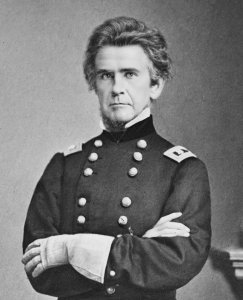
Major-General Ormsby M. Mitchel, Commanding Officer, U.S. Department of the South, circa 1862 (public domain).

The next week, the 47th Pennsylvania Volunteers entered into what would become an eventful service period. It began on Monday, September 15 when General Ormsby S. Mitchel arrived at Hilton Head, South Carolina and assumed command of the U.S. Army’s Department of the South. Mitchel then traveled to Beaufort the next day, according to 47th Pennsylvania musician Henry D. Wharton, where he demonstrated “his eagerness to command” as he reviewed all of the troops which made up the brigade serving under Brigadier-General John Milton Brannan.

“In the afternoon at 3 o’clock, the 47th and 55th Pennsylvania Volunteers, 4th New Hampshire, 8th Maine, 1st Massachusetts Cavalry, 1st Connecticut Battery, and the 1st US Artillery were on the drill ground, ready for the reception of their new officer. The 6th Connecticut was not on review, they being on picket. After review, the regiments marched to their different camps, formed in mass, ready to receive the General on his visit to their camps. Ours was the first at which he stopped. He rode in front of the regiment and said:

‘Soldiers, I am with you for the first time. I want you to hear my voice, that you may know it, on the battlefield and at night when you are on guard, so that when you do hear it you may know your General. Where I have been in command every soldier knows me by my voice, even at night, no matter what post I might cross. Discipline is the great requisite of the soldier. Every soldier should be fit to be a non-commissioned officer, none should be satisfied with his grades. A soldier who does nothing for promotion is not fit for a soldier, and a commissioned officer, who is satisfied with his position, will never make a good officer.’

‘Men of the 47th, of the Old Keystone, I trust you. It is impossible for a General, commanding, to know all in his command, nor the men him, but having confidence in you, I know you will act in such a manner that will reflect credit on the glorious state from which you hail. To gain a victory is your aim. There are two kinds of victories: one to meet the enemy and fall in death’s track, and the other to see the backs of the foe, as they try to escape the vengeance of those who are fighting for the most glorious cause and country a soldier can lay down his life for. It is not to be supposed you are to remain inactive. It is not quite time for an advance, but rest assured, you may soon hear the command, ‘Onward!’”

“The boys were very much pleased,” added Wharton, and as Mitchel and Gen. Brannan departed, they “gave such cheers, and a tiger, as Pennsylvanians always give to those in whom they place confidence.”

On Saturday, September 20, the 47th Pennsylvania Volunteers officially celebrated the one-year anniversary of their service by listening to a reading of Special Order No. 60, which had been issued at Beaufort by their regiment’s founder:

“The Colonel commanding takes great pleasure in complimenting the officers and men of the regiment on the favorable auspices of today.

Just one year ago today, the organization of the regiment was completed to enter the service of our beloved country, to uphold the same flag under which our forefathers fought, bled, and died, and perpetuate the same free institutions which they handed down to us unimpaired.

It is becoming therefore for us to rejoice on this first anniversary of our regimental history and to show forth devout gratitude to God for this special guardianship over us.

Whilst many other regiments who swelled the ranks of the Union Army even at a later date than the 47th have since been greatly reduced by sickness or almost cut to pieces on the field of battle, we as yet have an entire regiment and have lost but comparatively few out of our ranks.

Certain it is we have never evaded or shrunk from duty or danger, on the contrary, we have been ever anxious and ready to occupy any fort, or assume any position assigned to us in the great battle for the constitution and the Union.

We have braved the danger of land and sea, climate and disease, for our glorious cause, and it is with no ordinary degree of pleasure that the Colonel compliments the officers of the regiment for the faithfulness at their respective posts of duty and their uniform and gentlemanly manner towards one another.

Whilst in numerous other regiments there has been more or less jammings and quarelling [sic] among the officers who thus have brought reproach upon themselves and their regiments, we have had none of this, and everything has moved along smoothly and harmoniously. We also compliment the men in the ranks for their soldierly bearing, efficiency in drill and tidy and cleanly appearance, and if at any time it has seemed to be harsh and rigid in discipline, let the men ponder for a moment and they will see for themselves that it has been for their own good.

To the enforcement of law and order and discipline it is due our fame as a regiment and the reputation we have won throughout the land.

With you he has shared the same trials and encountered the same dangers. We have mutually suffered from the same cold in Virginia and burned by the same southern sun in Florida and South Carolina, and he assures the officers and men of the regiment that as long as the present war continues, and the service of the regiment is required, so long he stands by them through storm and sunshine, sharing the same danger and awaiting the same glory.”

Two days later, the 47th Pennsylvania’s Assistant Surgeon Jacob H. Scheetz, MD was placed in charge of the Union’s General Hospital in Beaufort. (The commander of the 47th Pennsylvania’s medical unit since March 17, 1862 when Regimental Surgeon Baily was assigned to detached duty, Scheetz would continue to direct operations at the Beaufort facility until the 47th Pennsylvania returned to Key West in December 1862.)

Saint John’s Bluff Expedition

USS Boston (pre-Civil War, public domain).

Then, as September drew to a close, the brisk winds of change began to truly stir when the 47th Pennsylvania Volunteers and other regiments under Brigadier-General Brannan’s command were ordered to pull together two days’ worth of ammunition and food for a return trip to Florida. Boarding the USS Boston, a 225-foot, 630-ton side wheeler, during the morning of Tuesday, September 30, the 47th Pennsylvanians sailed away around noon, followed by the 7th Connecticut at 2:30 p.m. that afternoon on the Ben DeFord, and sixty members of the 1st Massachusetts Cavalry plus two cannons and their operators from the 1st Connecticut Light Artillery, who sailed via the Cosmopolitan. Also joining the expedition was a smaller steamship, the Neptune, which transported surfboats.

Stopping briefly that afternoon at Hilton Head to pick up Brigadier-General Brannan and his staff (who made the Ben DeFord their headquarters for the expedition), the troops were addressed by Major-General Mitchel, urging them to capture as many of the enemy as possible while also destroying or seizing their artillery. “Exceptional glory” was not to be obtained “should the expedition succeed,” he said, but they would be “disgraced” if they failed.
Union Navy’s base of operations, Mayport Mills, circa 1862 (public domain).

The fleet of ships sailed out of Port Royal Bay at 4 p.m. and, after what was described by several of the soldiers involved as “a pleasant voyage” of roughly 140 miles, they reached the mouth of Florida’s St. John’s River at 7 a.m. on October 1. Steaming on to a point opposite Mayport Mills, they were forced to wait for the Darlington, a smaller steamer that had been captured previously from Confederates, to arrive and transport them to shore.

Brannan used the hour to review his troop strength and strategize with Captain Charles E. Steedman. The 1,573 men they commanded were slated to attack a reportedly impregnable Confederate fort atop a nearby bluff (Fort Rickets or Fort Finegan, according to members of the 47th Pennsylvania), which towered 80 feet above the river. That force included the following:

  • 47th Pennsylvania (825 men, commanded by Colonel Tilghman H. Good);
  • 7th Connecticut (647 men, commanded by Colonel Joseph R. Hawley);
  • 1st Connecticut Light Battery (41 men and two cannons from the battery’s left section, commanded by Lieutenant Cannon);
  • Hamilton’s Battery (two sections); and
  • 1st Massachusetts cavalry (one company of 60 men, commanded by Captain Case).

Waiting for them would be roughly 1,200 Confederate infantry and cavalry—plus artillery.

From Water to Land

Ready to move the troops from steamer to shore by noon on Wednesday, October 1, the Union’s transport ships crossed the St. John’s Bar and entered the river around 2 p.m. The Cimarron, Water Witch, and Uncas were sent upstream toward Sister’s Creek in order to draw enemy fire and shell the fort. Successful in distracting the enemy, those gunboats kept up their efforts for roughly an hour as the Union transports unloaded their passengers downstream.

* Note: Per historian Lewis Schmidt, Mayport Mills was “a small timber village located about two miles up the St. John’s River and four miles as the crow flies east of the fort at the approximate location of present day Mayport which is located along the south bank of the river.”

According to historian Herbert W. Beecher:

“There were two or three large sawmills supplied with gang saws, which gave evidence of cutting a large amount of lumber … a store close by  the bank … a Catholic Church and two light houses, one of them a very beautiful and costly structure, nearly new; apparently never having been used … several small cottages, containing three or four rooms, were built on the sand and had most probably been occupied by  the lumbermen; they appeared as though they had been standing empty six or seven months. The wind had drifted the white sand about them until some of the drifts were 25 feet high and so compactly made that it was possible for the comrades to walk up the sand drifts and on the roofs of the houses and look down the chimneys … one of the comrades … lighted a pine torch and commenced setting the houses on fire. He was surprised when ordered to stop the deprivation … and was arrested, reported a member of the Connecticut Battery. Mr. Parson, owner of the Mayport Lumber Mills, and one of his negroes was made a prisoner on Thursday morning, but Parson was so thoroughly a Rebel, that no threats could induce him to give information.”

The troop and equipment unloading plan appears to have been somewhat problematic, according to historian Herbert W. Beecher:

“In unloading, the horses were thrown overboard and mostly made for a sand bank about a quarter of a mile from the steamer, but in one or two cases they put out to sea and had to be chased by the boat’s crew in a small boat. In this way one horse was drowned, and Gen. Brannan’s horse had its leg broken and had to be killed…. It was late that night before the Cosmopolitan was unloaded and the companies had to remain on the bank among the sand hills all night….

The scouts reported that the infantry could land at place known as Buckhorn Creek, between Pablo and Mount Pleasant Creeks… A portion of the troops were taken under protection of the gunboats, to Buckhorn Creek on the mainland … and landed at 2 o’clock on the morning of the 2nd … between Pablo and Mount Pleasant Creeks … and if possible they were to capture the enemy….

The 47th Pennsylvania Volunteers, under Col. Good, immediately threw out skirmishers, and the advance commenced, but had proceeded hardly a mile when they came suddenly upon an unfordable creek, and were compelled to return to Mayport Mills, when it was decided to re-embark the troops on the flats.”

Military reports of the 47th Pennsylvania’s landing described a more efficient process, however; Colonel Good, the 47th’s commanding officer, stated that “at 9 PM Lt. Cannon reported to me that his command, consisting of one section of the 1st Connecticut Battery, was then coming up the creek on flat boats with a view of landing.”

“During the night … at 4 a.m. a safe landing was effected … the artillery was brought up in surf boats and landed at the point where we lay…. The order to move to St. John’s Bluff reached me at 4 p.m. yesterday…. The night passed pretty peacefully and we all excitedly awaited to see what would happen when the time came for the main engagement…. A few rebels came into our camp and insisted on going along with us, and also a few cattle we took along, which we slaughtered and divided among the companies.”

H Company First Lieutenant William Wallace Geety described “standing picket that night until 12 when I laid down and slept soundly. We were reinforced that night by cavalry and artillery.”
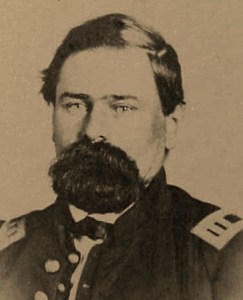
Captain Henry Durant (“H.D.”) Woodruff, commanding officer of Company D, 47th Pennsylvania Volunteers (public domain).

Captain Henry Durant Woodruff, the commanding officer of the 47th Pennsylvania’s D Company, recalled that:

“Between this point of land and the fort was an extensive swamp and lagoon, which we could not cross, and to reach the fort from this point we would have to march around forty miles. This we concluded not to do. We waited til night, re-embarked, unloaded our surf boats.”

* NOTE: According to Schmidt, the landing was effected where the Buckhorn Creek “intersects the Intercoastal Waterway and Pablo Creek at Chicopit Bay, about two miles upriver from Mayport…. The attempted approach was made through marsh and swamp and when the troops reached Greenfield Creek, the route became totally impassable and they were unable to reach a point where the fort could be approached from the rear or southern side.”

Also, per Woodruff:

“The ground was altogether too swampy for either cavalry or artillery to land at that point; the artillery was ordered to reload on a light draught steamer and flatboats and proceed up a winding creek to a point in the marsh where it was more practicable to land. The gunboats were called into requisition to transport the infantry, in their boats, to the land and to send their light howitzers to cover the landing. The entire force of the infantry and marine howitzers proceeded up the river a little distance and landed at the head of Mount Pleasant Creek, where Col. Good established a strong position to cover the landing of the artillery and cavalry….

We found five gunboats in the river. They had attempted the reduction of the fort, but had been repulsed. The only remedy left was for our small force to land and take it by storm; and the only place we could land was under the guns of the fort. Consequently we had recourse to strategy. We landed in full sight of the fort, on a point of land at the mouth of the river, out of reach of their guns….

Landing at our destination about 6 a.m. right in one of those great Florida swamps and marshes, among rattlesnakes, copperheads, centipedes, alligators, and many other poisonous reptiles and insects. We were informed that the natives never dare venture into that swamp, except in mid-winter, and even then they selected the coldest days when no sun was shining. The cook and his assistant selected a spot to make the coffee; it was near a large palmetto jungle. I well remember, when just as the fire was burning nicely, out crawled a huge rattlesnake from the palmetto grove. The heat of the fire had roused him from his lethargic sleep and the aromatic fragrance of the coffee was too much for him. Everyone who saw the reptile had a shot at him with pistols, making him surrender very quickly. He measured nine feet in length and had ten rattles. In his death struggles he emitted an odor, a sort of sickening musk, that scented the entire camp.”

As all of this was taking place, Brigadier-General Brannan was sailing up the river aboard the gunboat Paul Jones with additional troops following on the Cimarron and Patroon. Conducting reconnaissance, they also shelled the woods to the left and right.

“Col. Good and his 47th Pennsylvania Volunteers marched for the bluff,” early Thursday morning according to Schmidt, “with the help of a Black man named Israel, a contraband who served as Good’s guide. They headed for Parker’s Plantation.” The day unfolded as follows, per Good’s report to his superiors:

“HEADQUARTERS U.S. FORCES
Mount Pleasant Landing, Fla. October 2, 1862.

SIR: I have the honor to make the following report for the information of the general commanding:

In accordance with orders received I landed my regiment on the bank of Buckhorn Creek at 7 o’clock yesterday morning. After landing I moved forward in the direction of Parker’s plantation, about 1 mile, being then within about 1¼ miles of said plantation. Here I halted to await the arrival of the Seventh Connecticut Regiment. I advanced two companies of skirmishers toward the house, with instructions to halt in case of meeting any of the enemy and report the fact to me. After they had advanced about three-quarters of a mile they halted and reported some of the enemy ahead. I immediately went forward to the line and saw some 5 or 6 mounted men about 700 or 800 yards ahead. I then ascended a tree, so that I might have a distinct view of the house, and from this elevated position I distinctly saw one company of infantry close to the house, which I supposed to number about 30 or 40 men, and also some 60 or 70 mounted men. After waiting for the arrival of the Seventh Connecticut Volunteers until 10 o’clock, and it not appearing, I dispatched a squad of men back to the landing for a 6-pounderfield howitzer which had been kindly offered to my service my Lieutenant Boutelle, of the Paul Jones. This howitzer had been stationed on a flat-boat to protect our landing. The party, however, did not arrive with the piece until 12 o’clock, in consequence of the difficulty of dragging it through the swamp. Being anxious to have as little delay as possible, I did not await the arrival of the howitzer, but at 11 a.m. moved forward, and as I advanced the enemy fled. After reaching the house I awaited the arrival of the Seventh Connecticut and the howitzer. After they arrived I moved forward to the head of Mount Pleasant Creek to a bridge, at which place I arrived at 2 p.m. Here I found the bridge destroyed, but which I had repaired in a short time. I then crossed it and moved down on the south bank toward Mount Pleasant Landing. After moving about 1 mile down the bank of the creek my skirmishing companies came upon a camp which evidently had been very hastily evacuated, from the fact that the occupants had left a table standing with a sumptuous meal already prepared for eating. On the center of the table was placed a fine, large meat pie still warm, from which one of the party had already served his plate. The skirmishers also saw 3 mounted men leave the place in hot haste. I also found a small quantity of commissary and quartermaster’s stores, with 23 tents, which, for want of transportation, I was obliged to destroy. After moving about a mile farther on I came across another camp, which also indicated the same sudden evacuation. In it I found the following articles, viz: Eighteen Hall’s breech-loading carbines, 12 double-barreled shot-guns, 8 breech-loading Maynard rifles, 11 Enfield rifles, and 96 knapsacks. These articles I brought along by having the men carry them. There were, besides, a small quantity of commissary and quartermaster’s stores, including 16 tents, which, for the same reason as stated, I ordered to be destroyed. I then pushed forward to the landing, where I arrived at 7 p.m.

We drive the enemy’s skirmishers in small parties along the entire march. The march was a difficult one, in consequence of meeting so many swamps almost knee-deep.

I am, sir, your obedient servant,
T. H. GOOD,
Colonel Forty-seventh Regiment, Pennsylvania Volunteers.

Captain LAMBERT,
Assistant Adjutant-General”

* NOTE: Among the initial group of skirmishers from the 47th Pennsylvania was F Company Private George Klein. In a letter (transcribed from its original German by historian Lewis Schmidt), Klein noted that his “company put out skirmishers, and the first platoon which I belonged to, one Lieutenant and 28 men, went toward the first house we saw.”

“Our guide was an intelligent colored man [Israel] and we wanted to catch a secesh. We did get to catch a band of guerillas at the house who were watching to see what the Yankees had on their mind, and they pulled back when they saw us. We took them a piece back and handed them over to the officers, and they were put on the steamer and guarded. Still, there was one white man, three daughters or cousins, and three old [enslaved men] in the house. The ladies were getting excited when we got near the house and they were pretty and wondering what the Yankees were going to do to the devotees of Uncle Jeff. Perhaps the night before they had a nice dream about King Cotton’s future. That was reason enough to cry and weep. But it did not bother us, we grabbed our prey and got back to camp without trouble.”

Good then offered further insight via a follow-up report:

“HEADQUARTERS U.S. FORCES
Saint John’s Bluff, Fla., October 3, 1862.

SIR: For the information of the general commanding I have the honor to make the following report:

At 9 o’clock last night Lieutenant Cannon reported to me that his command, consisting of one section of the First Connecticut Battery, was then coming up the creek on flat-boats with a view of landing. At 4 o’clock this morning a safe landing was effected and the command was ready to move. The order to move to Saint John’s Bluff reached me at 4 p.m. yesterday. In accordance with it I put the column in motion immediately and moved cautiously up the bank of the Saint John’s River, the skirmishing companies occasionally seeing small parties of the enemy’s cavalry retiring in our front as we advanced. When about 2 miles from the bluff the left wing of the skirmishing line came upon another camp of the enemy, which, however, in consequence of the lateness of the hour, I did not take time to examine, it being then already dark.

After my arrival at the bluff, it being then 7:30 o’clock, I dispatched Lieutenant-Colonel Alexander with two companies back to the last-named camp (which I found, from a number of papers left behind, to have been called Camp Hopkins and occupied by the Milton Artillery, of Florida) to reconnoiter and ascertain its condition. Upon his return he reported that from every appearance the skedaddling of the enemy was as sudden as in the other instances already mentioned, leaving their trunks and all the camp equipage behind; also a small quantity of commissary stores, sugar, rice, half barrel of flour, one bag of salt, &c., including 60 tents, which I have brought in this morning. The commissary stores were used by the troops of my command.

I have the honor to be, your obedient servant,

T. H. GOOD,
Colonel Forty-seventh Regiment Pa. Vols., Comdg.

Captain LAMBERT,
Assistant Adjutant-General.”

* NOTE: Private Brecht recalled the expedition (in another letter, which was translated from the original German by Schmidt):

“It was an unusual day for us on the way, always through bush, marsh, swamp and water and a few times we were under water and in much rain. We worked through with sixty bullets per man on the side, and five days rations on the back, but we made it. Col. Good was at the head of the regiment on foot, and was strong and happy, and even the Connecticut Regiment could not keep up with us and were always a good piece behind. Before we reached out camping place we passed two rebel camps which we could see were abandoned in a hurry, one left his hat and one left his saber. Because of the swampy terrain, the horses could not follow us….

The enemy’s camps were utterly destroyed…. The tents, and those things we could not carry, we destroyed…. After destroying the marques [tents], mostly all new and numbering some seven or eight, we pushed on again under the guidance of a negro, who escaped from the fort but four weeks previous…. The country soon became marshy after leaving the last camp, and it was found necessary to build a corduroy road for the howitzer accompanying the land force. This unlooked for circumstance detained our troops some time…. Night came upon us. I then pushed forward to the landing, where I arrived at 7 PM … we moved to the river bank to bivouac for the night under the cover of gunboats … we made camp one mile below the fort … in the bushes for night…. Col. Good was in command all day. The march was a difficult one, in consequence of meeting so many swamps almost knee deep… it rained all day and much of our way was through swamps. I was glad to stop and get hot coffee and dry stockings.’ [Good] ‘sent to the General and asked permission to storm the fort that night. The General refused, as the cavalry and artillery had not been landed. So we bivouacked that night on the shore of the St. John….”

Earthen works surrounding the Confederate battery atop Saint John’s Bluff, Saint John’s River, Florida, 1862 (J. H. Schell, public domain).

While First Lieutenant Geety confirmed that:

“16 pieces of artillery were left ready loaded, primed, with the lanyards hooked to the primers ready to pull.’ He also included with his memorabilia a ‘roster of the rebel troops stationed about St. John’s River, Florida, taken at the camp of the Louisiana Tigers, who with another rebel regiment guarded the rear approaches of the rebel fort. They ran leaving all their camp and garrison equipage and their suppers on the fire which our men ate…. The rebels had 1500 men, six pieces of light artillery besides the nine pieces at the fort and a impregnable position. The rebels were not uniformed and have rice, corn, and fresh meat; coffee and flour only allowed those in the hospital; salt they had little or none of, it being worth $1 per quart; sugar they had plenty of.”

Penning his own recap, Brigadier-General Brannan estimated that the Confederate equipment captured by Union troops was worth more than two hundred thousand dollars and included: two eight-inch columbiads, two eight-inch howitzers, two eight-inch, smooth bore guns, two 4.6-inch rifled cannon, $15,000 worth of shot and shell, multiple small arms, and more than two hundred tents. Brannan later explained that he “left the work of removing the guns from St. John’s Bluff to Col. T.H. Good, 47th Regiment Pennsylvania Volunteers, my second in command.” 

One of the most detailed recaps, however, was apparently penned in Port Royal, South Carolina on Tuesday, October 14, 1862 by 47th Pennsylvanian Henry D. Wharton after Brigadier-General Brannan and his troops had returned from Florida to Hilton Head. Wharton’s report was subsequently distributed via several publications nationwide, including the October 20 edition of The New York Times and Wharton’s hometown newspaper:

“The expedition left Hilton Head on the afternoon of the 30th ultimo, consisting of the Pennsylvania Forty-seventh Regiment, Col. GOOD; the Connecticut Seventh Regiment, Col. HAWLEY; a section of the First Connecticut Battery, under Lieut. CARMON, and a detachment of the First Massachusetts Cavalry under Capt. CASE, making a total effective force of 1,573. The troops were embarked on the steamers Ben Deford, Boston, Cosmopolitan and Neptune, and arrived off the bar of the St. John’s River early on the morning following their departure, but were unable to enter the river until 2 P.M. in consequence of the shallowness of the channel. There the expedition was joined by the gunboats Paul Jones, Capt. STEEDMAN, commanding the fleet; Cameron, Capt. WOODHULL; Water Witch, Lieut.-Com. PENDERGRAST; E. B. Hait, Lieut.-Com. SNELL; Uncas, Lieut.-Com. CRANE, and the Patroon, Lieut.-Com. Urano. The same afternoon three gunboats were sent up to feel the position of the battery on the Bluff, and were immediately and warmly engaged, the enemy apparently having a number of heavy guns in his works.”

Wharton went on, noting that the troops disembarked “at a place known as Mayport Mills, situated a short distance from the entrance of the river,” and added that “all the men, rations and arms were on shore by 9 o’clock on the evening of the 1st.”

“The country between this point and St. John’s Bluff presented great difficulties in the transportation of troops, being intersected with impassable swamps and unfordable creeks, and presenting an alternative of a march of forty miles without land transportation, to turn the head of the creek, or to reland [sic] up the river at a strongly-guarded position of the enemy. On further search, a landing place was found for the infantry at about 2 o’clock on the morning of the 2d, at a place called Buckhorn Creek, between Pable and Mount Pleasant Creeks, but the swampy [nature] of the ground made it impracticable to land the cavalry and artillery at that point. The gunboats here rendered valuable assistance by transporting troops and sending light howitzers in launches to cover the landing.”

According to Wharton, the 47th Pennsylvania’s commanding officer, Col. Good, was ordered to lead “the entire infantry and … howitzers … immediately forward to the head of Mount Pleasant Creek, to secure a position to cover the landing of the cavalry and artillery.”

“The movement was executed skillfully, surprising and putting to flight the rebel pickets on that creek. This rapid movement to Mount Pleasant Creek, and the landing of the troops at Buckhorn Creek, was very fortunate as it seemed to disarrange the enemy’s plan, if he had any, to prevent our disembarkation. Their pickets retired in such haste and trepidation as to leave their camps standing, their arms, and even a great portion of their clothing behind them, and only escaped themselves because of the intricate character of the ground and their superior knowledge of the country.”

The next afternoon (October 3), “the artillery and cavalry were in readiness at the head of Mount Pleasant Creek, two miles from the enemy’s batteries at St. John’s Bluff.” Wharton and more senior military men estimated the number of Confederate cavalrymen and infantrymen who opposed them that day at 1,200 in addition to the artillery batteries, which reportedly contained “nine heavy pieces.” 

“Under these circumstances, Gen. Brannan deemed it expedient, in consultation with Capt. Steedman, to send the Cosmopolitan to Fernandina for reinforcements from the garrison of that place, and three hundred of the Ninth Maine Regiment were sent down on the following morning.”

Later in the day on October 3, according to Wharton, Brannan directed Steedman to send out three gunboats “to feel the position of the enemy, shelling them as they advanced, when the batteries were found to be vacated, and Lieut. Snell, of the Hale, sent a boat on shore and raised the American flag, finding the rebel flag in the battery. The naval force then retained possession, until the arrival of the troops, who immediately advanced…. On approaching the enemy’s position on the Bluff, it was found to be of great strength, possessing a heavy and effective armament, consisting of two eight-inch columbiads, two eight-inch siege howitzers, two eight-inch seacoast howitzers, and two rifled guns, supplied with ammunition in abundance, shot, shell, tools and camp equipage.”

“The works were skillfully and carefully constructed, and the strength of the position was greatly enhanced by the natural ground, it being only approachable on the land side, through a winding ravine immediately under the guns of the position, and, from the narrowness of the river and the elevation of the Bluff, rendering fighting by the gunboats most difficult and dangerous. Most of the guns were mounted on complete traverse circles, and, indeed, taking everything into consideration, there is no doubt that a small party of determined men might have maintained the position for a considerable time against even a larger force than we brought against it.”

But Brannan and Good’s men weren’t quite done, yet, with the Confederates in that region.

Next up? Entering Jacksonville, the capture of a Confederate steamer, and the integration of the 47th Pennsylvania Volunteer Infantry with the enlistment of several formerly enslaved Black men.

Sources:

  1. Beecher, Herbert W. History of the First Light Battery Connecticut Volunteers, 1861-1865, Vol. I. New York, New York: A. T. De La Mare Ptg. and Pub. Co., Ltd., 1901.
  2. “Important From Port Royal; The Expedition to Jacksonville, Destruction of the Rebel Batteries. Capture of a Steamboat. Another Speech from Gen. Mitchel. His Policy and Sentiments on the Negro Question.” New York, New York: The New York Times, October 20, 1862.
  3. Reports of Lieut. Col. Tilghman H. Good, Forty-seventh Pennsylvania Infantry, in Official Records of the Union and Confederate Armies, 1861-1865 (Microfilm M262). Washington, D.C.: U.S. National Archives and Records Administration.
  4. Schmidt, Lewis G. A Civil War History of the 47th Regiment of Pennsylvania Veteran Volunteers. Allentown, Pennsylvania: Self-published, 1986.
  5. Wharton, Henry D. Letters from the Sunbury Guards. Sunbury, Pennsylvania: Sunbury American, 1862.
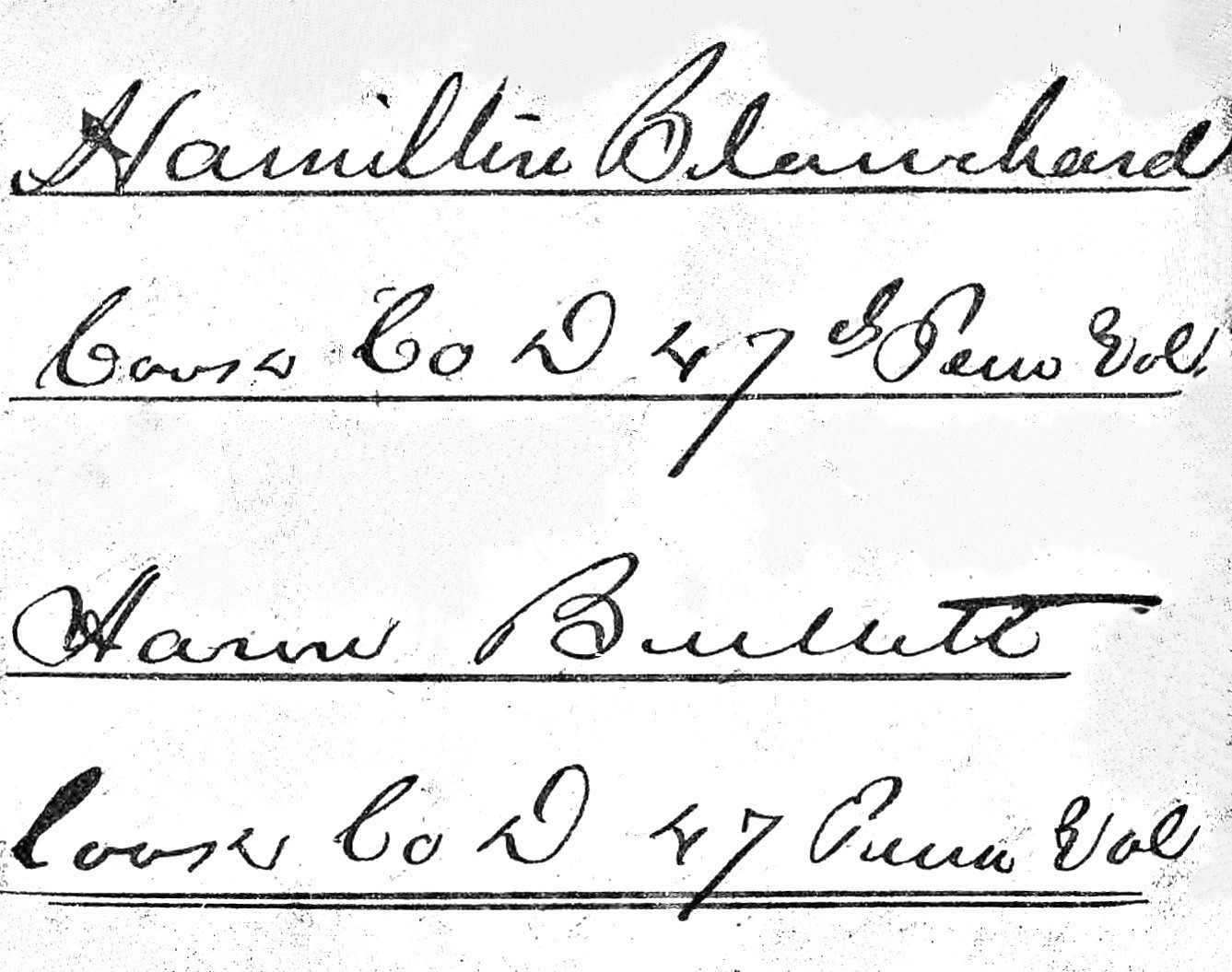
 

Spring and Summer of 1862: Disease, Duty and Another Departure

View the video related to this article

Sibley Tent (Patent #14740, United States Patent Office, April 22, 1856, H. H. Sibley, public domain).

As spring continued to take hold across Pennsylvania in 1862, turning the Great Keystone State’s colorful, budding trees into soothing havens of green-leafed shade, the members of the 47th Pennsylvania Volunteer Infantry continued to battle their great foe—disease. It was a fight that was made more difficult by the regiment’s challenging living conditions. The weather was warm, the water quality was poor, the mosquitos were plentiful, and hygiene was substandard because the majority of 47th Pennsylvania Volunteer Infantrymen continued to live in the close quarters of the Sibley tents that had been erected as “Camp Brannan” in Key West, Florida. (The men of Company F were slightly more fortunate, having been previously ordered to live and work at Fort Taylor.)

As a result, multiple members of the regiment fell ill during the month of April, including First Lieutenant and Regimental Adjutant Washington H. R. Hangen, who was required to temporarily cede his duties to H Company First Lieutenant William Wallace Geety after being admitted to the officers’ hospital at in Key West, and C Company’s Theodore Kiehl and Henry W. Wolfe, who had been confined to the hospital for enlisted men. Deemed too ill to continue serving with the regiment, F Company privates John G. Seider and Samuel Smith were honorably discharged on surgeons’ certificates of disabilities and sent back home.

Meanwhile, other members of the regiment continued to be advanced in rank, including Second-Sergeant Christian Seiler Beard, who was promoted to First-Sergeant, and Private Peter Haupt who was promoted to the rank of Sergeant—while others assumed additional duties, including D Company privates James E. Albert and William Collins, who were assigned to help the fort’s assistant surgeon, William F. Cornick, in caring for the increased number of patients who had been admitted. Then, General Order No. 84 was issued, directing I Company Captain Coleman A. G. Keck and one of his subordinates, Private William Smith, to return home to Pennsylvania to recruit more volunteers to help beef up the regiment’s dwindling ranks.

In addition, several officers from the 47th Pennsylvania were also called upon to conduct a general court martial trial of a lieutenant from the 90th New York Volunteers who was charged with having been absent from his duties without appropriate authorization (known more commonly today as being absent without leave or “AWOL”). Colonel Tilghman H. Good served as the court’s president, C Company Captain John Peter Shindel Gobin served as its general advocate, and H Company Captain James Kacy was one of the men appointed to serve on the court’s judicial panel, which found the 90th New Yorker guilty and directed that he lose roughly two weeks of pay.

April—May 1862

Key West, Florida, c. 1850 (courtesy of Florida Memory Project)

Key West, Florida, circa 1850 (courtesy of Florida Memory Project).

On April 19, the 47th Pennsylvania’s most prolific scribe, C Company Musician Henry D. Wharton, penned a letter to his hometown newspaper, the Sunbury American, from Camp Brannan in Key West:

“DEAR WILVERT:– Having finished a plate of soup, (not a hasty one) enjoyed a piece of ham, cooked in my best style, fried and now luxuriating in a pipe of the best Lynchburg tobacco, I conclude to indite [sic] you a few lines from this most miserable place, Key West.

There are now lying here three very fine vessels captured from Secessia. The cargoes are very valuable, consisting of cotton, coffee, rice, liquor, kerosene and olive oils, leather, and a great many articles of use. I attended the sale of one of the cargoes, and one article I found more numerous than any other—that of hooped skirts. I was curious to know why they had supplied themselves so plentifully with that article, when an old gentleman said that was easily understood, for when the rebels had to run, and in fear of being caught they would make good hiding places, and then he related a circumstance of a Mexican General who, in running away, found crinoline very convenient as a hiding place, but not secure enough for the Lynx-eyed Americans, as the brave gentleman was caught in his wife’s trap.

There has been considerable sickness among the troops, but I am happy to state it is abating. Two members of our company, Theodore Kiehl, and H. Wolf, have been in the Hospital, but are now out and almost ready for duty. They take very readily to their rations when they get back to the company, saying the Hospital is a very nice place to get well in, but no place for grub, as they were as hungry as wolves all the time they were in, or rather when they became better. We have lost eight men from our regiment, by death, since we have been on this island. From what I can learn the diseases were mostly contracted in Virginia, but if they have not, it is a wonder that the mortality is not greater among us, owing to the sudden change of climate, the bad water, hot sun and hard work our men are subjected to.

Lieut. Henry Bush, Co. F., in our regiment, died two weeks ago. His company were in the Fort, learning heavy artillery, where he was attacked with typhoid fever—in a few days he was beyond the physicians [sic] skill, and now he is sleeping his last sleep in the strangers [sic] cemetery. His funeral was very largely attended by the military and the masonic fraternity, of which he was a member. Lieut. Bush was beloved by his company—they having presented him with a sword a few days before he was taken sick—and in fact was liked by the whole regiment for his kindness and gentlemanly bearing to the men. As soon as the necessary arrangements can be made his body will be sent to Catasauqua, Lehigh county, where his widow and two little children reside.

Since the promotion of Lieut. Oyster, there has [sic] been some changes in our company, 2d Sergeant Beard has been made 1st Sergeant, and Peter Haupt, of Sunbury, taken from the ranks and promoted to 1st Sergeant. Haupt passed an excellent examination, and I am proud, for Sunbury, to say that he is considered one of the A. No. 1’s on drill in our regiment.

With the exceptions of a few slight cases of sickness, the boys are getting along very well and would be perfectly contented if they were at a place where there could be a chance to have a hand in some of the glorious victories which their brothers in arms are engaged in, and away from this detested spot, where there would be something to relieve the eye beside sea-gulls, pelicans and turkey-buzzards. Excuse the shortness of this, hoping ere long to be able to give you an account of a victory in which Co. C., was engaged….”

* Note: To read more of Henry Wharton’s insights, please see our collection of his letters here.

By mid-April, typhoid fever was claiming one member of the regiment after another. On Saturday April 19 and Sunday April 27, respectively, K Company privates George Leonhard and Lewis Dipple died at the Key West general hospital while E Company Private John B. Mickley died on April 30.

Death ledger entry for Private Lewis Dipple, Company K, “Registers of Deaths of Volunteers,” U.S. Army, 1862 (U.S. National Archives, public domain).

Initially interred in graves numbered nine, ten, and twelve at the fort’s post cemetery, the remains of Privates Leonhard, Dipple, and Mickley were later exhumed for reburial at the Barrancas National Cemetery. Although the process was successfully completed for Privates Leonard and Mickley in 1927, Private Dipple’s remains were handled so disrespectfully that they were later unable to be identified. As a result, they were consigned to a common grave at Barrancas with 227 other “unknown” soldiers.

That same day, General Order No. 26 was announced, directing that:

“I. The troops will be mustered and inspected at 7:45 AM tomorrow morning, 30th inst. April 30, 1862.

II. Immediately after muster, a council of administration to consist of Capt. Harte and officers will assemble to transact such business as regulations require.”

Major-General David Hunter, U.S. Army, circa 1863 (carte de visite, public domain).

Meanwhile, on April 25, 1862, the winds of change had begun to clear the way for long-denied social justice as Union Major-General David Hunter, commanding officer of the U.S. Army’s Department of the South, issued General Orders, No. 11, which directed that all enslaved men, women, and children in Georgia, Florida, and North Carolina be freed immediately:

“Head Quarters Department of the South,
Hilton Head, S.C. May 9, 1862.
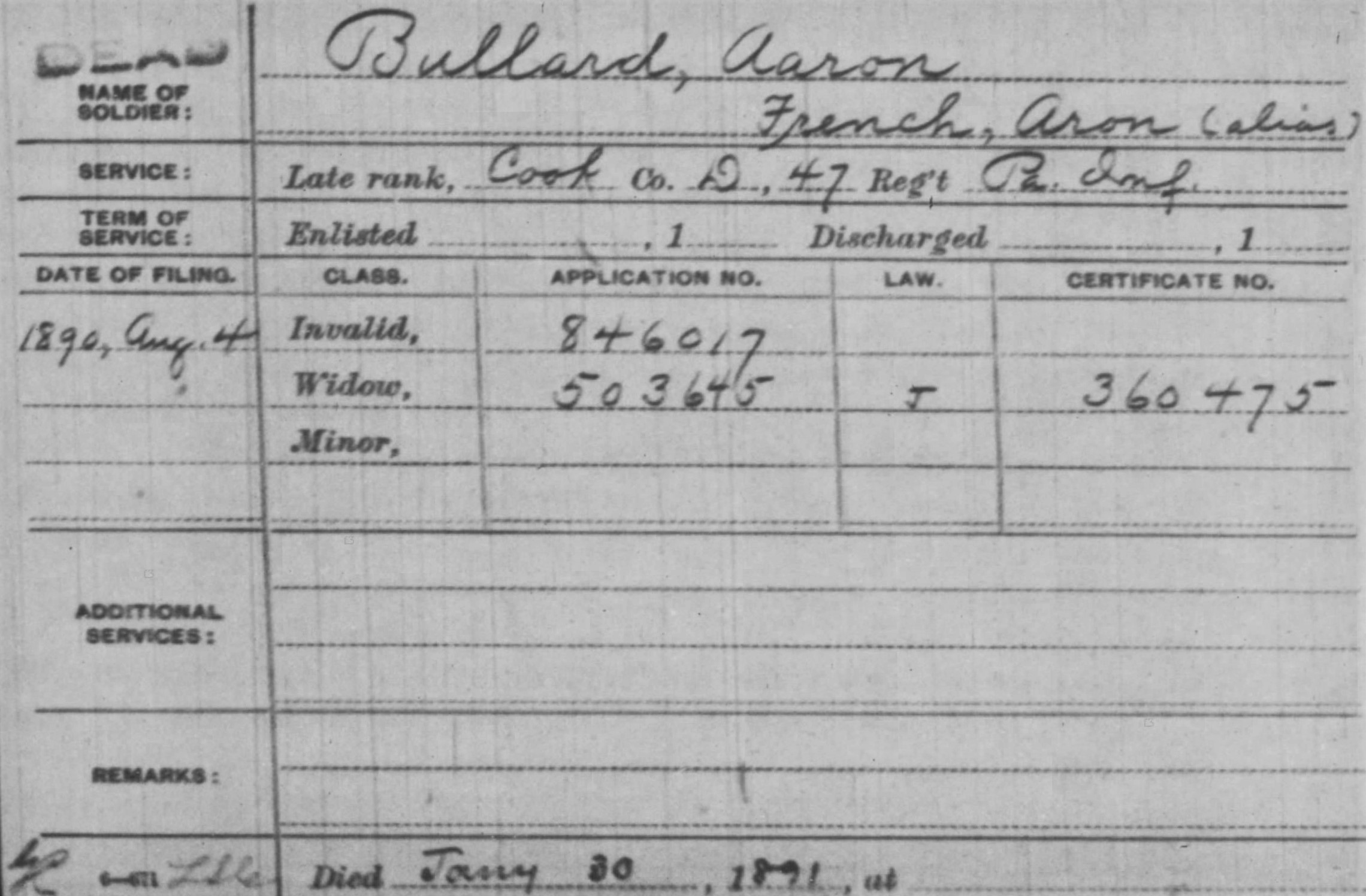
General Orders, No 11.— The three States of Georgia, Florida and South Carolina, comprising the military department of the south, having deliberately declared themselves no longer under the protection of the United States of America, and having taken up arms against the said United States, it becomes a military necessity to declare them under martial law. This was accordingly done on the 25th day of April, 1862. Slavery and martial law in a free country are altogether incompatible; the persons in these three States—Georgia, Florida and South Carolina—heretofore held as slaves, are therefore declared forever free.

(Official) David Hunter,
Major General Commanding.”

Although word of Hunter’s order did not immediately reach members of the regiment, it would eventually be carried in newspapers across America.

Meanwhile, the 47th Pennsylvania Volunteers continued to perform their provost and garrison duties in Key West. At the end of April, F Company Private Henry Falk was ordered to take on new duties with the quartermaster while Order No. 21 reassigned H Company Corporal James F. Naylor to the regimental color guard. During the first two days of May, I Company Private William Frack then became Corporal Frack while H Company Private Robert Kingsborough took over quartermaster duties performed previously by Private William O’Brien.

As spring progressed, the weather in Key West became hotter, and the mosquitoes grew even more bold. Even so, the fort’s commanding officer and his subordinates were still able to find a few minutes of relaxation. On May 7, they made time to attend a ball. Corporal James J. Kacey, however, was assigned to fix cartridge boxes around this same time while E Company Corporal George Nicholas was busy dodging disciplinary action, as well as a brush with death:

“I went down to the docks and ask [sic] a Man who owned the Storehouses their [sic] and he said the govemient Seased [sic] them. So I Said I will Sease [sic] the life Boat that laid their [sic]. So I took it up to camp and fixed it up and that got me in trouble I went out Sailing and Missed drill, and got a log to carry, and the next time in the Guard House…. [A] Scorpen Stung me in the finger and I cut a piece out and Sucked it and put Tobacco on it. My arm and hand commenced to Swell Some But Not Much.”

Increasingly debilitated by the bug that had recently felled him, the regiment’s founder and commanding officer, Colonel Tilghman Good, finally realized that he would need to distance himself from his men if he were to continue as their leader. In a letter penned to the Assistant Adjutant, Captain Lambert, he asked “permission to leave camp for a few days, to secure comfortable quarters in town, which I have every reason to believe would materially aid in my speedy restoration to health and strength. The Doctor tells me this desirable end can be attained, by taking rest in elevated and comfortable quarters for a few days. In consequence I do not deem it essential to remove to the hospital.”

Good’s decision proved to be a sound one as more and more members of the regiment were felled by disease, including D Company’s Private George Isett. Suffering from chronic diarrhea, he died on Friday, May 16, and was initially laid to rest in grave no. 14 at the post cemetery. Sadly, his remains were also mishandled when they were exhumed in 1927 for reburial, and were also consigned in the unknown grave of 227 Union soldiers at the Barrancas National Cemetery. His grieving comrades honored him by securing publication of the following Tribute of Respect in their hometown newspaper:

“WHEREAS, it has pleased God in his allwise providence, to remove from our midst our friend and brother in arms, Geo S. Isett; therefore,

RESOLVED, that by his death we have lost a warm hearted friend, a true patriot and good soldier, and one whose place cannot be filled among us.

RESOLVED, That we most heartily sympathize with the deceased and hope that he who has thus afficted [sic] them, will be their reliance in time of need.

RESOLVED, That these resolutions be forwarded to the Perry County papers for publication, and a copy be sent to the friends of the deceased.

Signed: George W. Topley, Jesse Meadith, Jacob Charles, George W. Jury, Isaac Baldwin, Committee.”

That same day (May 16), The Athens Post in Athens, Tennessee specifically mentioned the 47th Pennsylvania’s problems with illness in a news article entitled, “Yankees Sick and Dying”:

“A letter from the flag ship Niagara, published in the Providence Press, fears that the warm weather and imprudence and exposure will cause much sickness among the three Yankee regiments stationed at Key West, Florida. ‘Already the 47 Pennsylvania Regiment has lost a number of its members by the typhoid fever, and I am told they have 70 sick.’ They will have plenty of the same sort before August.”

In response to the continuing wave of sickness, H Company Private Daniel Kochenderfer was reassigned to nursing duties at Key West’s general hospital, where he earned $7.75 for the hazardous duty. Two days later, G Company Private Edmund G. Scholl succumbed to typhoid fever. Initially interred at the post cemetery, Private Scholl’s remains would later be returned home to his family when Allentown undertaker Paul Balliet took on the mission of bringing home both Scholl’s body and that of the infant Regimental Chaplain William Rodrock in 1864. (Both were then reinterred at the “New Allentown Cemetery” on January 30, 1864.)

On May 19, President Abraham Lincoln overturned the emancipation order issued by Major-General David Hunter. His proclamation read as follows:

“Washington [D.C.] this nineteenth day of May,
in the year of our Lord one thousand eight hundred and sixty-two

By the President of the United States of America.

A Proclamation.

Whereas there appears in the public prints, what purports to be a proclamation, of Major General Hunter, in the words and figures following, to wit:

‘Head Quarters Department of the South,
Hilton Head, S.C. May 9, 1862.

General Orders No 11.— The three States of Georgia, Florida and South Carolina, comprising the military department of the south, having deliberately declared themselves no longer under the protection of the United States of America, and having taken up arms against the said United States, it becomes a military necessity to declare them under martial law. This was accordingly done on the 25th day of April, 1862. Slavery and martial law in a free country are altogether incompatible; the persons in these three States—Georgia, Florida and South Carolina—heretofore held as slaves, are therefore declared forever free.

(Official) David Hunter,
Major General Commanding.
Ed. W. Smith, Acting Assistant Adjutant General.’

And whereas the same is producing some excitement, and misunderstanding; therefore I, Abraham Lincoln, President of the United States, proclaim and declare, that the government of the United States, had no knowledge, information, or belief, of an intention on the part of General Hunter to issue such a proclamation; nor has it yet, any authentic information that the document is genuine— And further, that neither General Hunter, nor any other commander, or person, has been authorized by the Government of the United States, to make proclamations declaring the slaves of any State free; and that the supposed proclamation, now in question, whether genuine or false, is altogether void, so far as respects such declaration.

I further make known that whether it be competent for me, as Commander-in-Chief of the Army and Navy, to declare the slaves of any State or States, free, and whether at any time, in any case, it shall have become a necessity indispensable to the maintenance of the government, to exercise such supposed power, are questions which, under my responsibility, I reserve to myself, and which I cannot feel justified in leaving to the decision of commanders in the field. These are totally different questions from those of police regulations in armies and camps.

On the sixth day of March last, by a special message, I recommended to Congress the adoption of a joint resolution to be substantially as follows:

Resolved, That the United States ought to co-operate with any State which may adopt a gradual abolishment of slavery, giving to such State pecuniary aid, to be used by such State in its discretion, to compensate for the inconveniences, public and private, produced by such change of system.

The resolution, in the language above quoted, was adopted by large majorities in both branches of Congress, and now stands an authentic, definite, and solemn proposal of the nation to the States and people most immediately interested in the subject matter. To the people of those States I now earnestly appeal— I do not argue, I beseech you to make the arguments for yourselves— You can not [sic] if you would, be blind to the signs of the times— I beg of you a calm and enlarged consideration of them, ranging, if it may be, far above personal and partizan [sic] politics. This proposal makes common cause for a common object, casting no reproaches upon any— It acts not the pharisee. The change it contemplates would come gently as the dews of heaven, not rending or wrecking anything. Will you not embrace it? So much good has not been done, by one effort, in all past time, as, in the providence of God, it is now your high privilege to do. May the vast future not have to lament that you have neglected it.

In witness whereof, I have hereunto set my hand, and caused the seal of the United States to be affixed.

Abraham Lincoln”

* Note: During the short time in which Major-General David Hunter’s emancipation order was in effect, thousands of enslaved individuals escaped from horrific conditions across Florida, Georgia, and South Carolina, and made their way to the safety of Union military encampments. In response, Hunter directed his subordinates in the U.S. Army’s Department of the South to create a loose network of social services to provide food, clothing, educational services, medical care, and shelter to the newly free men, women, and children. Hunter then also began advocating for able-bodied Freemen to be allowed to enlist with the Union Army.

Although many of these social justice initiatives were put on hold when Lincoln rescinded Hunter’s emancipation order, the disagreement between Lincoln and Hunter evidently made an indelible impression on leaders of the 47th Pennsylvania Volunteer Infantry; just six months later, those 47th Pennsylvanians would pave the way for the regiment to become an integrated one by facilitating the enlistment on October 5, 1862 of several young Black men who were freed from plantations near Beaufort, South Carolina—roughly three months prior to the enactment of Lincoln’s Emancipation Proclamation.

As May wore on, disease continued to thin the regiment’s ranks. Another member of the 47th to be felled by typhoid fever was B Company Private John Apple who died at Key West’s general hospital on May 21 (alternate date: March 12). Reportedly buried shortly thereafter and then disinterred from grave number 18 at the fort’s post cemetery in 1927, his remains were also among those that were reportedly consigned to a group grave of 228 unknown soldiers at the Barrancas National Cemetery, according to one source but, according to The Allentown Democrat, were returned to Pennsylvania on January 28, 1864 with the bodies of three other members of the regiment and the body of the regimental chaplain’s infant son. Private Apple was subsequently laid to rest at the Union-West End Cemetery in Allentown on January 31, 1864.

Around this same time, Henry Wharton was dusting off the skills he had learned, pre-war, as an employee of the Sunbury American newspaper. Founding a new publication—the Key West Herald, he was able to get the first edition of his newspaper into the hands of his fellow 47th Pennsylvanians by Saturday, May 24.

The newspaper’s release could not have been more timely. A significant number of his fellow 47th Pennsylvanians were in desperate need of reading material as they fought their way back from sickness. Among those ailing at this time were multiple members of Company D, including privates William Ewing, Samuel Kern, Andrew and William Powell, and Emanuel Snyder, Corporal Samuel Reed, and Sergeants William Fertig and George Topley. Of those, Fertig was the only one to be hospitalized. In addition, B Company Teamster Tilghman Ritz developed rheumatism sometime around the month of May, and underwent several weeks of treatment at the post hospital from the 47th Pennsylvania’s regimental surgeon, Elisha Baily. Even though he was treated “successfully” by Baily, however, the condition would continue to plague Ritz for the remainder of his life.

Early June—A Fateful Encounter with Friendly Fire

Woodcut depicting the harsh climate at Fort Taylor in Key West, Florida during the Civil War (U.S. Library of Congress, public domain).

One of the most senseless deaths of 47th Pennsylvania Volunteers during the entire war was a “friendly fire” incident which occurred on June 9, 1862. The day had started out peacefully enough—with weather so inviting that I Company Sergeant Charles Nolf, Jr. and several friends felt compelled to take a stroll along the southern portion of the beach in Key West. Tragically, while gathering seashells for family and friends back home, he was accidentally killed by a member of the 90th New York Volunteer Infantry who had been inexplicably playing around with a loaded rifle in violation of brigade regulations while walking on the same stretch of beach with three other members of his regiment—all three of whom had also been carrying loaded rifles—against regulations. Shot in the forehead, Sergeant Nolf died instantly at the scene. Initially interred at the fort’s post cemetery, his body was among the aforementioned group of soldiers’ remains disinterred and returned to Pennsylvania’s Lehigh Valley by Allentown undertaker Paul Balliet, where they were reburied at the Fairview Cemetery in West Catasauqua in late January of 1864.
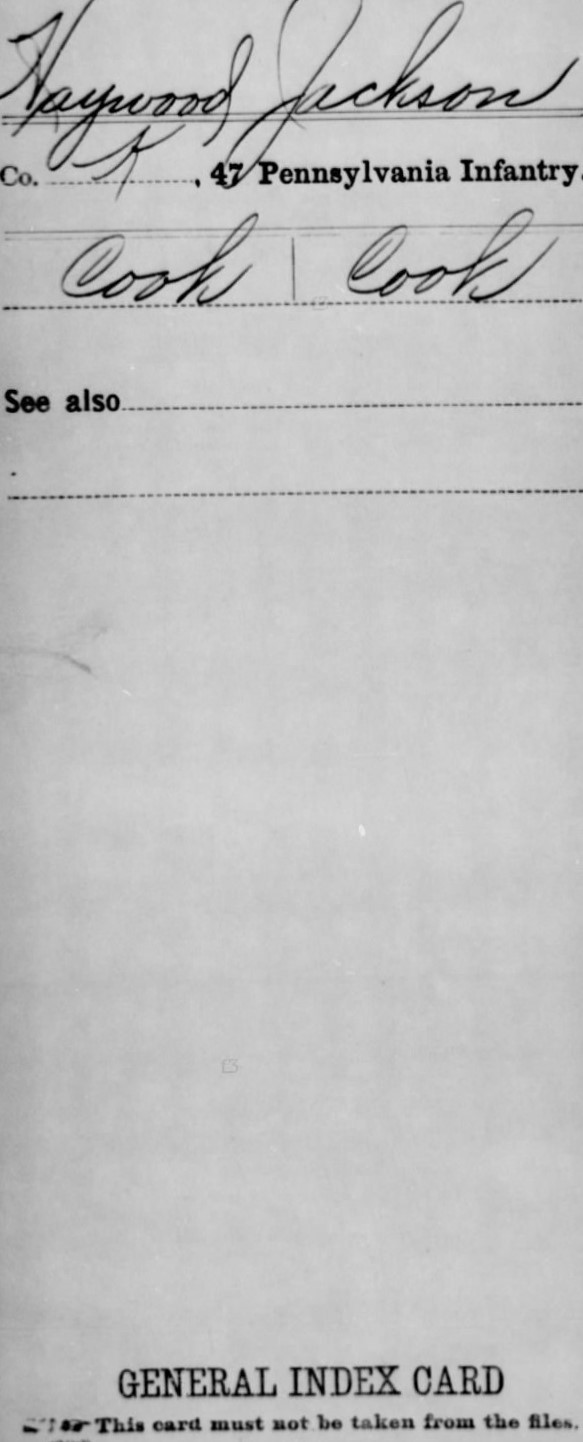
On the same day that Charles Nolf departed from the world (June 9), First Lieutenant William W. Geety was released from the hospital having successfully recovered from an attack of bilious fever which had resulted in his confinement beginning May 18. In a letter penned to his wife while recuperating, he described himself as “jaundiced.”

Brigadier-General John Milton Brannan, U.S. Army (public domain).

By June 11, I Company Captain Coleman Keck was back home in Allentown, Pennsylvania, hard at work recruiting more men to serve with the 47th Pennsylvania. Meanwhile, the “old men” of the regiment—the veterans—were sensing another change in the winds of fate. That change came on Friday, June 13, via General Order No. 53, which was issued by Brigadier-General Brannan:

“The 47th Regiment of Pennsylvania Volunteers will hold itself in readiness for immediate embarkation. Company F of this regiment which is detached at Fort Taylor will report at headquarters of the regiment. Each regiment will take six months [sic] supply of medicine and medical stores on embarkation.”

Rumors swirled that the regiment would be shipped to Port Royal, South Carolina in preparation for a Union attempt to wrest control of Savannah, Georgia or Charleston, South Carolina from the control of the Confederacy.

On Saturday, June 14, the 47th Pennsylvania Volunteers participated in a review with other members of Brigadier-General Brannan’s troops. According to an edition of the New Era, which was published around this same time:

“The 47th Pennsylvania Volunteers under command of Lt. Col. Alexander made a fine appearance. Their marching was perfect and the entire regiment showed the effect of careful drill. A more sturdy, soldierly looking body of men cannot be found, probably, in the service. Col. Good and the officers under his command have succeeded in bringing the regiment to a state of military discipline creditable alike to them and the state from which they hail. The regimental band deserves some mention; there are many bands in the service of greater celebrity, whose performances would not bear comparison with that attached to the 47th Regiment.”

On June 16, Wharton penned another letter to his hometown newspaper in which he reflected on the untimely, friendly fire death of Sergeant Nolf and provided further insights into the soldiering life in America’s Deep South:

“Great excitement was caused by the accident, and for a time (our boys not knowing the particulars) some of them were determined to avenge their comrade’s death, but an investigation pronounced it accidental, when they were satisfied. Nolf was a young man of excellent character, beloved by all who knew him, and it seems hard that he should be hurried into eternity in such a manner, and that too, when the carrying of loadened [sic] rifles is strictly prohibited.

There is a family in this city [Key West] by the name of Fift. One of them, A. Fift, after making a fortune out of his Uncle Samuel, (U.S.), thought to make another speck by going to New Orleans to his friend Mr. Mallory, one of Jeff Davis’ Cabinet (?) in the manufacture of gun boats. Mallory and he went into partnership. After finishing boats, while at Memphis, with a considerable amount of Confederate funds in his pocket, (specie) he gave them the slip. Some of his indignant southern friends followed the double traitor, caught him and immediate hung him, thus saving the United States the trouble of buying an extra rope after this war is over. His brother, who has grown fat off the government, and at the time giving aid to secesh, wishing to visit a cooler atmosphere, and act the part of a nabob in the North, was a few days ago provided with a passage to New York in a Government steamer, while on the same vessel, a soldier, for want of room, could not send a box of sea-shells to gratify the curiosity of his friends at home. You can draw your own inference….

The paymaster has come at last and paid us off for four months. The sight of money was new to the boys, and most eagerly accepted by them. The Sunbury boys sent most of their pay home to their friends, very glad to do so, showing that, although far away from home, loved ones are not forgotten.

We have received marching (sailing) orders, and before this reaches you, if winds do not play us false, we will be in South Carolina, and probably before Charleston, helping to reduce the place where this foul rebellion first broke out. I will write to you immediately on our arrival, attempting to give you a description of the voyage, and an account of the manner in which Neptune treated the health and feelings of the boys. All is hurry and bustle in camp, striking tents, &c., so much so that I can scarcely write. We are all well. None of the Sunbury boys left behind….”

The next day, the 47th Pennsylvania Volunteer Infantry began a phased departure from Key West.

A Summertime Occupation of South Carolina

Dock, Hilton Head, South Carolina, circa 1862 (Sam Cooley, U.S. Library of Congress, public domain).

On Tuesday, June 17, 1862, the members of the 47th Pennsylvania assigned to Companies A, F, and D boarded the schooner “Emilene,” and sailed for Hilton Head Island in South Carolina. Also readying for departure this day were the men from Companies B, C, and I, who boarded a brig, the Sea Lark. On June 19, Companies E and H boarded a different ship, which was not identified by regimental clerks in subsequent reports, but was identified in soldiers’ later correspondence as the Tangire. Setting off at 10:02 p.m. in the same direction as their predecessors, they were followed by the men from Companies G and K, who boarded a sloop, the Ellen Benan [identified in later soldiers’ correspondence as the “Ellen Bernard”], and departed at 2 p.m. on June 20—barely dodging the yellow fever epidemic which swept Key West, Florida.

On June 19, just prior to his departure, G Company Sergeant John Gross Helfrich penned a letter to his parents from the Officers’ Hospital in Key West, where he had been assigned as a hospital steward:

“…. We are under marching orders, some of the companies of our regiment have already gone. The reason for our not going together, is owing to not having vessels enough. Those who have left had to embark on small “briggs” & skooners [sic], taking from two to three companies aboard. The place of our destination is ‘Beaufort S. Carolina.’ The two companies of regulars, stationed here, have also left a few days ago; for the same place.

The health of our men is exceedingly good at present, out of our whole regiment there are but nineteen, who are unable on account of sickness to accompany us, which is comparatively, but a very small number, and these as far as my knowledge is concerned, are not dangerously ill; and it is hoped that they may soon be able to follow us.

After we are gone the garrison at this place will only consist of six companies of the 90th Regt. N.Y.V. [90th New York Volunteers]. The other four companies of the above named regt. are stationed at “Fort Jefferson”, Tortugas; some fifty-odd miles from here.

The 91st Regt. N.Y.V. were ordered a few weeks ago, to Pensacola, Fla. So you perceive, that there has been a considerable change made among the military, of late at this place….

Letter from Sergeant John G. Helfrich, Company G, to his parents, June 25, 1862 (used with permission, courtesy of Colin Cofield).

After Helfrich settled into his new quarters at Hilton Head, South Carolina, he penned the following update to his parents on June 25:

“Having first arrived at our place of destination spoken off [sic] in my last, I will now give you a brief description of our passage to this place.

We left Key West, on the 19th inst., about mid-night in the brigg [sic] “Ellen Bernard,” and arrived at this place yesterday (the 24th) at one o’clock p.m. having had a very pleasant voyage, not the slightest accident having occurred, and the men seem to get accustomed to riding at sea, as but a few had what is generally called ‘seasickness’. Our regt. was put on four small vessels, the ‘Sea Lark’, ‘Emaline’, “Tangire’ [handwriting difficult to read] & ‘Ellen Bernard, the second last named, has up to this time, not yet arrived, having started about 4 hours ahead of us. She had three companies aboard & the hospital baggage.

The weather is not quite so hot here as where we come from, but I think it will perhaps make a material change in a few days, as the ground is at present cooled off by the rain….

Since our arrival on this island we learned that a pretty severe fight came off about eighteen miles from here, at a place called ‘James island’ at which our boys seem to have got the worst of it as the hospital at this place contains a great many of the wounded.

Our boys are all eager for a fight, and no doubt they will get a chance to show their fighting abilities ere long, as it is rumored that an assault is to be made on ‘Charleston’ at an early date. Troops are coming and going every day, I am told, and I should not be surprised if we had to go away from here in a day or so.

You must excuse me for writing with red ink as it was the only article of the kind within reach.

I am in the full enjoyment of health at present, hoping you are the same.

I will enclose forty dolls. which I will send to you for safe keeping, until I return home, which will be ere long I reckon. Write soon, as I am anxious to hear from you….”

* Note: The letters of Sergeant John Helfrich are used with permission of Colin Cofield and his family who generously provided copies for use in documenting the history of the 47th Pennsylvania Volunteer Infantry. To read more of his insights, see our collection of Helfrich’s letters here.

According to military reports, the first two units of the regiment to arrive at Hilton Head—Companies E and H—disembarked on Sunday, June 22. After having spent four days aboard ship, these men quickly realized their initial accommodations would be far from plush. They were expected to sleep out in the open on the dock. The men from Companies, A, D, and F and B, C, and I arrived next, respectively disembarking from the “Emilene” and “Sea Lark” on Monday. They, too, all spent a restless night sleeping on the dock.

Fort Walker, Hilton Head, South Carolina, circa 1861 (Frank Leslie’s Illustrated Newspaper, public domain).

Finally, on Wednesday, June 25, at 2 p.m., the regiment was made whole again when the men from Companies G and K arrived on the “Ellen Benan.” The regiment was then marched to the rear of Fort Walker, where the 47th Pennsylvanians were ordered to pitch tents and organize their supplies.

* Note: Per an unspecified military report, Hilton Head was considered to be “a depot to receive army supplies . . . strongly fortified so as to command the channel, and [was] a good depot for troops, as they [could] be sent from there to almost any point needed in [that] part of the south.” Located on opposite sides of the channel from each other, Hilton Head and Port Royal were just fifteen miles upstream from Beaufort, South Carolina, which would ultimately become a long-term duty station for the 47th Pennsylvania Volunteers.

Fort Walker, which was situated in Hilton Head’s northeast section, “was irregularly shaped in a form that could be roughly described as half an octagon facing the ocean, backed by a slightly larger rectangle, and with a triangle on the inland side,” according to historian Lewis Schmidt. “Located about 1200 feet north of the fort was a pier which extended at right angles from the beach for a distance of 1277 feet. Inland from the fort and pier were numerous auxiliary facilities such as quarters, guard house, stables, quartermaster, ice house, blacksmith, carpenter, post office, bakery, hotel, theatre, church, and numerous other buildings.”

Mitchelville, a village built to house numerous formerly enslaved men, women and children, was located just west of the fort. Facilities of the provost marshal, provost guard, and Union Army’s engineering department, as well as the 60,000-square foot Union Army Hospital at Hilton Head were located on South Carolina’s coastline, just south of the fort. 

Bay Street Looking West, Beaufort, South Carolina, 1862 (Sam A. Cooley, 10th Army Corps, photographer, public domain).

The 47th Pennsylvania Volunteer Infantry did not remain in the Hilton Head-Port Royal area long, however; on July 2, the regiment departed for its new assignment—provost (military police and judicial) duties in Beaufort, South Carolina. Still assigned to the command of Brigadier-General John Milton Brannan, the 47th Pennsylvanians performed those duties as part of a combined occupying force that included the: 6th Connecticut under Colonel J. L. Chatfield, the 8th Maine under Lieutenant Colonel J. F. Twitchell, three companies of the 4th New Hampshire under Major J. D. Drew, the 7th New Hampshire under Colonel H. S. Putnam, the 55th Pennsylvania under Colonel R. White, the 1st Connecticut Battery under Captain A. P. Rockwell, three batteries of the 1st U. S. Artillery under Captain L. L. Langdon, three companies of the 1st Massachusetts Cavalry under Captain A. H. Stevens, Jr., and a detachment of the 1st New York Engineers.

According to Schmidt, roughly two thousand people resided in Beaufort during this time—a “population which sometimes doubled in the summer months with the influx of wealthy planters.”

The town had been located on Port Royal Island on a slightly higher elevation than the surrounding areas, and on its eastern side was bounded by a channel which is now part of the Intracoastal Waterway connecting Port Royal and St. Helena Sound. There were many large and beautiful homes with large pillars and porches in the southern tradition, and numerous live oak trees scattered throughout the area…. The town was laid out in a rectangle, with streets of fine white sand, but without any sidewalks.”

But it is the first-hand impressions of Beaufort, penned to family and friends by members of the regiment shortly after their arrival, which still provide important insights into life in Union Army-occupied Beaufort during the summer of 1862. Second Lieutenant William Geety noted that every house was “built in from the street with a yard, shade trees and lots of flowers, and that “the Rebels left much behind” while Private Francis Gildner of Company I juxtaposed the hardships and horrors of war with the city’s elegance:

“This is a beautiful place and has good water, and no defects like Key West. The hospital is in a very large building, however when you come inside you come upon a terrible scene. Here are hundreds of army men who have been wounded in the legs, and many were shot in the breast and face. There is an arm or leg amputated daily. The health of the regiment is good, but we hope we do not stay here too long as this area is infested with millions of mosquitoes and sandflies whom plague us both day and night.”

Enslaved men and women on the grounds of Mrs. Barnwell’s home in Beaufort, South Carolina, circa 1860 (U.S. Library of Congress, public domain).

Meanwhile, Private John Wantz of D Company dug deeper to produce an even more illuminating analysis:

“The city of Beaufort is, I suppose, one of the handsomest places in the United States. It was inhabited by only the rich, retired planters of the South and they spared no pains nor expense in making it beautiful with art, and nature could not develope [sic] itself more handsomely than it does here. The weather is pleasant the year round. The large shade trees cannot be surpassed for beauty. Their flower gardens are superb and there is not a single house but what is clustered around with orange, lemon, and fig trees; grapes they have in abundance, and in fact everything that the most fastidious could desire to make them happy and contented. They have all the different kind of vegetables that we are blessed with in the North and in much greater abundance. Everything tends to make a person happy and comfortable. Dull care is driven away by the sweet tones of the mocking bird, whose warble is continuously heard, and the air scented with the fragrance of the shrub and honeysuckle.

In time of peace, the question is who lives here? It is answered, ‘none but those who have obtained a fortune’, for a man of limited means could not. The work done here is by slaves, and a man of ordinary means would be obliged to put himself on equality with the negro, and I doubt if there is a man in the North would do so if he was to see the degraded, uneducated and deplorable looking set of negroes there is in this part of the country. They know of nothing but hard work upon the cotton, rice and corn plantations, and do not know why this war is, what was the cause of it, or anything about it, only that their masters were driven away by the soldiers and that some soldiers have driven other soldiers away. I never would have thought there was so much difference between the North and South if I had not seen it.”

By the second week of July, Union Army leaders issued orders directing part of the 47th Pennsylvania Volunteer Infantry to participate in an Expedition to Fenwick Island (July 9), followed by a Demonstration Against Pocotaligo (July 10). In response, the members of H Company marched to Port Royal Ferry, crossed the Coosaw River, and drove off Confederate soldiers who had set fire to the ferry house while out on picket duty. C Company Captain Gobin described the incident later in a letter, noting that “Two companies of our Regiment were thrown across under cover of a gunboat, drove in the rebel pickets, and penetrated into the country for about half a mile” while C Company Musician Wharton wrote:

“That portion of our regiment to whom was assigned picket duty, on the line nearest the enemy, have returned, being relieved by the 7th New Hampshire Volunteers. Our fellows report the duty pleasant, as it was amusing to see the Georgia sharpshooters trying to pop the pickets on post, forgetting that our Springfield rifles were of longer range than theirs, however they soon discovered it, as could be seen, by the way they jumped behind trees whenever our boys returned their fire. Before our party were relieved, two of three companies crossed the river to have some fun, the rebels not liking the appearance of our bright barrels, skedaddled, leaving our men nothing to do but to burn down the houses they had for protection, and the pay for their trouble amounted to a few red cotton overcoats.” 

Company Sergeant Reuben S. Gardner added even more details in his own letter to family, writing:

“So the other day we took a notion to turn the joke on them and we crossed over to this side and drove them off their posts and back several miles, and burnt four houses that were used by them to picket in. Our skirmishers had four shots at the rebels, but with what effect we don’t know as they soon got out of harm’s way. Companies H and B were all that crossed. The boys got so eager to follow up the rebels that they did not want to come back when ordered. Our force was too small to advance far, so we went back after doing all the damage we could to them. They fled in such a hurry as to leave three saddles, one double barreled [sic] shot gun, several overcoats, haversacks, canteens, &c., all of which our boys brought along as relics, that being the first of anything of that kind our regiment had. Now the boys want to cross every day; but the Colonel won’t allow them as it is beyond his orders to cross the river, and probably we would meet with a repulse, as the rebels have been in force on the opposite side since we drove them off. They are like a bee’s nest when stirred up. The day after we were over they fired more than a hundred shots at our boys. They returned some shots and only laughed at them. The distance across the river is some 800 to 1000 yards, and of course there can be but little damage done at that distance.”

Meanwhile, back at the regiment’s main camp, Regimental Order No. 160 was announced on July 10:

“I. The old officer of the day will be relieved by the new one at 9 AM at these headquarters.

II. The officer of the day will have charge of the camp and will be held responsible for the proper performance of the duties of the guard, the quietness of the camp and its cleanliness. The old guard under charge of its Captain will report to him immediately after breakfast for police purposes and he will have all rubbish and filth carried from the camp a sufficient distance and then have it buried or burned. He will visit the kitchens and quarters of every company accompanied by its commander immediately after he enters upon his duties and report the condition of the same to these headquarters.

III. The officer of the day will be held responsible for the calls of the hours of service and roll calls. One bugler will be detailed daily to report to him for that purpose.

IV. The attention of company commanders is called to article #28, paragraph #234, revised army regulations which requests all roll calls to be superintended by a commanding officer of the companies and Captains to report the absentees to the Colonel or the commanding officer.

V. Commanders of companies are imperatively directed to have the company quarters, kitches, &c., policed and cleaned immediately after breakfast.

VI. Morning reports of companies signed by the Captains and 1st Sergeants and all applications for special priviledges [sic] of soldiers must be handed to the Adjutant before 8 AM.

Col. Good”

The next day, the men of D Company were ordered to report to picket duty. On Saturday, July 12, Company H was sent out on skirmishing duty, as described by Second Lieutenant Geety:

“Five gunboats came up…Saturday and shelled the shore and crossed over and burned three shanties…. I had command of the right of the skirmish but did not get an opportunity to kill any secessionists. I got a secessionist cap box made in New York and the paper and case of a shell.”

On Sunday, Sergeant Reuben Gardner continued working on his letter to his father:

“We have been on picket now ten days [near the Port Royal Ferry and along the Broad River] and were to be relieved tomorrow; but for some cause are now to stay five days longer. The general rule is ten days; but always whip the horse that pulls the hardest. We are ten miles from camp, and are picketing around the west of the island, for 12 miles along the shore. Five companies of our regiment are out at a time. The rebel pickets are right opposite to us, across the river, and dozens of shots are exchanged every day; but without any effect on our side. The rebel’s [sic] guns fail to reach across. Our rifles will shoot across with a double charge, but we only fire at each other for fun. The 7th New Hampshire were on here before we came out and the rebels made them leave the line. They took advantage of that and crossed over and burnt a ferry house that stood on the end of the causeway on this side….

We have the greatest picket line here entirely. At low tide down along the beach at night you can’t hear thunder, by times, for the snapping of oysters, croaking of frogs, buzzing of mosquitoes, and the noise of a thousand other reptiles and varmints. It beats all I have heard since the commencement of the war. We have had a pretty good time out here on picket and good weather; but 15 days is a little too long to lie in the woods for my fancy….

* Note: Gardner apparently went on in this letter to express a virulent hatred of the formerly enslaved Black men, women, and children who were being employed by the Federal Government to cultivate and harvest the corn and cotton fields located near the regiment’s camp. But it is not clear if the ugliest parts of this letter were actually written by Gardner himself. According to Schmidt, Gardner’s correspondence was “one of the few anti-abolitionist letters uncovered in the correspondence of members of the regiment.” Printed “in a staunchly anti-abolitionist paper, the Perry County Democrat,” the original text of the letter may have been “embellished by the editor” to better align “with the paper’s views.”

Consequently, the managing editor of 47th Pennsylvania Volunteers: One Civil War Regiment’s Story has made the decision not to include that portion of Gardner’s letter here as part of this article. Further research is being conducted in an effort to verify Schmidt’s analysis; if that research is able to be completed, the full text of the letter will be presented with its analysis under the “Letters Home” section of this website.

An Old Foe Resurfaces

Even though the change of scenery for the 47th Pennsylvanians appears to have done some good for morale since they were now being given more opportunities to interact with the enemy, the men were still finding that they were being dogged by their old foe—disease. During the month of July, the following members of the 47th were among those seeking medical treatment:

  • Private George Nichols, Company E (admitted July 14, 1862 for treatment of a hernia);
  • Private Andrew Burke, Company E (admitted July 17, 1862 for treatment of a boil);
  • Private Peter McLaughlin, Company H (admitted July 18, 1862 for treatment of a sprain);
  • Private William Ward, Company E (admitted July 18, 1862 for treatment of a carbuncle);
  • Private Luther Bernheisel, Company H (admitted July 23, 1862 for treatment of a funiculus condition);
  • Private John Bruch, Company E (admitted July 24, 1862);
  • Private John Richards, Company E (admitted July 26, 1862 for treatment of a febrile condition);
  • Second Lieutenant William Wyker, Company E (admitted July 26, 1862 for treatment of diarrhea);
  • Corporal Joseph Schwab, Company F (admitted July 26, 1862 for treatment of bilious remittent fever);
  • Sergeant William Hiram Bartholomew, Company F (admitted July 26, 1862); and
  • First Lieutenant George W. Fuller, Company F (admitted July 26, 1862 for treatment of piles).

In addition, Earnest Rodman (alternate spelling “Ruttman”) of B Company sustained a severe wound to his lower jaw when his rifle accidentally discharged while he was assigned to picket duty at Beaufort on July 15.

As a result, as hospitalizations and medical discharges from the regiment increased, leaders of the 47th Pennsylvania realized that new enlistees would be needed to stabilize the 47th’s rosters. So, Major William Gausler and Captain Henry S. Harte were sent home to Pennsylvania to announce and manage a recruiting drive. Both arrived in their respective communities of Allentown and Catasauqua on July 15, and remained at home until early November. New recruits were enticed by the following:

  • Enlistment Premium: $4
  • One Month’s Pay (in advance): $13
  • 25% of the Standard Bounty (in advance): $25
  • County Bounty: $50
  • Additional Bounty (paid at the end of the war or end of the soldier’s term of service): $75
  • Regular Monthly Pay: $13

Meanwhile, back in Beaufort, Special Order No. 57 was issued on July 16, directing that:

“The hours of drill specified in the order determining the hours of service must be attended to by all the commanding officers of companies not on special duty. Second, in addition to the established hours of service, commanders of companies will cause the chiefs of squads to drill the squads from 9:30 to 10 AM and from 2:30 to 3 PM under the supervision of a commanding officer. Third, there will be a daily drill for noncommissioned officers from 1 to 2 PM. All noncommissioned officers not on special duty or sick must attend these drills. The Sergeants will be drilled by a 1st Lieutenant who will be detailed for that purpose for one weekend; the Corporals by a 2nd Lieutenant who will be detailed in the same manner. They will assemble in front of the color line, under the shade trees, at the sound of the Sergeants call. Lt. Fuller and Lt. Dennig are hereby detailed for that purpose and they will report to these headquarters immediately after drills to report all absentees. Fourth, a roster of each squad with the name of its chief at the head will be furnished to these headquarters as soon as practicable. Col. Good”

As the month of July wound down and hot days tested the patience of 47th Pennsylvanians, tempers flared. On July 24, Private William Kirkpatrick of D Company lost his cool and told his superior, Sergeant Alex D. Wilson, to “go to hell” after Wilson ordered him to add axe-grinding to his duties. Four days later, Kirkpatrick was brought before a military tribunal for “conduct prejudicial to good order and discipline.” Although he pleaded not guilty, he was convicted by the presiding officer, Captain Charles H. Yard, was sentenced to “close confinement for three days on a bread and water diet,” and was also required to forfeit a third of one month’s pay.

On July 29, Musician Daniel Fritz and Private Rudolph Fisher, both of Company K, were discharged on surgeons’ certificates of disability. Fritz, who had contracted typhoid fever and was also losing his eyesight, survived, but Fisher succumbed to his illness at a Union Army hospital in New York.

For much of July, 47th Pennsylvanians had been been assigned to picket duty at or near Port Royal Ferry; they would continue to perform similar duties in the same area throughout most of August as well. Company E would be assigned to “Barnwells” while men from Company D would be stationed near “Seabrook.”

August

As summer wore on, disease and injury continued to take out more members of the regiment. Among those hospitalized were:

  • Private Israel Reinhard, Company G (admitted August 6, 1862 for treatment of bilious remittent fever);
  • Corporal Solomon Wieder, Company G (admitted August 6, 1862 for treatment of otitis);
  • Sergeant Robert Nelson, Company H (admitted August 7, 1862 for treatment of intermittent fever);
  • Private Charles Rohrer, Company H (admitted with August 8, 1862 for treatment of diarrhea); and
  • Sergeant James Hahn, Company H (admitted August 10, 1862 for dysentery).

The month of August was particularly hard due to typhoid fever, which felled locals and soldiers alike in and around Hilton Head, Beaufort, and Port Royal. Yellow fever then also descended on Hilton Head. One of the protective measures employed by members of the regiment at this time, according to a letter penned by Private Alfred C. Pretz, was “liquid ammonia … kept in the office for the purpose of washing the skin where the little stingers [mosquitos] have sown their venom.”

Robert Barnwell Rhett’s home (“Secession House”), Beaufort, South Carolina, circa 1860s (U.S. Library of Congress, public domain).

It was also unbearably hot. In a letter to family and friends, C Company Captain Gobin noted that:

“The thermometer to-day has fallen to a respectable number … The weather for the last few weeks has been beyond conception. It was sweltering until Saturday a cool breeze from the North sprung up, and we have enjoyed two comfortable days … Every day last week until Saturday, it ranged from 100 to 110 degrees in our tents, and from 98 to 105 the coolest place you could find…. Our pickets at Seabrook, a few days ago, discovered the rebels throwing up earthworks, and the general impression is that a simultaneous attack will be made by their land forces. News has been received here for some time, of their concentrating large forces of the latter at Grahamsville and Pocotaligo….

But it was these two sentences of Gobin’s letter which provided the most illuminating details about what life was genuinely like for 47th Pennsylvania Volunteers who were now truly part of an occupying army in America’s Deep South:

“We occupy the house of Senator Rhett, which is one of the finest in the place. A large portion of the furniture is still in it, as is also a portion of his library. It is a magnificent residence, surrounded by orange trees and flowers of the most gorgeous colors. I presume he never intended it for the occupancy of Yankee Court Martial.”

Robert Barnwell Rhett (1800-1876) was, in fact, a powerful, longtime, pro-slavery, pro-secession activist. A native of Beaufort, South Carolina who began his professional life as a lawyer, he quickly became a vocal critic of the Tariff of 1828 (the “Tariff of Abominations”) while serving as a member of the South Carolina state House of Representatives (after he was first elected in 1826). Resigning that seat to become South Carolina’s Attorney General in 1832, he was subsequently elected to represent South Carolina in the U.S. House of Representatives (1837). A supporter of John C. Calhoun, Rhett ultimately parted ways with him when he came to believe that Calhoun was too moderate.

“The Union Is Dissolved” (South Carolina’s secession from the United States as announced by the Charleston Mercury, December 20, 1860 (U.S. Library of Congress, public domain).

By the mid-1840s, Rhett had worked his way into an even more powerful role, becoming the de facto leader of the fire eaters—South Carolina’s increasingly vocal, pro-secession movement. Opting not to seek reelection in 1849, he was elected to the U.S. Senate in December of 1850, but resigned that seat in 1852 when his efforts to advance the cause of secession stalled. He then turned to journalism. Purchasing the Charleston Mercury during the 1850s in partnership with his son, Barnwell, he used that newspaper to fan the embers of secession into a raging wildfire—going so far as to call for South Carolina to secede if U.S. voters selected any Republican candidate as the next President of the United States.

As a result, after Abraham Lincoln was elected to his first term, South Carolina seceded on December 20, 1860—just as Rhett had hoped. Rhett then lobbied multiple southern states to meet in Montgomery, Alabama in order to form a new country—one that he envisioned would be made up entirely of slaveholding states.

During what historians now refer to as the Montgomery Convention, Rhett played a key role in drafting a new constitution for the Confederate States of America (CSA). Among his contributions to that document were a stipulation that all future CSA presidents would serve six-year terms and wording that would prohibit future CSA leaders from levying tariffs; but, he failed in his attempt to remove wording that declared foreign slave trade to be illegal, and also failed at adding a provision that would have required all CSA states to allow the practice of slavery.

The sun was already beginning to set on his political career, however; by the time the 47th Pennsylvania Volunteers arrived in Beaufort, Rhett had lost the support of many fellow Confederates after having repeatedly denounced CSA President Jefferson Davis in the Charleston Mercury. Knowing that his hometown of Beaufort had fallen to the U.S. Army and that his Beaufort home had been commandeered for use by the 47th Pennsylvania for provost actions only served to stoke his anger and frustration.

Orders from on High

Directed by President Abraham Lincoln to participate in a parade to honor the late former President Martin Van Buren, the 47th Pennsylvania Volunteer Infantry turned out in full dress uniform on August 15 to listen to prayers and a eulogy. The regimental colors and officers’ sleeves subsequently remained covered with the appropriate designations of mourning for six months after the event. That same day, the regiment was also ordered to engage in enhanced bayonet drills per General Order No. 26.

Six days later, the 47th Pennsylvania lost its renowned Regimental Band when the ensemble (Pomp’s Cornet Band) was formally mustered out of service by the order of the U.S. Congress and U.S. War Department, which had deemed Union Army bands to be an unnecessary expense as the Civil War continued to rage.

While Gobin and other officers of the 47th Pennsylvania were busy with their judicial activities, regimental physicians and their soldier-patients continued their war against disease. Writing to superiors from the 47th Pennsylvania’s headquarters in Beaufort, South Carolina on August 31, Assistant Regimental Surgeon Jacob H. Scheetz reported that:

“Remittent Fever has prevailed to a considerable extent. It was characterized by a daily exacerbation and remission. The greater number of those afflicted with it, presented the following symptoms: A general feeling of lassitude for two or three days, with partial loss of appetite, followed by chills and flashes of heat alternately; cephalgia, felt principally over the orbits, of a sharp lancinating character, sometimes, however, described as a dull, aching, heavy sensation. The eyes were most generally suffused, skin sallow, tongue coated, thirst, anorexia. The bowels in the greater number of cases were torpid, but in others disposed to looseness; there was a tenderness over the right hypochondriac and epigastric regions, frequent nausea, and sometimes vomiting. The pulse ranged from 85 to 115 per minute. The skin was hot and dry during the exacerbations, moist and flacid [sic] during remissions. The urine was generally high colored, and caused frequent complaints of a scalding sensation while voiding it, and there was a continual complaint of pain in the back and extremities, etc. The treatment which was found most beneficial was to administer a mercurial purgative in cases in which the bowels were torpid; when there was nausea, twenty grains of ipecacuanha were combined with it. After the intestinal canal had been acted upon, five grains of quinine were given four to six times daily. When there was diarrhea, half a grain of opium or five of Dover’s powder were given with each alternate dose. When the peculiar effects of the quinia were apparent the disease rapidly yielded. The epigastric tenderness, when severe, was treated with sinapisms and opiates. The diet was light as possible.”

Scheetz also noted that, “Diarrhea prevailed considerably,” and added that the “cases were uniformly mild … unaccompanied by any febrile symptoms, and yielded to treatment very readily”—a protocol which “consisted of vegetable astringents and opium, tannic acid, and catechu being the astringents principally used.”

“Dysentery also assumed a mild type, very few cases presenting much febrile action. The treatment consisted in administering two grains of tartar emetic with half an ounce of epsom salts, and following it with a combination of acetate of lead and opium or more frequently two drachms of castor oil and forty drops of laudanum three times daily.”

Early to Mid-September

Design of the U.S. Army’s insignia for the Tenth (X) Army Corps, which would have been sewn onto uniforms of the 47th Pennsylvania Volunteer Infantry as a badge and displayed on a flag carried by the regiment.

On September 1, a Monday, Wharton penned another letter to the Sunbury American, confirming that:

“The right wing of our regiment, Company C included, have been on picket for the last ten days, tomorrow they return, being relieved by the 8th Maine Volunteers. Our fellows have had a sorry time of it so far as the elements were concerned for it has done nothing but rain, rain, and to get a sight of the sun, in that time was really reviving … the continual change of apparel, when the wardrobe is not very extensive, made it rather inconvenient for them, and more than one in need for a change of flannel had to make a shift without it….

Picket duty here is different from that in Virginia. There 24 hours did the business for one company for ten days, while here 500 men, besides a battery are the quantity required for that length of time. A river divides our line from the rebels and shots are continually exchanged with them, none, however, doing much damage. Occasionally a secesh horseman has temerity enough to come within shooting distance of our Springfields, when he is accomodated [sic] with their merry barkings, but in an instant he skedaddles, and that in such a hurry that does no credit to Southern chivalry or one who is willing to die in the last ditch.”

As summer wound down, two major changes were made to Union Army operations which would dramatically reshape the lives of 47th Pennsylvania Volunteers for the remainder of 1862. The 47th Pennsylvania was attached to the newly formed Tenth Army Corps (X Corps) after it was formed as a new army corps on September 3. On September 16, the Tenth Army was then placed under the command of Major-General Ormsby M. Mitchel when he took over command of the U.S. Department of the South from Major-General David Hunter.

As a direct result of those changes, before the month was out, disease would no longer be the 47th Pennsylvania Volunteer Infantry’s primary foe.

View the video related to this article.


Sources:

  1. Bates, Samuel P. History of Pennsylvania Volunteers, 1861-5. Harrisburg, Pennsylvania: B. Singerly, State Printer, 1869.
  2. Berlin, Ira, Barbara J. Fields, et. al. Freedom: A Documentary History of Emancipation, 1861-1867, Series I, Vol. I, pp. 123-125: “The Destruction of Slavery.” New York, New York: Cambridge University Press, 2010.
  3. Berlin, Ira, Barbara J. Fields, et. al. Free at Last: A Documentary History of Freedom, Slavery, and the Civil War, pp. 46-48. New York, New York: The New Press, 2007.
  4. Farrell, Michael. “History of the Formation of the Tenth Army Corps,” in “Department General Order No. 2 (Series 2013-2014, August 15, 2013).” Boca Raton, Florida: Sons of Union Veterans of the Civil War (Department of Florida).
  5. Hunter, Major-General David. Abstract from Return of the Department of the South, Major General David Hunter, U. S. Army, commanding, for July 31, 1862,” in The War of the Rebellion: Official Records of the Civil War: Chapter XXVI: “Operations on the Coast of South Carolina, Georgia, and Middle and East Florida, Apr. 12, 1862-Jun 11, 1863: Correspondence, etc.: Union.” Washington, D.C.: Government Printing Office, 1885.
  6. Lincoln, Abraham. “Proclamation by Abraham Lincoln, May 19, 1862, #90” (rescinding Major-General David Hunter’s Emancipation of Enslaved Persons in Georgia, Florida, and South Carolina via General Order No. 11), in “Presidential Proclamations” (Series 23, Record Group 11). Washington, D.C.: U.S. National Archives and Records Administration.
  7. Miller, Steven. Proclamation by the President,” in “Freedmen & Southern Society Project.” College Park, Maryland: University of Maryland, College Park (History Department), June 19, 2020.
  8. Reynolds, Michael S. “Rhett, Robert Barnwell,” in South Carolina Encyclopedia. Columbia, South Carolina: University of South Carolina, Institute for Southern Studies, October 25, 2016.
  9. “Registers of Deaths of Volunteers” (1862 U.S. Army death ledger entries for multiple members of the 47th Pennsylvania Volunteers). Washington, D.C.: U.S. National Archives and Records Administration.
  10. Schmidt, Lewis. A Civil War History of the 47th Regiment of Pennsylvania Veteran Volunteers. Allentown, Pennsylvania: Self-published, 1986.
  11. “Yankees Sick and Dying.” Athens, Tennessee: The Athens Post, May 16, 1862.