First Blood: The Battle of Pocotaligo, South Carolina (Planning and Preparation: Mid-October 1862)

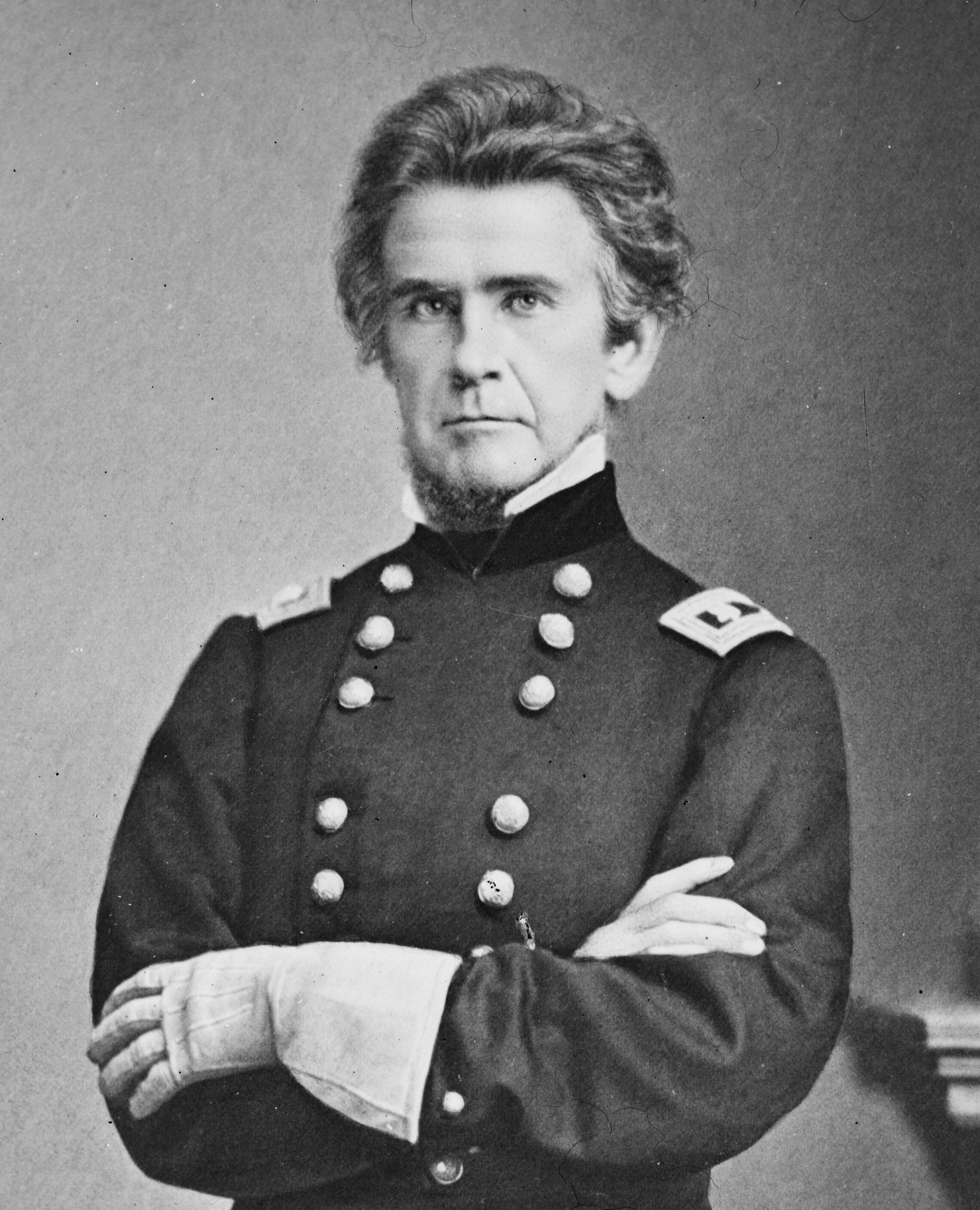
Major-General Ormsby MacKnight Mitchel, Commanding Officer, U.S. Department of the South and Tenth Corps, U.S. Army, circa 1862 (public domain).

On the heels of his army’s successful capture of Saint John’s Bluff, Florida and related events in early October 1862, Union Major-General Ormsby MacKnight Mitchel, commanding officer of the United States Army’s Department of the South, directed his senior staff and leadership of the U.S. Army’s Tenth Corps (X Corps) to intensify actions against the Confederate States Army and Navy in an effort to further disrupt the enemy’s ability to move troops and supplies throughout Florida, Georgia and South Carolina. As part of this directive, he engaged his senior officers in planning a new expedition — this time to Pocotaligo, South Carolina. According to Mitchel, preparations for that event began in earnest in mid-October, with an eye to the following objectives:

First, to make a complete reconnaissance of the Broad River and its three tributaries, Coosawhatchie, Tulifiny [sic], and Pocotaligo; second, to test practically the rapidity and safety with which a landing could be effected; third to learn the strength of the enemy on the main-land, now guarding the Charleston and Savannah Railroad; and fourth, to accomplish the destruction of so much of the road as could be effected in one day….

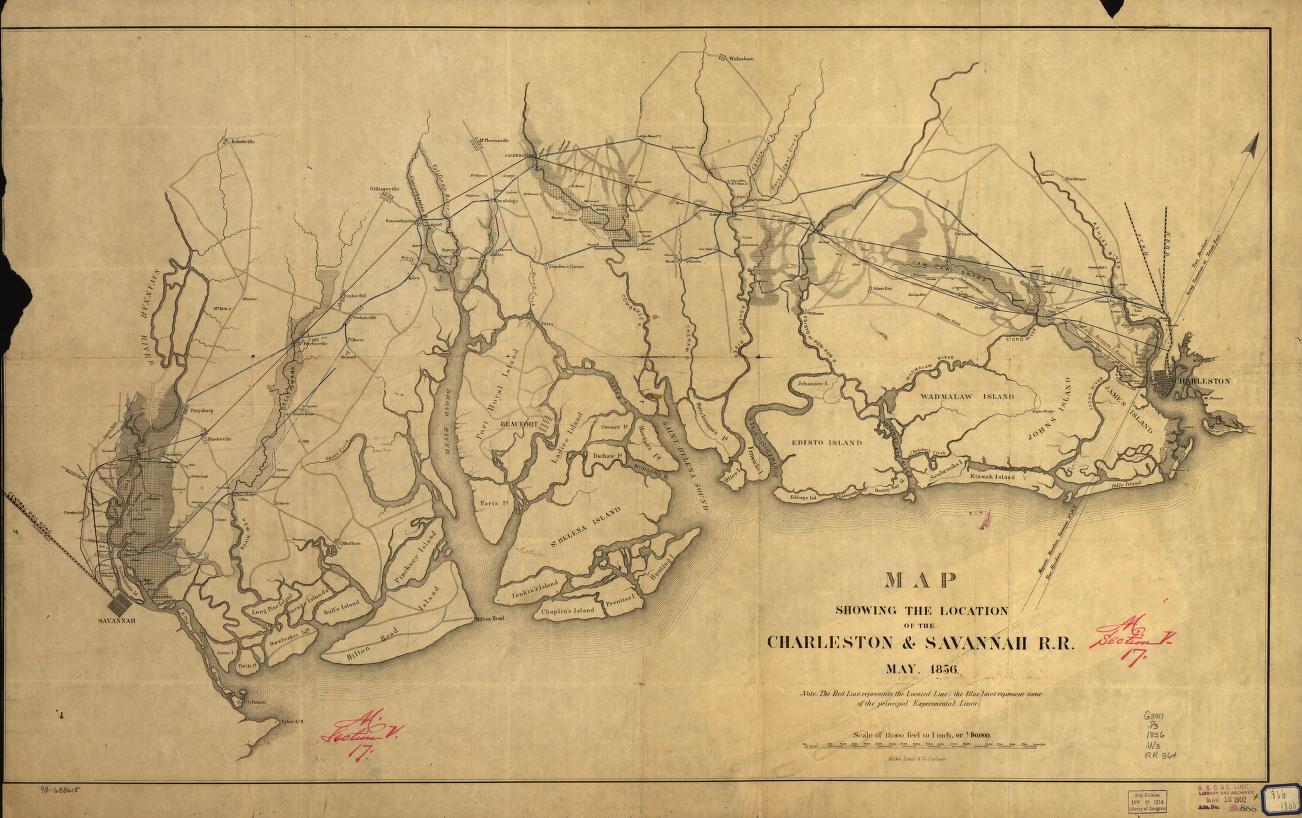
This 1856 map of the Charleston & Savannah Railroad shows the island of Hilton Head, South Carolina in relation to the town of Pocotaligo (U.S. Library of Congress, public domain; click to enlarge).

Mitchel then worked with his subordinate officers to determine how much of the U.S. Army’s Tenth Corps would take part in the expedition, assess the potential weak spots in his strategy and revise planning details to improve his soldiers’ likelihood of success:

The troops composing the expedition were the following: Forty-seventh Pennsylvania, 600 men; Fifty-fifth Pennsylvania, 400 men; Fourth New Hampshire, 600 men; Seventh Connecticut, 500 men; Third New Hampshire: 480 men; Sixth Connecticut, 500 men; Third Rhode Island, 300 men; Seventy-sixth Pennsylvania, 430 men; New York Mechanics and Engineers, 250 men; Forty-eighth New York, 300 men; one section of Hamilton’s battery and 40 men; one section of the First Regiment Artillery, Company M, battery and 40 men, and the First Massachusetts Cavalry, 100 men. Making an entire force of 4,500 men.

Every pains [sic] had been taken to secure as far as possible success for the expedition. Scouts and spies had been sent to the main-land to all the most important points between the Savannah River railroad bridge and the bridge across the Salkehatchie. A small party was sent out to cut, if possible, the telegraph wires. Scouts had been sent in boats up the tributaries of the Broad River. All the landings had been examined, and the depth of water in the several rivers ascertained as far as practicable. Two of our light-draught transports have been converted into formidable gunboats and are now heavily armed, to wit, The Planter and the George Washington. By my orders the New York Mechanics and Engineers, Colonel Serrell, had constructed two very large flat-boats, or scows, each capable of transporting half a battery of artillery, exclusive of the caissons, with the horses. They were provided with hinged aprons, to facilitate the landing not only of artillery but of troops from the transports.

Owing to an accident which occurred to the transport Cosmopolitan during the expedition to the Saint John’s River I found myself deficient in transportation, and applied to the commanding officer, Commodore Godon, of the South Atlantic Blockading Squadron, who promptly placed under my orders a number of light-draught gunboats for the double purpose of transportation and military protection.

The after cabin inside of the U.S. Steamer Ben Deford, c. 1860s (U.S. Library of Congress, public domain).

As planning progressed, details were firmed up regarding the Union Navy’s anticipated support. According to Mitchel:

On the evening of the 21st, under the command of Captain Steedman, U.S. Navy, the gunboats and transports were arranged in the following order for sailing: The Paul Jones, Captain Steedman, without troops; the Ben De Ford, Conemaugh, Wissahickon, Boston, Patroon, Darlington, steam-tug Relief, with schooner in tow; Marblehead, Vixen, Flora, Water Witch, George Washington, and Planter. The flat-boats, with artillery, were towed by the Ben De Ford and Boston. The best negro pilots which could be found were placed on the principal vessels, as well as signal officers, for the purpose of intercommunication. The night proved to be smoky and hazy, which produced some confusion in the sailing of the vessels, as signal lights could not be seen by those most remote from the leading ship. The larger vessels, however, got under way about 12 o’clock at night.

Union Army map, Pocotaligo-Coosawhatchie Expedition, 21-23 October 1862 (public domain; click to enlarge).

Mitchel and his leadership team also worked out the details of the expedition’s landing and debarkation plans, decided upon the weaponry they would need to disrupt and permanently disable the railroad tracks and the bridge at Pocotaligo and identified other possible actions to be undertaken by the expeditionary force:

After a careful examination of the map I ordered a landing to be effected at the mouth of the Pocotaligo River, at a place known as Mackay’s Point. This is really a narrow neck of land made by the Broad River and the Pocotaligo, in both of which rivers gunboats could lie and furnish a perfect protection for the debarkation and embarkation of the troops. There is a good country road leading from the Point to the old town of Pocotaligo, then entering a turnpike, which leads from the town of Coosawhatchie to the principal ferry on the Salkehatchie River. The distance to the railroad was only about 7 or 8 miles, thus rendering it possible to effect a landing, cut the railroad and telegraph wires, and return to the boats in the same day. I saw that it would be impossible for the troops to be attacked by the enemy either in flank or rear, as the two flanks were protected by the Pocotaligo River on the one hand and by the Broad and by the Tulifiny [sic, Tulifinny], its tributary, on the other. Presuming that the enemy would make his principal defense at or near Pocotaligo, I directed that a detachment of the Forty-eighth New York, under command of Colonel Barton, with the armed transport Planter, accompanied by one or two light-draught gunboats, should ascend the Coosawhatchie River, for the purpose of making a diversion, and in case no considerable force of the enemy was met, to destroy the railroad at and near the town of Coosawhatchie.

In addition to our land forces we were furnished by the Navy with several transports, armed with howitzers, three of which were landed with the artillery, and thus gave us a battery of seven pieces. All the troops were furnished with 100 rounds of ammunition. Two light ambulances and one wagon, with its team, accompanied the expedition.

The Integral Role of the 47th Pennsylvania

Design of the U.S. Army’s insignia for the Tenth (X) Army Corps, which would have been sewn onto uniforms of the 47th Pennsylvania Volunteer Infantry and displayed on a flag carried by the regiment during the Battle of Pocotaligo, South Carolina on 22 October 1862 (public domain).

The Union Army regiments selected for participation in the Pocotaligo expedition were part of the U.S. Army’s Tenth Corps (X Corps), which was part of the U.S. Army’s larger Department of the South, which was headquartered at Hilton Head, South Carolina and oversaw Union military operations in Florida, Georgia and South Carolina during this time. Established on 13 September 1862, the Tenth Corps served under the command of Union Major-General Ormsby MacKnight Mitchel from the time of its founding until his death from yellow fever on 30 October of that same year. It was then placed under the command of Brigadier-General John Milton Brannan, who had also assumed command of the U.S. Army’s Department of the South, a position he held until 21 January 1863.

Among the regiments attached to the U.S. Army’s Tenth Corps in the U.S. Department of the South during fall of 1862 was the 47th Pennsylvania Volunteer Infantry, which would later make history as the only regiment from Pennsylvania to participate in the Union’s 1864 Red River Campaign across Louisiana. The 47th Pennsylvania, which had been founded on 5 August 1861 by Colonel Tilghman H. Good, remained under Colonel Good’s command. Regimental operations were also overseen by Good’s second-in-command, Lieutenant-Colonel George Warren Alexander.

As preparations continued to be refined, Brigadier-General Brannan determined, in his new role as commanding officer of the expedition, that he would need one of his subordinate officers to take his place on the field as the expedition began. He chose Colonel Good of the 47th Pennsylvania Volunteers, who would go on to become a three-time mayor of Allentown, Pennsylvania after the war. Good then placed Lieutenant-Colonel Alexander in direct command of the 47th Pennsylvania. A New Hampshire native, Alexander had served as captain of the Reading Artillerists in Berks County, Pennsylvania prior to the war; post-war, he founded G. W. Alexander & Sons, a renowned hat manufacturing company that was based in West Reading.

What all of those Union Army infantrymen did not know at the time they boarded their respective transport ships on 21 October 1862 was that they would soon been engaged in combat so intense that the day would come to be described in history books more than a century later as the Second Battle of Pocotaligo (or the Battle of Yemassee, due to its proximity to the town of Yemassee, South Carolina).

This encounter between the Union and Confederate armies would unfold on 22 October 1862 between Savannah, Georgia and Charleston, South Carolina on the banks of the Pocotaligo River in northern Beaufort County, South Carolina.

Next: The Second Battle of Pocotaligo


Sources:

  1. “General Orders, Hdqrs., Department of the South, Numbers 40, Hilton Head, Port Royal, S. C., September 17, 1862” (announcement by Major-General Ormsby M. Mitchel that he has assumed command of the newly formed Department of the South), in The War of the Rebellion: A Compilation of the Official Records of the Union and Confederate Armies. Prepared Under the Direction of the Secretary of War, By Lieut. Col. Robert N. Scott, Third U.S. Artillery, and Published Pursuant to Act of Congress Approved June 16, 1880, Series I, Vol. XIV, Serial 20, p. 382. Washington, D.C.: Government Printing Office, 1885.
  2. “Report of Maj. Gen. Ormsby M. Mitchel, U.S. Army, commanding Department of the South and Return of Casualties in the Union forces in the skirmish at Coosawhatchie and engagements at the Caston and Frampton Plantations, near Pocotaligo, S.C., October 22, 1862,” in The War of the Rebellion: A Compilation of the Official Records of the Union and Confederate Armies. Prepared Under the Direction of the Secretary of War, By Lieut. Col. Robert N. Scott, Third U.S. Artillery, and Published Pursuant to Act of Congress Approved June 16, 1880, Series I, Vol. XIV. Washington, D.C.: Government Printing Office, 1885.

In Their Own Words: The Vocabulary of the 47th Pennsylvania Volunteer Infantry (“Skedaddle”)

Image: Definition of “Skedaddle,” a term frequently used by the 47th Pennsylvania Volunteers when describing Confederate troop movements during the American Civil War (fair use screenshot, courtesy of Merriam Webster, 2022).

“Skedaddle” or “skedaddling”:  Words frequently used by officers and enlisted members of the 47th Pennsylvania Volunteer Infantry to describe the behavior of Confederate States Army troops unfortunate enough to encounter the 47th Pennsylvania during the American Civil War. (See also: bolt, flee, hightail it, run away, and retreat.)

Example (October 1862):

“After my arrival at the bluff, it being then 7:30 o’clock, I dispatched Lieutenant-Colonel Alexander with two companies back to the last-named camp (which I found, from a number of papers left behind, to have been called Camp Hopkins and occupied by the Milton Artillery, of Florida) to reconnoiter and ascertain its condition. Upon his return he reported that from every appearance the skedaddling of the enemy was as sudden as in the other instances already mentioned, leaving their trunks and all the camp equipage behind; also a small quantity of commissary stores, sugar, rice, half barrel of flour, one bag of salt, &c., including 60 tents, which I have brought in this morning. The commissary stores were used by the troops of my command.”

— Colonel Tilghman H. Good in his report to Union Army superiors from the 47th Pennsylvania’s encampment at Saint John’s Bluff, Florida, 3 October 1862

To learn more about the involvement of the 47th Pennsylvania Volunteer Infantry and other Union troops in the capture of Saint Johns Bluff, Florida, visit the Official Battle and Campaign Reports section of our website.

The Demographics of the 47th Pennsylvania Volunteer Infantry

Lieutenant-Colonel George Warren Alexander, second-in-command, 47th Pennsylvania Volunteer Infantry, with officers from the 47th at Fort Jefferson in the Dry Tortugas, Florida, circa 1863 (public domain).

Recruited primarily at community gathering places in their respective hometowns, the majority of soldiers who served with the 47th Pennsylvania Volunteer Infantry were enrolled at county seats or other large population centers within the Commonwealth of Pennsylvania.

The youngest member of the regiment was a 12-year-old drummer boy; the oldest was a 65-year-old, financially successful farmer who would attempt to re-enlist, at the age of 68, after being seriously wounded while protecting the American flag in battle.

Roughly 70 percent were residents of Pennsylvania’s Lehigh Valley, including the cities of Allentown, Bethlehem and Easton and surrounding communities in Lehigh and Northampton counties. Company C, which was formed primarily of men from Northumberland County, was more commonly known as the “Sunbury Guards.” Company D and Company H were staffed largely by men from Perry County. Company K was formed with the intent of creating an “all-German” company that would be composed of German-Americans and German immigrants.

In point of fact, a number of the 47th Pennsylvania Volunteers were immigrants or first-generation Americans. A significant percentage of each of the regiment’s companies were men whose families still spoke German or “Pennsylvania Dutch” at their homes and churches more than a century after their ancestors emigrated from Germany in search of religious or political freedom. Others traced their roots to Ireland; one had been born on Spain’s Canary Islands, and at least two were natives of Cuba.

In early October of 1862, several African American men who had been freed from enslavement on plantations near Beaufort, South Carolina, joined the ranks of the 47th Pennsylvania, followed by the April 1864 enrollment of other formerly enslaved men in Natchitoches, Louisiana.

Their final resting places span the nation, from Maine to California and from the State of Washington to Florida.


Alpha and Omega: The First and Last Duty Stations of the 47th Pennsylvania Volunteer Infantry

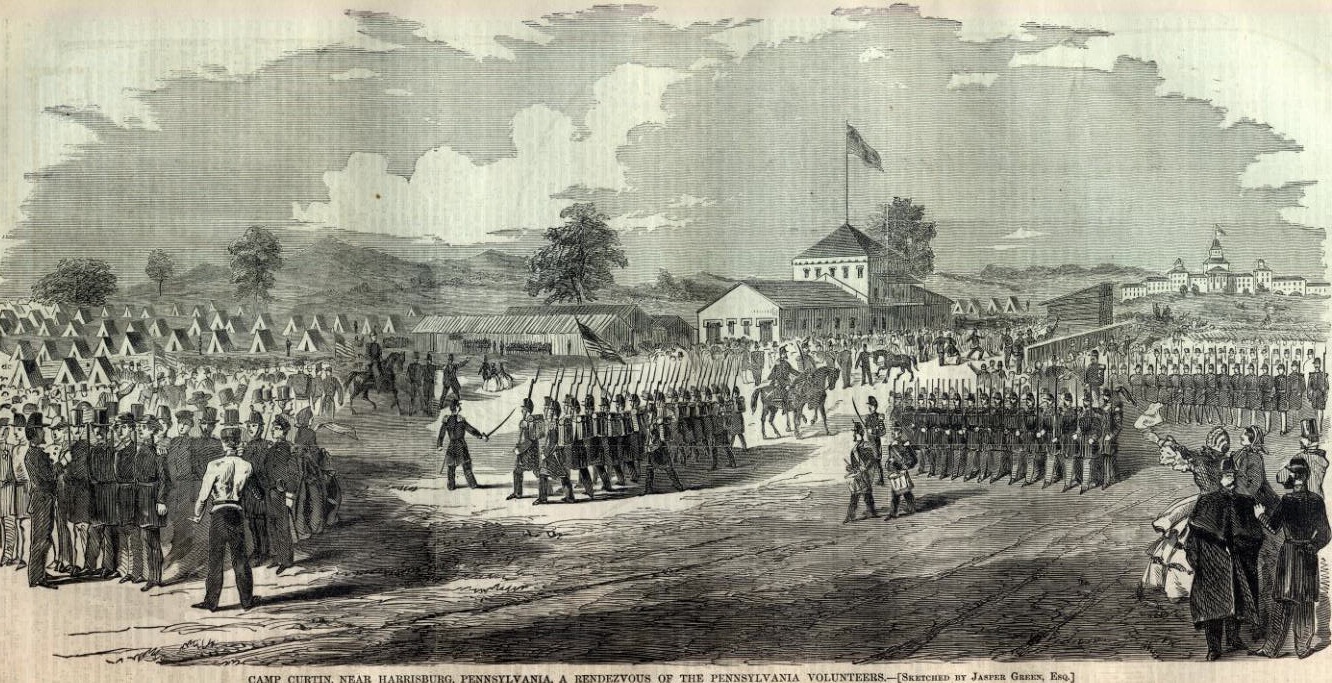
Camp Curtin (Harper’s Weekly, 1861; public domain).

Established just north of the Pennsylvania State Capitol building in Harrisburg by Pennsylvania’s Civil War-era governor, Andrew Gregg Curtin, on April 18, 1861—just three days after the fall of Fort Sumter to Confederate States Army troops—and initially named “Camp Union,” Camp Curtin was a key staging and training point for the United States Army at the dawn of the American Civil War. Within a few short months of its creation on eighty acres of land that had previously been used for Dauphin County’s Agricultural Fairgrounds, this camp site became the largest military facility in Pennsylvania and the nation during the war.

It was here, in mid-August of 1861, that new recruits and seasoned soldiers, who had just recently completed their Three Months’ duty, came together to form the newly-created 47th Pennsylvania Volunteer Infantry

After completing weeks of grueling, basic training in light infantry tactics, the members of the 47th Pennsylvania were personally given their regiment’s First State Color by Governor Curtin on September 20, 1861. An American flag emblazoned with the regiment’s state name and volunteer unit number, that flag was kept safe by the regiment’s color-bearer unit, Company C, from that moment until the regiment returned home to Pennsylvania nearly five long years later.

Camp Cadwalader and the German Hospital, 1876 (David Johnston Kennedy, courtesy of the Historical Society of Pennsylvania, public domain).

Arriving at Camp Cadwalader in Philadelphia in early 1866, the majority of the surviving 47th Pennsylvania Volunteers were given their final discharge papers on January 9, 1866, after having been officially mustered out from the regiment at its duty station in Charleston, South Carolina on Christmas Day in 1865.

This latter camp was named after Major-General George Cadwalader (1806-1879), a native of Philadelphia who had been appointed by Governor Curtin as Major-General of the Pennsylvania Volunteers at the beginning of the American Civil War.

To learn more about each of these Union Army facilities, read these camp profiles:

Learn More About the 47th Pennsylvania Volunteers

First State Color, 47th Regiment, Pennsylvania Volunteer Infantry (presented to the regiment by Pennsylvania Governor Andrew Curtin, 20 September 1861; retired 11 May 1865, public domain).

Largely forgotten by mainstream historians, the 47th Pennsylvania Volunteer Infantry was a Union Army unit which served for nearly the entire duration of the American Civil War. Formed by the fruit of the Great Keystone State’s small towns and cities, the regiment was born on August 5, 1861, when its founder, Tilghman H. Good, received permission from Pennsylvania Governor Andrew Gregg Curtin to form an entirely new regiment in response to President Abraham Lincoln’s call for additional volunteers to help preserve American’s Union. It ended its service during the early months of the nation’s Reconstruction Era, officially mustering out at Charleston, South Carolina on Christmas Day in 1865, its members receiving their final discharge papers at Camp Cadwalader in Philadelphia, Pennsylvania in early January of 1866.

Along the way, the 47th Pennsylvania made history, becoming an integrated regiment in 1862 and the only regiment from Pennsylvania to participate in the Union’s 1864 Red River Campaign across Louisiana. Its members also distinguished themselves in battle, repeatedly, including during Union General Philip Sheridan’s Shenandoah Valley Campaign, which unfolded between August and December of 1864.

Learn more about key moments in this regiment’s history by reading the following posts:

1861:

1862:

1863:

1864:

1865:

New Website Tells the Story of Nine Black Soldiers of the American Civil War

Largely forgotten for more than a century after honorably completing their historic military service during the American Civil War, nine formerly enslaved Black men who enlisted with the 47th Pennsylvania Volunteer Infantry have been repeatedly overlooked by mainstream historians over the years as potentially important subjects for research and have also been an ongoing source of mystery and frustration to their descendants because the majority of their military service records have still not been digitized by state and national archives.

Until now.

Thanks to a special initiative of 47th Pennsylvania Volunteers: One Civil War Regiment’s Story,” researchers have been locating and digitizing a wide range of local, state and federal records over the past five years—records that have uncovered critical details about the lives of each of these nine Black soldiers—four of whom were from South Carolina, five of whom were from Louisiana/Mississippi.

“Many of these documents hold the potential to help family history researchers feel closer to their Civil War-era ancestors while also enabling historians, teachers, students, American History enthusiasts, and Civil War buffs to deepen their understanding of one of the most painful chapters in the American narrative,” explains Laurie Snyder, the founder of and managing editor for the project. “One soldier’s U.S. Civil War Pension file revealed the name of his father and wife, as well as the surname of the family in Louisiana that had enslaved him prior to the Civil War while the U.S. Freedmen’s Bureau records for a second man shined a light on what his life was like after the war ended.”

It was this newly uncovered data that led Snyder to create a new website to make these records easily available, free of charge, for researchers and the general public. That website, “Freedmen of the 47th Pennsylvania Volunteer Infantry,” launched on Labor Day weekend 2022, and is already receiving positive reviews.

“We’re still in the process of adding records to the site, and will continue to do so throughout the next year as more records are found and digitized, but the data contained in these records is so important that I wanted to make the documents we’ve already amassed available now so that historians at colleges and universities across the United States and educators teaching history in middle and high school classrooms across Pennsylvania, Louisiana, Mississippi, and South Carolina can begin making use of the site this fall.

About “Freedmen of the 47th Pennsylvania Volunteer Infantry”

“Freedmen of the 47th Pennsylvania Volunteer Infantry” is a special educational initiative dedicated to researching, documenting and presenting the life stories of nine formerly enslaved Black men who enlisted with the 47th Pennsylvania Volunteer Infantry during two of the regiment’s most eventful years of service to the nation during the American Civil War—1862 and 1864.

About the 47th Pennsylvania Volunteer Infantry

Recruited primarily at community gathering places in their respective hometowns, the soldiers who served with the 47th Pennsylvania Volunteer Infantry were primarily men of German heritage whose families still spoke German or “Pennsylvania Dutch” more than a century after their ancestors emigrated from Germany in search of religious and political freedom. Still others were recent immigrants from Germany, Ireland and Cuba. Formerly enslaved Black men who had been freed by the regiment from plantations in South Carolina and Louisiana were added to regimental rosters in 1862 and 1864.

In addition to fighting in the battles of Sabine Cross Roads/Mansfield, Pleasant Hill and Monett’s Ferry/Cane River during the Red River Campaign, the 47th Pennsylvania Volunteers also engaged in the defense of Washington, D.C. in 1861 and again in 1865, following the assassination of President Abraham Lincoln; the capture of Saint John’s Bluff, Florida and Battle of Pocotaligo, South Carolina (1862); the garrisoning of Forts Taylor and Jefferson in Key West and the Dry Tortugas, Florida (1863); Union Major-General Philip Sheridan’s tide-turning Shenandoah Valley Campaign (1864), including the battles of Berryville, Opequon, Fisher’s Hill, and Cedar Creek; and provost (military police) and Reconstruction duties in Savannah, Georgia and Charleston, South Carolina (1865). Most were finally released from duty when the regiment formally mustered out on Christmas Day in 1865.

Learn More and Support

To learn more about the 47th Pennsylvania Volunteers and lend your support to this historic initiative, visit the websites of 47th Pennsylvania Volunteers: One Civil War Regiment’s Story and Freedmen of the 47th Pennsylvania Volunteer Infantry,” and follow the project’s updates on Facebook, Instagram and YouTube.

On Detached Duty: Attempting to Repair the Cape Florida Lighthouse, Key Biscayne, Florida (April 1862)

Cape Florida Lighthouse, Key Biscayne, Florida, circa 1996 (courtesy of the Florida Memory Project, public domain).

Erected roughly a year after the U.S. Government purchased the Florida barrier island where the present-day community of Key Biscayne is located, the Cape Florida Lighthouse was built in 1822 by an act of the U.S. Congress, which wanted to ensure that “shipping in the hazardous straits of Florida” would be protected, according to the Florida Association of Museums:

The first lighting occurred on December 17, 1825. In July 1836, an Indian attack in the early months of the Second Seminole War resulted in heavy damage to the tower. Rebuilt in 1846, the tower was heightened to 95 feet in 1855…. With the advent of the Civil War, Confederate sympathizers overwhelmed the lighthouse keeper in August 1861, damaged the central prism, and removed the reflector, rendering the lamp too dim for visibility by ships.

Just under a year later, a detachment of soldiers from the 47th Pennsylvania Volunteer Infantry was ordered to leave its garrison at Fort Taylor in Key West and head for the island where the Cape Florida Lighthouse was located. According to the Florida Association of Museums:

In April 1862, a group of carpenters accompanied by troops of the 47th Pennsylvania Infantry were sent to repair the lighthouse by Union authorities. [But] they found the damage to be too extensive to repair, and the lighthouse remained darkened for the duration of the war. Lighthouse service was restored on April 15, 1866. Service was discontinued in 1878.

Although those 47th Pennsylvanians were ultimately unsuccessful, the lighthouse is still considered to be an important piece of the regiment’s history because it served as a key point of reference for the officers and enlisted members of the 47th Pennsylvania Volunteer Infantry as they traveled back and forth between South Carolina and Florida for various military expeditions during 1862 and 1863—and from New Orleans to Washington, D.C., as the regiment returned from duty in the Union’s Red River Campaign across Louisiana to the Eastern Theater of war for participation in Major-General Philip H. Sheridan’s 1864 Shenandoah Valley Campaign in Virginia. An 1863 diary entry penned by Private Henry J. Hornbeck, provides an example of one such reference:

Thursday February 26th, at sea…. Running very near coast all day. Today being Wm. Ginkinger’s birthday, I took dinner with him at the table. Had a splendid dinner consisting of roast duck & the &c. Lighthouse in sight at 3 p.m. Passed Cape Florida Lighthouse at 4 p.m. At 9 p.m. passed Carysfort Lighthouse. Retired at 9:30. Sea rough.


Sources:

  1. “Cape Florida Lighthouse,” in Florida Civil War Heritage Trail,” p. 70. Tallahassee, Florida: Florida Association of Museums, retrieved online 7 August 2022.
  2. History of Island of Key Biscayne,” in “About Key Biscayne.” Key Biscayne, Florida: Village of Key Biscayne, retrieved online 7 August 2022.
  3. Schmidt, Lewis G. A Civil War History of the 47th Regiment of Pennsylvania Veteran Volunteers. Allentown, Pennsylvania: Self-published, 1986.
  4. Staubach, Lieutenant Colonel James C. “Miami During the Civil War: 1861-65,” in Tequesta: The Journal of the Historical Association of Southern Florida, Vol. LIII, pp. 31-62. Miami, Florida: Historical Museum of Southern Florida, 1993.


Research Update: More New Details Regarding the Lives of Formerly Enslaved Black Men Who Enlisted with the 47th Pennsylvania Volunteer Infantry

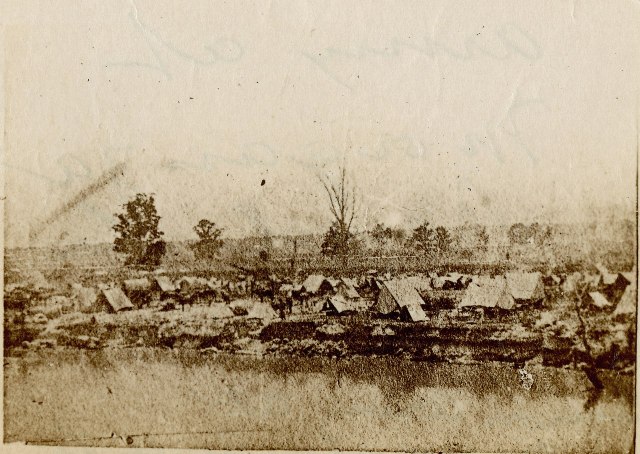
Union Army at Morganza Bend, Louisiana, c. 1863-1865_USLOC, pubdom

Union Army base at Morganza Bend, Louisiana, circa 1863-1865 (U.S. Library of Congress, public domain).

Researchers investigating the lives of nine formerly enslaved Black men who enlisted with the 47th Pennsylvania Volunteer Infantry during the American Civil War recently uncovered new details about two of those soldiers.

In addition to finding more data related to the immediate post-war life of Aaron French (learn more about him in this article here), including how and why he ended up settling in Mississippi following the Civil War, researchers have also now found important information about the life of Hamilton Blanchard—who enrolled with Bullard on the same day.

Born into slavery in Natchitoches, Louisiana sometime around 1843, Hamilton Blanchard was able to secure his freedom twenty-one years later when the United States Army arrived in town as part of an expedition led by Union Major-General Nathaniel P. Banks. Determined not to be forced back into bondage after the Union troops moved on in their ill-fated quest to capture the city of Shreveport, he chose to enlist with one of the units serving under Banks—the 47th Pennsylvania Volunteer Infantry—the only regiment from Pennsylvania that was involved in the Union’s 1864 Red River Campaign across Louisiana.

After enrolling in the military, Hamilton Blanchard was then assigned to Company D at the rank of “Cook” on 5 April 1864.

Crop_Bullard, Aaron and Hamilton Blanchard_Co. D, 47th PA_Muster Roll

Muster roll entries for Aaron Bullard and Hamilton Blanchard, Company D, 47th Pennsylvania Volunteers (U.S. National Archives, public domain).

The official muster-in of Blanchard, Aaron Bullard, and three other young Black men who enrolled that day did not take place immediately, however, because the 47th Pennsylvania Volunteers were ordered to move out shortly after their arrival, and were quickly drawn into intense combat with enemy troops commanded by Confederate Major-General Richard Taylor (a plantation owner and son of Zachary Taylor, former President of the United States). Battered badly during the Battle of Sabine Cross Roads near Mansfield, Louisiana on 8 April and in the Battle of Pleasant Hill the next day (9 April), they fought the Confederate Army again on 23 April near Monett’s Ferry in the Battle of Cane River and on 16 May in the Battle of Mansura near Marksville.

Continuing on toward the southeastern part of Louisiana, the 47th Pennsylvania Volunteers marched for Morganza, which had been held in Union hands since the fall of 1863 and was now the site of a major Union Army encampment. While there, the officers of the 47th Pennsylvania Volunteer Infantry officially mustered in all nine of the formerly enslaved Black men who had enlisted with the 47th Pennsylvania in Beaufort, South Carolina (1862) and Natchitoches, Louisiana (April 1864)—a process which took place between 20-24 June 1864.

From that point on, those nine men traveled with the 47th Pennsylvania as it returned to the East Coast and engaged in multiple battles associated with Union Major-General Philip Sheridan’s 1864 Shenandoah Valley Campaign across Virginia, the protection of the nation’s capital following the April 1865 assassination of President Abraham Lincoln, and the early days of Reconstruction in Georgia and South Carolina.

On Christmas Day in 1865, Hamilton Blanchard then joined his fellow 47th Pennsylvania Volunteers in mustering out from their final duty station in Charleston, South Carolina.

Post-War Life

Having been honorably discharged from the 47th Pennsylvania Volunteer Infantry when the regiment mustered out, at least two of the nine formerly enslaved Black men who had enlisted with the regiment evidently made their way north—possibly when the other members of their former regiment returned home to Pennsylvania. (It is also possible, however, that they made the journey independently of their former regiment because both men appear to have resettled in the Washington, D.C. area, post-war, while the other 47th Pennsylvania Volunteers were transported by ship directly to New York City and then by train to Camp Cadwalader in Philadelphia, Pennsylvania, where they were given their final discharge papers on 9 January 1866.)

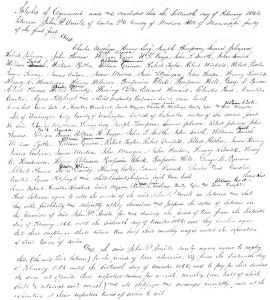
Blanchard-Bullard_Madison Co., MS_Freedmen's Bureau Contract, Feb-Dec 1866, p. 1

Freedmen’s Bureau contract between Madison County, Mississippi farm owner John P. Arvile [sic] and farm laborers Hamilton Blanchard, Aaron Bullard, et. al., Washington, D.C., 16 February 1866 (excerpt, p. 1, U.S. National Archives).

What is known for certain is that Hamilton Blanchard and Aaron Bullard made contact with a representative of the Bureau of Refugees, Freedmen, and Abandoned Lands sometime in late 1865 or early 1866. They then signed a contract with the Freedmen’s Bureau during the early winter of 1866 in which they both agreed to join a large group of formerly enslaved Black men, women, and children who would be providing farm labor to a man named John P. Avrill (alternate spellings: “Averile”, “Averill”, “Arvile”, “Arville”, or “Avrille”) at his property in Canton, Madison County, Mississippi.

That Freedmen’s Bureau contract was slated to be in effect between 16 February and 16 December of 1866, and begins with a cover page which states:

Washington D.C.
February 1866
Contract No.
John P. Arvill
With (66) Freedmen

John Arville
Contract with
46 Farm Hands

The main body of the document goes on to reveal the following details of the contract:

Articles of Agreement made and concluded this the Sixteenth day of February 1866 between John P. Arvile of Canton P.O. County of Madison State of Mississippi party of the first part and

Charles Matthews, Henry Long, Joseph Thompson, Samuel Johnson, Robert Johnson, John Thomas … Charles Ford, Caroline Carter, Agnes Fitzhugh and child (infant), Benjamin Smith, Anna Smith, Thomas Reed [sp?], Aaron Bullard, Hamilton Blanchard, Isaiah Wiggins, James Lewis, Charles K. [illegible], Baily Taylor, William Carter, and Andy Hampton [sp?].

The next paragraph lists Hamilton Blanchard and Aaron Bullard a second time, along with multiple names from the aforementioned group of farm laborers. Subsequent paragraphs spell out further points of the agreement:

All of Washington City, County of Washington, District of Columbia, parties of the second part, the said Charles Matthews, Henry Long, Joseph Thompsen, Samuel Johnson, Robert Johnson, John Thomas … Aaron Bullard, Hamilton Blanchard, Isaiah Wiggins, James Lewis … Field Laborers, agree to enter the service of the said John P. Averile as Laborers and that they will faithfully and diligently apply themselves and perform the duties of Laborers on the premises of said John P. Averile for and during the period of time from the Sixteenth day of February 1866 until the sixteenth day of 1866; and they further agree that their employer shall retain one half their monthly wages until the expiration of their term of service.

And the said John P. Arvile hereby agrees to employ them (the said Field laborers) for the period of time aforesaid. Viz from the Sixteenth day of February 1866 until the sixteenth day of December 1866; and to pay for their services the sum set opposite their respective names per month, monthly (one half of which shall be retained each month) and all stoppages and arranged promptly, paid at the expiration of their respective terms of service to wit…..

In equal monthly payments; and the said John P. Arvile further agrees to furnish said Freed laborers … quarters, fuel, full substantial and healthy rations, and all necessary attendance and supplies in case of sickness, in addition to the compensation … named, and that he will assist and encourage efforts for the education of the children of his employees, and it is further agreed by the said John P. Arvile, that in case he at any time fails to perform his part of this contract agreement he will pay to each of the said laborers the full sum of One hundred and twenty dollars [strikethrough made by someone’s hand to original contract], as fixed, agreed and liquidated damages. This contract can be annulled by the mutual consent of the Employer and the employee, but only in the presence of an Authorized Agent of the Bureau of Refugees Freedmen and Abandoned Lands and such annullment [sic] on the part of the Employer and anyone [sic] employee shall in no wise affect the validity of the Contract in respect to the employer and the other employees and should either party violate this contract then the other party shall make complaint to the nearest authorized agent of the Bureau Refugees Freemen & Abandoned Lands.

The contract continues on, specifying that both Aaron Bullard and Hamilton Blanchard were to each be paid a wage of $10 per month, and stating that some of the other men on the list would be paid as much as $12 per month while others would be paid $8 per month. (Teenaged boys and women on the list were to be paid even less—$6 per month.)

In all cases, the reality was far different. Per the contract, they were initially paid only half of what their monthly wages were because the Freedmen’s Bureau agent in charge of looking out for the welfare of these formerly enslaved men, women, and children allowed the white farmer—their “employer”—to “retain one half their monthly wages until the expiration of their term of service.”

No further data has been uncovered from Freedmen’s Bureau records about the status of those unpaid wages or the outcome of that contract, but because these Black men, women, and children were essentially returned to an unequal system of servitude by the Freedmen’s Bureau agent (as evidenced by the manner in which this contract was drafted—favoring the White “employer” over the Black “field laborer” and including multiple after-the-fact revisions, such as word insertions and strikethroughs)—it is highly unlikely that Hamilton Blanchard, Aaron Bullard, or the other Black men, women, and children mentioned in the contract were ever paid the full amount they were entitled to for what was most assuredly very hard labor.

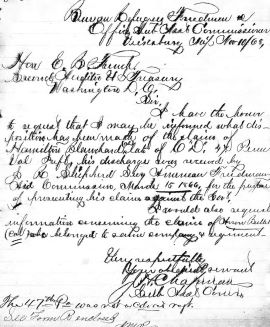
Blanchard-Bullard-Chapman_Treasury Inquiry, 10 Nov 1866

Letter of inquiry from J. H. Chapman on behalf of Hamilton Blanchard to E. B. French, second auditor, U.S. Treasury Department, 10 November 1868 (Freedmen’s Bureau records, U.S. National Archives). 

This hypothesis posed by researchers investigating the history of the 47th Pennsylvania Volunteer Infantry is backed up by a letter of inquiry penned on 10 November 1868 by J. H. Chapman, a Sub-Assistant Commissioner of the Freedmen’s Bureau working at an office in Vicksburg, Mississippi, to E. B. French, Second Auditor of the U.S. Department of the Treasury in Washington, D.C.

In this letter, Chapman asks French that he “be informed what disposition has been made of the claim of Hamilton Blanchard, late of Co. “D” 47 Penn Vol. Inft., his discharge was received by J. R. Schuchard [sp?]” of the “Freedmen’s Aid Commission, March 15, 1866.” Chapman added that he was requesting this update on Blanchard’s behalf “for the purpose of prosecuting his claim against the Gov.” He then also requested “information concerning the claim of Aaron Bullard (Col.) who belonged to same company & regiment.”

* Note: An unidentified individual added an undated notation to the bottom of this letter in handwriting that is clearly different from that of the original letter writer, Chapman. That notation correctly states: “The 47th Pa was not a colored regt. See Form R enclosed. A.M.R. 103.” (The 47th Pennsylvania Volunteer Infantry became an integrated regiment on 5 October 1862, but its African American members were not considered to be part of the U.S. Colored Troops, also known as the USCT.)

Researchers have not yet located the “Form R” referred to in the notation to Chapman’s letter, but will be pursuing this lead, as well as investigating the claims filed by Hamilton Blanchard and Aaron Bullard, and searching for additional information regarding what happened to Hamilton Blanchard during and after the 1870s. 

An additional avenue of inquiry will be the potential relationship that may have developed between Aaron Bullard and E. B. French during or after this time—a new theory being considered in light of the discovery of French’s name on this letter. (Aaron Bullard changed his surname, “Bullard,” which had been associated with his enslavement in Louisiana, to “French” sometime between his 1868 appeal to E. B. French in the U.S. Treasury Department and the day he was visited at home in Issaquena County, Mississippi by an enumerator of the 1870 U.S. Census—possibly indicating that he wanted to both shed his “slave name” and honor someone who had been helpful to him.)

Sources:

  1. Bates, Samuel P. History of Pennsylvania Volunteers, 1861-5, vol. 1. Harrisburg, Pennsylvania: B. Singerly, State Printer, 1869.
  2. Civil War Muster Rolls, in Records of the Department of Military and Veterans’ Affairs (Record Group 19, Series 19.11). Harrisburg, Pennsylvania: Pennsylvania Historical and Museum Commission, 1861-1865.
  3. Civil War Veterans’ Card File. Harrisburg, Pennsylvania: Pennsylvania State Archives.
  4. “Records of the Field Offices for the District of Columbia, Bureau of Refugees, Freedmen, and Abandoned Lands, 1865-1870” (NARA Series Number: M1902; NARA Reel Number: 18; NARA Record Group Number: 105; NARA Record Group Name: Records of the Bureau of Refugees, Freedmen, and Abandoned Lands, 1861 – 1880; Collection Title: District of Columbia Freedmen’s Bureau Field Office Records 1863-1872: Aaron Bullard and Hamilton Blanchard, 1866 and 1868). Washington, D.C.: U.S. National Archives and Records Administration.
  5. Schmidt, Lewis. A Civil War History of the 47th Regiment of Pennsylvania Veteran Volunteers. Allentown, Pennsylvania: Self-published, 1986.
  6. Wharton, Henry D. Letters from the Sunbury Guards. Sunbury, Pennsylvania: Sunbury American, 1861-1868.

Black History Month: New Details Uncovered Regarding the Formerly Enslaved Black Men Who Enlisted with the 47th Pennsylvania Volunteer Infantry

Research regarding the lives of the nine formerly enslaved Black men who enlisted with the 47th Pennsylvania Volunteer Infantry in 1862 and 1864 has continued to progress—even in the middle of a pandemic that has forced the closure of numerous local, state, and national archives.*

In addition to uncovering details about the life of the soldier from South Carolina who was mistakenly listed on muster rolls for the 47th Pennsylvania as “Presto Gettes” (learn more about him in this article here), researchers for 47th Pennsylvania Volunteers: One Civil War Regiment’s Story have been able to determine more about what happened to two of the other men post-war, and have also located records which seem to indicate that there may have been two or three other Black men who enlisted with the regiment (potentially bringing the total number of Black enlistees in the regiment to twelve).

Aaron French (enlisted as Aaron Bullard):

Muster roll entries for Aaron Bullard and Hamilton Blanchard, Company D, 47th Pennsylvania Volunteers (U.S. National Archives, public domain).

1864 was a life-changing year for Aaron Bullard and four other young Black men in Louisiana. After enlisting with the 47th Pennsylvania Volunteer Infantry on April 5 while the 47th was stationed at Natchitoches, Louisiana, Samuel Jones, Hamilton Blanchard (also known as John Hamilton), and Aaron, James, and John Bullard traveled with the 47th Pennsylvania as it participated in the multiple battles associated with the Union’s 1864 Red River Campaign across Louisiana. On or about June 22, they were formally mustered into the regiment at Morganza, Louisiana.

Sometime later (possibly post-war), Aaron Bullard changed his surname to French. After the American Civil War, he married, became a land-owning farmer—and a dad.

Post-Civil War, Aaron French and his family resided in Issaquena County, Mississippi (U.S. Census, 1870, public domain).

In August of 1870, Aaron French and his wife, Amanda, lived with their eight-month-old daughter, “Simpy” (also known as Cynthia or Cyntha) in Skipworth Precinct, Issaquena County, Mississippi. Still residing in Issaquena County a decade later when the June 1880 federal census was taken, Aaron and Amanda were the proud parents of three daughters: Cynthia (who would go on to marry Samuel L. Dixon on March 20, 1890), Jesanna (also known as Jessie/Jesse), and “Arctavia” (also known as Octavia). Jessie, who later went on to wed John B. Cobb on January 28, 1892, made a life with her husband and son in Mayersville, Mississippi, where she was a teacher in the local schools. Octavia married Frank Childress on March 20, 1894.

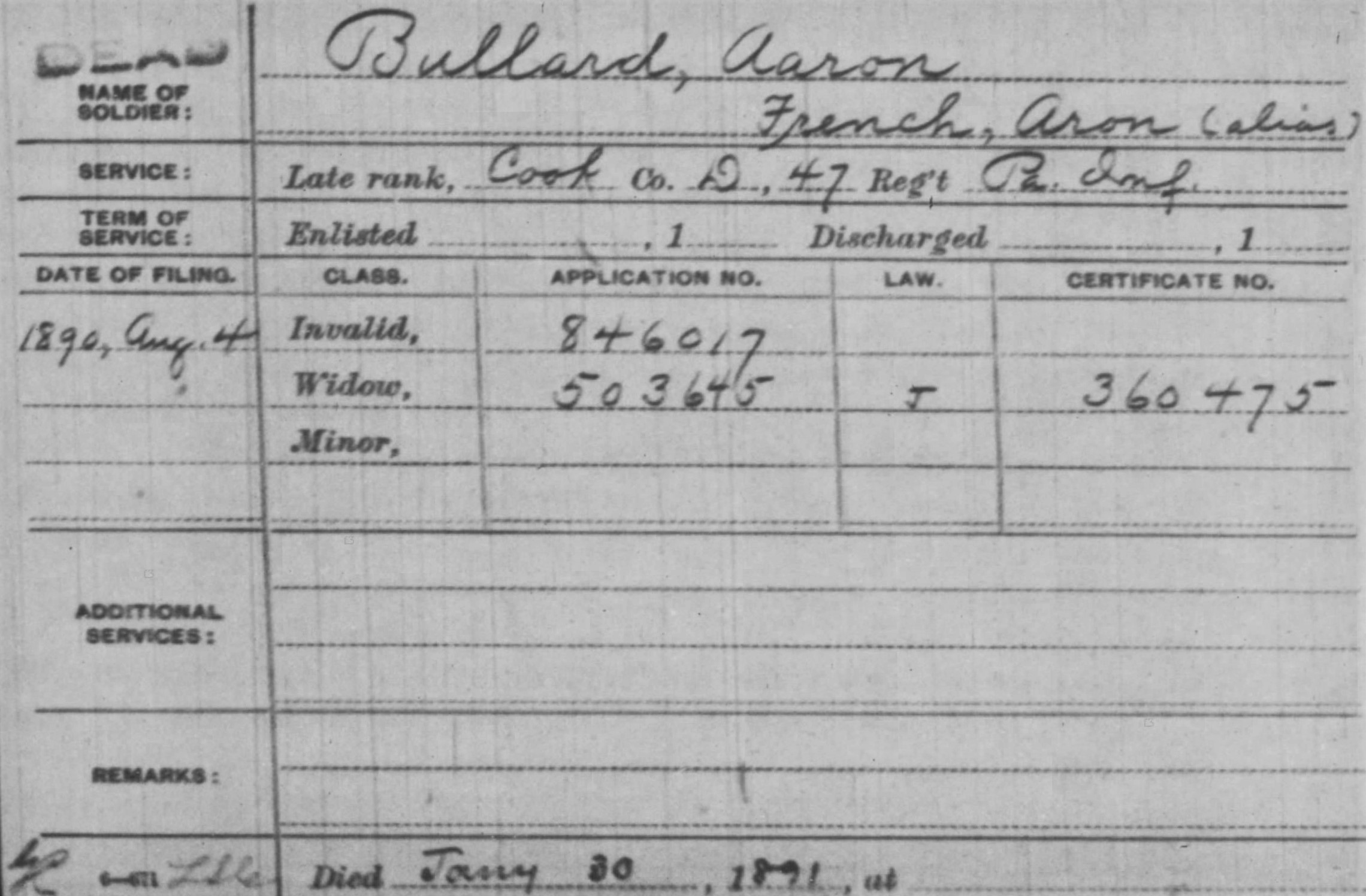
U.S. Civil War Pension Index Card for Aaron French, who enlisted with the 47th Pennsylvania Volunteers in Louisiana in 1864 (U.S. National Archives, public domain).

Sadly, Aaron French did not live to see his two youngest daughters marry because he died in Mississippi on January 30, 1891. He was just 40-43 years old, according to U.S. Census records and other data, which indicate that he was born in Louisiana sometime between 1848 and 1850.

Hearteningly, though, an even more intriguing piece of data has recently been uncovered about the later life of Aaron French—one that indicates that he had become active in politics prior to his death. According to the Vicksburg Evening Post, Aaron was appointed as a delegate from Issaquena County to the Republican Congressional Convention for the Third District, which was held in Greenville, Mississippi on August 7, 1886. Researchers are continuing to search for further details about his political activities and untimely death, as well as the exact location of his gravesite.

Thomas Haywood (alternate spellings of surname: Hayward, Haywood, Heywood) and Jack Jacobs:

Muster roll entries of Thomas Haywood and Edward Jassum, Company H, 47th Pennsylvania Volunteers (U.S. National Archives, public domain).

Born into slavery in South Carolina sometime around 1832, Thomas Haywood enlisted for a three-year term of service as an Under Cook with Company H of the 47th Pennsylvania Volunteer Infantry at Beaufort, South Carolina on November 1, 1862. He and three other formerly enslaved Black men—Abraham and Edward Jassum and Presto Gettes”—who had previously enlisted with the 47th Pennsylvania at Beaufort in October of 1862, then traveled with the 47th Pennsylvania as it participated in multiple military engagements, including the 47th’s garrisoning of Fort Taylor and Fort Jefferson in Florida in 1863 and 1864, the battles of the Union’s spring 1864 Red River Campaign across Louisiana, and the battles of Sheridan’s tide-turning Shenandoah Valley Campaign across Virginia in the fall of 1864.

On or about June 22, 1864 all nine of these Black soldiers were formally mustered into the regiment at Morganza, Louisiana; Thomas Haywood and seven of the eight others all successfully completed their tours of duty, and were honorably mustered out upon expiration of their respective terms of enlistment. In Thomas Haywood’s case, that honorable discharge was awarded on October 31, 1865.

Post-war, it appears from various Freedmen’s Bureau records that he may have entered into yearly contracts with several men who had previously been plantation owners in the Beaufort, South Carolina area. In exchange for agreeing to plant and cultivate cotton for those men on three to five-acre parcels of land that had been leased to him by those white men, he was allowed to keep portions of the cotton sales (the largest portions of which went to the former plantation owners who had also most likely been slave owners prior to and during the Civil War).

U.S. Civil War Index Card for Thomas Haywood, who enlisted with the 47th Pennsylvania Volunteers in South Carolina in 1862 (U.S. National Archives, public domain).

His body warn out from years of slavery prior to the war, difficult military service during the war, and harsh sharecropping experiences post-war, Thomas Hayward applied for, and was awarded a U.S. Civil War Pension on April 30, 1888. That pension was subsequently renewed by the federal government in 1907 at the rate of $15 per month (roughly $415 per month in today’s U.S. dollar equivalency).

By 1890, Thomas Haywood was living in Sheldon Township, Beaufort County, South Carolina. After a long life, he died on January 13, 1911. Unfortunately, his burial location has also not yet been identified by researchers.

In 1890, Thomas Haywood lived near Hanna Jacobs, the widow of Jack Jacobs, who may have been another Black soldier who enlisted with the 47th Pennsylvania Volunteers (U.S. Census, 1890, Sheldon Township, Beaufort County, South Carolina, public domain).

One other piece of tantalizing data that has recently been discovered is that a woman named “Hanna Jacobs” lived near Thomas Haywood in 1890. This information may be significant because Hanna was described on the 1890 U.S. Census of Union soldiers and widows as the widow of “Jack Jacobs,” who had served in the same company with Thomas Haywood (according to that special census).

Researchers currently believe that Jack Jacobs may, in fact, have been another formerly enslaved Black man who had enlisted with the 47th Pennsylvania when it was stationed near Beaufort in 1862, and are currently conducting a Go Fund Me campaign to raise funds to purchase the Civil War military and pension records of Hanna and Jack Jacobs, as well as the nine known formerly enslaved Black men who enlisted with the 47th Pennsylvania Volunteer Infantry in 1862 and 1864.

Jackson Haywood:

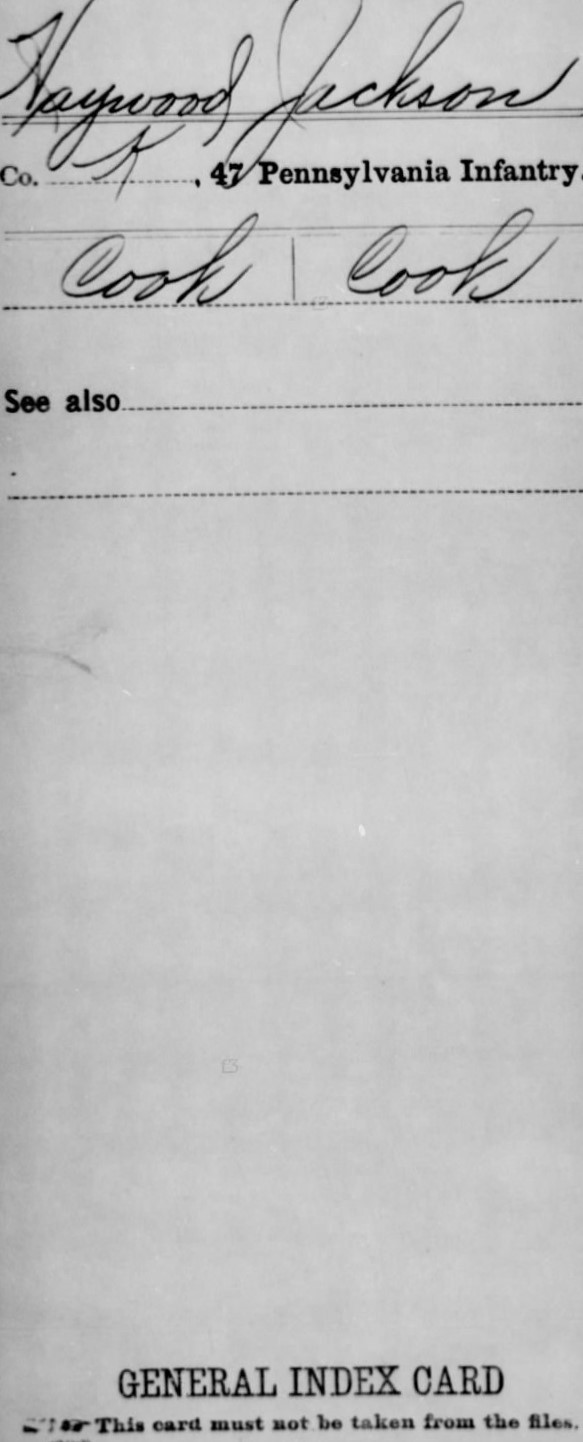
General Index Card for Jackson Haywood, who may have been a Black soldier who enlisted with the 47th Pennsylvania Volunteers (U.S. National Archives, public domain).

According to the “Index to Compiled Service Records of Volunteers Who Served in Organizations from the State of Pennsylvania,” which was created by staff at the U.S. National Archives, a General Index Card was created for yet another mystery man—a soldier named “Jackson Hayward.”

To date, researchers have only been able to determine that he may have enlisted with Company K of the 47th Pennsylvania Volunteer Infantry as a cook—a rank similar to that at which the known nine formerly enslaved Black men who enlisted with the 47th Pennsylvania were entered on the muster rolls of the regiment.

Researchers hope, with time and the continued financial support of the followers of 47th Pennsylvania Volunteers: One Civil War Regiment’s Story, to be able to confirm the dates of military service and race of this individual, as well as that of “Jack Jacobs.”

As always, we appreciate everyone’s help in ensuring that the service to the nation of these soldiers will never be forgotten. They helped to preserve our Union and deserve to be recognized more fully for their heroism and dedication.

* Our most important goal continues to be the purchase of the Compiled Military Service Records (CMSR) and U.S. Civil War Pension records for each of these remarkable men in order to document and freely share their stories with the widest possible audience. We continue to await word from staff at the U.S. National Archives regarding the timeframe for their resumption of digitization and reproduction services that have temporarily been suspended due to the coronavirus pandemic. As soon as those services have resumed, we will request an update regarding their estimated timeframe for fulfilling our records requests. In the interim, we will seek out further details about each of these soldiers via local and state archival resources across the nation, and will post updates as we confirm more data.

Sources:

  1. Bullard, Aaron, in Index to Compiled Service Records of Volunteers. Washington, DC: U.S. National Archives, 1861-1865.
  2. Bullard, Aaron and French, Aaron, in U.S. Civil War Pension Index Cards. Washington, DC: U.S. National Archives, 1890-1891.
  3. Bullard, Aaron, Presto Garris, Thomas Haywood, et. al. in U.S. Civil War Muster Out Rolls (47th Pennsylvania Volunteer Infantry). Washington, DC: U.S. National Archives, 1865-1866 (available via Ancestry.com).
  4. French, Aaron, in “Proceedings of the Third District Republican Convention.” Vicksburg, Mississippi: Vicksburg Evening Post, August 9, 1886.
  5. French, Aaron and Family, in U.S. Census Records (Issaquena County, Mississippi): Washington, DC: U.S. National Archives, 1870-1910.
  6. Haywood, Jackson, in Index to Compiled Service Records of Volunteers. Washington, DC: U.S. National Archives, 1861-1865.
  7. Haywood, Thomas, in Index to Compiled Service Records of Volunteers. Washington, DC: U.S. National Archives, 1861-1865.
  8. Haywood, Thomas, in U.S. Civil War Pension Index Cards. Washington, DC: U.S. National Archives, 1888, 1907.
  9. Haywood, Thomas, in U.S. Veterans’ Administration Pension Payment Cards. Washington, DC: U.S. National Archives, 1888, 1907.
  10. Haywood, Thomas, in U.S. Census (Beaufort County, South Carolina): Washington, DC: U.S. National Archives, 1890.
  11. Hanna Jacobs, widow of Jack Jacobs, in U.S. Census (Beaufort County, South Carolina): Washington, DC: U.S. National Archives, 1890.


Early to Mid-October 1862: Jacksonville, a Confederate Steamer, and a Regiment’s Historic Integration

Earthen works surrounding the Confederate battery atop Saint John’s Bluff along the Saint John’s River in Florida, 1862 (J. H. Schell, public domain).

Following their early October 1862 routing of Confederate States Army troops at an artillery battery on Saint John’s Bluff in Duval County, Florida—a battery which had been strategically positioned to prevent Union ships from making their way from the Atlantic Ocean and mouth of the Saint John’s River at Jacksonville to Palatka and points south, the 47th Pennsylvania Volunteers joined other Union soldiers in disabling the battery. According to 47th Pennsylvania Volunteer Infantryman Henry D. Wharton:

“On the day following our occupation of these works the guns were dismounted and removed on board the steamer Neptune, together with the shot and shell, and removed to Hilton Head. The powder was all used in destroying the batteries.”

Meanwhile that same weekend (Friday and Saturday, October 3-4, 1862), Brigadier-General John Milton Brannan, who was quartered on board the Ben Deford as the Union expedition’s commanding officer, Colonel Tilghman H. Good, commanding officer of the 47th Pennsylvania Volunteers, and other Union officers serving under Brannan were busy penning reports to their respective superiors, and were also planning their next move to further secure this region of Florida, which had been deemed of key strategic importance by senior Union military leaders due to the significant role the state had been playing as a supplier of food to the Confederacy.

On Saturday, Brannan chose several officers to direct their subordinates to prepare rations and ammunition for a new expedition that would take them roughly 20 miles upriver to Jacksonville. (A sophisticated hub of cultural and commercial activities with a racially diverse population of roughly 2,100 residents, the city had repeatedly changed hands between the Union and Confederacy until its occupation by Union forces on March 12, 1862.) Among the Union soldiers selected for this mission were 47th Pennsylvania Volunteers from Company C, Company E, and Company K.
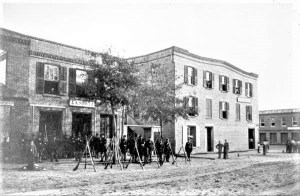
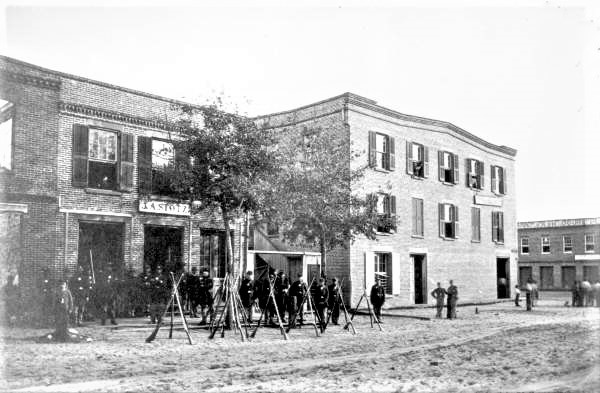
Provost Marshal’s guardhouse, Jacksonville, Florida, 1864 (public domain).

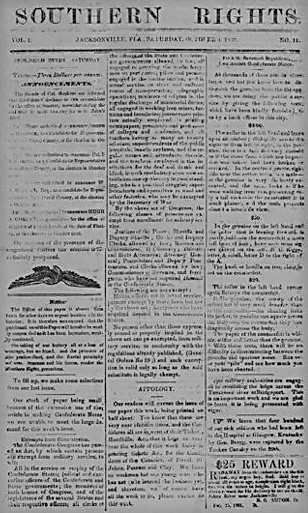
One of the first groups to depart—Company C of the 47th Pennsylvania, did so that Saturday as part of a small force made up of infantry and gunboats, the latter of which were commanded by Captain Charles E. Steedman. Their mission was to destroy all enemy boats they encountered to stop the movement of Confederate troops throughout the region. Upon arrival in Jacksonville later that same day, the infantrymen were charged by Brannan with setting fire to the office of that city’s Southern Rights newspaper.

This special pro-Union edition of Jacksonville, Florida’s formerly pro-Confederate Southern Rights newspaper was written and printed by Henry Wharton and other members of the 47th Pennsylvania Volunteers on October 4, 1862 (public domain).

Before that action was taken, however, Captain John Peter Shindel Gobin and his subordinate, Henry Wharton, who had both been employed by the Sunbury American newspaper in Sunbury, Pennsylvania prior to the war, salvaged the pro-Confederacy publication’s printing press so that Wharton could more efficiently produce the regimental newspaper he had launched while the 47th Pennsylvania was stationed at Fort Taylor in Key West, Florida. That salvage operation also gave Wharton and several of his C Company comrades the opportunity to take a parting, verbal “shot” at Confederate sympathizers in the region by publishing a snarky, final edition of the paper. Dated October 4, 1862, its text included the following:

“On account of the presence of distinguished visitors, the election is indefinitely postponed.

A few lines have been taken from the matter of this page to make room for explanation.

The form from which we strike off a few copies, is the same taken from Secession Printing Office at Jacksonville, Fla., on the expedition of Gen. J.M. Brannan to the St. John’s River.

Wishing to know whether secesh type would print under Federal rule, we concluded to bring along with us the press and fixtures; to our surprise and gratification we find the machine prints almost alone, satisfying us that it rejoices at the change. We have no doubt it will continue the good spirit already manifested and will make itself generally useful under the kind treatment already received, in printing various blanks required by the Post. It is possible it may get patriotic and issue a Constitutional Union Paper.

Beaufort, S.C. Oct. 17, 1862
Notice

The editor of this paper is absent from town for a few days on urgent business in the interior. It is therefore announced that the publication of this Paper will hereafter be weekly suspended as it has been heretofore, weakly continued.

The taking of our battery after a loss of courage, but no blood, and the presence of the yankee [sic] fleet, and the fearful proximity of Gen. Brannan and his forces, render the Southern Rights precarious.

The friends of Col. Hopkins are informed that the Colonel declines to run as a candidate for the office of Senator, notwithstanding the good time he made running from St. John’s Bluff.” 

According to historian Lewis Schmidt, the “newspaper contained other original articles of local interest,” as well as the announcement of a $25 reward for the capture of Ned, a 28-year-old Black man who had escaped slavery near Jacksonville.

On Sunday, October 5, Brannan and his detachment sailed away for Jacksonville at 6:30 a.m. Per Wharton, the weekend’s events unfolded as follows:

“As soon as we had got possession of the Bluff, Capt. STEEDMAN and his gunboats went to Jacksonville for the purpose of destroying all boats and intercepting the passage of the rebel troops across the river, and on the 5th Gen. BRANNAN also went up to Jacksonville in the steamer Ben Deford, with a force of 785 infantry, and occupied the town. On either side of the river were considerable crops of grain, which would have been destroyed or removed, but this was found impracticable for want of means of transportation. At Yellow Bluff we found that the rebels had a position in readiness to secure seven heavy guns, which they appeared to have lately evacuated, Jacksonville we found to be nearly deserted, there being only a few old men, women, and children in the town, soon after our arrival, however, while establishing our picket line, a few cavalry appeared on the outskirts, but they quickly left again. The few inhabitants were in a wretched condition, almost destitute of food, and Gen. BRANNAN, at their request, brought a large number up to Hilton Head to save them from starvation, together with 276 negroes—men, women, and children, who had sought our protection.”

* Note: Yellow Bluff, which was situated five miles to the north of Saint John’s Bluff on the opposite side of the Saint John’s River, was the site of another Confederate artillery battery—one surrounded by T-shaped earthen works that had been erected earlier in 1862.
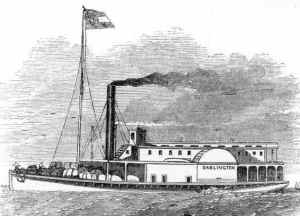
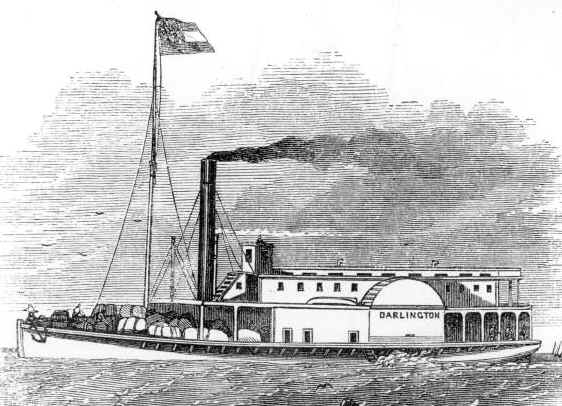
The Darlington, a former Confederate steamer turned Union gunboat (public domain).

Receiving word soon after his arrival at Jacksonville that “Rebel steamers were secreted in the creeks up the river,” Brigadier-General Brannan ordered Captain Charles Yard of the 47th Pennsylvania’s Company E to take a detachment of 100 men from his own company and those of the 47th’s Company K, and board the steamer Darlington “with two 24-pounder light howitzers and a crew of 25 men.” All would be under the command of Lt. Williams of the U.S. Navy, who would command the “convoy of gunboats to cut them out.” Describing the Darlington in a subsequent diary entry, Corporal George R. Nichols of the 47th Pennsylvania Volunteers’ E Company wrote:

“This steamer is runn [sic] by a negro crew and this same crew runn [sic] her away from the Rebels out of charleston [sic] harbor Passed [sic] forts Sumpter and Moltre [sic] and all the land Batterys [sic] and turned her over to Uncle Sam. The crew is Brave and Smart and that if they are Black men.”

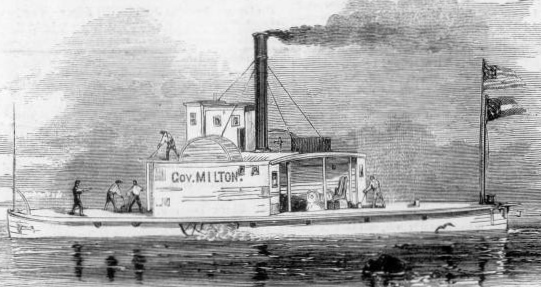
The rebel steamer Governor Milton, captured by the U.S. flotilla in St. John’s River, Florida (Frank Leslie’s Illustrated Newspaper, courtesy: State Archives of Florida, Florida Memory Project, public domain).

According to Schmidt, the small force steamed upriver roughly 100 to 200 miles “to Lake Beresford, where they then assisted in capturing the [68-ton] steamer Governor Milton,” which had been renamed in honor of Florida’s governor after having been “formerly known as the George M. Bird [under its previous owners] a New England family named ‘Swift’, who were timber cutters and used it as a tug boat to tow rafts loaded with live oak to the lumber market.”

Corporal Nichols of E Company went on to describe the capture as follows:

“At 9 PM … October 7, discovered the steamer Gov. Milton in a small creek, 2 miles above Hawkinsville; boarded her in a small boat, and found that she had been run in there but a short time before, as her fires were not yet out. Her engineer and mate, then in charge, were asleep on board at the time of her capture. They informed us that owing to the weakness of the steamer’s boiler we found her where we did. We returned our prize the next day…..

I commanded one of the Small Boats that whent [sic] in after her. I was Boatman and gave orders when the headman jumped on Bord [sic] take the Painter with him. That however belongs to Wm. Adams or Jacob Kerkendall [sic]. It was So dark I could not tell witch [sic] Struck the deck first. But when I Struck the deck I demanded the Surrend [sic] of the Boat in the name of the U.S. after we had the boat an offercier [sic] off the Paul Jones, a Gun Boat was with us he ask me how Soon could I move her out in the Stream I said five minuts [sic]. So an Engineer one of coulered [sic] Men helped me. and I will Say right hear [sic] he learned Me More than I ever knowed about Engineering. Where we Started down the River we was one hundred and twenty five miles up the river. When we Stopped at Polatkey [Palatka] to get wood for the Steamer I whent [sic] out and Borrowed a half of a deer that hung up in a cut house and a bee hive for some honey for the Boys. I never forget the boys.’” 

According to Brigadier-General Brannan, the Union party “returned on the morning of the 9th with a Rebel steamer, Governor Milton, which they captured in a creek about 230 miles up the river and about 27 miles north [and slightly west] from the town of Enterprise. Lt. Bacon, my aide-de-camp, accompanied the expedition… On the return of the successful expedition after the Rebel steamers… I proceeded with that portion of my command to St. John’s Bluff, awaiting the return of the Boston.”

This return trip did not happen without complications, however; in a letter penned to The New York Times on October 14, Wharton reported the following:

“Finding that the Cosmopolitan, which had been sent to Hilton Head for provisions, had struck heavily in crossing the bar, on her return to the St. John’s River, and was temporarily disabled for service, the Seventh Connecticut Regiment was sent to Hilton Head on the Boston, with the request that she should return for the remainder of the troops, and she got back on the 11th, when the command was reembarked, reaching this plane yesterday, excepting one company of the Forty-seventh Pennsylvania, which is left for the protection of the Cosmopolitan. The accident to this valuable steamer is severe. A large hole was made in her bottom and she filled, but she will not be a wreck, as was at first feared.”

The Governor Milton, which would later be appraised by the Union Navy at $2,000, was also temporarily left behind, under the command of Captain Steedman so that its boiler could be repaired. Overseeing those repairs was Corporal Nichols, who had been temporarily detached from the 47th Pennsylvania’s E Company. Observed Nichols:

“So hear [sic] we are at Jacksonville and off we go down the river again, and the Captain Yard Said you are detailed on detached duty as Engineer well that beats hell. I told him I did not Enlist for an Engineer. well I cannot help it he said. I got orders for you to stay hear [sic]. When the Boys was gone about a week orders came for us to come to Beaufort, S. Carolina by the inland rout over the Museley Mash Rout. So I Borrowed a twelve pound gun with amanition [sic] for to Protect our Selves with. But I only used it once to clear Some cavelry [sic] away. We Passed fort Palask [sic]. But that was in our Possession and we got Back to Beaufort all right. and I whent [sic] up to See the Boys and Beged [sic] captain to get me Back in the company, But he could not make it go.”

Integration of the Regiment

Meanwhile, as those activities were unfolding at Saint John’s Bluff, Yellow Bluff, Jacksonville and aboard the Governor Milton, the 47th Pennsylvania Volunteer Infantry was making history back in South Carolina when it became an integrated regiment on Sunday, October 5, 1862—three months before President Abraham Lincoln officially issued the Emancipation Proclamation.
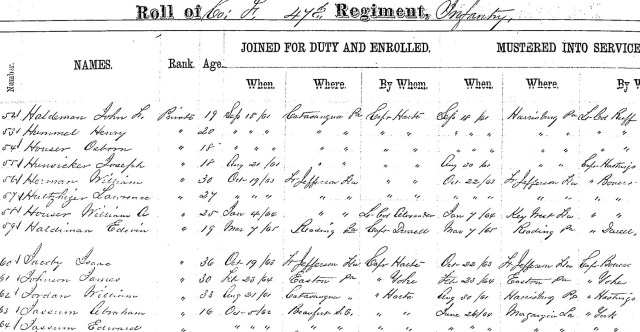
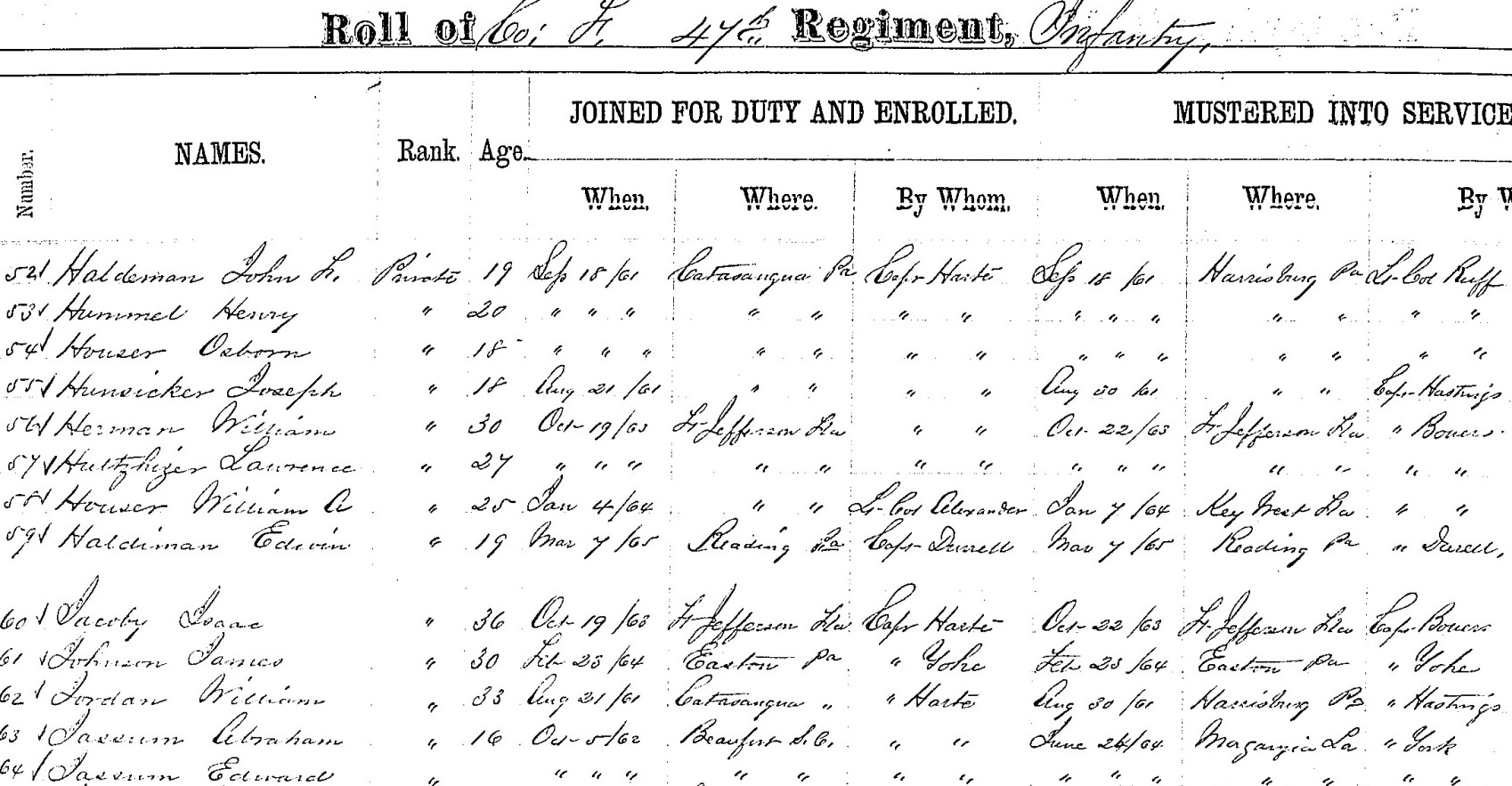
Roster entries for Privates Abraham and Edward Jassum confirm their October 1862 enlistments with Company F, 47th Pennsylvania Volunteer Infantry in Beaufort, South Carolina (Registers of Pennsylvania Volunteers, Pennsylvania State Archives, public domain).

On that day, two Black men who had been freed from slavery in Beaufort, South Carolina—Abraham Jassum and Bristor Gethers—enlisted with the 47th Pennsylvania Volunteers at a recruiting depot in Beaufort.

Jassum, who was just 16 years old, mustered in as a “negro undercook” with Company F. Military records described him as being 5 feet 6 inches tall with black hair, black eyes and a black complexion, and stated that his occupation prior to enlistment was “Cook.” (Those same records also confirm that Abraham Jassum continued to serve with F Company until he honorably mustered out at Charleston, South Carolina on October 4, 1865 when his three-year term of enlistment expired while an alternate set of records offers an alternate date of October 16, 1862 for his enlistment.)
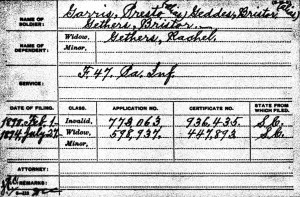
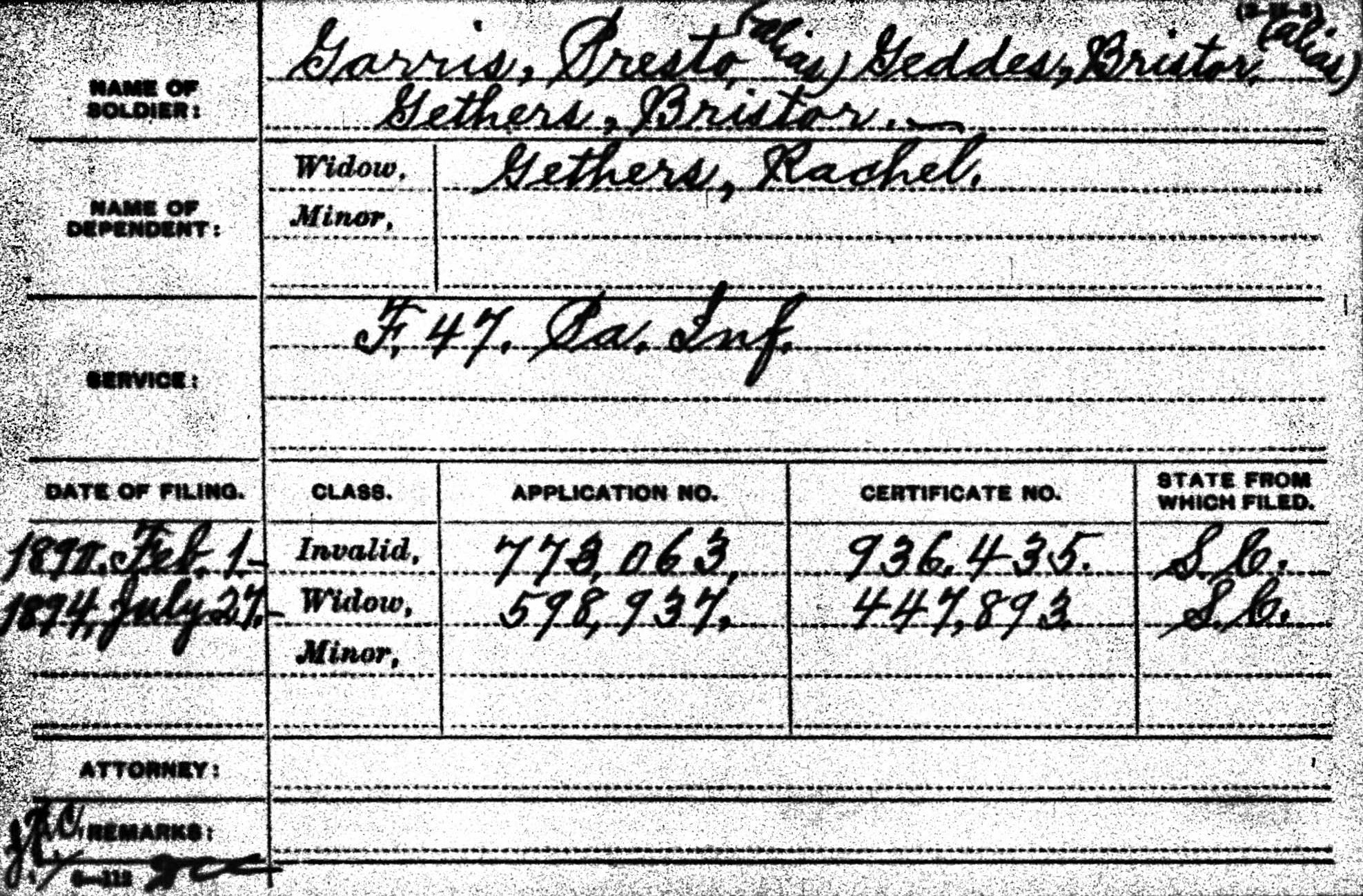
Possible name variants for Bristor Gethers of the 47th Pennsylvania Volunteers, 1894 (U.S. Civil War General Pension Index Cards, U.S. National Archives, public domain).

Gethers, a 33-year-old man whose name was misspelled repeatedly on military records throughout and following his enlistment tenure (as “Presto Gettes” on his muster roll entry and later listing in the Civil War Veterans’ Card File in the Pennsylvania State Archives and as “Presto Garris” and “Bristor Geddes” on U.S. Civil War Pension records), also mustered in with Company F as a “negro undercook.” Described on military records as being 5 feet 5 inches tall with black hair, black eyes and a black complexion, his entry in the Civil War Veterans’ Card File noted, perhaps incorrectly, that he had been employed as a fireman. (These same records also indicate that Bristor Gethers honorably mustered out at Charleston, South Carolina on October 4, 1865 upon expiration of his three-year term of service while federal records indicate that he and his wife, “Rachel Gethers,” applied for his Civil War Pension from South Carolina.)

The regiment’s integration also continued mid-month with the October 15 enlistment of 22-year-old Edward Jassum, who was also initially assigned to Company F as an undercook. (These same records indicate that he was transferred two years later—to Company H—on October 11, 1864, and that he also continued to serve with the 47th Pennsylvania Volunteers until being honorably discharged on October 14, 1865 upon expiration of his three-year term of service.)

Mop Up and Return to Headquarters

As that integration of the 47th Pennsylvania Volunteer Infantry was taking place in Beaufort, South Carolina, Brigadier-General Brannan’s expeditionary force was winding down its activities in Duval County, Florida. According to a letter penned by Private William Brecht of the 47th Pennsylvania’s K Company, once the artillery pieces were carried away from Saint John’s Bluff by Brannan’s troops, Brannan ordered Captain Henry D. Woodruff of the 47th’s D Company to take his company as well men from Company F and Company I to “blow up the fort, which was done with the most terrific explosions, filling the air for a great distance with fragments of timber and sand.”

“And thus came to an end Fort Finnegan, on St. John’s Bluff,” mused Brecht, who added that “after we destroyed the fort and it exploded into the air, the steamer Cosmopolitan which had been damaged and was full of water, we pumped out and fixed up again.”

Recapping the activities of his troops for his superiors, Brannan subsequently stated that, on Saturday, October 11:

“I embarked the section of the 1st Connecticut Battery, with their guns, horses, &c., and one company of the 47th on board the steamer Darlington, sending them to Hilton Head via Fernandina, Fla…. [T]he Boston having returned, I embarked myself, with the last remaining portion of my command, except one company of the 47th left to assist and protect the Cosmopolitan…which was stuck on the bar…for Hilton Head, S.C., on the 12th instant, and arrived at that place on the 13th instant. The captured steamer Governor Milton I left in charge of Capt. Steedman, U.S. Navy and Cpl. Nichols.”

According to Schmidt:

“Company F embarked for Hilton Head on Friday and arrived home on Sunday, while Company D embarked on Saturday…but did not leave the St. John’s River til Sunday…. Some of the troops, including Company C, had returned to Beaufort on Saturday, October 11, but at least portions of Company K did not return until the following Tuesday. Returning with Company C was Capt. Gobin, who had contracted intermittent fever during the expedition and was hospitalized as soon as he returned….

Company D arrived back at Hilton Head on Saturday, and Company B and F on Sunday; and by Monday, October 13, most of the troops were back in camp in Beaufort, including Companies, A, G and K which arrived on this date. Company E did not arrive until Wednesday and Company H on Thursday night.” 

Although Corporal Nichols of E Company would not return from his detached duties aboard the Governor Milton until much later, Captain Gobin was able to return to active duty on October 20. Crediting his recovery to “good nursing and an abundance of quinine,” he resumed leadership of the 47th Pennsylvania’s C Company, which had returned to South Carolina nine days earlier.

October 20 also proved to be an important day for the regiment when The New York Times published a letter that had been penned six days earlier by Wharton, and which recapped the events of the St. John’s Bluff Expedition and subsequent successes by Brigadier-General Brannan’s troops. In addition to excerpts presented above in this article and in the article, Late September to Early October 1862: First Victory,” Wharton’s letter also included the following insights:

“Gen. BRANNAN thinks it evident, from his experience on this expedition, that the rebel troops in this portion of the country have not sufficient organization and determination, in consequence of their living in separate and distinct companies, to sustain any position, but seem rather to devote themselves to a system of guerrilla warfare. This was exemplified by the advance on St. John’s Bluff, where, after evacuating the fort, they continued to hover on our flanks and front, but did not come near enough to make their fire effective. We learned at Jacksonville that they commenced evacuating the Bluff immediately after our surprise of their pickets at Mount Pleasant Creek.
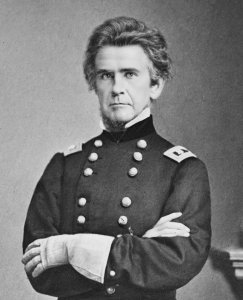
Major-General Ormsby M. Mitchel, Commanding Officer, U.S. Department of the South, circa 1862 (public domain).

Wharton also included remarkable details regarding the October 12, 1862 dedication of the First African Baptist Church on Hilton Head Island, South Carolina by Union Major-General Ormsby Mitchel—during which Mitchel outlined his plans for the creation of Mitchelville—“the first self-governed town of formerly enslaved people in the United States,” according to staff at the Historic Mitchelville Freedom Park. Wharton observed that:

“On Sunday the negro church at Hilton Head was dedicated to Divine service. Gen. HUNTER authorized the construction of the building, and before he left the work was nearly finished. The situation of the church is good; the appearance is neat, though plain as a Quaker meeting-house, and in all respects the building meets the requirements of the case. Three hundred persons may be comfortably seated. The Pastor is a black man from Savannah, named ABRAM MURCHISON, who has been in due form ordained a Baptist minister by the army Chaplains, and installed in office. ABRAM, though able to read and write, is not polished in his manners; but what he lacks in culture is more than compensated in earnest eloquence, a vigorous and clear expression of his views, deep piety, and a powerful influence over the colored people. The dedication exercises were interesting in themselves, being conducted by Rev. H.N. HUDSON, Chaplain of the New-York Volunteer Engineer Regiment, and elocutionist of celebrity. Gen. MITCHEL was present, with the members of this Staff, and, by invitation, addressed the audience. His remarks were pointed, impressive and instructive. They were listened to attentively, and indorsed [sic] with nods of approbation from young and old. I do not think that a portion of the TIMES could be better filled than with this frank and unmistakable expression of the Gen. MITCHEL’s views on the negro question. He said:

‘I have been requested to say a few words to you by your teacher, who is a good man. Any good man I like, regardless of color. I respect him as much whether he is black or white. If he be a bad man I shall treat him as such, whether he is white or black. Most of you know that I have talked to all my soldiers since I came here, and now I am talking to you who are another set of soldiers, who have not yet arms in their hands, but are under my protection and guidance, and in whom I take interest. With your past life I fully sympathize. I know and understand it all. I was reared in the midst of Slavery, born in Kentucky, and know all about it. While there are many things connected with it that are pleasant, to which you will testify, there are a vast many other things which are not pleasant, and I think that God intends all men shall be free, because he intends that all men shall serve him with their whole heart. I think this is true. I am not certain. I don’t know. But in any condition we can all love and serve God. That privilege cannot be taken away. I care not how savage and wicked the master may be, he cannot prevent you from praying in the midst of the night, and God hears and answers the prayer of all, slave or free.

But it seems to me that there is a new time coming for you colored people; a better day is dawning for you oppressed and down-trodden blacks. I don’t know that this is true, but I hope that the door is being opened for your deliverance. And now, how deeply you should ponder these words. If now you are unwilling to help yourselves nobody will be willing to help you. You must trust yourselves to the guidance of those who have had better opportunities and have acquired superior wisdom, if you would be carried through this crisis successfully. And I believe the good God will bless your efforts, and lift you up to a higher level than you have yet occupied, so that you and your children may become educated and industrious citizens. You must organize yourselves into families. Husbands must love their wives and children, clinging to them and turning from all others, and feeling that their highest object in life, next to serving the good God, is to do all they can for their families, working for them continually.

Good colored friends, you have a great work to do, and you are in a position of responsibility. The whole North, all the people in the Free States, are looking at you and the experiment now tried on your behalf with the deepest interest. This experiment is to give you freedom, position, home and your own families—wives, property, your own soil. You shall till and cultivate your own crops; you shall gather and sell the products of your industry for your own benefit; you shall own your own savings, and you shall be able to feel that God is prospering you from day to day and from year to year, and raising you to a higher level of goodness, religion and a nobler life.

Supposing you fail down here; that will be an end to the whole matter. It is like attaching a cable to a stranded vessel, and all the strength that can be mustered is put upon this rope to haul her off. If this only rope breaks the vessel is lost. God help you all and help us all to help you. If you are idle, vicious, indolent and negligent, you will fail and your last hope is gone; if you are not faithful you rivet eternally the fetters upon those who to-day are fastened down by fetters and suffer by the driver’s goad. You have in your hands the rescuing of those sufferers over whose sorrows you mourn continually. If you fail, what a dreadful responsibility it will be when you come to die to feel that the only great opportunity you had for serving yourselves and your oppressed race was allowed to slip.

And you, women, you must be careful of your children. You must teach them to be industrious, cleanly, obedient, and dutiful at all times. You must keep your houses neat and tidy, working all day, if necessary, to have them in the best possible condition, always thinking and contriving to make them cleaner and more comfortable. When your husband comes home from the labors and fatigues of the day, always have something good and nice for his supper, and speak kindly to him, for these little acts of love and attention will bring you happiness and joy.

And when you men go out to work, you must labor with diligence and zeal. It seems to me, had I the stimulus to work that you have that I could labor like a giant. Now you know who I am. My first duty here is to deal justly; second, to love mercy, and third, to walk humbly. First, justly—I shall endeavor to get you to do your duty faithfully. If you do I shall reward you; and if you refuse, then what comes next? Why, the wicked must be punished and made to do right. I will take the bad man by the throat and force him to his duty. I do not mean that I will take hold of him with my own hands, but with the strong arm of military power. Now do we understand each other? I am working for you already. I am told by your Superintendent that a gang of fifty men are building your houses at the rate of six a day. These houses are to make you more comfortable. You are to have a patch of ground, which you can call your own, to raise your own garden truck, and you may work for the Government for good wages. And you women must make your houses shine; you must plaster them and whitewash them, and gradually get furniture in your cabins, and a cooking-stove. I have arranged in such a way that you will get your clothing cheaper and better than before, and you are to have a school for your children. And you must have flowers in your gardens and blossoms before your doors. You will see in a little while how much happier you will be made. Are you not willing to work for this? Yes, God helping, you will all work. This is only for yourselves; but if you are successful, this plan will go all through the country, and we will have answered the question that has puzzled all good, thinking men in the world for one hundred years. They have asked, ‘What will you do with the black man after liberating him?’ We will show them what we will do. We will make him a useful, industrious citizen—give him the earnings of the sweat of his brow, and as a man, we will give him what the Lord ordained him to have.

I shall watch everything closely respecting this experiment. It is something to be permanent—more than for a day, more than for a year. Upon you depends whether this mighty result shall be worked out, and the day of jubilee come to God’s ransomed people.’”

Wharton also noted that:

“The white people have also had the advantage of religious instruction offered them during the past two Sabbaths, for the first time since the military occupation of South Carolina soil. An upper floor of one of the large commissary building has been appropriated as a place of worship, and the various regimental Chaplains are to officiate alternately. The first Sunday a discourse was delivered by the Rev. H.N. HUDSON, (Episcopal,) of the Volunteer Engineer Regiment, and day before yesterday the Rev. Dr. STRICKLAND, (Methodist,) Chaplain of the New-York Forty-eighth, favored us with a sermon. Gen. MITCHEL, who has instituted these religious privileges, is himself a regular attendant on the services.

Wharton then closed his letter with the following additional details:

“The propeller Trade Wind, Capt. Delanoy, was towed into this port last week by the gunboat Pocahontas, disabled by the bursting of her cylinder, when in latitude 25° north, longitude 79° 30′ west, on a voyage from New-York to New-Orleans, carrying a United States mail, and a cargo of Sutler’s goods. The damage is too great to be repaired here with our limited facilities, and she awaits a chance of being towed to New-York. Mr. RANKIN, of Philadelphia, chief engineer of the vessel, was severely sealed [sic] by the accident. The mails will be forwarded to New-Orleans by the first naval supply vessel going to that port.

The gunboat Quaker City at noon on Saturday last, ran [up] on the bar at North Edisto. Fears were [high] for the safely of the vessel, and the army steamers [?] Point and Rescue were sent to her aid. She was, however, out of danger when they reached her.

The work of organizing the troops in this Department into brigades has been commenced by Gen. MITCHEL, with a view to more system, and enhanced probability in future operations. Brig.-Gen. TERRY has been relieved of the command of the posts of the Florida Coast, and assigned to the Second Brigade, which is composed of the Seventh-sixth and Ninety-seventh Pennsylvania, the Seventh Connecticut, and the Third New-Hampshire Regiments….

By command of Maj.-Gen. O.M. MITCHEL,
W.P. [?], Maj.-Gen. and Chief of Staff ,
H. J. W.”


Sources:

  1. Beecher, Herbert W. History of the First Light Battery Connecticut Volunteers, 1861-1865, Vol. I. New York, New York: A. T. De La Mare Ptg. and Pub. Co., Ltd., 1901.
  2. “Florida’s Role in the Civil War: Supplier of the Confederacy.” Tampa, Florida: Florida Center for Instructional Technology, University of South Florida (College of Education), retrieved online, January 15, 2020.
  3. IMPORTANT FROM PORT ROYAL.; The Expedition to Jacksonville, DESTRUCTION OF THE REBEL BATTERIES. CAPTURE OF A STEAMBOAT. Another Speech from Gen. Mitchell. His Policy and Sentiments on the Negro Question.” New York, New York: The New York Times, October 20, 1862.
  4. “Mitchelville: Freedom’s Home,” in Think Like a Historian.” Beaufort County, South Carolina: Finding Freedom’s Home: Archaeology at Mitchelville, retrieved online, January 18, 2021.
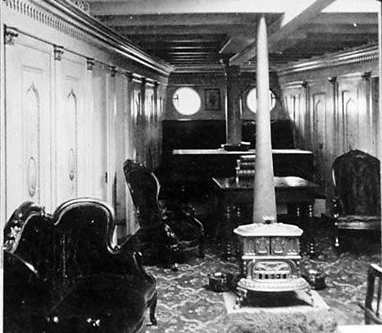
  5. Proctor, Samuel. Jacksonville During the Civil War,” in Florida Historical Quarterly, Vol. 41, No. 4, 1962, pp. 343-355. Orlando, Florida STARS (Showcase of Text, Archives, Research & Scholarship), University of Central, Florida.
  6. Reports of Lieut. Col. Tilghman H. Good, Forty-seventh Pennsylvania Infantry, in Official Records of the Union and Confederate Armies, 1861-1865 (Microfilm M262). Washington, D.C.: U.S. National Archives and Records Administration.
  7. Schmidt, Lewis G. A Civil War History of the 47th Regiment of Pennsylvania Veteran Volunteers. Allentown, Pennsylvania: Self-published, 1986.
  8. Timucuan: The River War: The Timucuan Preserve in the Civil War.” Washington, DC: National Park Service and the U.S. Department of the Interior, retrieved online, January 18, 2021.