Battle of Sabine Cross Roads/Mansfield, Louisiana, April 8, 1864 — Casualties and POWs from the 47th Pennsylvania Volunteer Infantry

Battle of Sabine Cross Roads/Mansfield, Louisiana (Frank Leslie’s Illustrated Newspaper, 14 May 1864, public domain).

At 4 p.m. Louisiana time on April 8, 1864, during the American Civil War, the left flank of the Confederate States Army, which was commanded by Major-General Richard Taylor, slowly began an echelon formation attack on troops commanded by Union Major-General Nathaniel Banks, forcing the Union’s cavalry line to buckle. During the first fourteen minutes of the opening charge of this combat engagement, which later became known as the Battle of Sabine Cross Roads (by Union troops) and the Battle of Mansfield (by Confederate troops), eleven out of fourteen Confederate officers were killed in action.

Shortly thereafter, Banks’ left Union flank also collapsed, and Taylor’s troops continued forward, puncturing a secondary Union Army position three quarters of a mile behind the Union’s front line.

In response, Banks ordered Brigadier-General William Emory to move his 1st Division, 19th U.S. Army Corps to the front. Among Emory’s 5,859 men were nine New York regiments, three from Maine—and the 47th Pennsylvania Volunteer Infantry. Ninety minutes and seven miles of marching later, Emory’s men waited for the Confederates on the ridge above Chapman’s Bayou.

* Note: The 47th Pennsylvania Volunteers were positioned behind the 161st New York, 29th Maine, and other Union regiments at or near the farm of Joshua Chapman, about five miles southeast of Mansfield, Louisiana. The battles here were termed the “Peach Orchard” fight by Confederates and “Pleasant Grove” by 47th Pennsylvanians—a name attributed by several historians to the live oak trees in front of Chapman’s house. The fighting at the peach orchard was particularly brutal.

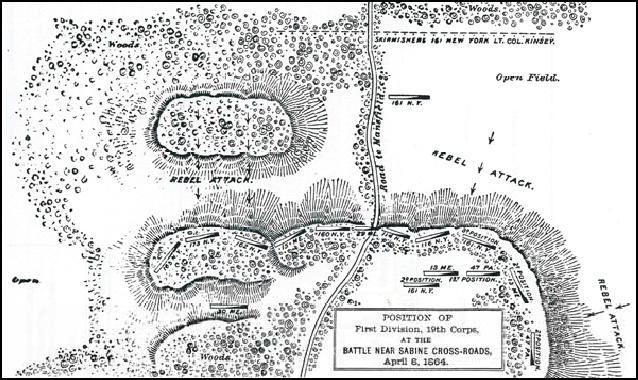
19th U.S. Army Map, Phase 3, Battle of Sabine Cross Roads/Mansfield (8 April 1864, public domain; click to enlarge).

Confederate troops next attacked the center of the Union line, causing the lines of the 161st New York Volunteers to buckle; the 29th Maine stood firm, however, and repulsed the enemy.

In response, Confederates from the 1st, 26th, 36th, and other Texas Cavalry units then attempted an end run on the Union’s right flank, but the 47th Pennsylvania Volunteers were ready for them. Initially positioned to the right of the 13th Maine Infantry, the 47th Pennsylvania and 13th Maine marched into the fray, pinwheeling to head off an attack by the cavalry group led by Confederate Brigadier-General Thomas Green, halting that flanking maneuver.

As darkness fell on April 8, 1864, the fighting gradually waned and then finally ceased as exhausted troops on both sides collapsed between the bodies of their dead comrades. Although the full scope of the carnage was not immediately evident, Union rosters were eventually updated, confirming that seventy-four men were dead, at least one hundred and sixty-one were wounded, and hundreds more were declared missing in action, including one hundred and eighty-eight soldiers from the 19th U.S. Army (to which the 47th Pennsylvania was attached). Some of these missing men (including men from the 47th Pennsylvania) were subsequently found and declared as wounded or dead; others (including 47th Pennsylvanians) ended up as prisoners of war (POWs), at Camp Ford, which was located near Tyler, Texas and was the largest Confederate prison located west of the Mississippi River.

Sadly, a significant number of 47th Pennsylvania Volunteers remain missing to this day, having been hastily interred somewhere on or near the Mansfield battlefield sites by fellow soldiers or local residents. (No remains were found during archaeological excavations of the area during the late twentieth and early twenty-first centuries, but one possible answer to the mystery surrounding the burial locations of these men was in provided in 1996 by L. P. Hecht, who reported in Echoes from the Letters of a Civil War Surgeon, that wild hogs had eaten the remains of at least some of the federal soldiers who had been left unburied.)

The abridged lists below partially document the members of the 47th Pennsylvania Volunteer Infantry who were declared as wounded in action, killed in action, missing in action, or captives of the Confederate States Army (POWs) after the Battle of Sabine Cross Roads/Mansfield:

Killed or Wounded in Action:

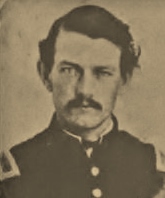
Second Lieutenant Alfred Swoyer, Company K, 47th Pennsylvania Volunteers, circa 1862 (public domain)

Barry, William: Private, Company H; killed in action during the Battle of Sabine Cross Roads/Mansfield, Louisiana on 8 April 1864.

Fries, John: Private, Company B: Wounded in action during the Battle of Sabine Cross Roads/Mansfield, Louisiana on 8 April 1864; recovered and returned to service with Company B; honorably mustered out from the 47th Pennsylvania on 29 June 1865.

Haas, Jeremiah: Private, Company C; survived breast and face wounds sustained during the Battle of Pocotaligo, South Carolina on 22 October 1862; killed in action during the Battle of Sabine Cross Roads/Mansfield, Louisiana on 8 April 1864.

Marshall, Charles L. (alias: Lothard, Thomas): Private, Company C; survived gunshot wound(s) to his head and/or body during the Battle of Pocotaligo, South Carolina on 22 October 1862; sustained additional gunshot wounds to the top of his head, the right side of his body and/or arm, and his left shin during the Battle of Sabine Cross Roads/Mansfield, Louisiana on 8 April 1864; recovered and returned to duty a second time; was honorably mustered out on 5 July 1865; lived out his later years at the U.S. National Soldiers’ Home in Marion, Indiana, and was interred at that Soldiers’ Home Cemetery following his death there.

McIntire, John (alternate spelling: McIntyre): Private, Company H; wounded in action during the Battle of Sabine Cross Roads/Mansfield, Louisiana on 8 April 1864; recovered and returned to duty with Company H; killed in action during the Battle of Cedar Creek, Virginia on 19 October 1864.

Nipple, Thomas: Private, Company C; wounded in the stomach during the Battle of Sabine Cross Roads/Mansfield, Louisiana on 8 April 1864; recovered and returned to duty with Company C; was honorably discharged on 25 December 1865.

Sanders, Francis (alternate spellings: Xander, Xandres): Corporal, Company B; wounded in action during the Battle of Sabine Cross Roads/Mansfield, Louisiana on 8 April 1864; died shortly after being carried to the rear by his brother; burial location unknown; his death was documented in the obituary of his widow, Henrietta Susan (Balliet) Sanders, in the 15 May 1916 edition of Allentown’s Morning Call newspaper, which reported that Francis Sanders “enlisted in the Forty-seventh regiment and saw service for two enlistments until the battle of Sabine Cross Roads, La., where he was wounded and carried to the rear by his brother. From that day to this not a word was heard from him and the supposition was that he died from his wounds….” That obituary also stated that Francis Sanders was likely interred in an unknown, unmarked grave.

Seip, Lewis H.: Private, Company B; wounded in the leg during the Battle of Sabine Cross Roads/Mansfield, Louisiana on 8 April 1864; recovered and returned to duty with Company B; was promoted to the rank of corporal on 19 September 1864; although reported as having been dishonorably discharged on 4 October 1865 in Samuel P. Bates’ History of Pennsylvania Volunteers, 1861-5, per other records, he mustered out with his regiment on 25 December 1865.

Swoyer, Alfred P.: Second Lieutenant, Company K; killed instantly after being struck by a minié ball in the right temple during the Battle of Sabine Cross Roads/Mansfield, Louisiana on 8 April 1884; burial location unknown.


Captured and Held as Prisoners of War (POW):

This image depicts life at Camp Ford, the largest Confederate Army prison camp west of the Mississippi River (Harper’s Weekly, 4 March 1865, public domain).

Firth, John Wesley (known as “Wesley”): Captured by Confederate forces during the Battle of Sabine Cross Roads/Mansfield, Louisiana on 8 April 1864; marched by Confederate States Army troops to Camp Ford, near Tyler, Texas, and held there as a prisoner of war (POW) until released during a prisoner exchange sometime between July and November 1864; recovered and returned to duty with Company C; was honorably discharged on 25 December 1865.

Holman, Conrad: Private, Company C; Survived being hit by a rifle ball to the face during the Battle of Pocotaligo, South Carolina on 22 October 1862, which destroyed all of his teeth; received medical treatment, recovered and returned to duty with Company C; was captured by Confederate forces during the Battle of Sabine Cross Roads/Mansfield on 8 April 1864 and marched to Camp Ford near Tyler, Texas; released during a prisoner exchange on 22 July 1864; recovered and returned to duty with Company C; honorably discharged on 18 September 1864.

Matthews, Edward: Private, Company C; captured by Confederate forces during the Battle of Sabine Cross Roads/Mansfield, Louisiana on 8 April 1864; held as prisoner of war (POW) at Camp Ford, near Tyler, Texas until being released as part of a prisoner exchange on 22 July 1864; recovered and returned to duty with Company C; honorably discharged on 1 October 1865.

Miller, Samuel W.: Private, Company C; captured by Confederate forces during the Battle of Sabine Cross Roads/Mansfield, Louisiana on 8 April 1864; held as prisoner of war (POW) at Camp Ford near Tyler, Texas until being released as part of a prisoner exchange on 22 July 1864; recovered and returned to duty with Company C; honorably discharged on 25 December 1865.


Sources:

  1. Bates, Samuel P. History of Pennsylvania Volunteers, 1861-5, vol. 1. Harrisburg, Pennsylvania: B. Singerly, State Printer, 1869.
  2. “Henrietta Sanders Dies in Her 90th Year” (obituary of Francis Sanders’ widow). Allentown, Pennsylvania: The Morning Call, 15 May 1916.
  3. Prisoner of War Records, Camp Ford and Camp Groce (47th Pennsylvania Volunteer Infantry). Tyler Texas: Smith County Historical Society, 2010.
  4. Schmidt, Lewis G. A Civil War History of the 47th Regiment of Pennsylvania Veteran Volunteers. Allentown, Pennsylvania: Self-published, 1986.


Black History Month: The Authorization, Duties and Pay of “Under-Cooks”

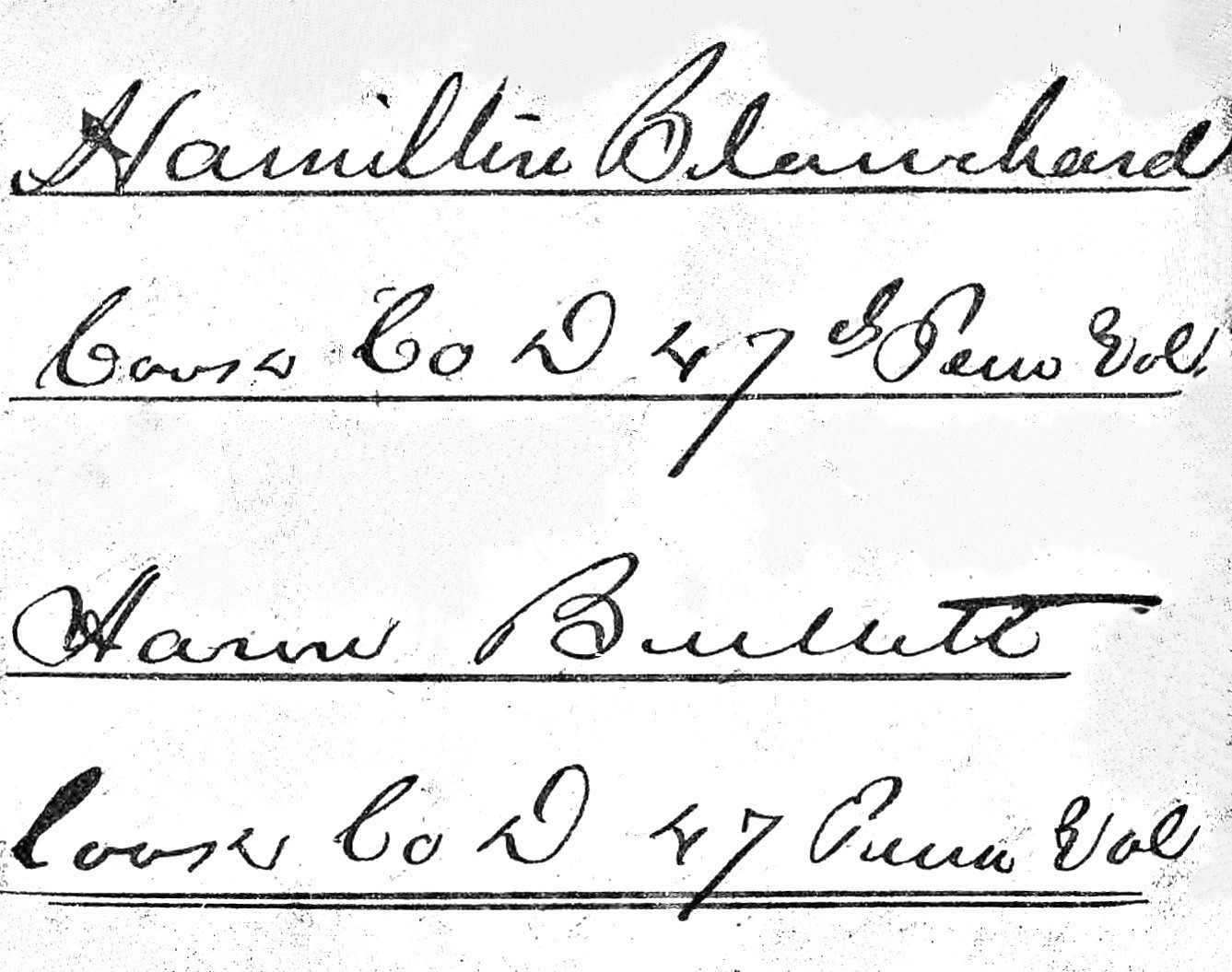
One of several U.S. Civil War Pension documents that confirmed the Union Army enrollment of Hamilton Blanchard and Aaron Bullard, known later as Aaron French, as Cooks (a higher rank than under-cook) with Company D of the 47th Pennsylvania Volunteer Infantry (U.S. Civil War Pension Files, U.S. National Archives and Records Administration, public domain).

Following executive orders promulgated by President Abraham Lincoln in 1862 and legislation enacted that same year by the United States Congress to facilitate the enrollment by free and enslaved Black men with Union Army regiments, the 47th Pennsylvania Volunteer Infantry began processing the enlistments of four of the nine formerly enslaved men who would ultimately be entered onto the rosters of this history-making regiment.

Enrolled as “Negro Under-Cooks” while the regiment was stationed in Beaufort, South Carolina as part of the U.S. Department of the South and Tenth Army (X Corps), Bristor Gethers, Thomas Haywood, Abraham Jassum, and Edward Jassum ranged in age from sixteen to thirty-three.

Roughly two years later, officers from the 47th Pennsylvania Volunteers then processed the enlistment paperwork for an additional five formerly enslaved men in Natchitoches, Louisiana in April 1864 while the 47th Pennsylvania was stationed there (as the only regiment from Pennsylvania to participate in the Union’s Red River Campaign across Louisiana). Hamilton Blanchard, Aaron French (who was known at that time as Aaron Bullard), James Bullard, John Bullard, and Samuel Jones ranged in age from sixteen to twenty-nine.

All but one of the nine would go on to complete their three-year terms of enlistment and be honorably mustered out in October 1865.

What Were Their Job Duties?

General Orders No. 323 (enlistment and pay of under-cooks of African descent), U.S. War Department and Office of the Adjutant General, September 28, 1863 (U.S. Library of Congress, public domain).

The duties and other pertinent details about the military tasks performed by Cooks and Under-Cooks of the Union Army were explained as follows by August Kautz in his 1864 manual, Customs of Service for Non-Commissioned Officers and Soldiers as Derived from Law and Regulations and Practised in the Army of the United States:

“108. DAILY DUTY.—A soldier is on daily duty when he is put upon some continuous duty that excuses him from the ordinary company duty but does not entitle him to additional pay from the government,—such as company cooks, tailors, clerks, standing orderlies, &c. These duties may be performed by soldiers selected on account of special capacity or merit, or detailed in turn, as is most convenient and conducive to the interest of the service.

109. The company cooks are one or more men in each company detailed to do the cooking for the entire company. This is the case usually in companies where it is not the custom to distribute the provisions to the men; for in this case the messes furnish their own cooks, and they are not excused from any duty except what is absolutely necessary and which their messmates can do for them.

110. The law authorizes the detailing of one cook to thirty men, or less; two cooks if there are more than thirty men in the company. It also allows to each cook two assistant cooks (colored), who are enlisted for the purpose, and are allowed ten dollars per month. (See Par. 269.)

111. The cooks are under the direction of the first sergeant or commissary-sergeant, who superintends the issue of provisions and directs the cooking for each day. Company cooks for the whole company are generally detailed in turn, and for periods of a week or ten days….

269. Cooks. — The law now allows the enlistment of four African under-cooks for each company of more than thirty men; if less, two are allowed. They receive ten dollars per month, three of which may be drawn in clothing, and one ration. (See Act March 3, 1863, section 10.) They are enlisted the same as other enlisted men, and their accounts are kept in the same way: they are entered on the company muster-rolls, at the foot of the list of privates. (G. 0. No. 323, 1863.)

270. These cooks are to be under the direction, of a head-cook, detailed from the soldiers alternately every ten days, when the company is of less than thirty men; when the company is of more than thirty men, two head-cooks are allowed. These are quite sufficient to cook the rations for a company; and, by system and method, the comfort and subsistence of a company may be greatly improved. The frequent changing of cooks under the old system worked badly for the comfort of the soldier and they were often treated to unwholesome food, in consequence of the inexperience of some of the men.

271. The object of changing the head-cooks every ten days, as required by section 9, Act March 3, 1863, is to teach all the men how to cook; but it will follow that the under-cooks, who are permanently on that duty will know more about it than the head-cooks. They will simply be held responsible that the cooking is properly performed.”

From Under-Cook to Private

Samuel Jones was an enslaved Black man who enlisted as an Under-Cook with Company C of the 47th Pennsylvania Volunteer Infantry in Natchitoches, Louisiana on April 5, 1864. Official regimental muster rolls confirmed that he was a private at the time of his honorable discharge in 1865 (Registers of Pennsylvania Volunteers, 1861-1865: 47th Regiment, in “Records of the Department of Military and Veterans’ Affairs,” Pennsylvania State Archives, public domain; click to enlarge).

As the officers and enlisted members of the 47th Pennsylvania Volunteer Infantry interacted more frequently with the nine formerly enslaved men who had enlisted with their regiment, their trust in, and respect for, those nine men grew. Over time, several of the nine men were assigned to increasingly responsible duties, which ultimately led to their respective promotions to the ranks of cook and private—ranks that were documented on official muster rolls of the 47th Pennsylvania Volunteers.

About “Faces of the 47th: Freedmen of the 47th Pennsylvania Volunteer Infantry”

“Faces of the 47th: Freedmen of the 47th Pennsylvania Volunteer Infantry” is a special project of 47th Pennsylvania Volunteers: One Civil War Regiment’s Story, an educational program designed to teach children and adults about the history of the 47th Pennsylvania Veteran Volunteers, a Union Army regiment which served for nearly the entire duration of the American Civil War and became the only military unit from the Commonwealth of Pennsylvania to participate in the Union’s 1864 Red River Campaign across Louisiana.

This important initiative is dedicated to researching, documenting and presenting the life stories of nine formerly enslaved Black men who enlisted with the 47th Pennsylvania Volunteer Infantry during two of the regiment’s most eventful years of service to the nation—1862 and 1864.

Largely forgotten for more than a century after honorably completing their historic military service, these nine men have been repeatedly overlooked by mainstream historians over the years as potentially important subjects for research and have also been an ongoing source of mystery and frustration to their descendants because the majority of their military service records have still not been digitized by state and national archives.

The purpose of this initiative is to remedy those failures and create a lasting tribute to these nine remarkable men.

Learn more about their lives before, during and after the war by visiting Freedmen of the 47th Pennsylvania Volunteer Infantry.”


Sources:

  1. “Bounties to Volunteers.” Washington, D.C.: National Republican, January 5, 1864.
  2. “Comfort of the Soldier.” Washington, D.C.: Daily National Republican, February 23, 1863.
  3. “Garris, Presto” [sic, “Gethers, Bristor”], and “Jones, Samuel,” in “Registers of Pennsylvania Volunteers, 1861-1865” (47th Regiment, Companies F and C), in “Records of the Department of Military and Veterans’ Affairs” (RG-19). Harrisburg, Pennsylvania: Pennsylvania State Archives.
  4. “General Orders No. 323” (enlistment and pay of “under-cooks of African descent”). Washington, D.C.: U.S. War Department and Adjutant General’s Office, September 28, 1863.
  5. “Important Diplomatic Circular by Secretary Seward: Review of Recent Military Events.” Washington, D.C.: The Evening Star, September 15, 1863.
  6. Kautz, August V. Customs of Service for Non-Commissioned Officers and Soldiers as Derived from Law and Regulations and Practised in the Army of the United States, pp. 41-42 (definitions and responsibilities of cooks and under-cooks), 68-69 (special enlistments: African Under-Cook), 84-88 (cooking responsibilities of hospital stewards), 90-9 (special enlistments: African Under-Cook, definition, enlistment and record-keeping for, and pay), and 93 (cooks and attendants in hospitals) . Philadelphia, Pennsylvania: J. B. Lippincott & Co., 1864.
  7. “Military Notices” (Fourteenth United States Infantry). Philadelphia, Pennsylvania: The Philadelphia Inquirer, January 14, 1864.
  8. “Official: Laws of the United States, Passed at the Third Session of the Thirty-seventh Congress.” Washington, D.C.: Daily National Republican, March 27, 1863.
  9. “Under Cooks of African Descent.” Washington, D.C.: National Republican, May 8, 1865.


Research Update: Additional New Details Learned About Bristor Gethers, One of the Nine Formerly Enslaved Men Who Enlisted with the 47th Pennsylvania Volunteers

Page one of the U.S. Army’s Civil War enlistment paperwork for Bristor Gethers (mistakenly listed as “Presto Garris”), 47th Pennsylvania Volunteer Infantry, Company F, October 5, 1862 (U.S. National Archives and Records Administration, public domain; click to enlarge).

Fleeing the brutal experience of chattel slavery in Georgetown County, South Carolina, a thirty-three-year-old Black man was willing to enlist for military service in the fall of 1862 as an “undercook”—a designation within the United States Army that was first authorized by the U.S. War Department on September 28, 1863—in order to ensure his freedom in America’s Deep South during the American Civil War.

Arriving at a federal military recruiting depot in Union Army-occupied Beaufort, South Carolina, that man—Bristor Gethers—was certified as fit for duty by Dr. William Reiber, an assistant surgeon with the 47th Pennsylvania Volunteer Infantry, and was then accepted into that regiment on October 5, 1862 by Captain Henry Samuel Harte, a German immigrant who had been commissioned as the commanding officer of that regiment’s F Company.

The reason that officers of the 47th Pennsylvania Volunteer Infantry were able to enroll Bristor Gethers, along with three additional formerly enslaved men that fall (roughly three months before U.S. President Abraham Lincoln officially issued the nation’s Emancipation Proclamation), was because the U.S. Congress had previously passed the Militia Act of 1862 on July 17, 1862, which authorized state and federal military units in Union-held territories to recruit and enroll enslaved and free Black men to fill labor-related jobs.

According to section twelve of that legislation, starting on that date, President Lincoln was “authorized to receive into the service of the United States, for the purpose of constructing intrenchments, or performing camp service or any other labor, or any military or naval service for which they may be found competent, persons of African descent, and such persons shall be enrolled and organized under such regulations, not inconsistent with the Constitution and laws, as the President may prescribe” while the next three sections specified the following additional details of that military service:

SEC. 13. And be it further enacted, That when any man or boy of African descent, who by the laws of any State shall owe service or labor to any person who, during the present rebellion, has levied war or has borne arms against the United States, or adhered to their enemies by giving them aid and comfort, shall render any such service as is provided for in this act, he, his mother and his wife and children, shall forever thereafter be free, any law, usage, or custom whatsoever to the contrary notwithstanding: Provided, That the mother, wife and children of such man or boy of African descent shall not be made free by the operation of this act except where such mother, wife or children owe service or labor to some person who, during the present rebellion, has borne arms against the United States or adhered to their enemies by giving them aid and comfort.

SEC. 14. And be it further enacted, That the expenses incurred to carry this act into effect shall be paid out of the general appropriation for the army and volunteers.

SEC. 15. And be it further enacted, That all persons who have been or shall be hereafter enrolled in the service of the United States under this act shall receive the pay and rations now allowed by law to soldiers, according to their respective grades: Provided, That persons of African descent, who under this law shall be employed, shall receive ten dollars per month and one ration, three dollars of which monthly pay may be in clothing.

Seeking to add more teeth to its anti-slavery legislation, the U.S. Congress then also passed the Confiscation Act of 1862 that same day, proclaiming that “every person who shall hereafter commit the crime of treason against the United States, and shall be adjudged guilty thereof, shall suffer death, and all his slaves, if any, shall be declared and made free.”

General Orders No. 323 (enlistment and pay of undercooks of African descent), U.S. War Department and Office of the Adjutant General, September 28, 1863 (U.S. Library of Congress, public domain; click to enlarge).

By taking that important step toward securing what he hoped would be permanent freedom from the plantation enslavement he had endured in South Carolina for more than three decades, Bristor Gethers was, in reality, trading one form of backbreaking labor (slavery) for another that was only marginally better because he was entering military life as an “undercook”—a designation that placed him on the very bottom of the 47th Pennsylvania’s military rosters—beneath the names of soldiers who were listed at the rank of private or drummer boy.

His status clearly improved enough over time, though, that he was willing to stay with the 47th Pennsylvania Volunteer Infantry for nearly the entire duration of its service to the nation. Traveling with the 47th to Florida, where the regiment was stationed on garrison duty at Forts Taylor and Jefferson from late December 1862 through early February 1864, he likely participated side by side with the regiment’s white soldiers as they felled trees, built new roads and engaged in other similar tasks designed to strengthen the fortifications of those federal installations. It was during this same time that he would have learned from his commanding officer, Captain Harte, that President Abraham Lincoln had officially issued the Emancipation Proclamation on January 1, 1863 and that the U.S. War Department and Adjutant General’s Office had issued General Orders No. 323 on September 28th of that same year, which authorized all Union Army units “to cause to be enlisted for each cook [in each Union Army regiment] two under-cooks of African descent, who shall receive for their full compensation ten dollars per month and one ration per day” (three dollars of which could be issued to undercooks “in clothing,” rather than money).

Bristor Gethers was listed as a private on the final version of the Commonwealth of Pennsylvania’s “Registers of Volunteers, 1861-1865” for Company F of the 47th Pennsylvania Volunteer Infantry (Pennsylvania State Archives, public domain; click to enlarge and scroll down).

Promoted to the rank of Cook by the spring of 1863, according to regimental muster rolls, his duties were also likely expanded to include the job of caring for the regiment’s combat casualties by the spring and fall of 1864, when the 47th Pennsylvania was engaged in the Union’s 1864 Red River Campaign across Louisiana and the 1864 Shenandoah Valley Campaign across Virginia. In addition to rescuing and carrying wounded men from multiple fields of battle under fire as a stretcher bearer during this time, as many other undercooks in the Union Army were ordered to do, he may very well also have helped to dig the graves for his 47th Pennsylvania comrades who had been killed in action.

Apparently so well thought of by his superior officers, according to the regiment’s final muster-out ledgers, Bristor Gethers was ultimately accorded the rank of private—a hard-won title that, on paper in the present day, may seem as if it were a minor achievement.

It wasn’t. It was, in reality, historic.

About “Faces of the 47th: Freedmen of the 47th Pennsylvania Volunteer Infantry”

Faces of the 47th: Freedmen of the 47th Pennsylvania Volunteer Infantry is a special project of 47th Pennsylvania Volunteers: One Civil War Regiment’s Story, an educational program designed to teach children and adults about the history of the 47th Pennsylvania Veteran Volunteers, a Union Army regiment which served for nearly the entire duration of the American Civil War and became the only military unit from the Commonwealth of Pennsylvania to participate in the Union’s 1864 Red River Campaign across Louisiana.

This important initiative is dedicated to researching, documenting and presenting the life stories of nine formerly enslaved Black men who enlisted with the 47th Pennsylvania Volunteer Infantry during two of the regiment’s most eventful years of service to the nation—1862 and 1864. Largely forgotten for more than a century after honorably completing their historic military service, these nine men have been repeatedly overlooked by mainstream historians over the years as potentially important subjects for research and have also been an ongoing source of mystery and frustration to their descendants because the majority of their military service records have still not been digitized by state and national archives.

To learn more about the life of Bristor Gethers before, during and after the war, and to view his U.S. Civil War military and pension records, visit his profile on “Freedmen of the 47th Pennsylvania Volunteer Infantry.”


Sources:

  1. Berlin, Ira, Joseph P. Reidy, and Leslie S. Rowland. Freedom’s Soldiers: the Black Military Experience in the Civil War. Cambridge, United Kingdom: Cambridge University Press, 1998.
  2. Blight, David W. Frederick Douglass’ Civil War: Keeping Faith in Jubilee. Baton Rouge, Louisiana: Louisiana State University Press, 1989.
  3. Foner, Eric. The Fiery Trial: Abraham Lincoln and American Slavery. New York, New York: W.W. Norton, 2010.
  4. “Garris, Presto” [sic, “Gethers, Bristor”], in Civil War Veterans’ Card File, 1861-1866. Harrisburg, Pennsylvania: Pennsylvania State Archives.
  5. “Garris, Presto” [sic, “Gethers, Bristor”], in “Registers of Pennsylvania Volunteers, 1861-1865” (47th Regiment, Company F), in “Records of the Department of Military and Veterans’ Affairs” (RG-19). Harrisburg, Pennsylvania: Pennsylvania State Archives.
  6. “Garris, Presto” [sic, “Gethers, Bristor”], in U.S. Civil War Compiled Military Service Records, 1862-1865. Washington, D.C.: U.S. National Archives and Records Administration.
  7. “Garris, Presto” [sic, “Gethers, Bristor”], in U.S. Civil War General Pension Index (veteran’s pension application no.: 773063, certificate no.: 936435, filed from South Carolina, February 1, 1890; widow’s pension application no.: 598937, certificate no.: 447893, filed from South Carolina, July 27, 1894). Washington, D.C.: U.S. National Archives and Records Administration.
  8. “Garris, Presto” [sic, “Gethers, Bristor”], in U.S. Civil War Muster Rolls (47th Pennsylvania Volunteer Infantry, Company F), 1862-1865. Harrisburg, Pennsylvania: Pennsylvania State Archives.
  9. McPherson, James M. The Negro’s Civil War: How American Blacks Felt and Acted During the War for the Union. New York, New York: Ballantine Books, 1991.
  10. Oakes, James. The Radical and the Republican: Frederick Douglass, Abraham Lincoln, and the Triumph of Antislavery Politics. New York, New York: W. W. Norton & Co., 2007.
  11. Smith, John David. Black Soldiers in Blue: African American Troops in the Civil War Era. Chapel Hill, North Carolina: University of North Carolina, 2002.
  12. The Militia Act of 1862, in U.S. Statutes at Large, Treaties, and Proclamations of the United States of America, vol. 12, pp. 597-600: Boston, Massachusetts: Little, Brown and Company, 1863.
  13. The Confiscation Act.” New York, New York: The New York Times, July 15, 1862.
  14. The Confiscation Acts of 1861 and 1862.” Washington, D.C.: United States Senate, retrieved online January 14, 2024.


Thoughts of Home at Christmas: The Influence of Thomas Nast’s Art During a 47th Pennsylvania Volunteer’s Lifetime

“Christmas Eve,” 1862 (Thomas Nast, Harper’s Weekly, Vol. 7, pp. 8-9, Christmas edition, 1862, public domain; click to enlarge).

When thinking about what life was like for the Pennsylvania volunteer soldiers who served their nation during the American Civil War, the influence of nineteenth century artists on their lives would likely not be the first thing that comes to mind. The orders they received from their superior officers in the Army and the “trickle down” effect of the directives issued by state and federal elected officials to those Union Army officers, yes, but visual artists? Probably not.

But artists and their artwork—paintings and illustrations created during and after the 1860s—did leave their mark on the psyches of soldiers in ways that were profoundly illuminating and long lasting.

Many of the most powerful artworks that were likely seen and reflected on by members of the 47th Pennsylvania Volunteer Infantry were those drawn by Thomas Nast (1840-1902), a native of Germany who had emigrated to the United States from Bavaria with his mother and siblings in 1846. He spent most of his formative years in New York City, where he took up drawing while still in school. As he aged, he came to view America as his homeland, but still grew up experiencing many German traditions—as had many 47th Pennsylvania Volunteers during their own formative years. (Company K, for example, was established in August 1861 as an “all-German company” of the 47th Pennsylvania.)

Nast’s first depiction of the Christmas season (shown above) was created for the cover and centerfold of the Christmas edition of Harper’s Weekly 1862, shortly after he was hired as a staff illustrator.

“Santa Claus in Camp,” 1863 (Thomas Nast, Harper’s Weekly, January 3, 1863, public domain; click to enlarge).

He then continued to create illustrations of Santa for Harper’s Weekly in subsequent years. According to journalist Lorraine Boissoneault:

You could call it the face that launched a thousand Christmas letters. Appearing on January 3, 1863, in the illustrated magazine Harper’s Weekly, two images cemented the nation’s obsession with a jolly old elf. The first drawing shows Santa distributing presents in a Union Army camp. Lest any reader question Santa’s allegiance in the Civil War, he wears a jacket patterned with stars and pants colored in stripes. In his hands, he holds a puppet toy with a rope around its neck, its features like those of Confederate president Jefferson Davis….

According to historians at Grant Cottage, “In 1868, newly elected 18th President U.S. Grant paid tribute to Thomas Nast by saying, ‘Two things elected me, the sword of Sheridan and the pencil of Thomas Nast.’”

As a result, members of the 47th Pennsylvania Volunteer Infantry had ample time to become well acquainted with Nast’s artistry and his support for their efforts, as part of the United States Army, to end the Civil War and preserve America’s Union. An ardent abolitionist, Nast also actively supported the federal government’s efforts to eradicate the brutal practice of chattel slavery.

Fort Taylor, Key West, Florida (Harper’s Weekly, 1864, public domain).

Nast’s first illustrations of Santa Claus and depictions of soldiers longing for family at Christmas would initially have been seen by 47th Pennsylvania Volunteers while they were stationed far from home at Fort Taylor in Key West, Florida—just two months after the regiment had sustained a shockingly high rate of casualties during the Battle of Pocotaligo, South Carolina on October 22, 1862. More than one hundred members of the regiment had been killed in action, mortally wounded, grievously wounded, or wounded less seriously, but still able to continue their service.

So terrible was the outcome that it would have been enough to make an impression even on individual 47th Pennsylvanians who hadn’t been wounded. They were not only now battle tested, they were battle scarred, according to comments made by individual members of the regiment in the letters they wrote to families and friends back home during that Christmas of 1862.

No matter how strong their capacity for overcoming adversity had been before that battle, their hearts and minds would never be the same. It would take time to heal and move forward—time they were given while stationed on garrison duty for more than a year.

Fort Jefferson (Harper’s Weekly, August 26, 1865, public domain; click to enlarge).

By the time that the American Civil War was ending its third year, the mental wounds of Pocotaligo were far less fresh than they had been the previous Christmas. Still stationed in Florida on garrison duty in 1863, the 47th Pennsylvania Volunteer Infantry was now a divided regiment. While slightly more than half of the regiment was still on duty at in Key West, as companies A, B, C, E, G, and I remained at Fort Taylor, the remaining members of the regiment—companies D, F, H, and K—were now even farther away from home—stationed at Fort Jefferson, the Union’s remote outpost that was situated so far off of Florida’s coast that it was accessible only by ship.

Letters penned to family and friends back in Pennsylvania during the early part of 1863 capture a sense of sadness and longing that pervaded the regiment—as 47th Pennsylvanians mourned the loss of their deceased comrades and thought about how deeply they missed their own families.

Gradually, as the year wore on, those feelings turned to acceptance of their respective losses and, eventually, frustration at still being assigned to garrison duty when they felt they could and should be helping the federal government bring a faster end to the war by defeating the Confederate States Army through enough tide-turning combat engagements that the Confederate States of America would finally surrender and agree to re-unify the nation.

By early 1864, the wish of those 47th Pennsylvanians was granted by senior Union Army officials. They were not only given the opportunity to return to combat, but to return to intense combat as a history-making regiment.

The only regiment from Pennsylvania to fight in the Union’s 1864 Red River Campaign across Louisiana, the 47th Pennsylvanians repeatedly displayed their valor as the blood of more and more of their comrades was spilled to eradicate slavery across the nation while also fighting to preserve the nation’s Union. By the fall of 1864, they were participating in such fierce, repeated battles across Virginia during Union Major-General Philip Sheridan’s 1864 Shenandoah Valley Campaign that President Abraham Lincoln was able to secure his reelection and the tide of the American Civil War was decisively turned in the federal government’s favor once and for all.

Ruins of Charleston, South Carolina as seen from the Circular Church, 1865 (U.S. National Archives and Records Administration, public domain).

By April 1865, the Confederate States Army had surrendered, the war was over and President Lincoln was gone, felled by an assassin’s bullet that had too easily found its target. So, once again, the 47th Pennsylvania Volunteers were in mourning.

Sent back to America’s Deep South that summer, they were assigned to Reconstruction duties in Savannah, Georgia and Charleston, South Carolina, where they helped to reestablish functioning local and state governments, rebuild shattered infrastructure, and reinvigorate a free press that was dedicated to supporting a unified nation—all while other Pennsylvania volunteer regiments were being mustered out and sent home.

Finally, after a long and storied period of service to their nation, the 47th Pennsylvania Veteran Volunteers were given their honorable discharge papers at Camp Cadwalader in Philadelphia, and were then sent home to their own family and friends in communities across Pennsylvania in early January 1866.

Return to Civilian Life

“Santa Claus and His Works,” 1866 (Thomas Nast, Harper’s Weekly, December 29, 1866, public domain; click to enlarge).

Attempting to regain some sense of normalcy as their post-war lives unfolded over the years between the late 1860s and the early 1900s, many of the surviving veterans of the 47th Pennsylvania Volunteer Infantry resumed the jobs they held prior to the war while others found new and better ways to make a living. Some became small business creators, pastors or other church officials, members of their local town councils or school boards, beloved doctors, or even inventors. One even became the lieutenant governor of the Commonwealth of Pennsylvania.

Most also married and began families, some small, some large. Still others made their way west—as far as the states of California and Washington—in search of fortune or, more commonly, places where war’s Grim Reaper would never find them again.

“‘Twas the Night Before Christmas,” 1866 (Thomas Nast, Harper’s Weekly, December 25, 1886, public domain; click to enlarge).

As the years rolled on, they saw more and more of Thomas Nast’s work as it was published in Harper’s Weekly, particularly at Christmas. But the Santa Claus of war was now transformed by Nast as the Saint Nicholas of his childhood in Germany—kind, altruistic, loving, and jolly.

Over time, those illustrations collectively formed the “mind pictures” that the majority of American children and adults experienced when they imagined Santa Claus. So powerful has Nast’s influence been that, even today, when Americans encounter the many variations of Santa used to promote products in Christmas advertising campaigns, they see images that are often based on Nast’s nineteenth century drawings—drawings that had their genesis as beacons of light and hope during one of the darkest times in America’s history.

Like Abraham Lincoln, Nast has been helping Americans to summon and follow “the better angels of our nature” for more than one hundred and sixty years. May the power of his art help us all continue to do so this year and for the remainder of our days.


Sources:

  1. Boissoneault, Lorraine. A Civil War Cartoonist Created the Modern Image of Santa Claus as Union Propaganda.” Washington, D.C.: Smithsonian Magazine, December 19, 2018.
  2. Drawn Together: The Friendship of U.S. Grant and Thomas Nast (video). Wilton, New York: Grant Cottage, May 14, 2022.
  3. Santa Claus,” in “Thomas Nast.” Columbus, Ohio: University Libraries, The Ohio State University, retrieved online December 23, 2023.
  4. Santa Claus in Camp (from ‘Harper’s Weekly,’ vol. 7, p. 1).” New York, New York: The Met, retrieved online December 23, 2023.
  5. Vinson, J. Chal. Thomas Nast and the American Political Scene,” in American Quarterly, vol. 9, no. 3, Autumn 1957, pp. 337-344. Baltimore, Maryland: The Johns Hopkins University Press.


Uniforms and Insignia of the 47th Pennsylvania Volunteer Infantry

Captain Richard A. Graeffe, Company A, 47th Pennsylvania Volunteers, circa 1862 (public domain).

Upon mustering in at Camp Curtin in Harrisburg, Pennsylvania in August and early September of 1861, the men who had enrolled for military service with the 47th Pennsylvania Volunteer Infantry were assigned to their respective companies and issued standardized uniforms—the same style of dark blue, wool uniforms that were worn by the regular officers or enlisted members of the U.S. Army. The uniform of Captain Richard Graeffe (pictured at right) shows the typical details of a company commander’s uniform with shoulder bars, hat and sword.

Initially equipped with Mississippi rifles, the 47th Pennsylvania Volunteers were then provided with basic training in light infantry tactics through mid-September. Presented with the regiment’s First State Color on September 20, 1861 by Pennsylvania Governor Andrew Curtin, they were subsequently marched to Harrisburg’s train station, and were transported to Washington, D.C., where they participated in the first of multiple duty assignments that would take them from the Eastern Theater of the American Civil War to the Western and Trans-Mississippi theaters between early 1862 and March of 1864 before being transported back to the Eastern Theater for the fateful and tide-turning Shenandoah Valley Campaign, which unfolded during the summer and fall of 1864.

Army of the United States, Corps Badges, 1865 (U.S. Library of Congress, public domain; click to enlarge).

Along the way, the 47th Pennsylvania Volunteer Infantry would be attached to the:

  • U.S. Army of the Potomac (“Mr. Lincoln’s Army”) in the Eastern Theater (1861);
  • U.S. Army’s Tenth Corps (X Corps) in the Western Theater (Occupying force duties and battles in Florida and South Carolina, early winter 1862 through early winter 1864);
  • U.S. Army’s Nineteenth Corps (XIX Corps) in the Trans-Mississippi Theater (Red River Campaign, spring and early summer 1864);
  • U.S. Army of the Shenandoah, Nineteenth Corps (XIX Corps) in the Eastern Theater (Battle of Cool Spring and Sheridan’s 1864 Shenandoah Valley Campaign, summer and fall 1864);
  • U.S. Army of the Shenandoah, Nineteenth Corps (XIX Corps) in the Eastern Theater (Defense of Washington, D.C., late winter 1864 through the immediate aftermath of the assassination of President Abraham Lincoln in 1865);
  • Selected units of the U.S. Army’s former Nineteenth Corps (XIX Corps (Reconstruction duties in Savannah, Georgia and Charleston, South Carolina, June through late December 1865); and
  • Camp Cadwalader (final discharge, early January 1866).
Each time that the 47th Pennsylvania Volunteers were attached to a different Union Army corps, they were issued specific insignia that were then sewn onto their uniforms. The chart pictured above shows the different insignia that were worn by the various Union corps’ members.

Learn More About the 47th Pennsylvania Volunteers

First State Color, 47th Regiment, Pennsylvania Volunteer Infantry (presented to the regiment by Pennsylvania Governor Andrew Curtin, 20 September 1861; retired 11 May 1865, public domain).

Largely forgotten by mainstream historians, the 47th Pennsylvania Volunteer Infantry was a Union Army unit which served for nearly the entire duration of the American Civil War. Formed by the fruit of the Great Keystone State’s small towns and cities, the regiment was born on August 5, 1861, when its founder, Tilghman H. Good, received permission from Pennsylvania Governor Andrew Gregg Curtin to form an entirely new regiment in response to President Abraham Lincoln’s call for additional volunteers to help preserve American’s Union. It ended its service during the early months of the nation’s Reconstruction Era, officially mustering out at Charleston, South Carolina on Christmas Day in 1865, its members receiving their final discharge papers at Camp Cadwalader in Philadelphia, Pennsylvania in early January of 1866.

Along the way, the 47th Pennsylvania made history, becoming an integrated regiment in 1862 and the only regiment from Pennsylvania to participate in the Union’s 1864 Red River Campaign across Louisiana. Its members also distinguished themselves in battle, repeatedly, including during Union General Philip Sheridan’s Shenandoah Valley Campaign, which unfolded between August and December of 1864.

Learn more about key moments in this regiment’s history by reading the following posts:

1861:

1862:

1863:

1864:

1865:

New Website Tells the Story of Nine Black Soldiers of the American Civil War

Largely forgotten for more than a century after honorably completing their historic military service during the American Civil War, nine formerly enslaved Black men who enlisted with the 47th Pennsylvania Volunteer Infantry have been repeatedly overlooked by mainstream historians over the years as potentially important subjects for research and have also been an ongoing source of mystery and frustration to their descendants because the majority of their military service records have still not been digitized by state and national archives.

Until now.

Thanks to a special initiative of 47th Pennsylvania Volunteers: One Civil War Regiment’s Story,” researchers have been locating and digitizing a wide range of local, state and federal records over the past five years—records that have uncovered critical details about the lives of each of these nine Black soldiers—four of whom were from South Carolina, five of whom were from Louisiana/Mississippi.

“Many of these documents hold the potential to help family history researchers feel closer to their Civil War-era ancestors while also enabling historians, teachers, students, American History enthusiasts, and Civil War buffs to deepen their understanding of one of the most painful chapters in the American narrative,” explains Laurie Snyder, the founder of and managing editor for the project. “One soldier’s U.S. Civil War Pension file revealed the name of his father and wife, as well as the surname of the family in Louisiana that had enslaved him prior to the Civil War while the U.S. Freedmen’s Bureau records for a second man shined a light on what his life was like after the war ended.”

It was this newly uncovered data that led Snyder to create a new website to make these records easily available, free of charge, for researchers and the general public. That website, “Freedmen of the 47th Pennsylvania Volunteer Infantry,” launched on Labor Day weekend 2022, and is already receiving positive reviews.

“We’re still in the process of adding records to the site, and will continue to do so throughout the next year as more records are found and digitized, but the data contained in these records is so important that I wanted to make the documents we’ve already amassed available now so that historians at colleges and universities across the United States and educators teaching history in middle and high school classrooms across Pennsylvania, Louisiana, Mississippi, and South Carolina can begin making use of the site this fall.

About “Freedmen of the 47th Pennsylvania Volunteer Infantry”

“Freedmen of the 47th Pennsylvania Volunteer Infantry” is a special educational initiative dedicated to researching, documenting and presenting the life stories of nine formerly enslaved Black men who enlisted with the 47th Pennsylvania Volunteer Infantry during two of the regiment’s most eventful years of service to the nation during the American Civil War—1862 and 1864.

About the 47th Pennsylvania Volunteer Infantry

Recruited primarily at community gathering places in their respective hometowns, the soldiers who served with the 47th Pennsylvania Volunteer Infantry were primarily men of German heritage whose families still spoke German or “Pennsylvania Dutch” more than a century after their ancestors emigrated from Germany in search of religious and political freedom. Still others were recent immigrants from Germany, Ireland and Cuba. Formerly enslaved Black men who had been freed by the regiment from plantations in South Carolina and Louisiana were added to regimental rosters in 1862 and 1864.

In addition to fighting in the battles of Sabine Cross Roads/Mansfield, Pleasant Hill and Monett’s Ferry/Cane River during the Red River Campaign, the 47th Pennsylvania Volunteers also engaged in the defense of Washington, D.C. in 1861 and again in 1865, following the assassination of President Abraham Lincoln; the capture of Saint John’s Bluff, Florida and Battle of Pocotaligo, South Carolina (1862); the garrisoning of Forts Taylor and Jefferson in Key West and the Dry Tortugas, Florida (1863); Union Major-General Philip Sheridan’s tide-turning Shenandoah Valley Campaign (1864), including the battles of Berryville, Opequon, Fisher’s Hill, and Cedar Creek; and provost (military police) and Reconstruction duties in Savannah, Georgia and Charleston, South Carolina (1865). Most were finally released from duty when the regiment formally mustered out on Christmas Day in 1865.

Learn More and Support

To learn more about the 47th Pennsylvania Volunteers and lend your support to this historic initiative, visit the websites of 47th Pennsylvania Volunteers: One Civil War Regiment’s Story and Freedmen of the 47th Pennsylvania Volunteer Infantry,” and follow the project’s updates on Facebook, Instagram and YouTube.

Research Update: More New Details Regarding the Lives of Formerly Enslaved Black Men Who Enlisted with the 47th Pennsylvania Volunteer Infantry

Union Army at Morganza Bend, Louisiana, c. 1863-1865_USLOC, pubdom

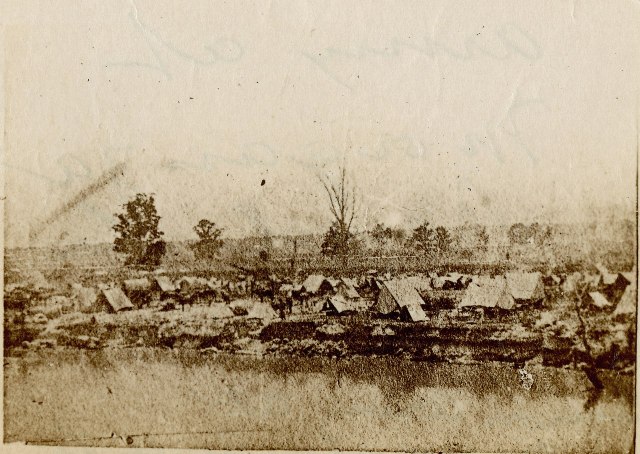
Union Army base at Morganza Bend, Louisiana, circa 1863-1865 (U.S. Library of Congress, public domain).

Researchers investigating the lives of nine formerly enslaved Black men who enlisted with the 47th Pennsylvania Volunteer Infantry during the American Civil War recently uncovered new details about two of those soldiers.

In addition to finding more data related to the immediate post-war life of Aaron French (learn more about him in this article here), including how and why he ended up settling in Mississippi following the Civil War, researchers have also now found important information about the life of Hamilton Blanchard—who enrolled with Bullard on the same day.

Born into slavery in Natchitoches, Louisiana sometime around 1843, Hamilton Blanchard was able to secure his freedom twenty-one years later when the United States Army arrived in town as part of an expedition led by Union Major-General Nathaniel P. Banks. Determined not to be forced back into bondage after the Union troops moved on in their ill-fated quest to capture the city of Shreveport, he chose to enlist with one of the units serving under Banks—the 47th Pennsylvania Volunteer Infantry—the only regiment from Pennsylvania that was involved in the Union’s 1864 Red River Campaign across Louisiana.

After enrolling in the military, Hamilton Blanchard was then assigned to Company D at the rank of “Cook” on 5 April 1864.

Crop_Bullard, Aaron and Hamilton Blanchard_Co. D, 47th PA_Muster Roll

Muster roll entries for Aaron Bullard and Hamilton Blanchard, Company D, 47th Pennsylvania Volunteers (U.S. National Archives, public domain).

The official muster-in of Blanchard, Aaron Bullard, and three other young Black men who enrolled that day did not take place immediately, however, because the 47th Pennsylvania Volunteers were ordered to move out shortly after their arrival, and were quickly drawn into intense combat with enemy troops commanded by Confederate Major-General Richard Taylor (a plantation owner and son of Zachary Taylor, former President of the United States). Battered badly during the Battle of Sabine Cross Roads near Mansfield, Louisiana on 8 April and in the Battle of Pleasant Hill the next day (9 April), they fought the Confederate Army again on 23 April near Monett’s Ferry in the Battle of Cane River and on 16 May in the Battle of Mansura near Marksville.

Continuing on toward the southeastern part of Louisiana, the 47th Pennsylvania Volunteers marched for Morganza, which had been held in Union hands since the fall of 1863 and was now the site of a major Union Army encampment. While there, the officers of the 47th Pennsylvania Volunteer Infantry officially mustered in all nine of the formerly enslaved Black men who had enlisted with the 47th Pennsylvania in Beaufort, South Carolina (1862) and Natchitoches, Louisiana (April 1864)—a process which took place between 20-24 June 1864.

From that point on, those nine men traveled with the 47th Pennsylvania as it returned to the East Coast and engaged in multiple battles associated with Union Major-General Philip Sheridan’s 1864 Shenandoah Valley Campaign across Virginia, the protection of the nation’s capital following the April 1865 assassination of President Abraham Lincoln, and the early days of Reconstruction in Georgia and South Carolina.

On Christmas Day in 1865, Hamilton Blanchard then joined his fellow 47th Pennsylvania Volunteers in mustering out from their final duty station in Charleston, South Carolina.

Post-War Life

Having been honorably discharged from the 47th Pennsylvania Volunteer Infantry when the regiment mustered out, at least two of the nine formerly enslaved Black men who had enlisted with the regiment evidently made their way north—possibly when the other members of their former regiment returned home to Pennsylvania. (It is also possible, however, that they made the journey independently of their former regiment because both men appear to have resettled in the Washington, D.C. area, post-war, while the other 47th Pennsylvania Volunteers were transported by ship directly to New York City and then by train to Camp Cadwalader in Philadelphia, Pennsylvania, where they were given their final discharge papers on 9 January 1866.)

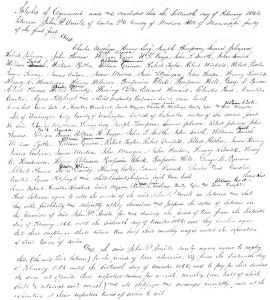
Blanchard-Bullard_Madison Co., MS_Freedmen's Bureau Contract, Feb-Dec 1866, p. 1

Freedmen’s Bureau contract between Madison County, Mississippi farm owner John P. Arvile [sic] and farm laborers Hamilton Blanchard, Aaron Bullard, et. al., Washington, D.C., 16 February 1866 (excerpt, p. 1, U.S. National Archives).

What is known for certain is that Hamilton Blanchard and Aaron Bullard made contact with a representative of the Bureau of Refugees, Freedmen, and Abandoned Lands sometime in late 1865 or early 1866. They then signed a contract with the Freedmen’s Bureau during the early winter of 1866 in which they both agreed to join a large group of formerly enslaved Black men, women, and children who would be providing farm labor to a man named John P. Avrill (alternate spellings: “Averile”, “Averill”, “Arvile”, “Arville”, or “Avrille”) at his property in Canton, Madison County, Mississippi.

That Freedmen’s Bureau contract was slated to be in effect between 16 February and 16 December of 1866, and begins with a cover page which states:

Washington D.C.
February 1866
Contract No.
John P. Arvill
With (66) Freedmen

John Arville
Contract with
46 Farm Hands

The main body of the document goes on to reveal the following details of the contract:

Articles of Agreement made and concluded this the Sixteenth day of February 1866 between John P. Arvile of Canton P.O. County of Madison State of Mississippi party of the first part and

Charles Matthews, Henry Long, Joseph Thompson, Samuel Johnson, Robert Johnson, John Thomas … Charles Ford, Caroline Carter, Agnes Fitzhugh and child (infant), Benjamin Smith, Anna Smith, Thomas Reed [sp?], Aaron Bullard, Hamilton Blanchard, Isaiah Wiggins, James Lewis, Charles K. [illegible], Baily Taylor, William Carter, and Andy Hampton [sp?].

The next paragraph lists Hamilton Blanchard and Aaron Bullard a second time, along with multiple names from the aforementioned group of farm laborers. Subsequent paragraphs spell out further points of the agreement:

All of Washington City, County of Washington, District of Columbia, parties of the second part, the said Charles Matthews, Henry Long, Joseph Thompsen, Samuel Johnson, Robert Johnson, John Thomas … Aaron Bullard, Hamilton Blanchard, Isaiah Wiggins, James Lewis … Field Laborers, agree to enter the service of the said John P. Averile as Laborers and that they will faithfully and diligently apply themselves and perform the duties of Laborers on the premises of said John P. Averile for and during the period of time from the Sixteenth day of February 1866 until the sixteenth day of 1866; and they further agree that their employer shall retain one half their monthly wages until the expiration of their term of service.

And the said John P. Arvile hereby agrees to employ them (the said Field laborers) for the period of time aforesaid. Viz from the Sixteenth day of February 1866 until the sixteenth day of December 1866; and to pay for their services the sum set opposite their respective names per month, monthly (one half of which shall be retained each month) and all stoppages and arranged promptly, paid at the expiration of their respective terms of service to wit…..

In equal monthly payments; and the said John P. Arvile further agrees to furnish said Freed laborers … quarters, fuel, full substantial and healthy rations, and all necessary attendance and supplies in case of sickness, in addition to the compensation … named, and that he will assist and encourage efforts for the education of the children of his employees, and it is further agreed by the said John P. Arvile, that in case he at any time fails to perform his part of this contract agreement he will pay to each of the said laborers the full sum of One hundred and twenty dollars [strikethrough made by someone’s hand to original contract], as fixed, agreed and liquidated damages. This contract can be annulled by the mutual consent of the Employer and the employee, but only in the presence of an Authorized Agent of the Bureau of Refugees Freedmen and Abandoned Lands and such annullment [sic] on the part of the Employer and anyone [sic] employee shall in no wise affect the validity of the Contract in respect to the employer and the other employees and should either party violate this contract then the other party shall make complaint to the nearest authorized agent of the Bureau Refugees Freemen & Abandoned Lands.

The contract continues on, specifying that both Aaron Bullard and Hamilton Blanchard were to each be paid a wage of $10 per month, and stating that some of the other men on the list would be paid as much as $12 per month while others would be paid $8 per month. (Teenaged boys and women on the list were to be paid even less—$6 per month.)

In all cases, the reality was far different. Per the contract, they were initially paid only half of what their monthly wages were because the Freedmen’s Bureau agent in charge of looking out for the welfare of these formerly enslaved men, women, and children allowed the white farmer—their “employer”—to “retain one half their monthly wages until the expiration of their term of service.”

No further data has been uncovered from Freedmen’s Bureau records about the status of those unpaid wages or the outcome of that contract, but because these Black men, women, and children were essentially returned to an unequal system of servitude by the Freedmen’s Bureau agent (as evidenced by the manner in which this contract was drafted—favoring the White “employer” over the Black “field laborer” and including multiple after-the-fact revisions, such as word insertions and strikethroughs)—it is highly unlikely that Hamilton Blanchard, Aaron Bullard, or the other Black men, women, and children mentioned in the contract were ever paid the full amount they were entitled to for what was most assuredly very hard labor.

Blanchard-Bullard-Chapman_Treasury Inquiry, 10 Nov 1866

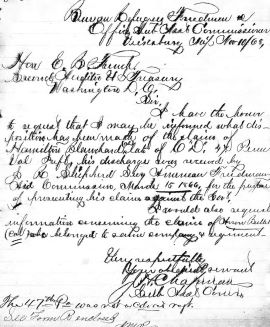
Letter of inquiry from J. H. Chapman on behalf of Hamilton Blanchard to E. B. French, second auditor, U.S. Treasury Department, 10 November 1868 (Freedmen’s Bureau records, U.S. National Archives). 

This hypothesis posed by researchers investigating the history of the 47th Pennsylvania Volunteer Infantry is backed up by a letter of inquiry penned on 10 November 1868 by J. H. Chapman, a Sub-Assistant Commissioner of the Freedmen’s Bureau working at an office in Vicksburg, Mississippi, to E. B. French, Second Auditor of the U.S. Department of the Treasury in Washington, D.C.

In this letter, Chapman asks French that he “be informed what disposition has been made of the claim of Hamilton Blanchard, late of Co. “D” 47 Penn Vol. Inft., his discharge was received by J. R. Schuchard [sp?]” of the “Freedmen’s Aid Commission, March 15, 1866.” Chapman added that he was requesting this update on Blanchard’s behalf “for the purpose of prosecuting his claim against the Gov.” He then also requested “information concerning the claim of Aaron Bullard (Col.) who belonged to same company & regiment.”

* Note: An unidentified individual added an undated notation to the bottom of this letter in handwriting that is clearly different from that of the original letter writer, Chapman. That notation correctly states: “The 47th Pa was not a colored regt. See Form R enclosed. A.M.R. 103.” (The 47th Pennsylvania Volunteer Infantry became an integrated regiment on 5 October 1862, but its African American members were not considered to be part of the U.S. Colored Troops, also known as the USCT.)

Researchers have not yet located the “Form R” referred to in the notation to Chapman’s letter, but will be pursuing this lead, as well as investigating the claims filed by Hamilton Blanchard and Aaron Bullard, and searching for additional information regarding what happened to Hamilton Blanchard during and after the 1870s. 

An additional avenue of inquiry will be the potential relationship that may have developed between Aaron Bullard and E. B. French during or after this time—a new theory being considered in light of the discovery of French’s name on this letter. (Aaron Bullard changed his surname, “Bullard,” which had been associated with his enslavement in Louisiana, to “French” sometime between his 1868 appeal to E. B. French in the U.S. Treasury Department and the day he was visited at home in Issaquena County, Mississippi by an enumerator of the 1870 U.S. Census—possibly indicating that he wanted to both shed his “slave name” and honor someone who had been helpful to him.)

Sources:

  1. Bates, Samuel P. History of Pennsylvania Volunteers, 1861-5, vol. 1. Harrisburg, Pennsylvania: B. Singerly, State Printer, 1869.
  2. Civil War Muster Rolls, in Records of the Department of Military and Veterans’ Affairs (Record Group 19, Series 19.11). Harrisburg, Pennsylvania: Pennsylvania Historical and Museum Commission, 1861-1865.
  3. Civil War Veterans’ Card File. Harrisburg, Pennsylvania: Pennsylvania State Archives.
  4. “Records of the Field Offices for the District of Columbia, Bureau of Refugees, Freedmen, and Abandoned Lands, 1865-1870” (NARA Series Number: M1902; NARA Reel Number: 18; NARA Record Group Number: 105; NARA Record Group Name: Records of the Bureau of Refugees, Freedmen, and Abandoned Lands, 1861 – 1880; Collection Title: District of Columbia Freedmen’s Bureau Field Office Records 1863-1872: Aaron Bullard and Hamilton Blanchard, 1866 and 1868). Washington, D.C.: U.S. National Archives and Records Administration.
  5. Schmidt, Lewis. A Civil War History of the 47th Regiment of Pennsylvania Veteran Volunteers. Allentown, Pennsylvania: Self-published, 1986.
  6. Wharton, Henry D. Letters from the Sunbury Guards. Sunbury, Pennsylvania: Sunbury American, 1861-1868.

Black History Month: New Details Uncovered Regarding the Formerly Enslaved Black Men Who Enlisted with the 47th Pennsylvania Volunteer Infantry

Research regarding the lives of the nine formerly enslaved Black men who enlisted with the 47th Pennsylvania Volunteer Infantry in 1862 and 1864 has continued to progress—even in the middle of a pandemic that has forced the closure of numerous local, state, and national archives.*

In addition to uncovering details about the life of the soldier from South Carolina who was mistakenly listed on muster rolls for the 47th Pennsylvania as “Presto Gettes” (learn more about him in this article here), researchers for 47th Pennsylvania Volunteers: One Civil War Regiment’s Story have been able to determine more about what happened to two of the other men post-war, and have also located records which seem to indicate that there may have been two or three other Black men who enlisted with the regiment (potentially bringing the total number of Black enlistees in the regiment to twelve).

Aaron French (enlisted as Aaron Bullard):

Muster roll entries for Aaron Bullard and Hamilton Blanchard, Company D, 47th Pennsylvania Volunteers (U.S. National Archives, public domain).

1864 was a life-changing year for Aaron Bullard and four other young Black men in Louisiana. After enlisting with the 47th Pennsylvania Volunteer Infantry on April 5 while the 47th was stationed at Natchitoches, Louisiana, Samuel Jones, Hamilton Blanchard (also known as John Hamilton), and Aaron, James, and John Bullard traveled with the 47th Pennsylvania as it participated in the multiple battles associated with the Union’s 1864 Red River Campaign across Louisiana. On or about June 22, they were formally mustered into the regiment at Morganza, Louisiana.

Sometime later (possibly post-war), Aaron Bullard changed his surname to French. After the American Civil War, he married, became a land-owning farmer—and a dad.

Post-Civil War, Aaron French and his family resided in Issaquena County, Mississippi (U.S. Census, 1870, public domain).

In August of 1870, Aaron French and his wife, Amanda, lived with their eight-month-old daughter, “Simpy” (also known as Cynthia or Cyntha) in Skipworth Precinct, Issaquena County, Mississippi. Still residing in Issaquena County a decade later when the June 1880 federal census was taken, Aaron and Amanda were the proud parents of three daughters: Cynthia (who would go on to marry Samuel L. Dixon on March 20, 1890), Jesanna (also known as Jessie/Jesse), and “Arctavia” (also known as Octavia). Jessie, who later went on to wed John B. Cobb on January 28, 1892, made a life with her husband and son in Mayersville, Mississippi, where she was a teacher in the local schools. Octavia married Frank Childress on March 20, 1894.

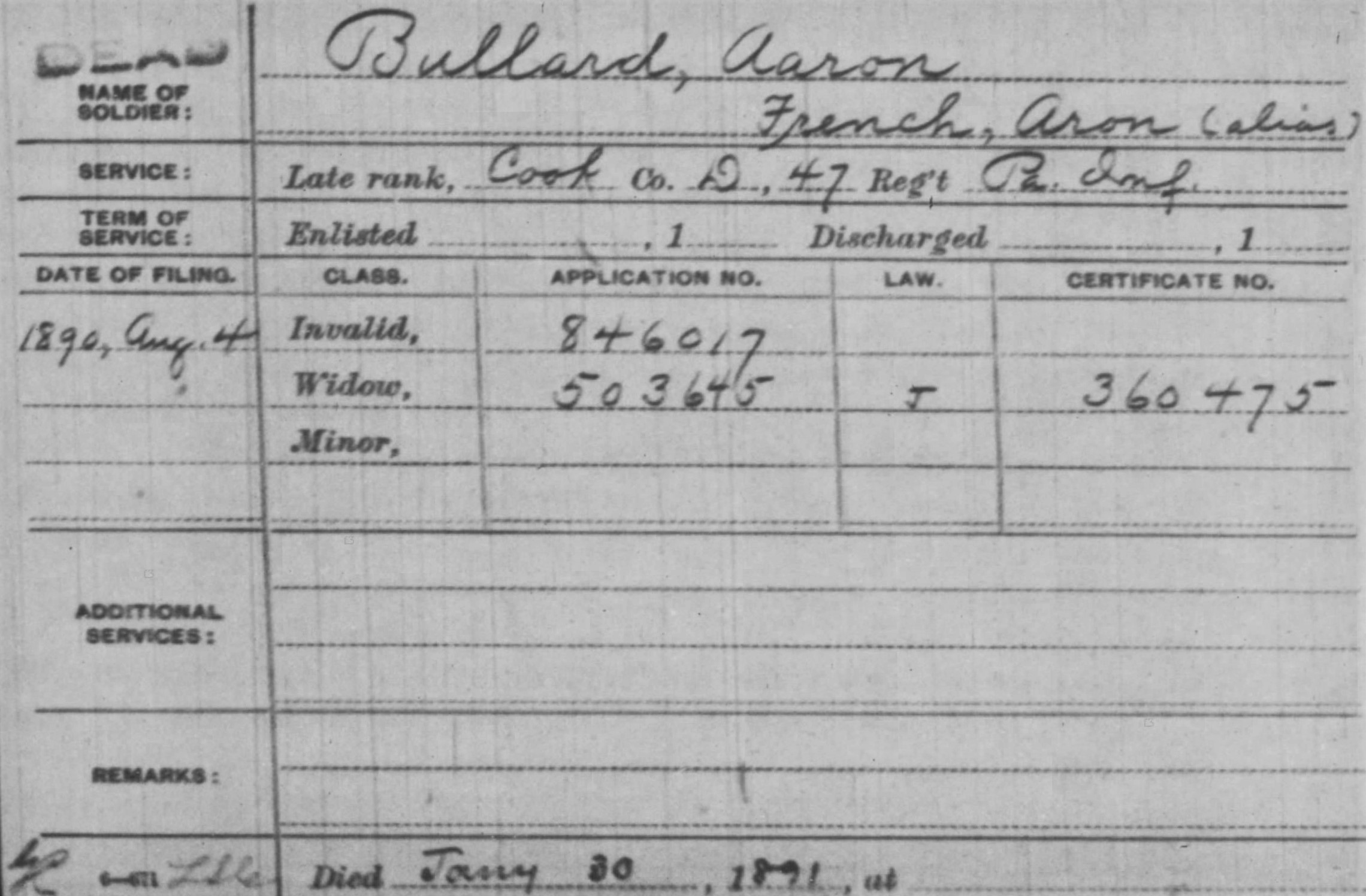
U.S. Civil War Pension Index Card for Aaron French, who enlisted with the 47th Pennsylvania Volunteers in Louisiana in 1864 (U.S. National Archives, public domain).

Sadly, Aaron French did not live to see his two youngest daughters marry because he died in Mississippi on January 30, 1891. He was just 40-43 years old, according to U.S. Census records and other data, which indicate that he was born in Louisiana sometime between 1848 and 1850.

Hearteningly, though, an even more intriguing piece of data has recently been uncovered about the later life of Aaron French—one that indicates that he had become active in politics prior to his death. According to the Vicksburg Evening Post, Aaron was appointed as a delegate from Issaquena County to the Republican Congressional Convention for the Third District, which was held in Greenville, Mississippi on August 7, 1886. Researchers are continuing to search for further details about his political activities and untimely death, as well as the exact location of his gravesite.

Thomas Haywood (alternate spellings of surname: Hayward, Haywood, Heywood) and Jack Jacobs:

Muster roll entries of Thomas Haywood and Edward Jassum, Company H, 47th Pennsylvania Volunteers (U.S. National Archives, public domain).

Born into slavery in South Carolina sometime around 1832, Thomas Haywood enlisted for a three-year term of service as an Under Cook with Company H of the 47th Pennsylvania Volunteer Infantry at Beaufort, South Carolina on November 1, 1862. He and three other formerly enslaved Black men—Abraham and Edward Jassum and Presto Gettes”—who had previously enlisted with the 47th Pennsylvania at Beaufort in October of 1862, then traveled with the 47th Pennsylvania as it participated in multiple military engagements, including the 47th’s garrisoning of Fort Taylor and Fort Jefferson in Florida in 1863 and 1864, the battles of the Union’s spring 1864 Red River Campaign across Louisiana, and the battles of Sheridan’s tide-turning Shenandoah Valley Campaign across Virginia in the fall of 1864.

On or about June 22, 1864 all nine of these Black soldiers were formally mustered into the regiment at Morganza, Louisiana; Thomas Haywood and seven of the eight others all successfully completed their tours of duty, and were honorably mustered out upon expiration of their respective terms of enlistment. In Thomas Haywood’s case, that honorable discharge was awarded on October 31, 1865.

Post-war, it appears from various Freedmen’s Bureau records that he may have entered into yearly contracts with several men who had previously been plantation owners in the Beaufort, South Carolina area. In exchange for agreeing to plant and cultivate cotton for those men on three to five-acre parcels of land that had been leased to him by those white men, he was allowed to keep portions of the cotton sales (the largest portions of which went to the former plantation owners who had also most likely been slave owners prior to and during the Civil War).

U.S. Civil War Index Card for Thomas Haywood, who enlisted with the 47th Pennsylvania Volunteers in South Carolina in 1862 (U.S. National Archives, public domain).

His body warn out from years of slavery prior to the war, difficult military service during the war, and harsh sharecropping experiences post-war, Thomas Hayward applied for, and was awarded a U.S. Civil War Pension on April 30, 1888. That pension was subsequently renewed by the federal government in 1907 at the rate of $15 per month (roughly $415 per month in today’s U.S. dollar equivalency).

By 1890, Thomas Haywood was living in Sheldon Township, Beaufort County, South Carolina. After a long life, he died on January 13, 1911. Unfortunately, his burial location has also not yet been identified by researchers.

In 1890, Thomas Haywood lived near Hanna Jacobs, the widow of Jack Jacobs, who may have been another Black soldier who enlisted with the 47th Pennsylvania Volunteers (U.S. Census, 1890, Sheldon Township, Beaufort County, South Carolina, public domain).

One other piece of tantalizing data that has recently been discovered is that a woman named “Hanna Jacobs” lived near Thomas Haywood in 1890. This information may be significant because Hanna was described on the 1890 U.S. Census of Union soldiers and widows as the widow of “Jack Jacobs,” who had served in the same company with Thomas Haywood (according to that special census).

Researchers currently believe that Jack Jacobs may, in fact, have been another formerly enslaved Black man who had enlisted with the 47th Pennsylvania when it was stationed near Beaufort in 1862, and are currently conducting a Go Fund Me campaign to raise funds to purchase the Civil War military and pension records of Hanna and Jack Jacobs, as well as the nine known formerly enslaved Black men who enlisted with the 47th Pennsylvania Volunteer Infantry in 1862 and 1864.

Jackson Haywood:

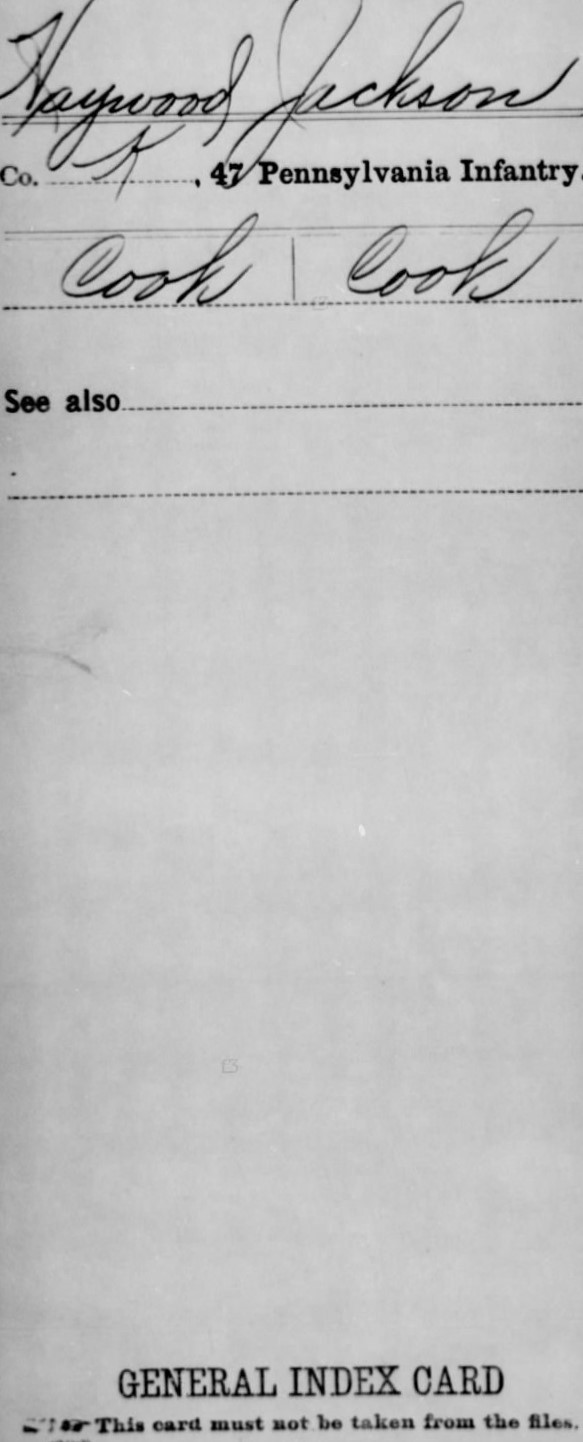
General Index Card for Jackson Haywood, who may have been a Black soldier who enlisted with the 47th Pennsylvania Volunteers (U.S. National Archives, public domain).

According to the “Index to Compiled Service Records of Volunteers Who Served in Organizations from the State of Pennsylvania,” which was created by staff at the U.S. National Archives, a General Index Card was created for yet another mystery man—a soldier named “Jackson Hayward.”

To date, researchers have only been able to determine that he may have enlisted with Company K of the 47th Pennsylvania Volunteer Infantry as a cook—a rank similar to that at which the known nine formerly enslaved Black men who enlisted with the 47th Pennsylvania were entered on the muster rolls of the regiment.

Researchers hope, with time and the continued financial support of the followers of 47th Pennsylvania Volunteers: One Civil War Regiment’s Story, to be able to confirm the dates of military service and race of this individual, as well as that of “Jack Jacobs.”

As always, we appreciate everyone’s help in ensuring that the service to the nation of these soldiers will never be forgotten. They helped to preserve our Union and deserve to be recognized more fully for their heroism and dedication.

* Our most important goal continues to be the purchase of the Compiled Military Service Records (CMSR) and U.S. Civil War Pension records for each of these remarkable men in order to document and freely share their stories with the widest possible audience. We continue to await word from staff at the U.S. National Archives regarding the timeframe for their resumption of digitization and reproduction services that have temporarily been suspended due to the coronavirus pandemic. As soon as those services have resumed, we will request an update regarding their estimated timeframe for fulfilling our records requests. In the interim, we will seek out further details about each of these soldiers via local and state archival resources across the nation, and will post updates as we confirm more data.

Sources:

  1. Bullard, Aaron, in Index to Compiled Service Records of Volunteers. Washington, DC: U.S. National Archives, 1861-1865.
  2. Bullard, Aaron and French, Aaron, in U.S. Civil War Pension Index Cards. Washington, DC: U.S. National Archives, 1890-1891.
  3. Bullard, Aaron, Presto Garris, Thomas Haywood, et. al. in U.S. Civil War Muster Out Rolls (47th Pennsylvania Volunteer Infantry). Washington, DC: U.S. National Archives, 1865-1866 (available via Ancestry.com).
  4. French, Aaron, in “Proceedings of the Third District Republican Convention.” Vicksburg, Mississippi: Vicksburg Evening Post, August 9, 1886.
  5. French, Aaron and Family, in U.S. Census Records (Issaquena County, Mississippi): Washington, DC: U.S. National Archives, 1870-1910.
  6. Haywood, Jackson, in Index to Compiled Service Records of Volunteers. Washington, DC: U.S. National Archives, 1861-1865.
  7. Haywood, Thomas, in Index to Compiled Service Records of Volunteers. Washington, DC: U.S. National Archives, 1861-1865.
  8. Haywood, Thomas, in U.S. Civil War Pension Index Cards. Washington, DC: U.S. National Archives, 1888, 1907.
  9. Haywood, Thomas, in U.S. Veterans’ Administration Pension Payment Cards. Washington, DC: U.S. National Archives, 1888, 1907.
  10. Haywood, Thomas, in U.S. Census (Beaufort County, South Carolina): Washington, DC: U.S. National Archives, 1890.
  11. Hanna Jacobs, widow of Jack Jacobs, in U.S. Census (Beaufort County, South Carolina): Washington, DC: U.S. National Archives, 1890.


A Nation’s Slow March Toward Freedom — The Key Steps Taken by America to Abolish Slavery

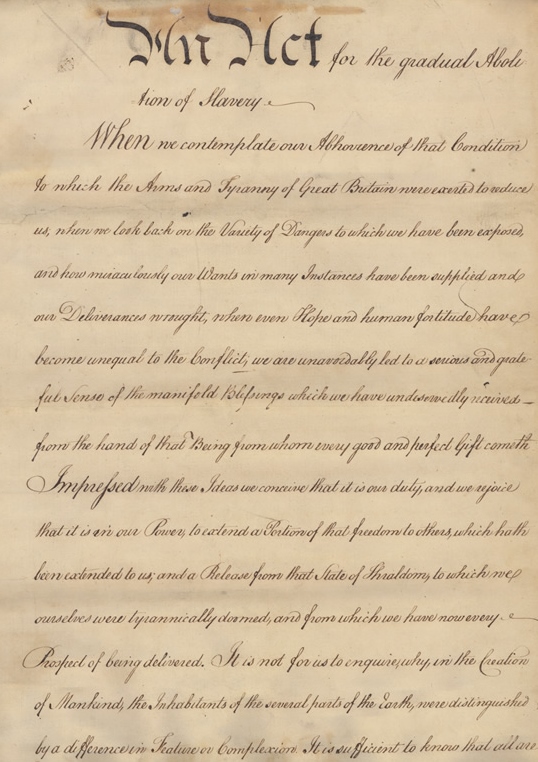
“An Act for the Gradual Abolition of Slavery” was passed by the Pennsylvania Assembly on March 1, 1780 (Pennsylvania Historical and Museum Commission, public domain).

The elimination of slavery in the United States of America has been a lengthy and less than perfect process, beginning with early abolition efforts which occurred during the nation’s colonial period, and which were designed to reduce and ultimately end the buying, selling, and exchanging or bartering of human beings. According to the Pennsylvania Historical and Museum Commission, “the first written protest in England’s American colonies came from Germantown Friends in 1688” in Pennsylvania; the Philadelphia Yearly Meeting of Friends also subsequently “criticized the importation of slaves in 1696, objected to slave trading in 1754, and in 1775 determined to disown members who would not free their slaves.”

That same year, America’s first abolition organization, the Society for the Relief of Free Negroes Unlawfully Held in Bondage, was also established. Formed in Philadelphia on April 14, 1775, the organization became more commonly known as the Pennsylvania Abolition Society. “Throughout the 1700s,” according to PHMC historians, the Pennsylvania Assembly also actively “attempted to discourage the slave trade by taxing it repeatedly,” and then began taking a slightly more intense approach by passing An Act for the Gradual Abolition of Slaveryby a vote of 34 to 21 on March 1, 1870. The first legislative action of its kind in America, it decreed, among other things, “that ‘every Negro and Mulatto child born within the State after the passing of the Act (1780) would be free upon reaching age twenty-eight,'” and that after their release from slavery, these freed people “were to receive the same freedom dues and other privileges ‘such as tools of their trade,’ as servants bound by indenture for four years.” Heavily opposed by German Lutherans and the representatives of counties with large populations of residents of German heritage, this new law still allowed residents of the Keystone State to continue to buy slaves who had already been registered, but prohibited Pennsylvanians from importing new slaves into the state.

* Note: Although a significant number of German Lutherans initially opposed the state’s 1870 abolition act, many German Methodists adopted anti-slavery positions, as did many who were considered to be “Forty-Eighters” (Germans who emigrated to America during or after the revolutions of 1848).

Although opponents of Pennsylvania’s new abolition law continued to challenge this legislation for several years after its passage, the legislation ultimately survived, and was subsequently strengthened in 1788 to stop Pennsylvanians residing near the borders of Delaware and Maryland from sneaking slaves into the state in violation of the law. The full wording of Pennsylvania’s initial abolition act read as follows:

When we contemplate our Abhorence of that Condition to which the Arms and Tyranny of Great Britain were exerted to reduce us, when we look back on the Variety of Dangers to which we have been exposed, and how miraculously our Wants in many Instances have been supplied and our Deliverances wrought, when even Hope and human fortitude have become unequal to the Conflict; we are unavoidably led to a serious and grateful Sense of the manifold Blessings which we have undeservedly received from the hand of that Being from whom every good and perfect Gift cometh. Impressed with these Ideas we conceive that it is our duty, and we rejoice that it is in our Power, to extend a Portion of that freedom to others, which hath been extended to us; and a Release from that State of Thraldom, to which we ourselves were tyrannically doomed, and from which we have now every Prospect of being delivered. It is not for us to enquire, why, in the Creation of Mankind, the Inhabitants of the several parts of the Earth, were distinguished by a difference in Feature or Complexion. It is sufficient to know that all are the Work of an Almighty Hand, We find in the distribution of the human Species, that the most fertile, as well as the most barren parts of the Earth are inhabited by Men of Complexions different from ours and from each other, from whence we may reasonably as well as religiously infer, that he, who placed them in their various Situations, hath extended equally his Care and Protection to all, and that it becometh not us to counteract his Mercies.

We esteem a peculiar Blessing granted to us, that we are enabled this Day to add one more Step to universal Civilization by removing as much as possible the Sorrows of those, who have lived in undeserved Bondage, and from which by the assumed Authority of the Kings of Britain, no effectual legal Relief could be obtained. Weaned by a long Course of Experience from those narrow Prejudices and Partialities we had imbibed, we find our Hearts enlarged with Kindness and Benevolence towards Men of all Conditions and Nations; and we conceive ourselves at this particular Period extraordinarily called upon by the Blessings which we have received, to manifest the Sincerity of our Profession and to give a substantial Proof of our Gratitude.

And whereas, the Condition of those Persons who have heretofore been denominated Negroe and Mulatto Slaves, has been attended with Circumstances which not only deprived them of the common Blessings that they were by Nature entitled to, but has cast them into the deepest Afflictions by an unnatural Separation and Sale of Husband and Wife from each other, and from their Children; an Injury the greatness of which can only be conceived, by supposing that we were in the same unhappy Case. In Justice therefore to Persons so unhappily circumstanced and who, having no Prospect before them whereon they may rest their Sorrows and their hopes have no reasonable Inducement to render that Service to Society, which they otherwise might; and also ingrateful Commemoration of our own happy Deliverance, from that State of unconditional Submission, to which we were doomed by the Tyranny of Britain.

Be it enacted and it is hereby enacted by the Representatives of the Freemen of the Commonwealth of Pennsylvania in General Assembly met and by the Authority of the same, That all Persons, as well Negroes, and Mulattos, as others, who shall be born within this State, from and after the Passing of this Act, shall not be deemed and considered as Servants for Life or Slaves; and that all Servitude for Life or Slavery of Children in Consequence of the Slavery of their Mothers, in the Case of all Children born within this State from and after the passing of this Act as aforesaid, shall be, an hereby is, utterly taken away, extinguished and for ever abolished.

Provided always and be it further enacted by the Authority aforesaid, That every Negroe and Mulatto Child born within this State after the passing of this Act as aforesaid, who would in Case this Act had not been made, have been born a Servant for Years or life or a Slave, shall be deemed to be and shall be, by Virtue of this Act the Servant of such person or his or her Assigns, who would in such Case have been entitled to the Service of such Child until such Child shall attain unto the Age of twenty eight Years, in the manner and on the Conditions whereon Servants bound by Indenture for four Years are or may be retained and holden; and shall be liable to like Correction and punishment, and intitled to like Relief in case he or she be evilly treated by his or her master or Mistress; and to like Freedom dues and other Privileges as Servants bound by Indenture for Four Years are or may be intitled unless the Person to whom the Service of any such Child Shall belong, shall abandon his or her Claim to the same, in which Case the Overseers of the Poor of the City Township or District, respectively where such Child shall be so abandoned, shall by Indenture bind out every Child so abandoned as an Apprentice for a Time not exceeding the Age herein before limited for the Service of such Children.

And be it further enacted by the Authority aforesaid, That every Person who is or shall be the Owner of any Negroe or Mulatto Slave or Servant for life or till the Age of thirty one Years, now within this State, or his lawful Attorney shall on or before the said first day of November next, deliver or cause to be delivered in Writing to the Clerk of the Peace of the County or to the Clerk of the Court of Record of the City of Philadelphia, in which he or she shall respectively inhabit, the Name and Sirname and Occupation or Profession of such Owner, and the Name of the County and Township District or Ward where he or she resideth, and also the Name and Names of any such Slave and Slaves and Servant and Servants for Life or till the Age of thirty one Years together with their Ages and Sexes severally and respectively set forth and annexed, by such Person owned or statedly employed, and then being within this State in order to ascertain and distinguish the Slaves and Servants for Life and Years till the Age of thirty one Years within this State who shall be such on the said first day of November next, from all other persons, which particulars shall by said Clerk of the Sessions and Clerk of said City Court be entered in Books to be provided for that Purpose by the said Clerks; and that no Negroe or Mulatto now within this State shall from and after the said first day of November by deemed a slave or Servant for life or till the Age of thirty one Years unless his or her name shall be entered as aforesaid on such Record except such Negroe and Mulatto Slaves and Servants as are hereinafter excepted; the said Clerk to be entitled to a fee of Two Dollars for each Slave or Servant so entered as aforesaid, from the Treasurer of the County to be allowed to him in his Accounts.

Provided always, That any Person in whom the Ownership or Right to the Service of any Negro or Mulatto shall be vested at the passing of this Act, other than such as are herein before excepted, his or her Heirs, Executors, Administrators and Assigns, and all and every of them severally Shall be liable to the Overseers of the Poor of the City, Township or District to which any such Negroe or Mulatto shall become chargeable, for such necessary Expence, with Costs of Suit thereon, as such Overseers may be put to through the Neglect of the Owner, Master or Mistress of such Negroe or Mulatto, notwithstanding the Name and other descriptions of such Negroe or Mulatto shall not be entered and recorded as aforesaid; unless his or her Master or Owner shall before such Slave or Servant attain his or her twenty eighth Year execute and record in the proper County, a deed or Instrument securing to such Slave or Servant his or her Freedom.

And be it further enacted by the Authority aforesaid, That the Offences and Crimes of Negroes and Mulattos as well as Slaves and Servants and Freemen, shall be enquired of, adjudged, corrected and punished in like manner as the Offences and Crimes of the other Inhabitants of this State are and shall be enquired of adjudged, corrected and punished, and not otherwise except that a Slave shall not be admitted to bear Witness agaist [sic] a Freeman.

And be it further enacted by the Authority aforesaid That in all Cases wherein Sentence of Death shall be pronounced against a Slave, the Jury before whom he or she shall be tried shall appraise and declare the Value of such Slave, and in Case Such Sentence be executed, the Court shall make an Order on the State Treasurer payable to the Owner for the same and for the Costs of Prosecution, but in Case of a Remission or Mitigation for the Costs only.

And be it further enacted by the Authority aforesaid That the Reward for taking up runaway and absconding Negroe and Mulatto Slaves and Servants and the Penalties for enticing away, dealing with, or harbouring, concealing or employing Negroe and Mulatto Slaves and Servants shall be the same, and shall be recovered in like manner, as in Case of Servants bound for Four Years.

And be it further enacted by the Authority aforesaid, That no Man or Woman of any Nation or Colour, except the Negroes or Mulattoes who shall be registered as aforesaid shall at any time hereafter be deemed, adjudged or holden, within the Territories of this Commonwealth, as Slaves or Servants for Life, but as freemen and Freewomen; and except the domestic Slaves attending upon Delegates in Congress from the other American States, foreign Ministers and Consuls, and persons passing through or sojourning in this State, and not becoming resident therein; and Seamen employed in Ships, not belonging to any Inhabitant of this State nor employed in any Ship owned by any such Inhabitant, Provided such domestic Slaves be not aliened or sold to any Inhabitant, nor (except in the Case of Members of Congress, foreign Ministers and Consuls) retained in this State longer than six Months.

Provided always and be it further enacted by the Authority aforesaid, That this Act nor any thing in it contained shall not give any Relief or Shelter to any absconding or Runaway Negroe or Mulatto Slave or Servant, who has absented himself or shall absent himself from his or her Owner, Master or Mistress, residing in any other State or Country, but such Owner, Master or Mistress, shall have like Right and Aid to demand, claim and take away his Slave or Servant, as he might have had in Case this Act had not been made. And that all Negroe and Mulatto Slaves, now owned, and heretofore resident in this State, who have absented themselves, or been clandestinely carried away, or who may be employed abroad as Seamen, and have not returned or been brought back to their Owners, Masters or Mistresses, before the passing of this Act may within five Years be registered as effectually, as is ordered by this Act concerning those who are now within the State, on producing such Slave, before any two Justices of the Peace, and satisfying the said Justices by due Proof, of the former Residence, absconding, taking away, or Absence of such Slave as aforesaid; who thereupon shall direct and order the said Slave to be entered on the Record as aforesaid.

And Whereas Attempts may be made to evade this Act, by introducing into this State, Negroes and Mulattos, bound by Covenant to serve for long and unreasonable Terms of Years, if the same be not prevented.

Be it therefore enacted by the Authority aforesaid, That no Covenant of personal Servitude or Apprenticeship whatsoever shall be valid or binding on a Negroe or Mulatto for a longer Time than Seven Years; unless such Servant or Apprentice were at the Commencement of such Servitude or Apprenticeship under the Age of Twenty one Years; in which Case such Negroe or Mulatto may be holden as a Servant or Apprentice respectively, according to the Covenant, as the Case shall be, until he or she shall attain the Age of twenty eight Years but no longer.

And be it further enacted by the Authority aforesaid, That an Act of Assembly of the Province of Pennsylvania passed in the Year one thousand seven hundred and five, intitled “An Act for the Trial of Negroes;” and another Act of Assembly of the said Province passed in the Year one thousand seven hundred and twenty five intitled “An Act for “the better regulating of Negroes in this Province;” and another Act of Assembly of the said Province passed in the Year one thousand seven hundred and sixty one intitled “An Act for laying a Duty on Negroe and Mulatto Slaves imported into this Province” and also another Act of Assembly of the said Province, passed in the Year one thousand seven hundred and seventy three, intitled “An Act for making perpetual An Act for laying a duty on Negroe and Mulatto “Slaves imported into this Province and for laying an additional “Duty on said Slaves;” shall be and are hereby repealed annulled and made void.

John Bayard, Speaker

Enacted into a Law at Philadelphia on Wednesday the first day of March, Anno Domini One thousand seven hundred Eighty
Thomas Paine, Clerk of the General Assembly

Other states then followed Pennsylvania’s lead, expanding upon it by enacting less conservative measures. During a series of judicial reviews which were conducted in Massachusetts between 1781 and 1783, for example, state leaders there declared that slavery was incompatible with their state’s new constitution.

These various laws, while not perfect, did gradually achieve their aim of reducing slavery in northern states, as did 1807 legislation by the U.S. Congress which made it a crime for Americans to engage in international slave trade (effective January 1, 1808), and which ultimately reduced shipments of slaves from Africa to the United States by ninety percent. With respect to Pennsylvania, specifically, “the number of slaves dropped from 3,737 to 1,706” between 1790 and 1800, according to PHMC historians, “and by 1810 to 795. In 1840, there still were 64 slaves in the state, but by 1850 there were none.”

Meanwhile, Quakers and others active in abolition movements in Delaware, Maryland, and Virginia achieved some success by pressuring slaveholders to agree to free slaves via wills and other methods of manumission so that, by 1860, more than ninety percent of black men, women, and children in Delaware and nearly fifty percent in Maryland were free.

Despite these efforts, however, the ugliness of slavery continued to persist — a fact made all too clear in newspapers and other publications of the period, including via William Lloyd Garrison’s abolitionist newspaper, The Liberator. But it was, perhaps, the nation’s fugitive slave laws which finally made plain slavery’s seemingly unshakeable grip on the country. Passed by the U.S. Congress, the Fugitive Slave Act of 1850 required that all escaped slaves, regardless of where they were captured, be returned to their masters — even if those escaped slaves had made it to safety via the Underground Railroad or other methods and had been given sanctuary by abolitionists in states where slaves had been permanently freed. In response, two years later, Harriet Beecher Stowe released her landmark, anti-slavery novel, Uncle Tom’s Cabin.

After the U.S. Congress set the stage to reverse decades of anti-slavery progress with its passage of the Kansas-Nebraska Act in 1854, abolitionists and other opponents of slavery banded together to form the Republican Party, which held its first national convention in Pittsburgh, Pennsylvania on February 22, 1856. Initially proposing a system which would contain slavery until each individual state where the practice still existed could be forced to eradicate it, the Republican Party adopted a harder, anti-slavery line in 1860 after the election of Abraham Lincoln as president of the United States.

Following the secession of multiple states from the Union, beginning with South Carolina on December 20, 1860, and the subsequent fall of Fort Sumter to Confederate States Army troops in mid-April 1861, the United States descended into a state of civil war with its federal government issuing a call for regular and volunteer troops to preserve the Union. On September 22, 1862, President Lincoln formally added the abolition of slavery as one of the federal government’s stated war goals with his release of the preliminary version of his Emancipation Proclamation, which decared that, effective January 1, 1863, “all persons held as slaves within any State, or designated part of a State, the people whereof shall then be in rebellion against the United States shall be then, thenceforward, and forever free.”

But it would take more than two years for that hoped-for dream to truly begin and nearly 150 years for it to be completely embraced by a divided nation.

THE 13TH AMENDMENT TO THE U.S. CONSTITUTION (THE ABOLITION OF SLAVERY)

“Section 1. Neither slavery nor involuntary servitude, except as a punishment for crime whereof the party shall have been duly convicted, shall exist within the United States, or any place subject to their jurisdiction.

Section 2. Congress shall have power to enforce this article by appropriate legislation.”
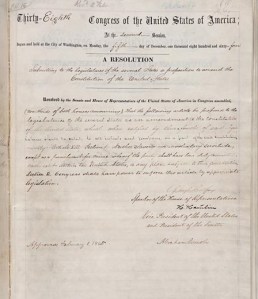
On January 31, 1865, the United States Congress approved the 13th Amendment to the U.S. Constitution, abolishing slavery in America. President Abraham Lincoln added his signature on February 1, 1865. (U.S. National Archives, public domain).

1864:

April 8, 1864: The United States Senate passes the 13th Amendment to the U.S. Constitution by a vote of 38 to 6.

1865:

January 31, 1865: The U.S. House passes the 13th Amendment by a vote of 119 to 56.

February 1, 1865: President Abraham Lincoln approves the Joint Resolution of Congress. According to historians at The Gilder Lehrman Institute of American History, even though the U.S. Constitution does not require presidential signatures on amendments, Lincoln chooses to add his signature, making the 13th Amendment “the only constitutional amendment to be later ratified that was signed by a president.” The resolution is also ratified on this day by the Illinois Legislature, making Illinois the first state to ratify the amendment. (According to news reports, the Illinois Legislature actually ratified the amendment in Springfield, Illinois before Lincoln added his signature to the document in Washington, D.C.)

February 2, 1865: Rhode Island becomes the second state to ratify the 13th Amendment to the U.S. Constitution. Michigan’s legislature also ratifies the amendment on this day.

February 3, 1865: Maryland, New York, and West Virginia ratify the 13th Amendment to the U.S. Constitution.

February 6, 1865: Missouri ratifies the 13th Amendment to the U.S. Constitution.

February 7, 1865: Maine, Kansas, and Massachusetts ratify the 13th Amendment to the U.S. Constitution.

February 8, 1865: Pennsylvania ratifies the 13th Amendment to the U.S. Constitution while Delaware initially rejects ratification of the amendment. (Delaware’s legislature will later approve it in 1901. See below for details.)

February 9, 1865: Virginia ratifies the 13th Amendment to the U.S. Constitution.

February 10, 1865: Ohio ratifies the 13th Amendment to the U.S. Constitution.

February 15–16, 1865: Louisiana ratifies the 13th Amendment to the U.S. Constitution on February 15 or 16 while Indiana and Nevada both ratify the amendment on February 16, 1865.

February 23, 1865: Minnesota ratifies the 13th Amendment to the U.S. Constitution.

February 24, 1865: Wisconsin ratifies the 13th Amendment to the U.S. Constitution while Kentucky rejects ratification. (Kentucky’s legislature will later approve ratification in 1976. See below for details.)

March 9, 1865: Vermont’s governor approves the 13th Amendment to the U.S. Constitution.

March 16, 1865: New Jersey initially rejects ratification of the 13th Amendment to the U.S. Constitution. (The state’s legislature will later approve it in 1866. See below for details.)

April 7, 1865: Tennessee ratifies the 13th Amendment to the U.S. Constitution.

April 14, 1865: Arkansas ratifies the 13th Amendment to the U.S. Constitution.

May 4, 1865: Connecticut ratifies the 13th Amendment to the U.S. Constitution.

June 30, 1865: New Hampshire ratifies the 13th Amendment to the U.S. Constitution.

November 13, 1865: South Carolina ratifies the 13th Amendment to the U.S. Constitution.

December 2, 1865: Alabama’s provisional governor approves the 13th Amendment to the U.S. Constitution while Mississippi rejects ratification of the 13th Amendment to the U.S. Constitution. (Mississippi’s certified ratification of the amendment will not be achieved until 148 years later. See below for detail.)

December 4, 1865: North Carolina ratifies the 13th Amendment to the U.S. Constitution.

December 6, 1865: The 13th Amendment to the U.S. Constitution is officially ratified when Georgia becomes the 27th state to approve the amendment. (America has a total of 36 states at this time in its history.) With this day’s formal abolition of slavery, four million Americans are permanently freed.

December 11, 1865: Oregon ratifies the 13th Amendment to the U.S. Constitution.

December 15, 1865: California ratifies the 13th Amendment to the U.S. Constitution.

December 18, 1865: United States Secretary of State William H. Seward certifies that the 13th Amendment has become a valid part of the U.S. Constitution.

William H. Seward, Secretary of State of the United States,
To all to whom these presents may come, greeting:

Dec. 18, 1865, Preamble: Know ye, that whereas the congress of the United States on the 1st of February last passed a resolution which is in the words following, namely:

“A resolution submitting to the legislatures of the several states a proposition to amend the Constitution of the United States.”

“Resolved by the Senate and House of the United States of America in Congress assembled, (two thirds of both houses occurring,) That the following article be proposed to the legislatures of the several states as an amendment to the Constitution of the United States, which, when ratified by three fourths of said legislatures, shall be valid, to all intents and purposes, as a part of the said constitution, namely:

“ARTICLE XIII.

“Section 1. Neither slavery nor involuntary servitude, except as a punishment for crime whereof the party shall have been duly convicted, shall exist within the United States, or any place subject to their jurisdiction.

“Section 2. Congress shall have power to enforce this article by appropriate legislation.”

And whereas it appears from official documents on file in this department that the amendment to the Constitution of the United States proposed, as aforesaid, has been ratified by the legislatures of the State of Illinois, Rhode Island, Michigan, Maryland, New York, West Virginia, Maine, Kansas, Massachusetts, Pennsylvania, Virginia, Ohio, Missouri, Nevada, Indiana, Louisiana, Minnesota, Wisconsin, Vermont, Tennessee, Arkansas, Connecticut, New Hampshire, South Carolina, Alabama, North Carolina, and Georgia; in all twenty-seven states;

And whereas the whole number of states in the United States is thirty-six; and whereas the before specially-named states, whose legislatures have ratified the said proposed amendment, constitute three fourths of the whole number of states in the United States;

Now, therefore, be it known, that I, WILLIAM H. SEWARD, Secretary of State of the United States, by virtue and in pursuance of the second section of the act of congress, approved the twentieth of April, eighteen hundred and eighteen, entitled “An act to provide for the publication of the laws of the United States and for other purposes,” do hereby certify that the amendment aforesaid has become valid, to all intents and purposes, as a part of the Constitution of the United States.

In testimony whereof, I have hereunto set my hand, and caused the seal of the Department of State to be affixed.

Done at the city of Washington, this eighteenth day of December, in the year of our Lord one thousand eight hundred and sixty-five, and of the Independence of the United States of America the ninetieth.

WILLIAM H. SEWARD.
Secretary of State.

December 28, 1865: Florida ratifies the 13th Amendment to the U.S. Constitution.

1866:

January 15, 1866: Iowa becomes the 31st state to approve the 13th Amendment to the U.S. Constitution (alternate date January 17, 1866).

January 23, 1866: New Jersey ratifies the 13th Amendment to the U.S. Constitution.

1868:

June 9, 1868: Florida reaffirms its ratification of the 13th Amendment to the U.S. Constitution as part of its legislature’s approval of a new state constitution.

1870:

February 17, 1870: Texas ratifies the 13th Amendment to the U.S. Constitution.

1901:

February 12, 1901: Delaware ratifies the 13th Amendment to the U.S. Constitution.

1976:

March 18, 1976: Kentucky ratifies the 13th Amendment to the U.S. Constitution.

2013:

February 7, 2013: Mississippi becomes the final state to achieve certified ratification of the 13th Amendment to the U.S. Constitution.

* Note: According to 2013 news reports by staff at ABC and CBS News, although Mississippi legislators finally voted for ratification of the 13th Amendment in 1995, they never notified the U.S. Archivist. As a result, their effort to formally abolish slavery was still not official – an error which was discovered in 2012 by Ranjan Batra, an immigrant from India and professor of Neurobiology and Anatomical sciences at the University of Mississippi Medical Center. After enlisting the help of a medical center colleague (long-time Mississippi resident Ken Sullivan) in uncovering documentation of the oversight, Batra then alerted Mississippi’s Secretary of State Delbert Hosemann, who finally rectified the error by sending the U.S. Office of the Federal Register a copy of Mississippi’s 1995 resolution on January 30, 2013. When that resolution was published in the Federal Register on February 7, 2013, Mississippi’s abolition of slavery finally became official.


Sources:

  1. An Act for the Gradual Abolition of Slavery — March 1, 1780.” Harrisburg, Pennsylvania: Pennsylvania Historical and Museum Commission, retrieved online January 31, 2019.
  2. 13th Amendment to the U.S. Constitution: Abolition of Slavery,” in “America’s Historical Documents.Washington, D.C.: U.S. National Archives and Records Administration, retrieved online January 31, 2019.
  3. Condon, Stephanie. After 148 Years, Mississippi Finally Ratifies 13th Amendment Which Banned Slavery. New York, New York: CBS News, February 18, 2013.
  4. Foner, Eric. Free Soil, Free Labor, Free Men: The Idealogy of the Republican Party Before the Civil War. Cary, North Carolina: Oxford University Press, April 1995.
  5. Founding of Pennsylvania Abolition Society,” in “Africans in America.” Boston, Massachusetts: WGBH (PBS), retrieved online January 31, 2019.
  6. Head, David. Slave Smuggling by Foreign Privateers: The Illegal Slave Trade and the Geopolitics of the Early Republic“, in Journal of the Early Republic, Vol. 33, No. 3, pp. 433-462. Philadelphia, Pennsylvania: University of Pennsylvania Press, Fall 2013.
  7. Kolchin, Peter. American Slavery, 1619–1877, pp. 78, 81–82. New York, New York: Hill and Wang (Macmillan), 1994.
  8. Massachusetts Constitution and the Abolition of Slavery,” in “Massachusetts Court System.” Boston, Massachusetts: Commonwealth of Massachusetts, Mass.gov, retrieved online January 31, 2019.
  9. McClelland, Edward. Illinois: First State to Ratify 13th Amendment. Chicago, Illinois: NBC 5-Chicago, November 16, 2012.
  10. No. 5: William H. Seward, Secretary of State of the United States (certification of the 13th Amendment to the U.S. Constitution), in “A Century of Lawmaking for a New Nation: U.S. Congressional Documents and Debates, 1774–1875: Statutes at Large,” in “American Memory.” Washington, D.C.: Library of Congress, retrieved online January 31, 2019.
  11. Oakes, James. Freedom National: The Destruction of Slavery in the United States, 1861–1865. New York, New York and London, United Kingdom: W.W. Norton & Company, Inc., 2013.
  12. Ratifying the Thirteenth Amendment, 1866: A Spotlight on a Primary Source by Iowa General Assembly,” in “History Now.” New York, New York: The Gilder Lehrman Institute of American History, retrieved online January 31, 2019.
  13. U.S. Senate Document No. 112-9 (2013), 112th Congress, 2nd Session: The Constitution of the United States Of America Analysis And Interpretation Centennial Edition Interim Edition: Analysis Of Cases Decided By The Supreme Court Of The United States To June 26, 2013s,” p. 30 (of large PDF file). Washington, D.C.: U.S. Government Printing Office, retrieved online January 31, 2019.
  14. Waldron, Ben. Mississippi Officially Abolishes Slavery, Ratifies 13th Amendment. New York, New York: ABC News, February 18, 2013.