Thoughts of Home at Christmas: The Influence of Thomas Nast’s Art During a 47th Pennsylvania Volunteer’s Lifetime

“Christmas Eve,” 1862 (Thomas Nast, Harper’s Weekly, Vol. 7, pp. 8-9, Christmas edition, 1862, public domain; click to enlarge).

When thinking about what life was like for the Pennsylvania volunteer soldiers who served their nation during the American Civil War, the influence of nineteenth century artists on their lives would likely not be the first thing that comes to mind. The orders they received from their superior officers in the Army and the “trickle down” effect of the directives issued by state and federal elected officials to those Union Army officers, yes, but visual artists? Probably not.

But artists and their artwork—paintings and illustrations created during and after the 1860s—did leave their mark on the psyches of soldiers in ways that were profoundly illuminating and long lasting.

Many of the most powerful artworks that were likely seen and reflected on by members of the 47th Pennsylvania Volunteer Infantry were those drawn by Thomas Nast (1840-1902), a native of Germany who had emigrated to the United States from Bavaria with his mother and siblings in 1846. He spent most of his formative years in New York City, where he took up drawing while still in school. As he aged, he came to view America as his homeland, but still grew up experiencing many German traditions—as had many 47th Pennsylvania Volunteers during their own formative years. (Company K, for example, was established in August 1861 as an “all-German company” of the 47th Pennsylvania.)

Nast’s first depiction of the Christmas season (shown above) was created for the cover and centerfold of the Christmas edition of Harper’s Weekly 1862, shortly after he was hired as a staff illustrator.

“Santa Claus in Camp,” 1863 (Thomas Nast, Harper’s Weekly, January 3, 1863, public domain; click to enlarge).

He then continued to create illustrations of Santa for Harper’s Weekly in subsequent years. According to journalist Lorraine Boissoneault:

You could call it the face that launched a thousand Christmas letters. Appearing on January 3, 1863, in the illustrated magazine Harper’s Weekly, two images cemented the nation’s obsession with a jolly old elf. The first drawing shows Santa distributing presents in a Union Army camp. Lest any reader question Santa’s allegiance in the Civil War, he wears a jacket patterned with stars and pants colored in stripes. In his hands, he holds a puppet toy with a rope around its neck, its features like those of Confederate president Jefferson Davis….

According to historians at Grant Cottage, “In 1868, newly elected 18th President U.S. Grant paid tribute to Thomas Nast by saying, ‘Two things elected me, the sword of Sheridan and the pencil of Thomas Nast.’”

As a result, members of the 47th Pennsylvania Volunteer Infantry had ample time to become well acquainted with Nast’s artistry and his support for their efforts, as part of the United States Army, to end the Civil War and preserve America’s Union. An ardent abolitionist, Nast also actively supported the federal government’s efforts to eradicate the brutal practice of chattel slavery.

Fort Taylor, Key West, Florida (Harper’s Weekly, 1864, public domain).

Nast’s first illustrations of Santa Claus and depictions of soldiers longing for family at Christmas would initially have been seen by 47th Pennsylvania Volunteers while they were stationed far from home at Fort Taylor in Key West, Florida—just two months after the regiment had sustained a shockingly high rate of casualties during the Battle of Pocotaligo, South Carolina on October 22, 1862. More than one hundred members of the regiment had been killed in action, mortally wounded, grievously wounded, or wounded less seriously, but still able to continue their service.

So terrible was the outcome that it would have been enough to make an impression even on individual 47th Pennsylvanians who hadn’t been wounded. They were not only now battle tested, they were battle scarred, according to comments made by individual members of the regiment in the letters they wrote to families and friends back home during that Christmas of 1862.

No matter how strong their capacity for overcoming adversity had been before that battle, their hearts and minds would never be the same. It would take time to heal and move forward—time they were given while stationed on garrison duty for more than a year.

Fort Jefferson (Harper’s Weekly, August 26, 1865, public domain; click to enlarge).

By the time that the American Civil War was ending its third year, the mental wounds of Pocotaligo were far less fresh than they had been the previous Christmas. Still stationed in Florida on garrison duty in 1863, the 47th Pennsylvania Volunteer Infantry was now a divided regiment. While slightly more than half of the regiment was still on duty at in Key West, as companies A, B, C, E, G, and I remained at Fort Taylor, the remaining members of the regiment—companies D, F, H, and K—were now even farther away from home—stationed at Fort Jefferson, the Union’s remote outpost that was situated so far off of Florida’s coast that it was accessible only by ship.

Letters penned to family and friends back in Pennsylvania during the early part of 1863 capture a sense of sadness and longing that pervaded the regiment—as 47th Pennsylvanians mourned the loss of their deceased comrades and thought about how deeply they missed their own families.

Gradually, as the year wore on, those feelings turned to acceptance of their respective losses and, eventually, frustration at still being assigned to garrison duty when they felt they could and should be helping the federal government bring a faster end to the war by defeating the Confederate States Army through enough tide-turning combat engagements that the Confederate States of America would finally surrender and agree to re-unify the nation.

By early 1864, the wish of those 47th Pennsylvanians was granted by senior Union Army officials. They were not only given the opportunity to return to combat, but to return to intense combat as a history-making regiment.

The only regiment from Pennsylvania to fight in the Union’s 1864 Red River Campaign across Louisiana, the 47th Pennsylvanians repeatedly displayed their valor as the blood of more and more of their comrades was spilled to eradicate slavery across the nation while also fighting to preserve the nation’s Union. By the fall of 1864, they were participating in such fierce, repeated battles across Virginia during Union Major-General Philip Sheridan’s 1864 Shenandoah Valley Campaign that President Abraham Lincoln was able to secure his reelection and the tide of the American Civil War was decisively turned in the federal government’s favor once and for all.

Ruins of Charleston, South Carolina as seen from the Circular Church, 1865 (U.S. National Archives and Records Administration, public domain).

By April 1865, the Confederate States Army had surrendered, the war was over and President Lincoln was gone, felled by an assassin’s bullet that had too easily found its target. So, once again, the 47th Pennsylvania Volunteers were in mourning.

Sent back to America’s Deep South that summer, they were assigned to Reconstruction duties in Savannah, Georgia and Charleston, South Carolina, where they helped to reestablish functioning local and state governments, rebuild shattered infrastructure, and reinvigorate a free press that was dedicated to supporting a unified nation—all while other Pennsylvania volunteer regiments were being mustered out and sent home.

Finally, after a long and storied period of service to their nation, the 47th Pennsylvania Veteran Volunteers were given their honorable discharge papers at Camp Cadwalader in Philadelphia, and were then sent home to their own family and friends in communities across Pennsylvania in early January 1866.

Return to Civilian Life

“Santa Claus and His Works,” 1866 (Thomas Nast, Harper’s Weekly, December 29, 1866, public domain; click to enlarge).

Attempting to regain some sense of normalcy as their post-war lives unfolded over the years between the late 1860s and the early 1900s, many of the surviving veterans of the 47th Pennsylvania Volunteer Infantry resumed the jobs they held prior to the war while others found new and better ways to make a living. Some became small business creators, pastors or other church officials, members of their local town councils or school boards, beloved doctors, or even inventors. One even became the lieutenant governor of the Commonwealth of Pennsylvania.

Most also married and began families, some small, some large. Still others made their way west—as far as the states of California and Washington—in search of fortune or, more commonly, places where war’s Grim Reaper would never find them again.

“‘Twas the Night Before Christmas,” 1866 (Thomas Nast, Harper’s Weekly, December 25, 1886, public domain; click to enlarge).

As the years rolled on, they saw more and more of Thomas Nast’s work as it was published in Harper’s Weekly, particularly at Christmas. But the Santa Claus of war was now transformed by Nast as the Saint Nicholas of his childhood in Germany—kind, altruistic, loving, and jolly.

Over time, those illustrations collectively formed the “mind pictures” that the majority of American children and adults experienced when they imagined Santa Claus. So powerful has Nast’s influence been that, even today, when Americans encounter the many variations of Santa used to promote products in Christmas advertising campaigns, they see images that are often based on Nast’s nineteenth century drawings—drawings that had their genesis as beacons of light and hope during one of the darkest times in America’s history.

Like Abraham Lincoln, Nast has been helping Americans to summon and follow “the better angels of our nature” for more than one hundred and sixty years. May the power of his art help us all continue to do so this year and for the remainder of our days.


Sources:

  1. Boissoneault, Lorraine. A Civil War Cartoonist Created the Modern Image of Santa Claus as Union Propaganda.” Washington, D.C.: Smithsonian Magazine, December 19, 2018.
  2. Drawn Together: The Friendship of U.S. Grant and Thomas Nast (video). Wilton, New York: Grant Cottage, May 14, 2022.
  3. Santa Claus,” in “Thomas Nast.” Columbus, Ohio: University Libraries, The Ohio State University, retrieved online December 23, 2023.
  4. Santa Claus in Camp (from ‘Harper’s Weekly,’ vol. 7, p. 1).” New York, New York: The Met, retrieved online December 23, 2023.
  5. Vinson, J. Chal. Thomas Nast and the American Political Scene,” in American Quarterly, vol. 9, no. 3, Autumn 1957, pp. 337-344. Baltimore, Maryland: The Johns Hopkins University Press.


Uniforms and Insignia of the 47th Pennsylvania Volunteer Infantry

Captain Richard A. Graeffe, Company A, 47th Pennsylvania Volunteers, circa 1862 (public domain).

Upon mustering in at Camp Curtin in Harrisburg, Pennsylvania in August and early September of 1861, the men who had enrolled for military service with the 47th Pennsylvania Volunteer Infantry were assigned to their respective companies and issued standardized uniforms—the same style of dark blue, wool uniforms that were worn by the regular officers or enlisted members of the U.S. Army. The uniform of Captain Richard Graeffe (pictured at right) shows the typical details of a company commander’s uniform with shoulder bars, hat and sword.

Initially equipped with Mississippi rifles, the 47th Pennsylvania Volunteers were then provided with basic training in light infantry tactics through mid-September. Presented with the regiment’s First State Color on September 20, 1861 by Pennsylvania Governor Andrew Curtin, they were subsequently marched to Harrisburg’s train station, and were transported to Washington, D.C., where they participated in the first of multiple duty assignments that would take them from the Eastern Theater of the American Civil War to the Western and Trans-Mississippi theaters between early 1862 and March of 1864 before being transported back to the Eastern Theater for the fateful and tide-turning Shenandoah Valley Campaign, which unfolded during the summer and fall of 1864.

Army of the United States, Corps Badges, 1865 (U.S. Library of Congress, public domain; click to enlarge).

Along the way, the 47th Pennsylvania Volunteer Infantry would be attached to the:

  • U.S. Army of the Potomac (“Mr. Lincoln’s Army”) in the Eastern Theater (1861);
  • U.S. Army’s Tenth Corps (X Corps) in the Western Theater (Occupying force duties and battles in Florida and South Carolina, early winter 1862 through early winter 1864);
  • U.S. Army’s Nineteenth Corps (XIX Corps) in the Trans-Mississippi Theater (Red River Campaign, spring and early summer 1864);
  • U.S. Army of the Shenandoah, Nineteenth Corps (XIX Corps) in the Eastern Theater (Battle of Cool Spring and Sheridan’s 1864 Shenandoah Valley Campaign, summer and fall 1864);
  • U.S. Army of the Shenandoah, Nineteenth Corps (XIX Corps) in the Eastern Theater (Defense of Washington, D.C., late winter 1864 through the immediate aftermath of the assassination of President Abraham Lincoln in 1865);
  • Selected units of the U.S. Army’s former Nineteenth Corps (XIX Corps (Reconstruction duties in Savannah, Georgia and Charleston, South Carolina, June through late December 1865); and
  • Camp Cadwalader (final discharge, early January 1866).
Each time that the 47th Pennsylvania Volunteers were attached to a different Union Army corps, they were issued specific insignia that were then sewn onto their uniforms. The chart pictured above shows the different insignia that were worn by the various Union corps’ members.

The Demographics of the 47th Pennsylvania Volunteer Infantry

Lieutenant-Colonel George Warren Alexander, second-in-command, 47th Pennsylvania Volunteer Infantry, with officers from the 47th at Fort Jefferson in the Dry Tortugas, Florida, circa 1863 (public domain).

Recruited primarily at community gathering places in their respective hometowns, the majority of soldiers who served with the 47th Pennsylvania Volunteer Infantry were enrolled at county seats or other large population centers within the Commonwealth of Pennsylvania.

The youngest member of the regiment was a 12-year-old drummer boy; the oldest was a 65-year-old, financially successful farmer who would attempt to re-enlist, at the age of 68, after being seriously wounded while protecting the American flag in battle.

Roughly 70 percent were residents of Pennsylvania’s Lehigh Valley, including the cities of Allentown, Bethlehem and Easton and surrounding communities in Lehigh and Northampton counties. Company C, which was formed primarily of men from Northumberland County, was more commonly known as the “Sunbury Guards.” Company D and Company H were staffed largely by men from Perry County. Company K was formed with the intent of creating an “all-German” company that would be composed of German-Americans and German immigrants.

In point of fact, a number of the 47th Pennsylvania Volunteers were immigrants or first-generation Americans. A significant percentage of each of the regiment’s companies were men whose families still spoke German or “Pennsylvania Dutch” at their homes and churches more than a century after their ancestors emigrated from Germany in search of religious or political freedom. Others traced their roots to Ireland; one had been born on Spain’s Canary Islands, and at least two were natives of Cuba.

In early October of 1862, several African American men who had been freed from enslavement on plantations near Beaufort, South Carolina, joined the ranks of the 47th Pennsylvania, followed by the April 1864 enrollment of other formerly enslaved men in Natchitoches, Louisiana.

Their final resting places span the nation, from Maine to California and from the State of Washington to Florida.


Learn More About the 47th Pennsylvania Volunteers

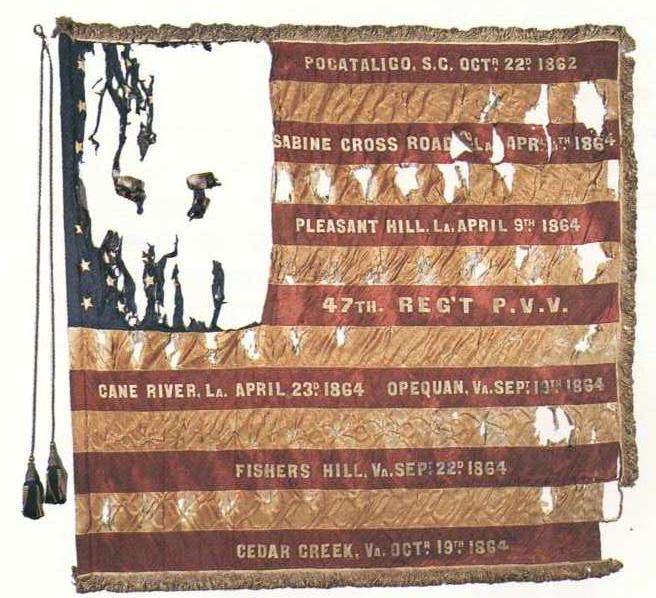
First State Color, 47th Regiment, Pennsylvania Volunteer Infantry (presented to the regiment by Pennsylvania Governor Andrew Curtin, 20 September 1861; retired 11 May 1865, public domain).

Largely forgotten by mainstream historians, the 47th Pennsylvania Volunteer Infantry was a Union Army unit which served for nearly the entire duration of the American Civil War. Formed by the fruit of the Great Keystone State’s small towns and cities, the regiment was born on August 5, 1861, when its founder, Tilghman H. Good, received permission from Pennsylvania Governor Andrew Gregg Curtin to form an entirely new regiment in response to President Abraham Lincoln’s call for additional volunteers to help preserve American’s Union. It ended its service during the early months of the nation’s Reconstruction Era, officially mustering out at Charleston, South Carolina on Christmas Day in 1865, its members receiving their final discharge papers at Camp Cadwalader in Philadelphia, Pennsylvania in early January of 1866.

Along the way, the 47th Pennsylvania made history, becoming an integrated regiment in 1862 and the only regiment from Pennsylvania to participate in the Union’s 1864 Red River Campaign across Louisiana. Its members also distinguished themselves in battle, repeatedly, including during Union General Philip Sheridan’s Shenandoah Valley Campaign, which unfolded between August and December of 1864.

Learn more about key moments in this regiment’s history by reading the following posts:

1861:

1862:

1863:

1864:

1865:

Research Update: More New Details Regarding the Lives of Formerly Enslaved Black Men Who Enlisted with the 47th Pennsylvania Volunteer Infantry

Union Army at Morganza Bend, Louisiana, c. 1863-1865_USLOC, pubdom

Union Army base at Morganza Bend, Louisiana, circa 1863-1865 (U.S. Library of Congress, public domain).

Researchers investigating the lives of nine formerly enslaved Black men who enlisted with the 47th Pennsylvania Volunteer Infantry during the American Civil War recently uncovered new details about two of those soldiers.

In addition to finding more data related to the immediate post-war life of Aaron French (learn more about him in this article here), including how and why he ended up settling in Mississippi following the Civil War, researchers have also now found important information about the life of Hamilton Blanchard—who enrolled with Bullard on the same day.

Born into slavery in Natchitoches, Louisiana sometime around 1843, Hamilton Blanchard was able to secure his freedom twenty-one years later when the United States Army arrived in town as part of an expedition led by Union Major-General Nathaniel P. Banks. Determined not to be forced back into bondage after the Union troops moved on in their ill-fated quest to capture the city of Shreveport, he chose to enlist with one of the units serving under Banks—the 47th Pennsylvania Volunteer Infantry—the only regiment from Pennsylvania that was involved in the Union’s 1864 Red River Campaign across Louisiana.

After enrolling in the military, Hamilton Blanchard was then assigned to Company D at the rank of “Cook” on 5 April 1864.

Crop_Bullard, Aaron and Hamilton Blanchard_Co. D, 47th PA_Muster Roll

Muster roll entries for Aaron Bullard and Hamilton Blanchard, Company D, 47th Pennsylvania Volunteers (U.S. National Archives, public domain).

The official muster-in of Blanchard, Aaron Bullard, and three other young Black men who enrolled that day did not take place immediately, however, because the 47th Pennsylvania Volunteers were ordered to move out shortly after their arrival, and were quickly drawn into intense combat with enemy troops commanded by Confederate Major-General Richard Taylor (a plantation owner and son of Zachary Taylor, former President of the United States). Battered badly during the Battle of Sabine Cross Roads near Mansfield, Louisiana on 8 April and in the Battle of Pleasant Hill the next day (9 April), they fought the Confederate Army again on 23 April near Monett’s Ferry in the Battle of Cane River and on 16 May in the Battle of Mansura near Marksville.

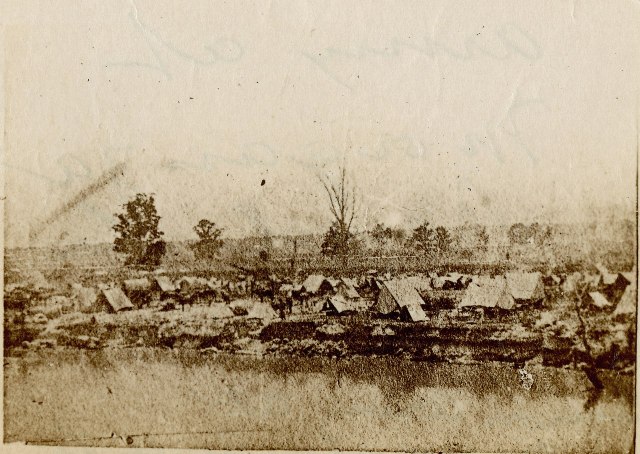
Continuing on toward the southeastern part of Louisiana, the 47th Pennsylvania Volunteers marched for Morganza, which had been held in Union hands since the fall of 1863 and was now the site of a major Union Army encampment. While there, the officers of the 47th Pennsylvania Volunteer Infantry officially mustered in all nine of the formerly enslaved Black men who had enlisted with the 47th Pennsylvania in Beaufort, South Carolina (1862) and Natchitoches, Louisiana (April 1864)—a process which took place between 20-24 June 1864.

From that point on, those nine men traveled with the 47th Pennsylvania as it returned to the East Coast and engaged in multiple battles associated with Union Major-General Philip Sheridan’s 1864 Shenandoah Valley Campaign across Virginia, the protection of the nation’s capital following the April 1865 assassination of President Abraham Lincoln, and the early days of Reconstruction in Georgia and South Carolina.

On Christmas Day in 1865, Hamilton Blanchard then joined his fellow 47th Pennsylvania Volunteers in mustering out from their final duty station in Charleston, South Carolina.

Post-War Life

Having been honorably discharged from the 47th Pennsylvania Volunteer Infantry when the regiment mustered out, at least two of the nine formerly enslaved Black men who had enlisted with the regiment evidently made their way north—possibly when the other members of their former regiment returned home to Pennsylvania. (It is also possible, however, that they made the journey independently of their former regiment because both men appear to have resettled in the Washington, D.C. area, post-war, while the other 47th Pennsylvania Volunteers were transported by ship directly to New York City and then by train to Camp Cadwalader in Philadelphia, Pennsylvania, where they were given their final discharge papers on 9 January 1866.)

Blanchard-Bullard_Madison Co., MS_Freedmen's Bureau Contract, Feb-Dec 1866, p. 1

Freedmen’s Bureau contract between Madison County, Mississippi farm owner John P. Arvile [sic] and farm laborers Hamilton Blanchard, Aaron Bullard, et. al., Washington, D.C., 16 February 1866 (excerpt, p. 1, U.S. National Archives).

What is known for certain is that Hamilton Blanchard and Aaron Bullard made contact with a representative of the Bureau of Refugees, Freedmen, and Abandoned Lands sometime in late 1865 or early 1866. They then signed a contract with the Freedmen’s Bureau during the early winter of 1866 in which they both agreed to join a large group of formerly enslaved Black men, women, and children who would be providing farm labor to a man named John P. Avrill (alternate spellings: “Averile”, “Averill”, “Arvile”, “Arville”, or “Avrille”) at his property in Canton, Madison County, Mississippi.

That Freedmen’s Bureau contract was slated to be in effect between 16 February and 16 December of 1866, and begins with a cover page which states:

Washington D.C.
February 1866
Contract No.
John P. Arvill
With (66) Freedmen

John Arville
Contract with
46 Farm Hands

The main body of the document goes on to reveal the following details of the contract:

Articles of Agreement made and concluded this the Sixteenth day of February 1866 between John P. Arvile of Canton P.O. County of Madison State of Mississippi party of the first part and

Charles Matthews, Henry Long, Joseph Thompson, Samuel Johnson, Robert Johnson, John Thomas … Charles Ford, Caroline Carter, Agnes Fitzhugh and child (infant), Benjamin Smith, Anna Smith, Thomas Reed [sp?], Aaron Bullard, Hamilton Blanchard, Isaiah Wiggins, James Lewis, Charles K. [illegible], Baily Taylor, William Carter, and Andy Hampton [sp?].

The next paragraph lists Hamilton Blanchard and Aaron Bullard a second time, along with multiple names from the aforementioned group of farm laborers. Subsequent paragraphs spell out further points of the agreement:

All of Washington City, County of Washington, District of Columbia, parties of the second part, the said Charles Matthews, Henry Long, Joseph Thompsen, Samuel Johnson, Robert Johnson, John Thomas … Aaron Bullard, Hamilton Blanchard, Isaiah Wiggins, James Lewis … Field Laborers, agree to enter the service of the said John P. Averile as Laborers and that they will faithfully and diligently apply themselves and perform the duties of Laborers on the premises of said John P. Averile for and during the period of time from the Sixteenth day of February 1866 until the sixteenth day of 1866; and they further agree that their employer shall retain one half their monthly wages until the expiration of their term of service.

And the said John P. Arvile hereby agrees to employ them (the said Field laborers) for the period of time aforesaid. Viz from the Sixteenth day of February 1866 until the sixteenth day of December 1866; and to pay for their services the sum set opposite their respective names per month, monthly (one half of which shall be retained each month) and all stoppages and arranged promptly, paid at the expiration of their respective terms of service to wit…..

In equal monthly payments; and the said John P. Arvile further agrees to furnish said Freed laborers … quarters, fuel, full substantial and healthy rations, and all necessary attendance and supplies in case of sickness, in addition to the compensation … named, and that he will assist and encourage efforts for the education of the children of his employees, and it is further agreed by the said John P. Arvile, that in case he at any time fails to perform his part of this contract agreement he will pay to each of the said laborers the full sum of One hundred and twenty dollars [strikethrough made by someone’s hand to original contract], as fixed, agreed and liquidated damages. This contract can be annulled by the mutual consent of the Employer and the employee, but only in the presence of an Authorized Agent of the Bureau of Refugees Freedmen and Abandoned Lands and such annullment [sic] on the part of the Employer and anyone [sic] employee shall in no wise affect the validity of the Contract in respect to the employer and the other employees and should either party violate this contract then the other party shall make complaint to the nearest authorized agent of the Bureau Refugees Freemen & Abandoned Lands.

The contract continues on, specifying that both Aaron Bullard and Hamilton Blanchard were to each be paid a wage of $10 per month, and stating that some of the other men on the list would be paid as much as $12 per month while others would be paid $8 per month. (Teenaged boys and women on the list were to be paid even less—$6 per month.)

In all cases, the reality was far different. Per the contract, they were initially paid only half of what their monthly wages were because the Freedmen’s Bureau agent in charge of looking out for the welfare of these formerly enslaved men, women, and children allowed the white farmer—their “employer”—to “retain one half their monthly wages until the expiration of their term of service.”

No further data has been uncovered from Freedmen’s Bureau records about the status of those unpaid wages or the outcome of that contract, but because these Black men, women, and children were essentially returned to an unequal system of servitude by the Freedmen’s Bureau agent (as evidenced by the manner in which this contract was drafted—favoring the White “employer” over the Black “field laborer” and including multiple after-the-fact revisions, such as word insertions and strikethroughs)—it is highly unlikely that Hamilton Blanchard, Aaron Bullard, or the other Black men, women, and children mentioned in the contract were ever paid the full amount they were entitled to for what was most assuredly very hard labor.

Blanchard-Bullard-Chapman_Treasury Inquiry, 10 Nov 1866

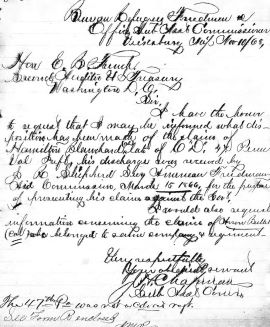
Letter of inquiry from J. H. Chapman on behalf of Hamilton Blanchard to E. B. French, second auditor, U.S. Treasury Department, 10 November 1868 (Freedmen’s Bureau records, U.S. National Archives). 

This hypothesis posed by researchers investigating the history of the 47th Pennsylvania Volunteer Infantry is backed up by a letter of inquiry penned on 10 November 1868 by J. H. Chapman, a Sub-Assistant Commissioner of the Freedmen’s Bureau working at an office in Vicksburg, Mississippi, to E. B. French, Second Auditor of the U.S. Department of the Treasury in Washington, D.C.

In this letter, Chapman asks French that he “be informed what disposition has been made of the claim of Hamilton Blanchard, late of Co. “D” 47 Penn Vol. Inft., his discharge was received by J. R. Schuchard [sp?]” of the “Freedmen’s Aid Commission, March 15, 1866.” Chapman added that he was requesting this update on Blanchard’s behalf “for the purpose of prosecuting his claim against the Gov.” He then also requested “information concerning the claim of Aaron Bullard (Col.) who belonged to same company & regiment.”

* Note: An unidentified individual added an undated notation to the bottom of this letter in handwriting that is clearly different from that of the original letter writer, Chapman. That notation correctly states: “The 47th Pa was not a colored regt. See Form R enclosed. A.M.R. 103.” (The 47th Pennsylvania Volunteer Infantry became an integrated regiment on 5 October 1862, but its African American members were not considered to be part of the U.S. Colored Troops, also known as the USCT.)

Researchers have not yet located the “Form R” referred to in the notation to Chapman’s letter, but will be pursuing this lead, as well as investigating the claims filed by Hamilton Blanchard and Aaron Bullard, and searching for additional information regarding what happened to Hamilton Blanchard during and after the 1870s. 

An additional avenue of inquiry will be the potential relationship that may have developed between Aaron Bullard and E. B. French during or after this time—a new theory being considered in light of the discovery of French’s name on this letter. (Aaron Bullard changed his surname, “Bullard,” which had been associated with his enslavement in Louisiana, to “French” sometime between his 1868 appeal to E. B. French in the U.S. Treasury Department and the day he was visited at home in Issaquena County, Mississippi by an enumerator of the 1870 U.S. Census—possibly indicating that he wanted to both shed his “slave name” and honor someone who had been helpful to him.)

Sources:

  1. Bates, Samuel P. History of Pennsylvania Volunteers, 1861-5, vol. 1. Harrisburg, Pennsylvania: B. Singerly, State Printer, 1869.
  2. Civil War Muster Rolls, in Records of the Department of Military and Veterans’ Affairs (Record Group 19, Series 19.11). Harrisburg, Pennsylvania: Pennsylvania Historical and Museum Commission, 1861-1865.
  3. Civil War Veterans’ Card File. Harrisburg, Pennsylvania: Pennsylvania State Archives.
  4. “Records of the Field Offices for the District of Columbia, Bureau of Refugees, Freedmen, and Abandoned Lands, 1865-1870” (NARA Series Number: M1902; NARA Reel Number: 18; NARA Record Group Number: 105; NARA Record Group Name: Records of the Bureau of Refugees, Freedmen, and Abandoned Lands, 1861 – 1880; Collection Title: District of Columbia Freedmen’s Bureau Field Office Records 1863-1872: Aaron Bullard and Hamilton Blanchard, 1866 and 1868). Washington, D.C.: U.S. National Archives and Records Administration.
  5. Schmidt, Lewis. A Civil War History of the 47th Regiment of Pennsylvania Veteran Volunteers. Allentown, Pennsylvania: Self-published, 1986.
  6. Wharton, Henry D. Letters from the Sunbury Guards. Sunbury, Pennsylvania: Sunbury American, 1861-1868.

Black History Month: New Details Uncovered Regarding the Formerly Enslaved Black Men Who Enlisted with the 47th Pennsylvania Volunteer Infantry

Research regarding the lives of the nine formerly enslaved Black men who enlisted with the 47th Pennsylvania Volunteer Infantry in 1862 and 1864 has continued to progress—even in the middle of a pandemic that has forced the closure of numerous local, state, and national archives.*

In addition to uncovering details about the life of the soldier from South Carolina who was mistakenly listed on muster rolls for the 47th Pennsylvania as “Presto Gettes” (learn more about him in this article here), researchers for 47th Pennsylvania Volunteers: One Civil War Regiment’s Story have been able to determine more about what happened to two of the other men post-war, and have also located records which seem to indicate that there may have been two or three other Black men who enlisted with the regiment (potentially bringing the total number of Black enlistees in the regiment to twelve).

Aaron French (enlisted as Aaron Bullard):

Muster roll entries for Aaron Bullard and Hamilton Blanchard, Company D, 47th Pennsylvania Volunteers (U.S. National Archives, public domain).

1864 was a life-changing year for Aaron Bullard and four other young Black men in Louisiana. After enlisting with the 47th Pennsylvania Volunteer Infantry on April 5 while the 47th was stationed at Natchitoches, Louisiana, Samuel Jones, Hamilton Blanchard (also known as John Hamilton), and Aaron, James, and John Bullard traveled with the 47th Pennsylvania as it participated in the multiple battles associated with the Union’s 1864 Red River Campaign across Louisiana. On or about June 22, they were formally mustered into the regiment at Morganza, Louisiana.

Sometime later (possibly post-war), Aaron Bullard changed his surname to French. After the American Civil War, he married, became a land-owning farmer—and a dad.

Post-Civil War, Aaron French and his family resided in Issaquena County, Mississippi (U.S. Census, 1870, public domain).

In August of 1870, Aaron French and his wife, Amanda, lived with their eight-month-old daughter, “Simpy” (also known as Cynthia or Cyntha) in Skipworth Precinct, Issaquena County, Mississippi. Still residing in Issaquena County a decade later when the June 1880 federal census was taken, Aaron and Amanda were the proud parents of three daughters: Cynthia (who would go on to marry Samuel L. Dixon on March 20, 1890), Jesanna (also known as Jessie/Jesse), and “Arctavia” (also known as Octavia). Jessie, who later went on to wed John B. Cobb on January 28, 1892, made a life with her husband and son in Mayersville, Mississippi, where she was a teacher in the local schools. Octavia married Frank Childress on March 20, 1894.

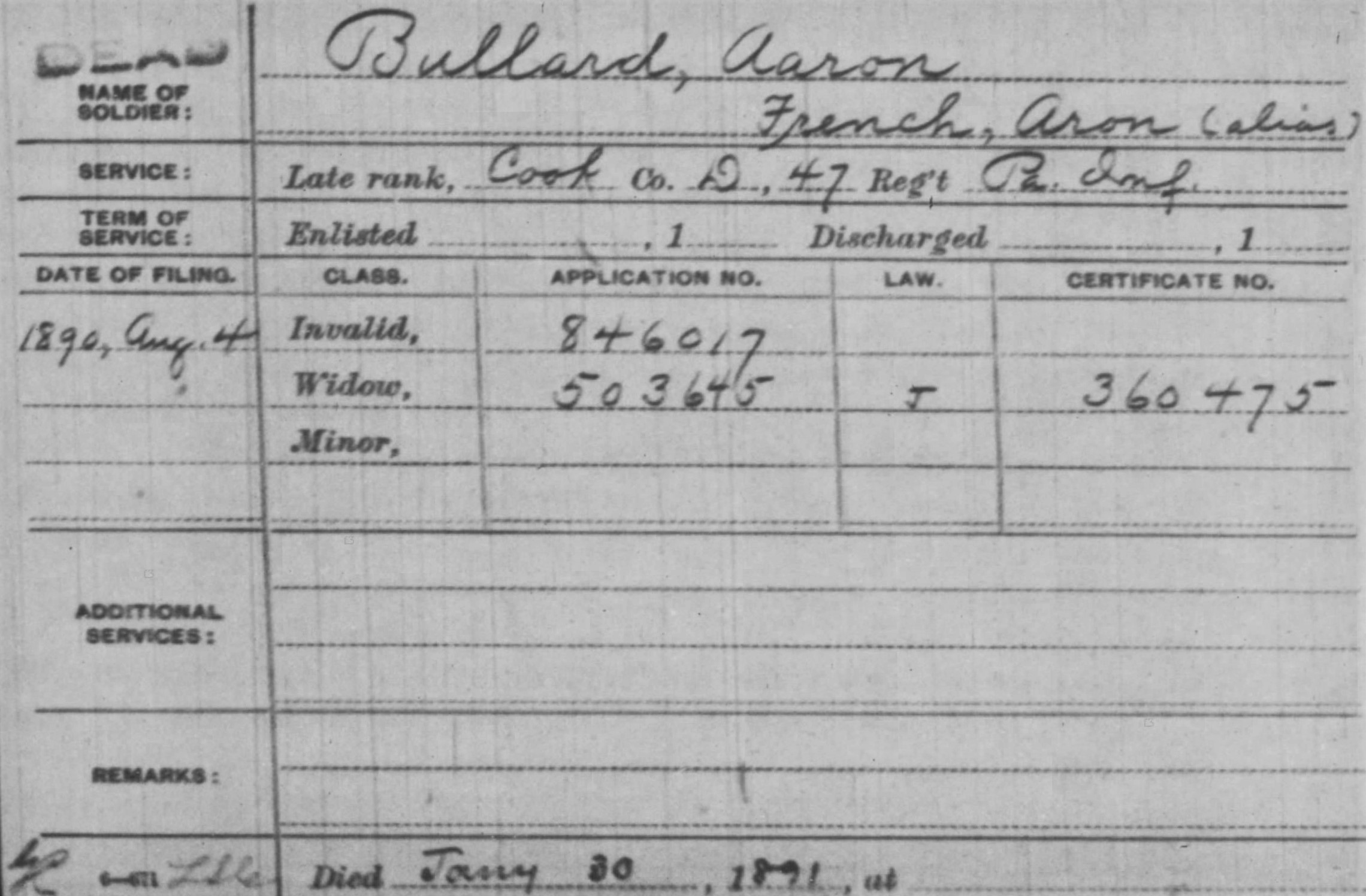
U.S. Civil War Pension Index Card for Aaron French, who enlisted with the 47th Pennsylvania Volunteers in Louisiana in 1864 (U.S. National Archives, public domain).

Sadly, Aaron French did not live to see his two youngest daughters marry because he died in Mississippi on January 30, 1891. He was just 40-43 years old, according to U.S. Census records and other data, which indicate that he was born in Louisiana sometime between 1848 and 1850.

Hearteningly, though, an even more intriguing piece of data has recently been uncovered about the later life of Aaron French—one that indicates that he had become active in politics prior to his death. According to the Vicksburg Evening Post, Aaron was appointed as a delegate from Issaquena County to the Republican Congressional Convention for the Third District, which was held in Greenville, Mississippi on August 7, 1886. Researchers are continuing to search for further details about his political activities and untimely death, as well as the exact location of his gravesite.

Thomas Haywood (alternate spellings of surname: Hayward, Haywood, Heywood) and Jack Jacobs:

Muster roll entries of Thomas Haywood and Edward Jassum, Company H, 47th Pennsylvania Volunteers (U.S. National Archives, public domain).

Born into slavery in South Carolina sometime around 1832, Thomas Haywood enlisted for a three-year term of service as an Under Cook with Company H of the 47th Pennsylvania Volunteer Infantry at Beaufort, South Carolina on November 1, 1862. He and three other formerly enslaved Black men—Abraham and Edward Jassum and Presto Gettes”—who had previously enlisted with the 47th Pennsylvania at Beaufort in October of 1862, then traveled with the 47th Pennsylvania as it participated in multiple military engagements, including the 47th’s garrisoning of Fort Taylor and Fort Jefferson in Florida in 1863 and 1864, the battles of the Union’s spring 1864 Red River Campaign across Louisiana, and the battles of Sheridan’s tide-turning Shenandoah Valley Campaign across Virginia in the fall of 1864.

On or about June 22, 1864 all nine of these Black soldiers were formally mustered into the regiment at Morganza, Louisiana; Thomas Haywood and seven of the eight others all successfully completed their tours of duty, and were honorably mustered out upon expiration of their respective terms of enlistment. In Thomas Haywood’s case, that honorable discharge was awarded on October 31, 1865.

Post-war, it appears from various Freedmen’s Bureau records that he may have entered into yearly contracts with several men who had previously been plantation owners in the Beaufort, South Carolina area. In exchange for agreeing to plant and cultivate cotton for those men on three to five-acre parcels of land that had been leased to him by those white men, he was allowed to keep portions of the cotton sales (the largest portions of which went to the former plantation owners who had also most likely been slave owners prior to and during the Civil War).

U.S. Civil War Index Card for Thomas Haywood, who enlisted with the 47th Pennsylvania Volunteers in South Carolina in 1862 (U.S. National Archives, public domain).

His body warn out from years of slavery prior to the war, difficult military service during the war, and harsh sharecropping experiences post-war, Thomas Hayward applied for, and was awarded a U.S. Civil War Pension on April 30, 1888. That pension was subsequently renewed by the federal government in 1907 at the rate of $15 per month (roughly $415 per month in today’s U.S. dollar equivalency).

By 1890, Thomas Haywood was living in Sheldon Township, Beaufort County, South Carolina. After a long life, he died on January 13, 1911. Unfortunately, his burial location has also not yet been identified by researchers.

In 1890, Thomas Haywood lived near Hanna Jacobs, the widow of Jack Jacobs, who may have been another Black soldier who enlisted with the 47th Pennsylvania Volunteers (U.S. Census, 1890, Sheldon Township, Beaufort County, South Carolina, public domain).

One other piece of tantalizing data that has recently been discovered is that a woman named “Hanna Jacobs” lived near Thomas Haywood in 1890. This information may be significant because Hanna was described on the 1890 U.S. Census of Union soldiers and widows as the widow of “Jack Jacobs,” who had served in the same company with Thomas Haywood (according to that special census).

Researchers currently believe that Jack Jacobs may, in fact, have been another formerly enslaved Black man who had enlisted with the 47th Pennsylvania when it was stationed near Beaufort in 1862, and are currently conducting a Go Fund Me campaign to raise funds to purchase the Civil War military and pension records of Hanna and Jack Jacobs, as well as the nine known formerly enslaved Black men who enlisted with the 47th Pennsylvania Volunteer Infantry in 1862 and 1864.

Jackson Haywood:

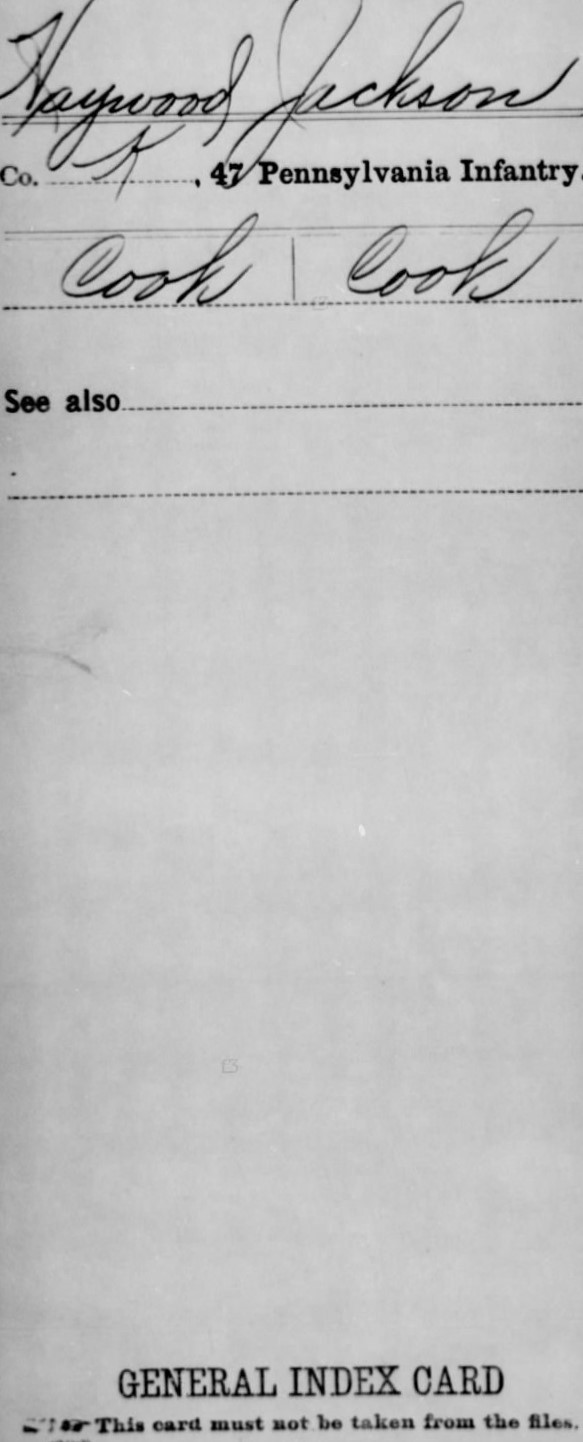
General Index Card for Jackson Haywood, who may have been a Black soldier who enlisted with the 47th Pennsylvania Volunteers (U.S. National Archives, public domain).

According to the “Index to Compiled Service Records of Volunteers Who Served in Organizations from the State of Pennsylvania,” which was created by staff at the U.S. National Archives, a General Index Card was created for yet another mystery man—a soldier named “Jackson Hayward.”

To date, researchers have only been able to determine that he may have enlisted with Company K of the 47th Pennsylvania Volunteer Infantry as a cook—a rank similar to that at which the known nine formerly enslaved Black men who enlisted with the 47th Pennsylvania were entered on the muster rolls of the regiment.

Researchers hope, with time and the continued financial support of the followers of 47th Pennsylvania Volunteers: One Civil War Regiment’s Story, to be able to confirm the dates of military service and race of this individual, as well as that of “Jack Jacobs.”

As always, we appreciate everyone’s help in ensuring that the service to the nation of these soldiers will never be forgotten. They helped to preserve our Union and deserve to be recognized more fully for their heroism and dedication.

* Our most important goal continues to be the purchase of the Compiled Military Service Records (CMSR) and U.S. Civil War Pension records for each of these remarkable men in order to document and freely share their stories with the widest possible audience. We continue to await word from staff at the U.S. National Archives regarding the timeframe for their resumption of digitization and reproduction services that have temporarily been suspended due to the coronavirus pandemic. As soon as those services have resumed, we will request an update regarding their estimated timeframe for fulfilling our records requests. In the interim, we will seek out further details about each of these soldiers via local and state archival resources across the nation, and will post updates as we confirm more data.

Sources:

  1. Bullard, Aaron, in Index to Compiled Service Records of Volunteers. Washington, DC: U.S. National Archives, 1861-1865.
  2. Bullard, Aaron and French, Aaron, in U.S. Civil War Pension Index Cards. Washington, DC: U.S. National Archives, 1890-1891.
  3. Bullard, Aaron, Presto Garris, Thomas Haywood, et. al. in U.S. Civil War Muster Out Rolls (47th Pennsylvania Volunteer Infantry). Washington, DC: U.S. National Archives, 1865-1866 (available via Ancestry.com).
  4. French, Aaron, in “Proceedings of the Third District Republican Convention.” Vicksburg, Mississippi: Vicksburg Evening Post, August 9, 1886.
  5. French, Aaron and Family, in U.S. Census Records (Issaquena County, Mississippi): Washington, DC: U.S. National Archives, 1870-1910.
  6. Haywood, Jackson, in Index to Compiled Service Records of Volunteers. Washington, DC: U.S. National Archives, 1861-1865.
  7. Haywood, Thomas, in Index to Compiled Service Records of Volunteers. Washington, DC: U.S. National Archives, 1861-1865.
  8. Haywood, Thomas, in U.S. Civil War Pension Index Cards. Washington, DC: U.S. National Archives, 1888, 1907.
  9. Haywood, Thomas, in U.S. Veterans’ Administration Pension Payment Cards. Washington, DC: U.S. National Archives, 1888, 1907.
  10. Haywood, Thomas, in U.S. Census (Beaufort County, South Carolina): Washington, DC: U.S. National Archives, 1890.
  11. Hanna Jacobs, widow of Jack Jacobs, in U.S. Census (Beaufort County, South Carolina): Washington, DC: U.S. National Archives, 1890.


St. Charles County Historical Society Donates David H. Smith Papers to 47th Pennsylvania Volunteers: One Civil War Regiment’s Story

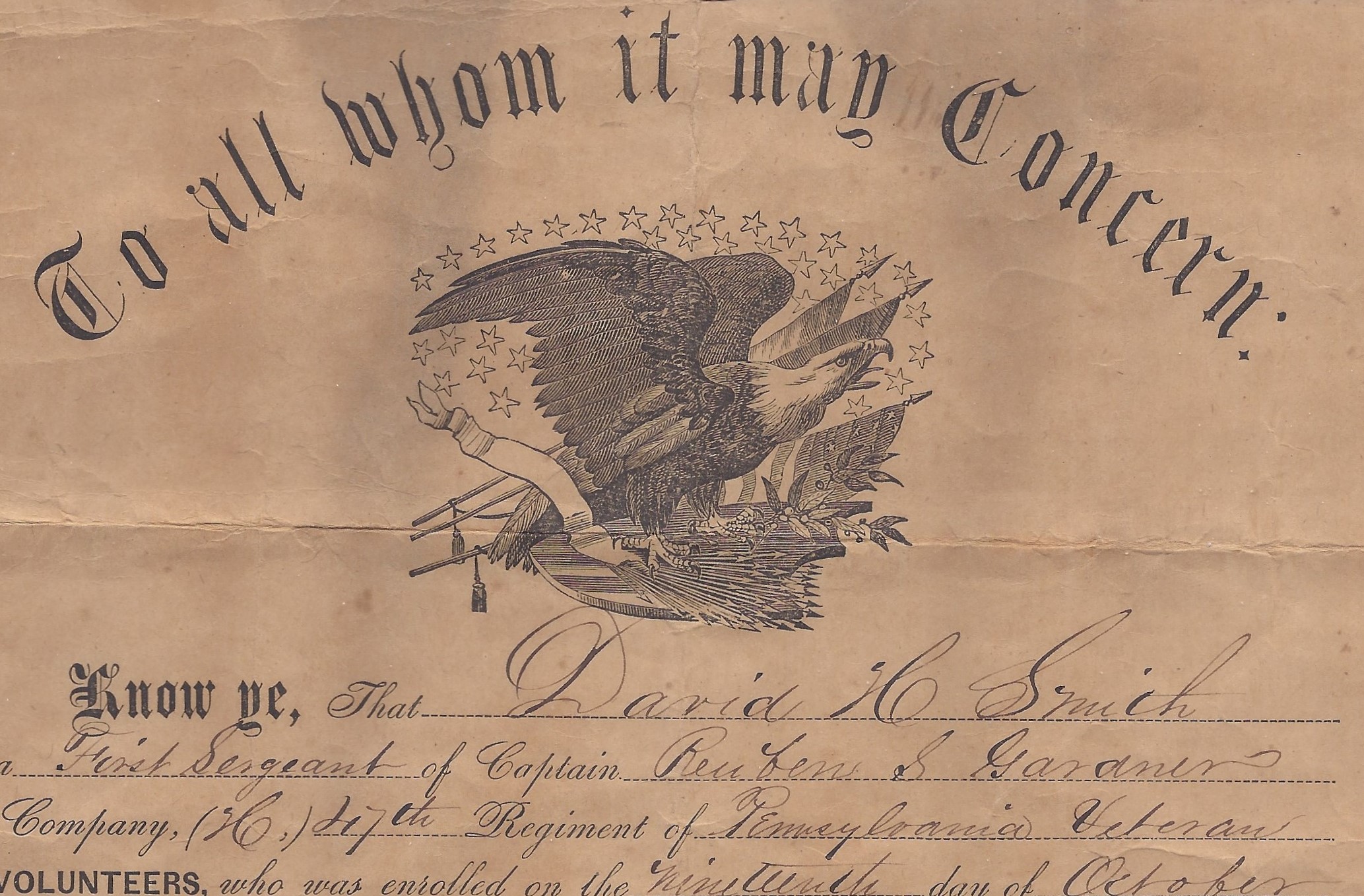
Honorable Discharge (excerpt), First Sergeant David H. Smith, Company H, 47th Pennsylvania Volunteers, December 25, 1865 (public domain).

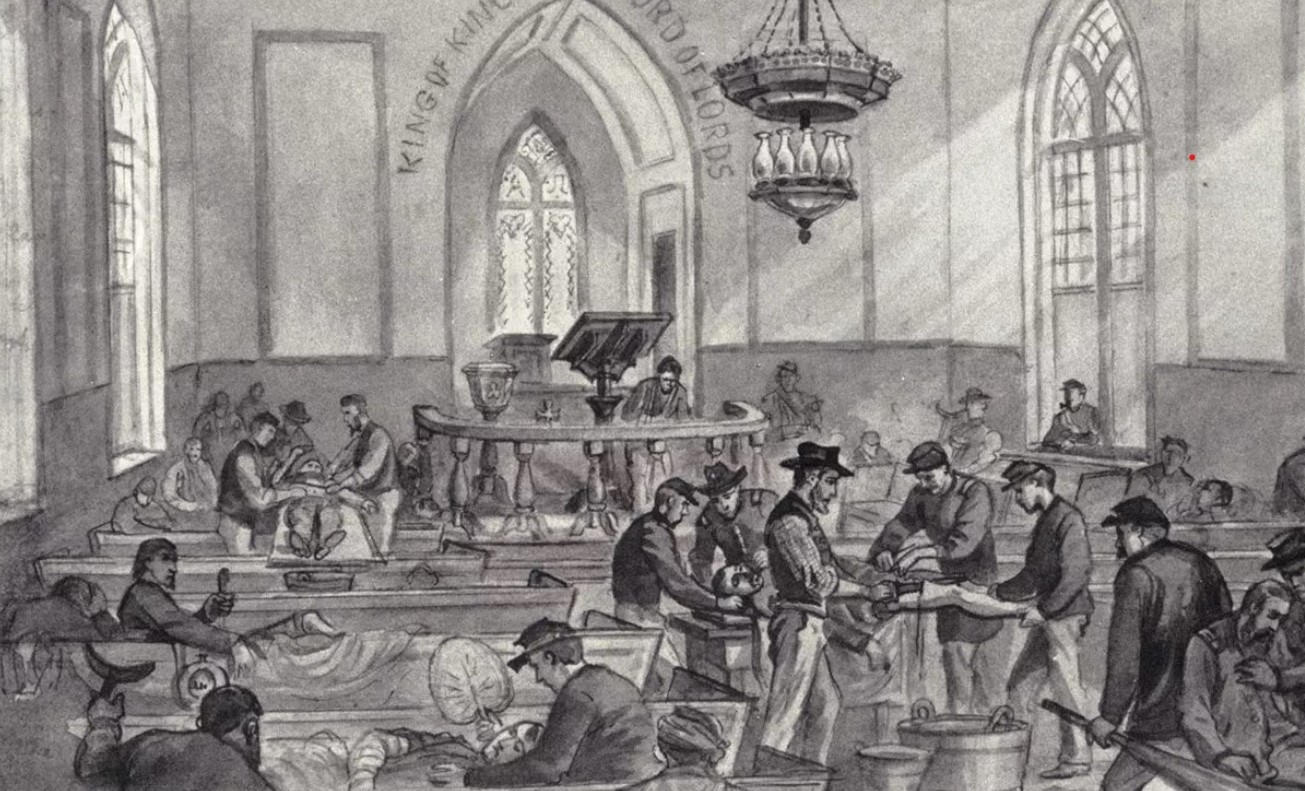
A challenging year for many Americans due to the COVID-19 pandemic, a faltering economy, and civil strife, 2020 proved to be a remarkably constructive one on many fronts for a humanities project dedicated to preserving and educating children and adults about the 47th Pennsylvania Volunteer Infantry—a Union Army unit which made history during the American Civil War as the only regiment from Pennsylvania to participate in the 1864 Red River Campaign across Louisiana, and which also was involved in guarding Mary Surratt and the other key conspirators involved in Lincoln’s assassination in 1865.

One of the most important developments in 2020 was the donation by the St. Charles County Historical Society in St. Charles, Missouri of its David H. Smith Papers collection to 47th Pennsylvania Volunteers: One Civil War Regiment’s Story.

David H. Smith was one of the 47th Pennsylvania Volunteers who served for the duration of the war. Following his enrollment at Harrisburg, Pennsylvania on August 22, 1861, Smith mustered in at Camp Curtin in Harrisburg on September 19 of that year as a private with Company H. Described as a nineteen-year-old farmer with light hair, blue eyes, and a light complexion who was five feet, nine inches tall, he was promoted to the rank of corporal on October 21, 1862—the day before the regiment was bloodied badly in the Battle of Pocotaligo, South Carolina. He then re-enlisted with the 47th Pennsylvania Volunteers in mid-October of 1863 at Fort Jefferson in the Dry Tortugas, Florida, where half of the regiment was stationed at the time, and was subsequently promoted to the rank of Sergeant on September 18, 1864—one day before the Battle of Opequan, Virginia, and promoted again to First Sergeant on April 21, 1865—exactly one week after Lincoln’s assassination. Smith then continued to serve until the regiment was honorably mustered out at Charleston, South Carolina on Christmas Day of that same year.

According to Adam Pesek, a collections volunteer with the St. Charles County Historical Society who reached out to Laurie Snyder, the managing editor of the 47th Pennsylvania Volunteers’ project, society personnel made the helpful overture because they had made a decision to downsize the society’s collection, and were seeking to redistribute a range of items to other organizations whose ties to those items were stronger.

Society archivist Amy G. Haake explained that she and her colleagues had made the decision to donate Smith’s papers when they realized “that Smith had no connections to St. Charles County, whether through marriage or otherwise,” and wanted to find a group which would ensure that the historic documents would be preserved and made publicly available for study by other historians and history students. Among the original documents are certificates related to promotions received by Smith during his tenure with the 47th Pennsylvania, as well as his reenlistment and honorable discharge paperwork.

“My plan is to digitize Sergeant Smith’s papers in 2021, research and write a biographical sketch of his life, and then make each of Smith’s documents and his biography publicly available online via our project’s website and Facebook page. I will then also donate Smith’s papers to a museum or historical society in Pennsylvania,” said Snyder. “These precious papers not only document Smith’s service to the nation; they provide tangible links to a defining time in our nation’s history—reminding us all of the sacrifices made by the heroes who left hearth and home to fight for the Union of a country they loved more than life.”

*******************************************************

47th Pennsylvania Volunteers: One Civil War Regiment’s Story is an educational initiative dedicated to documenting and raising public awareness about the history-making role played by the 47th Pennsylvania Volunteer Infantry during the American Civil War, as well as the contributions made by its members, post-war, to America’s growth and the advancement of its democratic ideals. Integrated in October of 1862 (prior to President Abraham Lincoln’s official release of the Emancipation Proclamation), this regiment went on to become the only regiment from Pennsylvania to participate in the Union’s 1864 Red River Campaign across Louisiana and the only regiment from Pennsylvania to have men held captive as prisoners of war at Camp Ford—the largest Confederate prison west of the Mississippi River, and was also involved in guarding Mary Surratt and the other key conspirators in Lincoln’s assassination in 1865 during the early days of their imprisonment.

Founded in 1956, the St. Charles County Historical Society (SCCHS) is a nonprofit organization which was initially established to preserve the history of St. Charles County, Missouri. In 2009, it merged with the St. Charles Genealogical Society in order to expand upon its mission “to foster an understanding and appreciation of all aspects of Saint Charles County history” to ensure that genealogical records of county residents are also preserved.


His First Name was “Presto?” A Black History Month Mystery

Roster entry: Presto Garris,” Company F, 47th Pennsylvania Volunteers, Bates’ History of Pennsylvania Volunteers, Vol. 1, 1869 (public domain; double click to enlarge).

“Presto?” The first name stood out like a sore thumb on the roster of my great-grandfather’s Civil War regiment—one with a rank and file populated largely by soldiers with Germanic surnames: “Acher,” “Bachman,” “Bauer,” “Bauman,” “Burger,” “Dachrodt,” “Diehl,” “Eisenbraun,” “Eppler,” “Fritz,” “Grimm,” “Guth,” “Handwerk,” “Hertzog,” “Keiser,” “Knecht,” “Knorr,” “Koenig,” “Laub,” “Metzger,” “Münch,” “Rehrig,” “Reinert,” “Richter,” “Sauerwein,” “Schmidt,” “Schneider,” “Strauss,” “Ulrich,” “Volkenand,” “Wagner,” “Weiss,” and “Zeppenfeld.”

Many of their given or middle names were equally as Germanic—“Adolph,” “Bernhard,” “Gottlieb,” “Friedrich,” “Heinrich,” “Levi,” “Matthias,” “Reinhold,” “Tilghman,” “Tobias,” and “Werner.” In addition, one of the regiment’s component units—Company K—had even been founded by a German immigrant with the intent of creating “a new German company” staffed entirely by German-Americans who had been born in the Lehigh Valley, as well as recent émigrés from Germany.

So, “Presto” as a given name seemed like it warranted further investigation. Did the spelling of this soldier’s given name signal that he had emigrated from a different part of the world—possibly Italy? There was, after all, another member of the 47th Pennsylvania’s ranks with a seemingly Italian surname—Battaglia (later proven to be an immigrant of Switzerland). Plus, there were also multiple men with Irish surnames who had also enlisted with the 47th.

Or, maybe this soldier had been employed as a magician prior to enlisting in the military? (Probably not, but strange discoveries are surprisingly common with genealogical research.)

A more likely scenario? A harried Union Army clerk, in his haste to process new enlistees, simply omitted the “n” at the end of this soldier’s name—making him “Presto” for posterity’s sake rather than “Preston.”

I just had to know. Who was Presto?

Listing for “Presto Garris,” Company F, 47th Pennsylvania Volunteers, Civil War Veterans’ Card File, 1861-1866, Pennsylvania State Archives (public domain).

It turned out that this 47th Pennsylvania Volunteer wasn’t a magician, and he wasn’t an immigrant from Italy, but he was someone whose first and last names were badly mangled by multiple “mis-spellers” over decades of data entry.

Upon further investigation, it became clear that he was a formerly enslaved, 33-year-old black man who had enlisted with the 47th Pennsylvania Volunteer Infantry on October 5, 1862 while the regiment was stationed near Beaufort, South Carolina—meaning that my great-grandfather’s regiment had become an integrated one at least three months before President Lincoln had issued the Emancipation Proclamation.

Totally “wowed” by this discovery, I searched for even more information about this very important enlisted man, but my quest wasn’t as easy as I hoped it would be because the regimental clerk who had entered “Presto” on the roster for Company F of the 47th Pennsylvania Regiment in the Registers of Pennsylvania Volunteers had spelled his name incorrectly—an error that was then perpetuated by historian Samuel P. Bates in his History of Pennsylvania Volunteers, 1861-5.

Possible name variants for an African American member of the 47th Pennsylvania Volunteers, U.S. Civil War General Pension Index Cards (National Archives, public domain).

Fortunately, this soldier’s listing in the U.S. Civil War General Pension Index Card system was slightly more helpful, providing multiple “alias” (alternate) spellings of his name: “Presto Garris,” “Bristor Geddes,” and “Bristor Gethers,” as well as a potential spelling for the name of his wife, “Rachel Gethers,” and a possible place of residency and year of death—1894—because his widow had filed for a U.S. Civil War Widow’s Pension from South Carolina on July 27, 1894.

Despite those hints, it took quite some time to pick up this soldier’s trail again. Eventually, though, that pension index card data helped me to find a Freedmen’s Bureau contract for him which confirmed that he had indeed settled in South Carolina post-war. Dated February 12, 1868, this document also confirmed that he had been signed to a contract with 14 other Freedmen by the Mt. Pleasant, South Carolina office of the U.S. Freedmen’s Bureau to provide labor for the Whitehouse Plantation.

List showing “Brister Geddis,” et. al. on an 1868 Freedmen’s Bureau contract with the Whitehouse Plantation in South Carolina (public domain; double click to enlarge).

But, in another seemingly frustrating turn of events, that contract caused further confusion surrounding his name—this time spelling it as “Brister Geddis.” Fortunately, this new variant was repeated in the 1870 federal census—a sign that it was either the correct spelling or at least a closer approximation of how this soldier had pronounced his own name. Describing him as a 42-year-old black male residing in Beaufort, South Carolina, that same census also noted that he lived in Beaufort Township with his wife “Rachel,” a 24-year-old black woman (estimated birth year 1846), and son “Peter,” a 6-year-old black child, and confirmed that all three had been born in South Carolina. And that census record also noted that both “Brister” and “Rachel” were involved in farming land valued at $1,500.

Unfortunately, the 1880 federal census taker created still more confusion by illegibly writing the name as “Geddes, Brista” or “Geddis, Bristor”—and gave rise to two new puzzles by omitting son Peter’s name and also radically altering the estimated birth year of wife “Rachel”—changing it from 1846 to 1820 by stating that she was a 60-year-old who was four years older than her husband (rather than younger as she had reportedly been in 1870).

Even more frustrating? The special veterans’ census of 1890 altered the spelling of his name yet again—this time to “Brister Gedders.”

At that point, I made the decision to do everything humanly possible to right the wrong of this 47th Pennsylvania Volunteer’s forgotten military service by launching a GoFundMe campaign to support the purchase of this his full set of his military and pension records from the National Archives (as well as those of the other eight African American men who enlisted with the 47th Pennsylvania Volunteer Infantry).

If just three of you who regularly read the content on this website and follow our Facebook page donate $10 each to this campaign, we will be able to purchase the entire Compiled Military Service File for this forgotten member of the 47th Pennsylvania Volunteers and make it publicly available (free of charge) to other family history researchers and historians. If just four of you donate $20 each, we would also be able to purchase the entire Federal Military Pension Application File for that same soldier—a file that may very well contain critical vital statistics about this soldier’s birth, life and death, as well as vital statistics for his widow and son.

We might just even be able to determine when and where Brister/Bristor was buried and whether or not a gravestone marks his final resting place. If we find that no marker exists, or that the existing one has been damaged, or that the gravestone carver spelled his name incorrectly, we can then fix that wrong as well by asking the appropriate county, state and federal authorities to erect a suitable veteran’s headstone for him.

Please help us honor the military service of this unsung hero by making your donation today to our GoFundMe campaign, Honor 9 Black Soldiers of the American Civil War.”

With Sincere Gratitude,

Laurie Snyder, Managing Editor
47th Pennsylvania Volunteers: One Civil War Regiment’s Story


Sources:

1. Bates, Samuel P. History of Pennsylvania Volunteers: 1861-5, Vol. 1. Harrisburg, Pennsylvania: B. Singerly, State Printer, 1869.

2. “Garris, Presto,” in Civil War Veterans’ Card File, 1861-1866. Harrisburg, Pennsylvania: Pennsylvania State Archives.

3. “Garris, Presto” (alias “Geddes, Bristor”, alias “Gethers, Bristor”), in U.S. Civil War General Pension Index, 1890-1894. Washington, D.C.: U.S. National Archives and Records Administration.

4. “Roll of Co. F., 47th Regiment, Infantry,” in Registers of Pennsylvania Volunteers, 1861-1865, in “Records of the Department of Military and Veterans’ Affairs.” Harrisburg, Pennsylvania: Pennsylvania State Archives, retrieved online February 10, 2020.


In Their Own Words: Soldiers Reflect on Life as Christmas and the New Year Approach During the U.S. Civil War


Personal Letter from Captain John Peter Shindel Gobin, Commanding Officer of Company C, 47th Pennsylvania Volunteers (14 December 1862)

Captain John Peter Shindel Gobin, Company C, 47th Pennsylvania Volunteers (circa 1862, public domain).

Beaufort, So. Ca.
December 14, 1862

Dear Friends,

This is the last letter you will receive from me dated as above. For some time, our Regt. has been ordered to Key West again and we leave for there tomorrow. We are even now all packed up and I am writing amid the piles of rubbish accumulated in a five months residence in Camp. Gen. Brannen [sic] expects to go North and his object evidently is to get us out of this Department so that when he is established in his command, he can get us with him. If we remained here Gen Hunter would not let us go as he is as well aware as is Brannen [sic] is that we are the best Regiment in the Department. Although I do not like the idea of going back there, under the circumstances we are content. At all events we will have nice quarters easy times, and plenty of food. But for my part I would rather have some fighting to do. Since we have become initiated I rather like it. At Key West we will get none, and have a nice rest after our duties here. I will take all my men along – not being compelled to leave any behind. Direct my letters hereafter to Key West, Fla.

I supposed the body of Sergt Haupt has arrived at home long ere this. When we left Key West [Last?] Oyster & myself  bought a large quantity of shells, and sent them to Mrs Oyster. If we got home all right [sic] Haupt was to make boxes for us. He having died, you and Mrs Oyster divide the shells, and you can take [two illegible words] and give them to our friends. Some to Uncle Luther [sp?], Jacob Lawk [sp?], Louisa Shindel and all friends. I can send some more when we get to Key West if they want them.

Arrangements are being made to run a schooner regularly between here and Key West, so your boxes sent to us will follow us. Neither Mrs Wilsons nor yours has been received yet.

I think I will send a box home from  here containing a few articles picked up at St. John’s Bluff and here. They examine all boxes closely but I think I can get some few articles through. The powder horn bullet pouch and breech sight I got at St. John’s Bluff the rest here. I will write, as soon as we get to Key West. Let me hear from you often. With love to all I remain

Yours,
J. P. Shindel Gobin

P.S. Get Youngman & [illegible name] to publish the change of your address.


Letter to the Sunbury American Newspaper from Henry D. Wharton, Musician, Company C, 47th Pennsylvania Volunteers (published 10 January 1863)

USS Seminole and USS Ellen accompanied by transports (left to right: Belvidere, McClellan, Boston, Delaware, and Cosmpolitan) at Wassau Sound, Georgia (circa January 1862, Harper’s Weekly, public domain).

[Correspondence for the AMERICAN.]
Letter from the Sunbury Guards,
FORT TAYLOR, KEY WEST, Florida.  }
December 21, 1862.

DEAR WILVERT:– Again at Key West. On Monday, December 15th we left Beaufort, S.C., on board the Steamer Cosmopolitan and proceeded to Hilton Head, where Gen. Brannen [sic] came on board to bid farewell to his regiment. Capt. Gobin addressed him in a neat little speech, which the General tried to reply to, but his feelings were too full and tears were in his eye as he bid the old word, ‘Good Bye.’ The boys gave him tremendous cheers as he left the vessel and the Band discoursed sweet music ‘till he reached the shore. The members of our regiment felt badly on leaving his command; but the assurance that we will soon be with him, in another department, makes them in a better humor; for with him they know all their wants are cared for, and in battle they have a leader on whom they can depend.

On the passage down, we ran along almost the whole coast of Florida. Rather a dangerous ground, and the reefs are no playthings. We were jarred considerably by running on one, and not liking the sensation our course was altered for the Gulf Stream. We had heavy sea all the time. I had often heard of ‘waves as big as a house,’ and thought it was a sailor’s yarn, but I have seen ‘em and am perfectly satisfied; so now, not having a nautical turn of mind, I prefer our movements being done on terra firma, and leave old neptune to those who have more desire for his better acquaintance. A nearer chance of a shipwreck never took place than ours, and it was only through Providence that we were saved. The Cosmopolitan is a good river boat, but to send her to sea, loadened [sic] with U.S. troops is a shame, and looks as though those in authority wish to get clear of soldiers in another way than that of battle. There was some sea sickness on our passage; several of the boys ‘casting up their accounts’ on the wrong side of the ledger.

Fort Jefferson, Dry Torguas, Florida (interior, c.irca 1934, C.E. Peterson, photographer, U.S. Library of Congress, public domain).

We landed here on last Thursday at noon, and immediately marched to quarters. Company I. and C., in Fort Taylor, E. and B. in the old Barracks, and A. and G. in the new Barracks. Lieut. Col. Alexander, with the other four companies proceeded to Tortugas, Col. Good having command of all the forces in and around Key West. Our regiment relieves the 90th Regiment N.Y.S. Vols. Col. Joseph Morgan, who will proceed to Hilton Head to report to the General commanding. His actions have been severely criticized by the people, but, as it is in bad taste to say anything against ones superiors, I merely mention, judging from the expression of the citizens, they were very glad of the return of the 47th Pennsylvania Volunteers.

The U.S. Gunboat ‘Sagamore’ has had good luck lately. She returned from a cruise on the 16th inst., having captured the English sloop ‘Ellen’ and schooners ‘Agnes,’ ‘By George’ and ‘Alicia,’ all hailing from Nassau N.P. The two former were cut out in India river by a boat expedition from the Sagamore. They had, however, previously discharged their cargoes, consisting principally of salt, and were awaiting a return cargo of the staple, (cotton) when the boats relieved them from further trouble and anxiety. The ‘By George’ was sighted on the morning of the 1st, and after a short chase she was overhauled. Her Captain, in answer to ‘where bound!’ replied Key West, but being so much out of his course and rather deficient in the required papers, an officer was placed in charge in order that she might safely reach this port. Cargo – Coffee, Salt, Medicines, &c. The “Alicia,’ cotton loaded, was taken in Indian river inlet, where she was nicely stowed away waiting a clear coast. The boats of the Sagamore also destroyed two small sloops. They were used in Indian river, near Daplin, by the rebels in lightering cargoes up and down the river. There are about twenty more prizes lying here, but I was unable to get the names of more than the following:

Schooner ‘Dianah.’ assorted cargo.
“         ‘Maria.’           “             “
“         ‘Corse.’           “             “
“       ‘Velocity.’        “             “
“  ‘W.E. Chester.’  sixty bales of cotton.

Woodcut depicting the harsh climate at Fort Taylor in Key West, Florida during the Civil War (U.S. Library of Congress, public domain).

Key West has improved very little since we left last June, but there is one improvement for which the 90th New York deserve a great deal of praise, and that is the beautifying of the ‘home’ of dec’d. soldiers. A neat and strong wall of stone encloses the yard, the ground is laid off in squares, all the graves are flat and are nicely put in proper shape by boards eight or ten inches high on the ends sides, covered with white sand, while a head and foot board, with the full name, company and regiment, marks the last resting place of the patriot who sacrificed himself for his country.

Two regiments of Gen. Bank’s [sic] expedition are now at this place, the vessels, on which they had taken passage for Ship Island, being disabled, they were obliged to disembark, and are now waiting transportation. They are the 156th and 160th N.Y.S. Vols. Part of the 156th are with us in Fort Taylor.

Key West is very healthy; the yellow fever having done its work, the people are very much relieved of its departure. The boys of our company are all well. I will write to you again as soon as ‘something turns up.’ With respects to friends generally, I remain,

Yours, Fraternally,
H. D. W.


Excerpts of Diary Entries from Henry Jacob Hornbeck, Private, Company G, 47th Pennsylvania Volunteers (December 1863 and Early January 1864)

Key West, Florida (circa 1850, courtesy of the Florida Memory Project).

December 1863. The workers at the fortification in Key West demanded back pay and a raise in December; their rate was $1.40 per day. The town had some excitement in December as a spark from a railway locomotive set the mess hall on fire, burning it to the ground; and nature retaliated with a violent storm, which caused heavy damage, putting the railroad out of service.

Friday December 25th. …. rose at 3 a.m. & proceeded to Slaughter House, had two Cattle & two Sheep cut up and served to the troops. Conveyed Fresh Meat to a number of citizens this morning, being Gen’l Woodburys [sic] gift, then had breakfast. Went to Fort Stables, had the horse fed, visited Mrs. Abbot in Fort Taylor, also Mrs. Heebner, from both of whom we rec’d Christmas Cakes & a drink, which were excellent…. We took dinner at Capt. Bells at 2 p.m. which was a splendid affair. A fine turkey served up, and finished up our dinner with excellent Mince pie, after the dinner we again took a ride about the Island, took the horse to Fort Stables and returned to office. At 5 p.m. a party of Masqueraders (or what we term in our State Fantasticals) paraded the street headed with music, a very comical party. Took a walk tonight, Churches finely decorated. Retired early at ½ past 8 p.m. Weather beautiful….

1864

January 1st Thursday. Rose as usual. After breakfast, went to office, kept busy all day on account of many steamers lying in port, waiting to coal. After supper took a walk about the city with Frank Good and Wm. Steckel. Heard music in a side street, went there and found the Black Band playing at the Postmaster’s residence. The Postmaster then called all the soldiers in, and gave us each a glass of wine.

He is a very patriotic man and very generous. I believe his name is Mr. Albury. We then went to barracks and retired.

January 2nd Friday…. After breakfast, work as usual in office. After dinner took a horseback ride to Fort Taylor…. Retired at 9 o’clock. Weather cool.

January 3rd Saturday…. Received our extra duty pay this afternoon. Purchased toilet articles. After supper went to the camp, took a walk about city, then went barracks & retired. Latest reports are that Burnside was defeated with great loss and the Cabinet broke up in a row. Retired at 10. Weather fine.

Sunday January 4th…. After breakfast, washed & dressed. After dinner John Lawall, Wm. Ginkinger & myself went to the wharf. I then returned to barracks and P. Pernd. E. Crader and myself went out on the beach, searching sea shell. Returned by 4 o’clock. I then cleaned my rifle. Witnessed dress parade. Then went to supper. After supper went to the Methodist Church, heard a good Sermon by our Chaplain. Retired at 9 o’clock.

Monday January 5th…. After breakfast went to office, busy, wrote a letter to Reuben Leisenring. At 11 o’clock the U.S. Mail Steamer Bio arrived from New York, having come in 5 days, papers dating 30th inst. The reports of a few days ago, are not confirmed, therefore they are untrue. She also has a mail on board.

Tuesday January 6th…. Received no letter yesterday, very small mail for our regiment. Busy all day in office. After supper, Wm. Smith, Allen Wolf & myself took a walk about the city, then went to barracks. Retired at 10 o’clock. Wrote a letter this afternoon to Uncle Ebenezer, sent him also by mail a small collection of sea shells. Weather fine.


Sources:

  1. Gobin, John Peter Shindel. Personal Letters, 1861-1865. Northumberland, Pennsylvania: Personal Collection of John Deppen.
  2. Hornbeck, Henry Jacob. Diary Excerpts, 1862-1864, in 47th Pennsylvania Volunteers: One Civil War Regiment’s Story. Retrieved online 1 December 2017.
  3. Wharton, Henry D. Letters from the Sunbury Guards. Sunbury, Pennsylvania: Sunbury American, 1861-1868.


Sheridan’s Tide-Turning Shenandoah Valley Campaign: The Battle of Cedar Creek and Its Aftermath (Virginia, October-December 1864)

Alfred Waud’s sketch, “Surprise at Cedar Creek,” captured the flanking attack on the rear of Union Brigadier-General William Emory’s 19th Corps by Lieutenant-General Jubal Early’s Confederate army, and the resistance by Emory’s troops from their Union rifle-pit positions, 19 October 1864 (public domain).

Sheridan having driven the enemy out of the valley, and taken the productions of the valley so that instead of going there for supplies the enemy would have to bring his provisions with him if he again entered it, recommended a reduction of his own force, the surplus to be sent where it could be of more use. I approved of his suggestion, and ordered him to send Wright’s corps back to the James River. I further directed him to repair the railroad up the Shenandoah Valley towards the advanced position which we would hold with a small force. The troops were to be sent to Washington by way of Culpeper, in order to watch the east side of the Blue Ridge, and prevent the enemy from getting into the rear of Sheridan while he was still doing his work of destruction.

The valley was so very important, however, to the Confederate army that, contrary to our expectations, they determined to make one more strike, and save it if possible before the supplies should all be destroyed.

– President Ulysses S. Grant, Personal Memoirs


Those were the thoughts of President Ulysses S. Grant in 1885 as he recalled his days of strategic planning as head of the Union Army during America’s fateful Fall of 1864. Having just described how one of his leading commanding officers, Major-General Philip H. Sheridan, had won the Battles of Berryville, Opequan and Fisher’s Hill that September, he began to set the stage for his retelling of what would be one of the bloodiest and most important moments of the U.S. Civil War—the Battle of Cedar Creek.

Reinforcements had been sent to [Confederate Lieutenant General Jubal] Early, and this before any of our troops had been withdrawn. Early prepared to strike Sheridan at Harrisonburg; but the latter had not remained there.

On the 6th of October Sheridan commenced retiring down the valley, taking or destroying all the food and forage and driving the cattle before him, Early following. At Fisher’s Hill Sheridan turned his cavalry back on that of Early, which, under the lead of Rosser, was pursuing closely, and routed it most completely, capturing eleven guns and a large number of prisoners. Sheridan lost only about sixty men. His cavalry pursued the enemy back some twenty-five miles.

“Custer’s Division Retiring from Mount Jackson, Shenandoah Valley, Virginia,” 7 July 1864 (Alfred Waud, U.S. Library of Congress, public domain).

Recalling the fall 1864 movements of his troops from the vantage point of his own memoirs (penned in 1888), Sheridan noted that on 6 October 1864:

The cavalry as it retired was stretched across the country from the Blue Ridge to the eastern slope of the Alleghanies [sic], with orders to drive off all stock and destroy all supplies as it moved northward. The infantry proceeded [sic] the cavalry, passing down the Valley pike, and as we marched along the many columns of smoke from burning stacks, and mills filled with grain, indicated that the adjacent country was fast losing the features which hitherto had made it a great magazine of stores for the Confederate armies.

During the 6th and 7th of October, the enemy’s horse followed us up, though at a respectful distance. This cavalry was now under command of General T. W. Rosser, who on October 5 had joined Early with an additional brigade from Richmond. As we proceeded the Confederates gained confidence, probably on account of the reputation with which its new commander had been heralded, and on the third day’s march had the temerity to annoy my rear guard considerably. Tired of these annoyances, I concluded to open the enemy’s eyes in earnest, so that night I told Torbert I expected him to give Rosser a drubbing next morning or get whipped himself, and that the infantry would be halted until the affair was over; I also informed him that I proposed to ride out to Round Top Mountain to see the fight. When I decided to have Rosser chastised, Merritt was encamped at the foot of Round Top, an elevation just north of Tom’s Brook, and Custer some six miles farther north and west, near Tumbling Run. In the night Custer was ordered to retrace his steps before daylight by the Back road, which is parallel to and about three miles from the Valley pike, and attack the enemy at Tom’s Brook crossing, while Merritt’s instructions were to assail him on the Valley pike in concert with Custer. About 7 in the morning, Custer’s division encountered Rosser himself with three brigades, and while the stirring sounds of the resulting artillery duel were reverberating through the valley Merritt moved briskly to the front and fell upon Generals Lomax and Johnson on the Valley pike. Merritt, by extending his right, quickly established connection with Custer, and the two divisions move forward together under Torbert’s direction, with a determination to inflict on the enemy the sharp and summary punishment his rashness had invited.

The engagement soon became general across the valley, both sides fighting mainly mounted. For about two hours the contending lines struggled with each other along Tom’s Brook, the charges and counter charges at many points being plainly visible from the summit of Round Top, where I had my headquarters for the time.

The open country permitting a sabre fight, both sides seemed bent on using that arm. In the centre [sic] the Confederates maintained their position with much stubbornness, and for a time seemed to have recovered their former spirit, but at last they began to give way on both flanks, and as these receded, Merritt and Custer went at the wavering ranks in a charge along the whole front. The result was a general smash-up of the entire Confederate line, the retreat quickly degenerating into a rout the like of which was never before seen. For twenty-six miles this wild stampede kept up, with our troopers close at the enemy’s heels; and the ludicrous incidents of the chase never ceased to be amusing topics around the camp-fires of Merritt and Custer. In the fight and pursuit Torbert took eleven pieces of artillery, with their caissons, all the wagons and ambulances the enemy had on the ground, and three hundred prisoners….

After this catastrophe, Early reported to General Lee that his cavalry was so badly demoralized that it should be dismounted; and the citizens of the valley, intensely disgusted with the boasting and swaggering that had characterized the arrival of the ‘Laurel Brigade’ in that section, baptized the action (known to us as Tom’s Brook) the ‘Woodstock Races,’ and never tired of poking fun at General Rosser about his precipitate and inglorious fight.

On the 10th my army, resuming its retrograde movement, crossed to the north side of Cedar Creek. The work of repairing the Manassas Gap branch of the Orange and Alexandria railroad had been begun some days before, out from Washington, and, anticipating that it would be in readiness to transport troops by the time they could reach Piedmont, I directed the Sixth Corps to continue its march toward Front Royal, expecting to return to the Army of the Potomac by that line. By the 12th, however, my views regarding the reconstruction of this railroad began to prevail, and the work on it was discontinued. The Sixth Corps, therefore, abandoned that route, and moved toward Ashby’s Gap with the purpose of marching direct to Washington, but on the 13th I recalled it to Cedar Creek, in consequence of the arrival of the enemy’s infantry at Fisher’s Hill, and the receipt, the night before, of the following despatch [sic], which again opened the question of an advance on Gordonsville and Charlottesville:

‘(Cipher.)
WASHINGTON, OCTOBER 12, 1864, 12 M.
MAJOR-GENERAL SHERIDAN:

Lieutenant-General Grant wishes a position taken far enough south to serve as a base for further operations upon Gordonsville and Charlottesville. It must be strongly fortified and provisioned. Some point in the vicinity of Manassas Gap would seem best suited for all purposes. Colonel Alexander, of the Engineers, will be sent to consult with you as soon as you connect with General Augur.

H. W. HALLECK, Major-General.’

As it was well known in Washington that the views expressed in the above despatch [sic] were counter to my convictions, I was the next day required by the following telegram from Secretary Stanton to repair to that city:

‘WASHINGTON, OCTOBER 13, 1864.
MAJOR-GENERAL SHERIDAN
(through General Augur):

If you can come here, a consultation on several points is extremely desirable. I propose to visit General Grant, and would like to see you first.

EDWIN M. STANTON,
Secretary of War’

I got all ready to comply with the terms of Secretary Stanton’s despatch [sic], but in the meantime the enemy appeared in my front in force, with infantry and cavalry, and attacked Colonel Thoburn, who had been pushed out toward Strasburg from Crook’s command, and also Custer’s division of cavalry on the Back road. As afterward appeared, this attack was made in the belief that all of my troops but Crook’s had gone to Petersburg. From this demonstration there ensued near Hupp’s Hill a bitter skirmish between Kershaw and Thoburn, and the latter was finally compelled to withdraw to the north bank of Cedar Creek. Custer gained better results, however, on the Back road, with his usual dash driving the enemy’s cavalry away from his front, Merritt’s division then joining him and remaining on the right.

In 1883, Union Army veterans gathered for a reunion at Belle Grove House, the site of former Major-General Philip H. Sheridan’s headquarters in the lead-up to the 19 October 1864 Battle of Cedar Creek Virginia (U.S. National Park Service, public domain).

The day’s events pointing to a probability that the enemy intended to resume the offensive, to anticipate such a contingency I ordered the Sixth Corps to return from its march toward Ashby’s Gap. It reached me by noon of the 14th, and went into position to the right and rear of the Nineteenth Corps [including the 47th Pennsylvania Volunteers], which held a line along the north bank of Cedar Creek, west of the Valley pike. Crook was posted on the left of the Nineteenth Corps and east of the Valley pike, with Thoburn’s division advanced to a round hill, which commanded the junction of Cedar Creek and the Shenandoah River, while Torbert retained both Merritt and Custer on the right of the Sixth Corps, and at the same time covered with Powell the roads toward Front Royal. My headquarters were at the Belle Grove House, which was to the west of the pike and in rear of the Nineteenth Corps [including the 47th Pennsylvania Volunteers]. It was my intention to attack the enemy as soon as the Sixth Corps reached me, but General Early having learned from his demonstration that I had not detached as largely as his previous information had led him to believe, on the night of the 13th withdrew to Fisher’s Hill; so, concluding that he could not do us serious hurt from there, I changed my mind as to attacking, deciding to defer such action till I could get to Washington, and come to some definite understanding about my future operations.

Grant, discovering that his directive to Sheridan “to halt, and improve the opportunity it afforded by the enemy’s having been sufficiently weakened, to move back again and cut the James River Canal and Virginia Central Railroad” had been disrupted by Union Major-General Henry W. Halleck’s interference in the transmittal of those orders to Sheridan, promptly reached out to Sheridan to clarify his thinking:

[W]hen Sheridan received what purported to be a statement of what I wanted him to do it was something entirely different. Halleck informed Sheridan that it was my wish for him to hold a forward position as a base from which to act against Charlottesville and Gordonsville; that he should fortify this position and provision it.

Sheridan objected to this most decidedly; and I was impelled to telegraph him, on the 14th as follows:

‘City Point, Va.,
October 14, 1864, 12:30 P.M.

MAJOR-GENERAL SHERIDAN,
Cedar Creek, Va.

What I want is for you to threaten the Virginia Central Railroad and canal in the manner your judgment tells you is best, holding yourself ready to advance, if the enemy draw off their forces. If you make the enemy hold a force equal to your own for the protection of those thoroughfares, it will accomplish nearly as much as the destruction. If you cannot do this, then the next best thing to do is to send here all the force you can. I deem a good cavalry force necessary for your offensive, as well as defensive operations. You need not therefore send here more than one division of cavalry.

U.S. GRANT,
Lieutenant General’

Sheridan having been summoned to Washington City, started on the 15th leaving Wright in command. His army was then at Cedar Creek, some twenty miles south of Winchester.

The next morning [16 October 1864], while at Front Royal, Sheridan received a dispatch from Wright, saying that a dispatch from Longstreet to Early had been intercepted. It directed the latter to be ready to move and to crush Sheridan as soon as he, Longstreet, arrived. On the receipt of this news Sheridan ordered the cavalry up the valley to join Wright.

Meanwhile, Sheridan directed “all of the cavalry under General Torbert to accompany” him to Front Royal on 15 October, “again intending to push it thence through Chester Gap to the Virginia Central railroad at Charlottesville, to destroy the bridge over the Rivanna River, while I passed through Manassas Gap to Rectortown, and thence by rail to Washington.”

On my arrival with the cavalry near Front Royal on the 16th, I halted at the house of Mrs. Richards, on the north bank of the river, and there received the following despatch [sic] and inclosure [sic] from General Wright, who had been left in command at Cedar Creek:

‘HEADQUARTERS MIDDLE MILITARY DIVISION,
OCTOBER 16, 1864.

GENERAL:

I enclose you despatch [sic] which explains itself. If the enemy should be strongly re-enforced in cavalry, he might, by turning our right, give us a great deal of trouble. I shall hold on here until the enemy’s movements are developed, and shall only fear an attack on my right, which I shall make every preparation for guarding against and resisting.

Very respectfully, your obedient servant,
H.
G. WRIGHT, Major-General Commanding. 

MAJOR-GENERAL P. H. SHERIDAN,
Commanding Middle Military Division.

[INCLOSURE.]

TO LIEUTENANT-GENERAL EARLY:

Be ready to move as soon as my forces join you, and we will crush Sheridan.

LONGSTREET, Lieutenant-General.’

The message from Longstreet had been taken down as it was being flagged from the Confederate signal-station on Three Top Mountain, and afterward translated by our signal officers, who knew the Confederate signal code. I first thought it a ruse, and hardly worth attention, but on reflection deemed it best to be on the safe side, so I abandoned the cavalry raid toward Charlottesville, in order to give General Wright the entire strength of the army, for it did not seem wise to reduce his numbers while reinforcement for the enemy might be near, and especially when such pregnant messages were reaching Early from one of the ablest of the Confederate generals. Therefore I sent the following note to General Wright:

‘HEADQUARTERS MIDDLE MILITARY DIVISION,
Front Royal, October 16, 1864.

GENERAL:

The cavalry is all ordered back to you; make your position strong. If Longstreet’s despatch [sic] is true, he is under the impression that we have largely detached. I will go over to Augur, and may get additional news. Close in Colonel Powell, who will be at this point. If the enemy should make an advance, I know you will defeat him. Look well to your ground and be well prepared. Get up everything that can be spared. I will bring up all I can, and will be up on Tuesday, if not sooner.

P. H. SHERIDAN, Major-General.

MAJOR-GENERAL H. G. WRIGHT,
Commanding Sixth Army Corps.’

At 5 o’clock on the evening of the 16th I telegraphed General Halleck from Rectortown, giving him the information which had come to me from Wright, asking if anything corroborative of it had been received from General Grant, and also saying that I would like to see Halleck; the telegram ending with the question: ‘Is it best for me to go to see you?’ Next morning I sent back to Wright all the cavalry except one regiment, which escorted me through Manassas Gap to the terminus of the railroad from Washington. I had with me Lieutenant-Colonel James W. Forsyth, chief-of-staff, and three of my aides, Major George A. Forsyth, Captain Joseph O’Keefe, and Captain Michael V. Sheridan. I rode my black horse, Rienzi, and the others their own respective mounts.

Before leaving Cedar Creek I had fixed the route of my return to be by rail from Washington to Martinsburg, and thence by horseback to Winchester and Cedar Creek, and had ordered three hundred cavalry to Martinsburg to escort me from that point to the front. At Rectortown I met General Augur, who had brought a force out from Washington to reconstruct and protect the line of railroad, and through him received the following reply from General Halleck:

‘HEADQUARTERS ARMIES OF THE UNITED STATES,
WASHINGTON, D.C., OCTOBER, 16, 1864.

TO MAJOR-GENERAL SHERIDAN,
Rectortown, Va.

General Grant says that Longstreet brought with him no troops from Richmond, but I have very little confidence in the information collected at his headquarters. If you can leave your command with safety, come to Washington, as I wish to give you the views of the authorities here.

H. W. HALLECK, Major-General, Chief-of-Staff.’

In consequence of the Longstreet despatch [sic], I felt a concern about my absence which I could hardly repress, but after duly considering what Halleck said, and believing that Longstreet could not unite with Early before I got back, and that even if he did Wright would be able to cope with them both, I and my staff, with our horses, took the cars for Washington, where we arrived on the morning of the 17th at about 8 o’clock. I proceeded at an early hour to the War Department, and as soon as I met Secretary Stanton, asked him for a special train to be ready at 12 o’clock to take me to Martinsburg, saying that in view of existing conditions I must get back to my army as quickly as possible. He at once gave the order for the train, and then the Secretary, Halleck, and I proceeded to hold a consultation in regard to my operating east of the Blue Ridge. The upshot was that my views against such a plan were practically agreed to, and two engineer officers were designated to return with me for the purpose of reporting on a defensive line in the valley that could be held while the bulk of my troops were being detached to Petersburg. Colonel Alexander and Colonel Thom, both of the Engineer Corps, reported to accompany me, and at 12 o’clock we took the train.

We arrived about dark at Martinsburg, and there found the escort of three hundred men which I had ordered before leaving Cedar Creek. We spent that night at Martinsburg, and early next morning mounted and started up the Valley pike for Winchester, leaving Captain Sheridan behind to conduct to the army the Commissioners whom the State of New York had sent down to receive the vote of her troops in the coming Presidential election. Colonel Alexander … and Colonel Thom … were both unaccustomed to riding [and] we had to go slowly, losing so much time, in fact, that we did not reach Winchester till between 3 and 4 o’clock in the afternoon, though the distance is but twenty-eight miles. As soon as we arrived at Colonel Edwards’s headquarters in the town, where I intended stopping for the night, I sent a courier to the front to bring me a report of the condition of affairs, and then took Colonel Alexander out on the heights about Winchester, in order that he might overlook the country, and make up his mind as to the utility of fortifying there. By the time we had completed out survey it was dark, and just as we reached Colonel Edwards’s house on our return a courier came in from Cedar Creek bringing word that everything was all right, that the enemy was quiet at Fisher’s Hill, and that a brigade of Grover’s division was to make a reconnaissance in the morning, the 19th, so about 10 o’clock I went to bed greatly relieved, and expecting to rejoin my headquarters at my leisure next day.

According to Grant, however, the intelligence provided to Sheridan was seriously flawed:

On the 18th of October Early was ready to move, and during the night succeeded in getting his troops in the rear of our left flank, which fled precipitately and in great confusion down the valley, losing eighteen pieces of artillery and a thousand or more prisoners [Battle of Cedar Creek]. The right under General Getty maintained a firm and steady front, falling back to Middletown where it took a position and made a stand. The cavalry went to the rear, seized the roads leading to Winchester and held them for the use of our troops in falling back, General Wright having ordered a retreat back to that place.

Sheridan having left Washington on the 18th, reached Winchester that night. The following morning he started to join his command. He had scarcely got out of town, when he met his men returning, in panic from the front and also heard heavy firing to the south. He immediately ordered the cavalry at Winchester to be deployed across the valley to stop the stragglers. Leaving members of his staff to take care of Winchester and the public property there, he set out with a small escort directly for the scene of the battle. As he met the fugitives he ordered them to turn back, reminding them that they were going the wrong way. His presence soon restored confidence. Finding themselves worse frightened than hurt the men did halt and turn back. Many of those who had run ten miles got back in time to redeem their reputation as gallant soldiers before night.

Still not provided with adequate intelligence by his staff by the following morning, Sheridan began his day at a leisurely pace, clearly unaware of the potential disaster in the making:

Toward 6 o’clock the morning of the 19th, the officer on picket duty at Winchester came to my room, I being yet in bed, and reported artillery firing from the direction of Cedar Creek. I asked him if the firing was continuous or only desultory, to which he replied that it was not a sustained fire, but rather irregular and fitful. I remarked: ‘It’s all right; Grover has gone out this morning to make a reconnaissance, and he is merely feeling the enemy.’ I tried to go to sleep again, but grew so restless that I could not, and soon got up and dressed myself. A little later the picket officer came back and reported that the firing, which could be distinctly heard from his line on the heights outside of Winchester, was still going on. I asked him if it sounded like a battle, and as he again said that it did not, I still inferred that the cannonading was caused by Grover’s division banging away at the enemy simply to find out what he was up to. However, I went down-stairs and requested that breakfast be hurried up, and at the same time ordered the horses to be saddled and in readiness, for I concluded to go to the front before any further examinations were made in regard to the defensive line.

We mounted our horses between half-past 8 and 9, and as we were proceeding up the street which leads directly through Winchester, from the Logan residence, where Edwards was quartered, to the Valley pike, I noticed that there were many women at the windows and doors of the houses, who kept shaking their skirts at us and who were otherwise markedly insolent in their demeanor, but supposing this conduct to be instigated by their well-known and perhaps natural prejudices, I ascribed to it no unusual significance. On reaching the edge of town I halted a moment, and there heard quite distinctly the sound of artillery firing in an unceasing roar. Concluding from this that a battle was in progress, I now felt confident that the women along the street had received intelligence from the battlefield by the ‘grape-vine telegraph,’ and were in raptures over some good news, while I as yet was utterly ignorant of the actual situation. Moving on, I put my head down toward the pommel of my saddle and listened intently, trying to locate and interpret the sound, continuing in this position till we had crossed Mill Creek, about half a mile from Winchester. The result of my efforts in the interval was the conviction that the travel of the sound was increasing too rapidly to be accounted for by my own rate of motion, and that therefore my army must be falling back.

At Mill Creek my escort fell in behind, and we were going ahead at a regular pace, when, just as we made the crest of the rise beyond the stream, there burst upon our view the appalling spectacle of a panic-stricken army – hundreds of slightly wounded men, throngs of others unhurt but utterly demoralized, and baggage-wagons by the score, all pressing to the rear in hopeless confusion, telling only too plainly that a disaster had occurred at the front. On accosting some of the fugitives, they assured me that the army was broken up, in full retreat, and that all was lost; all this with a manner true to that peculiar indifference that takes possession of panic-stricken men. I was greatly disturbed by the sight, but at once sent word to Colonel Edwards, commanding the brigade in Winchester, to stretch his troops across the valley, near Mill Creek, and stop all fugitives, directing also that the transportation be passed through and parked on the north side of the town.

As I continued at a walk a few hundred yards farther, thinking all the time of Longstreet’s telegram to Early, ‘Be ready when I join you, and we will crush Sheridan,’ I was fixing in my mind what I should do. My first thought was to stop the army in the suburbs of Winchester as it came back, form a new line, and fight there; but as the situation was more maturely considered a better conception prevailed. I was sure the troops had confidence in me, for heretofore we had been successful; and as at other times they had seen me present at the slightest sign of trouble or distress, I felt that I ought to try now to restore their broken ranks, or, failing in that, to share their fate because of what they had done hitherto.

About this time Colonel Wood, my chief commissary, arrived from the front and gave me fuller intelligence, reporting that everything was gone, my headquarters captured, and the troops dispersed. When I heard this I took two of my aides-de-camp, Major George A. Forsyth and Captain Joseph O’Keefe, and with twenty men from the escort started for the front, at the same time directing Colonel James W. Forsyth and Colonels Alexander and Thom to remain behind and do what they could to stop the runaways.

For a short distance I traveled on the road, but soon found it so blocked with wagons and wounded men that my progress was impeded, and I was forced to take to the adjoining fields to make haste. When most of the wagons and wounded were past I returned to the road, which was thickly lined with unhurt men, who, having got far enough to the rear to be out of danger, had halted without any organization, and begun cooking coffee, but when they saw me they abandoned their coffee, threw up their hats, shouldered their muskets, and as I passed along turned to follow with enthusiasm and cheers. To acknowledge this exhibition of feeling I took off my hat, and with Forsyth and O’Keefe rode some distance in advance of my escort, while every mounted officer who saw me galloped out on either side of the pike to tell the men at a distance that I had come back. In this way the news was spread to the stragglers off the road, when they, too, turned their faces to the front and marched toward the enemy, changing in a moment from the depths of depression to the extreme of enthusiasm. I already knew that even in the ordinary condition of mind enthusiasm is a potent element with soldiers, but what I saw that day convinced me that if it can be excited from a state of despondency its power is almost irresistible. I said nothing except to remark, as I rode among those on the road: ‘If I had been with you this morning this disaster would not have happened. We must face the other way; we will go back and recover our camp.’

My first halt was made just north of Newtown, where I met a chaplain digging his heels into the sides of his jaded horse, and making for the rear with all possible speed. I drew up for an instant, and inquired of him how matters were going at the front. He replied, ‘Everything is lost; but all will be right when you get there’; yet notwithstanding this expression of confidence in me, the parson at once resumed his breathless pace to the rear. At Newtown I was obliged to make a circuit to the left, to get round the village. I could not pass through it, the streets were so crowded, but meeting on this detour Major McKinley, of Crook’s staff, he spread the news of my return through the motley throng there.

According to Grant, “When Sheridan got to the front he found Getty and Custer still holding their ground firmly between the Confederates and our retreating troops.”

Everything in the rear was now ordered up. Sheridan at once proceeded to intrench [sic] his position; and he awaited an assault from the enemy. This was made with vigor, and was directed principally against Emory’s corps [including the 47th Pennsylvania Volunteers], which had sustained the principal loss in the first attack. By one o’clock the attack was repulsed. Early was so badly damaged that he seemed disinclined to make another attack, but went to work to intrench [sic] himself with a view to holding the position he had already gained….

Union General Phil Sheridan’s ride to the front, 19 October 1864 (Harper’s Weekly, 5 November 1864, Library of Congress, public domain).

What Sheridan encountered as he approached Newtown and the Valley pike from the south made him urge Rienzi on:

I saw about three-fourths of a mile west of the pike a body of troops, which proved to be Rickett’s and Wheaton’s divisions of the Sixth Corps, and then learned that the Nineteenth Corps [to which the 47th Pennsylvania had been assigned] had halted a little to the right and rear of these; but I did not stop, desiring to get to the extreme front. Continuing on parallel with the pike, about midway between Newtown and Middletown I crossed to the west of it, and a little later came up in rear of Getty’s division of the Sixth Corps. When I arrived, this division and the cavalry were the only troops in the presence of and resisting the enemy; they were apparently acting as a rear guard at a point about three miles north of the line we held at Cedar Creek when the battle began. General Torbert was the first officer to meet me, saying as he rode up, ‘My God! I am glad you’ve come.’ Getty’s division, when I found it, was about a mile north of Middleton, posted on the reverse slope of some slightly rising ground, holding a barricade made with fence-rails, and skirmishing slightly with the enemy’s pickets. Jumping my horse over the line of rails, I rode to the crest of the elevation, and there taking off my hat, the men rose up from behind their barricade with cheers of recognition. An officer of the Vermont brigade, Colonel A. S. Tracy, rode out to the front, and joining me, informed me that General Louis A. Grant was in command there, the regular division commander General Getty, having taken charge of the Sixth Corps in place of Ricketts, wounded early in the action, while temporarily commanding the corps. I then turned back to the rear of Getty’s division, and as I came behind it, a line of regimental flags rose up out of the ground, as it seemed, to welcome me. They were mostly the colors of Crook’s troops, who had been stampeded and scattered in the surprise of the morning. The color-bearers, having withstood the panic, had formed behind the troops of Getty. The line with the colors was largely composed of officers, among whom I recognized Colonel R. B. Hayes, since president of the United States, one of the brigade commanders. At the close of this incident I crossed the little narrow valley, or depression, in rear of Getty’s line, and dismounting on the opposite crest, established that point as my headquarters. In a few minutes some of my staff joined me, and the first directions I gave were to have the Nineteenth Corps [to which the 47th Pennsylvania was attached] and the two divisions of Wright’s corps brought to the front, so they could be formed on Getty’s division prolonged to the right; for I had already decided to attack the enemy from that line as soon as I could get matters in shape to take the offensive. Crook met me at this time, and strongly favored my idea of attacking, but said, however, that most of his troops were gone. General Wright came up a little later, when I saw that he was wounded, a ball having grazed the point of his chin so as to draw the blood plentifully.

Wright gave me a hurried account of the day’s events, and when told that we would fight the enemy on the line which Getty and the cavalry were holding, and that he must go himself and send all his staff to bring up the troops, he zealously fell in with the scheme; and it was then that the Nineteenth Corps [including the 47th Pennsylvania] and two divisions of the Sixth were ordered to the front from where they had been halted to the right and rear of Getty.

After this conversation I rode to the east of the Valley pike and to the left of Getty’s division, to a point from which I could obtain a good view of the front, in the mean time [sic] sending Major Forsyth to communicate with Colonel Lowell (who occupied a position close in toward the suburbs of Middletown and directly in front of Getty’s left) to learn whether he could hold on there. Lowell replied that he could. I then ordered Custer’s division back to the right flank, and returning to the place where my headquarters had been established I met near them Rickett’s division under General Kiefer and General Frank Wheaton’s division, both marching to the front. When the men of these divisions saw me they began cheering and took up the double quick to the front, while I turned back toward Getty’s line to point out where these returning troops should be place. Having done this, I ordered General Wright to resume command of the Sixth Corps, and Getty, who was temporarily in charge of it, to take command of his own division. A little later the Nineteenth Corps [including the 47th Pennsylvania] came up and was posted between the right of the Sixth Corps and Middle Marsh Brook.

All this had consumed a great deal of time, and I concluded to visit again the point to the east of the Valley pike, from where I had first observed the enemy, to see what he was doing. Arrived there, I could plainly seem him getting ready for attack, and Major Forsyth now suggested that it would be well to ride along the line of battle before the enemy assailed us, for although the troops had learned of my return, but few of them had seen me. Following his suggestion I started in behind the men, but when a few paces had been taken I crossed to the front and, hat in hand, passed along the entire length of the infantry line; and it is from this circumstance that many of the officers and men who then received me with such heartiness have since supposed that that was my first appearance on the field. But at least two hours had elapsed since I reached the ground, for it was after mid-day when this incident of riding down the front took place, and I arrived not later, certainly, than half-past 10 o’clock.

After re-arranging the line and preparing to attack I returned again to observe the Confederates, who shortly began to advance on us. The attacking columns did not cover my entire front, and it appeared that their onset would be mainly directed against the Nineteenth Corps [including the 47th Pennsylvania], so, fearing that they might be too strong for Emory on account of his depleted condition (many of his men not having had time to get up from the rear), and Getty’s division being free from assault, I transferred a part of it from the extreme left to the support of the Nineteenth Corps. The assault was quickly repulsed by Emory, however, and as the enemy fell back Getty’s troops were returned to their original place. This repulse of the Confederates made me feel pretty safe from further  offensive operations on their part, and I now decided to suspend the fighting till my thin ranks were further strengthened by the men who were continually coming up from the rear, and particularly till Crook’s troops could be assembled on the extreme left.

In consequence of the despatch [sic] already mentioned, ‘Be ready when I join you, and we will crush Sheridan,’ since learned to have been fictitious, I had been supposing all day that Longstreet’s troops were present, but as no definite intelligence on this point had been gathered, I concluded, in the lull that now occurred, to ascertain something positive regarding Longstreet; and Merritt having been transferred to our left in the morning, I directed him to attack an exposed battery then at the edge of Middletown, and capture some prisoners. Merritt soon did this work effectually, concealing his intention till his troops got close in to the enemy, and then by a quick dash gobbling up a number of Confederates. When the prisoners were brought in, I learned from them that the only troops of Longstreet’s in the fight were of Kershaw’s division, which had rejoined Early at Brown’s Gap in the latter part of September, and that the rest of Longstreet’s corps was not on the field. The receipt of this information entirely cleared the way for me to take the offensive, but on the heels of it came information that Longstreet was marching by the Front Royal pike to strike my rear at Winchester, driving Powell’s cavalry in as he advanced. This renewed my uneasiness, and caused me to delay the general attack till after assurances  came from Powell, denying utterly the reports as to Longstreet, and confirming the statements of the prisoners.

Launching another advance sometime mid-afternoon during which Sheridan “sent his cavalry by both flanks, and they penetrated to the enemy’s rear,” Grant added:

The contest was close for a time, but at length the left of the enemy broke, and disintegration along the whole line soon followed. Early tried to rally his men, but they were followed so closely that they had to give way very quickly every time they attempted to make a stand. Our cavalry, having pushed on and got in the rear of the Confederates, captured twenty-four pieces of artillery, besides retaking what had been lost in the morning. This victory pretty much closed the campaign in the Valley of Virginia. All the Confederate troops were sent back to Richmond with the exception of one division of infantry and a little cavalry. Wright’s corps was ordered back to the Army of the Potomac, and two other divisions were withdrawn from the valley. Early had lost more men in killed, wounded and captured in the valley than Sheridan had commanded from first to last.

Battlefields of Fisher’s Hill and Cedar Creek, Virginia (U.S. Engineers’ Map, Lieutenant-Colonel G. L. Gillespie, 1873, public domain).

Sheridan recalled this phase of the battle as follows:

Between half-past 3 and 4 o’clock, I was ready to assail, and decided to do so by advancing my infantry line in a swinging movement, so as to gain the Valley pike with my right between Middletown and the Belle Grove House; and when the order was passed along, the men pushed steadily forward with enthusiasm and confidence. General Early’s troops extended some little distance beyond our right, and when my flank neared the overlapping enemy, he turned on it, with the effect of causing a momentary confusion, but General McMillan [and his troops, which included the 47th Pennsylvania] quickly realizing the danger, broke the Confederates at the re-entering angle by a counter charge with his brigade, doing his work so well that the enemy’s flanking troops were cut off from their main body and left to shift for themselves. Custer, who was just then moving in from the west side of Middle Marsh Brook, followed McMillan’s timely blow with a charge of cavalry…. [T]he troops broken by McMillan had gained some little distance to their rear, but Custer’s troopers sweeping across the Middletown meadows and down toward Cedar Creek, took many of them prisoners before they could reach the stream….

My whole line as far as the eye could see was now driving everything before it, from behind trees, stone walls, and all such sheltering obstacles, so I rode toward the left to ascertain how matters were getting on there. As I passed along behind the advancing troops, first General Grover, and then Colonel Mackenzie, rode up to welcome me. Both were severely wounded, and I told them to leave the field, but they implored permission to remain till success was certain. When I reached the Valley pike Crook had reorganized his men, and as I desired that they should take part in the fight, for they were the very same troops that had turned Early’s flank at the Opequon and at Fisher’s Hill, I ordered them to be pushed forward; and the alacrity and celerity with which they moved on Middletown demonstrated that their ill-fortune of the morning had not sprung from lack of valor.

Meanwhile Lowell’s brigade of cavalry, which, it will be remembered, had been holding on, dismounted, just north of Middletown ever since the time I arrived from Winchester, fell to the rear for the purpose of getting their led horses. A momentary panic was created in the nearest brigade of infantry by this withdrawal of Lowell, but as soon as his men were mounted they charged the enemy clear up to the stone walls in the edge of Middletown; at sight of this the infantry brigade renewed its attack, and the enemy’s right gave way. The accomplished Lowell received his death-wound in this courageous charge.

All our troops were now moving on the retreating Confederates, and as I rode to the front Colonel Gibbs, who succeeded Lowell, made ready for another mounted charge, but I checked him from pressing the enemy’s right, in the hope that the swinging attack from my right would throw most of the Confederates to the east of the Valley pike, and hence off their line of retreat through Strasburg to Fisher’s Hill. The eagerness of the men soon frustrated this anticipation, however, the left insisting on keeping pace with the centre [sic] and right, and all pushing ahead till we regained our old camps at Cedar Creek. Beyond Cedar Creek, at Strasburg, the pike makes a sharp turn to the west toward Fisher’s Hill, and here Merritt uniting with Custer, they together fell on the flank of the retreating columns, taking many prisoners, wagons, and guns, among the prisoners being Major-General Ramseur, who, mortally wounded, died the next day.

On 22 Oct 1864, President Abraham Lincoln wrote this letter congratulating Major-General Philip Sheridan for his victory at Cedar Creek on 19 October (U.S. Library of Congress, public domain).

When news of the victory was received, General Grant directed a salute of one hundred guns to be fired into Petersburg. President Abraham Lincoln also tendered his thanks via this letter of commendation:

‘Executive Mansion
Washington, Oct. 22, 1864

Major General Sheridan

With great pleasure I tender to you and your brave army, the thanks of the Nation, and my own personal admiration and gratitude, for the months operations in the Shenandoah Valley, and especially for the splendid work of Oct. 19, 1864.

Your Obt. Servt.
Abraham Lincoln’

Several weeks later, President Lincoln then promoted Sheridan to the rank of Major-General with the U.S. Army.

I received notice of this in a special letter from the Secretary of War, saying, ‘that for the personal gallantry, military skill, and just confidence in the courage and patriotism of your troops, displayed by you on the 19th day of October at Cedar Run, whereby, under the blessing of Providence, your routed army was reorganized, a great National disaster averted, and a brilliant victory achieved over the rebels for the third time in pitched battle within thirty days, Philip H. Sheridan is appointed a major-general in the United States Army.’

The direct result of the battle was the recapture of all the artillery, transportation, and camp equipage we had lost, and in addition twenty-four pieces of the enemy’s artillery, twelve hundred prisoners, and a number of battle-flags. But more still flowed from this victory, succeeding as it did the disaster of the morning, for the re-occupation of our old camps at once re-established a morale which for some hours had been greatly endangered by ill-fortune.

It was not till after the battle that I learned fully what had taken place before my arrival, and then found that the enemy, having gathered all the strength he could through the return of convalescents and other absentees, had moved quietly from Fisher’s Hill, in the night of the 18th and early on the morning of the 19th, to surprise my army, which, it should be remembered, was posted on the north bank of Cedar Creek, Crook holding on the left of the Valley pike, with Thoburn’s division advanced toward the creek, and Duval’s (under Colonel Rutherford B. Hayes) and Kitching’s provisional divisions to the north and rear of Thoburn. The Nineteenth Corps [including the 47th Pennsylvania] was on the right of Crook, extending in a semi-circular line from the pike nearly to Meadow Brook, while the Sixth Corps lay to the west of the book in readiness to be used as a movable column. Merritt’s division was to the right and rear of the Sixth Corps, and about a mile and a half west of Merritt was Custer covering the fords of Cedar Creek as far west as the Middle road.

General Early’s plan was for one column under General Gordon, consisting of three divisions of infantry (Gordon’s, Ramseur’s, and Pegram’s), and Payne’s brigade of cavalry, to cross the Shenandoah River directly east of the Confederate works at Fisher’s Hill, march around the northerly face of the Massanutten Mountain, and again cross the Shenandoah at Bowman’s and McInturff’s fords. Payne’s task was to capture me at the Belle Grove House. General Early himself, with Kershaw’s and Wharton’s divisions, was to move through Strasburg, Kershaw, accompanied by Early, to cross Cedar Creek at Roberts’s ford and connect with Gordon, while Wharton was to continue on the Valley pike to Hupp’s Hill and join the left of Kershaw, when the crossing of the Valley pike over Cedar Creek became free.

Lomax’s cavalry, then in the Luray Valley, was ordered to join the right of Gordon on the field of battle, while Rosser was to carry the crossing of Cedar Creek on the Back road and attack Custer. Early’s conceptions were carried through in the darkness with little accident or delay, Kershaw opening the fight by a furious attack on Thoburn’s division, while at dawn and in a dense fog Gordon struck Crook’s extreme left, surprising his pickets, and bursting into his camp with such suddenness as to stampede Crook’s men. Gordon directing his march on my headquarters (the Belle Grove House), successfully turned our position as he gained the Valley pike, and General Wright was thus forced to order the withdrawal of the Nineteenth Corps [including the 47th Pennsylvania] from its post at the Cedar Creek crossing, and this enabled Wharton to get over the stream there unmolested and join Kershaw early in the action.

After Crook’s troops had been driven from their camps, General Wright endeavored to form a line with the Sixth Corps to hold the Valley pike to the left of the Nineteenth [including the 47th Pennsylvania], but failing in this he ordered the withdrawal of the latter corps, Ricketts, temporarily commanding the Sixth Corps, checking Gordon till Emory [and his troops, including the 47th Pennsylvania] had retired. As already stated, Wharton was thus permitted to cross Cedar Creek on the pike, and now that Early had a continuous line, he pressed his advantage so vigorously that the whole Union army was soon driven from its camps in more or less disorder; and though much disjointed resistance was displayed, it may be said that no systematic stand was made until Getty’s division, aided by Torbert’s  cavalry, which Wright had ordered to the left early in the action, took up the ground where, on arriving from Winchester, I found them.

When I left my command on the 16th, little did I anticipate that anything like this would happen. Indeed, I felt satisfied that Early was, of himself, too weak to take the offensive, and although I doubted the Longstreet despatch [sic], yet I was confident that, even should it prove true, I could get back before the junction could be made, and at the worst I felt certain that my army was equal to confronting the forces of Longstreet and Early combined. Still, the surprise of the morning might have befallen me as well as the general on whom it did descend, and though it is possible that this could have been precluded  had Powell’s cavalry been closed in, as suggested in my despatch [sic] from Front Royal, yet the enemy’s desperation might have prompted some other clever and ingenious scheme for relieving his fallen fortunes in the Shenandoah Valley.

The 47th Pennsylvania Volunteers – Valor and Unprecedented Loss

Headstone of Sergeant William Pyers, 47th Pennsylvania Volunteers, Co. C, Winchester National Cemetery, Virginia; he was killed in the fighting at the Cooley Farm during the Battle of Cedar Creek, Virginia, 19 October 1864 (courtesy of Randy Fletcher, 2014).

Two days after the last shot was fired during the Battle of Cedar Creek, Virginia, Henry Wharton recapped the valor and horror of the day for his hometown newspaper—the Sunbury American:

Letter from the Sunbury Guards.
NEAR MIDDLETOWN, Va., Oct 21, 1864.

DEAR WILVERT:

On Wednesday morning, October 19, at 4 o’clock, the rebels under Early made an attack and by a flank movement nearly undone the glorious work and victories achieved during the last month. Early’s forces were reported, the evening previous to the attack, to have left Fisher’s Hill and were moving up the valley towards Staunton. The report cause less vigilance on the part of some one in command, and at the hour mentioned the Johnneys [sic] came on the left flank of the 8th corps, taking them by surprise, and pouring in such a deadly fire that they were forced to leave their breastworks. The 19th corps was ordered to their support that they (the 8th) might form their broken ranks, which they did, but the terrific fire of the enemy forced them back, and as they were unsupported, they fell from line to line, pouring into the rebel ranks the deadliest fire, until they fell back to 6th corps, who had just come up. The fighting then was desperate, but by some means our flanks were exposed, and our forces fell back 1 mile east of Middletown. Here our men made a decided stand and held their position.

Up to this time we had lost twenty-two pieces of artillery, a portion of our wagon train, ambulances and a number of prisoners. At this critical moment Gen Sheridan who had been on to Washington, arrived. – His presence was received by the troops with cheers that made the valley ring. Gen Custer was so elated that he dismounted and embraced his beloved commander. A General rode up to Sheridan and said, ‘Sir, we are badly whipped, but the boys are not, and to-night they will encamp on their old ground,’ and turned his horse and rode in front of the entire line. When he reviewed his troops and had matters fixed to suit himself, orders was [sic] given to charge. This was done and with such impetuosity that the Johnnies could not stand it, and then commenced the tallest running that has yet been done on the sacred soil by any of the chivalry. Our infantry followed in pursuit across Cedar Creek to Strasburg, when they halted, the cavalry, however, following up the retreat to Harrisonburg, and perhaps further for aught I know to the contrary. We recaptured all our guns, besides twenty-six pieces of the enemy, that they had just brought from Richmond. We re-captured our wagons with one hundred and fifty of theirs, any quantity of small arms and four thousand prisoners. The road to Strasburg showed plainly their eagerness to escape. – Ambulances, caissons, torn horses, small arms, &c., filled the road. The retreat of Early, at Winchester, was a big thing on ice; but this beats anything I ever saw and is beyond my powers of description. It was a great and glorious victory, and shows what confidence the men have in that great little man, Major-General Phil Sheridan.

This victory was, to us, of company C, dearly bought, and will bring with it sorrow to more than one in Sunbury. It is my painful duty to inform you of the news [sic] and I will now give you our loss in killed wounded and missing.

KILLED.
Sergeant William Pyers,
“                   John Bartlow,
Privates – Theodore Kiehl, Jasper Gardner, John E. Will, James Brown, George Keiser.

WOUNDED.
Captain D. Oyster, right arm.
Bellas Rodrigue, slight.
Joseph Walters, slight.
George Blain, thigh.
Jacob Grubb, two wounds in leg.
Jesse G. Green, two wounds in leg.
David Weikel, arm and side.
William Michaels, wrist.
Alex. Given, abdomen.
Richard O’Rourke, face and shoulder.
John Lunken, nose.
Perry Colvin, twice in head, slight.
George Hepler, slight, head.
H.
Keiser, thumb.
P.
Swinehart, side.
William Finck, leg.

Pennsylvania Monument, Salisbury National Cemetery, site of the former Confederate prison camp where so many 47th Pennsylvania Volunteers died from starvation or disease, and were buried in unmarked mass graves (Section C, North side elevation looking south, U.S. Library of Congress, public domain).

MISSING.
1st Sergeant William Fry, prisoner.
Martin Berger, prisoner.
George D. John.
Isaac Kramer, prisoner.
* B. A. Shiffer,        “ [prisoner].
Joseph Smith,       “ [prisoner].
John W. Firth, lately released from Tyler, Texas.

The loss in the 47th Reg’t. was one hundred and seventy-one (171) killed, wounded and missing. The wounded are getting along well, and I am assured by the Surgeons that none of them are dangerous. – The rest of the boys are well. Please remember me to friends.

Yours, Fraternally,
H.
D. W.

* Mr. Shiffer [sic, alternate spelling: “Shiffin”] has since written a letter to this place, stating that he was at Baltimore, and was wounded in the thigh. – ED.

In subsequent days and weeks, regimental rosters were revised again and again, as Wharton and other clerks added more men to the list of those who had been killed in action, confirmed the Confederate prison camp locations of the 47th Pennsylvanians who had been captured in battle, and changed the status of the most gravely wounded to “deceased.” By the time the tallies were finally completed, it was clear that the 47th Pennsylvania Volunteers had sustained a grievous casualty rate equal to roughly two of its ten companies.

  • Acker, Joseph (Private, Company D; killed in action)
  • Andrews, Valentine (Private, Company H; killed in action)
  • Bachman, Charles (Sergeant, Company B; wounded; survived)
  • Baldwin, Isaac (Corporal, Company D;
  • ; survived)
  • Bartholomew, John (Private, Company I; killed in action)
  • Beavers, Henry (Private, Company E; captured and held as a POW at a Confederate prison camp until his release 8 March 1865; discharged 14 June 1865 by General Orders)
  • Berger, Martin M. (Private, Company C; captured and held as a POW at the Confederate prison camp at Salisbury, North Carolina, where he died 6 January 1865)
  • Becher, John (Private, Company G; killed in action)
  • Berksheimer, Marcus (Private, Company E; killed in action)
  • Berliner, Lewis (Private, Company K; killed in action)
  • Bower, Lewis (Private, Company A; died at a Confederate prison camp 1 March 1865)
  • Bower, Thomas J. (Private, Company A; killed in action)
  • Breidinger/Bridinger/BirdingerSamuel (Private, Company A; killed in action)
  • Burger, William (Sergeant; Company K; suffered a compression of the brain after being struck in the head by shrapnel from an exploding artillery shell or musket ball; died at the Union Army’s Satterlee General Hospital in Philadelphia 5 November 1864)
  • Burke, Andrew (Private, Company E; initially reported as killed in action, was diagnosed with gunshot wounds to the head and upper right arm; died from battle wound-related complications 23 December 1864 at the Union Army hospital at Frederick, Maryland)
  • Cope, Peter (Private, Company K; although the Union Army’s Registers of Deaths of Volunteer Soldiers stated that Private Peter Cope of K Company was killed in action during the Battle of Cedar Creek, historian Samuel P. Bates indicated that this soldier was discharged 22 June 1865 by General Orders of the U.S. War Department)
  • Crawford, Daniel S. (Private, Company A; severely wounded in the right leg; discharged 31 May 1864 on a surgeon’s certificate of disability, following earlier amputation of leg)
  • Darrohn, John A. (Corporal, Company B; wounded 4 October 1864 in the lead-up to the Battle of Cedar Creek; died from wound-related complications at the Union Army’s hospital at Winchester, Virginia 12 November 1864)
  • Detweiler, Charles (Private, Company A; wounded in action; died at a Union Army hospital in Philadelphia from battle wound-related complications 12 February 1865)
  • Egolf, John (Private, Company D; killed in action)
  • Eichman, William Henry (Corporal, Company E; wounded and captured by Confederate forces; held as a POW until his release 11 May 1865; discharged 1 June 1865 per General Order)
  • Fegely, Harrison (Private, Company K; wounded; transferred 17 January 1865 to Company E, 21st Regiment, 1st Battalion, Veteran Reserve Corps)
  • Fetherolf, David (1st Lieutenant, Company K; wounded; discharged on a surgeon’s certificate of disability 17 November 1864; died at home 19 August 1865)
  • Foreman, Henry (Private, Company D; wounded; survived)
  • Frack, Joseph (Private, Company K; wounded; survived)
  • Fraunfelder, Levi (Private, Company A; captured and held at a Confederate POW camp until his release 1 February 1865)
  • Fry, William (1st Sergeant, Company C; captured and held as a POW at the notorious Confederate prison camp at Andersonville, Georgia; released 4 March 1865, but died at home due to disease-related complications 28 March 1865)
  • Gatence, Lawrence (Private, Company A; killed in action)
  • Geho, Addison Kaiser (Private, Company F; killed in action)
  • Geidner, Evan (Private, Company B; wounded in action; survived)
  • Geiger, Harrison (Private, Company B; wounded in action; survived)
  • Gildner/Guildner, Francis (Private, Company I; killed in action)
  • Given, Alexander (Private, Company C; wounded in the abdomen and/or the left knee joint; died from battle wound-related complications 1 December 1864 at the Union Army’s Jarvis General Hospital in Baltimore, Maryland)
  • Goebel, John Joseph (Captain, Company G; sustained gunshot wound to his left hip which fractured the neck and head of his left femur; died from a battle wound-related complication – irritative fever – at the Union Army hospital at Winchester, Virginia 5 November 1864)
  • Golio, Reuben (Private, Company E; wounded; survived)
  • Grader, Rainey (Private, Company F; killed in action)
  • Grubb, Jacob C. (Private, Company C; sustained two gunshot wounds to his leg(s); died from battle wound-related complications at the Union Army hospital in Winchester, Virginia 9 November1864)
  • Haggerty, Peter Jacob (Private, Company E; captured and held as a POW at a Confederate prison camp until his release 1 March 1865; discharged by General Order 29 June 1865
  • Haltiman, Peter (Private, Company B; wounded; died at Baltimore, Maryland 20 November 1864 from battle wound-related complications – possibly paemia/septicemia)
  • Hahn, George (Corporal, Company E; wounded in action; survived)
  • Harper, Edward (Corporal, Company D; wounded; survived)
  • Heenan, Michael (Private, Company H; killed in action)
  • Hochstetter, Jacob C. (Private, Company H; captured and held as a POW at Libby Prison in Richmond, Virginia before being transferred to the Confederate prison camp at Salisbury, North Carolina, where he was held as a POW until his release)
  • Huff, James (Corporal, Company A; captured and held as POW at the Confederate prison camp at Salisbury, North Carolina, where he died from starvation 5 March 1865)
  • Jones, Harrison (Private, Company D; killed in action)
  • Klotz, Moses F. (Private, Company K; sustained fatal head wound in combat)
  • Knauss, Allen (Corporal, Company I; wounded; discharged on a surgeon’s certificate of disability 7 September 1865)
  • Knauss, Charles Henry (Private, Company B; wounded in action; survived)
  • Kolb, Hiram (Private, Company K; wounded; survived)
  • Kramer, Allen (Private, Company B; wounded in action; survived)
  • Kramer, Henry H. (Private, Company B; wounded in action; survived)
  • Kramer, Isaac (Private, Company C; wounded in action and captured by Confederate forces; held as a POW until his release; discharged on a surgeon’s certificate of disability 18 August 1865)
  • Koch, Ambrose (Private, Company A; killed in action)
  • Kunker, John (Private, Company E; wounded; survived)
  • Landis, William (Private, Company K; wounded; survived)
  • Lasker, Julius (Private, Company G; killed in action)
  • Liddick I, John (Private, Company H; wounded; died from battle wound-related complications 8 November 1864 at a Union Army hospital in Baltimore, Maryland)
  • Lunken, John (Private, Company C; alternate surname spelling: “Sunker”; wounded in action in the nose; survived)
  • Lutz, James (Private, Company I; declared missing in action and supposed dead, then declared killed in action)
  • Martin, William (Private, Company I; wounded; survived)
  • Mayers, William H. (Sergeant, Company I; wounded; survived)
  • McCalla, Daniel (Private, Company A; killed in action)
  • McIntire, John (Private, Company H; killed in action)
  • Menner, Edward (Private, Company E; wounded; survived)
  • Metcalf, Isaac (Private, Company F; captured and held as a POW at the Confederate prison at Salisbury, North Carolina, where he died from disease-related complications 25 December 1864)
  • Michael, Charles H. (Private, Company F; captured and held as a POW at the Confederate prison at Salisbury, North Carolina, where he died from starvation 11 December 1864)
  • Miller, Joseph (Private, Company A; captured and held at a Confederate POW camp until his release 12 April 1865)
  • Miller, Thomas (Corporal, Company B; wounded in action; died from battle wound-related complications at the Union Army hospital at Winchester, Virginia 25 October 1864)
  • Minnich, Edwin G. (Captain, Company B; killed in action)
  • Moll, William (Private, Company F; wounded; survived)
  • Moser, Franklin (Private, Company E; wounded; declared missing in action and supposed dead)
  • Moser, Owen (Private, Company E; wounded; survived)
  • Moyer I, William H. (Private, Company F; captured by Confederate forces during or after the Battle of Cedar Creek; died from starvation 22 January 1865 while being held as POW at the Confederate prison camp at Florence, South Carolina)
  • Newhard, Allen (Private, Company B; wounded in action; survived)
  • Ochs, Jacob (Private, Company E; wounded in the foot; discharged from Baltimore on a surgeon’s certificate of disability 19 June 1865)
  • Oyster, Daniel (Captain, Company C; sustained severe gunshot wound to right shoulder; survived)
  • Parks, Francis A. (Sergeant, Company E; killed in action)
  • Peterson, John (Private, Company E; wounded; survived)
  • Powell, Jr., Daniel (Private, Company D; killed in action)
  • Remaly, Samuel (Private, Company A; wounded in action; survived)
  • Repsher, Joseph (Private, Company B; wounded in action; survived)
  • Rhoads, Franklin (Private, Company B; captured and held as a POW at the Confederate prison camp at Salisbury, North Carolina, where he died from disease-related complications 15 November 1864; buried in an unmarked trench grave 22 November 1864)
  • Rupley, John (Corporal, Company H; wounded; survived)
  • Sailor, Cyrus James (Private, Company D; wounded; survived)
  • Sandt, Amandus (Corporal, Company A; shot in the hip; survived after being left to die by Confederate troops who had captured his brother, Edwin, who had stayed behind Union lines to care for him)
  • Sandt, Edwin (Private, Company A; narrowly avoided being shot thanks to a cartridge box which blocked a bullet’s path; captured behind Union lines by advancing Confederate forces while caring for his brother, Amandus, who had been shot in the hip; held initially as a POW at Libby Prison in Richmond, Virginia before being transferred to the Confederate prison camp at Salisbury, North Carolina; survived and returned to serve with regiment)
  • Scherer, August (Private, Company B; sustained gunshot wound to right thigh; died from battle wound-related complications at Newton University General Hospital in Baltimore, Maryland 28 October 1864)
  • Schimpf, John (Private, Company B; killed in action)
  • Schlagle, Henry J. (Private, Company I; captured and held as a POW at the Confederate prison camp at Salisbury, North Carolina, where he died from catarrh and starvation on 27 or 28 December 1864)
  • Schneck, Lewis (Private, Company K; killed in action)
  • Scott, Frederick J. (Corporal, Company E; captured and held as a POW at the Confederate prison camp at Danville, Virginia, where he died 23 February 1865)
  • Shaffer, Stephen (Private, Company H; captured and held as a POW at the Confederate prison camp at Salisbury, North Carolina, where he died 8 January 1865)
  • Shapley, Henry (Private, Company H; captured and held as a POW at Libby Prison in Richmond, Virginia before being transferred to the Confederate prison camp at Salisbury, North Carolina, where he died from starvation and harsh treatment 10 December 1864)
  • Shelley, Joseph (Private, Company H; killed in action)
  • Shiffin, Henry (Private, Company C; wounded in action; survived, and transferred to Veteran Reserve Corps February 1865)
  • Small, Jerome (Private, Company D; killed in action)
  • Smith, Joseph (Private, Company C; although Henry Wharton indicated this soldier was captured and held as a prisoner of war, other records show he was killed in action)
  • Smith, Joseph (Private, Company H; died from disease-related complications at a Union Army hospital near Cedar Creek, Virginia 11 November 1864)
  • Stephens, Joseph (Private, Company I; killed in action)
  • Strauss, James (Corporal, Company K; wounded; survived)
  • Stuart, Charles F. (Private, Company C; captured and held as a POW at a Confederate prison camp until his release 4 March 1865)
  • Swinehart, Peter (Private, Company C; wounded in the side; died from battle wound-related complications 1 December 1864)
  • Tagg, James (Private, Company D; wounded; survived)
  • Tice, James (Private, Company B; killed in action)
  • Walk, Josiah (Private, Company F; wounded; survived)
  • Werkheiser, Lewis (Private, Company A; killed in action)
  • Zellner, Benjamin F. (Private, Company K; shot in the leg and sustained bayonet wound; survived; also survived previous wounds sustained at the Battle of Pleasant Hill, Louisiana, 9 April 1864, as well as his capture and confinement as a POW following that battle at both the Confederate prison camps at Tyler, Texas and Andersonville, Georgia)
  • Ziegler, Thomas (Private, Company I; sustained gunshot wound to the left leg; survived)

The Battle’s Impact on the Overall Prosecution of the War

Reporting on the battle two weeks later in its 5 November 1864 edition, Harper’s Weekly described Sheridan’s leadership in glowing terms:

PHIL SHERIDAN RIDING TO THE FRONT.

The victory gained at Cedar Creek that day [19 October 1864] surpassed in interest the victory gained precisely one month earlier at Winchester. It was a victory following upon the heels of apparent reverse, and therefore reflecting peculiar credit on the brave commander to whose timely arrival upon the field the final success of the day must be attributed.

The General was at Winchester in the early morning when the enemy attacked – fifteen miles distant from the field of operations. General Wright was in command. The enemy had approached under cover of a heavy fog, and flanking the extreme right of the Federal line, held by Crook’s Corps, and attacking in the centre [sic], had thrown the entire line into confusion, and driven it for several miles. The stragglers to the rear were fearfully numerous, and the enemy was pushing on, turning against the Federals a score of guns already captured from them.

This was the situation a little before noon when Sheridan came on the field, rising, says one of his staff, so that the devil himself could not have kept up. A staff-officer meeting him pronounced the situation of the army to be ‘awful.’

‘Pshaw,’ said Sheridan, ‘it’s nothing of the sort. It’s all right, or we’ll fix it right!’

Sheridan hastened to his cavalry on the extreme left. Galloping past the batteries,’ says the World correspondent, ‘to the extreme left of the line held by the cavalry, he rode to the front, took off his hat and waved it, while a cheer went up from the ranks not less hearty and enthusiastic than that which greeted him after the battle of Winchester. Generals rode out to meet him, officers waved their swords, men threw up their hats in an extremity of glee. General Custer, discovering Sheridan at the moment he arrived, rode up to him, threw his arms around his neck, and kissed him on the cheek. Waiting for no other parley than simply to exchange greeting, and to say, ‘This retreat must be stopped!’ Sheridan broke loose and began galloping down the lines, along the whole front of the army. Every where [sic] the enthusiasm caused by his appearance was the same.’

The line was speedily reformed; provost marshals brought in stragglers by the scores; the retreating army turned its face to the foe. An attack just about to be made was repulsed, and the tide of battle turned. Then Sheridan’s time was come. A cavalry charge was ordered against right and left flank of the enemy, and then a grand advance of the three infantry corps from left to right on the Enemy’s centre [sic]. ‘On through Middletown,’ says the correspondent above quoted, ‘and beyond, the enemy hurried, and the Army of the Shenandoah pursued. The roar of musketry now had a gleeful, dancing sound. The guns fired shafted salutes of victory. Custer and Merritt, charging in on right and left, doubled up the flanks of the foe, taking prisoners, slashing, killing, driving as they went. The march of the infantry was more majestic and more terrible. The lines of the foe swayed and broke before it every where [sic]. Beyond Middletown, on the battle-field fought over in the morning, their columns were completely overthrown and disorganized [sic]. They fled along the pike and over the fields like sheep.’

Thus on through Strasburg with two brigades of cavalry at their heels. Two thousand prisoners were gathered together, though there was not a sufficient guard to send them all to the rear. The guns lost in the morning were recaptured, and as many more taken, making fifty in all, and, according to Sheridan’s report, the enemy reached Mount Jackson without an organized regiment.

The scene at Sheridan’s head-quarters at night after the battle was wildly exciting. ‘General Custer arrived about 9 o’clock. The first thing he did was to hug General Sheridan with all his might, lifting him in the air, whirling him around and around, with the shout: ‘By ___, we’ve cleaned them out and got the guns!’ Catching sight of General Torbert, Custer went through the same proceeding with him, until Torbert was forced to cry out: ‘There, there, old fellow, don’t capture me!’

Sheridan’s ride to the front, October 19, 1864 will go down in history as one of the most important and exciting events which have ever given interest to a battle scene; and to this event will be attributed the victory of the day. Says General Grant, ‘Turning what bid fair to be a disaster into a glorious victory stamps Sheridan what I have always thought him, one of the ablest of Generals.’

The 47th Pennsylvania Volunteers were also later recognized for their service that costly but important day, commended for their heroism by General Stephen Thomas who, in 1892, was awarded the Medal of Honor for his own “distinguished conduct in a desperate hand-to-hand encounter, in which the advance of the enemy was checked” on 19 October 1864.

Fisher’s Hill, Virginia, circa 1892 (William Henry Jackson, Detroit Publishing Co., U.S. Library of Congress, public domain).

As Sheridan looked back on his 1864 Shenandoah Valley Campaign from the vantage point of his 1888 memoirs, he also described the aftermath of Cedar Creek post-battle:

Early’s broken army practically made no halt in its retreat after the battle of Cedar  Creek until it reached New Market, though at Fisher’s Hill was left a small rear-guard of cavalry, which hastily decamped, however, when charged by Gibbs’s brigade on the morning of the 20th. Between the date of his signal defeat and the 11th of November, the enemy’s scattered forces had sufficiently reorganized to permit his again making a reconnaissance in the valley as far north as Cedar Creek, my army having meanwhile withdrawn to Kernstown, where it had been finally decided that a defensive line should be held to enable me to detach troops to General Grant, and where, by reconstructing the Winchester and Potomac railroad from Stephenson’s depot to Harper’s Ferry, my command might be more readily supplied. Early’s reconnaissance north of Cedar Creek ended in a rapid withdrawal of his infantry after feeling my front, and with the usual ill-fortune to his cavalry; Merritt and Custer driving Rosser and Lomax with ease across Cedar Creek and on the Middle and Back roads, while Powell’s cavalry struck McCausland near Stony Point, and after capturing two pieces of artillery and about three hundred officers and men, chased him into the Luray Valley.

Early got back to New Market on the 14th of November, and, from lack of subsistence, being unable to continue demonstrations to prevent my reinforcement of General Grant, began himself to detach to General Lee by returning Kershaw’s division to Petersburg, as was definitely ascertained by Torbert in a reconnaissance to Mount Jackson. At this time General Grant wished me to send him the Sixth Corps … but when I informed him that … Early still retained four divisions of infantry and one of cavalry, it was decided, on my suggestion, to let the Sixth Corps remain till the season should be a little further advanced, which the inclemency of the weather would preclude infantry campaigning. These conditions came about early in December….

Ordered to Camp Russell near Winchester, the 47th Pennsylvania Volunteers spent much of November and December trying to heal minds as well as bodies. Five days before Christmas of 1864, they trudged through a snowstorm in order to reach their new home—Camp Fairview in Charlestown, West Virginia—where they were assigned to outpost and railroad guard duties.

Attached to the Provisional Division of the 2nd Brigade of the Army of the Shenandoah in February 1865, they then moved back to Washington, D.C. via Winchester and Kernstown, setting the stage once again for the 47th Pennsylvanians to play a role in one of the most pivotal moments in American history.


Sources:

  1. Bates, Samuel P. History of Pennsylvania Volunteers, 1861-5, vol. 1. Harrisburg, Pennsylvania: B. Singerly, State Printer, 1869.
  2. “Battle of Cedar Creek,” in CWSAC Battle Summaries. Washington, D.C.: Civil War Sites Advisory Commission (CWSAC), The American Battlefield Protection Program, retrieved online 1 September 2016.
  3. Bluhm, Jr., Raymond K. Shenandoah Valley Campaign: March-November 1864. Washington, D.C.: Center of Military History, United States Army.
  4. Grant, Ulysses S. Personal Memoirs of Ulysses S. Grant. New York, New York: C. L. Webster, 1885.
  5. Irwin, Richard B. History of the Nineteenth Army Corps. New York, New York: G. P. Putnam’s Sons, 1892.
  6. Mahon, Michael G. The Shenandoah Valley 1861-1865: The Destruction of the Granary of the Confederacy. Mechanicsburg, Pennsylvania: Stackpole Books, 1999.
  7. “Phil Sheridan Riding to the Front.” New York, New York: Harper’s Weekly, 5 November 1864.
  8. Registers of Deaths of Volunteers, in Records of the U.S. Adjutant General’s Office (Record Group 94). Washington, D.C.: U.S. National Archives and Records Administration, 1861-1865.
  9. Schmidt, Lewis. A Civil War History of the 47th Regiment of Pennsylvania Veteran Volunteers. Allentown, Pennsylvania: Self-published, 1986.
  10. “Sheridan’s 1864 Shenandoah Campaign,” in “Shenandoah at War.” New Market, Virginia: Shenandoah Valley Battlefields Foundation, retrieved online 1 September 2016.
  11. Sheridan, Philip Henry. Personal Memoirs of P. H. Sheridan, General, United States Army in Two Volumes, vol. II. New York, New York: Charles L. Webster & Company, 1888.
  12. Snyder, Laurie. From Louisiana to Virginia (1864): The Battle of Snicker’s Gap and Service with the Army of the Shenandoah, and Sheridan’s Tide-Turning Shenandoah Valley Campaign: The September Battles (Virginia, July-September 1864), in 47th Pennsylvania Volunteers: One Civil War Regiment’s Story. Retrieved online 10 September 2017.
  13. “The Battle of Cedar Creek,” in “Cedar Creek and Belle Grove.” Washington, D.C.: U.S. National Park Service, retrieved online 1 September 2017.
  14. U.S. Civil War Veterans’, Widows’ and Orphans’ Pension Files. Washington, D.C.: U.S. National Archives and Records Administration.
  15. Wert, Jeffry D. From Winchester to Cedar Creek: The Shenandoah Campaign of 1864. Mechanicsburg, Pennsylvania: Stackpole Books, 1997.
  16. Wharton, Henry D. Letters from the Sunbury Guards. Sunbury, Pennsylvania: Sunbury American, 1864.
  17. Whitehorn, Joseph W. A. The Battle of Cedar Creek. Washington, D.C.: U.S. Army, Center of Military History, 1992.