Through a War Correspondent’s Eyes: The Art of Winslow Homer

Winslow Homer, 1880 (public domain).

Winslow Homer (1836-1910) was a Boston native who became one of the most important artists in nineteenth-century America. Best known for his pastoral landscapes and seascapes, he was also a notable chronicler of the lives of average American Civil War-era soldiers.

Apprenticed to Boston lithographer J. H. Bufford during the mid-1850s, he subsequently turned down a job offer by Harper’s Weekly later that same decade to become a staff illustrator, choosing, instead, to make his living as a freelancer and founder of his own art studio in New York City.

American Civil War

“The Civil War Surgeon at Work in the Field,” Winslow Homer, 12 July 1862 (National Library of Medicine, public domain).

During the early 1860s, however, Winslow Homer was ultimately persuaded to serve as a war correspondent for Harper’s Weekly, leading him to create some of the most evocative illustrations of the American Civil War era.

In 1862, for example, he showed Americans what it was like to be “The Civil War Surgeon at Work in the Field” by sketching a group of Union Army surgeons and wounded soldiers and then turning that sketch into a powerful illustration for a July edition of Harper’s Weekly. In November of that same year, he documented “A Sharp-Shooter on Picket Duty,” perched high up in a tree in the Virginia countryside, protecting his fellow members of the Army of the Potomac.

“Thanksgiving in Camp” (Winslow Homer, Harper’s Weekly, 29 November 1862, public domain).

That same month, he also preserved, for all time, a Thanksgiving celebration of one pensive group of Union Army soldiers who were stationed far from the arms of loved ones.

Why Was His Work So Popular?

Homer’s work captured the hearts and minds of Harper’s Weekly readers for three simple reasons. He had a great eye and great instincts to match his great skills as an illustrator.

“Sleeping on Their Arms” (Winslow Homer, Harper’s Weekly, 21 May 1864, public domain).

According to a 2015 Yale News article about Homer by Amy Athey Mcdonald, “Artist-reporters” of the Civil War era “had to be more than merely good draftsmen. They had to be astute observers, have an instinct for story and drama, the ability to sketch quickly and accurately, and no small amount of daring, as they faced battles, injuries, starvation, and disease first hand.”

Post-War Life

After the Civil War ended, Winslow put a fair amount of distance between himself and the United States. In 1866, he traveled to France, where he spent ten months studying and honing his skills. According to the late H. Barbara Weinberg, a renowned American art scholar and former curator at The Metropolitan Museum of Art in New York City, “While there [was] little likelihood of influence from members of the French avante-garde” during this phase of Homer’s life, “Homer shared their subject interests, their fascination with serial imagery, and their desire to incorporate into their works outdoor light, flat and simple forms (reinforced by their appreciation of Japanese design principles), and free brushwork.”

Recognized as a master of oil painting in the United States by the 1870s (while still just in his thirties), he also began to explore his talent as a watercolor artist.

“The Cotton Pickers” (Winslow Homer, 1876, public domain).

And, he began to document the post-war lives of men and women who had been freed from chattel enslavement. Painted in oil in 1876, “The Cotton Pickers” illustrated the harsh reality of the Reconstruction era–that many Freedmen and Freedwomen were still engaged in the same backbreaking work that they had endured while enslaved before the war. According to author Carol Strickland, “Although the artist left scant record of his convictions about race, his paintings of Black people are unlike those of his contemporaries.”

“The Gulf Stream” (Winslow Homer, 1899, public domain).

When speaking to Strickland for a 2022 profile of Homer, Associate Professor Gwendolyn DuBois Shaw observed that “before Emancipation, artists had elicited sympathy for enslaved people by portraying them on the auction block, for example. But the market for such work evaporated after the 1860s…. Caricatures derived from minstrel shows appeared in paintings, but ‘it was really unusual for Homer to stake so much on Black subjects connected to Reconstruction.'” His work in this regard, however, was not only limited to the Reconstruction era; in later years, he depicted the struggles of the Black men, women and children that he met while visiting the Bahamas.

“The Life Line” (Winslow Homer, 1884, public domain).

But it was, perhaps, through his paintings of the sea that he became best known to a wider audience across America. According to Weinberg:

He enjoyed isolation and was inspired by privacy and silence to paint the great themes of his career: the struggle of people against the sea and the relationship of fragile, transient human life to the timelessness of nature.


Sources:

  1. McDonald, Amy Athey. “As Embedded Artist with the Union Army, Winslow Homer Captured Life at the Front of the Civil War.” New Haven, Connecticut: Yale News, 20 April 2015.
  2. Strickland, Carol. “Not Just Seascapes: Winslow Homer’s Rendering of Black Humanity.” Boston, Massachusetts: The Christian Science Monitor, 7 June 2022.
  3. “Thanksgiving in Camp (from ‘Harper’s Weekly,’ Vol. VII).” New York, New York: The Metropolitan Museum of Art, retrieved online 28 November 2024.
  4. “The Army of the Potomac — A Sharp-Shooter on Picket Duty (from ‘Harper’s Weekly,’ Vol. VII).” New York, New York: The Metropolitan Museum of Art, retrieved online 28 November 2024.
  5. Weinberg, H. Barbara. “Winslow Homer (1836-1910).” New York, New York: The Metropolitan Museum of Art, October 2004.


The Thanksgiving Messages of Pennsylvania’s Civil War-Era Governor, Andrew Gregg Curtin

Andrew Gregg Curtin, Governor, Commonwealth of Pennsylvania, circa 1860 (public domain).

Proclamation of a Day of Thanksgiving. – 1862.

Pennsylvania, ss.
(Signed) A. G. Curtin.

IN THE NAME AND BY the Authority of the Commonwealth of Pennsylvania, Andrew G. Curtin, Governor of the said Commonwealth.

A PROCLAMATION.

Whereas, It is a good thing to render thanks unto God for His Mercy and loving kindness:

Therefore, I, Andrew G. Curtin, Governor of the Commonwealth of Pennsylvania, do recommend that Thursday the 27th day of November next, be set apart by the people of this Commonwealth, as a day of solemn Prayer and Thanksgiving to the Almighty: – Giving Him thanks that He has been graciously pleased to protect our free institutions and Government, and to keep us from sickness and pestilence; and to cause the earth to bring forth her increase, so that our garners are choked with the harvest; and to look so favorably on the toil of His children, that industry has thriven among us and labor had its reward; and also that He hath delivered us from the hands of our enemies, and filled our officers and men in the field with a loyal and intrepid spirit and given them victory; and that He has poured out upon us (albeit unworthy) other great and manifold blessings:

Beseeching Him to help and govern us, in his steadfast fear and love, and to put into our minds good desires, so that by His continued help we may have a right judgement in all things:

And especially praying Him to give to Christian churches grace to hate the thing which is evil, and to utter the teachings of truth and righteousness, declaring openly the whole counsel of God:

And most heartily entreating Him to bestow upon our Civil Rulers, wisdom and earnestness in council and upon our military leaders zeal and vigor in action, that the fires of rebellion may be quenched, that we, being armed with His defense, may be preserved from all perils, and that hereafter our people living in peace and quietness, may, from generation to generation, reap the abundant fruits of His mercy; and with joy and thankfulness praise and magnify His holy name.

Given under my Hand and the Great Seal of the State at Harrisburg, this twentieth day of October in the year of our Lord, one thousand eight hundred and sixty two, and the Commonwealth, the eighty-seventh.

By the Governor:

Eli Slifer,
Secretary of the Commonwealth.


Thanksgiving Proclamation. – 1863.

Pennsylvania, ss.
(Signed) A. G. Curtin

IN THE NAME AND BY the Authority of the Commonwealth of Pennsylvania, Andrew G. Curtin, Governor of the said Commonwealth.

A PROCLAMATION.

Whereas, The President of the United States, by his proclamation, bearing, date on the third day of this month, has invited the citizens of the United States to set apart Thursday, the twenty-sixth day of November next, as a day of Thanksgiving and Prayer, now I, Andrew G. Curtin, Governor of the Commonwealth of Pennsylvania, do hereby recommend, that the people of Pennsylvania do set apart and observe the said day accordingly, and that they do especially return thanks to Almighty God, for the gathered harvests of the fruits of the earth;

For the prosperity with which He has blessed the Industry of our people;

For the general health and welfare which He has graciously bestowed upon them;

And for the crowning mercy by which the blood-thirsty and devastating enemy was driven from our soil by the valor of our brethren freemen of this and other States;

And that they do especially pray for the continuance of the blessings which have been heaped upon us by the Divine Hand;

And for the safety and welfare and success of our brethren in the field, that they may be strengthened to the overthrow and confusion of the rebels now in arms against our beloved country;

So that peace may be restored to all our borders, and the Constitution and laws of the land be everywhere within them re-established and sustained.

Given under my Hand and the Great Seal of the State at Harrisburg, this twenty-eighth day of October in the year of our Lord, one thousand eight hundred and sixty-three and of the Commonwealth, the eighty-eighth.

By the Governor:

Eli Slifer,
Secretary of the Commonwealth.


Thanksgiving Proclamation. – 1864.

Pennsylvania, ss.
(Signed) A. G. Curtin.

IN THE NAME AND BY the Authority of the Commonwealth of Pennsylvania, Andrew G. Curtin, Governor of the said Commonwealth.

A PROCLAMATION.

Whereas, It is the honored custom of Pennsylvania to set apart, on the recommendation of the Executive, a day for returning thanks to the Giver of all Good, the Shepherd and Bishop of our Souls: Now, therefore,

I, Andrew G. Curtin, Governor as aforesaid, do recommend that the people throughout the Commonwealth observe Thursday, the twenty-fourth day of November instant, as a day of Thanksgiving to Almighty God,

For the gathered fruits of the earth;

For the continuance of health;

For the prosperity of industry;

For the preservation of good order and tranquility throughout our borders;

For the victories which He has vouchsafed to us over armed traitors,

And for the manifold blessings which he has heaped upon us, unworthy.

And that they do, moreover, humbly beseech Him to renew and increase his merciful favor to us during the year to come, so that rebellion being overthrown, peace may be restored to our distracted country, and, in every State, with grateful and loving accord, the incense of Praise and Thanksgiving may be offered by all the people unto His Holy Name.

Given under my Hand and the Great Seal of the Commonwealth at Harrisburg, this second day of [L. S.] November in the year of our Lord one thousand eight hundred and sixty-four and of the Commonwealth, the eighty-ninth.

By the Governor:

Eli Slifer,
Secretary of the Commonwealth.


Proclamation By the Governor.
The 7th of December Appointed a State Thanksgiving Day.

PROCLAMATION.

With feelings of the most profound gratitude to Almighty God, I invite the good people of the Commonwealth to meet in their places of public worship, on Thursday, the seventh day of December next, and raise their hearts and voices in praise and thanksgiving to Him, not only for the manifest ordinary blessings which, during the past year, He has continued to heap upon us,

For abundant and gathered harvests;

For thriving industry;

For general health;

For domestic good order and government;

But also most expressly and fervently for His unequalled goodness in having so strengthened and guarded our people during the last four years that they have been able to crush to the earth the late wicked rebellion–to exterminate the system of human slavery, which caused it.

As we wrestled in prayer with Him in the dark time of our trouble, when our brothers and sons were staking life and limb for us on a bloody field, or suffering by torture or famine in the hells of Andersonville or the Libby, so now, when our supplications have been so marvellously [sic, marvelously] and graciously answered, let us not withhold from Him the homage of our thanksgiving.

Let us say to all, “Choose, ye, this day, whom he will serve, but for us and our house, we will serve the Lord.”

Great Seal of the Commonwealth of Pennsylvania (public domain).

Come, then, ye people whom He hath so helped and led; come, ye war-worn and mutilated men whom He hath spared to return to your dear homes, let us throng the gates of His temples; let us throw ourselves on the knees of our hearts with a wilful joy at the foot of His throne, and render aloud our praise and thanksgiving to Him, because He hath made the right to prevail; because He hath given us the victory; because he has cleansed our land from the stain of human slavery, and because He hath graciously shown forth in the eyes of all men the great truth that no government is so strong as a republic controlled under His guidance by an educated, moral and religious people.

By the Governor:

Eli Slifer,
Secretary of the Commonwealth.
Harrisburg, November 7, 1865.


Sources:

  1. Curtin, Andrew Gregg. Proclamation of a Day of Thanksgiving – 1862, in Pennsylvania Archives: Fourth Series, Vol. VIII: Papers of the Governors, 1858-1871, Samuel Hazard, John Blair Lynn, William Henry Egle, et. al., editors. Harrisburg, Pennsylvania: Wm. Stanley Ray, State Printer, 1902.
  2. “Thanksgiving Proclamation.” Reading, Pennsylvania: Gazette and Democrat, November 21, 1863.
  3. “In the Name and by the Authority of the Commonwealth of Pennsylvania, Andrew G. Curtin, Governor of Said Commonwealth: A Proclamation.” Harrisburg, Pennsylvania: Daily Telegraph, November 10, 1864.
  4. “Proclamation by the Governor.” Philadelphia, Pennsylvania: The American Presbyterian, November 10, 1865.


Research Update: New Details Learned About Abraham Jassum, One of Nine Formerly Enslaved Men Who Enlisted with the 47th Pennsylvania Volunteers

Enlistment form for Abraham Jassum, Undercook, 47th Pennsylvania Volunteers, 5 October 1862, p. 1 (Compiled Military Service Records, U.S. National Archives and Records Administration, public domain; click to enlarge).

Fleeing the brutal practice of chattel slavery in South Carolina during the fall of 1862, a Black youth walked into a recruiting station for the Army of the United States in Beaufort, South Carolina and told an officer there that he wanted to become a soldier. His name, according to his enlistment paperwork, was Abraham Jassum, and he was just sixteen years old.

Sadly, much of that teenager’s life has remained a mystery that has stubbornly resisted unraveling–until now. Thanks to documents recently copied by the U.S. National Archives for 47th Pennsylvania Volunteers: One Civil War Regiment’s Story, researchers now know that Abraham Jassum was born into slavery in Charleston, South Carolina sometime around 1846.

Although specific details about what happened to this teenager between the dates of his birth and army enlistment have not yet been found, researchers do already have several ideas. One theory is that Abraham’s surname was not actually “Jassum” because that surname does not appear to have been present on any federal census records for any plantation owners or other enslavers in South Carolina between 1840 and 1860, nor was it used for any Black Freedmen in South Carolina on federal census records that were completed after the American Civil War. Furthermore, there appear to be no U.S. Civil War Pension records that exist for any soldier with the surname of “Jassum.”

Another theory is that, by the time that Abraham reached the age of sixteen, he had been transported to Beaufort to be used as an enslaved laborer there (or was “sold as property” by his enslaver in Charleston to a plantation owner or other enslaver near Beaufort), and that he was freed by Union soldiers when Beaufort was occupied by the Union Army.

Fortunately, the Compiled Military Service Records (CMSR) file for Abraham Jassum does contain important details about his life between October 1862 and October 1865.

Bay Street Looking West, Beaufort, South Carolina, circa 1862 (Sam A. Cooley, 10th Army Corps, photographer, public domain).

What is known for certain is that he enlisted for military service on October 5, 1862 as an “undercook“–a designation that was first authorized for use by regiments serving with the Army of the United States by the U.S. War Department. Examined and certified as fit for duty by William F. Reiber, M.D., an assistant regimental surgeon with the 47th Pennsylvania Volunteer Infantry, Abraham Jassum was then assigned to the 47th Pennsylvania Volunteers’ F Company.

Military records at the time of his enlistment noted that he was five feet, six inches tall and had black hair, black eyes and a black complexion. Muster sheets subsequently described him as a “Negro.”

During his three-year term of enlistment, he traveled with the 47th Pennsylvania to its battle, garrison, occupation, and other duty assignments in Florida, Louisiana, Virginia, Washington D.C., and South Carolina. While stationed with his regiment in Louisiana, he was documented as having been officially mustered into the regiment in June 1864, along with the other Black soldiers of the 47th Pennsylvania.

Additional military records of the 47th Pennsylvania Volunteer Infantry confirm Abraham Jassum’s service in 1864 and 1865, describing him as a “cook” or as a “private,” which appears to indicate that he may have been promoted at some point prior to his honorable discharge.

Issued his honorable discharge paperwork on October 4, 1865, while his regiment was assigned to Reconstruction-related duties in Charleston, South Carolina, he was given a small travel allowance to enable him to return to his place of enlistment (Beaufort, South Carolina), which seems to indicate that he chose to settle in Beaufort, at least initially, rather than remaining in the city where he had been born (Charleston), and instead of relocating north with his former regiment when it returned to Pennsylvania.

Researchers will continue to search for records that can shed more light on what happened to Abraham Jassum after the war, and will post updates if and when new data is uncovered.


Sources:

  1. Bates, Samuel P. History of Pennsylvania Volunteers, 1861-5, vol. 1. Harrisburg, Pennsylvania: B. Singerly, State Printer, 1869.
  2. Jassum, Abraham, in Civil War Veterans’ Card File, 1861-1866 (Company F, 47th Pennsylvania Infantry). Harrisburg, Pennsylvania: Pennsylvania State Archives.
  3. Jassum, Abraham, Civil War Muster Rolls (Company F, 47th Pennsylvania Infantry). Harrisburg, Pennsylvania: Pennsylvania State Archives.
  4. Jassum, Abraham, in Compiled Military Service Records (Company F, 47th Pennsylvania Volunteer Infantry). Washington, D.C.: U.S. National Archives and Records Administration.
  5. Jassum, Abraham, in Registers of Pennsylvania Volunteers, 1861-1865 (Company F, 47th Pennsylvania Infantry), in Records of the Department of Military and Veterans’ Affairs (RG-19). Harrisburg, Pennsylvania: Pennsylvania State Archives.
  6. Schmidt, Lewis. A Civil War History of the 47th Regiment of Pennsylvania Veteran Volunteers. Allentown, Pennsylvania: Self-published, 1986.


The Backbones of a Nation: The Laborers Who Enlisted with the 47th Pennsylvania Volunteer Infantry

“Labor Is Life” (U.S. Postal Service’s Labor Day Stamp, 1956, U.S. Library of Congress, public domain).

Bakers, blacksmiths, boatmen, butchers, carpenters, cabinetmakers, cigarmakers, coal miners, factory workers, farmers, gardeners, gold miners, iron workers, masons, quarry workers, teamsters, tombstone carvers. These were just a few of the diverse job titles held by the laborers who enlisted with the 47th Pennsylvania Volunteer Infantry during the American Civil War.

Many returned to their same occupations after the war ended while others found new pathways for their life journeys. Far too many were never able to return to the arms of their loved ones and still rest in marked or unmarked graves far from the Commonwealth of Pennsylvania.

In honor of Labor Day, 47th Pennsylvania Volunteers: One Civil War Regiment’s Story is proud to present this abridged list of blue-collar men and boys who served with the 47th Pennsylvania Volunteer Infantry between August 1861 and January 1866, as well as the names of two of the women associated with the regiment who made their own unforgettable marks on the world.

* Auchmuty, Samuel S. (First Lieutenant, Company D): A native of Duncannon, Perry County and veteran of the Mexican-American War who was employed as a carpenter during the early 1860s, Samuel Auchmuty responded to President Abraham Lincoln’s call for volunteers to defend the nation’s capital during the opening weeks of the American Civil War by enrolling as a first lieutenant with Company D of the newly-formed 47th Pennsylvania Volunteer Infantry on August 20, 1861; after completing his three-year term of enlistment, he was honorably discharged in September 1864 and returned home to Pennsylvania, where he resumed his work as a house carpenter and launched a successful contracting business that was responsible for building new business structures, churches, single-family homes, and schools, as well as renovating existing structures; he died in 1891, following a brief illness;

First Sergeant Christian S. Beard, circa 1863 (public domain).

* Beard, Christian Seiler (First Lieutenant, Company C): A twenty-seven-year-old, married carpenter residing in Williamsport, Lycoming County when President Abraham Lincoln called for seventy-five thousand volunteers to defend the nation’s capital, following the fall of Fort Sumter in mid-April 1865, Chistian S. Beard promptly enrolled for Civil War military service before that month was out as a private with Company D of the 11th Pennsylvania Volunteers; honorably discharged in July after completing his Three Months’ Service, he re-enlisted as a sergeant with Company C of the newly-formed 47th Pennsylvania Volunteers on August 19; after rising up through the ranks to become a first lieutenant, he was honorably discharged on Christmas Day, 1865, and returned home to his wife in Dauphin County, Pennsylvania, where he continued to work as a carpenter; after having several children with his wife, he was widowed by her; remarried in 1884, he relocated with his wife and children to Pittsburgh, where he continued to work as a carpenter; ailing with heart and kidney disease, he died there on November 16, 1911 and was interred at that city’s Highwood Cemetery;

* Burke, Thomas (Sergeant, Company I): A first-generation American, Thomas Burke was a twenty-year-old cabinetmaker residing in Allentown at the dawn of the American Civil War; after enrolling for military service on the day that the 47th Pennsylvania Volunteer Infantry was founded (August 5, 1861), he was officially mustered in as a private; from that point on, he continued to work his way up the ranks, receiving a promotion to corporal on September 19, 1864 and then to sergeant on July 11, 1865; honorably mustered out with his company in Charleston, South Carolina on December 25, 1865, he returned home to Lehigh County, where he married and began a family; sometime in early to mid-1871, he and his family migrated west to Iowa, settling in Anamosa, Jones County, where he was employed as a carpenter and contractor; he died at his home there on October 22, 1910 and was buried at that town’s Riverside Cemetery;

* Colvin, John Dorrance (Second Lieutenant, Company C): A native of Abington Township, Lackawanna County who was a farmer when he enlisted for Civil War military service on September 12, 1861, John D. Colvin transferred to the U.S. Army Signal Corps on October 13, 1863, and continued to serve with the Signal Corps for the duration of the war; employed as an engineer, post-war, he helped the Pacific Railroad to extend its service from Atchison, Kansas to Fort Kearney in Nebraska before returning home to Pennsylvania, where he married, began a family and resided with them in Olyphant and Carbondale before relocating with them to Parsons in Luzerne County, where he became a prominent civic leader and member of the school board; initially employed as a machinist, he went on to become superintendent of the Delaware & Hudson Coal company before taking a similar job with the Lehigh Valley Coal Company; the U.S. Postal Service’s postmaster of Parsons during the early 1890s, he died there on March 15, 1901 and was buried at the Hollenback Cemetery in Wilkes-Barre;

* Crownover, James (Sergeant, Company D): A twenty-three-year-old teamster residing in Blain, Perry County when he enrolled for Civil War military service on August 20, 1861, James Crownover rose up through the ranks of the 47th Pennsylvania from private to reach the rank of sergeant; wounded in the right shoulder and captured by Confederate troops during the Battle of Pleasant Hill, Louisiana on April 9, 1864, he was marched to Camp Ford, near Tyler, Texas, the largest Confederate prison camp west of the Mississippi River, where he was held as a prisoner of war (POW) until he was released during a prisoner exchange on November 25, 1864; during captivity, he was commissioned, but not mustered as a second lieutenant; given medical treatment before he was returned to active duty, he was honorably discharged with his regiment in Charleston, South Carolina on December 25, 1865; after returning home, he found work at a tannery near Blain, married, began a family and then relocated with them to East Huntingdon Township, Westmoreland County, where he worked as a teamster; relocating with them to Braddock in Allegheny County after the turn of the century, he worked at a local mill there; he died in Allegheny County on July 18, 1903 and was buried at the Monongahela Cemetery in Braddock Hills;

Jacob Daub, circa 1862-1865 (carte de visite, Cooley & Beckett Photographers, Savannah, Georgia and Beaufort and Hilton Head, South Carolina, public domain).

* Daub, Jacob and William J. (Drummer Boy, Company A): A German immigrant as a child, Jacob Daub emigrated with his parents and younger brother, William, circa 1852; after settling in Easton, Northampton County, Pennsylvania, where his father found work as a stone mason, Jacob grew up to become a cigarmaker, and also became the first of the two brothers to enlist in the American Civil War; after enrolling at the age of sixteen, he was classified as a field musician and assigned to Company A as its drummer boy; his nineteen-year-old brother, William, a carpenter by 1865, followed him into the war when he enlisted as a private with the same company in February of that year; after the war ended, both returned home to Northampton County, where they married, had children and went on to live long, full lives; William eventually died at the age of eighty in 1928, followed by Jacob, who passed away in 1936, roughly two months before his ninety-first birthday;

* Detweiler, Charles C. (Private, Company A): Berks County native Charles Detweiler enrolled for Civil War military service on September 16, 1862; a carpenter who later became a farmer, he served with Company A until he was severely injured in the Battle of Cedar Creek, Virginia, October 19, 1864, when he sustained a musket ball wound to the middle of his thigh; treated at a Union Army hospital in Virginia before being transported to the Union’s Mower General Hospital in Philadelphia, Pennsylvania, he learned that the musket ball had damaged his femur and femoral arteries; following his wound-related death at Mower on March 12, 1865, he was buried at the Fairview Cemetery in Kutztown, Berks County;

* Diaz, John (Private, Company I): An immigrant from Spain’s Canary Islands, John Diaz emigrated sometime between 1862 and 1865 and settled in Philadelphia, Pennsylvania, where he found work as a cigarmaker; on January 25, 1865, at the age of nineteen, he enlisted with the Union Army at a recruiting depot in Norristown, Montgomery County and served as a private with Company I of the 47th Pennsylvania Volunteer Infantry until it was mustered out on Christmas Day, 1865; following his return to Pennsylvania, he resumed work as a cigarmaker in Philadelphia, eventually launching his own cigarmaking firm, which became a family business as his sons became old enough to work for him; sometime between 1906 and 1910, he relocated with his wife and several of his children to Camden County, New Jersey, where he died on September 5, 1915;

James Downs (circa 1880s, public domain).

* Downs, James (Corporal, Company D): A twenty-three-year-old tanner residing in Blain, Perry County when he enrolled for Civil War military service on August 20, 1861, James Downs was captured by Confederate troops during the Battle of Pleasant Hill, Louisiana on April 9, 1864 and marched to Camp Ford, near Tyler, Texas, the largest Confederate prison camp west of the Mississippi River; held there as a prisoner of war (POW) until he was released during a prisoner exchange on July 22, 1864, he received medical treatment and was subsequently returned to active duty; following his honorable discharge with his regiment in Charleston, South Carolina, on December 25, 1865, he returned home, married, began a family and relocated with his family to Phillipsburg, New Jersey; suffering from heart and kidney disease, and possibly also from post-traumatic stress disorder, rather than “insane” as physicians at the Pennsylvania Memorial Home in Brookville, Jefferson County, Pennsylvania had diagnosed him, he fell from a window at that home and died at there on September 16, 1921; he was subsequently interred in the Veterans’ Circle of the Brookville Cemetery;

* Eagle, Augustus (Second Lieutenant, Company F): A German immigrant as a teenager, Augustus Eagle arrived in America on June 23, 1855, two years after his brother, Frederick Eagle, had emigrated and made a life for himself in Catasauqua, Lehigh County, Pennsylvania; both men married and began families there, with Fred employed as a laborer and Gus employed by the Crane Iron Works; when President Abraham Lincoln issued his call for volunteers to defend the nation’s capital during the opening weeks of the American Civil War, both men enrolled for military service on August 21, 1861 as privates with Company F of the 47th Pennsylvania Volunteer Infantry; in 1862, Fred fell ill and was honorably discharged on a surgeon’s certificate of disability, but Gus continued to serve, rising up through the regiment’s enlisted and officers’ ranks; commissioned as a second lieutenant, he was honorably discharged on September 11, 1864, upon completion of his three-year term of service; post-war, Fred became a successful baker with real estate and personal property valued at $4,200 (roughly $155,750 in 2023 dollars) and died in Catasauqua in 1885, while Gus owned a successful restaurant in Whitehall Township before operating the Fairview Hotel, which became a popular spot for political gatherings; after suffering a series of strokes in 1902, Gus died at his home on August 17 and was buried at the Fairview Cemetery in West Catasauqua;

* Eisenbraun, Alfred (Drummer Boy, Company B): A tobacco stripper and first-generation American from Allentown, Lehigh County, fifteen-year-old Alfred Eisenbraun became the second “man” from the 47th Pennsylvania to die when he succumbed to complications from typhoid fever at the Kalorama Eruptive Fever Hospital in Georgetown, District of Columbia on October 26, 1861; he still rests at the U.S. Soldiers’ and Airmen’s Home Cemetery in Washington, D.C.;

* Fink, Aaron (Corporal, Company B): A shoemaker and native of Salisbury Township, Lehigh County, Pennsylvania, Aaron Fink, grew up, began a family and established a successful small shoemaking business, first in Allentown and then in Mauch Chunk (now Jim Thorpe) in Carbon County; on August 20, 1861, he chose to respond to President Abraham Lincoln’s call for volunteers to help bring the American Civil War to a quick end when he enrolled for military service; shot in the right leg during the fighting at the Frampton Plantation during the Battle of Pocotaligo, South Carolina on October 22, 1862, he was treated at the Union Army’s hospital at Hilton Head, South Carolina, but died there from wound-related complications on November 5, 1862; initially buried near that hospital, his remains were later exhumed by Allentown undertaker Paul Balliet and returned to Pennsylvania for reinterment at that city’s Union-West End Cemetery;

* Fornwald, Reily M. (Corporal, Company G): Born in Heidelberg Township, Berks County, Reily Fornwald was raised there on his family’s farm near Stouchsberg; educated in his community’s common schools and then at Millersville State Normal School, he became a railroad worker before returning to farm life shortly before the dawn of the American Civil War; after enlisting for military service at the age of twenty on September 11, 1862, he was wounded in the head and groin by an exploding artillery shell during the Battle of Pocotaligo, South Carolina on October 22, 1862; stabilized on the battlefield before being transported to a field hospital for more advanced medical care, he spent four weeks recuperating before returning to active duty with his regiment; promoted to the rank of corporal on January 19, 1863, he continued to serve with his regiment until he was honorably discharged at Berryville, Virginia on September 18, 1864, upon expiration of his term of enlistment; after returning home, he spent four years operating a blast furnace for White & Ferguson in Robesonia, Berks County; he also married and began a family; sometime around 1870, he left that job to become an engine operator for Wright, Cook & Co. in Sheridan and then moved to a job as an engine operator for William M. Kauffman—a position he held for roughly a decade before securing employment as a shifting engineer with the Reading Railway Company at its yards in Reading; following his retirement in 1905, he and his wife settled in Robesonia, where he became involved in buying and selling real estate; following a severe fall in May 1925, during which he fractured a thigh bone, he died at the Homeopathic Hospital in Reading on June 1 and was buried at Robesonia’s Heidelberg Cemetery;

Captain Reuben Shatto Gardner, Company H, 47th Pennsylvania Volunteers, circa 1863 (public domain).

* Gardner, Reuben Shatto, John A. and Jacob S. R.: Natives of Perry County, Reuben Shatto Gardner and his brothers, John A. Gardner and Jacob S. R. Gardner, began their work lives as laborers; among the earliest responders to President Abraham Lincoln’s call to defend the nation’s capital, following the fall of Fort Sumter in mid-April 1861, Reuben was a twenty-five-year-old miller who resided in Newport, Perry County; after enlisting as a private with Company D of the 2nd Pennsylvania Volunteers on April 20, he was honorably mustered out after completing his term of service; he then re-upped for a three-year tour of duty, mustering in as a first sergeant with Company H of the newly-formed 47th Pennsylvania Volunteer Infantry; also enrolling with him that same day were his twenty-three-year-old and twenty-one-year-old brothers, John A. Gardner and Jacob S. R. Gardner; John officially mustered in at Camp Curtin in Harrisburg on September 18 (the day before Reuben arrived), while Jacob officially mustered in on September 19; both joined their brother’s company, entering at their respective ranks of corporal and private, but Jacob’s tenure was a short one; sickened by typhoid fever in late December 1861, he died at the 47th Pennsylvania’s regimental hospital at Camp Griffin, near Langley, Virginia on January 8, 1862; his remains were later returned to Perry County for burial at the Old Newport Cemetery; soldiering on, Reuben and John were transported with their regiment by ship to Fort Taylor in Key West, Florida and subsequently sent to South Carolina with their regiment and other Union troops; shot in the head and thigh during the Battle of Pocotaligo, South Carolina on October 22, 1862, Reuben was treated at the Union Army’s hospital at Hilton Head, South Carolina for an extended period of time, and then returned to active duty with his regiment; meanwhile, John was assigned with H Company and the men from Companies D, F and K to garrison Fort Jefferson in Florida’s Dry Tortugas; both brothers then continued to work their way up the regiment’s ranks, with John promoted to corporal on September 18, 1864 and Reuben ultimately commissioned as a captain and given  command of Company H on February 16, 1865; both then returned home after honorably mustering out with the regiment in Charleston, South Carolina on Christmas Day, 1865; sometime around 1866 or 1867, Reuben and his wife migrated west, first to Elk River Station in Sherburne County, Minnesota and then to Stillwater, Washington County, before settling in the city of Minneapolis; through it all, he worked as a miller; Reuben and his family then relocated farther west, arriving in King County, Washington after the Great Seattle Fire of 1889; initially employed in the restaurant industry, Reuben later found work as a railroad conductor before prospecting for gold with son Edward in the western United States and British Columbia, Canada during the 1890s Gold Rush; employed as a U.S. Post Office clerk in charge of the money order and registry departments in Seattle from 1898 to 1902, Reuben died in Seattle at the age of sixty-eight on September 25, 1903 and was interred at that city’s Lakeview Cemetery; meanwhile, his brother John, who had resumed work as a fireman with the Pennsylvania Railroad after returning from the war, was widowed by his wife in 1872; after remarrying and welcoming the births of more children, he was severely injured on October 9, 1873 while working as a fireman on the Pacific Express for the Pennsylvania Railroad; unable to continue working as a fireman due to his amputated hand, he worked briefly as a railroad call messenger before launching his own transfer business in Harrisburg; after he was widowed by his ailing second wife, John was severely injured in a second accident in 1894 while loading his delivery wagon; still operating his business after the turn of the century, he remarried on January 3, 1900, but was widowed by his third wife when she died during a surgical procedure in 1911; he subsequently closed his business and relocated to the home of his daughter in the city of Reading, Berks County; four years later, he fell on an icy sidewalk and became bedfast; aged eighty and ailing from arteriosclerosis and lung congestion, he died at her home on February 20, 1918 and was buried at Reading’s Charles Evans Cemetery;

* Gethers, Bristor (Under-Cook, Company F): Born into slavery in South Carolina circa 1829, Bristor Gethers was married “by slave custom at Georgetown, S.C.” on the Pringle plantation in Georgetown sometime around 1847 to “Rachael Richardson” (alternate spelling “Rachel”); a field hand at the dawn of the Civil War, he was freed from chattel enslavement in 1862 by Union Army troops; he then enlisted as an “Under-Cook” with Company F of the 47th Pennsylvania Volunteer Infantry in Beaufort, South Carolina on October 5, 1862, and traveled with the regiment until October 4, 1865, when he was honorably discharged in Charleston, South Carolina upon completion of his three-year term of enlistment; at that point, he returned to Beaufort and resumed life with his wife and their son, Peter; a farmer, Bristor was ultimately disabled by ailments that were directly attributable to his Union Army tenure; awarded a U.S. Civil War Soldiers’ Pension, he lived out his days with his wife on Horse Island, South Carolina, and died on Horse Island, South Carolina on June 24 or 25, 1894; he was then laid to rest at a graveyard on Parris Island on June 26 of that same year;

* Gilbert, Edwin (Captain, Company F): A native of Northampton County and a carpenter residing in Catasauqua, Lehigh County at the dawn of the American Civil War, Edwin Gilbert enrolled as a corporal on August 21, 1861; after rising up through his regiment’s officer ranks, he was ultimately commissioned as a captain and placed in charge of his company on New Year’s Day, 1865, and then mustered out with his company in Charleston, South Carolina of Christmas of that same year; resuming his life with his wife and children in Lehigh County after the war, he continued to work as a carpenter; after suffering a stroke in late December 1893, he died on January 2, 1894 and was buried at the Fairview Cemetery in West Catasauqua;

Mrs. Caroline Bost and Martin L. Guth celebrated the anniversary of President Abraham Lincoln’s birthday with fellow Grand Army of the Republic and ladies auxiliary members in February 1933 (public domain).

* Guth, Martin Luther (Corporal, Company K): A native of Lehigh County and son of a farmer, Martin L. Guth was a seventeen-year-old laborer and resident of Guthsville in Whitehall Township at the dawn of the American Civil War; after enrolling for military service on September 26, 1862, he was officially mustered in as a corporal; he continued to serve with his regiment until he was honorably mustered out on October 1, 1865, upon expiration of his term of service; at some point during that service, he broke his leg—an injury that did not heal properly and plagued him for the remainer of his life; after returning home to the Lehigh Valley, he found work again as a laborer; married in 1883, he became the father of four children, one of whom was born in New Mexico and another who was born in California; he had moved his family west in search of work in the mining industry; documented as a “prospector” or “miner” records created in Nevada during that period, he was also documented on voter registration rolls of Butte City in Glenn County, California in August 1892; by 1900, he was living separately from his wife, who was residing in Bandon, Coos County, Oregon with their two children while he was residing at the Veterans’ Home of California in Yount Township, Napa County, California; subsequently admitted to the Mountain Branch of the network of U.S. National Homes for Disabled Volunteer Soldiers in Johnson City, Tennessee on February 11, 1912, his disabilities included an old compound fracture of his right leg with chronic ulceration, defective vision (right eye), chronic bronchitis, and arteriosclerosis; discharged on December 12, 1920, he was admitted to the U.S. National Soldiers’ Home in Leavenworth, Kansas on July 30, 1912, but discharged on September 29, 1913; by 1920, he was living alone on Fruitvale Avenue in the city of Oakland, California, but was remaining active with his local chapter of the Grand Army of the Republic as he rose through the leadership ranks of chapter, state and national G.A.R. organizations; after a long, adventure-filled life, he died on October 11, 1935, at the age of ninety-one, at the veterans’ home in San Francisco and was interred at the San Francisco National Cemetery (also known as the Presidio Cemetery);

Lieutenant Charles A. Hackman, Company G, 47th Pennsylvania Volunteers, circa 1864 (public domain).

* Hackman, Charles Abraham and Martin Henry (First Lieutenant and Sergeant, Company G): Natives of Rittersville, Lehigh County, Charles and Martin Hackman began their work lives as apprentices, with Charles employed by a carpenter and Martin employed by master coachmaker Jacob Graffin; members of the local militia unit known as the Allen Rifles, they were among the earliest responders to President Abraham Lincoln’s call to defend the nation’s capital, following the fall of Fort Sumter in mid-April 1861; both enlisted as privates with Company I of the 1st Pennsylvania Volunteers on April 20 and were honorably mustered out in July after completing their service; Charles then re-upped for a three-year tour of duty, mustering in as a sergeant with Company G of the newly-formed 47th Pennsylvania Volunteer Infantry; he then spent most of his early service in Virginia; meanwhile, his younger brother, Martin H. Hackman, who was employed as a coach trimmer in Lehigh County, re-enlisted for his own second tour of duty, as a private with Charles’ company, on January 8, 1862; working their way up the ranks, Charles was commissioned as a first lieutenant on June 18, 1863, while Martin was promoted to sergeant on April 26, 1864; Charles was then breveted as a captain on November 30, 1864 after having mustered out on November 5; Martin was then honorably discharged on January 8, 1865; initially employed, post-war, with the Philadelphia & Reading Railroad’s train car facility in Reading, Berks County, Charles was promoted to car inspector at the company’s Philadelphia facility in December 1866; he subsequently married, but had no children and was widowed in 1904; remarried, he remained in Philadelphia until the early 1900s, when he relocated to Allentown; Martin, who worked as a bricklayer in Allentown, did have children after marrying, but he, too, was widowed; also remarried, he became a manager at a rolling mill; ailing with pneumonia in early 1917, Charles was eighty-six years old when he died in Allentown on January 17; he was buried at Allentown’s Union-West End Cemetery, while his brother Martin was buried at the Nisky Hill Cemetery in Bethlehem, following his death in Bethlehem from a cerebral hemorrhage on December 14, 1921;

* Junker, George (Captain, Company K): A German immigrant as a young adult, George Junker emigrated sometime around the early 1850s and settled in Allentown, Lehigh County, Pennsylvania, where he found employment as a marble worker and tombstone carver, and where he also joined the Allen Infantry, one of his adopted hometown’s three militia units; responding to U.S. President Abraham Lincoln’s call for volunteers to defend the nation’s capital during the opening weeks of the American Civil War, George enlisted with his fellow Allen Infantrymen, honorably completed his Three Months’ Service, and promptly began his own recruitment of men for an “all-German company” for the newly-formed 47th Pennsylvania Volunteer Infantry; commissioned as a captain with the 47th Pennsylvania, he was placed in charge of his men who became known as Company K; mortally wounded by a Confederate rifle shot during the Battle of Pocotaligo, South Carolina on October 22, 1862, he died from his wounds the next day at the Union Army’s division hospital at Hilton Head, South Carolina; his remains were returned to his family in Hazleton, Luzerne County for reburial at the Vine Street Cemetery;

* Kern, Samuel (Private, Company D): A native of Perry County who was employed as a farmer in Bloomfield, Perry County when he enrolled for Civil War military service on August 20, 1861, Samuel Kern was wounded and captured by Confederate troops during the Battle of Pleasant Hill, Louisiana on April 9, 1864; marched to Camp Ford, near Tyler, Texas, the largest Confederate prison camp west of the Mississippi River, he was held there as a prisoner of war (POW) until he died from harsh treatment on June 12, 1864; buried somewhere on the grounds of that prison camp, his grave remains unidentified;

* Kosier, George (Captain, Company D): A native of Perry County and twenty-four-year-old carpenter residing in that county’s community of New Bloomfield at the dawn of the American Civil War, George Kosier became one of the earliest men from his county to respond to President Abraham Lincoln’s call for to defend the nation’s capital, following the fall of Fort-Sumter in mid-April 1861, when he enrolled for military service on April 20 as a corporal with Company D of the 2nd Pennsylvania Volunteers; honorably discharged in July after completing his Three Months’ Service, he re-enlisted as a first sergeant with Company D of the newly-formed 47th Pennsylvania Volunteer Infantry; joining him were his younger brothers, Jesse and William S. Kosier, aged nineteen and twenty-three, who were enrolled as privates with the same company; all three subsequently re-enlisted with their company at Fort Taylor in Key West, Florida in 1863; sadly, Jesse fell ill with pleurisy and died at the Union Army’s Field Hospital in Sandy Hook, Maryland on August 1864; initially buried at a cemetery in Weverton, Maryland, his remains were later exhumed and reinterred at the Antietam National Cemetery in Sharpsburg, Maryland; both George and William continued to serve with the regiment, with George continuing his rise up the ranks; commissioned as a captain, he was given command of Company D in early June 1865; both brothers were then honorably discharged with their regiment on Christmas Day, 1865; post-war, both men married and began families; William died in Pennsylvania sometime around 1879, but George went on to live a long full life; after settling in Ogle County, Illinois, where he was employed as a carpenter, he relocated with his family to Wright County, Iowa, where he built bridges; he died in Chicago on December 3, 1920 and was buried at that city’s Rosehill Cemetery;

Anna (Weiser) Leisenring (1851-1942) , circa 1914 (public domain).

* Leisenring, Annie (Weiser): The wife of Thomas B. Leisenring (Captain, Company G), Annie Leisenring was employed by the Commonwealth of Pennsylvania as a factory inspector after the American Civil War; she became well known through newspaper accounts of her inspection visits and also became widely respected for her efforts to improve child labor laws statewide;

* Lowrey, Thomas (Corporal, Company E): An Irish immigrant as a young adult, Thomas Lowrey emigrated sometime around the late 1840s or early 1850s and settled in Northampton County, Pennsylvania, where he found work as a miner, married and began a family; responding to U.S. President Abraham Lincoln’s call for volunteers to defend the nation’s capital during the opening weeks of the American Civil War, Thomas enlisted with Company E of the 47th Pennsylvania on September 16, 1861; after completing his three-year term of enlistment, he was honorably discharged in September 1864 and returned home to Pennsylvania, where he resumed work as a coal miner near Shenandoah, Schuylkill County, and where he resided with his wife and children; after witnessing the dawn of a new century, he died in Shenandoah on January 11, 1906;

This image of Julia (Kuenher) Minnich, circa 1860s, is being presented here through the generosity of Chris Sapp and his family, and is being used with Mr. Sapp’s permission. This image may not be reproduced, repurposed, or shared with other websites without the permission of Chris Sapp.

* Magill, Julia Ann (Kuehner Minnich): Widowed and the mother of a young son at the time that her husband, B Company’s Captain Edwin G. Minnich, was killed in battle during the American Civil War, Julia Ann (Kuehner) Minnich became a Union Army nurse at Harewood Hospital in Washington, D.C. during the war in order to keep a roof over her son’s head; she then spent the remainder of her life battling the U.S. Pension Bureau to receive and keep both the U.S. Civil War Widow’s Pension and U.S. Civil War Nurse’s Pension that she was entitled to under federal law; forced to go on working into her later years by poverty, she finally found work as a cook at a hotel in South Bethlehem; she died sometime after 1906;

* Menner, Edward W. (Second Lieutenant, Company E): A first-generation American who was a native of Easton, Northampton County, Edward Menner was a sixteen-year-old carpenter when he enrolled for Civil War military service on August 25, 1861; working his way up from private to second lieutenant before he was honorably discharged with his regiment in Charleston, South Carolina on Christmas Day, 1865, he was wounded in the left shoulder during the Battle of Cedar Creek, Virginia on October 19, 1864; after returning home to the Lehigh Valley, he secured employment as a hooker with the Bethlehem Iron Company (later known as Bethlehem Steel) on March 15, 1866; he married, begam a family and continued to work in the iron industry for much of his life; he died in Bethlehem on April 25, 1913 and was buried at that city’s Nisky Hill Cemetery;

* Miller, John Garber (Sergeant, Company D): A native of Ironville, Blair County, John G. Miller was a twenty-one-year-old laborer living in Duncannon, Perry County when he enrolled for Civil War military service on August 20, 1861; captured by Confederate troops during the Battle of Pleasant Hill, Louisiana on April 9, 1864 and marched to Camp Ford, near Tyler, Texas, the largest Confederate prison camp west of the Mississippi River, he was held there as a prisoner of war (POW) until he was released during a prisoner exchange on July 22, 1864; returned to active duty with his regiment after receiving medical treatment, he continued to serve until he was honorably discharged with the regiment in Charleston, South Carolina on December 25, 1865; after returning home, he married, began a family and relocated with his family to Philipsburg, Centre County, Pennsylvania, where he was employed as a teamster; returning to Blair County with his family, he resided with them in Logan Township before relocating with them again to Coalport, Clearfield County; suffering from heart disease, he died in Coalport on February 16, 1921 and was interred at the Coalport Cemetery;

Captain Theodore Mink, Company I, 47th Pennsylvania Volunteers (circa 1870s-1880s, courtesy of Julian Burley; used with permission).

* Mink, Theodore (Captain, Company I): A native of Allentown, Lehigh County who was apprenticed as a coachmaker and then tried his hand as a whaler and blacksmith prior to the American Civil War, Thedore Mink became one of the “First Defenders” who responded to President Abraham Lincoln’s call for seventy-five thousand volunteers to defend the nation’s capital after the fall of Fort Sumter in mid-April 1861; after honorably completing his Three Months’ Service in July, he re-enlisted on August 5 as a sergeant with Company I of the newly-formed 47th Pennsylvania Volunteer Infantry; after steadily working his way up through the ranks, he was commissioned as a captain and placed in charge of his company on May 22, 1865; he continued to serve with his regiment until it was mustered out on Christmas Day, 1865; following his return to Pennsylvania, he was hired as a laborer with a circus troupe operated by Mike Lipman before finding longtime employment in advertising and then as head of the circus wardrobe for the Forepaugh Circus before he was promoted to management with the circus; felled by pneumonia during late 1889, he died in Philadelphia on January 7, 1890 and was interred in Allentown’s Union-West End Cemetery;

* Newman, Edward (Private, Company H): A German immigrant who left his homeland sometime around 1920, Edward Newman chose to settle in Allentown, Lehigh County, Pennsylvania, where he found work as a baker; after enlisting for Civil War military service in August 1862, he mustered in as a private with Company I of the 127th Pennsylvania Volunteers and fought in the Battle of Fredericksburg from December 11-15 of that year; honorably mustered out with his regiment in May 1863, he re-enlisted on October 23, 1863 for a second tour of duty—but as a private with a different regiment—Company H of the 47th Pennsylvania Volunteers; he continued to serve with the 47th Pennsylvania until he was officially mustered out in Charleston, South Carolina on Christmas Day, 1865, he returned to Pennsylvania’s Lehigh Valley, where he worked briefly as a baker; suffering from rheumatism that developed while the 47th Pennsylvania was stationed near Cedar Creek, Virginia during the fall of 1864, he was admitted to the network of U.S. Homes for Disabled Volunteer Soldiers at the Central Branch in Dayton, Montgomery County, Ohio on July 17, 1877; still unmarried and still living there in 1880, his health continued to decline; diagnosed with acute enteritis, he died there on January 22, 1886 and was buried at the Dayton National Cemetery;

Captain Daniel Oyster, Company C, 47th Pennsylvania Volunteers, circa 1864 (public domain).

* Oyster, Daniel (Captain, Company C): A native of Sunbury, Northumberland County who was employed as a machinist, Daniel Oyster became one of the earliest men from his county to respond to President Abraham Lincoln’s call to defend the nation’s capital, following the fall of Fort-Sumter in mid-April 1861, when he enrolled for Civil War military service on April 23 as a corporal with Company F of the 11th Pennsylvania Volunteers; honorably discharged in July after completing his Three Months’ Service, he re-enlisted as a first sergeant with Company C of the newly-formed 47th Pennsylvania Volunteers on August 19; his brother, John Oyster, subsequently followed him into the service, enrolling as a private with his company on November 20, 1863; after rising up through the ranks to become captain of his company, Daniel was shot in his left shoulder near Berryville, Virginia on September 5, 1864 and then shot in his right shoulder during the Battle of Cedar Creek on October 19; successfully treated by Union Army surgeons for both wounds, he was awarded a veteran’s furlough in order to continue his recuperation and returned home to Sunbury; he then returned to duty and was honorably discharged with his company on Christmas Day, 1865; post-discharge, he and his brother, John, returned home to Sunbury; Daniel continued to reside with their aging mother and was initially employed as a policeman, but was then forced by a war-related decline in his health to take less-taxing work as a railroad postal agent; his brother John, who was married, lived nearby and worked as a fireman, but died in Sunbury on April 20, 1899; employed as a bookkeeper after the turn of the century, Daniel never married and was ultimately admitted to the Southern Branch of the U.S. National Home for Disabled Volunteer Soldiers in Hampton, Virginia, where he died on August 5, 1922—exactly sixty-one years to the day after the 47th Pennsylvania Volunteer Infantry was founded; he was given a funeral with full military honors before being laid to rest in the officers’ section at the Arlington National Cemetery on August 11;

* Sauerwein, Thomas Franklin (First Sergeant, Company B): The son of a lock tender in Pennsylvania’s Lehigh Valley, Thomas Sauerwein was employed as a carpenter at the dawn of the American Civil War; following his enrollment for military service in Allentown, Lehigh County on August 20, 1861, he was officially mustered in as a private with Company B of the 47th Pennsylvania Volunteer Infantry; from that point on, he steadily worked his way up the ranks of the regiment, ultimately being promoted to first sergeant on New Year’s Day, 1865; following his honorable discharge with his company on Christmas Day of that same year, he returned home to the Lehigh Valley, where he found work as a carpenter, married and began a family; by 1880, he had moved his family west to Williamsport in Lycoming County, where he had found work as a machinist; employed as a leather roller with a tanning factory, he was promoted to a position as a leather finisher after the turn of the century, while his two sons worked as leather rollers in the same industry; he died in Williamsport on July 29, 1912 and was buried at the East Wildwood Cemetery in Loyalsock;

* Slayer, Joseph (Private, Company E; also known as “Dead Eye Dick” and “E. J. McMeeser”): A native of Philadelphia, Joseph Slayer was a nineteen-year-old miner residing in Willliams Township, Northampton County, Pennsylvania at the dawn of the American Civil War; after enrolling for military service in Easton, Northampton County on September 9, 1861, he was officially mustered in as a private with Company E of the 47th Pennsylvania Volunteers; he continued to serve with his company, re-enlisting as a private with Company E, under the name of Joseph Slayer, at Fort Jefferson in Florida’s Dry Tortugas on January 4, 1864; honorably mustered out with his company in Charleston, South Carolina on Christmas Day, 1865, he relocated to Zanesville, Ohio sometime after the war, where he joined the Grand Army of the Republic’s Hazlett Post No. 81; he may then have relocated briefly to St. Paul, Minnesota sometime around the 1870s or early 1880s, or may simply have had a child and grandchild living there, because newspaper reports of his death noted that he had been carrying a photograph of a toddler named Robert—a photo that had “To Grandpa” inscribed on it and indicated that the grandchild, Robert, was a resident of St. Paul in 1892; by the 1880s, Joseph had made it as far west as the Dakota Territory—but this was where his life’s journey took a strange twist; discarding the name he had used in the army (“Joseph Slayer”), he changed his name several times over the next several years, as if he were trying to shed his prior life and all of its associations; acquaintances he met in the southern part of the Dakota Territory during the early to mid-1880s knew him as “Dead Eye Dick” while others who met him after he had resettled in Bismarck, in the northern part of the Dakota Territory, knew him as “Eugene McMeeser” or “E. J. McMeeser” (alternate spelling: “McNeeser”); by the time that the federal government conducted its special census of Civil War veterans in June 1890, Joseph was so comfortable fusing parts of his old and new lives together that he was convincingly documented by an enumerator as “Eugene McMeeser,” a veteran who had served as a private with Company E of the 47th Pennsylvania Infantry from September 9, 1861 until January 11, 1866; in 1890, Joseph became a married man; documented as having rheumatism so severe that he was “at times confined at home,” he filed for a U.S. Civil War Pension from North Dakota on March 28, 1891—but he did so as “Joseph Slayer”—the name under which he had first enrolled for military service in Pennsylvania in 1861; ultimately awarded a pension—which would not have happened if federal officials had not been able to verify his identity and match it to his existing military service records, he was diagnosed with angina pectoris in 1904, but still managed to secure a U.S. patent for one of his inventions—a napkin holder; he died in Bismarck less than a month later, on January 12 or 13, 1905; found on the floor of his rented room, his death sparked a coroner’s inquest which revealed that he had been living under an assumed name; he was buried at Saint Mary’s Cemetery in Bismarck; the name “Joseph Slayer” was carved onto his military headstone;

* Snyder, Timothy (Corporal, Company C): A carpenter who was born in Rebuck, Northumberland County, Tim Snyder was employed as a carpenter and residing in the city of Sunbury in that county by the dawn of the American Civil War; after enlisting for military service as a private in August 1861, he was wounded twice in combat, once during the Battle of Pocotaligo, South Carolina (1862) and a second time, in the knee, during the Battle of Opequan, Virginia (1864), shortly after he had been promoted to the rank of corporal; he survived and returned to Pennsylvania, where he resumed work as a carpenter; after relocating to Schuylkill County, he settled in the community of Ashland; in 1870, he married Catharine Boyer and started a family with her; he continued to work as a carpenter in Schuylkill County until his untimely death in May 1889 and was laid to rest with military honors at the Brock Cemetery in Ashland; John Hartranft Snyder, his first son to survive infancy, grew up to become a co-founder of the Lavelle Telegraph and Telephone Company, while his second son to survive infancy, Timothy Grant Snyder, became a corporal in the United States Marine Corps during the Spanish-American War; stationed on the USS Buffalo as it visited Port Said, Egypt, he also served aboard Admiral George Dewey’s flagship, the USS Olympia, in 1899;

Drummer Boy William Williamson, 47th Pennsylvania Volunteers, Company A, circa 1863 (public domain).

* Williamson, William (Drummer, Company A): A farmer from Stockertown, Northampton County, William Williamson was documented by a mid-nineteenth-century federal census enumerator as an unmarried laborer who lived at the Easton home of Northampton County physician John Sandt, M.D.—an indication that William’s parents may have either died or were struggling so much financially during the 1850s and early 1860s that they had encouraged him to “leave the nest” and begin supporting himself, or had hired him out as an apprentice or indentured servant; like so many other young men from Northampton County, when President Abraham Lincoln issued his call for help to protect the nation’s capital from a likely invasion by Confederate States Army troops, he stepped forward, raised his hand, and stated the following:

I, William Williamson appointed a private in the Army of the United States, do solemnly swear, or affirm, that I will bear true allegiance to the United States of America, and that I will serve them honestly and faithfully against all their enemies or opposers whatsoever, and observe and obey the orders of the President of the United States, and the orders of the officers appointed over me, according to the rules and articles for the government of the Armies of the United States.

Later in life, William Williamson became a champion for an older woman who had been struggling to convince officials of the federal government that she was worthy enough to be awarded a U.S. Civil War Mother’s Pension, after her son had died in service to the nation as a Union Army soldier.

Post-war, William Williamson found work at a slate quarry, married, began a family in Belfast, Northampton County, and lived to witness the dawn of a new century. Following his death at the age of sixty in Plainfield Township on June 17, 1901, he was laid to rest at the Belfast Union Cemetery.


Sources:

  1. “A Badge from Admiral Dewey and Schuylkill County” (announcements of Timothy Grant Snyder’s service on Admiral Dewey’s flagship). Reading, Pennsylvania: Reading Eagle: October 3, 1899 and November 21, 1899.
  2. Baptismal, census, marriage, military, death, and burial records of the Snyder family. Pennsylvania, California, Florida, Louisiana, Massachusetts, Nevada, Ohio, etc.: Snyder Family Archives, 1650-present; and in Historic Pennsylvania Church and Town Records (baptismal, marriage, death and burial records of various churches across Pennsylvania). Philadelphia, Pennsylvania: Historical Society of Pennsylvania, 1776-1918.
  3. Bates, Samuel P. History of Pennsylvania Volunteers, 1861-5, vol. 1. Harrisburg, Pennsylvania: B. Singerly, State Printer, 1869.
  4. James Crownover, James Downs and Samuel Kern, et. al., in Camp Ford Prison Records. Tyler, Texas: The Smith County Historical Society, 1864.
  5. Civil War Muster Rolls, 1861-1866 (47th Pennsylvania Infantry). Harrisburg, Pennsylvania: Pennsylvania State Archives.
  6. Civil War Veterans’ Card File, 1861-1866 (47th Pennsylvania Infantry). Harrisburg, Pennsylvania: Pennsylvania State Archives.
  7. Registers of Deaths of Volunteers, U.S. Army; Admissions Ledgers, U.S. National Homes for Disabled Volunteer Soldiers; federal burial ledgers, and national cemetery interment control forms, 1861-1935. Washington, D.C.: U.S. Office of the Adjutant General (Record Group 94), U.S. National Archives and Records Administration.
  8. Schmidt, Lewis. A Civil War History of the 47th Regiment of Pennsylvania Veteran Volunteers. Allentown, Pennsylvania: Self-published, 1986.
  9. U.S. Census Records, 1830-1930. Washington, D.C.: U.S. National Archives and Records Administration.
  10. U.S. Civil War Pension Records, 1862-1935. Washington, D.C.: U.S. National Archives and Records Administration.

The Red River Campaign: How It Began, Progressed and Ended for the 47th Pennsylvania Volunteer Infantry (Louisiana, Late February to Early July 1864)

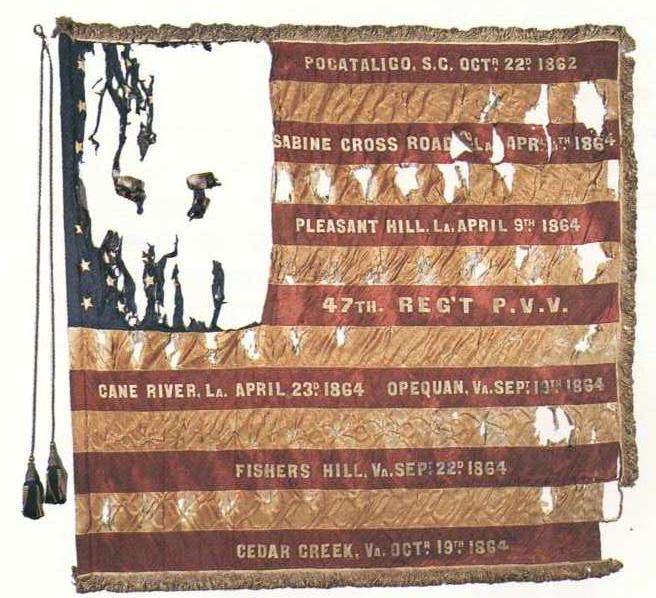
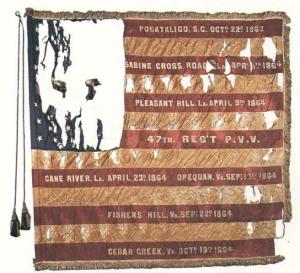
Second State Colors, 47th Pennsylvania Veteran Volunteers (presented to the regiment 7 March 1865).

Seven battle names embossed on a battle flag. Three documented a series of seemingly minor military engagements during one oft-maligned military campaign of the American Civil War.

Known by military scholars today as the 1864 Red River Campaign, those “minor” engagements ensured that the 47th Pennsylvania Volunteers would be known for all time as history makers—members of the only regiment from the Commonwealth of Pennsylvania to take part as the Union’s Army of the Gulf marched through Louisiana between late February and mid-July 1864, enabling the United States government to prevent the war and the brutal practice of chattel slavery from spreading any further west.

As for how inconsequential those “minor” engagements of the 1864 Red River Campaign were? They left such indelible marks on the 47th Pennsylvania Volunteer Infantry that its senior officers chose to emboss the majority of that campaign’s battle names on the second battle flag that was carried by the regiment as it defended the nation in the wake of President Abraham Lincoln’s assassination in April 1865, and as the regiment marched triumphantly through the streets of Washington, D.C. during the Union’s Grand Review of the Armies in late May of that same year.

How It Began

The 47th Pennsylvania Volunteers’ participation in the 1864 Red River Campaign across Louisiana began with a series of general and special orders and other communications that were issued by senior military officers of the United States Army:

  • SPECIAL ORDERS, No. 39
    HEADQUARTERS, DEPARTMENT OF THE GULF, New Orleans, Louisiana, February 13, 1864.

12. First. The Second Regiment U.S. Colored Troops will be relieved from duty at Ship Island and proceed without delay to Key West, Fla., where it will be reported for duty to Brig. Gen. D. P. Woodbury. Second. On the arrival of the Second U.S. Colored Troops at Key West, the battalion of Forty-seventh Pennsylvania Volunteers stationed at that point will be relieved from duty in the District of Key West and Tortugas, and will proceed without delay to Franklin, La., where it will be reported for duty to Maj. Gen. W. B. Franklin, commanding Nineteenth Army Corps. Third. On the arrival of the First Battalion, Forty-seventh Pennsylvania, at Franklin, the One hundred and tenth New York Volunteers will proceed to Fort Jefferson, Dry Tortugas, and relieve the battalion of the Forty-seventh Pennsylvania now in garrison there. Fourth. On being so relieved, the battalion of the Forty-seventh Pennsylvania now stationed at Fort Jefferson will proceed to Franklin, La., and report for duty at the headquarters of the regiment. The quartermaster’s department will immediately furnish the necessary transportation.

By command of Major-General Banks:

RICHD. B. IRWIN,
Assistant Adjutant-General.

  • SPECIAL ORDERS, No. 48
    H
    EADQUARTERS 19th ARMY CORPS AND U.S. FORCES, Franklin, Louisiana, February 18, 1864.

5. In pursuance of Special Orders No. 41, extract 3, current series, headquarters Department of the Gulf, the following-named regiments assigned to the First Division, Nineteenth Army Corps, Brig. Gen. W. H. Emory commanding, are hereby assigned to brigades as follows, to take effect February 20, 1864:First Brigade, to be commanded by Brig. Gen. William Dwight: Fifteenth Maine, Thirtieth Massachusetts, One hundred and fourteenth New York, One hundred and seventy-third New York, One hundred and sixty-first New York.Second Brigade, to be commanded by Brig. Gen. J. W. McMillan: Twenty-sixth Massachusetts (temporary), Thirteenth Maine, Twelfth Connecticut, Eighth Vermont, One hundred and sixtieth New York, Forty-seventh Pennsylvania.Third Brigade, to be commanded by the senior colonel: Fourteenth Maine, One hundred and sixty-second New York, One hundred and sixty-fifth New York, One hundred and sixteenth New York, Thirtieth Maine.

Capt. Duncan S. Walker, assistant adjutant-general, U.S. Volunteers, is assigned to duty as assistant adjutant-general, First Division, and will report to Brigadier-General Emory.

Capt. Oliver Matthews, assistant adjutant-general, U.S. Volunteers, is assigned to duty as assistant adjutant-general, First Brigade, First Division, and will report to Brig. Gen. William Dwight.

The following-named batteries are assigned to the First Division: Battery A, First U.S. Artillery; Battery L, First U.S. Artillery; Fourth Massachusetts Battery, Sixth Massachusetts Battery, Twenty-fifth New York Battery.

By order of Major-General Franklin:

WICKHAM HOFFMAN,
Assistant Adjutant-General.

  • HEADQUARTERS, DEPARTMENT OF THE GULF, New Orleans, Louisiana, February 19, 1864.
    Major-General Franklin, Commanding, Nineteenth Corps, Franklin:

GENERAL: Instead of awaiting the arrival of the battalion of the Forty-seventh Pennsylvania Volunteers, as heretofore ordered, the One hundred and tenth New York Volunteers will be immediately relieved from duty with the First Division, Nineteenth Army Corps, and will proceed without delay to Algiers, where it will take steam transportation for Key West, Fla.

By command of Major-General Banks:

RICHD. B. IRWIN,
Assistant-Adjutant General.

How It Progressed

Casualties began to be incurred by the 47th Pennsylvania even before members of the regiment stepped off of their respective troop transports and onto Louisiana soil in early March 1864. Researchers for 47th Pennsylvania Volunteers: One Civil War Regiment’s Story believe that the first Red River casualty was actually Private Frederick Koehler, who reportedly drowned after falling overboard from his transport, just as it was entering the harbor near Algiers, Louisiana.

From that moment on, the regiment’s casualty rate climbed as the 47th Pennsylvania Volunteers marched, built, dug, and fought their way across unfamiliar, difficult terrain, under conditions for which their northern bodies and immune systems were ill prepared. Two of the campaign’s engagements—the Battle of Sabine Cross Roads/Mansfield on April 8, 1864, and the Battle of Pleasant Hill on April 9—were among the most brutal and sanguinary fighting that they waged during the entire war.

Along the way, the 47th Pennsylvanians helped to free more Black men, women and children from the plantations where they had long been enslaved, with five of the men they met ultimately choosing to enlist with the 47th Pennsylvania Volunteer Infantry, further integrating a regiment that had already begun enrolling Black soldiers as far back as the fall of 1862.

How It Ended

Union Army base at Morganza Bend, Louisiana, circa 1863-1865 (U.S. Library of Congress, public domain).

Their final combat engagement—the Battle of Mansura—was fought on May 16, 1864. Afterward, they marched for Morganza, Louisiana. Encamped there for most of June, they finally made their way back to New Orleans by the end of that month—two campaign-ending duty stations that were not luxurious by any standards now, or then, but were far more comfortable than what they had endured throughout their long and difficult spring.

Those final duty stations were still not completely safe for them, however; the grim reaper continued to scythe men left and right as typhoid, mysterious fevers, dysentery, and chronic diarrhea ravaged the regiment during the unbearably hot, humid weeks of June and early July.

As a result, the regiment lost as many or more of its members to disease than it did to the rifle and cannon fire that they had so recently dodged. And the war was still not over.

When the Fourth of July arrived for the weary warriors, the 47th Pennsylvania Volunteers were busy packing their belongings, having just received new orders to return to the Eastern Theater of battle. By mid-July, roughly sixty percent of the regiment’s members were fighting for their lives yet again—this time in the Battle of Cool Spring, near Snicker’s Gap, Virginia.

As that was happening, multiple members of the regiment were coming to grips with the fact that they had been left behind to recuperate from battle wounds or diseases they had contracted while in service to the nation. Among those convalescents were eighteen men who subsequently died at Union hospitals or Confederate prison camps long after their comrades had reached the East Coast. Two of those men were later documented as among the five total who died in Baton Rouge, with ten men among the total of thirty-three who passed away in New Orleans. Seven others died in Natchez, Mississippi, and at least one of the men left behind had been one of the seventeen POWs held captive at Camp Ford, the largest Confederate prison camp west of the Mississippi River.

Stilled Voices

The phrase, “Dum Tacent Clamant” (While they are silent, they cry aloud”), is inscribed on the Grand Army of the Republic monument at the Chalmette National Cemetery in St. Bernard Parish, Louisiana, where multiple members of the 47th Pennsylvania Volunteers remain at rest (G.A.R. Monument, Chalmette National Cemetery, circa 1910, U.S. Library of Congress, public domain).

More than seventy of the 47th Pennsylvania’s disease and battle-related casualties remain at rest in marked or unmarked national cemetery graves in Louisiana and Mississippi. Other unsung heroes lie forgotten in graves yet to be identified, part of the legion of American soldiers “known but to God.”

Albert, George Washington: Corporal, Company H; fell ill during the Red River Campaign; was transported to New Orleans, where he was confined to a Union Army hospital; discharged on a surgeon’s certificate of disability on April 18, 1864, he died aboard the U.S. Steamer Yazoo while being transported home to Pennsylvania to convalesce; buried at sea, a cenotaph was created for him at Ludolph’s Cemetery in Elliottsburg, Pennsylvania;

Andrew, Michael: Private, Company A; fell ill with chronic diarrhea sometime during the Red River Campaign; was transported to New Orleans, where he was confined to a Union Army general hospital; died there on July 15 or 18, 1864; was interred at the Monument Cemetery in New Orleans (now the Chalmette National Cemetery);

Barry, William: Private, Company H; killed in action during the Battle of Sabine Cross Roads/Mansfield, Louisiana on April 8, 1864; his burial location remains unidentified;

Beidleman, Jacob (alternate surnames: Beiderman, Biedleman): Private, Company G; fell ill with chronic diarrhea during the Red River Campaign; was confined to the Union’s hospital ship, the USS Laurel Hill, and transported to Natchez, Mississippi, where he was confined to Union Army’s Natchez General hospital; died there on July 3, 1864; may have been interred at the Natchez National Cemetery in a grave that remains unidentified;

Bellis (alternate spelling: Bellus), Amandus: Private, Company A; fell ill during the Red River Campaign, was confined to the Union’s hospital ship, the USS Laurel Hill, while it was docked near Morganza, Louisiana; subsequently transported to Natchez, Mississippi, he died en route, while aboard that ship, on June 30, 1864; was possibly buried at sea or interred in an unmarked grave at the Natchez National Cemetery that remains unidentified;

Berlin, Elias: Private, Company A; fell ill in Florida, or during the opening days of the Red River Campaign; died in Florida, or aboard ship while en route to Louisiana, or in Louisiana on March 28, 1864; was interred, or a cenotaph was created for him, at the Zion UCC Stone Church Cemetery in Kreidersville, Pennsylvania;

Bettz, Godfrey (alternate spelling: Betz): Private, Company F; fell ill with chronic diarrhea sometime during the Red River Campaign; was transported to New Orleans, where he was confined to a Union Army general hospital; died there on May 8, 1864; was interred in section 51, grave no. 3968 at the Monument Cemetery in New Orleans (now the Chalmette National Cemetery);

Bohan, George (alternate spellings: Bohan, Bohn, Bollan, Bolian): Private, Company A; fell ill with chronic diarrhea sometime during the Red River Campaign; was transported to New Orleans, where he was confined to a Union Army general hospital; died there on June 27 or 28, 1864; was interred in section 67, grave no. 5358 at the Monument Cemetery in New Orleans (now the Chalmette National Cemetery);

Brader, Josiah (alternate spelling: Braden): Private, Company B; fell ill with typhoid fever sometime during the Red River Campaign; was transported to New Orleans, where he was confined to the University Hospital; died there on July 9, 1864; was interred in section 66, grave no. 5279 at the Monument Cemetery in New Orleans (now the Chalmette National Cemetery);

Brooks, George W.: Private, Company E; fell ill with chronic diarrhea sometime during the Red River Campaign; was transported to New Orleans, where he was confined to a Union Army hospital; died there on August 12, 1864; was interred in section 67, grave no. 5383 at the Monument Cemetery (now the Chalmette National Cemetery);

Clewell, Jr., Joseph: Private, Company G; fell ill with chronic diarrhea after being captured by Confederate troops during the Battle of Sabine Crossroads/Mansfield on April 8, 1864 or the Battle of Pleasant Hill on April 9, or during one of the regiment’s subsequent Red River Campaign engagements; was subsequently confined to the Confederate States Army hospital in Shreveport, Louisiana sometime in May or early June and held there as a prisoner of war (POW) until his death there on June 18, 1864; possibly interred in one of the unmarked graves in Shreveport’s Greenwood Cemetery, according to Joe Slattery, Genealogy Library Specialist at the Shreve Memorial Library in Shreveport; if not, his remains may have been exhumed and reinterred in an unmarked grave at the Alexandria National Cemetery in Pineville, Louisiana, according to historian Lewis Schmidt;

Crader, James: Sergeant, Company G; fell ill sometime during the Red River Campaign; was confined to the Union’s hospital ship, the USS Laurel Hill, and transported to Natchez, Mississippi, where he was confined to the Union’s General Hospital in Natchez; died there on July 9, 1864; may have been interred at the Natchez National Cemetery;

Davenport, Valentine: Private, Company H; fell ill during the opening days of the Red River Campaign; was confined to a Union hospital in New Orleans and then discharged on a surgeon’s certificate of disability on March 28, 1864; died in New Orleans on May 4, 1864; was buried at a national cemetery in the State of New York, according to the U.S. Army Department of the East’s Roll of Honor: Names of Soldiers Who Died in Defence of the American Union, Vol. X: “Soldiers Buried in the Department of the East: New York,” p. 15 (Washington, D.C.: Government Printing Office, 1867);

Dech, Alpheus (alternate presentations of name: Alfred Dech, Alpheus Deck): Private, Company G; fell ill with chronic diarrhea sometime during the Red River Campaign; was transported to New Orleans, where he was confined to the U.S. Marine Hospital; died there on June 3, 1864; was interred in grave no. 4028 at the Monument Cemetery in New Orleans (now the Chalmette National Cemetery);

Dumm, William F. (alternate spellings: Drum or Drumm): Private, Company H; killed in action during the Battle of Pleasant Hill, Louisiana on April 9, 1864; his burial location remains unidentified;

Evans, John: Private, Company H; fell ill with chronic diarrhea sometime during the Red River Campaign; was transported to New Orleans, where he was confined to a Union Army hospital; died there on June 20, 1864; was interred in section 51, grave no. 4042 at the Monument Cemetery in New Orleans (now the Chalmette National Cemetery);

Fetzer, Owen: Private, Company I; fell ill with chronic diarrhea sometime during the Red River Campaign; was transported to New Orleans, where he was hospitalized at the Union’s St. Louis General Hospital; died there on April 19, 1864; his burial location remains unidentified;

Fink, Edward: Private, Company B; declared missing in action (MIA) after the Battle of Pleasant Hill, Louisiana on April 9, 1864; was later declared as killed in action (KIA), having been killed by gunshot during the battle; his burial location remains unidentified;

Frack, William: Corporal, Company I; declared missing in action and “supposed dead” following the Battle of Pleasant Hill, Louisiana on April 9, 1864; was ultimately declared as killed in action; his burial location remains unidentified;

Gerrett, Mathias (alternate spelling: Garrett): Private, Company K; fell ill with typhoid fever sometime during the Red River Campaign; was transported to New Orleans, where he was confined to the Union Army’s Barracks Hospital; died there on May 22, 1864; was interred in section 51, grave no. 3995 at the Monument Cemetery in New Orleans (now the Chalmette National Cemetery);

Haas, Jeremiah: Private, Company C; killed in action during the Battle of Sabine Cross Roads/Mansfield, Louisiana on April 8, 1864; his burial location remains unidentified;

Hagelgans, Nicholas: Private, Company K; killed in action during the Battle of Pleasant Hill, Louisiana on April 9, 1864; his burial location remains unidentified;

Hahn, Richard: Private, Company E; killed in action by a musket ball during the Battle of Pleasant Hill, Louisiana on April 9, 1864; his burial location remains unidentified;

Hangen, Washington H. R.: First Lieutenant and Regimental Adjutant; officially discharged from the U.S. Army and 47th Pennsylvania Volunteer Infantry during the summer of 1864; remained in Louisiana, where he worked for the U.S. Bureau of Refugees, Freedmen, and Abandoned Lands (the “Freedmen’s Bureau”) in St. Tammany Parish and Washington Parish before becoming a surveyor for the State of Louisiana and the U.S. Office of the Surveyor General; died in Abita Springs, St. Tammany Parish on April 23, 1895; was likely interred at the Madisonville Cemetery in St. Tammany Parish, where his second wife had previously been buried;

Hart, J. S. (alternate spelling: Harte): Private, Company C; fell ill with chronic diarrhea sometime during the Red River Campaign; was transported to New Orleans, where he was confined to the Marine Hospital; died there on August 5, 1864; was interred in section 49, grave no. 3869 at the Monument Cemetery in New Orleans (now the Chalmette National Cemetery);

Hartshorn, John (alternate spelling: Hartshorne): Private, Company H; initially listed as missing in action following the Battle of Pleasant Hill, Louisiana on April 9, 1864, Union Army officials determined he had been captured by Confederate troops and marched one hundred and twenty-five miles to Camp Ford near Tyler, Texas, where he was held captive as a prisoner of war (POW) until he was released during a prisoner exchange on July 22, 1864; subsequently died at a Union Army hospital in New Orleans, Louisiana on August 8, 1864; his burial location remains unidentified;

Hawk, David C. (alternate spellings: Hank, Hauk): Private, Company I; fell ill with chronic diarrhea sometime during the Red River Campaign; was transported to New Orleans, where he was confined to a U.S. Army general hospital; died there on July 28, 1864 (alternate death date: July 28, 1865); was described on regimental muster rolls as “absent sick left in U.S. General Hospital of New Orleans since 9-20-64”; was interred in section 49, grave no. 3849 at the Monument Cemetery in New Orleans (now the Chalmette National Cemetery);

Helfrich, John Gross: Sergeant, Company C; fell ill with dysentery sometime during the Red River Campaign; was transported to New Orleans, where he was confined to Charity Hospital; died there on August 5, 1864; was interred in section 49, grave no. 3867 of the Monument Cemetery in New Orleans (now the Chalmette National Cemetery);

Heller, Jonathan: Private, Company G; fell ill with dysentery sometime during the Red River Campaign; was transported to New Orleans, where he was confined to Charity Hospital; died there on June 7, 1864; was interred in square 13, grave no. 1 of the Monument Cemetery in New Orleans (now the Chalmette National Cemetery);

Herbert, Jacob: Private, Company A; fell ill or was injured sometime during the Red River Campaign; was transported to Natchez, Mississippi, where he was confined to a Union Army hospital; died in Natchez on June 30, 1864; his burial location remains unidentified;

Herman, William: Private, Company F; fell ill with chronic diarrhea during the Red River Campaign; was confined to the Union Army hospital ship, the USS Laurel Hill, and transported to Natchez, Mississippi, where he was confined to the Union’s Natchez General Hospital; died there on July 23 or 24, 1864 (his wife’s affidavit in her widow’s pension application notes the date as 23 July; the U.S. Army’s death ledger indicates the date of death was 24 July 1864); may have been interred at the Natchez National Cemetery in Natchez, Mississippi;

Hettrick, Levinus (alternate presentations of name: Levenas Hedrick, Gevinus Hettrick, Levinas Hetrick, Sevinas Hettrick): Private, Company B; drowned in the Mississippi River on June 27, 1864, while serving with the 47th Pennsylvania Volunteers at Morganza, Louisiana, following the 47th’s participation in the Red River Campaign; his burial location remains unidentified;

Hoffman, Nicholas: Private, Company A; fell ill with typhoid fever sometime during the Red River Campaign; was confined to the Union’s hospital ship, the USS Laurel Hill, while it was docked near Morganza, Louisiana, and was transported to Natchez, Mississippi; died aboard that ship on June 30, 1864, while it was in the vicinity of Natchez; per an affidavit filed on June 19, 1865 by Sergeant Charles Small and Private Joseph A. Rogers of the 47th Pennsylvania Volunteer Infantry, Hoffman was buried at the Natchez National Cemetery in Mississippi;

Holsheiser, Lawrence (alternate spellings of surname: Holsheiser, Holyhauser, Hultzheizer, Hultzheizor): Private, Company F; fell ill with chronic diarrhea during the Red River Campaign; was transported to New Orleans, where he was confined to the Barracks Hospital; died there on May 1, 1864; was interred at the Monument Cemetery (now the Chalmette National Cemetery);

Hower, Phillip (alternate spelling: Philip): Private, Company G; contracted Variola (smallpox) during the Red River Campaign; was transported to New Orleans, where he was confined to the Union’s Barracks Hospital; died there on April 21, 1864; was interred at the Monument Cemetery in New Orleans (now the Chalmette National Cemetery);

Keiser, Uriah: Private, Unassigned Men; fell ill during the Red River Campaign; was transported to New Orleans, where he was confined to the Union’s Barracks Hospital; died there in July 1864; was interred at the Monument Cemetery in section 57, grave no.: 4477 (now the Chalmette National Cemetery);

Kennedy, James: Private, Company C; sustained gunshot fracture of the arm and gunshot wound to his side during the Battle of Pleasant Hill, Louisiana on April 9, 1864; was transported to the Union Army’s St. James Hospital in New Orleans, Louisiana, where he died from his battle wounds on April 27, 1864; his burial location remains unidentified;

Kern, Samuel M.: Private, Company D; wounded in action and captured during the Battle of Pleasant Hill, Louisiana on April 9, 1864; was marched or transported to Camp Ford near Tyler, Texas, where he was held in captivity as a prisoner of war (POW) until he died on June 12, 1864; his burial location remains unidentified;

Knauss, Elwin (alternate spellings: Knauss, Kneuss, Knouse; Ellwin, Elvin): Private, Company I; fell ill while during the Red River Campaign; was transported to New Orleans, where he was confined to the U.S. Marine Hospital; died there on August 3, 1864 (alternate death date: June 30, 1864); was interred in grave site 20-55 at the Monument Cemetery in New Orleans (now the Chalmette National Cemetery);

Koehler, Frederick (alternate spellings: Koehler, Kohler, Köhler): Private, Company K; was likely the regiment’s first casualty during the Red River Campaign; while sitting in one of the side hatches of the steamship transporting the 47th Pennsylvania to Louisiana, he fell overboard from the ship as it was rounding into port at Algiers and drowned; members of the regiment reported seeing his body “come up astern of the boat,” and that someone had retrieved his cap, which carried the label “F. K.” on its vizier; researchers have not been able to determine whether or not this soldier was buried at sea, at a cemetery in Louisiana, or if his body was returned home for burial in Pennsylvania;

Kramer, George: Private, Company C; fell ill with chronic diarrhea during the Red River Campaign; was likely confined to one of the Union Army’s general hospitals in Baton Rouge or New Orleans, Louisiana, or to a Union general hospital in Natchez, Mississippi; was placed aboard the Union’s hospital ship, the SS Mississippi; died aboard that ship on August 27, 1864 and was likely buried at sea or possibly at a still-unidentified cemetery in Louisiana or Mississippi; his name was included on the roster of soldiers listed on the Company C, 47th Pennsylvania Volunteers’ Soldiers Monument that was erected at the Sunbury Cemetery in Sunbury, Pennsylvania;

Lehr, Charles (alternate spelling: Lear): Private, Company A; fell ill with chronic diarrhea during the Red River Campaign; was confined to the Union Army’s hospital ship, the USS Laurel Hill, and was transported to the Union’s Natchez General Hospital in Natchez, Mississippi; died there on July 22, 1864; may have been interred in an unmarked/unknown grave at the Natchez National Cemetery;

Long, Solomon: Private, Company K; Contracted typhoid fever during the Red River Campaign; was transported to New Orleans, where he was confined to the U.S. Marine Hospital; died there on August 21, 1864; was interred in section 60, grave no. 4728 of the Monument Cemetery in New Orleans (now the Chalmette National Cemetery);

Matter/Madder, Jacob: Private, Company K; initially reported as missing in action following the Battle of Pleasant Hill, Louisiana on April 9, 1864, his status was subsequently updated to “died of wounds” from that battle; his burial location remains unidentified;

Mayes, William (alternate spelling: Hayes, Mays): Private, Company D; fell ill during the opening days of the Red River Campaign; was transported to New Orleans, where he was confined to a Union Army general hospital; died there on March 30, 1864; was interred in grave no. 3945 of the Monument Cemetery in New Orleans (now the Chalmette National Cemetery);

Miller, Jonathan: Private, Company A; cause and date of death have not yet been determined (soldier was identified by his military headstone); was interred in section 59, grave no. 4629 at the Monument Cemetery in New Orleans (now the Chalmette National Cemetery);

Missmer, Benjamin (alternate spellings: Messner, Missimer, Missmer): Private, Company H; fell ill with chronic diarrhea during the Red River Campaign; was transported to New Orleans, where he was confined to the Union’s St. Louis General Hospital; died there on August 7, 1864; was interred in section 49, grave no. 3874 at the Monument Cemetery in New Orleans (now the Chalmette National Cemetery;

Orris, Nicholas: Private, Co. H; killed in action during the Battle of Pleasant Hill, Louisiana on April 9, 1864; his burial location remains unidentified;

Osterstock, Jacob: Private, Company A; fell ill during the Red River Campaign; was transported to a Union Army hospital in Baton Rouge; died there on June 30, 1864; his burial location remains unidentified;

Powell, Solomon: Private, Company D; may have been wounded in action; was captured during the Battle of Pleasant Hill, Louisiana on April 9, 1864; died from his battle wounds at Pleasant Hill, Louisiana, either on the same day as the battle, or on June 7, 1864, while being held by Confederate troops as a prisoner of war (POW); his burial location remains unidentified; per historian Lewis Schmidt, “Privates Powell and Wantz were probably buried in a cemetery at Pleasant Hill, ‘at the rear of the brick building used for a hospital,’ and after the war reinterred at Alexandria National Cemetery at Pineville, Louisiana in unknown graves”;

Resch, Charles (alternate spelling: Resk): Private, Company K; fell ill during the Red River Campaign; was transported to Baton Rouge and confined to a Union Army general hospital; died there on August 18, 1864; was interred in section 11, grave no. 629 at the Baton Rouge National Cemetery;

Ridgeway, John (alternate spelling: Ridgway): Private, Company H; fell ill during the Red River Campaign; was transported to New Orleans and confined to a Union Army general hospital; died there on July 30, 1864; was interred in section 57, grave no.4475 at the Monument Cemetery in New Orleans (now the Chalmette National Cemetery);

Sanders, Francis (alternate spellings: Xander, Xandres): Corporal, Company B; wounded in action during the Battle of Sabine Cross Roads/Mansfield, Louisiana on April 8, 1864; died shortly after being carried to the rear by his brother; his death was documented in the obituary of his widow, Henrietta Susan (Balliet) Sanders, in the May 15, 1916 edition of Allentown’s Morning Call newspaper, which reported that Francis Sanders “enlisted in the Forty-seventh regiment and saw service for two enlistments until the battle of Sabine Cross Roads, La., where he was wounded and carried to the rear by his brother. From that day to this not a word was heard from him and the supposition was that he died from his wounds” and was likely interred in an unknown, unmarked grave; his burial location remains unidentified;

Schaffer, Reuben Moyer (alternate spellings: Schaeffer, Scheaffer, Shaffer): Private, Company H; reported as wounded in action during either the Battle of Sabine Cross Roads/Mansfield on April 8, 1864 or the Battle of Pleasant Hill on April 9; was subsequently marched with his regiment to Grand Ecore; was reported in U.S. Army records to have died at Grand Ecore on April 22, 1864; however, he actually died during the forty-five-mile march toward Cloutierville, according to a letter subsequently written by his commanding officer, Captain James Kacy, to First Lieutenant William Wallace Geety on May 29; was likely interred in an unknown, unmarked grave; his burial location remains unidentified;

Schlu, Christian (alternate spellings: Schla, Schlea): Private, Company G; fell ill with chronic diarrhea during the Red River Campaign; was transported to New Orleans, where he was confined to the U.S. Marine Hospital; died there on June 2, 1864; was interred in section 58, grave no.: 4577 at the Monument Cemetery in New Orleans (now the Chalmette National Cemetery);

Schweitzer, William (alternate spelling: Sweitzer): Corporal, Company A; fell ill during the Red River Campaign; was taken to the Union’s hospital ship, the USS Laurel Hill, which was docked near Morganza, Louisiana, and was hospitalized aboard that ship on June 20, 1864; diagnosed with typhoid fever, he died aboard ship four days later, on June 24, 1864 (alternate death date: June 23, 1864); his burial location remains unidentified;

Schwenk, Charles M.: Private, Company B; fell ill during the Red River Campaign; was transported to Baton Rouge, where he was confined to a Union general hospital; died there on June 20, 1864; was interred in section 8, grave no. 476 at the Baton Rouge National Cemetery;

Smith, Frederick: Private, Co. D; may have been wounded in action during the Battle of Pleasant Hill, Louisiana on April 9, 1864; was captured by Confederate troops during that battle and marched one hundred and twenty-five miles to Camp Ford near Tyler, Texas, where he was held captive as a prisoner of war (POW) until his death on May 4, 1864; his burial location remains unidentified, but may still be located on the grounds of the Camp Ford Historic Park;

Smith, George H.: Private, Company H; fell ill with chronic diarrhea during the Red River Campaign; was confined to the Union’s hospital ship, the USS Laurel Hill, and transported to Natchez, Mississippi, where he was hospitalized at the Union’s Natchez General Hospital; died there on July 9, 1864; was interred at the Natchez National Cemetery;

Smith, Henry: Private, Company G; fell ill with chronic diarrhea during the Red River Campaign; was transported to New Orleans, where he was confined to the U.S. Marine Hospital; died there on May 30, 1864; was interred in section 51, grave no. 4522 at the Monument Cemetery in New Orleans (now the Chalmette National Cemetery);

Smith, Joseph: Private, Company B; fell ill during the Red River Campaign; was transported to New Orleans, where he was confined to the Union’s Barracks General Hospital; died there on September 2, 1864; was interred in section 60, grave no. 4768 at the Monument Cemetery in New Orleans (now the Chalmette National Cemetery);

Snyder, Jonas: Private, Company I; fell ill and developed consumption during the Red River Campaign across Louisiana; died aboard the U.S. Steamer McClellan on July 8, 1864 while en route to Fortress Monroe, Virginia with his regiment; was buried at sea during a formal military burial ceremony, according to Company I First Lieutenant Levi Stuber’s affidavit that was filed on behalf of Jonas Snyder’s widow for her U.S. Civil War Widow’s Pension application;

Sterner, John C.: Private, Company C; killed in action during the Battle of Pleasant Hill, Louisiana on April 9, 1864; was interred, or a cenotaph was erected on his behalf, at Lantz’s Emmanuel Cemetery in Sunbury, Pennsylvania;

Stick, Francis: Private, Company I; fell ill with chronic diarrhea during the Red River Campaign; was transported to New Orleans, where he was confined to the University General Hospital; died there on June 10, 1864; was interred in section 52, grave no. 4065 at the Monument Cemetery in New Orleans (now the Chalmette National Cemetery);

Stocker, Josiah Simon: Private Company A; fell ill with dysentery during the Red River Campaign; was transported to New Orleans, where he was confined to the University General Hospital; died there on May 17, 1864; was interred in section 7, grave no. 368 at the Baton Rouge National Cemetery;

Straehley, Jeremiah (alternate spellings: Strackley, Strahle, Strahley): Private, Company G; fell ill with chronic diarrhea during the Red River Campaign; was transported to New Orleans, where he was confined to a Union Army general hospital; died there on May 14, 1864; his burial location remains unidentified;

Swoyer, Alfred P.: Second Lieutenant, Company K; was killed instantly after being struck by a minié ball in the right temple during the Battle of Sabine Cross Roads/Mansfield, Louisiana on April 8, 1884; his burial location remains unidentified;

Trabold, Jacob: Private, Company A; fell ill with dysentery during the Red River Campaign; died from disease-related complications at Morganza, Louisiana on June 27, 1864; his burial location remains unidentified;

Wagner, Samuel: Private, Company D; was wounded in action during the Battle of Pleasant Hill, Louisiana on April 9, 1864; was lost at sea while being transported for medical care aboard the USS Pocahontas when that steam transport foundered off of Cape May, New Jersey, after colliding with the City of Bath on June 1, 1864; his body was never recovered;

Walbert, William S. (alternate spelling: Walberd): Private, Company K; fell ill with chronic diarrhea during the Red River Campaign; was transported to New Orleans, where he was hospitalized at the U.S. Marine Hospital; died there on April 30, 1864; his burial location remains unidentified;

Walters, James: Private, Unassigned Men; fell ill during the Red River Campaign; died on June 23, 1864 (per historian Lewis Schmidt); his death and burial locations remain unidentified;

Wantz, Jonathan: Private, Company D; may have been wounded in action during the Battle of Pleasant Hill, Louisiana on April 9, 1864; was captured by Confederate troops during that battle, and was then held captive as a prisoner of war (POW) until he died at Pleasant Hill—either the same day as that battle, or on June 17, 1864, while he was still being held as a POW by Confederate troops; his burial location remains unidentified (per historian Lewis Schmidt, “Privates Powell and Wantz were probably buried in a cemetery at Pleasant Hill, ‘at the rear of the brick building used for a hospital,’ and after the war reinterred at Alexandria National Cemetery at Pineville, Louisiana in unknown graves”);

Webster, John Eyres: Private, Company G; fell ill with fever during the Red River Campaign; was confined to a Union Army general hospital in Baton Rouge; died there from disease-related complications on June 24, 1864 (alternate death date: June 21, 1864); was interred in section 4, grave no. 190 at the Baton Rouge National Cemetery with a cenotaph erected for him by his family at the Old Saint David Church Cemetery in Wayne, Delaware County, Pennsylvania;

Weiss, John: Private, Co. F; was wounded in action and captured by Confederate troops during the Battle of Pleasant Hill, Louisiana on April 9, 1864; was marched or transported to Camp Ford near Tyler, Texas, where he was held captive as a prisoner of war (POW) until his death on July 15, 1864; his burial location remains unknown;

Williamson, Jacob: Private, Company A; fell ill with typhoid fever during the Red River Campaign; was transported to Baton Rouge, where he was confined to the Union’s Baton Rouge General Hospital; died there from malignant typhoid fever on July 13, 1864; was interred in section 9, grave no. 500 at the Baton Rouge National Cemetery;

Witz, John (alternate spellings: Wilts, Wiltz, Wilz, Witts): Private, Unassigned Men and Company E; fell ill with typhoid fever during the Red River Campaign, was taken to the Union’s hospital ship, the USS Laurel Hill, which was docked near Morganza, Louisiana; died aboard that ship on June 23, 1864 (alternate death date: June 21, 1864); was most likely buried at sea or near Morganza, Louisiana; however, his exact burial location remains unidentified;

Worley, John (alternate spellings: Wehle, Worly, Whorley): Private, Company F; fell ill with chronic diarrhea during the Red River Campaign; was transported to New Orleans, where he was confined to the Union’s St. Louis General Hospital; died there on July 15, 1864; was interred on July 16, 1864 in section 142, grave no. 3804 of the Monument Cemetery in New Orleans (now the Chalmette National Cemetery);

Wolf, Samuel (alternate first name: Simon): Private, Company K; was initially declared as missing in action following the Battle of Pleasant Hill, Louisiana on April 9, 1864; was ultimately declared as having been killed in action during that battle after having been absent from muster rolls for a substantial period of time; his burial location remains unknown.


Sources:

  1. Civil War Muster Rolls (47th Pennsylvania Infantry, 1864). Harrisburg, Pennsylvania: Pennsylvania State Archives.
  2. Civil War Veterans’ Card File (47th Pennsylvania Infantry, 1864). Harrisburg, Pennsylvania: Pennsylvania State Archives.
  3. Gilbert, Randal B. A New Look at Camp Ford, Tyler Texas: The Largest Confederate Prison Camp West of the Mississippi River (3rd Edition). Tyler, Texas: The Smith County Historical Society, 2010.
  4. Prisoner of War Rosters, Camp Ford (47th Pennsylvania Infantry, 1864). Tyler, Texas: Smith County Historical Society, retrieved 2014.
  5. Registers of Deaths of Volunteers, 1861–1865 (NAID: 656639), in “Records of the Adjutant General’s Office” (Record Group 94). Washington, D.C.: National Archives and Records Administration.
  6. Registers of Pennsylvania Volunteers, 1861-1865 (47th Regiment), in “Records of the Department of Military and Veterans’ Affairs” (Record Group 19). Harrisburg, Pennsylvania: Pennsylvania State Archives.
  7. Roll of Honor: Names of Soldiers Who, in Defence [sic] of the American Union, Suffered Martyrdom in the Prison Pens throughout the South. Washington, D.C.: Government Printing Office, 1867-1868.
  8. Scott, Col. Robert N., ed. The War of the Rebellion: A Compilation of the Records of the Union and Confederate Armies (Series I – Volume XXXIV – In Four Parts: Part II, Correspondence, etc.: Chapter XLVI: Louisiana and the Trans-Mississippi). Washington, D.C.: Government Printing Office, 1891.
  9. Schmidt, Lewis G. A Civil War History of the 47th Regiment of Pennsylvania Veteran Volunteers. Allentown, Pennsylvania: Self-published, 1986.
  10. Thoms, Alston V., principal investigator and editor, and David O. Brown, Patricia A. Clabaugh, J. Philip Dering, et. al., contributing authors. Uncovering Camp Ford: Archaeological Interpretations of a Confederate Prisoner-of-War Camp in East Texas. College Station, Maryland: Center for Ecological Archaeology, Department of Anthropology, Texas A & M University, 2000.
  11. Wharton, Henry. Letters from the Sunbury Guards, 1864. Sunbury, Pennsylvania: Sunbury American.


The March from Marksville to Morganza, Louisiana and the Battle of Mansura, Mid to Late-May, 1864

USS Laurel Hill, May 26, 1862 (Baldwin Lithograph, Collection of President Franklin D. Roosevelt, Hyde Park, New York, 1936, U.S. Naval Heritage Command, public domain).

Barely out of sight of the city of Alexandria, in Rapides Parish Louisiana, when it ran into the enemy during its retreat south in mid-May 1864, the Union’s Army of the Gulf easily defeated the Confederate States Army troops it encountered and continued its trek toward the village of Marksville in Avoyelles Parish. Members of the 47th Pennsylvania Volunteer Infantry, which was positioned farther back in the Union column, were aware of, but not involved in, that short engagement. According to C Company Musician Henry D. Wharton:

After marching a few miles skirmishing commenced in front between the cavalry and the enemy in riflepits [sic] on the bank of the river, but they were easily driven away. When we came up we discovered their pits and places where there had been batteries planted. At this point the John Warren, an unarmed transport, on which were sick soldiers and women, was fired into and sunk, killing many and those that were not drowned taken prisoners. A tin-clad gunboat was destroyed at the same place, by which we lost a large mail. Many letters and directed envelopes were found on the bank – thrown there after the contents had been read by the unprincipled scoundrels. The inhumanity of Guerrilla bands in this department is beyond belief, and if one did not know the truth of it or saw some of their barbarities, he would write it down as the story of a ‘reliable gentleman’ or as told by an ‘intelligent contraband.’ Not satisfied with his murderous intent on unarmed transports he fires into the Hospital steamer Laurel Hill, with four hundred sick on board. This boat had the usual hospital signal floating fore and aft, yet, notwithstanding all this, and the customs of war, they fired on them, proving by this act that they are more hardened than the Indians on the frontier.

* Note: The USS Laurel Hill survived the attack and, in a few short weeks, became the final home for ailing 47th Pennsylvania Volunteers, including Corporal William Schweitzer and Privates Amandus Bellis and Nicholas Hoffman (Company A) and Private John Witz (Company E).

Map of key 1864 Red River Campaign locations, showing the battle sites of Sabine Cross Roads, Pleasant Hill and Mansura in relation to the Union’s occupation sites at Alexandria, Grand Ecore, Morganza, and New Orleans (excerpt from Dickinson College/U.S. Library of Congress map, public domain; click to enlarge).

Resuming their trek south with the retreating Army of the Gulf, the 47th Pennsylvania Volunteers engaged in yet another long march, trudging more than thirty miles as the month of May 1864 wore on. According to the expedition’s commanding officer, Union Major-General Nathaniel P. Banks:

The fleet passed below Alexandria on the 13th of May. The army on its march from Alexandria did not encounter the enemy in force until near the town of Mansura. He was driven through the town in the evening of the 14th of May, and at daybreak next morning our advance encountered his cavalry on the prairie east of the town.

According to Henry Wharton, “On Sunday, May 15, we left the river road and took a short route through the woods, saving considerable distance.”

The windings of Red river are so numerous that it resembles the tape-worm railroad wherewith the politicians frightened the dear people during the administration of Ritner and Stevens. – We stopped several hours in the woods to leave cavalry pass, when we moved forward and by four o’clock emerged into a large open plain where we formed in line of battle, expecting a regular engagement. The enemy, however, retired and we advanced ‘till dark, when the forces halted for the night, with orders to rest on their arms. – ‘Twas here that Banks rode through our regiment, amidst the cheers of the boys, and gave the pleasant news that Grant had defeated Lee.

“Sleeping on Their Arms” by Winslow Homer (Harper’s Weekly, May 21, 1864).

Positioned just outside of the town of Marksville, under orders to “rest on their arms” for the night, the 47th Pennsylvanians half-dozed with their rifles within a finger’s length—but without the benefit of tents for cover. It was the eve of the Battle of Mansura, which unfolded on May 16, 1864 as follows, according to Wharton:

Early next morning we marched through Marksville into a prairie nine miles long and six wide where every preparation was made for a fight. The whole of our force was formed in line, in support of artillery in front, who commenced operations on the enemy driving him gradually from the prairie into the woods. As the enemy retreated before the heavy fire of our artillery, the infantry advanced in line until they reached Mousoula [sic, Mansura], where they formed in column, taking the whole field in an attempt to flank the enemy, but their running qualities were so good that we were foiled. The maneuvring [sic, maneuvering] of the troops was handsomely done, and the movements was [sic, were] one of the finest things of the war. The fight of artillery was a steady one of five miles. The enemy merely stood that they might cover the retreat of their infantry and train under cover of their artillery.

Per Major-General Banks, the Confederate troops “fell back, with steady and sharp skirmishing across the prairie, to a belt of woods, which he occupied.”

The enemy’s position covered three roads diverging from Mansura to the Atchafalaya. He manifested a determination here to obstinately resist our passage. The engagement, which lasted several hours, was confined chiefly to the artillery until our troops got possession of the edge of the woods – first upon our left by General Emory; subsequently on our right by General Smith, when he was driven from the field, after a sharp and decisive fight, with considerable loss.

According to military historian Steven E. Clay, “As the Army of the Gulf marched from Alexandria to Simmesport, it followed the River Road. As it moved, Taylor’s cavalry harassed the column from all sides.”

Steele’s men resumed the pressure on A. J. Smith’s rearguard. Annoying Emory and the cavalry advanced guard was Major and Bagby’s commands. The troops also attempted to slow the Federal march by cutting trees and placing other obstacles in the way. Parson’s men skirmished with Gooding’s troopers on the right flank. None of the rebel cavalry’s efforts, however, appreciably slowed the Union column.

On 14 May, the army’s van arrived at Bayour Choctaw. Emory called the pontoon train forward, and within a short time, the pontonniers had the stream bridged and the army was crossing…. That evening the troops of the XIX Corps [including the 47th Pennsylvania Volunteers] bivouacked beside the wrecks of the John Warner, Signal, and Covington. Strewn upon the ground were the letters many of the men had mailed to their loved ones earlier and had been placed on the Warner bound for New Orleans. The rebel soldiers had opened the letters, read them for entertainment, and simply tossed them aside. The idea did not sit well with the Federals, but neither did the wanton destruction and plunder of civilian homes with the Confederates.

On 15 May the column slowly crossed the Bayou Choctaw Swamp and entered the Avoyelles … Prairie. There, Major’s cavalry, later along with Bagby’s troops, attacked the lead elements several times. The fighting became so hot at moments that Emory deployed his artillery to help drive the bothersome rebel troopers away…. By nightfall … the XIX Corps had reached Marksville with the rest of the army strung out behind.

Late on 15 May, Banks learned that Taylor had massed his forces six miles ahead at the town of Mansura, evidently with the intention of blocking further Federal movement on the road to Simmesport…. On learning of the concentration of rebel forces, Banks sent orders to Emory directing him to move no later than 0300 [3 a.m.] on 16 May and to attack the enemy at daybreak. Further, Smith advanced on Emory’s right to attack into Taylor’s left flank. The XIII Corps [13th Corps], now under Lawler since 9 May … was to remain in front of Marksville as the reserve. The trains [Union wagon trains] were held behind that town….

As ordered, the Army of the Gulf moved south before sunrise. As morning dawned, the Federal army began its deployment on the wide open plain of the Avoyelles Prairie. The US troops advanced with Emory’s XIX [including the 47th Pennsylvania] in the lead with Grover’s 1st Division on the Federal left near the Grand River and McMillan’s 2nd Division [including the 47th Pennsylvania] on the right. The XIX Corps was followed by A. J. Smith’s XVI Corps [16th Corps] in column; Mower’s division was followed by that of Kilby Smith. As the Federal brigades deployed on the field they could see the Confederate battle line in the distance. Virtually in the center of the battlefield was the tiny village of Mansura.

According to Clay, Confederate Major-General Richard Taylor (a plantation owner and son of former U.S. President Zachary Taylor) “had placed eight dismounted cavalry regiments from Major’s and Bagby’s commands to the east of the hamlet” of Mansura. “At least 19 cannon with the batteries interspersed among the brigades supported these troops.” Confederate Brigadier-General Camille Armand Jules Marie, the Prince de Polignac, a prince of France who fought with the Confederate Army during America’s Civil War and whom the 47th Pennsylvanian Volunteers had previously faced in combat during the Battle of Sabine Cross Roads near Mansfield, Louisiana, “posted his two small infantry brigades and two dismounted regiments of cavalry on the left, west of town, and thirteen more guns supported Polignac’s force.”

New York Tribune headline announcing the U.S. Army of the Gulf’s May 1864 victory near Marksville, Louisiana (New York Tribune, June 3, 1864, public domain).

Standing “on a flat, green savanna,” according to Clay, the troops under Brigadier-General Emory’s command, including the 47th Pennsylvania Volunteers, were the first to march into the battle’s fray, followed by A. J. Smith’s “divisions to the right of the line.” It quickly became obvious to all who were watching the scene unfold that Taylor had woefully misjudged his opponents; his six thousand Confederates were greeted with the spectacle of the eighteen-thousand strong Army of the Gulf arrayed before them.

According to Clay, “The battle began sometime after 0600 [6 a.m.] with a mutual artillery bombardment.”

As the fusillade opened, commanders on both sides ordered their men to lie down in order to reduce casualties during the artillery duel. The tactic was effective. The barrage lasted about four hours, but few men were struck by the many rounds fired. As the Union battle line rose and moved forward on occasion, Taylor’s skirmish line responded by slowly giving ground…. Finally, at about 1000 (1 p.m.), as the XVI Corps pressed forward on the Confederate left to flank Taylor’s position as planned, the rebel line quickly sidestepped the move and fell back toward their trains which were located southwest in the village of Evergreen.

Unlike the sanguinary opening battles of the Red River Campaign, the Battle of Mansura was far less brutal. Per Wharton:

Our loss was slight. Of the rebels we could not ascertain correctly, but learned from citizens who had secreted themselves during the fight, that they had many killed and wounded, who threw them into wagons, promiscuously, and drove them off so that we could not learn their casualties.

Afterward, the victorious Army of the Gulf resumed its march south. According Major-General Banks:

The 16th of May we reached Simmsport [sic, Simmesport], on the Atchafalaya. Being entirely destitute of any ordinary bridge material for the passage of this river – about six hundred yards wide – a bridge was constructed of the steamers, under direction of Lieutenant Colonel Bailey. This work was not of the same magnitude, but was as important to the army as the dam at Alexandria was to the navy. It had the merit of being an entirely novel construction, no bridge of such magnitude having been constructed of similar materials. The bridge was completed at one o’clock on the 19th of May. The wagon train passed in the afternoon, and the troops the next morning, in better spirit and condition, as able and eager to meet the enemy as at any period of the campaign.

Union Major-General Nathaniel Banks subsequently reported that, during the Army of the Gulf’s final engagement with Confederates, the “command of General A. J. Smith, which covered the rear of the army during the construction of the bridge and the passage of the army, had a severe engagement with the enemy, under Polignac, on the afternoon of the 19th, at Yellow Bayou, which lasted several hours.”

Our loss was about one hundred and fifty in killed and wounded; that of the enemy much greater, besides many prisoners who were taken by our troops. Major General E. R. S. Canby arrived at Simmsport [sic, Simmesport] on the 19th of May, and the next day assumed command of the troops as a portion of the forces of the military division of the West Mississippi, to the command of which he had been assigned.

The 47th Pennsylvania, however, was not involved in that battle at Yellow Bayou; according to Wharton:

This fight was the last one of the expedition. The whole of the force is safe on the Mississippi, gunboats, transports and trains. The 16th and 17th have gone to their old commands.

It is amusing to read the statements of correspondents to papers North, concerning our movements and the losses of our army. I have it from the best source that the Federal loss from Franklin to Mansfield, and from their [sic] to this point does not exceed thirty-five hundred in killed, wounded and missing, while that of the rebels is over eight thousand.

Union Army base at Morganza Bend, Louisiana, circa 1863-1865 (U.S. Library of Congress, public domain).

After that final battle, the surviving members of the 47th made their way through Simmesport and into the Atchafalaya Basin, and then moved on to the village of Morganza, where they made camp again. According to Wharton, the members of Company C were sent on a special mission which took them on an intense journey of one hundred and twenty miles:

Company C, on last Saturday was detailed by the General in command of the Division to take one hundred and eighty-seven prisoners (rebs) to New Orleans. This they done [sic] satisfactorily and returned yesterday to their regiment, ready for duty. While in the City some of the boys made Captain Gobin quite a handsome present, to show their appreciation of him as an officer gentleman.

By May 28, 1864, the men from Company C had returned from New Orleans and were once again encamped at Morganza with the full 47th Pennsylvania Volunteer Infantry, prompting Henry Wharton to write:

The boys are well. James Kennedy who was wounded at Pleasant Hill, died at New Orleans hospital a few days ago. His friends in the company were pleased to learn that Dr. Dodge of Sunbury, now of the U.S. Steamer Octorora, was with him in his last moments, and ministered to his wants. The Doctor was one of the Surgeons from the Navy who volunteered when our wounded was [sic, were] sent to New Orleans.

Their long trek through Louisiana was over, but their fight to preserve America’s Union was not.

Sources:

  1. Banks, Nathaniel P. “Report of the Red River Campaign,” in “Annual Report of the Secretary of  War,” in Message of the President of the United States, and Accompanying Documents, to the Two Houses of Congress, at the Commencement of the First Session of the Thirty-Ninth Congress. Washington: Government Printing Office, 1866.
  2. Bates, Samuel P. History of Pennsylvania Volunteers, 1861-5, vol. 1. Harrisburg, Pennsylvania: B. Singerly, State Printer, 1869.
  3. Battle of Pleasant Hill, April 9, 1864, Walker’s Texas Division Campaign Map, Detail,” in “House Divided.” Carlisle, Pennsylvania: History Department, Dickinson College, November 21, 2009 (cropped from the original public domain map available on the website of the U.S. Library of Congress).
  4. Clay, Steven E. The Staff Ride Handbook for the Red River Campaign, 7 March-19 May 1864. Fort Leavenworth, Kansas: Combat Studies Institute Press, U.S. Army Combined Arms Centers, 2023.
  5. Prisoner of War Records, Camp Ford and Camp Groce (47th Pennsylvania Volunteer Infantry). Tyler Texas: Smith County Historical Society, 2010.
  6. Report of Maj. Gen. Nathaniel P. Banks, U. S. Army, Commanding Expedition and Department of the Gulf (to Edwin M. Stanton, Secretary of War), in Annual Report of the Secretary of War, in Message of the President of the United States, and Accompanying Documents, to the Two Houses of Congress, at the Commencement of the First Session of the Thirty-Ninth Congress. Washington, D.C.: Government Printing Office, 1866.
  7. Schmidt, Lewis G. A Civil War History of the 47th Regiment of Pennsylvania Veteran Volunteers. Allentown, Pennsylvania: Self-published, 1986.
  8. “The History of the Forty-Seventh Regt. P. V.” Allentown, Pennsylvania: The Lehigh Register, July 20, 1870.
  9. Wharton, Henry D. Letters from the Sunbury Guards, 1861-1868. Sunbury, Pennsylvania: Sunbury American.


New Year, New Duty Station: Adjusting to Life at Fort Jefferson in Florida’s Dry Tortugas (Late December 1862 – Late February 1863)

Brigadier-General John Milton Brannan, U.S. Army (public domain).

“It is hardly necessary to point out to you the extreme military importance of the two works now intrusted [sic, entrusted] to your command. Suffice it to state that they cannot pass out of our hands without the greatest possible disgrace to whoever may conduct their defense, and to the nation at large. In view of difficulties that may soon culminate in war with foreign powers, it is eminently necessary that these works should be immediately placed beyond any possibility of seizure by any naval or military force that may be thrown upon them from neighboring ports….

Seizure of these forts by coup de main may be the first act of hostilities instituted by foreign powers, and the comparative isolation of their position, and their distance from reinforcements, point them out (independent of their national importance) as peculiarly the object of such an effort to possess them.”

— Excerpt from orders issued by Brigadier-General John Milton Brannan, commanding officer, United States Army, Department of the South, to Colonel Tilghman H. Good, commanding officer of the 47th Pennsylvania Volunteer Infantry in December 1862


Fort Jefferson, Dry Tortugas, Florida, view from the sea, 1946 (vacation photograph collection of President Harry Truman, November 1946 U.S. National Archives and Records Administration, public domain).

Having been ordered by Union Brigadier-General John Milton Brannan to resume garrison duties in Florida in December 1862, after having been badly battered in the Battle of Pocotaligo, South Carolina two months earlier, the officers and enlisted members of the 47th Pennsylvania Volunteer Infantry were also informed in December that their regiment would become a divided one. This was being done, Brannan said, not as a punishment for their performance, which had been valiant, but to help the federal government to ensure that the foreign governments that had granted belligerent status to the Confederate States of America would not be able to aid the Confederate army and navy further in their efforts to move troops and supplies from Europe and the Deep South of the United States to the various theaters of the American Civil War.

As a result, roughly sixty percent of 47th Pennsylvanians (Companies A, B, C, E, G, and I) were sent back to Fort Taylor in Key West shortly before Christmas in 1862 while the remaining members of the regiment (from Companies D, F, H, and K) were transported by the USS Cosmopolitan to Fort Jefferson, the Union’s remote outpost in the Dry Tortugas, which was situated roughly seventy miles off the coast of Florida. They arrived there in late December of that same year.

Life at Fort Jefferson

Union Army Columbiad on the Terreplein at Fort Jefferson, Dry Tortugas, Florida (George A. Grant, 1937, U.S. National Park Service, public domain).

Garrison duty in Florida proved to be serious business for the 47th Pennsylvania Volunteers. Per records of the United States Army’s Ordnance Department, the defense capabilities of Fort Jefferson in 1863 were impressive—thirty-three smoothbore cannon (twenty-four of which were twenty-four pounder howitzers that had been installed in the fort’s bastions to protect the installation’s flanks, and nine of which were forty-two pounders available for other defensive actions); six James rifles (forty-two pounder seacoast guns); and forty-three Columbiads (six ten-inch and thirty-seven eight-inch seacoast guns).

Fort Jefferson was so heavily armed because it was “key in controlling … shipping in the Gulf of Mexico and was being used as a supply depot for the distribution of rations and munitions to Federal troops in the Mississippi Delta; and as a supply and fueling station for naval vessels engaged in the blockade or transport of supplies and troops,” according to historian Lewis Schmidt.

Large quantities of stores, including such diverse items as flour … ham … coal, shot, shell, powder, 5000 crutches, hospital stores, and stone, bricks and lumber for the fort, were collected and stored at the Tortugas for distribution when needed. Federal prisoners, most of them court martialed Union soldiers, were incarcerated at the fort during the period of the war and used as laborers in improving the structure and grounds. As many as 1200 prisoners were kept at the fort during the war, and at least 500 to 600 were needed to maintain a 200 man working crew for the engineers.

With respect to housing and feeding the soldiers stationed here:

Cattle and swine were kept on one of the islands nearest the fort, called Hog Island (today’s Bush Key), and would be compelled to swim across the channel to the fort to be butchered, with a hawser fastened to their horns. The meat was butchered twice each week, and rations were frequently supplemented by drawing money for commissary stores not used, and using it to buy fish and other available food items from the local fishermen. The men of the 7th New Hampshire [who were also stationed at Fort Jefferson] acquired countless turtle and birds’ eggs … from adjacent keys, including ‘Sand Key’ [where the fort’s hospital was located]. Loggerhead turtles were also caught … [and] were kept in the ‘breakwater ditch outside of the walls of the fort’, and used to supplement the diet [according to one soldier from New Hampshire].

Second-tier casemates, lighthouse keeper’s house, sallyport, and lean-to structure, Fort Jefferson, Dry Tortugas, Florida, late 1860s (U.S. National Park Service and National Archives, public domain).

In addition, the fort’s “interior parade grounds, with numerous trees and shrubs in evidence, contained … officers’ quarters, [a] magazine, kitchens and out houses,” as well as a post office and “a ‘hot shot oven’ which was completed in 1863 and used to heat shot before firing,” according to Schmidt.

Most quarters for the garrison … were established in wooden sheds and tents inside the parade [grounds] or inside the walls of the fort in second-tier gun rooms of ‘East’ front no. 2, and adjacent bastions … with prisoners housed in isolated sections of the first and second tiers of the southeast, or no. 3 front, and bastions C and D, located in the general area of the sallyport. The bakery was located in the lower tier of the northwest bastion ‘F’, located near the central kitchen….

According to H Company Second Lieutenant Christian Breneman, the walk around Fort Jefferson’s barren perimeter was less than a mile long with a sweeping view of the Gulf of Mexico. Brennan also noted the presence of “six families living [nearby], with 12 or 15 respectable ladies.”

Balls and parties are held regularly at the officers’ quarters, which is a large three-story brick building with large rooms and folding doors.

Lieutenant-Colonel George Warren Alexander, second-in-command, 47th Pennsylvania Volunteer Infantry, standing next to his horse, with officers from the 47th, Fort Jefferson, Dry Tortugas, Florida, circa 1863 (public domain; click to enlarge).

Shortly after the arrival of the 47th Pennsylvania Volunteers at Fort Jefferson, First Lieutenant George W. Fuller was appointed as adjutant for Lieutenant-Colonel George Warren Alexander, who had been placed in command of the fort’s operations. Assistant Regimental Surgeon Jacob Scheetz, M.D. was appointed as post surgeon and given command of the fort’s hospital operations, responsibilities he would continue to execute for fourteen months. In addition, Private John Schweitzer of the 47th Pennsylvania’s A Company was directed to serve at the fort’s baker, B Company’s Private Alexander Blumer was assigned as clerk of the quartermaster’s department, and H Company’s Third Sergeant William C. Hutchinson began his new duties as provost sergeant while H Company Privates John D. Long and William Barry were given additional duties as a boatman and baker, respectively.

When Christmas Day dawned, many at the fort experienced feelings of sadness and ennui as they continued to mourn friends who had recently been killed at Pocotaligo and worried about others who were still fighting to recover from their battle wounds.

1863

Unidentified Union Army artillerymen standing beside one of the fifteen-inch Rodman guns installed on the third level of Fort Jefferson in the Dry Tortugas, Florida, circa 1862. Each smoothbore Rodman weighed twenty-five tons, and was able to fire four-hundred-and-fifty-pound shells more than three miles (U.S. National Park Service, public domain).

The New Year arrived at Fort Jefferson with a bang—literally—as the fort’s biggest guns thundered in salute, kicking off a day of celebration designed by senior military officials to lift the spirits of the men and inspire them to continued service. Donning their best uniforms, the 47th Pennsylvania Volunteers assembled on the parade grounds, where they marched in a dress parade and drilled to the delight of the civilians living on the island, including Emily Holder, who had been living in a small house within the fort’s walls since 1860 with her husband, who had been stationed there as a medical officer for the fort’s engineers. When describing that New Year’s Day and other events for an 1892 magazine article, she said:

On January 1st, 1863, the steamer Magnolia visited Fort Jefferson and we exchanged hospitalities. One of the officers who dined with us said it was the first time in nine months he had sat at a home table, having been all that time on the blockade….

Colonel Alexander, our new Commander, said that in Jacksonville, where they paid visits to the people, the young ladies would ask to be excused from not rising; they were ashamed to expose their uncovered feet, and their dresses were calico pieced from a variety of kinds.

Two days later, the 47th Pennsylvania Volunteers’ dress parade was a far less enjoyable one as temperatures and tempers soared. The next day, H Company Corporal George Washington Albert and several of his comrades were given the unpleasant task of carrying the regiment’s foul-smelling garbage to a flatboat and hauling it out to sea for dumping.

As the month of January progressed, it became abundantly clear to members of the regiment that the practice of chattel slavery was as ever present at and beyond the walls of Fort Jefferson as it had been at Fort Taylor and in South Carolina. It seemed that the changing of hearts and minds would take time even among northerners—despite President Lincoln’s best efforts, as illustrated by these telling observations made later that same month by Emily Holder:

We received a paper on the 10th of January, which was read in turns by the residents, containing rumors of the emancipation which was to take place on the first, but we had to wait another mail for the official announcement.

I asked a slave who was in my service if he thought he should like freedom. He replied, of course he should, and hoped it would prove true; but the disappointment would not be as great as though it was going to take away something they had already possessed. I thought him a philosopher.

In Key West, many of the slaves had already anticipated the proclamation, and as there was no authority to prevent it, many people were without servants. The colored people seemed to think ‘Uncle Sam’ was going to support them, taking the proclamation in its literal sense. They refused to work, and as they could not be allowed to starve, they were fed, though there were hundreds of people who were offering exorbitant prices for help of any kind—a strange state of affairs, yet in their ignorance one could not wholly blame them. Colonel Tinelle [sic, Colonel L. W. Tinelli] would not allow them to leave Fort Jefferson, and many were still at work on the fort.

John, a most faithful boy, had not heard the news when he came up to the house one evening, so I told him, then asked if he should leave us immediately if he had his freedom.

His face shone, and his eyes sparkled as he asked me to tell him all about it. He did not know what he would do. The next morning Henry, another of our good boys, who had always wished to be my cook, but had to work on the fort, came to see me, waiting until I broached the subject, for I knew what he came for. He hoped the report would not prove a delusion. He and John had laid by money, working after hours, and if it was true, they would like to go to one of the English islands and be ‘real free.’

I asked him how the boys took the news as it had been kept from them until now, or if they had heard a rumor whether they thought it one of the soldier’s stories.

‘Mighty excited, Missis,’ he replied….

Henry had been raised in Washington by a Scotch lady, who promised him his freedom when he became of age; but she died before that time arrived, and Henry had been sold with the other household goods.

The 47th Pennsylvanians continued to undergo inspections, drill and march for the remainder of January as regimental and company assignments were fine-tuned by their officers to improve efficiency. Among the changes made was the reassignment of Private Blumer to service as clerk of the fort’s ordnance department.

Three key officers of the regiment, however, remained absent. D Company’s Second Lieutenant George Stroop was still assigned to detached duties with the U.S. Army’s Signal Corps aboard the Union Navy’s war sloop, Canandaigua, and H Company’s First Lieutenant William Wallace Geety was back home in Pennsylvania, still trying to recruit new members for the regiment while recovering from the grievous injuries he had sustained at Pocotaligo, while Company K’s Captain Charles W. Abbott was undergoing treatment for disease-related complications at Fort Taylor’s post hospital.

Disease, in fact, would continue to be one of the Union Army’s most fearsome foes during this phase of duty, felling thirty-five members of its troops stationed at Fort Jefferson during the months of January and February alone. Those seriously ill enough to be hospitalized included twenty men battling dysentery and/or chronic diarrhea, four men suffering from either intermittent or bilious remittent fever, and two who were recovering from the measles with others diagnosed with rheumatism and general debility.

Fort Jefferson’s moat and wall, circa 1934, Dry Tortugas, Florida (C. E. Peterson, U.S. Library of Congress; public domain).

The primary reason for this shocking number of sick soldiers was the problematic water quality. According to Schmidt:

‘Fresh’ water was provided by channeling the rains from the fort’s barbette through channels in the interior walls, to filter trays filled with sand; and finally to the 114 cisterns located under the fort which held 1,231,200 gallons of water. The cisterns were accessible in each of the first level cells or rooms through a ‘trap hole’ in the floor covered by a temporary wooden cover…. Considerable dirt must have found its way into these access points and was responsible for some of the problems resulting in the water’s impurity…. The fort began to settle and the asphalt covering on the outer walls began to deteriorate and allow the sea water (polluted by debris in the moat) to penetrate the system…. Two steam condensers were available … and distilled 7000 gallons of tepid water per day for a separate system of reservoirs located in the northern section of the parade ground near the officers [sic, officers’] quarters. No provisions were made to use any of this water for personal hygiene of the [planned 1,500-soldier garrison force]….

Consequently, soldiers were forced to wash themselves and their clothes using saltwater hauled from the ocean. As if that were not difficult enough, “toilet facilities were located outside of the fort.” According to Schmidt:
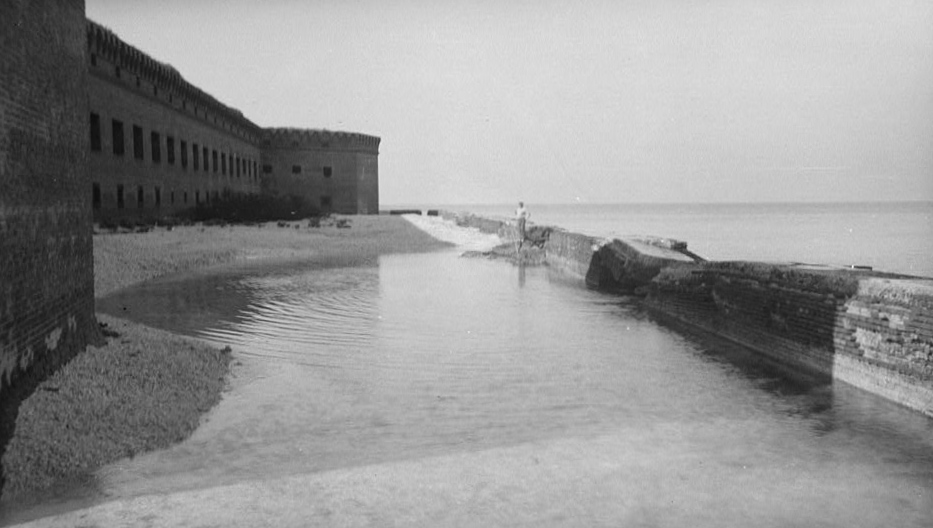
At least one location was near the wharf and sallyport, and another was reached through a door-sized hole in a gunport, and a walk across the moat on planks at the northwest wall…. These toilets were flushed twice each day by the actions of the tides, a procedure that did not work very well and contributed to the spread of disease. It was intended that the tidal flush should move the wastes into the moat, and from there, by similar tidal action, into the sea. But since the moat surrounding the fort was used clandestinely by the troops to dispose of litter and other wastes … it was a continuous problem for Lt. Col. Alexander and his surgeon.

When it came to the care of soldiers with more serious infectious diseases such as smallpox, soldiers and prisoners were confined to isolation roughly three miles away on Bird Key to prevent contagion. The small island also served as a burial ground for Union soldiers stationed at the fort.

* Note: During this same period, First Lieutenant Lawrence Bonstine was assigned to special duty as Post Adjutant at Fort Taylor in Key West, a position he continued to hold from at least January 10, 1863 through the end of December 1863. Reporting directly to the regiment’s founder and commanding officer, Colonel Tilghman H. Good, he was essentially Good’s right hand, ensuring that regimental records and reports to more senior military officials were kept up to date while performing other higher level administrative and leadership tasks.

On February 3, 1863, Colonel Tilghman Good, visited Fort Jefferson, in his capacity as regimental commanding officer and accompanied by the newly re-formed Regimental Band (band no. 2). Led by Regimental Bandmaster Anton Bush, the ensemble was on hand to perform the music for that evening’s officers’ ball.

Sometime during this phase of duty, Corporal George W. Albert was reassigned to duties as camp cook for Company H, giving him the opportunity to oversee at least one of the formerly enslaved Black men who had enlisted with the 47th Pennsylvania Volunteer Infantry while the regiment was stationed in Beaufort, South Carolina. Subsequently assigned to duties as an Under-Cook,” that Black soldier who fell under his authority was most likely Thomas Haywood, who had been entered onto the H Company roster after enrolling with the 47th Pennsylvania on November 1, 1862.

* Note: This was likely not a pleasant time for Thomas Haywood. One of the duties of his direct superior, Corporal George Albert, was to butcher a shipment of cattle that had just been received by the fort. Both men took on that task on Saturday, February 24—a day that Corporal Albert later described as hot, sultry and plagued by mosquitoes.

Based on Albert’s known history of overt racism, their interpersonal interactions were likely made worse that day by his liberal use of racial epithets, which were a frequent component of the diary entries he had penned during this time—hate speech that has all too often been wrongly attributed to the regiment’s entire membership by some mainstream historians and Civil War enthusiasts without providing actual evidence to back up those claims. There were a considerable number of officers and enlisted members of the 47th Pennsylvania who strongly supported the efforts of President Lincoln and senior federal government military leaders to eradicate the practice of chattel slavery nationwide with at least several members of the regiment known to be members of prominent abolitionist families in Pennsylvania.

Officers’ quarters and parade grounds, interior of Fort Jefferson, Dry Tortugas, Florida, 1898 (U.S. National Park Service and National Archives and Records Administration, public domain).

During this same period, Private Edward Frederick of the 47th Pennsylvania’s K Company was readmitted to the regimental hospital for further treatment of the head wound he had sustained at Pocotaligo. As his condition worsened, his health failed, and he died there late in the evening on February 15 from complications related to an abscess that had developed in his brain. He was subsequently laid to rest on the parade grounds at Fort Jefferson.

In a follow-up report, Post Surgeon Jacob H. Scheetz, M.D., the 47th Pennsylvania’s assistant regimental surgeon, provided these details of the battle wound and treatment that Frederick had endured:

Private Edward Frederick, Co. K, 47th Pennsylvania Vols, was struck by a musket ball at the battle of Pocotaligo, South Carolina, October 22, 1862. The ball lodged in the frontal bone and was removed. The wound did well for three weeks when he had a slight attack of erysipelas, which, however, soon subsided under treatment. The wound commenced suppurating freely and small spiculae of bone came away, or were removed, on several occasions. Cephalgia was a constant subject of complaint, which was described as a dull aching sensation. The wound had entirely closed on January 1, 1863, and little complaint made except the pain in the head when he exposed himself to the sun. About the 4th of February he was ordered into the hospital with the following symptoms: headache, pain in back and limbs, anorexia, tongue coated with a heavy white coating, bowels torpid. He had alternate flashes of heat; his pupils slightly dilated; his pulse 75, and of moderate volume. He was blistered on the nape of the neck, and had a cathartic given him, which produced a small passage. Growing prostrate, he was put upon the use of tonics, and opiates at night to promote sleep; without any advantage, however. His mind was clear til [sic] thirty-six hours before death, when his pupils were very much dilated, and he gradually sank into a comatose state until 12 M. [midnight] on the night of the 15th of February when he expired.

Another twelve hours after death: Upon removing the calvarium the membranes of the brain presented no abnormal appearance, except slight congestion immediately beneath the part struck. A slight osseus deposition had taken place in the same vicinity. Upon cutting into the left cerebrum, (anterior lobe) it was found normal, but an incision into the left anterior lobe was followed by a copious discharge of dark colored and very offensive pus, and was lined by a yellowish white membrane which was readily broken up by the fingers. I would also have stated that his inferior extremities were, during the last four days, partially paralyzed.

Lieutenant-Colonel George Warren Alexander, 47th Pennsylvania Volunteers, circa 1861 (public domain).

As Private Frederick’s body was being autopsied, the unceasing routine of fort life continued as members of the regiment went about performing their duties and the USS Cosmopolitan arrived with a new group of prisoners. On February 25, 1863, Lieutenant-Colonel Alexander issued Special Order No. 17:

I. Company commanders are hereby ordered to instruct the chief of detachment in their respective companies to see that all embrasures in the lower tier, both at and between their batteries, are properly closed and bolted immediately after retreat.

II. As the safety of the garrison depends on the carrying out of the above order, they will hold chiefs of detachments accountable for all delinquencies.

In addition, orders were given to company cooks to relocate their operations to bastion C of the fort, which was a much cooler place for them to do their duties—a change that was likely appreciated as much or more by the under-cooks as the higher-ranking cooks who oversaw their grueling work.

This was the first of several initiatives undertaken by Lieutenant-Colonel Alexander who, according to Schmidt, “was having some difficulty in exercising proper control over Fort Jefferson as it related to the Engineering Department and persons in their employ.”

It was his duty to train the garrison, guard the prisoners, and provide the necessary protection for the fort and its environs, a situation fraught with many problems not always understood by other military and non-military personnel on station there. It was during this period that relationships between the various interests began to deteriorate, as overseer George Phillips, temporarily filling in for Engineer Frost, refused the request of Lt. Col. Alexander to have as many engineer workmen removed from the casemates as could be comfortably accommodated inside the barracks outside the walls of the fort. Phillips lost the argument and the quarters were vacated, but the tone of the several letters exchanged between the two commands left much to be desired. Differences were aired concerning occupations of the prisoners and their possible use by the engineers; the amount of water used by the workmen as Alexander limited them to one gallon per day per man; Engineer Frost arriving and reclaiming for his department the central Kitchen, and another kitchen near it that had been used by Capt. Woodruff and others; stagnant water in the ditches which involved the post surgeon [Jacob H. Scheetz, M.D.] in the controversy; uncovering of the ‘cistern trap holes’ located in the floors of the first or lower tier, which allowed the water supplies to become contaminated; who exercised jurisdiction over the schooner Tortugas of the Engineering Department; depredations of wood belonging to the engineers; and many other conflicts….

Around this same time, Corporal George Nichols, who had piloted the Confederate steamer, the Governor Milton, behind Union lines after it had been captured by members of the 47th’s Companies E and K in October, was assigned once again to engineering duties—this time at Fort Jefferson—but he was not happy about it, according to a letter he wrote to family and friends:

So I am detailed on Special duty again as Engineer. I cannot See in this I did not Enlist as an Engineer. But I get Extra Pay for it but I do not like it. So I must get the condencer redy [sic, condenser ready] to condece [sic, condense] fresh water. Get her redy [ready] and no tools to do it with.

Corporal Nichols’ reassignment was made possible when the contingent of 47th Pennsylvanians at Fort Jefferson was strengthened with the transfer there of members of Companies E and G from Fort Taylor on February 28. That same day, the men of F Company received additional training with both light and heavy artillery at the fort while the men from K Company gained more direct experience with the installation’s seacoast guns. In addition, members of the regiment finally received the six months of back pay they were owed.

Rev. William DeWitt Clinton Rodrock, chaplain, 47th Pennsylvania Volunteers, Fort Jefferson, Dry Tortugas, Florida, 1863 (courtesy of Robert Champlin, used with permission).

It was also during this latest phase of duty that Regimental Chaplain William DeWitt Clinton Rodrock was transferred from Fort Taylor to Fort Jefferson—possibly to render spiritual comfort after what had been a brutal month in terms of hospitalizations. Among the seventy members of the 47th Pennsylvania who had been admitted to the post’s hospital in the Dry Tortugas were fifty-four men with dysentery and/or diarrhea, four men with remittent or bilious remittent fevers, three men suffering from catarrh, one man who had contracted typhoid fever, one man who had contracted tuberculosis and was suffering from the resulting wasting away syndrome known as phthisis, and three men suffering from diseases of the eye (two with nyctalopia, also known as night blindness, and one with cataracts).

One of the additional challenges faced by the men stationed in the Dry Tortugas (albeit a less serious one) was that there was no camp sutler available to them at Fort Jefferson, as there was for the 47th Pennsylvanians who were stationed at Fort Taylor. So, it was more difficult, if not impossible, to obtain their favorite foods, replacements for worn-out clothing, tobacco, and other items not furnished by the quartermasters of the Union Army—making their lives more miserable with each passing day as they depleted the care packages that had been sent to them by their families during the holidays.

Stationed farther from home than they had ever been, they could see no end in sight for the devastating war that had torn their nation apart.


Sources:

  1. Bates, Samuel P. History of Pennsylvania Volunteers, 1861-5, vol. 1. Harrisburg, Pennsylvania: B. Singerly, State Printer, 1869.
  2. Florida’s Role in the Civil War: ‘Supplier of the Confederacy.’ Tampa, Florida: Florida Center for Instructional Technology, College of Education, University of South Florida, retrieved online January 15, 2020.
  3. Holder, Emily. At the Dry Tortugas During the War.” San Francisco, California: Californian Illustrated Magazine, 1892 (part four, retrieved online, March 28, 2024, courtesy of Lit2Go, the website of the Educational Technology Clearinghouse at the Florida Center for Instructional Technology, College of Education, University of South Florida).
  4. History: Crops (Historic Florida Barge Canal Trail).” Historical Marker Database, retrieved online December 30, 2023.
  5. Malcom, Corey. Emancipation at Key West,” in “The 20th of May: The History and Heritage of Florida’s Emancipation Day Digital History Project.” St. Petersburg, Florida: Florida Humanities, retrieved online March 28, 2024.
  6. Owsley, Frank Lawrence, and Harriet Fason Chappell. King Cotton Diplomacy: Foreign Relations of the Confederate States of America. Chicago, Illinois: University of Chicago Press, 1959.
  7. Preventing Diplomatic Recognition of the Confederacy, 1861–1865,” and The Alabama Claims, 1862–1872,” in “Milestones: 1861–1865.” Washington, D.C.: Office of the Historian, Foreign Service Institute, United States Department of State, retrieved online December 30, 2023.
  8. Schmidt, Lewis G. A Civil War History of the 47th Regiment of Pennsylvania Veteran Volunteers. Allentown, Pennsylvania: Self-published, 1986.
  9. Staubach, Lieutenant Colonel James C. Miami During the Civil War: 1861-65, in Tequesta: The Journal of the Historical Association of Southern Florida, vol. LIII, pp. 31-62. Miami, Florida: Historical Museum of Southern Florida, 1993.
  10. Wharton, Henry D. Letters from the Sunbury Guards. Sunbury, Pennsylvania: Sunbury American, 1861-1868.


Black History Month: The Authorization, Duties and Pay of “Under-Cooks”

One of several U.S. Civil War Pension documents that confirmed the Union Army enrollment of Hamilton Blanchard and Aaron Bullard, known later as Aaron French, as Cooks (a higher rank than under-cook) with Company D of the 47th Pennsylvania Volunteer Infantry (U.S. Civil War Pension Files, U.S. National Archives and Records Administration, public domain).

Following executive orders promulgated by President Abraham Lincoln in 1862 and legislation enacted that same year by the United States Congress to facilitate the enrollment by free and enslaved Black men with Union Army regiments, the 47th Pennsylvania Volunteer Infantry began processing the enlistments of four of the nine formerly enslaved men who would ultimately be entered onto the rosters of this history-making regiment.

Enrolled as “Negro Under-Cooks” while the regiment was stationed in Beaufort, South Carolina as part of the U.S. Department of the South and Tenth Army (X Corps), Bristor Gethers, Thomas Haywood, Abraham Jassum, and Edward Jassum ranged in age from sixteen to thirty-three.

Roughly two years later, officers from the 47th Pennsylvania Volunteers then processed the enlistment paperwork for an additional five formerly enslaved men in Natchitoches, Louisiana in April 1864 while the 47th Pennsylvania was stationed there (as the only regiment from Pennsylvania to participate in the Union’s Red River Campaign across Louisiana). Hamilton Blanchard, Aaron French (who was known at that time as Aaron Bullard), James Bullard, John Bullard, and Samuel Jones ranged in age from sixteen to twenty-nine.

All but one of the nine would go on to complete their three-year terms of enlistment and be honorably mustered out in October 1865.

What Were Their Job Duties?

General Orders No. 323 (enlistment and pay of under-cooks of African descent), U.S. War Department and Office of the Adjutant General, September 28, 1863 (U.S. Library of Congress, public domain).

The duties and other pertinent details about the military tasks performed by Cooks and Under-Cooks of the Union Army were explained as follows by August Kautz in his 1864 manual, Customs of Service for Non-Commissioned Officers and Soldiers as Derived from Law and Regulations and Practised in the Army of the United States:

“108. DAILY DUTY.—A soldier is on daily duty when he is put upon some continuous duty that excuses him from the ordinary company duty but does not entitle him to additional pay from the government,—such as company cooks, tailors, clerks, standing orderlies, &c. These duties may be performed by soldiers selected on account of special capacity or merit, or detailed in turn, as is most convenient and conducive to the interest of the service.

109. The company cooks are one or more men in each company detailed to do the cooking for the entire company. This is the case usually in companies where it is not the custom to distribute the provisions to the men; for in this case the messes furnish their own cooks, and they are not excused from any duty except what is absolutely necessary and which their messmates can do for them.

110. The law authorizes the detailing of one cook to thirty men, or less; two cooks if there are more than thirty men in the company. It also allows to each cook two assistant cooks (colored), who are enlisted for the purpose, and are allowed ten dollars per month. (See Par. 269.)

111. The cooks are under the direction of the first sergeant or commissary-sergeant, who superintends the issue of provisions and directs the cooking for each day. Company cooks for the whole company are generally detailed in turn, and for periods of a week or ten days….

269. Cooks. — The law now allows the enlistment of four African under-cooks for each company of more than thirty men; if less, two are allowed. They receive ten dollars per month, three of which may be drawn in clothing, and one ration. (See Act March 3, 1863, section 10.) They are enlisted the same as other enlisted men, and their accounts are kept in the same way: they are entered on the company muster-rolls, at the foot of the list of privates. (G. 0. No. 323, 1863.)

270. These cooks are to be under the direction, of a head-cook, detailed from the soldiers alternately every ten days, when the company is of less than thirty men; when the company is of more than thirty men, two head-cooks are allowed. These are quite sufficient to cook the rations for a company; and, by system and method, the comfort and subsistence of a company may be greatly improved. The frequent changing of cooks under the old system worked badly for the comfort of the soldier and they were often treated to unwholesome food, in consequence of the inexperience of some of the men.

271. The object of changing the head-cooks every ten days, as required by section 9, Act March 3, 1863, is to teach all the men how to cook; but it will follow that the under-cooks, who are permanently on that duty will know more about it than the head-cooks. They will simply be held responsible that the cooking is properly performed.”

From Under-Cook to Private

Samuel Jones was an enslaved Black man who enlisted as an Under-Cook with Company C of the 47th Pennsylvania Volunteer Infantry in Natchitoches, Louisiana on April 5, 1864. Official regimental muster rolls confirmed that he was a private at the time of his honorable discharge in 1865 (Registers of Pennsylvania Volunteers, 1861-1865: 47th Regiment, in “Records of the Department of Military and Veterans’ Affairs,” Pennsylvania State Archives, public domain; click to enlarge).

As the officers and enlisted members of the 47th Pennsylvania Volunteer Infantry interacted more frequently with the nine formerly enslaved men who had enlisted with their regiment, their trust in, and respect for, those nine men grew. Over time, several of the nine men were assigned to increasingly responsible duties, which ultimately led to their respective promotions to the ranks of cook and private—ranks that were documented on official muster rolls of the 47th Pennsylvania Volunteers.

About “Faces of the 47th: Freedmen of the 47th Pennsylvania Volunteer Infantry”

“Faces of the 47th: Freedmen of the 47th Pennsylvania Volunteer Infantry” is a special project of 47th Pennsylvania Volunteers: One Civil War Regiment’s Story, an educational program designed to teach children and adults about the history of the 47th Pennsylvania Veteran Volunteers, a Union Army regiment which served for nearly the entire duration of the American Civil War and became the only military unit from the Commonwealth of Pennsylvania to participate in the Union’s 1864 Red River Campaign across Louisiana.

This important initiative is dedicated to researching, documenting and presenting the life stories of nine formerly enslaved Black men who enlisted with the 47th Pennsylvania Volunteer Infantry during two of the regiment’s most eventful years of service to the nation—1862 and 1864.

Largely forgotten for more than a century after honorably completing their historic military service, these nine men have been repeatedly overlooked by mainstream historians over the years as potentially important subjects for research and have also been an ongoing source of mystery and frustration to their descendants because the majority of their military service records have still not been digitized by state and national archives.

The purpose of this initiative is to remedy those failures and create a lasting tribute to these nine remarkable men.

Learn more about their lives before, during and after the war by visiting Freedmen of the 47th Pennsylvania Volunteer Infantry.”


Sources:

  1. “Bounties to Volunteers.” Washington, D.C.: National Republican, January 5, 1864.
  2. “Comfort of the Soldier.” Washington, D.C.: Daily National Republican, February 23, 1863.
  3. “Garris, Presto” [sic, “Gethers, Bristor”], and “Jones, Samuel,” in “Registers of Pennsylvania Volunteers, 1861-1865” (47th Regiment, Companies F and C), in “Records of the Department of Military and Veterans’ Affairs” (RG-19). Harrisburg, Pennsylvania: Pennsylvania State Archives.
  4. “General Orders No. 323” (enlistment and pay of “under-cooks of African descent”). Washington, D.C.: U.S. War Department and Adjutant General’s Office, September 28, 1863.
  5. “Important Diplomatic Circular by Secretary Seward: Review of Recent Military Events.” Washington, D.C.: The Evening Star, September 15, 1863.
  6. Kautz, August V. Customs of Service for Non-Commissioned Officers and Soldiers as Derived from Law and Regulations and Practised in the Army of the United States, pp. 41-42 (definitions and responsibilities of cooks and under-cooks), 68-69 (special enlistments: African Under-Cook), 84-88 (cooking responsibilities of hospital stewards), 90-9 (special enlistments: African Under-Cook, definition, enlistment and record-keeping for, and pay), and 93 (cooks and attendants in hospitals) . Philadelphia, Pennsylvania: J. B. Lippincott & Co., 1864.
  7. “Military Notices” (Fourteenth United States Infantry). Philadelphia, Pennsylvania: The Philadelphia Inquirer, January 14, 1864.
  8. “Official: Laws of the United States, Passed at the Third Session of the Thirty-seventh Congress.” Washington, D.C.: Daily National Republican, March 27, 1863.
  9. “Under Cooks of African Descent.” Washington, D.C.: National Republican, May 8, 1865.


Black History Month: Paving the Way for the Integration of the Union Army

Abraham Lincoln in New York City on Monday morning, February 27, 1860, several hours before he delivered his Cooper Union address (Matthew Brady, U.S. Library of Congress, public domain).

Acutely aware that Union military casualty figures had continued to climb as the American Civil War moved into and through its second year, President Abraham Lincoln and his senior military advisors soon realized that more drastic measures would need to be taken—and far more volunteer soldiers would need to be recruited if they were to ever begin healing their divided nation.

During the summer of 1862, President Lincoln kicked off that series of drastic measures by issuing his July 2 call for volunteers in which he pressed state governors of Connecticut, Maine, New Hampshire, Illinois, Indiana, Maryland, Michigan, Minnesota, Missouri, New Jersey, New York, Ohio, Pennsylvania, Vermont, Virginia, Tennessee, and Wisconsin, as well as the president of the Military Board of Kentucky, to furnish an additional three hundred thousand men for military service. That action was followed by the passage, two weeks later, of the Militia Act of 1862 on July 17, through which the U.S. Congress empowered Lincoln to “make all necessary rules and regulations to provide for enrolling the militia,” and also authorized state and federal military units in Union-held territories to recruit and enroll enslaved and free Black men to fill labor-related jobs.

Starting on July 17, according to section twelve of that legislation, President Lincoln was “authorized to receive into the service of the United States, for the purpose of constructing intrenchments, or performing camp service or any other labor, or any military or naval service for which they may be found competent, persons of African descent.” In addition, the new law’s next section specified that “when any man or boy of African descent, who by the laws of any State shall owe service or labor to any person who, during the present rebellion, has levied war or has borne arms against the United States, or adhered to their enemies by giving them aid and comfort, shall render any such service as is provided for in this act, he, his mother and his wife and children, shall forever thereafter be free, any law, usage, or custom whatsoever to the contrary notwithstanding: Provided, That the mother, wife and children of such man or boy of African descent shall not be made free by the operation of this act except where such mother, wife or children owe service or labor to some person who, during the present rebellion, has borne arms against the United States or adhered to their enemies by giving them aid and comfort.”

The subsequent two sections of this act then spelled out how the newly enlisted Black soldiers would be compensated for their work, stating that “the expenses incurred to carry this act into effect shall be paid out of the general appropriation for the army and volunteers,” and that “all persons who have been or shall be hereafter enrolled in the service of the United States under this act shall receive the pay and rations now allowed by law to soldiers, according to their respective grades: Provided, That persons of African descent, who under this law shall be employed, shall receive ten dollars per month and one ration, three dollars of which monthly pay may be in clothing.”

Adding More Teeth to the Fight’s Bite

That same day (July 17 1862), the U.S. Congress then also passed the Confiscation Act of 1862, proclaiming that “every person who shall hereafter commit the crime of treason against the United States, and shall be adjudged guilty thereof, shall suffer death, and all his slaves, if any, shall be declared and made free.”

A subsequent push that same summer by President Lincoln and his senior military advisors to state leaders to furnish an additional three hundred thousand men—for a revised total of six hundred thousand new volunteer soldiers—resulted in the enlistment of more than half a million men—with an additional ninety thousand troops added to Union rosters through the implementation of a nationwide draft.

Freeing More Enslaved Men and Enabling Them to Enlist

Page one of the Preliminary Emancipation Proclamation issued by President Abraham Lincoln, September 22, 1862 (U.S. National Archives and Records Administration, public domain; click to enlarge).

President Lincoln followed up his blistering recruitment drive of the summer of 1862 by adding even more support for his plan to increase federal troop strength by issuing his Preliminary Emancipation Proclamation on September 22, 1862. Giving a preview of what he intended to do in 1863 if Confederate States officials failed to cease hostilities and rejoin the Union, he began paving the road for Union regiments to rescue and recruit larger numbers of enslaved men:

By the President of the United States of America.
A Proclamation.

I, Abraham Lincoln, President of the United States of America, and Commander-in-Chief of the Army and Navy thereof, do hereby proclaim and declare that hereafter, as heretofore, the war will be prosecuted for the object of practically restoring the constitutional relation between the United States, and each of the States, and the people thereof, in which States that relation is, or may be, suspended or disturbed.

That it is my purpose, upon the next meeting of Congress to again recommend the adoption of a practical measure tendering pecuniary aid to the free acceptance or rejection of all slave States, so called, the people whereof may not then be in rebellion against the United States and which States may then have voluntarily adopted, or thereafter may voluntarily adopt, immediate or gradual abolishment of slavery within their respective limits; and that the effort to colonize persons of African descent, with their consent, upon this continent, or elsewhere, with the previously obtained consent of the Governments existing there, will be continued.

That on the first day of January in the year of our Lord, one thousand eight hundred and sixty-three, all persons held as slaves within any State, or designated part of a State, the people whereof shall then be in rebellion against the United States shall be then, thenceforward, and forever free; and the executive government of the United States, including the military and naval authority thereof, will recognize and maintain the freedom of such persons, and will do no act or acts to repress such persons, or any of them, in any efforts they may make for their actual freedom.

That the executive will, on the first day of January aforesaid, by proclamation, designate the States, and part of States, if any, in which the people thereof respectively, shall then be in rebellion against the United States; and the fact that any State, or the people thereof shall, on that day be, in good faith represented in the Congress of the United States, by members chosen thereto, at elections wherein a majority of the qualified voters of such State shall have participated, shall, in the absence of strong countervailing testimony, be deemed conclusive evidence that such State and the people thereof, are not then in rebellion against the United States.

That attention is hereby called to an Act of Congress entitled ‘An Act to make an additional Article of War’ approved March 13, 1862, and which act is in the words and figure following:

‘Be it enacted by the Senate and House of Representatives of the United States of America in Congress assembled, That hereafter the following shall be promulgated as an additional article of war for the government of the army of the United States, and shall be obeyed and observed as such:

Article-All officers or persons in the military or naval service of the United States are prohibited from employing any of the forces under their respective commands for the purpose of returning fugitives from service or labor, who may have escaped from any persons to whom such service or labor is claimed to be due, and any officer who shall be found guilty by a court martial of violating this article shall be dismissed from the service.

Sec.2. And be it further enacted, That this act shall take effect from and after its passage.

Also to the ninth and tenth sections of an act entitled ‘An Act to suppress Insurrection, to punish Treason and Rebellion, to seize and confiscate property of rebels, and for other purposes,’ approved July 17, 1862, and which sections are in the words and figures following:

Sec.9. And be it further enacted, That all slaves of persons who shall hereafter be engaged in rebellion against the government of the United States, or who shall in any way give aid or comfort thereto, escaping from such persons and taking refuge within the lines of the army; and all slaves captured from such persons or deserted by them and coming under the control of the government of the United States; and all slaves of such persons found on (or) being within any place occupied by rebel forces and afterwards occupied by the forces of the United States, shall be deemed captives of war, and shall be forever free of their servitude and not again held as slaves.

Sec.10. And be it further enacted, That no slave escaping into any State, Territory, or the District of Columbia, from any other State, shall be delivered up, or in any way impeded or hindered of his liberty, except for crime, or some offence against the laws, unless the person claiming said fugitive shall first make oath that the person to whom the labor or service of such fugitive is alleged to be due is his lawful owner, and has not borne arms against the United States in the present rebellion, nor in any way given aid and comfort thereto; and no person engaged in the military or naval service of the United States shall, under any pretence whatever, assume to decide on the validity of the claim of any person to the service or labor of any other person, or surrender up any such person to the claimant, on pain of being dismissed from the service.’

And I do hereby enjoin upon and order all persons engaged in the military and naval service of the United States to observe, obey, and enforce, within their respective spheres of service, the act, and sections above recited.

And the executive will in due time recommend that all citizens of the United States who shall have remained loyal thereto throughout the rebellion, shall (upon the restoration of the constitutional relation between the United States, and their respective States, and people, if that relation shall have been suspended or disturbed) be compensated for all losses by acts of the United States, including the loss of slaves.

In witness whereof, I have hereunto set my hand, and caused the seal of the United States to be affixed.

Done at the City of Washington this twenty-second day of September, in the year of our Lord, one thousand, eight hundred and sixty-two, and of the Independence of the United States the eighty seventh.

[Signed:] Abraham Lincoln
By the President

[Signed:] William H. Seward
Secretary of State

Page one of the Emancipation Proclamation issued by U.S. President Abraham Lincoln, January 1, 1863 (U.S. National Archives and Records Administration, public domain; click to enlarge).

When those state officials failed to comply, President Lincoln officially issued the Emancipation Proclamation on January 1, 1863:

By the President of the United States of America:
A Proclamation.

Whereas, on the twenty-second day of September, in the year of our Lord one thousand eight hundred and sixty-two, a proclamation was issued by the President of the United States, containing, among other things, the following, to wit:

‘That on the first day of January, in the year of our Lord one thousand eight hundred and sixty-three, all persons held as slaves within any State or designated part of a State, the people whereof shall then be in rebellion against the United States, shall be then, thenceforward, and forever free; and the Executive Government of the United States, including the military and naval authority thereof, will recognize and maintain the freedom of such persons, and will do no act or acts to repress such persons, or any of them, in any efforts they may make for their actual freedom.

That the Executive will, on the first day of January aforesaid, by proclamation, designate the States and parts of States, if any, in which the people thereof, respectively, shall then be in rebellion against the United States; and the fact that any State, or the people thereof, shall on that day be, in good faith, represented in the Congress of the United States by members chosen thereto at elections wherein a majority of the qualified voters of such State shall have participated, shall, in the absence of strong countervailing testimony, be deemed conclusive evidence that such State, and the people thereof, are not then in rebellion against the United States.’

Now, therefore I, Abraham Lincoln, President of the United States, by virtue of the power in me vested as Commander-in-Chief, of the Army and Navy of the United States in time of actual armed rebellion against the authority and government of the United States, and as a fit and necessary war measure for suppressing said rebellion, do, on this first day of January, in the year of our Lord one thousand eight hundred and sixty-three, and in accordance with my purpose so to do publicly proclaimed for the full period of one hundred days, from the day first above mentioned, order and designate as the States and parts of States wherein the people thereof respectively, are this day in rebellion against the United States, the following, to wit:

Arkansas, Texas, Louisiana, (except the Parishes of St. Bernard, Plaquemines, Jefferson, St. John, St. Charles, St. James Ascension, Assumption, Terrebonne, Lafourche, St. Mary, St. Martin, and Orleans, including the City of New Orleans) Mississippi, Alabama, Florida, Georgia, South Carolina, North Carolina, and Virginia, (except the forty-eight counties designated as West Virginia, and also the counties of Berkley, Accomac, Northampton, Elizabeth City, York, Princess Ann, and Norfolk, including the cities of Norfolk and Portsmouth[)], and which excepted parts, are for the present, left precisely as if this proclamation were not issued.

And by virtue of the power, and for the purpose aforesaid, I do order and declare that all persons held as slaves within said designated States, and parts of States, are, and henceforward shall be free; and that the Executive government of the United States, including the military and naval authorities thereof, will recognize and maintain the freedom of said persons.

And I hereby enjoin upon the people so declared to be free to abstain from all violence, unless in necessary self-defence; and I recommend to them that, in all cases when allowed, they labor faithfully for reasonable wages.

And I further declare and make known, that such persons of suitable condition, will be received into the armed service of the United States to garrison forts, positions, stations, and other places, and to man vessels of all sorts in said service.

And upon this act, sincerely believed to be an act of justice, warranted by the Constitution, upon military necessity, I invoke the considerate judgment of mankind, and the gracious favor of Almighty God.

In witness whereof, I have hereunto set my hand and caused the seal of the United States to be affixed.

Done at the City of Washington, this first day of January, in the year of our Lord one thousand eight hundred and sixty three, and of the Independence of the United States of America the eighty-seventh.

By the President: ABRAHAM LINCOLN

WILLIAM H. SEWARD, Secretary of State.

Adding More Teeth to the Fight’s Bite

This Civil War-era recruiting flyer documents the service of the 47th Pennsylvania Volunteer Infantry at Forts Taylor and Jefferson, Florida, under the leadership of Colonel Tilghman Good, as well as the premium and bounty added to standard pay to inspire more men to enlist (public domain).

Just over a month later, in February 1863, the United States Congress passed U.S. Senate Bill 511 (“An act for enrolling and calling out the national forces, and for other purposes”). Better known as the Enrollment Act of 1863 or “Conscription Act,” it was signed into law by President Lincoln on 3 March 1863, and gave state officials throughout the north the ability to draft men to serve whenever those officials were unable to meet their federal troop quotas through volunteer recruitment drives. It also allowed draftees to recruit others to muster in and serve for them.

Whereas there now exist in the United States an insurrection and rebellion against the authority thereof, and it is, under the Constitution of the United States, the duty of the government to suppress insurrection and rebellion, to guarantee to each State a republican form of government, and to preserve the public tranquility; and whereas, for these high purposes, a military force is indispensable, to raise and support which all persons ought willingly to contribute; and whereas no service can be more praiseworthy and honorable than that which is rendered for the maintenance of the Constitution and Union, and the consequent preservation of free government: Therefore—

Be it enacted by the Senate and House of Representatives of the United States of America in Congress assembled, That all able-bodied male citizens of the United States, and persons of foreign birth who shall have declared on oath their intention to become citizens under and in pursuance of the laws thereof, between the ages of twenty and forty-five years, except as hereinafter excepted, are hereby declared to constitute the national forces, and shall be liable to perform military duty in the service of the United States when called out by the President for that purpose.

SEC 2. And be it further enacted, That the following persons be, and they are hereby, excepted and exempt from the provisions of this act, and shall not be liable to military duty under the same, to wit: Such as are rejected as physically or mentally unfit for the service; also, First the Vice-President of the United States, the judges of the various courts of the United States, the heads of the various executive departments of the government, and the governors of the several States. Second, the only son liable to military duty of a widow dependent upon his labor for support. Third, the only son of aged or infirm parent or parents dependent upon his labor for support. Fourth, where there are two or more sons of aged or infirm parents subject to draft, the father, or, if he be dead, the mother, may elect which son shall be exempt. Fifth, the only brother of children not twelve years old, having neither father nor mother dependent upon his labor for support. Sixth, the father of motherless children under twelve years of age dependent upon his labor for support. Seventh, where there are a father and sons in the same family and household, and two of them are in the military service of the United States as non-commissioned officers, musicians, or privates, the residue of such family and household, not exceeding two, shall be exempt. And no persons but such as are herein excepted shall be exempt: Provided, however, That no person who has been convicted of any felony shall be enrolled or permitted to serve in said forces.

SEC. 3. And be it further enacted, That the national forces of the United States not now in the military service, enrolled under this act, shall be divided into two classes: the first of which shall comprise all persons subject to do military duty between the ages of twenty and thirty-five years, and all unmarried persons subject to do military duty above the age of thirty-five and under the age of forty-five; the second class shall comprise all other persons subject to do military duty, and they shall not, in any district, be called into the service of the United States until those of the first class hall have been called.

SEC. 4. And be it further enacted, That, for greater convenience in enrolling, calling out, and organizing the national forces, and for the arrest of deserters and spies of the enemy, the United States shall constitute one or more, as the President shall direct, and each congressional district of the respective states, as fixed by a law of the state next preceding the enrolment, shall constitute one: Provided, That in states which have not by their laws been divided into two or more congressional districts, the President of the United States shall divide the same into so many enrolment districts as he may deem fit and convenient.

SEC 8. And be it further enacted, That in each of said districts there shall be a board of enrolment, to be composed of the provost-marshal, as president, and two other persons, to be appointed by the President of the United States, one of whom shall be a licensed and practising physician and surgeon.

SEC. 10. And be it further enacted, That the enrolment of each class shall be made separately, and shall only embrace those whose ages shall be on the first day of July thereafter between twenty and forty-five years.

SEC. 11. And be it further enacted, That all persons thus enrolled shall be subject, for two years after the first day of July succeeding the enrolment, to be called into the military service of the United States, and to continue in service during the present rebellion, not, however, exceeding the term of three years; and when called into service shall be placed on the same footing, in all respects, as volunteers for three years, or during the war, including advance pay and bounty as now provided by law.

SEC. 12. And be it further enacted, That whenever it may be necessary to call out the national forces for military service, the President is hereby authorized to assign to each district the number of men to be furnished by said district; and thereupon the enrolling board shall, under the direction of the President, make a draft of the required number, and fifty per cent, in addition, and shall make an exact and complete roll of the names of the person so drawn, and of the order in which they are drawn, so that the first drawn may stand first upon the said roll and the second may stand second, and so on; and the persons so drawn shall be notified of the same within ten days thereafter, by a written or printed notice, to be served personally or by leaving a copy at the last place of residence, requiring them to appear at a designated rendezvous to report for duty. In assigning to the districts the number of men to be furnished therefrom, the President shall take into consideration the number of volunteers and militia furnished by and from the several states in which said districts are situated, and the period of their service since the commencement of the present rebellion, and shall so make said assignment as to equalize the numbers among the districts of the several states, considering and allowing for the numbers already furnished as aforesaid and the time of their service.

SEC. 13. And be it further enacted, That any person drafted and notified to appear as aforesaid, may, on or before the day fixed for his appearance, furnish an acceptable substitute to take his place in the draft; or he may pay to such person as the Secretary of War may authorize to receive it, such sum, not exceeding three hundred dollars, as the Secretary may determine, for the procuration of such substitute; which sum shall be fixed at a uniform rate by a general order made at the time of ordering a draft for any state or territory; and thereupon such person so furnishing the substitute, or paying the money, shall be discharged from further liability under that draft. And any person failing to report after due service of notice, as herein prescribed, without furnishing a substitute, or paying the required sum therefor, shall be deemed a deserter, and shall be arrested by the provost-marshal and sent to the nearest military post for trial by court-martial, unless, upon proper showing that he is not liable to do military duty, the board of enrolment shall relive him from the draft.

SEC. 16. And be it further enacted, That as soon as the required number of able-bodied men liable to do military duty shall be obtained from the list of those drafted, the remainder shall be discharged; and all drafted persons reporting at the place of rendezvous shall be allowed travelling pay from their places of residence; and all persons discharged at the place of rendezvous shall be allowed travelling pay to their places of residence; and all expenses connected with the enrolment and draft, including subsistence while at the rendezvous, shall be paid form the appropriation for enrolling and drafting, under such regulations as the President of the United States shall prescribe; and all expenses connected with the arrest and return of deserters to their regiments, or such other duties as the provost-marshal shall be called upon to perform, shall be paid from the appropriation for arresting deserters, under such regulations as the President of the United States shall prescribe: Provided, The provost-marshals shall in no case receive commutation for transportation or for fuel and quarters, but only for forage, when not furnished by the government, together with actual expenses of postage, stationery, and clerk hire authorized by the provost-marshal-general.

SEC. 17. And be it further enacted, That any person enrolled and drafted according to the provisions of this act who shall furnish an acceptable substitute, shall thereupon receive from the board of enrolment a certificate of discharge from such draft, which shall exempt him from military duty during the time for which he was drafted; and such substitute shall be entitled to the same pay and allowances provided by law as if he had been originally drafted into the service of the United States.

SEC. 18. And be it further enacted, That such of the volunteers and militia now in the service of the United States as may reenlist to serve one year, unless sooner discharged, after the expiration of their present term of service, shall be entitled to a bounty of fifty dollars, one half of which to be paid upon such reenlistment, and the balance at the expiration of the term of reenlistment; and such as may reenlist to serve for two years, unless sooner discharged, after the expiration of their present term of enlistment, shall receive, upon such reenlistment, twenty-five dollars of the one hundred dollars bounty for enlistment provided by the fifth section of the act approved twenty-second of July, eighteen hundred and sixty-one, entitled “An act to authorize the employment of volunteers to aid in enforcing the laws and protecting public property.”

SEC. 25. And be it further enacted, That if any person shall resist any draft of men enrolled under this act into the service of the United States, or shall counsel or aid any person to resist any such draft; or shall counsel or aid any person to resist any such draft; or shall assault or obstruct any officer in making such draft, or in the performance of any service in relation thereto; or shall counsel any person to assault or obstruct any such officer, or shall counsel any drafted men not to appear at the place of rendezvous, or wilfully dissuade them from the performance of military duty as required by law, such person shall be subject to summary arrest by the provost-marshal, and shall be forthwith delivered to the civil authorities, and upon conviction thereof, be punished by a fine not exceeding five hundred dollars, or by imprisonment not exceeding two years, or by both of said punishments.

SEC. 33. And be it further enacted, That the President of the United States is hereby authorized and empowered, during the present rebellion, to call forth the national forces, by draft, in the manner provided for in this act.

Those combined actions by President Lincoln and the U.S. Congress enabled the officers of the 47th Pennsylvania Volunteer Infantry to enroll the first four of nine formerly enslaved men in their regiment in early October 1862 while it was stationed in Beaufort, South Carolina—and then enabled the regiment’s officers to enroll five more formerly enslaved men in early April 1864 while the 47th Pennsylvania Volunteers were stationed in Natchitoches, Louisiana.

Initially assigned the rank of “Under-Cook,” and entered on regimental muster rolls below the names of the men who had enrolled at the rank of private, several of these nine formerly enslaved men were later awarded the rank of private, according to subsequent regimental records. After completing their respective terms of enlistment, all but one were honorably discharged during the fall of 1865 with several also being awarded U.S. Civil War Pensions in later life. Their life stories are now being documented on the website, Faces of the 47th: Freedmen of the 47th Pennsylvania Volunteer Infantry.”

Next: Black History Month: The Authorization, Duties and Pay of “Under-cooks


Sources:

  1. An Act for enrolling and calling out the national Forces, and for other Purposes,” Congressional Record. 37th Cong. 3d. Sess. Ch. 74, 75. 1863. March 3, 1863.” New Haven, Connecticut: Gilder Lehrman Center for the Study of Slavery, Resistance, and Abolition at the Whitney and Betty MacMillan Center for International and Area Studies at Yale University, retrieved online February 1, 2024.
  2. Emancipation Proclamation, January 1, 1863,” in “Presidential Proclamations, 1791-1991” (Record Group 11: General Records of the United States Government). Washington, D.C.: U.S. National Archives and Records Administration.
  3. Preliminary Emancipation Proclamation, September 22, 1862,” in “Presidential Proclamation 93” (Record Group 11, vault, box 2: General Records of the U.S. Government). Washington, D.C.: U.S. National Archives and Records Administration.
  4. The Conscription Act.; Judge Cadwallader’s Opinion Establishing Its Constitutionality.” New York, New York: The New York Times, September 13, 1863.
  5. The Law of the Draft.; Important Circulars Issued by the Provost-Marshal General. No Escape After a Name is Enrolled. Penalties of a Failure to Respond The Treatment of Deserters. The Question of Exemptions.” New York, New York: The New York Times, July 19, 1863.


Research Update: Additional New Details Learned About Bristor Gethers, One of the Nine Formerly Enslaved Men Who Enlisted with the 47th Pennsylvania Volunteers

Page one of the U.S. Army’s Civil War enlistment paperwork for Bristor Gethers (mistakenly listed as “Presto Garris”), 47th Pennsylvania Volunteer Infantry, Company F, October 5, 1862 (U.S. National Archives and Records Administration, public domain; click to enlarge).

Fleeing the brutal experience of chattel slavery in Georgetown County, South Carolina, a thirty-three-year-old Black man was willing to enlist for military service in the fall of 1862 as an “undercook”—a designation within the United States Army that was first authorized by the U.S. War Department on September 28, 1863—in order to ensure his freedom in America’s Deep South during the American Civil War.

Arriving at a federal military recruiting depot in Union Army-occupied Beaufort, South Carolina, that man—Bristor Gethers—was certified as fit for duty by Dr. William Reiber, an assistant surgeon with the 47th Pennsylvania Volunteer Infantry, and was then accepted into that regiment on October 5, 1862 by Captain Henry Samuel Harte, a German immigrant who had been commissioned as the commanding officer of that regiment’s F Company.

The reason that officers of the 47th Pennsylvania Volunteer Infantry were able to enroll Bristor Gethers, along with three additional formerly enslaved men that fall (roughly three months before U.S. President Abraham Lincoln officially issued the nation’s Emancipation Proclamation), was because the U.S. Congress had previously passed the Militia Act of 1862 on July 17, 1862, which authorized state and federal military units in Union-held territories to recruit and enroll enslaved and free Black men to fill labor-related jobs.

According to section twelve of that legislation, starting on that date, President Lincoln was “authorized to receive into the service of the United States, for the purpose of constructing intrenchments, or performing camp service or any other labor, or any military or naval service for which they may be found competent, persons of African descent, and such persons shall be enrolled and organized under such regulations, not inconsistent with the Constitution and laws, as the President may prescribe” while the next three sections specified the following additional details of that military service:

SEC. 13. And be it further enacted, That when any man or boy of African descent, who by the laws of any State shall owe service or labor to any person who, during the present rebellion, has levied war or has borne arms against the United States, or adhered to their enemies by giving them aid and comfort, shall render any such service as is provided for in this act, he, his mother and his wife and children, shall forever thereafter be free, any law, usage, or custom whatsoever to the contrary notwithstanding: Provided, That the mother, wife and children of such man or boy of African descent shall not be made free by the operation of this act except where such mother, wife or children owe service or labor to some person who, during the present rebellion, has borne arms against the United States or adhered to their enemies by giving them aid and comfort.

SEC. 14. And be it further enacted, That the expenses incurred to carry this act into effect shall be paid out of the general appropriation for the army and volunteers.

SEC. 15. And be it further enacted, That all persons who have been or shall be hereafter enrolled in the service of the United States under this act shall receive the pay and rations now allowed by law to soldiers, according to their respective grades: Provided, That persons of African descent, who under this law shall be employed, shall receive ten dollars per month and one ration, three dollars of which monthly pay may be in clothing.

Seeking to add more teeth to its anti-slavery legislation, the U.S. Congress then also passed the Confiscation Act of 1862 that same day, proclaiming that “every person who shall hereafter commit the crime of treason against the United States, and shall be adjudged guilty thereof, shall suffer death, and all his slaves, if any, shall be declared and made free.”

General Orders No. 323 (enlistment and pay of undercooks of African descent), U.S. War Department and Office of the Adjutant General, September 28, 1863 (U.S. Library of Congress, public domain; click to enlarge).

By taking that important step toward securing what he hoped would be permanent freedom from the plantation enslavement he had endured in South Carolina for more than three decades, Bristor Gethers was, in reality, trading one form of backbreaking labor (slavery) for another that was only marginally better because he was entering military life as an “undercook”—a designation that placed him on the very bottom of the 47th Pennsylvania’s military rosters—beneath the names of soldiers who were listed at the rank of private or drummer boy.

His status clearly improved enough over time, though, that he was willing to stay with the 47th Pennsylvania Volunteer Infantry for nearly the entire duration of its service to the nation. Traveling with the 47th to Florida, where the regiment was stationed on garrison duty at Forts Taylor and Jefferson from late December 1862 through early February 1864, he likely participated side by side with the regiment’s white soldiers as they felled trees, built new roads and engaged in other similar tasks designed to strengthen the fortifications of those federal installations. It was during this same time that he would have learned from his commanding officer, Captain Harte, that President Abraham Lincoln had officially issued the Emancipation Proclamation on January 1, 1863 and that the U.S. War Department and Adjutant General’s Office had issued General Orders No. 323 on September 28th of that same year, which authorized all Union Army units “to cause to be enlisted for each cook [in each Union Army regiment] two under-cooks of African descent, who shall receive for their full compensation ten dollars per month and one ration per day” (three dollars of which could be issued to undercooks “in clothing,” rather than money).

Bristor Gethers was listed as a private on the final version of the Commonwealth of Pennsylvania’s “Registers of Volunteers, 1861-1865” for Company F of the 47th Pennsylvania Volunteer Infantry (Pennsylvania State Archives, public domain; click to enlarge and scroll down).

Promoted to the rank of Cook by the spring of 1863, according to regimental muster rolls, his duties were also likely expanded to include the job of caring for the regiment’s combat casualties by the spring and fall of 1864, when the 47th Pennsylvania was engaged in the Union’s 1864 Red River Campaign across Louisiana and the 1864 Shenandoah Valley Campaign across Virginia. In addition to rescuing and carrying wounded men from multiple fields of battle under fire as a stretcher bearer during this time, as many other undercooks in the Union Army were ordered to do, he may very well also have helped to dig the graves for his 47th Pennsylvania comrades who had been killed in action.

Apparently so well thought of by his superior officers, according to the regiment’s final muster-out ledgers, Bristor Gethers was ultimately accorded the rank of private—a hard-won title that, on paper in the present day, may seem as if it were a minor achievement.

It wasn’t. It was, in reality, historic.

About “Faces of the 47th: Freedmen of the 47th Pennsylvania Volunteer Infantry”

Faces of the 47th: Freedmen of the 47th Pennsylvania Volunteer Infantry is a special project of 47th Pennsylvania Volunteers: One Civil War Regiment’s Story, an educational program designed to teach children and adults about the history of the 47th Pennsylvania Veteran Volunteers, a Union Army regiment which served for nearly the entire duration of the American Civil War and became the only military unit from the Commonwealth of Pennsylvania to participate in the Union’s 1864 Red River Campaign across Louisiana.

This important initiative is dedicated to researching, documenting and presenting the life stories of nine formerly enslaved Black men who enlisted with the 47th Pennsylvania Volunteer Infantry during two of the regiment’s most eventful years of service to the nation—1862 and 1864. Largely forgotten for more than a century after honorably completing their historic military service, these nine men have been repeatedly overlooked by mainstream historians over the years as potentially important subjects for research and have also been an ongoing source of mystery and frustration to their descendants because the majority of their military service records have still not been digitized by state and national archives.

To learn more about the life of Bristor Gethers before, during and after the war, and to view his U.S. Civil War military and pension records, visit his profile on “Freedmen of the 47th Pennsylvania Volunteer Infantry.”


Sources:

  1. Berlin, Ira, Joseph P. Reidy, and Leslie S. Rowland. Freedom’s Soldiers: the Black Military Experience in the Civil War. Cambridge, United Kingdom: Cambridge University Press, 1998.
  2. Blight, David W. Frederick Douglass’ Civil War: Keeping Faith in Jubilee. Baton Rouge, Louisiana: Louisiana State University Press, 1989.
  3. Foner, Eric. The Fiery Trial: Abraham Lincoln and American Slavery. New York, New York: W.W. Norton, 2010.
  4. “Garris, Presto” [sic, “Gethers, Bristor”], in Civil War Veterans’ Card File, 1861-1866. Harrisburg, Pennsylvania: Pennsylvania State Archives.
  5. “Garris, Presto” [sic, “Gethers, Bristor”], in “Registers of Pennsylvania Volunteers, 1861-1865” (47th Regiment, Company F), in “Records of the Department of Military and Veterans’ Affairs” (RG-19). Harrisburg, Pennsylvania: Pennsylvania State Archives.
  6. “Garris, Presto” [sic, “Gethers, Bristor”], in U.S. Civil War Compiled Military Service Records, 1862-1865. Washington, D.C.: U.S. National Archives and Records Administration.
  7. “Garris, Presto” [sic, “Gethers, Bristor”], in U.S. Civil War General Pension Index (veteran’s pension application no.: 773063, certificate no.: 936435, filed from South Carolina, February 1, 1890; widow’s pension application no.: 598937, certificate no.: 447893, filed from South Carolina, July 27, 1894). Washington, D.C.: U.S. National Archives and Records Administration.
  8. “Garris, Presto” [sic, “Gethers, Bristor”], in U.S. Civil War Muster Rolls (47th Pennsylvania Volunteer Infantry, Company F), 1862-1865. Harrisburg, Pennsylvania: Pennsylvania State Archives.
  9. McPherson, James M. The Negro’s Civil War: How American Blacks Felt and Acted During the War for the Union. New York, New York: Ballantine Books, 1991.
  10. Oakes, James. The Radical and the Republican: Frederick Douglass, Abraham Lincoln, and the Triumph of Antislavery Politics. New York, New York: W. W. Norton & Co., 2007.
  11. Smith, John David. Black Soldiers in Blue: African American Troops in the Civil War Era. Chapel Hill, North Carolina: University of North Carolina, 2002.
  12. The Militia Act of 1862, in U.S. Statutes at Large, Treaties, and Proclamations of the United States of America, vol. 12, pp. 597-600: Boston, Massachusetts: Little, Brown and Company, 1863.
  13. The Confiscation Act.” New York, New York: The New York Times, July 15, 1862.
  14. The Confiscation Acts of 1861 and 1862.” Washington, D.C.: United States Senate, retrieved online January 14, 2024.