Camp Griffin (also known as “Camp Big Chestnut”), Langley, Virginia

The Big Chestnut Tree, Camp Griffin, Langley, Virginia, 1861 (U.S. Library of Congress, public domain).

Located near Langley, Virginia, Camp Griffin was a key muster-in point for multiple Union Army units during the early years of the American Civil War. Originally named “Camp Big Chestnut” in recognition of the large chestnut tree that was one of the earliest defining features of the campground, it quickly became a major training base and staging area for multiple state volunteer infantry and artillery units that fought under the banner of the United States government.

During the fall of 1861, it was renamed as “Camp Griffin” to honor Captain Charles Griffin, who had distinguished himself in combat as the commanding officer of the United States Artillery’s 5th Regiment, Battery D (the “West Point Battery”) during the First Battle of Bull Run in July 1861. Griffin was then also later promoted to Brigadier-General of Volunteers on June 12, 1862.

The 47th Pennsylvania Volunteers at Camp Griffin

The Sibley tents of an unidentified Union Army regiment, Camp Griffin, Virginia, fall 1861 (U.S. Library of Congress, public domain; click to enlarge).

“Camp Big Chestnut” (later known as Camp Griffin) was the first “real home” of the 47th Pennsylvania Volunteer Infantry after its extended muster-in and basic training period at Camp Curtin in Harrisburg, Pennsylvania from August through mid-September 1861. Initially transported by rail to the Washington, D.C. area and stationed on the Kalorama Heights in the District of Columbia, the 47th Pennsylvania Volunteers were ordered to set up and tear down their camps multiple times during their earliest weeks on the job, moving from Camp Kalorama to Camp Lyon, Maryland on the Potomac River’s eastern shore during an intense, two-hour rainstorm, and then across the “Chain Bridge” into Virginia, where they briefly encamped before marching for Camp Advance near Falls Church the next day. During their brief stay there, they were situated close to Fort Ethan Allen and the headquarters of Brigadier-General William Farrar Smith (also known as “Baldy”).

Shortly after that, they were ordered to move yet again—this time, to “Camp Big Chestnut” near Langley, Virginia. They couldn’t have known it at the time, but it was here where they would spend the bulk of their assigned duties from the fall of 1861 through early January 1862.

It was from this point that they were sent out to perform picket duties and skirmish with Confederate troops that were stationed nearby, and it was here and near this camp that they continued to drill daily and participate in Grand Reviews with multiple other Union Army units to demonstrate their readiness for battle to the most senior of Union Army leaders like General George B. McClellan, commanding officer of the U.S. Army of the Potomac—and even to their commander-in-chief, President Abraham Lincoln.

It was also here that they also served as part of that Army of the Potomac (“Mr. Lincoln’s Army”), ensuring that no troops from the Confederate States Army were ever able to breach the Union’s defensive lines and enter Washington, D.C. Quite simply put, the 47th Pennsylvania Volunteer Infantry’s job was to defend the nation’s capital—a task which its members performed well and faithfully. No Rebel ever carried a Confederate flag into the U.S. Capitol Building or White House during its time on the job.

On October 11, the 47th Pennsylvania marched in a review of massed troops that was held near the camp. In his letter of  October 13 to the Sunbury American newspaper, Henry Wharton described their duties, as well as their new home:

The location of our camp is fine and the scenery would be splendid if the view was not obstructed by heavy thickets of pine and innumerable chesnut [sic] trees. The country around us is excellent for the Rebel scouts to display their bravery; that is, to lurk in the dense woods and pick off one of our unsuspecting pickets. Last night, however, they (the Rebels) calculated wide of their mark; some of the New York 33d boys were out on picket; some fourteen or fifteen shots were exchanged, when our side succeeded in bringing to the dust, (or rather mud,) an officer and two privates of the enemy’s mounted pickets. The officer was shot by a Lieutenant in Company H [?], of the 33d.

Our own boys have seen hard service since we have been on the ‘sacred soil.’ One day and night on picket, next day working on entrenchments at the Fort, (Ethan Allen.) another on guard, next on march and so on continually, but the hardest was on picket from last Thursday morning ‘till Saturday morning – all the time four miles from camp, and both of the nights the rain poured in torrents, so much so that their clothes were completely saturated with the rain. They stood it nobly – not one complaining; but from the size of their haversacks on their return, it is no wonder that they were satisfied and are so eager to go again tomorrow. I heard one of them say ‘there was such nice cabbage, sweet and Irish potatoes, turnips, &c., out where their duty called them, and then there was a likelihood of a Rebel sheep or young porker advancing over our lines and then he could take them as ‘contraband’ and have them for his own use.’ When they were out they saw about a dozen of the Rebel cavalry and would have had a bout with them, had it not been for…unlucky circumstance – one of the men caught the hammer of his rifle in the strap of his knapsack and caused his gun to fire; the Rebels heard the report and scampered in quick time….

In his own mid-October letter home, Captain John Peter Shindel Gobin, the commanding officer of C Company, reported that the right wing of the 47th Pennsylvania (companies A, C, D, F and I) was ordered to picket duty after the left-wing’s companies (B, G, K, E, and H) were forced to return to camp by Confederate troops:

I was ordered to take my company to Stewart’s house, drive the Rebels from it, and hold it at all hazards. It was about 3 o’clock in the morning, so waiting until it was just getting day, I marched 80 men up; but the Rebels had left after driving Capt. Kacy’s company [H] into the woods. I took possession of it, and stationed my men, and there we were for 24 hours with our hands on our rifles, and without closing an eye. I took ten men, and went out scouting within half a mile of the Rebels, but could not get a prisoner, and we did not dare fire on them first. Do not think I was rash, I merely obeyed orders, and had ten men with me who could whip a hundred; Brosius [sic, Brosious], Piers [sic, Pyers], Harp and McEwen were among the number. Every man in the company wanted to go. The Rebels did not attack us, and if they had they would have met with a warm reception, as I had my men posted in such a manner that I could have whipped a regiment. My men were all ready and anxious for a “fight.”

On Friday, October 22, the 47th engaged in a Divisional Review, described by historian Lewis Schmidt as “about 10,000 infantry, 1000 cavalry, and twenty pieces of artillery all in one big open field.” Four days later, Company B’s drummer boy, Alfred Eisenbraun, was dead—the second “man” from the regiment to die since the 47th Pennsylvania’s formation. (The first was another drummer boy, John Boulton Young of C Company, who was felled by smallpox at the Kalorama eruptive fever hospital in Georgetown on October 17.)

Of all of the dangerous foes the 47th Pennsylvania Volunteers would encounter during their stay at Camp Griffin, it seemed that disease would prove to be the most persistent—and deadliest. In subsequent letters home, Captain Gobin asked Sunbury residents to donate blankets for the Sunbury Guards (the men of Company C):

The government has supplied them with one blanket apiece, which, as the cold weather approaches, is not sufficient…. Some of my men have none, two of them, Theodore Kiehl and Robert McNeal, having given theirs to our lamented drummer boy when he was taken sick… Each can give at least one blanket, (no matter what color, although we would prefer dark,) and never miss it, while it would add to the comfort of the soldiers tenfold. Very frequently while on picket duty their overcoats and blankets are both saturated by the rain. They must then wait until they can dry them by the fire before they can take their rest.

In late October 1861, the men from Companies B, G and H woke at 3 a.m., according to Schmidt, assembled a day’s worth of rations, marched four miles from camp, and took over picket duties from the 49th New York:

Company B was stationed in the vicinity of a Mrs. Jackson’s house, with Capt. Kacy’s Company H on guard around the house. The men of Company B had erected a hut made of fence rails gathered around an oak tree, in front of which was the house and property, including a persimmon tree whose fruit supplied them with a snack. Behind the house was the woods were the Rebels had been fired on last Wednesday morning while they were chopping wood there.

Less than a month later, in his letter of 17 November, Henry Wharton revealed more details about life at Camp Griffin:

This morning our brigade was out for inspection; arms, accoutrements [sic], clothing, knapsacks, etc, all were out through a thorough examination, and if I must say it myself, our company stood best, A No. 1, for cleanliness. We have a new commander to our Brigade, Brigadier General Brannen [sic, Brannan], of the U.S. Army, and if looks are any criterion, I think he is a strict disciplinarian and one who will be as able to get his men out of danger as he is willing to lead them to battle….

The boys have plenty of work to do, such as piquet [sic] duty, standing guard, wood-chopping, police duty and day drill; but then they have the most substantial food; our rations consist of fresh beef (three times a week) pickled pork, pickled beef, smoked pork, fresh bread, daily, which is baked by our own bakers, the Quartermaster having procured portable ovens for that purpose, potatoes, split peas, beans, occasionally molasses and plenty of good coffee, so you see Uncle Sam supplies us plentifully….

A few nights ago our Company was out on piquet [sic, picket]; it was a terrible night, raining very hard the whole night, and what made it worse, the boys had to stand well to their work and dare not leave to look for shelter. Some of them consider they are well paid for their exposure, as they captured two ancient muskets belonging to Secessia. One of them is of English manufacture, and the other has the Virginia militia mark on it. They are both in a dilapidated condition, but the boys hold them in high estimation as they are trophies from the enemy, and besides they were taken from the house of Mrs. Stewart, sister to the rebel Jackson who assassinated the lamented Ellsworth at Alexandria. The honorable lady, Mrs. Stewart, is now a prisoner at Washington and her house is the headquarters of the command of the piquets [sic]….

Since the success of the secret expedition, we have all kinds of rumors in camp. One is that our Brigade will be sent to the relief of Gen. Sherman, in South Carolina. The boys all desire it and the news in the ‘Press’ is correct, that a large force is to be sent there, I think their wish will be gratified….

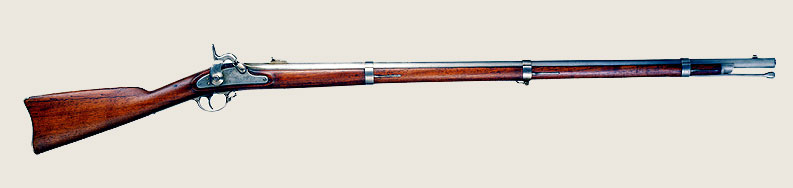
Springfield rifle, 1861 model (public domain).

On 20 November, the 47th Pennsylvania Volunteers marched in The Grand Review of the Army of the Potomac at Bailey’s Crossroads, Virginia. According to National Portrait Gallery historian James Barber:

For three hours some 70,000 polished troops marched passed the reviewing stand, where the president, members of his cabinet, and Washington dignitaries were in attendance. It was the largest military assemblage up to that time in North America. ‘The Grand Review went off splendidly,’ wrote McClellan that night in a letter to his wife, ‘not a mistake was made, not a hitch. I never saw so large a Review in Europe so well done—I was completely satisfied & delighted beyond expression.’

Among the 20,000 spectators to witness the Grand Review was the poet and social activist Julia Ward Howe of Boston, Massachusetts, who was visiting the Washington area with her husband, Dr. Samuel Gridley Howe.

After leaving the review, during the carriage ride back to Washington, she heard troops singing the song John Brown’s Body.’ A companion suggested that she should write new lyrics to the song, the melody of which lingered in her mind that night in her room at Willard’s Hotel in Washington. She awoke ‘in the gray of the morning twilight’ with the song still in her head and ‘the long lines of the desired poem began to twine themselves in my mind.’ She arose quickly and in the dimness of the early hour she began scribbling the verses on stationery ‘almost without looking at the paper.’

Her poem, The Battle Hymn of the Republic, was first published in The Atlantic Monthly in February 1862; the magazine paid her five dollars. Soon thereafter her verse was set to music and her inspirational song became a wartime favorite….

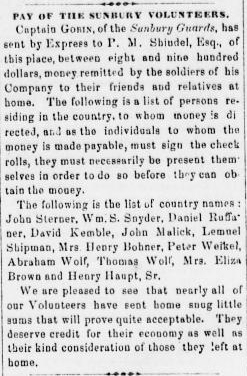
The November 30, 1861 edition of the Sunbury American carried the good news of pay sent home to loved ones by Sunbury’s boys in blue (public domain; click to enlarge).

The next day, according to Schmidt, the regiment participated in a morning divisional headquarters review overseen by the 47th Pennsylvania’s commanding officer, Colonel Tilghman H. Good, followed by brigade and division drills all afternoon. According to Schmidt, “each man was supplied with ten blank cartridges.” Afterward, “Gen. Smith requested Gen. Brannan to inform Col. Good that the 47th was the best regiment in the whole division.” As a reward—and in preparation for bigger things to come, Brannan obtained new Springfield rifles for every member of the 47th Pennsylvania.

As November came to a close, Captain Gobin helped a number of Sunbury Guardsmen to send a total of $900 from their collective pay back home to their families and friends in Pennsylvania. The editors of the Sunbury American subsequently announced the names of the family members and others who could expect to receive the sorely needed financial support from their boys in blue via a special notice in the newspaper’s November 30, 1861 edition.

Winter Quarters at Camp Griffin

Sketch of the 47th Pennsylvania Volunteers’ winter quarters at Camp Griffin, near Langley, Virginia, by Second Lieutenant William H. Wyker, Company E, December 1861 (public domain).

As fall deepened and progressed into winter, the 47th Pennsylvania Volunteer Infantry was ordered to batten down the hatches and establish its winter quarters—during a time when the guns on both sides of the war fell silent as snow blanketed Virginia, making it nearly impossible for Union and Confederate troops to march over the slippery, icy farm grounds around them—let alone drag their artillery into fighting positions in order to continue blasting away at one another.

It was simply too cold and too miserable to expend energy as combatants. But there were lighter moments as well.

Quartermaster James VanDyke procured a holiday surprise for the 47th Pennsylvania Volunteers (Sunbury American, December 21, 1861, public domain).

According to the December 21, 1861 edition of the Sunbury American, Regimental Quartermaster James Van Dyke, who was enjoying an approved furlough at home in Sunbury, Pennsylvania, was able to procure “various articles of comfort, for the inner as well as the outer man.” Upon his return to camp, many of the 47th Pennsylvanians of German heritage were pleasantly surprised to learn that the well-liked former sheriff of Sunbury had thoughtfully brought a sizable supply of sauerkraut with him. The German equivalent of “comfort food,” this favored treat warmed stomachs and lifted more than a few spirits that first cold winter away from loved ones.

Also, in a letter written sometime around Christmas 1861, Captain Gobin reported that Private John D. Colvin had been detailed to special duty with the signal corps in Washington, D.C. while Musician Henry D. Wharton, increasingly known to folks back home for his letters to the Sunbury American, had assumed additional responsibilities as a clerk who was assigned to the staff of Brigadier-General Brannan at Brigade Headquarters.

As fall fell away, the 47th Pennsylvania Volunteers continued to wait for better weather, hunkered down in their sturdier, winter quarters at Camp Griffin, remaining here until January 22, 1862, when the regiment was ordered to pack up and march for the railroad station at Falls Church. Transported from there by rail to Alexandria, they then sailed the Potomac via the steamship City of Richmond to the Washington Arsenal, where they were reequipped before being marched off for dinner and rest at the Soldiers’ Retreat in Washington, D.C. The next afternoon, they hopped cars on the Baltimore & Ohio Railroad, and headed for Annapolis, Maryland.

Arriving around 10 p.m., they were assigned quarters in barracks at the United States Naval Academy. They then spent that Friday through Monday (January 24-27, 1862) loading their equipment and other supplies onto the steamship Oriental, before sailing away at 4 p.m. that final afternoon. They were headed for America’s far warmer Deep South—and a very long time away from the arms of their loved ones and the comforts of home.

To learn more about the 47th Pennsylvania’s next phase of duty, read “Late Winter through Early Spring 1862 (Florida): Serving as Soldiers and Surrogates for Family.”


Sources:

  1. Bates, Samuel P. History of Pennsylvania Volunteers, 1861-5, vol 1. Harrisburg, Pennsylvania: B. Singerly, State Printer, 1869.
  2. Gobin, John Peter Shindel. Personal Letters, 1861-1865. Northumberland, Pennsylvania: Personal Collection of John Deppen.
  3. Lincoln and McClellan: An Army Ready for War.” Washington, D.C.: National Portrait Gallery, retrieved online December 1, 2023.
  4. Schmidt, Lewis G. A Civil War History of the 47th Regiment of Pennsylvania Veteran Volunteers. Allentown, Pennsylvania: Self-published, 1986.
  5. Wharton, Henry D. Letters from the Sunbury Guards. Sunbury, Pennsylvania: Sunbury American, 1861-1868.


The Battle of Pocotaligo, South Carolina: Unpredictable Outcomes

“The Commencement of the Battle near Pocotaligo River” (Frank Leslie’s Illustrated Newspaper, October 1862, public domain; click to enlarge).

And among them Strife and Tumult joined, and destructive Fate, grasping one man alive, fresh-wounded, another without a wound, and another she dragged dead through the melee by the feet; and the raiment she had about her shoulders was red with the blood of men. Just like living mortals joined they and fought; and they each were dragging away the bodies of the others’ slain.”

—Homer, The Iliad, Volume II, Book 18


October 22, 1862 was a deadly day for the 47th Pennsylvania Volunteer Infantry, and the succeeding days throughout that month and beyond proved to be deadlier still, as one member of the regiment after another succumbed to the wounds they had sustained in battle—or to complications that arose from the multiple surgeries that had been performed by Union Army surgeons in valiant, but vain attempts to save their lives.

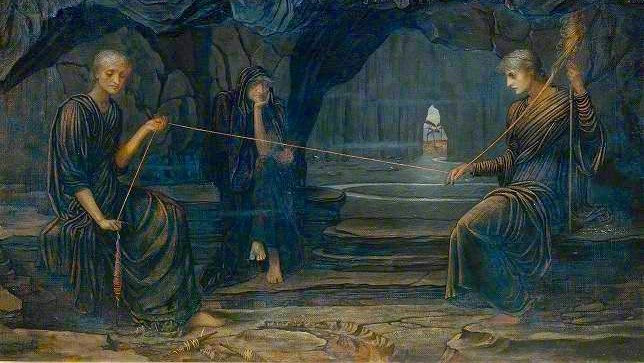
Excerpt from “A Golden Thread” (John Melhuish Strudwick, circa 1885, public domain).

What will be striking to any student of history engaged in even just a cursory review of this regiment’s medical and death records during this period of American Civil War-era service, is the seeming fickleness of who lived or died—as if Lachesis and Atropos had debated and determined their fates while Clotho spun out the thread of each life, giving them no say in their individual destinies.

Or was it the decision-making mind and finger of God? “You, but not you.”

This randomness dawns with startling clarity when examining the vastly different outcomes of Sunbury, Pennsylvania brothers, Samuel and Peter Haupt, and of company commanding officers Charles Mickley, George Junker and William Wallace Geety.

Captain Charles Mickley of G Company was killed instantly, early on in the Battle of Pocotaligo on October 22, 1862—brought swiftly to the ground by a rifle shot to his head. He never knew what hit him—or what happened to the men of his company who were marching head on with him into an intense barrage of canister and grape shot, mingled with rifle fire and artillery shell shrapnel.

Captain George Junker of Company K was felled by a minié ball fired from a Confederate rifle during his company’s advance on the Frampton Plantation. Initially stabilized in the field before being transported back to Hilton Head, where he was hospitalized at the Union Army’s post hospital, he died there the next day. He, too, had been shot in the head.

But First Lieutenant William Wallace Geety miraculously survived the gunshot that he sustained to his head—despite having been initially described by The New York Times in its list of Pocotaligo casualties as “mortally wounded.” His survival subsequently became the subject of multiple newspaper reports and medical journal articles. According to the Commemorative Biographical Encyclopedia of Dauphin County, he was wounded in action when “grape shot struck him between the eyes and passing to the left destroyed the eye, shattered the bones of the face, injuring the nerves and lodged near the carotid artery. While lying upon the field he was for a while given up for dead.”

The Union Army surgeons who treated him throughout his convalescence provided even more telling and precise accounts, documenting that William W. Geety had been struck between the eyes by a one-half-inch-diameter iron ball propelled by a cannon shrapnel shell which had exploded on impact in front of him while he was commanding his men on the field. As the shrapnel peppered the air around him, the ball traveled upward through his head before striking the back of his skull, where it then reversed course, traveled down toward his left jaw and neck, and lodged behind the carotid artery. In the process, his left eye was destroyed along with nerve sensation on his left neck and face, which was also disfigured. When battlefield surgeons realized that one of the major fragments was located perilously close to his carotid artery and could not be removed without killing their patient, they opted to leave that piece of shrapnel in place, stabilized Geety, and continued to care for him until he could safely be moved to one of the Union’s larger and better equipped hospitals for more advanced treatment.

Finally well enough to pen a letter home to his wife and children on November 19, 1864, Geety wrote:

I have lost my left eye, the base of the nose has been taken out. My jaw has been splintered besides some other bones about the brain being cracked. I am very thankful that I got through so safely, as my life was despared [sic] of at first.

In later accounts, he recalled that the grapeshot had struck him near the bottom of his nose, and “after knocking a piece out of my skull, turned and lodged in my throat against the carotid artery from whence I had it cut, at the same time part of the casing of the shell struck me in the face, making a longitudinal cut across my left eye, breaking the lower jaw, and staving in the upper jaw bone on the right side of the face. The socket for the lower jaw to work is broken off, so that every time I open my mouth the jaw flies out of joint.”

Astoundingly ambulatory just a month after the battle, he continued to receive medical care at the Union Officers’ Hospital in Beaufort, South Carolina, and was actually able to walk around the city under his own power.

* For more information about what happened to First Lieutenant William W. Geety after he was released from the Union Army’s hospital in South Carolina, read First Lieutenant William W. Geety — Battling Back from a Nearly Fatal Head Wound.”

But a Foot Wound Was Fatal?

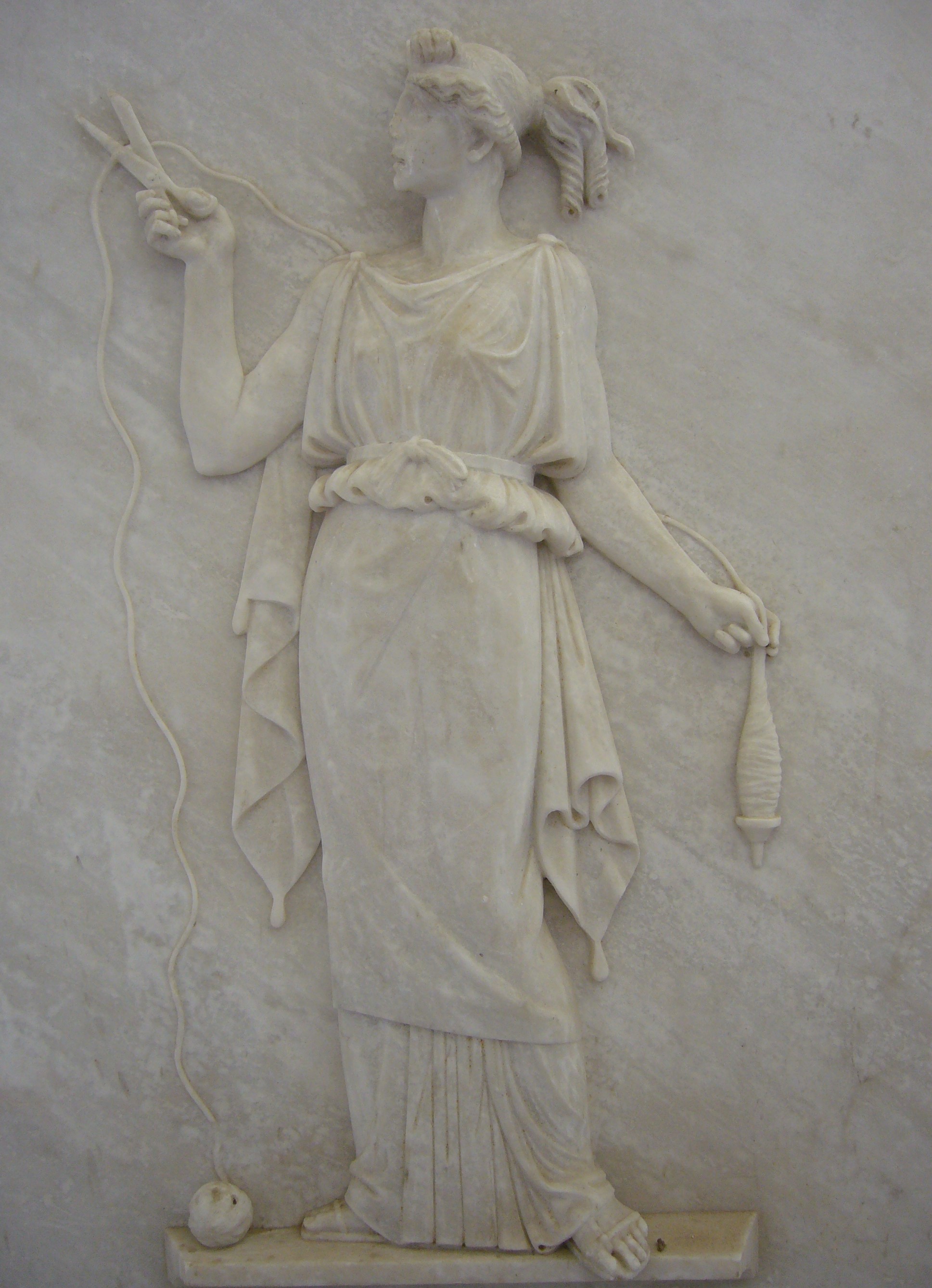
Atropos, one of the Three Fates in Greek mythology, cuts the thread of life (bas relief image, public domain).

Also wounded that same day, but seemingly less seriously than their commanding officers had been, were the Haupt brothers of the 47th Pennsylvania’s C Company (the color-bearer unit). Private Samuel Haupt was struck in the chin—presumably by one of the countless artillery shell fragments flying through the air as the enemy unleashed a barrage of cannon fire on their company as it advanced toward its target—while his brother, Sergeant Peter Haupt, was struck in the foot that had been fired by a musket or rifle ball.

Sam survived, but Peter did not.

A seemingly minor wound, ballistic injuries to a foot are often extremely painful and traumatic—even today. According to the editors of Ballistic Trauma: A Practical Guide, “There are three mechanisms whereby a projectile can cause tissue injury:

  1. In a low-energy transfer wound, the projectile crushes and lacerates tissue along the track of the projectile, causing a permanent cavity. In addition, bullet and bone fragments can act as secondary missiles, increasing the volume of tissue crushed.
  2. In a high-energy transfer wound, the projectile may impel the walls of the wound track [and] radially outwards, causing a temporary cavity lasting 5 to 10 milliseconds before its collapse in addition to the permanent mechanical disruption produced….
  3. In wounds where the firearm’s muzzle is in contact with the skin at the time of firing, tissues are forced aside by the gases expelled from the barrel of the fire, causing a localized blast injury.”

In Peter Haupt’s case, the high degree of damage to his foot was compounded by the fact that his wound was caused by a musket or minié ball that was made of lead—a substance known to cause blood poisoning and damage to human tissue and organs—and likely also by surgical procedures that were less than sterile, which resulted in a subsequent infection. His cause of death at the Union Army’s post hospital at Hilton Head, South Carolina on November 14, 1862—just over three weeks after the battle—was “traumatic tetanus,” according to the Union Army’s Registers of Deaths of Volunteer soldiers.

The Consequences of Human Conflict

Random, divergent and seemingly senseless fates.

Whether determined by the finger of God, the pre-battle machinations of the Moirai of Greek mythology, or the sheer dumb luck of being positioned at precisely the wrong spot in the regiment’s line of march that terrible day, the final outcomes of the 47th Pennsylvanians who did or did not make it home stand as a testament to the often inexplicable and heartbreaking nature of war.


Sources:

  1. “A Soldier’s Death” (obituary of Captain W. W. Geety). Harrisburg, Pennsylvania: Harrisburg Telegraph, 20 January 1887.
  2. Affidavit Regarding Peter Haupt’s Death (written by Second Lieutenant Daniel Oyster on August 14, 1863 and certified by Captain John Peter Shindel Gobin on August 20, 1863, Company C, 47th Pennsylvania Volunteer Infantry, Fort Taylor, Key West, Florida). Washington, D.C.: Officer of the United States Commissioner of Pensions.
  3. Burial Ledgers, in Record Group 15, The National Cemetery Administration, and Record Group 92, United States Departments of Defense and Army (Quartermaster General). Washington, D.C.: U.S. National Archives and Records Administration: 1861-1865.
  4. Commemorative Biographical Encyclopedia of Dauphin County, Containing Sketches of Representative Citizens, and Many of the Early Scotch-Irish and German Settlers. Chambersburg, Pennsylvania: J. M. Runk & Company, 1896.
  5. “Extraordinary Case” (account of the injury and treatment of William Wallace Geety). Harrisburg, Pennsylvania: Patriot & Union, June 12, 1863.
  6. Haupt, Peter, in Registers of Deaths of Volunteer Soldiers, United States Army, 1862. Washington, D.C.: U.S. National Archives and Records Administration.
  7. Homer, The Iliad, II, Book 18 (A. T. Murray, translator). Cambridge, Massachusetts: Harvard University Press, 1924.
  8. Junker, George, in Registers of Deaths of Volunteer Soldiers, United States Army, 1862. Washington, D.C.: U.S. National Archives and Records Administration.
  9. Lead Toxicity: Biological Fate,” in “Environmental Health and Medicine.” Atlanta, Georgia: Agency for Toxic Substances and Disease Registry, United States Centers for Disease Control, May 2023.
  10. Letter from Captain James Kacy from Beaufort, South Carolina, October 25, 1862, regarding H Company casualties sustained during the Battle of Pocotaligo, South Carolina, October 22, 1862. Bloomfield, Pennsylvania: The Perry County Democrat, November 6, 1862.
  11. “List of Casualties: Forty-Seventh Pennsylvania Volunteers—Col. T. H. Good.” New York, New York: The New York Times, October 29, 1862.
  12. Mahoney, Peter F., James Ryan, et. al. Ballistic Trauma: A Practical Guide, Second Edition, pp. 31-66, 91-121, 168-179, 356-395, 445-464, 535-540, 596-605. London, England: Springer-Verlag London Limited, 2005.
  13. Reimer, Terry. Wounds, Ammunition, and Amputation.” Frederick, Maryland: National Museum of Civil War Medicine, 2007.
  14. Reports of Col. Tilghman H. Good, Forty-seventh Pennsylvania Infantry and Report of Col. Tilghman H. Good, Forty-seventh Pennsylvania Infantry, commanding First Brigade, Tenth Army Corps, in The War of the Rebellion: A Compilation of the Official Records of the Union and Confederate Armies. Prepared Under the Direction of the Secretary of War, By Lieut. Col. Robert N. Scott, Third U.S. Artillery, and Published Pursuant to Act of Congress Approved June 16, 1880, Series I, Vol. XIV. Washington, D.C.: Government Printing Office, 1885.
  15. Schroeder-Lein, Glenna. The Wounded,” in “Essential Civil War Curriculum.” Blacksburg, Virginia: Virginia Center for Civil War Studies, Virginia Tech University, retrieved online November 8, 2023.
  16. “The Killed and Wounded in the Battle” (casualty list from the Battle of Pocotaligo). New York, New York: The New York Herald, October 29, 1862.
  17. “Younker, George [sic],” in United States Records of Headstones of Deceased Union Veterans, 1879-1903.” Washington, D.C.: U.S. National Archives and Records Administration.
  18. “Zurückgefehrt” (announcement of the return to Pennsylvania for reburial of the remains of Captain George Junker, Henry A. Blumer, Aaron Fink and Henry Zeppenfeld). Allentown, Pennsylvania: Der Lecha Caunty Patriot, December 3, 1862.


Uniforms and Insignia of the 47th Pennsylvania Volunteer Infantry

Captain Richard A. Graeffe, Company A, 47th Pennsylvania Volunteers, circa 1862 (public domain).

Upon mustering in at Camp Curtin in Harrisburg, Pennsylvania in August and early September of 1861, the men who had enrolled for military service with the 47th Pennsylvania Volunteer Infantry were assigned to their respective companies and issued standardized uniforms—the same style of dark blue, wool uniforms that were worn by the regular officers or enlisted members of the U.S. Army. The uniform of Captain Richard Graeffe (pictured at right) shows the typical details of a company commander’s uniform with shoulder bars, hat and sword.

Initially equipped with Mississippi rifles, the 47th Pennsylvania Volunteers were then provided with basic training in light infantry tactics through mid-September. Presented with the regiment’s First State Color on September 20, 1861 by Pennsylvania Governor Andrew Curtin, they were subsequently marched to Harrisburg’s train station, and were transported to Washington, D.C., where they participated in the first of multiple duty assignments that would take them from the Eastern Theater of the American Civil War to the Western and Trans-Mississippi theaters between early 1862 and March of 1864 before being transported back to the Eastern Theater for the fateful and tide-turning Shenandoah Valley Campaign, which unfolded during the summer and fall of 1864.

Army of the United States, Corps Badges, 1865 (U.S. Library of Congress, public domain; click to enlarge).

Along the way, the 47th Pennsylvania Volunteer Infantry would be attached to the:

  • U.S. Army of the Potomac (“Mr. Lincoln’s Army”) in the Eastern Theater (1861);
  • U.S. Army’s Tenth Corps (X Corps) in the Western Theater (Occupying force duties and battles in Florida and South Carolina, early winter 1862 through early winter 1864);
  • U.S. Army’s Nineteenth Corps (XIX Corps) in the Trans-Mississippi Theater (Red River Campaign, spring and early summer 1864);
  • U.S. Army of the Shenandoah, Nineteenth Corps (XIX Corps) in the Eastern Theater (Battle of Cool Spring and Sheridan’s 1864 Shenandoah Valley Campaign, summer and fall 1864);
  • U.S. Army of the Shenandoah, Nineteenth Corps (XIX Corps) in the Eastern Theater (Defense of Washington, D.C., late winter 1864 through the immediate aftermath of the assassination of President Abraham Lincoln in 1865);
  • Selected units of the U.S. Army’s former Nineteenth Corps (XIX Corps (Reconstruction duties in Savannah, Georgia and Charleston, South Carolina, June through late December 1865); and
  • Camp Cadwalader (final discharge, early January 1866).
Each time that the 47th Pennsylvania Volunteers were attached to a different Union Army corps, they were issued specific insignia that were then sewn onto their uniforms. The chart pictured above shows the different insignia that were worn by the various Union corps’ members.

In Their Own Words: The Vocabulary of the 47th Pennsylvania Volunteer Infantry (“Skedaddle”)

Image: Definition of “Skedaddle,” a term frequently used by the 47th Pennsylvania Volunteers when describing Confederate troop movements during the American Civil War (fair use screenshot, courtesy of Merriam Webster, 2022).

“Skedaddle” or “skedaddling”:  Words frequently used by officers and enlisted members of the 47th Pennsylvania Volunteer Infantry to describe the behavior of Confederate States Army troops unfortunate enough to encounter the 47th Pennsylvania during the American Civil War. (See also: bolt, flee, hightail it, run away, and retreat.)

Example (October 1862):

“After my arrival at the bluff, it being then 7:30 o’clock, I dispatched Lieutenant-Colonel Alexander with two companies back to the last-named camp (which I found, from a number of papers left behind, to have been called Camp Hopkins and occupied by the Milton Artillery, of Florida) to reconnoiter and ascertain its condition. Upon his return he reported that from every appearance the skedaddling of the enemy was as sudden as in the other instances already mentioned, leaving their trunks and all the camp equipage behind; also a small quantity of commissary stores, sugar, rice, half barrel of flour, one bag of salt, &c., including 60 tents, which I have brought in this morning. The commissary stores were used by the troops of my command.”

— Colonel Tilghman H. Good in his report to Union Army superiors from the 47th Pennsylvania’s encampment at Saint John’s Bluff, Florida, 3 October 1862

To learn more about the involvement of the 47th Pennsylvania Volunteer Infantry and other Union troops in the capture of Saint Johns Bluff, Florida, visit the Official Battle and Campaign Reports section of our website.

The Demographics of the 47th Pennsylvania Volunteer Infantry

Lieutenant-Colonel George Warren Alexander, second-in-command, 47th Pennsylvania Volunteer Infantry, with officers from the 47th at Fort Jefferson in the Dry Tortugas, Florida, circa 1863 (public domain).

Recruited primarily at community gathering places in their respective hometowns, the majority of soldiers who served with the 47th Pennsylvania Volunteer Infantry were enrolled at county seats or other large population centers within the Commonwealth of Pennsylvania.

The youngest member of the regiment was a 12-year-old drummer boy; the oldest was a 65-year-old, financially successful farmer who would attempt to re-enlist, at the age of 68, after being seriously wounded while protecting the American flag in battle.

Roughly 70 percent were residents of Pennsylvania’s Lehigh Valley, including the cities of Allentown, Bethlehem and Easton and surrounding communities in Lehigh and Northampton counties. Company C, which was formed primarily of men from Northumberland County, was more commonly known as the “Sunbury Guards.” Company D and Company H were staffed largely by men from Perry County. Company K was formed with the intent of creating an “all-German” company that would be composed of German-Americans and German immigrants.

In point of fact, a number of the 47th Pennsylvania Volunteers were immigrants or first-generation Americans. A significant percentage of each of the regiment’s companies were men whose families still spoke German or “Pennsylvania Dutch” at their homes and churches more than a century after their ancestors emigrated from Germany in search of religious or political freedom. Others traced their roots to Ireland; one had been born on Spain’s Canary Islands, and at least two were natives of Cuba.

In early October of 1862, several African American men who had been freed from enslavement on plantations near Beaufort, South Carolina, joined the ranks of the 47th Pennsylvania, followed by the April 1864 enrollment of other formerly enslaved men in Natchitoches, Louisiana.

Their final resting places span the nation, from Maine to California and from the State of Washington to Florida.


Alpha and Omega: The First and Last Duty Stations of the 47th Pennsylvania Volunteer Infantry

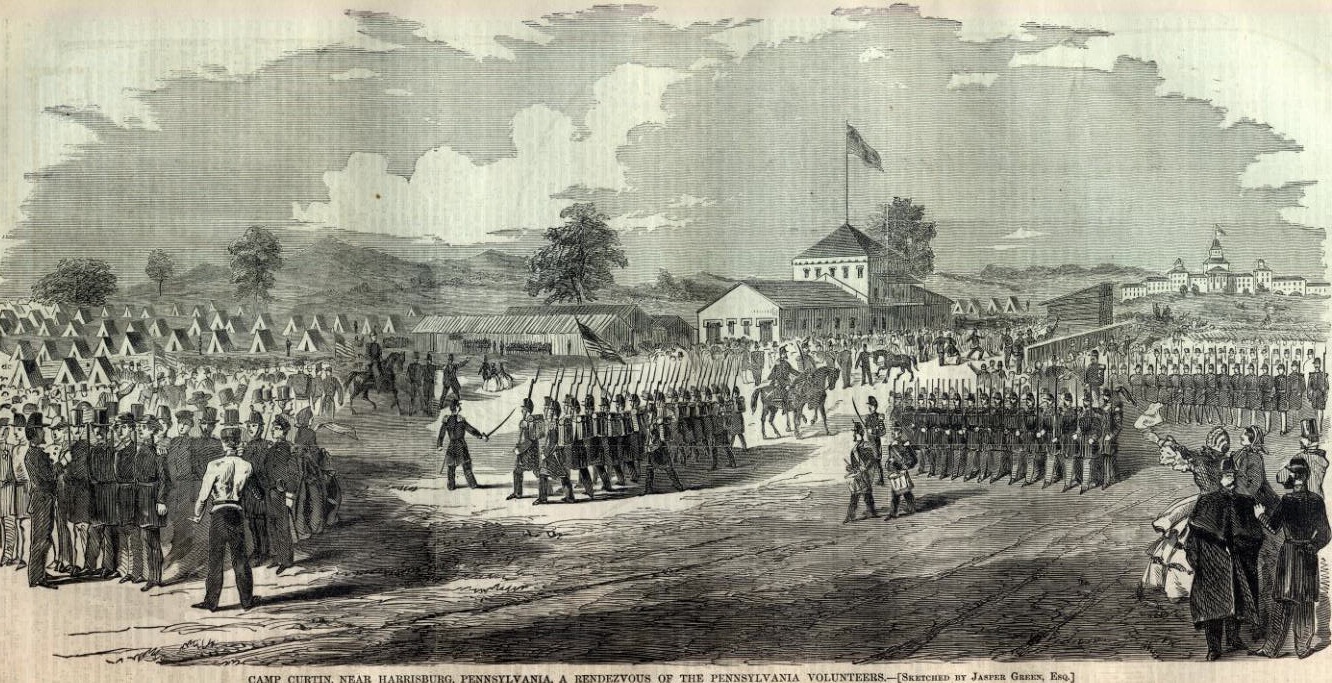
Camp Curtin (Harper’s Weekly, 1861; public domain).

Established just north of the Pennsylvania State Capitol building in Harrisburg by Pennsylvania’s Civil War-era governor, Andrew Gregg Curtin, on April 18, 1861—just three days after the fall of Fort Sumter to Confederate States Army troops—and initially named “Camp Union,” Camp Curtin was a key staging and training point for the United States Army at the dawn of the American Civil War. Within a few short months of its creation on eighty acres of land that had previously been used for Dauphin County’s Agricultural Fairgrounds, this camp site became the largest military facility in Pennsylvania and the nation during the war.

It was here, in mid-August of 1861, that new recruits and seasoned soldiers, who had just recently completed their Three Months’ duty, came together to form the newly-created 47th Pennsylvania Volunteer Infantry

After completing weeks of grueling, basic training in light infantry tactics, the members of the 47th Pennsylvania were personally given their regiment’s First State Color by Governor Curtin on September 20, 1861. An American flag emblazoned with the regiment’s state name and volunteer unit number, that flag was kept safe by the regiment’s color-bearer unit, Company C, from that moment until the regiment returned home to Pennsylvania nearly five long years later.

Camp Cadwalader and the German Hospital, 1876 (David Johnston Kennedy, courtesy of the Historical Society of Pennsylvania, public domain).

Arriving at Camp Cadwalader in Philadelphia in early 1866, the majority of the surviving 47th Pennsylvania Volunteers were given their final discharge papers on January 9, 1866, after having been officially mustered out from the regiment at its duty station in Charleston, South Carolina on Christmas Day in 1865.

This latter camp was named after Major-General George Cadwalader (1806-1879), a native of Philadelphia who had been appointed by Governor Curtin as Major-General of the Pennsylvania Volunteers at the beginning of the American Civil War.

To learn more about each of these Union Army facilities, read these camp profiles:

Learn More About the 47th Pennsylvania Volunteers

First State Color, 47th Regiment, Pennsylvania Volunteer Infantry (presented to the regiment by Pennsylvania Governor Andrew Curtin, 20 September 1861; retired 11 May 1865, public domain).

Largely forgotten by mainstream historians, the 47th Pennsylvania Volunteer Infantry was a Union Army unit which served for nearly the entire duration of the American Civil War. Formed by the fruit of the Great Keystone State’s small towns and cities, the regiment was born on August 5, 1861, when its founder, Tilghman H. Good, received permission from Pennsylvania Governor Andrew Gregg Curtin to form an entirely new regiment in response to President Abraham Lincoln’s call for additional volunteers to help preserve American’s Union. It ended its service during the early months of the nation’s Reconstruction Era, officially mustering out at Charleston, South Carolina on Christmas Day in 1865, its members receiving their final discharge papers at Camp Cadwalader in Philadelphia, Pennsylvania in early January of 1866.

Along the way, the 47th Pennsylvania made history, becoming an integrated regiment in 1862 and the only regiment from Pennsylvania to participate in the Union’s 1864 Red River Campaign across Louisiana. Its members also distinguished themselves in battle, repeatedly, including during Union General Philip Sheridan’s Shenandoah Valley Campaign, which unfolded between August and December of 1864.

Learn more about key moments in this regiment’s history by reading the following posts:

1861:

1862:

1863:

1864:

1865:

New Website Tells the Story of Nine Black Soldiers of the American Civil War

Largely forgotten for more than a century after honorably completing their historic military service during the American Civil War, nine formerly enslaved Black men who enlisted with the 47th Pennsylvania Volunteer Infantry have been repeatedly overlooked by mainstream historians over the years as potentially important subjects for research and have also been an ongoing source of mystery and frustration to their descendants because the majority of their military service records have still not been digitized by state and national archives.

Until now.

Thanks to a special initiative of 47th Pennsylvania Volunteers: One Civil War Regiment’s Story,” researchers have been locating and digitizing a wide range of local, state and federal records over the past five years—records that have uncovered critical details about the lives of each of these nine Black soldiers—four of whom were from South Carolina, five of whom were from Louisiana/Mississippi.

“Many of these documents hold the potential to help family history researchers feel closer to their Civil War-era ancestors while also enabling historians, teachers, students, American History enthusiasts, and Civil War buffs to deepen their understanding of one of the most painful chapters in the American narrative,” explains Laurie Snyder, the founder of and managing editor for the project. “One soldier’s U.S. Civil War Pension file revealed the name of his father and wife, as well as the surname of the family in Louisiana that had enslaved him prior to the Civil War while the U.S. Freedmen’s Bureau records for a second man shined a light on what his life was like after the war ended.”

It was this newly uncovered data that led Snyder to create a new website to make these records easily available, free of charge, for researchers and the general public. That website, “Freedmen of the 47th Pennsylvania Volunteer Infantry,” launched on Labor Day weekend 2022, and is already receiving positive reviews.

“We’re still in the process of adding records to the site, and will continue to do so throughout the next year as more records are found and digitized, but the data contained in these records is so important that I wanted to make the documents we’ve already amassed available now so that historians at colleges and universities across the United States and educators teaching history in middle and high school classrooms across Pennsylvania, Louisiana, Mississippi, and South Carolina can begin making use of the site this fall.

About “Freedmen of the 47th Pennsylvania Volunteer Infantry”

“Freedmen of the 47th Pennsylvania Volunteer Infantry” is a special educational initiative dedicated to researching, documenting and presenting the life stories of nine formerly enslaved Black men who enlisted with the 47th Pennsylvania Volunteer Infantry during two of the regiment’s most eventful years of service to the nation during the American Civil War—1862 and 1864.

About the 47th Pennsylvania Volunteer Infantry

Recruited primarily at community gathering places in their respective hometowns, the soldiers who served with the 47th Pennsylvania Volunteer Infantry were primarily men of German heritage whose families still spoke German or “Pennsylvania Dutch” more than a century after their ancestors emigrated from Germany in search of religious and political freedom. Still others were recent immigrants from Germany, Ireland and Cuba. Formerly enslaved Black men who had been freed by the regiment from plantations in South Carolina and Louisiana were added to regimental rosters in 1862 and 1864.

In addition to fighting in the battles of Sabine Cross Roads/Mansfield, Pleasant Hill and Monett’s Ferry/Cane River during the Red River Campaign, the 47th Pennsylvania Volunteers also engaged in the defense of Washington, D.C. in 1861 and again in 1865, following the assassination of President Abraham Lincoln; the capture of Saint John’s Bluff, Florida and Battle of Pocotaligo, South Carolina (1862); the garrisoning of Forts Taylor and Jefferson in Key West and the Dry Tortugas, Florida (1863); Union Major-General Philip Sheridan’s tide-turning Shenandoah Valley Campaign (1864), including the battles of Berryville, Opequon, Fisher’s Hill, and Cedar Creek; and provost (military police) and Reconstruction duties in Savannah, Georgia and Charleston, South Carolina (1865). Most were finally released from duty when the regiment formally mustered out on Christmas Day in 1865.

Learn More and Support

To learn more about the 47th Pennsylvania Volunteers and lend your support to this historic initiative, visit the websites of 47th Pennsylvania Volunteers: One Civil War Regiment’s Story and Freedmen of the 47th Pennsylvania Volunteer Infantry,” and follow the project’s updates on Facebook, Instagram and YouTube.

Research Update: More New Details Regarding the Lives of Formerly Enslaved Black Men Who Enlisted with the 47th Pennsylvania Volunteer Infantry

Union Army at Morganza Bend, Louisiana, c. 1863-1865_USLOC, pubdom

Union Army base at Morganza Bend, Louisiana, circa 1863-1865 (U.S. Library of Congress, public domain).

Researchers investigating the lives of nine formerly enslaved Black men who enlisted with the 47th Pennsylvania Volunteer Infantry during the American Civil War recently uncovered new details about two of those soldiers.

In addition to finding more data related to the immediate post-war life of Aaron French (learn more about him in this article here), including how and why he ended up settling in Mississippi following the Civil War, researchers have also now found important information about the life of Hamilton Blanchard—who enrolled with Bullard on the same day.

Born into slavery in Natchitoches, Louisiana sometime around 1843, Hamilton Blanchard was able to secure his freedom twenty-one years later when the United States Army arrived in town as part of an expedition led by Union Major-General Nathaniel P. Banks. Determined not to be forced back into bondage after the Union troops moved on in their ill-fated quest to capture the city of Shreveport, he chose to enlist with one of the units serving under Banks—the 47th Pennsylvania Volunteer Infantry—the only regiment from Pennsylvania that was involved in the Union’s 1864 Red River Campaign across Louisiana.

After enrolling in the military, Hamilton Blanchard was then assigned to Company D at the rank of “Cook” on 5 April 1864.

Crop_Bullard, Aaron and Hamilton Blanchard_Co. D, 47th PA_Muster Roll

Muster roll entries for Aaron Bullard and Hamilton Blanchard, Company D, 47th Pennsylvania Volunteers (U.S. National Archives, public domain).

The official muster-in of Blanchard, Aaron Bullard, and three other young Black men who enrolled that day did not take place immediately, however, because the 47th Pennsylvania Volunteers were ordered to move out shortly after their arrival, and were quickly drawn into intense combat with enemy troops commanded by Confederate Major-General Richard Taylor (a plantation owner and son of Zachary Taylor, former President of the United States). Battered badly during the Battle of Sabine Cross Roads near Mansfield, Louisiana on 8 April and in the Battle of Pleasant Hill the next day (9 April), they fought the Confederate Army again on 23 April near Monett’s Ferry in the Battle of Cane River and on 16 May in the Battle of Mansura near Marksville.

Continuing on toward the southeastern part of Louisiana, the 47th Pennsylvania Volunteers marched for Morganza, which had been held in Union hands since the fall of 1863 and was now the site of a major Union Army encampment. While there, the officers of the 47th Pennsylvania Volunteer Infantry officially mustered in all nine of the formerly enslaved Black men who had enlisted with the 47th Pennsylvania in Beaufort, South Carolina (1862) and Natchitoches, Louisiana (April 1864)—a process which took place between 20-24 June 1864.

From that point on, those nine men traveled with the 47th Pennsylvania as it returned to the East Coast and engaged in multiple battles associated with Union Major-General Philip Sheridan’s 1864 Shenandoah Valley Campaign across Virginia, the protection of the nation’s capital following the April 1865 assassination of President Abraham Lincoln, and the early days of Reconstruction in Georgia and South Carolina.

On Christmas Day in 1865, Hamilton Blanchard then joined his fellow 47th Pennsylvania Volunteers in mustering out from their final duty station in Charleston, South Carolina.

Post-War Life

Having been honorably discharged from the 47th Pennsylvania Volunteer Infantry when the regiment mustered out, at least two of the nine formerly enslaved Black men who had enlisted with the regiment evidently made their way north—possibly when the other members of their former regiment returned home to Pennsylvania. (It is also possible, however, that they made the journey independently of their former regiment because both men appear to have resettled in the Washington, D.C. area, post-war, while the other 47th Pennsylvania Volunteers were transported by ship directly to New York City and then by train to Camp Cadwalader in Philadelphia, Pennsylvania, where they were given their final discharge papers on 9 January 1866.)

Blanchard-Bullard_Madison Co., MS_Freedmen's Bureau Contract, Feb-Dec 1866, p. 1

Freedmen’s Bureau contract between Madison County, Mississippi farm owner John P. Arvile [sic] and farm laborers Hamilton Blanchard, Aaron Bullard, et. al., Washington, D.C., 16 February 1866 (excerpt, p. 1, U.S. National Archives).

What is known for certain is that Hamilton Blanchard and Aaron Bullard made contact with a representative of the Bureau of Refugees, Freedmen, and Abandoned Lands sometime in late 1865 or early 1866. They then signed a contract with the Freedmen’s Bureau during the early winter of 1866 in which they both agreed to join a large group of formerly enslaved Black men, women, and children who would be providing farm labor to a man named John P. Avrill (alternate spellings: “Averile”, “Averill”, “Arvile”, “Arville”, or “Avrille”) at his property in Canton, Madison County, Mississippi.

That Freedmen’s Bureau contract was slated to be in effect between 16 February and 16 December of 1866, and begins with a cover page which states:

Washington D.C.
February 1866
Contract No.
John P. Arvill
With (66) Freedmen

John Arville
Contract with
46 Farm Hands

The main body of the document goes on to reveal the following details of the contract:

Articles of Agreement made and concluded this the Sixteenth day of February 1866 between John P. Arvile of Canton P.O. County of Madison State of Mississippi party of the first part and

Charles Matthews, Henry Long, Joseph Thompson, Samuel Johnson, Robert Johnson, John Thomas … Charles Ford, Caroline Carter, Agnes Fitzhugh and child (infant), Benjamin Smith, Anna Smith, Thomas Reed [sp?], Aaron Bullard, Hamilton Blanchard, Isaiah Wiggins, James Lewis, Charles K. [illegible], Baily Taylor, William Carter, and Andy Hampton [sp?].

The next paragraph lists Hamilton Blanchard and Aaron Bullard a second time, along with multiple names from the aforementioned group of farm laborers. Subsequent paragraphs spell out further points of the agreement:

All of Washington City, County of Washington, District of Columbia, parties of the second part, the said Charles Matthews, Henry Long, Joseph Thompsen, Samuel Johnson, Robert Johnson, John Thomas … Aaron Bullard, Hamilton Blanchard, Isaiah Wiggins, James Lewis … Field Laborers, agree to enter the service of the said John P. Averile as Laborers and that they will faithfully and diligently apply themselves and perform the duties of Laborers on the premises of said John P. Averile for and during the period of time from the Sixteenth day of February 1866 until the sixteenth day of 1866; and they further agree that their employer shall retain one half their monthly wages until the expiration of their term of service.

And the said John P. Arvile hereby agrees to employ them (the said Field laborers) for the period of time aforesaid. Viz from the Sixteenth day of February 1866 until the sixteenth day of December 1866; and to pay for their services the sum set opposite their respective names per month, monthly (one half of which shall be retained each month) and all stoppages and arranged promptly, paid at the expiration of their respective terms of service to wit…..

In equal monthly payments; and the said John P. Arvile further agrees to furnish said Freed laborers … quarters, fuel, full substantial and healthy rations, and all necessary attendance and supplies in case of sickness, in addition to the compensation … named, and that he will assist and encourage efforts for the education of the children of his employees, and it is further agreed by the said John P. Arvile, that in case he at any time fails to perform his part of this contract agreement he will pay to each of the said laborers the full sum of One hundred and twenty dollars [strikethrough made by someone’s hand to original contract], as fixed, agreed and liquidated damages. This contract can be annulled by the mutual consent of the Employer and the employee, but only in the presence of an Authorized Agent of the Bureau of Refugees Freedmen and Abandoned Lands and such annullment [sic] on the part of the Employer and anyone [sic] employee shall in no wise affect the validity of the Contract in respect to the employer and the other employees and should either party violate this contract then the other party shall make complaint to the nearest authorized agent of the Bureau Refugees Freemen & Abandoned Lands.

The contract continues on, specifying that both Aaron Bullard and Hamilton Blanchard were to each be paid a wage of $10 per month, and stating that some of the other men on the list would be paid as much as $12 per month while others would be paid $8 per month. (Teenaged boys and women on the list were to be paid even less—$6 per month.)

In all cases, the reality was far different. Per the contract, they were initially paid only half of what their monthly wages were because the Freedmen’s Bureau agent in charge of looking out for the welfare of these formerly enslaved men, women, and children allowed the white farmer—their “employer”—to “retain one half their monthly wages until the expiration of their term of service.”

No further data has been uncovered from Freedmen’s Bureau records about the status of those unpaid wages or the outcome of that contract, but because these Black men, women, and children were essentially returned to an unequal system of servitude by the Freedmen’s Bureau agent (as evidenced by the manner in which this contract was drafted—favoring the White “employer” over the Black “field laborer” and including multiple after-the-fact revisions, such as word insertions and strikethroughs)—it is highly unlikely that Hamilton Blanchard, Aaron Bullard, or the other Black men, women, and children mentioned in the contract were ever paid the full amount they were entitled to for what was most assuredly very hard labor.

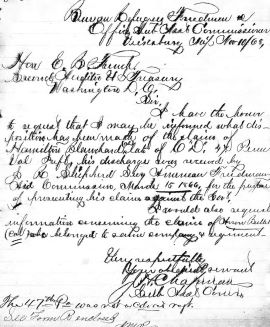
Blanchard-Bullard-Chapman_Treasury Inquiry, 10 Nov 1866

Letter of inquiry from J. H. Chapman on behalf of Hamilton Blanchard to E. B. French, second auditor, U.S. Treasury Department, 10 November 1868 (Freedmen’s Bureau records, U.S. National Archives). 

This hypothesis posed by researchers investigating the history of the 47th Pennsylvania Volunteer Infantry is backed up by a letter of inquiry penned on 10 November 1868 by J. H. Chapman, a Sub-Assistant Commissioner of the Freedmen’s Bureau working at an office in Vicksburg, Mississippi, to E. B. French, Second Auditor of the U.S. Department of the Treasury in Washington, D.C.

In this letter, Chapman asks French that he “be informed what disposition has been made of the claim of Hamilton Blanchard, late of Co. “D” 47 Penn Vol. Inft., his discharge was received by J. R. Schuchard [sp?]” of the “Freedmen’s Aid Commission, March 15, 1866.” Chapman added that he was requesting this update on Blanchard’s behalf “for the purpose of prosecuting his claim against the Gov.” He then also requested “information concerning the claim of Aaron Bullard (Col.) who belonged to same company & regiment.”

* Note: An unidentified individual added an undated notation to the bottom of this letter in handwriting that is clearly different from that of the original letter writer, Chapman. That notation correctly states: “The 47th Pa was not a colored regt. See Form R enclosed. A.M.R. 103.” (The 47th Pennsylvania Volunteer Infantry became an integrated regiment on 5 October 1862, but its African American members were not considered to be part of the U.S. Colored Troops, also known as the USCT.)

Researchers have not yet located the “Form R” referred to in the notation to Chapman’s letter, but will be pursuing this lead, as well as investigating the claims filed by Hamilton Blanchard and Aaron Bullard, and searching for additional information regarding what happened to Hamilton Blanchard during and after the 1870s. 

An additional avenue of inquiry will be the potential relationship that may have developed between Aaron Bullard and E. B. French during or after this time—a new theory being considered in light of the discovery of French’s name on this letter. (Aaron Bullard changed his surname, “Bullard,” which had been associated with his enslavement in Louisiana, to “French” sometime between his 1868 appeal to E. B. French in the U.S. Treasury Department and the day he was visited at home in Issaquena County, Mississippi by an enumerator of the 1870 U.S. Census—possibly indicating that he wanted to both shed his “slave name” and honor someone who had been helpful to him.)

Sources:

  1. Bates, Samuel P. History of Pennsylvania Volunteers, 1861-5, vol. 1. Harrisburg, Pennsylvania: B. Singerly, State Printer, 1869.
  2. Civil War Muster Rolls, in Records of the Department of Military and Veterans’ Affairs (Record Group 19, Series 19.11). Harrisburg, Pennsylvania: Pennsylvania Historical and Museum Commission, 1861-1865.
  3. Civil War Veterans’ Card File. Harrisburg, Pennsylvania: Pennsylvania State Archives.
  4. “Records of the Field Offices for the District of Columbia, Bureau of Refugees, Freedmen, and Abandoned Lands, 1865-1870” (NARA Series Number: M1902; NARA Reel Number: 18; NARA Record Group Number: 105; NARA Record Group Name: Records of the Bureau of Refugees, Freedmen, and Abandoned Lands, 1861 – 1880; Collection Title: District of Columbia Freedmen’s Bureau Field Office Records 1863-1872: Aaron Bullard and Hamilton Blanchard, 1866 and 1868). Washington, D.C.: U.S. National Archives and Records Administration.
  5. Schmidt, Lewis. A Civil War History of the 47th Regiment of Pennsylvania Veteran Volunteers. Allentown, Pennsylvania: Self-published, 1986.
  6. Wharton, Henry D. Letters from the Sunbury Guards. Sunbury, Pennsylvania: Sunbury American, 1861-1868.

Black History Month: New Details Uncovered Regarding the Formerly Enslaved Black Men Who Enlisted with the 47th Pennsylvania Volunteer Infantry

Research regarding the lives of the nine formerly enslaved Black men who enlisted with the 47th Pennsylvania Volunteer Infantry in 1862 and 1864 has continued to progress—even in the middle of a pandemic that has forced the closure of numerous local, state, and national archives.*

In addition to uncovering details about the life of the soldier from South Carolina who was mistakenly listed on muster rolls for the 47th Pennsylvania as “Presto Gettes” (learn more about him in this article here), researchers for 47th Pennsylvania Volunteers: One Civil War Regiment’s Story have been able to determine more about what happened to two of the other men post-war, and have also located records which seem to indicate that there may have been two or three other Black men who enlisted with the regiment (potentially bringing the total number of Black enlistees in the regiment to twelve).

Aaron French (enlisted as Aaron Bullard):

Muster roll entries for Aaron Bullard and Hamilton Blanchard, Company D, 47th Pennsylvania Volunteers (U.S. National Archives, public domain).

1864 was a life-changing year for Aaron Bullard and four other young Black men in Louisiana. After enlisting with the 47th Pennsylvania Volunteer Infantry on April 5 while the 47th was stationed at Natchitoches, Louisiana, Samuel Jones, Hamilton Blanchard (also known as John Hamilton), and Aaron, James, and John Bullard traveled with the 47th Pennsylvania as it participated in the multiple battles associated with the Union’s 1864 Red River Campaign across Louisiana. On or about June 22, they were formally mustered into the regiment at Morganza, Louisiana.

Sometime later (possibly post-war), Aaron Bullard changed his surname to French. After the American Civil War, he married, became a land-owning farmer—and a dad.

Post-Civil War, Aaron French and his family resided in Issaquena County, Mississippi (U.S. Census, 1870, public domain).

In August of 1870, Aaron French and his wife, Amanda, lived with their eight-month-old daughter, “Simpy” (also known as Cynthia or Cyntha) in Skipworth Precinct, Issaquena County, Mississippi. Still residing in Issaquena County a decade later when the June 1880 federal census was taken, Aaron and Amanda were the proud parents of three daughters: Cynthia (who would go on to marry Samuel L. Dixon on March 20, 1890), Jesanna (also known as Jessie/Jesse), and “Arctavia” (also known as Octavia). Jessie, who later went on to wed John B. Cobb on January 28, 1892, made a life with her husband and son in Mayersville, Mississippi, where she was a teacher in the local schools. Octavia married Frank Childress on March 20, 1894.

U.S. Civil War Pension Index Card for Aaron French, who enlisted with the 47th Pennsylvania Volunteers in Louisiana in 1864 (U.S. National Archives, public domain).

Sadly, Aaron French did not live to see his two youngest daughters marry because he died in Mississippi on January 30, 1891. He was just 40-43 years old, according to U.S. Census records and other data, which indicate that he was born in Louisiana sometime between 1848 and 1850.

Hearteningly, though, an even more intriguing piece of data has recently been uncovered about the later life of Aaron French—one that indicates that he had become active in politics prior to his death. According to the Vicksburg Evening Post, Aaron was appointed as a delegate from Issaquena County to the Republican Congressional Convention for the Third District, which was held in Greenville, Mississippi on August 7, 1886. Researchers are continuing to search for further details about his political activities and untimely death, as well as the exact location of his gravesite.

Thomas Haywood (alternate spellings of surname: Hayward, Haywood, Heywood) and Jack Jacobs:

Muster roll entries of Thomas Haywood and Edward Jassum, Company H, 47th Pennsylvania Volunteers (U.S. National Archives, public domain).

Born into slavery in South Carolina sometime around 1832, Thomas Haywood enlisted for a three-year term of service as an Under Cook with Company H of the 47th Pennsylvania Volunteer Infantry at Beaufort, South Carolina on November 1, 1862. He and three other formerly enslaved Black men—Abraham and Edward Jassum and Presto Gettes”—who had previously enlisted with the 47th Pennsylvania at Beaufort in October of 1862, then traveled with the 47th Pennsylvania as it participated in multiple military engagements, including the 47th’s garrisoning of Fort Taylor and Fort Jefferson in Florida in 1863 and 1864, the battles of the Union’s spring 1864 Red River Campaign across Louisiana, and the battles of Sheridan’s tide-turning Shenandoah Valley Campaign across Virginia in the fall of 1864.

On or about June 22, 1864 all nine of these Black soldiers were formally mustered into the regiment at Morganza, Louisiana; Thomas Haywood and seven of the eight others all successfully completed their tours of duty, and were honorably mustered out upon expiration of their respective terms of enlistment. In Thomas Haywood’s case, that honorable discharge was awarded on October 31, 1865.

Post-war, it appears from various Freedmen’s Bureau records that he may have entered into yearly contracts with several men who had previously been plantation owners in the Beaufort, South Carolina area. In exchange for agreeing to plant and cultivate cotton for those men on three to five-acre parcels of land that had been leased to him by those white men, he was allowed to keep portions of the cotton sales (the largest portions of which went to the former plantation owners who had also most likely been slave owners prior to and during the Civil War).

U.S. Civil War Index Card for Thomas Haywood, who enlisted with the 47th Pennsylvania Volunteers in South Carolina in 1862 (U.S. National Archives, public domain).

His body warn out from years of slavery prior to the war, difficult military service during the war, and harsh sharecropping experiences post-war, Thomas Hayward applied for, and was awarded a U.S. Civil War Pension on April 30, 1888. That pension was subsequently renewed by the federal government in 1907 at the rate of $15 per month (roughly $415 per month in today’s U.S. dollar equivalency).

By 1890, Thomas Haywood was living in Sheldon Township, Beaufort County, South Carolina. After a long life, he died on January 13, 1911. Unfortunately, his burial location has also not yet been identified by researchers.

In 1890, Thomas Haywood lived near Hanna Jacobs, the widow of Jack Jacobs, who may have been another Black soldier who enlisted with the 47th Pennsylvania Volunteers (U.S. Census, 1890, Sheldon Township, Beaufort County, South Carolina, public domain).

One other piece of tantalizing data that has recently been discovered is that a woman named “Hanna Jacobs” lived near Thomas Haywood in 1890. This information may be significant because Hanna was described on the 1890 U.S. Census of Union soldiers and widows as the widow of “Jack Jacobs,” who had served in the same company with Thomas Haywood (according to that special census).

Researchers currently believe that Jack Jacobs may, in fact, have been another formerly enslaved Black man who had enlisted with the 47th Pennsylvania when it was stationed near Beaufort in 1862, and are currently conducting a Go Fund Me campaign to raise funds to purchase the Civil War military and pension records of Hanna and Jack Jacobs, as well as the nine known formerly enslaved Black men who enlisted with the 47th Pennsylvania Volunteer Infantry in 1862 and 1864.

Jackson Haywood:

General Index Card for Jackson Haywood, who may have been a Black soldier who enlisted with the 47th Pennsylvania Volunteers (U.S. National Archives, public domain).

According to the “Index to Compiled Service Records of Volunteers Who Served in Organizations from the State of Pennsylvania,” which was created by staff at the U.S. National Archives, a General Index Card was created for yet another mystery man—a soldier named “Jackson Hayward.”

To date, researchers have only been able to determine that he may have enlisted with Company K of the 47th Pennsylvania Volunteer Infantry as a cook—a rank similar to that at which the known nine formerly enslaved Black men who enlisted with the 47th Pennsylvania were entered on the muster rolls of the regiment.

Researchers hope, with time and the continued financial support of the followers of 47th Pennsylvania Volunteers: One Civil War Regiment’s Story, to be able to confirm the dates of military service and race of this individual, as well as that of “Jack Jacobs.”

As always, we appreciate everyone’s help in ensuring that the service to the nation of these soldiers will never be forgotten. They helped to preserve our Union and deserve to be recognized more fully for their heroism and dedication.

* Our most important goal continues to be the purchase of the Compiled Military Service Records (CMSR) and U.S. Civil War Pension records for each of these remarkable men in order to document and freely share their stories with the widest possible audience. We continue to await word from staff at the U.S. National Archives regarding the timeframe for their resumption of digitization and reproduction services that have temporarily been suspended due to the coronavirus pandemic. As soon as those services have resumed, we will request an update regarding their estimated timeframe for fulfilling our records requests. In the interim, we will seek out further details about each of these soldiers via local and state archival resources across the nation, and will post updates as we confirm more data.

Sources:

  1. Bullard, Aaron, in Index to Compiled Service Records of Volunteers. Washington, DC: U.S. National Archives, 1861-1865.
  2. Bullard, Aaron and French, Aaron, in U.S. Civil War Pension Index Cards. Washington, DC: U.S. National Archives, 1890-1891.
  3. Bullard, Aaron, Presto Garris, Thomas Haywood, et. al. in U.S. Civil War Muster Out Rolls (47th Pennsylvania Volunteer Infantry). Washington, DC: U.S. National Archives, 1865-1866 (available via Ancestry.com).
  4. French, Aaron, in “Proceedings of the Third District Republican Convention.” Vicksburg, Mississippi: Vicksburg Evening Post, August 9, 1886.
  5. French, Aaron and Family, in U.S. Census Records (Issaquena County, Mississippi): Washington, DC: U.S. National Archives, 1870-1910.
  6. Haywood, Jackson, in Index to Compiled Service Records of Volunteers. Washington, DC: U.S. National Archives, 1861-1865.
  7. Haywood, Thomas, in Index to Compiled Service Records of Volunteers. Washington, DC: U.S. National Archives, 1861-1865.
  8. Haywood, Thomas, in U.S. Civil War Pension Index Cards. Washington, DC: U.S. National Archives, 1888, 1907.
  9. Haywood, Thomas, in U.S. Veterans’ Administration Pension Payment Cards. Washington, DC: U.S. National Archives, 1888, 1907.
  10. Haywood, Thomas, in U.S. Census (Beaufort County, South Carolina): Washington, DC: U.S. National Archives, 1890.
  11. Hanna Jacobs, widow of Jack Jacobs, in U.S. Census (Beaufort County, South Carolina): Washington, DC: U.S. National Archives, 1890.