Women’s History: A 47th Pennsylvania Wife Who Was “Married by Slave Custom”

“I was married about 14 years before the late War of the Rebellion, on Mr. Pringle plantation, in Georgetown County, S.C. I do not know the date, but from our crops we make for our former master I judged it was about 14 years before the war that I got married to Bristo Geddes by slave custom.” — Rachael (Richardson) Gethers, excerpt from an affidavit filed by her attorney on February 12, 1895
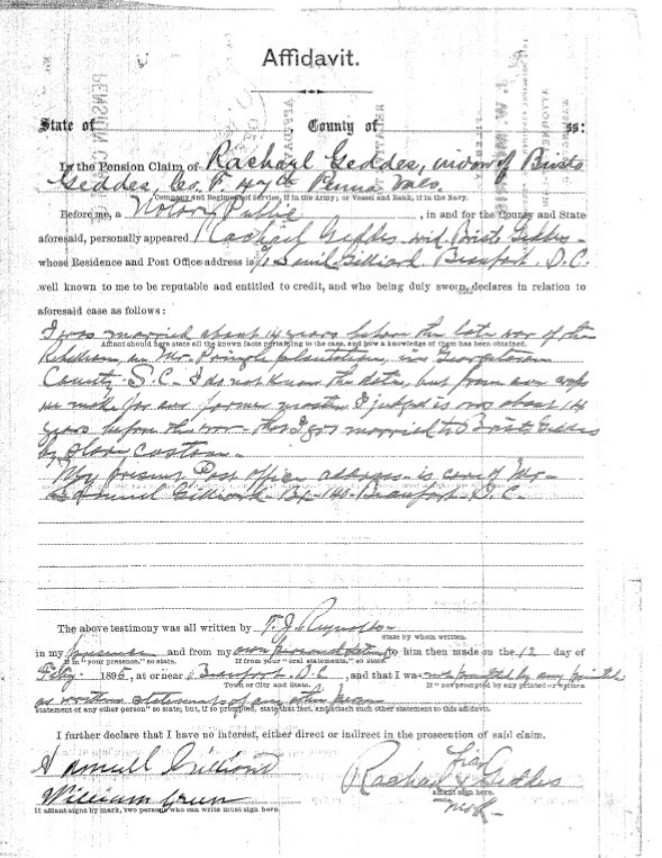
 

Attestation made February 12, 1895 by Rachael (Richardson) Gethers of her 1847 marriage “by slave custom” on the Pringle plantation in Georgetown County, South Carolina to Bristor Gethers (affidavit excerpt, U.S. Civil War Widow’s Pension File of Bristor and Rachael Gethers, U.S. National Archives and Records Administration, public domain; click to enlarge).

We do not know the names of this woman’s parents, but we do know her name and the names of her husband and their closest friends, thanks to documents that were filed on her behalf by an attorney in Beaufort County, South Carolina, as part of her application for a U.S. Civil War Widow’s Pension during the late 1890s.

Her name was Rachael (Richardson) Gethers, and she was born into slavery in South Carolina circa 1825. Her parents, who had also been born in South Carolina, according to Rachael’s U.S. Census entries for 1870 and 1880, had also likely been born into slavery.

Virtually nothing else is known at present about her childhood and teen years. What researchers do know is that Rachael was still enslaved at the time of her marriage in Georgetown County, South Carolina, circa 1847 — during her early twenties, to Bristor Gethers, a man who was enslaved on the same plantation in that county.

* Note: The plantation where Rachael Richardson and Bristor Gethers were enslaved was owned by one of the largest family of enslavers in the United States — the Pringles. Among their multiple plantations and other Georgetown County properties were Beneventum and the White House Plantation, both of which were devoted primarily to rice production and profited from the labor of hundreds of enslaved Black men, women and children. (The Pringles had been actively engaged in the slave trade since the 1700s, and had broadened their wealth and power by marrying members of other families that were also heavily involved in chattel slavery, including the Allstons.)

Unfortunately, the first and last names of Rachael (Richardson) Gethers’ husband were repeatedly misspelled in multiple civic, Freedmen’s Bureau, and military records throughout the nineteenth century. Variants of his given name between 1862 and 1893 included: Brista, Brister, Bristo, Bristor, Presto, Prestor, and Pristo; variants of his surname included: Gaddis, Garres, Garrees, Garris, Gathers, Geddes, Geddis, Gethers, Gettes. Affidavits filed in later life by Bristor Gethers and his attorney during the early 1890s finally confirmed the correct spelling of his name as “Bristor Gethers.” Rachael’s married surname was also spelled in various ways during her lifetime. In later years, an attorney who filed documents on her behalf for her application for a U.S. Civil War Widow’s Pension chose to spell her married surname as “Geddes.” Written as “Rachael” by that same attorney, her given name was spelled as “Rachel” on other records of the mid to late nineteenth century.

American Civil War
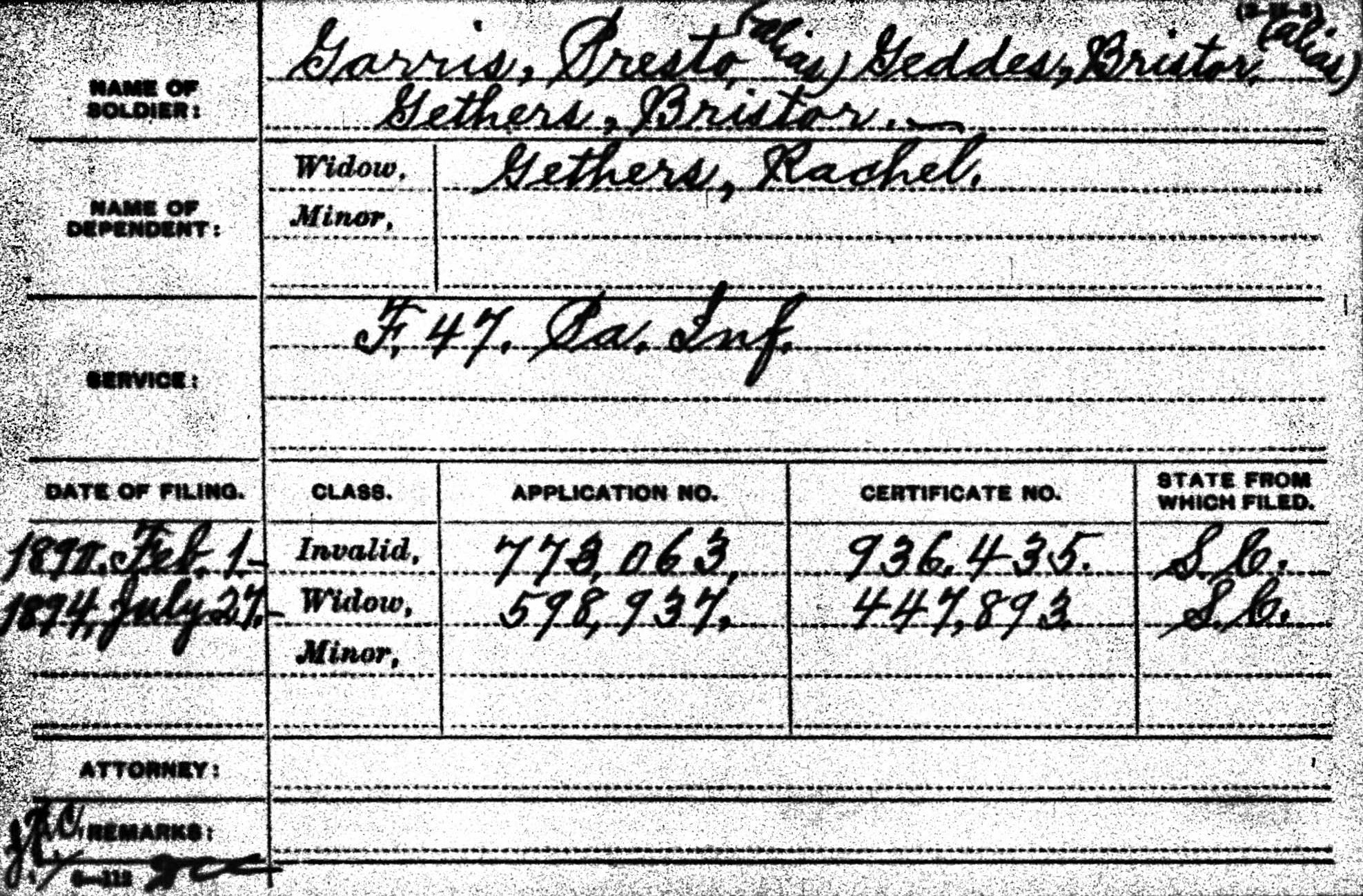
Spelling variants for Rachael (Richardson) Gethers and Bristor Gethers (U.S. Civil War General Pension Index Cards, U.S. National Archives, public domain).

The exact details of what happened to Rachael (Richardson) Gethers and her husband between the time of her marriage and the first years of the American Civil War are presently not known, but researchers do know that a new chapter in their life story began when her husband enlisted with a Union Army regiment in the city of Beaufort, South Carolina during the fall of 1862. Freed or escaped from slavery by that time, he joined the Union Army as a “Negro Under-Cook,” was entered onto the roster of Company F of the 47th Pennsylvania Volunteer Infantry on October 5, 1862, would go on to receive promotions to the rank of cook and then private during his three-year term of enlistment, and would travel with the 47th Pennsylvania as a member of its F Company to multiple duty stations and battle sites in Florida, Louisiana, Virginia, and Washington, D.C. during that war — and then to Georgia and South Carolina during five post-war months of the Reconstruction Era, at which point he was honorably discharged and allowed to return home to his wife.

Researchers have not yet determined what happened to Rachel during that same period, however; she may have escaped with Bristor and traveled with him to Beaufort or may have been freed herself by Union troops — or she may have remained behind, still enslaved on the Georgetown County plantation where they had been married, hoping that her husband would eventually return to free her.

What is known for certain is that Bristor did find her again.

Post-War Years
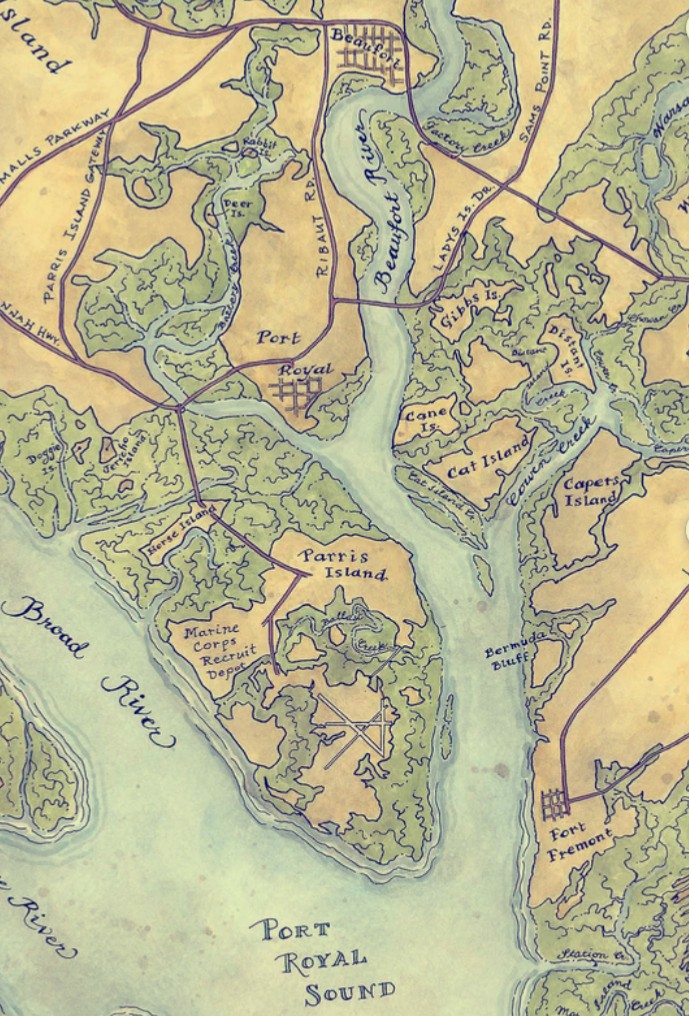
Horse Island, slightly above and to the left of Parris Island in Beaufort County, South Carolina (public domain; click to enlarge).

Following her husband’s honorable discharge from the Union Army, Rachael (Richardson) Gethers and her husband, Bristor, resumed life as a married couple. U.S. Census and Freedmen’s Bureau records confirm that they initially made their home in or near the city of Beaufort, South Carolina. Sometime around 1869, however, they relocated to Horse Island, in Beaufort Township, Beaufort County. According to the 1870 federal census, they resided there with their six-year-old son, Peter. By the time that the federal census was enumerated in 1880, however, their Horse Island household no longer included Peter.

Throughout their post-war years, Rachael and Bristor Gethers were farmers who often struggled to make ends meet. This was largely due to the fact that they were often required to turn over a significant portion of the funds they earned from their crops each harvest — under the terms of Freedmen’s Bureau contracts and other legal agreements that favored the wealthy White landowners whose land they were hired to farm. Adding to their worries was Bristor’s failing health. Having fallen seriously ill with dysentery during his military service, he was plagued by lifelong heart problems and chronic diarrhea that often left him too disabled to work.

But they persisted and managed to build a life together on Horse Island that lasted for nearly three decades. Preceded in death by her husband when he passed away on Horse Island in Beaufort Township on June 25, 1894, Rachael was so financially insecure at that point in her life that she was unable to pay for his burial. So, she reached out to friends for help.

Her husband’s close friend, Samuel Gilliard, was among the first to come to her rescue. He brought a coffin to the Gethers’ home, placed Bristor’s body in it and enlisted the help of Rachael’s neighbors in carrying the coffin down to the water, where they placed it on a boat, enabling Sam to transport it to Beaufort County’s Parris Island. Met there by William Green and other able-bodied men, Sam and his friends carried the coffin to a graveyard somewhere on that island, dug a new grave and laid Bristor to rest on June 26, 1894, according to affidavits that Sam and William both filed in support of Rachael’s Civil War widow’s pension application.

Life as a Widow
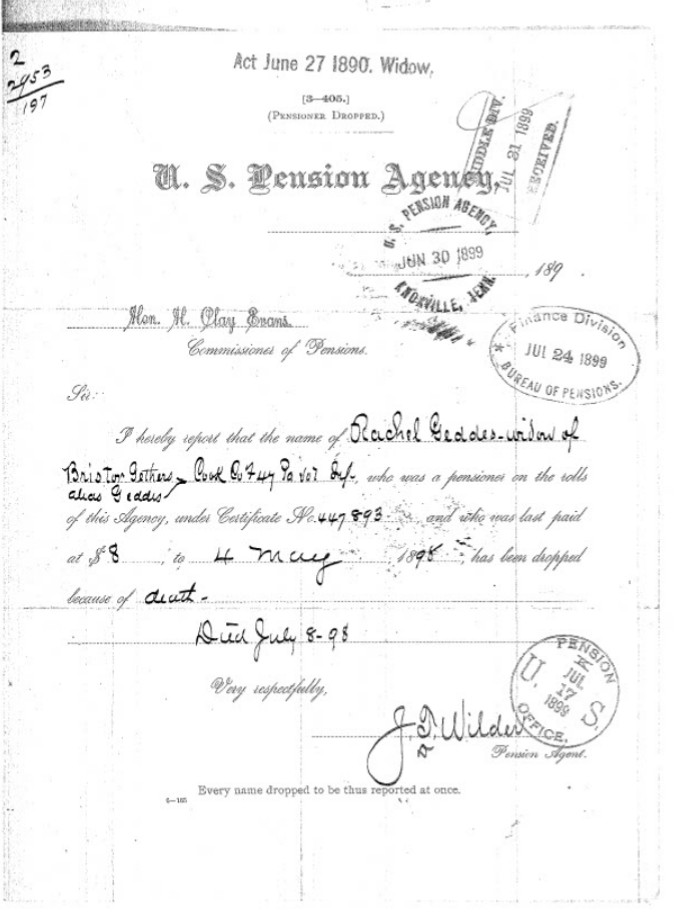
U.S. Pension Agency’s confirmation of Rachael (Richardson) Gethers’ date of death (U.S. National Archives and Records Administration, public domain; click to enlarge).

With a small U.S. Civil War Widow’s Pension of eight dollars per month (roughly three hundred and fifteen dollars per month in 2026 dollars), Rachael (Richardson) Gethers managed to survive her late husband by roughly four years. A certificate prepared by J. T. Wilder on behalf of the U.S. Pension Agency on June 30, 1899 confirmed that she died in Beaufort County, South Carolina on July 8, 1898.

Her exact burial location remains unknown, but is believed by researchers to be located somewhere on Parris Island in Beaufort County, South Carolina, based on U.S. Civil War Pension records which confirm that Parris Island was the burial location of her husband, Bristor Gethers.

* Note: To learn more about Rachael (Richardson) Gethers and her husband, Bristor, please read their full biography here and view their census and pension records, which are located on our website, Freedmen of the 47th Pennsylvania Volunteer Infantry (part of our special project dedicated to documenting the life histories of the nine formerly enslaved Black men who enlisted with the 47th Pennsylvania Volunteers).


Sources:

  1. Gaddis, Rachael, in U.S. Freedmen’s Bureau Hospital Records (Beaufort, South Carolina, December 1867), in Records of the Bureau of Refugees, Freedmen, and Abandoned Lands. Washington, D.C.: U.S. National Archives and Records Administration.
  2. Garris, Presto [sic, “Bristor Gethers”], in Civil War Muster Rolls and Civil War Veterans’ Card File, 1861-1866 (Company F, 47th Pennsylvania Infantry). Harrisburg, Pennsylvania: Pennsylvania State Archives.
  3. Garris, Presto (alias “Geddes, Bristor” and “Gethers, Bristor”) and Gethers, Rachel, in U.S. Civil War General Pension Index Cards (veteran’s application no.: 773063, veteran’s certificate no.: 936435, filed by the veteran from South Carolina, February 1, 1890; veteran’s widow’s application no.: 598937, veteran’s widow’s certificate no.: 447893, filed by the veteran’s widow from South Carolina, July 27, 1894). Washington, D.C.: U.S. National Archives and Records Administration.
  4. Geddes, Brister [sic, “Bristor Gethers”], Rachel and Peter, in U.S. Census (Beaufort, Beaufort Township, Beaufort County, South Carolina, 1870). Washington, D.C.: U.S. National Archives and Records Administration.
  5. Geddis, Brista [sic, “Bristor Gethers”] and Rachel, in U.S. Census (Beaufort Township, Beaufort County, South Carolina, 1880). Washington, D.C.: U.S. National Archives and Records Administration.
  6. Power, J. Tracy and Sherry Piland. “National Register of Historic Places Form: Beneventum Plantation” (filed by historians at the South Carolina Department of Archives and History, Columbia, South Carolina, September 15, 1987). Washington, D.C.: U.S. Department of the Interior, National Park Service.
  7. Roldán-Shaw, Michele. “Exploring the Sea Islands of Beaufort County.” Hilton Head, South Carolina: Local Life Insiders, retrieved online March 31, 2026.


“March Madness”: American Civil War Style

The phrase, “Dum Tacent Clamant” (“While they are silent, they cry aloud”), is inscribed on the Grand Army of the Republic monument at the Chalmette National Cemetery in Louisiana (G.A.R. Monument, Chalmette National Cemetery, circa 1910, U.S. Library of Congress, public domain).

For many Americans, the phrase “March Madness” conjures visions of college life or good times spent with friends at sports bars, cheering on favorite teams as future NBA All Stars steal and dunk their way through basketball championships en route to fame and fortune. But a very real form of “madness” affected Americans during the American Civil War — and it was a devastating experience for many of the boys and men who were forced to endure it by circumstances that were largely out of their control. That condition, which was referred to by physicians as nostalgia, was known to cause feelings of “despair and homesickness so severe that soldiers became listless and emaciated and sometimes died,” according to the late journalist Tony Horwitz, and it affected multiple members of the 47th Pennsylvania Volunteer Infantry throughout the regiment’s long and storied history.

“Though geographically less distant from home than soldiers in foreign wars, most Civil War servicemen were farm boys, in their teens and early 20s, who had rarely if ever traveled far from family and familiar surrounds….”

Horowitz’s description of young Civil War-era soldiers was particularly true for the teenagers and young men who served with the 47th Pennsylvania Volunteer Infantry. Among the most distantly located of Union Army troops, many were transported from farms and small towns across Pennsylvania to Virginia in 1861 — and then down to America’s Deep South as the war raged on toward its second year. Initially stationed at Fort Taylor in Key West, Florida during the late winter of 1862, they were subsequently transferred to South Carolina, and were then moved back and forth between Florida and South Carolina between the fall of 1862 and mid-February 1864 as they engaged in the capture of Saint John’s Bluff, Florida, the Battle of Pocotaligo, South Carolina, the capture of Jacksonville, Florida, and the garrisoning of Fort Taylor in Key West and of Fort Jefferson in Florida’s Dry Tortugas — the latter of which was a duty station that was about as far south as any American could travel in the United States.

And then they were shipped west to Louisiana to fight in the Union’s 1864 Red River Campaign, during which time they made history as the only regiment from Pennsylvania to take part in that campaign — a series of intense military engagements in which more than a dozen 47th Pennsylvania Volunteers would be captured by Confederate troops and force marched to Texas, only to be held in deplorable conditions as prisoners of war at Camp Ford — the largest Confederate POW camp west of the Mississippi River. Several never made it out alive; those who did were never the same.

Even more damaging were the horrific conditions experienced by a far larger group of 47th Pennsylvania Volunteers who were taken prisoner in Virginia roughly six months later, including First Sergeant William Fry (1836-1865) of Company C and Corporal James Huff (1835-1865) of Company E, who were both captured during the Battle of Cedar Creek and then dragged away to the two most infamous POW camps in the Confederacy. Sergeant Fry, who “was paroled [on March 4, 1865], only to ‘come home to die’ from starvation and slow poison — the victim [at Andersonville] of atrocities such as have only been practiced by the traitors to our own government, and from which savages would turn in disgust,” died three weeks later at his mother’s home (on March 28, 1865), according to the 15 April 1865 edition of The Sunbury American, while Corporal Huff lost his will to live on March 5, 1865, after suffering through months of the mental and physical torment of starvation that he endured at Salisbury. (His body was then thrown into an unmarked trench grave there with those of thousands of other Union POWs, and was never able to be identified.)

War-Induced Trauma

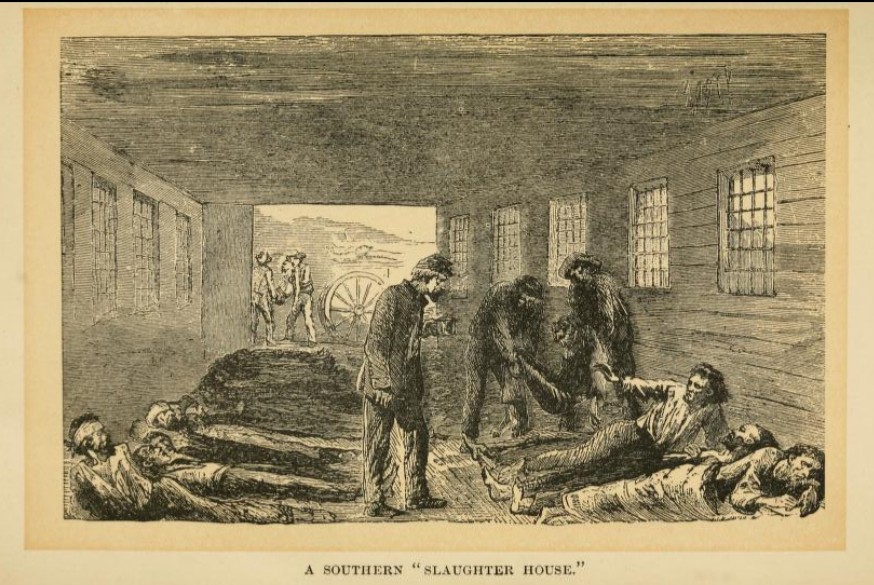
“A Southern ‘Slaughter House'” depicted the suffering of Union soldiers at the Confederacy’s Salisbury Prison Camp (Charles S. Greene, Sparks from the Campfire, 1889, public domain).

While it is true that the majority of 47th Pennsylvania Volunteers managed to avoid being killed or imprisoned as POWs, it is also true that a significant number of them suffered serious emotional trauma — either personally because they were wounded or became ill as a direct result of their military service, or vicariously — because they saw one of their comrades fall in battle or watched as a sibling or friend succumbed to disease-related complications at a Union Army hospital. So, it’s often heartbreaking for present-day descendants to read diary entries and letters that were penned by their 47th Pennsylvania ancestors as they tried to convey their thoughts in shaky, cursive handwriting while cycling between happy memories of home, their hope for better days and their profound feelings of bewilderment, grief and despair.

While scribbling one such letter during church services on Sunday, December 29, 1861, for example, Private Abraham N. Wolf told his wife that the 47th Pennsylvania’s Regimental Band was playing a hymn at that moment, and went on to state, with childlike wonder and incandescent joy, that he’d received the gift box she’d sent him, adding “everything was in it yet what you said was in it and it came on the second day of Christmas.” But his words then turned bittersweet as he reported that he had already “fried some of the sausages” that she’d sent him in order to take with him for dinner as he headed out for duty to chop wood for the regiment. “They tasted pretty good to me for it was something new to me for it was from home.”

The next year, homesickness and grief darkened the holidays for a very pensive Henry Hornbeck, as evidenced by this diary notation:

“How different this Christmas from last year when all was Joy at home. Mary & myself for the sake of a Joyful surprise, placed upon the plate (before Breakfast) of Dear Mother, a Christmas Gift, and how pleased she was for that present, which was entirely unexpected. Now, alas, she is no more, never more are we to see her in this world. No one who has not lost a dearly beloved Mother, can feel that loss or have the least idea of what the loss of his or her dearest friend on earth is, until he or she experiences what we have, Standing at the death bed of a dying parent, and to feel as we felt, alone in this wide world…. Retrospection is often times pleasing and also horrifying. I wish you a Merry Christmas.”

The Consequences of Untreated Suffering

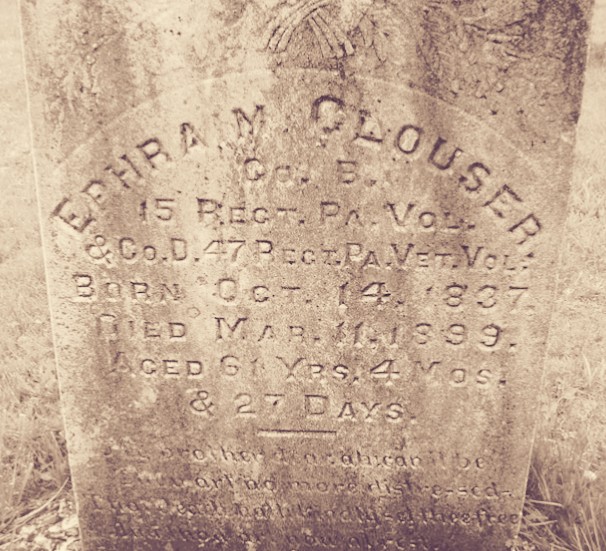
Placed by loved ones at the Bloomfield Cemetery in Perry County, Pennsylvania, this gravestone expresses the hope that the heart of 47th Pennsylvania veteran Ephraim Clouser is no longer distressed (public domain; click to enlarge).

One of the many heartbreaking truths of the American Civil War era is that soldiers who were battling depression or other mental health issues rarely received sympathy or support from their superior officers because those officers were advised by military physicians to respond harshly, rather than with compassion, to any behavior that might be perceived — or misperceived — as “malingering.” That surprising guidance was given by those surgeons because they had received medical school training which had taught them that any failure to shake off feelings of homesickness, sadness or grief was a sign of “weakness” or a “character flaw” rather than a symptom of a legitimate disease that required prompt and ongoing treatment. According to Horwitz:

“Military and medical officials recognized nostalgia as a serious ‘camp disease,’ but generally blamed it on ‘feeble will,’ ‘moral turpitude’ and inactivity in camp. Few sufferers were discharged or granted furloughs, and the recommended treatment was drilling and shaming of ‘nostalgic’ soldiers.”

In more than a few cases, the untreated or poorly-treated nostalgia experienced by 47th Pennsylvania Volunteer Infantrymen became so severe that it broke the hearts of those 47th Pennsylvanians — figuratively and then literally — as it led to the development of damaging heart or brain diseases that would later be termed “Soldier’s Heart” or “PTSD” (post-traumatic stress disorder).

One of the earliest casualties of that sub-standard treatment was Private Adolph Finster of the 47th Pennsylvania’s A Company, who ended his life by suicide in Key West, Florida on May 15, 1863. A twenty-five-year-old who had been employed as a clerk in Easton prior to the war, Private Finster was subsequently buried in grave number 180 “of the Key West Post Cemetery,” according to historian Lewis Schmidt.

Another was D Company Private Ephraim Clouser, who was hospitalized for months at one Union Army hospital after another, following his release from captivity as a POW on November 25, 1864. (Shot in the knee during the Battle of Pleasant Hill, Louisiana on April 9th, he had been force marched to Camp Ford in Texas, where he had then been subjected to starvation and dangerously unsanitary living conditions). Awarded a U.S. Civil War soldier’s invalid pension in 1866, he was then diagnosed with dementia (1868), described as “an insane veteran” by his hometown newspaper (1896) and “jailed as a dangerous character” (1898), before he was finally committed to the Pennsylvania State Lunatic Asylum (later known as the Harrisburg State Hospital).

Two of the other post-war casualties were William H. Sieger, a field musician from Company G, who died by suicide eight years after receiving his honorable discharge and eleven days after his twenty-ninth birthday, and Daniel Battaglia, a Swiss immigrant who served as a private with Adolph Finster in Company A and later battled mental health issues for decades before he was finally committed to the “Government Hospital for the Insane” (later known as St. Elizabeths Hospital) in Washington, D.C. — forty-five years after receiving his honorable discharge.

Still others, who managed to survive and be welcomed home with huzzahs and hearty backslaps after the war, seemed “just fine” to neighbors and co-workers but, in reality, were actually suffering greatly from physical or mental illnesses that would plague them for the remainder of their days — quiet casualties of a war that continued to claim lives more than half a century after it ended.

* Note: To see an image and read more of Abraham Wolf’s letter, read the article, 1861: Abraham Nicholas Wolf, Jr. to Sarah (Trexler) Wolf,” by Spared and Shared.


Sources:

  1. Da Costa, Jacob Mendez. “Observations on the diseases of the heart noticed among soldiers, particularly the organic diseases,” in Contributions relating to the Causation and Prevention of Disease, and to Camp Diseases; together with a Report of the Diseases, etc., Among the Prisoners at Andersonville, GA. New York: United States Sanitary Commission and Hurd and Houghton, 1867.
  2. Da Costa, Jacob Mendez. “On Irritable Heart; a Clinical Study of a Form of Functional Cardiac Disorder and Its Consequences: Result in Two Hundred Cases,” in The American Journal of the Medical Sciences, vol. 61, no. 121, p. 17. Philadelphia, Pennsylvania: Henry C. Lea, 1871.
  3. Friedman, Matthew J. “History of PTSD in Veterans: Civil War to DSM-5.” Washington, D.C.: National Center for PTSD, U.S. Department of Veterans Affairs, retrieved online, March 23, 2026.
  4. Greene, Lieutenant-Colonel Charles S. Sparks from the Campfire: Thrilling Stories of Heroism, Adventure, Daring and Suffering, Re-Told by the Boys Who Were There. New York: W. A. Houghton, 1889.
  5. Horwitz, Tony. “Did Civil War Soldiers Have PTSD?“, in Smithsonian Magazine. Washington, D.C.: Smithsonian Institution, January 2015.
  6. Pollard, Harvey, Chittari Shivakumari, et.al. “‘Soldier’s Heart’: A Genetic Basis for Elevated Cardiovascular Disease Risk Associated with Post-Traumatic Stress Disorder,” in Frontiers in Neuromolecular Science, September 23, 2016. Switzerland: Frontiers Research Foundation.
  7. “Resolutions of Condolence” (report regarding the death of former Andersonville prisoner of war, Sergeant William Fry, at his home in Sunbury). Sunbury, Pennsylvania: The Sunbury American, April 15, 1865.
  8. Schmidt, Lewis G. A Civil War History of the 47th Regiment of Pennsylvania Veteran Volunteers. Allentown, Pennsylvania: Self-published, 1986.


A Past That Seems Distant — But Wasn’t

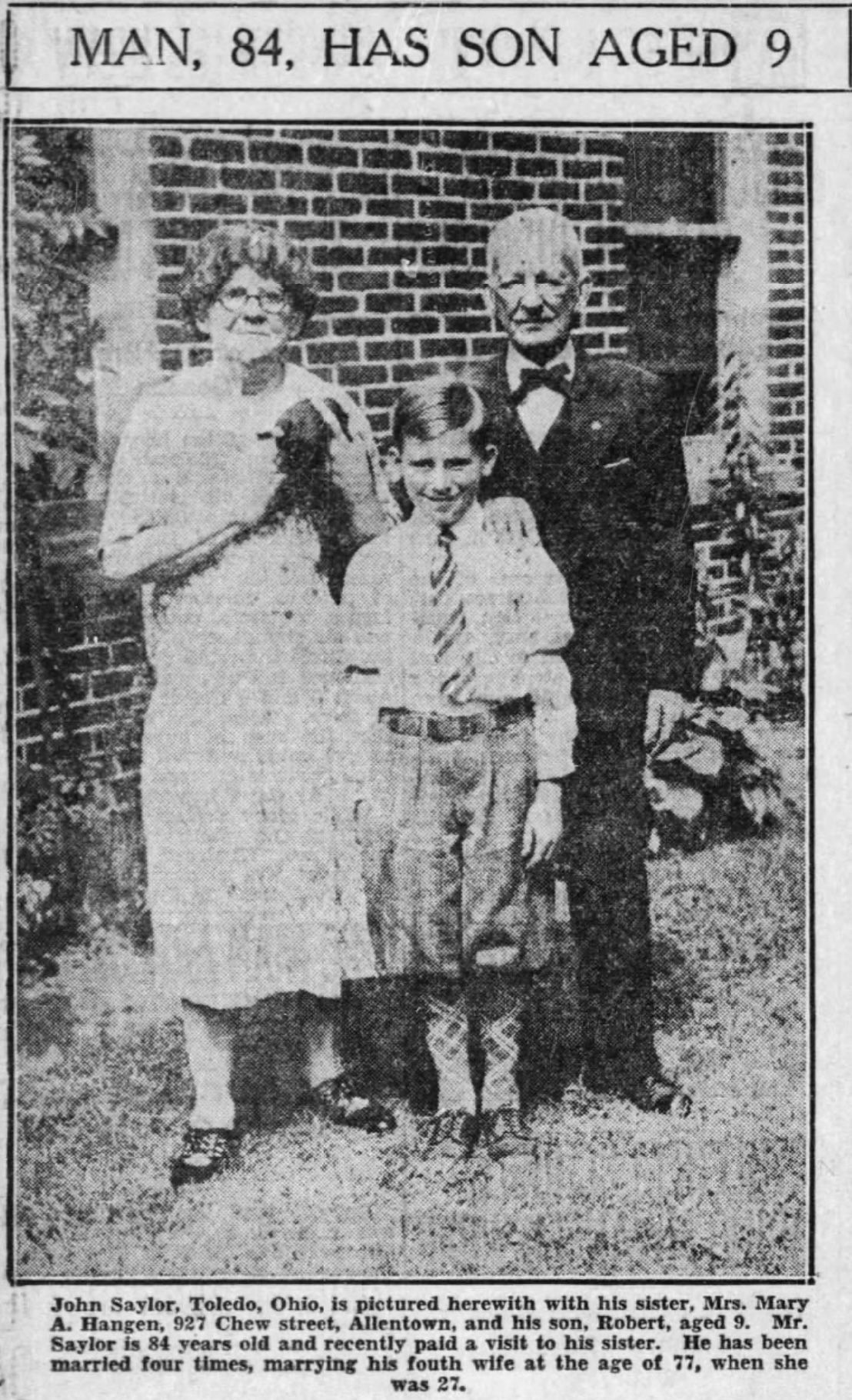
47th Pennsylvania veteran John Edward Saylor with his sister, Mary Alice (Saylor) Hangen, and his son, Robert Henry Saylor, (The Morning Call, Allentown, Pennsylvania, August 1929, public domain).

Many Americans tend to think of the American Civil War as part of the United States’ long distant past. Waged more than one hundred and sixty years ago, it began at a time when the art of photography was still in its infancy and the average newspaper contained mostly written text without any accompanying illustration.

As the war dragged on, though, newspaper publishers began sending Winslow Homer and other artists to far-flung locations, hoping that any sketches they sent back would give readers a better sense of the battles that were killing countless young men and destroying entire communities. Matthew B. Brady and Alexander Gardner, who had gained a measure of fame by photographing President Abraham Lincoln and members of his cabinet, went on to revolutionize war reporting by turning their cameras on carnage so horrific that it could not be conveyed by mere words or pencil illustrations. Their black and white photographs are the ones still viewed most often by history students in classrooms across the nation, contributing to the persistent notion that the American Civil War is distant, rather than recent history.

But that’s not quite correct, as the lives of Robert Henry Saylor and Edward John Saylor will show us. Born in the city of Toledo, Ohio during the early 1920s, the Saylor brothers could both lay claim to have been cradled in the arms of their father, John Edward Saylor (1846-1931), a veteran of the American Civil War who had served with the 47th Pennsylvania Volunteer Infantry’s K Company from early 1864 until early 1866.

Veterans of World War II, both brothers also made it through their respective tenures of military service and lived well into the last decades of the twentieth century, with the youngest brother nearly surviving long enough to witness the dawn of the twenty-first, making him a genuine “living bridge” between the not-so-distant past and present.

Their life stories help us to better understand just how recent so much of American History is. Reflect on that as you learn more about the Saylors’ lives by reading our new bio of Corporal John Edward Saylor.


Sources:

  1. Bates, Samuel P. History of Pennsylvania Volunteers, 1861-5, vol. 1. Harrisburg, Pennsylvania: B. Singerly, State Printer, 1869.
  2. Conway, William (boarding house operator) and Ollena; Saylor, John [sic, “John Edward Saylor”] (lodger and eighty-four-year-old Civil War veteran) and Robert (lodger and Civil War veteran’s ten-year-old son); et. al., in U.S. Census (Toledo, Lucas County, Ohio, 1930). Washington, D.C.: U.S. National Archives and Records Administration.
  3. “Edward Saylor” (obituary of a son of John Edward Saylor). Coshocton, Ohio: The Coshocton Tribune, August 5, 1999.
  4. “Former Resident Dies” (death notice of John Edward Saylor). Port Clinton, Ohio: News-Herald, September 4, 1931.
  5. John Saylor [sic, “John Edward Saylor”], in Death Certificates (registration district no.: 769, death of death: August 28, 1931). Columbus, Ohio: State of Ohio, Department of Health, Division of Vital Statistics.
  6. “Man, 84, Has Son Aged 9” (photo with caption of John Edward Saylor and his son, Robert, and John’s sister, Mary A. (Saylor) Hangen). Allentown, Pennsylvania: The Morning Call, August 25, 1929.
  7. Mary Alice Hangen (a sister of John Edward Saylor), in Death Certificates (file no.: 67765, registered no.: 858, date of death: July 12, 1932). Harrisburg, Pennsylvania: Commonwealth of Pennsylvania, Department of Health, Bureau of Vital Statistics.
  8. “Mrs. Mary A. Hangen” (obituary of a sister of John Edward Saylor). Allentown, Pennsylvania: The Morning Call, July 13, 1932.
  9. “Putnam Group Inducted Into Armed Forces” (notice of the impending World War II service of John Edward Saylor’s son, Robert Henry Saylor). Lima, Ohio: The Lima News, May 11, 1943.
  10. Robert Henry Saylor, in U.S. Headstone Applications for Military Veterans (Vista Memorial Gardens, Hialeah, Florida, year of death: 1977). Washington, D.C.: U.S. National Archives and Records Administration.
  11. “Saylor” (obituary of Robert Henry Saylor, a son of John Edward Saylor). Coshocton, Ohio: The Coshocton Tribune, January 4, 1977).
  12. Saylor, Edward J. (the groom and the youngest son of John Edward Saylor), John Saylor [sic, “John Edward Saylor”] (father of the groom) and Catherine Pyfer [sic, ” Pfeiffer”] (mother of the groom); and Loretta Wehrly (the bride), in Marriage Records (Putnam County, Ohio, June 10, 1946). Ottawa, Ohio: Putnam County Probate Court.
  13. Saylor, Edward J. (the youngest son of John Edward Saylor), Loretta, and Gloria J., in U.S. Census (Pleasant Township, Putnam County, Ohio, 1950). Washington, D.C.: U.S. National Archives and Records Administration.
  14. Saylor, John, in Civil War Muster Rolls (Company K, 47th Pennsylvania Infantry). Harrisburg, Pennsylvania: Pennsylvania State Archives.
  15. Saylor, John, in Civil War Veterans’ Card File, 1861-1866 (Company K, 47th Pennsylvania Infantry). Harrisburg, Pennsylvania: Pennsylvania State Archives.
  16. Saylor Robert (a son of John Edward Saylor) and Edwina, in U.S. Census (Coshocton, Coshocton County, Ohio, 1950). Washington, D.C.: U.S. National Archives and Records Administration.
  17. “Saylor, Robert H.” (obituary of a son of John Edward Saylor). Miami, Florida: The Miami Herald, January 4, 1977.


Black History Month: Say His Name, Then Share His Story

Page one of the U.S. Army’s Civil War enlistment paperwork for Bristor Gethers (mistakenly listed as “Presto Garris”), 47th Pennsylvania Volunteer Infantry, Company F, 5 October 1862 (U.S. National Archives and Records Administration, public domain; click to enlarge).

Our realization, as researchers, that there were at least nine formerly enslaved Black men who enlisted with the 47th Pennsylvania Volunteer Infantry during the American Civil War was sparked by a single index card for a soldier named “Presto Garris” that we found in the Pennsylvania Civil War Veterans’ Card File, which is maintained by the Pennsylvania State Archives.

Our ability to determine the true name of that soldier and correct the historical record about his life by researching and writing his biography was made possible by reading the dozens of pages contained in his U.S. Civil War Pension file and Compiled Military Service Records, which are maintained by the U.S. National Archives and Records Administration.

It was worth every penny of the roughly one hundred and ten dollars that we spent to obtain copies of those records from the National Archives because one of those documents confirmed the precise location of where that soldier had been enslaved prior to the war while others told us that he had survived the war and had lived out his life as a farmer. Another document even provided clues to the location of his grave.

That knowledge was so much more than we could have ever have hoped to gain because so many of the millions of men, women and children who were sold into, born into and re-sold throughout the American system of chattel slavery were never identified by name on state and federal census records prior to the war or were listed under names that had been created for them by their enslavers.

So, it matters that we’re able to tell you, for certain, that the true name of the soldier listed on that aforementioned index card was Bristor Gethers, that he lived near Mt. Pleasant, South Carolina after the war and that he resided with his wife and son near Beaufort, South Carolina after that. Please take the time to learn more about him by reading his bio on our educational program’s special website, Freedmen of the 47th Pennsylvania Volunteer Infantry. Then, look through the records that document his life’s journey.

Mr. Gethers’ story teaches us all that it is possible to find a new way forward after surviving the darkest of times.


Sources:

  1. “Garris, Presto,” in Civil War Muster Rolls (Company F, 47th Pennsylvania Infantry). Harrisburg, Pennsylvania: Pennsylvania State Archives.
  2. “Garris, Presto,” in Pennsylvania Civil War Veterans’ Card File, 1861-1866 (Company F, 47th Pennsylvania Infantry). Harrisburg, Pennsylvania: Pennsylvania State Archives.
  3. “Geddis, Brista” and “Geddis, Rachel,” in U.S. Census (Beaufort Township, Beaufort County, South Carolina, 1880). Washington, D.C.: U.S. National Archives and Records Administration.
  4. “Geddis, Brister,” in “Agreement Between B. J. Whitesides and Fifteen Freedmen” (Mt. Pleasant, South Carolina, 12 February 1868), in “Records of the Bureau of Refugees, Freedmen, and Abandoned Lands.” Washington, D.C.: U.S. National Archives and Records Administration.
  5. “Gethers, Bristor,” “Garris, Presto” and “Geddes, Bristor,” in U.S. Civil War Pension and U.S. Civil War Widows’ Pension Files (widow’s pension application no.: 598937, widow’s certificate no.: 447893, filed by the widow, Rachel Geddes, from South Carolina, 27 July 1894). Washington, D.C.: U.S. National Archives and Records Administration.


Seven Continents: The Year of 2025 in Review

“The Blue Marble” (Earth, photographed by Apollo 17 astronauts, December 7, 1972; NASA, public domain).

Another year almost gone. More milestones achieved for a personal research project that has grown into a multi-faceted, educational outreach program with connections on all seven continents of our planet.

Seven out of seven continents.

That statistic is the one that astonishes me most of all as I sit here compiling our annual Year in Review report for 2025. 47th Pennsylvania Volunteers: One Civil War Regiment’s Story is truly now a global community of lifelong learners.

Children and adults are engaged, at the moment I write this, in a quest to understand what it actually meant to be a member of the 47th Pennsylvania Volunteer Infantry during the American Civil War. As they do so, they are learning that the light of hope persists even when the world is filled with darkness.

Key Project Statistics (as of 6 p.m. Pacific Time on December 31, 2025):

  • First Content Posted to Website: May 25, 2014
  • Total Website Page Views to Date: 967,350
  • Total Number of Website Visitors to Date: 767,532
  • Total Number of Facebook Followers: 2,213
  • Total Number of Instagram Followers: 1,160
  • Total Number of 47th Pennsylvania Volunteer Gravesites Documented Via the Project’s Virtual Cemetery: 1,446
  • Total Number of Individual Officers and Enlisted Men Profiled to Date: 345
  • Most Popular Post in 2025: Finding Your 47th Pennsylvanian: Use “Bates’ History” — But With Caution

Why Is There So Much Interest, Globally, in a Single, Seemingly “Obscure” Civil War Regiment from Pennsylvania?

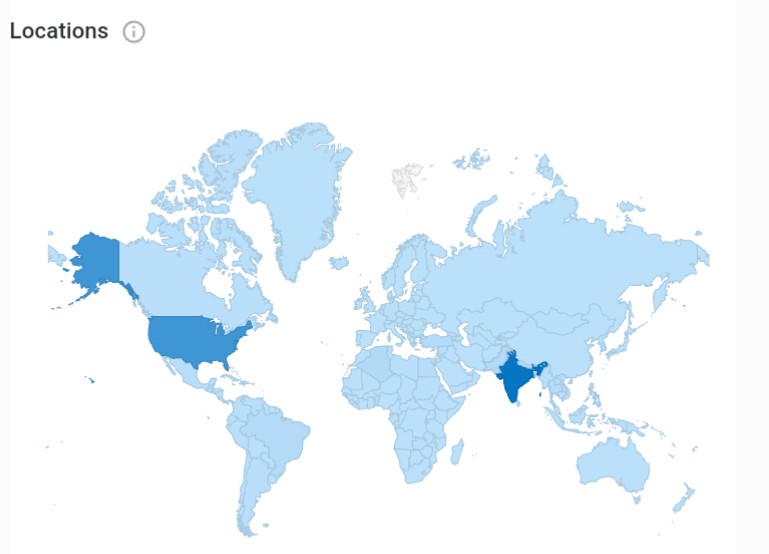
The light and dark blue areas of this map show the reach of 47th Pennsylvania Volunteers: One Civil War Regiment’s Story as of December 31, 2025 (image courtesy of Snyder Family Archives).

What started as a personal research interest of one descendant of a 47th Pennsylvania Volunteer Infantryman soon became the research focus of a half dozen descendants of 47th Pennsylvania Volunteers — and then dozens more as the website and social media sites for 47th Pennsylvania Volunteers: One Civil War Regiment’s Story launched and gradually attracted followers, including family historians, Civil War enthusiasts, history professors, and students in high schools and universities across the Commonwealth of Pennsylvania — and beyond.

In 2020, the project’s audience grew substantially as teachers and students turned to distance learning and the “47th Pennsylvania Volunteers’ Project” as a way to keep minds sharp during the COVID pandemic that prompted the closure of schools and businesses worldwide. It was that year that educators from India residing in the United States and teachers across India found our website and began helping their students better understand the history of the United States by encouraging them to “see” the American Civil War “through the eyes of” the soldiers and families whose biographies were available on our website.

As more people heard about our website, supporters of our work began donating photographs of young soldiers in uniform and letters penned by 47th Pennsylvanians stationed far from home — each artifact a “log on the fire” of expansion — growth that continued even as in-person instruction returned to classrooms across the globe. Since that time, Pennsylvanians have been reading and learning from the same content as students in:

  • Amsterdam (the Netherlands)
  • Bangkok (Thailand)
  • Barcelona, Madrid and Zaragoza (Spain)
  • Bengaluru and Mumbai (India)
  • Brussels (Belgium)
  • Bogota (Columbia)
  • Dubai (the United Arab Emirates)
  • Dhaka (Bangladesh)
  • Dublin (Ireland)
  • Falkenstein, Bielefeld, Frankfurt, and Koeln (Germany)
  • Glasgow (Scotland)
  • Helsinki (Finland)
  • Ho Chi Minh City (Vietnam)
  • Hrebinka (Ukraine)
  • Istanbul (Türkiye)
  • Jakarta (Indonesia)
  • Lagos (Nigeria)
  • Lima (Peru)
  • London, Durham, Leeds, and Manchester (Great Britain)
  • Luleå (Sweden)
  • Manama (Bahrain)
  • Manila (the Philippines)
  • Melbourne and Sydney (Australia)
  • Montreal, Courtenay, Edmonton, Ottawa, Saskatoon, Toronto, and Vancouver (Canada)
  • Nairobi (Kenya)
  • Santiago (Chile)
  • São Paulo (Brazil)
  • Seongnam and Seoul (South Korea)
  • Warsaw and Witkowo (Poland)
  • Singapore (Republic of Singapore)
  • Tokyo and Kumamoto (Japan)
  • Vientiane (Laos)
  • Xiamen, Beijing, Hong Kong, Shanghai, and Zhengzhou (China), and
  • Christchurch (New Zealand).

We now even have contacts at McMurdo Station in Antarctica! (Not a bad way to close the book on a challenging and often heartbreaking year.)

A Resolution for 2026

The 47th Pennsylvania Volunteers fought long and hard to help end a devastating civil war, eradicate the shameful practice of slavery and rebuild their shattered nation, and for those reasons alone, should be remembered for their service to the nation.

But perhaps the most important part of their collective story is that soldiers who somehow managed to survive unimaginable horrors never gave up trying to make their world a better one.

And neither should we.

My hope for 2026 is that more individuals in our world will “see wrong and try to right it” while also doing what is humanly possible to heal suffering in ways that “send forth ripples of hope and change.”

Happy New Year!


Finding Your 47th Pennsylvanian: Registers of Pennsylvania Volunteers, 1861-1865

Main website page for the Registers of Pennsylvania Volunteers, 1861-1865 (Pennsylvania State Archives, public domain; click to enlarge).

Another useful tool for Finding Your 47th Pennsylvanian is one of several records collections related to the American Civil War housed at the Pennsylvania State Archives in Harrisburg, Pennsylvania — the “Registers of Pennsylvana Volunteers, 1861-1865.”

Similar to the Pennsylvania State Archives’ collection of Pennsylvania Civil War Muster Rolls, the Registers of Pennsylvania Volunteers, 1861-1865 are part of a sixteen-volume set of rosters that document the names, ages, ranks, regiment and company affiliations, and dates and places of enlistment and discharge or desertion for the more than three hundred and sixty-thousand men who served with one or more of Pennsylvania’s volunteer infantry, volunteer militia, emergency militia, independent, or other military units during the war. In addition, many of these registers contain additional data about about the status of individual soldiers, including whether or not they were promoted or reduced in rank and whether or not they were wounded or killed in battle. According to Pennsylvania State Archives personnel:

“Arranged by regiment, rank, and then alphabetically by surname, these registers document Pennsylvania Volunteers who served during the Civil War. Information normally recorded includes the soldier’s name, age, rank, regiment and company; the term of service; and the date, place, and name of the person who enrolled him. Written remarks regarding the promotion, desertion, death, or discharge of the volunteer are frequently entered as well.”

Two PDFs to View for Each Soldier

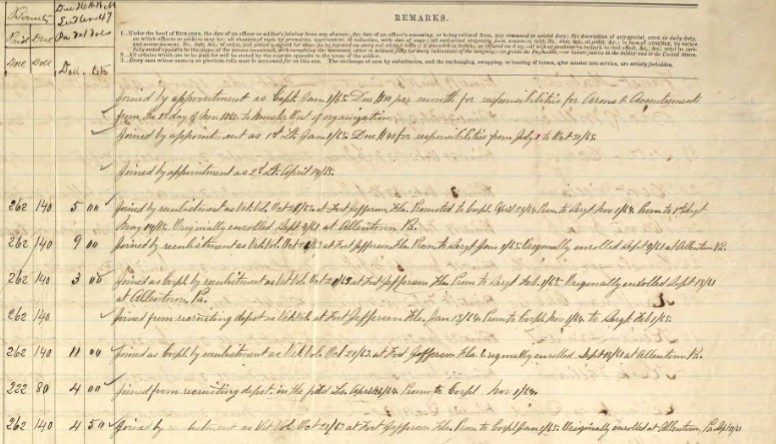
Excerpt from left side of register entry, Company A, 47th Pennsylvania Volunteer Infantry (Registers of Pennsylvania Volunteers, 1861-1865, Pennsylvania State Archives, public domain; click to enlarge).

Due to the large size of each book in this register series, Pennsylvania State Archives personnel scanned each page of each register as two separate PDF pages — with the first page containing the left side of the roster with an alphabetized list of soldiers’ names and their respective enrollment data — and the second page containing the right side of the roster with its remarks section, which presents data about the service status for each of those soldiers (promotions, desertions, deaths, etc.). Those PDF pages were then grouped by regiment and company, officers first, followed by the enlisted members of the regiment who served under them, and were posted on the Pennsylvania State Archives’ website, where they remain available, free of charge to everyone, regardless of geographic location, and without any requirement to create an account in order to search these records.

This collection has also been indexed by FamilySearch volunteers, who have entered each soldier’s summarized data into a database that may be searched online, free of charge, via the “Pennsylvania, Register of Military Volunteers, 1861-1865” portal on the FamilySearch website. (Note: While the summarized data for soldiers may be viewed online from the privacy of one’s home, by creating and logging into a free FamilySearch account, the opportunity to browse through and view scanned images of the original registers is only available by visiting a FamilySearch Center in person.)

Remember and Honor Them

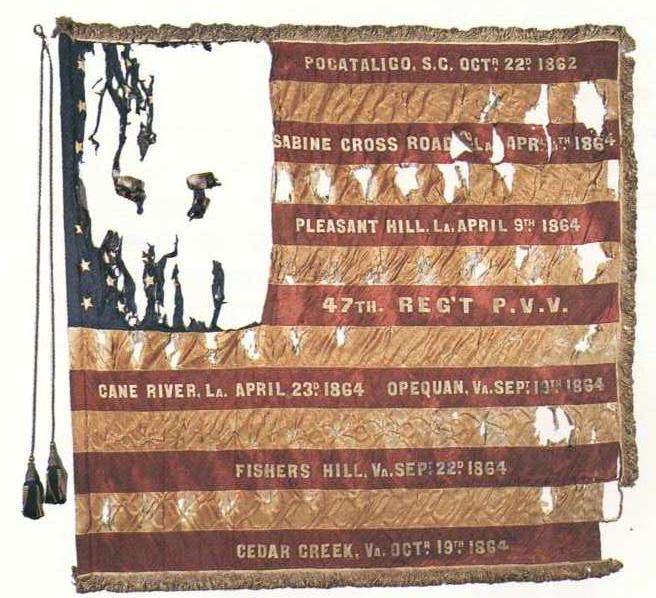
Second State Colors, 47th Pennsylvania Veteran
Volunteers (presented to the regiment 7 March 1865).

The members of the 47th Pennsylvania Volunteer Infantry gave everything they had in them to help preserve America’s Union. For that reason alone, they deserve our enduring gratitude and respect.

So, make it a practice to say the name of your ancestor out loud each week (or say the name of one of the men who fought beside him).

Tell and re-tell their stories to everyone you know (especially the children in your local school system).

And most of all, honor the sacrifices that they made by volunteering your own time and energy to make life better for everyone in your community.


Sources:

  1. Civil War Records,” in “Pennsylvania State Archives – Research Guides.” Harrisburg, Pennsylvania: Pennsylvania Historical and Museum Commission, Commonwealth of Pennsylvania, retrieved online November 3, 2025.
  2. Pennsylvania, Register of Military Volunteers, 1861-1865.” Lehi, Utah: FamilySearch, retrieved online November 3, 2025.
  3. Registers of Pennsylvania Volunteers, 1861-1865,” in Records of the Department of Military and Veterans’ Affairs (Record Group 19, Series 19.65). Harrisburg, Pennsylvania: Pennsylvania State Archives, retrieved online November 3, 2025.


On Crutches, Convalescing in Carolina: The Fight by Pocotaligo’s Wounded to Recover

Captain John Peter Shindel Gobin, Company C, 47th Pennsylvania Volunteers, shown here circa 1863, went on to become Lieutenant Governor of Pennsylvania after the war (public domain).

Still ruminating about the carnage that he and his fellow 47th Pennsylvania Volunteer Infantrymen had survived just weeks earlier during the Battle of Pocotaligo, C Company Captain John Peter Shindel Gobin sat down in his quarters at his regiment’s encampment in Beaufort, South Carolina in mid-November 1862 and began to pen an update to a letter that he had recently written to friends back home. Despite his belief that he had “nothing to write home about,” his letter proved to be an important historical artifact — a handwritten, dated and signed eyewitness account that detailed what happened to multiple Union Army soldiers who had been wounded in action at that 1862 battle in South Carolina.

Head Quarters Co. C 47 P.V.
Beaufort S.C. Nov. 13. 1862

Dear Friends

I have just learned that a mail leaves for the North tomorrow morning although I have nothing particular to write about, and there is no telling when you will get it, as I understand vessels from here are now quarantined ten days at New York. Still I suppose you will be anxious to hear from me.

I have not heard from Sergt. Haupt today. Yesterday he was still living and improving, and I now have hopes of his recovery. I was down on Saturday last and both nurses and doctor promised me to do everything in their power to save him. If money or attention can save him it must be done.

The rest of the wounded of my Company are doing very well. All will recover, I think, and lose no limbs, but how many will be unfit for service I cannot yet tell. Billington, Kiehl, Barlton [sic, “Bartlow”], Sergt. Haupt and Leffler are yet at Hilton Head. Billington is on crutches and attending to Haupt or helping. Barlton [sic, “Bartlow”] and Leffler are also on crutches. Kiehl is walking about, but his jaw is badly shattered. Corp S. Y. Haupt is on duty. Haas’ wound is healing up nicely. Corp. Finck is about on crutches. O’Rourke, Holman, Lothard, Rine [sic, “Rhine”], and Larkins are in camp, getting along finely. Those who were wounded in the body, face and legs all get along much better than Sergt. Haupt who was wounded in the foot. His jaws were tightly locked the last time I saw him.

The Yellow fever is pretty bad at the Head, and I do not like to send any body down. I am holding a Court Martial, and keep very busy. The fever creates no alarm whatever here. No cases at all have occurred save those brought from Hilton Head. We have had two frosts and all feel satisfied that will settle the fever. Some good men have fallen victims to it. Gen. Mitchell [sic, Major-General Ormsby Mitchel] is much regretted here.

Sixty of my men are on picket under Lieut. Oyster, Lieut. Rees [sic, “Reese”] having been on the sick list. However he is well again. The balance of the men are all getting along finely. Warren McEwen had been sick but is well again. My health is excellent. Spirits ditto. I suppose however by the looks of things I will be kept in Court Martials for a month longer, the trial list being very large. The men begin to look on me as a kind of executioner as it seems I must be upon every Court held in the Dep’t [Department of the South].

We are waiting patiently and anxiously for a mail, not having had any news from the North since the 24th of last month. Three weeks without news seems a terrible time, when you come to realize it.

I wrote home from the Head the last time I was down. Was my last received. Write soon and give me all the news. With love to all

I remain
Yours JPSG

What Ultimately Happened to the Men Identified in That Gobin Letter?

Captain Daniel Oyster, Company C, 47th Pennsylvania Volunteers, circa 1864 (public domain).

The “Rees” and “Oyster” mentioned by Captain J. P. S. Gobin were his immediate subordinates, First Lieutenant William Reese and Second Lieutenant Daniel Oyster, who both ended up surviving the war. Reese would later be accused of cowardice during the 1864 Red River Campaign but cleared of that false charge, while Oyster would rise through the regiment’s ranks to become captain of Company C before being wounded in two different battles of Sheridan’s 1864 Shenandoah Valley Campaign.

The “Billington” and “Barlow” who had sustained leg wounds were Privates Samuel Billington and John Bartlow. Although both ultimately recovered from those wounds, Private Billington would later be deemed unable to continue serving with the 47th Pennsylvania and would be honorably discharged on a surgeon’s certificate of disability on July 1, 1863, while Private Bartlow would go on to become a sergeant with the 47th’s C Company, effective September 1, 1864, only to be killed in action just over a month later, during the Battle of Cedar Creek, Virginia.

“Corp. Finck” was Corporal William F. Finck, who had also been wounded in the leg and who also subsequently recovered and returned to duty. Unlike Sergeant Bartlow, however, he would survive a second wound that he would later sustain during the Battle of Cedar Creek and would be promoted to the rank of sergeant on April 1, 1865.

“Haas” was Private Jeremiah Haas, who had been wounded in the breast and face. Known as “Jerry” to his friends and family, he also eventually recovered and returned to duty, but was then mortally wounded in action during the Battle of Sabine Cross Roads near Mansfield, Louisiana on April 8, 1864 and died “almost instantly,” according to a letter written by his Company C comrade, Henry Wharton.

The “Haupts” were Sergeant Peter Haupt and his brother, Private Samuel Y. Haupt. Sergeant Peter Haupt, whose foot and ankle had been wounded at Pocotaligo, later developed lockjaw and died after contracting tetanus from the lead in the canister shot that had struck him. His brother, Samuel, however, survived. Wounded in the face and chin, Samuel would later be cleared for active duty and then be promoted steadily up through the ranks to become a first sergeant.

“Holman” was Private Conrad P. Holman, who had also been wounded in the face and who also recovered and returned to duty, would later be captured by Confederate troops during the Battle of Pleasant Hill in Louisiana on April 9, 1864 and be held as a prisoner of war (POW) at Camp Ford near Tyler, Texas until he was released during a prisoner exchange on July 22 of that same year.

“Kiehl” was Private Theodore Kiehl, whose jaw had shattered when his mouth was struck by a rifle ball at Pocotaligo, also recovered and returned to active duty. Sadly, he would later be killed in action on the grounds of Cooley’s farm near Winchester, Virginia during the Battle of Cedar Creek in October 1864.

“Larkins” and “Leffler” were Privates Michael F. Larkin and Charles W. Lefler, who had sustained wounds to the hip and side and/or arm and stomach (Larkins) and leg (Lefler) at Pocotaligo. They also both recovered and returned to active duty. Unlike so many of their comrades, however, they both survived their respective tenures of service and were both honorably discharged.

“Lothard” was actually Charles L. Marshall — one of several “mystery men” of the 47th Pennsylvania Volunteer Infantry. A native of Virginia who had relocated to Luzerne County, Pennsylvania to work in a coal mine prior to the American Civil War, he had enlisted as a private with the 47th Pennsylvania under the assumed name of “Thomas Lothard.” Shot in the head and/or body at Pocotaligo, he would ultimately recover and return to active duty, only to be wounded again in his head (top), body (right side) and left shin left during the Battle of Sabine Cross Roads in Louisiana on April 8, 1864. Later mistakenly labeled as a deserter, his military records were subsequently clarified to reflect his honorable discharge on January 7, 1866, as well as his legal name and alias.

“Warren McEwen” was Private Warren C. McEwen, whose illness would later become so persistent that he would be honorably discharged on a surgeon’s certificate of disability on December 7, 1862.

“O’Rourke” and “Rine” were Privates Richard O’Rourke and James R. Rhine, who had also sustained wounds to the side (O’Rourke) and leg (Rhine) at Pocotaligo, and would also recover, return to active duty, serve out their respective terms of enlistment, and be honorably discharged.

Veteran Volunteers

Samuel Y. Haupt, Company C, 47th Pennsylvania Volunteers (circa 1863, public domain).

John Bartlow, William Finck, Samuel Haupt, Charles Marshall (as “Thomas Lothard”), Richard O’Rourke, and James Rhine were among multiple members of the 47th Pennsylvania Volunteer Infantry who would go on to be awarded the coveted title of “Veteran Volunteer” when they chose to re-enlist for additional tours of duty and helped to bring an end to one of the darkest times in America’s history.

Remember their names. Honor the sacrifices that they made.


Sources:

  1. Bates, Samuel P. History of Pennsylvania Volunteers, 1861-5, vol. 1. Harrisburg, Pennsylvania: B. Singerly, State Printer, 1869.
  2. Gobin, John Peter Shindel. Personal Letters, 1861-1865. Northumberland, Pennsylvania: Personal Collection of John Deppen.
  3. MacConkey, Alfred. “Tetanus: Its Prevention and Treatment by Means of Antitetanic Serum.” London, England: The British Medical Journal, vol. 2, no. 2806, October 10, 1914, pp. 609-614.
  4. Schmidt, Lewis G. A Civil War History of the 47th Regiment of Pennsylvania Veteran Volunteers. Allentown, Pennsylvania: Self-published, 1986.
  5. Wharton, Henry D. “Letters from the Sunbury Guards.” Sunbury, Pennsylvania: The Sunbury American, 1862.


Election Day 1864 — Lincoln or McClellan? How the 47th Pennsylvania Volunteers Voted

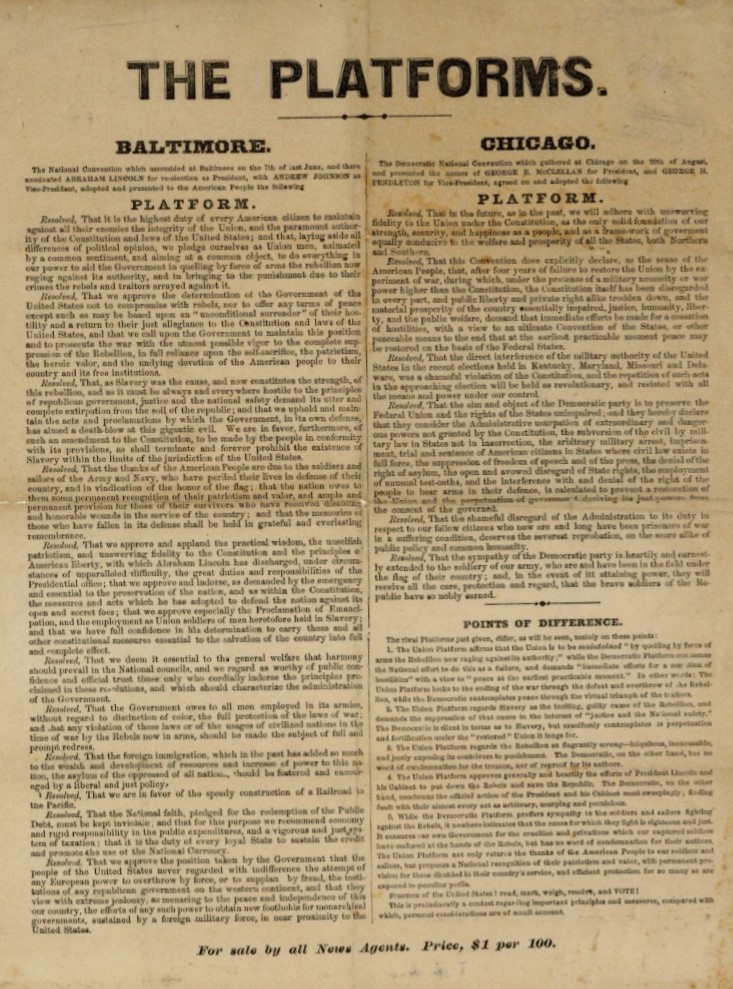
The platforms of the Union and Democratic parties, U.S. Presidential Election of 1864 (courtesy of the University of Illinois Urbana-Champaign; click to enlarge).

Even in the midst of a devastating civil war, Americans across the United States managed to come together to fulfill their civic responsibilities by voting on Election Day. Fathers and sons flocked to city and small town polling places while soldiers on active duty filled out ballot forms wherever they were stationed during the early to mid-1860s.

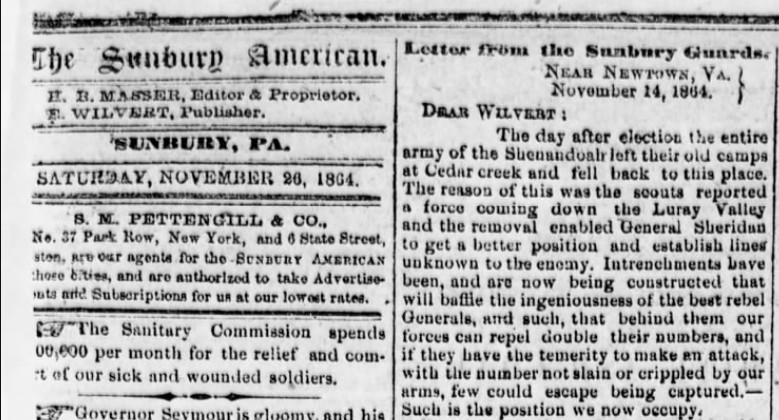
With respect to the Presidential Election of 1864, which was held in multiple states across America on November 8, 1864, that voting took place for members of the 47th Pennsylvania Volunteer Infantry at their encampment near Newtown, Virginia, according to a letter that was subsequently penned by 47th Pennsylvanian Henry D. Wharton to his hometown newspaper in Sunbury, Pennsylvania on November 14:

“The election passed off quietly and without any military interference, not the influence of officers used in controlling any man’s vote. In the regiments from the old Keystone, the companies were formed by the first Sergeant, when he stated to the men the object for which they were called to ‘fail to,’ and then they proceeded to the election of officers to hold the election – the boys having the whole control, none of the officers interfering in the least.”

Were the 47th Pennsylvania Volunteers pro-Lincoln or pro-McClellan?

Excerpt from Henry Wharton’s letter to his hometown newspaper, November 14, 1864 (The Sunbury American, November 14, 1864, public domain; click to enlarge).

Wharton reported that, after the votes from members of the regiment were counted, President Abraham Lincoln was the favored choice of most of the 47th Pennsylvania Volunteers. Lincoln had garnered one hundred and ninety-four votes to General George B. McClellan’s one hundred and twenty-one (a margin of seventy-three votes). Those votes, by individual company, were tallied as follows:

  • Company A: President Lincoln (ten); General McClellan (one)
  • Company B: President Lincoln (twenty-six); General McClellan (two)
  • Company C: President Lincoln (twenty-nine); General McClellan (thirteen)
  • Company D: President Lincoln (thirty-one); General McClellan (eleven)
  • Company E: President Lincoln (twenty-four); General McClellan (three)
  • Company F: President Lincoln (eighteen); General McClellan (sixteen)
  • Company G: President Lincoln (nine); General McClellan (thirteen)
  • Company H: President Lincoln (ten); General McClellan (twenty-four)
  • Company I: President Lincoln (nineteen); General McClellan (sixteen)
  • Company K: President Lincoln (eighteen); General McClellan (twenty)

But Wharton’s figures for the men from Company K were incorrect, according to historian Lewis Schmidt, who noted in his book, A Civil War History of the 47th Regiment of Pennsylvania Veteran Volunteers, that “Fifteen of the members [of Company K] voted for the Lincoln electors and seven for the McClellan electors” when they “voted on the battlefield of Cedar Creek, November 8, 1864.” The members of Company K who cast votes that day were: “David H. Fetherolf, Mathias Miller, John Keiser, Phaon Guth, James D. Weil, Daniel Strauss, Paul Strauss, George Sherer, Lewis G. Seip, Henry Hantz, Charles W. Abbott, George Kase, Charles Stoudt, William Schlicher, William F. Knerr, E. F. Benner, George Delp, Tilghman Boger, William H. Barber, William D. Schick, Frank Beisel, and David Semmel.”

Apathy or Attrition?

One of the first things that researchers notice when looking at those figures for the 1864 election is that the number of votes tendered by 47th Pennsylvania Volunteers that November day was lower than it should have been — shockingly so when considering that each company of the regiment had been staffed by roughly one hundred men when the 47th Pennsylvania left Camp Curtin and headed for Washington, D.C. three years earlier. The turnout of 47th Pennsylvanians was not a sign of voter apathy, however, but of a simple, ugly truth. The regiment had just recently lost the equivalent of nearly two full companies of men in combat. According to Wharton, “The battle at Cedar Creek thinned our ranks by which we lost many votes – this number and those away in hospitals would have increased the Union majority to three hundred.”

* Note: When Henry Wharton wrote the phrase “Union majority,” he was referring to the National Union Party, which had been established during the 1860s by prominent Republicans as a way to bring members of their party together with “War Democrats” and potential voters from border states to vote for President Lincoln and others who supported the Republican platform for eradicating chattel slavery and ending the nation’s secession crisis and civil war.

What Happened After That Election in 1864?

President Abraham Lincoln signing the Emancipation Proclamation in 1862 (W.E. Winner, painter, J. Serz, engraver, circa 1864; public domain, U.S. Library of Congress).

Successful in his bid for re-election, both in terms of the electoral college and popular vote, President Abraham Lincoln went on to deliver one of his most inspiring addresses to the nation, urging his fellow Americans “to bind up the nation’s wounds” and “do all which may achieve and cherish a just and lasting peace among ourselves and with all nations.” He then continued to shepherd his nation through one of its darkest times until the war was finally over.

Food for Thought

If Henry Wharton and his fellow soldiers could make it to the polls on Election Day after all they endured in battle, so can you. Please vote. Your voice does matter.


Sources:

  1. Political Party Timeline: 1836-1864,” in American Experience: Abraham and Mary Lincoln: A House Divided. Boston, Massachusetts: GBH Education for WGBH-TV (PBS), 2001.
  2. Schmidt, Lewis G. A Civil War History of the 47th Regiment of Pennsylvania Veteran Volunteers. Allentown, Pennsylvania: Self-published, 1986.
  3. The People’s Candidate: Lincoln’s Presidential Elections,” in “Illinois History & Lincoln Collections.” Urbana, Illinois: Main Library, University of Illinois Champaign-Urbana, retrieved online November 3, 2025.
  4. Transcript of Abraham Lincoln’s Second Inaugural Address (delivered Saturday March 4, 1865), in “UShistory.org.” Philadelphia, Pennsylvania: Independence Hall Association, retrieved online March 4, 2020 and November 3, 2025.
  5. Wharton, Henry D. “Letter from the Sunbury Guards, Near Newtown, VA, November 14, 1864.” Sunbury, Pennsylvania: The Sunbury American, November 26, 1864.

Finding Your 47th Pennsylvanian: The Surprising Details in Pennsylvania’s Civil War-Era Muster Rolls

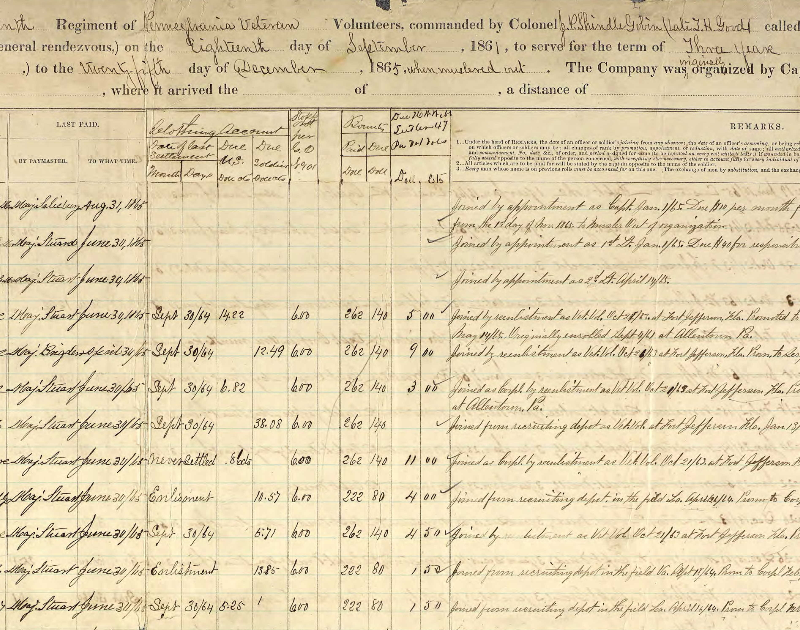
Excerpt of muster-out roll, Company G, 47th Pennsylvania Volunteer Infantry, December 25, 1865, page one (Pennsylvania Civil War Muster Rolls, Pennsylvania State Archives, public domain; click to enlarge).

The Commonwealth of Pennsylvania’s collection of Civil War-era muster rolls is another of the three major tools that beginning, medium and advanced researchers initially turn to for help in determining which Pennsylvania military unit(s) a soldier served with during the American Civil War. Unfortunately, it is also a resource that often does not receive the close attention from researchers that it should.

Those who have chosen to spend significant time looking through the individual documents contained in this collection have come to understand that, in addition to confirming the identity of a soldier’s regiment and company, as well as his rank(s) at enrollment and final discharge, Pennsylvania’s Civil War-era muster rolls are also useful for documenting when and where that soldier enrolled and mustered in for service and whether or not he had some change to his status while serving, such as a promotion, reduction in rank or charge of desertion — and possibly data which documented whether or not he was wounded or killed in battle and, if so, when and where.

Physically created as hard-copy index cards that were later preserved by the Pennsylvania State Archives in Harrisburg, Pennsylvania, as part of the “Civil War Muster Rolls and Related Records” group of documents from the Pennsylvania Department of Military and Veterans Affairs’ archives (Series RG:-019-ADJT-11, 1861-1866, 1906), this collection includes muster rolls from each of Pennsylvania’s volunteer infantry and volunteer militia regiments, emergency volunteer militia regiments that were formed during the summer of 1863 in response to the looming invasion of the commonwealth by the Confederate States Army, United States Colored Troops (USCT), United States Veteran Volunteer regiments and Hancock Veterans Corps, regiments of the Veterans Reserve Corps, and independent or other unattached units. Preserved on microfilm decades ago by the Commonwealth of Pennsylvania, a portion of this large collection has since been partially digitized and made available on the Ancestry.com website as “Pennsylvania, U.S., Civil War Muster Rolls, 1860-1869.”

* Note: Although Ancestry.com is a subscription-based genealogy service that generally requires users to pay for access to its records collections, the Commonwealth of Pennsylvania entered into a partnership with Ancestry.com several years ago “to digitize family history records in the State Archives and make them available online.” As part of that agreement, Ancestry.com created Ancestry.com Pennsylvania to provide free access to Pennsylvania residents to the Pennsylvania records it has digitized. If you reside in Pennsylvania and want to learn more about how you may obtain free access to those records, please contact the Pennsylvania State Archives for guidance. If you reside elsewhere, check with your local library to determine if it offers access to Ancestry.com as part of its service to library users.

What May Researchers Find with This Resource?

Excerpt from muster-out roll, Company G, 47th Pennsylvania Volunteer Infantry, December 25, 1865, showing soldiers’ promotions, status as Veteran Volunteers, etc. (Pennsylvania State Archives, public domain; click to enlarge).

According to personnel at the Pennsylvania State Archives, Pennsylvania’s Civil War Muster Rolls and Related Records collection includes:

“Alphabetical Rolls. The rolls are arranged alphabetically by the soldiers’ surnames. Entries usually give the name, rank, civilian occupation, and residence, the unit, regiment, company, and commanding officer, and the date and place where the roll was taken. Particulars about sickness or injury are also sometimes noted.

“Descriptive Lists of Deserters. Lists give the names, ages, places of birth, height, hair and eye color, civilian occupations, and ranks of deserters, the units, regiments, and companies to which they were assigned, and the dates and places from which they deserted.

“Muster-In Rolls. Entries usually list the name, age, rank, unit, regiment, and company of the soldier, the date and place where enrolled, the name of the person who mustered him in, the term of enlistment, the date of mustering in, and the name of commanding officer. Remarks concerning promotions and assignments are sometimes recorded.

“Muster-Out Rolls. The dated lists ordinarily give the soldier’s name, age, rank, unit, regiment, and company, the date, place, and person who mustered him in, the period of enlistment, and the name of the commanding officer. Particulars concerning pay earned, promotions, capture by the enemy and the like also regularly appear.

“Muster and Descriptive Rolls. Generally the rolls give the name, age, town or county and state or kingdom of birth, civilian occupation, complexion, height, eye and hair color, and rank, the unit, regiment, company and commanding officer, and the amount of money received for pay, bounties, and clothing. Rolls for assigned United States black troops are included in this group. Included throughout are such related materials as regimental accounts of action, and correspondence related to infractions of military procedures, correspondence from soldiers addressed to the governor expressing grievances or petitioning for promotion.

“The data found in the documents of this series were used to create the Civil War Veterans Card File, 1861-1866 (Series 19.12).”

Be Sure to Look for Data Regarding Soldiers’ Pay

Excerpt from muster-out roll for Company G, 47th Pennsylvania Volunteer Infantry, showing soldiers’ pay data, December 25, 1865 (Pennsylvania State Archives, public domain).

One of the most fascinating features found on the muster-out rolls for Pennsylvania volunteer soldiers is that many of the infantry unit clerks took the time to meticulously record the pay data for multiple members of their respective regiments. As a result, present-day researchers are often able to determine how much bounty pay a particular soldier was eligible for at the time of his enlistment — and how much of that promised pay he actually received, as well as how much money he still owed the United States government for his army uniform, rifle and ammunition at the time of his discharged from the military.

Another striking feature on the muster-out rolls is the “Last Paid” column, which corroborates the shocking fact that many Union Army soldiers were expected to perform their duties, even though they were not being paid regularly — a data point that also may help to shed light on why some soldiers’ families faced greater hardship than others (because some soldiers were able to send part of their pay home while others were not).

Caveat Regarding Ancestry.com’s Collection Related to the 47th Pennsylvania Volunteer Infantry

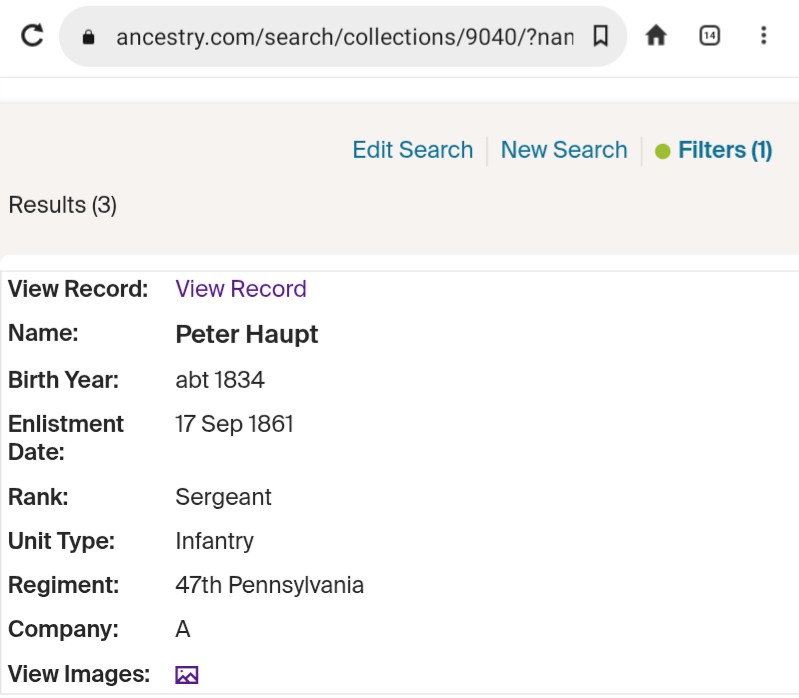
Screenshot of Ancestry.com’s record detail page for Peter Haupt, which incorrectly identifies him as a member of Company A, 47th Pennsylvania Volunteer Infantry, instead of Company C (fair use for illustration purpose, October 2025).

Although Ancestry.com’s collection of Pennsylvania Civil War-era muster rolls can be a useful tool for researchers, there is a significant problem with records related to the 47th Pennsylvania Volunteer Infantry that merits closer scrutiny — the inaccurate transcription of soldiers’ data. That scrutiny is needed because the muster rolls from the 47th Pennsylvania’s Company C were mixed together with the muster rolls from Company A when they were posted to Ancestry.com’s website, making it appear, when browsing through those rolls, that all of the soldiers listed on every single one of those incorrectly grouped muster rolls were all members of Company A, when they were not.

Complicating things further, the Ancestry.com personnel who were assigned to transcribe the data from each of those muster rolls and create Record Detail pages for each individual soldier that summarized each soldier’s data from the muster roll on which it appeared, apparently did not realize that the muster rolls from Companies A and C of the 47th Pennsylvania Volunteer Infantry had been mixed together. As a result, those transcribers incorrectly described every soldier from that improperly sorted muster roll group as a member of Company A, when they were not. (See attached image.)

So, when reviewing Ancestry.com’s collection of muster rolls, it is vitally important that researchers not take the transcribed data found on any of the Record Detail pages of 47th Pennsylvania muster rolls at face value. Instead, researchers should double check the data found on those muster rolls for the 47th Pennsylvania Volunteer Infantry against the data for individual soldiers published by Samuel P. Bates in his History of Pennsylvania Volunteers, 1861-5, volume 1, and should also then re-check that data against the information of individual soldiers that is contained in the Pennsylvania Civil War Veterans Index Card File, 1861-1866.

* Note: This is particularly important if you are a family historian who is hoping to identify the specific company in which your ancestor served. (And you will definitely want to know which company your ancestor served with because each company of the 47th Pennsylvania Volunteer Infantry was assigned to different duties in different locations at different times during the regiment’s service.)

Caveat Regarding “Deserters”

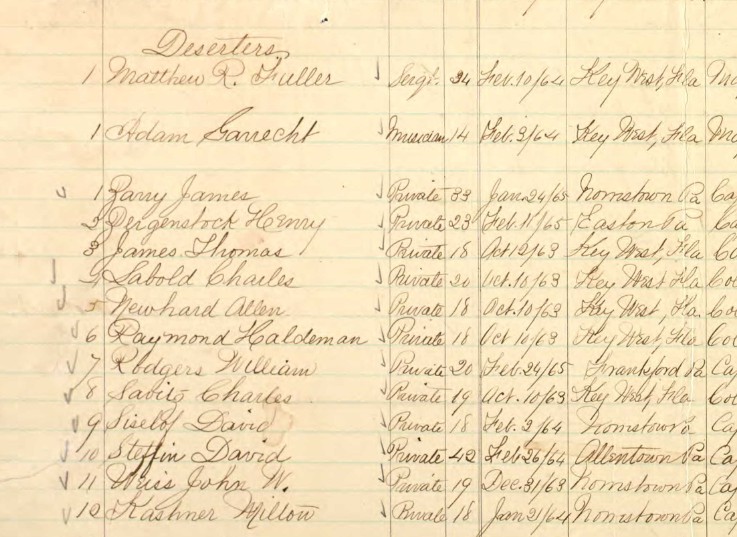
Private Milton P. Cashner, Company B, 47th Pennsylvania Volunteer Infantry, was incorrectly labeled as a deserter on this regimental muster roll from the American Civil War (Pennsylvania State Archives, public domain; click to enlarge).

If a muster roll entry for your ancestor noted that he was a deserter, it’s also important that you not take that label at face value, either, because that data may also be incorrect. Military records from the Civil War era contained a surprising number of errors, a fact that is understandable when considering what the average army clerk was expected to do — keep track of more than a thousand men, many of whom ended up becoming separated from their regiment and confined to Union Army hospitals after being wounded in battle. (Wounded too severely to identify themselves to army personnel, they were then often mis-identified by army hospital personnel and then also incorrectly labeled as “deserters” by their own regiments because they hadn’t shown up for post-battle roll calls.) So, it’s important to double and triple check the data for any ancestor who was labeled as a “deserter” because he might actually have been convalescing at a hospital and not absent without leave.

Honoring Our Ancestors 

One of the best ways to honor ancestors who fought to preserve America’s Union is to pass their stories along to future generations. No embellishment required. Their willingness to volunteer for military service and the bravery they displayed as they ran toward danger and certain death during one of America’s darkest times speaks for itself.

Our job, as students of American History, educators and family historians is to ensure that their stories are told as accurately and thoroughly as possible so that their valor and love of community and country are never forgotten.

Remember their names. Tell and re-tell their stories. Honor the sacrifices that they made.


Sources:

  1. “Ancestry Pennsylvania,” in “Agencies: Pennsylvania Historical and Museum Commission,” in “Pennsylvania State Archives.” Harrisburg, Pennsylvania: Commonwealth of Pennsylvania, retrieved online October 25, 2025.
  2. Civil War Muster Rolls and Related Records” (resource description). Harrisburg, Pennsylvania: Pennsylvania State Archives, retrieved online October 30, 2025.
  3. Pennsylvania,” in Collections. Lehi, Utah: Ancestry.com Operations, Inc., 2021 (retrieved online October 25, 2025).


Finding Your 47th Pennsylvanian: Using the Pennsylvania Civil War Veterans Card File, 1861-1866

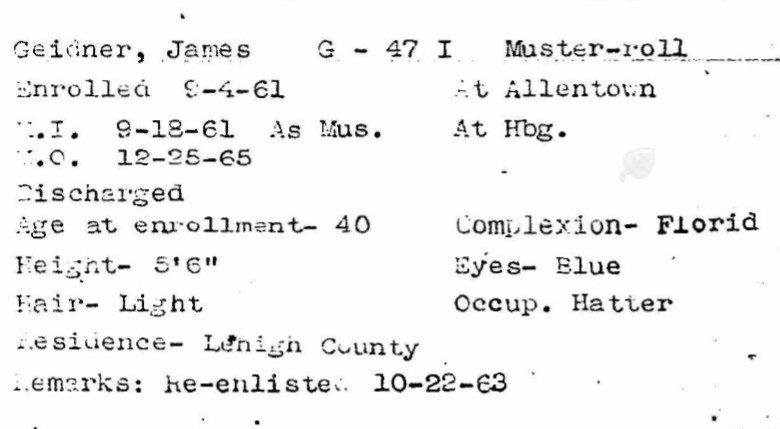
The index card of Field Musician James Geidner, Company G, 47th Pennsylvania Volunteer Infantry (Pennsylvania Civil War Veterans Card File, 1861-1866, courtesy of the Pennsylvania State Archives).

The Pennsylvania Civil War Veterans Index Card File, 1861-1866 is one of three resources that beginning, medium and advanced researchers frequently turn to for help in determining which Pennsylvania military unit(s) a soldier served with during the American Civil War. Physically housed at the Pennsylvania State Archives in Harrisburg, Pennsylvania, as part of the Pennsylvania Department of Military and Veterans Affairs’ archives (Series RG-019-ADJT-12), this collection of individual index cards was preserved on microfilm decades ago by the Commonwealth of Pennsylvania and then later digitized and made available, free of charge, on the State Archives’ website via a user-friendly portal, enabling researchers nationwide to search or browse, alphabetically, through each of the index cards that had been created for the majority of Pennsylvanians who had served with the Union Army (as well as the non-Pennsylvanians who had also served with Pennsylvania units). According to Pennsylvania State Archives personnel:

“These 3 x 5 cards were initially prepared to serve as an index to Samuel Penniman Bates’ History of Pennsylvania Volunteers, 1861-1865, (Harrisburg, 1869-1871). The Office of the Adjutant General later expanded the scope of the cards by transcribing onto them data found on the original documents. Among the information generally found are the soldiers’ names, military units, and ages at enrollment, the dates and places where enrolled, the dates and places where mustered in, and the dates of discharge. Physical descriptions (complexion, height, color of hair and eyes), residences, birthplaces, promotions and wounds also are sometimes included. The listing is not comprehensive.”

That last sentence is an important caveat because, while this index card system can be a helpful primary source for basic data about individual soldiers, it does not contain the name of every single Pennsylvanian who served with the Union Army during the Civil War. In addition, a significant number of the index cards contain errors (incorrect spellings of soldiers’ names, soldiers labeled as deserters when they had actually been honorably discharged or hospitalized to due battle wounds or illness, etc.).

* Note: Those faults are understandable, however, when considering that the index cards were based on data compiled by Samuel Bates for his History of Pennsylvania Volunteers, 1861-5a five-volume series of books that included rosters of soldiers for each Pennsylvania regiment that served during the American Civil War. The errors in Bates’ History are also understandable as you come to understand that Samuel Bates was assigned the task, during the mid-1860s, of summarizing thousands and thousands of muster rolls generated by Pennsylvania military units during the war — many of which were also filled with errors because the army clerks assigned to maintain those rolls were often unable to create accurate records as their regiments were being marched into battle or from one duty station to another.

Another more recent issue with this system is that its portal to the digitized index cards that was so easy to browse and search for free is now no longer available on the Pennsylvania State Archives’ website. The index cards are still available, however, to researchers who travel to Harrisburg to view the microfilmed version at the State Archives, as well as to online researchers via Ancestry.com as “Pennsylvania, U.S., Veterans Card Files, 1775-1948.” (Although Ancestry.com is a subscription-based genealogy service that generally requires users to pay for access to its records collections, the Commonwealth of Pennsylvania entered into a partnership with Ancestry.com several years ago “to digitize family history records in the State Archives and make them available online.” As part of that agreement, Ancestry.com created Ancestry.com Pennsylvania to provide free access to Pennsylvania residents to the Pennsylvania State Archives records it has digitized. If you reside in Pennsylvania and want to learn more about how you may obtain free access to those records, please contact the Pennsylvania State Archives for guidance. If you reside elsewhere, check with your local library to see if it offers access to Ancestry.com as part of its service to library users.)

Despite those issues, the Pennsylvania Civil War Veterans Index Card File, 1861-1866 remains a useful tool for finding your 47th Pennsylvanian because it may help you confirm your ancestor’s place of residence during the early 1860s and may also provide you with an approximate year of birth for him.

Additional Important Tips for Using This Resource

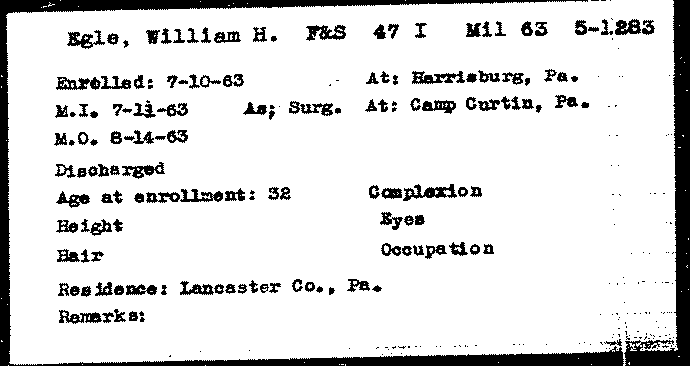
The index card of William H. Egle, M.D. shows that this soldier served with the 47th Pennsylvania Militia, Emergency of 1863 and not the 47th Pennsylvania Volunteer Infantry (Pennsylvania Civil War Veterans Card File, 1861-1866, courtesy of the Pennsylvania State Archives).

If you are able to find an index card for your ancestor in the Pennsylvania Civil War Veterans Index Card File, 1861-1866, pay particular attention to the top line of that card’s data. That data identifies the regiment number and company letter of his military unit. Then also look at the lines of data below. (Those lines of text note the start and dates of his service.) If you see dates of service indicating that your ancestor served between mid-April 1861 and the end of July 1861, you will realize that the regiment number in the top line was not “47.” This means that your ancestor performed what is known as “Three Months’ Service,” that he actually served with a different regiment during the first months of the war, and that he then may also have served with the 47th Pennsylvania Volunteer Infantry at a later date (because the 47th Pennsylvania Volunteer Infantry was not established until August 5, 1861). So, you’re one of those 47th Pennsylvania descendants who needs to look for two or more index cards in the Pennsylvania Civil War Veterans Index Card File, 1861-1866 — one for your ancestor’s “Three Month Service” and one for his service with the 47th Pennsylvania Volunteer Infantry (which was initially most likely a three-year term of enlistment, but may have been a one or two-year term, depending on how late he was enrolled for service).

HOWEVER, if you see dates of service indicating that your ancestor served at any point during 1863 — AND, if the top line indicates that his regiment was “47 I Mil 63” — this means that your ancestor DID NOT serve with the 47th Pennsylvania Volunteer Infantry. He served with the 47th Pennsylvania Militia, Emergency of 1863. (The soldiers who served with that militia group were also brave and honorable men, but they were part of a very different unit that had a very different mission. Learn more about that militia unit here.)

Regardless of whether or not your ancestor “performed Three Months’ Service” during the earliest part of the Civil War, if you see dates of service indicating that your ancestor served at any point between August 5, 1861 and early January 1866 — AND if the top line indicates that his regiment was “47 I” — then you can be reasonably confident that your ancestor actually did serve with the 47th Pennsylvania Volunteer Infantry (also known as the 47th Pennsylvania Volunteers or the 47th Pennsylvania Veteran Volunteers). So, you should make yourself a cup of coffee or tea, find a comfy chair, and spend some quality time exploring our website to learn more about the history-making 47th Pennsylvania Volunteer Infantry.

Best wishes for success with your research! Let us know what you learn about your ancestor!!


Sources:

  1. “Ancestry Pennsylvania,” in “Agencies: Pennsylvania Historical and Museum Commission,” in “Pennsylvania State Archives.” Harrisburg, Pennsylvania: Commonwealth of Pennsylvania, retrieved online October 25, 2025.
  2. Civil War Veterans Card File, 1861-1866” (resource description). Harrisburg, Pennsylvania: Pennsylvania State Archives, retrieved online October 25, 2025.
  3. Pennsylvania,” in Collections. Lehi, Utah: Ancestry.com Operations, Inc., 2021 (retrieved online October 25, 2025).