April 17, 1865: A Nation in Mourning Begins to Move Forward

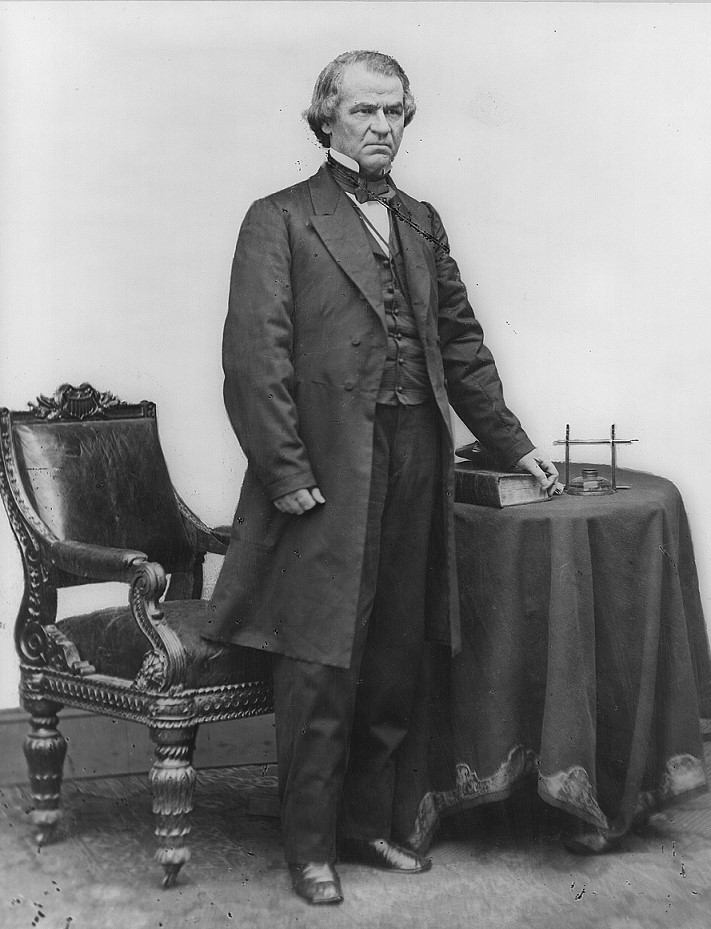
Andrew Johnson, photographed by Matthew Brady sometime between 1860 and 1875, was sworn in as president of the United States on April 15, 1865 (Matthew Brady Collection, U.S. Library of Congress, public domain).

Andrew Johnson, of Tennessee, is now President of the United States. The mysterious purposes of Divine Providence, far beyond the extremest perception of man’s mere judgment, in shaping the ends his wisdom deems to be wisest for our chastisement or in promoting our good, will chasten us while humbling us in the dust in the bereavement the People have sustained through that most wicked act, the bold and daring assassination of the President of the United States. Such an act of perfidy and atrocity has no parallel in the annals of deep and damning crime. The world will stand aghast in horror and detestation of the brutal murder, when the terrible tidings will have reached earth’s remotest extremity.

— The Constitutional Union newspaper, Philadelphia, Pennsylvania, Monday, April 17, 1865


That opening paragraph of Philadelphia’s Constitutional Union article, “The New President,” illustrates both the State of the Union and the state of mind of the average American during the first days after the assassination of President Abraham Lincoln—the collective and individual states of bewilderment and grief while looking back and reflecting on Lincoln’s life and death while also worrying about what the future held as a new leader was introduced to the nation.

That new leader—President Andrew Johnson (1808-1875), who had been quietly sworn in as the seventeenth president of the United States on the same day that Lincoln died—April 15, 1865—had worked his way up from an early-career job as mayor of a local town in Tennessee to a later-life election to the United States Senate, becoming the only senator from America’s Deep South to remain in service with the Senate when southern states began their secession from the Union in December 1860. Subsequently appointed by Lincoln as Tennessee’s military governor in March 1862, he had then been placed on the Republican ticket as Lincoln’s running mate during the pivotal presidential election of November 1864, and had been sworn in as the nation’s vice president in March 1865—just forty-two days before he succeeded Lincoln.

Like Lincoln and Lincoln’s Secretary of State William Seward, Andrew Johnson had also been the target of the assassination conspiracy that unfolded on April 14, 1865. But Johnson was luckier. George Atzerodt, the man who had been assigned to assassinate him, changed his mind as he reached Kirkwood House, the Pennsylvania Avenue hotel where Johnson lived, and, instead, left Washington, D.C., hoping to evade capture.

Shortly before sunrise, while still the sitting vice president, Johnson visited the unconscious, dying president at his bedside at the Petersen House, spent a few moments consoling Lincoln’s family, and then walked the short distance back to his residence to prepare for the possibility of being sworn in as the nation’s next president.

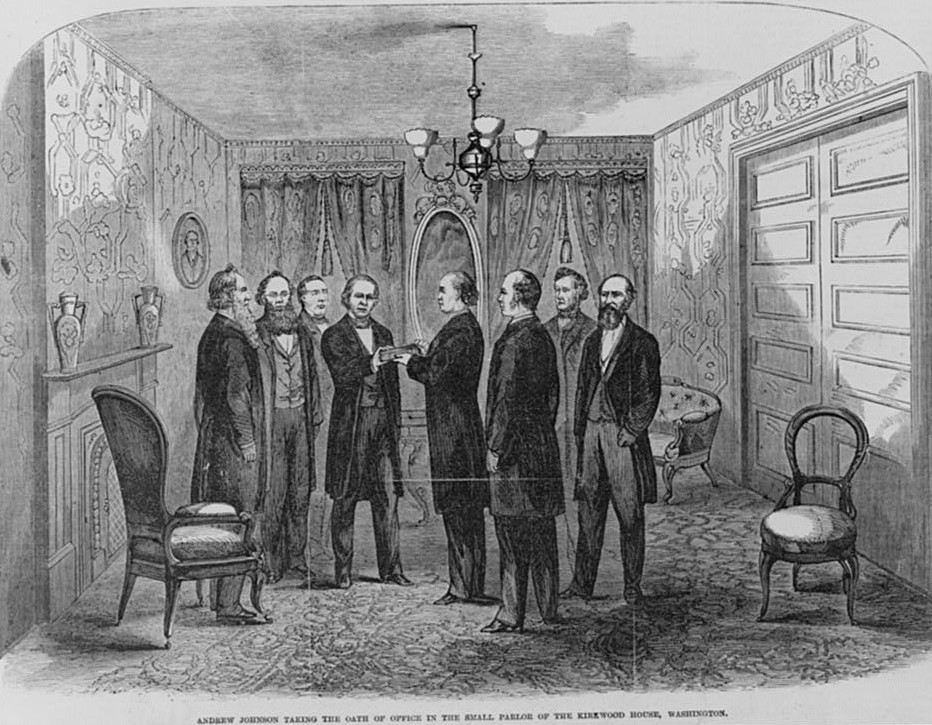
Depiction of Andrew Johnson being sworn as the seventeenth president of the United States, April 15, 1865. The ceremony, attended by only a handful of senior government officials, was a subdued affair due to the death earlier that day of President Lincoln. It was held at Kirkwood House in Washington, D.C., where Johnson had resided since his inauguration as vice president forty-two days earlier (Frank Leslie’s Illustrated Newspaper, January 6, 1866).

Less than four hours after Lincoln’s death, Johnson was administered the Oath of Office by Chief Justice Salmon Chase of the United States Supreme Court, as several members of Lincoln’s former cabinet and Johnson’s former fellow senators looked on:

I do solemnly swear (or affirm) that I will faithfully execute the Office of President of the United States, and will to the best of my Ability, preserve, protect and defend the Constitution of the United States.

After speaking those words, President Andrew Johnson told the small group:

The duties of the office are mine; I will perform them—the consequences are with God. Gentlemen, I shall lean upon you; I feel I shall need your support. I am deeply impressed with the solemnity of the occasion and the responsibilities of the duties of the office I am assuming.

It was at that moment, during the morning of April 15, 1865, that the 47th Pennsylvania Volunteer Infantry entered its tenure of Reconstruction Era service under a new commander-in-chief.

Members of the regiment began that new phase of duty with heavy hearts and hope for a brighter day, according to C Company’s Henry Wharton. Writing to the editor of his hometown newspaper, the Sunbury American, from an unidentified “Camp Near Washington, D.C.” on April 24, Wharton mused:

It is true we have sustained a great loss in the death of our much beloved President, but as it has pleased Divine Power to remove him from our midst, we should be thankful that He has given us such a great and determined man in his stead (Andrew Johnson) to drive on the machinery of the Government. It was a wise thing in the framers of the Constitution when they put in that clause, where if we lose our President the wheels of the Government can never be stopped. This is done by the Vice President, a plain unpretending citizen, on the death of the Chief Magistrate, stepping forward so to take the oath administered by the Chief Justice, and at once takes the responsibility of the office. No flourish of trumpets, nor convulsion of nations, but by the simple power vested in a Judge, a fellow citizen assumes power. This little fact proves that our Republic can never die.

I cannot describe to you the feeling of the army when the news reached us that Abraham Lincoln had been murdered by the assassin. I will not attempt it, for in doing so, I would work myself into a state to make me miserable. One thing – if the boys had gone into a fight that morning no prisoners would have been taken – no quarters given.

In Washington, the train containing the remains of our late President, passed us near the Annapolis Junction. There was [sic, were] nine cars heavily draped in mourning. Our train stopped on a siding. It was a solemn time. The men all uncovered in respect, and stout men wept as the last of him they loved, passed them, to be conveyed to its resting place. Along the whole route, houses were draped in mourning, and the American flag hung at half mast [sic, half-mast] with mourning. This showed the deep hold Mr. Lincoln had in the hearts of our people.


Sources:

  1. Andrew Johnson’s Inauguration.” Washington, D.C.: U.S. National Park Service, retrieved online April 17, 1865.
  2. Andrew Johnson: The 17th President of the United States.” Washington, D.C.: The White House, retrieved online April 17, 1865.
  3. “The New President” (announcement of President Andrew Johnson’s recent inauguration). Philadelphia, Pennsylvania: Constitutional Union, April 17, 1865.
  4. The Swearing in of Andrew Johnson.” Washington, D.C.: Joint Congressional Committee on Inaugural Ceremonies (JCCIC) and the United States Senate, retrieved online April 17, 1865.
  5. Wharton, Henry. Letters from the Sunbury Guards, 1861-1868. Sunbury, Pennsylvania: Sunbury American.


April 16, 1865: Stanton and Grant Inform the Union Army That President Lincoln Has Been Assassinated

Broadside showing the text of General Orders, No. 66 issued by U.S. Secretary of War Edwin Stanton and Lieutenant-General Ulysses S. Grant on 16 April 1865 to inform Union Army troops about the assassination of President Abraham Lincoln and provide instructions regarding the appropriate procedures for mourning (U.S. Library of Congress, public domain; click to enlarge).

General Orders, No. 66
War Department, Adjutant-General’s Office
Washington, April 16, 1865

The following order of the Secretary of War announces to the Armies of the United States the untimely and lamentable death of the illustrious ABRAHAM LINCOLN, late President of the United States:

WAR DEPARTMENT,
WASHINGTON, CITY, April 16, 1865

The distressing duty has devolved upon the Secretary of War to announce to the armies of the United States, that at twenty-two minutes after 7 o’clock, on the morning of Saturday, the 15th day of April, 1865, ABRAHAM LINCOLN, President of the United States, died of a mortal wound inflicted upon him by an assassin.

The Armies of the United States will share with their fellow-citizens the feelings of grief and horror inspired by this most atrocious murder of their great and beloved President and Commander-in-Chief, and with profound sorrow will mourn his death as a national calamity.

The Headquarters of every Department, Post, Station, Fort, and Arsenal will be draped in mourning for thirty days, and appropriate funeral honors will be paid by every Army, and in every Department, and at every Military Post, and at the Military Academy at West Point, to the memory of the late illustrious Chief Magistrate of the Nation and Commander-in-Chief of its Armies.

Lieutenant-General Grant will give the necessary instructions for carrying this order into effect.

EDWIN M. STANTON,
Secretary of War

On the day after the receipt of this order at the Headquarters of each Military Division, Department, Army, Post, Station, Fort, and Arsenal and at the Military Academy at West Point the troops and cadets will be paraded at 10 o’clock a. m. and the order read to them, after which all labors and operations for the day will cease and be suspended as far as practicable in a state of war.

The national flag will be displayed at half-staff.

At dawn of day thirteen guns will be fired, and afterwards at intervals of thirty minutes between the rising and setting sun a single gun, and at the close of the day a national salute of thirty-six guns.

The officers of the Armies of the United States will wear the badge of mourning on the left arm and on their swords and the colors of their commands and regiments will be put in mourning for the period of six months.

By command of Lieutenant-General Grant:
W. A. NICHOLS, Assistant Adjutant-General.


Sources:

  1. General Orders No. 66: War Department, Adjutant General’s Office, Washington, April 16, 1865.” Washington, D.C.: United States Library of Congress, retrieved online April 16, 2024.
  2. Stanton, Edwin McMasters (1814-1869) General Orders No. 66. New York, New York: The Gilder Lehrman Institute of American History, retrieved online April 16, 2024.
  3. Wooley, John and Gerhard Peters. Announcement to the Army of the Death of President Lincoln,” in “The American Presidency Project.” Santa Barbara, California: Department of Political Science, University of California, Santa Barbara, retrieved online April 16, 2024.


No Way to Treat a Widow: A Look at the U.S. Civil War Pension Battles Waged by Widows of Union Army Soldiers

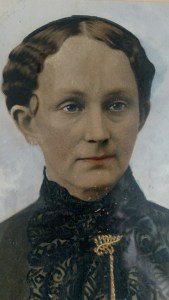
This image of Julia (Kuenher) Minnich, circa 1860s, is being presented here through the generosity of Chris Sapp and his family, and is being used with Mr. Sapp’s permission. This image may not be reproduced, repurposed, or shared with other websites without the permission of Chris Sapp.

Prove to us you were married to that soldier.

Prove to us that the children you claim to be his were actually fathered by that soldier.

Prove to us that you stayed faithful to that soldier by remaining a widow for the remainder of your life—depriving yourself of warmth, comfort and love, even though you were in your early twenties when he widowed you.

Those heartbreaking words exemplify the bureaucratic nightmares endured by many widows of Union Army soldiers as they battled with insensitive and sometimes surprisingly judgmental officials from the United States Department of the Interior to obtain U.S. Civil War Widows’ Pensions—the American Civil War-era form of general assistance that held the potential to help them keep rooves over the heads of their children as they struggled to adjust to their new roles as single mothers.

A closer look at the Civil War Widows’ Pension files of multiple women who were widowed when their soldier-husbands died while serving with the 47th Pennsylvania Volunteer Infantry between 1861 and 1865 reveals that the quests of many of these women were bewildering, exasperating, heartbreaking, and long.

A Widow, Mother and a Civil War Nurse

At the time of her husband’s death in combat, Julia Ann (Kuehner) Minnich was residing with the couple’s young son, George, at the family’s home in Allentown, Pennsylvania. Just two weeks after receiving word that her husband was dead, she was forced to put her grief aside, and move forward.

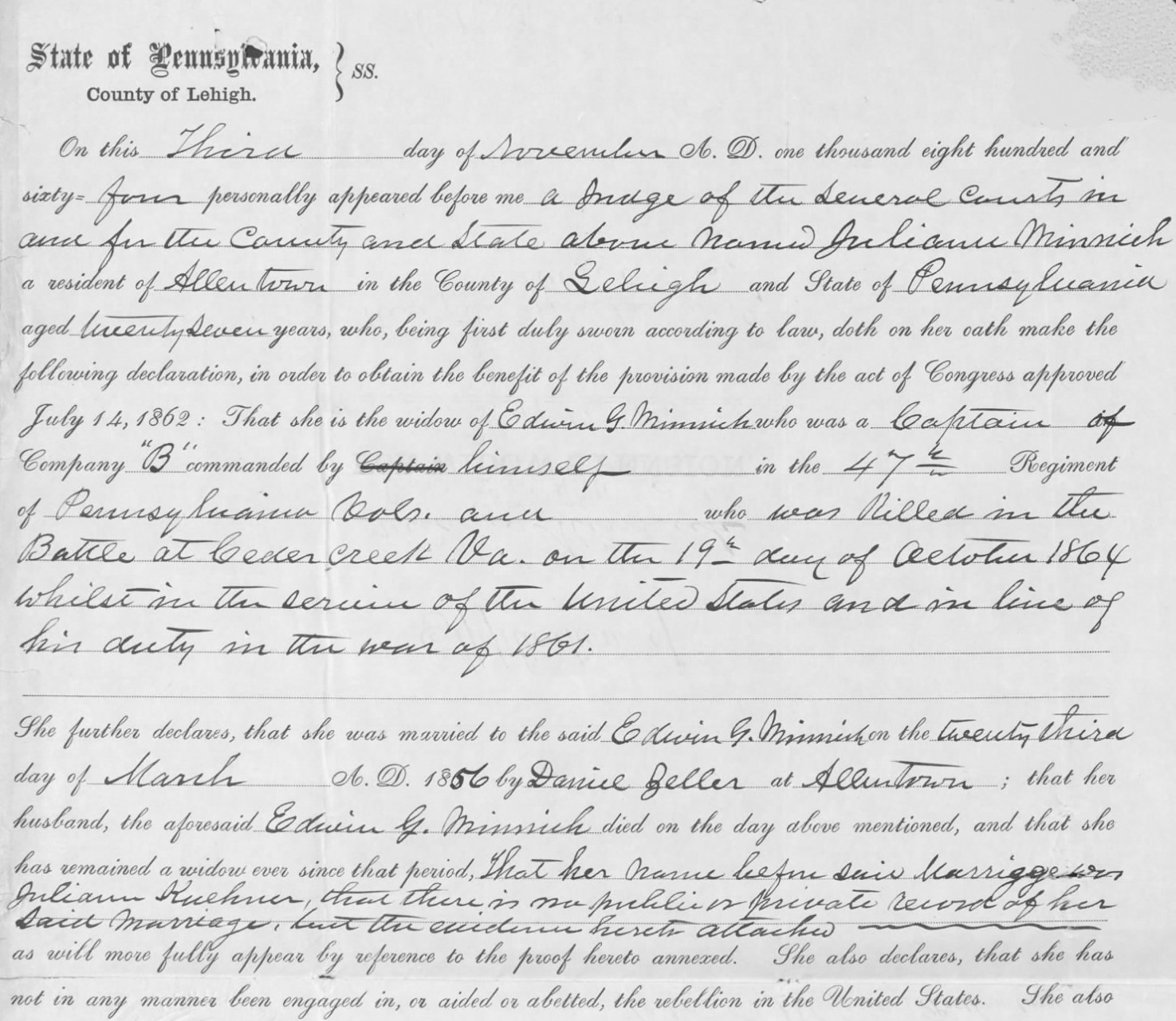
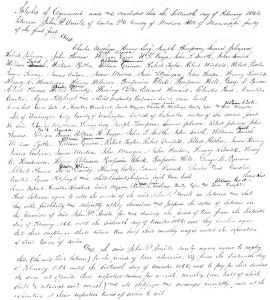
Appearing before a Lehigh County justice of the peace on November 3, 1864, Julia declared that she was the twenty-seven-year-old widow of Edwin G. Minnich, who had been the captain of Company B, 47th Pennsylvania Infantry when he was killed “whilst in the service of the United States and in the line of duty” during the Battle of Cedar Creek, Virginia on October 19, 1864.
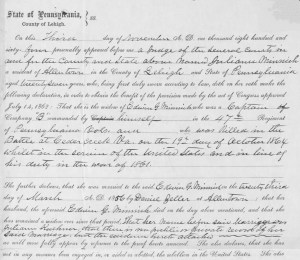
Juliann (Kuehner) Minnich’s 1864 Affidavit for Her Initial U.S. Civil War Widow’s Pension, p. 1 (U.S. Civil War Widows’ Pension Files, U.S. National Archives and Records Administration, public domain; click to enlarge).

Required by federal and state officials to prove that she had actually been married to Edwin Minnich—a distressing procedure that would have felt disrespectful to any grieving wife whose husband had been killed in combat, she subsequently furnished a series of affidavits which stated and re-stated that her maiden name before marriage was “Juliann Kuehner,” that she had been united in marriage with Edwin G. Minnich on March 23, 1856 by the Rev. Daniel Zeller at the German Reformed Church in Allentown, and that she had one surviving child from the marriage, George E. Minnich, who had been born on May 15, 1857 and was under the age of 16—making him eligible for U.S. Civil War Pension support. She also noted for the record that there had been “no public or private record” of her marriage.

The Rev. Daniel Zeller backed up her testimony by providing his own affidavit in which he attested to the date of her wedding ceremony, as did Minnich family friends John D. Lawall and William H. Blumer, the president of the First National Bank of Allentown and a brother to Jacob A. Blumer, a bank cashier who was later appointed as the guardian of Julia’s minor son, George. All four men swore under oath that they had known Julia and her husband for more than five years and confirmed that the statements she had made in her affidavits were true.

Despite this evidence, no decision was made regarding Julia’s eligibility for a pension award; as a result, she was forced to find other ways to support herself and her young son, including serving as a Civil War nurse for the Union Army.

Finally awarded a U.S. Civil War Widow’s Pension of twenty dollars per month on July 21, 1865, Julia (Kuehner) Minnich found herself in the position that many low-income women experience after struggling for months to make ends meet—having to build back her savings after digging herself out of a financial hole. In 1866, she made the difficult decision to send her son away to boarding school at the Home for Friendless Children for the City and County of Lancaster—one of the first privately run orphanages to receive funding from the Commonwealth of Pennsylvania to care for children who had lost one or both parents during the Civil War.

Seeking greater stability, she then remarried—to William Ruston, a native of England and employee of the Jordan Mill in Allentown—an act that would cause her greater hardship in the long run when her U.S. Civil War Widow’s Pension was cancelled by federal government officials due to her remarriage and again when her second husband deserted her during the mid-1870s.

Forced to settle for work as a household servant in Philadelphia by 1880, she then remarried for a third time in 1887—to Charles Magill, who then also widowed her two weeks before Christmas in 1889.
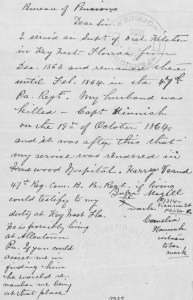
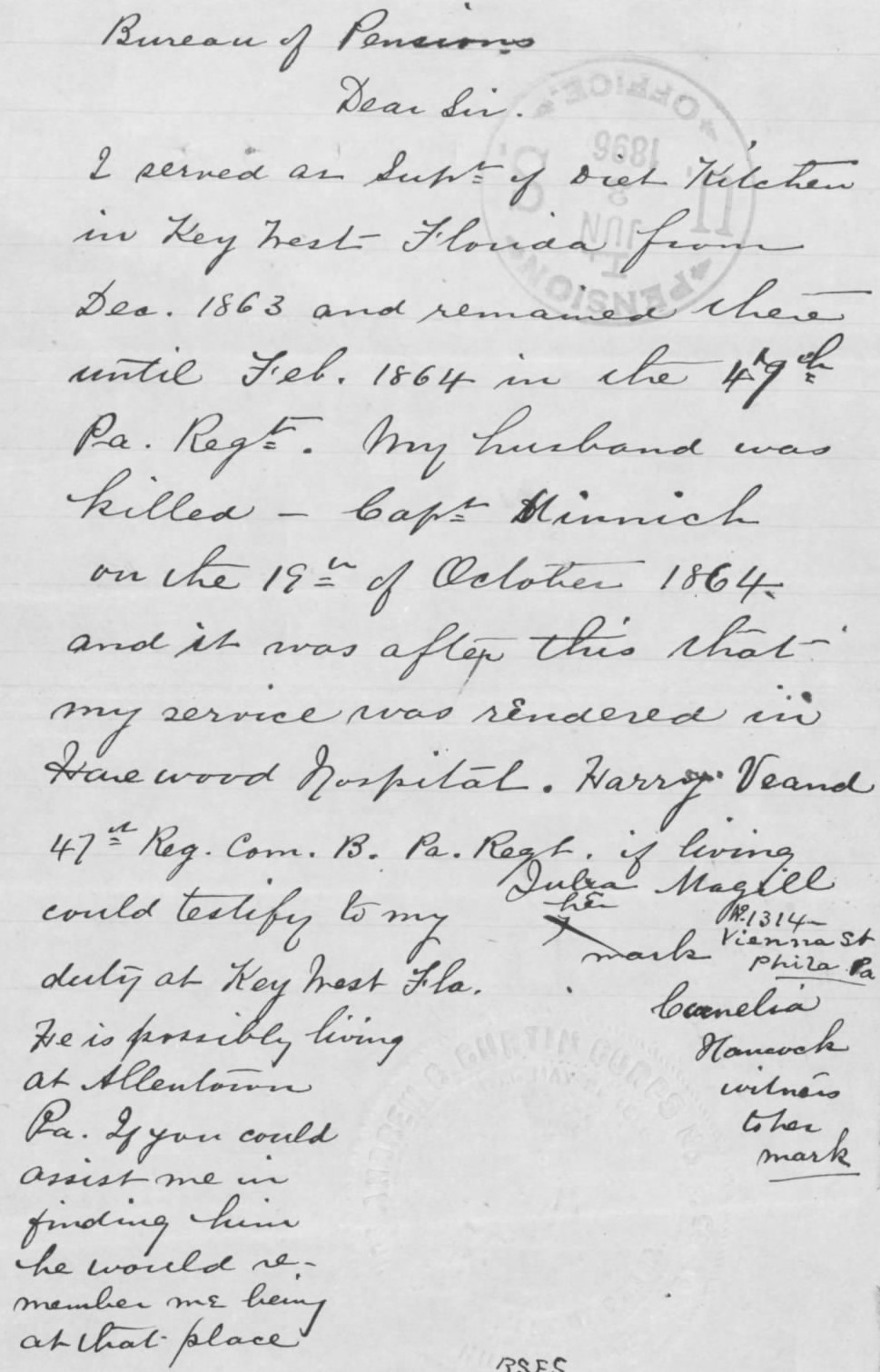
Julia (Minnich) Magill’s June 3, 1896 Attestation Re: her 1863-1864 U.S. Civil War Nursing Service at Fort Taylor in Key West, Florida (U.S. Civil War Nurses’ Pension Files, U.S. National Archives and Records Administration, public domain; click to enlarge).

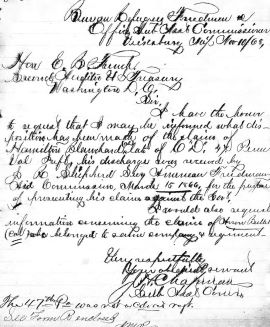
Soldiering on in the face of adversity, she felt a renewed sense of hope when the United States Congress approved a pension program for Civil War nurses on August 5, 1892. Applying for aid on March 4, 1896, she cited her 1865 nursing service with the Medical Department of the U.S. Volunteers at Harewood Hospital in Washington, D.C. She then added, via a letter penned on her behalf, that she had also performed nursing duties for the Union Army at Fort Taylor in Key West, Florida:

Bureau of Pensions
Dear Sir,

I served as Supt. Of Diet Kitchen in Key West – Florida from Dec. 1863 and remained there until Feb. 1864 in the 47th Pa. Regt. My husband was killed – Capt. Minnich on the 19th of October 1864 and it was after this that my service was rendered in Harewood Hospital. Harry Veand 47th Reg. Com. B Pa. Regt. if living could testify to my duty at Key West Fla. He is possibly living at Allentown Pa. If you could assist me in finding him he would remember me being at that place.

Julia Magill
her mark
No. 1314 Vienna St.
Phila Pa

Camelia Hancock [sic, possibly Cornelia Hancock]
witness to her mark

But that 1890s application process proved to be another difficult one. When her attorney advised her that pension officials had been unable to secure documentation of her nursing service, she began filing document after document with his help. But, although she was eventually gratified by an admission by federal officials that records documenting her nursing service actually did exist, she was still not awarded the nurse’s pension support that she so desperately needed and deserved.

It was only after the turn of the century—after changes were made to the federal pension system that allowed the resumption of assistance to remarried Civil War widows who had been stripped of their pensions—that her sacrifices and service to the nation were finally recognized with the restart of her Civil War Widow’s Pension payments of twenty dollars per month on April 5, 1901.

Sadly though, by this point in her life, Julia was in such dire straits, financially, that she had been forced to take a job as a cook at a hotel in Bethlehem, Pennsylvania for just two dollars per week. According to her son’s former guardian, during this period of her life, she “had no property, real or personal, and … had no means of support except her own daily labor.”

Researchers for 47th Pennsylvania Volunteers: One Civil War Regiment’s Story have not yet determined what ultimately happened to her.

A Widow Lacking English Language Proficiency
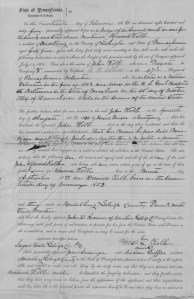
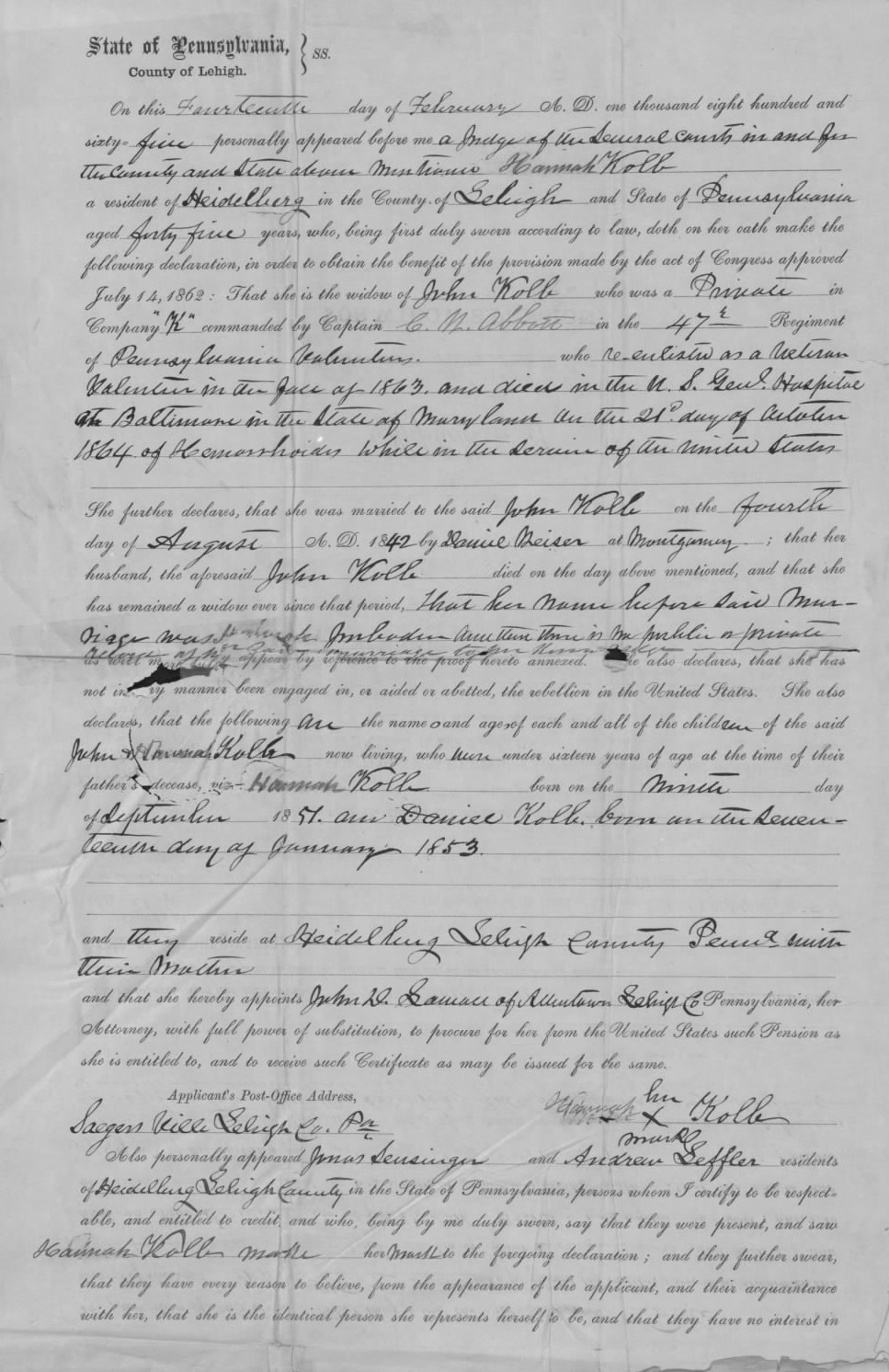
Hannah Kolb’s U.S. Civil War Widow’s Pension Claim (Hannah’s Affidavit, February 14, 1865, p. 1, U.S. Civil War Widows’ Pension Files, U.S. National Archives and Records Administration, public domain; click to enlarge).

Following the premature death of her husband, Hannah (Imborly) Kolb also quickly realized that she faced a challenging future as a widow, single mom and head of a household that was in a precarious financial state. Putting her own shock and grief to the side, she too sought help from the federal government. After submitting her U.S. Civil War Widow’s Pension claim on December 12, 1864, she was also forced to jump through multiple hoops before eventually gaining access to the pension support to which she was entitled.

Filing document after document with the court systems of both Lehigh and Montgomery counties, she appeared before justices of the peace and other county officials within those two counties to affirm that she had been married to, and had had children with, Private John Kolb, another 47th Pennsylvania Volunteer Infantryman who had died in 1864 during his American Civil War service on behalf of the United States.

During one of her earliest appearances, Hannah testified before a judge of the General Courts, Lehigh County on February 14, 1865 “to obtain the benefit of the provision made by the act of Congress approved July 14, 1862.” During that deposition, she stated that she was a forty-five-year-old resident of Saegersville in Heidelberg Township, Lehigh County who was “the widow of John Kolb who was a Private in Company ‘K’ commanded by Captain C. W. Abbott in the 47th Regiment of Pennsylvania Volunteers who re-enlisted as a Veteran Volunteer in the fall of 1863, and died in the U.S. Genl. Hospital at Baltimore in the State of Maryland on the 21st day of October 1864 of Hemorrhoides [sic] while in the service of the United States.”

She added that she had been “married to the said John Kolb on the fourth day of August 1842 by Daniel Weiser at Montgomery; that her husband, the aforesaid John Kolb, died on the day above mentioned, and that she [had] remained a widow ever since that period,” noting that “her name before said marriage was Hannah Imboden,” and affirmed that there was “no public or private record” available of their marriage. She then further attested to the birth of their children, Hannah, who had been born on September 9, 1852, and Daniel, who had been born on January 17, 1853—dates of birth that also made them eligible to receive U.S. Civil War Pension support because they were still both under the age of sixteen.

Still residing in Heidelberg Township in 1866, she appeared that year before another Lehigh County justice of the peace on December 8 to re-state for the record that she was the widow of Private John Kolb, who “died in the Military Service of the United States on the 21st day of October 1864 at the United States General Hospital Baltimore MD. while a private in company ‘K’ Commanded by Capt. C. W. Abbott 47th Regiment Penna. Vols. Commanded by Col. T. H. Good in the war of 1861,” and reiterated that she had “remained a widow” since the death of her husband. In addition, she repeated the vital statistics related to her marriage and births of her children, who were still living at home with her. Adding that she was filing her 1866 affidavit “for the purpose of obtaining the benefit of the provisions made by the Second Section of the Act of Congress increasing the pensions for widows and orphans approved July 25, 1866,” she also stated for the record that she was appointing C. W. Bennett, Esquire of Washington, D.C., as her attorney to represent her in ongoing proceedings related to her pension claim.
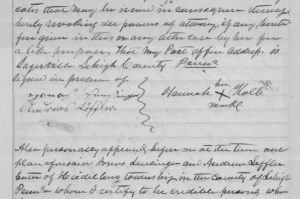
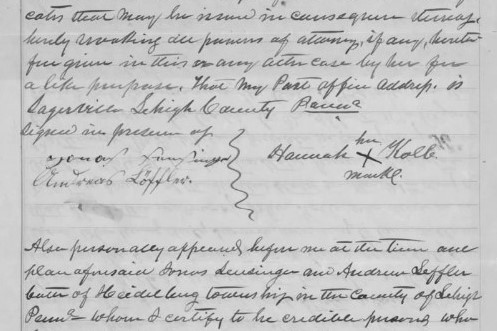
The mark made by Hannah Kolb, in lieu of her signature, on one of her U.S. Civil War Widow’s Pension claim affidavits (U.S. Civil War Widows’ Pension Files, U.S. National Archives and Records Administration, public domain; click to enlarge).

One of the notable features of Hannah Kolb’s pension paperwork (which is also a notable feature of many of the pension files of other women mentioned in this article) is that she “made her mark” on documents that she was required to sign, signaling that she could not read or write English well enough to complete the federal pension application forms and required supporting documentation by herself. Since a significant percentage of the men who enlisted with the 47th Pennsylvania Volunteer Infantry were German immigrants or Pennsylvania-born men of German heritage who still spoke German or Pennsylvania Dutch at home, it is reasonable to theorize that those times when she “made her mark” were an indication that she was most likely someone who also still only spoke German or Pennsylvania Dutch at home—a language barrier that put her at a disadvantage when trying to communicate with federal government officials who were far more proficient in English than they were in German.

Still battling to obtain the federal financial assistance she needed to keep her family housed and fed, Hannah next sought help from her husband’s former superior officer—Lieutenant-Colonel Charles W. Abbott. On August 31, 1867, Abbott submitted an affidavit to the county courts in which he attested that “John Kolb contracted a disease whilst in said service in the state of LA. [Louisiana] but however marched on with his said company [from] Richmond to Harrisonburg Va. and then from there he was sent to Jarvis U.S.A. G— Hospital at Baltimore Md. once Regt. reached Harrisonsburg [circa] 25th of Sept. 1864 and the said John Kolb reached that place [circa 27 September] and was the same day he reached there [was transferred to Jarvis Hospital].”
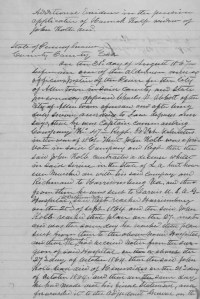
Lieutenant-Colonel Charles W. Abbott’s affidavit, filed in support of Hannah Kolb’s U.S. Civil War Widow’s Pension claim, p. 1, August 1867, p. 1, U.S. Civil War Widows’ Pension Files, U.S. National Archives and Records Administration, public domain; click to enlarge).

Abbott then went on to present additional facts related to John Kolb’s illness and death and made clear to court officials that his subordinate’s illness and death were both directly related to his military service with the 47th Pennsylvania.

Less than three months later, on November 18, 1867, Hannah appeared before Lehigh County Justice of the Peace Samuel J. Kistler for the purpose of “explaining discrepancies between the Original Application” for her pension and the paperwork she had subsequently filed for an increase in that pension. The justice asked questions regarding the birth date of her daughter, which she confirmed. Her attorney then explained that errors on previous paperwork were not Hannah’s fault but were due to the representation she had received previously.

On February 1, 1868, Hannah made her next pension claim-related appearance—this time before a Lehigh County alderman—to attest, yet again, that she was a resident of Heidelberg Township who was “the widow of John Kolb who was a private in Co. ‘K’ – 47 Regt. Pa. Vols. In the war of 1861,” reiterating that she “was married to John Kolb on the 4th day of August A.D. 1842.”

This time, however, her attorney came better prepared.

Stating for the record that her marriage data “appear[ed] by a family Record in an old prayer Book now in my possession (which said Record reads as follows…),” he handed court officials an affidavit that presented, verbatim, in German, the text from Hannah’s prayer book which contained the vital statistics of her marriage. During that round of testimony, Hannah and her attorney also corrected the spelling of her maiden name, stating that it was “Imborly” and not “Imboden,” as had been written by her previous legal representative. Once again, she made an “X” mark in lieu of her signature.

On March 13, 1879, she appeared before Lehigh County Justice of the Peace Samuel Kistler to file a new claim that would enable her to restart her pension, the monthly payments of which had fallen into “arrears” (unpaid) status. Once again, she marked an “X” on the legal document in lieu of her signature.

Throughout this long process, as she cleared one hurdle after another, sapping the emotional energy she needed to raise her children, Hannah sought the help of the minister who had married her, the physician who had delivered two of her children, and multiple neighbors—each of whom attested that she was, indeed, who she said she was—the widow of 47th Pennsylvania Volunteer Infantryman John Kolb and was, most definitely, the mother of his children.

Finally awarded a U.S. Civil War Widow’s Pension of eight dollars per month, she was then also granted an additional four dollars per month for the support of her minor children on February 19, 1868.

Researchers are still working to identify her year of death and burial location.

A Widow Pushed to the Brink of Madness
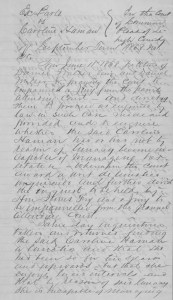
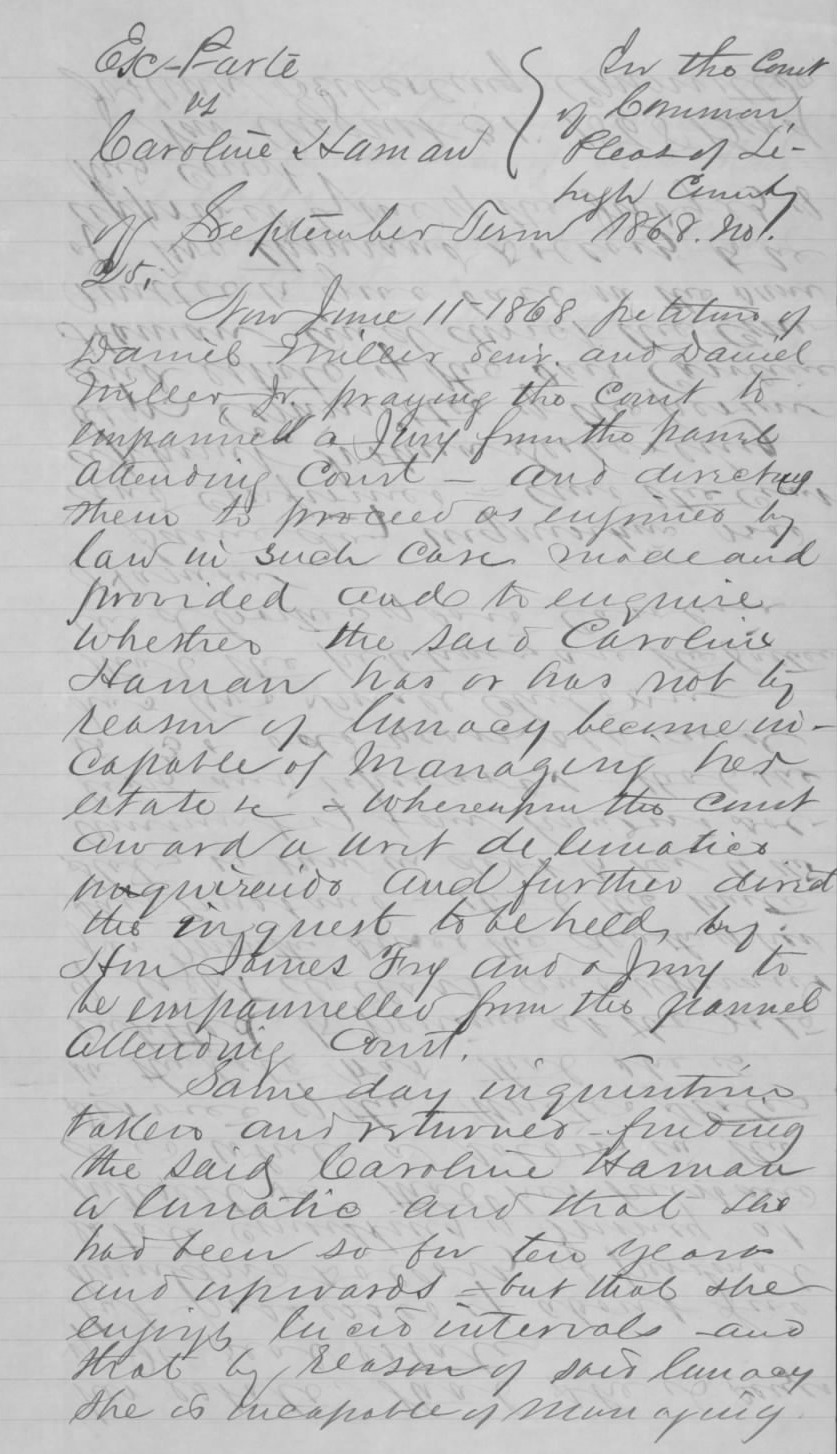
Excerpt from 1868 court petition by Caroline Herman’s father and brother to have her declared incompetent, p. 1 (U.S. Civil War Widows’ and Orphans’ Pension Files, U.S. National Archives and Records Administration, public domain; click to enlarge).

The mind of Caroline (Miller) Herman appears to have shattered after she received word that she had been widowed by her soldier-husband, Private William Herman, a member of the 47th Pennsylvania Volunteers’ F Company who had died from disease-related complications following the Union’s 1864 Red River Campaign across Louisiana. Struggling financially, her behavior became increasingly erratic after beginning her application process for a U.S. Civil War Widow’s Pension.

A resident of Weisenberg Township, Lehigh County during the fall of 1866, the thirty-two-year-old was in a such a precarious position by the end of that year that Joshua Seiberling, the attorney helping her with her pension application, felt compelled to pen an appeal to the U.S. Pension Bureau in which he begged federal officials to speed up their review due to the severe hardships that she and her children were suffering.

Although her widow’s pension was eventually approved by the bureau, the examiner handling her case initially refused to grant the additional orphans’ pension support she had requested (an extra two dollars per month for each of her two children). In later testimony before the court, Seiberling described how Caroline’s life had continued to unravel:

Just about that time [when she received word that she would be receiving a widow’s pension] she fell into the hands of Henry Croll from Berks Co. He controlled her so that she Refused to execute another paper for me. I dropped the matter there, after the Father and Brother of Caroline Harman [sic, Herman] called on me and desired me to permit them to present my name to our court as Committee of Caroline that they had all else prepared. I permitted them to do so and as you will see I was appointed but before the [proceedings] of said court was closed Croll persuaded Mrs. Harman to come and live with him and thereby got her out of our county, and out of our power. About the same time he was appointed by our court as guardian of the two minor children of said Mrs. Harman and for two of the minor children of William Shaffer, also a deceased soldier.

When the court realized that Henry Croll was “insolvent” and unable to pay the surety bond that all court-appointed guardians were expected to furnish, the court revoked his guardianship and appointed Seiberling in his place.

On June 11, 1868, Caroline’s father and brother—Daniel Miller, Sr. and Daniel Miller, Jr.—petitioned the Court of Common Pleas of Lehigh County, Pennsylvania, for help, stating that Caroline was so mentally ill that she was no longer capable of managing her finances or caring for her children. Asking the court to determine “whether the said Caroline Harman [sic, Herman] has or has not by reason of lunacy become incapable of managing her estate,” they also asked the court to order that a formal inquest be held.

Same day inquisition taken and returned finding the said Caroline Harman [sic, Herman] a lunatic and that she has been so for ten years and upwards—but that she enjoys lucid intervals—and that by reason of said lunacy she is incapable of managing her estate.

Her commitment was subsequently ordered by the court on September 25, 1868, and her children were enrolled by Seiberling in the Pennsylvania Soldiers’ Orphans’ School in Womelsdorf, Berks County, which was known at that time, and is still known as the Bethany Orphans’ Home. Although “provided for at the expense of the State,” according to Seiberling, Seiberling continued to seek pension support for Caroline and her children.

Nearly thirty-one years to the day on which her husband died, Caroline (Miller) Herman passed away in Reading, Berks County (on July 27, 1895).

A Widow Accused of Adultery
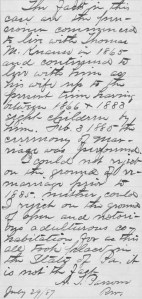
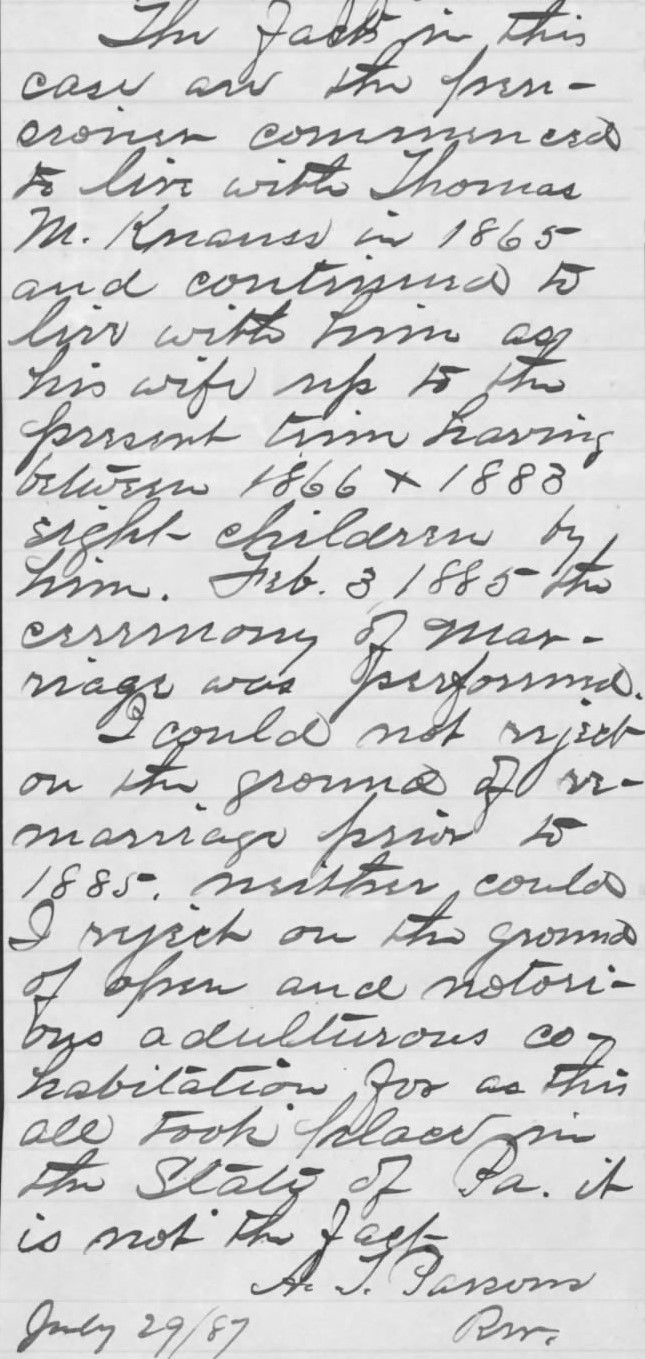
Accusation of adultery made against Pauline (Wilt Ritter) Knauss by U.S Pension Bureau official (Pauline Ritter’s U.S. Civil War Widow’s Pension File, Restoration Claim Rejection, 1887, p. 3, U.S. National Archives and Records Administration, public domain; click to enlarge).

Following the untimely death of her own husband, Pauline (Wilt) Ritter was just twenty-one years old when she became a single mother and head of her household. She filed for a U.S. Civil War Widow’s Pension on December 4, 1863, assisted by attorney Edwin Albright, while also fighting to keep her young daughter, Mary Jane Ritter, housed, clothed and fed.

According to her pension file, Pauline and her daughter were also residents of Allentown. Her eventual pension award—eight dollars per month—was made retroactive to October 30, 1863—the date of her soldier-husband’s death.

But she was young—and she had a long life ahead of her. So, after roughly fifteen years of living as the grieving widow of Corporal James Ritter, she made the decision to remarry in a ceremony that took place on February 3, 1885 at the home of her second husband, Thomas M. Knauss, a veteran of the Civil War who had served with Company L of the 1st Pennsylvania Cavalry.

Before she took this step, however, she made an unusual decision for a widow—to stop cashing her pension checks. She did so, according to testimony that she provided for government officials, because she had been told by several neighbors that she was not entitled to receive Civil War Pension support because she had “a suitor.”

Several years later, when she realized that she had been misled, she filed a claim with the U.S. Pension Bureau, on July 26, 1886, to be compensated for the back payments that she believed had rightly been due her since 1879. She then filed an additional affidavit, on November 30, in which she explained to those same officials, that she “did not draw her pension during the period from June 4, 1879 to Feb. 3, 1885 because during said period her present husband was her suitor or beau and she was told that because of said fact she could no longer draw her pension, and that being so informed by her neighbors she failed to execute her vouchers and never made inquiry of the pension office … taking it for granted that she could no longer get her pension.”

An ugly dispute then ensued.

After the initial Pension Bureau examiner who was assigned to review Pauline’s claim rejected that claim, another bureau staffer who had been assigned to re-review her claim made a determination that the first examiner’s work wasn’t up to par. On July 27, 1887, that Board of Re-Review staffer issued this finding: “The Reviewer gives no grounds for rejecting this claim for restoration.”

Two days later, on July 29, A. T. Parsons wrote this shocking letter to the Chief of the Board of Reviewers:

The Reviewer does give grounds for rejecting claim for restoration; if a pensioner has overdrawn all pension to which she is entitled is not grounds for rejection of a claim for restoration, and sufficient ground for such action I fail to understand what can be more effective.

The facts in this case are the pensioner commenced to live with Thomas M. Knauss in 1865 and continued to live with him as his wife up to the present time having between 1866 and 1883 eight children by him. Feb. 3 1885 the ceremony of marriage was performed.

I could not reject on the grounds of remarriage prior to 1885. Neither could I reject on the ground of open and notorious adulterous cohabitation for as this all took place in the State of Pa. it is not the fact.

Parsons made these incendiary claims, despite attestations by Pauline’s longtime neighbors and son-in-law that she had not remarried since the death of her husband until she wed Thomas Knauss in February 1885.

That first Pension Bureau claims reviewer appears to have been in possession of contradictory evidence, however; according to the federal census enumerator who visited her home in 1870, Pauline was already using the Knauss surname that year and was describing herself as the wife of Thomas Knauss and the mother of Mary Ritter (aged nine), George (aged four) and Robert (aged two). By the time of the 1880 federal census, her household with Thomas Knauss had grown to include four more children: daughters Emma (aged nine), Agnes (aged eight), Effy (aged three), and Minerva (aged one).

Meanwhile, Mary Jane—her daughter from her first marriage—had begun her own married life with her new husband. (Sadly, Mary Jane’s life would prove to be a short one. She passed away in Allentown while just in her early forties.)

Despite the growing controversy and heartache, Pauline soldiered on, waging a war of words and paper with the U.S. Pension Bureau while also continuing to make a life in Allentown with her second husband and their large family. But then he also widowed her.

Having survived the deaths of her first husband (1863), her second husband (1900), her daughter from her first marriage, Mary Jane (1902), and two of her sons from her second marriage—George W. Knauss in 1918, and John Ellsworth Knauss, who had died suddenly from an abscessed appendix on February 11, 1922, Pauline (Wilt Ritter) Knauss died in Allentown from mesenteric thrombosis (a blood clot in one of her intestinal arteries) on February 27, 1922. Subsequently buried beside her second husband, she was survived by her daughter from her second marriage, Goldie Viola (Knauss) Landis (1883-1960).

The Often Heartbreaking Evidence

To view the U.S. Civil War Widow’s Pension records of these and other widows of 47th Pennsylvania Volunteer Infantrymen who navigated the federal pension application process during and after the American Civil War, visit these pages of our project’s website:


Sources:

  1. Caroline Herman, Daniel Miller (father), Catharine Welder (mother), and William Herman, in Death Records (Zion Evangelical Lutheran Church, Maxatawny Township, Berks County, Pennsylvania, 1895). Berks County, Pennsylvania: Zion Evangelical Lutheran Church.
  2. Charles Magill, in Coroner’s Certificates. Philadelphia, Pennsylvania: Office of the Coroner, December 10, 1889.
  3. Charles Magill and “Julian Ruston” [sic], in Certificate of Marriage. Camden, New Jersey: St. Paul’s Protestant Episcopal Church, January 18, 1887.
  4. Edwin Minnich, Juliann (Kuehner) Minnich, and George Minnich, in U.S. Civil War Widows’ Pension Files. Washington, D.C.: U.S. National Archives and Records Administration, 1865-1901.
  5. Harman, Carolina [sic], in Death Records (City of Reading, Berks County, Pennsylvania, July 27, 1895). Reading, Pennsylvania: Clerk of the Orphans’ Court, Berks County.
  6. Harman [sic], William and Caroline, in U.S. Civil War Widows’ Pension Files. Washington, D.C.: U.S. National Archives and Records Administration.
  7. Herman, Caroline, widow of William Herman, in U.S. Census, Longswamp Township, Berks County, Pennsylvania, 1890). Washington, D.C.: U.S. National Archives and Records Administration.
  8. “Judge Endlich’s Opinion” (ruling on the sanity of Carolina Herman). Reading, Pennsylvania: Reading Times, September 30, 1890.
  9. Julia Magill, in “Prominent Army Nurses,” in “The National Association of Army Nurses of the Civil War.” Washington, D.C.: The Evening Times, Wednesday, October 8, 1902.
  10. Knauss, Thomas, Pauline, George, and Robert, and Ritter, Mary, in U.S. Census (Allentown, First Ward, Lehigh County, Pennsylvania, 1870). Washington, D.C.: U.S. National Archives and Records Administration.
  11. Knauss, Thomas, Pauline, George, Robert, Emma, Agnes, Effy, and Minerva, in U.S. Census (Allentown, Lehigh County, Pennsylvania, 1880). Washington, D.C.: U.S. National Archives and Records Administration.
  12. Pauline Knauss, in Death Certificates (file no.: 15329, registered no.: 219; date of death: February 27, 1922). Harrisburg, Pennsylvania: Commonwealth of Pennsylvania, Department of Health, Bureau of Vital Statistics.
  13. Kolb, Hannah and William, in U.S. Census (Heidelberg Township, Lehigh County, Pennsylvania, 1870; note: shown as living next door to/near Hiram Kolb, who was Hannah’s son and William’s brother); Washington, D.C.: U.S. National Archives and Records Administration.
  14. Kolb, John and Hannah, in U.S. Civil War Widows’ Pension Files. Washington, D.C.: U.S. National Archives and Records Administration.
  15. “Minick, Julia A. (nee) Megill, Julia A.” [sic], in U.S. Civil War Pension General Index Cards, 1896. Washington, D.C.: U.S. National Archives and Records Administration.
  16. Minnich, Capt. Edwin G. and Mrs. Julia (Kuehner) Minnich (images and military paperwork). Pennsylvania: Personal Collection of Chris Sapp.
  17. Minnich, George E., in New Jersey State Census (1895). Trenton, New Jersey: New Jersey Department of State.
  18. Ritter, James and Paulina, in U.S. Civil War Widows’ Pension Files. Washington, D.C.: U.S. National Archives and Records Administration.
  19. “Todte Körper Heimgebracht” (“Dead Bodies Brought Home”). Allentown, Pennsylvania: Der Lecha Caunty Patriot, February 2, 1864.
 

Black History Month: Paving the Way for the Integration of the Union Army

Abraham Lincoln in New York City on Monday morning, February 27, 1860, several hours before he delivered his Cooper Union address (Matthew Brady, U.S. Library of Congress, public domain).

Acutely aware that Union military casualty figures had continued to climb as the American Civil War moved into and through its second year, President Abraham Lincoln and his senior military advisors soon realized that more drastic measures would need to be taken—and far more volunteer soldiers would need to be recruited if they were to ever begin healing their divided nation.

During the summer of 1862, President Lincoln kicked off that series of drastic measures by issuing his July 2 call for volunteers in which he pressed state governors of Connecticut, Maine, New Hampshire, Illinois, Indiana, Maryland, Michigan, Minnesota, Missouri, New Jersey, New York, Ohio, Pennsylvania, Vermont, Virginia, Tennessee, and Wisconsin, as well as the president of the Military Board of Kentucky, to furnish an additional three hundred thousand men for military service. That action was followed by the passage, two weeks later, of the Militia Act of 1862 on July 17, through which the U.S. Congress empowered Lincoln to “make all necessary rules and regulations to provide for enrolling the militia,” and also authorized state and federal military units in Union-held territories to recruit and enroll enslaved and free Black men to fill labor-related jobs.

Starting on July 17, according to section twelve of that legislation, President Lincoln was “authorized to receive into the service of the United States, for the purpose of constructing intrenchments, or performing camp service or any other labor, or any military or naval service for which they may be found competent, persons of African descent.” In addition, the new law’s next section specified that “when any man or boy of African descent, who by the laws of any State shall owe service or labor to any person who, during the present rebellion, has levied war or has borne arms against the United States, or adhered to their enemies by giving them aid and comfort, shall render any such service as is provided for in this act, he, his mother and his wife and children, shall forever thereafter be free, any law, usage, or custom whatsoever to the contrary notwithstanding: Provided, That the mother, wife and children of such man or boy of African descent shall not be made free by the operation of this act except where such mother, wife or children owe service or labor to some person who, during the present rebellion, has borne arms against the United States or adhered to their enemies by giving them aid and comfort.”

The subsequent two sections of this act then spelled out how the newly enlisted Black soldiers would be compensated for their work, stating that “the expenses incurred to carry this act into effect shall be paid out of the general appropriation for the army and volunteers,” and that “all persons who have been or shall be hereafter enrolled in the service of the United States under this act shall receive the pay and rations now allowed by law to soldiers, according to their respective grades: Provided, That persons of African descent, who under this law shall be employed, shall receive ten dollars per month and one ration, three dollars of which monthly pay may be in clothing.”

Adding More Teeth to the Fight’s Bite

That same day (July 17 1862), the U.S. Congress then also passed the Confiscation Act of 1862, proclaiming that “every person who shall hereafter commit the crime of treason against the United States, and shall be adjudged guilty thereof, shall suffer death, and all his slaves, if any, shall be declared and made free.”

A subsequent push that same summer by President Lincoln and his senior military advisors to state leaders to furnish an additional three hundred thousand men—for a revised total of six hundred thousand new volunteer soldiers—resulted in the enlistment of more than half a million men—with an additional ninety thousand troops added to Union rosters through the implementation of a nationwide draft.

Freeing More Enslaved Men and Enabling Them to Enlist

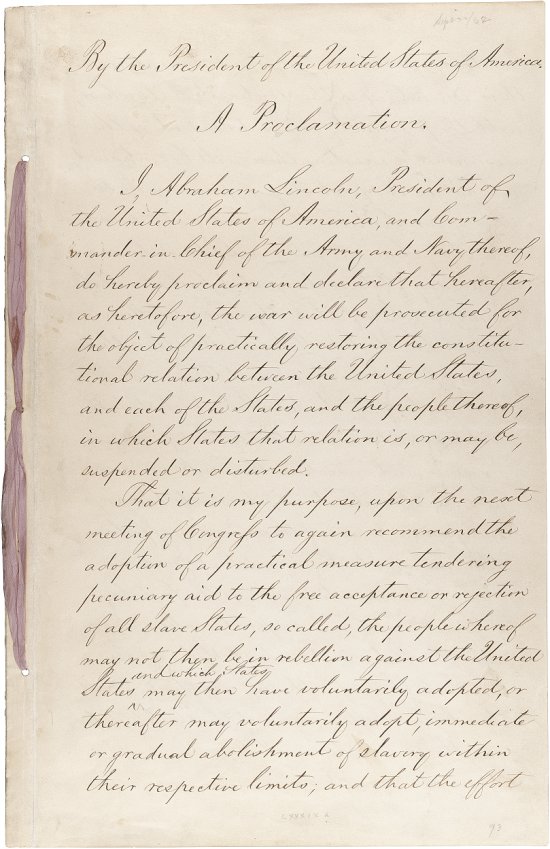
Page one of the Preliminary Emancipation Proclamation issued by President Abraham Lincoln, September 22, 1862 (U.S. National Archives and Records Administration, public domain; click to enlarge).

President Lincoln followed up his blistering recruitment drive of the summer of 1862 by adding even more support for his plan to increase federal troop strength by issuing his Preliminary Emancipation Proclamation on September 22, 1862. Giving a preview of what he intended to do in 1863 if Confederate States officials failed to cease hostilities and rejoin the Union, he began paving the road for Union regiments to rescue and recruit larger numbers of enslaved men:

By the President of the United States of America.
A Proclamation.

I, Abraham Lincoln, President of the United States of America, and Commander-in-Chief of the Army and Navy thereof, do hereby proclaim and declare that hereafter, as heretofore, the war will be prosecuted for the object of practically restoring the constitutional relation between the United States, and each of the States, and the people thereof, in which States that relation is, or may be, suspended or disturbed.

That it is my purpose, upon the next meeting of Congress to again recommend the adoption of a practical measure tendering pecuniary aid to the free acceptance or rejection of all slave States, so called, the people whereof may not then be in rebellion against the United States and which States may then have voluntarily adopted, or thereafter may voluntarily adopt, immediate or gradual abolishment of slavery within their respective limits; and that the effort to colonize persons of African descent, with their consent, upon this continent, or elsewhere, with the previously obtained consent of the Governments existing there, will be continued.

That on the first day of January in the year of our Lord, one thousand eight hundred and sixty-three, all persons held as slaves within any State, or designated part of a State, the people whereof shall then be in rebellion against the United States shall be then, thenceforward, and forever free; and the executive government of the United States, including the military and naval authority thereof, will recognize and maintain the freedom of such persons, and will do no act or acts to repress such persons, or any of them, in any efforts they may make for their actual freedom.

That the executive will, on the first day of January aforesaid, by proclamation, designate the States, and part of States, if any, in which the people thereof respectively, shall then be in rebellion against the United States; and the fact that any State, or the people thereof shall, on that day be, in good faith represented in the Congress of the United States, by members chosen thereto, at elections wherein a majority of the qualified voters of such State shall have participated, shall, in the absence of strong countervailing testimony, be deemed conclusive evidence that such State and the people thereof, are not then in rebellion against the United States.

That attention is hereby called to an Act of Congress entitled ‘An Act to make an additional Article of War’ approved March 13, 1862, and which act is in the words and figure following:

‘Be it enacted by the Senate and House of Representatives of the United States of America in Congress assembled, That hereafter the following shall be promulgated as an additional article of war for the government of the army of the United States, and shall be obeyed and observed as such:

Article-All officers or persons in the military or naval service of the United States are prohibited from employing any of the forces under their respective commands for the purpose of returning fugitives from service or labor, who may have escaped from any persons to whom such service or labor is claimed to be due, and any officer who shall be found guilty by a court martial of violating this article shall be dismissed from the service.

Sec.2. And be it further enacted, That this act shall take effect from and after its passage.

Also to the ninth and tenth sections of an act entitled ‘An Act to suppress Insurrection, to punish Treason and Rebellion, to seize and confiscate property of rebels, and for other purposes,’ approved July 17, 1862, and which sections are in the words and figures following:

Sec.9. And be it further enacted, That all slaves of persons who shall hereafter be engaged in rebellion against the government of the United States, or who shall in any way give aid or comfort thereto, escaping from such persons and taking refuge within the lines of the army; and all slaves captured from such persons or deserted by them and coming under the control of the government of the United States; and all slaves of such persons found on (or) being within any place occupied by rebel forces and afterwards occupied by the forces of the United States, shall be deemed captives of war, and shall be forever free of their servitude and not again held as slaves.

Sec.10. And be it further enacted, That no slave escaping into any State, Territory, or the District of Columbia, from any other State, shall be delivered up, or in any way impeded or hindered of his liberty, except for crime, or some offence against the laws, unless the person claiming said fugitive shall first make oath that the person to whom the labor or service of such fugitive is alleged to be due is his lawful owner, and has not borne arms against the United States in the present rebellion, nor in any way given aid and comfort thereto; and no person engaged in the military or naval service of the United States shall, under any pretence whatever, assume to decide on the validity of the claim of any person to the service or labor of any other person, or surrender up any such person to the claimant, on pain of being dismissed from the service.’

And I do hereby enjoin upon and order all persons engaged in the military and naval service of the United States to observe, obey, and enforce, within their respective spheres of service, the act, and sections above recited.

And the executive will in due time recommend that all citizens of the United States who shall have remained loyal thereto throughout the rebellion, shall (upon the restoration of the constitutional relation between the United States, and their respective States, and people, if that relation shall have been suspended or disturbed) be compensated for all losses by acts of the United States, including the loss of slaves.

In witness whereof, I have hereunto set my hand, and caused the seal of the United States to be affixed.

Done at the City of Washington this twenty-second day of September, in the year of our Lord, one thousand, eight hundred and sixty-two, and of the Independence of the United States the eighty seventh.

[Signed:] Abraham Lincoln
By the President

[Signed:] William H. Seward
Secretary of State

Page one of the Emancipation Proclamation issued by U.S. President Abraham Lincoln, January 1, 1863 (U.S. National Archives and Records Administration, public domain; click to enlarge).

When those state officials failed to comply, President Lincoln officially issued the Emancipation Proclamation on January 1, 1863:

By the President of the United States of America:
A Proclamation.

Whereas, on the twenty-second day of September, in the year of our Lord one thousand eight hundred and sixty-two, a proclamation was issued by the President of the United States, containing, among other things, the following, to wit:

‘That on the first day of January, in the year of our Lord one thousand eight hundred and sixty-three, all persons held as slaves within any State or designated part of a State, the people whereof shall then be in rebellion against the United States, shall be then, thenceforward, and forever free; and the Executive Government of the United States, including the military and naval authority thereof, will recognize and maintain the freedom of such persons, and will do no act or acts to repress such persons, or any of them, in any efforts they may make for their actual freedom.

That the Executive will, on the first day of January aforesaid, by proclamation, designate the States and parts of States, if any, in which the people thereof, respectively, shall then be in rebellion against the United States; and the fact that any State, or the people thereof, shall on that day be, in good faith, represented in the Congress of the United States by members chosen thereto at elections wherein a majority of the qualified voters of such State shall have participated, shall, in the absence of strong countervailing testimony, be deemed conclusive evidence that such State, and the people thereof, are not then in rebellion against the United States.’

Now, therefore I, Abraham Lincoln, President of the United States, by virtue of the power in me vested as Commander-in-Chief, of the Army and Navy of the United States in time of actual armed rebellion against the authority and government of the United States, and as a fit and necessary war measure for suppressing said rebellion, do, on this first day of January, in the year of our Lord one thousand eight hundred and sixty-three, and in accordance with my purpose so to do publicly proclaimed for the full period of one hundred days, from the day first above mentioned, order and designate as the States and parts of States wherein the people thereof respectively, are this day in rebellion against the United States, the following, to wit:

Arkansas, Texas, Louisiana, (except the Parishes of St. Bernard, Plaquemines, Jefferson, St. John, St. Charles, St. James Ascension, Assumption, Terrebonne, Lafourche, St. Mary, St. Martin, and Orleans, including the City of New Orleans) Mississippi, Alabama, Florida, Georgia, South Carolina, North Carolina, and Virginia, (except the forty-eight counties designated as West Virginia, and also the counties of Berkley, Accomac, Northampton, Elizabeth City, York, Princess Ann, and Norfolk, including the cities of Norfolk and Portsmouth[)], and which excepted parts, are for the present, left precisely as if this proclamation were not issued.

And by virtue of the power, and for the purpose aforesaid, I do order and declare that all persons held as slaves within said designated States, and parts of States, are, and henceforward shall be free; and that the Executive government of the United States, including the military and naval authorities thereof, will recognize and maintain the freedom of said persons.

And I hereby enjoin upon the people so declared to be free to abstain from all violence, unless in necessary self-defence; and I recommend to them that, in all cases when allowed, they labor faithfully for reasonable wages.

And I further declare and make known, that such persons of suitable condition, will be received into the armed service of the United States to garrison forts, positions, stations, and other places, and to man vessels of all sorts in said service.

And upon this act, sincerely believed to be an act of justice, warranted by the Constitution, upon military necessity, I invoke the considerate judgment of mankind, and the gracious favor of Almighty God.

In witness whereof, I have hereunto set my hand and caused the seal of the United States to be affixed.

Done at the City of Washington, this first day of January, in the year of our Lord one thousand eight hundred and sixty three, and of the Independence of the United States of America the eighty-seventh.

By the President: ABRAHAM LINCOLN

WILLIAM H. SEWARD, Secretary of State.

Adding More Teeth to the Fight’s Bite

This Civil War-era recruiting flyer documents the service of the 47th Pennsylvania Volunteer Infantry at Forts Taylor and Jefferson, Florida, under the leadership of Colonel Tilghman Good, as well as the premium and bounty added to standard pay to inspire more men to enlist (public domain).

Just over a month later, in February 1863, the United States Congress passed U.S. Senate Bill 511 (“An act for enrolling and calling out the national forces, and for other purposes”). Better known as the Enrollment Act of 1863 or “Conscription Act,” it was signed into law by President Lincoln on 3 March 1863, and gave state officials throughout the north the ability to draft men to serve whenever those officials were unable to meet their federal troop quotas through volunteer recruitment drives. It also allowed draftees to recruit others to muster in and serve for them.

Whereas there now exist in the United States an insurrection and rebellion against the authority thereof, and it is, under the Constitution of the United States, the duty of the government to suppress insurrection and rebellion, to guarantee to each State a republican form of government, and to preserve the public tranquility; and whereas, for these high purposes, a military force is indispensable, to raise and support which all persons ought willingly to contribute; and whereas no service can be more praiseworthy and honorable than that which is rendered for the maintenance of the Constitution and Union, and the consequent preservation of free government: Therefore—

Be it enacted by the Senate and House of Representatives of the United States of America in Congress assembled, That all able-bodied male citizens of the United States, and persons of foreign birth who shall have declared on oath their intention to become citizens under and in pursuance of the laws thereof, between the ages of twenty and forty-five years, except as hereinafter excepted, are hereby declared to constitute the national forces, and shall be liable to perform military duty in the service of the United States when called out by the President for that purpose.

SEC 2. And be it further enacted, That the following persons be, and they are hereby, excepted and exempt from the provisions of this act, and shall not be liable to military duty under the same, to wit: Such as are rejected as physically or mentally unfit for the service; also, First the Vice-President of the United States, the judges of the various courts of the United States, the heads of the various executive departments of the government, and the governors of the several States. Second, the only son liable to military duty of a widow dependent upon his labor for support. Third, the only son of aged or infirm parent or parents dependent upon his labor for support. Fourth, where there are two or more sons of aged or infirm parents subject to draft, the father, or, if he be dead, the mother, may elect which son shall be exempt. Fifth, the only brother of children not twelve years old, having neither father nor mother dependent upon his labor for support. Sixth, the father of motherless children under twelve years of age dependent upon his labor for support. Seventh, where there are a father and sons in the same family and household, and two of them are in the military service of the United States as non-commissioned officers, musicians, or privates, the residue of such family and household, not exceeding two, shall be exempt. And no persons but such as are herein excepted shall be exempt: Provided, however, That no person who has been convicted of any felony shall be enrolled or permitted to serve in said forces.

SEC. 3. And be it further enacted, That the national forces of the United States not now in the military service, enrolled under this act, shall be divided into two classes: the first of which shall comprise all persons subject to do military duty between the ages of twenty and thirty-five years, and all unmarried persons subject to do military duty above the age of thirty-five and under the age of forty-five; the second class shall comprise all other persons subject to do military duty, and they shall not, in any district, be called into the service of the United States until those of the first class hall have been called.

SEC. 4. And be it further enacted, That, for greater convenience in enrolling, calling out, and organizing the national forces, and for the arrest of deserters and spies of the enemy, the United States shall constitute one or more, as the President shall direct, and each congressional district of the respective states, as fixed by a law of the state next preceding the enrolment, shall constitute one: Provided, That in states which have not by their laws been divided into two or more congressional districts, the President of the United States shall divide the same into so many enrolment districts as he may deem fit and convenient.

SEC 8. And be it further enacted, That in each of said districts there shall be a board of enrolment, to be composed of the provost-marshal, as president, and two other persons, to be appointed by the President of the United States, one of whom shall be a licensed and practising physician and surgeon.

SEC. 10. And be it further enacted, That the enrolment of each class shall be made separately, and shall only embrace those whose ages shall be on the first day of July thereafter between twenty and forty-five years.

SEC. 11. And be it further enacted, That all persons thus enrolled shall be subject, for two years after the first day of July succeeding the enrolment, to be called into the military service of the United States, and to continue in service during the present rebellion, not, however, exceeding the term of three years; and when called into service shall be placed on the same footing, in all respects, as volunteers for three years, or during the war, including advance pay and bounty as now provided by law.

SEC. 12. And be it further enacted, That whenever it may be necessary to call out the national forces for military service, the President is hereby authorized to assign to each district the number of men to be furnished by said district; and thereupon the enrolling board shall, under the direction of the President, make a draft of the required number, and fifty per cent, in addition, and shall make an exact and complete roll of the names of the person so drawn, and of the order in which they are drawn, so that the first drawn may stand first upon the said roll and the second may stand second, and so on; and the persons so drawn shall be notified of the same within ten days thereafter, by a written or printed notice, to be served personally or by leaving a copy at the last place of residence, requiring them to appear at a designated rendezvous to report for duty. In assigning to the districts the number of men to be furnished therefrom, the President shall take into consideration the number of volunteers and militia furnished by and from the several states in which said districts are situated, and the period of their service since the commencement of the present rebellion, and shall so make said assignment as to equalize the numbers among the districts of the several states, considering and allowing for the numbers already furnished as aforesaid and the time of their service.

SEC. 13. And be it further enacted, That any person drafted and notified to appear as aforesaid, may, on or before the day fixed for his appearance, furnish an acceptable substitute to take his place in the draft; or he may pay to such person as the Secretary of War may authorize to receive it, such sum, not exceeding three hundred dollars, as the Secretary may determine, for the procuration of such substitute; which sum shall be fixed at a uniform rate by a general order made at the time of ordering a draft for any state or territory; and thereupon such person so furnishing the substitute, or paying the money, shall be discharged from further liability under that draft. And any person failing to report after due service of notice, as herein prescribed, without furnishing a substitute, or paying the required sum therefor, shall be deemed a deserter, and shall be arrested by the provost-marshal and sent to the nearest military post for trial by court-martial, unless, upon proper showing that he is not liable to do military duty, the board of enrolment shall relive him from the draft.

SEC. 16. And be it further enacted, That as soon as the required number of able-bodied men liable to do military duty shall be obtained from the list of those drafted, the remainder shall be discharged; and all drafted persons reporting at the place of rendezvous shall be allowed travelling pay from their places of residence; and all persons discharged at the place of rendezvous shall be allowed travelling pay to their places of residence; and all expenses connected with the enrolment and draft, including subsistence while at the rendezvous, shall be paid form the appropriation for enrolling and drafting, under such regulations as the President of the United States shall prescribe; and all expenses connected with the arrest and return of deserters to their regiments, or such other duties as the provost-marshal shall be called upon to perform, shall be paid from the appropriation for arresting deserters, under such regulations as the President of the United States shall prescribe: Provided, The provost-marshals shall in no case receive commutation for transportation or for fuel and quarters, but only for forage, when not furnished by the government, together with actual expenses of postage, stationery, and clerk hire authorized by the provost-marshal-general.

SEC. 17. And be it further enacted, That any person enrolled and drafted according to the provisions of this act who shall furnish an acceptable substitute, shall thereupon receive from the board of enrolment a certificate of discharge from such draft, which shall exempt him from military duty during the time for which he was drafted; and such substitute shall be entitled to the same pay and allowances provided by law as if he had been originally drafted into the service of the United States.

SEC. 18. And be it further enacted, That such of the volunteers and militia now in the service of the United States as may reenlist to serve one year, unless sooner discharged, after the expiration of their present term of service, shall be entitled to a bounty of fifty dollars, one half of which to be paid upon such reenlistment, and the balance at the expiration of the term of reenlistment; and such as may reenlist to serve for two years, unless sooner discharged, after the expiration of their present term of enlistment, shall receive, upon such reenlistment, twenty-five dollars of the one hundred dollars bounty for enlistment provided by the fifth section of the act approved twenty-second of July, eighteen hundred and sixty-one, entitled “An act to authorize the employment of volunteers to aid in enforcing the laws and protecting public property.”

SEC. 25. And be it further enacted, That if any person shall resist any draft of men enrolled under this act into the service of the United States, or shall counsel or aid any person to resist any such draft; or shall counsel or aid any person to resist any such draft; or shall assault or obstruct any officer in making such draft, or in the performance of any service in relation thereto; or shall counsel any person to assault or obstruct any such officer, or shall counsel any drafted men not to appear at the place of rendezvous, or wilfully dissuade them from the performance of military duty as required by law, such person shall be subject to summary arrest by the provost-marshal, and shall be forthwith delivered to the civil authorities, and upon conviction thereof, be punished by a fine not exceeding five hundred dollars, or by imprisonment not exceeding two years, or by both of said punishments.

SEC. 33. And be it further enacted, That the President of the United States is hereby authorized and empowered, during the present rebellion, to call forth the national forces, by draft, in the manner provided for in this act.

Those combined actions by President Lincoln and the U.S. Congress enabled the officers of the 47th Pennsylvania Volunteer Infantry to enroll the first four of nine formerly enslaved men in their regiment in early October 1862 while it was stationed in Beaufort, South Carolina—and then enabled the regiment’s officers to enroll five more formerly enslaved men in early April 1864 while the 47th Pennsylvania Volunteers were stationed in Natchitoches, Louisiana.

Initially assigned the rank of “Under-Cook,” and entered on regimental muster rolls below the names of the men who had enrolled at the rank of private, several of these nine formerly enslaved men were later awarded the rank of private, according to subsequent regimental records. After completing their respective terms of enlistment, all but one were honorably discharged during the fall of 1865 with several also being awarded U.S. Civil War Pensions in later life. Their life stories are now being documented on the website, Faces of the 47th: Freedmen of the 47th Pennsylvania Volunteer Infantry.”

Next: Black History Month: The Authorization, Duties and Pay of “Under-cooks


Sources:

  1. An Act for enrolling and calling out the national Forces, and for other Purposes,” Congressional Record. 37th Cong. 3d. Sess. Ch. 74, 75. 1863. March 3, 1863.” New Haven, Connecticut: Gilder Lehrman Center for the Study of Slavery, Resistance, and Abolition at the Whitney and Betty MacMillan Center for International and Area Studies at Yale University, retrieved online February 1, 2024.
  2. Emancipation Proclamation, January 1, 1863,” in “Presidential Proclamations, 1791-1991” (Record Group 11: General Records of the United States Government). Washington, D.C.: U.S. National Archives and Records Administration.
  3. Preliminary Emancipation Proclamation, September 22, 1862,” in “Presidential Proclamation 93” (Record Group 11, vault, box 2: General Records of the U.S. Government). Washington, D.C.: U.S. National Archives and Records Administration.
  4. The Conscription Act.; Judge Cadwallader’s Opinion Establishing Its Constitutionality.” New York, New York: The New York Times, September 13, 1863.
  5. The Law of the Draft.; Important Circulars Issued by the Provost-Marshal General. No Escape After a Name is Enrolled. Penalties of a Failure to Respond The Treatment of Deserters. The Question of Exemptions.” New York, New York: The New York Times, July 19, 1863.


Attempts to End Chattel Slavery Across America: President Abraham Lincoln Issues the Emancipation Proclamation (January 1, 1863)

President Abraham Lincoln signing the Emancipation Proclamation in 1862 (W.E. Winner, painter, J. Serz, engraver, circa 1864; public domain, U.S. Library of Congress).

“I do order and declare that all persons held as slaves within said designated States, and parts of States, are, and henceforward shall be free; and that the Executive government of the United States, including the military and naval authorities thereof, will recognize and maintain the freedom of said persons.”

—President Abraham Lincoln, “Emancipation Proclamation,” January 1, 1863


With those words, President Abraham Lincoln and the United States of America took another step forward in the nation’s long process of ending the brutal practice of chattel slavery in America. Issued on January 1, 1863, “the Emancipation Proclamation was limited in many ways,” according to historians at the U.S. National Archives. “It applied only to states that had seceded from the United States, leaving slavery untouched in the loyal border states. It also expressly exempted parts of the Confederacy (the Southern secessionist states) that had already come under Northern control. Most important, the freedom it promised depended upon Union (United States) military victory.”

Although the Emancipation Proclamation did not end slavery in the nation, it captured the hearts and imagination of millions of Americans and fundamentally transformed the character of the war. After January 1, 1863, every advance of federal troops expanded the domain of freedom. Moreover, the Proclamation announced the acceptance of black men into the Union Army and Navy, enabling the liberated to become liberators. By the end of the war, almost 200,000 black soldiers and sailors had fought for the Union and freedom.

From the first days of the Civil War, slaves had acted to secure their own liberty. The Emancipation Proclamation confirmed their insistence that the war for the Union must become a war for freedom. It added moral force to the Union cause and strengthened the Union both militarily and politically. As a milestone along the road to slavery’s final destruction, the Emancipation Proclamation has assumed a place among the great documents of human freedom.

By the time that President Lincoln had issued this proclamation, the 47th Pennsylvania Volunteer Infantry had already become an integrated regiment, having enrolled four formerly enslaved Black men in October and November 1862 while the regiment was assigned to occupation duties with the United States Army’s Tenth Corps (X Corps) in Beaufort, South Carolina—a process the regiment would continue during its tenure as the only regiment from Pennsylvania to participate in the Union’s 1864 Red River Campaign across Louisiana—an integration process that was supported by President Lincoln’s Emancipation Proclamation of 1863.

Page one of the Emancipation Proclamation issued by U.S. President Abraham Lincoln, January 1, 1863 (U.S. National Archives and Records Administration, public domain; click to enlarge).

The Full Text of the Emancipation Proclamation

January 1, 1863
By the President of the United States of America:
A Proclamation.

Whereas, on the twenty-second day of September, in the year of our Lord one thousand eight hundred and sixty-two, a proclamation was issued by the President of the United States, containing, among other things, the following, to wit:

That on the first day of January, in the year of our Lord one thousand eight hundred and sixty-three, all persons held as slaves within any State or designated part of a State, the people whereof shall then be in rebellion against the United States, shall be then, thenceforward, and forever free; and the Executive Government of the United States, including the military and naval authority thereof, will recognize and maintain the freedom of such persons, and will do no act or acts to repress such persons, or any of them, in any efforts they may make for their actual freedom.

‘That the Executive will, on the first day of January aforesaid, by proclamation, designate the States and parts of States, if any, in which the people thereof, respectively, shall then be in rebellion against the United States; and the fact that any State, or the people thereof, shall on that day be, in good faith, represented in the Congress of the United States by members chosen thereto at elections wherein a majority of the qualified voters of such State shall have participated, shall, in the absence of strong countervailing testimony, be deemed conclusive evidence that such State, and the people thereof, are not then in rebellion against the United States.’

Now, therefore I, Abraham Lincoln, President of the United States, by virtue of the power in me vested as Commander-in-Chief, of the Army and Navy of the United States in time of actual armed rebellion against the authority and government of the United States, and as a fit and necessary war measure for suppressing said rebellion, do, on this first day of January, in the year of our Lord one thousand eight hundred and sixty-three, and in accordance with my purpose so to do publicly proclaimed for the full period of one hundred days, from the day first above mentioned, order and designate as the States and parts of States wherein the people thereof respectively, are this day in rebellion against the United States, the following, to wit:

Arkansas, Texas, Louisiana, (except the Parishes of St. Bernard, Plaquemines, Jefferson, St. John, St. Charles, St. James Ascension, Assumption, Terrebonne, Lafourche, St. Mary, St. Martin, and Orleans, including the City of New Orleans) Mississippi, Alabama, Florida, Georgia, South Carolina, North Carolina, and Virginia, (except the forty-eight counties designated as West Virginia, and also the counties of Berkley, Accomac, Northampton, Elizabeth City, York, Princess Ann, and Norfolk, including the cities of Norfolk and Portsmouth[)], and which excepted parts, are for the present, left precisely as if this proclamation were not issued.

And by virtue of the power, and for the purpose aforesaid, I do order and declare that all persons held as slaves within said designated States, and parts of States, are, and henceforward shall be free; and that the Executive government of the United States, including the military and naval authorities thereof, will recognize and maintain the freedom of said persons.

And I hereby enjoin upon the people so declared to be free to abstain from all violence, unless in necessary self-defence; and I recommend to them that, in all cases when allowed, they labor faithfully for reasonable wages.

And I further declare and make known, that such persons of suitable condition, will be received into the armed service of the United States to garrison forts, positions, stations, and other places, and to man vessels of all sorts in said service.

And upon this act, sincerely believed to be an act of justice, warranted by the Constitution, upon military necessity, I invoke the considerate judgment of mankind, and the gracious favor of Almighty God.

In witness whereof, I have hereunto set my hand and caused the seal of the United States to be affixed.

Done at the City of Washington, this first day of January, in the year of our Lord one thousand eight hundred and sixty three, and of the Independence of the United States of America the eighty-seventh.

By the President: ABRAHAM LINCOLN

WILLIAM H. SEWARD, Secretary of State.


Sources:

  1. Establishing Slavery in the Lowcountry,” in “African Passages, Lowcountry Adaptations.” Charleston, South Carolina: Lowcountry Digital History Initiative, retrieved online January 1, 2024.
  2. “Franklin, John Hope. The Emancipation Proclamation: An Act of Justice,” in Prologue Magazine, Summer 1993, vol. 25, no. 2. Washington, D.C.: U.S. National Archives and Records Administration.
  3. Snyder, Laurie. “Freedmen from South Carolina,” in “Freedmen of the 47th Pennsylvania Volunteer Infantry.” 47th Pennsylvania Volunteers: One Civil War Regiment’s Story, 2023.
  4. The Emancipation Proclamation.” Washington, D.C.: U.S. National Archives and Records Administration, May 5, 2017.
  5. Transcript of the Proclamation (transcription of the Emancipation Proclamation).” Washington, D.C.: U.S. National Archives and Records Administration, May 5, 2017.


Abraham Lincoln’s Road to the Presidency

Abraham Lincoln in New York City on Monday morning, February 27, 1860, several hours before he delivered his Cooper Union address (Matthew Brady, U.S. Library of Congress, public domain).

During the almost quarter of a century that he resided in his adopted hometown of Springfield, Illinois, Abraham Lincoln was transformed from an average, young adult, who was embarking upon a crucial phase of his life’s journey in early nineteenth-century America, into the lawyer-turned-civic leader that would place his feet on the path to the White House.

A product of rural America, his formative years had been spent in Kentucky and southern Indiana. A resident of New Salem, Illinois in 1831, he was just twenty-five when he was elected to his first term in the Illinois State Legislature and began to study law more seriously. By 1837, he was a solicitor who lived and practiced law in Springfield. Married to Mary Todd five years later, he built his life with her at their Eighth and Jackson street-corner home, while also carving out a name for himself as a skilled and trustworthy legal scholar and successful courtroom attorney. Avidly interested in politics, he also became an active member of the Whig Party.

Persuaded by his wife and political associates to run for federal office in 1846, he was elected to the U.S. House of Representatives in that same year. His initial service was short-lived, however; he had pledged to serve only one, two-year term, hoping to secure a more stable, federal government job in the administration of U.S. President Zachary Taylor. But when that opportunity fell through, he returned home to Springfield and threw himself back into the practice of law.

* Note: During his tenure with the U.S. House of Representatives, Abraham Lincoln co-wrote a bill with Congressman Joshua R. Giddings that he hoped would end the practice of slavery in the District of Columbia. Lacking support from his fellow Whig Party members, however, he subsequently chose to withdraw that bill.

By the mid-1850s, Abraham Lincoln was realizing that his conscience would no longer permit him to sit on the sidelines, politically, when there was so much in his country that needed to be changed. Incensed by the passage of the Kansas-Nebraska Act in 1854, which paved the way for the brutal practice of chattel slavery to spread like a wave of toxic sludge over newly-forming states, Lincoln left the Whigs behind to join a new, more forward-thinking political organization—the Republican Party.

Four years later, he mounted a campaign against U.S. Senator Stephen A. Douglas. Although he lost that race, he would forever become linked to that Democrat as a result of their famously intense Lincoln-Douglas Debates, a forum that gave him a nationwide name recognition so high that it enabled him to become President of the United States.

Chosen by the Republican Party in 1860 to be its candidate for the highest office in the nation, Abraham Lincoln was elected as President on November 6, 1860.

How That Crucial Election Day Unfolded

Hand-sewn banner used in Abraham Lincoln’s 1860 campaign for President of the United States (Lincoln Home, U.S. National Park Service, public domain).

According to Jamie Malanowski, a former editor at Time magazine:

“There were no surprises: the long-settled Yankees in Maine and New Hampshire and pioneering Germans of Michigan and Wisconsin delivered the expected victories. And then came news from Illinois: ‘We have stood fine. Victory has come.’ And then from Indiana: ‘Indiana over twenty thousand for honest Old Abe.’

The throngs in the streets cheered every report, every step towards the electoral college number, but news from the big Eastern states was coming painfully slowly…. The advisers paced the floorboards, jumping at every eruption of the rapid clacking of Morse’s machine….

It wasn’t until after 10 that reports of victory in Pennsylvania arrived in the form a telegram from the canny vote-counter Simon Cameron, the political boss of the Keystone State, who tucked within his state’s tallies joyfully positive news about New York: ‘Hon. Abe Lincoln, Penna seventy thousand for you. New York safe. Glory enough.’

Not until 2 a.m. did official results from New York arrive … the one-time rail-splitter won by 50,000 votes.”

The Aftermath

“As the votes were counted, Lincoln had about 40 percent of the popular vote and 180 electoral votes, compared with 133 for his opponents combined,” according to historians at the National Constitution Center, but events in America’s Deep South “cast a pall over the upcoming Electoral College voting process”:

“What if the southern states refused to take part in the Electoral College? Or what if a unified front to avoid secession could convince enough ‘faithless electors’ to switch sides to derail the election?

And what if the southern states boycotted the Electoral College?”

Lincoln scholar Harold Holzer sums up what was in the minds of many Americans in the days following the 1860 presidential election:

“If these states did not participate in the traditional process, could the Electoral College proceed? What would constitute a quorum? No one, least of all Lincoln, knew the answers to these vexing questions.”

Those questions were finally answered when those southern states agreed to participate in the Electoral College process of the United States.

“But there was a greater than normal military presence on Capitol Hill” to ensure that the peaceful transfer of power would take place that certification day, according to historians at the National Constitution Center. And it did.

Abraham Lincoln’s election was officially certified by the U.S. Congress on February 15, 1861.


Sources:

  1. Donald, David Herbert. Lincoln. New York, New York: Simon & Schuster, 1996.
  2. Foner, Eric. The Fiery Trial: Abraham Lincoln and American Slavery. New York, New York: W. W. Norton & Company, Inc., 2010.
  3. Harris, William C. Lincoln’s Rise to the Presidency. Lawrence, Kansas: University Press of Kansas, 2007.
  4. “Lawyer to President,” in “Virtual Museum Exhibit.” Springfield, Illinois: Lincoln Home National Historic Site, retrieved online November 6, 2023.
  5. Malanowski, Jamie. “Lincoln Wins. Now What,” in “Disunion.” New York, New York: The New York Times, November 7, 2010.
  6. Oates, Stephen B. “Abraham Lincoln 1861–1865,” in C. Vann Woodward, ed. Responses of the Presidents to Charges of Misconduct. New York City: Dell Publishing Co., Inc. pp. 111–123, 1974.
  7. Oates, Stephen B. With Malice Toward None: A Life of Abraham Lincoln. New York, New York: Harper Collins, 2011.
  8. On This Day, Abraham Lincoln Is Elected President.” Philadelphia, Pennsylvania: National Constitution Center, November 6, 2023.
  9. President Abraham Lincoln.” Washington, D.C.: U.S. Library of Congress, retrieved online November 6, 2023.

Uniforms and Insignia of the 47th Pennsylvania Volunteer Infantry

Captain Richard A. Graeffe, Company A, 47th Pennsylvania Volunteers, circa 1862 (public domain).

Upon mustering in at Camp Curtin in Harrisburg, Pennsylvania in August and early September of 1861, the men who had enrolled for military service with the 47th Pennsylvania Volunteer Infantry were assigned to their respective companies and issued standardized uniforms—the same style of dark blue, wool uniforms that were worn by the regular officers or enlisted members of the U.S. Army. The uniform of Captain Richard Graeffe (pictured at right) shows the typical details of a company commander’s uniform with shoulder bars, hat and sword.

Initially equipped with Mississippi rifles, the 47th Pennsylvania Volunteers were then provided with basic training in light infantry tactics through mid-September. Presented with the regiment’s First State Color on September 20, 1861 by Pennsylvania Governor Andrew Curtin, they were subsequently marched to Harrisburg’s train station, and were transported to Washington, D.C., where they participated in the first of multiple duty assignments that would take them from the Eastern Theater of the American Civil War to the Western and Trans-Mississippi theaters between early 1862 and March of 1864 before being transported back to the Eastern Theater for the fateful and tide-turning Shenandoah Valley Campaign, which unfolded during the summer and fall of 1864.

Army of the United States, Corps Badges, 1865 (U.S. Library of Congress, public domain; click to enlarge).

Along the way, the 47th Pennsylvania Volunteer Infantry would be attached to the:

  • U.S. Army of the Potomac (“Mr. Lincoln’s Army”) in the Eastern Theater (1861);
  • U.S. Army’s Tenth Corps (X Corps) in the Western Theater (Occupying force duties and battles in Florida and South Carolina, early winter 1862 through early winter 1864);
  • U.S. Army’s Nineteenth Corps (XIX Corps) in the Trans-Mississippi Theater (Red River Campaign, spring and early summer 1864);
  • U.S. Army of the Shenandoah, Nineteenth Corps (XIX Corps) in the Eastern Theater (Battle of Cool Spring and Sheridan’s 1864 Shenandoah Valley Campaign, summer and fall 1864);
  • U.S. Army of the Shenandoah, Nineteenth Corps (XIX Corps) in the Eastern Theater (Defense of Washington, D.C., late winter 1864 through the immediate aftermath of the assassination of President Abraham Lincoln in 1865);
  • Selected units of the U.S. Army’s former Nineteenth Corps (XIX Corps (Reconstruction duties in Savannah, Georgia and Charleston, South Carolina, June through late December 1865); and
  • Camp Cadwalader (final discharge, early January 1866).
Each time that the 47th Pennsylvania Volunteers were attached to a different Union Army corps, they were issued specific insignia that were then sewn onto their uniforms. The chart pictured above shows the different insignia that were worn by the various Union corps’ members.

Learn More About the 47th Pennsylvania Volunteers

First State Color, 47th Regiment, Pennsylvania Volunteer Infantry (presented to the regiment by Pennsylvania Governor Andrew Curtin, 20 September 1861; retired 11 May 1865, public domain).

Largely forgotten by mainstream historians, the 47th Pennsylvania Volunteer Infantry was a Union Army unit which served for nearly the entire duration of the American Civil War. Formed by the fruit of the Great Keystone State’s small towns and cities, the regiment was born on August 5, 1861, when its founder, Tilghman H. Good, received permission from Pennsylvania Governor Andrew Gregg Curtin to form an entirely new regiment in response to President Abraham Lincoln’s call for additional volunteers to help preserve American’s Union. It ended its service during the early months of the nation’s Reconstruction Era, officially mustering out at Charleston, South Carolina on Christmas Day in 1865, its members receiving their final discharge papers at Camp Cadwalader in Philadelphia, Pennsylvania in early January of 1866.

Along the way, the 47th Pennsylvania made history, becoming an integrated regiment in 1862 and the only regiment from Pennsylvania to participate in the Union’s 1864 Red River Campaign across Louisiana. Its members also distinguished themselves in battle, repeatedly, including during Union General Philip Sheridan’s Shenandoah Valley Campaign, which unfolded between August and December of 1864.

Learn more about key moments in this regiment’s history by reading the following posts:

1861:

1862:

1863:

1864:

1865:

Research Update: More New Details Regarding the Lives of Formerly Enslaved Black Men Who Enlisted with the 47th Pennsylvania Volunteer Infantry

Union Army at Morganza Bend, Louisiana, c. 1863-1865_USLOC, pubdom

Union Army base at Morganza Bend, Louisiana, circa 1863-1865 (U.S. Library of Congress, public domain).

Researchers investigating the lives of nine formerly enslaved Black men who enlisted with the 47th Pennsylvania Volunteer Infantry during the American Civil War recently uncovered new details about two of those soldiers.

In addition to finding more data related to the immediate post-war life of Aaron French (learn more about him in this article here), including how and why he ended up settling in Mississippi following the Civil War, researchers have also now found important information about the life of Hamilton Blanchard—who enrolled with Bullard on the same day.

Born into slavery in Natchitoches, Louisiana sometime around 1843, Hamilton Blanchard was able to secure his freedom twenty-one years later when the United States Army arrived in town as part of an expedition led by Union Major-General Nathaniel P. Banks. Determined not to be forced back into bondage after the Union troops moved on in their ill-fated quest to capture the city of Shreveport, he chose to enlist with one of the units serving under Banks—the 47th Pennsylvania Volunteer Infantry—the only regiment from Pennsylvania that was involved in the Union’s 1864 Red River Campaign across Louisiana.

After enrolling in the military, Hamilton Blanchard was then assigned to Company D at the rank of “Cook” on 5 April 1864.

Crop_Bullard, Aaron and Hamilton Blanchard_Co. D, 47th PA_Muster Roll

Muster roll entries for Aaron Bullard and Hamilton Blanchard, Company D, 47th Pennsylvania Volunteers (U.S. National Archives, public domain).

The official muster-in of Blanchard, Aaron Bullard, and three other young Black men who enrolled that day did not take place immediately, however, because the 47th Pennsylvania Volunteers were ordered to move out shortly after their arrival, and were quickly drawn into intense combat with enemy troops commanded by Confederate Major-General Richard Taylor (a plantation owner and son of Zachary Taylor, former President of the United States). Battered badly during the Battle of Sabine Cross Roads near Mansfield, Louisiana on 8 April and in the Battle of Pleasant Hill the next day (9 April), they fought the Confederate Army again on 23 April near Monett’s Ferry in the Battle of Cane River and on 16 May in the Battle of Mansura near Marksville.

Continuing on toward the southeastern part of Louisiana, the 47th Pennsylvania Volunteers marched for Morganza, which had been held in Union hands since the fall of 1863 and was now the site of a major Union Army encampment. While there, the officers of the 47th Pennsylvania Volunteer Infantry officially mustered in all nine of the formerly enslaved Black men who had enlisted with the 47th Pennsylvania in Beaufort, South Carolina (1862) and Natchitoches, Louisiana (April 1864)—a process which took place between 20-24 June 1864.

From that point on, those nine men traveled with the 47th Pennsylvania as it returned to the East Coast and engaged in multiple battles associated with Union Major-General Philip Sheridan’s 1864 Shenandoah Valley Campaign across Virginia, the protection of the nation’s capital following the April 1865 assassination of President Abraham Lincoln, and the early days of Reconstruction in Georgia and South Carolina.

On Christmas Day in 1865, Hamilton Blanchard then joined his fellow 47th Pennsylvania Volunteers in mustering out from their final duty station in Charleston, South Carolina.

Post-War Life

Having been honorably discharged from the 47th Pennsylvania Volunteer Infantry when the regiment mustered out, at least two of the nine formerly enslaved Black men who had enlisted with the regiment evidently made their way north—possibly when the other members of their former regiment returned home to Pennsylvania. (It is also possible, however, that they made the journey independently of their former regiment because both men appear to have resettled in the Washington, D.C. area, post-war, while the other 47th Pennsylvania Volunteers were transported by ship directly to New York City and then by train to Camp Cadwalader in Philadelphia, Pennsylvania, where they were given their final discharge papers on 9 January 1866.)

Blanchard-Bullard_Madison Co., MS_Freedmen's Bureau Contract, Feb-Dec 1866, p. 1

Freedmen’s Bureau contract between Madison County, Mississippi farm owner John P. Arvile [sic] and farm laborers Hamilton Blanchard, Aaron Bullard, et. al., Washington, D.C., 16 February 1866 (excerpt, p. 1, U.S. National Archives).

What is known for certain is that Hamilton Blanchard and Aaron Bullard made contact with a representative of the Bureau of Refugees, Freedmen, and Abandoned Lands sometime in late 1865 or early 1866. They then signed a contract with the Freedmen’s Bureau during the early winter of 1866 in which they both agreed to join a large group of formerly enslaved Black men, women, and children who would be providing farm labor to a man named John P. Avrill (alternate spellings: “Averile”, “Averill”, “Arvile”, “Arville”, or “Avrille”) at his property in Canton, Madison County, Mississippi.

That Freedmen’s Bureau contract was slated to be in effect between 16 February and 16 December of 1866, and begins with a cover page which states:

Washington D.C.
February 1866
Contract No.
John P. Arvill
With (66) Freedmen

John Arville
Contract with
46 Farm Hands

The main body of the document goes on to reveal the following details of the contract:

Articles of Agreement made and concluded this the Sixteenth day of February 1866 between John P. Arvile of Canton P.O. County of Madison State of Mississippi party of the first part and

Charles Matthews, Henry Long, Joseph Thompson, Samuel Johnson, Robert Johnson, John Thomas … Charles Ford, Caroline Carter, Agnes Fitzhugh and child (infant), Benjamin Smith, Anna Smith, Thomas Reed [sp?], Aaron Bullard, Hamilton Blanchard, Isaiah Wiggins, James Lewis, Charles K. [illegible], Baily Taylor, William Carter, and Andy Hampton [sp?].

The next paragraph lists Hamilton Blanchard and Aaron Bullard a second time, along with multiple names from the aforementioned group of farm laborers. Subsequent paragraphs spell out further points of the agreement:

All of Washington City, County of Washington, District of Columbia, parties of the second part, the said Charles Matthews, Henry Long, Joseph Thompsen, Samuel Johnson, Robert Johnson, John Thomas … Aaron Bullard, Hamilton Blanchard, Isaiah Wiggins, James Lewis … Field Laborers, agree to enter the service of the said John P. Averile as Laborers and that they will faithfully and diligently apply themselves and perform the duties of Laborers on the premises of said John P. Averile for and during the period of time from the Sixteenth day of February 1866 until the sixteenth day of 1866; and they further agree that their employer shall retain one half their monthly wages until the expiration of their term of service.

And the said John P. Arvile hereby agrees to employ them (the said Field laborers) for the period of time aforesaid. Viz from the Sixteenth day of February 1866 until the sixteenth day of December 1866; and to pay for their services the sum set opposite their respective names per month, monthly (one half of which shall be retained each month) and all stoppages and arranged promptly, paid at the expiration of their respective terms of service to wit…..

In equal monthly payments; and the said John P. Arvile further agrees to furnish said Freed laborers … quarters, fuel, full substantial and healthy rations, and all necessary attendance and supplies in case of sickness, in addition to the compensation … named, and that he will assist and encourage efforts for the education of the children of his employees, and it is further agreed by the said John P. Arvile, that in case he at any time fails to perform his part of this contract agreement he will pay to each of the said laborers the full sum of One hundred and twenty dollars [strikethrough made by someone’s hand to original contract], as fixed, agreed and liquidated damages. This contract can be annulled by the mutual consent of the Employer and the employee, but only in the presence of an Authorized Agent of the Bureau of Refugees Freedmen and Abandoned Lands and such annullment [sic] on the part of the Employer and anyone [sic] employee shall in no wise affect the validity of the Contract in respect to the employer and the other employees and should either party violate this contract then the other party shall make complaint to the nearest authorized agent of the Bureau Refugees Freemen & Abandoned Lands.

The contract continues on, specifying that both Aaron Bullard and Hamilton Blanchard were to each be paid a wage of $10 per month, and stating that some of the other men on the list would be paid as much as $12 per month while others would be paid $8 per month. (Teenaged boys and women on the list were to be paid even less—$6 per month.)

In all cases, the reality was far different. Per the contract, they were initially paid only half of what their monthly wages were because the Freedmen’s Bureau agent in charge of looking out for the welfare of these formerly enslaved men, women, and children allowed the white farmer—their “employer”—to “retain one half their monthly wages until the expiration of their term of service.”

No further data has been uncovered from Freedmen’s Bureau records about the status of those unpaid wages or the outcome of that contract, but because these Black men, women, and children were essentially returned to an unequal system of servitude by the Freedmen’s Bureau agent (as evidenced by the manner in which this contract was drafted—favoring the White “employer” over the Black “field laborer” and including multiple after-the-fact revisions, such as word insertions and strikethroughs)—it is highly unlikely that Hamilton Blanchard, Aaron Bullard, or the other Black men, women, and children mentioned in the contract were ever paid the full amount they were entitled to for what was most assuredly very hard labor.

Blanchard-Bullard-Chapman_Treasury Inquiry, 10 Nov 1866

Letter of inquiry from J. H. Chapman on behalf of Hamilton Blanchard to E. B. French, second auditor, U.S. Treasury Department, 10 November 1868 (Freedmen’s Bureau records, U.S. National Archives). 

This hypothesis posed by researchers investigating the history of the 47th Pennsylvania Volunteer Infantry is backed up by a letter of inquiry penned on 10 November 1868 by J. H. Chapman, a Sub-Assistant Commissioner of the Freedmen’s Bureau working at an office in Vicksburg, Mississippi, to E. B. French, Second Auditor of the U.S. Department of the Treasury in Washington, D.C.

In this letter, Chapman asks French that he “be informed what disposition has been made of the claim of Hamilton Blanchard, late of Co. “D” 47 Penn Vol. Inft., his discharge was received by J. R. Schuchard [sp?]” of the “Freedmen’s Aid Commission, March 15, 1866.” Chapman added that he was requesting this update on Blanchard’s behalf “for the purpose of prosecuting his claim against the Gov.” He then also requested “information concerning the claim of Aaron Bullard (Col.) who belonged to same company & regiment.”

* Note: An unidentified individual added an undated notation to the bottom of this letter in handwriting that is clearly different from that of the original letter writer, Chapman. That notation correctly states: “The 47th Pa was not a colored regt. See Form R enclosed. A.M.R. 103.” (The 47th Pennsylvania Volunteer Infantry became an integrated regiment on 5 October 1862, but its African American members were not considered to be part of the U.S. Colored Troops, also known as the USCT.)

Researchers have not yet located the “Form R” referred to in the notation to Chapman’s letter, but will be pursuing this lead, as well as investigating the claims filed by Hamilton Blanchard and Aaron Bullard, and searching for additional information regarding what happened to Hamilton Blanchard during and after the 1870s. 

An additional avenue of inquiry will be the potential relationship that may have developed between Aaron Bullard and E. B. French during or after this time—a new theory being considered in light of the discovery of French’s name on this letter. (Aaron Bullard changed his surname, “Bullard,” which had been associated with his enslavement in Louisiana, to “French” sometime between his 1868 appeal to E. B. French in the U.S. Treasury Department and the day he was visited at home in Issaquena County, Mississippi by an enumerator of the 1870 U.S. Census—possibly indicating that he wanted to both shed his “slave name” and honor someone who had been helpful to him.)

Sources:

  1. Bates, Samuel P. History of Pennsylvania Volunteers, 1861-5, vol. 1. Harrisburg, Pennsylvania: B. Singerly, State Printer, 1869.
  2. Civil War Muster Rolls, in Records of the Department of Military and Veterans’ Affairs (Record Group 19, Series 19.11). Harrisburg, Pennsylvania: Pennsylvania Historical and Museum Commission, 1861-1865.
  3. Civil War Veterans’ Card File. Harrisburg, Pennsylvania: Pennsylvania State Archives.
  4. “Records of the Field Offices for the District of Columbia, Bureau of Refugees, Freedmen, and Abandoned Lands, 1865-1870” (NARA Series Number: M1902; NARA Reel Number: 18; NARA Record Group Number: 105; NARA Record Group Name: Records of the Bureau of Refugees, Freedmen, and Abandoned Lands, 1861 – 1880; Collection Title: District of Columbia Freedmen’s Bureau Field Office Records 1863-1872: Aaron Bullard and Hamilton Blanchard, 1866 and 1868). Washington, D.C.: U.S. National Archives and Records Administration.
  5. Schmidt, Lewis. A Civil War History of the 47th Regiment of Pennsylvania Veteran Volunteers. Allentown, Pennsylvania: Self-published, 1986.
  6. Wharton, Henry D. Letters from the Sunbury Guards. Sunbury, Pennsylvania: Sunbury American, 1861-1868.

“With Malice Toward None”: Abraham Lincoln’s Second Inaugural Address (March 4, 1865)

This 1865 photograph of President Abraham Lincoln by Alexander Gardner is believed by historians to be the final photo taken of Lincoln (1865, U.S. Library of Congress, public domain).


Fellow-Countrymen:

At this second appearing to take the oath of the Presidential office there is less occasion for an extended address than there was at the first. Then a statement somewhat in detail of a course to be pursued seemed fitting and proper. Now, at the expiration of four years, during which public declarations have been constantly called forth on every point and phase of the great contest which still absorbs the attention and engrosses the energies of the nation, little that is new could be presented. The progress of our arms, upon which all else chiefly depends, is as well known to the public as to myself, and it is, I trust, reasonably satisfactory and encouraging to all. With high hope for the future, no prediction in regard to it is ventured.

On the occasion corresponding to this four years ago all thoughts were anxiously directed to an impending civil war. All dreaded it, all sought to avert it. While the inaugural address was being delivered from this place, devoted altogether to saving the Union without war, urgent agents were in the city seeking to destroy it without war — seeking to dissolve the Union and divide effects by negotiation. Both parties deprecated war, but one of them would make war rather than let the nation survive, and the other would accept war rather than let it perish, and the war came.

One-eighth of the whole population were colored slaves, not distributed generally over the Union, but localized in the southern part of it. These slaves constituted a peculiar and powerful interest. All knew that this interest was somehow the cause of the war. To strengthen, perpetuate, and extend this interest was the object for which the insurgents would rend the Union even by war, while the Government claimed no right to do more than to restrict the territorial enlargement of it. Neither party expected for the war the magnitude or the duration which it has already attained. Neither anticipated that the cause of the conflict might cease with or even before the conflict itself should cease. Each looked for an easier triumph, and a result less fundamental and astounding. Both read the same Bible and pray to the same God, and each invokes His aid against the other. It may seem strange that any men should dare to ask a just God’s assistance in wringing their bread from the sweat of other men’s faces, but let us judge not, that we be not judged. The prayers of both could not be answered. That of neither has been answered fully. The Almighty has His own purposes. “Woe unto the world because of offenses; for it must needs be that offenses come, but woe to that man by whom the offense cometh.” If we shall suppose that American slavery is one of those offenses which, in the providence of God, must needs come, but which, having continued through His appointed time, He now wills to remove, and that He gives to both North and South this terrible war as the woe due to those by whom the offense came, shall we discern therein any departure from those divine attributes which the believers in a living God always ascribe to Him? Fondly do we hope, fervently do we pray, that this mighty scourge of war may speedily pass away. Yet, if God wills that it continue until all the wealth piled by the bondsman’s two hundred and fifty years of unrequited toil shall be sunk, and until every drop of blood drawn with the lash shall be paid by another drawn with the sword, as was said three thousand years ago, so still it must be said “the judgments of the Lord are true and righteous altogether.”

With malice toward none, with charity for all, with firmness in the right as God gives us to see the right, let us strive on to finish the work we are in, to bind up the nation’s wounds, to care for him who shall have borne the battle and for his widow and his orphan, to do all which may achieve and cherish a just and lasting peace among ourselves and with all nations.

A. Lincoln


Sources:

1.) Transcript of Abraham Lincoln’s Second Inaugural Address (delivered Saturday, March 4, 1865), in UShistory.org. Philadelphia, Pennsylvania: Independence Hall Association, retrieved online March 4, 2020.

2.) Images of the Reading Copy Used by President Abraham Lincoln When Delivering His Second Inaugural Address (delivered March 4, 1865 and endorsed by Lincoln, April 10, 1865), in Abraham Lincoln Papers: Series 3. General Correspondence. 1837-1897. Washington, D.C.: U.S. Library of Congress, retrieved online March 4, 2020.

3.) Glass, Ira. Lincoln’s Second Inaugural,” in This American Life. Chicago, Illinois: WBEZ Chicago, July 4, 1997.