Attempts to End Chattel Slavery Across America: President Abraham Lincoln Issues the Emancipation Proclamation (January 1, 1863)

President Abraham Lincoln signing the Emancipation Proclamation in 1862 (W.E. Winner, painter, J. Serz, engraver, circa 1864; public domain, U.S. Library of Congress).

“I do order and declare that all persons held as slaves within said designated States, and parts of States, are, and henceforward shall be free; and that the Executive government of the United States, including the military and naval authorities thereof, will recognize and maintain the freedom of said persons.”

—President Abraham Lincoln, “Emancipation Proclamation,” January 1, 1863


With those words, President Abraham Lincoln and the United States of America took another step forward in the nation’s long process of ending the brutal practice of chattel slavery in America. Issued on January 1, 1863, “the Emancipation Proclamation was limited in many ways,” according to historians at the U.S. National Archives. “It applied only to states that had seceded from the United States, leaving slavery untouched in the loyal border states. It also expressly exempted parts of the Confederacy (the Southern secessionist states) that had already come under Northern control. Most important, the freedom it promised depended upon Union (United States) military victory.”

Although the Emancipation Proclamation did not end slavery in the nation, it captured the hearts and imagination of millions of Americans and fundamentally transformed the character of the war. After January 1, 1863, every advance of federal troops expanded the domain of freedom. Moreover, the Proclamation announced the acceptance of black men into the Union Army and Navy, enabling the liberated to become liberators. By the end of the war, almost 200,000 black soldiers and sailors had fought for the Union and freedom.

From the first days of the Civil War, slaves had acted to secure their own liberty. The Emancipation Proclamation confirmed their insistence that the war for the Union must become a war for freedom. It added moral force to the Union cause and strengthened the Union both militarily and politically. As a milestone along the road to slavery’s final destruction, the Emancipation Proclamation has assumed a place among the great documents of human freedom.

By the time that President Lincoln had issued this proclamation, the 47th Pennsylvania Volunteer Infantry had already become an integrated regiment, having enrolled four formerly enslaved Black men in October and November 1862 while the regiment was assigned to occupation duties with the United States Army’s Tenth Corps (X Corps) in Beaufort, South Carolina—a process the regiment would continue during its tenure as the only regiment from Pennsylvania to participate in the Union’s 1864 Red River Campaign across Louisiana—an integration process that was supported by President Lincoln’s Emancipation Proclamation of 1863.

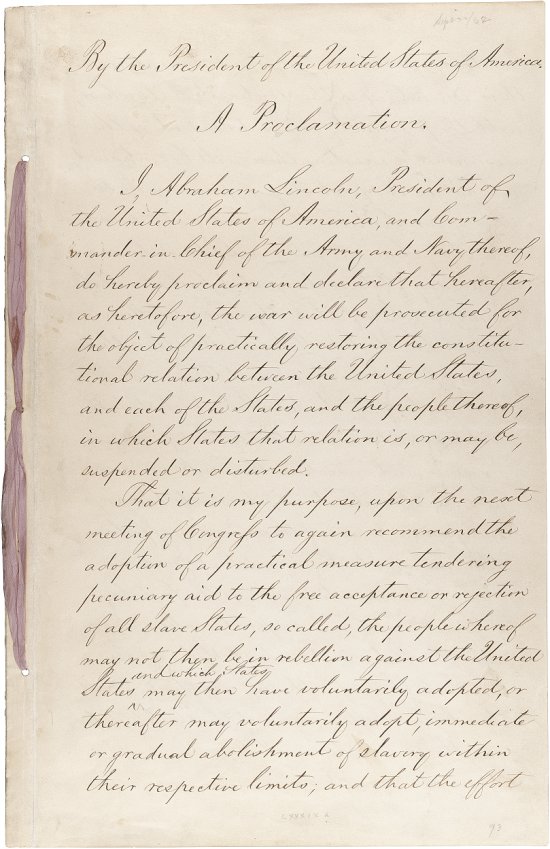
Page one of the Emancipation Proclamation issued by U.S. President Abraham Lincoln, January 1, 1863 (U.S. National Archives and Records Administration, public domain; click to enlarge).

The Full Text of the Emancipation Proclamation

January 1, 1863
By the President of the United States of America:
A Proclamation.

Whereas, on the twenty-second day of September, in the year of our Lord one thousand eight hundred and sixty-two, a proclamation was issued by the President of the United States, containing, among other things, the following, to wit:

That on the first day of January, in the year of our Lord one thousand eight hundred and sixty-three, all persons held as slaves within any State or designated part of a State, the people whereof shall then be in rebellion against the United States, shall be then, thenceforward, and forever free; and the Executive Government of the United States, including the military and naval authority thereof, will recognize and maintain the freedom of such persons, and will do no act or acts to repress such persons, or any of them, in any efforts they may make for their actual freedom.

‘That the Executive will, on the first day of January aforesaid, by proclamation, designate the States and parts of States, if any, in which the people thereof, respectively, shall then be in rebellion against the United States; and the fact that any State, or the people thereof, shall on that day be, in good faith, represented in the Congress of the United States by members chosen thereto at elections wherein a majority of the qualified voters of such State shall have participated, shall, in the absence of strong countervailing testimony, be deemed conclusive evidence that such State, and the people thereof, are not then in rebellion against the United States.’

Now, therefore I, Abraham Lincoln, President of the United States, by virtue of the power in me vested as Commander-in-Chief, of the Army and Navy of the United States in time of actual armed rebellion against the authority and government of the United States, and as a fit and necessary war measure for suppressing said rebellion, do, on this first day of January, in the year of our Lord one thousand eight hundred and sixty-three, and in accordance with my purpose so to do publicly proclaimed for the full period of one hundred days, from the day first above mentioned, order and designate as the States and parts of States wherein the people thereof respectively, are this day in rebellion against the United States, the following, to wit:

Arkansas, Texas, Louisiana, (except the Parishes of St. Bernard, Plaquemines, Jefferson, St. John, St. Charles, St. James Ascension, Assumption, Terrebonne, Lafourche, St. Mary, St. Martin, and Orleans, including the City of New Orleans) Mississippi, Alabama, Florida, Georgia, South Carolina, North Carolina, and Virginia, (except the forty-eight counties designated as West Virginia, and also the counties of Berkley, Accomac, Northampton, Elizabeth City, York, Princess Ann, and Norfolk, including the cities of Norfolk and Portsmouth[)], and which excepted parts, are for the present, left precisely as if this proclamation were not issued.

And by virtue of the power, and for the purpose aforesaid, I do order and declare that all persons held as slaves within said designated States, and parts of States, are, and henceforward shall be free; and that the Executive government of the United States, including the military and naval authorities thereof, will recognize and maintain the freedom of said persons.

And I hereby enjoin upon the people so declared to be free to abstain from all violence, unless in necessary self-defence; and I recommend to them that, in all cases when allowed, they labor faithfully for reasonable wages.

And I further declare and make known, that such persons of suitable condition, will be received into the armed service of the United States to garrison forts, positions, stations, and other places, and to man vessels of all sorts in said service.

And upon this act, sincerely believed to be an act of justice, warranted by the Constitution, upon military necessity, I invoke the considerate judgment of mankind, and the gracious favor of Almighty God.

In witness whereof, I have hereunto set my hand and caused the seal of the United States to be affixed.

Done at the City of Washington, this first day of January, in the year of our Lord one thousand eight hundred and sixty three, and of the Independence of the United States of America the eighty-seventh.

By the President: ABRAHAM LINCOLN

WILLIAM H. SEWARD, Secretary of State.


Sources:

  1. Establishing Slavery in the Lowcountry,” in “African Passages, Lowcountry Adaptations.” Charleston, South Carolina: Lowcountry Digital History Initiative, retrieved online January 1, 2024.
  2. “Franklin, John Hope. The Emancipation Proclamation: An Act of Justice,” in Prologue Magazine, Summer 1993, vol. 25, no. 2. Washington, D.C.: U.S. National Archives and Records Administration.
  3. Snyder, Laurie. “Freedmen from South Carolina,” in “Freedmen of the 47th Pennsylvania Volunteer Infantry.” 47th Pennsylvania Volunteers: One Civil War Regiment’s Story, 2023.
  4. The Emancipation Proclamation.” Washington, D.C.: U.S. National Archives and Records Administration, May 5, 2017.
  5. Transcript of the Proclamation (transcription of the Emancipation Proclamation).” Washington, D.C.: U.S. National Archives and Records Administration, May 5, 2017.


Abraham Lincoln’s Road to the Presidency

Abraham Lincoln in New York City on Monday morning, February 27, 1860, several hours before he delivered his Cooper Union address (Matthew Brady, U.S. Library of Congress, public domain).

During the almost quarter of a century that he resided in his adopted hometown of Springfield, Illinois, Abraham Lincoln was transformed from an average, young adult, who was embarking upon a crucial phase of his life’s journey in early nineteenth-century America, into the lawyer-turned-civic leader that would place his feet on the path to the White House.

A product of rural America, his formative years had been spent in Kentucky and southern Indiana. A resident of New Salem, Illinois in 1831, he was just twenty-five when he was elected to his first term in the Illinois State Legislature and began to study law more seriously. By 1837, he was a solicitor who lived and practiced law in Springfield. Married to Mary Todd five years later, he built his life with her at their Eighth and Jackson street-corner home, while also carving out a name for himself as a skilled and trustworthy legal scholar and successful courtroom attorney. Avidly interested in politics, he also became an active member of the Whig Party.

Persuaded by his wife and political associates to run for federal office in 1846, he was elected to the U.S. House of Representatives in that same year. His initial service was short-lived, however; he had pledged to serve only one, two-year term, hoping to secure a more stable, federal government job in the administration of U.S. President Zachary Taylor. But when that opportunity fell through, he returned home to Springfield and threw himself back into the practice of law.

* Note: During his tenure with the U.S. House of Representatives, Abraham Lincoln co-wrote a bill with Congressman Joshua R. Giddings that he hoped would end the practice of slavery in the District of Columbia. Lacking support from his fellow Whig Party members, however, he subsequently chose to withdraw that bill.

By the mid-1850s, Abraham Lincoln was realizing that his conscience would no longer permit him to sit on the sidelines, politically, when there was so much in his country that needed to be changed. Incensed by the passage of the Kansas-Nebraska Act in 1854, which paved the way for the brutal practice of chattel slavery to spread like a wave of toxic sludge over newly-forming states, Lincoln left the Whigs behind to join a new, more forward-thinking political organization—the Republican Party.

Four years later, he mounted a campaign against U.S. Senator Stephen A. Douglas. Although he lost that race, he would forever become linked to that Democrat as a result of their famously intense Lincoln-Douglas Debates, a forum that gave him a nationwide name recognition so high that it enabled him to become President of the United States.

Chosen by the Republican Party in 1860 to be its candidate for the highest office in the nation, Abraham Lincoln was elected as President on November 6, 1860.

How That Crucial Election Day Unfolded

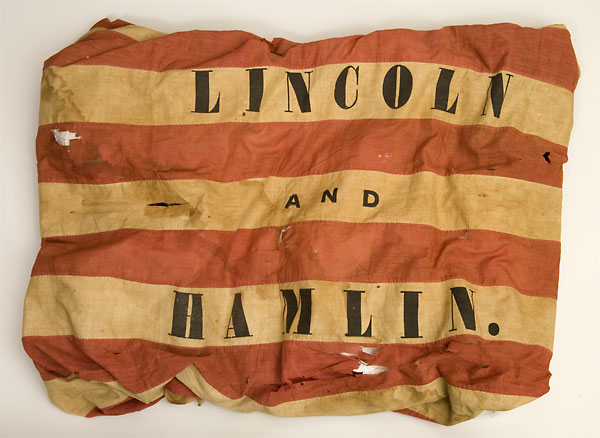
Hand-sewn banner used in Abraham Lincoln’s 1860 campaign for President of the United States (Lincoln Home, U.S. National Park Service, public domain).

According to Jamie Malanowski, a former editor at Time magazine:

“There were no surprises: the long-settled Yankees in Maine and New Hampshire and pioneering Germans of Michigan and Wisconsin delivered the expected victories. And then came news from Illinois: ‘We have stood fine. Victory has come.’ And then from Indiana: ‘Indiana over twenty thousand for honest Old Abe.’

The throngs in the streets cheered every report, every step towards the electoral college number, but news from the big Eastern states was coming painfully slowly…. The advisers paced the floorboards, jumping at every eruption of the rapid clacking of Morse’s machine….

It wasn’t until after 10 that reports of victory in Pennsylvania arrived in the form a telegram from the canny vote-counter Simon Cameron, the political boss of the Keystone State, who tucked within his state’s tallies joyfully positive news about New York: ‘Hon. Abe Lincoln, Penna seventy thousand for you. New York safe. Glory enough.’

Not until 2 a.m. did official results from New York arrive … the one-time rail-splitter won by 50,000 votes.”

The Aftermath

“As the votes were counted, Lincoln had about 40 percent of the popular vote and 180 electoral votes, compared with 133 for his opponents combined,” according to historians at the National Constitution Center, but events in America’s Deep South “cast a pall over the upcoming Electoral College voting process”:

“What if the southern states refused to take part in the Electoral College? Or what if a unified front to avoid secession could convince enough ‘faithless electors’ to switch sides to derail the election?

And what if the southern states boycotted the Electoral College?”

Lincoln scholar Harold Holzer sums up what was in the minds of many Americans in the days following the 1860 presidential election:

“If these states did not participate in the traditional process, could the Electoral College proceed? What would constitute a quorum? No one, least of all Lincoln, knew the answers to these vexing questions.”

Those questions were finally answered when those southern states agreed to participate in the Electoral College process of the United States.

“But there was a greater than normal military presence on Capitol Hill” to ensure that the peaceful transfer of power would take place that certification day, according to historians at the National Constitution Center. And it did.

Abraham Lincoln’s election was officially certified by the U.S. Congress on February 15, 1861.


Sources:

  1. Donald, David Herbert. Lincoln. New York, New York: Simon & Schuster, 1996.
  2. Foner, Eric. The Fiery Trial: Abraham Lincoln and American Slavery. New York, New York: W. W. Norton & Company, Inc., 2010.
  3. Harris, William C. Lincoln’s Rise to the Presidency. Lawrence, Kansas: University Press of Kansas, 2007.
  4. “Lawyer to President,” in “Virtual Museum Exhibit.” Springfield, Illinois: Lincoln Home National Historic Site, retrieved online November 6, 2023.
  5. Malanowski, Jamie. “Lincoln Wins. Now What,” in “Disunion.” New York, New York: The New York Times, November 7, 2010.
  6. Oates, Stephen B. “Abraham Lincoln 1861–1865,” in C. Vann Woodward, ed. Responses of the Presidents to Charges of Misconduct. New York City: Dell Publishing Co., Inc. pp. 111–123, 1974.
  7. Oates, Stephen B. With Malice Toward None: A Life of Abraham Lincoln. New York, New York: Harper Collins, 2011.
  8. On This Day, Abraham Lincoln Is Elected President.” Philadelphia, Pennsylvania: National Constitution Center, November 6, 2023.
  9. President Abraham Lincoln.” Washington, D.C.: U.S. Library of Congress, retrieved online November 6, 2023.

New Website Tells the Story of Nine Black Soldiers of the American Civil War

Largely forgotten for more than a century after honorably completing their historic military service during the American Civil War, nine formerly enslaved Black men who enlisted with the 47th Pennsylvania Volunteer Infantry have been repeatedly overlooked by mainstream historians over the years as potentially important subjects for research and have also been an ongoing source of mystery and frustration to their descendants because the majority of their military service records have still not been digitized by state and national archives.

Until now.

Thanks to a special initiative of 47th Pennsylvania Volunteers: One Civil War Regiment’s Story,” researchers have been locating and digitizing a wide range of local, state and federal records over the past five years—records that have uncovered critical details about the lives of each of these nine Black soldiers—four of whom were from South Carolina, five of whom were from Louisiana/Mississippi.

“Many of these documents hold the potential to help family history researchers feel closer to their Civil War-era ancestors while also enabling historians, teachers, students, American History enthusiasts, and Civil War buffs to deepen their understanding of one of the most painful chapters in the American narrative,” explains Laurie Snyder, the founder of and managing editor for the project. “One soldier’s U.S. Civil War Pension file revealed the name of his father and wife, as well as the surname of the family in Louisiana that had enslaved him prior to the Civil War while the U.S. Freedmen’s Bureau records for a second man shined a light on what his life was like after the war ended.”

It was this newly uncovered data that led Snyder to create a new website to make these records easily available, free of charge, for researchers and the general public. That website, “Freedmen of the 47th Pennsylvania Volunteer Infantry,” launched on Labor Day weekend 2022, and is already receiving positive reviews.

“We’re still in the process of adding records to the site, and will continue to do so throughout the next year as more records are found and digitized, but the data contained in these records is so important that I wanted to make the documents we’ve already amassed available now so that historians at colleges and universities across the United States and educators teaching history in middle and high school classrooms across Pennsylvania, Louisiana, Mississippi, and South Carolina can begin making use of the site this fall.

About “Freedmen of the 47th Pennsylvania Volunteer Infantry”

“Freedmen of the 47th Pennsylvania Volunteer Infantry” is a special educational initiative dedicated to researching, documenting and presenting the life stories of nine formerly enslaved Black men who enlisted with the 47th Pennsylvania Volunteer Infantry during two of the regiment’s most eventful years of service to the nation during the American Civil War—1862 and 1864.

About the 47th Pennsylvania Volunteer Infantry

Recruited primarily at community gathering places in their respective hometowns, the soldiers who served with the 47th Pennsylvania Volunteer Infantry were primarily men of German heritage whose families still spoke German or “Pennsylvania Dutch” more than a century after their ancestors emigrated from Germany in search of religious and political freedom. Still others were recent immigrants from Germany, Ireland and Cuba. Formerly enslaved Black men who had been freed by the regiment from plantations in South Carolina and Louisiana were added to regimental rosters in 1862 and 1864.

In addition to fighting in the battles of Sabine Cross Roads/Mansfield, Pleasant Hill and Monett’s Ferry/Cane River during the Red River Campaign, the 47th Pennsylvania Volunteers also engaged in the defense of Washington, D.C. in 1861 and again in 1865, following the assassination of President Abraham Lincoln; the capture of Saint John’s Bluff, Florida and Battle of Pocotaligo, South Carolina (1862); the garrisoning of Forts Taylor and Jefferson in Key West and the Dry Tortugas, Florida (1863); Union Major-General Philip Sheridan’s tide-turning Shenandoah Valley Campaign (1864), including the battles of Berryville, Opequon, Fisher’s Hill, and Cedar Creek; and provost (military police) and Reconstruction duties in Savannah, Georgia and Charleston, South Carolina (1865). Most were finally released from duty when the regiment formally mustered out on Christmas Day in 1865.

Learn More and Support

To learn more about the 47th Pennsylvania Volunteers and lend your support to this historic initiative, visit the websites of 47th Pennsylvania Volunteers: One Civil War Regiment’s Story and Freedmen of the 47th Pennsylvania Volunteer Infantry,” and follow the project’s updates on Facebook, Instagram and YouTube.

Research Update: More New Details Regarding the Lives of Formerly Enslaved Black Men Who Enlisted with the 47th Pennsylvania Volunteer Infantry

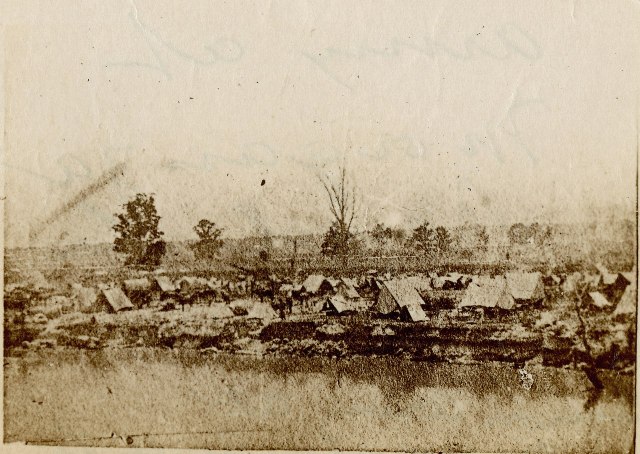
Union Army at Morganza Bend, Louisiana, c. 1863-1865_USLOC, pubdom

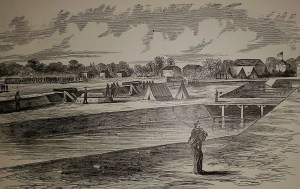
Union Army base at Morganza Bend, Louisiana, circa 1863-1865 (U.S. Library of Congress, public domain).

Researchers investigating the lives of nine formerly enslaved Black men who enlisted with the 47th Pennsylvania Volunteer Infantry during the American Civil War recently uncovered new details about two of those soldiers.

In addition to finding more data related to the immediate post-war life of Aaron French (learn more about him in this article here), including how and why he ended up settling in Mississippi following the Civil War, researchers have also now found important information about the life of Hamilton Blanchard—who enrolled with Bullard on the same day.

Born into slavery in Natchitoches, Louisiana sometime around 1843, Hamilton Blanchard was able to secure his freedom twenty-one years later when the United States Army arrived in town as part of an expedition led by Union Major-General Nathaniel P. Banks. Determined not to be forced back into bondage after the Union troops moved on in their ill-fated quest to capture the city of Shreveport, he chose to enlist with one of the units serving under Banks—the 47th Pennsylvania Volunteer Infantry—the only regiment from Pennsylvania that was involved in the Union’s 1864 Red River Campaign across Louisiana.

After enrolling in the military, Hamilton Blanchard was then assigned to Company D at the rank of “Cook” on 5 April 1864.

Crop_Bullard, Aaron and Hamilton Blanchard_Co. D, 47th PA_Muster Roll

Muster roll entries for Aaron Bullard and Hamilton Blanchard, Company D, 47th Pennsylvania Volunteers (U.S. National Archives, public domain).

The official muster-in of Blanchard, Aaron Bullard, and three other young Black men who enrolled that day did not take place immediately, however, because the 47th Pennsylvania Volunteers were ordered to move out shortly after their arrival, and were quickly drawn into intense combat with enemy troops commanded by Confederate Major-General Richard Taylor (a plantation owner and son of Zachary Taylor, former President of the United States). Battered badly during the Battle of Sabine Cross Roads near Mansfield, Louisiana on 8 April and in the Battle of Pleasant Hill the next day (9 April), they fought the Confederate Army again on 23 April near Monett’s Ferry in the Battle of Cane River and on 16 May in the Battle of Mansura near Marksville.

Continuing on toward the southeastern part of Louisiana, the 47th Pennsylvania Volunteers marched for Morganza, which had been held in Union hands since the fall of 1863 and was now the site of a major Union Army encampment. While there, the officers of the 47th Pennsylvania Volunteer Infantry officially mustered in all nine of the formerly enslaved Black men who had enlisted with the 47th Pennsylvania in Beaufort, South Carolina (1862) and Natchitoches, Louisiana (April 1864)—a process which took place between 20-24 June 1864.

From that point on, those nine men traveled with the 47th Pennsylvania as it returned to the East Coast and engaged in multiple battles associated with Union Major-General Philip Sheridan’s 1864 Shenandoah Valley Campaign across Virginia, the protection of the nation’s capital following the April 1865 assassination of President Abraham Lincoln, and the early days of Reconstruction in Georgia and South Carolina.

On Christmas Day in 1865, Hamilton Blanchard then joined his fellow 47th Pennsylvania Volunteers in mustering out from their final duty station in Charleston, South Carolina.

Post-War Life

Having been honorably discharged from the 47th Pennsylvania Volunteer Infantry when the regiment mustered out, at least two of the nine formerly enslaved Black men who had enlisted with the regiment evidently made their way north—possibly when the other members of their former regiment returned home to Pennsylvania. (It is also possible, however, that they made the journey independently of their former regiment because both men appear to have resettled in the Washington, D.C. area, post-war, while the other 47th Pennsylvania Volunteers were transported by ship directly to New York City and then by train to Camp Cadwalader in Philadelphia, Pennsylvania, where they were given their final discharge papers on 9 January 1866.)

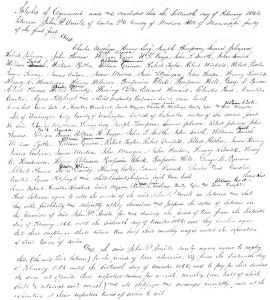
Blanchard-Bullard_Madison Co., MS_Freedmen's Bureau Contract, Feb-Dec 1866, p. 1

Freedmen’s Bureau contract between Madison County, Mississippi farm owner John P. Arvile [sic] and farm laborers Hamilton Blanchard, Aaron Bullard, et. al., Washington, D.C., 16 February 1866 (excerpt, p. 1, U.S. National Archives).

What is known for certain is that Hamilton Blanchard and Aaron Bullard made contact with a representative of the Bureau of Refugees, Freedmen, and Abandoned Lands sometime in late 1865 or early 1866. They then signed a contract with the Freedmen’s Bureau during the early winter of 1866 in which they both agreed to join a large group of formerly enslaved Black men, women, and children who would be providing farm labor to a man named John P. Avrill (alternate spellings: “Averile”, “Averill”, “Arvile”, “Arville”, or “Avrille”) at his property in Canton, Madison County, Mississippi.

That Freedmen’s Bureau contract was slated to be in effect between 16 February and 16 December of 1866, and begins with a cover page which states:

Washington D.C.
February 1866
Contract No.
John P. Arvill
With (66) Freedmen

John Arville
Contract with
46 Farm Hands

The main body of the document goes on to reveal the following details of the contract:

Articles of Agreement made and concluded this the Sixteenth day of February 1866 between John P. Arvile of Canton P.O. County of Madison State of Mississippi party of the first part and

Charles Matthews, Henry Long, Joseph Thompson, Samuel Johnson, Robert Johnson, John Thomas … Charles Ford, Caroline Carter, Agnes Fitzhugh and child (infant), Benjamin Smith, Anna Smith, Thomas Reed [sp?], Aaron Bullard, Hamilton Blanchard, Isaiah Wiggins, James Lewis, Charles K. [illegible], Baily Taylor, William Carter, and Andy Hampton [sp?].

The next paragraph lists Hamilton Blanchard and Aaron Bullard a second time, along with multiple names from the aforementioned group of farm laborers. Subsequent paragraphs spell out further points of the agreement:

All of Washington City, County of Washington, District of Columbia, parties of the second part, the said Charles Matthews, Henry Long, Joseph Thompsen, Samuel Johnson, Robert Johnson, John Thomas … Aaron Bullard, Hamilton Blanchard, Isaiah Wiggins, James Lewis … Field Laborers, agree to enter the service of the said John P. Averile as Laborers and that they will faithfully and diligently apply themselves and perform the duties of Laborers on the premises of said John P. Averile for and during the period of time from the Sixteenth day of February 1866 until the sixteenth day of 1866; and they further agree that their employer shall retain one half their monthly wages until the expiration of their term of service.

And the said John P. Arvile hereby agrees to employ them (the said Field laborers) for the period of time aforesaid. Viz from the Sixteenth day of February 1866 until the sixteenth day of December 1866; and to pay for their services the sum set opposite their respective names per month, monthly (one half of which shall be retained each month) and all stoppages and arranged promptly, paid at the expiration of their respective terms of service to wit…..

In equal monthly payments; and the said John P. Arvile further agrees to furnish said Freed laborers … quarters, fuel, full substantial and healthy rations, and all necessary attendance and supplies in case of sickness, in addition to the compensation … named, and that he will assist and encourage efforts for the education of the children of his employees, and it is further agreed by the said John P. Arvile, that in case he at any time fails to perform his part of this contract agreement he will pay to each of the said laborers the full sum of One hundred and twenty dollars [strikethrough made by someone’s hand to original contract], as fixed, agreed and liquidated damages. This contract can be annulled by the mutual consent of the Employer and the employee, but only in the presence of an Authorized Agent of the Bureau of Refugees Freedmen and Abandoned Lands and such annullment [sic] on the part of the Employer and anyone [sic] employee shall in no wise affect the validity of the Contract in respect to the employer and the other employees and should either party violate this contract then the other party shall make complaint to the nearest authorized agent of the Bureau Refugees Freemen & Abandoned Lands.

The contract continues on, specifying that both Aaron Bullard and Hamilton Blanchard were to each be paid a wage of $10 per month, and stating that some of the other men on the list would be paid as much as $12 per month while others would be paid $8 per month. (Teenaged boys and women on the list were to be paid even less—$6 per month.)

In all cases, the reality was far different. Per the contract, they were initially paid only half of what their monthly wages were because the Freedmen’s Bureau agent in charge of looking out for the welfare of these formerly enslaved men, women, and children allowed the white farmer—their “employer”—to “retain one half their monthly wages until the expiration of their term of service.”

No further data has been uncovered from Freedmen’s Bureau records about the status of those unpaid wages or the outcome of that contract, but because these Black men, women, and children were essentially returned to an unequal system of servitude by the Freedmen’s Bureau agent (as evidenced by the manner in which this contract was drafted—favoring the White “employer” over the Black “field laborer” and including multiple after-the-fact revisions, such as word insertions and strikethroughs)—it is highly unlikely that Hamilton Blanchard, Aaron Bullard, or the other Black men, women, and children mentioned in the contract were ever paid the full amount they were entitled to for what was most assuredly very hard labor.

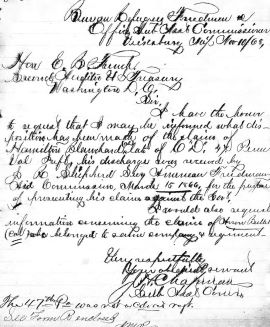
Blanchard-Bullard-Chapman_Treasury Inquiry, 10 Nov 1866

Letter of inquiry from J. H. Chapman on behalf of Hamilton Blanchard to E. B. French, second auditor, U.S. Treasury Department, 10 November 1868 (Freedmen’s Bureau records, U.S. National Archives). 

This hypothesis posed by researchers investigating the history of the 47th Pennsylvania Volunteer Infantry is backed up by a letter of inquiry penned on 10 November 1868 by J. H. Chapman, a Sub-Assistant Commissioner of the Freedmen’s Bureau working at an office in Vicksburg, Mississippi, to E. B. French, Second Auditor of the U.S. Department of the Treasury in Washington, D.C.

In this letter, Chapman asks French that he “be informed what disposition has been made of the claim of Hamilton Blanchard, late of Co. “D” 47 Penn Vol. Inft., his discharge was received by J. R. Schuchard [sp?]” of the “Freedmen’s Aid Commission, March 15, 1866.” Chapman added that he was requesting this update on Blanchard’s behalf “for the purpose of prosecuting his claim against the Gov.” He then also requested “information concerning the claim of Aaron Bullard (Col.) who belonged to same company & regiment.”

* Note: An unidentified individual added an undated notation to the bottom of this letter in handwriting that is clearly different from that of the original letter writer, Chapman. That notation correctly states: “The 47th Pa was not a colored regt. See Form R enclosed. A.M.R. 103.” (The 47th Pennsylvania Volunteer Infantry became an integrated regiment on 5 October 1862, but its African American members were not considered to be part of the U.S. Colored Troops, also known as the USCT.)

Researchers have not yet located the “Form R” referred to in the notation to Chapman’s letter, but will be pursuing this lead, as well as investigating the claims filed by Hamilton Blanchard and Aaron Bullard, and searching for additional information regarding what happened to Hamilton Blanchard during and after the 1870s. 

An additional avenue of inquiry will be the potential relationship that may have developed between Aaron Bullard and E. B. French during or after this time—a new theory being considered in light of the discovery of French’s name on this letter. (Aaron Bullard changed his surname, “Bullard,” which had been associated with his enslavement in Louisiana, to “French” sometime between his 1868 appeal to E. B. French in the U.S. Treasury Department and the day he was visited at home in Issaquena County, Mississippi by an enumerator of the 1870 U.S. Census—possibly indicating that he wanted to both shed his “slave name” and honor someone who had been helpful to him.)

Sources:

  1. Bates, Samuel P. History of Pennsylvania Volunteers, 1861-5, vol. 1. Harrisburg, Pennsylvania: B. Singerly, State Printer, 1869.
  2. Civil War Muster Rolls, in Records of the Department of Military and Veterans’ Affairs (Record Group 19, Series 19.11). Harrisburg, Pennsylvania: Pennsylvania Historical and Museum Commission, 1861-1865.
  3. Civil War Veterans’ Card File. Harrisburg, Pennsylvania: Pennsylvania State Archives.
  4. “Records of the Field Offices for the District of Columbia, Bureau of Refugees, Freedmen, and Abandoned Lands, 1865-1870” (NARA Series Number: M1902; NARA Reel Number: 18; NARA Record Group Number: 105; NARA Record Group Name: Records of the Bureau of Refugees, Freedmen, and Abandoned Lands, 1861 – 1880; Collection Title: District of Columbia Freedmen’s Bureau Field Office Records 1863-1872: Aaron Bullard and Hamilton Blanchard, 1866 and 1868). Washington, D.C.: U.S. National Archives and Records Administration.
  5. Schmidt, Lewis. A Civil War History of the 47th Regiment of Pennsylvania Veteran Volunteers. Allentown, Pennsylvania: Self-published, 1986.
  6. Wharton, Henry D. Letters from the Sunbury Guards. Sunbury, Pennsylvania: Sunbury American, 1861-1868.

Black History Month: New Details Uncovered Regarding the Formerly Enslaved Black Men Who Enlisted with the 47th Pennsylvania Volunteer Infantry

Research regarding the lives of the nine formerly enslaved Black men who enlisted with the 47th Pennsylvania Volunteer Infantry in 1862 and 1864 has continued to progress—even in the middle of a pandemic that has forced the closure of numerous local, state, and national archives.*

In addition to uncovering details about the life of the soldier from South Carolina who was mistakenly listed on muster rolls for the 47th Pennsylvania as “Presto Gettes” (learn more about him in this article here), researchers for 47th Pennsylvania Volunteers: One Civil War Regiment’s Story have been able to determine more about what happened to two of the other men post-war, and have also located records which seem to indicate that there may have been two or three other Black men who enlisted with the regiment (potentially bringing the total number of Black enlistees in the regiment to twelve).

Aaron French (enlisted as Aaron Bullard):

Muster roll entries for Aaron Bullard and Hamilton Blanchard, Company D, 47th Pennsylvania Volunteers (U.S. National Archives, public domain).

1864 was a life-changing year for Aaron Bullard and four other young Black men in Louisiana. After enlisting with the 47th Pennsylvania Volunteer Infantry on April 5 while the 47th was stationed at Natchitoches, Louisiana, Samuel Jones, Hamilton Blanchard (also known as John Hamilton), and Aaron, James, and John Bullard traveled with the 47th Pennsylvania as it participated in the multiple battles associated with the Union’s 1864 Red River Campaign across Louisiana. On or about June 22, they were formally mustered into the regiment at Morganza, Louisiana.

Sometime later (possibly post-war), Aaron Bullard changed his surname to French. After the American Civil War, he married, became a land-owning farmer—and a dad.

Post-Civil War, Aaron French and his family resided in Issaquena County, Mississippi (U.S. Census, 1870, public domain).

In August of 1870, Aaron French and his wife, Amanda, lived with their eight-month-old daughter, “Simpy” (also known as Cynthia or Cyntha) in Skipworth Precinct, Issaquena County, Mississippi. Still residing in Issaquena County a decade later when the June 1880 federal census was taken, Aaron and Amanda were the proud parents of three daughters: Cynthia (who would go on to marry Samuel L. Dixon on March 20, 1890), Jesanna (also known as Jessie/Jesse), and “Arctavia” (also known as Octavia). Jessie, who later went on to wed John B. Cobb on January 28, 1892, made a life with her husband and son in Mayersville, Mississippi, where she was a teacher in the local schools. Octavia married Frank Childress on March 20, 1894.

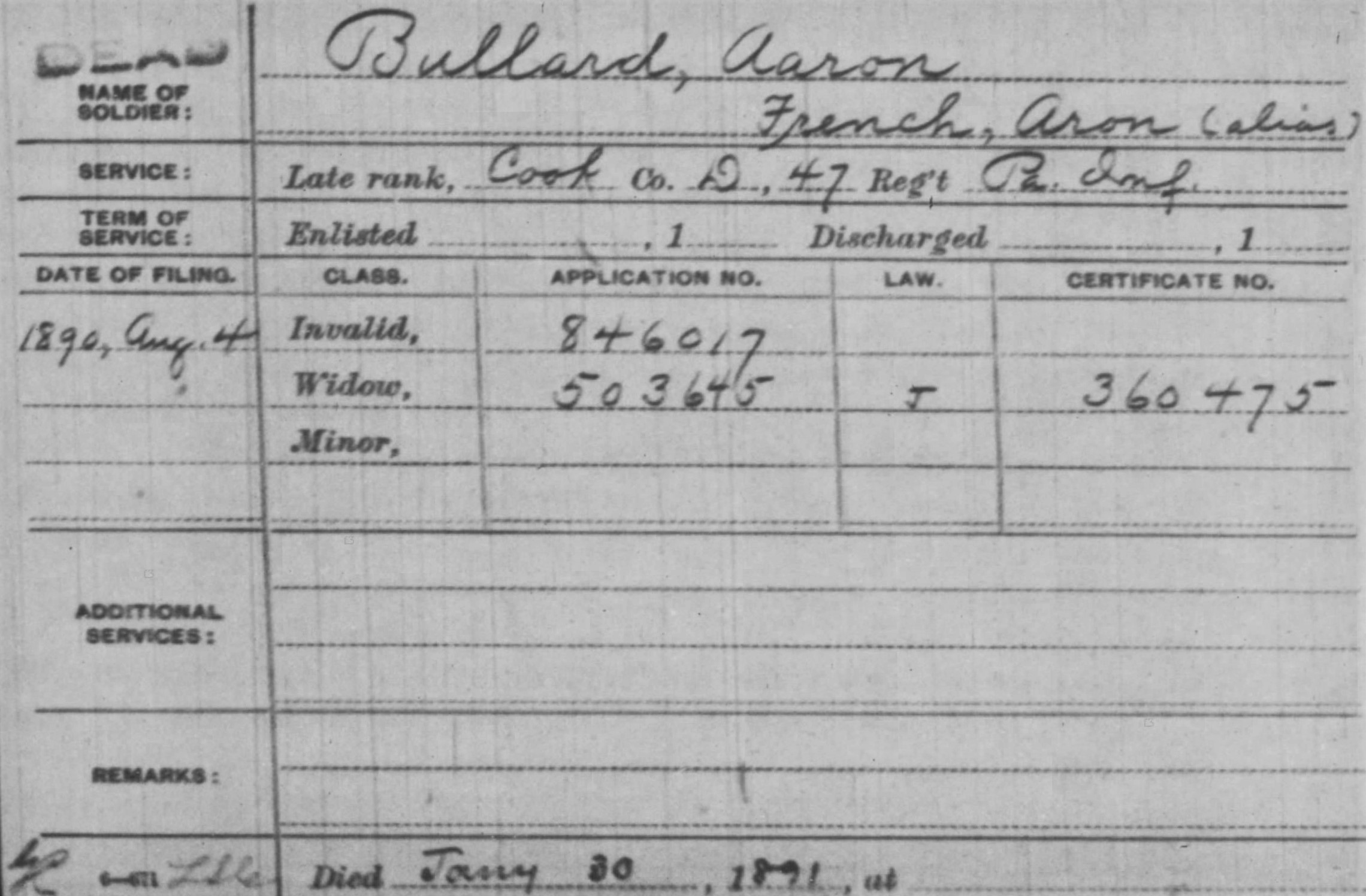
U.S. Civil War Pension Index Card for Aaron French, who enlisted with the 47th Pennsylvania Volunteers in Louisiana in 1864 (U.S. National Archives, public domain).

Sadly, Aaron French did not live to see his two youngest daughters marry because he died in Mississippi on January 30, 1891. He was just 40-43 years old, according to U.S. Census records and other data, which indicate that he was born in Louisiana sometime between 1848 and 1850.

Hearteningly, though, an even more intriguing piece of data has recently been uncovered about the later life of Aaron French—one that indicates that he had become active in politics prior to his death. According to the Vicksburg Evening Post, Aaron was appointed as a delegate from Issaquena County to the Republican Congressional Convention for the Third District, which was held in Greenville, Mississippi on August 7, 1886. Researchers are continuing to search for further details about his political activities and untimely death, as well as the exact location of his gravesite.

Thomas Haywood (alternate spellings of surname: Hayward, Haywood, Heywood) and Jack Jacobs:

Muster roll entries of Thomas Haywood and Edward Jassum, Company H, 47th Pennsylvania Volunteers (U.S. National Archives, public domain).

Born into slavery in South Carolina sometime around 1832, Thomas Haywood enlisted for a three-year term of service as an Under Cook with Company H of the 47th Pennsylvania Volunteer Infantry at Beaufort, South Carolina on November 1, 1862. He and three other formerly enslaved Black men—Abraham and Edward Jassum and Presto Gettes”—who had previously enlisted with the 47th Pennsylvania at Beaufort in October of 1862, then traveled with the 47th Pennsylvania as it participated in multiple military engagements, including the 47th’s garrisoning of Fort Taylor and Fort Jefferson in Florida in 1863 and 1864, the battles of the Union’s spring 1864 Red River Campaign across Louisiana, and the battles of Sheridan’s tide-turning Shenandoah Valley Campaign across Virginia in the fall of 1864.

On or about June 22, 1864 all nine of these Black soldiers were formally mustered into the regiment at Morganza, Louisiana; Thomas Haywood and seven of the eight others all successfully completed their tours of duty, and were honorably mustered out upon expiration of their respective terms of enlistment. In Thomas Haywood’s case, that honorable discharge was awarded on October 31, 1865.

Post-war, it appears from various Freedmen’s Bureau records that he may have entered into yearly contracts with several men who had previously been plantation owners in the Beaufort, South Carolina area. In exchange for agreeing to plant and cultivate cotton for those men on three to five-acre parcels of land that had been leased to him by those white men, he was allowed to keep portions of the cotton sales (the largest portions of which went to the former plantation owners who had also most likely been slave owners prior to and during the Civil War).

U.S. Civil War Index Card for Thomas Haywood, who enlisted with the 47th Pennsylvania Volunteers in South Carolina in 1862 (U.S. National Archives, public domain).

His body warn out from years of slavery prior to the war, difficult military service during the war, and harsh sharecropping experiences post-war, Thomas Hayward applied for, and was awarded a U.S. Civil War Pension on April 30, 1888. That pension was subsequently renewed by the federal government in 1907 at the rate of $15 per month (roughly $415 per month in today’s U.S. dollar equivalency).

By 1890, Thomas Haywood was living in Sheldon Township, Beaufort County, South Carolina. After a long life, he died on January 13, 1911. Unfortunately, his burial location has also not yet been identified by researchers.

In 1890, Thomas Haywood lived near Hanna Jacobs, the widow of Jack Jacobs, who may have been another Black soldier who enlisted with the 47th Pennsylvania Volunteers (U.S. Census, 1890, Sheldon Township, Beaufort County, South Carolina, public domain).

One other piece of tantalizing data that has recently been discovered is that a woman named “Hanna Jacobs” lived near Thomas Haywood in 1890. This information may be significant because Hanna was described on the 1890 U.S. Census of Union soldiers and widows as the widow of “Jack Jacobs,” who had served in the same company with Thomas Haywood (according to that special census).

Researchers currently believe that Jack Jacobs may, in fact, have been another formerly enslaved Black man who had enlisted with the 47th Pennsylvania when it was stationed near Beaufort in 1862, and are currently conducting a Go Fund Me campaign to raise funds to purchase the Civil War military and pension records of Hanna and Jack Jacobs, as well as the nine known formerly enslaved Black men who enlisted with the 47th Pennsylvania Volunteer Infantry in 1862 and 1864.

Jackson Haywood:

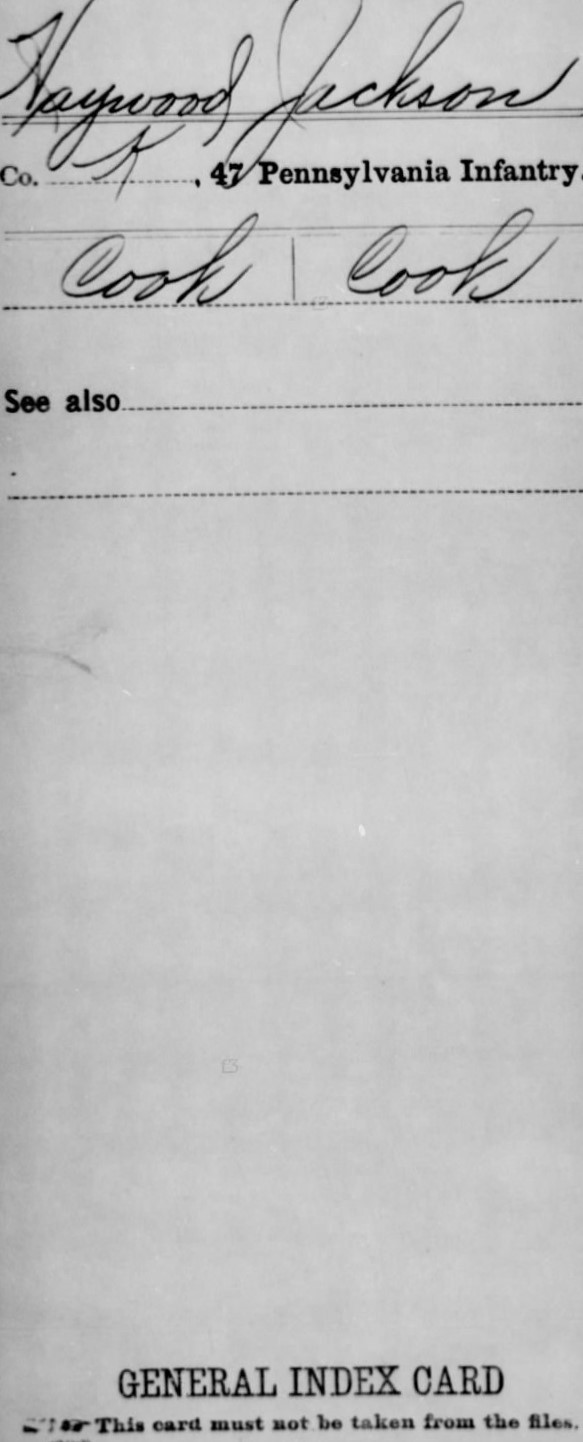
General Index Card for Jackson Haywood, who may have been a Black soldier who enlisted with the 47th Pennsylvania Volunteers (U.S. National Archives, public domain).

According to the “Index to Compiled Service Records of Volunteers Who Served in Organizations from the State of Pennsylvania,” which was created by staff at the U.S. National Archives, a General Index Card was created for yet another mystery man—a soldier named “Jackson Hayward.”

To date, researchers have only been able to determine that he may have enlisted with Company K of the 47th Pennsylvania Volunteer Infantry as a cook—a rank similar to that at which the known nine formerly enslaved Black men who enlisted with the 47th Pennsylvania were entered on the muster rolls of the regiment.

Researchers hope, with time and the continued financial support of the followers of 47th Pennsylvania Volunteers: One Civil War Regiment’s Story, to be able to confirm the dates of military service and race of this individual, as well as that of “Jack Jacobs.”

As always, we appreciate everyone’s help in ensuring that the service to the nation of these soldiers will never be forgotten. They helped to preserve our Union and deserve to be recognized more fully for their heroism and dedication.

* Our most important goal continues to be the purchase of the Compiled Military Service Records (CMSR) and U.S. Civil War Pension records for each of these remarkable men in order to document and freely share their stories with the widest possible audience. We continue to await word from staff at the U.S. National Archives regarding the timeframe for their resumption of digitization and reproduction services that have temporarily been suspended due to the coronavirus pandemic. As soon as those services have resumed, we will request an update regarding their estimated timeframe for fulfilling our records requests. In the interim, we will seek out further details about each of these soldiers via local and state archival resources across the nation, and will post updates as we confirm more data.

Sources:

  1. Bullard, Aaron, in Index to Compiled Service Records of Volunteers. Washington, DC: U.S. National Archives, 1861-1865.
  2. Bullard, Aaron and French, Aaron, in U.S. Civil War Pension Index Cards. Washington, DC: U.S. National Archives, 1890-1891.
  3. Bullard, Aaron, Presto Garris, Thomas Haywood, et. al. in U.S. Civil War Muster Out Rolls (47th Pennsylvania Volunteer Infantry). Washington, DC: U.S. National Archives, 1865-1866 (available via Ancestry.com).
  4. French, Aaron, in “Proceedings of the Third District Republican Convention.” Vicksburg, Mississippi: Vicksburg Evening Post, August 9, 1886.
  5. French, Aaron and Family, in U.S. Census Records (Issaquena County, Mississippi): Washington, DC: U.S. National Archives, 1870-1910.
  6. Haywood, Jackson, in Index to Compiled Service Records of Volunteers. Washington, DC: U.S. National Archives, 1861-1865.
  7. Haywood, Thomas, in Index to Compiled Service Records of Volunteers. Washington, DC: U.S. National Archives, 1861-1865.
  8. Haywood, Thomas, in U.S. Civil War Pension Index Cards. Washington, DC: U.S. National Archives, 1888, 1907.
  9. Haywood, Thomas, in U.S. Veterans’ Administration Pension Payment Cards. Washington, DC: U.S. National Archives, 1888, 1907.
  10. Haywood, Thomas, in U.S. Census (Beaufort County, South Carolina): Washington, DC: U.S. National Archives, 1890.
  11. Hanna Jacobs, widow of Jack Jacobs, in U.S. Census (Beaufort County, South Carolina): Washington, DC: U.S. National Archives, 1890.


Spring and Summer of 1862: Disease, Duty and Another Departure

View the video related to this article

Sibley Tent (Patent #14740, United States Patent Office, April 22, 1856, H. H. Sibley, public domain).

As spring continued to take hold across Pennsylvania in 1862, turning the Great Keystone State’s colorful, budding trees into soothing havens of green-leafed shade, the members of the 47th Pennsylvania Volunteer Infantry continued to battle their great foe—disease. It was a fight that was made more difficult by the regiment’s challenging living conditions. The weather was warm, the water quality was poor, the mosquitos were plentiful, and hygiene was substandard because the majority of 47th Pennsylvania Volunteer Infantrymen continued to live in the close quarters of the Sibley tents that had been erected as “Camp Brannan” in Key West, Florida. (The men of Company F were slightly more fortunate, having been previously ordered to live and work at Fort Taylor.)

As a result, multiple members of the regiment fell ill during the month of April, including First Lieutenant and Regimental Adjutant Washington H. R. Hangen, who was required to temporarily cede his duties to H Company First Lieutenant William Wallace Geety after being admitted to the officers’ hospital at in Key West, and C Company’s Theodore Kiehl and Henry W. Wolfe, who had been confined to the hospital for enlisted men. Deemed too ill to continue serving with the regiment, F Company privates John G. Seider and Samuel Smith were honorably discharged on surgeons’ certificates of disabilities and sent back home.

Meanwhile, other members of the regiment continued to be advanced in rank, including Second-Sergeant Christian Seiler Beard, who was promoted to First-Sergeant, and Private Peter Haupt who was promoted to the rank of Sergeant—while others assumed additional duties, including D Company privates James E. Albert and William Collins, who were assigned to help the fort’s assistant surgeon, William F. Cornick, in caring for the increased number of patients who had been admitted. Then, General Order No. 84 was issued, directing I Company Captain Coleman A. G. Keck and one of his subordinates, Private William Smith, to return home to Pennsylvania to recruit more volunteers to help beef up the regiment’s dwindling ranks.

In addition, several officers from the 47th Pennsylvania were also called upon to conduct a general court martial trial of a lieutenant from the 90th New York Volunteers who was charged with having been absent from his duties without appropriate authorization (known more commonly today as being absent without leave or “AWOL”). Colonel Tilghman H. Good served as the court’s president, C Company Captain John Peter Shindel Gobin served as its general advocate, and H Company Captain James Kacy was one of the men appointed to serve on the court’s judicial panel, which found the 90th New Yorker guilty and directed that he lose roughly two weeks of pay.

April—May 1862

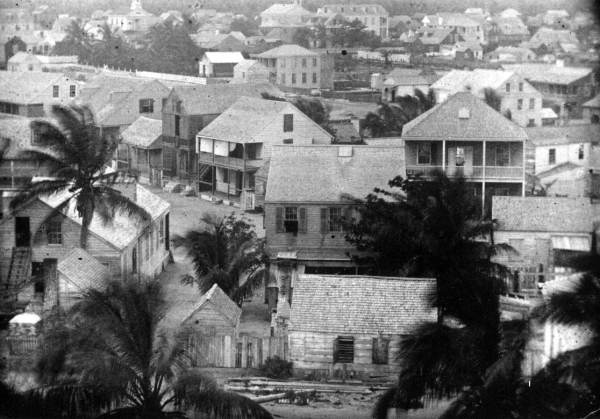
Key West, Florida, c. 1850 (courtesy of Florida Memory Project)

Key West, Florida, circa 1850 (courtesy of Florida Memory Project).

On April 19, the 47th Pennsylvania’s most prolific scribe, C Company Musician Henry D. Wharton, penned a letter to his hometown newspaper, the Sunbury American, from Camp Brannan in Key West:

“DEAR WILVERT:– Having finished a plate of soup, (not a hasty one) enjoyed a piece of ham, cooked in my best style, fried and now luxuriating in a pipe of the best Lynchburg tobacco, I conclude to indite [sic] you a few lines from this most miserable place, Key West.

There are now lying here three very fine vessels captured from Secessia. The cargoes are very valuable, consisting of cotton, coffee, rice, liquor, kerosene and olive oils, leather, and a great many articles of use. I attended the sale of one of the cargoes, and one article I found more numerous than any other—that of hooped skirts. I was curious to know why they had supplied themselves so plentifully with that article, when an old gentleman said that was easily understood, for when the rebels had to run, and in fear of being caught they would make good hiding places, and then he related a circumstance of a Mexican General who, in running away, found crinoline very convenient as a hiding place, but not secure enough for the Lynx-eyed Americans, as the brave gentleman was caught in his wife’s trap.

There has been considerable sickness among the troops, but I am happy to state it is abating. Two members of our company, Theodore Kiehl, and H. Wolf, have been in the Hospital, but are now out and almost ready for duty. They take very readily to their rations when they get back to the company, saying the Hospital is a very nice place to get well in, but no place for grub, as they were as hungry as wolves all the time they were in, or rather when they became better. We have lost eight men from our regiment, by death, since we have been on this island. From what I can learn the diseases were mostly contracted in Virginia, but if they have not, it is a wonder that the mortality is not greater among us, owing to the sudden change of climate, the bad water, hot sun and hard work our men are subjected to.

Lieut. Henry Bush, Co. F., in our regiment, died two weeks ago. His company were in the Fort, learning heavy artillery, where he was attacked with typhoid fever—in a few days he was beyond the physicians [sic] skill, and now he is sleeping his last sleep in the strangers [sic] cemetery. His funeral was very largely attended by the military and the masonic fraternity, of which he was a member. Lieut. Bush was beloved by his company—they having presented him with a sword a few days before he was taken sick—and in fact was liked by the whole regiment for his kindness and gentlemanly bearing to the men. As soon as the necessary arrangements can be made his body will be sent to Catasauqua, Lehigh county, where his widow and two little children reside.

Since the promotion of Lieut. Oyster, there has [sic] been some changes in our company, 2d Sergeant Beard has been made 1st Sergeant, and Peter Haupt, of Sunbury, taken from the ranks and promoted to 1st Sergeant. Haupt passed an excellent examination, and I am proud, for Sunbury, to say that he is considered one of the A. No. 1’s on drill in our regiment.

With the exceptions of a few slight cases of sickness, the boys are getting along very well and would be perfectly contented if they were at a place where there could be a chance to have a hand in some of the glorious victories which their brothers in arms are engaged in, and away from this detested spot, where there would be something to relieve the eye beside sea-gulls, pelicans and turkey-buzzards. Excuse the shortness of this, hoping ere long to be able to give you an account of a victory in which Co. C., was engaged….”

* Note: To read more of Henry Wharton’s insights, please see our collection of his letters here.

By mid-April, typhoid fever was claiming one member of the regiment after another. On Saturday April 19 and Sunday April 27, respectively, K Company privates George Leonhard and Lewis Dipple died at the Key West general hospital while E Company Private John B. Mickley died on April 30.

Death ledger entry for Private Lewis Dipple, Company K, “Registers of Deaths of Volunteers,” U.S. Army, 1862 (U.S. National Archives, public domain).

Initially interred in graves numbered nine, ten, and twelve at the fort’s post cemetery, the remains of Privates Leonhard, Dipple, and Mickley were later exhumed for reburial at the Barrancas National Cemetery. Although the process was successfully completed for Privates Leonard and Mickley in 1927, Private Dipple’s remains were handled so disrespectfully that they were later unable to be identified. As a result, they were consigned to a common grave at Barrancas with 227 other “unknown” soldiers.

That same day, General Order No. 26 was announced, directing that:

“I. The troops will be mustered and inspected at 7:45 AM tomorrow morning, 30th inst. April 30, 1862.

II. Immediately after muster, a council of administration to consist of Capt. Harte and officers will assemble to transact such business as regulations require.”

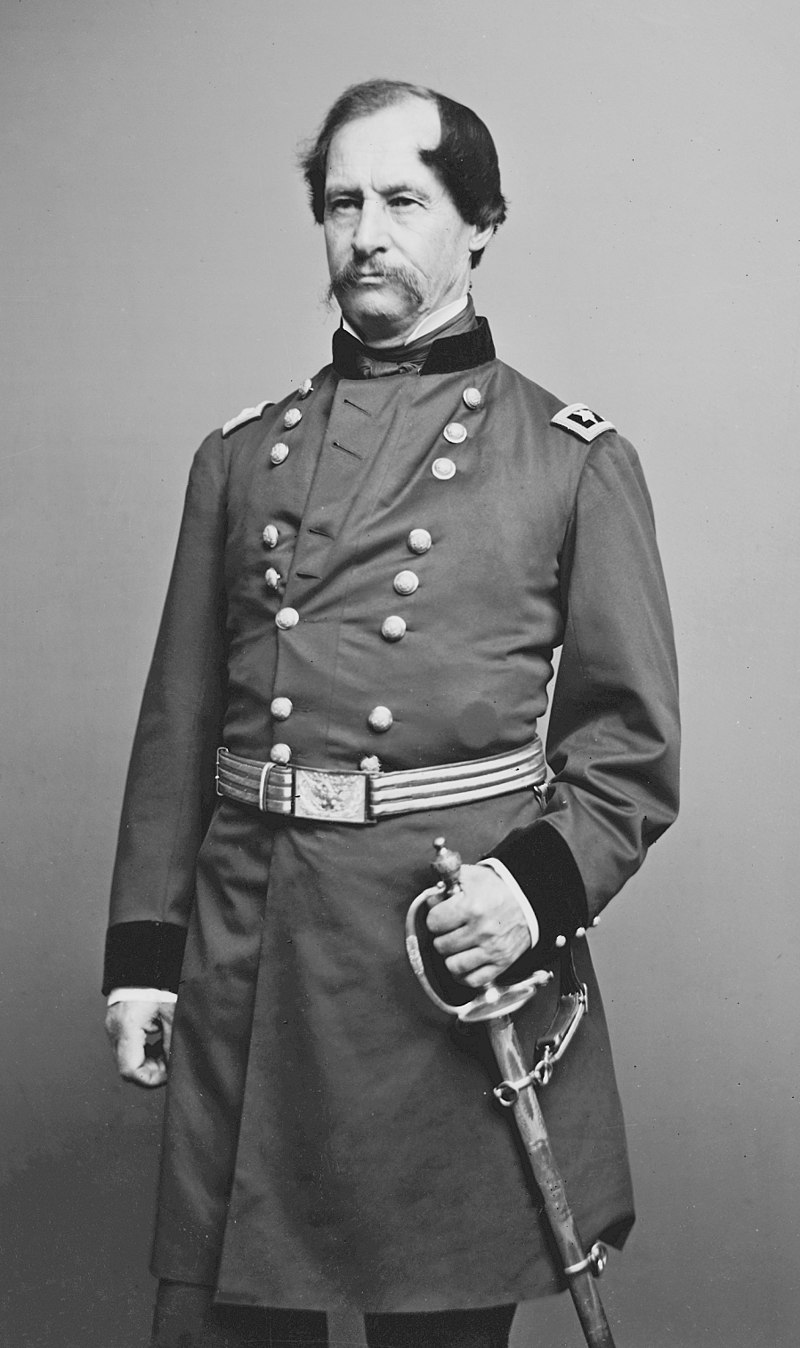
Major-General David Hunter, U.S. Army, circa 1863 (carte de visite, public domain).

Meanwhile, on April 25, 1862, the winds of change had begun to clear the way for long-denied social justice as Union Major-General David Hunter, commanding officer of the U.S. Army’s Department of the South, issued General Orders, No. 11, which directed that all enslaved men, women, and children in Georgia, Florida, and North Carolina be freed immediately:

“Head Quarters Department of the South,
Hilton Head, S.C. May 9, 1862.

General Orders, No 11.— The three States of Georgia, Florida and South Carolina, comprising the military department of the south, having deliberately declared themselves no longer under the protection of the United States of America, and having taken up arms against the said United States, it becomes a military necessity to declare them under martial law. This was accordingly done on the 25th day of April, 1862. Slavery and martial law in a free country are altogether incompatible; the persons in these three States—Georgia, Florida and South Carolina—heretofore held as slaves, are therefore declared forever free.

(Official) David Hunter,
Major General Commanding.”

Although word of Hunter’s order did not immediately reach members of the regiment, it would eventually be carried in newspapers across America.

Meanwhile, the 47th Pennsylvania Volunteers continued to perform their provost and garrison duties in Key West. At the end of April, F Company Private Henry Falk was ordered to take on new duties with the quartermaster while Order No. 21 reassigned H Company Corporal James F. Naylor to the regimental color guard. During the first two days of May, I Company Private William Frack then became Corporal Frack while H Company Private Robert Kingsborough took over quartermaster duties performed previously by Private William O’Brien.

As spring progressed, the weather in Key West became hotter, and the mosquitoes grew even more bold. Even so, the fort’s commanding officer and his subordinates were still able to find a few minutes of relaxation. On May 7, they made time to attend a ball. Corporal James J. Kacey, however, was assigned to fix cartridge boxes around this same time while E Company Corporal George Nicholas was busy dodging disciplinary action, as well as a brush with death:

“I went down to the docks and ask [sic] a Man who owned the Storehouses their [sic] and he said the govemient Seased [sic] them. So I Said I will Sease [sic] the life Boat that laid their [sic]. So I took it up to camp and fixed it up and that got me in trouble I went out Sailing and Missed drill, and got a log to carry, and the next time in the Guard House…. [A] Scorpen Stung me in the finger and I cut a piece out and Sucked it and put Tobacco on it. My arm and hand commenced to Swell Some But Not Much.”

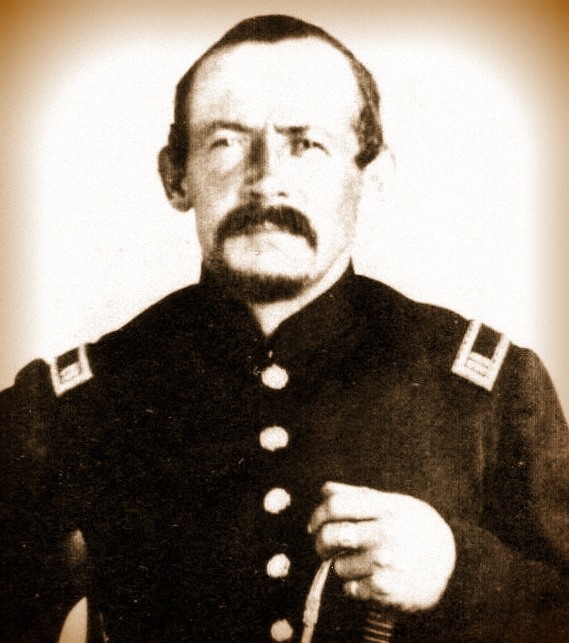
Increasingly debilitated by the bug that had recently felled him, the regiment’s founder and commanding officer, Colonel Tilghman Good, finally realized that he would need to distance himself from his men if he were to continue as their leader. In a letter penned to the Assistant Adjutant, Captain Lambert, he asked “permission to leave camp for a few days, to secure comfortable quarters in town, which I have every reason to believe would materially aid in my speedy restoration to health and strength. The Doctor tells me this desirable end can be attained, by taking rest in elevated and comfortable quarters for a few days. In consequence I do not deem it essential to remove to the hospital.”

Good’s decision proved to be a sound one as more and more members of the regiment were felled by disease, including D Company’s Private George Isett. Suffering from chronic diarrhea, he died on Friday, May 16, and was initially laid to rest in grave no. 14 at the post cemetery. Sadly, his remains were also mishandled when they were exhumed in 1927 for reburial, and were also consigned in the unknown grave of 227 Union soldiers at the Barrancas National Cemetery. His grieving comrades honored him by securing publication of the following Tribute of Respect in their hometown newspaper:

“WHEREAS, it has pleased God in his allwise providence, to remove from our midst our friend and brother in arms, Geo S. Isett; therefore,

RESOLVED, that by his death we have lost a warm hearted friend, a true patriot and good soldier, and one whose place cannot be filled among us.

RESOLVED, That we most heartily sympathize with the deceased and hope that he who has thus afficted [sic] them, will be their reliance in time of need.

RESOLVED, That these resolutions be forwarded to the Perry County papers for publication, and a copy be sent to the friends of the deceased.

Signed: George W. Topley, Jesse Meadith, Jacob Charles, George W. Jury, Isaac Baldwin, Committee.”

That same day (May 16), The Athens Post in Athens, Tennessee specifically mentioned the 47th Pennsylvania’s problems with illness in a news article entitled, “Yankees Sick and Dying”:

“A letter from the flag ship Niagara, published in the Providence Press, fears that the warm weather and imprudence and exposure will cause much sickness among the three Yankee regiments stationed at Key West, Florida. ‘Already the 47 Pennsylvania Regiment has lost a number of its members by the typhoid fever, and I am told they have 70 sick.’ They will have plenty of the same sort before August.”

In response to the continuing wave of sickness, H Company Private Daniel Kochenderfer was reassigned to nursing duties at Key West’s general hospital, where he earned $7.75 for the hazardous duty. Two days later, G Company Private Edmund G. Scholl succumbed to typhoid fever. Initially interred at the post cemetery, Private Scholl’s remains would later be returned home to his family when Allentown undertaker Paul Balliet took on the mission of bringing home both Scholl’s body and that of the infant Regimental Chaplain William Rodrock in 1864. (Both were then reinterred at the “New Allentown Cemetery” on January 30, 1864.)

On May 19, President Abraham Lincoln overturned the emancipation order issued by Major-General David Hunter. His proclamation read as follows:

“Washington [D.C.] this nineteenth day of May,
in the year of our Lord one thousand eight hundred and sixty-two

By the President of the United States of America.

A Proclamation.

Whereas there appears in the public prints, what purports to be a proclamation, of Major General Hunter, in the words and figures following, to wit:

‘Head Quarters Department of the South,
Hilton Head, S.C. May 9, 1862.

General Orders No 11.— The three States of Georgia, Florida and South Carolina, comprising the military department of the south, having deliberately declared themselves no longer under the protection of the United States of America, and having taken up arms against the said United States, it becomes a military necessity to declare them under martial law. This was accordingly done on the 25th day of April, 1862. Slavery and martial law in a free country are altogether incompatible; the persons in these three States—Georgia, Florida and South Carolina—heretofore held as slaves, are therefore declared forever free.

(Official) David Hunter,
Major General Commanding.
Ed. W. Smith, Acting Assistant Adjutant General.’

And whereas the same is producing some excitement, and misunderstanding; therefore I, Abraham Lincoln, President of the United States, proclaim and declare, that the government of the United States, had no knowledge, information, or belief, of an intention on the part of General Hunter to issue such a proclamation; nor has it yet, any authentic information that the document is genuine— And further, that neither General Hunter, nor any other commander, or person, has been authorized by the Government of the United States, to make proclamations declaring the slaves of any State free; and that the supposed proclamation, now in question, whether genuine or false, is altogether void, so far as respects such declaration.

I further make known that whether it be competent for me, as Commander-in-Chief of the Army and Navy, to declare the slaves of any State or States, free, and whether at any time, in any case, it shall have become a necessity indispensable to the maintenance of the government, to exercise such supposed power, are questions which, under my responsibility, I reserve to myself, and which I cannot feel justified in leaving to the decision of commanders in the field. These are totally different questions from those of police regulations in armies and camps.

On the sixth day of March last, by a special message, I recommended to Congress the adoption of a joint resolution to be substantially as follows:

Resolved, That the United States ought to co-operate with any State which may adopt a gradual abolishment of slavery, giving to such State pecuniary aid, to be used by such State in its discretion, to compensate for the inconveniences, public and private, produced by such change of system.

The resolution, in the language above quoted, was adopted by large majorities in both branches of Congress, and now stands an authentic, definite, and solemn proposal of the nation to the States and people most immediately interested in the subject matter. To the people of those States I now earnestly appeal— I do not argue, I beseech you to make the arguments for yourselves— You can not [sic] if you would, be blind to the signs of the times— I beg of you a calm and enlarged consideration of them, ranging, if it may be, far above personal and partizan [sic] politics. This proposal makes common cause for a common object, casting no reproaches upon any— It acts not the pharisee. The change it contemplates would come gently as the dews of heaven, not rending or wrecking anything. Will you not embrace it? So much good has not been done, by one effort, in all past time, as, in the providence of God, it is now your high privilege to do. May the vast future not have to lament that you have neglected it.

In witness whereof, I have hereunto set my hand, and caused the seal of the United States to be affixed.

Abraham Lincoln”

* Note: During the short time in which Major-General David Hunter’s emancipation order was in effect, thousands of enslaved individuals escaped from horrific conditions across Florida, Georgia, and South Carolina, and made their way to the safety of Union military encampments. In response, Hunter directed his subordinates in the U.S. Army’s Department of the South to create a loose network of social services to provide food, clothing, educational services, medical care, and shelter to the newly free men, women, and children. Hunter then also began advocating for able-bodied Freemen to be allowed to enlist with the Union Army.

Although many of these social justice initiatives were put on hold when Lincoln rescinded Hunter’s emancipation order, the disagreement between Lincoln and Hunter evidently made an indelible impression on leaders of the 47th Pennsylvania Volunteer Infantry; just six months later, those 47th Pennsylvanians would pave the way for the regiment to become an integrated one by facilitating the enlistment on October 5, 1862 of several young Black men who were freed from plantations near Beaufort, South Carolina—roughly three months prior to the enactment of Lincoln’s Emancipation Proclamation.

As May wore on, disease continued to thin the regiment’s ranks. Another member of the 47th to be felled by typhoid fever was B Company Private John Apple who died at Key West’s general hospital on May 21 (alternate date: March 12). Reportedly buried shortly thereafter and then disinterred from grave number 18 at the fort’s post cemetery in 1927, his remains were also among those that were reportedly consigned to a group grave of 228 unknown soldiers at the Barrancas National Cemetery, according to one source but, according to The Allentown Democrat, were returned to Pennsylvania on January 28, 1864 with the bodies of three other members of the regiment and the body of the regimental chaplain’s infant son. Private Apple was subsequently laid to rest at the Union-West End Cemetery in Allentown on January 31, 1864.

Around this same time, Henry Wharton was dusting off the skills he had learned, pre-war, as an employee of the Sunbury American newspaper. Founding a new publication—the Key West Herald, he was able to get the first edition of his newspaper into the hands of his fellow 47th Pennsylvanians by Saturday, May 24.

The newspaper’s release could not have been more timely. A significant number of his fellow 47th Pennsylvanians were in desperate need of reading material as they fought their way back from sickness. Among those ailing at this time were multiple members of Company D, including privates William Ewing, Samuel Kern, Andrew and William Powell, and Emanuel Snyder, Corporal Samuel Reed, and Sergeants William Fertig and George Topley. Of those, Fertig was the only one to be hospitalized. In addition, B Company Teamster Tilghman Ritz developed rheumatism sometime around the month of May, and underwent several weeks of treatment at the post hospital from the 47th Pennsylvania’s regimental surgeon, Elisha Baily. Even though he was treated “successfully” by Baily, however, the condition would continue to plague Ritz for the remainder of his life.

Early June—A Fateful Encounter with Friendly Fire

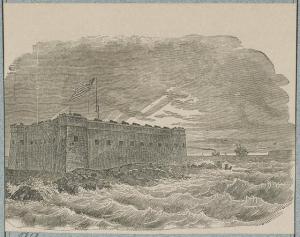
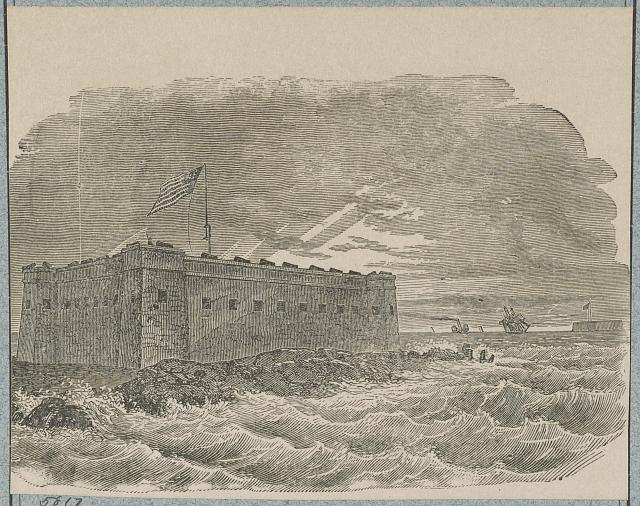
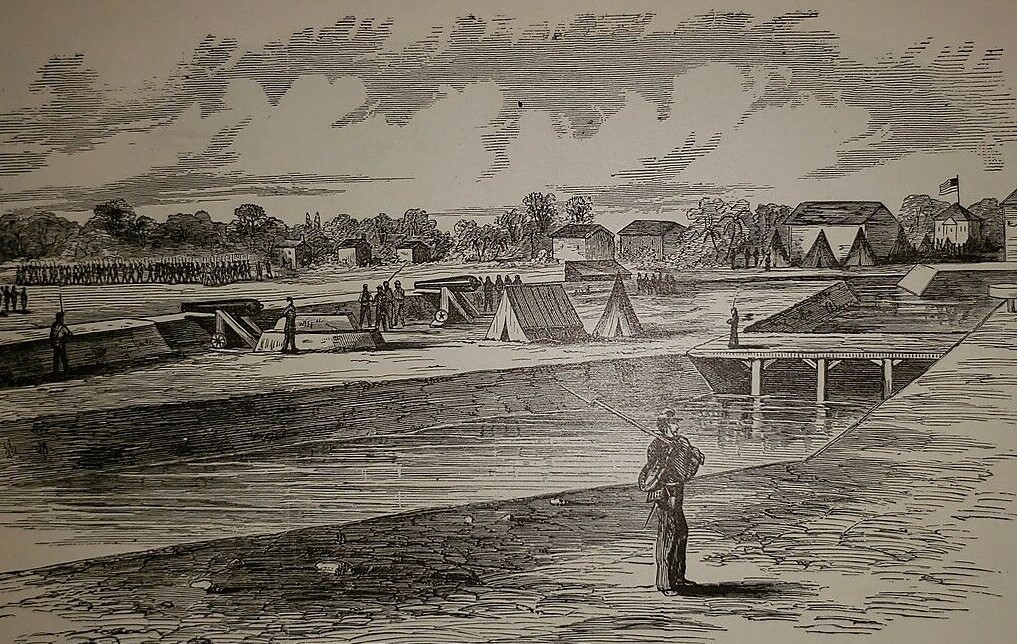
Woodcut depicting the harsh climate at Fort Taylor in Key West, Florida during the Civil War (U.S. Library of Congress, public domain).

One of the most senseless deaths of 47th Pennsylvania Volunteers during the entire war was a “friendly fire” incident which occurred on June 9, 1862. The day had started out peacefully enough—with weather so inviting that I Company Sergeant Charles Nolf, Jr. and several friends felt compelled to take a stroll along the southern portion of the beach in Key West. Tragically, while gathering seashells for family and friends back home, he was accidentally killed by a member of the 90th New York Volunteer Infantry who had been inexplicably playing around with a loaded rifle in violation of brigade regulations while walking on the same stretch of beach with three other members of his regiment—all three of whom had also been carrying loaded rifles—against regulations. Shot in the forehead, Sergeant Nolf died instantly at the scene. Initially interred at the fort’s post cemetery, his body was among the aforementioned group of soldiers’ remains disinterred and returned to Pennsylvania’s Lehigh Valley by Allentown undertaker Paul Balliet, where they were reburied at the Fairview Cemetery in West Catasauqua in late January of 1864.

On the same day that Charles Nolf departed from the world (June 9), First Lieutenant William W. Geety was released from the hospital having successfully recovered from an attack of bilious fever which had resulted in his confinement beginning May 18. In a letter penned to his wife while recuperating, he described himself as “jaundiced.”

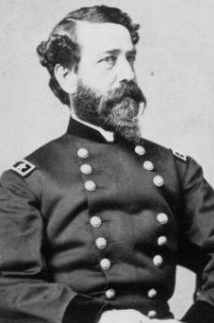
Brigadier-General John Milton Brannan, U.S. Army (public domain).

By June 11, I Company Captain Coleman Keck was back home in Allentown, Pennsylvania, hard at work recruiting more men to serve with the 47th Pennsylvania. Meanwhile, the “old men” of the regiment—the veterans—were sensing another change in the winds of fate. That change came on Friday, June 13, via General Order No. 53, which was issued by Brigadier-General Brannan:

“The 47th Regiment of Pennsylvania Volunteers will hold itself in readiness for immediate embarkation. Company F of this regiment which is detached at Fort Taylor will report at headquarters of the regiment. Each regiment will take six months [sic] supply of medicine and medical stores on embarkation.”

Rumors swirled that the regiment would be shipped to Port Royal, South Carolina in preparation for a Union attempt to wrest control of Savannah, Georgia or Charleston, South Carolina from the control of the Confederacy.

On Saturday, June 14, the 47th Pennsylvania Volunteers participated in a review with other members of Brigadier-General Brannan’s troops. According to an edition of the New Era, which was published around this same time:

“The 47th Pennsylvania Volunteers under command of Lt. Col. Alexander made a fine appearance. Their marching was perfect and the entire regiment showed the effect of careful drill. A more sturdy, soldierly looking body of men cannot be found, probably, in the service. Col. Good and the officers under his command have succeeded in bringing the regiment to a state of military discipline creditable alike to them and the state from which they hail. The regimental band deserves some mention; there are many bands in the service of greater celebrity, whose performances would not bear comparison with that attached to the 47th Regiment.”

On June 16, Wharton penned another letter to his hometown newspaper in which he reflected on the untimely, friendly fire death of Sergeant Nolf and provided further insights into the soldiering life in America’s Deep South:

“Great excitement was caused by the accident, and for a time (our boys not knowing the particulars) some of them were determined to avenge their comrade’s death, but an investigation pronounced it accidental, when they were satisfied. Nolf was a young man of excellent character, beloved by all who knew him, and it seems hard that he should be hurried into eternity in such a manner, and that too, when the carrying of loadened [sic] rifles is strictly prohibited.

There is a family in this city [Key West] by the name of Fift. One of them, A. Fift, after making a fortune out of his Uncle Samuel, (U.S.), thought to make another speck by going to New Orleans to his friend Mr. Mallory, one of Jeff Davis’ Cabinet (?) in the manufacture of gun boats. Mallory and he went into partnership. After finishing boats, while at Memphis, with a considerable amount of Confederate funds in his pocket, (specie) he gave them the slip. Some of his indignant southern friends followed the double traitor, caught him and immediate hung him, thus saving the United States the trouble of buying an extra rope after this war is over. His brother, who has grown fat off the government, and at the time giving aid to secesh, wishing to visit a cooler atmosphere, and act the part of a nabob in the North, was a few days ago provided with a passage to New York in a Government steamer, while on the same vessel, a soldier, for want of room, could not send a box of sea-shells to gratify the curiosity of his friends at home. You can draw your own inference….

The paymaster has come at last and paid us off for four months. The sight of money was new to the boys, and most eagerly accepted by them. The Sunbury boys sent most of their pay home to their friends, very glad to do so, showing that, although far away from home, loved ones are not forgotten.

We have received marching (sailing) orders, and before this reaches you, if winds do not play us false, we will be in South Carolina, and probably before Charleston, helping to reduce the place where this foul rebellion first broke out. I will write to you immediately on our arrival, attempting to give you a description of the voyage, and an account of the manner in which Neptune treated the health and feelings of the boys. All is hurry and bustle in camp, striking tents, &c., so much so that I can scarcely write. We are all well. None of the Sunbury boys left behind….”

The next day, the 47th Pennsylvania Volunteer Infantry began a phased departure from Key West.

A Summertime Occupation of South Carolina

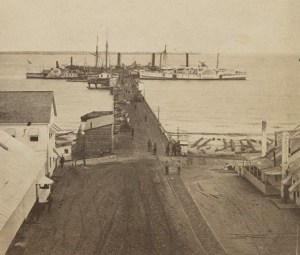
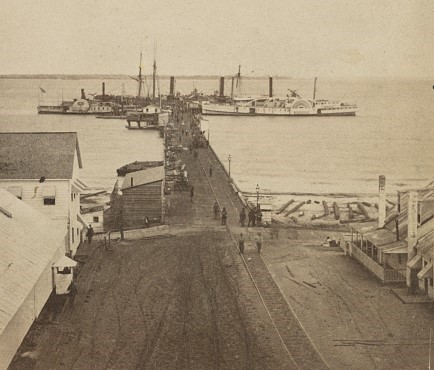
Dock, Hilton Head, South Carolina, circa 1862 (Sam Cooley, U.S. Library of Congress, public domain).

On Tuesday, June 17, 1862, the members of the 47th Pennsylvania assigned to Companies A, F, and D boarded the schooner “Emilene,” and sailed for Hilton Head Island in South Carolina. Also readying for departure this day were the men from Companies B, C, and I, who boarded a brig, the Sea Lark. On June 19, Companies E and H boarded a different ship, which was not identified by regimental clerks in subsequent reports, but was identified in soldiers’ later correspondence as the Tangire. Setting off at 10:02 p.m. in the same direction as their predecessors, they were followed by the men from Companies G and K, who boarded a sloop, the Ellen Benan [identified in later soldiers’ correspondence as the “Ellen Bernard”], and departed at 2 p.m. on June 20—barely dodging the yellow fever epidemic which swept Key West, Florida.

On June 19, just prior to his departure, G Company Sergeant John Gross Helfrich penned a letter to his parents from the Officers’ Hospital in Key West, where he had been assigned as a hospital steward:

“…. We are under marching orders, some of the companies of our regiment have already gone. The reason for our not going together, is owing to not having vessels enough. Those who have left had to embark on small “briggs” & skooners [sic], taking from two to three companies aboard. The place of our destination is ‘Beaufort S. Carolina.’ The two companies of regulars, stationed here, have also left a few days ago; for the same place.

The health of our men is exceedingly good at present, out of our whole regiment there are but nineteen, who are unable on account of sickness to accompany us, which is comparatively, but a very small number, and these as far as my knowledge is concerned, are not dangerously ill; and it is hoped that they may soon be able to follow us.

After we are gone the garrison at this place will only consist of six companies of the 90th Regt. N.Y.V. [90th New York Volunteers]. The other four companies of the above named regt. are stationed at “Fort Jefferson”, Tortugas; some fifty-odd miles from here.

The 91st Regt. N.Y.V. were ordered a few weeks ago, to Pensacola, Fla. So you perceive, that there has been a considerable change made among the military, of late at this place….

Letter from Sergeant John G. Helfrich, Company G, to his parents, June 25, 1862 (used with permission, courtesy of Colin Cofield).

After Helfrich settled into his new quarters at Hilton Head, South Carolina, he penned the following update to his parents on June 25:

“Having first arrived at our place of destination spoken off [sic] in my last, I will now give you a brief description of our passage to this place.

We left Key West, on the 19th inst., about mid-night in the brigg [sic] “Ellen Bernard,” and arrived at this place yesterday (the 24th) at one o’clock p.m. having had a very pleasant voyage, not the slightest accident having occurred, and the men seem to get accustomed to riding at sea, as but a few had what is generally called ‘seasickness’. Our regt. was put on four small vessels, the ‘Sea Lark’, ‘Emaline’, “Tangire’ [handwriting difficult to read] & ‘Ellen Bernard, the second last named, has up to this time, not yet arrived, having started about 4 hours ahead of us. She had three companies aboard & the hospital baggage.

The weather is not quite so hot here as where we come from, but I think it will perhaps make a material change in a few days, as the ground is at present cooled off by the rain….

Since our arrival on this island we learned that a pretty severe fight came off about eighteen miles from here, at a place called ‘James island’ at which our boys seem to have got the worst of it as the hospital at this place contains a great many of the wounded.

Our boys are all eager for a fight, and no doubt they will get a chance to show their fighting abilities ere long, as it is rumored that an assault is to be made on ‘Charleston’ at an early date. Troops are coming and going every day, I am told, and I should not be surprised if we had to go away from here in a day or so.

You must excuse me for writing with red ink as it was the only article of the kind within reach.

I am in the full enjoyment of health at present, hoping you are the same.

I will enclose forty dolls. which I will send to you for safe keeping, until I return home, which will be ere long I reckon. Write soon, as I am anxious to hear from you….”

* Note: The letters of Sergeant John Helfrich are used with permission of Colin Cofield and his family who generously provided copies for use in documenting the history of the 47th Pennsylvania Volunteer Infantry. To read more of his insights, see our collection of Helfrich’s letters here.

According to military reports, the first two units of the regiment to arrive at Hilton Head—Companies E and H—disembarked on Sunday, June 22. After having spent four days aboard ship, these men quickly realized their initial accommodations would be far from plush. They were expected to sleep out in the open on the dock. The men from Companies, A, D, and F and B, C, and I arrived next, respectively disembarking from the “Emilene” and “Sea Lark” on Monday. They, too, all spent a restless night sleeping on the dock.

Fort Walker, Hilton Head, South Carolina, circa 1861 (Frank Leslie’s Illustrated Newspaper, public domain).

Finally, on Wednesday, June 25, at 2 p.m., the regiment was made whole again when the men from Companies G and K arrived on the “Ellen Benan.” The regiment was then marched to the rear of Fort Walker, where the 47th Pennsylvanians were ordered to pitch tents and organize their supplies.

* Note: Per an unspecified military report, Hilton Head was considered to be “a depot to receive army supplies . . . strongly fortified so as to command the channel, and [was] a good depot for troops, as they [could] be sent from there to almost any point needed in [that] part of the south.” Located on opposite sides of the channel from each other, Hilton Head and Port Royal were just fifteen miles upstream from Beaufort, South Carolina, which would ultimately become a long-term duty station for the 47th Pennsylvania Volunteers.

Fort Walker, which was situated in Hilton Head’s northeast section, “was irregularly shaped in a form that could be roughly described as half an octagon facing the ocean, backed by a slightly larger rectangle, and with a triangle on the inland side,” according to historian Lewis Schmidt. “Located about 1200 feet north of the fort was a pier which extended at right angles from the beach for a distance of 1277 feet. Inland from the fort and pier were numerous auxiliary facilities such as quarters, guard house, stables, quartermaster, ice house, blacksmith, carpenter, post office, bakery, hotel, theatre, church, and numerous other buildings.”

Mitchelville, a village built to house numerous formerly enslaved men, women and children, was located just west of the fort. Facilities of the provost marshal, provost guard, and Union Army’s engineering department, as well as the 60,000-square foot Union Army Hospital at Hilton Head were located on South Carolina’s coastline, just south of the fort. 

Bay Street Looking West, Beaufort, South Carolina, 1862 (Sam A. Cooley, 10th Army Corps, photographer, public domain).

The 47th Pennsylvania Volunteer Infantry did not remain in the Hilton Head-Port Royal area long, however; on July 2, the regiment departed for its new assignment—provost (military police and judicial) duties in Beaufort, South Carolina. Still assigned to the command of Brigadier-General John Milton Brannan, the 47th Pennsylvanians performed those duties as part of a combined occupying force that included the: 6th Connecticut under Colonel J. L. Chatfield, the 8th Maine under Lieutenant Colonel J. F. Twitchell, three companies of the 4th New Hampshire under Major J. D. Drew, the 7th New Hampshire under Colonel H. S. Putnam, the 55th Pennsylvania under Colonel R. White, the 1st Connecticut Battery under Captain A. P. Rockwell, three batteries of the 1st U. S. Artillery under Captain L. L. Langdon, three companies of the 1st Massachusetts Cavalry under Captain A. H. Stevens, Jr., and a detachment of the 1st New York Engineers.

According to Schmidt, roughly two thousand people resided in Beaufort during this time—a “population which sometimes doubled in the summer months with the influx of wealthy planters.”

The town had been located on Port Royal Island on a slightly higher elevation than the surrounding areas, and on its eastern side was bounded by a channel which is now part of the Intracoastal Waterway connecting Port Royal and St. Helena Sound. There were many large and beautiful homes with large pillars and porches in the southern tradition, and numerous live oak trees scattered throughout the area…. The town was laid out in a rectangle, with streets of fine white sand, but without any sidewalks.”

But it is the first-hand impressions of Beaufort, penned to family and friends by members of the regiment shortly after their arrival, which still provide important insights into life in Union Army-occupied Beaufort during the summer of 1862. Second Lieutenant William Geety noted that every house was “built in from the street with a yard, shade trees and lots of flowers, and that “the Rebels left much behind” while Private Francis Gildner of Company I juxtaposed the hardships and horrors of war with the city’s elegance:

“This is a beautiful place and has good water, and no defects like Key West. The hospital is in a very large building, however when you come inside you come upon a terrible scene. Here are hundreds of army men who have been wounded in the legs, and many were shot in the breast and face. There is an arm or leg amputated daily. The health of the regiment is good, but we hope we do not stay here too long as this area is infested with millions of mosquitoes and sandflies whom plague us both day and night.”

Enslaved men and women on the grounds of Mrs. Barnwell’s home in Beaufort, South Carolina, circa 1860 (U.S. Library of Congress, public domain).

Meanwhile, Private John Wantz of D Company dug deeper to produce an even more illuminating analysis:

“The city of Beaufort is, I suppose, one of the handsomest places in the United States. It was inhabited by only the rich, retired planters of the South and they spared no pains nor expense in making it beautiful with art, and nature could not develope [sic] itself more handsomely than it does here. The weather is pleasant the year round. The large shade trees cannot be surpassed for beauty. Their flower gardens are superb and there is not a single house but what is clustered around with orange, lemon, and fig trees; grapes they have in abundance, and in fact everything that the most fastidious could desire to make them happy and contented. They have all the different kind of vegetables that we are blessed with in the North and in much greater abundance. Everything tends to make a person happy and comfortable. Dull care is driven away by the sweet tones of the mocking bird, whose warble is continuously heard, and the air scented with the fragrance of the shrub and honeysuckle.

In time of peace, the question is who lives here? It is answered, ‘none but those who have obtained a fortune’, for a man of limited means could not. The work done here is by slaves, and a man of ordinary means would be obliged to put himself on equality with the negro, and I doubt if there is a man in the North would do so if he was to see the degraded, uneducated and deplorable looking set of negroes there is in this part of the country. They know of nothing but hard work upon the cotton, rice and corn plantations, and do not know why this war is, what was the cause of it, or anything about it, only that their masters were driven away by the soldiers and that some soldiers have driven other soldiers away. I never would have thought there was so much difference between the North and South if I had not seen it.”

By the second week of July, Union Army leaders issued orders directing part of the 47th Pennsylvania Volunteer Infantry to participate in an Expedition to Fenwick Island (July 9), followed by a Demonstration Against Pocotaligo (July 10). In response, the members of H Company marched to Port Royal Ferry, crossed the Coosaw River, and drove off Confederate soldiers who had set fire to the ferry house while out on picket duty. C Company Captain Gobin described the incident later in a letter, noting that “Two companies of our Regiment were thrown across under cover of a gunboat, drove in the rebel pickets, and penetrated into the country for about half a mile” while C Company Musician Wharton wrote:

“That portion of our regiment to whom was assigned picket duty, on the line nearest the enemy, have returned, being relieved by the 7th New Hampshire Volunteers. Our fellows report the duty pleasant, as it was amusing to see the Georgia sharpshooters trying to pop the pickets on post, forgetting that our Springfield rifles were of longer range than theirs, however they soon discovered it, as could be seen, by the way they jumped behind trees whenever our boys returned their fire. Before our party were relieved, two of three companies crossed the river to have some fun, the rebels not liking the appearance of our bright barrels, skedaddled, leaving our men nothing to do but to burn down the houses they had for protection, and the pay for their trouble amounted to a few red cotton overcoats.” 

Company Sergeant Reuben S. Gardner added even more details in his own letter to family, writing:

“So the other day we took a notion to turn the joke on them and we crossed over to this side and drove them off their posts and back several miles, and burnt four houses that were used by them to picket in. Our skirmishers had four shots at the rebels, but with what effect we don’t know as they soon got out of harm’s way. Companies H and B were all that crossed. The boys got so eager to follow up the rebels that they did not want to come back when ordered. Our force was too small to advance far, so we went back after doing all the damage we could to them. They fled in such a hurry as to leave three saddles, one double barreled [sic] shot gun, several overcoats, haversacks, canteens, &c., all of which our boys brought along as relics, that being the first of anything of that kind our regiment had. Now the boys want to cross every day; but the Colonel won’t allow them as it is beyond his orders to cross the river, and probably we would meet with a repulse, as the rebels have been in force on the opposite side since we drove them off. They are like a bee’s nest when stirred up. The day after we were over they fired more than a hundred shots at our boys. They returned some shots and only laughed at them. The distance across the river is some 800 to 1000 yards, and of course there can be but little damage done at that distance.”

Meanwhile, back at the regiment’s main camp, Regimental Order No. 160 was announced on July 10:

“I. The old officer of the day will be relieved by the new one at 9 AM at these headquarters.

II. The officer of the day will have charge of the camp and will be held responsible for the proper performance of the duties of the guard, the quietness of the camp and its cleanliness. The old guard under charge of its Captain will report to him immediately after breakfast for police purposes and he will have all rubbish and filth carried from the camp a sufficient distance and then have it buried or burned. He will visit the kitchens and quarters of every company accompanied by its commander immediately after he enters upon his duties and report the condition of the same to these headquarters.

III. The officer of the day will be held responsible for the calls of the hours of service and roll calls. One bugler will be detailed daily to report to him for that purpose.

IV. The attention of company commanders is called to article #28, paragraph #234, revised army regulations which requests all roll calls to be superintended by a commanding officer of the companies and Captains to report the absentees to the Colonel or the commanding officer.

V. Commanders of companies are imperatively directed to have the company quarters, kitches, &c., policed and cleaned immediately after breakfast.

VI. Morning reports of companies signed by the Captains and 1st Sergeants and all applications for special priviledges [sic] of soldiers must be handed to the Adjutant before 8 AM.

Col. Good”

The next day, the men of D Company were ordered to report to picket duty. On Saturday, July 12, Company H was sent out on skirmishing duty, as described by Second Lieutenant Geety:

“Five gunboats came up…Saturday and shelled the shore and crossed over and burned three shanties…. I had command of the right of the skirmish but did not get an opportunity to kill any secessionists. I got a secessionist cap box made in New York and the paper and case of a shell.”

On Sunday, Sergeant Reuben Gardner continued working on his letter to his father:

“We have been on picket now ten days [near the Port Royal Ferry and along the Broad River] and were to be relieved tomorrow; but for some cause are now to stay five days longer. The general rule is ten days; but always whip the horse that pulls the hardest. We are ten miles from camp, and are picketing around the west of the island, for 12 miles along the shore. Five companies of our regiment are out at a time. The rebel pickets are right opposite to us, across the river, and dozens of shots are exchanged every day; but without any effect on our side. The rebel’s [sic] guns fail to reach across. Our rifles will shoot across with a double charge, but we only fire at each other for fun. The 7th New Hampshire were on here before we came out and the rebels made them leave the line. They took advantage of that and crossed over and burnt a ferry house that stood on the end of the causeway on this side….

We have the greatest picket line here entirely. At low tide down along the beach at night you can’t hear thunder, by times, for the snapping of oysters, croaking of frogs, buzzing of mosquitoes, and the noise of a thousand other reptiles and varmints. It beats all I have heard since the commencement of the war. We have had a pretty good time out here on picket and good weather; but 15 days is a little too long to lie in the woods for my fancy….

* Note: Gardner apparently went on in this letter to express a virulent hatred of the formerly enslaved Black men, women, and children who were being employed by the Federal Government to cultivate and harvest the corn and cotton fields located near the regiment’s camp. But it is not clear if the ugliest parts of this letter were actually written by Gardner himself. According to Schmidt, Gardner’s correspondence was “one of the few anti-abolitionist letters uncovered in the correspondence of members of the regiment.” Printed “in a staunchly anti-abolitionist paper, the Perry County Democrat,” the original text of the letter may have been “embellished by the editor” to better align “with the paper’s views.”

Consequently, the managing editor of 47th Pennsylvania Volunteers: One Civil War Regiment’s Story has made the decision not to include that portion of Gardner’s letter here as part of this article. Further research is being conducted in an effort to verify Schmidt’s analysis; if that research is able to be completed, the full text of the letter will be presented with its analysis under the “Letters Home” section of this website.

An Old Foe Resurfaces

Even though the change of scenery for the 47th Pennsylvanians appears to have done some good for morale since they were now being given more opportunities to interact with the enemy, the men were still finding that they were being dogged by their old foe—disease. During the month of July, the following members of the 47th were among those seeking medical treatment:

  • Private George Nichols, Company E (admitted July 14, 1862 for treatment of a hernia);
  • Private Andrew Burke, Company E (admitted July 17, 1862 for treatment of a boil);
  • Private Peter McLaughlin, Company H (admitted July 18, 1862 for treatment of a sprain);
  • Private William Ward, Company E (admitted July 18, 1862 for treatment of a carbuncle);
  • Private Luther Bernheisel, Company H (admitted July 23, 1862 for treatment of a funiculus condition);
  • Private John Bruch, Company E (admitted July 24, 1862);
  • Private John Richards, Company E (admitted July 26, 1862 for treatment of a febrile condition);
  • Second Lieutenant William Wyker, Company E (admitted July 26, 1862 for treatment of diarrhea);
  • Corporal Joseph Schwab, Company F (admitted July 26, 1862 for treatment of bilious remittent fever);
  • Sergeant William Hiram Bartholomew, Company F (admitted July 26, 1862); and
  • First Lieutenant George W. Fuller, Company F (admitted July 26, 1862 for treatment of piles).

In addition, Earnest Rodman (alternate spelling “Ruttman”) of B Company sustained a severe wound to his lower jaw when his rifle accidentally discharged while he was assigned to picket duty at Beaufort on July 15.

As a result, as hospitalizations and medical discharges from the regiment increased, leaders of the 47th Pennsylvania realized that new enlistees would be needed to stabilize the 47th’s rosters. So, Major William Gausler and Captain Henry S. Harte were sent home to Pennsylvania to announce and manage a recruiting drive. Both arrived in their respective communities of Allentown and Catasauqua on July 15, and remained at home until early November. New recruits were enticed by the following:

  • Enlistment Premium: $4
  • One Month’s Pay (in advance): $13
  • 25% of the Standard Bounty (in advance): $25
  • County Bounty: $50
  • Additional Bounty (paid at the end of the war or end of the soldier’s term of service): $75
  • Regular Monthly Pay: $13

Meanwhile, back in Beaufort, Special Order No. 57 was issued on July 16, directing that:

“The hours of drill specified in the order determining the hours of service must be attended to by all the commanding officers of companies not on special duty. Second, in addition to the established hours of service, commanders of companies will cause the chiefs of squads to drill the squads from 9:30 to 10 AM and from 2:30 to 3 PM under the supervision of a commanding officer. Third, there will be a daily drill for noncommissioned officers from 1 to 2 PM. All noncommissioned officers not on special duty or sick must attend these drills. The Sergeants will be drilled by a 1st Lieutenant who will be detailed for that purpose for one weekend; the Corporals by a 2nd Lieutenant who will be detailed in the same manner. They will assemble in front of the color line, under the shade trees, at the sound of the Sergeants call. Lt. Fuller and Lt. Dennig are hereby detailed for that purpose and they will report to these headquarters immediately after drills to report all absentees. Fourth, a roster of each squad with the name of its chief at the head will be furnished to these headquarters as soon as practicable. Col. Good”

As the month of July wound down and hot days tested the patience of 47th Pennsylvanians, tempers flared. On July 24, Private William Kirkpatrick of D Company lost his cool and told his superior, Sergeant Alex D. Wilson, to “go to hell” after Wilson ordered him to add axe-grinding to his duties. Four days later, Kirkpatrick was brought before a military tribunal for “conduct prejudicial to good order and discipline.” Although he pleaded not guilty, he was convicted by the presiding officer, Captain Charles H. Yard, was sentenced to “close confinement for three days on a bread and water diet,” and was also required to forfeit a third of one month’s pay.

On July 29, Musician Daniel Fritz and Private Rudolph Fisher, both of Company K, were discharged on surgeons’ certificates of disability. Fritz, who had contracted typhoid fever and was also losing his eyesight, survived, but Fisher succumbed to his illness at a Union Army hospital in New York.

For much of July, 47th Pennsylvanians had been been assigned to picket duty at or near Port Royal Ferry; they would continue to perform similar duties in the same area throughout most of August as well. Company E would be assigned to “Barnwells” while men from Company D would be stationed near “Seabrook.”

August

As summer wore on, disease and injury continued to take out more members of the regiment. Among those hospitalized were:

  • Private Israel Reinhard, Company G (admitted August 6, 1862 for treatment of bilious remittent fever);
  • Corporal Solomon Wieder, Company G (admitted August 6, 1862 for treatment of otitis);
  • Sergeant Robert Nelson, Company H (admitted August 7, 1862 for treatment of intermittent fever);
  • Private Charles Rohrer, Company H (admitted with August 8, 1862 for treatment of diarrhea); and
  • Sergeant James Hahn, Company H (admitted August 10, 1862 for dysentery).

The month of August was particularly hard due to typhoid fever, which felled locals and soldiers alike in and around Hilton Head, Beaufort, and Port Royal. Yellow fever then also descended on Hilton Head. One of the protective measures employed by members of the regiment at this time, according to a letter penned by Private Alfred C. Pretz, was “liquid ammonia … kept in the office for the purpose of washing the skin where the little stingers [mosquitos] have sown their venom.”

Robert Barnwell Rhett’s home (“Secession House”), Beaufort, South Carolina, circa 1860s (U.S. Library of Congress, public domain).

It was also unbearably hot. In a letter to family and friends, C Company Captain Gobin noted that:

“The thermometer to-day has fallen to a respectable number … The weather for the last few weeks has been beyond conception. It was sweltering until Saturday a cool breeze from the North sprung up, and we have enjoyed two comfortable days … Every day last week until Saturday, it ranged from 100 to 110 degrees in our tents, and from 98 to 105 the coolest place you could find…. Our pickets at Seabrook, a few days ago, discovered the rebels throwing up earthworks, and the general impression is that a simultaneous attack will be made by their land forces. News has been received here for some time, of their concentrating large forces of the latter at Grahamsville and Pocotaligo….

But it was these two sentences of Gobin’s letter which provided the most illuminating details about what life was genuinely like for 47th Pennsylvania Volunteers who were now truly part of an occupying army in America’s Deep South:

“We occupy the house of Senator Rhett, which is one of the finest in the place. A large portion of the furniture is still in it, as is also a portion of his library. It is a magnificent residence, surrounded by orange trees and flowers of the most gorgeous colors. I presume he never intended it for the occupancy of Yankee Court Martial.”

Robert Barnwell Rhett (1800-1876) was, in fact, a powerful, longtime, pro-slavery, pro-secession activist. A native of Beaufort, South Carolina who began his professional life as a lawyer, he quickly became a vocal critic of the Tariff of 1828 (the “Tariff of Abominations”) while serving as a member of the South Carolina state House of Representatives (after he was first elected in 1826). Resigning that seat to become South Carolina’s Attorney General in 1832, he was subsequently elected to represent South Carolina in the U.S. House of Representatives (1837). A supporter of John C. Calhoun, Rhett ultimately parted ways with him when he came to believe that Calhoun was too moderate.

“The Union Is Dissolved” (South Carolina’s secession from the United States as announced by the Charleston Mercury, December 20, 1860 (U.S. Library of Congress, public domain).

By the mid-1840s, Rhett had worked his way into an even more powerful role, becoming the de facto leader of the fire eaters—South Carolina’s increasingly vocal, pro-secession movement. Opting not to seek reelection in 1849, he was elected to the U.S. Senate in December of 1850, but resigned that seat in 1852 when his efforts to advance the cause of secession stalled. He then turned to journalism. Purchasing the Charleston Mercury during the 1850s in partnership with his son, Barnwell, he used that newspaper to fan the embers of secession into a raging wildfire—going so far as to call for South Carolina to secede if U.S. voters selected any Republican candidate as the next President of the United States.

As a result, after Abraham Lincoln was elected to his first term, South Carolina seceded on December 20, 1860—just as Rhett had hoped. Rhett then lobbied multiple southern states to meet in Montgomery, Alabama in order to form a new country—one that he envisioned would be made up entirely of slaveholding states.

During what historians now refer to as the Montgomery Convention, Rhett played a key role in drafting a new constitution for the Confederate States of America (CSA). Among his contributions to that document were a stipulation that all future CSA presidents would serve six-year terms and wording that would prohibit future CSA leaders from levying tariffs; but, he failed in his attempt to remove wording that declared foreign slave trade to be illegal, and also failed at adding a provision that would have required all CSA states to allow the practice of slavery.

The sun was already beginning to set on his political career, however; by the time the 47th Pennsylvania Volunteers arrived in Beaufort, Rhett had lost the support of many fellow Confederates after having repeatedly denounced CSA President Jefferson Davis in the Charleston Mercury. Knowing that his hometown of Beaufort had fallen to the U.S. Army and that his Beaufort home had been commandeered for use by the 47th Pennsylvania for provost actions only served to stoke his anger and frustration.

Orders from on High

Directed by President Abraham Lincoln to participate in a parade to honor the late former President Martin Van Buren, the 47th Pennsylvania Volunteer Infantry turned out in full dress uniform on August 15 to listen to prayers and a eulogy. The regimental colors and officers’ sleeves subsequently remained covered with the appropriate designations of mourning for six months after the event. That same day, the regiment was also ordered to engage in enhanced bayonet drills per General Order No. 26.

Six days later, the 47th Pennsylvania lost its renowned Regimental Band when the ensemble (Pomp’s Cornet Band) was formally mustered out of service by the order of the U.S. Congress and U.S. War Department, which had deemed Union Army bands to be an unnecessary expense as the Civil War continued to rage.

While Gobin and other officers of the 47th Pennsylvania were busy with their judicial activities, regimental physicians and their soldier-patients continued their war against disease. Writing to superiors from the 47th Pennsylvania’s headquarters in Beaufort, South Carolina on August 31, Assistant Regimental Surgeon Jacob H. Scheetz reported that:

“Remittent Fever has prevailed to a considerable extent. It was characterized by a daily exacerbation and remission. The greater number of those afflicted with it, presented the following symptoms: A general feeling of lassitude for two or three days, with partial loss of appetite, followed by chills and flashes of heat alternately; cephalgia, felt principally over the orbits, of a sharp lancinating character, sometimes, however, described as a dull, aching, heavy sensation. The eyes were most generally suffused, skin sallow, tongue coated, thirst, anorexia. The bowels in the greater number of cases were torpid, but in others disposed to looseness; there was a tenderness over the right hypochondriac and epigastric regions, frequent nausea, and sometimes vomiting. The pulse ranged from 85 to 115 per minute. The skin was hot and dry during the exacerbations, moist and flacid [sic] during remissions. The urine was generally high colored, and caused frequent complaints of a scalding sensation while voiding it, and there was a continual complaint of pain in the back and extremities, etc. The treatment which was found most beneficial was to administer a mercurial purgative in cases in which the bowels were torpid; when there was nausea, twenty grains of ipecacuanha were combined with it. After the intestinal canal had been acted upon, five grains of quinine were given four to six times daily. When there was diarrhea, half a grain of opium or five of Dover’s powder were given with each alternate dose. When the peculiar effects of the quinia were apparent the disease rapidly yielded. The epigastric tenderness, when severe, was treated with sinapisms and opiates. The diet was light as possible.”

Scheetz also noted that, “Diarrhea prevailed considerably,” and added that the “cases were uniformly mild … unaccompanied by any febrile symptoms, and yielded to treatment very readily”—a protocol which “consisted of vegetable astringents and opium, tannic acid, and catechu being the astringents principally used.”

“Dysentery also assumed a mild type, very few cases presenting much febrile action. The treatment consisted in administering two grains of tartar emetic with half an ounce of epsom salts, and following it with a combination of acetate of lead and opium or more frequently two drachms of castor oil and forty drops of laudanum three times daily.”

Early to Mid-September

Design of the U.S. Army’s insignia for the Tenth (X) Army Corps, which would have been sewn onto uniforms of the 47th Pennsylvania Volunteer Infantry as a badge and displayed on a flag carried by the regiment.

On September 1, a Monday, Wharton penned another letter to the Sunbury American, confirming that:

“The right wing of our regiment, Company C included, have been on picket for the last ten days, tomorrow they return, being relieved by the 8th Maine Volunteers. Our fellows have had a sorry time of it so far as the elements were concerned for it has done nothing but rain, rain, and to get a sight of the sun, in that time was really reviving … the continual change of apparel, when the wardrobe is not very extensive, made it rather inconvenient for them, and more than one in need for a change of flannel had to make a shift without it….

Picket duty here is different from that in Virginia. There 24 hours did the business for one company for ten days, while here 500 men, besides a battery are the quantity required for that length of time. A river divides our line from the rebels and shots are continually exchanged with them, none, however, doing much damage. Occasionally a secesh horseman has temerity enough to come within shooting distance of our Springfields, when he is accomodated [sic] with their merry barkings, but in an instant he skedaddles, and that in such a hurry that does no credit to Southern chivalry or one who is willing to die in the last ditch.”

As summer wound down, two major changes were made to Union Army operations which would dramatically reshape the lives of 47th Pennsylvania Volunteers for the remainder of 1862. The 47th Pennsylvania was attached to the newly formed Tenth Army Corps (X Corps) after it was formed as a new army corps on September 3. On September 16, the Tenth Army was then placed under the command of Major-General Ormsby M. Mitchel when he took over command of the U.S. Department of the South from Major-General David Hunter.

As a direct result of those changes, before the month was out, disease would no longer be the 47th Pennsylvania Volunteer Infantry’s primary foe.

View the video related to this article.
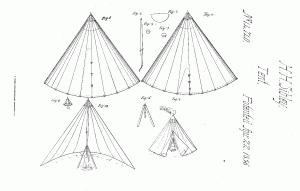
 

Sources:

  1. Bates, Samuel P. History of Pennsylvania Volunteers, 1861-5. Harrisburg, Pennsylvania: B. Singerly, State Printer, 1869.
  2. Berlin, Ira, Barbara J. Fields, et. al. Freedom: A Documentary History of Emancipation, 1861-1867, Series I, Vol. I, pp. 123-125: “The Destruction of Slavery.” New York, New York: Cambridge University Press, 2010.
  3. Berlin, Ira, Barbara J. Fields, et. al. Free at Last: A Documentary History of Freedom, Slavery, and the Civil War, pp. 46-48. New York, New York: The New Press, 2007.
  4. Farrell, Michael. “History of the Formation of the Tenth Army Corps,” in “Department General Order No. 2 (Series 2013-2014, August 15, 2013).” Boca Raton, Florida: Sons of Union Veterans of the Civil War (Department of Florida).
  5. Hunter, Major-General David. Abstract from Return of the Department of the South, Major General David Hunter, U. S. Army, commanding, for July 31, 1862,” in The War of the Rebellion: Official Records of the Civil War: Chapter XXVI: “Operations on the Coast of South Carolina, Georgia, and Middle and East Florida, Apr. 12, 1862-Jun 11, 1863: Correspondence, etc.: Union.” Washington, D.C.: Government Printing Office, 1885.
  6. Lincoln, Abraham. “Proclamation by Abraham Lincoln, May 19, 1862, #90” (rescinding Major-General David Hunter’s Emancipation of Enslaved Persons in Georgia, Florida, and South Carolina via General Order No. 11), in “Presidential Proclamations” (Series 23, Record Group 11). Washington, D.C.: U.S. National Archives and Records Administration.
  7. Miller, Steven. Proclamation by the President,” in “Freedmen & Southern Society Project.” College Park, Maryland: University of Maryland, College Park (History Department), June 19, 2020.
  8. Reynolds, Michael S. “Rhett, Robert Barnwell,” in South Carolina Encyclopedia. Columbia, South Carolina: University of South Carolina, Institute for Southern Studies, October 25, 2016.
  9. “Registers of Deaths of Volunteers” (1862 U.S. Army death ledger entries for multiple members of the 47th Pennsylvania Volunteers). Washington, D.C.: U.S. National Archives and Records Administration.
  10. Schmidt, Lewis. A Civil War History of the 47th Regiment of Pennsylvania Veteran Volunteers. Allentown, Pennsylvania: Self-published, 1986.
  11. “Yankees Sick and Dying.” Athens, Tennessee: The Athens Post, May 16, 1862.


Black History Month: An Early Encounter with the Evil of Slavery and a Celebration of Washington’s Birthday (February 1862)

Woodcut depicting the harsh climate at Fort Taylor in Key West, Florida during the Civil War (public domain, U.S. Library of Congress).

“I was a servant until I was 13 years old and then my master put me into the field to make sugar and molasses. I tried to escape, but my master came on the ship and took me back.”

— Walter Bowten, a twenty-seven-year-old Black man who requested help from the 47th Pennsylvania Volunteers after successfully escaping from slavery in February 1862


Attached to the command of Brigadier-General John Milton Brannan and assigned to garrison Fort Zachary Taylor in Key West, Florida in early February 1862, the members of the 47th Regiment, Pennsylvania Volunteer Infantry were soon brought face to face with the realities of life behind enemy lines in America’s Deep South as the United States was about to enter into the second year of its Civil War. Familiarized early on with the open, corrosive hatred of supporters of secession and the Confederacy, they also learned about the ugliest practices of slavery firsthand from a young man who had been whipped simply because his clothing had torn during a period of hard labor.

Taking turns with members of Brannan’s other regiments (the 90th and 91st New York Volunteers) in guarding roughly 200 to 300 blockade runners, gunboat operators and other Confederate prisoners, as well as 57 secessionists from Ship Island, the 47th Pennsylvanians also drilled daily in heavy artillery tactics, felled trees, helped to build new roads, and strengthened the fortifications in and around the Union Army’s presence in Key West.

* Note: Although several earlier historians have speculated that the 47th Pennsylvania Infantry was ordered to Florida because its members were incompetent militarily or because they were being punished for some unspecified wrongdoing, this belief is unfounded. Brigadier-General Brannan personally selected the 47th Pennsylvania to accompany him on what he knew would be a difficult mission—terminating Florida’s role as “the supplier of the Confederacy.” Florida’s livestock farmers were among the earliest to feed Confederate States Army troops, becoming one of the largest sources of cattle for CSA regiments, as well as suppliers of pork products while other food producers contributed fruit and fish. In addition, Florida was a major producer of American salt—a key ingredient critical to the preservation of food for CSA troops on the move.

Furthermore, President Abraham Lincoln and his generals realized that, if they were to prevent Europe from helping the Confederate States of America turn the tide of war in its favor by landing ammunition and food-laden ships on the coast of Florida, Union troops would need to capture and then maintain control of Florida’s coastal and interior waterways. So, they began to beef up the presence of Union Army and Navy forces at key locations around the state, including at Fort Taylor in Key West and Fort Jefferson in the Dry Tortugas, as well as via offshore shipping blockades; they then also increased the heavy artillery training of their fort-based troops to further persuade Confederate and European leaders that any attempted sea-based attack or supply delivery would be so costly that it would not be worth the risk.

As the 47th Pennsylvania Volunteers settled in further to their new assignments, they also began to make their presence felt in another important way—by trooping regularly at the fort and through the town. On Friday, February 7 alone, the 47th Pennsylvanians marched behind their Regimental Band in three separate regimental parades, followed by an evening drill in front of their barracks.

To safeguard against potential misbehavior by soldiers stationed far from home, military discipline was also instilled and reinforced through a series of proclamations by superior officers at the brigade, regimental, or unit levels, such as General Order No. 2, which announced that water permits would be “issued to the quartermaster Sgt. of each company each evening at 6:45 for the succeeding day” due to a critical shortage of safe drinking water:

“A sufficient number of men will be detailed to carry water, but they will not be excused from other duty. No bathing will be allowed after 5:30 AM. The right wing of the regiment will bathe tomorrow morning from 5 to 5:30 AM. They will be in charge of a commanding officer of each company. The commanding officer will see that the men avail themselves of bathing as it is essential to the health and welfare of the regiment. All bathing in daytime is absolutely prohibited. Hours of service and roll call are: Reveille at daybreak; police immediately after; call for drill 5:30; recall 7; breakfast 7:15; surgeon’s call 7:45; guard mounting 9; call for drill 10; recall 11; dinner 12; 1st Sgt. call 1; call for drill 3:30; recall 5; dress parade 5:30; tattoo at 8; taps 8:30. These calls will be beat by the drum at the central guard quarters five minutes before the time stated.”

Captain Richard A. Graeffe, Company A, 47th Pennsylvania Volunteers (c. 1863, public domain).

Special Order No. 18 authorized Captain Richard Graeffe, the commanding officer of Company A, to direct two men to immediately report to the regiment’s master baker for extra duties as bakers’ helpers while General Order No. 3 directed the commanding officers of individual companies to ensure that their respective sergeants had enough time to complete their administrative duties before submitting their required reports to the brigade’s headquarters each morning by 10 a.m. (Regimental Order No. 2 was subsequently modified to reflect the rescheduling of tattoo and taps to 9 and 9:30 p.m., respectively.) Around this same time, Private Abraham N. Wolf was awarded a temporary boost in authority with his assignment as “boss carpenter”—an additional duty he would continue to perform until June 20.

Following an early inspection by their superiors on Sunday, February 9, many 47th Pennsylvanians walked into the main part of the city to attend church services. C Company Musician Henry D. Wharton described the experience a week later in another of his letters to the Sunbury American:

“With several members of our company I attended Episcopal Church last Sabbath—The church building is a large and beautiful one, and the people deserve great credit for erecting it. The Minister is a strong Union man, and it struck me, on last Sabbath, that he lost no opportunity of displaying his Union sentiments. Some time ago some members of the Church were very disloyal, and when the Minister read the prayer “to behold and bless Thy servant, the President of the United States, and all others in authority,” they would close the prayer book, and look daggers at him, wondering whom they should hang first – the Minister or Abe Lincoln. General Brannan (Captain at the time), hearing of it, put an end to this disrespect, made them take the oath of allegiance, and now they now can say ‘Amen’ as loud and as heartily as the best Union men on the island…. For the sake of the Church, I am happy to state that only a few of its members were weak enough to show their fondness for Jeff Davis—the rest of the members were very glad that Gen. Brannan took the matter in hand.

The population of the island is about four thousand, consisting of negroes, Spaniards, and a few whites. With the exception of five storekeepers, the occupation of its inhabitants is fishing, dealing in fruit and selling hot coffee and cool drinks. There are as many coffee and cool drink saloons here as there are Lager Bier saloons in the Everlasting State of Williamsport, and from that you can readily perceive there is no need of being thirsty. As for intoxicating drinks, they are prohibited—the island being under martial law it is impossible to get even a smell, and it is well that it is so, for in this climate there is no telling what amount of sickness its use might produce. The buildings used for stores are very large and airy, but I can assure you that in the stores of either Friling & Grant or E. Y. Bright & Son, there are more goods than in all the stores on this island put together. Oranges, coming from Cuba and Nassau islands, are very plenty, and can be bo’t [sic] at three for a sixpence; not such as you folks get at home, but real fresh, juicy fellows that melt in one’s mouth equal to the best ice cream made in H. B. Masser’s patent ice cream freezers. Fish are very plenty [sic], and can be bought cheap. Thanks to Sergeant Smelser [alternate spelling “Smeltzer”], our company is living high in the fish line. He is Company Quarter-Master Sergeant, and on every fish market morning, Peter is at the wharf, and there exchanges our surplus pork and beef for fish; so that the boys have a variety and are content.

Horse and cattle are very small. They come from Cuba. The horses are not near as big as Peter B. Masser’s black ponies, and I have seen at home two year old cattle larger than those they use here for beeves.

There is an article here, that I believe bothers the whole human race, and that is mosquitoes. Those on this island are not of the common kind, but regular tormentors. – Fix your net work as you may, you will receive their sting before morning. They are great on a serenade too, and if one is impolite enough to go to sleep as they are in the middle of a glee, the leader will give you a tickler with his sting that it is impossible to resist; but for my part, I can easily dispense with that kind of music, and often wish that they would favor some one else who can appreciate their talents better than I can.

The Fort on this island (Fort Taylor) is a very large one, and is now of the most importance to the Government. It is not near finished, but so much so that the rebels dare not venture within the range of its guns. – When finished it will have one hundred and eighty guns, and with those on the embankment on the moat, fronting the town, it will have two hundred and seventy five. Some time since the fort came within an ace of being taken by the rebels, but Capt. Brannan saved it be stratagem. Men were working at the fort, so, to prevent suspicion, the Captain every morning would march a guard from the garrison to the fort, and in that manner before the rebels were aware of it, he had full possession of it. Mulraner, formerly a Sergeant of the Captain’s, who became rich in the rum business, hoisted a secesh flag on his hotel, and sent an impudent note to the Captain requesting him to honor the seven stars by firing a salute from the fort. The reply was that if the rag was not taken down on the return of the messenger, the Commander would open the guns of the fort on the town, and send Mulraner and his friends to Tortugas to work in the hot sand and give them time to repent of their folly, preparatory to dangling at the end of a rope. The flag was taken down — Mulraner vamoosed [sic] the ranch, and is now in command of a company of rebels somewhere near Pensacola. It is tho’t [sic] that when Gen. Brannan arrives Mulraner’s property, which is valuable, will be confiscated.

There are a large number of men-of-war here, and every day more are added to their number. Fifty-seven prisoners were brought in during the last week from Ship Island, besides two prizes, one loaded with turpentine, and the other with arms and machinery that were on the road to New Orleans, for a large steamer that is building there for use of the rebels.

You need not be surprised to here [sic] of an expedition being sent out from here – everything looks like it – so many vessels in port, more expected and troops arriving every day. There are three regiments here now, the 90th and 91st New York, and our own, besides the Regulars in the fort. If we do go, there will have to be a strong force left behind; for, in my opinion, the most of the Union men here are as treacherous as the men who use the stiletto to stab a friend, at night, from behind.

With the exception of fish and fruit, everything they use comes from the North. They would starve if it were not for the ‘mud ills,’ and yet they would try to break up the Government that protects them. Lumber is worth one hundred dollars per thousand feet. Carpenters’ wages are three dollars per day but I think they would starve at that, as I see no employment for them. The boys are very well, and are enjoying themselves with the sea bathing. We have received the American and Gazette three times since our arrival, and they are very welcome visitors, much more so than were the morning papers in Virginia. It is very strange we receive no letters; if the ‘folks at home’ knew how anxious we are to get them they would be a little more punctual.”

Following completion that same Sunday (February 9) of the brigade’s dress parade, which began at 5:30 p.m., B Company Lieutenant Allen G. Balliet marched roughly 40 members of the 47th Pennsylvania to Key West’s Methodist Church for evening services during which a sermon was delivered by the 91st New York Volunteers’ regimental chaplain. That same day, H Company Captain James Kacy issued Company Order No. 7:

“Sgt. R. S. Gardner will have under his command tents #1 and 2 and will be held personally responsible for the clean up of the men in person, clothing, arms, accoutrements, and quarters. Sgt. James Hahn will have under him tents #3 and 4 and be held responsible the same as #1 and 2. Sgt. Lynch will have under his control tents #5 and 6 and will be likewise held responsible. The Sgts. Gardner, Hahn and Lynch will have the men of the company on the parade ground at 5:30 AM and when one of them is on guard, the other two will attend to this drill duty and divide the squad between their respective commands.”

As the days of February rolled by, the commanding officers of the 47th Pennsylvania made a concerted effort to stabilize the living arrangements for their subordinates, housing the bulk of their men in military barracks southeast of Palm Avenue and White Street at Peary Court on the eastern side of Key West. Lodged in three buildings on the northeast side and three buildings on the southwest side of the Union Army’s parade grounds were the regiment’s field and staff officers, as well as the entire membership of the Regimental Band. Additionally, two 125-foot by 20-foot buildings accommodated a portion of enlisted members of the 47th Pennsylvania with the remainder housed in adjacent military tents—effective Tuesday, February 18. Known as Sibley tents, these were large, round, canvas structures which were 12 feet tall by 18 feet in diameter, supported by center poles and warmed by central fireplaces. Housing 16 to 19 men each, seven tents each were erected by the 47th Pennsylvania’s ten companies. One tent per company was placed at the head of each company’s “street” to house that company’s officers with the other six tents per company allotted to the enlisted men, each of whom who were arranged on the inside “like the spokes of a wheel,” according to Schmidt, “with their feet to the fireplace.”

According to Regimental Chaplain William DeWitt Clinton Rodrock, “The barracks were large and commodious two story [sic] buildings forming three sides of a quadrangle, the opening toward the sea.” Also located in this section of the city were the army’s hospital and cemetery.

As Henry Wharton indicated in his letter (above), serving with the 47th Pennsylvania under Brannan were the 90th New York, which was commanded by Colonel Joseph S. Morgan and which would later fight alongside the 47th Pennsylvania during the Union’s 1864 Red River Campaign across Louisiana and 1864 Shenandoah Valley Campaign across Virginia, and the 91st New York, commanded by Colonel J. Van Sandt. In addition, five companies of U.S. Army “regulars” also called Fort Taylor home at this time. (The 7th New Hampshire, which was stationed at Fort Jefferson in Florida’s Dry Tortugas, would be brought into closer proximity with the 47th Pennsylvania a few months later when Brannan and his men were ordered to move to South Carolina.)

There were also a significant number of enslaved and formerly enslaved men, women and children in the region. According to Schmidt:

“There was a slave camp about one mile from the military camps, where 150 Blacks were engaged in manufacturing salt; it was reported that 50,000 bushels of salt were made on the island each year by solar evaporation…. The manufacture of salt was terminated later in 1862, and was not restarted until 1854, to prevent any salt from the facility finding its way into the Confederacy….

Another building of note on the island of Key West during the war was the ‘slave barracoons’, used to house Blacks taken from captured slavery vessels, and described as being a long low building about 300 feet by 30 feet. Lt. Geety reported that there were 1500 slaves there at one time, and 400 died in four months [sic] time; a rate per day that the 90th New York Regiment would approach in August-September as a result of a Yellow Fever epidemic, during which time the barracoons, located at Whitehead’s Point in the southernmost area of Key West would be converted into a temporary hospital.”

Rendering of Fort Taylor, Key West, Florida (Harper’s Weekly, 1864, public domain).

On Friday, February 14, the 47th Pennsylvania Volunteers made their presence known once again to Key West residents as the regiment paraded through the streets of the city. Two days later, their commanding officers insisted that they get better acquainted with the residents of their new community by attending services at local churches. That same Sunday evening, a young black man named Walter Bowten entered the camp to request protection. Provided food and a tobacco-filled pipe, he was also given a regimental uniform to replace his tattered, soiled clothing. His mind at greater ease, he then explained that he had escaped slavery from Providence Island, and recounted his life experience to one of the regiment’s bilingual members, who documented the man’s story in German. The following translation was provided by regimental historian Lewis Schmidt:

“My name is Walter Bowten and I was born in 1835. My parents were born slaves but they worked to free themselves. I was a servant until I was 13 years old and then my master put me into the field to make sugar and molasses. I tried to escape, but my master came on the ship and took me back…. Where my master lives is not much of a place, it is only one island where tangerines, oranges, lemons and coconuts grow. I do not have a cent of money from my master and would rather be with the white folks than with a mulatto. I had to work every day from morning until night, and on Sunday we had to work until 8 in the morning. We had two changes of clothing, one for work and one change for good, and when the clothing was torn, our master would threaten and whip us. Our master would not let us go to the soldiers and said he would shoot us, but we came away anyway.”

Regrettably, the attempts of the 47th Pennsylvanians to protect Bowten were thwarted the next day by other soldiers at the fort who seized Bowten while the 47th Pennsylvania was marching in another of its regimental parades. Bowten was subsequently ordered to be held at the fort, according to Schmidt, “until a ship which had gone to Havana for a load of sugar would return.”

Brigadier-General John Milton Brannan, U.S. Army (public domain).

On Friday, February 21, the 47th Pennsylvania Volunteers marched, for the first time in Key West, in a dress parade that was observed by Brigadier-General Brannan, who had just arrived at Fort Taylor that day. Brannan later took the time to ride his horse along the various “company streets” of the 47th Pennsylvania’s encampment, “tipping his hat” as he passed his cheering subordinates, according to Schmidt.

Another brigade parade was then held at 10 a.m. the next day—Washington’s Birthday—a day of great joy that began with prayer and a reading of President George Washington’s farewell address

“Friends and Fellow Citizens,

The period for a new election of a citizen to administer the executive government of the United States being not far distant, and the time actually arrived when your thoughts must be employed in designating the person who is to be clothed with that important trust, it appears to me proper, especially as it may conduce to a more distinct expression of the public voice, that I should now apprise you of the resolution I have formed, to decline being considered among the number of those out of whom a choice is to be made.

I beg you, at the same time, to do me the justice to be assured that this resolution has not been taken without a strict regard to all the considerations appertaining to the relation which binds a dutiful citizen to his country; and that in withdrawing the tender of service, which silence in my situation might imply, I am influenced by no diminution of zeal for your future interest, no deficiency of grateful respect for your past kindness, but am supported by a full conviction that the step is compatible with both.

The acceptance of, and continuance hitherto in, the office to which your suffrages have twice called me have been a uniform sacrifice of inclination to the opinion of duty and to a deference of what appeared to be your desire. I constantly hoped that it would have been much earlier in my power, consistently with motives which I was not at liberty to disregard, to return to that retirement from which I had been reluctantly drawn. The strength of my inclination to do this, previous to the last election, had even led to the preparation of an address to declare it to you; but mature reflection on the then perplexed and critical posture of our affairs with foreign nations, and the unanimous advice of persons entitled to my confidence, impelled me to abandon the idea.

I rejoice that the state of your concerns, external as well as internal, no longer renders the pursuit of inclination incompatible with the sentiment of duty or propriety, and am persuaded, whatever partiality may be retained for my services, that, in the present circumstances of our country, you will not disapprove my determination to retire.

The impressions with which I first undertook the arduous trust were explained on the proper occasion. In the discharge of this trust, I will only say that I have, with good intentions, contributed towards the organization and administration of the government in the best exertions of which a very fallible judgment was capable. Not unconscious in the outset of the inferiority of my qualifications, experience in my own eyes, perhaps still more in the eyes of others, has strengthened the motives to diffidence of myself; and every day the increasing weight of years admonishes me more and more that the shade of retirement is as necessary to me as it will be welcome. Satisfied that if any circumstances have given peculiar value to my services, they were temporary, I have the consolation to believe that, while choice and prudence invite me to quit the political scene, patriotism does not forbid it.

In looking forward to the moment which is intended to terminate the career of my public life, my feelings do not permit me to suspend the deep acknowledgment of that debt of gratitude which I owe to my beloved country for the many hours it has conferred upon me; still more for the steadfast confidence with which it has supported me; and for the opportunities I have thence enjoyed of manifesting my inviolable attachment, by services faithful and persevering, though in usefulness unequal to my zeal. If benefits have resulted to our country from these services, let it always be remembered to your praise, and as an instructive example in our annals, that under circumstances in which the passions, agitated in every direction, were liable to mislead, amidst appearances sometimes dubious, vicissitudes of fortune often discouraging, in situations in which not unfrequently want of success has countenanced the spirit of criticism, the constancy of your support was the essential prop of the efforts, and a guarantee of the plans by which they were effected. Profoundly penetrated with this idea, I shall carry it with me to my grave, as a strong incitement to unceasing vows that heaven may continue to you the choicest tokens of its beneficence; that your union and brotherly affection may be perpetual; that the free Constitution, which is the work of your hands, may be sacredly maintained; that its administration in every department may be stamped with wisdom and virtue; that, in fine, the happiness of the people of these States, under the auspices of liberty, may be made complete by so careful a preservation and so prudent a use of this blessing as will acquire to them the glory of recommending it to the applause, the affection, and adoption of every nation which is yet a stranger to it.

Here, perhaps, I ought to stop. But a solicitude for your welfare, which cannot end but with my life, and the apprehension of danger, natural to that solicitude, urge me, on an occasion like the present, to offer to your solemn contemplation, and to recommend to your frequent review, some sentiments which are the result of much reflection, of no inconsiderable observation, and which appear to me all-important to the permanency of your felicity as a people. These will be offered to you with the more freedom, as you can only see in them the disinterested warnings of a parting friend, who can possibly have no personal motive to bias his counsel. Nor can I forget, as an encouragement to it, your indulgent reception of my sentiments on a former and not dissimilar occasion.

Interwoven as is the love of liberty with every ligament of your hearts, no recommendation of mine is necessary to fortify or confirm the attachment.

The unity of government which constitutes you one people is also now dear to you. It is justly so, for it is a main pillar in the edifice of your real independence, the support of your tranquility at home, your peace abroad; of your safety; of your prosperity; of that very liberty which you so highly prize. But as it is easy to foresee that, from different causes and from different quarters, much pains will be taken, many artifices employed to weaken in your minds the conviction of this truth; as this is the point in your political fortress against which the batteries of internal and external enemies will be most constantly and actively (though often covertly and insidiously) directed, it is of infinite moment that you should properly estimate the immense value of your national union to your collective and individual happiness; that you should cherish a cordial, habitual, and immovable attachment to it; accustoming yourselves to think and speak of it as of the palladium of your political safety and prosperity; watching for its preservation with jealous anxiety; discountenancing whatever may suggest even a suspicion that it can in any event be abandoned; and indignantly frowning upon the first dawning of every attempt to alienate any portion of our country from the rest, or to enfeeble the sacred ties which now link together the various parts.

For this you have every inducement of sympathy and interest. Citizens, by birth or choice, of a common country, that country has a right to concentrate your affections. The name of American, which belongs to you in your national capacity, must always exalt the just pride of patriotism more than any appellation derived from local discriminations. With slight shades of difference, you have the same religion, manners, habits, and political principles. You have in a common cause fought and triumphed together; the independence and liberty you possess are the work of joint counsels, and joint efforts of common dangers, sufferings, and successes.

But these considerations, however powerfully they address themselves to your sensibility, are greatly outweighed by those which apply more immediately to your interest. Here every portion of our country finds the most commanding motives for carefully guarding and preserving the union of the whole.

The North, in an unrestrained intercourse with the South, protected by the equal laws of a common government, finds in the productions of the latter great additional resources of maritime and commercial enterprise and precious materials of manufacturing industry. The South, in the same intercourse, benefitting by the agency of the North, sees its agriculture grow and its commerce expand. Turning partly into its own channels the seamen of the North, it finds its particular navigation invigorated; and, while it contributes, in different ways, to nourish and increase the general mass of the national navigation, it looks forward to the protection of a maritime strength, to which itself is unequally adapted. The East, in a like intercourse with the West, already finds, and in the progressive improvement of interior communications by land and water, will more and more find a valuable vent for the commodities which it brings from abroad, or manufactures at home. The West derives from the East supplies requisite to its growth and comfort, and, what is perhaps of still greater consequence, it must of necessity owe the secure enjoyment of indispensable outlets for its own productions to the weight, influence, and the future maritime strength of the Atlantic side of the Union, directed by an indissoluble community of interest as one nation. Any other tenure by which the West can hold this essential advantage, whether derived from its own separate strength, or from an apostate and unnatural connection with any foreign power, must be intrinsically precarious.

While, then, every part of our country thus feels an immediate and particular interest in union, all the parts combined cannot fail to find in the united mass of means and efforts greater strength, greater resource, proportionably greater security from external danger, a less frequent interruption of their peace by foreign nations; and, what is of inestimable value, they must derive from union an exemption from those broils and wars between themselves, which so frequently afflict neighboring countries not tied together by the same governments, which their own rival ships alone would be sufficient to produce, but which opposite foreign alliances, attachments, and intrigues would stimulate and embitter. Hence, likewise, they will avoid the necessity of those overgrown military establishments which, under any form of government, are inauspicious to liberty, and which are to be regarded as particularly hostile to republican liberty. In this sense it is that your union ought to be considered as a main prop of your liberty, and that the love of the one ought to endear to you the preservation of the other.

These considerations speak a persuasive language to every reflecting and virtuous mind, and exhibit the continuance of the Union as a primary object of patriotic desire. Is there a doubt whether a common government can embrace so large a sphere? Let experience solve it. To listen to mere speculation in such a case were criminal. We are authorized to hope that a proper organization of the whole with the auxiliary agency of governments for the respective subdivisions, will afford a happy issue to the experiment. It is well worth a fair and full experiment. With such powerful and obvious motives to union, affecting all parts of our country, while experience shall not have demonstrated its impracticability, there will always be reason to distrust the patriotism of those who in any quarter may endeavor to weaken its bands.

In contemplating the causes which may disturb our Union, it occurs as matter of serious concern that any ground should have been furnished for characterizing parties by geographical discriminations, Northern and Southern, Atlantic and Western; whence designing men may endeavor to excite a belief that there is a real difference of local interests and views. One of the expedients of party to acquire influence within particular districts is to misrepresent the opinions and aims of other districts. You cannot shield yourselves too much against the jealousies and heartburnings [sic] which spring from these misrepresentations; they tend to render alien to each other those who ought to be bound together by fraternal affection. The inhabitants of our Western country have lately had a useful lesson on this head; they have seen, in the negotiation by the Executive, and in the unanimous ratification by the Senate, of the treaty with Spain, and in the universal satisfaction at that event, throughout the United States, a decisive proof of how unfounded were the suspicions propagated among them of a policy in the General Government and in the Atlantic States unfriendly to their interests in regard to the Mississippi; they have been witnesses to the formation of two treaties, that with Great Britain, and that with Spain, which secure to them everything they could desire, in respect to our foreign relations, towards confirming their prosperity. Will it not be their wisdom to rely for the preservation of these advantages on the Union by which they were procured? Will they not henceforth be deaf to those advisors, if such there are, who would sever them from their brethren and connect them with aliens?

To the efficacy and permanency of your Union, a government for the whole is indispensable. No alliance, however strict, between the parts can be an adequate substitute; they must inevitably experience the infractions and interruptions which all alliances in all times have experienced. Sensible of this momentous truth, you have improved upon your first essay, by the adoption of a constitution of government better calculated than your former for an intimate union, and for the efficacious management of your common concerns. This government, the offspring of our own choice, uninfluenced and unawed, adopted upon full investigation and mature deliberation, completely free in its principles, in the distribution of its powers, uniting security with energy, and containing within itself a provision for its own amendment, has a just claim to your confidence and your support. Respect for its authority, compliance with its laws, acquiescence in its measures, are duties enjoined by the fundamental maxims of true liberty. The basis of our political systems is the right of the people to make and to alter their constitutions of government. But the Constitution which at any time exists, till charged by an explicit and authentic act of the whole people, is sacredly obligatory upon all. The very idea of the power and the right of the people to establish government presupposes the duty of every individual to obey the established government.

All obstructions to the execution of the laws, all combinations and associations, under whatever plausible character, with the real design to direct, control, counteract, or awe the regular deliberation and action of the constituted authorities, are destructive of this fundamental principle, and of fatal tendency. They serve to organize faction, to give it an artificial and extraordinary force; to put, in the place of the delegated will of the nation the will of a party, often a small but artful and enterprising minority of the community; and according to the alternate triumphs of different parties, to make the public administration the mirror of the ill-concerted and incongruous projects of faction, rather than the organ of consistent and wholesome plans digested by common counsels and modified by mutual interests.

However combinations or associations of the above description may now and then answer popular ends, they are likely, in the course of time and things, to become potent engines, by which cunning, ambitious, and unprincipled men will be enabled to subvert the power of the people and to usurp for themselves the reins of government, destroying afterwards the very engines which have lifted them to unjust dominion.

Towards the preservation of your government, and the permanency of your happy state, it is requisite, not only that you steadily discountenance irregular oppositions to its acknowledged authority, but also that you resist with care the spirit of innovation upon its principles, however specious the pretexts. One method of assault may be to effect, in the forms of the Constitution, alterations which will impair the energy of the system, and thus to undermine what cannot directly be overthrown. In all the changes to which you may be invited, remember that time and habit are at least as necessary to fix the true character of governments as of other human institutions; that experience is the surest standard by which to test the real tendency of the existing constitution of a country; that facility in changes, upon the credit of mere hypothesis and opinion; and remember, especially, that for the efficient management of your common interests, in a country so extensive as ours, a government of as much vigor as is consistent with the perfect security of liberty is indispensable. Liberty itself will find in such a government, with powers properly distributed and adjusted, its surest guardian. It is, indeed, little else than a name, where the government is too feeble to withstand the enterprises of faction, to confine each member of the society within the limits prescribed by the laws, and to maintain all in the secure and tranquil enjoyment of the rights of person and property.

I have already intimated to you the danger of parties in the State, with particular reference to the founding of them on geographical discriminations. Let me now take a more comprehensive view, and warn you in the most solemn manner against the baneful effects of the spirit of party generally.

This spirit, unfortunately, is inseparable from our nature, having its root in the strongest passions of the human mind. It exists under different shapes in all governments, more or less stifled, controlled, or repressed; but, in those of the popular form, it is seen in its greatest rankness, and is truly their worst enemy.

The alternate domination of one faction over another, sharpened by the spirit of revenge, natural to party dissension, which in different ages and countries has perpetrated the most horrid enormities, is itself a frightful despotism. But this leads at length to a more formal and permanent despotism. The disorders and miseries which result gradually incline the minds of men to seek security and repose in the absolute power of an individual; and sooner or later the chief of some prevailing faction, more able or more fortunate than his competitors, turns this disposition to the purposes of his own elevation, on the ruins of public liberty.

Without looking forward to an extremity of this kind (which nevertheless ought not to be entirely out of sight), the common and continual mischiefs of the spirit of party are sufficient to make it the interest and duty of a wise people to discourage and restrain it.

It serves always to distract the public councils and enfeeble the public administration. It agitates the community with ill-founded jealousies and false alarms, kindles the animosity of one part against another, foments occasionally riot and insurrection. It opens the door to foreign influence and corruption, which finds a facilitated access to the government itself through the channels of party passions. Thus the policy and the will of one country are subjected to the policy and will of another.

There is an opinion that parties in free countries are useful checks upon the administration of the government and serve to keep alive the spirit of liberty. This within certain limits is probably true, and in governments of a monarchical cast, patriotism may look with indulgence, if not with favor, upon the spirit of party. But in those of the popular character, in governments purely elective, it is a spirit not to be encouraged. From their natural tendency, it is certain there will always be enough of that spirit for every salutary purpose. And there being constant danger of excess, the effort ought to be by force of public opinion, to mitigate and assuage it. A fire not to be quenched, it demands a uniform vigilance to prevent its bursting into a flame, lest, instead of warming, it should consume.

It is important, likewise, that the habits of thinking in a free country should inspire caution in those entrusted with its administration, to confine themselves within their respective constitutional spheres, avoiding in the exercise of the powers of one department to encroach upon another. The spirit of encroachment tends to consolidate the powers of all the departments in one, and thus to create, whatever the form of government, a real despotism. A just estimate of that love of power, and proneness to abuse it, which predominates in the human heart, is sufficient to satisfy us of the truth of this position. The necessity of reciprocal checks in the exercise of political power, by dividing it and distributing it into different depositaries, and constituting each the guardian of the public weal against invasions by the others, has been evinced by experiments ancient and modern; some of them in our country and under our own eyes. To preserve them must be as necessary as to institute them. If, in the opinion of the people, the distribution or modification of the constitutional powers be in any particular wrong, let it be corrected by an amendment in the way which the Constitution designates. But let there be no change by usurpation; for though this, in one instance, may be the instrument of good, it is the customary weapon by which free governments are destroyed. The precedent must always greatly overbalance in permanent evil any partial or transient benefit, which the use can at any time yield.

Of all the dispositions and habits which lead to political prosperity, religion and morality are indispensable supports. In vain would that man claim the tribute of patriotism, who should labor to subvert these great pillars of human happiness, these firmest props of the duties of men and citizens. The mere politician, equally with the pious man, ought to respect and to cherish them. A volume could not trace all their connections with private and public felicity. Let it simply be asked: Where is the security for property, for reputation, for life, if the sense of religious obligation desert the oaths which are the instruments of investigation in courts of justice? And let us with caution indulge the supposition that morality can be maintained without religion. Whatever may be conceded to the influence of refined education on minds of peculiar structure, reason and experience both forbid us to expect that national morality can prevail in exclusion of religious principle.

It is substantially true that virtue or morality is a necessary spring of popular government. The rule, indeed, extends with more or less for to every species of free government. Who that is a sincere friend to it can look with indifference upon attempts to shake the foundation of the fabric?

Promote then, as an object of primary importance, institutions for the general diffusion of knowledge. In proportion as the structure of a government gives force to public opinion, it is essential that public opinion should be enlightened.

As a very important source of strength and security, cherish public credit. One method of preserving it is to use it as sparingly as possible, avoiding occasions of expense by cultivating peace, but remembering also that timely disbursements to prepare for danger frequently prevent much greater disbursements to repel it, avoiding likewise the accumulation of debt, not only by shunning occasions of expense, but by vigorous exertion in time of peace to discharge the debts which unavoidable wars may have occasioned, not ungenerously throwing upon posterity the burden which we ourselves ought to bear. The execution of these maxims belongs to your representatives, but it is necessary that public opinion should co-operate. To facilitate to them the performance of their duty, it is essential that you should practically bear in mind that towards the payment of debts there must be revenue; that to have revenue there must be taxes; that no taxes can be devised which are not more or less inconvenient and unpleasant; that the intrinsic embarrassment, inseparable from the selection of the proper objects (which is always a choice of difficulties), ought to be a decisive motive for a candid construction of the conduct of the government in making it, and for a spirit of acquiescence in the measures for obtaining revenue, which the public exigencies may at any time dictate.

Observe good faith and justice toward all nations; cultivate peace and harmony with all. Religion and morality enjoin this conduct; and can it be, that good policy does not equally enjoin it? It will be worthy of a free, enlightened, and at no distance period, a great nation, to give to mankind the magnanimous and too novel example of a people always guided by an exalted justice and benevolence. Who can doubt that, in the course of time and things, the fruits of such a plan would richly repay any temporary advantages which might be lost by a steady adherence to it? Can it be that Providence has not connected the permanent felicity of a nation with its virtue? The experiment, at least, is recommended by every sentiment which ennobles human nature. Alas! is it rendered impossible by its vices?

In the execution of such a plan, nothing is more essential than that permanent, inveterate antipathies against particular nations, and passionate attachments for others, should be excluded; and that, in place of them, just and amicable feelings towards all should be cultivated. The nation which indulges toward another a habitual hatred or a habitual fondness is in some degree a slave. It is a slave to its animosity or to its affection, either of which is sufficient to lead it astray from its duty and its interest. Antipathy in one nation against another disposes each more readily to offer insult and injury, to lay hold of slight causes of umbrage, and to be haughty and intractable, when accidental or trifling occasions of dispute occur. Hence, frequent collisions, obstinate, envenomed, and bloody contests. The nation, prompted by ill-will and resentment, sometimes impels to war the government, contrary to the best calculations of policy. The government sometimes participates in the national propensity, and adopts through passion what reason would reject; at other times it makes the animosity of the nation subservient to projects of hostility instigated by pride, ambition, and other sinister and pernicious motives. The peace often, sometimes perhaps the liberty, of nations, has been the victim.

So likewise, a passionate attachment of one nation to another produces a variety of evils.
Sympathy for the favorite nation, facilitating the illusion of an imaginary common interest in cases where no real common interest exists, and infusing into one the enmities of the other, betrays the former into a participation in the quarrels and wars of the latter without adequate inducement or justification. It leads also to concessions to the favorite nation of privileges denied to others which is apt doubly to injure the nation making the concessions; by unnecessarily parting with what ought to have been retained, and by exciting jealousy, ill-will, and a disposition to retaliate, in the parties from whom equal privileges are withheld. And it gives to ambitious, corrupted, or deluded citizens (who devote themselves to the favorite nation), facility to betray or sacrifice the interests of their own country, without odium, sometimes even with popularity; gliding, with the appearances of a virtuous sense of obligation, a commendable deference for public opinion, or a laudable zeal for public good, the base or foolish compliances of ambition, corruption, or infatuation.

As avenues to foreign influence in innumerable ways, such attachments are particularly alarming to the truly enlightened and independent patriot. How many opportunities do they afford to tamper with domestic factions, to practice the arts of seduction, to mislead public opinion, to influence or awe the public councils? Such an attachment of a small or weak towards a great and powerful nation dooms the former to be the satellite of the latter.

Against the insidious wiles of foreign influence (I conjure you to believe me, fellow-citizens) the jealousy of a free people ought to be constantly awake, since history and experience prove that foreign influence is one of the most baneful foes of republican government. But that jealousy to be useful must be impartial; else it becomes the instrument of the very influence to be avoided, instead of a defense against it. Excessive partiality for one foreign nation an excessive dislike of another cause those whom they actuate to see danger only on one side, and serve to veil and even second the arts of influence on the other. Real patriots who may resist the intrigues of the favorite are liable to become suspected and odious, while its tools and dupes usurp the applause and confidence of the people, to surrender their interests.

The great rule of conduct for us in regard to foreign nations is in extending our commercial relations, to have with them as little political connection as possible. So far as we have already formed engagements, let them be fulfilled with perfect good faith. Here let us stop. Europe has a set of primary interests which to us have none; or a very remote relation. Hence she must be engaged in frequent controversies, the causes of which are essentially foreign to our concerns. Hence, therefore, it must be unwise in us to implicate ourselves by artificial ties in the ordinary vicissitudes of her politics, or the ordinary combinations and collisions of her friendships or enmities.

Our detached and distant situation invites and enables us to pursue a different course. If we remain one people under an efficient government, the period is not far off when we may defy material injury from external annoyance; when we may take such an attitude as will cause the neutrality we may at any time resolve upon to be scrupulously respected; when belligerent nations, under the impossibility of making acquisitions upon us, will not lightly hazard the giving us provocation; when we may choose peace or war, as our interest, guided by justice, shall counsel.

Why forego the advantages of so peculiar a situation? Why quit our own to stand upon foreign ground? Why, by interweaving our destiny with that of any part of Europe, entangle our peace and prosperity in the toils of European ambition, rivalship, interest, humor or caprice?

It is our true policy to steer clear of permanent alliances with any portion of the foreign world; so far, I mean, as we are now at liberty to do it; for let me not be understood as capable of patronizing infidelity to existing engagements. I hold the maxim no less applicable to public than to private affairs, that honesty is always the best policy. I repeat it, therefore, let those engagements be observed in their genuine sense. But, in my opinion, it is unnecessary and would be unwise to extend them.

Taking care always to keep ourselves by suitable establishments on a respectable defensive posture, we may safely trust to temporary alliances for extraordinary emergencies.

Harmony, liberal intercourse with all nations, are recommended by policy, humanity, and interest. But even our commercial policy should hold an equal and impartial hand; neither seeking nor granting exclusive favors or preferences; consulting the natural course of things; diffusing and diversifying by gentle means the streams of commerce, but forcing nothing; establishing (with powers so disposed, in order to give trade a stable course, to define the rights of our merchants, and to enable the government to support them) conventional rules of intercourse, the best that present circumstances and mutual opinion will permit, but temporary, and liable to be from time to time abandoned or varied, as experience and circumstances shall dictate; constantly keeping in view that it is folly in one nation to look for disinterested favors from another; that it must pay with a portion of its independence for whatever it may accept under that character; that, by such acceptance, it may place itself in the condition of having given equivalents for nominal favors, and yet of being reproached with ingratitude for not giving more. There can be no greater error than to expect or calculate upon real favors from nation to nation. It is an illusion, which experience must cure, which a just pride ought to discard.

In offering to you, my countrymen, these counsels of an old an affectionate friend, I dare not hope they will make the strong and lasting impression I could wish; that they will control the usual current of the passions, or prevent our nation from running the course which has hitherto marked the destiny of nations. But, if I may even flatter myself that they may be productive of some partial benefit, some occasional good; that they may now and then recur to moderate the fury of party spirit, to warn against the mischiefs of foreign intrigue, to guard against the impostures of pretended patriotism; this hope will be a full recompense for the solicitude for your welfare, by which they have been dictated.

How far in the discharge of my official duties I have been guided by the principles which have been delineated, the public records and other evidences of my conduct must witness to you and to the world. To myself, the assurance of my own conscience is, that I have at least believed myself to be guided by them.

In relation to the still subsisting war in Europe, my proclamation of the twenty-second of April, 1793, is the index of my plan. Sanctioned by your approving voice, and by that of your representatives in both houses of Congress, the spirit of that measure has continually governed me, uninfluenced by any attempts to deter or divert me from it.

After deliberate examination, with the aid of the best lights I could obtain, I was well satisfied to that our country, under all the circumstances of the case, had a right to take, and was bound in duty and interest to take, a neutral position. Having taken it, I determined, as far as should depend upon me, to maintain it, with moderation, perseverance, and firmness.

The considerations which respect the right to hold this conduct, it is not necessary on this occasion to detail. I will only observe that, according to my understanding of the matter, that right, so far from being denied by any of the belligerent powers, has been virtually admitted by all.

The duty of holding a neutral conduct may be inferred, without anything more, from the obligation which justice and humanity impose on every nation, in cases in which it is free to act, to maintain inviolate the relations of peace and amity towards other nations.

The inducements of interest for observing that conduct will best be referred to your own reflections and experience. With me a predominant motive has been to endeavor to gain time to our country to settle and mature its yet recent institutions, and to progress without interruption to that degree of strength and consistency which is necessary to give it, humanly speaking, the command of its own fortunes.

Though, in reviewing the incidents of my administration, I am unconscious of intentional error, I am nevertheless too sensible of my defects not to think it probably that I may have committed many errors. Whatever they may be, I fervently beseech the Almighty to avert or mitigate the evils to which they may tend. I shall also carry with me the hope that my country will never cease to view them with indulgence; and that, after forty five years of my life dedicated to its service with an upright zeal, the faults of incompetent abilities will be consigned to oblivion, as myself must soon be to the mansions of rest.

Relying on its kindness in this as in other things, and actuated by that fervent love towards it, which is so natural to a man who views in it the native soil of himself and his progenitors for several generations, I anticipate with pleasing expectation that retreat in which I promise myself to realize, without alloy, the sweet enjoyment of partaking, in the midst of my fellow-citizens, the benign influence of good laws under a free government, the ever-favorite object of my heart, and the happy reward, as I trust, of our mutual cares, labors, and dangers.

United States
19th September, 1796

Geo. Washington”

Professor Thomas Coates, the “Father of Band Music in America,” led the Regimental Band, 47th Pennsylvania Volunteer Infantry from August 1861 to September 1862 (public domain).

The parade then began on Washington’s birthday, 1862 with the 47th Pennsylvania Volunteer Infantry and the other units commanded by Brannan marching through Key West to the home of a Union-supporting judge who was known for proudly flying the American flag. Stopping behind its Regimental Band as it struck up “The Star-Spangled Banner,” the 47th Pennsylvania Infantry then marched to Fort Taylor, where its members witnessed the firing of a national, 34-gun salute by the fort’s artillery guns, followed by a salute fired by the guns of the man-of-war, Pensacola.

The celebration continued well into the evening, as brigade members were treated to a formal band concert and formal address by C Company Captain John Peter Shindel Gobin. Brigade members then competed against one another in foot, wheelbarrow and sack races, as well as a pig chase. C Company Corporal Jacob K. Keefer came in second in that foot race while C Company Private P. M. Randall somehow managed to take second in the sack race after falling down near the end and rolling across the finish line.

Joseph Eugene Walter, cornetist, Regimental Band, 47th Pennsylvania Volunteers, c. 1861.

On Monday, February 24 and Wednesday, February 26, the 47th Pennsylvania’s Regimental Band again performed in concert with the band giving “a ball for the officers, which was “numerously attended by the Knights of the spur and tinsel,” according to Wharton, who also noted the unfortunate circumstance that “there were only enough ladies in attendance to form six setts.”

On Friday, February 28, the entire regiment reported for an 8 a.m. inspection in response to Regimental Order No. 39, which had been issued by the commanding officers of the 47th Pennsylvania per Brigadier-General Brannan’s General Order No. 5. The regiment also received the following additional instruction via Brannan’s General Order No. 11:

“I. Officers and soldiers are required to live within the limits of their respective commands and on no account to sleep out thereof without special permission of the Brigadier General commanding. No non-commissioned officers or soldier will be allowed in the town without a written pass from his commanding officer. Non-commissioned officers furnished with permits from their commanding officers will be allowed in town. But the provost guard has strict orders to arrest any Private who on any pretext is found in town after the tattoo beating [the signal from regimental musicians that lights should be extinguished and all loud talking or other noise should cease within 15 minutes when Taps will be played] except by special permit from headquarters.

II. The attention of commissioned officers is specially directed to article 29, paragraph 237 to 257 relating to: Honor to be paid by the troops. Any non-commissioned officer or soldier when approaching a commanding officer will invariably salute, if armed by touching his musket at the position of shoulder arms, if unarmed by raising the outer hand horizontally to his cap peak. Should the officer address him he will stand in the respectful position of attention until the officer shall have concluded. On an officer entering the quarters of any party of non-commissioned officers, the senior officer will call the party to attention; and on his approaching any party of men commanded by a non-commissioned officer they will immediately be called to attention and if armed brought to the position of shoulder arms. Should an officer approach any soldier or party of soldiers sitting or lying down they will immediately rise and remain in the position of attention until he shall have passed…. A sentry on post on the approach of an officer will first halt, second face outward from his post, third come to the position of shoulder arms. Should the officer prove to be a general or field officer he will further come to the position of present arms and so remain at the requisite salute until the officers shall have passed his post. The sentry on the guard room door of all guards will turn out his guard at the approach of the general commanding, the field officer of the day, and all armed parties. Regimental guards will further turn out to the commanding officer of their respective regiments….

III. No officer or soldier on guard duty will leave his guard room on any business whatever without being fully equipped. Neither will any soldier be permitted to leave the camp or station of his regiment or company unless properly dressed in accordance with the regulations of that headquarters.

IV. Public property is on no account to be used otherwise then in the service of the government nor will any soldier be permitted to act as an officer’s servant unless he be duly mustered as such.

… VII. All communications for these headquarters are invariably to be made through the chief of staff, signed by Gen. Brannan.”

This last day of February 1862 also brought a brief change for C Company 1st Lt. William Reese, a thirty-two-year-old former Juniata County shoemaker, who was temporarily transferred to the staff of the Chief of Topographical Engineers of Brannan’s 3rd Brigade—a position he held until March 25, 1862.


Sources:

  1. Bates, Samuel P. History of Pennsylvania Volunteers, 1861-5, Vol 1. Harrisburg, Pennsylvania: B. Singerly, State Printer, 1869.
  2. Florida’s Role in the Civil War: ‘Supplier of the Confederacy.” Tampa, Florida: Florida Center for Instructional Technology, University of South Florida (College of Education), retrieved online January 15, 2020.
  3. Gobin, John Peter Shindel. Personal Letters, 1861-1865. Northumberland, Pennsylvania: Personal Collection of John Deppen.
  4. Schmidt, Lewis G. A Civil War History of the 47th Regiment of Pennsylvania Veteran Volunteers. Allentown, Pennsylvania: Self-published, 1986.
  5. President George Washington’s Farewell Address (1796), in Our Documents.” Washington, DC: U.S. National Archives, et. al., retrieved online January 18, 2020.
  6. United States War Department (multiple contributors). The War of the Rebellion: A Compilation of the Official Records of the Union and Confederate Armies: Series I, Vol. VI. Washington, DC: Government Printing Office, 1880-1901.
  7. Wharton, Henry D. Letters from the Sunbury Guards. Sunbury, Pennsylvania: Sunbury American, 1861-1868.


A Nation’s Slow March Toward Freedom — The Key Steps Taken by America to Abolish Slavery

“An Act for the Gradual Abolition of Slavery” was passed by the Pennsylvania Assembly on March 1, 1780 (Pennsylvania Historical and Museum Commission, public domain).

The elimination of slavery in the United States of America has been a lengthy and less than perfect process, beginning with early abolition efforts which occurred during the nation’s colonial period, and which were designed to reduce and ultimately end the buying, selling, and exchanging or bartering of human beings. According to the Pennsylvania Historical and Museum Commission, “the first written protest in England’s American colonies came from Germantown Friends in 1688” in Pennsylvania; the Philadelphia Yearly Meeting of Friends also subsequently “criticized the importation of slaves in 1696, objected to slave trading in 1754, and in 1775 determined to disown members who would not free their slaves.”

That same year, America’s first abolition organization, the Society for the Relief of Free Negroes Unlawfully Held in Bondage, was also established. Formed in Philadelphia on April 14, 1775, the organization became more commonly known as the Pennsylvania Abolition Society. “Throughout the 1700s,” according to PHMC historians, the Pennsylvania Assembly also actively “attempted to discourage the slave trade by taxing it repeatedly,” and then began taking a slightly more intense approach by passing An Act for the Gradual Abolition of Slaveryby a vote of 34 to 21 on March 1, 1870. The first legislative action of its kind in America, it decreed, among other things, “that ‘every Negro and Mulatto child born within the State after the passing of the Act (1780) would be free upon reaching age twenty-eight,'” and that after their release from slavery, these freed people “were to receive the same freedom dues and other privileges ‘such as tools of their trade,’ as servants bound by indenture for four years.” Heavily opposed by German Lutherans and the representatives of counties with large populations of residents of German heritage, this new law still allowed residents of the Keystone State to continue to buy slaves who had already been registered, but prohibited Pennsylvanians from importing new slaves into the state.

* Note: Although a significant number of German Lutherans initially opposed the state’s 1870 abolition act, many German Methodists adopted anti-slavery positions, as did many who were considered to be “Forty-Eighters” (Germans who emigrated to America during or after the revolutions of 1848).

Although opponents of Pennsylvania’s new abolition law continued to challenge this legislation for several years after its passage, the legislation ultimately survived, and was subsequently strengthened in 1788 to stop Pennsylvanians residing near the borders of Delaware and Maryland from sneaking slaves into the state in violation of the law. The full wording of Pennsylvania’s initial abolition act read as follows:

When we contemplate our Abhorence of that Condition to which the Arms and Tyranny of Great Britain were exerted to reduce us, when we look back on the Variety of Dangers to which we have been exposed, and how miraculously our Wants in many Instances have been supplied and our Deliverances wrought, when even Hope and human fortitude have become unequal to the Conflict; we are unavoidably led to a serious and grateful Sense of the manifold Blessings which we have undeservedly received from the hand of that Being from whom every good and perfect Gift cometh. Impressed with these Ideas we conceive that it is our duty, and we rejoice that it is in our Power, to extend a Portion of that freedom to others, which hath been extended to us; and a Release from that State of Thraldom, to which we ourselves were tyrannically doomed, and from which we have now every Prospect of being delivered. It is not for us to enquire, why, in the Creation of Mankind, the Inhabitants of the several parts of the Earth, were distinguished by a difference in Feature or Complexion. It is sufficient to know that all are the Work of an Almighty Hand, We find in the distribution of the human Species, that the most fertile, as well as the most barren parts of the Earth are inhabited by Men of Complexions different from ours and from each other, from whence we may reasonably as well as religiously infer, that he, who placed them in their various Situations, hath extended equally his Care and Protection to all, and that it becometh not us to counteract his Mercies.

We esteem a peculiar Blessing granted to us, that we are enabled this Day to add one more Step to universal Civilization by removing as much as possible the Sorrows of those, who have lived in undeserved Bondage, and from which by the assumed Authority of the Kings of Britain, no effectual legal Relief could be obtained. Weaned by a long Course of Experience from those narrow Prejudices and Partialities we had imbibed, we find our Hearts enlarged with Kindness and Benevolence towards Men of all Conditions and Nations; and we conceive ourselves at this particular Period extraordinarily called upon by the Blessings which we have received, to manifest the Sincerity of our Profession and to give a substantial Proof of our Gratitude.

And whereas, the Condition of those Persons who have heretofore been denominated Negroe and Mulatto Slaves, has been attended with Circumstances which not only deprived them of the common Blessings that they were by Nature entitled to, but has cast them into the deepest Afflictions by an unnatural Separation and Sale of Husband and Wife from each other, and from their Children; an Injury the greatness of which can only be conceived, by supposing that we were in the same unhappy Case. In Justice therefore to Persons so unhappily circumstanced and who, having no Prospect before them whereon they may rest their Sorrows and their hopes have no reasonable Inducement to render that Service to Society, which they otherwise might; and also ingrateful Commemoration of our own happy Deliverance, from that State of unconditional Submission, to which we were doomed by the Tyranny of Britain.

Be it enacted and it is hereby enacted by the Representatives of the Freemen of the Commonwealth of Pennsylvania in General Assembly met and by the Authority of the same, That all Persons, as well Negroes, and Mulattos, as others, who shall be born within this State, from and after the Passing of this Act, shall not be deemed and considered as Servants for Life or Slaves; and that all Servitude for Life or Slavery of Children in Consequence of the Slavery of their Mothers, in the Case of all Children born within this State from and after the passing of this Act as aforesaid, shall be, an hereby is, utterly taken away, extinguished and for ever abolished.

Provided always and be it further enacted by the Authority aforesaid, That every Negroe and Mulatto Child born within this State after the passing of this Act as aforesaid, who would in Case this Act had not been made, have been born a Servant for Years or life or a Slave, shall be deemed to be and shall be, by Virtue of this Act the Servant of such person or his or her Assigns, who would in such Case have been entitled to the Service of such Child until such Child shall attain unto the Age of twenty eight Years, in the manner and on the Conditions whereon Servants bound by Indenture for four Years are or may be retained and holden; and shall be liable to like Correction and punishment, and intitled to like Relief in case he or she be evilly treated by his or her master or Mistress; and to like Freedom dues and other Privileges as Servants bound by Indenture for Four Years are or may be intitled unless the Person to whom the Service of any such Child Shall belong, shall abandon his or her Claim to the same, in which Case the Overseers of the Poor of the City Township or District, respectively where such Child shall be so abandoned, shall by Indenture bind out every Child so abandoned as an Apprentice for a Time not exceeding the Age herein before limited for the Service of such Children.

And be it further enacted by the Authority aforesaid, That every Person who is or shall be the Owner of any Negroe or Mulatto Slave or Servant for life or till the Age of thirty one Years, now within this State, or his lawful Attorney shall on or before the said first day of November next, deliver or cause to be delivered in Writing to the Clerk of the Peace of the County or to the Clerk of the Court of Record of the City of Philadelphia, in which he or she shall respectively inhabit, the Name and Sirname and Occupation or Profession of such Owner, and the Name of the County and Township District or Ward where he or she resideth, and also the Name and Names of any such Slave and Slaves and Servant and Servants for Life or till the Age of thirty one Years together with their Ages and Sexes severally and respectively set forth and annexed, by such Person owned or statedly employed, and then being within this State in order to ascertain and distinguish the Slaves and Servants for Life and Years till the Age of thirty one Years within this State who shall be such on the said first day of November next, from all other persons, which particulars shall by said Clerk of the Sessions and Clerk of said City Court be entered in Books to be provided for that Purpose by the said Clerks; and that no Negroe or Mulatto now within this State shall from and after the said first day of November by deemed a slave or Servant for life or till the Age of thirty one Years unless his or her name shall be entered as aforesaid on such Record except such Negroe and Mulatto Slaves and Servants as are hereinafter excepted; the said Clerk to be entitled to a fee of Two Dollars for each Slave or Servant so entered as aforesaid, from the Treasurer of the County to be allowed to him in his Accounts.

Provided always, That any Person in whom the Ownership or Right to the Service of any Negro or Mulatto shall be vested at the passing of this Act, other than such as are herein before excepted, his or her Heirs, Executors, Administrators and Assigns, and all and every of them severally Shall be liable to the Overseers of the Poor of the City, Township or District to which any such Negroe or Mulatto shall become chargeable, for such necessary Expence, with Costs of Suit thereon, as such Overseers may be put to through the Neglect of the Owner, Master or Mistress of such Negroe or Mulatto, notwithstanding the Name and other descriptions of such Negroe or Mulatto shall not be entered and recorded as aforesaid; unless his or her Master or Owner shall before such Slave or Servant attain his or her twenty eighth Year execute and record in the proper County, a deed or Instrument securing to such Slave or Servant his or her Freedom.

And be it further enacted by the Authority aforesaid, That the Offences and Crimes of Negroes and Mulattos as well as Slaves and Servants and Freemen, shall be enquired of, adjudged, corrected and punished in like manner as the Offences and Crimes of the other Inhabitants of this State are and shall be enquired of adjudged, corrected and punished, and not otherwise except that a Slave shall not be admitted to bear Witness agaist [sic] a Freeman.

And be it further enacted by the Authority aforesaid That in all Cases wherein Sentence of Death shall be pronounced against a Slave, the Jury before whom he or she shall be tried shall appraise and declare the Value of such Slave, and in Case Such Sentence be executed, the Court shall make an Order on the State Treasurer payable to the Owner for the same and for the Costs of Prosecution, but in Case of a Remission or Mitigation for the Costs only.

And be it further enacted by the Authority aforesaid That the Reward for taking up runaway and absconding Negroe and Mulatto Slaves and Servants and the Penalties for enticing away, dealing with, or harbouring, concealing or employing Negroe and Mulatto Slaves and Servants shall be the same, and shall be recovered in like manner, as in Case of Servants bound for Four Years.

And be it further enacted by the Authority aforesaid, That no Man or Woman of any Nation or Colour, except the Negroes or Mulattoes who shall be registered as aforesaid shall at any time hereafter be deemed, adjudged or holden, within the Territories of this Commonwealth, as Slaves or Servants for Life, but as freemen and Freewomen; and except the domestic Slaves attending upon Delegates in Congress from the other American States, foreign Ministers and Consuls, and persons passing through or sojourning in this State, and not becoming resident therein; and Seamen employed in Ships, not belonging to any Inhabitant of this State nor employed in any Ship owned by any such Inhabitant, Provided such domestic Slaves be not aliened or sold to any Inhabitant, nor (except in the Case of Members of Congress, foreign Ministers and Consuls) retained in this State longer than six Months.

Provided always and be it further enacted by the Authority aforesaid, That this Act nor any thing in it contained shall not give any Relief or Shelter to any absconding or Runaway Negroe or Mulatto Slave or Servant, who has absented himself or shall absent himself from his or her Owner, Master or Mistress, residing in any other State or Country, but such Owner, Master or Mistress, shall have like Right and Aid to demand, claim and take away his Slave or Servant, as he might have had in Case this Act had not been made. And that all Negroe and Mulatto Slaves, now owned, and heretofore resident in this State, who have absented themselves, or been clandestinely carried away, or who may be employed abroad as Seamen, and have not returned or been brought back to their Owners, Masters or Mistresses, before the passing of this Act may within five Years be registered as effectually, as is ordered by this Act concerning those who are now within the State, on producing such Slave, before any two Justices of the Peace, and satisfying the said Justices by due Proof, of the former Residence, absconding, taking away, or Absence of such Slave as aforesaid; who thereupon shall direct and order the said Slave to be entered on the Record as aforesaid.

And Whereas Attempts may be made to evade this Act, by introducing into this State, Negroes and Mulattos, bound by Covenant to serve for long and unreasonable Terms of Years, if the same be not prevented.

Be it therefore enacted by the Authority aforesaid, That no Covenant of personal Servitude or Apprenticeship whatsoever shall be valid or binding on a Negroe or Mulatto for a longer Time than Seven Years; unless such Servant or Apprentice were at the Commencement of such Servitude or Apprenticeship under the Age of Twenty one Years; in which Case such Negroe or Mulatto may be holden as a Servant or Apprentice respectively, according to the Covenant, as the Case shall be, until he or she shall attain the Age of twenty eight Years but no longer.

And be it further enacted by the Authority aforesaid, That an Act of Assembly of the Province of Pennsylvania passed in the Year one thousand seven hundred and five, intitled “An Act for the Trial of Negroes;” and another Act of Assembly of the said Province passed in the Year one thousand seven hundred and twenty five intitled “An Act for “the better regulating of Negroes in this Province;” and another Act of Assembly of the said Province passed in the Year one thousand seven hundred and sixty one intitled “An Act for laying a Duty on Negroe and Mulatto Slaves imported into this Province” and also another Act of Assembly of the said Province, passed in the Year one thousand seven hundred and seventy three, intitled “An Act for making perpetual An Act for laying a duty on Negroe and Mulatto “Slaves imported into this Province and for laying an additional “Duty on said Slaves;” shall be and are hereby repealed annulled and made void.

John Bayard, Speaker

Enacted into a Law at Philadelphia on Wednesday the first day of March, Anno Domini One thousand seven hundred Eighty
Thomas Paine, Clerk of the General Assembly

Other states then followed Pennsylvania’s lead, expanding upon it by enacting less conservative measures. During a series of judicial reviews which were conducted in Massachusetts between 1781 and 1783, for example, state leaders there declared that slavery was incompatible with their state’s new constitution.

These various laws, while not perfect, did gradually achieve their aim of reducing slavery in northern states, as did 1807 legislation by the U.S. Congress which made it a crime for Americans to engage in international slave trade (effective January 1, 1808), and which ultimately reduced shipments of slaves from Africa to the United States by ninety percent. With respect to Pennsylvania, specifically, “the number of slaves dropped from 3,737 to 1,706” between 1790 and 1800, according to PHMC historians, “and by 1810 to 795. In 1840, there still were 64 slaves in the state, but by 1850 there were none.”

Meanwhile, Quakers and others active in abolition movements in Delaware, Maryland, and Virginia achieved some success by pressuring slaveholders to agree to free slaves via wills and other methods of manumission so that, by 1860, more than ninety percent of black men, women, and children in Delaware and nearly fifty percent in Maryland were free.

Despite these efforts, however, the ugliness of slavery continued to persist — a fact made all too clear in newspapers and other publications of the period, including via William Lloyd Garrison’s abolitionist newspaper, The Liberator. But it was, perhaps, the nation’s fugitive slave laws which finally made plain slavery’s seemingly unshakeable grip on the country. Passed by the U.S. Congress, the Fugitive Slave Act of 1850 required that all escaped slaves, regardless of where they were captured, be returned to their masters — even if those escaped slaves had made it to safety via the Underground Railroad or other methods and had been given sanctuary by abolitionists in states where slaves had been permanently freed. In response, two years later, Harriet Beecher Stowe released her landmark, anti-slavery novel, Uncle Tom’s Cabin.

After the U.S. Congress set the stage to reverse decades of anti-slavery progress with its passage of the Kansas-Nebraska Act in 1854, abolitionists and other opponents of slavery banded together to form the Republican Party, which held its first national convention in Pittsburgh, Pennsylvania on February 22, 1856. Initially proposing a system which would contain slavery until each individual state where the practice still existed could be forced to eradicate it, the Republican Party adopted a harder, anti-slavery line in 1860 after the election of Abraham Lincoln as president of the United States.

Following the secession of multiple states from the Union, beginning with South Carolina on December 20, 1860, and the subsequent fall of Fort Sumter to Confederate States Army troops in mid-April 1861, the United States descended into a state of civil war with its federal government issuing a call for regular and volunteer troops to preserve the Union. On September 22, 1862, President Lincoln formally added the abolition of slavery as one of the federal government’s stated war goals with his release of the preliminary version of his Emancipation Proclamation, which decared that, effective January 1, 1863, “all persons held as slaves within any State, or designated part of a State, the people whereof shall then be in rebellion against the United States shall be then, thenceforward, and forever free.”

But it would take more than two years for that hoped-for dream to truly begin and nearly 150 years for it to be completely embraced by a divided nation.

THE 13TH AMENDMENT TO THE U.S. CONSTITUTION (THE ABOLITION OF SLAVERY)

“Section 1. Neither slavery nor involuntary servitude, except as a punishment for crime whereof the party shall have been duly convicted, shall exist within the United States, or any place subject to their jurisdiction.

Section 2. Congress shall have power to enforce this article by appropriate legislation.”

On January 31, 1865, the United States Congress approved the 13th Amendment to the U.S. Constitution, abolishing slavery in America. President Abraham Lincoln added his signature on February 1, 1865. (U.S. National Archives, public domain).

1864:

April 8, 1864: The United States Senate passes the 13th Amendment to the U.S. Constitution by a vote of 38 to 6.

1865:

January 31, 1865: The U.S. House passes the 13th Amendment by a vote of 119 to 56.

February 1, 1865: President Abraham Lincoln approves the Joint Resolution of Congress. According to historians at The Gilder Lehrman Institute of American History, even though the U.S. Constitution does not require presidential signatures on amendments, Lincoln chooses to add his signature, making the 13th Amendment “the only constitutional amendment to be later ratified that was signed by a president.” The resolution is also ratified on this day by the Illinois Legislature, making Illinois the first state to ratify the amendment. (According to news reports, the Illinois Legislature actually ratified the amendment in Springfield, Illinois before Lincoln added his signature to the document in Washington, D.C.)

February 2, 1865: Rhode Island becomes the second state to ratify the 13th Amendment to the U.S. Constitution. Michigan’s legislature also ratifies the amendment on this day.

February 3, 1865: Maryland, New York, and West Virginia ratify the 13th Amendment to the U.S. Constitution.

February 6, 1865: Missouri ratifies the 13th Amendment to the U.S. Constitution.

February 7, 1865: Maine, Kansas, and Massachusetts ratify the 13th Amendment to the U.S. Constitution.

February 8, 1865: Pennsylvania ratifies the 13th Amendment to the U.S. Constitution while Delaware initially rejects ratification of the amendment. (Delaware’s legislature will later approve it in 1901. See below for details.)

February 9, 1865: Virginia ratifies the 13th Amendment to the U.S. Constitution.

February 10, 1865: Ohio ratifies the 13th Amendment to the U.S. Constitution.

February 15–16, 1865: Louisiana ratifies the 13th Amendment to the U.S. Constitution on February 15 or 16 while Indiana and Nevada both ratify the amendment on February 16, 1865.

February 23, 1865: Minnesota ratifies the 13th Amendment to the U.S. Constitution.

February 24, 1865: Wisconsin ratifies the 13th Amendment to the U.S. Constitution while Kentucky rejects ratification. (Kentucky’s legislature will later approve ratification in 1976. See below for details.)

March 9, 1865: Vermont’s governor approves the 13th Amendment to the U.S. Constitution.

March 16, 1865: New Jersey initially rejects ratification of the 13th Amendment to the U.S. Constitution. (The state’s legislature will later approve it in 1866. See below for details.)

April 7, 1865: Tennessee ratifies the 13th Amendment to the U.S. Constitution.

April 14, 1865: Arkansas ratifies the 13th Amendment to the U.S. Constitution.

May 4, 1865: Connecticut ratifies the 13th Amendment to the U.S. Constitution.

June 30, 1865: New Hampshire ratifies the 13th Amendment to the U.S. Constitution.

November 13, 1865: South Carolina ratifies the 13th Amendment to the U.S. Constitution.

December 2, 1865: Alabama’s provisional governor approves the 13th Amendment to the U.S. Constitution while Mississippi rejects ratification of the 13th Amendment to the U.S. Constitution. (Mississippi’s certified ratification of the amendment will not be achieved until 148 years later. See below for detail.)

December 4, 1865: North Carolina ratifies the 13th Amendment to the U.S. Constitution.

December 6, 1865: The 13th Amendment to the U.S. Constitution is officially ratified when Georgia becomes the 27th state to approve the amendment. (America has a total of 36 states at this time in its history.) With this day’s formal abolition of slavery, four million Americans are permanently freed.

December 11, 1865: Oregon ratifies the 13th Amendment to the U.S. Constitution.

December 15, 1865: California ratifies the 13th Amendment to the U.S. Constitution.

December 18, 1865: United States Secretary of State William H. Seward certifies that the 13th Amendment has become a valid part of the U.S. Constitution.

William H. Seward, Secretary of State of the United States,
To all to whom these presents may come, greeting:

Dec. 18, 1865, Preamble: Know ye, that whereas the congress of the United States on the 1st of February last passed a resolution which is in the words following, namely:

“A resolution submitting to the legislatures of the several states a proposition to amend the Constitution of the United States.”

“Resolved by the Senate and House of the United States of America in Congress assembled, (two thirds of both houses occurring,) That the following article be proposed to the legislatures of the several states as an amendment to the Constitution of the United States, which, when ratified by three fourths of said legislatures, shall be valid, to all intents and purposes, as a part of the said constitution, namely:

“ARTICLE XIII.

“Section 1. Neither slavery nor involuntary servitude, except as a punishment for crime whereof the party shall have been duly convicted, shall exist within the United States, or any place subject to their jurisdiction.

“Section 2. Congress shall have power to enforce this article by appropriate legislation.”

And whereas it appears from official documents on file in this department that the amendment to the Constitution of the United States proposed, as aforesaid, has been ratified by the legislatures of the State of Illinois, Rhode Island, Michigan, Maryland, New York, West Virginia, Maine, Kansas, Massachusetts, Pennsylvania, Virginia, Ohio, Missouri, Nevada, Indiana, Louisiana, Minnesota, Wisconsin, Vermont, Tennessee, Arkansas, Connecticut, New Hampshire, South Carolina, Alabama, North Carolina, and Georgia; in all twenty-seven states;

And whereas the whole number of states in the United States is thirty-six; and whereas the before specially-named states, whose legislatures have ratified the said proposed amendment, constitute three fourths of the whole number of states in the United States;

Now, therefore, be it known, that I, WILLIAM H. SEWARD, Secretary of State of the United States, by virtue and in pursuance of the second section of the act of congress, approved the twentieth of April, eighteen hundred and eighteen, entitled “An act to provide for the publication of the laws of the United States and for other purposes,” do hereby certify that the amendment aforesaid has become valid, to all intents and purposes, as a part of the Constitution of the United States.

In testimony whereof, I have hereunto set my hand, and caused the seal of the Department of State to be affixed.

Done at the city of Washington, this eighteenth day of December, in the year of our Lord one thousand eight hundred and sixty-five, and of the Independence of the United States of America the ninetieth.

WILLIAM H. SEWARD.
Secretary of State.

December 28, 1865: Florida ratifies the 13th Amendment to the U.S. Constitution.

1866:

January 15, 1866: Iowa becomes the 31st state to approve the 13th Amendment to the U.S. Constitution (alternate date January 17, 1866).

January 23, 1866: New Jersey ratifies the 13th Amendment to the U.S. Constitution.

1868:

June 9, 1868: Florida reaffirms its ratification of the 13th Amendment to the U.S. Constitution as part of its legislature’s approval of a new state constitution.

1870:

February 17, 1870: Texas ratifies the 13th Amendment to the U.S. Constitution.

1901:

February 12, 1901: Delaware ratifies the 13th Amendment to the U.S. Constitution.

1976:

March 18, 1976: Kentucky ratifies the 13th Amendment to the U.S. Constitution.

2013:

February 7, 2013: Mississippi becomes the final state to achieve certified ratification of the 13th Amendment to the U.S. Constitution.

* Note: According to 2013 news reports by staff at ABC and CBS News, although Mississippi legislators finally voted for ratification of the 13th Amendment in 1995, they never notified the U.S. Archivist. As a result, their effort to formally abolish slavery was still not official – an error which was discovered in 2012 by Ranjan Batra, an immigrant from India and professor of Neurobiology and Anatomical sciences at the University of Mississippi Medical Center. After enlisting the help of a medical center colleague (long-time Mississippi resident Ken Sullivan) in uncovering documentation of the oversight, Batra then alerted Mississippi’s Secretary of State Delbert Hosemann, who finally rectified the error by sending the U.S. Office of the Federal Register a copy of Mississippi’s 1995 resolution on January 30, 2013. When that resolution was published in the Federal Register on February 7, 2013, Mississippi’s abolition of slavery finally became official.


Sources:

  1. An Act for the Gradual Abolition of Slavery — March 1, 1780.” Harrisburg, Pennsylvania: Pennsylvania Historical and Museum Commission, retrieved online January 31, 2019.
  2. 13th Amendment to the U.S. Constitution: Abolition of Slavery,” in “America’s Historical Documents.Washington, D.C.: U.S. National Archives and Records Administration, retrieved online January 31, 2019.
  3. Condon, Stephanie. After 148 Years, Mississippi Finally Ratifies 13th Amendment Which Banned Slavery. New York, New York: CBS News, February 18, 2013.
  4. Foner, Eric. Free Soil, Free Labor, Free Men: The Idealogy of the Republican Party Before the Civil War. Cary, North Carolina: Oxford University Press, April 1995.
  5. Founding of Pennsylvania Abolition Society,” in “Africans in America.” Boston, Massachusetts: WGBH (PBS), retrieved online January 31, 2019.
  6. Head, David. Slave Smuggling by Foreign Privateers: The Illegal Slave Trade and the Geopolitics of the Early Republic“, in Journal of the Early Republic, Vol. 33, No. 3, pp. 433-462. Philadelphia, Pennsylvania: University of Pennsylvania Press, Fall 2013.
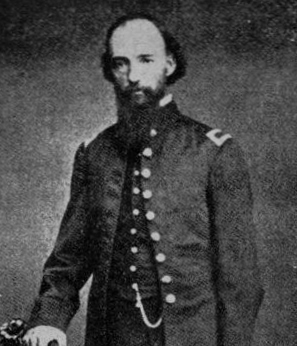
  7. Kolchin, Peter. American Slavery, 1619–1877, pp. 78, 81–82. New York, New York: Hill and Wang (Macmillan), 1994.
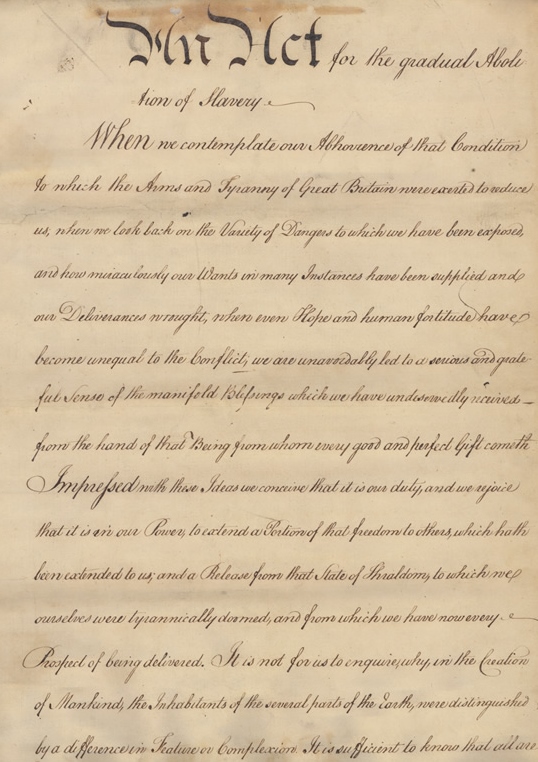
  8. Massachusetts Constitution and the Abolition of Slavery,” in “Massachusetts Court System.” Boston, Massachusetts: Commonwealth of Massachusetts, Mass.gov, retrieved online January 31, 2019.
  9. McClelland, Edward. Illinois: First State to Ratify 13th Amendment. Chicago, Illinois: NBC 5-Chicago, November 16, 2012.
  10. No. 5: William H. Seward, Secretary of State of the United States (certification of the 13th Amendment to the U.S. Constitution), in “A Century of Lawmaking for a New Nation: U.S. Congressional Documents and Debates, 1774–1875: Statutes at Large,” in “American Memory.” Washington, D.C.: Library of Congress, retrieved online January 31, 2019.
  11. Oakes, James. Freedom National: The Destruction of Slavery in the United States, 1861–1865. New York, New York and London, United Kingdom: W.W. Norton & Company, Inc., 2013.
  12. Ratifying the Thirteenth Amendment, 1866: A Spotlight on a Primary Source by Iowa General Assembly,” in “History Now.” New York, New York: The Gilder Lehrman Institute of American History, retrieved online January 31, 2019.
  13. U.S. Senate Document No. 112-9 (2013), 112th Congress, 2nd Session: The Constitution of the United States Of America Analysis And Interpretation Centennial Edition Interim Edition: Analysis Of Cases Decided By The Supreme Court Of The United States To June 26, 2013s,” p. 30 (of large PDF file). Washington, D.C.: U.S. Government Printing Office, retrieved online January 31, 2019.
  14. Waldron, Ben. Mississippi Officially Abolishes Slavery, Ratifies 13th Amendment. New York, New York: ABC News, February 18, 2013.


President Abraham Lincoln’s Final Public Address (11 April 1865)

This 1865 photograph of President Abraham Lincoln by Alexander Gardner is believed by historians to be the final photo taken of Lincoln (1865, U.S. Library of Congress, public domain).

We meet this evening, not in sorrow, but in gladness of heart. The evacuation of Petersburg and Richmond, and the surrender of the principal insurgent army, give hope of a righteous and speedy peace whose joyous expression can not be restrained. In the midst of this, however, He, from Whom all blessings flow, must not be forgotten. A call for a national thanksgiving is being prepared, and will be duly promulgated. Nor must those whose harder part gives us the cause of rejoicing, be overlooked. Their honors must not be parcelled out with others. I myself, was near the front, and had the high pleasure of transmitting much of the good news to you; but no part of the honor, for plan or execution, is mine. To Gen. Grant, his skilful officers, and brave men, all belongs. The gallant Navy stood ready, but was not in reach to take active part.

By these recent successes the re-inauguration of the national authority—reconstruction—which has had a large share of thought from the first, is pressed much more closely upon our attention. It is fraught with great difficulty. Unlike the case of a war between independent nations, there is no authorized organ for us to treat with. No one man has authority to give up the rebellion for any other man. We simply must begin with, and mould from, disorganized and discordant elements. Nor is it a small additional embarrassment that we, the loyal people, differ among ourselves as to the mode, manner, and means of reconstruction.

As a general rule, I abstain from reading the reports of attacks upon myself, wishing not to be provoked by that to which I can not properly offer an answer. In spite of this precaution, however, it comes to my knowledge that I am much censured for some supposed agency in setting up, and seeking to sustain, the new State Government of Louisiana. In this I have done just so much as, and no more than, the public knows. In the Annual Message of Dec. 1863 and accompanying Proclamation, I presented a plan of re-construction (as the phrase goes) which, I promised, if adopted by any State, should be acceptable to, and sustained by, the Executive government of the nation. I distinctly stated that this was not the only plan which might possibly be acceptable; and I also distinctly protested that the Executive claimed no right to say when, or whether members should be admitted to seats in Congress from such States. This plan was, in advance, submitted to the then Cabinet, and distinctly approved by every member of it. One of them suggested that I should then, and in that connection, apply the Emancipation Proclamation to the theretofore excepted parts of Virginia and Louisiana; that I should drop the suggestion about apprenticeship for freed-people, and that I should omit the protest against my own power, in regard to the admission of members to Congress; but even he approved every part and parcel of the plan which has since been employed or touched by the action of Louisiana. The new constitution of Louisiana, declaring emancipation for the whole State, practically applies the Proclamation to the part previously excepted. It does not adopt apprenticeship for freed-people; and it is silent, as it could not well be otherwise, about the admission of members to Congress. So that, as it applies to Louisiana, every member of the Cabinet fully approved the plan. The Message went to Congress, and I received many commendations of the plan, written and verbal; and not a single objection to it, from any professed emancipationist, came to my knowledge, until after the news reached Washington that the people of Louisiana had begun to move in accordance with it. From about July 1862, I had corresponded with different persons, supposed to be interested, seeking a reconstruction of a State government for Louisiana. When the Message of 1863, with the plan before mentioned, reached New-Orleans, Gen. Banks wrote me that he was confident the people, with his military co-operation, would reconstruct, substantially on that plan. I wrote him, and some of them to try it; they tried it, and the result is known. Such only has been my agency in getting up the Louisiana government. As to sustaining it, my promise is out, as before stated. But, as bad promises are better broken than kept, I shall treat this as a bad promise, and break it, whenever I shall be convinced that keeping it is adverse to the public interest. But I have not yet been so convinced.

I have been shown a letter on this subject, supposed to be an able one, in which the writer expresses regret that my mind has not seemed to be definitely fixed on the question whether the seceded States, so called, are in the Union or out of it. It would perhaps, add astonishment to his regret, were he to learn that since I have found professed Union men endeavoring to make that question, I have purposely forborne any public expression upon it. As appears to me that question has not been, nor yet is, a practically material one, and that any discussion of it, while it thus remains practically immaterial, could have no effect other than the mischievous one of dividing our friends. As yet, whatever it may hereafter become, that question is bad, as the basis of a controversy, and good for nothing at all—a merely pernicious abstraction.

We all agree that the seceded States, so called, are out of their proper practical relation with the Union; and that the sole object of the government, civil and military, in regard to those States is to again get them into that proper practical relation. I believe it is not only possible, but in fact, easier, to do this, without deciding, or even considering, whether these states have even been out of the Union, than with it. Finding themselves safely at home, it would be utterly immaterial whether they had ever been abroad. Let us all join in doing the acts necessary to restoring the proper practical relations between these states and the Union; and each forever after, innocently indulge his own opinion whether, in doing the acts, he brought the States from without, into the Union, or only gave them proper assistance, they never having been out of it.

The amount of constituency, so to to [sic] speak, on which the new Louisiana government rests, would be more satisfactory to all, if it contained fifty, thirty, or even twenty thousand, instead of only about twelve thousand, as it does. It is also unsatisfactory to some that the elective franchise is not given to the colored man. I would myself prefer that it were now conferred on the very intelligent, and on those who serve our cause as soldiers. Still the question is not whether the Louisiana government, as it stands, is quite all that is desirable. The question is “Will it be wiser to take it as it is, and help to improve it; or to reject, and disperse it?” “Can Louisiana be brought into proper practical relation with the Union sooner by sustaining, or by discarding her new State Government?”

Some twelve thousand voters in the heretofore slave-state of Louisiana have sworn allegiance to the Union, assumed to be the rightful political power of the State, held elections, organized a State government, adopted a free-state constitution, giving the benefit of public schools equally to black and white, and empowering the Legislature to confer the elective franchise upon the colored man. Their Legislature has already voted to ratify the constitutional amendment recently passed by Congress, abolishing slavery throughout the nation. These twelve thousand persons are thus fully committed to the Union, and to perpetual freedom in the state—committed to the very things, and nearly all the things the nation wants—and they ask the nations recognition, and it’s assistance to make good their committal. Now, if we reject, and spurn them, we do our utmost to disorganize and disperse them. We in effect say to the white men “You are worthless, or worse—we will neither help you, nor be helped by you.” To the blacks we say “This cup of liberty which these, your old masters, hold to your lips, we will dash from you, and leave you to the chances of gathering the spilled and scattered contents in some vague and undefined when, where, and how.” If this course, discouraging and paralyzing both white and black, has any tendency to bring Louisiana into proper practical relations with the Union, I have, so far, been unable to perceive it. If, on the contrary, we recognize, and sustain the new government of Louisiana the converse of all this is made true. We encourage the hearts, and nerve the arms of the twelve thousand to adhere to their work, and argue for it, and proselyte for it, and fight for it, and feed it, and grow it, and ripen it to a complete success. The colored man too, in seeing all united for him, is inspired with vigilance, and energy, and daring, to the same end. Grant that he desires the elective franchise, will he not attain it sooner by saving the already advanced steps toward it, than by running backward over them? Concede that the new government of Louisiana is only to what it should be as the egg is to the fowl, we shall sooner have the fowl by hatching the egg than by smashing it? Again, if we reject Louisiana, we also reject one vote in favor of the proposed amendment to the national constitution. To meet this proposition, it has been argued that no more than three fourths of those States which have not attempted secession are necessary to validly ratify the amendment. I do not commit myself against this, further than to say that such a ratification would be questionable, and sure to be persistently questioned; while a ratification by three fourths of all the States would be unquestioned and unquestionable.

I repeat the question. “Can Louisiana be brought into proper practical relation with the Union sooner by sustaining or by discarding her new State Government?

What has been said of Louisiana will apply generally to other States. And yet so great peculiarities pertain to each state; and such important and sudden changes occur in the same state; and, withal, so new and unprecedented is the whole case, that no exclusive, and inflexible plan can safely be prescribed as to details and colatterals. Such exclusive, and inflexible plan, would surely become a new entanglement. Important principles may, and must, be inflexible.

In the present ‘situation’ as the phrase goes, it may be my duty to make some new announcement to the people of the South. I am considering, and shall not fail to act, when satisfied that action will be proper.


Annotation (per Roy Basler, et. al., editors):

[1]   AD-P, ISLA. On April 11, Salmon P. Chase had written Lincoln at length about reconstruction:

“I am very anxious about the future: and most about the principles which are to govern reconstruction for as these principles are sound or unsound so will be the work & its results. . . .

“And first as to Virginia.

“By the action of every branch of the Government we are committed to the recognition & maintenance of the State organization of which Governor Pierpont is the head. You know all the facts. . . . There will be a pressure for the recognition of the rebel organization on condition of profession of loyalty. It will be far easier and wiser, in my judgment, to stand by the loyal organization already recognized.

“And next as to the other rebel States:

“The easiest & safest way seems to me to be the enrollment of the loyal citizens without regard to complexion and encouragement & support to them in the reorganization of State Governments under constitutions securing suffrage to all citizens. . . . This you know has long been my opinion. . . .

“This way is recommended by its simplicity, facility & above all, justice. It will be, hereafter, counted equally a crime & a folly if the colored loyalists of the rebel states shall be left to the control of restored rebels, not likely, in that case, to be either wise or just, until taught both wisdom and justice by new calamities.

“The application of this principle to Louisiana is made somewhat difficult by the organization which has already taken place: but happily the Constitution enables the Legislature to extend the right of suffrage. . . .

“The same result can be assured in Arkansas by an amendment of the state constitution; or what would be better, I think, by a new Convention . . . without distinction of color. To all the other states the general principle may be easily applied. . . .'” (DLC-RTL).


On the morning after Lincoln’s speech, Chase wrote again:

“The American of this morning contains your speech of last evening. Seeing that you say something on the subject of my letter to you yesterday—reconstruction—, & refer, though without naming me, to the suggestions I made in relation to the Amnesty Proclamation, when you brought it before the Heads of Departments, I will ask your permission to add some observations to what I have already written.

“I recollect the suggestions you mention; my impression is that they were in writing. There was another which you do not mention and which, I think, was not in writing. It is distinct in my memory; though doubtless forgotten by you. It was an objection to the restriction of participation in reorganization to persons having the qualifications of voters under the laws of their several states just before rebellion.

“Ever since questions of reconstruction have been talked about, it has been my opinion that the colored loyalists ought to be allowed to participate in it and it was because of this opinion that I was anxious to have this question left open. I did not however say much about the restriction. I was the only one who expressed a wish for its omission; & I did not desire to seem pertinacious.

“You will remember, doubtless, that the first order ever issued for enrollment with a view to reconstruction went to General Shepley & directed the enrollment of all loyal citizens; and I suppose that, since the opinion of Attorney General Bates, no one, connected with your administration, has questioned the citizenship of free colored men more than that of free white men. The restriction in the amnesty proclamation operated as a revocation of the order to General Shepley:—but, as I understood you not to be wedded to any particular plan of reconstruction, I hoped & believed that reflection & observation would probably satisfy you that the restriction should not be adhered to.

“I fully sympathized with your desire for the restoration of the Union by the change of rebel slave States into Union free States; and was willing, if I could not get exactly the plan I thought best, to take the plan you thought best, & to trust the future for modifications. I welcomed, therefore, with joy the prospects of good results from the cooperation of General Banks with the free state men of Louisiana. I think General Banks’ error, & I have said so to him, was in not acting through instead of over the Free State Committee. This Committee had already shown itself disposed to a degree of liberality towards the colored people quite remarkable at that time. They had admitted delegates from the creole colored population into their free State Convention, & had evinced a readiness to admit intelligent colored citizens of that class to the rights of suffrage. I have no doubt that great & satisfactory progress would have been made in the same direction had not the work been taken out of their hands. This created the impression that the advocates of general suffrage were to be treated with disfavor by the representatives of the Government. Discouragement & disinterest were the natural consequences.

“For one I was glad of all the good that was done; and, naturally, wanted more. So when I came to Washington last winter I saw Gen Banks: and, being now more deeply than ever persuaded of the necessity of universal suffrage, I begged him to write himself & to induce the Senators & Representatives elect from Louisiana to write to members of the Legislature and urge them to exercise their power under the constitution by passing an act extending suffrage to colored citizens. I knew that many of our best men in and out of Congress had become thoroughly convinced of the impolicy and injustice of allowing representation in Congress to States which had been in rebellion and were not yet prepared to concede equal political rights to all loyal citizens. They felt that if such representation should be allowed & such states reinstated in all their former rights as loyal members of the Union, the colored population would be practically abandoned to the disposition of the white population, with every probability against them; and this, they believed would be equally unjust & dangerous.

“I shared their sentiment & was therefore extremely desirous that General Banks should take the action I urged upon him. I thought indeed that he concurred, mainly, in my views, & would to some extent at least act upon them. I must have been mistaken, for I never heard that he did anything in that direction.

“I know you attach much importance to the admission of Louisiana, or rather to the recognition of her right to representation in Congress as a loyal State in the Union. If I am not misinformed there is nothing in the way except the indisposition of her Legislature to give satisfactory proof of loyalty by a sufficient guaranty of safety & justice to colored citizens through the extension to loyal colored men of the right of suffrage. Why not, then, as almost every loyal man concurs with you as to the desirableness of that recognition, take the shortest road to it by causing every proper representation to be made to the Louisiana Legislature of the importance of such extension.

“I most earnestly wish you could have read the New Orleans papers for the last few months. Your duties have not allowed it. I have read them a good deal—quite enough to be satisfied that, if you had read what I have, your feelings of humanity & justice would not let you rest till all loyalists are made equal in the right of self protection by suffrage.

“Once I should have been, if not satisfied, reasonably contented by suffrage for the more intelligent & for those who have been soldiers; now I am convinced that universal suffrage is demanded by sound policy and impartial justice alike.

“I have written too much already & will not trouble you with my reasons for this conclusion. I shall return to Washington in a day or two & perhaps it will not be disagreeable to you to have the whole subject talked over. . . .” (DLC-RTL).


Sources:

1. Basler, Roy P., editor, et. al. Collected works. The Abraham Lincoln Association/Springfield, Illinois, vol. 8. New Brunswick, New Jersey: Rutgers University Press, 1953.

2. Masur, Louis P. Lincoln’s Last Speech. New York, New York: Opinionator: Disunion, The New York Times, 10 April 2015.


RED RIVER CAMPAIGN (Louisiana, March to June 1864)

February-March 1864:

 "For twenty minutes a continual roar of musketry was heard, reports of artillery shook the earth and the air seemed filled with the whiz of shells and bullets, commingled with the cheers of the men engaged in deadly strife…." - Henry D. Wharton, Company C, regarding the Battle of Opequan (19 September 1864)

First State Color, 47th Pennsylvania Volunteers; carried during the Red River Campaign across Louisiana, March-May 1864.

On February 25 and March 1, 1864, members of the 47th Regiment, Pennsylvania Volunteer Infantry set off for a phase of service in which their regiment will truly make history. Steaming for New Orleans aboard the Charles Thomas, the men of the 47th arrive at Algiers, Louisiana on or after February 28, and are then shipped by train to Brashear City. Following another steamer ride—this time to Franklin via the Bayou Teche—the 47th joins the 2nd Brigade, 1st Division of the Department of the Gulf’s 19th Army Corps. In short order, the 47th becomes the only Pennsylvania regiment to serve in the Red River Campaign of Union Major-General Nathaniel P. Banks. The 1st Division of the U.S. Army’s 19th Corps is commanded by Brigadier-General William Hemsley Emory. The 2nd Brigade is led by Brigadier-General James W. McMillan.

From March 14-26, the 47th marches through New Iberia, Vermillionville, Opelousas, and Washington while en route to Alexandria and Natchitoches. Often short on food and water, a number of men from the regiment become ill during the grueling marches in the harsh Louisiana climate while others are felled by dysentery and/or tropical diseases.

April 6, 1864:

Nathaniel P. Banks. Major General, U.S. Volunteers (1863, U.S. National Archives, public domain).

Nathaniel P. Banks, Major General, U.S. Volunteers (1863, U.S. National Archives, public domain).

Union Major-General Nathaniel P. Banks sends his Union troops west via a single road. The column of men stretches for twenty-plus miles.

Heading the column are roughly four thousand cavalrymen led by Brigadier-General Albert Lindley Lee. Most are newbies who have little experience on horseback. They are followed by three hundred supply wagons, artillery units, one infantry division, seven hundred additional support wagons, and most of the 13th and 19th Corps.

As they move, they move west, marching toward Los Adaes, Louisiana, and then north on the Shreveport-Natchitoches stagecoach road. The column is SO long and SO slow moving that the troops at its head reach Pleasant Hill before the last men have even left Natchitoches, Louisiana.

April 7, 1864:

Union cavalry troops of Major-General Nathaniel Banks begin their march. Led by Brigadier-General Albert Lee, their progress is slowed by Union wagons. Lee’s requests for infantry support plus redirection of the wagons is denied by Banks and leaders of the U.S. Army’s 19th Corps.

April 8, 1864 (morning):

Union Major-General Nathaniel Banks’ Cavalry, led by Brigadier-General Albert Lee, crosses a stream, and moves through trees and fields. In the distance, atop a ridge, Lee spots Confederate cavalry and infantry which stretch along both sides of the road for three quarters of a mile. After he spots more Confederate cavalry troops to his right, he asks for help from Banks. After taking his time, Banks finally orders the 13th U.S. Army to move up to assist Lee’s cavalry. Banks also moves up to see what’s happening.

Major General Richard Taylor, CSA (c. 1860s, public domain).

Major-General Richard Taylor, CSA (circa 1860s, public domain).

Arrayed before him in the distance are roughly ten thousand troops led by Confederate Major-General Richard Taylor, a plantation owner and son of former U.S. President Zachary Taylor. (Ironically, the 47th Pennsylvania Volunteers had just spent a significant period of time—off and on between 1862 to early 1864—garrisoning Fort Zachary Taylor in Key West, Florida.)

It’s the morning of April 8, 1864, the day of the Battle of Sabine Cross Roads near Mansfield, Louisiana.

Confederate Taylor and his 10,000 troops expect Banks’ Union forces to charge—but they don’t. A six-hour waiting game ensues.

April 8, 1864 (afternoon and evening):

At 4 p.m. Louisiana time, Confederate Major-General Richard Taylor’s left flank slowly begins an echelon formation attack on troops commanded by Union Major-General Nathaniel Banks, and the Union’s cavalry line buckles. BUT, in the process, eleven out of fourteen Confederate officers are killed in action within fourteen minutes of the opening charge.

Replacing one of those fallen Confederate leaders is Brigadier-General Camille Armand Jules Marie, the Prince de Polignac. A Prince of France, he fought with the Confederate Army during America’s Civil War, and is an important name for descendants of the 47th Pennsylvania Volunteers and others studying the 47th’s history because, later that same day, forces led by Polignac and Confederate Brigadier-General Thomas Green (Texas Cavalry Corps) directly engage in battle with the 47th Pennsylvania.

Good, Tilghman HThe 47th Pennsylvania Volunteers are led by Colonel Tilghman H. Good, the regiment’s founder, and his second in command, Lieutenant-Colonel George Warren Alexander.

Following the charge by Taylor’s Confederate troops and the resulting buckling of the Union’s right flank, Banks’ left Union flank also collapses. Taylor’s troops continue on, puncturing a secondary Union position mile three quarters of a mile behind the Union’s front line.

Banks then orders Brigadier-General William Emory to move his 1st Division, 19th U.S. Army Corps men to the front. Among Emory’s 5,859 men were nine New York regiments, three from Maine—and the 47th Pennsylvania Volunteers. Ninety minutes and seven miles of marching later, Emory’s men are waiting for the Confederates on the ridge above Chapman’s Bayou.

* Note: The 47th Pennsylvania Volunteers were positioned behind the 161st New York, 29th Maine, and other Union regiments at or near the farm of Joshua Chapman, about five miles southeast of Mansfield, Louisiana. The battles here were termed the “Peach Orchard” fight by Confederates and “Pleasant Grove” by 47th Pennsylvanians, a name attributed by some historians to the live oak trees in front of Chapman’s house. The fighting at the peach orchard was particularly brutal.

19th U.S. Army Map, Phase 3, Battle of Sabine Cross Roads/Mansfield, Louisiana (8 April 1864, public domain).

19th U.S. Army Map, Phase 3, Battle of Sabine Cross Roads/Mansfield, Louisiana (April 8, 1864, public domain).

As Confederates, led by Polignac, et. al. attack the center of the Union line, the 161st buckles, but the 29th Maine is able to repulse the Confederates. Green’s Confederate cavalrymen then attempt an end run on the Union’s right flank. His troops include: Brigadier-General Xavier DeBray’s Cavalry Brigade (composed of the 26th and 36th Texas Cavalry) and Colonel Augustus Buchel’s Cavalry Brigade (composed of the 1st Texas Cavalry and Terrell’s Texas Cavalry).

Initially positioned to the right of the 13th Maine Infantry, the 47th Pennsylvania Volunteers and 13th Maine both pinwheel to head off Green’s attack, and end Green’s flanking effort.

As darkness falls on April 8, 1864, fighting wanes and then ceases as exhausted troops on both sides collapse between the bodies of their dead comrades. Seventy-four men were killed in action, at least one hundred and sixty-one are wounded, and hundreds more are declared missing in action, including one hundred and eighty-eight men from the 19th U.S. Army (to which the 47th Pennsylvania was attached). Some of these missing soldiers (including members of the 47th Pennsylvania) are eventually found wounded or dead; others (including 47th Pennsylvanians) end up as prisoners of war (POWs), at Camp Ford, a Confederate prison near Tyler, Texas, but some remain missing to this day.

* Note: Some historians believe that these missing men may have been hastily interred somewhere on or near the battlefield by fellow soldiers or local residents, but no remains were found during archaeological excavations of the area during the late 20th and early 21st centuries. In 1996, L.P. Hecht, in his Echoes from the Letters of a Civil War Surgeon, reported that wild hogs had eaten the remains of at least some of the federal soldiers who had been left unburied.

April 8, 1864 (late evening):

Receiving word of another likely attack, Banks orders his Union troops to withdraw to Pleasant Hill (not to be confused with the aforementioned Pleasant Grove). This withdrawal commences after midnight and through the early hours of April 9, 1864. According to Banks:

From Pleasant Grove, where this action occurred, to Pleasant Hill was 15 miles. It was certain that the enemy, who was within the reach of re-enforcements, would renew the attack in the morning, and it was wholly uncertain whether the command of General Smith could reach the position we held in season for a second engagement. For this reason the army toward morning fell back to Pleasant Hill, General Emory covering the rear, burying the dead, bringing off the wounded, and all the material of the army. It arrived there at 8.30 on the morning of the 9th, effecting a junction with the forces of General Smith and the colored brigade under Colonel Dickey, which had reached that point the evening previous.

* To view the abridged casualty lists from the Battle of Sabine Cross Roads, visit “Battle of Sabine Cross Roads/Mansfield, Louisiana, April 8, 1864 — Casualties and POWs from the 47th Pennsylvania Volunteer Infantry.”

April 9, 1864 (morning):

Battle of Pleasant Hill, Louisiana, 9 April 1864 (Harper's Weekly, 7 May 1864, public domain).

Battle of Pleasant Hill, Louisiana, April  9, 1864 (Harper’s Weekly, May 7, 1864, public domain).

Arriving at Pleasant Hill, Louisiana around 8:30 a.m., and with the enemy believed to be in pursuit, Union Major-General Nathaniel Banks orders his troops to regroup and ready themselves for a new round of fighting.

The Battle of Pleasant Hill, Louisiana is just hours from its start. In his official Red River Campaign Report penned a year later, Banks described how the day unfolded:

A line of battle was formed in the following order: First Brigade, Nineteenth Corps, on the right, resting on a ravine; Second Brigade in the center, and Third Brigade on the left. The center was strengthened by a brigade of General Smith’s forces, whose main force was held in reserve. The enemy moved toward our right flank. The Second Brigade [including the 47th Pennsylvania Volunteers] withdrew from the center to the support of the First Brigade. The brigade in support of the center moved up into position, and another of General Smith’s brigades was posted to the extreme left position on the hill, in echelon to the rear of the left main line.

Light skirmishing occurred during the afternoon. Between 4 and 5 o’clock it increased in vigor, and about 5 p.m., when it appeared to have nearly ceased, the enemy drove in our skirmishers and attacked in force, his first onset being against the left. He advanced in two oblique lines, extending well over toward the right of the Third Brigade, Nineteenth Corps. After a determined resistance this part of the line gave way and went slowly back to the reserves. The First and Second Brigades were soon enveloped in front, right, and rear. By skillful movements of General Emory the flanks of the two brigades, now bearing the brunt of the battle, were covered. The enemy pursued the brigades, passing the left and center, until he approached the reserves under General Smith, when he was met by a charge led by General Mower and checked. The whole of the reserves were now ordered up, and in turn we drove the enemy, continuing the pursuit until night compelled us to halt.

The battle of the 9th was desperate and sanguinary. The defeat of the enemy was complete, and his loss in officers and men more than double that sustained by our forces. There was nothing in the immediate position or condition of the two armies to prevent a forward movement the next morning, and orders were given to prepare for an advance. The train, which had been turned to the rear on the day of the battle, was ordered to reform and advance at daybreak. I communicated this purpose at the close of the day to General A. J. Smith, who expressed his concurrence therein. But representations subsequently received from General Franklin and all the general officers of the Nineteenth Corps, as to the condition of their respective commands for immediate active operations against the enemy, caused a suspension of this order, and a conference of the general officers was held in the evening, in which it was determined, upon the urgent recommendation of all the general officers above named, and with the acquiescence of General Smith, to retire upon Grand Ecore the following day. The reasons urged for this course by the officers commanding the Nineteenth and Thirteenth Corps were, first, that the absence of water made it absolutely necessary to advance or retire without delay. General Emory’s command [including the 47th Pennsylvania Volunteers] had been without rations for two days, and the train, which had been turned to the rear during the battle, could not be put in condition to move forward upon the single road through dense woods, in which it stood, without difficulty and loss of time. It was for the purpose of communicating with the fleet at Springfield Landing from the Sabine Cross-Roads to the river, as well as to prevent the concentration of the Texan troops with the enemy at Mansfield, that we had pushed for the early occupation of that point. Considering the difficulty with which the gun-boats passed Alexandria and Grand Ecore, there was every reason to believe that the navigation of the river would be found impracticable. A squadron of cavalry, under direction of Mr. Young, who had formerly been employed in the surveys of this country and was now connected with the engineer department, which had been sent upon a reconnaissance to the river, returned to Pleasant Hill on the day of the battle with the report that they had not been able to discover the fleet nor learn from the people its passage up the river. (The report of General T. Kilby Smith, commanding the river forces, states that the fleet did not arrive at Loggy Bayou until 2 p.m. on the 10th of April, two days after the battle at Sabine Cross-Roads.) This led to the belief that the low water had prevented the advance of the fleet. The condition of the river, which had been steadily falling since our march from Alexandria, rendered it very doubtful, if the fleet ascended the river, whether it could return from any intermediate point, and probable, if not certain, that if it reached Shreveport it would never escape without a rise of the river, of which all hopes began to fail. The forces designated for this campaign numbered 42,000 men. Less than half that number was actually available for service against the enemy during its progress.

The distance which separated General Steele’s command from the line of our operations (nearly 200 miles) rendered his movements of little moment to us or to the enemy, and reduced the strength of the fighting column to the extent of his force, which was expected to be from 10,000 to 15,000 men. The depot at Alexandria, made necessary by the impracticable navigation, withdrew from our forces 3,000 men under General Grover. The return of the Marine Brigade to the defense of the Mississippi, upon the demand of Major-General McPherson, and which could not pass Alexandria without its steamers nor move by land for want of land transportation, made a further reduction of 3,000 men. The protection of the fleet of transports against the enemy on both sides of the river made it necessary for General A. J. Smith to detach General T. Kilby Smith’s division of 2,500 men from the main body for that duty. The army train required a guard of 500 men. These several detachments, which it was impossible to avoid, and the distance of General Steele’s command, which it was not in my power to correct, reduced the number of troops that we were able at any point to bring into action from 42,000 men to about 20,000. The losses sustained in the very severe battles of the 7th, 8th, and 9th of April amounted to about 3,969 men, and necessarily reduced our active forces to that extent.

The enemy, superior to us in numbers in the outset, by falling back was able to recover from his great losses by means of re-enforcements, which were within his reach as he approached his base of operations, while we were growing weaker as we departed from ours. We had fought the battle at Pleasant Hill with about 15,000 against 22,000 men and won a victory, which for these reasons we were unable to follow up. Other considerations connected with the actual military condition of affairs afforded additional reasons for the course recommended. Between the commencement of the expedition and the battle of Pleasant Hill a change had occurred in the general command of the army, which caused a modification of my instructions in regard to this expedition.

Lieutenant-General Grant, in a dispatch dated the 15th March, which I received on the 27th March, at Alexandria, eight days before we reached Grand Ecore, by special messenger, gave me the following instructions:

‘Should you find that the taking of Shreveport will occupy ten or fifteen days more time than General Sherman gave his troops to be absent from their command you will send them back at the time specified in his note of (blank date) March, even if it should lead to the abandonment of the main object of the expedition. Should it prove successful, hold Shreveport and Red River with such force as you deem necessary and return the balance of your troops to the neighborhood of New Orleans.’

These instructions, I was informed, were given for the purpose of having ‘all parts of the army, or rather all armies, act as much in concert as possible,’ and with a view to a movement in the spring campaign against Mobile, which was certainly to be made ‘if troops enough could be obtained without embarrassing other movements; in which event New Orleans would be the point of departure for such an expedition.’ A subsequent dispatch, though it did not control, fully justified my action, repeated these general views and stated that the commanding general ‘would much rather the Red River expedition had never been begun that that you should be detained one day beyond the 1st of May in commencing the movement east of the Mississippi.’

The limitation of time referred to in these dispatches was based upon an opinion which I had verbally expressed to General Sherman at New Orleans, that General Smith could be spared in thirty days after we reached Alexandria, but it was predicted upon the expectation that the navigation of the river would be unobstructed; that we should advance without delay at Alexandria, Grand Ecore, or elsewhere on account of low water, and that the forces of General Steele were to co-operate with us effectively at some point on Red River, near Natchitoches or Monroe. It was never understood that an expedition that involved on the part of my command a land march of nearly 400 miles into the enemy’s country, and which terminated at a point which we might not be able to hold, either on account of the strength of the enemy or the difficulties of obtaining supplies, was to be limited to thirty days. The condition of our forces, and the distance and difficulties attending the further advance into the enemy’s country after the battles of the 8th and 9th against an enemy superior in numbers to our own, rendered it probable that we could not occupy Shreveport within the time specified, and certain that without a rise in the river the troops necessary to hold it against the enemy would be compelled to evacuate it for want of supplies, and impossible that the expedition should return in any event to New Orleans in time to co-operate in the general movements of the army contemplated for the spring campaign. It was known at this time that the fleet could not repass the rapids at Alexandria, and it was doubtful, if the fleet reached any point above Grand Ecore, whether it would be able to return. By falling back to Grand Ecore we should be able to ascertain the condition of the fleet, the practicability of continuing the movement by the river, reorganize a part of the forces that had been shattered in the battles of the 7th, 8th, and 9th, possibly ascertain the position of General Steele and obtain from him the assistance expected for a new advance north of the river or upon its southern bank, and perhaps obtain definite instructions from the Government as to the course to be pursued.

Upon these general considerations, and without reference to the actual condition of the respective armies, at 12 o’clock midnight on the 9th I countermanded the order for the return of the train, and directed preparations to be made for the return of the army to Grand Ecore. The dead were buried and the wounded brought in from the field of battle and placed in the most comfortable hospitals that could be provided, and surgeons and supplies furnished for them. A second squadron of cavalry was sent, under direction of Mr. Young, of the engineer department, to inform the fleet of our retrograde movement and to direct its return, if it had ascended the river, and on the morning of the 10th the army leisurely returned to Grand Ecore.

The 47th Pennsylvania Volunteers had been ordered into a critically important defensive position at the far right of the Union lines that day (April 9, 1864), their right flank spreading up onto a high bluff. According to Bates, after fighting off a charge by the troops of Confederate Major-General Richard Taylor, the 47th was forced to bolster the buckling lines of the 165th New York Infantry—just as the 47th was shifting to the left of the massed Union forces.

The regiment sustained heavy casualties during the Battle of Pleasant Hill. The regiment’s second in command, Lieutenant-Colonel George W. Alexander, was severely wounded in both legs. One of those wounds—an artillery shrapnel wound to his left leg near the ankle—resulted in a fractured leg. Regimental Color-Sergeant Benjamin Walls and Sergeant William Pyers both sustained gunshot wounds.

Color-Sergeant Walls, the oldest man in the regiment, was shot in the left shoulder as he was mounting the 47th’s flag on one of the Massachusetts artillery caissons that had been recaptured by the 47th. Sergeant Pyers was then shot while retrieving the American flag from Walls, thereby preventing it from falling into enemy hands. Both men survived and continued to fight for the 47th—Walls until his three-year term of service expired on September 18, 1864, Pyers until he was killed in action just over a month later during the Battle of Cedar Creek, Virginia.

Many others were less fortunate. Hastily buried by comrades or local citizens, several still rest in unknown graves.

In addition, more men from the 47th Pennsylvania were captured and marched off to Camp Ford near Tyler, Texas, becoming the only soldiers from any Pennsylvania regiment to have men imprisoned there. At least three 47th Pennsylvanians never made it out alive; the remaining POWs were released in prisoner exchanges which took place from July through the fall of 1864.

Nearly two decades later, First Lieutenant James Hahn recalled his involvement (as a sergeant) in both engagements for a retrospective article in the January 31, 1884 edition of The National Tribune:

A PENNSYLVANIA SOLDIER’S EXPERIENCE.

Lieutenant James Hahn, of the 47th Pennsylvania infantry, writing from Newport, Pa., refers as follows to the engagements at Sabine Cross-roads and Pleasant Hill :

‘The 19th Corps had gone into camp for the evening about four miles from Sabine Cross-Roads. The engagement at Mansfield had been fought by the 13th Corps, who struggled bravely against overwhelming odds until they were driven from the field. I presume the rebel Gen. Dick Taylor knew of the situation of our army, and that the 19th was in the rear of the 13th, and the 16th still in rear of the 19th, some thirteen miles away, encamped at Pleasant Hill. They thought it would be a good joke to whip Banks’ army in detail : first, the 13th corps, then 19th, then finish up on the 16th. But they counted without their hosts; for when the couriers came flying back to the 19th with the news of the sad disaster that had befallen the 13th corps, we were double-quicked a distance of some four miles, and just met the advance of our defeated 13th corps – coming pell-mell, infantry, cavalry, and artillery all in one conglomerated mass, in such a manner as only a defeated and routed army can be mixed up – at Sabine Cross-roads, where our corps was thrown into line just in time to receive the victorious and elated Johnnies with a very warm reception, which gave them a recoil, and which stopped their impetuous headway, and gave the 13th corps time to get safely to the rear. I do not know what would have been the consequence if the 19th had been defeated also, that evening of the 8th, at Sabine Cross-roads, and the victorious rebel army had thrown themselves upon the ‘guerrillas’ then lying in camp at Pleasant Hill. It was just about getting dark when the Johnnies made their last assault upon the lines of the 19th. We held the field until about midnight, and then fell back and left the picket to hold the line while we joined the 16th at Pleasant Hill the morning of the 9th of April, soon after daybreak. It was not long until the rebel cavalry put in an appearance, and soon skirmishing commenced. About 4 o’clock in the afternoon the engagement become general all along the line, and with varied success, until late in the afternoon the rebels were driven from the field, and were followed until darkness set in, and about midnight our army made a retrograde movement, which ended at Grand Ecore, and left our dead and wounded lying on the field, all of whom fell into rebel hands. I have been informed since by one of our regiment, who was left wounded on the field, that the rebels were so completely defeated that they did not return to the battlefield till late the next day, and I have always been of the opinion that, if the defeat that the rebels got at Pleasant Hill had been followed up, Banks’ army, with the aid of A. J. Smith’s divisions, could have got to Shreveport (the objective point) without much left or hindrance from the rebel army.’

* To view the abridged casualty lists from the Battle of Pleasant Hill, visit “Battle of Pleasant Hill, Louisiana, April 9, 1864 — Casualties and POWs from the 47th Pennsylvania Volunteer Infantry.”

April 10-June 20, 1864:

After the regiment resettled in at Grand Ecore, Louisiana, 47th Pennsylvania scribe Henry D. Wharton finally had time to gather his thoughts and pen an account for the Sunbury American of the regiment’s recent battles:

Grand Ecore, Western La. }
April 12, 1864.

DEAR WILVERT:–After lying over for three days at Natchitoches to recruit and get a fresh supply from the Commisariat [sic], we again pushed forward in hunt of the rebs, as the sequel will show, proved lucky to us, and a perfect discomfiture to the enemy. On the first days march we were detained several hours by letting the 13th Army Corps pass by us, when we pushed forward to Double Bridges, a distance of sixteen miles. It was at this place, shortly before our arrival that a brisk skirmish came off between our cavalry and the rebs, in which we lost ninety men in killed and wounded. The rebs loss was more severe, besides a number of prisoners. On our march next day we saw unmistakeable [sic] evidence of hot work, the limbs were knocked from trees and their trunks were well pierced with shot and a number of horses lie dead by the road side, which showed the good work done by our cavalry…. We made Pleasant Hill that day and encamped. It was here that we expected a heavy fight, but there was a mere skirmish, the rebs skedaddling in a hurry, followed by our cavalry. Our forces moved early next morning, the 13th corps far in the advance. We made but seven miles and then went into camp, when the news [broke] that the 13th  and cavalry had engaged the enemy in force. Receiving two days hard tack, orders came to forward, which was done in double quick, making the distance, eight miles, in one hour and twenty minutes. We reached there at the right time, for the 13th had fought hard, expending their ammunition; the cavalry were repulsed and in their retreat made such confusion among the teams, that had it not been for our timely arrival, a panic would have ensued, exceeding that of Bull Run.

Our corps, the 19th, rushed to the rescue, fell into line of battle, and were soon pouring on the rebs a fire which turned the tide of affairs. We were two hours under fire, giving the enemy more than we received, when darkness caused the fight to come to a close, not, however, until we gave them a parting salute of two volleys from the whole corps. Three pieces of Nimm’s battery was [sic] captured by the enemy before our corps got there, besides the train of the cavalry, with ammunition and stores.

About 10 o’clock that night our forces made a retrograde movement, falling back to Pleasant Hill, to secure a better position.– The trains were sent back so as not to interfere with our movements. We arrived safely at nine o’clock, next morning [10 April 1864], and immediately prepared for the coming work. An hour later the rear guard came in informing us of the approach of the enemy.– Our skirmishers of cavalry and infantry were sent out, and ’twas not long until shots were exchanged. At this time, 10 o’clock, Smith’s 16th Army Corps reinforced us, and was soon formed in line of battle. Skirmishing continued until four o’clock, when the rebs commenced feeling our lines, with artillery, on right, left and centre [sic]. This was well replied to by the 25th N.Y. Battery. (The Battery to which Dad Randels and some others of our own boys are attached.)

The battle then commenced in real earnest. The rebs charged our lines, with cheers, firing volleys of musketry that would seem to annihilate our forces. They tried to flank our right and left, but the boys repulsed them handsomely. Batteries were captured and recaptured; advances were made and repulsed, the enemy fighting as though it was the last of a desperate cause. Our volleys of musketry, of which more was used than in any fight during the war, and the executions of the artillery was too much for them, for they fled, our men after them, yelling shouts of victory, and chasing them for five miles beyond the battlefield. Our fire told with terrible effect. A rebel Lieut.-Col. prisoner, said that in a charge made by one of their Brigades, when they advanced so far as to make a capture of a portion of our left a sure thing, they were met by a fire that destroyed four hundred, and then were driven back in confusion. In another advance, our fire was so destructive that only three men were left unscathed to return within their lines.

The prisoners captured amounted to two thousand; among them one General, one Lieutenant-Colonel, and any quantity of Captains and Lieutenants. Of the number killed and wounded I am unable to say, but the general impression is it amounted to over five thousand. The dead body of Lieut.-Gen. Mouton was found on the field, they leaving him in their hasty retreat. He was killed by the explosion of a shell, tearing away the upper portion of his head.

Nimm’s Battery was recaptured by our regiment. Twenty-three pieces of artillery were captured by the enemy. It was at the recaptured of Nimm’s Battery that our Color Sergeant, B. F. Walls, received his wound. The Squire was so well pleased at the recapture, that he rushed forward with his flag and raised it on the wheels of a caisson, when he fell pierced by a bullet in the left shoulder.

It seems the enemy were panic stricken, fleeing from the field in confusion, not caring for the wounded. They burned their entire train for fear of its falling into our hands. Part of this was well for us, for by doing so, the train taken from our cavalry was destroyed, giving us the satisfaction that our stores done [sic] them no good.

Our whole loss, in killed, wounded, missing and stragglers is estimated at three thousand. The greatest portion belonging to the 13th corps, having occurred at Sabine, on the 8th, in the first fight. The loss in Company “C,” is Jeremiah Haas, killed. Jerry felt no pain, dying almost instantly. He was beloved by his comrades, and his loss is much regretted by them. He was a good soldier, a young man whose morals were not injured from the influences of an army, and best of all, an honest man. The wounded are – 

Serg. Wm. Pyers, arm and side, not dangerous.
”  B. F. Walls, left shoulder.
Private Thomas Lothard, two wounds in arm, slight,
”  Cornelius Kramer, left leg, below knee.
”  George Miller, side.
”  Thomas Nipple, hip, slight.
”  James Kennedy, right and side, severe.

Missing – J. W. McNew, J. W. Firth, Samuel Miller, Edward Matthews, John Sterner and Conrad Holman.

The whole force of the enemy was thirty-five thousand – ten thousand of them coming fresh into the fight on the second day, at Pleasant Hill, under General (Pap) Price. Our forces, parts of the 19th and 16th corps, amounted to fifteen thousand, the 13th taking no part in this action. We expect to have another fight soon, probably at Shreveport, where it is expected the rebellion will be crushed on the western side of the Mississippi.

Our wounded are getting along finely, and are in the best of spirits. They will be sent to New Orleans to remain in hospital until convalescent. The boys remaining are well and seem anxious for another encounter with the graybacks.

The 47th Pennsylvanians remained at Grand Ecore for a total of eleven days (through April 22, 1864), where they engaged in the hard labor of strengthening regimental and brigade fortifications in a brutal climate. They then moved back to Natchitoches Parish where they arrived in Cloutierville, after marching forty-five miles, at 10 p.m. that night. En route, the Union forces were attacked again—this time in the rear, but they were able to quickly end the encounter and continue on.

The 47th Pennsylvania Volunteers were stationed just to the left of the “Thick Woods” with Emory’s 2nd Brigade, 1st Division for the Battle of Cane River Crossing at Monett’s Ferry, Louisiana, April 23, 1864 (Union Army map, public domain).

The next morning (April 23, 1864), episodic skirmishing quickly roared into the flames of a robust fight.

As part of the advance party led by Brigadier-General William Emory, the 47th Pennsylvanians took on the Confederate cavalrymen commanded by Brigadier-General Hamilton P. Bee in the Battle of Monett’s Ferry (also known as the “Cane River Crossing” or the “Affair at Monett’s Ferry”).

Responding to a barrage from the Confederate’s twenty-pound Parrott guns and raking fire from enemy troops situated near a bayou and on a bluff, Emory directed one of his brigades to keep Bee’s Confederates busy while sending the other two brigades to find a safe spot where his Union troops could ford the Cane River.

Affair at Monett’s Bluff, Louisiana, April 23, 1864 (Major-General Nathaniel Banks’ Red River Campaign Report, public domain).

As part of the “beekeepers,” the 47th Pennsylvanian Volunteers supported Emory’s artillery.

Meanwhile, other troops who were part of Emory’s command found and worked their way across the Cane River, attacked Bee’s flank, and forced a Rebel retreat. That Union brigade then erected a series of pontoon bridges, enabling the 47th and other remaining Union troops to make the Cane River Crossing by the next day.

As the Confederates retreated, they torched their own food stores, as well as the cotton supplies of their fellow southerners.

Encamping overnight before resuming their march toward Rapides Parish, the 47th Pennsylvanians finally arrived on April 26 in Alexandria, where they camped for seventeen more days (through May 13, 1864).

While there, they engaged yet again in the hard labor of fortification work, and also helped to build Bailey’s Dam,” a timber structure that enabled Union gunboats to make their way back down the Red River.

Christened “Bailey’s Dam” in reference to the Union officer who oversaw its construction, Lieutenant-Colonel Joseph Bailey, this timber dam built by the Union Army on the Red River near Alexandria, Louisiana in May 1864 facilitated Union gunboat passage (public domain).

In a follow-up letter penned from the 47th’s encampment at Morganza to the Sunbury American on May 29, 1864, Henry D. Wharton reported on the dam’s construction and other key details from this difficult period of service:

MORGAWZA BEND [sic, Morganza], La., May 29, 1864

DEAR WILVERT: – The uncertainty of a mail passing the blockade on the Red river, established by the Johnny Rebs while we were lying at Alexandria, prevented me from writing to you until now; but knowing the anxiety you have for us, I feel justified in commencing from where I dated my last letter, and will give you the ‘dangers we have passed’ as I recollect them.

Our sojourn at Grand Ecore was for eleven days, during which time our position was well fortified by entrenchments for a length of five miles, made of heavy logs, five feet high and six feet wide, filled in with dirt. In front of this, trees were felled for a distance of two hundred yards, so that if the enemy attacked we had an open space before us which would enable our forces to repel them and follow if necessary. But our labor seemed to the men as useless, for on the morning of 22d April, the army abandoned these works and started for Alexandria. From our scouts it was ascertained that the enemy had passed some miles to our left with the intention of making a stand against our right at Bayou Cane, where there is a high bluff and dense woods, and at the same attack Smith’s forces who were bringing up the rear. This first day was a hard one on the boys, for by ten o’clock at night they made Cloutierville, a distance of forty-five miles. On that day the rear was attacked which caused our forces to reverse their front and form in line of battle, expecting too, to go back to the relief of Smith, but he needed no assistance, sending word to the front that he had ‘whipped them, and could do it again.’ It was well that Banks made so long a march on that day, for on the next we found the enemy prepared to carry out their design of attacking us front and rear. Skirmishing commenced early in the morning and as our columns advanced he fell back towards the bayou, when we soon discovered the position of their batteries on the bluff. There was then an artillery duel by the smaller pieces, and some sharp fighting by the cavalry, when the ‘mule battery,’ twenty pound Parrott guns, opened a heavy fire, which soon dislodged them, forcing the chivalry to flee in a manner not at all suitable to their boasted courage. Before this one cavalry, the 3d Brigade of the 1st Div., and Birges’ brigade of the second, had crossed the bayou and were doing good service, which, with the other work, made the enemy show their heels. The 3d brigade done some daring deeds in this fight, as also did the cavalry. In one instance the 3d charged up a hill almost perpendicular, driving the enemy back by the bayonet without firing a gun. The woods on this bluff was so thick that the cavalry had to dismount and fight on foot. During the whole of the day, our brigade, the 2d was supporting artillery, under fire all the time, and could not give Mr. Reb a return shot.

While we were fighting in front, Smith was engaged some miles in the rear, but he done his part well and drove them back. The rebel commanders thought by attacking us in the rear, and having a large face on the bluffs, they would be able to capture our train and take us all prisoners, but in this they were mistaken, for our march was so rapid that we were on them before they had thrown up the necessary earthworks. Besides they underrated the amount of our artillery, calculating from the number engaged at Pleasant Hill. The rebel prisoners say it ‘seems as though the Yankees manufacture, on short notice, artillery to order, and the men are furnished with wings when they wish to make a certain point.

The damage done to the Confederate cause by the burning of cotton was immense. On the night of the 22d our route was lighted up for miles and millions of dollars worth of this production was destroyed. This loss will be felt more by Davis & Co., than several defeats in this region, for the basis of the loan in England was on the cotton of Western Louisiana.

After the rebels had fled from the bluff the negro troops put down the pontoons, and by ten that night we were six miles beyond the bayou safely encamped. The next morning we moved forward and in two days were in Alexandria. Johnnys followed Smith’s forces, keeping out of range of his guns, except when he had gained the eminence across the bayou, when he punished them (the rebs) severely.

We were at Alexandria seventeen days, during which time the men were kept busy at throwing up earthworks, foraging and three times went out some distance to meet the enemy, but they did not make their appearance in numbers large enough for an engagement. The water in the Red river had fallen so much that it prevented the gunboats from operating with us, and kept our transports from supplying the troops with rations, (and you know soldiers, like other people, will eat) so Banks was compelled to relinquish his designs on Shreveport and fall back to the Mississippi. To do this a large dam had to be built on the falls at Alexandria to get the ironclads down the river. After a great deal labor this was accomplished and by the morning of May 13th the last one was through the shute [sic], when we bade adieu to Alexandria, marching through the town with banners flying and keeping step to the music of ‘Rally around the flag,’ and ‘When this cruel war is over.’

Tragically, sometime after the 47th’s departure from Alexandria, an individual or groups of individuals torched the city. Although many present-day historians indicate that this terrible act was the work of Union troops, Henry Wharton recounted in his same letter of May 29 what had been reported about the fire to leaders of the 47th on May 14, 1864, and also provided a glimpse into two horrific attacks by Confederates on non-combatant ships:

The next morning, at our camping place, the fleet of boats passed us, when we were informed that Alexandria had been destroyed by fire – the act of a dissatisfied citizen and several negroes. Incendiary acts were strictly forbidden in a general order the day before we left the place, and a cavalry guard was left in the rear to see the order enforced. After marching a few miles skirmishing commenced in front between the cavalry and the enemy in riflepits [sic] on the bank of the river, but they were easily driven away. When we came up we discovered their pits and places where there had been batteries planted. At this point the John Warren, an unarmed transport, on which were sick soldiers and women, was fired into and sunk, killing many and those that were not drowned taken prisoners. A tin-clad gunboat was destroyed at the same place, by which we lost a large mail. Many letters and directed envelopes were found on the bank – thrown there after the contents had been read by the unprincipled scoundrels. The inhumanity of Guerrilla bands in this department is beyond belief, and if one did not know the truth of it or saw some of their barbarities, he would write it down as the story of a ‘reliable gentleman’ or as told by an ‘intelligent contraband.’ Not satisfied with his murderous intent on unarmed transports he fires into the Hospital steamer Laurel Hill, with four hundred sick on board. This boat had the usual hospital signal floating fore and aft, yet, notwithstanding all this, and the customs of war, they fired on them, proving by this act that they are more hardened than the Indians on the frontier.

As the Union troops continued their march toward the southeastern part of Louisiana, they passed Fort DeRussy, and then engaged in yet another battle—this time in Avoyelles Parish near Marksville. Fighting in this Battle of Mansura on May 16, 1864, Union infantry skirmished with Dick Taylor’s Confederates, and then orchestrated a flanking attack to force Taylor’s troops into retreat during what was largely a four-hour artillery shoot out:

On Sunday, May 15, we left the river road and took a short route through the woods, saving considerable distance. The windings of Red river are so numerous that it resembles the tape-worm railroad wherewith the politicians frightened the dear people during the administration of Ritner and Stevens. – We stopped several hours in the woods to leave cavalry pass, when we moved forward and by four o’clock emerged into a large open plain where we formed in line of battle, expecting a regular engagement. The enemy, however, retired and we advanced ‘till dark, when the forces halted for the night, with orders to rest on their arms. – ‘Twas here that Banks rode through our regiment, amidst the cheers of the boys, and gave the pleasant news that Grant had defeated Lee. Early next morning we marched through Marksville into a prairie nine miles long and six wide where every preparation was made for a fight. The whole of our force was formed in line, in support of artillery in front, who commenced operations on the enemy driving him gradually from the prairie into the woods. As the enemy retreated before the heavy fire of our artillery, the infantry advanced in line until they reached Mousoula [sic], where they formed in column, taking the whole field in an attempt to flank the enemy, but their running qualities were so good that we were foiled. The maneuvring [sic] of the troops was handsomely done, and the movements was [sic] one of the finest things of the war. The fight of artillery was a steady one of five miles. The enemy merely stood that they might cover the retreat of their infantry and train under cover of their artillery. Our loss was slight. Of the rebels we could not ascertain correctly, but learned from citizens who had secreted themselves during the fight, that they had many killed and wounded, who threw them into wagons, promiscuously, and drove them off so that we could not learn their casualties. The next day we moved to Simmsport on the Achafalaya [sic] river, where a bridge was made by putting the transports side by side, which enabled the troops and train to pass safely over. – The day before we crossed the rebels attacked Smith, thinking it was but the rear guard, in which they, the graybacks, were awfully cut up, and four hundred prisoners fell into our hands. Our loss in killed and wounded was ninety. This fight was the last one of the expedition. The whole of the force is safe on the Mississippi, gunboats, transports and trains. The 16th and 17th have gone to their old commands.

It is amusing to read the statements of correspondents to papers North, concerning our movements and the losses of our army. I have it from the best source that the Federal loss from Franklin to Mansfield, and from their [sic] to this point does not exceed thirty-five hundred in killed, wounded and missing, while that of the rebels is over eight thousand.

On Saturday, May 21, 1864, Brigadier-General William Emory then ordered the men of Company C – the 47th Pennsylvania’s Color-Guard Unit—to move enemy prisoners to a safer Union stronghold. So, Captain John Peter Shindel Gobin and his men marched one hundred and eighty-seven Confederate soldiers south, transferred their management to the appropriate Union authorities, and returned to the regiment.

In his continuation of his May 29 letter, Henry Wharton delivered the sad news that James Kennedy had died at a Union hospital in New Orleans from the wounds he had sustained in action during the Battle of Pleasant Hill on April 9:

His friends in the company were pleased to learn that Dr. Dodge of Sunbury, now of the U.S. Steamer Octorora, was with him in his last moments, and ministered to his wants. The Doctor was one of the Surgeons from the Navy who volunteered when our wounded was [sic] sent to New Orleans.

Aftermath

In addition to deaths in combat or at Confederate prison camps, the 47th Pennsylvania Volunteers lost a significant number of men to disease and the hardships wrought by hard duty in a difficult climate. Three members of the regiment also drowned during the Red River Campaign—one at the start of the expedition, the other two as the regiment’s time in Louisiana wound down.

Many of the regiment’s dead were ultimately laid to rest at the Chalmette National Cemetery in Chalmette, Louisiana—a fair number in unmarked graves. The graves of others still have not yet been located. At least one historian believes the missing status of soldiers on both sides is due to a combination of factors—poor military record keeping, hasty burials of war dead by civilians or retreating troops in shallow, unmarked graves, or the destruction of bodies by feral hogs which devoured soldiers’ remains before they could be properly interred. Quite simply, the scale of the carnage, once again, had overwhelmed military leaders on both sides.

History books record the Battle of Sabine Cross Roads/Mansfield as a Confederate victory, the Battle of Pleasant Hill as a technical victory for the Union, and the Battle of Monett’s Ferry/Cane River Crossing and Battle of Mansura/Marksville as clear victories for the Union.

Through it all, the Commonwealth of Pennsylvania was represented by just one regiment—the 47th Regiment, Pennsylvania Volunteer Infantry.


Sources:

1. 47th Pennsylvania Volunteer Records, in Camp Ford Prisoner of War Database. Tyler, Texas: The Smith County Historical Society, 1864.

2. A Pennsylvania Soldier’s Experience, in Up the Red River: How the Famous Banks Expedition Came to Grief: Off for Shreveport: The March from Grand Ecore to Pleasant Hill: Sabine Cross-Roads, And the Part the 13th Corps Played in That Battle. Washington, D.C.: January 31, 1884.

3. Banks, Nathaniel P. “General Banks’s Report of the Red River Campaign,” in Annual Report of the Secretary of War, in Message of the President of the United States, and Accompanying Documents, to the Two Houses of Congress, at the Commencement of the First Session of the Thirty-Ninth Congress. Washington, D.C.: Government Printing Office, 1866.

4. Bates, Samuel P. History of Pennsylvania Volunteers, 1861-5, vol. 1. Harrisburg, Pennsylvania: B. Singerly, State Printer, 1869.

5. Burial Ledgers, in Records of The National Cemetery Administration, and in Records of the U.S. Departments of Defense and Army (Quartermaster General). Washington, D.C.: U.S. National Archives and Records Administration, 1864-1865.

6. Civil War Muster Rolls, in Records of the Department of Military and Veterans’ Affairs (Record Group 19, Series 19.11). Harrisburg, Pennsylvania: Pennsylvania Historical and Museum Commission.

7. Civil War Veterans’ Card File, 1861-1866. Harrisburg, Pennsylvania: Pennsylvania State Archives.

8. Claims for Widow and Minor Pensions, in U.S. Civil War Widows’ Pension Files. Washington, D.C.: U.S. National Archives.

9. Dixon, Boyd. Archaeological Investigations at the Third Phase of the Battle of Mansfield, in Bulletin of the Louisiana Archaeological Society, Number 33. New Orleans, Louisiana: 2006. Retrieved online December 2015.

10. Gilbert, Randal B. A New Look at Camp Ford, Tyler Texas: The Largest Confederate Prison Camp West of the Mississippi River, 3rd Edition. Tyler, Texas: The Smith County Historical Society, 2010.

11. Interment Control Forms, in Records of the U.S. Office of the Quartermaster General. College Park, Maryland: U.S. National Archives and Records Administration.

12. Joiner, Gary D. The Red River Campaign: March 10—May 22, 1864. Civil War Trust: Washington, D.C.. Retrieved online December 2015.

13. Registers of Deaths of Volunteers, in Records of the U.S. Adjutant General’s Office. Washington, D.C.: U.S. National Archives and Records Administration, 1864-1865.

14. Reports of Maj. Gen. N. P. Banks (dated April 6, 1865), et. al., in The War of the Rebellion, Vol. XXXIV: A Compilation of the Official Records of the Union and Confederate Armies. Washington, D.C.: Government Printing Office, 1891.

15. Schmidt, Lewis. A Civil War History of the 47th Regiment of Pennsylvania Veteran Volunteers. Allentown, Pennsylvania: Self-published, 1986.

16. “The Red River Campaign: Detailed Account of the Retrograde Movement How the Gunboats Escaped.” New York, New York: The New York Times, 5 June 1864.

17. Wharton, Henry D. (as “H. D. W.”). Sunbury, Pennsylvania: Sunbury American, 1864-1865.