Reconstruction and Diplomacy: The 47th Pennsylvania in Georgia (Summer 1865)

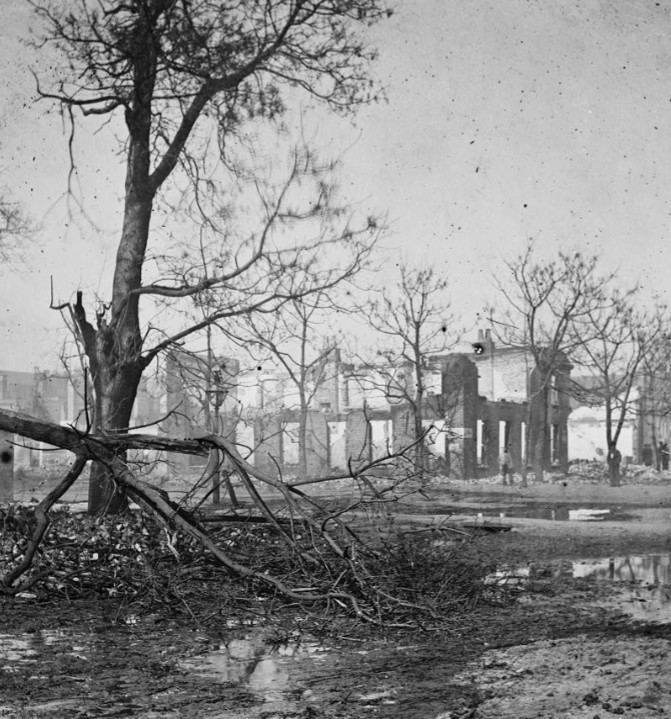
War-damaged houses in Savannah, Georgia, 1865 (Sam Cooley, U.S. Army, U.S. Library of Congress, public domain).

Stationed in Savannah, Georgia since June 7, 1865, the soldiers still serving with the 47th Pennsylvania Volunteer Infantry that first summer after the American Civil War were assigned to provost duties — as peacekeepers, public information specialists and public works officials, during what has since become known as the Presidential Reconstruction Era (1865-1867) of American History.

Commanded by Colonel John Peter Shindel Gobin, Lieutenant-Colonel Charles William Abbott and Major Levi Stuber, multiple members of the regiment were literally involved in the re-construction of small southern towns and larger cities, helping to shore up war-damaged structures that could be restored — and in tearing down others that were deemed too dangerous for civilians to leave standing.

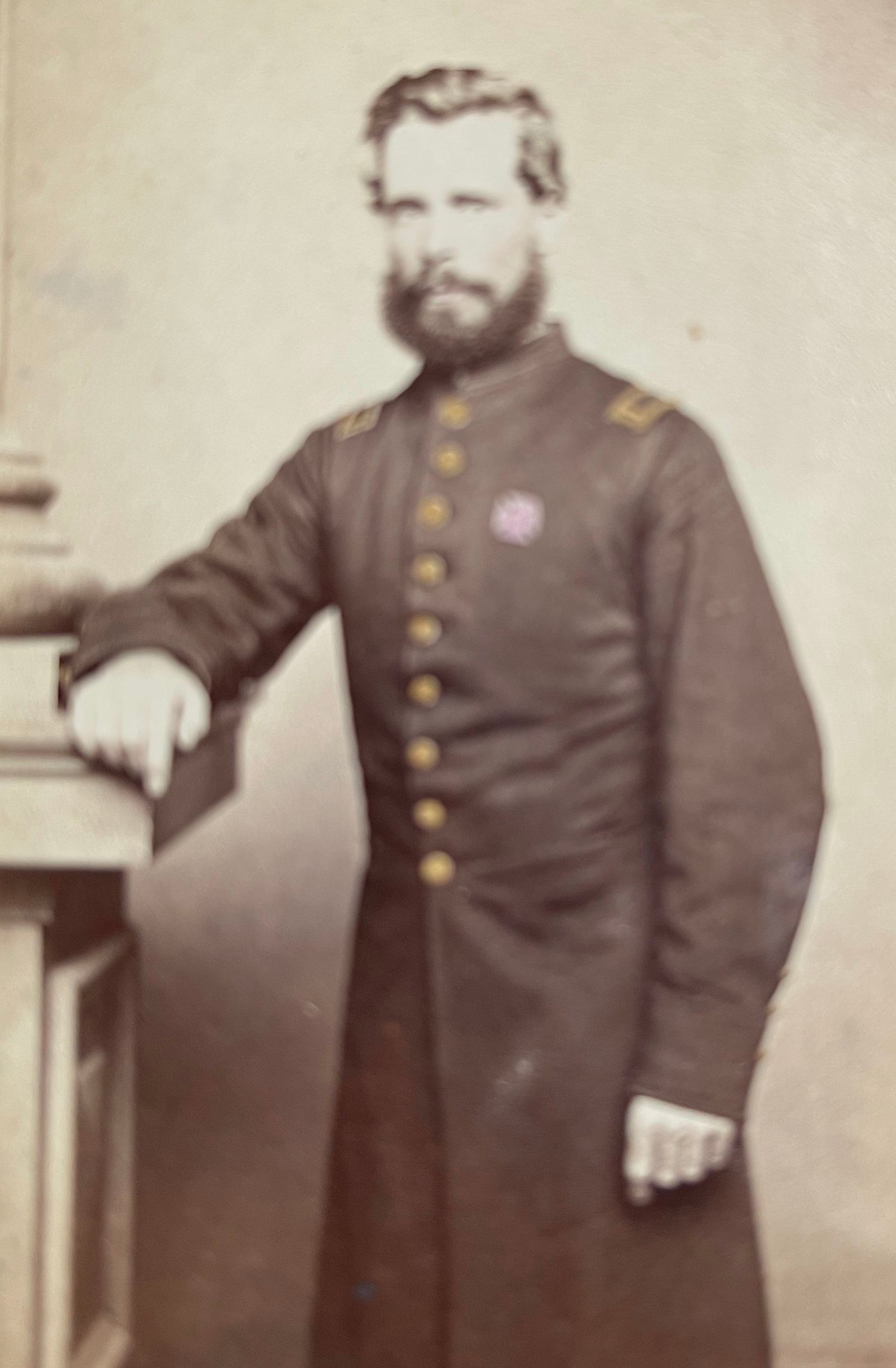
John Young Shindel, M.D., assistant surgeon, 47th Pennsylvania Volunteers, 1865 (public domain).

It was hazardous work, according to John Young Shindel, M.D., an assistant regimental surgeon who had joined the medical staff of the 47th Pennsylvania earlier that same year. On Wednesday, June 18, 1865, he noted that:

10 o’clock wall fell in and buried 15 or 20 men. 6 or 7 were taken out some dead. Zellner Co. K badly hurt. Sent him to Hosp. Capt. Hoffman, Chief of Police, seriously hurt. In P.M. was with Capt. Hoffman.

The 47th Pennsylvanian mentioned by Dr. Young was Private Ben Zellner, who had survived repeated battle wounds and confinement as a prisoner of war (POW) at two Confederate States Army prison camps, only to nearly lose his life while assigned to police duty during peacetime. According to Private Zellner’s 1896 account of that 1865 accident, his jawbone had been broken during the wall’s collapse “and he sustained 11 scalp wounds”; as a result, he “lost the sight of his left eye and the hearing of his left ear.”

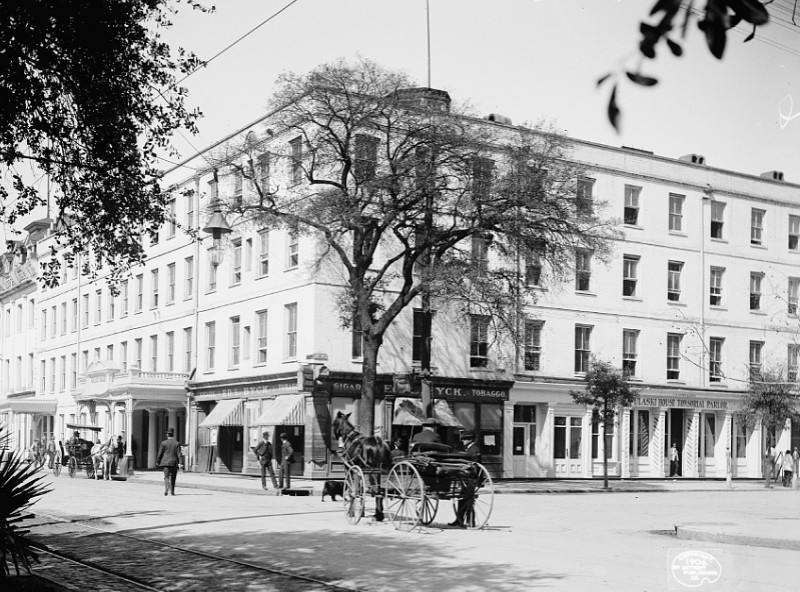
The 47th Pennsylvania Volunteer Infantry’s Regimental Band performed in concert for James Johnson, provincial governor of the State of Georgia, at the Pulaski Hotel in Savannah on June 30, 1865 (Pulaski Hotel, Savannah, Georgia, circa 1906, U.S. Library of Congress, public domain).

Meanwhile, other 47th Pennsylvania Volunteers were being transformed into diplomats. Officers and enlisted members of the regiment, for example, helped to facilitate a warm welcome for James Johnson, the provisional governor of Georgia, during his official visit to Savannah in early July. According to the Charleston Daily Courier, Governor Johnson (who had been appointed to his gubernatorial post by U.S. President Andrew Johnson (but was not related to the president), had been invited to Savannah by members of the city council “to address the citizens … at some suitable place.” In that invitation, council members also suggested that “military and naval commanders of the United States army and navy at this post and their respective staffs be respectfully invited to attend said meeting.” Johnson subsequently accepted the invitation and made the trip to Savannah in late June. The night of his arrival (June 30), “the fine band of the 47th Pennsylvania Regiment, Eugene Walter, Leader, serenaded the Governor at the Pulaski House.”

Several patriotic airs were played, and as soon as practicable the Governor appeared on one of the balconies, in response to repeated calls. He was loudly welcomed. He made no elaborate speech, but addressed the immense assembly substantially as follows:

“Fellow-Citizens — I thank you for the consideration, on your part, which has occasioned this demonstration. I know that you have called on me as the Provisional Governor of the State of Georgia, and in the discharge of the high duties now incumbent upon me, I promise you to act to the best of my ability. I know that you will not expect, on this occasion, any very full remarks. Hoping to meet you hereafter, and then to have an opportunity to explain my sentiments and position, I will bid you good night.”

This brief address was received with loud cheers by the crowd, and the band then played several other appropriate airs.

Joseph Eugene Walter, Regimental Band, 47th Pennsylvania Volunteers, circa 1861.

On July 1, the Savannah Republican newspaper published a more detailed description of that evening’s events:

Last evening, through the exertions of a few citizens, an impromptu call was made upon Gov. Johnson at the Pulaski by a delegation of loyal men, accompanied by the fine band of the 47th Pennsylvania Veteran Volunteers, now stationed in this city. The object of the call was simply to manifest the joy of the people at the return of a loyal civil magistrate, who, in a measure, holds the future destiny of Georgia in his hands, and to pay the Governor the compliment of a serenade. After the band had performed several appropriate pieces of music, loud calls and cheers were given for the Governor, who at length appeared, and in a few brief remarks thanked the assemblage for their demonstrations of respect, and informed them that, being wearied with traveling he begged to be excused from making any formal speech. Before bidding the crowd good night, the Governor informed them that it would be his pleasure to address the people tonight at the Theatre, where he would state his position and give his views on the state of the country. Upon retiring, the crowd applauded and cheered the Governor lustily, while Johnson square was ablaze with the discharge of fire works, the shooting of rockets, roman candles, and the illumination of blue lights, gave the scene a very brilliant appearance and made the vicinity of Savannah lively for one hour. At a late hour the crowd quietly dispersed to their homes, well pleased with the impromptu ovation to the Governor. Governor Johnson was afterwards introduced to a large number of army officers, each of whom expresses the wish that the day was near when bayonets would not be necessary to maintain order in Georgia. The Governor, who is a most unostentatious gentleman, spoke very encouragingly of the future, and shook hands with all who were introduced.

The thanks of our citizens are due Colonel Gobin, of the 47th Pennsylvania Volunteers, for the services of his excellent band, whose presence made the hasty reception a success. The Colonel has very kindly offered the use of his band for the meeting this evening at the theatre, and we may expect a brilliant gathering of the masses tonight at 8 o’clock.

James Johnson, provisional governor of the State of Georgia, 1865 (Lawton B. Evans, A History of Georgia for Use in Schools, 1898, public domain).

On Saturday evening (July 1), Governor Johnson fulfilled his promise. During a lengthy address, he spoke about cooperation and the rule of law, the true meaning of citizenship and the path forward following the nationwide eradication of chattel slavery. The crowd, which had been attentive throughout his speech, gave him a robust round of applause, and peacefully dispersed, according to subsequent newspaper reports. The festivities, which continued into the next week, also included a “Grand Review of the Garrison,” which was held in Savannah on Monday afternoon, July 3. According to the Savannah Republican:

The review of the entire garrison by Major General H. W. Birge, on Monday afternoon, was certainly one of the finest military pageants that we have witnessed since the departure of Gen. Sherman’s army. For perfection of military movements, neatness of appearance and true soldierly bearing on the part of privates as well as officers, won encomiums from the vast crowd of spectators who witnessed the review. We don’t blame Gen. Birge to feel proud of such a noble body of gallant men as he has the honor to command, and we are fortunate in having so excellent a command garrisoning our city.

The following composes the troops that participated in the review:

Brigadier General Joseph D. Fessenden, commanding 1st Division.

1st Brigade, 1st Division, Col. L. Peck commanding. — 90th New York, Lt. Col. Schamman; 173d New York, Lt. Col. Holbrook; 160th New York, Lt. Col. Blanchard; 47th Pennsylvania, Col. Gobin.

2d Brigade, Col. H. Day commanding. — 131st New York, Capt. Tilosting commanding; 128th New York, Capt. _____ ; 14th New Hampshire, Lt. Col. Mastern.

3d Brigade, 2d Division, Col. Graham commanding. — 22d Iowa, Lt. Col. _____ ; 24th Iowa, Lt. Col. Wright; 28th Iowa, Lt. Col. Wilson.

4th Brigade, Brevet Brig. Gen. E. P. Davis commanding. — 153d _____ , Lt. Col. Loughlin; 30th Maine, Col. Hubbard; 12th Connecticut, Lt. Col. Lewis; 26th Massachusetts, Lt. Col. Chapman; 75th New York, Lt. Col. York; 103rd U.S.C.T., Major Manning.

Civil conversation, community concerts and displays of kindness toward strangers were indeed replacing bayonets — becoming the most powerful tools ever wielded by the 47th Pennsylvania Volunteers as they helped to rescue their nation from disunion.


Sources:

  1. Bates, Samuel P. History of Pennsylvania Volunteers, 1865-1, vol. 1. Harrisburg, Pennsylvania: B. Singerly, State Printer, 1869.
  2. “Comrade Zellner’s Birthday” (includes description of Private Benjamin F. Zellner’s injury in 1865 while serving with the 47th Pennsylvania Volunteers during the Reconstruction Era). Allentown, Pennsylvania: The Allentown Leader, March 27, 1896.
  3. Evans, Lawton B. A History of Georgia for Use in Schools, p. 304. New York, New York: Universal Publishing Company, 1898.
  4. Foner, Eric. “Reconstruction.” Washington, D.C.: U.S. National Park Service, retrieved online July 1, 2025.
  5. Governor Johnson’s Patriotic Address: A Stirring Appeal to Georgians.” Savannah, Georgia: Savannah Republican, July 6, 2025.
  6. “House Divided: The Civil War Research Engine at Dickinson College.” Carlisle, Pennsylvania: Dickinson College, accessed July 1, 2025.
  7. James Johnson,” in New Georgia Encyclopedia. Atlanta, Georgia: Georgia Humanities, retrieved online July 1, 2025.
  8. “Savannah Intelligence.” Charleston, South Carolina: Charleston Daily Courier, July 4, 1865.
  9. “Serenade to Our New Governor: The Pulaski House and Johnson Square Radiant with Fireworks: Remarks of the Governor: Music and Pyrotechnics.” Savannah, Georgia: Savannah Republican, July 1, 1865.
  10. Shindel, John Young. Diary and Personal Letters, 1865-1866. Allentown, Pennsylvania: Personal Collection of Lewis Schmidt.
  11. Wharton, Henry D. Letters from the Sunbury Guards, 1865. Sunbury, Pennsylvania: Sunbury American, 1865-1866.
  12. “The Grand Review of the Garrison.” Savannah, Georgia: Savannah Republican, July 6, 1865.
  13. “The History of the Forty-Seventh Regt. P. V.” Allentown, Pennsylvania: The Lehigh Register, July 20, 1870.


“Propitious Weather and a Splendid Spectacle”: The United States of America’s Grand Review of the Armies (May 23, 1865)

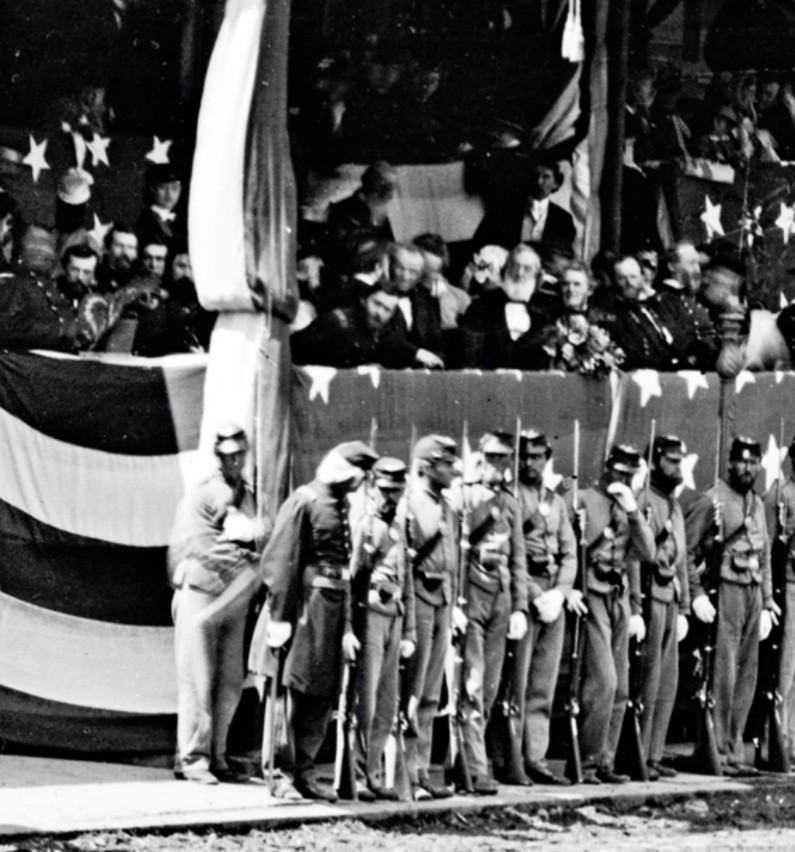
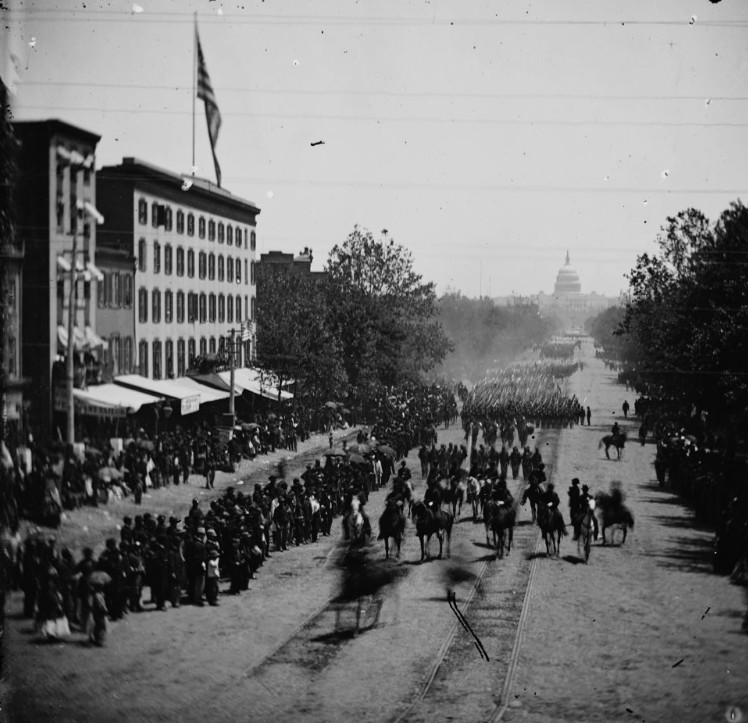
Lieutenant-General Ulysses S. Grant leans forward to have a better look at a Union regiment approaching the presidential reviewing stand, President Andrew Johnson to his left, Grand Review of the National Armies, Washington, D.C., May 23, 1865 (U.S. Library of Congress, public domain; click to enlarge).

It was a week to remember. The 47th Pennsylvania Veteran Volunteers had survived the bloody Battle of Pocotaligo in South Carolina (October 1862) to make history as the only regiment from the Great Keystone State to participate in the Union’s 1864 Red River Campaign across Louisiana and help firmly, finally turn the tide of the American Civil War in the Union’s favor during Sheridan’s 1864 Shenandoah Valley Campaign — only to be brought to their knees in mourning, upon receiving the heartbreaking news that their beloved commander-in-chief had been assassinated — just as victory was at hand.

Now, they were joining more than one hundred and forty-five thousand other “boys in blue” in a triumphant march through the streets of Washington, D.C. that would subsequently be described by The New York Times as “The Grand Procession of Battle Stained Banners” and a “splendid spectacle” that was graced with “propitious weather.” The reporter penning those superlatives was describing the Union’s Grand Review of the National Armies, which took place from May 23 to 24.

The Army of the Potomac has passed in review. The first day’s pageant is over, and to the correspondent falls the duty of depicting a scene almost devoid of incident, save in its grand aspiration. Every circumstance has combined to make it a complete success. The weather has been magnificent; the air, delightfully tempered by the rains of the past week, is cool and fragrant, and dust, is for the time subdued….

Though the city is so crowded, it is yet gay and jovial with the good feeling that prevails, for the occasion is one of such grand import and true rejoicing, that small vexations sink out of sight. With many it is the greatest epoch of their lives; with the soldier it is the last act in the drama; with the nation it is the triumphant exhibition of the resources and valor which have saved it from disruption and placed it first upon earth.

So the scene of to-day (and that of to-morrow) will never be forgotten, and he who is privileged to be a witness will mark it as a white day in the calendar, from which to gather hope and courage for the future….

That Times reporter went on to describe the ways in which multiple Union Army regiments had made their way to the nation’s capital, where they had set up tents upon their respective arrivals and how they had assembled for the first day of the review, providing a list, line-by-line, of the long order of march — a list which included the 47th Pennsylvania Volunteers. (Officially stationed at Camp Brightwood in the northwest corner of Washington, D.C. by early May 1865, the 47th Pennsylvanians had departed from that camp on Monday, May 22 to move closer to their assigned position for the Grand Review’s start, according to Private Henry Horn of Company G.)

19th Corps, Army of the United States, Grand Review of the National Armies, Pennsylvania Avenue, Washington, D.C., May 23, 1865 (Matthew Brady, U.S. Library of Congress, public domain).

The 47th Pennsylvania was just one of the one hundred and eighteen infantry regiments, twenty-nine cavalry regiments and thirty-three artillery batteries that boldly stepped forth from Capitol Hill on that first day of the Grand Review (May 23, 1865). Marching with the precision they were known for, under the banners of the Army of the Potomac (Mr. Lincoln’s Army), they were participants in a thrilling, six-hour parade, passing in front of a review stand that sheltered U.S. President Andrew Johnson, Secretary of War Edwin M. Stanton, Lieutenant-General Ulysses S. Grant, and other high-ranking officials of the military and federal government. According to the Times, the 47th Pennsylvania Veteran Volunteers were positioned behind the parade’s third division, as part of the Nineteenth Army Corps (XIX Corps) in Dwight’s Division:

Third Division.
Brevet Brig.-Gen. John G. Curtin commanding.

First Brigade, Col. A. B. McCalmon commanding — 51st Pennsylvania Veteran Volunteers, Col. William J. Bolton; 208th Pennsylvania, Lieut.-Col. M. T. Heintzelman; 209th Pennsylvania, Col. T. B. Kaufman; 200th Pennsylvania, Maj. Jacob Rehm.

Second Brigade, Col. J. A. Mathews commanding — 207th Pennsylvania, Col. R. C. Cox; 211th Pennsylvania, Lieut.-Col. Coulter; 205th Pennsylvania, Lieut.-Col. W. F. Walter.

Dwight’s Division.
Nineteenth Army Corps, Brig.-Gen. William Dwight commanding.

First Brigade, Brig.-Gen. G. L. Beal commanding — 15th Maine, Col. Isaac Dyer; 114th New York, Col. S. R. Per Lee; 29th Maine, Col. George H. Nye; 30th Massachusetts, Lieut.-Col. N. Shardman; 1st Maine Battalion, Capt. C. S. Brown.

Second Brigade, Brevet Brig.-Gen. E. P. Davis commanding — 153rd New York, Lieut.-Col. J. A. McLaughlin; 8th Vermont, Col. J. B. Mead; 12th Connecticut, Lieut.-Col. G. W. Lewis; 26th Massachusetts, Lieut.-Col. W. H. Chapman; 47th Pennsylvania, Col. J. P. S. Gobin.

Third Brigade, Brig.-Gen. J. D. Fessenden commanding — 173rd New York, Col. L. M. Peck; 160th New York, Col. C. C. Dwight; 162nd New York, Col. J. W. Blanchard; 133rd New York, Col. L. D. Currie; 30th Maine, Col. T. H. Hubbard.

Artillery Brigade, Brevet Brig.-Gen. J. C. Tidball commanding — 34th New York Battery, Brevet Maj. J. Roemer; 7th Maine Battery, Capt. A. B. Twitchell; 19th New York Battery, Capt. E. W. Rogers; Battery D, 47th Pennsylvania Volunteer Artillery; Capt. S. H. Rhoads; 11th Massachusetts Battery, Capt. E. J. Jones; 27th New York Battery, Capt. J. B. Eaton.

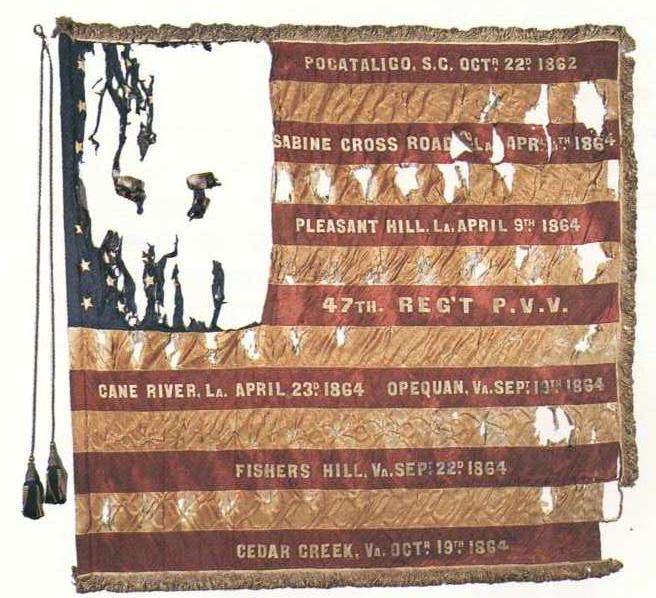
Second State Colors, 47th Pennsylvania Veteran Volunteers (presented to the regiment 7 March 1865).

Lest one be tempted to think that the 47th Pennsylvania Veteran Volunteers were placed further back in the line of march because they were being accorded less respect, one only need look at the rosters of the men who immediately followed the 47th. The division positioned directly behind them was composed of general staff of the Army of the United States and regiments led by American Civil War icon and Gettyburg hero Joshua L. Chamberlain. Observed U.S. Secretary of War Edwin M. Stanton, “You see in these armies, the foundation of the Republic: our future railroad managers, congressmen, bank presidents, senators, manufacturers, judges, governors and diplomats; yes and not less than half a dozen presidents.”

John Peter Shindel Gobin, 47th Pennsylvania Volunteers, shown here as a captain in 1863, went on to become lieutenant governor of Pennsylvania after the war (public domain).

Among the 47th Pennsylvanians who would continue to serve their communities, commonwealth and nation faithfully were future city councilmen, industrialists, inventors, judges, a three-time mayor, newspaper publishers, physicians, policemen, federal postmasters, local school board members, and a state senator who would be publicly elected as Pennsylvania’s seventh lieutenant governor. Each one had experienced the horrors of war. All were forever changed. So, please take time this Memorial Day weekend to read and share their stories with your family, friends and neighbors — and say their names as you offer a toast in tribute to their valor. We owe them at least that much for the sacrifices they made to save our nation.


Sources:

  1. Bates, Samuel P. History of Pennsylvania Volunteers, 1861-5, vol. 1. Harrisburg, Pennsylvania: B. Singerly, State Printer, 1869.
  2. “Grand Military Review: Streets Crowded with Spectators: Sherman Greeted with Deafening Cheers.” Pittsburgh, Pennsylvania: The Daily Post, May 25, 1865.
  3. “Our Heroes! The Grand Review at Washington. Honor to the Brave. Immense Outpouring of the People. The Troops Reviewed by Gen. Grant.” Harrisburg, Pennsylvania: Daily Telegraph, May 23, 1865.
  4. Review of the Armies; Propitious Weather and a Splendid Spectacle. Nearly a Hundred Thousand Veterans in the Lines.” New York, New York: The New York Times, May 24, 1865, front page.
  5. Rodrock, Rev. William D. C. Chaplain’s Reports (47th Pennsylvania Volunteer Infantry, 1865). Washington, D.C.: U.S. National Archives and Records Administration.
  6. Schmidt, Lewis. A Civil War History of the 47th Regiment of Pennsylvania Veteran Volunteers. Allentown, Pennsylvania: Self-published, 1986.
  7. “Serenade to General Grant” (performance for Lieutenant-General Ulysses S. Grant by the 47th Pennsylvania Veteran Volunteers’ Regimental Band), in “Washington.” Philadelphia, Pennsylvania: The Inquirer, May 22, 1865.
  8. The Final March: Grand Review of the Armies.” Washington, D.C.: U.S. National Park Service, retrieved online May 20, 2025.
  9. “The Grand Review: A Grand Spectacle Witnessed.” Pittsburgh, Pennsylvania: The Daily Post, May 24, 1865.
  10. “The Grand Review: Immense Crowds in Washington: Fine Appearance of the Troops: Their Enthusiastic Reception.” Harrisburg, Pennsylvania: Pennsylvania Daily Telegraph, May 24, 1865; and West Chester, Pennsylvania: The Record, May 17, 1865.
  11. “The Grand Review: The City Crowded with Visitors: Order of Corps, Divisions, Brigades and Regiments.” Philadelphia, Pennsylvania: Daily Constitutional Union, May 23, 1865.
  12. “The History of the Forty-Seventh Regt. P. V.” Allentown, Pennsylvania: The Lehigh Register, 20 July 1870.


April 12th: This Date in 47th Pennsylvania Volunteer Infantry History

April 12th would prove to be an important date for the men who served with the 47th Pennsylvania Volunteer Infantry during the American Civil War and Reconstruction eras. This abridged timeline illustrates why:

1861

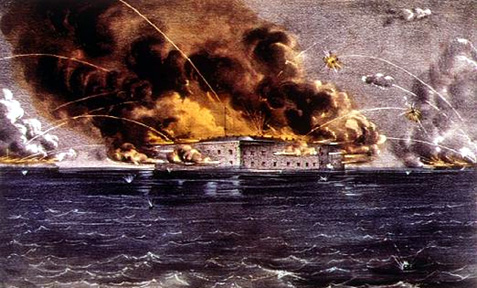
The bombardment of Fort Sumter 12-14 April 1861 (Currier & Ives, public domain).

At 4:30 a.m., on April 12, 1861, artillery batteries of the Confederate States Army open fire on United States Army troops stationed at Fort Sumter in Charleston, South Carolina. A long and disastrous period of civil war begins in America.

The majority of Pennsylvanians and residents of other states throughout America who will ultimately serve with the 47th Pennsylvania Volunteer Infantry are at home, asleep in their beds — or just rising and readying themselves for their work days on family farms, as canal boatmen, in iron foundries, silk mills, tanneries or tobacco factories, as quarrymen toiling away in the slate industry, or as miners tunneling deeper inside of the Earth in poorly-lighted coal mines, along with countless other blue collar laborers who are risking their own health and safety just to keep their families housed and fed.

The 47th Pennsylvania Volunteer Infantry isn’t even “a glimmer” in anyone’s eyes — yet. (It won’t be founded until August 5, 1861.)

1862

In 1862, The Gazette, one of two hometown newspapers read by the majority of men serving with the 47th Pennsylvania Volunteer Infantry’s C Company, carries the following news in its April 12th edition:

Jeff. Davis is becoming desperate. He has issued an extraordinary Message ordering the enrollment of all citizens of the Confederate States between the ages of 18 and 35, for military service, the residue of the fighting population, above 35 to form a fighting force.

Although that particular edition of the newspaper has not yet reached the 47th Pennsylvania Volunteers who are stationed in Florida, a warning about the Confederate Conscription Act’s pending passage has likely been telegraphed by the U.S. War Department to senior officers at the 47th Pennsylvania’s headquarters at Fort Taylor in Key West in order to prepare them for the increased threat they and their troops will face.

1864

On April 12, 1864, Captain Charles William Abbott, commanding officer of the 47th Pennsylvania Volunteer Infantry’s K Company, pens a brief report from his regiment’s camp at Grand Ecore, Louisiana to his superior officers in the United States Army of the Gulf, which partially documents the losses in soldiers and supplies sustained by his regiment during the Battle of Pleasant Hill, Louisiana on April 9, 1864. That report also contains details about the regiment’s movements during this phase of duty.

Sergeant John Gross Helfrich then describes this same battle in a letter to his parents on May 5th, in which he notes:

I have learned additional news of the late fight of our boys of the “Nineteenth Corps”…. The casualties of our boys amounted to a great deal more than at first reported. The Lt. Col. of our Forty-seventh Regt. is missing, and supposed he is wounded or perhaps killed. Lt. Swoyer is dead.

1865

In a letter that he is writing to the Sunbury American on April 12, 1865 from the 47th Pennsylvania Volunteer Infantry’s camp near Summit Point, Virginia, 47th Pennsylvanian Henry D. Wharton describes a celebration that took place following the surrender at Appomattox by Confederate General Robert E. Lee and his army on April 9, 1865:

Since yesterday a week we have been on the move, going as far as three miles beyond Winchester. There we halted for three days, waiting for the return or news from Torbett’s cavalry who had gone on a reconnoisance [sic] up to the valley. They returned, reporting they were as far up as Mt. Jackson, some sixty miles, and found nary an armed reb. The reason of our move was to be ready in case Lee moved against us, or to march on Lynchburg, if Lee reached that point, so that we could aid in surrounding him and [his] army, and with Sheridan and Mead capture the whole party. Grant’s gallant boys saved us that march and bagged the whole crowd. Last Sunday night our camp was aroused by the loud road of artillery. Hearing so much good news of late, I stuck to my blanket, not caring to get up, for I suspected a salute, which it really was for the ‘unconditional surrender of Lee.’ The boys got wild over the news, shouting till they were hoarse, the loud huzzas [sic, huzzahs] echoing through the Valley, songs of ‘rally round the flag,’ &c., were sung, and above the noise of the ‘cannons opening roar,’ and confusion of camp, could be heard ‘Hail Columbia’ and Yankee Doodle played by our band. Other bands took it up and soon the whole army let loose, making ‘confusion worse confounded.’

The next morning we packed up, struck tents, marched away, and now we are within a short distance of our old quarters. – The war is about played out, and peace is clearly seen through the bright cloud that has taken the place of those that darkened the sky for the last four years. The question now with us is whether the veterans after Old Abe has matters fixed to his satisfaction, will have to stay ‘till the expiration of the three years, or be discharged as per agreement, at the ‘end of the war.’ If we are not discharged when hostilities cease, great injustice will be done.

The members of Co. ‘C,’ wishing to do honor to Lieut. C. S. Beard, and show their appreciation of him as an officer and gentleman, presented him with a splendid sword, sash and belt. Lieut. Beard rose from the ranks, and as one of their number, the boys gave him this token of esteem.

A few nights ago, an aid [sic] on Gen. Torbett’s staff, with two more officers, attempted to pass a safe guard stationed at a house near Winchester. The guard halted the party, they rushed on, paying no attention to the challenge, when the sentinel charged bayonet, running the sharp steel through the abdomen of the aid [sic], wounding him so severely that he died in an hour. The guard did his duty as he was there for the protection of the inmates and their property, with instruction to let no one enter.

The boys are all well, and jubilant over the victories of Grant, and their own little Sheridan, and feel as though they would soon return to meet the loved ones at home, and receive a kind greeting from old friends….

1866

On April 12, 1866, members of the 47th Pennsylvania Veteran Volunteers who survived the American Civil War are three months into their post-war civilian lives. Many are back home in Pennsylvania, trying to regain some sense of their old selves with normal work and family routines. Others have already left their pre-war and war lives behind, choosing to migrate west in search of better opportunities — or a certain peace of mind they hope to find in knowing they will be far away from any decision-makers who might drag their communities and nation back down into another disastrous war in the future.


Sources:

  1. Abbott, Charles W. Report from Captain Charles W. Abbott, Captain, Company K, 47th Pennsylvania Volunteer Infantry, to Senior Officers of the U.S. Army of the Gulf’s XIX Corps (19th Corps), Grand Ecore, Louisiana, April 12, 1864. Nazareth, Pennsylvania: Personal Collection of Julian Burley.
  2. Agriculture and Rural Life,” in “Stories from PA History.” Harrisburg, Pennsylvania: Pennsylvania Historical and Museum Commission, 2023.
  3. Fort Sumter and Fort Moultrie National Park.” Washington, D.C.: National Park Foundation, retrieved online April 12, 2025.
  4. Harris, Howard and Perry K. Blatz. Keystone of Democracy: A History of Pennsylvania Workers. Harrisburg, Pennsylvania: Pennsylvania Historical and Museum Commission, 1999.
  5. Helfrich, John Gross. Letter to His Parents, May 5, 1864. Mesa, Arizona: Personal Collection of the Colin Cofield Family Archives.
  6. Miller, Randall M. and William A. Pencak. Pennsylvania: A History of the CommonwealthUniversity Park, Pennsylvania: The Pennsylvania State University Press, 2002.
  7. Mining Anthracite,” in “Stories from PA History.” Harrisburg, Pennsylvania: Pennsylvania Historical and Museum Commission, 2023.
  8. Montgomery, Morton L. Early Furnaces and Forges of Berks County, Pennsylvania, in The Pennsylvania Magazine of History and Biography, 1884. Philadelphia, Pennsylvania: Historical Society of Pennsylvania, 1884.
  9. News Regarding the Confederate States’ New Conscription Order. Sunbury, Pennsylvania: The Gazette, April 12, 1862.
  10. Palladino, Grace. Another Civil War: Labor, Capital, and the State in the Anthracite Regions of Pennsylvania, 1840-1868. New York, New York: Fordham University Press, March 30, 2006.
  11. Sacher, John M. Confederate Conscription and the Struggle for Southern Soldiers. Baton Rouge, Louisiana: LSU Press, 2021.
  12. The Industrial Age,” in “Stories from PA History: Science and Invention.” Harrisburg, Pennsylvania: Pennsylvania Historical and Museum Commission, 2023.
  13. The Pennsylvania Iron Industry: Furnace and Forge of America,” in “Stories from PA History.” Harrisburg, Pennsylvania: Pennsylvania Historical and Museum Commission, 2023.
  14. The Railroad in Pennsylvania,” in “Stories from PA History.” Harrisburg, Pennsylvania: Pennsylvania Historical and Museum Commission, 2023.
  15. Timeline of Labor History in Pennsylvania.” Pennsylvania: Pennsylvania Labor History Society, retrieved online April 12, 2025.


President Abraham Lincoln’s Final Public Address (11 April 1865)

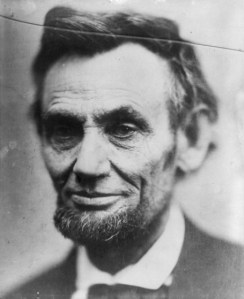
This 1865 photograph of President Abraham Lincoln by Alexander Gardner is believed by historians to be the final photo taken of Lincoln (1865, U.S. Library of Congress, public domain).

We meet this evening, not in sorrow, but in gladness of heart. The evacuation of Petersburg and Richmond, and the surrender of the principal insurgent army, give hope of a righteous and speedy peace whose joyous expression can not be restrained. In the midst of this, however, He, from Whom all blessings flow, must not be forgotten. A call for a national thanksgiving is being prepared, and will be duly promulgated. Nor must those whose harder part gives us the cause of rejoicing, be overlooked. Their honors must not be parcelled out with others. I myself, was near the front, and had the high pleasure of transmitting much of the good news to you; but no part of the honor, for plan or execution, is mine. To Gen. Grant, his skilful officers, and brave men, all belongs. The gallant Navy stood ready, but was not in reach to take active part.

By these recent successes the re-inauguration of the national authority—reconstruction—which has had a large share of thought from the first, is pressed much more closely upon our attention. It is fraught with great difficulty. Unlike the case of a war between independent nations, there is no authorized organ for us to treat with. No one man has authority to give up the rebellion for any other man. We simply must begin with, and mould from, disorganized and discordant elements. Nor is it a small additional embarrassment that we, the loyal people, differ among ourselves as to the mode, manner, and means of reconstruction.

As a general rule, I abstain from reading the reports of attacks upon myself, wishing not to be provoked by that to which I can not properly offer an answer. In spite of this precaution, however, it comes to my knowledge that I am much censured for some supposed agency in setting up, and seeking to sustain, the new State Government of Louisiana. In this I have done just so much as, and no more than, the public knows. In the Annual Message of Dec. 1863 and accompanying Proclamation, I presented a plan of re-construction (as the phrase goes) which, I promised, if adopted by any State, should be acceptable to, and sustained by, the Executive government of the nation. I distinctly stated that this was not the only plan which might possibly be acceptable; and I also distinctly protested that the Executive claimed no right to say when, or whether members should be admitted to seats in Congress from such States. This plan was, in advance, submitted to the then Cabinet, and distinctly approved by every member of it. One of them suggested that I should then, and in that connection, apply the Emancipation Proclamation to the theretofore excepted parts of Virginia and Louisiana; that I should drop the suggestion about apprenticeship for freed-people, and that I should omit the protest against my own power, in regard to the admission of members to Congress; but even he approved every part and parcel of the plan which has since been employed or touched by the action of Louisiana. The new constitution of Louisiana, declaring emancipation for the whole State, practically applies the Proclamation to the part previously excepted. It does not adopt apprenticeship for freed-people; and it is silent, as it could not well be otherwise, about the admission of members to Congress. So that, as it applies to Louisiana, every member of the Cabinet fully approved the plan. The Message went to Congress, and I received many commendations of the plan, written and verbal; and not a single objection to it, from any professed emancipationist, came to my knowledge, until after the news reached Washington that the people of Louisiana had begun to move in accordance with it. From about July 1862, I had corresponded with different persons, supposed to be interested, seeking a reconstruction of a State government for Louisiana. When the Message of 1863, with the plan before mentioned, reached New-Orleans, Gen. Banks wrote me that he was confident the people, with his military co-operation, would reconstruct, substantially on that plan. I wrote him, and some of them to try it; they tried it, and the result is known. Such only has been my agency in getting up the Louisiana government. As to sustaining it, my promise is out, as before stated. But, as bad promises are better broken than kept, I shall treat this as a bad promise, and break it, whenever I shall be convinced that keeping it is adverse to the public interest. But I have not yet been so convinced.

I have been shown a letter on this subject, supposed to be an able one, in which the writer expresses regret that my mind has not seemed to be definitely fixed on the question whether the seceded States, so called, are in the Union or out of it. It would perhaps, add astonishment to his regret, were he to learn that since I have found professed Union men endeavoring to make that question, I have purposely forborne any public expression upon it. As appears to me that question has not been, nor yet is, a practically material one, and that any discussion of it, while it thus remains practically immaterial, could have no effect other than the mischievous one of dividing our friends. As yet, whatever it may hereafter become, that question is bad, as the basis of a controversy, and good for nothing at all—a merely pernicious abstraction.

We all agree that the seceded States, so called, are out of their proper practical relation with the Union; and that the sole object of the government, civil and military, in regard to those States is to again get them into that proper practical relation. I believe it is not only possible, but in fact, easier, to do this, without deciding, or even considering, whether these states have even been out of the Union, than with it. Finding themselves safely at home, it would be utterly immaterial whether they had ever been abroad. Let us all join in doing the acts necessary to restoring the proper practical relations between these states and the Union; and each forever after, innocently indulge his own opinion whether, in doing the acts, he brought the States from without, into the Union, or only gave them proper assistance, they never having been out of it.

The amount of constituency, so to to [sic] speak, on which the new Louisiana government rests, would be more satisfactory to all, if it contained fifty, thirty, or even twenty thousand, instead of only about twelve thousand, as it does. It is also unsatisfactory to some that the elective franchise is not given to the colored man. I would myself prefer that it were now conferred on the very intelligent, and on those who serve our cause as soldiers. Still the question is not whether the Louisiana government, as it stands, is quite all that is desirable. The question is “Will it be wiser to take it as it is, and help to improve it; or to reject, and disperse it?” “Can Louisiana be brought into proper practical relation with the Union sooner by sustaining, or by discarding her new State Government?”

Some twelve thousand voters in the heretofore slave-state of Louisiana have sworn allegiance to the Union, assumed to be the rightful political power of the State, held elections, organized a State government, adopted a free-state constitution, giving the benefit of public schools equally to black and white, and empowering the Legislature to confer the elective franchise upon the colored man. Their Legislature has already voted to ratify the constitutional amendment recently passed by Congress, abolishing slavery throughout the nation. These twelve thousand persons are thus fully committed to the Union, and to perpetual freedom in the state—committed to the very things, and nearly all the things the nation wants—and they ask the nations recognition, and it’s assistance to make good their committal. Now, if we reject, and spurn them, we do our utmost to disorganize and disperse them. We in effect say to the white men “You are worthless, or worse—we will neither help you, nor be helped by you.” To the blacks we say “This cup of liberty which these, your old masters, hold to your lips, we will dash from you, and leave you to the chances of gathering the spilled and scattered contents in some vague and undefined when, where, and how.” If this course, discouraging and paralyzing both white and black, has any tendency to bring Louisiana into proper practical relations with the Union, I have, so far, been unable to perceive it. If, on the contrary, we recognize, and sustain the new government of Louisiana the converse of all this is made true. We encourage the hearts, and nerve the arms of the twelve thousand to adhere to their work, and argue for it, and proselyte for it, and fight for it, and feed it, and grow it, and ripen it to a complete success. The colored man too, in seeing all united for him, is inspired with vigilance, and energy, and daring, to the same end. Grant that he desires the elective franchise, will he not attain it sooner by saving the already advanced steps toward it, than by running backward over them? Concede that the new government of Louisiana is only to what it should be as the egg is to the fowl, we shall sooner have the fowl by hatching the egg than by smashing it? Again, if we reject Louisiana, we also reject one vote in favor of the proposed amendment to the national constitution. To meet this proposition, it has been argued that no more than three fourths of those States which have not attempted secession are necessary to validly ratify the amendment. I do not commit myself against this, further than to say that such a ratification would be questionable, and sure to be persistently questioned; while a ratification by three fourths of all the States would be unquestioned and unquestionable.

I repeat the question. “Can Louisiana be brought into proper practical relation with the Union sooner by sustaining or by discarding her new State Government?

What has been said of Louisiana will apply generally to other States. And yet so great peculiarities pertain to each state; and such important and sudden changes occur in the same state; and, withal, so new and unprecedented is the whole case, that no exclusive, and inflexible plan can safely be prescribed as to details and colatterals. Such exclusive, and inflexible plan, would surely become a new entanglement. Important principles may, and must, be inflexible.

In the present ‘situation’ as the phrase goes, it may be my duty to make some new announcement to the people of the South. I am considering, and shall not fail to act, when satisfied that action will be proper.


Annotation (per Roy Basler, et. al., editors):

[1]   AD-P, ISLA. On April 11, Salmon P. Chase had written Lincoln at length about reconstruction:

“I am very anxious about the future: and most about the principles which are to govern reconstruction for as these principles are sound or unsound so will be the work & its results. . . .

“And first as to Virginia.

“By the action of every branch of the Government we are committed to the recognition & maintenance of the State organization of which Governor Pierpont is the head. You know all the facts. . . . There will be a pressure for the recognition of the rebel organization on condition of profession of loyalty. It will be far easier and wiser, in my judgment, to stand by the loyal organization already recognized.

“And next as to the other rebel States:

“The easiest & safest way seems to me to be the enrollment of the loyal citizens without regard to complexion and encouragement & support to them in the reorganization of State Governments under constitutions securing suffrage to all citizens. . . . This you know has long been my opinion. . . .

“This way is recommended by its simplicity, facility & above all, justice. It will be, hereafter, counted equally a crime & a folly if the colored loyalists of the rebel states shall be left to the control of restored rebels, not likely, in that case, to be either wise or just, until taught both wisdom and justice by new calamities.

“The application of this principle to Louisiana is made somewhat difficult by the organization which has already taken place: but happily the Constitution enables the Legislature to extend the right of suffrage. . . .

“The same result can be assured in Arkansas by an amendment of the state constitution; or what would be better, I think, by a new Convention . . . without distinction of color. To all the other states the general principle may be easily applied. . . .'” (DLC-RTL).


On the morning after Lincoln’s speech, Chase wrote again:

“The American of this morning contains your speech of last evening. Seeing that you say something on the subject of my letter to you yesterday—reconstruction—, & refer, though without naming me, to the suggestions I made in relation to the Amnesty Proclamation, when you brought it before the Heads of Departments, I will ask your permission to add some observations to what I have already written.

“I recollect the suggestions you mention; my impression is that they were in writing. There was another which you do not mention and which, I think, was not in writing. It is distinct in my memory; though doubtless forgotten by you. It was an objection to the restriction of participation in reorganization to persons having the qualifications of voters under the laws of their several states just before rebellion.

“Ever since questions of reconstruction have been talked about, it has been my opinion that the colored loyalists ought to be allowed to participate in it and it was because of this opinion that I was anxious to have this question left open. I did not however say much about the restriction. I was the only one who expressed a wish for its omission; & I did not desire to seem pertinacious.

“You will remember, doubtless, that the first order ever issued for enrollment with a view to reconstruction went to General Shepley & directed the enrollment of all loyal citizens; and I suppose that, since the opinion of Attorney General Bates, no one, connected with your administration, has questioned the citizenship of free colored men more than that of free white men. The restriction in the amnesty proclamation operated as a revocation of the order to General Shepley:—but, as I understood you not to be wedded to any particular plan of reconstruction, I hoped & believed that reflection & observation would probably satisfy you that the restriction should not be adhered to.

“I fully sympathized with your desire for the restoration of the Union by the change of rebel slave States into Union free States; and was willing, if I could not get exactly the plan I thought best, to take the plan you thought best, & to trust the future for modifications. I welcomed, therefore, with joy the prospects of good results from the cooperation of General Banks with the free state men of Louisiana. I think General Banks’ error, & I have said so to him, was in not acting through instead of over the Free State Committee. This Committee had already shown itself disposed to a degree of liberality towards the colored people quite remarkable at that time. They had admitted delegates from the creole colored population into their free State Convention, & had evinced a readiness to admit intelligent colored citizens of that class to the rights of suffrage. I have no doubt that great & satisfactory progress would have been made in the same direction had not the work been taken out of their hands. This created the impression that the advocates of general suffrage were to be treated with disfavor by the representatives of the Government. Discouragement & disinterest were the natural consequences.

“For one I was glad of all the good that was done; and, naturally, wanted more. So when I came to Washington last winter I saw Gen Banks: and, being now more deeply than ever persuaded of the necessity of universal suffrage, I begged him to write himself & to induce the Senators & Representatives elect from Louisiana to write to members of the Legislature and urge them to exercise their power under the constitution by passing an act extending suffrage to colored citizens. I knew that many of our best men in and out of Congress had become thoroughly convinced of the impolicy and injustice of allowing representation in Congress to States which had been in rebellion and were not yet prepared to concede equal political rights to all loyal citizens. They felt that if such representation should be allowed & such states reinstated in all their former rights as loyal members of the Union, the colored population would be practically abandoned to the disposition of the white population, with every probability against them; and this, they believed would be equally unjust & dangerous.

“I shared their sentiment & was therefore extremely desirous that General Banks should take the action I urged upon him. I thought indeed that he concurred, mainly, in my views, & would to some extent at least act upon them. I must have been mistaken, for I never heard that he did anything in that direction.

“I know you attach much importance to the admission of Louisiana, or rather to the recognition of her right to representation in Congress as a loyal State in the Union. If I am not misinformed there is nothing in the way except the indisposition of her Legislature to give satisfactory proof of loyalty by a sufficient guaranty of safety & justice to colored citizens through the extension to loyal colored men of the right of suffrage. Why not, then, as almost every loyal man concurs with you as to the desirableness of that recognition, take the shortest road to it by causing every proper representation to be made to the Louisiana Legislature of the importance of such extension.

“I most earnestly wish you could have read the New Orleans papers for the last few months. Your duties have not allowed it. I have read them a good deal—quite enough to be satisfied that, if you had read what I have, your feelings of humanity & justice would not let you rest till all loyalists are made equal in the right of self protection by suffrage.

“Once I should have been, if not satisfied, reasonably contented by suffrage for the more intelligent & for those who have been soldiers; now I am convinced that universal suffrage is demanded by sound policy and impartial justice alike.

“I have written too much already & will not trouble you with my reasons for this conclusion. I shall return to Washington in a day or two & perhaps it will not be disagreeable to you to have the whole subject talked over. . . .” (DLC-RTL).


Sources:

1. Basler, Roy P., editor, et. al. Collected works. The Abraham Lincoln Association/Springfield, Illinois, vol. 8. New Brunswick, New Jersey: Rutgers University Press, 1953.

2. Masur, Louis P. Lincoln’s Last Speech. New York, New York: Opinionator: Disunion, The New York Times, 10 April 2015.