Research Update: New Details Learned About Abraham Jassum, One of Nine Formerly Enslaved Men Who Enlisted with the 47th Pennsylvania Volunteers

Enlistment form for Abraham Jassum, Undercook, 47th Pennsylvania Volunteers, 5 October 1862, p. 1 (Compiled Military Service Records, U.S. National Archives and Records Administration, public domain; click to enlarge).

Fleeing the brutal practice of chattel slavery in South Carolina during the fall of 1862, a Black youth walked into a recruiting station for the Army of the United States in Beaufort, South Carolina and told an officer there that he wanted to become a soldier. His name, according to his enlistment paperwork, was Abraham Jassum, and he was just sixteen years old.

Sadly, much of that teenager’s life has remained a mystery that has stubbornly resisted unraveling–until now. Thanks to documents recently copied by the U.S. National Archives for 47th Pennsylvania Volunteers: One Civil War Regiment’s Story, researchers now know that Abraham Jassum was born into slavery in Charleston, South Carolina sometime around 1846.

Although specific details about what happened to this teenager between the dates of his birth and army enlistment have not yet been found, researchers do already have several ideas. One theory is that Abraham’s surname was not actually “Jassum” because that surname does not appear to have been present on any federal census records for any plantation owners or other enslavers in South Carolina between 1840 and 1860, nor was it used for any Black Freedmen in South Carolina on federal census records that were completed after the American Civil War. Furthermore, there appear to be no U.S. Civil War Pension records that exist for any soldier with the surname of “Jassum.”

Another theory is that, by the time that Abraham reached the age of sixteen, he had been transported to Beaufort to be used as an enslaved laborer there (or was “sold as property” by his enslaver in Charleston to a plantation owner or other enslaver near Beaufort), and that he was freed by Union soldiers when Beaufort was occupied by the Union Army.

Fortunately, the Compiled Military Service Records (CMSR) file for Abraham Jassum does contain important details about his life between October 1862 and October 1865.

Bay Street Looking West, Beaufort, South Carolina, circa 1862 (Sam A. Cooley, 10th Army Corps, photographer, public domain).

What is known for certain is that he enlisted for military service on October 5, 1862 as an “undercook“–a designation that was first authorized for use by regiments serving with the Army of the United States by the U.S. War Department. Examined and certified as fit for duty by William F. Reiber, M.D., an assistant regimental surgeon with the 47th Pennsylvania Volunteer Infantry, Abraham Jassum was then assigned to the 47th Pennsylvania Volunteers’ F Company.

Military records at the time of his enlistment noted that he was five feet, six inches tall and had black hair, black eyes and a black complexion. Muster sheets subsequently described him as a “Negro.”

During his three-year term of enlistment, he traveled with the 47th Pennsylvania to its battle, garrison, occupation, and other duty assignments in Florida, Louisiana, Virginia, Washington D.C., and South Carolina. While stationed with his regiment in Louisiana, he was documented as having been officially mustered into the regiment in June 1864, along with the other Black soldiers of the 47th Pennsylvania.

Additional military records of the 47th Pennsylvania Volunteer Infantry confirm Abraham Jassum’s service in 1864 and 1865, describing him as a “cook” or as a “private,” which appears to indicate that he may have been promoted at some point prior to his honorable discharge.

Issued his honorable discharge paperwork on October 4, 1865, while his regiment was assigned to Reconstruction-related duties in Charleston, South Carolina, he was given a small travel allowance to enable him to return to his place of enlistment (Beaufort, South Carolina), which seems to indicate that he chose to settle in Beaufort, at least initially, rather than remaining in the city where he had been born (Charleston), and instead of relocating north with his former regiment when it returned to Pennsylvania.

Researchers will continue to search for records that can shed more light on what happened to Abraham Jassum after the war, and will post updates if and when new data is uncovered.


Sources:

  1. Bates, Samuel P. History of Pennsylvania Volunteers, 1861-5, vol. 1. Harrisburg, Pennsylvania: B. Singerly, State Printer, 1869.
  2. Jassum, Abraham, in Civil War Veterans’ Card File, 1861-1866 (Company F, 47th Pennsylvania Infantry). Harrisburg, Pennsylvania: Pennsylvania State Archives.
  3. Jassum, Abraham, Civil War Muster Rolls (Company F, 47th Pennsylvania Infantry). Harrisburg, Pennsylvania: Pennsylvania State Archives.
  4. Jassum, Abraham, in Compiled Military Service Records (Company F, 47th Pennsylvania Volunteer Infantry). Washington, D.C.: U.S. National Archives and Records Administration.
  5. Jassum, Abraham, in Registers of Pennsylvania Volunteers, 1861-1865 (Company F, 47th Pennsylvania Infantry), in Records of the Department of Military and Veterans’ Affairs (RG-19). Harrisburg, Pennsylvania: Pennsylvania State Archives.
  6. Schmidt, Lewis. A Civil War History of the 47th Regiment of Pennsylvania Veteran Volunteers. Allentown, Pennsylvania: Self-published, 1986.


Black History Month: The Authorization, Duties and Pay of “Under-Cooks”

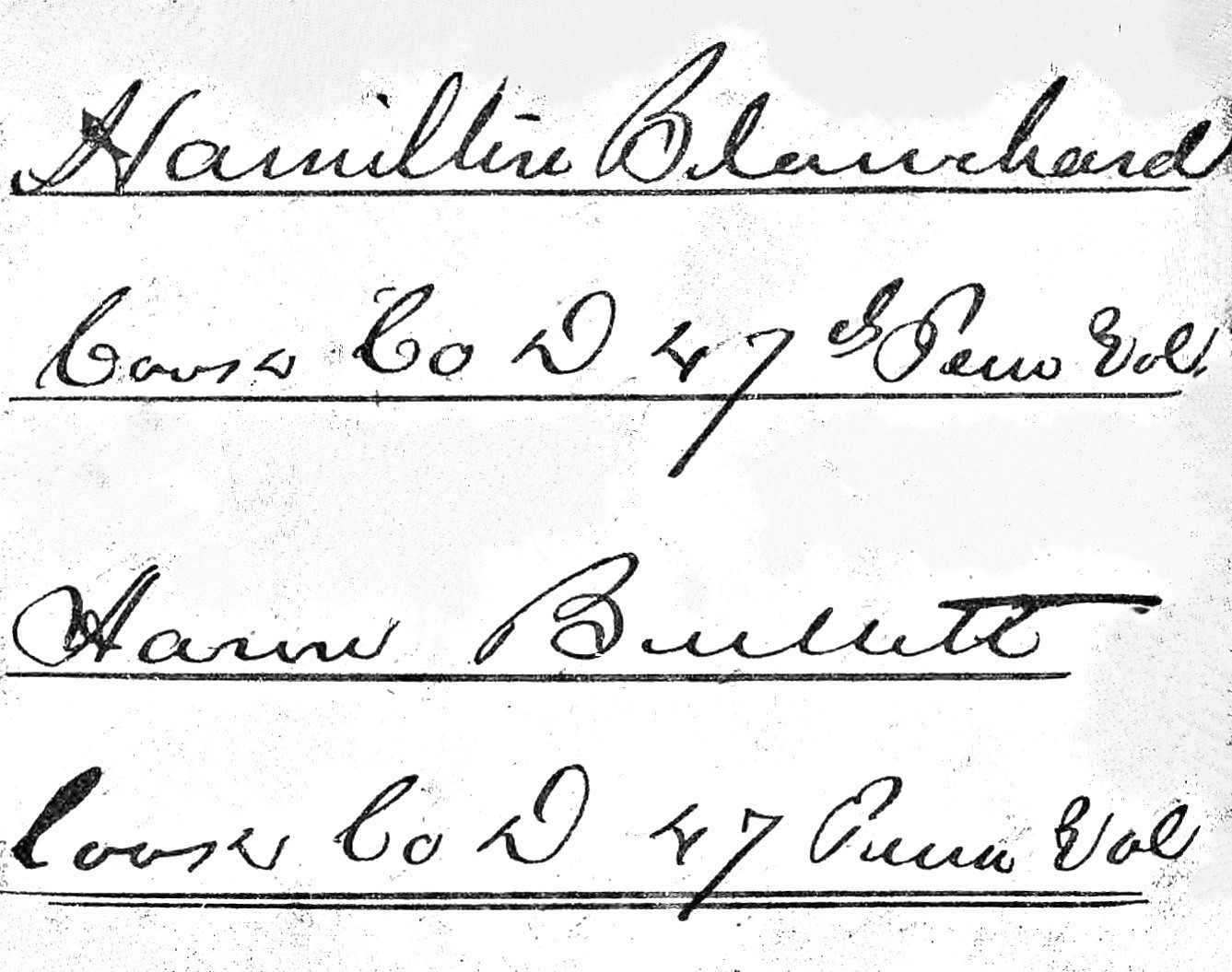
One of several U.S. Civil War Pension documents that confirmed the Union Army enrollment of Hamilton Blanchard and Aaron Bullard, known later as Aaron French, as Cooks (a higher rank than under-cook) with Company D of the 47th Pennsylvania Volunteer Infantry (U.S. Civil War Pension Files, U.S. National Archives and Records Administration, public domain).

Following executive orders promulgated by President Abraham Lincoln in 1862 and legislation enacted that same year by the United States Congress to facilitate the enrollment by free and enslaved Black men with Union Army regiments, the 47th Pennsylvania Volunteer Infantry began processing the enlistments of four of the nine formerly enslaved men who would ultimately be entered onto the rosters of this history-making regiment.

Enrolled as “Negro Under-Cooks” while the regiment was stationed in Beaufort, South Carolina as part of the U.S. Department of the South and Tenth Army (X Corps), Bristor Gethers, Thomas Haywood, Abraham Jassum, and Edward Jassum ranged in age from sixteen to thirty-three.

Roughly two years later, officers from the 47th Pennsylvania Volunteers then processed the enlistment paperwork for an additional five formerly enslaved men in Natchitoches, Louisiana in April 1864 while the 47th Pennsylvania was stationed there (as the only regiment from Pennsylvania to participate in the Union’s Red River Campaign across Louisiana). Hamilton Blanchard, Aaron French (who was known at that time as Aaron Bullard), James Bullard, John Bullard, and Samuel Jones ranged in age from sixteen to twenty-nine.

All but one of the nine would go on to complete their three-year terms of enlistment and be honorably mustered out in October 1865.

What Were Their Job Duties?

General Orders No. 323 (enlistment and pay of under-cooks of African descent), U.S. War Department and Office of the Adjutant General, September 28, 1863 (U.S. Library of Congress, public domain).

The duties and other pertinent details about the military tasks performed by Cooks and Under-Cooks of the Union Army were explained as follows by August Kautz in his 1864 manual, Customs of Service for Non-Commissioned Officers and Soldiers as Derived from Law and Regulations and Practised in the Army of the United States:

“108. DAILY DUTY.—A soldier is on daily duty when he is put upon some continuous duty that excuses him from the ordinary company duty but does not entitle him to additional pay from the government,—such as company cooks, tailors, clerks, standing orderlies, &c. These duties may be performed by soldiers selected on account of special capacity or merit, or detailed in turn, as is most convenient and conducive to the interest of the service.

109. The company cooks are one or more men in each company detailed to do the cooking for the entire company. This is the case usually in companies where it is not the custom to distribute the provisions to the men; for in this case the messes furnish their own cooks, and they are not excused from any duty except what is absolutely necessary and which their messmates can do for them.

110. The law authorizes the detailing of one cook to thirty men, or less; two cooks if there are more than thirty men in the company. It also allows to each cook two assistant cooks (colored), who are enlisted for the purpose, and are allowed ten dollars per month. (See Par. 269.)

111. The cooks are under the direction of the first sergeant or commissary-sergeant, who superintends the issue of provisions and directs the cooking for each day. Company cooks for the whole company are generally detailed in turn, and for periods of a week or ten days….

269. Cooks. — The law now allows the enlistment of four African under-cooks for each company of more than thirty men; if less, two are allowed. They receive ten dollars per month, three of which may be drawn in clothing, and one ration. (See Act March 3, 1863, section 10.) They are enlisted the same as other enlisted men, and their accounts are kept in the same way: they are entered on the company muster-rolls, at the foot of the list of privates. (G. 0. No. 323, 1863.)

270. These cooks are to be under the direction, of a head-cook, detailed from the soldiers alternately every ten days, when the company is of less than thirty men; when the company is of more than thirty men, two head-cooks are allowed. These are quite sufficient to cook the rations for a company; and, by system and method, the comfort and subsistence of a company may be greatly improved. The frequent changing of cooks under the old system worked badly for the comfort of the soldier and they were often treated to unwholesome food, in consequence of the inexperience of some of the men.

271. The object of changing the head-cooks every ten days, as required by section 9, Act March 3, 1863, is to teach all the men how to cook; but it will follow that the under-cooks, who are permanently on that duty will know more about it than the head-cooks. They will simply be held responsible that the cooking is properly performed.”

From Under-Cook to Private

Samuel Jones was an enslaved Black man who enlisted as an Under-Cook with Company C of the 47th Pennsylvania Volunteer Infantry in Natchitoches, Louisiana on April 5, 1864. Official regimental muster rolls confirmed that he was a private at the time of his honorable discharge in 1865 (Registers of Pennsylvania Volunteers, 1861-1865: 47th Regiment, in “Records of the Department of Military and Veterans’ Affairs,” Pennsylvania State Archives, public domain; click to enlarge).

As the officers and enlisted members of the 47th Pennsylvania Volunteer Infantry interacted more frequently with the nine formerly enslaved men who had enlisted with their regiment, their trust in, and respect for, those nine men grew. Over time, several of the nine men were assigned to increasingly responsible duties, which ultimately led to their respective promotions to the ranks of cook and private—ranks that were documented on official muster rolls of the 47th Pennsylvania Volunteers.

About “Faces of the 47th: Freedmen of the 47th Pennsylvania Volunteer Infantry”

“Faces of the 47th: Freedmen of the 47th Pennsylvania Volunteer Infantry” is a special project of 47th Pennsylvania Volunteers: One Civil War Regiment’s Story, an educational program designed to teach children and adults about the history of the 47th Pennsylvania Veteran Volunteers, a Union Army regiment which served for nearly the entire duration of the American Civil War and became the only military unit from the Commonwealth of Pennsylvania to participate in the Union’s 1864 Red River Campaign across Louisiana.

This important initiative is dedicated to researching, documenting and presenting the life stories of nine formerly enslaved Black men who enlisted with the 47th Pennsylvania Volunteer Infantry during two of the regiment’s most eventful years of service to the nation—1862 and 1864.

Largely forgotten for more than a century after honorably completing their historic military service, these nine men have been repeatedly overlooked by mainstream historians over the years as potentially important subjects for research and have also been an ongoing source of mystery and frustration to their descendants because the majority of their military service records have still not been digitized by state and national archives.

The purpose of this initiative is to remedy those failures and create a lasting tribute to these nine remarkable men.

Learn more about their lives before, during and after the war by visiting Freedmen of the 47th Pennsylvania Volunteer Infantry.”


Sources:

  1. “Bounties to Volunteers.” Washington, D.C.: National Republican, January 5, 1864.
  2. “Comfort of the Soldier.” Washington, D.C.: Daily National Republican, February 23, 1863.
  3. “Garris, Presto” [sic, “Gethers, Bristor”], and “Jones, Samuel,” in “Registers of Pennsylvania Volunteers, 1861-1865” (47th Regiment, Companies F and C), in “Records of the Department of Military and Veterans’ Affairs” (RG-19). Harrisburg, Pennsylvania: Pennsylvania State Archives.
  4. “General Orders No. 323” (enlistment and pay of “under-cooks of African descent”). Washington, D.C.: U.S. War Department and Adjutant General’s Office, September 28, 1863.
  5. “Important Diplomatic Circular by Secretary Seward: Review of Recent Military Events.” Washington, D.C.: The Evening Star, September 15, 1863.
  6. Kautz, August V. Customs of Service for Non-Commissioned Officers and Soldiers as Derived from Law and Regulations and Practised in the Army of the United States, pp. 41-42 (definitions and responsibilities of cooks and under-cooks), 68-69 (special enlistments: African Under-Cook), 84-88 (cooking responsibilities of hospital stewards), 90-9 (special enlistments: African Under-Cook, definition, enlistment and record-keeping for, and pay), and 93 (cooks and attendants in hospitals) . Philadelphia, Pennsylvania: J. B. Lippincott & Co., 1864.
  7. “Military Notices” (Fourteenth United States Infantry). Philadelphia, Pennsylvania: The Philadelphia Inquirer, January 14, 1864.
  8. “Official: Laws of the United States, Passed at the Third Session of the Thirty-seventh Congress.” Washington, D.C.: Daily National Republican, March 27, 1863.
  9. “Under Cooks of African Descent.” Washington, D.C.: National Republican, May 8, 1865.


Research Update: More New Details Regarding the Lives of Formerly Enslaved Black Men Who Enlisted with the 47th Pennsylvania Volunteer Infantry

Union Army at Morganza Bend, Louisiana, c. 1863-1865_USLOC, pubdom

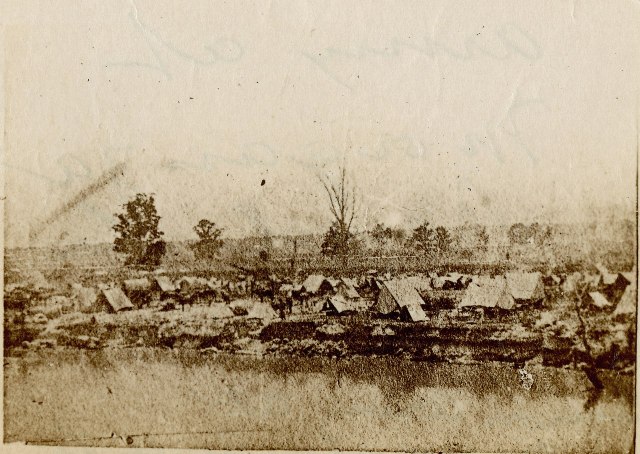
Union Army base at Morganza Bend, Louisiana, circa 1863-1865 (U.S. Library of Congress, public domain).

Researchers investigating the lives of nine formerly enslaved Black men who enlisted with the 47th Pennsylvania Volunteer Infantry during the American Civil War recently uncovered new details about two of those soldiers.

In addition to finding more data related to the immediate post-war life of Aaron French (learn more about him in this article here), including how and why he ended up settling in Mississippi following the Civil War, researchers have also now found important information about the life of Hamilton Blanchard—who enrolled with Bullard on the same day.

Born into slavery in Natchitoches, Louisiana sometime around 1843, Hamilton Blanchard was able to secure his freedom twenty-one years later when the United States Army arrived in town as part of an expedition led by Union Major-General Nathaniel P. Banks. Determined not to be forced back into bondage after the Union troops moved on in their ill-fated quest to capture the city of Shreveport, he chose to enlist with one of the units serving under Banks—the 47th Pennsylvania Volunteer Infantry—the only regiment from Pennsylvania that was involved in the Union’s 1864 Red River Campaign across Louisiana.

After enrolling in the military, Hamilton Blanchard was then assigned to Company D at the rank of “Cook” on 5 April 1864.

Crop_Bullard, Aaron and Hamilton Blanchard_Co. D, 47th PA_Muster Roll

Muster roll entries for Aaron Bullard and Hamilton Blanchard, Company D, 47th Pennsylvania Volunteers (U.S. National Archives, public domain).

The official muster-in of Blanchard, Aaron Bullard, and three other young Black men who enrolled that day did not take place immediately, however, because the 47th Pennsylvania Volunteers were ordered to move out shortly after their arrival, and were quickly drawn into intense combat with enemy troops commanded by Confederate Major-General Richard Taylor (a plantation owner and son of Zachary Taylor, former President of the United States). Battered badly during the Battle of Sabine Cross Roads near Mansfield, Louisiana on 8 April and in the Battle of Pleasant Hill the next day (9 April), they fought the Confederate Army again on 23 April near Monett’s Ferry in the Battle of Cane River and on 16 May in the Battle of Mansura near Marksville.

Continuing on toward the southeastern part of Louisiana, the 47th Pennsylvania Volunteers marched for Morganza, which had been held in Union hands since the fall of 1863 and was now the site of a major Union Army encampment. While there, the officers of the 47th Pennsylvania Volunteer Infantry officially mustered in all nine of the formerly enslaved Black men who had enlisted with the 47th Pennsylvania in Beaufort, South Carolina (1862) and Natchitoches, Louisiana (April 1864)—a process which took place between 20-24 June 1864.

From that point on, those nine men traveled with the 47th Pennsylvania as it returned to the East Coast and engaged in multiple battles associated with Union Major-General Philip Sheridan’s 1864 Shenandoah Valley Campaign across Virginia, the protection of the nation’s capital following the April 1865 assassination of President Abraham Lincoln, and the early days of Reconstruction in Georgia and South Carolina.

On Christmas Day in 1865, Hamilton Blanchard then joined his fellow 47th Pennsylvania Volunteers in mustering out from their final duty station in Charleston, South Carolina.

Post-War Life

Having been honorably discharged from the 47th Pennsylvania Volunteer Infantry when the regiment mustered out, at least two of the nine formerly enslaved Black men who had enlisted with the regiment evidently made their way north—possibly when the other members of their former regiment returned home to Pennsylvania. (It is also possible, however, that they made the journey independently of their former regiment because both men appear to have resettled in the Washington, D.C. area, post-war, while the other 47th Pennsylvania Volunteers were transported by ship directly to New York City and then by train to Camp Cadwalader in Philadelphia, Pennsylvania, where they were given their final discharge papers on 9 January 1866.)
Blanchard-Bullard_Madison Co., MS_Freedmen's Bureau Contract, Feb-Dec 1866, p. 1

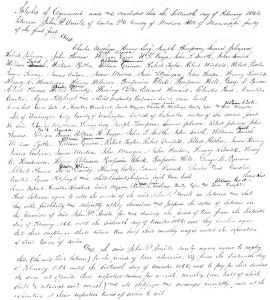
Freedmen’s Bureau contract between Madison County, Mississippi farm owner John P. Arvile [sic] and farm laborers Hamilton Blanchard, Aaron Bullard, et. al., Washington, D.C., 16 February 1866 (excerpt, p. 1, U.S. National Archives).

What is known for certain is that Hamilton Blanchard and Aaron Bullard made contact with a representative of the Bureau of Refugees, Freedmen, and Abandoned Lands sometime in late 1865 or early 1866. They then signed a contract with the Freedmen’s Bureau during the early winter of 1866 in which they both agreed to join a large group of formerly enslaved Black men, women, and children who would be providing farm labor to a man named John P. Avrill (alternate spellings: “Averile”, “Averill”, “Arvile”, “Arville”, or “Avrille”) at his property in Canton, Madison County, Mississippi.

That Freedmen’s Bureau contract was slated to be in effect between 16 February and 16 December of 1866, and begins with a cover page which states:

Washington D.C.
February 1866
Contract No.
John P. Arvill
With (66) Freedmen

John Arville
Contract with
46 Farm Hands

The main body of the document goes on to reveal the following details of the contract:

Articles of Agreement made and concluded this the Sixteenth day of February 1866 between John P. Arvile of Canton P.O. County of Madison State of Mississippi party of the first part and

Charles Matthews, Henry Long, Joseph Thompson, Samuel Johnson, Robert Johnson, John Thomas … Charles Ford, Caroline Carter, Agnes Fitzhugh and child (infant), Benjamin Smith, Anna Smith, Thomas Reed [sp?], Aaron Bullard, Hamilton Blanchard, Isaiah Wiggins, James Lewis, Charles K. [illegible], Baily Taylor, William Carter, and Andy Hampton [sp?].

The next paragraph lists Hamilton Blanchard and Aaron Bullard a second time, along with multiple names from the aforementioned group of farm laborers. Subsequent paragraphs spell out further points of the agreement:

All of Washington City, County of Washington, District of Columbia, parties of the second part, the said Charles Matthews, Henry Long, Joseph Thompsen, Samuel Johnson, Robert Johnson, John Thomas … Aaron Bullard, Hamilton Blanchard, Isaiah Wiggins, James Lewis … Field Laborers, agree to enter the service of the said John P. Averile as Laborers and that they will faithfully and diligently apply themselves and perform the duties of Laborers on the premises of said John P. Averile for and during the period of time from the Sixteenth day of February 1866 until the sixteenth day of 1866; and they further agree that their employer shall retain one half their monthly wages until the expiration of their term of service.

And the said John P. Arvile hereby agrees to employ them (the said Field laborers) for the period of time aforesaid. Viz from the Sixteenth day of February 1866 until the sixteenth day of December 1866; and to pay for their services the sum set opposite their respective names per month, monthly (one half of which shall be retained each month) and all stoppages and arranged promptly, paid at the expiration of their respective terms of service to wit…..

In equal monthly payments; and the said John P. Arvile further agrees to furnish said Freed laborers … quarters, fuel, full substantial and healthy rations, and all necessary attendance and supplies in case of sickness, in addition to the compensation … named, and that he will assist and encourage efforts for the education of the children of his employees, and it is further agreed by the said John P. Arvile, that in case he at any time fails to perform his part of this contract agreement he will pay to each of the said laborers the full sum of One hundred and twenty dollars [strikethrough made by someone’s hand to original contract], as fixed, agreed and liquidated damages. This contract can be annulled by the mutual consent of the Employer and the employee, but only in the presence of an Authorized Agent of the Bureau of Refugees Freedmen and Abandoned Lands and such annullment [sic] on the part of the Employer and anyone [sic] employee shall in no wise affect the validity of the Contract in respect to the employer and the other employees and should either party violate this contract then the other party shall make complaint to the nearest authorized agent of the Bureau Refugees Freemen & Abandoned Lands.

The contract continues on, specifying that both Aaron Bullard and Hamilton Blanchard were to each be paid a wage of $10 per month, and stating that some of the other men on the list would be paid as much as $12 per month while others would be paid $8 per month. (Teenaged boys and women on the list were to be paid even less—$6 per month.)

In all cases, the reality was far different. Per the contract, they were initially paid only half of what their monthly wages were because the Freedmen’s Bureau agent in charge of looking out for the welfare of these formerly enslaved men, women, and children allowed the white farmer—their “employer”—to “retain one half their monthly wages until the expiration of their term of service.”

No further data has been uncovered from Freedmen’s Bureau records about the status of those unpaid wages or the outcome of that contract, but because these Black men, women, and children were essentially returned to an unequal system of servitude by the Freedmen’s Bureau agent (as evidenced by the manner in which this contract was drafted—favoring the White “employer” over the Black “field laborer” and including multiple after-the-fact revisions, such as word insertions and strikethroughs)—it is highly unlikely that Hamilton Blanchard, Aaron Bullard, or the other Black men, women, and children mentioned in the contract were ever paid the full amount they were entitled to for what was most assuredly very hard labor.
Blanchard-Bullard-Chapman_Treasury Inquiry, 10 Nov 1866

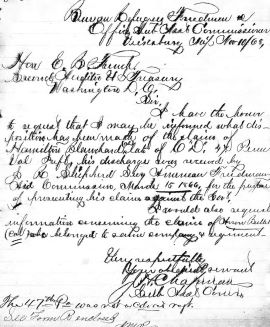
Letter of inquiry from J. H. Chapman on behalf of Hamilton Blanchard to E. B. French, second auditor, U.S. Treasury Department, 10 November 1868 (Freedmen’s Bureau records, U.S. National Archives). 

This hypothesis posed by researchers investigating the history of the 47th Pennsylvania Volunteer Infantry is backed up by a letter of inquiry penned on 10 November 1868 by J. H. Chapman, a Sub-Assistant Commissioner of the Freedmen’s Bureau working at an office in Vicksburg, Mississippi, to E. B. French, Second Auditor of the U.S. Department of the Treasury in Washington, D.C.

In this letter, Chapman asks French that he “be informed what disposition has been made of the claim of Hamilton Blanchard, late of Co. “D” 47 Penn Vol. Inft., his discharge was received by J. R. Schuchard [sp?]” of the “Freedmen’s Aid Commission, March 15, 1866.” Chapman added that he was requesting this update on Blanchard’s behalf “for the purpose of prosecuting his claim against the Gov.” He then also requested “information concerning the claim of Aaron Bullard (Col.) who belonged to same company & regiment.”

* Note: An unidentified individual added an undated notation to the bottom of this letter in handwriting that is clearly different from that of the original letter writer, Chapman. That notation correctly states: “The 47th Pa was not a colored regt. See Form R enclosed. A.M.R. 103.” (The 47th Pennsylvania Volunteer Infantry became an integrated regiment on 5 October 1862, but its African American members were not considered to be part of the U.S. Colored Troops, also known as the USCT.)

Researchers have not yet located the “Form R” referred to in the notation to Chapman’s letter, but will be pursuing this lead, as well as investigating the claims filed by Hamilton Blanchard and Aaron Bullard, and searching for additional information regarding what happened to Hamilton Blanchard during and after the 1870s. 

An additional avenue of inquiry will be the potential relationship that may have developed between Aaron Bullard and E. B. French during or after this time—a new theory being considered in light of the discovery of French’s name on this letter. (Aaron Bullard changed his surname, “Bullard,” which had been associated with his enslavement in Louisiana, to “French” sometime between his 1868 appeal to E. B. French in the U.S. Treasury Department and the day he was visited at home in Issaquena County, Mississippi by an enumerator of the 1870 U.S. Census—possibly indicating that he wanted to both shed his “slave name” and honor someone who had been helpful to him.)

Sources:

  1. Bates, Samuel P. History of Pennsylvania Volunteers, 1861-5, vol. 1. Harrisburg, Pennsylvania: B. Singerly, State Printer, 1869.
  2. Civil War Muster Rolls, in Records of the Department of Military and Veterans’ Affairs (Record Group 19, Series 19.11). Harrisburg, Pennsylvania: Pennsylvania Historical and Museum Commission, 1861-1865.
  3. Civil War Veterans’ Card File. Harrisburg, Pennsylvania: Pennsylvania State Archives.
  4. “Records of the Field Offices for the District of Columbia, Bureau of Refugees, Freedmen, and Abandoned Lands, 1865-1870” (NARA Series Number: M1902; NARA Reel Number: 18; NARA Record Group Number: 105; NARA Record Group Name: Records of the Bureau of Refugees, Freedmen, and Abandoned Lands, 1861 – 1880; Collection Title: District of Columbia Freedmen’s Bureau Field Office Records 1863-1872: Aaron Bullard and Hamilton Blanchard, 1866 and 1868). Washington, D.C.: U.S. National Archives and Records Administration.
  5. Schmidt, Lewis. A Civil War History of the 47th Regiment of Pennsylvania Veteran Volunteers. Allentown, Pennsylvania: Self-published, 1986.
  6. Wharton, Henry D. Letters from the Sunbury Guards. Sunbury, Pennsylvania: Sunbury American, 1861-1868.

Black History Month: New Details Uncovered Regarding the Formerly Enslaved Black Men Who Enlisted with the 47th Pennsylvania Volunteer Infantry

Research regarding the lives of the nine formerly enslaved Black men who enlisted with the 47th Pennsylvania Volunteer Infantry in 1862 and 1864 has continued to progress—even in the middle of a pandemic that has forced the closure of numerous local, state, and national archives.*

In addition to uncovering details about the life of the soldier from South Carolina who was mistakenly listed on muster rolls for the 47th Pennsylvania as “Presto Gettes” (learn more about him in this article here), researchers for 47th Pennsylvania Volunteers: One Civil War Regiment’s Story have been able to determine more about what happened to two of the other men post-war, and have also located records which seem to indicate that there may have been two or three other Black men who enlisted with the regiment (potentially bringing the total number of Black enlistees in the regiment to twelve).

Aaron French (enlisted as Aaron Bullard):

Muster roll entries for Aaron Bullard and Hamilton Blanchard, Company D, 47th Pennsylvania Volunteers (U.S. National Archives, public domain).

1864 was a life-changing year for Aaron Bullard and four other young Black men in Louisiana. After enlisting with the 47th Pennsylvania Volunteer Infantry on April 5 while the 47th was stationed at Natchitoches, Louisiana, Samuel Jones, Hamilton Blanchard (also known as John Hamilton), and Aaron, James, and John Bullard traveled with the 47th Pennsylvania as it participated in the multiple battles associated with the Union’s 1864 Red River Campaign across Louisiana. On or about June 22, they were formally mustered into the regiment at Morganza, Louisiana.

Sometime later (possibly post-war), Aaron Bullard changed his surname to French. After the American Civil War, he married, became a land-owning farmer—and a dad.

Post-Civil War, Aaron French and his family resided in Issaquena County, Mississippi (U.S. Census, 1870, public domain).

In August of 1870, Aaron French and his wife, Amanda, lived with their eight-month-old daughter, “Simpy” (also known as Cynthia or Cyntha) in Skipworth Precinct, Issaquena County, Mississippi. Still residing in Issaquena County a decade later when the June 1880 federal census was taken, Aaron and Amanda were the proud parents of three daughters: Cynthia (who would go on to marry Samuel L. Dixon on March 20, 1890), Jesanna (also known as Jessie/Jesse), and “Arctavia” (also known as Octavia). Jessie, who later went on to wed John B. Cobb on January 28, 1892, made a life with her husband and son in Mayersville, Mississippi, where she was a teacher in the local schools. Octavia married Frank Childress on March 20, 1894.

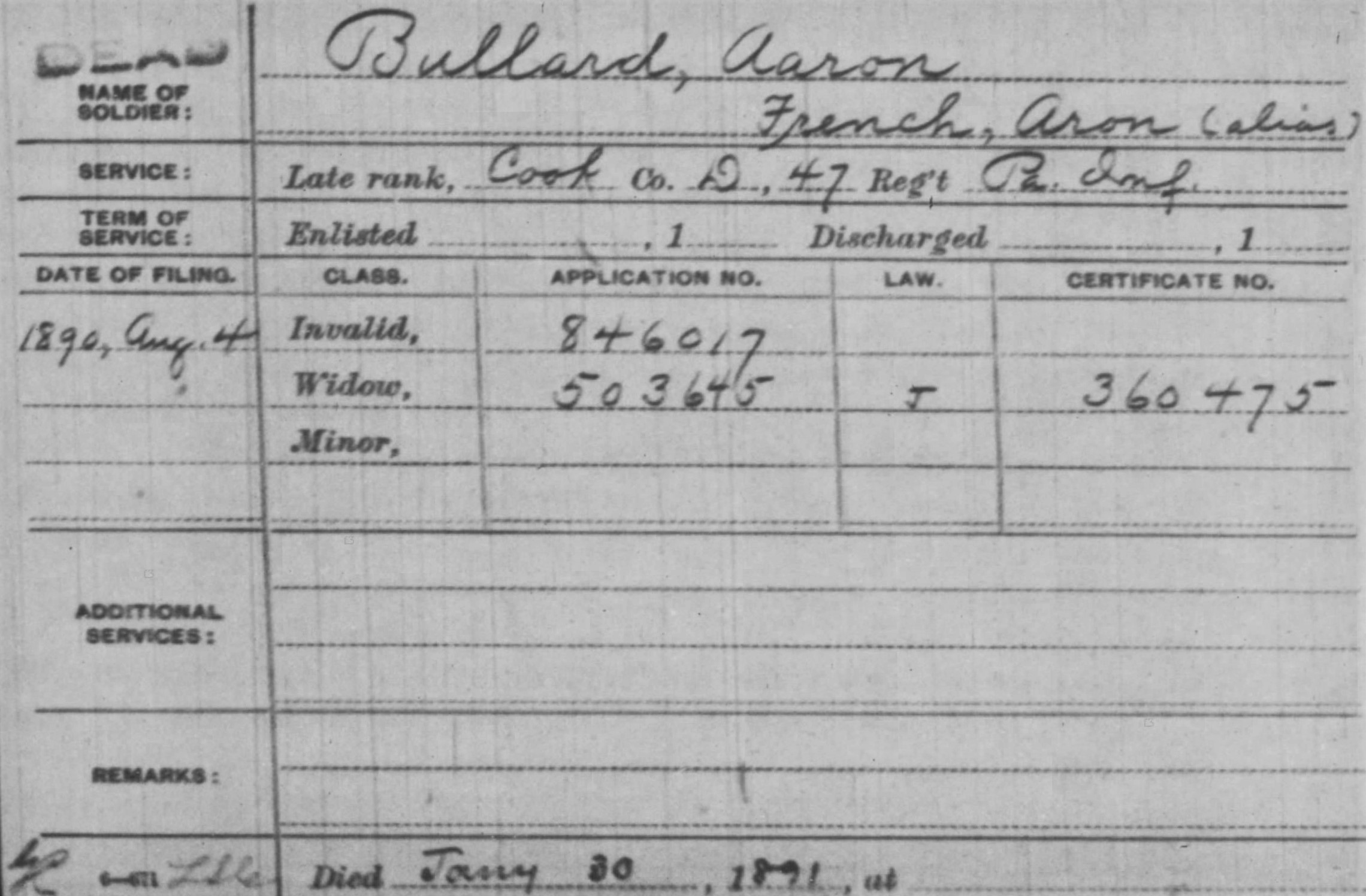
U.S. Civil War Pension Index Card for Aaron French, who enlisted with the 47th Pennsylvania Volunteers in Louisiana in 1864 (U.S. National Archives, public domain).

Sadly, Aaron French did not live to see his two youngest daughters marry because he died in Mississippi on January 30, 1891. He was just 40-43 years old, according to U.S. Census records and other data, which indicate that he was born in Louisiana sometime between 1848 and 1850.

Hearteningly, though, an even more intriguing piece of data has recently been uncovered about the later life of Aaron French—one that indicates that he had become active in politics prior to his death. According to the Vicksburg Evening Post, Aaron was appointed as a delegate from Issaquena County to the Republican Congressional Convention for the Third District, which was held in Greenville, Mississippi on August 7, 1886. Researchers are continuing to search for further details about his political activities and untimely death, as well as the exact location of his gravesite.

Thomas Haywood (alternate spellings of surname: Hayward, Haywood, Heywood) and Jack Jacobs:

Muster roll entries of Thomas Haywood and Edward Jassum, Company H, 47th Pennsylvania Volunteers (U.S. National Archives, public domain).

Born into slavery in South Carolina sometime around 1832, Thomas Haywood enlisted for a three-year term of service as an Under Cook with Company H of the 47th Pennsylvania Volunteer Infantry at Beaufort, South Carolina on November 1, 1862. He and three other formerly enslaved Black men—Abraham and Edward Jassum and Presto Gettes”—who had previously enlisted with the 47th Pennsylvania at Beaufort in October of 1862, then traveled with the 47th Pennsylvania as it participated in multiple military engagements, including the 47th’s garrisoning of Fort Taylor and Fort Jefferson in Florida in 1863 and 1864, the battles of the Union’s spring 1864 Red River Campaign across Louisiana, and the battles of Sheridan’s tide-turning Shenandoah Valley Campaign across Virginia in the fall of 1864.

On or about June 22, 1864 all nine of these Black soldiers were formally mustered into the regiment at Morganza, Louisiana; Thomas Haywood and seven of the eight others all successfully completed their tours of duty, and were honorably mustered out upon expiration of their respective terms of enlistment. In Thomas Haywood’s case, that honorable discharge was awarded on October 31, 1865.

Post-war, it appears from various Freedmen’s Bureau records that he may have entered into yearly contracts with several men who had previously been plantation owners in the Beaufort, South Carolina area. In exchange for agreeing to plant and cultivate cotton for those men on three to five-acre parcels of land that had been leased to him by those white men, he was allowed to keep portions of the cotton sales (the largest portions of which went to the former plantation owners who had also most likely been slave owners prior to and during the Civil War).

U.S. Civil War Index Card for Thomas Haywood, who enlisted with the 47th Pennsylvania Volunteers in South Carolina in 1862 (U.S. National Archives, public domain).

His body warn out from years of slavery prior to the war, difficult military service during the war, and harsh sharecropping experiences post-war, Thomas Hayward applied for, and was awarded a U.S. Civil War Pension on April 30, 1888. That pension was subsequently renewed by the federal government in 1907 at the rate of $15 per month (roughly $415 per month in today’s U.S. dollar equivalency).

By 1890, Thomas Haywood was living in Sheldon Township, Beaufort County, South Carolina. After a long life, he died on January 13, 1911. Unfortunately, his burial location has also not yet been identified by researchers.

In 1890, Thomas Haywood lived near Hanna Jacobs, the widow of Jack Jacobs, who may have been another Black soldier who enlisted with the 47th Pennsylvania Volunteers (U.S. Census, 1890, Sheldon Township, Beaufort County, South Carolina, public domain).

One other piece of tantalizing data that has recently been discovered is that a woman named “Hanna Jacobs” lived near Thomas Haywood in 1890. This information may be significant because Hanna was described on the 1890 U.S. Census of Union soldiers and widows as the widow of “Jack Jacobs,” who had served in the same company with Thomas Haywood (according to that special census).

Researchers currently believe that Jack Jacobs may, in fact, have been another formerly enslaved Black man who had enlisted with the 47th Pennsylvania when it was stationed near Beaufort in 1862, and are currently conducting a Go Fund Me campaign to raise funds to purchase the Civil War military and pension records of Hanna and Jack Jacobs, as well as the nine known formerly enslaved Black men who enlisted with the 47th Pennsylvania Volunteer Infantry in 1862 and 1864.

Jackson Haywood:

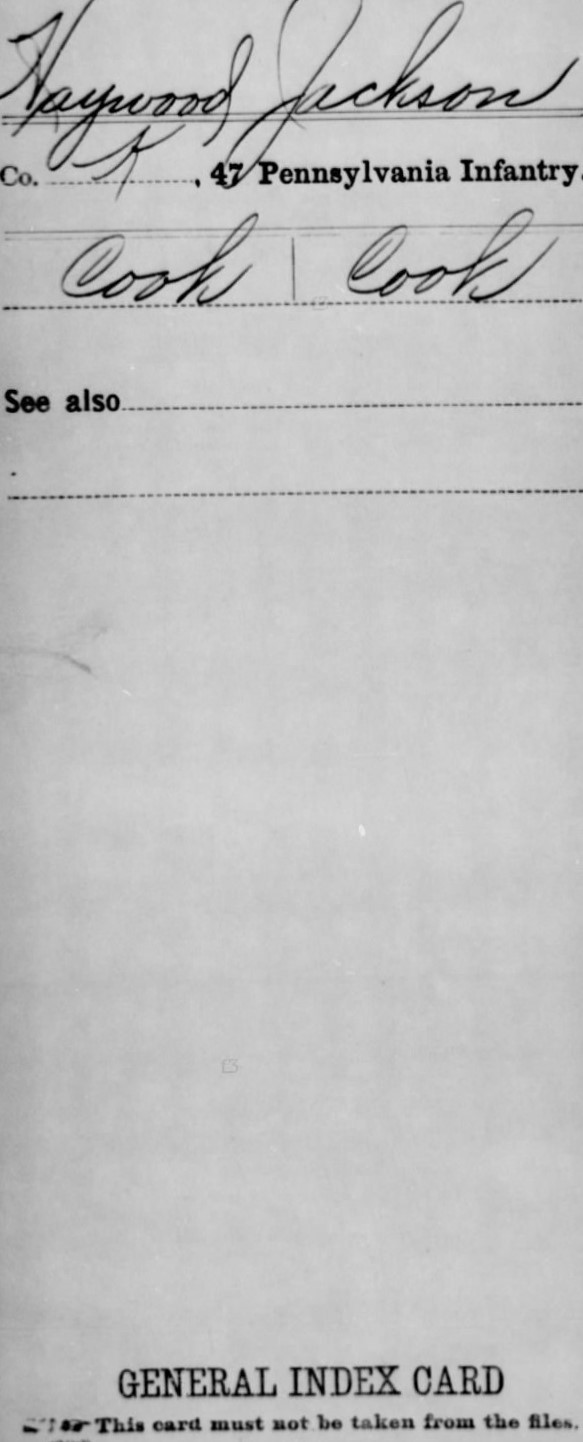
General Index Card for Jackson Haywood, who may have been a Black soldier who enlisted with the 47th Pennsylvania Volunteers (U.S. National Archives, public domain).

According to the “Index to Compiled Service Records of Volunteers Who Served in Organizations from the State of Pennsylvania,” which was created by staff at the U.S. National Archives, a General Index Card was created for yet another mystery man—a soldier named “Jackson Hayward.”

To date, researchers have only been able to determine that he may have enlisted with Company K of the 47th Pennsylvania Volunteer Infantry as a cook—a rank similar to that at which the known nine formerly enslaved Black men who enlisted with the 47th Pennsylvania were entered on the muster rolls of the regiment.

Researchers hope, with time and the continued financial support of the followers of 47th Pennsylvania Volunteers: One Civil War Regiment’s Story, to be able to confirm the dates of military service and race of this individual, as well as that of “Jack Jacobs.”

As always, we appreciate everyone’s help in ensuring that the service to the nation of these soldiers will never be forgotten. They helped to preserve our Union and deserve to be recognized more fully for their heroism and dedication.

* Our most important goal continues to be the purchase of the Compiled Military Service Records (CMSR) and U.S. Civil War Pension records for each of these remarkable men in order to document and freely share their stories with the widest possible audience. We continue to await word from staff at the U.S. National Archives regarding the timeframe for their resumption of digitization and reproduction services that have temporarily been suspended due to the coronavirus pandemic. As soon as those services have resumed, we will request an update regarding their estimated timeframe for fulfilling our records requests. In the interim, we will seek out further details about each of these soldiers via local and state archival resources across the nation, and will post updates as we confirm more data.

Sources:

  1. Bullard, Aaron, in Index to Compiled Service Records of Volunteers. Washington, DC: U.S. National Archives, 1861-1865.
  2. Bullard, Aaron and French, Aaron, in U.S. Civil War Pension Index Cards. Washington, DC: U.S. National Archives, 1890-1891.
  3. Bullard, Aaron, Presto Garris, Thomas Haywood, et. al. in U.S. Civil War Muster Out Rolls (47th Pennsylvania Volunteer Infantry). Washington, DC: U.S. National Archives, 1865-1866 (available via Ancestry.com).
  4. French, Aaron, in “Proceedings of the Third District Republican Convention.” Vicksburg, Mississippi: Vicksburg Evening Post, August 9, 1886.
  5. French, Aaron and Family, in U.S. Census Records (Issaquena County, Mississippi): Washington, DC: U.S. National Archives, 1870-1910.
  6. Haywood, Jackson, in Index to Compiled Service Records of Volunteers. Washington, DC: U.S. National Archives, 1861-1865.
  7. Haywood, Thomas, in Index to Compiled Service Records of Volunteers. Washington, DC: U.S. National Archives, 1861-1865.
  8. Haywood, Thomas, in U.S. Civil War Pension Index Cards. Washington, DC: U.S. National Archives, 1888, 1907.
  9. Haywood, Thomas, in U.S. Veterans’ Administration Pension Payment Cards. Washington, DC: U.S. National Archives, 1888, 1907.
  10. Haywood, Thomas, in U.S. Census (Beaufort County, South Carolina): Washington, DC: U.S. National Archives, 1890.
  11. Hanna Jacobs, widow of Jack Jacobs, in U.S. Census (Beaufort County, South Carolina): Washington, DC: U.S. National Archives, 1890.