Catching Dogs and Hogs During the “Dog Days” of Summer (Charleston, South Carolina, 1865)

Meeting and Broad Streets near Line Street in Charleston, South Carolina, St. Michael’s Episcopal Church in the distance (U.S. Navy, circa 1863-1865, U.S. Library of Congress, public domain).

There is no disputing that the 47th Pennsylvania Volunteer Infantry had a long and storied history. Formed on August 5, 1861, the regiment not only served for the entire duration of the American Civil War; it continued its service to the nation for more than eight months after the end of that terrible conflict, becoming the only regiment from the Commonwealth of Pennsylvania to fight in the Union’s 1864 Red River Campaign across Louisiana before it participated in Major-General Philip Sheridan’s tide-turning Shenandoah Valley Campaign across Virginia during the fall of 1864 and helped defend Washington, D.C. in the wake of the assassination of President Abraham Lincoln in April 1865.

As those war years unfolded, newspapers from Easton to Pittsburgh published updates on the regiment’s travels, along with excerpts from letters penned by its baby-faced recruits and wizened warriors. One of the more unusual news items was reported during the 47th Pennsylvania’s final months of service—while it was stationed in the Deep South of the United States of America during the early days of Reconstruction, following the end of the American Civil War. Assigned to keep the peace in the first state that had seceded from the Union, members of the regiment lived and primarily worked in Charleston, South Carolina, where they performed a wide range of provost (civil governance)-related tasks, including the prevention and prosecution of crimes against civilians and the re-establishment of newspaper publishing operations.

The Line Street area of Charleston, South Carolina, where a public pound was established in July 1865 to improve animal control and public safety (Thomas Fetters, The Charleston & Hamburg, public domain; click to enlarge).

During the summer of 1865, that “to do” list was expanded to include the “policing” of the city’s furrier denizens. According to The Charleston Daily Courier, Sergeant George Nichols (alternate surname spelling: “Nicholas”) of the 47th Pennsylvania’s E Company was ordered to supervise the operations of a new animal pound that had been established on Line Street in Charleston, “between Coming and Percy streets”:

Headquarters,
Charleston, S.C. July 20, 1865
[GENERAL ORDERS, No. 64.]

I. A POUND IS HEREBY ESTABLISHED ON LINE-STREET, between Coming and Percy-streets, and Sergeant GEO. NICHOLAS, Co. “E,” 47th Pennsylvania Volunteers, temporarily detailed as pound-keeper.

II. Hereafter all cattle, sheep, goats, hogs, and dogs found running at large in the City South of Line-street, shall be taken to the public pound and there detained until the penalty prescribed by this Order, together with the charges of the pound-keeper and the actual expense of maintaining said animals while in the pound, shall be paid.

The penalties for each violation of this Order to be as follows:

Cattle . . . . . . . . . . . . . . . . . . . . . . . . . . .$5.00 per head
Sheep, goats, hogs and dogs . . . . . . . $1.00

The amount to be turned into the City Treasury.

III. All animals, except dogs, remaining in the public pound for the space of six (6) days without being claimed and the penalties and charges therefor [sic] paid, shall be sold at public sale by the pound-keeper. The proceeds to be turned over to the owner of such animals, after deducting the fines and pound fees.

All dogs remaining unclaimed for the space of one week shall be shot.

The Provost Marshal and Chief of Military Police are charged with the execution of this Order.

By order Bt. Brig. Gen. W. T. BENNETT, Com’dg Post.
CHARLES G. CHIPMAN,
Capt. 54th Massachusetts Volunteers, A. A. D. C.
OFFICIAL: THOS. F. LAMBERT, 2d Lieut. 47th Pa. Vols., A. A. D. C.
July 21

The Confederate Steamer, Governor Milton, that was captured by Companies E and K, 47th Pennsylvania Volunteers, October 1862 (Frank Leslie’s Illustrated Newspaper, public domain).

By the time that he had received this duty assignment in 1865, Sergeant Nichols had already amassed a distinguished service history. In early October 1862, while still just a corporal, he was placed in charge of the Governor Milton, a Confederate steamship that had been captured by a detachment of 47th Pennsylvania Volunteers as part of Union Army and Navy operations related to the capture of Saint John’s Bluff, Florida. He later preserved his memories of that day’s events with this diary entry:

“At 9 PM … October 7, discovered the steamer Gov. Milton in a small creek, 2 miles above Hawkinsville; boarded her in a small boat, and found that she had been run in there but a short time before, as her fires were not yet out. Her engineer and mate, then in charge, were asleep on board at the time of her capture. They informed us that owing to the weakness of the steamer’s boiler we found her where we did. We returned our prize the next day…..

I commanded one of the Small Boats that whent [sic] in after her. I was Boatman and gave orders when the headman jumped on Bord [sic] take the Painter with him. That however belongs to Wm. Adams or Jacob Kerkendall [sic]. It was So dark I could not tell witch [sic] Struck the deck first. But when I Struck the deck I demanded the Surrend [sic] of the Boat in the name of the U.S. after we had the boat an offercier [sic] off the Paul Jones, a Gun Boat was with us he ask me how Soon could I move her out in the Stream I said five minuts [sic]. So an Engineer one of coulered [sic] Men helped me. and I will Say right hear [sic] he learned Me More than I ever knowed about Engineering. Where we Started down the River we was one hundred and twenty five miles up the river. When we Stopped at Polatkey [Palatka] to get wood for the Steamer I whent [sic] out and Borrowed a half of a deer that hung up in a cut house and a bee hive for some honey for the Boys. I never forget the boys.’”

When the 47th Pennsylvania Volunteers made their way back to their respective troop transports near Saint John’s Bluff, the captured steamer was left behind to enable a group of Union soldiers to repair its boiler. Overseeing those repairs was none other than Corporal Nichols, who had been temporarily detached from the 47th Pennsylvania’s E Company. Adding to his diary, he wrote:

“So hear [sic] we are at Jacksonville and off we go down the river again, and the Captain Yard Said you are detailed on detached duty as Engineer well that beats hell. I told him I did not Enlist for an Engineer. well I cannot help it he said. I got orders for you to stay hear [sic]. When the Boys was gone about a week orders came for us to come to Beaufort, S. Carolina by the inland rout over the Museley Mash Rout. So I Borrowed a twelve pound gun with amanition [sic] for to Protect our Selves with. But I only used it once to clear Some cavelry [sic] away. We Passed fort Palask [sic]. But that was in our Possession and we got Back to Beaufort all right. and I whent [sic] up to See the Boys and Beged [sic] captain to get me Back in the company, But he could not make it go.”

After completing his detached duty, Corporal Nichols was reunited with his regiment at its duty station in Beaufort, South Carolina that same October of 1862. He then went on to serve with the regiment for the remainder of its service to the nation, finally mustering out with his fellow 47th Pennsylvania Veteran Volunteers in Charleston, South Carolina on Christmas Day of 1865. An engineer with the Delaware, Lackawanna & Western Railroad following the war, he died from pneumonia at the age of seventy at his home in Phillipsburg, New Jersey on March 2, 1908, and was laid to rest at the Phillipsburg Cemetery.


Sources:

  1. Bates, Samuel P. History of Pennsylvania Volunteers, 1861-5, vol. 1. Harrisburg, Pennsylvania: B. Singerly, State Printer, 1869.
  2. “General Orders, No. 64” (establishment and staffing of a public pound in Charleston, South Carolina). Charleston, South Carolina: The Charleston Daily Courier, 21 July 1865, p. 2.
  3. Schmidt, Lewis. A Civil War History of the 47th Regiment of Pennsylvania Veteran Volunteers. Allentown, Pennsylvania: Self-published, 1986.


Occupation and Garrison Duties in Florida (July through August 1863)

Fort Jefferson, Dry Tortugas, Florida, view from the sea, 1946 (Vacation photograph collection of President Harry Truman, November 1946, U.S. National Archives and Records Administration, public domain).

Still stationed at Fort Jefferson in Florida’s Dry Tortugas in July 1863, Lieutenant-Colonel George W. Alexander and the members of Companies F, H and K baked in the unrelenting heat while on duty and sought refuge in the cooler spaces of the fort and island when not. The inferior quality of water available to them continued to wreak havoc on their health. That month alone, twenty-three members of the regiment and twenty-six of the prisoners they were guarding were admitted to the fort’s post hospital with a range of ailments, including six cases of fever (five bilious remittent and one intermittent), seven with intestinal-related diseases (four with dysentery, two with chronic diarrhea, and one with hemorrhoids/piles that were likely caused by the prior two conditions), and three with inflammatory diseases or infections (boils or carbuncles, funiculitis, odontalgia (toothache), orchitis, otitis (earache), along with assorted injuries, including abrasions, sprains and hernia issues.

Meanwhile, the members of Companies A, B, C, D, E, G, and I were still stationed at Fort Taylor in Key West, Florida, under the command of the regiment’s founder, Colonel Tilghman H. Good. They too waged their own battles with the heat and disease.

* Note: The members of Company D had just returned to Fort Taylor from Fort Jefferson in mid-May 1863.

Taking time to record his thoughts in his diary throughout July, Private Henry J. Hornbeck of Company G noted that he was “busy in office” during the first two days of the month as he “procured Henry Kramer Company B as cook for our mess” on 1 July and as the “U.S. Gunboat Bermuda arrived from New Orleans,” that same afternoon, “having an old mail for this place, which had passed here, and had gone on there, some time ago…. Weiss & myself took a short walk towards the barracks, accompanying Pretz & Lawall. After which returned to office…. Ginkinger, Whiting & myself then went in bathing off the wharf. Retired at 11 p.m.”

On July 3, he noted, “Could not sleep tonight on account of the heat, sitting up greater portion of the night.”

First Lieutenant George W. Huntsberger, Company G, 47th Pennsylvania Volunteers, circa 1863 (public domain).

The year was also proving to be an unforgettable one for the 47th Pennsylvania Volunteer Infantry in an entirely different way—many of the carte de visite images taken of its members were taken in 1863, according to historian Lewis Schmidt, who has stated that the photographer of choice for the regiment’s officers was Moffat & Simpson on Duval Street in Key West.

Members of the regiment who were still serving at Fort Taylor during this time commemorated the Fourth of July in grand style as “the celebrations began at Key West at 9 AM,” according to Schmidt. Following an inspection and review of the five companies stationed at the fort by Brigadier-General Woodbury, “the regiment marched in a ‘street parade through the principal streets of the city in heat of 110 degrees Fahrenheit and the dust almost suffocating’. After which ‘each detachment was taken to their quarters, dismissed, and then to enjoy themselves as best they could… Col. Good fired the National Salute of 35 guns from Fort Taylor at Meridian [noon]…. There was a great amount of firing from the vessels in the harbor in honor of the day.’”

According to Private Hornbeck, his holiday was only partially duty free with “No work in office.” But he still had an early start to what became a very long, but memorable Fourth.

Rose at 4 a.m. went with Ginkinger to Slaughter House, procured rations of fresh beef for our mess. Mennig & Myself went to fish market, purchased two fish. Took a cup of coffee at café opposite Provost Marshals Office. After breakfast Whiting & myself played a game of billiards, then witnessed the parade of 47th P. V. 5 Companies with Band & Col. & Staff. Review by the Genl. At Headquarters. Dispersed at 11 a.m. Weather extremely hot. Provost Guard quarters finely decorated. Flags hoisted at great many places. Firing squibs &c, salute by Fort Taylor & Gunboats in harbor, as usual on such occasions. Remained in office all day. After supper Ginkinger & myself visited Capt. Bell, then went with Serg’t. Mink to procure ice cream at a Colored Woman’s establishment, after which returned to office. Many of boys, as usual upon such occasions, being today pretty well curried. Today the San Jacinto relieved the Magnolia as Flag Ship for this port. After taking a sea bath retired at 11 p.m.

From the perspective of C Company Musician Henry D. Wharton:

The city was gaily dressed in flags, and the prettiest thing of the kind was that at the guard station, under Lt. Reese of Company C. Five flags were suspended from the quarters, with wreaths, while the whole front of the enclosure of the yard was covered with evergreens and the red, white, and blue. The Navy had their vessels dressed in their best ‘bib and tucker’, flags flying fore and aft, of our own and those of all nations. It was a pretty sight, and in a measure paid for the fatigue of the boys on their march. At 12 noon, both Army and Navy fired a national salute of thirty five guns.

A day later, Private Hornbeck noted “News very bad. Lee’s army still in Pennsylvania making bad havoc,” and on July 7, “Weather sultry & mosquitoes again at work.” During this time, he was also hard at work updating the regiment’s commissary paperwork to enable the commissary staff to issue rations to members of the regiment later that week. On July 9, he recorded the following:

Busy today, moving the office next door to Provost Marshal’s office, fine place. Tug Reaney returned from Havana having a mail…. News very bad from Pa. Rebels about to attack Harrisburg. The Militia confident of holding the place. Bridges &c burnt on the Susquehanna…. Steamer Creole passed by this evening Pilot Boat brought in a paper up to July 3 reports 9000 Rebels to be Captured between Carlisle & Chambersburg. Genl. Hooker relieved from Command of Army of Potomac and Genl. Meade his successor, general satisfaction by this change…. Weather cool this evening.

Around this same time, Major William Gausler, who had been appointed by senior Union Army leaders to serve as the provost marshal of Key West, described the influence that the 47th Pennsylvania’s presence was having on local residents, noting “morals of the city in a good state,” and ascribing at least part of that success to C Company’s First Lieutenant William Reese:

The days are quiet, but the nights are a busy time for Lt. Reese at the guard station…. Woe betide those who imbibe sufficient to make them weak in the knees, for a soft plank in the lockup will be their bed, and a fine in the morning…. Reese is playing the deuce [with local residents selling liquor illegally] in the way of confiscating the ardent-stuff, sure to kill at forty yards. A few days ago he captured ‘eleven five gallon demijohns under the floor of a house, and another in a barrel covered with flowers in the lower part of the yard, where the [local resident] had been selling it to the sailors and soldiers in bottles containing scarcely a pint, at the exorbitant price of three dollars a bottle. A nice profit, as the stuff costs fifty five cents per gallon, clear of duties, being smuggled in at night.’”

That bootlegger was fined $400, according to Schmidt.

Captain Henry Durant Woodruff, commanding officer of Company D, 47th Pennsylvania Volunteers (public domain).

Also according to Schmidt, additional festivities ensued on July 16, 1863 when members of Company D “presented a magnificent sword, sash, and belt” to Captain Woodruff “at the US Barracks in Key West.”

The company was formed in front of their quarters at 8 AM, across the barracks ground from Company C, and Pvt. George W. Baltozer, a 24 year old teacher from Perry County, made the following remarks on behalf of the company:

‘The motives that assemble us on the present occasion are based on our mature confidence, the martial skill, the intrepid heroism, and the undaunted intrepidity of our leader in arms. It is manifestive of our consciousness of your noble ability to wield in the defence [sic] of the rights of our country, this glittering weapon, that we place it in your protective hand. Receive it, sir, as a token of our estimation of your promotion of our ease and comfort in quietude, and for your chivalrous spirit on the sanguine field, when the heavens glared with fire, and the earth trembled ‘neath cannons’ roar. May it never rest in its scabbard ’till rebellion is crushed and traitorism is banished from the land, and peace spread her white wings from the St. John’s to the sunny banks of the Rio Grande. May it ever bespeak in the heart of him that wields it, bravery, loyalty, heroism, and philanthropy. That it may ever benefit you in the hour of peril, and that you may undauntingly use it as opportunity is afforded, is the very ardent wish of your most obedient servants.'”

Captain Woodruff then responded to this touching tribute by presenting a surprisingly lengthy address to his men:

My companions in arms, your beautiful present is accepted with sincere satisfaction and heartfelt thanks. It affords the satisfaction that you still respect and have confidence in your commander, and he is thankful not only for the value of this noble gift, but for the rich token of your kind regard. And while I wear these arms and accoutrements, emblematical of my rank and office, may they never be worn unworthily, or the noble donors have cause to blush for the ungallant act of the wearer.

Two years have nearly elapsed since we have been associated as commander and commanded. Two years of privation and toil, yet your love for the cause and your ardor to serve your country has not abated.

When you entered upon this gigantic struggle, you were not prompted by large bribes or bounties, or intimidated by being forced in service by conscription. But inspired by a noble patriotism, you cheerfully volunteered for the longest period known to law.

Your conduct thus far has been in accordance with the honorable principles which caused you to volunteer. No discipline too strict, no privations too great, no toil too sore, but that your indomitable spirits have been able to accomplish, to undergo and overcome. And now allow me to say to you that I am proud of the noble men who compose this company; I am proud of your generous and gallant conduct; I am proud of your association; I am proud of the honor you have this day conferred upon your Captain.

In looking forward, I have no fears for you in the future, whatever you may be called on to do—in garrison—in the tented field, or on the sanguined plain, it will be bravely—it will be well done. Then until rebels and traitors shall become extinct, or have grounded their arms, and acknowledged the supremacy of the government and the law, let this our motto be: Give us death or give us liberty.

In his own account of that event, Sergeant Alan Wilson noted that Captain Woodruff’s speech was received with three cheers by the men of D Company and a reception at which they ate and drank heartily in his honor.

Two days later, on Sunday, July 18, two privates from Company B—Charles Knauss and Allen Newhard—missed the regiment’s regularly scheduled inspection at Fort Taylor. Absent from morning through evening, they returned to their quarters. In response to their unexcused absence, their superior officers confined them to the guard house for three days and fined them each five dollars.

On July 22, Captain Henry S. Harte conducted a formal inspection of his F Company soldiers, who were dressed in full uniform and carrying their rifles for the event. That same day, B Company Private William Geist was reported as being drunk in his company’s barracks. Citing previous episodes of drunkenness, he was ordered by his superior officers “to stand upon the head of a barrel in front of the guard quarters for six successive days from 7 to 10 AM, and be confined in the guard house in the interval,” according to Schmidt.

In a letter penned around this same time, I Company Private Alfred Pretz wrote:

The weather is pleasant here, nothing short of it. Here we are set down on a small key in the ocean with the cooling sea breezes continually blowing over us so that, although the rays of the sun parch the ground and wither the herbage, the air in the shade is temperate. From 10 to 3 we keep in doors, the early mornings are fine, the evenings are cool. We have the moonlight at night now too which makes it delightful. I have just returned from Fort Taylor. Col. Good was here with his carriage at 12 and asked me whether I would ride back to the fort with him. Of course, I went transacted a little business for headquarters down there and walked back, over a mile. It would be impossible, I believe, to walk so far at this time of day if the breeze were not so strong and cooling. Tomorrow evening the Colonel is to be presented with a magnificent sword by the citizens of Key West ‘as a token of [their] appreciation of his merits as a gentlemen and soldier,’ so the Chairman of the Committee of Arrangements said at their meeting the other evening. The sword was made to order in New York and cost $750. I have not seen it. I will describe it to you as soon as I have seen it. The Yellow Fever season commences about the 1st of August. I don’t think we will have any of it this year, as there are none of the usual signs. We haven’t had a death in the regiment in the last month. There are few sick.

Colonel Tilghman H. Good, commanding officer, 47th Pennsylvania Volunteers (public domain image, circa 1863).

Colonel Good received that sword from the citizens of Key West during a festive event on Saturday, July 25, according to Schmidt.

At 4 PM, Companies C and D which were stationed at the barracks, were marched to Fort Taylor where Companies A, B, and I were stationed. The companies were formed in a line under command of Col. Good and marched through several street to the front of the Custom House, where they formed in a square column at 5 PM, with the Colonel on his horse ‘in his regular position’ in front of the troops. ‘A fine stand had been erected on the piazza of the building, seats were placed for the ladies, flags were stretched across the streets, and everything so arranged as to give it the appearance of a holiday. On the stand were Rear Admiral Bailey, Capt. Templeton of the Navy, Gen. Woodbury and staff, Captains Hook and McFarland of the Army; besides Thomas J. Boynton, U.S. District Attorney, for the Southern District of Florida.’

Two citizens came down from the platform and Col. Good dismounted from his horse and took his cap in his hand, stepped between the two men and was escorted to the platform at the cheers of his men. He was presented with the sword, sash, and belt by Mr. Maloney, a Key West lawyer.

Maloney then delivered the following address:

The people of Key West have called upon me to represent them today, and in their name and on their behalf to present you with a sword as a token of their regard, and in appreciation of your merits as a gentleman and soldier. And permit me to say, sir, that heretofore in instances almost without number have I been called upon to serve this people, during a residence of 28 years among them. And that many of those calls have been attended with positions of honor, trust, and emolument; but upon no occasion have I felt the honor more great, or my sympathies more in accord with the good people of this island, than upon the present occasion.

You first came to our island, sir, nearly two years ago. You came then as a subordinate, but at the head of a regiment, which had met the armed enemies of the government of the United States on the fields of Virginia, and had shown its discipline and bravery in battle, which attracted the favorable attention of the General soon after appointed to the command of this island; and which caused your regiment to be selected by him to serve under his command at this point.

Transferred from Virginia to Key West. From scenes of carnage to the peaceful abode of an unarmed and loyal people, you met the inhabitants of this island, as they deserved to be met and as they met you, and all who came before you bearing the flag of the Union and the command at this post.

After a very short sojourn on the island, but not before you had succeeded in making a favorable impression on the inhabitants, the government found it necessary to transfer your regiment to South Carolina where it was expected fighting was to be done. And it was with pride and pleasure that your friends here learned that you met the enemy at Pocotaligo and Jacksonville and demonstrated that the most modest could be the most brave.

Unfortunately for us, sir, the transfer operated to bring into chief command on this island, one who had yet to learn to meet an armed foe. And I refrain from speaking of the administration, or more correctly speaking, the maladministration of that officer only because he is absent.

Wiser councils, and a good providence returned you to us, as chief in command, at a moment of great peril to a large number of our inhabitants, and you signalized your assumption of command by inaugurating renewed confidence in the good faith of the government of the United States. By discountenancing a vile system of clandestine attacks upon the reputation of quiet law abiding citizens. And by bringing order out of general confusion.

Your administration of affairs as chief of command was short, but such as to attract the respect sand esteem of the greater portion of the people of this island; and without disparagement to others, I can confidently say that no military officer of the United States more wisely and prudently governed on this island than yourself.

The citizens of Key West, in appreciation of your merits as a gentleman and a soldier, through me, now present this sword, asking your acceptance of the same, confident that they confide it to the hands of an officer who knows both how and when to use it.

In response, Colonel Good said:

Gentlemen, I accept at your hands this magnificent gift, and beg of you to accept in return my most heartfelt thanks. Duly sensible that no acts of mine as an individual have merited it, I shall regard the presentation of this testimonial as evidence of your attachment to the cause I have the honor to represent, and of your devotion to our common country. It shall ever serve as an additional memento, if one were needed, to remind me of the pleasant days passed among you, and of the loyalty of your citizens, to whom I am already greatly indebted for many kindnesses. It shall be sacredly preserved and I hope no act of mine will ever disgrace it or cause you to regret of your generosity. I am a man of action, gentlemen, and I know you will in these times, particularly, excuse a lengthy speech from me, it not being a soldier’s vocation. Imagine all a grateful heart could prompt the most eloquent to utter, and you will have the correct idea of my feelings.

A reception then followed, during which the 47th Pennsylvania’s Regimental Band performed Bully for You and other numbers and the assembled crowd of Key West residents and men from the 47th Pennsylvania gave rousing cheers for Colonel Good, the Army and Navy of the United States and its senior military officers, President Abraham Lincoln, and America’s Union. As the event wound down, the regiment’s various companies marched back to their respective quarters.

August 1863

Officers’ quarters and parade grounds, interior of Fort Jefferson, Dry Tortugas, Florida, 1898 (U.S. National Park Service and National Archives and Records Administration, public domain).

During the month of August, forty-nine of the inhabitants of Fort Jefferson were admitted to the fort’s post hospital, twenty-nine of whom were members of the 47th Pennsylvania Volunteer Infantry. Among those admitted from the regiment were twenty-five soldiers who had contracted infectious or inflammatory diseases or developed other types of infections. Conditions identified during this period included: anthrax/fungus infections (two cases), bilious remittent or intermittent fevers (nine cases); conjunctivitis; constipation, dysentery/diarrhea, enuresis/bed wetting or other intestinal complaints (eleven cases); funiculitis and orchitis, as well as cases of cramp, debilitas, hemorrhage, and rheumatism.

That same month, the men stationed at Fort Jefferson continued their routine of morning infantry drills, followed by artillery practice in the afternoon, with Second Lieutenant Christian K. Breneman appointed as the fort’s post adjutant, Company K’s First Lieutenant David Fetherolf appointed as “A.A.G.M. & A.A.C.S. of Post in accordance with Spec. Order #98 HQ Fort Jefferson,” and Privates Alexander Blumer (Company B), Charles Detweiler (Company A), John Schweitzer (Company A), Charles Shaffer (Company E), and John Weiss (Company F) assigned to responsibilities, respectively, as a company clerk, nurse, baker, quartermaster department member, and ordnance department member. In addition, other members of the regiment were assigned to guard duty.

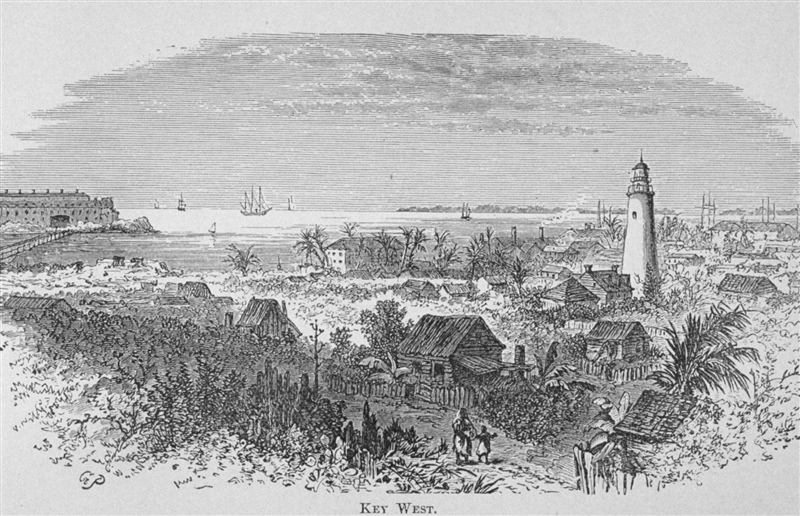
Lighthouse, Key West, Florida, early to mid-1800s (Florida for Tourists, Invalids, and Settlers, George M. Barbour, 1881, public domain).

Their routine changed dramatically for one day, however; on Thursday, August 6, 1863—the date President Abraham Lincoln had proclaimed as a nationwide day of Thanksgiving and reflection—and a date on which 47th Pennsylvanians at both of garrison sites most certainly took time to reflect on all that they had endured since enlisting.

While the majority of enlisted men and lower ranking officers stationed in the Dry Tortugas observed the national holiday there at Fort Jefferson, many of their superior officers headed to Fort Taylor, where every store in town was closed to ensure wider participation in the commemorative events that had been scheduled there, which C Company’s Henry Wharton described in his August 23, 1863 letter to the Sunbury American:

Thanksgiving, or the day set apart by the President for prayer and to return thanks to Him who has the control of battles, was properly observed by the Army and Navy at this place. The proclamation of the President was read from the pulpits of the different churches on the Sunday evening previous, and invitation extended to all who wished to participate in the services on that occasion. General Woodbury issued a circular requesting all of his command to observe the day in a becoming manner and to attend Divine service at their usual places of worship.– He ordered that all drills and policeing [sic] should be dispensed with, so that the men were at liberty to spend the day as their feelings best dictated. The invitation of the Clergy was accepted, and the Military, by companies attended church. Company C, headed by Captain Gobin and Lieutenant Oyster, marched to the Episcopal church, where an eloquent discourse was delivered by the Rev. Dr. Herrick, but owing to the great crowd many were compelled to retire, thus losing an intellectual treat that would have benefitted them more than the mere listening to a common sermon. The Reverend gentleman of this church has been very kind to our regiment in reserving seats for their accommodation. One act of his speaks for itself, viz: on our arrival here he addressed a note to the Colonel of the 47th, inviting the officers and men to attend the services at St. Marks church, and mentioned particularly that the seats were free.

On the Saturday following Thanksgiving a Yacht race came off on the waters between Sand Key Light House and Key West.– Some thirty boats were entered. Boats of all kinds, from a Captains gig to a thirty or forty ton schooner. The wind was fine and a splendid day they had for the purpose.– Each boat had a flag that it might be known, and as they moved off, the fleet made a grand display. From the ramparts of Fort Taylor the sight was magnificent, for from that point one had a full view, and an opportunity afforded of following the different parties, with the eye, until they gained the turning point and their return to the starting ground. A steam tug followed the party, having on board ladies, the committee and guests, who had a jolly time of it, and an opportunity of tripping the ‘light, fantastic toe,’ to the fine music of the 47th Band, lead by that excellent musician, Prof. Bush. Quartermaster Lock’s schooner ‘Nonpareil’ won the race, out distancing all of its competitors. Of that fact I was certain, for how else could it be, when its name belongs to the ‘art, preservative of all arts’ – printing.

Last Wednesday brought two-thirds of the ‘three years’ of the ‘Sunbury Guards’ to a close, when Lieut. Reese surprised the boys, agreeably, by giving them an entertainment. In this the Lieut., took the start of the other officers of the company, but as all joined in devouring the good things furnished, every one was in a good humor and satisfied, no matter who was the caterer for the occasion. Company C is blessed with good officers – men who do, as they wish to be done by. This little celebration had a good effect, for if there was any misunderstanding, previously, it is now settled, and no better conducted or well regulated family, where good feeling are exhibited, can be found among the soldiers of Uncle Sam. Our company is slightly envied on account of their good grub, but for this the boys should not be blamed for Gobin, who has charge of the company savings, is continually hunting the market for the best it affords, and Sergeant Piers and Johnny Voonsch serve it up in their best style, proving to others that soldiers can, if they good [sic] cooks, live a well as any ‘other man.’

The nomination of Governor Curtin for re-election was well received, and if they had the right to vote there would be no fear of the next Chief Magistrate of Pennsylvania being a copperhead. The decision of Judge Woodward, depriving the soldier of a vote, is looked upon as a bribe for not re-enlisting; and indeed it is, for does it not give the bounty of the right of suffrage to every elector who stays at home? The voting men of the 47th Regiment, Pennsylvania Volunteers, are as a unit for the re-election of Andrew G. Curtin.

Blockade running is nearly played out, and is confined to Mobile and Wilmington, N.C. Very few vessels of this sort are brought into this port at present, owing to the strict watch that is kept on the above named places; however, a day or two ago, the U.S. Steamer De Soto brought in two very large river steamers laden with cotton. The cotton is being transferred to other vessels and will soon be sent North, where it will be put in market for sale.

One of the houses belonging to the Engineer Department was entirely destroyed by fire on last Thursday. It was occupied by the laborers as a sleeping apartment. How the fire originated is unknown, but it is supposed to have caught from a tobacco pipe of one of the men, or from a spark of the locomotive that is used in hauling material for the outside works at Fort Taylor. The boys are all very well and in fine spirits, only a little more active life, and occasional brush with the enemy, they think, would give them a better appetite and enable them to enjoy the rations fournished [sic] by Government….

Fort Jefferson and its wharf (Harper’s Weekly, August 26, 1865, public domain; click to enlarge).

As the month of August wore on, one of the 47th Pennsylvanians assigned to guard duty at Fort Jefferson was H Company’s Corporal George W. Albert, who was stationed at the wharf in the Dry Tortugas on August 24. Standing guard at the regimental post designated as No. 6, he was assigned to night duty, and was relieved the next morning at 8 a.m.

That same day, General Woodbury arrived at the Tortugas for an inspection. He was impressed by the regiment’s level of discipline according to H Company Captain James Kacy, who later wrote: “Men were fully armed and ready for march, splendid appearance…. Gen. Woodbury would not part with the 47th if he does not have to, and all the people at Key West and the Tortugas are pleased with the 47th more than any other regiment.”

With respect to the civilian population at Fort Jefferson and across Florida’s Dry Tortugas, life was also often surprisingly busy. According to Emily Holder, who was making a life with her physician-husband at a house on the fort’s grounds during this time:

The latter part of August 1863, Mr. Hall, who with his wife, had been long with us, was ordered away. He was a very efficient officer and we heard long afterwards that his bravery under fire was remarkable. Their departure was most tantalizing to them and to us somewhat amusing. It showed more clearly than anything else would our isolated condition, for our only legitimate means of getting away was by sail; whenever we had steam conveyance it was by special favor.

We had given some farewell entertainments to Mr. And Mrs. Hall, and Saturday afternoon saw them on board the boat that was to carry them directly to Pensacola. When ready to sail the wind suddenly failed, and the vessel could not get away from the wharf.

The doctor went down and brought them back with him to tea after which they returned to the boat, hoping that during the night a breeze would spring up, but in the morning there the boat lay, and they breakfasted with the colonel. Later all went down again to see them off, as a breeze gently flapped the flag, but it was dead ahead, making it impossible to get out of the narrow channel, which in some places was not wide enough for two vessels to pass each other, and beating out was impossible, so they came up to tea again and spent the evening.

The next morning the doctor looked out of the window and exclaimed: “There they go!” when suddenly as we were watching, the masts became perfectly motionless. We knew only too well what that meant. They had run on to the edge of the reef, within hailing distance of the Fort, and the doctor with others, went out and spent the morning with them, as they refused to come on shore again. Mr. Hall said he was going to “stand by the ship.”

In the course of the day, by kedging as the sailors call it, putting out the anchor and pulling the boat up to it, then throwing it out again further on, they managed to crawl to the first buoy, and there lay in the broiling sun….

Someone replied that it was fortunate that the Wishawken had captured the Atlanta and that the Florida after running the blockade from Mobile under the British colors, rarely came near our coast, for they certainly would have been captured had there been a privateer in those waters.

The next morning when we went on top of the Fort, the sails of the schooner were just a white speck on the northern horizon, and we could hear music from the steamer, which was bringing Colonel Goode [sic] for his monthly inspection of the troops.

Our rains continued occasionally later than usual, one in the middle of September almost ending in a hurricane; so rough was it that the Clyde, a long, graceful, English-built steamer, that came in for coal with the Sunflower, had to remain several days. The Clyde had quite a serious time in reaching the harbor. We watched it through a porthole with great anxiety. It was too strong a wind for us to venture on the ramparts, but we could walk all about inside seeing everything that came in from our safe lookout.

Colonel Goode [sic] on his last trip had left the regiment band for us awhile, so that guard mount and dress parade were important features, while the naval officers went about visiting the various houses, keeping us bright and gay while they were weather bound.

The high winds ended in a severe norther—an almost unheard of thing so early in the season. Later we saw by a paper that they had snow in New York the latter part of August; it might have been the same cold wave that swept down over the Gulf, for it housed us shivering.

While the band was with us the ramparts were the favorite places for viewing dress parade, and the colonel gave the ladies all the pleasure he could, having the band play on parade during the evening.

A remittent fever broke out and we were ill for three weeks. It was very much like the break-bone fever; extreme suffering in the limbs and back seemed to be the prevailing feature of the attacks. At the same time they were digging a ditch around close to the wall of the Fort, which made it pass between the house and kitchen as the latter was in the casemates.

The rains, of course, swelled the size of the brook so that the bridge over it, when the wind blew, as it seemed to most of the time, was rather an insecure passage, as it was five feet wide and from three to four deep, and to cross that every time one went into the kitchen was no small annoyance, and the contrivances to get the meals into the dining-room got required no little ingenuity.

Meanwhile, as summer progressed, the 47th Pennsylvania Volunteers continued to weaken Florida’s abilities to supply and transport food and troops throughout the area held by the Confederate States of America by capturing livestock and farm produce, as well as disrupting the manufacture of salt.

They also continued to train, keeping their battle skills sharp in readiness for the moment they would be ordered back into the fray in order to finally extinguish the faction of fire-eaters bent on dissolving the United States and all that the nation had stood for since its founding.


Sources:

  1. Bates, Samuel P. History of Pennsylvania Volunteers, 1861-5, vol. 1. Harrisburg, Pennsylvania: B. Singerly, State Printer, 1869.
  2. Florida’s Role in the Civil War: ‘Supplier of the Confederacy.’” Tampa, Florida: Florida Center for Instructional Technology, College of Education, University of South Florida, retrieved online January 15, 2020.
  3. Holder, Emily. At the Dry Tortugas During the War.” San Francisco, California: Californian Illustrated Magazine, 1892 (part four, retrieved online, March 28, 2024, courtesy of Lit2Go, the website of the Educational Technology Clearinghouse at the Florida Center for Instructional Technology, College of Education, University of South Florida).
  4. History: Crops (Historic Florida Barge Canal Trail).” Historical Marker Database, retrieved online December 30, 2023.
  5. Owsley, Frank Lawrence, and Harriet Fason Chappell. King Cotton Diplomacy: Foreign Relations of the Confederate States of America. Chicago, Illinois: University of Chicago Press, 1959.
  6. Preventing Diplomatic Recognition of the Confederacy, 1861–1865,” andThe Alabama Claims, 1862–1872,” in “Milestones: 1861–1865.” Washington, D.C.: Office of the Historian, Foreign Service Institute, United States Department of State, retrieved online December 30, 2023.
  7. Schmidt, Lewis G. A Civil War History of the 47th Regiment of Pennsylvania Veteran Volunteers. Allentown, Pennsylvania: Self-published, 1986.
  8. Wharton, Henry. Letters from the Sunbury Guards. Sunbury, Pennsylvania: Sunbury American, 1861-1868.


Respect and Confidence: The Bond Between an Effective Commanding Officer and His Men

Unidentified Union Army artillerymen standing next to one of the fifteen-inch Rodman guns, which were installed on the third level of Fort Jefferson in the Dry Tortugas, Florida, beginning in 1862. These smoothbore Rodman weighed twenty-five tons, and was able to fire four hundred and fity-pound shells more than three miles (U.S. National Park Service, public domain).

July of 1863 was a very different experience for the 47th Pennsylvania Volunteers than it was for many other members of the Army of the United States. Divided roughly in half, in order to provide garrison coverage at two federal military installations in Florida that had been deemed critical to the federal government’s ability to turn the tide of the American Civil War in the Union’s favor, their regiment was not involved in the epic Battle of Gettysburg that unfolded over three days on the soil of their home state that month.

But their service to the nation still mattered. Split between Fort Taylor in Key West, Florida and Fort Jefferson in Florida’s remote Dry Tortugas, their collective job was not only to hamper efforts by the Confederate States of America to move troops and supplies throughout the Deep South, but also to prevent Great Britain and other European nations from interfering in the war.

As winter gave way to spring and summer, individual companies of the regiment continued to drill in the use of their respective fort artillery batteries and their own rifles and were also assigned to provost duties, functioning both as military police who ensured that soldiers behaved themselves and were punished when they did not, and as civil justice officials who upheld the nation’s rule of law to protect the local citizenry by arresting and prosecuting criminals, preventing the illegal sale of alcohol and other prohibited goods and carrying out the enforcement of multiple federal laws, including the nation’s newly adopted Lieber Code for the Armies of the United States and President Abraham Lincoln’s Emancipation Proclamation which freed the men, women and children who had been enslaved in their respective jurisdictions.

They were also still nursing their wounded bodies and souls as they came to terms with the deaths of their comrades and the emotional and physical injuries that they had sustained themselves during the bloody Battle of Pocotaligo, South Carolina on October 22, 1862.

Captain Henry Durant Woodruff, commanding officer of Company D, 47th Pennsylvania Volunteers (public domain).

It was in this spirit of reflection that a genuinely memorable event took place at Fort Taylor in Key West, Florida on July 16, 1863. That day, the members of the 47th Pennsylvania’s Company D “presented a magnificent sword, sash, and belt” to Captain Henry Durant Woodruff “at the US Barracks in Key West,” according to historian Lewis Schmidt.

The company was formed in front of their quarters at 8 AM, across the barracks ground from Company C, and Pvt. George W. Baltozer, a 24 year old teacher from Perry County, made the following remarks on behalf of the company:

‘The motives that assemble us on the present occasion are based on our mature confidence, the martial skill, the intrepid heroism, and the undaunted intrepidity of our leader in arms. It is manifestive of our consciousness of your noble ability to wield in the defence [sic] of the rights of our country, this glittering weapon, that we place it in your protective hand. Receive it, sir, as a token of our estimation of your promotion of our ease and comfort in quietude, and for your chivalrous spirit on the sanguine field, when the heavens glared with fire, and the earth trembled ‘neath cannons’ roar. May it never rest in its scabbard ’till rebellion is crushed and traitorism is banished from the land, and peace spread her white wings from the St. John’s to the sunny banks of the Rio Grande. May it ever bespeak in the heart of him that wields it, bravery, loyalty, heroism, and philanthropy. That it may ever benefit you in the hour of peril, and that you may undauntingly use it as opportunity is afforded, is the very ardent wish of your most obedient servants.'”

Also, according to Schmidt, Captain Woodruff responded to this touching tribute by presenting a surprisingly lengthy address to his men:

My companions in arms, your beautiful present is accepted with sincere satisfaction and heartfelt thanks. It affords the satisfaction that you still respect and have confidence in your commander, and he is thankful not only for the value of this noble gift, but for the rich token of your kind regard. And while I wear these arms and accoutrements, emblematical of my rank and office, may they never be worn unworthily, or the noble donors have cause to blush for the ungallant act of the wearer.

Two years have nearly elapsed since we have been associated as commander and commanded. Two years of privation and toil, yet your love for the cause and your ardor to serve your country has not abated.

When you entered upon this gigantic struggle, you were not prompted by large bribes or bounties, or intimidated by being forced in service by conscription. But inspired by a noble patriotism, you cheerfully volunteered for the longest period known to law.

Your conduct thus far has been in accordance with the honorable principles which caused you to volunteer. No discipline too strict, no privations too great, no toil too sore, but that your indomitable spirits have been able to accomplish, to undergo and overcome. And now allow me to say to you that I am proud of the noble men who compose this company; I am proud of your generous and gallant conduct; I am proud of your association; I am proud of the honor you have this day conferred upon your Captain.

In looking forward, I have no fears for you in the future, whatever you may be called on to do—in garrison—in the tented field, or on the sanguined plain, it will be bravely—it will be well done. Then until rebels and traitors shall become extinct, or have grounded their arms, and acknowledged the supremacy of the government and the law, let this our motto be: Give us death or give us liberty.

Later that year, multiple members of Company D would opt to re-enlist to finish the fight, serving valiantly until the leaders of the Rebellion finally surrendered in April 1865—and beyond—into the early months of the Reconstruction Era, until their regiment was finally mustered out at Charleston, South Carolina on Christmas Day in 1865.


Sources:

  1. Bates, Samuel P. History of Pennsylvania Volunteers, 1861-5, vol. 1. Harrisburg, Pennsylvania: B. Singerly, State Printer, 1869.
  2. Carnahan, Burrus. Global Impact: The Lincoln Administration and the Development of International Law.” Washington, D.C.: President Lincoln’s Cottage, May 9, 2016.
  3. Florida’s Role in the Civil War: ‘Supplier of the Confederacy.’” Tampa, Florida: Florida Center for Instructional Technology, College of Education, University of South Florida, retrieved online January 15, 2020.
  4. General Orders 100: The Lieber Code,” in “The Avalon Project: Documents in Law, History and Diplomacy.” New Haven, Connecticut: Lillian Goldman Law Library, Yale Law School, Yale University, retrieved online April 3, 2024.
  5. Gesley, Jenny. The ‘Lieber Code’—the First Modern Codification of the Laws of War,” in “In Custodia Legis: Law Librarians of Congress.” Washington, D.C.: U.S. Library of Congress, retrieved online April 3, 2024.
  6. History: Crops (Historic Florida Barge Canal Trail).” Historical Marker Database, retrieved online December 30, 2023.
  7. Lieber, Francis. Instructions for the Government of Armies of the United States in the Field. Washington, D.C.: Government Printing Office, 1898.
  8. Owsley, Frank Lawrence, and Harriet Fason Chappell. King Cotton Diplomacy: Foreign Relations of the Confederate States of America. Chicago, Illinois: University of Chicago Press, 1959.
  9. Preventing Diplomatic Recognition of the Confederacy, 1861–1865,” and The Alabama Claims, 1862–1872,” in “Milestones: 1861–1865.” Washington, D.C.: Office of the Historian, Foreign Service Institute, United States Department of State, retrieved online December 30, 2023.
  10. Schmidt, Lewis. A Civil War History of the 47th Regiment of Pennsylvania Veteran Volunteers. Allentown, Pennsylvania: Self-published, 1986.
  11. Wharton, Henry D. Letters from the Sunbury Guards. Sunbury, Pennsylvania, Sunbury American, 1861-1866.


Reunited in Death: The Virtual Cemetery Project of “47th Pennsylvania Volunteers: One Civil War Regiment’s Story”

Gravestone of Private John M. Cohler, Company A, 47th Pennsylvania Volunteers, Easton Cemtery, Easton, Pennsylvania, June 2024 (used with the permission of Julian Burley).

From eastern Maine down to Southern California and Florida’s Dry Tortugas up through Seattle, Washington, the men who served with the 47th Pennsylvania Volunteer Infantry are being reunited again—this time in death, thanks to a “virtual cemetery” that has recently undergone a significant expansion.

Established in 2014, the Virtual Cemetery Project of 47th Pennsylvania Volunteers: One Civil War Regiment’s Story has been fueled by the energy of more than a dozen volunteers, who have trekked through cemeteries coast to coast over the years, in good weather and bad, to find and photograph the final resting places of, and monuments erected to, the 47th Pennsylvania Volunteers who fought to preserve America’s Union during the American Civil War.

What those Virtual Cemetery Project volunteers have created is an astonishing treasure trove of vital statistics, combined with thought-provoking imagery illustrating the stirring patriotism of average Americans and the heartbreaking cost of disunion and war.

A Milestone Reached

By the time that the first rocket illuminates the night sky on the Fourth of July in 2024, the 47th Pennsylvania Volunteers’ Virtual Cemetery will have grown to include memorials honoring more than fourteen hundred members of the regiment, including:

  • John Boulton Young, a thirteen-year-old drummer boy who was the first member of the regiment to die;
  • Professor Thomas Coates, the “Father of Band Music in America” who became the first conductor of the 47th Pennsylvania’s renowned regimental band;
  • Fuller Family members who were Mayflower descendants and prominent, nineteenth-century civic leaders and industrialists;
  • Inventors Daniel Reeder and Abraham N. Wolf;
  • John Peter Shindel Gobin, the regiment’s final commanding officer who later became the seventh lieutenant governor of the Commonwealth of Pennsylvania;
  • Franz Schwentzer, a leading, nineteenth-century Frakturist, wood carver and furniture maker; and
  • Dead-Eye Dick,” one of the regiment’s “mystery men.”

Supporters of the project hope that the grave of every member of the 47th Pennsylvania Volunteer Infantry will eventually be located and properly marked, and that a biographical sketch will be written and posted for each soldier.

To learn more, visit the Resting Places and Memorials section of the 47th Pennsylvania Volunteers’ website.


The Red River Campaign: How It Began, Progressed and Ended for the 47th Pennsylvania Volunteer Infantry (Louisiana, Late February to Early July 1864)

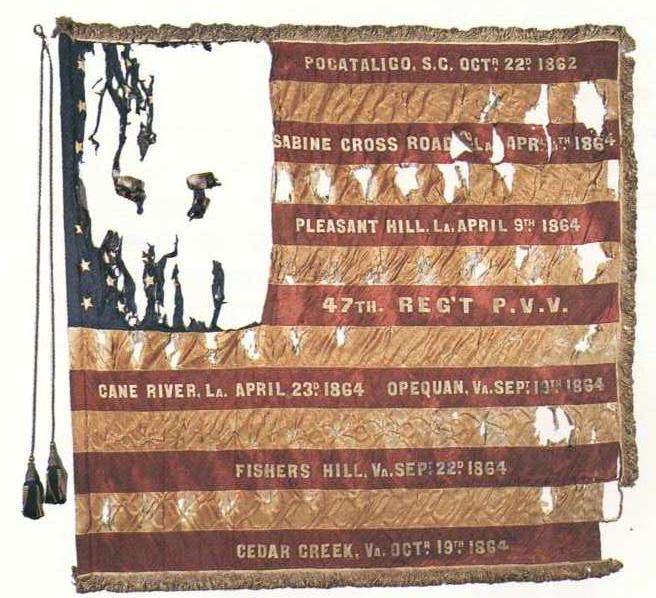
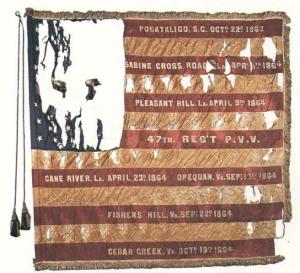
Second State Colors, 47th Pennsylvania Veteran Volunteers (presented to the regiment 7 March 1865).

Seven battle names embossed on a battle flag. Three documented a series of seemingly minor military engagements during one oft-maligned military campaign of the American Civil War.

Known by military scholars today as the 1864 Red River Campaign, those “minor” engagements ensured that the 47th Pennsylvania Volunteers would be known for all time as history makers—members of the only regiment from the Commonwealth of Pennsylvania to take part as the Union’s Army of the Gulf marched through Louisiana between late February and mid-July 1864, enabling the United States government to prevent the war and the brutal practice of chattel slavery from spreading any further west.

As for how inconsequential those “minor” engagements of the 1864 Red River Campaign were? They left such indelible marks on the 47th Pennsylvania Volunteer Infantry that its senior officers chose to emboss the majority of that campaign’s battle names on the second battle flag that was carried by the regiment as it defended the nation in the wake of President Abraham Lincoln’s assassination in April 1865, and as the regiment marched triumphantly through the streets of Washington, D.C. during the Union’s Grand Review of the Armies in late May of that same year.

How It Began

The 47th Pennsylvania Volunteers’ participation in the 1864 Red River Campaign across Louisiana began with a series of general and special orders and other communications that were issued by senior military officers of the United States Army:

  • SPECIAL ORDERS, No. 39
    HEADQUARTERS, DEPARTMENT OF THE GULF, New Orleans, Louisiana, February 13, 1864.

12. First. The Second Regiment U.S. Colored Troops will be relieved from duty at Ship Island and proceed without delay to Key West, Fla., where it will be reported for duty to Brig. Gen. D. P. Woodbury. Second. On the arrival of the Second U.S. Colored Troops at Key West, the battalion of Forty-seventh Pennsylvania Volunteers stationed at that point will be relieved from duty in the District of Key West and Tortugas, and will proceed without delay to Franklin, La., where it will be reported for duty to Maj. Gen. W. B. Franklin, commanding Nineteenth Army Corps. Third. On the arrival of the First Battalion, Forty-seventh Pennsylvania, at Franklin, the One hundred and tenth New York Volunteers will proceed to Fort Jefferson, Dry Tortugas, and relieve the battalion of the Forty-seventh Pennsylvania now in garrison there. Fourth. On being so relieved, the battalion of the Forty-seventh Pennsylvania now stationed at Fort Jefferson will proceed to Franklin, La., and report for duty at the headquarters of the regiment. The quartermaster’s department will immediately furnish the necessary transportation.

By command of Major-General Banks:

RICHD. B. IRWIN,
Assistant Adjutant-General.

  • SPECIAL ORDERS, No. 48
    H
    EADQUARTERS 19th ARMY CORPS AND U.S. FORCES, Franklin, Louisiana, February 18, 1864.

5. In pursuance of Special Orders No. 41, extract 3, current series, headquarters Department of the Gulf, the following-named regiments assigned to the First Division, Nineteenth Army Corps, Brig. Gen. W. H. Emory commanding, are hereby assigned to brigades as follows, to take effect February 20, 1864:First Brigade, to be commanded by Brig. Gen. William Dwight: Fifteenth Maine, Thirtieth Massachusetts, One hundred and fourteenth New York, One hundred and seventy-third New York, One hundred and sixty-first New York.Second Brigade, to be commanded by Brig. Gen. J. W. McMillan: Twenty-sixth Massachusetts (temporary), Thirteenth Maine, Twelfth Connecticut, Eighth Vermont, One hundred and sixtieth New York, Forty-seventh Pennsylvania.Third Brigade, to be commanded by the senior colonel: Fourteenth Maine, One hundred and sixty-second New York, One hundred and sixty-fifth New York, One hundred and sixteenth New York, Thirtieth Maine.

Capt. Duncan S. Walker, assistant adjutant-general, U.S. Volunteers, is assigned to duty as assistant adjutant-general, First Division, and will report to Brigadier-General Emory.

Capt. Oliver Matthews, assistant adjutant-general, U.S. Volunteers, is assigned to duty as assistant adjutant-general, First Brigade, First Division, and will report to Brig. Gen. William Dwight.

The following-named batteries are assigned to the First Division: Battery A, First U.S. Artillery; Battery L, First U.S. Artillery; Fourth Massachusetts Battery, Sixth Massachusetts Battery, Twenty-fifth New York Battery.

By order of Major-General Franklin:

WICKHAM HOFFMAN,
Assistant Adjutant-General.

  • HEADQUARTERS, DEPARTMENT OF THE GULF, New Orleans, Louisiana, February 19, 1864.
    Major-General Franklin, Commanding, Nineteenth Corps, Franklin:

GENERAL: Instead of awaiting the arrival of the battalion of the Forty-seventh Pennsylvania Volunteers, as heretofore ordered, the One hundred and tenth New York Volunteers will be immediately relieved from duty with the First Division, Nineteenth Army Corps, and will proceed without delay to Algiers, where it will take steam transportation for Key West, Fla.

By command of Major-General Banks:

RICHD. B. IRWIN,
Assistant-Adjutant General.

How It Progressed

Casualties began to be incurred by the 47th Pennsylvania even before members of the regiment stepped off of their respective troop transports and onto Louisiana soil in early March 1864. Researchers for 47th Pennsylvania Volunteers: One Civil War Regiment’s Story believe that the first Red River casualty was actually Private Frederick Koehler, who reportedly drowned after falling overboard from his transport, just as it was entering the harbor near Algiers, Louisiana.

From that moment on, the regiment’s casualty rate climbed as the 47th Pennsylvania Volunteers marched, built, dug, and fought their way across unfamiliar, difficult terrain, under conditions for which their northern bodies and immune systems were ill prepared. Two of the campaign’s engagements—the Battle of Sabine Cross Roads/Mansfield on April 8, 1864, and the Battle of Pleasant Hill on April 9—were among the most brutal and sanguinary fighting that they waged during the entire war.

Along the way, the 47th Pennsylvanians helped to free more Black men, women and children from the plantations where they had long been enslaved, with five of the men they met ultimately choosing to enlist with the 47th Pennsylvania Volunteer Infantry, further integrating a regiment that had already begun enrolling Black soldiers as far back as the fall of 1862.

How It Ended

Union Army base at Morganza Bend, Louisiana, circa 1863-1865 (U.S. Library of Congress, public domain).

Their final combat engagement—the Battle of Mansura—was fought on May 16, 1864. Afterward, they marched for Morganza, Louisiana. Encamped there for most of June, they finally made their way back to New Orleans by the end of that month—two campaign-ending duty stations that were not luxurious by any standards now, or then, but were far more comfortable than what they had endured throughout their long and difficult spring.

Those final duty stations were still not completely safe for them, however; the grim reaper continued to scythe men left and right as typhoid, mysterious fevers, dysentery, and chronic diarrhea ravaged the regiment during the unbearably hot, humid weeks of June and early July.

As a result, the regiment lost as many or more of its members to disease than it did to the rifle and cannon fire that they had so recently dodged. And the war was still not over.

When the Fourth of July arrived for the weary warriors, the 47th Pennsylvania Volunteers were busy packing their belongings, having just received new orders to return to the Eastern Theater of battle. By mid-July, roughly sixty percent of the regiment’s members were fighting for their lives yet again—this time in the Battle of Cool Spring, near Snicker’s Gap, Virginia.

As that was happening, multiple members of the regiment were coming to grips with the fact that they had been left behind to recuperate from battle wounds or diseases they had contracted while in service to the nation. Among those convalescents were eighteen men who subsequently died at Union hospitals or Confederate prison camps long after their comrades had reached the East Coast. Two of those men were later documented as among the five total who died in Baton Rouge, with ten men among the total of thirty-three who passed away in New Orleans. Seven others died in Natchez, Mississippi, and at least one of the men left behind had been one of the seventeen POWs held captive at Camp Ford, the largest Confederate prison camp west of the Mississippi River.

Stilled Voices

The phrase, “Dum Tacent Clamant” (While they are silent, they cry aloud”), is inscribed on the Grand Army of the Republic monument at the Chalmette National Cemetery in St. Bernard Parish, Louisiana, where multiple members of the 47th Pennsylvania Volunteers remain at rest (G.A.R. Monument, Chalmette National Cemetery, circa 1910, U.S. Library of Congress, public domain).

More than seventy of the 47th Pennsylvania’s disease and battle-related casualties remain at rest in marked or unmarked national cemetery graves in Louisiana and Mississippi. Other unsung heroes lie forgotten in graves yet to be identified, part of the legion of American soldiers “known but to God.”

Albert, George Washington: Corporal, Company H; fell ill during the Red River Campaign; was transported to New Orleans, where he was confined to a Union Army hospital; discharged on a surgeon’s certificate of disability on April 18, 1864, he died aboard the U.S. Steamer Yazoo while being transported home to Pennsylvania to convalesce; buried at sea, a cenotaph was created for him at Ludolph’s Cemetery in Elliottsburg, Pennsylvania;

Andrew, Michael: Private, Company A; fell ill with chronic diarrhea sometime during the Red River Campaign; was transported to New Orleans, where he was confined to a Union Army general hospital; died there on July 15 or 18, 1864; was interred at the Monument Cemetery in New Orleans (now the Chalmette National Cemetery);

Barry, William: Private, Company H; killed in action during the Battle of Sabine Cross Roads/Mansfield, Louisiana on April 8, 1864; his burial location remains unidentified;

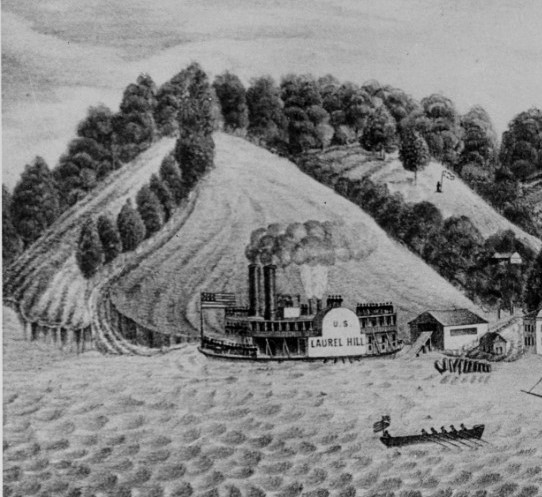
Beidleman, Jacob (alternate surnames: Beiderman, Biedleman): Private, Company G; fell ill with chronic diarrhea during the Red River Campaign; was confined to the Union’s hospital ship, the USS Laurel Hill, and transported to Natchez, Mississippi, where he was confined to Union Army’s Natchez General hospital; died there on July 3, 1864; may have been interred at the Natchez National Cemetery in a grave that remains unidentified;

Bellis (alternate spelling: Bellus), Amandus: Private, Company A; fell ill during the Red River Campaign, was confined to the Union’s hospital ship, the USS Laurel Hill, while it was docked near Morganza, Louisiana; subsequently transported to Natchez, Mississippi, he died en route, while aboard that ship, on June 30, 1864; was possibly buried at sea or interred in an unmarked grave at the Natchez National Cemetery that remains unidentified;

Berlin, Elias: Private, Company A; fell ill in Florida, or during the opening days of the Red River Campaign; died in Florida, or aboard ship while en route to Louisiana, or in Louisiana on March 28, 1864; was interred, or a cenotaph was created for him, at the Zion UCC Stone Church Cemetery in Kreidersville, Pennsylvania;

Bettz, Godfrey (alternate spelling: Betz): Private, Company F; fell ill with chronic diarrhea sometime during the Red River Campaign; was transported to New Orleans, where he was confined to a Union Army general hospital; died there on May 8, 1864; was interred in section 51, grave no. 3968 at the Monument Cemetery in New Orleans (now the Chalmette National Cemetery);

Bohan, George (alternate spellings: Bohan, Bohn, Bollan, Bolian): Private, Company A; fell ill with chronic diarrhea sometime during the Red River Campaign; was transported to New Orleans, where he was confined to a Union Army general hospital; died there on June 27 or 28, 1864; was interred in section 67, grave no. 5358 at the Monument Cemetery in New Orleans (now the Chalmette National Cemetery);

Brader, Josiah (alternate spelling: Braden): Private, Company B; fell ill with typhoid fever sometime during the Red River Campaign; was transported to New Orleans, where he was confined to the University Hospital; died there on July 9, 1864; was interred in section 66, grave no. 5279 at the Monument Cemetery in New Orleans (now the Chalmette National Cemetery);

Brooks, George W.: Private, Company E; fell ill with chronic diarrhea sometime during the Red River Campaign; was transported to New Orleans, where he was confined to a Union Army hospital; died there on August 12, 1864; was interred in section 67, grave no. 5383 at the Monument Cemetery (now the Chalmette National Cemetery);

Clewell, Jr., Joseph: Private, Company G; fell ill with chronic diarrhea after being captured by Confederate troops during the Battle of Sabine Crossroads/Mansfield on April 8, 1864 or the Battle of Pleasant Hill on April 9, or during one of the regiment’s subsequent Red River Campaign engagements; was subsequently confined to the Confederate States Army hospital in Shreveport, Louisiana sometime in May or early June and held there as a prisoner of war (POW) until his death there on June 18, 1864; possibly interred in one of the unmarked graves in Shreveport’s Greenwood Cemetery, according to Joe Slattery, Genealogy Library Specialist at the Shreve Memorial Library in Shreveport; if not, his remains may have been exhumed and reinterred in an unmarked grave at the Alexandria National Cemetery in Pineville, Louisiana, according to historian Lewis Schmidt;

Crader, James: Sergeant, Company G; fell ill sometime during the Red River Campaign; was confined to the Union’s hospital ship, the USS Laurel Hill, and transported to Natchez, Mississippi, where he was confined to the Union’s General Hospital in Natchez; died there on July 9, 1864; may have been interred at the Natchez National Cemetery;

Davenport, Valentine: Private, Company H; fell ill during the opening days of the Red River Campaign; was confined to a Union hospital in New Orleans and then discharged on a surgeon’s certificate of disability on March 28, 1864; died in New Orleans on May 4, 1864; was buried at a national cemetery in the State of New York, according to the U.S. Army Department of the East’s Roll of Honor: Names of Soldiers Who Died in Defence of the American Union, Vol. X: “Soldiers Buried in the Department of the East: New York,” p. 15 (Washington, D.C.: Government Printing Office, 1867);

Dech, Alpheus (alternate presentations of name: Alfred Dech, Alpheus Deck): Private, Company G; fell ill with chronic diarrhea sometime during the Red River Campaign; was transported to New Orleans, where he was confined to the U.S. Marine Hospital; died there on June 3, 1864; was interred in grave no. 4028 at the Monument Cemetery in New Orleans (now the Chalmette National Cemetery);

Dumm, William F. (alternate spellings: Drum or Drumm): Private, Company H; killed in action during the Battle of Pleasant Hill, Louisiana on April 9, 1864; his burial location remains unidentified;

Evans, John: Private, Company H; fell ill with chronic diarrhea sometime during the Red River Campaign; was transported to New Orleans, where he was confined to a Union Army hospital; died there on June 20, 1864; was interred in section 51, grave no. 4042 at the Monument Cemetery in New Orleans (now the Chalmette National Cemetery);

Fetzer, Owen: Private, Company I; fell ill with chronic diarrhea sometime during the Red River Campaign; was transported to New Orleans, where he was hospitalized at the Union’s St. Louis General Hospital; died there on April 19, 1864; his burial location remains unidentified;

Fink, Edward: Private, Company B; declared missing in action (MIA) after the Battle of Pleasant Hill, Louisiana on April 9, 1864; was later declared as killed in action (KIA), having been killed by gunshot during the battle; his burial location remains unidentified;

Frack, William: Corporal, Company I; declared missing in action and “supposed dead” following the Battle of Pleasant Hill, Louisiana on April 9, 1864; was ultimately declared as killed in action; his burial location remains unidentified;

Gerrett, Mathias (alternate spelling: Garrett): Private, Company K; fell ill with typhoid fever sometime during the Red River Campaign; was transported to New Orleans, where he was confined to the Union Army’s Barracks Hospital; died there on May 22, 1864; was interred in section 51, grave no. 3995 at the Monument Cemetery in New Orleans (now the Chalmette National Cemetery);

Haas, Jeremiah: Private, Company C; killed in action during the Battle of Sabine Cross Roads/Mansfield, Louisiana on April 8, 1864; his burial location remains unidentified;

Hagelgans, Nicholas: Private, Company K; killed in action during the Battle of Pleasant Hill, Louisiana on April 9, 1864; his burial location remains unidentified;

Hahn, Richard: Private, Company E; killed in action by a musket ball during the Battle of Pleasant Hill, Louisiana on April 9, 1864; his burial location remains unidentified;

Hangen, Washington H. R.: First Lieutenant and Regimental Adjutant; officially discharged from the U.S. Army and 47th Pennsylvania Volunteer Infantry during the summer of 1864; remained in Louisiana, where he worked for the U.S. Bureau of Refugees, Freedmen, and Abandoned Lands (the “Freedmen’s Bureau”) in St. Tammany Parish and Washington Parish before becoming a surveyor for the State of Louisiana and the U.S. Office of the Surveyor General; died in Abita Springs, St. Tammany Parish on April 23, 1895; was likely interred at the Madisonville Cemetery in St. Tammany Parish, where his second wife had previously been buried;

Hart, J. S. (alternate spelling: Harte): Private, Company C; fell ill with chronic diarrhea sometime during the Red River Campaign; was transported to New Orleans, where he was confined to the Marine Hospital; died there on August 5, 1864; was interred in section 49, grave no. 3869 at the Monument Cemetery in New Orleans (now the Chalmette National Cemetery);

Hartshorn, John (alternate spelling: Hartshorne): Private, Company H; initially listed as missing in action following the Battle of Pleasant Hill, Louisiana on April 9, 1864, Union Army officials determined he had been captured by Confederate troops and marched one hundred and twenty-five miles to Camp Ford near Tyler, Texas, where he was held captive as a prisoner of war (POW) until he was released during a prisoner exchange on July 22, 1864; subsequently died at a Union Army hospital in New Orleans, Louisiana on August 8, 1864; his burial location remains unidentified;

Hawk, David C. (alternate spellings: Hank, Hauk): Private, Company I; fell ill with chronic diarrhea sometime during the Red River Campaign; was transported to New Orleans, where he was confined to a U.S. Army general hospital; died there on July 28, 1864 (alternate death date: July 28, 1865); was described on regimental muster rolls as “absent sick left in U.S. General Hospital of New Orleans since 9-20-64”; was interred in section 49, grave no. 3849 at the Monument Cemetery in New Orleans (now the Chalmette National Cemetery);

Helfrich, John Gross: Sergeant, Company C; fell ill with dysentery sometime during the Red River Campaign; was transported to New Orleans, where he was confined to Charity Hospital; died there on August 5, 1864; was interred in section 49, grave no. 3867 of the Monument Cemetery in New Orleans (now the Chalmette National Cemetery);

Heller, Jonathan: Private, Company G; fell ill with dysentery sometime during the Red River Campaign; was transported to New Orleans, where he was confined to Charity Hospital; died there on June 7, 1864; was interred in square 13, grave no. 1 of the Monument Cemetery in New Orleans (now the Chalmette National Cemetery);

Herbert, Jacob: Private, Company A; fell ill or was injured sometime during the Red River Campaign; was transported to Natchez, Mississippi, where he was confined to a Union Army hospital; died in Natchez on June 30, 1864; his burial location remains unidentified;

Herman, William: Private, Company F; fell ill with chronic diarrhea during the Red River Campaign; was confined to the Union Army hospital ship, the USS Laurel Hill, and transported to Natchez, Mississippi, where he was confined to the Union’s Natchez General Hospital; died there on July 23 or 24, 1864 (his wife’s affidavit in her widow’s pension application notes the date as 23 July; the U.S. Army’s death ledger indicates the date of death was 24 July 1864); may have been interred at the Natchez National Cemetery in Natchez, Mississippi;

Hettrick, Levinus (alternate presentations of name: Levenas Hedrick, Gevinus Hettrick, Levinas Hetrick, Sevinas Hettrick): Private, Company B; drowned in the Mississippi River on June 27, 1864, while serving with the 47th Pennsylvania Volunteers at Morganza, Louisiana, following the 47th’s participation in the Red River Campaign; his burial location remains unidentified;

Hoffman, Nicholas: Private, Company A; fell ill with typhoid fever sometime during the Red River Campaign; was confined to the Union’s hospital ship, the USS Laurel Hill, while it was docked near Morganza, Louisiana, and was transported to Natchez, Mississippi; died aboard that ship on June 30, 1864, while it was in the vicinity of Natchez; per an affidavit filed on June 19, 1865 by Sergeant Charles Small and Private Joseph A. Rogers of the 47th Pennsylvania Volunteer Infantry, Hoffman was buried at the Natchez National Cemetery in Mississippi;

Holsheiser, Lawrence (alternate spellings of surname: Holsheiser, Holyhauser, Hultzheizer, Hultzheizor): Private, Company F; fell ill with chronic diarrhea during the Red River Campaign; was transported to New Orleans, where he was confined to the Barracks Hospital; died there on May 1, 1864; was interred at the Monument Cemetery (now the Chalmette National Cemetery);

Hower, Phillip (alternate spelling: Philip): Private, Company G; contracted Variola (smallpox) during the Red River Campaign; was transported to New Orleans, where he was confined to the Union’s Barracks Hospital; died there on April 21, 1864; was interred at the Monument Cemetery in New Orleans (now the Chalmette National Cemetery);

Keiser, Uriah: Private, Unassigned Men; fell ill during the Red River Campaign; was transported to New Orleans, where he was confined to the Union’s Barracks Hospital; died there in July 1864; was interred at the Monument Cemetery in section 57, grave no.: 4477 (now the Chalmette National Cemetery);

Kennedy, James: Private, Company C; sustained gunshot fracture of the arm and gunshot wound to his side during the Battle of Pleasant Hill, Louisiana on April 9, 1864; was transported to the Union Army’s St. James Hospital in New Orleans, Louisiana, where he died from his battle wounds on April 27, 1864; his burial location remains unidentified;

Kern, Samuel M.: Private, Company D; wounded in action and captured during the Battle of Pleasant Hill, Louisiana on April 9, 1864; was marched or transported to Camp Ford near Tyler, Texas, where he was held in captivity as a prisoner of war (POW) until he died on June 12, 1864; his burial location remains unidentified;

Knauss, Elwin (alternate spellings: Knauss, Kneuss, Knouse; Ellwin, Elvin): Private, Company I; fell ill while during the Red River Campaign; was transported to New Orleans, where he was confined to the U.S. Marine Hospital; died there on August 3, 1864 (alternate death date: June 30, 1864); was interred in grave site 20-55 at the Monument Cemetery in New Orleans (now the Chalmette National Cemetery);

Koehler, Frederick (alternate spellings: Koehler, Kohler, Köhler): Private, Company K; was likely the regiment’s first casualty during the Red River Campaign; while sitting in one of the side hatches of the steamship transporting the 47th Pennsylvania to Louisiana, he fell overboard from the ship as it was rounding into port at Algiers and drowned; members of the regiment reported seeing his body “come up astern of the boat,” and that someone had retrieved his cap, which carried the label “F. K.” on its vizier; researchers have not been able to determine whether or not this soldier was buried at sea, at a cemetery in Louisiana, or if his body was returned home for burial in Pennsylvania;

Kramer, George: Private, Company C; fell ill with chronic diarrhea during the Red River Campaign; was likely confined to one of the Union Army’s general hospitals in Baton Rouge or New Orleans, Louisiana, or to a Union general hospital in Natchez, Mississippi; was placed aboard the Union’s hospital ship, the SS Mississippi; died aboard that ship on August 27, 1864 and was likely buried at sea or possibly at a still-unidentified cemetery in Louisiana or Mississippi; his name was included on the roster of soldiers listed on the Company C, 47th Pennsylvania Volunteers’ Soldiers Monument that was erected at the Sunbury Cemetery in Sunbury, Pennsylvania;

Lehr, Charles (alternate spelling: Lear): Private, Company A; fell ill with chronic diarrhea during the Red River Campaign; was confined to the Union Army’s hospital ship, the USS Laurel Hill, and was transported to the Union’s Natchez General Hospital in Natchez, Mississippi; died there on July 22, 1864; may have been interred in an unmarked/unknown grave at the Natchez National Cemetery;

Long, Solomon: Private, Company K; Contracted typhoid fever during the Red River Campaign; was transported to New Orleans, where he was confined to the U.S. Marine Hospital; died there on August 21, 1864; was interred in section 60, grave no. 4728 of the Monument Cemetery in New Orleans (now the Chalmette National Cemetery);

Matter/Madder, Jacob: Private, Company K; initially reported as missing in action following the Battle of Pleasant Hill, Louisiana on April 9, 1864, his status was subsequently updated to “died of wounds” from that battle; his burial location remains unidentified;

Mayes, William (alternate spelling: Hayes, Mays): Private, Company D; fell ill during the opening days of the Red River Campaign; was transported to New Orleans, where he was confined to a Union Army general hospital; died there on March 30, 1864; was interred in grave no. 3945 of the Monument Cemetery in New Orleans (now the Chalmette National Cemetery);

Miller, Jonathan: Private, Company A; cause and date of death have not yet been determined (soldier was identified by his military headstone); was interred in section 59, grave no. 4629 at the Monument Cemetery in New Orleans (now the Chalmette National Cemetery);

Missmer, Benjamin (alternate spellings: Messner, Missimer, Missmer): Private, Company H; fell ill with chronic diarrhea during the Red River Campaign; was transported to New Orleans, where he was confined to the Union’s St. Louis General Hospital; died there on August 7, 1864; was interred in section 49, grave no. 3874 at the Monument Cemetery in New Orleans (now the Chalmette National Cemetery;

Orris, Nicholas: Private, Co. H; killed in action during the Battle of Pleasant Hill, Louisiana on April 9, 1864; his burial location remains unidentified;

Osterstock, Jacob: Private, Company A; fell ill during the Red River Campaign; was transported to a Union Army hospital in Baton Rouge; died there on June 30, 1864; his burial location remains unidentified;

Powell, Solomon: Private, Company D; may have been wounded in action; was captured during the Battle of Pleasant Hill, Louisiana on April 9, 1864; died from his battle wounds at Pleasant Hill, Louisiana, either on the same day as the battle, or on June 7, 1864, while being held by Confederate troops as a prisoner of war (POW); his burial location remains unidentified; per historian Lewis Schmidt, “Privates Powell and Wantz were probably buried in a cemetery at Pleasant Hill, ‘at the rear of the brick building used for a hospital,’ and after the war reinterred at Alexandria National Cemetery at Pineville, Louisiana in unknown graves”;

Resch, Charles (alternate spelling: Resk): Private, Company K; fell ill during the Red River Campaign; was transported to Baton Rouge and confined to a Union Army general hospital; died there on August 18, 1864; was interred in section 11, grave no. 629 at the Baton Rouge National Cemetery;

Ridgeway, John (alternate spelling: Ridgway): Private, Company H; fell ill during the Red River Campaign; was transported to New Orleans and confined to a Union Army general hospital; died there on July 30, 1864; was interred in section 57, grave no.4475 at the Monument Cemetery in New Orleans (now the Chalmette National Cemetery);

Sanders, Francis (alternate spellings: Xander, Xandres): Corporal, Company B; wounded in action during the Battle of Sabine Cross Roads/Mansfield, Louisiana on April 8, 1864; died shortly after being carried to the rear by his brother; his death was documented in the obituary of his widow, Henrietta Susan (Balliet) Sanders, in the May 15, 1916 edition of Allentown’s Morning Call newspaper, which reported that Francis Sanders “enlisted in the Forty-seventh regiment and saw service for two enlistments until the battle of Sabine Cross Roads, La., where he was wounded and carried to the rear by his brother. From that day to this not a word was heard from him and the supposition was that he died from his wounds” and was likely interred in an unknown, unmarked grave; his burial location remains unidentified;

Schaffer, Reuben Moyer (alternate spellings: Schaeffer, Scheaffer, Shaffer): Private, Company H; reported as wounded in action during either the Battle of Sabine Cross Roads/Mansfield on April 8, 1864 or the Battle of Pleasant Hill on April 9; was subsequently marched with his regiment to Grand Ecore; was reported in U.S. Army records to have died at Grand Ecore on April 22, 1864; however, he actually died during the forty-five-mile march toward Cloutierville, according to a letter subsequently written by his commanding officer, Captain James Kacy, to First Lieutenant William Wallace Geety on May 29; was likely interred in an unknown, unmarked grave; his burial location remains unidentified;

Schlu, Christian (alternate spellings: Schla, Schlea): Private, Company G; fell ill with chronic diarrhea during the Red River Campaign; was transported to New Orleans, where he was confined to the U.S. Marine Hospital; died there on June 2, 1864; was interred in section 58, grave no.: 4577 at the Monument Cemetery in New Orleans (now the Chalmette National Cemetery);

Schweitzer, William (alternate spelling: Sweitzer): Corporal, Company A; fell ill during the Red River Campaign; was taken to the Union’s hospital ship, the USS Laurel Hill, which was docked near Morganza, Louisiana, and was hospitalized aboard that ship on June 20, 1864; diagnosed with typhoid fever, he died aboard ship four days later, on June 24, 1864 (alternate death date: June 23, 1864); his burial location remains unidentified;

Schwenk, Charles M.: Private, Company B; fell ill during the Red River Campaign; was transported to Baton Rouge, where he was confined to a Union general hospital; died there on June 20, 1864; was interred in section 8, grave no. 476 at the Baton Rouge National Cemetery;

Smith, Frederick: Private, Co. D; may have been wounded in action during the Battle of Pleasant Hill, Louisiana on April 9, 1864; was captured by Confederate troops during that battle and marched one hundred and twenty-five miles to Camp Ford near Tyler, Texas, where he was held captive as a prisoner of war (POW) until his death on May 4, 1864; his burial location remains unidentified, but may still be located on the grounds of the Camp Ford Historic Park;

Smith, George H.: Private, Company H; fell ill with chronic diarrhea during the Red River Campaign; was confined to the Union’s hospital ship, the USS Laurel Hill, and transported to Natchez, Mississippi, where he was hospitalized at the Union’s Natchez General Hospital; died there on July 9, 1864; was interred at the Natchez National Cemetery;

Smith, Henry: Private, Company G; fell ill with chronic diarrhea during the Red River Campaign; was transported to New Orleans, where he was confined to the U.S. Marine Hospital; died there on May 30, 1864; was interred in section 51, grave no. 4522 at the Monument Cemetery in New Orleans (now the Chalmette National Cemetery);

Smith, Joseph: Private, Company B; fell ill during the Red River Campaign; was transported to New Orleans, where he was confined to the Union’s Barracks General Hospital; died there on September 2, 1864; was interred in section 60, grave no. 4768 at the Monument Cemetery in New Orleans (now the Chalmette National Cemetery);

Snyder, Jonas: Private, Company I; fell ill and developed consumption during the Red River Campaign across Louisiana; died aboard the U.S. Steamer McClellan on July 8, 1864 while en route to Fortress Monroe, Virginia with his regiment; was buried at sea during a formal military burial ceremony, according to Company I First Lieutenant Levi Stuber’s affidavit that was filed on behalf of Jonas Snyder’s widow for her U.S. Civil War Widow’s Pension application;

Sterner, John C.: Private, Company C; killed in action during the Battle of Pleasant Hill, Louisiana on April 9, 1864; was interred, or a cenotaph was erected on his behalf, at Lantz’s Emmanuel Cemetery in Sunbury, Pennsylvania;

Stick, Francis: Private, Company I; fell ill with chronic diarrhea during the Red River Campaign; was transported to New Orleans, where he was confined to the University General Hospital; died there on June 10, 1864; was interred in section 52, grave no. 4065 at the Monument Cemetery in New Orleans (now the Chalmette National Cemetery);

Stocker, Josiah Simon: Private Company A; fell ill with dysentery during the Red River Campaign; was transported to New Orleans, where he was confined to the University General Hospital; died there on May 17, 1864; was interred in section 7, grave no. 368 at the Baton Rouge National Cemetery;

Straehley, Jeremiah (alternate spellings: Strackley, Strahle, Strahley): Private, Company G; fell ill with chronic diarrhea during the Red River Campaign; was transported to New Orleans, where he was confined to a Union Army general hospital; died there on May 14, 1864; his burial location remains unidentified;

Swoyer, Alfred P.: Second Lieutenant, Company K; was killed instantly after being struck by a minié ball in the right temple during the Battle of Sabine Cross Roads/Mansfield, Louisiana on April 8, 1884; his burial location remains unidentified;

Trabold, Jacob: Private, Company A; fell ill with dysentery during the Red River Campaign; died from disease-related complications at Morganza, Louisiana on June 27, 1864; his burial location remains unidentified;

Wagner, Samuel: Private, Company D; was wounded in action during the Battle of Pleasant Hill, Louisiana on April 9, 1864; was lost at sea while being transported for medical care aboard the USS Pocahontas when that steam transport foundered off of Cape May, New Jersey, after colliding with the City of Bath on June 1, 1864; his body was never recovered;

Walbert, William S. (alternate spelling: Walberd): Private, Company K; fell ill with chronic diarrhea during the Red River Campaign; was transported to New Orleans, where he was hospitalized at the U.S. Marine Hospital; died there on April 30, 1864; his burial location remains unidentified;

Walters, James: Private, Unassigned Men; fell ill during the Red River Campaign; died on June 23, 1864 (per historian Lewis Schmidt); his death and burial locations remain unidentified;

Wantz, Jonathan: Private, Company D; may have been wounded in action during the Battle of Pleasant Hill, Louisiana on April 9, 1864; was captured by Confederate troops during that battle, and was then held captive as a prisoner of war (POW) until he died at Pleasant Hill—either the same day as that battle, or on June 17, 1864, while he was still being held as a POW by Confederate troops; his burial location remains unidentified (per historian Lewis Schmidt, “Privates Powell and Wantz were probably buried in a cemetery at Pleasant Hill, ‘at the rear of the brick building used for a hospital,’ and after the war reinterred at Alexandria National Cemetery at Pineville, Louisiana in unknown graves”);

Webster, John Eyres: Private, Company G; fell ill with fever during the Red River Campaign; was confined to a Union Army general hospital in Baton Rouge; died there from disease-related complications on June 24, 1864 (alternate death date: June 21, 1864); was interred in section 4, grave no. 190 at the Baton Rouge National Cemetery with a cenotaph erected for him by his family at the Old Saint David Church Cemetery in Wayne, Delaware County, Pennsylvania;

Weiss, John: Private, Co. F; was wounded in action and captured by Confederate troops during the Battle of Pleasant Hill, Louisiana on April 9, 1864; was marched or transported to Camp Ford near Tyler, Texas, where he was held captive as a prisoner of war (POW) until his death on July 15, 1864; his burial location remains unknown;

Williamson, Jacob: Private, Company A; fell ill with typhoid fever during the Red River Campaign; was transported to Baton Rouge, where he was confined to the Union’s Baton Rouge General Hospital; died there from malignant typhoid fever on July 13, 1864; was interred in section 9, grave no. 500 at the Baton Rouge National Cemetery;

Witz, John (alternate spellings: Wilts, Wiltz, Wilz, Witts): Private, Unassigned Men and Company E; fell ill with typhoid fever during the Red River Campaign, was taken to the Union’s hospital ship, the USS Laurel Hill, which was docked near Morganza, Louisiana; died aboard that ship on June 23, 1864 (alternate death date: June 21, 1864); was most likely buried at sea or near Morganza, Louisiana; however, his exact burial location remains unidentified;

Worley, John (alternate spellings: Wehle, Worly, Whorley): Private, Company F; fell ill with chronic diarrhea during the Red River Campaign; was transported to New Orleans, where he was confined to the Union’s St. Louis General Hospital; died there on July 15, 1864; was interred on July 16, 1864 in section 142, grave no. 3804 of the Monument Cemetery in New Orleans (now the Chalmette National Cemetery);

Wolf, Samuel (alternate first name: Simon): Private, Company K; was initially declared as missing in action following the Battle of Pleasant Hill, Louisiana on April 9, 1864; was ultimately declared as having been killed in action during that battle after having been absent from muster rolls for a substantial period of time; his burial location remains unknown.


Sources:

  1. Civil War Muster Rolls (47th Pennsylvania Infantry, 1864). Harrisburg, Pennsylvania: Pennsylvania State Archives.
  2. Civil War Veterans’ Card File (47th Pennsylvania Infantry, 1864). Harrisburg, Pennsylvania: Pennsylvania State Archives.
  3. Gilbert, Randal B. A New Look at Camp Ford, Tyler Texas: The Largest Confederate Prison Camp West of the Mississippi River (3rd Edition). Tyler, Texas: The Smith County Historical Society, 2010.
  4. Prisoner of War Rosters, Camp Ford (47th Pennsylvania Infantry, 1864). Tyler, Texas: Smith County Historical Society, retrieved 2014.
  5. Registers of Deaths of Volunteers, 1861–1865 (NAID: 656639), in “Records of the Adjutant General’s Office” (Record Group 94). Washington, D.C.: National Archives and Records Administration.
  6. Registers of Pennsylvania Volunteers, 1861-1865 (47th Regiment), in “Records of the Department of Military and Veterans’ Affairs” (Record Group 19). Harrisburg, Pennsylvania: Pennsylvania State Archives.
  7. Roll of Honor: Names of Soldiers Who, in Defence [sic] of the American Union, Suffered Martyrdom in the Prison Pens throughout the South. Washington, D.C.: Government Printing Office, 1867-1868.
  8. Scott, Col. Robert N., ed. The War of the Rebellion: A Compilation of the Records of the Union and Confederate Armies (Series I – Volume XXXIV – In Four Parts: Part II, Correspondence, etc.: Chapter XLVI: Louisiana and the Trans-Mississippi). Washington, D.C.: Government Printing Office, 1891.
  9. Schmidt, Lewis G. A Civil War History of the 47th Regiment of Pennsylvania Veteran Volunteers. Allentown, Pennsylvania: Self-published, 1986.
  10. Thoms, Alston V., principal investigator and editor, and David O. Brown, Patricia A. Clabaugh, J. Philip Dering, et. al., contributing authors. Uncovering Camp Ford: Archaeological Interpretations of a Confederate Prisoner-of-War Camp in East Texas. College Station, Maryland: Center for Ecological Archaeology, Department of Anthropology, Texas A & M University, 2000.
  11. Wharton, Henry. Letters from the Sunbury Guards, 1864. Sunbury, Pennsylvania: Sunbury American.


The Aftermath of Combat: An Army Captain Reports His Company’s Losses During the Union’s 1864 Red River Campaign Across Louisiana

With sincere gratitude to Julian Burley for his purchase and preservation of Captain Charles W. Abbott’s letter and for his permission to use the letter’s image and text for 47th Pennsylvania Volunteers: One Civil War Regiment’s Story.


Captain Charles William Abbott, Company K, 47th Pennsylvania Volunteers, went on to become a lieutenant-colonel and second-in-command of his regiment (public domain).

His company had barely gotten back to camp after surviving the brutal combat of the Battle of Sabine Cross Roads during the Union’s 1864 Red River Campaign across Louisiana when his men were expected to suck it up, turn around and march back toward the enemy for what would ultimately turn into the Battle of Pleasant Hill, Louisiana later that day—9 April 1864.

He was Captain Charles William Abbott, and he was the commanding officer of Company K—the second to have headed “the all-German company” that had been recruited for service with the 47th Pennsylvania Volunteer Infantry in August 1861 by Captain George Junker, who had been killed during the Battle of Pocotaligo in October 1862. Unlike his predecessor, though, Captain Abbott would turn out to be a survivor of multiple battles and would later be commissioned as a lieutenant-colonel and appointed as second-in-command of the 47th Pennsylvania Volunteers.

But in April 1864, during the opening weeks of the Red River Campaign, he was still “middle management”—a company captain who had to explain to superiors why he needed more supplies for his company when his own commanding officers were thinking that he and his men had already been given their designated allotment of food and other items necessary to perform their duties in the Western Theater of the American Civil War.

Captain Abbott’s brief report, penned on 12 April 1864—three days after the Battle of Pleasant Hill, from the U.S. Army of the Gulf’s encampment at Grand Ecore, Louisiana, documented a significant hardship faced by Union Army troops when they were suddenly ordered into combat—the unanticipated loss of unit-related supplies and personal belongings. That same report also presented key details about his company’s movements before and after its most recent battle, as well as its post-battle casualty status.

Transcription of Captain Abbott’s Letter:

Report by Captain Charles W. Abbott, Company K, 47th Pennsylvania Volunteers, Grand Ecore, Louisiana, 12 April 1864 (courtesy of Julian Burley, used with permission; click to enlarge).

Grand Ecore, La.
April 12th 1864.

I certify on honor that on the 9th day of April 1864 at Pleasant Hill, La., the Camp and Garrison Equipage enumerated below were lost under the following Circumstances. The Regiment to which my Company belongs were ordered to leave their knapsacks in Camp, and prepare for action. During the Engagement the Enemy got possession of our Camp but were driven from the field. During the Engagement One Sergeant and One Private were wounded, and Ten Privates missing. The Regiment lay on their arms during the Night in a different locality and were ordered to retreat in good Order at 2 O’clock A.M. April 10th. It was therefore unpossible [sic, impossible] to recover the Camp and Garrison Equipage. The following is a List of the Stores abandoned:

21 Knapsacks
31 Haversacks
19 Canteen’s & Straps
18 Shelter tents

4 Camp Kettles

Chas. W. Abbott Capt.
Comdg. Co. K. 47th Pa Vols

The undersigned, being duly sworn, deposes and says that he is cognizant of the facts as above set forth, and that they are correct, to the best of his knowledge and belief.

G. W. Alexander
Lt. Col. 47 R.P.V.

Sworn to and subscribed before me; at Grand Ecore, La. this 12th day of April 1864.


Sources:

  1. Abbott, Charles W., in Civil War Veterans’ Card File, 1861-1865 (K-47 I and F&S-47 I). Harrisburg, Pennsylvania: Pennsylvania State Archives.
  2. Abbott, Charles W., in Civil War Muster Rolls (K-47 I and F&S-47 I). Harrisburg, Pennsylvania: Pennsylvania State Archives.
  3. Abbott, Charles W. Report from Captain Charles W. Abbott, Company K, 47th Pennsylvania Volunteer Infantry, to senior officers of the U.S. Army of the Gulf’s XIX Corps (19th Corps), Grand Ecore, Louisiana, 12 April 1864. Nazareth, Pennsylvania: Personal Collection of Julian Burley.
  4. Bates, Samuel P. History of Pennsylvania Volunteers, 1861-5, vol. 1. Harrisburg, Pennsylvania: B. Singerly, State Printer, 1869.
  5. “History of the Forty-Seventh Regiment P.V., The.” Allentown, Pennsylvania: The Lehigh Register, 20 July 1870.
  6. Schmidt, Lewis G. A Civil War History of the 47th Regiment of Pennsylvania Veteran Volunteers. Allentown, Pennsylvania: Self-published, 1986.


The March from Marksville to Morganza, Louisiana and the Battle of Mansura, Mid to Late-May, 1864

USS Laurel Hill, May 26, 1862 (Baldwin Lithograph, Collection of President Franklin D. Roosevelt, Hyde Park, New York, 1936, U.S. Naval Heritage Command, public domain).

Barely out of sight of the city of Alexandria, in Rapides Parish Louisiana, when it ran into the enemy during its retreat south in mid-May 1864, the Union’s Army of the Gulf easily defeated the Confederate States Army troops it encountered and continued its trek toward the village of Marksville in Avoyelles Parish. Members of the 47th Pennsylvania Volunteer Infantry, which was positioned farther back in the Union column, were aware of, but not involved in, that short engagement. According to C Company Musician Henry D. Wharton:

After marching a few miles skirmishing commenced in front between the cavalry and the enemy in riflepits [sic] on the bank of the river, but they were easily driven away. When we came up we discovered their pits and places where there had been batteries planted. At this point the John Warren, an unarmed transport, on which were sick soldiers and women, was fired into and sunk, killing many and those that were not drowned taken prisoners. A tin-clad gunboat was destroyed at the same place, by which we lost a large mail. Many letters and directed envelopes were found on the bank – thrown there after the contents had been read by the unprincipled scoundrels. The inhumanity of Guerrilla bands in this department is beyond belief, and if one did not know the truth of it or saw some of their barbarities, he would write it down as the story of a ‘reliable gentleman’ or as told by an ‘intelligent contraband.’ Not satisfied with his murderous intent on unarmed transports he fires into the Hospital steamer Laurel Hill, with four hundred sick on board. This boat had the usual hospital signal floating fore and aft, yet, notwithstanding all this, and the customs of war, they fired on them, proving by this act that they are more hardened than the Indians on the frontier.

* Note: The USS Laurel Hill survived the attack and, in a few short weeks, became the final home for ailing 47th Pennsylvania Volunteers, including Corporal William Schweitzer and Privates Amandus Bellis and Nicholas Hoffman (Company A) and Private John Witz (Company E).

Map of key 1864 Red River Campaign locations, showing the battle sites of Sabine Cross Roads, Pleasant Hill and Mansura in relation to the Union’s occupation sites at Alexandria, Grand Ecore, Morganza, and New Orleans (excerpt from Dickinson College/U.S. Library of Congress map, public domain; click to enlarge).

Resuming their trek south with the retreating Army of the Gulf, the 47th Pennsylvania Volunteers engaged in yet another long march, trudging more than thirty miles as the month of May 1864 wore on. According to the expedition’s commanding officer, Union Major-General Nathaniel P. Banks:

The fleet passed below Alexandria on the 13th of May. The army on its march from Alexandria did not encounter the enemy in force until near the town of Mansura. He was driven through the town in the evening of the 14th of May, and at daybreak next morning our advance encountered his cavalry on the prairie east of the town.

According to Henry Wharton, “On Sunday, May 15, we left the river road and took a short route through the woods, saving considerable distance.”

The windings of Red river are so numerous that it resembles the tape-worm railroad wherewith the politicians frightened the dear people during the administration of Ritner and Stevens. – We stopped several hours in the woods to leave cavalry pass, when we moved forward and by four o’clock emerged into a large open plain where we formed in line of battle, expecting a regular engagement. The enemy, however, retired and we advanced ‘till dark, when the forces halted for the night, with orders to rest on their arms. – ‘Twas here that Banks rode through our regiment, amidst the cheers of the boys, and gave the pleasant news that Grant had defeated Lee.

“Sleeping on Their Arms” by Winslow Homer (Harper’s Weekly, May 21, 1864).

Positioned just outside of the town of Marksville, under orders to “rest on their arms” for the night, the 47th Pennsylvanians half-dozed with their rifles within a finger’s length—but without the benefit of tents for cover. It was the eve of the Battle of Mansura, which unfolded on May 16, 1864 as follows, according to Wharton:

Early next morning we marched through Marksville into a prairie nine miles long and six wide where every preparation was made for a fight. The whole of our force was formed in line, in support of artillery in front, who commenced operations on the enemy driving him gradually from the prairie into the woods. As the enemy retreated before the heavy fire of our artillery, the infantry advanced in line until they reached Mousoula [sic, Mansura], where they formed in column, taking the whole field in an attempt to flank the enemy, but their running qualities were so good that we were foiled. The maneuvring [sic, maneuvering] of the troops was handsomely done, and the movements was [sic, were] one of the finest things of the war. The fight of artillery was a steady one of five miles. The enemy merely stood that they might cover the retreat of their infantry and train under cover of their artillery.

Per Major-General Banks, the Confederate troops “fell back, with steady and sharp skirmishing across the prairie, to a belt of woods, which he occupied.”

The enemy’s position covered three roads diverging from Mansura to the Atchafalaya. He manifested a determination here to obstinately resist our passage. The engagement, which lasted several hours, was confined chiefly to the artillery until our troops got possession of the edge of the woods – first upon our left by General Emory; subsequently on our right by General Smith, when he was driven from the field, after a sharp and decisive fight, with considerable loss.

According to military historian Steven E. Clay, “As the Army of the Gulf marched from Alexandria to Simmesport, it followed the River Road. As it moved, Taylor’s cavalry harassed the column from all sides.”

Steele’s men resumed the pressure on A. J. Smith’s rearguard. Annoying Emory and the cavalry advanced guard was Major and Bagby’s commands. The troops also attempted to slow the Federal march by cutting trees and placing other obstacles in the way. Parson’s men skirmished with Gooding’s troopers on the right flank. None of the rebel cavalry’s efforts, however, appreciably slowed the Union column.

On 14 May, the army’s van arrived at Bayour Choctaw. Emory called the pontoon train forward, and within a short time, the pontonniers had the stream bridged and the army was crossing…. That evening the troops of the XIX Corps [including the 47th Pennsylvania Volunteers] bivouacked beside the wrecks of the John Warner, Signal, and Covington. Strewn upon the ground were the letters many of the men had mailed to their loved ones earlier and had been placed on the Warner bound for New Orleans. The rebel soldiers had opened the letters, read them for entertainment, and simply tossed them aside. The idea did not sit well with the Federals, but neither did the wanton destruction and plunder of civilian homes with the Confederates.

On 15 May the column slowly crossed the Bayou Choctaw Swamp and entered the Avoyelles … Prairie. There, Major’s cavalry, later along with Bagby’s troops, attacked the lead elements several times. The fighting became so hot at moments that Emory deployed his artillery to help drive the bothersome rebel troopers away…. By nightfall … the XIX Corps had reached Marksville with the rest of the army strung out behind.

Late on 15 May, Banks learned that Taylor had massed his forces six miles ahead at the town of Mansura, evidently with the intention of blocking further Federal movement on the road to Simmesport…. On learning of the concentration of rebel forces, Banks sent orders to Emory directing him to move no later than 0300 [3 a.m.] on 16 May and to attack the enemy at daybreak. Further, Smith advanced on Emory’s right to attack into Taylor’s left flank. The XIII Corps [13th Corps], now under Lawler since 9 May … was to remain in front of Marksville as the reserve. The trains [Union wagon trains] were held behind that town….

As ordered, the Army of the Gulf moved south before sunrise. As morning dawned, the Federal army began its deployment on the wide open plain of the Avoyelles Prairie. The US troops advanced with Emory’s XIX [including the 47th Pennsylvania] in the lead with Grover’s 1st Division on the Federal left near the Grand River and McMillan’s 2nd Division [including the 47th Pennsylvania] on the right. The XIX Corps was followed by A. J. Smith’s XVI Corps [16th Corps] in column; Mower’s division was followed by that of Kilby Smith. As the Federal brigades deployed on the field they could see the Confederate battle line in the distance. Virtually in the center of the battlefield was the tiny village of Mansura.

According to Clay, Confederate Major-General Richard Taylor (a plantation owner and son of former U.S. President Zachary Taylor) “had placed eight dismounted cavalry regiments from Major’s and Bagby’s commands to the east of the hamlet” of Mansura. “At least 19 cannon with the batteries interspersed among the brigades supported these troops.” Confederate Brigadier-General Camille Armand Jules Marie, the Prince de Polignac, a prince of France who fought with the Confederate Army during America’s Civil War and whom the 47th Pennsylvanian Volunteers had previously faced in combat during the Battle of Sabine Cross Roads near Mansfield, Louisiana, “posted his two small infantry brigades and two dismounted regiments of cavalry on the left, west of town, and thirteen more guns supported Polignac’s force.”

New York Tribune headline announcing the U.S. Army of the Gulf’s May 1864 victory near Marksville, Louisiana (New York Tribune, June 3, 1864, public domain).

Standing “on a flat, green savanna,” according to Clay, the troops under Brigadier-General Emory’s command, including the 47th Pennsylvania Volunteers, were the first to march into the battle’s fray, followed by A. J. Smith’s “divisions to the right of the line.” It quickly became obvious to all who were watching the scene unfold that Taylor had woefully misjudged his opponents; his six thousand Confederates were greeted with the spectacle of the eighteen-thousand strong Army of the Gulf arrayed before them.

According to Clay, “The battle began sometime after 0600 [6 a.m.] with a mutual artillery bombardment.”

As the fusillade opened, commanders on both sides ordered their men to lie down in order to reduce casualties during the artillery duel. The tactic was effective. The barrage lasted about four hours, but few men were struck by the many rounds fired. As the Union battle line rose and moved forward on occasion, Taylor’s skirmish line responded by slowly giving ground…. Finally, at about 1000 (1 p.m.), as the XVI Corps pressed forward on the Confederate left to flank Taylor’s position as planned, the rebel line quickly sidestepped the move and fell back toward their trains which were located southwest in the village of Evergreen.

Unlike the sanguinary opening battles of the Red River Campaign, the Battle of Mansura was far less brutal. Per Wharton:

Our loss was slight. Of the rebels we could not ascertain correctly, but learned from citizens who had secreted themselves during the fight, that they had many killed and wounded, who threw them into wagons, promiscuously, and drove them off so that we could not learn their casualties.

Afterward, the victorious Army of the Gulf resumed its march south. According Major-General Banks:

The 16th of May we reached Simmsport [sic, Simmesport], on the Atchafalaya. Being entirely destitute of any ordinary bridge material for the passage of this river – about six hundred yards wide – a bridge was constructed of the steamers, under direction of Lieutenant Colonel Bailey. This work was not of the same magnitude, but was as important to the army as the dam at Alexandria was to the navy. It had the merit of being an entirely novel construction, no bridge of such magnitude having been constructed of similar materials. The bridge was completed at one o’clock on the 19th of May. The wagon train passed in the afternoon, and the troops the next morning, in better spirit and condition, as able and eager to meet the enemy as at any period of the campaign.

Union Major-General Nathaniel Banks subsequently reported that, during the Army of the Gulf’s final engagement with Confederates, the “command of General A. J. Smith, which covered the rear of the army during the construction of the bridge and the passage of the army, had a severe engagement with the enemy, under Polignac, on the afternoon of the 19th, at Yellow Bayou, which lasted several hours.”

Our loss was about one hundred and fifty in killed and wounded; that of the enemy much greater, besides many prisoners who were taken by our troops. Major General E. R. S. Canby arrived at Simmsport [sic, Simmesport] on the 19th of May, and the next day assumed command of the troops as a portion of the forces of the military division of the West Mississippi, to the command of which he had been assigned.

The 47th Pennsylvania, however, was not involved in that battle at Yellow Bayou; according to Wharton:

This fight was the last one of the expedition. The whole of the force is safe on the Mississippi, gunboats, transports and trains. The 16th and 17th have gone to their old commands.

It is amusing to read the statements of correspondents to papers North, concerning our movements and the losses of our army. I have it from the best source that the Federal loss from Franklin to Mansfield, and from their [sic] to this point does not exceed thirty-five hundred in killed, wounded and missing, while that of the rebels is over eight thousand.

Union Army base at Morganza Bend, Louisiana, circa 1863-1865 (U.S. Library of Congress, public domain).

After that final battle, the surviving members of the 47th made their way through Simmesport and into the Atchafalaya Basin, and then moved on to the village of Morganza, where they made camp again. According to Wharton, the members of Company C were sent on a special mission which took them on an intense journey of one hundred and twenty miles:

Company C, on last Saturday was detailed by the General in command of the Division to take one hundred and eighty-seven prisoners (rebs) to New Orleans. This they done [sic] satisfactorily and returned yesterday to their regiment, ready for duty. While in the City some of the boys made Captain Gobin quite a handsome present, to show their appreciation of him as an officer gentleman.

By May 28, 1864, the men from Company C had returned from New Orleans and were once again encamped at Morganza with the full 47th Pennsylvania Volunteer Infantry, prompting Henry Wharton to write:

The boys are well. James Kennedy who was wounded at Pleasant Hill, died at New Orleans hospital a few days ago. His friends in the company were pleased to learn that Dr. Dodge of Sunbury, now of the U.S. Steamer Octorora, was with him in his last moments, and ministered to his wants. The Doctor was one of the Surgeons from the Navy who volunteered when our wounded was [sic, were] sent to New Orleans.

Their long trek through Louisiana was over, but their fight to preserve America’s Union was not.

Sources:

  1. Banks, Nathaniel P. “Report of the Red River Campaign,” in “Annual Report of the Secretary of  War,” in Message of the President of the United States, and Accompanying Documents, to the Two Houses of Congress, at the Commencement of the First Session of the Thirty-Ninth Congress. Washington: Government Printing Office, 1866.
  2. Bates, Samuel P. History of Pennsylvania Volunteers, 1861-5, vol. 1. Harrisburg, Pennsylvania: B. Singerly, State Printer, 1869.
  3. Battle of Pleasant Hill, April 9, 1864, Walker’s Texas Division Campaign Map, Detail,” in “House Divided.” Carlisle, Pennsylvania: History Department, Dickinson College, November 21, 2009 (cropped from the original public domain map available on the website of the U.S. Library of Congress).
  4. Clay, Steven E. The Staff Ride Handbook for the Red River Campaign, 7 March-19 May 1864. Fort Leavenworth, Kansas: Combat Studies Institute Press, U.S. Army Combined Arms Centers, 2023.
  5. Prisoner of War Records, Camp Ford and Camp Groce (47th Pennsylvania Volunteer Infantry). Tyler Texas: Smith County Historical Society, 2010.
  6. Report of Maj. Gen. Nathaniel P. Banks, U. S. Army, Commanding Expedition and Department of the Gulf (to Edwin M. Stanton, Secretary of War), in Annual Report of the Secretary of War, in Message of the President of the United States, and Accompanying Documents, to the Two Houses of Congress, at the Commencement of the First Session of the Thirty-Ninth Congress. Washington, D.C.: Government Printing Office, 1866.
  7. Schmidt, Lewis G. A Civil War History of the 47th Regiment of Pennsylvania Veteran Volunteers. Allentown, Pennsylvania: Self-published, 1986.
  8. “The History of the Forty-Seventh Regt. P. V.” Allentown, Pennsylvania: The Lehigh Register, July 20, 1870.
  9. Wharton, Henry D. Letters from the Sunbury Guards, 1861-1868. Sunbury, Pennsylvania: Sunbury American.


Building Bailey’s Dam on the Red River, Alexandria, Louisiana, Late April to Mid-May, 1864


The Union’s Army of the Gulf marched into Alexandria, Louisiana, during the weekend of April 22, 1864 (Harper’s Weekly, public domain; click to enlarge).

Resupplied with ammunition and food by the Union Navy’s fleet of quartermaster ships after reaching Alexandria, Louisiana on April 26, 1864, the 47th Pennsylvania Volunteers and other Union infantry and artillery troops were placed temporarily under the command of Lieutenant-Colonel Joseph Bailey and assigned to the hard labor of fortification work. Throwing their backs into erecting “Bailey’s Dam,” they helped to create a timber dam that was designed by Bailey to enable the Union Navy’s gunboats and other vessels to be able to travel along the Red River without fear of running aground. This construction was undertaken, according to C Company Musician Henry D. Wharton, because:

The water in the Red river had fallen so much that it prevented the gunboats from operating with us, and kept our transports from supplying the troops with rations, (and you know soldiers, like other people, will eat) so Banks was compelled to relinquish his designs on Shreveport and fall back to the Mississippi. To do this a large dam had to be built on the falls at Alexandria to get the ironclads down the river.

Brigadier-General Joseph Bailey, shonw here circa 1865, was responsible for designing and overseeing the construction of Bailey’s Dam nexr Alexandria, Louisiana during the spring of 1864 (public domain).

Historian Steven Clay notes that, by this point in the Red River Campaign, “The depth of the river was only between three and four feet; it took seven feet of water to get the gunboats over the rocky bottom at the rapids.” To make that happen, Lieutenant-Colonel Bailey had initially floated the idea to build a dam while also sinking “several stone-laden barges to block the passage of water and cause the river to pool up behind them.”

There would be three narrow chutes constructed in the middle to allow passage of the largest gunboats. Then when the depth was sufficient, the boats would steam over the rocks, through the passageways, and into safe and deep waters below the dam.

According to archaeologist and military historian Steven D. Smith, Ph.D. and staff of the Louisiana Archaeological Survey and Antiquities Commission, “Military engineer Joseph Bailey’s presence with the Red River expedition was, in a sense, one of those coincidences of history that sometimes result in turning the course of events.”

His knowledge of engineering was not acquired through formal study at West Point. Instead, he had learned practical engineering on the Wisconsin frontier, where damming was a skill perfected by lumbermen to float logs to their sawmills.

Born in Ashtabula County, Ohio on May 6, 1827, Bailey grew up in Illinois. In 1850 he moved to Wisconsin, where for the next 20 years he was involved in the construction of dams, mills, and bridges. At the beginning of the war, Bailey formed a company of lumbermen and became a captain. Soon, though, his construction genius was recognized and he was supervising various engineering projects for the North, including construction at Fort Dix in Washington D.C….

In 1863 Bailey won distinction at the battle of Port Hudson. There, despite the scoffs of formally trained military engineers, he constructed a gun emplacement in full sight of rebel fortifications and proceeded to silence the Confederate guns. He also built a dam during the siege to refloat two grounded steamboats.

Christened “Bailey’s Dam” in reference to the Union officer who designed and oversaw its construction, Lieutenant-Colonel Joseph Bailey, this timber dam was built by the Union Army on the Red River near Alexandria, Louisiana in May 1864 to facilitate Union gunboat passage (U.S. Library of Congress, public domain; click to enlarge).

The construction of Bailey’s Dam near Alexandria during the spring of 1864 was described by Lieutenant-Colonel Bailey in a post-construction report to his superiors as follows:

…. Immediately after our army received a check at Sabine Cross-Roads and the retreat commenced I learned through reliable sources that the Red River was rapidly falling. I became assured that by the time the fleet could reach Alexandria there would not be sufficient water to float the gun-boats over the falls. It was evident, therefore, that they were in imminent danger. Believing, as I did, that their capture or destruction would involve the destruction of our army, the blockade of the Mississippi, and even greater disasters to our cause, I proposed to Major-General Franklin on the 9th of April, previous to the battle of Pleasant Hill, to increase the depth of water by means of a dam, and submitted to him my plan of the same. In the course of the conversation he expressed a favorable opinion of it.

During the halt of the army at Grand Ecore on the 17th of April, General Franklin, having heard that the iron-clad gun-boat Eastport had struck a snag on the preceding day and sunk at a point 9 miles below, gave me a letter of introduction to Admiral Porter and directed me to do all in my power to assist in raising the Eastport, and to communicate to the admiral my plan of constructing a dam to relieve the fleet, with his belief in its practicability; also that he thought it advisable that the admiral should at once confer with General Banks and urge him to make the necessary preparations, send for tools, &c. Nothing further was done until after our arrival at Alexandria. On the 26th, the admiral reached the head of the falls. I examined the river and submitted additional details of the proposed dam. General Franklin approved of them and directed me to see the admiral and again urge upon him the necessity of prevailing upon General Banks to order the work to be commenced immediately. There was no doubt that the entire fleet then above the rapids would be lost unless the plan of raising the water by a dam was adopted and put into execution with all possible vigor. I represented that General Franklin had full confidence in the success of the undertaking, and that the admiral might rely upon him for all the assistance in his power. The only preliminary required was an order from General Banks. On the 29th, by order of General Franklin, I consulted with Generals Banks and Hunter, and explained to them the proposed plan in detail. The latter remarked that, although he had little confidence in its feasibility, he nevertheless thought it better to try the experiment, especially as General Franklin, who is an engineer, advised it. Upon this General Banks issued the necessary order for details, teams, &c., and I commenced the work on the morning of the 30th.

I presume it is sufficient in this report to say that the dam was constructed entirely on the plan first given to General Franklin, and approved by him.

During the first few days I had some difficulty in procuring details, &c., but the officers and men soon gained confidence and labored faithfully. The work progressed rapidly, without accident or interruption, except the breaking away of two coal barges which formed part of the dam. This afterward proved beneficial. In addition to the dam at the foot of the falls, I constructed two wing-dams on each side of the river at the head of the falls.

The width of the river at the point where the dam was built is 758 feet, and the depth of the water from 4 to 6 feet. The current is very rapid, running about 10 miles per hour. The increase of depth by the main dam was 5 feet 4 inches; by the wing-dams, 1 foot 2 inches; total, 6 feet 6 inches. On the completion of the dam, we had the gratification of seeing the entire fleet pass over the rapids to a place of safety below, and we found ample reward for our labors in witnessing their result. The army and navy were relieved from a painful suspense, and eight valuable gunboats saved from destruction. The cheers of the masses assembled on the shore when the boats passed down attested their joy and renewed confidence. To Major-General Franklin, who, previous to the commencement of the work, was the only supporter of my proposition to save the fleet by means of a dam, and whose persevering efforts caused its adoption, I desire to return my grateful thanks. I trust the country will join with the Army of the Gulf and the Mississippi Squadron in awarding to him due praise for his earnest and intelligent efforts in their behalf. Major-General Banks promptly issued all necessary orders and assisted me by his constant presence and co-operation. General Dwight, his chief of staff, Colonel Wilson and Lieutenant Sargent, aides-de-camp, also rendered valuable assistance by their personal attention to our wants. Admiral Porter furnished a detail from his ships’ crews, under command of an excellent officer, Captain Langthorne, of the Mound City. All his officers and men were constantly present, and to their extraordinary exertions and to the well-known energy and ability of the admiral much of the success of the undertaking is due….

The crib dam designed by Lieutenant-Colonel Joseph Bailey to improve the water levels of the Red River near Alexandria, Louisiana, spring 1864 (Joseph Bailey, “Report on the Construction of the Dam Across the Red River,” 1865, public domain).

According to Smith, “Historical documents indicate that Bailey first built his dam just above the lower, downstream rapids.”

By constructing the dam at that particular location, he hoped the water would rise enough behind the dam to allow the gunboats to float over the upper rapids. Then, with the built-up water pressure, the dam could be broken through at the proper time and the gunboats could rush over the lower rapids, carried by the force of the released water.

Following Bailey’s practical nature, the dam was built with any locally available material readily at hand. To do so, he used different methods of construction for each riverbank. On the west (Alexandria) bank, he built the dam of large wooden boxes called cribs. Bailey constructed a number of cribs which were placed side by side from the bank out into the river.

Historical accounts indicate that lumber from Alexandria mills, homes, and barns was quickly stripped for use in building the cribs. Bricks, stone, and even machinery were used to fill and anchor the cribs. Additionally, historical illustrations show that iron bars were placed vertically in the four corners of each crib, to provide a supporting framework….

On the east (Pineville) bank, there were no town buildings to strip for lumber but there was, quite conveniently, a forest. With abundant trees available, Bailey constructed a ‘self-loading’ tree dam. According to historical diagrams, trees were stacked lengthwise with the flow of the stream. The upstream treetops were anchored to the river bottom with stones. The downstream trunks were raised higher than the upstream tops by alternating layers of other logs running perpendicular to, or across, the stream. This technique presented a dam face of logs angled upward with the stream flow. As the river was held back by the log face, the water pressure actually made the dam stronger or ‘self-loading.’

The tree dam designed by Lieutenant-Colonel Joseph Bailey for the Red River near Alexandria, Louisiana, spring 1864 (Joseph Bailey, “Report on the Construction of the Dam Across the Red River,” 1865, public domain).

Putting readers into the shoes of the Union Army troops on the ground during those days, the 1868 publication, The Rebellion Record: A Diary of American Events, noted that:

Oak, elm, and pine trees … were falling to the ground under the blows of the stalwart pioneers of Maine, bearing with them in their fall trees of lesser growth; mules and oxen were dragging the trees, denuded of their branches, to the river’s bank; wagons heavily loaded were moving in every direction; flat-boats carrying stone were floating with the current, while others were being drawn up the stream in the manner of canal boats. Meanwhile hundreds of men were at work at each end of the dam, moving heavy logs to the outer end of the tree-dam, … wheeling brick out to the cribs, carrying bars of railway iron to the barges, … while on each bank of the river were to be seen thousands of spectators, consisting of officers of both services, groups of sailors, soldiers, camp-followers, and citizens of Alexandria, all eagerly watching our progress and discussing the chances of success.

Initially, according to Smith, the “dam complex” worked well. “By May 6, the water held by the dam had risen 4 feet. By May 8, the water level was up 5 feet 4 inches.” But then the water levels continued to increase to such an extent that “the pressure against the dam became tremendous,” causing the dam to burst.

Two of the barges used in the dam had broken loose, and the water was gushing through. Porter, seeing the crisis, quickly ordered the gunboat Lexington to run the gap….

The Lexington’s run was followed by the three gunboats waiting behind the dam. Had the rest of the fleet been prepared, all of the boats might have escaped at that time. However … valuable time was wasted as the fleet gathered steam to attempt the run. Eventually, the water behind the dam fell and six gunboats still remained trapped.

But the Lexington’s adventure had proven that the dam could work, and troops confidently went back to work. Bailey worried that the dam would break again and decided to leave the 70-foot gap in the dam as it was. But this time he added smaller, lighter dams near the upper rapids. Like the dam sections at the lower rapids, both crib and tree dam methods were employed. These dams helped channel the water while reducing the pressure on the main dam. Thus, instead of relying on one dam to hold back the water until another run could be made, a series of dams were built to create a deep channel of water along the whole course of the shoals in that part of the Red River.

And, at that point, “Bailey’s Dam” became “Bailey’s Dams.”

“Passage of the Fleet of Gunboats Over the Falls at Alexandria, Louisiana, May 1864 (Frank Leslie’s Illustrated Newspaper, July 16, 1864, U.S. Library of Congress, public domain; click to enlarge).

“While the army labored to build the upper dam, the navy … worked to lighten the loads on the trapped gunboats,” according to Smith.

From May 10 through 12, the remaining gunboats above the rapids struggled through the upper shoals to the pool behind the main dam. Yet another dam had to be built to refloat a gunboat that got stuck during this passage. Then on the twelfth of May, the Mound City, the largest gunboat of the fleet, ran for the gap in the main dam. The previous scene was repeated, with thousands lining the banks to watch the excitement. Marching bands played the ‘Star Spangled Banner’ and the ‘Battle Cry for Freedom [sic, ‘Battle Cry of Freedom’].’ Like the Lexington before it, as the Mound City hit the gap, it ground against the rocky river bottom, and then shot through. The next day all of the trapped vessels lay safely below the rapids.

Through it all, members of the 47th Pennsylvania Volunteer Infantry put their backs into their work, along with multiple other Union Army soldiers, including men from the 16th and 23rd Ohio Volunteers, the 19th Kentucky, the 23rd and 29th Wisconsin Volunteers, the 24th Iowa, the 24th and 27th Indiana, the 29th Maine, the 77th and 130th Illinois Volunteers, and the 97th and 99th U.S. Colored Infantry.

Lieutenant-Colonel Bailey later stated that his “details labored patiently and enthusiastically by day and night, standing waist deep in the water, under a broiling sun,” adding:

Their reward is the consciousness of having performed their duty as true soldiers, and they deserve the gratitude of their countrymen.

The massive construction project lasted roughly two weeks, according to 47th Pennsylvanian Henry Wharton, but proved to be worth it.

After a great deal of labor this was accomplished and by the morning of May 13th the last one was through the shute [sic], when we bade adieu to Alexandria, marching through the town with banners flying and keeping step to the music of Rally around the flag,’ and ‘When this cruel war is over.’

The Army of the Gulf’s departure, however, also brought shock and heartache; according to Major-General Banks:

Rumors were circulated freely throughout the camp at Alexandria that upon the evacuation of the town it would be burned. To prevent this destruction of property – part of which belonged to loyal citizens – General Grover, commanding the post, was instructed to organize a thorough police, and to provide for its occupation by an armed force until the army had marched for Simmsport [sic, Simmesport]. The measures taken were sufficient to prevent a conflagration in the manner in which it had been anticipated. But on the morning of the evacuation, while the army was in full possession of the town, a fire broke out in a building on the levee, which had been occupied by refugees or soldiers, in such a manner as to make it impossible to prevent a general conflagration. I saw the fire when it was first discovered. The ammunition and ordnance transports and the depot of ammunition on the levee were within a few yards of the fire. The boats were floated into the river and the ammunition moved from the levee with all possible dispatch [sic]. The troops labored with alacrity and vigor to suppress the conflagration, but owing to a high wind and the combustible material of the buildings it was found impossible to limit its progress, and a considerable portion of the town was destroyed.

According to Smith, “It is unclear who started the fires, as some accounts describe soldiers looting and setting fires, while other accounts note that army guards shot looters.” What is known for certain is that the 47th Pennsylvania Volunteers could not possibly have taken part in Alexandria’s destruction because they had actually left the city before the fire had even begun. According to Henry Wharton:

The next morning, at our camping place, the fleet of boats passed us, when we were informed that Alexandria had been destroyed by fire – the act of a dissatisfied citizen and several negroes. Incendiary acts were strictly forbidden in a general order the day before we left the place, and a cavalry guard was left in the rear to see the order enforced.

Injured or Sick:

Private Abraham Wolf, Company B, 47th Pennsylvania Volunteers, circa 1861 (public domain).

Wolf, Abraham: Private, Company B; developed first signs of rheumatism, a condition that would last for the remainder of his life; also fell ill with chronic diarrhea during the construction of Bailey’s Dam due to poor water quality; subsequently developed hemorrhoids as a direct result of that illness.

Captured and Held as Prisoner of War (POW):

Maul, Adam (alternate spellings: Moll, Moul): Private, Company C; captured by Confederate forces at the Cane River on May 3, 1864 while assigned to duties away from the regiment’s Alexandria, Louisiana encampment—possibly during the construction of Bailey’s Dam; held as a prisoner of war (POW) at Camp Ford, a Confederate Army prison camp near Tyler, Texas until being released as part of a prisoner exchange between the Union and Confederate armies on July 22, 1864; received medical treatment, recovered from his experience, and returned to duty with Company C.

Smith, Frederick: Private, Company D; possibly wounded in action during the Battle of Pleasant Hill, Louisiana on April 9, 1864; captured by Confederate States Army troops during that battle and marched one hundred and twenty-five miles to Camp Ford near Tyler, Texas, where he was held captive as a prisoner of war (POW) until his death on May 4, 1864.


Sources:

  1. Bailey, Joseph. Report on the construction of the dam across the Red River,” in Report of the Joint Committee on the Conduct of the War, at the Second Session Thirty-Eighth Congress, Red River Expedition, Fort Fisher Expedition, Heavy Ordnance. Washington: Government Printing Office, 1865.
  2. Bailey’s Dam.” Washington, D.C.: American Battlefield Trust, retrieved online May 6, 2024.
  3. Bailey’s Dam,” in Anthropological Study No. 8. Baton Rouge, Louisiana: Archaeological Survey and Antiquities Commission, Louisiana Department of Culture, Recreation and Tourism, March 1986.
  4. Bates, Samuel P. History of Pennsylvania Volunteers, 1861-5, vol. 1. Harrisburg, Pennsylvania: B. Singerly, State Printer, 1869.
  5. Clay, Steven E. The Staff Ride Handbook for the Red River Campaign, 7 March-19 May 1864. Fort Leavenworth, Kansas: Combat Studies Institute Press, U.S. Army Combined Arms Centers, 2023.
  6. Dollar, Susan E. The Red River Campaign, Natchitoches Parish, Louisiana: A Case of Equal Opportunity Destruction,” in Louisiana History: The Journal of the Louisiana Historical Association, vol. 43, no. 4 (Autumn 2002), pp. 411-432, accessed April 22, 2024. Baton Rouge, Louisiana: Louisiana Historical Association.
  7. Moore, Frank, editor. “The Red River Dam,” in The Rebellion Record: A Diary of American Events, vol. 11, pp. 11-12. New York, New York: D. Van Nostrand, 1868.
  8. Prisoner of War Records, Camp Ford and Camp Groce (47th Pennsylvania Volunteer Infantry). Tyler Texas: Smith County Historical Society, 2010.
  9. Report of Maj. Gen. Nathaniel P. Banks, U. S. Army, Commanding Expedition and Department of the Gulf (to Edwin M. Stanton, Secretary of War), in Annual Report of the Secretary of War, in Message of the President of the United States, and Accompanying Documents, to the Two Houses of Congress, at the Commencement of the First Session of the Thirty-Ninth Congress. Washington, D.C.: Government Printing Office, 1866.
  10. Schmidt, Lewis G. A Civil War History of the 47th Regiment of Pennsylvania Veteran Volunteers. Allentown, Pennsylvania: Self-published, 1986.
  11. The History of the Forty-Seventh Regt. P. V.” Allentown, Pennsylvania: The Lehigh Register, July 20, 1870.


Battle of Monett’s Ferry/Cane River, Louisiana, April 23, 1864


Breastworks manned by the 1st Missouri Artillery, Grand Ecore, Louisiana (C. E. H. Bonwill, illustrator, public domain).

As seventeen 47th Pennsylvania Volunteer Infantrymen were being spirited away to Texas for imprisonment by Confederate troops at Camp Ford, following the Battle of Pleasant Hill, Louisiana in mid-April 1864, the remaining members of their regiment were receiving orders to march for the village of Grand Ecore as part of a massive retreat by the Union’s Army of the Gulf that was commanded by Major-General Nathaniel P. Banks. Upon their arrival, the Union infantry and artillery troops reconnected with the Union Navy’s fleet of quartermaster ships that were carrying food and fresh ammunition for them. They then “immediately began entrenching,” according to military historian Lieutenant-Colonel Steven E. Clay (U.S. Army, retired).

On 11 April, two days after the battle at Pleasant Hill, Banks’ engineer officers supervised the layout and construction of a three-mile, semicircular line of entrenchments around the little hamlet. The works were substantial and utilized, in part, existing works previously prepared by [Confederate General Richard] Taylor’s men. The infantry troops felled large trees to build breastworks and reinforce the earthworks. The engineers constructed abatis and other obstacles, while the artillerymen built battery positions along likely avenues of approach. Each location was chosen to take advantage of the high ground and maximize kill zones. Though there was some skirmishing around Grand Ecore and later at Alexandria, the works were never seriously challenged by Taylor’s forces. The Confederate commander simply did not have enough men to make costly frontal assaults against entrenched troops.

* Note: Prior to that return to Grand Ecore, Banks was initially planning to continue with his original Red River Campaign objective to march his Army of the Gulf to Shreveport. According to historian Steven Clay:

Apparently buoyed by the army’s performance at Chapman’s Bayou and Pleasant Hill, Banks’ confidence had returned. Indeed, he even dispatched a message to Lee to turn around the trains and bring them back. Smith was in agreement with commanding general’s decision and rode off to tend to his troops and prepare them for the advance. All this, however, was before Banks met with other generals later that evening.

That plan changed, however, when three of Banks’ senior generals—Emory, Franklin and Mower—expressed their concerns about the feasibility of the proposed march “for several reasons.”

First, on the army’s present route there was no easy access to Porter’s naval support until arrival at Shreveport. Also, Banks’ next resupply of food and ammunition was located on the transports moving with Porter. Additionally, Emory’s division was almost out of food.

Second, no one knew the status of Porter’s flotilla, whether it was still moving north or if it had been captured or destroyed. There was no word even on whether Porter could reach Shreveport given the falling water level. Third, Banks had not heard anything regarding Steele’s progress in Arkansas. Was that column still en route, or had it met disaster? Fourth, it was now 10 April and Banks only had five days to capture Shreveport before Smith’s troops had to depart for Memphis. Was it possible to reach the city and take it in five days? Finally, there was still the lack of water in the pine barrens and precious little remained at Pleasant Hill. What was remaining would be gone by the morrow. Franklin offered that the army should march for Blair’s Landing to link there with Porter and be resupplied. From there a decision could be made about what to do next. Emory concurred. Dwight, Banks’ closest confidant, suggested that the army return to Grand Ecore since nothing had been heard from Porter. After considering the three options, Banks gave in, but selected the advice of the most junior general, Dwight.

Scrapping most of his original campaign objectives on 20 April 1864, Banks ordered the Army of the Gulf to retreat further—this time to Alexandria. That move unfolded over a period of several days, beginning with the departure of one of the Union’s cavalry units at 5 p.m. on 21 April.

The 47th Pennsylvania Volunteers departed the next day. While marching toward Alexandria, they were attacked again—this time at the rear of their retreating brigade but were able to quickly end the encounter and continue on, reaching Cloutierville at 10 p.m. that same night—after a forty-five-mile trek.

Battle of Monett’s Ferry and the Cane River Crossing

The 47th Pennsylvania Volunteers were stationed just to the left of the “Thick Woods” with Emory’s 2nd Brigade, 1st Division as shown on this map of Union troop positions for the Battle of Cane River Crossing at Monett’s Ferry, Louisiana, April 23, 1864 (Major-General Nathaniel Banks’ official Red River Campaign Report, public domain; click to enlarge).

The next morning (23 April 1864), episodic skirmishing with Confederate troops quickly roared into the flames of a robust fight. As part of the advance party led by Union Brigadier-General William Emory, the 47th Pennsylvanians took on the Confederate cavalry of Brigadier-General Hamilton P. Bee in the Battle of Monett’s Ferry (also known as “the Affair at Monett’s Ferry” or the “Battle of Cane River/the Cane River Crossing”).

Responding to a barrage from the Confederate artillery’s twenty-pound Parrott guns and raking fire from enemy troops situated near a bayou and on a bluff, Brigadier-General Emory directed one of his brigades to keep Bee’s Confederates busy while sending his other two brigades to find a safe spot where his Union troops could ford the Cane River. As part of the “beekeepers,” the 47th Pennsylvania Volunteers supported Emory’s artillery.

Meanwhile, other troops serving with Emory’s brigade attacked Bee’s flank to force a Rebel retreat, and then erected a series of pontoon bridges that enabled the 47th and other remaining Union soldiers to make the Cane River Crossing by the next day. As the Confederates retreated, the Rebels torched their own food stores, as well as the cotton supplies of their fellow southerners.

U.S. Army of the Gulf crosses the Cane River following the Battle of Monett’s Ferry, April 23, 1864 (Harper’s Weekly, public domain; click to enlarge).

In a letter penned from Morganza, Louisiana on 29 May, Henry Wharton described what had happened to the 47th Pennsylvanians during and immediately after making camp at Grand Ecore:

Our sojourn at Grand Ecore was for eleven days, during which time our position was well fortified by entrenchments for a length of five miles, made of heavy logs, five feet high and six feet wide, filled in with dirt. In front of this, trees were felled for a distance of two hundred yards, so that if the enemy attacked we had an open space before us which would enable our forces to repel them and follow if necessary. But our labor seemed to the men as useless, for on the morning of 22d April, the army abandoned these works and started for Alexandria. From our scouts it was ascertained that the enemy had passed some miles to our left with the intention of making a stand against our right at Bayou Cane, where there is a high bluff and dense woods, and at the same attack Smith’s forces who were bringing up the rear. This first day was a hard one on the boys, for by ten o’clock at night they made Cloutierville, a distance of forty-five miles. On that day the rear was attacked which caused our forces to reverse their front and form in line of battle, expecting too, to go back to the relief of Smith, but he needed no assistance, sending word to the front that he had ‘whipped them, and could do it again.’ It was well that Banks made so long a march on that day, for on the next we found the enemy prepared to carry out their design of attacking us front and rear. Skirmishing commenced early in the morning and as our columns advanced he fell back towards the bayou, when we soon discovered the position of their batteries on the bluff. There was then an artillery duel by the smaller pieces, and some sharp fighting by the cavalry, when the ‘mule battery,’ twenty pound Parrott guns, opened a heavy fire, which soon dislodged them, forcing the chivalry to flee in a manner not at all suitable to their boasted courage. Before this one cavalry, the 3d Brigade of the 1st Div., and Birges’ brigade of the second, had crossed the bayou and were doing good service, which, with the other work, made the enemy show their heels. The 3d brigade done some daring deeds in this fight, as also did the cavalry. In one instance the 3d charged up a hill almost perpendicular, driving the enemy back by the bayonet without firing a gun. The woods on this bluff was so thick that the cavalry had to dismount and fight on foot. During the whole of the day, our brigade, the 2d was supporting artillery, under fire all the time, and could not give Mr. Reb a return shot.

While we were fighting in front, Smith was engaged some miles in the rear, but he done his part well and drove them back. The rebel commanders thought by attacking us in the rear, and having a large face on the bluffs, they would be able to capture our train and take us all prisoners, but in this they were mistaken, for our march was so rapid that we were on them before they had thrown up the necessary earthworks. Besides they underrated the amount of our artillery, calculating from the number engaged at Pleasant Hill. The rebel prisoners say it ‘seems as though the Yankees manufacture, on short notice, artillery to order, and the men are furnished with wings when they wish to make a certain point.

The damage done to the Confederate cause by the burning of cotton was immense. On the night of the 22d our route was lighted up for miles and millions of dollars worth of this production was destroyed. This loss will be felt more by Davis & Co., than several defeats in this region, for the basis of the loan in England was on the cotton of Western Louisiana.’

After the rebels had fled from the bluff the negro troops put down the pontoons, and by ten that night we were six miles beyond the bayou safely encamped. The next morning we moved forward and in two days were in Alexandria. Johnnys followed Smith’s forces, keeping out of range of his guns, except when he had gained the eminence across the bayou, when he punished them (the rebs) severely.

* Note: According to historian Steven Clay, sometime before or during this engagement, engineers from the Army of the Gulf were sent back to the Cane River (on 23 April) in order to lay out a pontoon bridge near Monett’s Ferry, an objective they completed by or before 7 p.m.

All that night, the army retreated over the river and completed the crossing by noon the following day. The pontoon bridge was laid twice more during the retreat of the Army of the Gulf toward Simmesport [giving] the Army of the Gulf a significant mobility capacity that enabled it to easily cross what might otherwise have been major impediments to the movement of the force.

Killed or Wounded in Action:

Private Reuben Moyer Sheaffer, Company H, 47th Pennsylvania Volunteers (shown circa 1860s-1870s, public domain).

Sheaffer, Reuben Moyer (alternate spellings: Schaeffer, Schaffer, Shaffer): Private, Company H; reported as wounded in action during either the Battle of Sabine Cross Roads/Mansfield on April 8, 1864 or the Battle of Pleasant Hill on April 9, he marched with his regiment to Grand Ecore. Although reported in U.S. Army records to have died at Grand Ecore on April 22, 1864, Private Sheaffer actually died sometime during the forty-five-mile march toward Cloutierville, according to a letter subsequently written by his commanding officer, Captain James Kacy, to First Lieutenant William Wallace Geety on May 29. According to Captain Kacy, “Schaffer died on the march of excessive fatigue. We marched in retreat from 1 AM to 11 PM 49 miles, and several died of it.” Prior to his death, Private Sheaffer had been in poor health. According to historian Lewis Schmidt, Private Sheaffer had been “hospitalized for five days with dysentery at Fort Jefferson on January 25, 1863; and again on February 18 with ‘Debiletas’ (rheumatism) for almost two weeks, as he was returned to duty on March 2.”

Captured and Held as Prisoner of War (POW):

Maul, Adam (alternate spellings: Moll, Moul): Private, Company C; captured by Confederate forces at the Cane River on May 3, 1864 while assigned to duties away from the regiment’s Alexandria, Louisiana encampment; held as a prisoner of war (POW) at Camp Ford, a Confederate Army prison camp near Tyler, Texas until being released as part of a prisoner exchange between the Union and Confederate armies on July 22, 1864; received medical treatment, recovered from his experience, and returned to duty with Company C.

How Did Union Army Leaders Communicate During the 1864 Red River Campaign

Union Navy gunboats, Alexandria, Louisiana, 1864 (public domain).

According to Clay, “Banks’ strategic line of communication was by way of courier boat down the Red and Mississippi Rivers to New Orleans.”

From there, ocean-going ships took messages directly to Washington, DC, or to another port which had telegraphic communications with the capital. It was usually about a month-long process under the best of conditions. Thus, Lincoln, Halleck, and Grant were forced to provide suggestions, instructions, and orders that were broad in nature and allowed Banks to manage the details.

At the tactical level, Banks and his subordinates typically communicated by horse-mounted courier, both up and down the chain of command and laterally. Though Banks possessed trained signal teams in his army, the nature of the terrain precluded effective use of flag and light signals. The only time the Signal Corps was able to function in battle with flag teams was briefly at the battle of Monett’s Ferry and at Alexandria, after the retreat from Grand Ecore. At Alexandria, Capt. Frank W. Marston, Chief Signal Officer for the department, was later able to set up a line of signal stations to facilitate communications between Banks’ headquarters with the outlying headquarters of the army’s major commands and Porter’s gunboats.

Additionally, the Army of the Gulf possessed a tactical telegraph capability during the Red River Campaign. It consisted of a telegraph train of five wagons, three of which carried large reels of wire. There were four civilian telegraph operators and several other teamsters and support personnel, all under the command of Capt. Charles S. Bulkley.

Entry into Alexandria, Louisiana

The Union’s Army of the Gulf marched into Alexandria, Louisiana, during the weekend of April 22, 1864 (Harper’s Weekly, public domain; click to enlarge).

After reaching Alexandria on April 26, 1864, the 47th Pennsylvania Volunteers and other Union artillery and infantry troops reconnected once again with the Union Navy’s fleet of quartermaster ships, which provided them with additional ammunition and food. When Confederate States Army troops “closed off the Red River below the city,” shortly thereafter, according to Clay, Major-General Banks ordered his troops “out on forays into rebel-held areas outside the city” to ensure that the U.S. Army of the Gulf would have enough food and other supplies to last a planned two-week occupation of the city.

Taylor responded by ordering his troops to take or burn anything the Federals could possibly use within miles of Alexandria. Eventually, however, Porter’s gunboats reopened the river and forage arrived in enough quantities for the horses to pull their loads southward. Soon after, Banks ordered the surplus stores, tools, and equipment loaded on army transports and sent down river. On 12 May, the army started its return trip back to Simmesport. The train was now up to 976 wagons, 105 ambulances, and 12,000 horses and mules. Few supply problems were encountered en route. Indeed, in actions which presaged Sherman’s forthcoming Savannah Campaign, many soldiers, especially A. J. Smith’s men, helped themselves to whatever foodstuffs (and other things) they wanted from the homes and farms along the way.


Sources:

  1. Bates, Samuel P. History of Pennsylvania Volunteers, 1861-5, vol. 1. Harrisburg, Pennsylvania: B. Singerly, State Printer, 1869.
  2. Battle Detail: Monett’s Ferry,” in “The Civil War.” Washington, D.C.: U.S. National Park Service, retrieved online April 21, 2024.
  3. Clay, Steven E. The Staff Ride Handbook for the Red River Campaign, 7 March-19 May 1864. Fort Leavenworth, Kansas: Combat Studies Institute Press, U.S. Army Combined Arms Centers, 2023.
  4. Dollar, Susan E. “The Red River Campaign, Natchitoches Parish, Louisiana: A Case of Equal Opportunity Destruction,” in Louisiana History: The Journal of the Louisiana Historical Association, vol. 43, no. 4 (Autumn 2002), pp. 411-432, accessed April 22, 2024. Baton Rouge, Louisiana: Louisiana Historical Association.
  5. Prisoner of War Records, Camp Ford and Camp Groce (47th Pennsylvania Volunteer Infantry). Tyler Texas: Smith County Historical Society, 2010.
  6. Report of Maj. Gen. Nathaniel P. Banks, U. S. Army, Commanding Expedition and Department of the Gulf (to Edwin M. Stanton, Secretary of War), in Annual Report of the Secretary of War, in Message of the President of the United States, and Accompanying Documents, to the Two Houses of Congress, at the Commencement of the First Session of the Thirty-Ninth Congress. Washington, D.C.: Government Printing Office, 1866.
  7. Schmidt, Lewis G. A Civil War History of the 47th Regiment of Pennsylvania Veteran Volunteers. Allentown, Pennsylvania: Self-published, 1986.
  8. “The History of the Forty-Seventh Regt. P. V.” Allentown, Pennsylvania: The Lehigh Register, July 20, 1870.
  9. War on the Red: A look at the Red River Campaign of 1864,” in “News.” Natchitoches, Louisiana: Cane River National Heritage Area, retrieved online April 22, 2024.
  10. Wharton, Henry D. “Letters from the Sunbury Guards, 1861-1868. Sunbury, Pennsylvania, Sunbury American.


April 16, 1865: Stanton and Grant Inform the Union Army That President Lincoln Has Been Assassinated

Broadside showing the text of General Orders, No. 66 issued by U.S. Secretary of War Edwin Stanton and Lieutenant-General Ulysses S. Grant on 16 April 1865 to inform Union Army troops about the assassination of President Abraham Lincoln and provide instructions regarding the appropriate procedures for mourning (U.S. Library of Congress, public domain; click to enlarge).

General Orders, No. 66
War Department, Adjutant-General’s Office
Washington, April 16, 1865

The following order of the Secretary of War announces to the Armies of the United States the untimely and lamentable death of the illustrious ABRAHAM LINCOLN, late President of the United States:

WAR DEPARTMENT,
WASHINGTON, CITY, April 16, 1865

The distressing duty has devolved upon the Secretary of War to announce to the armies of the United States, that at twenty-two minutes after 7 o’clock, on the morning of Saturday, the 15th day of April, 1865, ABRAHAM LINCOLN, President of the United States, died of a mortal wound inflicted upon him by an assassin.

The Armies of the United States will share with their fellow-citizens the feelings of grief and horror inspired by this most atrocious murder of their great and beloved President and Commander-in-Chief, and with profound sorrow will mourn his death as a national calamity.

The Headquarters of every Department, Post, Station, Fort, and Arsenal will be draped in mourning for thirty days, and appropriate funeral honors will be paid by every Army, and in every Department, and at every Military Post, and at the Military Academy at West Point, to the memory of the late illustrious Chief Magistrate of the Nation and Commander-in-Chief of its Armies.

Lieutenant-General Grant will give the necessary instructions for carrying this order into effect.

EDWIN M. STANTON,
Secretary of War

On the day after the receipt of this order at the Headquarters of each Military Division, Department, Army, Post, Station, Fort, and Arsenal and at the Military Academy at West Point the troops and cadets will be paraded at 10 o’clock a. m. and the order read to them, after which all labors and operations for the day will cease and be suspended as far as practicable in a state of war.

The national flag will be displayed at half-staff.

At dawn of day thirteen guns will be fired, and afterwards at intervals of thirty minutes between the rising and setting sun a single gun, and at the close of the day a national salute of thirty-six guns.

The officers of the Armies of the United States will wear the badge of mourning on the left arm and on their swords and the colors of their commands and regiments will be put in mourning for the period of six months.

By command of Lieutenant-General Grant:
W. A. NICHOLS, Assistant Adjutant-General.


Sources:

  1. General Orders No. 66: War Department, Adjutant General’s Office, Washington, April 16, 1865.” Washington, D.C.: United States Library of Congress, retrieved online April 16, 2024.
  2. Stanton, Edwin McMasters (1814-1869) General Orders No. 66. New York, New York: The Gilder Lehrman Institute of American History, retrieved online April 16, 2024.
  3. Wooley, John and Gerhard Peters. Announcement to the Army of the Death of President Lincoln,” in “The American Presidency Project.” Santa Barbara, California: Department of Political Science, University of California, Santa Barbara, retrieved online April 16, 2024.