Late September to Early October 1862: First Victory

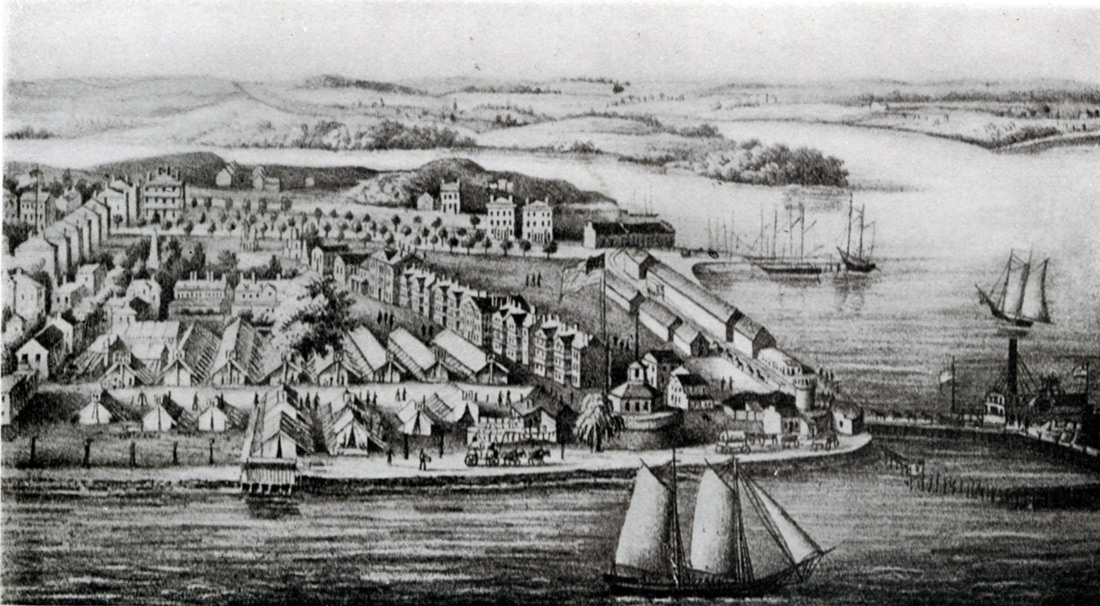
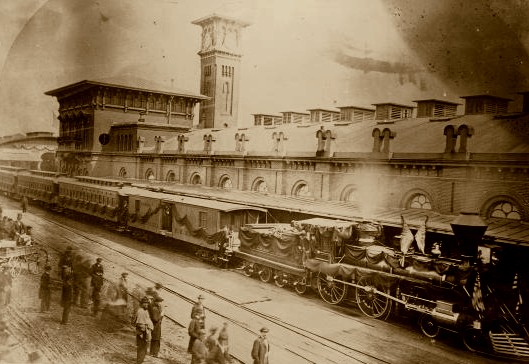
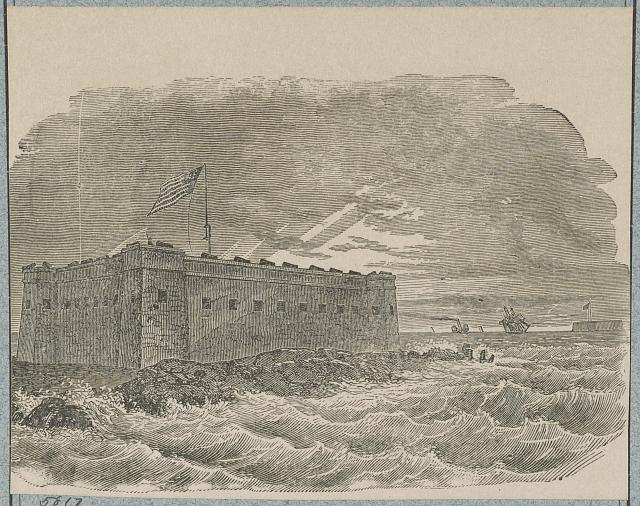
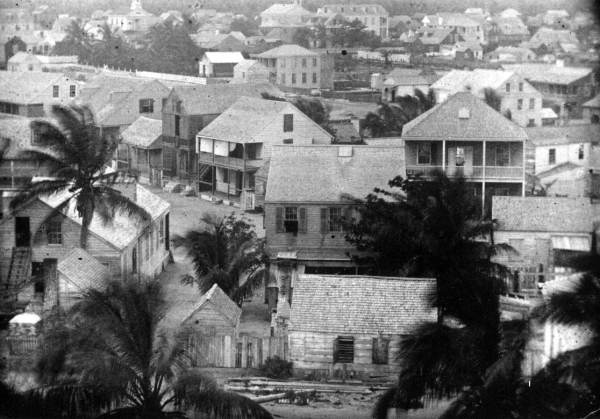
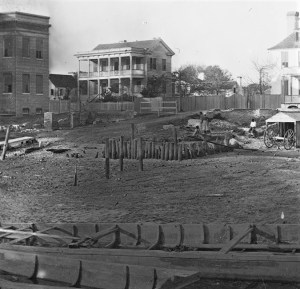
Boat Landing, Beaufort, South Carolina, February 1862 (Timothy O’Sullivan, U.S. Army, U.S. Library of Congress, public domain).

Still stationed far from home during the middle of the second year of the American Civil War, the officers of the 47th Regiment, Pennsylvania Volunteer Infantry marked the first anniversary of their regiment’s mustering in to the Union Army by issuing a series of orders to protect their subordinates and facilitate the continued smooth operation of their organization.

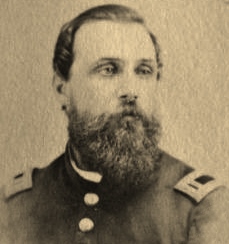
Colonel Tilghman H. Good, concerned about his men’s repeated battles with smallpox, typhoid, and dysentery, announced key procedural changes as follows:

“Beaufort, S.C. Sept 12th, 1862
Regimental Order No. 207

I. The Colonel commanding desires to call the attention of all officers and men in the regiment to the paramount necessity of observing rules for the preservation of health. There is less to be apprehended from battle than disease. The records of all companies in climate like this show many more casualties by the neglect of sanitary post action than by the skill, ordnance and courage of the enemy. Anxious that the men in my command may be preserved in the full enjoyment of health to the service of the Union. And that only those who can leave behind the proud epitaph of having fallen on the field of battle in the defense of their country shall fail to return to their families and relations at the termination of this war.

II. All the tents will be struck at 7:30 a.m. on Monday, Wednesday and Saturday of each week. The signal for this purpose will be given by the drum major by giving three taps on the drum. Every article of clothing and bedding will be taken out and aired; the flooring and bunks will be thoroughly cleaned. By the same signal at 11 a.m. the tents will be re-erected. On the days the tents are not struck the sides will be raised during the day for the purpose of ventilation.

III. The proper cooking of provisions is a matter of great importance more especially in this climate but have not yet received from most of the offices of the regiment that attention that should be paid to it.

IV. Thereafter an officer of each company will be detailed by the commander of each company and have their names reported to these headquarters to superintend the cooking of provisions taking care that all food prepared for the soldiers is sufficiently cooked and that the meats are all boiled or seared (not fried). He will also have charge of the dress table and he is held responsible for the cleanliness of the kitchen cooking utensils and the preparation of the meals at the time appointed.

V. The following rules for the taking of meals and regulations in regard to the conducting of the company will be strictly followed. Every soldier will turn his plate, cup, knife and fork into the Quarter Master Sgt who will designate a permanent place or spot for each member of the company and there leave his plate & cup, knife and fork placed at each meal with the soldier’s rations on it. Nor will any soldier be permitted to go to the company kitchen and take away food therefrom.

VI. Until further orders the following times for taking meals will be followed. Breakfast at six, dinner at twelve, supper at six. The drum major will beat a designated call fifteen minutes before the specified time which will be the signal to prepare the tables, and at the time specified for the taking of meals he will beat the dinner call. The soldier will be permitted to take his spot at the table before the last call.

VII. Commanders of companies will see that this order is entered in their company order book and that it is read forth with each day on the company parade. All commanding officers of companies will regulate daily their time by the time of this headquarters. They will send their 1st Sergeants to this headquarters daily at 8 a.m. for this purpose.

Great punctuality is enjoined in conforming to the stated hours prescribed by the roll calls, parades, drills, and taking of meals; review of army regulations while attending all roll calls to be suspended by a commissioned officer of the companies, and a Captain to report the alternate to the Colonel or the commanding officer.

At 5 a.m., Commanders of companies are imperatively instructed to have the company quarters washed and policed and secured immediately after breakfast.

At 6 a.m., morning reports of companies requested by the Captains and 1st Sergeants and all applications for special privileges of soldiers must be handed to the Adjutant before 8 a.m. 

By Command of  Col. T. H. Good
W. H. R. Hangen, Adj.’”

Good’s order also delineated the regiment’s daily schedule:

  • Reveille (5:30 a.m.) and Breakfast (6:00 a.m.)
  • First Call for Guard (6:10 a.m.) and Second Call for Guard (6:15 a.m.)
  • Surgeon’s call (6:30 a.m.)
  • First Call for Company Drill (6:45 a.m.) and Second Call for Company Drill (7:00 a.m.)
  • Recall from Company Drill (8:00 a.m.)
  • First Call for Squad Drill (9:00 a.m.) and Second Call for Squad Drill (9:15 a.m.)
  • Recall from Squad Drill (10:30 a.m.)
  • Dinner (12:00 p.m.)
  • Call for Non-commissioned Officers (1:30 p.m.) and Recall 2:30 p.m.
  • First Call for Squad Drill (3:15 p.m.) and Second Call for Squad Drill (3:30 p.m.)
  • Recall from Squad Drill (4:30 p.m.)
  • First Call for Dress Parade (5:10 p.m.) and Second Call for dress parade (5:15 p.m.)
  • Supper (6:10 p.m.)
  • Tattoo (9:00 p.m.) and Taps (9:15 p.m.)

General Order No. 130 directed officers to reduce the amount of baggage they carried with them, allowing each officer only a single carpet bag or valise and a single mess chest. Moving forward, none of their boxes or trunks would be taken aboard baggage trains. In addition, privates would be prohibited from loading boxes onto regimental wagons, as well as from carrying carry carpet bags—while sutlers were banned from using regimental wagons to move their wares from place to place.
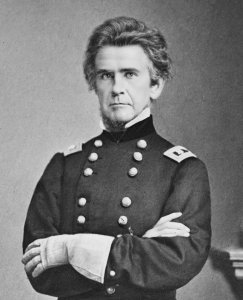
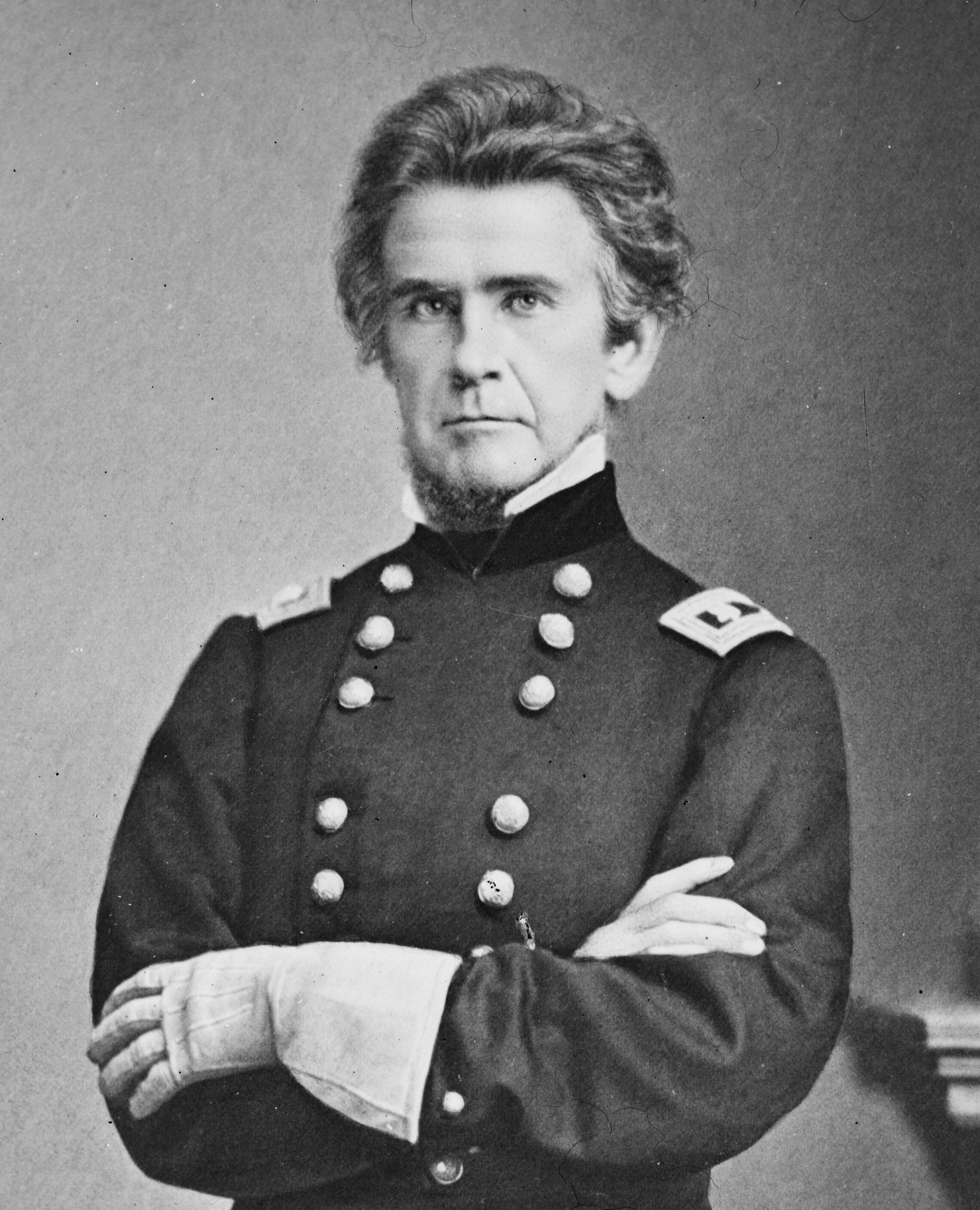
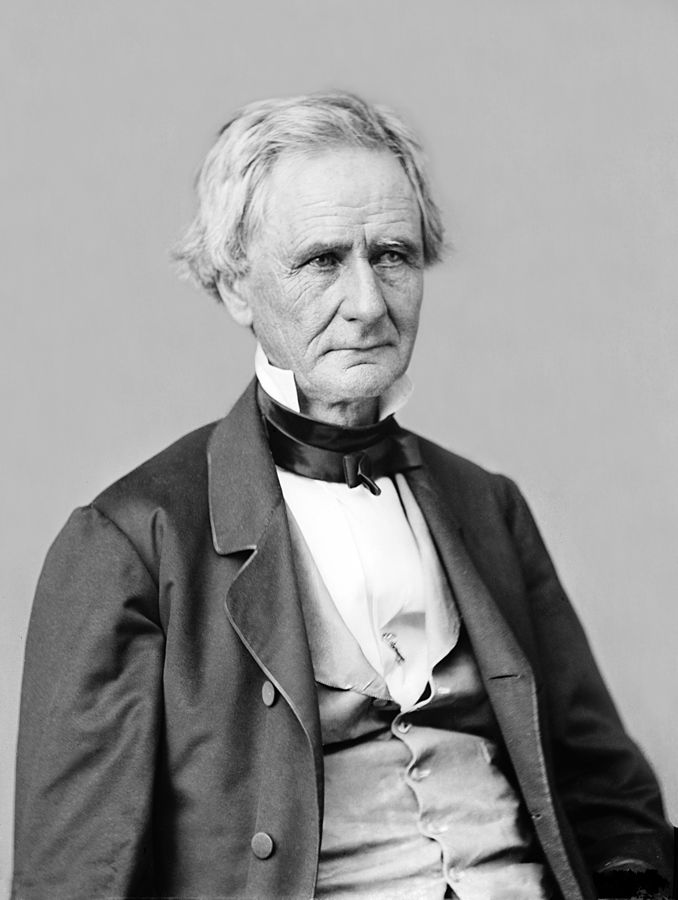
Major-General Ormsby M. Mitchel, Commanding Officer, U.S. Department of the South, circa 1862 (public domain).

The next week, the 47th Pennsylvania Volunteers entered into what would become an eventful service period. It began on Monday, September 15 when General Ormsby S. Mitchel arrived at Hilton Head, South Carolina and assumed command of the U.S. Army’s Department of the South. Mitchel then traveled to Beaufort the next day, according to 47th Pennsylvania musician Henry D. Wharton, where he demonstrated “his eagerness to command” as he reviewed all of the troops which made up the brigade serving under Brigadier-General John Milton Brannan.

“In the afternoon at 3 o’clock, the 47th and 55th Pennsylvania Volunteers, 4th New Hampshire, 8th Maine, 1st Massachusetts Cavalry, 1st Connecticut Battery, and the 1st US Artillery were on the drill ground, ready for the reception of their new officer. The 6th Connecticut was not on review, they being on picket. After review, the regiments marched to their different camps, formed in mass, ready to receive the General on his visit to their camps. Ours was the first at which he stopped. He rode in front of the regiment and said:

‘Soldiers, I am with you for the first time. I want you to hear my voice, that you may know it, on the battlefield and at night when you are on guard, so that when you do hear it you may know your General. Where I have been in command every soldier knows me by my voice, even at night, no matter what post I might cross. Discipline is the great requisite of the soldier. Every soldier should be fit to be a non-commissioned officer, none should be satisfied with his grades. A soldier who does nothing for promotion is not fit for a soldier, and a commissioned officer, who is satisfied with his position, will never make a good officer.’

‘Men of the 47th, of the Old Keystone, I trust you. It is impossible for a General, commanding, to know all in his command, nor the men him, but having confidence in you, I know you will act in such a manner that will reflect credit on the glorious state from which you hail. To gain a victory is your aim. There are two kinds of victories: one to meet the enemy and fall in death’s track, and the other to see the backs of the foe, as they try to escape the vengeance of those who are fighting for the most glorious cause and country a soldier can lay down his life for. It is not to be supposed you are to remain inactive. It is not quite time for an advance, but rest assured, you may soon hear the command, ‘Onward!’”

“The boys were very much pleased,” added Wharton, and as Mitchel and Gen. Brannan departed, they “gave such cheers, and a tiger, as Pennsylvanians always give to those in whom they place confidence.”

On Saturday, September 20, the 47th Pennsylvania Volunteers officially celebrated the one-year anniversary of their service by listening to a reading of Special Order No. 60, which had been issued at Beaufort by their regiment’s founder:

“The Colonel commanding takes great pleasure in complimenting the officers and men of the regiment on the favorable auspices of today.

Just one year ago today, the organization of the regiment was completed to enter the service of our beloved country, to uphold the same flag under which our forefathers fought, bled, and died, and perpetuate the same free institutions which they handed down to us unimpaired.

It is becoming therefore for us to rejoice on this first anniversary of our regimental history and to show forth devout gratitude to God for this special guardianship over us.

Whilst many other regiments who swelled the ranks of the Union Army even at a later date than the 47th have since been greatly reduced by sickness or almost cut to pieces on the field of battle, we as yet have an entire regiment and have lost but comparatively few out of our ranks.

Certain it is we have never evaded or shrunk from duty or danger, on the contrary, we have been ever anxious and ready to occupy any fort, or assume any position assigned to us in the great battle for the constitution and the Union.

We have braved the danger of land and sea, climate and disease, for our glorious cause, and it is with no ordinary degree of pleasure that the Colonel compliments the officers of the regiment for the faithfulness at their respective posts of duty and their uniform and gentlemanly manner towards one another.

Whilst in numerous other regiments there has been more or less jammings and quarelling [sic] among the officers who thus have brought reproach upon themselves and their regiments, we have had none of this, and everything has moved along smoothly and harmoniously. We also compliment the men in the ranks for their soldierly bearing, efficiency in drill and tidy and cleanly appearance, and if at any time it has seemed to be harsh and rigid in discipline, let the men ponder for a moment and they will see for themselves that it has been for their own good.

To the enforcement of law and order and discipline it is due our fame as a regiment and the reputation we have won throughout the land.

With you he has shared the same trials and encountered the same dangers. We have mutually suffered from the same cold in Virginia and burned by the same southern sun in Florida and South Carolina, and he assures the officers and men of the regiment that as long as the present war continues, and the service of the regiment is required, so long he stands by them through storm and sunshine, sharing the same danger and awaiting the same glory.”

Two days later, the 47th Pennsylvania’s Assistant Surgeon Jacob H. Scheetz, MD was placed in charge of the Union’s General Hospital in Beaufort. (The commander of the 47th Pennsylvania’s medical unit since March 17, 1862 when Regimental Surgeon Baily was assigned to detached duty, Scheetz would continue to direct operations at the Beaufort facility until the 47th Pennsylvania returned to Key West in December 1862.)

Saint John’s Bluff Expedition

USS Boston (pre-Civil War, public domain).

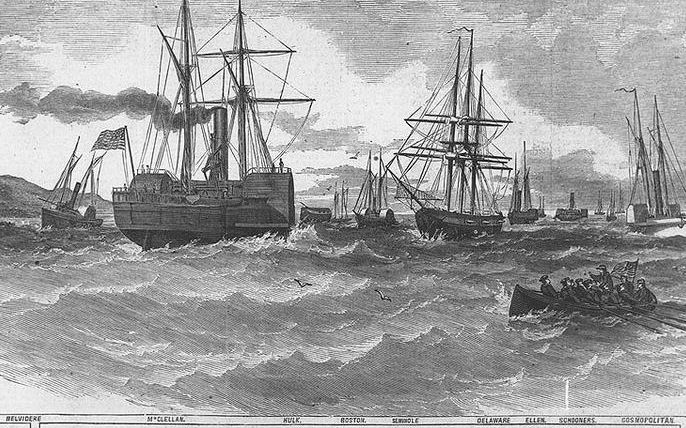
Then, as September drew to a close, the brisk winds of change began to truly stir when the 47th Pennsylvania Volunteers and other regiments under Brigadier-General Brannan’s command were ordered to pull together two days’ worth of ammunition and food for a return trip to Florida. Boarding the USS Boston, a 225-foot, 630-ton side wheeler, during the morning of Tuesday, September 30, the 47th Pennsylvanians sailed away around noon, followed by the 7th Connecticut at 2:30 p.m. that afternoon on the Ben DeFord, and sixty members of the 1st Massachusetts Cavalry plus two cannons and their operators from the 1st Connecticut Light Artillery, who sailed via the Cosmopolitan. Also joining the expedition was a smaller steamship, the Neptune, which transported surfboats.

Stopping briefly that afternoon at Hilton Head to pick up Brigadier-General Brannan and his staff (who made the Ben DeFord their headquarters for the expedition), the troops were addressed by Major-General Mitchel, urging them to capture as many of the enemy as possible while also destroying or seizing their artillery. “Exceptional glory” was not to be obtained “should the expedition succeed,” he said, but they would be “disgraced” if they failed.
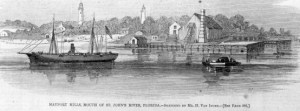
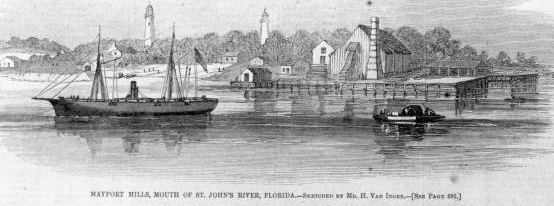
Union Navy’s base of operations, Mayport Mills, circa 1862 (public domain).

The fleet of ships sailed out of Port Royal Bay at 4 p.m. and, after what was described by several of the soldiers involved as “a pleasant voyage” of roughly 140 miles, they reached the mouth of Florida’s St. John’s River at 7 a.m. on October 1. Steaming on to a point opposite Mayport Mills, they were forced to wait for the Darlington, a smaller steamer that had been captured previously from Confederates, to arrive and transport them to shore.

Brannan used the hour to review his troop strength and strategize with Captain Charles E. Steedman. The 1,573 men they commanded were slated to attack a reportedly impregnable Confederate fort atop a nearby bluff (Fort Rickets or Fort Finegan, according to members of the 47th Pennsylvania), which towered 80 feet above the river. That force included the following:

  • 47th Pennsylvania (825 men, commanded by Colonel Tilghman H. Good);
  • 7th Connecticut (647 men, commanded by Colonel Joseph R. Hawley);
  • 1st Connecticut Light Battery (41 men and two cannons from the battery’s left section, commanded by Lieutenant Cannon);
  • Hamilton’s Battery (two sections); and
  • 1st Massachusetts cavalry (one company of 60 men, commanded by Captain Case).

Waiting for them would be roughly 1,200 Confederate infantry and cavalry—plus artillery.

From Water to Land

Ready to move the troops from steamer to shore by noon on Wednesday, October 1, the Union’s transport ships crossed the St. John’s Bar and entered the river around 2 p.m. The Cimarron, Water Witch, and Uncas were sent upstream toward Sister’s Creek in order to draw enemy fire and shell the fort. Successful in distracting the enemy, those gunboats kept up their efforts for roughly an hour as the Union transports unloaded their passengers downstream.

* Note: Per historian Lewis Schmidt, Mayport Mills was “a small timber village located about two miles up the St. John’s River and four miles as the crow flies east of the fort at the approximate location of present day Mayport which is located along the south bank of the river.”

According to historian Herbert W. Beecher:

“There were two or three large sawmills supplied with gang saws, which gave evidence of cutting a large amount of lumber … a store close by  the bank … a Catholic Church and two light houses, one of them a very beautiful and costly structure, nearly new; apparently never having been used … several small cottages, containing three or four rooms, were built on the sand and had most probably been occupied by  the lumbermen; they appeared as though they had been standing empty six or seven months. The wind had drifted the white sand about them until some of the drifts were 25 feet high and so compactly made that it was possible for the comrades to walk up the sand drifts and on the roofs of the houses and look down the chimneys … one of the comrades … lighted a pine torch and commenced setting the houses on fire. He was surprised when ordered to stop the deprivation … and was arrested, reported a member of the Connecticut Battery. Mr. Parson, owner of the Mayport Lumber Mills, and one of his negroes was made a prisoner on Thursday morning, but Parson was so thoroughly a Rebel, that no threats could induce him to give information.”

The troop and equipment unloading plan appears to have been somewhat problematic, according to historian Herbert W. Beecher:

“In unloading, the horses were thrown overboard and mostly made for a sand bank about a quarter of a mile from the steamer, but in one or two cases they put out to sea and had to be chased by the boat’s crew in a small boat. In this way one horse was drowned, and Gen. Brannan’s horse had its leg broken and had to be killed…. It was late that night before the Cosmopolitan was unloaded and the companies had to remain on the bank among the sand hills all night….

The scouts reported that the infantry could land at place known as Buckhorn Creek, between Pablo and Mount Pleasant Creeks… A portion of the troops were taken under protection of the gunboats, to Buckhorn Creek on the mainland … and landed at 2 o’clock on the morning of the 2nd … between Pablo and Mount Pleasant Creeks … and if possible they were to capture the enemy….

The 47th Pennsylvania Volunteers, under Col. Good, immediately threw out skirmishers, and the advance commenced, but had proceeded hardly a mile when they came suddenly upon an unfordable creek, and were compelled to return to Mayport Mills, when it was decided to re-embark the troops on the flats.”

Military reports of the 47th Pennsylvania’s landing described a more efficient process, however; Colonel Good, the 47th’s commanding officer, stated that “at 9 PM Lt. Cannon reported to me that his command, consisting of one section of the 1st Connecticut Battery, was then coming up the creek on flat boats with a view of landing.”

“During the night … at 4 a.m. a safe landing was effected … the artillery was brought up in surf boats and landed at the point where we lay…. The order to move to St. John’s Bluff reached me at 4 p.m. yesterday…. The night passed pretty peacefully and we all excitedly awaited to see what would happen when the time came for the main engagement…. A few rebels came into our camp and insisted on going along with us, and also a few cattle we took along, which we slaughtered and divided among the companies.”

H Company First Lieutenant William Wallace Geety described “standing picket that night until 12 when I laid down and slept soundly. We were reinforced that night by cavalry and artillery.”
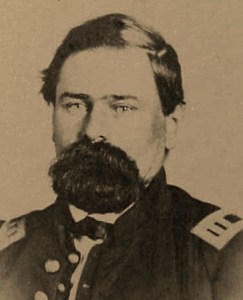
Captain Henry Durant (“H.D.”) Woodruff, commanding officer of Company D, 47th Pennsylvania Volunteers (public domain).

Captain Henry Durant Woodruff, the commanding officer of the 47th Pennsylvania’s D Company, recalled that:

“Between this point of land and the fort was an extensive swamp and lagoon, which we could not cross, and to reach the fort from this point we would have to march around forty miles. This we concluded not to do. We waited til night, re-embarked, unloaded our surf boats.”

* NOTE: According to Schmidt, the landing was effected where the Buckhorn Creek “intersects the Intercoastal Waterway and Pablo Creek at Chicopit Bay, about two miles upriver from Mayport…. The attempted approach was made through marsh and swamp and when the troops reached Greenfield Creek, the route became totally impassable and they were unable to reach a point where the fort could be approached from the rear or southern side.”

Also, per Woodruff:

“The ground was altogether too swampy for either cavalry or artillery to land at that point; the artillery was ordered to reload on a light draught steamer and flatboats and proceed up a winding creek to a point in the marsh where it was more practicable to land. The gunboats were called into requisition to transport the infantry, in their boats, to the land and to send their light howitzers to cover the landing. The entire force of the infantry and marine howitzers proceeded up the river a little distance and landed at the head of Mount Pleasant Creek, where Col. Good established a strong position to cover the landing of the artillery and cavalry….

We found five gunboats in the river. They had attempted the reduction of the fort, but had been repulsed. The only remedy left was for our small force to land and take it by storm; and the only place we could land was under the guns of the fort. Consequently we had recourse to strategy. We landed in full sight of the fort, on a point of land at the mouth of the river, out of reach of their guns….

Landing at our destination about 6 a.m. right in one of those great Florida swamps and marshes, among rattlesnakes, copperheads, centipedes, alligators, and many other poisonous reptiles and insects. We were informed that the natives never dare venture into that swamp, except in mid-winter, and even then they selected the coldest days when no sun was shining. The cook and his assistant selected a spot to make the coffee; it was near a large palmetto jungle. I well remember, when just as the fire was burning nicely, out crawled a huge rattlesnake from the palmetto grove. The heat of the fire had roused him from his lethargic sleep and the aromatic fragrance of the coffee was too much for him. Everyone who saw the reptile had a shot at him with pistols, making him surrender very quickly. He measured nine feet in length and had ten rattles. In his death struggles he emitted an odor, a sort of sickening musk, that scented the entire camp.”

As all of this was taking place, Brigadier-General Brannan was sailing up the river aboard the gunboat Paul Jones with additional troops following on the Cimarron and Patroon. Conducting reconnaissance, they also shelled the woods to the left and right.

“Col. Good and his 47th Pennsylvania Volunteers marched for the bluff,” early Thursday morning according to Schmidt, “with the help of a Black man named Israel, a contraband who served as Good’s guide. They headed for Parker’s Plantation.” The day unfolded as follows, per Good’s report to his superiors:

“HEADQUARTERS U.S. FORCES
Mount Pleasant Landing, Fla. October 2, 1862.

SIR: I have the honor to make the following report for the information of the general commanding:

In accordance with orders received I landed my regiment on the bank of Buckhorn Creek at 7 o’clock yesterday morning. After landing I moved forward in the direction of Parker’s plantation, about 1 mile, being then within about 1¼ miles of said plantation. Here I halted to await the arrival of the Seventh Connecticut Regiment. I advanced two companies of skirmishers toward the house, with instructions to halt in case of meeting any of the enemy and report the fact to me. After they had advanced about three-quarters of a mile they halted and reported some of the enemy ahead. I immediately went forward to the line and saw some 5 or 6 mounted men about 700 or 800 yards ahead. I then ascended a tree, so that I might have a distinct view of the house, and from this elevated position I distinctly saw one company of infantry close to the house, which I supposed to number about 30 or 40 men, and also some 60 or 70 mounted men. After waiting for the arrival of the Seventh Connecticut Volunteers until 10 o’clock, and it not appearing, I dispatched a squad of men back to the landing for a 6-pounderfield howitzer which had been kindly offered to my service my Lieutenant Boutelle, of the Paul Jones. This howitzer had been stationed on a flat-boat to protect our landing. The party, however, did not arrive with the piece until 12 o’clock, in consequence of the difficulty of dragging it through the swamp. Being anxious to have as little delay as possible, I did not await the arrival of the howitzer, but at 11 a.m. moved forward, and as I advanced the enemy fled. After reaching the house I awaited the arrival of the Seventh Connecticut and the howitzer. After they arrived I moved forward to the head of Mount Pleasant Creek to a bridge, at which place I arrived at 2 p.m. Here I found the bridge destroyed, but which I had repaired in a short time. I then crossed it and moved down on the south bank toward Mount Pleasant Landing. After moving about 1 mile down the bank of the creek my skirmishing companies came upon a camp which evidently had been very hastily evacuated, from the fact that the occupants had left a table standing with a sumptuous meal already prepared for eating. On the center of the table was placed a fine, large meat pie still warm, from which one of the party had already served his plate. The skirmishers also saw 3 mounted men leave the place in hot haste. I also found a small quantity of commissary and quartermaster’s stores, with 23 tents, which, for want of transportation, I was obliged to destroy. After moving about a mile farther on I came across another camp, which also indicated the same sudden evacuation. In it I found the following articles, viz: Eighteen Hall’s breech-loading carbines, 12 double-barreled shot-guns, 8 breech-loading Maynard rifles, 11 Enfield rifles, and 96 knapsacks. These articles I brought along by having the men carry them. There were, besides, a small quantity of commissary and quartermaster’s stores, including 16 tents, which, for the same reason as stated, I ordered to be destroyed. I then pushed forward to the landing, where I arrived at 7 p.m.

We drive the enemy’s skirmishers in small parties along the entire march. The march was a difficult one, in consequence of meeting so many swamps almost knee-deep.

I am, sir, your obedient servant,
T. H. GOOD,
Colonel Forty-seventh Regiment, Pennsylvania Volunteers.

Captain LAMBERT,
Assistant Adjutant-General”

* NOTE: Among the initial group of skirmishers from the 47th Pennsylvania was F Company Private George Klein. In a letter (transcribed from its original German by historian Lewis Schmidt), Klein noted that his “company put out skirmishers, and the first platoon which I belonged to, one Lieutenant and 28 men, went toward the first house we saw.”

“Our guide was an intelligent colored man [Israel] and we wanted to catch a secesh. We did get to catch a band of guerillas at the house who were watching to see what the Yankees had on their mind, and they pulled back when they saw us. We took them a piece back and handed them over to the officers, and they were put on the steamer and guarded. Still, there was one white man, three daughters or cousins, and three old [enslaved men] in the house. The ladies were getting excited when we got near the house and they were pretty and wondering what the Yankees were going to do to the devotees of Uncle Jeff. Perhaps the night before they had a nice dream about King Cotton’s future. That was reason enough to cry and weep. But it did not bother us, we grabbed our prey and got back to camp without trouble.”

Good then offered further insight via a follow-up report:

“HEADQUARTERS U.S. FORCES
Saint John’s Bluff, Fla., October 3, 1862.

SIR: For the information of the general commanding I have the honor to make the following report:

At 9 o’clock last night Lieutenant Cannon reported to me that his command, consisting of one section of the First Connecticut Battery, was then coming up the creek on flat-boats with a view of landing. At 4 o’clock this morning a safe landing was effected and the command was ready to move. The order to move to Saint John’s Bluff reached me at 4 p.m. yesterday. In accordance with it I put the column in motion immediately and moved cautiously up the bank of the Saint John’s River, the skirmishing companies occasionally seeing small parties of the enemy’s cavalry retiring in our front as we advanced. When about 2 miles from the bluff the left wing of the skirmishing line came upon another camp of the enemy, which, however, in consequence of the lateness of the hour, I did not take time to examine, it being then already dark.

After my arrival at the bluff, it being then 7:30 o’clock, I dispatched Lieutenant-Colonel Alexander with two companies back to the last-named camp (which I found, from a number of papers left behind, to have been called Camp Hopkins and occupied by the Milton Artillery, of Florida) to reconnoiter and ascertain its condition. Upon his return he reported that from every appearance the skedaddling of the enemy was as sudden as in the other instances already mentioned, leaving their trunks and all the camp equipage behind; also a small quantity of commissary stores, sugar, rice, half barrel of flour, one bag of salt, &c., including 60 tents, which I have brought in this morning. The commissary stores were used by the troops of my command.

I have the honor to be, your obedient servant,

T. H. GOOD,
Colonel Forty-seventh Regiment Pa. Vols., Comdg.

Captain LAMBERT,
Assistant Adjutant-General.”

* NOTE: Private Brecht recalled the expedition (in another letter, which was translated from the original German by Schmidt):

“It was an unusual day for us on the way, always through bush, marsh, swamp and water and a few times we were under water and in much rain. We worked through with sixty bullets per man on the side, and five days rations on the back, but we made it. Col. Good was at the head of the regiment on foot, and was strong and happy, and even the Connecticut Regiment could not keep up with us and were always a good piece behind. Before we reached out camping place we passed two rebel camps which we could see were abandoned in a hurry, one left his hat and one left his saber. Because of the swampy terrain, the horses could not follow us….

The enemy’s camps were utterly destroyed…. The tents, and those things we could not carry, we destroyed…. After destroying the marques [tents], mostly all new and numbering some seven or eight, we pushed on again under the guidance of a negro, who escaped from the fort but four weeks previous…. The country soon became marshy after leaving the last camp, and it was found necessary to build a corduroy road for the howitzer accompanying the land force. This unlooked for circumstance detained our troops some time…. Night came upon us. I then pushed forward to the landing, where I arrived at 7 PM … we moved to the river bank to bivouac for the night under the cover of gunboats … we made camp one mile below the fort … in the bushes for night…. Col. Good was in command all day. The march was a difficult one, in consequence of meeting so many swamps almost knee deep… it rained all day and much of our way was through swamps. I was glad to stop and get hot coffee and dry stockings.’ [Good] ‘sent to the General and asked permission to storm the fort that night. The General refused, as the cavalry and artillery had not been landed. So we bivouacked that night on the shore of the St. John….”

Earthen works surrounding the Confederate battery atop Saint John’s Bluff, Saint John’s River, Florida, 1862 (J. H. Schell, public domain).

While First Lieutenant Geety confirmed that:

“16 pieces of artillery were left ready loaded, primed, with the lanyards hooked to the primers ready to pull.’ He also included with his memorabilia a ‘roster of the rebel troops stationed about St. John’s River, Florida, taken at the camp of the Louisiana Tigers, who with another rebel regiment guarded the rear approaches of the rebel fort. They ran leaving all their camp and garrison equipage and their suppers on the fire which our men ate…. The rebels had 1500 men, six pieces of light artillery besides the nine pieces at the fort and a impregnable position. The rebels were not uniformed and have rice, corn, and fresh meat; coffee and flour only allowed those in the hospital; salt they had little or none of, it being worth $1 per quart; sugar they had plenty of.”

Penning his own recap, Brigadier-General Brannan estimated that the Confederate equipment captured by Union troops was worth more than two hundred thousand dollars and included: two eight-inch columbiads, two eight-inch howitzers, two eight-inch, smooth bore guns, two 4.6-inch rifled cannon, $15,000 worth of shot and shell, multiple small arms, and more than two hundred tents. Brannan later explained that he “left the work of removing the guns from St. John’s Bluff to Col. T.H. Good, 47th Regiment Pennsylvania Volunteers, my second in command.” 

One of the most detailed recaps, however, was apparently penned in Port Royal, South Carolina on Tuesday, October 14, 1862 by 47th Pennsylvanian Henry D. Wharton after Brigadier-General Brannan and his troops had returned from Florida to Hilton Head. Wharton’s report was subsequently distributed via several publications nationwide, including the October 20 edition of The New York Times and Wharton’s hometown newspaper:

“The expedition left Hilton Head on the afternoon of the 30th ultimo, consisting of the Pennsylvania Forty-seventh Regiment, Col. GOOD; the Connecticut Seventh Regiment, Col. HAWLEY; a section of the First Connecticut Battery, under Lieut. CARMON, and a detachment of the First Massachusetts Cavalry under Capt. CASE, making a total effective force of 1,573. The troops were embarked on the steamers Ben Deford, Boston, Cosmopolitan and Neptune, and arrived off the bar of the St. John’s River early on the morning following their departure, but were unable to enter the river until 2 P.M. in consequence of the shallowness of the channel. There the expedition was joined by the gunboats Paul Jones, Capt. STEEDMAN, commanding the fleet; Cameron, Capt. WOODHULL; Water Witch, Lieut.-Com. PENDERGRAST; E. B. Hait, Lieut.-Com. SNELL; Uncas, Lieut.-Com. CRANE, and the Patroon, Lieut.-Com. Urano. The same afternoon three gunboats were sent up to feel the position of the battery on the Bluff, and were immediately and warmly engaged, the enemy apparently having a number of heavy guns in his works.”

Wharton went on, noting that the troops disembarked “at a place known as Mayport Mills, situated a short distance from the entrance of the river,” and added that “all the men, rations and arms were on shore by 9 o’clock on the evening of the 1st.”

“The country between this point and St. John’s Bluff presented great difficulties in the transportation of troops, being intersected with impassable swamps and unfordable creeks, and presenting an alternative of a march of forty miles without land transportation, to turn the head of the creek, or to reland [sic] up the river at a strongly-guarded position of the enemy. On further search, a landing place was found for the infantry at about 2 o’clock on the morning of the 2d, at a place called Buckhorn Creek, between Pable and Mount Pleasant Creeks, but the swampy [nature] of the ground made it impracticable to land the cavalry and artillery at that point. The gunboats here rendered valuable assistance by transporting troops and sending light howitzers in launches to cover the landing.”

According to Wharton, the 47th Pennsylvania’s commanding officer, Col. Good, was ordered to lead “the entire infantry and … howitzers … immediately forward to the head of Mount Pleasant Creek, to secure a position to cover the landing of the cavalry and artillery.”

“The movement was executed skillfully, surprising and putting to flight the rebel pickets on that creek. This rapid movement to Mount Pleasant Creek, and the landing of the troops at Buckhorn Creek, was very fortunate as it seemed to disarrange the enemy’s plan, if he had any, to prevent our disembarkation. Their pickets retired in such haste and trepidation as to leave their camps standing, their arms, and even a great portion of their clothing behind them, and only escaped themselves because of the intricate character of the ground and their superior knowledge of the country.”

The next afternoon (October 3), “the artillery and cavalry were in readiness at the head of Mount Pleasant Creek, two miles from the enemy’s batteries at St. John’s Bluff.” Wharton and more senior military men estimated the number of Confederate cavalrymen and infantrymen who opposed them that day at 1,200 in addition to the artillery batteries, which reportedly contained “nine heavy pieces.” 

“Under these circumstances, Gen. Brannan deemed it expedient, in consultation with Capt. Steedman, to send the Cosmopolitan to Fernandina for reinforcements from the garrison of that place, and three hundred of the Ninth Maine Regiment were sent down on the following morning.”

Later in the day on October 3, according to Wharton, Brannan directed Steedman to send out three gunboats “to feel the position of the enemy, shelling them as they advanced, when the batteries were found to be vacated, and Lieut. Snell, of the Hale, sent a boat on shore and raised the American flag, finding the rebel flag in the battery. The naval force then retained possession, until the arrival of the troops, who immediately advanced…. On approaching the enemy’s position on the Bluff, it was found to be of great strength, possessing a heavy and effective armament, consisting of two eight-inch columbiads, two eight-inch siege howitzers, two eight-inch seacoast howitzers, and two rifled guns, supplied with ammunition in abundance, shot, shell, tools and camp equipage.”

“The works were skillfully and carefully constructed, and the strength of the position was greatly enhanced by the natural ground, it being only approachable on the land side, through a winding ravine immediately under the guns of the position, and, from the narrowness of the river and the elevation of the Bluff, rendering fighting by the gunboats most difficult and dangerous. Most of the guns were mounted on complete traverse circles, and, indeed, taking everything into consideration, there is no doubt that a small party of determined men might have maintained the position for a considerable time against even a larger force than we brought against it.”

But Brannan and Good’s men weren’t quite done, yet, with the Confederates in that region.

Next up? Entering Jacksonville, the capture of a Confederate steamer, and the integration of the 47th Pennsylvania Volunteer Infantry with the enlistment of several formerly enslaved Black men.

Sources:

  1. Beecher, Herbert W. History of the First Light Battery Connecticut Volunteers, 1861-1865, Vol. I. New York, New York: A. T. De La Mare Ptg. and Pub. Co., Ltd., 1901.
  2. “Important From Port Royal; The Expedition to Jacksonville, Destruction of the Rebel Batteries. Capture of a Steamboat. Another Speech from Gen. Mitchel. His Policy and Sentiments on the Negro Question.” New York, New York: The New York Times, October 20, 1862.
  3. Reports of Lieut. Col. Tilghman H. Good, Forty-seventh Pennsylvania Infantry, in Official Records of the Union and Confederate Armies, 1861-1865 (Microfilm M262). Washington, D.C.: U.S. National Archives and Records Administration.
  4. Schmidt, Lewis G. A Civil War History of the 47th Regiment of Pennsylvania Veteran Volunteers. Allentown, Pennsylvania: Self-published, 1986.
  5. Wharton, Henry D. Letters from the Sunbury Guards. Sunbury, Pennsylvania: Sunbury American, 1862.
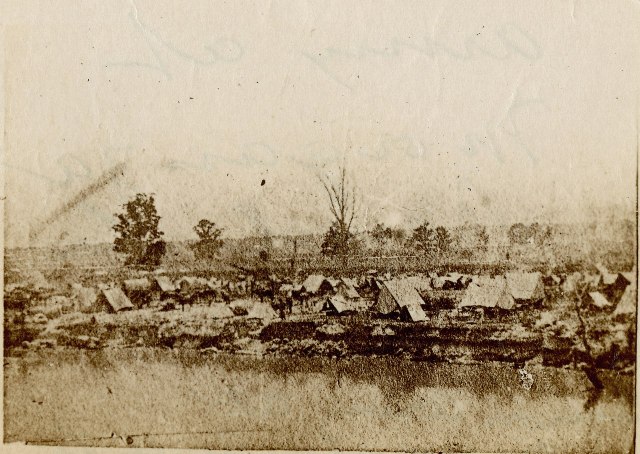

 

St. Charles County Historical Society Donates David H. Smith Papers to 47th Pennsylvania Volunteers: One Civil War Regiment’s Story

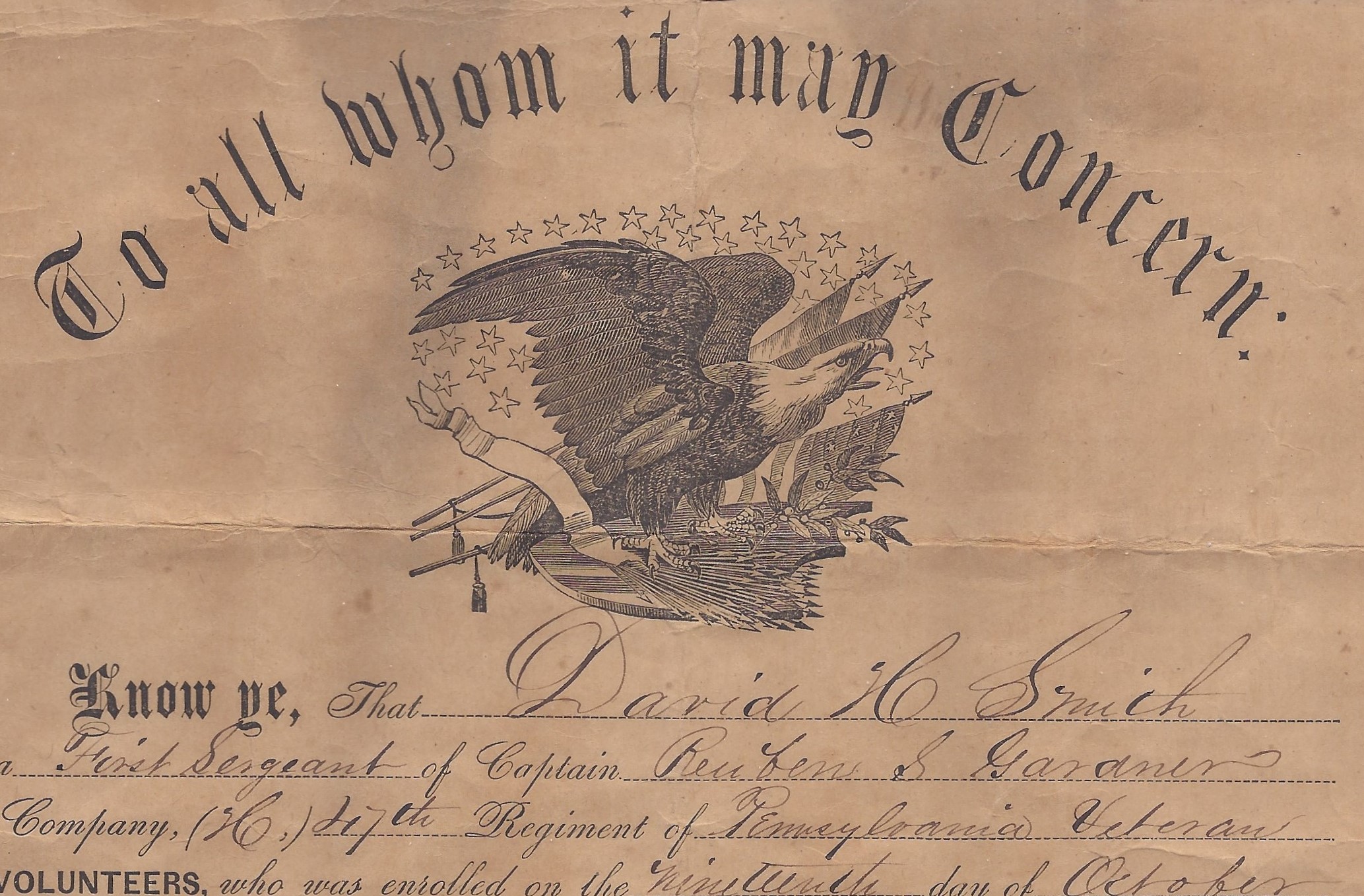
Honorable Discharge (excerpt), First Sergeant David H. Smith, Company H, 47th Pennsylvania Volunteers, December 25, 1865 (public domain).

A challenging year for many Americans due to the COVID-19 pandemic, a faltering economy, and civil strife, 2020 proved to be a remarkably constructive one on many fronts for a humanities project dedicated to preserving and educating children and adults about the 47th Pennsylvania Volunteer Infantry—a Union Army unit which made history during the American Civil War as the only regiment from Pennsylvania to participate in the 1864 Red River Campaign across Louisiana, and which also was involved in guarding Mary Surratt and the other key conspirators involved in Lincoln’s assassination in 1865.

One of the most important developments in 2020 was the donation by the St. Charles County Historical Society in St. Charles, Missouri of its David H. Smith Papers collection to 47th Pennsylvania Volunteers: One Civil War Regiment’s Story.

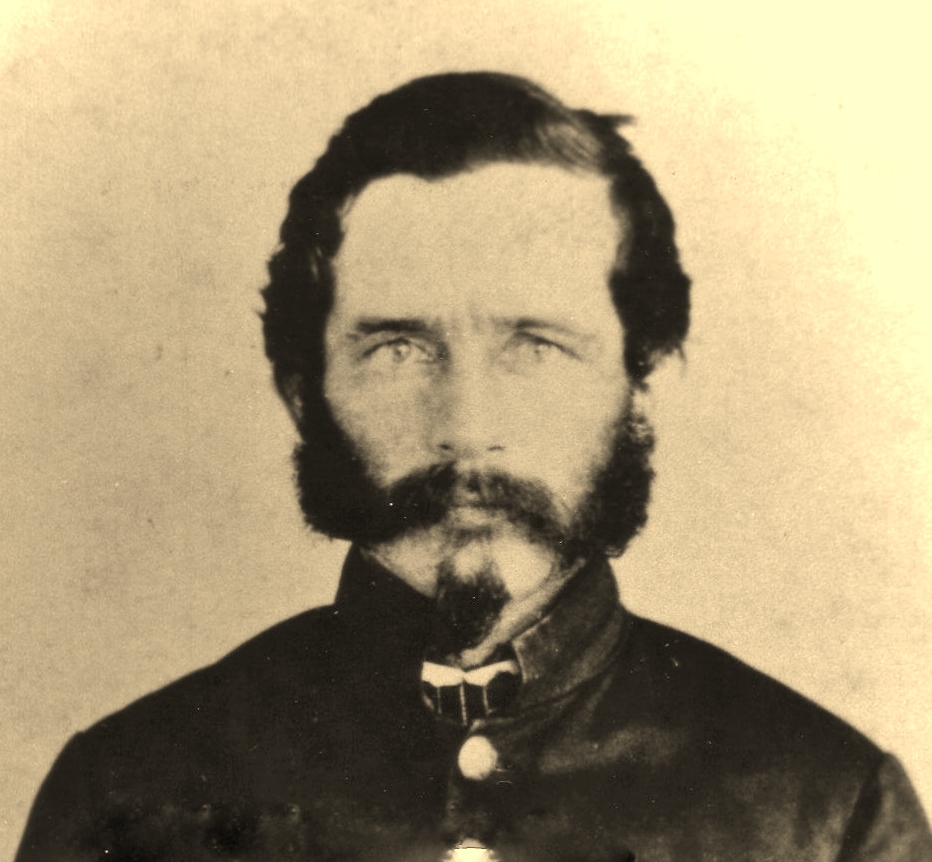
David H. Smith was one of the 47th Pennsylvania Volunteers who served for the duration of the war. Following his enrollment at Harrisburg, Pennsylvania on August 22, 1861, Smith mustered in at Camp Curtin in Harrisburg on September 19 of that year as a private with Company H. Described as a nineteen-year-old farmer with light hair, blue eyes, and a light complexion who was five feet, nine inches tall, he was promoted to the rank of corporal on October 21, 1862—the day before the regiment was bloodied badly in the Battle of Pocotaligo, South Carolina. He then re-enlisted with the 47th Pennsylvania Volunteers in mid-October of 1863 at Fort Jefferson in the Dry Tortugas, Florida, where half of the regiment was stationed at the time, and was subsequently promoted to the rank of Sergeant on September 18, 1864—one day before the Battle of Opequan, Virginia, and promoted again to First Sergeant on April 21, 1865—exactly one week after Lincoln’s assassination. Smith then continued to serve until the regiment was honorably mustered out at Charleston, South Carolina on Christmas Day of that same year.

According to Adam Pesek, a collections volunteer with the St. Charles County Historical Society who reached out to Laurie Snyder, the managing editor of the 47th Pennsylvania Volunteers’ project, society personnel made the helpful overture because they had made a decision to downsize the society’s collection, and were seeking to redistribute a range of items to other organizations whose ties to those items were stronger.

Society archivist Amy G. Haake explained that she and her colleagues had made the decision to donate Smith’s papers when they realized “that Smith had no connections to St. Charles County, whether through marriage or otherwise,” and wanted to find a group which would ensure that the historic documents would be preserved and made publicly available for study by other historians and history students. Among the original documents are certificates related to promotions received by Smith during his tenure with the 47th Pennsylvania, as well as his reenlistment and honorable discharge paperwork.

“My plan is to digitize Sergeant Smith’s papers in 2021, research and write a biographical sketch of his life, and then make each of Smith’s documents and his biography publicly available online via our project’s website and Facebook page. I will then also donate Smith’s papers to a museum or historical society in Pennsylvania,” said Snyder. “These precious papers not only document Smith’s service to the nation; they provide tangible links to a defining time in our nation’s history—reminding us all of the sacrifices made by the heroes who left hearth and home to fight for the Union of a country they loved more than life.”

*******************************************************

47th Pennsylvania Volunteers: One Civil War Regiment’s Story is an educational initiative dedicated to documenting and raising public awareness about the history-making role played by the 47th Pennsylvania Volunteer Infantry during the American Civil War, as well as the contributions made by its members, post-war, to America’s growth and the advancement of its democratic ideals. Integrated in October of 1862 (prior to President Abraham Lincoln’s official release of the Emancipation Proclamation), this regiment went on to become the only regiment from Pennsylvania to participate in the Union’s 1864 Red River Campaign across Louisiana and the only regiment from Pennsylvania to have men held captive as prisoners of war at Camp Ford—the largest Confederate prison west of the Mississippi River, and was also involved in guarding Mary Surratt and the other key conspirators in Lincoln’s assassination in 1865 during the early days of their imprisonment.

Founded in 1956, the St. Charles County Historical Society (SCCHS) is a nonprofit organization which was initially established to preserve the history of St. Charles County, Missouri. In 2009, it merged with the St. Charles Genealogical Society in order to expand upon its mission “to foster an understanding and appreciation of all aspects of Saint Charles County history” to ensure that genealogical records of county residents are also preserved.


January-Early February 1862: New Year, New Civil War Mission — A Pennsylvania Regiment Heads for Florida

Unknown regiment, Camp Griffin, Virginia, Fall 1861 (public domain, U.S. Library of Congress).

“He was the light and life of our company, and his death has caused a blight and sadness to prevail, that only the rude wheels of time can efface….” — Captain John Peter Shindel Gobin to the parents of drummer boy John Boulton Young, mid-October, 1861

“I passed the night in ‘watching,’ but somewhat differently from the watch meetings at home. I spent from 8 to 12 at night on the outposts, and we were in expectation of an attack all the time…. At 12, I was relieved and moved with my men back to the main reserve where we built a huge fire, and six to eight officers of us gathered around the fire and spent the time in telling yarns, cracking jokes.” — Captain John Peter Shindel Gobin to his own parents in a letter penned on New Year’s Day, 1862

“Will write again if I am spared to do so.” — G Company Sergeant John Gross Helfrich to his parents in a letter penned on January 12, 1862


As America’s Civil War dragged on, the contemplation of life’s biggest questions became an increasing preoccupation for more than a few members of the 47th Regiment, Pennsylvania Volunteer Infantry. Initially elated by their August 1861 enrollment for service in the fight to preserve their nation’s Union, many were propelled heart and headlong into a valley of grief just weeks later by the untimely deaths of John Boulton Young and Alfred Eisenbraun, two of the regiment’s beloved drummer boys.

Their equilibrium was gradually restored by their work as Union Army soldiers, however, and their spirits were raised further by the approaching Christmas season—largely thanks to surprise shipments by families and friends of “care packages” stuffed with favored foods and other items of comfort. Naturally, though, many members of the regiment began ruminating again as the New Year’s Eve of 1861 gave way to the New Year’s Day of 1862—as shown by this January 1, 1862 letter written to family by C Company Captain John Peter Shindel Gobin:

“I went on picket yesterday morning, and was relieved this morning. So the entire programme [sic] of the departure of the old and advent of the New Year was open to me. I passed the night in ‘watching,’ but somewhat differently from the watch meetings at home. I spent from 8 to 12 at night on the outposts, and we were in expectation of an attack all the time. This kept me constantly in the line, among the men preparing for an attack. At 12, I was relieved and moved with my men back to the main reserve where we built a huge fire, and six to eight officers of us gathered around the fire and spent the time in telling yarns, cracking jokes. Officers from the 7th Maine, 49th & 53d New York were present. Occasionally a shot or two would bring us all to our feet, but as all would be quiet again down we would go into the fire again. About four oclock [sic] this morning, I spread my blanket on the ground, and with a stone for a pillow, slept peaceably my first sleep for 1862. I got to Camp about 9 a.m. and found your letters awaiting me.

…. I would like to have been at home on Christmas, and had set my heart upon going, but somehow or other Col Good and Gen Brannen [sic] both do not want me to leave at present. The fact is we are daily expecting an engagement and they seem to think my company will not do as well as they expect it to unless I am there. I have the crack company in the Regiment. Yesterday was muster day and Sam Miller received the premium for having the cleanest arms in the Regiment….

…. I will make a desperate effort to spend my birthday at home. Mother if I get there I want you to cook a dish of schnitz und knep [sic]. I have been wishing for them all day. Yesterday I went into a house on the line and bought a mince pie and cup of coffee of a girl there. They were first rate, but Mother could beat them.”

* Note: Schnitz und knepp, which translates from the Pennsylvania German to English as “apples and buttons,” was a traditional fall recipe for Pennsylvania Dutch families during the 1800s, and remains so today. Made in a large kettle with dried apples, ham, and dumplings, and flavored with brown sugar and other seasonings, its aroma, taste, and warmth have long come together to create the very definition of “comfort food” on the chilly fall days of the Great Keystone State.

“I had not intended mentioning the following but for fear some of the boys may and an incorrect story gets out, I will tell you the other night while on picket, Mark Shipman fired upon one man crawling up to him, or he supposed he was. Sergeant Piers [sic] and I went out to the line to see the cause of the report, and someone attempted to shoot at us, but his cap snapped. The fellow made tracks in a hurry before we could catch him, but I think he got badly frightened anyhow. You do not say anything about this and do not be alarmed as he could not hit us. It was too dark. And if he had fired, or his gun gone off, we could have shot him, by the flash. We have not lost a man on picket in our entire division.

…. The wind is blowing a perfect hurricane around the house. I have my house papered all over now, and I tell you it is the best this side of Gen Smiths head quarters [sic]. Jake Keaffer [sic] just came in. He was on picket with me last night and tried for about two hours to catch some guinea hens for a New Year dinner. They were too wild for him and so he filled his haversack with potatoes out of a hole he found. He wont [sic] starve in this country. Remember me to all friends and all write soon.

Then, barely a week into the New Year, the regiment’s most persistent and dangerous foe to date resumed its assault, claiming H Company Private Jacob S. R. Gardner as one of the first of what would be a stunning number of casualties for the 47th Pennsylvania in 1862. Unable to withstand the “one-two punch” he absorbed from contracting measles after having just survived a battle with Variola (smallpox), the former Perry County laborer died on January 8. His brothers, Sergeant Reuben Shatto Gardner and Corporal John A. Gardner, who had both been serving side-by-side with him in H Company, saw to the shipping arrangements which sent Jacob’s body back home for interment at the Newport Cemetery in Newport, Pennsylvania, but they did not accompany the transport. Instead, they tamped down their grief and returned to duty—a difficult act that would continue to be repeated by numerous other heartbroken brothers for years to come across a bitterly divided United States.

Meanwhile, at dawn on the same day of Private Gardner’s passing, the bulk of the 47th Pennsylvania Volunteer Infantry had just begun to carry out the latest directive from superior officers. Marching from Camp Griffin toward the Army of the Potomac’s central commandthe headquarters of Brigadier-General William F. (“Baldy”) Smith, the 47th Pennsylvanians met up with six additional Union infantry regiments, one cavalry regiment, and a ten-piece artillery unit. Moving on as part of this larger force, they continued on to Lewinsville, where they picked up the support of an additional 233 Union wagons.

Heading out again, they trekked on for eight miles until reaching Peacock Hill, where they chased off a significantly smaller group of Confederate States Army troops from picket duty, and then proceeded to remove 200 bushels of corn and 30 loads of hay.

Sergeant-Major William M. Hendricks, central regimental command, 47th Pennsylvania Volunteers (c. 1863, public domain).

In his subsequent recap of the event, Sergeant-Major William M. Hendricks noted, “We just marched up to a corn crib, and off went the roof, and the wagons were backed up and filled.” The 47th Pennsylvanians were back in camp that same day by 4 p.m.

According to Gobin in his own letter home, which was penned on the same day of the expedition:

“Yesterday our division of about ten thousand men went out to Hunters Mill, and got 252 wagon loads of forage. We drove in the Rebel pickets and waited a long time for them to come at us, but they did not show themselves. The march was a hard one. I was very tired, but one nights [sic] sleep, and all as sound as ever.”

On Friday, January 10, the 47th Pennsylvania Volunteers were informed that they had performed their duties so admirably up to this point that they had been chosen by Union Brigadier-General John Milton Brannan to join a new expedition under his leadership. Shortly thereafter, the members of the 47th Pennsylvania Volunteer Infantry began packing up their regiment’s tents, Springfield rifles, ammunition, cooking utensils, and other equipment critical to any Union Army unit on the move.

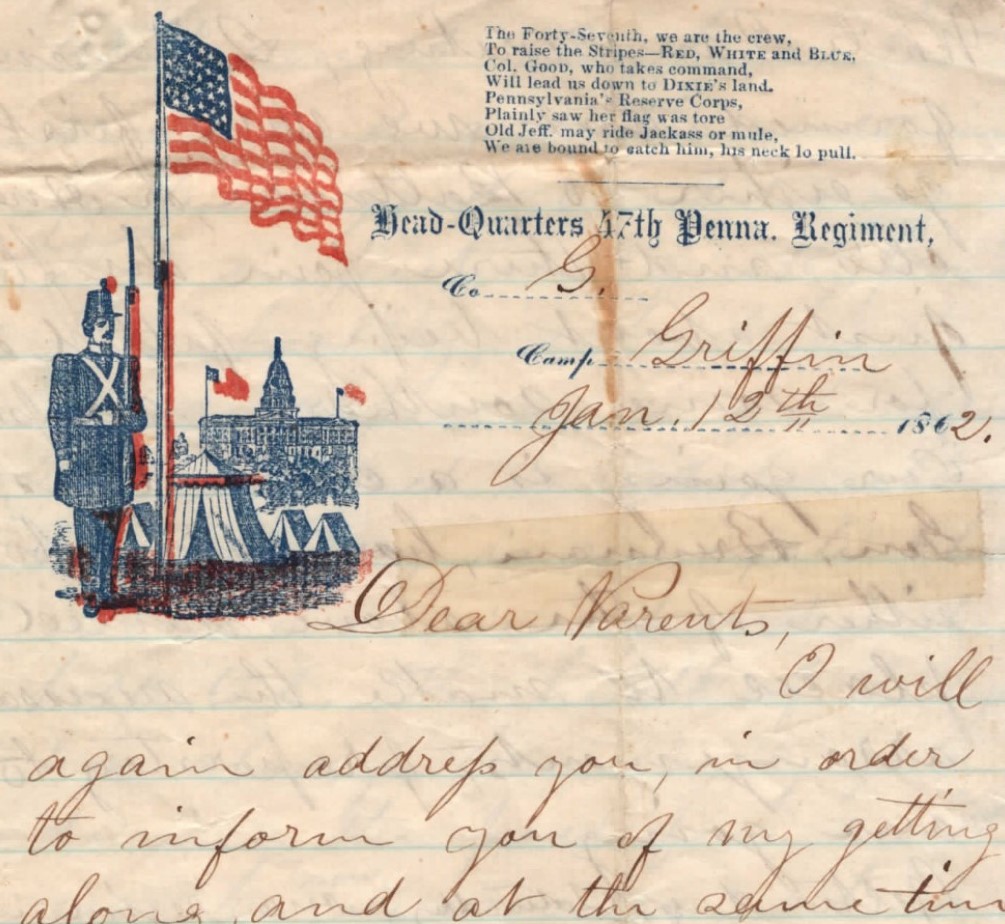
Excerpt of letter from Sergeant John Helfrich, 47th Pennsylvania Volunteers, January 12, 1862 (used with permission from Colin Colfield).

In the midst of all of this, G Company Sergeant John Helfrich carved time out to pen the following letter:

“Camp Griffin,
Jan. 12th 1862

Dear Parents,

I will again address you, in order to inform you of my getting along, and at the same time I will remark that this will to all probability be the last letter that I may be able to write, while at this place, as we have orders to leave at almost any moment. The place of our destination I can not [sic] name for certain, however, it is rumored that we would go to Florida.

While I am writing, I am informed that we will first go either to Baltimore or Anapolis [sic], and there join the fleet just about being fitted out for some southern seaport. Our going is a certainty, as Gen. Brannan, has gone to either of the above named places to make the necessary arrangements, preparatory to our going.

Yesterday, (Saturday) our regiment was paid for the preceeding [sic] two month service. The monthly wages of a sergeant is seventeen and those of a private thirteen, dollars.

Our company has first passed through the usual Sunday morning inspection, when each man is [to] have a suit of clean clothes in his knapsack, and must also have his arms, and accoutrements, in perfect good condition. This inspection, greatly promotes the healthy, as well as the good appearances of the soldier, and in fact is indispensable.

Our company is in excellent health not a man is at present in the hospital. The health of the regt. has always been pretty good during the first four month [sic] we are now in service, which is verified by the fact that there occurred but seven cases that proved fatal, out of our nine hundred men, and we can not [sic] find language to express our thanks to the Great giver of this our greatest and blessing, that a mortal being can enjoy, and it is our prayer that He may continue to bless us in the future.

I would very much like to see my friends and relations first before we go, but time, and circumstances, will not permit me to do so. I hope however that the time may soon be at hand, when peace may again be restored to our former blessed land, and when those who are now separated from their Parents and friends, fighting for their country, cause and honor, may again be permitted to return home, and enter the circle of their Parents, families, and friends, left and home in peace and prosperity.

Enclosed find ten dollars of my wages. I would send you more, but perhaps I may need it myself, from this until next payday. I must now close by saying that I am well, hoping that you and all the rest of the family are enjoying the same. Remember me kindly to all my friends at home and abroad.

A friendly goodby [sic] to you all.

Your son,

John G. Helfrich

Will write again soon if I am spared to do so.

J. G. Helfrich”

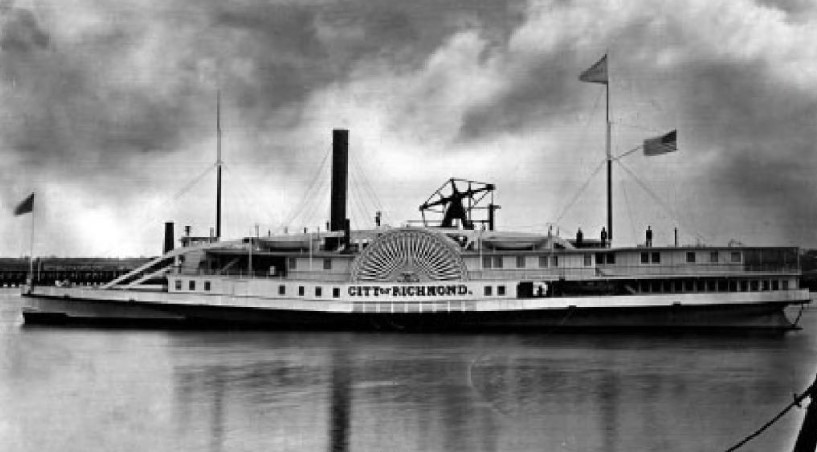
The City of Richmond, a sidewheel steamer which transported Union troops during the Civil War (Maine, c. late 1860s, public domain).

Lined up and ready to move out early on the morning of Wednesday, January 22, the 47th Pennsylvania Volunteers “gave three cheers for Camp Griffin” after listening to the 47th Pennsylvania’s Regimental Band play “Auld Lang Syne,” according to regimental historian Lewis Schmidt. Marching forth at 8:30 a.m., the men of B Company brought up the rear as the regiment slogged through snow and deep mud for three miles in order to reach the Vienna railroad depot in Falls Church, Virginia. Arriving at 9:30 a.m., they boarded a train and departed at 11 for Alexandria, Virginia where, a half hour later, they marched behind their band to the strains of “Yankee Doodle.”

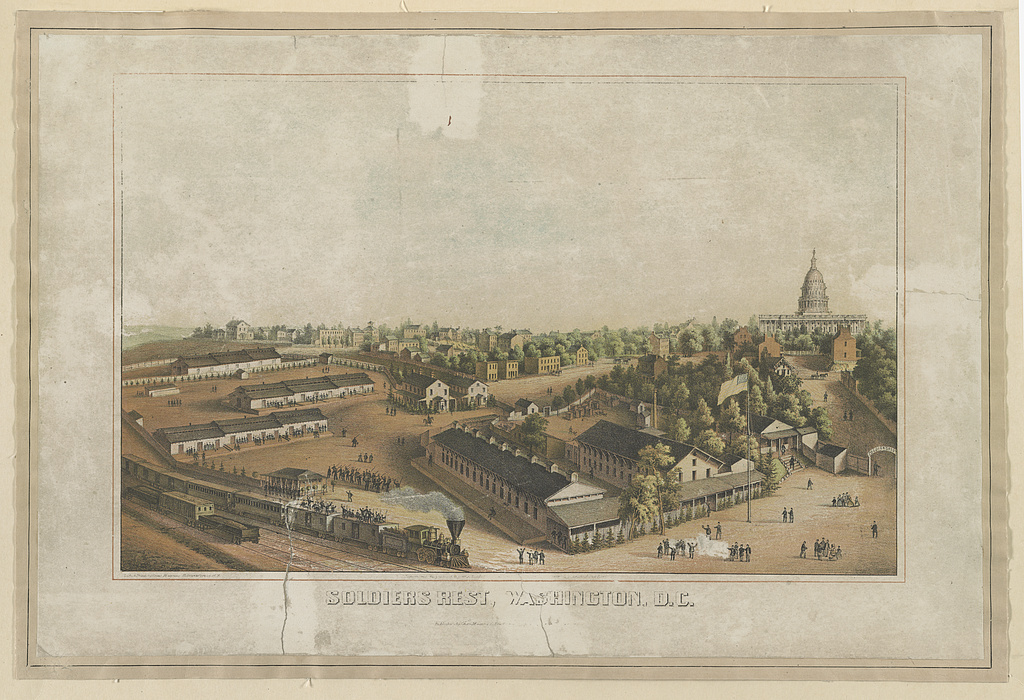
Arriving at the docks nearby, they quickly began loading their equipment on the City of Richmond, a steamship which ultimately transported them along the Potomac River to the Washington Arsenal, where they disembarked sometime around 4 p.m. Marched from the arsenal area’s docks to the munitions storage area, regimental leaders replenished the ammunition supplies of the regiment, one company at a time—a process which took roughly two hours. They were then marched off for dinner and rest at the Soldiers’ Retreat in Washington, D.C.

U.S. Naval Academy Barracks and temporary hospital, Annapolis, Maryland (c. 1861-1865, public domain).

The next day (January 23), the 47th Pennsylvanians reloaded their equipment onto and then boarded a Baltimore & Ohio Railroad train. Departing for Annapolis, Maryland at 2 p.m., they arrived around 10 p.m., were assigned quarters in barracks at the U.S. Naval Academy, and turned in for the night. They then spent that Friday through Monday (January 24-27) loading their equipment and other supplies onto the 210-foot steamship S.S. Oriental. Those preparations ceased on Monday, January 27, at 10 a.m., however, in order to make time for a very public dismissal of one member of the regiment—Private James C. Robinson—who was dishonorably discharged from the 47th Pennsylvania (effective on that same date). According to regimental historian Schmidt and letters home from members of the regiment:

“The regiment was formed and instructed by Lt. Col. Alexander ‘that we were about drumming out a member who had behaved himself unlike a soldier.’ …. The prisoner, Pvt. James C. Robinson of Company I, was a 36 year old miner from Allentown who had been ‘disgracefully discharged’ by order of the War Department. Pvt. Robinson was marched out with martial music playing and a guard of nine men, two men on each side and five behind him at charge bayonets. The music then struck up with ‘Robinson Crusoe’ as the procession was marched up and down in front of the regiment, and Pvt. Robinson was marched out of the yard.”

The 47th Pennsylvania Volunteers were transported to Florida aboard the steamship S.S. Oriental in January 1862 (public domain).

Reloading then resumed and, that same afternoon (January 27), the enlisted members of the 47th Regiment, Volunteer Infantry began to board the Oriental, followed by their superior officers. Ferried to that Philadelphia-built steamship by smaller steamers, they sailed away for America’s Deep South at 4 p.m., per the directive of Brigadier-General Brannan. They were headed for Florida which, despite its secession from the Union, remained strategically important to the Union due to the presence of Forts Taylor and Jefferson in Key West and the Dry Tortugas. Their ship, which was captained by Benjamin F. Tuzo, was rocked by rough seas for much of their trip; consequently, many members of the regiment suffered from intense seasickness—particularly as the Oriental made its way down the stormy coast of the Carolinas and passed the Bahamas and Great Abaco Island.

On February 2, Regimental Chaplain William DeWitt Clinton Rodrock gathered his flock together for Sunday services, which began with the tolling of the ship’s bell at 11 a.m., a selection of hymns performed by the Regimental Band, and an opening prayer and scripture reading by Rodrock. Following the regiment’s singing of “From All That Dwell Below the Skies” (accompanied by the band to the music of “Old Hundred”), Rodrock presented that week’s sermon, which was based on the Bible’s “Acts of the Apostles,” chapter 17, verse 23. The service then closed with the singing of “Lord Dismiss Us with Thy Blessing” and the Doxology, followed by Rodrock’s benediction.

That day and the next, the men’s spirits were boosted further by the sight of dolphins swimming alongside the Oriental.

Rendering of Fort Taylor, Key West, Florida (Harper’s Weekly, 1864, public domain).

Arriving in the waters off Key West, Florida at 8 p.m. on Monday, February 3, the 47th Pennsylvanians were forced to endure a waiting game aboard ship until a pilot could be brought aboard to bring the ship into a safe place in the harbor—a process the pilot began at 7 a.m. the next morning.

According to Schmidt, “The deck was crowded with the regiment’s men, with the band playing as they passed some of the men-at-war…. Arriving in the harbor at 8 AM, the bands playing ‘national songs’ and numerous onlookers, including many ‘colored women,’ along the shore watching the ship sail into port.”

“After disembarking at 9 AM on the dock about one mile west of Fort Taylor, the regiment marched down the main street of the city in their regular order of column of divisions, and stacked their weapons, waiting until the unit would be notified where to make camp…. At 12 in the afternoon, the men were ordered to fall in and stand to attention, and with their 23 member band playing and the ladies of Key West waving their handkerchiefs, and with quite a crowd of followers, the 1000 men marched to their new camp ‘one fourth mile out of the city, near the beach,’ across from the barracks of the 90th New York Regiment.”

Led to the area of Key West that is now known as Palm and White streets, the 47th Pennsylvania Volunteers were, in fact, initially housed just 350 feet from the ocean—a locale which may sound breathtakingly luxurious to the modern day reader until one realizes that the 47th Pennsylvanians’ first nights were “spent in blankets on the beach, with knapsacks for pillows”—a vexing, sandy state of affairs which persisted until their tents were unloaded and assembled on Thursday, February 6.

Even so, the members of the regiment still managed to make an early, favorable impression on Key West residents, including a New York Herald reporter who “commented on the fact that the 47th was equipped with the best weapons available, and was the best looking Volunteer Regiment he had ever seen.’’

Adjutant and 1st Lieutenant Washington H. R. Hangen (c. 1862-1864, public domain).

This was in very large part due to the leadership of Colonel Tilghman H. Good, the founder and commanding officer of the 47th Pennsylvania Volunteer Infantry, who had been placed in charge not just of the 47th Pennsylvania, but of all of the men who had been assigned to serve under Brannan in Key West, including two volunteer regiments from New York and U.S. Army artillery units. Good would continue to perform this role until Brannan was able to reach Florida and assume command of his brigade. The 47th Pennsylvania’s Regimental Adjutant Washington H. R. Hangen was then also appointed as Adjutant General for Brannan’s brigade.

And those tents which took so long to be delivered and assembled? They were officially designated as “Camp Brannan” in honor of the brigadier-general who had requested that the 47th Pennsylvania be assigned to his command.

* NOTE: Three months after dropping the 47th Pennsylvania Volunteers off in Key West, the steamship Oriental ran aground and sank north of Cape Hatteras, North Carolina. Its boiler may still be seen from shore while walking along the beach at the Pea Island National Wildlife Refuge.


Sources:

1. Bates, Samuel P. History of Pennsylvania Volunteers, 1861-5, Vol 1. Harrisburg, Pennsylvania: B. Singerly, State Printer, 1869.

2. Faust, Drew G. “The Civil War soldier and the art of dying,” in The Journal of Southern History, Vol. 67, No. 1, pp. 3-38. Houston, Texas: Southern Historical Association (Rice University), 2001.

3. Gobin, John Peter Shindel. Personal Letters, 1861-1865. Northumberland, Pennsylvania: Personal Collection of John Deppen.

4. Helfrich, John G. Personal Letters, 1862. Mesa, Arizona: Personal Collection of Colin Cofield.
5. Schmidt, Lewis G. A Civil War History of the 47th Regiment of Pennsylvania Veteran Volunteers. Allentown, Pennsylvania: Self-published, 1986.

6. Wharton, Henry D. Letters from the Sunbury Guards. Sunbury, Pennsylvania: Sunbury American, 1861-1868.


December 1861: A Young Regiment’s First Christmas and New Year’s Day Away from Home

First State Color, 47th Pennsylvania Volunteers (issued 20 September 1861, retired 11 May 1865).

Barely four months old when December 1861 arrived, the 47th Pennsylvania Volunteer Infantry continued its occupation of Virginia—just one of the many Union regiments attached to the Army of the Potomac charged with defending the nation’s capital from potential invasion by Confederate States Army troops during the first year of America’s Civil War. Encamped at Camp Advance near Fort Ethan Allen during late September and early October, the 47th Pennsylvania had spent a significant portion of its time reinforcing and expanding upon the basic training in Hardee’s light infantry tactics that it had received upon its muster at Camp Curtin.

On one typical day—Friday, October 4—the regiment drilled from just after reveille until roughly 7 a.m., repeated the drill between 10 and 11 a.m. and then again between 2 and 3 p.m., and then marched in a formal regimental parade from 5 to 6 p.m. Two days later, the regiment demonstrated its readiness yet again when its members were formally inspected by senior officers of its brigade. At midnight the next day—Monday, October 7—the 47th Pennsylvania Volunteer Infantry was ordered to engage the enemy.

Following behind the 79th New York Volunteers and trailed by the 33rd and 49th New York, as well as a Union cavalry unit and three Union artillery batteries, the 47th Pennsylvania Volunteers marched away from Camp Advance at 3 a.m.—excited to do more than mere drilling. Before they could reach their intended destination, however, the 79th New York Volunteers ran smack into Confederate skirmishers three miles outside of Lewinsville.

As battle lines began to form, the 47th Pennsylvania was ordered to move to the front and both sides of the road to shield the brigade’s other units. Initially stationed at the front, the 47th Pennsylvania’s F Company and A Company were shifted to protective positions at the brigade’s left and right, respectively, and Company D and Company I were then shifted to protect the brigade’s front. Advancing in this formation up and down three miles of the undulating, forested Virginia countryside, the 47th Pennsylvania Volunteers pushed the Confederate troops back toward Prospect Hill, where they stopped and held their brigade’s position for the remainder of the day and night.

Forming a new battle line the next morning at 8 a.m., the 47th Pennsylvania Volunteers were assigned, again, to guard both sides of their brigade. When neighboring Confederate troops failed to attack by 10 a.m., they were ordered to begin fortifying their brigade’s position, and proceeded to carve out a five-mile road and fell a substantial number of trees in order to construct earthen breastworks in front of the brigade’s artillery batteries. They were also assigned to dig holes to create rifle pits for brigade snipers—work which continued until they were relieved by a regiment from Vermont at sundown. Allowed to sleep until daylight via a procedure known as “laying on their arms,” they essentially held their rifles while napping lightly.

Unknown regiment, Camp Griffin, Virginia, fall 1861 (public domain, U.S. Library of Congress).

Ordered on toward Manassas Gap early that same week, the 47th Pennsylvania Volunteers were next stationed between Lewinsville and Falls Church as part of this mission. Moving back and forth around this area, they reached as far as the Leesburg Turnpike, which was roughly two miles from the Chain Bridge they had first crossed when entering Virginia in September. Moving out again the next day, the 47th Pennsylvania’s right wing (Companies A, C, D, F, and I) were ordered to head for a new camp site in Fairfax County, Virginia. Marching to a site two miles outside of Falls Church, they began pitching regimental tents at “Camp Big Chestnut”—so named due to the looming presence of a large chestnut tree located there. This encampment would ultimately come to be known as Camp Griffin.

Meanwhile, the men from H Company and other units of the 47th Pennsylvania’s left wing were ordered out on a new, five-mile expedition. During this time, a six-man detail from H Company, commanded by Lieutenant William W. Geety, was sent out on reconnaissance toward the Richmond Turnpike, but nearly met with disaster when Confederate cavalry approached within 300 feet of that detail’s position around midnight. Fortunately, this detachment was saved by a thick fog which descended and obscured its position from the enemy’s view.

On Thursday, October 10, Geety’s party was joined by the regiment’s third-in-command, Major William H. Gausler, who ordered Geety to perform further reconnaissance. Spotting enemy pickets a quarter mile away from the main encampment of the 47th Pennsylvania’s expedition, Geety promptly returned to Gausler to report his findings. Men from G Company were then placed on picket duty, which they performed until they were relieved at 1 a.m. the next day.

According to regimental historian, Lewis Schmidt, Colonel Tilghman H. Good, the 47th Pennsylvania’s founder and commanding officer, reported to his superiors “that the work associated with being out on advanced picket duty was very difficult, and that the enemy pickets at times were too close to his camp, which gave his troops constant unrest.” Further adding to their stress, they were forced to wait so long for their tents to be brought from their former encampment that they ended up having to pitch those tents “during constant alarms from the enemy pickets.”

They’d barely finished when the rains came. Geety later reported that they’d endured such a hard downpour that he’d “slept in a puddle all night”; those of his subordinates who weren’t sent out on picket duty again spent the next two days trying unsuccessfully to dry their clothes.

Captain John Peter Shindel Gobin, Co. C, 47th Pennsylvania Volunteers, c. 1862 (public domain).

Many hours were, in fact, passed in similarly miserable conditions—so much so that camp life became a test of endurance. According to Captain John Peter Shindel Gobin, the commanding officer of the 47th Pennsylvania’s C Company, Friday, November 29 was “the most disagreeable time we have yet experienced.” Assigned to picket duty, he had been ordered to march his subordinates out and position them away from camp some distance in order to head off potential enemy attacks on the Army of the Potomac’s massive encampment by Confederate troops stationed in their vicinity.

“It rained hard all day and night, and was very cold. I had command of the first relief, which went to the special reserve at 12 midnight. By that time most of us were wet through, so I took possession of a minister’s house, near by, where I quartered my men until morning.”

Additional letters written by other 47th Pennsylvanians around this same time evoke similar shivers of empathy, transporting present day readers back in time and into the muddy shoes and heavy, sodden uniforms of the cold, sniffling soldiers who wearily set pen to paper once they were finally permitted to crawl back into their dry tents at camp.

Consequently, disease became an even more formidable foe than the Confederate States Army—and a fearsome one at that, scything multiple members of the regiment from its ranks, including two drummer boys, aged thirteen and fifteen, and a seasoned sergeant within days of each of their respective hospitalizations, followed by Daniel Foose, a 19-year-old private from Perry County’s H Company who was felled by typhoid or bilious fever; David Losch, a 22-year-old Allentown native and private from I Company; Daniel Biceline, a 23-year-old H Company private also felled by typhoid; and Private William Young of G Company.

Easing their distress somewhat was the long overdue news that members of the 47th Pennsylvania Volunteer Infantry would finally be paid for the first time since enrolling for service. When the money arrived, many members of the regiment began transferring what they could home to parents and wives. C Company men sent $900 to their loved ones in Sunbury while those from Company A and Company D sent a whopping $2,500 and $2,000, respectively, to Northampton and Perry counties.

Additionally, the regiment was still stationed close enough to Pennsylvania that a significant number of 47th Pennsylvanians were able to personally return to their hometowns on brief furloughs while others were buoyed by family members who had the means to travel to their Virginia encampment for short visits.

Christmas

Quartermaster James Van Dyke procured a holiday surprise for the 47th Pennsylvania Volunteers (Sunbury American, 21 December 1861, public domain).

As a result, it was with a mixture of heavy hearts and hope that members of the 47th Pennsylvania Volunteer Infantry welcomed the dawn of Christmas Day in 1861.

Among those making the time more bearable for his fellow 47th Pennsylvanians was Regimental Quartermaster and former Northumberland County sheriff James Van Dyke who, according to the December 21 edition of the Sunbury American, “came home on a short visit and returned to Camp Griffin 47th Regiment … taking with him three or four large boxes filled with various articles of comfort, for the inner as well as the outer man….”

The newspaper also included this important detail:

“Among the edibles, was a barrel of ‘sour krout,’ presented by William I. Greenough, Esq.”

In addition to being a beloved taste of home for the often hungry members of the regiment, the sauerkraut likely also served an important cultural function for the numerous German-Americans and German immigrants who had enrolled with the 47th. When paired with pork and eaten on New Year’s Day as part of an annual tradition, sauerkraut has been said to attract prosperity for the remainder of the year because it is made from green cabbage (green being the color of money) while eating pork ensures progress and good luck because pigs “root forward” with their snouts rather than backward with their feet as chickens do, according to a 2015 article by Billy Penn News.

Pvt. Abraham Nicholas Wolf, Company B, 47th Pennsylvania Volunteers, c. 1861 (public domain).

Food and other “articles of comfort” were, in fact, on the minds of pretty much all members of the regiment as they were about to spend their first Christmas and New Year’s holidays away from loved ones. While penning a letter to his family during regimental church services on Sunday, December 29, Private Abraham N. Wolf told his wife, Sarah, that the Regimental Band was playing a hymn as he wrote to her.

Noting that he’d received the gift box she’d sent him, Wolf’s joy was child-like when he added that “everything was in it yet what you said was in it and it came on the second day of Christmas.” Just that morning, he’d fried “fried some of the sausages” that she’d sent him “and took some sausages along for dinner” later because he’d been scheduled for duty—chopping wood for the regiment—“and they tasted pretty good to me for it was something new to me for it was from home.” And then he added that the day before:

“… the chicken cooked for dinner and so we had a good dinner for it was the best dinner that I had since I left home. And this morning I ate the last part of the chickens but I have some of your molasses candy yet which you sent to me. And I have the big cake yet. And that pocket handkerchief which your mother sent to me I got too.”

Their joy and respite were brief, however; by mid-January 1862, the 47th Pennsylvania Volunteers were on the move again. When they finally stopped and were able to take in their new surroundings, they would suddenly gain an entirely different perspective on the meaning of “far from the comforts of home.”

For more Christmas and New Year’s-related content, please check out this sampling of our prior posts on 47th Pennsylvania Volunteers: One Civil War Regiment’s Story:

To see an image and read more of Abraham Wolf’s letter, read the article, 1861: Abraham Nicholas Wolf Jr. to Sarah (Trexler) Wolf,” by Spared and Shared.

Sources:

1. Bates, Samuel P. History of Pennsylvania Volunteers, 1861-5, Vol 1. Harrisburg, Pennsylvania: B. Singerly, State Printer, 1869.

2. Gobin, John Peter Shindel. Personal Letters, 1861-1865. Northumberland, Pennsylvania: Personal Collection of John Deppen.

3. Schmidt, Lewis G. A Civil War History of the 47th Regiment of Pennsylvania Veteran Volunteers. Allentown, Pennsylvania: Self-published, 1986.

4. Wharton, Henry D. Letters from the Sunbury Guards. Sunbury, Pennsylvania: Sunbury American, 1861-1868.

October 1861: Drummer Boys, Disease, and Death

U.S. Soldiers’ Asylum Home Cemetery, Washington, D.C., circa 1861 (public domain).

“[T]he impact and meaning of the war’s casualties were not simply a consequence of scale, of the sheer numbers of Union and Confederate soldiers who died. Death’s significance for the Civil War generation derived as well from the way it violated prevailing assumptions about life’s proper end — about who should die, when and where, and under what circumstances.”

— Drew Gilpin Faust, Ph.D., President Emeritus and the Arthur Kingsley Porter University Professor, Harvard University and author, This Republic of Suffering: Death and the Civil War


Less than a month after leaving the great Keystone State for the Eastern Theater of America’s shattering Civil War, the members of the 47th Pennsylvania Volunteer Infantry encountered their most fearsome foe — the one they would consistently find the most difficult to defeat throughout the long war — disease.

It was an enemy, in fact, that turned out to be the deadliest not just for the 47th Pennsylvania Volunteers, but for the entire Union Army as it fought to preserve the nation’s Union while ending the practice of slavery across the United States. Per The Gilder Lehrman Institute of American History, sixty-two percent of all Union soldiers who died during the American Civil War were felled by disease, rather than by the shrapnel-spewing blasts of Confederate cannon or the accurately targeted minié balls of CSA rifles.

Surprising as this may seem to this century’s students of American History, it shouldn’t be, according to infectious disease specialist Jeffrey S. Sartin, M.D.:

“The American Civil War represents a landmark in military and medical history as the last large-scale conflict fought without knowledge of the germ theory of disease. Unsound hygiene, dietary deficiencies, and battle wounds set the stage for epidemic infection, while inadequate information about disease causation greatly hampered disease prevention, diagnosis, and treatment. Pneumonia, typhoid, diarrhea/dysentery, and malaria were the predominant illnesses. Altogether, two-thirds of the approximately 660,000 deaths of soldiers were caused by uncontrolled infectious diseases, and epidemics played a major role in halting several major campaigns. These delays, coming at a crucial point early in the war, prolonged the fighting by as much as 2 years.”

With respect to the 47th Pennsylvania Volunteers, the two diseases which wreaked such devastating havoc early on were Variola (smallpox) and typhoid fever.

Variola

A transmission electron micrograph of an 1849 strain of Variola shows several smallpox virions. Note the “dumbbell-shaped” structure. Located inside the virion, this is the viral core, and contains the DNA of the virus (Temple University, public domain via Wikipedia).

Variola, more commonly known as “smallpox,” was an acute infectious disease that, even in the mildest of cases in 1861, was highly contagious. Notable for the high fever it caused, it also produced individual, boil-like eruptions across the human body. Known as “pocks,” these eruptions would quickly become fluid-filled pustules — even with the weakest strains of the disease — that would, if sufferers survived, eventually burst, leaving them badly scarred.

If, however, the soldier contracted the most virulent form of the disease — Variola confluens — as happened with at least one member of the 47th Pennsylvania — the suffering and likelihood of death was much, much greater. Far more severe than the strain that would have typically sickened the average child or adult during the mid-1800s, Variola confluens produced patches of pustules, rather than individual pocks. Forming on the face in such large swaths, the skin of the soldier who had been unfortunate to contract this strain of the disease would have appeared to have been burned or blistered. In addition to the horrific facial disfigurement, that soldier would also likely have experienced hair loss, severe pain and damage to his mucous membranes, mouth, throat, and eyes as the fever ravaged his body and continued to climb. If the disease devolved into the hemorrhagic phase prior to his death, the pocks on his face and mucous membranes would then also have begun to bleed.

Most likely exposed to the disease sometime while they were encamped in Virginia with their regiment, the first of the 47th Pennsylvanians to contract Variola would not initially have noticed any symptoms during this disease’s ten to fourteen-day incubation period. The first symptoms they would have experienced would have been due to rigor (sudden chills as the onset of fever began, alternating with shivering and sweating). As this primary fever increased, their temperatures would have risen to 103° or 104° Fahrenheit or higher over a two-day period, quickening the pulse and causing intense thirst, headache, constipation, vomiting, and back pain. As their conditions worsened, they might also have experienced convulsions and/or a redness on their abdomens or inner thighs — markings which might have appeared to be a rash of some sort or the beginnings of scarlet fever, but which were, in fact, a series of small, flat, circular spots on the body caused by bleeding under the skin and known as “petechiae.”

It would only have been on roughly the third day, post-incubation period, that these same men would have noticed that their faces were erupting with boils, but even then, they might have missed this sign because such pocks typically appeared as a single patch of redness on the sufferer’s forehead, near the roots of the hair. Within hours of this first eruption, however, the soldiers would most certainly have realized that something was wrong as they began scratching to relieve the itching on patches that had spread across their faces and bodies — particularly when the pocks began to fill with fluid and swelled to pea-sized bumps.

Likely sent to the regiment’s hospital sometime around this time, these 47th Pennsylvanians would have been transferred to the eruptive fever hospital on the Kalorama Heights in Georgetown before the week was out because, by day eight or nine, their skin would have become inflamed and swollen as the fluid in the pocks changed from clear to yellow, began to smell, and spread to their mouths, throats, noses, and eyes, putting their breathing and vision at risk. Increasingly hoarse, despite the increase in saliva they were experiencing, their bodies would then also have been overtaken by secondary fever, followed possibly by delirium and then coma.

If they somehow managed to survive until the disease’s latter phase, the pustules would have eventually dried up (typically on the twelfth day, post-incubation); if they didn’t, death most likely would have ensued due to myocardial insufficiency caused by the weakening of their heart muscles.

Typhoid Fever

An image of Salmonella typhi, the bacteria which cause typhoid fever (U.S. Armed Forces. Institute of Pathology, public domain).

Often confused with the insect-borne typhus fever, typhoid fever is caused by bacteria. Poorly understood well into and beyond the mid-nineteenth century, despite having sickened countless numbers of individuals since the time of Hippocrates, according to American University historian Thomas V. DiBacco, typhoid fever’s method of transmission remained unidentified until 1856. That year, it finally dawned on scientists that fecal matter contaminated with Salmonella typhosa, one of the strains of bacteria now known to cause food poisoning, was at the root of the “persistently high fever, rash, generalized pains, headache and severe abdominal discomfort,” and intestinal bleeding of the patients physicians were failing to save.

Spread by the unsanitary conditions so common to the close living quarters shared by America’s Civil War-era soldiers, as well as by their respective regimental company cooks who were often forced to prepare meals with unclean hands when their regiments stopped briefly during long marches, the typhoid fever-causing Salmonella typhosa bacterium would typically enter a soldier’s body “through food, milk or water contaminated by a carrier,” but might also have been contracted just as easily via a bite from one of the many flies swarming around a regiment’s latrine facilities or horses.

And, because the “worst manifestations” of the disease did not appear until two or three weeks into an individual’s illness, according to DiBacco, typhoid fever was able to spread like wildfire not just during its incubation period, but even when soldiers were aware that others within their respective companies were ill because “typhoid victims were disposed to think the malady less serious as time went by.”

It is this latter fact alone that, perhaps, explains why outbreaks of typhoid fever continued to plague the 47th Pennsylvania throughout the duration of the war when Variola did not.

The First ”Men” to Die

Court House, Sunbury, Pennsylvania, 1851 (James Fuller Queen, U.S. Library of Congress, public domain).

The first “man” to die from the 47th Pennsylvania Volunteer Infantry was John Boulton Young, a thirteen-year-old drummer boy who was known affectionately as “Boulty” (alternatively, “Boltie”). A member of the regiment’s C Company, he served under Captain John Peter Shindel Gobin, but was known to, and beloved by, the majority of the roughly one thousand men who served with the 47th.

Born on 25 September 1848 in Sunbury, Pennsylvania as the second oldest son of Pennsylvania natives, Michael A. and Elizabeth (Boulton) Young, Boulty was still in school at the time of his enlistment for Civil War military service in his hometown on 19 August 1861. He clearly lied about his age on military paperwork that day, indicating that he was fourteen, rather than twelve — a fiction which was maintained by Gobin and his fellow C Company officers throughout the boy’s tenure of service.

* Note: According to historians at the American Battlefield Trust, “For most of the war, the minimum enlistment age in the North was legally held at 18 for soldiers and 16 for musicians, although younger men could enlist at the permission of their parents until 1862. In the South, the age limit for soldiers stayed at 18 until 1864 when it was legally dropped to 17.”

Just four feet tall at the time of his official muster in at the rank of musician (drummer boy) at Camp Curtin in Harrisburg on 2 September, Boulty was so small that his superiors needed to customize both his uniform and his drum to make it easier for him to function as a member of the 47th Pennsylvania.

The Kalorama Eruptive Fever Hospital (also known as the Anthony Holmead House in Georgetown, D.C. after it was destroyed in a Christmas Eve fire in 1865 (U.S. Library of Congress, public domain).

After completing basic training and traveling by train with his regiment to the Washington, D.C. area in mid-September, Boulty subsequently endured several long marches, including at least one undertaken in a driving rain. By late September or early October of 1861, Boulty had contracted such a challenging case of Variola (smallpox) that regimental surgeons ordered his superiors to ship him from Virginia, where the 47th Pennsylvania was encamped as part of the Army of the Potomac, to the eruptive fever hospital on the Kalorama Heights in Georgetown, District of Columbia.

Diagnosed by the physicians there with Variola confluens, the most virulent form of the disease, he died at that hospital on 17 October 1861. His body was then quickly prepared and transported for burial. Initially interred in Washington, D.C. at the Soldiers’ Asylum Cemetery (now known the United States Soldiers’ and Airmen’s Home Cemetery), his remains were disinterred in early 1862, and returned to Pennsylvania for reburial at Penn’s Cemetery in his hometown of Sunbury.

To learn more about Boulty’s life before and during the Civil War, as well as what happened to the surviving members of his family, read his biographical sketch, The First “Man” to Die: Drummer Boy John Boulton Young.

Alfred Eisenbraun

Allentown, circa 1840 (public domain).

The second “man” from the 47th Pennsylvania to die was also a drummer boy — fifteen-year-old Alfred Eisenbraun, who served with the regiment’s B Company. A native of Allentown, Pennsylvania who was born in June of 1846, he was a son of Johann Daniel Eisenbraun, a noted Frakturist and tombstone carver who had emigrated from Württemberg, Germany to the United States in 1820, and Lehigh County, Pennsylvania native Margaret (Troxell) Eisenbraun.

Unlike “Boulty,” however, Alfred Eisenbraun had already left his studies behind, and had joined his community’s local workforce in order to help support his family. Employed as a “tobacco stripper,” he separated tobacco leaves from their stems before stacking those leaves in piles for the creation of cigars or chewable tobacco. As he did this, he likely would have been “breathing foul air, in rooms bare and cold or suffocatingly hot”, possibly “in a damp basement, musty with mould [sic] or lurking miasma,” according to Clare de Graffenried, a 19th-century U.S. Bureau of Labor employee who researched and wrote extensively about child labor.

So, it comes as no surprise that a boy in Eisenbraun’s situation would have viewed service with the military as a vast improvement over his existing job — especially if the pay was higher — which it most certainly was. Just barely fifteen when he enrolled for Civil War service in his hometown on 20 August 1861, Eisenbraun officially mustered in at the rank of musician (drummer boy) with the 47th Pennsylvania’s Company B at Camp Curtin on 30 August. Military records at the time described him as being five feet, five inches tall with black hair, black eyes and a dark complexion. His commanding officer was Captain Emanuel P. Rhoads.

Like Boulty, Eisenbraun completed basic training, traveled by train with his regiment to the Washington, D.C. area in mid-September, and then endured several long marches, including the same one that was undertaken in a driving rain. And, like Boulty, Eisenbraun also fell ill in late September or early October.

The Union Hotel in Georgetown, District of Columbia became one of the U.S. Army’s general hospitals during the American Civil War (image circa 1861-1865, U.S. Library of Congress, public domain).

But unlike Boulty, Eisenbraun was felled by typhoid fever. According to regimental historian Lewis Schmidt, the teen “had been sick almost from the time the regiment left Camp Curtin” in mid-September. After initially receiving treatment from regimental physicians through at least mid-October, he was sent back to the Washington, D.C. area to receive more advanced care. Per Schmidt, two of Eisenbraun’s fellow B Company members “visited Alfred at the fort on the 21st … and found him getting better, pleased to see them, and happy to engage in some conversation.”

But on Thursday morning, 24 October, after Captain Rhoads headed over to the fort’s hospital nearby, he was informed that Eisenbraun “and all the other sick men had been moved to the General Hospital in Georgetown.” Assuming that Eisenbraun’s condition had improved, since he’d apparently been deemed well enough to travel, Rhoads returned to his camp site, confident that he’d see the boy again — but he was wrong.

Eisenbraun, it turned out, had been transported to the former Union Hotel in Georgetown, which had been converted into one of the U.S. Army’s general hospitals. He died there from typhoid fever on 26 October 1861. Like Boulty, he was laid to rest at the Soldiers’ Asylum Cemetery in Washington, D.C.; unlike Boulty, however, his remains were never brought home.

To learn more about Alfred’s life before and during the Civil War, read his biographical sketch, Alfred Eisenbraun, Drummer Boy – The Regiment’s Second “Man” to Die.

The Third to Die: Sergeant Franklin M. Holt

Court House, Amherst, New Hampshire, circa 1858 (public domain).

Franklin M. Holt had already distinguished himself before becoming the first “true man” from the 47th Pennsylvania’s rosters to die. The regiment’s third fatality, he was also one of a handful of non-Pennsylvanians serving with this all-volunteer Pennsylvania regiment.

Born in New Hampshire in 1838, Frank Holt was a son of Cambridge, Massachusetts native, Edwin Holt, and Mont Vernon, New Hampshire native, Susan (Marden) Holt. A farmer like his father, he left his home state sometime around the summer of 1860, and took a job as a “map agent” in Monmouth County, New Jersey. But by the spring of 1861, he had relocated again, and had adopted the Perry County, Pennsylvania community of New Bloomfield as his new hometown.

That same spring, when President Abraham Lincoln issued his call for seventy-five thousand volunteers to help defend the nation’s capital following the fall of Fort Sumter to troops of the Confederate States Army, Holt enrolled with Company D of the 2nd Pennsylvania Infantry, completing his Three Months’ Service from 20 April to 26 July 1861 under the leadership of Henry D. Woodruff.

Realizing that the fight to preserve America’s Union was far from over, Holt re-enlisted in the 47th Regiment, Pennsylvania Volunteer Infantry’s D Company, which was also commanded by Captain Woodruff. Following his re-enrollment on 20 August in Bloomfield, he then re-mustered at Camp Curtin on 31 August at the rank of sergeant and, like drummer boys John Boulton Young and Alfred Eisenbraun, completed basic training before traveling with the regiment to the Washington, D.C. area for service with the Army of the Potomac.

Enduring a climate of torrential rain and pervasive, persistent dampness during his early days of service, Holt ultimately also fell ill with Variola (smallpox) and, like drummer boy Young who had also contracted the disease, he was transported to the eruptive fever hospital on the Kalorama Heights in Georgetown, District of Columbia, where he was treated by at least one of the same physicians who treated Boulty. Despite having apparently been diagnosed with a less severe form of the disease (according to military records which noted that Holt was sickened by Variola rather than the Variola confluens that felled Boulty), Sergeant Holt died at Kalorama on 28 October 1861.

“Kind, gentlemanly courteous, and honest in all his transactions,” according to the New Bloomfield Democrat, Holt had also “won for himself the esteem of all who knew him” prior to his untimely death. Like the two young drummer boys before him, he too was buried quickly at the Soldiers’ Asylum Cemetery in Washington, D.C. Although his remains were also never returned home, Holt was ultimately honored by members of his family, who erected a cenotaph in his honor at the Meadow View Cemetery in Amherst, New Hampshire.

To learn more about Frank’s life before and during the Civil War, read his biographical sketch, Holt, Franklin M. (Sergeant).

To learn more about Civil War Medicine, in general, as well as the battle wounds and illnesses most commonly experienced by members of the 47th Pennsylvania Volunteers, please visit the Medical section of this website.


Sources:

  1. Affleck, M.D., J. O. Smallpox,” in “1902 Encyclopedia.” Encyclopedia Britannica, 9th and 10th editions (online), 2005-2019.
  2. Alfred Eisenbraun (obituary). Allentown, Pennsylvania: Lehigh Register, 30 October 1861.
  3. Alfred Eisenbraun (obituary), in “Gestörben.” Allentown, Pennsylvania: Der Lecha Caunty Patriot, 6 November 1861.
  4. Allen Eisenbraun (death notice), in “Deaths of Soldiers.” Washington, D.C.: The Evening Star, 28 October 1861.
  5. Barker, M.D., Lewellys Franklin. Monographic Medicine, Vol. II: The Clinical Diagnosis of Internal Diseases,” p. 431 (“Variola confluens”). New York, New York: D. Appleton and Company, 1916.
  6. Bates, Samuel P. History of Pennsylvania Volunteers, 1861-5, vol.1. Harrisburg, Pennsylvania: B. Singerly, State Printer, 1869.
  7. Burial Ledgers (Eisenbraun, Alfred; Holt, Franklin M.; Young, J. Bolton), in Records of The National Cemetery Administration and U.S. Departments of Defense and Army (Quartermaster General), 1861. Washington, D.C.: U.S. National Archives and Records Administration.
  8. Casualties and Costs of the Civil War.” New York, New York: The Gilder Lehrman Institute of American History.
  9. Civil War General Index Cards (Eisenbraun, Alfred and Eisenbrown, Allen), in Records of the U.S. Department of the Army. Washington, D.C.: U.S. National Archives and Records Administration and Fold3: 1861.
  10. Civil War Veterans’ Card File, 1861-1865 (Eisenbraun, Alfred; Holt, Franklin M.; Young, J. Bolton). Harrisburg, Pennsylvania: Pennsylvania State Archives.
  11. “Death of a Young Soldier” (obituary of John Boulton Young). Bloomsburg, Pennsylvania: Star of the North, Wednesday, 30 October 1861 (reprinted from the Sunbury Gazette).
  12. “Deaths of Soldiers” (death notice for John Boulton Young). Washington, D.C.: The National Republican, 18 October 1861.
  13. de Graffenried, Clare. “Child Labor,” in Publications of the American Economic Association, Vol. 5, No. 2. New York, New York: March 1890 (accessed 22 March 2016).
  14. DiBacco, Thomas V. When Typhoid Was Dreaded.” Washington, D.C.: The Washington Post, 25 January 1994.
  15. “The Drummer Boy’s Monument” (monument erected to John Boulton Young). Sunbury, Pennsylvania: Sunbury American, 6 February 1864.
  16. Fabian, Monroe H. John Daniel Eisenbrown, in “Pennsylvania Folklife Book 62,” in Pennsylvania Folklife Magazine, Vol. 24, No. 2. Lancaster, Pennsylvania: 1975.
  17. Faust, Drew G. The Civil War soldier and the art of dying,” in The Journal of Southern History, Vol. 67, No. 1, pp. 3-38. Houston, Texas: Southern Historical Association (Rice University), 2001.
  18. Holt Eulogy. New Bloomfield, Pennsylvania: New Bloomfield Democrat, 1861. Inkrote, Cindy. “Civil War drummer boy was different kind of hero.” Sunbury, Pennsylvania: The Daily Item, 4 October 2009.
  19. Letters of John Peter Shindel Gobin, 1861-1900. Various Collections (descendants of the 47th Pennsylvania Volunteers, et. al.).
  20. “Registers of Pennsylvania Volunteers, 1861-1865: 47th Regiment” (Companies B, C, and D) in Records of the Department of Military and Veterans’ Affairs (Record Group 19, Series 19.11). Harrisburg, Pennsylvania: Pennsylvania State Archives.
  21. Sartin, M.D., Jeffrey S. Infectious diseases during the Civil War: The triumph of the ‘Third Army,’ in Clinical Infectious Diseases, Vol. 16, No. 4, pp. 580-584. Cary, North Carolina: Oxford University Press, April 1993.
  22. Schmidt, Lewis. A Civil War History of the 47th Regiment of Pennsylvania Veteran Volunteers. Allentown, Pennsylvania: Self-published, 1986.
  23. U.S. Census. Washington, D.C. and Pennsylvania (Allentown and Sunbury, Pennsylvania; Amherst, New Hampshire; Monmouth, New Jersey): 1840-1930.
  24. U.S. Registers of Deaths of Volunteers, 1861 (Eisenbraun/Eisenbraum, Alfred; Holt, Franklin/Frank M; Young, J. Bolton/Jno. B.). Washington, D.C.: United States Army and U.S. National Archives and Records Administration.


September 1861: A New Pennsylvania Regiment Heads for Washington, D.C. and War

First State Color, 47th Regiment, Pennsylvania Volunteer Infantry. Presented to the Regiment by Pennsylvania Governor Andrew Curtin on 20 September 1861. Retired 11 May 1865. Source: Pennsylvania Capitol Preservation Committee (1985.057, State Color, Evans and Hassall, v1p126).

As the days of September 1861 rolled away and summer turned to fall, the 47th Regiment, Pennsylvania Volunteer Infantry, which had been founded by Colonel Tilghman H. Good on 5 August 1861, and had been trained in Hardee’s Light Infantry Tactics as its men mustered in by company at Camp Curtin in Harrisburg from mid-August through mid-September, was finally given its first official assignment — to defend its nation’s capital, which had been threatened with invasion by troops of the Confederate States Army.

Roughly seventy percent of the 47th Pennsylvania Infantry hailed from the Keystone State’s Lehigh Valley, including the cities of Allentown, Bethlehem and Easton and surrounding communities in Lehigh and Northampton counties. Company C, which had been formed primarily from the men of Northumberland County and was led by Captain John Peter Shindel Gobin, was more commonly known as the “Sunbury Guards.” Companies D and H were staffed largely by men from Perry County. Company K was formed with the intent of creating an “all German” company comprised of German-Americans and German immigrants. In actuality, the majority of 47th Pennsylvania Volunteers were men of German descent — a noteworthy fact when considering the significant role played by German immigrants and German-Americans prior to, during, and after the American Civil War. Curriculum developers at Boston’s WGBH Educational Foundation, which produced the 1998 PBS television series, Africans in America, note that:

“As early as 1688, four German Quakers in Germantown near Philadelphia protested slavery in a resolution that condemned the “traffic of Men-body.” By the 1770s, abolitionism was a full-scale movement in Pennsylvania. Led by such Quaker activists as Anthony Benezet and John Woolman, many Philadelphia slaveholders of all denominations had begun bowing to pressure to emancipate their slaves on religious, moral, and economic grounds.

In April 1775, Benezet called the first meeting of the Society for the Relief of Free Negroes Unlawfully held in Bondage at the Rising Sun Tavern. Thomas Paine was among the ten white Philadelphians who attended; seven of the group were Quakers. Often referred to as the Abolition Society, the group focused on intervention in the cases of blacks and Indians who claimed to have been illegally enslaved. Of the twenty-four men who attended the four meetings held before the Society disbanded, seventeen were Quakers.

Six of these original members were among the largely Quaker group of eighteen Philadelphians that reorganized in February 1784 as the Pennsylvania Society for Promoting the Abolition of Slavery and for the Relief of Free Negroes Unlawfully Held in Bondage (commonly referred to as the Pennsylvania Abolition Society, or PAS). Although still occupied with litigation on behalf of blacks who were illegally enslaved under existing laws, the new name reflected the Society’s growing emphasis on abolition as a goal. Within two years, the group had grown to 82 members and inspired the establishment of anti-slavery organizations in other cities.

PAS reorganized once again in 1787. While previously, artisans and shopkeepers had been the core of the organization, PAS broadened its membership to include such prominent figures as Benjamin Franklin and Benjamin Rush, who helped write the Society’s new constitution. PAS became much more aggressive in its strategy of litigation on behalf of free blacks, and attempted to work more closely with the Free African Society in a wide range of social, political and educational activity.

In 1787, PAS organized local efforts to support the crusade to ban the international slave trade and petitioned the Constitutional Convention to institute a ban. The following year, in collaboration with the Society of Friends, PAS successfully petitioned the Pennsylvania legislature to amend the gradual abolition act of 1780. As a result of the 2000-signature petition and other lobbying efforts, the legislature prohibited the transportation of slave children or pregnant women out of Pennsylvania, as well as the building, outfitting or sending of slave ships from Philadelphia. The amended act imposed heavier fines for slave kidnapping, and made it illegal to separate slave families by more than ten miles.”

Although the Pennsylvania Abolition Society’s influence had begun to wane by the early 1800s, men and women of German descent helped to reinvigorate support for the abolition of slavery in the lead-up to and during the Civil War. According to Kenneth Barkin, professor emeritus of history at the University of California, Riverside, “it is increasingly evident that German immigrant opposition to slavery was so pervasive that it may have been a crucial, albeit, ignored factor in the victory of Union forces.”

“Of the 1.3 million German immigrants in the United States before 1860, approximately 200,000 either volunteered for or were drafted into the Union Army. They produced a considerably higher percentage of Union soldiers per hundred thousand immigrants in the U.S. population than either the British or the Irish. About 24 percent of Union troops were born outside of the United States, and 10 percent of all Union soldiers were of German origin. There were several battalions with German soldiers and officers in which the German language was used for communication.”

In the case of the 47th Pennsylvania Volunteer Infantry, many of the men who were of German heritage and their families still spoke German or “Pennsylvania Dutch” at their homes and churches more than a century after their ancestors emigrated from Germany in search of religious or political freedom.

The 47th Pennsylvania was also noteworthy because it attracted males of diverse ages. Its youngest member was John Boulton Young, a thirteen-year-old drummer boy from Sunbury, Pennsylvania; its oldest was Benjamin Walls, a sixty-five-year-old, financially successful farmer from Juniata County who would, at the age of sixty-eight, attempt to re-enlist after being seriously wounded while protecting the American flag in combat. They and their comrades were initially led by Colonel Tilghman Good, Lieutenant-Colonel George Warren Alexander, and Major William H. Gausler.

Thomas Coates, “Father of Band Music in America,” led the 47th Pennsylvania’s Regimental Band from August 1861 to September 1862 (public domain).

On Friday the 13th, there were frequent bouts of inspiration among Harrisburg residents, rather than of superstitious worry, as three thousand men from the 47th Pennsylvania and other volunteer regiments from the Keystone State marched in an impromptu parade from Camp Curtin through the city’s main streets.

The next day, members of the 47th Pennsylvania marched forth again — this time to welcome the arrival of their Regimental Band, which was led by the “Father of Band Music in America,” Professor Thomas Coates, and was comprised primarily of musicians from the Easton-based ensemble known as Pomp’s Cornet Band, as well as members of the Allentown Band. Later that evening, the band performed for Pennsylvania Governor Andrew Gregg Curtin.

With the majority of the regiment’s officers and enlisted men mustered in by 19 September 1861, the 47th Pennsylvania Volunteer Infantry was ordered to head south for Washington, D.C.

A Journey of Heroes Begins

President Abraham Lincoln’s funeral train passes through the train station in Harrisburg, Pennsylvania on 22 April 1865 (public domain).

Their epic journey began on 20 September 1861. Directed to begin packing at 5:00 a.m. so that they would be ready for a 7:00 a.m. departure by train, the men of the 47th Regiment, Pennsylvania Volunteer Infantry pulled their gear together and assembled in formation at Camp Curtin. They were then presented with the Pennsylvania State Battle Flag (shown at the top of this article). Also known as the First State Color, it had “a field of 34 white stars, one for each state both north and south, on a blue background in the upper left corner in the shape of a rectangle covering approximately 19% of the flag’s total area, with 17 stars above and below the state emblem, which consisted of two white horses, eagle, seal and inscription,” according to regimental historian Lewis Schmidt. “The remainder of the flag was composed of 7 red and 6 white alternating horizontal stripes, and the whole was fringed with gold braid. The unit designation was painted in gold on the center red stripe to the right of the bottom of the blue field. As battle citations were awarded each unit, they would be painted on the red stripes in gold lettering.”

This flag would ultimately be carried by regimental color-bearers between the fall of 1861 and 11 May 1865 into Confederate States of America-held territories of the United States, as well as throughout multiple U.S. territories that were recaptured by Union troops, and would also serve as a rallying point during the intense, smoke-filled battles fought by the 47th Pennsylvania Infantry in South Carolina, Louisiana, and Virginia in 1862 and 1864.

Marched to the train station in Harrisburg, they boarded cattle and hog cars on a Northern Central Railway train, and then did what military men have done throughout the ages. They waited — and waited. By the time of their 1:30 p.m. departure, a crowd “had gathered and lined both sides of the track, all the way from the depot to the other side of the bridge which crosses the Susquehanna River,” according to Schmidt. “Everyone was cheering, flags were flying, and the men were hanging from the cars, all in a great state of excitement. Many railroad friends of the Easton contingent that had been part of the 1st Regiment during earlier service, turned out to see them off with their new unit, having transported them to the seat of war on earlier occasions.”

Traveling by way of York, Pennsylvania, they finally reached the Bolton Depot in Baltimore, Maryland, where they disembarked, refilled their canteens with water, lined up behind their Regimental Band, and marched with their loaded rifles across the city to the Baltimore and Ohio Railroad Station. Once there, they clambered aboard “glorious to tell, real genuine passenger cars” and departed for Washington, D.C., according to Captain Gobin, who added that the “lateness of the hour did not prevent the appearance, at a great many windows, of white robed fair ones, who had evidently risen from their beds to greet and cheer us as we passed.”

Soldier’s Rest, Washington, D.C., circa 1860s (U.S. Library of Congress, public domain).

Just outside of Baltimore, according to Schmidt, “the troop train had to ‘switch off’ for a short time, as the regular passenger train passed.” Consequently, the 47th Pennsylvanians did not arrive in the nation’s capital until 9:00 a.m. on 21 September. Disembarking after the train came to a stop, they were granted a brief respite at the Soldier’s Rest there, according to C Company Musician Henry Wharton, who later penned a recap of their travels for his hometown newspaper, the Sunbury American:

“After a tedious ride we have, at last, safely arrived at the City of ‘magnificent distances.’ We left Harrisburg on Friday last at 1 o’clock A.M. and reached this camp yesterday (Saturday) at 4 P.M., as tired and worn out a sett [sic] of mortals as can possibly exist. On arriving at Washington we were marched to the ‘Soldiers Retreat,’ a building purposely erected for the benefit of the soldier, where every comfort is extended to him and the wants of the ‘inner man’ supplied.”

Gobin, who was Wharton’s direct superior, added that, when they arrived at the Soldier’s Rest, “we found the Union Relief Association had provided ice water in abundance for us, while hot coffee could be obtained for three cents a cup. I indulged in several of the latter.” Schmidt later uncovered these additional details about their brief period of respite:

“At 9 AM, the regiment arrived in Washington and Col. Good left to find a place for the men to camp and get some rest, while Lt. Col. Alexander busied himself seeing to the problem of procuring some cooked rations for the troops. The first building that they saw when they arrived was a very large structure near the railroad which displayed a sign with prominent letters that read ‘The Soldier’s Rest’, a place they intended to head for at the first opportunity. Lt. Col. Alexander returned shortly thereafter and instructed the Captains to take their companies, two at a time, to another building conveniently in view in the distance, and identified by its large sign with letters in bold relief advertising ‘Soldier’s Retreat’, where the men were served cooked beef, bread and coffee. The soldiers satisfied their hunger with this excellent meal, and ‘partook that which sticks to your ribs’, before settling down and enjoying a few hours rest and free [time], after which they washed up and had their pictures taken.”

Afterward, according to Wharton, they “were ordered into line and marched, about three miles” to “Camp Kalorama” on the Kalorama Heights near Georgetown — just two miles from the White House.

“So tired were the men, that on marching out, some gave out, and had to leave the ranks, but J. Boulton Young, our ‘little Zouave,’ stood it bravely, and acted like a veteran. So small a drummer is scarcely seen in the army, and on the march through Washington he was twice the recipient of three cheers.”

Union General George B. McClellan on Horseback (Harper’s Weekly, January 1862, public domain).

The length of that march was, in fact, closer to four miles, and was “considerably more difficult,” according to Schmidt, “since the men had not had any sleep the night before and they were marching in the warmest part of the day with a strong, bright sun in their faces the whole way.” That march also turned out to be a noteworthy one for an entirely different reason, according to Wharton:

“We were reviewed by Gen. McClellan yesterday [21 September 1861] without our knowing it. All along the march we noticed a considerable number of officers, both mounted and on foot; the horse of one of the officers was so beautiful that he was noticed by the whole regiment, in fact, so wrapt [sic] up were they in the horse, the rider wasn’t noticed, and the boys were considerably mortified this morning on dis-covering [sic] they had missed the sight of, and the neglect of not saluting the soldier next in command to Gen. Scott.”

The weary 47th Pennsylvanians finally arrived at Camp Kalorama around 5:00 p.m. on 21 September, and immediately began to erect their white soldiers’ tents — an activity they continued to engage in even as the region’s rainy weather began to increase in intensity.

The U.S. Capitol, under construction at the time of President Abraham Lincoln’s inauguration (shown here), was still not finished when the 47th Pennsylvania Volunteers arrived in Washington, D.C. in September 1861 (public domain).

The next day, as Wharton was penning his 22 September recap to the Sunbury American, he described Colonel Tilghman Good as “an excellent man and a splendid soldier” and “a man of very few words” who continually attend[ed] to his duties and the wants of the Regiment,” and added that C Company’s William Hendricks had been promoted to the rank of regimental sergeant-major. “He made his first appearance at guard mounting this morning; he looked well, done up his duties admirably, and, in time, will make an excellent officer.” Gobin observed that their new home was “a very fine location for a camp…. Good water is handy, while Rock Creek, which skirts one side of us, affords an excellent place for washing and bathing.”

Within short order, several 47th Pennsylvanians were given passes to the city, including members of Company D who “climbed to the top of the unfinished Capitol,” and B Company’s Corporal Henry Storch and Private Luther Mennig, who were sent to the Washington Arsenal on regimental business. On 24 September 1861, the 47th Regiment, Pennsylvania Volunteer Infantry finally became part of the Union Army when its men were officially mustered into federal service. Members of the regiment dressed in the standard dark blue wool uniforms worn by the regular troops of the U.S. Army.

Three days later, the regiment was attached to the Army of the Potomac, and assigned to Brigadier-General Isaac Stevens’ 3rd Brigade, which also included the 33rd, 49th and 79th New York regiments. By that afternoon, the 47th Pennsylvania was on the move again, ordered onward by Brigadier-General Silas Casey.

Chain Bridge across the Potomac above Georgetown looking toward Virginia, 1861 (The Illustrated London News, public domain).

Marching behind their Regimental Band, the Mississippi rifle-armed 47th Pennsylvania infantrymen reached Camp Lyon, Maryland on the Potomac River’s eastern shore. At 5:00 p.m., they joined the 46th Pennsylvania in moving double-quick (onehundred and sixty-five steps per minute using thirty-three-inch steps) across the “Chain Bridge” marked on federal maps, and continued on for roughly another mile before being ordered to make camp.

The next morning, they broke camp and moved again. Marching toward Falls Church, Virginia, they trudged into Camp Advance around dusk. There, about two miles from the bridge they had crossed a day earlier, they re-pitched their tents in a deep ravine near a new federal fort under construction (Fort Ethan Allen). They had completed a roughly eight-mile trek, and were situated fairly close to Brigadier-General William Farrar Smith’s headquarters. Under Smith’s leadership, their regiment and brigade would help to defend the nation’s capital from the time of their September arrival through late January of 1862 when the men of the 47th Pennsylvania would be shipped south.

Once again, 47th Pennsylvanians took pen to paper to recap their regiment’s activities, including Privates George Washington Hahn, David Huber and Frederick Scott of E Company who sent this letter to the editor of the Easton Express:

“Most likely you have already published the letter from the headquarters of the company, but it may also be interesting to some of your readers to hear from the boys.

We left Harrisburg at 1-1/2 p.m. on Friday last, and after a ride of about twenty-four hours in those delightful cattle cars, we came in sight of the Capitol of the U.S. with colors flying and the band playing and everyone in the best of spirits. After waiting a few minutes, we were provided with an excellent dinner of bread, beef and coffee, and then proceeded to Camp Kalorama, near Georgetown Heights and about three miles from Washington. We have one of the best camps in the Union; plenty of shade trees, water and food at present; we have had no ‘Hardees’ [hardtack] yet in this camp, but no doubt we will have them in abundance by and by. But we can cook them in so many different ways, they are better than beef. We soak them overnight, fry them for breakfast, stew them for dinner, and warm them over for supper. Who wouldn’t be a soldier and get such good living free gratis?

We are all happy boys. The way we pass our time in the evening is as follows: first, after supper, we have a good Union song, then we read, write, crack jokes and sing again. We are ‘gay and happy’ and always shall be while the stars and stripes float over us.

We have one of the best regiments we have yet seen, and no doubt in a few months, it will be the crack regiment of the army. We have a noble Colonel and an excellent Band, and the company officers throughout are well drilled for their positions. Our boys are well and contented; satisfied with their clothing, satisfied with their rations, and more than all satisfied with their officers, from Captain to the 8th Corporal. Our boys will stand by the Captain till the last man falls. We had the pleasure this morning of meeting an old Eastonian, Major Baldy. He looks well and hearty and says he is ready for action. His men are in the rifle pits every night and think nothing of facing the enemy.

This morning we took a French pass [leave without authorization] and visited Georgetown Heights; we stood on top of the reservoir and from there had a fine view of the Federal forts and forces on the other side of the Potomac. It looks impossible for an enemy to enter Washington, so strongly fortified is every hill and the camps connect for miles along the river. We saw General McClellan and Professor Lowe taking a view of the Confederate army from the balloon. The rebels are now only four miles from here. But we are afraid we have taken too much of your room. You may expect to hear from us again soon.”

Company C Musician Henry Wharton then noted via this 29 September letter to the Sunbury American that the 47th had changed camps three times in three days:

“On Friday last we left Camp Kalorama, and the same night encamped about one mile from the Chain Bridge on the opposite side of the Potomac from Washington. The next morning, Saturday, we were ordered to this Camp [Camp Advance near Fort Ethan Allen, Virginia], one and a half miles from the one we occupied the night previous. I should have mentioned that we halted on a high hill (on our march here) at the Chain Bridge, called Camp Lyon, but were immediately ordered on this side of the river. On the route from Kalorama we were for two hours exposed to the hardest rain I ever experienced. Whew, it was a whopper; but the fellows stood it well – not a murmur – and they waited in their wet clothes until nine o’clock at night for their supper. Our Camp adjoins that of the N.Y. 79th (Highlanders)….

We had not been in this Camp more than six hours before our boys were supplied with twenty rounds of ball and cartridge, and ordered to march and meet the enemy; they were out all night and got back to Camp at nine o’clock this morning, without having a fight. They are now in their tents taking a snooze preparatory to another march this morning…. I don’t know how long the boys will be gone, but the orders are to cook two days’ rations and take it with them in their haversacks….

There was a nice little affair came off at Lavensville [sic], a few miles from here on Wednesday last; our troops surprised a party of rebels (much larger than our own.) killing ten, took a Major prisoner, and captured a large number of horses, sheep and cattle, besides a large quantity of corn and potatoes, and about ninety six tons of hay. A very nice day’s work. The boys are well, in fact, there is no sickness of any consequence at all in our Regiment.”

According to G Company Private George Xander, after their initial arrival at Camp Advance/Fort Ethan Allen, the 47th Pennsylvanians immediately began building “defensive works” that “were thrown up with logs, in front of which a ditch eight feet wide and eight feet deep was dug. A powder magazine was also built.” On 28 September, the regiment was ordered to relocate yet again. After marching two more miles, they re-pitched their tents along a hill at the back of the fort, becoming part of the 4th Provisional Brigade, along with the men from Colonel Cosgrove’s 27th Indiana Volunteers, Colonel Leasure’s Roundheads, Colonel McKnight’s Wildcats, and Colonel Robinson’s 1st Michigan Volunteers.

The military action described by Wharton above in which “our boys were supplied with twenty rounds of ball and cartridge” actually began at 10:00 p.m. on Saturday, 28 September in response to intelligence received by senior Union Army officials that Fort Ethan Allen was likely to be attacked by Confederate forces that night. After making their way inside the fort at 10:30 p.m., the 47th Pennsylvanians formed battle lines “against the breastworks where they remained until 2 AM, when they were relieved by the 33rd New York Regiment and told to rest and sleep on their arms,” according to Schmidt. Around 4:00 a.m., they were then “ordered to march ‘double-quick for about three miles to Vandersburg Farm, where encountering no officers with instructions, Col. Good decided to advance another mile…. Here he found Gen. Smith who ordered the 47th into position in reserve. Many ambulances were coming up the road with the dead and wounded, and there were dead horses and broken gun carriages lying all about. It was reported that there were about 17 killed and 25 wounded.”

Although the 47th Pennsylvania was later reported to have been involved in the fighting, they were not. They had narrowly missed being ensnared in a “friendly fire” incident between the 69th and 71st Pennsylvania Volunteers, and instead had been ordered to return to their campsite on the hill after having completed their guard duties inside the fort. Finally able to enjoy a hearty breakfast that Sunday morning, the regiment then participated in the Sunday religious services which were being presented by Chaplain Rizer of the 79th New York Highlanders. The sermon was delivered by Rizer in German out of respect for the significant number of men in the 47th Pennsylvania who were German immigrants or were German-Americans who spoke “Pennsylvania Dutch.”

Simon Cameron, President Lincoln’s first Secretary of War, shown between 1860 and 1870 (public domain).

That evening of Sunday, 29 September, Simon Cameron, a native of Lancaster County, Pennsylvania who was serving as President Lincoln’s Secretary of War, officially welcomed the 47th Pennsylvania Infantry to Washington.

The month then closed with the men of 47th’s B and D Companies marching four miles away from the camp to perform a 48-hour stint of picket duty, beginning on 30 September 1861.

Exactly two months later, the sentiments of Civil War-era soldiers regarding their assignment to picket duty was eloquently evoked by a 30-something, female poet and short story writer in the “The Picket Guard.” Penned by Ethel Lynn Beers, the poem was initially published in the 30 November 1861 edition of Harper’s Weekly. It was then later set to music, and became more commonly known as “All Quiet Along the Potomac To-night”:

“ALL quiet along the Potomac to-night!”
Except here and there a stray picket
Is shot, as he walks on his beat, to and fro,
By a rifleman hid in the thicket.
‘Tis nothing! a private or two, now and then,
Will not count in the news of the battle;
Not an officer lost, only one of the men,
Moaning out, all alone, the death rattle.

All quiet along the Potomac to-night!
Where the soldiers lie peacefully dreaming;
And their tents in the rays of the clear autumn moon,
And the light of the camp-fires are gleaming.
A tremulous sigh, as the gentle night-wind
Through the forest leaves softly is creeping;
While stars up above, with their glittering eyes,
Keep guard o’er the army sleeping.
There’s only the sound of the lone sentry’s tread
As he tramps from the rock to the fountain,
And he thinks of the two in the low trundle-bed,
Far away in the cot on the mountain.

His musket falls slack; his face, dark and grim,
Grows gentle with memories tender,
As he mutters a prayer for the children asleep,
For their mother—”may Heaven defend her!”
The moon seems to shine just as brightly as then—
That night when the love, yet unspoken,
Leaped up to his lips, when low, murmured vows
Were pledged to be ever unbroken.

Then drawing his sleeve roughly over his eyes,
He dashes off tears that are welling,
And gathers his gun closer up to his breast
As if to keep down the heart’s swelling.
He passes the fountain, the blasted pine-tree,
And his footstep is lagging and weary;
Yet onward he goes, through the broad belt of light,
Toward the shades of the forest so dreary.

Hark! was it the night-wind that rustled the leaves?
Was it moonlight so wondrously flashing?
It looked like a rifle: “Ha! Mary, good-by!”
And the life-blood is ebbing and plashing.
“All quiet along the Potomac to-night!”
No sound save the rush of the river,
While soft falls the dew on the face of the dead,
The picket’s off duty forever!


Sources:

  1. Barkin, Kenneth. Ordinary Germans, Slavery, and the U.S. Civil War,” in “Essay Reviews,” in The Journal of African American History, Vol. 93, No. 1, Winter 2008, pp. 70-79. Chicago, Illinois: University of Chicago Press (published for the Association for the Study of African American and History), 2008.
  2. Bates, Samuel P. History of Pennsylvania Volunteers, 1861-5, Prepared in Compliance with Acts of the Legislature, vol. 1, 1150-1190. Harrisburg, Pennsylvania: B. Singerly, State Printer, 1869.
  3. Beers, Ethel Lynn. “The Picket Guard.” New York, New York: Harper’s Weekly, 30 November 1861.
  4. Egle, William H. Life and Times of Andrew Gregg Curtin, pp. 127, 250. Philadelphia, Pennsylvania: The Thompson Publishing Co., 1896.
  5. “47th Infantry, First State Color,” in “Pennsylvania Civil War Battle Flags.” Harrisburg, Pennsylvania: Pennsylvania Capitol Preservation Committee.
  6. “Founding of the Pennsylvania Abolition Society,” in Africans in America. Boston, Massachusetts: WGBH Educational Foundation, 1998.
  7. Hahn, George Washington, David Huber and Frederick Scott. Letter from the 47th Pennsylvania Volunteers. Easton, Pennsylvania: Easton Daily Evening Express, September 1861.
  8. Hardee, William Joseph. Hardee’s Rifle and Light Infantry Tactics. Memphis, Tennessee: E.C. Kirk & Co., 1861.
  9. Henry, Matthew Schropp. History of the Lehigh Valley, Containing a Copious Selection of the Most Interesting Facts, Traditions, Biographical Sketches, Anecdotes, etc., etc., Relating to Its History and Antiquities, pp. 141-143. Easton, Pennsylvania: Bixler & Corwin, 1860.
  10. “Letter from the Secretary of War, Transmitting the report of Major General George B. McClellan upon the organization of the Army of the Potomac, and its campaigns in Virginia and Maryland, from July 26, 1861, to November 7, 1862.” Washington, D.C.: Government Printing Office (Ex. Doc. No. 15 produced for the 38th Congress, 1st Session, U.S. House of Representatives), 1864.
  11. Mathews, Alfred and Austin N. Hungerford. History of the Counties of Lehigh and Carbon, in the Commonwealth of Pennsylvania. Philadelphia, Pennsylvania: Everts & Richards, 1884.
  12. Newman, Richard S. The PAS and American Abolitionism: A Century of Activism from the American Revolutionary Era to the Civil War,” in “Pennsylvania Abolition Society Papers,” in “History Online: Digital History Projects.” Philadelphia, Pennsylvania: Historical Society of Pennsylvania, retrieved online 28 August 2019.
  13. Schmidt, Lewis. A Civil War History of the 47th Regiment of Pennsylvania Veteran Volunteers. Allentown, Pennsylvania: Self-published, 1986.
  14. Wharton, Henry. Letters from the Sunbury Guards. Sunbury, Pennsylvania: Sunbury American, 1861-1862.


August 5, 1861 — A New Pennsylvania Volunteer Regiment Is Born

Colonel Tilghman H. Good, Commanding Officer, 47th Pennsylvania Volunteers (public domain).

Watch the related YouTube video.

When Lieutenant-Colonel Tilghman H. Good received permission from Pennsylvania Governor Andrew Gregg Curtin, on 5 August 1861, to form an entirely new regiment of volunteer soldiers in response to President Abraham Lincoln’s 22 July 1861 call for five hundred thousand men to preserve America’s Union in the face of the expanding U.S. Civil War, he only knew that his nation was in crisis and needed his help. He could not possibly have foreseen then that most of the men he would recruit for the 47th Regiment, Pennsylvania Volunteer Infantry would make genuine history while repeatedly distinguishing themselves in battle during terms of service which would be far longer than the three years Lincoln had envisioned.

Good, himself, had been tested in battle by the time he had received Curtin’s permission to form the 47th Pennsylvania, having mustered out from the 1st Regiment, Pennsylvania Volunteer Infantry on 23 July 1861 after honorably completing his Three Months’ Service as second-in-command of that regiment during the war’s opening months. His new subordinates, who would later come to be known as the 47th Pennsylvania Veteran Volunteers, would be so well-trained and, ultimately, become so toughened by battle that they would frequently be placed on point when a massive corps of combined Union Army regiments was marched into battle—or assigned to guard the rear, protecting the retreating troops of other regiments from Confederate States Army (C.S.A.) fire and potential capture by the advancing enemy when brigades of that same Union corps were forced into retreat.

And his beloved 47th would also become the only regiment from the great Keystone State to fight in the Union’s 1864 Red River Campaign across Louisiana, as well as the only Pennsylvania regiment to have men imprisoned at Camp Ford, the largest POW camp operated by the C.S.A. west of the Mississippi River.

Camp Curtin (Harper’s Weekly, 1861, public domain).

After receiving permission from Governor Curtin to form a new regiment on 5 August 1861, Good was commissioned as a colonel and re-enrolled for a three-year term of military service that same day. He then promptly reached out to recruit William H. Gausler, George Warren Alexander, and other former subordinates from his officer corps with the 1st Pennsylvania, as well as John Peter Shindel Gobin from the 11th Pennsylvania and other respected officers from other three-month Pennsylvania regiments to enlist their service in recruiting men for the 47th Pennsylvania Volunteer Infantry. In short order, Good ensured that Alexander was commissioned as a lieutenant-colonel and appointed as his second-in-command with Gausler appointed to central command as a commissioned major. Gobin was commissioned as a captain and given the critical role of commanding the regiment’s color-bearer unit.

Also helping to recruit men to serve with the 47th Pennsylvania was Northumberland County’s former constable and sheriff James Van Dyke, Sr. The owner-operator of Sunbury’s Central Hotel, Van Dyke took out an advertisement in the Sunbury American on 10 August 1861, which read:

GOOD MEN, able bodied, between the ages of 18 and 35, who love their country and to Volunteer in the Army, are requested to apply to the subscriber at the Central Hotel, Sunbury, before the 18th day of August next.

The Term of service is for three years or during the war. Pay from $12 to $21 per month.

This company is intended to form a part of the first Regiment of the new requisition of ten Regiments from Pennsylvania, and is ordered to report in ten days at Camp Curtin.

The company will select its own officers to be appointed by the Governor.

JAMES VAN DYKE.
August 10, 1861

According to historian Lewis Schmidt, nine hundred and eleven of the men who would initially serve under Good (roughly ninety percent of the total number typically required to form a Union Army regiment) were mustered in at Camp Curtin in Harrisburg from mid-August through mid-September by Captain Jonathan R. Snead of the 5th U.S. Artillery. The regiment’s ten companies were processed as follows:

Company F, which was recruited and enrolled in Catasauqua, Lehigh County and mustered in from 13 to 30 August, was led by Captain Henry Samuel Harte;
Regimental Band No. 1, which was recruited from the membership of the Pomp’s Cornet Band in Easton, Northampton County, enrolled in Easton, and mustered in on 14 August, was conducted by Thomas Coates;
Company C (Sunbury Guards), which was recruited primarily from Northumberland and Juniata counties, enrolled at Sunbury, Northumberland County, and mustered in from 19 August to 2 September, was led by Captain John Peter Shindel Gobin, who had personally volunteered the services of the Sunbury Guards to Governor Curtin on 18 April 1861, following President Lincoln’s earlier call for 75,000 volunteers after the Fall of Fort Sumter;
Company D, which was recruited primarily from Bloomfield and other Perry County towns, enrolled in Bloomfield, and mustered in from 20 to 31 August, was led by Captain Henry Durant (“H. D.”) Woodruff;
Company I, which was recruited primarily from Lehigh County, enrolled in the city of Allentown in Lehigh County, and mustered in on 30 August as the largest company (with 102 men), was led by Captain Coleman A.G. Keck;
Company B, which was recruited and enrolled in Allentown, mustered in at Camp Curtin from 30 to 31 August, and led by Captain Emanuel P. Rhoads;
Company A, which was recruited at the saloon operated by Charles Frederick William Glanz in Easton, enrolled in Easton, and mustered in from 15 to 16 September, was led by Captain Richard A. Graeffe;
Company E, which was recruited and enrolled at the Easton-based saloon owned by Charles Hickman Yard, Sr. and mustered in on 16 September as the smallest company with just 83 men and with Yard commissioned as its captain;
Company K, which was formed by George Junker, an Allentown-based tombstone carver, with the intent of being an “all-German company”, recruited from the Lehigh County communities of Allentown, Guthsville, Hazleton, Longswamp, and Saegersville, enrolled in Allentown, and mustered in on 17 September, was led by Junker, who had been commissioned as captain;
Company G, which was recruited and enrolled in Allentown and mustered in on 18 September, was led by Captain Charles Mickley;
Company H, which was recruited and enrolled primarily from Newport and its surrounding Perry County communities and mustered in on 19 September as the 47th Pennsylvania’s final company to form at Camp Curtin, was led by Captain James Kacy, who had personally enrolled in the Perry County community of Elliotsburg.

Springfield rifle, 1861 model (public domain).

From late August through mid-September of that first year of the American Civil War, Good and his second-in-command, Lieutenant-Colonel G. W. Alexander, drilled their Mississippi rifle-armed subordinates in light infantry strategies and procedures, using Hardee’s Rifle and Light Infantry Tactics, a training manual penned by William Joseph Hardee, a 1938 graduate of the United States Military Academy at West Point and U.S. Army officer who had been brevetted as a lieutenant-colonel during the Mexican-American War and who had, on 31 January 1861, just resigned his U.S. Army commission in order to accept a commission as a lieutenant-general with the Confederate States Army.

The best known of military training manuals in use during the Civil War, “Hardee’s Tactics,” as it was frequently known, defined not only how the most senior officers should conduct themselves (the “field officers, colonel, lieutenant colonel and major are supposed to be mounted, and [when] on active service shall be on horseback” while the “adjutant, when the battalion is manoeuvring [sic], will be on foot”), it made clear the importance of the regiment’s junior leaders (“the discipline and efficiency of a company materially depend on the conduct and character of its sergeants”), and also spelled out in detail the physical movements which would be made by the rank and file while drilling, at rest, or in combat. Lesson one for each new private was “Position of the Soldier”:

  • “Heels on the same line, as near each other as the conformation of the man will permit;
    The feet turned out equally, and forming with each other something less than a right angle;
    The knees straight without stiffness;
    The body erect on the hips, including a little forward;
    The shoulders square and falling equally;
    The arms hanging naturally;
    The elbows near the body;
    The palm of the hand turned a little to the front, the little finger behind the seam of the pantaloons;
    The head erect and square to the front, without constraint;
    The chin near the stock, without covering it;
    The eyes fixed straight to the front, and striking the ground about the distance of fifteen paces.”

The second lesson was “Eyes”:

  • “At the word right, the recruit will turn the head gently, so as to bring the inner corner of the left eye in a line with the buttons of the coat, the eyes fixed on the line of the eyes of the men in, or supposed to be in, the same rank;
    At the second command, the head will resume the direct or habitual position;
    The movement of Eyes—Left will be executed by inverse means;
    The instructor will take particular care that the movement of the head does not derange the squareness of the shoulders, which will happen if the movement of the former be too sudden.”

Pvt. Abraham N. Wolf, of Co. B, 47th Pennsylvania Volunteers, standing with his Mississippi rifle, circa 1861 (public domain).

Instructed next in the basics of marching, the privates were subsequently drilled in the Manual of Arms—taught how to support, present, shoulder, and order arms before learning how to load and ready their rifles for firing and also learning to fix their bayonets in preparation for hand-to-hand combat.

In lesson four, they were finally taught how to fire and cease fire, and how to fire obliquely, by file, and by rank.

In lesson five, they learned how to fire and load while kneeling or lying down.

They drilled until their leaders deemed they were ready to meet the enemy—the Confederate States Army—in a war which would ultimately cost America $4.183 million (period value) and kill 623,026 (total killed in battle from both sides, not including disease-related deaths). By late September of 1861, the 47th Pennsylvania Volunteers were serving in the Eastern Theater of combat, officially enrolled as part of the United States Army, and attached to the massive Army of the Potomac (“Mr. Lincoln’s Army).

Watch the related YouTube video, 47th Pennsylvania Volunteers: One Civil War Regiment’s Story: The Birth of a New Regiment.”

Then, to learn even more about the 47th Pennsylvania Volunteer Infantry’s efforts to preserve America’s Union and end the scourge of slavery, visit our “About” page.


Sources:

  1. Bates, Samuel P. History of Pennsylvania Volunteers, 1861-5, Prepared in Compliance with Acts of the Legislature, vol. 1, 1150-1190. Harrisburg, Pennsylvania: B. Singerly, State Printer, 1869.
  2. “Casualties and Costs of the Civil War” (infographic). New York, New York: The Gilder Lehrman Institute of American History.
  3. Egle, William H. Life and Times of Andrew Gregg Curtin, pp. 127, 250. Philadelphia, Pennsylvania: The Thompson Publishing Co., 1896.
  4. Good, Tilghman H. (F&S – 47 I), in Civil War Veterans’ Card File, 1861-1866. Harrisburg, Pennsylvania: Pennsylvania State Archives.
  5. Hardee, William Joseph. Hardee’s Rifle and Light Infantry Tactics. Memphis, Tennessee: E.C. Kirk & Co., 1861.
  6. Mathews, Alfred and Austin N. Hungerford. History of the Counties of Lehigh and Carbon, in the Commonwealth of Pennsylvania. Philadelphia, Pennsylvania: Everts & Richards, 1884.
  7. Schmidt, Lewis. A Civil War History of the 47th Regiment of Pennsylvania Veteran Volunteers. Allentown, Pennsylvania: Self-published, 1986.
  8. Stewart, Richard, ed. American Military History, Vol. I: The United States Army and the Forging of a Nation, 1775-1917 (Chapter 9: “The Civil War, 1861). Washington, D.C.: Center of Military History, United States Army, 2009.
  9. “The New State Regiments.” Harrisburg, Pennsylvania: Pennsylvania Daily Telegraph, September 23, 1861, p. 3.


In Their Own Words: Soldiers Reflect on Life as Christmas and the New Year Approach During the U.S. Civil War


Personal Letter from Captain John Peter Shindel Gobin, Commanding Officer of Company C, 47th Pennsylvania Volunteers (14 December 1862)

Captain John Peter Shindel Gobin, Company C, 47th Pennsylvania Volunteers (circa 1862, public domain).

Beaufort, So. Ca.
December 14, 1862

Dear Friends,

This is the last letter you will receive from me dated as above. For some time, our Regt. has been ordered to Key West again and we leave for there tomorrow. We are even now all packed up and I am writing amid the piles of rubbish accumulated in a five months residence in Camp. Gen. Brannen [sic] expects to go North and his object evidently is to get us out of this Department so that when he is established in his command, he can get us with him. If we remained here Gen Hunter would not let us go as he is as well aware as is Brannen [sic] is that we are the best Regiment in the Department. Although I do not like the idea of going back there, under the circumstances we are content. At all events we will have nice quarters easy times, and plenty of food. But for my part I would rather have some fighting to do. Since we have become initiated I rather like it. At Key West we will get none, and have a nice rest after our duties here. I will take all my men along – not being compelled to leave any behind. Direct my letters hereafter to Key West, Fla.

I supposed the body of Sergt Haupt has arrived at home long ere this. When we left Key West [Last?] Oyster & myself  bought a large quantity of shells, and sent them to Mrs Oyster. If we got home all right [sic] Haupt was to make boxes for us. He having died, you and Mrs Oyster divide the shells, and you can take [two illegible words] and give them to our friends. Some to Uncle Luther [sp?], Jacob Lawk [sp?], Louisa Shindel and all friends. I can send some more when we get to Key West if they want them.

Arrangements are being made to run a schooner regularly between here and Key West, so your boxes sent to us will follow us. Neither Mrs Wilsons nor yours has been received yet.

I think I will send a box home from  here containing a few articles picked up at St. John’s Bluff and here. They examine all boxes closely but I think I can get some few articles through. The powder horn bullet pouch and breech sight I got at St. John’s Bluff the rest here. I will write, as soon as we get to Key West. Let me hear from you often. With love to all I remain

Yours,
J. P. Shindel Gobin

P.S. Get Youngman & [illegible name] to publish the change of your address.


Letter to the Sunbury American Newspaper from Henry D. Wharton, Musician, Company C, 47th Pennsylvania Volunteers (published 10 January 1863)

USS Seminole and USS Ellen accompanied by transports (left to right: Belvidere, McClellan, Boston, Delaware, and Cosmpolitan) at Wassau Sound, Georgia (circa January 1862, Harper’s Weekly, public domain).

[Correspondence for the AMERICAN.]
Letter from the Sunbury Guards,
FORT TAYLOR, KEY WEST, Florida.  }
December 21, 1862.

DEAR WILVERT:– Again at Key West. On Monday, December 15th we left Beaufort, S.C., on board the Steamer Cosmopolitan and proceeded to Hilton Head, where Gen. Brannen [sic] came on board to bid farewell to his regiment. Capt. Gobin addressed him in a neat little speech, which the General tried to reply to, but his feelings were too full and tears were in his eye as he bid the old word, ‘Good Bye.’ The boys gave him tremendous cheers as he left the vessel and the Band discoursed sweet music ‘till he reached the shore. The members of our regiment felt badly on leaving his command; but the assurance that we will soon be with him, in another department, makes them in a better humor; for with him they know all their wants are cared for, and in battle they have a leader on whom they can depend.

On the passage down, we ran along almost the whole coast of Florida. Rather a dangerous ground, and the reefs are no playthings. We were jarred considerably by running on one, and not liking the sensation our course was altered for the Gulf Stream. We had heavy sea all the time. I had often heard of ‘waves as big as a house,’ and thought it was a sailor’s yarn, but I have seen ‘em and am perfectly satisfied; so now, not having a nautical turn of mind, I prefer our movements being done on terra firma, and leave old neptune to those who have more desire for his better acquaintance. A nearer chance of a shipwreck never took place than ours, and it was only through Providence that we were saved. The Cosmopolitan is a good river boat, but to send her to sea, loadened [sic] with U.S. troops is a shame, and looks as though those in authority wish to get clear of soldiers in another way than that of battle. There was some sea sickness on our passage; several of the boys ‘casting up their accounts’ on the wrong side of the ledger.

Fort Jefferson, Dry Torguas, Florida (interior, c.irca 1934, C.E. Peterson, photographer, U.S. Library of Congress, public domain).

We landed here on last Thursday at noon, and immediately marched to quarters. Company I. and C., in Fort Taylor, E. and B. in the old Barracks, and A. and G. in the new Barracks. Lieut. Col. Alexander, with the other four companies proceeded to Tortugas, Col. Good having command of all the forces in and around Key West. Our regiment relieves the 90th Regiment N.Y.S. Vols. Col. Joseph Morgan, who will proceed to Hilton Head to report to the General commanding. His actions have been severely criticized by the people, but, as it is in bad taste to say anything against ones superiors, I merely mention, judging from the expression of the citizens, they were very glad of the return of the 47th Pennsylvania Volunteers.

The U.S. Gunboat ‘Sagamore’ has had good luck lately. She returned from a cruise on the 16th inst., having captured the English sloop ‘Ellen’ and schooners ‘Agnes,’ ‘By George’ and ‘Alicia,’ all hailing from Nassau N.P. The two former were cut out in India river by a boat expedition from the Sagamore. They had, however, previously discharged their cargoes, consisting principally of salt, and were awaiting a return cargo of the staple, (cotton) when the boats relieved them from further trouble and anxiety. The ‘By George’ was sighted on the morning of the 1st, and after a short chase she was overhauled. Her Captain, in answer to ‘where bound!’ replied Key West, but being so much out of his course and rather deficient in the required papers, an officer was placed in charge in order that she might safely reach this port. Cargo – Coffee, Salt, Medicines, &c. The “Alicia,’ cotton loaded, was taken in Indian river inlet, where she was nicely stowed away waiting a clear coast. The boats of the Sagamore also destroyed two small sloops. They were used in Indian river, near Daplin, by the rebels in lightering cargoes up and down the river. There are about twenty more prizes lying here, but I was unable to get the names of more than the following:

Schooner ‘Dianah.’ assorted cargo.
“         ‘Maria.’           “             “
“         ‘Corse.’           “             “
“       ‘Velocity.’        “             “
“  ‘W.E. Chester.’  sixty bales of cotton.

Woodcut depicting the harsh climate at Fort Taylor in Key West, Florida during the Civil War (U.S. Library of Congress, public domain).

Key West has improved very little since we left last June, but there is one improvement for which the 90th New York deserve a great deal of praise, and that is the beautifying of the ‘home’ of dec’d. soldiers. A neat and strong wall of stone encloses the yard, the ground is laid off in squares, all the graves are flat and are nicely put in proper shape by boards eight or ten inches high on the ends sides, covered with white sand, while a head and foot board, with the full name, company and regiment, marks the last resting place of the patriot who sacrificed himself for his country.

Two regiments of Gen. Bank’s [sic] expedition are now at this place, the vessels, on which they had taken passage for Ship Island, being disabled, they were obliged to disembark, and are now waiting transportation. They are the 156th and 160th N.Y.S. Vols. Part of the 156th are with us in Fort Taylor.

Key West is very healthy; the yellow fever having done its work, the people are very much relieved of its departure. The boys of our company are all well. I will write to you again as soon as ‘something turns up.’ With respects to friends generally, I remain,

Yours, Fraternally,
H. D. W.


Excerpts of Diary Entries from Henry Jacob Hornbeck, Private, Company G, 47th Pennsylvania Volunteers (December 1863 and Early January 1864)

Key West, Florida (circa 1850, courtesy of the Florida Memory Project).

December 1863. The workers at the fortification in Key West demanded back pay and a raise in December; their rate was $1.40 per day. The town had some excitement in December as a spark from a railway locomotive set the mess hall on fire, burning it to the ground; and nature retaliated with a violent storm, which caused heavy damage, putting the railroad out of service.

Friday December 25th. …. rose at 3 a.m. & proceeded to Slaughter House, had two Cattle & two Sheep cut up and served to the troops. Conveyed Fresh Meat to a number of citizens this morning, being Gen’l Woodburys [sic] gift, then had breakfast. Went to Fort Stables, had the horse fed, visited Mrs. Abbot in Fort Taylor, also Mrs. Heebner, from both of whom we rec’d Christmas Cakes & a drink, which were excellent…. We took dinner at Capt. Bells at 2 p.m. which was a splendid affair. A fine turkey served up, and finished up our dinner with excellent Mince pie, after the dinner we again took a ride about the Island, took the horse to Fort Stables and returned to office. At 5 p.m. a party of Masqueraders (or what we term in our State Fantasticals) paraded the street headed with music, a very comical party. Took a walk tonight, Churches finely decorated. Retired early at ½ past 8 p.m. Weather beautiful….

1864

January 1st Thursday. Rose as usual. After breakfast, went to office, kept busy all day on account of many steamers lying in port, waiting to coal. After supper took a walk about the city with Frank Good and Wm. Steckel. Heard music in a side street, went there and found the Black Band playing at the Postmaster’s residence. The Postmaster then called all the soldiers in, and gave us each a glass of wine.

He is a very patriotic man and very generous. I believe his name is Mr. Albury. We then went to barracks and retired.

January 2nd Friday…. After breakfast, work as usual in office. After dinner took a horseback ride to Fort Taylor…. Retired at 9 o’clock. Weather cool.

January 3rd Saturday…. Received our extra duty pay this afternoon. Purchased toilet articles. After supper went to the camp, took a walk about city, then went barracks & retired. Latest reports are that Burnside was defeated with great loss and the Cabinet broke up in a row. Retired at 10. Weather fine.

Sunday January 4th…. After breakfast, washed & dressed. After dinner John Lawall, Wm. Ginkinger & myself went to the wharf. I then returned to barracks and P. Pernd. E. Crader and myself went out on the beach, searching sea shell. Returned by 4 o’clock. I then cleaned my rifle. Witnessed dress parade. Then went to supper. After supper went to the Methodist Church, heard a good Sermon by our Chaplain. Retired at 9 o’clock.

Monday January 5th…. After breakfast went to office, busy, wrote a letter to Reuben Leisenring. At 11 o’clock the U.S. Mail Steamer Bio arrived from New York, having come in 5 days, papers dating 30th inst. The reports of a few days ago, are not confirmed, therefore they are untrue. She also has a mail on board.

Tuesday January 6th…. Received no letter yesterday, very small mail for our regiment. Busy all day in office. After supper, Wm. Smith, Allen Wolf & myself took a walk about the city, then went to barracks. Retired at 10 o’clock. Wrote a letter this afternoon to Uncle Ebenezer, sent him also by mail a small collection of sea shells. Weather fine.


Sources:

  1. Gobin, John Peter Shindel. Personal Letters, 1861-1865. Northumberland, Pennsylvania: Personal Collection of John Deppen.
  2. Hornbeck, Henry Jacob. Diary Excerpts, 1862-1864, in 47th Pennsylvania Volunteers: One Civil War Regiment’s Story. Retrieved online 1 December 2017.
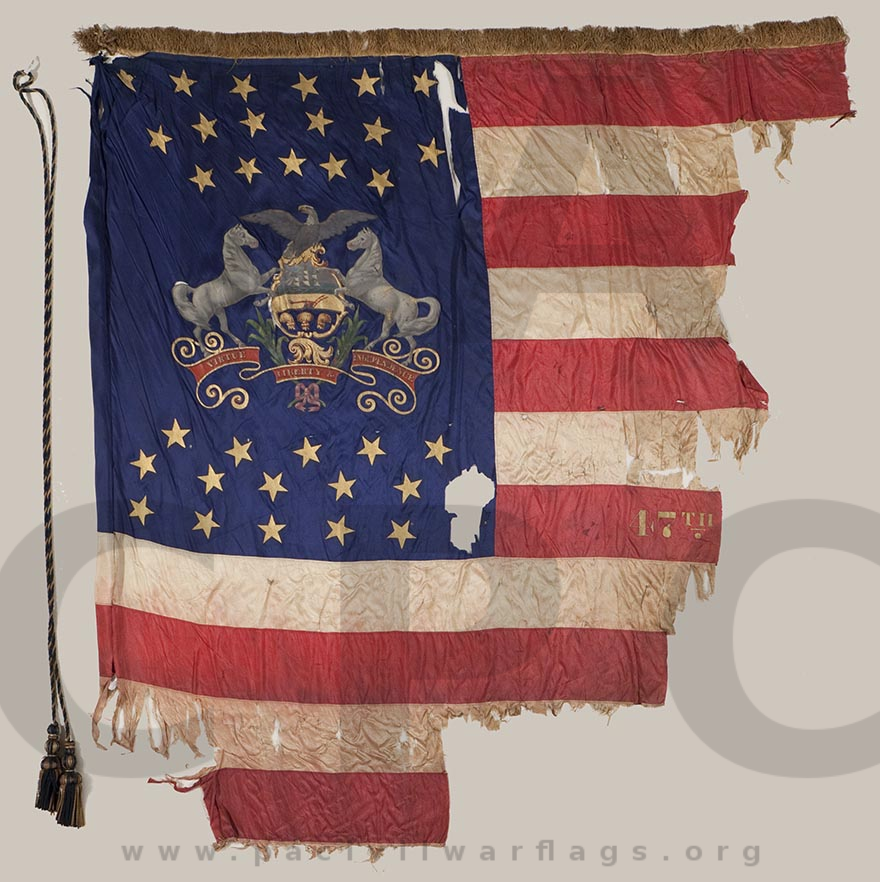
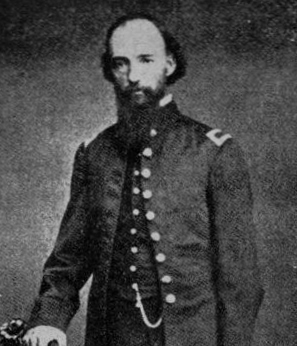
  3. Wharton, Henry D. Letters from the Sunbury Guards. Sunbury, Pennsylvania: Sunbury American, 1861-1868.


From Louisiana to Virginia (1864): The Battle of Snicker’s Gap and Service with the Army of the Shenandoah

Cool Spring Battlefield, Clark County, Virginia (2016, North Virginia Regional Park Authority, public domain).

Cool Spring Battlefield, Clarke County, Virginia (2016, North Virginia Regional Park Authority, public domain).

Battered but undeterred following their experience in the Union’s Red River Campaign across Louisiana and still attached to the 2nd Brigade, 1st Division of the U.S. Army’s 19th Corps, the 47th Pennsylvania Volunteers received new orders on the 4th of July 1864. Under the command of brigadier-generals James W. McMillan, William Dwight, Jr. and William Hemsley Emory (with McMillan continuing to report to Dwight and Dwight to Emory, who headed the 19th Corps), the 47th Pennsylvania Volunteers were directed to return to the East Coast.

They did — but they did so in two stages.

U.S. Steamer McClellan (Alfred Waud, c. 1860-1865, U.S. Library of Congress, public domain).

U.S. Steamer McClellan (Alfred Waud, circa 1860-1865, U.S. Library of Congress, public domain).

According to 47th Pennsylvania historian Lewis Schmidt, ‘’Companies A, C, D, E, F, H, and I, composing the 1st, 2nd, 3rd and half of the 4th division, sailed from Algiers … at 1 PM on Thursday, July 7. Companies B, G and K of the 4th and 5th divisions remained behind at Morganza, La. under command of Capt. Harte, for want of transportation, and would not arrive in Washington until July 28.”

The men from the 47th’s first detachment could not yet know it, but their transit would lead them into a memorable encounter with President Abraham Lincoln.

As this first grouping readied for departure, Corporal George R. Nichols of E Company penned the following diary entry on 7 July:

Received orders to Pack up at Six O’clock AM and I was detailed on fatigue duty to Load wagons it was for a Mark [demerit]. We Marched to the dock. Embarked on Board of the Steamer McClellan. ar [sic] was packed on Board because about Nine hundred Men was Shoved on her at one O’clock PM. Started down the Mississippi River. Past a New Mail Steamer at five PM Bound for New Orleans Past forts St. Phillip and Jackson at 8 PM. came to anchor at ten Oclock and layed to for the Night’…. [continuing on Friday]: ‘Started this Morning at four Oclock AM. Crost the Bar about Seven. Shaped our course South East. At nine Oclock the orders was torn open, and then we knowed or destination. So we are Bound for Virginia. Well I am Glad. Maby I can See My Brother’ [with the Pennsylvania Bucktail Regiment].

En route, C Company scribe Henry D. Wharton continued chronicling the regiment’s movement:

The passage down the Mississippi was mostly at night, so I am unable to give you a description of it. At Pilottown we exchanged pilots; immediately below was hailed by the S river gunboat 48 with ‘steamer ahoy: what steamer’s that?’ which was answered satisfactorily, when with a wave of the hand we parted, our boat on its way to cross the bar, and then to find out by certain papers our destination. An expedition was on the move but what point no one outside of headquarters was able to tell. It was a secret move. This was right, for the destination of former expeditions was known weeks before embarking, and by the time the troops reached the point to which they were ordered, the rebs were ready to receive them. New Orleans is filled with traitors and spies, ready to do the bidding of Jefferson D., and it is necessary that the greatest precaution be used when anything extraordinary is going on.

As the pilot was leaving, after safely steering ‘Little Mac’ past the Belize, the sealed orders were opened, when we learned our course was toward Fortress Monroe, to join in the good work going on in front of Richmond. Why our destination was kept so secret I cannot conjecture, unless it was a bait to catch spies, inducing them to forward word to Johnston that an advance was being made on Mobile, which might lead him to withdraw a portion of his troops from Sherman’s front an send them to the protection of the latter city.

When out on the gulf sixty miles, Jonas Snyder of Carbon County, Pa., a member of Company I, died. His body was prepared for burial by nicely sewing it up in blankets, with weights attached to make it sink. The funeral was conducted by Chaplain Rodrock, who read the beautiful sea service from the prayer book of the Protestant Episcopal Church. The ‘Flag of our Union’ was at half mast, the boat stopped, and as the sun was hiding in the west, the body was launched into the sea, sinking to rise no more, until the great day comes when the soul must give an account for the ‘deeds’ done in the body. 

[Note: Pvt. Jonas Snyder: forty-five years old, five feet, three inches tall, former powder maker, died from chronic diarrhea on Friday, 8 July; however, his death was recorded in regimental books as having occurred on 19 July 1864.

A significant thinning of the ranks occurred during this phase of duty as other ailing members of the 47th Pennsylvania who had been left behind to convalesce in Louisiana and Mississippi lost their battles with disease and war wound recovery, or were discharged on surgeons’ certificates of disability. Among the deceased were B Company’s Josiah Braden, who died in New Orleans and rests at the Chalmette National Cemetery in St. Bernard Parish; H Company’s Private George H. Smith, who passed away while receiving medical care at the Union’s general hospital at Natchez, Mississippi and was laid to rest in the city cemetery there before being exhumed and reinterred at the Natchez National Cemetery; and G Company’s Sergeant James Crader, who also died at the Natchez hospital but whose body was ultimately returned to Pennsylvania for burial at Allentown’s Union-West End Cemetery. According to Schmidt:

Sgt. Crader, a 48 year old shoemaker, was the father of James W., Thomas K., and Edwin K. Crader who served with the same company. His son James W. Crader would receive a promotion to 2nd Lieutenant in 1865. A news article in the Allentown Morning Call of October 24, 1910, reported in contradiction, that Sgt. Crader was ‘on his way home sick’ when he died.

The deaths continued in mid-July as A Company Privates J. Williamson and Michael Andrew died, respectively, at Baton Rouge and New Orleans on 13 and 14 July; Williamson’s grave remains unidentified to this day, according to Schmidt, but may be located at one of the national cemeteries in Baton Rouge or Port Hudson, Louisiana. Andrew, a widowed father who left behind five children under the age of 16, was ultimately interred at the Chalmette National Cemetery.

“Also returning home on another ship about this same time, after being discharged with a surgeon’s certificate in June, was Pvt. Jacob Rinnick of Company E.” Per Schmidt, he “died on board ship as a civilian, one day out of New York.”

The body was temporarily buried on Long Island in the Cypress Hill Cemetery, and later disinterred after a short burial. On Saturday, July 30, the remains were returned to Easton and interred in the City Cemetery after services in his father’s house. Another source reported that the burial took place at the German Reformed Church Burial Ground in Easton.

Privates Thaddeus Heckroth of B Company, Jerome Bryner of H Company and I Company’s William Münch were among those discharged via Surgeons’ Certificates. Heckroth and Bryner were released from duty while still in Louisiana while Münch was discharged while at sea.]

Meanwhile, as Companies A, C, D, E, F, H, and I were en route to the East Coast via the steamer McClellan, the Confederate threat to the nation’s capital mounted as troops led by Lieutenant General Jubal Early made their way north through the Shenandoah Valley toward Washington. “As a result,” explained Schmidt, “troops were diverted to the defenses of Washington, and as units of the First Division of the 19th Corps began to arrive at Fortress Monroe, their orders were changed and they were sent on to the Capital. This confusion in destinations caused the main detachment of the [47th Pennsylvania] to bypass Bermuda Hundred and proceed directly to Washington.”

Still steaming aboard the McClellan on Sunday, 10 July, the 47th Pennsylvanians purposefully avoided both Forts Taylor and Jefferson due to a raging yellow fever outbreak, according to Wharton, who added:

In one week from the day we started we reached Fortress Monroe [Thursday, July 14]. Gen. [McMillan] went ashore to report, where he received orders to push on to Washington. It was here we received the first intimation of the rebel raid into Maryland and the supposed danger to which Washington was exposed. The boys were anxious to move forward that they might participate in any punishment that would be given the rebels.

Arrival in Virginia

According to C Company Captain John Peter Shindel Gobin, “Pleasant weather attended the voyage,” and the McClellan finally steamed into Hampton Roads, Virginia on the afternoon of 11 July. The next morning, he and his fellow 47th Pennsylvanians headed for Washington. While disembarked briefly at Fort Stevens, they saw President Lincoln in person, and thrilled to the pomp befitting the arrival of a battle-tested regiment. Their trip down the Potomac while aboard the Creole was described by both Nichols and Wharton in their writings of 15 July as “splendid.”

As they passed Washington’s tomb, wrote Wharton, “the band of the 47th played ‘Hail Columbia’, and several national airs, while the ‘Star Spangled Banner’ on the stern of the McClellan was lowered and hoisted in salute.” After disembarking at the wharf on 7th Street, the regiment then marched up Pennsylvania Avenue, “out past the President’s house to Georgetown, and then on to this place where we bivouacked…. The 47th had disembarked and took up its line of march, arriving at Tenleytown, located about two miles north of Georgetown. The weather had been very hot, and the regiment remained in camp at Tenleytown until 3PM on Saturday.”

Nichols confirmed that the regiment started its march toward Washington at daylight, and observed that their new assignment:

Seems More like life hear then down South. We past fort Washington about 12 M. and Sighted the Capitol and Alexandria at the Same time. arrived at Washington at about one oclock PM disembarked about three Got coffee and crackers at the Sanitary Commissions. Started on the March at Six oclock PM. Marched through Washington and Georgetown to Tenlatown [Tenleytown] about Eight Miles and Bivouac for the Night at Nine oclock PM.

In his History of the Nineteenth Army Corps, Richard B. Irwin confirmed that the 47th Pennsylvania’s main detachment had indeed arrived at Tenleytown by mid-July:

About 3,600 men of Emory’s division had landed at Washington during the 12th and 13th of July, increasing the effective force of the Nineteenth Corps to about 4,200, most of whom spent the night in following the windings of the road that marks the long outline of northern fortifications.

 This grouping, explained Irwin, arrived as follows:

On the 13th of July the Clinton arrived at Washington with the 29th Maine and part of the 13th Maine, the St. Mary with the 8th Vermont, the Corinthian with the remaining six companies of the 114th New York, the Mississippi with the 90th and 116th New York and the 30th Massachusetts, the Creole with the 47th Pennsylvania. As the detachments landed they were hurried, in most instances by long and needless circuits to Tennallytown, where they found themselves at night without supplies or wagons, without orders, and without much organization.

 …. Out of this Grant brought order by assigning Wright to conduct the pursuit of Early. When, therefore, on the morning of the 13th Wright found Early gone from his front, he marched after him with the Sixth Corps, and ordered the detachment of the Nineteenth Corps to follow. Grant wished Wright to push on to Edwards Ferry to cut off Early’s retreat across the Potomac.

On 16 July, the 47th Pennsylvanians joined in crossing the Potomac with their fellow members of the 19th Corps, 1st Division, under Brigadier-General Emory, along with the U.S. 6th Corps at White’s Ford, the spot on the Potomac at which Early’s troops had just managed to evade the Union’s pursuit and escape to Leesburg, Virginia. The 19th Corpsmen then trekked roughly three miles past Leesburg into the Catoctin Mountains, pitched their tents at Clark’s Gap, and provided support to the Union forces led by Major-General David Hunter as Hunter’s group began flanking Early’s Army.

Unfortunately, Early’s men escaped once again, and headed again for the Shenandoah Valley – this time, marching through Snicker’s Gap. According to the U.S. National Park Service:

A Union column, consisting of the VI Corps and elements of the XIX Corps under Maj. Gen. Horatio Wright, pursued Early’s army as it withdrew from the environs of Washington, D.C.  Wright’s force was joined by elements of Crook’s command, which had accompanied Hunter during his retreat through West Virginia. On July 17, the Union cavalry passed through Snickers Gap and attempted to force passage of the Shenandoah River at Snickers Ford (Castleman’s Ferry). On the morning of July 18, the vanguard of the Union infantry moved through Snickers Gap. Col. Joseph Thoburn (of Crook’s command) led his division downstream to cross the river at Judge Richard Parker’s Ford. Early’s three nearby infantry divisions moved to defend the fords. In the afternoon, Rodes’s division attacked and shattered Thoburn’s right flank on the Cool Spring plantation. Thoburn made a stand behind a stone wall at the river’s edge and beat off three attacks until darkness enabled him to withdraw. Union pursuit of Early was delayed several days.

On 18 July 1864, the 47th Pennsylvania became one of those Union regiments tasked with entering the Shenandoah Valley via Snicker’s Gap. While there, the regiment engaged the enemy in the Battle of Cool Spring, Virginia (also known as the Battle of Snicker’s Gap). Converging on Early’s larger Confederate Army of eight thousand men from three sides (front, flank and rear) as part of the smaller Union force of five thousand, the 47th Pennsylvania helped inspire the Rebel retreat to Strasburg from 19-20 July.

Chain Bridge Across the Potomac Above Georgetown Looking Toward Virginia, 1861 (The Illustrated London News, public domain).

Chain Bridge across the Potomac above Georgetown looking toward Virginia, 1861 (The Illustrated London News, public domain).

Returning to Leesburg, the Union troops encamped at Goose Creek before heading back to Washington, D.C. on 22 July. After crossing the Chain Bridge the next day, the 47th Pennsylvania’s Companies A, C, D, E, F, H, and I and their fellow 19th Corpsmen established a new camp “on the high ground overlooking the Potomac near Battery Vermont,” thereby ending “the ‘Snicker’s Gap war,” according to Irwin. (Casualties – Union: 422; Confederate: 397.)

Through the Eyes of a 47th Pennsylvanian

Snicker’s Gap, Virginia in relation to Charlestown, West Virginia, July 1864 (Hotchkiss map excerpt, U.S. Library of Congress, public domain; click to enlarge).

In recounting the Battle of Cool Spring, Wharton delineated the actions of the 47th Pennsylvania Volunteers as follows:

The 6th Corps crossed the Potomac on Saturday, previous to which they overtook the rear guard of the enemy at Poolesville, a section of artillery with cavalry pressed forward and vigorously shelled the enemy from several positions. The corps overtook them at Snicker’s Gap. Though the gap might have been successfully held, it was evacuated without much delay, and our infantry took possession. The enemy held possession of the other bank of the Shenandoah River, one mile distant.

A part of Hunter’s command, to the number of five thousand, were ordered to the river, which they crossed in face of the enemy’s fire. After the force had crossed, the enemy attempted a flank movement on their right and left, but Adams’ Rhode Island Battery came into position on an eminence overlooking the valley below. They immediately opened upon the enemy with shot and shell from the three inch rifled guns, creating great havoc among them. The range was accurate and each shell burst in their midst. The enemy finding the damage to their infantry so great, attempted to silence the battery by firing upon them with twenty pound parrots, which however, lasted but a moment, as they in turn were fired upon and forced to silence. Night coming on our infantry recrossed the river to come under the batteries. At this point we lost a number in killed and wounded; a few were drowned in getting off the proper ford. Among the wounded I noticed Ed. M. Shindel, son of Rev. Jeremiah Shindel, and nephew of H. B. Masser, Esq. I am happy to state that his wound is so slight that it will scarcely keep him from duty….

Instead of going to Grant in front of Petersburg, as we expected, orders were issued sending the 6th and 19th Corps up through Maryland in quest of rebels. On the route I conversed with many farmers who had been deprived of property by the chivalry in their late raid and all of them agree in the abhorrence with which they hold the raiders, and are no ways particular in their speech concerning them. A gentleman told me they came not as warriors, but as the lower class of robbers, resorting to petty larceny, and were so mean that they even asked ladies for the ear drops worn as ornaments. At a farmer’s where they had stolen eight horses, a young lady sad that the ‘low fellows wanted papa to take the boots off his feet to give them.’

We are to move forward after the enemy, but whether it will be before the arrival of three of our companies, who could not get passage with us, I cannot tell. From what I can learn we will move towards the Point of Rocks. The raiders have, or are attempting to cross the Potomac at Rockville.

 The diary of E Company’s George Nichols adds further color to Wharton’s words, indicating that on that Saturday, the 47th:

Received three days Rations. Started on the March at three oclock PM. Plenty of Good cool water along the Road. I Picked Some Green appels and ate them the first I Seen for two years and Six Month on trees Marched the distance of fourteen Miles and Encamped at half past ten oclock PM.

 The next Sunday, Nichols reported that he was:

 acting left Genl. Guide to the Regtment and I are not compelled to carry a Gun so in the wagon it Goes. it will be easier for Me. we Started on the tramp at Eight AM very hot and dusty at twelve M. half of the Redgt. Was Stragling be hind and when we Got to the Potomac our company Musterd only Nine Men offercers and all. The rest was Played out. We came fourteen Miles to Kelleysford [sic] arrived at three PM. We are Ordered Back to Washington’. On Monday the ‘order [was] contermanded So we Started at four oclock AM croost the River to Virginia Side the Water was three feet deep. But we forderd her all the Same We Struck the leesburg pike whent through leesburg. hamiltonn and Perserville at four PM. We caught the Rear Guard of the army and at twelve oclock Midnight we came to our division after Marching about Twenty Eight Miles. We Passed through Snickers Gap and Encamped in the Vally at Twelve oclock PM.

Kelly's Ford on the Rappahannock River (Edwin Forbes, 10 February 1864, U.S. Library of Congress, public domain)

Kelly’s Ford on the Rappahannock River (Edwin Forbes, 10 February 1864, U.S. Library of Congress, public domain).

Wharton’s writings back up Nichols’ account of the Kelly’s Ford experience, and also confirm that the 47th Pennsylvania Volunteers (Companies A, C, D, E, F, H, and I) did indeed engage in the Battle of Cool Spring/Snicker’s Gap:

The second day’s march brought us to the Potomac at Kelly’s Ford, which we crossed by wading, proceeded on our way to Leesburg, making Snicker’s Gap, where we joined the 6th Army Corps and the balance of our division of the 19th. The 6th boys are some on a march, but were completely taken by surprise when they learned we had crossed the Potomac that morning after sunrise, thinking it was impossible for troops to make what they did not, thirty miles on a hard pike.

On the Move Again

By late July, Companies A, C, D, E, F, H, and I from the 47th Pennsylvania were on the move again with Emory’s Army. Encamped the night of 26 July in Maryland “on the Frederick road, four miles north of Rockville, after a march of nineteen miles,” according to Irwin, they departed at 3 a.m. the next morning, marching another fifteen miles to a site just beyond Hyattstown. “On the 28th Emory took the road at five, marched to Monocacy Junction, where the Sixth Corps crossed the Monocacy, then filed to the right, and crossed at the upper ford, and passing through Frederick went into bivouac four miles beyond.”

They had trekked another thirteen miles.

“On the 29th, an intensely hot day,” wrote Irwin, “Emory marched at eight, following the Sixth Corps, crossed the Potomac at Harper’s Ferry, marched nineteen miles, and went into bivouac at Halltown.” Following another 13-mile march on 31 July – back into and across the Catoctin Mountains – Emory ordered his exhausted men to make camp at 1 a.m. near Jefferson.

Just four hours later, they were awakened by bugle call and sent on the march again at 6 a.m. Thirteen miles later, they pitched their tents along the Emmitsburg Road, roughly two miles past Frederick. Their duties involved “holding the line of the Monocacy and observing the passes of the South Mountain,” according to Irwin.

Meanwhile, Captain Henry S. Harte and the men from Companies B, G and K were finally making their own East Coast arrival.

A Regiment Reunited

Having sailed from Louisiana aboard the Blackstone and, according to Schmidt, “after first stopping enroute [sic] at Bermuda Hundred, under temporary assignment to the Army of the James, with the Second Division of the 19th Corps,” Captain Harte and the men of Companies B, G and K arrived in Virginia on 28 July, and finally reconnected with the bulk of their regiment in Maryland at Monocacy on 2 August 1864.

On 6 August, Emory’s men crossed back over the Potomac River at Harper’s Ferry, preceded and followed, respectively, by the Union forces led by brigadier-generals George R. Crook and John B. Ricketts. “Hunter took up his position covering Halltown and proceeded to strengthen its entrenchments,” according to Irwin, while “Crook’s left rested on the Shenandoah, Emory extended the line to the turnpike road, and Wright carried it to the Potomac.”

But once again, a major shakeup in the top level of Union leadership was underway. Explained Irwin:

Grant had already proposed to unite in a single command the four distinct departments covering the theatre of war on the Shenandoah and on the upper Potomac; as the commander he had first suggested Franklin and afterward Meade. Now, since no action had followed either suggestion, he sent up Sheridan, meaning to place him in command of all the active forces of these four departments, for the purpose of overthrowing Early or expelling him from the Shenandoah. Upon learning this, Hunter, to remove the difficulty, asked to be relieved; and thus, on the 7th of August, Grant gained his wish, and an order was issued by the War Department, creating the Middle Military Division, to include Washington, Virginia, West Virginia, Maryland, Pennsylvania, and part of Ohio, and Sheridan was assigned to the command.

 The stage was now set for Major-General Philip Sheridan’s tide-turning, 1864 Shenandoah Valley Campaign.


Sources:

  1. Bates, Samuel P. History of Pennsylvania Volunteers, 1861-5. Harrisburg, Pennsylvania: B. Singerly, State Printer, 1869.
  2. “Battle of Snicker’s Gap/Battle of Cool Spring,” in CWSAC Battle Summaries. Washington, D.C.: Civil War Sites Advisory Commission (CWSAC), The American Battlefield Protection Program, retrieved online 1 September 2016.
  3. Bluhm, Jr., Raymond K. Shenandoah Valley Campaign: March-November 1864. Washington, D.C.: Center of Military History, United States Army.
  4. Gobin, Companion J. P. S. Lincoln Under Fire, in records of the Memorial Meeting held on 13 February 1907, in Abraham Lincoln. Philadelphia, Pennsylvania: Commandery of the State of Pennsylvania, Military Order of the Loyal Legion of the United States, 1907-1911.
  5. Hotchkiss, Jedediah. “Preliminary Map of Northern Virginia Embracing Portions of Loudoun, Fauquier, Prince William, and Culpeper Counties,” in “Hotchkiss Map Collection.” Washington, D.C.: U.S. Library of Congress, retrieved online 18 July 2025.
  6. Irwin, Richard Bache. History of the Nineteenth Army Corps. New York, New York: G. P. Putnam’s Sons, 1893.
  7. Registers of Deaths of Volunteers, in Records of the U.S. Adjutant General’s Office (Record Group 94). Washington, D.C.: U.S. National Archives and Records Administration, 1861-1865.
  8. Schmidt, Lewis. A Civil War History of the 47th Regiment of Pennsylvania Veteran Volunteers. Allentown, Pennsylvania: Self-published, 1986.
  9. The Battle of Cool Spring. Washington, D.C.: Civil War Trust, retrieved online 1 September 2016.
  10. U.S. Civil War Veterans’, Widows’ and Orphans’ Pension Files. Washington, D.C.: U.S. National Archives and Records Administration.
  11. Wharton, Henry D. Letters from the Sunbury Guards. Sunbury, Pennsylvania: Sunbury American, 1864.


Celebrating the Fourth Far from Home

The city was gaily dressed in flags, and the prettiest thing of the kind was that at the guard station, under Lt. Reese of Company C. Five flags were suspended from the quarters, with wreaths, while the whole front of the enclosure of the yard was covered with evergreens and the red, white, and blue. The Navy had their vessels dressed in their best ‘bib and tucker’, flags flying fore and aft, of our own and those of all nations. It was a pretty sight, and in a measure paid for the fatigue of the boys on their march. At 12 noon, both Army and Navy fired a national salute of thirty five guns. – Henry D. Wharton


The 1863 Fourth of July celebrations in Key West, Florida likely resembled those captured in this image from January 1880 in which former U.S. President Ulysses S. Grant and General Philip Sheridan arrived at the Russell House on Duval Street (Florida Memory Project, public domain).

The 1863 Fourth of July celebrations in Key West, Florida likely resembled those captured in this image from January 1880 in which former U.S. President Ulysses S. Grant and General Philip Sheridan arrived at the Russell House on Duval Street (Florida Memory Project, public domain).

It was the Fourth of July, 1863, and the native sons of Pennsylvania enrolled for Civil War military service with the 47th Pennsylvania Volunteers were stationed about as far from home as they could possibly be. The men serving with Companies A, B, C, D, and I were stationed at Fort Taylor in Key West, Florida while those assigned to companies E, F, G, H, and K were toughing it out at Fort Jefferson, the Union’s remote outpost in the Dry Tortugas. The men from D Company had only just returned to Key West from Fort Jefferson a month earlier.

But life was not all about duty for the Keystone Staters in 1863. According to historian Lewis Schmidt,”July 4th fell on a Saturday, and the celebrations began at Key West at 9 AM when the five companies of the 47th stationed there were reviewed by Gen. Woodbury before the regiment’s office. Immediately after inspection, the regiment marched in a ‘street parade through the principal streets of the city in the heat of 100 degrees Fahrenheit and the dust almost suffocating.’ After which each ‘detachment was taken to their quarters, dismissed, and then to enjoy themselves as best they could.'”

Henry D. Wharton, a member of Company C known for his detailed letters to his hometown newspaper, the Sunbury American, added, “The day passed off pleasantly, all seemed to enjoy themselves.” Afterward, said Wharton, “the city was as quiet as could be expected.”


Sources:

1. Letters from Henry D. Wharton, in Sunbury American. Sunbury, Pennsylvania: 1861-1865.

2. Schmidt, Lewis. A Civil War History of the 47th Regiment of Pennsylvania Veteran Volunteers. Allentown, Pennsylvania: Self-published, 1986.