Black History Month: Paving the Way for the Integration of the Union Army

Abraham Lincoln in New York City on Monday morning, February 27, 1860, several hours before he delivered his Cooper Union address (Matthew Brady, U.S. Library of Congress, public domain).

Acutely aware that Union military casualty figures had continued to climb as the American Civil War moved into and through its second year, President Abraham Lincoln and his senior military advisors soon realized that more drastic measures would need to be taken—and far more volunteer soldiers would need to be recruited if they were to ever begin healing their divided nation.

During the summer of 1862, President Lincoln kicked off that series of drastic measures by issuing his July 2 call for volunteers in which he pressed state governors of Connecticut, Maine, New Hampshire, Illinois, Indiana, Maryland, Michigan, Minnesota, Missouri, New Jersey, New York, Ohio, Pennsylvania, Vermont, Virginia, Tennessee, and Wisconsin, as well as the president of the Military Board of Kentucky, to furnish an additional three hundred thousand men for military service. That action was followed by the passage, two weeks later, of the Militia Act of 1862 on July 17, through which the U.S. Congress empowered Lincoln to “make all necessary rules and regulations to provide for enrolling the militia,” and also authorized state and federal military units in Union-held territories to recruit and enroll enslaved and free Black men to fill labor-related jobs.

Starting on July 17, according to section twelve of that legislation, President Lincoln was “authorized to receive into the service of the United States, for the purpose of constructing intrenchments, or performing camp service or any other labor, or any military or naval service for which they may be found competent, persons of African descent.” In addition, the new law’s next section specified that “when any man or boy of African descent, who by the laws of any State shall owe service or labor to any person who, during the present rebellion, has levied war or has borne arms against the United States, or adhered to their enemies by giving them aid and comfort, shall render any such service as is provided for in this act, he, his mother and his wife and children, shall forever thereafter be free, any law, usage, or custom whatsoever to the contrary notwithstanding: Provided, That the mother, wife and children of such man or boy of African descent shall not be made free by the operation of this act except where such mother, wife or children owe service or labor to some person who, during the present rebellion, has borne arms against the United States or adhered to their enemies by giving them aid and comfort.”

The subsequent two sections of this act then spelled out how the newly enlisted Black soldiers would be compensated for their work, stating that “the expenses incurred to carry this act into effect shall be paid out of the general appropriation for the army and volunteers,” and that “all persons who have been or shall be hereafter enrolled in the service of the United States under this act shall receive the pay and rations now allowed by law to soldiers, according to their respective grades: Provided, That persons of African descent, who under this law shall be employed, shall receive ten dollars per month and one ration, three dollars of which monthly pay may be in clothing.”

Adding More Teeth to the Fight’s Bite

That same day (July 17 1862), the U.S. Congress then also passed the Confiscation Act of 1862, proclaiming that “every person who shall hereafter commit the crime of treason against the United States, and shall be adjudged guilty thereof, shall suffer death, and all his slaves, if any, shall be declared and made free.”

A subsequent push that same summer by President Lincoln and his senior military advisors to state leaders to furnish an additional three hundred thousand men—for a revised total of six hundred thousand new volunteer soldiers—resulted in the enlistment of more than half a million men—with an additional ninety thousand troops added to Union rosters through the implementation of a nationwide draft.

Freeing More Enslaved Men and Enabling Them to Enlist

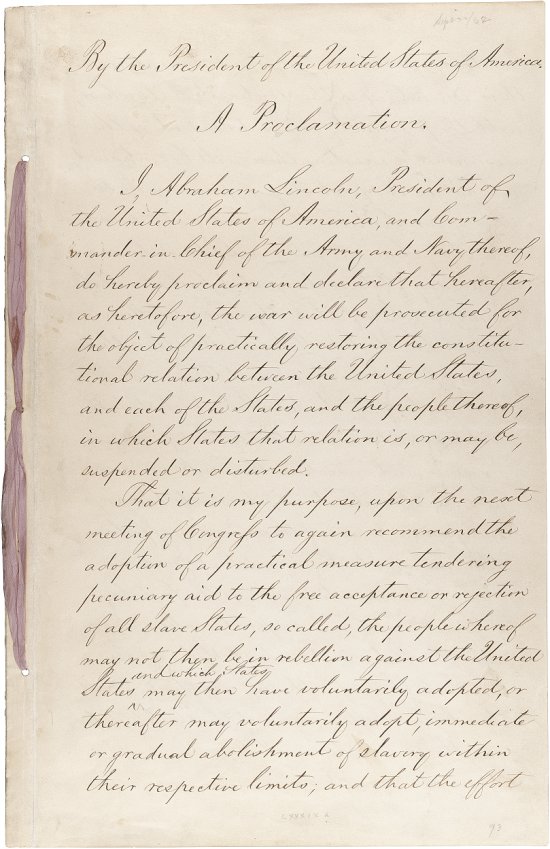
Page one of the Preliminary Emancipation Proclamation issued by President Abraham Lincoln, September 22, 1862 (U.S. National Archives and Records Administration, public domain; click to enlarge).

President Lincoln followed up his blistering recruitment drive of the summer of 1862 by adding even more support for his plan to increase federal troop strength by issuing his Preliminary Emancipation Proclamation on September 22, 1862. Giving a preview of what he intended to do in 1863 if Confederate States officials failed to cease hostilities and rejoin the Union, he began paving the road for Union regiments to rescue and recruit larger numbers of enslaved men:

By the President of the United States of America.
A Proclamation.

I, Abraham Lincoln, President of the United States of America, and Commander-in-Chief of the Army and Navy thereof, do hereby proclaim and declare that hereafter, as heretofore, the war will be prosecuted for the object of practically restoring the constitutional relation between the United States, and each of the States, and the people thereof, in which States that relation is, or may be, suspended or disturbed.

That it is my purpose, upon the next meeting of Congress to again recommend the adoption of a practical measure tendering pecuniary aid to the free acceptance or rejection of all slave States, so called, the people whereof may not then be in rebellion against the United States and which States may then have voluntarily adopted, or thereafter may voluntarily adopt, immediate or gradual abolishment of slavery within their respective limits; and that the effort to colonize persons of African descent, with their consent, upon this continent, or elsewhere, with the previously obtained consent of the Governments existing there, will be continued.

That on the first day of January in the year of our Lord, one thousand eight hundred and sixty-three, all persons held as slaves within any State, or designated part of a State, the people whereof shall then be in rebellion against the United States shall be then, thenceforward, and forever free; and the executive government of the United States, including the military and naval authority thereof, will recognize and maintain the freedom of such persons, and will do no act or acts to repress such persons, or any of them, in any efforts they may make for their actual freedom.

That the executive will, on the first day of January aforesaid, by proclamation, designate the States, and part of States, if any, in which the people thereof respectively, shall then be in rebellion against the United States; and the fact that any State, or the people thereof shall, on that day be, in good faith represented in the Congress of the United States, by members chosen thereto, at elections wherein a majority of the qualified voters of such State shall have participated, shall, in the absence of strong countervailing testimony, be deemed conclusive evidence that such State and the people thereof, are not then in rebellion against the United States.

That attention is hereby called to an Act of Congress entitled ‘An Act to make an additional Article of War’ approved March 13, 1862, and which act is in the words and figure following:

‘Be it enacted by the Senate and House of Representatives of the United States of America in Congress assembled, That hereafter the following shall be promulgated as an additional article of war for the government of the army of the United States, and shall be obeyed and observed as such:

Article-All officers or persons in the military or naval service of the United States are prohibited from employing any of the forces under their respective commands for the purpose of returning fugitives from service or labor, who may have escaped from any persons to whom such service or labor is claimed to be due, and any officer who shall be found guilty by a court martial of violating this article shall be dismissed from the service.

Sec.2. And be it further enacted, That this act shall take effect from and after its passage.

Also to the ninth and tenth sections of an act entitled ‘An Act to suppress Insurrection, to punish Treason and Rebellion, to seize and confiscate property of rebels, and for other purposes,’ approved July 17, 1862, and which sections are in the words and figures following:

Sec.9. And be it further enacted, That all slaves of persons who shall hereafter be engaged in rebellion against the government of the United States, or who shall in any way give aid or comfort thereto, escaping from such persons and taking refuge within the lines of the army; and all slaves captured from such persons or deserted by them and coming under the control of the government of the United States; and all slaves of such persons found on (or) being within any place occupied by rebel forces and afterwards occupied by the forces of the United States, shall be deemed captives of war, and shall be forever free of their servitude and not again held as slaves.

Sec.10. And be it further enacted, That no slave escaping into any State, Territory, or the District of Columbia, from any other State, shall be delivered up, or in any way impeded or hindered of his liberty, except for crime, or some offence against the laws, unless the person claiming said fugitive shall first make oath that the person to whom the labor or service of such fugitive is alleged to be due is his lawful owner, and has not borne arms against the United States in the present rebellion, nor in any way given aid and comfort thereto; and no person engaged in the military or naval service of the United States shall, under any pretence whatever, assume to decide on the validity of the claim of any person to the service or labor of any other person, or surrender up any such person to the claimant, on pain of being dismissed from the service.’

And I do hereby enjoin upon and order all persons engaged in the military and naval service of the United States to observe, obey, and enforce, within their respective spheres of service, the act, and sections above recited.

And the executive will in due time recommend that all citizens of the United States who shall have remained loyal thereto throughout the rebellion, shall (upon the restoration of the constitutional relation between the United States, and their respective States, and people, if that relation shall have been suspended or disturbed) be compensated for all losses by acts of the United States, including the loss of slaves.

In witness whereof, I have hereunto set my hand, and caused the seal of the United States to be affixed.

Done at the City of Washington this twenty-second day of September, in the year of our Lord, one thousand, eight hundred and sixty-two, and of the Independence of the United States the eighty seventh.

[Signed:] Abraham Lincoln
By the President

[Signed:] William H. Seward
Secretary of State

Page one of the Emancipation Proclamation issued by U.S. President Abraham Lincoln, January 1, 1863 (U.S. National Archives and Records Administration, public domain; click to enlarge).

When those state officials failed to comply, President Lincoln officially issued the Emancipation Proclamation on January 1, 1863:

By the President of the United States of America:
A Proclamation.

Whereas, on the twenty-second day of September, in the year of our Lord one thousand eight hundred and sixty-two, a proclamation was issued by the President of the United States, containing, among other things, the following, to wit:

‘That on the first day of January, in the year of our Lord one thousand eight hundred and sixty-three, all persons held as slaves within any State or designated part of a State, the people whereof shall then be in rebellion against the United States, shall be then, thenceforward, and forever free; and the Executive Government of the United States, including the military and naval authority thereof, will recognize and maintain the freedom of such persons, and will do no act or acts to repress such persons, or any of them, in any efforts they may make for their actual freedom.

That the Executive will, on the first day of January aforesaid, by proclamation, designate the States and parts of States, if any, in which the people thereof, respectively, shall then be in rebellion against the United States; and the fact that any State, or the people thereof, shall on that day be, in good faith, represented in the Congress of the United States by members chosen thereto at elections wherein a majority of the qualified voters of such State shall have participated, shall, in the absence of strong countervailing testimony, be deemed conclusive evidence that such State, and the people thereof, are not then in rebellion against the United States.’

Now, therefore I, Abraham Lincoln, President of the United States, by virtue of the power in me vested as Commander-in-Chief, of the Army and Navy of the United States in time of actual armed rebellion against the authority and government of the United States, and as a fit and necessary war measure for suppressing said rebellion, do, on this first day of January, in the year of our Lord one thousand eight hundred and sixty-three, and in accordance with my purpose so to do publicly proclaimed for the full period of one hundred days, from the day first above mentioned, order and designate as the States and parts of States wherein the people thereof respectively, are this day in rebellion against the United States, the following, to wit:

Arkansas, Texas, Louisiana, (except the Parishes of St. Bernard, Plaquemines, Jefferson, St. John, St. Charles, St. James Ascension, Assumption, Terrebonne, Lafourche, St. Mary, St. Martin, and Orleans, including the City of New Orleans) Mississippi, Alabama, Florida, Georgia, South Carolina, North Carolina, and Virginia, (except the forty-eight counties designated as West Virginia, and also the counties of Berkley, Accomac, Northampton, Elizabeth City, York, Princess Ann, and Norfolk, including the cities of Norfolk and Portsmouth[)], and which excepted parts, are for the present, left precisely as if this proclamation were not issued.

And by virtue of the power, and for the purpose aforesaid, I do order and declare that all persons held as slaves within said designated States, and parts of States, are, and henceforward shall be free; and that the Executive government of the United States, including the military and naval authorities thereof, will recognize and maintain the freedom of said persons.

And I hereby enjoin upon the people so declared to be free to abstain from all violence, unless in necessary self-defence; and I recommend to them that, in all cases when allowed, they labor faithfully for reasonable wages.

And I further declare and make known, that such persons of suitable condition, will be received into the armed service of the United States to garrison forts, positions, stations, and other places, and to man vessels of all sorts in said service.

And upon this act, sincerely believed to be an act of justice, warranted by the Constitution, upon military necessity, I invoke the considerate judgment of mankind, and the gracious favor of Almighty God.

In witness whereof, I have hereunto set my hand and caused the seal of the United States to be affixed.

Done at the City of Washington, this first day of January, in the year of our Lord one thousand eight hundred and sixty three, and of the Independence of the United States of America the eighty-seventh.

By the President: ABRAHAM LINCOLN

WILLIAM H. SEWARD, Secretary of State.

Adding More Teeth to the Fight’s Bite

This Civil War-era recruiting flyer documents the service of the 47th Pennsylvania Volunteer Infantry at Forts Taylor and Jefferson, Florida, under the leadership of Colonel Tilghman Good, as well as the premium and bounty added to standard pay to inspire more men to enlist (public domain).

Just over a month later, in February 1863, the United States Congress passed U.S. Senate Bill 511 (“An act for enrolling and calling out the national forces, and for other purposes”). Better known as the Enrollment Act of 1863 or “Conscription Act,” it was signed into law by President Lincoln on 3 March 1863, and gave state officials throughout the north the ability to draft men to serve whenever those officials were unable to meet their federal troop quotas through volunteer recruitment drives. It also allowed draftees to recruit others to muster in and serve for them.

Whereas there now exist in the United States an insurrection and rebellion against the authority thereof, and it is, under the Constitution of the United States, the duty of the government to suppress insurrection and rebellion, to guarantee to each State a republican form of government, and to preserve the public tranquility; and whereas, for these high purposes, a military force is indispensable, to raise and support which all persons ought willingly to contribute; and whereas no service can be more praiseworthy and honorable than that which is rendered for the maintenance of the Constitution and Union, and the consequent preservation of free government: Therefore—

Be it enacted by the Senate and House of Representatives of the United States of America in Congress assembled, That all able-bodied male citizens of the United States, and persons of foreign birth who shall have declared on oath their intention to become citizens under and in pursuance of the laws thereof, between the ages of twenty and forty-five years, except as hereinafter excepted, are hereby declared to constitute the national forces, and shall be liable to perform military duty in the service of the United States when called out by the President for that purpose.

SEC 2. And be it further enacted, That the following persons be, and they are hereby, excepted and exempt from the provisions of this act, and shall not be liable to military duty under the same, to wit: Such as are rejected as physically or mentally unfit for the service; also, First the Vice-President of the United States, the judges of the various courts of the United States, the heads of the various executive departments of the government, and the governors of the several States. Second, the only son liable to military duty of a widow dependent upon his labor for support. Third, the only son of aged or infirm parent or parents dependent upon his labor for support. Fourth, where there are two or more sons of aged or infirm parents subject to draft, the father, or, if he be dead, the mother, may elect which son shall be exempt. Fifth, the only brother of children not twelve years old, having neither father nor mother dependent upon his labor for support. Sixth, the father of motherless children under twelve years of age dependent upon his labor for support. Seventh, where there are a father and sons in the same family and household, and two of them are in the military service of the United States as non-commissioned officers, musicians, or privates, the residue of such family and household, not exceeding two, shall be exempt. And no persons but such as are herein excepted shall be exempt: Provided, however, That no person who has been convicted of any felony shall be enrolled or permitted to serve in said forces.

SEC. 3. And be it further enacted, That the national forces of the United States not now in the military service, enrolled under this act, shall be divided into two classes: the first of which shall comprise all persons subject to do military duty between the ages of twenty and thirty-five years, and all unmarried persons subject to do military duty above the age of thirty-five and under the age of forty-five; the second class shall comprise all other persons subject to do military duty, and they shall not, in any district, be called into the service of the United States until those of the first class hall have been called.

SEC. 4. And be it further enacted, That, for greater convenience in enrolling, calling out, and organizing the national forces, and for the arrest of deserters and spies of the enemy, the United States shall constitute one or more, as the President shall direct, and each congressional district of the respective states, as fixed by a law of the state next preceding the enrolment, shall constitute one: Provided, That in states which have not by their laws been divided into two or more congressional districts, the President of the United States shall divide the same into so many enrolment districts as he may deem fit and convenient.

SEC 8. And be it further enacted, That in each of said districts there shall be a board of enrolment, to be composed of the provost-marshal, as president, and two other persons, to be appointed by the President of the United States, one of whom shall be a licensed and practising physician and surgeon.

SEC. 10. And be it further enacted, That the enrolment of each class shall be made separately, and shall only embrace those whose ages shall be on the first day of July thereafter between twenty and forty-five years.

SEC. 11. And be it further enacted, That all persons thus enrolled shall be subject, for two years after the first day of July succeeding the enrolment, to be called into the military service of the United States, and to continue in service during the present rebellion, not, however, exceeding the term of three years; and when called into service shall be placed on the same footing, in all respects, as volunteers for three years, or during the war, including advance pay and bounty as now provided by law.

SEC. 12. And be it further enacted, That whenever it may be necessary to call out the national forces for military service, the President is hereby authorized to assign to each district the number of men to be furnished by said district; and thereupon the enrolling board shall, under the direction of the President, make a draft of the required number, and fifty per cent, in addition, and shall make an exact and complete roll of the names of the person so drawn, and of the order in which they are drawn, so that the first drawn may stand first upon the said roll and the second may stand second, and so on; and the persons so drawn shall be notified of the same within ten days thereafter, by a written or printed notice, to be served personally or by leaving a copy at the last place of residence, requiring them to appear at a designated rendezvous to report for duty. In assigning to the districts the number of men to be furnished therefrom, the President shall take into consideration the number of volunteers and militia furnished by and from the several states in which said districts are situated, and the period of their service since the commencement of the present rebellion, and shall so make said assignment as to equalize the numbers among the districts of the several states, considering and allowing for the numbers already furnished as aforesaid and the time of their service.

SEC. 13. And be it further enacted, That any person drafted and notified to appear as aforesaid, may, on or before the day fixed for his appearance, furnish an acceptable substitute to take his place in the draft; or he may pay to such person as the Secretary of War may authorize to receive it, such sum, not exceeding three hundred dollars, as the Secretary may determine, for the procuration of such substitute; which sum shall be fixed at a uniform rate by a general order made at the time of ordering a draft for any state or territory; and thereupon such person so furnishing the substitute, or paying the money, shall be discharged from further liability under that draft. And any person failing to report after due service of notice, as herein prescribed, without furnishing a substitute, or paying the required sum therefor, shall be deemed a deserter, and shall be arrested by the provost-marshal and sent to the nearest military post for trial by court-martial, unless, upon proper showing that he is not liable to do military duty, the board of enrolment shall relive him from the draft.

SEC. 16. And be it further enacted, That as soon as the required number of able-bodied men liable to do military duty shall be obtained from the list of those drafted, the remainder shall be discharged; and all drafted persons reporting at the place of rendezvous shall be allowed travelling pay from their places of residence; and all persons discharged at the place of rendezvous shall be allowed travelling pay to their places of residence; and all expenses connected with the enrolment and draft, including subsistence while at the rendezvous, shall be paid form the appropriation for enrolling and drafting, under such regulations as the President of the United States shall prescribe; and all expenses connected with the arrest and return of deserters to their regiments, or such other duties as the provost-marshal shall be called upon to perform, shall be paid from the appropriation for arresting deserters, under such regulations as the President of the United States shall prescribe: Provided, The provost-marshals shall in no case receive commutation for transportation or for fuel and quarters, but only for forage, when not furnished by the government, together with actual expenses of postage, stationery, and clerk hire authorized by the provost-marshal-general.

SEC. 17. And be it further enacted, That any person enrolled and drafted according to the provisions of this act who shall furnish an acceptable substitute, shall thereupon receive from the board of enrolment a certificate of discharge from such draft, which shall exempt him from military duty during the time for which he was drafted; and such substitute shall be entitled to the same pay and allowances provided by law as if he had been originally drafted into the service of the United States.

SEC. 18. And be it further enacted, That such of the volunteers and militia now in the service of the United States as may reenlist to serve one year, unless sooner discharged, after the expiration of their present term of service, shall be entitled to a bounty of fifty dollars, one half of which to be paid upon such reenlistment, and the balance at the expiration of the term of reenlistment; and such as may reenlist to serve for two years, unless sooner discharged, after the expiration of their present term of enlistment, shall receive, upon such reenlistment, twenty-five dollars of the one hundred dollars bounty for enlistment provided by the fifth section of the act approved twenty-second of July, eighteen hundred and sixty-one, entitled “An act to authorize the employment of volunteers to aid in enforcing the laws and protecting public property.”

SEC. 25. And be it further enacted, That if any person shall resist any draft of men enrolled under this act into the service of the United States, or shall counsel or aid any person to resist any such draft; or shall counsel or aid any person to resist any such draft; or shall assault or obstruct any officer in making such draft, or in the performance of any service in relation thereto; or shall counsel any person to assault or obstruct any such officer, or shall counsel any drafted men not to appear at the place of rendezvous, or wilfully dissuade them from the performance of military duty as required by law, such person shall be subject to summary arrest by the provost-marshal, and shall be forthwith delivered to the civil authorities, and upon conviction thereof, be punished by a fine not exceeding five hundred dollars, or by imprisonment not exceeding two years, or by both of said punishments.

SEC. 33. And be it further enacted, That the President of the United States is hereby authorized and empowered, during the present rebellion, to call forth the national forces, by draft, in the manner provided for in this act.

Those combined actions by President Lincoln and the U.S. Congress enabled the officers of the 47th Pennsylvania Volunteer Infantry to enroll the first four of nine formerly enslaved men in their regiment in early October 1862 while it was stationed in Beaufort, South Carolina—and then enabled the regiment’s officers to enroll five more formerly enslaved men in early April 1864 while the 47th Pennsylvania Volunteers were stationed in Natchitoches, Louisiana.

Initially assigned the rank of “Under-Cook,” and entered on regimental muster rolls below the names of the men who had enrolled at the rank of private, several of these nine formerly enslaved men were later awarded the rank of private, according to subsequent regimental records. After completing their respective terms of enlistment, all but one were honorably discharged during the fall of 1865 with several also being awarded U.S. Civil War Pensions in later life. Their life stories are now being documented on the website, Faces of the 47th: Freedmen of the 47th Pennsylvania Volunteer Infantry.”

Next: Black History Month: The Authorization, Duties and Pay of “Under-cooks


Sources:

  1. An Act for enrolling and calling out the national Forces, and for other Purposes,” Congressional Record. 37th Cong. 3d. Sess. Ch. 74, 75. 1863. March 3, 1863.” New Haven, Connecticut: Gilder Lehrman Center for the Study of Slavery, Resistance, and Abolition at the Whitney and Betty MacMillan Center for International and Area Studies at Yale University, retrieved online February 1, 2024.
  2. Emancipation Proclamation, January 1, 1863,” in “Presidential Proclamations, 1791-1991” (Record Group 11: General Records of the United States Government). Washington, D.C.: U.S. National Archives and Records Administration.
  3. Preliminary Emancipation Proclamation, September 22, 1862,” in “Presidential Proclamation 93” (Record Group 11, vault, box 2: General Records of the U.S. Government). Washington, D.C.: U.S. National Archives and Records Administration.
  4. The Conscription Act.; Judge Cadwallader’s Opinion Establishing Its Constitutionality.” New York, New York: The New York Times, September 13, 1863.
  5. The Law of the Draft.; Important Circulars Issued by the Provost-Marshal General. No Escape After a Name is Enrolled. Penalties of a Failure to Respond The Treatment of Deserters. The Question of Exemptions.” New York, New York: The New York Times, July 19, 1863.


Research Update: Additional New Details Learned About Bristor Gethers, One of the Nine Formerly Enslaved Men Who Enlisted with the 47th Pennsylvania Volunteers

Page one of the U.S. Army’s Civil War enlistment paperwork for Bristor Gethers (mistakenly listed as “Presto Garris”), 47th Pennsylvania Volunteer Infantry, Company F, October 5, 1862 (U.S. National Archives and Records Administration, public domain; click to enlarge).

Fleeing the brutal experience of chattel slavery in Georgetown County, South Carolina, a thirty-three-year-old Black man was willing to enlist for military service in the fall of 1862 as an “undercook”—a designation within the United States Army that was first authorized by the U.S. War Department on September 28, 1863—in order to ensure his freedom in America’s Deep South during the American Civil War.

Arriving at a federal military recruiting depot in Union Army-occupied Beaufort, South Carolina, that man—Bristor Gethers—was certified as fit for duty by Dr. William Reiber, an assistant surgeon with the 47th Pennsylvania Volunteer Infantry, and was then accepted into that regiment on October 5, 1862 by Captain Henry Samuel Harte, a German immigrant who had been commissioned as the commanding officer of that regiment’s F Company.

The reason that officers of the 47th Pennsylvania Volunteer Infantry were able to enroll Bristor Gethers, along with three additional formerly enslaved men that fall (roughly three months before U.S. President Abraham Lincoln officially issued the nation’s Emancipation Proclamation), was because the U.S. Congress had previously passed the Militia Act of 1862 on July 17, 1862, which authorized state and federal military units in Union-held territories to recruit and enroll enslaved and free Black men to fill labor-related jobs.

According to section twelve of that legislation, starting on that date, President Lincoln was “authorized to receive into the service of the United States, for the purpose of constructing intrenchments, or performing camp service or any other labor, or any military or naval service for which they may be found competent, persons of African descent, and such persons shall be enrolled and organized under such regulations, not inconsistent with the Constitution and laws, as the President may prescribe” while the next three sections specified the following additional details of that military service:

SEC. 13. And be it further enacted, That when any man or boy of African descent, who by the laws of any State shall owe service or labor to any person who, during the present rebellion, has levied war or has borne arms against the United States, or adhered to their enemies by giving them aid and comfort, shall render any such service as is provided for in this act, he, his mother and his wife and children, shall forever thereafter be free, any law, usage, or custom whatsoever to the contrary notwithstanding: Provided, That the mother, wife and children of such man or boy of African descent shall not be made free by the operation of this act except where such mother, wife or children owe service or labor to some person who, during the present rebellion, has borne arms against the United States or adhered to their enemies by giving them aid and comfort.

SEC. 14. And be it further enacted, That the expenses incurred to carry this act into effect shall be paid out of the general appropriation for the army and volunteers.

SEC. 15. And be it further enacted, That all persons who have been or shall be hereafter enrolled in the service of the United States under this act shall receive the pay and rations now allowed by law to soldiers, according to their respective grades: Provided, That persons of African descent, who under this law shall be employed, shall receive ten dollars per month and one ration, three dollars of which monthly pay may be in clothing.

Seeking to add more teeth to its anti-slavery legislation, the U.S. Congress then also passed the Confiscation Act of 1862 that same day, proclaiming that “every person who shall hereafter commit the crime of treason against the United States, and shall be adjudged guilty thereof, shall suffer death, and all his slaves, if any, shall be declared and made free.”

General Orders No. 323 (enlistment and pay of undercooks of African descent), U.S. War Department and Office of the Adjutant General, September 28, 1863 (U.S. Library of Congress, public domain; click to enlarge).

By taking that important step toward securing what he hoped would be permanent freedom from the plantation enslavement he had endured in South Carolina for more than three decades, Bristor Gethers was, in reality, trading one form of backbreaking labor (slavery) for another that was only marginally better because he was entering military life as an “undercook”—a designation that placed him on the very bottom of the 47th Pennsylvania’s military rosters—beneath the names of soldiers who were listed at the rank of private or drummer boy.

His status clearly improved enough over time, though, that he was willing to stay with the 47th Pennsylvania Volunteer Infantry for nearly the entire duration of its service to the nation. Traveling with the 47th to Florida, where the regiment was stationed on garrison duty at Forts Taylor and Jefferson from late December 1862 through early February 1864, he likely participated side by side with the regiment’s white soldiers as they felled trees, built new roads and engaged in other similar tasks designed to strengthen the fortifications of those federal installations. It was during this same time that he would have learned from his commanding officer, Captain Harte, that President Abraham Lincoln had officially issued the Emancipation Proclamation on January 1, 1863 and that the U.S. War Department and Adjutant General’s Office had issued General Orders No. 323 on September 28th of that same year, which authorized all Union Army units “to cause to be enlisted for each cook [in each Union Army regiment] two under-cooks of African descent, who shall receive for their full compensation ten dollars per month and one ration per day” (three dollars of which could be issued to undercooks “in clothing,” rather than money).

Bristor Gethers was listed as a private on the final version of the Commonwealth of Pennsylvania’s “Registers of Volunteers, 1861-1865” for Company F of the 47th Pennsylvania Volunteer Infantry (Pennsylvania State Archives, public domain; click to enlarge and scroll down).

Promoted to the rank of Cook by the spring of 1863, according to regimental muster rolls, his duties were also likely expanded to include the job of caring for the regiment’s combat casualties by the spring and fall of 1864, when the 47th Pennsylvania was engaged in the Union’s 1864 Red River Campaign across Louisiana and the 1864 Shenandoah Valley Campaign across Virginia. In addition to rescuing and carrying wounded men from multiple fields of battle under fire as a stretcher bearer during this time, as many other undercooks in the Union Army were ordered to do, he may very well also have helped to dig the graves for his 47th Pennsylvania comrades who had been killed in action.

Apparently so well thought of by his superior officers, according to the regiment’s final muster-out ledgers, Bristor Gethers was ultimately accorded the rank of private—a hard-won title that, on paper in the present day, may seem as if it were a minor achievement.

It wasn’t. It was, in reality, historic.

About “Faces of the 47th: Freedmen of the 47th Pennsylvania Volunteer Infantry”

Faces of the 47th: Freedmen of the 47th Pennsylvania Volunteer Infantry is a special project of 47th Pennsylvania Volunteers: One Civil War Regiment’s Story, an educational program designed to teach children and adults about the history of the 47th Pennsylvania Veteran Volunteers, a Union Army regiment which served for nearly the entire duration of the American Civil War and became the only military unit from the Commonwealth of Pennsylvania to participate in the Union’s 1864 Red River Campaign across Louisiana.

This important initiative is dedicated to researching, documenting and presenting the life stories of nine formerly enslaved Black men who enlisted with the 47th Pennsylvania Volunteer Infantry during two of the regiment’s most eventful years of service to the nation—1862 and 1864. Largely forgotten for more than a century after honorably completing their historic military service, these nine men have been repeatedly overlooked by mainstream historians over the years as potentially important subjects for research and have also been an ongoing source of mystery and frustration to their descendants because the majority of their military service records have still not been digitized by state and national archives.

To learn more about the life of Bristor Gethers before, during and after the war, and to view his U.S. Civil War military and pension records, visit his profile on “Freedmen of the 47th Pennsylvania Volunteer Infantry.”


Sources:

  1. Berlin, Ira, Joseph P. Reidy, and Leslie S. Rowland. Freedom’s Soldiers: the Black Military Experience in the Civil War. Cambridge, United Kingdom: Cambridge University Press, 1998.
  2. Blight, David W. Frederick Douglass’ Civil War: Keeping Faith in Jubilee. Baton Rouge, Louisiana: Louisiana State University Press, 1989.
  3. Foner, Eric. The Fiery Trial: Abraham Lincoln and American Slavery. New York, New York: W.W. Norton, 2010.
  4. “Garris, Presto” [sic, “Gethers, Bristor”], in Civil War Veterans’ Card File, 1861-1866. Harrisburg, Pennsylvania: Pennsylvania State Archives.
  5. “Garris, Presto” [sic, “Gethers, Bristor”], in “Registers of Pennsylvania Volunteers, 1861-1865” (47th Regiment, Company F), in “Records of the Department of Military and Veterans’ Affairs” (RG-19). Harrisburg, Pennsylvania: Pennsylvania State Archives.
  6. “Garris, Presto” [sic, “Gethers, Bristor”], in U.S. Civil War Compiled Military Service Records, 1862-1865. Washington, D.C.: U.S. National Archives and Records Administration.
  7. “Garris, Presto” [sic, “Gethers, Bristor”], in U.S. Civil War General Pension Index (veteran’s pension application no.: 773063, certificate no.: 936435, filed from South Carolina, February 1, 1890; widow’s pension application no.: 598937, certificate no.: 447893, filed from South Carolina, July 27, 1894). Washington, D.C.: U.S. National Archives and Records Administration.
  8. “Garris, Presto” [sic, “Gethers, Bristor”], in U.S. Civil War Muster Rolls (47th Pennsylvania Volunteer Infantry, Company F), 1862-1865. Harrisburg, Pennsylvania: Pennsylvania State Archives.
  9. McPherson, James M. The Negro’s Civil War: How American Blacks Felt and Acted During the War for the Union. New York, New York: Ballantine Books, 1991.
  10. Oakes, James. The Radical and the Republican: Frederick Douglass, Abraham Lincoln, and the Triumph of Antislavery Politics. New York, New York: W. W. Norton & Co., 2007.
  11. Smith, John David. Black Soldiers in Blue: African American Troops in the Civil War Era. Chapel Hill, North Carolina: University of North Carolina, 2002.
  12. The Militia Act of 1862, in U.S. Statutes at Large, Treaties, and Proclamations of the United States of America, vol. 12, pp. 597-600: Boston, Massachusetts: Little, Brown and Company, 1863.
  13. The Confiscation Act.” New York, New York: The New York Times, July 15, 1862.
  14. The Confiscation Acts of 1861 and 1862.” Washington, D.C.: United States Senate, retrieved online January 14, 2024.


Attempts to End Chattel Slavery Across America: President Abraham Lincoln Issues the Emancipation Proclamation (January 1, 1863)

President Abraham Lincoln signing the Emancipation Proclamation in 1862 (W.E. Winner, painter, J. Serz, engraver, circa 1864; public domain, U.S. Library of Congress).

“I do order and declare that all persons held as slaves within said designated States, and parts of States, are, and henceforward shall be free; and that the Executive government of the United States, including the military and naval authorities thereof, will recognize and maintain the freedom of said persons.”

—President Abraham Lincoln, “Emancipation Proclamation,” January 1, 1863


With those words, President Abraham Lincoln and the United States of America took another step forward in the nation’s long process of ending the brutal practice of chattel slavery in America. Issued on January 1, 1863, “the Emancipation Proclamation was limited in many ways,” according to historians at the U.S. National Archives. “It applied only to states that had seceded from the United States, leaving slavery untouched in the loyal border states. It also expressly exempted parts of the Confederacy (the Southern secessionist states) that had already come under Northern control. Most important, the freedom it promised depended upon Union (United States) military victory.”

Although the Emancipation Proclamation did not end slavery in the nation, it captured the hearts and imagination of millions of Americans and fundamentally transformed the character of the war. After January 1, 1863, every advance of federal troops expanded the domain of freedom. Moreover, the Proclamation announced the acceptance of black men into the Union Army and Navy, enabling the liberated to become liberators. By the end of the war, almost 200,000 black soldiers and sailors had fought for the Union and freedom.

From the first days of the Civil War, slaves had acted to secure their own liberty. The Emancipation Proclamation confirmed their insistence that the war for the Union must become a war for freedom. It added moral force to the Union cause and strengthened the Union both militarily and politically. As a milestone along the road to slavery’s final destruction, the Emancipation Proclamation has assumed a place among the great documents of human freedom.

By the time that President Lincoln had issued this proclamation, the 47th Pennsylvania Volunteer Infantry had already become an integrated regiment, having enrolled four formerly enslaved Black men in October and November 1862 while the regiment was assigned to occupation duties with the United States Army’s Tenth Corps (X Corps) in Beaufort, South Carolina—a process the regiment would continue during its tenure as the only regiment from Pennsylvania to participate in the Union’s 1864 Red River Campaign across Louisiana—an integration process that was supported by President Lincoln’s Emancipation Proclamation of 1863.

Page one of the Emancipation Proclamation issued by U.S. President Abraham Lincoln, January 1, 1863 (U.S. National Archives and Records Administration, public domain; click to enlarge).

The Full Text of the Emancipation Proclamation

January 1, 1863
By the President of the United States of America:
A Proclamation.

Whereas, on the twenty-second day of September, in the year of our Lord one thousand eight hundred and sixty-two, a proclamation was issued by the President of the United States, containing, among other things, the following, to wit:

That on the first day of January, in the year of our Lord one thousand eight hundred and sixty-three, all persons held as slaves within any State or designated part of a State, the people whereof shall then be in rebellion against the United States, shall be then, thenceforward, and forever free; and the Executive Government of the United States, including the military and naval authority thereof, will recognize and maintain the freedom of such persons, and will do no act or acts to repress such persons, or any of them, in any efforts they may make for their actual freedom.

‘That the Executive will, on the first day of January aforesaid, by proclamation, designate the States and parts of States, if any, in which the people thereof, respectively, shall then be in rebellion against the United States; and the fact that any State, or the people thereof, shall on that day be, in good faith, represented in the Congress of the United States by members chosen thereto at elections wherein a majority of the qualified voters of such State shall have participated, shall, in the absence of strong countervailing testimony, be deemed conclusive evidence that such State, and the people thereof, are not then in rebellion against the United States.’

Now, therefore I, Abraham Lincoln, President of the United States, by virtue of the power in me vested as Commander-in-Chief, of the Army and Navy of the United States in time of actual armed rebellion against the authority and government of the United States, and as a fit and necessary war measure for suppressing said rebellion, do, on this first day of January, in the year of our Lord one thousand eight hundred and sixty-three, and in accordance with my purpose so to do publicly proclaimed for the full period of one hundred days, from the day first above mentioned, order and designate as the States and parts of States wherein the people thereof respectively, are this day in rebellion against the United States, the following, to wit:

Arkansas, Texas, Louisiana, (except the Parishes of St. Bernard, Plaquemines, Jefferson, St. John, St. Charles, St. James Ascension, Assumption, Terrebonne, Lafourche, St. Mary, St. Martin, and Orleans, including the City of New Orleans) Mississippi, Alabama, Florida, Georgia, South Carolina, North Carolina, and Virginia, (except the forty-eight counties designated as West Virginia, and also the counties of Berkley, Accomac, Northampton, Elizabeth City, York, Princess Ann, and Norfolk, including the cities of Norfolk and Portsmouth[)], and which excepted parts, are for the present, left precisely as if this proclamation were not issued.

And by virtue of the power, and for the purpose aforesaid, I do order and declare that all persons held as slaves within said designated States, and parts of States, are, and henceforward shall be free; and that the Executive government of the United States, including the military and naval authorities thereof, will recognize and maintain the freedom of said persons.

And I hereby enjoin upon the people so declared to be free to abstain from all violence, unless in necessary self-defence; and I recommend to them that, in all cases when allowed, they labor faithfully for reasonable wages.

And I further declare and make known, that such persons of suitable condition, will be received into the armed service of the United States to garrison forts, positions, stations, and other places, and to man vessels of all sorts in said service.

And upon this act, sincerely believed to be an act of justice, warranted by the Constitution, upon military necessity, I invoke the considerate judgment of mankind, and the gracious favor of Almighty God.

In witness whereof, I have hereunto set my hand and caused the seal of the United States to be affixed.

Done at the City of Washington, this first day of January, in the year of our Lord one thousand eight hundred and sixty three, and of the Independence of the United States of America the eighty-seventh.

By the President: ABRAHAM LINCOLN

WILLIAM H. SEWARD, Secretary of State.


Sources:

  1. Establishing Slavery in the Lowcountry,” in “African Passages, Lowcountry Adaptations.” Charleston, South Carolina: Lowcountry Digital History Initiative, retrieved online January 1, 2024.
  2. “Franklin, John Hope. The Emancipation Proclamation: An Act of Justice,” in Prologue Magazine, Summer 1993, vol. 25, no. 2. Washington, D.C.: U.S. National Archives and Records Administration.
  3. Snyder, Laurie. “Freedmen from South Carolina,” in “Freedmen of the 47th Pennsylvania Volunteer Infantry.” 47th Pennsylvania Volunteers: One Civil War Regiment’s Story, 2023.
  4. The Emancipation Proclamation.” Washington, D.C.: U.S. National Archives and Records Administration, May 5, 2017.
  5. Transcript of the Proclamation (transcription of the Emancipation Proclamation).” Washington, D.C.: U.S. National Archives and Records Administration, May 5, 2017.


Sheridan’s 1864 Shenandoah Valley Campaign: Camp Fairview, Charlestown, West Virginia (December 20, 1864 – early April 1865)

Charlestown West Virginia, circa 1863 (public domain).

Encamped in early December 1864 with the United States Army of the Shenandoah at its winter quarters at Camp Russell, which was located just west of Stephens City (now Newtown) and south of Winchester, Virginia, the members of the 47th Pennsylvania Volunteer Infantry were learning that their stay at this Union Army complex was destined to be shorter than they had hoped. Ordered to prepare for yet another march, they were informed by their superiors that they were being reassigned yet again—this time to help fulfill the directive of Major-General Philip H. Sheridan that the Army of the Shenandoah search out and eliminate the ongoing threat posed by Confederate States Army guerrilla soldiers who had been attacking federal troops, railroad systems and supply lines throughout Virginia and West Virginia.

So, after packing up and saying goodbye to the new friends they’d made at Camp Russell, they began a new, thirty-mile march, five days before Christmas. Trudging north during a driving snowstorm on December 20, 1864, they finally reached Charlestown, West Virginia, where they quickly established their latest “new home” at Camp Fairview, which was situated roughly two miles outside of the village.

Per an 1870 edition of The Lehigh Register, while marching for Charlestown, the 47th Pennsylvania Volunteers made their way through Winchester and followed the Charlestown and Winchester Railroad line “until two o’clock the following morning” when they were forced to sleep on their arms “until daylight, the guide having lost his way.”

Initially using this camp as the regiment’s winter quarters, the 47th Pennsylvania Volunteers were soon “on constant active duty, guarding the railroad and constructing works for defense against the incursions of guerrillas. The regiment participated in a number of reconnoissances [sic] and skirmishes during the winter”—as the old year of 1864 became the New Year of 1865.

More specifically, by 1865, according to historians at the Pennsylvania State Archives, who had uncovered details about the 47th Pennsylvania’s time at Camp Fairview by reading the diaries of Jeremiah Siders of Company H, the 47th Pennsylvania Volunteers “were employed building blockhouses at all the railroad ‘posts’ (meaning loading stations).”

A Chaplain Expresses His Thoughts on the Ongoing War

Rev. William DeWitt Clinton Rodrock, chaplain, 47th Pennsylvania Volunteers, Fort Jefferson, Dry Tortugas, Florida, 1863 (courtesy of Robert Champlin, used with permission).

On New Year’s Eve in 1864, the Rev. William DeWitt Clinton Rodrock, the regimental chaplain of the 47th Pennsylvania Volunteer Infantry, penned the following words in a report to his superiors:

Camp, 47th Reg. Pa. Vet. Vol’s
Near Charlestown Va, Dec. 31st 1864

Brig. Gen’l L. Thomas,
Adj. Gen’l, U.S. Army

Sir.

I respectfully, beg leave to state that absence from the Reg. accounts for my failing to report for the previous month.

And in submitting my report for the present month it affords me great pleasure to state that the condition and morale of the Reg. is in every respect encouraging.

Of the large number of wounded in the terrible battle of Cedar Creek, Oct. 19th/64, comparatively few have died, probably fourteen, or even a less number will cover the entire loss, whilst nearly all the surviving ones, will be able to join our ranks.

No deaths have occurred in the Reg during the month, whilst few are sick in Hospital, and the health generally is good.

For some time past, the Reg. had been deficient in its quota of officers, but this deficiency is now being happily filled by suitable promotions from the ranks.

In the aggregate it now numbers 882 men. Of which 24 are officers.

In a moral and religious point of view, there is still a large margin for improvement and it is my earnest endeavor to devote all proper and available means for the spiritual welfare of the command.

Under its new organization and in the fourth year of its history, our Reg. has an encouraging future before it.

In conclusion, I may yet say that the review of our National life during the year that is about being numbered with the past, affords rare promise for the future. At no period in the history of our great contest for freedom and Unity has the prospect of returning peace, through honorable conflict, been so promising.

The efforts, the sacrifices, the patience of the loyal states and People are crowned, at last, with triumphs worthy of the holy cause of liberty.

Yet a little while, and we shall rejoice in a peace based on the everlasting foundations of Religion, Humanity, Nationality, and freedom.

For this defeat of traitors at home as well as of Rebels in arms and their sympathizers abroad, for this expression of stern and resolute purpose, for this unshrinking determination to make the last needed sacrifice, how can we be sufficiently grateful?

May the God of our fathers still smile upon us.

I have the honor, Gen’l, to remain,
Very Respectfully, Your Obed’t Serv’nt

W.D. C. Rodrock, Chap., 47th Reg. P.V.V.
2nd Brig. 1st Div. 19th A.C.

* Note: Chaplain Rodrock’s December 31, 1864 report to superiors had noticeable errors, including his significant underestimation of his regiment’s casualty figures during Sheridan’s 1864 Shenandoah Valley Campaign. During the Battle of Cedar Creek alone, more than one hundred and seventy-four members of the 47th Pennsylvania were declared killed, wounded, captured, or missing (forty killed in action, ninety-nine wounded in action, fifteen of whom later died, twenty-five captured, ten of whom later died while still being held as POWs or shortly after their release by CSA troops, nine missing, one unresolved). While he may not yet have had full casualty figures by the time he penned the report above, he would certainly have been able to at least obtain accurate figures regarding the number of men who had been killed and mortally wounded.

Page one of a report written by the Rev. William DeWitt Clinton Rodrock, 47th Pennsylvania Volunteer Infantry Regimental Chaplain, from Camp Fairview, West Virginia to his superiors, January 31, 1865 (U.S. Army, U.S. National Archives and Records Administration, public domain).

Exactly one month later, Rev. Rodrock was putting the final touches on his latest report:

Camp Fairview.
Two miles from Charlestown, Va
January 31st, 1865

Brig. Gen’l L. Thomas
Adj. Gen’l, U.S. Army

Sir.

I have the honor respectfully, to submit the following report for the present month.

Although God is not in men’s thoughts; his law being violated with impunity and his authority contemned “at will”; yet as a nation, our God is the Lord. The mind rest with pleasure on the abounding proof of this great fact. The history of the past, how full of it!

From the first planting of our Fathers on this soil, onward to this day, the true God has been claimed as ours. The foundations of our government were laid in the full and firm apprehension and acknowledgment of this fact. There is one scene recorded in our history which more than all others prove this; we have it commemorated in the engraving of the First Prayer in Congress.

There were the sages and patriots of our land – the representations of the whole country. They had reached a most critical point in their deliberations. They felt the need of higher wisdom than their own. They call in the minister of God, the servant of Jesus Christ; and there and then, in most affecting, service, our country – our whole country is laid at the foot of the Divine throne.

If ever there was heartfelt acknowledgment of a living and true God, and most hearty and sincere invocation of his favor, it was there. For themselves, for their living countrymen, for those to come after them, they cast their all on God, and bound themselves and all to him! Most touching and ever-memorable scene! Worthy the occasion and worthy of a great nation. In this spirit the Christian and the patriot, whether in civic or military life strive to labor, and should fire all hearts and nerve all arms in our present fiery struggle for universal freedom.

I am happy to report the favorable and healthy condition of the Reg. Our aggregate is 891. Of these 19 are transiently on the sick list. No deaths have occurred during the month.

We employ all available means for promoting the temporal and spiritual welfare of the command.

Having a large library of select books, I am prepared to meet the wants of the men in this direction.

Besides I distribute several hundred religious papers among them every week. I am convinced, by experience, that this is one of the effectual and welcome means of gaining the attention of the mass of the men to religious truth, and keeping up the tie between them and the Church at home.

Ever striving to labor with an eye single to the glory of God and our country.

I have the honor,
Gen’l to remain
Your Obed’t Servant

W. D. C. Rodrock
Chaplain, 47th Reg. P.V.V.
2nd Brig. 1st Div. 19th Corps

Page one of a report written by the Rev. William DeWitt Clinton Rodrock, 47th Pennsylvania Volunteer Infantry Regimental Chaplain, from Camp Fairview, West Virginia to his superiors, February 28, 1865 (U.S. Army, U.S. National Archives and Records Administration, public domain).

While Rev. Rodrock’s next monthly report conveyed the following to his superiors:

Camp Fairview
Near Charlestown, Va
Feb. 28th 1865

Brig. Gen. L. Thomas
Adj. Gen’l U.S. Army

Sir.

I have the honor herewith, to present my report for the month of February.

That blessed peace whose type and emblem is our holy Gospel it is as yet not ours to enjoy. The stern alarums of war still resound in the ears of the nation. And as our victorious columns are marching on, they are sounding the death-knell of the so called Southern Confederacy.

In the strange system and series of paradoxes which make up human life, it often happens that the very disciples of “good will” and brotherly love must buckle on the harness of war. Such emphatically is the case in our present contest. Nor should it be otherwise.

Even our Saviour [sic] came not to bring peace, but a sword until the right should triumph and the sword be beat to a ploughshare. And as our present struggle involves on our side, all that is worthy living for and all that is worth dying for, it may very well fire all hearts and nerve all arms in its behalf.

The Flag which Hernando Cortes carried in that most extraordinary of expeditions in Mexico had for its device, flames of fire on a white and blue ground, with a red cross in the midst of the blaze, and the following words on the borders as a motto, ‘Amici, Crucem sequamur, et in hoc signo vincemur!’ Friends, let us follow the cross, and, trusting in that emblem we shall conquer!’

In these more enlightened times, with more intelligent soldiers, with a purer Church at our back, and with a holier cause, we will keep the motto of Cortes steadily before our eyes; and in personal as in national experience, we shall turn the war into a blessing to the country and to humanity.

It gives me great pleasure to report the improved condition and general good health of the Reg. A large influx of recruits has materially increased our numbers; making our present aggregate 954 men, including 35 commissioned officers.

The number of sick in the Reg. is 22; all of which are transient cases, and no deaths have occurred during the month.

Whilst in a moral and religious point of view there is still a wide margin for amendment and improvement; it is nevertheless gratifying to state that all practicable and available means are employed for the promotion of the spiritual and physical welfare of the command.

And in this connection, I desire to mention our indebtedness to the U.S. Christian Commission for furnishing us with a large supply of excellent reading matter and such delicacies as are highly useful for the Hospital.

That God is in this war of rebellion, that he has brought it upon us, that He over rules it, that its issues are in his hand, that he intends to teach us and the whole world some of the greatest and most sublime lessons ever taught in his providential dealings since the world began, is becoming more and more manifest.

To Him, we will ascribe all Honor and Glory, now and forever.

I have the honor, Gen’l, to remain
Respectfully, Your Obed’t Servant.

W. D. C. Rodrock,
Chaplain, 47th Reg. P.V.V.
2nd Brig. 1st Division, 19th A.C.

Page one of a report written by the Rev. William DeWitt Clinton Rodrock, 47th Pennsylvania Volunteer Infantry Regimental Chaplain, from Camp Fairview, West Virginia to his superiors, March 31, 1865 (U.S. Army, U.S. National Archives and Records Administration, public domain).

In his final report from Camp Fairview, Rev. Rodrock wrote:

Camp Fairview.
Near Charlestown, Va.
March 31st/65

Brig. Gen’l L. Thomas
Adj. Gen’l U.S. Army

Sir.
I have the honor herewith, to transmit my report for the present month.

Very Respectfully Yours,

W. D. C. Rodrock
Chapl’n, 47th Reg. P. Vols


Camp Fairview
Two Miles from Charlestown, Va.
March 5th/65

Brig. Gen’l L. Thomas
Adj. Gen., U.S. Army

Sir.

I hereby enclose my report for Feb. It having been returned from Brig. Hd. Qrts, to be forwarded direct. In accordance with Gen’l  Orders No 158, dated Apl. 13th 1864, I hitherto forwarded my reports through the “usual military channels”. Why I am now ordered to forward direct, is not clear to my mind. Would you have the kindness to forward me any orders issued since the one of the above date & bearing on the duties of Chaplains etc.

If any have been issued, I never recd [sic] them.

I have the honor, Gen’l
To remain, respectfully,
Your Obed’t Servant

W. D. C. Rodrock
Chap. 47th Reg. P.V.V.
2nd Brig. 1st Div. 19th Corps
Washington, D.C.


Camp Fairview, Va.
March 31st 1865

Brig. Gen’l L. Thomas
Adj. Gen’l, U.S. Army

Sir.

Amidst the general glory and success attending our arms on land and sea, it is my pleasant duty to report also the favorable and improved condition of our Reg. for the present month.

In a military sense it has greatly improved in efficiency and strength. By daily drill and a constant accession of recruits, these desirable objects have been attained. The entire strength of the Reg. rank and file is now 1019 men.

Its sanitary condition is all that can be desired. But 26 are on the sick list, and these are only transient cases. We have now our full number of Surgeons, – all efficient and faithful officers.

We have lost none by natural death. Two of our men were wounded by guerillas, while on duty at their Post. From the effects of which one died on the same day of the sad occurrence. He was buried yesterday with appropriate ceremonies. All honor to the heroic dead.

In a moral and religious point of view, we can never attain too great a proficiency. And in our Reg. like in all others, the vices incident to army life prevail to a considerable extent, whatever means may be employed for their restraint.

Still it affords me pleasure to state, that every possible facility is extended the men for moral and religious culture. Divine services are held whenever practicable, and a good supply of moral and religious reading matter, in the form of books and papers, is furnished to the command.

Glory be to the Father and to the Son, and to the Holy Ghost; as it was in the beginning, is now, and ever shall be, world without end.

I have the honor, Gen’l
To remain, Respectfully
Your Obed’t. Servant.

W. D. C. Rodrock
Chapl’n, 47th Reg. P.V. Vols

Another New Mission, Another March

“The capitulation and surrender of Robt. E. Lee and his army at Appomattox C.H., Va. to Lt. Gen. U.S. Grant. April 9th 1865” (Kurz & Allison, 16 September 1885, U.S. Library of Congress, public domain).

According to The Lehigh Register, as the end of March 1865 loomed, “The command was ordered to proceed up the valley to intercept the enemy’s troops, should any succeed in making their escape in that direction.”

By April 4, 1865, the 47th Pennsylvania Volunteers had made their way back to Winchester, Virginia and were headed for Kernstown. Five days later, they received word that General Robert E. Lee had surrendered the Confederate Army of Northern Virginia to Union General Ulysses S. Grant at Appomattox on April 9, 1865. The long war appeared to be over.

But it wasn’t. In a letter penned to the Sunbury American on April 12, 47th Pennsylvanian Henry Wharton described the celebration that took place following Lee’s surrender while also explaining to residents of his hometown that Union Army operations in Virginia were still continuing in order to ensure that the Confederate surrender would hold:

Letter from the Sunbury Guards.
CAMP NEAR SUMMIT POINT, Va.,
April 12, 1865

Since yesterday a week we have been on the move, going as far as three miles beyond Winchester. There we halted for three days, waiting for the return or news from Torbett’s cavalry who had gone on a reconnoisance [sic] up to the valley. They returned, reporting they were as far up as Mt. Jackson, some sixty miles, and found nary an armed reb. The reason of our move was to be ready in case Lee moved against us, or to march on Lynchburg, if Lee reached that point, so that we could aid in surrounding him and [his] army, and with Sheridan and Mead capture the whole party. Grant’s gallant boys saved us that march and bagged the whole crowd. Last Sunday night our camp was aroused by the loud road of artillery. Hearing so much good news of late, I stuck to my blanket, not caring to get up, for I suspected a salute, which it really was for the ‘unconditional surrender of Lee.’ The boys got wild over the news, shouting till they were hoarse, the loud huzzas [sic] echoing through the Valley, songs of ‘rally round the flag,’ &c., were sung, and above the noise of the ‘cannons opening roar,’ and confusion of camp, could be heard ‘Hail Columbia’ and Yankee Doodle played by our band. Other bands took it up and soon the whole army let loose, making ‘confusion worse confounded.’

The next morning we packed up, struck tents, marched away, and now we are within a short distance of our old quarters. – The war is about played out, and peace is clearly seen through the bright cloud that has taken the place of those that darkened the sky for the last four years. The question now with us is whether the veterans after Old Abe has matters fixed to his satisfaction, will have to stay ‘till the expiration of the three years, or be discharged as per agreement, at the ‘end of the war.’ If we are not discharged when hostilities cease, great injustice will be done.

The members of Co. ‘C,’ wishing to do honor to Lieut. C. S. Beard, and show their appreciation of him as an officer and gentleman, presented him with a splendid sword, sash and belt. Lieut. Beard rose from the ranks, and as one of their number, the boys gave him this token of esteem.

A few nights ago, an aid [sic] on Gen. Torbett’s staff, with two more officers, attempted to pass a safe guard stationed at a house near Winchester. The guard halted the party, they rushed on, paying no attention to the challenge, when the sentinel charged bayonet, running the sharp steel through the abdomen of the aid [sic], wounding him so severely that he died in an hour. The guard did his duty as he was there for the protection of the inmates and their property, with instruction to let no one enter.

The boys are all well, and jubilant over the victories of Grant, and their own little Sheridan, and feel as though they would soon return to meet the loved ones at home, and receive a kind greeting from old friends, and do you believe me to be

Yours Fraternally,
H. D. W.

Two days later, that fragile peace was shattered when a Confederate loyalist fired the bullet that ended the life of President Abraham Lincoln.


Sources:

  1. Camp Russell.” The Historical Marker Database, retrieved online December 27, 2023.
  2. Civil War, 1861-1865.” Stephens City, Virginia: Newtown History Center, retrieved online December 27, 2023.
  3. Diaries of Jeremiah Siders (Company H. 47th Pennsylvania Volunteer Infantry), in “Pennsylvania Military Museum Collections, 1856-1970” (MG 272). Harrisburg, Pennsylvania: Pennsylvania State Archives.
  4. Dyer, Frederick H. A Compendium of the War of the Rebellion, p. 1589. Des Moines, Iowa: The Dyer Publishing Company, 1908.
  5. Letters home from ”H.D.W.” and the “Sunbury Guards.” Sunbury, Pennsylvania: Sunbury American, 1864-1865.
  6. Noyalas, Jonathan. The Fight at Cedar Creek Was Over. So Why Couldn’t Union Troops Let Their Guard Down? Arlington, Virginia: HistoryNet, 27 February 2023.
  7. Reports and Other Correspondence of W. D. C. Rodrock, Chaplain, 47th Pennsylvania Volunteer Infantry (Record Group R29). Washington, D.C.: U.S. National Archives and Records Administration, 1864-1865.
  8. “The History of the Forty-Seventh Regt. P. V.” Allentown, Pennsylvania: The Lehigh Register, July 20, 1870.


Thoughts of Home at Christmas: The Influence of Thomas Nast’s Art During a 47th Pennsylvania Volunteer’s Lifetime

“Christmas Eve,” 1862 (Thomas Nast, Harper’s Weekly, Vol. 7, pp. 8-9, Christmas edition, 1862, public domain; click to enlarge).

When thinking about what life was like for the Pennsylvania volunteer soldiers who served their nation during the American Civil War, the influence of nineteenth century artists on their lives would likely not be the first thing that comes to mind. The orders they received from their superior officers in the Army and the “trickle down” effect of the directives issued by state and federal elected officials to those Union Army officers, yes, but visual artists? Probably not.

But artists and their artwork—paintings and illustrations created during and after the 1860s—did leave their mark on the psyches of soldiers in ways that were profoundly illuminating and long lasting.

Many of the most powerful artworks that were likely seen and reflected on by members of the 47th Pennsylvania Volunteer Infantry were those drawn by Thomas Nast (1840-1902), a native of Germany who had emigrated to the United States from Bavaria with his mother and siblings in 1846. He spent most of his formative years in New York City, where he took up drawing while still in school. As he aged, he came to view America as his homeland, but still grew up experiencing many German traditions—as had many 47th Pennsylvania Volunteers during their own formative years. (Company K, for example, was established in August 1861 as an “all-German company” of the 47th Pennsylvania.)

Nast’s first depiction of the Christmas season (shown above) was created for the cover and centerfold of the Christmas edition of Harper’s Weekly 1862, shortly after he was hired as a staff illustrator.

“Santa Claus in Camp,” 1863 (Thomas Nast, Harper’s Weekly, January 3, 1863, public domain; click to enlarge).

He then continued to create illustrations of Santa for Harper’s Weekly in subsequent years. According to journalist Lorraine Boissoneault:

You could call it the face that launched a thousand Christmas letters. Appearing on January 3, 1863, in the illustrated magazine Harper’s Weekly, two images cemented the nation’s obsession with a jolly old elf. The first drawing shows Santa distributing presents in a Union Army camp. Lest any reader question Santa’s allegiance in the Civil War, he wears a jacket patterned with stars and pants colored in stripes. In his hands, he holds a puppet toy with a rope around its neck, its features like those of Confederate president Jefferson Davis….

According to historians at Grant Cottage, “In 1868, newly elected 18th President U.S. Grant paid tribute to Thomas Nast by saying, ‘Two things elected me, the sword of Sheridan and the pencil of Thomas Nast.’”

As a result, members of the 47th Pennsylvania Volunteer Infantry had ample time to become well acquainted with Nast’s artistry and his support for their efforts, as part of the United States Army, to end the Civil War and preserve America’s Union. An ardent abolitionist, Nast also actively supported the federal government’s efforts to eradicate the brutal practice of chattel slavery.

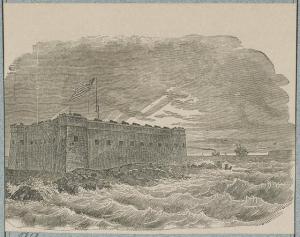
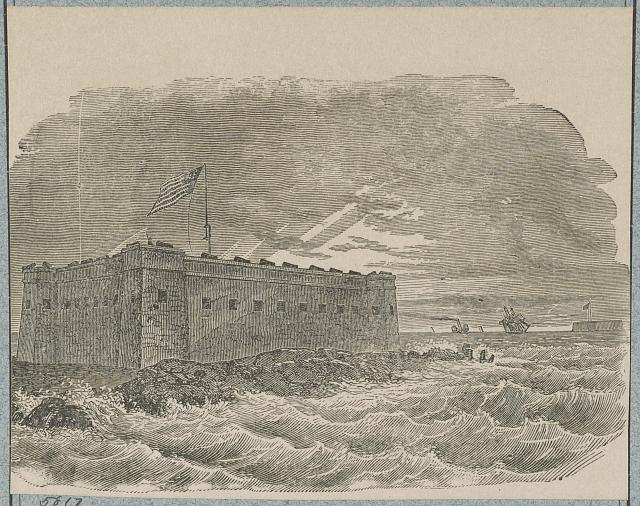
Fort Taylor, Key West, Florida (Harper’s Weekly, 1864, public domain).

Nast’s first illustrations of Santa Claus and depictions of soldiers longing for family at Christmas would initially have been seen by 47th Pennsylvania Volunteers while they were stationed far from home at Fort Taylor in Key West, Florida—just two months after the regiment had sustained a shockingly high rate of casualties during the Battle of Pocotaligo, South Carolina on October 22, 1862. More than one hundred members of the regiment had been killed in action, mortally wounded, grievously wounded, or wounded less seriously, but still able to continue their service.

So terrible was the outcome that it would have been enough to make an impression even on individual 47th Pennsylvanians who hadn’t been wounded. They were not only now battle tested, they were battle scarred, according to comments made by individual members of the regiment in the letters they wrote to families and friends back home during that Christmas of 1862.

No matter how strong their capacity for overcoming adversity had been before that battle, their hearts and minds would never be the same. It would take time to heal and move forward—time they were given while stationed on garrison duty for more than a year.

Fort Jefferson (Harper’s Weekly, August 26, 1865, public domain; click to enlarge).

By the time that the American Civil War was ending its third year, the mental wounds of Pocotaligo were far less fresh than they had been the previous Christmas. Still stationed in Florida on garrison duty in 1863, the 47th Pennsylvania Volunteer Infantry was now a divided regiment. While slightly more than half of the regiment was still on duty at in Key West, as companies A, B, C, E, G, and I remained at Fort Taylor, the remaining members of the regiment—companies D, F, H, and K—were now even farther away from home—stationed at Fort Jefferson, the Union’s remote outpost that was situated so far off of Florida’s coast that it was accessible only by ship.

Letters penned to family and friends back in Pennsylvania during the early part of 1863 capture a sense of sadness and longing that pervaded the regiment—as 47th Pennsylvanians mourned the loss of their deceased comrades and thought about how deeply they missed their own families.

Gradually, as the year wore on, those feelings turned to acceptance of their respective losses and, eventually, frustration at still being assigned to garrison duty when they felt they could and should be helping the federal government bring a faster end to the war by defeating the Confederate States Army through enough tide-turning combat engagements that the Confederate States of America would finally surrender and agree to re-unify the nation.

By early 1864, the wish of those 47th Pennsylvanians was granted by senior Union Army officials. They were not only given the opportunity to return to combat, but to return to intense combat as a history-making regiment.

The only regiment from Pennsylvania to fight in the Union’s 1864 Red River Campaign across Louisiana, the 47th Pennsylvanians repeatedly displayed their valor as the blood of more and more of their comrades was spilled to eradicate slavery across the nation while also fighting to preserve the nation’s Union. By the fall of 1864, they were participating in such fierce, repeated battles across Virginia during Union Major-General Philip Sheridan’s 1864 Shenandoah Valley Campaign that President Abraham Lincoln was able to secure his reelection and the tide of the American Civil War was decisively turned in the federal government’s favor once and for all.

Ruins of Charleston, South Carolina as seen from the Circular Church, 1865 (U.S. National Archives and Records Administration, public domain).

By April 1865, the Confederate States Army had surrendered, the war was over and President Lincoln was gone, felled by an assassin’s bullet that had too easily found its target. So, once again, the 47th Pennsylvania Volunteers were in mourning.

Sent back to America’s Deep South that summer, they were assigned to Reconstruction duties in Savannah, Georgia and Charleston, South Carolina, where they helped to reestablish functioning local and state governments, rebuild shattered infrastructure, and reinvigorate a free press that was dedicated to supporting a unified nation—all while other Pennsylvania volunteer regiments were being mustered out and sent home.

Finally, after a long and storied period of service to their nation, the 47th Pennsylvania Veteran Volunteers were given their honorable discharge papers at Camp Cadwalader in Philadelphia, and were then sent home to their own family and friends in communities across Pennsylvania in early January 1866.

Return to Civilian Life

“Santa Claus and His Works,” 1866 (Thomas Nast, Harper’s Weekly, December 29, 1866, public domain; click to enlarge).

Attempting to regain some sense of normalcy as their post-war lives unfolded over the years between the late 1860s and the early 1900s, many of the surviving veterans of the 47th Pennsylvania Volunteer Infantry resumed the jobs they held prior to the war while others found new and better ways to make a living. Some became small business creators, pastors or other church officials, members of their local town councils or school boards, beloved doctors, or even inventors. One even became the lieutenant governor of the Commonwealth of Pennsylvania.

Most also married and began families, some small, some large. Still others made their way west—as far as the states of California and Washington—in search of fortune or, more commonly, places where war’s Grim Reaper would never find them again.

“‘Twas the Night Before Christmas,” 1866 (Thomas Nast, Harper’s Weekly, December 25, 1886, public domain; click to enlarge).

As the years rolled on, they saw more and more of Thomas Nast’s work as it was published in Harper’s Weekly, particularly at Christmas. But the Santa Claus of war was now transformed by Nast as the Saint Nicholas of his childhood in Germany—kind, altruistic, loving, and jolly.

Over time, those illustrations collectively formed the “mind pictures” that the majority of American children and adults experienced when they imagined Santa Claus. So powerful has Nast’s influence been that, even today, when Americans encounter the many variations of Santa used to promote products in Christmas advertising campaigns, they see images that are often based on Nast’s nineteenth century drawings—drawings that had their genesis as beacons of light and hope during one of the darkest times in America’s history.

Like Abraham Lincoln, Nast has been helping Americans to summon and follow “the better angels of our nature” for more than one hundred and sixty years. May the power of his art help us all continue to do so this year and for the remainder of our days.


Sources:

  1. Boissoneault, Lorraine. A Civil War Cartoonist Created the Modern Image of Santa Claus as Union Propaganda.” Washington, D.C.: Smithsonian Magazine, December 19, 2018.
  2. Drawn Together: The Friendship of U.S. Grant and Thomas Nast (video). Wilton, New York: Grant Cottage, May 14, 2022.
  3. Santa Claus,” in “Thomas Nast.” Columbus, Ohio: University Libraries, The Ohio State University, retrieved online December 23, 2023.
  4. Santa Claus in Camp (from ‘Harper’s Weekly,’ vol. 7, p. 1).” New York, New York: The Met, retrieved online December 23, 2023.
  5. Vinson, J. Chal. Thomas Nast and the American Political Scene,” in American Quarterly, vol. 9, no. 3, Autumn 1957, pp. 337-344. Baltimore, Maryland: The Johns Hopkins University Press.


Camp Griffin (also known as “Camp Big Chestnut”), Langley, Virginia

The Big Chestnut Tree, Camp Griffin, Langley, Virginia, 1861 (U.S. Library of Congress, public domain).

Located near Langley, Virginia, Camp Griffin was a key muster-in point for multiple Union Army units during the early years of the American Civil War. Originally named “Camp Big Chestnut” in recognition of the large chestnut tree that was one of the earliest defining features of the campground, it quickly became a major training base and staging area for multiple state volunteer infantry and artillery units that fought under the banner of the United States government.

During the fall of 1861, it was renamed as “Camp Griffin” to honor Captain Charles Griffin, who had distinguished himself in combat as the commanding officer of the United States Artillery’s 5th Regiment, Battery D (the “West Point Battery”) during the First Battle of Bull Run in July 1861. Griffin was then also later promoted to Brigadier-General of Volunteers on June 12, 1862.

The 47th Pennsylvania Volunteers at Camp Griffin

The Sibley tents of an unidentified Union Army regiment, Camp Griffin, Virginia, fall 1861 (U.S. Library of Congress, public domain; click to enlarge).

“Camp Big Chestnut” (later known as Camp Griffin) was the first “real home” of the 47th Pennsylvania Volunteer Infantry after its extended muster-in and basic training period at Camp Curtin in Harrisburg, Pennsylvania from August through mid-September 1861. Initially transported by rail to the Washington, D.C. area and stationed on the Kalorama Heights in the District of Columbia, the 47th Pennsylvania Volunteers were ordered to set up and tear down their camps multiple times during their earliest weeks on the job, moving from Camp Kalorama to Camp Lyon, Maryland on the Potomac River’s eastern shore during an intense, two-hour rainstorm, and then across the “Chain Bridge” into Virginia, where they briefly encamped before marching for Camp Advance near Falls Church the next day. During their brief stay there, they were situated close to Fort Ethan Allen and the headquarters of Brigadier-General William Farrar Smith (also known as “Baldy”).

Shortly after that, they were ordered to move yet again—this time, to “Camp Big Chestnut” near Langley, Virginia. They couldn’t have known it at the time, but it was here where they would spend the bulk of their assigned duties from the fall of 1861 through early January 1862.

It was from this point that they were sent out to perform picket duties and skirmish with Confederate troops that were stationed nearby, and it was here and near this camp that they continued to drill daily and participate in Grand Reviews with multiple other Union Army units to demonstrate their readiness for battle to the most senior of Union Army leaders like General George B. McClellan, commanding officer of the U.S. Army of the Potomac—and even to their commander-in-chief, President Abraham Lincoln.

It was also here that they also served as part of that Army of the Potomac (“Mr. Lincoln’s Army”), ensuring that no troops from the Confederate States Army were ever able to breach the Union’s defensive lines and enter Washington, D.C. Quite simply put, the 47th Pennsylvania Volunteer Infantry’s job was to defend the nation’s capital—a task which its members performed well and faithfully. No Rebel ever carried a Confederate flag into the U.S. Capitol Building or White House during its time on the job.

On October 11, the 47th Pennsylvania marched in a review of massed troops that was held near the camp. In his letter of  October 13 to the Sunbury American newspaper, Henry Wharton described their duties, as well as their new home:

The location of our camp is fine and the scenery would be splendid if the view was not obstructed by heavy thickets of pine and innumerable chesnut [sic] trees. The country around us is excellent for the Rebel scouts to display their bravery; that is, to lurk in the dense woods and pick off one of our unsuspecting pickets. Last night, however, they (the Rebels) calculated wide of their mark; some of the New York 33d boys were out on picket; some fourteen or fifteen shots were exchanged, when our side succeeded in bringing to the dust, (or rather mud,) an officer and two privates of the enemy’s mounted pickets. The officer was shot by a Lieutenant in Company H [?], of the 33d.

Our own boys have seen hard service since we have been on the ‘sacred soil.’ One day and night on picket, next day working on entrenchments at the Fort, (Ethan Allen.) another on guard, next on march and so on continually, but the hardest was on picket from last Thursday morning ‘till Saturday morning – all the time four miles from camp, and both of the nights the rain poured in torrents, so much so that their clothes were completely saturated with the rain. They stood it nobly – not one complaining; but from the size of their haversacks on their return, it is no wonder that they were satisfied and are so eager to go again tomorrow. I heard one of them say ‘there was such nice cabbage, sweet and Irish potatoes, turnips, &c., out where their duty called them, and then there was a likelihood of a Rebel sheep or young porker advancing over our lines and then he could take them as ‘contraband’ and have them for his own use.’ When they were out they saw about a dozen of the Rebel cavalry and would have had a bout with them, had it not been for…unlucky circumstance – one of the men caught the hammer of his rifle in the strap of his knapsack and caused his gun to fire; the Rebels heard the report and scampered in quick time….

In his own mid-October letter home, Captain John Peter Shindel Gobin, the commanding officer of C Company, reported that the right wing of the 47th Pennsylvania (companies A, C, D, F and I) was ordered to picket duty after the left-wing’s companies (B, G, K, E, and H) were forced to return to camp by Confederate troops:

I was ordered to take my company to Stewart’s house, drive the Rebels from it, and hold it at all hazards. It was about 3 o’clock in the morning, so waiting until it was just getting day, I marched 80 men up; but the Rebels had left after driving Capt. Kacy’s company [H] into the woods. I took possession of it, and stationed my men, and there we were for 24 hours with our hands on our rifles, and without closing an eye. I took ten men, and went out scouting within half a mile of the Rebels, but could not get a prisoner, and we did not dare fire on them first. Do not think I was rash, I merely obeyed orders, and had ten men with me who could whip a hundred; Brosius [sic, Brosious], Piers [sic, Pyers], Harp and McEwen were among the number. Every man in the company wanted to go. The Rebels did not attack us, and if they had they would have met with a warm reception, as I had my men posted in such a manner that I could have whipped a regiment. My men were all ready and anxious for a “fight.”

On Friday, October 22, the 47th engaged in a Divisional Review, described by historian Lewis Schmidt as “about 10,000 infantry, 1000 cavalry, and twenty pieces of artillery all in one big open field.” Four days later, Company B’s drummer boy, Alfred Eisenbraun, was dead—the second “man” from the regiment to die since the 47th Pennsylvania’s formation. (The first was another drummer boy, John Boulton Young of C Company, who was felled by smallpox at the Kalorama eruptive fever hospital in Georgetown on October 17.)

Of all of the dangerous foes the 47th Pennsylvania Volunteers would encounter during their stay at Camp Griffin, it seemed that disease would prove to be the most persistent—and deadliest. In subsequent letters home, Captain Gobin asked Sunbury residents to donate blankets for the Sunbury Guards (the men of Company C):

The government has supplied them with one blanket apiece, which, as the cold weather approaches, is not sufficient…. Some of my men have none, two of them, Theodore Kiehl and Robert McNeal, having given theirs to our lamented drummer boy when he was taken sick… Each can give at least one blanket, (no matter what color, although we would prefer dark,) and never miss it, while it would add to the comfort of the soldiers tenfold. Very frequently while on picket duty their overcoats and blankets are both saturated by the rain. They must then wait until they can dry them by the fire before they can take their rest.

In late October 1861, the men from Companies B, G and H woke at 3 a.m., according to Schmidt, assembled a day’s worth of rations, marched four miles from camp, and took over picket duties from the 49th New York:

Company B was stationed in the vicinity of a Mrs. Jackson’s house, with Capt. Kacy’s Company H on guard around the house. The men of Company B had erected a hut made of fence rails gathered around an oak tree, in front of which was the house and property, including a persimmon tree whose fruit supplied them with a snack. Behind the house was the woods were the Rebels had been fired on last Wednesday morning while they were chopping wood there.

Less than a month later, in his letter of 17 November, Henry Wharton revealed more details about life at Camp Griffin:

This morning our brigade was out for inspection; arms, accoutrements [sic], clothing, knapsacks, etc, all were out through a thorough examination, and if I must say it myself, our company stood best, A No. 1, for cleanliness. We have a new commander to our Brigade, Brigadier General Brannen [sic, Brannan], of the U.S. Army, and if looks are any criterion, I think he is a strict disciplinarian and one who will be as able to get his men out of danger as he is willing to lead them to battle….

The boys have plenty of work to do, such as piquet [sic] duty, standing guard, wood-chopping, police duty and day drill; but then they have the most substantial food; our rations consist of fresh beef (three times a week) pickled pork, pickled beef, smoked pork, fresh bread, daily, which is baked by our own bakers, the Quartermaster having procured portable ovens for that purpose, potatoes, split peas, beans, occasionally molasses and plenty of good coffee, so you see Uncle Sam supplies us plentifully….

A few nights ago our Company was out on piquet [sic, picket]; it was a terrible night, raining very hard the whole night, and what made it worse, the boys had to stand well to their work and dare not leave to look for shelter. Some of them consider they are well paid for their exposure, as they captured two ancient muskets belonging to Secessia. One of them is of English manufacture, and the other has the Virginia militia mark on it. They are both in a dilapidated condition, but the boys hold them in high estimation as they are trophies from the enemy, and besides they were taken from the house of Mrs. Stewart, sister to the rebel Jackson who assassinated the lamented Ellsworth at Alexandria. The honorable lady, Mrs. Stewart, is now a prisoner at Washington and her house is the headquarters of the command of the piquets [sic]….

Since the success of the secret expedition, we have all kinds of rumors in camp. One is that our Brigade will be sent to the relief of Gen. Sherman, in South Carolina. The boys all desire it and the news in the ‘Press’ is correct, that a large force is to be sent there, I think their wish will be gratified….

Springfield rifle, 1861 model (public domain).

On 20 November, the 47th Pennsylvania Volunteers marched in The Grand Review of the Army of the Potomac at Bailey’s Crossroads, Virginia. According to National Portrait Gallery historian James Barber:

For three hours some 70,000 polished troops marched passed the reviewing stand, where the president, members of his cabinet, and Washington dignitaries were in attendance. It was the largest military assemblage up to that time in North America. ‘The Grand Review went off splendidly,’ wrote McClellan that night in a letter to his wife, ‘not a mistake was made, not a hitch. I never saw so large a Review in Europe so well done—I was completely satisfied & delighted beyond expression.’

Among the 20,000 spectators to witness the Grand Review was the poet and social activist Julia Ward Howe of Boston, Massachusetts, who was visiting the Washington area with her husband, Dr. Samuel Gridley Howe.

After leaving the review, during the carriage ride back to Washington, she heard troops singing the song John Brown’s Body.’ A companion suggested that she should write new lyrics to the song, the melody of which lingered in her mind that night in her room at Willard’s Hotel in Washington. She awoke ‘in the gray of the morning twilight’ with the song still in her head and ‘the long lines of the desired poem began to twine themselves in my mind.’ She arose quickly and in the dimness of the early hour she began scribbling the verses on stationery ‘almost without looking at the paper.’

Her poem, The Battle Hymn of the Republic, was first published in The Atlantic Monthly in February 1862; the magazine paid her five dollars. Soon thereafter her verse was set to music and her inspirational song became a wartime favorite….

The November 30, 1861 edition of the Sunbury American carried the good news of pay sent home to loved ones by Sunbury’s boys in blue (public domain; click to enlarge).

The next day, according to Schmidt, the regiment participated in a morning divisional headquarters review overseen by the 47th Pennsylvania’s commanding officer, Colonel Tilghman H. Good, followed by brigade and division drills all afternoon. According to Schmidt, “each man was supplied with ten blank cartridges.” Afterward, “Gen. Smith requested Gen. Brannan to inform Col. Good that the 47th was the best regiment in the whole division.” As a reward—and in preparation for bigger things to come, Brannan obtained new Springfield rifles for every member of the 47th Pennsylvania.

As November came to a close, Captain Gobin helped a number of Sunbury Guardsmen to send a total of $900 from their collective pay back home to their families and friends in Pennsylvania. The editors of the Sunbury American subsequently announced the names of the family members and others who could expect to receive the sorely needed financial support from their boys in blue via a special notice in the newspaper’s November 30, 1861 edition.

Winter Quarters at Camp Griffin

Sketch of the 47th Pennsylvania Volunteers’ winter quarters at Camp Griffin, near Langley, Virginia, by Second Lieutenant William H. Wyker, Company E, December 1861 (public domain).

As fall deepened and progressed into winter, the 47th Pennsylvania Volunteer Infantry was ordered to batten down the hatches and establish its winter quarters—during a time when the guns on both sides of the war fell silent as snow blanketed Virginia, making it nearly impossible for Union and Confederate troops to march over the slippery, icy farm grounds around them—let alone drag their artillery into fighting positions in order to continue blasting away at one another.

It was simply too cold and too miserable to expend energy as combatants. But there were lighter moments as well.

Quartermaster James VanDyke procured a holiday surprise for the 47th Pennsylvania Volunteers (Sunbury American, December 21, 1861, public domain).

According to the December 21, 1861 edition of the Sunbury American, Regimental Quartermaster James Van Dyke, who was enjoying an approved furlough at home in Sunbury, Pennsylvania, was able to procure “various articles of comfort, for the inner as well as the outer man.” Upon his return to camp, many of the 47th Pennsylvanians of German heritage were pleasantly surprised to learn that the well-liked former sheriff of Sunbury had thoughtfully brought a sizable supply of sauerkraut with him. The German equivalent of “comfort food,” this favored treat warmed stomachs and lifted more than a few spirits that first cold winter away from loved ones.

Also, in a letter written sometime around Christmas 1861, Captain Gobin reported that Private John D. Colvin had been detailed to special duty with the signal corps in Washington, D.C. while Musician Henry D. Wharton, increasingly known to folks back home for his letters to the Sunbury American, had assumed additional responsibilities as a clerk who was assigned to the staff of Brigadier-General Brannan at Brigade Headquarters.

As fall fell away, the 47th Pennsylvania Volunteers continued to wait for better weather, hunkered down in their sturdier, winter quarters at Camp Griffin, remaining here until January 22, 1862, when the regiment was ordered to pack up and march for the railroad station at Falls Church. Transported from there by rail to Alexandria, they then sailed the Potomac via the steamship City of Richmond to the Washington Arsenal, where they were reequipped before being marched off for dinner and rest at the Soldiers’ Retreat in Washington, D.C. The next afternoon, they hopped cars on the Baltimore & Ohio Railroad, and headed for Annapolis, Maryland.

Arriving around 10 p.m., they were assigned quarters in barracks at the United States Naval Academy. They then spent that Friday through Monday (January 24-27, 1862) loading their equipment and other supplies onto the steamship Oriental, before sailing away at 4 p.m. that final afternoon. They were headed for America’s far warmer Deep South—and a very long time away from the arms of their loved ones and the comforts of home.

To learn more about the 47th Pennsylvania’s next phase of duty, read “Late Winter through Early Spring 1862 (Florida): Serving as Soldiers and Surrogates for Family.”


Sources:

  1. Bates, Samuel P. History of Pennsylvania Volunteers, 1861-5, vol 1. Harrisburg, Pennsylvania: B. Singerly, State Printer, 1869.
  2. Gobin, John Peter Shindel. Personal Letters, 1861-1865. Northumberland, Pennsylvania: Personal Collection of John Deppen.
  3. Lincoln and McClellan: An Army Ready for War.” Washington, D.C.: National Portrait Gallery, retrieved online December 1, 2023.
  4. Schmidt, Lewis G. A Civil War History of the 47th Regiment of Pennsylvania Veteran Volunteers. Allentown, Pennsylvania: Self-published, 1986.
  5. Wharton, Henry D. Letters from the Sunbury Guards. Sunbury, Pennsylvania: Sunbury American, 1861-1868.


Abraham Lincoln’s Road to the Presidency

Abraham Lincoln in New York City on Monday morning, February 27, 1860, several hours before he delivered his Cooper Union address (Matthew Brady, U.S. Library of Congress, public domain).

During the almost quarter of a century that he resided in his adopted hometown of Springfield, Illinois, Abraham Lincoln was transformed from an average, young adult, who was embarking upon a crucial phase of his life’s journey in early nineteenth-century America, into the lawyer-turned-civic leader that would place his feet on the path to the White House.

A product of rural America, his formative years had been spent in Kentucky and southern Indiana. A resident of New Salem, Illinois in 1831, he was just twenty-five when he was elected to his first term in the Illinois State Legislature and began to study law more seriously. By 1837, he was a solicitor who lived and practiced law in Springfield. Married to Mary Todd five years later, he built his life with her at their Eighth and Jackson street-corner home, while also carving out a name for himself as a skilled and trustworthy legal scholar and successful courtroom attorney. Avidly interested in politics, he also became an active member of the Whig Party.

Persuaded by his wife and political associates to run for federal office in 1846, he was elected to the U.S. House of Representatives in that same year. His initial service was short-lived, however; he had pledged to serve only one, two-year term, hoping to secure a more stable, federal government job in the administration of U.S. President Zachary Taylor. But when that opportunity fell through, he returned home to Springfield and threw himself back into the practice of law.

* Note: During his tenure with the U.S. House of Representatives, Abraham Lincoln co-wrote a bill with Congressman Joshua R. Giddings that he hoped would end the practice of slavery in the District of Columbia. Lacking support from his fellow Whig Party members, however, he subsequently chose to withdraw that bill.

By the mid-1850s, Abraham Lincoln was realizing that his conscience would no longer permit him to sit on the sidelines, politically, when there was so much in his country that needed to be changed. Incensed by the passage of the Kansas-Nebraska Act in 1854, which paved the way for the brutal practice of chattel slavery to spread like a wave of toxic sludge over newly-forming states, Lincoln left the Whigs behind to join a new, more forward-thinking political organization—the Republican Party.

Four years later, he mounted a campaign against U.S. Senator Stephen A. Douglas. Although he lost that race, he would forever become linked to that Democrat as a result of their famously intense Lincoln-Douglas Debates, a forum that gave him a nationwide name recognition so high that it enabled him to become President of the United States.

Chosen by the Republican Party in 1860 to be its candidate for the highest office in the nation, Abraham Lincoln was elected as President on November 6, 1860.

How That Crucial Election Day Unfolded

Hand-sewn banner used in Abraham Lincoln’s 1860 campaign for President of the United States (Lincoln Home, U.S. National Park Service, public domain).

According to Jamie Malanowski, a former editor at Time magazine:

“There were no surprises: the long-settled Yankees in Maine and New Hampshire and pioneering Germans of Michigan and Wisconsin delivered the expected victories. And then came news from Illinois: ‘We have stood fine. Victory has come.’ And then from Indiana: ‘Indiana over twenty thousand for honest Old Abe.’

The throngs in the streets cheered every report, every step towards the electoral college number, but news from the big Eastern states was coming painfully slowly…. The advisers paced the floorboards, jumping at every eruption of the rapid clacking of Morse’s machine….

It wasn’t until after 10 that reports of victory in Pennsylvania arrived in the form a telegram from the canny vote-counter Simon Cameron, the political boss of the Keystone State, who tucked within his state’s tallies joyfully positive news about New York: ‘Hon. Abe Lincoln, Penna seventy thousand for you. New York safe. Glory enough.’

Not until 2 a.m. did official results from New York arrive … the one-time rail-splitter won by 50,000 votes.”

The Aftermath

“As the votes were counted, Lincoln had about 40 percent of the popular vote and 180 electoral votes, compared with 133 for his opponents combined,” according to historians at the National Constitution Center, but events in America’s Deep South “cast a pall over the upcoming Electoral College voting process”:

“What if the southern states refused to take part in the Electoral College? Or what if a unified front to avoid secession could convince enough ‘faithless electors’ to switch sides to derail the election?

And what if the southern states boycotted the Electoral College?”

Lincoln scholar Harold Holzer sums up what was in the minds of many Americans in the days following the 1860 presidential election:

“If these states did not participate in the traditional process, could the Electoral College proceed? What would constitute a quorum? No one, least of all Lincoln, knew the answers to these vexing questions.”

Those questions were finally answered when those southern states agreed to participate in the Electoral College process of the United States.

“But there was a greater than normal military presence on Capitol Hill” to ensure that the peaceful transfer of power would take place that certification day, according to historians at the National Constitution Center. And it did.

Abraham Lincoln’s election was officially certified by the U.S. Congress on February 15, 1861.


Sources:

  1. Donald, David Herbert. Lincoln. New York, New York: Simon & Schuster, 1996.
  2. Foner, Eric. The Fiery Trial: Abraham Lincoln and American Slavery. New York, New York: W. W. Norton & Company, Inc., 2010.
  3. Harris, William C. Lincoln’s Rise to the Presidency. Lawrence, Kansas: University Press of Kansas, 2007.
  4. “Lawyer to President,” in “Virtual Museum Exhibit.” Springfield, Illinois: Lincoln Home National Historic Site, retrieved online November 6, 2023.
  5. Malanowski, Jamie. “Lincoln Wins. Now What,” in “Disunion.” New York, New York: The New York Times, November 7, 2010.
  6. Oates, Stephen B. “Abraham Lincoln 1861–1865,” in C. Vann Woodward, ed. Responses of the Presidents to Charges of Misconduct. New York City: Dell Publishing Co., Inc. pp. 111–123, 1974.
  7. Oates, Stephen B. With Malice Toward None: A Life of Abraham Lincoln. New York, New York: Harper Collins, 2011.
  8. On This Day, Abraham Lincoln Is Elected President.” Philadelphia, Pennsylvania: National Constitution Center, November 6, 2023.
  9. President Abraham Lincoln.” Washington, D.C.: U.S. Library of Congress, retrieved online November 6, 2023.

Learn More About the 47th Pennsylvania Volunteers

First State Color, 47th Regiment, Pennsylvania Volunteer Infantry (presented to the regiment by Pennsylvania Governor Andrew Curtin, 20 September 1861; retired 11 May 1865, public domain).

Largely forgotten by mainstream historians, the 47th Pennsylvania Volunteer Infantry was a Union Army unit which served for nearly the entire duration of the American Civil War. Formed by the fruit of the Great Keystone State’s small towns and cities, the regiment was born on August 5, 1861, when its founder, Tilghman H. Good, received permission from Pennsylvania Governor Andrew Gregg Curtin to form an entirely new regiment in response to President Abraham Lincoln’s call for additional volunteers to help preserve American’s Union. It ended its service during the early months of the nation’s Reconstruction Era, officially mustering out at Charleston, South Carolina on Christmas Day in 1865, its members receiving their final discharge papers at Camp Cadwalader in Philadelphia, Pennsylvania in early January of 1866.

Along the way, the 47th Pennsylvania made history, becoming an integrated regiment in 1862 and the only regiment from Pennsylvania to participate in the Union’s 1864 Red River Campaign across Louisiana. Its members also distinguished themselves in battle, repeatedly, including during Union General Philip Sheridan’s Shenandoah Valley Campaign, which unfolded between August and December of 1864.

Learn more about key moments in this regiment’s history by reading the following posts:

1861:

1862:

1863:

1864:

1865:

The Lincoln Assassination: A Union Army Chaplain’s Angry, Heartsick Response

Rev. William DeWitt Clinton Rodrock, chaplain, 47th Pennsylvania Volunteers, Fort Jefferson, Dry Tortugas, Florida, 1863 (courtesy of Robert Champlin, used with permission).

In an April 30, 1865 report sent to Brigadier-General L. Thomas, the Adjutant General of the U.S. Army, the Rev. William DeWitt Clinton Rodrock, chaplain of the 47th Pennsylvania Volunteer Infantry, expressed his ire and grief regarding the recent assassination of President Abraham Lincoln:

“Sir.

The present month claims more than an ordinary place in our National history. In the very hour of general exultation and rejoicing for vouchsafed blessings and victories on our arms, promising speedy restoration of internal peace and return of prosperity and happiness, our great and good Chief Magistrate, Abraham Lincoln, was slain by the hand of foul conspiracy and vile assassination. For the first time the annals of the country have been stained by a political assassination! It is a crime against God, against the Nation, against humanity and against liberty, that has thus been perpetrated! It is the madness of Treason and murder! And the day that commemorates the Crucifixion of the Saviour of Man is henceforth made forever memorable by a new crime against the Law of God and Country.

But we must bow low, before the Almighty Hand that thus shows us the weakness and wickedness of man and the vanity of all human calculations!

May this fearful blow recall us all to our duties! We will draw near to the Altar of our country, also, as we approach the Altar of our God. We have great duties in this crisis. And the first is to forget selfishness and passion and party, and look to the salvation of the Country.

As to our lamented President, let us do justice to his memory! He dies in the hour of his country’s restored greatness, and in the full fruition of his own personal triumph. The assassin’s blow, will rank him in the memory of mankind among the martyrs of freedom.

The 19th inst. – the day set apart for the funeral of our late President, was duly observed with appropriate ceremonies for our Brigade. The Regiments present were the 47th Pa. V.V.’s, 8th Vermont, 12th Conn. and 153rd N.Y. It became my duty to officiate on the occasion, and it was one of the most solemn and impressive scenes I ever witnessed.” 

Rodrock then went on to report on the morale and health of his regiment, leaving the “solemn and impressive” gathering of soldiers to the reader’s imagination. What is known for certain is that the 47th Pennsylvania Volunteers were unable to participate in the President’s funeral parade, as many other Union troops did, because the 47th Pennsylvanians and their fellow brigade members were still on duty. Assigned to protect Washington, DC in the wake of Lincoln’s assassination, they grieved collectively during Rodrock’s brief memorial service and individually as battle-hardened soldiers when their respective schedules allowed time for rumination.

Over the next two weeks, one member of the 47th Pennsylvania would be given the honor of guarding the late President’s funeral train while others would be assigned to guard Mary Surratt and the other key conspirators in Lincoln’s assassination during the early days of their imprisonment.

To read more of Chaplain Rodrock’s reports, please see the Religion and Spirituality section of this website.

Spring and Summer of 1862: Disease, Duty and Another Departure

View the video related to this article

Sibley Tent (Patent #14740, United States Patent Office, April 22, 1856, H. H. Sibley, public domain).

As spring continued to take hold across Pennsylvania in 1862, turning the Great Keystone State’s colorful, budding trees into soothing havens of green-leafed shade, the members of the 47th Pennsylvania Volunteer Infantry continued to battle their great foe—disease. It was a fight that was made more difficult by the regiment’s challenging living conditions. The weather was warm, the water quality was poor, the mosquitos were plentiful, and hygiene was substandard because the majority of 47th Pennsylvania Volunteer Infantrymen continued to live in the close quarters of the Sibley tents that had been erected as “Camp Brannan” in Key West, Florida. (The men of Company F were slightly more fortunate, having been previously ordered to live and work at Fort Taylor.)

As a result, multiple members of the regiment fell ill during the month of April, including First Lieutenant and Regimental Adjutant Washington H. R. Hangen, who was required to temporarily cede his duties to H Company First Lieutenant William Wallace Geety after being admitted to the officers’ hospital at in Key West, and C Company’s Theodore Kiehl and Henry W. Wolfe, who had been confined to the hospital for enlisted men. Deemed too ill to continue serving with the regiment, F Company privates John G. Seider and Samuel Smith were honorably discharged on surgeons’ certificates of disabilities and sent back home.

Meanwhile, other members of the regiment continued to be advanced in rank, including Second-Sergeant Christian Seiler Beard, who was promoted to First-Sergeant, and Private Peter Haupt who was promoted to the rank of Sergeant—while others assumed additional duties, including D Company privates James E. Albert and William Collins, who were assigned to help the fort’s assistant surgeon, William F. Cornick, in caring for the increased number of patients who had been admitted. Then, General Order No. 84 was issued, directing I Company Captain Coleman A. G. Keck and one of his subordinates, Private William Smith, to return home to Pennsylvania to recruit more volunteers to help beef up the regiment’s dwindling ranks.

In addition, several officers from the 47th Pennsylvania were also called upon to conduct a general court martial trial of a lieutenant from the 90th New York Volunteers who was charged with having been absent from his duties without appropriate authorization (known more commonly today as being absent without leave or “AWOL”). Colonel Tilghman H. Good served as the court’s president, C Company Captain John Peter Shindel Gobin served as its general advocate, and H Company Captain James Kacy was one of the men appointed to serve on the court’s judicial panel, which found the 90th New Yorker guilty and directed that he lose roughly two weeks of pay.

April—May 1862

Key West, Florida, c. 1850 (courtesy of Florida Memory Project)

Key West, Florida, circa 1850 (courtesy of Florida Memory Project).

On April 19, the 47th Pennsylvania’s most prolific scribe, C Company Musician Henry D. Wharton, penned a letter to his hometown newspaper, the Sunbury American, from Camp Brannan in Key West:

“DEAR WILVERT:– Having finished a plate of soup, (not a hasty one) enjoyed a piece of ham, cooked in my best style, fried and now luxuriating in a pipe of the best Lynchburg tobacco, I conclude to indite [sic] you a few lines from this most miserable place, Key West.

There are now lying here three very fine vessels captured from Secessia. The cargoes are very valuable, consisting of cotton, coffee, rice, liquor, kerosene and olive oils, leather, and a great many articles of use. I attended the sale of one of the cargoes, and one article I found more numerous than any other—that of hooped skirts. I was curious to know why they had supplied themselves so plentifully with that article, when an old gentleman said that was easily understood, for when the rebels had to run, and in fear of being caught they would make good hiding places, and then he related a circumstance of a Mexican General who, in running away, found crinoline very convenient as a hiding place, but not secure enough for the Lynx-eyed Americans, as the brave gentleman was caught in his wife’s trap.

There has been considerable sickness among the troops, but I am happy to state it is abating. Two members of our company, Theodore Kiehl, and H. Wolf, have been in the Hospital, but are now out and almost ready for duty. They take very readily to their rations when they get back to the company, saying the Hospital is a very nice place to get well in, but no place for grub, as they were as hungry as wolves all the time they were in, or rather when they became better. We have lost eight men from our regiment, by death, since we have been on this island. From what I can learn the diseases were mostly contracted in Virginia, but if they have not, it is a wonder that the mortality is not greater among us, owing to the sudden change of climate, the bad water, hot sun and hard work our men are subjected to.

Lieut. Henry Bush, Co. F., in our regiment, died two weeks ago. His company were in the Fort, learning heavy artillery, where he was attacked with typhoid fever—in a few days he was beyond the physicians [sic] skill, and now he is sleeping his last sleep in the strangers [sic] cemetery. His funeral was very largely attended by the military and the masonic fraternity, of which he was a member. Lieut. Bush was beloved by his company—they having presented him with a sword a few days before he was taken sick—and in fact was liked by the whole regiment for his kindness and gentlemanly bearing to the men. As soon as the necessary arrangements can be made his body will be sent to Catasauqua, Lehigh county, where his widow and two little children reside.

Since the promotion of Lieut. Oyster, there has [sic] been some changes in our company, 2d Sergeant Beard has been made 1st Sergeant, and Peter Haupt, of Sunbury, taken from the ranks and promoted to 1st Sergeant. Haupt passed an excellent examination, and I am proud, for Sunbury, to say that he is considered one of the A. No. 1’s on drill in our regiment.

With the exceptions of a few slight cases of sickness, the boys are getting along very well and would be perfectly contented if they were at a place where there could be a chance to have a hand in some of the glorious victories which their brothers in arms are engaged in, and away from this detested spot, where there would be something to relieve the eye beside sea-gulls, pelicans and turkey-buzzards. Excuse the shortness of this, hoping ere long to be able to give you an account of a victory in which Co. C., was engaged….”

* Note: To read more of Henry Wharton’s insights, please see our collection of his letters here.

By mid-April, typhoid fever was claiming one member of the regiment after another. On Saturday April 19 and Sunday April 27, respectively, K Company privates George Leonhard and Lewis Dipple died at the Key West general hospital while E Company Private John B. Mickley died on April 30.

Death ledger entry for Private Lewis Dipple, Company K, “Registers of Deaths of Volunteers,” U.S. Army, 1862 (U.S. National Archives, public domain).

Initially interred in graves numbered nine, ten, and twelve at the fort’s post cemetery, the remains of Privates Leonhard, Dipple, and Mickley were later exhumed for reburial at the Barrancas National Cemetery. Although the process was successfully completed for Privates Leonard and Mickley in 1927, Private Dipple’s remains were handled so disrespectfully that they were later unable to be identified. As a result, they were consigned to a common grave at Barrancas with 227 other “unknown” soldiers.

That same day, General Order No. 26 was announced, directing that:

“I. The troops will be mustered and inspected at 7:45 AM tomorrow morning, 30th inst. April 30, 1862.

II. Immediately after muster, a council of administration to consist of Capt. Harte and officers will assemble to transact such business as regulations require.”

Major-General David Hunter, U.S. Army, circa 1863 (carte de visite, public domain).

Meanwhile, on April 25, 1862, the winds of change had begun to clear the way for long-denied social justice as Union Major-General David Hunter, commanding officer of the U.S. Army’s Department of the South, issued General Orders, No. 11, which directed that all enslaved men, women, and children in Georgia, Florida, and North Carolina be freed immediately:

“Head Quarters Department of the South,
Hilton Head, S.C. May 9, 1862.

General Orders, No 11.— The three States of Georgia, Florida and South Carolina, comprising the military department of the south, having deliberately declared themselves no longer under the protection of the United States of America, and having taken up arms against the said United States, it becomes a military necessity to declare them under martial law. This was accordingly done on the 25th day of April, 1862. Slavery and martial law in a free country are altogether incompatible; the persons in these three States—Georgia, Florida and South Carolina—heretofore held as slaves, are therefore declared forever free.

(Official) David Hunter,
Major General Commanding.”

Although word of Hunter’s order did not immediately reach members of the regiment, it would eventually be carried in newspapers across America.

Meanwhile, the 47th Pennsylvania Volunteers continued to perform their provost and garrison duties in Key West. At the end of April, F Company Private Henry Falk was ordered to take on new duties with the quartermaster while Order No. 21 reassigned H Company Corporal James F. Naylor to the regimental color guard. During the first two days of May, I Company Private William Frack then became Corporal Frack while H Company Private Robert Kingsborough took over quartermaster duties performed previously by Private William O’Brien.

As spring progressed, the weather in Key West became hotter, and the mosquitoes grew even more bold. Even so, the fort’s commanding officer and his subordinates were still able to find a few minutes of relaxation. On May 7, they made time to attend a ball. Corporal James J. Kacey, however, was assigned to fix cartridge boxes around this same time while E Company Corporal George Nicholas was busy dodging disciplinary action, as well as a brush with death:

“I went down to the docks and ask [sic] a Man who owned the Storehouses their [sic] and he said the govemient Seased [sic] them. So I Said I will Sease [sic] the life Boat that laid their [sic]. So I took it up to camp and fixed it up and that got me in trouble I went out Sailing and Missed drill, and got a log to carry, and the next time in the Guard House…. [A] Scorpen Stung me in the finger and I cut a piece out and Sucked it and put Tobacco on it. My arm and hand commenced to Swell Some But Not Much.”

Increasingly debilitated by the bug that had recently felled him, the regiment’s founder and commanding officer, Colonel Tilghman Good, finally realized that he would need to distance himself from his men if he were to continue as their leader. In a letter penned to the Assistant Adjutant, Captain Lambert, he asked “permission to leave camp for a few days, to secure comfortable quarters in town, which I have every reason to believe would materially aid in my speedy restoration to health and strength. The Doctor tells me this desirable end can be attained, by taking rest in elevated and comfortable quarters for a few days. In consequence I do not deem it essential to remove to the hospital.”

Good’s decision proved to be a sound one as more and more members of the regiment were felled by disease, including D Company’s Private George Isett. Suffering from chronic diarrhea, he died on Friday, May 16, and was initially laid to rest in grave no. 14 at the post cemetery. Sadly, his remains were also mishandled when they were exhumed in 1927 for reburial, and were also consigned in the unknown grave of 227 Union soldiers at the Barrancas National Cemetery. His grieving comrades honored him by securing publication of the following Tribute of Respect in their hometown newspaper:

“WHEREAS, it has pleased God in his allwise providence, to remove from our midst our friend and brother in arms, Geo S. Isett; therefore,

RESOLVED, that by his death we have lost a warm hearted friend, a true patriot and good soldier, and one whose place cannot be filled among us.

RESOLVED, That we most heartily sympathize with the deceased and hope that he who has thus afficted [sic] them, will be their reliance in time of need.

RESOLVED, That these resolutions be forwarded to the Perry County papers for publication, and a copy be sent to the friends of the deceased.

Signed: George W. Topley, Jesse Meadith, Jacob Charles, George W. Jury, Isaac Baldwin, Committee.”

That same day (May 16), The Athens Post in Athens, Tennessee specifically mentioned the 47th Pennsylvania’s problems with illness in a news article entitled, “Yankees Sick and Dying”:

“A letter from the flag ship Niagara, published in the Providence Press, fears that the warm weather and imprudence and exposure will cause much sickness among the three Yankee regiments stationed at Key West, Florida. ‘Already the 47 Pennsylvania Regiment has lost a number of its members by the typhoid fever, and I am told they have 70 sick.’ They will have plenty of the same sort before August.”

In response to the continuing wave of sickness, H Company Private Daniel Kochenderfer was reassigned to nursing duties at Key West’s general hospital, where he earned $7.75 for the hazardous duty. Two days later, G Company Private Edmund G. Scholl succumbed to typhoid fever. Initially interred at the post cemetery, Private Scholl’s remains would later be returned home to his family when Allentown undertaker Paul Balliet took on the mission of bringing home both Scholl’s body and that of the infant Regimental Chaplain William Rodrock in 1864. (Both were then reinterred at the “New Allentown Cemetery” on January 30, 1864.)

On May 19, President Abraham Lincoln overturned the emancipation order issued by Major-General David Hunter. His proclamation read as follows:

“Washington [D.C.] this nineteenth day of May,
in the year of our Lord one thousand eight hundred and sixty-two

By the President of the United States of America.

A Proclamation.

Whereas there appears in the public prints, what purports to be a proclamation, of Major General Hunter, in the words and figures following, to wit:

‘Head Quarters Department of the South,
Hilton Head, S.C. May 9, 1862.

General Orders No 11.— The three States of Georgia, Florida and South Carolina, comprising the military department of the south, having deliberately declared themselves no longer under the protection of the United States of America, and having taken up arms against the said United States, it becomes a military necessity to declare them under martial law. This was accordingly done on the 25th day of April, 1862. Slavery and martial law in a free country are altogether incompatible; the persons in these three States—Georgia, Florida and South Carolina—heretofore held as slaves, are therefore declared forever free.

(Official) David Hunter,
Major General Commanding.
Ed. W. Smith, Acting Assistant Adjutant General.’

And whereas the same is producing some excitement, and misunderstanding; therefore I, Abraham Lincoln, President of the United States, proclaim and declare, that the government of the United States, had no knowledge, information, or belief, of an intention on the part of General Hunter to issue such a proclamation; nor has it yet, any authentic information that the document is genuine— And further, that neither General Hunter, nor any other commander, or person, has been authorized by the Government of the United States, to make proclamations declaring the slaves of any State free; and that the supposed proclamation, now in question, whether genuine or false, is altogether void, so far as respects such declaration.

I further make known that whether it be competent for me, as Commander-in-Chief of the Army and Navy, to declare the slaves of any State or States, free, and whether at any time, in any case, it shall have become a necessity indispensable to the maintenance of the government, to exercise such supposed power, are questions which, under my responsibility, I reserve to myself, and which I cannot feel justified in leaving to the decision of commanders in the field. These are totally different questions from those of police regulations in armies and camps.

On the sixth day of March last, by a special message, I recommended to Congress the adoption of a joint resolution to be substantially as follows:

Resolved, That the United States ought to co-operate with any State which may adopt a gradual abolishment of slavery, giving to such State pecuniary aid, to be used by such State in its discretion, to compensate for the inconveniences, public and private, produced by such change of system.

The resolution, in the language above quoted, was adopted by large majorities in both branches of Congress, and now stands an authentic, definite, and solemn proposal of the nation to the States and people most immediately interested in the subject matter. To the people of those States I now earnestly appeal— I do not argue, I beseech you to make the arguments for yourselves— You can not [sic] if you would, be blind to the signs of the times— I beg of you a calm and enlarged consideration of them, ranging, if it may be, far above personal and partizan [sic] politics. This proposal makes common cause for a common object, casting no reproaches upon any— It acts not the pharisee. The change it contemplates would come gently as the dews of heaven, not rending or wrecking anything. Will you not embrace it? So much good has not been done, by one effort, in all past time, as, in the providence of God, it is now your high privilege to do. May the vast future not have to lament that you have neglected it.

In witness whereof, I have hereunto set my hand, and caused the seal of the United States to be affixed.

Abraham Lincoln”

* Note: During the short time in which Major-General David Hunter’s emancipation order was in effect, thousands of enslaved individuals escaped from horrific conditions across Florida, Georgia, and South Carolina, and made their way to the safety of Union military encampments. In response, Hunter directed his subordinates in the U.S. Army’s Department of the South to create a loose network of social services to provide food, clothing, educational services, medical care, and shelter to the newly free men, women, and children. Hunter then also began advocating for able-bodied Freemen to be allowed to enlist with the Union Army.

Although many of these social justice initiatives were put on hold when Lincoln rescinded Hunter’s emancipation order, the disagreement between Lincoln and Hunter evidently made an indelible impression on leaders of the 47th Pennsylvania Volunteer Infantry; just six months later, those 47th Pennsylvanians would pave the way for the regiment to become an integrated one by facilitating the enlistment on October 5, 1862 of several young Black men who were freed from plantations near Beaufort, South Carolina—roughly three months prior to the enactment of Lincoln’s Emancipation Proclamation.

As May wore on, disease continued to thin the regiment’s ranks. Another member of the 47th to be felled by typhoid fever was B Company Private John Apple who died at Key West’s general hospital on May 21 (alternate date: March 12). Reportedly buried shortly thereafter and then disinterred from grave number 18 at the fort’s post cemetery in 1927, his remains were also among those that were reportedly consigned to a group grave of 228 unknown soldiers at the Barrancas National Cemetery, according to one source but, according to The Allentown Democrat, were returned to Pennsylvania on January 28, 1864 with the bodies of three other members of the regiment and the body of the regimental chaplain’s infant son. Private Apple was subsequently laid to rest at the Union-West End Cemetery in Allentown on January 31, 1864.

Around this same time, Henry Wharton was dusting off the skills he had learned, pre-war, as an employee of the Sunbury American newspaper. Founding a new publication—the Key West Herald, he was able to get the first edition of his newspaper into the hands of his fellow 47th Pennsylvanians by Saturday, May 24.

The newspaper’s release could not have been more timely. A significant number of his fellow 47th Pennsylvanians were in desperate need of reading material as they fought their way back from sickness. Among those ailing at this time were multiple members of Company D, including privates William Ewing, Samuel Kern, Andrew and William Powell, and Emanuel Snyder, Corporal Samuel Reed, and Sergeants William Fertig and George Topley. Of those, Fertig was the only one to be hospitalized. In addition, B Company Teamster Tilghman Ritz developed rheumatism sometime around the month of May, and underwent several weeks of treatment at the post hospital from the 47th Pennsylvania’s regimental surgeon, Elisha Baily. Even though he was treated “successfully” by Baily, however, the condition would continue to plague Ritz for the remainder of his life.

Early June—A Fateful Encounter with Friendly Fire

Woodcut depicting the harsh climate at Fort Taylor in Key West, Florida during the Civil War (U.S. Library of Congress, public domain).

One of the most senseless deaths of 47th Pennsylvania Volunteers during the entire war was a “friendly fire” incident which occurred on June 9, 1862. The day had started out peacefully enough—with weather so inviting that I Company Sergeant Charles Nolf, Jr. and several friends felt compelled to take a stroll along the southern portion of the beach in Key West. Tragically, while gathering seashells for family and friends back home, he was accidentally killed by a member of the 90th New York Volunteer Infantry who had been inexplicably playing around with a loaded rifle in violation of brigade regulations while walking on the same stretch of beach with three other members of his regiment—all three of whom had also been carrying loaded rifles—against regulations. Shot in the forehead, Sergeant Nolf died instantly at the scene. Initially interred at the fort’s post cemetery, his body was among the aforementioned group of soldiers’ remains disinterred and returned to Pennsylvania’s Lehigh Valley by Allentown undertaker Paul Balliet, where they were reburied at the Fairview Cemetery in West Catasauqua in late January of 1864.

On the same day that Charles Nolf departed from the world (June 9), First Lieutenant William W. Geety was released from the hospital having successfully recovered from an attack of bilious fever which had resulted in his confinement beginning May 18. In a letter penned to his wife while recuperating, he described himself as “jaundiced.”

Brigadier-General John Milton Brannan, U.S. Army (public domain).

By June 11, I Company Captain Coleman Keck was back home in Allentown, Pennsylvania, hard at work recruiting more men to serve with the 47th Pennsylvania. Meanwhile, the “old men” of the regiment—the veterans—were sensing another change in the winds of fate. That change came on Friday, June 13, via General Order No. 53, which was issued by Brigadier-General Brannan:

“The 47th Regiment of Pennsylvania Volunteers will hold itself in readiness for immediate embarkation. Company F of this regiment which is detached at Fort Taylor will report at headquarters of the regiment. Each regiment will take six months [sic] supply of medicine and medical stores on embarkation.”

Rumors swirled that the regiment would be shipped to Port Royal, South Carolina in preparation for a Union attempt to wrest control of Savannah, Georgia or Charleston, South Carolina from the control of the Confederacy.

On Saturday, June 14, the 47th Pennsylvania Volunteers participated in a review with other members of Brigadier-General Brannan’s troops. According to an edition of the New Era, which was published around this same time:

“The 47th Pennsylvania Volunteers under command of Lt. Col. Alexander made a fine appearance. Their marching was perfect and the entire regiment showed the effect of careful drill. A more sturdy, soldierly looking body of men cannot be found, probably, in the service. Col. Good and the officers under his command have succeeded in bringing the regiment to a state of military discipline creditable alike to them and the state from which they hail. The regimental band deserves some mention; there are many bands in the service of greater celebrity, whose performances would not bear comparison with that attached to the 47th Regiment.”

On June 16, Wharton penned another letter to his hometown newspaper in which he reflected on the untimely, friendly fire death of Sergeant Nolf and provided further insights into the soldiering life in America’s Deep South:

“Great excitement was caused by the accident, and for a time (our boys not knowing the particulars) some of them were determined to avenge their comrade’s death, but an investigation pronounced it accidental, when they were satisfied. Nolf was a young man of excellent character, beloved by all who knew him, and it seems hard that he should be hurried into eternity in such a manner, and that too, when the carrying of loadened [sic] rifles is strictly prohibited.

There is a family in this city [Key West] by the name of Fift. One of them, A. Fift, after making a fortune out of his Uncle Samuel, (U.S.), thought to make another speck by going to New Orleans to his friend Mr. Mallory, one of Jeff Davis’ Cabinet (?) in the manufacture of gun boats. Mallory and he went into partnership. After finishing boats, while at Memphis, with a considerable amount of Confederate funds in his pocket, (specie) he gave them the slip. Some of his indignant southern friends followed the double traitor, caught him and immediate hung him, thus saving the United States the trouble of buying an extra rope after this war is over. His brother, who has grown fat off the government, and at the time giving aid to secesh, wishing to visit a cooler atmosphere, and act the part of a nabob in the North, was a few days ago provided with a passage to New York in a Government steamer, while on the same vessel, a soldier, for want of room, could not send a box of sea-shells to gratify the curiosity of his friends at home. You can draw your own inference….

The paymaster has come at last and paid us off for four months. The sight of money was new to the boys, and most eagerly accepted by them. The Sunbury boys sent most of their pay home to their friends, very glad to do so, showing that, although far away from home, loved ones are not forgotten.

We have received marching (sailing) orders, and before this reaches you, if winds do not play us false, we will be in South Carolina, and probably before Charleston, helping to reduce the place where this foul rebellion first broke out. I will write to you immediately on our arrival, attempting to give you a description of the voyage, and an account of the manner in which Neptune treated the health and feelings of the boys. All is hurry and bustle in camp, striking tents, &c., so much so that I can scarcely write. We are all well. None of the Sunbury boys left behind….”

The next day, the 47th Pennsylvania Volunteer Infantry began a phased departure from Key West.

A Summertime Occupation of South Carolina

Dock, Hilton Head, South Carolina, circa 1862 (Sam Cooley, U.S. Library of Congress, public domain).

On Tuesday, June 17, 1862, the members of the 47th Pennsylvania assigned to Companies A, F, and D boarded the schooner “Emilene,” and sailed for Hilton Head Island in South Carolina. Also readying for departure this day were the men from Companies B, C, and I, who boarded a brig, the Sea Lark. On June 19, Companies E and H boarded a different ship, which was not identified by regimental clerks in subsequent reports, but was identified in soldiers’ later correspondence as the Tangire. Setting off at 10:02 p.m. in the same direction as their predecessors, they were followed by the men from Companies G and K, who boarded a sloop, the Ellen Benan [identified in later soldiers’ correspondence as the “Ellen Bernard”], and departed at 2 p.m. on June 20—barely dodging the yellow fever epidemic which swept Key West, Florida.

On June 19, just prior to his departure, G Company Sergeant John Gross Helfrich penned a letter to his parents from the Officers’ Hospital in Key West, where he had been assigned as a hospital steward:

“…. We are under marching orders, some of the companies of our regiment have already gone. The reason for our not going together, is owing to not having vessels enough. Those who have left had to embark on small “briggs” & skooners [sic], taking from two to three companies aboard. The place of our destination is ‘Beaufort S. Carolina.’ The two companies of regulars, stationed here, have also left a few days ago; for the same place.

The health of our men is exceedingly good at present, out of our whole regiment there are but nineteen, who are unable on account of sickness to accompany us, which is comparatively, but a very small number, and these as far as my knowledge is concerned, are not dangerously ill; and it is hoped that they may soon be able to follow us.

After we are gone the garrison at this place will only consist of six companies of the 90th Regt. N.Y.V. [90th New York Volunteers]. The other four companies of the above named regt. are stationed at “Fort Jefferson”, Tortugas; some fifty-odd miles from here.

The 91st Regt. N.Y.V. were ordered a few weeks ago, to Pensacola, Fla. So you perceive, that there has been a considerable change made among the military, of late at this place….

Letter from Sergeant John G. Helfrich, Company G, to his parents, June 25, 1862 (used with permission, courtesy of Colin Cofield).

After Helfrich settled into his new quarters at Hilton Head, South Carolina, he penned the following update to his parents on June 25:

“Having first arrived at our place of destination spoken off [sic] in my last, I will now give you a brief description of our passage to this place.

We left Key West, on the 19th inst., about mid-night in the brigg [sic] “Ellen Bernard,” and arrived at this place yesterday (the 24th) at one o’clock p.m. having had a very pleasant voyage, not the slightest accident having occurred, and the men seem to get accustomed to riding at sea, as but a few had what is generally called ‘seasickness’. Our regt. was put on four small vessels, the ‘Sea Lark’, ‘Emaline’, “Tangire’ [handwriting difficult to read] & ‘Ellen Bernard, the second last named, has up to this time, not yet arrived, having started about 4 hours ahead of us. She had three companies aboard & the hospital baggage.

The weather is not quite so hot here as where we come from, but I think it will perhaps make a material change in a few days, as the ground is at present cooled off by the rain….

Since our arrival on this island we learned that a pretty severe fight came off about eighteen miles from here, at a place called ‘James island’ at which our boys seem to have got the worst of it as the hospital at this place contains a great many of the wounded.

Our boys are all eager for a fight, and no doubt they will get a chance to show their fighting abilities ere long, as it is rumored that an assault is to be made on ‘Charleston’ at an early date. Troops are coming and going every day, I am told, and I should not be surprised if we had to go away from here in a day or so.

You must excuse me for writing with red ink as it was the only article of the kind within reach.

I am in the full enjoyment of health at present, hoping you are the same.

I will enclose forty dolls. which I will send to you for safe keeping, until I return home, which will be ere long I reckon. Write soon, as I am anxious to hear from you….”

* Note: The letters of Sergeant John Helfrich are used with permission of Colin Cofield and his family who generously provided copies for use in documenting the history of the 47th Pennsylvania Volunteer Infantry. To read more of his insights, see our collection of Helfrich’s letters here.

According to military reports, the first two units of the regiment to arrive at Hilton Head—Companies E and H—disembarked on Sunday, June 22. After having spent four days aboard ship, these men quickly realized their initial accommodations would be far from plush. They were expected to sleep out in the open on the dock. The men from Companies, A, D, and F and B, C, and I arrived next, respectively disembarking from the “Emilene” and “Sea Lark” on Monday. They, too, all spent a restless night sleeping on the dock.

Fort Walker, Hilton Head, South Carolina, circa 1861 (Frank Leslie’s Illustrated Newspaper, public domain).

Finally, on Wednesday, June 25, at 2 p.m., the regiment was made whole again when the men from Companies G and K arrived on the “Ellen Benan.” The regiment was then marched to the rear of Fort Walker, where the 47th Pennsylvanians were ordered to pitch tents and organize their supplies.

* Note: Per an unspecified military report, Hilton Head was considered to be “a depot to receive army supplies . . . strongly fortified so as to command the channel, and [was] a good depot for troops, as they [could] be sent from there to almost any point needed in [that] part of the south.” Located on opposite sides of the channel from each other, Hilton Head and Port Royal were just fifteen miles upstream from Beaufort, South Carolina, which would ultimately become a long-term duty station for the 47th Pennsylvania Volunteers.

Fort Walker, which was situated in Hilton Head’s northeast section, “was irregularly shaped in a form that could be roughly described as half an octagon facing the ocean, backed by a slightly larger rectangle, and with a triangle on the inland side,” according to historian Lewis Schmidt. “Located about 1200 feet north of the fort was a pier which extended at right angles from the beach for a distance of 1277 feet. Inland from the fort and pier were numerous auxiliary facilities such as quarters, guard house, stables, quartermaster, ice house, blacksmith, carpenter, post office, bakery, hotel, theatre, church, and numerous other buildings.”

Mitchelville, a village built to house numerous formerly enslaved men, women and children, was located just west of the fort. Facilities of the provost marshal, provost guard, and Union Army’s engineering department, as well as the 60,000-square foot Union Army Hospital at Hilton Head were located on South Carolina’s coastline, just south of the fort. 

Bay Street Looking West, Beaufort, South Carolina, 1862 (Sam A. Cooley, 10th Army Corps, photographer, public domain).

The 47th Pennsylvania Volunteer Infantry did not remain in the Hilton Head-Port Royal area long, however; on July 2, the regiment departed for its new assignment—provost (military police and judicial) duties in Beaufort, South Carolina. Still assigned to the command of Brigadier-General John Milton Brannan, the 47th Pennsylvanians performed those duties as part of a combined occupying force that included the: 6th Connecticut under Colonel J. L. Chatfield, the 8th Maine under Lieutenant Colonel J. F. Twitchell, three companies of the 4th New Hampshire under Major J. D. Drew, the 7th New Hampshire under Colonel H. S. Putnam, the 55th Pennsylvania under Colonel R. White, the 1st Connecticut Battery under Captain A. P. Rockwell, three batteries of the 1st U. S. Artillery under Captain L. L. Langdon, three companies of the 1st Massachusetts Cavalry under Captain A. H. Stevens, Jr., and a detachment of the 1st New York Engineers.

According to Schmidt, roughly two thousand people resided in Beaufort during this time—a “population which sometimes doubled in the summer months with the influx of wealthy planters.”

The town had been located on Port Royal Island on a slightly higher elevation than the surrounding areas, and on its eastern side was bounded by a channel which is now part of the Intracoastal Waterway connecting Port Royal and St. Helena Sound. There were many large and beautiful homes with large pillars and porches in the southern tradition, and numerous live oak trees scattered throughout the area…. The town was laid out in a rectangle, with streets of fine white sand, but without any sidewalks.”

But it is the first-hand impressions of Beaufort, penned to family and friends by members of the regiment shortly after their arrival, which still provide important insights into life in Union Army-occupied Beaufort during the summer of 1862. Second Lieutenant William Geety noted that every house was “built in from the street with a yard, shade trees and lots of flowers, and that “the Rebels left much behind” while Private Francis Gildner of Company I juxtaposed the hardships and horrors of war with the city’s elegance:

“This is a beautiful place and has good water, and no defects like Key West. The hospital is in a very large building, however when you come inside you come upon a terrible scene. Here are hundreds of army men who have been wounded in the legs, and many were shot in the breast and face. There is an arm or leg amputated daily. The health of the regiment is good, but we hope we do not stay here too long as this area is infested with millions of mosquitoes and sandflies whom plague us both day and night.”

Enslaved men and women on the grounds of Mrs. Barnwell’s home in Beaufort, South Carolina, circa 1860 (U.S. Library of Congress, public domain).

Meanwhile, Private John Wantz of D Company dug deeper to produce an even more illuminating analysis:

“The city of Beaufort is, I suppose, one of the handsomest places in the United States. It was inhabited by only the rich, retired planters of the South and they spared no pains nor expense in making it beautiful with art, and nature could not develope [sic] itself more handsomely than it does here. The weather is pleasant the year round. The large shade trees cannot be surpassed for beauty. Their flower gardens are superb and there is not a single house but what is clustered around with orange, lemon, and fig trees; grapes they have in abundance, and in fact everything that the most fastidious could desire to make them happy and contented. They have all the different kind of vegetables that we are blessed with in the North and in much greater abundance. Everything tends to make a person happy and comfortable. Dull care is driven away by the sweet tones of the mocking bird, whose warble is continuously heard, and the air scented with the fragrance of the shrub and honeysuckle.

In time of peace, the question is who lives here? It is answered, ‘none but those who have obtained a fortune’, for a man of limited means could not. The work done here is by slaves, and a man of ordinary means would be obliged to put himself on equality with the negro, and I doubt if there is a man in the North would do so if he was to see the degraded, uneducated and deplorable looking set of negroes there is in this part of the country. They know of nothing but hard work upon the cotton, rice and corn plantations, and do not know why this war is, what was the cause of it, or anything about it, only that their masters were driven away by the soldiers and that some soldiers have driven other soldiers away. I never would have thought there was so much difference between the North and South if I had not seen it.”

By the second week of July, Union Army leaders issued orders directing part of the 47th Pennsylvania Volunteer Infantry to participate in an Expedition to Fenwick Island (July 9), followed by a Demonstration Against Pocotaligo (July 10). In response, the members of H Company marched to Port Royal Ferry, crossed the Coosaw River, and drove off Confederate soldiers who had set fire to the ferry house while out on picket duty. C Company Captain Gobin described the incident later in a letter, noting that “Two companies of our Regiment were thrown across under cover of a gunboat, drove in the rebel pickets, and penetrated into the country for about half a mile” while C Company Musician Wharton wrote:

“That portion of our regiment to whom was assigned picket duty, on the line nearest the enemy, have returned, being relieved by the 7th New Hampshire Volunteers. Our fellows report the duty pleasant, as it was amusing to see the Georgia sharpshooters trying to pop the pickets on post, forgetting that our Springfield rifles were of longer range than theirs, however they soon discovered it, as could be seen, by the way they jumped behind trees whenever our boys returned their fire. Before our party were relieved, two of three companies crossed the river to have some fun, the rebels not liking the appearance of our bright barrels, skedaddled, leaving our men nothing to do but to burn down the houses they had for protection, and the pay for their trouble amounted to a few red cotton overcoats.” 

Company Sergeant Reuben S. Gardner added even more details in his own letter to family, writing:

“So the other day we took a notion to turn the joke on them and we crossed over to this side and drove them off their posts and back several miles, and burnt four houses that were used by them to picket in. Our skirmishers had four shots at the rebels, but with what effect we don’t know as they soon got out of harm’s way. Companies H and B were all that crossed. The boys got so eager to follow up the rebels that they did not want to come back when ordered. Our force was too small to advance far, so we went back after doing all the damage we could to them. They fled in such a hurry as to leave three saddles, one double barreled [sic] shot gun, several overcoats, haversacks, canteens, &c., all of which our boys brought along as relics, that being the first of anything of that kind our regiment had. Now the boys want to cross every day; but the Colonel won’t allow them as it is beyond his orders to cross the river, and probably we would meet with a repulse, as the rebels have been in force on the opposite side since we drove them off. They are like a bee’s nest when stirred up. The day after we were over they fired more than a hundred shots at our boys. They returned some shots and only laughed at them. The distance across the river is some 800 to 1000 yards, and of course there can be but little damage done at that distance.”

Meanwhile, back at the regiment’s main camp, Regimental Order No. 160 was announced on July 10:

“I. The old officer of the day will be relieved by the new one at 9 AM at these headquarters.

II. The officer of the day will have charge of the camp and will be held responsible for the proper performance of the duties of the guard, the quietness of the camp and its cleanliness. The old guard under charge of its Captain will report to him immediately after breakfast for police purposes and he will have all rubbish and filth carried from the camp a sufficient distance and then have it buried or burned. He will visit the kitchens and quarters of every company accompanied by its commander immediately after he enters upon his duties and report the condition of the same to these headquarters.

III. The officer of the day will be held responsible for the calls of the hours of service and roll calls. One bugler will be detailed daily to report to him for that purpose.

IV. The attention of company commanders is called to article #28, paragraph #234, revised army regulations which requests all roll calls to be superintended by a commanding officer of the companies and Captains to report the absentees to the Colonel or the commanding officer.

V. Commanders of companies are imperatively directed to have the company quarters, kitches, &c., policed and cleaned immediately after breakfast.

VI. Morning reports of companies signed by the Captains and 1st Sergeants and all applications for special priviledges [sic] of soldiers must be handed to the Adjutant before 8 AM.

Col. Good”

The next day, the men of D Company were ordered to report to picket duty. On Saturday, July 12, Company H was sent out on skirmishing duty, as described by Second Lieutenant Geety:

“Five gunboats came up…Saturday and shelled the shore and crossed over and burned three shanties…. I had command of the right of the skirmish but did not get an opportunity to kill any secessionists. I got a secessionist cap box made in New York and the paper and case of a shell.”

On Sunday, Sergeant Reuben Gardner continued working on his letter to his father:

“We have been on picket now ten days [near the Port Royal Ferry and along the Broad River] and were to be relieved tomorrow; but for some cause are now to stay five days longer. The general rule is ten days; but always whip the horse that pulls the hardest. We are ten miles from camp, and are picketing around the west of the island, for 12 miles along the shore. Five companies of our regiment are out at a time. The rebel pickets are right opposite to us, across the river, and dozens of shots are exchanged every day; but without any effect on our side. The rebel’s [sic] guns fail to reach across. Our rifles will shoot across with a double charge, but we only fire at each other for fun. The 7th New Hampshire were on here before we came out and the rebels made them leave the line. They took advantage of that and crossed over and burnt a ferry house that stood on the end of the causeway on this side….

We have the greatest picket line here entirely. At low tide down along the beach at night you can’t hear thunder, by times, for the snapping of oysters, croaking of frogs, buzzing of mosquitoes, and the noise of a thousand other reptiles and varmints. It beats all I have heard since the commencement of the war. We have had a pretty good time out here on picket and good weather; but 15 days is a little too long to lie in the woods for my fancy….

* Note: Gardner apparently went on in this letter to express a virulent hatred of the formerly enslaved Black men, women, and children who were being employed by the Federal Government to cultivate and harvest the corn and cotton fields located near the regiment’s camp. But it is not clear if the ugliest parts of this letter were actually written by Gardner himself. According to Schmidt, Gardner’s correspondence was “one of the few anti-abolitionist letters uncovered in the correspondence of members of the regiment.” Printed “in a staunchly anti-abolitionist paper, the Perry County Democrat,” the original text of the letter may have been “embellished by the editor” to better align “with the paper’s views.”

Consequently, the managing editor of 47th Pennsylvania Volunteers: One Civil War Regiment’s Story has made the decision not to include that portion of Gardner’s letter here as part of this article. Further research is being conducted in an effort to verify Schmidt’s analysis; if that research is able to be completed, the full text of the letter will be presented with its analysis under the “Letters Home” section of this website.

An Old Foe Resurfaces

Even though the change of scenery for the 47th Pennsylvanians appears to have done some good for morale since they were now being given more opportunities to interact with the enemy, the men were still finding that they were being dogged by their old foe—disease. During the month of July, the following members of the 47th were among those seeking medical treatment:

  • Private George Nichols, Company E (admitted July 14, 1862 for treatment of a hernia);
  • Private Andrew Burke, Company E (admitted July 17, 1862 for treatment of a boil);
  • Private Peter McLaughlin, Company H (admitted July 18, 1862 for treatment of a sprain);
  • Private William Ward, Company E (admitted July 18, 1862 for treatment of a carbuncle);
  • Private Luther Bernheisel, Company H (admitted July 23, 1862 for treatment of a funiculus condition);
  • Private John Bruch, Company E (admitted July 24, 1862);
  • Private John Richards, Company E (admitted July 26, 1862 for treatment of a febrile condition);
  • Second Lieutenant William Wyker, Company E (admitted July 26, 1862 for treatment of diarrhea);
  • Corporal Joseph Schwab, Company F (admitted July 26, 1862 for treatment of bilious remittent fever);
  • Sergeant William Hiram Bartholomew, Company F (admitted July 26, 1862); and
  • First Lieutenant George W. Fuller, Company F (admitted July 26, 1862 for treatment of piles).

In addition, Earnest Rodman (alternate spelling “Ruttman”) of B Company sustained a severe wound to his lower jaw when his rifle accidentally discharged while he was assigned to picket duty at Beaufort on July 15.

As a result, as hospitalizations and medical discharges from the regiment increased, leaders of the 47th Pennsylvania realized that new enlistees would be needed to stabilize the 47th’s rosters. So, Major William Gausler and Captain Henry S. Harte were sent home to Pennsylvania to announce and manage a recruiting drive. Both arrived in their respective communities of Allentown and Catasauqua on July 15, and remained at home until early November. New recruits were enticed by the following:

  • Enlistment Premium: $4
  • One Month’s Pay (in advance): $13
  • 25% of the Standard Bounty (in advance): $25
  • County Bounty: $50
  • Additional Bounty (paid at the end of the war or end of the soldier’s term of service): $75
  • Regular Monthly Pay: $13

Meanwhile, back in Beaufort, Special Order No. 57 was issued on July 16, directing that:

“The hours of drill specified in the order determining the hours of service must be attended to by all the commanding officers of companies not on special duty. Second, in addition to the established hours of service, commanders of companies will cause the chiefs of squads to drill the squads from 9:30 to 10 AM and from 2:30 to 3 PM under the supervision of a commanding officer. Third, there will be a daily drill for noncommissioned officers from 1 to 2 PM. All noncommissioned officers not on special duty or sick must attend these drills. The Sergeants will be drilled by a 1st Lieutenant who will be detailed for that purpose for one weekend; the Corporals by a 2nd Lieutenant who will be detailed in the same manner. They will assemble in front of the color line, under the shade trees, at the sound of the Sergeants call. Lt. Fuller and Lt. Dennig are hereby detailed for that purpose and they will report to these headquarters immediately after drills to report all absentees. Fourth, a roster of each squad with the name of its chief at the head will be furnished to these headquarters as soon as practicable. Col. Good”

As the month of July wound down and hot days tested the patience of 47th Pennsylvanians, tempers flared. On July 24, Private William Kirkpatrick of D Company lost his cool and told his superior, Sergeant Alex D. Wilson, to “go to hell” after Wilson ordered him to add axe-grinding to his duties. Four days later, Kirkpatrick was brought before a military tribunal for “conduct prejudicial to good order and discipline.” Although he pleaded not guilty, he was convicted by the presiding officer, Captain Charles H. Yard, was sentenced to “close confinement for three days on a bread and water diet,” and was also required to forfeit a third of one month’s pay.

On July 29, Musician Daniel Fritz and Private Rudolph Fisher, both of Company K, were discharged on surgeons’ certificates of disability. Fritz, who had contracted typhoid fever and was also losing his eyesight, survived, but Fisher succumbed to his illness at a Union Army hospital in New York.

For much of July, 47th Pennsylvanians had been been assigned to picket duty at or near Port Royal Ferry; they would continue to perform similar duties in the same area throughout most of August as well. Company E would be assigned to “Barnwells” while men from Company D would be stationed near “Seabrook.”

August

As summer wore on, disease and injury continued to take out more members of the regiment. Among those hospitalized were:

  • Private Israel Reinhard, Company G (admitted August 6, 1862 for treatment of bilious remittent fever);
  • Corporal Solomon Wieder, Company G (admitted August 6, 1862 for treatment of otitis);
  • Sergeant Robert Nelson, Company H (admitted August 7, 1862 for treatment of intermittent fever);
  • Private Charles Rohrer, Company H (admitted with August 8, 1862 for treatment of diarrhea); and
  • Sergeant James Hahn, Company H (admitted August 10, 1862 for dysentery).

The month of August was particularly hard due to typhoid fever, which felled locals and soldiers alike in and around Hilton Head, Beaufort, and Port Royal. Yellow fever then also descended on Hilton Head. One of the protective measures employed by members of the regiment at this time, according to a letter penned by Private Alfred C. Pretz, was “liquid ammonia … kept in the office for the purpose of washing the skin where the little stingers [mosquitos] have sown their venom.”

Robert Barnwell Rhett’s home (“Secession House”), Beaufort, South Carolina, circa 1860s (U.S. Library of Congress, public domain).

It was also unbearably hot. In a letter to family and friends, C Company Captain Gobin noted that:

“The thermometer to-day has fallen to a respectable number … The weather for the last few weeks has been beyond conception. It was sweltering until Saturday a cool breeze from the North sprung up, and we have enjoyed two comfortable days … Every day last week until Saturday, it ranged from 100 to 110 degrees in our tents, and from 98 to 105 the coolest place you could find…. Our pickets at Seabrook, a few days ago, discovered the rebels throwing up earthworks, and the general impression is that a simultaneous attack will be made by their land forces. News has been received here for some time, of their concentrating large forces of the latter at Grahamsville and Pocotaligo….

But it was these two sentences of Gobin’s letter which provided the most illuminating details about what life was genuinely like for 47th Pennsylvania Volunteers who were now truly part of an occupying army in America’s Deep South:

“We occupy the house of Senator Rhett, which is one of the finest in the place. A large portion of the furniture is still in it, as is also a portion of his library. It is a magnificent residence, surrounded by orange trees and flowers of the most gorgeous colors. I presume he never intended it for the occupancy of Yankee Court Martial.”

Robert Barnwell Rhett (1800-1876) was, in fact, a powerful, longtime, pro-slavery, pro-secession activist. A native of Beaufort, South Carolina who began his professional life as a lawyer, he quickly became a vocal critic of the Tariff of 1828 (the “Tariff of Abominations”) while serving as a member of the South Carolina state House of Representatives (after he was first elected in 1826). Resigning that seat to become South Carolina’s Attorney General in 1832, he was subsequently elected to represent South Carolina in the U.S. House of Representatives (1837). A supporter of John C. Calhoun, Rhett ultimately parted ways with him when he came to believe that Calhoun was too moderate.

“The Union Is Dissolved” (South Carolina’s secession from the United States as announced by the Charleston Mercury, December 20, 1860 (U.S. Library of Congress, public domain).

By the mid-1840s, Rhett had worked his way into an even more powerful role, becoming the de facto leader of the fire eaters—South Carolina’s increasingly vocal, pro-secession movement. Opting not to seek reelection in 1849, he was elected to the U.S. Senate in December of 1850, but resigned that seat in 1852 when his efforts to advance the cause of secession stalled. He then turned to journalism. Purchasing the Charleston Mercury during the 1850s in partnership with his son, Barnwell, he used that newspaper to fan the embers of secession into a raging wildfire—going so far as to call for South Carolina to secede if U.S. voters selected any Republican candidate as the next President of the United States.

As a result, after Abraham Lincoln was elected to his first term, South Carolina seceded on December 20, 1860—just as Rhett had hoped. Rhett then lobbied multiple southern states to meet in Montgomery, Alabama in order to form a new country—one that he envisioned would be made up entirely of slaveholding states.

During what historians now refer to as the Montgomery Convention, Rhett played a key role in drafting a new constitution for the Confederate States of America (CSA). Among his contributions to that document were a stipulation that all future CSA presidents would serve six-year terms and wording that would prohibit future CSA leaders from levying tariffs; but, he failed in his attempt to remove wording that declared foreign slave trade to be illegal, and also failed at adding a provision that would have required all CSA states to allow the practice of slavery.

The sun was already beginning to set on his political career, however; by the time the 47th Pennsylvania Volunteers arrived in Beaufort, Rhett had lost the support of many fellow Confederates after having repeatedly denounced CSA President Jefferson Davis in the Charleston Mercury. Knowing that his hometown of Beaufort had fallen to the U.S. Army and that his Beaufort home had been commandeered for use by the 47th Pennsylvania for provost actions only served to stoke his anger and frustration.

Orders from on High

Directed by President Abraham Lincoln to participate in a parade to honor the late former President Martin Van Buren, the 47th Pennsylvania Volunteer Infantry turned out in full dress uniform on August 15 to listen to prayers and a eulogy. The regimental colors and officers’ sleeves subsequently remained covered with the appropriate designations of mourning for six months after the event. That same day, the regiment was also ordered to engage in enhanced bayonet drills per General Order No. 26.

Six days later, the 47th Pennsylvania lost its renowned Regimental Band when the ensemble (Pomp’s Cornet Band) was formally mustered out of service by the order of the U.S. Congress and U.S. War Department, which had deemed Union Army bands to be an unnecessary expense as the Civil War continued to rage.

While Gobin and other officers of the 47th Pennsylvania were busy with their judicial activities, regimental physicians and their soldier-patients continued their war against disease. Writing to superiors from the 47th Pennsylvania’s headquarters in Beaufort, South Carolina on August 31, Assistant Regimental Surgeon Jacob H. Scheetz reported that:

“Remittent Fever has prevailed to a considerable extent. It was characterized by a daily exacerbation and remission. The greater number of those afflicted with it, presented the following symptoms: A general feeling of lassitude for two or three days, with partial loss of appetite, followed by chills and flashes of heat alternately; cephalgia, felt principally over the orbits, of a sharp lancinating character, sometimes, however, described as a dull, aching, heavy sensation. The eyes were most generally suffused, skin sallow, tongue coated, thirst, anorexia. The bowels in the greater number of cases were torpid, but in others disposed to looseness; there was a tenderness over the right hypochondriac and epigastric regions, frequent nausea, and sometimes vomiting. The pulse ranged from 85 to 115 per minute. The skin was hot and dry during the exacerbations, moist and flacid [sic] during remissions. The urine was generally high colored, and caused frequent complaints of a scalding sensation while voiding it, and there was a continual complaint of pain in the back and extremities, etc. The treatment which was found most beneficial was to administer a mercurial purgative in cases in which the bowels were torpid; when there was nausea, twenty grains of ipecacuanha were combined with it. After the intestinal canal had been acted upon, five grains of quinine were given four to six times daily. When there was diarrhea, half a grain of opium or five of Dover’s powder were given with each alternate dose. When the peculiar effects of the quinia were apparent the disease rapidly yielded. The epigastric tenderness, when severe, was treated with sinapisms and opiates. The diet was light as possible.”

Scheetz also noted that, “Diarrhea prevailed considerably,” and added that the “cases were uniformly mild … unaccompanied by any febrile symptoms, and yielded to treatment very readily”—a protocol which “consisted of vegetable astringents and opium, tannic acid, and catechu being the astringents principally used.”

“Dysentery also assumed a mild type, very few cases presenting much febrile action. The treatment consisted in administering two grains of tartar emetic with half an ounce of epsom salts, and following it with a combination of acetate of lead and opium or more frequently two drachms of castor oil and forty drops of laudanum three times daily.”

Early to Mid-September

Design of the U.S. Army’s insignia for the Tenth (X) Army Corps, which would have been sewn onto uniforms of the 47th Pennsylvania Volunteer Infantry as a badge and displayed on a flag carried by the regiment.

On September 1, a Monday, Wharton penned another letter to the Sunbury American, confirming that:

“The right wing of our regiment, Company C included, have been on picket for the last ten days, tomorrow they return, being relieved by the 8th Maine Volunteers. Our fellows have had a sorry time of it so far as the elements were concerned for it has done nothing but rain, rain, and to get a sight of the sun, in that time was really reviving … the continual change of apparel, when the wardrobe is not very extensive, made it rather inconvenient for them, and more than one in need for a change of flannel had to make a shift without it….

Picket duty here is different from that in Virginia. There 24 hours did the business for one company for ten days, while here 500 men, besides a battery are the quantity required for that length of time. A river divides our line from the rebels and shots are continually exchanged with them, none, however, doing much damage. Occasionally a secesh horseman has temerity enough to come within shooting distance of our Springfields, when he is accomodated [sic] with their merry barkings, but in an instant he skedaddles, and that in such a hurry that does no credit to Southern chivalry or one who is willing to die in the last ditch.”

As summer wound down, two major changes were made to Union Army operations which would dramatically reshape the lives of 47th Pennsylvania Volunteers for the remainder of 1862. The 47th Pennsylvania was attached to the newly formed Tenth Army Corps (X Corps) after it was formed as a new army corps on September 3. On September 16, the Tenth Army was then placed under the command of Major-General Ormsby M. Mitchel when he took over command of the U.S. Department of the South from Major-General David Hunter.

As a direct result of those changes, before the month was out, disease would no longer be the 47th Pennsylvania Volunteer Infantry’s primary foe.

View the video related to this article.
 

Sources:

  1. Bates, Samuel P. History of Pennsylvania Volunteers, 1861-5. Harrisburg, Pennsylvania: B. Singerly, State Printer, 1869.
  2. Berlin, Ira, Barbara J. Fields, et. al. Freedom: A Documentary History of Emancipation, 1861-1867, Series I, Vol. I, pp. 123-125: “The Destruction of Slavery.” New York, New York: Cambridge University Press, 2010.
  3. Berlin, Ira, Barbara J. Fields, et. al. Free at Last: A Documentary History of Freedom, Slavery, and the Civil War, pp. 46-48. New York, New York: The New Press, 2007.
  4. Farrell, Michael. “History of the Formation of the Tenth Army Corps,” in “Department General Order No. 2 (Series 2013-2014, August 15, 2013).” Boca Raton, Florida: Sons of Union Veterans of the Civil War (Department of Florida).
  5. Hunter, Major-General David. Abstract from Return of the Department of the South, Major General David Hunter, U. S. Army, commanding, for July 31, 1862,” in The War of the Rebellion: Official Records of the Civil War: Chapter XXVI: “Operations on the Coast of South Carolina, Georgia, and Middle and East Florida, Apr. 12, 1862-Jun 11, 1863: Correspondence, etc.: Union.” Washington, D.C.: Government Printing Office, 1885.
  6. Lincoln, Abraham. “Proclamation by Abraham Lincoln, May 19, 1862, #90” (rescinding Major-General David Hunter’s Emancipation of Enslaved Persons in Georgia, Florida, and South Carolina via General Order No. 11), in “Presidential Proclamations” (Series 23, Record Group 11). Washington, D.C.: U.S. National Archives and Records Administration.
  7. Miller, Steven. Proclamation by the President,” in “Freedmen & Southern Society Project.” College Park, Maryland: University of Maryland, College Park (History Department), June 19, 2020.
  8. Reynolds, Michael S. “Rhett, Robert Barnwell,” in South Carolina Encyclopedia. Columbia, South Carolina: University of South Carolina, Institute for Southern Studies, October 25, 2016.
  9. “Registers of Deaths of Volunteers” (1862 U.S. Army death ledger entries for multiple members of the 47th Pennsylvania Volunteers). Washington, D.C.: U.S. National Archives and Records Administration.
  10. Schmidt, Lewis. A Civil War History of the 47th Regiment of Pennsylvania Veteran Volunteers. Allentown, Pennsylvania: Self-published, 1986.
  11. “Yankees Sick and Dying.” Athens, Tennessee: The Athens Post, May 16, 1862.