Election Day 1864 — Lincoln or McClellan? How the 47th Pennsylvania Volunteers Voted

The platforms of the Union and Democratic parties, U.S. Presidential Election of 1864 (courtesy of the University of Illinois Urbana-Champaign; click to enlarge).

Even in the midst of a devastating civil war, Americans across the United States managed to come together to fulfill their civic responsibilities by voting on Election Day. Fathers and sons flocked to city and small town polling places while soldiers on active duty filled out ballot forms wherever they were stationed during the early to mid-1860s.

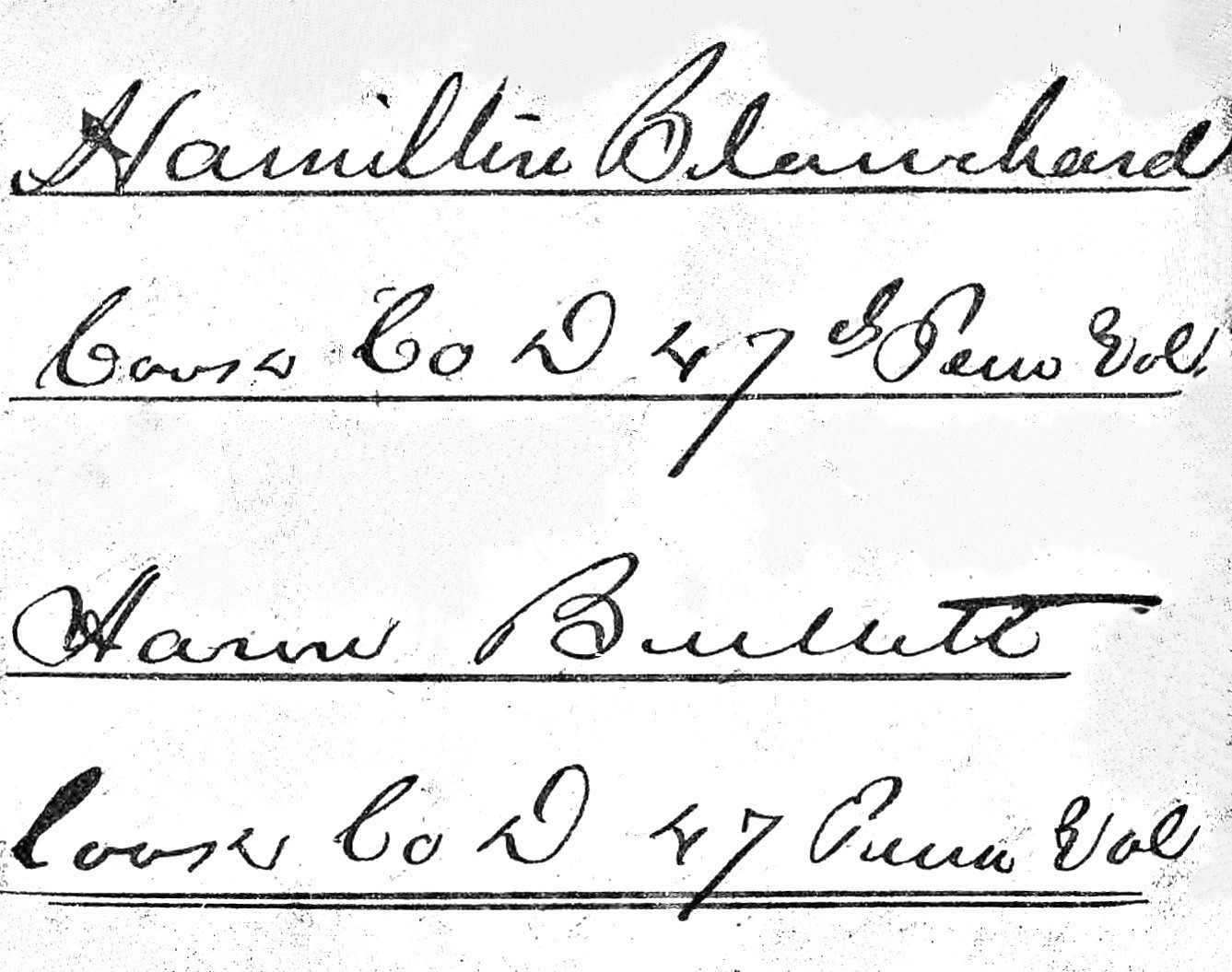
With respect to the Presidential Election of 1864, which was held in multiple states across America on November 8, 1864, that voting took place for members of the 47th Pennsylvania Volunteer Infantry at their encampment near Newtown, Virginia, according to a letter that was subsequently penned by 47th Pennsylvanian Henry D. Wharton to his hometown newspaper in Sunbury, Pennsylvania on November 14:

“The election passed off quietly and without any military interference, not the influence of officers used in controlling any man’s vote. In the regiments from the old Keystone, the companies were formed by the first Sergeant, when he stated to the men the object for which they were called to ‘fail to,’ and then they proceeded to the election of officers to hold the election – the boys having the whole control, none of the officers interfering in the least.”

Were the 47th Pennsylvania Volunteers pro-Lincoln or pro-McClellan?

Excerpt from Henry Wharton’s letter to his hometown newspaper, November 14, 1864 (The Sunbury American, November 14, 1864, public domain; click to enlarge).

Wharton reported that, after the votes from members of the regiment were counted, President Abraham Lincoln was the favored choice of most of the 47th Pennsylvania Volunteers. Lincoln had garnered one hundred and ninety-four votes to General George B. McClellan’s one hundred and twenty-one (a margin of seventy-three votes). Those votes, by individual company, were tallied as follows:

  • Company A: President Lincoln (ten); General McClellan (one)
  • Company B: President Lincoln (twenty-six); General McClellan (two)
  • Company C: President Lincoln (twenty-nine); General McClellan (thirteen)
  • Company D: President Lincoln (thirty-one); General McClellan (eleven)
  • Company E: President Lincoln (twenty-four); General McClellan (three)
  • Company F: President Lincoln (eighteen); General McClellan (sixteen)
  • Company G: President Lincoln (nine); General McClellan (thirteen)
  • Company H: President Lincoln (ten); General McClellan (twenty-four)
  • Company I: President Lincoln (nineteen); General McClellan (sixteen)
  • Company K: President Lincoln (eighteen); General McClellan (twenty)

But Wharton’s figures for the men from Company K were incorrect, according to historian Lewis Schmidt, who noted in his book, A Civil War History of the 47th Regiment of Pennsylvania Veteran Volunteers, that “Fifteen of the members [of Company K] voted for the Lincoln electors and seven for the McClellan electors” when they “voted on the battlefield of Cedar Creek, November 8, 1864.” The members of Company K who cast votes that day were: “David H. Fetherolf, Mathias Miller, John Keiser, Phaon Guth, James D. Weil, Daniel Strauss, Paul Strauss, George Sherer, Lewis G. Seip, Henry Hantz, Charles W. Abbott, George Kase, Charles Stoudt, William Schlicher, William F. Knerr, E. F. Benner, George Delp, Tilghman Boger, William H. Barber, William D. Schick, Frank Beisel, and David Semmel.”

Apathy or Attrition?

One of the first things that researchers notice when looking at those figures for the 1864 election is that the number of votes tendered by 47th Pennsylvania Volunteers that November day was lower than it should have been — shockingly so when considering that each company of the regiment had been staffed by roughly one hundred men when the 47th Pennsylvania left Camp Curtin and headed for Washington, D.C. three years earlier. The turnout of 47th Pennsylvanians was not a sign of voter apathy, however, but of a simple, ugly truth. The regiment had just recently lost the equivalent of nearly two full companies of men in combat. According to Wharton, “The battle at Cedar Creek thinned our ranks by which we lost many votes – this number and those away in hospitals would have increased the Union majority to three hundred.”

* Note: When Henry Wharton wrote the phrase “Union majority,” he was referring to the National Union Party, which had been established during the 1860s by prominent Republicans as a way to bring members of their party together with “War Democrats” and potential voters from border states to vote for President Lincoln and others who supported the Republican platform for eradicating chattel slavery and ending the nation’s secession crisis and civil war.

What Happened After That Election in 1864?

President Abraham Lincoln signing the Emancipation Proclamation in 1862 (W.E. Winner, painter, J. Serz, engraver, circa 1864; public domain, U.S. Library of Congress).

Successful in his bid for re-election, both in terms of the electoral college and popular vote, President Abraham Lincoln went on to deliver one of his most inspiring addresses to the nation, urging his fellow Americans “to bind up the nation’s wounds” and “do all which may achieve and cherish a just and lasting peace among ourselves and with all nations.” He then continued to shepherd his nation through one of its darkest times until the war was finally over.

Food for Thought

If Henry Wharton and his fellow soldiers could make it to the polls on Election Day after all they endured in battle, so can you. Please vote. Your voice does matter.


Sources:

  1. Political Party Timeline: 1836-1864,” in American Experience: Abraham and Mary Lincoln: A House Divided. Boston, Massachusetts: GBH Education for WGBH-TV (PBS), 2001.
  2. Schmidt, Lewis G. A Civil War History of the 47th Regiment of Pennsylvania Veteran Volunteers. Allentown, Pennsylvania: Self-published, 1986.
  3. The People’s Candidate: Lincoln’s Presidential Elections,” in “Illinois History & Lincoln Collections.” Urbana, Illinois: Main Library, University of Illinois Champaign-Urbana, retrieved online November 3, 2025.
  4. Transcript of Abraham Lincoln’s Second Inaugural Address (delivered Saturday March 4, 1865), in “UShistory.org.” Philadelphia, Pennsylvania: Independence Hall Association, retrieved online March 4, 2020 and November 3, 2025.
  5. Wharton, Henry D. “Letter from the Sunbury Guards, Near Newtown, VA, November 14, 1864.” Sunbury, Pennsylvania: The Sunbury American, November 26, 1864.

One Special September Day: Four 47th Pennsylvania Volunteers Shake Hands with President Abraham Lincoln in 1861 (part two)

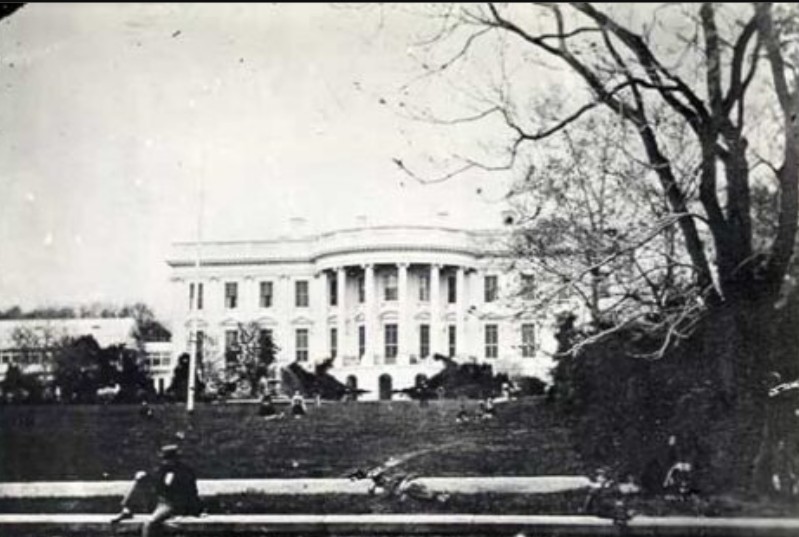
White House, Washington, D.C., 1861 (Matthew Brady, U.S. Library of Congress, public domain).

“There is another chapter to the story of how four young soldiers from Allentown, members of the Forty-Seventh Regiment, managed to see President Lincoln in 1861 after they had made two ineffectual efforts to see the great man. The young soldiers were Allen Wolf, William H. Smith, Jacob Worman, and George Hepler. They were members of Captain Mickley’s Company G and the pass which they had expired at 5 p.m. of that day.”

The Allentown Democrat, April 5, 1911


Their mission to shake the hand of President Abraham Lincoln accomplished, Private George Heppler, Drummer William N. Smith, Private Allen David Wolf, and Private Jacob Peter Worman, of the 47th Pennsylvania Volunteer Infantry, had a second mission to accomplish in late September of 1861 — to make it back to their regiment’s encampment, safely and quickly — because the pass that they had received from one of their superior officers was about to expire.

But their new mission would prove to be even more difficult than had their successful White House meeting with President Lincoln. According to The Allentown Democrat:

“It was growing late in the afternoon when the young soldiers left the White House and they made tracks for the camp. What followed can best be told in Mr. Wolf’s own words:

‘When we got to the point where our regiment had been encamped in the morning we saw nothing but strange faces. We asked for Company G, and were directed to a point. When we came there we found that during our absence the Forty-seventh had been ordered to move and a Wisconsin regiment was encamped there. We decided to return to the city [Washington, D.C.] and in due time fell into the hands of the patrol. We showed our pass and were sent to the headquarters of General McClellan. The general met us personally. We told him of our predicament and he told us that our regiment was now encamped in a different location. He directed us to cross the chain bridge. The general also informed us that a wagon train would go that way and that we should follow it. We did as he instructed us to do. What a march that was, however! It was raining all night and we were drenched to the skin by the time we reached our regiment. But we felt amply repaid. We had seen the greatest man in the country and had spoken to General McClellan.’

Chain Bridge across the Potomac above Georgetown looking toward Virginia, 1861 (The Illustrated London News, public domain).

The inability of the four 47th Pennsylvania Volunteers to locate their regiment’s camp is more easily understood when reading a letter penned on 29 September by Company C Musician Henry Wharton, in which he informed readers of the Sunbury American that the 47th Pennsylvania had changed camps three times in three days:

“On Friday last we left Camp Kalorama, and the same night encamped about one mile from the Chain Bridge on the opposite side of the Potomac from Washington. The next morning, Saturday, we were ordered to this Camp [Camp Advance near Fort Ethan Allen, Virginia], one and a half miles from the one we occupied the night previous. I should have mentioned that we halted on a high hill (on our march here) at the Chain Bridge, called Camp Lyon, but were immediately ordered on this side of the river. On the route from Kalorama we were for two hours exposed to the hardest rain I ever experienced. Whew, it was a whopper; but the fellows stood it well – not a murmur – and they waited in their wet clothes until nine o’clock at night for their supper. Our Camp adjoins that of the N.Y. 79th (Highlanders.)….

“We had not been in this Camp more than six hours before our boys were supplied with twenty rounds of ball and cartridge, and ordered to march and meet the enemy; they were out all night and got back to Camp at nine o’clock this morning, without having a fight. They are now in their tents taking a snooze preparatory to another march this morning…. I don’t know how long the boys will be gone, but the orders are to cook two days’ rations and take it with them in their haversacks….”

Despite that confusion, all four of the adventurous 47th Pennsylvania Volunteers eventually did manage to reconnect with their regiment at its encampment in Virginia. They then went on to follow President Lincoln’s directive to them: “Be good and above all obey your commander.”

Private Allen David Wolf, who was ultimately promoted up through the ranks to become Corporal Wolf, and Drummer William N. Smith both survived their initial three-year terms of enlistment and were both honorably discharged from the 47th Pennsylvania Volunteer Infantry’s encampment near Berryville, Virginia on September 18, 1864.

Private George Heppler, who was also ultimately promoted to the rank of corporal, and Private Worman, who was promoted to the rank of sergeant, served far longer — until the 47th was mustered out for the final time on Christmas Day in 1865.

All four witnessed both the worst and best of humanity and were forever changed by all that they had seen and heard as they fought to save their nation from disunion.


Sources:

  1. Bates, Samuel P. History of Pennsylvania Volunteers, 1861-5, vol. 1. Harrisburg, Pennsylvania: B. Singerly, State Printer, 1869.
  2. “Gleanings by the Way.” Allentown, Pennsylvania: The Allentown Democrat, April 4, 1911.
  3. “Gleanings By the Way.” Allentown, Pennsylvania: The Allentown Democrat, April 5, 1911.
  4. Wharton, Henry D. “Letters from the Sunbury Guards.” Sunbury, Pennsylvania: The Sunbury American, September 1861.


One Special September Day: Four 47th Pennsylvania Volunteers Shake Hands with President Abraham Lincoln in 1861 (part one)

Abraham Lincoln in New York City on Monday morning, February 27, 1860, several hours before he delivered his Cooper Union address (Matthew Brady, U.S. Library of Congress, public domain).

“In the eyes of the young men who went to the front during the dark days of the Civil War, the greatest man in the country was President Lincoln. It was every young soldier’s ambition to get the opportunity to see the great Lincoln, to shake him by the hand and to hear words fall from his lips. It was not an easy matter to have this ambition gratified. But comparatively few soldiers ever got within speaking distance of the great statesman. It was a physical impossibility for the president to see all those who wished to meet him and the attaches [sic] of the White House had to exercise great diplomacy with the eager throngs that haunted the executive mansion.”

— The Allentown Democrat, April 4, 1911


The vast majority of average Americans will never have the opportunity to shake the hand of a United States president. The schedules of modern office holders are too hectic and security protections are too tight to allow for such encounters on anything more than an infrequent basis — a reality that was true even for many U.S. citizens in the nineteenth century.

So, it is striking to learn that four young Pennsylvanians actually were able to shake President Abraham Lincoln’s hand on one very special day in late September 1861. All four were members of the 47th Pennsylvania Volunteer Infantry, which would go on to make history as the only regiment from the Commonwealth of Pennsylvania to participate in the Union’s Red River Campaign across Louisiana, and all four were members of that regiment’s G Company — a unit that would sustain heavy casualties as it fought valiantly in the Battle of Pocotaligo, South Carolina in 1862 and the Battle of Cedar Creek, Virginia in 1864.

Those memorable handshakes between President Lincoln and Private George Heppler, Drummer William N. Smith, Private Allen David Wolf, and Private Jacob Peter Worman, unfolded as follows, according to Wolf (who was interviewed by The Allentown Democrat in 1911):

“Our regiment went in 1861 from Harrisburg to Washington where we were encamped just outside the city limits. It was our dream to see Lincoln. Accordingly one day the four of us secured a pass to go into the city, but the time set for our return was 5 o’clock. We were all young fellows — I was seventeen years of age — and thrown into a new world. Everything seemed so wonderful to us and so different from Allentown. We were enjoying our holiday immensely, when some one suggested that we try to see President Lincoln. We had heard so much about this great man and when the matter was suggested we were all agreed.

“Let me tell you, however, that to start out to see the president and to actually see him in those days was [sic] two different things. Little did we dream of the difficulties that we would encounter. We started for the White House and arrived in due time. We got into the green room, where a negro servant met us and asked us our business. We told him that we were young soldiers from Pennsylvania and were very eager to see the president. The black man retired and returned a few moments later with the message that the president was very busy and could not see us at that time. We were disappointed, of course.

“We walked around the city for about an hour, but we were not satisfied. The disappointment over our failure to see the president weighed heavily on our minds. It was then that we determined to make another effort to have our ambition gratified and presented ourselves at the White House again. The negro servant recognized us and laughed when he saw us. We prevailed upon him to see the president and to find out whether we couldn’t see him. The negro again went up stairs and returned with the message that the president was still busy. We went away the second time disappointed.

“Again we walked about the city. Nothing seemed to interest us, however. We nursed our disappointment as best we could, but we simply could not rid ourselves of the desire to see the president. At four o’clock in the afternoon we determined to make a final effort. Again we ascended the White House steps and again we were met by our negro friend.He consented to intercede for us and went up stairs. A few moments later the president came down the stairway. We were standing at the bottom. There was a kindly, patient smile on his face. He greeted us cordially, shook each by the hand and said: ‘Boys, you are young soldiers. Be good and above all obey your commander.’ With that he retired. We were satisfied and went away brimful of happiness and patriotism.'”

What happened next for those four soldiers? Find out in part two of our look back at one of several encounters that members of the 47th Pennsylvania Volunteer Infantry had with President Abraham Lincoln during the American Civil War.


Sources:

  1. Bates, Samuel P. History of Pennsylvania Volunteers, 1861-5, vol. 1. Harrisburg, Pennsylvania: B. Singerly, State Printer, 1869.
  2. “Gleanings by the Way.” Allentown, Pennsylvania: The Allentown Democrat, April 4, 1911.
  3. “Gleanings By the Way.” Allentown, Pennsylvania: The Allentown Democrat, April 5, 1911.


Camp Brightwood, Washington, D.C. (Mid-April – June 2, 1865)

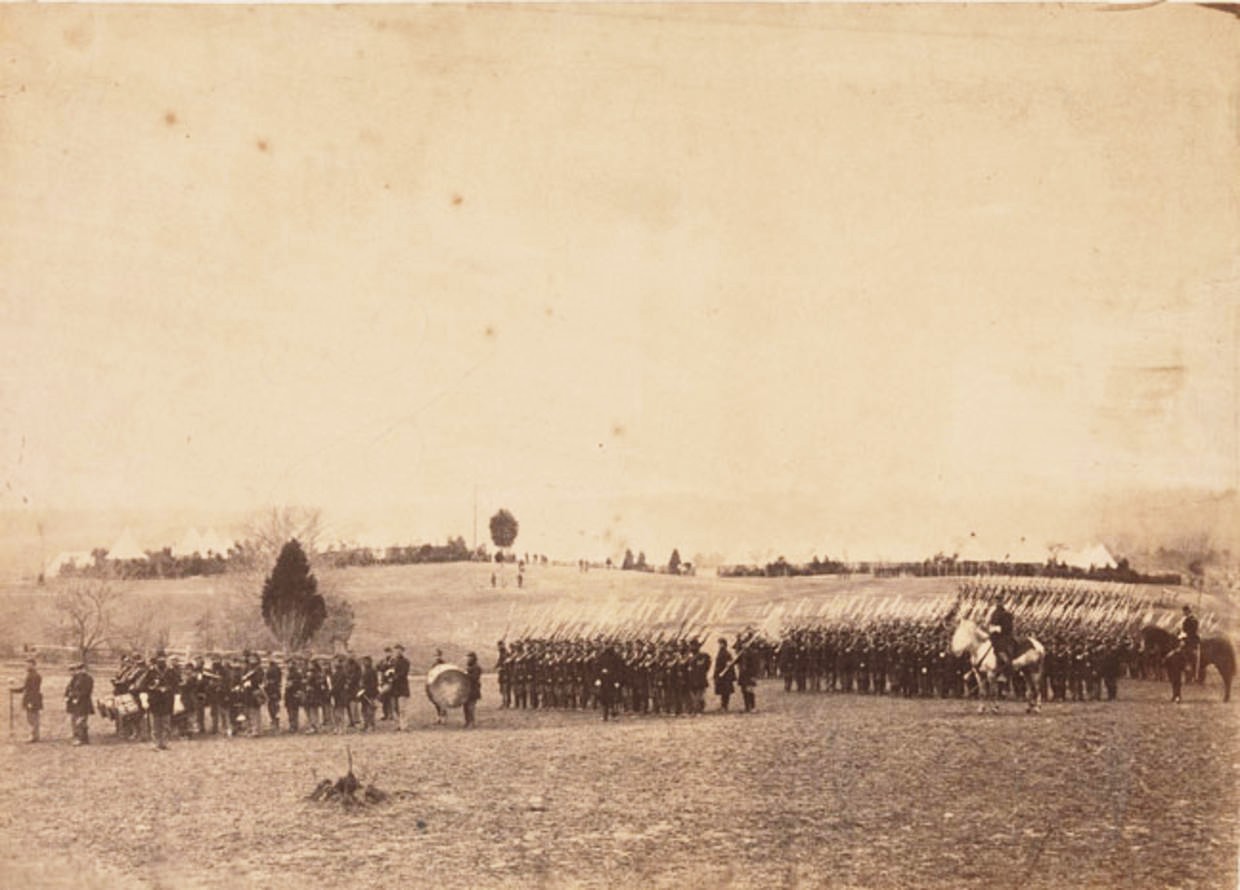
Unidentified Union infantry regiment, Camp Brightwood, Washington, D.C., circa 1865 (public domain; click to enlarge).

Marched closer to the nation’s capital in the wake of U.S. President Abraham Lincoln’s assassination in mid-April 1865, the 47th Pennsylvania Veteran Volunteers were directed to proceed to the Brightwood district in the northwestern section of Washington, D.C. and erect their Sibley tents at the Union Army duty station known as Camp Brightwood.

Their new job was to prevent Confederate States Army troops and their sympathizers from reigniting the flames of civil war that had just been stamped out weeks earlier.

According to historians at Cultural Tourism DC, Brightwood was “one of Washington, DC’s early communities and the site of the only Civil War battle to take place within the District of Columbia” — the Battle of Fort Stevens.

This crossroads community developed from the Seventh Street Turnpike, today’s Georgia Avenue, and Military Road. Its earliest days included a pre-Civil War settlement of free African Americans…. Eventually Brightwood boasted a popular race track, country estates, and sturdy suburban housing. In 1861 the area was known as Brighton, but once it was large enough to merit a U.S. Post Office, the name was changed to Brightwood to distinguish it from Brighton, Maryland.

Also, according to Cultural Tourism historians, Camp Brightwood was established on the grounds of “Emery Place, the summer estate of Matthew Gault Emery,” who had “made a fortune in stone-cutting, including the cornerstone for the Washington Monument,” which was laid in 1848.

During the Civil War (1861-1865), Captain Emery led the local militia. His hilltop became a signal station where soldiers used flags or torches to communicate with nearby Fort DeRussy or the distant Capitol. Soldiers of the 35th New York Volunteers created Camp Brightwood here. During the Battle of Fort Stevens in July 1864, Camp Brightwood was a transfer point for the wounded.

By late April of 1865, it was home to multiple Union Army regiments, including the 47th Pennsylvania Veteran Volunteers.

Guarding the Lincoln Assassination Conspirators

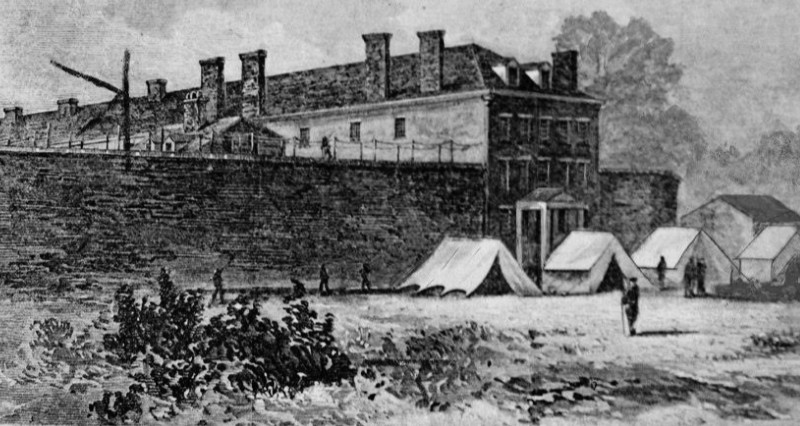
Washington Arsenal Penitentiary, Washington, D.C., 1865 (Joseph Hanshew, public domain; click to enlarge).

Sometime after their arrival at Camp Brightwood during that fateful spring of 1865, a group of 47th Pennsylvania Veteran Volunteers were given a new assignment — guard duty at the Washington Arsenal and its prison facility, where eight people were being held in connection with their involvement in the assassination of President Abraham Lincoln. They had been arrested between April 17 and 26.

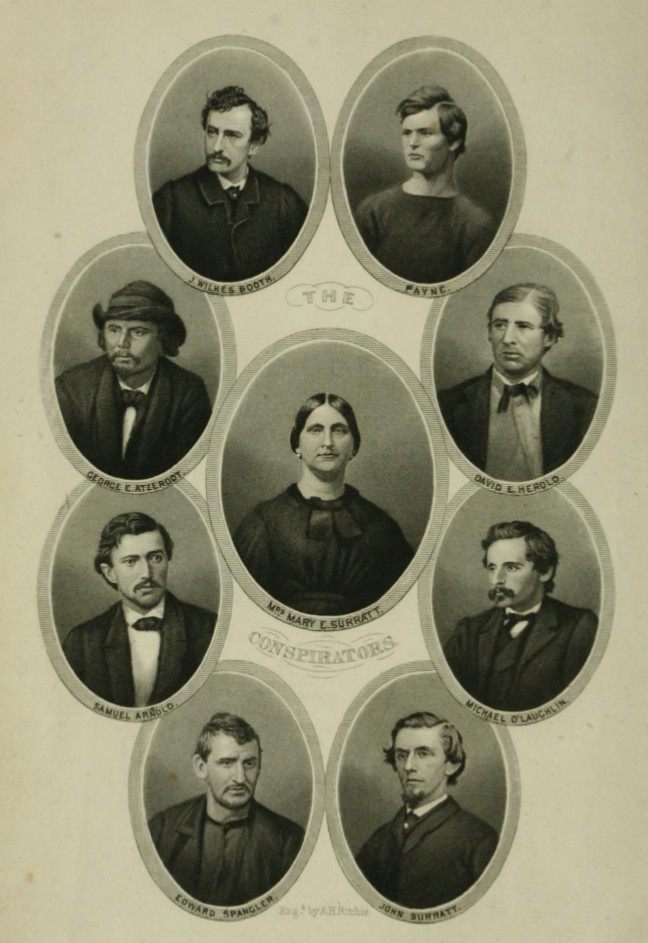
The key conspirators involved in President Abraham Lincoln’s assassination (Benn Pitman, The Assassination of President Lincoln and the Trial of the Conspirators,” 1865, U.S. Library of Congress, public domain).

While researchers for 47th Pennsylvania Volunteers: One Civil War Regiment’s Story have not yet determined the exact start date of the 47th Pennsylvania’s guard duties at the Washington Arsenal Penitentiary, they are now able to offer a better estimate — thanks to the work of Lincoln scholars Edward Steers, Jr. and Harold Holzer, who published documents written by Union Major-General John Frederick Hartranft, the Pennsylvanian appointed by U.S. President Andrew Johnson on May 1, 1865 “to command the military prison at the Washington Arsenal, where the U.S. government had just incarerated the seven men and one woman accused of complicity in the shooting.” Included in the Steers-Holzer compilation is a letter from Major-General Hartranft, governor and commander of the “Washington Arsenal Military Prison,” to Major-General Winfield S. Hancock, commanding officer of the United States Middle Military Division, which was dated May 11, 1865. Hartranft began by informing Hancock that “at 10:25 yesterday [May 10, 1865], Lt. Col. J. M. Clough, 18th N. H. reported with 450 muskets, for four days duty, relieving the 47th Pa. Vols.” He then went on to describe the duties performed by 18th New Hampshire Volunteers at the Washington Arsenal on May 10:

At 11:45, the prisoners on trial were taken into Court, in compliance with the orders of the same. At 1 P.M. the Court ordered the prisoners returned to their cells, which was done.

At 1:10 P.M. dinner was served to the prisoners in the usual manner.

At 1:30 in compliance with your orders Marshal McPhail was admitted to see the prisoner in 161 [Atzerodt], his hood having been previously removed; he remained with him until 2.35, immediately after which his hood was replaced and the door locked.

At 3:45 P.M. Mr. George L. Crawford in accordance with your instructions, was permitted to have an interview with prisoner in 209. I was present during the same, and heard all that was said. The conversation was in regard to the property of the prisoner in Philadelphia. At 4:25 the hood was replaced and the cell locked.

At 6 P.M. Supper was furnished the prisoners and at the same time Dr. Porter and myself made inspections of all the cells and prisoners.

At 6 P.M. in accordance with your instructions, Mr. Stone, counsel for Dr. Mudd, was permitted to visit his client. The interview took place in the presence of Lt. Col. McCall but not in his hearing.

At 6:35 the interview closed, and the door was again locked.

At 7 this A.M. breakfast was served to the prisoners in the usual manner. At 7:15, Dr. Porter and myself made Inspections of all the cells and prisoners.

I would respectfully recommend that the prisoner in 190 be removed to cell 165.

All passes admitting persons during the last 24 hours are here with enclosed.

As a result, researchers for the 47th Pennsylvania Volunteers’ project postulate that:

  1. As many as four hundred and fifty 47th Pennylvania Veteran Volunteer Infantrymen may have been stationed at the Washington Arsenal between May 6-10, 1865; and
  2. At least some of those 47th Pennsylvanians may very well have interacted with the key Lincoln assassination conspirators (Samuel Bland Arnold, George A. Atzerodt, David E. Herold, Dr. Samuel Alexander Mudd, Michael O’Laughlen, Lewis Thornton Powell/Lewis Payne, Edman Spangler/Ned Spangler, and Mary Elizabeth Surratt) — interactions which likely took place while those eight prisoners were confined at the Washington Arsenal prison; on the way to and from the courtroom, where they were being tried for conspiring to assassinate President Lincoln; inside that courtroom during trial proceedings; and possibly also at other sites related to their confinement and trial.

Although the duties performed between by 47th Pennsylvania Volunteers between May 6-9 would not have been exactly the same as those performed by the New Hampshire soldiers on May 10, they may very well have been similar — meaning that at least some 47th Pennsylvania Volunteers may have been involved in locking and unlocking the doors of the conspirators’ cells, escorting the conspirators into the courtroom of their military trial (which began on May 9, 1865), standing guard over the conspirators during their trial to prevent their escape, escorting them from the courtroom, and interacting with them in their cells by:

  • Bringing meals to them;
  • Removing and replacing the hoods that covered their heads so that they could interact with their lawyers and other visitors;
  • Verifying the legitimacy of passes held by would-be visitors and denying or granting access to those visitors as appropriate;
  • Escorting visitors to and from their cells; and
  • Monitoring their visits with anyone granted entry to their cells.

With their guard assignment completed by the morning of May 10, 1865, the 47th Pennsylvania Volunteers who were serving on detached duty at the Washington Arsenal were marched back to Camp Brightwood, where they would remain until their next assignment — participating in the Union’s Grand Review of the National Armies on May 23, 1865.

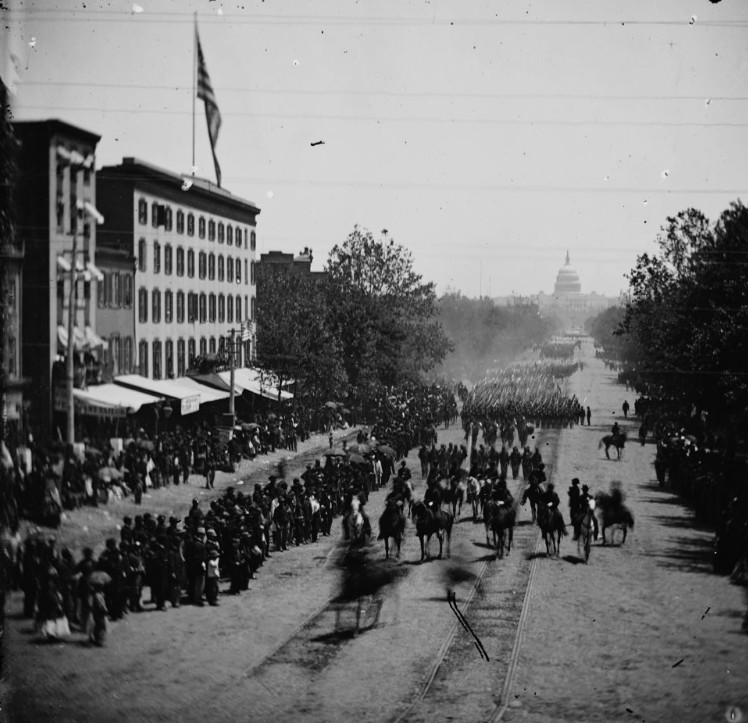
19th Corps, Army of the United States, Grand Review of the National Armies, Pennsylvania Avenue, Washington, D.C., May 23, 1865 (Matthew Brady, U.S. Library of Congress, public domain).

The Grandest of the Grand Reviews

The 47th Pennsylvania Veteran Volunteer Infantry was just one group of the more than one hundred and forty-five thousand Union military men who marched from Capitol Hill through the streets of Washington, D.C. during a two-day spectacle designed to celebrate the end of the American Civil War and heal Americans’ heartbreak in the wake of President Lincoln’s assassination. Held from May 23-24, 1865, it was a sight that had never been seen before — and one that would likely never be seen anywhere in the United States of America ever again. The first day’s parade alone lasted six hours.

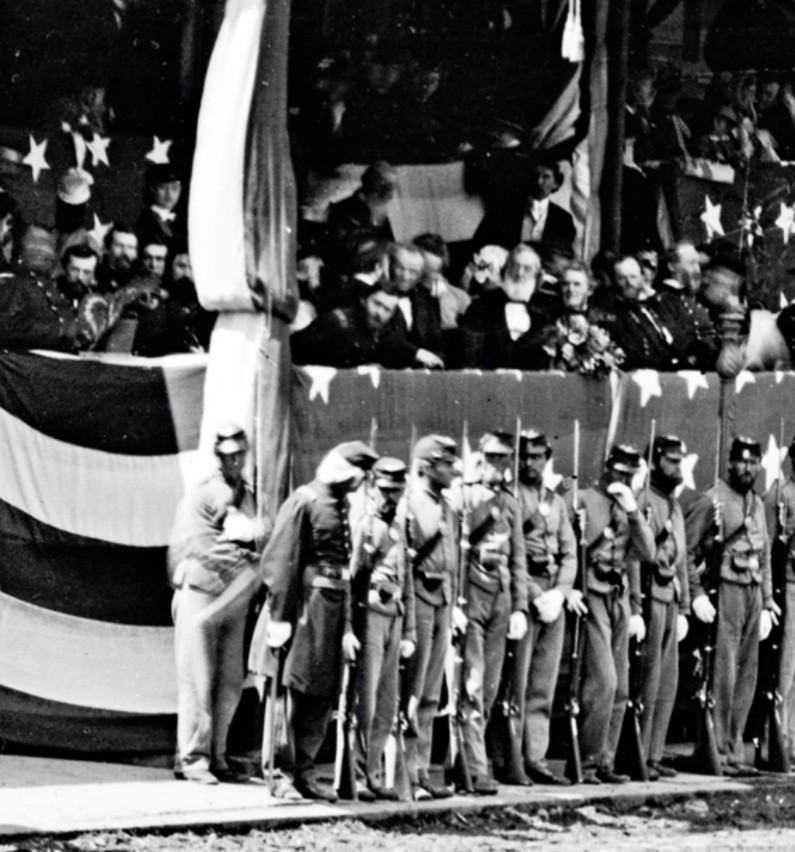
Lieutenant-General Ulysses S. Grant, leaning forward, President Andrew Johnson to his left, Grand Review of the National Armies, Washington, D.C., May 23, 1865 (U.S. Library of Congress, public domain).

According to The New York Times, the 47th Pennsylvanians were positioned behind the parade’s third division, as part of the Nineteenth Army Corps (XIX Corps) in Dwight’s Division. Marching with the precision for which they had become renowned, they passed in front of a review stand which sheltered U.S. President Andrew Johnson, Secretary of War Edwin M. Stanton and Lieutenant-General Ulysses S. Grant. The division directly behind the 47th Pennsylvanians in that day’s line of march included other officers and general staff of the Army of the United States and regiments commanded by American Civil War icon Brigadier-General Joshua L. Chamberlain, one of the most beloved heroes from the tide-turning Battle of Gettysburg.

Rev. William DeWitt Clinton Rodrock, chaplain, 47th Pennsylvania Volunteers (courtesy of Robert Champlin, used with permission).

Afterward, 47th Pennsylvania Chaplain William DeWitt Clinton Rodrock summed up the experience in a report penned at Camp Brightwood on May 31:

The wise king of the Scriptures speaks of a sorrow that pervades the human heart “in the midst of laughter.” The truthfulness of this Divine philosophy is a matter of daily experience. Our most joyous seasons are intermingled with a sadness that often challenges definition. Every garden has its sepulchre. Every draft of sweet has its ingredient of bitter. This fact has never been so fully realized as this month. With the mighty army of brave soldiers congregated and reviewed in Washington and the … expressions of deep regret that Abraham Lincoln is not here to have witnessed the great pageant of the 23rd and 24th inst. have been universal. Not the splendid victories which our brave soldiers have won — not the pleasing prospect that they are “homeward bound” — not the consolatory thought that the reins of government have fallen into the hands of so good a man as Andrew Johnson — have served to restrain these utterances of grief and sorrow. Had it been God’s will to spare Mr. Lincoln’s life, what an eclat his presence would have imparted to the mighty pageant.

But as He willed otherwise and “doeth all things well,” it is ours to learn the great lesson of the hour.

Rebuilding a Shattered Nation

Ruins of Charleston, South Carolina as seen from the Circular Church, 1865 (U.S. National Archives and Records Administration, public domain).

As the cheers of the Grand Review crowds faded, the 47th Pennsylvania Veteran Volunteers resumed life at Camp Brightwood, with many assuming that their days of wearing “Union Blue” were finally coming to an end. But that assumption proved to be an incorrect one when the 47th Pennsylvania Veteran Volunteers received word that they were being reassigned. Ordered to pack their belongings in late May 1865, they would be heading back to America’s Deep South — this time to assist with Reconstruction duties in Georgia and South Carolina, beginning the first week in June.


Sources:

  1. Assassination of President Abraham Lincoln.” Washington, D.C.: U.S. Library of Congress, retrieved online May 21, 2025.
  2. Bates, Samuel P. History of Pennsylvania Volunteers, 1861-5, vol. 1. Harrisburg, Pennsylvania: B. Singerly, State Printer, 1869.
  3. Battleground National Cemetery: Battleround to Community — Brightwood Heritage Trail,” “Fort Stevens” and “Mayor Emery and the Union Army.” United States: Historical Marker Database, retrieved online May 20, 2025.
  4. “Battleground to Community: Brightwood Heritage Trail.” Washington, D.C.: Cultural Tourism DC, 2008.
  5. “Grand Military Review: Streets Crowded with Spectators: Sherman Greeted with Deafening Cheers.” Pittsburgh, Pennsylvania: The Daily Post, May 25, 1865.
  6. Grant” (television mini-series). New York, New York: History Channel Education, 2020.
  7. “Our Heroes! The Grand Review at Washington. Honor to the Brave. Immense Outpouring of the People. The Troops Reviewed by Gen. Grant.” Harrisburg, Pennsylvania: Daily Telegraph, May 23, 1865.
  8. Pitman, Benn. The Assassination of President Abraham Lincoln and the Trial of the Conspirators. Cincinnati, Ohio and New York, New York: Moore, Wilstach & Boldwin, 1865.
  9. Reconstruction: An Overview.” Washington, D.C.: American Battlefield Trust, November 28, 2023.
  10. Review of the Armies; Propitious Weather and a Splendid Spectacle. Nearly a Hundred Thousand Veterans in the Lines.” New York, New York: The New York Times, May 24, 1865, front page.
  11. Rodrock, Rev. William D. C. Chaplain’s Reports (47th Pennsylvania Volunteer Infantry, 1865). Washington, D.C.: U.S. National Archives and Records Administration.
  12. Schmidt, Lewis. A Civil War History of the 47th Regiment of Pennsylvania Veteran Volunteers. Allentown, Pennsylvania: Self-published, 1986.
  13. “Serenade to General Grant” (performance for Lieutenant-General Ulysses S. Grant by the 47th Pennsylvania Veteran Volunteers’ Regimental Band), in “Washington.” Philadelphia, Pennsylvania: The Inquirer, May 22, 1865.
  14. Steers, Edward Jr. and Harold Holzer. The Lincoln Assassination Conspirators: Their Confinement and Execution, as Recorded in the Letterbook of John Frederick Hartranft. Baton Rouge, Louisiana, 2009.
  15. The Final March: Grand Review of the Armies.” Washington, D.C.: U.S. National Park Service, retrieved online May 20, 2025.
  16. “The Grand Review: A Grand Spectacle Witnessed.” Pittsburgh, Pennsylvania: The Daily Post, May 24, 1865.
  17. “The Grand Review: Immense Crowds in Washington: Fine Appearance of the Troops: Their Enthusiastic Reception.” Harrisburg, Pennsylvania: Pennsylvania Daily Telegraph, May 24, 1865; and West Chester, Pennsylvania: The Record, May 17, 1865.
  18. “The Grand Review: The City Crowded with Visitors: Order of Corps, Divisions, Brigades and Regiments.” Philadelphia, Pennsylvania: Daily Constitutional Union, May 23, 1865.
  19. “The History of the Forty-Seventh Regt. P. V.” Allentown, Pennsylvania: The Lehigh Register, 20 July 1870.
  20. The Lincoln Conspirators,” in “Ford’s Theatre.” Washington, D.C.: U.S. National Park Service, retrieved online May 21, 2025.


April 15th: A Date of Decision and Death for President Abraham Lincoln

This 1865 photograph of President Abraham Lincoln by Alexander Gardner is believed by historians to be the final photo taken of Lincoln (1865, U.S. Library of Congress, public domain).

There were multiple key moments in the life of the man who would become the sixteenth president of the United States of America. Some, like the deaths of his mother and sister, would dramatically alter the trajectory of his life; others, like his decision to embark upon a life of public service, would reshape the future of a nation.

But his actions on one particular date, during two entirely different years, did both.

So pivotal in history, that particular date’s annual arrival still stops average Americans in their tracks each year, prompting them to reflect on the legacy of that one man — and the question, “What if?”

That man was U.S. President Abraham Lincoln and that date is April 15.

Lincoln’s Call for Seventy-Five Thousand Volunteers (April 15, 1861)

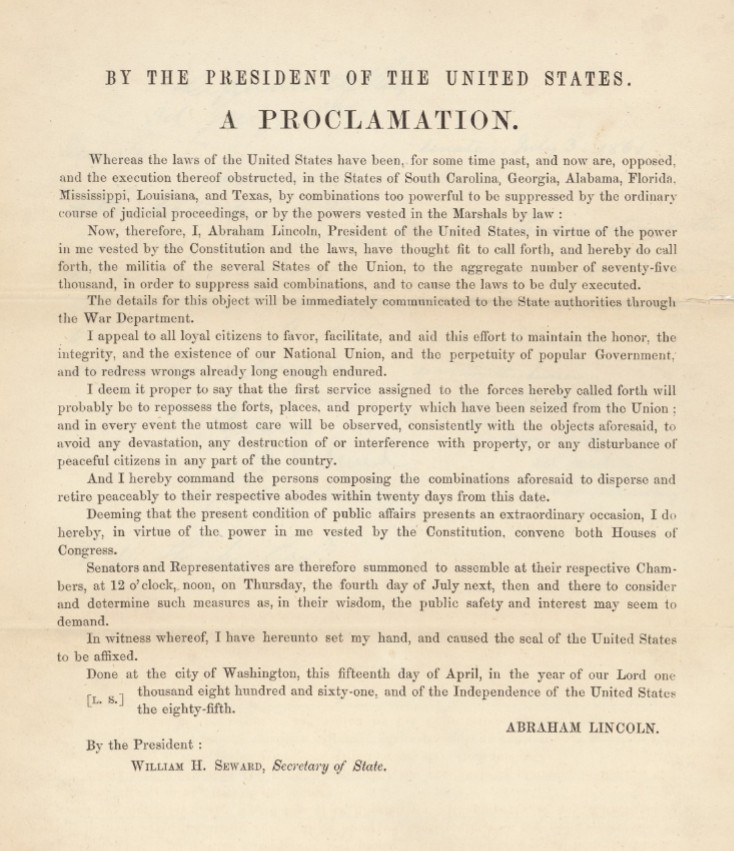
Proclamation issued by U.S. President Abraham Lincoln, calling for seventy-five thousand state militia troops to bring an end to the secession of, and insurrection by, eleven of fifteen southern slaveholding states, April 15, 1861 (U.S. National Archives and Records Administration, public domain; click to enlarge).

In response to the fall of Fort Sumter in Charleston, South Carolina to Confederate States troops on April 14, 1861, President Abraham Lincoln issued a proclamation in which he called for seventy-five thousand men across the United States to risk their lives to defend the nation’s capital and bring a swift end to the secession crisis and insurrection initiated by eleven of fifteen southern slave holding states. That proclamation, which was issued on April 15, 1861 read as follows:

By the President of the United States.

A Proclamation.

Whereas the laws of the United States have been, for some time past, and now are, opposed, and the execution thereof obstructed, in the States of South Carolina, Georgia, Alabama, Florida, Mississippi, Louisiana, and Texas, by combinations too powerful to be suppressed by the ordinary course of judicial proceedings, or by the powers vested in the Marshals by law:

Now, therefore, I, Abraham Lincoln, President of the United States, in virtue of the power in me vested by the Constitution and the laws, have thought fit to call forth, and hereby do call forth, the militia of the several States of the Union, to the aggregate number of seventy-five thousand, in order to suppress said combinations, and to cause the laws to be duly executed.

The details for this object will be immediately communicated to the State authorities through the War Department.

I appeal to all loyal citizens to favor, facilitate, and aid this effort to maintain the honor, the integrity, and the existence of our National Union, and the perpetuity of popular Government, and to redress wrongs already long enough endured.

I deem it proper to say that the first service assigned to the forces hereby called forth will probably be to repossess the forts, places, and property which have been seized from the Union; and in every event the utmost care will be observed, consistently with the objects aforesaid, to avoid any devastation, any destruction of or interference with property, or any disturbance of peaceful citizens in any part of the country.

And I hereby command the persons composing the combinations aforesaid to disperse and retire peaceably to their respective abodes within twenty days from this date.

Deeming that the present condition of public affairs presents an extraordinary occasion, I do hereby, in virtue of the power in me vested by the Constitution, convene both Houses of Congress.

Senators and Representatives are therefore summoned to assemble at their respective Chambers, at 12 o’clock, noon, on Thursday, the fourth day of July next, then and there to consider and determine such measures as, in their wisdom, the public safety and interest may seem to demand.

In witness whereof, I have hereunto set my hand, and caused the seal of the United States to be affixed.

Done at the city of Washington, this fifteenth day of April, in the year of our Lord one thousand eight hundred and sixty-one, and of the Independence of the United States the eighty-fifth.

Abraham Lincoln

By the President: William H. Seward, Secretary of State.

Four years later, on the exact same date, President Abraham would draw his last breath.

Lincoln’s Death from an Assassin’s Bullet (April 15, 1865)

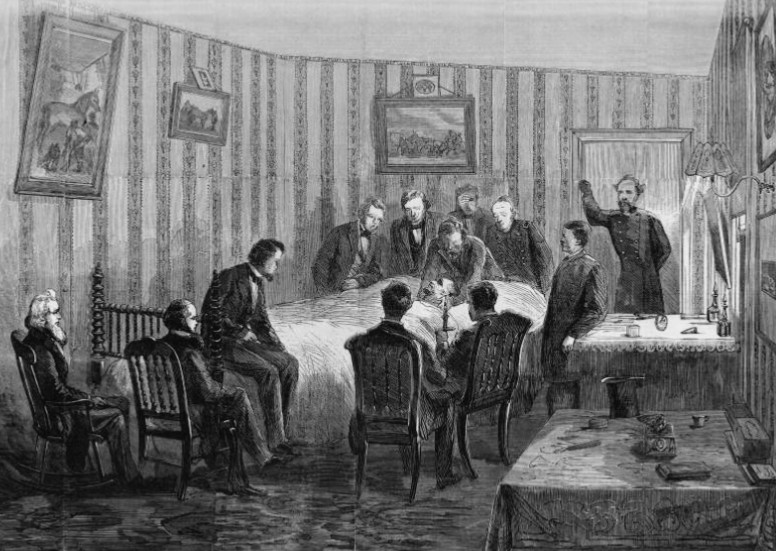
President Abraham Lincoln on his deathbed at the Petersen House in Washington, D.C., April 15, 1865 (Harper’s Weekly, 1865, public domain; click to enlarge).

Mortally wounded by a shot to his head, which was fired by an assassin and Confederate sympathizer while President Abraham Lincoln was watching a performance of the popular stage play, Our American Cousin, at Ford’s Theatre in Washington, D.C., on the evening of Good Friday, April 14, 1865, President Lincoln was initially examined on site in the presidential box, by fellow theatre attendee and physician Charles Leale, before being carried downstairs by Union Army soldiers and taken across Tenth Street — and into a room at the Petersen boarding house, where he was then gently lowered onto the bed of Willie Clark.

As additional physicians arrived and assessed the president’s condition, a decision was made to make him as comfortable as possible, when it was determined that he would likely not survive the night.

A remarkably strong man, even as he waged his toughest battle, President Lincoln managed to hang onto until the following morning, drawing his final ragged breath at 7:22 a.m. on April 15, 1865 — and leaving the work of national healing and Reconstruction in far less capable hands.

One hundred and sixty years later, Americans still wonder, “Would we be a better nation if Lincoln had survived?”


Sources:

  1. A Proclamation by the President of the United States, April 15, 1861.” Washington, D.C.: U.S. Capitol Visitor Center, retrieved online April 15, 2025.
  2. Abraham Lincoln’s Assassination,” in “History Channel: Civil War.” New York, New York: A&E Television Networks, February 27, 2025.
  3. Eric Foner: Reconstruction and the Constitution” (video). Chicago, Illinois: Chicago Humanities Festival, 2019.
  4. Lincoln’s Death,” in “Lincoln Assassination.” Washington, D.C.: Ford’s Theatre, retrieved online December 1, 2024.
  5. The Petersen House.” Washington, D.C.: U.S. National Park Service, December 1, 2024.


April 12th: This Date in 47th Pennsylvania Volunteer Infantry History

April 12th would prove to be an important date for the men who served with the 47th Pennsylvania Volunteer Infantry during the American Civil War and Reconstruction eras. This abridged timeline illustrates why:

1861

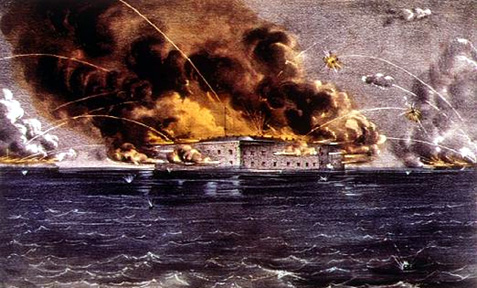
The bombardment of Fort Sumter 12-14 April 1861 (Currier & Ives, public domain).

At 4:30 a.m., on April 12, 1861, artillery batteries of the Confederate States Army open fire on United States Army troops stationed at Fort Sumter in Charleston, South Carolina. A long and disastrous period of civil war begins in America.

The majority of Pennsylvanians and residents of other states throughout America who will ultimately serve with the 47th Pennsylvania Volunteer Infantry are at home, asleep in their beds — or just rising and readying themselves for their work days on family farms, as canal boatmen, in iron foundries, silk mills, tanneries or tobacco factories, as quarrymen toiling away in the slate industry, or as miners tunneling deeper inside of the Earth in poorly-lighted coal mines, along with countless other blue collar laborers who are risking their own health and safety just to keep their families housed and fed.

The 47th Pennsylvania Volunteer Infantry isn’t even “a glimmer” in anyone’s eyes — yet. (It won’t be founded until August 5, 1861.)

1862

In 1862, The Gazette, one of two hometown newspapers read by the majority of men serving with the 47th Pennsylvania Volunteer Infantry’s C Company, carries the following news in its April 12th edition:

Jeff. Davis is becoming desperate. He has issued an extraordinary Message ordering the enrollment of all citizens of the Confederate States between the ages of 18 and 35, for military service, the residue of the fighting population, above 35 to form a fighting force.

Although that particular edition of the newspaper has not yet reached the 47th Pennsylvania Volunteers who are stationed in Florida, a warning about the Confederate Conscription Act’s pending passage has likely been telegraphed by the U.S. War Department to senior officers at the 47th Pennsylvania’s headquarters at Fort Taylor in Key West in order to prepare them for the increased threat they and their troops will face.

1864

On April 12, 1864, Captain Charles William Abbott, commanding officer of the 47th Pennsylvania Volunteer Infantry’s K Company, pens a brief report from his regiment’s camp at Grand Ecore, Louisiana to his superior officers in the United States Army of the Gulf, which partially documents the losses in soldiers and supplies sustained by his regiment during the Battle of Pleasant Hill, Louisiana on April 9, 1864. That report also contains details about the regiment’s movements during this phase of duty.

Sergeant John Gross Helfrich then describes this same battle in a letter to his parents on May 5th, in which he notes:

I have learned additional news of the late fight of our boys of the “Nineteenth Corps”…. The casualties of our boys amounted to a great deal more than at first reported. The Lt. Col. of our Forty-seventh Regt. is missing, and supposed he is wounded or perhaps killed. Lt. Swoyer is dead.

1865

In a letter that he is writing to the Sunbury American on April 12, 1865 from the 47th Pennsylvania Volunteer Infantry’s camp near Summit Point, Virginia, 47th Pennsylvanian Henry D. Wharton describes a celebration that took place following the surrender at Appomattox by Confederate General Robert E. Lee and his army on April 9, 1865:

Since yesterday a week we have been on the move, going as far as three miles beyond Winchester. There we halted for three days, waiting for the return or news from Torbett’s cavalry who had gone on a reconnoisance [sic] up to the valley. They returned, reporting they were as far up as Mt. Jackson, some sixty miles, and found nary an armed reb. The reason of our move was to be ready in case Lee moved against us, or to march on Lynchburg, if Lee reached that point, so that we could aid in surrounding him and [his] army, and with Sheridan and Mead capture the whole party. Grant’s gallant boys saved us that march and bagged the whole crowd. Last Sunday night our camp was aroused by the loud road of artillery. Hearing so much good news of late, I stuck to my blanket, not caring to get up, for I suspected a salute, which it really was for the ‘unconditional surrender of Lee.’ The boys got wild over the news, shouting till they were hoarse, the loud huzzas [sic, huzzahs] echoing through the Valley, songs of ‘rally round the flag,’ &c., were sung, and above the noise of the ‘cannons opening roar,’ and confusion of camp, could be heard ‘Hail Columbia’ and Yankee Doodle played by our band. Other bands took it up and soon the whole army let loose, making ‘confusion worse confounded.’

The next morning we packed up, struck tents, marched away, and now we are within a short distance of our old quarters. – The war is about played out, and peace is clearly seen through the bright cloud that has taken the place of those that darkened the sky for the last four years. The question now with us is whether the veterans after Old Abe has matters fixed to his satisfaction, will have to stay ‘till the expiration of the three years, or be discharged as per agreement, at the ‘end of the war.’ If we are not discharged when hostilities cease, great injustice will be done.

The members of Co. ‘C,’ wishing to do honor to Lieut. C. S. Beard, and show their appreciation of him as an officer and gentleman, presented him with a splendid sword, sash and belt. Lieut. Beard rose from the ranks, and as one of their number, the boys gave him this token of esteem.

A few nights ago, an aid [sic] on Gen. Torbett’s staff, with two more officers, attempted to pass a safe guard stationed at a house near Winchester. The guard halted the party, they rushed on, paying no attention to the challenge, when the sentinel charged bayonet, running the sharp steel through the abdomen of the aid [sic], wounding him so severely that he died in an hour. The guard did his duty as he was there for the protection of the inmates and their property, with instruction to let no one enter.

The boys are all well, and jubilant over the victories of Grant, and their own little Sheridan, and feel as though they would soon return to meet the loved ones at home, and receive a kind greeting from old friends….

1866

On April 12, 1866, members of the 47th Pennsylvania Veteran Volunteers who survived the American Civil War are three months into their post-war civilian lives. Many are back home in Pennsylvania, trying to regain some sense of their old selves with normal work and family routines. Others have already left their pre-war and war lives behind, choosing to migrate west in search of better opportunities — or a certain peace of mind they hope to find in knowing they will be far away from any decision-makers who might drag their communities and nation back down into another disastrous war in the future.


Sources:

  1. Abbott, Charles W. Report from Captain Charles W. Abbott, Captain, Company K, 47th Pennsylvania Volunteer Infantry, to Senior Officers of the U.S. Army of the Gulf’s XIX Corps (19th Corps), Grand Ecore, Louisiana, April 12, 1864. Nazareth, Pennsylvania: Personal Collection of Julian Burley.
  2. Agriculture and Rural Life,” in “Stories from PA History.” Harrisburg, Pennsylvania: Pennsylvania Historical and Museum Commission, 2023.
  3. Fort Sumter and Fort Moultrie National Park.” Washington, D.C.: National Park Foundation, retrieved online April 12, 2025.
  4. Harris, Howard and Perry K. Blatz. Keystone of Democracy: A History of Pennsylvania Workers. Harrisburg, Pennsylvania: Pennsylvania Historical and Museum Commission, 1999.
  5. Helfrich, John Gross. Letter to His Parents, May 5, 1864. Mesa, Arizona: Personal Collection of the Colin Cofield Family Archives.
  6. Miller, Randall M. and William A. Pencak. Pennsylvania: A History of the CommonwealthUniversity Park, Pennsylvania: The Pennsylvania State University Press, 2002.
  7. Mining Anthracite,” in “Stories from PA History.” Harrisburg, Pennsylvania: Pennsylvania Historical and Museum Commission, 2023.
  8. Montgomery, Morton L. Early Furnaces and Forges of Berks County, Pennsylvania, in The Pennsylvania Magazine of History and Biography, 1884. Philadelphia, Pennsylvania: Historical Society of Pennsylvania, 1884.
  9. News Regarding the Confederate States’ New Conscription Order. Sunbury, Pennsylvania: The Gazette, April 12, 1862.
  10. Palladino, Grace. Another Civil War: Labor, Capital, and the State in the Anthracite Regions of Pennsylvania, 1840-1868. New York, New York: Fordham University Press, March 30, 2006.
  11. Sacher, John M. Confederate Conscription and the Struggle for Southern Soldiers. Baton Rouge, Louisiana: LSU Press, 2021.
  12. The Industrial Age,” in “Stories from PA History: Science and Invention.” Harrisburg, Pennsylvania: Pennsylvania Historical and Museum Commission, 2023.
  13. The Pennsylvania Iron Industry: Furnace and Forge of America,” in “Stories from PA History.” Harrisburg, Pennsylvania: Pennsylvania Historical and Museum Commission, 2023.
  14. The Railroad in Pennsylvania,” in “Stories from PA History.” Harrisburg, Pennsylvania: Pennsylvania Historical and Museum Commission, 2023.
  15. Timeline of Labor History in Pennsylvania.” Pennsylvania: Pennsylvania Labor History Society, retrieved online April 12, 2025.


April 17, 1865: A Nation in Mourning Begins to Move Forward

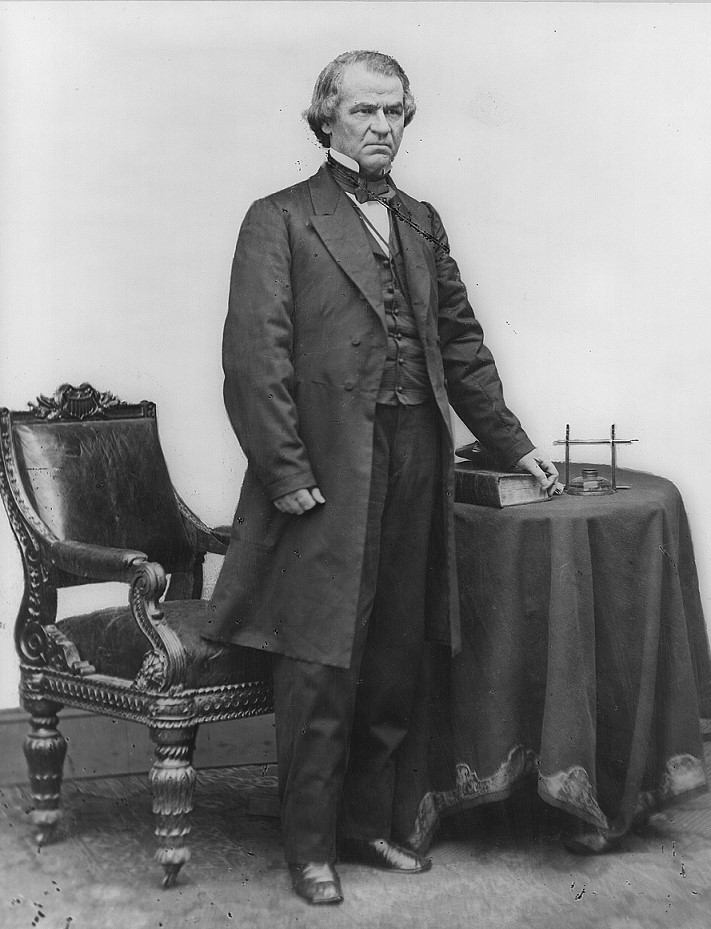
Andrew Johnson, photographed by Matthew Brady sometime between 1860 and 1875, was sworn in as president of the United States on April 15, 1865 (Matthew Brady Collection, U.S. Library of Congress, public domain).

Andrew Johnson, of Tennessee, is now President of the United States. The mysterious purposes of Divine Providence, far beyond the extremest perception of man’s mere judgment, in shaping the ends his wisdom deems to be wisest for our chastisement or in promoting our good, will chasten us while humbling us in the dust in the bereavement the People have sustained through that most wicked act, the bold and daring assassination of the President of the United States. Such an act of perfidy and atrocity has no parallel in the annals of deep and damning crime. The world will stand aghast in horror and detestation of the brutal murder, when the terrible tidings will have reached earth’s remotest extremity.

— The Constitutional Union newspaper, Philadelphia, Pennsylvania, Monday, April 17, 1865


That opening paragraph of Philadelphia’s Constitutional Union article, “The New President,” illustrates both the State of the Union and the state of mind of the average American during the first days after the assassination of President Abraham Lincoln—the collective and individual states of bewilderment and grief while looking back and reflecting on Lincoln’s life and death while also worrying about what the future held as a new leader was introduced to the nation.

That new leader—President Andrew Johnson (1808-1875), who had been quietly sworn in as the seventeenth president of the United States on the same day that Lincoln died—April 15, 1865—had worked his way up from an early-career job as mayor of a local town in Tennessee to a later-life election to the United States Senate, becoming the only senator from America’s Deep South to remain in service with the Senate when southern states began their secession from the Union in December 1860. Subsequently appointed by Lincoln as Tennessee’s military governor in March 1862, he had then been placed on the Republican ticket as Lincoln’s running mate during the pivotal presidential election of November 1864, and had been sworn in as the nation’s vice president in March 1865—just forty-two days before he succeeded Lincoln.

Like Lincoln and Lincoln’s Secretary of State William Seward, Andrew Johnson had also been the target of the assassination conspiracy that unfolded on April 14, 1865. But Johnson was luckier. George Atzerodt, the man who had been assigned to assassinate him, changed his mind as he reached Kirkwood House, the Pennsylvania Avenue hotel where Johnson lived, and, instead, left Washington, D.C., hoping to evade capture.

Shortly before sunrise, while still the sitting vice president, Johnson visited the unconscious, dying president at his bedside at the Petersen House, spent a few moments consoling Lincoln’s family, and then walked the short distance back to his residence to prepare for the possibility of being sworn in as the nation’s next president.

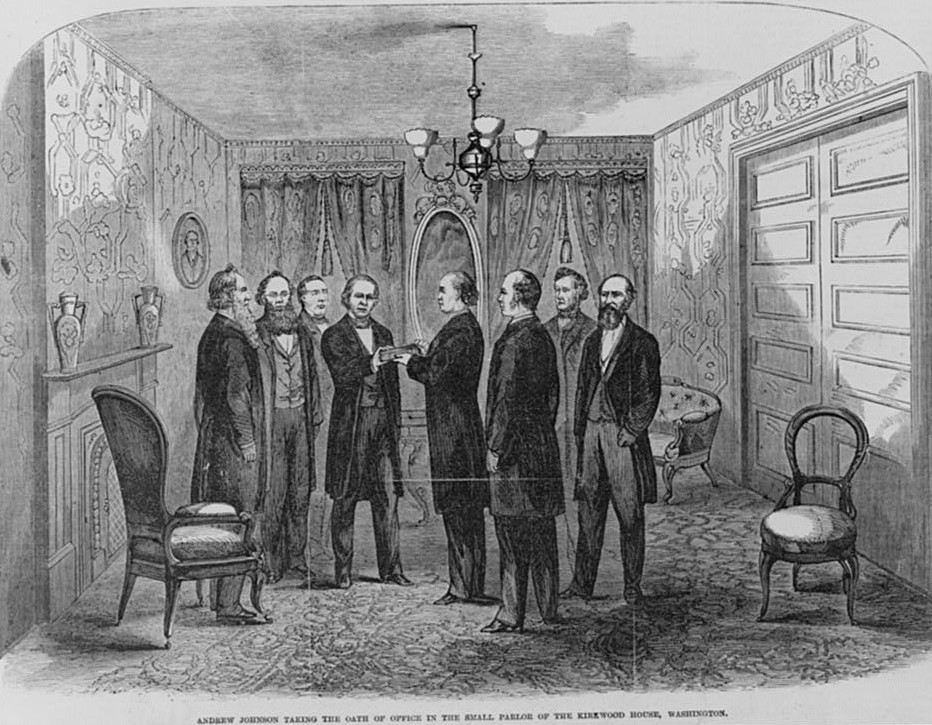
Depiction of Andrew Johnson being sworn as the seventeenth president of the United States, April 15, 1865. The ceremony, attended by only a handful of senior government officials, was a subdued affair due to the death earlier that day of President Lincoln. It was held at Kirkwood House in Washington, D.C., where Johnson had resided since his inauguration as vice president forty-two days earlier (Frank Leslie’s Illustrated Newspaper, January 6, 1866).

Less than four hours after Lincoln’s death, Johnson was administered the Oath of Office by Chief Justice Salmon Chase of the United States Supreme Court, as several members of Lincoln’s former cabinet and Johnson’s former fellow senators looked on:

I do solemnly swear (or affirm) that I will faithfully execute the Office of President of the United States, and will to the best of my Ability, preserve, protect and defend the Constitution of the United States.

After speaking those words, President Andrew Johnson told the small group:

The duties of the office are mine; I will perform them—the consequences are with God. Gentlemen, I shall lean upon you; I feel I shall need your support. I am deeply impressed with the solemnity of the occasion and the responsibilities of the duties of the office I am assuming.

It was at that moment, during the morning of April 15, 1865, that the 47th Pennsylvania Volunteer Infantry entered its tenure of Reconstruction Era service under a new commander-in-chief.

Members of the regiment began that new phase of duty with heavy hearts and hope for a brighter day, according to C Company’s Henry Wharton. Writing to the editor of his hometown newspaper, the Sunbury American, from an unidentified “Camp Near Washington, D.C.” on April 24, Wharton mused:

It is true we have sustained a great loss in the death of our much beloved President, but as it has pleased Divine Power to remove him from our midst, we should be thankful that He has given us such a great and determined man in his stead (Andrew Johnson) to drive on the machinery of the Government. It was a wise thing in the framers of the Constitution when they put in that clause, where if we lose our President the wheels of the Government can never be stopped. This is done by the Vice President, a plain unpretending citizen, on the death of the Chief Magistrate, stepping forward so to take the oath administered by the Chief Justice, and at once takes the responsibility of the office. No flourish of trumpets, nor convulsion of nations, but by the simple power vested in a Judge, a fellow citizen assumes power. This little fact proves that our Republic can never die.

I cannot describe to you the feeling of the army when the news reached us that Abraham Lincoln had been murdered by the assassin. I will not attempt it, for in doing so, I would work myself into a state to make me miserable. One thing – if the boys had gone into a fight that morning no prisoners would have been taken – no quarters given.

In Washington, the train containing the remains of our late President, passed us near the Annapolis Junction. There was [sic, were] nine cars heavily draped in mourning. Our train stopped on a siding. It was a solemn time. The men all uncovered in respect, and stout men wept as the last of him they loved, passed them, to be conveyed to its resting place. Along the whole route, houses were draped in mourning, and the American flag hung at half mast [sic, half-mast] with mourning. This showed the deep hold Mr. Lincoln had in the hearts of our people.


Sources:

  1. Andrew Johnson’s Inauguration.” Washington, D.C.: U.S. National Park Service, retrieved online April 17, 1865.
  2. Andrew Johnson: The 17th President of the United States.” Washington, D.C.: The White House, retrieved online April 17, 1865.
  3. “The New President” (announcement of President Andrew Johnson’s recent inauguration). Philadelphia, Pennsylvania: Constitutional Union, April 17, 1865.
  4. The Swearing in of Andrew Johnson.” Washington, D.C.: Joint Congressional Committee on Inaugural Ceremonies (JCCIC) and the United States Senate, retrieved online April 17, 1865.
  5. Wharton, Henry. Letters from the Sunbury Guards, 1861-1868. Sunbury, Pennsylvania: Sunbury American.


April 16, 1865: Stanton and Grant Inform the Union Army That President Lincoln Has Been Assassinated

Broadside showing the text of General Orders, No. 66 issued by U.S. Secretary of War Edwin Stanton and Lieutenant-General Ulysses S. Grant on 16 April 1865 to inform Union Army troops about the assassination of President Abraham Lincoln and provide instructions regarding the appropriate procedures for mourning (U.S. Library of Congress, public domain; click to enlarge).

General Orders, No. 66
War Department, Adjutant-General’s Office
Washington, April 16, 1865

The following order of the Secretary of War announces to the Armies of the United States the untimely and lamentable death of the illustrious ABRAHAM LINCOLN, late President of the United States:

WAR DEPARTMENT,
WASHINGTON, CITY, April 16, 1865

The distressing duty has devolved upon the Secretary of War to announce to the armies of the United States, that at twenty-two minutes after 7 o’clock, on the morning of Saturday, the 15th day of April, 1865, ABRAHAM LINCOLN, President of the United States, died of a mortal wound inflicted upon him by an assassin.

The Armies of the United States will share with their fellow-citizens the feelings of grief and horror inspired by this most atrocious murder of their great and beloved President and Commander-in-Chief, and with profound sorrow will mourn his death as a national calamity.

The Headquarters of every Department, Post, Station, Fort, and Arsenal will be draped in mourning for thirty days, and appropriate funeral honors will be paid by every Army, and in every Department, and at every Military Post, and at the Military Academy at West Point, to the memory of the late illustrious Chief Magistrate of the Nation and Commander-in-Chief of its Armies.

Lieutenant-General Grant will give the necessary instructions for carrying this order into effect.

EDWIN M. STANTON,
Secretary of War

On the day after the receipt of this order at the Headquarters of each Military Division, Department, Army, Post, Station, Fort, and Arsenal and at the Military Academy at West Point the troops and cadets will be paraded at 10 o’clock a. m. and the order read to them, after which all labors and operations for the day will cease and be suspended as far as practicable in a state of war.

The national flag will be displayed at half-staff.

At dawn of day thirteen guns will be fired, and afterwards at intervals of thirty minutes between the rising and setting sun a single gun, and at the close of the day a national salute of thirty-six guns.

The officers of the Armies of the United States will wear the badge of mourning on the left arm and on their swords and the colors of their commands and regiments will be put in mourning for the period of six months.

By command of Lieutenant-General Grant:
W. A. NICHOLS, Assistant Adjutant-General.


Sources:

  1. General Orders No. 66: War Department, Adjutant General’s Office, Washington, April 16, 1865.” Washington, D.C.: United States Library of Congress, retrieved online April 16, 2024.
  2. Stanton, Edwin McMasters (1814-1869) General Orders No. 66. New York, New York: The Gilder Lehrman Institute of American History, retrieved online April 16, 2024.
  3. Wooley, John and Gerhard Peters. Announcement to the Army of the Death of President Lincoln,” in “The American Presidency Project.” Santa Barbara, California: Department of Political Science, University of California, Santa Barbara, retrieved online April 16, 2024.


New Year, New Duty Station: Adjusting to Life at Fort Jefferson in Florida’s Dry Tortugas (Late December 1862 – Late February 1863)

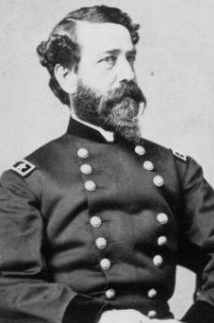
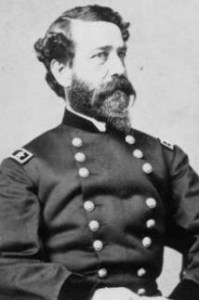
Brigadier-General John Milton Brannan, U.S. Army (public domain).

“It is hardly necessary to point out to you the extreme military importance of the two works now intrusted [sic, entrusted] to your command. Suffice it to state that they cannot pass out of our hands without the greatest possible disgrace to whoever may conduct their defense, and to the nation at large. In view of difficulties that may soon culminate in war with foreign powers, it is eminently necessary that these works should be immediately placed beyond any possibility of seizure by any naval or military force that may be thrown upon them from neighboring ports….

Seizure of these forts by coup de main may be the first act of hostilities instituted by foreign powers, and the comparative isolation of their position, and their distance from reinforcements, point them out (independent of their national importance) as peculiarly the object of such an effort to possess them.”

— Excerpt from orders issued by Brigadier-General John Milton Brannan, commanding officer, United States Army, Department of the South, to Colonel Tilghman H. Good, commanding officer of the 47th Pennsylvania Volunteer Infantry in December 1862
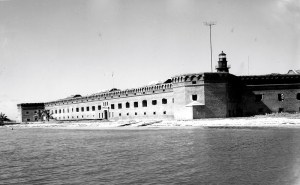
 

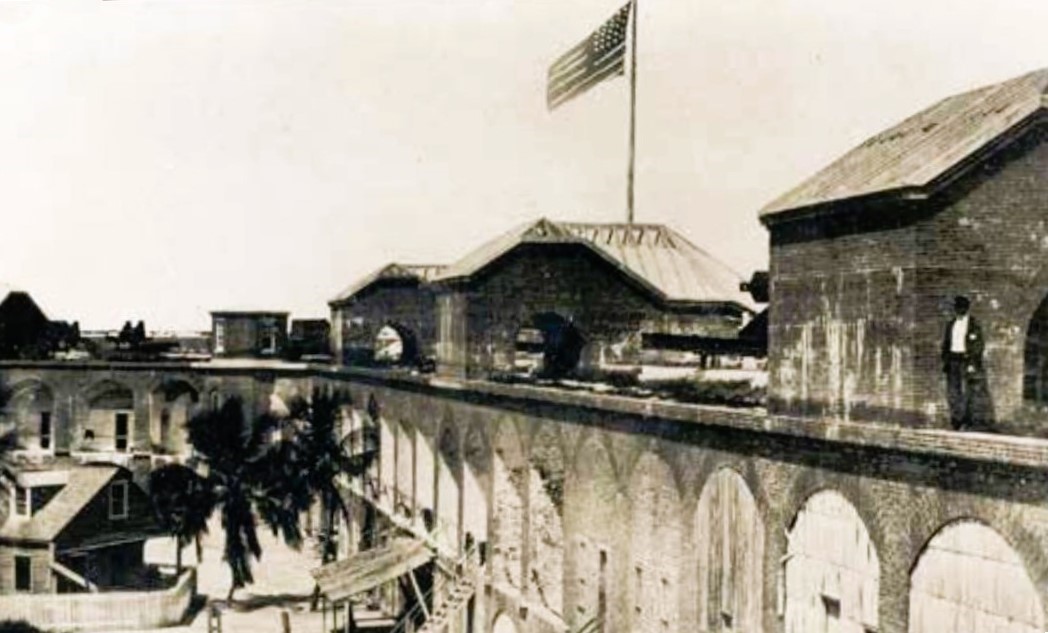
Fort Jefferson, Dry Tortugas, Florida, view from the sea, 1946 (vacation photograph collection of President Harry Truman, November 1946 U.S. National Archives and Records Administration, public domain).

Having been ordered by Union Brigadier-General John Milton Brannan to resume garrison duties in Florida in December 1862, after having been badly battered in the Battle of Pocotaligo, South Carolina two months earlier, the officers and enlisted members of the 47th Pennsylvania Volunteer Infantry were also informed in December that their regiment would become a divided one. This was being done, Brannan said, not as a punishment for their performance, which had been valiant, but to help the federal government to ensure that the foreign governments that had granted belligerent status to the Confederate States of America would not be able to aid the Confederate army and navy further in their efforts to move troops and supplies from Europe and the Deep South of the United States to the various theaters of the American Civil War.

As a result, roughly sixty percent of 47th Pennsylvanians (Companies A, B, C, E, G, and I) were sent back to Fort Taylor in Key West shortly before Christmas in 1862 while the remaining members of the regiment (from Companies D, F, H, and K) were transported by the USS Cosmopolitan to Fort Jefferson, the Union’s remote outpost in the Dry Tortugas, which was situated roughly seventy miles off the coast of Florida. They arrived there in late December of that same year.

Life at Fort Jefferson
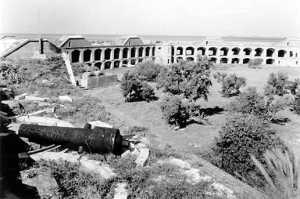
Union Army Columbiad on the Terreplein at Fort Jefferson, Dry Tortugas, Florida (George A. Grant, 1937, U.S. National Park Service, public domain).

Garrison duty in Florida proved to be serious business for the 47th Pennsylvania Volunteers. Per records of the United States Army’s Ordnance Department, the defense capabilities of Fort Jefferson in 1863 were impressive—thirty-three smoothbore cannon (twenty-four of which were twenty-four pounder howitzers that had been installed in the fort’s bastions to protect the installation’s flanks, and nine of which were forty-two pounders available for other defensive actions); six James rifles (forty-two pounder seacoast guns); and forty-three Columbiads (six ten-inch and thirty-seven eight-inch seacoast guns).

Fort Jefferson was so heavily armed because it was “key in controlling … shipping in the Gulf of Mexico and was being used as a supply depot for the distribution of rations and munitions to Federal troops in the Mississippi Delta; and as a supply and fueling station for naval vessels engaged in the blockade or transport of supplies and troops,” according to historian Lewis Schmidt.

Large quantities of stores, including such diverse items as flour … ham … coal, shot, shell, powder, 5000 crutches, hospital stores, and stone, bricks and lumber for the fort, were collected and stored at the Tortugas for distribution when needed. Federal prisoners, most of them court martialed Union soldiers, were incarcerated at the fort during the period of the war and used as laborers in improving the structure and grounds. As many as 1200 prisoners were kept at the fort during the war, and at least 500 to 600 were needed to maintain a 200 man working crew for the engineers.

With respect to housing and feeding the soldiers stationed here:

Cattle and swine were kept on one of the islands nearest the fort, called Hog Island (today’s Bush Key), and would be compelled to swim across the channel to the fort to be butchered, with a hawser fastened to their horns. The meat was butchered twice each week, and rations were frequently supplemented by drawing money for commissary stores not used, and using it to buy fish and other available food items from the local fishermen. The men of the 7th New Hampshire [who were also stationed at Fort Jefferson] acquired countless turtle and birds’ eggs … from adjacent keys, including ‘Sand Key’ [where the fort’s hospital was located]. Loggerhead turtles were also caught … [and] were kept in the ‘breakwater ditch outside of the walls of the fort’, and used to supplement the diet [according to one soldier from New Hampshire].

Second-tier casemates, lighthouse keeper’s house, sallyport, and lean-to structure, Fort Jefferson, Dry Tortugas, Florida, late 1860s (U.S. National Park Service and National Archives, public domain).

In addition, the fort’s “interior parade grounds, with numerous trees and shrubs in evidence, contained … officers’ quarters, [a] magazine, kitchens and out houses,” as well as a post office and “a ‘hot shot oven’ which was completed in 1863 and used to heat shot before firing,” according to Schmidt.

Most quarters for the garrison … were established in wooden sheds and tents inside the parade [grounds] or inside the walls of the fort in second-tier gun rooms of ‘East’ front no. 2, and adjacent bastions … with prisoners housed in isolated sections of the first and second tiers of the southeast, or no. 3 front, and bastions C and D, located in the general area of the sallyport. The bakery was located in the lower tier of the northwest bastion ‘F’, located near the central kitchen….

According to H Company Second Lieutenant Christian Breneman, the walk around Fort Jefferson’s barren perimeter was less than a mile long with a sweeping view of the Gulf of Mexico. Brennan also noted the presence of “six families living [nearby], with 12 or 15 respectable ladies.”

Balls and parties are held regularly at the officers’ quarters, which is a large three-story brick building with large rooms and folding doors.

Lieutenant-Colonel George Warren Alexander, second-in-command, 47th Pennsylvania Volunteer Infantry, standing next to his horse, with officers from the 47th, Fort Jefferson, Dry Tortugas, Florida, circa 1863 (public domain; click to enlarge).

Shortly after the arrival of the 47th Pennsylvania Volunteers at Fort Jefferson, First Lieutenant George W. Fuller was appointed as adjutant for Lieutenant-Colonel George Warren Alexander, who had been placed in command of the fort’s operations. Assistant Regimental Surgeon Jacob Scheetz, M.D. was appointed as post surgeon and given command of the fort’s hospital operations, responsibilities he would continue to execute for fourteen months. In addition, Private John Schweitzer of the 47th Pennsylvania’s A Company was directed to serve at the fort’s baker, B Company’s Private Alexander Blumer was assigned as clerk of the quartermaster’s department, and H Company’s Third Sergeant William C. Hutchinson began his new duties as provost sergeant while H Company Privates John D. Long and William Barry were given additional duties as a boatman and baker, respectively.

When Christmas Day dawned, many at the fort experienced feelings of sadness and ennui as they continued to mourn friends who had recently been killed at Pocotaligo and worried about others who were still fighting to recover from their battle wounds.

1863

Unidentified Union Army artillerymen standing beside one of the fifteen-inch Rodman guns installed on the third level of Fort Jefferson in the Dry Tortugas, Florida, circa 1862. Each smoothbore Rodman weighed twenty-five tons, and was able to fire four-hundred-and-fifty-pound shells more than three miles (U.S. National Park Service, public domain).

The New Year arrived at Fort Jefferson with a bang—literally—as the fort’s biggest guns thundered in salute, kicking off a day of celebration designed by senior military officials to lift the spirits of the men and inspire them to continued service. Donning their best uniforms, the 47th Pennsylvania Volunteers assembled on the parade grounds, where they marched in a dress parade and drilled to the delight of the civilians living on the island, including Emily Holder, who had been living in a small house within the fort’s walls since 1860 with her husband, who had been stationed there as a medical officer for the fort’s engineers. When describing that New Year’s Day and other events for an 1892 magazine article, she said:

On January 1st, 1863, the steamer Magnolia visited Fort Jefferson and we exchanged hospitalities. One of the officers who dined with us said it was the first time in nine months he had sat at a home table, having been all that time on the blockade….

Colonel Alexander, our new Commander, said that in Jacksonville, where they paid visits to the people, the young ladies would ask to be excused from not rising; they were ashamed to expose their uncovered feet, and their dresses were calico pieced from a variety of kinds.

Two days later, the 47th Pennsylvania Volunteers’ dress parade was a far less enjoyable one as temperatures and tempers soared. The next day, H Company Corporal George Washington Albert and several of his comrades were given the unpleasant task of carrying the regiment’s foul-smelling garbage to a flatboat and hauling it out to sea for dumping.

As the month of January progressed, it became abundantly clear to members of the regiment that the practice of chattel slavery was as ever present at and beyond the walls of Fort Jefferson as it had been at Fort Taylor and in South Carolina. It seemed that the changing of hearts and minds would take time even among northerners—despite President Lincoln’s best efforts, as illustrated by these telling observations made later that same month by Emily Holder:

We received a paper on the 10th of January, which was read in turns by the residents, containing rumors of the emancipation which was to take place on the first, but we had to wait another mail for the official announcement.

I asked a slave who was in my service if he thought he should like freedom. He replied, of course he should, and hoped it would prove true; but the disappointment would not be as great as though it was going to take away something they had already possessed. I thought him a philosopher.

In Key West, many of the slaves had already anticipated the proclamation, and as there was no authority to prevent it, many people were without servants. The colored people seemed to think ‘Uncle Sam’ was going to support them, taking the proclamation in its literal sense. They refused to work, and as they could not be allowed to starve, they were fed, though there were hundreds of people who were offering exorbitant prices for help of any kind—a strange state of affairs, yet in their ignorance one could not wholly blame them. Colonel Tinelle [sic, Colonel L. W. Tinelli] would not allow them to leave Fort Jefferson, and many were still at work on the fort.

John, a most faithful boy, had not heard the news when he came up to the house one evening, so I told him, then asked if he should leave us immediately if he had his freedom.

His face shone, and his eyes sparkled as he asked me to tell him all about it. He did not know what he would do. The next morning Henry, another of our good boys, who had always wished to be my cook, but had to work on the fort, came to see me, waiting until I broached the subject, for I knew what he came for. He hoped the report would not prove a delusion. He and John had laid by money, working after hours, and if it was true, they would like to go to one of the English islands and be ‘real free.’

I asked him how the boys took the news as it had been kept from them until now, or if they had heard a rumor whether they thought it one of the soldier’s stories.

‘Mighty excited, Missis,’ he replied….

Henry had been raised in Washington by a Scotch lady, who promised him his freedom when he became of age; but she died before that time arrived, and Henry had been sold with the other household goods.

The 47th Pennsylvanians continued to undergo inspections, drill and march for the remainder of January as regimental and company assignments were fine-tuned by their officers to improve efficiency. Among the changes made was the reassignment of Private Blumer to service as clerk of the fort’s ordnance department.

Three key officers of the regiment, however, remained absent. D Company’s Second Lieutenant George Stroop was still assigned to detached duties with the U.S. Army’s Signal Corps aboard the Union Navy’s war sloop, Canandaigua, and H Company’s First Lieutenant William Wallace Geety was back home in Pennsylvania, still trying to recruit new members for the regiment while recovering from the grievous injuries he had sustained at Pocotaligo, while Company K’s Captain Charles W. Abbott was undergoing treatment for disease-related complications at Fort Taylor’s post hospital.

Disease, in fact, would continue to be one of the Union Army’s most fearsome foes during this phase of duty, felling thirty-five members of its troops stationed at Fort Jefferson during the months of January and February alone. Those seriously ill enough to be hospitalized included twenty men battling dysentery and/or chronic diarrhea, four men suffering from either intermittent or bilious remittent fever, and two who were recovering from the measles with others diagnosed with rheumatism and general debility.

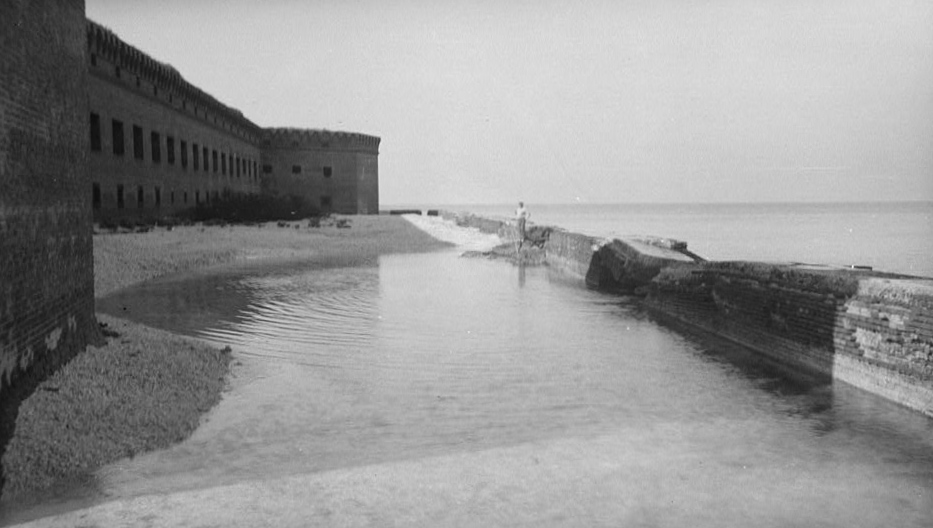
Fort Jefferson’s moat and wall, circa 1934, Dry Tortugas, Florida (C. E. Peterson, U.S. Library of Congress; public domain).

The primary reason for this shocking number of sick soldiers was the problematic water quality. According to Schmidt:

‘Fresh’ water was provided by channeling the rains from the fort’s barbette through channels in the interior walls, to filter trays filled with sand; and finally to the 114 cisterns located under the fort which held 1,231,200 gallons of water. The cisterns were accessible in each of the first level cells or rooms through a ‘trap hole’ in the floor covered by a temporary wooden cover…. Considerable dirt must have found its way into these access points and was responsible for some of the problems resulting in the water’s impurity…. The fort began to settle and the asphalt covering on the outer walls began to deteriorate and allow the sea water (polluted by debris in the moat) to penetrate the system…. Two steam condensers were available … and distilled 7000 gallons of tepid water per day for a separate system of reservoirs located in the northern section of the parade ground near the officers [sic, officers’] quarters. No provisions were made to use any of this water for personal hygiene of the [planned 1,500-soldier garrison force]….

Consequently, soldiers were forced to wash themselves and their clothes using saltwater hauled from the ocean. As if that were not difficult enough, “toilet facilities were located outside of the fort.” According to Schmidt:

At least one location was near the wharf and sallyport, and another was reached through a door-sized hole in a gunport, and a walk across the moat on planks at the northwest wall…. These toilets were flushed twice each day by the actions of the tides, a procedure that did not work very well and contributed to the spread of disease. It was intended that the tidal flush should move the wastes into the moat, and from there, by similar tidal action, into the sea. But since the moat surrounding the fort was used clandestinely by the troops to dispose of litter and other wastes … it was a continuous problem for Lt. Col. Alexander and his surgeon.

When it came to the care of soldiers with more serious infectious diseases such as smallpox, soldiers and prisoners were confined to isolation roughly three miles away on Bird Key to prevent contagion. The small island also served as a burial ground for Union soldiers stationed at the fort.

* Note: During this same period, First Lieutenant Lawrence Bonstine was assigned to special duty as Post Adjutant at Fort Taylor in Key West, a position he continued to hold from at least January 10, 1863 through the end of December 1863. Reporting directly to the regiment’s founder and commanding officer, Colonel Tilghman H. Good, he was essentially Good’s right hand, ensuring that regimental records and reports to more senior military officials were kept up to date while performing other higher level administrative and leadership tasks.

On February 3, 1863, Colonel Tilghman Good, visited Fort Jefferson, in his capacity as regimental commanding officer and accompanied by the newly re-formed Regimental Band (band no. 2). Led by Regimental Bandmaster Anton Bush, the ensemble was on hand to perform the music for that evening’s officers’ ball.

Sometime during this phase of duty, Corporal George W. Albert was reassigned to duties as camp cook for Company H, giving him the opportunity to oversee at least one of the formerly enslaved Black men who had enlisted with the 47th Pennsylvania Volunteer Infantry while the regiment was stationed in Beaufort, South Carolina. Subsequently assigned to duties as an Under-Cook,” that Black soldier who fell under his authority was most likely Thomas Haywood, who had been entered onto the H Company roster after enrolling with the 47th Pennsylvania on November 1, 1862.

* Note: This was likely not a pleasant time for Thomas Haywood. One of the duties of his direct superior, Corporal George Albert, was to butcher a shipment of cattle that had just been received by the fort. Both men took on that task on Saturday, February 24—a day that Corporal Albert later described as hot, sultry and plagued by mosquitoes.

Based on Albert’s known history of overt racism, their interpersonal interactions were likely made worse that day by his liberal use of racial epithets, which were a frequent component of the diary entries he had penned during this time—hate speech that has all too often been wrongly attributed to the regiment’s entire membership by some mainstream historians and Civil War enthusiasts without providing actual evidence to back up those claims. There were a considerable number of officers and enlisted members of the 47th Pennsylvania who strongly supported the efforts of President Lincoln and senior federal government military leaders to eradicate the practice of chattel slavery nationwide with at least several members of the regiment known to be members of prominent abolitionist families in Pennsylvania.

Officers’ quarters and parade grounds, interior of Fort Jefferson, Dry Tortugas, Florida, 1898 (U.S. National Park Service and National Archives and Records Administration, public domain).

During this same period, Private Edward Frederick of the 47th Pennsylvania’s K Company was readmitted to the regimental hospital for further treatment of the head wound he had sustained at Pocotaligo. As his condition worsened, his health failed, and he died there late in the evening on February 15 from complications related to an abscess that had developed in his brain. He was subsequently laid to rest on the parade grounds at Fort Jefferson.

In a follow-up report, Post Surgeon Jacob H. Scheetz, M.D., the 47th Pennsylvania’s assistant regimental surgeon, provided these details of the battle wound and treatment that Frederick had endured:

Private Edward Frederick, Co. K, 47th Pennsylvania Vols, was struck by a musket ball at the battle of Pocotaligo, South Carolina, October 22, 1862. The ball lodged in the frontal bone and was removed. The wound did well for three weeks when he had a slight attack of erysipelas, which, however, soon subsided under treatment. The wound commenced suppurating freely and small spiculae of bone came away, or were removed, on several occasions. Cephalgia was a constant subject of complaint, which was described as a dull aching sensation. The wound had entirely closed on January 1, 1863, and little complaint made except the pain in the head when he exposed himself to the sun. About the 4th of February he was ordered into the hospital with the following symptoms: headache, pain in back and limbs, anorexia, tongue coated with a heavy white coating, bowels torpid. He had alternate flashes of heat; his pupils slightly dilated; his pulse 75, and of moderate volume. He was blistered on the nape of the neck, and had a cathartic given him, which produced a small passage. Growing prostrate, he was put upon the use of tonics, and opiates at night to promote sleep; without any advantage, however. His mind was clear til [sic] thirty-six hours before death, when his pupils were very much dilated, and he gradually sank into a comatose state until 12 M. [midnight] on the night of the 15th of February when he expired.

Another twelve hours after death: Upon removing the calvarium the membranes of the brain presented no abnormal appearance, except slight congestion immediately beneath the part struck. A slight osseus deposition had taken place in the same vicinity. Upon cutting into the left cerebrum, (anterior lobe) it was found normal, but an incision into the left anterior lobe was followed by a copious discharge of dark colored and very offensive pus, and was lined by a yellowish white membrane which was readily broken up by the fingers. I would also have stated that his inferior extremities were, during the last four days, partially paralyzed.
Lieutenant-Colonel George Warren Alexander, 47th Pennsylvania Volunteers, circa 1861 (public domain).

As Private Frederick’s body was being autopsied, the unceasing routine of fort life continued as members of the regiment went about performing their duties and the USS Cosmopolitan arrived with a new group of prisoners. On February 25, 1863, Lieutenant-Colonel Alexander issued Special Order No. 17:

I. Company commanders are hereby ordered to instruct the chief of detachment in their respective companies to see that all embrasures in the lower tier, both at and between their batteries, are properly closed and bolted immediately after retreat.

II. As the safety of the garrison depends on the carrying out of the above order, they will hold chiefs of detachments accountable for all delinquencies.

In addition, orders were given to company cooks to relocate their operations to bastion C of the fort, which was a much cooler place for them to do their duties—a change that was likely appreciated as much or more by the under-cooks as the higher-ranking cooks who oversaw their grueling work.

This was the first of several initiatives undertaken by Lieutenant-Colonel Alexander who, according to Schmidt, “was having some difficulty in exercising proper control over Fort Jefferson as it related to the Engineering Department and persons in their employ.”

It was his duty to train the garrison, guard the prisoners, and provide the necessary protection for the fort and its environs, a situation fraught with many problems not always understood by other military and non-military personnel on station there. It was during this period that relationships between the various interests began to deteriorate, as overseer George Phillips, temporarily filling in for Engineer Frost, refused the request of Lt. Col. Alexander to have as many engineer workmen removed from the casemates as could be comfortably accommodated inside the barracks outside the walls of the fort. Phillips lost the argument and the quarters were vacated, but the tone of the several letters exchanged between the two commands left much to be desired. Differences were aired concerning occupations of the prisoners and their possible use by the engineers; the amount of water used by the workmen as Alexander limited them to one gallon per day per man; Engineer Frost arriving and reclaiming for his department the central Kitchen, and another kitchen near it that had been used by Capt. Woodruff and others; stagnant water in the ditches which involved the post surgeon [Jacob H. Scheetz, M.D.] in the controversy; uncovering of the ‘cistern trap holes’ located in the floors of the first or lower tier, which allowed the water supplies to become contaminated; who exercised jurisdiction over the schooner Tortugas of the Engineering Department; depredations of wood belonging to the engineers; and many other conflicts….

Around this same time, Corporal George Nichols, who had piloted the Confederate steamer, the Governor Milton, behind Union lines after it had been captured by members of the 47th’s Companies E and K in October, was assigned once again to engineering duties—this time at Fort Jefferson—but he was not happy about it, according to a letter he wrote to family and friends:

So I am detailed on Special duty again as Engineer. I cannot See in this I did not Enlist as an Engineer. But I get Extra Pay for it but I do not like it. So I must get the condencer redy [sic, condenser ready] to condece [sic, condense] fresh water. Get her redy [ready] and no tools to do it with.

Corporal Nichols’ reassignment was made possible when the contingent of 47th Pennsylvanians at Fort Jefferson was strengthened with the transfer there of members of Companies E and G from Fort Taylor on February 28. That same day, the men of F Company received additional training with both light and heavy artillery at the fort while the men from K Company gained more direct experience with the installation’s seacoast guns. In addition, members of the regiment finally received the six months of back pay they were owed.

Rev. William DeWitt Clinton Rodrock, chaplain, 47th Pennsylvania Volunteers, Fort Jefferson, Dry Tortugas, Florida, 1863 (courtesy of Robert Champlin, used with permission).

It was also during this latest phase of duty that Regimental Chaplain William DeWitt Clinton Rodrock was transferred from Fort Taylor to Fort Jefferson—possibly to render spiritual comfort after what had been a brutal month in terms of hospitalizations. Among the seventy members of the 47th Pennsylvania who had been admitted to the post’s hospital in the Dry Tortugas were fifty-four men with dysentery and/or diarrhea, four men with remittent or bilious remittent fevers, three men suffering from catarrh, one man who had contracted typhoid fever, one man who had contracted tuberculosis and was suffering from the resulting wasting away syndrome known as phthisis, and three men suffering from diseases of the eye (two with nyctalopia, also known as night blindness, and one with cataracts).

One of the additional challenges faced by the men stationed in the Dry Tortugas (albeit a less serious one) was that there was no camp sutler available to them at Fort Jefferson, as there was for the 47th Pennsylvanians who were stationed at Fort Taylor. So, it was more difficult, if not impossible, to obtain their favorite foods, replacements for worn-out clothing, tobacco, and other items not furnished by the quartermasters of the Union Army—making their lives more miserable with each passing day as they depleted the care packages that had been sent to them by their families during the holidays.

Stationed farther from home than they had ever been, they could see no end in sight for the devastating war that had torn their nation apart.


Sources:

  1. Bates, Samuel P. History of Pennsylvania Volunteers, 1861-5, vol. 1. Harrisburg, Pennsylvania: B. Singerly, State Printer, 1869.
  2. Florida’s Role in the Civil War: ‘Supplier of the Confederacy.’ Tampa, Florida: Florida Center for Instructional Technology, College of Education, University of South Florida, retrieved online January 15, 2020.
  3. Holder, Emily. At the Dry Tortugas During the War.” San Francisco, California: Californian Illustrated Magazine, 1892 (part four, retrieved online, March 28, 2024, courtesy of Lit2Go, the website of the Educational Technology Clearinghouse at the Florida Center for Instructional Technology, College of Education, University of South Florida).
  4. History: Crops (Historic Florida Barge Canal Trail).” Historical Marker Database, retrieved online December 30, 2023.
  5. Malcom, Corey. Emancipation at Key West,” in “The 20th of May: The History and Heritage of Florida’s Emancipation Day Digital History Project.” St. Petersburg, Florida: Florida Humanities, retrieved online March 28, 2024.
  6. Owsley, Frank Lawrence, and Harriet Fason Chappell. King Cotton Diplomacy: Foreign Relations of the Confederate States of America. Chicago, Illinois: University of Chicago Press, 1959.
  7. Preventing Diplomatic Recognition of the Confederacy, 1861–1865,” and The Alabama Claims, 1862–1872,” in “Milestones: 1861–1865.” Washington, D.C.: Office of the Historian, Foreign Service Institute, United States Department of State, retrieved online December 30, 2023.
  8. Schmidt, Lewis G. A Civil War History of the 47th Regiment of Pennsylvania Veteran Volunteers. Allentown, Pennsylvania: Self-published, 1986.
  9. Staubach, Lieutenant Colonel James C. Miami During the Civil War: 1861-65, in Tequesta: The Journal of the Historical Association of Southern Florida, vol. LIII, pp. 31-62. Miami, Florida: Historical Museum of Southern Florida, 1993.
  10. Wharton, Henry D. Letters from the Sunbury Guards. Sunbury, Pennsylvania: Sunbury American, 1861-1868.
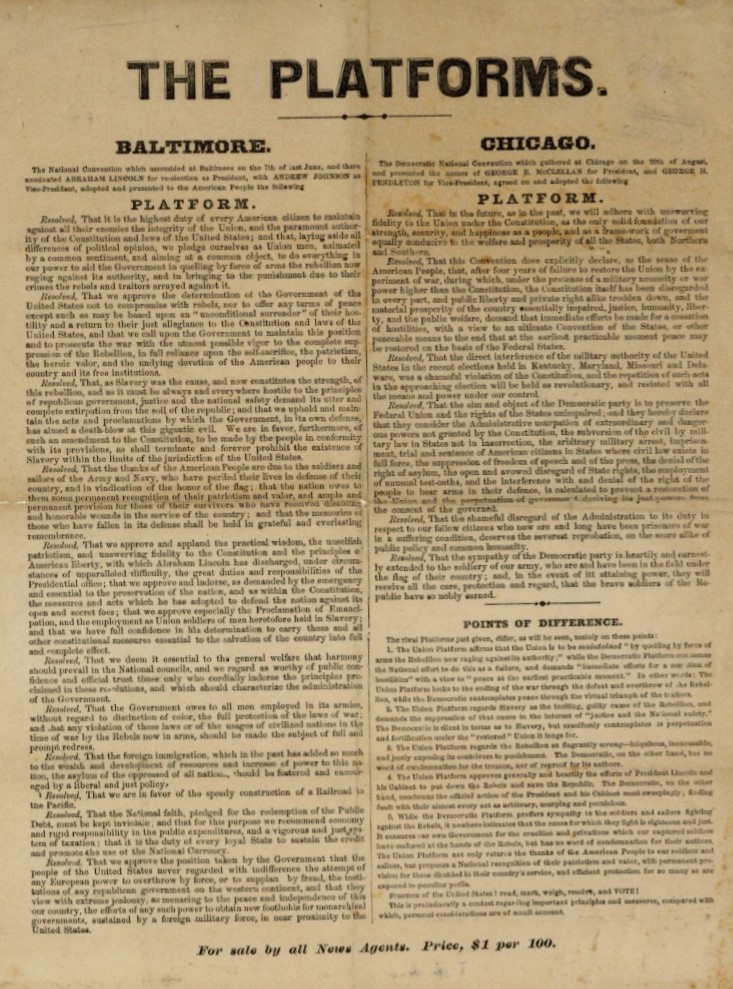
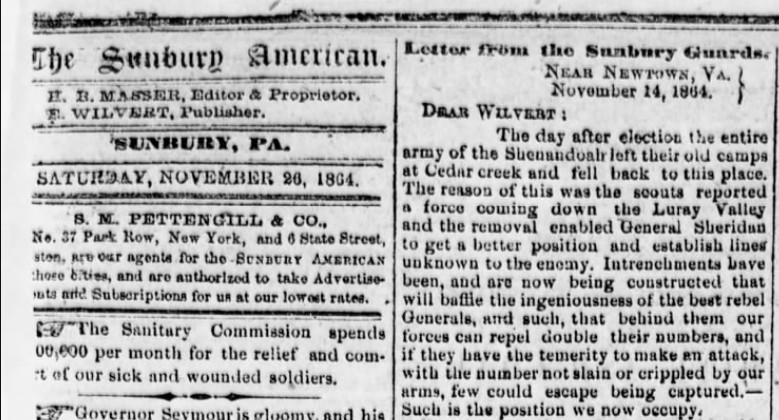
 

Black History Month: The Authorization, Duties and Pay of “Under-Cooks”

One of several U.S. Civil War Pension documents that confirmed the Union Army enrollment of Hamilton Blanchard and Aaron Bullard, known later as Aaron French, as Cooks (a higher rank than under-cook) with Company D of the 47th Pennsylvania Volunteer Infantry (U.S. Civil War Pension Files, U.S. National Archives and Records Administration, public domain).

Following executive orders promulgated by President Abraham Lincoln in 1862 and legislation enacted that same year by the United States Congress to facilitate the enrollment by free and enslaved Black men with Union Army regiments, the 47th Pennsylvania Volunteer Infantry began processing the enlistments of four of the nine formerly enslaved men who would ultimately be entered onto the rosters of this history-making regiment.

Enrolled as “Negro Under-Cooks” while the regiment was stationed in Beaufort, South Carolina as part of the U.S. Department of the South and Tenth Army (X Corps), Bristor Gethers, Thomas Haywood, Abraham Jassum, and Edward Jassum ranged in age from sixteen to thirty-three.

Roughly two years later, officers from the 47th Pennsylvania Volunteers then processed the enlistment paperwork for an additional five formerly enslaved men in Natchitoches, Louisiana in April 1864 while the 47th Pennsylvania was stationed there (as the only regiment from Pennsylvania to participate in the Union’s Red River Campaign across Louisiana). Hamilton Blanchard, Aaron French (who was known at that time as Aaron Bullard), James Bullard, John Bullard, and Samuel Jones ranged in age from sixteen to twenty-nine.

All but one of the nine would go on to complete their three-year terms of enlistment and be honorably mustered out in October 1865.

What Were Their Job Duties?

General Orders No. 323 (enlistment and pay of under-cooks of African descent), U.S. War Department and Office of the Adjutant General, September 28, 1863 (U.S. Library of Congress, public domain).

The duties and other pertinent details about the military tasks performed by Cooks and Under-Cooks of the Union Army were explained as follows by August Kautz in his 1864 manual, Customs of Service for Non-Commissioned Officers and Soldiers as Derived from Law and Regulations and Practised in the Army of the United States:

“108. DAILY DUTY.—A soldier is on daily duty when he is put upon some continuous duty that excuses him from the ordinary company duty but does not entitle him to additional pay from the government,—such as company cooks, tailors, clerks, standing orderlies, &c. These duties may be performed by soldiers selected on account of special capacity or merit, or detailed in turn, as is most convenient and conducive to the interest of the service.

109. The company cooks are one or more men in each company detailed to do the cooking for the entire company. This is the case usually in companies where it is not the custom to distribute the provisions to the men; for in this case the messes furnish their own cooks, and they are not excused from any duty except what is absolutely necessary and which their messmates can do for them.

110. The law authorizes the detailing of one cook to thirty men, or less; two cooks if there are more than thirty men in the company. It also allows to each cook two assistant cooks (colored), who are enlisted for the purpose, and are allowed ten dollars per month. (See Par. 269.)

111. The cooks are under the direction of the first sergeant or commissary-sergeant, who superintends the issue of provisions and directs the cooking for each day. Company cooks for the whole company are generally detailed in turn, and for periods of a week or ten days….

269. Cooks. — The law now allows the enlistment of four African under-cooks for each company of more than thirty men; if less, two are allowed. They receive ten dollars per month, three of which may be drawn in clothing, and one ration. (See Act March 3, 1863, section 10.) They are enlisted the same as other enlisted men, and their accounts are kept in the same way: they are entered on the company muster-rolls, at the foot of the list of privates. (G. 0. No. 323, 1863.)

270. These cooks are to be under the direction, of a head-cook, detailed from the soldiers alternately every ten days, when the company is of less than thirty men; when the company is of more than thirty men, two head-cooks are allowed. These are quite sufficient to cook the rations for a company; and, by system and method, the comfort and subsistence of a company may be greatly improved. The frequent changing of cooks under the old system worked badly for the comfort of the soldier and they were often treated to unwholesome food, in consequence of the inexperience of some of the men.

271. The object of changing the head-cooks every ten days, as required by section 9, Act March 3, 1863, is to teach all the men how to cook; but it will follow that the under-cooks, who are permanently on that duty will know more about it than the head-cooks. They will simply be held responsible that the cooking is properly performed.”

From Under-Cook to Private

Samuel Jones was an enslaved Black man who enlisted as an Under-Cook with Company C of the 47th Pennsylvania Volunteer Infantry in Natchitoches, Louisiana on April 5, 1864. Official regimental muster rolls confirmed that he was a private at the time of his honorable discharge in 1865 (Registers of Pennsylvania Volunteers, 1861-1865: 47th Regiment, in “Records of the Department of Military and Veterans’ Affairs,” Pennsylvania State Archives, public domain; click to enlarge).

As the officers and enlisted members of the 47th Pennsylvania Volunteer Infantry interacted more frequently with the nine formerly enslaved men who had enlisted with their regiment, their trust in, and respect for, those nine men grew. Over time, several of the nine men were assigned to increasingly responsible duties, which ultimately led to their respective promotions to the ranks of cook and private—ranks that were documented on official muster rolls of the 47th Pennsylvania Volunteers.

About “Faces of the 47th: Freedmen of the 47th Pennsylvania Volunteer Infantry”

“Faces of the 47th: Freedmen of the 47th Pennsylvania Volunteer Infantry” is a special project of 47th Pennsylvania Volunteers: One Civil War Regiment’s Story, an educational program designed to teach children and adults about the history of the 47th Pennsylvania Veteran Volunteers, a Union Army regiment which served for nearly the entire duration of the American Civil War and became the only military unit from the Commonwealth of Pennsylvania to participate in the Union’s 1864 Red River Campaign across Louisiana.

This important initiative is dedicated to researching, documenting and presenting the life stories of nine formerly enslaved Black men who enlisted with the 47th Pennsylvania Volunteer Infantry during two of the regiment’s most eventful years of service to the nation—1862 and 1864.

Largely forgotten for more than a century after honorably completing their historic military service, these nine men have been repeatedly overlooked by mainstream historians over the years as potentially important subjects for research and have also been an ongoing source of mystery and frustration to their descendants because the majority of their military service records have still not been digitized by state and national archives.

The purpose of this initiative is to remedy those failures and create a lasting tribute to these nine remarkable men.

Learn more about their lives before, during and after the war by visiting Freedmen of the 47th Pennsylvania Volunteer Infantry.”


Sources:

  1. “Bounties to Volunteers.” Washington, D.C.: National Republican, January 5, 1864.
  2. “Comfort of the Soldier.” Washington, D.C.: Daily National Republican, February 23, 1863.
  3. “Garris, Presto” [sic, “Gethers, Bristor”], and “Jones, Samuel,” in “Registers of Pennsylvania Volunteers, 1861-1865” (47th Regiment, Companies F and C), in “Records of the Department of Military and Veterans’ Affairs” (RG-19). Harrisburg, Pennsylvania: Pennsylvania State Archives.
  4. “General Orders No. 323” (enlistment and pay of “under-cooks of African descent”). Washington, D.C.: U.S. War Department and Adjutant General’s Office, September 28, 1863.
  5. “Important Diplomatic Circular by Secretary Seward: Review of Recent Military Events.” Washington, D.C.: The Evening Star, September 15, 1863.
  6. Kautz, August V. Customs of Service for Non-Commissioned Officers and Soldiers as Derived from Law and Regulations and Practised in the Army of the United States, pp. 41-42 (definitions and responsibilities of cooks and under-cooks), 68-69 (special enlistments: African Under-Cook), 84-88 (cooking responsibilities of hospital stewards), 90-9 (special enlistments: African Under-Cook, definition, enlistment and record-keeping for, and pay), and 93 (cooks and attendants in hospitals) . Philadelphia, Pennsylvania: J. B. Lippincott & Co., 1864.
  7. “Military Notices” (Fourteenth United States Infantry). Philadelphia, Pennsylvania: The Philadelphia Inquirer, January 14, 1864.
  8. “Official: Laws of the United States, Passed at the Third Session of the Thirty-seventh Congress.” Washington, D.C.: Daily National Republican, March 27, 1863.
  9. “Under Cooks of African Descent.” Washington, D.C.: National Republican, May 8, 1865.