Camp Griffin (also known as “Camp Big Chestnut”), Langley, Virginia

The Big Chestnut Tree, Camp Griffin, Langley, Virginia, 1861 (U.S. Library of Congress, public domain).

Located near Langley, Virginia, Camp Griffin was a key muster-in point for multiple Union Army units during the early years of the American Civil War. Originally named “Camp Big Chestnut” in recognition of the large chestnut tree that was one of the earliest defining features of the campground, it quickly became a major training base and staging area for multiple state volunteer infantry and artillery units that fought under the banner of the United States government.

During the fall of 1861, it was renamed as “Camp Griffin” to honor Captain Charles Griffin, who had distinguished himself in combat as the commanding officer of the United States Artillery’s 5th Regiment, Battery D (the “West Point Battery”) during the First Battle of Bull Run in July 1861. Griffin was then also later promoted to Brigadier-General of Volunteers on June 12, 1862.

The 47th Pennsylvania Volunteers at Camp Griffin

The Sibley tents of an unidentified Union Army regiment, Camp Griffin, Virginia, fall 1861 (U.S. Library of Congress, public domain; click to enlarge).

“Camp Big Chestnut” (later known as Camp Griffin) was the first “real home” of the 47th Pennsylvania Volunteer Infantry after its extended muster-in and basic training period at Camp Curtin in Harrisburg, Pennsylvania from August through mid-September 1861. Initially transported by rail to the Washington, D.C. area and stationed on the Kalorama Heights in the District of Columbia, the 47th Pennsylvania Volunteers were ordered to set up and tear down their camps multiple times during their earliest weeks on the job, moving from Camp Kalorama to Camp Lyon, Maryland on the Potomac River’s eastern shore during an intense, two-hour rainstorm, and then across the “Chain Bridge” into Virginia, where they briefly encamped before marching for Camp Advance near Falls Church the next day. During their brief stay there, they were situated close to Fort Ethan Allen and the headquarters of Brigadier-General William Farrar Smith (also known as “Baldy”).

Shortly after that, they were ordered to move yet again—this time, to “Camp Big Chestnut” near Langley, Virginia. They couldn’t have known it at the time, but it was here where they would spend the bulk of their assigned duties from the fall of 1861 through early January 1862.

It was from this point that they were sent out to perform picket duties and skirmish with Confederate troops that were stationed nearby, and it was here and near this camp that they continued to drill daily and participate in Grand Reviews with multiple other Union Army units to demonstrate their readiness for battle to the most senior of Union Army leaders like General George B. McClellan, commanding officer of the U.S. Army of the Potomac—and even to their commander-in-chief, President Abraham Lincoln.

It was also here that they also served as part of that Army of the Potomac (“Mr. Lincoln’s Army”), ensuring that no troops from the Confederate States Army were ever able to breach the Union’s defensive lines and enter Washington, D.C. Quite simply put, the 47th Pennsylvania Volunteer Infantry’s job was to defend the nation’s capital—a task which its members performed well and faithfully. No Rebel ever carried a Confederate flag into the U.S. Capitol Building or White House during its time on the job.

On October 11, the 47th Pennsylvania marched in a review of massed troops that was held near the camp. In his letter of  October 13 to the Sunbury American newspaper, Henry Wharton described their duties, as well as their new home:

The location of our camp is fine and the scenery would be splendid if the view was not obstructed by heavy thickets of pine and innumerable chesnut [sic] trees. The country around us is excellent for the Rebel scouts to display their bravery; that is, to lurk in the dense woods and pick off one of our unsuspecting pickets. Last night, however, they (the Rebels) calculated wide of their mark; some of the New York 33d boys were out on picket; some fourteen or fifteen shots were exchanged, when our side succeeded in bringing to the dust, (or rather mud,) an officer and two privates of the enemy’s mounted pickets. The officer was shot by a Lieutenant in Company H [?], of the 33d.

Our own boys have seen hard service since we have been on the ‘sacred soil.’ One day and night on picket, next day working on entrenchments at the Fort, (Ethan Allen.) another on guard, next on march and so on continually, but the hardest was on picket from last Thursday morning ‘till Saturday morning – all the time four miles from camp, and both of the nights the rain poured in torrents, so much so that their clothes were completely saturated with the rain. They stood it nobly – not one complaining; but from the size of their haversacks on their return, it is no wonder that they were satisfied and are so eager to go again tomorrow. I heard one of them say ‘there was such nice cabbage, sweet and Irish potatoes, turnips, &c., out where their duty called them, and then there was a likelihood of a Rebel sheep or young porker advancing over our lines and then he could take them as ‘contraband’ and have them for his own use.’ When they were out they saw about a dozen of the Rebel cavalry and would have had a bout with them, had it not been for…unlucky circumstance – one of the men caught the hammer of his rifle in the strap of his knapsack and caused his gun to fire; the Rebels heard the report and scampered in quick time….

In his own mid-October letter home, Captain John Peter Shindel Gobin, the commanding officer of C Company, reported that the right wing of the 47th Pennsylvania (companies A, C, D, F and I) was ordered to picket duty after the left-wing’s companies (B, G, K, E, and H) were forced to return to camp by Confederate troops:

I was ordered to take my company to Stewart’s house, drive the Rebels from it, and hold it at all hazards. It was about 3 o’clock in the morning, so waiting until it was just getting day, I marched 80 men up; but the Rebels had left after driving Capt. Kacy’s company [H] into the woods. I took possession of it, and stationed my men, and there we were for 24 hours with our hands on our rifles, and without closing an eye. I took ten men, and went out scouting within half a mile of the Rebels, but could not get a prisoner, and we did not dare fire on them first. Do not think I was rash, I merely obeyed orders, and had ten men with me who could whip a hundred; Brosius [sic, Brosious], Piers [sic, Pyers], Harp and McEwen were among the number. Every man in the company wanted to go. The Rebels did not attack us, and if they had they would have met with a warm reception, as I had my men posted in such a manner that I could have whipped a regiment. My men were all ready and anxious for a “fight.”

On Friday, October 22, the 47th engaged in a Divisional Review, described by historian Lewis Schmidt as “about 10,000 infantry, 1000 cavalry, and twenty pieces of artillery all in one big open field.” Four days later, Company B’s drummer boy, Alfred Eisenbraun, was dead—the second “man” from the regiment to die since the 47th Pennsylvania’s formation. (The first was another drummer boy, John Boulton Young of C Company, who was felled by smallpox at the Kalorama eruptive fever hospital in Georgetown on October 17.)

Of all of the dangerous foes the 47th Pennsylvania Volunteers would encounter during their stay at Camp Griffin, it seemed that disease would prove to be the most persistent—and deadliest. In subsequent letters home, Captain Gobin asked Sunbury residents to donate blankets for the Sunbury Guards (the men of Company C):

The government has supplied them with one blanket apiece, which, as the cold weather approaches, is not sufficient…. Some of my men have none, two of them, Theodore Kiehl and Robert McNeal, having given theirs to our lamented drummer boy when he was taken sick… Each can give at least one blanket, (no matter what color, although we would prefer dark,) and never miss it, while it would add to the comfort of the soldiers tenfold. Very frequently while on picket duty their overcoats and blankets are both saturated by the rain. They must then wait until they can dry them by the fire before they can take their rest.

In late October 1861, the men from Companies B, G and H woke at 3 a.m., according to Schmidt, assembled a day’s worth of rations, marched four miles from camp, and took over picket duties from the 49th New York:

Company B was stationed in the vicinity of a Mrs. Jackson’s house, with Capt. Kacy’s Company H on guard around the house. The men of Company B had erected a hut made of fence rails gathered around an oak tree, in front of which was the house and property, including a persimmon tree whose fruit supplied them with a snack. Behind the house was the woods were the Rebels had been fired on last Wednesday morning while they were chopping wood there.

Less than a month later, in his letter of 17 November, Henry Wharton revealed more details about life at Camp Griffin:

This morning our brigade was out for inspection; arms, accoutrements [sic], clothing, knapsacks, etc, all were out through a thorough examination, and if I must say it myself, our company stood best, A No. 1, for cleanliness. We have a new commander to our Brigade, Brigadier General Brannen [sic, Brannan], of the U.S. Army, and if looks are any criterion, I think he is a strict disciplinarian and one who will be as able to get his men out of danger as he is willing to lead them to battle….

The boys have plenty of work to do, such as piquet [sic] duty, standing guard, wood-chopping, police duty and day drill; but then they have the most substantial food; our rations consist of fresh beef (three times a week) pickled pork, pickled beef, smoked pork, fresh bread, daily, which is baked by our own bakers, the Quartermaster having procured portable ovens for that purpose, potatoes, split peas, beans, occasionally molasses and plenty of good coffee, so you see Uncle Sam supplies us plentifully….

A few nights ago our Company was out on piquet [sic, picket]; it was a terrible night, raining very hard the whole night, and what made it worse, the boys had to stand well to their work and dare not leave to look for shelter. Some of them consider they are well paid for their exposure, as they captured two ancient muskets belonging to Secessia. One of them is of English manufacture, and the other has the Virginia militia mark on it. They are both in a dilapidated condition, but the boys hold them in high estimation as they are trophies from the enemy, and besides they were taken from the house of Mrs. Stewart, sister to the rebel Jackson who assassinated the lamented Ellsworth at Alexandria. The honorable lady, Mrs. Stewart, is now a prisoner at Washington and her house is the headquarters of the command of the piquets [sic]….

Since the success of the secret expedition, we have all kinds of rumors in camp. One is that our Brigade will be sent to the relief of Gen. Sherman, in South Carolina. The boys all desire it and the news in the ‘Press’ is correct, that a large force is to be sent there, I think their wish will be gratified….
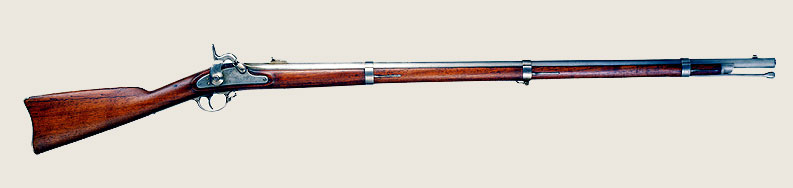
Springfield rifle, 1861 model (public domain).

On 20 November, the 47th Pennsylvania Volunteers marched in The Grand Review of the Army of the Potomac at Bailey’s Crossroads, Virginia. According to National Portrait Gallery historian James Barber:

For three hours some 70,000 polished troops marched passed the reviewing stand, where the president, members of his cabinet, and Washington dignitaries were in attendance. It was the largest military assemblage up to that time in North America. ‘The Grand Review went off splendidly,’ wrote McClellan that night in a letter to his wife, ‘not a mistake was made, not a hitch. I never saw so large a Review in Europe so well done—I was completely satisfied & delighted beyond expression.’

Among the 20,000 spectators to witness the Grand Review was the poet and social activist Julia Ward Howe of Boston, Massachusetts, who was visiting the Washington area with her husband, Dr. Samuel Gridley Howe.

After leaving the review, during the carriage ride back to Washington, she heard troops singing the song John Brown’s Body.’ A companion suggested that she should write new lyrics to the song, the melody of which lingered in her mind that night in her room at Willard’s Hotel in Washington. She awoke ‘in the gray of the morning twilight’ with the song still in her head and ‘the long lines of the desired poem began to twine themselves in my mind.’ She arose quickly and in the dimness of the early hour she began scribbling the verses on stationery ‘almost without looking at the paper.’

Her poem, The Battle Hymn of the Republic, was first published in The Atlantic Monthly in February 1862; the magazine paid her five dollars. Soon thereafter her verse was set to music and her inspirational song became a wartime favorite….
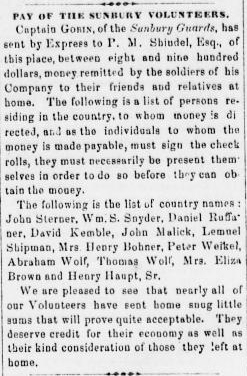
The November 30, 1861 edition of the Sunbury American carried the good news of pay sent home to loved ones by Sunbury’s boys in blue (public domain; click to enlarge).

The next day, according to Schmidt, the regiment participated in a morning divisional headquarters review overseen by the 47th Pennsylvania’s commanding officer, Colonel Tilghman H. Good, followed by brigade and division drills all afternoon. According to Schmidt, “each man was supplied with ten blank cartridges.” Afterward, “Gen. Smith requested Gen. Brannan to inform Col. Good that the 47th was the best regiment in the whole division.” As a reward—and in preparation for bigger things to come, Brannan obtained new Springfield rifles for every member of the 47th Pennsylvania.

As November came to a close, Captain Gobin helped a number of Sunbury Guardsmen to send a total of $900 from their collective pay back home to their families and friends in Pennsylvania. The editors of the Sunbury American subsequently announced the names of the family members and others who could expect to receive the sorely needed financial support from their boys in blue via a special notice in the newspaper’s November 30, 1861 edition.

Winter Quarters at Camp Griffin

Sketch of the 47th Pennsylvania Volunteers’ winter quarters at Camp Griffin, near Langley, Virginia, by Second Lieutenant William H. Wyker, Company E, December 1861 (public domain).

As fall deepened and progressed into winter, the 47th Pennsylvania Volunteer Infantry was ordered to batten down the hatches and establish its winter quarters—during a time when the guns on both sides of the war fell silent as snow blanketed Virginia, making it nearly impossible for Union and Confederate troops to march over the slippery, icy farm grounds around them—let alone drag their artillery into fighting positions in order to continue blasting away at one another.

It was simply too cold and too miserable to expend energy as combatants. But there were lighter moments as well.

Quartermaster James VanDyke procured a holiday surprise for the 47th Pennsylvania Volunteers (Sunbury American, December 21, 1861, public domain).

According to the December 21, 1861 edition of the Sunbury American, Regimental Quartermaster James Van Dyke, who was enjoying an approved furlough at home in Sunbury, Pennsylvania, was able to procure “various articles of comfort, for the inner as well as the outer man.” Upon his return to camp, many of the 47th Pennsylvanians of German heritage were pleasantly surprised to learn that the well-liked former sheriff of Sunbury had thoughtfully brought a sizable supply of sauerkraut with him. The German equivalent of “comfort food,” this favored treat warmed stomachs and lifted more than a few spirits that first cold winter away from loved ones.

Also, in a letter written sometime around Christmas 1861, Captain Gobin reported that Private John D. Colvin had been detailed to special duty with the signal corps in Washington, D.C. while Musician Henry D. Wharton, increasingly known to folks back home for his letters to the Sunbury American, had assumed additional responsibilities as a clerk who was assigned to the staff of Brigadier-General Brannan at Brigade Headquarters.

As fall fell away, the 47th Pennsylvania Volunteers continued to wait for better weather, hunkered down in their sturdier, winter quarters at Camp Griffin, remaining here until January 22, 1862, when the regiment was ordered to pack up and march for the railroad station at Falls Church. Transported from there by rail to Alexandria, they then sailed the Potomac via the steamship City of Richmond to the Washington Arsenal, where they were reequipped before being marched off for dinner and rest at the Soldiers’ Retreat in Washington, D.C. The next afternoon, they hopped cars on the Baltimore & Ohio Railroad, and headed for Annapolis, Maryland.

Arriving around 10 p.m., they were assigned quarters in barracks at the United States Naval Academy. They then spent that Friday through Monday (January 24-27, 1862) loading their equipment and other supplies onto the steamship Oriental, before sailing away at 4 p.m. that final afternoon. They were headed for America’s far warmer Deep South—and a very long time away from the arms of their loved ones and the comforts of home.

To learn more about the 47th Pennsylvania’s next phase of duty, read “Late Winter through Early Spring 1862 (Florida): Serving as Soldiers and Surrogates for Family.”


Sources:

  1. Bates, Samuel P. History of Pennsylvania Volunteers, 1861-5, vol 1. Harrisburg, Pennsylvania: B. Singerly, State Printer, 1869.
  2. Gobin, John Peter Shindel. Personal Letters, 1861-1865. Northumberland, Pennsylvania: Personal Collection of John Deppen.
  3. Lincoln and McClellan: An Army Ready for War.” Washington, D.C.: National Portrait Gallery, retrieved online December 1, 2023.
  4. Schmidt, Lewis G. A Civil War History of the 47th Regiment of Pennsylvania Veteran Volunteers. Allentown, Pennsylvania: Self-published, 1986.
  5. Wharton, Henry D. Letters from the Sunbury Guards. Sunbury, Pennsylvania: Sunbury American, 1861-1868.

 

Late Winter through Early Spring 1862 (Florida): Serving as Soldiers and Surrogates for Family

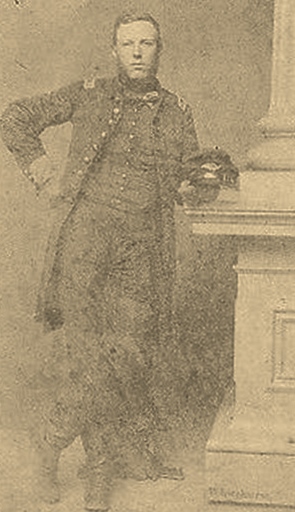
Drummer Boy William Williamson, 47th Pennsylvania Volunteers, Company A, circa 1863 (public domain).

Arriving with March 1862’s winds of change in America were career advancements for members of the 47th Pennsylvania Volunteer Infantry who were settling into life as soldiers on garrison duty in America’s Deep South during the Civil War. Among those receiving word that their lives would be changing even while continuing to serve with their regiment at Fort Taylor, Camp Brannan and other duty stations in Key West, Florida were several members of Company A: Jacob Beck, who was promoted from the rank of corporal to quartermaster sergeant; drummer boy William Williamson, who took on additional duties with the regimental commissary; Private John J. Jones, who was ordered to report for daily duties at the fort’s hospital; and Private Peter Lewis, who was ordered by Colonel Tilghman H. Good to assist First Lieutenant Washington H. R. Hangen with his added duties as Adjutant General of the Union Army brigade to which the 47th Pennsylvania had been attached.

Meanwhile, G Company Sergeant Charles A. Hackman was advanced to the rank of first sergeant (sergeant-major) while the regiment continued to add to its rosters with the enrollment of several new members, including Charles Martin, an immigrant from Kent, England who became a private with Company B.

And Major William H. Gausler, the regiment’s third-in-command, also assumed a heavier burden, having been appointed as Provost Marshal of Key West—a position which required him to oversee the city’s police operations and judicial affairs—duties which he performed from an office located at Hick’s Wharf in Key West.

Captain John Peter Shindel Gobin, 47th Pennsylvania Volunteers, Company C, circa 1862 (public domain).

On Monday, March 10, the 97 members of F Company were marched from Camp Brannan to Fort Taylor, where they would live and work moving forward. The next day, Captain John Peter Shindel Gobin of C Company penned a letter to Pennsylvania Governor Andrew Curtin to inform him that:

“Gen. Brannan has appointed me Deputy Judge Advocate General of the Department of Key West, giving me Supervision of all law proceedings on the island. I have Samuel Haupt for my clerk, and it keeps us both busy. I have a splendid office in the barracks – everything nice as can be. It beats the one at home all to pieces…. The weather continues very warm.”

In fairly short order, though, a new hindrance—the lack of safe drinking water—gave renewed strength to the regiment’s old adversary—disease. This happened because soldiers at the fort were frequently required to rely on rainwater captured by above-ground cisterns—an unworkable situation both in terms of water quantity and quality. In response, Brigadier-General John Milton Brannan, the Union Army general in charge of all of the Key West-based regiments, ordered his subordinates to board schooners and sail for Havana, Cuba in mid-March in order to locate and purchase additional water supplies.

And, as if battling water shortages and disease were not enough, 47th Pennsylvanians were quickly learning that local flora and fauna would also prove to be a significant threat. According to H Company First Lieutenant William W. Geety, who penned a letter to his wife around this same time, the bite of just one six-inch-long centipede meant “certain death” for any Pennsylvanian not sharp-eyed enough to spot the insect and step away fast enough.

Rev. William DeWitt Clinton Rodrock, chaplain, 47th Pennsylvania Volunteers, Fort Jefferson, Dry Tortugas, Florida, 1863 (courtesy of Robert Champlin, used with permission).

On Thursday, March 13, Regimental Chaplain William DeWitt Clinton Rodrock was in another contemplative mood, putting pen to paper to inform readers of Philadelphia’s The Press newspaper about what life was like as a Union soldier in America’s Deep South while also presenting his perspective on why the war was still being waged:

“In my former communication, I promised a more minute description of the beautiful island and city of Key West. I now do so; but cannot refrain, in the first place, from adverting to the glorious victories which have recently crowned our arms in the different divisions of the grand army of the Union. No wonder the whole country is wild with excitement and rejoicing. No wonder that cannons have been fired and bells tolled in every city, town, and hamlet, of the loyal States. For such successes and such victories as have recently crowned our flag with imperishable glory, are enough to thrill every fibre of the Republic and cause its great heart to beat with renewed life and activity. We have now passed the long line of checks and reverses and have made rapid advances on the broad, clear road that leads to complete and abiding triumph. Every true American breathes freer, walks firmer, and hopes brighter.

Whilst the year 1861 was one of trial, suffering, and discipline to the Government, it was to the rebel leaders, in a large measure, one of hope, of promise and success. But how different the opening of the year 1862! In the great cause of the Union, the bow of promise looms up on every side. There has been one continuous stream of success and victory.

To the rebel leaders all is discomfiture, disaster, and dismay. Every star of hope and promise has disappeared—defeat, ruin, and death, are closing around them on every side.

It is a marvelous [sic] fact in the history and warfare of the Anglo-Saxon race, that the side which suffers most grievously in the beginning is the side which triumphs most gloriously in the end. In not a single instance, during the last hundred years, has this rule varied. It was so in the ‘Old French War,’ when British arms sustained disaster after disaster, commencing with Braddock’s inglorious defeat, and running on through three campaigns, until the French had acquired possession of every foot of the disputed ground. But at Louisburg the tide turned, and Frontenac, and Ticonderoga, Niagara, and Quebec, soon drove the French from every standing place on the continent. A precisely similar experience attended the British operations in other quarters of the globe. Failure followed failure, but in due time gave place to a course of uninterrupted success by land and sea, such as has seldom fallen to the lot of any nation.

It was so in our Revolutionary war. The side beaten first was the side to win last. During the first twenty months of the war, up to the battle of Trenton, there was a continuous record of American discomfitures and retreats. In fact, there was little to lighten the dark page of that fierce struggle, until the battle of Saratoga and surrender of Burgoyne, the year afterward. Washington, and all the military chiefs of the Revolution, all through the first half of that military period, with all their lofty constancy, almost uniformly evince the painful consciousness of miscarriage and misfortune. The civilized world knows the grand success that at last crowned their efforts.

It was so in our last struggle with England. One of the first events of that war was the shameful surrender of Hull, at Detroit, by which the entire peninsula of Michigan passed into the hands of the enemy. He had been sent to invade and seize Upper Canada, but never was there a more ignominious failure. The first year’s land campaign, throughout, form the most discreditable chapter in our national annals. Yet the struggle, severe as it was, closed with the most memorable of all American victories at New Orleans, and has passed into history as a war completely successful for America.

However it be accounted for, the fact is undeniable, that, with the Anglo-Saxon family, opposite fates precide [sic] at the outset and upshot of their military undertakings; whilst success and victory invariably crown their close. The present wicked and lunatic rebellion is the last, but not the least illustration of this great fact. Much as I desire to elaborate this subject more fully, time and space both require me to leave it for the present, and give you as promised a brief description of

KEY WEST ISLAND AND CITY.

The island is six miles long and two miles broad, and nowhere more than twelve or fifteen feet above the sea level. It is of coral formation, and has a sandy, sterile soil, but in the few spots which are arable the vegetation is extremely rich. The greater part of it is covered with copsewood or low brushes. There are some vegetable gardens which produce through all the seasons, though less in winter than summer. The climate is well adapted for all kinds of tropical fruits. Cocoa nuts [sic], oranges, lemons, pomegranates, pine apples [sic], bananas, etc., are very abundant. There is an artificial salt pond on the island, 350 acres in extent. On the southwest point there is a lighthouse with a fixed light 70 feet above water.

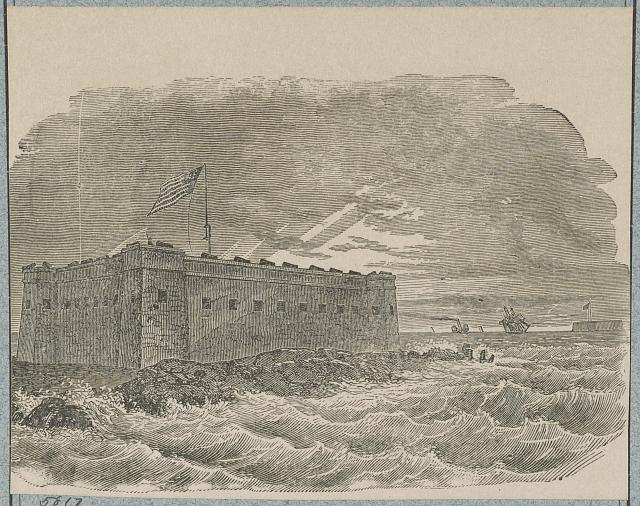
Key West City, on the same island, is the capital of Monroe county, Florida, and the southernmost settlement belonging to the United States. It is situated in latitude 21 deg. 32 min. N., longitude 81 deg. 48 min. W., and has a population of about 3,000. It has a fine harbor, accessible through several channels by the largest vessels drawing twenty-four feet of water; being the key to the best entrance to the Gulf of Mexico, it is strongly fortified. The principal work of defence [sic] is Fort Taylor, built on an artificial island within the main entrance to the harbor. It is a first-class fort, intended to mount upwards of two hundred guns of the heaviest calibre, and is now in excellent state of defence [sic]. The barracks are large and commodious buildings, forming three sides of a quadrangle, the opening facing the sea. Near these barracks our regiment is now comfortably quartered, and the camp presents a most romantic and picturesque appearance.

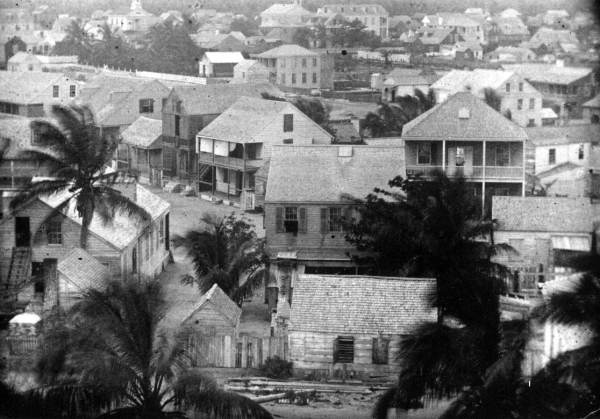
The streets of the city are wide and clean; the houses are generally of white frame of the cottage style, are neat and mostly embosomed in shrubbery. The flowers and roses are seen blooming around almost every house during the whole year. There are Episcopal, Methodist, Baptist, and Roman Catholic churches, a well arranged marine hospital 100 feet long by 45 feet wide, a customhouse, a court-house, and other public buildings. A large proportion of the population of Key West consists of natives or children of natives of the Bahama islands. These mostly sympathize with Secession, and had it not been for the prompt action of Captain, now Gen. Brannan, his handfull [sic] of men and the co operation [sic] of the loyal citizens, at the outbreak of the rebellion, the island and city with all the fortifications would have fallen into the hands of the rebels.

As a regiment, we have great reason to thank God for his watchful care over us, in sparing our lives. But with all, the unerring hand of death has not altogether left our ranks untouched. It is my painful duty to announce the death of three of our brethren-in-arms since we have pitched our tents in the sunny South.

Frederick Watt, Co. H, Captain Kacey’s, died in hospital February 13, of “brain fever,” contracted on board the Oriental. Aged 23 years. He enlisted in Perry county, Pennsylvania.

Andrew Bellisfield [sic], Co. A, Captain Graeffe’s, died in hospital of erysipelas. Aged 30 years. He was born, raised and enlisted In Northampton county, Pennsylvania.

Henry Beltz, Company B, Captain Rhoades [sic], died in hospital of typhoid fever. Aged 20 years. He was also a native of and enlisted in Northampton county, Pennsylvania.

Thus, three of our number have boon summoned from the field of strife and conflict, we trust, to the sweet fields and sunny banks of Canaan above.

They were buried with all the honors of war, and now sleep side by side, till the Resurrection morn. Although no kind father and mother, no affectionate sister and brother, were here to shed the tear of grief and sorrow over the graves of our departed brethren, yet there were few hearts in the ranks that were unmoved, and few cheeks that were dry, as we deposited their remains in the cold, silent earth.

Rest, soldiers, rest; your country comes,
With tender love and true,
Freely to deck your honored beds,
Her banner o’er its turf to spread,
And on your monuments to shed
Fond memory’s pearly dew.’

There are but few of our men now confined to the hospital, and these are doing very well.

Much yet remains to be said of our regiment, this post, etc., but as the mail will leave in a few moments by the Rhode Island, Captain Blanchard, I will close, promising to write again ere long.

‘In Peace or War, on land or sea,
Our flag, the aegis of the free,
Bright emblem of Columbia’s glory I
Shall tell to coming years the story,
How, stout of heart, and strong of hand,
The patriots of our native land
Bore it, the nation’s hope and life,
On tented field, ‘mid fearful strife,
Still on, till [sic] through the sulphurous [sic] cloud
It broke in triumph Treason’s shroud.'”

* Note: In point of fact, the 47th Pennsylvania Volunteers had come together on the afternoon of February 13, 1862 for what would be the regiment’s first funeral at Key West—that of Private Frederick Watt, a 19-year-old Perry County laborer who had fallen ill with measles while sailing aboard the S.S. Oriental and had been confined to the post hospital at Fort Taylor since disembarking. Following his interment with full military honors in grave number 27 of the post cemetery, hospital clerks muddied the documentation surrounding Watt’s passing, noting his cause of death as both brain fever and typhoid pneumonia. Watt’s body was later disinterred, in 1927, as part of a mass relocation of Union soldiers’ remains from Fort Taylor to the Fort Barrancas National Cemetery in Pensacola, Florida, and was subsequently reburied at that national cemetery in section 18, grave number 92.

In contrast, Private Andrew Bellis (not “Bellisfield”), succumbed to complications from erysipelas, which developed after Bellis had been bitten by a scorpion. Laid to rest in grave number 26 of the post cemetery following funeral services officiated by A Company Captain Richard A. Graeffe, Private Bellis’s cause of death was confirmed by B Company Private Jacob Apple in a letter to his own (Apple’s) family. As happened with Private Watt, Private Bellis’s body was disinterred in 1927 as part of the mass relocation of Union soldier, and was subsequently reinterred in section 17, grave number 97 at the Fort Barrancas National Cemetery.

As with those privates who preceded him in death, Private Beltz was also laid to rest in the post cemetery. Initially interred there in grave number 181, his body was similarly disinterred in 1927 as part of the mass relocation of Union soldiers’ remains; tragically, though, his remains were among those of multiple members of the 47th Pennsylvania that were mishandled. Unable to be re-identified upon transfer to staff at the national cemetery, Private Beltz’s remains were carelessly consigned to one of 228 graves marked as “unknown”—the majority of which still have not been identified as the centenary of that grave relocation project approaches.

As for the Key West lighthouse mentioned by Rev. Rodrock in his letter, the structure had been forced to darken twice after its 1822 construction authorization by the U.S. Congress to protect ships navigating the dangerous Straits of Florida. Initially illuminated on December 17, 1825, it ceased operating in July 1836 when its tower was heavily damaged during the Second Seminole War. Repaired in 1846, it continued to operate until August 1861 when supporters of the Confederacy sabotaged it by removing the system’s reflector while also wrecking its central prism. Determined to fix the problem, Brigadier-General John M. Brannan sent a team of carpenters and guards to the lighthouse in April 1862, but the mission was aborted when technicians determined that the light could not be repaired with the limited tools they had available at that time. Out of service until it was repaired in 1866, the light finally began functioning again on April 15 of that year.

As illness continued to ravage the ranks of the 47th Pennsylvania throughout the late winter and early spring of 1862, Company A’s First Lieutenant James Meyers was subsequently hospitalized for two months while F Company’s Private John Weiss was ordered to convalesce in his quarters.

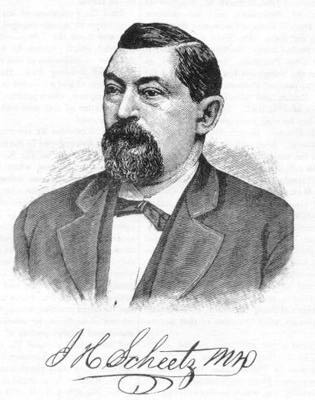
On Monday, March 17, Assistant Regimental Surgeon Jacob H. Scheetz was placed in command of the 47th Pennsylvania’s medical unit when the 47th’s Regimental Surgeon Elisha W. Baily was reassigned to detached duty. (Scheetz would continue to fulfill this role until September 1862 when he was placed in charge of the Union Army’s General Hospital in Beaufort, South Carolina, where the 47th Pennsylvania was stationed.)

Two days later, Northampton County Journal readers learned from that day’s edition of their newspaper that fourteen men from their community would be returning home, including A Company Privates Christian Haldeman and George Muller, residents of Easton who had been respectively employed as a laborer and hostler, Stockertown blacksmith Enos Unangst, and Monroe County’s William Pucker—all of whom had been honorably discharged on surgeons certificates of disability. (Muller was released due to a foot injury.)

On Sunday, March 23, Captain Gobin informed family and friends back in Sunbury that:

“Two batteries of field Artillery have been landed on the Island, and we are drilling our Regiment to the use of them. The men have been supplied with new clothing, brass shoulder scales to protect them from cavalry, and everything betokens a readiness on our part to join in the grand encircling of the monster Rebellion. The trees are still being cut down, while artillery roads, thirty feet wide, are being run from one part of the island to another, at different points. Our men have been working hard, but we daily expect 500 contrabands from Port Royal, when we will have easy times.”

All the while, the regiment’s most fearsome foe continued its scything of the ranks as E Company Private Amandus Long and 29-year-old Second Lieutenant Henry H. Bush of F Company lost their respective battles with typhoid fever.

Beloved by his F Company subordinates, Lieutenant Bush “had just been presented a sword by his company a few days before,” according to Schmidt, “and left a widow and two little children behind.” In reporting the death of the Catasauqua millwright, editors of the New Era confirmed that Bush had initially been laid to rest at the post cemetery:

“It becomes our sad duty to record the death of Lt. H. H. Bush, of Company F, 47th Regiment of Pennsylvania Volunteers. He died of Typhoid Fever on the 31st of March and was buried with Masonic and Military Honors in the soldiers burying ground near the barracks.”

The most enlightening glimpse into the funerary rituals of the 47th Pennsylvania Volunteers, however, was Company Order Number 23:

“The Major commanding has the painful duty to announce to this command the death after a short illness of 2nd Lt. H. H. Bush of Company F stationed at this post. By his death the service has lost a good officer and efficient soldier. His remains will be buried at 5 PM (April 1). One half of company accompanied by subaltern will form escort. The usual badge of mourning will be worn by the officers of Company F for one month.”

* Note: Initially interred in grave number 3 of the post cemetery, Private Amandus Long was one of the 47th Pennsylvanians whose bodies were disinterred in 1927 as part of the mass relocation of Union soldiers’ remains from Fort Taylor to the Fort Barrancas National Cemetery in Pensacola, Florida. Tragically, his body was also among those that were mishandled. Unable to be reidentified upon transfer to the national cemetery, his remains were also carelessly consigned to one of 228 graves marked as “unknown.”

Unlike the remains of Private Long, however, those of Second Lieutenant Henry H. Bush were disinterred and brought back to the Keystone State at the request of his surviving family. Lieutenant Bush was then finally laid to rest at Catasauqua’s Fairview Cemetery.

The deaths of Beltz, Bush, Long, and so many other young men sorely tested the notion of 19th century Pennsylvanians that terminally ill loved ones “should die amidst family assembled around the deathbed,” according to American Civil War historian Drew Gilpin Faust, president emeritus of Harvard University and the author of This Republic of Suffering. Tradition had long dictated that “family members needed to witness a death in order to assess the state of the dying person’s soul” because the “critical last moments of life would epitomize his or her spiritual condition.”

“Kin would use their observations of the deathbed to evaluate the family’s chances for a reunion in heaven. A life was a narrative that could only be incomplete without this final chapter, without the life-defining last words.

Last words had always held a place of prominence in the Ars Moriendi [‘Good Death’] tradition. By the eighteenth century, ‘dying declarations’ had assumed—and still retain—explicit secular importance: a special evidentiary status excepting them from legal rules excluding hearsay. Final words were regarded as possessing an especially high truth status, both because it was believed that a dying person could no longer have any early motivation to lie and because those about to meet their Maker would not wish to expire bearing false witness…. Not only were last words important because of their assumed honesty, they also imposed a meaning on the life narrative they would conclude. At the same time that they exemplified a life, moreover, they communicated invaluable lessons or insights to those gathered around the deathbed. This educational function provided a critical means through which the deceased could continue to exist in the lives of the survivors. The teachings that last words imparted served as a lingering exhortation and a persisting tie between the living and the dead.”

But when members of the 47th Pennsylvania died far from home—as they were now doing at Fort Taylor in Florida—this immediate and long-lasting form of comfort and counsel was out of reach of the loving embrace of a dying soldier’s family and friends. And that, according to Faust, was utterly shocking and “unbearable to many nineteenth-century Americans left at home while their sons, husbands, and brothers died with their last words unrecorded or even unheard.”

As the war would continue to rage, according to Faust, a dying soldier’s regimental comrades would often become surrogates for far-away family, as would regimental and hospital chaplains, physicians, and army nurses, “struggling even amidst the chaos of the war to make it possible for men—and their loved ones—to believe they had died well. Spiritual wounds demanded attention as powerfully as did those of the flesh.”

Sadly, these realizations was being driven home to the members of the 47th Regiment, Pennsylvania Volunteer Infantry time and again as the dawn of a second year of civil war loomed in America.


Sources:

1. Bates, Samuel P. History of Pennsylvania Volunteers, 1861-5, Vol 1. Harrisburg, Pennsylvania: B. Singerly, State Printer, 1869.

2. Faust, Drew G. The Civil War Soldier and the Art of Dying,” in The Journal of Southern History, Vol. 67, No. 1, pp. 3-38. Houston, Texas: Southern Historical Association (Rice University), 2001.

3. Florida’s Role in the Civil War: ‘Supplier of the Confederacy.” Tampa, Florida: Florida Center for Instructional Technology, University of South Florida (College of Education), retrieved online January 15, 2020.

4. Gobin, John Peter Shindel. Personal Letters, 1861-1865. Northumberland, Pennsylvania: Personal Collection of John Deppen.

5. Johnson, Rossiter and John Howard Brown. The Twentieth Century Biographical Dictionary of Notable Americans, Vol. 1, p. 419: Brannan, John Milton.” Boston, Massachusetts: The Biographical Society, 1904.

6. “Letter from Key West” (from “W. D. C. R., Chaplain, Forty-seventh Regiment, P. V.”; dated March 13, 1862). Philadelphia, Pennsylvania: The Press, March 31, 1972 (front page).

7. Rodrock, William DeWitt Clinton and Julia (Weldy) Rodrock. Photographs, Correspondence, Sermons, etc., 1849-1900. St. Louis, Missouri: “William DeWitt Clinton Rodrock Collection” held by Robert Champlin.

8. Schmidt, Lewis G. A Civil War History of the 47th Regiment of Pennsylvania Veteran Volunteers. Allentown, Pennsylvania: Self-published, 1986.

9. Sharp, Rebecca. Medical and Surgical History of the War of the Rebellion (video). Washington, D.C.: U.S. National Archives and Records Administration, June 3, 2015.

10. Staubach, Lieutenant Colonel James C. Miami During the Civil War: 1861-65,” in Tequesta: The Journal of the Historical Association of Southern Florida, LIII, 31-62. Miami: Historical Museum of Southern Florida, 1993.

11. Wharton, Henry D. Letters from the Sunbury Guards. Sunbury, Pennsylvania: Sunbury American, 1861-1868.


December 1861: A Young Regiment’s First Christmas and New Year’s Day Away from Home

First State Color, 47th Pennsylvania Volunteers (issued 20 September 1861, retired 11 May 1865).

Barely four months old when December 1861 arrived, the 47th Pennsylvania Volunteer Infantry continued its occupation of Virginia—just one of the many Union regiments attached to the Army of the Potomac charged with defending the nation’s capital from potential invasion by Confederate States Army troops during the first year of America’s Civil War. Encamped at Camp Advance near Fort Ethan Allen during late September and early October, the 47th Pennsylvania had spent a significant portion of its time reinforcing and expanding upon the basic training in Hardee’s light infantry tactics that it had received upon its muster at Camp Curtin.

On one typical day—Friday, October 4—the regiment drilled from just after reveille until roughly 7 a.m., repeated the drill between 10 and 11 a.m. and then again between 2 and 3 p.m., and then marched in a formal regimental parade from 5 to 6 p.m. Two days later, the regiment demonstrated its readiness yet again when its members were formally inspected by senior officers of its brigade. At midnight the next day—Monday, October 7—the 47th Pennsylvania Volunteer Infantry was ordered to engage the enemy.

Following behind the 79th New York Volunteers and trailed by the 33rd and 49th New York, as well as a Union cavalry unit and three Union artillery batteries, the 47th Pennsylvania Volunteers marched away from Camp Advance at 3 a.m.—excited to do more than mere drilling. Before they could reach their intended destination, however, the 79th New York Volunteers ran smack into Confederate skirmishers three miles outside of Lewinsville.

As battle lines began to form, the 47th Pennsylvania was ordered to move to the front and both sides of the road to shield the brigade’s other units. Initially stationed at the front, the 47th Pennsylvania’s F Company and A Company were shifted to protective positions at the brigade’s left and right, respectively, and Company D and Company I were then shifted to protect the brigade’s front. Advancing in this formation up and down three miles of the undulating, forested Virginia countryside, the 47th Pennsylvania Volunteers pushed the Confederate troops back toward Prospect Hill, where they stopped and held their brigade’s position for the remainder of the day and night.

Forming a new battle line the next morning at 8 a.m., the 47th Pennsylvania Volunteers were assigned, again, to guard both sides of their brigade. When neighboring Confederate troops failed to attack by 10 a.m., they were ordered to begin fortifying their brigade’s position, and proceeded to carve out a five-mile road and fell a substantial number of trees in order to construct earthen breastworks in front of the brigade’s artillery batteries. They were also assigned to dig holes to create rifle pits for brigade snipers—work which continued until they were relieved by a regiment from Vermont at sundown. Allowed to sleep until daylight via a procedure known as “laying on their arms,” they essentially held their rifles while napping lightly.

Unknown regiment, Camp Griffin, Virginia, fall 1861 (public domain, U.S. Library of Congress).

Ordered on toward Manassas Gap early that same week, the 47th Pennsylvania Volunteers were next stationed between Lewinsville and Falls Church as part of this mission. Moving back and forth around this area, they reached as far as the Leesburg Turnpike, which was roughly two miles from the Chain Bridge they had first crossed when entering Virginia in September. Moving out again the next day, the 47th Pennsylvania’s right wing (Companies A, C, D, F, and I) were ordered to head for a new camp site in Fairfax County, Virginia. Marching to a site two miles outside of Falls Church, they began pitching regimental tents at “Camp Big Chestnut”—so named due to the looming presence of a large chestnut tree located there. This encampment would ultimately come to be known as Camp Griffin.

Meanwhile, the men from H Company and other units of the 47th Pennsylvania’s left wing were ordered out on a new, five-mile expedition. During this time, a six-man detail from H Company, commanded by Lieutenant William W. Geety, was sent out on reconnaissance toward the Richmond Turnpike, but nearly met with disaster when Confederate cavalry approached within 300 feet of that detail’s position around midnight. Fortunately, this detachment was saved by a thick fog which descended and obscured its position from the enemy’s view.

On Thursday, October 10, Geety’s party was joined by the regiment’s third-in-command, Major William H. Gausler, who ordered Geety to perform further reconnaissance. Spotting enemy pickets a quarter mile away from the main encampment of the 47th Pennsylvania’s expedition, Geety promptly returned to Gausler to report his findings. Men from G Company were then placed on picket duty, which they performed until they were relieved at 1 a.m. the next day.

According to regimental historian, Lewis Schmidt, Colonel Tilghman H. Good, the 47th Pennsylvania’s founder and commanding officer, reported to his superiors “that the work associated with being out on advanced picket duty was very difficult, and that the enemy pickets at times were too close to his camp, which gave his troops constant unrest.” Further adding to their stress, they were forced to wait so long for their tents to be brought from their former encampment that they ended up having to pitch those tents “during constant alarms from the enemy pickets.”

They’d barely finished when the rains came. Geety later reported that they’d endured such a hard downpour that he’d “slept in a puddle all night”; those of his subordinates who weren’t sent out on picket duty again spent the next two days trying unsuccessfully to dry their clothes.

Captain John Peter Shindel Gobin, Co. C, 47th Pennsylvania Volunteers, c. 1862 (public domain).

Many hours were, in fact, passed in similarly miserable conditions—so much so that camp life became a test of endurance. According to Captain John Peter Shindel Gobin, the commanding officer of the 47th Pennsylvania’s C Company, Friday, November 29 was “the most disagreeable time we have yet experienced.” Assigned to picket duty, he had been ordered to march his subordinates out and position them away from camp some distance in order to head off potential enemy attacks on the Army of the Potomac’s massive encampment by Confederate troops stationed in their vicinity.

“It rained hard all day and night, and was very cold. I had command of the first relief, which went to the special reserve at 12 midnight. By that time most of us were wet through, so I took possession of a minister’s house, near by, where I quartered my men until morning.”

Additional letters written by other 47th Pennsylvanians around this same time evoke similar shivers of empathy, transporting present day readers back in time and into the muddy shoes and heavy, sodden uniforms of the cold, sniffling soldiers who wearily set pen to paper once they were finally permitted to crawl back into their dry tents at camp.

Consequently, disease became an even more formidable foe than the Confederate States Army—and a fearsome one at that, scything multiple members of the regiment from its ranks, including two drummer boys, aged thirteen and fifteen, and a seasoned sergeant within days of each of their respective hospitalizations, followed by Daniel Foose, a 19-year-old private from Perry County’s H Company who was felled by typhoid or bilious fever; David Losch, a 22-year-old Allentown native and private from I Company; Daniel Biceline, a 23-year-old H Company private also felled by typhoid; and Private William Young of G Company.

Easing their distress somewhat was the long overdue news that members of the 47th Pennsylvania Volunteer Infantry would finally be paid for the first time since enrolling for service. When the money arrived, many members of the regiment began transferring what they could home to parents and wives. C Company men sent $900 to their loved ones in Sunbury while those from Company A and Company D sent a whopping $2,500 and $2,000, respectively, to Northampton and Perry counties.

Additionally, the regiment was still stationed close enough to Pennsylvania that a significant number of 47th Pennsylvanians were able to personally return to their hometowns on brief furloughs while others were buoyed by family members who had the means to travel to their Virginia encampment for short visits.

Christmas

Quartermaster James Van Dyke procured a holiday surprise for the 47th Pennsylvania Volunteers (Sunbury American, 21 December 1861, public domain).

As a result, it was with a mixture of heavy hearts and hope that members of the 47th Pennsylvania Volunteer Infantry welcomed the dawn of Christmas Day in 1861.

Among those making the time more bearable for his fellow 47th Pennsylvanians was Regimental Quartermaster and former Northumberland County sheriff James Van Dyke who, according to the December 21 edition of the Sunbury American, “came home on a short visit and returned to Camp Griffin 47th Regiment … taking with him three or four large boxes filled with various articles of comfort, for the inner as well as the outer man….”

The newspaper also included this important detail:

“Among the edibles, was a barrel of ‘sour krout,’ presented by William I. Greenough, Esq.”

In addition to being a beloved taste of home for the often hungry members of the regiment, the sauerkraut likely also served an important cultural function for the numerous German-Americans and German immigrants who had enrolled with the 47th. When paired with pork and eaten on New Year’s Day as part of an annual tradition, sauerkraut has been said to attract prosperity for the remainder of the year because it is made from green cabbage (green being the color of money) while eating pork ensures progress and good luck because pigs “root forward” with their snouts rather than backward with their feet as chickens do, according to a 2015 article by Billy Penn News.

Pvt. Abraham Nicholas Wolf, Company B, 47th Pennsylvania Volunteers, c. 1861 (public domain).

Food and other “articles of comfort” were, in fact, on the minds of pretty much all members of the regiment as they were about to spend their first Christmas and New Year’s holidays away from loved ones. While penning a letter to his family during regimental church services on Sunday, December 29, Private Abraham N. Wolf told his wife, Sarah, that the Regimental Band was playing a hymn as he wrote to her.

Noting that he’d received the gift box she’d sent him, Wolf’s joy was child-like when he added that “everything was in it yet what you said was in it and it came on the second day of Christmas.” Just that morning, he’d fried “fried some of the sausages” that she’d sent him “and took some sausages along for dinner” later because he’d been scheduled for duty—chopping wood for the regiment—“and they tasted pretty good to me for it was something new to me for it was from home.” And then he added that the day before:

“… the chicken cooked for dinner and so we had a good dinner for it was the best dinner that I had since I left home. And this morning I ate the last part of the chickens but I have some of your molasses candy yet which you sent to me. And I have the big cake yet. And that pocket handkerchief which your mother sent to me I got too.”

Their joy and respite were brief, however; by mid-January 1862, the 47th Pennsylvania Volunteers were on the move again. When they finally stopped and were able to take in their new surroundings, they would suddenly gain an entirely different perspective on the meaning of “far from the comforts of home.”

For more Christmas and New Year’s-related content, please check out this sampling of our prior posts on 47th Pennsylvania Volunteers: One Civil War Regiment’s Story:

To see an image and read more of Abraham Wolf’s letter, read the article, 1861: Abraham Nicholas Wolf Jr. to Sarah (Trexler) Wolf,” by Spared and Shared.

Sources:

1. Bates, Samuel P. History of Pennsylvania Volunteers, 1861-5, Vol 1. Harrisburg, Pennsylvania: B. Singerly, State Printer, 1869.

2. Gobin, John Peter Shindel. Personal Letters, 1861-1865. Northumberland, Pennsylvania: Personal Collection of John Deppen.

3. Schmidt, Lewis G. A Civil War History of the 47th Regiment of Pennsylvania Veteran Volunteers. Allentown, Pennsylvania: Self-published, 1986.

4. Wharton, Henry D. Letters from the Sunbury Guards. Sunbury, Pennsylvania: Sunbury American, 1861-1868.
A Nation Comes Together, Time and Again, to Give Thanks

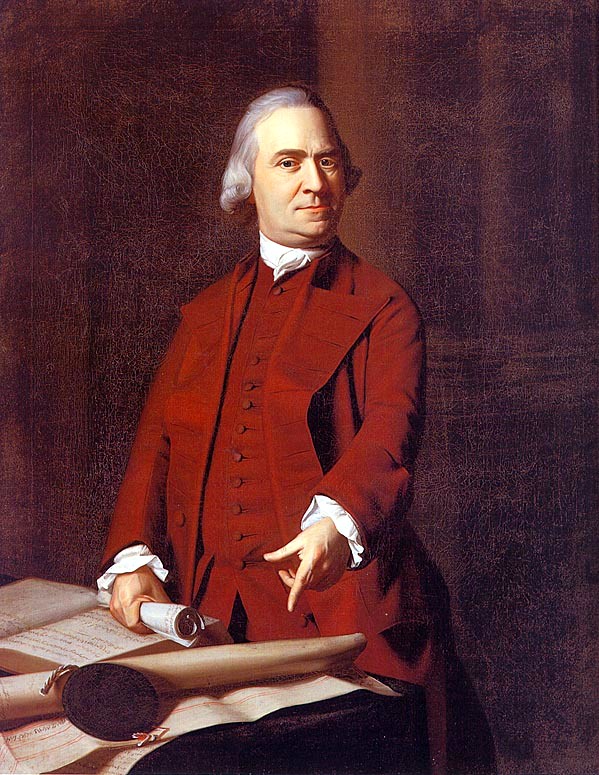
Samuel Adams (John Singleton Copley, circa 1772, public domain).

Well before the outbreak of America’s devastating Civil War, the concept of Thanksgiving was on the minds of the nation’s founding fathers. Among those who grasped the importance of inspiring shared feelings of unity and gratitude between residents of the United States was Samuel Adams, who drafted the nation’s first Thanksgiving proclamation, which was then officially issued by the Continental Congress on 1 November 1777:

“FOR AS MUCH as it is the indispensable Duty of all Men to adore the superintending Providence of Almighty God; to acknowledge with Gratitude their Obligation to him for Benefits received, and to implore such farther Blessings as they stand in Need of: And it having pleased him in his abundant Mercy, not only to continue to us the innumerable Bounties of his common Providence; but also to smile upon us in the Prosecution of a just and necessary War, for the Defense and Establishment of our unalienable Rights and Liberties; particularly in that he hath been pleased, in so great a Measure, to prosper the Means used for the Support of our Troops, and to crown our Arms with most signal success:

It is therefore recommended to the legislative or executive Powers of these UNITED STATES to set apart Thursday, the eighteenth Day of December next, for SOLEMN THANKSGIVING and PRAISE: That at one Time and with one Voice, the good People may express the grateful Feelings of their Hearts, and consecrate themselves to the Service of their Divine Benefactor; and that, together with their sincere Acknowledgments and Offerings, they may join the penitent Confession of their manifold Sins, whereby they had forfeited every Favor; and their humble and earnest Supplication that it may please GOD through the Merits of JESUS CHRIST, mercifully to forgive and blot them out of Remembrance; That it may please him graciously to afford his Blessing on the Governments of these States respectively, and prosper the public Council of the whole: To inspire our Commanders, both by Land and Sea, and all under them, with that Wisdom and Fortitude which may render them fit Instruments, under the Providence of Almighty GOD, to secure for these United States, the greatest of all human Blessings, INDEPENDENCE and PEACE: That it may please him, to prosper the Trade and Manufactures of the People, and the Labor of the Husbandman, that our Land may yield its Increase: To take Schools and Seminaries of Education, so necessary for cultivating the Principles of true Liberty, Virtue and Piety, under his nurturing Hand; and to prosper the Means of Religion, for the promotion and enlargement of that Kingdom, which consisteth ‘in Righteousness, Peace and Joy in the Holy Ghost.’

And it is further recommended, That servile Labor, and such Recreation, as, though at other Times innocent, may be unbecoming the Purpose of this Appointment, be omitted on so solemn an Occasion.”

Nearly twelve years later, on 3 October 1789, President George Washington also urged Americans to come together to express their gratitude, and proclaimed that that year’s celebration would be held on 26 November:

“By the President of the United States of America, a Proclamation.

Whereas it is the duty of all Nations to acknowledge the providence of Almighty God, to obey his will, to be grateful for his benefits, and humbly to implore his protection and favor — and whereas both Houses of Congress have by their joint Committee requested me to recommend to the People of the United States a day of public thanksgiving and prayer to be observed by acknowledging with grateful hearts the many signal favors of Almighty God especially by affording them an opportunity peaceably to establish a form of government for their safety and happiness.

Now therefore I do recommend and assign Thursday the 26th day of November next to be devoted by the People of these States to the service of that great and glorious Being, who is the beneficent Author of all the good that was, that is, or that will be — That we may then all unite in rendering unto him our sincere and humble thanks — for his kind care and protection of the People of this Country previous to their becoming a Nation — for the signal and manifold mercies, and the favorable interpositions of his Providence which we experienced in the course and conclusion of the late war — for the great degree of tranquility, union, and plenty, which we have since enjoyed — for the peaceable and rational manner, in which we have been enabled to establish constitutions of government for our safety and happiness, and particularly the national One now lately instituted — for the civil and religious liberty with which we are blessed; and the means we have of acquiring and diffusing useful knowledge; and in general for all the great and various favors which he hath been pleased to confer upon us.

and also that we may then unite in most humbly offering our prayers and supplications to the great Lord and Ruler of Nations and beseech him to pardon our national and other transgressions — to enable us all, whether in public or private stations, to perform our several and relative duties properly and punctually — to render our national government a blessing to all the people, by constantly being a Government of wise, just, and constitutional laws, discreetly and faithfully executed and obeyed — to protect and guide all Sovereigns and Nations (especially such as have shewn kindness unto us) and to bless them with good government, peace, and concord — To promote the knowledge and practice of true religion and virtue, and the encrease of science among them and us — and generally to grant unto all Mankind such a degree of temporal prosperity as he alone knows to be best.

Given under my hand at the City of New York the third day of October in the year of our Lord 1789.

George Washington

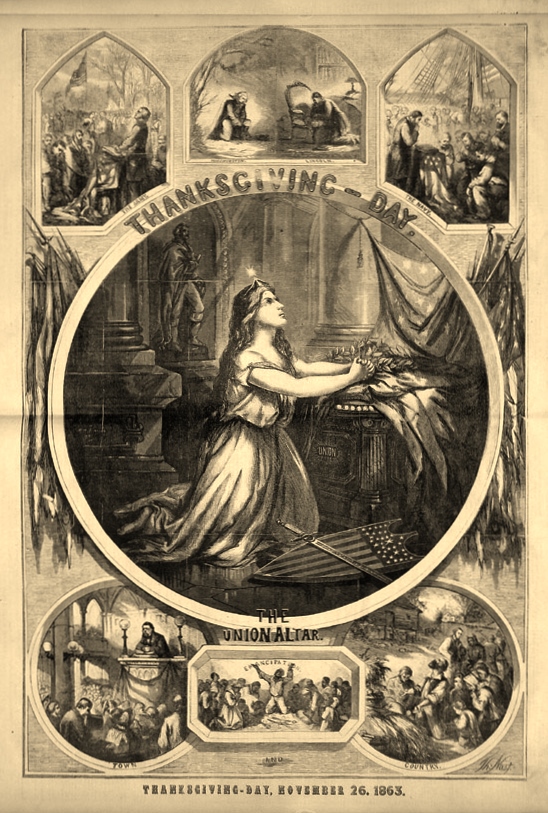
Thanksgiving, November 1863 (Thomas Nast, Harper’s Weekly, 5 December 1863, public domain).

Nearly three quarters of a century later, Pennsylvania’s Civil War governor, Andrew Gregg Curtin, urged his fellow Keystone State residents to pray that God would “bestow upon our Civil Rulers, wisdom and earnestness in council and upon our military leaders zeal and vigor in action, that the fires of rebellion may be quenched, that we, being armed with His defense, may be preserved from all perils, and that hereafter our people living in peace and quietness, may, from generation to generation, reap the abundant fruits of His mercy; and with joy and thankfulness praise and magnify His holy name.”

A year later, President Abraham Lincoln penned the following words as part of his own sobering, yet hopeful proclamation:

“I do therefore invite my fellow citizens in every part of the United States, and also those who are at sea and those who are sojourning in foreign lands, to set apart and observe the last Thursday of November next, as a day of Thanksgiving and Praise to our beneficent Father who dwelleth in the Heavens. And I recommend to them that while offering up the ascriptions justly due to Him for such singular deliverances and blessings, they do also, with humble penitence for our national perverseness and disobedience, commend to His tender care all those who have become widows, orphans, mourners or sufferers in the lamentable civil strife in which we are unavoidably engaged, and fervently implore the interposition of the Almighty Hand to heal the wounds of the nation and to restore it as soon as may be consistent with the Divine purposes to the full enjoyment of peace, harmony, tranquillity and Union.”

So, with our common heritage in mind, and as an expression of deep gratitude for the ongoing support of our many wonderful readers and volunteers who have helped us build a loyal following for 47th Pennsylvania Volunteers: One Civil War Regiment’s Story, we present this collection of links to our most popular Thanksgiving-related content. With our best wishes from “our house” to yours, wherever you reside in this our United States of America, may you have a peaceful, bountiful and joyous holiday season. And in the New Year to come, may we all, finally, embrace the belief that one’s ability to show kindness and compassion in the face of adversity is a sign of strength, not weakness.

Thanksgiving Post Collection — 47th Pennsylvania Volunteers: One Civil War Regiment’s Story


Sources:

1. Basler, Roy P., editor, et. al. Collected works, Vol. 6. The Abraham Lincoln Association/Springfield, Illinois. New Brunswick, New Jersey: Rutgers University Press, 1953.

2. Curtin, Andrew Gregg. Proclamation of a Day of Thanksgiving – 1862,” in Pennsylvania Archives: Fourth Series, Vol. VIII: “Papers of the Governors, 1858-1871,” Samuel Hazard, John Blair Lynn, William Henry Egle, et. al., editors. Harrisburg, Pennsylvania: Wm. Stanley Ray, State Printer, 1902.

3. Snyder Family Recipes: Turkey, Filling and Gravy (Thanksgiving and Christmas),” in 47th Pennsylvania Volunteers: One Civil War Regiment’s Story. Snyder Family Archives: © 2017-present. All rights reserved.

4. Thanksgiving Proclamation, 1863: A primary source by Abraham Lincoln and Thomas Nast.” New York, New York: The Gilder Lehrman Institute of History, retrieved online 1 November 2017.

5. Thanksgiving Proclamation 1777 By the Continental Congress: The First National Thanksgiving Proclamation.” Plymouth, Massachusetts: Pilgrim Hall Museum, retrieved online 4 November 2019.

6.Thanksgiving Proclamation of 1789,” in “Education — Primary Sources.” Mount Vernon, Virginia: George Washington’s Mount Vernon, retrieved online 4 November 2019.

7. Wharton, Henry D. Letter from the Sunbury Guards: Key West, Fla., 23 August 1863 (Henry Wharton’s Thanksgiving Update, 1863). Sunbury, Pennsylvania: Sunbury American, 5 September 1863.


Healing a Nation – A President’s Christmas Acts of Forgiveness and Compassion

President Abraham Lincoln signing the Emancipation Proclamation in 1862 (W. E. Winner, painter, J. Serz, engraver, circa 1864; public domain, U.S. Library of Congress).

1863 was a pivotal year for Abraham Lincoln and the United States of America. It began with the New Year’s Day execution of the President’s Emancipation Proclamation, which freed all people held as slaves in every state which had seceded from the Union, saw the course of the American Civil War swing in the federal government’s favor with the Union’s victory over Confederate States Army troops in the bloody, tide-turning Battle of Gettysburg in early July, and closed with Lincoln’s attempts to reunify both his nation and family in the days leading up to Christmas through two very different documents which shared the common threads of compassion and forgiveness – an Executive Letter designed to provide his wife’s cousin – a supporter of the Confederacy – to have safe passage to, and secure residency at, her home in Arkansas, and a proclamation intended to inspire similar CSA supporters to pressure their leaders to end the war and return to the Union fold.

The texts of both documents are shown below.


Proclamation of Amnesty and Reconstruction (8 December 1863)

BY THE PRESIDENT OF THE UNITED STATES OF AMERICA:
A PROCLAMATION.

WHEREAS, in and by the Constitution of the United States, it is provided that the President “shall have power to grant reprieves and pardons for offences against the United States, except in cases of impeachment;” and

Whereas, a rebellion now exists whereby the loyal state governments of several states have for a long time been subverted, and many persons have committed, and are now guilty of, treason against the United States; and

Whereas, with reference to said rebellion and treason, laws have been enacted by congress, declaring forfeitures and confiscation of property and liberation of slaves, all upon terms and conditions therein stated, and also declaring that the President was thereby authorized at any time thereafter, by proclamation, to extend to persons who may have participated in the existing rebellion, in any state or part thereof, pardon and amnesty, with such exceptions and at such times and on such conditions as he may deem expedient for the public welfare; and

Whereas, the congressional declaration for limited and conditional pardon accords with well-established judicial exposition of the pardoning power; and

Whereas, with reference to said rebellion, the President of the United States has issued several proclamations, with provisions in regard to the liberation of slaves; and

Whereas, it is now desired by some persons heretofore engaged in said rebellion to resume their allegiance to the United States, and to reinaugurate loyal state governments within and for their respective states: Therefore–

I, ABRAHAM LINCOLN, President of the United States, do proclaim, declare, and make known to all persons who have, directly or by implication, participated in the existing rebellion, except as hereinafter excepted, that a full pardon is hereby granted to them and each of them, with restoration of all rights of property, except as to slaves, and in property cases where rights of third parties shall have intervened, and upon the condition that every such person shall take and subscribe an oath, and thenceforward keep and maintain said oath inviolate; and which oath shall be registered for permanent preservation, and shall be of the tenor and effect following, to wit:–

“I, ______ , do solemnly swear, in presence of Almighty God, that I will henceforth faithfully support, protect, and defend the Constitution of the United States and the Union of the States thereunder; and that I will, in like manner, abide by and faithfully support all acts of congress passed during the existing rebellion with reference to slaves, so long and so far as not repealed, modified, or held void by congress, or by decision of the supreme court; and that I will, in like manner, abide by and faithfully support all proclamations of the President made during the existing rebellion having reference to slaves, so long and so far as not modified or declared void by decision of the supreme court. So help me God.”

The persons excepted from the benefits of the foregoing provisions are all who are, or shall have been, civil or diplomatic officers or agents of the so-called Confederate government; all who have left judicial stations under the United States to aid the rebellion; all who are, or shall have been, military or naval officers of said so-called Confederate government above the rank of colonel in the army or of lieutenant in the navy; all who left seats in the United States congress to aid the rebellion; all who resigned commissions in the army or navy of the United States and afterwards aided the rebellion; and all who have engaged in any way in treating colored persons, or white persons in charge of such, otherwise than lawfully as prisoners of war, and which persons may have been found in the United States service as soldiers, seamen, or in any other capacity.

And I do further proclaim, declare, and make known that whenever, in any of the States of Arkansas, Texas, Louisiana, Mississippi, Tennessee, Alabama, Georgia, Florida, South Carolina, and North Carolina, a number of persons, not less than one tenth in number of the votes cast in such state at the presidential election of the year of our Lord one thousand eight hundred and sixty, each having taken the oath aforesaid, and not having since violated it, and being a qualified voter by the election law of the state existing immediately before the so-called act of secession, and excluding all others, shall reestablish a state government which shall be republican, and in nowise contravening said oath, such shall be recognized as the true government of the state, and the state shall receive thereunder the benefits of the constitutional provision which declares that “the United States shall guaranty to every state in this Union a republican form of government, and shall protect each of them against invasion; and on application of the legislature, or the executive, (when the legislature cannot be convened,) against domestic violence.”

And I do further proclaim, declare, and make known that any provision which may be adopted by such state government in relation to the freed people of such state, which shall recognize and declare their permanent freedom, provide for their education, and which may yet be consistent as a temporary arrangement with their present condition as a laboring, landless, and homeless class, will not be objected to by the National Executive.

And it is suggested as not improper that, in constructing a loyal state government in any state, the name of the state, the boundary, the subdivisions, the constitution, and the general code of laws, as before the rebellion, be maintained, subject only to the modifications made necessary by the conditions hereinbefore stated, and such others, if any, not contravening said conditions, and which may be deemed expedient by those framing the new state government.

To avoid misunderstanding, it may be proper to say that this proclamation, so far as it relates to state governments, has no reference to states wherein loyal state governments have all the while been maintained. And, for the same reason, it may be proper to further say, that whether members sent to congress from any state shall be admitted to seats constitutionally rests exclusively with the respective houses, and not to any extent with the Executive. And still further, that this proclamation is intended to present the people of the states wherein the national authority has been suspended, and loyal state governments have been subverted, a mode in and by which the national authority and loyal state governments may be reestablished within said states, or in any of them; and while the mode presented is the best the Executive can suggest, with his present impressions, it must not be understood that no other possible mode would be acceptable.

Given under my hand at the city of Washington the eighth day of December, A.D. one thousand eight hundred and sixty-three, and of the Independence of the United States of America the eighty-eighth.

ABRAHAM LINCOLN.

By the President:
WILLIAM H. SEWARD, Secretary of State.


Executive Letter in Support of Mary Todd Lincoln’s First Cousin (21 December 1863)

Executive Mansion
Washington, December 21, 1863.

Mr. and Mrs. Craig, of Arkansas, whose plantation, situated upon the Mississippi River a few miles below Helena, has been desolated during the present war, purpose returning to reoccupy and cultivate said plantation; and it is my wish that they be permitted to do so, and that the United States military forces in that vicinity will not molest them, or allow them to be molested, as long as the said Mr. and Mrs. Craig shall demean themselves as peaceful, loyal citizens of the United States.

Abraham Lincoln

Letter Text: The Raab Collection (see “Sources” below)


Sources:

  1. An Original Christmas Week Letter from Abraham Lincoln During the Civil War Is Up for Sale for the First Time.” Ardmore, Pennsylvania: The Raab Collection, December 13, 2018.
  2. Civil War Timeline,” in “Gettysburg National Military Park. Gettysburg, Pennsylvania and Washington, D.C.: U.S. National Park Service, retrieved online December 1, 2018.
  3. The Proclamation of Amnesty and Reconstruction,” in “Freedmen & Southern Society Project.” College Park, Maryland: Department of History, University of Maryland, retrieved online December 1, 2018.
  4. Transcript of the Proclamation,” in “The Emancipation Proclamation,” in “Online Exhibits: Featured Documents.” Washington, D.C.: U.S. National Archives and Records Administration, retrieved online December 1, 2018.
  5. Sanger, George P., ed. The Statutes at Large, Treaties, and Proclamations of the United States of America from December 1863, to to December 1865, Vol. XIII, pp. 737–39. Boston, Massachusetts: Little, Brown and Company, 1866.


In Their Own Words: Soldiers Reflect on Life as Christmas and the New Year Approach During the U.S. Civil War


Personal Letter from Captain John Peter Shindel Gobin, Commanding Officer of Company C, 47th Pennsylvania Volunteers (14 December 1862)

Captain John Peter Shindel Gobin, Company C, 47th Pennsylvania Volunteers (circa 1862, public domain).

Beaufort, So. Ca.
December 14, 1862

Dear Friends,

This is the last letter you will receive from me dated as above. For some time, our Regt. has been ordered to Key West again and we leave for there tomorrow. We are even now all packed up and I am writing amid the piles of rubbish accumulated in a five months residence in Camp. Gen. Brannen [sic] expects to go North and his object evidently is to get us out of this Department so that when he is established in his command, he can get us with him. If we remained here Gen Hunter would not let us go as he is as well aware as is Brannen [sic] is that we are the best Regiment in the Department. Although I do not like the idea of going back there, under the circumstances we are content. At all events we will have nice quarters easy times, and plenty of food. But for my part I would rather have some fighting to do. Since we have become initiated I rather like it. At Key West we will get none, and have a nice rest after our duties here. I will take all my men along – not being compelled to leave any behind. Direct my letters hereafter to Key West, Fla.

I supposed the body of Sergt Haupt has arrived at home long ere this. When we left Key West [Last?] Oyster & myself  bought a large quantity of shells, and sent them to Mrs Oyster. If we got home all right [sic] Haupt was to make boxes for us. He having died, you and Mrs Oyster divide the shells, and you can take [two illegible words] and give them to our friends. Some to Uncle Luther [sp?], Jacob Lawk [sp?], Louisa Shindel and all friends. I can send some more when we get to Key West if they want them.

Arrangements are being made to run a schooner regularly between here and Key West, so your boxes sent to us will follow us. Neither Mrs Wilsons nor yours has been received yet.

I think I will send a box home from  here containing a few articles picked up at St. John’s Bluff and here. They examine all boxes closely but I think I can get some few articles through. The powder horn bullet pouch and breech sight I got at St. John’s Bluff the rest here. I will write, as soon as we get to Key West. Let me hear from you often. With love to all I remain

Yours,
J. P. Shindel Gobin

P.S. Get Youngman & [illegible name] to publish the change of your address.


Letter to the Sunbury American Newspaper from Henry D. Wharton, Musician, Company C, 47th Pennsylvania Volunteers (published 10 January 1863)

USS Seminole and USS Ellen accompanied by transports (left to right: Belvidere, McClellan, Boston, Delaware, and Cosmpolitan) at Wassau Sound, Georgia (circa January 1862, Harper’s Weekly, public domain).

[Correspondence for the AMERICAN.]
Letter from the Sunbury Guards,
FORT TAYLOR, KEY WEST, Florida.  }
December 21, 1862.

DEAR WILVERT:– Again at Key West. On Monday, December 15th we left Beaufort, S.C., on board the Steamer Cosmopolitan and proceeded to Hilton Head, where Gen. Brannen [sic] came on board to bid farewell to his regiment. Capt. Gobin addressed him in a neat little speech, which the General tried to reply to, but his feelings were too full and tears were in his eye as he bid the old word, ‘Good Bye.’ The boys gave him tremendous cheers as he left the vessel and the Band discoursed sweet music ‘till he reached the shore. The members of our regiment felt badly on leaving his command; but the assurance that we will soon be with him, in another department, makes them in a better humor; for with him they know all their wants are cared for, and in battle they have a leader on whom they can depend.

On the passage down, we ran along almost the whole coast of Florida. Rather a dangerous ground, and the reefs are no playthings. We were jarred considerably by running on one, and not liking the sensation our course was altered for the Gulf Stream. We had heavy sea all the time. I had often heard of ‘waves as big as a house,’ and thought it was a sailor’s yarn, but I have seen ‘em and am perfectly satisfied; so now, not having a nautical turn of mind, I prefer our movements being done on terra firma, and leave old neptune to those who have more desire for his better acquaintance. A nearer chance of a shipwreck never took place than ours, and it was only through Providence that we were saved. The Cosmopolitan is a good river boat, but to send her to sea, loadened [sic] with U.S. troops is a shame, and looks as though those in authority wish to get clear of soldiers in another way than that of battle. There was some sea sickness on our passage; several of the boys ‘casting up their accounts’ on the wrong side of the ledger.

Fort Jefferson, Dry Torguas, Florida (interior, c.irca 1934, C.E. Peterson, photographer, U.S. Library of Congress, public domain).

We landed here on last Thursday at noon, and immediately marched to quarters. Company I. and C., in Fort Taylor, E. and B. in the old Barracks, and A. and G. in the new Barracks. Lieut. Col. Alexander, with the other four companies proceeded to Tortugas, Col. Good having command of all the forces in and around Key West. Our regiment relieves the 90th Regiment N.Y.S. Vols. Col. Joseph Morgan, who will proceed to Hilton Head to report to the General commanding. His actions have been severely criticized by the people, but, as it is in bad taste to say anything against ones superiors, I merely mention, judging from the expression of the citizens, they were very glad of the return of the 47th Pennsylvania Volunteers.

The U.S. Gunboat ‘Sagamore’ has had good luck lately. She returned from a cruise on the 16th inst., having captured the English sloop ‘Ellen’ and schooners ‘Agnes,’ ‘By George’ and ‘Alicia,’ all hailing from Nassau N.P. The two former were cut out in India river by a boat expedition from the Sagamore. They had, however, previously discharged their cargoes, consisting principally of salt, and were awaiting a return cargo of the staple, (cotton) when the boats relieved them from further trouble and anxiety. The ‘By George’ was sighted on the morning of the 1st, and after a short chase she was overhauled. Her Captain, in answer to ‘where bound!’ replied Key West, but being so much out of his course and rather deficient in the required papers, an officer was placed in charge in order that she might safely reach this port. Cargo – Coffee, Salt, Medicines, &c. The “Alicia,’ cotton loaded, was taken in Indian river inlet, where she was nicely stowed away waiting a clear coast. The boats of the Sagamore also destroyed two small sloops. They were used in Indian river, near Daplin, by the rebels in lightering cargoes up and down the river. There are about twenty more prizes lying here, but I was unable to get the names of more than the following:

Schooner ‘Dianah.’ assorted cargo.
“         ‘Maria.’           “             “
“         ‘Corse.’           “             “
“       ‘Velocity.’        “             “
“  ‘W.E. Chester.’  sixty bales of cotton.

Woodcut depicting the harsh climate at Fort Taylor in Key West, Florida during the Civil War (U.S. Library of Congress, public domain).

Key West has improved very little since we left last June, but there is one improvement for which the 90th New York deserve a great deal of praise, and that is the beautifying of the ‘home’ of dec’d. soldiers. A neat and strong wall of stone encloses the yard, the ground is laid off in squares, all the graves are flat and are nicely put in proper shape by boards eight or ten inches high on the ends sides, covered with white sand, while a head and foot board, with the full name, company and regiment, marks the last resting place of the patriot who sacrificed himself for his country.

Two regiments of Gen. Bank’s [sic] expedition are now at this place, the vessels, on which they had taken passage for Ship Island, being disabled, they were obliged to disembark, and are now waiting transportation. They are the 156th and 160th N.Y.S. Vols. Part of the 156th are with us in Fort Taylor.

Key West is very healthy; the yellow fever having done its work, the people are very much relieved of its departure. The boys of our company are all well. I will write to you again as soon as ‘something turns up.’ With respects to friends generally, I remain,

Yours, Fraternally,
H. D. W.


Excerpts of Diary Entries from Henry Jacob Hornbeck, Private, Company G, 47th Pennsylvania Volunteers (December 1863 and Early January 1864)

Key West, Florida (circa 1850, courtesy of the Florida Memory Project).

December 1863. The workers at the fortification in Key West demanded back pay and a raise in December; their rate was $1.40 per day. The town had some excitement in December as a spark from a railway locomotive set the mess hall on fire, burning it to the ground; and nature retaliated with a violent storm, which caused heavy damage, putting the railroad out of service.

Friday December 25th. …. rose at 3 a.m. & proceeded to Slaughter House, had two Cattle & two Sheep cut up and served to the troops. Conveyed Fresh Meat to a number of citizens this morning, being Gen’l Woodburys [sic] gift, then had breakfast. Went to Fort Stables, had the horse fed, visited Mrs. Abbot in Fort Taylor, also Mrs. Heebner, from both of whom we rec’d Christmas Cakes & a drink, which were excellent…. We took dinner at Capt. Bells at 2 p.m. which was a splendid affair. A fine turkey served up, and finished up our dinner with excellent Mince pie, after the dinner we again took a ride about the Island, took the horse to Fort Stables and returned to office. At 5 p.m. a party of Masqueraders (or what we term in our State Fantasticals) paraded the street headed with music, a very comical party. Took a walk tonight, Churches finely decorated. Retired early at ½ past 8 p.m. Weather beautiful….

1864

January 1st Thursday. Rose as usual. After breakfast, went to office, kept busy all day on account of many steamers lying in port, waiting to coal. After supper took a walk about the city with Frank Good and Wm. Steckel. Heard music in a side street, went there and found the Black Band playing at the Postmaster’s residence. The Postmaster then called all the soldiers in, and gave us each a glass of wine.

He is a very patriotic man and very generous. I believe his name is Mr. Albury. We then went to barracks and retired.

January 2nd Friday…. After breakfast, work as usual in office. After dinner took a horseback ride to Fort Taylor…. Retired at 9 o’clock. Weather cool.

January 3rd Saturday…. Received our extra duty pay this afternoon. Purchased toilet articles. After supper went to the camp, took a walk about city, then went barracks & retired. Latest reports are that Burnside was defeated with great loss and the Cabinet broke up in a row. Retired at 10. Weather fine.

Sunday January 4th…. After breakfast, washed & dressed. After dinner John Lawall, Wm. Ginkinger & myself went to the wharf. I then returned to barracks and P. Pernd. E. Crader and myself went out on the beach, searching sea shell. Returned by 4 o’clock. I then cleaned my rifle. Witnessed dress parade. Then went to supper. After supper went to the Methodist Church, heard a good Sermon by our Chaplain. Retired at 9 o’clock.

Monday January 5th…. After breakfast went to office, busy, wrote a letter to Reuben Leisenring. At 11 o’clock the U.S. Mail Steamer Bio arrived from New York, having come in 5 days, papers dating 30th inst. The reports of a few days ago, are not confirmed, therefore they are untrue. She also has a mail on board.

Tuesday January 6th…. Received no letter yesterday, very small mail for our regiment. Busy all day in office. After supper, Wm. Smith, Allen Wolf & myself took a walk about the city, then went to barracks. Retired at 10 o’clock. Wrote a letter this afternoon to Uncle Ebenezer, sent him also by mail a small collection of sea shells. Weather fine.


Sources:

  1. Gobin, John Peter Shindel. Personal Letters, 1861-1865. Northumberland, Pennsylvania: Personal Collection of John Deppen.
  2. Hornbeck, Henry Jacob. Diary Excerpts, 1862-1864, in 47th Pennsylvania Volunteers: One Civil War Regiment’s Story. Retrieved online 1 December 2017.
  3. Wharton, Henry D. Letters from the Sunbury Guards. Sunbury, Pennsylvania: Sunbury American, 1861-1868.


A Thanksgiving Message from the Past: Abraham Lincoln

Thanksgiving, November 1863 (Thomas Nast, Harper’s Weekly, 5 December 1863, public domain).

Washington, D.C.
October 3, 1863

By the President of the United States of America.

A Proclamation.


The year that is drawing towards its close, has been filled with the blessings of fruitful fields and healthful skies. To these bounties, which are so constantly enjoyed that we are prone to forget the source from which they come, others have been added, which are of so extraordinary a nature, that they cannot fail to penetrate and soften even the heart which is habitually insensible to the ever watchful providence of Almighty God.

In the midst of a civil war of unequalled magnitude and severity, which has sometimes seemed to foreign States to invite and to provoke their aggression, peace has been preserved with all nations, order has been maintained, the laws have been respected and obeyed, and harmony has prevailed everywhere except in the theatre of military conflict; while that theatre has been greatly contracted by the advancing armies and navies of the Union.

Needful diversions of wealth and of strength from the fields of peaceful industry to the national defence, have not arrested the plough, the shuttle or the ship; the axe has enlarged the borders of our settlements, and the mines, as well of iron and coal as of the precious metals, have yielded even more abundantly than heretofore. Population has steadily increased, notwithstanding the waste that has been made in the camp, the siege and the battle-field; and the country, rejoicing in the consciousness of augmented strength and vigor, is permitted to expect continuance of years with large increase of freedom.

No human counsel hath devised nor hath any mortal hand worked out these great things. They are the gracious gifts of the Most High God, who, while dealing with us in anger for our sins, hath nevertheless remembered mercy.

It has seemed to me fit and proper that they should be solemnly, reverently and gratefully acknowledged as with one heart and one voice by the whole American People. I do therefore invite my fellow citizens in every part of the United States, and also those who are at sea and those who are sojourning in foreign lands, to set apart and observe the last Thursday of November next, as a day of Thanksgiving and Praise to our beneficent Father who dwelleth in the Heavens. And I recommend to them that while offering up the ascriptions justly due to Him for such singular deliverances and blessings, they do also, with humble penitence for our national perverseness and disobedience, commend to His tender care all those who have become widows, orphans, mourners or sufferers in the lamentable civil strife in which we are unavoidably engaged, and fervently implore the interposition of the Almighty Hand to heal the wounds of the nation and to restore it as soon as may be consistent with the Divine purposes to the full enjoyment of peace, harmony, tranquillity and Union.

In testimony whereof, I have hereunto set my hand and caused the Seal of the United States to be affixed.

Done at the City of Washington, this Third day of October, in the year of our Lord one thousand eight hundred and sixty-three, and of the Independence of the United States the Eighty-eighth.

By the President: Abraham Lincoln

William H. Seward,
Secretary of State


* Notes: According to Lincoln historian Roy P. Basler, “The original draft of this proclamation has not been located, but a letter from John G. Nicolay to John Hay from New York, April 1, 1864, relates that ‘the Mss. of the President’s Thanksgiving Proclamation, which was written by Seward and is in his handwriting’ had been sent by the State Department to Leavitt Hunt ‘to be sold at the Fair.’”

The proceeds from that and other Sanitary Fairs raised millions of dollars funds in support of the aid rendered by the U.S. Sanitary Commission to sick and wounded Union soldiers and their families.

Nicolay, a German immigrant, served as one of two private secretaries to President Abraham Lincoln.

The paragraph formatting used for the reprinting of the proclamation (above) was taken from the formatting used for the publication of the proclamation in the 17 October 1863 edition of Harper’s Weekly.


Sources:

1. Basler, Roy P., editor, et. al. Collected works, vol. 6. The Abraham Lincoln Association/Springfield, Illinois. New Brunswick: Rutgers University Press, 1953.

2. Thanksgiving Proclamation, 1863: A primary source by Abraham Lincoln and Thomas Nast. New York, New York: The Gilder Lehrman Institute of History, retrieved online 1 November 2017.


A Thanksgiving Message from the Past: Andrew Gregg Curtin

Andrew Gregg Curtin, Governor, Commonwealth of Pennsylvania, c. 1860 (public domain).

Proclamation of a Day of Thanksgiving. – 1862.

Pennsylvania, ss.
(Signed) A. G. Curtin.


IN THE NAME AND BY the Authority of the Commonwealth of Pennsylvania, ANDREW G. CURTIN, Governor of the said Commonwealth.

A PROCLAMATION.


Whereas, It is a good thing to render thanks unto God for His Mercy and loving kindness:

Therefore, I Andrew G. Curtin Governor of the Commonwealth of Pennsylvania, do recommend that Thursday the 27th day of November next, be set apart by the people of this Commonwealth, as a day of solemn Prayer and Thanksgiving to the Almighty: – Giving Him thanks that He has been graciously pleased to protect our free institutions and Government, and to keep us from sickness and pestilence; and to cause the earth to bring forth her increase, so that our garners are choked with the harvest; and to look so favorably on the toil of His children, that industry has thriven among us and labor had its reward; and also that He hath delivered us from the hands of our enemies, and filled our officers and men in the field with a loyal and intrepid spirit and given them victory; and that He has poured out upon us (albeit unworthy) other great and manifold blessings:

Beseeching Him to help and govern us, in his steadfast fear and love, and to put into our minds good desires, so that by His continued help we may have a right judgement in all things:

And especially praying Him to give to Christian churches grace to hate the thing which is evil, and to utter the teachings of truth and righteousness, declaring openly the whole counsel of God:

And most heartily entreating Him to bestow upon our Civil Rulers, wisdom and earnestness in council and upon our military leaders zeal and vigor in action, that the fires of rebellion may be quenched, that we, being armed with His defense, may be preserved from all perils, and that hereafter our people living in peace and quietness, may, from generation to generation, reap the abundant fruits of His mercy; and with joy and thankfulness praise and magnify His holy name.

Great Seal of the State of Pennsylvania (public domain).

Given under my Hand and the Great Seal of the State at Harrisburg, this twentieth day of October in the year of our Lord one thousand eight hundred and sixty two, and the Commonwealth the eighty-seventh.

By the Governor:

Eli Slifer,
Secretary of the Commonwealth.


Source:

Curtin, Andrew Gregg. Proclamation of a Day of Thanksgiving – 1862, in Pennsylvania Archives: Fourth Series, Vol. VIII: Papers of the Governors, 1858-1871, Samuel Hazard, John Blair Lynn, William Henry Egle, et. al., editors. Harrisburg, Pennsylvania: Wm. Stanley Ray, State Printer, 1902.


Snyder Family Recipes: Turkey, Filling and Gravy (Thanksgiving and Christmas)


Selecting the Thanksgiving Turkey, cover, Frank Leslie’s Illustrated Newspaper (4 December 1860, public domain).

Ingredients – Filling:

  •  4½ pounds of sliced onions
  • 2 tablespoons of parsley
  • 3 tablespoons of sweet marjoram*
    (also called leaf marjoram)
  • 4 heaping tablespoons of butter-flavored Crisco (original recipe used lard)
  • 2 heaping tablespoons of margarine
  • 20 slices of dried bread
    (cut into cubes, excluding crusts)
  • 3 pounds of quartered potatoes
  • salt and pepper
  • margarine and milk
    (the amounts typically used in mashed potatoes)
  • 3 raw eggs
    (leave unbroken until you reach the appropriate step in the filling recipe)

Ingredients and Cooking Implements – Turkey and Gravy:

  • 1 turkey (or chicken)
  • salt and pepper
  • butter-flavored PAM cooking spray
  • 1 Reynolds Kitchen oven bag
    (add 2 tablespoons of flour and shake to coat bag)
  • 2 chicken bouillon cubes
  • 1 beef bouillon cube
  • 2 tablespoons of flour
  • 1½ to 3 cups of water


Making the Filling:

1. Use 2 frying pans. Place 2 tablespoons of Crisco and 1 tablespoon of margarine in each pan.

 2. Melt the Crisco-margarine mix, and then add 2¼ pounds of onions to each pan. Sauté the onions for roughly 1½ to 2 hours (over low heat so they won’t burn) until they’re translucent and golden.

3a. Lower the burner heat to simmer. Add 1 tablespoon of parsley and 1½ tablespoons of sweet marjoram to each pan; mix well. (*Note: By using sweet marjoram also called leaf marjoram rather than regular marjoram, you will preserve the taste of the original recipe, which is believed to have originated in Germany and to have been passed down through generations of the Snyder and Strohecker families prior to and following their pre-Revolutionary War arrival in America.)

3b. While the onions are cooking, boil 3 pounds of quartered potatoes in salted water until soft. Drain. Whip with hand mixer until well broken up. Add margarine and milk (in the same proportions as used for mashed potatoes). Add salt and pepper to taste. Set aside and keep warm until the onions have finished cooking.

4. Then add half of the dried bread cubes to each pan, and mix until evenly coated. DO NOT BURN.

5. After the onions have finished cooking and the seasonings and bread cubes have been added and browned, turn off the burner’s heat. Then add half of the mashed potatoes to each pan and mix well.

6. Combine the potato-onion-bread filling mixture from both pans in one large bowl; refrigerate until cold. [Reminder: ALWAYS fill a COLD BIRD with COLD FILLING to reduce the potential for salmonella.]

6a. Before stuffing the turkey with the filling, break 3 raw eggs over the filling and mix well.

6b. Put the remaining filling (which was not used to stuff the bird) into a buttered casserole dish, and cover with aluminum foil. Then, 20 minutes before the bird is done, place the casserole dish into the oven beside the bird so that the “non-bird version” of the filling mix will also heat through in time to be served.


Preparing and Roasting the Turkey:

1. Unwrap the bird, remove the turkey neck and giblet packages from the bird’s cavities, and soak the turkey in ice-cold salt water for 10 minutes. Then, drain the water, rinse the bird in cold water, and soak the turkey in fresh ice water for an additional 10 minutes to remove the salt. (Use a bowl which is large enough to cover the bird, or keep the water running, and turn the turkey over frequently.) Once the bird is thoroughly cleaned, remove and pat dry with paper towels.

2. Pre-heat the oven to 350 degrees Farenheit.

3. Salt and pepper the bird’s cavities to taste. Then stuff the cavities of the turkey loosely with the filling mix created from the recipe above. (Note: Stuffing the bird too tightly with filling may cause the turkey to explode.)

4. Spray the bird all over (including the bottom) with butter-flavored PAM cooking spray. Then, shield the bird’s legs and wings with aluminum foil so they won’t burn, and place the bird in a Reynolds Kitchens oven bag (to which 2 tablespoons of flour have been added and shaken around to coat the bag). Cut 4 one-inch slits in the bag, and roast. (Make sure the roasting pan is large enough so the bird doesn’t hang over the sides, and follow the roasting time instructions on the package of bags. Or see the roasting times posted on the Reynolds Brands’ website.

5. Check on the progress of the bird every 30 minutes, rotating the turkey in the oven so that it browns evenly; spray with more PAM if the bird looks dry. As the end of the roasting time approaches for the bird, stick a meat thermometer into the thigh and, without touching any bone, verify whether or not the turkey is fully cooked. (When the temperature reaches 190 degrees, the bird is done.)

6a. Remove the roasting pan from the oven, carefully take the turkey out of the bag, and set it to the side of your workspace (covered with aluminum foil). Begin preparing the gravy while the turkey is cooling.

6b. After 20 minutes, remove the filling from the cavities and carve the bird.


Making the Perfect Gravy:  

1. Carefully empty the turkey’s juices from the roasting bag into a pot. Place the pot on a stove burner and, on low heat, bring the juices to a slow boil, stirring to keep from burning.

2. When the juices reach a slow boil, turn off the heat, strain the contents through a sieve to remove the accumulated grease, and return the contents to the pan.

3a. Stirring constantly, bring the juices to a slow boil once again. During this process, add 2 chicken bouillon cubes, 1 beef bouillon cube (for color), and extra water (½ cup at a time, stirring until cubes are dissolved and your desired taste is achieved).

3b. In a container with a tight fitting lid, create a thickening mixture for the turkey juices by combining 2 tablespoons of flour with 1 cup of cold water; shake until smooth. Then, while constantly stirring, add the flour-water mixture to turkey juices a little at a time until the gravy reaches your desired consistency (while also being careful not to burn the gravy). Keep the gravy warm while carving the bird; then transfer to a gravy boat and serve with the roast turkey, Snyder Family Filling, and vegetables of your choice.


To learn more about the Snyder family’s history during the U.S. Civil War, see Corporal Timothy Matthias Snyder – A Patriot’s Great-Grandson and Telephone Pioneer’s Father.


Copyright: Snyder Family Archives, © 2017-present. All rights reserved.

Recipe Disclaimer: 47th Pennsylvania Volunteers: One Civil War Regiment’s Story and its creators assume no obligation or liability for any accidents, fires, food poisoning/food borne disease, or other problems that may result from preparing or eating these recipes, and make no warranties or guarantees of favorable results from this recipe’s use. Results may differ due to variations in the quality of ingredients used, omissions from the recipes posted, cooking temperatures, and/or individual cooking abilities. Caution is advised when working with eggs and other raw ingredients. Please see the U.S. Department of Health and Human Services’ website for these important food safety tips.


A Voyage North and a Memorable Encounter with Abraham Lincoln

Pres. Abraham Lincoln at Fort Stevens, July 1864 (public domain illustration).

President Abraham Lincoln at Fort Stevens, 12 July 1864 (public domain illustration).

With the Union’s Red River Campaign across Louisiana finally over by June of 1864, their supplies replenished, their dead buried, and the traumatic injuries of their wounded on the mend by early July, it was time for the 47th Pennsylvania Volunteers to move on. Still part of the 2nd Brigade of Brigadier General William Dwight’s 1st Division in Brigadier General William H. Emory’s 19th U.S. Army Corps, Companies A, C, D, E, F, H, and I received orders on the 4th of July to leave Companies B, G and K behind and march for Algiers, Louisiana. Boarding the U.S. Steamer McClellan there on Thursday, 7 July 1864, the bulk of 47th Pennsylvanians then sailed away from the docks at 1 p.m.

According to a diary entry made that day by Corporal George R. Nichols of E Company, the regiment was forced to leave behind those three companies because the McClellan simply did not have enough space for the entire regiment. Noting that they had been ordered to begin packing at 6 a.m. that morning for the march to the steamer, he said “about Nine hundred men was Shoved on her.”

Note: Left behind in Morganza, Louisiana under the command of F Company Captain Henry S. Harte to await additional transportation, Companies B, G, and K sailed later that same month aboard the Blackstone, made a brief stop at Bermuda Hundred, arrived in the Washington, D.C. area on 28 July 1864, and reconnected with the remainder of the regiment and the 19th Corps three days later in Maryland at Monocacy.

Carrying sealed orders with instructions that they be opened and read only after the McClellan had traveled “beyond the bar,” Companies A, C, D, E, F, H, and I sailed in the dark—figuratively and literally. “The passage down the Mississippi was mostly at night, so I am unable to give you a description of it. An expedition was on the move but what point no one outside of headquarters was able to tell. It was a secret move,” wrote C Company Musician Henry D. Wharton to his hometown newspaper. He and his superiors were among the many who speculated that the regiment was headed for new duties near Mobile, Alabama which would place them under the command of Major General William Tecumseh Sherman.

Note: This speculation proved to be completely off the mark, and would result in the utterly incorrect “documentation” by numerous genealogists, historians and news reporters which persists even today that the 47th Pennsylvania had participated in Sherman’s March to the Sea and the burning of Atlanta when the 47th Pennsylvania Volunteers were nowhere near Sherman and his troops during those incidents.

The initial secrecy was a smart move, observed Wharton, “for the destination of former expeditions was known weeks before embarking, and by the time the troops reached the point to which they were ordered, the rebs were ready to receive them.” New Orleans, he added, was “filled with traitors and spies, ready to do the bidding of Jefferson D.,” making it “necessary that the greatest precaution be used when anything extraordinary is going on.”

After obtaining a new pilot for the steamer at Pilottown, the McClellan continued on. Once the pilot had helped the steamer to clear the bar, the orders were indeed finally opened and, according to Captain John Peter Shindel Gobin, “the consternation was great when it was discovered we were bound for the Army of the Potomac.”

U.S. Steamer McClellan_Alfred Waud_c. 1860-1865

U.S. Steamer McClellan (Alfred Waud, circa 1860s, U.S. Library of Congress, public domain).

Still steaming for Washington, the 47th Pennsylvanians lost another of their brotherhood when, on 8 July, Private Jonas Snyder of I Company died from consumption (tuberculosis) and related complications. The forty-five-year-old Carbon County native was buried at sea with full military honors—sixty miles off America’s coast in the Gulf of Mexico. In recounting the ceremony for Private Snyder, Wharton noted that:

His body was prepared for burial by nicely sewing it up in blankets, with weights attached to make it sink. The funeral was conducted by Chaplain Rodrock, who read the beautiful sea service from the prayer book of the Protestant Episcopal Church. The ‘Flag of our Union’ was at half mast, the boat stopped, and as the sun was hiding in the west, the body was launched into the sea, sinking to rise no more, until the great day comes when the soul must give an account for the ‘deeds’ done in the body.

As the 47th Pennsylvanians grieved their latest loss, the hearts of citizens in Washington City were also troubled as Lieutenant-General Jubal Early’s Confederate troops marched their way. According to historian Lewis Schmidt, as the first members of the 19th Corps began arriving at Fortress Monroe in Virginia, “their orders were changed and they were sent on to the Capital.”

At 7 a.m. on Sunday, 10 July, the 47th Pennsylvanians began rounding the tip of Florida, sailing past Fort Jefferson in the Dry Tortugas, and on past Key West at 2 p.m. An intense yellow fever epidemic among the locals and remaining soldiers stationed there eliminated all hopes of a short sojourn at Fort Taylor.

According to Captain Gobin, “Pleasant weather attended the voyage,” and the McClellan finally steamed into Hampton Roads, Virginia on the afternoon of 11 July. But before the ship’s anchor could even hit the water, the 47th Pennsylvania Volunteers were receiving new orders—directed to march for Washington, which they did the next morning. Little did they know they would soon have yet another memorable story to be passed down to their grandchildren—and their grandchildren’s grandchildren.

An Encounter with President Abraham Lincoln

Lincoln Arriving on Horseback at Fort Stevens, 8 July 1864 (Frank Leslie's Illustrated Nespaper, 13 August 1864, public domain).

Lincoln Arrives on Horseback at Fort Stevens, 12 July 1864 (Frank Leslie’s Illustrated Newspaper, 13 August 1864, public domain).

In an essay penned in 1907 for the Military Order of the Loyal Legion of the United States, The Honorable John Peter Shindel Gobin (now a former Lieutenant Governor of Pennsylvania), recalled how the majority of the 47th Pennsylvania Volunteers suddenly realized they were seeing President Abraham Lincoln in person during the summer of 1864—and how an incident that same day—one which “might have been exceedingly serious in the prosecution of the war”—nearly took the life of their beloved Commander-in-Chief as it brought Lincoln “under the actual fire of the enemy in their attack upon Fort Stevens, July 12th, 1864”:

We landed at the Navy Yard, were met by an officer with instructions to move out at once, leaving a detail to look after baggage and horses. Up the avenue and out Seventh St. we at once proceeded, and at intervals were met by handsomely uniformed officers, who urged us to hurry up double quick.

Officers and men moving along discussed the cause of all this, but with no intimation of trouble or information or instructions of what was needed until we heard the sound of artillery and later of musketry.

There appeared to be no unusual commotion in Washington – few people on the streets – nothing to indicate the presence of an enemy, until the sound of firing was heard. The day was very hot the column marched along until Fort Stevens was reached, when, to the great surprise of every one, it was evident that a fight was going on at the front. We halted, and then began the inquiry, ‘What’s up? Are those Johnnies? Where’s Grant?’

Fort Stevens, explained Gobin, “was an earthwork in a line of fortifications built for the defense of Washington. It was a strong earthwork, and apparently easily protected. The guns were mounted en-barbette and were all of heavy caliber.” While waiting for new orders, members of the 47th struck up a conversation with an officer from another Union regiment and were told, “’Old Abe’s in the Fort.’”

This was so startling, as it was repeated from file to file, that everybody made a rush to get near enough to see him. There was no mistaking him. His tall figure and high hat made him prominent, and I think every man of the regiment had a look at him.

Our Corps badge resembled that of the 5th Corps, and to many inquiries, ‘Do you belong to the 5th Corps?’ the answer was, ‘No, to the 19th.’ Considerable curiosity was evinced to know where the 19th Corps was from, and great surprise was expressed as to how we had gotten there from New Orleans, as it was stated, just in time.

In the meantime, numerous officers had been circulating around, various orders had been received, but nobody seemed to know what to do with us, and the regiment stood awaiting definite instructions.

At last it came, to move out to the left and deploy, move forward and connect with Bidwell’s Brigade. As we came into line and moved out, a young staff officer rode down the line, shouting, ‘You are going into action under the eye of the President! He wants to see how you can fight.’ The answer was a shout and a rush. We met with but little opposition. A sparse picket line of dismounted cavalry got out of the way readily, other regiments came in on our left. We did not meet Bidwell’s Brigade, but passed over their battle ground, until, after nightfall, we passed over some of the ground they had fought over, and recognized the red cross of the 1st Division, 6th Corps, as being the fighters. They had evidently been on the extreme left of the line in action. We bivouacked that night near the remains of a burnt house which was said to be Montgomery Blair’s.

The fighting was virtually over before we arrived, but the camp was full of stories during the night as to what had occurred at Fort Stevens while the President was there. Evidently that fort was within the range of the artillery and the skirmishers of the Rebel Army, and it was rumored that General H. G. Wright had positively ordered the President to get out of the range of danger after an officer had been shot by his side.

Mr. Chittenden, Register of the Treasury, in his account of it says that when he reached the Fort, he found the President, Secretary Stanton and other civilians. A young colonel of the artillery, who appeared to be the officer of the day, was in great distress because the President would expose himself and paid little attention to his warnings.  He was satisfied the Confederates had recognized him, for they were firing at him very hotly, and a soldier near him had just fallen with a broken thigh. He asked my advice, says Chittenden, for he said the President was in great danger. After some consultation the young officer walked to where the President was looking over the edge of the parapet and said, ‘Mr. President, you are standing within range of 500 Rebel rifles. Please come down to a safer place. If you do not it will be my duty to call a file of men and make you.’

‘And you would do quite right, my boy,’ said the President, coming down at once, ‘you are in command of this fort. I should be the last man to set an example of disobedience.’ He was shown to a place where the view was less extended, but where there was almost no exposure. As Mr. Chittenden was present and speaks from personal knowledge, I assume this to be a correct statement.

I have recently seen a publication in which an officer, claiming to be on the staff of General Upton, describes the President as having halted at the side of the road, and with having been struck by a stray bullet. No mention of it is made in any of the accounts hitherto published of his presence. Certain it is, he was in the Fort and not in the road when we reached there. There were no other troops except those in the trenches and in the Fort at that time, and my recollection is that it must have been after dinner, the fight well over as, although we went in immediately and rapidly, we had no serious casualties. Our Brig.-General came to us, as he said, as soon as he could get a horse, and halted us for the night.

 The 47th Pennsylvanians could breathe a sigh of genuine relief when they were all finally reunited in late July of 1864. President Abraham Lincoln was still safe—and the boys from Companies A, C, D, E, F, H, and I had gotten a very good look at him.


Sources:

  1. Gobin, Companion J. P. S. Lincoln Under Fire, in records of the Memorial Meeting held on 13 February 1907, in Abraham Lincoln. Philadelphia, Pennsylvania: Commandery of the State of Pennsylvania, Military Order of the Loyal Legion of the United States, 1907-1911.
  2. Schmidt, Lewis. A Civil War History of the 47th Regiment of Pennsylvania Veteran Volunteers. Allentown Pennsylvania: Self-published, 1986.
  3. Wharton, Henry D. Letters from the Sunbury Guards. Sunbury, Pennsylvania: Sunbury American, 1864.