April 12th: This Date in 47th Pennsylvania Volunteer Infantry History

April 12th would prove to be an important date for the men who served with the 47th Pennsylvania Volunteer Infantry during the American Civil War and Reconstruction eras. This abridged timeline illustrates why:

1861

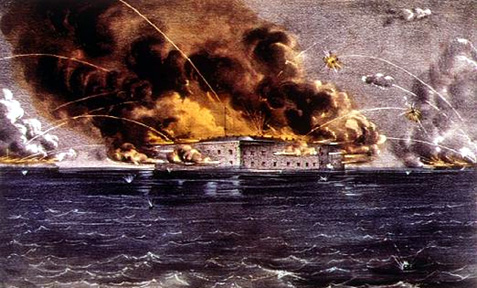
The bombardment of Fort Sumter 12-14 April 1861 (Currier & Ives, public domain).

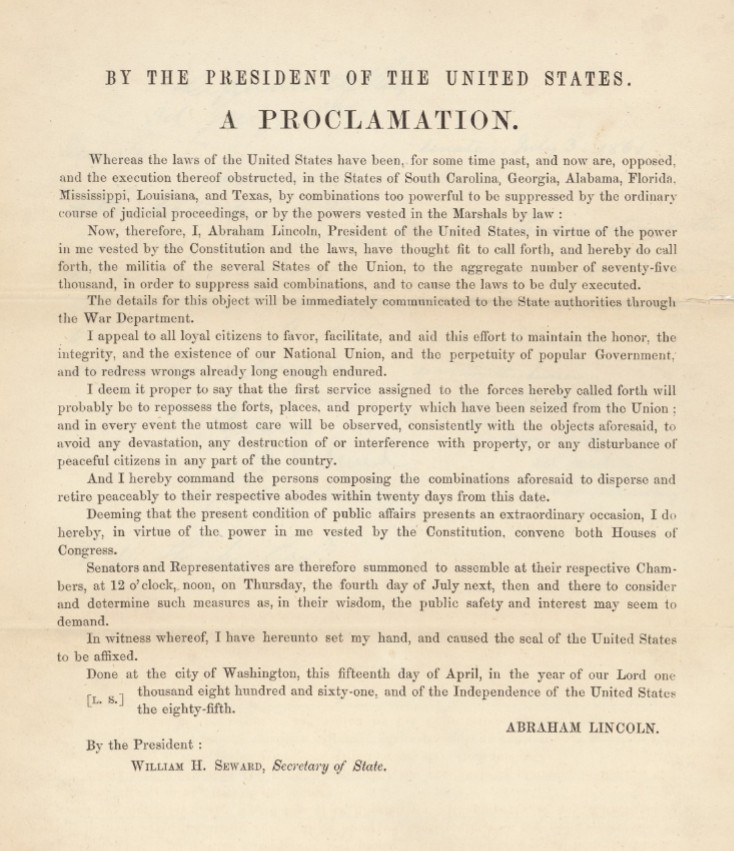
At 4:30 a.m., on April 12, 1861, artillery batteries of the Confederate States Army open fire on United States Army troops stationed at Fort Sumter in Charleston, South Carolina. A long and disastrous period of civil war begins in America.

The majority of Pennsylvanians and residents of other states throughout America who will ultimately serve with the 47th Pennsylvania Volunteer Infantry are at home, asleep in their beds — or just rising and readying themselves for their work days on family farms, as canal boatmen, in iron foundries, silk mills, tanneries or tobacco factories, as quarrymen toiling away in the slate industry, or as miners tunneling deeper inside of the Earth in poorly-lighted coal mines, along with countless other blue collar laborers who are risking their own health and safety just to keep their families housed and fed.

The 47th Pennsylvania Volunteer Infantry isn’t even “a glimmer” in anyone’s eyes — yet. (It won’t be founded until August 5, 1861.)

1862

In 1862, The Gazette, one of two hometown newspapers read by the majority of men serving with the 47th Pennsylvania Volunteer Infantry’s C Company, carries the following news in its April 12th edition:

Jeff. Davis is becoming desperate. He has issued an extraordinary Message ordering the enrollment of all citizens of the Confederate States between the ages of 18 and 35, for military service, the residue of the fighting population, above 35 to form a fighting force.

Although that particular edition of the newspaper has not yet reached the 47th Pennsylvania Volunteers who are stationed in Florida, a warning about the Confederate Conscription Act’s pending passage has likely been telegraphed by the U.S. War Department to senior officers at the 47th Pennsylvania’s headquarters at Fort Taylor in Key West in order to prepare them for the increased threat they and their troops will face.

1864

On April 12, 1864, Captain Charles William Abbott, commanding officer of the 47th Pennsylvania Volunteer Infantry’s K Company, pens a brief report from his regiment’s camp at Grand Ecore, Louisiana to his superior officers in the United States Army of the Gulf, which partially documents the losses in soldiers and supplies sustained by his regiment during the Battle of Pleasant Hill, Louisiana on April 9, 1864. That report also contains details about the regiment’s movements during this phase of duty.

Sergeant John Gross Helfrich then describes this same battle in a letter to his parents on May 5th, in which he notes:

I have learned additional news of the late fight of our boys of the “Nineteenth Corps”…. The casualties of our boys amounted to a great deal more than at first reported. The Lt. Col. of our Forty-seventh Regt. is missing, and supposed he is wounded or perhaps killed. Lt. Swoyer is dead.

1865

In a letter that he is writing to the Sunbury American on April 12, 1865 from the 47th Pennsylvania Volunteer Infantry’s camp near Summit Point, Virginia, 47th Pennsylvanian Henry D. Wharton describes a celebration that took place following the surrender at Appomattox by Confederate General Robert E. Lee and his army on April 9, 1865:

Since yesterday a week we have been on the move, going as far as three miles beyond Winchester. There we halted for three days, waiting for the return or news from Torbett’s cavalry who had gone on a reconnoisance [sic] up to the valley. They returned, reporting they were as far up as Mt. Jackson, some sixty miles, and found nary an armed reb. The reason of our move was to be ready in case Lee moved against us, or to march on Lynchburg, if Lee reached that point, so that we could aid in surrounding him and [his] army, and with Sheridan and Mead capture the whole party. Grant’s gallant boys saved us that march and bagged the whole crowd. Last Sunday night our camp was aroused by the loud road of artillery. Hearing so much good news of late, I stuck to my blanket, not caring to get up, for I suspected a salute, which it really was for the ‘unconditional surrender of Lee.’ The boys got wild over the news, shouting till they were hoarse, the loud huzzas [sic, huzzahs] echoing through the Valley, songs of ‘rally round the flag,’ &c., were sung, and above the noise of the ‘cannons opening roar,’ and confusion of camp, could be heard ‘Hail Columbia’ and Yankee Doodle played by our band. Other bands took it up and soon the whole army let loose, making ‘confusion worse confounded.’

The next morning we packed up, struck tents, marched away, and now we are within a short distance of our old quarters. – The war is about played out, and peace is clearly seen through the bright cloud that has taken the place of those that darkened the sky for the last four years. The question now with us is whether the veterans after Old Abe has matters fixed to his satisfaction, will have to stay ‘till the expiration of the three years, or be discharged as per agreement, at the ‘end of the war.’ If we are not discharged when hostilities cease, great injustice will be done.

The members of Co. ‘C,’ wishing to do honor to Lieut. C. S. Beard, and show their appreciation of him as an officer and gentleman, presented him with a splendid sword, sash and belt. Lieut. Beard rose from the ranks, and as one of their number, the boys gave him this token of esteem.

A few nights ago, an aid [sic] on Gen. Torbett’s staff, with two more officers, attempted to pass a safe guard stationed at a house near Winchester. The guard halted the party, they rushed on, paying no attention to the challenge, when the sentinel charged bayonet, running the sharp steel through the abdomen of the aid [sic], wounding him so severely that he died in an hour. The guard did his duty as he was there for the protection of the inmates and their property, with instruction to let no one enter.

The boys are all well, and jubilant over the victories of Grant, and their own little Sheridan, and feel as though they would soon return to meet the loved ones at home, and receive a kind greeting from old friends….

1866

On April 12, 1866, members of the 47th Pennsylvania Veteran Volunteers who survived the American Civil War are three months into their post-war civilian lives. Many are back home in Pennsylvania, trying to regain some sense of their old selves with normal work and family routines. Others have already left their pre-war and war lives behind, choosing to migrate west in search of better opportunities — or a certain peace of mind they hope to find in knowing they will be far away from any decision-makers who might drag their communities and nation back down into another disastrous war in the future.


Sources:

  1. Abbott, Charles W. Report from Captain Charles W. Abbott, Captain, Company K, 47th Pennsylvania Volunteer Infantry, to Senior Officers of the U.S. Army of the Gulf’s XIX Corps (19th Corps), Grand Ecore, Louisiana, April 12, 1864. Nazareth, Pennsylvania: Personal Collection of Julian Burley.
  2. Agriculture and Rural Life,” in “Stories from PA History.” Harrisburg, Pennsylvania: Pennsylvania Historical and Museum Commission, 2023.
  3. Fort Sumter and Fort Moultrie National Park.” Washington, D.C.: National Park Foundation, retrieved online April 12, 2025.
  4. Harris, Howard and Perry K. Blatz. Keystone of Democracy: A History of Pennsylvania Workers. Harrisburg, Pennsylvania: Pennsylvania Historical and Museum Commission, 1999.
  5. Helfrich, John Gross. Letter to His Parents, May 5, 1864. Mesa, Arizona: Personal Collection of the Colin Cofield Family Archives.
  6. Miller, Randall M. and William A. Pencak. Pennsylvania: A History of the CommonwealthUniversity Park, Pennsylvania: The Pennsylvania State University Press, 2002.
  7. Mining Anthracite,” in “Stories from PA History.” Harrisburg, Pennsylvania: Pennsylvania Historical and Museum Commission, 2023.
  8. Montgomery, Morton L. Early Furnaces and Forges of Berks County, Pennsylvania, in The Pennsylvania Magazine of History and Biography, 1884. Philadelphia, Pennsylvania: Historical Society of Pennsylvania, 1884.
  9. News Regarding the Confederate States’ New Conscription Order. Sunbury, Pennsylvania: The Gazette, April 12, 1862.
  10. Palladino, Grace. Another Civil War: Labor, Capital, and the State in the Anthracite Regions of Pennsylvania, 1840-1868. New York, New York: Fordham University Press, March 30, 2006.
  11. Sacher, John M. Confederate Conscription and the Struggle for Southern Soldiers. Baton Rouge, Louisiana: LSU Press, 2021.
  12. The Industrial Age,” in “Stories from PA History: Science and Invention.” Harrisburg, Pennsylvania: Pennsylvania Historical and Museum Commission, 2023.
  13. The Pennsylvania Iron Industry: Furnace and Forge of America,” in “Stories from PA History.” Harrisburg, Pennsylvania: Pennsylvania Historical and Museum Commission, 2023.
  14. The Railroad in Pennsylvania,” in “Stories from PA History.” Harrisburg, Pennsylvania: Pennsylvania Historical and Museum Commission, 2023.
  15. Timeline of Labor History in Pennsylvania.” Pennsylvania: Pennsylvania Labor History Society, retrieved online April 12, 2025.


Women’s History Month: A Look Back at the Mothers, Wives, Widows, Daughters, and Granddaughters of the 47th Pennsylvania Volunteers

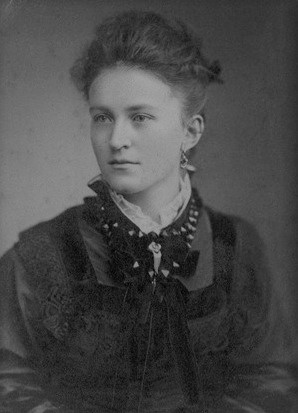
Leanna (Diehl) Hornbeck (1851-1934).

Leanna (Diehl) Hornbeck (1851-1934).

As Women’s History Month 2025 comes to a close, we take a look back at the mothers, wives, widows, daughters, and granddaughters of 47th Pennsylvania Volunteer Infantrymen who helped to preserve America’s Union and rebuild their shattered nation following the end of the American Civil War.

The backbones of their respective families, they not only kept the home fires burning while their husbands were engaged in combat far from their loving arms, they each left their own marks on the communities where they lived, and deserve to be remembered and celebrated for their own courage and resilience. Learn more about these remarkable women by watching our YouTube video, “Faces of the 47th: Wives, Widows and Daughters of the 47th Pennsylvania Volunteers,” and by reading the following biographies:

Remember their names. Be inspired by their strength. Honor the sacrifices they made for community and country.


Sources: 

  1. “Allen and Nona Albert’s Retirement a Loss to Long-Time Customers.” Tremont, Pennsylvania: The Press-Herald and The Pine Grove Herald, 12 February 1970.
  2. “Allentown Woman on the Roll of Honor: Gov. Brumbaugh Retires Mrs. Anna S. Leisenring, Factory Inspector, with Half Pay.” Reading, Pennsylvania: Reading Eagle, 20 January 1918.
  3. “Allentown Woman to Come to Reading to Inspect Bake Shops and Textile Establishments: Mrs. Annie Leisenring Is Lineal Descendant of Conrad Weiser, the Great Colonial Pioneer Who Lived Near Womelsdorf. Was First Appointed to Factory Inspection Service in 1893.” Reading, Pennsylvania: Reading Eagle, 20 May 1914.
  4. Baptismal, marriage, military, death, and burial records of the Snyder family. Pennsylvania, California, Florida, Louisiana, Nevada, Ohio, etc.: Snyder Family Archives, 1650-present and Historic Pennsylvania Church and Town Records (baptismal, marriage, death, and burial records of various churches across Pennsylvania). Harrisburg, Pennsylvania: Department of Health, Bureau of Vital Statistics, 1905-1956; and Philadelphia, Pennsylvania: Historical Society of Pennsylvania, 1776-1956.
  5. Beyerle, Emma; and Snyder, H. Corinne [sic, Corrine], Catharine R. and Lillian E., in U.S. Census (City of Reading, Fourteenth Ward, City of Reading, Berks County, Pennsylvania, 1930). Washington, D.C.: U.S. National Archives and Records Administration.
  6. Breneman, Christian K. and Margaret J., in U.S. Civil War Pension Index (application no.: 432815, certificate no.: 307318, filed by the widow from Pennsylvania on 7 July 1891). Washington, D.C.: U.S. National Archives and Records Administration.
  7. Breneman, Margaret A., Wm. L. Gardner, and Margaret J. Breneman; Victor L., Carrie I. Landis, Christian and Margaret J. Breneman, and R. M. Landis; Benj. C Breneman, Lena M. Rupley, Christian K. and Margaret J. Breneman, and Henry M. and Phoebe Rupley; Harry S. Breneman, Anna May Gebhard, C. K. and M. J. Breneman, and Jacob and Anna Gebhard, in Applications for Marriage Licenses. Harrisburg, Pennsylvania: Clerk of the Orphans’ Court of Dauphin County, Pennsylvania, 21 December 1897; 21 November 1906; 17 June 1911; and 3 October 1914.
  8. “Catharine Courtney, 89, Private Secretary” (obituary). Lancaster, Pennsylvania: Intelligencer Journal, 28 August 1995.
  9. Catharine S. Courtney, in “Clubs: York Woman Heads State Secretaries.” Lancaster, Pennsylvania: New Era, 23 April 1956.
  10. Chalkley John, in Portrait and Biographical Album of Whiteside County, Illinois, Containing Full-Page Portraits and Biographical Sketches of Prominent and Representative Citizens of the County, Together with the Portraits and Biographies of All the Governors of Illinois, and the Presidents of the United States. Chicago, Illinois: Chapman Brothers, 1863.
  11. Charles Magill and “Julian Ruston” [sic], in Certificate of Marriage. Camden, New Jersey: St. Paul’s Protestant Episcopal Church, 18 January 1887.
  12. Courtney, Charles F. and Catharine R., in Polk’s Lancaster City Directory, 1950. Boston, Massachusetts: R. L. Polk & Co., Inc., Publishers, 1950.
  13. Davis, William W. History of Whiteside County, Illinois from Its Earliest Settlement to 1908: Illustrated, with Biographical Sketches of Some Prominent Citizens of the County, vols. 1 and 2. Chicago, Illinois: Pioneer Publishing Co., 1908.
  14. “Death of a Highly Esteemed Citizen.” Allentown, Pennsylvania: The Allentown Democrat, 5 October 1898.
  15. Edwin Minnich, Juliann (Kuehner) Minnich, and George Minnich, in U.S. Civil War Widows’ Pension Files. Washington, D.C.: U.S. National Archives and Records Administration, 1865-1901.
  16. Explaining Trends in the Gender Wage Gap: A Report by The Council of Economic Advisors.” Washington, D.C.: The White House, June 1998.
  17. “Funeral of Mrs. Mary B. Moyer from Her Late Home on East Market Street,” in “Green Ridge Items.” Scranton, Pennsylvania: The Scranton Tribune, 9 December 1901.
  18. Fusselman, Daniel, Catherine, Celistia [sic, Salista], Catherine, John W. R., Caroline, Mary E., and Sarah, in U.S. Census (East Waterford, Tuscarora Township, Juniata County, Pennsylvania, 1860). Washington, D.C.: U.S. National Archives and Records Administration.
  19. Fusselman, Daniel (father), Kate, John, Caroline, Emna Sarah, Daniel (son), Amanda, Rosa, and Josiah, in U.S. Census (McCullochs Mills, Tuscarora Township, Juniata County, Pennsylvania, 1870). Washington, D.C.: U.S. National Archives and Records Administration.
  20. Fusselman, Daniel and Catharine, in U.S. Civil War Pension Files (application no.: 254530, certificate no.: 315939, filed from Pennsylvania by the veteran, 8 May 1878; application no.: 250052, certificate no.: 347812, filed by the veteran’s widow, 20 August 1879). Washington, D.C.: U.S. National Archives and Records Administration.
  21. Gordon, Elizabeth Putnam. Women Torch-Bearers: The Story of the Woman’s Christian Temperance Union. Evanston, Illinois: National Woman’s Christian Temperance Union Publishing House, 1924.
  22. Holland Farmer Passed Away Friday.” Abilene, Kansas: Abilene Daily Reflector, 29 August 1914.
  23. “John Family Papers, 1775-1951” (RG5/077). Swarthmore, Pennsylvania: Friends Historical Library of Swarthmore College.
  24. John, Clark E. History and Family Record of the “John” Family, 1683 to 1964: The Descendants of John Phillips and Ellen, His Wife, from Haverfordwest, Pembrokeshire, Wales. Salt Lake City, Utah: Genealogical Society of the Church of Latter Day Saints, 1967.
  25. John, Don D. and Helen Doup John. “Eliza John Diary from 1839 to 1863: An Historical and Genealogical Record of the Quakers in Northumberland County, Pennsylvania and What Befell Them,” in Historical Collections of the John Family in America, 1950. Louisville, Kentucky: J. D. John, Self-published, 1951.
  26. John, George D., Mary Alice John, Elida P. John, Sarah Hughes, and Sidney A. John, in Illinois Deaths and Stillbirths, 1916-1947 (database via Public Board of Health, Archives, Springfield, Illinois, Family History Library microfilm 1,614,419, 1,786,728 and 1,818,801; dates: 1928, 1937, 1938). Salt Lake City, Utah: Family History Library.
  27. Leanna D. Hornbeck, in Illinois Deaths and Stillbirths, 1916–1947. Salt Lake City, Utah: FamilySearch, 1934.
  28. Leanna D. Hornbeck, in U.S. Passport Applications (No. 5492 on Roll No. 184). Washington, D.C.: U.S. Department of State, Bureau of Citizenship and U.S. National Archives, 10 May 1913.
  29. Lecture Presentation by Annie E. Leisenring, in “Addresses and Discussions: Fourth Annual Welfare and Efficiency Conference, Pennsylvania Department of Labor and Industry, November 21, 22, 23, 1916.” Harrisburg, Pennsylvania: Monthly Bulletin of the Pennsylvania Department of Labor and Industry, William Stanley Ray, State Printer, March 1917.
  30. Leisenring, Annie, in U.S. Census of Union Veterans and Widows of the Civil War. Washington, D.C. and Pennsylvania: 1890.
  31. Leisenring, Annie E., in United States Veterans Administration Pension Payment Cards (Certificate No.: 240043). Washington, D.C.: U.S. National Archives and Records Administration, 1887-1920.
  32. Letter from Key West (from “W. D. C. R., Chaplain, Forty-seventh Regiment, P. V.”; dated 13 March 1862). Philadelphia, Pennsylvania: The Press, 31 March 1862, front page.
  33. Lewis, Jim. “Not Forgotten: She Was Both Pediatrician and Pioneer” (obituary of Sandra Rowan, MD, one of the children cared for by Lillie May Snyder). Reading, Pennsylvania: Reading Eagle, 16 July 2016.
  34. “Lillian Snyder, 92, Was Registered Nurse” (obituary of H. Corrine Snyder’s younger sister, Lillian Estelle Snyder). Lancaster, Pennsylvania: Intelligencer Journal, 9 June 2001.
  35. “Local Group Returns from Tour of Orient” (photo with article about the travels of Catharine R. (Snyder) Courtney and friends). Lancaster, Pennsylvania: Intelligencer Journal, 2 April 1963.
  36. “Many Attend Funeral of Stephen J. Moyer.” Scranton, Pennsylvania: The Scranton Tribune, 9 August 1915.
  37. Maurer, Russ. “Lavelle Telegraph Telephone Company Charted in 1908,” in “Memories of Russ Maurer.” Hegins, Pennsylvania: The Citizen-Standard, circa 1990s.
  38. “Minick, Julia A. (nee) Megill, Julia A.” [sic], in U.S. Civil War Pension General Index Cards, 1896. Washington, D.C.: U.S. National Archives and Records Administration.
  39. Minnich, Capt. Edwin G. and Mrs. Julia (Kuehner) Minnich (images and military paperwork). Pennsylvania: Personal Collection of Chris Sapp.
  40. “Miss Nona Snyder Is Married Today to Pine Grove Man” (article describing the wedding ceremony of Nona M. Snyder and Allen A. Albert). Lebanon, Pennsylvania: Lebanon Daily News, 23 September 1953.
  41. Mrs. Julia Magill, in “Prominent Army Nurses,” in “The National Association of Army Nurses of the Civil War.” Washington, D.C.: The Evening Times, Wednesday, October 8, 1902.
  42. “Mrs. Margaret J. Breneman” (obituary). Harrisburg, Pennsylvania: Harrisburg Telegraph, 20 March 1930.
  43. “Nona Albert” (obituary). Lebanon, Pennsylvania: The Daily News, 3 June 1960.
  44. Notice of Mrs. Henry Hornbeck’s Return from Chicago. Allentown, Pennsylvania: The Allentown Democrat, 23 September 1909.
  45. Occupational Outlook Handbook, 1959 Edition, pp. 239-249, in Bulletin No. 1255. Washington, D.C.: United States Department of Labor, 1959.
  46. Rodrock, William D. C. and Julia M. Rodrock, in U.S. Civil War Pension Index (application no.: 296549, certificate no.: 260499, filed by the veteran on 17 July 1879; application no.: 793449, certificate no.: 574458, filed by the veteran’s widow from New Jersey on 24 October 1903). Washington, D.C.: U.S. National Archives and Records Administration.
  47. “Shopping Nights Are Agreed Upon.” Allentown, Pennsylvania: The Allentown Leader, 17 December 1917.
  48. Smalser, Robert. Letter of Mary Barbara (Nyhart) Moyer to her husband, Stephen J. Moyer, and photographs of Stephen J. and Mary Moyer and their children. Seabeck, Washington: Personal Collection of Col. Bob Smalser (used with permission).
  49. Snyder, Catharine, John, Timothy, Lillie, and Salome, in A Directory of the Eleventh Census of the Population of Schuylkill County, Giving the Names and Ages of Males and Females, Published by Cities, Boroughs, Wards, Townships, Precincts or Towns, in Connection with a Business Directory of the Same for Advertising Purposes. Lebanon, Pennsylvania: E. A. Schartel, Publisher, 1891.
  50. Snyder, Catharine R. and Courtney, Charles F., in “Massachusetts Vital Records Index to Marriages” (documentation of the marriage of H. Corrine Snyder’s younger sister, Catharine, in Boston in 1947). Boston, Massachusetts: New England Historic Genealogical Society.
  51. Snyder, Catharine R. and Lillian, E., in The Boston Directory for the Year Commencing July 1, 1942 (Boston Massachusetts, 1942). Chicago, Illinois: R. L. Polk Publishers, 1942.
  52. Snyder, Corrine and Catharine, in Reading City Directory, 1926. Reading, Pennsylvania: Boyd’s City Directories.
  53. Snyder, Corrine, Lillian E. and Catharine R., in U.S. Census (City of Reading, Fourteenth Ward, Berks County, Pennsylvania, 1940). Washington, D.C.: U.S. National Archives and Records Administration.
  54. Snyder, H. Corrine, in U.S. Census (Allentown, Lehigh County, Pennsylvania, 1950). Washington, D.C.: U.S. National Archives and Records Administration.
  55. Snyder, John H., Minnie R., Timothy P. and Nona M., in U.S. Census (Butler Township, Schuylkill County, Pennsylvania, 1900). Washington, D.C.: U.S. National Archives and Records Administration.
  56. Snyder, John H., Minnie R., Timothy P., Nona M., H. Corrine, John S., Catharine R., and Lillian E., in U.S. Census (Lavelle, Northwest Butler Township, Schuylkill County, Pennsylvania, 1910). Washington, D.C.: U.S. National Archives and Records Administration.
  57. Snyder, John H., Minnie, Nona M., John S., and Willard E. in U.S. Census (Butler Township, Schuylkill County, Pennsylvania, 1930). Washington, D.C.: U.S. National Archives and Records Administration.
  58. Snyder, John H., Minnie R., Nona, Corrine, John S., Catharine R., Lillian E., Chester H., and Willard E. in U.S. Census (Butler Township, Schuylkill County, Pennsylvania, 1920). Washington, D.C.: U.S. National Archives and Records Administration.
  59. Snyder, Lillie May, in Gibson & Sanders Funeral Home Records (1956). Reading, Pennsylvania: Sanders Funeral Home, retrieved in 2011.
  60. Snyder, Miss Lillie (obituary and funeral notice). Reading, Pennsylvania: Reading Eagle, 16 and 18 May 1956.
  61. “Stephen J. Moyer,” in “Deaths.” Scranton, Pennsylvania: The Scranton Tribune, 6 August 1915.
  62. “Veterans Who Will Be at the G.A.R. Celebration Owe Their Lives to the Heroic Self-Sacrifice of These Wgomen Nurses.” Philadelphia, Pennsylvania: The Philadelphia Times, Sunday, 20 August 1899.
  63. “Violate Child Labor Law: One Employer Heavily Fined and Others to Be Arrested. Special to The Telegraph.” Harrisburg, Pennsylvania: Harrisburg Telegraph, 8 September 1911.
  64. Wattenberg, Ben. “FMC Program Segments 1900-1930: Infant and Maternal Mortality,” in “The First Measured Century.” Washington, D.C.: PBS, 2000 (retrieved online 14 February 2025).
  65. “W.C.T.U. Convention,” in “Frackville News.” Shenandoah, Pennsylvania: Evening Herald, 30 September 1950.
  66. “Will of Henry J. Hornbeck.” Allentown, Pennsylvania: The Allentown Democrat, 19 October 1898.


Music of the American Civil War Era

“The Songs of the War,” Homer Winslow (Harper’s Weekly, November 23, 1861, public domain; click image to enlarge).

“Music has done its share, and more than its share, in winning this war.” — Major-General Philip H. Sheridan


“The Civil War played an instrumental role in the development of an American national identity,” according to historians at the Smithsonian Institution in Washington, D.C. “Specifically for American folk music, the war inspired songwriting on both sides of the conflict, as amateurs and professionals wrote new, timely lyrics to old English, Scottish, and Irish ballads as well as original compositions.”

That new music, in turn, inspired one American artist, Winslow Homer, to capture the support he was witnessing and hearing for the United States government and its Union Army defenders during the mid-nineteenth century — support that was conveyed through the enthusiastic singing of pro-Union songs by soldiers, abolitionists and others who had dedicated themselves to the preservation of America’s Union and the eradication of the brutal practice of chattel slavery.

His sketch, “The Songs of the War,” which first appeared in print in the November 23, 1861 edition of Harper’s Weekly, featured seven of the most popular songs during the first year of the American Civil War: “The Bold Soldier Boy,” “Hail to the Chief,” “We’ll Be Free and Easy Still,” “Rogue’s March,” “Glory Hallelujah,” “The Girl I Left Behind Me,” and “Dixie.”

“The Bold Soldier Boy,” excerpt from the illustration, “The Songs of the War” (Winslow Homer, Harper’s Weekly, November 23, 1861, public domain).

“The Bold Soldier Boy” was an old folk song that had been arranged by multiple composers in different ways throughout the nineteenth century prior to Homer’s first hearing of it. The specific variant of the tune that sparked Homer’s imagination as he drew the scene in the upper left corner of “The Songs of the War” was most likely the version that had been arranged by S. Lover and William Dressler. Published by Wm. Hall & Son of New York in 1851, that variant was one of the selections that was included in book one of Dressler’s Scraps of Melody for Young Pianists.

According to Dressler’s obituary in the The Brooklyn Daily Eagle, William Dressler had created this arrangement shortly after his emigration to the United States. A native of Nottingham, England, he was a son of the “court flutist to the King of Saxony” and an 1847 graduate of the Cologne Conservatory of Music in Germany, and had become well-known across the United States as an “organist and professor of music.”

“Hail to the Chief,” excerpt from “The Songs of the War” (Winslow Homer, Harper’s Weekly, November 23, 1861).

“Hail to the Chief,” has since become familiar to generations of Americans as the triumphal tune performed by the United States Marine Band (“The President’s Own“) to herald the arrival of presidents of the United States at State of the Union addresses presented to the United States Congress, as well as other functions of the United States government. According to military music historian Jari Villaneuva, this particular piece of music “was already very popular when the Marine Band played it from a barge for the opening of the Chesapeake and Ohio Canal on July 4, 1828, in the presence of President John Quincy Adams.”

During the American Civil War, “Hail to the Chief” was frequently performed by the bands of state and federal military regiments to announce the arrival of Union Army generals at special events, including the often well-attended public ceremonies when generals reviewed their troops. On September 17, 1861, for example, the Lancaster Intelligencer noted that Major-General George B. McClellan was greeted with a performance of “Hail to the Chief” as he arrived with a group of dignitaries at the camp of the Seventy-Ninth New York Volunteer Infantry on September 10.

“We’ll Be Free and Easy Still,” excerpt from “The Songs of the War” (Winslow Homer, Harper’s Weekly, November 23, 1861, public domain).

With his scene, “We’ll Be Free and Easy Still,” Homer was referencing a song that had been promoted in broadside advertisements in London, England as far back as 1832. The song had been made popular thanks to its frequent performance in music halls across Great Britain during the 1840s.

According to historians at the U.S. Library of Congress, the melody was included as “Free and Easy,” in a medley of songs for cornet that was arranged by David L. Downing circa 1861 for concert band performance, and had been included in one of the manuscript books of the Manchester Cornet Band.

The source for the tune appears to have been the chorus of “‘Gay and Happy.’ Composed and sung by Miss Fanny Forrest (with unbounded applause) (Baltimore: Henry McCaffrey [1860])…. This version, or one similar to it, was almost certainly what Winslow Homer had in mind:

I’m the lad that’s free and easy,
Wheresoe’er I chance to be;
And I’ll do my best to please ye,
If you will but list to me.

Chorus.–So let the world jog along as it will,
I’ll be free and easy still….

“We’ll Be Free and Easy Still” had become so popular by the mid-nineteenth century, in fact, that composer Stephen Foster referenced it in his 1866 song, “The Song of All Songs.

“Rogue’s March,” excerpt from “The Songs of the War” (Winslow Homer, Harper’s Weekly, November 23, 1861, public domain).

Rogue’s March can be traced to an even earlier time — the mid-eighteenth century. It “was one of the most widespread and recognized melodies in martial repertory of the era,” according to Andrew Kuntz and Valerio Pelliccioni, creators of The Traditional Tune Archive. Also known as “Poor Old Robinson Crusoe,” this English march in G Major “was played in the British and American armies when military and civil offenders and other undesirable characters were drummed from camps and cantonments, sometimes with a halter about their necks, sometimes with the final disgrace of a farewell ritual kick from the regiment’s youngest drummer.” Also according to Kuntz and Pelliccioni:

[T]he actual ceremony consisted of as many drummers and fifers as possible (to make it the more impressive) [who] would parade the prisoner along the front of the regimental formation to this tune, and then to the entrance of the camp. The offender’s coat would be turned inside out as a sign of disgrace, and his hands were bound behind him…. The sentence would then be published in the local paper.

The fifers and drummers of the 47th Pennsylvania Volunteer Infantry were actually called upon to play the “Rogue’s March” during the punishment and dismissal of one of their regiment’s own while the 47th Pennsylvania Volunteers were preparing for the regiment’s departure for America’s Deep South. According to regimental historian Lewis Schmidt, the public shaming of Private James C. Robinson of the 47th Pennsylvania’s Company I began at 10 a.m. on Monday, January 27, 1862, at the United States Naval Academy in Annapolis, Maryland, where the regiment was briefly stationed.

The regiment was formed and instructed by Lt. Col. Alexander ‘that we were about drumming out a member who had behaved himself unlike a soldier.’ …. The prisoner, Pvt. James C. Robinson of Company I, was a 36 year old miner from Allentown who had been ‘disgracefully discharged’ by order of the War Department. Pvt. Robinson was marched out with martial music playing and a guard of nine men, two men on each side and five behind him at charge bayonets. The music then struck up with ‘Robinson Crusoe’ as the procession was marched up and down in front of the regiment, and Pvt. Robinson was marched out of the yard.

“Glory Hallelujah,” excerpt from “The Songs of the War” (Winslow Homer, Harper’s Weekly, November 23, 1861, public domain).

“Glory Hallelujah” was almost certainly a reference to the chorus verse of the “Battle Hymn of the Republic,” the song which quickly became an anthem for the Union Army after the lyrics were written by abolitionist and suffragist Julia Ward Howe during November 1861. Set to the melody (and partially derived from the lyrics) of “John Brown’s Body,” a song sung often by Union soldiers during the earliest months of the war, Howe’s “Battle Hymn” was published in The Atlantic Monthly in February 1862 and remains one of the most popular patriotic songs in the United States.

The chorus of “Glory Hallelujah” was also then employed by Mrs. M. A. Kidder in an arrangement for piano by Augustus Cull of “Brave McClellan Is Our Leader Now, or Glory Hallelujah!“, which was published by Horace Waters of New York in 1862.

“The Girl I Left Behind Me,” excerpt from “The Songs of War” (Winslow Homer, Harper’s Weekly, November 23, 1861, public domain).

Dating back to the 1700s, “The Girl I Left Behind Me” was derived from a popular Irish folk tune that reportedly served as the melody for multiple popular and military songs during the eighteenth and ninetenth centuries, according to Kuntz and Pelliccioni.

There are a few literary references to the song or melody. For example, “The Girl I Left Behind Me,” clearly a reference to the military use of the song, was the title of a chapter (XXX) in William Makepeace Thackeray’s Vanity Fair (1848)…. The English novelist Thomas Hardy, himself an accordianist and fiddler, mentioned the tune in scene notes to The Dynasts….

James Fenimore Cooper mentions the tune in his novel of the sea, The Pilot (1824)….

“The Girl I Left Behind Me” has a long and illustrious history in America…. [I]t appears in Riley’s Flute Melodies, published in several volumes in New York beginning in 1814…. The melody appears in Bruce and Emmett’s Drummers’ and Fifers’ Guide, published in 1862 to help codify and train the hordes of new musicians needed for service in the Union Army early in the American Civil War. Therein it is remarked: “This air and (drum) beat is generally played at the departure of the soldiers from one city (or camp) to another….

“Dixie,” excerpt from “The Songs of the War” (Winslow Homer, Harper’s Weekly, November 23, 1861, public domain).

The final song that Homer chose to include in his pro-Union music montage, “Dixie” (an anthem of the Confederacy), might seem to have been an odd choice on his part, were in not for the way in which he chose to illustrate it. In the foreground, a free Black man looks thoughtfully off into the distance as he sits atop a barrel labeled with the word, “Contraband,” while a still-enslaved Black man struggles to move a heavy bale of cotton in the background, his body buckling from the burden he shoulders. That image was Homer’s powerful way of reminding Harper’s Weekly readers that, although some progress had already been made in the fight against the brutal practice of chattel slavery in parts of the United States, that fight was not yet won in “Dixie,” where many who were still enslaved continued to suffer greatly.


Sources:

  1. Band Instruments,” in “Collection: Band Music from the Civil War Era.” Washington, D.C.: U.S. Library of Congress, retrieved online January 17, 2025.
  2. Band Music,” in “Collection: Band Music from the Civil War Era.” Washington, D.C.: U.S. Library of Congress, retrieved online January 17, 2025.
  3. Baxter, John. “Free and Easy,” in “Folk Song and Music Hall.” Self-published, John Baxter, retrieved online January 17, 2025.
  4. “Brave McClellan Is Our Leader Now, or Glory Hallelujah!”, in “New Music,” in “Local Items.” Brooklyn, New York: The Brooklyn Daily Times, 9 February 1862.
  5. Brave McClellan Is Our Leader Now, or Glory Hallelujah!”, in “Notated Music.” Washington, D.C.: U.S. Library of Congress, retrieved online January 17, 2025.
  6. Civil War Music: Dixie.” Washington, D.C.: American Battlefield Trust, retrieved online January 17, 2025.
  7. “Free and Easy,” in “A Concert for Brass Band Voice and Piano,” in “Band Music from the Civil War Era.” Washington, D.C.: U.S. Library of Congress, retrieved online January 17, 2025.
  8. Homer, Winslow. “The Songs of the Civil War.” New York, New York: Harper’s Weekly, November 23, 1861.
  9. Kuntz, Andrew and Valerio Pelliccioni. “Rogue’s March.” Wappingers Falls, New York and Basiano, Italy: The Traditional Tune Archive, November 14, 2024.
  10. Kuntz, Andrew and Valerio Pelliccioni. “The Girl I Left Behind Me.” Wappingers Falls, New York and Basiano, Italy: The Traditional Tune Archive, December 22, 2024.
  11. McCollum, Sean. “Battle Hymn of the Republic: The Story Behind the Song.” Washington, D.C.: The Kennedy Center, September 17, 2019.
  12. “Pennsylvanians at Washington” (performance of “Hail to the Chief” to honor Major-General George B. McClellan). Lancaster, Pennsylvania: Lancaster Intelligencer, September 17, 1861.
  13. Songs of the Civil War,” in “Smithsonian Folkways Recordings.” Washington, D.C.: Smithsonian Institution, retrieved online January 17, 2025.
  14. The Bold Soldier Boy,” in “Notated Music.” Washington, D.C.: U.S. Library of Congress, retrieved online January 17, 2025.
  15. “The Bold Soldier Boy,” in Scraps of Melody for Young Pianists, in “New Music.” Cleveland Ohio: Morning Daily True Democrat, December 25, 1861.
  16. The Civil War Bands,” in “Collection: Band Music from the Civil War Era.” Washington, D.C.: U.S. Library of Congress, retrieved online January 17, 2025.
  17. Thomas, Anne Elise. “Music of the Civil War.” Washington, D.C.: The Kennedy Center, retrieved online January 17, 2025.
  18. Thompson, Beth. in “The Song of All Songs,” in “Beth’s Notes: Supporting and Inspiring Music Educators.” Self-published: Beth Thompson, retrieved online January 17, 2025.
  19. Villanueva, Jari. “Hail to the Chief.” Catonsville, Maryland: TapsBugler, January 17, 2025.
  20. “William Dressler” (obituary). Brooklyn, New York: The Brooklyn Daily Eagle, July 3, 1914.


The Thanksgiving Messages of Pennsylvania’s Civil War-Era Governor, Andrew Gregg Curtin

Andrew Gregg Curtin, Governor, Commonwealth of Pennsylvania, circa 1860 (public domain).

Proclamation of a Day of Thanksgiving. – 1862.

Pennsylvania, ss.
(Signed) A. G. Curtin.

IN THE NAME AND BY the Authority of the Commonwealth of Pennsylvania, Andrew G. Curtin, Governor of the said Commonwealth.

A PROCLAMATION.

Whereas, It is a good thing to render thanks unto God for His Mercy and loving kindness:

Therefore, I, Andrew G. Curtin, Governor of the Commonwealth of Pennsylvania, do recommend that Thursday the 27th day of November next, be set apart by the people of this Commonwealth, as a day of solemn Prayer and Thanksgiving to the Almighty: – Giving Him thanks that He has been graciously pleased to protect our free institutions and Government, and to keep us from sickness and pestilence; and to cause the earth to bring forth her increase, so that our garners are choked with the harvest; and to look so favorably on the toil of His children, that industry has thriven among us and labor had its reward; and also that He hath delivered us from the hands of our enemies, and filled our officers and men in the field with a loyal and intrepid spirit and given them victory; and that He has poured out upon us (albeit unworthy) other great and manifold blessings:

Beseeching Him to help and govern us, in his steadfast fear and love, and to put into our minds good desires, so that by His continued help we may have a right judgement in all things:

And especially praying Him to give to Christian churches grace to hate the thing which is evil, and to utter the teachings of truth and righteousness, declaring openly the whole counsel of God:

And most heartily entreating Him to bestow upon our Civil Rulers, wisdom and earnestness in council and upon our military leaders zeal and vigor in action, that the fires of rebellion may be quenched, that we, being armed with His defense, may be preserved from all perils, and that hereafter our people living in peace and quietness, may, from generation to generation, reap the abundant fruits of His mercy; and with joy and thankfulness praise and magnify His holy name.

Given under my Hand and the Great Seal of the State at Harrisburg, this twentieth day of October in the year of our Lord, one thousand eight hundred and sixty two, and the Commonwealth, the eighty-seventh.

By the Governor:

Eli Slifer,
Secretary of the Commonwealth.


Thanksgiving Proclamation. – 1863.

Pennsylvania, ss.
(Signed) A. G. Curtin

IN THE NAME AND BY the Authority of the Commonwealth of Pennsylvania, Andrew G. Curtin, Governor of the said Commonwealth.

A PROCLAMATION.

Whereas, The President of the United States, by his proclamation, bearing, date on the third day of this month, has invited the citizens of the United States to set apart Thursday, the twenty-sixth day of November next, as a day of Thanksgiving and Prayer, now I, Andrew G. Curtin, Governor of the Commonwealth of Pennsylvania, do hereby recommend, that the people of Pennsylvania do set apart and observe the said day accordingly, and that they do especially return thanks to Almighty God, for the gathered harvests of the fruits of the earth;

For the prosperity with which He has blessed the Industry of our people;

For the general health and welfare which He has graciously bestowed upon them;

And for the crowning mercy by which the blood-thirsty and devastating enemy was driven from our soil by the valor of our brethren freemen of this and other States;

And that they do especially pray for the continuance of the blessings which have been heaped upon us by the Divine Hand;

And for the safety and welfare and success of our brethren in the field, that they may be strengthened to the overthrow and confusion of the rebels now in arms against our beloved country;

So that peace may be restored to all our borders, and the Constitution and laws of the land be everywhere within them re-established and sustained.

Given under my Hand and the Great Seal of the State at Harrisburg, this twenty-eighth day of October in the year of our Lord, one thousand eight hundred and sixty-three and of the Commonwealth, the eighty-eighth.

By the Governor:

Eli Slifer,
Secretary of the Commonwealth.


Thanksgiving Proclamation. – 1864.

Pennsylvania, ss.
(Signed) A. G. Curtin.

IN THE NAME AND BY the Authority of the Commonwealth of Pennsylvania, Andrew G. Curtin, Governor of the said Commonwealth.

A PROCLAMATION.

Whereas, It is the honored custom of Pennsylvania to set apart, on the recommendation of the Executive, a day for returning thanks to the Giver of all Good, the Shepherd and Bishop of our Souls: Now, therefore,

I, Andrew G. Curtin, Governor as aforesaid, do recommend that the people throughout the Commonwealth observe Thursday, the twenty-fourth day of November instant, as a day of Thanksgiving to Almighty God,

For the gathered fruits of the earth;

For the continuance of health;

For the prosperity of industry;

For the preservation of good order and tranquility throughout our borders;

For the victories which He has vouchsafed to us over armed traitors,

And for the manifold blessings which he has heaped upon us, unworthy.

And that they do, moreover, humbly beseech Him to renew and increase his merciful favor to us during the year to come, so that rebellion being overthrown, peace may be restored to our distracted country, and, in every State, with grateful and loving accord, the incense of Praise and Thanksgiving may be offered by all the people unto His Holy Name.

Given under my Hand and the Great Seal of the Commonwealth at Harrisburg, this second day of [L. S.] November in the year of our Lord one thousand eight hundred and sixty-four and of the Commonwealth, the eighty-ninth.

By the Governor:

Eli Slifer,
Secretary of the Commonwealth.


Proclamation By the Governor.
The 7th of December Appointed a State Thanksgiving Day.

PROCLAMATION.

With feelings of the most profound gratitude to Almighty God, I invite the good people of the Commonwealth to meet in their places of public worship, on Thursday, the seventh day of December next, and raise their hearts and voices in praise and thanksgiving to Him, not only for the manifest ordinary blessings which, during the past year, He has continued to heap upon us,

For abundant and gathered harvests;

For thriving industry;

For general health;

For domestic good order and government;

But also most expressly and fervently for His unequalled goodness in having so strengthened and guarded our people during the last four years that they have been able to crush to the earth the late wicked rebellion–to exterminate the system of human slavery, which caused it.

As we wrestled in prayer with Him in the dark time of our trouble, when our brothers and sons were staking life and limb for us on a bloody field, or suffering by torture or famine in the hells of Andersonville or the Libby, so now, when our supplications have been so marvellously [sic, marvelously] and graciously answered, let us not withhold from Him the homage of our thanksgiving.

Let us say to all, “Choose, ye, this day, whom he will serve, but for us and our house, we will serve the Lord.”

Great Seal of the Commonwealth of Pennsylvania (public domain).

Come, then, ye people whom He hath so helped and led; come, ye war-worn and mutilated men whom He hath spared to return to your dear homes, let us throng the gates of His temples; let us throw ourselves on the knees of our hearts with a wilful joy at the foot of His throne, and render aloud our praise and thanksgiving to Him, because He hath made the right to prevail; because He hath given us the victory; because he has cleansed our land from the stain of human slavery, and because He hath graciously shown forth in the eyes of all men the great truth that no government is so strong as a republic controlled under His guidance by an educated, moral and religious people.

By the Governor:

Eli Slifer,
Secretary of the Commonwealth.
Harrisburg, November 7, 1865.


Sources:

  1. Curtin, Andrew Gregg. Proclamation of a Day of Thanksgiving – 1862, in Pennsylvania Archives: Fourth Series, Vol. VIII: Papers of the Governors, 1858-1871, Samuel Hazard, John Blair Lynn, William Henry Egle, et. al., editors. Harrisburg, Pennsylvania: Wm. Stanley Ray, State Printer, 1902.
  2. “Thanksgiving Proclamation.” Reading, Pennsylvania: Gazette and Democrat, November 21, 1863.
  3. “In the Name and by the Authority of the Commonwealth of Pennsylvania, Andrew G. Curtin, Governor of Said Commonwealth: A Proclamation.” Harrisburg, Pennsylvania: Daily Telegraph, November 10, 1864.
  4. “Proclamation by the Governor.” Philadelphia, Pennsylvania: The American Presbyterian, November 10, 1865.


Research Update: New Details Learned About Abraham Jassum, One of Nine Formerly Enslaved Men Who Enlisted with the 47th Pennsylvania Volunteers

Enlistment form for Abraham Jassum, Undercook, 47th Pennsylvania Volunteers, 5 October 1862, p. 1 (Compiled Military Service Records, U.S. National Archives and Records Administration, public domain; click to enlarge).

Fleeing the brutal practice of chattel slavery in South Carolina during the fall of 1862, a Black youth walked into a recruiting station for the Army of the United States in Beaufort, South Carolina and told an officer there that he wanted to become a soldier. His name, according to his enlistment paperwork, was Abraham Jassum, and he was just sixteen years old.

Sadly, much of that teenager’s life has remained a mystery that has stubbornly resisted unraveling–until now. Thanks to documents recently copied by the U.S. National Archives for 47th Pennsylvania Volunteers: One Civil War Regiment’s Story, researchers now know that Abraham Jassum was born into slavery in Charleston, South Carolina sometime around 1846.

Although specific details about what happened to this teenager between the dates of his birth and army enlistment have not yet been found, researchers do already have several ideas. One theory is that Abraham’s surname was not actually “Jassum” because that surname does not appear to have been present on any federal census records for any plantation owners or other enslavers in South Carolina between 1840 and 1860, nor was it used for any Black Freedmen in South Carolina on federal census records that were completed after the American Civil War. Furthermore, there appear to be no U.S. Civil War Pension records that exist for any soldier with the surname of “Jassum.”

Another theory is that, by the time that Abraham reached the age of sixteen, he had been transported to Beaufort to be used as an enslaved laborer there (or was “sold as property” by his enslaver in Charleston to a plantation owner or other enslaver near Beaufort), and that he was freed by Union soldiers when Beaufort was occupied by the Union Army.

Fortunately, the Compiled Military Service Records (CMSR) file for Abraham Jassum does contain important details about his life between October 1862 and October 1865.

Bay Street Looking West, Beaufort, South Carolina, circa 1862 (Sam A. Cooley, 10th Army Corps, photographer, public domain).

What is known for certain is that he enlisted for military service on October 5, 1862 as an “undercook“–a designation that was first authorized for use by regiments serving with the Army of the United States by the U.S. War Department. Examined and certified as fit for duty by William F. Reiber, M.D., an assistant regimental surgeon with the 47th Pennsylvania Volunteer Infantry, Abraham Jassum was then assigned to the 47th Pennsylvania Volunteers’ F Company.

Military records at the time of his enlistment noted that he was five feet, six inches tall and had black hair, black eyes and a black complexion. Muster sheets subsequently described him as a “Negro.”

During his three-year term of enlistment, he traveled with the 47th Pennsylvania to its battle, garrison, occupation, and other duty assignments in Florida, Louisiana, Virginia, Washington D.C., and South Carolina. While stationed with his regiment in Louisiana, he was documented as having been officially mustered into the regiment in June 1864, along with the other Black soldiers of the 47th Pennsylvania.

Additional military records of the 47th Pennsylvania Volunteer Infantry confirm Abraham Jassum’s service in 1864 and 1865, describing him as a “cook” or as a “private,” which appears to indicate that he may have been promoted at some point prior to his honorable discharge.

Issued his honorable discharge paperwork on October 4, 1865, while his regiment was assigned to Reconstruction-related duties in Charleston, South Carolina, he was given a small travel allowance to enable him to return to his place of enlistment (Beaufort, South Carolina), which seems to indicate that he chose to settle in Beaufort, at least initially, rather than remaining in the city where he had been born (Charleston), and instead of relocating north with his former regiment when it returned to Pennsylvania.

Researchers will continue to search for records that can shed more light on what happened to Abraham Jassum after the war, and will post updates if and when new data is uncovered.


Sources:

  1. Bates, Samuel P. History of Pennsylvania Volunteers, 1861-5, vol. 1. Harrisburg, Pennsylvania: B. Singerly, State Printer, 1869.
  2. Jassum, Abraham, in Civil War Veterans’ Card File, 1861-1866 (Company F, 47th Pennsylvania Infantry). Harrisburg, Pennsylvania: Pennsylvania State Archives.
  3. Jassum, Abraham, Civil War Muster Rolls (Company F, 47th Pennsylvania Infantry). Harrisburg, Pennsylvania: Pennsylvania State Archives.
  4. Jassum, Abraham, in Compiled Military Service Records (Company F, 47th Pennsylvania Volunteer Infantry). Washington, D.C.: U.S. National Archives and Records Administration.
  5. Jassum, Abraham, in Registers of Pennsylvania Volunteers, 1861-1865 (Company F, 47th Pennsylvania Infantry), in Records of the Department of Military and Veterans’ Affairs (RG-19). Harrisburg, Pennsylvania: Pennsylvania State Archives.
  6. Schmidt, Lewis. A Civil War History of the 47th Regiment of Pennsylvania Veteran Volunteers. Allentown, Pennsylvania: Self-published, 1986.


The Backbones of a Nation: The Laborers Who Enlisted with the 47th Pennsylvania Volunteer Infantry

“Labor Is Life” (U.S. Postal Service’s Labor Day Stamp, 1956, U.S. Library of Congress, public domain).

Bakers, blacksmiths, boatmen, butchers, carpenters, cabinetmakers, cigarmakers, coal miners, factory workers, farmers, gardeners, gold miners, iron workers, masons, quarry workers, teamsters, tombstone carvers. These were just a few of the diverse job titles held by the laborers who enlisted with the 47th Pennsylvania Volunteer Infantry during the American Civil War.

Many returned to their same occupations after the war ended while others found new pathways for their life journeys. Far too many were never able to return to the arms of their loved ones and still rest in marked or unmarked graves far from the Commonwealth of Pennsylvania.

In honor of Labor Day, 47th Pennsylvania Volunteers: One Civil War Regiment’s Story is proud to present this abridged list of blue-collar men and boys who served with the 47th Pennsylvania Volunteer Infantry between August 1861 and January 1866, as well as the names of two of the women associated with the regiment who made their own unforgettable marks on the world.

* Auchmuty, Samuel S. (First Lieutenant, Company D): A native of Duncannon, Perry County and veteran of the Mexican-American War who was employed as a carpenter during the early 1860s, Samuel Auchmuty responded to President Abraham Lincoln’s call for volunteers to defend the nation’s capital during the opening weeks of the American Civil War by enrolling as a first lieutenant with Company D of the newly-formed 47th Pennsylvania Volunteer Infantry on August 20, 1861; after completing his three-year term of enlistment, he was honorably discharged in September 1864 and returned home to Pennsylvania, where he resumed his work as a house carpenter and launched a successful contracting business that was responsible for building new business structures, churches, single-family homes, and schools, as well as renovating existing structures; he died in 1891, following a brief illness;

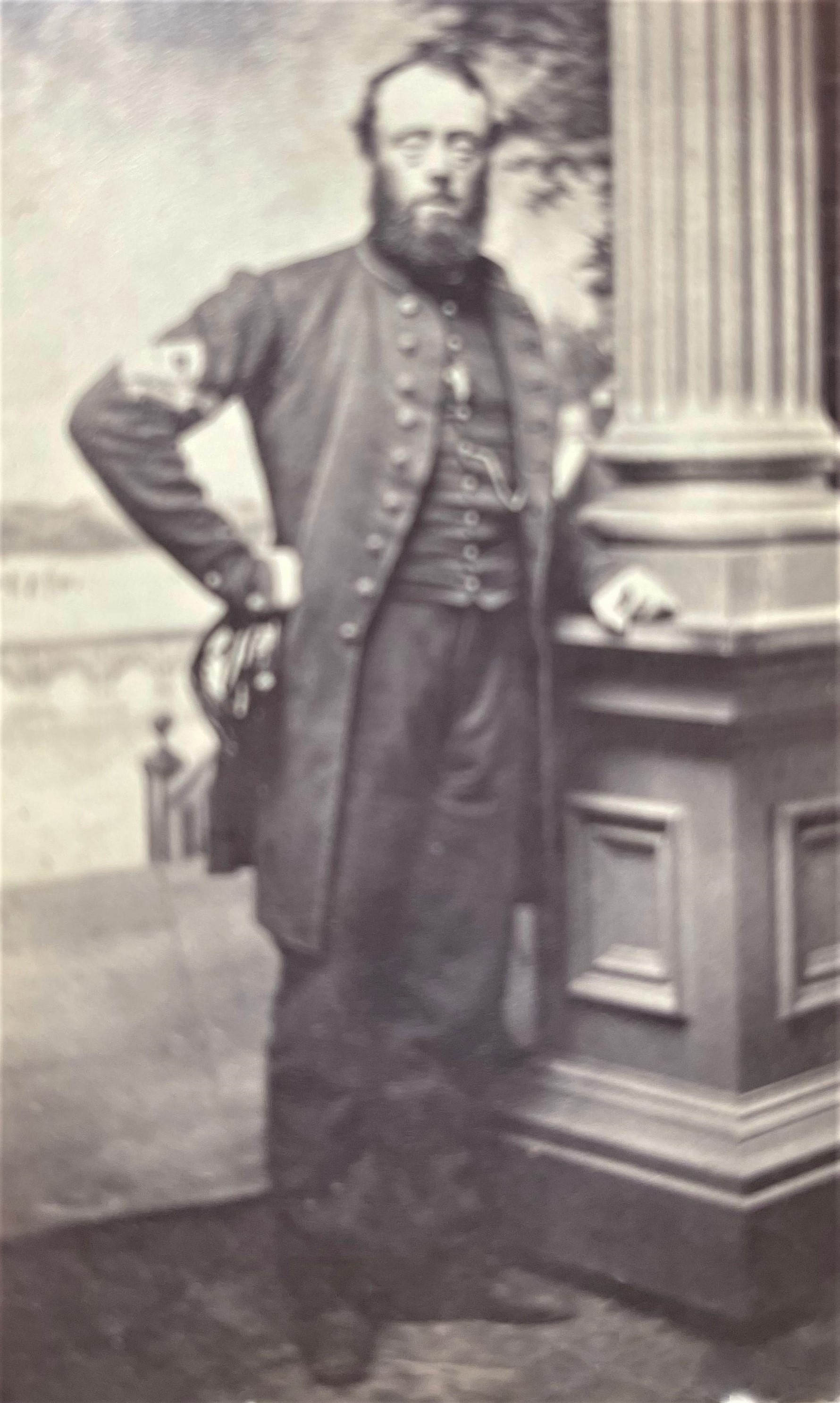
First Sergeant Christian S. Beard, circa 1863 (public domain).

* Beard, Christian Seiler (First Lieutenant, Company C): A twenty-seven-year-old, married carpenter residing in Williamsport, Lycoming County when President Abraham Lincoln called for seventy-five thousand volunteers to defend the nation’s capital, following the fall of Fort Sumter in mid-April 1865, Chistian S. Beard promptly enrolled for Civil War military service before that month was out as a private with Company D of the 11th Pennsylvania Volunteers; honorably discharged in July after completing his Three Months’ Service, he re-enlisted as a sergeant with Company C of the newly-formed 47th Pennsylvania Volunteers on August 19; after rising up through the ranks to become a first lieutenant, he was honorably discharged on Christmas Day, 1865, and returned home to his wife in Dauphin County, Pennsylvania, where he continued to work as a carpenter; after having several children with his wife, he was widowed by her; remarried in 1884, he relocated with his wife and children to Pittsburgh, where he continued to work as a carpenter; ailing with heart and kidney disease, he died there on November 16, 1911 and was interred at that city’s Highwood Cemetery;

* Burke, Thomas (Sergeant, Company I): A first-generation American, Thomas Burke was a twenty-year-old cabinetmaker residing in Allentown at the dawn of the American Civil War; after enrolling for military service on the day that the 47th Pennsylvania Volunteer Infantry was founded (August 5, 1861), he was officially mustered in as a private; from that point on, he continued to work his way up the ranks, receiving a promotion to corporal on September 19, 1864 and then to sergeant on July 11, 1865; honorably mustered out with his company in Charleston, South Carolina on December 25, 1865, he returned home to Lehigh County, where he married and began a family; sometime in early to mid-1871, he and his family migrated west to Iowa, settling in Anamosa, Jones County, where he was employed as a carpenter and contractor; he died at his home there on October 22, 1910 and was buried at that town’s Riverside Cemetery;

* Colvin, John Dorrance (Second Lieutenant, Company C): A native of Abington Township, Lackawanna County who was a farmer when he enlisted for Civil War military service on September 12, 1861, John D. Colvin transferred to the U.S. Army Signal Corps on October 13, 1863, and continued to serve with the Signal Corps for the duration of the war; employed as an engineer, post-war, he helped the Pacific Railroad to extend its service from Atchison, Kansas to Fort Kearney in Nebraska before returning home to Pennsylvania, where he married, began a family and resided with them in Olyphant and Carbondale before relocating with them to Parsons in Luzerne County, where he became a prominent civic leader and member of the school board; initially employed as a machinist, he went on to become superintendent of the Delaware & Hudson Coal company before taking a similar job with the Lehigh Valley Coal Company; the U.S. Postal Service’s postmaster of Parsons during the early 1890s, he died there on March 15, 1901 and was buried at the Hollenback Cemetery in Wilkes-Barre;

* Crownover, James (Sergeant, Company D): A twenty-three-year-old teamster residing in Blain, Perry County when he enrolled for Civil War military service on August 20, 1861, James Crownover rose up through the ranks of the 47th Pennsylvania from private to reach the rank of sergeant; wounded in the right shoulder and captured by Confederate troops during the Battle of Pleasant Hill, Louisiana on April 9, 1864, he was marched to Camp Ford, near Tyler, Texas, the largest Confederate prison camp west of the Mississippi River, where he was held as a prisoner of war (POW) until he was released during a prisoner exchange on November 25, 1864; during captivity, he was commissioned, but not mustered as a second lieutenant; given medical treatment before he was returned to active duty, he was honorably discharged with his regiment in Charleston, South Carolina on December 25, 1865; after returning home, he found work at a tannery near Blain, married, began a family and then relocated with them to East Huntingdon Township, Westmoreland County, where he worked as a teamster; relocating with them to Braddock in Allegheny County after the turn of the century, he worked at a local mill there; he died in Allegheny County on July 18, 1903 and was buried at the Monongahela Cemetery in Braddock Hills;

Jacob Daub, circa 1862-1865 (carte de visite, Cooley & Beckett Photographers, Savannah, Georgia and Beaufort and Hilton Head, South Carolina, public domain).

* Daub, Jacob and William J. (Drummer Boy, Company A): A German immigrant as a child, Jacob Daub emigrated with his parents and younger brother, William, circa 1852; after settling in Easton, Northampton County, Pennsylvania, where his father found work as a stone mason, Jacob grew up to become a cigarmaker, and also became the first of the two brothers to enlist in the American Civil War; after enrolling at the age of sixteen, he was classified as a field musician and assigned to Company A as its drummer boy; his nineteen-year-old brother, William, a carpenter by 1865, followed him into the war when he enlisted as a private with the same company in February of that year; after the war ended, both returned home to Northampton County, where they married, had children and went on to live long, full lives; William eventually died at the age of eighty in 1928, followed by Jacob, who passed away in 1936, roughly two months before his ninety-first birthday;

* Detweiler, Charles C. (Private, Company A): Berks County native Charles Detweiler enrolled for Civil War military service on September 16, 1862; a carpenter who later became a farmer, he served with Company A until he was severely injured in the Battle of Cedar Creek, Virginia, October 19, 1864, when he sustained a musket ball wound to the middle of his thigh; treated at a Union Army hospital in Virginia before being transported to the Union’s Mower General Hospital in Philadelphia, Pennsylvania, he learned that the musket ball had damaged his femur and femoral arteries; following his wound-related death at Mower on March 12, 1865, he was buried at the Fairview Cemetery in Kutztown, Berks County;

* Diaz, John (Private, Company I): An immigrant from Spain’s Canary Islands, John Diaz emigrated sometime between 1862 and 1865 and settled in Philadelphia, Pennsylvania, where he found work as a cigarmaker; on January 25, 1865, at the age of nineteen, he enlisted with the Union Army at a recruiting depot in Norristown, Montgomery County and served as a private with Company I of the 47th Pennsylvania Volunteer Infantry until it was mustered out on Christmas Day, 1865; following his return to Pennsylvania, he resumed work as a cigarmaker in Philadelphia, eventually launching his own cigarmaking firm, which became a family business as his sons became old enough to work for him; sometime between 1906 and 1910, he relocated with his wife and several of his children to Camden County, New Jersey, where he died on September 5, 1915;

James Downs (circa 1880s, public domain).

* Downs, James (Corporal, Company D): A twenty-three-year-old tanner residing in Blain, Perry County when he enrolled for Civil War military service on August 20, 1861, James Downs was captured by Confederate troops during the Battle of Pleasant Hill, Louisiana on April 9, 1864 and marched to Camp Ford, near Tyler, Texas, the largest Confederate prison camp west of the Mississippi River; held there as a prisoner of war (POW) until he was released during a prisoner exchange on July 22, 1864, he received medical treatment and was subsequently returned to active duty; following his honorable discharge with his regiment in Charleston, South Carolina, on December 25, 1865, he returned home, married, began a family and relocated with his family to Phillipsburg, New Jersey; suffering from heart and kidney disease, and possibly also from post-traumatic stress disorder, rather than “insane” as physicians at the Pennsylvania Memorial Home in Brookville, Jefferson County, Pennsylvania had diagnosed him, he fell from a window at that home and died at there on September 16, 1921; he was subsequently interred in the Veterans’ Circle of the Brookville Cemetery;

* Eagle, Augustus (Second Lieutenant, Company F): A German immigrant as a teenager, Augustus Eagle arrived in America on June 23, 1855, two years after his brother, Frederick Eagle, had emigrated and made a life for himself in Catasauqua, Lehigh County, Pennsylvania; both men married and began families there, with Fred employed as a laborer and Gus employed by the Crane Iron Works; when President Abraham Lincoln issued his call for volunteers to defend the nation’s capital during the opening weeks of the American Civil War, both men enrolled for military service on August 21, 1861 as privates with Company F of the 47th Pennsylvania Volunteer Infantry; in 1862, Fred fell ill and was honorably discharged on a surgeon’s certificate of disability, but Gus continued to serve, rising up through the regiment’s enlisted and officers’ ranks; commissioned as a second lieutenant, he was honorably discharged on September 11, 1864, upon completion of his three-year term of service; post-war, Fred became a successful baker with real estate and personal property valued at $4,200 (roughly $155,750 in 2023 dollars) and died in Catasauqua in 1885, while Gus owned a successful restaurant in Whitehall Township before operating the Fairview Hotel, which became a popular spot for political gatherings; after suffering a series of strokes in 1902, Gus died at his home on August 17 and was buried at the Fairview Cemetery in West Catasauqua;

* Eisenbraun, Alfred (Drummer Boy, Company B): A tobacco stripper and first-generation American from Allentown, Lehigh County, fifteen-year-old Alfred Eisenbraun became the second “man” from the 47th Pennsylvania to die when he succumbed to complications from typhoid fever at the Kalorama Eruptive Fever Hospital in Georgetown, District of Columbia on October 26, 1861; he still rests at the U.S. Soldiers’ and Airmen’s Home Cemetery in Washington, D.C.;

* Fink, Aaron (Corporal, Company B): A shoemaker and native of Salisbury Township, Lehigh County, Pennsylvania, Aaron Fink, grew up, began a family and established a successful small shoemaking business, first in Allentown and then in Mauch Chunk (now Jim Thorpe) in Carbon County; on August 20, 1861, he chose to respond to President Abraham Lincoln’s call for volunteers to help bring the American Civil War to a quick end when he enrolled for military service; shot in the right leg during the fighting at the Frampton Plantation during the Battle of Pocotaligo, South Carolina on October 22, 1862, he was treated at the Union Army’s hospital at Hilton Head, South Carolina, but died there from wound-related complications on November 5, 1862; initially buried near that hospital, his remains were later exhumed by Allentown undertaker Paul Balliet and returned to Pennsylvania for reinterment at that city’s Union-West End Cemetery;

* Fornwald, Reily M. (Corporal, Company G): Born in Heidelberg Township, Berks County, Reily Fornwald was raised there on his family’s farm near Stouchsberg; educated in his community’s common schools and then at Millersville State Normal School, he became a railroad worker before returning to farm life shortly before the dawn of the American Civil War; after enlisting for military service at the age of twenty on September 11, 1862, he was wounded in the head and groin by an exploding artillery shell during the Battle of Pocotaligo, South Carolina on October 22, 1862; stabilized on the battlefield before being transported to a field hospital for more advanced medical care, he spent four weeks recuperating before returning to active duty with his regiment; promoted to the rank of corporal on January 19, 1863, he continued to serve with his regiment until he was honorably discharged at Berryville, Virginia on September 18, 1864, upon expiration of his term of enlistment; after returning home, he spent four years operating a blast furnace for White & Ferguson in Robesonia, Berks County; he also married and began a family; sometime around 1870, he left that job to become an engine operator for Wright, Cook & Co. in Sheridan and then moved to a job as an engine operator for William M. Kauffman—a position he held for roughly a decade before securing employment as a shifting engineer with the Reading Railway Company at its yards in Reading; following his retirement in 1905, he and his wife settled in Robesonia, where he became involved in buying and selling real estate; following a severe fall in May 1925, during which he fractured a thigh bone, he died at the Homeopathic Hospital in Reading on June 1 and was buried at Robesonia’s Heidelberg Cemetery;

Captain Reuben Shatto Gardner, Company H, 47th Pennsylvania Volunteers, circa 1863 (public domain).

* Gardner, Reuben Shatto, John A. and Jacob S. R.: Natives of Perry County, Reuben Shatto Gardner and his brothers, John A. Gardner and Jacob S. R. Gardner, began their work lives as laborers; among the earliest responders to President Abraham Lincoln’s call to defend the nation’s capital, following the fall of Fort Sumter in mid-April 1861, Reuben was a twenty-five-year-old miller who resided in Newport, Perry County; after enlisting as a private with Company D of the 2nd Pennsylvania Volunteers on April 20, he was honorably mustered out after completing his term of service; he then re-upped for a three-year tour of duty, mustering in as a first sergeant with Company H of the newly-formed 47th Pennsylvania Volunteer Infantry; also enrolling with him that same day were his twenty-three-year-old and twenty-one-year-old brothers, John A. Gardner and Jacob S. R. Gardner; John officially mustered in at Camp Curtin in Harrisburg on September 18 (the day before Reuben arrived), while Jacob officially mustered in on September 19; both joined their brother’s company, entering at their respective ranks of corporal and private, but Jacob’s tenure was a short one; sickened by typhoid fever in late December 1861, he died at the 47th Pennsylvania’s regimental hospital at Camp Griffin, near Langley, Virginia on January 8, 1862; his remains were later returned to Perry County for burial at the Old Newport Cemetery; soldiering on, Reuben and John were transported with their regiment by ship to Fort Taylor in Key West, Florida and subsequently sent to South Carolina with their regiment and other Union troops; shot in the head and thigh during the Battle of Pocotaligo, South Carolina on October 22, 1862, Reuben was treated at the Union Army’s hospital at Hilton Head, South Carolina for an extended period of time, and then returned to active duty with his regiment; meanwhile, John was assigned with H Company and the men from Companies D, F and K to garrison Fort Jefferson in Florida’s Dry Tortugas; both brothers then continued to work their way up the regiment’s ranks, with John promoted to corporal on September 18, 1864 and Reuben ultimately commissioned as a captain and given  command of Company H on February 16, 1865; both then returned home after honorably mustering out with the regiment in Charleston, South Carolina on Christmas Day, 1865; sometime around 1866 or 1867, Reuben and his wife migrated west, first to Elk River Station in Sherburne County, Minnesota and then to Stillwater, Washington County, before settling in the city of Minneapolis; through it all, he worked as a miller; Reuben and his family then relocated farther west, arriving in King County, Washington after the Great Seattle Fire of 1889; initially employed in the restaurant industry, Reuben later found work as a railroad conductor before prospecting for gold with son Edward in the western United States and British Columbia, Canada during the 1890s Gold Rush; employed as a U.S. Post Office clerk in charge of the money order and registry departments in Seattle from 1898 to 1902, Reuben died in Seattle at the age of sixty-eight on September 25, 1903 and was interred at that city’s Lakeview Cemetery; meanwhile, his brother John, who had resumed work as a fireman with the Pennsylvania Railroad after returning from the war, was widowed by his wife in 1872; after remarrying and welcoming the births of more children, he was severely injured on October 9, 1873 while working as a fireman on the Pacific Express for the Pennsylvania Railroad; unable to continue working as a fireman due to his amputated hand, he worked briefly as a railroad call messenger before launching his own transfer business in Harrisburg; after he was widowed by his ailing second wife, John was severely injured in a second accident in 1894 while loading his delivery wagon; still operating his business after the turn of the century, he remarried on January 3, 1900, but was widowed by his third wife when she died during a surgical procedure in 1911; he subsequently closed his business and relocated to the home of his daughter in the city of Reading, Berks County; four years later, he fell on an icy sidewalk and became bedfast; aged eighty and ailing from arteriosclerosis and lung congestion, he died at her home on February 20, 1918 and was buried at Reading’s Charles Evans Cemetery;

* Gethers, Bristor (Under-Cook, Company F): Born into slavery in South Carolina circa 1829, Bristor Gethers was married “by slave custom at Georgetown, S.C.” on the Pringle plantation in Georgetown sometime around 1847 to “Rachael Richardson” (alternate spelling “Rachel”); a field hand at the dawn of the Civil War, he was freed from chattel enslavement in 1862 by Union Army troops; he then enlisted as an “Under-Cook” with Company F of the 47th Pennsylvania Volunteer Infantry in Beaufort, South Carolina on October 5, 1862, and traveled with the regiment until October 4, 1865, when he was honorably discharged in Charleston, South Carolina upon completion of his three-year term of enlistment; at that point, he returned to Beaufort and resumed life with his wife and their son, Peter; a farmer, Bristor was ultimately disabled by ailments that were directly attributable to his Union Army tenure; awarded a U.S. Civil War Soldiers’ Pension, he lived out his days with his wife on Horse Island, South Carolina, and died on Horse Island, South Carolina on June 24 or 25, 1894; he was then laid to rest at a graveyard on Parris Island on June 26 of that same year;

* Gilbert, Edwin (Captain, Company F): A native of Northampton County and a carpenter residing in Catasauqua, Lehigh County at the dawn of the American Civil War, Edwin Gilbert enrolled as a corporal on August 21, 1861; after rising up through his regiment’s officer ranks, he was ultimately commissioned as a captain and placed in charge of his company on New Year’s Day, 1865, and then mustered out with his company in Charleston, South Carolina of Christmas of that same year; resuming his life with his wife and children in Lehigh County after the war, he continued to work as a carpenter; after suffering a stroke in late December 1893, he died on January 2, 1894 and was buried at the Fairview Cemetery in West Catasauqua;

Mrs. Caroline Bost and Martin L. Guth celebrated the anniversary of President Abraham Lincoln’s birthday with fellow Grand Army of the Republic and ladies auxiliary members in February 1933 (public domain).

* Guth, Martin Luther (Corporal, Company K): A native of Lehigh County and son of a farmer, Martin L. Guth was a seventeen-year-old laborer and resident of Guthsville in Whitehall Township at the dawn of the American Civil War; after enrolling for military service on September 26, 1862, he was officially mustered in as a corporal; he continued to serve with his regiment until he was honorably mustered out on October 1, 1865, upon expiration of his term of service; at some point during that service, he broke his leg—an injury that did not heal properly and plagued him for the remainer of his life; after returning home to the Lehigh Valley, he found work again as a laborer; married in 1883, he became the father of four children, one of whom was born in New Mexico and another who was born in California; he had moved his family west in search of work in the mining industry; documented as a “prospector” or “miner” records created in Nevada during that period, he was also documented on voter registration rolls of Butte City in Glenn County, California in August 1892; by 1900, he was living separately from his wife, who was residing in Bandon, Coos County, Oregon with their two children while he was residing at the Veterans’ Home of California in Yount Township, Napa County, California; subsequently admitted to the Mountain Branch of the network of U.S. National Homes for Disabled Volunteer Soldiers in Johnson City, Tennessee on February 11, 1912, his disabilities included an old compound fracture of his right leg with chronic ulceration, defective vision (right eye), chronic bronchitis, and arteriosclerosis; discharged on December 12, 1920, he was admitted to the U.S. National Soldiers’ Home in Leavenworth, Kansas on July 30, 1912, but discharged on September 29, 1913; by 1920, he was living alone on Fruitvale Avenue in the city of Oakland, California, but was remaining active with his local chapter of the Grand Army of the Republic as he rose through the leadership ranks of chapter, state and national G.A.R. organizations; after a long, adventure-filled life, he died on October 11, 1935, at the age of ninety-one, at the veterans’ home in San Francisco and was interred at the San Francisco National Cemetery (also known as the Presidio Cemetery);

Lieutenant Charles A. Hackman, Company G, 47th Pennsylvania Volunteers, circa 1864 (public domain).

* Hackman, Charles Abraham and Martin Henry (First Lieutenant and Sergeant, Company G): Natives of Rittersville, Lehigh County, Charles and Martin Hackman began their work lives as apprentices, with Charles employed by a carpenter and Martin employed by master coachmaker Jacob Graffin; members of the local militia unit known as the Allen Rifles, they were among the earliest responders to President Abraham Lincoln’s call to defend the nation’s capital, following the fall of Fort Sumter in mid-April 1861; both enlisted as privates with Company I of the 1st Pennsylvania Volunteers on April 20 and were honorably mustered out in July after completing their service; Charles then re-upped for a three-year tour of duty, mustering in as a sergeant with Company G of the newly-formed 47th Pennsylvania Volunteer Infantry; he then spent most of his early service in Virginia; meanwhile, his younger brother, Martin H. Hackman, who was employed as a coach trimmer in Lehigh County, re-enlisted for his own second tour of duty, as a private with Charles’ company, on January 8, 1862; working their way up the ranks, Charles was commissioned as a first lieutenant on June 18, 1863, while Martin was promoted to sergeant on April 26, 1864; Charles was then breveted as a captain on November 30, 1864 after having mustered out on November 5; Martin was then honorably discharged on January 8, 1865; initially employed, post-war, with the Philadelphia & Reading Railroad’s train car facility in Reading, Berks County, Charles was promoted to car inspector at the company’s Philadelphia facility in December 1866; he subsequently married, but had no children and was widowed in 1904; remarried, he remained in Philadelphia until the early 1900s, when he relocated to Allentown; Martin, who worked as a bricklayer in Allentown, did have children after marrying, but he, too, was widowed; also remarried, he became a manager at a rolling mill; ailing with pneumonia in early 1917, Charles was eighty-six years old when he died in Allentown on January 17; he was buried at Allentown’s Union-West End Cemetery, while his brother Martin was buried at the Nisky Hill Cemetery in Bethlehem, following his death in Bethlehem from a cerebral hemorrhage on December 14, 1921;

* Junker, George (Captain, Company K): A German immigrant as a young adult, George Junker emigrated sometime around the early 1850s and settled in Allentown, Lehigh County, Pennsylvania, where he found employment as a marble worker and tombstone carver, and where he also joined the Allen Infantry, one of his adopted hometown’s three militia units; responding to U.S. President Abraham Lincoln’s call for volunteers to defend the nation’s capital during the opening weeks of the American Civil War, George enlisted with his fellow Allen Infantrymen, honorably completed his Three Months’ Service, and promptly began his own recruitment of men for an “all-German company” for the newly-formed 47th Pennsylvania Volunteer Infantry; commissioned as a captain with the 47th Pennsylvania, he was placed in charge of his men who became known as Company K; mortally wounded by a Confederate rifle shot during the Battle of Pocotaligo, South Carolina on October 22, 1862, he died from his wounds the next day at the Union Army’s division hospital at Hilton Head, South Carolina; his remains were returned to his family in Hazleton, Luzerne County for reburial at the Vine Street Cemetery;

* Kern, Samuel (Private, Company D): A native of Perry County who was employed as a farmer in Bloomfield, Perry County when he enrolled for Civil War military service on August 20, 1861, Samuel Kern was wounded and captured by Confederate troops during the Battle of Pleasant Hill, Louisiana on April 9, 1864; marched to Camp Ford, near Tyler, Texas, the largest Confederate prison camp west of the Mississippi River, he was held there as a prisoner of war (POW) until he died from harsh treatment on June 12, 1864; buried somewhere on the grounds of that prison camp, his grave remains unidentified;

* Kosier, George (Captain, Company D): A native of Perry County and twenty-four-year-old carpenter residing in that county’s community of New Bloomfield at the dawn of the American Civil War, George Kosier became one of the earliest men from his county to respond to President Abraham Lincoln’s call for to defend the nation’s capital, following the fall of Fort-Sumter in mid-April 1861, when he enrolled for military service on April 20 as a corporal with Company D of the 2nd Pennsylvania Volunteers; honorably discharged in July after completing his Three Months’ Service, he re-enlisted as a first sergeant with Company D of the newly-formed 47th Pennsylvania Volunteer Infantry; joining him were his younger brothers, Jesse and William S. Kosier, aged nineteen and twenty-three, who were enrolled as privates with the same company; all three subsequently re-enlisted with their company at Fort Taylor in Key West, Florida in 1863; sadly, Jesse fell ill with pleurisy and died at the Union Army’s Field Hospital in Sandy Hook, Maryland on August 1864; initially buried at a cemetery in Weverton, Maryland, his remains were later exhumed and reinterred at the Antietam National Cemetery in Sharpsburg, Maryland; both George and William continued to serve with the regiment, with George continuing his rise up the ranks; commissioned as a captain, he was given command of Company D in early June 1865; both brothers were then honorably discharged with their regiment on Christmas Day, 1865; post-war, both men married and began families; William died in Pennsylvania sometime around 1879, but George went on to live a long full life; after settling in Ogle County, Illinois, where he was employed as a carpenter, he relocated with his family to Wright County, Iowa, where he built bridges; he died in Chicago on December 3, 1920 and was buried at that city’s Rosehill Cemetery;

Anna (Weiser) Leisenring (1851-1942) , circa 1914 (public domain).

* Leisenring, Annie (Weiser): The wife of Thomas B. Leisenring (Captain, Company G), Annie Leisenring was employed by the Commonwealth of Pennsylvania as a factory inspector after the American Civil War; she became well known through newspaper accounts of her inspection visits and also became widely respected for her efforts to improve child labor laws statewide;

* Lowrey, Thomas (Corporal, Company E): An Irish immigrant as a young adult, Thomas Lowrey emigrated sometime around the late 1840s or early 1850s and settled in Northampton County, Pennsylvania, where he found work as a miner, married and began a family; responding to U.S. President Abraham Lincoln’s call for volunteers to defend the nation’s capital during the opening weeks of the American Civil War, Thomas enlisted with Company E of the 47th Pennsylvania on September 16, 1861; after completing his three-year term of enlistment, he was honorably discharged in September 1864 and returned home to Pennsylvania, where he resumed work as a coal miner near Shenandoah, Schuylkill County, and where he resided with his wife and children; after witnessing the dawn of a new century, he died in Shenandoah on January 11, 1906;

This image of Julia (Kuenher) Minnich, circa 1860s, is being presented here through the generosity of Chris Sapp and his family, and is being used with Mr. Sapp’s permission. This image may not be reproduced, repurposed, or shared with other websites without the permission of Chris Sapp.

* Magill, Julia Ann (Kuehner Minnich): Widowed and the mother of a young son at the time that her husband, B Company’s Captain Edwin G. Minnich, was killed in battle during the American Civil War, Julia Ann (Kuehner) Minnich became a Union Army nurse at Harewood Hospital in Washington, D.C. during the war in order to keep a roof over her son’s head; she then spent the remainder of her life battling the U.S. Pension Bureau to receive and keep both the U.S. Civil War Widow’s Pension and U.S. Civil War Nurse’s Pension that she was entitled to under federal law; forced to go on working into her later years by poverty, she finally found work as a cook at a hotel in South Bethlehem; she died sometime after 1906;

* Menner, Edward W. (Second Lieutenant, Company E): A first-generation American who was a native of Easton, Northampton County, Edward Menner was a sixteen-year-old carpenter when he enrolled for Civil War military service on August 25, 1861; working his way up from private to second lieutenant before he was honorably discharged with his regiment in Charleston, South Carolina on Christmas Day, 1865, he was wounded in the left shoulder during the Battle of Cedar Creek, Virginia on October 19, 1864; after returning home to the Lehigh Valley, he secured employment as a hooker with the Bethlehem Iron Company (later known as Bethlehem Steel) on March 15, 1866; he married, begam a family and continued to work in the iron industry for much of his life; he died in Bethlehem on April 25, 1913 and was buried at that city’s Nisky Hill Cemetery;

* Miller, John Garber (Sergeant, Company D): A native of Ironville, Blair County, John G. Miller was a twenty-one-year-old laborer living in Duncannon, Perry County when he enrolled for Civil War military service on August 20, 1861; captured by Confederate troops during the Battle of Pleasant Hill, Louisiana on April 9, 1864 and marched to Camp Ford, near Tyler, Texas, the largest Confederate prison camp west of the Mississippi River, he was held there as a prisoner of war (POW) until he was released during a prisoner exchange on July 22, 1864; returned to active duty with his regiment after receiving medical treatment, he continued to serve until he was honorably discharged with the regiment in Charleston, South Carolina on December 25, 1865; after returning home, he married, began a family and relocated with his family to Philipsburg, Centre County, Pennsylvania, where he was employed as a teamster; returning to Blair County with his family, he resided with them in Logan Township before relocating with them again to Coalport, Clearfield County; suffering from heart disease, he died in Coalport on February 16, 1921 and was interred at the Coalport Cemetery;

Captain Theodore Mink, Company I, 47th Pennsylvania Volunteers (circa 1870s-1880s, courtesy of Julian Burley; used with permission).

* Mink, Theodore (Captain, Company I): A native of Allentown, Lehigh County who was apprenticed as a coachmaker and then tried his hand as a whaler and blacksmith prior to the American Civil War, Thedore Mink became one of the “First Defenders” who responded to President Abraham Lincoln’s call for seventy-five thousand volunteers to defend the nation’s capital after the fall of Fort Sumter in mid-April 1861; after honorably completing his Three Months’ Service in July, he re-enlisted on August 5 as a sergeant with Company I of the newly-formed 47th Pennsylvania Volunteer Infantry; after steadily working his way up through the ranks, he was commissioned as a captain and placed in charge of his company on May 22, 1865; he continued to serve with his regiment until it was mustered out on Christmas Day, 1865; following his return to Pennsylvania, he was hired as a laborer with a circus troupe operated by Mike Lipman before finding longtime employment in advertising and then as head of the circus wardrobe for the Forepaugh Circus before he was promoted to management with the circus; felled by pneumonia during late 1889, he died in Philadelphia on January 7, 1890 and was interred in Allentown’s Union-West End Cemetery;

* Newman, Edward (Private, Company H): A German immigrant who left his homeland sometime around 1920, Edward Newman chose to settle in Allentown, Lehigh County, Pennsylvania, where he found work as a baker; after enlisting for Civil War military service in August 1862, he mustered in as a private with Company I of the 127th Pennsylvania Volunteers and fought in the Battle of Fredericksburg from December 11-15 of that year; honorably mustered out with his regiment in May 1863, he re-enlisted on October 23, 1863 for a second tour of duty—but as a private with a different regiment—Company H of the 47th Pennsylvania Volunteers; he continued to serve with the 47th Pennsylvania until he was officially mustered out in Charleston, South Carolina on Christmas Day, 1865, he returned to Pennsylvania’s Lehigh Valley, where he worked briefly as a baker; suffering from rheumatism that developed while the 47th Pennsylvania was stationed near Cedar Creek, Virginia during the fall of 1864, he was admitted to the network of U.S. Homes for Disabled Volunteer Soldiers at the Central Branch in Dayton, Montgomery County, Ohio on July 17, 1877; still unmarried and still living there in 1880, his health continued to decline; diagnosed with acute enteritis, he died there on January 22, 1886 and was buried at the Dayton National Cemetery;

Captain Daniel Oyster, Company C, 47th Pennsylvania Volunteers, circa 1864 (public domain).

* Oyster, Daniel (Captain, Company C): A native of Sunbury, Northumberland County who was employed as a machinist, Daniel Oyster became one of the earliest men from his county to respond to President Abraham Lincoln’s call to defend the nation’s capital, following the fall of Fort-Sumter in mid-April 1861, when he enrolled for Civil War military service on April 23 as a corporal with Company F of the 11th Pennsylvania Volunteers; honorably discharged in July after completing his Three Months’ Service, he re-enlisted as a first sergeant with Company C of the newly-formed 47th Pennsylvania Volunteers on August 19; his brother, John Oyster, subsequently followed him into the service, enrolling as a private with his company on November 20, 1863; after rising up through the ranks to become captain of his company, Daniel was shot in his left shoulder near Berryville, Virginia on September 5, 1864 and then shot in his right shoulder during the Battle of Cedar Creek on October 19; successfully treated by Union Army surgeons for both wounds, he was awarded a veteran’s furlough in order to continue his recuperation and returned home to Sunbury; he then returned to duty and was honorably discharged with his company on Christmas Day, 1865; post-discharge, he and his brother, John, returned home to Sunbury; Daniel continued to reside with their aging mother and was initially employed as a policeman, but was then forced by a war-related decline in his health to take less-taxing work as a railroad postal agent; his brother John, who was married, lived nearby and worked as a fireman, but died in Sunbury on April 20, 1899; employed as a bookkeeper after the turn of the century, Daniel never married and was ultimately admitted to the Southern Branch of the U.S. National Home for Disabled Volunteer Soldiers in Hampton, Virginia, where he died on August 5, 1922—exactly sixty-one years to the day after the 47th Pennsylvania Volunteer Infantry was founded; he was given a funeral with full military honors before being laid to rest in the officers’ section at the Arlington National Cemetery on August 11;

* Sauerwein, Thomas Franklin (First Sergeant, Company B): The son of a lock tender in Pennsylvania’s Lehigh Valley, Thomas Sauerwein was employed as a carpenter at the dawn of the American Civil War; following his enrollment for military service in Allentown, Lehigh County on August 20, 1861, he was officially mustered in as a private with Company B of the 47th Pennsylvania Volunteer Infantry; from that point on, he steadily worked his way up the ranks of the regiment, ultimately being promoted to first sergeant on New Year’s Day, 1865; following his honorable discharge with his company on Christmas Day of that same year, he returned home to the Lehigh Valley, where he found work as a carpenter, married and began a family; by 1880, he had moved his family west to Williamsport in Lycoming County, where he had found work as a machinist; employed as a leather roller with a tanning factory, he was promoted to a position as a leather finisher after the turn of the century, while his two sons worked as leather rollers in the same industry; he died in Williamsport on July 29, 1912 and was buried at the East Wildwood Cemetery in Loyalsock;

* Slayer, Joseph (Private, Company E; also known as “Dead Eye Dick” and “E. J. McMeeser”): A native of Philadelphia, Joseph Slayer was a nineteen-year-old miner residing in Willliams Township, Northampton County, Pennsylvania at the dawn of the American Civil War; after enrolling for military service in Easton, Northampton County on September 9, 1861, he was officially mustered in as a private with Company E of the 47th Pennsylvania Volunteers; he continued to serve with his company, re-enlisting as a private with Company E, under the name of Joseph Slayer, at Fort Jefferson in Florida’s Dry Tortugas on January 4, 1864; honorably mustered out with his company in Charleston, South Carolina on Christmas Day, 1865, he relocated to Zanesville, Ohio sometime after the war, where he joined the Grand Army of the Republic’s Hazlett Post No. 81; he may then have relocated briefly to St. Paul, Minnesota sometime around the 1870s or early 1880s, or may simply have had a child and grandchild living there, because newspaper reports of his death noted that he had been carrying a photograph of a toddler named Robert—a photo that had “To Grandpa” inscribed on it and indicated that the grandchild, Robert, was a resident of St. Paul in 1892; by the 1880s, Joseph had made it as far west as the Dakota Territory—but this was where his life’s journey took a strange twist; discarding the name he had used in the army (“Joseph Slayer”), he changed his name several times over the next several years, as if he were trying to shed his prior life and all of its associations; acquaintances he met in the southern part of the Dakota Territory during the early to mid-1880s knew him as “Dead Eye Dick” while others who met him after he had resettled in Bismarck, in the northern part of the Dakota Territory, knew him as “Eugene McMeeser” or “E. J. McMeeser” (alternate spelling: “McNeeser”); by the time that the federal government conducted its special census of Civil War veterans in June 1890, Joseph was so comfortable fusing parts of his old and new lives together that he was convincingly documented by an enumerator as “Eugene McMeeser,” a veteran who had served as a private with Company E of the 47th Pennsylvania Infantry from September 9, 1861 until January 11, 1866; in 1890, Joseph became a married man; documented as having rheumatism so severe that he was “at times confined at home,” he filed for a U.S. Civil War Pension from North Dakota on March 28, 1891—but he did so as “Joseph Slayer”—the name under which he had first enrolled for military service in Pennsylvania in 1861; ultimately awarded a pension—which would not have happened if federal officials had not been able to verify his identity and match it to his existing military service records, he was diagnosed with angina pectoris in 1904, but still managed to secure a U.S. patent for one of his inventions—a napkin holder; he died in Bismarck less than a month later, on January 12 or 13, 1905; found on the floor of his rented room, his death sparked a coroner’s inquest which revealed that he had been living under an assumed name; he was buried at Saint Mary’s Cemetery in Bismarck; the name “Joseph Slayer” was carved onto his military headstone;

* Snyder, Timothy (Corporal, Company C): A carpenter who was born in Rebuck, Northumberland County, Tim Snyder was employed as a carpenter and residing in the city of Sunbury in that county by the dawn of the American Civil War; after enlisting for military service as a private in August 1861, he was wounded twice in combat, once during the Battle of Pocotaligo, South Carolina (1862) and a second time, in the knee, during the Battle of Opequan, Virginia (1864), shortly after he had been promoted to the rank of corporal; he survived and returned to Pennsylvania, where he resumed work as a carpenter; after relocating to Schuylkill County, he settled in the community of Ashland; in 1870, he married Catharine Boyer and started a family with her; he continued to work as a carpenter in Schuylkill County until his untimely death in May 1889 and was laid to rest with military honors at the Brock Cemetery in Ashland; John Hartranft Snyder, his first son to survive infancy, grew up to become a co-founder of the Lavelle Telegraph and Telephone Company, while his second son to survive infancy, Timothy Grant Snyder, became a corporal in the United States Marine Corps during the Spanish-American War; stationed on the USS Buffalo as it visited Port Said, Egypt, he also served aboard Admiral George Dewey’s flagship, the USS Olympia, in 1899;

Drummer Boy William Williamson, 47th Pennsylvania Volunteers, Company A, circa 1863 (public domain).

* Williamson, William (Drummer, Company A): A farmer from Stockertown, Northampton County, William Williamson was documented by a mid-nineteenth-century federal census enumerator as an unmarried laborer who lived at the Easton home of Northampton County physician John Sandt, M.D.—an indication that William’s parents may have either died or were struggling so much financially during the 1850s and early 1860s that they had encouraged him to “leave the nest” and begin supporting himself, or had hired him out as an apprentice or indentured servant; like so many other young men from Northampton County, when President Abraham Lincoln issued his call for help to protect the nation’s capital from a likely invasion by Confederate States Army troops, he stepped forward, raised his hand, and stated the following:

I, William Williamson appointed a private in the Army of the United States, do solemnly swear, or affirm, that I will bear true allegiance to the United States of America, and that I will serve them honestly and faithfully against all their enemies or opposers whatsoever, and observe and obey the orders of the President of the United States, and the orders of the officers appointed over me, according to the rules and articles for the government of the Armies of the United States.

Later in life, William Williamson became a champion for an older woman who had been struggling to convince officials of the federal government that she was worthy enough to be awarded a U.S. Civil War Mother’s Pension, after her son had died in service to the nation as a Union Army soldier.

Post-war, William Williamson found work at a slate quarry, married, began a family in Belfast, Northampton County, and lived to witness the dawn of a new century. Following his death at the age of sixty in Plainfield Township on June 17, 1901, he was laid to rest at the Belfast Union Cemetery.


Sources:

  1. “A Badge from Admiral Dewey and Schuylkill County” (announcements of Timothy Grant Snyder’s service on Admiral Dewey’s flagship). Reading, Pennsylvania: Reading Eagle: October 3, 1899 and November 21, 1899.
  2. Baptismal, census, marriage, military, death, and burial records of the Snyder family. Pennsylvania, California, Florida, Louisiana, Massachusetts, Nevada, Ohio, etc.: Snyder Family Archives, 1650-present; and in Historic Pennsylvania Church and Town Records (baptismal, marriage, death and burial records of various churches across Pennsylvania). Philadelphia, Pennsylvania: Historical Society of Pennsylvania, 1776-1918.
  3. Bates, Samuel P. History of Pennsylvania Volunteers, 1861-5, vol. 1. Harrisburg, Pennsylvania: B. Singerly, State Printer, 1869.
  4. James Crownover, James Downs and Samuel Kern, et. al., in Camp Ford Prison Records. Tyler, Texas: The Smith County Historical Society, 1864.
  5. Civil War Muster Rolls, 1861-1866 (47th Pennsylvania Infantry). Harrisburg, Pennsylvania: Pennsylvania State Archives.
  6. Civil War Veterans’ Card File, 1861-1866 (47th Pennsylvania Infantry). Harrisburg, Pennsylvania: Pennsylvania State Archives.
  7. Registers of Deaths of Volunteers, U.S. Army; Admissions Ledgers, U.S. National Homes for Disabled Volunteer Soldiers; federal burial ledgers, and national cemetery interment control forms, 1861-1935. Washington, D.C.: U.S. Office of the Adjutant General (Record Group 94), U.S. National Archives and Records Administration.
  8. Schmidt, Lewis. A Civil War History of the 47th Regiment of Pennsylvania Veteran Volunteers. Allentown, Pennsylvania: Self-published, 1986.
  9. U.S. Census Records, 1830-1930. Washington, D.C.: U.S. National Archives and Records Administration.
  10. U.S. Civil War Pension Records, 1862-1935. Washington, D.C.: U.S. National Archives and Records Administration.

Catching Dogs and Hogs During the “Dog Days” of Summer (Charleston, South Carolina, 1865)

Meeting and Broad Streets near Line Street in Charleston, South Carolina, St. Michael’s Episcopal Church in the distance (U.S. Navy, circa 1863-1865, U.S. Library of Congress, public domain).

There is no disputing that the 47th Pennsylvania Volunteer Infantry had a long and storied history. Formed on August 5, 1861, the regiment not only served for the entire duration of the American Civil War; it continued its service to the nation for more than eight months after the end of that terrible conflict, becoming the only regiment from the Commonwealth of Pennsylvania to fight in the Union’s 1864 Red River Campaign across Louisiana before it participated in Major-General Philip Sheridan’s tide-turning Shenandoah Valley Campaign across Virginia during the fall of 1864 and helped defend Washington, D.C. in the wake of the assassination of President Abraham Lincoln in April 1865.

As those war years unfolded, newspapers from Easton to Pittsburgh published updates on the regiment’s travels, along with excerpts from letters penned by its baby-faced recruits and wizened warriors. One of the more unusual news items was reported during the 47th Pennsylvania’s final months of service—while it was stationed in the Deep South of the United States of America during the early days of Reconstruction, following the end of the American Civil War. Assigned to keep the peace in the first state that had seceded from the Union, members of the regiment lived and primarily worked in Charleston, South Carolina, where they performed a wide range of provost (civil governance)-related tasks, including the prevention and prosecution of crimes against civilians and the re-establishment of newspaper publishing operations.

The Line Street area of Charleston, South Carolina, where a public pound was established in July 1865 to improve animal control and public safety (Thomas Fetters, The Charleston & Hamburg, public domain; click to enlarge).

During the summer of 1865, that “to do” list was expanded to include the “policing” of the city’s furrier denizens. According to The Charleston Daily Courier, Sergeant George Nichols (alternate surname spelling: “Nicholas”) of the 47th Pennsylvania’s E Company was ordered to supervise the operations of a new animal pound that had been established on Line Street in Charleston, “between Coming and Percy streets”:

Headquarters,
Charleston, S.C. July 20, 1865
[GENERAL ORDERS, No. 64.]

I. A POUND IS HEREBY ESTABLISHED ON LINE-STREET, between Coming and Percy-streets, and Sergeant GEO. NICHOLAS, Co. “E,” 47th Pennsylvania Volunteers, temporarily detailed as pound-keeper.

II. Hereafter all cattle, sheep, goats, hogs, and dogs found running at large in the City South of Line-street, shall be taken to the public pound and there detained until the penalty prescribed by this Order, together with the charges of the pound-keeper and the actual expense of maintaining said animals while in the pound, shall be paid.

The penalties for each violation of this Order to be as follows:

Cattle . . . . . . . . . . . . . . . . . . . . . . . . . . .$5.00 per head
Sheep, goats, hogs and dogs . . . . . . . $1.00

The amount to be turned into the City Treasury.

III. All animals, except dogs, remaining in the public pound for the space of six (6) days without being claimed and the penalties and charges therefor [sic] paid, shall be sold at public sale by the pound-keeper. The proceeds to be turned over to the owner of such animals, after deducting the fines and pound fees.

All dogs remaining unclaimed for the space of one week shall be shot.

The Provost Marshal and Chief of Military Police are charged with the execution of this Order.

By order Bt. Brig. Gen. W. T. BENNETT, Com’dg Post.
CHARLES G. CHIPMAN,
Capt. 54th Massachusetts Volunteers, A. A. D. C.
OFFICIAL: THOS. F. LAMBERT, 2d Lieut. 47th Pa. Vols., A. A. D. C.
July 21

The Confederate Steamer, Governor Milton, that was captured by Companies E and K, 47th Pennsylvania Volunteers, October 1862 (Frank Leslie’s Illustrated Newspaper, public domain).

By the time that he had received this duty assignment in 1865, Sergeant Nichols had already amassed a distinguished service history. In early October 1862, while still just a corporal, he was placed in charge of the Governor Milton, a Confederate steamship that had been captured by a detachment of 47th Pennsylvania Volunteers as part of Union Army and Navy operations related to the capture of Saint John’s Bluff, Florida. He later preserved his memories of that day’s events with this diary entry:

“At 9 PM … October 7, discovered the steamer Gov. Milton in a small creek, 2 miles above Hawkinsville; boarded her in a small boat, and found that she had been run in there but a short time before, as her fires were not yet out. Her engineer and mate, then in charge, were asleep on board at the time of her capture. They informed us that owing to the weakness of the steamer’s boiler we found her where we did. We returned our prize the next day…..

I commanded one of the Small Boats that whent [sic] in after her. I was Boatman and gave orders when the headman jumped on Bord [sic] take the Painter with him. That however belongs to Wm. Adams or Jacob Kerkendall [sic]. It was So dark I could not tell witch [sic] Struck the deck first. But when I Struck the deck I demanded the Surrend [sic] of the Boat in the name of the U.S. after we had the boat an offercier [sic] off the Paul Jones, a Gun Boat was with us he ask me how Soon could I move her out in the Stream I said five minuts [sic]. So an Engineer one of coulered [sic] Men helped me. and I will Say right hear [sic] he learned Me More than I ever knowed about Engineering. Where we Started down the River we was one hundred and twenty five miles up the river. When we Stopped at Polatkey [Palatka] to get wood for the Steamer I whent [sic] out and Borrowed a half of a deer that hung up in a cut house and a bee hive for some honey for the Boys. I never forget the boys.’”

When the 47th Pennsylvania Volunteers made their way back to their respective troop transports near Saint John’s Bluff, the captured steamer was left behind to enable a group of Union soldiers to repair its boiler. Overseeing those repairs was none other than Corporal Nichols, who had been temporarily detached from the 47th Pennsylvania’s E Company. Adding to his diary, he wrote:

“So hear [sic] we are at Jacksonville and off we go down the river again, and the Captain Yard Said you are detailed on detached duty as Engineer well that beats hell. I told him I did not Enlist for an Engineer. well I cannot help it he said. I got orders for you to stay hear [sic]. When the Boys was gone about a week orders came for us to come to Beaufort, S. Carolina by the inland rout over the Museley Mash Rout. So I Borrowed a twelve pound gun with amanition [sic] for to Protect our Selves with. But I only used it once to clear Some cavelry [sic] away. We Passed fort Palask [sic]. But that was in our Possession and we got Back to Beaufort all right. and I whent [sic] up to See the Boys and Beged [sic] captain to get me Back in the company, But he could not make it go.”

After completing his detached duty, Corporal Nichols was reunited with his regiment at its duty station in Beaufort, South Carolina that same October of 1862. He then went on to serve with the regiment for the remainder of its service to the nation, finally mustering out with his fellow 47th Pennsylvania Veteran Volunteers in Charleston, South Carolina on Christmas Day of 1865. An engineer with the Delaware, Lackawanna & Western Railroad following the war, he died from pneumonia at the age of seventy at his home in Phillipsburg, New Jersey on March 2, 1908, and was laid to rest at the Phillipsburg Cemetery.


Sources:

  1. Bates, Samuel P. History of Pennsylvania Volunteers, 1861-5, vol. 1. Harrisburg, Pennsylvania: B. Singerly, State Printer, 1869.
  2. “General Orders, No. 64” (establishment and staffing of a public pound in Charleston, South Carolina). Charleston, South Carolina: The Charleston Daily Courier, 21 July 1865, p. 2.
  3. Schmidt, Lewis. A Civil War History of the 47th Regiment of Pennsylvania Veteran Volunteers. Allentown, Pennsylvania: Self-published, 1986.


The Lieber Code: President Abraham Lincoln Formalizes the Code of Conduct for the Union Army (April 24, 1863)


Professor Francis Lieber, circa 1860s (U.S. Library of Congress, public domain).

Issued by President Abraham Lincoln on April 24, 1863 as “General Orders, No. 100: Instructions for the Government of Armies of the United States in the Field,” the “Lieber Code” defined how regular and volunteer military personnel in service to the United States were expected to behave toward one another, toward civilians and toward those they considered to be the enemy—Confederate States government officials, sailors, soldiers, spies, and others supporting the Confederacy.

Those instructions were researched and drafted by Francis Lieber, a native of the Kingdom of Prussia who became a professor of American history and political science in South Carolina roughly a decade after arriving as an immigrant in the United States. Professor Lieber, who later joined the faculty of what is, today, Columbia University, also became known for his creation of the maxim, “Nullum jus sine officio, nullum officium sine jure” (translation: “No right without its duties, no duty without its rights”), which was inscribed on his personal stationery.

According to Jenny Gesley, Ph.D., a legal specialist at the United States Library of Congress, Professor Lieber “had been imprisoned as an ‘enemy of the state,’” while still a resident of Prussia “due to his liberal nationalist views and his opposition to Prussia’s political system.”

His book “On Civil Liberty and Self Government” (1853) was a bestseller and was eventually adopted as a standard college textbook. Even though he was widely known and respected in the academic community, he felt like an outsider in South Carolina, in particular because of his opposition to slavery. In 1857, he therefore accepted a position in the department of history and political science at Columbia College, the future Columbia University, and subsequently a position in Columbia Law School.

…. When the Civil War broke out in 1861, President Lincoln wanted to provide instructions to Union officers on the particularly complicated legal issues arising from non-international armed conflicts. Among these issues were whether to treat captured Confederate soldiers as traitors subject to the death penalty or as prisoners of war (POWs) and the treatment of fugitive or freed slaves…. Lieber and a committee of four generals were therefore asked to draw up a manual for Union soldiers….

By the time that the Lieber Code was finalized, it contained one hundred and fifty-seven provisions, including several that addressed “the treatment of fugitive and freed slaves that entered the Union territory.” According to Dr. Gesley:

Lieber took the view that international law did not distinguish between people based on color (Art. 58) and that the law of nature and nations has never acknowledged slavery (Art. 42). He therefore included provisions that held that fugitive slaves that escaped to the North became free (Arts. 42, 43) and that all soldiers no matter their skin color must be awarded POW status (Art.57).

The Lieber Code also spelled out how civilians and miliary prisoners of war (POWs) should be treated. The following were among the most enlightening provisions of this new code of conduct:

Article 15. Military necessity admits of all direct destruction of life or limb of armed enemies, and of other persons whose destruction is incidentally unavoidable in the armed contests of the war; it allows of the capturing of every armed enemy, and every enemy of importance to the hostile government, or of peculiar danger to the captor; it allows of all destruction of property, and obstruction of the ways and channels of traffic, travel, or communication, and of all withholding of sustenance or means of life from the enemy; of the appropriation of whatever an enemy’s country affords necessary for the subsistence and safety of the army, and of such deception as does not involve the breaking of good faith either positively pledged, regarding agreements entered into during the war, or supposed by the modern law of war to exist. Men who take up arms against one another in public war do not cease on this account to be moral beings, responsible to one another and to God.

Article 16. Military necessity does not admit of cruelty—that is, the infliction of suffering for the sake of suffering or for revenge, nor of maiming or wounding except in fight, nor of torture to extort confessions. It does not admit of the use of poison in any way, nor of the wanton devastation of a district. It admits of deception, but disclaims acts of perfidy; and, in general, military necessity does not include any act of hostility which makes the return to peace unnecessarily difficult.

Article 17 (no longer permitted under present-day international laws). War is not carried on by arms alone. It is lawful to starve the hostile belligerent, armed or unarmed, so that it leads to the speedier subjection of the enemy….

Article 21. The citizen or native of a hostile country is thus an enemy, as one of the constituents of the hostile state or nation, and as such is subjected to the hardships of the war.

Article 22. Nevertheless, as civilization has advanced during the last centuries, so has likewise steadily advanced, especially in war on land, the distinction between the private individual belonging to a hostile country and the hostile country itself, with its men in arms. The principle has been more and more acknowledged that the unarmed citizen is to be spared in person, property, and honor as much as the exigencies of war will admit.

Article 23. Private citizens are no longer murdered, enslaved, or carried off to distant parts, and the inoffensive individual is as little disturbed in his private relations as the commander of the hostile troops can afford to grant in the overruling demands of a vigorous war….

Article 26. Commanding generals may cause the magistrates and civil officers of the hostile country to take the oath of temporary allegiance or an oath of fidelity to their own victorious government or rulers, and they may expel everyone who declines to do so. But whether they do so or not, the people and their civil officers owe strict obedience to them as long as they hold sway over the district or country, at the peril of their lives….

Article 35. Commanding generals may cause the magistrates and civil officers of the hostile country to take the oath of temporary allegiance or an oath of fidelity to their own victorious government or rulers, and they may expel everyone who declines to do so. But whether they do so or not, the people and their civil officers owe strict obedience to them as long as they hold sway over the district or country, at the peril of their lives.

Article 36. If such works of art, libraries, collections, or instruments belonging to a hostile nation or government, can be removed without injury, the ruler of the conquering state or nation may order them to be seized and removed for the benefit of the said nation. The ultimate ownership is to be settled by the ensuing treaty of peace. In no case shall they be sold or given away, if captured by the armies of the United States, nor shall they ever be privately appropriated, or wantonly destroyed or injured.

Article 37. The United States acknowledge and protect, in hostile countries occupied by them, religion and morality; strictly private property; the persons of the inhabitants, especially those of women: and the sacredness of domestic relations. Offenses to the contrary shall be rigorously punished. This rule does not interfere with the right of the victorious invader to tax the people or their property, to levy forced loans, to billet soldiers, or to appropriate property, especially houses, lands, boats or ships, and churches, for temporary and military uses.

Article 38. Private property, unless forfeited by crimes or by offenses of the owner, can be seized only by way of military necessity, for the support or other benefit of the army or of the United States. If the owner has not fled, the commanding officer will cause receipts to be given, which may serve the spoliated owner to obtain indemnity….

Article 42.  Slavery, complicating and confounding the ideas of property, (that is of a thing,) and of personality, (that is of humanity,) exists according to municipal or local law only. The law of nature and nations has never acknowledged it. The digest of the Roman law enacts the early dictum of the pagan jurist, that “so far as the law of nature is concerned, all men are equal.” Fugitives escaping from a country in which they were slaves, villains, or serfs, into another country, have, for centuries past, been held free and acknowledged free by judicial decisions of European countries, even though the municipal law of the country in which the slave had taken refuge acknowledged slavery within its own dominions.

Article 43. Therefore, in a war between the United States and a belligerent which admits of slavery, if a person held in bondage by that belligerent be captured by or come as a fugitive under the protection of the military forces of the United States, such person is immediately entitled to the rights and privileges of a freeman. To return such person into slavery would amount to enslaving a free person, and neither the United States nor any officer under their authority can enslave any human being. Moreover, a person so made free by the law of war is under the shield of the law of nations, and the former owner or State can have, by the law of postliminy, no belligerent lien or claim of service.

Article 44. All wanton violence committed against persons in the invaded country, all destruction of property not commanded by the authorized officer, all robbery, all pillage or sacking, even after taking a place by main force, all rape, wounding, maiming, or killing of such inhabitants, are prohibited under the penalty of death, or such other severe punishment as may seem adequate for the gravity of the offense. A soldier, officer or private, in the act of committing such violence, and disobeying a superior ordering him to abstain from it, may be lawfully killed on the spot by such superior….

Article 47. Crimes punishable by all penal codes, such as arson, murder, maiming, assaults, highway robbery, theft, burglary, fraud, forgery, and rape, if committed by an American soldier in a hostile country against its inhabitants, are not only punishable as at home, but in all cases in which death is not inflicted, the severer punishment shall be preferred.

Article 48. Deserters from the American Army, having entered the service of the enemy, suffer death if they fall again into the hands of the United States, whether by capture, or being delivered up to the American Army; and if a deserter from the enemy, having taken service in the Army of the United States, is captured by the enemy, and punished by them with death or otherwise, it is not a breach against the law and usages of war, requiring redress or retaliation.

Article 49. A prisoner of war is a public enemy armed or attached to the hostile army for active aid, who has fallen into the hands of the captor, either fighting or wounded, on the field or in the hospital, by individual surrender or by capitulation. All soldiers, of whatever species of arms; all men who belong to the rising en masse of the hostile country; all those who are attached to the army for its efficiency and promote directly the object of the war, except such as are hereinafter provided for; all disabled men or officers on the field or elsewhere, if captured; all enemies who have thrown away their arms and ask for quarter, are prisoners of war, and as such exposed to the inconveniences as well as entitled to the privileges of a prisoner of war.

Article 50. Moreover, citizens who accompany an army for whatever purpose, such as sutlers, editors, or reporters of journals, or contractors, if captured, may be made prisoners of war, and be detained as such. The monarch and members of the hostile reigning family, male or female, the chief, and chief officers of the hostile government, its diplomatic agents, and all persons who are of particular and singular use and benefit to the hostile army or its government, are, if captured on belligerent ground, and if unprovided with a safe conduct granted by the captor’s government, prisoners of war.

Article 51. If the people of that portion of an invaded country which is not yet occupied by the enemy, or of the whole country, at the approach of a hostile army, rise, under a duly authorized levy en masse to resist the invader, they are now treated as public enemies, and, if captured, are prisoners of war.

Article 52. No belligerent has the right to declare that he will treat every captured man in arms of a levy en masse as a brigand or bandit. If, however, the people of a country, or any portion of the same, already occupied by an army, rise against it, they are violators of the laws of war, and are not entitled to their protection.

Article 53. The enemy’s chaplains, officers of the medical staff, apothecaries, hospital nurses and servants, if they fall into the hands of the American Army, are not prisoners of war, unless the commander has reasons to retain them. In this latter case; or if, at their own desire, they are allowed to remain with their captured companions, they are treated as prisoners of war, and may be exchanged if the commander sees fit….

Article 56. A prisoner of war is subject to no punishment for being a public enemy, nor is any revenge wreaked upon him by the intentional infliction of any suffering, or disgrace, by cruel imprisonment, want of food, by mutilation, death or any other barbarity.

Article 57. So soon as a man is armed by a sovereign government and takes the soldier’s oath of fidelity, he is a belligerent; his killing, wounding, or other warlike acts are not individual crimes or offenses. No belligerent has a right to declare that enemies of a certain class, color, or condition, when properly organized as soldiers, will not be treated by him as public enemies.

Article 58. The law of nations knows no distinction of color, and if an enemy of the United States should enslave and sell any captured persons of their army, it would be a case for the severest retaliation, if not redressed upon complaint. The United States cannot retaliate by enslavement; therefore death must be the retaliation for this crime against the law of nations.

Article 59. A prisoner of war remains answerable for his crimes committed against the captor’s army or people, committed before he was captured, and for which he has not been punished by his own authorities. All prisoners of war are liable to the infliction of retaliatory measures.

Article 60. It is against the usage of modern war to resolve, in hatred and revenge, to give no quarter. No body of troops has the right to declare that it will not give, and therefore will not expect, quarter; but a commander is permitted to direct his troops to give no quarter, in great straits, when his own salvation makes it impossible to cumber himself with prisoners.

Article 61. Troops that give no quarter have no right to kill enemies already disabled on the ground, or prisoners captured by other troops.

Article 62. All troops of the enemy known or discovered to give no quarter in general, or to any portion of the army, receive none.

Article 63. Troops who fight in the uniform of their enemies, without any plain, striking, and uniform mark of distinction of their own, can expect no quarter….

Article 65. The use of the enemy’s national standard, flag, or other emblem of nationality, for the purpose of deceiving the enemy in battle, is an act of perfidy by which they lose all claim to the protection of the laws of war….

Article 67. The law of nations allows every sovereign government to make war upon another sovereign state, and, therefore, admits of no rules or laws different from those of regular warfare, regarding the treatment of prisoners of war, although they may belong to the army of a government which the captor may consider as a wanton and unjust assailant.

Article 68. Modern wars are not internecine wars, in which the killing of the enemy is the object. The destruction of the enemy in modern war, and, indeed, modern war itself, are means to obtain that object of the belligerent which lies beyond the war. Unnecessary or revengeful destruction of life is not lawful.

Article 69. Outposts, sentinels, or pickets are not to be fired upon, except to drive them in, or when a positive order, special or general, has been issued to that effect.

Article 70. The use of poison in any manner, be it to poison wells, or food, or arms, is wholly excluded from modern warfare. He that uses it puts himself out of the pale of the law and usages of war.

Article 71. Whoever intentionally inflicts additional wounds on an enemy already wholly disabled, or kills such an enemy, or who orders or encourages soldiers to do so, shall suffer death, if duly convicted, whether he belongs to the Army of the United States, or is an enemy captured after having committed his misdeed.

Article 72. Money and other valuables on the person of a prisoner, such as watches or jewelry, as well as extra clothing, are regarded by the American Army as the private property of the prisoner, and the appropriation of such valuables or money is considered dishonorable, and is prohibited. Nevertheless, if large sums are found upon the persons of prisoners, or in their possession, they shall be taken from them, and the surplus, after providing for their own support, appropriated for the use of the army, under the direction of the commander, unless otherwise ordered by the government. Nor can prisoners claim, as private property, large sums found and captured in their train, although they have been placed in the private luggage of the prisoners.

Article 73. All officers, when captured, must surrender their side arms to the captor. They may be restored to the prisoner in marked cases, by the commander, to signalize admiration of his distinguished bravery or approbation of his humane treatment of prisoners before his capture. The captured officer to whom they may be restored can not wear them during captivity.

Article 74. A prisoner of war, being a public enemy, is the prisoner of the government, and not of the captor. No ransom can be paid by a prisoner of war to his individual captor or to any officer in command. The government alone releases captives, according to rules prescribed by itself.

Article 75. Prisoners of war are subject to confinement or imprisonment such as may be deemed necessary on account of safety, but they are to be subjected to no other intentional suffering or indignity. The confinement and mode of treating a prisoner may be varied during his captivity according to the demands of safety.

Article 76. Prisoners of war shall be fed upon plain and wholesome food whenever practicable, and treated with humanity. They may be required to work for the benefit of the captor’s government, according to their rank and condition.

Article 77. A prisoner of war who escapes may be shot, or otherwise killed in his flight; but neither death nor any other punishment shall be inflicted upon him simply for the attempt to escape, which the law of war does not consider a crime. Stricter means of security shall be used after an unsuccessful attempt at escape. If, however, a conspiracy is discovered, the purpose of which is a united or general escape, the conspirators may be rigorously punished, even with death; and capital punishment may also be inflicted upon prisoners of war discovered to have plotted rebellion against the authorities of the captors, whether in union with fellow prisoners or other persons.

Article 78. If prisoners of war, having given no pledge nor made any promise on their honor, forcibly or otherwise escape, and are captured again in battle after having rejoined their own army, they shall not be punished for their escape, but shall be treated as simple prisoners of war, although they will be subjected to stricter confinement.

Article 79. Every captured wounded enemy shall be medically treated, according to the ability of the medical staff.

Article 80. Honorable men, when captured, will abstain from giving to the enemy information concerning their own army, and the modern law of war permits no longer the use of any violence against prisoners in order to extort the desired information or to punish them for having given false information.

Article 81. Partisans are soldiers armed and wearing the uniform of their army, but belonging to a corps which acts detached from the main body for the purpose of making inroads into the territory occupied by the enemy. If captured, they are entitled to all the privileges of the prisoner of war.

Article 82. Men, or squads of men, who commit hostilities, whether by fighting, or inroads for destruction or plunder, or by raids of any kind, without commission, without being part and portion of the organized hostile army, and without sharing continuously in the war, but who do so with intermitting returns to their homes and avocations, or with the occasional assumption of the semblance of peaceful pursuits, divesting themselves of the character or appearance of soldiers—such men, or squads of men, are not public enemies, and, therefore, if captured, are not entitled to the privileges of prisoners of war, but shall be treated summarily as highway robbers or pirates.

Article 83. Scouts, or single soldiers, if disguised in the dress of the country or in the uniform of the army hostile to their own, employed in obtaining information, if found within or lurking about the lines of the captor, are treated as spies, and suffer death.

Article 84. Armed prowlers, by whatever names they may be called, or persons of the enemy’s territory, who steal within the lines of the hostile army for the purpose of robbing, killing, or of destroying bridges, roads or canals, or of robbing or destroying the mail, or of cutting the telegraph wires, are not entitled to the privileges of the prisoner of war.

Article 85. War-rebels are persons within an occupied territory who rise in arms against the occupying or conquering army, or against the authorities established by the same. If captured, they may suffer death, whether they rise singly, in small or large bands, and whether called upon to do so by their own, but expelled, government or not. They are not prisoners of war; nor are they if discovered and secured before their conspiracy has matured to an actual rising or armed violence….

Article 88. A spy is a person who secretly, in disguise or under false pretense, seeks information with the intention of communicating it to the enemy. The spy is punishable with death by hanging by the neck, whether or not he succeeds in obtaining the information or in conveying it to the enemy.

Article 89. If a citizen of the United States obtains information in a legitimate manner, and betrays it to the enemy, be he a military or civil officer, or a private citizen, he shall suffer death.

Article 90. A traitor under the law of war, or a war-traitor, is a person in a place or district under Martial Law who, unauthorized by the military commander, gives information of any kind to the enemy, or holds intercourse with him.

Article 91. The war-traitor is always severely punished. If his offense consists in betraying to the enemy anything concerning the condition, safety, operations, or plans of the troops holding or occupying the place or district, his punishment is death.

Article 92. If the citizen or subject of a country or place invaded or conquered gives information to his own government, from which he is separated by the hostile army, or to the army of his government, he is a war-traitor, and death is the penalty of his offense….

Article 94. No person having been forced by the enemy to serve as guide is punishable for having done so.

Article 95. If a citizen of a hostile and invaded district voluntarily serves as a guide to the enemy, or offers to do so, he is deemed a war-traitor, and shall suffer death.

Article 96. A citizen serving voluntarily as a guide against his own country commits treason, and will be dealt with according to the law of his country.

Article 97. Guides, when it is clearly proved that they have misled intentionally, may be put to death.

Article 98. An unauthorized or secret communication with the enemy is considered treasonable by the law of war. Foreign residents in an invaded or occupied territory, or foreign visitors in the same, can claim no immunity from this law. They may communicate with foreign parts, or with the inhabitants of the hostile country, so far as the military authority permits, but no further. Instant expulsion from the occupied territory would be the very least punishment for the infraction of this rule.

Article 99. A messenger carrying written dispatches or verbal messages from one portion of the army, or from a besieged place, to another portion of the same army, or its government, if armed, and in the uniform of his army, and if captured, while doing so, in the territory occupied by the enemy, is treated by the captor as a prisoner of war. If not in uniform, nor a soldier, the circumstances connected with his capture must determine the disposition that shall be made of him.

Article 100. A messenger or agent who attempts to steal through the territory occupied by the enemy, to further, in any manner, the interests of the enemy, if captured, is not entitled to the privileges of the prisoner of war, and may be dealt with according to the circumstances of the case.

Article 101. While deception in war is admitted as a just and necessary means of hostility, and is consistent with honorable warfare, the common law of war allows even capital punishment for clandestine or treacherous attempts to injure an enemy, because they are so dangerous, and it is difficult to guard against them.

Article 102. The law of war, like the criminal law regarding other offenses, makes no difference on account of the difference of sexes, concerning the spy, the war-traitor, or the war-rebel.

Article 103. Spies, war-traitors, and war-rebels are not exchanged according to the common law of war. The exchange of such persons would require a special cartel, authorized by the government, or, at a great distance from it, by the chief commander of the army in the field….

Article 105. Exchanges of prisoners take place—number for number—rank for rank wounded for wounded—with added condition for added condition—such, for instance, as not to serve for a certain period.

Article 106. In exchanging prisoners of war, such numbers of persons of inferior rank may be substituted as an equivalent for one of superior rank as may be agreed upon by cartel, which requires the sanction of the government, or of the commander of the army in the field.

Article 107. A prisoner of war is in honor bound truly to state to the captor his rank; and he is not to assume a lower rank than belongs to him, in order to cause a more advantageous exchange, nor a higher rank, for the purpose of obtaining better treatment. Offenses to the contrary have been justly punished by the commanders of released prisoners, and may be good cause for refusing to release such prisoners.

Article 108. The surplus number of prisoners of war remaining after an exchange has taken place is sometimes released either for the payment of a stipulated sum of money, or, in urgent cases, of provision, clothing, or other necessaries. Such arrangement, however, requires the sanction of the highest authority.

Article 109. The exchange of prisoners of war is an act of convenience to both belligerents. If no general cartel has been concluded, it cannot be demanded by either of them. No belligerent is obliged to exchange prisoners of war. A cartel is voidable as soon as either party has violated it.

Article 110. No exchange of prisoners shall be made except after complete capture, and after an accurate account of them, and a list of the captured officers, has been taken.

Article 111. The bearer of a flag of truce cannot insist upon being admitted. He must always be admitted with great caution. Unnecessary frequency is carefully to be avoided.

Article 112. If the bearer of a flag of truce offer himself during an engagement, he can be admitted as a very rare exception only. It is no breach of good faith to retain such flag of truce, if admitted during the engagement. Firing is not required to cease on the appearance of a flag of truce in battle.

Article 113. If the bearer of a flag of truce, presenting himself during an engagement, is killed or wounded, it furnishes no ground of complaint whatever.

Article 114. If it be discovered, and fairly proved, that a flag of truce has been abused for surreptitiously obtaining military knowledge, the bearer of the flag thus abusing his sacred character is deemed a spy. So sacred is the character of a flag of truce, and so necessary is its sacredness, that while its abuse is an especially heinous offense, great caution is requisite, on the other hand, in convicting the bearer of a flag of truce as a spy.

Article 115. It is customary to designate by certain flags (usually yellow) the hospitals in places which are shelled, so that the besieging enemy may avoid firing on them. The same has been done in battles, when hospitals are situated within the field of the engagement….

Article 119. Prisoners of war may be released from captivity by exchange, and, under certain circumstances, also by parole.

Article 120. The term Parole designates the pledge of individual good faith and honor to do, or to omit doing, certain acts after he who gives his parole shall have been dismissed, wholly or partially, from the power of the captor….

Article 122. The parole applies chiefly to prisoners of war whom the captor allows to return to their country, or to live in greater freedom within the captor’s country or territory, on conditions stated in the parole.

Article 123. Release of prisoners of war by exchange is the general rule; release by parole is the exception.

Article 124. Breaking the parole is punished with death when the person breaking the parole is captured again. Accurate lists, therefore, of the paroled persons must be kept by the belligerents.

Article 125. When paroles are given and received there must be an exchange of two written documents, in which the name and rank of the paroled individuals are accurately and truthfully stated.

Article 126. Commissioned officers only are allowed to give their parole, and they can give it only with the permission of their superior, as long as a superior in rank is within reach.

Article 127. No noncommissioned officer or private can give his parole except through an officer. Individual paroles not given through an officer are not only void, but subject the individuals giving them to the punishment of death as deserters. The only admissible exception is where individuals, properly separated from their commands, have suffered long confinement without the possibility of being paroled through an officer.

Article 128. No paroling on the battlefield; no paroling of entire bodies of troops after a battle; and no dismissal of large numbers of prisoners, with a general declaration that they are paroled, is permitted, or of any value.

Article 129. In capitulations for the surrender of strong places or fortified camps the commanding officer, in cases of urgent necessity, may agree that the troops under his command shall not fight again during the war, unless exchanged.

Article 130. The usual pledge given in the parole is not to serve during the existing war, unless exchanged. This pledge refers only to the active service in the field, against the paroling belligerent or his allies actively engaged in the same war. These cases of breaking the parole are patent acts, and can be visited with the punishment of death; but the pledge does not refer to internal service, such as recruiting or drilling the recruits, fortifying places not besieged, quelling civil commotions, fighting against belligerents unconnected with the paroling belligerents, or to civil or diplomatic service for which the paroled officer may be employed.

Article 131. If the government does not approve of the parole, the paroled officer must return into captivity, and should the enemy refuse to receive him, he is free of his parole.

Article 132. A belligerent government may declare, by a general order, whether it will allow paroling, and on what conditions it will allow it. Such order is communicated to the enemy.

Article 133. No prisoner of war can be forced by the hostile government to parole himself, and no government is obliged to parole prisoners of war, or to parole all captured officers, if it paroles any. As the pledging of the parole is an individual act, so is paroling, on the other hand, an act of choice on the part of the belligerent.

Article 134. The commander of an occupying army may require of the civil officers of the enemy, and of its citizens, any pledge he may consider necessary for the safety or security of his army, and upon their failure to give it he may arrest, confine, or detain them….

Article 144. So soon as a capitulation is signed, the capitulator has no right to demolish, destroy, or injure the works, arms, stores, or ammunition, in his possession, during the time which elapses between the signing and the execution of the capitulation, unless otherwise stipulated in the same….

Article 146. Prisoners taken in the act of breaking an armistice must be treated as prisoners of war, the officer alone being responsible who gives the order for such a violation of an armistice. The highest authority of the belligerent aggrieved may demand redress for the infraction of an armistice….

Article 148. The law of war does not allow proclaiming either an individual belonging to the hostile army, or a citizen, or a subject of the hostile government, an outlaw, who may be slain without trial by any captor, any more than the modern law of peace allows such intentional outlawry; on the contrary, it abhors such outrage. The sternest retaliation should follow the murder committed in consequence of such proclamation, made by whatever authority. Civilized nations look with horror upon offers of rewards for the assassination of enemies as relapses into barbarism.

Article 149. Insurrection is the rising of people in arms against their government, or a portion of it, or against one or more of its laws, or against an officer or officers of the government. It may be confined to mere armed resistance, or it may have greater ends in view.

Article 150. Civil war is war between two or more portions of a country or state, each contending for the mastery of the whole, and each claiming to be the legitimate government. The term is also sometimes applied to war of rebellion, when the rebellious provinces or portions of the state are contiguous to those containing the seat of government.

Article 151. The term rebellion is applied to an insurrection of large extent, and is usually a war between the legitimate government of a country and portions of provinces of the same who seek to throw off their allegiance to it and set up a government of their own….

Article 153. Treating captured rebels as prisoners of war, exchanging them, concluding of cartels, capitulations, or other warlike agreements with them; addressing officers of a rebel army by the rank they may have in the same; accepting flags of truce; or, on the other hand, proclaiming Martial Law in their territory, or levying war-taxes or forced loans, or doing any other act sanctioned or demanded by the law and usages of public war between sovereign belligerents, neither proves nor establishes an acknowledgment of the rebellious people, or of the government which they may have erected, as a public or sovereign power. Nor does the adoption of the rules of war toward rebels imply an engagement with them extending beyond the limits of these rules. It is victory in the field that ends the strife and settles the future relations between the contending parties.

Article 154. Treating, in the field, the rebellious enemy according to the law and usages of war has never prevented the legitimate government from trying the leaders of the rebellion or chief rebels for high treason, and from treating them accordingly, unless they are included in a general amnesty.

Article 155. All enemies in regular war are divided into two general classes—that is to say, into combatants and noncombatants, or unarmed citizens of the hostile government. The military commander of the legitimate government, in a war of rebellion, distinguishes between the loyal citizen in the revolted portion of the country and the disloyal citizen. The disloyal citizens may further be classified into those citizens known to sympathize with the rebellion without positively aiding it, and those who, without taking up arms, give positive aid and comfort to the rebellious enemy without being bodily forced thereto.

Article 156. Common justice and plain expediency require that the military commander protect the manifestly loyal citizens, in revolted territories, against the hardships of the war as much as the common misfortune of all war admits. The commander will throw the burden of the war, as much as lies within his power, on the disloyal citizens, of the revolted portion or province, subjecting them to a stricter police than the noncombatant enemies have to suffer in regular war; and if he deems it appropriate, or if his government demands of him that every citizen shall, by an oath of allegiance, or by some other manifest act, declare his fidelity to the legitimate government, he may expel, transfer, imprison, or fine the revolted citizens who refuse to pledge themselves anew as citizens obedient to the law and loyal to the government. Whether it is expedient to do so, and whether reliance can be placed upon such oaths, the commander or his government have the right to decide.

Article 157. Armed or unarmed resistance by citizens of the United States against the lawful movements of their troops is levying war against the United States, and is therefore treason.


Sources:

  1. A Maxim (letter to the editor explaining the origins of Francis Lieber’s maxim, “Nullum jus sine officio”), in The American Historical Record, vol. 1, no. 2 (February 1872), pp. 80-81. Philadelphia, Pennsylvania: Chase & Town Publishers, 1872.
  2. Carnahan, Burrus. Global Impact: The Lincoln Administration and the Development of International Law.” Washington, D.C.: President Lincoln’s Cottage, May 9, 2016.
  3. General Orders 100: The Lieber Code,” in “The Avalon Project: Documents in Law, History and Diplomacy.” New Haven, Connecticut: Lillian Goldman Law Library, Yale Law School, Yale University, retrieved online April 3, 2024.
  4. Gesley, Jenny. The ‘Lieber Code’—the First Modern Codification of the Laws of War,” in “In Custodia Legis: Law Librarians of Congress.” Washington, D.C.: U.S. Library of Congress, retrieved online April 3, 2024.
  5. Gilman, D. C.; Peck, H. T.; Colby, F. M., editors. “Lieber, Francis,” in New International Encyclopedia (first edition). New York, New York: Dodd, Mead, 1905.
  6. Lieber, Francis. Instructions for the Government of Armies of the United States in the Field. Washington, D.C.: Government Printing Office, 1898.
  7. The Laws of War: The Lieber Codes.” Andersonville, Georgia: Andersonville National Historic Site, U.S. National Park Service, retrieved online April 3, 2024.



April 17, 1865: A Nation in Mourning Begins to Move Forward

Andrew Johnson, photographed by Matthew Brady sometime between 1860 and 1875, was sworn in as president of the United States on April 15, 1865 (Matthew Brady Collection, U.S. Library of Congress, public domain).

Andrew Johnson, of Tennessee, is now President of the United States. The mysterious purposes of Divine Providence, far beyond the extremest perception of man’s mere judgment, in shaping the ends his wisdom deems to be wisest for our chastisement or in promoting our good, will chasten us while humbling us in the dust in the bereavement the People have sustained through that most wicked act, the bold and daring assassination of the President of the United States. Such an act of perfidy and atrocity has no parallel in the annals of deep and damning crime. The world will stand aghast in horror and detestation of the brutal murder, when the terrible tidings will have reached earth’s remotest extremity.

— The Constitutional Union newspaper, Philadelphia, Pennsylvania, Monday, April 17, 1865


That opening paragraph of Philadelphia’s Constitutional Union article, “The New President,” illustrates both the State of the Union and the state of mind of the average American during the first days after the assassination of President Abraham Lincoln—the collective and individual states of bewilderment and grief while looking back and reflecting on Lincoln’s life and death while also worrying about what the future held as a new leader was introduced to the nation.

That new leader—President Andrew Johnson (1808-1875), who had been quietly sworn in as the seventeenth president of the United States on the same day that Lincoln died—April 15, 1865—had worked his way up from an early-career job as mayor of a local town in Tennessee to a later-life election to the United States Senate, becoming the only senator from America’s Deep South to remain in service with the Senate when southern states began their secession from the Union in December 1860. Subsequently appointed by Lincoln as Tennessee’s military governor in March 1862, he had then been placed on the Republican ticket as Lincoln’s running mate during the pivotal presidential election of November 1864, and had been sworn in as the nation’s vice president in March 1865—just forty-two days before he succeeded Lincoln.

Like Lincoln and Lincoln’s Secretary of State William Seward, Andrew Johnson had also been the target of the assassination conspiracy that unfolded on April 14, 1865. But Johnson was luckier. George Atzerodt, the man who had been assigned to assassinate him, changed his mind as he reached Kirkwood House, the Pennsylvania Avenue hotel where Johnson lived, and, instead, left Washington, D.C., hoping to evade capture.

Shortly before sunrise, while still the sitting vice president, Johnson visited the unconscious, dying president at his bedside at the Petersen House, spent a few moments consoling Lincoln’s family, and then walked the short distance back to his residence to prepare for the possibility of being sworn in as the nation’s next president.

Depiction of Andrew Johnson being sworn as the seventeenth president of the United States, April 15, 1865. The ceremony, attended by only a handful of senior government officials, was a subdued affair due to the death earlier that day of President Lincoln. It was held at Kirkwood House in Washington, D.C., where Johnson had resided since his inauguration as vice president forty-two days earlier (Frank Leslie’s Illustrated Newspaper, January 6, 1866).

Less than four hours after Lincoln’s death, Johnson was administered the Oath of Office by Chief Justice Salmon Chase of the United States Supreme Court, as several members of Lincoln’s former cabinet and Johnson’s former fellow senators looked on:

I do solemnly swear (or affirm) that I will faithfully execute the Office of President of the United States, and will to the best of my Ability, preserve, protect and defend the Constitution of the United States.

After speaking those words, President Andrew Johnson told the small group:

The duties of the office are mine; I will perform them—the consequences are with God. Gentlemen, I shall lean upon you; I feel I shall need your support. I am deeply impressed with the solemnity of the occasion and the responsibilities of the duties of the office I am assuming.

It was at that moment, during the morning of April 15, 1865, that the 47th Pennsylvania Volunteer Infantry entered its tenure of Reconstruction Era service under a new commander-in-chief.

Members of the regiment began that new phase of duty with heavy hearts and hope for a brighter day, according to C Company’s Henry Wharton. Writing to the editor of his hometown newspaper, the Sunbury American, from an unidentified “Camp Near Washington, D.C.” on April 24, Wharton mused:

It is true we have sustained a great loss in the death of our much beloved President, but as it has pleased Divine Power to remove him from our midst, we should be thankful that He has given us such a great and determined man in his stead (Andrew Johnson) to drive on the machinery of the Government. It was a wise thing in the framers of the Constitution when they put in that clause, where if we lose our President the wheels of the Government can never be stopped. This is done by the Vice President, a plain unpretending citizen, on the death of the Chief Magistrate, stepping forward so to take the oath administered by the Chief Justice, and at once takes the responsibility of the office. No flourish of trumpets, nor convulsion of nations, but by the simple power vested in a Judge, a fellow citizen assumes power. This little fact proves that our Republic can never die.

I cannot describe to you the feeling of the army when the news reached us that Abraham Lincoln had been murdered by the assassin. I will not attempt it, for in doing so, I would work myself into a state to make me miserable. One thing – if the boys had gone into a fight that morning no prisoners would have been taken – no quarters given.

In Washington, the train containing the remains of our late President, passed us near the Annapolis Junction. There was [sic, were] nine cars heavily draped in mourning. Our train stopped on a siding. It was a solemn time. The men all uncovered in respect, and stout men wept as the last of him they loved, passed them, to be conveyed to its resting place. Along the whole route, houses were draped in mourning, and the American flag hung at half mast [sic, half-mast] with mourning. This showed the deep hold Mr. Lincoln had in the hearts of our people.


Sources:

  1. Andrew Johnson’s Inauguration.” Washington, D.C.: U.S. National Park Service, retrieved online April 17, 1865.
  2. Andrew Johnson: The 17th President of the United States.” Washington, D.C.: The White House, retrieved online April 17, 1865.
  3. “The New President” (announcement of President Andrew Johnson’s recent inauguration). Philadelphia, Pennsylvania: Constitutional Union, April 17, 1865.
  4. The Swearing in of Andrew Johnson.” Washington, D.C.: Joint Congressional Committee on Inaugural Ceremonies (JCCIC) and the United States Senate, retrieved online April 17, 1865.
  5. Wharton, Henry. Letters from the Sunbury Guards, 1861-1868. Sunbury, Pennsylvania: Sunbury American.


April 16, 1865: Stanton and Grant Inform the Union Army That President Lincoln Has Been Assassinated

Broadside showing the text of General Orders, No. 66 issued by U.S. Secretary of War Edwin Stanton and Lieutenant-General Ulysses S. Grant on 16 April 1865 to inform Union Army troops about the assassination of President Abraham Lincoln and provide instructions regarding the appropriate procedures for mourning (U.S. Library of Congress, public domain; click to enlarge).

General Orders, No. 66
War Department, Adjutant-General’s Office
Washington, April 16, 1865

The following order of the Secretary of War announces to the Armies of the United States the untimely and lamentable death of the illustrious ABRAHAM LINCOLN, late President of the United States:

WAR DEPARTMENT,
WASHINGTON, CITY, April 16, 1865

The distressing duty has devolved upon the Secretary of War to announce to the armies of the United States, that at twenty-two minutes after 7 o’clock, on the morning of Saturday, the 15th day of April, 1865, ABRAHAM LINCOLN, President of the United States, died of a mortal wound inflicted upon him by an assassin.

The Armies of the United States will share with their fellow-citizens the feelings of grief and horror inspired by this most atrocious murder of their great and beloved President and Commander-in-Chief, and with profound sorrow will mourn his death as a national calamity.

The Headquarters of every Department, Post, Station, Fort, and Arsenal will be draped in mourning for thirty days, and appropriate funeral honors will be paid by every Army, and in every Department, and at every Military Post, and at the Military Academy at West Point, to the memory of the late illustrious Chief Magistrate of the Nation and Commander-in-Chief of its Armies.

Lieutenant-General Grant will give the necessary instructions for carrying this order into effect.

EDWIN M. STANTON,
Secretary of War

On the day after the receipt of this order at the Headquarters of each Military Division, Department, Army, Post, Station, Fort, and Arsenal and at the Military Academy at West Point the troops and cadets will be paraded at 10 o’clock a. m. and the order read to them, after which all labors and operations for the day will cease and be suspended as far as practicable in a state of war.

The national flag will be displayed at half-staff.

At dawn of day thirteen guns will be fired, and afterwards at intervals of thirty minutes between the rising and setting sun a single gun, and at the close of the day a national salute of thirty-six guns.

The officers of the Armies of the United States will wear the badge of mourning on the left arm and on their swords and the colors of their commands and regiments will be put in mourning for the period of six months.

By command of Lieutenant-General Grant:
W. A. NICHOLS, Assistant Adjutant-General.


Sources:

  1. General Orders No. 66: War Department, Adjutant General’s Office, Washington, April 16, 1865.” Washington, D.C.: United States Library of Congress, retrieved online April 16, 2024.
  2. Stanton, Edwin McMasters (1814-1869) General Orders No. 66. New York, New York: The Gilder Lehrman Institute of American History, retrieved online April 16, 2024.
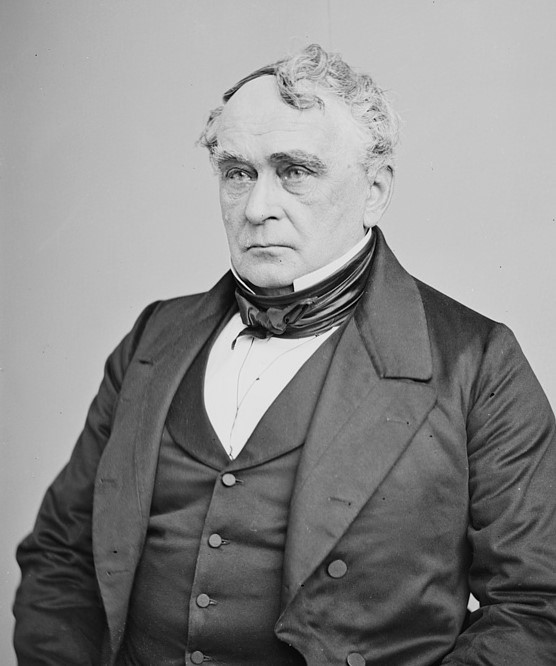
  3. Wooley, John and Gerhard Peters. Announcement to the Army of the Death of President Lincoln,” in “The American Presidency Project.” Santa Barbara, California: Department of Political Science, University of California, Santa Barbara, retrieved online April 16, 2024.